EP3879697B1 - Redundanzsteuerungsvorrichtung für flugzeuge - Google Patents
Redundanzsteuerungsvorrichtung für flugzeuge Download PDFInfo
- Publication number
- EP3879697B1 EP3879697B1 EP21160681.9A EP21160681A EP3879697B1 EP 3879697 B1 EP3879697 B1 EP 3879697B1 EP 21160681 A EP21160681 A EP 21160681A EP 3879697 B1 EP3879697 B1 EP 3879697B1
- Authority
- EP
- European Patent Office
- Prior art keywords
- output
- comparison
- signal
- switch
- circuit
- Prior art date
- Legal status (The legal status is an assumption and is not a legal conclusion. Google has not performed a legal analysis and makes no representation as to the accuracy of the status listed.)
- Active
Links
Images




Classifications
-
- H—ELECTRICITY
- H02—GENERATION; CONVERSION OR DISTRIBUTION OF ELECTRIC POWER
- H02P—CONTROL OR REGULATION OF ELECTRIC MOTORS, ELECTRIC GENERATORS OR DYNAMO-ELECTRIC CONVERTERS; CONTROLLING TRANSFORMERS, REACTORS OR CHOKE COILS
- H02P29/00—Arrangements for regulating or controlling electric motors, appropriate for both AC and DC motors
- H02P29/02—Providing protection against overload without automatic interruption of supply
- H02P29/024—Detecting a fault condition, e.g. short circuit, locked rotor, open circuit or loss of load
-
- H—ELECTRICITY
- H03—ELECTRONIC CIRCUITRY
- H03K—PULSE TECHNIQUE
- H03K19/00—Logic circuits, i.e. having at least two inputs acting on one output; Inverting circuits
- H03K19/20—Logic circuits, i.e. having at least two inputs acting on one output; Inverting circuits characterised by logic function, e.g. AND, OR, NOR, NOT circuits
- H03K19/23—Majority or minority circuits, i.e. giving output having the state of the majority or the minority of the inputs
-
- B—PERFORMING OPERATIONS; TRANSPORTING
- B60—VEHICLES IN GENERAL
- B60L—PROPULSION OF ELECTRICALLY-PROPELLED VEHICLES; SUPPLYING ELECTRIC POWER FOR AUXILIARY EQUIPMENT OF ELECTRICALLY-PROPELLED VEHICLES; ELECTRODYNAMIC BRAKE SYSTEMS FOR VEHICLES IN GENERAL; MAGNETIC SUSPENSION OR LEVITATION FOR VEHICLES; MONITORING OPERATING VARIABLES OF ELECTRICALLY-PROPELLED VEHICLES; ELECTRIC SAFETY DEVICES FOR ELECTRICALLY-PROPELLED VEHICLES
- B60L3/00—Electric devices on electrically-propelled vehicles for safety purposes; Monitoring operating variables, e.g. speed, deceleration or energy consumption
- B60L3/0023—Detecting, eliminating, remedying or compensating for drive train abnormalities, e.g. failures within the drive train
- B60L3/0084—Detecting, eliminating, remedying or compensating for drive train abnormalities, e.g. failures within the drive train relating to control modules
-
- B—PERFORMING OPERATIONS; TRANSPORTING
- B60—VEHICLES IN GENERAL
- B60L—PROPULSION OF ELECTRICALLY-PROPELLED VEHICLES; SUPPLYING ELECTRIC POWER FOR AUXILIARY EQUIPMENT OF ELECTRICALLY-PROPELLED VEHICLES; ELECTRODYNAMIC BRAKE SYSTEMS FOR VEHICLES IN GENERAL; MAGNETIC SUSPENSION OR LEVITATION FOR VEHICLES; MONITORING OPERATING VARIABLES OF ELECTRICALLY-PROPELLED VEHICLES; ELECTRIC SAFETY DEVICES FOR ELECTRICALLY-PROPELLED VEHICLES
- B60L3/00—Electric devices on electrically-propelled vehicles for safety purposes; Monitoring operating variables, e.g. speed, deceleration or energy consumption
- B60L3/0092—Electric devices on electrically-propelled vehicles for safety purposes; Monitoring operating variables, e.g. speed, deceleration or energy consumption with use of redundant elements for safety purposes
-
- B—PERFORMING OPERATIONS; TRANSPORTING
- B64—AIRCRAFT; AVIATION; COSMONAUTICS
- B64C—AEROPLANES; HELICOPTERS
- B64C13/00—Control systems or transmitting systems for actuating flying-control surfaces, lift-increasing flaps, air brakes, or spoilers
- B64C13/24—Transmitting means
- B64C13/38—Transmitting means with power amplification
- B64C13/40—Transmitting means with power amplification using fluid pressure
- B64C13/42—Transmitting means with power amplification using fluid pressure having duplication or stand-by provisions
-
- B—PERFORMING OPERATIONS; TRANSPORTING
- B64—AIRCRAFT; AVIATION; COSMONAUTICS
- B64C—AEROPLANES; HELICOPTERS
- B64C13/00—Control systems or transmitting systems for actuating flying-control surfaces, lift-increasing flaps, air brakes, or spoilers
- B64C13/24—Transmitting means
- B64C13/38—Transmitting means with power amplification
- B64C13/50—Transmitting means with power amplification using electrical energy
- B64C13/505—Transmitting means with power amplification using electrical energy having duplication or stand-by provisions
-
- G—PHYSICS
- G05—CONTROLLING; REGULATING
- G05D—SYSTEMS FOR CONTROLLING OR REGULATING NON-ELECTRIC VARIABLES
- G05D1/00—Control of position, course, altitude or attitude of land, water, air or space vehicles, e.g. using automatic pilots
- G05D1/0055—Control of position, course, altitude or attitude of land, water, air or space vehicles, e.g. using automatic pilots with safety arrangements
- G05D1/0077—Control of position, course, altitude or attitude of land, water, air or space vehicles, e.g. using automatic pilots with safety arrangements using redundant signals or controls
-
- G—PHYSICS
- G06—COMPUTING OR CALCULATING; COUNTING
- G06F—ELECTRIC DIGITAL DATA PROCESSING
- G06F11/00—Error detection; Error correction; Monitoring
- G06F11/07—Responding to the occurrence of a fault, e.g. fault tolerance
- G06F11/16—Error detection or correction of the data by redundancy in hardware
- G06F11/18—Error detection or correction of the data by redundancy in hardware using passive fault-masking of the redundant circuits
- G06F11/181—Eliminating the failing redundant component
-
- G—PHYSICS
- G06—COMPUTING OR CALCULATING; COUNTING
- G06F—ELECTRIC DIGITAL DATA PROCESSING
- G06F11/00—Error detection; Error correction; Monitoring
- G06F11/07—Responding to the occurrence of a fault, e.g. fault tolerance
- G06F11/16—Error detection or correction of the data by redundancy in hardware
- G06F11/18—Error detection or correction of the data by redundancy in hardware using passive fault-masking of the redundant circuits
- G06F11/182—Error detection or correction of the data by redundancy in hardware using passive fault-masking of the redundant circuits based on mutual exchange of the output between redundant processing components
-
- G—PHYSICS
- G06—COMPUTING OR CALCULATING; COUNTING
- G06F—ELECTRIC DIGITAL DATA PROCESSING
- G06F11/00—Error detection; Error correction; Monitoring
- G06F11/07—Responding to the occurrence of a fault, e.g. fault tolerance
- G06F11/16—Error detection or correction of the data by redundancy in hardware
- G06F11/18—Error detection or correction of the data by redundancy in hardware using passive fault-masking of the redundant circuits
- G06F11/183—Error detection or correction of the data by redundancy in hardware using passive fault-masking of the redundant circuits by voting, the voting not being performed by the redundant components
- G06F11/184—Error detection or correction of the data by redundancy in hardware using passive fault-masking of the redundant circuits by voting, the voting not being performed by the redundant components where the redundant components implement processing functionality
-
- H—ELECTRICITY
- H02—GENERATION; CONVERSION OR DISTRIBUTION OF ELECTRIC POWER
- H02P—CONTROL OR REGULATION OF ELECTRIC MOTORS, ELECTRIC GENERATORS OR DYNAMO-ELECTRIC CONVERTERS; CONTROLLING TRANSFORMERS, REACTORS OR CHOKE COILS
- H02P29/00—Arrangements for regulating or controlling electric motors, appropriate for both AC and DC motors
- H02P29/02—Providing protection against overload without automatic interruption of supply
- H02P29/024—Detecting a fault condition, e.g. short circuit, locked rotor, open circuit or loss of load
- H02P29/028—Detecting a fault condition, e.g. short circuit, locked rotor, open circuit or loss of load the motor continuing operation despite the fault condition, e.g. eliminating, compensating for or remedying the fault
-
- H—ELECTRICITY
- H03—ELECTRONIC CIRCUITRY
- H03K—PULSE TECHNIQUE
- H03K3/00—Circuits for generating electric pulses; Monostable, bistable or multistable circuits
- H03K3/02—Generators characterised by the type of circuit or by the means used for producing pulses
- H03K3/027—Generators characterised by the type of circuit or by the means used for producing pulses by the use of logic circuits, with internal or external positive feedback
- H03K3/037—Bistable circuits
-
- H—ELECTRICITY
- H03—ELECTRONIC CIRCUITRY
- H03K—PULSE TECHNIQUE
- H03K5/00—Manipulating of pulses not covered by one of the other main groups of this subclass
- H03K5/22—Circuits having more than one input and one output for comparing pulses or pulse trains with each other according to input signal characteristics, e.g. slope, integral
- H03K5/24—Circuits having more than one input and one output for comparing pulses or pulse trains with each other according to input signal characteristics, e.g. slope, integral the characteristic being amplitude
-
- B—PERFORMING OPERATIONS; TRANSPORTING
- B60—VEHICLES IN GENERAL
- B60L—PROPULSION OF ELECTRICALLY-PROPELLED VEHICLES; SUPPLYING ELECTRIC POWER FOR AUXILIARY EQUIPMENT OF ELECTRICALLY-PROPELLED VEHICLES; ELECTRODYNAMIC BRAKE SYSTEMS FOR VEHICLES IN GENERAL; MAGNETIC SUSPENSION OR LEVITATION FOR VEHICLES; MONITORING OPERATING VARIABLES OF ELECTRICALLY-PROPELLED VEHICLES; ELECTRIC SAFETY DEVICES FOR ELECTRICALLY-PROPELLED VEHICLES
- B60L2200/00—Type of vehicles
- B60L2200/10—Air crafts
-
- Y—GENERAL TAGGING OF NEW TECHNOLOGICAL DEVELOPMENTS; GENERAL TAGGING OF CROSS-SECTIONAL TECHNOLOGIES SPANNING OVER SEVERAL SECTIONS OF THE IPC; TECHNICAL SUBJECTS COVERED BY FORMER USPC CROSS-REFERENCE ART COLLECTIONS [XRACs] AND DIGESTS
- Y02—TECHNOLOGIES OR APPLICATIONS FOR MITIGATION OR ADAPTATION AGAINST CLIMATE CHANGE
- Y02T—CLIMATE CHANGE MITIGATION TECHNOLOGIES RELATED TO TRANSPORTATION
- Y02T10/00—Road transport of goods or passengers
- Y02T10/60—Other road transportation technologies with climate change mitigation effect
- Y02T10/64—Electric machine technologies in electromobility
Definitions
- the present invention relates to a redundancy control device for an aircraft.
- a redundancy control device disclosed in JPH 0198034 A (“the '034 Publication”) includes three controllers. identical signals are supplied to the three controllers and the three controllers are configured to output identical output signals. The output signals from the three controllers are supplied to a majority voting circuit. The majority voting circuit establishes a majority among the inputs by the three controllers and produces a final output. Even if any one of the controllers fails in such a redundancy control device, an appropriate final output can be obtained from the outputs of the other two of the controllers.
- US 4517639 A discloses a triplex redundant digital control system
- EP 0307191 A2 discloses a multiplex control system comprises a plurality of control apparatuses (1), test signal generators (J1), signal selectors (10), and diagnosis units (2).
- Such a redundancy control device using the technique disclosed in the '034 Publication may be used for control of various parts of an aircraft.
- the reliability of the final output cannot be secured since the final output determined by majority voting changes depending on whether outputs of the two faulty controllers are identical and whether the outputs of the two faulty controllers are identical to an output of the normally working controller.
- a monitoring controller may be provided for each of the three controllers.
- the voting circuit may be configured such that, when the monitoring controller determines failure of the corresponding controller, an output of the controller is not reflected on a final output.
- such monitoring controllers have complex configurations and are prone to failures.
- the present invention has been made in view of the above drawback, and one object thereof is to provide a redundancy control device that produces a highly reliable output.
- a redundancy control device for aircraft includes: three controllers each outputting a first voltage or a second voltage different from the first voltage as an output signal to an actuator that drives a moving surface of an aircraft, each of the three controllers performing a same processing to obtain an operation result, each of the three controllers outputting the operation result as a status signal; a comparison circuit provided for each of the three controllers, the comparison circuit outputting a comparison signal based on a comparison between the status signal outputted by a corresponding one of the three controllers and the status signal outputted by another of the three controllers; a switch provided for each of three output lines, each of the three controllers being provided with a corresponding one of the three output lines through which the output signal is outputted by a corresponding one of the three controllers, the switch switching between connection and disconnection of a corresponding one of the three output lines; a switch control unit provided for each switch, the switch control unit outputting a switch signal to the switch in response to the comparison signal from the comparison circuit; a voltage supply
- the switch control unit outputs the switch signal to disconnect the switch provided in the output line of a first controller, which is a corresponding one of the three controllers, when the comparison signals outputted by the comparison circuits of second and third controllers, which are the other two of the three controllers, both indicate a mismatch between the first controller and the second and third controllers.
- the switch control unit disconnects the output line when the comparison signals outputted by the comparison circuits of the other two controllers both indicate a mismatch between the corresponding controller and the other controller.
- the voltage supply unit supplies the second voltage to the output line, and the latch circuit latches the second voltage. The second voltage is then inputted to the majority voting circuit through the output line. In this way, when there is a high probability that the controller has failed, the second voltage is inputted to the majority voting circuit through the output line of the controller. Therefore, if two or more controllers fail, the second voltage is inputted to the majority circuit from the corresponding two or more output lines.
- the majority voting circuit reliably outputs the second voltage as the final output signal, and the voltage of the final output signal is reliably defined to the second voltage. In this way, when two controllers fail, a reliable output can be obtained as the final output signal without using monitoring controllers.
- the redundancy control device may be applied to a plurality of fluid pressure actuators attached to a same moving surface of the aircraft, and the plurality of actuators are configured to be switched between an active mode where the actuators drive the moving surface and a standby mode where the actuators follow the moving surface without driving the moving surface.
- the plurality of actuators attached to the moving surface may include one or more first actuators and one or more second actuators different from the first actuator, and one of the first actuator and the second actuator may be controlled to operate in the active mode, and the other of the first actuator and the second actuator may be controlled to operate in the standby mode.
- the redundancy control device may be applied to an electromechanical actuator attached to a moving surface of the aircraft.
- a first actuator 300 and a second actuator 400 that drive a flap 600 are attached to the flap 600 of an aircraft.
- a plurality of first actuators 300 are provided, but Fig. 1 only shows one of them.
- the plurality of first actuators 300 all have an identical configuration.
- a plurality of second actuators 400 are provided, but Fig. 1 only shows one of them.
- the plurality of second actuators 400 all have an identical configuration. The same number of the second actuators 400 as those of the first actuator 300 are provided.
- the first actuator 300 is an electrohydraulic system.
- a main body 310 of the first actuator 300 has a tubular cylinder 510.
- the interior of the cylinder 510 constitutes a fluid chamber into which and from which a hydraulic fluid is fed and discharged.
- a rod 520 having a columnar shape is positioned coaxially with the cylinder 510.
- a tip of the rod 520 protrudes out from the cylinder 510 and is attached to the flap 600.
- a piston 530 projects from an outer peripheral surface of the rod 520. The piston 530 divides the fluid chamber into two in an axial direction of the cylinder 510.
- a connection passage 540 is connected to each of the pair of fluid chambers divided by the piston 530.
- the pair of connection passages 540 are coupled to a mode switching valve 550 that switches a flow path of the hydraulic fluid.
- the mode switching valve 550 is a solenoid valve whose position is switched between a communicating position 551 and a cutoff position 552 according to a supply of electric power.
- the mode switching valve 550 operates in a feeding and discharging mode. That is, one of the pair of connection passages 540 is connected to a feed passage 561 of the hydraulic oil, and the other of the connection passages 540 is connected to a discharge passage 562 of the hydraulic oil.
- the hydraulic oil delivered from the pump 570 is supplied to one fluid chamber through the feed passage 561, and the hydraulic oil is discharged from the other fluid chamber to a tank 580 through the discharge passage 562.
- the mode switching valve 550 When the mode switching valve 550 is switched to the cutoff position 552, the mode switching valve 550 operates in a bypass mode. Specifically, the pair of connection passages 540A switched to the cutoff position 552 are cut off from both the feed passage 561 and the discharge passage 562. At the same time, the pair of connection passages 540A switched to the cutoff position 552 are connected to each other. As a result, the hydraulic fluid can move back and forth between the pair of fluid chambers.
- a connection switching valve 560 for switching connections of the feed passage 561 and the discharge passage 562 to the pair of connection passages 540 is provided in the feed passage 561 and the discharge passage 562.
- connection switching valve 560, the mode switching valve 550, the feed passage 561, the discharge passage 562, and the pair of connection passages 540 form a first hydraulic circuit 320 that feeds and discharges the hydraulic fluid to the main body 310 of the first actuator 300.
- the first actuator 300 includes the first hydraulic circuit 320 and the main body 310.
- the switching valves 550 and 560 and the pump 570 of the first hydraulic circuit 320 are controlled a first redundancy control device 350.
- the first redundancy control device 350 estimates values of current and the like for controlling the switching valves 550, 560 and the pump 570 based on a command signal S from an upper-level device 700, and outputs them to the first hydraulic circuit 320 as a command signal P.
- the upper-level device 700 is a control device that comprehensively controls various moving surfaces attached to the aircraft.
- the plurality of first actuators 300 are provided. These first actuators 300 are controlled by the same first redundancy control device 350 and operate synchronously.
- a main body 410 of a second actuator 400 has the same configuration as the main body 310 of the first actuator 300. Hydraulic fluid is fed to and discharged from the main body 410 by a second hydraulic circuit 420 having the same configuration as the first hydraulic circuit 320.
- the second hydraulic circuit 420 is controlled by a second redundancy control device 450 having the same configuration as the first redundancy control device 350.
- the same components as those of the first actuator 300 are designated by the same reference numerals as those of the first actuator 300, and will not be repeatedly described.
- the plurality of second actuators 400 are provided. These second actuators 400 are controlled by the same second redundancy control device 450 and operate synchronously.
- the upper-level device 700 transmits the command signal S to control the first actuator 300 such that the first actuator 300 operates in an active mode in which the flap 600 is driven by the first actuator, and control the second actuator 400 such that the second actuator 400 operates in a standby mode in which the second actuator 400 stands by for a failure of the first actuator 300.
- the mode switching valve 550 is controlled to operate in a feed/discharge mode, and the connection switching valve 560 and the pump 570 operate according to a target position of the flap 600.
- the mode switching valve 550 is controlled to operate in the bypass mode and the pair of connection passages 540A are connected to each other.
- the hydraulic fluid moves back and forth between the pair of fluid chambers according to operation of the flap 600. That is, the second actuator 400 follows movement of the flap 600.
- the mode switching valve 550 of the first hydraulic circuit 320 is forcibly switched to the bypass mode. That is, the first actuator 300 enters the standby mode.
- the upper-level device 700 controls the second actuator 400 through the second redundancy control device 450 such that the second actuator 400 operates in the active mode.
- the first redundancy control device 350 and the second redundancy control device 450 will be now described in detail.
- the second redundancy control device 450 has the identical configuration as the first redundancy control device 350 so that the description thereof will be omitted.
- the first redundancy control device 350 includes three controllers 11, 12, and 13 that have an identical configuration.
- the three controllers 11, 12, and 13 each have a control circuit that performs a comprehensive control and a comparison circuit that exchanges information with the control circuit.
- control circuit that performs a comprehensive control
- comparison circuit that exchanges information with the control circuit.
- components such as the control circuit and the comparison circuit in the controller, which could be any one of the three controllers 11, 12, and 13, given reference numeral will not be herein used to describe the component.
- a first control circuit 21 of the first controller 11 generates and outputs a control signal P for the first hydraulic circuit 320 based on the command signal S from the upper-level device 700.
- a second control circuit 22 of the second controller 12 and a third control circuit 23 of the third controller 13 also perform identical functions as the first control circuit 21.
- One of the three controllers 11, 12, and 13 is selected as a main system, and the control signal P of the controller selected as the main system is supplied to the first hydraulic circuit 320.
- the first control circuit 21 performs a count-up process in which counting up is carried out over a predetermined fixed period, and outputs that operational result to the first comparison circuit 31 of the first controller 11 as a first status signal N1 of the first controller 11.
- the first control circuit 21 repeats such a process at a predetermined cycle.
- the first comparison circuit 31 outputs the first status signal to a second comparison circuit 32 of the second controller 12 and a third comparison circuit 33 of the third controller 13 via a communication line (not shown).
- the second control circuit 22 and the second comparison circuit 32 also perform the same processes to output a second status signal N2 of the second controller 12 to the first comparison circuit 31 and the third comparison circuit 33.
- the third control circuit 23 and the third comparison circuit 33 also perform the same processes to output a third status signal N3 of the third controller 13 to the first comparison circuit 31 and the second comparison circuit 32.
- the three comparison circuits 31, 32, and 33 exchange their status signals with each other.
- the three comparison circuits 31, 32, and 33 send and receive status signals in synchronization with each other.
- the first comparison circuit 31 has two output terminals that output comparison signals C based on a comparison between the first status signal N1 and the status signals of the other controllers.
- a first comparison output terminal 31A which is one of the two output terminals, outputs the comparison signal C based on a comparison between the first status signal N1 and the second status signal N2.
- the first comparison output terminal 31A outputs a high voltage H as the comparison signal C when the first status signal N1 and the second status signal N2 match each other, and outputs a low voltage L, which is a voltage lower than the voltage H, when the first status signal N1 and the second status signal N2 do not match each other.
- a second comparison output terminal 31B which is the other of the two output terminals, outputs the comparison signal C based on a comparison between the first status signal N1 and the third status signal N3.
- the second comparison output terminal 31B outputs the high voltage H as the comparison signal C when the first status signal N1 and the third status signal N3 match each other, and outputs the low voltage L when the first status signal N1 and the third status signal N3 do not match each other.
- the second comparison circuit 32 has a first comparison output terminal 32A and a second comparison output terminal 32B.
- the first comparison output terminal 32A outputs the comparison signal C based on a comparison between the second status signal N2 and the third status signal N3, and the second comparison output terminal 32B outputs the comparison signal C based on a comparison between the second status signal N2 and the first status signal N1.
- the third comparison circuit 33 also has a first comparison output terminal 33A and a second comparison output terminal 33B.
- the first comparison output terminal 33A outputs the comparison signal C based on a comparison between the third status signal N3 and the second status signal N2, and the second comparison output terminal 33B outputs the comparison signal C based on a comparison between the third status signal N3 and the first status signal N1.
- each comparison output terminal outputs the high voltage H as the comparison signal C when the two status signals inputted thereto match each other, and outputs the low voltage L as the comparison signal C when the two status signals inputted thereto do not match each other.
- the first control circuit 21 has an abnormality output terminal 21A that outputs an output signal T indicating the presence or absence of an abnormality in the first redundancy control device 350.
- the abnormality output terminal 21A outputs the output signal T based on the comparison signals C output from the two comparison output terminals 31A and 31B of the first comparison circuit 31. Specifically, the abnormality output terminal 21A outputs the high voltage H as the output signal T when at least one of the comparison signals C output from the two comparison output terminals 31A and 31B of the first comparison circuit 31 has a high voltage H. Whereas when both the comparison signals C output from the two comparison output terminals 31A and 31B have the low voltage L, the abnormality output terminal 21A outputs the low voltage L as the output signal T.
- the second control circuit 22 also has an identical abnormality output terminal 22A
- the third control circuit 23 also has an identical abnormality output terminal 23A. That is, these abnormality output terminals also output the high voltage H as the output signal T when at least one of the comparison signals C output from the two output terminals of their comparison circuits of their own controllers has the high voltage H. Whereas the output terminals output the low voltage L when both the comparison signals C have the low voltage L.
- a signal indicating the abnormality of the flight control system is transmitted to the three control circuits 21, 22, 23 as the command signal S from the upper-level device 700.
- the three control circuits 21, 22, 23 forcibly output the output signal T of the low voltage L from the abnormality output terminals 21A, 22A, and 23A, respectively.
- a signal instructing shutdown of the first redundancy control device 350 is supplied to the three control circuits 21, 22, 23 via the upper-level device 700 or any other circuit, the three control circuits 21, 22, 23 forcibly output the output signal T of the low voltage L from the abnormality output terminals 21A, 22A, 23A respectively.
- the three control circuits 21, 22, 23 When a signal instructing activation of the first redundancy control device 350 is supplied to the three control circuits 21, 22, 23 via the upper-level device 700 or any other circuit, the three control circuits 21, 22, 23 forcibly output the output signal T of the high voltage H from the abnormality output terminals 21A, 22A, 23A, respectively when initializing process of the respective control circuit is completed.
- Output lines are connected to the abnormality output terminals 21A, 22A, and 23A, respectively. That is, a first output line 91 is connected to the abnormality output terminal 21A of the first control circuit 21. A second output line 92 is connected to the abnormality output terminal 22A of the second control circuit 22. A third output line 93 is connected to the abnormality output terminal 23A of the second control circuit 23.
- the majority voting circuit 70 establishes a majority vote of the output signals T inputted from these three output lines 91, 92, 93 and outputs the low voltage L or the high voltage H as a final output signal F.
- the majority voting circuit 70 includes three AND circuits, that is, a first AND circuit 71, a second AND circuit 72, and a third AND circuit 73.
- the first output line 91 and the second output line 92 are connected to input terminals of the first AND circuit 71.
- the first output line 91 and the third output line 93 are connected to input terminals of the second AND circuit 72.
- the second output line 92 and the third output line 93 are connected to input terminals of the third AND circuit 73.
- Each of the three AND circuits 71, 72, 73 outputs the low voltage L when at least one of the output signals T from the two output lines has the low voltage L, and outputs the high voltage H when both the output signals T from the two output lines have the high voltage H.
- the output terminals of the three AND circuits 71, 72, 73 are connected to input terminals of an OR circuit 74 in the majority voting circuit 70.
- the OR circuit 74 outputs the low voltage L from its output terminal when all the signals inputted thereto from the three AND circuits 71, 72, 73 have the low voltage L. Whereas when at least one of the signals from the three AND circuits 71, 72, 73 has the high voltage H, the OR circuit 74 outputs the high voltage H from its output terminal.
- the output from the OR circuit 74 is outputted to the first hydraulic circuit 320 as a final output signal F from the first redundancy control device 350.
- the final output signal F is a signal for switching between enable and disable of the control signal P outputted by the control circuit.
- the control signal P When the final output signal F has the high voltage H, the control signal P is enabled and the first hydraulic circuit 320 is controlled based on the control signal P. Whereas when the final output signal F has the low voltage L, the control signal P is disabled. At the same time, in the first hydraulic circuit 320, the mode switching valve 550 shown in Fig. 1 is switched to the bypass mode.
- a first switch 41 that switching between connection and disconnection of the first output line 91 is provided in the first output line 91.
- the first switch 41 is a so-called normally open switch, and is configured to be connected when the high voltage H is supplied thereto, and disconnected when the low voltage L is supplied thereto.
- a first pull-down resistor 51 is provided on the downstream side of the first switch 41 with respect to the flowing direction of the signal in the first output line 91, that is, on the side of the first switch 41 closer to the majority voting circuit 70.
- the first pull-down resistor 51 serves as a voltage supply unit.
- the first pull-down resistor 51 supplies the low voltage L to the first output line 91 when the output signal T from the first controller 11 is lost as the first switch 41 switches to the disconnected state.
- a first latch circuit 61 is provided on the downstream side of the first pull-down resistor 51 with respect to the flowing direction of the signal in the first output line 91, that is, on the side of the first pull-down resistor 51 closer to the majority voting circuit 70.
- the first latch circuit 61 latches the low voltage L and keeps outputting the low voltage L.
- the first latch circuit 61 is connected to reset lines extending from the three controllers 11, 12, 13. The first latch circuit 61 returns to an initial state when latch clear signals are supplied thereto from all the three controllers 11, 12, 13 through the reset lines.
- a second switch 42, a second pull-down resistor 52, and a second latch circuit 62 are connected in the second output line 92. Further, a third switch 43, a third pull-down resistor 53, and a third latch circuit 63 are also connected in the third output line 93.
- a first switch control unit 81 is connected to the first switch 41.
- the first switch control unit 81 is formed of an OR circuit.
- the first switch control unit 81 receives the comparison signals C from the second comparison circuit 32 and the third comparison circuit 33, and outputs a switch signal K to the first switch 41 based on the comparison signals C.
- the second comparison output terminal 32B of the second comparison circuit 32 is connected to one input terminal of the first switch control unit 81.
- the second comparison output terminal 32B outputs the comparison signal C based on the comparison between the second status signal N2 and the first status signal N1.
- the second comparison output terminal 33B of the third comparison circuit 33 is connected to the other input terminal of the first switch control unit 81.
- the second comparison output terminal 33B outputs the comparison signal C based on the comparison between the third status signal N3 and the first status signal N1.
- the first switch control unit 81 outputs the high voltage H as the switch signal K when the high voltage H indicating a match between the second status signal N2 and the first status signal N1 is inputted to the first switch control unit 81 from the second comparison output terminal 32B of the second comparison circuit 32, or when the high voltage H indicating a match between the third status signal N3 and the first status signal N1 is inputted to the first switch control unit 81 from the second comparison output terminal 33B of the third comparison circuit 33.
- the first switch control unit 81 outputs the low voltage L as the switch signal K when the low voltage L indicating a mismatch between the second status signal N2 and the first status signal N1 is inputted to the first switch control unit 81 from the second comparison output terminal 32B of the second comparison circuit 32 and the low voltage L indicating a mismatch between the third status signal N3 and the first status signal N1 is inputted to the first switch control unit 81 from the second comparison output terminal 33B of the third comparison circuit 33.
- the high voltage H is the switching signal K that switches the first switch 41 to the connected state
- the low voltage L is the switching signal K that switches the first switch 41 to the disconnected state.
- a second switch control unit 82 identical to the first switch control unit 81 is connected to the second switch 42.
- One input terminal of the second switch control unit 82 is connected to the first comparison output terminal 31A of the first comparison circuit 31 that outputs a result of comparison between the first status signal N1 and the second status signal N2.
- the other input terminal of the second switch control unit 82 is connected to the first comparison output terminal 33A of the third comparison circuit 33 that outputs a result of comparison between the third status signal N3 and the second status signal N2.
- the second switch control unit 82 outputs the high voltage H as the switch signal K when the high voltage H indicating a match between the first status signal N1 and the second status signal N2 is inputted to the second switch control unit 82 from the first comparison output terminal 31A of the first comparison circuit 31, or when the high voltage H indicating a match between the third status signal N3 and the second status signal N2 is inputted to the second switch control unit 82 from the first comparison output terminal 33A of the third comparison circuit 33.
- the second switch control unit 82 outputs the low voltage L as the switch signal K when the low voltage L indicating a mismatch between the first status signal N1 and the second status signal N2 is inputted to the second switch control unit 82 from the first comparison output terminal 31A of the first comparison circuit 31 and the low voltage L indicating a mismatch between the third status signal N3 and the second status signal N2 is inputted to the second switch control unit 82 from the first comparison output terminal 33A of the third comparison circuit 33.
- a third switch control unit 83 identical to the first switch control unit 81 and the second switch control unit 82 is connected to the third switch 43.
- One input terminal of the third switch control unit 83 is connected to the second comparison output terminal 31B of the first comparison circuit 31 that outputs a result of comparison between the first status signal N1 and the third status signal N3.
- the other input terminal of the third switch control unit 83 is connected to the first comparison output terminal 32A of the second comparison circuit 32 that outputs a result of comparison between the second status signal N2 and the third status signal N3.
- the third switch control unit 83 outputs the high voltage H as the switch signal K when the high voltage H indicating a match between the first status signal N1 and the third status signal N3 is inputted to the third switch control unit 83 from the second comparison output terminal 31B of the first comparison circuit 31, or when the high voltage H indicating a match between the second status signal N2 and the third status signal N3 is inputted to the third switch control unit 83 from the first comparison output terminal 32A of the second comparison circuit 32.
- the third switch control unit 83 outputs the low voltage L as the switch signal K when the low voltage L indicating a mismatch between the first status signal N1 and the third status signal N3 is inputted to the third switch control unit 83 from the second comparison output terminal 31B of the first comparison circuit 31 and the low voltage L indicating a mismatch between the second status signal N2 and the third status signal N3 is inputted to the third switch control unit 83 from the first comparison output terminal 32A of the second comparison circuit 32.
- the first status signal N1, the second status signal N2, and the third status signal N3 match with each other.
- the high voltage H indicating the match between the second status signal N2 and the first status signal N1 is inputted from the second comparison output terminal 32B of the second comparison circuit 32
- the high voltage H indicating the match between the third status signal N3 and the first status signal N1 is inputted from the second comparison output terminal 33B of the third comparison circuit 33. Since both of the two comparison signals C inputted to the first switch control unit 81 have the high voltage H, the switch signal K output from the first switch control unit 81 has the high voltage H.
- the first switch 41 is controlled to the connected state.
- the first comparison output terminal 31A of the first comparison circuit 31 outputs the high voltage H indicating the match between the first status signal N1 and the second status signal N2
- the second comparison output terminal 31B outputs the high voltage H indicating the match between the first status signal N1 and the third status signal N3, so that the high voltage H is output to the first output line 91 from the abnormality output terminal 21A of the first control circuit 21. Since the first switch 41 is connected, this high voltage H is supplied to the majority voting circuit 70 through the first output line 91.
- the high voltage H indicating the match between the status signals are inputted to the second switch control unit 82 from both the first comparison output terminal 31A of the first comparison circuit 31 and the first comparison output terminal 33A of the third comparison circuit 33.
- the high voltage H is outputted from the second switch control unit 82 as the switch signal K.
- the second switch 42 is controlled to the connected state.
- the high voltage H indicating the match between the status signals is outputted from both the two comparison output terminals 32A and 32B of the second comparison circuit 32, so that the high voltage H is outputted from the abnormality output terminal 22A of the second control circuit 22 to the second output line 92. Since the second switch 42 is connected, this high voltage H is supplied to the majority voting circuit 70 through the second output line 92.
- the high voltage H indicating the match between the status signals are inputted to the third switch control unit 83 from both the second comparison output terminal 31B of the first comparison circuit 31 and the first comparison output terminal 32A of the second comparison circuit 32.
- the high voltage H is outputted from the third switch control unit 83 as the switch signal K.
- the third switch 43 is controlled to the connected state.
- the high voltage H indicating the match between the status signals is outputted from both the two comparison output terminals 33A and 33B of the third comparison circuit 33, so that the high voltage H is outputted from the abnormality output terminal 23A of the third control circuit 23 to the third output line 93. Since the third switch 43 is connected, this high voltage H is supplied to the majority voting circuit 70 through the third output line 93.
- the majority voting circuit 70 outputs the high voltage H as the final output signal F. Consequently, the control signal P outputted by the control circuit is enabled, and the first hydraulic circuit 320 is controlled based on the control signal P. That is, the first actuator 300 is in the active mode.
- the first controller 11 fails from the state where the three controllers 11, 12, and 13 operate normally.
- the output signal T outputted from the abnormality output terminal 21A of the first control circuit 21 cannot be defined, and the output signal T may have the low voltage L or high voltage H as shown in Fig. 3 .
- the state where the signal is indefinite is indicated by "X”. Since the first controller 11 is out of order, the comparison signal C outputted from the two comparison output terminals 31A and 31B of the first comparison circuit 31 are also indefinite.
- the second status signal N2 and the third status signal N3 match with each other while the first status signal N1 does not match them.
- the low voltage L indicating mismatch between the second status signal N2 and the first status signal N1 is inputted from the second comparison output terminal 32B of the second comparison circuit 32
- the low voltage L indicating mismatch between the third status signal N3 and the first status signal N1 is inputted from the second comparison output terminal 33B of the third comparison circuit 33. Since both of the two comparison signals C inputted to the first switch control unit 81 have the low voltage L, the switch signal K output from the first switch control unit 81 has the low voltage L. Therefore, the first switch 41 is controlled to the disconnected state.
- the low voltage L is supplied to the first output line 91 from the first pull-down resistor 51. Then, the first latch circuit 61 latches the low voltage L and continues to output the low voltage L. Consequently, the low voltage L is inputted to the majority voting circuit 70 from the first output line 91.
- the low voltage L or the high voltage H is inputted from the first comparison output terminal 31A of the failed first comparison circuit 31, and the high voltage H indicating the match between the third status signal N3 and the second status signal N2 is inputted from the first comparison output terminal 33A of the third comparison circuit 33. Since the high voltage H is inputted to the second switch control unit 82 at least from the first comparison output terminal 33A of the third comparison circuit 33, the switch signal K outputted from the second switch control unit 82 has the high voltage H. As a result, the second switch 42 is controlled to the connected state.
- the high voltage H indicating the match between the second status signal N2 and the third status signal N3 is outputted from the first comparison output terminal 32A of the second comparison circuit 32
- the low voltage L indicating the mismatch between the second status signal N2 and the first status signal N1 is outputted from the second comparison output terminal 32B. Accordingly at least one of the comparison output terminals of the second comparison circuit 32 outputs the high voltage H, so that the high voltage H is outputted to the second output line 92 from the abnormality output terminal 22A of the second control circuit 22. Since the second switch 42 is connected at this time, this high voltage H is supplied to the majority voting circuit 70 through the second output line 92.
- the low voltage L or the high voltage H is inputted from the second comparison output terminal 31B of the failed first comparison circuit 31, and the high voltage H indicating the match between the second status signal N2 and the third status signal N3 is inputted from the first comparison output terminal 32A of the second comparison circuit 32. Since the high voltage H is inputted to the third switch control unit 83 at least from the first comparison output terminal 32A of the second comparison circuit 32, the switch signal K outputted from the third switch control unit 83 has the high voltage H. As a result, the third switch 43 is controlled to the connected state.
- the high voltage H indicating the match between the third status signal N3 and the second status signal N2 is outputted from the first comparison output terminal 33A of the third comparison circuit 33
- the low voltage L indicating the mismatch between the third status signal N3 and the first status signal N1 is outputted from the second comparison output terminal 33B. Accordingly, similar to the abnormality output terminal 22A of the second control circuit 22, the high voltage H is outputted to the third output line 93 from the abnormality output terminal 23A of the third control circuit 23. Since the third switch 43 is connected at this time, this high voltage H is supplied to the majority voting circuit 70 through the third output line 93.
- the low voltage L is inputted to the majority voting circuit 70 from the first output line 91 while the second output line 92 and the third output line 93 input the high voltage H to the majority voting circuit 70.
- the majority voting circuit 70 outputs the high voltage H as the final output signal F. Consequently, the control signal P outputted by the normal second control circuit 22 and the normal third control circuit 23 are enabled, and the first hydraulic circuit 320 is controlled based on the control signal P.
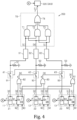
- the second controller 12 further fails from the state where the first controller 11 has failed.
- the output signal T outputted from the abnormality output terminal 22A of the second control circuit 22 is indefinite as shown in Fig. 4 .
- the comparison signals C outputted from both of the two comparison output terminals 32A and 32B of the second comparison circuit 32 are also indefinite.
- the third status signal N3 does not match with the first status signal N1 and the second status signal N2.
- the first switch control unit 81 the low voltage L or the high voltage H is inputted from the second comparison output terminal 32B of the failed second comparison circuit 32, and the low voltage L indicating the mismatch between the third status signal N3 and the first status signal N1 is inputted from the second comparison output terminal 33B of the third comparison circuit 33.
- the switch signal K from the first switch control unit 81 can have either the low voltage L or the high voltage H depending on the output from the second comparison output terminal 32B of the second comparison circuit 32, so that the first switch 41 can be in the connected state or the disconnected state.
- the low voltage L is latched by the first latch circuit 61 at the time of failure of the first controller 11 described in the above (B), the low voltage L is supplied to the majority decision circuit 70 from the first output line 91.
- the switch signal K from the second switch control unit 82 can have either the low voltage L or the high voltage H depending on the output from the first comparison output terminal 31A of the first comparison circuit 31.
- the second switch 41 can be in the connected state or the disconnected state.
- the low voltage L is inputted to the majority voting circuit 70 from the second output line 92.
- the second switch 42 is controlled to the connected state, the low voltage L or the high voltage H is outputted from the abnormality output terminal 22A of the failed second control circuit 22, so that the low voltage L or the high voltage H is inputted to the majority voting circuit 70 from the second output line 92.
- the signal inputted from the second output line 92 to the majority voting circuit 70 is indefinite.
- the switch signal K from the third switch control unit 83 can have either the low voltage L or the high voltage H.
- the third switch 43 can be in the connected state or the disconnected state.
- the case where the third switch 43 is controlled to the connected state is considered.
- the first comparison output terminal 33A of the third comparison circuit 33 outputs the low voltage L indicating the mismatch between the third status signal N3 and the second status signal N2, the second comparison output terminal 33B also outputs the low voltage L indicating the mismatch between the first status signal N1 and the third status signal N3, so that the low voltage L is outputted to the third output line 93 from the abnormality output terminal 23A of the third control circuit 23. Since the third switch 43 is connected, this low voltage L is supplied to the majority voting circuit 70 through the third output line 93. Next, the case where the third switch 43 is controlled to the disconnected state is considered. In this case, the low voltage L is supplied to the third output line 93 from the third pull-down resistor 53, and the third latch circuit 63 latches the low voltage L.
- the low voltage L is inputted to the majority voting circuit 70 from the third output line 93.
- the low voltage L is inputted to the majority voting circuit 70 from the third output line 93 regardless of whether the third switch 43 is in the connected state or in the disconnected state.
- the low voltage L is inputted to the majority voting circuit 70 from the first output line 91 and the third output line 93 while the second output line 92 inputs the low voltage L or the high voltage H to the majority voting circuit 70.
- the majority voting circuit 70 outputs the low voltage L as the final output signal F. Consequently, the control signal P outputted by the normal third control circuit 23 is disabled. Accordingly, in the first hydraulic circuit 320, the mode switching valve 550 is switched to the bypass mode. That is, the first actuator 300 enters the standby mode.
- output signals TV outputted from the control circuit 21, 22, 23 may be changed as follows.
- the high voltage H is outputted as the output signal TV.
- both of the comparison signals CV outputted from the two comparison output terminals of the comparison circuit have the high voltage H indicating the mismatch between the status signals
- the low voltage L is outputted as the output signal TV.
- control signal P may be enabled when the final output signal FV has the high voltage H, and the control signal P may be disabled when the final output signal FV has the low voltage L.
- the high voltage H may be forcibly outputted from the respective abnormality output terminals.
- a signal instructing the shutdown of the first redundancy control device 350 is inputted to each of the control circuits 21, 22, 23, the high voltage H may be forcibly outputted from the respective abnormality output terminals.
- the low voltage L may be forcibly outputted as the output signal T from the respective abnormality output terminals.
- the circuit may be configured as a combination of the above two modification examples as shown in Fig. 7 . That is, similar to the first modification, each switch control unit 84, 85, 86 is formed of the AND circuit, and each switch 44, 45, 46 is formed of the normally closed switch. Therefore, when at least one of the two comparison signals CV inputted to the switch control unit has the low voltage L indicating the match between the status signals, the switch control unit outputs the low voltage L as the switch signal KV to control the switch such that the switch becomes the connected state. Whereas when both of the two comparison signals CV inputted to the switch control unit have the high voltage H indicating the mismatch between the status signals, the switch control unit outputs the high voltage H as the switch signal KV to control the switch such that the switch becomes the disconnected state.
- each of the latch circuits 64, 65, 66 is configured to latch the high voltage H and continue to output the high voltage H when the high voltage H is inputted thereto.
- the high voltage H is supplied to the output line by the pull-up resistor when the output line is disconnected due to a failure of the controller, and the latch circuit latches the voltage H and continues to output the high voltage H.
- the mode switching valve 550 can be switched to the bypass mode when the two controllers fail.
- the comparison circuits 31, 32, 33 may transmit and receive the respective status signals at different timings.
- the moving surface may be driven by an electromechanical actuator.
- an output rod is housed inside, for example, a circular cylinder and the output rod reciprocates therein.
- the electromechanical actuator includes a motor that drives the rod and a conversion unit that converts a rotational motion of the motor into a linear motion. When the motor rotates, the rotation is transmitted to the rod in the cylinder as the linear motion via the conversion unit.
- the motor is stopped once the final output signal F indicating that two controllers have failed is outputted. In this case, the flap stops moving as the motor stops.
- the conversion unit that converts the rotational motion of the motor into the linear motion is moved smoothly by the force inputted by the motor, but is difficult to be moved by the force inputted by the rod. That is, even if a flow of wind generated by the flight of the aircraft tries to move the flap, the rod does not move so the flap does not move. Therefore, the flap stays in a substantially same position. Consequently, it becomes easier to balance the flight with other moving surfaces.
Landscapes
- Engineering & Computer Science (AREA)
- Physics & Mathematics (AREA)
- Theoretical Computer Science (AREA)
- General Engineering & Computer Science (AREA)
- General Physics & Mathematics (AREA)
- Power Engineering (AREA)
- Automation & Control Theory (AREA)
- Aviation & Aerospace Engineering (AREA)
- Quality & Reliability (AREA)
- Sustainable Development (AREA)
- Sustainable Energy (AREA)
- Mechanical Engineering (AREA)
- Life Sciences & Earth Sciences (AREA)
- Transportation (AREA)
- Computing Systems (AREA)
- Computer Hardware Design (AREA)
- Mathematical Physics (AREA)
- Fluid Mechanics (AREA)
- Nonlinear Science (AREA)
- Remote Sensing (AREA)
- Radar, Positioning & Navigation (AREA)
- Safety Devices In Control Systems (AREA)
- Hardware Redundancy (AREA)
Claims (4)
- Redundanzsteuerungsvorrichtung für ein Flugzeug (350, 450), umfassend:drei Steuerungen (11, 12, 13), die jeweils dazu ausgelegt sind, eine erste Spannung oder eine von der ersten Spannung verschiedene zweite Spannung als Ausgangssignal (T) an einen Aktuator (300, 400) auszugeben, der eine bewegliche Oberfläche (600) eines Flugzeugs antreibt, wobei jede der drei Steuerungen dazu ausgelegt ist, die gleiche Verarbeitung durchzuführen, um ein Operationsergebnis zu erhalten, wobei jede der drei Steuerungen dazu ausgelegt ist, das Operationsergebnis als Statussignal (N1, N2, N3) auszugeben; undeine Vergleichsschaltung (31, 32, 33), die für jede der drei Steuerungen vorgesehen ist, wobei die Vergleichsschaltung dazu ausgelegt ist, ein Vergleichssignal (C) basierend auf einem Vergleich zwischen dem von einer entsprechenden der drei Steuerungen ausgegebenen Statussignal und dem von einer anderen der drei Steuerungen ausgegebenen Statussignal auszugeben; dadurch gekennzeichnet, dass die Redundanzsteuerungsvorrichtung für das Flugzeug (350, 450) ferner umfasst:einen Schalter (41, 42, 43), der für jede von drei Ausgangsleitungen (91, 92, 93) vorgesehen ist, wobei jede der drei Steuerungen mit einer entsprechenden der drei Ausgangsleitungen versehen ist, über die das Ausgangssignal von einer entsprechenden der drei Steuerungen ausgegeben wird, wobei der Schalter dazu ausgelegt ist, zwischen Verbindung und Trennung einer entsprechenden der drei Ausgangsleitungen umzuschalten;eine Schaltersteuereinheit (81, 82, 83), die für jeden Schalter vorgesehen ist, wobei die Schaltersteuereinheit dazu ausgelegt ist, als Reaktion auf das Vergleichssignal von der Vergleichsschaltung ein Schaltersignal (K) an den Schalter auszugeben;eine Spannungsversorgungseinheit (51, 52, 53), die mit jeder der drei Ausgangsleitungen stromabwärts des Schalters verbunden ist, wobei die Spannungsversorgungseinheit dazu ausgelegt ist, die Ausgangsleitung mit der zweiten Spannung zu versorgen, wenn die erste Spannung von der Steuerung verloren geht, wenn ein entsprechender der Schalter in einen getrennten Zustand geschaltet wird;eine Latch-Schaltung (61, 62, 63), die mit jeder der drei Ausgangsleitungen stromabwärts der Spannungsversorgungseinheit verbunden ist, wobei die Latch-Schaltung dazu ausgelegt ist, die zweite Spannung zu halten und die zweite Spannung weiterhin auszugeben, sobald die zweite Spannung dort eingegeben wird; undeine Mehrheitsentscheidungsschaltung (70), die mit den drei Ausgangsleitungen stromabwärts der Latch-Schaltungen verbunden ist, wobei jedes der Ausgangssignale von den drei Steuerungen über jede entsprechende Ausgangsleitung in die Mehrheitsentscheidungsschaltung eingegeben wird, wobei die Mehrheitsentscheidungsschaltung dazu ausgelegt ist, eine Mehrheitsentscheidung der drei Ausgangssignale zu treffen und die erste Spannung oder die zweite Spannung als endgültiges Ausgangssignal (F) auszugeben,wobei die Schaltersteuereinheit dazu ausgelegt ist, das Schaltersignal auszugeben, um den in der Ausgangsleitung einer ersten Steuerung, die eine entsprechende der drei Steuerungen ist, vorgesehenen Schalter zu trennen, wenn die von den Vergleichsschaltungen der zweiten und dritten Steuerung, die die beiden anderen der drei Steuerungen sind, ausgegebenen Vergleichssignale beide auf eine Nichtübereinstimmung zwischen der ersten Steuerung und der zweiten und dritten Steuerung hinweisen.
- Redundanzsteuerungsvorrichtung für ein Flugzeug nach Anspruch 1, wobei die Redundanzsteuerungsvorrichtung auf eine Vielzahl von Fluiddruckaktuatoren (300, 400) angewendet wird, die an derselben beweglichen Oberfläche (600) des Flugzeugs angebracht sind, und die Vielzahl von Aktuatoren dazu konfiguriert ist, zwischen einem aktiven Modus, in dem die Aktuatoren die bewegliche Oberfläche antreiben, und einem Standby-Modus, in dem die Aktuatoren der beweglichen Oberfläche folgen, ohne die bewegliche Oberfläche anzutreiben, umgeschaltet zu werden.
- Redundanzsteuerungsvorrichtung für ein Flugzeug nach Anspruch 2, wobeidie Vielzahl von an der beweglichen Oberfläche angebrachten Aktuatoren einen oder mehrere erste Aktuatoren (300) und einen oder mehrere zweite Aktuatoren (400) einschließt, die sich vom ersten Aktuator unterscheiden, undeiner von dem ersten Aktuator und dem zweiten Aktuator gesteuert wird, um im aktiven Modus zu arbeiten, und der andere von dem ersten Aktuator und dem zweiten Aktuator gesteuert wird, um im Standby-Modus zu arbeiten.
- Redundanzsteuerungsvorrichtung für ein Flugzeug nach Anspruch 1, wobei die Redundanzsteuerungsvorrichtung auf einen elektromechanischen Aktuator angewendet wird, der an der beweglichen Oberfläche des Flugzeugs angebracht ist.
Applications Claiming Priority (1)
| Application Number | Priority Date | Filing Date | Title |
|---|---|---|---|
| JP2020039939A JP7386108B2 (ja) | 2020-03-09 | 2020-03-09 | 航空機用の多重化制御装置 |
Publications (2)
| Publication Number | Publication Date |
|---|---|
| EP3879697A1 EP3879697A1 (de) | 2021-09-15 |
| EP3879697B1 true EP3879697B1 (de) | 2024-02-14 |
Family
ID=74858304
Family Applications (1)
| Application Number | Title | Priority Date | Filing Date |
|---|---|---|---|
| EP21160681.9A Active EP3879697B1 (de) | 2020-03-09 | 2021-03-04 | Redundanzsteuerungsvorrichtung für flugzeuge |
Country Status (3)
| Country | Link |
|---|---|
| US (1) | US11552640B2 (de) |
| EP (1) | EP3879697B1 (de) |
| JP (1) | JP7386108B2 (de) |
Families Citing this family (3)
| Publication number | Priority date | Publication date | Assignee | Title |
|---|---|---|---|---|
| AU2022337470B2 (en) | 2021-08-31 | 2025-01-30 | Yoshino Gypsum Co., Ltd. | Smoother and gypsum board manufacturing device |
| CN114280919B (zh) * | 2022-03-08 | 2022-05-31 | 浙江中控技术股份有限公司 | 冗余控制装置 |
| US20240308648A1 (en) * | 2023-03-16 | 2024-09-19 | Honeywell International Inc. | Fly-by-wire flight control system with back-up control in an inceptor |
Family Cites Families (13)
| Publication number | Priority date | Publication date | Assignee | Title |
|---|---|---|---|---|
| US4517639A (en) * | 1982-05-13 | 1985-05-14 | The Boeing Company | Fault scoring and selection circuit and method for redundant system |
| JPH0731537B2 (ja) * | 1987-09-11 | 1995-04-10 | 株式会社日立製作所 | 多重化制御装置 |
| JPH0198034A (ja) | 1987-10-09 | 1989-04-17 | Nec Corp | 多重冗長系回路 |
| JPH0271304A (ja) * | 1988-09-07 | 1990-03-09 | Hitachi Ltd | フオールト・トレラント制御システム |
| US5082208A (en) * | 1989-09-29 | 1992-01-21 | The Boeing Company | System and method for controlling an aircraft flight control member |
| JP3930513B2 (ja) * | 2003-05-21 | 2007-06-13 | 富士通株式会社 | 多数決論理回路を有するフリップフロップ回路 |
| JP4890845B2 (ja) * | 2005-12-08 | 2012-03-07 | ナブテスコ株式会社 | アクチュエータ機構 |
| US9327600B1 (en) * | 2011-09-06 | 2016-05-03 | Neeme Systems Solutions, Inc. | Aircraft utilities and power distribution system |
| JP6178587B2 (ja) * | 2013-02-28 | 2017-08-09 | 三菱航空機株式会社 | 航空機のアクチュエータ装置、及び、航空機 |
| JP6373154B2 (ja) * | 2014-10-09 | 2018-08-15 | 株式会社日立超エル・エス・アイ・システムズ | 半導体装置 |
| US10428842B2 (en) * | 2017-05-05 | 2019-10-01 | Aurora Flight Sciences Corporation | Pneumatic actuation systems having improved feedback control |
| US10229016B2 (en) * | 2017-06-01 | 2019-03-12 | The University Of Akron | Redundant computer system utilizing comparison diagnostics and voting techniques |
| US10571914B2 (en) * | 2017-06-29 | 2020-02-25 | The Boeing Company | Fault coverage for multiple failures in redundant systems |
-
2020
- 2020-03-09 JP JP2020039939A patent/JP7386108B2/ja active Active
-
2021
- 2021-03-04 US US17/192,257 patent/US11552640B2/en active Active
- 2021-03-04 EP EP21160681.9A patent/EP3879697B1/de active Active
Also Published As
| Publication number | Publication date |
|---|---|
| EP3879697A1 (de) | 2021-09-15 |
| US11552640B2 (en) | 2023-01-10 |
| US20210281265A1 (en) | 2021-09-09 |
| JP7386108B2 (ja) | 2023-11-24 |
| JP2021140653A (ja) | 2021-09-16 |
Similar Documents
| Publication | Publication Date | Title |
|---|---|---|
| EP3879697B1 (de) | Redundanzsteuerungsvorrichtung für flugzeuge | |
| EP3222520B1 (de) | Hydraulikantrieb mit lokaler unterstützung für flugzeugsteuerungssysteme | |
| US8434301B2 (en) | Local backup hydraulic actuator for aircraft control systems | |
| US4807516A (en) | Flight control system employing three controllers operating a dual actuator | |
| CN108799238B (zh) | 具有改进的反馈控制的气动致动系统 | |
| US8504178B2 (en) | Multiple redundant control system | |
| US4887214A (en) | Flight control system employing two dual controllers operating a dual actuator | |
| US9031676B2 (en) | Actuator control system | |
| US4759515A (en) | Drive control for a vertical rudder of an aircraft | |
| CN205089733U (zh) | 用于工艺技术设备的气压调节装置的位置调节器 | |
| US3426650A (en) | Triple channel redundant hydraeric control system | |
| US7175133B2 (en) | Wing driving apparatus | |
| US12421988B2 (en) | Pilot control unit for at least one valve drive of a hydraulic valve and method for operating same | |
| CN102107731A (zh) | 致动器控制系统 | |
| EP3839688B1 (de) | Motorsteuerungssystem, verfahren zum betrieb eines motorsteuerungssystems und flugzeug | |
| EP3792178B1 (de) | Hydraulisches steigungsverriegelungspropellersystem mit zwei aktuatoren | |
| CN110431316B (zh) | 用于控制液压调节驱动装置的方法、控制装置和调节驱动装置控制器 | |
| US11108344B2 (en) | Soft starter, operating method, and switching system | |
| JP4152609B2 (ja) | 舵面駆動装置及び舵面駆動システム | |
| CN114270407B (zh) | 冗余致动电力和控制 | |
| JP4252583B2 (ja) | 翼駆動装置 | |
| KR101507022B1 (ko) | 서보 구동 장치의 포화구동을 방지하는 제어 장치 및 방법 | |
| CN117429599A (zh) | 一种用于飞行器的液压伺服作动系统和方法 | |
| CN117420750A (zh) | 汽轮机控制系统及汽轮机 |
Legal Events
| Date | Code | Title | Description |
|---|---|---|---|
| PUAI | Public reference made under article 153(3) epc to a published international application that has entered the european phase |
Free format text: ORIGINAL CODE: 0009012 |
|
| STAA | Information on the status of an ep patent application or granted ep patent |
Free format text: STATUS: REQUEST FOR EXAMINATION WAS MADE |
|
| 17P | Request for examination filed |
Effective date: 20210304 |
|
| AK | Designated contracting states |
Kind code of ref document: A1 Designated state(s): AL AT BE BG CH CY CZ DE DK EE ES FI FR GB GR HR HU IE IS IT LI LT LU LV MC MK MT NL NO PL PT RO RS SE SI SK SM TR |
|
| P01 | Opt-out of the competence of the unified patent court (upc) registered |
Effective date: 20230411 |
|
| GRAP | Despatch of communication of intention to grant a patent |
Free format text: ORIGINAL CODE: EPIDOSNIGR1 |
|
| STAA | Information on the status of an ep patent application or granted ep patent |
Free format text: STATUS: GRANT OF PATENT IS INTENDED |
|
| INTG | Intention to grant announced |
Effective date: 20230914 |
|
| GRAS | Grant fee paid |
Free format text: ORIGINAL CODE: EPIDOSNIGR3 |
|
| GRAA | (expected) grant |
Free format text: ORIGINAL CODE: 0009210 |
|
| STAA | Information on the status of an ep patent application or granted ep patent |
Free format text: STATUS: THE PATENT HAS BEEN GRANTED |
|
| AK | Designated contracting states |
Kind code of ref document: B1 Designated state(s): AL AT BE BG CH CY CZ DE DK EE ES FI FR GB GR HR HU IE IS IT LI LT LU LV MC MK MT NL NO PL PT RO RS SE SI SK SM TR |
|
| REG | Reference to a national code |
Ref country code: GB Ref legal event code: FG4D |
|
| REG | Reference to a national code |
Ref country code: CH Ref legal event code: EP |
|
| REG | Reference to a national code |
Ref country code: DE Ref legal event code: R096 Ref document number: 602021009278 Country of ref document: DE |
|
| REG | Reference to a national code |
Ref country code: IE Ref legal event code: FG4D |
|
| REG | Reference to a national code |
Ref country code: LT Ref legal event code: MG9D |
|
| REG | Reference to a national code |
Ref country code: NL Ref legal event code: MP Effective date: 20240214 |
|
| PG25 | Lapsed in a contracting state [announced via postgrant information from national office to epo] |
Ref country code: IS Free format text: LAPSE BECAUSE OF FAILURE TO SUBMIT A TRANSLATION OF THE DESCRIPTION OR TO PAY THE FEE WITHIN THE PRESCRIBED TIME-LIMIT Effective date: 20240614 |
|
| PG25 | Lapsed in a contracting state [announced via postgrant information from national office to epo] |
Ref country code: LT Free format text: LAPSE BECAUSE OF FAILURE TO SUBMIT A TRANSLATION OF THE DESCRIPTION OR TO PAY THE FEE WITHIN THE PRESCRIBED TIME-LIMIT Effective date: 20240214 |
|
| PG25 | Lapsed in a contracting state [announced via postgrant information from national office to epo] |
Ref country code: GR Free format text: LAPSE BECAUSE OF FAILURE TO SUBMIT A TRANSLATION OF THE DESCRIPTION OR TO PAY THE FEE WITHIN THE PRESCRIBED TIME-LIMIT Effective date: 20240515 |
|
| REG | Reference to a national code |
Ref country code: AT Ref legal event code: MK05 Ref document number: 1657927 Country of ref document: AT Kind code of ref document: T Effective date: 20240214 |
|
| PG25 | Lapsed in a contracting state [announced via postgrant information from national office to epo] |
Ref country code: NL Free format text: LAPSE BECAUSE OF FAILURE TO SUBMIT A TRANSLATION OF THE DESCRIPTION OR TO PAY THE FEE WITHIN THE PRESCRIBED TIME-LIMIT Effective date: 20240214 Ref country code: RS Free format text: LAPSE BECAUSE OF FAILURE TO SUBMIT A TRANSLATION OF THE DESCRIPTION OR TO PAY THE FEE WITHIN THE PRESCRIBED TIME-LIMIT Effective date: 20240514 Ref country code: HR Free format text: LAPSE BECAUSE OF FAILURE TO SUBMIT A TRANSLATION OF THE DESCRIPTION OR TO PAY THE FEE WITHIN THE PRESCRIBED TIME-LIMIT Effective date: 20240214 |
|
| PG25 | Lapsed in a contracting state [announced via postgrant information from national office to epo] |
Ref country code: ES Free format text: LAPSE BECAUSE OF FAILURE TO SUBMIT A TRANSLATION OF THE DESCRIPTION OR TO PAY THE FEE WITHIN THE PRESCRIBED TIME-LIMIT Effective date: 20240214 |
|
| PG25 | Lapsed in a contracting state [announced via postgrant information from national office to epo] |
Ref country code: AT Free format text: LAPSE BECAUSE OF FAILURE TO SUBMIT A TRANSLATION OF THE DESCRIPTION OR TO PAY THE FEE WITHIN THE PRESCRIBED TIME-LIMIT Effective date: 20240214 |
|
| PG25 | Lapsed in a contracting state [announced via postgrant information from national office to epo] |
Ref country code: RS Free format text: LAPSE BECAUSE OF FAILURE TO SUBMIT A TRANSLATION OF THE DESCRIPTION OR TO PAY THE FEE WITHIN THE PRESCRIBED TIME-LIMIT Effective date: 20240514 Ref country code: NO Free format text: LAPSE BECAUSE OF FAILURE TO SUBMIT A TRANSLATION OF THE DESCRIPTION OR TO PAY THE FEE WITHIN THE PRESCRIBED TIME-LIMIT Effective date: 20240514 Ref country code: NL Free format text: LAPSE BECAUSE OF FAILURE TO SUBMIT A TRANSLATION OF THE DESCRIPTION OR TO PAY THE FEE WITHIN THE PRESCRIBED TIME-LIMIT Effective date: 20240214 Ref country code: LT Free format text: LAPSE BECAUSE OF FAILURE TO SUBMIT A TRANSLATION OF THE DESCRIPTION OR TO PAY THE FEE WITHIN THE PRESCRIBED TIME-LIMIT Effective date: 20240214 Ref country code: IS Free format text: LAPSE BECAUSE OF FAILURE TO SUBMIT A TRANSLATION OF THE DESCRIPTION OR TO PAY THE FEE WITHIN THE PRESCRIBED TIME-LIMIT Effective date: 20240614 Ref country code: HR Free format text: LAPSE BECAUSE OF FAILURE TO SUBMIT A TRANSLATION OF THE DESCRIPTION OR TO PAY THE FEE WITHIN THE PRESCRIBED TIME-LIMIT Effective date: 20240214 Ref country code: GR Free format text: LAPSE BECAUSE OF FAILURE TO SUBMIT A TRANSLATION OF THE DESCRIPTION OR TO PAY THE FEE WITHIN THE PRESCRIBED TIME-LIMIT Effective date: 20240515 Ref country code: FI Free format text: LAPSE BECAUSE OF FAILURE TO SUBMIT A TRANSLATION OF THE DESCRIPTION OR TO PAY THE FEE WITHIN THE PRESCRIBED TIME-LIMIT Effective date: 20240214 Ref country code: ES Free format text: LAPSE BECAUSE OF FAILURE TO SUBMIT A TRANSLATION OF THE DESCRIPTION OR TO PAY THE FEE WITHIN THE PRESCRIBED TIME-LIMIT Effective date: 20240214 Ref country code: BG Free format text: LAPSE BECAUSE OF FAILURE TO SUBMIT A TRANSLATION OF THE DESCRIPTION OR TO PAY THE FEE WITHIN THE PRESCRIBED TIME-LIMIT Effective date: 20240214 Ref country code: AT Free format text: LAPSE BECAUSE OF FAILURE TO SUBMIT A TRANSLATION OF THE DESCRIPTION OR TO PAY THE FEE WITHIN THE PRESCRIBED TIME-LIMIT Effective date: 20240214 |
|
| PG25 | Lapsed in a contracting state [announced via postgrant information from national office to epo] |
Ref country code: PL Free format text: LAPSE BECAUSE OF FAILURE TO SUBMIT A TRANSLATION OF THE DESCRIPTION OR TO PAY THE FEE WITHIN THE PRESCRIBED TIME-LIMIT Effective date: 20240214 Ref country code: PT Free format text: LAPSE BECAUSE OF FAILURE TO SUBMIT A TRANSLATION OF THE DESCRIPTION OR TO PAY THE FEE WITHIN THE PRESCRIBED TIME-LIMIT Effective date: 20240614 |
|
| PG25 | Lapsed in a contracting state [announced via postgrant information from national office to epo] |
Ref country code: SE Free format text: LAPSE BECAUSE OF FAILURE TO SUBMIT A TRANSLATION OF THE DESCRIPTION OR TO PAY THE FEE WITHIN THE PRESCRIBED TIME-LIMIT Effective date: 20240214 Ref country code: PT Free format text: LAPSE BECAUSE OF FAILURE TO SUBMIT A TRANSLATION OF THE DESCRIPTION OR TO PAY THE FEE WITHIN THE PRESCRIBED TIME-LIMIT Effective date: 20240614 Ref country code: PL Free format text: LAPSE BECAUSE OF FAILURE TO SUBMIT A TRANSLATION OF THE DESCRIPTION OR TO PAY THE FEE WITHIN THE PRESCRIBED TIME-LIMIT Effective date: 20240214 Ref country code: LV Free format text: LAPSE BECAUSE OF FAILURE TO SUBMIT A TRANSLATION OF THE DESCRIPTION OR TO PAY THE FEE WITHIN THE PRESCRIBED TIME-LIMIT Effective date: 20240214 |
|
| PG25 | Lapsed in a contracting state [announced via postgrant information from national office to epo] |
Ref country code: DK Free format text: LAPSE BECAUSE OF FAILURE TO SUBMIT A TRANSLATION OF THE DESCRIPTION OR TO PAY THE FEE WITHIN THE PRESCRIBED TIME-LIMIT Effective date: 20240214 |
|
| PG25 | Lapsed in a contracting state [announced via postgrant information from national office to epo] |
Ref country code: SM Free format text: LAPSE BECAUSE OF FAILURE TO SUBMIT A TRANSLATION OF THE DESCRIPTION OR TO PAY THE FEE WITHIN THE PRESCRIBED TIME-LIMIT Effective date: 20240214 |
|
| PG25 | Lapsed in a contracting state [announced via postgrant information from national office to epo] |
Ref country code: CZ Free format text: LAPSE BECAUSE OF FAILURE TO SUBMIT A TRANSLATION OF THE DESCRIPTION OR TO PAY THE FEE WITHIN THE PRESCRIBED TIME-LIMIT Effective date: 20240214 Ref country code: EE Free format text: LAPSE BECAUSE OF FAILURE TO SUBMIT A TRANSLATION OF THE DESCRIPTION OR TO PAY THE FEE WITHIN THE PRESCRIBED TIME-LIMIT Effective date: 20240214 |
|
| PG25 | Lapsed in a contracting state [announced via postgrant information from national office to epo] |
Ref country code: SK Free format text: LAPSE BECAUSE OF FAILURE TO SUBMIT A TRANSLATION OF THE DESCRIPTION OR TO PAY THE FEE WITHIN THE PRESCRIBED TIME-LIMIT Effective date: 20240214 |
|
| PG25 | Lapsed in a contracting state [announced via postgrant information from national office to epo] |
Ref country code: SM Free format text: LAPSE BECAUSE OF FAILURE TO SUBMIT A TRANSLATION OF THE DESCRIPTION OR TO PAY THE FEE WITHIN THE PRESCRIBED TIME-LIMIT Effective date: 20240214 Ref country code: SK Free format text: LAPSE BECAUSE OF FAILURE TO SUBMIT A TRANSLATION OF THE DESCRIPTION OR TO PAY THE FEE WITHIN THE PRESCRIBED TIME-LIMIT Effective date: 20240214 Ref country code: RO Free format text: LAPSE BECAUSE OF FAILURE TO SUBMIT A TRANSLATION OF THE DESCRIPTION OR TO PAY THE FEE WITHIN THE PRESCRIBED TIME-LIMIT Effective date: 20240214 Ref country code: EE Free format text: LAPSE BECAUSE OF FAILURE TO SUBMIT A TRANSLATION OF THE DESCRIPTION OR TO PAY THE FEE WITHIN THE PRESCRIBED TIME-LIMIT Effective date: 20240214 Ref country code: DK Free format text: LAPSE BECAUSE OF FAILURE TO SUBMIT A TRANSLATION OF THE DESCRIPTION OR TO PAY THE FEE WITHIN THE PRESCRIBED TIME-LIMIT Effective date: 20240214 Ref country code: CZ Free format text: LAPSE BECAUSE OF FAILURE TO SUBMIT A TRANSLATION OF THE DESCRIPTION OR TO PAY THE FEE WITHIN THE PRESCRIBED TIME-LIMIT Effective date: 20240214 |
|
| REG | Reference to a national code |
Ref country code: CH Ref legal event code: PL |
|
| REG | Reference to a national code |
Ref country code: DE Ref legal event code: R097 Ref document number: 602021009278 Country of ref document: DE |
|
| PG25 | Lapsed in a contracting state [announced via postgrant information from national office to epo] |
Ref country code: LU Free format text: LAPSE BECAUSE OF NON-PAYMENT OF DUE FEES Effective date: 20240304 |
|
| PG25 | Lapsed in a contracting state [announced via postgrant information from national office to epo] |
Ref country code: MC Free format text: LAPSE BECAUSE OF FAILURE TO SUBMIT A TRANSLATION OF THE DESCRIPTION OR TO PAY THE FEE WITHIN THE PRESCRIBED TIME-LIMIT Effective date: 20240214 |
|
| PG25 | Lapsed in a contracting state [announced via postgrant information from national office to epo] |
Ref country code: MC Free format text: LAPSE BECAUSE OF FAILURE TO SUBMIT A TRANSLATION OF THE DESCRIPTION OR TO PAY THE FEE WITHIN THE PRESCRIBED TIME-LIMIT Effective date: 20240214 Ref country code: LU Free format text: LAPSE BECAUSE OF NON-PAYMENT OF DUE FEES Effective date: 20240304 |
|
| PG25 | Lapsed in a contracting state [announced via postgrant information from national office to epo] |
Ref country code: IT Free format text: LAPSE BECAUSE OF FAILURE TO SUBMIT A TRANSLATION OF THE DESCRIPTION OR TO PAY THE FEE WITHIN THE PRESCRIBED TIME-LIMIT Effective date: 20240214 |
|
| REG | Reference to a national code |
Ref country code: BE Ref legal event code: MM Effective date: 20240331 |
|
| PLBE | No opposition filed within time limit |
Free format text: ORIGINAL CODE: 0009261 |
|
| STAA | Information on the status of an ep patent application or granted ep patent |
Free format text: STATUS: NO OPPOSITION FILED WITHIN TIME LIMIT |
|
| PG25 | Lapsed in a contracting state [announced via postgrant information from national office to epo] |
Ref country code: IT Free format text: LAPSE BECAUSE OF FAILURE TO SUBMIT A TRANSLATION OF THE DESCRIPTION OR TO PAY THE FEE WITHIN THE PRESCRIBED TIME-LIMIT Effective date: 20240214 |
|
| PG25 | Lapsed in a contracting state [announced via postgrant information from national office to epo] |
Ref country code: BE Free format text: LAPSE BECAUSE OF NON-PAYMENT OF DUE FEES Effective date: 20240331 |
|
| 26N | No opposition filed |
Effective date: 20241115 |
|
| PG25 | Lapsed in a contracting state [announced via postgrant information from national office to epo] |
Ref country code: IE Free format text: LAPSE BECAUSE OF NON-PAYMENT OF DUE FEES Effective date: 20240304 |
|
| PG25 | Lapsed in a contracting state [announced via postgrant information from national office to epo] |
Ref country code: IE Free format text: LAPSE BECAUSE OF NON-PAYMENT OF DUE FEES Effective date: 20240304 Ref country code: BE Free format text: LAPSE BECAUSE OF NON-PAYMENT OF DUE FEES Effective date: 20240331 Ref country code: CH Free format text: LAPSE BECAUSE OF NON-PAYMENT OF DUE FEES Effective date: 20240331 |
|
| PG25 | Lapsed in a contracting state [announced via postgrant information from national office to epo] |
Ref country code: SI Free format text: LAPSE BECAUSE OF FAILURE TO SUBMIT A TRANSLATION OF THE DESCRIPTION OR TO PAY THE FEE WITHIN THE PRESCRIBED TIME-LIMIT Effective date: 20240214 |
|
| PG25 | Lapsed in a contracting state [announced via postgrant information from national office to epo] |
Ref country code: CY Free format text: LAPSE BECAUSE OF FAILURE TO SUBMIT A TRANSLATION OF THE DESCRIPTION OR TO PAY THE FEE WITHIN THE PRESCRIBED TIME-LIMIT; INVALID AB INITIO Effective date: 20210304 |
|
| PG25 | Lapsed in a contracting state [announced via postgrant information from national office to epo] |
Ref country code: HU Free format text: LAPSE BECAUSE OF FAILURE TO SUBMIT A TRANSLATION OF THE DESCRIPTION OR TO PAY THE FEE WITHIN THE PRESCRIBED TIME-LIMIT; INVALID AB INITIO Effective date: 20210304 |
|
| GBPC | Gb: european patent ceased through non-payment of renewal fee |
Effective date: 20250304 |
|
| PG25 | Lapsed in a contracting state [announced via postgrant information from national office to epo] |
Ref country code: TR Free format text: LAPSE BECAUSE OF FAILURE TO SUBMIT A TRANSLATION OF THE DESCRIPTION OR TO PAY THE FEE WITHIN THE PRESCRIBED TIME-LIMIT Effective date: 20240214 |
|
| PG25 | Lapsed in a contracting state [announced via postgrant information from national office to epo] |
Ref country code: GB Free format text: LAPSE BECAUSE OF NON-PAYMENT OF DUE FEES Effective date: 20250304 |
|
| PGFP | Annual fee paid to national office [announced via postgrant information from national office to epo] |
Ref country code: DE Payment date: 20260319 Year of fee payment: 6 |
|
| PGFP | Annual fee paid to national office [announced via postgrant information from national office to epo] |
Ref country code: FR Payment date: 20260323 Year of fee payment: 6 |