EP3869598B1 - Lead-acid battery current collector - Google Patents
Lead-acid battery current collector Download PDFInfo
- Publication number
- EP3869598B1 EP3869598B1 EP19873655.5A EP19873655A EP3869598B1 EP 3869598 B1 EP3869598 B1 EP 3869598B1 EP 19873655 A EP19873655 A EP 19873655A EP 3869598 B1 EP3869598 B1 EP 3869598B1
- Authority
- EP
- European Patent Office
- Prior art keywords
- lead
- current collector
- section
- acid battery
- contour
- Prior art date
- Legal status (The legal status is an assumption and is not a legal conclusion. Google has not performed a legal analysis and makes no representation as to the accuracy of the status listed.)
- Active
Links
Images





Classifications
-
- H—ELECTRICITY
- H01—ELECTRIC ELEMENTS
- H01M—PROCESSES OR MEANS, e.g. BATTERIES, FOR THE DIRECT CONVERSION OF CHEMICAL ENERGY INTO ELECTRICAL ENERGY
- H01M4/00—Electrodes
- H01M4/02—Electrodes composed of, or comprising, active material
- H01M4/14—Electrodes for lead-acid accumulators
-
- H—ELECTRICITY
- H01—ELECTRIC ELEMENTS
- H01M—PROCESSES OR MEANS, e.g. BATTERIES, FOR THE DIRECT CONVERSION OF CHEMICAL ENERGY INTO ELECTRICAL ENERGY
- H01M4/00—Electrodes
- H01M4/02—Electrodes composed of, or comprising, active material
- H01M4/64—Carriers or collectors
- H01M4/70—Carriers or collectors characterised by shape or form
- H01M4/72—Grids
- H01M4/73—Grids for lead-acid accumulators, e.g. frame plates
-
- H—ELECTRICITY
- H01—ELECTRIC ELEMENTS
- H01M—PROCESSES OR MEANS, e.g. BATTERIES, FOR THE DIRECT CONVERSION OF CHEMICAL ENERGY INTO ELECTRICAL ENERGY
- H01M4/00—Electrodes
- H01M4/02—Electrodes composed of, or comprising, active material
- H01M4/64—Carriers or collectors
- H01M4/82—Multi-step processes for manufacturing carriers for lead-acid accumulators
-
- Y—GENERAL TAGGING OF NEW TECHNOLOGICAL DEVELOPMENTS; GENERAL TAGGING OF CROSS-SECTIONAL TECHNOLOGIES SPANNING OVER SEVERAL SECTIONS OF THE IPC; TECHNICAL SUBJECTS COVERED BY FORMER USPC CROSS-REFERENCE ART COLLECTIONS [XRACs] AND DIGESTS
- Y02—TECHNOLOGIES OR APPLICATIONS FOR MITIGATION OR ADAPTATION AGAINST CLIMATE CHANGE
- Y02E—REDUCTION OF GREENHOUSE GAS [GHG] EMISSIONS, RELATED TO ENERGY GENERATION, TRANSMISSION OR DISTRIBUTION
- Y02E60/00—Enabling technologies; Technologies with a potential or indirect contribution to GHG emissions mitigation
- Y02E60/10—Energy storage using batteries
Definitions
- JP-A-51-60936 proposes a lead grid plate for a lead-acid battery formed by press-punching a rolled plate of a lead alloy, characterized in that the thicknesses of inner longitudinal and transverse bars are made smaller than the thickness of an outer frame, the thickness of the outer frame is in the range of 0.8 to 1.5 mm, and the thicknesses of the inner bars are in the range of 0.6 to 0.8 mm.
- the holding force of the active material is improved, when the current collector corrodes, the elongation of the current collector occurs, and then, the electrode material may fall off.
- the elongation of the current collector due to its corrosion is considered to depend on the corrosion form of the current collector.
- the present invention provides a current collector for a lead-acid battery with the features of claim 1.
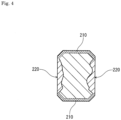
- a percentage (hereinafter also referred to as a first-portion rate) of the contour (hereinafter also referred to as a first contour part) corresponding to the first portion to the total length of the contour C is 50% or more. That is, a percentage (hereinafter also referred to as a second-portion rate) of the contour (hereinafter also referred to as a second contour part) corresponding to the second portion to the total length of the contour C is 50% or less.
- the cross-section perpendicular to the fiber length of the fibrous structure is hardly exposed on the outer surface of the outer peripheral region of the section C.
- the cross-section perpendicular to the fiber length of the fibrous structure has many grain boundaries.
- the first portion and the second portion are different in the form of progress of corrosion.
- the corrosion layer when gas is generated at the interface between the current collector (the outer surface of the first portion of the outer peripheral region) and the corrosion layer, the corrosion layer is relatively easily peeled off from the current collector.
- the fibrous metallic structure extends in the depth direction of the inner rib.
- the grain boundary extends longer in the depth direction of the inner rib than in the surface direction of the inner rib.
- the corrosion layer formed along the outer surface of the second portion of the outer peripheral region has a high bonding strength with the current collector (inner rib).
- the corrosion of the longitudinal rib In the first portion in the section C, the corrosion of the longitudinal rib easily proceeds shallow, and the elongation of the current collector due to the shallow corrosion is small. On the other hand, in the second portion in the section C, the corrosion of the longitudinal rib easily proceeds deep in a wedge shape, and the elongation of the current collector due to the deep corrosion tends to increase.
- the first-portion rate and the second-portion rate are intentionally controllable. Even when the longitudinal rib originally has a large second-portion rate, it is possible to deform the longitudinal rib so as to crush the second portion.
- the first-portion rate can be arbitrarily controlled by the speed of a press, the pressure of the press, the shape of the die, or the like.
- That the fibrous structure (direction of stripes) extends along the contour of the section C in the first portion refers to the following state.
- the inside of the frame rib of the current collector is cut into three equal sections: an upper region on the upper element side of the frame rib; a lower region on the lower element side of the frame rib; and a middle region between the upper region and the lower region.
- four rows of the cross-sections C perpendicular to the first direction parallel to the upper element and the lower element and parallel to the thickness direction
- one row of the sections C is formed in each of the upper region and the lower region, and two rows of the sections C are formed in the middle region.
- a current collector before being filled with the electrode material may be used.
- a lead-acid battery in a fully charged state is disassembled, an electrode plate is taken out and washed with water to remove an electrolyte solution, and the electrode plate is dried. Subsequently, the electrode material is removed from the electrode plate, and the electrode material adhering to the surface of the current collector is removed by mannitol.
- the prepared current collector may be embedded in a thermosetting resin so as to cover the whole of the prepared current collector to cure the resin, and thereafter, the current collector may be cut.
- the state of the metallic structure in the section C may only be observed by performing etching on the cross-section of the current collector and photographing with a microscope.
- the lead-acid battery in the fully charged state refers to a chemically converted lead-acid battery having been fully charged. So long as after chemical conversion, the lead-acid battery may be fully charged immediately after chemical conversion or after a lapse of time from chemical conversion. For example, a chemically converted lead-acid battery in use (preferably at the initial stage of use) may be fully charged.
- the battery in the initial stage of use refers to a battery that has not been used for a long time and has hardly been degraded.
- the thickness of the first portion may only be 55 ⁇ m or more.
- the thickness of the region in which the striped pattern of the fibrous structure is observed is less than 55 ⁇ m, even in the outer peripheral region that appears at a glance as the first portion, the region is regarded not as the first portion but as the second portion.
- the first portion having a thickness of 55 ⁇ m or more has a sufficient action to prevent penetration of corrosion to the inside. In this case, the penetration of corrosion to the inside is likely to become highly uniform throughout the inner ribs. Therefore, the elongation of the current collector is remarkably reduced, and the falling of the electrode material is also remarkably prevented.
- the thickness of the first portion is preferably 100 ⁇ m or more.
- the section C By forming the section C in an octagon shape, it is easy to control the percentage of the length of the first contour part to the total length of the contour C to be less than 100%, and as a result, it is also easy to control the first-portion rate to be 95% or less or 90% or less.
- the octagonal shape does not have to be a strictly octagonal shape in the mathematical sense, and the apex may be slightly rounded, or each side may be bent slightly.
- a total length WLW of the inner dimensions of the transverse rib and a total length WLH of the inner dimensions of the longitudinal rib may satisfy WLH/LW ⁇ 0.8 and may satisfy WLH/WLW ⁇ 1.3.
- the corrosion of the current collector tends to penetrate to the inside, and hence the elongation of the current collector is reduced more remarkably by controlling the first-portion rate to be 50% or more.
- the inner dimension length of each inner rib means the length in the inner dimension of the grid square, that is, the length (bar length) of the side of a rectangular space defining the grid square.
- the direction of the length WLW (a direction in which the transverse rib elongates) usually corresponds to the stretching direction of the stretched sheet (machine direction (MD)).
- the current collector according to the present invention may be applied to either a positive electrode plate or a negative electrode plate. That is, the electrode plate according to the present invention can be either the positive electrode plate or the negative electrode plate. However, the current collector according to the present invention is particularly suitable as a current collector for the positive electrode plate from the viewpoint of reducing the elongation of the current collector due to its corrosion
- the density of the electrode material means the value of the bulk density of the chemically converted electrode material in the fully charged state and is measured as follows.
- the battery after chemical conversion or in use (preferably at the initial stage of use) is fully charged and then disassembled, and the obtained electrode plate is washed with water and dried to remove an electrolyte solution in the electrode plate.
- the washing with water is performed until it is confirmed that the color of the pH test paper does not change by pressing the pH test paper against the surface of the negative electrode plate washed with water. However, the washing with water is performed within two hours.
- the negative electrode plate washed with water is dried at 60°C ⁇ 5°C in a reduced pressure environment for about six hours.
- the negative electrode material contains, as an essential component, a negative active material (lead or lead sulfate), which exhibits a capacity by an oxidation-reduction reaction, and can contain an organic expander, a carbonaceous material, and an additive such as barium sulfate.
- a negative active material lead or lead sulfate
- the negative active material in a charged state is spongy lead, but a non-chemically converted negative electrode plate is usually prepared using a lead powder.
- the sulfur-containing group may be directly bonded to the aromatic ring contained in the compound and may, for example, be bonded to the aromatic ring as an alkyl chain having the sulfur-containing group.
- a condensate obtained using an aldehyde compound of the compound having the aromatic ring described above and a monocyclic aromatic compound (aminobenzenesulfonic acid, alkylaminobenzenesulfonic acid, phenolsulfonic acid, or its substituent) may be used as the organic expander.
- carbon black As the carbonaceous material contained in the negative electrode material, carbon black, graphite, hard carbon, soft carbon, and the like can be used.
- the carbon black include acetylene black, furnace black, and lamp black. Furnace black also includes ketjen black (product name).
- the graphite may be a carbon material including a graphite-type crystal structure and may be either artificial graphite or natural graphite.
- the content of barium sulfate in the negative electrode material is, for example, preferably 0.5% by mass or more, more preferably 1% by mass or more, and still more preferably 1.3% by mass or more. On the other hand, the content is preferably 3.0% by mass or less, more preferably 2.5% by mass or less, and still more preferably 2% by mass or less. These lower and upper limits can be combined arbitrarily.
- the uncrushed sample S is crushed, and the crushed sample S is immersed in a 1 mol/L NaOH aqueous solution to extract the organic expander.
- An insoluble component is removed from a NaOH aqueous solution containing the extracted organic expander by filtration.
- the obtained filtrate (hereinafter also referred to as a filtrate to be analyzed) is desalted, concentrated, and dried to obtain a powder of the organic expander (hereinafter also referred to as a powder to be analyzed).
- Desalting may be performed by immersing the filtrate in distilled water in a dialysis tube.
- the organic expander is specified by obtaining information from an infrared spectral spectrum of the powder to be analyzed, an ultraviolet-visible absorption spectrum of a solution obtained by dissolving the powder to be analyzed in distilled water or the like, a nuclear magnetic resonance (NMR) spectrum of a solution obtained by dissolving the powder to be analyzed in a solvent such as heavy water, a pyrolysis gas chromatographymass spectrometry (GC-MS) capable of obtaining information on individual compounds constituting the substance, or the like.
- NMR nuclear magnetic resonance
- GC-MS pyrolysis gas chromatographymass spectrometry
- the ultraviolet-visible absorption spectrum of the filtrate to be analyzed is measured.
- the content of the organic expander in the negative electrode material is quantified using a spectral intensity and a calibration curve prepared in advance.
- the calibration curve is prepared using an available organic expander exhibiting an ultraviolet-visible absorption spectrum, an infrared spectral spectrum, an NMR spectrum, and the like similar to those of the organic expander to be analyzed.
- the obtained solid is dispersed in water to form a dispersion, and then components except for the carbonaceous material and barium sulfate (e.g., reinforcing material) are removed from the dispersion by using a sieve.
- the dispersion is subjected to suction filtration using a membrane filter with its mass measured in advance, and the membrane filter is dried with the filtered sample in a dryer at 110°C ⁇ 5°C.
- the filtered sample is a mixed sample of a carbonaceous material and barium sulfate.
- a mass (A) of the mixed sample is measured by subtracting the mass of the membrane filter from the total mass of the dried mixed sample and the membrane filter.
- the chemical conversion can be performed by charging the electrode plate group in a state where the electrode plate group including the non-chemically converted negative electrode plate is immersed in the electrolyte solution containing sulfuric acid in the container of the lead-acid battery.
- the chemical conversion may be performed before the lead-acid battery or the electrode plate group is assembled. The chemical conversion produces spongy lead.
- the microporous film is a porous sheet mainly made of components except for fiber components and is obtained by, for example, extrusion molding a composition containing, for example, a pore-forming additive (polymer powder, oil, etc.) into a sheet shape and then removing the pore-forming additive to form pores.
- the microporous film is preferably made mainly of a polymer component.
- a polyolefin such as polyethylene or polypropylene is preferred.
- Fig. 5 shows an example of a flooded-type battery (vented battery)
- the lead-acid battery may be a valve regulated battery (VRLA type).
- An overcharge test is performed using a predetermined test battery in a water bath at 75°C ⁇ 2°C with a constant current of 1.7 A (current density: 0.0054 A/cm 2 ) for five days, and thereafter, the operation of pausing for two days (one week) is repeated for three weeks.
- the apparent current collector area at the time of calculating the current density is set twice the product of the height and width of the outer dimensions of the frame ribs of the positive current collector.
- a repeated 5hR charge-discharge test is performed using the predetermined test battery in the following procedure in a water bath at 25°C ⁇ 2°C.
- the battery is discharged at a constant current (a current (Ah) 0.2 times the numerical value indicated as the five-hour-rate rated capacity (Ah)) up to 1.75 V/cell and then charged at the constant current (the current (A) 0.2 times the numerical value indicated as the five-hour-rate rated capacity (Ah)) up to 135% of the amount of discharge.
- the same cycle is repeated five times to determine a percentage of a 5hR discharge capacity at a fifth cycle to an initial capacity (5hR discharge capacity) (rate to initial capacity).
- the numerical value indicated as the rated capacity is a numerical value in units of Ah.
- the unit of the current which is set based on the numerical value indicated as the rated capacity is A.
- an aqueous sulfuric acid solution is used as an electrolyte solution.
- the specific gravity of the electrolyte solution for use in a test battery X at 20°C is 1.28.
- the specific gravity of the electrolyte solution at 20°C is adjusted to 1.28 in each of the chemically converted test batteries in a fully charged state after chemical conversion.
- the test battery Y (2 V, rated five-hour-rate capacity of 6 Ah) is assembled using a non-chemically converted positive electrode plate including a positive current collector and a positive electrode material.
- the test battery Y is made up of one non-chemically converted positive electrode plate, two non-chemically converted negative electrode plates supporting the positive electrode plate, and an electrolyte solution, and is chemically formed in an electrolyte solution.
- the negative electrode plate is housed in a bag-shaped separator.
- the grid body A1 prepared as described above and the negative electrode plate are used to assemble a battery A1 (2 V, rated five-hour-rate capacity of 6 Ah) as the test battery X.
- the first-portion rate of the section C is changed to 82.6% or 56.2% to prepare grid bodies A2 and A3, and batteries A2 and A3 are prepared as the test batteries X.
- Table 1 shows the results of the first single-plate overcharge test for the batteries A1 to A3 and the battery B1.
- Fig. 6 is a graph showing the relationship among the first-portion rate, the corrosion rate, and the deformation amount (width-elongation and height-elongation of the grid body) for the grid bodies A1 to A3 and B1. It can be seen from Fig. 6 that, although the corrosion rate does not change so much, the width-elongation and the height-elongation are remarkably reduced when the first-portion rate is 60% or more.
- Table 2 shows the results of the second single-plate overcharge test for the batteries A4 to A7 and the batteries B2 to B5.
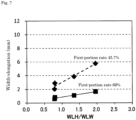
- Table 2 WLH/WLW First-portion rate (%) Width-elongation (mm)
- A4 1.96 60 1.7 A5 1.34 60 1.1 A6 0.80 60 0.8 A7 0.79 60 0.6 B2 1.96 45.7 5.8
- B3 1.34 45.7 3.8
- the first-portion rate of the section C is changed to 50%, 70%, 80%, 90%, 95%, or 100% to prepare each of grid bodies A9 to A14, the above positive electrode plate is prepared, and batteries A9 to A14 (12 V, rated five-hour-rate capacity of 48 Ah) are assembled as the test battery Z described above.
- Table 3 shows the results of the repeated 5hR charge-discharge test for the batteries A8 to A14.
- First-portion rate (%) 5hR discharge capacity (rate to initial) (%) A9 50 100 A8 60 100 A10 70 98 A11 80 96 A12 90 90 A13 95 78 A14 100 65
- Fig. 8 is a graph showing the relationship between the first-portion rate and the five-hour rate discharge capacity (rate to initial). There is seen a tendency that when the first-portion rate exceeds 95%, the five-hour rate discharge capacity decreases. Therefore, it can be understood that a higher first-portion rate is not always better and that controlling the first portion rate to be 95% or less is preferred.
Landscapes
- Chemical & Material Sciences (AREA)
- Chemical Kinetics & Catalysis (AREA)
- Electrochemistry (AREA)
- General Chemical & Material Sciences (AREA)
- Cell Electrode Carriers And Collectors (AREA)
Applications Claiming Priority (2)
| Application Number | Priority Date | Filing Date | Title |
|---|---|---|---|
| JP2018194798 | 2018-10-16 | ||
| PCT/JP2019/040720 WO2020080424A1 (ja) | 2018-10-16 | 2019-10-16 | 鉛蓄電池用集電体およびその製造方法 |
Publications (3)
| Publication Number | Publication Date |
|---|---|
| EP3869598A1 EP3869598A1 (en) | 2021-08-25 |
| EP3869598A4 EP3869598A4 (en) | 2021-12-15 |
| EP3869598B1 true EP3869598B1 (en) | 2025-04-16 |
Family
ID=70284386
Family Applications (1)
| Application Number | Title | Priority Date | Filing Date |
|---|---|---|---|
| EP19873655.5A Active EP3869598B1 (en) | 2018-10-16 | 2019-10-16 | Lead-acid battery current collector |
Country Status (4)
| Country | Link |
|---|---|
| EP (1) | EP3869598B1 (https=) |
| JP (1) | JP7452429B2 (https=) |
| CN (1) | CN112913058A (https=) |
| WO (1) | WO2020080424A1 (https=) |
Family Cites Families (10)
| Publication number | Priority date | Publication date | Assignee | Title |
|---|---|---|---|---|
| JPS5160936A (ja) | 1974-11-01 | 1976-05-27 | Furukawa Electric Co Ltd | Namarichikudenchonamarikoshiban |
| JPH06267544A (ja) * | 1993-03-12 | 1994-09-22 | Matsushita Electric Ind Co Ltd | 鉛蓄電池用極板とこれを用いた鉛蓄電池 |
| JP4263465B2 (ja) * | 2002-12-04 | 2009-05-13 | 株式会社Nttファシリティーズ | 電極集電体及びその製造方法とシール鉛蓄電池 |
| JP4929558B2 (ja) * | 2003-08-08 | 2012-05-09 | 株式会社Gsユアサ | 鉛蓄電池用格子の製造方法 |
| JP5316040B2 (ja) * | 2009-02-06 | 2013-10-16 | 新神戸電機株式会社 | 鉛蓄電池用集電体の製造方法 |
| CN102640334B (zh) * | 2010-10-18 | 2014-09-17 | 新神户电机株式会社 | 铅蓄电池 |
| US9761883B2 (en) * | 2011-11-03 | 2017-09-12 | Johnson Controls Technology Company | Battery grid with varied corrosion resistance |
| EP3059791B1 (en) * | 2013-10-15 | 2021-12-29 | GS Yuasa International Ltd. | Valve-regulated lead-acid battery |
| JP6652133B2 (ja) * | 2015-05-29 | 2020-02-19 | 株式会社Gsユアサ | 鉛蓄電池および鉛蓄電池の製造方法 |
| JP7098874B2 (ja) * | 2016-02-02 | 2022-07-12 | 株式会社Gsユアサ | 鉛蓄電池、鉛蓄電池用の正極板の製造方法 |
-
2019
- 2019-10-16 EP EP19873655.5A patent/EP3869598B1/en active Active
- 2019-10-16 WO PCT/JP2019/040720 patent/WO2020080424A1/ja not_active Ceased
- 2019-10-16 CN CN201980068560.1A patent/CN112913058A/zh active Pending
- 2019-10-16 JP JP2020553249A patent/JP7452429B2/ja active Active
Also Published As
| Publication number | Publication date |
|---|---|
| JPWO2020080424A1 (ja) | 2021-09-02 |
| WO2020080424A1 (ja) | 2020-04-23 |
| EP3869598A4 (en) | 2021-12-15 |
| JP7452429B2 (ja) | 2024-03-19 |
| EP3869598A1 (en) | 2021-08-25 |
| CN112913058A (zh) | 2021-06-04 |
Similar Documents
| Publication | Publication Date | Title |
|---|---|---|
| EP3855536A1 (en) | Lead storage battery and method for producing same | |
| EP3855537A1 (en) | Lead storage battery | |
| EP3780243B1 (en) | Lead-acid battery | |
| EP3879618A1 (en) | Lead storage battery | |
| EP3866227A1 (en) | Lead storage battery | |
| EP3866249A1 (en) | Lead-acid battery | |
| JP7347439B2 (ja) | 鉛蓄電池 | |
| EP3869598B1 (en) | Lead-acid battery current collector | |
| JP7248033B2 (ja) | 鉛蓄電池およびその製造方法 | |
| EP4095952A1 (en) | Current collector for lead storage battery, positive electrode plate for lead storage battery, and lead storage battery | |
| JP6750378B2 (ja) | 鉛蓄電池 | |
| EP3780173B1 (en) | Lead-acid battery | |
| JP2024104758A (ja) | 鉛蓄電池 | |
| JP7388110B2 (ja) | 鉛蓄電池 | |
| EP3595054B1 (en) | Lead acid battery | |
| EP3588639A1 (en) | Lead acid battery | |
| EP4525129A1 (en) | Lead-acid battery | |
| EP4485611A1 (en) | Lead-acid battery | |
| JP2025184642A (ja) | 鉛蓄電池 | |
| CN121693815A (zh) | 液式铅蓄电池 |
Legal Events
| Date | Code | Title | Description |
|---|---|---|---|
| STAA | Information on the status of an ep patent application or granted ep patent |
Free format text: STATUS: THE INTERNATIONAL PUBLICATION HAS BEEN MADE |
|
| PUAI | Public reference made under article 153(3) epc to a published international application that has entered the european phase |
Free format text: ORIGINAL CODE: 0009012 |
|
| STAA | Information on the status of an ep patent application or granted ep patent |
Free format text: STATUS: REQUEST FOR EXAMINATION WAS MADE |
|
| 17P | Request for examination filed |
Effective date: 20210514 |
|
| AK | Designated contracting states |
Kind code of ref document: A1 Designated state(s): AL AT BE BG CH CY CZ DE DK EE ES FI FR GB GR HR HU IE IS IT LI LT LU LV MC MK MT NL NO PL PT RO RS SE SI SK SM TR |
|
| A4 | Supplementary search report drawn up and despatched |
Effective date: 20211115 |
|
| RIC1 | Information provided on ipc code assigned before grant |
Ipc: H01M 4/14 20060101ALI20211109BHEP Ipc: H01M 4/73 20060101AFI20211109BHEP |
|
| DAV | Request for validation of the european patent (deleted) | ||
| DAX | Request for extension of the european patent (deleted) | ||
| GRAP | Despatch of communication of intention to grant a patent |
Free format text: ORIGINAL CODE: EPIDOSNIGR1 |
|
| STAA | Information on the status of an ep patent application or granted ep patent |
Free format text: STATUS: GRANT OF PATENT IS INTENDED |
|
| INTG | Intention to grant announced |
Effective date: 20241213 |
|
| P01 | Opt-out of the competence of the unified patent court (upc) registered |
Free format text: CASE NUMBER: APP_3955/2025 Effective date: 20250124 |
|
| GRAS | Grant fee paid |
Free format text: ORIGINAL CODE: EPIDOSNIGR3 |
|
| GRAA | (expected) grant |
Free format text: ORIGINAL CODE: 0009210 |
|
| STAA | Information on the status of an ep patent application or granted ep patent |
Free format text: STATUS: THE PATENT HAS BEEN GRANTED |
|
| AK | Designated contracting states |
Kind code of ref document: B1 Designated state(s): AL AT BE BG CH CY CZ DE DK EE ES FI FR GB GR HR HU IE IS IT LI LT LU LV MC MK MT NL NO PL PT RO RS SE SI SK SM TR |
|
| REG | Reference to a national code |
Ref country code: GB Ref legal event code: FG4D |
|
| REG | Reference to a national code |
Ref country code: CH Ref legal event code: EP |
|
| REG | Reference to a national code |
Ref country code: IE Ref legal event code: FG4D |
|
| REG | Reference to a national code |
Ref country code: DE Ref legal event code: R096 Ref document number: 602019068835 Country of ref document: DE |
|
| REG | Reference to a national code |
Ref country code: NL Ref legal event code: MP Effective date: 20250416 |
|
| PG25 | Lapsed in a contracting state [announced via postgrant information from national office to epo] |
Ref country code: NL Free format text: LAPSE BECAUSE OF FAILURE TO SUBMIT A TRANSLATION OF THE DESCRIPTION OR TO PAY THE FEE WITHIN THE PRESCRIBED TIME-LIMIT Effective date: 20250416 |
|
| REG | Reference to a national code |
Ref country code: AT Ref legal event code: MK05 Ref document number: 1786412 Country of ref document: AT Kind code of ref document: T Effective date: 20250416 |
|
| PG25 | Lapsed in a contracting state [announced via postgrant information from national office to epo] |
Ref country code: PT Free format text: LAPSE BECAUSE OF FAILURE TO SUBMIT A TRANSLATION OF THE DESCRIPTION OR TO PAY THE FEE WITHIN THE PRESCRIBED TIME-LIMIT Effective date: 20250818 Ref country code: ES Free format text: LAPSE BECAUSE OF FAILURE TO SUBMIT A TRANSLATION OF THE DESCRIPTION OR TO PAY THE FEE WITHIN THE PRESCRIBED TIME-LIMIT Effective date: 20250416 Ref country code: FI Free format text: LAPSE BECAUSE OF FAILURE TO SUBMIT A TRANSLATION OF THE DESCRIPTION OR TO PAY THE FEE WITHIN THE PRESCRIBED TIME-LIMIT Effective date: 20250416 |
|
| REG | Reference to a national code |
Ref country code: LT Ref legal event code: MG9D |
|
| PG25 | Lapsed in a contracting state [announced via postgrant information from national office to epo] |
Ref country code: GR Free format text: LAPSE BECAUSE OF FAILURE TO SUBMIT A TRANSLATION OF THE DESCRIPTION OR TO PAY THE FEE WITHIN THE PRESCRIBED TIME-LIMIT Effective date: 20250717 Ref country code: NO Free format text: LAPSE BECAUSE OF FAILURE TO SUBMIT A TRANSLATION OF THE DESCRIPTION OR TO PAY THE FEE WITHIN THE PRESCRIBED TIME-LIMIT Effective date: 20250716 |
|
| PG25 | Lapsed in a contracting state [announced via postgrant information from national office to epo] |
Ref country code: PL Free format text: LAPSE BECAUSE OF FAILURE TO SUBMIT A TRANSLATION OF THE DESCRIPTION OR TO PAY THE FEE WITHIN THE PRESCRIBED TIME-LIMIT Effective date: 20250416 |
|
| PGFP | Annual fee paid to national office [announced via postgrant information from national office to epo] |
Ref country code: TR Payment date: 20250926 Year of fee payment: 7 |
|
| PG25 | Lapsed in a contracting state [announced via postgrant information from national office to epo] |
Ref country code: BG Free format text: LAPSE BECAUSE OF FAILURE TO SUBMIT A TRANSLATION OF THE DESCRIPTION OR TO PAY THE FEE WITHIN THE PRESCRIBED TIME-LIMIT Effective date: 20250416 |
|
| PG25 | Lapsed in a contracting state [announced via postgrant information from national office to epo] |
Ref country code: HR Free format text: LAPSE BECAUSE OF FAILURE TO SUBMIT A TRANSLATION OF THE DESCRIPTION OR TO PAY THE FEE WITHIN THE PRESCRIBED TIME-LIMIT Effective date: 20250416 |
|
| PG25 | Lapsed in a contracting state [announced via postgrant information from national office to epo] |
Ref country code: AT Free format text: LAPSE BECAUSE OF FAILURE TO SUBMIT A TRANSLATION OF THE DESCRIPTION OR TO PAY THE FEE WITHIN THE PRESCRIBED TIME-LIMIT Effective date: 20250416 |
|
| PG25 | Lapsed in a contracting state [announced via postgrant information from national office to epo] |
Ref country code: RS Free format text: LAPSE BECAUSE OF FAILURE TO SUBMIT A TRANSLATION OF THE DESCRIPTION OR TO PAY THE FEE WITHIN THE PRESCRIBED TIME-LIMIT Effective date: 20250716 |
|
| PG25 | Lapsed in a contracting state [announced via postgrant information from national office to epo] |
Ref country code: IS Free format text: LAPSE BECAUSE OF FAILURE TO SUBMIT A TRANSLATION OF THE DESCRIPTION OR TO PAY THE FEE WITHIN THE PRESCRIBED TIME-LIMIT Effective date: 20250816 |
|
| PG25 | Lapsed in a contracting state [announced via postgrant information from national office to epo] |
Ref country code: LV Free format text: LAPSE BECAUSE OF FAILURE TO SUBMIT A TRANSLATION OF THE DESCRIPTION OR TO PAY THE FEE WITHIN THE PRESCRIBED TIME-LIMIT Effective date: 20250416 |
|
| PGFP | Annual fee paid to national office [announced via postgrant information from national office to epo] |
Ref country code: DE Payment date: 20250923 Year of fee payment: 7 |
|
| PG25 | Lapsed in a contracting state [announced via postgrant information from national office to epo] |
Ref country code: SM Free format text: LAPSE BECAUSE OF FAILURE TO SUBMIT A TRANSLATION OF THE DESCRIPTION OR TO PAY THE FEE WITHIN THE PRESCRIBED TIME-LIMIT Effective date: 20250416 Ref country code: DK Free format text: LAPSE BECAUSE OF FAILURE TO SUBMIT A TRANSLATION OF THE DESCRIPTION OR TO PAY THE FEE WITHIN THE PRESCRIBED TIME-LIMIT Effective date: 20250416 |
|
| REG | Reference to a national code |
Ref country code: DE Ref legal event code: R097 Ref document number: 602019068835 Country of ref document: DE |
|
| PG25 | Lapsed in a contracting state [announced via postgrant information from national office to epo] |
Ref country code: CZ Free format text: LAPSE BECAUSE OF FAILURE TO SUBMIT A TRANSLATION OF THE DESCRIPTION OR TO PAY THE FEE WITHIN THE PRESCRIBED TIME-LIMIT Effective date: 20250416 |
|
| PG25 | Lapsed in a contracting state [announced via postgrant information from national office to epo] |
Ref country code: EE Free format text: LAPSE BECAUSE OF FAILURE TO SUBMIT A TRANSLATION OF THE DESCRIPTION OR TO PAY THE FEE WITHIN THE PRESCRIBED TIME-LIMIT Effective date: 20250416 |
|
| PG25 | Lapsed in a contracting state [announced via postgrant information from national office to epo] |
Ref country code: SK Free format text: LAPSE BECAUSE OF FAILURE TO SUBMIT A TRANSLATION OF THE DESCRIPTION OR TO PAY THE FEE WITHIN THE PRESCRIBED TIME-LIMIT Effective date: 20250416 Ref country code: RO Free format text: LAPSE BECAUSE OF FAILURE TO SUBMIT A TRANSLATION OF THE DESCRIPTION OR TO PAY THE FEE WITHIN THE PRESCRIBED TIME-LIMIT Effective date: 20250416 |
|
| PG25 | Lapsed in a contracting state [announced via postgrant information from national office to epo] |
Ref country code: IT Free format text: LAPSE BECAUSE OF FAILURE TO SUBMIT A TRANSLATION OF THE DESCRIPTION OR TO PAY THE FEE WITHIN THE PRESCRIBED TIME-LIMIT Effective date: 20250416 |
|
| PLBE | No opposition filed within time limit |
Free format text: ORIGINAL CODE: 0009261 |
|
| STAA | Information on the status of an ep patent application or granted ep patent |
Free format text: STATUS: NO OPPOSITION FILED WITHIN TIME LIMIT |
|
| REG | Reference to a national code |
Ref country code: CH Ref legal event code: L10 Free format text: ST27 STATUS EVENT CODE: U-0-0-L10-L00 (AS PROVIDED BY THE NATIONAL OFFICE) Effective date: 20260225 |
|
| 26N | No opposition filed |
Effective date: 20260119 |