EP3865477B1 - Carbenverbindung, carben-metallnanopartikel-komplex und herstellungsverfahren dafür - Google Patents
Carbenverbindung, carben-metallnanopartikel-komplex und herstellungsverfahren dafür Download PDFInfo
- Publication number
- EP3865477B1 EP3865477B1 EP19871674.8A EP19871674A EP3865477B1 EP 3865477 B1 EP3865477 B1 EP 3865477B1 EP 19871674 A EP19871674 A EP 19871674A EP 3865477 B1 EP3865477 B1 EP 3865477B1
- Authority
- EP
- European Patent Office
- Prior art keywords
- carbene
- group
- carbon atoms
- metal
- nanoparticle complex
- Prior art date
- Legal status (The legal status is an assumption and is not a legal conclusion. Google has not performed a legal analysis and makes no representation as to the accuracy of the status listed.)
- Active
Links
Images



Classifications
-
- G—PHYSICS
- G01—MEASURING; TESTING
- G01N—INVESTIGATING OR ANALYSING MATERIALS BY DETERMINING THEIR CHEMICAL OR PHYSICAL PROPERTIES
- G01N33/00—Investigating or analysing materials by specific methods not covered by groups G01N1/00 - G01N31/00
- G01N33/48—Biological material, e.g. blood, urine; Haemocytometers
- G01N33/50—Chemical analysis of biological material, e.g. blood, urine; Testing involving biospecific ligand binding methods; Immunological testing
- G01N33/53—Immunoassay; Biospecific binding assay; Materials therefor
- G01N33/543—Immunoassay; Biospecific binding assay; Materials therefor with an insoluble carrier for immobilising immunochemicals
- G01N33/54313—Immunoassay; Biospecific binding assay; Materials therefor with an insoluble carrier for immobilising immunochemicals the carrier being characterised by its particulate form
- G01N33/54346—Nanoparticles
-
- C—CHEMISTRY; METALLURGY
- C07—ORGANIC CHEMISTRY
- C07D—HETEROCYCLIC COMPOUNDS
- C07D233/00—Heterocyclic compounds containing 1,3-diazole or hydrogenated 1,3-diazole rings, not condensed with other rings
- C07D233/04—Heterocyclic compounds containing 1,3-diazole or hydrogenated 1,3-diazole rings, not condensed with other rings having one double bond between ring members or between a ring member and a non-ring member
-
- C—CHEMISTRY; METALLURGY
- C07—ORGANIC CHEMISTRY
- C07D—HETEROCYCLIC COMPOUNDS
- C07D403/00—Heterocyclic compounds containing two or more hetero rings, having nitrogen atoms as the only ring hetero atoms, not provided for by group C07D401/00
- C07D403/02—Heterocyclic compounds containing two or more hetero rings, having nitrogen atoms as the only ring hetero atoms, not provided for by group C07D401/00 containing two hetero rings
- C07D403/12—Heterocyclic compounds containing two or more hetero rings, having nitrogen atoms as the only ring hetero atoms, not provided for by group C07D401/00 containing two hetero rings linked by a chain containing hetero atoms as chain links
-
- C—CHEMISTRY; METALLURGY
- C07—ORGANIC CHEMISTRY
- C07D—HETEROCYCLIC COMPOUNDS
- C07D235/00—Heterocyclic compounds containing 1,3-diazole or hydrogenated 1,3-diazole rings, condensed with other rings
- C07D235/02—Heterocyclic compounds containing 1,3-diazole or hydrogenated 1,3-diazole rings, condensed with other rings condensed with carbocyclic rings or ring systems
- C07D235/04—Benzimidazoles; Hydrogenated benzimidazoles
-
- C—CHEMISTRY; METALLURGY
- C07—ORGANIC CHEMISTRY
- C07D—HETEROCYCLIC COMPOUNDS
- C07D235/00—Heterocyclic compounds containing 1,3-diazole or hydrogenated 1,3-diazole rings, condensed with other rings
- C07D235/02—Heterocyclic compounds containing 1,3-diazole or hydrogenated 1,3-diazole rings, condensed with other rings condensed with carbocyclic rings or ring systems
- C07D235/04—Benzimidazoles; Hydrogenated benzimidazoles
- C07D235/06—Benzimidazoles; Hydrogenated benzimidazoles with only hydrogen atoms, hydrocarbon or substituted hydrocarbon radicals, directly attached in position 2
-
- G—PHYSICS
- G01—MEASURING; TESTING
- G01N—INVESTIGATING OR ANALYSING MATERIALS BY DETERMINING THEIR CHEMICAL OR PHYSICAL PROPERTIES
- G01N33/00—Investigating or analysing materials by specific methods not covered by groups G01N1/00 - G01N31/00
- G01N33/48—Biological material, e.g. blood, urine; Haemocytometers
- G01N33/50—Chemical analysis of biological material, e.g. blood, urine; Testing involving biospecific ligand binding methods; Immunological testing
- G01N33/53—Immunoassay; Biospecific binding assay; Materials therefor
- G01N33/543—Immunoassay; Biospecific binding assay; Materials therefor with an insoluble carrier for immobilising immunochemicals
- G01N33/54366—Apparatus specially adapted for solid-phase testing
-
- G—PHYSICS
- G01—MEASURING; TESTING
- G01N—INVESTIGATING OR ANALYSING MATERIALS BY DETERMINING THEIR CHEMICAL OR PHYSICAL PROPERTIES
- G01N33/00—Investigating or analysing materials by specific methods not covered by groups G01N1/00 - G01N31/00
- G01N33/48—Biological material, e.g. blood, urine; Haemocytometers
- G01N33/50—Chemical analysis of biological material, e.g. blood, urine; Testing involving biospecific ligand binding methods; Immunological testing
- G01N33/53—Immunoassay; Biospecific binding assay; Materials therefor
- G01N33/543—Immunoassay; Biospecific binding assay; Materials therefor with an insoluble carrier for immobilising immunochemicals
- G01N33/551—Immunoassay; Biospecific binding assay; Materials therefor with an insoluble carrier for immobilising immunochemicals the carrier being inorganic
- G01N33/553—Metal or metal coated
Definitions
- the present invention relates to a carbene compound, a carbene-metal nanoparticle complex, and a preparation method thereof.
- gold is very important in the industry as well as the real life, and depending on its size and shape, gold exhibits unique physical and chemical properties in various fields (semiconductor memory devices, organic chemical reaction catalysts, next generation energy, Lateral Flow Assay (LFA), biosensors, etc.).
- semiconductor memory devices semiconductor memory devices
- organic chemical reaction catalysts organic chemical reaction catalysts
- next generation energy lateral Flow Assay (LFA)
- biosensors etc.
- gold nanoprobes nanoparticles, nanorods, etc.
- the gold nanoprobes have been used for diagnosis and treatment of diseases in the bio industry, but in the gold nanoprobes, particularly, gold surface treatment technology has a very large effect on performance.
- gold surface treatment a conventional treatment method using alkylamine, carboxylic acid (decanoic acid, citric acid, etc.), thiol, ammonium, etc. has been widely used due to advantages such as dispersibility in water or organic solvent, ease of adhesion of a bio probe part, etc.
- thiol has a high binding strength to gold (Au).
- Au gold
- thiol-gold bonds are unstable on its surface under a high salt concentration solution and an acid/base solution so that agglomeration occurs, and particularly, at 60°C or more and 0°C or less, the agglomeration is very severe, and thus there is a serious limit on the storage of the product.
- a gold nanoprobe as a product used in LFA for field diagnosis was released to enable aqueous dispersion by surrounding its surface with thiol, and needs to be refrigerated.
- a bio-probe part e.g.
- the conventional carbene-gold nanoparticles have no functional group at a terminal, so that it is impossible to be applied to the biosensors and the like.
- Patent Document 1 US Laid-open Patent Publication No. 2006/0100365 (May 11, 2006 )
- An object of the present invention is to provide a carbene-gold nanoparticle complex with chemical and physical stability even in various environments of a high-concentration salt solution, strong acid or strong base, and high temperature and ultra-low temperature, by synthesizing a carbene compound including functional groups at a terminal to stabilize the surfaces of carbene-metal nanoparticles, so as to be used to fields of biosensors such as LFA and the like.
- the present invention provides a carbene compound represented by the following Chemical Formula 1 or 2 substituted with polyethylene glycol (PEG) having nitrogen-containing functional groups at a terminal:
- PEG polyethylene glycol
- the present invention also provides a carbene-metal nanoparticle complex in which the carbene compound described above binds to metal nanoparticles.
- the present invention provides a preparation method of a carbene-metal nanoparticle complex comprising mixing metal nanoparticles with polyethylene glycol containing a thiol group; and mixing the carbene compound described above with the metal nanoparticles bound with the polyethylene glycol containing the thiol group.
- the present invention provides a biosensor comprising the carbene-metal nanoparticle complex described above.
- the carbene compound since the carbene compound has excellent stability, in the carbene-metal nanoparticle complex prepared by binding the carbene compound to metal, as compared with conventional metal nanoprobes, the carbene compound is not easily separated from the metal nanoparticles even in various types of solvents and various ranges of pH or temperature. Therefore, the carbene-metal nanoparticle complex of the present invention is used to more firmly immobilize a bio-probe part (biomaterial) and may be usefully applied to biosensors and the like.
- the present invention provides a carbene compound represented by the following Chemical Formula 1 or 2 substituted with polyethylene glycol (PEG) having nitrogen-containing functional groups at a terminal.
- PEG polyethylene glycol
- the carbene compound may be prepared by introducing polyethylene glycol (PEG) substituted with nitrogen-containing functional groups to a terminal.
- PEG polyethylene glycol
- the carbene compound introduces a polyethylene glycol group to a terminal site to increase aqueous dispersibility, and introduces nitrogen-containing functional groups to the polyethylene glycol terminal to be functionalized to facilitate adhesion of a bio-probe part (e.g. antibody, DNA, aptamer, primer, etc.) to the nitrogen-containing functional groups through a click reaction below.
- a bio-probe part e.g. antibody, DNA, aptamer, primer, etc.
- the nitrogen-containing functional group may be azide, phthalimide or amine.
- the R1, R2, R5 and R6 may be equal to or different from each other and each independently hydrogen, an alkyl group having 1 to 20 carbon atoms, or an aryl group having 6 to 30 carbon atoms.
- the R1, R2, R5 and R6 may be equal to or different from each other and each independently hydrogen or an alkyl group having 1 to 20 carbon atoms.
- the R1, R2, R5 and R6 may be equal to or different from each other and each independently hydrogen, isopropyl, or benzyl.
- At least one of the R1 and R2 and at least one of the R5 and R6 may be equal to or different from each other and each independently an alkyl group having 1 to 20 carbon atoms or an aryl group having 6 to 30 carbon atoms.
- At least one of the R1 and R2 and at least one of the R5 and R6 may be equal to or different from each other and each independently isopropyl or benzyl.
- the R3, R4, R7, R8, R9 and R10 are equal to or different from each other, and each independently hydrogen, an alkyl group having 1 to 20 carbon atoms, a cycloalkyl group having 3 to 20 carbon atoms, an aryl group having 6 to 30 carbon atoms, a heteroaryl group having 2 to 30 carbon atoms, or a structure represented by the following Chemical Formula 3, or two or more substituents adjacent to each other in R7 to R10 bind to each other to form a hydrocarbon ring.
- R3, R4, R7, R8, R9 and R10 are equal to or different from each other, and each independently hydrogen or a structure represented by the following Chemical Formula 3, or two or more substituents adjacent to each other in R7 to R10 bind to each other to form a hydrocarbon ring.
- At least one of hydrogens binding to carbons forming the hydrocarbon ring may be substituted with the structure represented by Chemical Formula 3.
- At least one of R3 and R4 may be the structure represented by Chemical Formula 3.
- a least one of R7 to R10 may be the structure represented by Chemical Formula 3.
- the n may be an integer of 1 to 30 as the number of repeated units in parentheses, and preferably 1 to 10.
- the n is less than 1, the aqueous dispersibility of the carbene compound is lowered, and when the n is more than 30, a distance between the bio-probe parts is increased due to a long chain of polyethylene glycol, and thus, the bio sensing efficiency rather decreases.
- the A is an alkyl group having 1 to 20 carbon atoms containing nitrogen (N) atoms or a heteroaryl group having 2 to 30 carbon atoms containing nitrogen (N) atoms.
- the A may be azide, phthalimide or amine.
- the "adjacent" group may mean a substituent substituted to an atom linked directly to an atom substituted with the corresponding substituent, a substituent that is located stereoscopically closest to the corresponding substituent, or another substituent substituted to an atom substituted with the corresponding substituent.
- two substituents substituted in ortho sites in a benzene ring and two substituents substituted to the same carbon in an aliphatic ring are groups "adjacent" to each other.
- the alkyl group may be a linear or branched chain, and may have 1 to 20 carbon atoms, preferably 1 to 10 carbon atoms. More preferably, the alkyl group may have 1 to 6 carbon atoms. Specific examples of the alkyl group include methyl, ethyl, propyl, n-propyl, isopropyl, butyl, n-butyl, isobutyl, tert-butyl, sec-butyl, 1-methylbutyl, 1-ethylbutyl, pentyl, n-pentyl, isopentyl, neopentyl, tert-pentyl, hexyl, n-hexyl, 1-methylpentyl, 2-methylpentyl, 4-methyl-2-pentyl, 3,3-dimethylobutyl, 2-ethylbutyl, heptyl, n-heptyl, 1-methylhexyl, cyclopen
- the cycloalkyl group may have 3 to 20 carbon atoms, preferably 3 to 10 carbon atoms.
- Specific examples of the cycloalkyl group include cyclopropyl, cyclobutyl, cyclopentyl, 3-methylcyclopentyl, 2,3-dimethylcyclopentyl, cyclohexyl, 3-methylcyclohexyl, 4-methylcyclohexyl, 2,3-dimethylcyclohexyl, 3,4,5-trimethylcyclohexyl, 4-tert-butylcyclohexyl, cycloheptyl, cyclooctyl, etc., but are not limited thereto.
- the aryl group may have 6 to 30 carbon atoms, preferably 6 to 10 carbon atoms.
- the aryl group may be a monocyclic aryl group or a polycyclic aryl group. Specific examples of the monocyclic aryl group include a phenyl group, a biphphenyl group, a terphenyl group, etc., and the specific examples of the polycyclic aryl group include a naphthyl group, an anthracenyl group, a phenanthyl group, a pyrenyl group, a perylenyl group, a chrysenyl group, a fluorenyl group, a triphenylene group, etc., but are not limited thereto.
- the heteroaryl group may be an aromatic ring group including one or more selected from N, O, P, S, Si and Se as a heteroatom, and may have 2 to 30 carbon atoms, preferably 2 to 20 carbon atoms.
- Specific examples of the heteroaryl group include a thiophene group, a furan group, a pyrrole group, an imidazole group, a thiazole group, an oxazole group, an oxadiazole group, a triazole group, a pyridyl group, a pyrimidyl group, a triazine group, a triazole group, an acryldyl group, a quinolinyl group, a quinazoline group, a quinoxalinyl group, a phtalazyrinyl group, an isquinoline group, an indole group, a carbazole group, a benzoxazole group, a benzimidazoline group, a
- alkyl group, the cycloalkyl group, the aryl group, the heteroaryl group, or the hydrocarbon ring may be substituted or unsubstituted with an alkyl group, a cycloalkyl group, an aryl group or a heteroaryl group again.
- the present invention also provides a carbene-metal nanoparticle complex in which the carbene compound described above binds to metal nanoparticles.
- the particle diameter of the metal nanoparticle may be 1 nm to 40 nm.
- the particle diameter of the metal nanoparticle is less than 1 nm, it is difficult to introduce a required level of carbene compound to the surface of the metal nanoparticle, and thus, the efficiency as a biosensor is deteriorated.
- the particle diameter of the metal nanoparticle is more than 40 nm, the carbene-metal nanoparticle complex is not uniform, and thus, the efficiency and reproducibility of the biosensor may be deteriorated. That is, if the particle diameter of the metal nanoparticle exceeds 40 nm, a possibility that the agglomeration of the metal nanoparticles may occur is increased only by a small change in environment.
- the metal nanoparticle may be any one selected from the group consisting of copper (Cu), cobalt (Co), bismuth (Bi), silver (Ag), aluminum (Al), gold (Au), hafnium (Hf), chromium (Cr), indium (In), manganese (Mn), molybdenum (Mo), magnesium (Mg), nickel (Ni), niobium (Nb), lead (Pb), palladium (Pd), platinum (Pt), rhenium (Re), rhodium (Rh), antimony (Sb), tantalum (Ta), titanium (Ti), tungsten (W), vanadium (V), zirconium (Zr), zinc (Zn), iron (Fe), and mixtures thereof (e.g., bimetallic nanoparticles).
- the metal may be gold (Au) when considering stability and crystallizability in various environments of the biosensor to which the carbene-metal nanoparticle complex is applied and a binding force between the carbene compound and
- the carbene-metal nanoparticle complex may have a uniform form, as illustrated in a TEM image of FIG. 16 , and the aqueous dispersibility becomes excellent because the carbene-metal nanoparticle complex has the uniform form.
- the present invention provides a preparation method of a carbene-metal nanoparticle complex comprising preparing sulfur-metal nanoparticles by mixing polyethylene glycol containing a thiol group at one terminal and a nitrogen-containing functional group at the other terminal with metal nanoparticles, and mixing the sulfur-metal nanoparticles with the carbene compound described above.
- the polyethylene glycol including the nitrogen-containing functional group at the terminal may be introduced to the surface of the metal nanoparticles, by mediating a metal-sulfur bond of sulfur of the thiol group on the metal surface.
- the above-described carbene compound according to the present invention is introduced to the sulfur-metal nanoparticles formed above, while the metal-sulfur bond present on the surface of the metal nanoparticles is substituted with a metal-carbene bond, finally, the carbene-metal nanoparticle complex may be formed.
- the reaction for substituting the metal-sulfur bond present on the surface of the metal nanoparticles with the metal-carbene bond may occur at room temperature (20°C to 30°C). Since the binding force of the metal-carbene bond is stronger than that of the metal-sulfur bond as known above, the substitution reaction may occur even only when left at room temperature for 1 to 10 hours. Particularly, referring to FIG.
- the intensity of the gold-carbene bond (binding energy: -63.55 Kcal/mol, bond distance: 2.03 ⁇ ) is stronger than that of the gold-sulfur bond (binding energy: -14.36 Kcal/mol, bond distance: 2.60 ⁇ ), and thus, as described above, the metal-sulfur bond may be easily substituted with the gold-carbene bond even at room temperature (see Chem. Soc. Rev. 2017 Apr 18;46(8):2057-2075 ).
- the carbene-metal nanoparticle complex Since the nitrogen group is exposed to the terminal as described above, the carbene-metal nanoparticle complex has an advantage of more easily bonding the bio-probe part (biomaterial). In particular, unlike the metal-sulfur bond, due to the stability of the metal-carbene bond, even in various environments of a high-concentration salt condition, a strong acid or weak base condition, and high temperature and ultra low temperature, the metal-carbene bond is maintained, so that there is an effect that the agglomeration of the carbene-metal nanoparticle complex may not occur.
- the present invention provides a biosensor comprising the carbene-metal nanoparticle complex described above.
- the biosensor in particular, the color thereof is changed by a particle size, a material, a shape, and a surrounding environment of the metal nanoparticles, and as a result, the biosensor may be a nano biosensor using a changed surface plasmon band of the metal nanoparticles, but is not limited thereto.
- the biosensor may be a lateral flow assay (LFA) diagnostic kit for field diagnosis manufactured to be easily portable, and in addition, a surface-enhanced raman spectroscopy (SERS)-based biosensor, a dark field-based biosensor, and the like may be applied.
- LFA lateral flow assay
- SERS surface-enhanced raman spectroscopy
- bio-probe part e.g. antibody, DNA, aptamer, primer, etc.
- a bio-probe part e.g. antibody, DNA, aptamer, primer, etc.
- the carbene-metal nanoparticle complex of the present invention may serve to immobilize the bio-probe part.
- the carbene-metal nanoparticle complex of the present invention includes the nitrogen-containing functional group at the terminal, so that the bio-probe part (e.g., antibody, DNA, aptamer, primer, etc.) may adhere to the nitrogen-containing functional group using a click reaction.
- the bio-probe part e.g., antibody, DNA, aptamer, primer, etc.
- the bio-probe part binds to the metal nanoparticle by electrostatic attraction, since the bio-probe part may be immobilized to the metal nanoparticle by a stronger chemical bond, when the bio-probe part is applied to fields such as a biosensor and the like, there are advantages of enhancing the applicability to various environments in addition to the excellent storability and ease of storage of the product.
- carbene compound 1 was prepared.
- FIG. 11 illustrated a result of 1 H-NMR analysis of carbene compound 1.
- carbene compound 2 was prepared.
- carbene compound 3 was prepared.
- FIG. 12 illustrated a result of 1 H-NMR analysis of carbene compound 3.
- carbene compound 4 was prepared.
- FIG. 13 illustrated a result of 1 H-NMR analysis of carbene compound 4.
- carbene compound 5 was prepared.
- FIG. 14 illustrated a result of 1 H-NMR analysis of carbene compound 5.
- carbene compound 6 was prepared.
- FIG. 15 illustrated a result of 1 H-NMR analysis of carbene compound 6.
- a thiol-PEG compound in which azide was introduced to a terminal was added into gold nanoparticles dispersed in an organic solvent to prepare a gold nanoparticle complex (Au NPs Thiol) by gold-sulfur bonds.
- carbene compound 1 prepared in Preparation Example 1 was added, and the gold-sulfur bond was substituted with the gold-carbene bond to prepare a carbene-gold nanoparticle complex (Au NPs Carbene).
- a gold nanoparticle complex such as the following structure was prepared.
- a gold nanoparticle complex such as the following structure was prepared.
- a malaria antibody was introduced into the carbene-gold nanoparticle complex (Au NPs Carbene) in Example 1 to prepare a malaria diagnostic kit (LFA).
- a diagnostic test was performed with 100 ng/ml, 10 ng/ml, and 1 ng/ml of malaria antigen samples and the result was shown in FIG. 7 .
- Aqueous solutions added with the carbene-gold nanoparticle complex (Au NPs Carbene) of Example 1 and the gold nanoparticle complex of Comparative Example 1 were prepared, respectively, and left at 100°C for 6 hours, and then changes in colors of the solutions were observed, and the result was shown in FIG. 9 .
- Aqueous solutions added with the carbene-gold nanoparticle complex (Au NPs Carbene) of Example 1 and the gold nanoparticle complex of Comparative Example 1 were prepared, respectively, and left at -20°C for 6 hours, and then changes in colors of the solutions were observed, and the result was shown in FIG. 10 .
- the gold nanoparticles (Au NPs Thiol) bound with the thiol-PEG and the gold nanoparticles (Au NPs) showed dark red due to the agglomeration of the gold nanoparticles because ligands bound to the gold nanoparticles were separated around concentrations of 50 mM and 100 mM, respectively (gradually from dark red to purple).
- the carbene-gold nanoparticle complex (Au NPs Carbene) according to the present invention, it was confirmed that the gold nanoparticles were not agglomerated but stably maintained in the entire concentration range (0 to 1,000 mM) of NaCl salt (no color changed).
Landscapes
- Health & Medical Sciences (AREA)
- Chemical & Material Sciences (AREA)
- Immunology (AREA)
- Life Sciences & Earth Sciences (AREA)
- Engineering & Computer Science (AREA)
- Organic Chemistry (AREA)
- Urology & Nephrology (AREA)
- Biomedical Technology (AREA)
- Hematology (AREA)
- Molecular Biology (AREA)
- Food Science & Technology (AREA)
- General Health & Medical Sciences (AREA)
- Cell Biology (AREA)
- Medicinal Chemistry (AREA)
- Physics & Mathematics (AREA)
- Analytical Chemistry (AREA)
- Biochemistry (AREA)
- Microbiology (AREA)
- General Physics & Mathematics (AREA)
- Pathology (AREA)
- Biotechnology (AREA)
- Inorganic Chemistry (AREA)
- Nanotechnology (AREA)
- Powder Metallurgy (AREA)
Claims (9)
- Carbenverbindung gemäß der Darstellung in den folgenden chemischen Formeln 1 oder 2, wobei sie mit Polyethylenglykol (PEG) substituiert ist, welches an einem Ende mit stickstoffhaltigen funktionellen Gruppen versehen ist:

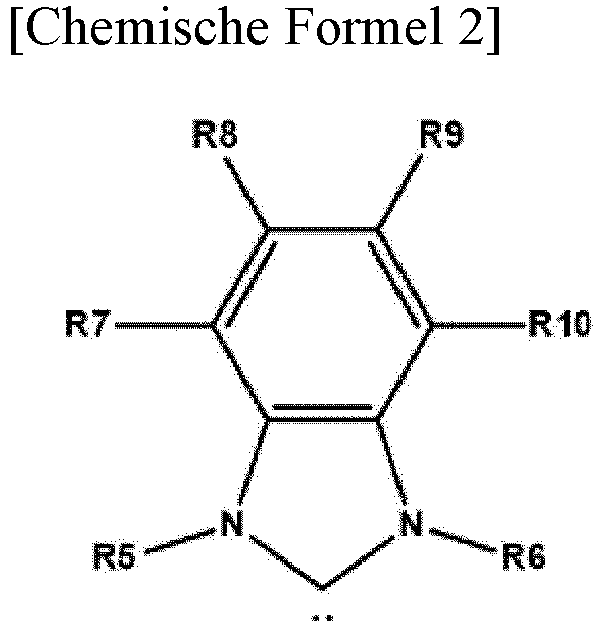 wobei, in den obigen Chemischen Formeln 1 und 2,R1, R2, R5 und R6 gleichartig sind oder sich voneinander unterscheiden, wobei sie jeweils auf unabhängige Weise für Wasserstoff, eine Alkylgruppe mit 1 bis 20 Kohlenstoffatomen, eine Cycloalkylgruppe mit 3 bis 20 Kohlenstoffatomen, eine Arylgruppe mit 6 bis 30 Kohlenstoffatomen oder eine Heteroarylgruppe mit 2 bis 30 Kohlenstoffatomen stehen,R3, R4, R7, R8, R9 and R10 gleichartig sind oder sich voneinander unterscheiden, wobei sie jeweils auf unabhängige Weise für Wasserstoff, eine Alkylgruppe mit 1 bis 20 Kohlenstoffatomen, eine Cycloalkylgruppe mit 3 bis 20 Kohlenstoffatomen, eine Arylgruppe mit 6 bis 30 Kohlenstoffatomen oder eine Heteroarylgruppe mit 2 bis 30 Kohlenstoffatomen oder eine Struktur gemäß der Darstellung in der folgenden Chemischen Formel 3 stehen, oder mindestens zwei Substituenten, die in R7 bis R10 miteinander benachbart sind, derart verbunden sind, dass sie einen Kohlenwasserstoffring bilden,mindestens einer von R3 und R4 eine Struktur gemäß der Darstellung in der folgenden Chemischen Formel 3 hat,mindestens einer von R7 bis R10 einer Struktur entspricht, wie sie in der folgenden Chemischen Formel 3 dargestellt ist, oder, wenn mindestens zwei Substituenten, die in R7 bis R10 miteinander benachbart sind, derart verbunden sind, dass sie den Kohlenwasserstoffring bilden, mindestens einer der Wasserstoffe, welche an die Kohlenstoffe gebunden sind, die den Kohlenwasserstoffring bilden, durch eine Struktur gemäß der Darstellung in der folgenden Chemischen Formel 3 ersetzt ist,
 wobei, in der obigen Chemischen Formel 3,n eine ganze Zahl von 1 bis 30 ist, wobei sie die Anzahl an Wiederholeinheiten in den Klammern angibt, undA für eine Alkylgruppe mit 1 bis 20 Kohlenstoffatomen, die Stickstoff(N)-Atome enthält, oder eine Heteroarylgruppe mit 2 bis 30 Kohlenstoffatomen steht, die Stickstoff(N)-Atome enthält.
 - Carbenverbindung nach Anspruch 1, wobei es sich bei der stickstoffhaltigen funktionellen Gruppe um mindestens eine handelt, die aus der Gesamtheit ausgewählt ist, welche aus Azid, Phthalimid und Amin besteht.
- Carbenverbindung nach Anspruch 1, wobei mindestens einer der R1 und R2 und mindestens einer der R5 und R6 gleichartig sind oder sich voneinander unterscheiden, wobei sie jeweils auf unabhängige Weise für eine Alkylgruppe mit 1 bis 20 Kohlenstoffatomen, eine Cycloalkylgruppe mit 3 bis 20 Kohlenstoffatomen, eine Arylgruppe mit 6 bis 30 Kohlenstoffatomen oder eine Heteroarylgruppe mit 2 bis 30 Kohlenstoffatomen stehen.
- Carben-Metallnanopartikel-Komplex, in welchem die Carbenverbindung nach einem beliebigen der Ansprüche 1 bis 3 an Metallnanopartikel bindet.
- Carben-Metallnanopartikel-Komplex nach Anspruch 4, wobei die Partikelgröße des Metallnanopartikels 1 nm bis 40 nm beträgt.
- Carben-Metallnanopartikel-Komplex nach Anspruch 4, wobei es sich bei dem Metall um ein beliebiges handelt, das aus der Gesamtheit ausgewählt ist, welche aus Kupfer (Cu), Kobalt (Co), Bismut (Bi), Silber (Ag), Aluminium (Al), Gold (Au), Hafnium (Hf), Chrom (Cr), Indium (In), Mangan (Mn), Molybdän (Mo), Magnesium (Mg), Nickel (Ni), Niob (Nb), Blei (Pb), Palladium (Pd), Platin (Pt), Rhenium (Re), Rhodium (Rh), Antimon (Sb), Tantal (Ta), Titan (Ti), Wolfram (W), Vanadium (V), Zirconium (Zr), Zink (Zn), Eisen (Fe) und deren Mischungen besteht.
- Verfahren zur Herstellung eines Carben-Nanopartikel-Komplexes, das Folgendes umfasst:Herstellen von Schwefel-Metallnanopartikeln, indem Polyethylenglykol, der an einem Ende eine Thiolgruppe und am anderen Ende eine stickstoffhaltige funktionelle Gruppe enthält, mit Metallnanopartikeln vermischt wird; undVermischen der Schwefel-Metallnanopartikel mit der Carbenverbindung nach einem beliebigen der Ansprüche 1 bis 3.
- Verfahren zur Herstellung des Carben-Metallnanopartikel-Komplexes nach Anspruch 7, wobei im Rahmen des Vermischens der Schwefel-Metallnanopartikel mit der Carbenverbindung die Metall-Schwefel-Bindungen, welche an den Oberflächen der Metallnanopartikel vorliegen, durch Metall-Carben-Bindungen ersetzt werden.
- Biosensor, der den Carben-Metallnanopartikel-Komplex nach Anspruch 4 umfasst, wobei daran ein Biosondenabschnitt mittels einer Click-Reaktion verankert ist.
Applications Claiming Priority (2)
| Application Number | Priority Date | Filing Date | Title |
|---|---|---|---|
| KR20180120648 | 2018-10-10 | ||
| PCT/KR2019/013314 WO2020076106A1 (ko) | 2018-10-10 | 2019-10-10 | 카벤 화합물, 카벤-금속나노입자 복합체 및 이의 제조방법 |
Publications (3)
| Publication Number | Publication Date |
|---|---|
| EP3865477A1 EP3865477A1 (de) | 2021-08-18 |
| EP3865477A4 EP3865477A4 (de) | 2021-11-17 |
| EP3865477B1 true EP3865477B1 (de) | 2023-07-12 |
Family
ID=70165052
Family Applications (1)
| Application Number | Title | Priority Date | Filing Date |
|---|---|---|---|
| EP19871674.8A Active EP3865477B1 (de) | 2018-10-10 | 2019-10-10 | Carbenverbindung, carben-metallnanopartikel-komplex und herstellungsverfahren dafür |
Country Status (6)
| Country | Link |
|---|---|
| US (1) | US12372519B2 (de) |
| EP (1) | EP3865477B1 (de) |
| JP (1) | JP7212409B2 (de) |
| KR (1) | KR102291885B1 (de) |
| CN (1) | CN113166072B (de) |
| WO (1) | WO2020076106A1 (de) |
Families Citing this family (2)
| Publication number | Priority date | Publication date | Assignee | Title |
|---|---|---|---|---|
| WO2022225347A1 (ko) * | 2021-04-22 | 2022-10-27 | 한국생명공학연구원 | 바이러스 수용체를 포함하는 그래핀 채널 부재, 이를 포함하는 센서 |
| WO2022235077A1 (ko) * | 2021-05-07 | 2022-11-10 | 한국생명공학연구원 | 신규 사이드로포어 화합물 및 이를 이용한 금속 나노입자 복합체 |
Family Cites Families (19)
| Publication number | Priority date | Publication date | Assignee | Title |
|---|---|---|---|---|
| DE19610908A1 (de) | 1996-03-20 | 1997-09-25 | Hoechst Ag | Verfahren zur Herstellung heterocyclischer Carbene |
| FR2859731B1 (fr) | 2003-09-16 | 2008-03-07 | Arkema | Compositions a base d'hydrocarbures fluores et de butanol secondaire pour le defluxage de cartes electroniques |
| US20060083694A1 (en) * | 2004-08-07 | 2006-04-20 | Cabot Corporation | Multi-component particles comprising inorganic nanoparticles distributed in an organic matrix and processes for making and using same |
| US7572912B2 (en) * | 2004-10-29 | 2009-08-11 | University Of Hong Kong | Luminescent gold (III) compounds, their preparation, and light-emitting devices containing same |
| WO2006053071A2 (en) | 2004-11-09 | 2006-05-18 | E.I. Dupont De Nemours And Company | Ring opening polymerization of cyclic amides using n-heterocyclic carbene catalysts |
| US7951744B2 (en) * | 2006-01-27 | 2011-05-31 | Southern Illinois University Carbondale | Nano-reagents with cooperative catalysis and their uses in multiple phase reactions |
| WO2009126649A2 (en) * | 2008-04-07 | 2009-10-15 | Life Bioscience, Inc. | Method of providing particles having biological-binding areas for biological applications |
| KR101462653B1 (ko) | 2008-05-20 | 2014-11-17 | 삼성전자 주식회사 | 카르벤 유도체를 이용한 나노입자 제조방법 |
| US9173943B2 (en) * | 2009-01-12 | 2015-11-03 | The Regents Of The University Of California | Imprinted polymer nanoparticles |
| US9410949B2 (en) * | 2010-12-03 | 2016-08-09 | Washington University In St. Louis | Label-free detection of renal cancer |
| US20120244075A1 (en) * | 2011-03-24 | 2012-09-27 | Nanoprobes, Inc. | 5 NM Nickel-NTA-Gold Nanoparticles |
| US8853239B2 (en) * | 2011-12-09 | 2014-10-07 | Boehringer Ingelheim International Gmbh | Compounds, pharmaceutical compositions and uses thereof |
| US8828984B2 (en) * | 2012-11-19 | 2014-09-09 | The University Of Hong Kong | Gold(III) complexes containing N-heterocyclic carbene ligand, synthesis, and their applications in cancer treatment and thiol detection |
| SG11201601199QA (en) | 2013-08-19 | 2016-03-30 | Univ Kingston | Carbene-functionalized composite materials |
| WO2016004324A1 (en) | 2014-07-02 | 2016-01-07 | University Of Florida Research Foundation, Inc. | Aptamer conjugates with n-heterocyclic carbene metal complexes for targeted drug delivery |
| EP3331860B1 (de) * | 2015-08-07 | 2019-07-17 | Boehringer Ingelheim International GmbH | Indanylaminopyridylcyclopropancarbonsäuren, pharmazeutische zusammensetzungen daraus und verwendungen davon |
| US11008291B2 (en) * | 2015-11-06 | 2021-05-18 | Queen's University At Kingston | Methods of forming carbene-functionalized composite materials |
| WO2019083342A1 (ko) | 2017-10-27 | 2019-05-02 | 한국생명공학연구원 | 기능화된 n-헤테로사이클릭 카벤 화합물을 포함하는 그래핀 트랜지스터 및 그 제조방법, 이를 포함하는 바이오 센서 |
| KR102084088B1 (ko) | 2018-03-12 | 2020-03-04 | 한국기초과학지원연구원 | 지카 바이러스 검출용 센서 및 이의 제조방법 |
-
2019
- 2019-10-10 EP EP19871674.8A patent/EP3865477B1/de active Active
- 2019-10-10 CN CN201980079045.3A patent/CN113166072B/zh active Active
- 2019-10-10 WO PCT/KR2019/013314 patent/WO2020076106A1/ko not_active Ceased
- 2019-10-10 KR KR1020190125410A patent/KR102291885B1/ko active Active
- 2019-10-10 US US17/284,249 patent/US12372519B2/en active Active
- 2019-10-10 JP JP2021520142A patent/JP7212409B2/ja active Active
Also Published As
| Publication number | Publication date |
|---|---|
| CN113166072B (zh) | 2024-09-03 |
| EP3865477A4 (de) | 2021-11-17 |
| KR20200040688A (ko) | 2020-04-20 |
| WO2020076106A1 (ko) | 2020-04-16 |
| EP3865477A1 (de) | 2021-08-18 |
| US12372519B2 (en) | 2025-07-29 |
| US20210356461A1 (en) | 2021-11-18 |
| JP2022502470A (ja) | 2022-01-11 |
| KR102291885B1 (ko) | 2021-08-23 |
| CN113166072A (zh) | 2021-07-23 |
| JP7212409B2 (ja) | 2023-01-25 |
Similar Documents
| Publication | Publication Date | Title |
|---|---|---|
| Heinecke et al. | Structural and theoretical basis for ligand exchange on thiolate monolayer protected gold nanoclusters | |
| EP2286234B1 (de) | Neuer au-ag-kern-hülle-verbundstoff für biosensor | |
| Si et al. | Tryptophan‐based peptides to synthesize gold and silver nanoparticles: a mechanistic and kinetic study | |
| Kennedy et al. | Chromophore containing bipyridyl ligands. Part 1: supramolecular solid-state structure of Ag (I) complexes | |
| Qasem et al. | Development of tripodal imine metal chelates: Synthesis, physicochemical inspection, theoretical studies and biomedical evaluation | |
| Talukder et al. | End-to-end single cyanato and thiocyanato bridged Cu (II) polymers with a new tridentate Schiff base ligand: Crystal structure and magnetic properties | |
| Das et al. | Fluorescent indicator displacement assay: ultrasensitive detection of glutathione and selective cancer cell imaging | |
| Panja et al. | Solvent-triggered cis/trans isomerism in cobalt dioxolene chemistry: Distinguishing effects of packing on valence tautomerism | |
| US12372519B2 (en) | Carbene compound, carbene-metal nanoparticle complex and preparation method thereof | |
| WO2006087950A1 (ja) | プルシアンブルー型金属錯体超微粒子、その分散液、及びそれらの製造方法 | |
| Al Shehab et al. | Curcumin mediated PEG thiol acid conjugated gold nanoparticles for the determination of melamine | |
| Xu et al. | Structural and photophysical studies on geometric (Er2Yb2/Yb2Er2) and configurational (EuTb3/Eu3Tb) isomers of heterotetranuclear lanthanide (III) complexes | |
| Kalaivani et al. | Photophysical properties and in vitro cytotoxicity studies of new Ru (II) carbonyl complexes and mixed geometrical Ru (II)–Ni (II) complex in HS-DNA/BSA protein and human lung (A549) and liver (HepG2) cells | |
| US20210395606A1 (en) | Chromophoric structures for macrocyclic lanthanide chelates | |
| JP2019507161A (ja) | 有機金属複合体用多方向性リガンド | |
| Mertens et al. | Revisiting the reactivity of tetrachloroauric acid with N, N-bidentate ligands: structural and spectroscopic insights | |
| Hurtubise et al. | Multimetallic complexes and functionalized nanoparticles based on unsymmetrical dithiocarbamate ligands with allyl and propargyl functionality | |
| US7803568B2 (en) | Carbodithioate ligands for nanotechnology and biosensing applications | |
| CN106243135B (zh) | 一种叠氮酸锌‑8‑氨基喹啉席夫碱配合物及其制备方法 | |
| Phonsri et al. | Spin crossover in mixed ligand iron (III) complexes | |
| JPWO2006059664A1 (ja) | 安定化無機ナノ粒子、安定化無機ナノ粒子群、安定化無機ナノ粒子の製造方法及び安定化無機ナノ粒子の利用方法 | |
| Todorović et al. | Synthesis and characterization of Zn (II) and Cd (II) complexes with 2, 6-diacetylpyridine-bis (selenosemicarbazone). Crystal structure of a Ni (II) complex with a modified 2, 6-diacetylpyridine-bis (selenosemicarbazone) | |
| Ferrari et al. | Synthesis, characterization, crystal structure and luminescence properties of phosphinic silver (I) complexes with thiourea derivatives | |
| Samy et al. | Synthesis and spectroscopic characterization of dimer, mono-and bi-nuclear copper complexes of 2-[α-(acetyloxime) ethylidenehydrazino]-4, 6-dimethylquinoline | |
| Duan et al. | Synthesis, Crystal Structure and Fluorescent Property of Cis-bis [N, N-diethyl-N'-(p-nitrobenzoyl) thiourea-kS, O] Platinum (II) Complex |
Legal Events
| Date | Code | Title | Description |
|---|---|---|---|
| STAA | Information on the status of an ep patent application or granted ep patent |
Free format text: STATUS: THE INTERNATIONAL PUBLICATION HAS BEEN MADE |
|
| PUAI | Public reference made under article 153(3) epc to a published international application that has entered the european phase |
Free format text: ORIGINAL CODE: 0009012 |
|
| STAA | Information on the status of an ep patent application or granted ep patent |
Free format text: STATUS: REQUEST FOR EXAMINATION WAS MADE |
|
| 17P | Request for examination filed |
Effective date: 20210422 |
|
| AK | Designated contracting states |
Kind code of ref document: A1 Designated state(s): AL AT BE BG CH CY CZ DE DK EE ES FI FR GB GR HR HU IE IS IT LI LT LU LV MC MK MT NL NO PL PT RO RS SE SI SK SM TR |
|
| A4 | Supplementary search report drawn up and despatched |
Effective date: 20211019 |
|
| RIC1 | Information provided on ipc code assigned before grant |
Ipc: G01N 33/553 20060101ALI20211013BHEP Ipc: G01N 33/543 20060101ALI20211013BHEP Ipc: C07D 235/04 20060101ALI20211013BHEP Ipc: C07D 233/04 20060101AFI20211013BHEP |
|
| DAV | Request for validation of the european patent (deleted) | ||
| DAX | Request for extension of the european patent (deleted) | ||
| STAA | Information on the status of an ep patent application or granted ep patent |
Free format text: STATUS: EXAMINATION IS IN PROGRESS |
|
| 17Q | First examination report despatched |
Effective date: 20220816 |
|
| GRAP | Despatch of communication of intention to grant a patent |
Free format text: ORIGINAL CODE: EPIDOSNIGR1 |
|
| STAA | Information on the status of an ep patent application or granted ep patent |
Free format text: STATUS: GRANT OF PATENT IS INTENDED |
|
| INTG | Intention to grant announced |
Effective date: 20230215 |
|
| GRAS | Grant fee paid |
Free format text: ORIGINAL CODE: EPIDOSNIGR3 |
|
| GRAA | (expected) grant |
Free format text: ORIGINAL CODE: 0009210 |
|
| STAA | Information on the status of an ep patent application or granted ep patent |
Free format text: STATUS: THE PATENT HAS BEEN GRANTED |
|
| AK | Designated contracting states |
Kind code of ref document: B1 Designated state(s): AL AT BE BG CH CY CZ DE DK EE ES FI FR GB GR HR HU IE IS IT LI LT LU LV MC MK MT NL NO PL PT RO RS SE SI SK SM TR |
|
| REG | Reference to a national code |
Ref country code: CH Ref legal event code: EP |
|
| REG | Reference to a national code |
Ref country code: IE Ref legal event code: FG4D |
|
| REG | Reference to a national code |
Ref country code: DE Ref legal event code: R096 Ref document number: 602019032790 Country of ref document: DE |
|
| REG | Reference to a national code |
Ref country code: LT Ref legal event code: MG9D |
|
| REG | Reference to a national code |
Ref country code: NL Ref legal event code: MP Effective date: 20230712 |
|
| REG | Reference to a national code |
Ref country code: AT Ref legal event code: MK05 Ref document number: 1587021 Country of ref document: AT Kind code of ref document: T Effective date: 20230712 |
|
| PG25 | Lapsed in a contracting state [announced via postgrant information from national office to epo] |
Ref country code: NL Free format text: LAPSE BECAUSE OF FAILURE TO SUBMIT A TRANSLATION OF THE DESCRIPTION OR TO PAY THE FEE WITHIN THE PRESCRIBED TIME-LIMIT Effective date: 20230712 |
|
| PG25 | Lapsed in a contracting state [announced via postgrant information from national office to epo] |
Ref country code: GR Free format text: LAPSE BECAUSE OF FAILURE TO SUBMIT A TRANSLATION OF THE DESCRIPTION OR TO PAY THE FEE WITHIN THE PRESCRIBED TIME-LIMIT Effective date: 20231013 |
|
| PG25 | Lapsed in a contracting state [announced via postgrant information from national office to epo] |
Ref country code: ES Free format text: LAPSE BECAUSE OF FAILURE TO SUBMIT A TRANSLATION OF THE DESCRIPTION OR TO PAY THE FEE WITHIN THE PRESCRIBED TIME-LIMIT Effective date: 20230712 |
|
| PG25 | Lapsed in a contracting state [announced via postgrant information from national office to epo] |
Ref country code: IS Free format text: LAPSE BECAUSE OF FAILURE TO SUBMIT A TRANSLATION OF THE DESCRIPTION OR TO PAY THE FEE WITHIN THE PRESCRIBED TIME-LIMIT Effective date: 20231112 |
|
| PG25 | Lapsed in a contracting state [announced via postgrant information from national office to epo] |
Ref country code: SE Free format text: LAPSE BECAUSE OF FAILURE TO SUBMIT A TRANSLATION OF THE DESCRIPTION OR TO PAY THE FEE WITHIN THE PRESCRIBED TIME-LIMIT Effective date: 20230712 Ref country code: RS Free format text: LAPSE BECAUSE OF FAILURE TO SUBMIT A TRANSLATION OF THE DESCRIPTION OR TO PAY THE FEE WITHIN THE PRESCRIBED TIME-LIMIT Effective date: 20230712 Ref country code: PT Free format text: LAPSE BECAUSE OF FAILURE TO SUBMIT A TRANSLATION OF THE DESCRIPTION OR TO PAY THE FEE WITHIN THE PRESCRIBED TIME-LIMIT Effective date: 20231113 Ref country code: NO Free format text: LAPSE BECAUSE OF FAILURE TO SUBMIT A TRANSLATION OF THE DESCRIPTION OR TO PAY THE FEE WITHIN THE PRESCRIBED TIME-LIMIT Effective date: 20231012 Ref country code: LV Free format text: LAPSE BECAUSE OF FAILURE TO SUBMIT A TRANSLATION OF THE DESCRIPTION OR TO PAY THE FEE WITHIN THE PRESCRIBED TIME-LIMIT Effective date: 20230712 Ref country code: LT Free format text: LAPSE BECAUSE OF FAILURE TO SUBMIT A TRANSLATION OF THE DESCRIPTION OR TO PAY THE FEE WITHIN THE PRESCRIBED TIME-LIMIT Effective date: 20230712 Ref country code: IS Free format text: LAPSE BECAUSE OF FAILURE TO SUBMIT A TRANSLATION OF THE DESCRIPTION OR TO PAY THE FEE WITHIN THE PRESCRIBED TIME-LIMIT Effective date: 20231112 Ref country code: HR Free format text: LAPSE BECAUSE OF FAILURE TO SUBMIT A TRANSLATION OF THE DESCRIPTION OR TO PAY THE FEE WITHIN THE PRESCRIBED TIME-LIMIT Effective date: 20230712 Ref country code: GR Free format text: LAPSE BECAUSE OF FAILURE TO SUBMIT A TRANSLATION OF THE DESCRIPTION OR TO PAY THE FEE WITHIN THE PRESCRIBED TIME-LIMIT Effective date: 20231013 Ref country code: FI Free format text: LAPSE BECAUSE OF FAILURE TO SUBMIT A TRANSLATION OF THE DESCRIPTION OR TO PAY THE FEE WITHIN THE PRESCRIBED TIME-LIMIT Effective date: 20230712 Ref country code: ES Free format text: LAPSE BECAUSE OF FAILURE TO SUBMIT A TRANSLATION OF THE DESCRIPTION OR TO PAY THE FEE WITHIN THE PRESCRIBED TIME-LIMIT Effective date: 20230712 Ref country code: AT Free format text: LAPSE BECAUSE OF FAILURE TO SUBMIT A TRANSLATION OF THE DESCRIPTION OR TO PAY THE FEE WITHIN THE PRESCRIBED TIME-LIMIT Effective date: 20230712 |
|
| PG25 | Lapsed in a contracting state [announced via postgrant information from national office to epo] |
Ref country code: PL Free format text: LAPSE BECAUSE OF FAILURE TO SUBMIT A TRANSLATION OF THE DESCRIPTION OR TO PAY THE FEE WITHIN THE PRESCRIBED TIME-LIMIT Effective date: 20230712 |
|
| REG | Reference to a national code |
Ref country code: DE Ref legal event code: R097 Ref document number: 602019032790 Country of ref document: DE |
|
| PG25 | Lapsed in a contracting state [announced via postgrant information from national office to epo] |
Ref country code: SM Free format text: LAPSE BECAUSE OF FAILURE TO SUBMIT A TRANSLATION OF THE DESCRIPTION OR TO PAY THE FEE WITHIN THE PRESCRIBED TIME-LIMIT Effective date: 20230712 Ref country code: RO Free format text: LAPSE BECAUSE OF FAILURE TO SUBMIT A TRANSLATION OF THE DESCRIPTION OR TO PAY THE FEE WITHIN THE PRESCRIBED TIME-LIMIT Effective date: 20230712 Ref country code: EE Free format text: LAPSE BECAUSE OF FAILURE TO SUBMIT A TRANSLATION OF THE DESCRIPTION OR TO PAY THE FEE WITHIN THE PRESCRIBED TIME-LIMIT Effective date: 20230712 Ref country code: DK Free format text: LAPSE BECAUSE OF FAILURE TO SUBMIT A TRANSLATION OF THE DESCRIPTION OR TO PAY THE FEE WITHIN THE PRESCRIBED TIME-LIMIT Effective date: 20230712 Ref country code: CZ Free format text: LAPSE BECAUSE OF FAILURE TO SUBMIT A TRANSLATION OF THE DESCRIPTION OR TO PAY THE FEE WITHIN THE PRESCRIBED TIME-LIMIT Effective date: 20230712 Ref country code: SK Free format text: LAPSE BECAUSE OF FAILURE TO SUBMIT A TRANSLATION OF THE DESCRIPTION OR TO PAY THE FEE WITHIN THE PRESCRIBED TIME-LIMIT Effective date: 20230712 |
|
| PLBE | No opposition filed within time limit |
Free format text: ORIGINAL CODE: 0009261 |
|
| STAA | Information on the status of an ep patent application or granted ep patent |
Free format text: STATUS: NO OPPOSITION FILED WITHIN TIME LIMIT |
|
| PG25 | Lapsed in a contracting state [announced via postgrant information from national office to epo] |
Ref country code: IT Free format text: LAPSE BECAUSE OF FAILURE TO SUBMIT A TRANSLATION OF THE DESCRIPTION OR TO PAY THE FEE WITHIN THE PRESCRIBED TIME-LIMIT Effective date: 20230712 Ref country code: MC Free format text: LAPSE BECAUSE OF FAILURE TO SUBMIT A TRANSLATION OF THE DESCRIPTION OR TO PAY THE FEE WITHIN THE PRESCRIBED TIME-LIMIT Effective date: 20230712 |
|
| REG | Reference to a national code |
Ref country code: CH Ref legal event code: PL |
|
| REG | Reference to a national code |
Ref country code: BE Ref legal event code: MM Effective date: 20231031 |
|
| 26N | No opposition filed |
Effective date: 20240415 |
|
| PG25 | Lapsed in a contracting state [announced via postgrant information from national office to epo] |
Ref country code: LU Free format text: LAPSE BECAUSE OF NON-PAYMENT OF DUE FEES Effective date: 20231010 |
|
| PG25 | Lapsed in a contracting state [announced via postgrant information from national office to epo] |
Ref country code: LU Free format text: LAPSE BECAUSE OF NON-PAYMENT OF DUE FEES Effective date: 20231010 |
|
| PG25 | Lapsed in a contracting state [announced via postgrant information from national office to epo] |
Ref country code: CH Free format text: LAPSE BECAUSE OF NON-PAYMENT OF DUE FEES Effective date: 20231031 |
|
| PG25 | Lapsed in a contracting state [announced via postgrant information from national office to epo] |
Ref country code: CH Free format text: LAPSE BECAUSE OF NON-PAYMENT OF DUE FEES Effective date: 20231031 Ref country code: SI Free format text: LAPSE BECAUSE OF FAILURE TO SUBMIT A TRANSLATION OF THE DESCRIPTION OR TO PAY THE FEE WITHIN THE PRESCRIBED TIME-LIMIT Effective date: 20230712 |
|
| PG25 | Lapsed in a contracting state [announced via postgrant information from national office to epo] |
Ref country code: BE Free format text: LAPSE BECAUSE OF NON-PAYMENT OF DUE FEES Effective date: 20231031 |
|
| PG25 | Lapsed in a contracting state [announced via postgrant information from national office to epo] |
Ref country code: IE Free format text: LAPSE BECAUSE OF NON-PAYMENT OF DUE FEES Effective date: 20231010 |
|
| PG25 | Lapsed in a contracting state [announced via postgrant information from national office to epo] |
Ref country code: IE Free format text: LAPSE BECAUSE OF NON-PAYMENT OF DUE FEES Effective date: 20231010 |
|
| PG25 | Lapsed in a contracting state [announced via postgrant information from national office to epo] |
Ref country code: BG Free format text: LAPSE BECAUSE OF FAILURE TO SUBMIT A TRANSLATION OF THE DESCRIPTION OR TO PAY THE FEE WITHIN THE PRESCRIBED TIME-LIMIT Effective date: 20230712 |
|
| PG25 | Lapsed in a contracting state [announced via postgrant information from national office to epo] |
Ref country code: BG Free format text: LAPSE BECAUSE OF FAILURE TO SUBMIT A TRANSLATION OF THE DESCRIPTION OR TO PAY THE FEE WITHIN THE PRESCRIBED TIME-LIMIT Effective date: 20230712 |
|
| PG25 | Lapsed in a contracting state [announced via postgrant information from national office to epo] |
Ref country code: CY Free format text: LAPSE BECAUSE OF FAILURE TO SUBMIT A TRANSLATION OF THE DESCRIPTION OR TO PAY THE FEE WITHIN THE PRESCRIBED TIME-LIMIT; INVALID AB INITIO Effective date: 20191010 |
|
| PG25 | Lapsed in a contracting state [announced via postgrant information from national office to epo] |
Ref country code: HU Free format text: LAPSE BECAUSE OF FAILURE TO SUBMIT A TRANSLATION OF THE DESCRIPTION OR TO PAY THE FEE WITHIN THE PRESCRIBED TIME-LIMIT; INVALID AB INITIO Effective date: 20191010 |
|
| PGFP | Annual fee paid to national office [announced via postgrant information from national office to epo] |
Ref country code: GB Payment date: 20250904 Year of fee payment: 7 |
|
| PGFP | Annual fee paid to national office [announced via postgrant information from national office to epo] |
Ref country code: FR Payment date: 20250908 Year of fee payment: 7 |
|
| PG25 | Lapsed in a contracting state [announced via postgrant information from national office to epo] |
Ref country code: TR Free format text: LAPSE BECAUSE OF FAILURE TO SUBMIT A TRANSLATION OF THE DESCRIPTION OR TO PAY THE FEE WITHIN THE PRESCRIBED TIME-LIMIT Effective date: 20230712 |
|
| PGFP | Annual fee paid to national office [announced via postgrant information from national office to epo] |
Ref country code: DE Payment date: 20250902 Year of fee payment: 7 |
|
| REG | Reference to a national code |
Ref country code: DE Ref legal event code: R082 Ref document number: 602019032790 Country of ref document: DE Representative=s name: VUILLERMOZ, BRUNO, FR |