EP3858684B1 - Aufgeweitetes rohr für eine kraftfahrzeug-crashbox und zugehöriges herstellungsverfahren - Google Patents
Aufgeweitetes rohr für eine kraftfahrzeug-crashbox und zugehöriges herstellungsverfahren Download PDFInfo
- Publication number
- EP3858684B1 EP3858684B1 EP20154182.8A EP20154182A EP3858684B1 EP 3858684 B1 EP3858684 B1 EP 3858684B1 EP 20154182 A EP20154182 A EP 20154182A EP 3858684 B1 EP3858684 B1 EP 3858684B1
- Authority
- EP
- European Patent Office
- Prior art keywords
- crash box
- tube
- zones
- expanded
- motor vehicle
- Prior art date
- Legal status (The legal status is an assumption and is not a legal conclusion. Google has not performed a legal analysis and makes no representation as to the accuracy of the status listed.)
- Active
Links
Images


Classifications
-
- B—PERFORMING OPERATIONS; TRANSPORTING
- B21—MECHANICAL METAL-WORKING WITHOUT ESSENTIALLY REMOVING MATERIAL; PUNCHING METAL
- B21C—MANUFACTURE OF METAL SHEETS, WIRE, RODS, TUBES, PROFILES OR LIKE SEMI-MANUFACTURED PRODUCTS OTHERWISE THAN BY ROLLING; AUXILIARY OPERATIONS USED IN CONNECTION WITH METAL-WORKING WITHOUT ESSENTIALLY REMOVING MATERIAL
- B21C37/00—Manufacture of metal sheets, rods, wire, tubes, profiles or like semi-manufactured products, not otherwise provided for; Manufacture of tubes of special shape
- B21C37/06—Manufacture of metal sheets, rods, wire, tubes, profiles or like semi-manufactured products, not otherwise provided for; Manufacture of tubes of special shape of tubes or metal hoses; Combined procedures for making tubes, e.g. for making multi-wall tubes
- B21C37/08—Making tubes with welded or soldered seams
-
- B—PERFORMING OPERATIONS; TRANSPORTING
- B21—MECHANICAL METAL-WORKING WITHOUT ESSENTIALLY REMOVING MATERIAL; PUNCHING METAL
- B21D—WORKING OR PROCESSING OF SHEET METAL OR METAL TUBES, RODS OR PROFILES WITHOUT ESSENTIALLY REMOVING MATERIAL; PUNCHING METAL
- B21D41/00—Application of procedures in order to alter the diameter of tube ends
- B21D41/02—Enlarging
-
- B—PERFORMING OPERATIONS; TRANSPORTING
- B60—VEHICLES IN GENERAL
- B60R—VEHICLES, VEHICLE FITTINGS, OR VEHICLE PARTS, NOT OTHERWISE PROVIDED FOR
- B60R19/00—Wheel guards; Radiator guards, e.g. grilles; Obstruction removers; Fittings damping bouncing force in collisions
- B60R19/02—Bumpers, i.e. impact receiving or absorbing members for protecting vehicles or fending off blows from other vehicles or objects
- B60R19/03—Bumpers, i.e. impact receiving or absorbing members for protecting vehicles or fending off blows from other vehicles or objects characterised by material, e.g. composite
-
- B—PERFORMING OPERATIONS; TRANSPORTING
- B60—VEHICLES IN GENERAL
- B60R—VEHICLES, VEHICLE FITTINGS, OR VEHICLE PARTS, NOT OTHERWISE PROVIDED FOR
- B60R19/00—Wheel guards; Radiator guards, e.g. grilles; Obstruction removers; Fittings damping bouncing force in collisions
- B60R19/02—Bumpers, i.e. impact receiving or absorbing members for protecting vehicles or fending off blows from other vehicles or objects
- B60R19/24—Arrangements for mounting bumpers on vehicles
- B60R19/26—Arrangements for mounting bumpers on vehicles comprising yieldable mounting means
- B60R19/34—Arrangements for mounting bumpers on vehicles comprising yieldable mounting means destroyed upon impact, e.g. one-shot type
-
- C—CHEMISTRY; METALLURGY
- C21—METALLURGY OF IRON
- C21D—MODIFYING THE PHYSICAL STRUCTURE OF FERROUS METALS; GENERAL DEVICES FOR HEAT TREATMENT OF FERROUS OR NON-FERROUS METALS OR ALLOYS; MAKING METAL MALLEABLE, e.g. BY DECARBURISATION OR TEMPERING
- C21D6/00—Heat treatment of ferrous alloys
- C21D6/002—Heat treatment of ferrous alloys containing Cr
-
- C—CHEMISTRY; METALLURGY
- C21—METALLURGY OF IRON
- C21D—MODIFYING THE PHYSICAL STRUCTURE OF FERROUS METALS; GENERAL DEVICES FOR HEAT TREATMENT OF FERROUS OR NON-FERROUS METALS OR ALLOYS; MAKING METAL MALLEABLE, e.g. BY DECARBURISATION OR TEMPERING
- C21D7/00—Modifying the physical properties of iron or steel by deformation
- C21D7/02—Modifying the physical properties of iron or steel by deformation by cold working
- C21D7/10—Modifying the physical properties of iron or steel by deformation by cold working of the whole cross-section, e.g. of concrete reinforcing bars
- C21D7/12—Modifying the physical properties of iron or steel by deformation by cold working of the whole cross-section, e.g. of concrete reinforcing bars by expanding tubular bodies
-
- C—CHEMISTRY; METALLURGY
- C21—METALLURGY OF IRON
- C21D—MODIFYING THE PHYSICAL STRUCTURE OF FERROUS METALS; GENERAL DEVICES FOR HEAT TREATMENT OF FERROUS OR NON-FERROUS METALS OR ALLOYS; MAKING METAL MALLEABLE, e.g. BY DECARBURISATION OR TEMPERING
- C21D9/00—Heat treatment, e.g. annealing, hardening, quenching or tempering, adapted for particular articles; Furnaces therefor
- C21D9/08—Heat treatment, e.g. annealing, hardening, quenching or tempering, adapted for particular articles; Furnaces therefor for tubular bodies or pipes
-
- C—CHEMISTRY; METALLURGY
- C21—METALLURGY OF IRON
- C21D—MODIFYING THE PHYSICAL STRUCTURE OF FERROUS METALS; GENERAL DEVICES FOR HEAT TREATMENT OF FERROUS OR NON-FERROUS METALS OR ALLOYS; MAKING METAL MALLEABLE, e.g. BY DECARBURISATION OR TEMPERING
- C21D9/00—Heat treatment, e.g. annealing, hardening, quenching or tempering, adapted for particular articles; Furnaces therefor
- C21D9/50—Heat treatment, e.g. annealing, hardening, quenching or tempering, adapted for particular articles; Furnaces therefor for welded joints
-
- F—MECHANICAL ENGINEERING; LIGHTING; HEATING; WEAPONS; BLASTING
- F16—ENGINEERING ELEMENTS AND UNITS; GENERAL MEASURES FOR PRODUCING AND MAINTAINING EFFECTIVE FUNCTIONING OF MACHINES OR INSTALLATIONS; THERMAL INSULATION IN GENERAL
- F16F—SPRINGS; SHOCK-ABSORBERS; MEANS FOR DAMPING VIBRATION
- F16F7/00—Vibration-dampers; Shock-absorbers
- F16F7/12—Vibration-dampers; Shock-absorbers using plastic deformation of members
-
- F—MECHANICAL ENGINEERING; LIGHTING; HEATING; WEAPONS; BLASTING
- F16—ENGINEERING ELEMENTS AND UNITS; GENERAL MEASURES FOR PRODUCING AND MAINTAINING EFFECTIVE FUNCTIONING OF MACHINES OR INSTALLATIONS; THERMAL INSULATION IN GENERAL
- F16F—SPRINGS; SHOCK-ABSORBERS; MEANS FOR DAMPING VIBRATION
- F16F7/00—Vibration-dampers; Shock-absorbers
- F16F7/12—Vibration-dampers; Shock-absorbers using plastic deformation of members
- F16F7/125—Units with a telescopic-like action as one member moves into, or out of a second member
-
- B—PERFORMING OPERATIONS; TRANSPORTING
- B21—MECHANICAL METAL-WORKING WITHOUT ESSENTIALLY REMOVING MATERIAL; PUNCHING METAL
- B21C—MANUFACTURE OF METAL SHEETS, WIRE, RODS, TUBES, PROFILES OR LIKE SEMI-MANUFACTURED PRODUCTS OTHERWISE THAN BY ROLLING; AUXILIARY OPERATIONS USED IN CONNECTION WITH METAL-WORKING WITHOUT ESSENTIALLY REMOVING MATERIAL
- B21C37/00—Manufacture of metal sheets, rods, wire, tubes, profiles or like semi-manufactured products, not otherwise provided for; Manufacture of tubes of special shape
- B21C37/06—Manufacture of metal sheets, rods, wire, tubes, profiles or like semi-manufactured products, not otherwise provided for; Manufacture of tubes of special shape of tubes or metal hoses; Combined procedures for making tubes, e.g. for making multi-wall tubes
- B21C37/08—Making tubes with welded or soldered seams
- B21C37/0803—Making tubes with welded or soldered seams the tubes having a special shape, e.g. polygonal tubes
-
- B—PERFORMING OPERATIONS; TRANSPORTING
- B21—MECHANICAL METAL-WORKING WITHOUT ESSENTIALLY REMOVING MATERIAL; PUNCHING METAL
- B21C—MANUFACTURE OF METAL SHEETS, WIRE, RODS, TUBES, PROFILES OR LIKE SEMI-MANUFACTURED PRODUCTS OTHERWISE THAN BY ROLLING; AUXILIARY OPERATIONS USED IN CONNECTION WITH METAL-WORKING WITHOUT ESSENTIALLY REMOVING MATERIAL
- B21C37/00—Manufacture of metal sheets, rods, wire, tubes, profiles or like semi-manufactured products, not otherwise provided for; Manufacture of tubes of special shape
- B21C37/06—Manufacture of metal sheets, rods, wire, tubes, profiles or like semi-manufactured products, not otherwise provided for; Manufacture of tubes of special shape of tubes or metal hoses; Combined procedures for making tubes, e.g. for making multi-wall tubes
- B21C37/15—Making tubes of special shape; Making tube fittings
- B21C37/16—Making tubes with varying diameter in longitudinal direction
-
- C—CHEMISTRY; METALLURGY
- C21—METALLURGY OF IRON
- C21D—MODIFYING THE PHYSICAL STRUCTURE OF FERROUS METALS; GENERAL DEVICES FOR HEAT TREATMENT OF FERROUS OR NON-FERROUS METALS OR ALLOYS; MAKING METAL MALLEABLE, e.g. BY DECARBURISATION OR TEMPERING
- C21D2211/00—Microstructure comprising significant phases
- C21D2211/001—Austenite
-
- C—CHEMISTRY; METALLURGY
- C21—METALLURGY OF IRON
- C21D—MODIFYING THE PHYSICAL STRUCTURE OF FERROUS METALS; GENERAL DEVICES FOR HEAT TREATMENT OF FERROUS OR NON-FERROUS METALS OR ALLOYS; MAKING METAL MALLEABLE, e.g. BY DECARBURISATION OR TEMPERING
- C21D2221/00—Treating localised areas of an article
Definitions
- the present invention relates to a motor vehicle crash box with a working direction in the longitudinal axis of the motor vehicle.
- the present invention further relates to the manufacturing method of such a component.
- State-of-the-art motor vehicles are equipped at each end of their length or longest dimension (front and rear ends) with energy absorption elements as crash-protection parts.
- Such elements are called crash-management systems or bumper systems and are typically attached to one another by one cross member connected with two state-of-the-art crash boxes, which in turn are connected with the car body construction.
- the crash boxes absorb kinetic crash energy during an impact.
- the crash boxes are irreversibly plasticly deformed by compressing or folding. As a result, the car body itself should be protected without any structural damage or distortion.
- the component crash box as one part of the motor vehicle typically has different, partially seemingly contrary properties like enabling high crash-safety while at the same time being light in weight to reduce fuel consumption and thereby reduce CO 2 emissions, and being cost-effective. Moreover, the crash box provides protection to pedestrians. Further requirements for this component are easy assembly with the neighboring parts, optimal space utilization and the component should be easily replaceable after an impact.
- the "Research Council for Automobile Repairs" developed a test scenario called RCAR crash test to evaluate damage and repairing costs after rear-impact crashes and collisions at lower speed levels. The result of such tests has a direct influence on the insurance rating of passenger vehicles and is therefore of considerable interest to end-users.
- Circular and polygonal tubes as well as modular designs with multi-chamber profiles or box-shape constructions which can be conically tapered in the longitudinal direction of the component. While homogeneous tube profiles provide constant force absorption, the resistance against cross-forces and bending torque is lower than for profiles of other geometries. Tubes present the easiest producible and therefore most cost-effective geometry for crash boxes.
- US patent application publication US2017113638A1 describes a cross member which is made of light metal alloy and configured as a hollow profile to define an interior space and which has a top beam and a bottom beam, with the top beam and/or bottom beam having a recess defined by a marginal area in the form of a collar oriented into an interior space of the cross member.
- a crash box Arranged at an end of the cross member is a crash box formed with a flange sized to overlap at least one region of the cross member in motor vehicle longitudinal direction.
- a spacer is arranged in the interior space of the cross member and has a chamfer for formfitting engagement by the collar.
- a fastener is configured for passage of the recess and thereby extending in a motor vehicle vertical direction through the flange of each crash box and the spacer.
- Japanese patent application JP 2011 011661 A describes a cylindrical shock absorbing member that absorbs shock energy by collapse deformation using a load working upon collision of an automobile.
- the shock absorbing member has a straight cylindrical portion with an inside diameter which is formed to be substantially uniform, a tapered cylindrical portion formed in a tapered shape, an end of which has an outside diameter different from an outside diameter of the other end, and an intermediate cylindrical portion that is interposed between the other ends of the straight cylindrical portion and the tapered cylindrical portion so that both are coaxially connected to each other.
- US patent application publication 2013119705A1 discloses a crash box system in which a multiple chamber profile is used with the integration of an additional support element as well as a fastening profile. Also the integration of weakening tools and longitudinal rips, known from the US patent application publication 2013048455A1 demonstrates an additional effort during component manufacturing resulting in higher component costs.
- US patent application 2011291431A1 describes a crash box using manganese-boron alloyed steel grade, which must be press-hardened and further annealed between 300 - 450°C. Such grades have the technical disadvantage of being brittle even in their weld zones because of their martensitic microstructure having a significantly lower energy absorption potential than grades with an austenitic, ductile microstructure. Moreover, the manufacturing process of press-hardening plus further annealing results in cost-expensive production with inefficient cycle times, high investment costs and unsatisfactory impact on life cycle assessment.
- the crash box of the present invention is easy to assemble and scalable depending on the vehicle model and its dimensions.
- the present invention relates to a motor vehicle crash box with a working direction in the longitudinal axis of the motor vehicle, and a manufacturing method thereof.
- the invention is defined by what is disclosed in the independent claims. Preferable embodiments are set out in the dependent claims.
- the present invention relates to a motor vehicle crash box as defined by claim 1.
- the present invention further relates to the manufacturing method of such a component.
- Embodiments describe a motor vehicle crash box.
- the motor vehicle crash box has a working direction in a vehicle's longitudinal axis.
- the motor vehicle crash box is manufactured out of a tube which is expanded by a forming process into an expanded tube having at least two zones having different material strength and different geometry.
- the crash box comprises an expanded tube having at least two zones. Each of the zones has different material strength and a different shape or geometry.
- the tube is a circular tube.
- the tube is a polygonal tube.
- a circular tube is a tube in which both the lumen or inside space of the tube and the outer circumference of the tube are circular and of non-fluctuating diameter.
- the inside space of the tube has a diameter which is essentially the same along the length of the tube and similarly the tube has an external diameter which is essentially the same along the length of the tube.
- the zones have a strength [N/mm 2 ] to diameter [mm] ratio of 6.0 - 9.0 N/mm 3 .
- the strengths are measured by the method according to DIN EN 10216 in which a steel tensile test of one zone of the tube is carried out under quasi-static conditions at room temperature.
- the hardening behavior of stable one-phase steel is known from tensile tests according to DIN EN ISO 6892-1:2017-02, which are carried out under flat sheet conditions, quasi-static conditions and a room temperature.
- between the different zones is a minimum strength delta of ⁇ Rm ⁇ 75MPa, preferably ⁇ Rm ⁇ 120MPa, measured according to the methods described above.
- the differences in strengths between the zones are optimized to result in crumple zones for absorbing kinetic crash energy, as described in the following embodiment in which the expanded tube with its different zones is firstly folded by the zone having the smallest diameter, followed by the others depending on the respectively smallest diameter.
- the zones have a foldability which is inversely proportional to the diameter of the zone. This means that the zone with the smallest diameter folds first and the zone with largest diameter folds last on an impact.
- the expanded tube is configured to provide a residual safety area by reaching a block length of the system, preferably L B ⁇ 80 mm, more preferably L B ⁇ 100 mm, after impact. This limits the transfer of forces into a passenger compartment of a vehicle.
- the center in the longitudinal direction works as a mirror axis and the zones are characterized in a way that starting from the outer-sides to the center, the diameter of the zone decreases towards the center.
- At least one end of the expanded tube is widened to provide a flange around the circumference of the end of the tube, the flange being essentially perpendicular to the longitudinal axis of the tube box and its working direction.
- the flange provides a surface for attaching the crash box to a neighboring vehicle part, for example to a bumper or to the chassis of a car.
- the flange can be, for example, welded as a fillet on the lap joint or mechanically attached in lap joint condition to the neighboring vehicle parts, for example by screws or other mechanical attachments, like rivets, nails, nuts, bolts etc. Such attachment means provide for easy assembly and minimize costs downstream when installing a crash box in a motor vehicle.
- Welded tubes in general cost significantly less than cold drawn seamless tubes. Welding, in particular high-frequency welding offers the highest production speed. Further, high-frequency welding has the lowest possible heat input.
- the heat input in this method is concentrated at the surfaces to be welded. This concentration of the heat input makes the method ideal for welding thin tubes, e.g. tubes having a steel thickness of 0.8mm ⁇ t ⁇ 2.5mm. Thermal distortion is reduced and internal stresses of the tubes are lowered.
- the tube is expanded by a mechanical drift expanding process in a mechanical drift expanding process machine.
- Mechanical drift expanding process machines are relatively inexpensive. Mechanical drift expanding process machines can be used both for testing quality of weld seams and for carrying out the expanding forming step.
- the mechanical drift expanding process machine uses at least two different expanding mandrels for at least two different zones of the crash box. The use of different mandrels optimizes the process.
- the mechanical drift expanding process machine has a mirrored longitudinal axis to create a symmetrical crash box.
- the tube is manufactured out of strain-hardenable, fully austenitic steels, preferably austenitic stainless steels, having an initial yield strength R p0.2 ⁇ 380 MPa and an initial elongation A 80 ⁇ 40 %, measured by the tensile test according to DIN EN ISO 6892-1:2017-02 under flat sheet conditions, quasi-static and at room temperature.
- the tube has an initial thickness of 0.8mm ⁇ t ⁇ 2.5mm and the ratio of the initial diameter to the thickness is 24 ⁇ r d/t ⁇ 125, more preferably between 40 ⁇ r d/t ⁇ 55.
- the thickness and diameter may be measured by various means known to those skilled in the art, e.g. with a caliper or with a mechanical outside micrometer, a further method of measuring the diameter could be an optical method, such as a laser distance measurement method.
- the described thickness and internal diameter ratios are optimal for forming crashboxes for use in passenger cars, trucks, buses or in agricultural vehicles.
- FIG. 1 One embodiment describes the use of an expanded tube as a crash box in a motor vehicle.
- the motor vehicle in which the crash box is integrated is a passenger car, a truck, a bus or an agricultural vehicle.
- the motor vehicle in which the crash box is integrated is a battery electric vehicle.
- the crash box is used as an energy absorbing element in a crash barrier, guardrail or inside a railway vehicle.
- the expanded tube crash box is manufactured out of a longitudinally welded continuous tube, preferably a circular tube whereby the continuous manufactured tube is cut in a first step to the later needed component length.
- the tube cut to the component length is then expanded by a mechanical drift expanding process from at least one side of the tube, preferably from both ends of the tube.
- the longitudinal welding process is preferably a high-frequency welding process which further provides high ductility and power transmission in the welded zones by using austenitic steels.
- a laser beam welding process can be used to fulfill the method of the present invention.
- the cut tube is expanded by a forming process, preferably by a mechanical drift expanding process, into at least two zones different in material strength and geometry, especially in tube diameter.
- a forming process preferably by a mechanical drift expanding process
- the higher expanded zone with a higher resulting diameter offers a higher strength level.
- the expanded tube crash box will fold together, whereby the zone with the smallest diameter and therefore the lowest strength level will fold first. Because there is at the same time the highest elongation in this zone, the potential for energy absorption which means converting the kinetic impact energy into material-related plastic deformation is at its highest.
- the crash box absorbs kinetic impact energy such that the car body and particularly an occupant in the car is not affected by the.
- the resistance against the impact will increase in two ways with the crash box and method of the present invention: Firstly, on a material-related way because the used strain-hardening austenitic steels will increase in strength during the affecting impact because of their hardening mechanism. With this effect, a ratio of yield strength [N/mm 2 ] to diameter of the respective zone [mm] can be defined as design factor for the component engineers. For the method of the present invention with the combination of an expanded tube crash box and strain-hardenable austenitic steels, the ratio is suitable between 6.0 - 9.0 N/mm 3 .
- the resistance against the impact will increase in a second way which is geometry related because the continuous folding of the lower diameter zone into the higher diameter zones results in the effect that more material must be folded during the respective next folding step.
- a component condition is reached where a block length L B is attained which can be defined as a residual safety area at which the maximum resistance against the impact acts.
- the block length of the crash box is reached at a length of L B ⁇ 80 mm, more preferably L B ⁇ 100 mm.
- a minimum strength delta between the different zones is performed.
- the machine is designed with tools having at least two different expanding mandrels for at least two different zones of the crash box. It is preferable that the total mandrel tool is able to shape one side of the mirror axis with one insertion of the tube into the tool. To realize a fast and cost-effective production for high vehicle volumes, it is further preferably that the machine has a mirrored longitudinal axis to create a symmetrical crash box enabling an insertion with mandrel tools from both sides of the longitudinal axis of the tube so that from both sides the tube is expanded simultaneously to its mirror axis.
- At least one end, but preferably both ends, of the expanded tube is widened to provide a flange around the circumference of the end of the tube, the flange being essentially perpendicular to the longitudinal axis of the tube box and its working direction.
- the flange provides a surface for attaching the crash box to a neighboring vehicle part, for example to a bumper or to the chassis of a car.
- the flange can be, for example, welded as a fillet on the lap joint or mechanically attached in lap joint condition to the neighboring vehicle parts, for example by screws or other mechanical attachments, like rivets, nails, nuts, bolts etc.
- Such attachment means provide for easy assembly and minimize costs downstream when installing a crash box in a motor vehicle.
- the initial material form before tube manufacturing is a flat steel with a thickness t ⁇ 3.0 mm, preferably between 0.8 mm ⁇ t ⁇ 2.5 mm and is typically provided to the tube manufacturer in the form of a coil or a strip. It is further suitable to define a ratio of the initial diameter of the tube to the thickness which is 24 ⁇ r d/t ⁇ 125, preferably between 40 ⁇ r d/t ⁇ 55. It is possible to manufacture single tubes out of sheets or plates, however, the use of strips and coils as starting materials for continuous tube manufacturing provides a cost-effective and large-scaled industrial crash box manufacturing for bigger vehicle volumes.
- cold-formable and strain-hardenable austenitic steels preferably stainless steels, having an initial yield strength R p0.2 ⁇ 380MPa and an initial elongation A 80 ⁇ 45 % are used.
- stable one-phase austenitic steels are used, fully austenitic even after forming and welding offering a TWIP (Twinning induced Plasticity) strain-hardening effect.
- ductility described as elongation after fracture with a value of A 80 ⁇ 40 %, preferably A 80 ⁇ 50 %, is suitable for the initial material of the present invention.
- the needed combination of strength and elongation is given by steels with an austenitic microstructure and a strain-hardening mechanism, especially by austenitic stainless steels, having a chromium content Cr ⁇ 10.5%.
- the characteristic of strain-hardening gives the vehicle engineer the possibility to reach the final strength-ductility combination after finalizing component manufacturing, in this case after expanding the tube crash box.
- the first hardening takes place during cold-forming including manufacturing and the second hardening takes place on crash impact during the lifetime of the component.
- Steels with a metastable austenitic microstructure have the hardening effect of TRIP ( TR ansformation I nduced P lasticity ) where the austenite changes into martensite during a forming load.
- TRIP TR ansformation I nduced P lasticity
- steels with a fully austenitic microstructure having a so-called TWIP ( TW inning Induced P lasticity ) hardening effect, which is combined with a specific stacking fault energy (SFE) between 20 and 30 mJ/m 2 are used.
- TWIP hardening austenitic steels is that during tube expanding, the microstructure stays in the initial ductile-austenitic condition without brittle martensitic phases and therefore the component has a homogeneous microstructure.
- austenitic stainless steels offer a significant higher corrosion resistance than low- or unalloyed steels because of their natural and repassivating chromium-oxide-surface layer. An additional dip-coating process of the component is thus avoided and the total costs of the crash box component are therefore reduced. In addition the life cycle environmental impact can be improved.
- the stainless steel crash box component is completely recyclable; it can be melted in an electric arc furnace at the end of the component's life.
- the expanded tube crash box can be used in every motor vehicle, preferably inside a passenger car, but also inside trucks, buses or agricultural vehicles. It is further possible to adapt the method of the present invention by changing the thicknesses and diameters to higher values to enable usage inside railway vehicles. Moreover, the expanded tube crash box could be also integrated into crash barrier or guardrail systems as energy absorbing elements to protect intruding vehicles and their occupants during a collision.
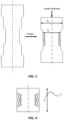
- Fig. 1 illustrates from the side view the expanded tube crash box after manufacturing.
- the dotted line demonstrates the longitudinal symmetry axis.
- Fig. 2 illustrates for the component showed in fig. 1 the relation of strength in longitudinal direction of the component with the different zones whereby transition zones (4) are located between the main zones (1), (2) and (3) from Fig. 1 .
- the transversal dotted lines (5) demonstrate the starting points where a change of the zone and therefore a change in diameter and strength proceed.
- the zone 1 with the smallest diameter d 1 has the lowest strength level. With an increased diameter, the strength level increases, too.
- ⁇ Rm (6) The difference in strength between each diameter is essentially the same
- Fig. 3 illustrates the forming behavior of the component during an impact situation from the longitudinal side whereby the zone with the lowest diameter, (1) from fig. 1 , and therefore the lowest strength level fold.
- the zones with the higher diameter will slide over the ones with the lower diameter depending on the particular strength levels.
- Fig. 4 illustrates the ongoing impact from fig. 3 at its ending position called block length L B (7) where the energy absorption of the component is exhausted.
- the block length L B (7) is further equal with a residual safety area where other components can be located and will not be influenced by the impact.
- Fig. 5 illustrates one preferred embodiment of the present invention where at least one end of the expanded tube is widened in a way that the end (8) is bent across the longitudinal axis of the tube crash box and its working direction to enable joining on the lap joint (9) to the neighboring vehicle parts (10).
- the joining can be executed as welding as a fillet or like mechanical joining as a lap joint like screwing.
Landscapes
- Engineering & Computer Science (AREA)
- Chemical & Material Sciences (AREA)
- Mechanical Engineering (AREA)
- Organic Chemistry (AREA)
- Crystallography & Structural Chemistry (AREA)
- Materials Engineering (AREA)
- Metallurgy (AREA)
- General Engineering & Computer Science (AREA)
- Thermal Sciences (AREA)
- Physics & Mathematics (AREA)
- Vibration Dampers (AREA)
- Body Structure For Vehicles (AREA)
- Shaping Metal By Deep-Drawing, Or The Like (AREA)
- Motor Power Transmission Devices (AREA)
- Making Paper Articles (AREA)
Claims (14)
- Kraftfahrzeug-Crashbox mit einer Arbeitsrichtung in der Längsachse eines Fahrzeugs, wobei das Bauteil aus einem Rohr hergestellt ist, das aus einem austenitischen Stahl gefertigt ist, der eine homogene austenitische Mikrostruktur mit einem Kaltverfestigungseffekt selbst nach dem Formen aufweist, das durch einen Formprozess zu einem aufgeweiteten Rohr erweitert wird, das mindestens zwei Zonen (1, 2, 3) aufweist, die unterschiedliche Materialfestigkeit und unterschiedliche Geometrie aufweisen,
dadurch gekennzeichnet, dass die Mitte in Längsrichtung als eine Spiegelachse fungiert, und die Zonen (1, 2, 3) in einer Art gebildet sind, die von den Außenseiten zu der Mitte ausgeht, wobei der Durchmesser (d1, d2, d3) der Zone (1, 2, 3) in Richtung der Mitte abnimmt. - Kraftfahrzeug-Crashbox nach Anspruch 1, dadurch gekennzeichnet, dass die Zonen (1, 2, 3) ein Stärke- [N/mm2] zu Durchmesser- [mm] Verhältnis von 6,0 - 9,0 N/mm3 aufweisen.
- Kraftfahrzeug-Crashbox nach Anspruch 1 oder 2, dadurch gekennzeichnet, dass zwischen den unterschiedlichen Zonen (1, 2, 3) ein Mindeststärke-Delta von ΔRm ≥ 75 MPa, bevorzugt ΔRm ≥ 120 MPa besteht.
- Kraftfahrzeug-Kreisbox nach einem der vorstehenden Ansprüche, dadurch gekennzeichnet, dass die Zonen (1, 2, 3) eine Faltbarkeit aufweisen, die zu dem Durchmesser (d1, d2, d3) der Zone (1, 2, 3) umgekehrt proportional ist.
- Kraftfahrzeug-Crashbox nach einem der vorstehenden Ansprüche, dadurch gekennzeichnet, dass das aufgeweitete Rohr dazu konfiguriert ist, einen Restsicherheitsbereich durch Erreichen einer Blocklänge des Systems von bevorzugt LB ≥ 80 mm, bevorzugter LB ≥ 100 mm nach dem Aufprall bereitzustellen.
- Kraftfahrzeug-Crashbox nach einem der Ansprüche 1 bis 5, dadurch gekennzeichnet, dass mindestens ein Ende des aufgeweiteten Rohrs aufgeweitet ist, um einen Flansch um den Umfang des Endes des Rohrs bereitzustellen, wobei der Flansch im Wesentlichen zu der Längsachse der Rohr-Crashbox und ihrer Arbeitsrichtung senkrecht ist, wobei der Flansch eine Oberfläche zum Anbringen der Crashbox an einem benachbarten Fahrzeugteil bereitstellt.
- Verfahren zum Herstellen einer Kraftfahrzeug-Crashbox nach einem der vorstehenden Ansprüche, dadurch gekennzeichnet, dass das Rohr als ein längs geschweißtes Rohr, bevorzugt Hochfrequenz-geschweißtes Rohr, hergestellt wird.
- Verfahren nach Anspruch 7, dadurch gekennzeichnet, dass das Rohr durch einen mechanischen Aufweitungsprozess in einer mechanischen Drift-Aufweitmaschine aufgeweitet wird.
- Verfahren nach Anspruch 7 oder 8, dadurch gekennzeichnet, dass der mechanische Drift-Aufweitungsprozess mindestens zwei unterschiedliche Aufweitdorne für mindestens zwei unterschiedliche Zonen der Crashbox verwendet.
- Verfahren nach einem der Ansprüche 7 bis 9, dadurch gekennzeichnet, dass der mechanische Drift-Aufweitungsprozess eine gespiegelte Längsachse aufweist, um eine symmetrische Crashbox zu schaffen.
- Verfahren nach einem der Ansprüche 7 bis 10, dadurch gekennzeichnet, dass das Rohr aus kaltverfestigbaren, vollaustenitischen Stählen, bevorzugt austenitischen rostfreien Stählen hergestellt ist, die eine anfängliche Streckgrenze Rp0.2 ≥ 380 MPa und eine anfängliche Dehnung A80 ≥ 40 % aufweisen.
- Verfahren nach einem der Ansprüche 7 bis 11, dadurch gekennzeichnet, dass das Rohr eine anfängliche Dicke von 0,8 mm ≤ t ≤ 2,5 mm aufweist, und das Verhältnis des anfänglichen Durchmessers zur Dicke 24 ≤ rd/t ≤ 125, bevorzugter zwischen 40 ≤ rd/t ≤ 55 beträgt.
- Verwendung eines aufgeweiteten Rohrs, das aus einem austenitischen Stahl hergestellt ist, für eine Crashbox nach einem der Ansprüche 1 - 6, der eine homogene austenitische Mikrostruktur mit einem Kaltverfestigungseffekt sogar nach dem Formen aufweist, das durch einen Formprozess in ein aufgeweitetes Rohr aufgeweitet wird, das mindestens zwei Zonen (1, 2, 3) aufweist, die unterschiedliche Materialstärke und unterschiedliche Geometrie aufweisen als eine Crashbox, dadurch gekennzeichnet, dass das Kraftfahrzeug, in das die Crashbox eingebaut wird, ein Personenkraftwagen, ein Lastkraftwagen, ein Bus oder eine landwirtschaftliche Maschine ist.
- Verwendung eines aufgeweiteten Rohrs, das aus einem austenitischen Stahl hergestellt ist, für eine Crashbox nach einem der Ansprüche 1 - 6, der eine homogene austenitische Mikrostruktur mit einem Kaltverfestigungseffekt sogar nach dem Formen aufweist, das durch einen Formprozess in ein aufgeweitetes Rohr aufgeweitet wird, das mindestens zwei Zonen (1, 2, 3) aufweist, die unterschiedliche Materialstärke und unterschiedliche Geometrie aufweisen als eine Crashbox, dadurch gekennzeichnet, dass die Crashbox ein Energie absorbierendes Element in einer Leitplanke, einem Geländer oder im Inneren eines Schienenfahrzeugs ist.
Priority Applications (11)
| Application Number | Priority Date | Filing Date | Title |
|---|---|---|---|
| EP20154182.8A EP3858684B1 (de) | 2020-01-28 | 2020-01-28 | Aufgeweitetes rohr für eine kraftfahrzeug-crashbox und zugehöriges herstellungsverfahren |
| ES20154182T ES3028333T3 (en) | 2020-01-28 | 2020-01-28 | Expanded tube for a motor vehicle crash box and manufacturing method for it |
| TW110102825A TWI893050B (zh) | 2020-01-28 | 2021-01-26 | 用於縱向軸線上具有一工作方向之機動車輛防撞箱之膨脹管、彼之製造方法及彼作為一防撞箱之用途 |
| JP2022539725A JP7464722B2 (ja) | 2020-01-28 | 2021-01-28 | 自動車用クラッシュボックスのための拡径管及びその製造方法 |
| CN202180007567.XA CN114901519B (zh) | 2020-01-28 | 2021-01-28 | 用于机动车辆碰撞盒的胀管及其制造方法 |
| PCT/EP2021/051994 WO2021152015A1 (en) | 2020-01-28 | 2021-01-28 | Expanded tube for a motor vehicle crash box and manufacturing method for it |
| CA3164879A CA3164879A1 (en) | 2020-01-28 | 2021-01-28 | Expanded tube for a motor vehicle crash box and manufacturing method for it |
| MX2022008787A MX2022008787A (es) | 2020-01-28 | 2021-01-28 | Tubo expandido para una caja de colision de vehiculo de motor y su metodo de fabricacion. |
| US17/759,227 US12391201B2 (en) | 2020-01-28 | 2021-01-28 | Expanded tube for a motor vehicle crash box and manufacturing method for it |
| BR112022012833A BR112022012833A2 (pt) | 2020-01-28 | 2021-01-28 | Tubo expandido para uma caixa de colisão de veículo automotor e método para fabricação da mesma |
| KR1020227022835A KR20220130682A (ko) | 2020-01-28 | 2021-01-28 | 자동차 크래시 박스용 팽창된 튜브 및 그 제조 방법 |
Applications Claiming Priority (1)
| Application Number | Priority Date | Filing Date | Title |
|---|---|---|---|
| EP20154182.8A EP3858684B1 (de) | 2020-01-28 | 2020-01-28 | Aufgeweitetes rohr für eine kraftfahrzeug-crashbox und zugehöriges herstellungsverfahren |
Publications (2)
| Publication Number | Publication Date |
|---|---|
| EP3858684A1 EP3858684A1 (de) | 2021-08-04 |
| EP3858684B1 true EP3858684B1 (de) | 2025-03-05 |
Family
ID=69571760
Family Applications (1)
| Application Number | Title | Priority Date | Filing Date |
|---|---|---|---|
| EP20154182.8A Active EP3858684B1 (de) | 2020-01-28 | 2020-01-28 | Aufgeweitetes rohr für eine kraftfahrzeug-crashbox und zugehöriges herstellungsverfahren |
Country Status (11)
| Country | Link |
|---|---|
| US (1) | US12391201B2 (de) |
| EP (1) | EP3858684B1 (de) |
| JP (1) | JP7464722B2 (de) |
| KR (1) | KR20220130682A (de) |
| CN (1) | CN114901519B (de) |
| BR (1) | BR112022012833A2 (de) |
| CA (1) | CA3164879A1 (de) |
| ES (1) | ES3028333T3 (de) |
| MX (1) | MX2022008787A (de) |
| TW (1) | TWI893050B (de) |
| WO (1) | WO2021152015A1 (de) |
Families Citing this family (1)
| Publication number | Priority date | Publication date | Assignee | Title |
|---|---|---|---|---|
| CN113775682B (zh) * | 2021-11-12 | 2022-02-08 | 太原理工大学 | 一种基于剪纸结构的可调控圆管吸能/储能机构 |
Family Cites Families (45)
| Publication number | Priority date | Publication date | Assignee | Title |
|---|---|---|---|---|
| DE854157C (de) | 1951-01-23 | 1952-10-30 | Daimler Benz Ag | Kraftfahrzeug, insbesondere zur Befoerderung von Personen |
| DE2427764A1 (de) * | 1974-06-08 | 1976-01-02 | Volkswagenwerk Ag | Stossfaengeranordnung fuer ein mit laengstraegern ausgeruestetes fahrzeug |
| JPS6224827A (ja) * | 1985-07-25 | 1987-02-02 | Sumitomo Metal Ind Ltd | 拡管用マンドレル |
| US6282769B1 (en) * | 1998-07-15 | 2001-09-04 | Cosma International Inc. | Motor vehicle end module assembly |
| FR2792384B1 (fr) * | 1999-04-15 | 2001-06-01 | Lorraine Laminage | Organe absorbeur de choc et procede de fabrication |
| JP2001001053A (ja) * | 1999-04-22 | 2001-01-09 | Aisin Seiki Co Ltd | ロール成形品および自動車用バンパー |
| DE10042221A1 (de) * | 1999-09-02 | 2001-08-09 | Om Corp | Stoßdämpfer für ein Fahrzeug, das plastische Verformungen ausnutzt |
| CA2342702A1 (en) * | 2001-04-04 | 2002-10-04 | Copperweld Canada Inc. | Forming method using tube blanks of variable wall thickness |
| US6648384B2 (en) * | 2001-09-27 | 2003-11-18 | Shape Corporation | Bumper crush tower with rings of varied strength |
| US6942262B2 (en) * | 2001-09-27 | 2005-09-13 | Shape Corporation | Tubular energy management system for absorbing impact energy |
| US7182191B2 (en) * | 2002-07-11 | 2007-02-27 | Autoliv Asp, Inc. | Motion damper |
| JP4219189B2 (ja) * | 2003-02-28 | 2009-02-04 | 株式会社アステア | 車体メンバに対するバンパ補強材の支持構造 |
| WO2005075254A1 (ja) * | 2004-02-10 | 2005-08-18 | Sango Co., Ltd. | 車両の衝撃吸収装置 |
| AU2005282527A1 (en) * | 2004-09-07 | 2006-03-16 | Shape Corporation | Plastic energy management beam |
| US7225660B1 (en) * | 2005-05-13 | 2007-06-05 | Kw Industries, Inc. | Apparatus and method for expanding a tube diameter and a pole formed thereby |
| EP1864866A1 (de) * | 2006-06-06 | 2007-12-12 | Corus Staal BV | Vorrichtung zum Absorbieren von Energie |
| WO2008012376A1 (es) * | 2006-07-21 | 2008-01-31 | Autotech Engineering A.I.E. | Método para producir un absorbedor de choques y absorbedor de choques obtenido |
| US20080098601A1 (en) * | 2006-10-30 | 2008-05-01 | Shape Corporation | Tubular tapered crushable structures and manufacturing methods |
| DE202006018616U1 (de) * | 2006-12-08 | 2008-04-17 | Cosma Engineering Europe Ag | Energieabsorptionsvorrichtung |
| FR2915451B1 (fr) * | 2007-04-26 | 2009-10-09 | Vallourec Vitry | Prolonge avec appui perfectionne. |
| CN101600520B (zh) * | 2008-02-01 | 2011-04-13 | 住友金属工业株式会社 | 用冷拔法制造超薄壁金属管的方法 |
| US8893866B2 (en) * | 2008-11-27 | 2014-11-25 | Posco | Shock absorbing device for vehicle with multiple shock absorbing stages |
| GB0904343D0 (en) * | 2009-03-13 | 2009-04-29 | Linde Ag | Vehicle structures |
| JP2011011661A (ja) * | 2009-07-02 | 2011-01-20 | Honda Motor Co Ltd | 衝撃吸収部材 |
| DE102009056443A1 (de) | 2009-12-02 | 2011-06-09 | Benteler Automobiltechnik Gmbh | Crashbox und Verfahren zu deren Herstellung |
| DE102009054616A1 (de) | 2009-12-14 | 2011-06-16 | Robert Bosch Gmbh | Crashbox mit veränderbarer Steifigkeit und Verfahren zur Veränderung einer Steifigkeit einer solchen Crashbox |
| DE102010018316A1 (de) | 2010-02-26 | 2011-09-01 | Robert Bosch Gmbh | Crashbox für ein Kraftfahrzeug |
| US8276955B2 (en) * | 2010-03-26 | 2012-10-02 | Ford Global Technologies, Llc | Zero stack-up telescopically collapsible energy absorbing rail and bracket assembly |
| DE102011117933A1 (de) | 2011-11-08 | 2013-05-08 | GM Global Technology Operations LLC (n. d. Gesetzen des Staates Delaware) | Crashbox |
| US8746763B2 (en) * | 2012-05-18 | 2014-06-10 | GM Global Technology Operations LLC | Multistage energy absorber device and method of forming same |
| CN104349853B (zh) * | 2012-05-29 | 2016-03-30 | 杰富意钢铁株式会社 | 金属管的扩管制造方法 |
| DE102013101276A1 (de) * | 2013-02-08 | 2014-08-14 | Benteler Automobiltechnik Gmbh | Verfahren zur Herstellung eines Kraftfahrzeugstabilisators |
| FI126577B (en) * | 2014-06-17 | 2017-02-28 | Outokumpu Oy | DUPLEX STAINLESS STEEL |
| DE102014115887A1 (de) | 2014-10-31 | 2016-05-19 | Benteler Automobiltechnik Gmbh | Crashbox für ein Stoßfängersystem eines Kraftfahrzeugs |
| DE102015121152B4 (de) | 2015-10-26 | 2021-01-14 | Benteler Automobiltechnik Gmbh | Stoßfängeranordnung für ein Kraftfahrzeug |
| CN205086844U (zh) * | 2015-11-05 | 2016-03-16 | 重庆江北区长安产业有限公司 | 前防撞梁结构的吸能盒 |
| CN105438101A (zh) * | 2015-12-11 | 2016-03-30 | 中交华安科技(天津)有限公司 | 一种危化品运输车辆吸能结构 |
| DE102016000599A1 (de) | 2016-01-21 | 2017-08-10 | GM Global Technology Operations LLC (n. d. Ges. d. Staates Delaware) | Crashbox |
| JP6256668B1 (ja) * | 2016-03-11 | 2018-01-10 | 新日鐵住金株式会社 | 差厚鋼管の製造方法および差厚鋼管 |
| TWI651224B (zh) * | 2017-11-21 | 2019-02-21 | 財團法人金屬工業研究發展中心 | 衝擊吸能裝置 |
| KR102120700B1 (ko) * | 2018-09-13 | 2020-06-09 | 주식회사 포스코 | 확관가공성 및 내시효균열성이 우수한 오스테나이트계 스테인리스강 |
| BR202018070682U2 (pt) * | 2018-10-08 | 2020-04-28 | Aethra Sist Automotivos S/A | disposição aplicada em para-choque de veículos automotores |
| US11104283B2 (en) * | 2018-11-16 | 2021-08-31 | Aisin Seiki Kabushiki Kaisha | Vehicular energy absorbing member and manufacturing method thereof |
| DE102019103926A1 (de) * | 2019-02-15 | 2020-08-20 | Walter Henrich GmbH | Verfahren und Vorrichtung zum axialen Umformen eines Rohres |
| EP3995599A1 (de) * | 2020-11-06 | 2022-05-11 | Outokumpu Oyj | Austenitischer rostfreier stahl |
-
2020
- 2020-01-28 ES ES20154182T patent/ES3028333T3/es active Active
- 2020-01-28 EP EP20154182.8A patent/EP3858684B1/de active Active
-
2021
- 2021-01-26 TW TW110102825A patent/TWI893050B/zh active
- 2021-01-28 KR KR1020227022835A patent/KR20220130682A/ko active Pending
- 2021-01-28 CA CA3164879A patent/CA3164879A1/en active Pending
- 2021-01-28 BR BR112022012833A patent/BR112022012833A2/pt unknown
- 2021-01-28 JP JP2022539725A patent/JP7464722B2/ja active Active
- 2021-01-28 US US17/759,227 patent/US12391201B2/en active Active
- 2021-01-28 MX MX2022008787A patent/MX2022008787A/es unknown
- 2021-01-28 WO PCT/EP2021/051994 patent/WO2021152015A1/en not_active Ceased
- 2021-01-28 CN CN202180007567.XA patent/CN114901519B/zh active Active
Also Published As
| Publication number | Publication date |
|---|---|
| TW202134086A (zh) | 2021-09-16 |
| ES3028333T3 (en) | 2025-06-18 |
| KR20220130682A (ko) | 2022-09-27 |
| TWI893050B (zh) | 2025-08-11 |
| WO2021152015A1 (en) | 2021-08-05 |
| EP3858684A1 (de) | 2021-08-04 |
| US12391201B2 (en) | 2025-08-19 |
| BR112022012833A2 (pt) | 2022-09-06 |
| MX2022008787A (es) | 2022-08-15 |
| JP2023509623A (ja) | 2023-03-09 |
| CA3164879A1 (en) | 2021-08-05 |
| US20230060627A1 (en) | 2023-03-02 |
| CN114901519A (zh) | 2022-08-12 |
| CN114901519B (zh) | 2026-02-03 |
| JP7464722B2 (ja) | 2024-04-09 |
Similar Documents
| Publication | Publication Date | Title |
|---|---|---|
| EP3428993B1 (de) | Sicherheitsbehaelter für eine batterie in elektrischen fahrzeugen | |
| EP2617509B1 (de) | Geformtes element und herstellungsverfahren dafür | |
| US7144072B2 (en) | Beam and method of making same | |
| EP3190031B1 (de) | Automobilelement | |
| US20040262930A1 (en) | Multiple material bumper beam | |
| CN114340983B (zh) | 用于电动车辆的后部结构 | |
| US12391201B2 (en) | Expanded tube for a motor vehicle crash box and manufacturing method for it | |
| JP4830017B2 (ja) | 乗用車用バンパー構造体 | |
| JP5283405B2 (ja) | 自動車用補強部材 | |
| US20240149947A1 (en) | Impact absorbing structure of automobile | |
| US20250229835A1 (en) | Front rail with crash tuning features | |
| EP3842295B1 (de) | Überrollschutzring für fahrzeuge | |
| Wheeler | Crashworthiness of Aluminum-Structured Vehicles | |
| WO2022090771A1 (en) | Bumper assembly for an automotive vehicle |
Legal Events
| Date | Code | Title | Description |
|---|---|---|---|
| PUAI | Public reference made under article 153(3) epc to a published international application that has entered the european phase |
Free format text: ORIGINAL CODE: 0009012 |
|
| STAA | Information on the status of an ep patent application or granted ep patent |
Free format text: STATUS: THE APPLICATION HAS BEEN PUBLISHED |
|
| AK | Designated contracting states |
Kind code of ref document: A1 Designated state(s): AL AT BE BG CH CY CZ DE DK EE ES FI FR GB GR HR HU IE IS IT LI LT LU LV MC MK MT NL NO PL PT RO RS SE SI SK SM TR |
|
| STAA | Information on the status of an ep patent application or granted ep patent |
Free format text: STATUS: REQUEST FOR EXAMINATION WAS MADE |
|
| 17P | Request for examination filed |
Effective date: 20220204 |
|
| RBV | Designated contracting states (corrected) |
Designated state(s): AL AT BE BG CH CY CZ DE DK EE ES FI FR GB GR HR HU IE IS IT LI LT LU LV MC MK MT NL NO PL PT RO RS SE SI SK SM TR |
|
| STAA | Information on the status of an ep patent application or granted ep patent |
Free format text: STATUS: EXAMINATION IS IN PROGRESS |
|
| 17Q | First examination report despatched |
Effective date: 20230704 |
|
| REG | Reference to a national code |
Ref country code: DE Ref legal event code: R079 Free format text: PREVIOUS MAIN CLASS: B60R0019340000 Ipc: B21C0037080000 Ref country code: DE Ref legal event code: R079 Ref document number: 602020047077 Country of ref document: DE Free format text: PREVIOUS MAIN CLASS: B60R0019340000 Ipc: B21C0037080000 |
|
| GRAP | Despatch of communication of intention to grant a patent |
Free format text: ORIGINAL CODE: EPIDOSNIGR1 |
|
| STAA | Information on the status of an ep patent application or granted ep patent |
Free format text: STATUS: GRANT OF PATENT IS INTENDED |
|
| RIC1 | Information provided on ipc code assigned before grant |
Ipc: F16F 7/12 20060101ALI20240913BHEP Ipc: B60R 19/34 20060101ALI20240913BHEP Ipc: C21D 9/50 20060101ALI20240913BHEP Ipc: C21D 9/08 20060101ALI20240913BHEP Ipc: C21D 7/12 20060101ALI20240913BHEP Ipc: C21D 6/00 20060101ALI20240913BHEP Ipc: B21C 37/16 20060101ALI20240913BHEP Ipc: B21C 37/08 20060101AFI20240913BHEP |
|
| INTG | Intention to grant announced |
Effective date: 20240926 |
|
| GRAS | Grant fee paid |
Free format text: ORIGINAL CODE: EPIDOSNIGR3 |
|
| GRAA | (expected) grant |
Free format text: ORIGINAL CODE: 0009210 |
|
| STAA | Information on the status of an ep patent application or granted ep patent |
Free format text: STATUS: THE PATENT HAS BEEN GRANTED |
|
| AK | Designated contracting states |
Kind code of ref document: B1 Designated state(s): AL AT BE BG CH CY CZ DE DK EE ES FI FR GB GR HR HU IE IS IT LI LT LU LV MC MK MT NL NO PL PT RO RS SE SI SK SM TR |
|
| REG | Reference to a national code |
Ref country code: GB Ref legal event code: FG4D |
|
| REG | Reference to a national code |
Ref country code: CH Ref legal event code: EP |
|
| REG | Reference to a national code |
Ref country code: IE Ref legal event code: FG4D |
|
| REG | Reference to a national code |
Ref country code: DE Ref legal event code: R096 Ref document number: 602020047077 Country of ref document: DE |
|
| REG | Reference to a national code |
Ref country code: ES Ref legal event code: FG2A Ref document number: 3028333 Country of ref document: ES Kind code of ref document: T3 Effective date: 20250618 |
|
| PG25 | Lapsed in a contracting state [announced via postgrant information from national office to epo] |
Ref country code: RS Free format text: LAPSE BECAUSE OF FAILURE TO SUBMIT A TRANSLATION OF THE DESCRIPTION OR TO PAY THE FEE WITHIN THE PRESCRIBED TIME-LIMIT Effective date: 20250605 |
|
| PG25 | Lapsed in a contracting state [announced via postgrant information from national office to epo] |
Ref country code: FI Free format text: LAPSE BECAUSE OF FAILURE TO SUBMIT A TRANSLATION OF THE DESCRIPTION OR TO PAY THE FEE WITHIN THE PRESCRIBED TIME-LIMIT Effective date: 20250305 |
|
| REG | Reference to a national code |
Ref country code: NL Ref legal event code: MP Effective date: 20250305 |
|
| REG | Reference to a national code |
Ref country code: LT Ref legal event code: MG9D |
|
| PG25 | Lapsed in a contracting state [announced via postgrant information from national office to epo] |
Ref country code: NO Free format text: LAPSE BECAUSE OF FAILURE TO SUBMIT A TRANSLATION OF THE DESCRIPTION OR TO PAY THE FEE WITHIN THE PRESCRIBED TIME-LIMIT Effective date: 20250605 |
|
| PG25 | Lapsed in a contracting state [announced via postgrant information from national office to epo] |
Ref country code: HR Free format text: LAPSE BECAUSE OF FAILURE TO SUBMIT A TRANSLATION OF THE DESCRIPTION OR TO PAY THE FEE WITHIN THE PRESCRIBED TIME-LIMIT Effective date: 20250305 |
|
| PG25 | Lapsed in a contracting state [announced via postgrant information from national office to epo] |
Ref country code: LV Free format text: LAPSE BECAUSE OF FAILURE TO SUBMIT A TRANSLATION OF THE DESCRIPTION OR TO PAY THE FEE WITHIN THE PRESCRIBED TIME-LIMIT Effective date: 20250305 |
|
| PG25 | Lapsed in a contracting state [announced via postgrant information from national office to epo] |
Ref country code: BG Free format text: LAPSE BECAUSE OF FAILURE TO SUBMIT A TRANSLATION OF THE DESCRIPTION OR TO PAY THE FEE WITHIN THE PRESCRIBED TIME-LIMIT Effective date: 20250305 Ref country code: GR Free format text: LAPSE BECAUSE OF FAILURE TO SUBMIT A TRANSLATION OF THE DESCRIPTION OR TO PAY THE FEE WITHIN THE PRESCRIBED TIME-LIMIT Effective date: 20250606 |
|
| PG25 | Lapsed in a contracting state [announced via postgrant information from national office to epo] |
Ref country code: NL Free format text: LAPSE BECAUSE OF FAILURE TO SUBMIT A TRANSLATION OF THE DESCRIPTION OR TO PAY THE FEE WITHIN THE PRESCRIBED TIME-LIMIT Effective date: 20250305 |
|
| PG25 | Lapsed in a contracting state [announced via postgrant information from national office to epo] |
Ref country code: SE Free format text: LAPSE BECAUSE OF FAILURE TO SUBMIT A TRANSLATION OF THE DESCRIPTION OR TO PAY THE FEE WITHIN THE PRESCRIBED TIME-LIMIT Effective date: 20250305 |
|
| PG25 | Lapsed in a contracting state [announced via postgrant information from national office to epo] |
Ref country code: SM Free format text: LAPSE BECAUSE OF FAILURE TO SUBMIT A TRANSLATION OF THE DESCRIPTION OR TO PAY THE FEE WITHIN THE PRESCRIBED TIME-LIMIT Effective date: 20250305 |
|
| PG25 | Lapsed in a contracting state [announced via postgrant information from national office to epo] |
Ref country code: PT Free format text: LAPSE BECAUSE OF FAILURE TO SUBMIT A TRANSLATION OF THE DESCRIPTION OR TO PAY THE FEE WITHIN THE PRESCRIBED TIME-LIMIT Effective date: 20250707 |
|
| PG25 | Lapsed in a contracting state [announced via postgrant information from national office to epo] |
Ref country code: PL Free format text: LAPSE BECAUSE OF FAILURE TO SUBMIT A TRANSLATION OF THE DESCRIPTION OR TO PAY THE FEE WITHIN THE PRESCRIBED TIME-LIMIT Effective date: 20250305 |
|
| PG25 | Lapsed in a contracting state [announced via postgrant information from national office to epo] |
Ref country code: EE Free format text: LAPSE BECAUSE OF FAILURE TO SUBMIT A TRANSLATION OF THE DESCRIPTION OR TO PAY THE FEE WITHIN THE PRESCRIBED TIME-LIMIT Effective date: 20250305 |
|
| PG25 | Lapsed in a contracting state [announced via postgrant information from national office to epo] |
Ref country code: RO Free format text: LAPSE BECAUSE OF FAILURE TO SUBMIT A TRANSLATION OF THE DESCRIPTION OR TO PAY THE FEE WITHIN THE PRESCRIBED TIME-LIMIT Effective date: 20250305 |
|
| PG25 | Lapsed in a contracting state [announced via postgrant information from national office to epo] |
Ref country code: SK Free format text: LAPSE BECAUSE OF FAILURE TO SUBMIT A TRANSLATION OF THE DESCRIPTION OR TO PAY THE FEE WITHIN THE PRESCRIBED TIME-LIMIT Effective date: 20250305 |
|
| PG25 | Lapsed in a contracting state [announced via postgrant information from national office to epo] |
Ref country code: IS Free format text: LAPSE BECAUSE OF FAILURE TO SUBMIT A TRANSLATION OF THE DESCRIPTION OR TO PAY THE FEE WITHIN THE PRESCRIBED TIME-LIMIT Effective date: 20250705 |
|
| REG | Reference to a national code |
Ref country code: DE Ref legal event code: R097 Ref document number: 602020047077 Country of ref document: DE |
|
| PLBE | No opposition filed within time limit |
Free format text: ORIGINAL CODE: 0009261 |
|
| STAA | Information on the status of an ep patent application or granted ep patent |
Free format text: STATUS: NO OPPOSITION FILED WITHIN TIME LIMIT |
|
| PG25 | Lapsed in a contracting state [announced via postgrant information from national office to epo] |
Ref country code: DK Free format text: LAPSE BECAUSE OF FAILURE TO SUBMIT A TRANSLATION OF THE DESCRIPTION OR TO PAY THE FEE WITHIN THE PRESCRIBED TIME-LIMIT Effective date: 20250305 |
|
| REG | Reference to a national code |
Ref country code: CH Ref legal event code: L10 Free format text: ST27 STATUS EVENT CODE: U-0-0-L10-L00 (AS PROVIDED BY THE NATIONAL OFFICE) Effective date: 20260114 |
|
| 26N | No opposition filed |
Effective date: 20251208 |
|
| PGFP | Annual fee paid to national office [announced via postgrant information from national office to epo] |
Ref country code: ES Payment date: 20260227 Year of fee payment: 7 |
|
| PGFP | Annual fee paid to national office [announced via postgrant information from national office to epo] |
Ref country code: DE Payment date: 20260121 Year of fee payment: 7 |
|
| PGFP | Annual fee paid to national office [announced via postgrant information from national office to epo] |
Ref country code: AT Payment date: 20260122 Year of fee payment: 7 |
|
| PGFP | Annual fee paid to national office [announced via postgrant information from national office to epo] |
Ref country code: IT Payment date: 20260122 Year of fee payment: 7 |
|
| PGFP | Annual fee paid to national office [announced via postgrant information from national office to epo] |
Ref country code: FR Payment date: 20260123 Year of fee payment: 7 |
|
| PGFP | Annual fee paid to national office [announced via postgrant information from national office to epo] |
Ref country code: CZ Payment date: 20260121 Year of fee payment: 7 |