EP3856980B1 - Method for stabilizing a jack-up platform unit - Google Patents
Method for stabilizing a jack-up platform unit Download PDFInfo
- Publication number
- EP3856980B1 EP3856980B1 EP19828858.1A EP19828858A EP3856980B1 EP 3856980 B1 EP3856980 B1 EP 3856980B1 EP 19828858 A EP19828858 A EP 19828858A EP 3856980 B1 EP3856980 B1 EP 3856980B1
- Authority
- EP
- European Patent Office
- Prior art keywords
- legs
- hull
- load
- platform
- crane
- Prior art date
- Legal status (The legal status is an assumption and is not a legal conclusion. Google has not performed a legal analysis and makes no representation as to the accuracy of the status listed.)
- Active
Links
Images



Classifications
-
- E—FIXED CONSTRUCTIONS
- E02—HYDRAULIC ENGINEERING; FOUNDATIONS; SOIL SHIFTING
- E02B—HYDRAULIC ENGINEERING
- E02B17/00—Artificial islands mounted on piles or like supports, e.g. platforms on raisable legs or offshore constructions; Construction methods therefor
- E02B17/02—Artificial islands mounted on piles or like supports, e.g. platforms on raisable legs or offshore constructions; Construction methods therefor placed by lowering the supporting construction to the bottom, e.g. with subsequent fixing thereto
- E02B17/021—Artificial islands mounted on piles or like supports, e.g. platforms on raisable legs or offshore constructions; Construction methods therefor placed by lowering the supporting construction to the bottom, e.g. with subsequent fixing thereto with relative movement between supporting construction and platform
-
- E—FIXED CONSTRUCTIONS
- E02—HYDRAULIC ENGINEERING; FOUNDATIONS; SOIL SHIFTING
- E02B—HYDRAULIC ENGINEERING
- E02B17/00—Artificial islands mounted on piles or like supports, e.g. platforms on raisable legs or offshore constructions; Construction methods therefor
- E02B17/0017—Means for protecting offshore constructions
-
- E—FIXED CONSTRUCTIONS
- E02—HYDRAULIC ENGINEERING; FOUNDATIONS; SOIL SHIFTING
- E02B—HYDRAULIC ENGINEERING
- E02B17/00—Artificial islands mounted on piles or like supports, e.g. platforms on raisable legs or offshore constructions; Construction methods therefor
- E02B2017/0039—Methods for placing the offshore structure
-
- E—FIXED CONSTRUCTIONS
- E02—HYDRAULIC ENGINEERING; FOUNDATIONS; SOIL SHIFTING
- E02B—HYDRAULIC ENGINEERING
- E02B17/00—Artificial islands mounted on piles or like supports, e.g. platforms on raisable legs or offshore constructions; Construction methods therefor
- E02B2017/0056—Platforms with supporting legs
-
- Y—GENERAL TAGGING OF NEW TECHNOLOGICAL DEVELOPMENTS; GENERAL TAGGING OF CROSS-SECTIONAL TECHNOLOGIES SPANNING OVER SEVERAL SECTIONS OF THE IPC; TECHNICAL SUBJECTS COVERED BY FORMER USPC CROSS-REFERENCE ART COLLECTIONS [XRACs] AND DIGESTS
- Y02—TECHNOLOGIES OR APPLICATIONS FOR MITIGATION OR ADAPTATION AGAINST CLIMATE CHANGE
- Y02E—REDUCTION OF GREENHOUSE GAS [GHG] EMISSIONS, RELATED TO ENERGY GENERATION, TRANSMISSION OR DISTRIBUTION
- Y02E10/00—Energy generation through renewable energy sources
- Y02E10/70—Wind energy
- Y02E10/727—Offshore wind turbines
Definitions
- the invention is related to a method for stabilizing a jack-up platform unit.
- Jack-up platform units generally comprise a buoyant hull as well as a plurality of movable legs which are extendible from and/or through said hull, for example three legs, four legs, six legs, or more.
- Jack-up platform units usually also include at least one crane mounted on the platform unit, for example mounted around one of the legs, or mounted elsewhere on the platform, and/or a movable cantilever for supporting operations outside of the platform. Said jack-up platforms can be self-sailing or self-propelled, or may need to be towed.
- Jack-up platform units are widely used in off-shore industry, for example at off-shore drilling sites, for building large bridges spanning water, or for example for the installation and/or maintenance of off-shore wind turbines.
- a jack-up platform unit When a jack-up platform unit has arrived on site, the unit needs to be stabilized in a relatively harsh environment of the sea before any work can begin. Thereto, the legs of the jack-up unit are lowered until the legs can rest on the seabed. Then, the jack-up platform is raised just above sea-level along the legs via a jacking system. As the stability of the underlying seabed is not known in detail, it is common practice to apply a high load, for example of some thousands of tons, to each of the legs in turns, for example individually or in pairs, while the other legs remain only slightly loaded, which procedure is often referred to as 'preloading'.
- a high load for example of some thousands of tons
- the value of the applied load can then be used to determine a maximal allowable load value that the legs can support during survival conditions or during operations on the platform without jeopardizing the stability of the platform unit.
- the maximum allowable value can be determined to be for example a given fraction of the load applied to the legs during preloading.
- the hull is further raised to a desired operational elevation above the sea surface, for example to a height of more or less 10 to 15m above the sea surface, which substantially avoids the hull being continuously hit by waves.
- the load on the legs may be substantially equalized. In this way, a relatively stable platform is established from which operations can be executed almost independently of current and/or wave action.
- US2015354164 describes pre-loading to simulate the anticipated vertical footing load during design storm and to proof test the foundation soil, wherein the jack is elevated to a minimum clearance above the water and ballast water is added into the hull to impose more gravity load onto the footing. After stable penetration of the footing into the seabed, the ballast water is removed and the jack-up platform is raised to an operational height above the sea surface.
- US4456404 describes pre-loading by a combination of adding ballast water to the hull and by removing weight from different legs by operating different ones of the jacking mechanisms, as such placing extra weight on the remaining legs to ensure that they are fully secured to the sea bed.
- WO2018074923 describes a procedure for pre-loading in which a first and second pairs of retractable legs are sequentially secured in the sea bed, by applying the full weight of the vessel on said pairs of legs.
- the axes formed by the first and second pair of legs are a beam of the vessel and a centerline of the vessel.
- the loading of a leg during crane or cantilever operations may come close, or even exceed, the achieved preloading of the legs, which may eventually result in an uncontrolled settlement of the jack-up platform, a punch through, or even in a collapse of the crane and/or of the jack-up platform unit. Therefore, there is a need for an improved stabilization method of jack-up platform units.
- the invention aims at providing an improved method for stabilizing a jack-up platform unit which can ensure relatively safe operations while maintaining or improving capacities to work over the side of the platform unit with for example a crane or a cantilever or any other device with direct impact on leg loads.
- a jack-up platform unit for example a jack-up rig or a self elevating vessel, includes a hull, which may, but need not, be a buoyant hull.
- the platform unit also includes a plurality of legs, for example four, five, six or more legs, which are extendible from and/or through the hull and which are arranged to support the platform unit during off-shore operations.
- the unit further includes a jacking system arranged to move the plurality of legs between a transport position, in which the legs extend substantially above the platform, and an operational position, in which the legs extend substantially below the platform to stand on a seabed, the jacking system also being arranged to move the hull along the plurality of legs between a floating position, wherein the hull floats on water, and an operational position, in which the hull is substantially above sea surface.
- a jacking system can for example be a hydraulic system, an electric system, a rack-an-pinion system, a combination thereof, or any other suitable system known to the person skilled in the art.
- a jack-up platform unit can generally also include at least one crane or may include a cantilever mounted on the platform, which are arranged to lift loads on and/or off the platform during offshore installation and/or maintenance work.
- a method to stabilize such a jack-up platform unit generally comprises the steps of lowering the plurality of legs until the legs stand on or in the seabed, and raising the hull substantially above the sea surface, to a level where a bottom side of the hull is typically 1.5m above still water level. Before raising the hull above the sea surface, a first test of pre-loading with a limited load on the legs may optionally be performed in order to check whether or not it is safe to raise the hull above the sea level.
- This test may be performed with the hull slightly raised along the legs, but not above the sea level, just high enough such that a weight of the platform unit prevents the legs from losing contact with the seabed because of wave forces acting on the unit.
- a preload is temporarily applied on the plurality of legs. Preloading should be understood in a broad sense as applying a load to each of the legs above a static leg load, which can be done in various ways.
- Each of the legs can for example be directly preloaded by actively pushing legs down with excess load of the jacking system, which may be referred to as 'pre-driving'.
- the legs may also be indirectly preloaded, in which case load is decreased on at least one leg resulting in an increase of load on at least some of the other legs. Decreasing load on a leg can for example be obtained by slightly lowering the hull along said leg. Still another possibility of preloading is for example temporarily taking in large quantities of water ballast, which can be shifted around on the platform.
- the hull is further raised to an operational height above the sea surface, typically to a height of more or less 15m above the sea surface.
- the method to stabilize the jack-up platform unit now further comprises a step of applying a torque to the hull of the jack-up platform unit, in particular a step of actively applying a torque to the hull.
- the jacking operator coordinates the pre-loading operations. Applying a pre-load to a specific leg, which can be done in various ways as explained above, is repeated for that specific leg by the jacking operator until the jacking operator is of the opinion, given his experience and expertise, that the leg is sufficiently settled and the foundation is stable.
- the pre-loading operation is repeated for all legs and can be done for each leg individually or for pairs of legs. For a four-legged or six-legged platform, the pre-loading is usually done for pairs of diagonally opposite legs simultaneously.
- the pre-load value thus determined by the jacking operator is used for determining the operational capacity of the jack-up platform.
- the jacking operator may determine a pre-load value for each leg. After pre-loading, the load onto all of the legs is usually equalized. This means that the load, namely the weight of the platform, is approximately equally distributed over all of the legs. After this equalizing, the hull of the jack-up platform is then moved to its operational condition at an operational height above the sea surface. When the hull is at operational level, the static load on each leg is considered the installed load.
- the pre-load value defines the maximum allowable load that a leg can handle without jeopardizing the stability of the platform.
- the theoretical maximum allowable load on a leg is defined as the pre-load value with a safety margin on it.
- the safety margin can for example be between about 2% up to 20% depending on operator, conditions etc.
- the operational margin of the leg can then be calculated as the difference between the maximum allowable load, which is the safety margin times the pre-load value, and the installed load. This difference determines the operational margin or the working capacity on the respective leg. This information is important for e.g. a crane operator who performs lifting and/or hoisting operations with his crane.
- the crane operator needs to operate his crane within the operational margin defined on the legs, in particular the leg that is closest to the crane may be limiting the working capacity of the crane.
- the operational margin can be consumed for some load, hoisting angle or boom angle more than for other operational conditions. This may limit the lifting capacity of the crane.
- the invention provides for an additional step once the jack-up platform is in operational condition at operational height above the sea surface.
- This additional step is the so-called pre-torque step, in which the load on at least one leg is decreased with respect to the other legs, thus resulting in a torque applied to the hull.
- a pair of diagonally opposite legs are loaded more than the other pair of diagonally opposite legs, in case of a four-legged platform.
- the static load or installed load on one the legs is significantly lower than the static load on the other legs.
- the static load or installed load on one of the pairs of diagonally opposed legs is significantly lower than on the other pair of diagonally opposed legs.
- the one of the legs of the pair of diagonally opposed legs that now has the lower static load is closest to the crane.
- the operational margin for the crane is increased as now the difference between the lower static load and the maximum load (pre-load * safety margin) is larger.
- the crane or cantilever working capacity can be increased without structural adaptations or modifications to the jack-up platform.
- one of the pairs of diagonally opposed legs can be decreased in loading, preferably the pair of which one of the legs is closest to the crane.
- the other two pairs, or one of the other two pairs of legs can have an increased static load.
- a four legged jack-up platform unit may have a maximum elevated weight of 18000 t.
- Each of the legs are pre-loaded up to a pre-load value of 9000 t per leg.
- As a safety margin 20% is taken.
- the weight of the platform is equalized over all four legs, resulting in a theoretical equalized load of 4500 t per leg.
- the load on the leg closest to the crane may not exceed the maximum allowable leg load. This may for some lifting and/or hoisting operations result in a truncated operational crane envelope, in that the crane boom may not extend beyond a certain distance from the leg or crane base. This limits the operational crane capacity. So, according to the invention, when the jack-up platform is in operational condition at operational level above the sea surface, a pre-torque is applied to the hull. In this example, the load on a pair of diagonally opposite legs of which one leg is closest to the crane is decreased, in the example up to 4000 t. The other pair of diagonally opposed legs consequently has an increased static load, namely 5000 t.
- the load on one of the pairs of diagonally opposed legs can be decreased up to 3500 t, resulting in a load increase on the other pair of legs up to 5500 t.
- the difference in installed load, after pre-torqueing, between the leg with the decreased load and the other legs having the increased load, with respect to the legs having the higher installed load value is preferably more than 5%, more preferably more than 10%, advantageously between about 5% and about 50%, more advantageously between about 10% and about 50%.
- This deliberately introduced difference in static load between, for example, the pairs of legs is much larger than differences that may occur in conventional operations in which a jacking operator tries his best to distribute the load evenly as possible, but which may, in practice, always imply slight differences.
- This deliberately introduced static difference that results in the pre-torque of the hull is also larger than static load differences that are sometimes introduced to accommodate variations in soil conditions.
- This method of pre-torqueing is also applicable irrespective of the way how the pre-load value was determined, e.g. by experience and expertise and human judgment of the jacking operator or using a calculation algorithm determining the achieved pre-load.
- Applying a torque to the hull can be done in different ways.
- the hull may be slightly raised along at least one leg, which increases load directly on said leg and applies a torque on the hull.
- a torque to the hull may be applied by decreasing load on at least one leg, for example by slightly lowering the hull along said at least one leg, resulting in an increase of load on the other legs.
- the resulting differentiated load distribution over the legs can then induce a torque in the hull.
- This indirect way of applying a torque to the hull can have the advantage of needing less energy than for example increasing the load on at least one leg directly.
- a shifting of ballast weight around the platform may induce a torque in the hull of the platform.
- this method may be rather inconvenient in practice.
- load can be decreased on the at least one leg which is closest to at least one crane or cantilever mounted on the platform. This allows a higher operational loading of the crane without exceeding the allowed load on the leg, and/or a larger working range for crane or cantilever operations.
- the present method can especially be advantageous when the jack-up platform unit comprises at least four legs, for example four legs, five legs, six legs or more.
- the legs can for example be distributed substantially equally over the platform, for example along a shape of a rectangle.
- load can be decreased both on the leg which is closest to the at least one crane or cantilever mounted on the platform, as well as on a leg which is located substantially diagonally opposite said leg closest to said at least one crane or cantilever.
- substantially diagonally opposite should also be understood broadly, especially when more than 4 legs are implied, i.e. two legs which are not directly neighbouring legs are considered to be diagonally opposite legs.
- Unloading a diagonal pair of legs for example by slightly lowering the hull along said pair of legs, puts a higher load on the other legs resulting in a torque in the hull.
- by decreasing load over a diagonal pair of legs stability of the platform is substantially maintained during load redistribution.
- the method of stabilizing a jack-up platform unit may further comprise a step of substantially equalizing load on each of the legs before applying a torque to the hull of the jack-up platform unit.
- Equalizing loads may be understood as bringing loads on each of the legs as close as practically possible to a substantially equal average load level. This step may for example be performed just before raising the hull from a level just above sea level to an operational level, as the raising of the hull or jacking can then be done with less power from the jacking system. Once the hull has reached its operational height, the step of equalizing the load over the legs may optionally be repeated to correct for slight differences in load distribution due to the jacking operation.
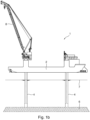
- FIGS 1a and 1b show a side view of an exemplary embodiment of a jack-up platform unit 1 in a sailing configuration and an operating configuration respectively.
- the jack-up platform unit 1 which is a self-propelled vessel in this case, includes a buoyant hull 2, as well as a plurality of legs 4, in this example a set of four legs 4, which are extendible from and/or through the hull 2 and which are arranged to support the platform unit 1 during off-shore operations.
- a jacking system (not shown) is arranged to move the legs 4 between a transport position, shown in Figure 1a , in which the legs 4 extend substantially above the hull 2, and an operational position, shown in Figure 1b , in which the legs 4 extend substantially below the hull 2 to stand on a seabed 6.
- the legs 4 may rest on the seabed 6, or may partially sink into the seabed 6. In this example, an enlarged foot 3 of the legs has sunk into the seabed 6.
- the jacking system is also arranged to move the hull 2 along the plurality of legs 4 between a floating position, wherein the hull 2 floats on water, and an operational position, in which the hull 2 is substantially above sea surface 7.
- a first test of pre-loading with a limited load on the legs 4 in order to check whether or not it is safe to raise the hull 2 above the sea level 7.
- This test may be performed with the hull 2 slightly raised along the legs 4, but not above the sea level 7, just high enough such that a weight of the platform unit 1 prevents the legs 4 from losing contact with the seabed 6 because of wave forces acting on the unit 1, in particular on the hull 2.
- the hull 2 is raised substantially above the sea surface 7, to a level where a bottom side of the hull 2 is typically 1.5m above still water level. After raising the hull 2 above the sea surface 7, a preload is temporarily applied on the legs 4, i.e.
- a load above a static leg load is applied to each of the legs 4 in turns. This is preferably done by slightly lowering the hull 2 along a diagonal pair of legs. As a result, load on the other diagonal pair of legs is significantly increased.
- the load on each of the legs 4 may be equalized before the hull 2 is further raised to an operational height above the sea surface 7, typically to a height of more or less 15m above the sea surface 7. Once the hull 2 has reached this operational height, the step of equalizing the load over the legs may optionally be repeated to correct for slight differences in load distribution due to the jacking operation.
- FIG. 2 shows a top view of the jack-up platform unit 1 of Figures 1a and 1b .
- the hull 2 as seen from above has a substantially rectangular shape.
- the four legs 4 are substantially equally distributed over the hull 2: two legs are located towards the fore F of the vessel, of which one on port side PS and one on starboard SB, and two legs at the aft A of the vessel, of which one at port side PS and one on starboard SB.
- the crane 8 is mounted around one of the four legs 4, in particular around the leg located aft on port side PS of the hull 2, but the crane could also be mounted elsewhere on the platform 2.
- the crane 8 can be arranged to be movable between a sailing position, in which the crane is folded down, extending over the hull 2, as shown in Figures 1a and 2 , and a operational position, in which the crane 8 is arranged to be upright, as shown in Figure 1b .
- the crane 8 is preferably arranged to be pivotable over 360 degrees such that the crane 8 can pick up load from the platform 2 and lift the load overboard, for example onto a building site, such as a construction site of an off-shore wind turbine.
- the working range of the crane 8 may be more or less limited.
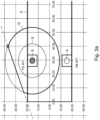
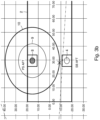
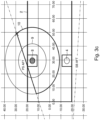
- Figures 3a , 3b , 3c and 3d show a series of four graphs representing a safe working range for a given crane load of a crane 8 mounted on a hull 2 of a unit 1 shown in Figures 1a and 1b .
- the axes represent distances in metres.
- the aft of the hull 2 of a jack-up platform unit 1 is represented, having a width of 40 metres.
- the two aft legs of the four legs 4 are indicated, as well as a crane 8 around the aft leg on port side PS. Due to an inherent inclination of the crane arm, the crane cannot lift a load at an inner side of the inner circle 9, indicated in blue.
- the present method of stabilizing a jack-up platform unit further includes the step of applying a torque to the hull 2 of the jack-up platform unit 1. This is preferably done by decreasing the load on the leg which is closest to the crane 8, i.e.
- the hull 2 can for example be slightly lowered along said aft leg on port side, resulting in an increase of the load on the aft leg on starboard and on the fore leg on port side.
- the hull 2 can also be lowered both along the aft leg on port side, i.e. where the crane 8 is located in the present example, and on the fore leg on starboard, which is diagonally opposite the crane leg, with the same result of increasing a load on the two other legs.
- a 1600-ton load on the crane does not provide a workable crane range, as shown by the red circle 10 in Figure 3c , but when a torque on the hull 2 is applied, the working range 10 of the crane comes close to complete, as shown in Figure 3d .
- crane capacities on a jack-up platform unit can be substantially extended in a relatively reliable and cost-saving way.
- any reference signs placed between parentheses shall not be construed as limiting the claim.
- the word 'comprising' does not exclude the presence of other features or steps than those listed in a claim.
- the words 'a' and 'an' shall not be construed as limited to 'only one', but instead are used to mean ⁇ at least one', and do not exclude a plurality.
- the mere fact that certain measures are recited in mutually different claims does not indicate that a combination of these measures cannot be used to an advantage. Many variants will be apparent to the person skilled in the art. All variants are understood to be comprised within the scope of the invention defined in the following claims.
Landscapes
- Engineering & Computer Science (AREA)
- General Engineering & Computer Science (AREA)
- Mechanical Engineering (AREA)
- Civil Engineering (AREA)
- Structural Engineering (AREA)
- Jib Cranes (AREA)
Applications Claiming Priority (2)
| Application Number | Priority Date | Filing Date | Title |
|---|---|---|---|
| NL2021708A NL2021708B1 (en) | 2018-09-25 | 2018-09-25 | Method for stabilizing a jack-up platform unit |
| PCT/NL2019/050646 WO2020067896A1 (en) | 2018-09-25 | 2019-09-25 | Method for stabilizing a jack-up platform unit |
Publications (2)
| Publication Number | Publication Date |
|---|---|
| EP3856980A1 EP3856980A1 (en) | 2021-08-04 |
| EP3856980B1 true EP3856980B1 (en) | 2024-02-28 |
Family
ID=64172555
Family Applications (1)
| Application Number | Title | Priority Date | Filing Date |
|---|---|---|---|
| EP19828858.1A Active EP3856980B1 (en) | 2018-09-25 | 2019-09-25 | Method for stabilizing a jack-up platform unit |
Country Status (9)
| Country | Link |
|---|---|
| US (1) | US11499282B2 (pl) |
| EP (1) | EP3856980B1 (pl) |
| JP (1) | JP7379500B2 (pl) |
| CN (1) | CN113423891B (pl) |
| DK (1) | DK3856980T3 (pl) |
| LT (1) | LT3856980T (pl) |
| NL (1) | NL2021708B1 (pl) |
| PL (1) | PL3856980T3 (pl) |
| WO (1) | WO2020067896A1 (pl) |
Cited By (1)
| Publication number | Priority date | Publication date | Assignee | Title |
|---|---|---|---|---|
| NO349209B1 (en) * | 2024-06-21 | 2025-11-03 | Fred Olsen 1848 As | Method for installation of a vessel in a seabed |
Families Citing this family (3)
| Publication number | Priority date | Publication date | Assignee | Title |
|---|---|---|---|---|
| NL2021625B1 (en) * | 2018-09-13 | 2020-05-06 | Gustomsc Resources Bv | Controlling movement of a cantilever structure of an offshore platform |
| NL2023832B1 (en) * | 2019-09-13 | 2021-05-18 | Gustomsc B V | Method for determining a crane or cantilever operations envelope on a jack-up platform unit, jack-up platform unit |
| EP4433650A1 (en) * | 2021-11-16 | 2024-09-25 | Itrec B.V. | A jack-up vessel |
Family Cites Families (42)
| Publication number | Priority date | Publication date | Assignee | Title |
|---|---|---|---|---|
| DE1904726A1 (de) * | 1969-01-31 | 1970-08-13 | Strabag Bau Ag | Schreitende Hubinsel |
| US3804268A (en) * | 1970-03-16 | 1974-04-16 | Jackson Byron Inc | Marine platform structure |
| US3797256A (en) * | 1972-09-08 | 1974-03-19 | Sharp Inc G | Jack-up type offshore platform apparatus |
| NL7906710A (nl) * | 1979-09-07 | 1981-03-10 | Rsv Gusto Eng Bv | Werkwijze en inrichting voor het door voordrukken verhogen van de stabiliteit van een kunstmatig eiland. |
| US4456404A (en) * | 1982-02-17 | 1984-06-26 | Atlantic Pacific Marine Corporation | Method and apparatus for positioning a working barge above a sea surface |
| US4512553A (en) * | 1982-03-17 | 1985-04-23 | Red Fox Industries, Inc. | Jack-up unit |
| GB2153749A (en) * | 1984-02-13 | 1985-08-29 | Robin Shipyard | Stabilized jack-up mobile offshore drilling platform |
| JPS6268914A (ja) * | 1985-09-18 | 1987-03-30 | Hitachi Zosen Corp | ジヤツキアツプリグの転倒モ−メント制御方法 |
| US5188484A (en) * | 1991-05-13 | 1993-02-23 | Self Installing Platforms, Inc. | Jack-up type offshore oil and gas production platform and method |
| US5997217A (en) * | 1998-05-11 | 1999-12-07 | Verret; Rodney J. | Shallow water well-drilling apparatus |
| CN2384929Y (zh) * | 1999-08-16 | 2000-06-28 | 焦作矿务局建筑安装工程总公司 | 自升式门架提升机 |
| GB2359058A (en) * | 1999-09-28 | 2001-08-15 | Kurt Elith Thomsen | Vessel |
| US6869252B1 (en) * | 1999-12-28 | 2005-03-22 | Zentech, Inc. | Taut mooring system for jack-up type mobile offshore platforms |
| US6607331B2 (en) * | 2000-08-17 | 2003-08-19 | Ronald E. Sanders | Elevated crane support system and method for elevating a lifting apparatus |
| US7258510B2 (en) * | 2001-03-29 | 2007-08-21 | Masasuke Kawasaki | Systems and methods useful in stabilizing platforms and vessels having platforms and legs |
| US7163355B2 (en) * | 2001-04-16 | 2007-01-16 | James E. Ingle | Mobile wind-driven electric generating systems and methods |
| SG120186A1 (en) * | 2004-09-07 | 2006-03-28 | Offshore Technology Dev Pte Lt | Improved jackup oil rig and similar platforms |
| US20080240863A1 (en) * | 2007-03-30 | 2008-10-02 | Remdial (Cyprus) Pcl | Elevating support vessel and methods thereof |
| US20090090191A1 (en) * | 2007-10-05 | 2009-04-09 | Bernardino Lenders | Methods and structures for monitoring offshore platform supports |
| CN101181927B (zh) * | 2007-12-19 | 2011-09-07 | 上海振华重工(集团)股份有限公司 | 半潜式海洋多功能工程船 |
| US20130115011A1 (en) * | 2009-12-22 | 2013-05-09 | Total Marine Services Inc. | Submersible offshore positionable frame |
| WO2011116254A2 (en) * | 2010-03-19 | 2011-09-22 | National Oilwell Varco, L.P. | Jack-up rig with leg-supported ballast loads |
| SG177019A1 (en) * | 2010-06-09 | 2012-01-30 | Keppel Offshore & Marine Technology Ct Pte Ltd | Movable brace frame for self-installing platform |
| CN102979067A (zh) * | 2011-09-06 | 2013-03-20 | 天津市海王星海上工程技术有限公司 | 迁移底盘式自升降平台 |
| NO334831B1 (no) * | 2011-09-29 | 2014-06-10 | Aker Engineering & Technology | Offshorestruktur og fremgangsmåte for å installere strukturen |
| CN102704452B (zh) * | 2012-07-05 | 2014-07-02 | 南通中远船务工程有限公司 | 具有多类型桩腿的超大型自升式风电安装船及其设计方法 |
| SG2012086682A (en) * | 2012-11-23 | 2014-06-27 | Keppel Offshore & Marine Technology Ct Pte Ltd | Structure-assisted jackup system |
| CN103911979B (zh) * | 2012-12-31 | 2016-02-03 | 中交第一航务工程局有限公司 | 整平船四角均衡压载抬升方法 |
| CN103015388B (zh) * | 2013-01-21 | 2015-01-14 | 上海振华重工(集团)股份有限公司 | 可动态检测载荷的自升式平台升降装置 |
| GB2522942A (en) * | 2013-07-19 | 2015-08-12 | Ap Moeller Maersk As | A jack-up rig and method of installing the same on location of operation |
| US9371625B2 (en) * | 2014-06-09 | 2016-06-21 | Offshore Technology Development Pte Ltd | Modified spudcan with optimal peripheral skirt for enhanced performance of jackup operations |
| NL2013675B1 (en) * | 2014-10-23 | 2016-10-06 | Itrec Bv | Offshore Drilling Vessel. |
| CN104802116B (zh) * | 2014-12-22 | 2017-02-22 | 烟台中集来福士海洋工程有限公司 | 自升式平台的马达力矩预加载装置及加载、检测方法 |
| CN204357115U (zh) * | 2014-12-26 | 2015-05-27 | 中建三局集团有限公司 | 一种低位顶升模架抗侧倾装置 |
| DK178601B1 (en) * | 2015-01-14 | 2016-08-08 | Envision Energy Denmark Aps | Method for providing a stable working platform and a vessel thereof |
| CN105004506A (zh) * | 2015-06-29 | 2015-10-28 | 中国海洋大学 | 自升式海洋平台桩腿波流载荷系数测试实验系统 |
| CN105059489B (zh) * | 2015-07-15 | 2017-07-28 | 中国海洋石油总公司 | 一种恒稳式海上核电平台 |
| US10968590B2 (en) * | 2016-01-22 | 2021-04-06 | Gustomsc B.V. | Measurement system, leg guide, jack-up platform |
| CN105752282A (zh) * | 2016-03-31 | 2016-07-13 | 中交第三航务工程局有限公司 | 一种自升式风电施工船 |
| NL2017637B1 (en) * | 2016-10-18 | 2018-04-26 | Ulstein Design & Solutions B V | Self-propelled jack-up vessel |
| CN108454790B (zh) * | 2017-07-20 | 2024-06-21 | 上海振华重工(集团)股份有限公司 | 坐底自升式风电打桩船 |
| CN108163152A (zh) * | 2018-02-06 | 2018-06-15 | 浙江华蕴海洋工程技术服务有限公司 | 自升式风电机组安装平台 |
-
2018
- 2018-09-25 NL NL2021708A patent/NL2021708B1/en active
-
2019
- 2019-09-25 PL PL19828858.1T patent/PL3856980T3/pl unknown
- 2019-09-25 WO PCT/NL2019/050646 patent/WO2020067896A1/en not_active Ceased
- 2019-09-25 JP JP2021541009A patent/JP7379500B2/ja active Active
- 2019-09-25 US US17/211,348 patent/US11499282B2/en active Active
- 2019-09-25 LT LTEPPCT/NL2019/050646T patent/LT3856980T/lt unknown
- 2019-09-25 EP EP19828858.1A patent/EP3856980B1/en active Active
- 2019-09-25 DK DK19828858.1T patent/DK3856980T3/da active
- 2019-09-25 CN CN201980062948.0A patent/CN113423891B/zh active Active
Cited By (2)
| Publication number | Priority date | Publication date | Assignee | Title |
|---|---|---|---|---|
| NO349209B1 (en) * | 2024-06-21 | 2025-11-03 | Fred Olsen 1848 As | Method for installation of a vessel in a seabed |
| WO2025264124A1 (en) | 2024-06-21 | 2025-12-26 | Fred. Olsen 1848 AS | Method for installation of a vessel in a seabed |
Also Published As
| Publication number | Publication date |
|---|---|
| US20210372070A1 (en) | 2021-12-02 |
| DK3856980T3 (da) | 2024-05-27 |
| NL2021708B1 (en) | 2020-05-07 |
| WO2020067896A1 (en) | 2020-04-02 |
| EP3856980A1 (en) | 2021-08-04 |
| JP2022502590A (ja) | 2022-01-11 |
| JP7379500B2 (ja) | 2023-11-14 |
| PL3856980T3 (pl) | 2024-07-15 |
| US11499282B2 (en) | 2022-11-15 |
| CN113423891B (zh) | 2023-07-18 |
| LT3856980T (lt) | 2024-07-10 |
| CN113423891A (zh) | 2021-09-21 |
Similar Documents
| Publication | Publication Date | Title |
|---|---|---|
| EP3856980B1 (en) | Method for stabilizing a jack-up platform unit | |
| US10894701B2 (en) | Crane, vessel comprising such a crane, and a method for up-ending a longitudinal structure | |
| EP1356205B1 (en) | Method and apparatus for placing at least one wind turbine on open water | |
| TW202014344A (zh) | 用於從受制於運動之船隻的甲板提升物件的裝置及方法 | |
| EP3849894B1 (en) | Floating wind turbine generator installation | |
| IE47768B1 (en) | Mobile jack-up rig for marine drilling | |
| US20040237871A1 (en) | Lift boat | |
| US12152358B2 (en) | Jack-up platform comprising a mooring system and a method for mooring a floating vessel | |
| JP3247078U (ja) | 浮体式船舶用吊り上げ構造及びその方法 | |
| NO149321B (no) | Fremgangsmaate ved opphevelse av understoettende kontakt av et fartoey paa havbunnen | |
| NO334831B1 (no) | Offshorestruktur og fremgangsmåte for å installere strukturen | |
| US4505615A (en) | Method of supporting a shallow water drilling barge | |
| CN107653856B (zh) | 自升式平台的建造合拢方法 | |
| EP2472008A1 (en) | Jack-up offshore platform and its use for lifting large and heavy loads | |
| US11131073B2 (en) | Method for foundation of a transformer platform and transformer platform with at least three piles | |
| BE1030621B1 (nl) | Werkwijze voor het in een waterbodem verankeren van een hol buisvormig element, en samenstel van het buisvormige element en een afsluitlichaam | |
| GB2485678A (en) | Jack-up vessel system for offshore transport and handling of cargo | |
| KR101825655B1 (ko) | 잭업리그 | |
| NO316696B1 (no) | Ballasterbart loftefartoy og fremgangsmate for lofting, transportering, posisjonering og installasjon av minst ±n marin konstruksjon, saerlig ±n eller flere vindmoller | |
| EP3693513A1 (en) | Structure and method for decommissioning an offshore platform | |
| US3104531A (en) | Mobile marine drilling foundation | |
| TW202106602A (zh) | 具備塔式起重機之作業船及其起重機運用方法 | |
| CN116553399A (zh) | 一种适用于高水位差和大变幅的起重装备及使用方法 | |
| WO2020122712A1 (en) | Piling frame with cut-out | |
| JPS58513A (ja) | 海洋構造物の組立方法 |
Legal Events
| Date | Code | Title | Description |
|---|---|---|---|
| STAA | Information on the status of an ep patent application or granted ep patent |
Free format text: STATUS: UNKNOWN |
|
| STAA | Information on the status of an ep patent application or granted ep patent |
Free format text: STATUS: THE INTERNATIONAL PUBLICATION HAS BEEN MADE |
|
| PUAI | Public reference made under article 153(3) epc to a published international application that has entered the european phase |
Free format text: ORIGINAL CODE: 0009012 |
|
| STAA | Information on the status of an ep patent application or granted ep patent |
Free format text: STATUS: REQUEST FOR EXAMINATION WAS MADE |
|
| 17P | Request for examination filed |
Effective date: 20210423 |
|
| AK | Designated contracting states |
Kind code of ref document: A1 Designated state(s): AL AT BE BG CH CY CZ DE DK EE ES FI FR GB GR HR HU IE IS IT LI LT LU LV MC MK MT NL NO PL PT RO RS SE SI SK SM TR |
|
| DAV | Request for validation of the european patent (deleted) | ||
| DAX | Request for extension of the european patent (deleted) | ||
| RIN1 | Information on inventor provided before grant (corrected) |
Inventor name: HOFMAN, JOHANNES ANDRIES |
|
| GRAP | Despatch of communication of intention to grant a patent |
Free format text: ORIGINAL CODE: EPIDOSNIGR1 |
|
| STAA | Information on the status of an ep patent application or granted ep patent |
Free format text: STATUS: GRANT OF PATENT IS INTENDED |
|
| INTG | Intention to grant announced |
Effective date: 20230516 |
|
| P01 | Opt-out of the competence of the unified patent court (upc) registered |
Effective date: 20230516 |
|
| GRAJ | Information related to disapproval of communication of intention to grant by the applicant or resumption of examination proceedings by the epo deleted |
Free format text: ORIGINAL CODE: EPIDOSDIGR1 |
|
| STAA | Information on the status of an ep patent application or granted ep patent |
Free format text: STATUS: REQUEST FOR EXAMINATION WAS MADE |
|
| GRAP | Despatch of communication of intention to grant a patent |
Free format text: ORIGINAL CODE: EPIDOSNIGR1 |
|
| STAA | Information on the status of an ep patent application or granted ep patent |
Free format text: STATUS: GRANT OF PATENT IS INTENDED |
|
| INTC | Intention to grant announced (deleted) | ||
| INTG | Intention to grant announced |
Effective date: 20230919 |
|
| GRAS | Grant fee paid |
Free format text: ORIGINAL CODE: EPIDOSNIGR3 |
|
| GRAA | (expected) grant |
Free format text: ORIGINAL CODE: 0009210 |
|
| STAA | Information on the status of an ep patent application or granted ep patent |
Free format text: STATUS: THE PATENT HAS BEEN GRANTED |
|
| AK | Designated contracting states |
Kind code of ref document: B1 Designated state(s): AL AT BE BG CH CY CZ DE DK EE ES FI FR GB GR HR HU IE IS IT LI LT LU LV MC MK MT NL NO PL PT RO RS SE SI SK SM TR |
|
| REG | Reference to a national code |
Ref country code: GB Ref legal event code: FG4D |
|
| REG | Reference to a national code |
Ref country code: CH Ref legal event code: EP |
|
| REG | Reference to a national code |
Ref country code: DE Ref legal event code: R096 Ref document number: 602019047454 Country of ref document: DE |
|
| REG | Reference to a national code |
Ref country code: IE Ref legal event code: FG4D |
|
| REG | Reference to a national code |
Ref country code: DK Ref legal event code: T3 Effective date: 20240523 |
|
| REG | Reference to a national code |
Ref country code: SE Ref legal event code: TRGR |
|
| PG25 | Lapsed in a contracting state [announced via postgrant information from national office to epo] |
Ref country code: IS Free format text: LAPSE BECAUSE OF FAILURE TO SUBMIT A TRANSLATION OF THE DESCRIPTION OR TO PAY THE FEE WITHIN THE PRESCRIBED TIME-LIMIT Effective date: 20240628 |
|
| REG | Reference to a national code |
Ref country code: NL Ref legal event code: FP |
|
| PG25 | Lapsed in a contracting state [announced via postgrant information from national office to epo] |
Ref country code: GR Free format text: LAPSE BECAUSE OF FAILURE TO SUBMIT A TRANSLATION OF THE DESCRIPTION OR TO PAY THE FEE WITHIN THE PRESCRIBED TIME-LIMIT Effective date: 20240529 |
|
| PG25 | Lapsed in a contracting state [announced via postgrant information from national office to epo] |
Ref country code: HR Free format text: LAPSE BECAUSE OF FAILURE TO SUBMIT A TRANSLATION OF THE DESCRIPTION OR TO PAY THE FEE WITHIN THE PRESCRIBED TIME-LIMIT Effective date: 20240228 Ref country code: RS Free format text: LAPSE BECAUSE OF FAILURE TO SUBMIT A TRANSLATION OF THE DESCRIPTION OR TO PAY THE FEE WITHIN THE PRESCRIBED TIME-LIMIT Effective date: 20240528 |
|
| PG25 | Lapsed in a contracting state [announced via postgrant information from national office to epo] |
Ref country code: ES Free format text: LAPSE BECAUSE OF FAILURE TO SUBMIT A TRANSLATION OF THE DESCRIPTION OR TO PAY THE FEE WITHIN THE PRESCRIBED TIME-LIMIT Effective date: 20240228 |
|
| PG25 | Lapsed in a contracting state [announced via postgrant information from national office to epo] |
Ref country code: RS Free format text: LAPSE BECAUSE OF FAILURE TO SUBMIT A TRANSLATION OF THE DESCRIPTION OR TO PAY THE FEE WITHIN THE PRESCRIBED TIME-LIMIT Effective date: 20240528 Ref country code: IS Free format text: LAPSE BECAUSE OF FAILURE TO SUBMIT A TRANSLATION OF THE DESCRIPTION OR TO PAY THE FEE WITHIN THE PRESCRIBED TIME-LIMIT Effective date: 20240628 Ref country code: HR Free format text: LAPSE BECAUSE OF FAILURE TO SUBMIT A TRANSLATION OF THE DESCRIPTION OR TO PAY THE FEE WITHIN THE PRESCRIBED TIME-LIMIT Effective date: 20240228 Ref country code: GR Free format text: LAPSE BECAUSE OF FAILURE TO SUBMIT A TRANSLATION OF THE DESCRIPTION OR TO PAY THE FEE WITHIN THE PRESCRIBED TIME-LIMIT Effective date: 20240529 Ref country code: FI Free format text: LAPSE BECAUSE OF FAILURE TO SUBMIT A TRANSLATION OF THE DESCRIPTION OR TO PAY THE FEE WITHIN THE PRESCRIBED TIME-LIMIT Effective date: 20240228 Ref country code: ES Free format text: LAPSE BECAUSE OF FAILURE TO SUBMIT A TRANSLATION OF THE DESCRIPTION OR TO PAY THE FEE WITHIN THE PRESCRIBED TIME-LIMIT Effective date: 20240228 Ref country code: BG Free format text: LAPSE BECAUSE OF FAILURE TO SUBMIT A TRANSLATION OF THE DESCRIPTION OR TO PAY THE FEE WITHIN THE PRESCRIBED TIME-LIMIT Effective date: 20240228 |
|
| PG25 | Lapsed in a contracting state [announced via postgrant information from national office to epo] |
Ref country code: PT Free format text: LAPSE BECAUSE OF FAILURE TO SUBMIT A TRANSLATION OF THE DESCRIPTION OR TO PAY THE FEE WITHIN THE PRESCRIBED TIME-LIMIT Effective date: 20240628 |
|
| REG | Reference to a national code |
Ref country code: AT Ref legal event code: MK05 Ref document number: 1661349 Country of ref document: AT Kind code of ref document: T Effective date: 20240228 Ref country code: EE Ref legal event code: FG4A Ref document number: E024318 Country of ref document: EE Effective date: 20240523 |
|
| PG25 | Lapsed in a contracting state [announced via postgrant information from national office to epo] |
Ref country code: PT Free format text: LAPSE BECAUSE OF FAILURE TO SUBMIT A TRANSLATION OF THE DESCRIPTION OR TO PAY THE FEE WITHIN THE PRESCRIBED TIME-LIMIT Effective date: 20240628 |
|
| PG25 | Lapsed in a contracting state [announced via postgrant information from national office to epo] |
Ref country code: SM Free format text: LAPSE BECAUSE OF FAILURE TO SUBMIT A TRANSLATION OF THE DESCRIPTION OR TO PAY THE FEE WITHIN THE PRESCRIBED TIME-LIMIT Effective date: 20240228 |
|
| PG25 | Lapsed in a contracting state [announced via postgrant information from national office to epo] |
Ref country code: CZ Free format text: LAPSE BECAUSE OF FAILURE TO SUBMIT A TRANSLATION OF THE DESCRIPTION OR TO PAY THE FEE WITHIN THE PRESCRIBED TIME-LIMIT Effective date: 20240228 |
|
| PG25 | Lapsed in a contracting state [announced via postgrant information from national office to epo] |
Ref country code: AT Free format text: LAPSE BECAUSE OF FAILURE TO SUBMIT A TRANSLATION OF THE DESCRIPTION OR TO PAY THE FEE WITHIN THE PRESCRIBED TIME-LIMIT Effective date: 20240228 |
|
| PG25 | Lapsed in a contracting state [announced via postgrant information from national office to epo] |
Ref country code: SK Free format text: LAPSE BECAUSE OF FAILURE TO SUBMIT A TRANSLATION OF THE DESCRIPTION OR TO PAY THE FEE WITHIN THE PRESCRIBED TIME-LIMIT Effective date: 20240228 |
|
| PG25 | Lapsed in a contracting state [announced via postgrant information from national office to epo] |
Ref country code: SM Free format text: LAPSE BECAUSE OF FAILURE TO SUBMIT A TRANSLATION OF THE DESCRIPTION OR TO PAY THE FEE WITHIN THE PRESCRIBED TIME-LIMIT Effective date: 20240228 Ref country code: SK Free format text: LAPSE BECAUSE OF FAILURE TO SUBMIT A TRANSLATION OF THE DESCRIPTION OR TO PAY THE FEE WITHIN THE PRESCRIBED TIME-LIMIT Effective date: 20240228 Ref country code: RO Free format text: LAPSE BECAUSE OF FAILURE TO SUBMIT A TRANSLATION OF THE DESCRIPTION OR TO PAY THE FEE WITHIN THE PRESCRIBED TIME-LIMIT Effective date: 20240228 Ref country code: CZ Free format text: LAPSE BECAUSE OF FAILURE TO SUBMIT A TRANSLATION OF THE DESCRIPTION OR TO PAY THE FEE WITHIN THE PRESCRIBED TIME-LIMIT Effective date: 20240228 Ref country code: AT Free format text: LAPSE BECAUSE OF FAILURE TO SUBMIT A TRANSLATION OF THE DESCRIPTION OR TO PAY THE FEE WITHIN THE PRESCRIBED TIME-LIMIT Effective date: 20240228 |
|
| REG | Reference to a national code |
Ref country code: DE Ref legal event code: R097 Ref document number: 602019047454 Country of ref document: DE |
|
| PG25 | Lapsed in a contracting state [announced via postgrant information from national office to epo] |
Ref country code: IT Free format text: LAPSE BECAUSE OF FAILURE TO SUBMIT A TRANSLATION OF THE DESCRIPTION OR TO PAY THE FEE WITHIN THE PRESCRIBED TIME-LIMIT Effective date: 20240228 |
|
| PG25 | Lapsed in a contracting state [announced via postgrant information from national office to epo] |
Ref country code: IT Free format text: LAPSE BECAUSE OF FAILURE TO SUBMIT A TRANSLATION OF THE DESCRIPTION OR TO PAY THE FEE WITHIN THE PRESCRIBED TIME-LIMIT Effective date: 20240228 |
|
| PLBE | No opposition filed within time limit |
Free format text: ORIGINAL CODE: 0009261 |
|
| STAA | Information on the status of an ep patent application or granted ep patent |
Free format text: STATUS: NO OPPOSITION FILED WITHIN TIME LIMIT |
|
| 26N | No opposition filed |
Effective date: 20241129 |
|
| PG25 | Lapsed in a contracting state [announced via postgrant information from national office to epo] |
Ref country code: SI Free format text: LAPSE BECAUSE OF FAILURE TO SUBMIT A TRANSLATION OF THE DESCRIPTION OR TO PAY THE FEE WITHIN THE PRESCRIBED TIME-LIMIT Effective date: 20240228 Ref country code: MC Free format text: LAPSE BECAUSE OF FAILURE TO SUBMIT A TRANSLATION OF THE DESCRIPTION OR TO PAY THE FEE WITHIN THE PRESCRIBED TIME-LIMIT Effective date: 20240228 |
|
| REG | Reference to a national code |
Ref country code: CH Ref legal event code: PL |
|
| PG25 | Lapsed in a contracting state [announced via postgrant information from national office to epo] |
Ref country code: LU Free format text: LAPSE BECAUSE OF NON-PAYMENT OF DUE FEES Effective date: 20240925 |
|
| PG25 | Lapsed in a contracting state [announced via postgrant information from national office to epo] |
Ref country code: CH Free format text: LAPSE BECAUSE OF NON-PAYMENT OF DUE FEES Effective date: 20240930 |
|
| PGFP | Annual fee paid to national office [announced via postgrant information from national office to epo] |
Ref country code: NL Payment date: 20250704 Year of fee payment: 7 |
|
| PGFP | Annual fee paid to national office [announced via postgrant information from national office to epo] |
Ref country code: LT Payment date: 20250827 Year of fee payment: 7 Ref country code: DK Payment date: 20250911 Year of fee payment: 7 Ref country code: DE Payment date: 20250702 Year of fee payment: 7 |
|
| PGFP | Annual fee paid to national office [announced via postgrant information from national office to epo] |
Ref country code: NO Payment date: 20250909 Year of fee payment: 7 |
|
| PGFP | Annual fee paid to national office [announced via postgrant information from national office to epo] |
Ref country code: PL Payment date: 20250704 Year of fee payment: 7 |
|
| PGFP | Annual fee paid to national office [announced via postgrant information from national office to epo] |
Ref country code: BE Payment date: 20250703 Year of fee payment: 7 Ref country code: GB Payment date: 20250703 Year of fee payment: 7 |
|
| PGFP | Annual fee paid to national office [announced via postgrant information from national office to epo] |
Ref country code: FR Payment date: 20250808 Year of fee payment: 7 |
|
| PGFP | Annual fee paid to national office [announced via postgrant information from national office to epo] |
Ref country code: SE Payment date: 20250702 Year of fee payment: 7 |
|
| PGFP | Annual fee paid to national office [announced via postgrant information from national office to epo] |
Ref country code: EE Payment date: 20250828 Year of fee payment: 7 Ref country code: IE Payment date: 20250702 Year of fee payment: 7 |
|
| PGFP | Annual fee paid to national office [announced via postgrant information from national office to epo] |
Ref country code: LV Payment date: 20250721 Year of fee payment: 7 |
|
| PG25 | Lapsed in a contracting state [announced via postgrant information from national office to epo] |
Ref country code: CY Free format text: LAPSE BECAUSE OF FAILURE TO SUBMIT A TRANSLATION OF THE DESCRIPTION OR TO PAY THE FEE WITHIN THE PRESCRIBED TIME-LIMIT; INVALID AB INITIO Effective date: 20190925 |
|
| PG25 | Lapsed in a contracting state [announced via postgrant information from national office to epo] |
Ref country code: HU Free format text: LAPSE BECAUSE OF FAILURE TO SUBMIT A TRANSLATION OF THE DESCRIPTION OR TO PAY THE FEE WITHIN THE PRESCRIBED TIME-LIMIT; INVALID AB INITIO Effective date: 20190925 |