EP3852182A1 - Sekundärbatterie mit wasserfreiem elektrolyt, verfahren zu ihrer herstellung und sekundärbatterie mit wasserfreiem elektrolyt - Google Patents
Sekundärbatterie mit wasserfreiem elektrolyt, verfahren zu ihrer herstellung und sekundärbatterie mit wasserfreiem elektrolyt Download PDFInfo
- Publication number
- EP3852182A1 EP3852182A1 EP19859956.5A EP19859956A EP3852182A1 EP 3852182 A1 EP3852182 A1 EP 3852182A1 EP 19859956 A EP19859956 A EP 19859956A EP 3852182 A1 EP3852182 A1 EP 3852182A1
- Authority
- EP
- European Patent Office
- Prior art keywords
- electrolyte secondary
- aqueous electrolyte
- secondary battery
- positive electrode
- negative electrode
- Prior art date
- Legal status (The legal status is an assumption and is not a legal conclusion. Google has not performed a legal analysis and makes no representation as to the accuracy of the status listed.)
- Pending
Links
Images
Classifications
-
- H—ELECTRICITY
- H01—ELECTRIC ELEMENTS
- H01M—PROCESSES OR MEANS, e.g. BATTERIES, FOR THE DIRECT CONVERSION OF CHEMICAL ENERGY INTO ELECTRICAL ENERGY
- H01M4/00—Electrodes
- H01M4/02—Electrodes composed of, or comprising, active material
- H01M4/64—Carriers or collectors
- H01M4/66—Selection of materials
- H01M4/661—Metal or alloys, e.g. alloy coatings
-
- H—ELECTRICITY
- H01—ELECTRIC ELEMENTS
- H01M—PROCESSES OR MEANS, e.g. BATTERIES, FOR THE DIRECT CONVERSION OF CHEMICAL ENERGY INTO ELECTRICAL ENERGY
- H01M4/00—Electrodes
- H01M4/02—Electrodes composed of, or comprising, active material
- H01M4/36—Selection of substances as active materials, active masses, active liquids
- H01M4/38—Selection of substances as active materials, active masses, active liquids of elements or alloys
- H01M4/46—Alloys based on magnesium or aluminium
- H01M4/463—Aluminium based
-
- H—ELECTRICITY
- H01—ELECTRIC ELEMENTS
- H01M—PROCESSES OR MEANS, e.g. BATTERIES, FOR THE DIRECT CONVERSION OF CHEMICAL ENERGY INTO ELECTRICAL ENERGY
- H01M10/00—Secondary cells; Manufacture thereof
- H01M10/05—Accumulators with non-aqueous electrolyte
- H01M10/052—Li-accumulators
-
- H—ELECTRICITY
- H01—ELECTRIC ELEMENTS
- H01M—PROCESSES OR MEANS, e.g. BATTERIES, FOR THE DIRECT CONVERSION OF CHEMICAL ENERGY INTO ELECTRICAL ENERGY
- H01M10/00—Secondary cells; Manufacture thereof
- H01M10/42—Methods or arrangements for servicing or maintenance of secondary cells or secondary half-cells
- H01M10/46—Accumulators structurally combined with charging apparatus
-
- H—ELECTRICITY
- H01—ELECTRIC ELEMENTS
- H01M—PROCESSES OR MEANS, e.g. BATTERIES, FOR THE DIRECT CONVERSION OF CHEMICAL ENERGY INTO ELECTRICAL ENERGY
- H01M4/00—Electrodes
- H01M4/02—Electrodes composed of, or comprising, active material
- H01M4/13—Electrodes for accumulators with non-aqueous electrolyte, e.g. for lithium-accumulators; Processes of manufacture thereof
- H01M4/134—Electrodes based on metals, Si or alloys
-
- H—ELECTRICITY
- H01—ELECTRIC ELEMENTS
- H01M—PROCESSES OR MEANS, e.g. BATTERIES, FOR THE DIRECT CONVERSION OF CHEMICAL ENERGY INTO ELECTRICAL ENERGY
- H01M4/00—Electrodes
- H01M4/02—Electrodes composed of, or comprising, active material
- H01M4/36—Selection of substances as active materials, active masses, active liquids
- H01M4/48—Selection of substances as active materials, active masses, active liquids of inorganic oxides or hydroxides
- H01M4/485—Selection of substances as active materials, active masses, active liquids of inorganic oxides or hydroxides of mixed oxides or hydroxides for inserting or intercalating light metals, e.g. LiTi2O4 or LiTi2OxFy
-
- H—ELECTRICITY
- H01—ELECTRIC ELEMENTS
- H01M—PROCESSES OR MEANS, e.g. BATTERIES, FOR THE DIRECT CONVERSION OF CHEMICAL ENERGY INTO ELECTRICAL ENERGY
- H01M50/00—Constructional details or processes of manufacture of the non-active parts of electrochemical cells other than fuel cells, e.g. hybrid cells
- H01M50/40—Separators; Membranes; Diaphragms; Spacing elements inside cells
- H01M50/409—Separators, membranes or diaphragms characterised by the material
-
- H—ELECTRICITY
- H01—ELECTRIC ELEMENTS
- H01M—PROCESSES OR MEANS, e.g. BATTERIES, FOR THE DIRECT CONVERSION OF CHEMICAL ENERGY INTO ELECTRICAL ENERGY
- H01M50/00—Constructional details or processes of manufacture of the non-active parts of electrochemical cells other than fuel cells, e.g. hybrid cells
- H01M50/40—Separators; Membranes; Diaphragms; Spacing elements inside cells
- H01M50/489—Separators, membranes, diaphragms or spacing elements inside the cells, characterised by their physical properties, e.g. swelling degree, hydrophilicity or shut down properties
- H01M50/491—Porosity
-
- H—ELECTRICITY
- H01—ELECTRIC ELEMENTS
- H01M—PROCESSES OR MEANS, e.g. BATTERIES, FOR THE DIRECT CONVERSION OF CHEMICAL ENERGY INTO ELECTRICAL ENERGY
- H01M10/00—Secondary cells; Manufacture thereof
- H01M10/05—Accumulators with non-aqueous electrolyte
- H01M10/058—Construction or manufacture
- H01M10/0587—Construction or manufacture of accumulators having only wound construction elements, i.e. wound positive electrodes, wound negative electrodes and wound separators
-
- H—ELECTRICITY
- H01—ELECTRIC ELEMENTS
- H01M—PROCESSES OR MEANS, e.g. BATTERIES, FOR THE DIRECT CONVERSION OF CHEMICAL ENERGY INTO ELECTRICAL ENERGY
- H01M10/00—Secondary cells; Manufacture thereof
- H01M10/42—Methods or arrangements for servicing or maintenance of secondary cells or secondary half-cells
- H01M10/44—Methods for charging or discharging
-
- H—ELECTRICITY
- H01—ELECTRIC ELEMENTS
- H01M—PROCESSES OR MEANS, e.g. BATTERIES, FOR THE DIRECT CONVERSION OF CHEMICAL ENERGY INTO ELECTRICAL ENERGY
- H01M4/00—Electrodes
- H01M4/02—Electrodes composed of, or comprising, active material
- H01M2004/021—Physical characteristics, e.g. porosity, surface area
-
- H—ELECTRICITY
- H01—ELECTRIC ELEMENTS
- H01M—PROCESSES OR MEANS, e.g. BATTERIES, FOR THE DIRECT CONVERSION OF CHEMICAL ENERGY INTO ELECTRICAL ENERGY
- H01M4/00—Electrodes
- H01M4/02—Electrodes composed of, or comprising, active material
- H01M4/36—Selection of substances as active materials, active masses, active liquids
- H01M4/38—Selection of substances as active materials, active masses, active liquids of elements or alloys
- H01M4/40—Alloys based on alkali metals
- H01M4/405—Alloys based on lithium
-
- H—ELECTRICITY
- H01—ELECTRIC ELEMENTS
- H01M—PROCESSES OR MEANS, e.g. BATTERIES, FOR THE DIRECT CONVERSION OF CHEMICAL ENERGY INTO ELECTRICAL ENERGY
- H01M50/00—Constructional details or processes of manufacture of the non-active parts of electrochemical cells other than fuel cells, e.g. hybrid cells
- H01M50/40—Separators; Membranes; Diaphragms; Spacing elements inside cells
- H01M50/409—Separators, membranes or diaphragms characterised by the material
- H01M50/44—Fibrous material
-
- H—ELECTRICITY
- H01—ELECTRIC ELEMENTS
- H01M—PROCESSES OR MEANS, e.g. BATTERIES, FOR THE DIRECT CONVERSION OF CHEMICAL ENERGY INTO ELECTRICAL ENERGY
- H01M50/00—Constructional details or processes of manufacture of the non-active parts of electrochemical cells other than fuel cells, e.g. hybrid cells
- H01M50/40—Separators; Membranes; Diaphragms; Spacing elements inside cells
- H01M50/489—Separators, membranes, diaphragms or spacing elements inside the cells, characterised by their physical properties, e.g. swelling degree, hydrophilicity or shut down properties
-
- Y—GENERAL TAGGING OF NEW TECHNOLOGICAL DEVELOPMENTS; GENERAL TAGGING OF CROSS-SECTIONAL TECHNOLOGIES SPANNING OVER SEVERAL SECTIONS OF THE IPC; TECHNICAL SUBJECTS COVERED BY FORMER USPC CROSS-REFERENCE ART COLLECTIONS [XRACs] AND DIGESTS
- Y02—TECHNOLOGIES OR APPLICATIONS FOR MITIGATION OR ADAPTATION AGAINST CLIMATE CHANGE
- Y02E—REDUCTION OF GREENHOUSE GAS [GHG] EMISSIONS, RELATED TO ENERGY GENERATION, TRANSMISSION OR DISTRIBUTION
- Y02E60/00—Enabling technologies; Technologies with a potential or indirect contribution to GHG emissions mitigation
- Y02E60/10—Energy storage using batteries
-
- Y—GENERAL TAGGING OF NEW TECHNOLOGICAL DEVELOPMENTS; GENERAL TAGGING OF CROSS-SECTIONAL TECHNOLOGIES SPANNING OVER SEVERAL SECTIONS OF THE IPC; TECHNICAL SUBJECTS COVERED BY FORMER USPC CROSS-REFERENCE ART COLLECTIONS [XRACs] AND DIGESTS
- Y02—TECHNOLOGIES OR APPLICATIONS FOR MITIGATION OR ADAPTATION AGAINST CLIMATE CHANGE
- Y02P—CLIMATE CHANGE MITIGATION TECHNOLOGIES IN THE PRODUCTION OR PROCESSING OF GOODS
- Y02P70/00—Climate change mitigation technologies in the production process for final industrial or consumer products
- Y02P70/50—Manufacturing or production processes characterised by the final manufactured product
Definitions
- the present invention relates to a non-aqueous electrolyte secondary battery excellent in reliability and productivity, a method for manufacturing the same, and a system including the non-aqueous electrolyte secondary battery.
- Non-aqueous electrolyte batteries are used in various applications, taking advantage of their characteristics such as high-capacity characteristics and high-voltage characteristics.
- the practical application of electric cars has resulted in an increase in demand for vehicle-mounted non-aqueous electrolyte batteries in recent years, for example.
- non-aqueous electrolyte batteries for vehicle application are mainly applied to driving power sources for motors in electric cars, they are being increasingly applied to other applications.
- emergency call systems for making a report about, e.g., an accident of a vehicle to various related parties are currently under development, and the application of the non-aqueous electrolyte batteries to power sources for these systems is being looked into.
- non-aqueous electrolyte primary batteries are used that have better storage characteristics than non-aqueous electrolyte secondary batteries widely used as power sources of electronic devices and that have a capacity that is hard to decrease even after long-term storage of several years or more.
- a lithium alloy such as metallic lithium (Li) or a Li-Al (lithium-aluminum) alloy is used.
- Li-Al lithium-aluminum
- a lithium alloy can also be used for a negative electrode active material in a non-aqueous electrolyte secondary battery.
- Patent Document 1 discloses that a negative electrode is used in which a metal base layer made of a material that is not alloyed with Li and Al active layers made of Al and including an Li-Al alloy on a surface thereof are bonded to each other, and that storage characteristics of a non-aqueous electrolyte secondary battery (non-aqueous liquid electrolyte secondary battery) in a high temperature environment can be enhanced by providing the Al active layers on both surfaces of the metal base layer and making the metal base layer with a certain metal.
- Patent Document 1 JP WO 2016/039323
- the present invention was achieved in light of the aforementioned circumstances, and it is an object thereof to provide a non-aqueous electrolyte secondary battery excellent in reliability and productivity, a method for manufacturing the same, and a system including the non-aqueous electrolyte secondary battery.
- a non-aqueous electrolyte secondary battery of the present invention includes a positive electrode, a negative electrode, a separator, and a non-aqueous electrolyte.
- the positive electrode includes a positive electrode mixture layer in which a lithium-containing composite oxide is used as a positive electrode active material.
- the negative electrode includes an aluminum foil or an aluminum alloy foil and a Li-Al alloy formed by reaction with Li ions deintercalated from the positive electrode.
- the Li-Al alloy has a Li content of 7 to 29 atomic% with respect to 100 atomic% of a total of Li and Al at the end of charge.
- the non-aqueous electrolyte secondary battery of the present invention can be manufactured by, e.g., a manufacturing method of the present invention in which the aluminum foil or the aluminum alloy foil having a thickness of 40 ⁇ m or more is used for the negative electrode.
- a non-aqueous electrolyte secondary battery system of the present invention includes the non-aqueous electrolyte secondary battery of the present invention and a charging circuit for charging the non-aqueous electrolyte secondary battery.
- a charging circuit for charging the non-aqueous electrolyte secondary battery.
- an end-of-charge condition is set so that the Li content with respect to 100 atomic% of the total of Li and Al in the negative electrode of the non-aqueous electrolyte secondary battery is 7 to 29 atomic% at the end of charge.
- the present invention can provide a non-aqueous electrolyte secondary battery excellent in reliability and productivity, a method for manufacturing the same, and a system including the non-aqueous electrolyte secondary battery.
- the metal base layer functioning as a current collector and Al layers (Al metal layers or Al alloy layers) are bonded to each other.
- Li ions deintercalated from a positive electrode active material of a positive electrode by the charge of the battery form Li-Al alloys on the surfaces of the Al layers, thereby changing the Al layers into the Al active layers.
- the occurrence ratio of those causing a decrease in the OCV is relatively high among such non-aqueous electrolyte secondary batteries.
- the present inventors further studied the above-described decrease in the OCV in the non-aqueous electrolyte secondary batteries, and consequently found the following.
- an Al layer (Al active layer) of the negative electrode was partially peeled off from the metal base layer, and the peeled Al layer pressed a separator, causing a position at which a distance between the negative electrode and the positive electrode was very small.
- a micro-short circuit occurred.
- the amount of Al may be insufficient at the position receiving an excessive amount of the Li ions, and the ratio of Li in the produced Li-Al alloys may be high. Thus, abnormal expansion may occur, which may cause the peeling from the metal base layer.
- Al foil An Al metal foil or Al alloy foil (hereinafter, both may be referred to as the "Al foil” together) was used for a negative electrode, and the ratio of Li with respect to 100 atomic% of the total of Li and Al was set to be a certain value.
- the degree of the unevenness was small.
- the occurrence of a micro-short circuit due to the pressing of a separator was able to be suppressed.
- such a configuration has been employed in the present invention, and has enabled the provision of a highly reliable non-aqueous electrolyte secondary battery with good productivity.
- An Al foil (Al metal foil or Al alloy foil) is used for a negative electrode of a non-aqueous electrolyte secondary battery.
- the foil constituting the negative electrode include a foil (Al metal foil) made of Al and unavoidable impurities and a foil constituted by an Al alloy containing Fe, Ni, Co, Mn, Cr, V, Ti, Zr, Nb, Mo, and/or other alloying components as an alloying component(s) and the remainder that are Al and unavoidable impurities (the content of the alloying component(s) is, e.g., 50 mass% or less in total).
- a thickness of the Al metal foil or Al alloy foil in a portion of the negative electrode that does not face a positive electrode mixture layer is preferably 40 ⁇ m or more, more preferably 45 ⁇ m or more, and further preferably 50 ⁇ m or more from the viewpoints of handleability during production and adjusting a Li content described later to suppress the occurrence of batteries having a low OCV.
- the Al metal foil or Al alloy foil is too thick, the negative electrode occupies an extremely large percentage of the inner volume of the battery, which may cause a problem of, e.g., a decrease in the capacity.
- the thickness of the Al metal foil or Al alloy foil in the portion of the negative electrode in the charged state that does not face the positive electrode mixture layer is preferably 100 ⁇ m or less, and more preferably 80 ⁇ m or less.
- the thickness of an unreacted region of the Al foil excluding a portion where the Li-Al alloy is formed on a surface of the Al foil is smaller than that of the Al foil used for the assembly of the battery.
- the determination is performed at a position that does not faces the positive electrode mixture layer and at which the Li-Al alloy is not formed.
- the thickness of the Al metal foil or Al alloy foil used for the negative electrode is the same as that of the Al foil in the portion of the negative electrode in the charged state that does not face the positive electrode mixture layer.
- the thickness is preferably 40 ⁇ m or more, and more preferably 50 ⁇ m or more.
- the thickness is preferably 100 ⁇ m or less, and more preferably 80 ⁇ m or less.
- the thickness of the Al metal foil or Al alloy foil in the portion of the negative electrode in the charged state that does not face the positive electrode mixture layer, and the thickness of the Al metal foil or Al alloy foil used for the negative electrode can be measured using, e.g., an "indicator 543 series" manufactured by Mitutoyo Corporation.
- an "indicator 543 series” manufactured by Mitutoyo Corporation e.g., an "indicator 543 series” manufactured by Mitutoyo Corporation.
- a negative electrode in which an Al metal foil or Al alloy foil and a metal base layer are bonded to each other is used, only the Al foil portion is dissolved in a sodium hydroxide aqueous solution (5 mol/L), and the thickness of the Al foil can be calculated from the weight of the dissolved Al and the Al specific gravity. All values described in examples described later were measured by these methods.
- the negative electrode may be that in which an Al metal foil or Al alloy foil and a metal base layer (made of, e.g., a Cu alloy, a Ni alloy) functioning as a current collector are bonded to each other (e.g., a clad material).
- a metal base layer made of, e.g., a Cu alloy, a Ni alloy
- the negative electrode does not include the metal base layer from the viewpoint of suppressing an increase in the thickness of the negative electrode.
- the negative electrode includes the Li-Al alloy formed on, e.g., the surface of the Al foil by the reaction of the Al foil with Li ions deintercalated from the positive electrode (positive electrode active material).
- the non-aqueous electrolyte secondary battery has a Li content of 7 atomic% or more with respect to 100 atomic% of the total of Li and Al in the negative electrode at the end of charge of the battery.
- the problem of the above-described decrease in the OCV tends to occur in a non-aqueous electrolyte secondary battery controlled so as to have such a Li content in a negative electrode at the end of charge.
- the problem of the decrease in the OCV that should be solved by the present invention is hard to occur in a battery having a Li content of less than 7 atomic% in a negative electrode at the end of charge.
- the Li content in the total of Li and Al in the negative electrode increases at the end of charge, the irreversible capacity of the negative electrode may increase, and the charge-discharge cycle characteristics may significantly deteriorate.
- the Li content with respect to 100 atomic% of the total of Li and Al in the negative electrode at the end of charge is 29 atomic% or less.
- the Li content with respect to 100 atomic% of the total of Li and Al in the negative electrode at the end of charge is preferably 25 atomic% or less, more preferably 20 atomic% or less, and further preferably 15 atomic% or less.
- a nonwoven fabric is preferably used for a separator from the viewpoint of more highly suppressing the problem of the above-described decrease in the OCV as will be described later, in a non-aqueous electrolyte secondary battery in which a Li-Al alloy is produced in a negative electrode by charge, pulverization occurs at a position where the Li-Al alloy has been produced, and powder easily drops off from the negative electrode.
- the battery controlled so as to have a small Li content as described above in the negative electrode at the end of charge can lower the ratio of small sized powder in fine powder formed when the Li-Al alloy is produced in the negative electrode by charge, and thus the effects of suppressing the occurrence of the above problem due to the passage of the above-described fine powder through the separator made of the nonwoven fabric can be expected.
- the Li content with respect to 100 atomic% of the total of Li and Al in the negative electrode at the end of charge of the non-aqueous electrolyte secondary battery indicates a value calculated by disassembling the battery at the end of charge, removing the negative electrode, cutting a portion of the negative electrode that has a predetermined area, dissolving the portion in an acid, and then determining the amounts of Li and Al in the solution by an inductively-coupled plasma (ICP) emission spectrometry (calibration curve method).
- ICP inductively-coupled plasma
- the non-aqueous electrolyte secondary battery of the present invention is manufactured with positive electrode capacity regulation, the time at which charge has been terminated can be detected by controlling, e.g., the charging electric quantity or charging voltage, and thus an end-of-charge condition can be set in advance on a charging circuit side.
- the Li content with respect to 100 atomic% of the total of Li and Al in the negative electrode at the end of charge can be controlled by setting the end-of-charge condition of a charging circuit used for the charge.
- the end-of-charge condition of the charging circuit is set so that the Li content is the values described above in a non-aqueous electrolyte secondary battery system including the non-aqueous electrolyte secondary battery and the charging circuit.
- the negative electrode e.g., the Al foil thereof or metal base layer
- the negative electrode can be provided with a negative electrode lead body using an ordinary method before the assembly of the battery.
- the positive electrode of the non-aqueous electrolyte secondary battery may have a structure in which the positive electrode mixture layer containing, e.g., a positive electrode active material, a conductive assistant, and a binder is formed on one surface or both surfaces of a current collector.
- the positive electrode mixture layer containing, e.g., a positive electrode active material, a conductive assistant, and a binder is formed on one surface or both surfaces of a current collector.
- a lithium -containing composite oxide (lithium-containing composite oxide capable of absorbing and desorbing Li ions) is used.
- lithium-containing composite oxides having a layer structure represented by Li 1+x M 1 O 2 (-0.1 ⁇ x ⁇ 0.1, M 1 : e.g., Co, Ni, Mn, Al, Mg); lithium manganese oxides having a spinel structure such as LiMn 2 O 4 and substitution products thereof obtained by substituting a portion of the elements in LiMn 2 O 4 with other elements; and olivine compounds represented by LiM 2 PO 4 (M 2 : e.g., Co, Ni, Mn, Fe).
- lithium-containing composite oxides having a layer structure include a lithium cobalt oxide such as LiCoO 2 , LiNi 1-a Co a-b Al b O 2 (0.1 ⁇ a ⁇ 0.3, 0.01 ⁇ b ⁇ 0.2), and oxides containing at least Co, Ni, and Mn (e.g., LiMn 1/3 Ni 1/3 Co 1/3 O 2 , LiMn 5/12 Ni 5/12 Co 1/6 O 2 , LiNi 3/5 Mn 1/5 Co 1/5 O 2 ).
- the above examples of the lithium-containing composite oxide may be used individually or in combination of two or more.
- Examples of the conductive assistant of the positive electrode mixture layer include the following: carbon materials such as carbon blacks (e.g., acetylene black, Ketjenblack, channel black, furnace black, lamp black, thermal black) and carbon fibers; conductive fibers such as metallic fibers; carbon fluoride; powders of metals such as copper and nickel; and organic conductive materials such as polyphenylene derivatives.
- carbon blacks e.g., acetylene black, Ketjenblack, channel black, furnace black, lamp black, thermal black
- carbon fibers such as metallic fibers
- carbon fluoride carbon fluoride
- powders of metals such as copper and nickel
- organic conductive materials such as polyphenylene derivatives.
- binder of the positive electrode mixture layer examples include polyvinylidene fluoride (PVDF), polytetrafluoroethylene (PTFE), styrene butadiene rubber (SBR), carboxymethyl cellulose (CMC), and polyvinylpyrrolidone (PVP).
- PVDF polyvinylidene fluoride
- PTFE polytetrafluoroethylene
- SBR styrene butadiene rubber
- CMC carboxymethyl cellulose
- PVP polyvinylpyrrolidone
- the positive electrode can be produced, e.g., by the following steps.
- a positive electrode mixture containing, e.g., the positive electrode active material, the conductive assistant, the binder is dispersed in a solvent (organic solvent such as NMP, or water) to prepare a positive electrode mixture-containing composition (e.g., paste, slurry).
- the positive electrode mixture-containing composition is applied to, e.g., one surface or both surfaces of the current collector, and dried, and subjected to pressing as necessary.
- the positive electrode can also be obtained by forming a molded body using the positive electrode mixture, and laminating part or the entire of one surface of the molded body to the positive electrode current collector.
- the positive electrode mixture molded body may be laminated to the positive electrode current collector, e.g., by pressing.
- the current collector of the positive electrode may be a foil, a punching metal, a mesh, or an expanded metal made of a metal such as aluminum or an aluminum alloy. Typically, an aluminum foil is preferably used.
- the thickness of the positive electrode current collector is preferably 10 to 30 ⁇ m.
- the positive electrode mixture layer preferably has a composition of, e.g., 80.0 to 99.8 mass% of the positive electrode active material, 0.1 to 10 mass% of the conductive assistant, and 0.1 to 10 mass% of the binder. Moreover, the positive electrode mixture layer has a thickness of preferably 30 to 300 ⁇ m per surface of the current collector.
- the positive electrode mixture layer has a mass of 7 mg/cm 2 or more and 12.5 mg/cm 2 or less per surface of the positive electrode current collector.
- the movement distance of Li ions in the positive electrode mixture layer can be reduced, a certain amount of the positive electrode active material can be obtained, and a load in high rate discharge can be reduced.
- the current collector of the positive electrode can be provided with a positive electrode lead body using an ordinary method.
- the positive electrode and the negative electrode are used, e.g., in the form of an electrode body constituted by stacking the positive electrode and the negative electrode with the separator being interposed therebetween, a wound electrode body obtained by spirally winding the electrode body, or a stacked electrode body obtained by alternately stacking a plurality of positive electrodes and a plurality of negative electrodes.
- a nonwoven fabric or a microporous membrane is used.
- a material therefor include polyolefins such as polyethylene (PE), polypropylene (PP), and ethylene-propylene copolymers.
- examples of the material include a fluororesin such as tetrafluoroethylene-perfluoroalkoxy ethylene copolymer (PFA); polyphenylene sulfide (PPS); polyether ether ketone (PEEK); polybutylene terephthalate (PBT); polymethylpentene; polyamide; polyimide; aramid; and cellulose when heat resistance is required according to the application of the battery.
- the above examples of the material for the nonwoven fabric or microporous membrane may be used individually or in combination of two or more.
- the nonwoven fabric or microporous membrane as the separator may have a single layer structure made of one of the examples of the material, or, e.g., a laminated structure in which a plurality of nonwoven fabrics or microporous membranes made of different materials are laminated.
- the separator made of the nonwoven fabric is more preferred.
- the problem of the above-described decrease in the OCV in a non-aqueous electrolyte secondary battery occurs mainly due to gas generated during initial charge in the manufacture of the battery.
- the separator made of the nonwoven fabric is used, such gas is hardly to be held in the separator or on a negative electrode surface, and unevenness in reaction can be suppressed at the formation of the Li-Al alloy in the negative electrode. Therefore, the effects of suppressing the occurrence of the problem of the low OCV become more favorable.
- the separator has a thickness of preferably 10 ⁇ m or more and less than 35 ⁇ m. When the thickness is within the range, the separator strength can be kept, and the battery energy density can be enhanced. If the thickness of the separator is 35 ⁇ m or more, the battery energy density decreases, but the problem of the low OCV is hard to occur. This is because, even when irregularities are produced on the negative electrode surface due to the unevenness in reaction at the formation of the Li-Al alloy, the thickness of the separator absorbs the irregularities to hardly cause a micro-short circuit.
- the separator has a porosity of preferably 55% or more, more preferably 65% or more, and most preferably 69% or more.
- the porosity of the separator is preferably 80% or less.
- the porosity of the separator indicates a value calculated by obtaining the sum of constituent components i using the following formula (1) from the thickness of the separator, the mass thereof per area, and the density of each component thereof.
- P 100 ⁇ ⁇ a i / ⁇ i ⁇ m / t
- ai represents the ratio of the component i by mass%
- pi represents the density (g/cm 3 ) of the component i
- m represents the mass of the separator per unit area (g/cm 2 )
- t represents the thickness (cm) of the separator.
- a non-aqueous electrolyte of the non-aqueous electrolyte secondary battery may be, e.g., a solution (non-aqueous liquid electrolyte) prepared by dissolving a lithium salt in a non-aqueous solvent described below.
- the solvent examples include aprotic organic solvents such as ethylene carbonate (EC), propylene carbonate (PC), butylene carbonate (BC), dimethyl carbonate (DMC), diethyl carbonate (DEC), methylethyl carbonate (MEC), ⁇ -butyrolactone ( ⁇ -BL), 1,2-dimethoxyethane (DME), tetrahydrofuran (THF), 2-methyltetrahydrofuran, dimethyl sulfoxide (DMSO), 1,3-dioxolane, formamide, dimethylformamide (DMF), dioxolane, acetonitrile, nitromethane, methyl formate, methyl acetate, phosphoric acid triester, trimethoxymethane, dioxolane derivatives, sulfolane, 3-methyl-2-oxazolidinone, propylene carbonate derivatives, tetrahydrofuran derivatives, diethylether, and 1,3-propanesultone.
- lithium salt in the non-aqueous liquid electrolyte examples include LiClO 4 , LiPF e , LiBF 4 , LiAsF 6 , LiSbF 6 , LiCF 3 SO 3 , LiCF 3 CO 2 , Li 2 C 2 F 4 (SO 3 ) 2 , LiN(CF 3 SO 2 ) 2 , LiC(CF 3 SO 2 ) 3 , LiC n F 2n+1 SO 3 (n ⁇ 2), LiN(RfOSO 2 ) 2 (where Rf represents a fluoroalkyl group), and at least one selected from these is used.
- the lithium salt in the liquid electrolyte has a concentration of preferably 0.6 to 1.8 mol/l, and more preferably 0.9 to 1.6 mol/l.
- An additive can also be added to the non-aqueous liquid electrolyte as appropriate in order to further improve various characteristics of the battery.
- the additive include vinylene carbonates, sultone compounds (e.g., 1,3-propanesultone, 1,4-butanesultone, 1,3-propenesultone), an organic lithium borate such as lithium bis(oxalate) borate, lithium monofluorophosphate (Li 2 PO 3 F), lithium difluorophosphate (LiPO 2 F 2 ), diphenyl disulfide, cyclohexylbenzene, biphenyl, fluorobenzene, t-butylbenzene, a phosphoric acid compound such as tris(trimethylsilyl) phosphate, and a boric acid compound such as tris(trimethylsilyl) borate.
- vinylene carbonates e.g., 1,3-propanesultone, 1,4-butanesultone, 1,3-propenesul
- non-aqueous electrolyte may also be made into a solid, e.g., a gel (gel-like electrolyte) by adding a gelling agent such as a known polymer to the non-aqueous liquid electrolyte.
- a gel gel-like electrolyte
- the non-aqueous electrolyte secondary battery is manufactured, e.g., by placing an electrode body in an outer case body, injecting the non-aqueous electrolyte into the outer case body to immerse the electrode body in the non-aqueous electrolyte, and then sealing an opening of the outer case body.
- the outer case body may be, e.g., a tubular outer can (e.g., a prismatic outer can, a cylindrical outer can) made of steel, aluminum, or an aluminum alloy, or may be, e.g., an outer case body made of a laminated film obtained through metal vapor deposition.
- the composition of the Li-Al alloy (Li content) in the negative electrode in the charged state can be controlled by adjusting the amount of the positive electrode mixture layer in the positive electrode, and can be controlled by adjusting the end-of-charge condition with the charging circuit charging the non-aqueous electrolyte secondary battery as described above.
- the present invention also includes the non-aqueous electrolyte secondary battery system including the non-aqueous electrolyte secondary battery of the present invention and the charging circuit.
- the end-of-charge condition is set so that the Li content with respect to 100 atomic% of the total of Li and Al in the negative electrode of the non-aqueous electrolyte secondary battery is 7 to 29 atomic% at the end of charge.
- Al alloy foil thickness: 70 ⁇ m
- alloy No. 1N30 in accordance with JIS standards amended in 2014 that was made into a size of 950 mm ⁇ 44.5 mm
- a lead body made of nickel for the conductive connection with the outside of the battery was attached to the Al alloy foil.
- a slurry was prepared by dispersing 97 parts by mass of LiNi 0.8 Co 0.15 Al 0.05 O 2 as a positive electrode active material, 1.5 parts by mass of acetylene black as a conductive assistant, and 1.5 parts by mass of PVDF as a binder in NMP.
- the slurry was applied to both surfaces of an Al foil having a thickness of 12 ⁇ m, dried, and subjected to pressing.
- a positive electrode mixture layer with a mass of 11 mg/cm 2 per surface of the Al foil current collector was formed.
- a lead body made of aluminum was attached.
- a strap-shaped positive electrode with a length of 940 mm and a width of 43 mm was produced.
- LiBF 4 was dissolved at a concentration of 1.2 mol/l in a mixed solvent containing propylene carbonate (PC) and ethylmethyl carbonate (EMC) at a volume ratio of 20 : 80, and tris(trimethylsilyl) phosphate (TMSP) in an amount of 3 mass% was further added to prepare a non-aqueous liquid electrolyte.
- PC propylene carbonate
- EMC ethylmethyl carbonate
- TMSP tris(trimethylsilyl) phosphate
- the positive electrode and the negative electrode were laminated with a nonwoven fabric (thickness: 20 pm, porosity: 69%) as a separator that was made of cellulose being interposed therebetween and disposed proximately to the positive electrode mixture layer.
- the laminate was spirally wound, and then pressed into a flat shape in cross section.
- a flat wound electrode body was produced.
- the flat wound electrode body was inserted into a rectangular battery container having a thickness of 0.8 mm and made of an aluminum alloy, and the non-aqueous liquid electrolyte was injected thereto. Thereafter, the battery container was sealed.
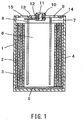
- a rectangular non-aqueous electrolyte secondary battery (size: 103450) having a standard capacity of 1000 mAh and a structure illustrated in FIGS. 1 and 2 was assembled.
- FIG. 1 is a partial cross-sectional view thereof.
- a positive electrode 1 and a negative electrode 2 are spirally wound with a separator 3 interposed therebetween, and then pressed into a flat shape, and thus a flat wound electrode body 6 is formed.
- the flat wound electrode body 6 is accommodated in a rectangular (prismatic) battery container 4 together with the non-aqueous liquid electrolyte.
- layers in the positive electrode 1 and layers in the negative electrode 2, the non-aqueous liquid electrolyte are not illustrated in FIG. 1 in order to prevent the figures from being complicated.
- the battery container 4 is made of an aluminum alloy and constitutes an outer case body of the battery.
- the battery container 4 also serves as a positive electrode terminal.
- An insulator 5 made of a PE sheet is disposed on the bottom portion of the battery container 4.
- a positive electrode lead body 7 and a negative electrode lead body 8 that are respectively connected to one end of the positive electrode 1 and one end of the negative electrode 2 are drawn out from the flat wound electrode body 6 constituted by the positive electrode 1, the negative electrode 2, and the separator 3.
- a terminal 11 made of stainless steel is attached to a sealing cover plate 9 made of an aluminum alloy for sealing an opening of the battery container 4, via an insulating packing 10 made of polypropylene.
- a lead plate 13 made of stainless steel is attached to the terminal 11 via an insulator 12.
- the cover plate 9 is inserted into the opening of the battery container 4.
- the opening of the battery container 4 is sealed by welding a joint between the cover plate and the battery container, and thus the inside of the battery is sealed.
- the cover plate 9 is provided with a non-aqueous liquid electrolyte inlet 14.
- the non-aqueous liquid electrolyte inlet 14 is sealed by, e.g., laser welding with a sealing member inserted therein, and thus the sealing of the battery is secured.
- a cleavage vent 15 as a mechanism for discharging an internal gas to the outside when the temperature of the battery rises is provided in the cover plate 9.
- the battery container 4 and the cover plate 9 are allowed to function as a positive electrode terminal by directly welding the positive electrode lead body 7 to the cover plate 9.
- the terminal 11 is allowed to function as a negative electrode terminal by welding the negative electrode lead body 8 to the lead plate 13 to electrically connect the negative electrode lead body 8 to the terminal 11 via the lead plate 13.
- the positive and negative sides may be reversed depending on, e.g., the material of battery container 4.
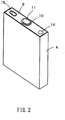
- FIG. 2 is a perspective view schematically illustrating the external appearance of the battery illustrated in FIG. 1 .
- FIG. 2 is illustrated to indicate that the battery is a rectangular battery.
- the battery is schematically illustrated in FIG. 2 , and only specific constituent members of the battery are illustrated.
- the portion on the internal peripheral side of the electrode body is not illustrated in cross section in FIG. 1 .
- a rectangular non-aqueous electrolyte secondary battery was produced in the same manner as in Example 1 except that a microporous membrane (thickness: 20 ⁇ m, porosity: 46%) made of polyethylene was used as a separator.
- a negative electrode was produced in the same manner as in Example 1 except that the thickness of the Al alloy foil was changed to 50 ⁇ m.
- a rectangular non-aqueous electrolyte secondary battery was produced in the same manner as in Example 2 except that the negative electrode was used.
- a negative electrode was produced in the same manner as in Example 1 except that the thickness of the Al alloy foil was changed to 80 ⁇ m.
- a positive electrode was produced in the same manner as in Example 1 except that the mass of the positive electrode mixture layer was changed to 8.0 mg/cm 2 per surface of an Al current collector.
- a rectangular non-aqueous electrolyte secondary battery was produced in the same manner as in Example 2 except that the positive electrode and the negative electrode were used.
- a negative electrode was produced in the same manner as in Example 1 except that a clad material in which individual Al foils having a thickness of 17.5 ⁇ m were bonded to both surfaces of a Cu foil having a thickness of 25 ⁇ m was used instead of an Al alloy foil. Moreover, a positive electrode was produced in the same manner as in Example 1 except that the mass of the positive electrode mixture layer was changed to 12.7 mg/cm 2 per surface of an Al current collector.
- a rectangular non-aqueous electrolyte secondary battery was produced in the same manner as in Example 2 except that the negative electrode and the positive electrode were used.
- a rectangular non-aqueous electrolyte secondary battery was produced in the same manner as in Comparative Example 1 except that a separator (porosity: 49%) including a heat-resistant porous layer (thickness of 4 ⁇ m) containing boehmite particles and an acrylic resin (binder) on one surface of a microporous membrane made of polyethylene and having a thickness of 16 ⁇ m was used instead of the microporous membrane made of polyethylene and a flat wound electrode body was formed by laminating the separator so that the heat-resistant porous layer thereof faced the positive electrode.
- a separator porosity: 49%) including a heat-resistant porous layer (thickness of 4 ⁇ m) containing boehmite particles and an acrylic resin (binder) on one surface of a microporous membrane made of polyethylene and having a thickness of 16 ⁇ m was used instead of the microporous membrane made of polyethylene and a flat wound electrode body was formed by laminating the separator so that the heat-resistant porous
- a negative electrode was produced in the same manner as in Example 1 except that the thickness of the Al alloy foil was changed to 40 ⁇ m. Moreover, a rectangular non-aqueous electrolyte secondary battery was produced in the same manner as in Comparative Example 1 except that the negative electrode and a separator (porosity: 44%) including a heat-resistant porous layer (thickness of 4 ⁇ m) containing boehmite particles and an acrylic resin (binder) on one surface of a microporous membrane made of polyethylene and having a thickness of 12 ⁇ m were used and a flat wound electrode body was formed by laminating the separator so that the heat-resistant porous layer thereof faced the positive electrode.
- a separator porosity: 44%) including a heat-resistant porous layer (thickness of 4 ⁇ m) containing boehmite particles and an acrylic resin (binder) on one surface of a microporous membrane made of polyethylene and having a thickness of 12 ⁇ m were used and a flat wound electrode body was formed by
- Each of the batteries after the formation treatment was subjected to a constant-current and constant-voltage charge for charging each battery at a constant current of 0.2 C (200 mA) until the voltage reached 3.8 V and then continuing charge until a current value decreased to 0.01 C (10 mA) at a constant voltage of 3.8 V.
- the batteries in the charged state were left to stand in an environment of 23 ⁇ 3°C for 14 days. Then, the voltages of the batteries were measured.
- a battery whose voltage decreased to 3.725 V or less was defined as a battery having a low OCV failure, and the failure ratio (%) thereof was determined.
- the batteries of each of the examples and the comparative examples were subjected to the formation treatment under the same conditions as those in the evaluation of OCV, and then subjected to a constant-current and constant-voltage charge under the same conditions as those in the evaluation of OCV. Then, each battery was disassembled in an argon gas atmosphere, and the negative electrode was removed.
- the Li content (%) in 100 atomic% of the total of Li and Al was determined by the method described above.
- the thickness of the Al foil (Al alloy foil or Al foil constituting the clad material) in a portion of the removed negative electrode that did not face the positive electrode was measured.
- Table 1 indicates the constitution of the non-aqueous electrolyte secondary batteries of the examples and the comparative examples.
- Table 2 indicates the results of the evaluations.
- values in parentheses in the section "Used foil” in “Negative electrode” indicate the thicknesses of the foils or the thicknesses of the foils constituting the clad materials.
- values in parentheses in the section “Class” in “Separator” indicate the thicknesses of the separators or the thicknesses of layers constituting the separators.
- Negative electrode Separator Used foil Thickness: ⁇ m
- Thickness of Al foil in portion that did not face positive electrode ⁇ m
- Class thickness: ⁇ m
- Porosity %
- the non-aqueous electrolyte secondary batteries of Examples 1-4 having a Li content within a predetermined range with respect to 100 atomic% of the total of Li and Al had a low occurrence ratio of products having a low OCV, and highly reliable batteries were able to be manufactured with good production efficiency.
- the batteries of Example 1 in which the nonwoven fabric having a large porosity was used for the separator were able to have a lower occurrence ratio of products having a low OCV than the batteries of Example 2 in which the microporous membrane was used for the separator.
- the batteries of Comparative Examples 1-3 including the negative electrodes constituted by the clad materials using the thin Al foils or by the thin Al foil and having a Li content out of the predetermined range with respect to 100 atomic% of the total of Li and Al had a larger occurrence ratio of products having a low OCV than the batteries of Examples 1-4.
- the non-aqueous electrolyte secondary battery of the present invention can be used in various applications to which non-aqueous electrolyte secondary batteries have been applied conventionally, and can suitably be applied to applications, such as power sources of vehicle emergency call systems, in which the capacity is required to be favorably maintained for a long period of time.
Landscapes
- Chemical & Material Sciences (AREA)
- Chemical Kinetics & Catalysis (AREA)
- Electrochemistry (AREA)
- General Chemical & Material Sciences (AREA)
- Engineering & Computer Science (AREA)
- Manufacturing & Machinery (AREA)
- Materials Engineering (AREA)
- Inorganic Chemistry (AREA)
- Secondary Cells (AREA)
- Cell Electrode Carriers And Collectors (AREA)
- Cell Separators (AREA)
- Battery Electrode And Active Subsutance (AREA)
Applications Claiming Priority (2)
| Application Number | Priority Date | Filing Date | Title |
|---|---|---|---|
| JP2018172649 | 2018-09-14 | ||
| PCT/JP2019/035320 WO2020054648A1 (ja) | 2018-09-14 | 2019-09-09 | 非水電解質二次電池、その製造方法および非水電解質二次電池システム |
Publications (2)
| Publication Number | Publication Date |
|---|---|
| EP3852182A1 true EP3852182A1 (de) | 2021-07-21 |
| EP3852182A4 EP3852182A4 (de) | 2022-06-08 |
Family
ID=69778291
Family Applications (1)
| Application Number | Title | Priority Date | Filing Date |
|---|---|---|---|
| EP19859956.5A Pending EP3852182A4 (de) | 2018-09-14 | 2019-09-09 | Sekundärbatterie mit wasserfreiem elektrolyt, verfahren zu ihrer herstellung und sekundärbatterie mit wasserfreiem elektrolyt |
Country Status (4)
| Country | Link |
|---|---|
| US (1) | US12034159B2 (de) |
| EP (1) | EP3852182A4 (de) |
| JP (1) | JP7350761B2 (de) |
| WO (1) | WO2020054648A1 (de) |
Families Citing this family (1)
| Publication number | Priority date | Publication date | Assignee | Title |
|---|---|---|---|---|
| CN118156404A (zh) * | 2024-02-21 | 2024-06-07 | 江苏正力新能电池技术有限公司 | 一种正极极片、正极极片制备方法、锂离子二次电池以及evtol |
Family Cites Families (12)
| Publication number | Priority date | Publication date | Assignee | Title |
|---|---|---|---|---|
| JPS63175348A (ja) * | 1987-01-14 | 1988-07-19 | Hitachi Maxell Ltd | リチウム電池 |
| JPH0541252A (ja) * | 1991-08-07 | 1993-02-19 | Hitachi Maxell Ltd | リチウム二次電池 |
| JPH07320723A (ja) * | 1994-05-18 | 1995-12-08 | Hitachi Maxell Ltd | リチウム二次電池およびその製造方法 |
| JPH08293302A (ja) * | 1995-04-24 | 1996-11-05 | Matsushita Electric Ind Co Ltd | 有機電解液二次電池 |
| JPH1012279A (ja) * | 1996-04-26 | 1998-01-16 | Denso Corp | 金属リチウム2次電池 |
| JP2005294013A (ja) * | 2004-03-31 | 2005-10-20 | Sanyo Electric Co Ltd | 前駆体電池及び非水電解質二次電池 |
| JP6435699B2 (ja) | 2014-08-08 | 2018-12-12 | スミダコーポレーション株式会社 | コイル部品およびコイル部品の製造方法 |
| WO2016039323A1 (ja) * | 2014-09-08 | 2016-03-17 | 日立マクセル株式会社 | 非水電解液電池、その製造方法、および非水電解液電池システム |
| CN108604706A (zh) | 2016-02-09 | 2018-09-28 | 麦克赛尔控股株式会社 | 非水电解液电池 |
| CN109075377B (zh) * | 2016-04-28 | 2020-08-25 | 远景Aesc日本有限公司 | 非水电解质二次电池 |
| WO2017190364A1 (zh) | 2016-05-06 | 2017-11-09 | 深圳先进技术研究院 | 一种二次电池及其制备方法 |
| JP2019129147A (ja) * | 2018-01-25 | 2019-08-01 | マクセルホールディングス株式会社 | 非水電解質電池 |
-
2019
- 2019-09-09 JP JP2020546003A patent/JP7350761B2/ja active Active
- 2019-09-09 US US17/274,717 patent/US12034159B2/en active Active
- 2019-09-09 WO PCT/JP2019/035320 patent/WO2020054648A1/ja not_active Ceased
- 2019-09-09 EP EP19859956.5A patent/EP3852182A4/de active Pending
Also Published As
| Publication number | Publication date |
|---|---|
| US12034159B2 (en) | 2024-07-09 |
| JP7350761B2 (ja) | 2023-09-26 |
| JPWO2020054648A1 (ja) | 2021-08-30 |
| EP3852182A4 (de) | 2022-06-08 |
| WO2020054648A1 (ja) | 2020-03-19 |
| US20220052326A1 (en) | 2022-02-17 |
Similar Documents
| Publication | Publication Date | Title |
|---|---|---|
| EP3128586B1 (de) | Negativelektroden-aktivmaterial auf graphitbasis, negativelektrode und lithium-ionen-sekundärbatterie | |
| US10396352B2 (en) | Non-aqueous electrolyte battery, method for manufacturing same, and non-aqueous electrolyte battery system | |
| US11855259B2 (en) | Electrolyte for lithium secondary battery and lithium secondary battery comprising same | |
| CN109937504A (zh) | 非水电解质二次电池 | |
| EP3706224A1 (de) | Sekundärbatterie mit wasserfreiem elektrolyt und verfahren zur herstellung davon | |
| KR20140085337A (ko) | 리튬 이차 전지 | |
| CN104521032A (zh) | 制造非水电解质二次电池的方法以及非水电解质二次电池 | |
| US20090123849A1 (en) | Nonaqueous electrolyte secondary battery | |
| WO2019098056A1 (ja) | リチウムイオン二次電池 | |
| WO2017154592A1 (ja) | 非水電解液電池 | |
| KR20060106622A (ko) | 비수성 이차 전지용 음극 | |
| JP2007273183A (ja) | 負極及び二次電池 | |
| EP3322024B1 (de) | Batterie mit wasserfreiem elektrolyt und batteriepack | |
| JP6656370B2 (ja) | リチウムイオン二次電池および組電池 | |
| JP5514394B2 (ja) | 二次電池用非水系電解液及びそれを用いた非水系電解液二次電池 | |
| CN113228339B (zh) | 非水电解质二次电池及其制造方法 | |
| CN116783731A (zh) | 电极、电池及电池包 | |
| CN110400960B (zh) | 锂金属二次电池及其制造方法 | |
| JP2019164965A (ja) | リチウムイオン二次電池 | |
| EP3706232B1 (de) | Sekundärzelle mit wasserfreiem elektrolyt | |
| JP7003775B2 (ja) | リチウムイオン二次電池 | |
| US12034159B2 (en) | Non-aqueous electrolyte secondary battery, method of manufacturing same, and non-aqueous electrolyte secondary battery system | |
| EP3905413B1 (de) | Sekundärbatterie mit wasserfreiem elektrolyt | |
| JP6392566B2 (ja) | 非水電解質二次電池 | |
| JP7112265B2 (ja) | 非水電解液二次電池およびその製造方法 |
Legal Events
| Date | Code | Title | Description |
|---|---|---|---|
| STAA | Information on the status of an ep patent application or granted ep patent |
Free format text: STATUS: THE INTERNATIONAL PUBLICATION HAS BEEN MADE |
|
| PUAI | Public reference made under article 153(3) epc to a published international application that has entered the european phase |
Free format text: ORIGINAL CODE: 0009012 |
|
| STAA | Information on the status of an ep patent application or granted ep patent |
Free format text: STATUS: REQUEST FOR EXAMINATION WAS MADE |
|
| 17P | Request for examination filed |
Effective date: 20210309 |
|
| AK | Designated contracting states |
Kind code of ref document: A1 Designated state(s): AL AT BE BG CH CY CZ DE DK EE ES FI FR GB GR HR HU IE IS IT LI LT LU LV MC MK MT NL NO PL PT RO RS SE SI SK SM TR |
|
| DAV | Request for validation of the european patent (deleted) | ||
| DAX | Request for extension of the european patent (deleted) | ||
| RAP3 | Party data changed (applicant data changed or rights of an application transferred) |
Owner name: MAXELL, LTD. |
|
| A4 | Supplementary search report drawn up and despatched |
Effective date: 20220510 |
|
| RIC1 | Information provided on ipc code assigned before grant |
Ipc: H01M 10/44 20060101ALI20220503BHEP Ipc: H01M 10/058 20100101ALI20220503BHEP Ipc: H01M 4/66 20060101ALI20220503BHEP Ipc: H01M 4/58 20100101ALI20220503BHEP Ipc: H01M 4/485 20100101ALI20220503BHEP Ipc: H01M 4/46 20060101ALI20220503BHEP Ipc: H01M 4/134 20100101ALI20220503BHEP Ipc: H01M 10/052 20100101AFI20220503BHEP |