EP3848487B1 - Mehrlagiges mullgewebe - Google Patents
Mehrlagiges mullgewebe Download PDFInfo
- Publication number
- EP3848487B1 EP3848487B1 EP18932490.8A EP18932490A EP3848487B1 EP 3848487 B1 EP3848487 B1 EP 3848487B1 EP 18932490 A EP18932490 A EP 18932490A EP 3848487 B1 EP3848487 B1 EP 3848487B1
- Authority
- EP
- European Patent Office
- Prior art keywords
- layer
- yarn
- middle layer
- warp
- weft
- Prior art date
- Legal status (The legal status is an assumption and is not a legal conclusion. Google has not performed a legal analysis and makes no representation as to the accuracy of the status listed.)
- Active
Links
Images





Classifications
-
- D—TEXTILES; PAPER
- D03—WEAVING
- D03D—WOVEN FABRICS; METHODS OF WEAVING; LOOMS
- D03D19/00—Gauze or leno-woven fabrics
-
- A—HUMAN NECESSITIES
- A47—FURNITURE; DOMESTIC ARTICLES OR APPLIANCES; COFFEE MILLS; SPICE MILLS; SUCTION CLEANERS IN GENERAL
- A47K—SANITARY EQUIPMENT; ACCESSORIES THEREFOR, e.g. TOILET ACCESSORIES
- A47K10/00—Body-drying implements; Toilet paper; Holders therefor
- A47K10/02—Towels
-
- D—TEXTILES; PAPER
- D03—WEAVING
- D03D—WOVEN FABRICS; METHODS OF WEAVING; LOOMS
- D03D11/00—Double or multi-ply fabrics not otherwise provided for
-
- D—TEXTILES; PAPER
- D03—WEAVING
- D03D—WOVEN FABRICS; METHODS OF WEAVING; LOOMS
- D03D13/00—Woven fabrics characterised by the special disposition of the warp or weft threads, e.g. with curved weft threads, with discontinuous warp threads, with diagonal warp or weft
- D03D13/004—Woven fabrics characterised by the special disposition of the warp or weft threads, e.g. with curved weft threads, with discontinuous warp threads, with diagonal warp or weft with weave pattern being non-standard or providing special effects
-
- D—TEXTILES; PAPER
- D03—WEAVING
- D03D—WOVEN FABRICS; METHODS OF WEAVING; LOOMS
- D03D15/00—Woven fabrics characterised by the material, structure or properties of the fibres, filaments, yarns, threads or other warp or weft elements used
- D03D15/20—Woven fabrics characterised by the material, structure or properties of the fibres, filaments, yarns, threads or other warp or weft elements used characterised by the material of the fibres or filaments constituting the yarns or threads
- D03D15/208—Woven fabrics characterised by the material, structure or properties of the fibres, filaments, yarns, threads or other warp or weft elements used characterised by the material of the fibres or filaments constituting the yarns or threads cellulose-based
- D03D15/217—Woven fabrics characterised by the material, structure or properties of the fibres, filaments, yarns, threads or other warp or weft elements used characterised by the material of the fibres or filaments constituting the yarns or threads cellulose-based natural from plants, e.g. cotton
-
- D—TEXTILES; PAPER
- D03—WEAVING
- D03D—WOVEN FABRICS; METHODS OF WEAVING; LOOMS
- D03D15/00—Woven fabrics characterised by the material, structure or properties of the fibres, filaments, yarns, threads or other warp or weft elements used
- D03D15/40—Woven fabrics characterised by the material, structure or properties of the fibres, filaments, yarns, threads or other warp or weft elements used characterised by the structure of the yarns or threads
- D03D15/41—Woven fabrics characterised by the material, structure or properties of the fibres, filaments, yarns, threads or other warp or weft elements used characterised by the structure of the yarns or threads with specific twist
-
- D—TEXTILES; PAPER
- D03—WEAVING
- D03D—WOVEN FABRICS; METHODS OF WEAVING; LOOMS
- D03D25/00—Woven fabrics not otherwise provided for
- D03D25/005—Three-dimensional woven fabrics
Definitions
- the present invention relates to a gauze fabric. Specifically, the present invention relates to a multi-ply woven gauze fabric in which a surface layer and a back layer are formed into a plain weave construction and a middle layer is formed into a honeycomb weave construction.
- a gauze fabric is a flat woven fabric that is coarsely woven by using a relatively thin yarn.
- the gauze fabric employs a solid (not hollow) twisted cotton yarn.
- the cotton gauze fabric includes several types such as a single woven fabric, a double woven fabric, and a triple woven fabric.
- the single gauze fabric is employed for, for example, a medical use and dishcloth.
- the double gauze fabric is employed for, for example, clothing and handkerchiefs.
- the pure cotton yarn (mainly a single yarn having the English cotton count of 40, 14,7 tex) is employed.
- the triple gauze fabric is employed for, for example, towels and bed and bedding.
- the pure cotton yarn is employed.
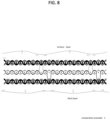
- FIG. 7 illustrates a cross section of a typical triple gauze fabric.
- the triple gauze fabric includes a surface layer, a back layer, and a middle layer. Each layer is formed into a gauze structure.
- the gauze structure is composed of a warp yarn (lengthwise yarn) and a weft yarn (crosswise yarn). While the warp yarn is supplied, the weft yarn is drawn across the warp yarn. The gauze structure of a plain weave construction is thereby formed. While the surface layer, the middle layer, and the back layer are formed, the surface layer and the middle layer and the back layer and the middle layer, respectively, are joined together via connection parts with proper timing. As illustrated, the connection parts may be formed by the warp yarn, or the connection parts may be formed by the weft yarn. Alternatively, the joining between the surface layer and the back layer may achieve the joining between the surface layer and the middle layer and the joining between the back layer and the middle layer.
- the gauze is a coarse-meshed fabric (having a large gap between yarns). Because the gauze is the coarse-meshed flat woven fabric, it has an excellent breathability and an excellent lightness.
- the gauze fabric is poor in heat-retaining property. Because the gauze fabric is still thin even when it is formed into a multi-ply gauze, the heat-retaining property cannot be expected. If the number of gauze fabrics is increased for the purpose of obtaining the heat-retaining property of a satisfactory level, the lightness thereof is spoiled remarkably.
- the gauze is the coarse-meshed fabric, it is poor in bounce and softness.
- the gauze is the coarse-meshed fabric, the skin is easy to be seen through the gauze when it is employed for, for example, clothes.
- a yarn having a large diameter is used or if the gauze is formed to have a high density, the transparency preventing property improves, but the breathability and the lightness, which are the advantageous characteristics of the gauze, are spoiled remarkably.
- the properties of the conventional multi-ply woven gauze fabric are not satisfactory enough to the extent that the conventional multi-ply woven gauze fabric is applied to a cloth for clothes and bedding. Therefore, the present inventor deemed that the conventional multi-ply woven gauze fabric needs further improvement.
- a typically used twisted yarn is formed by twisting raw cotton fibers.
- a non-twisted yarn is formed by untwisting a twisted yarn to put the twisted yarn in a non-twisted state.
- a water-soluble yarn is twisted in a reverse direction of the twisted yarn, and weaving is performed by using thus obtained conjugated yarn. Then, the water-soluble yarn is dissolved and removed, thereby obtaining a yarn in the non-twisted state.
- the non-twisted yarn puffs and swells to retain a large amount of air between fibers.
- the non-twisted yarn piles achieve the heat-retaining property and a feel of soft touch.
- the soft twist yarn is formed by untwisting a twisted yarn in the same way as it is done for the non-twisted yarn but in a manner to remain a twisting state of the twisted yarn.
- the soft twist yarn has properties approximate to those of the non-twisted yarn.
- the present inventor conducted intensive studies about application of the non-twisted yarn or the soft twist yarn to the gauze fabric.
- the gauze structure composed of the non-twisted yarn or the soft twist yarn has bulkiness, when compared with the gauze structure composed of the twisted yarn, while keeping the breathability and the lightness. As a result, the heat-retaining property, the feel of soft touch, and the transparency preventing property improve.
- the non-twisted yarn and the soft twist yarn are, however, poor in strength in comparison with the twisted yarn. Therefore, the gauze structure composed of only the non-twisted yarn is poor in strength. The gauze structure composed of only the soft twist yarn is also poor in strength. Even if a multi-ply gauze is formed by the above-described gauzed structure, the multi-ply gauze still fails to achieve a remarkable improvement in strength.
- the present inventor conducted intensive studies about application to the multi-ply woven gauze fabric in which the gauze structure composed of the twisted yarn and the gauze structure composed of the non-twisted yarn (or the soft twist yarn; the same applies hereinafter) are joined together.
- the gauze structure composed of the twisted yarn maintains the strength, and the gauze structure composed of the non-twisted yarn provides the heat-retaining property, the feel of soft touch, and the transparency preventing property as well. More specifically, the combination provides advantageous properties of both gauze structures.
- the present inventor proposes, as related inventions, multi-ply woven gauze fabrics according to, for example, Patent Document 1 and Patent Document 2.
- FIG. 8 illustrates a cross section of the triple gauze fabrics according to the related inventions.
- the triple gauze fabrics according to the related inventions each employs a non-twisted yarn for a surface layer and a back layer and employs a twisted yarn for a middle layer.
- wrinkles occur due to a differential shrinkage between the non-twisted yarn and the twisted yarn. Owing to the bulkiness caused by the wrinkles, the feel of soft touch improves more than imagined from an effect of the mere use of the non-twisted yarn.
- the heat-retaining property and the transparency preventing property also improve more than imagined from the effect of the mere use of the non-twisted yarn.
- the triple gauze fabric is lighter than imagined from its puffy appearance, i.e., the lightness also improves.
- the triple gauze fabrics according to the related inventions owing to the bulkiness caused by the wrinkles, the feel of soft touch, the heat-retaining property, the transparency preventing property, and the lightness improve more than imagined from the effect of the mere use of the non-twisted yarn.
- a purpose of the present invention is to provide a multi-ply woven gauze fabric having more bulkiness and being excellent in feel of soft touch, heat-retaining property, transparency preventing property, and lightness.
- the multi-ply woven gauze fabric of the present invention is a multi-ply woven gauze fabric according to claim 1.
- the bulkiness improves remarkably due to a synergistic effect between the bulkiness caused by the wrinkles and the bulkiness that the honeycomb weave construction originally has.
- the surface layer and the back layer are formed of a non-twisted yarn or a soft twist yarn.
- the bulkiness further improves owing to a differential shrinkage caused between the twisted yarn and the non-twisted yarn (or the soft twist yarn).
- the surface layer and the back layer are formed of the twisted yarn.
- the noticeable bulkiness can be produced even without using the non-twisted yarn. This contributes to the reduction of the manufacturing cost.
- the middle layer includes a first middle layer and a second middle layer
- warp densities of the first middle layer and the second middle layer are half of warp densities of the surface layer and the back layer
- weft densities of the first middle layer and the second middle layer are half of weft densities of the surface layer and the back layer.
- the middle layer is a single layer
- the warp density of the middle layer is identical to the warp densities of the surface layer and the back layer
- the weft density of the middle layer is identical to the weft densities of the surface layer and the back layer.
- the multi-ply woven gauze fabric has an amount of structure almost identical to that of a typical triple gauze fabric (about the same weight). In having about the same weight, the bulkiness improves remarkably.
- the middle layer includes first to fourth middle layers, the warp densities of the first to fourth middle layers are half of the warp densities of the surface layer and the back layer, and the weft densities of the first to fourth middle layers are half of the weft densities of the surface layer and the back layer.
- the middle layer includes a first middle layer and a second middle layer
- the warp densities of the first middle layer and the second middle layer are identical to the warp densities of the surface layer and the back layer
- the weft densities of the first middle layer and the second middle layer are identical to the weft densities of the surface layer and the back layer.
- the multi-ply woven gauze fabric has the amount of structure almost identical to that of a typical four-ply gauze fabric (about the same weight). In having about the same weight, the bulkiness improves remarkably.
- the bulkiness improves.
- the feel of soft touch, the heat-retaining property, the transparency preventing property, and the lightness improve.
- the present embodiment is directed to a multi-ply woven gauze fabric which includes a surface layer, a middle layer, and a back layer.
- the surface layer and the middle layer are joined together via connection parts, and the back layer and the middle layer are joined together via connection parts.
- connection parts may be formed of the warp yarn or, alternatively, the connection parts may be formed of the weft yarn.
- the yarn of the surface layer may be brought into joining with the middle layer or, alternatively, the yarn of the middle layer may be brought into joining with the surface layer.
- the yarn of the back layer may be brought into joining with the middle layer or, alternatively, the yarn of the middle layer may be brought into joining with the back layer. Further alternatively, the joining between the surface layer and the back layer may achieve the joining between the surface layer and the middle layer and may further achieve the joining between the back layer and the middle layer.
- the surface layer and the back layer are composed of the warp yarn (lengthwise yarn) and the weft yarn (crosswise yarn).
- the weft yarn is supplied to cross with the warp yarn, thereby causing the layers to be formed into a plain weave construction.
- a yarn having the fineness of 9.8 to 36.9 tex (English cotton count of a range between 16 and 60, single yarn conversion) is employed.
- a yarn having the fineness range of 14.8 tex to 29.5 tex (English cotton count of a range between 20 and 40) is employed.
- the structure When using a fine count yarn, the structure is formed to have a high density.
- An upper limit of the density is to be set to 15.7 warps per cam and 15.7 wefts per cm ( 40 warp yarns/inch and 40 weft yarns/inch).
- the structure When using a thick count yarn, the structure is formed to have a low density.
- a lower limit of the density is to be set to 15.7 warps per cam and 15.7 wefts per cm ( 24 warp yams/inch and 24 weft yarns/inch).
- a preferable density is to be set to 10.2-13.4 warp yarns per cm and 10.2-13.4 weft yarns per cm ( 26-34 warp yarns/inch and 26-34 weft yarns/inch).
- the surface layer and the back layer are formed into a typical gauze fabric (plain weave construction).
- the middle layer is composed of the warp yarn and the weft yarn and is formed into a honeycomb weave construction.
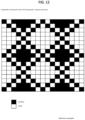
- the honeycomb weave construction is formed in such a manner that the warp yarn and the weft yarn are elongated and floated to be woven into a concave/convex diamond shape or a concave/convex square shape on both surfaces.
- the honeycomb weave is sometimes referred to as "waffle fabric" because it has a texture alike the snack of Waffle.
- the middle layer having the honeycomb weave construction of the present invention slightly differs from the waffle weave towels commercially available in the market (will be described below).
- a yarn having the fineness of preferably between 14.8 to 59.0 tex (English cotton count of, preferably, a range between 10 and 40, single yarn conversion) is employed. Further preferably, a yarn having the fineness of preferably between 19.7 to 39.3 tex (cotton count of a range between 15 and 30) is employed.
- a construction density of the middle layer is, in consideration of the number of reed marks (dents), about the same as those of the surface layer and the back layer (see, Third and Fourth Embodiments).
- the total number of the lengthwise and crosswise yarns per cm is preferably a range between 18.9 and 31.5 (48 and 80 yarns per inch).
- the construction density of the single middle layer is set to the half of the construction densities of the surface layer and the back layer (see, First and Second Embodiments) (will be described below).
- One repeat for constituting the honeycomb weave construction is formed to have a density of a range between 8 warp yarns ⁇ 8 weft yarns and 28 warp yarns ⁇ 28 weft yarns. Further, preferably, it is formed to have a density of a range between 12 warp yarns ⁇ 12 weft yarns and 16 warp yarns ⁇ 16 weft yarns.
- the one repeat has a size of about a range between 5 ⁇ 5 mm and 25 ⁇ 25 mm. Further, preferably, it has a size of about a range between 10 ⁇ 10 mm and 16 ⁇ 16 mm.
- the twisted yarn or the non-twisted yarn may be employed.
- the non-twisted yarn is employed for forming the surface layer and the back layer, because the effect (bulkiness caused by the differential shrinkage between the twisted yarn and the non-twisted yarn) produced in the related inventions is added, the bulkiness caused by the wrinkles further improves.
- the twisted yarn When the twisted yarn is used for forming the surface layer and the back layer, the bulkiness caused by the wrinkles can be realized without using the non-twisted yarn, and thus the manufacturing cost can be saved.
- the cotton yarn specifically, pure cotton yarn.
- a blended yarn combined with chemical fibers and plant-derived regenerated fibers such as rayon.
- the portion including the small number of crossing shrinks largely and thus forms a convex/concave shape. Because the shrinkage occurs in proportion to a length of a portion where there is no crossing, a largely shrunk portion in one repeat forms a convex shape and a small shrunk portion in one repeat forms a concave shape, respectively.
- the apex part is formed at a position where the warp yarn and the weft yarn cross to each other in the convex portion.
- the convex portion and the concave portion have a front-rear relation in the honeycomb weave construction.
- the connection parts between the surface layer and the middle layer and the connection parts between the back layer and the middle layer, respectively, are made at apex parts.
- the plain weave construction cannot follow the shrinkage of the honeycomb weave construction, and thus the wrinkles occur between connection parts in the surface layer and the back layer.
- the differential shrinkage between the plain weave construction and the honeycomb weave construction is noticeably large compared with the differential shrinkage between the twisted yarn and the non-twisted yarn. Therefore, the bulkiness caused by the wrinkles improves when compared with the related inventions.
- honeycomb weave construction itself has the bulkiness, the bulkiness improves more, owing to a synergistic effect, in comparison with the related inventions.
- the improvement of the bulkiness contributes to the improvement of the feel of soft touch owing to the wrinkles serving as a cushion.
- the improvement of the bulkiness contributes to the improvement of the heat-retaining property because the structure retains therein much air.
- the improvement of the bulkiness contributes to the improvement of the transparency preventing property because a distance between the surface layer and the back layer is secured.
- the improvement of the bulkiness contributes to the improvement of the lightness more than imagined from the outer appearance.
- weight per unit area increases slightly in proportion to the shrinkage of the structure.
- FIG. 1 schematically illustrates a multi-ply woven gauze fabric according to First Embodiment. For simplification, connection parts are omitted from the illustration.
- FIG. 2 schematically illustrates a cross section of the multi-ply woven gauze fabric according to First Embodiment.
- a surface layer and a back layer are formed into the plain weave construction.
- a middle layer includes a first middle layer and a second middle layer. The first middle layer and the second middle layer are formed into the honeycomb weave construction.
- connection parts The surface layer and the first middle layer are joined together via connection parts, and the back layer and the second middle layer are joined together via connection parts. Further, the first middle layer and the second middle layer are joined together via connection parts.
- connection parts between the first middle layer and the second middle layer are not essential.
- the warp densities of the first middle layer and the second middle layer are half of the warp densities of the surface layer and the back layer.
- the weft densities of the first middle layer and the second middle layer are half of the weft densities of the surface layer and the back layer.
- the densities are exemplified by 16 warp yarns ⁇ 16 weft yarns in the surface layer and the back layer, whereas the densities are exemplified by 8 warp yarns ⁇ 8 weft yarns in the first middle layer and the second middle layer.
- the density is exemplified by 16 warp yarns ⁇ 16 weft yarns.
- the multi-ply woven gauze fabric according to First Embodiment seems to include four layers but has an amount of structure almost equivalent to that of a typical triple gauze fabric.
- FIG. 3 is an image of the outer appearance of the multi-ply woven gauze fabric according to First Embodiment.
- the wrinkles occur between the connection parts.
- the wrinkles extending in a warp yarn direction and the wrinkles extending in a weft yarn direction are supplementary shown by a dotted line.
- FIG. 4 schematically illustrates a multi-ply woven gauze fabric according to Second Embodiment.
- a middle layer includes first to fourth middle layers.
- the first to fourth middle layers are formed into the honeycomb weave construction.
- the first to fourth middle layers each has a construction density of the half of the construction densities of the surface layer and the back layer.
- the multi-ply woven gauze fabric according to Second Embodiment seems to include six layers but has an amount of structure almost equivalent to that of a typical four-ply gauze fabric.
- FIG. 5 schematically illustrates a multi-ply woven gauze fabric according to Third Embodiment.
- a middle layer is a single layer.
- the middle layer is formed into the honeycomb weave construction.
- the warp density of the middle layer is identical to the warp densities of the surface layer and the back layer.
- the weft density of the middle layer is identical to the weft densities of the surface layer and the back layer.
- the densities are exemplified by 16 warp yarns ⁇ 16 weft yarns in the surface layer and the back layer, and the density is exemplified by 16 warp yarns ⁇ 16 weft yarns in the middle layer.
- the multi-ply woven gauze fabric according to Third Embodiment is composed of three layers.
- the present multi-ply woven gauze fabric has an amount of structure almost equivalent to that of a typical triple gauze fabric.
- both the fabrics have about the same amount of structure (the total number of the warp yarns and the weft yarns).
- the number of warp yarns identical to that of Third Embodiment is employed and the warp yarns are divided to form two middle layers.
- FIG. 6 schematically illustrates a multi-ply woven gauze fabric according to Fourth Embodiment.
- a middle layer includes a first middle layer and a second middle layer.
- the first middle layer and the second middle layer are formed into the honeycomb weave construction.
- the construction densities of the first middle layer and the second middle layer are identical to the construction densities of the surface layer and the back layer.
- the multi-ply woven gauze fabric according to Fourth Embodiment includes four layers.
- the fabric has an amount of structure almost equivalent to that of a typical four-ply gauze fabric.
- FIG. 7 illustrates a cross section of a multi-ply woven gauze fabric according to Comparative Example 1.
- Comparative Example 1 is directed to a typical triple gauze fabric. It includes a surface layer, a middle layer, and a back layer. The surface layer, the middle layer, and the back layer are formed into the plain weave construction. The surface layer, the middle layer, and the back layer are formed of the twisted yarn.
- FIG. 8 illustrates a cross section of a multi-ply woven gauze fabric according to Comparative Example 2.
- Comparative Example 2 is directed to a triple gauze fabric according to the related inventions. It includes a surface layer, a middle layer, and a back layer. The surface layer, the middle layer, and the back layer are formed into the plain weave construction. The surface layer and the back layer are formed of the non-twisted yarn. The middle layer is formed of the twisted yarn. In FIG. 8 , a thick line represents the non-twisted yarn, and a thin line represents the twisted yarn.
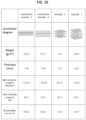
- FIG. 9 is a table for effect comparison in which Comparative Example 1, Comparative Example 2, Third Embodiment, and First Embodiment are compared with each other.
- a cotton yarn having the fineness of 19.7 tex ((English cotton count of 30) was employed.
- the warp density was set to 12.6 yarns per cm ( 32 yarns/inch) and the weft density was set to 11.0 yarns per cm (28 yarns/inch).
- the warp yarn and the weft yarn for forming the middle layer a cotton yarn having the fineness of 29.5 tex (English cotton count of 20) was employed.
- the warp density was set to 12.6 yarns per cm (32 yarns/inch) and the weft density was set to 11.0 yarns per cm (28 yarns/inch).
- the construction density was set to be half. More specifically, the construction densities are almost equivalent to each other between the double middle layers of First Embodiment and the single middle layer of Third Embodiment.
- the shrinkage in Comparative Example 1 and Comparative Example 2 is about 3-5% for both lengthwise yarns and crosswise yarns, whereas the shrinkage in First Embodiment and Third Embodiment is about 13-14% for both lengthwise yarns and crosswise yarns.
- the weight per unit area in First Embodiment and Third Embodiment becomes slightly heavier than the weight per unit area in Comparative Example 1 and Comparative Example 2.
- the twisted yarn was employed for gauze parts of the surface layer and the back layer.
- Comparative Example 1 When a comparison is made between Comparative Example 1 and Comparative Example 2, because of the differential shrinkage caused between the twisted yarn and the non-twisted yarn, wrinkles occur in the surface layer and the back layer. This makes the thickness be about 1.5 times.
- the fabric of First Embodiment is bulkier. More specifically, even when the amount of structure is the same, the middle layer composed of two layers can produce more effect in improving the bulkiness.
- the weight per unit area is divided by the thickness to obtain an index of lightness.
- the weight per unit area in First Embodiment and Third Embodiment is slightly heavier than the weight per unit area in Comparative Example 1 and Comparative Example 2.
- the index of lightness in First Embodiment and Third Embodiment is remarkably higher than the index of lightness in Comparative Example 1 and Comparative Example 2.
- Comparative Example 1 results in about 64%.
- Comparative Example 1 and Third Embodiment results in about 48%
- Comparative Example 1 and First Embodiment results in about 41%.
- the lightness improves remarkably.
- the fabrics of First Embodiment and Third Embodiment are employed for cloths and towels of clothes and bedding, the fabrics give a noticeably lighter feeling than imagined from its puffy appearance.
- the heat-retaining property also improves.
- the breathability as one of the characteristics of the gauze fabric does not degrade too much, i.e., the breathability is not inversely proportional to the improvement of the heat-retaining property.
- the thickness was measured in conformity with the standard of JIS L 1096 A method (load of 0.3 kPa), the weight per unit area was measured in conformity with the standard of JIS L 1096, the heat-retaining property was measured in conformity with the standard of JIS L 1018/1096, and the breathability was measured in conformity with the standard of JIS L 1096/1018, respectively.
- FIG. 10 illustrates a table for effect comparison in which Comparative Example 3, Comparative Example 4, Third Embodiment, and First Embodiment are compared with each other.
- Comparative Example 3 is directed to a typical four-ply gauze fabric.
- Comparative Example 4 is directed to a typical five-ply gauze fabric. They have a structure almost identical to that of Comparative Example 1 other than the number of layers.
- the substantial three-ply gauze fabrics of Third Embodiment and First Embodiment are bulkier than the four-ply gauze fabric of Comparative Example 3 and further bulkier than the five-ply gauze fabric of Comparative Example 4. More specifically, the gauze fabrics of Third Embodiment and First Embodiment have excellent bulkiness.
- FIG. 11 is an illustration for effect comparison in which Comparative Example 3, Fourth Embodiment, and Second Embodiment are compared with each other.
- Comparative Example 3 is directed to a typical four-ply gauze fabric. It is composed of four layers. Each layer has the plain weave construction that is formed of the twisted yarn.
- the amount of structure is about the same (substantially four layers) among Comparative Example 3, Fourth Embodiment, and Second Embodiment.
- the weight per unit area in Second Embodiment and Fourth Embodiment is slightly heavier than the weight per unit area in Comparative Example 3.
- the multi-ply woven gauze fabric of the present invention is characterized in that the middle layer is formed into the honeycomb weave construction. Also, a waffle weave towel commercially available in the market has the honeycomb weave construction. As described below, the middle layer of the present invention, however, differs from the waffle weave towel commercially available in the market.
- FIG. 12 illustrates an example of a structure of a typical honeycomb weave construction.
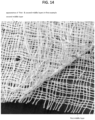
- FIG. 13 is an image of a waffle weave towel commercially available in the market.
- waffle weave towels are formed of warp yarns and weft yarns which are cotton yarns having the (English) cotton count of a range between 8 and 15 (single yarn conversion).
- the number of warp yarns per cm is 11.8-13.4 yarns (30-34 yarns/inch) and the number of weft yarns per cm is 11.8-13.4 yarns (30-34 yarns/inch), and the number of yarns for one repeat is 12-32 yarns and the size of one repeat is 10-25 mm.
- the waffle weave towel has the construction density larger than that of atypical gauze fabric.
- a space between yarns becomes about 0.4-0.6 mm.
- the space becomes narrower (e.g., below 0.5 mm).
- it is hard to visually recognize the gaps between yarns.
- the middle layer of the present invention for example, a yarn of the fineness of 14.8 to 29.5 tex (English cotton count of a range between 20 and 40, single yarn conversion) is employed.
- the middle layer is set to have a construction density of 10.2-13.4 warp yarns per cm ( 26-34 warp yarns/inch) and 10.2-13.4 warp yarns per cm (26-34 weft yarns/inch).
- the construction density is set to be half.
- FIG. 14 is an image of the outer appearances of the first middle layer and the second middle layer in First Embodiment.
- the middle layer is formed in such a manner that the first middle layer (honeycomb weave construction) and the second middle layer (honeycomb weave construction) are layered one another.
- the second middle layer is partially turned over to expose the first middle layer.
- the boundary line is supplementary represented by a dotted line.
- the middle layer of the present invention has a rough construction density, and thus the effect obtainable from the waffle weave towel cannot be expected. Therefore, it is impossible to use the middle layer singularly as the final product.
- a space between yarns becomes about a range between 0.6 and 0.9 mm. Specifically, in a case where the middle layer is divided into two layers, the space between the yarns becomes about a range between 1.2 and 1.8 mm. In the example of FIG. 14 , it is easy to visually recognize the gaps between yarns.
- the middle layer of the present invention differs from the waffle weave towel commercially available in the market.
- the honeycomb weave construction is a modification example of the plain weave construction. Therefore, the middle layer of the present invention is treated as the modification example of gauze.
- the multi-ply woven gauze fabric of the present invention the characteristics of the gauze fabric is maintained, and the bulkiness and the effect produced thereby improve as well.
- the multi-ply woven gauze fabric of the present invention is suitable to be applied, of course, not only to gauze towels and handkerchiefs but also to cloth for clothing (gowns, pajamas, shirts, pants, scurf, articles for infant, etc.) and beddings (sheets, blankets, pillow covers, etc.).
- the multi-ply woven gauze fabric of the present invention can response to the temperature change.
- the multi-ply woven gauze fabric of the present invention when used as a towel, it has the advantageous characteristics of both the gauze fabric and the waffle fabric.
Landscapes
- Engineering & Computer Science (AREA)
- Textile Engineering (AREA)
- Life Sciences & Earth Sciences (AREA)
- Botany (AREA)
- Health & Medical Sciences (AREA)
- Public Health (AREA)
- Woven Fabrics (AREA)
- Laminated Bodies (AREA)
Claims (9)
- Mehrlagiges Mullgewebe, das aufweist:eine Oberflächenschicht, die in Leinwandbindung gebildet ist,eine Mittelschicht, die in Waffelbindung gebildet ist, wobei die Waffelbindung so gebildet ist, dass ein Kettgarn und ein Schussgarn gestreckt und flottiert sind, um zu einer konkaven/konvexen Rautenform oder einer konkaven/konvexen Quadratform auf beiden Oberflächen verwebt zu sein; undeine Rückschicht, die in Leinwandbindung gebildet ist,wobei die Oberflächenschicht und die Mittelschicht über Verbindungsteile miteinander verbunden sind und die Rückschicht und die Mittelschicht über Verbindungsteile miteinander verbunden sind,wobei ein Kettgarn und ein Schussgarn der Oberflächenschicht und der Rückschicht jeweils ein Garn mit einer Feinheit zwischen 9,8 tex und 36,9 tex (englische Baumwollnummer zwischen 16 und 60) ist,wobei ein Kettgarn und ein Schussgarn der Mittelschicht jeweils ein Garn mit einer Feinheit zwischen 14,8 tex und 59,0 tex (englische Baumwollnummer zwischen 10 und 40) ist, undwobei die Oberflächenschicht, die Rückschicht und die Mittelschicht jeweils eine Bindungsdichte von höchstens 15,7 Kettgarnen pro cm und 15,7 Schussgarnen pro cm (40 Kettgamen/Inch und 40 Schussgarnen/Inch) haben.
- Mehrlagiges Mullgewebe nach Anspruch 1, wobei die Verbindungsteile an Scheitelpunktteilen der Waffelbindung hergestellt sind.
- Mehrlagiges Mullgewebe nach Anspruch 1 oder 2, wobei Knitter auf der Oberflächenschicht und der Rückschicht gebildet sind.
- Mehrlagiges Mullgewebe nach einem der Ansprüche 1 bis 3, wobei die Oberflächenschicht und die Rückschicht aus einem drehungslosen Garn oder einem weichen gedrehten Garn gebildet sind, wobei das drehungslose Garn durch Aufdrehen eines gedrehten Garns gebildet ist, um das gedrehte Garn in einen drehungslosen Zustand zu versetzen, und das weiche gedrehte Garn durch Aufdrehen eines gedrehten Garns auf die gleiche Weise wie für das drehungslose Garn, aber so gebildet ist, dass es einen Drehungszustand des gedrehten Garns beibehält.
- Mehrlagiges Mullgewebe nach einem der Ansprüche 1 bis 3, wobei die Oberflächenschicht und die Rückschicht aus einem gedrehten Garn gebildet sind.
- Mehrlagiges Mullgewebe nach einem der Ansprüche 1 bis 5,wobei die Mittelschicht eine erste Mittelschicht und eine zweite Mittelschicht aufweist;wobei Kettdichten der ersten Mittelschicht und der zweiten Mittelschicht halb so groß wie Kettdichten der Oberflächenschicht und der Rückschicht sind, undwobei Schussdichten der ersten Mittelschicht und der zweiten Mittelschicht halb so groß wie Schussdichten der Oberflächenschicht und der Rückschicht sind.
- Mehrlagiges Mullgewebe nach einem der Ansprüche 1 bis 5,wobei die Mittelschicht eine Einzelschicht ist,wobei die Kettdichte der Mittelschicht mit den Kettdichten der Oberflächenschicht und der Rückschicht identisch ist, undwobei die Schussdichte der Mittelschicht mit den Schussdichten der Oberflächenschicht und der Rückschicht identisch ist.
- Mehrlagiges Mullgewebe nach einem der Ansprüche 1 bis 5,wobei die Mittelschicht eine erste bis vierte Mittelschicht aufweist;wobei die Kettdichten der ersten bis vierten Mittelschicht halb so groß wie die Kettdichten der Oberflächenschicht und der Rückschicht sind, undwobei die Schussdichten der ersten bis vierten Mittelschicht halb so groß wie die Schussdichten der Oberflächenschicht und der Rückschicht sind.
- Mehrlagiges Mullgewebe nach einem der Ansprüche 1 bis 5,wobei die Mittelschicht eine erste Mittelschicht und eine zweite Mittelschicht aufweist;wobei die Kettdichten der ersten Mittelschicht und der zweiten Mittelschicht mit den Kettdichten der Oberflächenschicht und der Rückschicht identisch sind, undwobei die Schussdichten der ersten Mittelschicht und der zweiten Mittelschicht mit den Schussdichten der Oberflächenschicht und der Rückschicht identisch sind.
Applications Claiming Priority (1)
| Application Number | Priority Date | Filing Date | Title |
|---|---|---|---|
| PCT/JP2018/033092 WO2020049696A1 (ja) | 2018-09-06 | 2018-09-06 | 多重ガーゼ織物 |
Publications (3)
| Publication Number | Publication Date |
|---|---|
| EP3848487A1 EP3848487A1 (de) | 2021-07-14 |
| EP3848487A4 EP3848487A4 (de) | 2022-04-13 |
| EP3848487B1 true EP3848487B1 (de) | 2024-11-06 |
Family
ID=66166740
Family Applications (1)
| Application Number | Title | Priority Date | Filing Date |
|---|---|---|---|
| EP18932490.8A Active EP3848487B1 (de) | 2018-09-06 | 2018-09-06 | Mehrlagiges mullgewebe |
Country Status (6)
| Country | Link |
|---|---|
| US (1) | US11535961B2 (de) |
| EP (1) | EP3848487B1 (de) |
| JP (1) | JP6501334B1 (de) |
| CN (1) | CN112639189B (de) |
| TW (2) | TWI735032B (de) |
| WO (1) | WO2020049696A1 (de) |
Families Citing this family (6)
| Publication number | Priority date | Publication date | Assignee | Title |
|---|---|---|---|---|
| US20220064825A1 (en) * | 2020-09-01 | 2022-03-03 | Casper Sleep Inc. | Light woven sheet |
| US20220331082A1 (en) * | 2021-04-16 | 2022-10-20 | Warsaw Orthopedic, Inc. | Woven mesh for enclosing bone material |
| CN113249846A (zh) * | 2021-04-28 | 2021-08-13 | 南通大东有限公司 | 一种含丝柔纺纱线的新型三层面料 |
| CN113320241A (zh) * | 2021-05-11 | 2021-08-31 | 上海贤雯服饰科技有限公司 | 一种环保柔滑蓬松的面料 |
| CN117026462A (zh) * | 2023-08-17 | 2023-11-10 | 南京玻璃纤维研究设计院有限公司 | 一种多夹层中空织物及其织造方法 |
| CN119553404B (zh) * | 2024-12-12 | 2025-08-26 | 浙江果茂纺织科技有限公司 | 一种皮毛一体面料及其织造工艺 |
Family Cites Families (27)
| Publication number | Priority date | Publication date | Assignee | Title |
|---|---|---|---|---|
| JPS5534383B1 (de) | 1970-12-30 | 1980-09-06 | ||
| JPS5234147A (en) | 1975-09-11 | 1977-03-15 | Fuji Electric Co Ltd | Power conversion system of liquefied natural gas using cold heat of ga s |
| JPH01250430A (ja) * | 1987-03-31 | 1989-10-05 | Asahi Chem Ind Co Ltd | 多層構造織物及び該織物からなる複合材 |
| US5632072A (en) * | 1988-04-14 | 1997-05-27 | International Paper Company | Method for hydropatterning napped fabric |
| JP3216545B2 (ja) * | 1996-01-26 | 2001-10-09 | トヨタ自動車株式会社 | 内燃機関の排気浄化用触媒装置 |
| KR20010096071A (ko) | 2000-04-17 | 2001-11-07 | 전병민 | 고강도 방탄직물 |
| US6418974B1 (en) * | 2001-01-12 | 2002-07-16 | Si Corporation | Woven fabric using three dimensional and flat weave in combination, related methods and filter element |
| US6893086B2 (en) * | 2002-07-03 | 2005-05-17 | W.E.T. Automotive Systems Ltd. | Automotive vehicle seat insert |
| JP2004107823A (ja) * | 2002-09-18 | 2004-04-08 | Masaoka Towel Kk | 多重ガーゼ織物 |
| CN101311400A (zh) | 2006-12-26 | 2008-11-26 | 马伟华 | 无捻纱布制作工艺 |
| US8104650B2 (en) * | 2008-06-06 | 2012-01-31 | Pibed Ltd. | Anti drip device for liquid dispensers |
| SE534293C2 (sv) | 2009-03-16 | 2011-06-28 | Siw Eriksson | Flerlagertextil |
| US8252705B2 (en) * | 2009-03-24 | 2012-08-28 | Nicolon Corporation | Turf reinforcement erosion control mat |
| JP5610866B2 (ja) * | 2010-06-16 | 2014-10-22 | 有限会社スワモンショウ | ガーゼ織物の製織方法 |
| US11441246B2 (en) * | 2013-05-28 | 2022-09-13 | Uchino Co., Ltd. | Towel product |
| EP2992796B1 (de) * | 2013-05-28 | 2018-09-19 | Uchino Co., Ltd. | Handtuchprodukt |
| CN104583479B (zh) | 2013-08-29 | 2016-01-13 | 内野株式会社 | 纱织品 |
| CN104321476B (zh) * | 2013-12-25 | 2016-01-13 | 内野株式会社 | 纱织品 |
| FR3023564B1 (fr) * | 2014-07-11 | 2017-03-24 | Perrin & Fils | Tissu et article d'habillement comprenant des zones de compression et methode d'obtention d'un tel tissu. |
| TWM521548U (zh) * | 2016-01-28 | 2016-05-11 | Merryson Corp | 織物 |
| CN106012237A (zh) * | 2016-08-14 | 2016-10-12 | 谢强 | 3d间隔机织物 |
| CN106319721B (zh) * | 2016-11-04 | 2018-07-20 | 浙江金海环境技术股份有限公司 | 纱窗网、制备方法及其应用 |
| CN207079341U (zh) | 2017-02-13 | 2018-03-09 | 刘树虎 | 一种特殊的三层织物 |
| WO2018150763A1 (ja) * | 2017-02-15 | 2018-08-23 | ソンウォルビナジェイエスシー | 多重ガーゼ織物及びその製造方法 |
| CN207391663U (zh) | 2017-09-28 | 2018-05-22 | 深圳全棉时代科技有限公司 | 多层色织纱布 |
| CN207711524U (zh) | 2017-12-22 | 2018-08-10 | 杭州中纺织造有限公司 | 一种抑菌防霉提花布 |
| CA3126906C (en) * | 2019-02-08 | 2024-05-07 | Asahi Kasei Kabushiki Kaisha | Woven fabric, method for producing same, and fiber product containing said woven fabric |
-
2018
- 2018-09-06 EP EP18932490.8A patent/EP3848487B1/de active Active
- 2018-09-06 CN CN201880097186.3A patent/CN112639189B/zh active Active
- 2018-09-06 US US17/274,151 patent/US11535961B2/en active Active
- 2018-09-06 WO PCT/JP2018/033092 patent/WO2020049696A1/ja not_active Ceased
- 2018-09-06 JP JP2018564986A patent/JP6501334B1/ja active Active
-
2019
- 2019-08-26 TW TW108130420A patent/TWI735032B/zh active
- 2019-08-26 TW TW109144444A patent/TWI760972B/zh active
Also Published As
| Publication number | Publication date |
|---|---|
| TWI735032B (zh) | 2021-08-01 |
| TW202120766A (zh) | 2021-06-01 |
| EP3848487A4 (de) | 2022-04-13 |
| CN112639189B (zh) | 2022-05-10 |
| WO2020049696A1 (ja) | 2020-03-12 |
| EP3848487A1 (de) | 2021-07-14 |
| US11535961B2 (en) | 2022-12-27 |
| TW202016381A (zh) | 2020-05-01 |
| CN112639189A (zh) | 2021-04-09 |
| JPWO2020049696A1 (ja) | 2020-09-17 |
| JP6501334B1 (ja) | 2019-04-17 |
| US20210277549A1 (en) | 2021-09-09 |
| TWI760972B (zh) | 2022-04-11 |
Similar Documents
| Publication | Publication Date | Title |
|---|---|---|
| EP3848487B1 (de) | Mehrlagiges mullgewebe | |
| EP2116641B1 (de) | Schlaufengewebe mit bamboo-Schlaufen und daraus hergestellte frottee-ware | |
| TW201518568A (zh) | 紗布織物 | |
| TWI639739B (zh) | 多重紗布織品、二重紗布織品、衣物及床具類 | |
| US10077510B2 (en) | Gauze fabric | |
| JP2015151645A (ja) | 非衣料用途の丸編構造体 | |
| EP3231911B1 (de) | Verfahren zum weben eines mehrlagigen gazestoffes und mehrlagiger gewebter gazestoff | |
| JP3994420B2 (ja) | 椅子張地用織物と車両座席 | |
| KR100793143B1 (ko) | 가교에 의해 체적을 증가시킨 기능성 직물 | |
| TWI599689B (zh) | Multiple gauze fabrics | |
| JP3222039U (ja) | 楊柳縮緬多重ガーゼ織物 | |
| HK40055724A (en) | Multiply gauze woven fabric | |
| CN219363938U (zh) | 天丝麻酷丝棉功能性环保面料 | |
| CN223103172U (zh) | 一种绒条灯芯绒双面布 | |
| CN222648262U (zh) | 分区起皱外观的全棉梭织三层泡泡布和纺织制品 | |
| HK40046224A (en) | Multi-ply woven gauze | |
| JP2002235260A (ja) | 編織物 | |
| HK40046224B (zh) | 多层纱织物 | |
| HK40002023A (en) | Multiple gauze fabric | |
| HK40002023B (en) | Multiple gauze fabric |
Legal Events
| Date | Code | Title | Description |
|---|---|---|---|
| STAA | Information on the status of an ep patent application or granted ep patent |
Free format text: STATUS: THE INTERNATIONAL PUBLICATION HAS BEEN MADE |
|
| PUAI | Public reference made under article 153(3) epc to a published international application that has entered the european phase |
Free format text: ORIGINAL CODE: 0009012 |
|
| STAA | Information on the status of an ep patent application or granted ep patent |
Free format text: STATUS: REQUEST FOR EXAMINATION WAS MADE |
|
| 17P | Request for examination filed |
Effective date: 20210406 |
|
| AK | Designated contracting states |
Kind code of ref document: A1 Designated state(s): AL AT BE BG CH CY CZ DE DK EE ES FI FR GB GR HR HU IE IS IT LI LT LU LV MC MK MT NL NO PL PT RO RS SE SI SK SM TR |
|
| DAV | Request for validation of the european patent (deleted) | ||
| DAX | Request for extension of the european patent (deleted) | ||
| A4 | Supplementary search report drawn up and despatched |
Effective date: 20220314 |
|
| RIC1 | Information provided on ipc code assigned before grant |
Ipc: D03D 25/00 20060101ALI20220308BHEP Ipc: A47K 10/02 20060101ALI20220308BHEP Ipc: D03D 15/567 20210101ALI20220308BHEP Ipc: D03D 19/00 20060101ALI20220308BHEP Ipc: D03D 15/41 20210101ALI20220308BHEP Ipc: D03D 15/217 20210101ALI20220308BHEP Ipc: D03D 13/00 20060101ALI20220308BHEP Ipc: A41D 31/02 20190101ALI20220308BHEP Ipc: A41D 31/00 20190101ALI20220308BHEP Ipc: A41B 17/00 20060101ALI20220308BHEP Ipc: D03D 11/00 20060101AFI20220308BHEP |
|
| GRAP | Despatch of communication of intention to grant a patent |
Free format text: ORIGINAL CODE: EPIDOSNIGR1 |
|
| STAA | Information on the status of an ep patent application or granted ep patent |
Free format text: STATUS: GRANT OF PATENT IS INTENDED |
|
| INTG | Intention to grant announced |
Effective date: 20240531 |
|
| GRAS | Grant fee paid |
Free format text: ORIGINAL CODE: EPIDOSNIGR3 |
|
| GRAA | (expected) grant |
Free format text: ORIGINAL CODE: 0009210 |
|
| STAA | Information on the status of an ep patent application or granted ep patent |
Free format text: STATUS: THE PATENT HAS BEEN GRANTED |
|
| AK | Designated contracting states |
Kind code of ref document: B1 Designated state(s): AL AT BE BG CH CY CZ DE DK EE ES FI FR GB GR HR HU IE IS IT LI LT LU LV MC MK MT NL NO PL PT RO RS SE SI SK SM TR |
|
| REG | Reference to a national code |
Ref country code: GB Ref legal event code: FG4D |
|
| P01 | Opt-out of the competence of the unified patent court (upc) registered |
Free format text: CASE NUMBER: APP_53913/2024 Effective date: 20240930 |
|
| REG | Reference to a national code |
Ref country code: CH Ref legal event code: EP |
|
| REG | Reference to a national code |
Ref country code: DE Ref legal event code: R096 Ref document number: 602018076441 Country of ref document: DE |
|
| REG | Reference to a national code |
Ref country code: IE Ref legal event code: FG4D |
|
| REG | Reference to a national code |
Ref country code: LT Ref legal event code: MG9D |
|
| REG | Reference to a national code |
Ref country code: NL Ref legal event code: MP Effective date: 20241106 |
|
| PG25 | Lapsed in a contracting state [announced via postgrant information from national office to epo] |
Ref country code: PT Free format text: LAPSE BECAUSE OF FAILURE TO SUBMIT A TRANSLATION OF THE DESCRIPTION OR TO PAY THE FEE WITHIN THE PRESCRIBED TIME-LIMIT Effective date: 20250306 Ref country code: HR Free format text: LAPSE BECAUSE OF FAILURE TO SUBMIT A TRANSLATION OF THE DESCRIPTION OR TO PAY THE FEE WITHIN THE PRESCRIBED TIME-LIMIT Effective date: 20241106 Ref country code: IS Free format text: LAPSE BECAUSE OF FAILURE TO SUBMIT A TRANSLATION OF THE DESCRIPTION OR TO PAY THE FEE WITHIN THE PRESCRIBED TIME-LIMIT Effective date: 20250306 |
|
| PG25 | Lapsed in a contracting state [announced via postgrant information from national office to epo] |
Ref country code: FI Free format text: LAPSE BECAUSE OF FAILURE TO SUBMIT A TRANSLATION OF THE DESCRIPTION OR TO PAY THE FEE WITHIN THE PRESCRIBED TIME-LIMIT Effective date: 20241106 Ref country code: NL Free format text: LAPSE BECAUSE OF FAILURE TO SUBMIT A TRANSLATION OF THE DESCRIPTION OR TO PAY THE FEE WITHIN THE PRESCRIBED TIME-LIMIT Effective date: 20241106 |
|
| REG | Reference to a national code |
Ref country code: AT Ref legal event code: MK05 Ref document number: 1739436 Country of ref document: AT Kind code of ref document: T Effective date: 20241106 |
|
| PG25 | Lapsed in a contracting state [announced via postgrant information from national office to epo] |
Ref country code: BG Free format text: LAPSE BECAUSE OF FAILURE TO SUBMIT A TRANSLATION OF THE DESCRIPTION OR TO PAY THE FEE WITHIN THE PRESCRIBED TIME-LIMIT Effective date: 20241106 |
|
| PG25 | Lapsed in a contracting state [announced via postgrant information from national office to epo] |
Ref country code: ES Free format text: LAPSE BECAUSE OF FAILURE TO SUBMIT A TRANSLATION OF THE DESCRIPTION OR TO PAY THE FEE WITHIN THE PRESCRIBED TIME-LIMIT Effective date: 20241106 |
|
| PG25 | Lapsed in a contracting state [announced via postgrant information from national office to epo] |
Ref country code: NO Free format text: LAPSE BECAUSE OF FAILURE TO SUBMIT A TRANSLATION OF THE DESCRIPTION OR TO PAY THE FEE WITHIN THE PRESCRIBED TIME-LIMIT Effective date: 20250206 |
|
| PG25 | Lapsed in a contracting state [announced via postgrant information from national office to epo] |
Ref country code: LV Free format text: LAPSE BECAUSE OF FAILURE TO SUBMIT A TRANSLATION OF THE DESCRIPTION OR TO PAY THE FEE WITHIN THE PRESCRIBED TIME-LIMIT Effective date: 20241106 Ref country code: GR Free format text: LAPSE BECAUSE OF FAILURE TO SUBMIT A TRANSLATION OF THE DESCRIPTION OR TO PAY THE FEE WITHIN THE PRESCRIBED TIME-LIMIT Effective date: 20250207 Ref country code: AT Free format text: LAPSE BECAUSE OF FAILURE TO SUBMIT A TRANSLATION OF THE DESCRIPTION OR TO PAY THE FEE WITHIN THE PRESCRIBED TIME-LIMIT Effective date: 20241106 |
|
| PG25 | Lapsed in a contracting state [announced via postgrant information from national office to epo] |
Ref country code: PL Free format text: LAPSE BECAUSE OF FAILURE TO SUBMIT A TRANSLATION OF THE DESCRIPTION OR TO PAY THE FEE WITHIN THE PRESCRIBED TIME-LIMIT Effective date: 20241106 |
|
| PG25 | Lapsed in a contracting state [announced via postgrant information from national office to epo] |
Ref country code: RS Free format text: LAPSE BECAUSE OF FAILURE TO SUBMIT A TRANSLATION OF THE DESCRIPTION OR TO PAY THE FEE WITHIN THE PRESCRIBED TIME-LIMIT Effective date: 20250206 |
|
| PG25 | Lapsed in a contracting state [announced via postgrant information from national office to epo] |
Ref country code: SM Free format text: LAPSE BECAUSE OF FAILURE TO SUBMIT A TRANSLATION OF THE DESCRIPTION OR TO PAY THE FEE WITHIN THE PRESCRIBED TIME-LIMIT Effective date: 20241106 |
|
| PG25 | Lapsed in a contracting state [announced via postgrant information from national office to epo] |
Ref country code: DK Free format text: LAPSE BECAUSE OF FAILURE TO SUBMIT A TRANSLATION OF THE DESCRIPTION OR TO PAY THE FEE WITHIN THE PRESCRIBED TIME-LIMIT Effective date: 20241106 |
|
| PG25 | Lapsed in a contracting state [announced via postgrant information from national office to epo] |
Ref country code: EE Free format text: LAPSE BECAUSE OF FAILURE TO SUBMIT A TRANSLATION OF THE DESCRIPTION OR TO PAY THE FEE WITHIN THE PRESCRIBED TIME-LIMIT Effective date: 20241106 |
|
| PG25 | Lapsed in a contracting state [announced via postgrant information from national office to epo] |
Ref country code: RO Free format text: LAPSE BECAUSE OF FAILURE TO SUBMIT A TRANSLATION OF THE DESCRIPTION OR TO PAY THE FEE WITHIN THE PRESCRIBED TIME-LIMIT Effective date: 20241106 |
|
| PG25 | Lapsed in a contracting state [announced via postgrant information from national office to epo] |
Ref country code: SK Free format text: LAPSE BECAUSE OF FAILURE TO SUBMIT A TRANSLATION OF THE DESCRIPTION OR TO PAY THE FEE WITHIN THE PRESCRIBED TIME-LIMIT Effective date: 20241106 |
|
| PG25 | Lapsed in a contracting state [announced via postgrant information from national office to epo] |
Ref country code: CZ Free format text: LAPSE BECAUSE OF FAILURE TO SUBMIT A TRANSLATION OF THE DESCRIPTION OR TO PAY THE FEE WITHIN THE PRESCRIBED TIME-LIMIT Effective date: 20241106 |
|
| REG | Reference to a national code |
Ref country code: DE Ref legal event code: R097 Ref document number: 602018076441 Country of ref document: DE |
|
| PG25 | Lapsed in a contracting state [announced via postgrant information from national office to epo] |
Ref country code: SE Free format text: LAPSE BECAUSE OF FAILURE TO SUBMIT A TRANSLATION OF THE DESCRIPTION OR TO PAY THE FEE WITHIN THE PRESCRIBED TIME-LIMIT Effective date: 20241106 |
|
| PLBE | No opposition filed within time limit |
Free format text: ORIGINAL CODE: 0009261 |
|
| STAA | Information on the status of an ep patent application or granted ep patent |
Free format text: STATUS: NO OPPOSITION FILED WITHIN TIME LIMIT |
|
| 26N | No opposition filed |
Effective date: 20250807 |
|
| PGFP | Annual fee paid to national office [announced via postgrant information from national office to epo] |
Ref country code: IT Payment date: 20250919 Year of fee payment: 8 |
|
| PGFP | Annual fee paid to national office [announced via postgrant information from national office to epo] |
Ref country code: GB Payment date: 20250919 Year of fee payment: 8 |
|
| PGFP | Annual fee paid to national office [announced via postgrant information from national office to epo] |
Ref country code: FR Payment date: 20250924 Year of fee payment: 8 |
|
| PGFP | Annual fee paid to national office [announced via postgrant information from national office to epo] |
Ref country code: DE Payment date: 20250929 Year of fee payment: 8 |
|
| REG | Reference to a national code |
Ref country code: CH Ref legal event code: H13 Free format text: ST27 STATUS EVENT CODE: U-0-0-H10-H13 (AS PROVIDED BY THE NATIONAL OFFICE) Effective date: 20260425 |