EP3842425B1 - Neuartige chinolinderivatinhibitoren - Google Patents
Neuartige chinolinderivatinhibitoren Download PDFInfo
- Publication number
- EP3842425B1 EP3842425B1 EP19851019.0A EP19851019A EP3842425B1 EP 3842425 B1 EP3842425 B1 EP 3842425B1 EP 19851019 A EP19851019 A EP 19851019A EP 3842425 B1 EP3842425 B1 EP 3842425B1
- Authority
- EP
- European Patent Office
- Prior art keywords
- alkyl
- compound
- mixture
- formula
- independently selected
- Prior art date
- Legal status (The legal status is an assumption and is not a legal conclusion. Google has not performed a legal analysis and makes no representation as to the accuracy of the status listed.)
- Active
Links
Classifications
-
- C—CHEMISTRY; METALLURGY
- C07—ORGANIC CHEMISTRY
- C07D—HETEROCYCLIC COMPOUNDS
- C07D213/00—Heterocyclic compounds containing six-membered rings, not condensed with other rings, with one nitrogen atom as the only ring hetero atom and three or more double bonds between ring members or between ring members and non-ring members
- C07D213/02—Heterocyclic compounds containing six-membered rings, not condensed with other rings, with one nitrogen atom as the only ring hetero atom and three or more double bonds between ring members or between ring members and non-ring members having three double bonds between ring members or between ring members and non-ring members
- C07D213/04—Heterocyclic compounds containing six-membered rings, not condensed with other rings, with one nitrogen atom as the only ring hetero atom and three or more double bonds between ring members or between ring members and non-ring members having three double bonds between ring members or between ring members and non-ring members having no bond between the ring nitrogen atom and a non-ring member or having only hydrogen or carbon atoms directly attached to the ring nitrogen atom
- C07D213/60—Heterocyclic compounds containing six-membered rings, not condensed with other rings, with one nitrogen atom as the only ring hetero atom and three or more double bonds between ring members or between ring members and non-ring members having three double bonds between ring members or between ring members and non-ring members having no bond between the ring nitrogen atom and a non-ring member or having only hydrogen or carbon atoms directly attached to the ring nitrogen atom with hetero atoms or with carbon atoms having three bonds to hetero atoms with at the most one bond to halogen, e.g. ester or nitrile radicals, directly attached to ring carbon atoms
- C07D213/78—Carbon atoms having three bonds to hetero atoms, with at the most one bond to halogen, e.g. ester or nitrile radicals
- C07D213/79—Acids; Esters
- C07D213/80—Acids; Esters in position 3
-
- C—CHEMISTRY; METALLURGY
- C07—ORGANIC CHEMISTRY
- C07D—HETEROCYCLIC COMPOUNDS
- C07D401/00—Heterocyclic compounds containing two or more hetero rings, having nitrogen atoms as the only ring hetero atoms, at least one ring being a six-membered ring with only one nitrogen atom
- C07D401/14—Heterocyclic compounds containing two or more hetero rings, having nitrogen atoms as the only ring hetero atoms, at least one ring being a six-membered ring with only one nitrogen atom containing three or more hetero rings
-
- A—HUMAN NECESSITIES
- A61—MEDICAL OR VETERINARY SCIENCE; HYGIENE
- A61K—PREPARATIONS FOR MEDICAL, DENTAL OR TOILETRY PURPOSES
- A61K31/00—Medicinal preparations containing organic active ingredients
- A61K31/33—Heterocyclic compounds
- A61K31/395—Heterocyclic compounds having nitrogen as a ring hetero atom, e.g. guanethidine or rifamycins
- A61K31/435—Heterocyclic compounds having nitrogen as a ring hetero atom, e.g. guanethidine or rifamycins having six-membered rings with one nitrogen as the only ring hetero atom
- A61K31/47—Quinolines; Isoquinolines
- A61K31/4709—Non-condensed quinolines and containing further heterocyclic rings
-
- A—HUMAN NECESSITIES
- A61—MEDICAL OR VETERINARY SCIENCE; HYGIENE
- A61K—PREPARATIONS FOR MEDICAL, DENTAL OR TOILETRY PURPOSES
- A61K31/00—Medicinal preparations containing organic active ingredients
- A61K31/33—Heterocyclic compounds
- A61K31/395—Heterocyclic compounds having nitrogen as a ring hetero atom, e.g. guanethidine or rifamycins
- A61K31/495—Heterocyclic compounds having nitrogen as a ring hetero atom, e.g. guanethidine or rifamycins having six-membered rings with two or more nitrogen atoms as the only ring heteroatoms, e.g. piperazine or tetrazines
- A61K31/50—Pyridazines; Hydrogenated pyridazines
- A61K31/501—Pyridazines; Hydrogenated pyridazines not condensed and containing further heterocyclic rings
-
- A—HUMAN NECESSITIES
- A61—MEDICAL OR VETERINARY SCIENCE; HYGIENE
- A61K—PREPARATIONS FOR MEDICAL, DENTAL OR TOILETRY PURPOSES
- A61K31/00—Medicinal preparations containing organic active ingredients
- A61K31/33—Heterocyclic compounds
- A61K31/395—Heterocyclic compounds having nitrogen as a ring hetero atom, e.g. guanethidine or rifamycins
- A61K31/495—Heterocyclic compounds having nitrogen as a ring hetero atom, e.g. guanethidine or rifamycins having six-membered rings with two or more nitrogen atoms as the only ring heteroatoms, e.g. piperazine or tetrazines
- A61K31/505—Pyrimidines; Hydrogenated pyrimidines, e.g. trimethoprim
- A61K31/506—Pyrimidines; Hydrogenated pyrimidines, e.g. trimethoprim not condensed and containing further heterocyclic rings
-
- A—HUMAN NECESSITIES
- A61—MEDICAL OR VETERINARY SCIENCE; HYGIENE
- A61K—PREPARATIONS FOR MEDICAL, DENTAL OR TOILETRY PURPOSES
- A61K45/00—Medicinal preparations containing active ingredients not provided for in groups A61K31/00 - A61K41/00
- A61K45/06—Mixtures of active ingredients without chemical characterisation, e.g. antiphlogistics and cardiaca
-
- A—HUMAN NECESSITIES
- A61—MEDICAL OR VETERINARY SCIENCE; HYGIENE
- A61P—SPECIFIC THERAPEUTIC ACTIVITY OF CHEMICAL COMPOUNDS OR MEDICINAL PREPARATIONS
- A61P13/00—Drugs for disorders of the urinary system
- A61P13/12—Drugs for disorders of the urinary system of the kidneys
-
- A—HUMAN NECESSITIES
- A61—MEDICAL OR VETERINARY SCIENCE; HYGIENE
- A61P—SPECIFIC THERAPEUTIC ACTIVITY OF CHEMICAL COMPOUNDS OR MEDICINAL PREPARATIONS
- A61P15/00—Drugs for genital or sexual disorders; Contraceptives
-
- A—HUMAN NECESSITIES
- A61—MEDICAL OR VETERINARY SCIENCE; HYGIENE
- A61P—SPECIFIC THERAPEUTIC ACTIVITY OF CHEMICAL COMPOUNDS OR MEDICINAL PREPARATIONS
- A61P17/00—Drugs for dermatological disorders
- A61P17/06—Antipsoriatics
-
- A—HUMAN NECESSITIES
- A61—MEDICAL OR VETERINARY SCIENCE; HYGIENE
- A61P—SPECIFIC THERAPEUTIC ACTIVITY OF CHEMICAL COMPOUNDS OR MEDICINAL PREPARATIONS
- A61P19/00—Drugs for skeletal disorders
- A61P19/02—Drugs for skeletal disorders for joint disorders, e.g. arthritis, arthrosis
-
- A—HUMAN NECESSITIES
- A61—MEDICAL OR VETERINARY SCIENCE; HYGIENE
- A61P—SPECIFIC THERAPEUTIC ACTIVITY OF CHEMICAL COMPOUNDS OR MEDICINAL PREPARATIONS
- A61P19/00—Drugs for skeletal disorders
- A61P19/08—Drugs for skeletal disorders for bone diseases, e.g. rachitism, Paget's disease
- A61P19/10—Drugs for skeletal disorders for bone diseases, e.g. rachitism, Paget's disease for osteoporosis
-
- A—HUMAN NECESSITIES
- A61—MEDICAL OR VETERINARY SCIENCE; HYGIENE
- A61P—SPECIFIC THERAPEUTIC ACTIVITY OF CHEMICAL COMPOUNDS OR MEDICINAL PREPARATIONS
- A61P27/00—Drugs for disorders of the senses
- A61P27/02—Ophthalmic agents
-
- A—HUMAN NECESSITIES
- A61—MEDICAL OR VETERINARY SCIENCE; HYGIENE
- A61P—SPECIFIC THERAPEUTIC ACTIVITY OF CHEMICAL COMPOUNDS OR MEDICINAL PREPARATIONS
- A61P29/00—Non-central analgesic, antipyretic or antiinflammatory agents, e.g. antirheumatic agents; Non-steroidal antiinflammatory drugs [NSAID]
-
- A—HUMAN NECESSITIES
- A61—MEDICAL OR VETERINARY SCIENCE; HYGIENE
- A61P—SPECIFIC THERAPEUTIC ACTIVITY OF CHEMICAL COMPOUNDS OR MEDICINAL PREPARATIONS
- A61P35/00—Antineoplastic agents
-
- A—HUMAN NECESSITIES
- A61—MEDICAL OR VETERINARY SCIENCE; HYGIENE
- A61P—SPECIFIC THERAPEUTIC ACTIVITY OF CHEMICAL COMPOUNDS OR MEDICINAL PREPARATIONS
- A61P35/00—Antineoplastic agents
- A61P35/02—Antineoplastic agents specific for leukemia
-
- A—HUMAN NECESSITIES
- A61—MEDICAL OR VETERINARY SCIENCE; HYGIENE
- A61P—SPECIFIC THERAPEUTIC ACTIVITY OF CHEMICAL COMPOUNDS OR MEDICINAL PREPARATIONS
- A61P35/00—Antineoplastic agents
- A61P35/04—Antineoplastic agents specific for metastasis
-
- A—HUMAN NECESSITIES
- A61—MEDICAL OR VETERINARY SCIENCE; HYGIENE
- A61P—SPECIFIC THERAPEUTIC ACTIVITY OF CHEMICAL COMPOUNDS OR MEDICINAL PREPARATIONS
- A61P9/00—Drugs for disorders of the cardiovascular system
-
- C—CHEMISTRY; METALLURGY
- C07—ORGANIC CHEMISTRY
- C07D—HETEROCYCLIC COMPOUNDS
- C07D237/00—Heterocyclic compounds containing 1,2-diazine or hydrogenated 1,2-diazine rings
- C07D237/02—Heterocyclic compounds containing 1,2-diazine or hydrogenated 1,2-diazine rings not condensed with other rings
- C07D237/06—Heterocyclic compounds containing 1,2-diazine or hydrogenated 1,2-diazine rings not condensed with other rings having three double bonds between ring members or between ring members and non-ring members
- C07D237/10—Heterocyclic compounds containing 1,2-diazine or hydrogenated 1,2-diazine rings not condensed with other rings having three double bonds between ring members or between ring members and non-ring members with hetero atoms or with carbon atoms having three bonds to hetero atoms with at the most one bond to halogen, e.g. ester or nitrile radicals, directly attached to ring carbon atoms
- C07D237/24—Carbon atoms having three bonds to hetero atoms with at the most one bond to halogen
-
- C—CHEMISTRY; METALLURGY
- C07—ORGANIC CHEMISTRY
- C07D—HETEROCYCLIC COMPOUNDS
- C07D491/00—Heterocyclic compounds containing in the condensed ring system both one or more rings having oxygen atoms as the only ring hetero atoms and one or more rings having nitrogen atoms as the only ring hetero atoms, not provided for by groups C07D451/00 - C07D459/00, C07D463/00, C07D477/00 or C07D489/00
- C07D491/02—Heterocyclic compounds containing in the condensed ring system both one or more rings having oxygen atoms as the only ring hetero atoms and one or more rings having nitrogen atoms as the only ring hetero atoms, not provided for by groups C07D451/00 - C07D459/00, C07D463/00, C07D477/00 or C07D489/00 in which the condensed system contains two hetero rings
- C07D491/04—Ortho-condensed systems
- C07D491/056—Ortho-condensed systems with two or more oxygen atoms as ring hetero atoms in the oxygen-containing ring
Definitions
- the present invention belongs to the medical field, particularly to a compound represented by general formula (I) (which is an inhibitor of TAM family kinases/ and CSF1R kinase), a pharmaceutically acceptable salt, an ester, a stereoisomer, and a tautomer thereof, a pharmaceutical composition comprising same, a pharmaceutical formulation and their use.
- the compound of the present invention may selectively inhibit the TAM family of tyrosine kinases/ and CSF1R kinase, and may be used for the treatment and/or prevention of diseases mediated by the abnormal expression of TAM family kinases/ and CSF1R kinase receptors and/or ligands thereof.
- the compound of the present invention may be used to treat and/or prevent related diseases caused by NTRK, more specifically, said compound may be used for the treatment and/or prevention of drug-resistant related diseases caused by NTRK mutations.
- the TAM family includes three members, i.e., Axl, Mer, and Tyro-3.
- This family contains an extracellular domain, a transmembrane domain, and a conservative intracellular kinase domain.
- the extracellular domain consists of repeat units formed by linking two immunoglobulin-like domains to two fibronectin type III.
- the conservative amino acid sequence KW(I/L)A(I/L)ES in its intracellular kinase domain is a unique structural feature of the TAM family.
- This family has one common ligand-growth arrest-specific protein 6 (GAS6), which ligand can bind to all TAM receptors with different binding strengths.
- GAS6 ligand-growth arrest-specific protein 6
- the TAM family further comprises relevant receptors such as vitamin K dependent protein S (ProS), tubby-like protein Tubby, recombinant human tubby-like protein 1 (Tulp1), and galectin-3 ( WU Yan jun, Chinese Journal of New Drugs 2016 ; Lu Ping, Journal of Chinese Practical Diagnosis and Therapy, 2016 ).
- relevant receptors such as vitamin K dependent protein S (ProS), tubby-like protein Tubby, recombinant human tubby-like protein 1 (Tulp1), and galectin-3 ( WU Yan jun, Chinese Journal of New Drugs 2016 ; Lu Ping, Journal of Chinese Practical Diagnosis and Therapy, 2016 ).
- Axl also referred to as UFO, Ark, Tyro-7, JTK1
- Mer also referred to as c-Mer, Mertk, Eyk, Nyk, Tyro-12
- Tyro-3 also referred to as Sky, Byk, Rse, Dtk and the like
- galectin-3 also referred to as Sky, Byk, Rse, Dtk and the like
- Glectin-3 also referred to as Sky, Byk, Rse, Dtk and the like
- Gas6, ProS are aberrantly expressed in a wide range of solid tumors such as lung cancer, gastric cancer, and liver cancer and hematological tumors such as AML, ALL, and CML, and are significantly associated with poor prognosis in diseases, the progression of disease, the tumor metastasis, the drug resistance of tumor and the like ( Douglas K, Nature reviews, 2014 ).
- Axl as a tyrosine kinase, has been proven to be one of the reasons for the resistance to EGFR inhibitors in NSCLC, and is closely related to the metastasis of various solid tumors.
- the drugs developed based on this target also confirm that the inhibition of Axl may delay the resistance to EGFR inhibitors and the tumor metastasis ( T. Jimbo, Annals of Oncology, 2017 ; Sacha J. Holland, American Association for Cancer Research, 2010 ).
- Axl, Mer, Tryo-3 and TAM ligands also play a major role in tumor immunization.
- Inhibition of the TAM family and its ligands can reverse the tumor's immunosuppressive environment and enhance the ability of the immune system to kill tumor cells by promoting the polarization of macrophages to M1 macrophages, increasing the activation and function of effector T cells, and enhancing the anti-tumor activity of NK cells ( Yemsratch T. Akalu, Immunological Reviews, 2017 ; Greg Lemke, Nature Reviews Immunology, 2008 ). Therefore, the development of such inhibitors can have strong inhibitory and therapeutic effects on various solid and hematological tumors induced by said family, such as lung cancer, liver cancer, breast cancer, brain glioma, melanoma, AML, ALL, and CML.
- the TAM family receptors and its ligands can regulate several physiological functions such as vascular smooth muscle homeostasis, platelet aggregation, thrombus stabilization, erythropoiesis, oligodendrocyte survival, osteoclast function, phagocytosis of apoptotic cells, inflammation, and innate immunity.
- the TAM family inhibitor may also be used for related diseases caused by the TAM family signaling pathway disorder such as adenomyosis, vascular disease/injury, psoriasis, visual defect/impairment (caused by macular degeneration, diabetes, premature birth and the like), kidney disease, rheumatoid arthritis, and osteoporosis.
- related diseases caused by the TAM family signaling pathway disorder such as adenomyosis, vascular disease/injury, psoriasis, visual defect/impairment (caused by macular degeneration, diabetes, premature birth and the like), kidney disease, rheumatoid arthritis, and osteoporosis.
- Colony Stimulating Factor 1 Receptor also referred to as c-FMS, FMS, FIM2, MCSF and CD115
- CSF1R Colony Stimulating Factor 1 Receptor
- c-FMS Colony Stimulating Factor 1 Receptor
- FMS FMS
- FIM2 MCSF
- CD115 Colony Stimulating Factor 1 Receptor
- CSF1R is a single-chain transmembrane glycoprotein composed of 972 amino acid residues.
- RTK III-type receptor tyrosine kinase
- CSF1R is only expressed on the surface of monocyte lines, such as macrophages.
- CSF1R ligands include colony stimulating factor 1 (CSF1, macrophage colony-stimulating factor, also referred to as M-CSF) and interleukin-34 (IL-34).
- CSF1R colony stimulating factor 1
- M-CSF macrophage colony-stimul
- CSF1 affects various cellular functions of monocyte cell lines by binding to CSF1R.
- IL-34 can bind to CSF1R firmly, thereby promoting the survival, proliferation and differentiation of monocyte cell lines. They constitute the CSF1/IL-34/CSF1R pathway.
- CSF1 and CSF1R form a signal axis to promote the growth of macrophages in the body, and regulate the normal development and homeostasis of tissues and organs, whereas the imbalance of the body's homeostasis can cause various diseases such as inflammation, immune system diseases, and tumors.
- macrophages have the potential to kill tumor cells, tumor-associated macrophages (TAMs) mainly exert immunosuppressive effects.
- TAMs tumor-associated macrophages
- MDSCs myeloid-derived suppressor cells
- MDSCs myeloid-derived suppressor cells
- CSF1/CSF1R has been found in a variety of tumors such as breast cancer, ovarian cancer, colorectal cancer, prostate cancer, lung cancer, and Hodgkin's lymphoma ( O' Brien J, Am J Pathol, 2010 ).
- Overexpression of CSF1/CSF1R is associated with malignant invasiveness and poor prognosis of tumors.
- High expression of CSF 1R can be detected in CSF1-induced fibroblasts and epithelial cells, and tumors are eventually formed in nude mice, suggesting that the CSF1/CSF1R axis promotes the proliferation and survival of tumor cells, and plays a vital role in the tumorigenesis and the tumor development.
- CSF1R plays a role in osteolytic bone destruction ( Ono, Mol. Cancer Ther, 2006 ). Therefore, inhibition of the CSF1/IL-34/CSF1R signaling pathway can alleviate the immunosuppressive effect of tumors and enhance the activity of the immune system, thereby inhibiting the development and metastasis of tumors. It has also been reported that CSF1R inhibitors can significantly reduce tumors, e.g. the volume of tumors such as glioblast tumor, and reduces tumor invasiveness and proliferation ( Pyonteck Stephanie M, Nature Medicine, 2013 ). In summary, inhibition of the CFS 1R pathway has become one of the main therapeutic targets for cancer.
- TAM and CSF1R inhibitors can improve the immunosuppressive environment of tumors and enhance the ability of the immune system to kill tumor cells.
- TAM and CSF1R inhibitors can exert their double immunotherapy effect on tumors.
- CSF1R inhibitors are generally combined with PD-1 in therapy, and there is no inhibitor concurrently targeting TAM/ and CSF1R available in the market.
- the NTRK gene contains NTRK1, NTRK2 and NTRK3, which are responsible for the synthesis of the Tropomyosin-related kinase (TRK) family proteins TRKA, TRKB and TRKC, respectively.
- TRK Tropomyosin-related kinase
- Gene expression studies indicate that the NTRK gene is mainly expressed in the nervous system and is also expressed during embryonic development and in adults.
- TRK can autophosphorylate and activate downstream signaling pathways to achieve a variety of physiological functions.
- the downstream signaling molecules of TRK include SHC, FRS2, PLC ⁇ , MAPK, PI3K and PKC. Most of these signaling molecules are closely related to the functions of cell energy exchange, survival and proliferation.
- TRK is dysfunctional, the physiological functions of cells may be out of control, of which cells may be even transformed into cancer cells. Therefore, when chromosomal variation occurs in terms of NTRK gene fusion, the TRK fusion protein will be in a continually active state, thus triggering a permanent cascade of downstream signaling pathways that drive the spread and growth of TRK fusion tumors ( Yekaterina B. Khotskaya, Pharmacology & Therapeutics, 2017 ).
- NTRK gene fusion may occur anywhere in the body and is found in a variety of solid tumors in adults and children, including mammary analogue secretory carcinoma (MASC), colon cancer, lung cancer, pancreatic cancer, thyroid cancer, and various sarcomas.
- NTRK fusion occurs at a low frequency of less than 5% in common types of cancer such as colon cancer and lung cancer; however, it is found in some rare types of cancer, such as congenital renal tumor, infant sarcoma, salivary gland cancer, and secretory breast cancer, with a very high mutation rate, and the occurrence frequency of individual cancer types is greater than 90% ( Clinical Medication Journal, Vol. 15, No. 12, Dec, 2017 ). Therefore, the development of NTRK inhibitors has great clinical value.
- TKI thyroid kinase inhibitor
- WO 2015/100117 relates to pyrazolo[1,5-a]pyridine derivatives and their use as AXL and c-MET kinase inhibitors.
- WO 2013/022766 relates to compounds of the Formula (I): and pharmaceutically acceptable salts, as kinase modulators, compatible with the Type-II inhibition of kinases.
- the prevent invention provides a novel inhibitor compound and a pharmaceutically acceptable salt, an ester, a stereoisomer, and a tautomer thereof (hereinafter, sometimes referred to as the compound of the present invention).
- the compound of the present invention has an inhibitory effect on the TAM family kinases.
- the compound of the present invention can also target the CSF1R kinase, and has an inhibitory effect on the CSF1R kinase.
- the compound of the present invention may be used for the treatment and/or prevention of diseases mediated by the abnormal expression of the TAM family kinase receptors and/or ligands thereof.
- the compound of the present invention may be used for the treatment and/or prevention of diseases mediated by the abnormal expression of TAM family kinases/ and CSF1R kinase receptors and/or ligands thereof.
- the compound of the present invention by inhibiting the TAM family kinases/ and CSF 1R kinase, reverses the immunosuppression in the tumor microenvironment, inhibits tumor growth, migration, and/or drug-resistance performance, and exerts the tumor immunity effect and the antitumor effect.
- the compound of the present invention may be used for the treatment and/or prevention of related diseases caused by NTRK, in particular, drug-resistant related diseases caused by NTRK mutations.
- the technical solutions according to the present invention comprise the followings: A compound represented by general formula (I), or a pharmaceutically acceptable salt, an ester, a stereoisomer, or a tautomer thereof:
- the aforesaid compound represented by formula (I), or a pharmaceutically acceptable salt, an ester, a stereoisomer, or a tautomer thereof has a structure represented by general formula (II), wherein
- the aforesaid compound represented by formula (I) or formula (II), or a pharmaceutically acceptable salt, an ester, a stereoisomer, or a tautomer thereof has a structure represented by general formula (III), wherein
- the aforesaid compound represented by formula (I) or formula (II), or a pharmaceutically acceptable salt, an ester, a stereoisomer, or a tautomer thereof has a structure represented by general formula (IV),
- the compound represented by formula (I), or a pharmaceutically acceptable salt, an ester, a stereoisomer, or a tautomer thereof is: No. Structure No. Structure 1 2 3 4 5 6 10 11 12 13 14 15 16 17 18 19 20 21 22 26 27 28 29 30 31 32 33 34 35 36 37 38 39 40 41 42 43 44 45 46
- the present invention also provides a pharmaceutical composition, which comprises a compound of any of formula (I), formula (II), formula (III) and formula (IV) as above, or a pharmaceutically acceptable salt, an ester, a stereoisomer, or a tautomer thereof.
- the present invention also provides a pharmaceutical composition which comprises a compound of any of formula (I), formula (II), formula (III) and formula (IV) as above, or a pharmaceutically acceptable salt, an ester, a stereoisomer, or a tautomer thereof, and which can optionally comprise one or more pharmaceutically acceptable carriers.
- the present invention also provides a pharmaceutically acceptable formulation which comprises a compound of any of formula (I), formula (II), formula (III) and formula (IV) as above, or a pharmaceutically acceptable salt, an ester, a stereoisomer, or a tautomer thereof, which optionally comprises one or more pharmaceutically acceptable carriers.
- the above-mentioned pharmaceutical composition or formulation can further comprise one or more second therapeutically active agents.
- the second therapeutically active agent is at least one selected from: antimetabolites, growth factor inhibitors, mitosis inhibitors, antitumor hormones, alkylation agents, platinum group metals, topoisomerase inhibitors, hormones, immunomodulators, tumor suppressor genes, cancer vaccines, immune checkpoints or tumor immunotherapy-related antibodies, small molecular drugs and cell therapy agents.
- the pharmaceutical composition or formulation can be administered by any suitable means known in the art, for example, orally, parenterally (including subcutaneously, intramuscularly, intravenously, intraarterially, intradermally, intrathecally and epidurally), transdermally, rectally, nasally, transpulmonarily, topically(including orally and sublingually), vaginally, intraperitoneally, intrapulmonarily and intranasally, to a patient or a subject in need of such prevention and/or treatment.
- parenterally including subcutaneously, intramuscularly, intravenously, intraarterially, intradermally, intrathecally and epidurally
- transdermally rectally
- nasally transpulmonarily, topically(including orally and sublingually)
- vaginally intraperitoneally, intrapulmonarily and intranasally
- the pharmaceutical composition or formulation can be made into conventional solid preparations, such as tablets, capsules, pills, and granules; or can also made into oral liquid preparations, such as oral solutions, oral suspensions, and syrups.
- suitable filler, binder, disintegrant, lubricant and the like can be added.
- parenteral administration the pharmaceutical composition can be made into injections, including sterile powder for injection and concentrated solution for injection.
- injections including sterile powder for injection and concentrated solution for injection.
- an additional agent may not be added, or a suitable additional agent can be added according to the drug properties.
- the pharmaceutical composition can be made into suppositories and the like.
- transpulmonary administration the pharmaceutical composition can be made into inhalations or aerosols and the like.
- a compound of any of formula (I), formula (II), formula (III) and formula (IV) as above, or a pharmaceutically acceptable salt, an ester, a stereoisomer, or a tautomer thereof, the above-mentioned pharmaceutical composition, or the above-mentioned formulation is for use in treating and/or preventing diseases mediated by the abnormal expression of the TAM family kinase receptors and/or ligands thereof, wherein the diseases mediated by the abnormal expression of the TAM family kinase receptors and/or ligands thereof comprise at least one of the following diseases: tumor, tumor immunity, adenomyosis, vascular disease/injury, psoriasis, visual defect/impairment (caused by macular degeneration, diabetes, premature birth), kidney disease, rheumatoid arthritis, and osteoporosis,.
- a compound of any of formula (I), formula (II), formula (III) and formula (IV) as above, or a pharmaceutically acceptable salt, an ester, a stereoisomer, or a tautomer thereof, the above-mentioned pharmaceutical composition, or the above-mentioned formulation is for use in a method for treating and/or preventing diseases mediated by the abnormal expression of TAM family kinases/ and CSF1R kinase receptors and/or ligands thereof, wherein the diseases mediated by the abnormal expression of TAM family kinases/ and CSF1R kinase receptors and/or ligands thereof comprise at least one of the following diseases: tumor, tumor immunity, adenomyosis, vascular disease/injury, psoriasis, visual defect/impairment (caused by macular degeneration, diabetes, premature birth), kidney disease, rheumatoid arthritis, and osteoporosis.
- a compound of any of formula (I), formula (II), formula (III) and formula (IV) as above, or a pharmaceutically acceptable salt, an ester, a stereoisomer, or a tautomer thereof, the above-mentioned pharmaceutical composition, or the above-mentioned formulation is for use in treating and/or preventing related diseases caused by NTRK, in particular drug-resistant related diseases caused by NTRK mutations, wherein the related diseases caused by NTRK comprise, but are not limited to, non-small cell lung cancer, colorectal cancer, mammary analogue secretory carcinoma, sarcoma, astrocytoma, glioblastoma, Spitz-like melanoma, cholangiocarcinoma, papillary thyroid carcinoma, breast secretory cancer, breast cancer-unknown pathological type and the like.
- a compound of any of formula (I), formula (II), formula (III) and formula (IV) as above, or a pharmaceutically acceptable salt, an ester, a stereoisomer, or a tautomer thereof, the above-mentioned pharmaceutical composition, or the above-mentioned formulation is for use in treating and/or preventing related diseases caused by NTRK, in particular, drug-resistant related diseases caused by NTRK mutations.
- the tumor includes sarcoma, lymphoma and cancer, specifically lung cancer, squamous carcinoma, bladder cancer, gastric cancer, ovarian cancer, peritoneal cancer, breast cancer, breast ductal carcinoma, head and neck cancer, endometrial cancer, corpus uteri carcinoma, rectal cancer, liver cancer, kidney cancer, renal pelvis cancer, esophageal cancer, adenocarcinoma of esophagus, glioma, prostate, thyroid cancer, female reproductive system cancer, carcinoma in situ, lymphoma, neurofibromatosis, bone cancer, skin cancer, brain cancer, colon cancer, testicular cancer, gastrointestinal stromal tumor, oral cancer, cancer of pharynx, multiple myeloma, leukemia, non-Hodgkin's lymphoma, villous colon adenoma, melanoma, cell tumor and sarcoma.
- lung cancer squamous carcinoma
- bladder cancer gastric cancer
- ovarian cancer peritone
- the present invention further provides a method for preparing the compound represented by general formula (I) according to appended claim 11 and an intermediate according to appended claim 12.
- the compound of the present invention has an inhibitory effect on the TAM family kinases.
- the compound of the present invention can also target the CSF1R kinase, and has an inhibitory effect on the CSF1R kinase.
- the compound of the present invention may be used for the treatment and/or prevention of diseases mediated by the abnormal expression of the TAM family kinase receptors and/or ligands thereof.
- the compound of the present invention may be used for the treatment and/or prevention of diseases mediated by the abnormal expression of TAM family kinases/ and CSF1R kinase receptors and/or ligands thereof
- the compound of the present invention by concurrently targeting and inhibiting the TAM family kinases and the CSF1R kinase, reverses the immunosuppression in the tumor microenvironment, inhibits tumor growth, migration, and/or resistant performance, and exerts the tumor immunity effect and the antitumor effect.
- the compound of the present invention has a very good NTRK mutant target activity, has a good application prospect in the acquired resistant patients treated with the first generation of NTRK inhibitors, and can treat and/or prevent related diseases caused by NTRK, in particular, drug-resistant related diseases caused by NTRK mutations.
- the compound of the present invention has a long in-vivo half-life, has excellent metabolic stability in vivo, has excellent drug-forming ability, and therefore the compound of the present invention can improve the therapeutic effect of the drug, reduce the patient's burden for administration, and improve the patient compliance.
- hydrocarbons or hydrocarbon derivative groups having 3 or more carbon atoms such as propyl, propoxy, butyl, butane, butene, butenyl, hexane, and the like
- propyl is generally understood to represent n-propyl
- butyl is generally understood to represent n-butyl, unless otherwise explicitly defined.
- any features or technical means not discussed specifically will be understood with the meanings known in the art without any substantive modification.
- any embodiment described in the description can be associated freely with one or more other embodiments described in the description, and the technical solution or idea formed therefrom is deemed as a part of the original disclosure or original record, but cannot be considered as a new content not disclosed or expected by the description, unless those skilled in the art believe that the combination is obviously unfeasible.
- C a-b group (a and b represent integers of one or more, a ⁇ b) means that the "group” has a-b carbon atoms, for example, C 1-4 alkyl represents an alkyl having 1-4 carbon atoms, C 1-4 alkoxy represents an alkoxy having 1-4 carbon atoms, C 3-10 cycloalkyl represents a cycloalkyl having 3-10 carbon atoms, and C 1-4 alkoxyC 1-4 alkyl represents a group formed by attaching an alkoxy having 1-4 carbon atoms to an alkyl having 1-4 carbon atoms.
- cycloalkyl also expressed as cycloalkyl group
- cycloalkyl group includes a monovalent group obtained by removing one hydrogen atom from the corresponding hydrocarbon, or a divalent or higher group obtained by removing two or more hydrogen atoms from the same carbon atom or two or more different carbon atoms of the corresponding hydrocarbon.
- cycloalkyl is used as a terminal group, it is naturally a monovalent group, and when a cycloalkyl group is used as a linking group in the structure, it is a divalent or higher group.
- a monovalent or divalent or higher group generally means a monovalent group or a divalent group, but the group may have a higher valence (e.g., trivalent, tetravalent, pentavalent, hexavalent and the like), as needed.
- valence number represented by "-yl" and "group”.
- the group "obtained by removing one or more hydrogen atoms” refers to monovalent group obtained by removing one hydrogen atom, bivalent group obtained by removing two hydrogen atoms, trivalent group obtained by removing three hydrogen atoms, tetravalent groups obtained by removing four hydrogen atoms.
- the number of the hydrogen atom to be removed can be determined according to the valency of the group (e.g. monovalent, bivalent, trivalent, tetravalent, and the like).
- halogen atom refers to a fluorine atom, a chlorine atom, a bromine atom, or an iodine atom, preferably a fluorine atom, a chlorine atom or a bromine atom.
- halo refers to such a condition, in which the hydrogen atom(s) on any carbon atom in a substituent group is/are substituted by one or more same or different halogen atoms.
- Halogen atom is as defined above.
- C 1-6 alkyl refers to a linear or branched alkyl obtained derivatively by removing one or more hydrogen atoms from an alkane containing 1-6 carbon atoms, which comprises linear C 1-6 alkyl and branched C 1-6 alkyl.
- alkane containing 1-6 carbon atoms which comprises linear C 1-6 alkyl and branched C 1-6 alkyl.
- C 1-6 alkyl has a branched chain (branched C 1-6 alkyl), it has at least three carbon atoms.
- C 1-6 alkyl for example, methyl, ethyl, n-propyl, isopropyl, n-butyl, iso-butyl, sec-butyl, tert-butyl, n-pentyl, iso-pentyl, 2-methylbutyl, neo-pentyl, 1-ethylpropyl, n-hexyl, iso-hexyl, 4-methylpentyl, 3-methylpentyl, 2-methylpentyl, 1-methylpentyl, 3,3-dimethylbutyl, 2,2-dimethylbutyl, 1,1-dimethylbutyl, 1,2-dimethylbutyl, 1,3-dimethylbutyl, 2,3-dimethylbutyl, 2-ethylbutyl, 1-methyl-2-methylpropyl and the like can be exemplified.
- Said “C 1-4 alkyl” refers to those containing 1-4 carbon
- hydroxyC 1-6 alkyl, cyanoC 1-6 alkyl, aminoC 1-6 alkyl, C 1-6 alkylaminoC 1-6 alkyl, haloC 1-6 alkyl, C 1-6 alkoxyC 1-6 alkyl refer to the groups formed by replacing one or more hydrogen atoms of C 1-6 alkyl respectively and independently with one or more hydroxy, cyano, amino, C 1-6 alkylamino, halogen, and C 1-6 alkoxy groups.
- C 1-6 alkyl such as “C 1-6 alkylamino”, “(C 1-6 alkyl) 2 amino”, “C 1-6 alkylaminocarbonyl”, “C 1-6 alkylcarbonyl”, “C 1-6 alkylcarbonyloxy”, “C 1-6 alkylsulfonamido”, “C 1-6 alkylsulfonyl", and “C 1-6 alkylthio” refer to the groups formed by attaching C 1-6 alkyl to the corresponding groups such as -NH-, -CO-O-, -NH-CO-, -CO-, -SO 2 NH-, -SO 2 -, or -S- respectively.
- the groups formed by attaching the groups exemplified in the above-mentioned "C 1-6 alkyl" to the corresponding groups such as -NH-, -CO-O-, -NH-CO-, -CO-, -SO 2 NH-, -SO 2 -, or -S- respectively can be exemplified.
- C 2-8 alkenyl refers to a linear or branched alkenyl obtained derivatively by removing one or more hydrogen atoms from an alkene containing at least one C-C double bond and 2-8 carbon atoms, for example, ethenyl, 1-propenyl, 2-propenyl, 1-butenyl, 2-butenyl, 1,3-butadiene-1-yl, 1-pentene-3-yl, 2-pentene-1-yl, 3-pentene-1-yl, 3-pentene-2-yl, 1,3-pentadiene-1-yl, 1,4-pentadiene-3-yl, 1-hexene-3-yl, 1,4-hexadiene-1-yl can be exemplified.
- "C 2-8 alkenyl” contains one C-C double bond.
- C 2-8 alkynyl refers to a linear or branched alkynyl obtained derivatively by removing one or more hydrogen atoms from an alkyne containing at least one C-C triple bond and 2-8 carbon atoms, for example, ethynyl, propynyl, 2-butyn-1-yl, 2-pentyn-1-yl, 3-pentyn-1-yl, 4-methyl-2-pentyn-1-yl, 2-hexyn-1-yl, 2-hexyn-2-yl, 3-hexyn-1-yl, 3-hexyn-2-yl and the like can be exemplified.
- "C 2-8 alkynyl” contains one C-C triple bond.
- C 1-6 alkoxy refers to the group obtained from the above-defined “C 1-6 alkyl” by attaching to the parent group via an oxygen atom, i.e. the group "C 1-6 alkyl-O-", for example, methoxy, ethoxy, n-propoxy, iso-propoxy, n-butoxy, tert-butoxy, n-pentyloxy, neo-pentyloxy and n-hexyloxy, and the like can be exemplified.
- C 1-4 alkoxy refers to those containing 1-4 carbon atoms in the above-mentioned examples, i.e. the group "C 1-4 alkyl-O-”.
- the groups containing "C 1-6 alkoxy” such as “haloC 1-6 alkoxy”, “C 1-6 alkoxyC 1-6 alkoxy”, and “C 1-6 alkylC 1-6 alkoxy” refer to the groups formed by replacing one or more hydrogen atoms of C 1-6 alkoxy respectively and independently with one or more corresponding groups such as halogen, C 1-6 alkoxy, C 1-6 alkyl groups.
- polycyclic ring refers to a polycyclic ring system formed from two or more cyclic structures and in form of fused ring, bridged ring and spiro ring.
- Said fused ring refers to a polycyclic ring structure formed from two or more cyclic structures, wherein each two cyclic structure shares two adjacent ring atoms (i.e. commonly uses one bond).
- Said bridged ring refers to a polycyclic ring structure formed from two or more cyclic structures, wherein each two cyclic structure shares two non-adjacent ring atoms.
- Said spiro ring refers to a polycyclic ring structure formed from two or more cyclic structures, wherein each two cyclic structure shares one ring atom.
- cycloalkyl or “cycloalkyl group” (hereinafter collectively referred to as “cycloalkyl”) refers to a monovalent group or a divalent or higher group (as required) formed from a cycloalkane.
- Said cycloalkane comprises a monocyclic cycloalkane or a polycyclic cycloalkane. It is for example “3-12-membered cycloalkyl", that is to say, it can have 3, 4, 5, 6, 7, 8, 9, 10, 11 or 12 ring-constituting carbon atoms.
- X-membered cycloalkyl comprises all possible monocyclic and polycyclic rings (including fused ring, spiro ring and bridged ring).
- Cycloalkyl can be a 3-12-membered monovalent group or divalent or higher group (as required), a 3-10-membered monovalent group or divalent or higher group (as required), a 3-8-membered monovalent group or divalent or higher group (as required), a 3-6-membered monovalent group or divalent or higher group (as required), a 4-6-membered monovalent group or divalent or higher group (as required), or a 5-7-membered monovalent group or divalent or higher group (as required).
- (the monovalent or divalent or higher) monocyclic cycloalkyl can be 3-12-membered cycloalkyl, 3-10-membered cycloalkyl, 3-8-membered cycloalkyl, 3-6-membered cycloalkyl, 4-6-membered cycloalkyl, 5-6-membered cycloalkyl, 5-7-membered cycloalkyl.
- Its example includes, but is not limited to, cyclopropyl, cyclobutyl, cyclopentyl, cyclohexyl, cycloheptyl, cyclooctyl, cyclopentane-1,3-diyl, cyclohexane-1,4-diyl, cycloheptane-1,4-diyl and the like.
- the monovalent or divalent or higher polycyclic cycloalkyl comprises fused cycloalkyl, bridged cycloalkyl, spiro cycloalkyl.
- the monovalent or divalent or higher fused cycloalkyl can be 6-11-membered fused cycloalkyl, or 7-10-membered fused cycloalkyl. Its representative example includes, but is not limited to, a monovalent group or a bivalent or higher group obtained from bicyclo[3.1.1]heptane, bicyclo[2.2.1]heptane, bicyclo[2.2.2]octane, bicyclo[3.2.2]nonane, bicyclo[3.3.1]nonane and bicyclo[4.2.1]nonane.
- the monovalent or divalent or higher bridged ring cycloalkyl can be a monovalent group formed by removing one hydrogen atoms from 6-12-membered bridged ring or 7-11-membered bridged ring, or as required, a divalent or higher group formed by removing two or more hydrogen atoms from the same carbon atom or different carbon atoms.
- the example of said bridged ring includes, but is not limited to,
- the monovalent or divalent or higher spiro ring cycloalkyl can be a monovalent group formed by removing one hydrogen atoms from 7-12-membered spiro ring or 7-11-membered spiro ring, or as required, a divalent or higher group formed by removing two or more hydrogen atoms from the same carbon atom or different carbon atoms.
- the example of said spiro ring includes, but is not limited to,
- cycloalkenyl refers to the group derivable from the above-mentioned cycloalkyl but having at least one double bond.
- it can be "3-12-membered cycloalkenyl", that is to say, it can have 3, 4, 5, 6, 7, 8, 9, 10, 11 or 12 ring-constituting carbon atoms.
- X-membered cycloalkenyl comprises all possible monocyclic and polycyclic rings (including fused ring, spiro ring and bridged ring).
- Cycloalkenyl can be 3-12-membered cycloalkenyl, 3-8-membered cycloalkenyl, 4-6-membered cycloalkenyl, 7-11-membered spiro-ring cycloalkenyl, 7-11-membered fused-ring cycloalkenyl, 6-11-membered bridged-ring cycloalkenyl and the like.
- cycloalkenyl includes, but is not limited to, cyclobutenyl, cyclopentenyl, cyclopentadienyl, cyclohexenyl, 1,4-cyclohexadiene-1-yl, cycloheptenyl, 1,4-cycloheptadiene-1-yl, cyclooctenyl, 1,5-cyclooctadiene-1-yl and the like.
- heterocycle comprises a non-aromatic cyclic hydrocarbon containing at least one heteroatom (for example, 1-5, 1-4, 1-3, 1-2 or 1) selected from O, S, and N as the ring-constituting atom in the ring. It can be a heterocycle having 3, 4, 5, 6, 7, 8, 9, 10, 11, 12, 13 or 14 ring-constituting atoms. Optionally, at least one double bond can be present in the ring.
- the heterocycle of the present invention can be a monocyclic system, and may also be a polycyclic system (in form of fused ring, spiro ring and bridged ring).
- the monocyclic heterocycle such as pyrroline, pyrrolidine, piperidine, piperazine, morpholine, thiomorpholine, tetrahydropyran, dihydropyridine, dihydropyridazine, 1,4-dioxane, oxathiolaneoxathiolane, tetrahydrothiopyrante, tetrahydrofuran, tetrahydropyran, tetrahydrothiazole, and tetrahydroisothiazole; and polycyclic heterocycle such as indoline, isoindoline, benzopyran, benzo-1,4-dioxane, tetrahydroquinoline, benzo[d]oxazole-2(3H)-one, tetrahydrobenzothiophene, can be exemplified.
- heterocycle obtained by replacing at least one ring carbon atom of the above-mentioned 7-12-membered spiro ring, 7-11-membered spiro ring, 6-12-membered bridged ring, or 7-11-membered bridged ring with a heteroatom selected from O, S and N, preferably 1-4 heteroatoms can be exemplified.
- the following groups according to the present invention can be further exemplified: 6-12-membered fused ring group, 7-10-membered fused ring group, 6-10-membered fused ring group, 6-12-membered saturated fused ring group, 6-12-membered spiro heterocycle, 7-11-membered spiro heterocycle, 6-12-membered saturated spiro heterocycle, 7-11 membered saturated spiro heterocycle, 6-12-membered bridged heterocycle, 7-11-membered bridged heterocycle, 6-12-membered saturated bridged heterocycle, and 7-8-membered saturated bridged heterocycle.
- heterocyclyl or “heterocyclic group” (hereinafter collectively referred to as “heterocyclyl”) refers to a monovalent or divalent or higher group obtained derivatively from the above-mentioned “heterocycle”.
- heterocyclyl can be also a non-aromatic monovalent or divalent or higher cyclic group obtained derivatively by replacing at least one ring carbon atom of the above-mentioned cycloalkyl or cycloalkenyl with at least one heteroatom selected from O, S and N, preferably 1-4 heteroatoms.
- heterocyclyl can be a heterocyclic group having 3, 4, 5, 6, 7, 8, 9, 10, 11, 12, 13, or 14 ring-constituting atoms. It can be 3-14-membered heterocyclyl, 3-10-membered heterocyclyl, 4-10-membered heterocyclyl, 3-8-membered heterocyclyl, 4-8-membered heterocyclyl, 4-6-membered heterocyclyl, 3-12-membered heterocyclyl, 4-12-membered heterocyclyl, including monocyclic heterocyclyl or polycyclic heterocyclyl.
- heterocyclyl refers to monovalent or (as required) divalent or higher monocyclic heterocyclyl, monovalent or (as required) divalent or higher bicyclic heterocyclic system or monovalent or (as required) divalent or higher polycyclic heterocyclic system (also referred to as polycyclic ring system), including saturated or partially saturated heterocyclyl, but excluding aromatic ring. Unless otherwise specified, all possible, saturated or partially saturated, monocyclic and polycyclic rings (including fusedring, spiro ring and bridged ring) are included. It can be for example "3-14-membered heterocyclyl".
- Monovalent or (as required) divalent or higher monocyclic heterocyclyl can be 3-14-membered heterocyclyl, 3-12-membered heterocyclyl, 3-10-membered heterocyclyl, 4-10-membered heterocyclyl, 3-8-membered heterocyclyl, 3-8-membered saturated heterocyclyl, 4-8-membered heterocyclyl, 3-6-membered heterocyclyl, 4-6-membered heterocyclyl, 4-7-membered heterocyclyl, 5-7-membered heterocyclyl, 5-6-membered heterocyclyl, 5-6-membered oxygen-containing heterocyclyl, 3-8-membered nitrogen-containing heterocyclyl, 5-6-membered nitrogen-containing heterocyclyl, 5-6-membered saturated heterocyclyl and the like.
- it may also be 3-14-membered oxygen-containing heterocyclyl, 3-14-membered nitrogen-containing heterocyclyl, 3-12-membered oxygen-containing heterocyclyl, 3-12-membered sulfur-containing heterocyclyl, 3-12-membered sulfuryl(S(O) 2 )-containing heterocyclyl, 3-12-membered sulfoxide(S(O))-containing heterocyclyl and the like.
- heterocyclyl includes, but is not limited to, azacyclopropyl, oxacyclopropyl, thiacyclopropyl, azacyclobutyl, oxacyclobutyl, thiacyclobutyl, tetrahydrofuranyl, tetrahydropyrrolyl, tetrahydrothiophenyl, imidazolealkyl, pyrazolealkyl, 1,2-oxazolealkyl, 1,3-oxazolealkyl, 1,2-thiazolealkyl, 1,3-thiazolealkyl, tetrahydro-2H-pyranyl, tetrahydro-2H-thiopyranyl, piperidinyl, piperazinyl, morpholinyl, 1,4-dioxacyclohexyl, 1,4-oxathiacyclohexyl; 4,5-dihydroisoxazolyl, 4,5-
- Monovalent or (as required) divalent or higher polycyclic heterocycle includes fused heterocyclyl, spiro heterocyclyl, and bridged heterocyclyl, which can be saturated, partially saturated or unsaturated, but not aromatic.
- Polycyclic heterocyclyl can be a heterocyclyl obtained by fusing the above-mentioned heterocyclyl to 6-14-membered aryl (e.g.
- benzene ring 3-12-membered cycloalkyl, 3-12-membered cycloalkenyl, 3-14-membered heterocyclyl or 3-14-membered heteroaryl, 5-6-membered monocyclic cycloalkyl, 5-6-membered monocyclic cycloalkenyl, 5-6-membered monocyclic heterocyclyl or 5-6-membered monocyclic heteroaryl, 5-6-membered monocyclic heterocyclyl.
- Said fused heterocyclyl can be 6-12-membered fused ring group, 7-10-membered fused ring group, 6-10-membered fused ring group, or 6-12-membered saturated fused ring group.
- the representative example includes, but is not limited to, 3-azabicyclo[3.1.0]hexyl, 3,6-diazabicyclo[3.2.0]heptyl, 3,8-diazabicyclo[4.2.0]octyl, 3,7-diazabicyclo[4.2.0]octyl, octahydropyrrolo[3,4-c]pyrrolyl, octahydropyrrolo[3,4-b]pyrrolyl, octahydropyrrolo[3,4-b][1,4]oxazinyl, octahydro-1H-pyrrolo[3,4-c]pyridinyl, 2,3-dihydrobenzofuran-2-yl, 2,
- Said spiro heterocyclyl can be a monovalent group obtained by removing one hydrogen atom from 6-12-membered spiro heterocycle, 7-11-membered spiro heterocycle, 6-12-membered saturated spiro heterocycle, or 7-membered saturated spiro heterocycle, or as required, a divalent or higher group obtained by removing hydrogen atoms from the same carbon atom or different carbon atoms of the spiro heterocycle.
- the example of the spiro heterocycle includes, but is not limited to,
- Said bridged heterocyclyl can be a monovalent group obtained by removing one hydrogen atom from 6-12-membered bridged heterocycle, 7-11-membered bridged heterocycle, 6-12-membered saturated bridged heterocycle, or 7-8-membered saturated bridged heterocycle, or as required, a divalent or higher group obtained by removing hydrogen atoms from the same carbon atom or different carbon atoms of the bridged heterocycle.
- the example of the bridged heterocycle includes, but is not limited to,
- aromatic ring refers to the carboneous cyclic hydrocarbon having the aromatic property.
- Monovalent or divalent or higher group (as required) is obtained derivatively from the aromatic carboneous cyclic hydrocarbon.
- Said aromatic carboneous cyclic hydrocarbon includes 6-14-membered aromatic ring, 6-10-membered aromatic ring, 6-8-membered monocyclic aromatic hydrocarbon and 8-14-membered polycyclic aromatic hydrocarbon.
- 6-8-membered monocyclic aryl is for example phenyl.
- 8-14-membered polycyclic aryl is for example naphthalenyl, phenanthrenyl, anthracenyl and the like. When it is a divalent group, phenylene, naphthalenediyl and the like can be exemplified.
- aryl or “aromatic group” (hereinafter collectively referred to as “aryl”) refers to monovalent or divalent or higher group (as required) obtained derivatively from aromatic carboneous cyclic hydrocarbon. It comprises 6-14-membered aryl, or 6-10-membered aryl. 6-14-membered aryl is for example phenyl, naphthalenyl, phenanthrenyl, and anthracenyl. 6-10-membered aryl is for example phenyl, and naphthalenyl. When it is a divalent group, phenylene, naphthalenediyl and the like can be exemplified.
- heteromatic ring refers to the cyclic hydrocarbon having the aromatic property and having at least one (for example, 1-5, 1-4, 1-3, 1-2 or 1) ring-constituting heteroatoms selected from O, S, and N. It can be 5, 6, 7, 8, 9, 10, 11, 12, 13 or 14-membered aromatic cyclic group, preferably having 1-3 heteroatoms.
- the heteroaromatic ring of the present invention can be a monocyclic system, and may also be a polycyclic system (in form of fused ring, spiro ring and bridged ring).
- monocyclic heteroaromatic ring such as pyrrole, pyrazine, pyrazole, indole, tetrazole, furan, thiophene, pyridine, imidazole, triazole, tetrazole, triazine, pyridazine, pyrimidine, pyrazine, isoxazole, thiazole, isothiazole, thiadiazole, oxazole, oxadiazole
- polycyclic heteroaromatic ring such as isoindole, indazole, indolizine, isoindoline, quinoline, isoquinoline, cinnoline, phthalazine, quinazoline, naphthyridine, quinoxaline, purine, pteridine, benzoimidazole, benzoisoxazole, benzooxazole, benzooxadiazole, benzoiso
- heteroaryl or “heteroaromatic group” (hereinafter collectively referred to as “heteroaryl”) refers to monovalent or higher group derived from the above-mentioned “heteroaromatic ring”.
- heteroaryl may also be an aromatic cyclic hydrocarbyl containing at least one heteroatom selected from O, S and N and having a ring-constituting atom number of 5, 6, 7, 8, 9, 10, 11, 12, 13 or 14. Namely, it can be 5-14-membered heteroaryl, 5-10-membered heteroaryl, 5-6-membered heteroaryl.
- Heteroaryl can have 1, 2, 3, 4 or 5 heteroatoms as ring-constituting atom.
- Heteroaryl comprises monocyclic heteroaryl and polycyclic heteroaryl. Unless otherwise specified, X-membered heteroaryl comprises all possible monocyclic and polycyclic rings, which are completely aromatic or partially aromatic. Monocyclic heteroaryl can be 5-7-membered heteroaryl, or 5-6-membered heteroaryl.
- Its example includes, but is not limited to, furanyl, imidazolyl, isoxazolyl, thiazolyl, isothiazolyl, oxadiazolyl, oxazolyl, pyridinyl, pyridazinyl, pyrimidinyl, pyrazinyl, pyrazolyl, pyrrolyl, tetrazolyl, thiadiazolyl, thiophenyl, triazolyl and triazinyl.
- polycyclic heteroaryl refers to a group obtained by fusing monocyclic heteroaromatic ring to phenyl, cycloalkenyl, heteroaryl, or cycloalkyl, heterocyclyl.
- Polycyclic heteroaryl can be 8-12-membered fused heteroaryl, or 9-10-membered fused heteroaryl.
- benzoimidazolyl benzofuranyl, benzothiophenyl, benzooxadiazolyl, benzothiadiazolyl, benzothiazolyl, cinnolinyl, 5,6-dihydroquinoline-2-yl, 5,6-dihydroisoquinoline-1-yl, furopyridinyl, indazolyl, indolyl, isoindolyl, isoquinolinyl, naphthyridinyl, purinyl, quinolinyl, 5,6,7,8-tetrahydroquinoline-2-yl, 5,6,7,8-tetrahydroquinolinyl, 5,6,7,8-tetrahydroquinoline-4-yl, 5,6,7,8-tetrahydroisoquinoline-1-yl, thienopyridinyl, 4,5,6,7-tetrahydrobenzo[c][1,2,5]
- 5-14-membered cyclic group refers to a group having 5, 6, 7, 8, 9, 10, 11, 12, 13, or 14 ring-constituting atoms, which can be those having 5-14 ring-constituting atoms as mentioned above for cycloalkyl, cycloalkenyl, heterocyclic group, aromatic cyclic group, or heteroaromatic group of the present invention. It can specifically be 5-10-membered cyclic group, or 5-6-membered cyclic group.
- the formed cyclic structure can be monocyclic ring or polycyclic ring, which can be saturated, partially saturated or aromatic.
- Its example includes, but is not limited to, a group obtained derivatively from pyrroline, pyrrolidine, piperidine, piperazine, morpholine, thiomorpholine, tetrahydropyran, dihydropyridine, dihydropyridazine, 1,4-dioxane, oxathiolane, tetrahydrothiopyran, tetrahydrofuran, tetrahydropyran, tetrahydrothiazole, tetrahydroisothiazole, pyrrole, pyrazine, pyrazole, indole, tetrazole, furan, thiophene, pyridine, imidazole, triazole, tetrazole, triazine, pyridazine, pyrimidine, pyrazine, isoxazole, thiazole, isothiazole, thiadiazole, oxazole, o
- one or more means that the number of the substituents can be the number of all of the sites on which group to be substituted can be chemically substituted, preferably 1-6, more preferably 1-5, further preferably 1-3, still preferably 1-2, more further preferably 1.
- the number of the substituent(s) may be 0 (i.e. not substituted), or from 1 to the number of all of the sites on which group to be substituted can be chemically substituted, preferably 1-6, more preferably 1-5, further preferably 1-4, still preferably 1-3, more further preferably 1-2, still further preferably 1.
- the present invention provides a compound represented by general formula (I), or a pharmaceutically acceptable salt, an ester, a stereoisomer, or a tautomer thereof: wherein all symbols have the same meanings as in appended claim 1.
- the compound represented by formula (I) of the present invention or a pharmaceutically acceptable salt, an ester, a stereoisomer, or a tautomer thereof is represented by the following formula (II). wherein all symbols have the same meanings as in appended claim 2.
- the compound represented by formula (I) of the present invention or a pharmaceutically acceptable salt, an ester, a stereoisomer, or a tautomer thereof is represented by the following formula (III). wherein all symbols have the same meanings as in appended claim 3.
- the compound represented by formula (I) of the present invention or a pharmaceutically acceptable salt, an ester, a stereoisomer, or a tautomer thereof is represented by the following formula (IV). wherein all symbols have the same meanings as in appended claim 4.
- M 1 and M 2 are each independently selected from H, C 1-6 alkyl, or M 1 and M 2 together with the atoms to which they are attached may form 3-8-membered cycloalkyl.
- M 1 and M 2 are each independently C 1-6 alkyl, or M 1 and M 2 together with the atoms to which they are attached may form 3-8-membered cycloalkyl.
- M 1 and M 2 are each independently C 1-6 alkyl, or M 1 and M 2 together with the atoms to which they are attached may form cyclopropyl, cyclobutyl, cyclopentyl, cyclohexyl.
- X 1 is NR b
- X 2 is CR a R a
- X 1 is CR a R a
- X 2 is NR b
- X 1 is CR a R a
- X 2 is CR a R a
- Cy 3 is selected from the following groups optionally substituted by one or more R 3 :
- Cy 3 is selected from the following groups optionally substituted by one or more R 3 : the * end is attached to N, and the ⁇ end is attached to L.
- R 2 is each independently selected from H, hydroxy, halogen, C 1-6 alkyl, hydroxyC 1-6 alkyl, aminoC 1-6 alkyl, haloC 1-6 alkyl, C 1-6 alkoxy, or haloC 1-6 alkoxy; preferably, R 2 is each independently selected from H, hydroxy, fluoro, chloro, bromo, or C 1-4 alkyl.
- R 3 is each independently selected from H, hydroxy, halogen, C 1-6 alkyl, hydroxyC 1-6 alkyl, aminoC 1-6 alkyl, haloC 1-6 alkyl, C 1-6 alkoxy, or haloC 1-6 alkoxy; preferably, R 3 is each independently selected from H, hydroxy, fluoro, chloro, bromo, or C 1-4 alkyl.
- R 4 is each independently selected from H, hydroxy, halogen, C 1-6 alkyl, hydroxyC 1-6 alkyl, aminoC 1-6 alkyl, haloC 1-6 alkyl, C 1-6 alkoxy, haloC 1-6 alkoxy, C 1-6 alkoxyC 1-6 alkyl, C 1-6 alkylC 1-6 alkoxy, and C 1-6 alkoxyC 1-6 alkoxy.
- R 4 is selected from H, hydroxy, mercapto, halogen, C 1-4 alkyl, haloC 1-4 alkyl, C 1-4 alkoxy, C 1-4 alkoxyC 1-4 alkyl, C 1-4 alkylC 1-4 alkoxy, C 1-4 alkoxyC 1-4 alkoxy, and haloC 1-4 alkoxy.
- the substituent in said "optionally substituted by a substituent" is each independently selected from hydroxy, mercapto, amino, carboxyl, cyano, nitro, halogen, C 1-6 alkyl, C 1-6 alkoxyC 1-6 alkyl, C 1-6 alkoxy, C 1-6 alkylC 1-6 alkoxy, C 1-6 alkoxyC 1-6 alkoxy, C 1-6 alkylamino, (C 1-6 alkyl) 2 amino, C 1-6 alkylaminocarbonyl, (C 1-6 alkyl) 2 aminocarbonyl, C 1-6 alkylcarbonyl, C 1-6 alkylcarbonyloxy, C 1-6 alkylcarbonylamino, C 1-6 alkylsulfonamido, haloC 1-6 alkyl, haloC 1-6 alkoxy, C 1-6 alkylsulfonyl, C 1-6 alkylthio, 3-8-membered cycloalkyl,
- the substituent in said "optionally substituted by a substituent" is each independently selected from hydroxy, mercapto, amino, carboxyl, cyano, nitro, halogen, C 1-4 alkyl, C 1-4 alkoxyC 1-4 alkyl, C 1-4 alkoxy, C 1-4 alkylC 1-4 alkoxy, C 1-4 alkoxyC 1-4 alkoxy, C 1-4 alkylamino, (C 1-4 alkyl) 2 amino, C 1-4 alkylaminocarbonyl, (C 1-4 alkyl) 2 aminocarbonyl, C 1-4 alkylcarbonyl, C 1-4 alkylcarbonyloxy, C 1-4 alkylcarbonylamino, C 1-4 alkylsulfonamido, haloC 1-4 alkyl, haloC 1-4 alkoxy, C 1-4 alkylsulfonyl, C 1-4 alkylthio, cyclopropyl, cyclobutyl
- n 0, 1, or 2.
- L is selected from -NR b -, -O- or -S-.
- ester refers to a pharmaceutically acceptable ester formed from the compound of the present invention, more specifically, the ester such as formic acid ester, acetic acid ester, propionic acid ester, butyric acid ester, acrylic acid ester and ethyl succinic acid ester of the compound of the present invention, but not limited thereto.
- a pharmaceutically acceptable salt refers to a pharmaceutically acceptable acid and base addition salt or solvate thereof.
- Such pharmaceutically acceptable salt includes a salt of an acid such as: hydrochloric acid, phosphoric acid, hydrobromic acid, sulfuric acid, sulfurous acid, formic acid, toluene sulfonic acid, methane sulfonic acid, nitric acid, benzoic acid, citric acid, tartaric acid, maleic acid, hydroiodic acid, and alkanoic acid (such as acetic acid, HOOC-(CH 2 ) n -COOH (wherein n is 0-4)); a salt of a base: sodium salt, potassium salt, calcium salt, ammonium salt and the like.
- Those skilled in the art know a variety of nontoxic pharmaceutically acceptable addition salts.
- Hydrogen atom, fluorine atom, carbon atom, nitrogen atom, oxygen atom, sulfur atom and the like in the present invention also include their respective radioisotopes or stable isotopes.
- tumor comprises sarcoma, lymphoma and cancer, and specifically can comprise lung cancer, squamous carcinoma, bladder cancer, gastric cancer, ovarian cancer, peritoneal cancer, breast cancer, breast ductal carcinoma, head and neck cancer, endometrial cancer, corpus uteri carcinoma, rectal cancer, liver cancer, kidney cancer, renal pelvis cancer, esophageal cancer, adenocarcinoma of esophagus, glioma, prostate cancer,, thyroid cancer, female reproductive system cancer, carcinoma in situ, lymphoma, neurofibromatosis, bone cancer, skin cancer, brain cancer, colon cancer, testicular cancer, gastrointestinal stromal tumor, oral cancer, cancer of pharynx, multiple myeloma, leukemia, non-Hodgkin's lymphoma, villous colon adenoma, melanoma, cell tumor and sarcoma.
- related diseases caused by NTRK comprise non-small cell lung cancer, colorectal cancer, mammary analogue secretory carcinoma, sarcoma, astrocytoma, glioblastoma, Spitz-like melanoma, cholangiocarcinoma, papillary thyroid carcinoma, breast secretory cancer, breast cancer-unknown pathological type and the like.
- the expression “A/and B” refers to A alone, or both A and B.
- the TAM family kinase/and the CSF 1R kinase refers to "the TAM family kinase” alone, or both "the TAM family kinase” and “the CSF1R kinase”.
- Steps of the compounds of formulae (I), (II), (III) and (IV) of the present invention mean that when an asymmetric atom exists in the compounds of the formulae (I), (II), (III) and (IV), enantiomers can be generated; when a carbon-carbon double bond or cyclic structure is present in the compounds, cis and trans isomers will be generated. All of enantiomers, diastereomers, racemic isomers, cis and trans isomers, geometric isomers, epimers of the compounds of formulae (I), (II), (III) and (IV), and mixtures thereof are included within the scope of the invention.
- the definition of the compound of the present invention includes all possible stereoisomers and mixtures thereof.
- it includes racemic forms and isolated optical isomers having the indicated activities.
- the racemic form can be resolved by physical methods such as fractional crystallization, separation or crystallization of diastereomeric derivatives or separation by chiral column chromatography.
- Individual optical isomers can be obtained from the racemate by conventional methods, such as salt formation with an optically active acid followed by crystallization.
- Tautomers of the compounds of formulae (I), (II), (III) and (IV) of the present invention mean that when a certain atom in the compounds of formulae (I), (II), (III) and (IV) moves rapidly between two positions, functional group isomers will be generated and are referred to as tautomers; when hydrogen on the ⁇ position of a functional group containing a carbonyl group is attached to the ⁇ carbon, a keto tautomer will be generated, and when hydrogen on the ⁇ position of a functional group containing a carbonyl group is attached to the oxygen atom of the carbonyl group, an alcoholic tautomer will be generated.
- the pharmaceutical composition of the present invention contains at least one of the compounds represented by formula (I), formula (II), formula (III) and formula (IV), or a pharmaceutically acceptable salt, an ester, a stereoisomer, or a tautomer thereof.
- the pharmaceutical composition of the present invention contains the compounds represented by formula (I), formula (II), formula (III) and formula (IV), or a pharmaceutically acceptable salt, an ester, a stereoisomer, or a tautomer thereof and optionally one or more pharmaceutically acceptable carriers.
- composition of the present invention can be administered by any suitable means known in the art, for example, orally, parenterally (including subcutaneously, intramuscularly, intravenously, intraarterially, intradermally, intrathecally and epidurally), transdermally, rectally, nasally, transpulmonarily, topically (including orally and sublingually), vaginally, intraperitoneally, intrapulmonarily and intranasally, to a patient or a subject in need of such prevention and/or treatment.
- parenterally including subcutaneously, intramuscularly, intravenously, intraarterially, intradermally, intrathecally and epidurally
- transdermally rectally
- nasally including orally and sublingually
- vaginally including orally and sublingually
- intraperitoneally intrapulmonarily and intranasally
- the pharmaceutical composition of the present invention can be made into conventional solid preparations, such as tablets, capsules, pills, and granules; or can also be made into oral liquid preparations, such as oral solutions, oral suspensions, and syrups.
- oral preparations one or more of excipient, diluent, sweetener, solubilizer, lubricant, binder, tablet disintegrant, stabilizer, preservative or encapsulating material can be suitably added.
- the pharmaceutical composition can be made into injections, including sterile powder for injection and concentrated solution for injection.
- the conventional production methods known in the pharmaceutical field can be used, and upon formulating the injection, an additive may not be added, or a suitable additive can be added according to the drug properties.
- an additive may not be added, or a suitable additive can be added according to the drug properties.
- the pharmaceutical composition can be made into suppositories and the like.
- transpulmonary administration the pharmaceutical composition can be made into inhalations or aerosols and the like.
- suitable solid carriers include, but are not limited to, for example, cellulose, glucose, lactose, mannitol, magnesium stearate, magnesium carbonate, sodium carbonate, sodium saccharin, sucrose, dextrin, talc, starch, pectin, gelatin, tragacanth, acacia, sodium alginate, parabens, methylcellulose, sodium carboxymethylcellulose, low melting wax, cocoa butter and the like.
- Suitable liquid carriers include but are not limited to water, ethanol, polyol (e.g., glycerol, propylene glycol, liquid polyethylene glycol and the like), vegetable oil, glyceride and mixtures thereof.
- Methods for preparing the pharmaceutical composition of the present invention are generally known.
- the preparation of the pharmaceutical composition of the present invention in a known manner includes conventional methods of mixing, granulating, tableting, coating, dissolving or lyophilizing.
- the pharmaceutical formulation is preferably in a unit dosage form.
- the formulation is subdivided into unit dosages containing appropriate quantities of the active ingredient.
- the unit dosage form can be packaged in a package containing discrete quantities of the formulation, such as a packaged tablet, a capsule, or a powder in a vial or ampule.
- the dosage of the drug to be administered depends on various factors including the age, weight and condition of the patient and the route of administration. The precise dosages to be administered will be determined based on the judgment of the treating physician. Typical dosages for administration of the active compound would be, for example, from about 0.01 to about 100 mg per day, from about 0.05 to about 75 mg per day, from about 0.1 to about 50 mg per day, or from about 5 to about 10 mg per day. The desired dosage will also depend on the particular compound employed, the severity of the disease, the route of administration, the weight and health condition of the patient, and the judgment of the treating physician.
- the compounds of the present invention can be prepared by a variety of methods, including standard chemical methods. Unless otherwise stated, any previously defined variables will continue to have the previously defined meaning. Exemplary general synthetic methods are set forth in the schemes below and can be readily modified to prepare other compounds of the present invention. Those skilled in the art can carry out the following reactions according to conventional methods taught in the art (e.g., Organic Synthesis 2nd, Michael B. Smith etc.). Particular compounds of the present invention are specifically prepared in the section of Examples.
- the method for preparing the compound represented by general formula (I) comprises the following steps:
- the solvent is selected from: N,N-dimethylformamide, N,N-dimethylacetamide, dimethyl sulfoxide, toluene, benzene, xylene, trimethylbenzene, cyclohexane, hexane, dichloromethane, chloroform, 1,2-dichloroethane, tetrahydrofuran, diethyl ether, dioxane, 1,2-dimethoxyethane, methyl acetate, ethyl acetate, acetone, methyl ethyl ketone, acetonitrile, methanol, ethanol, isopropanol, tert-butanol, water, and a mixture thereof;
- the compound of formula (I) can be prepared by reacting a compound of formula (I-a) with a compound of formula (I-b): wherein, M 1 , M 2 , R, n, W, Cy 3 , Land Cy 4 are as defined above.
- a suitable solvent e.g., tetrahydrofuran, N , N -dimethylformamide, N , N -dimethylacetamide and the like, preferably N , N -dimethylformamide
- a suitable peptide coupling reagent preferably 2-(7-azabenzotriazole-1-yl)- N , N , N' , N' -tetramethyluronium hexafluorophosphate
- a suitable base e.g., triethylamine, pyridine, N , N -
- the resulting mixture is cooled to a suitable temperature (e.g., 0°C), and stirred for a suitable time period (e.g., 10-30 minutes).
- the compound of formula (I-b) is added, and the resulting mixture is stirred at a suitable temperature (e.g., 0°C to ambient temperature) for a suitable time period (e.g., 1-16 hours).
- the reaction liquor is concentrated under reduced pressure.
- a suitable amount of water is added, and the resulting mixture is extracted with a suitable extractant (e.g., ethyl acetate).
- the extract is concentrated.
- the crude product is separated by a conventional purification method (e.g., silica gel column chromatography) to obtain the compound of formula (I).
- the compound of formula (I-a) and the compound of formula (I-b) are added to a suitable base (e.g., pyridine), and the resulting mixture is cooled to a suitable temperature (e.g., 0°C).
- a coupling reagent e.g., phosphorus oxychloride
- the resulting mixture is stirred for a suitable time period (e.g., 0.5-3 hours) until the reaction is completed.
- the reaction liquor is concentrated under reduced pressure.
- a suitable amount of water is added, and the resulting mixture is extracted with a suitable extractant (e.g., ethyl acetate). The extract is concentrated.
- the crude product is separated by a conventional purification method (e.g., silica gel column chromatography) to obtain the compound of formula (I).
- the compound of formula (I-a) can be prepared from the compound of formula (I-c): wherein, R 1 is C 1-6 alkyl, and M 1 , M 2 , R and n are as defined above.
- a suitable solvent e.g., methanol, ethanol, tetrahydrofuran, dioxane and the like, preferably methanol
- a suitable base e.g., lithium hydroxide, sodium hydroxide, potassium hydroxide and the like, preferably lithium hydroxide
- the resulting mixture is stirred at a suitable temperature (e.g., room temperature) for a suitable time period (e.g., 0.5-3 hours). After the completion of the reaction, the mixture is concentrated under reduced pressure, adjusted with an aqueous solution of a suitable acid (such as hydrochloric acid and citric acid) to a suitable pH range (e.g., 2-5), and filtered to produce the compound of formula (I-a).
- a suitable temperature e.g., room temperature
- a suitable time period e.g., 0.5-3 hours.
- a suitable acid such as hydrochloric acid and citric acid
- the compound of formula (I-c) can be prepared by reacting the compound of formula (I-d) with the compound of formula (I-e): wherein, R and Ri are as defined above; LG is a leaving group such as chlorine, bromine, iodine, mesylate or benzenesulfonate, or boric acid, or borate; M 1 , M 2 and n are as defined above.
- a suitable solvent e.g., acetonitrile, tetrahydrofuran, N,N -dimethylformamide and the like, preferably N,N- dimethylformamide
- a suitable base e.g., sodium carbonate, potassium carbonate, cesium carbonate and the like, preferably potassium carbonate
- the resulting mixture is reacted at a suitable temperature (e.g., 50°C) under stirring for a suitable time period (e.g., 10-16 hours). After the completion of the reaction, water and a suitable extractant are added.
- the crude product is separated by a conventional purification means (e.g., silica gel column chromatography) to produce the compound of formula (I-c).
- the compound of formula (I-d) and the compound of formula (I-e) are dissolved in a suitable solvent (e.g., acetonitrile, dichloromethane, chloroform, pyridine, N , N -dimethylformamide and the like, preferably N , N -dimethylformamide), and a suitable base (e.g., triethylamine, pyridine and the like) and a suitable catalyst (e.g., copper acetate, copper chloride and the like) are added.
- a suitable solvent e.g., acetonitrile, dichloromethane, chloroform, pyridine, N , N -dimethylformamide and the like, preferably N , N -dimethylformamide
- a suitable base e.g., triethylamine, pyridine and the like
- a suitable catalyst e.g., copper acetate, copper chloride and the like
- the resulting mixture is reacted under an air or oxygen condition at a suitable temperature (e.g., room temperature to 50°C) for a suitable time period (e.g., 14 hours).
- a suitable temperature e.g., room temperature to 50°C
- a suitable time period e.g. 14 hours.
- the mixture is subjected to the conventional post-treatment (such as extraction and concentration) to provide a crude product.
- the crude product is subjected to the conventional purification (e.g., silica gel column chromatography) to produce a product.
- the compound of formula (I-b) can be prepared by reacting the compound of formula (I-b') with W-LG: wherein, Cy 3 , L, Cy 4 , W and LG are as defined above.
- a suitable solvent e.g., acetonitrile, tetrahydrofuran, N,N- dimethylformamide and the like, preferably N , N -dimethylformamide
- a suitable base e.g., sodium carbonate, potassium carbonate, cesium carbonate and the like, preferably potassium carbonate
- the resulting mixture is reacted at a suitable temperature (e.g., 50°C) under stirring for a suitable time period (e.g., 10-16 hours). After the completion of the reaction, water and a suitable extractant are added.
- the crude product is separated by a conventional purification means (e.g., silica gel column chromatography) to produce the compound of formula (I-b).
- the compound of formula (I-b) can be prepared from the compound of formula (I-f): wherein, Cy 3 , L and Cy 4 are as defined above.
- a suitable reducing agent e.g., iron powder, zinc powder, stannous chloride, sodium dithionite and the like, preferably iron powder
- a suitable solvent e.g., ethanol, an aqueous ammonium chloride solution, acetic acid, a mixture of ethanol and an aqueous ammonium chloride solution, and the like.
- the resulting mixture is reacted at a suitable temperature (e.g., 80°C) for a suitable time period (e.g., 4 hours). After the completion of the reaction, the mixture is filtered, concentrated under reduced pressure, extracted with a suitable extractant (e.g., dichloromethane), and concentrated under reduced pressure to produce a product.
- a suitable temperature e.g. 80°C
- a suitable time period e.g., 4 hours
- the compound of formula (I-f) can be prepared by reacting the compound of formula (I-g) with the compound of formula (I-h): wherein, L, Cy 4 , Cy 3 and LG are as defined above.
- a suitable solvent e.g., tetrahydrofuran, acetonitrile, N,N- dimethylformamide, N , N -dimethylacetamide and the like, preferably N,N- dimethylformamide
- a suitable base e.g., potassium carbonate, sodium carbonate, triethylamine, N , N -diisopropylethylamine and the like, preferably potassium carbonate
- the resulting mixture is stirred at a suitable temperature (e.g., room temperature to 80°C) for a suitable time period (e.g., 14 hours).
- a suitable temperature e.g., room temperature to 80°C
- a suitable time period e.g. 14 hours.
- the mixture is subjected to the conventional post-treatment (e.g., filtration, extraction, and the like) to provide a crude product.
- the crude product is separated by a conventional purification means (e.g., silica gel column chromatography) to produce a product.
- the compound of formula (I-b) can be prepared through the following reactions:
- the compound of formula (I-c) can prepare the compound of formula (I-c) from the compound of formula (I-m) according to conventional methods in the art, and the following schematically provides a method for preparing the compound of formula (I-c) from the compound of formula (I-m): for example, the compound of formula (I-m) is added to a suitable solvent (e.g., toluene, xylene, trimethylbenzene, N , N- dimethylformamide, N , N -dimethylacetamide and the like, preferably toluene), and a suitable reagent (e.g., N , N -dimethylformamide dimethyl acetal, trimethyl orthoformate , triethyl orthoformate and the like, preferably N , N -dimethylformamide dimethyl acetal) is added.
- a suitable solvent e.g., toluene, xylene, trimethylbenzene, N , N- dimethylform
- the resulting mixture is heated to a suitable temperature (e.g., 100°C) and stirred for a suitable time period (e.g., 15 hours). After the completion of the reaction, the mixture is subjected to the conventional post-treatment (e.g., filtration, extraction, concentration and the like) to produce the compound of formula (I-n).
- a suitable temperature e.g., 100°C
- a suitable time period e.g. 15 hours
- the mixture is subjected to the conventional post-treatment (e.g., filtration, extraction, concentration and the like) to produce the compound of formula (I-n).
- the compound of formula (I-n) and the compound of formula (I-o) are added to a suitable solvent (e.g., ethanol, isopropanol, toluene and the like).
- a suitable solvent e.g., ethanol, isopropanol, toluene and the like.
- the resulting mixture is heated to a suitable temperature (e.g., 100°C) and reacted for a suitable time period (e.g., 3 h).
- a suitable temperature e.g., 100°C
- a suitable time period e.g., 3 h
- the mixture is subjected to the conventional purification (e.g., silica gel column chromatography) to produce the compound of formula (I-c).
- a suitable solvent e.g., dichloromethane, chloroform, 1,2-dichloroethane and the like, preferably dichloromethane
- a suitable temperature e.g., 0°C
- a suitable base e.g., potassium carbonate, sodium carbonate, sodium hydroxide and the like, preferably potassium carbonate
- a suitable time period e.g. 3-15 hours.
- the mixture is subjected to the conventional purification (e.g., silica gel column chromatography) to produce the compound of formula (I-r).
- the compound of formula (I-r) is added to a suitable solvent (e.g., toluene, xylene, trimethylbenzene, N , N -dimethylformamide, N , N -dimethylacetamide and the like, preferably toluene), and a suitable reagent (e.g., N , N -dimethylformamide dimethyl acetal, trimethyl orthoformate, triethyl orthoformate and the like, preferably N , N -dimethylformamide dimethyl acetal) is added.
- a suitable temperature e.g., 110°C
- stirred for a suitable time period e.g., 15 hours.
- the mixture is subjected to the conventional post-treatment (e.g., filtration, extraction, concentration and the like) and the purification (e.g., silica gel column chromatography) to produce the compound of formula (I-c).
- the conventional post-treatment e.g., filtration, extraction, concentration and the like
- the purification e.g., silica gel column chromatography
- Those skilled in the art can prepare the compound of formula (I-c) from the compound of formula (I-s) according to conventional methods in the art, and the following schematically provides a method for preparing the compound of formula (I-c) from the compound of formula (I-s): for example, the compound of formula (I-s) and the compound of formula (I-t) are added to a suitable solvent (e.g., methanol, ethanol, isopropanol and the like, preferably ethanol). The resulting mixture is reacted at a suitable temperature (e.g., 80°C) for a suitable time period (e.g., 15 hours). After the completion of the reaction, the mixture is subjected to the conventional purification (e.g., silica gel column chromatography) to produce the compound of formula (I-u).
- a suitable solvent e.g., methanol, ethanol, isopropanol and the like, preferably ethanol.
- a suitable temperature e.g. 80°C
- the compound of formula (I-u) is added to a suitable solvent (e.g., tetrahydrofuran, 2-methyltetrahydrofuran, N , N -dimethylformamide, N,N- dimethylacetamide, ethanol and the like, preferably 2-methyltetrahydrofuran), and the resulting mixture is cooled to a suitable temperature (e.g., 0°C).
- a suitable base e.g., sodium hydride, sodium tert-butoxide, potassium tert-butoxide, sodium ethoxide and the like, preferably potassium tert-butoxide
- sodium hydride sodium tert-butoxide
- potassium tert-butoxide sodium ethoxide and the like, preferably potassium tert-butoxide
- the resulting mixture is warmed to a suitable temperature (e.g., room temperature) and stirred for a suitable time period (e.g., 15 hours).
- a suitable temperature e.g., room temperature
- a suitable time period e.g. 15 hours
- the reaction liquor is adjusted to a suitable pH value (e.g., 5-6).
- the mixture is subjected to the conventional post-treatment (e.g., filtration, extraction, concentration and the like) and the purification (e.g., silica gel column chromatography) to produce the compound of formula (I-v).
- the compound of formula (I-v) is added to a suitable solvent (e.g., acetonitrile), and a suitable oxidant (e.g., copper chloride) is added.
- a suitable temperature e.g. 80°C
- a suitable time period e.g., 2-4 hours.
- the mixture is subjected to the conventional post-treatment (e.g., filtration, extraction, concentration and the like) and the purification (e.g., silica gel column chromatography) to produce the compound of formula (I-c).
- the compound of formula (I-t) can be prepared according to the following reaction scheme: wherein, X 2 and X 5 are each independently selected from CH or CH 2 ; PG is a protecting group (e.g., tert-butoxycarbonyl, benzyloxycarbonyl, acetyl, p-methoxybenzyl and the like); R 1 , M 1 , M 2 and n are as defined above, with n ⁇ 1.
- a suitable solvent e.g., dichloromethane, methanol, ethanol and the like, preferably dichloromethane
- a suitable acid e.g., acetic acid
- a dehydrating agent e.g., magnesium sulfate
- a suitable reducing agent e.g., sodium triacetoxyborohydride, sodium cyanoborohydride and the like
- the resulting mixture is reacted at a suitable temperature (e.g., room temperature) for a suitable time period (e.g., 15 hours).
- a suitable temperature e.g., room temperature
- a suitable time period e.g. 15 hours
- the mixture is subjected to the conventional post-treatment (e.g., filtration, extraction, concentration and the like) to produce the compound of formula (I-y).
- the compound of formula (I-y) and the compound of formula (I-z) are added to a suitable solvent (e.g., ethanol).
- a suitable solvent e.g., ethanol
- the resulting mixture is reacted at a suitable temperature (e.g., 80°C) for a suitable time period (e.g., 15 hours).
- a suitable temperature e.g. 80°C
- a suitable time period e.g. 15 hours.
- the mixture is subjected to the conventional post-treatment (e.g., filtration, extraction, concentration and the like) and the purification (e.g., silica gel column chromatography) to produce the compound of formula (I-a1).
- the compound of formula (I-a1) is treated by a suitable deprotection process (e.g., acid, base, hydrogenation, oxidation and the like), and then subjected to the conventional post-treatment (e.g., filtration, extraction, concentration and the like) and the purification (e.g., recrystallization, silica gel column chromatography and the like) to produce the compound of formula (I-t).
- a suitable deprotection process e.g., acid, base, hydrogenation, oxidation and the like
- the conventional post-treatment e.g., filtration, extraction, concentration and the like
- the purification e.g., recrystallization, silica gel column chromatography and the like
- the compound of formula (I-a1) can be prepared according to the following reaction scheme: wherein, X 2 and X 5 are each independently selected from CH or CH 2 ; PG is a protecting group (e.g., tert-butoxycarbonyl, benzyloxycarbonyl, acetyl, p-methoxybenzyl and the like); LG is a leaving group (e.g., benzenesulfonate , mesylate and the like); R 1 , M 1 , M 2 and n are as defined above.
- PG is a protecting group (e.g., tert-butoxycarbonyl, benzyloxycarbonyl, acetyl, p-methoxybenzyl and the like)
- LG is a leaving group (e.g., benzenesulfonate , mesylate and the like)
- R 1 , M 1 , M 2 and n are as defined above.
- Those skilled in the art can prepare the compound of formula (I-a1) from the compound of formula (I-o) according to conventional methods in the art, and the following schematically provides a method for preparing the compound of formula (I-a1) from the compound of formula (I-o): for example, the compound of formula (I-o) is dissolved in a suitable solvent (e.g., ethanol), and the compound of formula (I-z) is added at a suitable temperature (e.g., from 0°C to room temperature). The resulting mixture is reacted for a suitable time period (2-15 hours).
- a suitable solvent e.g., ethanol
- a suitable temperature e.g., from 0°C to room temperature
- the mixture is subjected to the conventional post-treatment (e.g., filtration, extraction, concentration and the like) and the purification (e.g., recrystallization, silica gel column chromatography and the like) to produce the compound of formula (I-a2).
- the conventional post-treatment e.g., filtration, extraction, concentration and the like
- the purification e.g., recrystallization, silica gel column chromatography and the like
- the compound of formula (I-a2) is added to a suitable solvent (e.g., dichloromethane, tetrahydrofuran, 2-methyltetrahydrofuran and the like), and a suitable base (e.g., triethylamine, N,N -diisopropylethylamine, N -methylmorpholine and the like) is added.
- a suitable solvent e.g., dichloromethane, tetrahydrofuran, 2-methyltetrahydrofuran and the like
- a suitable base e.g., triethylamine, N,N -diisopropylethylamine, N -methylmorpholine and the like
- the resulting mixture is cooled to a suitable temperature (e.g., -5°C).
- the compound of formula (I-a3) is added, and the resulting mixture is warmed to room temperature and reacted for a suitable time period (e.g., 14 hours).
- the mixture is subjected to the conventional post-treatment (e.g., filtration, extraction, concentration and the like) and the purification (e.g., recrystallization, silica gel column chromatography and the like) to produce the compound of formula (I-a1).
- the conventional post-treatment e.g., filtration, extraction, concentration and the like
- the purification e.g., recrystallization, silica gel column chromatography and the like
- the compound of formula (I-d) can be prepared according to the following reaction scheme: wherein, LG is a leaving group (e.g., chlorine); PG is a protecting group (preferably tert-butoxycarbonyl); and R 1 is as defined above.
- Those skilled in the art can prepare the compound of formula (I-d) from the compound of formula (I-d3) according to conventional methods in the art, and the following schematically provides a method for preparing the compound of formula (I-d) from the compound of formula (I-d3): for example, the compound of formula (I-d3) is dissolved in a suitable solvent (e.g., ethyl acetate). The resulting mixture is cooled to a suitable temperature (e.g., 0°C). The compound of formula (I-d4) is added, and the resulting mixture is warmed to room temperature and reacted for a suitable time period (e.g., 15 hours).
- a suitable solvent e.g., ethyl acetate
- a suitable temperature e.g., 0°C
- the compound of formula (I-d4) is added, and the resulting mixture is warmed to room temperature and reacted for a suitable time period (e.g., 15 hours).
- the mixture is quenched by adding a suitable base (e.g., potassium carbonate), and then subjected to the conventional post-treatment (e.g., filtration, extraction, concentration and the like) and the purification (e.g., recrystallization, silica gel column chromatography and the like) to produce the compound of formula (I-d5).
- a suitable base e.g., potassium carbonate
- the conventional post-treatment e.g., filtration, extraction, concentration and the like
- the purification e.g., recrystallization, silica gel column chromatography and the like
- the compound of formula (I-d5) is dissolved in a suitable solvent (e.g., methyl tert-butyl ether), and the resulting mixture is cooled to a suitable temperature (e.g., 0°C).
- a suitable reducing agent e.g., triphenylphosphine, tri-n-butyl phosphine and the like, preferably tri-n-butyl phosphine
- a suitable time period e.g. 15 hours
- the mixture is subjected to the conventional post-treatment (e.g., filtration, extraction, concentration and the like) and the purification (e.g., recrystallization, silica gel column chromatography and the like) to produce the compound of formula (I-d6).
- the conventional post-treatment e.g., filtration, extraction, concentration and the like
- the purification e.g., recrystallization, silica gel column chromatography and the like
- the compound of formula (I-d6) is dissolved in a suitable solvent (e.g., dichloromethane, tetrahydrofuran and the like), and the resulting mixture is cooled to a suitable temperature (e.g., 0°C).
- a suitable base e.g., triethylamine, N,N- diisopropylethylamine, potassium carbonate, sodium carbonate and the like, preferably triethylamine
- a suitable protecting group agent e.g., di-tert-butyl dicarbonate
- the mixture is subjected to the conventional post-treatment (e.g., filtration, extraction, concentration and the like) and the purification (e.g., recrystallization, silica gel column chromatography and the like) to produce the compound of formula (I-d7).
- the conventional post-treatment e.g., filtration, extraction, concentration and the like
- the purification e.g., recrystallization, silica gel column chromatography and the like
- the compound of formula (I-d7) is added to a suitable solvent (e.g., toluene, xylene, trimethylbenzene, N,N -dimethylformamide, N,N -dimethylacetamide and the like, preferably toluene), and a suitable reagent (e.g., N,N -dimethylformamide dimethyl acetal, trimethyl orthoformate, triethyl orthoformate and the like, preferably N,N -dimethylformamide dimethyl acetal) is added.
- a suitable temperature e.g., 60°C
- stirred for a suitable time period e.g., 15 hours.
- the mixture is subjected to the conventional post-treatment (e.g., filtration, extraction, concentration and the like) and the purification (e.g., recrystallization, silica gel column chromatography and the like) to produce the compound of formula (I-d).
- the conventional post-treatment e.g., filtration, extraction, concentration and the like
- the purification e.g., recrystallization, silica gel column chromatography and the like
- a solvent commonly used in the art may be used as the reaction solvent, including but not limited to ethers, alkanes, halogenated alkanes, aromatic hydrocarbons, alcohols and the like.
- the following solvents can be exemplified such as N,N-dimethylformamide, N,N-dimethylacetamide, dimethyl sulfoxide, aromatic hydrocarbons (e.g., toluene, benzene, xylene, trimethylbenzene and the like), saturated hydrocarbons (e.g., cyclohexane, hexane and the like), halogenated hydrocarbons (e.g., dichloromethane, chloroform, 1,2-dichloroethane and the like), ethers (e.g., tetrahydrofuran, diethyl ether, dioxane, 1,2-dimethoxyethane and the like), esters (e.g.,
- the base to be used may be a base commonly used in the art, including an organic base and an inorganic base.
- the organic base methylamine, ethylamine, propylamine, N,N-diisopropylethylamine, trimethylamine, triethylamine, dicyclohexylamine, ethanolamine, diethanolamine, triethanolamine, meglumine, diethanolamine, ethylenediamine, pyridine, picoline, quinoline and the like can be exemplified;
- the inorganic base hydroxide, carbonate and bicarbonate of alkali metal (e.g., lithium, sodium, potassium, and cesium); hydroxide, carbonate and bicarbonate of alkaline earth metal (magnesium, calcium, strontium, and barium); sodium tert-butoxide, potassium tert-butoxide, sodium ethoxide and the like can be exemplified.
- the acid to be used may be an acid commonly used in the art, including an organic acid and an inorganic acid.
- organic acid formic acid, acetic acid, propionic acid, trifluoroacetic acid, citric acid, lactic acid, tartaric acid, oxalic acid, maleic acid, fumaric acid, mandelic acid, glutaric acid, malic acid, benzoic acid, phthalic acid, ascorbic acid, benzenesulfonic acid, p-toluenesulfonic acid, methylsulfonic acid and ethylsulfonic acid can be exemplified; as the inorganic acid, hydrochloric acid, sulfuric acid, nitric acid, carbonic acid, hydrobromic acid, phosphoric acid, hydroiodic acid and the like can be exemplified.
- the reducing agent to be used may be a reducing agent commonly used in the art, including but not limited to, triphenylphosphine, tri-n-butylphosphine, sodium triacetoxyborohydride, sodium cyanoborohydride, sodium borohydride, iron powder, zinc powder, stannous chloride, sodium dithionite, hydrogen, and the like.
- the oxidizing agent to be used may be an oxidizing agent commonly used in the art, including but not limited to, copper chloride, manganese dioxide, permanganate, dichromate, peracetic acid, peroxybenzoic acid, and the like.
- the catalyst to be used may be a catalyst commonly used in the art, including but not limited to, for example, copper acetate, copper chloride, palladium on carbon, iron chloride, palladium acetate, [1,1'-bis(diphenylphosphino)ferrocene]palladium dichloride and the like.
- the temperature is expressed in degrees Celsius (°C), and unless otherwise stated, the operation is carried out at room temperature; (ii) the reaction is traced by thin-layer chromatography (TLC) or LC-MS; (iii) the final products have clear proton nuclear magnetic resonance spectroscopy ( 1 H-NMR) data and mass spectrometry (MS) data.
- TLC thin-layer chromatography
- MS mass spectrometry
- Step 2 Synthesis of 5-(2-(4-fluorophenyl)acetyl)-2,2-dimethyl-1,3-dioxane-4,6-dione
- reaction liquor was washed three times with 1 mol/L HCl, and the pH of the aqueous phase was 3-4.
- the reaction liquor was washed again twice with a saturated aqueous NaCl solution, dried, and concentrated under reduced pressure to produce a yellow oily product.
- Step 3 Synthesis of ethyl 4-(4-fluorophenyl)-3-oxobutanoate
- Step 4 Synthesis of ethyl 5-(dimethylamino)-2-((dimethylamino)methylene)-4-(4-fluorophenyl)-3-oxopent-4-enoate
- Step 5 Synthesis of ethyl 5-(4-fluorophenyl)-1-isopropyl-4-oxo-1,4-dihydropyridin-3 -carboxylate
- Step 7 Synthesis of N-(5-((6,7-dimethoxyquinolin-4-yl)oxy)pyridin-2-yl)-5-(4-fluorophenyl)-1-isopropyl-4-oxo-1,4-dihydropyridin-3 -carboxamide
- the obtained solid was dissolved in tetrahydrofuran, and 1 mol/L HCl was added to adjust the pH value to 7-8. The mixture was stirred for 0.5 hour, and filtered by suction. The filter cake was washed with water and dried to produce a product (313.0 mg, yield: 62.0%).
- Step 1 Synthesis of ethyl 1-isopropyl-4-oxo-5-p-tolyl-1,4-dihydropyridin-3-carboxylate
- Ethyl 1-isopropyl-4-oxo-5-p-tolyl-1,4-dihydropyridin-3-carboxylate (1.60 g, 5.34 mmol, 1.0 eq) was dissolved in methanol (20 mL), and an aqueous solution (10 mL) of lithium hydroxide monohydrate (1.01 g, 24.05 mmol, 4.5 eq) was added. The mixture was reacted at room temperature under stirring for 1 hour. TLC detection showed the completion of the reaction. The mixture was concentrated under reduced pressure. A solid was precipitated. Water was added, and the mixture was stirred until the solid dissolved.
- the mixture was adjusted with concentrated HCl to a pH value of 3-4 under an ice bath, and stirred for 30 minutes.
- the mixture was filtered, and the filter cake was dissolved in dichloromethane.
- the mixture was dried over anhydrous sodium sulfate, and filtered by suction.
- the filtrate was concentrated under reduced pressure to produce a product (1.00 g, yield: 69.0%).
- Step 3 Synthesis of N -(5-((6,7-dimethoxyquinolin-4-yl)oxy)pyridin-2-yl)-1-isopropyl-4-oxo-5-p-tolyl-1,4-dihydropyridin-3-carboxamide
- the mixture was concentrated under reduced pressure.
- the crude product was dissolved in ethyl acetate (10 mL). The mixture was successively washed with a saturated aqueous NaHCO 3 solution (5 mL), a saturated aqueous NH 4 Cl solution (5 mL), water (5 mL ⁇ 4) and saturated brine (5 mL), dried over anhydrous sodium sulfate, and filtered by suction. The filtrate was concentrated under reduced pressure.
- the crude product was purified by preparative thin-layer chromatography (developing agent: ethyl acetate) to produce a product (216 mg, yield: 53.2%).
- the aqueous phase was extracted with dichloromethane (20 mL ⁇ 3). The organic phases were combined, washed with saturated brine (20 mL), dried over anhydrous sodium sulfate, and filtered by suction. The filtrate was concentrated under reduced pressure to produce a product (4.07 g, yield: 95.3%).
- Step 3 Synthesis of N -(5-((6,7-dimethoxyquinolin-4-yl)oxy)pyridin-2-yl)-5-(4-fluorophenyl)-1-isopropyl-4-oxo-1,4-dihydropyridazine-3-carboxamide
- Step 2 Synthesis of ethyl 2-diazo-4-(4-fluorophenyl)-3-oxobutanoate
- Step 3 Synthesis of ethyl 4-(4-fluorophenyl)-2-hydrazono-3-oxobutanoate
- Step 4 Synthesis of tert-butyl 2-(1-ethoxy-4-(4-fluorophenyl)-1,3-dioxobutane-2-ylidene)hydrazine-1-carboxylate
- Step 5 Synthesis of ethyl 5-(4-fluorophenyl)-4-oxo-1,4-dihydropyridazine-3-carboxylate
- Step 6 Synthesis of ethyl 5-(4-fluorophenyl)-1-isopropyl-4-oxo-1,4-dihydropyridazine-3 -carboxylate
- Ethyl 5-(4-fluorophenyl)-4-oxo-1,4-dihydropyridazine-3-carboxylate (8.80 g, 33.5 mmol, 1.0 eq) was dissolved in DMF (30 mL). Potassium carbonate (9.26 g, 67.0 mmol, 2.0 eq) and bromoisopropane (6.18 g, 50.3 mmol, 1.5 eq) were added. The mixture was stirred at 50°C under the nitrogen protection overnight. TLC detection showed the completion of the reaction. The mixture was concentrated under reduced pressure. Ethyl acetate (150 mL) and water (200 mL) were added, and the mixture was subjected to the liquid separation.
- Step 7 Synthesis of 5-(4-fluorophenyl)-1-isopropyl-4-oxo-1,4-dihydropyridazine-3-carboxylic acid
- Step 8 Synthesis of N -(5-((6,7-dimethoxyquinolin-4-yl)oxy)pyrimidine-2-yl)-5-(4-fluorophenyl)-1-isopropyl-4-oxo-1,4-dihydropyridazine-3 -carboxamide
- Step 1 Synthesis of N -(5-((6,7-dimethoxyquinolin-4-yl)oxy)pyrimidine-2-yl)-5-(4-fluorophenyl)-1-isopropyl-4-oxo-1,4-dihydropyridin-3-carboxamide
- Step 3 Synthesis of N -(6-((6,7-dimethoxyquinolin-4-yl)oxy)pyridin-3-yl)-1-isopropyl-4-oxo-5-para-fluorophenyl-1,4-dihydropyridazine-3-carboxamide
- the mixture was concentrated under reduced pressure.
- the crude product was dissolved in ethyl acetate (10 mL). The mixture was successively washed with a saturated aqueous NaHCO 3 solution (5 mL), a saturated aqueous NH 4 Cl solution (5 mL), water (5 mL ⁇ 4) and saturated brine (5 mL), dried over anhydrous sodium sulfate, and filtered by suction. The filtrate was concentrated under reduced pressure.
- Step 1 Synthesis of ethyl 5-(dimethylamino)-2-((dimethylamino)methylene)-4-para-fluorophenyl-3-oxopentan-4-enoate
- Step 2 Synthesis of ethyl 1-cyclopropyl-4-oxo-5-para-fluorophenyl-1,4-dihydropyridin-3 -carboxylate
- Step 4 Synthesis of N -(5-((6,7-dimethoxyquinolin-4-yl)oxy)pyridin-2-yl)-1-cyclopropyl-4-oxo-5-para-fluorophenyl-1,4-dihydropyridin-3-carboxamide
- the mixture was concentrated under reduced pressure.
- the crude product was dissolved in ethyl acetate (10 mL). The mixture was successively washed with a saturated sodium bicarbonate solution (5 mL), a saturated ammonium chloride solution (5 mL), water (5 mL ⁇ 4) and saturated brine (5 mL), dried over anhydrous sodium sulfate, and filtered by suction. The filtrate was concentrated under reduced pressure.
- Step 1 Synthesis of 1-cyclopropyl- N -(5-((6,7-dimethoxyquinolin-4-yl)oxy)pyrimidine-2-yl)-5-(4-fluorophenyl)-4-oxo-1,4-dihydropyridin-3-carboxamide
- Step 1 Synthesis of ethyl 1-cyclopropyl-5-(4-fluorophenyl)-4-oxo-1,4-dihydropyridazine-3 -carboxylate
- Ethyl 5-(4-fluorophenyl)-4-oxo-1,4-dihydropyridazine-3-carboxylate (2.0 g, 7.627 mmol, 1.0 eq), cyclopropylboronic acid (1.965 g, 22.880 mmol, 3.0 eq), triethylamine (3.858 g, 38.133 mmol, 5.0 eq), pyridine (4.826 g, 61.013 mmol, 8.0 eq) and copper acetate (1.385 g, 7.627 mmol, 1.0 eq) were dissolved in DMF (20.0 mL), and the mixture was reacted at 50°C overnight under an oxygen condition.
- Step 2 Synthesis of 1-cyclopropyl-5-(4-fluorophenyl)-4-oxo-1,4-dihydropyridazine-3-carboxylic acid
- Step 3 Synthesis of 1-cyclopropyl- N -(5-((6,7-dimethylquinolin-4-yl)oxy)pyridin-2-yl)-5-(4-fluorophenyl)-4-oxo-1,4-dihydropyridazine-3-carboxamide
- Step 1 Synthesis of 1-cyclopropyl- N -(5-((6,7-dimethylquinolin-4-yl)oxy)pyrimidine-2-yl)-5-(4-fluorophenyl)-4-oxo-1,4-dihydropyridazine-3-carboxamide
- the reaction liquor was poured into water (20.0 mL), and adjusted to a pH value of 6-7.
- the mixture was extracted with ethyl acetate (10.0 mL ⁇ 2).
- the organic phase was washed with 2 mol/L of HCl solution (2.0 mL ⁇ 2), dried over anhydrous sodium sulfate, and concentrated under reduced pressure.
- Step 3 Synthesis of N -(2-((6,7-dimethoxyquinolin-4-yl)oxy)pyrimidine-5-yl)-5-para-fluorophenyl-1-isopropyl-4-oxo-1,4-dihydropyridazine-3-carboxamide
- Example 12 Synthesis of ethyl 1-cyclopropyl-5-(4-fluorophenyl)-4-oxo-1,4-dihydropyridazine-3-carboxylate as an intermediate
- Step 3 Synthesis of ethyl 2-(2-cyclopropylhydrazino)-4-(4-fluorophenyl)-3-oxobutanoate
- Step 4 Synthesis of ethyl 2-(2-cyclopropylhydrazono)-5-(dimethylamino)-4-(4-fluorophenyl)-3-oxopent-4-enoate
- Step 5 Synthesis of ethyl 1-cyclopropyl-5-(4-fluorophenyl)-4-oxo-1,4-dihydropyridazine-3 -carboxylate
- Step 1 Synthesis of 1-cyclopropyl-5-(4-fluorophenyl)-4-oxo-1,4-dihydropyridazine-3-carboxylic acid
- Ethyl 1-cyclopropyl-5-(4-fluorophenyl)-4-oxo-1,4-dihydropyridazine-3-carboxylate (1.17 g, 3.87 mmol, 1.0 eq.) was added to methanol (10 mL). After the mixture was stirred to dissolve the solid, an aqueous solution (4 mL) of lithium hydroxide monohydrate (487.0 mg, 11.6 mmol, 3.0 eq) was added. The mixture was stirred at room temperature for 2 hours.
- Step 2 Synthesis of 1-cyclopropyl- N- (6-((6,7-dimethylquinolin-4-yl)oxy)pyridin-3 -yl)-5-(4-fluorophenyl)-4-oxo-1,4-dihydropyridazine-3 - carboxamide
- Step 1 Synthesis of 1-cyclopropyl- N -(2-((6,7-dimethoxyquinolin-4-yl)oxy)pyrimidine-5-yl)-5-para-fluorophenyl-4-oxo-1,4-dihydropyridazine-3-carboxamide
- Step 1 Synthesis of N -(6-((6,7-dimethoxyquinolin-4-yl)oxy)pyridin-3-yl)-6-para-fluorophenyl-2-isopropyl-5-oxo-2,5-dihydropyridazine-4-carboxamide
- 6-para-fluorophenyl-2-isopropyl-5-oxo-2,5-dihydropyridazine-4-carboxylic acid (150.0 mg, 0.54 mmol, 1.0 eq) was dissolved in DMF (3 mL).
- DIPEA (164.8 mg, 1.63 mmol, 3.0 eq)
- HATU (309.7 mg, 0.81 mmol, 1.5 eq) were successively added with cooling in an ice bath. The mixture was stirred for 10 minutes and then 6-((6,7-dimethoxyquinolin-4-yl)oxy)pyridin-3-amine (177.6 mg, 0.59 mmol, 1.1 eq) was added.
- Step 1 Synthesis of N -(5-((6,7-dimethoxyquinolin-4-yl)oxy)pyrimidine-2-yl)-6-(4-fluorophenyl)-2-isopropyl-5-oxo-2,5-dihydropyridazine-4-carboxamide
- 6-(4-fluorophenyl)-2-isopropyl-5-oxo-2,5-dihydropyridazine-4-carboxylic acid (100.0 mg, 0.36 mmol, 1.0 eq) was added to pyridine (3 mL). The mixture was stirred to dissolve the solid, and then 5-((6,7-dimethoxyquinolin-4-yl)oxy)pyrimidine-2-amine (118.7 mg, 0.39 mmol, 1.1 eq) and phosphorus oxychloride (0.2 mL) were added. The mixture was stirred at room temperature for 10 minutes.
- Step 1 Synthesis of N -(2-((6,7-dimethoxyquinolin-4-yl)oxy)pyrimidine-5-yl)-6-(4-fluorophenyl)-2-isopropyl-5-oxo-2,5-dihydropyridazine-4-carboxamide
- 6-(4-fluorophenyl)-2-isopropyl-5-oxo-2,5-dihydropyridazine-4-carboxylic acid (101.9 mg, 0.37 mmol, 1.1 eq) was dissolved in DMF (3 mL).
- DIPEA (101.8 mg, 1.01 mmol, 3.0 eq)
- HATU (191.3 mg, 0.50 mmol, 1.5 eq) were successively added with cooling in an ice bath. The mixture was stirred for 10 minutes and then 6-((6,7-dimethoxyquinolin-4-yl)oxy)pyrimidine-5-amine (100.0 mg, 0.34 mmol, 1.0 eq) was added. The mixture was warmed to room temperature and reacted under stirring overnight.
- Step 1 Synthesis of tert-butyl 2-isopropylhydrazine-1-carboxylate
- Step 2 Synthesis of tert-butyl 2-(3-ethoxy-3-oxopropyl)-2-isopropylhydrazine-1-carboxylate
- Step 3 Synthesis of ethyl 3-(1-isopropylhydrazinyl)propionate
- Step 4 Synthesis of ethyl 2-(4-fluorophenyl)-2-oxoacetate
- the mixture was kept at a pH value of 5-6.
- the aqueous phase was extracted with ethyl acetate.
- the organic phases were combined, washed with water, washed with brine, dried over anhydrous sodium sulfate, and filtered.
- the filtrate was concentrated under reduced pressure.
- Step 5 Synthesis of ethyl 3-(2-(2-ethoxy-1-(4-fluorophenyl)-2-oxoethylidene)-1-isopropylhydrazinyl)propionate
- Step 6 Synthesis of ethyl 6-(4-fluorophenyl)-2-isopropyl-5-oxo-2,3,4,5-tetrahydropyridazine-4-carboxylate
- Step 7 Synthesis of ethyl 6-(4-fluorophenyl)-2-isopropyl-5-oxo-2,5-dihydropyridazine-4-carboxylate
- Step 8 Synthesis of 6-(4-fluorophenyl)-2-isopropyl-5-oxo-2,5-dihydropyridazine-4-carboxylic acid
- Ethyl 6-(4-fluorophenyl)-2-isopropyl-5-oxo-2,5-dihydropyridazine-4-carboxylate (700.0 mg, 2.3 mmol) was added to a mixed solvent of methanol (6 mL) and water (5 mL), and lithium hydroxide monohydrate (284.4 mg, 6.91 mmol) was added. The mixture was stirred at room temperature for 1 hour. TLC showed the completion of the reaction. The mixture was adjusted with citric acid to a pH value of 2-3. A solid was precipitated. The mixture was filtered by suction. Dichloromethane was added to dissolve the filter cake. The mixture was dried over anhydrous sodium sulfate, and filtered. The filtrate was concentrated under reduced pressure to produce a product (600.0 mg, yield: 94.5%).
- Step 1 Synthesis of N -(5-((6,7-dimethoxyquinolin-4-yl)oxy)pyridin-2-yl)-6-(4-fluorophenyl)-2-isopropyl-5-oxo-2,5-dihydropyridazine-4-carboxamide
- 6-(4-fluorophenyl)-2-isopropyl-5-oxo-2,5-dihydropyridazine-4-carboxylic acid 50.0 mg, 0.181 mmol, 1.0 eq
- DIPEA 70.0 mg, 0.543 mmol, 3.0 eq
- HATU 103.0 mg, 0.272 mmol, 1.5 eq
- the mixture was stirred for 0.5 hour.
- 5-((6,7-dimethoxyquinolin-4-yl)oxy)pyridin-2-amine 54.0 mg, 0.181 mmol, 1.0 eq) was added.
- Step 2 Synthesis of tert-butyl 2-cyclopropyl-2-(3-ethoxy-3-oxopropyl)hydrazine-1 -carboxylate
- Step 3 Synthesis of ethyl 3-(1-cyclopropylhydrazine)propionate
- Step 4 Synthesis of ethyl 2-(4-fluorophenyl)-2-oxoacetate
- Para-fluoro-iodobenzene (400.0 g, 1.8 mol, 1.0 eq) was added to 2-methyltetrahydrofuran (2 L), and isopropyl magnesium chloride (2 mol/L, 990.0 mL) was dropwise added under an ice-salt bath. The mixture was stirred for 30 minutes. The above reaction liquor was dropwise added to a solution of diethyl oxalate (289.7 g, 1.98 mol, 1.1 eq) in 2-methyltetrahydrofuran (2.0 L). The mixture was gradually warmed to room temperature and stirred for 15 hours. TLC detection showed the completion of the reaction.
- the reaction liquor was added to a saturated aqueous citric acid solution and controlled to a pH value of 5-6.
- Ethyl acetate 2.0 L was added, and the mixture was subjected to the liquid separation.
- the organic phase was washed with saturated brine, dried over anhydrous sodium sulfate, and filtered.
- the filtrate was concentrated under reduced pressure.
- Step 5 Synthesis of ethyl 3-(1-cyclopropyl-2-(2-ethoxy-1-(4-fluorophenyl)-2-oxoethylidene)hydrazinyl)propionate
- Step 6 Synthesis of ethyl 2-cyclopropyl-6-(4-fluorophenyl)-5-oxo-2,3,4,5-tetrahydropyridazine-4-carboxylate
- Step 7 Synthesis of ethyl 2-cyclopropyl-6-(4-fluorophenyl)-5-oxo-2,5-dihydropyridazine-4-carboxylate
- Step 8 Synthesis of 2-cyclopropyl-6-(4-fluorophenyl)-5-oxo-2,5-dihydropyridazine-4-carboxylic acid
- Step 9 Synthesis of 2-cyclopropyl- N -(5-((6,7-dimethoxyquinolin-4-yl)oxy)pyridin-2-yl)-6-(4-fluorophenyl)-5-oxo-2,5-dihydropyridazine-4-carboxamide
- Step 3 Synthesis of 2-cyclopropyl- N -(6-((6,7-dimethoxyquinolin-4-yl)oxy)pyridin-3-yl)-6-para-fluorophenyl-5-oxo-2,5-dihydropyridazine-4-carboxamide
- the residual aqueous phase was extracted with dichloromethane (10 mL ⁇ 3). The organic phases were combined, washed with saturated brine (10 mL), dried over anhydrous sodium sulfate, and filtered by suction. The filtrate was concentrated under reduced pressure to produce a product (0.93 g, yield: 60.2%).
- Step 3 Synthesis of 2-cyclopropyl- N -(2-((6,7-dimethoxyquinolin-4-yl)oxy)pyrimidine-5-yl)-6-para-fluorophenyl-5-oxo-2,5-dihydropyridazine-4-carboxamide
- Step 3 Synthesis of 2-cyclopropyl- N -(5-((6,7-dimethoxyquinolin-4-yl)oxy)pyrimidine-2-yl)-6-(4-fluorophenyl)-5-oxo-2,5-dihydropyridazine-4-carboxamide
- Step 3 Synthesis of ethyl 3-oxo-4-(para-tolyl)butanoate
- Step 4 Synthesis of ethyl 2-(2-cyclopropylhydrazono)-3-oxo-4-(p-tolyl)butanoate
- Step 5 Synthesis of ethyl 2-(2-cyclopropylhydrazono)-5-(dimethylamino)-3-oxo-4-(p-tolyl)pent-4-enoate
- Step 6 Synthesis of ethyl 1-cyclopropyl-4-oxo-5-p-tolyl-1,4-dihydropyridazine-3 -carboxylate
- Step 7 Synthesis of 1-cyclopropyl-4-oxo-5-p-tolyl-1,4-dihydropyridazine-3-carboxylic acid
- Ethyl 1-cyclopropyl-4-oxo-5-p-tolyl-1,4-dihydropyridazine-3 -carboxylate (450.0 mg, 1.51 mmol, 1.0 eq.) was dissolved in methanol (6 mL). A solution of lithium hydroxide monohydrate (284.8 mg, 6.79 mmol, 4.5 eq.) in water (3 mL) was added. The mixture was reacted at room temperature under stirring for 1 hour. TLC detection showed the completion of the reaction. The mixture was concentrated under reduced pressure, and extracted with ethyl acetate (3 mL). The aqueous phase was stirred and adjusted with concentrated HCl to a pH value of 3-4. A white solid was precipitated.
- Step 8 Synthesis of 1-cyclopropyl- N -(5-((6,7-dimethoxyquinolin-4-yl)oxy)pyridin-2-yl)-4-oxo-5-p-tolyl-1,4-dihydropyridazine-3-carboxamide
- Assay 1 Stability assessment of the compounds of the present invention in liver microsome of mice and dogs
- Test substances the compounds of the present invention, wherein the structures and preparations thereof were as described above.
- composition of the incubation system Substance to be added Initial concentration Proportion (%) Final concentration Phosphate buffer 100 mM 50 50 mM MgCl 2 20 mM 5 1 mM Liver microsome 20 mg protein/mL 2.5 0.5 mg protein/mL Water to be supplemented - 22.5 - Compound 10 ⁇ M 10 1 ⁇ M ⁇ -NADPH 10 mM 10 1 mM
- V d 1/protein content in liver microsome
- k was the slope of the logarithm of the remaining amount of the compound versus time
- V d was the apparent distribution volume
- Table 1 Stability test of the compounds of the present invention in liver microsome of mice and dogs Compound No. Mouse Dog CL int (mL/min/mg) t 1/2 (min) CL int (mL/min/mg) t 1/2 (min) Compound 1 0.0182 76.2 0.1102 12.6 Compound 14 0.0074 187 0.0090 154 Compound 15 0.0036 385 0.0062 224 Compound 16 0.0142 97.6 0.0028 495 Compound 20 0.0042 330 0.0038 365 Compound 29 0.0072 193 0.0106 131 Compound 30 0.0260 53.3 0.0246 56.3 Compound 31 0.0016 866 ⁇ 0 ⁇ Compound 32 0.0056 248 0.0066 210 Compound 33 0.0084 165 ⁇ 0 ⁇ Compound 34 0.0050 277 0.0028 495 Compound 36 0.0046 301 0.0120 116 Compound 37 0.0026 533 0.0082 169 Compound 39 0.004 3465 ⁇ 0
- test compounds 14, 15, 16, 20, 29, 30, 31, 32, 33, 34, 36, 37, 47 and 48 were dissolved in 5% DMSO + 20% (30% solutol) + 75% saline to prepare the compound solutions.
- Each of the compound solutions was intragastrically administered to SD rats at a dose of 5.0 mg/kg.
- the time points of blood collection were: 15 minutes, 30 minutes, 1 hour, 2 hours, 4 hours, 6 hours, 8 hours, 24 hours, 30 hours, and 48 hours.
- test compounds 38, 39, 40 and 41 were dissolved in 5% NMP+5% Tween-80+90% saline to prepare the compound solutions.
- Each of the compound solutions was intragastrically administered to SD rats at a dose of 5.0 mg/kg.
- the time points of blood collection were: 15 minutes, 30 minutes, 1 hour, 2 hours, 4 hours, 6 hours, 8 hours, 24 hours, 30 hours, and 48 hours.
- test compounds 14, 15, 16, 20, 29, 30, 31, 32, 33, 34, 36, 37, 47 and 48 were dissolved in 5% DMSO + 20% (30% solutol) +75% saline to prepare the compound solutions.
- Each of the compound solutions was administered by intravenous bolus injection to SD rats at a dose of 1 mg/kg.
- the time points of blood collection were: 5 minutes, 15 minutes, 30 minutes, 1 hour, 2 hours, 4 hours, 6 hours, 8 hours, 24 hours, and 48 hours.
- test compounds 38, 39, 40 and 41 were dissolved in 5% NMP+5% Tween-80+90% saline to prepare the compound solutions.
- Each of the compound solutions was administered by intravenous bolus injection to SD rats at a dose of 1 mg/kg.
- the time points of blood collection were: 5 minutes, 15 minutes, 30 minutes, 1 hour, 2 hours, 4 hours, 6 hours, 8 hours, 24 hours, and 48 hours.
- the animal was fixed. The tail was heated in a water bath pot 10 minutes before each time point. About 100 ⁇ L of blood was collected through the tail vein. The blood was collected and placed in an anti-coagulation tube containing EDTA-K 2 . The blood sample was centrifuged at 8000 rpm for 6 minutes at 4°C to obtain a plasma sample. The plasma was prepared within 30 minutes after the blood collection. The plasma was stored in a -80°C refrigerator before testing.
- the sample to be tested was taken out from the -80°C refrigerator, naturally melted at room temperature and vortexed for 5 minutes.
- 20 ⁇ L of plasma sample was accurately pipetted into a 1.5 mL centrifuge tube.
- 200 ⁇ L of an internal standard working solution (a solution of tolbutamide in methanol) having a concentration of 100 ng/mL was added and mixed well.
- the mixture was vortexed for 5 minutes, and centrifuged at 12000 rpm for 5 minutes.
- 50 ⁇ L of the supernatant was accurately pipetted into a 96-well plate pre-filled with 150 ⁇ L/well of water. The plate was vortexed for 5 minutes and mixed well, and then the LC-MS/MS determination and analysis were performed.
- the concentration of the test substance was output using Analyst 1.6.3 from AB Company. Parameters such as mean, standard deviation, and coefficient of variation were calculated with Microsoft Excel (direct outputs from Analyst 1.6.3 were not calculated), and the PK parameters were calculated using Pharsight Phoenix 6.1 software NCA (T max was the median).
- AUC last area under the drug-time curve from 0 to 48 hours, F%: absolute bioavailability.
- Test substances the compounds of the present invention, wherein the structures and preparations thereof were as described above.
- the compound was dissolved in 100% DMSO to prepare a stock solution with a maximum concentration of 500 ⁇ M.
- the compound stock solution was diluted to final concentrations of 500, 150, 50, 15, 5, 1.5, 0.5, 0.15 and 0.05 ⁇ M to become the compound working solutions (50x).
- the Axl (h) enzyme was dissolved in 8 mM MOPS (pH 7.0), 0.2 mM EDTA, and 250 ⁇ M KKSRGDYMTMQIG to prepare an enzyme solution having a final concentration of 1.7 nM.
- the enzymatic reaction was activated by using 10 mM magnesium acetate and 10 ⁇ M [ ⁇ - 33 P]-ATP to form an Mg/ATP mixed solution.
- the Mer (h) enzyme was dissolved in 8 mM MOPS (pH 7.0), 0.2 mM EDTA, 30 mM NaCl, and 250 ⁇ M GGMEDIYFEFMGGKKK to prepare an enzyme solution having a final concentration of 3.1 nM.
- the enzymatic reaction was activated by using 10 mM magnesium acetate and 10 ⁇ M [ ⁇ - 33 P]-ATP to form an Mg/ATP mixed solution.
- the Tyro3 (h) enzyme was dissolved in 8 mM MOPS (pH 7.0), 0.2 mM EDTA, 1 mM MnCl 2 , and 250 ⁇ M KVEKIGEGTYGVVYK to prepare an enzyme solution having a final concentration of 38 nM.
- the enzymatic reaction was activated by using 10 mM magnesium acetate and 10 ⁇ M [ ⁇ - 33 P]-ATP to form an Mg/ATP mixed solution.
- the CSF1R (h) enzyme was dissolved in 8 mM MOPS (pH 7.0), 0.2 mM EDTA, and 250 ⁇ M KKSRGDYMTMQIG to prepare an enzyme solution having a final concentration of 64 nM.
- the enzymatic reaction was activated by using 10 mM magnesium acetate and 10 ⁇ M [ ⁇ - 33 P]-ATP to form an Mg/ATP mixed solution.
- the compound working solution was added to final concentrations of 10000, 3000, 1000, 300, 100, 30, 10, 3, and 1 nM. Then different enzyme reaction solutions prepared according to the above conditions were added. The incubation was carried out for 40 minutes at room temperature. The test was terminated by the addition of a 0.5% phosphoric acid solution. 10 ⁇ L of the reaction solution was taken and dropped to the P30 filter paper. The filter paper was washed 4 times with 0.425% phosphoric acid solution and once with methanol, and then placed on a scintillation counter. The grayscale analysis of the results was performed using Image J software and the IC 50 values were calculated using GraphPad 5.0 software.
- the compounds of the present invention have good inhibitory activities against Axl(h), Mer(h), Tyro3(h) and CSF1R(h), and thus the compounds of the present invention are useful for preventing and/or treating diseases mediated by the Axl(h), Mer(h), Tyro-3(h) and CSF1R(h).
- Test substances the compounds of the present invention, wherein the structures and preparations thereof were as described above.
- the compound was dissolved in 100% DMSO to prepare a stock solution with a maximum concentration of 500 ⁇ M.
- the compound stock solution was diluted to final concentrations of 500, 150, 50, 15, 5, 1.5, 0.5, 0.15 and 0.05 ⁇ M to become the compound working solutions (50x).
- TrkA (h) enzyme was dissolved in 8 mM MOPS (pH 7.0), 0.2 mM EDTA, and 250 ⁇ M KKKSPGEYVNIEFG to prepare an enzyme solution having a final concentration of 1.7 nM.
- the enzymatic reaction was activated by using 10 mM magnesium acetate and 10 ⁇ M [ ⁇ - 33 P]-ATP to form an Mg/ATP mixed solution.
- TrkB (h) enzyme was dissolved in 8 mM MOPS (pH 7.0), 0.2 mM EDTA, and 0.1 mg/mL poly(Glu, Tyr) 4:1 to prepare an enzyme solution having a final concentration of 3.1 nM.
- the enzymatic reaction was activated by using 10 mM magnesium acetate and 10 ⁇ M [ ⁇ - 33 P]-ATP to form an Mg/ATP mixed solution.
- TrkC (h) enzyme was dissolved in 8 mM MOPS (pH 7.0), 0.2 mM EDTA, and 500 ⁇ M GEEPLYWSFPAKKK to prepare an enzyme solution having a final concentration of 38 nM.
- the enzymatic reaction was activated by using 10 mM magnesium acetate and 10 ⁇ M [ ⁇ - 33 P]-ATP to form an Mg/ATP mixed solution.
- the compound working solution was added to final concentrations of 10000, 3000, 1000, 300, 100, 30, 10, 3, and 1 nM. Then different enzyme reaction solutions prepared according to the above conditions were added. The incubation was carried out for 40 minutes at room temperature. The test was terminated by the addition of a 0.5% phosphoric acid solution. 10 ⁇ L of the reaction solution was taken and dropped to the P30 filter paper. The filter paper was washed 4 times with 0.425% phosphoric acid solution and once with methanol, and then placed on a scintillation counter. The grayscale analysis of the results was performed using Image J software and the IC 50 values were calculated using GraphPad 5.0 software.
- Table 4 Inhibitory activities of the compounds of the present invention on different kinases - IC 50 (nM) Test substances TrkA(h) TrkB(h) TrkC(h) Compound 15 6 3 6 Compound 31 3 3 3 Compound 33 13 8 5 Compound 34 5 3 6 Compound 36 2 4 3 Compound 37 7 6 4 Compound 38 11 11 8 Compound 39 18 17 10 Compound 40 7 6 14 Compound 41 5 - - - indicates no determination.
- the compounds of the present invention have good inhibitory activities against TrkA (h), TrkB (h) and TrkC (h), and thus the compounds of the present invention are useful for preventing and/or treating diseases mediated by the TrkA (h), TrkB (h) and TrkC (h).
- Assay 5 Test for inhibitory activities of the compounds of the present invention on the cell pAxl
- H1299 is a non-small cell lung cancer cell.
- Test substances the compounds of the present invention, wherein the structures thereof were as described above.
- Test equipment protein electrophoresis apparatus (manufactured by Bio Rad), transfer unit (manufactured by Bio Rad), exposure unit (manufactured by Tanon), CO 2 cell incubator (manufactured by Thermo).
- the H1299 cells were inoculated in a 6-well plate (containing 10% FBS 1640 medium, 5 ⁇ 10 5 cells per well), and adherent cells were cultivated at 37°C in a 5% CO 2 condition for 18 hours. The cells were starved overnight. Different concentrations of compounds were added. The final compound concentrations were 1.1, 3.3, 10, and 30 nM, and the final DMSO content was 1 ⁇ .
- the negative control wells contained the medium containing 1 ⁇ DMSO. After incubating at 37°C in a 5% CO 2 condition for 60 minutes, hGAS6 (R&D, final concentration 200 ng/mL) was added to each well. After further incubating for 60 minutes, the cell total protein was extracted for Western Blot and the IC 50 values were calculated using GraphPad 5.0 software. The inhibitory activity of the compound on the cell pAxl was examined.
- Table 5 Inhibitory activities of the compounds of the present invention on the cell pAxl Compound IC 50 (nM) 1 ⁇ 1.1 14 ⁇ 1.1 15 ⁇ 1.1 16 ⁇ 1.1 20 ⁇ 1.1 29 ⁇ 1.1 30 ⁇ 1.1 31 ⁇ 1.1 32 ⁇ 1.1 33 ⁇ 1.1 34 ⁇ 1.1 36 ⁇ 1.1 37 ⁇ 1.1 38 3.3 39 3.3 40 10 41 ⁇ 10 42 1.1-3.3 43 3.3 44 3.3-10 45 1.1 46 ⁇ 1.1
- the compounds of the present invention have significant inhibitory effect on H1299 cell pAxl, indicating that the compounds of the present invention can effectively inhibit Axl activity at the cellular level and are an excellent Axl inhibitor.
- Assay 6 Test for inhibitory activities of the compounds of the present invention on the cell pMer
- H1299 is a non-small cell lung cancer cell.
- Test substances the compounds of the present invention, wherein the structures thereof were as described above.
- Test equipment protein electrophoresis apparatus (manufactured by Bio Rad), transfer unit (manufactured by Bio Rad), exposure unit (manufactured by Tanon), CO 2 cell incubator (manufactured by Thermo).
- the H1299 cells were inoculated in a 6-well plate (containing 10% FBS 1640 medium, 5 ⁇ 10 5 cells per well), and adherent cells were cultivated at 37°C in a 5% CO 2 condition for 18 hours. The cells were starved overnight. Different concentrations of compounds were added. The final compound concentrations were 0.35, 1.1, 3.3 and 10 nM, and the final DMSO content was 1 ⁇ .
- the negative control wells contained the medium containing 1 ⁇ DMSO. After incubating at 37°C in a 5% CO 2 condition for 60 minutes, Human MerMab (R&D, final concentration 200 ng/mL) was added to each well. After further incubating for 60 minutes, the cell total protein was extracted for Western Blot and the IC 50 values were calculated using GraphPad 5.0 software. The inhibitory activity of the compound on the cell pMer was examined.
- Table 6 Inhibitory activities of the compounds of the present invention on the cell pMer Compound IC 50 (nM) 1 1.1-3.3 14 0.35 15 ⁇ 0.35 16 ⁇ 1.1 20 1.1 29 ⁇ 1.1 30 1.1-3.3 31 ⁇ 0.35 32 ⁇ 1.1 33 ⁇ 1.1 34 ⁇ 1.1 36 ⁇ 0.35 37 1.1-3.3 38 10 39 1.1 40 10 41 ⁇ 3.3 42 ⁇ 1.1 43 ⁇ 1.1 44 10 45 ⁇ 1.1 46 ⁇ 0.37
- the compounds of the present invention have significant inhibitory effect on H1299 cell pMer, indicating that the compounds of the present invention can effectively inhibit Mer activity at the cellular level and are an excellent Mer inhibitor.
- Assay 7 Test for inhibitory activities of the compounds of the present invention on the cell pCSF1R
- HEK293T is a human renal epithelial cell.
- Test substances the compounds of the present invention, wherein the structures thereof were as described above.
- Test equipment protein electrophoresis apparatus (manufactured by Bio Rad), transfer unit (manufactured by Bio Rad), exposure unit (manufactured by Tanon), CO 2 cell incubator (manufactured by Thermo).
- the HEK293T cells were inoculated in a 6-well plate (containing 10% FBS DMEM medium, 4 ⁇ 10 5 cells per well), and adherent cells were cultivated at 37°C in a 5% CO 2 condition for 6 hours. Each well was transfected with 2 ⁇ g CSF 1R plasmid, and the cells were cultivated at 37°C in a 5% CO 2 condition overnight. At 24 hours after transfection, different concentrations of compounds were added to the administration group. The final compound concentrations were 30, 100, 300, and 1000 nM, and the final DMSO content was 1 ⁇ .
- the negative control wells contained the medium containing 1 ⁇ DMSO.
- the cell total protein was extracted for Western Blot, the grayscale analysis of the results was performed using Image J software and the IC 50 values were calculated using GraphPad 5.0 software. The inhibitory activity of the compound on the cell pCSF1R was examined.
- Test results inhibitory activities of the compounds of the present invention on the cell pCSF 1R were determined, and the IC 50 values thereof were more than 0 and less than or equal to 300 nM.
- Table 7 Inhibitory activities of the compounds of the present invention on the cell pCSF1R Compound IC 50 (nM) 15 100-300 31 30-100
- Assay 8 Cell viability test of the compounds of the present invention
- Test substances the compounds of the present invention, wherein the structures thereof were as described above.
- Test instrument SpectraMax multi-label microplate reader.
- Each cell was inoculated in a 96- well plate and adherent cells were cultivated overnight. Different concentrations of the compounds (9 dose groups, 3.16 times DMSO serial dilution) were added to give the final concentration of 0.1-1000 nM, and the final DMSO content was 1 %o.
- the negative control wells contained the medium containing 1 ⁇ DMSO.
- the cells were incubated at 37°C in a condition of 5% CO 2 and 95% humidity for 72 hours for use.
- An equal volume of CTG reagent was added to each well, and the cells were lysed by shaking for 5 minutes on an orbital shaker, and incubated for 20 minutes at room temperature to stabilize the cold light signal.
- the cold light signal was read with a microplate reader. Data were analyzed using GraphPad Prism 5.0 software, and data were fitted using nonlinear S-curve regression to derive a dose-response curve and thereby calculate IC 50 values.
- Table 8 Inhibitory activities of the compounds of the present invention on cells (IC 50 ) (nM) Compound Ba/F3 LMNA-NTRK1 Ba/F3 ETV6-NTRK2 Ba/F3 LMNA-NTRK1 G667C Ba/F3 LMNA-NTRK1-V573M Compound 15 3.28 16.45 0.09 0.51 Compound 31 17.3 - 1.4 1.4 Compound 34 14.34 109.47 0.68 2.7 Compound 39 42.4 - 8.1 5 Compound 33 73 - 3 6 Compound 38 55.1 - 5.7 7.5 Compound 40 52.1 - 9.1 9.1 - indicates no determination.
- the compounds of the present invention have good inhibitory activities against NTRK wild-type cells such as Ba/F3 LMNA-NTRK1 and Ba/F3 ETV6-NTRK2 and even higher inhibitory activities against NTRK gene mutant cells such as Ba/F3 LMNA-NTRK1 G667C and Ba/F3 LMNA-NTRK1-V573M, indicating that the compounds of the present invention can be used to treat NTRK fusion tumors and drug-resistant tumors caused by NTRK mutations, and have very good clinical value.
- NTRK wild-type cells such as Ba/F3 LMNA-NTRK1 and Ba/F3 ETV6-NTRK2
- NTRK gene mutant cells such as Ba/F3 LMNA-NTRK1 G667C and Ba/F3 LMNA-NTRK1-V573M
- the prevent invention provides a novel TAM family kinase inhibitor compound.
- Said compound has good kinase inhibitory activities and can be used to prevent and/or treat diseases mediated by the abnormal expression of TAM family kinase receptors and/or ligands thereof.
- the compound of the present invention can also target the CSF1R kinase, and can be used to prevent and/or treat diseases mediated by the abnormal expression of TAM family kinases/and CSF1R kinase receptors and/or ligands thereof.
- the compound of the present invention can inhibit the growth, migration, and/or drug resistance of tumors caused by the TAM family kinase/and CSF1R kinase.
- the compound of the present invention can treat and/or prevent related diseases caused by NTRK, in particular, related drug resistant diseases caused by NTRK mutations. Furthermore, the compound of the present invention has a long in-vivo half-life, has an excellent metabolic stability in vivo, and therefore the compound of the present invention can improve the therapeutic effect of the drug, reduce the patient's burden for administration, and improve the patient compliance.
Landscapes
- Health & Medical Sciences (AREA)
- Chemical & Material Sciences (AREA)
- Organic Chemistry (AREA)
- Veterinary Medicine (AREA)
- Medicinal Chemistry (AREA)
- Pharmacology & Pharmacy (AREA)
- Life Sciences & Earth Sciences (AREA)
- Animal Behavior & Ethology (AREA)
- General Health & Medical Sciences (AREA)
- Public Health (AREA)
- Nuclear Medicine, Radiotherapy & Molecular Imaging (AREA)
- Chemical Kinetics & Catalysis (AREA)
- General Chemical & Material Sciences (AREA)
- Bioinformatics & Cheminformatics (AREA)
- Engineering & Computer Science (AREA)
- Epidemiology (AREA)
- Rheumatology (AREA)
- Physical Education & Sports Medicine (AREA)
- Orthopedic Medicine & Surgery (AREA)
- Oncology (AREA)
- Urology & Nephrology (AREA)
- Ophthalmology & Optometry (AREA)
- Pain & Pain Management (AREA)
- Immunology (AREA)
- Hematology (AREA)
- Reproductive Health (AREA)
- Endocrinology (AREA)
- Heart & Thoracic Surgery (AREA)
- Cardiology (AREA)
- Dermatology (AREA)
- Pharmaceuticals Containing Other Organic And Inorganic Compounds (AREA)
- Plural Heterocyclic Compounds (AREA)
- Nitrogen Condensed Heterocyclic Rings (AREA)
- Medicines That Contain Protein Lipid Enzymes And Other Medicines (AREA)
Claims (12)
- Eine durch die allgemeine Formel (I) dargestellte Verbindung oder ein pharmazeutisch verträgliches Salz, ein Stereoisomer oder ein Tautomer davon:
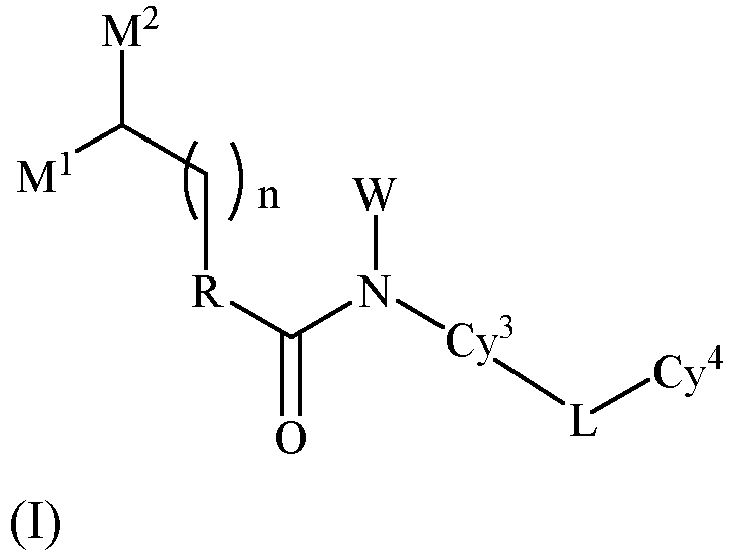 wobei W aus Wasserstoff oder C1-6Alkyl ausgewählt ist;R stellt eine Gruppe dar, die durch die folgende allgemeine Formel (b) dargestellt wird:
 in Formel (b) ist die
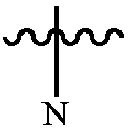 X1 und X2 sind jeweils unabhängig aus CRa und NRb ausgewählt und X3 ist C=O;X4 und X5 sind jeweils unabhängig C;M1 und M2 sind jeweils unabhängig voneinander ausgewählt aus Wasserstoff, Hydroxy, Halogen und C1-6Alkyl, oder M1 und M2 können zusammen mit den Atomen, an die sie gebunden sind, ein 3-8-gliedriges Cycloalkyl bilden;Cy2 ist Phenyl, das optional durch ein oder mehrere R2 substituiert ist, R2 ist jeweils unabhängig ausgewählt aus Wasserstoff, Hydroxy, Halogen, Carboxyl, Nitro, -NRbRc, -C(O)Rd, -C(O)NRbRc, -NRbC(O). )Rd, C1-6Alkyl, HydroxyC1-6Alkyl, AminoC1-6Alkyl, HalogenC1-6Alkyl, C1-6Alkoxy und HalogenC1-6Alkoxy;Cy3 ist
 Cy4 ist
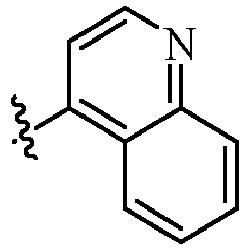 L ist ausgewählt aus -NRb-, -O- und -S-;Ra fehlt oder ist bei jedem Vorkommen unabhängig ausgewählt aus Wasserstoff, C1-6Alkyl und HalogenC1-6Alkyl;Rb und Rc fehlen oder sind bei jedem Vorkommen jeweils unabhängig ausgewählt aus Wasserstoff und C1-6Alkyl;Rd fehlt oder ist bei jedem Vorkommen unabhängig ausgewählt aus Wasserstoff und C1-6Alkyl;n ist eine ganze Zahl von 0-1;
- Die Verbindung nach Anspruch 1 oder ein pharmazeutisch verträgliches Salz, ein Stereoisomer oder ein Tautomer davon mit einer durch die folgende allgemeine Formel (II) dargestellten Struktur,
 X1 ist N, X2 ist CRa und X3 ist C=O; oderX1 ist CRa, X2 ist N und X3 ist C=O; oderX1 ist CRa, X2 ist CRa und X3 ist C=O;
 und alle anderen Symbole haben die gleichen Bedeutungen wie in Anspruch 1.
 - Die Verbindung nach Anspruch 1 oder ein pharmazeutisch verträgliches Salz, ein Stereoisomer oder ein Tautomer davon mit einer durch die allgemeine Formel (III) dargestellten Struktur,
 t2, t3 und t4 sind jeweils unabhängig aus einer ganzen Zahl von 1-5 ausgewählt;
 und alle anderen Symbole haben die gleichen Bedeutungen wie in Anspruch 1,Vorzugsweise, X1 ist N, X2 ist CRa und X3 ist C=O;Vorzugsweise, X1 ist CRa, X2 ist N und X3 ist C=O;Vorzugsweise, X1 ist CRa, X2 ist CRa und X3 ist C=O.
 - Eine durch die allgemeine Formel (IV) dargestellte Verbindung oder ein pharmazeutisch verträgliches Salz, ein Stereoisomer oder ein Tautomer davon,
 wobei X1 und X2 sind jeweils unabhängig aus CRa oder NRb ausgewählt, und X3 ist C=O;Cy2 ist Phenyl;Y6 und Y7 sind jeweils unabhängig aus CH und N ausgewählt, und mindestens einer von Y6 und Y7 ist N;Cy4 ist
 M1 und M2 sind jeweils unabhängig ausgewählt aus Wasserstoff, Hydroxy, Halogen und C1-6Alkyl, oder M1 und M2 können zusammen mit den Atomen, an die sie gebunden sind, ein 3-6-gliedriges Cycloalkyl bilden; R2 ist jeweils unabhängig ausgewählt aus Wasserstoff, Hydroxy, Halogen, Carboxyl, Nitro, -NRbRc, -C(O)Rd, - C(O)NRbRc, -NRbC(O)Rd, C1-6Alkyl, HydroxyC1-6Alkyl, AminoC1- 6Alkyl, HalogenC1-6Alkyl, C1-6Alkoxy und HalogenC1-6Alkoxy; vorzugsweise ist das Halogenatom ein Fluoratom;R3 ist jeweils unabhängig ausgewählt aus Wasserstoff, Hydroxy, Halogen, Carboxyl, Nitro, -NRbRc, -C(O)Rd, -C(O)NRbRc, -NRbC(O)Rd, C1-6Alkyl, HydroxyC1-6Alkyl, AminoC1-6Alkyl, HalogenC1-6Alkyl, C1-6Alkoxy und HalogenC1-6Alkoxy;R4 jeweils unabhängig ausgewählt ist aus Wasserstoff, Hydroxy, Halogen, Nitro, - NRbRc, -C(O)Rd, -C(O)NRbRc, -NRbC(O)Rd, C1-6Alkyl, HydroxyC1-6Alkyl, AminoC1-6Alkyl, HalogenC1-6Alkyl, C1-6Alkoxy, HalogenC1-6Alkoxy, C1-6AlkoxyC1-6Alkyl, C1-6AlkoxyC1-6Alkoxy und 3-14-gliedriges Heterocyclyl;L ist ausgewählt aus -NRb-, -O- und -S-;Ra fehlt oder ist bei jedem Vorkommen unabhängig ausgewählt aus Wasserstoff, C1-6Alkyl und HalogenC1-6Alkyl;Rb und Rc fehlen oder sind bei jedem Vorkommen jeweils unabhängig ausgewählt aus Wasserstoff und C1-6Alkyl;Rd fehlt oder ist bei jedem Vorkommen unabhängig ausgewählt aus Wasserstoff und C1-6Alkyl;n ist eine ganze Zahl von 0-2;t2, t3 und t4 sind jeweils unabhängig aus einer ganzen Zahl von 1-5 ausgewählt;
 Vorzugsweise, X1 ist N, X2 ist CRa und X3 ist C=O;Vorzugsweise, X1 ist CRa, X2 ist N und X3 ist C=O;Vorzugsweise, X1 ist CRa, X2 ist CRa und X3 ist C=O.
 - Die Verbindung nach Anspruch 1 oder 2 oder ein pharmazeutisch verträgliches Salz, ein Stereoisomer oder ein Tautomer davon, wobeiW ist Wasserstoff;R2 ist jeweils unabhängig ausgewählt aus Wasserstoff, Hydroxy, Fluor, Chlor, Brom und C1-4Alkyl; vorzugsweise ist R2 jeweils unabhängig ausgewählt aus Wasserstoff, Fluor, Chlor und C1-4Alkyl;Cy3 ist aus
 R4 ist jeweils unabhängig aus Wasserstoff, Hydroxy, Halogen, C1-4Alkyl, HalogenC1-4Alkyl, C1-4Alkoxy, HalogenC1-4Alkoxy und 3-14-gliedrigem Heterocyclyl ausgewählt;List -O-;und alle anderen Symbole haben die gleichen Bedeutungen wie in Anspruch 1 oder 2,Vorzugsweise, X1 ist N, X2 ist CRa und X3 ist C=O;Vorzugsweise, X1 ist CRa, X2 ist N und X3 ist C=O;Vorzugsweise, X1 ist CRa, X2 ist CRa und X3 ist C=O.
 - Eine aus den Verbindungen mit den folgenden Strukturen ausgewählte Verbindung, oder ein pharmazeutisch verträgliches Salz, ein Stereoisomer oder ein Tautomer davon:


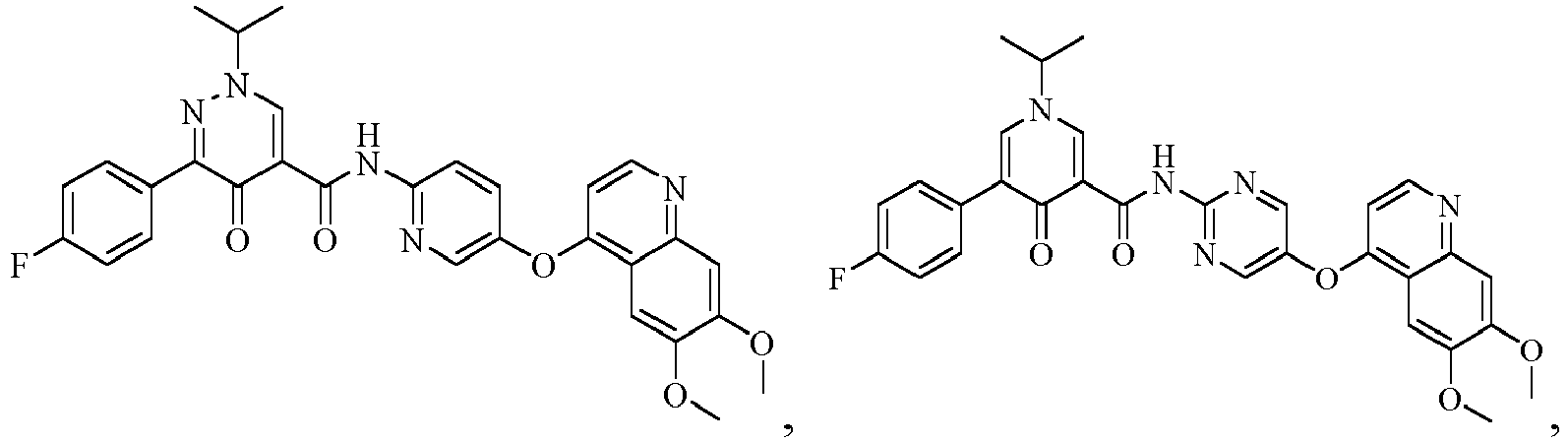


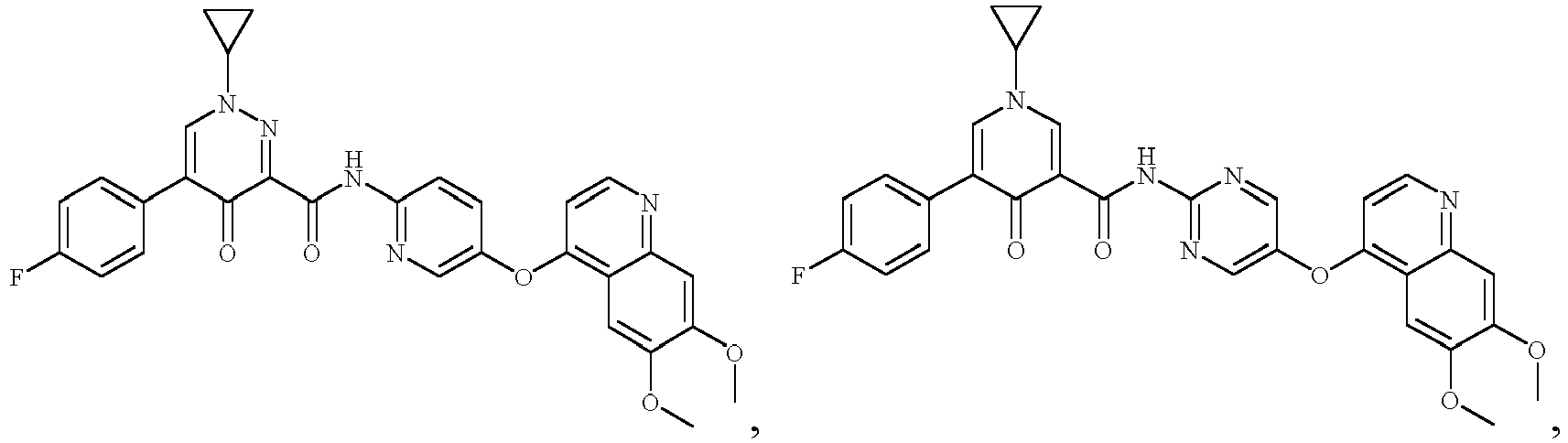


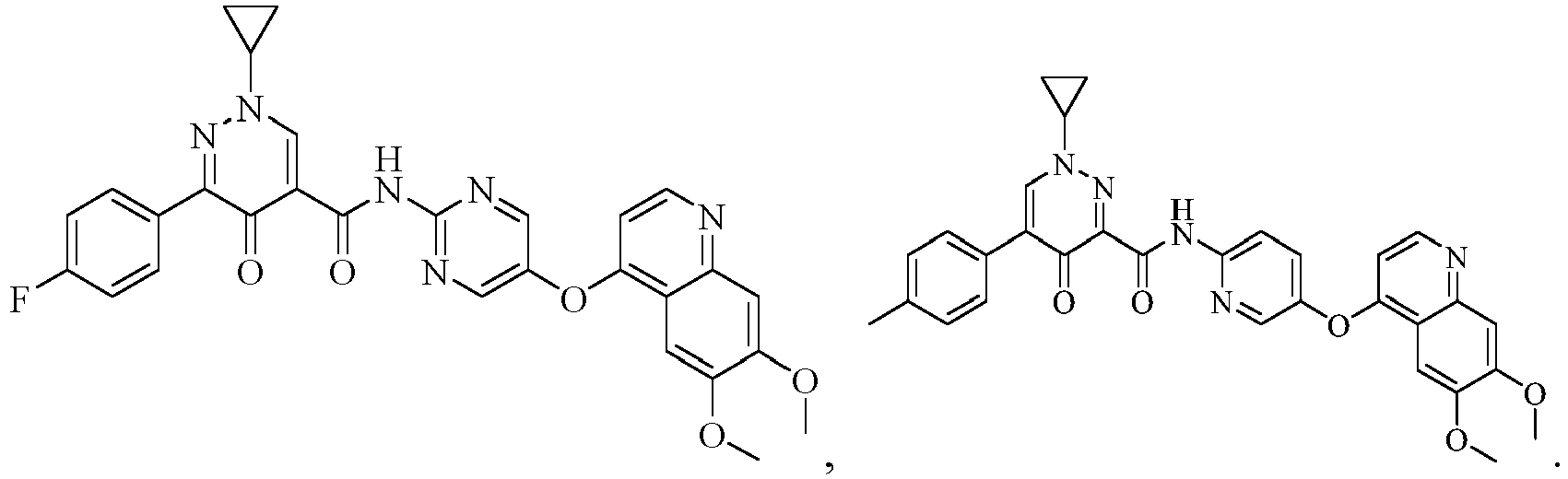
- Eine pharmazeutische Zusammensetzung, umfassend die Verbindung nach einem der Ansprüche 1-6, oder ein pharmazeutisch verträgliches Salz, ein Stereoisomer oder ein Tautomer davon, vorzugsweise weiterhin umfassend ein oder mehrere zweite therapeutisch aktive Mittel, wobei die zweiten therapeutisch aktiven Mittel aus Antimetaboliten, Wachstumsfaktorhemmer, Mitosehemmer, Antitumorhormone, Alkylierungsmittel, Metalle, Topoisomerasehemmer, Hormone, Immunmodulatoren, Tumorsuppressorgene, Krebsimpfstoffe, Immun-Checkpoints oder Antikörper im Zusammenhang mit der Tumorimmuntherapie und niedermolekulare Arzneimittel ausgewählt sind.
- Die Verbindung nach einem der Ansprüche 1-6, oder ein pharmazeutisch verträgliches Salz, ein Stereoisomer oder ein Tautomer davon, oder die pharmazeutische Zusammensetzung nach Anspruch 7 zur Verwendung in einem Verfahren zur Behandlung und/oder Vorbeugung von damit verbundenen Krankheiten, die durch abnormale Signalwege aufgrund der abnormalen Expression der Rezeptoren der TAM-Familie und/oder ihrer Liganden verursacht werden, wobei die damit verbundenen Krankheiten, die durch abnormale Signalwege aufgrund der abnormalen Expression der Rezeptoren der TAM-Familie und/oder ihrer Liganden verursacht werden, aus Tumor, Adenomyose, Gefäßerkrankung/ Verletzungen, Psoriasis, Sehfehler/-beeinträchtigung, Nierenerkrankungen, rheumatoide Arthritis und Osteoporose ausgewählt sind.
- Die Verbindung nach einem der Ansprüche 1-6, oder ein pharmazeutisch verträgliches Salz, ein Stereoisomer oder ein Tautomer davon, oder die pharmazeutische Zusammensetzung nach Anspruch 7 zur Verwendung in einem Verfahren zur Behandlung und/oder Vorbeugung von damit verbundenen Krankheiten, die durch abnormale Signalwege aufgrund der abnormalen Expression von Kinasen der TAM-Familie/und CSF1R-Kinase-Rezeptoren und/oder Liganden davon verursacht werden, wobei die verwandten Krankheiten, die durch abnormale Signalwege aufgrund der abnormalen Expression von Kinasen der TAM-Familie/ und CSF1R-Kinaserezeptoren und/oder Liganden davon verursacht werden, aus Tumor, Adenomyose, Gefäßerkrankung/-verletzung, Psoriasis, Sehfehler/-beeinträchtigung, Nierenerkrankung, rheumatoide Arthritis und Osteoporose ausgewählt sind.
- Die Verbindung nach einem der Ansprüche 1-6, oder ein pharmazeutisch verträgliches Salz, ein Stereoisomer oder ein Tautomer davon, oder die pharmazeutische Zusammensetzung nach Anspruch 7 zur Verwendung in einem Verfahren zur Behandlung und/oder Vorbeugung von durch NTRK verursachten verwandten Krankheiten, vorzugsweise, durch NTRK-Mutationen verursachte arzneimittelresistente Erkrankungen, wobei die durch NTRK verursachten arzneimittelresistenten Erkrankungen und durch NTRK-Mutationen verursachten arzneimittelresistenten Erkrankungen aus nicht-kleinzelligem Lungenkrebs, Darmkrebs, Mammaanalogon-sekretorischem Karzinom, Sarkom, Astrozytom, Glioblastom, Spitz-ähnliches Melanom, Cholangiokarzinom, papilläres Schilddrüsenkarzinom, sekretorischer Brustkrebs und Brustkrebs vom unbekannten pathologischen Typ ausgewählt sind.
- Ein Verfahren zur Herstellung der durch die allgemeine Formel (I) dargestellten Verbindung, umfassend
 Zugabe der Formel (I-a) zu einem Lösungsmittel, anschließende Zugabe eines Peptidkopplungsreagenzes, einer Base und der Formel (I-b), und Umsetzung der resultierenden Mischung, um die durch die allgemeine Formel (I) dargestellte Verbindung herzustellen; oder,Zugabe der Formel (I-a) und Formel (I-b) zu einer Base, dann tropfenweise Zugabe eines Kopplungsreagenzes, Umsetzung der resultierenden Mischung, um die durch die allgemeine Formel (I) dargestellte Verbindung herzustellen,wobei M1, M2, R, n, W, Cy3, L und Cy4 wie in einem der Ansprüche 1-6 definiert sind,Vorzugsweise ist das Lösungsmittel aus einer der N,N-Dimethylformamid, N,N-Dimethylacetamid, Dimethylsulfoxid, Toluol, Benzol, Xylol, Trimethylbenzol, Cyclohexan, Hexan, Dichlormethan, Chloroform, 1,2-Dichlorethan, Tetrahydrofuran und Diethylether, Dioxan, 1,2-Dimethoxyethan, Methylacetat, Ethylacetat, Aceton, Methylethylketon, Acetonitril, Methanol, Ethanol, Isopropanol, tert-Butanol, Wasser und eine Mischung davon ausgewählt; Unddie Base aus einer der Methylamin, Ethylamin, Propylamin, N,N-Diisopropylethylamin, Trimethylamin, Triethylamin, Dicyclohexylamin, Ethanolamin, Diethanolamin, Triethanolamin, Meglumin, Diethanolamin, Ethylendiamin, Pyridin, Picolin, Chinolin und einer Mischung davon ausgewählt ist;das Peptidkopplungsreagens aus einer der 2-(7-azabenzotriazol-1-yl)-tetramethyluroniumhexafluorphosphat (HATU), O-Benzotriazolyl-N,N,N',N'-tetramethyluroniumhexafluorphosphat (HBTU), 2-( 1H-Benzo[d][1,2,3]triazol-1-yl)-1,1,3,3-tetramethyluroniumtetrafluorborat (TBTU) und eine Mischung davon ausgewählt ist; Unddas Kopplungsreagenz aus Phosphoroxychlorid, Dicyclohexylcarbodiimid (DCC), N,N'-Carbonyldiimidazol, Isobutylchlorformiat, 1-n-Propylphosphorsäureanhydrid und einer Mischung davon ausgewählt ist.
 - Ein Zwischenprodukt zur Herstellung der Verbindung der allgemeinen Formel (I), wobei das Zwischenprodukt die durch die folgende Formel (I-a) dargestellte Struktur aufweist.
 R stellt eine Gruppe dar, die durch die folgende allgemeine Formel (b) dargestellt wird:
 X1 ist NRb, X2 ist CRa und X3 ist C=O; oder X1 ist CRa, X2 ist NRb und X3 ist C=O;X4 und X5 werden jeweils unabhängig aus C und ausgewählt, undM1, M2, Cy2, Ra, Rb, n und
Applications Claiming Priority (5)
| Application Number | Priority Date | Filing Date | Title |
|---|---|---|---|
| CN201810971406 | 2018-08-24 | ||
| CN201811403888 | 2018-11-23 | ||
| CN201910126817 | 2019-02-20 | ||
| CN201910490783 | 2019-06-06 | ||
| PCT/CN2019/102230 WO2020038460A1 (zh) | 2018-08-24 | 2019-08-23 | 一种新型的喹啉衍生物抑制剂 |
Publications (3)
| Publication Number | Publication Date |
|---|---|
| EP3842425A1 EP3842425A1 (de) | 2021-06-30 |
| EP3842425A4 EP3842425A4 (de) | 2022-05-18 |
| EP3842425B1 true EP3842425B1 (de) | 2024-05-22 |
Family
ID=69591988
Family Applications (1)
| Application Number | Title | Priority Date | Filing Date |
|---|---|---|---|
| EP19851019.0A Active EP3842425B1 (de) | 2018-08-24 | 2019-08-23 | Neuartige chinolinderivatinhibitoren |
Country Status (13)
| Country | Link |
|---|---|
| US (1) | US20220073496A1 (de) |
| EP (1) | EP3842425B1 (de) |
| JP (2) | JP7888140B2 (de) |
| KR (1) | KR102845791B1 (de) |
| CN (1) | CN110857293B (de) |
| AU (1) | AU2019323455B9 (de) |
| BR (1) | BR112021003447A2 (de) |
| ES (1) | ES2985569T3 (de) |
| PL (1) | PL3842425T3 (de) |
| PT (1) | PT3842425T (de) |
| SG (1) | SG11202101622VA (de) |
| TW (1) | TWI726397B (de) |
| WO (1) | WO2020038460A1 (de) |
Families Citing this family (9)
| Publication number | Priority date | Publication date | Assignee | Title |
|---|---|---|---|---|
| CN112625027B (zh) * | 2019-09-24 | 2022-09-09 | 药捷安康(南京)科技股份有限公司 | 杂环衍生物及其用途 |
| JP2022551422A (ja) | 2019-09-26 | 2022-12-09 | エグゼリクシス, インコーポレイテッド | ピリドン化合物およびタンパク質キナーゼの調節における使用の方法 |
| IL296790B1 (en) * | 2020-03-30 | 2026-07-01 | Hutchmed Ltd | Amide compounds and their uses |
| CN114127987B (zh) | 2020-05-07 | 2024-06-14 | 株式会社Lg新能源 | 具有降低的水分反应性的高镍电极片及其制造方法 |
| IT202100022682A1 (it) * | 2021-09-01 | 2023-03-01 | Luigi Frati | Derivati pirimidinici e loro uso nel trattamento di tumori |
| KR20250053959A (ko) | 2022-08-30 | 2025-04-22 | 트랜스테라 사이언시즈 (난징), 인크. | 퀴놀린 유도체 억제제의 결정형 및 이의 제조 방법과 용도 |
| CN115894198B (zh) * | 2022-11-04 | 2024-05-17 | 浙江永太科技股份有限公司 | Qulipta的关键中间体1-(2,3,6-三氟苯基)丙烷-2-酮的制备方法 |
| CN117534655B (zh) * | 2023-11-13 | 2024-08-30 | 复旦大学 | 一种喹诺酮类化合物及其制备方法和用途 |
| CN119074713B (zh) * | 2024-08-07 | 2025-10-31 | 中国医学科学院药用植物研究所 | L-nrb在制备治疗肌萎缩侧索硬化症的药物中的应用 |
Citations (2)
| Publication number | Priority date | Publication date | Assignee | Title |
|---|---|---|---|---|
| WO2011139891A1 (en) * | 2010-04-29 | 2011-11-10 | Deciphera Pharmaceuticals, Llc | Pyridone amides and analogs exhibiting anti-cancer and anti-proliferative activites |
| US20130281428A1 (en) * | 2012-01-31 | 2013-10-24 | Daiichi Sankyo Company, Limited | Pyridone Derivatives |
Family Cites Families (17)
| Publication number | Priority date | Publication date | Assignee | Title |
|---|---|---|---|---|
| JO2787B1 (en) * | 2005-04-27 | 2014-03-15 | امجين إنك, | Alternative amide derivatives and methods of use |
| JP5386508B2 (ja) * | 2008-01-22 | 2014-01-15 | ヴァーナリス アールアンドディー リミテッド | インドリル−ピリドン誘導体類 |
| TWI365185B (en) | 2008-07-24 | 2012-06-01 | Lilly Co Eli | Amidophenoxyindazoles useful as inhibitors of c-met |
| KR20120055608A (ko) | 2009-08-06 | 2012-05-31 | 메르크 파텐트 게엠베하 | 신규한 이환 우레아 화합물 |
| EP2739143B1 (de) * | 2011-08-05 | 2018-07-11 | Gary A. Flynn | Herstellung und verfahren zur verwendung von ortho-aryl-5-gliedrigem heteroaryl-carboxamid mit mehrfach gezielten kinasehemmern |
| EA023521B1 (ru) * | 2011-11-14 | 2016-06-30 | Сефалон, Инк. | ПРОИЗВОДНЫЕ УРАЦИЛА В КАЧЕСТВЕ ИНГИБИТОРОВ AXL И c-MET КИНАЗЫ |
| WO2014018535A1 (en) * | 2012-07-25 | 2014-01-30 | Salk Institute For Biological Studies | Regulating the interaction between tam ligands and lipid membranes with exposed phosphatidylserine |
| US9133183B2 (en) * | 2013-03-15 | 2015-09-15 | Deciphera Pharmaceuticals, Llc | Imidazolidinones and analogs exhibiting anti-cancer and anti-proliferative activities |
| PL3087070T3 (pl) * | 2013-12-26 | 2018-03-30 | Ignyta, Inc. | Pochodne pirazolo[1,5-a]pirydyny i sposoby ich zastosowania |
| WO2016104617A1 (ja) | 2014-12-25 | 2016-06-30 | 小野薬品工業株式会社 | キノリン誘導体 |
| KR102499359B1 (ko) * | 2015-04-14 | 2023-02-10 | 주식회사 큐리언트 | Tam rtk 억제제로서 퀴놀린 유도체들 |
| CN106467541B (zh) * | 2015-08-18 | 2019-04-05 | 暨南大学 | 取代喹诺酮类衍生物或其药学上可接受的盐或立体异构体及其药用组合物和应用 |
| KR102374012B1 (ko) * | 2017-05-24 | 2022-03-14 | 아비스코 테라퓨틱스 컴퍼니 리미티드 | N-(아자릴)시클로락탐-1-카르복사미드 유도체 및 합성법과 그 용법 |
| CN110520416B (zh) * | 2017-10-26 | 2022-06-03 | 北京越之康泰生物医药科技有限公司 | 多取代吡啶酮类衍生物、其制备方法及其医药用途 |
| CN111372925B (zh) * | 2017-11-24 | 2022-09-02 | 南京明德新药研发有限公司 | 作为c-MET/AXL抑制剂的尿嘧啶类化合物 |
| UY38349A (es) * | 2018-08-30 | 2020-03-31 | Array Biopharma Inc | Compuestos de pirazolo[3,4-b]piridina como inhibidores de cinasas tam y met |
| AU2020205035A1 (en) * | 2019-01-03 | 2021-07-22 | Array Biopharma Inc. | Quinoline compounds as inhibitors of TAM and MET kinases |
-
2019
- 2019-08-23 PT PT198510190T patent/PT3842425T/pt unknown
- 2019-08-23 CN CN201910785074.3A patent/CN110857293B/zh active Active
- 2019-08-23 SG SG11202101622VA patent/SG11202101622VA/en unknown
- 2019-08-23 WO PCT/CN2019/102230 patent/WO2020038460A1/zh not_active Ceased
- 2019-08-23 EP EP19851019.0A patent/EP3842425B1/de active Active
- 2019-08-23 US US17/268,309 patent/US20220073496A1/en active Pending
- 2019-08-23 ES ES19851019T patent/ES2985569T3/es active Active
- 2019-08-23 PL PL19851019.0T patent/PL3842425T3/pl unknown
- 2019-08-23 KR KR1020217008562A patent/KR102845791B1/ko active Active
- 2019-08-23 JP JP2021510026A patent/JP7888140B2/ja active Active
- 2019-08-23 AU AU2019323455A patent/AU2019323455B9/en active Active
- 2019-08-23 BR BR112021003447-1A patent/BR112021003447A2/pt unknown
- 2019-08-26 TW TW108130427A patent/TWI726397B/zh active
-
2024
- 2024-01-26 JP JP2024010530A patent/JP2024056742A/ja active Pending
Patent Citations (2)
| Publication number | Priority date | Publication date | Assignee | Title |
|---|---|---|---|---|
| WO2011139891A1 (en) * | 2010-04-29 | 2011-11-10 | Deciphera Pharmaceuticals, Llc | Pyridone amides and analogs exhibiting anti-cancer and anti-proliferative activites |
| US20130281428A1 (en) * | 2012-01-31 | 2013-10-24 | Daiichi Sankyo Company, Limited | Pyridone Derivatives |
Also Published As
| Publication number | Publication date |
|---|---|
| AU2019323455B2 (en) | 2024-07-11 |
| CA3109891A1 (en) | 2020-02-27 |
| CN110857293A (zh) | 2020-03-03 |
| EP3842425A4 (de) | 2022-05-18 |
| SG11202101622VA (en) | 2021-03-30 |
| CN110857293B (zh) | 2023-01-10 |
| PL3842425T3 (pl) | 2024-08-19 |
| JP7888140B2 (ja) | 2026-07-13 |
| KR102845791B1 (ko) | 2025-08-13 |
| TW202021589A (zh) | 2020-06-16 |
| AU2019323455B9 (en) | 2024-10-24 |
| BR112021003447A2 (pt) | 2021-05-18 |
| KR20210049862A (ko) | 2021-05-06 |
| EP3842425A1 (de) | 2021-06-30 |
| JP2021536436A (ja) | 2021-12-27 |
| AU2019323455A1 (en) | 2021-04-01 |
| ES2985569T3 (es) | 2024-11-06 |
| PT3842425T (pt) | 2024-07-02 |
| TWI726397B (zh) | 2021-05-01 |
| US20220073496A1 (en) | 2022-03-10 |
| WO2020038460A1 (zh) | 2020-02-27 |
| JP2024056742A (ja) | 2024-04-23 |
Similar Documents
| Publication | Publication Date | Title |
|---|---|---|
| EP3842425A1 (de) | Neuartige chinolinderivatinhibitoren | |
| JP6876833B2 (ja) | Fgfr阻害剤およびその使用 | |
| CN110041316B (zh) | Tam家族激酶/和csf1r激酶抑制剂及其用途 | |
| CN113164481B (zh) | 环烷-1,3-二胺衍生物 | |
| JP2022517085A (ja) | ハロゲン化アリルアミン系化合物及びその適用 | |
| TW202140446A (zh) | 喹啉基膦氧化合物及其組合物和用途 | |
| WO2011019060A1 (ja) | ヘッジホッグシグナル阻害剤 | |
| CN112625026B (zh) | Tam家族激酶抑制剂的喹啉衍生物 | |
| RU2802283C2 (ru) | Новый ингибитор на основе производного хинолина | |
| CA3109891C (en) | Quinoline derivative inhibitor: tam, ntrk, and csf1r kinases | |
| HK40046551B (en) | Novel quinoline derivative inhibitor | |
| HK40046551A (en) | Novel quinoline derivative inhibitor | |
| US20200399285A1 (en) | Dioxinoquinoline compounds, preparation method and uses thereof | |
| JP2024526096A (ja) | タンパク質キナーゼ阻害剤としての新規な化合物 | |
| JP2022551180A (ja) | イソクエン酸デヒドロゲナーゼ(idh)阻害剤 | |
| TWI889173B (zh) | 含苯基取代的二氫萘啶類化合物的藥物製劑與用途 | |
| HK40041650A (en) | Tam family kinase /and csf1r kinase inhibitor and use thereof | |
| JP2022549678A (ja) | 複素環誘導体及びその使用 | |
| HK1142333A (en) | 2-oxo-3-benzyl-benzoxazol-2-one derivatives and related compounds as met kinase inhibitors for the treatment of tumors |
Legal Events
| Date | Code | Title | Description |
|---|---|---|---|
| STAA | Information on the status of an ep patent application or granted ep patent |
Free format text: STATUS: THE INTERNATIONAL PUBLICATION HAS BEEN MADE |
|
| PUAI | Public reference made under article 153(3) epc to a published international application that has entered the european phase |
Free format text: ORIGINAL CODE: 0009012 |
|
| STAA | Information on the status of an ep patent application or granted ep patent |
Free format text: STATUS: REQUEST FOR EXAMINATION WAS MADE |
|
| 17P | Request for examination filed |
Effective date: 20210322 |
|
| AK | Designated contracting states |
Kind code of ref document: A1 Designated state(s): AL AT BE BG CH CY CZ DE DK EE ES FI FR GB GR HR HU IE IS IT LI LT LU LV MC MK MT NL NO PL PT RO RS SE SI SK SM TR |
|
| REG | Reference to a national code |
Ref country code: HK Ref legal event code: DE Ref document number: 40046551 Country of ref document: HK |
|
| DAV | Request for validation of the european patent (deleted) | ||
| DAX | Request for extension of the european patent (deleted) | ||
| A4 | Supplementary search report drawn up and despatched |
Effective date: 20220419 |
|
| RIC1 | Information provided on ipc code assigned before grant |
Ipc: C07D 237/24 20060101ALI20220408BHEP Ipc: C07D 213/80 20060101ALI20220408BHEP Ipc: A61P 35/04 20060101ALI20220408BHEP Ipc: A61P 35/02 20060101ALI20220408BHEP Ipc: A61K 45/06 20060101ALI20220408BHEP Ipc: A61P 13/12 20060101ALI20220408BHEP Ipc: A61P 29/00 20060101ALI20220408BHEP Ipc: A61P 19/10 20060101ALI20220408BHEP Ipc: A61P 19/02 20060101ALI20220408BHEP Ipc: A61P 27/02 20060101ALI20220408BHEP Ipc: A61P 17/06 20060101ALI20220408BHEP Ipc: A61P 9/00 20060101ALI20220408BHEP Ipc: A61P 15/00 20060101ALI20220408BHEP Ipc: A61P 35/00 20060101ALI20220408BHEP Ipc: A61K 31/506 20060101ALI20220408BHEP Ipc: A61K 31/501 20060101ALI20220408BHEP Ipc: A61K 31/4709 20060101ALI20220408BHEP Ipc: C07D 491/056 20060101ALI20220408BHEP Ipc: C07D 401/14 20060101AFI20220408BHEP |
|
| RAP3 | Party data changed (applicant data changed or rights of an application transferred) |
Owner name: TRANSTHERA SCIENCES (NANJING), INC. |
|
| STAA | Information on the status of an ep patent application or granted ep patent |
Free format text: STATUS: EXAMINATION IS IN PROGRESS |
|
| 17Q | First examination report despatched |
Effective date: 20230613 |
|
| GRAP | Despatch of communication of intention to grant a patent |
Free format text: ORIGINAL CODE: EPIDOSNIGR1 |
|
| STAA | Information on the status of an ep patent application or granted ep patent |
Free format text: STATUS: GRANT OF PATENT IS INTENDED |
|
| INTG | Intention to grant announced |
Effective date: 20240207 |
|
| GRAS | Grant fee paid |
Free format text: ORIGINAL CODE: EPIDOSNIGR3 |
|
| GRAA | (expected) grant |
Free format text: ORIGINAL CODE: 0009210 |
|
| STAA | Information on the status of an ep patent application or granted ep patent |
Free format text: STATUS: THE PATENT HAS BEEN GRANTED |
|
| AK | Designated contracting states |
Kind code of ref document: B1 Designated state(s): AL AT BE BG CH CY CZ DE DK EE ES FI FR GB GR HR HU IE IS IT LI LT LU LV MC MK MT NL NO PL PT RO RS SE SI SK SM TR |
|
| P01 | Opt-out of the competence of the unified patent court (upc) registered |
Effective date: 20240413 |
|
| REG | Reference to a national code |
Ref country code: GB Ref legal event code: FG4D |
|
| REG | Reference to a national code |
Ref country code: CH Ref legal event code: EP |
|
| REG | Reference to a national code |
Ref country code: DE Ref legal event code: R096 Ref document number: 602019052721 Country of ref document: DE |
|
| REG | Reference to a national code |
Ref country code: IE Ref legal event code: FG4D |
|
| REG | Reference to a national code |
Ref country code: PT Ref legal event code: SC4A Ref document number: 3842425 Country of ref document: PT Date of ref document: 20240702 Kind code of ref document: T Free format text: AVAILABILITY OF NATIONAL TRANSLATION Effective date: 20240625 |
|
| REG | Reference to a national code |
Ref country code: SE Ref legal event code: TRGR |
|
| REG | Reference to a national code |
Ref country code: NL Ref legal event code: FP |
|
| REG | Reference to a national code |
Ref country code: LT Ref legal event code: MG9D |
|
| PG25 | Lapsed in a contracting state [announced via postgrant information from national office to epo] |
Ref country code: IS Free format text: LAPSE BECAUSE OF FAILURE TO SUBMIT A TRANSLATION OF THE DESCRIPTION OR TO PAY THE FEE WITHIN THE PRESCRIBED TIME-LIMIT Effective date: 20240922 |
|
| PG25 | Lapsed in a contracting state [announced via postgrant information from national office to epo] |
Ref country code: BG Free format text: LAPSE BECAUSE OF FAILURE TO SUBMIT A TRANSLATION OF THE DESCRIPTION OR TO PAY THE FEE WITHIN THE PRESCRIBED TIME-LIMIT Effective date: 20240522 |
|
| PG25 | Lapsed in a contracting state [announced via postgrant information from national office to epo] |
Ref country code: HR Free format text: LAPSE BECAUSE OF FAILURE TO SUBMIT A TRANSLATION OF THE DESCRIPTION OR TO PAY THE FEE WITHIN THE PRESCRIBED TIME-LIMIT Effective date: 20240522 Ref country code: FI Free format text: LAPSE BECAUSE OF FAILURE TO SUBMIT A TRANSLATION OF THE DESCRIPTION OR TO PAY THE FEE WITHIN THE PRESCRIBED TIME-LIMIT Effective date: 20240522 |
|
| PG25 | Lapsed in a contracting state [announced via postgrant information from national office to epo] |
Ref country code: GR Free format text: LAPSE BECAUSE OF FAILURE TO SUBMIT A TRANSLATION OF THE DESCRIPTION OR TO PAY THE FEE WITHIN THE PRESCRIBED TIME-LIMIT Effective date: 20240823 |
|
| REG | Reference to a national code |
Ref country code: AT Ref legal event code: MK05 Ref document number: 1688702 Country of ref document: AT Kind code of ref document: T Effective date: 20240522 |
|
| PG25 | Lapsed in a contracting state [announced via postgrant information from national office to epo] |
Ref country code: AT Free format text: LAPSE BECAUSE OF FAILURE TO SUBMIT A TRANSLATION OF THE DESCRIPTION OR TO PAY THE FEE WITHIN THE PRESCRIBED TIME-LIMIT Effective date: 20240522 |
|
| PG25 | Lapsed in a contracting state [announced via postgrant information from national office to epo] |
Ref country code: LV Free format text: LAPSE BECAUSE OF FAILURE TO SUBMIT A TRANSLATION OF THE DESCRIPTION OR TO PAY THE FEE WITHIN THE PRESCRIBED TIME-LIMIT Effective date: 20240522 |
|
| PG25 | Lapsed in a contracting state [announced via postgrant information from national office to epo] |
Ref country code: NO Free format text: LAPSE BECAUSE OF FAILURE TO SUBMIT A TRANSLATION OF THE DESCRIPTION OR TO PAY THE FEE WITHIN THE PRESCRIBED TIME-LIMIT Effective date: 20240822 Ref country code: LV Free format text: LAPSE BECAUSE OF FAILURE TO SUBMIT A TRANSLATION OF THE DESCRIPTION OR TO PAY THE FEE WITHIN THE PRESCRIBED TIME-LIMIT Effective date: 20240522 Ref country code: IS Free format text: LAPSE BECAUSE OF FAILURE TO SUBMIT A TRANSLATION OF THE DESCRIPTION OR TO PAY THE FEE WITHIN THE PRESCRIBED TIME-LIMIT Effective date: 20240922 Ref country code: HR Free format text: LAPSE BECAUSE OF FAILURE TO SUBMIT A TRANSLATION OF THE DESCRIPTION OR TO PAY THE FEE WITHIN THE PRESCRIBED TIME-LIMIT Effective date: 20240522 Ref country code: GR Free format text: LAPSE BECAUSE OF FAILURE TO SUBMIT A TRANSLATION OF THE DESCRIPTION OR TO PAY THE FEE WITHIN THE PRESCRIBED TIME-LIMIT Effective date: 20240823 Ref country code: FI Free format text: LAPSE BECAUSE OF FAILURE TO SUBMIT A TRANSLATION OF THE DESCRIPTION OR TO PAY THE FEE WITHIN THE PRESCRIBED TIME-LIMIT Effective date: 20240522 Ref country code: BG Free format text: LAPSE BECAUSE OF FAILURE TO SUBMIT A TRANSLATION OF THE DESCRIPTION OR TO PAY THE FEE WITHIN THE PRESCRIBED TIME-LIMIT Effective date: 20240522 Ref country code: AT Free format text: LAPSE BECAUSE OF FAILURE TO SUBMIT A TRANSLATION OF THE DESCRIPTION OR TO PAY THE FEE WITHIN THE PRESCRIBED TIME-LIMIT Effective date: 20240522 Ref country code: RS Free format text: LAPSE BECAUSE OF FAILURE TO SUBMIT A TRANSLATION OF THE DESCRIPTION OR TO PAY THE FEE WITHIN THE PRESCRIBED TIME-LIMIT Effective date: 20240822 |
|
| REG | Reference to a national code |
Ref country code: ES Ref legal event code: FG2A Ref document number: 2985569 Country of ref document: ES Kind code of ref document: T3 Effective date: 20241106 |
|
| PG25 | Lapsed in a contracting state [announced via postgrant information from national office to epo] |
Ref country code: DK Free format text: LAPSE BECAUSE OF FAILURE TO SUBMIT A TRANSLATION OF THE DESCRIPTION OR TO PAY THE FEE WITHIN THE PRESCRIBED TIME-LIMIT Effective date: 20240522 |
|
| PG25 | Lapsed in a contracting state [announced via postgrant information from national office to epo] |
Ref country code: EE Free format text: LAPSE BECAUSE OF FAILURE TO SUBMIT A TRANSLATION OF THE DESCRIPTION OR TO PAY THE FEE WITHIN THE PRESCRIBED TIME-LIMIT Effective date: 20240522 |
|
| PG25 | Lapsed in a contracting state [announced via postgrant information from national office to epo] |
Ref country code: CZ Free format text: LAPSE BECAUSE OF FAILURE TO SUBMIT A TRANSLATION OF THE DESCRIPTION OR TO PAY THE FEE WITHIN THE PRESCRIBED TIME-LIMIT Effective date: 20240522 |
|
| PG25 | Lapsed in a contracting state [announced via postgrant information from national office to epo] |
Ref country code: SK Free format text: LAPSE BECAUSE OF FAILURE TO SUBMIT A TRANSLATION OF THE DESCRIPTION OR TO PAY THE FEE WITHIN THE PRESCRIBED TIME-LIMIT Effective date: 20240522 Ref country code: RO Free format text: LAPSE BECAUSE OF FAILURE TO SUBMIT A TRANSLATION OF THE DESCRIPTION OR TO PAY THE FEE WITHIN THE PRESCRIBED TIME-LIMIT Effective date: 20240522 |
|
| PG25 | Lapsed in a contracting state [announced via postgrant information from national office to epo] |
Ref country code: SM Free format text: LAPSE BECAUSE OF FAILURE TO SUBMIT A TRANSLATION OF THE DESCRIPTION OR TO PAY THE FEE WITHIN THE PRESCRIBED TIME-LIMIT Effective date: 20240522 |
|
| PG25 | Lapsed in a contracting state [announced via postgrant information from national office to epo] |
Ref country code: SM Free format text: LAPSE BECAUSE OF FAILURE TO SUBMIT A TRANSLATION OF THE DESCRIPTION OR TO PAY THE FEE WITHIN THE PRESCRIBED TIME-LIMIT Effective date: 20240522 Ref country code: SK Free format text: LAPSE BECAUSE OF FAILURE TO SUBMIT A TRANSLATION OF THE DESCRIPTION OR TO PAY THE FEE WITHIN THE PRESCRIBED TIME-LIMIT Effective date: 20240522 Ref country code: RO Free format text: LAPSE BECAUSE OF FAILURE TO SUBMIT A TRANSLATION OF THE DESCRIPTION OR TO PAY THE FEE WITHIN THE PRESCRIBED TIME-LIMIT Effective date: 20240522 Ref country code: EE Free format text: LAPSE BECAUSE OF FAILURE TO SUBMIT A TRANSLATION OF THE DESCRIPTION OR TO PAY THE FEE WITHIN THE PRESCRIBED TIME-LIMIT Effective date: 20240522 Ref country code: DK Free format text: LAPSE BECAUSE OF FAILURE TO SUBMIT A TRANSLATION OF THE DESCRIPTION OR TO PAY THE FEE WITHIN THE PRESCRIBED TIME-LIMIT Effective date: 20240522 Ref country code: CZ Free format text: LAPSE BECAUSE OF FAILURE TO SUBMIT A TRANSLATION OF THE DESCRIPTION OR TO PAY THE FEE WITHIN THE PRESCRIBED TIME-LIMIT Effective date: 20240522 |
|
| REG | Reference to a national code |
Ref country code: DE Ref legal event code: R097 Ref document number: 602019052721 Country of ref document: DE |
|
| PLBE | No opposition filed within time limit |
Free format text: ORIGINAL CODE: 0009261 |
|
| STAA | Information on the status of an ep patent application or granted ep patent |
Free format text: STATUS: NO OPPOSITION FILED WITHIN TIME LIMIT |
|
| PG25 | Lapsed in a contracting state [announced via postgrant information from national office to epo] |
Ref country code: LU Free format text: LAPSE BECAUSE OF NON-PAYMENT OF DUE FEES Effective date: 20240823 |
|
| PG25 | Lapsed in a contracting state [announced via postgrant information from national office to epo] |
Ref country code: MC Free format text: LAPSE BECAUSE OF FAILURE TO SUBMIT A TRANSLATION OF THE DESCRIPTION OR TO PAY THE FEE WITHIN THE PRESCRIBED TIME-LIMIT Effective date: 20240522 Ref country code: SI Free format text: LAPSE BECAUSE OF FAILURE TO SUBMIT A TRANSLATION OF THE DESCRIPTION OR TO PAY THE FEE WITHIN THE PRESCRIBED TIME-LIMIT Effective date: 20240522 |
|
| 26N | No opposition filed |
Effective date: 20250225 |
|
| PG25 | Lapsed in a contracting state [announced via postgrant information from national office to epo] |
Ref country code: IE Free format text: LAPSE BECAUSE OF NON-PAYMENT OF DUE FEES Effective date: 20240823 |
|
| PGFP | Annual fee paid to national office [announced via postgrant information from national office to epo] |
Ref country code: NL Payment date: 20250826 Year of fee payment: 7 |
|
| PGFP | Annual fee paid to national office [announced via postgrant information from national office to epo] |
Ref country code: ES Payment date: 20250902 Year of fee payment: 7 |
|
| PGFP | Annual fee paid to national office [announced via postgrant information from national office to epo] |
Ref country code: DE Payment date: 20250827 Year of fee payment: 7 |
|
| PGFP | Annual fee paid to national office [announced via postgrant information from national office to epo] |
Ref country code: PL Payment date: 20250731 Year of fee payment: 7 Ref country code: TR Payment date: 20250725 Year of fee payment: 7 Ref country code: IT Payment date: 20250827 Year of fee payment: 7 |
|
| PGFP | Annual fee paid to national office [announced via postgrant information from national office to epo] |
Ref country code: BE Payment date: 20250815 Year of fee payment: 7 Ref country code: GB Payment date: 20250826 Year of fee payment: 7 |
|
| PGFP | Annual fee paid to national office [announced via postgrant information from national office to epo] |
Ref country code: FR Payment date: 20250826 Year of fee payment: 7 |
|
| PGFP | Annual fee paid to national office [announced via postgrant information from national office to epo] |
Ref country code: CH Payment date: 20250901 Year of fee payment: 7 Ref country code: SE Payment date: 20250826 Year of fee payment: 7 |
|
| PG25 | Lapsed in a contracting state [announced via postgrant information from national office to epo] |
Ref country code: CY Free format text: LAPSE BECAUSE OF FAILURE TO SUBMIT A TRANSLATION OF THE DESCRIPTION OR TO PAY THE FEE WITHIN THE PRESCRIBED TIME-LIMIT; INVALID AB INITIO Effective date: 20190823 |
|
| PG25 | Lapsed in a contracting state [announced via postgrant information from national office to epo] |
Ref country code: HU Free format text: LAPSE BECAUSE OF FAILURE TO SUBMIT A TRANSLATION OF THE DESCRIPTION OR TO PAY THE FEE WITHIN THE PRESCRIBED TIME-LIMIT; INVALID AB INITIO Effective date: 20190823 |
|
| PG25 | Lapsed in a contracting state [announced via postgrant information from national office to epo] |
Ref country code: LT Free format text: LAPSE BECAUSE OF FAILURE TO SUBMIT A TRANSLATION OF THE DESCRIPTION OR TO PAY THE FEE WITHIN THE PRESCRIBED TIME-LIMIT Effective date: 20240522 |
|
| PGFP | Annual fee paid to national office [announced via postgrant information from national office to epo] |
Ref country code: PT Payment date: 20260625 Year of fee payment: 8 |