EP3836975B1 - Nucleic acid decontamination methods - Google Patents
Nucleic acid decontamination methods Download PDFInfo
- Publication number
- EP3836975B1 EP3836975B1 EP19766123.4A EP19766123A EP3836975B1 EP 3836975 B1 EP3836975 B1 EP 3836975B1 EP 19766123 A EP19766123 A EP 19766123A EP 3836975 B1 EP3836975 B1 EP 3836975B1
- Authority
- EP
- European Patent Office
- Prior art keywords
- pectin
- nucleic acid
- amidated
- amidated pectin
- solution
- Prior art date
- Legal status (The legal status is an assumption and is not a legal conclusion. Google has not performed a legal analysis and makes no representation as to the accuracy of the status listed.)
- Active
Links
Images



Classifications
-
- A—HUMAN NECESSITIES
- A61—MEDICAL OR VETERINARY SCIENCE; HYGIENE
- A61L—METHODS OR APPARATUS FOR STERILISING MATERIALS OR OBJECTS IN GENERAL; DISINFECTION, STERILISATION OR DEODORISATION OF AIR; CHEMICAL ASPECTS OF BANDAGES, DRESSINGS, ABSORBENT PADS OR SURGICAL ARTICLES; MATERIALS FOR BANDAGES, DRESSINGS, ABSORBENT PADS OR SURGICAL ARTICLES
- A61L9/00—Disinfection, sterilisation or deodorisation of air
- A61L9/01—Deodorant compositions
-
- A—HUMAN NECESSITIES
- A61—MEDICAL OR VETERINARY SCIENCE; HYGIENE
- A61L—METHODS OR APPARATUS FOR STERILISING MATERIALS OR OBJECTS IN GENERAL; DISINFECTION, STERILISATION OR DEODORISATION OF AIR; CHEMICAL ASPECTS OF BANDAGES, DRESSINGS, ABSORBENT PADS OR SURGICAL ARTICLES; MATERIALS FOR BANDAGES, DRESSINGS, ABSORBENT PADS OR SURGICAL ARTICLES
- A61L2/00—Disinfection or sterilisation of materials or objects, in general; Accessories therefor
- A61L2/16—Disinfection or sterilisation of materials or objects, in general; Accessories therefor using chemical substances
- A61L2/18—Liquid substances
-
- A—HUMAN NECESSITIES
- A61—MEDICAL OR VETERINARY SCIENCE; HYGIENE
- A61L—METHODS OR APPARATUS FOR STERILISING MATERIALS OR OBJECTS IN GENERAL; DISINFECTION, STERILISATION OR DEODORISATION OF AIR; CHEMICAL ASPECTS OF BANDAGES, DRESSINGS, ABSORBENT PADS OR SURGICAL ARTICLES; MATERIALS FOR BANDAGES, DRESSINGS, ABSORBENT PADS OR SURGICAL ARTICLES
- A61L2/00—Disinfection or sterilisation of materials or objects, in general; Accessories therefor
- A61L2/16—Disinfection or sterilisation of materials or objects, in general; Accessories therefor using chemical substances
-
- A—HUMAN NECESSITIES
- A61—MEDICAL OR VETERINARY SCIENCE; HYGIENE
- A61L—METHODS OR APPARATUS FOR STERILISING MATERIALS OR OBJECTS IN GENERAL; DISINFECTION, STERILISATION OR DEODORISATION OF AIR; CHEMICAL ASPECTS OF BANDAGES, DRESSINGS, ABSORBENT PADS OR SURGICAL ARTICLES; MATERIALS FOR BANDAGES, DRESSINGS, ABSORBENT PADS OR SURGICAL ARTICLES
- A61L9/00—Disinfection, sterilisation or deodorisation of air
- A61L9/01—Deodorant compositions
- A61L9/013—Deodorant compositions containing animal or plant extracts, or vegetable material
-
- A—HUMAN NECESSITIES
- A61—MEDICAL OR VETERINARY SCIENCE; HYGIENE
- A61L—METHODS OR APPARATUS FOR STERILISING MATERIALS OR OBJECTS IN GENERAL; DISINFECTION, STERILISATION OR DEODORISATION OF AIR; CHEMICAL ASPECTS OF BANDAGES, DRESSINGS, ABSORBENT PADS OR SURGICAL ARTICLES; MATERIALS FOR BANDAGES, DRESSINGS, ABSORBENT PADS OR SURGICAL ARTICLES
- A61L9/00—Disinfection, sterilisation or deodorisation of air
- A61L9/14—Disinfection, sterilisation or deodorisation of air using sprayed or atomised substances including air-liquid contact processes
- A61L9/145—Disinfection, sterilisation or deodorisation of air using sprayed or atomised substances including air-liquid contact processes air-liquid contact processes, e.g. scrubbing
-
- C—CHEMISTRY; METALLURGY
- C08—ORGANIC MACROMOLECULAR COMPOUNDS; THEIR PREPARATION OR CHEMICAL WORKING-UP; COMPOSITIONS BASED THEREON
- C08B—POLYSACCHARIDES; DERIVATIVES THEREOF
- C08B37/00—Preparation of polysaccharides not provided for in groups C08B1/00 - C08B35/00; Derivatives thereof
- C08B37/0006—Homoglycans, i.e. polysaccharides having a main chain consisting of one single sugar, e.g. colominic acid
- C08B37/0045—Homoglycans, i.e. polysaccharides having a main chain consisting of one single sugar, e.g. colominic acid alpha-D-Galacturonans, e.g. methyl ester of (alpha-1,4)-linked D-galacturonic acid units, i.e. pectin, or hydrolysis product of methyl ester of alpha-1,4-linked D-galacturonic acid units, i.e. pectinic acid; Derivatives thereof
-
- C—CHEMISTRY; METALLURGY
- C08—ORGANIC MACROMOLECULAR COMPOUNDS; THEIR PREPARATION OR CHEMICAL WORKING-UP; COMPOSITIONS BASED THEREON
- C08L—COMPOSITIONS OF MACROMOLECULAR COMPOUNDS
- C08L5/00—Compositions of polysaccharides or of their derivatives not provided for in groups C08L1/00 or C08L3/00
- C08L5/06—Pectin; Derivatives thereof
-
- C—CHEMISTRY; METALLURGY
- C11—ANIMAL OR VEGETABLE OILS, FATS, FATTY SUBSTANCES OR WAXES; FATTY ACIDS THEREFROM; DETERGENTS; CANDLES
- C11D—DETERGENT COMPOSITIONS; USE OF SINGLE SUBSTANCES AS DETERGENTS; SOAP OR SOAP-MAKING; RESIN SOAPS; RECOVERY OF GLYCEROL
- C11D17/00—Detergent materials or soaps characterised by their shape or physical properties
- C11D17/04—Detergent materials or soaps characterised by their shape or physical properties combined with or containing other objects
-
- C—CHEMISTRY; METALLURGY
- C11—ANIMAL OR VEGETABLE OILS, FATS, FATTY SUBSTANCES OR WAXES; FATTY ACIDS THEREFROM; DETERGENTS; CANDLES
- C11D—DETERGENT COMPOSITIONS; USE OF SINGLE SUBSTANCES AS DETERGENTS; SOAP OR SOAP-MAKING; RESIN SOAPS; RECOVERY OF GLYCEROL
- C11D17/00—Detergent materials or soaps characterised by their shape or physical properties
- C11D17/04—Detergent materials or soaps characterised by their shape or physical properties combined with or containing other objects
- C11D17/049—Cleaning or scouring pads; Wipes
-
- C—CHEMISTRY; METALLURGY
- C11—ANIMAL OR VEGETABLE OILS, FATS, FATTY SUBSTANCES OR WAXES; FATTY ACIDS THEREFROM; DETERGENTS; CANDLES
- C11D—DETERGENT COMPOSITIONS; USE OF SINGLE SUBSTANCES AS DETERGENTS; SOAP OR SOAP-MAKING; RESIN SOAPS; RECOVERY OF GLYCEROL
- C11D7/00—Compositions of detergents based essentially on non-surface-active compounds
- C11D7/22—Organic compounds
- C11D7/26—Organic compounds containing oxygen
- C11D7/268—Carbohydrates or derivatives thereof
-
- C—CHEMISTRY; METALLURGY
- C11—ANIMAL OR VEGETABLE OILS, FATS, FATTY SUBSTANCES OR WAXES; FATTY ACIDS THEREFROM; DETERGENTS; CANDLES
- C11D—DETERGENT COMPOSITIONS; USE OF SINGLE SUBSTANCES AS DETERGENTS; SOAP OR SOAP-MAKING; RESIN SOAPS; RECOVERY OF GLYCEROL
- C11D7/00—Compositions of detergents based essentially on non-surface-active compounds
- C11D7/22—Organic compounds
- C11D7/32—Organic compounds containing nitrogen
- C11D7/329—Carbohydrate or derivatives thereof
-
- C—CHEMISTRY; METALLURGY
- C12—BIOCHEMISTRY; BEER; SPIRITS; WINE; VINEGAR; MICROBIOLOGY; ENZYMOLOGY; MUTATION OR GENETIC ENGINEERING
- C12Q—MEASURING OR TESTING PROCESSES INVOLVING ENZYMES, NUCLEIC ACIDS OR MICROORGANISMS; COMPOSITIONS OR TEST PAPERS THEREFOR; PROCESSES OF PREPARING SUCH COMPOSITIONS; CONDITION-RESPONSIVE CONTROL IN MICROBIOLOGICAL OR ENZYMOLOGICAL PROCESSES
- C12Q1/00—Measuring or testing processes involving enzymes, nucleic acids or microorganisms; Compositions therefor; Processes of preparing such compositions
- C12Q1/68—Measuring or testing processes involving enzymes, nucleic acids or microorganisms; Compositions therefor; Processes of preparing such compositions involving nucleic acids
- C12Q1/6844—Nucleic acid amplification reactions
- C12Q1/6848—Nucleic acid amplification reactions characterised by the means for preventing contamination or increasing the specificity or sensitivity of an amplification reaction
-
- A—HUMAN NECESSITIES
- A61—MEDICAL OR VETERINARY SCIENCE; HYGIENE
- A61L—METHODS OR APPARATUS FOR STERILISING MATERIALS OR OBJECTS IN GENERAL; DISINFECTION, STERILISATION OR DEODORISATION OF AIR; CHEMICAL ASPECTS OF BANDAGES, DRESSINGS, ABSORBENT PADS OR SURGICAL ARTICLES; MATERIALS FOR BANDAGES, DRESSINGS, ABSORBENT PADS OR SURGICAL ARTICLES
- A61L2101/00—Chemical composition of materials used in disinfecting, sterilising or deodorising
- A61L2101/32—Organic compounds
- A61L2101/46—Macromolecular compounds
- A61L2101/50—Polysaccharides or derivatives thereof
-
- A—HUMAN NECESSITIES
- A61—MEDICAL OR VETERINARY SCIENCE; HYGIENE
- A61L—METHODS OR APPARATUS FOR STERILISING MATERIALS OR OBJECTS IN GENERAL; DISINFECTION, STERILISATION OR DEODORISATION OF AIR; CHEMICAL ASPECTS OF BANDAGES, DRESSINGS, ABSORBENT PADS OR SURGICAL ARTICLES; MATERIALS FOR BANDAGES, DRESSINGS, ABSORBENT PADS OR SURGICAL ARTICLES
- A61L2103/00—Materials or objects being the target of disinfection or sterilisation
- A61L2103/05—Living organisms or biological materials
-
- A—HUMAN NECESSITIES
- A61—MEDICAL OR VETERINARY SCIENCE; HYGIENE
- A61L—METHODS OR APPARATUS FOR STERILISING MATERIALS OR OBJECTS IN GENERAL; DISINFECTION, STERILISATION OR DEODORISATION OF AIR; CHEMICAL ASPECTS OF BANDAGES, DRESSINGS, ABSORBENT PADS OR SURGICAL ARTICLES; MATERIALS FOR BANDAGES, DRESSINGS, ABSORBENT PADS OR SURGICAL ARTICLES
- A61L2103/00—Materials or objects being the target of disinfection or sterilisation
- A61L2103/15—Laboratory, medical or dentistry appliances, e.g. catheters or sharps
-
- A—HUMAN NECESSITIES
- A61—MEDICAL OR VETERINARY SCIENCE; HYGIENE
- A61L—METHODS OR APPARATUS FOR STERILISING MATERIALS OR OBJECTS IN GENERAL; DISINFECTION, STERILISATION OR DEODORISATION OF AIR; CHEMICAL ASPECTS OF BANDAGES, DRESSINGS, ABSORBENT PADS OR SURGICAL ARTICLES; MATERIALS FOR BANDAGES, DRESSINGS, ABSORBENT PADS OR SURGICAL ARTICLES
- A61L2209/00—Aspects relating to disinfection, sterilisation or deodorisation of air
- A61L2209/20—Method-related aspects
- A61L2209/21—Use of chemical compounds for treating air or the like
-
- C—CHEMISTRY; METALLURGY
- C11—ANIMAL OR VEGETABLE OILS, FATS, FATTY SUBSTANCES OR WAXES; FATTY ACIDS THEREFROM; DETERGENTS; CANDLES
- C11D—DETERGENT COMPOSITIONS; USE OF SINGLE SUBSTANCES AS DETERGENTS; SOAP OR SOAP-MAKING; RESIN SOAPS; RECOVERY OF GLYCEROL
- C11D2111/00—Cleaning compositions characterised by the objects to be cleaned; Cleaning compositions characterised by non-standard cleaning or washing processes
- C11D2111/10—Objects to be cleaned
-
- C—CHEMISTRY; METALLURGY
- C11—ANIMAL OR VEGETABLE OILS, FATS, FATTY SUBSTANCES OR WAXES; FATTY ACIDS THEREFROM; DETERGENTS; CANDLES
- C11D—DETERGENT COMPOSITIONS; USE OF SINGLE SUBSTANCES AS DETERGENTS; SOAP OR SOAP-MAKING; RESIN SOAPS; RECOVERY OF GLYCEROL
- C11D2111/00—Cleaning compositions characterised by the objects to be cleaned; Cleaning compositions characterised by non-standard cleaning or washing processes
- C11D2111/10—Objects to be cleaned
- C11D2111/14—Hard surfaces
- C11D2111/20—Industrial or commercial equipment, e.g. reactors, tubes or engines
Definitions
- sequence listing associated with this application is provided in text format in lieu of a paper copy and is hereby incorporated by reference into the specification.
- the name of the text file containing the sequence listing is 70134_Seq_Final_2019-08-14.txt.
- the text file is 2.23 KB; was created on August 14, 2019; and is being submitted via EFS-Web with the filing of the specification.
- the invention relates to methods for reduction of nucleic acid contamination on surfaces, in air, and in solutions.
- nucleic acid amplification-based techniques such as polymerase chain reaction (PCR)
- PCR polymerase chain reaction
- the high sensitivity of these techniques makes them vulnerable to contamination.
- Nucleic acid cross-contamination in the laboratory presents a serious problem for highly sensitive amplification-based assays.
- the repeated amplification of the target sequence itself, which leads to accumulation of amplification products, or so called amplicons, in the laboratory environment, is of the largest sources of cross-contamination.
- Prevention of amplicon carryover and/or sterilization of the generated amplicons by destroying them or rendering them ineligible for amplification are critical in molecular biology and diagnostic applications.
- CN1798570 describes nucleic acid damaging agents. It is also known from the prior art that pectin can be modified and used in different compositions for example: in air freshener gels with amidated pectin ( WO2004005352 and US2013072381 ), in pharmaceutical preparations with esterified pectins ( DE69321215 ), in detergents with pectins and effervescent agents ( US2017320764 ).
- a method of reducing nucleic acid contamination on a surface comprising contacting a surface contaminated with a nucleic acid with a composition comprising a modified pectin, wherein the modified pectin comprises a plurality of amino groups.
- the modified pectin is an amidated pectin.
- the modified pectin comprises one or more monomeric units represented by Formula:
- the molecular weight of the amidated pectin is between about 0.5 kDa and about 500 kDa or between about 100 kDa and about 300 kDa.
- the decontaminating reagents disclosed herein comprise an amidated pectin comprising one or more monomeric units substituted with at least one amino group.
- the amidated pectins comprise one or more monomeric units having the structure of Formula I: wherein:
- Aryl and heteroaryl moieties can be substituted with a variety of substituents including C1-C8 alkyl, C2-C8 alkenyl, C2-C8 alkynyl, C5-C12 aryl, C1-C8 acyl, and heteroforms of these, each of which can itself be further substituted; other substituents for aryl and heteroaryl moieties include halogens (F, Cl, Br, I), OR, NR 2 , SR, SO 2 R, SO 2 NR 2 , NRSO 2 R, NRCONR 2 , NRC(O)OR, NRC(O)R, CN, C(O)OR, C(O)NR 2 , OC(O)R, C(O)R, and NO 2 , wherein each R is independently H, C1-C8 alkyl, C2-C8 heteroalkyl, C2-C8 alkenyl, C2-C8 heteroalkenyl, C2-C8 alkynyl, C2-
- Optionally substituted indicates that the particular group being described can have one or more hydrogen substituents replaced by a non-hydrogen substituent. In some optionally substituted groups or moieties, all hydrogen substituents are replaced by a non-hydrogen substituent (e.g., a polyfluorinated alkyl such as trifluoromethyl). If not otherwise specified, the total number of such substituents that can be present is equal to the number of H atoms present on the unsubstituted form of the group being described.
- a non-hydrogen substituent e.g., a polyfluorinated alkyl such as trifluoromethyl
- the group takes up two available valences, so the total number of substituents that may be included is reduced according to the number of available valences.
- the amidated pectin comprises one or more primary amino groups. In some embodiments, the amidated pectin is amidated with a polyamine. In some embodiments, the polyamine is selected from spermine, spermidine, cadaverine, ethylenediamine, and putrescine.
- the amidated pectin comprises one or more units represented by formulas: their tautomers, isomers, salts, or combinations thereof.
- the amidated pectins comprise a plurality of monomeric units represented by formulae shown above.
- the term "plurality" means more than one.
- a plurality of monomeric units means at least two monomeric units, at least three monomeric units, or at least monomeric units, and the like. If an embodiment of the present invention comprises more than one types of monomeric units, they may also be referred to as a first monomeric unit, a second monomeric unit, a third monomeric unit, etc.
- the method for reducing nucleic acid contamination on a surface comprising: contacting the surface to be decontaminated with a solution comprising a dissolved or suspended modified pectin comprising a plurality of amino groups, i.e. an amidated pectin.
- the modified pectin is an amidated pectin, wherein the amidated pectin comprises one or more monomeric units having the structure of Formulae I-V.
- the concentration of the amidated pectin in the decontaminating solution is between about 0.01% and about 5%, between about 0.01% and about 1%, between about 0.01% and about 0.1%, between about 0.
- concentration of the amidated pectin in the decontaminating solution is between about 0.1 ⁇ g/mL and about 10,000 ⁇ g/mL, between about 0. 1 ⁇ g/mL and about 5,000 ⁇ g/mL, between about 0.1 ⁇ g/mL and about 1,000 ⁇ g/mL,between about 0.1 ⁇ g/mL and about 100 ⁇ g/mL, between about 0.1 ⁇ g/mL and about 5 ⁇ g/mL.
- concentration of the amidated pectin in the decontaminating solution is between about 0.1 ⁇ g/mL and about 10,000 ⁇ g/mL, between about 0. 1 ⁇ g/mL and about 5,000 ⁇ g/mL, between about 0.1 ⁇ g/mL and about 1,000 ⁇ g/mL,between about 0.1 ⁇ g/mL and about 100 ⁇ g/mL, between about 0.1 ⁇ g/mL and about 5 ⁇ g/mL.
- a person skilled in the art can select the suitable amount and/or concentration of
- the decontaminating solution is present on a swab, wipe, cloth, filter, or sponge.
- the surface to be decontaminated is a surface of an instrument or a laboratory bench surface. In other embodiments, the solution is used to decontaminate laboratory pipettes.
- the methods of decontamination disclosed herein further comprise rinsing or wiping the surface to be decontaminated with water or another solution that does not comprise an amidated pectin.
- the methods further comprise contacting the surface or solution to be decontaminated from nucleic acid contaminants with a solution comprising a metal ion that can form a hydrogel with pectin thereby precipitating, trapping, complexing, or otherwise render insoluble the nucleic acid or the complex of the nucleic acid with the amidated pectins of the decontaminating solutions disclosed herein.
- Suitable metal ions include Ca 2+ and Mg 2+ ions. Any metal that can crosslink a pectin or an amidated pectin is suitable to be included in the decontaminating compositions disclosed herein.
- compositions comprising an amidated pectin covalently bound to a solid support, wherein the amidated pectin comprises a plurality of monomeric residues having the structure of Formulae I-V shown above.
- solid support refers to any substrate including paramagnetic particles, gels, controlled pore glass, magnetic beads, microspheres, nanospheres, capillaries, filter membranes, columns, cloths, wipes, paper, flat supports, multi-well plates, porous membranes, porous monoliths, wafers, combs, or any combination thereof.
- Solid supports can comprise any suitable material, including but not limited to glass, silica, titanium oxide, iron oxide, ethylenic backbone polymers, polypropylene, polyethylene, polystyrene, ceramic, cellulose, nitrocellulose, and divinylbenzene.
- Covalent attachment of modified pectins such as amidated pectins to solid supports can be achieved in any suitable manner by reacting the pectin with a solid support that comprises amine-reactive groups, for example, an epoxide, aldehyde, ketone, or activated ester.
- a solid support that comprises amine-reactive groups, for example, an epoxide, aldehyde, ketone, or activated ester.
- Non-limiting examples of suitable coupling agents include carbodiimide coupling agents such as DCC and EDCI, phosphonium and imonium type reagents such as BOP, PyBOP, PyBrOP, TBTU, HBTU, HATU, COMU, and TFFH.
- the carboxylic acid group of the solid substrate can be converted to an activated ester and then subsequently reacted with an amino group of the amidated pectin.
- PCR reaction solution 25 mM KCl, 50 mM MgCl 2 , 4.2 mM HEPES, 0.1% Tween, 0.2 mM dNTP's, 1.5 mU/uL of hot start Taq enzyme, 400 nM probe and 400 nM primers.
- FIGURE 1 shows the PCR curves where 2.5 ng of template dsDNA (126 bp) was treated with spermine conjugated pectin.
- Each curve represents an experiment where 0.5 to 6.0 ng of spermine-pectin was added to 2.5 ng of dsDNA.
- the first curve on the left side has a Ct of 12.2 which represents the no spermine-pectin control. As more pectin is added to the separate reactions, the Ct's become longer, until at 6 ug of spermine-pectin, no Ct is observed. This is the concentration where all of the template is bound by the spermine-pectin conjugate, and the template cannot be amplified in the PCR reaction.
- Two separate vials were prepared each containing 6 ⁇ g of the spermine-pectin conjugate in 60 ⁇ L of water.
- 4 ⁇ g of hgDNA in 20 ⁇ L of water was added and allowed to sit at RT for 1 h.
- 2.5 ng of the salmon dsDNA (126 bp) model amplicon in 100 uL was then added to both vials.
- a 5 ⁇ L aliquot was removed from each vial to use in PCR as described below.
- the salmon dsDNA (126 bp) model amplicon was diluted to a concentration of 10 million copies per 1 mL of water. 1 mL of the DNA solution was added to each of three separate vials. One vial was used as the no spermine-pectin control sample. To the other two vials, 1 ⁇ g of the spermine-pectin conjugate in 10 ⁇ L of water was added. And to only one of these vials, an additional 2.5 ng of the salmon dsDNA (126 bp) model amplicon was added in 100 ⁇ L of water. After sitting for 1 h, 5 ⁇ L was used from each vial for the PCR reaction as described below.
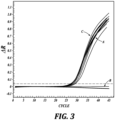
- FIGURE 3 shows that when 10 million copies of dsDNA (126 bp) were treated with 1 ug of the spermine-pectin conjugate, the amplification was completely inhibited (B). After more copies (1.9 x 10 10 ) were added to the spermine-pectin-DNA mixture, the amplification recovered (C), comparable to untreated DNA amplification (A). This shows how the spermine-pectin conjugate can be used to bind minor DNA contaminates, and then allow amplification of target to take place.
- PCR with the salmon DNA target was performed by the method described above without using the probe. After 40 PCR cycles, the content of the PCR tube was diluted 1000 times giving "amplicon solution" with approximately 400B copies of DNA/mL. The ability to amplify and the number of copies/mL were confirmed by parallel comparison in PCR with standard 10K copies of the salmon DNA target. The amplicon solution was used in the following experiments.
- a 31x23 cm polypropylene plate was roughened using P150 (very fine) sandpaper.
- the surface was cleaned with water, tested for wettability and dried.
- the surface was marked with a grid of 7.5 cm x1.8 cm spaciously separated segments for testing various treatments and running controls.
- 10 mL of amplicon solution was deposited onto the dry surface and spread consistently throughout the surface using a cotton swab.
- the plate was left on a horizontal surface and allowed to dry for 4 hr.
- the surface containing the dried amplicon was subjected to the following decontaminating and control experiments.
- Aerosol was collected above the surface of roughened 31x23 cm polypropylene surface containing dried analyte using a 7 cm diameter polypropylene funnel installed 3 cm above the surface.
- the funnel was connected by flexible tubing to a polypropylene impinger containing 30 mL of water.
- the outlet of the impinger was connected to a suction pump set at a 5 L/min rate.
- Collection of airborne particles was performed over 24 hr and a sample of the solution was submitted for PCR analysis. Untreated surface amplicon produced PCR signal at Ct 35.
- the surface that was treated by spraying of 0.1% Compound 1 solution and then dried overnight showed no detected amplicon ( Figure 4 ).
- Aerosol was collected above the surface of roughened 31x23 cm polypropylene surface containing dried amplicon using a 7 cm diameter polypropylene funnel installed 3 cm above the surface.
- the funnel was connected by flexible tubing to a polypropylene impinger A containing 30 mL of water.
- Another impinger B with 30 mL of water was connected in series with impinger A.
- the outlet of the impinger B was connected to a suction pump set at a 5 L/min rate. Collection of airborne particles in impinger A and then subsequently in impinger B was performed over 24 hr and samples of the solutions from A and B were submitted to PCR analysis. Aerosol from surface amplicon produced PCR signal at Ct 35 from A and 42 from B. This experiment demonstrates that water was not effective scrubbing substance: amplicon still escape from impinger A resulting in detection of amplicon in impinger B.
Landscapes
- Chemical & Material Sciences (AREA)
- Health & Medical Sciences (AREA)
- Life Sciences & Earth Sciences (AREA)
- Chemical Kinetics & Catalysis (AREA)
- Organic Chemistry (AREA)
- Engineering & Computer Science (AREA)
- General Health & Medical Sciences (AREA)
- Wood Science & Technology (AREA)
- Molecular Biology (AREA)
- Public Health (AREA)
- Epidemiology (AREA)
- Animal Behavior & Ethology (AREA)
- Veterinary Medicine (AREA)
- Oil, Petroleum & Natural Gas (AREA)
- Medicinal Chemistry (AREA)
- Polymers & Plastics (AREA)
- Biochemistry (AREA)
- Zoology (AREA)
- Materials Engineering (AREA)
- General Chemical & Material Sciences (AREA)
- Emergency Medicine (AREA)
- Proteomics, Peptides & Aminoacids (AREA)
- Biophysics (AREA)
- General Engineering & Computer Science (AREA)
- Biotechnology (AREA)
- Immunology (AREA)
- Microbiology (AREA)
- Physics & Mathematics (AREA)
- Bioinformatics & Cheminformatics (AREA)
- Analytical Chemistry (AREA)
- Genetics & Genomics (AREA)
- Botany (AREA)
- Measuring Or Testing Involving Enzymes Or Micro-Organisms (AREA)
- Polysaccharides And Polysaccharide Derivatives (AREA)
- Biomedical Technology (AREA)
- Detergent Compositions (AREA)
Applications Claiming Priority (2)
| Application Number | Priority Date | Filing Date | Title |
|---|---|---|---|
| US201862765014P | 2018-08-17 | 2018-08-17 | |
| PCT/US2019/046925 WO2020037270A1 (en) | 2018-08-17 | 2019-08-16 | Nucleic acid decontamination methods |
Publications (2)
| Publication Number | Publication Date |
|---|---|
| EP3836975A1 EP3836975A1 (en) | 2021-06-23 |
| EP3836975B1 true EP3836975B1 (en) | 2025-07-09 |
Family
ID=67909453
Family Applications (1)
| Application Number | Title | Priority Date | Filing Date |
|---|---|---|---|
| EP19766123.4A Active EP3836975B1 (en) | 2018-08-17 | 2019-08-16 | Nucleic acid decontamination methods |
Country Status (9)
| Country | Link |
|---|---|
| US (1) | US11819584B2 (https=) |
| EP (1) | EP3836975B1 (https=) |
| JP (1) | JP7431217B2 (https=) |
| KR (1) | KR102860589B1 (https=) |
| CN (1) | CN113056291B (https=) |
| AU (1) | AU2019320827B2 (https=) |
| CA (1) | CA3109795A1 (https=) |
| WO (1) | WO2020037270A1 (https=) |
| ZA (1) | ZA202101478B (https=) |
Families Citing this family (4)
| Publication number | Priority date | Publication date | Assignee | Title |
|---|---|---|---|---|
| AU2019320825B2 (en) * | 2018-08-17 | 2025-09-25 | Cepheid | Methods and compositions for nucleic acid isolation |
| WO2020037262A1 (en) * | 2018-08-17 | 2020-02-20 | Cepheid | Nucleic acid isolation and related methods |
| CN114672482B (zh) * | 2022-05-31 | 2022-08-30 | 上海百力格生物技术有限公司 | 核酸探针制备方法 |
| CN115873663B (zh) * | 2022-12-11 | 2024-07-12 | 熠创鼎惠(上海)生物科技有限公司 | 用于清除物表核酸污染的水溶液及其湿巾 |
Citations (1)
| Publication number | Priority date | Publication date | Assignee | Title |
|---|---|---|---|---|
| CN1798570A (zh) * | 2003-04-07 | 2006-07-05 | 坎巴斯有限公司 | 抗真菌肽模拟物 |
Family Cites Families (19)
| Publication number | Priority date | Publication date | Assignee | Title |
|---|---|---|---|---|
| IT1264321B (it) * | 1992-01-13 | 1996-09-23 | Mini Ricerca Scient Tecnolog | Esteri di acidi pectici e pectinici, procedimento di preparazione e loro applicazioni farmaceutiche e biosanitarie |
| AU682226B2 (en) * | 1993-11-23 | 1997-09-25 | Ciba Corning Diagnostics Corp. | Use of antisense oligomers in a process for controlling contamination in nucleic acid amplification reactions |
| EP1390514A2 (en) | 2001-05-04 | 2004-02-25 | Ato B.V. | Regulatory protein involved in pectin modification |
| DK176653B1 (da) | 2002-07-02 | 2009-02-02 | Cp Kelco Aps | Fremgangsmåde til fremstilling af amideret pektin med lav forestringsgrad, amideret pektin, som er opnåeligt ved fremgangsmåden, og anvendelse af dette |
| HUE030493T2 (en) | 2003-04-04 | 2017-05-29 | Basf Enzymes Llc | Pectate lyases, nucleic acids and processes encoding them for their production and use |
| US7125842B2 (en) * | 2003-04-07 | 2006-10-24 | Canbas Co. Ltd. | Anti-fungal compounds and methods of use |
| CN103333870A (zh) * | 2003-12-03 | 2013-10-02 | 丹尼斯科美国公司 | 过水解酶 |
| US20050163825A1 (en) * | 2004-01-27 | 2005-07-28 | Naidu A. S. | Lactoferrin-treated filament materials |
| CA2588833A1 (en) * | 2004-12-09 | 2007-04-19 | The Dial Corporation | Compositions having a high antiviral and antibacterial efficacy |
| US8580192B2 (en) * | 2006-10-31 | 2013-11-12 | Ethicon, Inc. | Sterilization of polymeric materials |
| DE102008063003A1 (de) | 2008-12-23 | 2010-06-24 | Qiagen Gmbh | Nukleinsäureaufreinigungsverfahren |
| AU2015201538A1 (en) * | 2009-03-04 | 2015-04-16 | Trustees Of Tufts College | Silk fibroin systems for antibiotic delivery |
| US8039613B2 (en) | 2009-08-28 | 2011-10-18 | Promega Corporation | Methods of purifying a nucleic acid and formulation and kit for use in performing such methods |
| US8716176B2 (en) * | 2011-09-19 | 2014-05-06 | Cp Kelco Aps | Low soluble solids acid gels and methods for making same |
| MX2016003963A (es) * | 2013-09-30 | 2016-07-06 | Southern Gardens Citrus | Metodo para determinar la calidad y/o seguridad de un jugo/sidra. |
| JP2015119656A (ja) | 2013-12-24 | 2015-07-02 | 東洋紡株式会社 | 核酸増幅法 |
| DK3227419T3 (da) * | 2014-12-05 | 2019-11-18 | Dalli Werke Gmbh & Co Kg | Brusesammensætninger der omfatter pectin |
| CN108219026A (zh) * | 2016-12-14 | 2018-06-29 | 杭州垚信生物科技有限公司 | 一种高胶凝甜菜果胶的制备方法 |
| CN107141369B (zh) | 2017-05-25 | 2019-10-18 | 华南理工大学 | 一种改性果胶的制备方法 |
-
2019
- 2019-08-16 US US17/269,230 patent/US11819584B2/en active Active
- 2019-08-16 CA CA3109795A patent/CA3109795A1/en active Pending
- 2019-08-16 CN CN201980065427.0A patent/CN113056291B/zh active Active
- 2019-08-16 KR KR1020217007886A patent/KR102860589B1/ko active Active
- 2019-08-16 EP EP19766123.4A patent/EP3836975B1/en active Active
- 2019-08-16 JP JP2021507742A patent/JP7431217B2/ja active Active
- 2019-08-16 WO PCT/US2019/046925 patent/WO2020037270A1/en not_active Ceased
- 2019-08-16 AU AU2019320827A patent/AU2019320827B2/en active Active
-
2021
- 2021-03-03 ZA ZA2021/01478A patent/ZA202101478B/en unknown
Patent Citations (1)
| Publication number | Priority date | Publication date | Assignee | Title |
|---|---|---|---|---|
| CN1798570A (zh) * | 2003-04-07 | 2006-07-05 | 坎巴斯有限公司 | 抗真菌肽模拟物 |
Non-Patent Citations (2)
| Title |
|---|
| GERBA CHARLES P. ET AL: "Microbiological Hazards of Household Toilets: Droplet Production and the Fate of Residual Organisms", APPLIED MICROBIOLOGY, vol. 30, no. 2, 1 August 1975 (1975-08-01), US, pages 229 - 237, XP093038416, ISSN: 0003-6919, Retrieved from the Internet <URL:https://www.ncbi.nlm.nih.gov/pmc/articles/PMC187159/pdf/applmicro00026-0083.pdf> DOI: 10.1128/am.30.2.229-237.1975 * |
| GIBBONS SEAN M. ET AL: "Ecological Succession and Viability of Human-Associated Microbiota on Restroom Surfaces", APPLIED AND ENVIRONMENTAL MICROBIOLOGY, vol. 81, no. 2, 15 January 2015 (2015-01-15), US, pages 765 - 773, XP093038412, ISSN: 0099-2240, Retrieved from the Internet <URL:https://journals.asm.org/doi/pdf/10.1128/AEM.03117-14> DOI: 10.1128/AEM.03117-14 * |
Also Published As
| Publication number | Publication date |
|---|---|
| JP7431217B2 (ja) | 2024-02-14 |
| CN113056291B (zh) | 2023-05-30 |
| AU2019320827A1 (en) | 2021-04-08 |
| ZA202101478B (en) | 2024-08-28 |
| EP3836975A1 (en) | 2021-06-23 |
| JP2021533776A (ja) | 2021-12-09 |
| US20210162085A1 (en) | 2021-06-03 |
| CA3109795A1 (en) | 2020-02-20 |
| KR20210045453A (ko) | 2021-04-26 |
| WO2020037270A1 (en) | 2020-02-20 |
| AU2019320827B2 (en) | 2024-07-11 |
| CN113056291A (zh) | 2021-06-29 |
| KR102860589B1 (ko) | 2025-09-17 |
| US11819584B2 (en) | 2023-11-21 |
Similar Documents
| Publication | Publication Date | Title |
|---|---|---|
| EP3836975B1 (en) | Nucleic acid decontamination methods | |
| JP5711127B2 (ja) | リガンドグラフト官能化基材 | |
| JP5530098B2 (ja) | 生物学的インジケータ | |
| KR102900265B1 (ko) | 핵산 분리를 위한 방법 및 조성물 | |
| JP7811612B2 (ja) | 核酸単離及び関連方法 | |
| JP6424343B2 (ja) | エンドトキシン吸着剤 | |
| US7687027B2 (en) | Cleaning compositions, methods and materials for reducing nucleic acid contamination | |
| JP2021178270A (ja) | エンドトキシン吸着剤及びその製造方法 | |
| JP2022544908A (ja) | 架橋グアニジニル含有ポリマーを含有する物品及びその使用 | |
| JPWO2015108020A1 (ja) | 組成物、糖鎖試料の調製方法及び糖鎖の分析方法 | |
| JP6588765B2 (ja) | Dna吸着担体及びその利用方法 | |
| JPS60246766A (ja) | 血液処理剤 | |
| JPH052105B2 (https=) | ||
| JPH03292899A (ja) | 核酸塩基配列の変異又は特定の塩基配列を有する核酸の存在を検出する方法 | |
| PL234156B1 (pl) | Pochodna polioligosacharydu, chitation i kompozycja farmaceutyczna zawierająca chitation do zastosowania do zapobiegania alergii wywołanej metalami ciężkimi |
Legal Events
| Date | Code | Title | Description |
|---|---|---|---|
| STAA | Information on the status of an ep patent application or granted ep patent |
Free format text: STATUS: UNKNOWN |
|
| STAA | Information on the status of an ep patent application or granted ep patent |
Free format text: STATUS: THE INTERNATIONAL PUBLICATION HAS BEEN MADE |
|
| PUAI | Public reference made under article 153(3) epc to a published international application that has entered the european phase |
Free format text: ORIGINAL CODE: 0009012 |
|
| STAA | Information on the status of an ep patent application or granted ep patent |
Free format text: STATUS: REQUEST FOR EXAMINATION WAS MADE |
|
| 17P | Request for examination filed |
Effective date: 20210309 |
|
| AK | Designated contracting states |
Kind code of ref document: A1 Designated state(s): AL AT BE BG CH CY CZ DE DK EE ES FI FR GB GR HR HU IE IS IT LI LT LU LV MC MK MT NL NO PL PT RO RS SE SI SK SM TR |
|
| DAV | Request for validation of the european patent (deleted) | ||
| DAX | Request for extension of the european patent (deleted) | ||
| STAA | Information on the status of an ep patent application or granted ep patent |
Free format text: STATUS: EXAMINATION IS IN PROGRESS |
|
| 17Q | First examination report despatched |
Effective date: 20230417 |
|
| GRAP | Despatch of communication of intention to grant a patent |
Free format text: ORIGINAL CODE: EPIDOSNIGR1 |
|
| STAA | Information on the status of an ep patent application or granted ep patent |
Free format text: STATUS: GRANT OF PATENT IS INTENDED |
|
| RIC1 | Information provided on ipc code assigned before grant |
Ipc: C11D 17/04 20060101ALI20250116BHEP Ipc: C11D 7/26 20060101ALI20250116BHEP Ipc: C08L 5/06 20060101ALI20250116BHEP Ipc: C08B 37/00 20060101ALI20250116BHEP Ipc: A61L 2/00 20060101ALI20250116BHEP Ipc: A61L 9/01 20060101ALI20250116BHEP Ipc: A61L 2/16 20060101AFI20250116BHEP |
|
| INTG | Intention to grant announced |
Effective date: 20250203 |
|
| P01 | Opt-out of the competence of the unified patent court (upc) registered |
Free format text: CASE NUMBER: APP_17420/2025 Effective date: 20250409 |
|
| GRAS | Grant fee paid |
Free format text: ORIGINAL CODE: EPIDOSNIGR3 |
|
| GRAA | (expected) grant |
Free format text: ORIGINAL CODE: 0009210 |
|
| STAA | Information on the status of an ep patent application or granted ep patent |
Free format text: STATUS: THE PATENT HAS BEEN GRANTED |
|
| AK | Designated contracting states |
Kind code of ref document: B1 Designated state(s): AL AT BE BG CH CY CZ DE DK EE ES FI FR GB GR HR HU IE IS IT LI LT LU LV MC MK MT NL NO PL PT RO RS SE SI SK SM TR |
|
| REG | Reference to a national code |
Ref country code: GB Ref legal event code: FG4D |
|
| REG | Reference to a national code |
Ref country code: CH Ref legal event code: EP |
|
| REG | Reference to a national code |
Ref country code: IE Ref legal event code: FG4D |
|
| REG | Reference to a national code |
Ref country code: DE Ref legal event code: R096 Ref document number: 602019072308 Country of ref document: DE |
|
| REG | Reference to a national code |
Ref country code: SE Ref legal event code: TRGR |
|
| PGFP | Annual fee paid to national office [announced via postgrant information from national office to epo] |
Ref country code: DE Payment date: 20250827 Year of fee payment: 7 |
|
| PGFP | Annual fee paid to national office [announced via postgrant information from national office to epo] |
Ref country code: GB Payment date: 20250826 Year of fee payment: 7 |
|
| PGFP | Annual fee paid to national office [announced via postgrant information from national office to epo] |
Ref country code: FR Payment date: 20250825 Year of fee payment: 7 |
|
| PGFP | Annual fee paid to national office [announced via postgrant information from national office to epo] |
Ref country code: SE Payment date: 20250825 Year of fee payment: 7 |
|
| REG | Reference to a national code |
Ref country code: NL Ref legal event code: MP Effective date: 20250709 |
|
| PG25 | Lapsed in a contracting state [announced via postgrant information from national office to epo] |
Ref country code: PT Free format text: LAPSE BECAUSE OF FAILURE TO SUBMIT A TRANSLATION OF THE DESCRIPTION OR TO PAY THE FEE WITHIN THE PRESCRIBED TIME-LIMIT Effective date: 20251110 |
|
| PG25 | Lapsed in a contracting state [announced via postgrant information from national office to epo] |
Ref country code: NL Free format text: LAPSE BECAUSE OF FAILURE TO SUBMIT A TRANSLATION OF THE DESCRIPTION OR TO PAY THE FEE WITHIN THE PRESCRIBED TIME-LIMIT Effective date: 20250709 |
|
| REG | Reference to a national code |
Ref country code: AT Ref legal event code: MK05 Ref document number: 1811241 Country of ref document: AT Kind code of ref document: T Effective date: 20250709 |
|
| PG25 | Lapsed in a contracting state [announced via postgrant information from national office to epo] |
Ref country code: IS Free format text: LAPSE BECAUSE OF FAILURE TO SUBMIT A TRANSLATION OF THE DESCRIPTION OR TO PAY THE FEE WITHIN THE PRESCRIBED TIME-LIMIT Effective date: 20251109 |
|
| PG25 | Lapsed in a contracting state [announced via postgrant information from national office to epo] |
Ref country code: NO Free format text: LAPSE BECAUSE OF FAILURE TO SUBMIT A TRANSLATION OF THE DESCRIPTION OR TO PAY THE FEE WITHIN THE PRESCRIBED TIME-LIMIT Effective date: 20251009 |
|
| REG | Reference to a national code |
Ref country code: LT Ref legal event code: MG9D |
|
| PG25 | Lapsed in a contracting state [announced via postgrant information from national office to epo] |
Ref country code: AT Free format text: LAPSE BECAUSE OF FAILURE TO SUBMIT A TRANSLATION OF THE DESCRIPTION OR TO PAY THE FEE WITHIN THE PRESCRIBED TIME-LIMIT Effective date: 20250709 |
|
| PG25 | Lapsed in a contracting state [announced via postgrant information from national office to epo] |
Ref country code: FI Free format text: LAPSE BECAUSE OF FAILURE TO SUBMIT A TRANSLATION OF THE DESCRIPTION OR TO PAY THE FEE WITHIN THE PRESCRIBED TIME-LIMIT Effective date: 20250709 |
|
| PG25 | Lapsed in a contracting state [announced via postgrant information from national office to epo] |
Ref country code: HR Free format text: LAPSE BECAUSE OF FAILURE TO SUBMIT A TRANSLATION OF THE DESCRIPTION OR TO PAY THE FEE WITHIN THE PRESCRIBED TIME-LIMIT Effective date: 20250709 |
|
| PG25 | Lapsed in a contracting state [announced via postgrant information from national office to epo] |
Ref country code: GR Free format text: LAPSE BECAUSE OF FAILURE TO SUBMIT A TRANSLATION OF THE DESCRIPTION OR TO PAY THE FEE WITHIN THE PRESCRIBED TIME-LIMIT Effective date: 20251010 |
|
| PG25 | Lapsed in a contracting state [announced via postgrant information from national office to epo] |
Ref country code: LV Free format text: LAPSE BECAUSE OF FAILURE TO SUBMIT A TRANSLATION OF THE DESCRIPTION OR TO PAY THE FEE WITHIN THE PRESCRIBED TIME-LIMIT Effective date: 20250709 |
|
| PG25 | Lapsed in a contracting state [announced via postgrant information from national office to epo] |
Ref country code: PL Free format text: LAPSE BECAUSE OF FAILURE TO SUBMIT A TRANSLATION OF THE DESCRIPTION OR TO PAY THE FEE WITHIN THE PRESCRIBED TIME-LIMIT Effective date: 20250709 Ref country code: BG Free format text: LAPSE BECAUSE OF FAILURE TO SUBMIT A TRANSLATION OF THE DESCRIPTION OR TO PAY THE FEE WITHIN THE PRESCRIBED TIME-LIMIT Effective date: 20250709 |
|
| PG25 | Lapsed in a contracting state [announced via postgrant information from national office to epo] |
Ref country code: RS Free format text: LAPSE BECAUSE OF FAILURE TO SUBMIT A TRANSLATION OF THE DESCRIPTION OR TO PAY THE FEE WITHIN THE PRESCRIBED TIME-LIMIT Effective date: 20251009 |
|
| PG25 | Lapsed in a contracting state [announced via postgrant information from national office to epo] |
Ref country code: ES Free format text: LAPSE BECAUSE OF FAILURE TO SUBMIT A TRANSLATION OF THE DESCRIPTION OR TO PAY THE FEE WITHIN THE PRESCRIBED TIME-LIMIT Effective date: 20250709 |
|
| PG25 | Lapsed in a contracting state [announced via postgrant information from national office to epo] |
Ref country code: RO Free format text: LAPSE BECAUSE OF FAILURE TO SUBMIT A TRANSLATION OF THE DESCRIPTION OR TO PAY THE FEE WITHIN THE PRESCRIBED TIME-LIMIT Effective date: 20250709 |
|
| REG | Reference to a national code |
Ref country code: CH Ref legal event code: H13 Free format text: ST27 STATUS EVENT CODE: U-0-0-H10-H13 (AS PROVIDED BY THE NATIONAL OFFICE) Effective date: 20260324 |
|
| PG25 | Lapsed in a contracting state [announced via postgrant information from national office to epo] |
Ref country code: SM Free format text: LAPSE BECAUSE OF FAILURE TO SUBMIT A TRANSLATION OF THE DESCRIPTION OR TO PAY THE FEE WITHIN THE PRESCRIBED TIME-LIMIT Effective date: 20250709 |
|
| PG25 | Lapsed in a contracting state [announced via postgrant information from national office to epo] |
Ref country code: DK Free format text: LAPSE BECAUSE OF FAILURE TO SUBMIT A TRANSLATION OF THE DESCRIPTION OR TO PAY THE FEE WITHIN THE PRESCRIBED TIME-LIMIT Effective date: 20250709 |
|
| PG25 | Lapsed in a contracting state [announced via postgrant information from national office to epo] |
Ref country code: LU Free format text: LAPSE BECAUSE OF NON-PAYMENT OF DUE FEES Effective date: 20250816 Ref country code: IT Free format text: LAPSE BECAUSE OF FAILURE TO SUBMIT A TRANSLATION OF THE DESCRIPTION OR TO PAY THE FEE WITHIN THE PRESCRIBED TIME-LIMIT Effective date: 20250709 |
|
| PG25 | Lapsed in a contracting state [announced via postgrant information from national office to epo] |
Ref country code: CZ Free format text: LAPSE BECAUSE OF FAILURE TO SUBMIT A TRANSLATION OF THE DESCRIPTION OR TO PAY THE FEE WITHIN THE PRESCRIBED TIME-LIMIT Effective date: 20250709 Ref country code: CH Free format text: LAPSE BECAUSE OF NON-PAYMENT OF DUE FEES Effective date: 20250831 |
|
| PG25 | Lapsed in a contracting state [announced via postgrant information from national office to epo] |
Ref country code: EE Free format text: LAPSE BECAUSE OF FAILURE TO SUBMIT A TRANSLATION OF THE DESCRIPTION OR TO PAY THE FEE WITHIN THE PRESCRIBED TIME-LIMIT Effective date: 20250709 Ref country code: SK Free format text: LAPSE BECAUSE OF FAILURE TO SUBMIT A TRANSLATION OF THE DESCRIPTION OR TO PAY THE FEE WITHIN THE PRESCRIBED TIME-LIMIT Effective date: 20250709 |