EP3835642B1 - Halterungsvorrichtung für mobile endgeräte am bedienpult eines schienenfahrzeuges - Google Patents
Halterungsvorrichtung für mobile endgeräte am bedienpult eines schienenfahrzeuges Download PDFInfo
- Publication number
- EP3835642B1 EP3835642B1 EP20211305.6A EP20211305A EP3835642B1 EP 3835642 B1 EP3835642 B1 EP 3835642B1 EP 20211305 A EP20211305 A EP 20211305A EP 3835642 B1 EP3835642 B1 EP 3835642B1
- Authority
- EP
- European Patent Office
- Prior art keywords
- support arm
- receiving element
- base element
- holding device
- groove
- Prior art date
- Legal status (The legal status is an assumption and is not a legal conclusion. Google has not performed a legal analysis and makes no representation as to the accuracy of the status listed.)
- Active
Links
Images


Classifications
-
- H—ELECTRICITY
- H04—ELECTRIC COMMUNICATION TECHNIQUE
- H04M—TELEPHONIC COMMUNICATION
- H04M1/00—Substation equipment, e.g. for use by subscribers
- H04M1/02—Constructional features of telephone sets
- H04M1/04—Supports for telephone transmitters or receivers
-
- B—PERFORMING OPERATIONS; TRANSPORTING
- B60—VEHICLES IN GENERAL
- B60R—VEHICLES, VEHICLE FITTINGS, OR VEHICLE PARTS, NOT OTHERWISE PROVIDED FOR
- B60R11/00—Arrangements for holding or mounting articles, not otherwise provided for
- B60R11/02—Arrangements for holding or mounting articles, not otherwise provided for for radio sets, television sets, telephones, or the like; Arrangement of controls thereof
- B60R11/0229—Arrangements for holding or mounting articles, not otherwise provided for for radio sets, television sets, telephones, or the like; Arrangement of controls thereof for displays, e.g. cathodic tubes
- B60R11/0235—Arrangements for holding or mounting articles, not otherwise provided for for radio sets, television sets, telephones, or the like; Arrangement of controls thereof for displays, e.g. cathodic tubes of flat type, e.g. LCD
-
- B—PERFORMING OPERATIONS; TRANSPORTING
- B60—VEHICLES IN GENERAL
- B60R—VEHICLES, VEHICLE FITTINGS, OR VEHICLE PARTS, NOT OTHERWISE PROVIDED FOR
- B60R11/00—Arrangements for holding or mounting articles, not otherwise provided for
- B60R11/02—Arrangements for holding or mounting articles, not otherwise provided for for radio sets, television sets, telephones, or the like; Arrangement of controls thereof
- B60R11/0241—Arrangements for holding or mounting articles, not otherwise provided for for radio sets, television sets, telephones, or the like; Arrangement of controls thereof for telephones
-
- B—PERFORMING OPERATIONS; TRANSPORTING
- B60—VEHICLES IN GENERAL
- B60R—VEHICLES, VEHICLE FITTINGS, OR VEHICLE PARTS, NOT OTHERWISE PROVIDED FOR
- B60R11/00—Arrangements for holding or mounting articles, not otherwise provided for
- B60R11/02—Arrangements for holding or mounting articles, not otherwise provided for for radio sets, television sets, telephones, or the like; Arrangement of controls thereof
- B60R11/0252—Arrangements for holding or mounting articles, not otherwise provided for for radio sets, television sets, telephones, or the like; Arrangement of controls thereof for personal computers, e.g. laptops, notebooks
-
- B—PERFORMING OPERATIONS; TRANSPORTING
- B60—VEHICLES IN GENERAL
- B60R—VEHICLES, VEHICLE FITTINGS, OR VEHICLE PARTS, NOT OTHERWISE PROVIDED FOR
- B60R11/00—Arrangements for holding or mounting articles, not otherwise provided for
- B60R11/02—Arrangements for holding or mounting articles, not otherwise provided for for radio sets, television sets, telephones, or the like; Arrangement of controls thereof
- B60R11/0264—Arrangements for holding or mounting articles, not otherwise provided for for radio sets, television sets, telephones, or the like; Arrangement of controls thereof for control means
-
- F—MECHANICAL ENGINEERING; LIGHTING; HEATING; WEAPONS; BLASTING
- F16—ENGINEERING ELEMENTS AND UNITS; GENERAL MEASURES FOR PRODUCING AND MAINTAINING EFFECTIVE FUNCTIONING OF MACHINES OR INSTALLATIONS; THERMAL INSULATION IN GENERAL
- F16M—FRAMES, CASINGS OR BEDS OF ENGINES, MACHINES OR APPARATUS, NOT SPECIFIC TO ENGINES, MACHINES OR APPARATUS PROVIDED FOR ELSEWHERE; STANDS; SUPPORTS
- F16M11/00—Stands or trestles as supports for apparatus or articles placed thereon ; Stands for scientific apparatus such as gravitational force meters
- F16M11/02—Heads
- F16M11/04—Means for attachment of apparatus; Means allowing adjustment of the apparatus relatively to the stand
- F16M11/041—Allowing quick release of the apparatus
-
- F—MECHANICAL ENGINEERING; LIGHTING; HEATING; WEAPONS; BLASTING
- F16—ENGINEERING ELEMENTS AND UNITS; GENERAL MEASURES FOR PRODUCING AND MAINTAINING EFFECTIVE FUNCTIONING OF MACHINES OR INSTALLATIONS; THERMAL INSULATION IN GENERAL
- F16M—FRAMES, CASINGS OR BEDS OF ENGINES, MACHINES OR APPARATUS, NOT SPECIFIC TO ENGINES, MACHINES OR APPARATUS PROVIDED FOR ELSEWHERE; STANDS; SUPPORTS
- F16M13/00—Other supports for positioning apparatus or articles; Means for steadying hand-held apparatus or articles
-
- F—MECHANICAL ENGINEERING; LIGHTING; HEATING; WEAPONS; BLASTING
- F16—ENGINEERING ELEMENTS AND UNITS; GENERAL MEASURES FOR PRODUCING AND MAINTAINING EFFECTIVE FUNCTIONING OF MACHINES OR INSTALLATIONS; THERMAL INSULATION IN GENERAL
- F16M—FRAMES, CASINGS OR BEDS OF ENGINES, MACHINES OR APPARATUS, NOT SPECIFIC TO ENGINES, MACHINES OR APPARATUS PROVIDED FOR ELSEWHERE; STANDS; SUPPORTS
- F16M13/00—Other supports for positioning apparatus or articles; Means for steadying hand-held apparatus or articles
- F16M13/02—Other supports for positioning apparatus or articles; Means for steadying hand-held apparatus or articles for supporting on, or attaching to, an object, e.g. tree, gate, window-frame, cycle
Definitions
- the present invention relates to a mounting device for mobile terminals for attachment to the control panel of a rail vehicle.
- the device is placed on a free area of the control panel or picked up if necessary.
- a simplified use of mobile devices can be made possible with mounting devices.
- smartphones and tablet computers that can be placed on a table top, for example, so that a user of the mobile device does not have to hold it or bend over the table top.
- Other models are designed for mounting mobile devices in vehicles.
- the EN 10 2016 209 168 A1 For example, a tablet holder that can be attached to the center console of a vehicle.
- WO 2012/138699 A1 describes a tablet holder that can be attached to the backrest of a front vehicle seat.
- EN 10 2013 206 692 B3 , FR 3 035 042 A1 , KR 201 6 0000276 U and US 201 81345875 A1 each describe a holder for an electronic device.
- placing the mobile device on the control panel can distract the train driver from the rail traffic. This can happen, for example, if the mobile device slips, but also if the train driver has to look down to see a mobile device in front of him. In addition, placing the mobile device flat can cause unwanted reflections on the windscreen of the train.
- Previous mounting devices are not suitable for use on a control panel of a rail vehicle because, for example, they cannot be attached and can therefore pose a danger during (full) braking, or because they require certain structures for attachment that a traction vehicle does not have.
- the object of the present invention is to provide a mounting device for mobile terminals which allows the mobile terminal to be securely attached to a control panel of a rail vehicle, can be used flexibly for different control panels and/or mobile terminals and/or can be produced cost-effectively.
- the holding device according to the invention can be designed in particular for holding a mobile terminal.
- the term "mobile terminal” in the following particularly includes devices that are equipped with a touchscreen. For example, tablet computers and smartphones are included.
- the mobile terminals can, for example, have a screen diagonal of 4 to 14 inches, preferably 6 to 12 inches.
- the mounting device for mobile terminals for attachment to a control panel for rail vehicles comprises a base element, a Base element fixable holding arm, an upper receiving element arranged on the holding arm and a lower receiving element fixed to the base element.
- the base element has an upper side and a lower side opposite the upper side.
- the lower side is at least partially adapted to a surface contour of the control panel so that the base element can be fixed to the control panel.
- the lower receiving element is designed to grip around a first edge of a mobile terminal and the upper receiving element is designed to grip around a second edge of the mobile terminal, wherein the first edge is opposite the second edge.
- the mobile terminal can be clamped by means of the lower receiving element and the upper receiving element so that the mobile terminal is held.
- the base element By having the underside of the base element adapted to the surface contour of a control panel at least in sections, the base element can be secured to the control panel - in particular by means of a flat contact with the surface contour of the control panel. Fastening can be ensured, for example, by gluing at least part of the underside or by screwing between the control panel and the base element. The base element can thus ensure that the mounting device is firmly positioned - even in the event of emergency braking.
- the underside of the base element has a surface that is curved at least in sections.
- the surface that is curved at least in sections can be used to adapt to the surface contour of the control panel, for example, since the surface contour of many control panels has curved sections.
- the mounting arm can be secured to the base element.
- the mounting arm extends diagonally away from the base element, so that the mounting arm and the base element together enclose an angle ⁇ .
- the angle ⁇ can, for example, be an acute angle.
- a mobile terminal received between the upper and lower receiving elements is preferably located opposite the angle ⁇ .
- a mobile terminal received between the upper and lower receiving elements is preferably located between the sections of the mounting arm and the base element that together enclose the angle ⁇ .
- the support arm and the base element are detachably connected to one another.
- the support device can, for example, form a modular support device.
- the support arm can be be designed so that it can be connected to base elements that each have different undersides. In this way, the same mounting arm can always be used for the mounting device, whereas the base element is selected in such a way that it fits the respective control panel of the rail vehicle.
- a modular mounting device can also allow a base element attached to the control panel to be combined with mounting arms of different lengths and/or angles. This makes it possible, for example, to react to different body sizes of the train drivers without having to remove the entire mounting device. In the event of a defect in the base element or the mounting arm, the entire mounting device does not have to be replaced; just replacing one of the elements is sufficient.
- the mounting arm is movably connected to the base element.
- a movement of the mounting arm relative to the base element can enable the mounting device to adjust, for example, the inclination of the held mobile terminal relative to a user.
- the support arm can be translationally displaceable along the top of the base element.
- the translational displacement can be one-dimensional, for example on a rail.
- the support arm has a groove, while the base element, for example on its upper side, has an elongated rail engaging in the groove. The support arm can then be displaced translationally along the rail engaging in the groove.
- the base element has a groove, for example on its upper side, while the support arm has an elongated rail that engages in the groove. The support arm can then be moved translationally along the groove via the rail.
- the support arm can have a slotted hole.
- the base element can have a fastening means such as a screw that extends through the slotted hole.
- the support arm can be moved along the top of the base element and can be (removably) fixed in place at various positions on the base element, in particular the top of the base element, by means of the fastening element.
- the support arm can be connected to the base element in such a way that the support arm is adjustable in its inclination and/or pivotable.
- the support arm can be pivotable via a joint on the base element.
- a joint could, for example, be a ball joint on the support arm that is connected to a joint socket of the base element.
- the support arm can be pivotable relative to the top of the base element so that an angle ⁇ enclosed between the support arm and the base element is variable.
- the joint can alternatively be arranged in the support arm.
- the support arm is then, for example, in two parts, for example with a lower support arm component that is connected to the base element and an upper support arm component that is connected to the lower support arm component via the joint.
- the support arm can be locked in a desired position relative to the base element.
- the upper and lower receiving elements are each designed to grip one edge of the mobile device to be held, so that the mobile device is clamped, for example, between the upper and lower receiving elements.
- the mobile device can be securely held by the mounting device, so that the mobile device can be prevented from slipping or falling out, for example during a steep curve or heavy braking. This can prevent the train driver from being distracted and also prevent damage to the mobile device from falling down.
- the upper receiving element can, for example, have a groove for gripping the edge of the mobile terminal.
- the lower receiving element can also have a groove for gripping the edge of the mobile terminal.
- the groove can be designed to taper narrowly in the inner cross section from an open side to a closed side of the groove.
- a wider area of the groove of the upper receiving element preferably faces the lower receiving element.
- a wider area of the groove of the lower receiving element preferably faces the upper receiving element.
- the groove can have a wedge-shaped or a trapezoidal inner cross-section.
- a trapezoidal shape describes in particular a trapezoid with two mutually inclined legs (not parallel legs).
- An open side of the groove in the inner cross section forms a longer base side of the trapezoidal shape.
- a closed side of the groove in the inner cross section forms a shorter base side of the trapezoidal shape.
- a narrowing inner cross-section can allow the gripping of edges of mobile devices of different thicknesses. While the edges of mobile devices with a small thickness are gripped in a narrower area of the trapezoidal inner cross-section, for example, the edges of mobile devices with a greater thickness are gripped in a wider area of the trapezoidal inner cross-section.
- the groove can thus allow one edge of a large number of mobile devices with different thicknesses or edges of mobile devices with and without a protective cover to be gripped.
- the groove of the upper and/or lower receiving element can be a continuous groove that extends over a length of the upper and/or lower receiving element.
- the groove of the upper and/or lower receiving element can be a groove that is offset on one side or both sides.
- the groove of the upper and/or lower receiving element can be made up of several parts, in particular the groove can be split in two, so that an edge of a mobile terminal is encompassed by the two-part groove on a left and a right side of the edge.
- a groove that does not extend over the entire encompassed edge typically allows material savings.
- a similar stability of the encompassed edge can be achieved as with a continuous groove.
- the lower receiving element is rigidly connected to the base element or is formed integrally with it.
- the lower receiving element can also be detachably connected to the base element and/or consist of a different material than the base element.
- the lower receiving element can have an elongated shape.
- the base element and the lower receiving element attached to the base element together have a T-shape.
- the base element forms the vertical bar of the "T” and the lower receiving element forms the horizontal bar of the "T".
- the lower receiving element can be equipped with a non-slip material.
- non-slip material can be applied within the groove of the lower receiving element, which can be used to grip the first edge of the mobile device.
- the non-slip material can, for example, be introduced into one or more recesses along the groove (form-fitting). This can increase the durability of the non-slip material on the lower receiving element, as corners and edges of the non-slip material are partially protected by the recesses and are thus less exposed to influences that could lead to the non-slip material coming off.
- the non-slip material can protrude from the recess, for example 3 mm.
- the non-slip material can, for example, be strip-shaped. The non-slip material can prevent the first edges of the mobile device from slipping in the event of vibrations or braking.
- the lower receiving element attached to the base element can have a lower side.
- the lower side of the lower receiving element can be adapted to the surface contour of the control panel, at least in sections. This enables, for example, an even larger contact area between the mounting device and the control panel and can contribute to an even safer and/or more stable attachment.
- the lower receiving element can have a recess for receiving a plug and/or a cable.
- the receiving element can be designed in particular to receive a plug that is plugged into a socket of the mobile terminal held by the mounting device.
- the upper receiving element can be arranged opposite the lower receiving element in such a way that it projects beyond the lower receiving element.
- a mobile terminal clamped between the upper receiving element and the lower receiving element can thus be inclined at an angle ⁇ relative to the upper side of the base element.
- the former being designed to engage around the second edge of the mobile terminal and the latter being designed to engage around the first edge of the mobile terminal, this results in the second edge being inclined further forward than the first edge when the mobile terminal is held.
- the upper and lower receiving elements can be arranged offset from one another in the horizontal direction.
- a “horizontal direction” refers to a direction that runs from front to back or from back to front, typically in the extension of the base element.
- a “vertical direction” describes a direction that runs from top to bottom. or from bottom to top.
- the upper mounting element is located vertically above the lower mounting element.
- the upper receiving element defines an upper front end of the holding device and the lower receiving element defines a lower front end of the holding device.
- the upper front end projects beyond the lower front end in a horizontal direction.
- an upper edge (i.e. the second edge) of the mobile terminal tilts further forward than a lower edge (i.e. the first edge).
- a mobile terminal clamped between the upper receiving element and the lower receiving element can enclose an obtuse angle with the base element opposite the holding arm.
- a vertical projection of the lower receiving element onto a horizontal plane is closer to an intersection point of the plane with the support arm than a vertical projection of the upper receiving element in vertical projection onto the plane.
- the horizontal plane can be defined, for example, by the top of the base element.
- An inclination of the mobile device in which the second (upper) edge is inclined further forward than a first (lower) edge enables a user to look at the display of the mobile device from below, for example. This can prove to be advantageous, in particular, when the mounting device is attached to a control panel.
- the control panels sometimes have high surfaces relative to the driver's eye level.
- a mobile device mounted on a higher surface with the display facing downwards thus enables the driver sitting lower to have a relaxed posture when viewing and using the mobile device.
- An inclination of the mobile device in which the second edge is inclined further forward than the first edge can also be used to prevent reflections of the mobile device's display in the windshield.
- the upper receiving element is fixed to the support arm.
- the upper receiving element can comprise, for example, an elastic clamp.
- the elastic clamp can be used to receive the second edge of the mobile terminal under The elastic clamp can then return to its original position and grip the second edge.
- the upper mounting element can be moved along the mounting arm. This ensures that the distance between the lower and upper mounting elements can be adjusted. In particular, the distance can be adjusted to the size of the mobile device. Adjusting the distance between the lower and upper mounting elements also allows you to switch between landscape and portrait format on the same mobile device.
- the mounting arm can, for example, have a longitudinal guide.
- the upper receiving element can then be moved along the mounting arm via the longitudinal guide.
- the longitudinal guide of the mounting arm can, for example, comprise an elongated hole.
- the upper receiving element can be fixed to a position of the elongated hole of the mounting arm using a fastening means that passes through the elongated hole of the mounting arm.
- the fastening means can, for example, comprise a screw, e.g. a knurled screw or a screw with a wing nut.
- the mounting arm comprises an upper and a lower mounting arm component.
- the mounting arm can, for example, be in two parts.
- the upper receiving element can be arranged on the upper mounting arm component.
- the upper receiving element can in particular be fixed to the upper mounting arm component.
- the mounting arm can be designed such that the upper mounting arm component can be moved along the lower mounting arm component. The moveability allows a distance between the lower and upper receiving elements to be adapted to a size or format of the mobile terminal.
- the lower support arm component can, for example, have a longitudinal guide and the upper support arm component can be moved along the support arm via the longitudinal guide of the lower support arm component.
- the longitudinal guide of the lower support arm component can, for example, comprise an elongated hole.
- the upper support arm component can be fixed to a position of the elongated hole of the lower support arm component using a fastening means that passes through the elongated hole.
- the fastening means can, for example, comprise a screw, e.g. a knurled screw or a screw with a wing nut.
- the mounting arm is formed in one piece.
- the mounting arm can be rigid.
- a rigid mounting arm in particular does not include any joints.
- the mounting arm can therefore be relatively simple and/or inexpensive to manufacture.
- the mounting arm can be manufactured, for example, using 3D printing or injection molding.
- such a mounting arm is largely robust and/or has only a few weak points that can be damaged during use. This contributes to a long durability of the mounting device.
- a material of the holding device or individual components thereof can in particular comprise plastic.
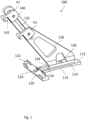
- Figure 1 shows a schematic side view of a mounting device 100 according to an embodiment.
- Figure 2 shows a schematic bottom view of the mounting device from Fig.1 .
- the mounting device comprises a base element 110, a mounting arm 130 and an upper and a lower receiving element 140, 120.
- the base element 110 has an upper side 112 and a lower side 114, wherein the lower side 114 is opposite the upper side 112.
- the lower side 114 of the base element 110 is preferably designed such that it is at least partially adapted to a surface contour that has the control panel to which the mounting device 100 is to be attached.
- such an adaptation to the surface contour of a control panel consists in an at least partially curved surface on the underside 114 of the base element 110.
- the curved surface is, for example, in Fig.2 illustrated.
- the support arm 130 can be fixed to the base element 110.
- the support arm 130 is movably connected to the base element via a rail 118 on the top side 112 of the base element 110.
- the support arm 130 has a groove 134 into which the rail 118 can engage.
- the support arm 130 can be moved translationally along the rail 118 via the groove 134. This makes it possible, for example, to vary the inclination of a mobile terminal held by the support device.
- Fig.1 the support arm 130 extends obliquely away from the base element 110.
- the angle ⁇ enclosed between the support arm 130 and the base element 110 is shown by way of example in Fig.3 illustrates and describes in particular an acute angle.
- the support arm 130 has an elongated hole 136.
- the support arm 130 can be fixed along the top side 112 of the base element 110 at various positions on the base element 110 using a fastening means (not shown) engaging in the elongated hole 136.
- the lower receiving element 120 is fixed to the base element 110.
- Fig.1 shows the lower receiving element 120 with an elongated shape.
- the lower receiving element 120 has a T-shape together with the base element 110.
- the lower receiving element 120 may have a bottom side, as shown, for example, in Fig. 2
- the underside of the lower receiving element 120 can be adapted, at least in sections, to the surface contour of the control panel.
- the lower receiving element 120 can have a recess 124.
- the recess 124 can serve to receive a plug and/or a cable.
- the receptacle can in particular be designed such that it can receive a plug that is plugged into a socket of the mobile terminal 150 held by the mounting device.
- the lower receiving element 120 is designed to grip around a first edge of a mobile terminal 150.
- the lower receiving element 120 can have a groove 122.
- the groove 122 is shown as a two-part groove that can encompass a left and a right side of the first edge. A middle part of the first edge is therefore not encompassed by the groove 122.
- a similar stability to that of a continuous groove can be achieved, while at the same time saving material.
- the groove 122 of the lower receiving element 120 can have a trapezoidal inner cross section, as shown for example in Fig.3
- the groove 122 thus has a wider area in the inner cross section and a narrower area.
- a mobile terminal 150 can be clamped by the wider area or the narrower area depending on the thickness of the first edge.
- the upper receiving element 140 is arranged on the support arm 130.
- the upper receiving element 140 can be displaceable along the support arm 130. The displacement of the receiving element 140 allows a distance between the lower and the upper receiving element 120, 140 to be set.
- the Figures 1 and 2 show the upper receiving element in two positions P1 and P2.
- position P1 the distance between the upper and lower receiving elements 120, 140 is relatively large, so that a relatively large mobile terminal or a mobile terminal in lengthwise format can be clamped between the upper and lower receiving elements 120, 140.
- position P2 the distance between the upper and lower receiving elements 120, 140 is relatively small, so that a relatively small mobile terminal or a A mobile device can be clamped in landscape format between the upper and lower receiving elements 120, 140.
- the displacement of the upper receiving element 140 can be carried out via a longitudinal guide 132.
- the longitudinal guide is shown as an elongated hole by way of example.
- the upper recess element 140 can be fixed to a position of the elongated hole using a fastening means (not shown) that extends through the elongated hole.
- the upper receiving element 140 is designed to grip around a second edge of a mobile terminal 150, wherein the second edge is opposite the first edge.
- the upper receiving element can have a groove 142.
- the Figures 1 and 2 show the upper receiving element 140 with a groove 142 which is designed to engage the second edge of the mobile terminal 150 at a central point of the second edge.
- the groove 142 of the upper receiving element can have a trapezoidal inner cross section, as shown for example in Fig.3
- the groove 142 thus has a wider area in the inner cross section and a narrower area.
- Mobile terminals 150 with second edges of different thicknesses can thus be clamped by the wider area or the narrower area.
- the latter can be held by means of the upper and lower holding elements 140, 120.
- the upper and lower holding elements 140, 120 can clamp a mobile terminal 150 between each other.
- Fig.3 shows an example of how the mobile terminal 150 can be held by the holding device 100.
- the mobile terminal 150 can be received in such a way that it is opposite the (acute) angle ⁇ enclosed between the holding arm 130 and the base element 110.
- the upper receiving element 140 can be arranged opposite the lower receiving element 120 in such a way that it projects beyond the lower receiving element 120, so that a mobile terminal clamped between the upper receiving element and the lower receiving element is inclined further forward with the second edge than with the first edge, as is shown by way of example in Fig.3
- the angle ⁇ included between the terminal 150 and the base element 110, which is opposite the support arm, can therefore in particular be an obtuse angle, as in Fig.3 illustrated.
- the tilt of the mobile device with the upper second edge further forward than the lower first edge means that the display of the held mobile device is directed diagonally downwards.
- the display is therefore aimed at a user A who is positioned slightly lower.
- Fig.3 differs in some features from the design example on the Figures 1 and 2 . These features will be briefly mentioned below.
- the support arm 130 is movably connected to the base element 110 via a joint.
- the support arm 130 can thus be pivoted and adjusted in its inclination.
- the angle ⁇ enclosed between the support arm 130 and the base element 110 can thus be varied.
- the inclination of a mobile terminal held by the support device can be varied.
- Fig.3 shows the upper receiving element 140 fixed to the support arm 130.
- the upper receiving element 140 can, for example, comprise an elastic clamp that allows a mobile terminal to be clamped in place.
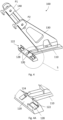
- Fig. 4 and Fig. 4A shows an embodiment of the mounting device in which a non-slip material (not shown) is provided within the groove 122 of the lower receiving element 120.
- the lower receiving element comprises two recesses 128 at each section of the two-part groove 122.
- a strip of non-slip material can be inserted into each of these recesses in a form-fitting manner.
- the non-slip material can protrude from the recess, for example 3 mm.
Landscapes
- Engineering & Computer Science (AREA)
- Mechanical Engineering (AREA)
- General Engineering & Computer Science (AREA)
- Signal Processing (AREA)
- Telephone Set Structure (AREA)
- Fittings On The Vehicle Exterior For Carrying Loads, And Devices For Holding Or Mounting Articles (AREA)
Description
- Die vorliegende Erfindung betrifft eine Halterungsvorrichtung für mobile Endgeräte zur Befestigung am Bedienpult eines Schienenfahrzeuges.
- Mobile Endgeräte, wie Tabletcomputer und Smartphones, nehmen eine zunehmend wichtige Rolle im Arbeitsalltag von Triebfahrzeugführern ein. So erlaubt beispielsweise die Verwendung von Tabletcomputern dem Triebfahrzeugführer einen bedienungsfreundlichen und schnellen Zugriff auf Informationen über aktuelle Betriebsanweisungen, Fahrtenbücher und vieles mehr.
- Zur Verwendung mobiler Endgeräte am Bedienpult des Triebfahrzeuges wird dieses beispielsweise auf einer freien Fläche des Bedienpultes abgelegt oder bei Bedarf in die Hand genommen.
- In verschiedenen anderen Anwendungsbereichen, kann eine vereinfachte Benutzung von mobilen Endgeräten mit Halterungsvorrichtungen ermöglicht werden. So gibt es verschiedene Modelle für Smartphones und Tabletcomputer, die beispielsweise auf einer Tischplatte aufgestellt werden können, sodass ein Verwender des mobilen Endgeräts selbiges weder halten noch sich über die Tischplatte beugen muss. Andere Modelle sind auf die Befestigung mobiler Endgeräte im Kraftfahrzeug ausgelegt. So beschreibt die
DE 10 2016 209 168 A1 beispielsweise eine Tablet-Halterung, die an der Mittelkonsole eines Kraftfahrzeuges angebracht werden kann. DieWO 2012/138699 A1 beschreibt eine Tablet-Halterung, die an der Rückenlehne eines vorderen Fahrzeugsitzes angebracht werden kann.DE 10 2013 206 692 B3 ,FR 3 035 042 A1 KR 201 6 0000276 U US 201 81345875 A1 beschreiben jeweils eine Halterung für ein elektronisches Gerät. - Die bisher bekannten Lösungen zur Verwendung von mobilen Endgeräten sind für den Schienenfahrzeugbau ungeeignet und können bei Benutzung gesundheitliche Probleme für den Triebfahrzeugführer aufgrund ungünstiger Ergonomie nach sich ziehen und dadurch auch zu Gefahren für den Schienenverkehr führen.
- Beispielsweise ist längeres oder häufiges Betrachten eines mobilen Endgeräts, das auf einer freien Fläche vor dem Triebfahrzeugführer liegt, als ergonomisch bedenklich einzustufen.
- Des Weiteren kann die Ablage des mobilen Endgeräts auf dem Bedienpult eine Ablenkung des Triebfahrzeugführers vom Schienenverkehr bedingen. Dies kann beispielsweise durch ein Verrutschen des mobilen Endgeräts erfolgen, aber auch dadurch, dass der Triebfahrzeugführer bei der Betrachtung eines vor ihm liegenden mobilen Endgeräts herabsehen muss. Zudem kann die flache Ablage des mobilen Endgeräts unerwünschte Reflektionen auf der Frontscheibe des Triebfahrzeuges hervorrufen.
- Bisherige Halterungsvorrichtungen eignen sich für die Verwendung an einem Bedienpult eines Schienenfahrzeuges nur unzureichend, weil sie beispielsweise nicht befestigbar sind und daher bei (Voll-) Bremsungen eine Gefahr darstellen können, oder weil sie bestimmte Strukturen zur Befestigung benötigen, die ein Triebfahrzeug nicht aufweist.
- Aufgabe der vorliegenden Erfindung ist es, eine Halterungsvorrichtung für mobile Endgeräte bereitzustellen, die das sichere befestigen des mobilen Endgeräts an einem Bedienpult eines Schienenfahrzeuges erlaubt, für verschiedene Bedienpulte und/oder mobile Endgeräte flexibel nutzbar ist und/oder kostengünstig herstellbar ist.
- Die obige Aufgabe wird durch eine Halterungsvorrichtung nach Anspruch 1 gelöst. Vorteilhafte Ausführungsformen ergeben sich aus den abhängigen Unteransprüchen.
- Die erfindungsgemäße Halterungsvorrichtung kann insbesondere für das Halten eines mobilen Endgeräts ausgelegt sein. Der Begriff "mobiles Endgerät" umfasst im Folgenden insbesondere Geräte, die mit einem Touchscreen ausgestattet sind. Beispielsweise werden Tabletcomputer und Smartphones umfasst. Die mobilen Endgeräte können beispielsweise eine Bildschirmdiagonale von 4 bis 14 Zoll aufweisen, vorzugsweise 6 bis 12 Zoll.
- Gemäß der Erfindung umfasst die Halterungsvorrichtung für mobile Endgeräte zur Befestigung an einem Bedienpult für Schienenfahrzeuge ein Basiselement, einen am Basiselement festlegebaren Halterungsarm, ein am Halterungsarm angeordnetes oberes Aufnahme-Element und ein am Basiselement festgelegtes unteres Aufnahme-Element. Das Basiselement weist eine Oberseite und eine der Oberseite gegenüberliegende Unterseite auf. Die Unterseite ist zumindest abschnittsweise an eine Oberflächenkontur des Bedienpultes angepasst, sodass das Basiselement an dem Bedienpult festgelegt werden kann. Das untere Aufnahme-Element ist dazu ausgelegt eine erste Kante eines mobilen Endgeräts zu umgreifen und das obere Aufnahme-Element ist dazu ausgelegt, eine zweite Kante des mobilen Endgeräts zu umgreifen, wobei die erste Kante der zweiten Kante gegenüberliegt. Das mobile Endgerät kann mittels des unteren Aufnahme-Elements und des oberen Aufnahme-Elements festgeklemmt werden, sodass das mobile Endgerät gehalten wird.
- Durch eine auf die Oberflächenkontur eines Bedienpultes zumindest abschnittweise angepasste Unterseite des Basiselements kann das Basiselement am Bedienpult - insbesondere über einen flächigen Kontakt mit der Oberflächenkontur des Bedienpults - festgelegt werden. Eine Befestigung kann beispielsweise durch eine flächige Verklebung mindestens eines Teils der Unterseite oder mittels Verschraubung zwischen Bedienpult und Basiselement gewährleistet werden. Das Basiselement kann damit - selbst bei einer Vollbremsung - einen festen Stand der Halterungsvorrichtung sichern.
- Erfindungsgemäß weist die Unterseite des Basiselements eine zumindest abschnittsweise gekrümmte Fläche auf. Durch die zumindest abschnittsweise gekrümmte Fläche kann beispielweise die Anpassung an die Oberflächenkontur des Bedienpultes erreicht werden, da die Oberflächenkontur vieler Bedienpulte gekrümmte Abschnitte aufweist.
- Der Halterungsarm ist am Basiselement festlegbar. In einer Ausgestaltungsform erstreckt sich der Halterungsarm schräg vom Basiselement weg, sodass der Halterungsarm und das Basiselement zusammen einen Winkel α einschließen. Der Winkel α kann beispielsweise ein spitzer Winkel sein. Ein zwischen dem oberen und dem unteren Aufnahme-Element aufgenommenes mobiles Endgerät liegt dem Winkel α bevorzugt gegenüber. Ein zwischen dem oberen und dem unteren Aufnahme-Element aufgenommenes mobiles Endgerät liegt bevorzugt zwischen den Abschnitten des Halterungsarm und des Basiselement die zusammen den Winkel α einschließen.
- In einer Ausgestaltungform sind der Halterungsarm und das Basiselement miteinander lösbar verbunden. Die Halterungsvorrichtung kann beispielsweise eine modulare Halterungsvorrichtung bilden. In einer Ausgestaltungsform kann der Halterungsarm derart ausgelegt sein, dass er mit Basiselementen verbunden werden kann, die jeweils verschiedene Unterseiten aufweisen. Auf diese Weise kann stets der gleiche Halterungsarm für die Halterungsvorrichtung Verwendung finden, wohingegen das Basiselement jeweils so gewählt wird, dass es zum jeweiligen Bedienpult des Schienenfahrzeuges passt. Eine modulare Halterungsvorrichtung kann zudem erlauben, dass ein am Bedienpult festgelegtes Basiselement mit verschieden langen und/oder angewinkelten Halterungsarmen kombiniert werden kann. So kann beispielsweise auf verschiedene Körpergrößen der Triebfahrzeugführer reagiert werden, ohne die ganze Halterungsvorrichtung abnehmen zu müssen. Bei einem Defekt am Basiselement oder dem Halterungsarm muss zudem nicht die ganze Halterungsvorrichtung ausgetauscht werden, sondern es genügt der Austausch nur eines der Elemente.
- In einer Ausgestaltungsform ist der Halterungsarm mit dem Basiselement beweglich verbunden. Eine Bewegung des Halterungsarms relativ zum Basiselement kann der Halterungsvorrichtung ermöglichen zum Beispiel die Neigung des gehaltenen mobilen Endgeräts gegenüber einem Verwender einzustellen.
- Beispielsweise kann der Halterungsarm entlang der Oberseite des Basiselements translatorisch verschiebbar sein. Die translatorische Verschiebung kann eindimensional erfolgen, beispielsweise auf einer Schiene.
- In einer Ausgestaltungsform weist der Halterungsarm eine Nut auf, während das Basiselement, zum Beispiel auf seiner Oberseite, eine in die Nut eingreifende langgestreckte Schiene aufweist. Der Halterungsarm kann dann entlang der in die Nut eingreifenden Schiene translatorisch verschoben werden.
- In einer weiteren Ausgestaltungsform weist das Basiselement, zum Beispiel auf seiner Oberseite, eine Nut auf, während der Halterungsarm eine in die Nut eingreifende langgestreckte Schiene aufweist. Der Halterungsarm kann dann über die Schiene entlang der Nut translatorisch verschoben werden.
- Alternativ oder zusätzlich kann der Halterungsarm ein Langloch aufweisen. Das Basiselement kann ein durch das Langloch greifendes Befestigungsmittel wie zum Beispiel eine Schraube aufweisen. Der Halterungsarm kann entlang der Oberseite des Basiselements verschoben werden und mittels des Befestigungselements an verschiedenen Positionen am Basiselement, insbesondere der Oberseite des Basiselements, (lösbar) fixiert werden.
- Alternativ oder zusätzlich kann der Halterungsarm derart mit dem Basiselement verbunden sein, dass der Halterungsarm in seiner Neigung einstellbar und/oder schwenkbar ist. Beispielsweise kann der Halterungsarm über ein Gelenk am Basiselement schwenkbar sein. Ein Gelenk könnte zum Beispiel ein Kugelgelenk am Halterungsarm sein, das mit einer Gelenkpfanne des Basiselements verbunden ist. In einer Ausgestaltungsform kann der Halterungsarm gegenüber der Oberseite des Basiselements schwenkbar sein, sodass ein zwischen dem Halterungsarm und dem Basiselement eingeschlossener Winkel α variabel ist. Das Gelenk kann alternativ im Halterungsarm angeordnet sein. Der Halterungsarm ist dann beispielsweise zweiteilig, beispielsweise mit einer unteren Halterungsarm-Komponente, der mit dem Basiselement verbunden ist, und einer oberen Halterungsarm-Komponente, die mit der unteren Halterungsarm-Komponente über das Gelenk verbunden ist.
- In einer Ausgestaltungsform ist der Halterungsarm relativ zum Basiselement in einer gewünschten Position arretierbar.
- Das obere und das untere Aufnahme-Element sind dazu ausgelegt, jeweils eine Kante des zu haltenden mobilen Endgeräts zu umgreifen, sodass das mobile Endgerät zum Beispiel zwischen dem oberen und unteren Aufnahme-Element festgeklemmt ist. Durch das Umgreifen von zwei gegenüberliegenden Kanten und/oder durch das Festklemmen kann das mobile Endgerät sicher von der Halterungsvorrichtung aufgenommen werden, sodass ein Verrutschen oder ein Herausfallen des mobilen Endgeräts, zum Beispiel bei einer steilen Kurve oder einer starken Bremsung verhindert werden kann. Damit kann sowohl eine Ablenkung des Triebfahrzeugführers verhindert werden als auch ein Schaden am mobilen Endgerät durch Herabstürzen.
- Das obere Aufnahme-Element kann zum Umgreifen der Kante des mobilen Endgeräts beispielsweise eine Nut aufweisen. Alternativ oder zusätzlich kann auch das untere Aufnahme-Element zum Umgreifen der Kante des mobilen Endgeräts eine Nut aufweisen. Die Nut kann im Innenquerschnitt von einer offenen Seite zu einer geschlossenen Seite der Nut schmal zulaufend ausgebildet sein. Ein breiterer Bereich der Nut des oberen Aufnahme-Elements ist dabei vorzugsweise dem unteren Aufnahme-Element zugewandt. Ein breiterer Bereich der Nut des unteren Aufnahme-Elements ist dabei vorzugsweise dem oberen Aufnahme-Element zugewandt.
- Typischerweise kann die Nut einen keilförmigen oder einen trapezförmigen Innenquerschnitt aufweisen. Eine Trapezform beschreibt dabei insbesondere ein Trapez mit zwei zueinander geneigten Schenkeln (nicht parallele Schenkel). Eine offene Seite der Nut im Innenquerschnitt bildet dabei eine längere Grundseite der Trapezform. Eine geschlossene Seite der Nut im Innenquerschnitt bildet eine kürzere Grundseite der Trapezform.
- Ein schmaler werdender Innenquerschnitt kann das Umgreifen von verschieden dicken Kanten mobiler Endgeräte erlauben. Während die Kanten mobiler Endgeräte mit einer geringen Dicke in einem schmaleren Bereich des beispielsweise trapezförmigen Innenquerschnitt gegriffen werden, werden die Kanten mobiler Endgeräte mit einer stärkeren Dicke bereits in einem breiteren Bereich des trapezförmigen Innenquerschnitt gegriffen. Die Nut kann somit erlauben, jeweils eine Kante von einer Vielzahl von mobilen Endgeräten mit verschiedenen Dicken bzw. Kanten von mobilen Endgeräten mit und ohne Schutzhülle umgreifen.
- Die Nut des oberen und/oder des unteren Aufnahme-Elements kann eine durchlaufende Nut sein, die sich über eine Länge des oberen bzw. des unteren Aufnahme-Elements erstreckt. Die Nut des oberen und/oder des unteren Aufnahme-Elements kann eine einseitig oder beidseitig abgesetzte Nut sein. Die Nut des oberen und/oder des unteren Aufnahme-Elements kann mehrteilig sein, insbesondere, kann die Nut zweigeteilt sein, sodass eine Kante eines mobilen Endgeräts an einer linken und einer rechten Seite der Kante von der zweiteiligen Nut umgriffen wird. Eine Nut, die sich nicht über die ganze umgriffene Kante erstreckt, erlaubt typischerweise eine Materialersparnis. Gleichzeitig kann beim Umgreifen einer linken und einer rechten Seite der Kante mit einer zweiteiligen Nut eine ähnliche Stabilität der umgriffenen Kante erhalten werden, wie bei einer durchlaufenden Nut.
- In einem Ausgestaltungsbeispiel ist das untere Aufnahmeelement starr mit dem Basiselement verbunden bzw. mit diesem integral ausgebildet. Das untere Aufnahmeelement kann aber auch lösbar mit dem Basiselement verbunden sein und/oder aus einem anderen Material als das Basiselement bestehen.
- Das untere Aufnahme-Element kann eine langgestreckte Form aufweisen. In einer Ausgestaltungsform weisen das Basiselement und das am Basiselement festgelegte untere Aufnahme-Element zusammen eine T-Form auf. Beispielsweise formt das Basiselement den vertikalen Balken des "T" und das untere Aufnahmeelement formt den horizontalen Balken des "T".
- Das untere Aufnahme-Element kann mit einem rutschfesten Material ausgestattet sein. Beispielsweise kann innerhalb der Nut des unteren Aufnahme-Elements, mit der die erste Kante des mobilen Endgeräts umgriffen werden kann, rutschfestes Material aufgebracht werden. Das rutschfeste Material kann beispielsweise in einer oder mehreren Vertiefungen entlang der Nut (formschlüssig) eingebracht werden. Dies kann die Haltbarkeit des rutschfesten Materials am unteren Aufnahme-Element erhöhen, da Ecken und Kanten des rutschfesten Materials teilweise durch die Vertiefungen geschützt sind und so weniger Einflüssen ausgesetzt sind, die zu einem Ablösen des rutschfesten Material führen können. Typischerweise kann das rutschfeste Material aus der Vertiefung überstehen, beispielsweise 3 mm. Das rutschfeste Material kann beispielsweise streifenförmig sein. Durch das rutschfeste Material kann ein Verrutschen der ersten Kanten des mobilen Endgeräts bei Erschütterungen oder Bremsungen verhindert werden.
- Das am Basiselement festgelegte untere Aufnahme-Element kann eine Unterseite aufweisen. Die Unterseite des unteren Aufnahme-Elements kann zumindest abschnittsweise an die Oberflächenkontur des Bedienpultes angepasst sein. Dies ermöglicht zum Beispiel eine noch größere Kontaktfläche der Halterungsvorrichtung mit dem Bedienpult und kann zu einer noch sichereren und/oder stabileren Befestigung beitragen.
- Das untere Aufnahme-Element kann eine Ausnehmung zur Aufnahme eines Steckers und/oder eines Kabels aufweisen. Die Aufnahme kann insbesondere dazu ausgelegt sein, einen Stecker aufzunehmen, der in einer Steckerbuchse des von der Halterungsvorrichtung gehaltenen mobilen Endgeräts eingesteckt ist.
- Das obere Aufnahme-Element kann dem unteren Aufnahme-Element gegenüber derart angeordnet sein, dass es über das untere Aufnahme-Element hinausragt. Ein zwischen dem oberen Aufnahme-Element und dem unteren Aufnahme-Element festgeklemmtes mobiles Endgerät kann somit gegenüber der Oberseite des Basiselements in einem Winkel β geneigt sein.
- Ein Hinausragen des oberen Aufnahme-Elements über das untere Aufnahme-Element, wobei ersteres dazu ausgelegt ist die zweite Kante des mobilen Endgeräts zu umgreifen und letzteres dazu ausgelegt ist, die ersten Kante des mobilen Endgeräts zu umgreifen, führt bei Halterung des mobilen Endgeräts dazu, dass die zweite Kante weiter nach vorne geneigt ist als die erste Kante.
- Das obere und das untere Aufnahmeelement können in horizontaler Richtung zueinander versetzt angeordnet sein. Eine "horizontale Richtung" bezeichnet dabei eine Richtung, die von vorn nach hinten bzw. von hinten nach vorne verläuft, typischerweise in Erstreckung des Basiselements. Eine "vertikale Richtung" beschreibt eine Richtung, die von oben nach unten bzw. von unten nach oben verläuft. Das obere Aufnahme-Element liegt in vertikaler Richtung oberhalb des unteren Aufnahme-Elements.
- Gemäß einer Ausführungsform definiert das obere Aufnahme-Element ein oberes Vorderende der Halterungsvorrichtung und das untere Aufnahme-Element definiert ein unteres Vorderende der Halterungsvorrichtung. Vorzugsweise ragt das obere Vorderende in horizontaler Richtung über das untere Vorderende hinaus. Bei Halterung des mobilen Endgeräts neigt sich eine obere Kante (d.h. die zweite Kante) des mobilen Endgeräts weiter nach vorne als eine untere Kante (d.h. die erste Kante). Beispielsweise kann ein zwischen dem oberen Aufnahme-Element und dem unteren Aufnahme-Element festgeklemmtes mobiles Endgerät mit dem Basiselement einen dem Halterungsarm gegenüberliegenden stumpfen Winkel einschließen.
- Anders ausgedrückt kann man sagen, dass eine vertikale Projektion des unteren Aufnahme-Elements auf eine horizontale Ebene einem Schnittpunkt der Ebene mit dem Halterungsarm näher gelegen ist, als eine vertikale Projektion des oberen Aufnahme-Elements in vertikaler Projektion auf die Ebene. Die horizontale Ebene kann beispielsweise durch die Oberseite des Basiselements definiert werden. Ein zwischen dem oberen Aufnahme-Element und dem unteren Aufnahme-Element festgeklemmtes mobiles Endgerät kann so mit dem Basiselement einen dem Halterungsarm gegenüberliegenden stumpfen Winkel einschließen.
- Eine Neigung des mobilen Endgeräts, bei dem die zweite (obere) Kante weiter nach vorne geneigt ist als eine erste (untere) Kante, ermöglicht einem Verwender beispielsweise von schräg unten auf die Anzeige des mobilen Endgeräts zu schauen. Dies kann sich insbesondere bei einer Befestigung der Halterungsvorrichtung an einem Bedienpult als vorteilhaft erweisen. Relativ zur Augenhöhe des Triebfahrzeugführers weisen die Bedienpulte mitunter hoch gelegene Oberflächen auf. Ein auf einer höheren Oberfläche angebrachtes mobiles Endgerät, dessen Anzeige nach unten ausgerichtet ist, ermöglicht dem tiefer sitzenden Triebfahrzeugführer somit eine entspannte Körperhaltung bei der Betrachtung und Verwendung des mobilen Endgeräts. Eine Neigung des mobilen Endgeräts, bei der die zweite Kante weiter nach vorne geneigt ist als die erste Kante, kann zudem dazu genutzt werden, Reflektionen der Anzeige des mobilen Endgeräts in der Frontscheibe zu verhindern.
- In einer Ausgestaltungsform ist das obere Aufnahme-Element am Halterungsarm festgelegt. Das obere Aufnahme-Element kann beispielsweise eine elastische Klemme umfassen. Die elastische Klemme kann zur Aufnahme der zweiten Kante des mobilen Endgeräts unter Krafteinwirkung leicht aufgebogen werden. Anschließend kann die elastische Klemme in ihren Ausgangszustand zurückkehren und die zweite Kante umgreifen.
- In einer Ausgestaltungsform ist das obere Aufnahme-Element entlang des Halterungsarms verschiebbar. Damit kann gewährleistet werden, dass ein Abstand zwischen dem unteren und dem oberen Aufnahme-Element anpassbar ist. Insbesondere kann der Abstand auf eine Größe des mobilen Endgeräts angepasst werden. Eine Anpassung des Abstands zwischen dem unteren und dem oberen Aufnahme-Element erlaubt zudem zwischen Querformat und Längsformat beim selben mobilen Endgerät zu wechseln.
- Der Halterungsarm kann beispielsweise eine Längsführung aufweisen. Das obere Aufnahmeelement kann dann über die Längsführung entlang des Halterungsarms verschoben werden. Die Längsführung des Halterungsarms kann beispielsweise ein Langloch umfassen. Das obere Ausnahmeelement kann mit einem durch das Langloch des Halterungsarms hindurchgreifenden Befestigungsmittel an einer Position des Langlochs des Halterungsarms fixiert werden. Das Befestigungsmittel kann beispielsweise eine Schraube umfassen, z.B. eine Rändelschraube oder eine Schraube mit Flügelmutter.
- Gemäß einer Ausgestaltungsform umfasst der Halterungsarm eine obere und eine untere Halterungsarm-Komponente. Der Halterungsarm kann beispielsweise zweiteilig sein. Das obere Aufnahme-Element kann an der oberen Halterungsarm-Komponente angeordnet sein. Das obere Aufnahme-Element kann insbesondere an der oberen Halterungsarm-Komponente festgelegt sein. Der Halterungsarm kann derart gestaltet sein, dass die obere Halterungsarm-Komponente entlang der unteren Halterungsarm-Komponente verschiebbar ist. Durch die Verschiebbarkeit kann ein Abstand zwischen dem unteren und dem oberen Aufnahme-Element auf eine Größe oder ein Format des mobilen Endgeräts angepasst werden.
- Die untere Halterungsarm-Komponente kann beispielsweise eine Längsführung aufweisen und die obere Halterungsarm-Komponente über die Längsführung der unteren Halterungsarm-Komponente entlang des Halterungsarms verschoben werden. Die Längsführung der unteren Halterungsarm-Komponente kann beispielsweise ein Langloch umfassen. Die obere Halterungsarm-Komponente kann mit einem durch das Langloch hindurchgreifenden Befestigungsmittel an einer Position des Langlochs der unteren Halterungsarm-Komponente fixiert werden. Das Befestigungsmittel kann beispielsweise eine Schraube umfassen, z.B. eine Rändelschraube oder eine Schraube mit Flügelmutter.
- Gemäß einer Ausgestaltungsform ist der Halterungsarm einstückig ausgebildet. Typischerweise kann der Halterungsarm starr sein. Ein starrer Halterungsarm umfasst insbesondere keine Gelenke. Der Halterungsarm kann damit relativ einfach und/oder kostengünstig in der Herstellung sein. Der Halterungsarm kann beispielsweise über 3D-Druck oder Spritzgussverfahren fertigbar sein. Des Weiteren ist ein solcher Halterungsarm weitgehend robust und/oder weist nur wenige Schwachpunkte auf, die im Laufe der Verwendung einen Schaden nehmen können. Dies trägt zu einer langen Haltbarkeit der Halterungsvorrichtung bei.
- Ein Material der Halterungsvorrichtung oder einzelner Komponenten davon kann insbesondere Kunststoff umfassen.
- Die vorstehend beschriebenen Ausgestaltungsbeispiele können beliebig miteinander kombiniert werden.
- Die beiliegenden Zeichnungen veranschaulichen Ausführungsformen und dienen zusammen mit der Beschreibung der Erläuterung der Prinzipien der Erfindung. Die Elemente der Zeichnungen sind relativ zueinander und nicht notwendigerweise maßstabsgetreu.
- Gleiche Bezugszeichen bezeichnen entsprechend ähnliche Teile.
-
Figur 1 zeigt eine schematische Darstellung einer Halterungsvorrichtung für Tabletcomputer gemäß einem Ausführungsbeispiel. -
Figur 2 zeigt die inFigur 1 dargestellte Halterungsvorrichtung aus einer weiteren Perspektive. -
Figur 3 zeigt eine schematische Darstellung einer Halterungsvorrichtung für Tabletcomputer gemäß einem weiteren Ausführungsbeispiel. -
Figur 4 zeigt eine schematische Darstellung einer Halterungsvorrichtung für Tabletcomputer gemäß einem Ausführungsbeispiel. -
Figur 4A zeigt den Ausschnitt S derFigur 4 vergrößert. -
Figur 1 zeigt eine schematische seitliche Ansicht einer Halterungsvorrichtung 100 gemäß einem Ausführungsbeispiel.Figur 2 zeigt eine schematische untere Ansicht der Halterungsvorrichtung ausFig. 1 . - Die Halterungsvorrichtung umfasst ein Basiselement 110, einen Halterungsarm 130 sowie ein oberes und ein unteres Aufnahme-Element 140, 120.
- Das Basiselement 110 weist eine Oberseite 112 und eine Unterseite 114 auf, wobei die Unterseite 114 der Oberseite 112 gegenüberliegt. Die Unterseite 114 des Basiselements 110 ist bevorzugt derart ausgestaltet, dass sie zumindest abschnittsweise an eine Oberflächenkontur angepasst ist, die das Bedienpult aufweist, an dem die Halterungsvorrichtung 100 befestigt werden soll.
- Eine solche Anpassung an die Oberflächenkontur eines Bedienpultes besteht erfindungsgemäß in einer zumindest abschnittsweise gekrümmten Fläche an der Unterseite 114 des Basiselements 110. Die gekrümmte Fläche ist beispielsweise in
Fig. 2 illustriert. - Der Halterungsarm 130 ist am Basiselement 110 festlegbar. In
Fig. 1 ist der Halterungsarm 130 über eine Schiene 118 auf der Oberseite 112 des Basiselements 110 mit dem Basiselement beweglich verbunden. Der Halterungsarm 130 weist eine Nut 134 auf, in die die Schiene 118 eingreifen kann. Entlang der Schiene 118 kann der Halterungsarm 130 über die Nut 134 translatorisch verschoben werden. Dies ermöglicht beispielsweise die Neigung eines von der Halterungsvorrichtung gehaltenen mobilen Endgeräts zu variieren. - In
Fig. 1 erstreckt sich der Halterungsarm 130 schräg vom Basiselement 110 weg. Der Halterungsarm 130 und das Basiselement 110 schließen zusammen einen Winkel α ein. Der zwischen dem Halterungsarm 130 und dem Basiselement 110 eingeschlossene Winkel α ist beispielhaft inFig. 3 illustriert und beschreibt insbesondere einen spitzen Winkel. - Der Halterungsarm 130 weist ein Langloch 136 auf. Über ein in das Langloch 136 eingreifendes Befestigungsmittel (nicht gezeigt) kann der Halterungsarm 130 entlang der Oberseite 112 Basiselements 110 an verschiedenen Positionen am Basiselement 110 fixiert werden.
- Das untere Aufnahme-Element 120 ist am Basiselement 110 festgelegt.
Fig. 1 zeigt das untere Aufnahme-Element 120 mit einer langgestreckten Form. Das untere Aufnahme-Element 120 weist zusammen mit dem Basiselement 110 eine T-Form auf. - Das untere Aufnahme-Element 120 kann eine Unterseite aufweisen, wie sie beispielsweise in
Fig. 2 dargestellt ist. Die Unterseite des unteren Aufnahme-Elements 120 kann zumindest abschnittsweise an die Oberflächenkontur des Bedienpultes angepasst sein. - Wie in
Fig. 1 dargestellt, kann das untere Aufnahme-Element 120 eine Ausnehmung 124 aufweisen. Die Ausnehmung 124 kann zur Aufnahme eines Steckers und/oder eines Kabels dienen. Die Aufnahme kann insbesondere derart ausgestaltet sein, dass sie einen Stecker aufnehmen kann, der in einer Steckerbuchse des von der Halterungsvorrichtung gehaltenen mobilen Endgeräts 150 eingesteckt ist. - Das untere Aufnahme-Element 120 ist dazu ausgelegt, eine erste Kante eines mobilen Endgeräts 150 zu umgreifen. Zum Umgreifen der ersten Kante des mobilen Endgeräts 150 kann das untere Aufnahme-Element 120 eine Nut 122 aufweisen. In
Fig. 1 ist die Nut 122 als eine zweigeteilte Nut dargestellt, die eine linke und eine rechte Seite der ersten Kante umgreifen kann. Ein mittlerer Teil der ersten Kante wird somit nicht von der Nut 122 umgriffen. Durch das Umgreifen der linken und der rechten Seite der ersten Kante kann eine ähnliche Stabilität wie bei einer durchlaufenden Nut erreicht werden, bei gleichzeitiger Materialersparnis. - Die Nut 122 des unteren Aufnahme-Elements 120 kann einen trapezförmigen Innenquerschnitt aufweisen, wie er beispielhaft in
Fig. 3 dargestellt ist. Die Nut 122 weist damit einen breiteren Bereich im Innenquerschnitt auf und einen schmaleren Bereich. Ein mobiles Endgerät 150 kann je nach Dicke der ersten Kante von dem breiteren Bereich oder dem schmaleren Bereich festgeklemmt werden. - Das obere Aufnahme-Element 140 ist am Halterungsarm 130 angeordnet. Das obere Aufnahme-Element 140 kann entlang des Halterungsarms 130 verschiebbar sein. Die Verschiebung des Aufnahme-Elements 140 erlaubt, einen Abstand zwischen dem unteren und dem oberen Aufnahme-Element 120, 140 einzustellen.
- Die
Figuren 1 und2 zeigen das obere Aufnahme-Element in zwei Positionen P1 und P2. In Position P1 ist der Abstand zwischen dem oberen und dem unteren Aufnahmeelement 120, 140 relativ groß, sodass ein relativ großes mobiles Endgerät oder ein mobiles Endgerät in Längsformat zwischen dem oberen und dem unteren Aufnahmeelement 120, 140 festklemmbar ist. In Position P2 ist der Abstand zwischen dem oberen und dem unteren Aufnahmeelement 120, 140 relativ klein, sodass ein relativ kleines mobiles Endgerät oder ein mobiles Endgerät in Querformat zwischen dem oberen und dem unteren Aufnahmeelement 120, 140 festklemmbar ist. - Die Verschiebung des oberen Aufnahme-Elements 140 kann über eine Längsführung 132 erfolgen. In den
Figuren 1 und2 ist die Längsführung beispielhaft als Langloch dargestellt. Das obere Ausnahmeelement 140 kann mit einem durch das Langloch hindurchgreifenden Befestigungsmittel (nicht gezeigt) an einer Position des Langlochs fixiert werden. - Das obere Aufnahme-Element 140 ist dazu ausgelegt, eine zweite Kante eines mobilen Endgeräts 150 zu umgreifen, wobei die zweite Kante der ersten Kante gegenüberliegt. Zum Umgreifen der zweiten Kante kann das obere Aufnahme-Element eine Nut 142 aufweisen. Die
Figuren 1 und2 zeigen das obere Aufnahme-Element 140 mit einer Nut 142, die dazu ausgelegt ist die zweite Kante des mobilen Endgeräts 150 an einem mittleren Punkt der zweiten Kante zu umgreifen. - Die Nut 142 des oberen Aufnahme-Elements kann einen trapezförmigen Innenquerschnitt aufweisen, wie er beispielhaft in
Fig. 3 dargestellt ist. Die Nut 142 weist damit einen breiteren Bereich im Innenquerschnitt auf und einen schmaleren Bereich. So können mobile Endgeräte 150 mit zweiten Kanten verschiedener Dicke von dem breiteren Bereich oder dem schmaleren Bereich festgeklemmt werden. - Zur Halterung eines mobilen Endgeräts 150 kann dieses mittels dem oberen und unteren Aufnahme-Element 140, 120 aufgenommen werden. Insbesondere können das obere und das untere Aufnahme-Element 140, 120 ein mobiles Endgerät 150 zwischen einander festklemmen.
-
Fig. 3 zeigt beispielhaft, wie das mobile Endgerät 150 von der Halterungsvorrichtung 100 gehalten werden kann. Das mobile Endgerät 150 kann derart aufgenommen werden, dass es dem zwischen dem Halterungsarm 130 und dem Basiselement 110 eingeschlossenen (spitzen) Winkel α gegenüberliegt. - Das obere Aufnahme-Element 140 kann dem unteren Aufnahme-Element 120 gegenüber derart angeordnet sein, dass es über das untere Aufnahme-Element 120 hinausragt, sodass ein zwischen dem oberen Aufnahme-Element und dem unteren Aufnahme-Element festgeklemmtes mobiles Endgerät mit der zweiten Kante weiter nach vorne geneigt als mit der ersten Kante, wie dies beispielhaft in
Fig. 3 dargestellt ist. Ein zwischen dem mobilen Endgerät 150 und dem Basiselement 110 eingeschlossener Winkel β, der dem Halterungsarm gegenüberliegt, kann daher insbesondere ein stumpfer Winkel sein, wie inFig. 3 illustriert. - Die Neigung des mobilen Endgeräts mit der oberen zweiten Kante weiter vorne mit der unteren ersten Kante führt dazu, dass die Anzeige des gehaltenen mobilen Endgeräts schräg nach unten gerichtet ist. Die Anzeige ist somit auf einen etwas tiefer gelegenen Verwender A ausgerichtet.
- Das Ausführungsbeispiel in
Fig. 3 unterscheidet sich in einigen Merkmalen von dem Ausgestaltungsbeispiel auf denFiguren 1 und2 . Auf diese Merkmale soll im Folgenden noch kurz hingewiesen werden. - In
Fig. 3 ist der Halterungsarm 130 über ein Gelenk beweglich mit dem Basiselement 110 verbunden. Der Halterungsarm 130 ist damit in seiner Neigung einstellbar schwenkbar und in seiner Neigung einstellbar. Der zwischen dem Halterungsarm 130 und dem Basiselement 110 eingeschlossene Winkel α kann somit variiert werden. Gleichzeitig kann die Neigung eines von der Halterungsvorrichtung gehaltenen mobilen Endgeräts variiert werden. -
Fig. 3 zeigt das obere Aufnahme-Element 140 am Halterungsarm 130 festgelegt. Das obere Aufnahme-Element 140 kann beispielsweise eine elastische Klemme umfassen, die das festklemmen eines mobilen Endgeräts erlaubt. - In
Fig. 4 und Fig. 4A zeigt eine Ausführungsform der Halterungsvorrichtung, bei der ein rutschfestes Material (nicht gezeigt) innerhalb der Nut 122 des unteren Aufnahme-Elements 120 vorgesehen ist. InFig. 4 und Fig. 4A umfasst das untere Aufnahme-Element zwei Vertiefungen 128 an jedem Abschnitt der zweigeteilten Nut 122. In diese Vertiefungen kann je ein Streifen rutschfesten Materials formschlüssig eingebracht werden. Typischerweise kann das rutschfeste Material aus der Vertiefung überstehen, beispielsweise 3 mm. - Wenngleich hierin spezifische Ausführungsformen dargestellt und beschrieben worden sind, liegt es im Rahmen der vorliegenden Erfindung, die gezeigten Ausführungsformen geeignet zu modifizieren, ohne vom Schutzbereich der vorliegenden Erfindung abzuweichen. Die nachfolgenden Ansprüche stellen einen ersten, nicht bindenden Versuch dar, die Erfindung allgemein zu definieren.
-
- 100
- Halterungsvorrichtung
- 110
- Basiselement
- 112
- Oberseite des Basiselements
- 114
- Unterseite des Basiselements
- 118
- Schiene des Basiselements
- 120
- unteres Aufnahme-Element
- 122
- Nut des unteren Aufnahme-Elements
- 124
- Ausnehmung im unteren Aufnahme-Element
- 128
- Vertiefung für rutschfestes Material
- 130
- Halterungsarm
- 132
- Längsführung des Halterungsarms
- 134
- Nut des Halterungsarms
- 136
- Langloch
- 140
- oberes Aufnahme-Element
- 142
- Nut des oberen Aufnahme-Elements
- 150
- mobiles Endgerät
- A
- Verwender
- P1
- Position 1 des oberen Aufnahme-Elements
- P2
- Position 2 des oberen Aufnahme-Elements
Claims (14)
- Halterungsvorrichtung (100) für mobile Endgeräte zur Befestigung an einem Bedienpult eines Schienenfahrzeugs, aufweisend:ein Basiselement (110) mit einer Oberseite (112) und einer der Oberseite gegenüberliegenden Unterseite (114), die zumindest abschnittsweise an die Oberflächenkontur des Bedienpultes angepasst ist, um das Basiselement (110) an dem Bedienpult festzulegen, wobei die Anpassung an die Oberflächenkontur des Bedienpultes in einer zumindest abschnittsweise gekrümmten Fläche an der Unterseite des Basiselements besteht;einen am Basiselement (110) festlegebaren Halterungsarm (130),ein am Basiselement (110) festgelegtes unteres Aufnahme-Element (120), das dazu ausgelegt ist, eine erste Kante eines mobilen Endgeräts (150) zu umgreifen;ein am Halterungsarm (130) angeordnetes oberes Aufnahme-Element (140), das dazu ausgelegt ist, eine der ersten Kante gegenüberliegende zweite Kante des mobilen Endgeräts zu umgreifen,wobei zur Halterung des mobilen Endgeräts dieses mittels des unteren Aufnahme-Elements (120) und des oberen Aufnahme-Elements (140) festklemmbar ist.
- Halterungsvorrichtung nach einem der vorherigen Ansprüche, wobei der Halterungsarm (130) mit dem Basiselement (110) beweglich verbunden ist und relativ zum Basiselement (110) in einer gewünschten Position arretierbar ist.
- Halterungsvorrichtung nach einem der vorherigen Ansprüche, wobei der Halterungsarm (130) entlang der Oberseite (112) des Basiselements (110) translatorisch verschiebbar und/oder in einer Neigung einstellbar ist.
- Halterungsvorrichtung nach einem der vorherigen Ansprüche, wobei entweder der Halterungsarm (130) oder die Oberseite (112) des Basiselements (110) eine Nut (134) und das jeweils andere Element eine in die Nut eingreifende langgestreckte Schiene (118) aufweist, wobei der Halterungsarm (130) entlang der in die Nut (134) eingreifenden Schiene (118) translatorisch verschiebbar ist.
- Halterungsvorrichtung nach einem der vorherigen Ansprüche, wobei der Halterungsarm (130) ein Langloch aufweist und das Basiselement (110) ein durch das Langloch greifendes Befestigungselement aufweist, und der Halterungsarm (130) entlang der Oberseite (112) des Basiselements (110) verschiebbar und mittels des Befestigungselements an verschiedenen Positionen am Basiselement (110) fixierbar ist.
- Halterungsvorrichtung nach einem der vorherigen Ansprüche, wobei das obere Aufnahme-Element (140) über das untere Aufnahme-Element (120) hinausragt, sodass ein zwischen dem oberen Aufnahme-Element (140) und dem unteren Aufnahme-Element (120) festgeklemmtes mobiles Endgerät gegenüber der Oberseite (112) des Basiselements (110) in einem Winkel β geneigt ist.
- Halterungsvorrichtung nach einem der vorherigen Ansprüche, wobei sich der Halterungsarm (130) schräg vom Basiselement (110) weg erstreckt, sodass der Halterungsarm (130) und die Oberseite des Basiselements (110) einen spitzen Winkel (α) einschließen, wobei ein zwischen dem oberen Aufnahme-Element (140) und dem unteren Aufnahme-Element (120) festgeklemmtes mobiles Endgerät (150) dem spitzen Winkel gegenüber liegt.
- Halterungsvorrichtung nach einem der vorherigen Ansprüche, wobei der Halterungsarm (130) gegenüber der Oberseite (112) des Basiselements (110) schwenkbar ist, sodass ein zwischen dem Halterungsarm (130) und dem Basiselement (110) eingeschlossener Winkel α variabel ist.
- Halterungsvorrichtung nach einem der vorherigen Ansprüche, wobei der Halterungsarm (130) über ein Gelenk am Basiselement (110) schwenkbar ist.
- Halterungsvorrichtung nach einem der vorherigen Ansprüche, wobei das untere und/oder das obere Aufnahme-Element (120, 140) zum Umgreifen der Kante des mobilen Endgeräts (150) eine Nut (122, 142) mit einem keil- oder trapezförmigen Innenquerschnittaufweist und/oder wobei das obere Aufnahme-Element eine elastische Klemme umfasst.
- Halterungsvorrichtung nach einem der vorherigen Ansprüche, wobei das obere Aufnahme-Element (140) entlang des Halterungsarms (130) verschiebbar ist, sodass ein Abstand zwischen dem unteren und dem oberen Aufnahme-Element (120, 140) auf eine Größe oder ein Format des mobilen Endgeräts anpassbar ist, insbesondere, wobei der Halterungsarm (130) eine Längsführung (132) aufweist und das obere Aufnahme-Element (140) über die Längsführung (132) des Halterungsarms entlang des Halterungsarms (130) verschiebbar ist;
und/oder
wobei der Halterungsarm (130) eine obere und eine untere Halterungsarm-Komponente umfasst, wobei das obere Aufnahme-Element (140) an der obere Halterungsarm-Komponente festgelegt ist, wobei die obere Halterungsarm-Komponente entlang der unteren Halterungsarm-Komponente verschiebbar ist, sodass ein Abstand zwischen dem unteren und dem oberen Aufnahme-Element (120, 140) auf eine Größe oder ein Format des mobilen Endgeräts anpassbar ist, insbesondere, wobei die untere Halterungsarm-Komponente eine Längsführung aufweist und die obere Halterungsarm-Komponente über die Längsführung der unteren Halterungsarm-Komponente entlang des Halterungsarms (130) verschiebbar ist. - Halterungsvorrichtung nach einem der vorherigen Ansprüche, wobei das Basiselement (110) und der Halterungsarm (130) lösbar miteinander verbundene Elemente sind und dadurch eine modulare Halterungsvorrichtung bilden.
- Halterungsvorrichtung nach einem der vorherigen Ansprüche, wobei das untere Aufnahme-Element (120) starr mit dem Basiselement (110) verbunden ist und/oder wobei das Basiselement (110) und das untere Aufnahme-Element (120) zusammen eine T-Form aufweisen.
- Halterungsvorrichtung nach einem der vorherigen Ansprüche, wobei das untere Aufnahme-Element (120) eine Ausnehmung (124) zur Aufnahme eines Steckers aufweist, wenn dieser in eine Steckerbuchse des von der Halterungsvorrichtung gehaltenen mobilen Endgeräts eingesteckt ist und/oder
wobei das untere Aufnahme-Element (120) mit einem rutschfesten Material ausgestattet ist.
Applications Claiming Priority (1)
| Application Number | Priority Date | Filing Date | Title |
|---|---|---|---|
| DE102019133594.9A DE102019133594A1 (de) | 2019-12-09 | 2019-12-09 | Halterungsvorrichtung für mobile endgeräte am bedienpult eines schienenfahrzeuges |
Publications (2)
| Publication Number | Publication Date |
|---|---|
| EP3835642A1 EP3835642A1 (de) | 2021-06-16 |
| EP3835642B1 true EP3835642B1 (de) | 2024-08-21 |
Family
ID=73694887
Family Applications (1)
| Application Number | Title | Priority Date | Filing Date |
|---|---|---|---|
| EP20211305.6A Active EP3835642B1 (de) | 2019-12-09 | 2020-12-02 | Halterungsvorrichtung für mobile endgeräte am bedienpult eines schienenfahrzeuges |
Country Status (2)
| Country | Link |
|---|---|
| EP (1) | EP3835642B1 (de) |
| DE (1) | DE102019133594A1 (de) |
Family Cites Families (6)
| Publication number | Priority date | Publication date | Assignee | Title |
|---|---|---|---|---|
| US20180345875A1 (en) * | 2010-11-25 | 2018-12-06 | Thomas Buchhalter | Holder for motor vehicles for receiving mobile devices |
| CN103534170B (zh) * | 2011-04-04 | 2016-06-15 | Be航天股份有限公司 | 用于平板计算机的座椅靠背支座 |
| DE102013206692B3 (de) * | 2013-04-15 | 2014-09-25 | Faurecia Innenraum Systeme Gmbh | Vorrichtung zum Halten eines tragbaren elektronischen Geräts |
| KR20160000276U (ko) * | 2014-07-15 | 2016-01-25 | 최순규 | 스마트폰 등을 포함하는 전자 기기의 차량용 거치대 |
| FR3035042B1 (fr) * | 2015-04-17 | 2017-05-19 | Faurecia Interieur Ind | Ensemble comprenant un appareil electronique portatif et un support de fixation de l'appareil electronique portatif |
| DE102016209168A1 (de) * | 2015-05-26 | 2016-12-01 | David Ecker | Tablet-Halterung für ein Kraftfahrzeug |
-
2019
- 2019-12-09 DE DE102019133594.9A patent/DE102019133594A1/de active Pending
-
2020
- 2020-12-02 EP EP20211305.6A patent/EP3835642B1/de active Active
Also Published As
| Publication number | Publication date |
|---|---|
| EP3835642A1 (de) | 2021-06-16 |
| DE102019133594A1 (de) | 2021-06-10 |
Similar Documents
| Publication | Publication Date | Title |
|---|---|---|
| DE4100327C2 (de) | Vorrichtung zum Befestigen einer Skibindung auf einem Ski | |
| DE19703754A1 (de) | Ständer | |
| DE29910564U1 (de) | Vorrichtung zur Verstellung des Handgriffs von Golfwagen | |
| DE19602909A1 (de) | Kopfstütze für Fahrzeugsitze | |
| EP3835642B1 (de) | Halterungsvorrichtung für mobile endgeräte am bedienpult eines schienenfahrzeuges | |
| DE4328852C2 (de) | Lösbar an einem Kraftfahrzeugdach festlegbare Tragstrebenhalterung | |
| DE3146815C2 (de) | Lagerung für eine Schlauchdüse mit Pistolengriff während deren Nichtbenutzung | |
| EP3912693A1 (de) | Vorrichtung zur halterung eines handys oder tablets an einem übungsgerät für kopf-, hand- und schulterstandübungen | |
| DE2709332A1 (de) | Stuetzkonstruktion fuer einen sitz, insbesondere einen fahrzeugsitz | |
| DE69937526T2 (de) | Halterung von Sitzgleitschienen auf dem Boden eines Kraftfahrzeuges | |
| DE8705173U1 (de) | Multivariabler Tisch | |
| WO2003006777A1 (de) | Vorrichtung zum absichern des standes von leitern oder ähnlichen gestellen | |
| DE29720612U1 (de) | Haltevorrichtung | |
| DE9104081U1 (de) | Bauzaunelement mit Verkehrsleiteinrichtung | |
| DE29603197U1 (de) | Bildschirmhalter für Navigationssysteme in Kraftfahrzeugen | |
| DE3046573A1 (de) | "staffelei" | |
| DE102023116804A1 (de) | Halterung für mobiles Endgerät im Lastkraftwagen | |
| DE19859278C2 (de) | Ständer zur Aufstellung eines Gemäldes | |
| DE29903792U1 (de) | Aufnahmevorrichtung für Handys zum Aufbau auf eine Fahrzeugkonsole in einem Kraftfahrzeug | |
| DE29919446U1 (de) | Haltevorrichtung für eine Deckenrandschalung | |
| DE3541982A1 (de) | Vorrichtung zum tragen von geraeten auf einer arbeitsflaeche | |
| DE102025147552A1 (de) | Vorrichtung mit Mobilgerät-Ablagetablett, Stützvorrichtung und Fach | |
| DE102023002428A1 (de) | Ablagekonzept für ein Mobiltelefon im Fahrzeug | |
| DE102015012850B4 (de) | Befestigungsvorrichtung zum Anbauen einer Luftleitvorrichtung an einer Fahrzeugkarosserie | |
| DE202009000851U1 (de) | Basisgestell für eine Tragkonstruktion von Bordcomputern |
Legal Events
| Date | Code | Title | Description |
|---|---|---|---|
| PUAI | Public reference made under article 153(3) epc to a published international application that has entered the european phase |
Free format text: ORIGINAL CODE: 0009012 |
|
| STAA | Information on the status of an ep patent application or granted ep patent |
Free format text: STATUS: THE APPLICATION HAS BEEN PUBLISHED |
|
| AK | Designated contracting states |
Kind code of ref document: A1 Designated state(s): AL AT BE BG CH CY CZ DE DK EE ES FI FR GB GR HR HU IE IS IT LI LT LU LV MC MK MT NL NO PL PT RO RS SE SI SK SM TR |
|
| STAA | Information on the status of an ep patent application or granted ep patent |
Free format text: STATUS: REQUEST FOR EXAMINATION WAS MADE |
|
| 17P | Request for examination filed |
Effective date: 20211215 |
|
| RBV | Designated contracting states (corrected) |
Designated state(s): AL AT BE BG CH CY CZ DE DK EE ES FI FR GB GR HR HU IE IS IT LI LT LU LV MC MK MT NL NO PL PT RO RS SE SI SK SM TR |
|
| STAA | Information on the status of an ep patent application or granted ep patent |
Free format text: STATUS: EXAMINATION IS IN PROGRESS |
|
| 17Q | First examination report despatched |
Effective date: 20221209 |
|
| RAP1 | Party data changed (applicant data changed or rights of an application transferred) |
Owner name: ALSTOM HOLDINGS |
|
| P01 | Opt-out of the competence of the unified patent court (upc) registered |
Effective date: 20230822 |
|
| GRAP | Despatch of communication of intention to grant a patent |
Free format text: ORIGINAL CODE: EPIDOSNIGR1 |
|
| STAA | Information on the status of an ep patent application or granted ep patent |
Free format text: STATUS: GRANT OF PATENT IS INTENDED |
|
| INTG | Intention to grant announced |
Effective date: 20240405 |
|
| GRAS | Grant fee paid |
Free format text: ORIGINAL CODE: EPIDOSNIGR3 |
|
| GRAA | (expected) grant |
Free format text: ORIGINAL CODE: 0009210 |
|
| STAA | Information on the status of an ep patent application or granted ep patent |
Free format text: STATUS: THE PATENT HAS BEEN GRANTED |
|
| AK | Designated contracting states |
Kind code of ref document: B1 Designated state(s): AL AT BE BG CH CY CZ DE DK EE ES FI FR GB GR HR HU IE IS IT LI LT LU LV MC MK MT NL NO PL PT RO RS SE SI SK SM TR |
|
| REG | Reference to a national code |
Ref country code: GB Ref legal event code: FG4D Free format text: NOT ENGLISH |
|
| REG | Reference to a national code |
Ref country code: CH Ref legal event code: EP |
|
| REG | Reference to a national code |
Ref country code: IE Ref legal event code: FG4D Free format text: LANGUAGE OF EP DOCUMENT: GERMAN |
|
| REG | Reference to a national code |
Ref country code: DE Ref legal event code: R096 Ref document number: 502020008923 Country of ref document: DE |
|
| REG | Reference to a national code |
Ref country code: NL Ref legal event code: FP |
|
| REG | Reference to a national code |
Ref country code: LT Ref legal event code: MG9D |
|
| PG25 | Lapsed in a contracting state [announced via postgrant information from national office to epo] |
Ref country code: NO Free format text: LAPSE BECAUSE OF FAILURE TO SUBMIT A TRANSLATION OF THE DESCRIPTION OR TO PAY THE FEE WITHIN THE PRESCRIBED TIME-LIMIT Effective date: 20241121 |
|
| PG25 | Lapsed in a contracting state [announced via postgrant information from national office to epo] |
Ref country code: PL Free format text: LAPSE BECAUSE OF FAILURE TO SUBMIT A TRANSLATION OF THE DESCRIPTION OR TO PAY THE FEE WITHIN THE PRESCRIBED TIME-LIMIT Effective date: 20240821 Ref country code: FI Free format text: LAPSE BECAUSE OF FAILURE TO SUBMIT A TRANSLATION OF THE DESCRIPTION OR TO PAY THE FEE WITHIN THE PRESCRIBED TIME-LIMIT Effective date: 20240821 Ref country code: GR Free format text: LAPSE BECAUSE OF FAILURE TO SUBMIT A TRANSLATION OF THE DESCRIPTION OR TO PAY THE FEE WITHIN THE PRESCRIBED TIME-LIMIT Effective date: 20241122 Ref country code: PT Free format text: LAPSE BECAUSE OF FAILURE TO SUBMIT A TRANSLATION OF THE DESCRIPTION OR TO PAY THE FEE WITHIN THE PRESCRIBED TIME-LIMIT Effective date: 20241223 |
|
| PG25 | Lapsed in a contracting state [announced via postgrant information from national office to epo] |
Ref country code: BG Free format text: LAPSE BECAUSE OF FAILURE TO SUBMIT A TRANSLATION OF THE DESCRIPTION OR TO PAY THE FEE WITHIN THE PRESCRIBED TIME-LIMIT Effective date: 20240821 |
|
| PG25 | Lapsed in a contracting state [announced via postgrant information from national office to epo] |
Ref country code: LV Free format text: LAPSE BECAUSE OF FAILURE TO SUBMIT A TRANSLATION OF THE DESCRIPTION OR TO PAY THE FEE WITHIN THE PRESCRIBED TIME-LIMIT Effective date: 20240821 |
|
| PG25 | Lapsed in a contracting state [announced via postgrant information from national office to epo] |
Ref country code: IS Free format text: LAPSE BECAUSE OF FAILURE TO SUBMIT A TRANSLATION OF THE DESCRIPTION OR TO PAY THE FEE WITHIN THE PRESCRIBED TIME-LIMIT Effective date: 20241221 |
|
| PG25 | Lapsed in a contracting state [announced via postgrant information from national office to epo] |
Ref country code: HR Free format text: LAPSE BECAUSE OF FAILURE TO SUBMIT A TRANSLATION OF THE DESCRIPTION OR TO PAY THE FEE WITHIN THE PRESCRIBED TIME-LIMIT Effective date: 20240821 |
|
| PG25 | Lapsed in a contracting state [announced via postgrant information from national office to epo] |
Ref country code: ES Free format text: LAPSE BECAUSE OF FAILURE TO SUBMIT A TRANSLATION OF THE DESCRIPTION OR TO PAY THE FEE WITHIN THE PRESCRIBED TIME-LIMIT Effective date: 20240821 Ref country code: RS Free format text: LAPSE BECAUSE OF FAILURE TO SUBMIT A TRANSLATION OF THE DESCRIPTION OR TO PAY THE FEE WITHIN THE PRESCRIBED TIME-LIMIT Effective date: 20241121 |
|
| PG25 | Lapsed in a contracting state [announced via postgrant information from national office to epo] |
Ref country code: RS Free format text: LAPSE BECAUSE OF FAILURE TO SUBMIT A TRANSLATION OF THE DESCRIPTION OR TO PAY THE FEE WITHIN THE PRESCRIBED TIME-LIMIT Effective date: 20241121 Ref country code: PT Free format text: LAPSE BECAUSE OF FAILURE TO SUBMIT A TRANSLATION OF THE DESCRIPTION OR TO PAY THE FEE WITHIN THE PRESCRIBED TIME-LIMIT Effective date: 20241223 Ref country code: PL Free format text: LAPSE BECAUSE OF FAILURE TO SUBMIT A TRANSLATION OF THE DESCRIPTION OR TO PAY THE FEE WITHIN THE PRESCRIBED TIME-LIMIT Effective date: 20240821 Ref country code: NO Free format text: LAPSE BECAUSE OF FAILURE TO SUBMIT A TRANSLATION OF THE DESCRIPTION OR TO PAY THE FEE WITHIN THE PRESCRIBED TIME-LIMIT Effective date: 20241121 Ref country code: LV Free format text: LAPSE BECAUSE OF FAILURE TO SUBMIT A TRANSLATION OF THE DESCRIPTION OR TO PAY THE FEE WITHIN THE PRESCRIBED TIME-LIMIT Effective date: 20240821 Ref country code: IS Free format text: LAPSE BECAUSE OF FAILURE TO SUBMIT A TRANSLATION OF THE DESCRIPTION OR TO PAY THE FEE WITHIN THE PRESCRIBED TIME-LIMIT Effective date: 20241221 Ref country code: HR Free format text: LAPSE BECAUSE OF FAILURE TO SUBMIT A TRANSLATION OF THE DESCRIPTION OR TO PAY THE FEE WITHIN THE PRESCRIBED TIME-LIMIT Effective date: 20240821 Ref country code: GR Free format text: LAPSE BECAUSE OF FAILURE TO SUBMIT A TRANSLATION OF THE DESCRIPTION OR TO PAY THE FEE WITHIN THE PRESCRIBED TIME-LIMIT Effective date: 20241122 Ref country code: FI Free format text: LAPSE BECAUSE OF FAILURE TO SUBMIT A TRANSLATION OF THE DESCRIPTION OR TO PAY THE FEE WITHIN THE PRESCRIBED TIME-LIMIT Effective date: 20240821 Ref country code: ES Free format text: LAPSE BECAUSE OF FAILURE TO SUBMIT A TRANSLATION OF THE DESCRIPTION OR TO PAY THE FEE WITHIN THE PRESCRIBED TIME-LIMIT Effective date: 20240821 Ref country code: BG Free format text: LAPSE BECAUSE OF FAILURE TO SUBMIT A TRANSLATION OF THE DESCRIPTION OR TO PAY THE FEE WITHIN THE PRESCRIBED TIME-LIMIT Effective date: 20240821 |
|
| PG25 | Lapsed in a contracting state [announced via postgrant information from national office to epo] |
Ref country code: SM Free format text: LAPSE BECAUSE OF FAILURE TO SUBMIT A TRANSLATION OF THE DESCRIPTION OR TO PAY THE FEE WITHIN THE PRESCRIBED TIME-LIMIT Effective date: 20240821 Ref country code: RO Free format text: LAPSE BECAUSE OF FAILURE TO SUBMIT A TRANSLATION OF THE DESCRIPTION OR TO PAY THE FEE WITHIN THE PRESCRIBED TIME-LIMIT Effective date: 20240821 Ref country code: DK Free format text: LAPSE BECAUSE OF FAILURE TO SUBMIT A TRANSLATION OF THE DESCRIPTION OR TO PAY THE FEE WITHIN THE PRESCRIBED TIME-LIMIT Effective date: 20240821 |
|
| PG25 | Lapsed in a contracting state [announced via postgrant information from national office to epo] |
Ref country code: EE Free format text: LAPSE BECAUSE OF FAILURE TO SUBMIT A TRANSLATION OF THE DESCRIPTION OR TO PAY THE FEE WITHIN THE PRESCRIBED TIME-LIMIT Effective date: 20240821 |
|
| PG25 | Lapsed in a contracting state [announced via postgrant information from national office to epo] |
Ref country code: CZ Free format text: LAPSE BECAUSE OF FAILURE TO SUBMIT A TRANSLATION OF THE DESCRIPTION OR TO PAY THE FEE WITHIN THE PRESCRIBED TIME-LIMIT Effective date: 20240821 |
|
| PG25 | Lapsed in a contracting state [announced via postgrant information from national office to epo] |
Ref country code: SK Free format text: LAPSE BECAUSE OF FAILURE TO SUBMIT A TRANSLATION OF THE DESCRIPTION OR TO PAY THE FEE WITHIN THE PRESCRIBED TIME-LIMIT Effective date: 20240821 |
|
| REG | Reference to a national code |
Ref country code: DE Ref legal event code: R097 Ref document number: 502020008923 Country of ref document: DE |
|
| PLBE | No opposition filed within time limit |
Free format text: ORIGINAL CODE: 0009261 |
|
| STAA | Information on the status of an ep patent application or granted ep patent |
Free format text: STATUS: NO OPPOSITION FILED WITHIN TIME LIMIT |
|
| PG25 | Lapsed in a contracting state [announced via postgrant information from national office to epo] |
Ref country code: MC Free format text: LAPSE BECAUSE OF FAILURE TO SUBMIT A TRANSLATION OF THE DESCRIPTION OR TO PAY THE FEE WITHIN THE PRESCRIBED TIME-LIMIT Effective date: 20240821 |
|
| 26N | No opposition filed |
Effective date: 20250522 |
|
| REG | Reference to a national code |
Ref country code: CH Ref legal event code: PL |
|
| PG25 | Lapsed in a contracting state [announced via postgrant information from national office to epo] |
Ref country code: LU Free format text: LAPSE BECAUSE OF NON-PAYMENT OF DUE FEES Effective date: 20241202 |
|
| GBPC | Gb: european patent ceased through non-payment of renewal fee |
Effective date: 20241202 |
|
| PG25 | Lapsed in a contracting state [announced via postgrant information from national office to epo] |
Ref country code: SE Free format text: LAPSE BECAUSE OF FAILURE TO SUBMIT A TRANSLATION OF THE DESCRIPTION OR TO PAY THE FEE WITHIN THE PRESCRIBED TIME-LIMIT Effective date: 20240821 |
|
| REG | Reference to a national code |
Ref country code: BE Ref legal event code: MM Effective date: 20241231 |
|
| PG25 | Lapsed in a contracting state [announced via postgrant information from national office to epo] |
Ref country code: GB Free format text: LAPSE BECAUSE OF NON-PAYMENT OF DUE FEES Effective date: 20241202 Ref country code: BE Free format text: LAPSE BECAUSE OF NON-PAYMENT OF DUE FEES Effective date: 20241231 |
|
| PG25 | Lapsed in a contracting state [announced via postgrant information from national office to epo] |
Ref country code: CH Free format text: LAPSE BECAUSE OF NON-PAYMENT OF DUE FEES Effective date: 20241231 |
|
| PG25 | Lapsed in a contracting state [announced via postgrant information from national office to epo] |
Ref country code: IE Free format text: LAPSE BECAUSE OF NON-PAYMENT OF DUE FEES Effective date: 20241202 |
|
| PGFP | Annual fee paid to national office [announced via postgrant information from national office to epo] |
Ref country code: DE Payment date: 20251211 Year of fee payment: 6 |
|
| PGFP | Annual fee paid to national office [announced via postgrant information from national office to epo] |
Ref country code: AT Payment date: 20260113 Year of fee payment: 5 |
|
| PGFP | Annual fee paid to national office [announced via postgrant information from national office to epo] |
Ref country code: IT Payment date: 20251223 Year of fee payment: 6 |
|
| PGFP | Annual fee paid to national office [announced via postgrant information from national office to epo] |
Ref country code: NL Payment date: 20251219 Year of fee payment: 6 Ref country code: FR Payment date: 20251229 Year of fee payment: 6 |
|
| PG25 | Lapsed in a contracting state [announced via postgrant information from national office to epo] |
Ref country code: CY Free format text: LAPSE BECAUSE OF FAILURE TO SUBMIT A TRANSLATION OF THE DESCRIPTION OR TO PAY THE FEE WITHIN THE PRESCRIBED TIME-LIMIT; INVALID AB INITIO Effective date: 20201202 |