EP3831394B1 - Cross-linked chondroitin sulfate, composition containing same, and treatment agent for eye disease - Google Patents
Cross-linked chondroitin sulfate, composition containing same, and treatment agent for eye disease Download PDFInfo
- Publication number
- EP3831394B1 EP3831394B1 EP21150701.7A EP21150701A EP3831394B1 EP 3831394 B1 EP3831394 B1 EP 3831394B1 EP 21150701 A EP21150701 A EP 21150701A EP 3831394 B1 EP3831394 B1 EP 3831394B1
- Authority
- EP
- European Patent Office
- Prior art keywords
- cross
- linked
- compound
- group
- sample
- Prior art date
- Legal status (The legal status is an assumption and is not a legal conclusion. Google has not performed a legal analysis and makes no representation as to the accuracy of the status listed.)
- Active
Links
Images





Classifications
-
- A—HUMAN NECESSITIES
- A61—MEDICAL OR VETERINARY SCIENCE; HYGIENE
- A61K—PREPARATIONS FOR MEDICAL, DENTAL OR TOILETRY PURPOSES
- A61K31/00—Medicinal preparations containing organic active ingredients
- A61K31/70—Carbohydrates; Sugars; Derivatives thereof
- A61K31/715—Polysaccharides, i.e. having more than five saccharide radicals attached to each other by glycosidic linkages; Derivatives thereof, e.g. ethers, esters
- A61K31/738—Cross-linked polysaccharides
-
- A—HUMAN NECESSITIES
- A61—MEDICAL OR VETERINARY SCIENCE; HYGIENE
- A61K—PREPARATIONS FOR MEDICAL, DENTAL OR TOILETRY PURPOSES
- A61K9/00—Medicinal preparations characterised by special physical form
- A61K9/0012—Galenical forms characterised by the site of application
- A61K9/0048—Eye, e.g. artificial tears
-
- A—HUMAN NECESSITIES
- A61—MEDICAL OR VETERINARY SCIENCE; HYGIENE
- A61K—PREPARATIONS FOR MEDICAL, DENTAL OR TOILETRY PURPOSES
- A61K9/00—Medicinal preparations characterised by special physical form
- A61K9/08—Solutions
-
- A—HUMAN NECESSITIES
- A61—MEDICAL OR VETERINARY SCIENCE; HYGIENE
- A61P—SPECIFIC THERAPEUTIC ACTIVITY OF CHEMICAL COMPOUNDS OR MEDICINAL PREPARATIONS
- A61P27/00—Drugs for disorders of the senses
- A61P27/02—Ophthalmic agents
-
- C—CHEMISTRY; METALLURGY
- C08—ORGANIC MACROMOLECULAR COMPOUNDS; THEIR PREPARATION OR CHEMICAL WORKING-UP; COMPOSITIONS BASED THEREON
- C08B—POLYSACCHARIDES; DERIVATIVES THEREOF
- C08B37/00—Preparation of polysaccharides not provided for in groups C08B1/00 - C08B35/00; Derivatives thereof
- C08B37/006—Heteroglycans, i.e. polysaccharides having more than one sugar residue in the main chain in either alternating or less regular sequence; Gellans; Succinoglycans; Arabinogalactans; Tragacanth or gum tragacanth or traganth from Astragalus; Gum Karaya from Sterculia urens; Gum Ghatti from Anogeissus latifolia; Derivatives thereof
- C08B37/0063—Glycosaminoglycans or mucopolysaccharides, e.g. keratan sulfate; Derivatives thereof, e.g. fucoidan
- C08B37/0069—Chondroitin-4-sulfate, i.e. chondroitin sulfate A; Dermatan sulfate, i.e. chondroitin sulfate B or beta-heparin; Chondroitin-6-sulfate, i.e. chondroitin sulfate C; Derivatives thereof
Definitions
- the present invention relates to a method for producing cross-linked chondroitin sulfate.
- dry eye is defined as follows: “Dry eye is a multifactorial disease of the tears and ocular surface that results in symptoms of discomfort, visual disturbance, and tear film instability with potential damage to the ocular surface. It is accompanied by increased osmolarity of the tear film and inflammation of the ocular surface” ( The Ocular Surface Vol. 5, No. 2: 75-92, 2007 ).
- CS chondroitin sulfate
- Studies on the effect of CS on the ocular surface Tsutomu Fujihara, et al., Journal of Ocular Pharmacology and Therapeutics, Vol. 11, No. 4: 503-508, 1995 ) have reported the examination of the prevention of corneal epithelial disorders.
- the recent literature Gary D. Novack, The Ocular Surface, Vol. 12, No. 3: 227-230, 2014 describes a variety of therapeutic agents for dry eye developed in Japan and the U.S.
- cross-linked CS CS derivatives having a cross-linked structure through a cross-linker
- CS cross-linked CS
- WO 1991/16881 pamphlet
- Japanese Patent Application Laid-Open (kokai) No. 1994-73102 Amnon Sintov, et al., Biomaterials, 16: 473-478, 1995
- Rubinstein, et al. have reported attempts to produce CS derivatives using 1,12-diaminododecane as a cross-linking agent ( WO 1991/16881 , pamphlet, Amnon Sintov, et al., Biomaterials, 16: 473-478, 1995 ).
- CS which is readily water-soluble
- is cross-linked for imparting poor water-solubility thereto, for use as, for example, membranes or tablets.
- an object of the present invention is to provide a method for producing cross-linked CS.
- the present inventors have first successfully produced a CS derivative having a cross-linked structure through a group in a polyvalent amine and have accomplished the present invention.
- a method for producing cross-linked chondroitin sulfate comprising cross-linking a chondroitin sulfate through covalent bonding by amidating a carboxy group of the chondroitin sulfate and an amino group of a polyvalent amine, which is a diamine having two primary amino groups or a triamine having three primary amino groups, wherein a mole equivalent of the polyvalent amine is from 0.005 to 0.100 relative to 1.00 mole equivalent of the disaccharide unit of the chondroitin sulfate.
- [A2] The method according to [A1], wherein the amidating is conducted by a method using a condensing agent in a solvent, a symmetric acid anhydride method, a mixed acid anhydride method, or an active ester method.
- the condensing agent is selected from the group consisting of a water-soluble carbodiimide, dicyclohexylcarbodiimide, and 4-(4,6-dimethoxy-1,3,5-triazin-2-yl)-4-methylmorpholinium chloride N hydrate.
- [A4] The method according to [A2] or [A3], wherein a mole equivalent of the condensing agent is [(0.50 to 5.00) ⁇ valence of the polyvalent amine] to 1.00 mole equivalent of the polyvalent amine.
- [A5] The method according to any one of [A1] to [A4], wherein the cross-linked chondroitin sulfate and the chondroitin sulfate are in a non-salt form or a pharmaceutically acceptable salt form.
- the present invention provides a method for producing cross-linked CS derivative having a cross-linked structure through a group in a polyvalent amine.
- chondroitin sulfate (may be referred to as “CS”) refers to chondroitin sulfate or a salt form thereof.
- cross-linked chondroitin sulfate (may be referred to as “cross-linked CS”) refers to a CS derivative or a salt form thereof having a cross-linked structure through a cross-linker, the derivative being cross-linked between disaccharide units of CS.
- the derivative may be cross-linked within a single CS molecule and/or between different CS molecules.
- substitution refers to substitution of one or more hydrogen atoms in a compound by another atom or a group of atoms.
- the atom or group of atoms substituted for the hydrogen atom(s) will be referred to as "substituent.”
- heteroatom refers to an atom (other than carbon and hydrogen) contained in a compound, such as nitrogen, oxygen, or sulfur.
- having a heteroatom refers to the case where a compound has one or more types of heteroatoms, and one or more atoms of each type are present in the compound.
- the expression "having a heteroatom in a chain” refers to the case where at least one carbon atom in the chain is substituted by a heteroatom.
- carbon chain refers to an atomic chain mainly formed of carbon atoms, the chain optionally having a branch and/or a heteroatom.
- reactive functional group refers to a functional group having reactivity with a functional group contained in chondroitin sulfate.
- main chain refers to a linear carbon chain which links two reactive functional groups. When three or more reactive functional groups are present, the main chain is the longest one of linear carbon chains each linking two reactive functional groups.
- a carbon chain of a branch is not included in the main chain.
- the main chain may have one or more heteroatoms at any position of a carbon atom other than a position at which the carbon atom is directly bonded to a reactive functional group.
- a cyclic structure is present in a carbon chain linking reactive functional groups, the cyclic structure is regarded as having at least one branch and sharing an atom as a terminal of at least two branched carbon chains.
- the main chain is the longest chain among each of the branched chains.
- the "number of atoms in a main chain" refers to the number of atoms constituting the main chain.
- the number of atoms in the main chain includes the number of the heteroatom.
- the "main chain" of a polyvalent amine or a group in a polyvalent amine refers to a linear carbon chain linking two primary amino groups, which are reactive functional groups.
- hydrocarbon refers to, for example, a group or compound having carbon and hydrogen. Unless otherwise specified, the hydrocarbon may have a heteroatom and/or a substituent. The "hydrocarbon” may have a linear or branched structure.
- aliphatic refers to, for example, a group or compound having no aromaticity.
- cyclic refers to, for example, a group or compound having an intramolecular cyclic structure.
- acyclic refers to, for example, a group or compound having no intramolecular cyclic structure.
- alkyl group refers to a monovalent linear or branched saturated aliphatic hydrocarbon group.
- alkylene group refers to a divalent linear or branched saturated aliphatic hydrocarbon group.
- alkenylene group refers to a divalent linear or branched unsaturated aliphatic hydrocarbon group having at least one double bond.
- alkynylene group refers to a divalent linear or branched unsaturated aliphatic hydrocarbon group having at least one triple bond.
- aryl group refers to a monovalent monocyclic or polycyclic aromatic hydrocarbon group.
- arylene group refers to a divalent monocyclic or polycyclic aromatic hydrocarbon group.
- arylalkylene group refers to a divalent group formed through substitution of one hydrogen atom of an aryl group by an alkylene group, or a divalent group formed through substitution of two hydrogen atoms of an aromatic ring by alkylene groups.
- cycloalkyl group refers to a monovalent cyclic aliphatic hydrocarbon group.
- cycloalkylene group refers to a divalent cyclic aliphatic hydrocarbon group.
- cycloalkylalkylene group refers to a divalent group formed through substitution of one hydrogen atom of a cycloalkyl group by an alkylene group, or a divalent group formed through substitution of two hydrogen atoms of a cycloalkane by alkylene groups.
- aminoalkyl group refers to an amino-substituted alkyl group.
- hydroxyalkyl group refers to a hydroxy-substituted alkyl group.
- polyvalent amine refers to an amine having two or more primary amino groups (-NH 2 ).
- diamine refers to an amine having two primary amino groups, and the term “triamine” refers to an amine having three primary amino groups.
- aliphatic polyvalent amine refers to a polyvalent amine formed through substitution of two or more hydrogen atoms of an aliphatic hydrocarbon by primary amino groups.
- aromatic polyvalent amine refers to a polyvalent amine formed through substitution of two or more hydrogen atoms of an aromatic hydrocarbon by primary amino groups or aminoalkyl groups.
- the term "to" between two numerical values indicates that the numerical values before and after the term mean the lower limit value and the upper limit value in the range, respectively.
- the content of the component in the composition refers to the total amount of the components in the composition, unless otherwise specified.
- the "cross-linked CS" produced by the method of the present invention has a cross-linked structure between disaccharide units of CS through a cross-linker.
- the cross-linked CS may be cross-linked within a single CS molecule and/or between different CS molecules.
- No particular limitation is imposed on the type of CS used as a raw material for producing the cross-linked CS, so long as the CS is a glycosaminoglycan that has a primary structure formed of repeating disaccharide units of D-glucuronic acid and N-acetyl-D-galactosamine wherein hydroxy groups of the constitutive sugars are partially sulfated.
- the cross-linked CS and CS used as a raw material therefor may be in a free (non-salt) form or a pharmaceutically acceptable salt form.
- the pharmaceutically acceptable salt examples include an alkali metal, such as a sodium salt and a potassium salt; and an alkaline earth metal salt, such as a magnesium salt and a calcium salt.
- the cross-linked CS produced by the method of the present invention is preferably in the form of a pharmaceutically acceptable alkali metal salt, more preferably in the form of a sodium salt, from the viewpoints of biological compatibility and affinity.
- the cross-linked CS produced by the method of the present invention or CS used as a raw material therefor may be in the form of a hydrate or a solvate.
- CS chondroitin sulfate C
- CSC chondroitin sulfate C
- origin of CS used as a raw material for producing the cross-linked CS may be a naturally occurring substance or may be a chemically synthesized substance.
- the naturally occurring product i.e., raw material
- CS of interest may be prepared through appropriate modification of a naturally occurring substance by a chemosynthetic technique.
- the weight average molecular weight of CS used as a raw material for producing the cross-linked CS.
- the weight average molecular weight of CS is preferably 10,000 to 100,000, more preferably 10,000 to 80,000, still more preferably 10,000 to 60,000, particularly preferably 15,000 to 45,000.
- the weight average molecular weight of CS can be determined by a common technique, such as size exclusion chromatography or a light scattering method.
- the cross-linked CS can be produced through covalent bonding between CS and a cross-linking agent.
- the method for producing a cross-linked CS will be described further below.
- cross-linker refers to a residue derived from a compound having two or more groups capable of covalently bonding to the groups contained in CS.
- the cross-linking agent used for cross-linking the CS is a polyvalent amine, which is a diamine having two primary amino groups or a triamine having three primary amino groups (in the following also referred to as "polyvalent amine used in the present invention”).
- the number of carbon atoms of the polyvalent amine used in the present invention is, for example, 1 to 20, 1 to 12, 1 to 10, 1 to 8, 1 to 6, 1 to 4, 2 to 12, 2 to 10, 2 to 8, 2 to 6, 2 to 4, 4 to 12, 4 to 10, or 4 to 8.
- the amino group can form an amide bond with the carboxy group of CS.
- No particular limitation is imposed on the polyvalent amine used in the method of the present invention, so long as it is a diamine having two primary amino groups (-NH 2 ) or a triamine having three primary amino groups (-NH 2 ).
- the polyvalent amine is preferably a diamine for reducing the structural diversity of the cross-linked CS.
- the polyvalent amine used in the present invention may be a polyvalent amine having no biodegradable bond (i.e., no biodegradable moiety).
- the polyvalent amine may be a polyvalent amine having no biodegradable moiety in the main chain of the molecule.
- the biodegradable moiety corresponds to an ester bond or a thioester bond.
- the polyvalent amine may be a polyvalent amine having neither an ester bond nor a thioester bond in the main chain of the molecule.
- the polyvalent amine may be a polyvalent amine having no disulfide bond.
- the polyvalent amine may be a polyvalent amine having no disulfide bond in the main chain.
- the polyvalent amine may be, for example, an aliphatic polyvalent amine or an aromatic polyvalent amine, but is preferably an aliphatic polyvalent amine.
- the aliphatic polyvalent amine may be an acyclic aliphatic polyvalent amine or a cyclic aliphatic polyvalent amine, but is preferably an acyclic aliphatic polyvalent amine.
- the aliphatic polyvalent amine may be a saturated aliphatic polyvalent amine or an unsaturated aliphatic polyvalent amine.
- the aliphatic polyvalent amine may be an acyclic saturated aliphatic polyvalent amine, an acyclic unsaturated aliphatic polyvalent amine, a cyclic saturated aliphatic polyvalent amine, or a cyclic unsaturated aliphatic polyvalent amine, but is preferably an acyclic saturated aliphatic polyvalent amine.
- the polyvalent amine may be the same as a biological component or a derivative thereof.
- the polyvalent amine may be a basic amino acid or a derivative thereof.
- the polyvalent amine may be, for example, a substituted or unsubstituted, aliphatic polyvalent amine or aromatic polyvalent amine optionally having a heteroatom in the main chain.
- examples of the substituent include an alkyl group, an aminoalkyl group, a hydroxyalkyl group, an alkyl ester group, an alkoxy group, an amino group, a formyl group, a hydroxy group, a carboxy group, and a carbonyl group.
- the substituent contains a reactive functional group (e.g., an aminoalkyl group)
- the substituent does not form the main chain of the polyvalent amine.
- the substituent is preferably an alkyl group, an aminoalkyl group, an alkyl ester group, or a hydroxy group.
- the alkyl group, the aminoalkyl group, the hydroxyalkyl group, the alkyl ester group, and the alkoxy group each preferably have one to five carbon atoms, more preferably one to three carbon atoms.
- the alkyl group is preferably a C1 to C3 alkyl group; i.e., a methyl group, an ethyl group, or a propyl group.
- the aminoalkyl group is preferably an aminomethyl group, an aminoethyl group, or an aminopropyl group.
- Examples of the alkyl ester group include a methyl ester group, an ethyl ester group, a propyl ester group, and a butyl ester group.
- the polyvalent amine may have any number of substituents.
- the polyvalent amine may have one to five substituents at substitutable positions.
- the polyvalent amine preferably has one to three substituents. If the polyvalent amine has two or more substituents, the substituents may be identical to or different from one another.
- examples of the heteroatom include nitrogen, oxygen, and sulfur.
- the polyvalent amine used in the present invention may have any number of heteroatoms in the main chain.
- the polyvalent amine has, for example, one to five heteroatoms or one to three heteroatoms.
- the heteroatoms may be identical to or different from one another.
- these heteroatoms may be located separately so as to prevent direct bonding therebetween.
- the heteroatom may be located at a position other than a position where a reactive functional group (in particular, a primary amino group) is directly bonded.
- the number of carbon atoms in the main chain of the polyvalent amine is, for example, 1 or more, or 2 or more, and is, for example, 20 or less, 12 or less, 10 or less, 8 or less, 6 or less, or 4 or less.
- the number of carbon atoms is, for example, 1 to 20, 1 to 12, 1 to 10, 1 to 8, 1 to 6, 1 to 4, 2 to 20, 2 to 12, 2 to 10, 2 to 8, 2 to 6, 2 to 4, 1, 2, 3, 4, 5, 6, 7, 8, 9, 10, 11, or 12.
- the number of carbon atoms in the main chain of the polyvalent amine is preferably 1 to 10, more preferably 1 to 8, still more preferably 1 to 6, particularly preferably 2 to 4, from a viewpoint of an improvement in cross-linking efficiency.
- the number of carbon atoms in the main chain of the polyvalent amine is preferably 1 to 10, more preferably 1 to 8, still more preferably 1 to 6, yet more preferably 2 to 5, yet still more preferably 2 to 4, from a viewpoint of an improvement in medical efficacy.
- the number of atoms in the main chain of the polyvalent amine is, for example, 1 or more, or 2 or more, and is, for example, 20 or less, 12 or less, 11 or less, 10 or less, 8 or less, 6 or less, or 4 or less.
- the number of atoms is, for example, 1 to 20, 1 to 12, 1 to 11, 1 to 10, 1 to 8, 1 to 6, 1 to 4, 2 to 20, 2 to 12, 2 to 11, 2 to 10, 2 to 8, 2 to 6, 2 to 4, 1, 2, 3, 4, 5, 6, 7, 8, 9, 10, 11, or 12.
- the number of atoms in the main chain of the polyvalent amine is preferably 1 to 11, more preferably 1 to 10, still more preferably 1 to 8, yet more preferably 1 to 6, particularly preferably 2 to 4, from a viewpoint of an improvement in cross-linking efficiency.
- the number of atoms in the main chain of the polyvalent amine is preferably 1 to 11, more preferably 1 to 10, still more preferably 1 to 8, yet more preferably 1 to 6, yet still more preferably 2 to 5, particularly preferably 2 to 4, from a viewpoint of an improvement in medical efficacy.
- the polyvalent amine is a triamine or a diamine, and more preferably a diamine.
- the polyvalent amine is preferably an aliphatic diamine or an aromatic diamine, and more preferably an aliphatic diamine.
- the aliphatic diamine may be, for example, an acyclic aliphatic diamine or a cyclic aliphatic diamine, but is preferably an acyclic aliphatic diamine.
- Examples of the cyclic aliphatic diamine include a cycloalkylenediamine and a bis(aminoalkyl)cycloalkane.
- Examples of the acyclic aliphatic diamine include an alkylenediamine, an alkenylenediamine, and an alkynylenediamine.
- an alkylenediamine and an alkenylenediamine are preferred, and an alkylenediamine is particularly preferred.
- the aromatic diamine include an arylenediamine and a bis(aminoalkyl)benzene.
- polyvalent amine examples include an alkylenediamine, such as ethane-1,2-diamine, 1,3-diaminopropane, 1,4-diaminobutane (putrescine), 1,5-diaminopentane (cadaverine), 1,6-diaminohexane, 1,7-diaminoheptane, 1,8-diaminooctane, 1,9-diaminononane, 1,10-diaminodecane, 1,11-diaminoundecane, 1,12-diaminododecane, 1,3-diamino-2-propanol, 2,2'-thiodiethanamine, 2,2'-oxydiethanamine, 1,11-diamino-3,6,9- trioxaundecane, L-lysine ethyl ester, L-ornithine ethyl ester, N-
- cross-linked structure refers to a structure formed within a single CS molecule or between different CS molecules through covalent bonding with a cross-linker.
- the cross-linked CS produced by the method of the present invention may have a cross-linked structure represented by the following formula (I): Y-CO-NH-R-NH-CO-Z (I) (where Y-CO- represents a disaccharide unit moiety in a chondroitin sulfate molecule;
- the cross-linked CS produced by the method of the present invention may have a structure represented by the following formula (III): Y-CO-NH-R-NH 2 (III) (where Y-CO-, R, and -CO-NH- each represent the same embodiments as defined in the formula (I) above). That is, the cross-linked CS of the present invention may have a structure in which one amino group of the polyvalent amine is covalently bonded to CS.
- -NH-R-NH- or -NH-R-NH 2 is a group in a polyvalent amine used in the present invention.
- the description, examples, and preferred ranges regarding the polyvalent amine used in the present invention described above in the section ⁇ cross-linker> can be applied mutatis mutandis to those.
- R in the formulae (I) and (III) may be a substituted or unsubstituted hydrocarbon group optionally having a heteroatom in the main chain.
- the hydrocarbon group may be an aliphatic hydrocarbon group or an aromatic hydrocarbon group, but is preferably an aliphatic hydrocarbon group.
- the aliphatic hydrocarbon group may be an acyclic aliphatic hydrocarbon group or a cyclic aliphatic hydrocarbon group, but is preferably an acyclic aliphatic hydrocarbon group.
- the aliphatic hydrocarbon group may be a saturated aliphatic hydrocarbon group or an unsaturated aliphatic hydrocarbon group.
- the aliphatic hydrocarbon group may be an acyclic saturated aliphatic hydrocarbon group, an acyclic unsaturated aliphatic hydrocarbon group, a cyclic saturated aliphatic hydrocarbon group, or a cyclic unsaturated aliphatic hydrocarbon group, but is preferably an acyclic saturated aliphatic hydrocarbon group.
- the acyclic aliphatic hydrocarbon group include an alkylene group, an alkenylene group, and an alkynylene group. Of these, an alkylene group or an alkenylene group is preferred, and an alkylene group is more preferred.
- Examples of the cyclic aliphatic hydrocarbon group include a cycloalkylene group and a cycloalkylalkylene group.
- Examples of the aromatic hydrocarbon group include an arylene group and an arylalkylene group.
- R in the formulae (I) and (III) may be a hydrocarbon group other than an unsubstituted hydrocarbon group having no heteroatom in the main chain.
- R in the formulae (I) and (III) may be a hydrocarbon group having no biodegradable moiety.
- R may be a hydrocarbon group having no biodegradable moiety in the main chain.
- the biodegradable moiety may be, for example, an ester bond or a thioester bond.
- R may be a hydrocarbon group having neither an ester bond nor a thioester bond in the main chain.
- R in the formulae (I) and (III) may be a hydrocarbon group having no disulfide bond.
- R may be a hydrocarbon group having no disulfide bond in the main chain.
- these heteroatoms may be located so as to prevent direct bonding therebetween.
- the terminal atoms of R bonded to the nitrogen atoms may be carbon atoms.
- R in the formulae (I) and (III) is -CH 2 CH 2 -(R 1 -CH 2 CH 2 ) n - (where R 1 represents an oxygen atom, a sulfur atom, or -NH; when n is 2 or more, the radicals R 1 may be identical to or different from one another; and n represents an integer of 1 to 5 or 1 to 3).
- R in the formulae (I) and (III) is -(CH 2 ) l -(CR 2 R 3 )-(CH 2 ) m - (where R 2 and R 3 each independently represent a hydrogen atom, -OH, -NH 2 , or a C1 to C3 alkyl group, alkyl ester group, or aminoalkyl group; 1 represents an integer of 1 to 5; and m represents an integer of 0 to 5).
- R is -(CH 2 ) 1 -(CR 2 R 3 )-(CH 2 ) m - (where R 2 , R 3 , 1, and m are the same as defined above; and when R 2 is hydrogen atom, R 3 is not a hydrogen atom).
- R is -(CH 2 ) 1 -(CR 2 R 3 )-(CH 2 ) m - (where R 2 , R 3 , and 1 are the same as defined above; m represents an integer of 1 to 5; and when R 2 is hydrogen atom, R 3 is not a hydrogen atom).
- All the carboxy groups in CS do not necessarily form amide bonds with the cross-linker; i.e., some of the carboxy groups may form amide bonds with the cross-linker.
- cross-linked CS produced by the method of the present invention is as follows.
- cross-linked CS is produced through covalent bonding by amidating a carboxy group of the CS and an amino group of a polyvalent amine, which is a diamine having two primary amino groups or a triamine having three primary amino groups.
- the carboxy groups of CS may be present in a single CS molecule or in different CS molecules.
- the examples and preferred ranges described above in the section ⁇ cross-linker> can be applied mutatis mutandis to the polyvalent amine used in the method of the present invention .
- the concentration of CS in a solvent used for the cross-linking reaction between CS and the cross-linking agent is preferably 2 to 20% by weight (hereinafter may be referred to as "wt.%"), more preferably 2 to 15 wt.%, particularly preferably 3 to 15 wt.%.
- the solvent is preferably water or a mixture of water and a water-miscible organic solvent.
- the water-miscible organic solvent include, but are not particularly limited to, lower alcohols, such as methanol, ethanol, isopropanol, n-propanol, and tertiary butanol; glycol ethers, such as ethylene glycol monomethyl ether and ethylene glycol monoethyl ether; acetone; 1,4-dioxane; tetrahydrofuran; and acetonitrile.
- methanol ethanol
- acetone tetrahydrofuran
- 1,4-dioxane are preferred.
- These water-miscible organic solvents, which are mixed with water, may be used singly or in combination of two or more species.
- reaction time of cross-linking No particular limitation is imposed on the reaction time of cross-linking.
- the reaction time of cross-linking may be, for example, 1 to 48 hours, 1 to 24 hours, 2 to 20 hours, or overnight. As used herein, the term “overnight” refers to 10 to 24 hours.
- the cross-linking reaction may be stopped during the reaction by, for example, addition of 10% aqueous sodium carbonate solution.
- reaction temperature of cross-linking which is appropriately determined depending on the type of the solvent used, is preferably 5 to 60°C, more preferably 15 to 30°C.
- the cross-linking reaction may be appropriately followed by an alkali treatment step.
- the alkali treatment for alkalifying the reaction mixture obtained through the cross-linking reaction, so long as the treated reaction mixture exhibits alkalinity.
- the alkali treatment preferably involves the use of an inorganic base.
- sodium hydroxide, sodium hydrogen carbonate, or sodium carbonate is preferably used.
- the alkali treatment is performed at a pH of, for example, 7.2 to 11, preferably at a pH of 7.5 to 10.
- No particular limitation is imposed on the time of alkali treatment.
- the time of alkali treatment is, for example, 2 to 12 hours, preferably 2 to 6 hours.
- the temperature of alkali treatment is preferably 5 to 60°C, more preferably 15 to 30°C.
- the reaction mixture containing cross-linked CS is subjected to 1) an agitation step, 2) a precipitation step, 3) a washing step, and 4) a drying step, thereby finally preparing a dry powder of cross-linked CS.
- the agitation step, the precipitation step, the washing step, and the drying step may be carried out by a method generally known to those skilled in the art. No particular limitation is imposed on the method.
- the amidation method used in the method of the present invention may be, for example a method using, in a solvent, a condensing agent, such as a water-soluble carbodiimide (e.g., 1-ethyl-3-(3-dimethylaminopropyl)carbodiimide), dicyclohexylcarbodiimide (DCC), or 4-(4,6-dimethoxy-1,3,5-triazin-2-yl)-4-methylmorpholinium chloride N hydrate (DMT-MM); the symmetric acid anhydride method; the mixed acid anhydride method; or the active ester method.
- a condensing agent such as a water-soluble carbodiimide (e.g., 1-ethyl-3-(3-dimethylaminopropyl)carbodiimide), dicyclohexylcarbodiimide (DCC), or 4-(4,6-dimethoxy-1,3,5-triazin-2-yl)-4-methyl
- the concentration of CS in a solvent is preferably 2 to 20 wt.%, more preferably 2 to 15 wt.%, particularly preferably 3 to 15 wt.%.
- the mole equivalent (eq) of the polyvalent amine as a cross-linking agent is 0.005 to 0.100 eq, relative to 1.00 mole equivalent (eq) of the disaccharide unit of CS.
- the mole equivalent (eq) of the condensing agent is preferably [(0.50 to 5.00) ⁇ valence] eq, more preferably [(1.00 to 4.00) ⁇ valence] eq, particularly preferably [(1.00 to 3.00) ⁇ valence] eq, relative to 1.00 mole equivalent (eq) of the polyvalent amine used in the present invention.
- valence refers to the valence of the polyvalent amine.
- the examples and preferred ranges described above can be applied mutatis mutandis to the solvent used for the cross-linking reaction, the reaction time of cross-linking, and the reaction temperature of cross-linking.
- the amidation method used for the cross-linking reaction, the CS concentration, the structure of the polyvalent amine as a cross-linking agent, the amount of the cross-linking agent added, the amount of the condensing agent added, and the solvent are appropriately determined depending on the properties required for the cross-linked CS.
- cross-linked CS products having a variety of structures may be produced depending on the cross-linked position of the hydroxy groups.
- the cross-linking is effected using a carboxy group of CS whereby the structural diversity of the cross-linked CS is reduced.
- the cross-linking agent is a polyvalent amine in view of formation of an amide bond between the polyvalent amine and a carboxy group of CS.
- a diamine is particularly preferred.
- the cross-linked structure of the cross-linked CS can be determined by, for example, the method described in Example 12A.
- the percent of cross-linking of the cross-linked CS refers to the percentage of the number of cross-linkers (wherein two or more functional groups are bonded to CS) relative to the number of disaccharide units of CS.
- the percent of cross-linking of a CS derivative having a cross-linked structure formed with a group in a diamine is calculated by the following formula (A): the amount by mole mol of a cross-linker wherein both terminal amino groups are bonded to CS / the total amount by mole mol of ⁇ COR in the cross-linked CS ⁇ 100 % (where R represents -OH, -OM (M represents a metal of group 1 or 2 of the periodic table), or a group in a diamine).
- the percent of cross-linking of the cross-linked CS produced by the method of the present invention may be, for example, 0.01% or more, 0.05% or more, 0.1% or more, 0.5% or more, 30% or less, 10% or less, 5% or less, 3% or less, or 1% or less.
- the percent of cross- linking is preferably 0.01 to 30%, more preferably 0.05 to 10%, still more preferably 0.1 to 5%, yet more preferably 0.25 to 4%, particularly preferably 0.5 to 3%.
- the percent of cross-linking of the CS derivative having a cross-linked structure through a group in a diamine can be determined by, for example, the method described below. Specifically, dilute sulfuric acid is added to a test substance followed by being heated at 60°C for six hours, and the resultant solution is then basified. Propylene oxide is added to the basified solution and heated at 60°C overnight. The strongly acidified solution is heated at 110°C overnight, and the resultant solution is basified. The amino group of the cross-linker is labeled with phenyl isothiocyanate, and the labeled cross-linker is quantified by means of LC/MS. The ratio of the amount by mole of the cross-linker to that of the disaccharide unit of CS is calculated in percentage.
- Example of the "pharmaceutically acceptable carrier” as used herein include saline, phosphate buffered saline, purified water, and water for injection.
- the pharmaceutically acceptable carrier may contain a common additive, such as a pH adjuster, a buffer, an isotonizing agent, a stabilizer, or a preservative.
- a common additive such as a pH adjuster, a buffer, an isotonizing agent, a stabilizer, or a preservative.
- examples of the additive include sodium chloride, potassium chloride, sodium dihydrogen phosphate, disodium hydrogen phosphate, monopotassium dihydrogen phosphate, sodium edetate, and benzalkonium chloride.
- the cross-linked CS produced by the method of the present invention may be contained in a composition.
- the composition containing the cross-linked CS of the present invention (hereinafter may be referred to as "the composition containing the cross-linked CS").
- the composition containing the cross-linked CS can be prepared by mixing the cross-linked CS produced by the method of the present invention with a pharmaceutically acceptable carrier, and shaking the resultant mixture by means of a shaking apparatus for 4 to 24 hours or longer.
- the composition containing the cross-linked CS is preferably in the form of a liquid, more preferably in the form of an aqueous solution in view of sufficiently homogeneous dispersion of the microparticulate solute in a solvent.
- aqueous solution refers to a composition containing water as a solvent and being in a clear form (hereinafter may be referred to as "solution form").
- solution form can be determined by the "test for determining solution form” described below.
- the composition containing the cross-linked CS is used as a pharmaceutical preparation (e.g., an eye drop)
- the presence of insoluble matter in the composition may cause a foreign body.
- the composition containing the cross-linked CS is preferably in the form of an aqueous solution.
- the composition containing water as a solvent is, for example, a composition prepared by mixing the cross-linked CS with saline, phosphate buffered saline, purified water, or water for injection.
- the cross-linked CS is preferably water-soluble.
- the "test for determining water solubility" described below can determine whether or not the cross-linked CS is water-soluble.
- the cross-linked CS exhibits a filter-passing rate of preferably 50% or more, more preferably 60% or more, still more preferably 70% or more, yet more preferably 80% or more, particularly preferably 85% or more.
- the composition containing the cross-linked CS may have a viscosity of 5 to 11,000, 10 to 5,000, 20 to 1,000, 30 to 300, or 30 to 250 mPa ⁇ s.
- the concentration of the cross-linked CS in the composition containing the cross-linked CS may be 0.1 to 15 wt.%, 0.3 to 13 wt.%, or 1 to 10 wt.% relative to the entire amount of the composition.
- the absorbance of a prepared composition at 600 nm is measured by means of an ultraviolet visible spectrophotometer (UV-1800, manufactured by Shimadzu Corporation). A composition exhibiting an absorbance of 0.1 or less is determined as "clear,” and a composition exhibiting an absorbance of more than 0. 1 is determined as "turbid.”
- UV-1800 ultraviolet visible spectrophotometer
- a cross-linked CS is dissolved in water or PBS so as to achieve a concentration of 2.0% (w/w), and the absorbance of the resultant composition at 600 nm is measured by means of an ultraviolet visible spectrophotometer (UV-1800, manufactured by Shimadzu Corporation).
- UV-1800 ultraviolet visible spectrophotometer
- a cross-linked CS exhibiting an absorbance of 0.1 or less is determined as "water-soluble.”
- the viscosity of the composition is measured at 25°C and 5 rpm by means of an E-type rotary viscometer (TV-L/H, Toki Sangyo Co., Ltd.) with a standard cone (CORD-1, 1° 34' xR24).
- the measured viscosity is defined as "viscosity” (mPa ⁇ s) as used herein. If the viscosity at 5 rpm falls outside the range of detection, an extrapolated value is determined at another rotation speed, and the value is defined as “viscosity” (mPa ⁇ s) as used herein.
- a sample is passed through a porous filter (pore size: 5.0 ⁇ m, diameter: 25 mm) at 25°C, and the CS concentration (in terms of disaccharide unit) of the sample (hereinafter may be referred to as "CS concentration") is measured before and after the passage of the sample through the filter by the carbazole-sulfuric acid method described below.
- the "filter-passing rate" as used herein is calculated by the following formula (B).
- the pressure during passage of the sample through the filter is adjusted to 5.3 kgf/cm 2 or less.
- the filter-passing rate 90%.
- the CS concentration (mol/L) is calculated by the following formula (C) in accordance with the carbazole-sulfuric acid method by use of 20.0 ⁇ g/mL aqueous D-glucuronolactone (molecular weight: 176.12) solution as a standard.
- the cross-linked CS produced by the method of the present invention and the composition containing the cross-linked CS produced by the method of the present invention can be used, for example, as a pharmaceutical preparation or an agent for the treatment of an eye disease.
- the cross-linked CS produced by the method of the present invention can be used as an active pharmaceutical ingredient of a pharmaceutical preparation or an agent for the treatment of an eye disease.
- the agent for the treatment of an eye disease contains the cross-linked CS produced by the method of the present invention as an active pharmaceutical ingredient.
- the cross-linked CS is any of those described hereinabove; in particular, any of the aforementioned CS derivatives produced according to embodiments [A1] to [A5].
- No particular limitation is imposed on the "eye disease” as used herein, so long as it causes any abnormality in the anterior segment of the eye.
- the anterior segment of the eye is preferably the ocular surface, more preferably the cornea, and particularly preferably the superficial cornea.
- the "anterior segment of the eye” as used herein includes tear.
- the "eye disease” as used herein is preferably corneal epithelial disorder, abnormal tear film, or dry eye, and particularly preferably corneal epithelial disorder or dry eye.
- the "dry eye” as used herein may be either or both of dry eye disease and dry eye syndrome.
- the term "abnormal tear film” corresponds to the state where the tear film is broken or the tear film is likely to be broken, and includes the state of "tear film instability” according to the definition of dry eye by DEWS ( The Ocular Surface Vol. 5, No. 2: 75-92, 2007 ).
- Abnormal tear film is caused by, for example, increased tear evaporation or reduced tear volume.
- Abnormal tear film can be determined by, for example, the Schirmer test, breakup time (BUT), or surface regularity index (SRI).
- the corneal epithelial disorder is, for example, corneal epithelial defect, corneal erosion, corneal ulcer, corneal perforation.
- examples of the corneal epithelial disorder include corneal epithelial disorders caused by superficial punctate keratopathy, keratitis, or the like.
- Other examples of the corneal epithelial disorder include corneal epithelial disorders caused by endogenous diseases, such as dry eye, Sjogren's syndrome, and Stevens-Johnson syndrome; and corneal epithelial disorders caused by exogenous factors, such as contact lens wear, trauma, surgery, infection, or pharmaceutical preparation.
- Particularly preferred is a corneal epithelial disorder caused by dry eye.
- treatment includes therapy.
- therapy includes amelioration, healing, and healing acceleration.
- agent for the treatment includes a therapeutic agent, and the term “therapeutic agent” includes an ameliorating agent and a healing accelerator.
- the therapy for abnormal tear film may be referred to as “tear film stabilization.”
- agent for the treatment of eye disease is preferably an agent for the treatment of abnormality in the anterior segment of the eye, in particular, abnormality in the ocular surface or tear.
- agent for the treatment of a corneal epithelial disorder include an agent for the treatment of a corneal epithelial disorder, a tear film stabilizer, and an agent for the treatment of dry eye.
- the agent may be referred to as "the agent"
- the dosage form include an eye drop, an eye ointment, a cream, and a lotion. Of these, an eye drop is preferred, and an aqueous eye drop is particularly preferred.
- aqueous eye drop refers to an eye drop containing water in an amount of 50 wt.% or more.
- the aqueous eye drop of the present invention contains water in an amount of preferably 80 wt.% or more, more preferably 90 wt.% or more.
- the aqueous eye drop of the present invention may contain any pharmaceutically or physiologically acceptable water.
- the water include distilled water, purified water, sterilized purified water, water for injection, and distilled water for injection. These definitions are based on The Japanese Pharmacopoeia, Sixteenth Edition.
- the eye drop may contain, for example, saline or phosphate buffered saline.
- the eye drop may appropriately contain a common additive, such as a pH adjuster, a buffer, an isotonizing agent, a stabilizer, or a preservative.
- the additive examples include sodium chloride, potassium chloride, sodium dihydrogen phosphate, disodium hydrogen phosphate, monopotassium dihydrogen phosphate, sodium edetate, and benzalkonium chloride.
- No particular limitation is imposed on the pH and osmotic pressure ratio of the eye drop, so long as they fall within ranges acceptable for ophthalmic preparations.
- the agent does not necessarily contain hyaluronic acid.
- the agent is preferably in the form of a liquid, more preferably in the form of an aqueous solution in view of sufficiently homogeneous dispersion of the microparticulate solute in a solvent.
- the agent is preferably in the form of an aqueous solution.
- the cross-linked CS exhibits a filter-passing rate of preferably 60% or more, more preferably 70% or more, still more preferably 80% or more, particularly preferably 85% or more.
- concentration of the cross-linked CS in the agent is, for example, 0.01 to 20 wt.%, 0.1 to 15 wt.%, or 0.3 to 10 wt.%.
- the application target of the agent is preferably a mammal.
- the mammal include, but are not particularly limited to, human, equine, bovine, canine, feline, rabbit, hamster, guinea pig, and mouse.
- the agent can serve as a pharmaceutical preparation for a human or an animal, preferably a pharmaceutical preparation for a human.
- the dosage of the agent can be appropriately varied depending on, for example, the degree of patient's symptom, the age or body weight of a patient, or the diagnosis by a physician.
- the number of instillation times of the agent per day or the instillation period is, for example, one to eight, one to six, one to four, one to three, one, or two, and the number may be "appropriately increased or decreased.
- No particular limitation is imposed on the instillation period, and the period is, for example, one week to several months.
- the agent is preferably instilled every day.
- one or two drops or one to three drops are instilled with single application; specifically, one to eight ocular instillations per day (one to three drops per instillation), one to six ocular instillations per day (one to three drops per instillation), one to four ocular instillations per day (one to three drops per instillation), one to three ocular instillations per day (one to three drops per instillation), or one or two ocular instillations per day (one to three drops per instillation).
- the eye drop is instilled every day.
- the agent can be instilled into the eyes of a human or an animal. No particular limitation is imposed on the instillation of the agent into the eye(s) of a human or an animal, so long as the agent is instilled in a medically acceptable manner so that the advantageous effects of the present invention are achieved.
- the instillation manner may be appropriately determined depending on the form of dosage or preparation, and is preferably, for example, ocular instillation.
- the agent may be used in a method for the treatment of an eye disease, the method involving instillation of the agent or the composition containing the cross-linked CS produced by the method of the present invention into the eyes of a human or an animal.
- the treatment method can be carried out in the same manner as described above, for example, in the sections ⁇ application target>, ⁇ usage and dosage>, and ⁇ method of using the agent >.
- WFI water for injection
- the resultant solution was mixed with ethanol (EtOH) (20.0 mL).
- Aqueous sodium carbonate solution Na 2 CO 3 /WFI (20 mL) (20 mL) was added to the mixture, and the mixture was vigorously agitated for two to four hours.
- the resultant mixture was neutralized with 50wt.% aqueous acetic acid solution (AcOH/WFI) (4.0 mL), and then sodium chloride (NaCl) (2.0 g) was added to the mixture, followed by precipitation with EtOH.
- the resultant precipitate was collected through filtration and washed with 90% EtOH (200 mL) thrice and then with EtOH (200 mL) twice.
- the resultant precipitate was dried under reduced pressure at 42°C overnight, to thereby produce a cross-linked CS product (cross-linked CS-NC2N, compound 1) as a white powder (1.81 g).
- Example 1(A) The procedure of Example 1(A) was repeated, except that the mole equivalent of NC2N ⁇ 2HCl was changed to 0.0050, 0.0100, 0.0150, 0.0175, 0.0225, 0.0250, and 0.0275 eq, and the mole equivalent of DMT-MM was changed to 0.0200, 0.0400, 0.0600, 0.0700, 0.0900, 0.100, and 0.110 eq, to thereby produce cross-linked CS products (cross-linked CS-NC2N, compounds 2 to 8) as white powders (about 1.75 g each).
- Example 1(A) The procedure of Example 1(A) was repeated, except that the amount of CS was changed to 10 g, the mole equivalent of NC2N ⁇ 2HCl was changed to 0.020 eq, and the mole equivalent of DMT-MM was changed to 0.080 eq, to thereby produce a cross-linked CS product (cross-linked CS-NC2N, compound 9) as a white powder (8.94 g).
- Example 1(A) The procedure of Example 1(A) was repeated, except that the amount of CS was changed to 20 g, the mole equivalent of NC2N ⁇ 2HCl was changed to 0.02375 eq, the mole equivalent of DMT-MM was changed to 0.0950 eq, and the reaction time of cross-linking was changed to 3 hours and 46 minutes, to thereby produce a cross-linked CS product (cross-linked CS-NC2N, compound 10) as a white powder (19.1 g).
- Example 1(A) The procedure of Example 1(A) was repeated, except that the amount of CS was changed to 1 g, 1,3-diaminopropane dihydrochloride (NC3N ⁇ 2HCl, Tokyo Chemical Industry Co., Ltd.) was used as a cross-linking agent (mole equivalent: 0.0150, 0.0200, 0.0300, and 0.0400 eq), and the mole equivalent of DMT-MM was changed to 0.0600, 0.0800, 0.120, and 0.160 eq, to thereby produce cross-linked CS products (cross-linked CS-NC3N, compounds 11 to 14) as white powders (about 0.84 g each).
- N3N ⁇ 2HCl 1,3-diaminopropane dihydrochloride
- Example 1(A) The procedure of Example 1(A) was repeated, except that the amount of CS was changed to 4 g, 1,4-diaminobutane dihydrochloride (NC4N ⁇ 2HCl, Wako Pure Chemical Industries, Ltd.) was used as a cross-linking agent (mole equivalent: 0.0300, 0.0425, 0.0450, and 0.0475 eq), and the mole equivalent of DMT-MM was changed to 0.120, 0.170, 0.180, and 0.190 eq, to thereby produce cross-linked CS products (cross-linked CS-NC4N, compounds 15 to 18) as white powders (about 3.85 g each).
- N4-diaminobutane dihydrochloride NC4N ⁇ 2HCl, Wako Pure Chemical Industries, Ltd.
- Example 1(A) The procedure of Example 1(A) was repeated, except that the amount of CS was changed to 1 g, 1,5-diaminopentane dihydrochloride (NC5N ⁇ 2HCl, Tokyo Chemical Industry Co., Ltd.) was used as a cross-linking agent (mole equivalent: 0.0250, 0.0350, 0.0450, and 0.0550 eq), and the mole equivalent of DMT-MM was changed to 0.100, 0.140, 0.180, and 0.220 eq, to thereby produce cross-linked CS products (cross-linked CS-NC5N, compounds 19 to 22) as white powders (about 0.85 g each).
- N5N ⁇ 2HCl 1,5-diaminopentane dihydrochloride
- Example 1(A) The procedure of Example 1(A) was repeated, except that the amount of CS was changed to 4 g, 1,6-diaminohexane dihydrochloride (NC6N ⁇ 2HCl, Wako Pure Chemical Industries, Ltd.) was used as a cross-linking agent (mole equivalent: 0.0400, 0.0525, 0.0550, and 0.0575 eq), and the mole equivalent of DMT-MM was changed to 0.160, 0.210, 0.220, and 0.230 eq, to thereby produce cross-linked CS products (cross-linked CS-NC6N, compounds 23 to 26) as white powders (about 3.83 g each).
- N6N ⁇ 2HCl 1,6-diaminohexane dihydrochloride
- Example 1(A) The procedure of Example 1(A) was repeated, except that the amount of CS was changed to 4 g, 1,8-diaminooctane dihydrochloride (NC8N ⁇ 2HCl, prepared by addition of IN hydrochloric acid (2.00 eq) to 1,8-diaminooctane [Wako Pure Chemical Industries, Ltd.]) was used as a cross-linking agent (mole equivalent: 0.0500, 0.0650, 0.0700, and 0.0725 eq), and the mole equivalent of DMT-MM was changed to 0.200, 0.260, 0.280, and 0.290 eq, to thereby produce cross-linked CS products (cross-linked CS-NC8N, compounds 27 to 30) as white powders (about 3.88 g each).
- N8-diaminooctane dihydrochloride NC8N ⁇ 2HCl, prepared by addition of IN hydrochloric acid (2.00 eq) to 1,8-diamino
- Example 1(A) The procedure of Example 1(A) was repeated, except that the amount of CS was changed to 1 g, 1,12-diaminododecane dihydrochloride (NC12N ⁇ 2HCl, prepared by addition of IN hydrochloric acid (2.00 eq) to 1,12-diaminododecane [Sigma-Aldrich]) was used as a cross-linking agent (mole equivalent: 0.0550 and 0.0700 eq), and the mole equivalent of DMT-MM was changed to 0.220 and 0.280 eq, to thereby produce cross-linked CS products (cross-linked CS-NC12N, compounds 31 and 32) as white powders (about 0.82 g each).
- N12-diaminododecane dihydrochloride N12N ⁇ 2HCl, prepared by addition of IN hydrochloric acid (2.00 eq) to 1,12-diaminododecane [Sigma-Aldrich]
- Example 1(A) The procedure of Example 1(A) was repeated, except that the amount of CS was changed to 1 g, L-lysine ethyl ester dihydrochloride (LysEt ⁇ 2HCl, Sigma-Aldrich) was used as a cross-linking agent (mole equivalent: 0.0450 eq), the mole equivalent of DMT-MM was fixed to 0.180 eq, and the reaction time of cross-linking was changed to 2 hours, 3 hours, 3 hours and 40 minutes, 4 hours and 20 minutes, 5 hours, and 5 hours and 50 minutes, to thereby produce cross-linked CS products (cross-linked CS-LysEt, compounds 33 to 38) as white powders (about 1.04 g each).
- L-lysine ethyl ester dihydrochloride Lithyl ester dihydrochloride
- Example 1(A) The procedure of Example 1(A) was repeated, except that the amount of CS was changed to 2 g, ornithine ethyl ester dihydrochloride (OrnEt ⁇ 2HCl, Chem-Impex International) was used as a cross-linking agent (mole equivalent: 0.0200, 0.0300, 0.0325, and 0.0350 eq), and the mole equivalent of DMT-MM was changed to 0.0800, 0.120, 0.130, and 0.140 eq, to thereby produce cross-linked CS products (cross-linked CS-OrnEt, compounds 39 to 42) as white powders (about 1.99 g each).
- OrnEt ⁇ 2HCl Chem-Impex International
- Example 1(A) The procedure of Example 1(A) was repeated, except that the amount of CS was changed to 1 or 2 g, spermidine trihydrochloride (Spermidine ⁇ 3HCl, Sigma-Aldrich) was used as a cross-linking agent (mole equivalent: 0.0100, 0.0200, and 0.0220 eq), and the mole equivalent of DMT-MM was changed to 0.0400, 0.0800, and 0.0880 eq, to thereby produce cross-linked CS products (cross-linked CS-Spermidine, compounds 43, 44, and 67) as white powders (about 0.77 g, about 0.77 g, and about 1.75 g, respectively).
- spermidine trihydrochloride Spermidine ⁇ 3HCl, Sigma-Aldrich
- Example 1(A) The procedure of Example 1(A) was repeated, except that the amount of CS was changed to 2 g, 2-(aminomethyl)-2-methylpropane-1,3-diamine trihydrochloride (triAmine ⁇ 3HCl, Aldrich) was used as a cross-linking agent (mole equivalent: 0.0091, 0.0092, and 0.0097 eq), and the mole equivalent of DMT-MM was changed to 0.0364, 0.0368, and 0.0388 eq, to thereby produce cross-linked CS products (cross-linked CS-triAmine, compounds 48 to 50) as white powders (about 1.74 g each).
- triAmine ⁇ 3HCl, Aldrich 2-(aminomethyl)-2-methylpropane-1,3-diamine trihydrochloride
- Example 1(A) The procedure of Example 1(A) was repeated, except that the amount of CS was changed to 2 g, 1,3-diamino-2-propanol dihydrochloride (NC3(OH)N ⁇ 2HCl, prepared by addition of IN hydrochloric acid (2.00 eq) to 1,3-diamino-2-propanol [Aldrich]) was used as a cross-linking agent (mole equivalent: 0.0220, 0.0240, and 0.0260 eq), and the mole equivalent of DMT-MM was changed to 0.0880, 0.0960, and 0.1040 eq, to thereby produce cross-linked CS products (cross-linked CS-NC3(OH)N, compounds 51 to 53) as white powders (about 1.75 g each).
- N3(OH)N ⁇ 2HCl 1,3-diamino-2-propanol dihydrochloride
- N 2-butene-1,4-diamine dihydrochloride
- DMT-MM mole equivalent
- Example 1(A) The procedure of Example 1(A) was repeated, except that the amount of CS was changed to 2 g, 1,4-bis(aminomethyl)benzene dihydrochloride (Xylylene ⁇ 2HCl, prepared by addition of IN hydrochloric acid (2.00 eq) to 1,4-bis(aminomethyl)benzene [Aldrich]) was used as a cross-linking agent (mole equivalent: 0.0135, 0.0145, and 0.0150 eq), and the mole equivalent of DMT-MM was changed to 0.0540, 0.0580, and 0.0600 eq, to thereby produce cross-linked CS products (cross-linked CS-Xylylene, compounds 56 to 58) as white powders (about 1.77 g each).
- 1,4-bis(aminomethyl)benzene dihydrochloride Xylylene ⁇ 2HCl, prepared by addition of IN hydrochloric acid (2.00 eq) to 1,4-bis(aminomethyl)benzen
- Example 1(A) The procedure of Example 1(A) was repeated, except that the amount of CS was changed to 2 g, 1,4-bis(aminomethyl)cyclohexane dihydrochloride (Cyclohex ⁇ 2HCl, prepared by addition of IN hydrochloric acid (2.00 eq) to 1,4-bis(aminomethyl)cyclohexane [Kanto Chemical Co., Inc.]) was used as a cross-linking agent (mole equivalent: 0.0410 and 0.0425 eq), and the mole equivalent of DMT-MM was changed to 0.1640 and 0.1700 eq, to thereby produce cross-linked CS products (cross-linked CS-Cyclohex, compounds 59 and 60) as white powders (about 1.80 g each).
- 1,4-bis(aminomethyl)cyclohexane dihydrochloride Cyclohex ⁇ 2HCl, prepared by addition of IN hydrochloric acid (2.00 eq) to 1,4-bis(amino
- Example 1(A) The procedure of Example 1(A) was repeated, except that the amount of CS was changed to 2 g, 2,2'-thiodiethanamine dihydrochloride (NC5(S)N ⁇ 2HCl, prepared by addition of IN hydrochloric acid (2.00 eq) to 2,2'-thiodiethanamine [Tokyo Chemical Industry Co., Ltd.]) was used as a cross-linking agent (mole equivalent: 0.0170 and 0.0180 eq), and the mole equivalent of DMT-MM was changed to 0.0680 and 0.0720 eq, to thereby produce cross-linked CS products (cross-linked CS-NC5(S)N, compounds 61 and 62) as white powders (about 1.77 g each).
- N5(S)N ⁇ 2HCl 2,2'-thiodiethanamine dihydrochloride
- Example 1(A) The procedure of Example 1(A) was repeated, except that the amount of CS was changed to 2 g, 2,2'-oxydiethanamine dihydrochloride (Glycol(C5) ⁇ 2HCl, Wako Pure Chemical Industries, Ltd.) was used as a cross-linking agent (mole equivalent: 0.0290 and 0.0310 eq), and the mole equivalent of DMT-MM was changed to 0.1160 and 0.1240 eq, to thereby produce cross-linked CS products (cross-linked CS-Glycol(C5), compounds 63 and 64) as white powders (about 1.76 g each).
- Glycol(C5) ⁇ 2HCl 2,2'-oxydiethanamine dihydrochloride
- DMT-MM mole equivalent
- Example 1(A) The procedure of Example 1(A) was repeated, except that the amount of CS was changed to 2 g, 1,11-diamino-3,6,9-trioxaundecane dihydrochloride (Glycol(C11) ⁇ 2HCl, prepared by addition of IN hydrochloric acid (2.00 eq) to 1,11-diamino-3,6,9-trioxaundecane [Tokyo Chemical Industry Co., Ltd.]) was used as a cross-linking agent (mole equivalent: 0.0380 and 0.0410 eq), and the mole equivalent of DMT-MM was changed to 0.1520 and 0.1640 eq, to thereby produce cross-linked CS products (cross-linked CS-Glycol(C11), compounds 65 and 66) as white powders (about 1.87 g each).
- Glycol(C11) ⁇ 2HCl 1,11-diamino-3,6,9-trioxaundecane dihydrochloride
- a powder of a CS derivative modified with 1,12-diaminododecane was produced through the method described below. According to the literature from which the production method is cited, the modification is carried out for reducing the hydrophilicity of CS.
- CSA chondroitin sulfate A
- DCC dicyclohexylcarbodiimide
- Tables 1 to 4 illustrate the compounds produced in the aforementioned Examples and Comparative Examples.
- Compound Cross-linked product Cross-linking agent Equivalent of cross-linking agent (eq) Equivalent of DMT-MM (eq)
- Compound 1 Cross-linked CS-NC2N (Example 1,2) NC2N ⁇ 2HCl 0.0200 0.0800 Compound 2 0.0050 0.0200 Compound 3 0.0100 0.0400 Compound 4 0.0150 0.0600 Compound 5 0.0175 0.0700 Compound 6 0.0225 0.0900 Compound 7 0.0250 0.100 Compound 8 0.0275 0.110 Compound 9 0.020 0.080
- Compound 11 Cross-linked CS-NC3N (Example 3) NC3N ⁇ 2HCl 0.0150 0.0600 Compound 12 0.0200 0.0800 Compound 13 0.0300 0.120 Compound 14 0.0400 0.160 Compound 15 Cross-linked CS-NC4N (Example 4) NC4N ⁇ 2HCl 0.0
- the CS-NC12N derivative produced through the method described in WO 91/16881 was analyzed by various analytic methods. However, the cross-linkage of CS was not determined ( C. Bourie, et al., J. Biomater. Appl., 12, (1998), 201-221 ).
- the cross-linked CS was digested with an enzyme, and the digested product was analyzed by means of liquid chromatography (HPLC)/multi-stage mass spectrometry.
- CS sodium chondroitin sulfate (Japanese Pharmaceutical Codex), weight average molecular weight: 40,000, Seikagaku Corporation) and the cross-linked CS-NC2N (compound 9) were used.
- C-ABC Chondroitinase ABC
- 50 mM tris-HCl buffer (pH 7.5)-0.1% BSA solution 50 U/mL.
- the diluted C-ABC (10 ⁇ L) was added to 1% w/v aqueous CS solution (20 ⁇ L) or 1% w/v aqueous cross-linked CS-NC2N solution (20 ⁇ L).
- the resultant mixture was heated at 37°C for three hours and then boiled for 30 seconds, to thereby stop the reaction.
- the resultant solution was analyzed by means of an LC-MS apparatus of HPLC (Prominence, manufactured by Shimadzu Corporation) connected to ESI-MS (LCMS-IT-TOF, manufactured by Shimadzu Corporation).
- TSKgel Amide-80 HR (4.6 mm I.D. ⁇ 250 mm) was used as a column.
- ESI-MS 20 mM aqueous ammonium formate solution (Solvent A) and acetonitrile (Solvent B) were used as eluents for analysis of the C-ABC-digested liquid sample (detection: 232 nm and MS).
- Peaks observed only in the chart of the cross-linked CS-NC2N through LC-MS analysis were subjected to mass spectrometry under the conditions described below.
- LCMS-IT-TOF manufactured by Shimadzu Corporation
- NES-100 nanoESI ion source
- a solution containing the cross-linked CS-NC2N was fractionated under the aforementioned HPLC conditions, and the solvent was removed from the solution under reduced pressure. Thereafter, the residue was dissolved in a 0.5% NH 3 -containing 50% MeOH solution. The resultant solution was directly injected by means of a syringe pump.
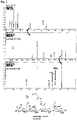
- the HPLC charts of the digested liquids illustrate that CS and the cross-linked CS-NC2N were similarly digested with C-ABC ( Fig. 1 ). Peaks A and B in Fig. 1 are typical peaks that are not observed in the HPLC chart of non-cross-linked CS.
- the LC-MS analysis suggested that these peaks belong to a structure having a group in a diamine. Table 5 summarizes structures that are presumed to have a group in a diamine on the basis of mass-to-charge ratio.
- Peak B was subjected to multi-stage mass spectrometry for determining a structure cross-linked with a group in a diamine.
- Figs. 2 and 3 illustrate some of the results. As illustrated in Figs. 2 and 3 , peaks suggesting the covalent bonding between ethane-1,2-diamine and two glucuronic acid molecules of CS were detected.
- Example 1 or 2 A portion of the sample prepared in Example 1 or 2 was weighed (10 mg) and dissolved in 20 mM sulfuric acid (1 mL) followed by subjected to degassing. The resultant solution was heated at 60°C for six hours and then basified. Ethanol and propylene oxide were added to the basified solution, and the solution was heated at 60°C overnight. The solution was cooled and acidified followed by subjected to evaporation to dryness under reduced pressure. Diaminobutane (internal standard) was added to the resultant product, and 6 M hydrochloric acid was added thereto. The resultant solution was heated at 110°C overnight followed by subjected to evaporation to dryness under reduced pressure.
- Phosphate buffered saline (may be referred to as "PBS” herein) having the following composition was prepared:
- the cross-linked CS products produced in Examples 1, 2, 4, 6 to 11, and A1 to A8 were mixed with the aforementioned PBS so as to achieve concentrations as shown in Tables 7, 8, and 9, followed by shaking with a shaking apparatus overnight, to thereby prepare samples (samples 1 to 43, 55 to 71, and 75 to 77). Thereafter, some samples were measured for absorbance at 600 nm by means of an ultraviolet visible spectrophotometer (UV-1800, manufactured by Shimadzu Corporation). The results are illustrated in Tables 7, 8, and 9.
- Example 14 In the same manner as described in Example 13, the CS-NC12N derivative (Comparative Example) produced in Comparative Example 1 was mixed with the PBS so as to achieve concentrations as shown in Table 8, to thereby prepare samples (samples 44 to 46 and 72 to 74). Thereafter, the samples were measured for absorbance at 600 nm by means of an ultraviolet visible spectrophotometer (UV-1800, manufactured by Shimadzu Corporation). The results are illustrated in Table 8.
- the viscosities (mPa ⁇ s) of the samples prepared in Example 13 and Comparative Example 2 were measured at 25°C and 5 rpm by means of an E-type rotary viscometer (TV-L/H, Toki Sangyo Co., Ltd.) with a standard cone (CORD-1, 1° 34' xR24). If the viscosity at 5 rpm fell outside the range of detection, an extrapolated value was determined at another rotation speed, and the value was defined as viscosity (mPa ⁇ s). The results are illustrated in Tables 7 to 10.
- Samples 7, 13, 16, 19, 22, 26, 31, 35 to 40, 42, 53, 55 to 71, and 75 to 77 were found to be in a clear solution form (i.e., these samples were an aqueous solution).
- a composition of higher concentration is in a clear solution form
- a composition of lower concentration is also probably in a clear solution form.
- Samples 1 to 43, 47 to 71, and 75 to 77 were confirmed to be clear through visual observation (the term "clear” as used herein refers to a clear composition).
- compositions containing the CS-NC12N derivative Comparative Example
- compounds 45 to 47 were found to be in a turbid solution form (i.e., these compositions were not an aqueous solution).
- Example 13 Some of the samples prepared in Example 13 were subjected to the test for filter-passing rate. Specifically, a sample was charged into a 1 mL syringe (SS-01T, Terumo Corporation) equipped with a porous filter (pore size: 5.0 ⁇ m, diameter: 25 mm, Millex (registered trademark)-SV 5.00 ⁇ m (Millipore Ireland)). The sample was extruded with a piston at 25°C and a pressure of 5.3 kgf/cm 2 or less, to thereby pass the sample through the filter. The CS concentration of the sample was determined before passage of the sample through the filter. Also, the CS concentration of the sample was determined after passage of the sample (in an amount of 0.5 mL or more) through the filter.
- the CS concentration was determined by the carbazole-sulfuric acid method using 20.0 ⁇ g/mL aqueous D-glucuronolactone solution as a standard. The ratio of the CS concentration after passage of the sample through the filter to that before passage of the sample through the filter was calculated, to thereby determine the filter-passing rate of the sample. The results are illustrated in Table 11.
- SD rats (Charles River Laboratories Japan, Inc.) were prepared into dry eye models in accordance with the method described in Fujihara, et al. (Invest. Ophthalmol. Vis. Sci. 42 (1): 96-100 (2001 )). A test substance was instilled into the eyes of each model and examined for the effect of accelerating the healing of corneal epithelial disorder.
- CS sodium chondroitin sulfate (Japanese Pharmaceutical Codex), weight average molecular weight: 40,000, Seikagaku Corporation)
- compound 10, compound 18, or compound 42 was mixed with PBS so as to achieve a CS (or cross-linked CS) concentration of 2%, and the mixture was shaken by means of a shaking apparatus overnight, to thereby prepare a test substance.
- the test substance was 2% CS, 2% cross-linked CS-NC2N, 2% cross-linked CS-NC4N, or 2% cross-linked CS-OrnEt.
- PBS was used as a control.
- the exorbital lacrimal gland was excised from both eyes of an SD rat under inhalation anesthesia with isoflurane, to thereby prepare a dry eye model.
- a portion of corneal epithelial disorder was stained with fluorescein.
- the degree of staining at an upper, middle, or lower portion of the superficial cornea was scored according to the following classification, and the total scores of each portion were calculated.
- the test substance was instilled into both eyes (5 ⁇ L per an eye) twice a day for three weeks.
- PBS serving as a control was instilled in the same manner as described above.
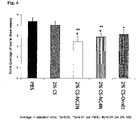
- Table 12 and Fig. 4 illustrate the transitions and averages of scores for one, two, and three weeks.
- 2% Cross-linked CS-NC2N, 2% cross-linked CS-NC4N, and 2% cross-linked CS-OrnEt exhibited a significant effect of accelerating the healing of corneal epithelial disorder as compared with PBS.
- 2% Cross-linked CS-NC2N and 2% cross-linked CS-NC4N exhibited a significant effect of accelerating the healing of corneal epithelial disorder as compared with 2% CS.
- Compound 49 or compound 52 was mixed with PBS so as to achieve a cross-linked CS concentration of 2%, and the mixture was shaken by means of a shaking apparatus overnight, to thereby prepare a test substance.
- the test substance was 2% cross-linked CS-triAmine and 2% cross-linked CS-NC3(OH)N.
- PBS was used as a control (Example 17A).
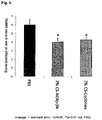
- Table 13 and Fig. 5 (Example 17A) and Table 14 and Fig. 6 (Example 17B) illustrate the transitions and averages of scores for one, two, and three weeks.
- test substance was 2% cross-linked CS-NC6N, 2% cross-linked CS-NC5(S)N, 2% cross-linked CS-Glycol(C5), 2% cross-linked CS-Glycol(C11), and 2% cross-linked CS-Spermidine.
- PBS was used as a control (Examples 18A to 18D).
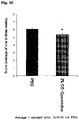
- 2% Cross-linked CS-NC6N, 2% cross-linked CS-NC5(S)N, 2% cross-linked CS-Glycol(C5), 2% cross-linked CS-Glycol(C11), and 2% cross-linked CS-Spermidine exhibited a significant effect of accelerating the healing of corneal epithelial disorder as compared with PBS.
- the cross-linked CS produced by the method of the present invention can be used as an agent for the treatment of an eye disease, in particular, an agent for the therapy of a corneal epithelial disorder and/or dry eye.
- the method of the present invention can be industrially used as a method for producing cross-linked CS.
Landscapes
- Health & Medical Sciences (AREA)
- Life Sciences & Earth Sciences (AREA)
- Chemical & Material Sciences (AREA)
- General Health & Medical Sciences (AREA)
- Medicinal Chemistry (AREA)
- Public Health (AREA)
- Veterinary Medicine (AREA)
- Animal Behavior & Ethology (AREA)
- Pharmacology & Pharmacy (AREA)
- Epidemiology (AREA)
- Ophthalmology & Optometry (AREA)
- Molecular Biology (AREA)
- Organic Chemistry (AREA)
- Chemical Kinetics & Catalysis (AREA)
- Engineering & Computer Science (AREA)
- General Chemical & Material Sciences (AREA)
- Nuclear Medicine, Radiotherapy & Molecular Imaging (AREA)
- Bioinformatics & Cheminformatics (AREA)
- Dermatology (AREA)
- Biochemistry (AREA)
- Materials Engineering (AREA)
- Polymers & Plastics (AREA)
- Pharmaceuticals Containing Other Organic And Inorganic Compounds (AREA)
- Polysaccharides And Polysaccharide Derivatives (AREA)
Applications Claiming Priority (4)
| Application Number | Priority Date | Filing Date | Title |
|---|---|---|---|
| JP2015007072 | 2015-01-16 | ||
| JP2015150976 | 2015-07-30 | ||
| EP16737468.5A EP3246037A4 (en) | 2015-01-16 | 2016-01-15 | Crosslinked chondroitin sulfate, composition containing same, and treatment agent for eye disease |
| PCT/JP2016/051176 WO2016114397A1 (ja) | 2015-01-16 | 2016-01-15 | コンドロイチン硫酸架橋体、並びにこれを含有する組成物、及び眼疾患処置剤 |
Related Parent Applications (1)
| Application Number | Title | Priority Date | Filing Date |
|---|---|---|---|
| EP16737468.5A Division EP3246037A4 (en) | 2015-01-16 | 2016-01-15 | Crosslinked chondroitin sulfate, composition containing same, and treatment agent for eye disease |
Publications (2)
| Publication Number | Publication Date |
|---|---|
| EP3831394A1 EP3831394A1 (en) | 2021-06-09 |
| EP3831394B1 true EP3831394B1 (en) | 2022-12-21 |
Family
ID=56405937
Family Applications (2)
| Application Number | Title | Priority Date | Filing Date |
|---|---|---|---|
| EP21150701.7A Active EP3831394B1 (en) | 2015-01-16 | 2016-01-15 | Cross-linked chondroitin sulfate, composition containing same, and treatment agent for eye disease |
| EP16737468.5A Withdrawn EP3246037A4 (en) | 2015-01-16 | 2016-01-15 | Crosslinked chondroitin sulfate, composition containing same, and treatment agent for eye disease |
Family Applications After (1)
| Application Number | Title | Priority Date | Filing Date |
|---|---|---|---|
| EP16737468.5A Withdrawn EP3246037A4 (en) | 2015-01-16 | 2016-01-15 | Crosslinked chondroitin sulfate, composition containing same, and treatment agent for eye disease |
Country Status (5)
| Country | Link |
|---|---|
| US (3) | US10420796B2 (https=) |
| EP (2) | EP3831394B1 (https=) |
| JP (2) | JP6110037B2 (https=) |
| ES (1) | ES2938482T3 (https=) |
| WO (1) | WO2016114397A1 (https=) |
Families Citing this family (6)
| Publication number | Priority date | Publication date | Assignee | Title |
|---|---|---|---|---|
| WO2019060696A1 (en) | 2017-09-25 | 2019-03-28 | Surface Pharmaceuticals, Inc. | OPTHALMIC PHARMACEUTICAL COMPOSITIONS AND METHODS FOR THE TREATMENT OF OCULAR SURFACE DISEASE |
| CA3124945A1 (en) | 2018-12-27 | 2020-07-02 | Surface Ophthalmics, Inc. | Ophthalmic pharmaceutical compositions and methods for treating ocular surface disease |
| BR112022018535A2 (pt) * | 2020-03-19 | 2022-11-29 | Glycologix Inc | Biomateriais de glicosaminoglicano sulfatado como miméticos de proteoglicanos |
| US12440510B2 (en) | 2021-05-10 | 2025-10-14 | Surface Ophthalmics, Inc. | Use of chondroitin sulfate for relieving ocular pain |
| US12310981B2 (en) | 2021-05-10 | 2025-05-27 | Surface Ophthalmics, Inc. | Use of chondroitin sulfate for relieving ocular pain |
| CN116687959B (zh) * | 2022-05-18 | 2024-10-22 | 朱小丰 | 一种硫酸软骨素生物多胺复合物、其制备方法及用途 |
Family Cites Families (12)
| Publication number | Priority date | Publication date | Assignee | Title |
|---|---|---|---|---|
| US4863907A (en) * | 1984-06-29 | 1989-09-05 | Seikagaku Kogyo Co., Ltd. | Crosslinked glycosaminoglycans and their use |
| US5527893A (en) | 1987-09-18 | 1996-06-18 | Genzyme Corporation | Water insoluble derivatives of polyanionic polysaccharides |
| RU2113221C1 (ru) | 1990-05-04 | 1998-06-20 | Ииссум Рисерч Дивелопмент Компани оф дзе Хебрю Юниверсити оф Иеруcалим | Фармацевтическая форма для введения лекарственного средства в ободочную кишку, способ введения лекарственного препарата и способ получения матриц для такой формы |
| IL98087A (en) | 1990-05-04 | 1996-11-14 | Perio Prod Ltd | Preparation for dispensing drugs in the colon |
| JP2855307B2 (ja) | 1992-02-05 | 1999-02-10 | 生化学工業株式会社 | 光反応性グリコサミノグリカン、架橋グリコサミノグリカン及びそれらの製造方法 |
| JPH07223966A (ja) | 1994-02-08 | 1995-08-22 | Seiko Epson Corp | 眼科用人工涙液 |
| JP3059092B2 (ja) | 1995-11-15 | 2000-07-04 | 田辺製薬株式会社 | ドライアイおよびドライアイを原因とする疾患の予防・治療剤 |
| IT1303738B1 (it) * | 1998-11-11 | 2001-02-23 | Aquisitio S P A | Processo di reticolazione di polisaccaridi carbossilati. |
| JP3903475B2 (ja) * | 1999-04-30 | 2007-04-11 | ニプロ株式会社 | 乾性角膜症治療剤 |
| CA2671572C (en) | 2006-12-04 | 2015-05-26 | Johns Hopkins University | Imidated biopolymer adhesive and hydrogel |
| EP3040117A1 (en) * | 2014-12-29 | 2016-07-06 | Galderma S.A. | Ether cross-linked chondroitin sulfate hydrogels and their use for soft tissue applications |
| WO2016107834A1 (en) * | 2014-12-29 | 2016-07-07 | Galderma S.A. | Carboxyl cross-linked chondroitin hydrogels and their use for soft tissue applications |
-
2016
- 2016-01-15 ES ES21150701T patent/ES2938482T3/es active Active
- 2016-01-15 EP EP21150701.7A patent/EP3831394B1/en active Active
- 2016-01-15 WO PCT/JP2016/051176 patent/WO2016114397A1/ja not_active Ceased
- 2016-01-15 EP EP16737468.5A patent/EP3246037A4/en not_active Withdrawn
- 2016-01-15 JP JP2016533212A patent/JP6110037B2/ja active Active
- 2016-01-15 US US15/543,748 patent/US10420796B2/en active Active
-
2017
- 2017-03-08 JP JP2017043621A patent/JP6715201B2/ja active Active
-
2019
- 2019-08-09 US US16/536,779 patent/US10716804B2/en active Active
-
2020
- 2020-06-09 US US16/896,823 patent/US11207345B2/en active Active
Also Published As
| Publication number | Publication date |
|---|---|
| ES2938482T3 (es) | 2023-04-11 |
| JPWO2016114397A1 (ja) | 2017-04-27 |
| WO2016114397A1 (ja) | 2016-07-21 |
| US10420796B2 (en) | 2019-09-24 |
| EP3831394A1 (en) | 2021-06-09 |
| US20210052634A1 (en) | 2021-02-25 |
| JP6715201B2 (ja) | 2020-07-01 |
| US20190365796A1 (en) | 2019-12-05 |
| US20170368093A1 (en) | 2017-12-28 |
| JP6110037B2 (ja) | 2017-04-05 |
| EP3246037A4 (en) | 2018-07-11 |
| US11207345B2 (en) | 2021-12-28 |
| US10716804B2 (en) | 2020-07-21 |
| EP3246037A1 (en) | 2017-11-22 |
| JP2017125203A (ja) | 2017-07-20 |
Similar Documents
| Publication | Publication Date | Title |
|---|---|---|
| US11207345B2 (en) | Crosslinked chondroitin sulfate, composition containing same, and treatment agent for eye disease | |
| CN106456536B (zh) | 水性眼用溶液和治疗干眼综合征的方法 | |
| JP6557144B2 (ja) | アルキル化シクロデキストリン組成物ならびにその調製方法および使用方法 | |
| US10239962B2 (en) | Hyaluronic acid derivatives | |
| EP2392579A1 (en) | Low-molecular polysulfated hyaluronic acid derivative and medicine containing same | |
| JP2016166368A (ja) | アルキル化シクロデキストリン組成物ならびにその調製方法および使用方法 | |
| US20100273734A1 (en) | Derivatives of Hyaluronic Acids | |
| EP2682409A1 (en) | Hyaluronic acid derivative modified by amino-carbonic acid | |
| CN1203071C (zh) | 谷氨酸n-衍生物的多糖酯 | |
| EP1724287A1 (en) | Hyaluronic acid/methotrexate compound | |
| EP1739097A1 (en) | Hyaluronic acid/methotrexate compound | |
| JP7734537B2 (ja) | 点眼剤 | |
| TWI782232B (zh) | 基於硫酸化玻尿酸之水凝膠及含彼之藥學組成物 | |
| EP3305304A1 (en) | Composition including glucosaminoglycan derivative and chemokine receptor activity regulator | |
| US11376274B2 (en) | Joint cavity injection preparation and use thereof | |
| EP1797888A1 (en) | Ophthalmic composition containing xanthan gum and amino acid | |
| EP4578452A1 (en) | Corneal disorder treatment agent | |
| WO2026068808A1 (en) | Thiol-functionalized polyglycerol derivatives and their medical uses |
Legal Events
| Date | Code | Title | Description |
|---|---|---|---|
| PUAI | Public reference made under article 153(3) epc to a published international application that has entered the european phase |
Free format text: ORIGINAL CODE: 0009012 |
|
| STAA | Information on the status of an ep patent application or granted ep patent |
Free format text: STATUS: REQUEST FOR EXAMINATION WAS MADE |
|
| 17P | Request for examination filed |
Effective date: 20210108 |
|
| AC | Divisional application: reference to earlier application |
Ref document number: 3246037 Country of ref document: EP Kind code of ref document: P |
|
| AK | Designated contracting states |
Kind code of ref document: A1 Designated state(s): AL AT BE BG CH CY CZ DE DK EE ES FI FR GB GR HR HU IE IS IT LI LT LU LV MC MK MT NL NO PL PT RO RS SE SI SK SM TR |
|
| STAA | Information on the status of an ep patent application or granted ep patent |
Free format text: STATUS: EXAMINATION IS IN PROGRESS |
|
| 17Q | First examination report despatched |
Effective date: 20220301 |
|
| GRAP | Despatch of communication of intention to grant a patent |
Free format text: ORIGINAL CODE: EPIDOSNIGR1 |
|
| STAA | Information on the status of an ep patent application or granted ep patent |
Free format text: STATUS: GRANT OF PATENT IS INTENDED |
|
| INTG | Intention to grant announced |
Effective date: 20220713 |
|
| RIN1 | Information on inventor provided before grant (corrected) |
Inventor name: FUNAYAMA, SHO |
|
| GRAS | Grant fee paid |
Free format text: ORIGINAL CODE: EPIDOSNIGR3 |
|
| GRAA | (expected) grant |
Free format text: ORIGINAL CODE: 0009210 |
|
| STAA | Information on the status of an ep patent application or granted ep patent |
Free format text: STATUS: THE PATENT HAS BEEN GRANTED |
|
| AC | Divisional application: reference to earlier application |
Ref document number: 3246037 Country of ref document: EP Kind code of ref document: P |
|
| AK | Designated contracting states |
Kind code of ref document: B1 Designated state(s): AL AT BE BG CH CY CZ DE DK EE ES FI FR GB GR HR HU IE IS IT LI LT LU LV MC MK MT NL NO PL PT RO RS SE SI SK SM TR |
|
| REG | Reference to a national code |
Ref country code: GB Ref legal event code: FG4D |
|
| REG | Reference to a national code |
Ref country code: CH Ref legal event code: EP |
|
| REG | Reference to a national code |
Ref country code: DE Ref legal event code: R096 Ref document number: 602016077086 Country of ref document: DE |
|
| REG | Reference to a national code |
Ref country code: AT Ref legal event code: REF Ref document number: 1538643 Country of ref document: AT Kind code of ref document: T Effective date: 20230115 |
|
| REG | Reference to a national code |
Ref country code: IE Ref legal event code: FG4D |
|
| REG | Reference to a national code |
Ref country code: LT Ref legal event code: MG9D Ref country code: ES Ref legal event code: FG2A Ref document number: 2938482 Country of ref document: ES Kind code of ref document: T3 Effective date: 20230411 |
|
| REG | Reference to a national code |
Ref country code: NL Ref legal event code: MP Effective date: 20221221 |
|
| PG25 | Lapsed in a contracting state [announced via postgrant information from national office to epo] |
Ref country code: SE Free format text: LAPSE BECAUSE OF FAILURE TO SUBMIT A TRANSLATION OF THE DESCRIPTION OR TO PAY THE FEE WITHIN THE PRESCRIBED TIME-LIMIT Effective date: 20221221 Ref country code: NO Free format text: LAPSE BECAUSE OF FAILURE TO SUBMIT A TRANSLATION OF THE DESCRIPTION OR TO PAY THE FEE WITHIN THE PRESCRIBED TIME-LIMIT Effective date: 20230321 Ref country code: LT Free format text: LAPSE BECAUSE OF FAILURE TO SUBMIT A TRANSLATION OF THE DESCRIPTION OR TO PAY THE FEE WITHIN THE PRESCRIBED TIME-LIMIT Effective date: 20221221 Ref country code: FI Free format text: LAPSE BECAUSE OF FAILURE TO SUBMIT A TRANSLATION OF THE DESCRIPTION OR TO PAY THE FEE WITHIN THE PRESCRIBED TIME-LIMIT Effective date: 20221221 |
|
| REG | Reference to a national code |
Ref country code: AT Ref legal event code: MK05 Ref document number: 1538643 Country of ref document: AT Kind code of ref document: T Effective date: 20221221 |
|
| PG25 | Lapsed in a contracting state [announced via postgrant information from national office to epo] |
Ref country code: RS Free format text: LAPSE BECAUSE OF FAILURE TO SUBMIT A TRANSLATION OF THE DESCRIPTION OR TO PAY THE FEE WITHIN THE PRESCRIBED TIME-LIMIT Effective date: 20221221 Ref country code: LV Free format text: LAPSE BECAUSE OF FAILURE TO SUBMIT A TRANSLATION OF THE DESCRIPTION OR TO PAY THE FEE WITHIN THE PRESCRIBED TIME-LIMIT Effective date: 20221221 Ref country code: HR Free format text: LAPSE BECAUSE OF FAILURE TO SUBMIT A TRANSLATION OF THE DESCRIPTION OR TO PAY THE FEE WITHIN THE PRESCRIBED TIME-LIMIT Effective date: 20221221 Ref country code: GR Free format text: LAPSE BECAUSE OF FAILURE TO SUBMIT A TRANSLATION OF THE DESCRIPTION OR TO PAY THE FEE WITHIN THE PRESCRIBED TIME-LIMIT Effective date: 20230322 |
|
| P01 | Opt-out of the competence of the unified patent court (upc) registered |
Effective date: 20230428 |
|
| PG25 | Lapsed in a contracting state [announced via postgrant information from national office to epo] |
Ref country code: NL Free format text: LAPSE BECAUSE OF FAILURE TO SUBMIT A TRANSLATION OF THE DESCRIPTION OR TO PAY THE FEE WITHIN THE PRESCRIBED TIME-LIMIT Effective date: 20221221 |
|
| PG25 | Lapsed in a contracting state [announced via postgrant information from national office to epo] |
Ref country code: SM Free format text: LAPSE BECAUSE OF FAILURE TO SUBMIT A TRANSLATION OF THE DESCRIPTION OR TO PAY THE FEE WITHIN THE PRESCRIBED TIME-LIMIT Effective date: 20221221 Ref country code: RO Free format text: LAPSE BECAUSE OF FAILURE TO SUBMIT A TRANSLATION OF THE DESCRIPTION OR TO PAY THE FEE WITHIN THE PRESCRIBED TIME-LIMIT Effective date: 20221221 Ref country code: PT Free format text: LAPSE BECAUSE OF FAILURE TO SUBMIT A TRANSLATION OF THE DESCRIPTION OR TO PAY THE FEE WITHIN THE PRESCRIBED TIME-LIMIT Effective date: 20230421 Ref country code: EE Free format text: LAPSE BECAUSE OF FAILURE TO SUBMIT A TRANSLATION OF THE DESCRIPTION OR TO PAY THE FEE WITHIN THE PRESCRIBED TIME-LIMIT Effective date: 20221221 Ref country code: CZ Free format text: LAPSE BECAUSE OF FAILURE TO SUBMIT A TRANSLATION OF THE DESCRIPTION OR TO PAY THE FEE WITHIN THE PRESCRIBED TIME-LIMIT Effective date: 20221221 Ref country code: AT Free format text: LAPSE BECAUSE OF FAILURE TO SUBMIT A TRANSLATION OF THE DESCRIPTION OR TO PAY THE FEE WITHIN THE PRESCRIBED TIME-LIMIT Effective date: 20221221 |
|
| PG25 | Lapsed in a contracting state [announced via postgrant information from national office to epo] |
Ref country code: SK Free format text: LAPSE BECAUSE OF FAILURE TO SUBMIT A TRANSLATION OF THE DESCRIPTION OR TO PAY THE FEE WITHIN THE PRESCRIBED TIME-LIMIT Effective date: 20221221 Ref country code: PL Free format text: LAPSE BECAUSE OF FAILURE TO SUBMIT A TRANSLATION OF THE DESCRIPTION OR TO PAY THE FEE WITHIN THE PRESCRIBED TIME-LIMIT Effective date: 20221221 Ref country code: IS Free format text: LAPSE BECAUSE OF FAILURE TO SUBMIT A TRANSLATION OF THE DESCRIPTION OR TO PAY THE FEE WITHIN THE PRESCRIBED TIME-LIMIT Effective date: 20230421 Ref country code: AL Free format text: LAPSE BECAUSE OF FAILURE TO SUBMIT A TRANSLATION OF THE DESCRIPTION OR TO PAY THE FEE WITHIN THE PRESCRIBED TIME-LIMIT Effective date: 20221221 |
|
| REG | Reference to a national code |
Ref country code: CH Ref legal event code: PL |
|
| REG | Reference to a national code |
Ref country code: DE Ref legal event code: R097 Ref document number: 602016077086 Country of ref document: DE |
|
| PG25 | Lapsed in a contracting state [announced via postgrant information from national office to epo] |
Ref country code: MC Free format text: LAPSE BECAUSE OF FAILURE TO SUBMIT A TRANSLATION OF THE DESCRIPTION OR TO PAY THE FEE WITHIN THE PRESCRIBED TIME-LIMIT Effective date: 20221221 Ref country code: LU Free format text: LAPSE BECAUSE OF NON-PAYMENT OF DUE FEES Effective date: 20230115 |
|
| REG | Reference to a national code |
Ref country code: BE Ref legal event code: MM Effective date: 20230131 |
|
| PLBE | No opposition filed within time limit |
Free format text: ORIGINAL CODE: 0009261 |
|
| STAA | Information on the status of an ep patent application or granted ep patent |
Free format text: STATUS: NO OPPOSITION FILED WITHIN TIME LIMIT |
|
| PG25 | Lapsed in a contracting state [announced via postgrant information from national office to epo] |
Ref country code: LI Free format text: LAPSE BECAUSE OF NON-PAYMENT OF DUE FEES Effective date: 20230131 Ref country code: DK Free format text: LAPSE BECAUSE OF FAILURE TO SUBMIT A TRANSLATION OF THE DESCRIPTION OR TO PAY THE FEE WITHIN THE PRESCRIBED TIME-LIMIT Effective date: 20221221 Ref country code: CH Free format text: LAPSE BECAUSE OF NON-PAYMENT OF DUE FEES Effective date: 20230131 |
|
| 26N | No opposition filed |
Effective date: 20230922 |
|
| PG25 | Lapsed in a contracting state [announced via postgrant information from national office to epo] |
Ref country code: BE Free format text: LAPSE BECAUSE OF NON-PAYMENT OF DUE FEES Effective date: 20230131 |
|
| PG25 | Lapsed in a contracting state [announced via postgrant information from national office to epo] |
Ref country code: SI Free format text: LAPSE BECAUSE OF FAILURE TO SUBMIT A TRANSLATION OF THE DESCRIPTION OR TO PAY THE FEE WITHIN THE PRESCRIBED TIME-LIMIT Effective date: 20221221 Ref country code: IE Free format text: LAPSE BECAUSE OF NON-PAYMENT OF DUE FEES Effective date: 20230115 |
|
| PG25 | Lapsed in a contracting state [announced via postgrant information from national office to epo] |
Ref country code: BG Free format text: LAPSE BECAUSE OF FAILURE TO SUBMIT A TRANSLATION OF THE DESCRIPTION OR TO PAY THE FEE WITHIN THE PRESCRIBED TIME-LIMIT Effective date: 20221221 |
|
| PG25 | Lapsed in a contracting state [announced via postgrant information from national office to epo] |
Ref country code: BG Free format text: LAPSE BECAUSE OF FAILURE TO SUBMIT A TRANSLATION OF THE DESCRIPTION OR TO PAY THE FEE WITHIN THE PRESCRIBED TIME-LIMIT Effective date: 20221221 |
|
| PG25 | Lapsed in a contracting state [announced via postgrant information from national office to epo] |
Ref country code: CY Free format text: LAPSE BECAUSE OF FAILURE TO SUBMIT A TRANSLATION OF THE DESCRIPTION OR TO PAY THE FEE WITHIN THE PRESCRIBED TIME-LIMIT; INVALID AB INITIO Effective date: 20160115 |
|
| PG25 | Lapsed in a contracting state [announced via postgrant information from national office to epo] |
Ref country code: HU Free format text: LAPSE BECAUSE OF FAILURE TO SUBMIT A TRANSLATION OF THE DESCRIPTION OR TO PAY THE FEE WITHIN THE PRESCRIBED TIME-LIMIT; INVALID AB INITIO Effective date: 20160115 |
|
| PG25 | Lapsed in a contracting state [announced via postgrant information from national office to epo] |
Ref country code: TR Free format text: LAPSE BECAUSE OF FAILURE TO SUBMIT A TRANSLATION OF THE DESCRIPTION OR TO PAY THE FEE WITHIN THE PRESCRIBED TIME-LIMIT Effective date: 20221221 |
|
| PGFP | Annual fee paid to national office [announced via postgrant information from national office to epo] |
Ref country code: GB Payment date: 20251127 Year of fee payment: 11 |
|
| PGFP | Annual fee paid to national office [announced via postgrant information from national office to epo] |
Ref country code: FR Payment date: 20251128 Year of fee payment: 11 |
|
| PGFP | Annual fee paid to national office [announced via postgrant information from national office to epo] |
Ref country code: ES Payment date: 20260203 Year of fee payment: 11 |
|
| PGFP | Annual fee paid to national office [announced via postgrant information from national office to epo] |
Ref country code: DE Payment date: 20251203 Year of fee payment: 11 |
|
| PGFP | Annual fee paid to national office [announced via postgrant information from national office to epo] |
Ref country code: IT Payment date: 20251219 Year of fee payment: 11 |