EP3830207B1 - System mit einer mikrofluidischen kartusche und einer kartuschenabdeckvorrichtung zum versiegeln der mikrofluidischen kartusche und verfahren zu seiner herstellung - Google Patents
System mit einer mikrofluidischen kartusche und einer kartuschenabdeckvorrichtung zum versiegeln der mikrofluidischen kartusche und verfahren zu seiner herstellung Download PDFInfo
- Publication number
- EP3830207B1 EP3830207B1 EP19749308.3A EP19749308A EP3830207B1 EP 3830207 B1 EP3830207 B1 EP 3830207B1 EP 19749308 A EP19749308 A EP 19749308A EP 3830207 B1 EP3830207 B1 EP 3830207B1
- Authority
- EP
- European Patent Office
- Prior art keywords
- cartridge
- adhesive
- cover layer
- adhesive mass
- microfluidic cartridge
- Prior art date
- Legal status (The legal status is an assumption and is not a legal conclusion. Google has not performed a legal analysis and makes no representation as to the accuracy of the status listed.)
- Active
Links
Images

Classifications
-
- B—PERFORMING OPERATIONS; TRANSPORTING
- B01—PHYSICAL OR CHEMICAL PROCESSES OR APPARATUS IN GENERAL
- B01L—CHEMICAL OR PHYSICAL LABORATORY APPARATUS FOR GENERAL USE
- B01L3/00—Containers or dishes for laboratory use, e.g. laboratory glassware; Droppers
- B01L3/50—Containers for the purpose of retaining a material to be analysed, e.g. test tubes
- B01L3/502—Containers for the purpose of retaining a material to be analysed, e.g. test tubes with fluid transport, e.g. in multi-compartment structures
- B01L3/5027—Containers for the purpose of retaining a material to be analysed, e.g. test tubes with fluid transport, e.g. in multi-compartment structures by integrated microfluidic structures, i.e. dimensions of channels and chambers are such that surface tension forces are important, e.g. lab-on-a-chip
- B01L3/502707—Containers for the purpose of retaining a material to be analysed, e.g. test tubes with fluid transport, e.g. in multi-compartment structures by integrated microfluidic structures, i.e. dimensions of channels and chambers are such that surface tension forces are important, e.g. lab-on-a-chip characterised by the manufacture of the container or its components
-
- B—PERFORMING OPERATIONS; TRANSPORTING
- B01—PHYSICAL OR CHEMICAL PROCESSES OR APPARATUS IN GENERAL
- B01L—CHEMICAL OR PHYSICAL LABORATORY APPARATUS FOR GENERAL USE
- B01L3/00—Containers or dishes for laboratory use, e.g. laboratory glassware; Droppers
- B01L3/56—Labware specially adapted for transferring fluids
- B01L3/565—Seals
-
- C—CHEMISTRY; METALLURGY
- C08—ORGANIC MACROMOLECULAR COMPOUNDS; THEIR PREPARATION OR CHEMICAL WORKING-UP; COMPOSITIONS BASED THEREON
- C08K—Use of inorganic or non-macromolecular organic substances as compounding ingredients
- C08K5/00—Use of organic ingredients
- C08K5/04—Oxygen-containing compounds
- C08K5/06—Ethers; Acetals; Ketals; Ortho-esters
-
- C—CHEMISTRY; METALLURGY
- C08—ORGANIC MACROMOLECULAR COMPOUNDS; THEIR PREPARATION OR CHEMICAL WORKING-UP; COMPOSITIONS BASED THEREON
- C08K—Use of inorganic or non-macromolecular organic substances as compounding ingredients
- C08K7/00—Use of ingredients characterised by shape
- C08K7/16—Solid spheres
-
- C—CHEMISTRY; METALLURGY
- C08—ORGANIC MACROMOLECULAR COMPOUNDS; THEIR PREPARATION OR CHEMICAL WORKING-UP; COMPOSITIONS BASED THEREON
- C08K—Use of inorganic or non-macromolecular organic substances as compounding ingredients
- C08K7/00—Use of ingredients characterised by shape
- C08K7/22—Expanded, porous or hollow particles
-
- C—CHEMISTRY; METALLURGY
- C09—DYES; PAINTS; POLISHES; NATURAL RESINS; ADHESIVES; COMPOSITIONS NOT OTHERWISE PROVIDED FOR; APPLICATIONS OF MATERIALS NOT OTHERWISE PROVIDED FOR
- C09J—ADHESIVES; NON-MECHANICAL ASPECTS OF ADHESIVE PROCESSES IN GENERAL; ADHESIVE PROCESSES NOT PROVIDED FOR ELSEWHERE; USE OF MATERIALS AS ADHESIVES
- C09J11/00—Features of adhesives not provided for in group C09J9/00, e.g. additives
- C09J11/02—Non-macromolecular additives
- C09J11/04—Non-macromolecular additives inorganic
-
- C—CHEMISTRY; METALLURGY
- C09—DYES; PAINTS; POLISHES; NATURAL RESINS; ADHESIVES; COMPOSITIONS NOT OTHERWISE PROVIDED FOR; APPLICATIONS OF MATERIALS NOT OTHERWISE PROVIDED FOR
- C09J—ADHESIVES; NON-MECHANICAL ASPECTS OF ADHESIVE PROCESSES IN GENERAL; ADHESIVE PROCESSES NOT PROVIDED FOR ELSEWHERE; USE OF MATERIALS AS ADHESIVES
- C09J11/00—Features of adhesives not provided for in group C09J9/00, e.g. additives
- C09J11/02—Non-macromolecular additives
- C09J11/06—Non-macromolecular additives organic
-
- C—CHEMISTRY; METALLURGY
- C09—DYES; PAINTS; POLISHES; NATURAL RESINS; ADHESIVES; COMPOSITIONS NOT OTHERWISE PROVIDED FOR; APPLICATIONS OF MATERIALS NOT OTHERWISE PROVIDED FOR
- C09J—ADHESIVES; NON-MECHANICAL ASPECTS OF ADHESIVE PROCESSES IN GENERAL; ADHESIVE PROCESSES NOT PROVIDED FOR ELSEWHERE; USE OF MATERIALS AS ADHESIVES
- C09J163/00—Adhesives based on epoxy resins; Adhesives based on derivatives of epoxy resins
-
- C—CHEMISTRY; METALLURGY
- C09—DYES; PAINTS; POLISHES; NATURAL RESINS; ADHESIVES; COMPOSITIONS NOT OTHERWISE PROVIDED FOR; APPLICATIONS OF MATERIALS NOT OTHERWISE PROVIDED FOR
- C09J—ADHESIVES; NON-MECHANICAL ASPECTS OF ADHESIVE PROCESSES IN GENERAL; ADHESIVE PROCESSES NOT PROVIDED FOR ELSEWHERE; USE OF MATERIALS AS ADHESIVES
- C09J5/00—Adhesive processes in general; Adhesive processes not provided for elsewhere, e.g. relating to primers
-
- C—CHEMISTRY; METALLURGY
- C09—DYES; PAINTS; POLISHES; NATURAL RESINS; ADHESIVES; COMPOSITIONS NOT OTHERWISE PROVIDED FOR; APPLICATIONS OF MATERIALS NOT OTHERWISE PROVIDED FOR
- C09J—ADHESIVES; NON-MECHANICAL ASPECTS OF ADHESIVE PROCESSES IN GENERAL; ADHESIVE PROCESSES NOT PROVIDED FOR ELSEWHERE; USE OF MATERIALS AS ADHESIVES
- C09J7/00—Adhesives in the form of films or foils
- C09J7/20—Adhesives in the form of films or foils characterised by their carriers
-
- C—CHEMISTRY; METALLURGY
- C09—DYES; PAINTS; POLISHES; NATURAL RESINS; ADHESIVES; COMPOSITIONS NOT OTHERWISE PROVIDED FOR; APPLICATIONS OF MATERIALS NOT OTHERWISE PROVIDED FOR
- C09J—ADHESIVES; NON-MECHANICAL ASPECTS OF ADHESIVE PROCESSES IN GENERAL; ADHESIVE PROCESSES NOT PROVIDED FOR ELSEWHERE; USE OF MATERIALS AS ADHESIVES
- C09J7/00—Adhesives in the form of films or foils
- C09J7/30—Adhesives in the form of films or foils characterised by the adhesive composition
- C09J7/38—Pressure-sensitive adhesives [PSA]
-
- B—PERFORMING OPERATIONS; TRANSPORTING
- B01—PHYSICAL OR CHEMICAL PROCESSES OR APPARATUS IN GENERAL
- B01L—CHEMICAL OR PHYSICAL LABORATORY APPARATUS FOR GENERAL USE
- B01L2200/00—Solutions for specific problems relating to chemical or physical laboratory apparatus
- B01L2200/06—Fluid handling related problems
- B01L2200/0689—Sealing
-
- B—PERFORMING OPERATIONS; TRANSPORTING
- B01—PHYSICAL OR CHEMICAL PROCESSES OR APPARATUS IN GENERAL
- B01L—CHEMICAL OR PHYSICAL LABORATORY APPARATUS FOR GENERAL USE
- B01L2200/00—Solutions for specific problems relating to chemical or physical laboratory apparatus
- B01L2200/12—Specific details about manufacturing devices
-
- B—PERFORMING OPERATIONS; TRANSPORTING
- B01—PHYSICAL OR CHEMICAL PROCESSES OR APPARATUS IN GENERAL
- B01L—CHEMICAL OR PHYSICAL LABORATORY APPARATUS FOR GENERAL USE
- B01L2300/00—Additional constructional details
- B01L2300/12—Specific details about materials
- B01L2300/123—Flexible; Elastomeric
-
- B—PERFORMING OPERATIONS; TRANSPORTING
- B01—PHYSICAL OR CHEMICAL PROCESSES OR APPARATUS IN GENERAL
- B01L—CHEMICAL OR PHYSICAL LABORATORY APPARATUS FOR GENERAL USE
- B01L2300/00—Additional constructional details
- B01L2300/16—Surface properties and coatings
- B01L2300/168—Specific optical properties, e.g. reflective coatings
-
- C—CHEMISTRY; METALLURGY
- C08—ORGANIC MACROMOLECULAR COMPOUNDS; THEIR PREPARATION OR CHEMICAL WORKING-UP; COMPOSITIONS BASED THEREON
- C08K—Use of inorganic or non-macromolecular organic substances as compounding ingredients
- C08K7/00—Use of ingredients characterised by shape
- C08K7/16—Solid spheres
- C08K7/18—Solid spheres inorganic
- C08K7/20—Glass
-
- C—CHEMISTRY; METALLURGY
- C08—ORGANIC MACROMOLECULAR COMPOUNDS; THEIR PREPARATION OR CHEMICAL WORKING-UP; COMPOSITIONS BASED THEREON
- C08K—Use of inorganic or non-macromolecular organic substances as compounding ingredients
- C08K7/00—Use of ingredients characterised by shape
- C08K7/22—Expanded, porous or hollow particles
- C08K7/24—Expanded, porous or hollow particles inorganic
- C08K7/28—Glass
-
- C—CHEMISTRY; METALLURGY
- C09—DYES; PAINTS; POLISHES; NATURAL RESINS; ADHESIVES; COMPOSITIONS NOT OTHERWISE PROVIDED FOR; APPLICATIONS OF MATERIALS NOT OTHERWISE PROVIDED FOR
- C09J—ADHESIVES; NON-MECHANICAL ASPECTS OF ADHESIVE PROCESSES IN GENERAL; ADHESIVE PROCESSES NOT PROVIDED FOR ELSEWHERE; USE OF MATERIALS AS ADHESIVES
- C09J2301/00—Additional features of adhesives in the form of films or foils
- C09J2301/40—Additional features of adhesives in the form of films or foils characterized by the presence of essential components
- C09J2301/408—Additional features of adhesives in the form of films or foils characterized by the presence of essential components additives as essential feature of the adhesive layer
-
- C—CHEMISTRY; METALLURGY
- C09—DYES; PAINTS; POLISHES; NATURAL RESINS; ADHESIVES; COMPOSITIONS NOT OTHERWISE PROVIDED FOR; APPLICATIONS OF MATERIALS NOT OTHERWISE PROVIDED FOR
- C09J—ADHESIVES; NON-MECHANICAL ASPECTS OF ADHESIVE PROCESSES IN GENERAL; ADHESIVE PROCESSES NOT PROVIDED FOR ELSEWHERE; USE OF MATERIALS AS ADHESIVES
- C09J2301/00—Additional features of adhesives in the form of films or foils
- C09J2301/40—Additional features of adhesives in the form of films or foils characterized by the presence of essential components
- C09J2301/416—Additional features of adhesives in the form of films or foils characterized by the presence of essential components use of irradiation
-
- C—CHEMISTRY; METALLURGY
- C09—DYES; PAINTS; POLISHES; NATURAL RESINS; ADHESIVES; COMPOSITIONS NOT OTHERWISE PROVIDED FOR; APPLICATIONS OF MATERIALS NOT OTHERWISE PROVIDED FOR
- C09J—ADHESIVES; NON-MECHANICAL ASPECTS OF ADHESIVE PROCESSES IN GENERAL; ADHESIVE PROCESSES NOT PROVIDED FOR ELSEWHERE; USE OF MATERIALS AS ADHESIVES
- C09J2463/00—Presence of epoxy resin
Definitions
- the present invention relates to a system with a microfluidic cartridge and a cartridge covering device for sealing the microfluidic cartridge, as well as a method for producing the system.
- adhesive film refers to any form of flat adhesive system, i.e. not only adhesive tapes in the narrow sense, but also adhesive films, adhesive strips, adhesive plates or adhesive die-cut parts.
- Pressure-sensitive adhesive is the term used to describe adhesive bonds in which the two parts are joined together by an adhesive layer between them and under pressure. The bond is reversible in such a way that it can be removed again without damaging the two parts, because the adhesive seam is the weakest point in the bond.
- Structural adhesive bonds are those in which the joining partners are connected to one another in such a way that if the bond is separated, it is not necessarily released at the adhesive seam, but under certain circumstances one of the joining partners may be the weakest point in the bond and is then damaged by the separation. Structural adhesive bonds therefore have high strengths. The strengths, measured in the quasi-static tensile shear test, are over 6 MPa for structural bonds. The usual values that are aimed for for structural adhesive bonds with epoxy adhesives are 30 MPa.
- UV radiation is understood to mean radiation in the wavelength range of UV light, in particular "UVA" or "UVC” light. UVA radiation is in the wavelength range of approx.
- UVC radiation is in the wavelength range of approx. 280 to 100 nm. In general, both are electromagnetic radiation with wavelengths that are shorter than visible light.
- the energy input is approximately 3.26 to 3.95 electron volts (eV)
- eV electron volts
- UVC light approximately 4.43 to 12.40 eV.
- Activation means that the adhesive begins to harden after exposure to UV light, i.e. the photoinitiators in the adhesive are activated by light exposure and initiate the hardening process by initiating the formation of polymer chains.
- UV-curing adhesives are usually irradiated after the bonding partners have been joined. This requires substrates that have sufficient are permeable to the UV radiation used. The bonding area is then irradiated until the curing has progressed sufficiently.
- Open time is the time between the adhesive being applied and the bonding.
- the open time is the time between UV activation and bonding, i.e. the time after activation during which a bond can be created.
- a cartridge cover device is applied to a cartridge to be sealed.
- the adhesive contained in the cartridge cover device ensures the necessary adhesion. Since the viscosity, i.e. the thickness of an adhesive, generally increases after application, the open time for adhesives is limited.
- the "curing time” is the period between the joining of the joining partners and the achievement of the final strength of the bond.
- dark reaction refers to the fact that a curing reaction is initiated (triggered) by briefly irradiating the adhesive with UV light and then the complete curing takes place without further irradiation.
- cover layer refers to a layer arranged on an adhesive composition which permanently covers the cartridge.
- the cover layer can remain permanently on the cartridge covering device to protect it.
- the cover layer can be provided in the form of a release liner which is removed before use, i.e. before joining to a cartridge.
- Microfluidic systems in the form of polymer test carriers are used for in-vitro diagnostics or for diagnostic monitoring of a variety of diseases.
- the test carriers usually contain a microfluidic system that can be used to automatically process a biological assay.
- test carrier requires the provision of a cartridge, which is produced, for example, using a microthermoforming or injection molding process.
- the cartridge is then filled with the reagents (solid and liquid) required for the desired function. Finally, the cartridge is sealed with a sealing film.
- Common techniques for sealing a cartridge include cold sealing, thermal diffusion sealing, laser welding, and solvent sealing.
- Cold sealing involves placing an acrylate-based film on the cartridge, whereby pressure is applied to destroy microcapsules, thus ensuring adhesion only in the desired places. Adhesive bonding is easy to implement, but can lead to clogging of the cartridge's microfluidic channels and has a relatively low sealability and strength, especially at higher temperatures.
- Thermodiffusion sealing is characterized by high seal seam strengths. However, the process carries the risk of a negative influence from the sealing temperature when using thermosensitive reagents. In addition, the availability of suitable, commercially available sealing films is limited.
- Laser welding is easy to implement in terms of process technology, but is not yet technically mature for transparent/transparent materials and is associated with high acquisition costs.
- WO 2017/117163 A1 shows a two-stage structural pressure sensitive adhesive.
- US 2015/0184034 A1 shows an adhesive layer and an adhesive film.
- a pressure-sensitive adhesive tape which contains a radiation-activatable, polymerizable composition which undergoes a dark reaction after activation.
- An adhesive film which has an adhesive mass which can be activated by UV radiation and which, after UV activation, has an open time of 10 seconds to 60 minutes, during which the film has a pressure-sensitive adhesive property.
- a first aspect of the invention relates to a system with a microfluidic cartridge and a cartridge covering device for sealing the microfluidic cartridge, wherein the cartridge covering device comprises at least one layered adhesive.
- the layered adhesive can be UV-activated to initiate curing and, after activation, is pressure-sensitively adhesive until the end of an open time at room temperature.
- the layered adhesive can also be pressure-sensitively adhesive before UV activation.
- the cartridge cover can be treated like a "normal" pressure-sensitive adhesive tape during processing, ie it can be easily applied with adhesion and, if necessary, removed or even repositioned before the end of the open time.
- the joining partners are only finally and structurally joined after the open time has elapsed.
- a beneficial component of the layered adhesive is a film former.
- the film former can be a thermoplastic or elastomeric polymer compound that regulates the viscosity.
- the following polymers can be used as film formers: acrylates, polyamides, phenoxy resins, polyurethanes or ethylene vinyl acetates (EVAs), with polyurethanes and ethylene vinyl acetate copolymers being preferred.
- Aromatic, aliphatic and cycloaliphatic epoxy resins can be used as epoxy resins. They can be liquid, highly viscous or solid in terms of their viscosity.
- the proportion of aromatic resins measured in terms of the proportion of the epoxy equivalent of the mixture is higher than the proportion of cycloaliphatic epoxy resins.
- the proportion of the epoxy equivalent of the cycloaliphatic epoxy resins in relation to the epoxy equivalent of all epoxy resins is between 0% and 35%.
- the proportion of the epoxy equivalent of the aromatic epoxy resins to the epoxy equivalent of all epoxy resins is over 60%.
- the layered adhesive advantageously contains at least one polyether compound that is derivatized with epoxy groups. These are particularly preferably epoxidized polyethylene glycols or polypropylene glycols.
- the proportion of the epoxy equivalent of the epoxidized polyether compounds to the epoxy equivalent of all epoxy resins is between 0 and 40%. The open time can be effectively adjusted via the proportion of polyether compounds.
- Another component of the layered adhesive can be compounds with several free hydroxyl groups (polyols), for example polyethylene glycols, polytetrahydrofuran or polypropylene glycols.
- polyols for example polyethylene glycols, polytetrahydrofuran or polypropylene glycols.
- polyols are responsible for delaying the curing reaction (A. Hartwig, "Kationisch härtende Epoxidharzklebstoffe", February 2012). Transfer reactions prolong the curing reaction, resulting in a dark reaction. Together with the epoxidized polyethers, the polyols are therefore useful for controlling the open time and the speed of the crosslinking reaction.
- Cationic photoinitiators can be used as initiators for the layered adhesive.
- Arylsulfonium, iodonium, ferrocenium or thioxathenium salts are suitable, for example, with triarylsulfonium salts being particularly preferred. These are characterized by a rapid decomposition reaction even with relatively low UV radiation. When the initiators decompose, acids are formed that harden the epoxy resins.
- layered adhesive examples include additives for epoxy adhesive tapes known to those skilled in the art: impact modifiers, organic or inorganic fillers, and also functional fillers such as flame retardants, dyes, anti-aging agents, flow and rheology aids.
- the layered adhesive mass after UV activation has an open time of 0 seconds to 60 minutes, preferably from 0 seconds to 30 minutes and particularly preferably from 10 seconds to 60 minutes, while the film has a pressure-sensitive adhesive property.
- the layered adhesive mass hardens after UV activation without the introduction of heat or UV light.
- the layered adhesive mass forms a duromer film during hardening.
- the layered adhesive mass adheres after curing only to the surfaces of the microfluidic cartridge, which consist of substrates such as COP, PC or ABS.
- the layered adhesive mass is no longer adhesive at the locations of the channels.
- a reactive epoxy resin system means that a thin layer of adhesive is sufficient to achieve a very high sealing force.
- the layered adhesive has a thickness of 2 to 1,000 ⁇ m, alternatively a thickness of 5 to 500 ⁇ m, a thickness of 5 to 200 ⁇ m or a thickness of 5 to 100 ⁇ m. It is advantageous if the thickness is selected so that sufficient adhesive strength is provided and at the same time clogging of the channels by the layered adhesive is avoided. Thinner thicknesses of the layered adhesive have the advantage, among other things, that less adhesive needs to be used.
- the layered adhesive mass comprises fillers.
- the fillers can be ceramic fillers or alternatively polymer-based fillers.
- the fillers can be solid glass spheres, hollow glass spheres and/or polymer spheres.
- the maximum dimension of a filler, alternatively the diameter of a filler, or alternatively the smallest diameter of a filler is smaller than the thickness of the layered adhesive.
- the fillers can, among other things, have a beneficial effect on the elastic properties of the layered adhesive or on the elastic properties of the cartridge cover device, which in turn can lead to an advantageous sealing of the microfluidic cartridge.
- the addition of fillers can also lead to the layered adhesive or alternatively the entire cartridge cover device being able to be produced comparatively more economically.
- a cover layer preferably a plastic film, which functions as a cover film, is arranged on a first side of the layered adhesive.
- the cover layer can also take on the function of a carrier material, for example.
- the cover layer can increase the stability of the cartridge cover device, in particular if the cover layer remains in the device during use of the microfluidic cartridge.
- the cover layer can protect the layered adhesive, for example from external influences such as chemical, physical or mechanical influences.
- the cover layer can also be advantageous in that it allows the cartridge cover device to be rolled up without the layered adhesive sticking to itself in an unfavorable manner.
- the cover layer can allow several separate cartridge cover devices to be placed on top of one another without the layered adhesives sticking to one another in an unfavorable manner.
- the cover layer is removable.
- the cover layer can be a peel-off film or a release liner. This means that the cover layer can be removed again after the cartridge cover device has been brought together with the microfluidic cartridge or after the layered adhesive has hardened. This is advantageous, for example, if there are high quality requirements for the optical properties of the cartridge cover device.
- the curing of the layered adhesive is initiated by UV activation. During curing, a duromer film is formed.
- the cured layered adhesive preferably has the required stability and/or the required resistance to external influences, in particular chemical, physical or mechanical influences.
- the layered adhesive has a thickness of > 5 ⁇ m, > 100 ⁇ m, > 500 ⁇ m or > 1000 ⁇ m.
- a cover layer which can preferably function as a peel-off film, is arranged on a second side of the layered adhesive.
- This cover layer can also serve as a carrier material.
- the cover layer protects the layered adhesive from external influences, for example chemical, physical and/or mechanical influences.
- This cover layer can also be advantageous in that it allows the cartridge covering device to be rolled up without the layered adhesive sticking to itself in an unfavorable way or because it allows several separate cartridge covering devices to be placed on top of one another without the layered adhesives sticking to one another in an unfavorable way.
- the cover layer can be designed to be removable.
- the cover layer can be a peel-off film or a release liner. The cover layer can then be removed before assembling the cartridge cover device with the microfluidic cartridge.
- the cover layer has an adhesive-repellent coating on the side facing the layered adhesive and/or the side facing away from the layered adhesive.
- the adhesive-repellent coating on the side facing the layered adhesive can be particularly advantageous if the cover layer is to be removable.
- the adhesive-repellent coating on the side facing away from the layered adhesive can be advantageous if the cartridge covering device is to be rollable.
- the adhesive-repellent coating is a silicone system, in particular a silicone layer, with which the cover layer is coated.
- the adhesive-repellent coating is advantageously selected so that it has sufficient dehesion to the layered adhesive.
- the cover layer on the first side of the layered adhesive and/or the cover layer on the second side of the layered adhesive is a temperature and media-resistant film, preferably a PET film, a PC film, a COP film or the like.
- the temperature-resistant films preferably withstand temperatures greater than 80°C, particularly preferably from 90°C to 125°C.
- the media resistance of the films can be classified, for example, according to the DIBt test list.
- the cartridge covering device has an autofluorescence in the range from 230 to 450 nm. Autofluorescence in the range from 300-450 nm can be achieved with a cartridge covering device which, in addition to a layered adhesive, has at least one cover layer, such as a carrier film.
- the layered adhesive of the cartridge cover device only exhibits significant autofluorescence in the range of 300 to 450 nm. This property is particularly advantageous for in-vitro diagnostics, which is often carried out using microfluidic cartridges. Here, the results are often detected using fluorescence spectroscopy. It is therefore advantageous if the cartridge cover device does not exhibit significant autofluorescence in the range of typical excitation and detection wavelengths of common fluorescent dyes. This range extends approximately from 460 to 720 nm.
- the cartridge covering device is particularly suitable for adhering to surfaces made of plastics such as COP and PET if their surfaces have previously been energetically enhanced with plasma.
- the cartridge covering device is particularly suitable for adhering to surfaces made of metal, glass, ceramic, glass fiber plastic (GRP), carbon fiber reinforced plastic (CFRP) and/or other higher energy surfaces.
- GRP glass fiber plastic
- CFRP carbon fiber reinforced plastic
- the cartridge covering device has bonding strengths of between 6 and 20 MPa, depending on the formulation details, radiation dose and substrates to be bonded.
- the cartridge covering device is suitable for (semi-) structural bonding of plastics and other low-energy surfaces.
- a second aspect of the invention relates to a method for producing a cartridge covering device according to the first aspect of the invention.
- the method comprises the following steps: Applying the adhesive, which is pressure-sensitive at room temperature, to a carrier material.
- the adhesive can be applied to a carrier material using a doctor blade, for example.
- the carrier material can be a polyester film, for example.
- the polyester film advantageously has a thickness of 10-200 ⁇ m.
- the carrier material can also be a temperature- and media-resistant film, alternatively a PET film, a PC film, a COP film or the like.
- the adhesive can also contain solvents.
- the carrier material can also advantageously have an adhesive-repellent coating, advantageously a silicone layer, on one or both sides.
- the composite can first be dried for 10 minutes at room temperature and then for 10 minutes at 80°C in a convection oven.
- the application quantity can be adjusted so that a predetermined layer thickness results after drying. Drying can correspond to removing the solvent mixture. After drying, a pressure-sensitive adhesive or alternatively a sticky layer-like adhesive can be obtained.
- this adhesive mass adheres on one side to the carrier material remaining in the product.
- the adhesive mass can also be coated onto an adhesive-repellent carrier material, for example a siliconized film, and then laminated onto the cover layer remaining in the product after drying.
- a second covering layer can be added to the composite, which advantageously protects the composite.
- stamped parts can be manufactured from the composite.
- a third aspect of the invention relates to a method for producing a system according to the first aspect of the invention.
- This method comprises the following steps: UV activation of the cartridge cover device.
- the curing of the adhesive tapes and die-cut parts is activated by UV light, preferably by UVA or UVC light.
- UV light preferably by UVA or UVC light.
- a UV-LED lamp with a wavelength of 365 nm can be used for this purpose.
- the films used here are sterilized using UV light before use. This step can be combined with the activation to generate further process efficiency.
- Sealing the microfluidic cartridge by joining a second side of the cartridge cover device to the microfluidic cartridge within the open time or before the expiry of the open time of the layered adhesive. If there is another cover layer on this side of the adhesive, for example a peel-off film, this should be removed before joining.
- the joining can be carried out, for example, by placing the cartridge cover device on the microfluidic cartridge. It is advantageous to press it on with light pressure. By placing a cover layer on the cartridge cover device on the side facing away from the cartridge, it can be avoided that parts of the adhesive get caught on the pressure device, for example a press stamp.
- the cover layer arranged on a first side of the adhesive can be removed after pressing.
- the cover layer can also be removed after curing. This means that there are no requirements, or lower requirements, for the optical properties, such as the autofluorescence or transparency of the cover layer.
- the sealed cartridge Due to the immediate adhesive strength of the adhesive tape on the cartridge, the sealed cartridge can be transported immediately. During storage, the epoxy resin adhesive can harden completely without any further action. The hardening reaction takes place in several steps. The duration of the dark reaction can depend on various factors such as the resin component used (cycloaliphatic or aromatic epoxy resin), the chain length, the initiator type, the irradiation time, the irradiation dose (UV wavelength) or even the temperature.
- the curing time after irradiation can be between 0 seconds and 60 minutes, depending on the factors mentioned and their interaction.
- the layered adhesive mass has reacted to a large extent after a maximum of 2 hours, so that the adhesive no longer sticks in the channels.
- Duromers are known for their high resistance to temperatures and chemicals. In the case of essays that react sensitively to monomers, subsequent storage (e.g. 1 hour at approx. 60°C) can help to complete the reaction of the last monomers.
- the layered adhesive cures without the introduction of heat.
- the layered adhesive mass hardens when heat is applied.
- the layered adhesive can have a very high sealing force, comparable to that of heat-sealing films, but can harden at room temperature and can therefore also be used for temperature-sensitive reagents.
- the process advantageously does not require a heat-sealing station. Alternatively, this can be used, since a slightly increased temperature of, for example, approx. 35-45°C can increase the wetting of the layered adhesive on the surface of the microfluidic cartridge.
- the layered adhesive cures without additional introduction of UV light.
- the UV activation takes place spatially separated from the microfluidic cartridge, alternatively the UV activation takes place on the microfluidic cartridge, i.e. during or after joining the cartridge covering device to the cartridge.
- the UV activation takes place before joining the cartridge cover device to the microfluidic cartridge, alternatively also during or after joining the cartridge cover device to the microfluidic cartridge.
- UV activation can also take place before the cartridge cover device is joined to the microfluidic cartridge. This also allows UV activation of the layered adhesive spatially separated from the microfluidic cartridge, for example outside a sealing station with the microfluidic cartridge provided. This means that UV irradiation has no influence on the functionality of the microfluidic cartridge or on the functionality of the reagents used. In a preferred further development, the cartridge cover device is sterilized by the spatially separated UV activation.
- UV activation of the layered adhesive after assembly can in turn be advantageous to improve process efficiency.
- UV activation can also sterilize the microfluidic cartridge, which can save a separate sterilization step.
- the thickness of the layered adhesive mass is 30 - 70 ⁇ m.
- the thickness can be 2 to 1000 ⁇ m, preferably 5 to 500 ⁇ m and particularly preferably 5 to 100 ⁇ m.
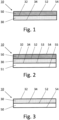
- the first side of the layered adhesive mass 32 and the second side of the layered adhesive mass 34 are also shown schematically.
- a cover layer 50 in the form of a polyester film carrier is arranged on the first side 32 of the layered adhesive 30.
- any other cover layer preferably a plastic film, can also be used as the cover layer.
- the cover layer 50 can advantageously also be a temperature- and media-resistant film, preferably a PET film, a PC film, a COP film or the like.
- the cover layer 50 in this embodiment has a thickness of 100 ⁇ m, but it can also have a different thickness, in particular a thickness of 10 - 200 ⁇ m.
- the cover layer 50 in this embodiment has a silicone coating on the side 54 facing away from the layered adhesive 30.
- any other adhesive-repellent coating, in particular a silicone system, could also be provided.
- the adhesive-repellent coating is advantageously selected so that it has a sufficiently high dehesion to the epoxy resin system. This is advantageous in that the cartridge covering device 10 can be wound up in itself for storage, for example.
- the cover layer 50 is preferably selected such that the autofluorescence is not in the wavelength range used by common fluorescent dyes. In this embodiment, this is not the case, since the autofluorescence of the adhesive and cover layer is in the range of 230 - 450 nm.
- the polyester film carrier 50 in this embodiment has no further coating on the side 52 facing the layered adhesive 30. This is advantageous in this embodiment because the cover layer 50 is intended to remain on the layered adhesive 30.
- the cover layer 50 can therefore serve, for example, as a one-sided protective film for the layered adhesive 30 of the cartridge covering device 10.
- the layered adhesive 30 can be UV-activated to initiate curing and is tacky before and after activation until the end of an open time at room temperature.
- FIG 2 A cartridge covering device 10 is shown schematically, which essentially corresponds to the Figure 1 shown cartridge cover device 10.
- the in Figure 2 The cartridge cover device 10 shown differs from the one shown in Figure 1 cartridge cover device shown.
- an additional cover layer 51 in the form of a PET film is arranged on the second side 34 of the layered adhesive 30.
- any other cover layer can be arranged, preferably in the form of a release film.
- the cover layer 51 in this embodiment has a thickness of 50 ⁇ m, but it can also have a different thickness, in particular a thickness of 2 to 1000 ⁇ m, preferably 5 to 500 ⁇ m and particularly preferably 5 to 100 ⁇ m.
- the cover layer 51 has a silicone coating on the side 53 facing the layered adhesive 30, but it could also have any other adhesive-repellent surface.
- the adhesive-repellent coating is advantageously selected so that it has a sufficiently high dehesion to the epoxy resin system. This may be necessary so that the PET film can be removed before joining it to the microfluidic cartridge.
- the cover layer 51 therefore has the function of a peel-off film.
- cover layer 51 has a silicone coating on the side 55 facing away from the layered adhesive 30.
- the cover layer can also have any other adhesive-repellent surface.
- the silicone coating on the side 55 facing away from the layered adhesive 30 serves for storage purposes and, for example, facilitates the rolling up and unrolling of the cartridge covering device 10 in the event that the latter is to be stored in roll form.
- FIG 3 A cartridge covering device 10 is shown schematically, which comprises a layered adhesive 30, which is the adhesive of Figure 1 corresponds.
- the cartridge cover device according to Figure 3 has a cover layer 51 in the form of a PET film only on the second side 34 of the layered adhesive 30. Structure and properties of the Figure 3
- the cover layer 51 shown correspond to those of the second cover layer of Figure 2 Since the cover layer 51 does not remain in the product, there are no requirements for autofluorescence properties.
- Figure 4 is shown schematically an embodiment of the cartridge covering device 10, which essentially corresponds to the cartridge covering device of Figure 1 corresponds.
- the in Figure 4 The cartridge cover device shown differs from the cartridge cover device according to Figure 1 that the cover layer 50 in the form of a PET film has a silicone coating on the side 52 facing the layered adhesive 30.
- the cover layer 50 can also have any other adhesive-repellent surface.
- the adhesive-repellent coating is advantageously selected so that it has a sufficiently high dehesion, ie it can be removed manually or mechanically without great effort without external damage and without negative functional impairment of the adhesive surface of the epoxy resin system. This may be necessary so that the cover layer 50 can be removed before joining with the microfluidic cartridge.
- the cover layer 50 also has a silicone coating on the side 54 facing away from the layered adhesive 30. This coating can also alternatively be any other adhesive-repellent surface.
- the cartridge covering device 10 according to Figure 4 a removable cover layer 50, 51 on both sides of the adhesive 30.
- a double release liner can be particularly helpful when very high quality demands are placed on the appearance of the product.
- a cartridge cover device 10 is shown schematically, which is joined to a microfluidic cartridge 20.
- the cartridge 20 has recesses on a top side, such as cavities, chambers, channels and the like, which serve to accommodate reagents, such as an in-vitro assay, in order to be able to carry out in-vitro diagnostics.
- the cartridge cover device 10 is arranged on the cartridge 20 in such a way that the recesses in the surface of the cartridge 20 are sealed from the environment.
- a layered adhesive mass 30 is shown schematically, which comprises filler bodies 40 in the form of solid glass spheres.
- the maximum dimension of the filler bodies 40 is smaller than the thickness of the layered adhesive mass 30.
- the filler bodies 40 have, among other things, a beneficial effect on the elastic properties of the layered adhesive mass and on the elastic properties of the cartridge covering device, which in turn leads to an advantageous sealing of the microfluidic cartridge.
- the layered adhesive 30 can alternatively also comprise other fillers 40, such as hollow glass spheres and/or polymer spheres.
- fillers 40 made of other materials can also be used, in particular ceramic fillers or polymer-based fillers.
- the first side of the layered adhesive 32 and the second side of the layered adhesive 34 are also shown schematically.
- the material should not exhibit any fluorescence in the range of the detection wavelengths.
- the seal seam strength should withstand a pressure of 1 bar (equivalent to 0.1 N/mm 2 ) at 100°C.
- the sealing layer that comes into contact with the product should not contain any ingredients that affect the biochemistry of the sample material or the reagents.
- the material should not become brittle and should be flexible (not bendable) after production. It should also not break when disposed of after use so that no substances such as reagents or blood containing pathogens can leak out.
- the material should only show a low water absorption ( ⁇ 10% within the 2-hour process time). The lower the water absorption capacity, the lower the risk that pathogens will attach to or stick to the material or that material properties will change.
- Another optical requirement for the adhesive is that no bubbles should form when the adhesive hardens.
- the microfluidic cartridge is covered in the clean room, which usually has a low humidity of approx. 35-50% rH.
Landscapes
- Chemical & Material Sciences (AREA)
- Organic Chemistry (AREA)
- Health & Medical Sciences (AREA)
- Chemical Kinetics & Catalysis (AREA)
- Medicinal Chemistry (AREA)
- Polymers & Plastics (AREA)
- Clinical Laboratory Science (AREA)
- Analytical Chemistry (AREA)
- Dispersion Chemistry (AREA)
- General Health & Medical Sciences (AREA)
- Hematology (AREA)
- Inorganic Chemistry (AREA)
- Adhesives Or Adhesive Processes (AREA)
- Apparatus Associated With Microorganisms And Enzymes (AREA)
- Laminated Bodies (AREA)
- Lining Or Joining Of Plastics Or The Like (AREA)
- Adhesive Tapes (AREA)
- Physical Or Chemical Processes And Apparatus (AREA)
- Micromachines (AREA)
Applications Claiming Priority (2)
| Application Number | Priority Date | Filing Date | Title |
|---|---|---|---|
| DE102018118581.2A DE102018118581A1 (de) | 2018-07-31 | 2018-07-31 | Kartuschenabdeckvorrichtung zum Versiegeln einer mikrofluidischen Kartusche |
| PCT/EP2019/070622 WO2020025670A1 (de) | 2018-07-31 | 2019-07-31 | Kartuschenabdeckvorrichtung zum versiegeln einer mikrofluidischen kartusche |
Publications (3)
| Publication Number | Publication Date |
|---|---|
| EP3830207A1 EP3830207A1 (de) | 2021-06-09 |
| EP3830207B1 true EP3830207B1 (de) | 2025-02-19 |
| EP3830207C0 EP3830207C0 (de) | 2025-02-19 |
Family
ID=67539496
Family Applications (1)
| Application Number | Title | Priority Date | Filing Date |
|---|---|---|---|
| EP19749308.3A Active EP3830207B1 (de) | 2018-07-31 | 2019-07-31 | System mit einer mikrofluidischen kartusche und einer kartuschenabdeckvorrichtung zum versiegeln der mikrofluidischen kartusche und verfahren zu seiner herstellung |
Country Status (7)
| Country | Link |
|---|---|
| US (1) | US20210317349A1 (https=) |
| EP (1) | EP3830207B1 (https=) |
| JP (1) | JP7347741B2 (https=) |
| KR (1) | KR20210040104A (https=) |
| CN (1) | CN112513213A (https=) |
| DE (1) | DE102018118581A1 (https=) |
| WO (1) | WO2020025670A1 (https=) |
Families Citing this family (1)
| Publication number | Priority date | Publication date | Assignee | Title |
|---|---|---|---|---|
| DE102021210723A1 (de) | 2021-09-27 | 2023-03-30 | Robert Bosch Gesellschaft mit beschränkter Haftung | Vorrichtung, insbesondere mikrofluidische Vorrichtung, mit einer Siegelfolie und Verfahren zur Herstellung |
Family Cites Families (20)
| Publication number | Priority date | Publication date | Assignee | Title |
|---|---|---|---|---|
| US7053133B2 (en) * | 2001-05-29 | 2006-05-30 | Hiroaki Yamaguchi | Ultraviolet activatable adhesive film |
| US6663235B2 (en) * | 2001-10-31 | 2003-12-16 | Hewlett-Packard Development Company, L.P. | Coverlayer based on functional polymers |
| US20050256230A1 (en) * | 2002-04-01 | 2005-11-17 | Hiroaki Yamaguchi | Cationic polymerizable adhesive composition and anisotropically electroconductive adhesive composition |
| US20060011305A1 (en) * | 2003-09-19 | 2006-01-19 | Donald Sandell | Automated seal applicator |
| JP4595457B2 (ja) | 2004-09-14 | 2010-12-08 | Dic株式会社 | ポリメラーゼ連鎖反応用流路を有するマイクロ流体デバイス |
| US7540584B2 (en) * | 2005-03-31 | 2009-06-02 | Lexmark International, Inc. | Orifice plate protection device |
| US20070213429A1 (en) * | 2006-03-10 | 2007-09-13 | Chih-Min Cheng | Anisotropic conductive adhesive |
| JP2007322265A (ja) | 2006-06-01 | 2007-12-13 | Kawamura Inst Of Chem Res | 多孔質体の固着方法 |
| WO2011026136A1 (en) * | 2009-08-31 | 2011-03-03 | Life Technologies Corporation | Low-volume sequencing system and method of use |
| JP5644896B2 (ja) * | 2012-07-04 | 2014-12-24 | 大日本印刷株式会社 | 粘接着層及び粘接着シート |
| KR20150067219A (ko) * | 2012-09-29 | 2015-06-17 | 쓰리엠 이노베이티브 프로퍼티즈 컴파니 | 접착제 조성물 및 접착 테이프 |
| JP6033959B2 (ja) * | 2013-01-09 | 2016-11-30 | テカン・トレーディング・アクチェンゲゼルシャフトTECAN Trading AG | マイクロ流体システム用使い捨てカートリッジ |
| US10391485B2 (en) * | 2013-09-25 | 2019-08-27 | Arizona Board Of Regents, A Body Corporate Of The State Of Arizona, Acting For And On Behalf Of Arizona State University | Microfluidic electrocage device and cell medium for trapping and rotating cells for live-cell computed tomography (CT) |
| TWI564975B (zh) * | 2014-04-09 | 2017-01-01 | 精材科技股份有限公司 | 晶片封裝體及其製造方法 |
| KR101712703B1 (ko) * | 2014-07-18 | 2017-03-06 | 삼성에스디아이 주식회사 | 접착 조성물, 이방 도전성 필름 및 이를 이용한 반도체 장치 |
| TWI730984B (zh) * | 2015-09-18 | 2021-06-21 | 德商漢高智慧財產控股公司 | 可固化且光學透明之壓敏黏著劑及其用途 |
| EP3397711B1 (en) * | 2015-12-30 | 2023-02-15 | 3M Innovative Properties Company | Dual stage structural bonding adhesive |
| US10659000B2 (en) * | 2016-03-25 | 2020-05-19 | Qorvo Biotechnologies, Llc | Fluidic sensor device having UV-blocking cover |
| MX2018011923A (es) * | 2016-04-04 | 2019-01-10 | Tesa Se | Cinta adhesiva sensible a la presion activable por radiacion que tiene reaccion oscura y uso de la misma. |
| DE102017001696A1 (de) * | 2017-02-22 | 2018-08-23 | Lohmann Gmbh & Co. Kg | UV-aktivierbares strukturelles Haftklebeband |
-
2018
- 2018-07-31 DE DE102018118581.2A patent/DE102018118581A1/de not_active Ceased
-
2019
- 2019-07-31 EP EP19749308.3A patent/EP3830207B1/de active Active
- 2019-07-31 JP JP2021505746A patent/JP7347741B2/ja active Active
- 2019-07-31 CN CN201980050746.4A patent/CN112513213A/zh active Pending
- 2019-07-31 WO PCT/EP2019/070622 patent/WO2020025670A1/de not_active Ceased
- 2019-07-31 US US17/264,454 patent/US20210317349A1/en not_active Abandoned
- 2019-07-31 KR KR1020217006034A patent/KR20210040104A/ko not_active Ceased
Non-Patent Citations (1)
| Title |
|---|
| KOSSE D.: "Microthermoforming and Sealing of COP Films to Form Thin Walled Lab-on-a-chip Cartridges", PROCEEDINGS OF THE 8TH INTERNATIONAL CONFERENCE ON MULTI-MATERIAL MICRO MANUFACTURE, 1 January 2011 (2011-01-01), pages 1 - 4, XP093221615 * |
Also Published As
| Publication number | Publication date |
|---|---|
| WO2020025670A1 (de) | 2020-02-06 |
| US20210317349A1 (en) | 2021-10-14 |
| DE102018118581A1 (de) | 2020-02-06 |
| CN112513213A (zh) | 2021-03-16 |
| KR20210040104A (ko) | 2021-04-12 |
| JP7347741B2 (ja) | 2023-09-20 |
| JP2021533228A (ja) | 2021-12-02 |
| EP3830207A1 (de) | 2021-06-09 |
| EP3830207C0 (de) | 2025-02-19 |
Similar Documents
| Publication | Publication Date | Title |
|---|---|---|
| DE102009039029B4 (de) | Verfahren zum Fügen von mindestens zwei Bauteilen unter Verwendung einer dualhärtenden Klebstoffzusammensetzung | |
| EP3137566B1 (de) | Verfahren zur herstellung einer verklebung auf permeat sensiblen oberflächen | |
| EP3137568B1 (de) | Spaltbares klebeband mit dosierfähigen spaltbaren flüssigklebstoff | |
| WO2018153985A1 (de) | Wickel- und stanzbarer klebender film | |
| EP3830207B1 (de) | System mit einer mikrofluidischen kartusche und einer kartuschenabdeckvorrichtung zum versiegeln der mikrofluidischen kartusche und verfahren zu seiner herstellung | |
| EP3994227A1 (de) | Komprimierbarer, uv- oder thermisch aktivierbarer (semi-) struktureller klebefilm mit farbumschlag jeweils nach aktivierung und aushärtung | |
| DE10056908A1 (de) | Verfahren zum Verbinden von Kunststoffteilen | |
| EP2985327B1 (de) | Verfahren und Vorrichtung zur Herstellung einer Haftklebeschicht | |
| WO2020119898A1 (de) | Wickel- und stanzbarer klebender film | |
| EP3788112B1 (de) | Wickel- und stanzbares klebeband zur selektiven uv-aktivierung | |
| EP3186328B1 (de) | Wasserresistente haftklebemasse zur verklebung auf feuchten oberflächen, insbesondere in automobilanwendungen | |
| DE102022110643A1 (de) | Thermisch aktivierbares Expansionselement, Verwendung desselben sowie Fügeteil und Verbundbauteil umfassend das thermisch aktivierbare Expansionselement | |
| WO2022175361A1 (de) | Mikrofluidisches system aus einer gefalteten folie und herstellungsverfahren | |
| DE10248382B4 (de) | Verfahren zum Laminieren von Folien und Folienanordnung | |
| EP3931280B1 (de) | Klebeband, umfassend mindestens zwei voneinander verschiedene klebemassen, welche durch eine barriereschicht voneinander getrennt sind | |
| DE102021006273B4 (de) | Indikatormischung | |
| DE9405515U1 (de) | Verklebter Formkörper aus thermoplastisch verarbeitbarem (extrudierbarem) Polymethylmethacrylat mit Klebfugen, deren Ränder mit Klebwülsten aus PMMA überdeckt sind | |
| WO2021037380A1 (de) | Klebeband mit einem strukturellen klebefilm mit definierten strukturen | |
| DE102011081873A1 (de) | Siegellack | |
| WO2019081387A1 (de) | Dimensionsstabile klebebänder | |
| DD258778A1 (de) | Verfahren zur herstellung von verbunden |
Legal Events
| Date | Code | Title | Description |
|---|---|---|---|
| STAA | Information on the status of an ep patent application or granted ep patent |
Free format text: STATUS: UNKNOWN |
|
| STAA | Information on the status of an ep patent application or granted ep patent |
Free format text: STATUS: THE INTERNATIONAL PUBLICATION HAS BEEN MADE |
|
| PUAI | Public reference made under article 153(3) epc to a published international application that has entered the european phase |
Free format text: ORIGINAL CODE: 0009012 |
|
| STAA | Information on the status of an ep patent application or granted ep patent |
Free format text: STATUS: REQUEST FOR EXAMINATION WAS MADE |
|
| 17P | Request for examination filed |
Effective date: 20210225 |
|
| AK | Designated contracting states |
Kind code of ref document: A1 Designated state(s): AL AT BE BG CH CY CZ DE DK EE ES FI FR GB GR HR HU IE IS IT LI LT LU LV MC MK MT NL NO PL PT RO RS SE SI SK SM TR |
|
| DAV | Request for validation of the european patent (deleted) | ||
| DAX | Request for extension of the european patent (deleted) | ||
| STAA | Information on the status of an ep patent application or granted ep patent |
Free format text: STATUS: EXAMINATION IS IN PROGRESS |
|
| 17Q | First examination report despatched |
Effective date: 20220805 |
|
| GRAP | Despatch of communication of intention to grant a patent |
Free format text: ORIGINAL CODE: EPIDOSNIGR1 |
|
| STAA | Information on the status of an ep patent application or granted ep patent |
Free format text: STATUS: GRANT OF PATENT IS INTENDED |
|
| INTG | Intention to grant announced |
Effective date: 20241127 |
|
| GRAS | Grant fee paid |
Free format text: ORIGINAL CODE: EPIDOSNIGR3 |
|
| GRAA | (expected) grant |
Free format text: ORIGINAL CODE: 0009210 |
|
| STAA | Information on the status of an ep patent application or granted ep patent |
Free format text: STATUS: THE PATENT HAS BEEN GRANTED |
|
| AK | Designated contracting states |
Kind code of ref document: B1 Designated state(s): AL AT BE BG CH CY CZ DE DK EE ES FI FR GB GR HR HU IE IS IT LI LT LU LV MC MK MT NL NO PL PT RO RS SE SI SK SM TR |
|
| REG | Reference to a national code |
Ref country code: GB Ref legal event code: FG4D Free format text: NOT ENGLISH |
|
| REG | Reference to a national code |
Ref country code: CH Ref legal event code: EP |
|
| REG | Reference to a national code |
Ref country code: DE Ref legal event code: R096 Ref document number: 502019012960 Country of ref document: DE |
|
| REG | Reference to a national code |
Ref country code: IE Ref legal event code: FG4D Free format text: LANGUAGE OF EP DOCUMENT: GERMAN |
|
| U01 | Request for unitary effect filed |
Effective date: 20250226 |
|
| U07 | Unitary effect registered |
Designated state(s): AT BE BG DE DK EE FI FR IT LT LU LV MT NL PT RO SE SI Effective date: 20250307 |
|
| PG25 | Lapsed in a contracting state [announced via postgrant information from national office to epo] |
Ref country code: RS Free format text: LAPSE BECAUSE OF FAILURE TO SUBMIT A TRANSLATION OF THE DESCRIPTION OR TO PAY THE FEE WITHIN THE PRESCRIBED TIME-LIMIT Effective date: 20250519 |
|
| PG25 | Lapsed in a contracting state [announced via postgrant information from national office to epo] |
Ref country code: PL Free format text: LAPSE BECAUSE OF FAILURE TO SUBMIT A TRANSLATION OF THE DESCRIPTION OR TO PAY THE FEE WITHIN THE PRESCRIBED TIME-LIMIT Effective date: 20250219 |
|
| PG25 | Lapsed in a contracting state [announced via postgrant information from national office to epo] |
Ref country code: ES Free format text: LAPSE BECAUSE OF FAILURE TO SUBMIT A TRANSLATION OF THE DESCRIPTION OR TO PAY THE FEE WITHIN THE PRESCRIBED TIME-LIMIT Effective date: 20250219 |
|
| PG25 | Lapsed in a contracting state [announced via postgrant information from national office to epo] |
Ref country code: IS Free format text: LAPSE BECAUSE OF FAILURE TO SUBMIT A TRANSLATION OF THE DESCRIPTION OR TO PAY THE FEE WITHIN THE PRESCRIBED TIME-LIMIT Effective date: 20250619 Ref country code: NO Free format text: LAPSE BECAUSE OF FAILURE TO SUBMIT A TRANSLATION OF THE DESCRIPTION OR TO PAY THE FEE WITHIN THE PRESCRIBED TIME-LIMIT Effective date: 20250519 |
|
| PG25 | Lapsed in a contracting state [announced via postgrant information from national office to epo] |
Ref country code: HR Free format text: LAPSE BECAUSE OF FAILURE TO SUBMIT A TRANSLATION OF THE DESCRIPTION OR TO PAY THE FEE WITHIN THE PRESCRIBED TIME-LIMIT Effective date: 20250219 |
|
| PG25 | Lapsed in a contracting state [announced via postgrant information from national office to epo] |
Ref country code: GR Free format text: LAPSE BECAUSE OF FAILURE TO SUBMIT A TRANSLATION OF THE DESCRIPTION OR TO PAY THE FEE WITHIN THE PRESCRIBED TIME-LIMIT Effective date: 20250520 |
|
| U20 | Renewal fee for the european patent with unitary effect paid |
Year of fee payment: 7 Effective date: 20250728 |
|
| PG25 | Lapsed in a contracting state [announced via postgrant information from national office to epo] |
Ref country code: SM Free format text: LAPSE BECAUSE OF FAILURE TO SUBMIT A TRANSLATION OF THE DESCRIPTION OR TO PAY THE FEE WITHIN THE PRESCRIBED TIME-LIMIT Effective date: 20250219 |
|
| PGFP | Annual fee paid to national office [announced via postgrant information from national office to epo] |
Ref country code: GB Payment date: 20250722 Year of fee payment: 7 |
|
| PGFP | Annual fee paid to national office [announced via postgrant information from national office to epo] |
Ref country code: CH Payment date: 20250801 Year of fee payment: 7 |
|
| PG25 | Lapsed in a contracting state [announced via postgrant information from national office to epo] |
Ref country code: CZ Free format text: LAPSE BECAUSE OF FAILURE TO SUBMIT A TRANSLATION OF THE DESCRIPTION OR TO PAY THE FEE WITHIN THE PRESCRIBED TIME-LIMIT Effective date: 20250219 |
|
| PGFP | Annual fee paid to national office [announced via postgrant information from national office to epo] |
Ref country code: IE Payment date: 20250723 Year of fee payment: 7 |
|
| PG25 | Lapsed in a contracting state [announced via postgrant information from national office to epo] |
Ref country code: SK Free format text: LAPSE BECAUSE OF FAILURE TO SUBMIT A TRANSLATION OF THE DESCRIPTION OR TO PAY THE FEE WITHIN THE PRESCRIBED TIME-LIMIT Effective date: 20250219 |
|
| PLBE | No opposition filed within time limit |
Free format text: ORIGINAL CODE: 0009261 |
|
| STAA | Information on the status of an ep patent application or granted ep patent |
Free format text: STATUS: NO OPPOSITION FILED WITHIN TIME LIMIT |
|
| 26N | No opposition filed |
Effective date: 20251120 |