EP3828613B1 - Zoomobjektiv und bildaufnahmevorrichtung damit - Google Patents
Zoomobjektiv und bildaufnahmevorrichtung damit Download PDFInfo
- Publication number
- EP3828613B1 EP3828613B1 EP20205618.0A EP20205618A EP3828613B1 EP 3828613 B1 EP3828613 B1 EP 3828613B1 EP 20205618 A EP20205618 A EP 20205618A EP 3828613 B1 EP3828613 B1 EP 3828613B1
- Authority
- EP
- European Patent Office
- Prior art keywords
- lens
- lens unit
- refractive power
- zoom
- zoom lens
- Prior art date
- Legal status (The legal status is an assumption and is not a legal conclusion. Google has not performed a legal analysis and makes no representation as to the accuracy of the status listed.)
- Active
Links
Images








Classifications
-
- G—PHYSICS
- G02—OPTICS
- G02B—OPTICAL ELEMENTS, SYSTEMS OR APPARATUS
- G02B15/00—Optical objectives with means for varying the magnification
- G02B15/14—Optical objectives with means for varying the magnification by axial movement of one or more lenses or groups of lenses relative to the image plane for continuously varying the equivalent focal length of the objective
- G02B15/144—Optical objectives with means for varying the magnification by axial movement of one or more lenses or groups of lenses relative to the image plane for continuously varying the equivalent focal length of the objective having four groups only
- G02B15/1445—Optical objectives with means for varying the magnification by axial movement of one or more lenses or groups of lenses relative to the image plane for continuously varying the equivalent focal length of the objective having four groups only the first group being negative
- G02B15/144511—Optical objectives with means for varying the magnification by axial movement of one or more lenses or groups of lenses relative to the image plane for continuously varying the equivalent focal length of the objective having four groups only the first group being negative arranged -+-+
-
- G—PHYSICS
- G02—OPTICS
- G02B—OPTICAL ELEMENTS, SYSTEMS OR APPARATUS
- G02B15/00—Optical objectives with means for varying the magnification
- G02B15/14—Optical objectives with means for varying the magnification by axial movement of one or more lenses or groups of lenses relative to the image plane for continuously varying the equivalent focal length of the objective
- G02B15/143—Optical objectives with means for varying the magnification by axial movement of one or more lenses or groups of lenses relative to the image plane for continuously varying the equivalent focal length of the objective having three groups only
- G02B15/1435—Optical objectives with means for varying the magnification by axial movement of one or more lenses or groups of lenses relative to the image plane for continuously varying the equivalent focal length of the objective having three groups only the first group being negative
- G02B15/143503—Optical objectives with means for varying the magnification by axial movement of one or more lenses or groups of lenses relative to the image plane for continuously varying the equivalent focal length of the objective having three groups only the first group being negative arranged -+-
-
- G—PHYSICS
- G02—OPTICS
- G02B—OPTICAL ELEMENTS, SYSTEMS OR APPARATUS
- G02B15/00—Optical objectives with means for varying the magnification
- G02B15/14—Optical objectives with means for varying the magnification by axial movement of one or more lenses or groups of lenses relative to the image plane for continuously varying the equivalent focal length of the objective
- G02B15/16—Optical objectives with means for varying the magnification by axial movement of one or more lenses or groups of lenses relative to the image plane for continuously varying the equivalent focal length of the objective with interdependent non-linearly related movements between one lens or lens group, and another lens or lens group
- G02B15/177—Optical objectives with means for varying the magnification by axial movement of one or more lenses or groups of lenses relative to the image plane for continuously varying the equivalent focal length of the objective with interdependent non-linearly related movements between one lens or lens group, and another lens or lens group having a negative front lens or group of lenses
-
- G—PHYSICS
- G02—OPTICS
- G02B—OPTICAL ELEMENTS, SYSTEMS OR APPARATUS
- G02B13/00—Optical objectives specially designed for the purposes specified below
- G02B13/18—Optical objectives specially designed for the purposes specified below with lenses having one or more non-spherical faces, e.g. for reducing geometrical aberration
-
- G—PHYSICS
- G02—OPTICS
- G02B—OPTICAL ELEMENTS, SYSTEMS OR APPARATUS
- G02B15/00—Optical objectives with means for varying the magnification
- G02B15/14—Optical objectives with means for varying the magnification by axial movement of one or more lenses or groups of lenses relative to the image plane for continuously varying the equivalent focal length of the objective
- G02B15/144—Optical objectives with means for varying the magnification by axial movement of one or more lenses or groups of lenses relative to the image plane for continuously varying the equivalent focal length of the objective having four groups only
- G02B15/1445—Optical objectives with means for varying the magnification by axial movement of one or more lenses or groups of lenses relative to the image plane for continuously varying the equivalent focal length of the objective having four groups only the first group being negative
- G02B15/144503—Optical objectives with means for varying the magnification by axial movement of one or more lenses or groups of lenses relative to the image plane for continuously varying the equivalent focal length of the objective having four groups only the first group being negative arranged -+--
Definitions
- the present invention relates to a zoom lens suitable for image capturing apparatus, such as a digital video camera, a digital still camera, a camera for broadcast, a camera for silver-halide film, and a monitoring camera.
- a zoom lens suitable for image capturing apparatus such as a digital video camera, a digital still camera, a camera for broadcast, a camera for silver-halide film, and a monitoring camera.
- a negative-lead zoom lens in which a lens unit having negative refractive power is disposed at a position closest to the object has been known.
- Japanese Patent Laid-Open No. 2014-178388 discusses a negative-lead zoom lens including a first lens unit having negative refractive power, a second lens unit having positive refractive power, and a subsequent lens unit.
- N-lead zoom lens is known from Japanese Patent Laid-Open No. 2005-275280 .
- the present invention is directed to a zoom lens having excellent optical performance and weight reduction.
- the present invention in its first aspect provides a zoom lens as specified in claims 1 to 10.
- the present invention in its second aspect provides an image capturing apparatus as specified in claim 11.
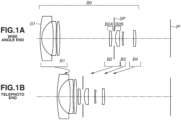
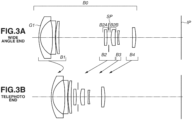
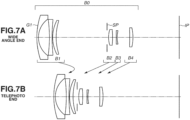
- Figs. 1A and 1B , Figs. 3A and 3B , Figs. 5A and 5B , Figs. 7A and 7B , Figs. 9A and 9B , Figs. 11A and 11B , Figs. 13A and 13B , and Figs. 15A and 15B are cross-sectional views of zoom lenses B0 of first, second, third, fourth, fifth, sixth, seventh, and eighth exemplary embodiments according to the present invention, respectively.
- FIG. 15A are cross-sectional views at a wide angle end
- Fig. 1B , Fig. 3B , Fig. 5B , Fig. 7B , Fig. 9B , Fig. 11B , Fig. 13B , and Fig. 15B are cross-sectional views at a telephoto end.
- the zoom lens B0 is used for image capturing apparatuses, such as a digital still camera, a video camera, a silver-halide film camera, a camera for broadcast, and a projection apparatus, such as a projector.
- image capturing apparatuses such as a digital still camera, a video camera, a silver-halide film camera, a camera for broadcast
- projection apparatus such as a projector.
- the left side is the object side (the enlargement side) and the right side is the image side (the reduction side).
- lens unit in the present disclosure is a component of the zoom lens B0 and includes one or a plurality of lenses.
- the lenses in each of the lens units integrally move or remain in place during at least one of zooming and focusing, and the distance between the lens units adjacent to each other changes during at least one of zooming and focusing.
- optical members such as a prism, a cover glass, and a filter
- the optical members are not described as a part of the zoom lens.
- An aperture stop SP determines (limits) the amount of light at a full aperture of F-number (Fno).
- An imaging plane IP is an image place where an image sensor (a photoelectric conversion element), such as a charge coupled device (CCD) sensor and a complementary metal oxide semiconductor (CMOS) sensor, is disposed in a case where the zoom lens B0 according to each of the exemplary embodiments is used as an image-capturing optical system of a video camera or a digital still camera. In a case where the zoom lens B0 according to each of the exemplary embodiments is used as an image-capturing optical system of a silver-halide camera, the photosensitive surface of a film is disposed at the imaging plane IP.
- a photoelectric conversion element such as a charge coupled device (CCD) sensor and a complementary metal oxide semiconductor (CMOS) sensor
- Arrows illustrated in each of the lens cross-sectional views each represent a simplified movement locus of each of the lens units in zooming from the wide angle end to the telephoto end.
- Each of the wide angle end and the telephoto end in the present disclosure refers to a zoom position of a state where each of the lens units is at an end of a corresponding mechanically movable range.
- the zoom lens B0 includes a first lens unit B1 having negative refractive power, a second lens unit B2 having positive refractive power, and a third lens unit B3 having negative refractive power, in order from the object side to the image side. Effects of the present invention can also be effectively achieved even in a case where the zoom lens B0 further includes another lens unit on the image side of the third lens unit B3.
- the first lens unit B1 moves during zooming.
- the first lens unit B1 includes a negative lens G1 (first negative lens G1) at a position closest to the object and at least one positive lens.
- lenses included in the second lens unit B2 all have positive refractive power.
- the second lens unit B2 consists only of one or more positive lenses.
- the number of lenses included in the third lens unit B3 is two or less, and the third lens unit B3 moves toward the image side during focusing from infinity to close range.
- the zoom lens B0 may have a function as an anti-vibration optical system by decentering one or a plurality of lenses in a direction including a component perpendicular to an optical axis in image blurring correction.
- a parallel plate substantially having no refractive power for example, a low-pass filter and an infrared cut filter, may be disposed between the lens disposed closest to the object side and the imaging plane IP.
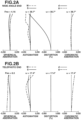
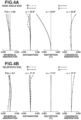
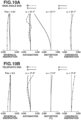
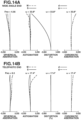
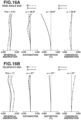
- Figs. 2A and 2B , Figs. 4A and 4B , Figs. 6A and 6B , Figs. 8A and 8B , Figs. 10A and 10B , Figs. 12A and 12B , Figs. 14A and 14B , and Figs. 16A and 16B are aberration diagrams each illustrating the zoom lens B0, and correspond to the first, second, third, fourth, fifth, sixth, seventh, and eighth exemplary embodiments, respectively.
- FIG. 16A each illustrate aberration in an infinity in-focus state at the wide angle end
- Fig. 2B , Fig. 4B , Fig. 6B , Fig. 8B , Fig. 10B , Fig. 12B , Fig. 14B , and Fig. 16B each illustrate aberration in an infinity in-focus state at the telephoto end.
- a spherical aberration diagram illustrates a d-line (a wavelength of 587.6 nm) and a g-line (a wavelength of 435.8 nm).
- a line S and a dotted line M in an astigmatism diagram represent the d-line at a sagittal image plane and the d-line at a meridional image plane, respectively.
- a distortion diagram illustrates the d-line.
- a chromatic aberration diagram illustrates a magnification chromatic aberration amount of the g-line with respect to the d-line.
- the zoom lens B0 is a negative-lead zoom lens.
- the third lens unit B3 which has negative refractive power and of which diameter is easily reducible is configured to move during focusing, and therefore it is possible to achieve weight reduction of not only a focus lens unit, but also a holding mechanism for holding the focus lens unit as well as a drive mechanism for driving the focus lens unit.
- the third lens unit B3 includes two lenses or less, and therefore the weight is further reduced.
- the first lens unit B 1 includes the negative lens G1 at a position closest to the object. This is because, in a negative-lead zoom lens, the diameter of a lens closest to the object can be reduced by using a negative lens as the lens closest to the object.
- the first lens unit B 1 further includes at least one positive lens. The chromatic aberration of the first lens unit B 1 is thereby successfully corrected.
- the first lens unit B 1 is the lens unit that moves during zooming, variations in magnification chromatic aberration and axial chromatic aberration that occur during zooming can be reduced by the above-describe configuration.
- the second lens unit B2 consists only of one or more positive lenses.
- the second lens unit B2 functions as a main magnifying unit in the zoom lens B0 according to each of the exemplary embodiments, and thus it is desirable to provide strong positive refractive power to the second lens unit B2. If a negative lens is added to the second lens unit B2, the refractive power of the positive lens in the second lens unit B2 is required to be increased as much as the negative refractive power of the added negative lens. This increases the thickness of the second lens unit B2, and consequently weight reduction of the zoom lens B0 is difficult to achieve.
- the zoom lens B0 satisfies the following inequality (1): 1.40 ⁇ Nd _ G 1 ⁇ 1.80 where, Nd_G1 is a refractive index in the d-line of the negative lens G1.
- the inequality (1) defines the refractive index of the negative lens G1.
- the refractive index exceeds the upper limit of the inequality (1), it is difficult to obtain a material having low specific gravity, i.e., a material advantageous to weight reduction of the zoom lens B0.
- the refractive index falls below the lower limit of the inequality (1), the volume of the negative lens G1 increases when sufficient refractive power is provided to the negative lens G1, and consequently the weight reduction is difficult to achieve, which is not desirable.
- the curvature radius of the negative lens G1 on the image plane side is too small, and consequently it is difficult to successfully reduce or suppress occurrence of the field curvature and the astigmatism at the wide angle end in particular.
- the optical system in each of the exemplary embodiments achieves excellent optical performance while being light in weight.
- the zoom lens B0 according to each of the exemplary embodiments to satisfy one or more of the following inequalities (2) to (6): 5.0 ⁇ SF _ B 3 n ⁇ 0.50 1.0 ⁇ f 1 / fw ⁇ 3.0 0.2 ⁇ f 2 / fw ⁇ 5.0 0.1 ⁇ f 3 / f 1 ⁇ 5.0 and 18 ⁇ ⁇ d _ B 3 n ⁇ 36
- SF_B3n is a shape factor SF of the negative lens having the strongest refractive power among the negative lenses included in the third lens unit B3 (in a case where the third lens unit B3 consists of one negative lens, the shape factor SF is for the one negative lens).
- fw is a focal length of the zoom lens B0 at the wide angle end
- f1 is a focal length of the first lens unit B 1
- f2 is a focal length of the second lens unit B2
- f3 is a focal length of the third lens unit B3
- vd_B3n is an Abbe number in the d-line of the negative lens having the strongest refractive power among the negative lenses included in the third lens unit B3 (in a case where the third lens unit B3 consists of one negative lens, the Abbe number is for the one negative lens).
- the inequality (2) defines the shape of the negative lens having the strongest refractive power among the negative lenses included in the third lens unit B3.
- the value falls below the lower limit of the inequality (2), it is difficult to successfully reduce or suppress a variation in the field curvature that occurs in focusing at the wide angle end, which is not desirable.
- the value exceeds the upper limit of the inequality (2), it is difficult to successfully reduce or suppress a variation in the spherical aberration that occurs in focusing at the telephoto end, which is not desirable.
- the inequality (3) defines the ratio between the focal length of the first lens unit B1 and the entire system focal length at the wide angle end.
- the refractive power of the first lens unit B1 is too strong, and consequently it is difficult to successfully reduce or suppress the field curvature and the astigmatic difference occurring at the wide angle end.
- the refractive power of the first lens unit B1 is too weak, and consequently the front diameter (the diameter of the lens closest to the object) is too large. As a result, it is difficult to sufficiently reduce the weight of the zoom lens B0.
- the inequality (4) defines the ratio between the focal length of the second lens unit B2 and the entire system focal length at the wide angle end.
- the refractive power of the second lens unit B2 is too strong, and consequently it is difficult to successfully reduce or suppress variations in the spherical aberration and the comatic aberration occurring from the wide angle end to the telephoto end.
- the refractive power of the second lens unit B2 is too weak, and consequently a movement amount of the second lens unit that is required for a desirable zoom ratio is too large. As a result, it is difficult to sufficiently reduce the weight of the zoom lens B0.
- the inequality (5) defines the ratio between the focal length of the third lens unit B3 and the focal length of the first lens unit B1.
- the refractive power of the third lens unit B3 is too weak, and consequently the movement amount during focusing increases.
- the increase in the movement amount enlarges the drive mechanism, and consequently it is difficult to sufficiently reduce the weight.
- the refractive power of the third lens unit B3 is too strong, and consequently it is difficult to reduce a change in the optical performance during focusing to a sufficiently small amount.
- the inequality (6) defines the Abbe number of the negative lens having the strongest refractive power among the negative lenses included in the third lens unit B3.
- the Abbe number is large to the extent that the Abbe number exceeds the upper limit of the inequality (6), the correction of the chromatic aberration in the entire zoom lens B0 is insufficient, and consequently high optical performance is insufficiently achieved.
- the Abbe number is small to the extent that the Abbe number falls below the lower limit of the inequality (6), the correction of the chromatic aberration in the entire zoom lens B0 is excessive, and consequently high optical performance is insufficiently achieved.
- the zoom lens B0 prefferably configured in such a manner that the number of the included lenses from the lens closest to the object in the second lens unit B2 to the lens closest to the image in the zoom lens B0 be five or less.
- This number of lenses includes the lens closest to the object in the second lens unit B2 and the lens closest to the image in the zoom lens B0.
- the number of lenses included in the second lens unit B2 be two or less. This also facilitates weight reduction while the zoom lens B0 has desirable optical performance.
- the third lens unit B3 to consist of a single lens having negative refractive power. This also facilitates weight reduction while the zoom lens B0 has desirable optical performance.
- the first lens unit B 1 it is desirable for the first lens unit B 1 to include a lens having an aspherical surface (an aspherical lens). Having the aspherical lens reduces or suppresses the field curvature and the astigmatic difference occurring at the wide angle end. Further, it is desirable that the aspherical lens included in the first lens unit B 1 be a lens made of resin (a resin lens) because this facilitates the weight reduction.
- the zoom lens B0 it is desirable to correct camera shake by displacing a part or the whole of the second lens unit B2 in a direction substantially perpendicular to the optical axis.
- the focus lens unit is one lens unit, a plurality of lens units may be used as a focus unit. Such a focusing system is called floating.
- a refractive optical element a lens
- a diffractive optical element may also be used.
- an optical path may be bent using a reflection optical member.
- the zoom lens B0 includes the first lens unit B 1 having negative refractive power, the second lens unit B2 having positive refractive power, the third lens unit B3 having negative refractive power, and a fourth lens unit B4 having positive refractive power.
- the first lens unit B 1 moves toward the image side, and the second lens unit B2 to the fourth lens unit B4 move toward the object side.
- the distance between the first lens unit B 1 and the second lens unit B2 decreases, the distance between the second lens unit B2 and the third lens unit B3 increases, and the distance between the third lens unit B3 and the fourth lens unit B4 decreases.
- the second lens unit B2 and the fourth lens unit B4 move in the identical loci during zooming.
- the third lens unit B3 is the focus lens unit, and moves from the object side toward the image side during focusing from an infinity object to a close object.
- Image blurring (an image position) is corrected by moving the part of the second lens unit B2 (the fourth lens, a sub-unit B2A) on the object side in a direction including a component substantially perpendicular to the optical axis.
- the zoom lens B0 includes the first lens unit B1 having negative refractive power, the second lens unit B2 having positive refractive power, the third lens unit B3 having negative refractive power, and the fourth lens unit B4 having positive refractive power.
- the first lens unit B1 moves toward the image side, and the second lens unit B2 to the fourth lens unit B4 move toward the object side.
- the distance between the first lens unit B1 and the second lens unit B2 decreases, the distance between the second lens unit B2 and the third lens unit B3 increases, and the distance between the third lens unit B3 and the fourth lens unit B4 decreases.
- the second lens unit B2 and the fourth lens unit B4 move in the identical loci during zooming.
- the third lens unit B3 is the focus lens unit, and moves from the object side toward the image side during focusing from the infinity object to the close object.
- Image blurring (the image position) is corrected by moving the part of the second lens unit B2 (the fourth lens, the sub-unit B2A) on the object side in a direction including a component substantially perpendicular to the optical axis.
- the zoom lens B0 includes the first lens unit B1 having negative refractive power, the second lens unit B2 having positive refractive power, the third lens unit B3 having negative refractive power, and the fourth lens unit B4 having positive refractive power.
- the first lens unit B1 moves toward the image side, and the second lens unit B2, the third lens unit B3, and the fourth lens unit B4 move in the identical loci toward the object side. In this operation, the distance between the first lens unit B1 and the second lens unit B2 decreases.
- the third lens unit B3 is the focus lens unit, and moves from the object side toward the image side during focusing from the infinity object to the close object.
- Image blurring (the image position) is corrected by moving the part of the second lens unit B2 (the fourth lens, the sub-unit B2A) on the object side in a direction including a component substantially perpendicular to the optical axis.
- the zoom lens B0 includes the first lens unit B1 having negative refractive power, the second lens unit B2 having positive refractive power, the third lens unit B3 having negative refractive power, and the fourth lens unit B4 having positive refractive power.
- the first lens unit B1 moves toward the image side, and the second lens unit B2 to the fourth lens unit B4 move toward the object side.
- the distance between the first lens unit B1 and the second lens unit B2 decreases, the distance between the second lens unit B2 and the third lens unit B3 increases, and the distance between the third lens unit B3 and the fourth lens unit B4 decreases.
- the second lens unit B2 and the fourth lens unit B4 move in the identical loci during zooming.
- the third lens unit B3 is the focus lens unit and moves from the object side toward the image side during focusing from the infinity object to the close object.
- Image blurring (the image position) is corrected by moving the second lens unit B2 in a direction including a component substantially perpendicular to the optical axis.
- the zoom lens B0 includes the first lens unit B1 having negative refractive power, the second lens unit B2 having positive refractive power, the third lens unit B3 having negative refractive power, and the fourth lens unit B4 having negative refractive power.
- the first lens unit B1 moves toward the image side, and the second lens unit B2 to the fourth lens unit B4 move toward the object side.
- the distance between the first lens unit B1 and the second lens unit B2 decreases, the distance between the second lens unit B2 and the third lens unit B3 increases, and the distance between the third lens unit B3 and the fourth lens unit B4 decreases.
- the second lens unit B2 and the fourth lens unit B4 move in the identical loci during zooming.
- the third lens unit B3 is the focus lens unit, and moves from the object side toward the image side during focusing from the infinity object to the close object.
- Image blurring (the image position) is corrected by moving the part of the second lens unit B2 (the fourth lens, the sub-unit B2A) on the object side in a direction including a component substantially perpendicular to the optical axis.
- the zoom lens B0 includes the first lens unit B1 having negative refractive power, the second lens unit B2 having positive refractive power, the third lens unit B3 having negative refractive power, and the fourth lens unit B4 having positive refractive power.
- the first lens unit B1 moves toward the image side, and the second lens unit B2, the third lens unit B3, and the fourth lens unit B4 move in the identical loci toward the object side. In this operation, the distance between the first lens unit B1 and the second lens unit B2 decreases.
- the third lens unit B3 is the focus lens unit, and moves from the object side toward the image side during focusing from the infinity object to the close object.
- Image blurring (the image position) is corrected by moving the part of the second lens unit B2 (the fourth lens, the sub-unit B2A) on the object side in a direction including a component substantially perpendicular to the optical axis.
- the zoom lens B0 includes the first lens unit B1 having negative refractive power, the second lens unit B2 having positive refractive power, and the third lens unit B3 having negative refractive power.
- the first lens unit B1 moves toward the image side
- the second lens unit B2 moves toward the object side
- the third lens unit B3 moves toward the object side.
- the distance between the first lens unit B1 and the second lens unit B2 decreases, and the distance between the second lens unit B2 and the third lens unit B3 increases.
- the third lens unit B3 is the focus lens unit, and moves from the object side toward the image side during focusing from the infinity object to the close object.
- Image blurring (the image position) is corrected by moving the part of the second lens unit B2 (the fourth lens, the sub-unit B2A) on the object side in a direction including a component substantially perpendicular to the optical axis.
- the zoom lens B0 includes the first lens unit B 1 having negative refractive power, the second lens unit B2 having positive refractive power, and the third lens unit B3 having negative refractive power.
- the first lens unit B 1 moves toward the image side
- the second lens unit B2 moves toward the object side
- the third lens unit B3 moves toward the object side.
- the distance between the first lens unit B 1 and the second lens unit B2 decreases, and the distance between the second lens unit B2 and the third lens unit B3 increases.
- the third lens unit B3 is the focus lens unit, and moves from the object side toward the image side during focusing from the infinity object to the close object.
- Image blurring (the image position) is corrected by moving the part of the second lens unit B2 (the fourth lens, the sub-unit B2A) on the object side in a direction including a component substantially perpendicular to the optical axis.
- r represents the curvature radius of each optical surface
- d (mm) represents the axial distance (the distance in the optical axis) between an mth surface and an (m+1)th surface, where m is a number assigned to each surface and numbered from the light incidence side.
- nd represents the refractive index for the d-line of each optical member
- vd represents the Abbe number of the optical member.
- vd Nd ⁇ 1 / NF ⁇ NC
- Nd, NF, NC, and Ng are a refractive index in a d-line (587.56 nm), a refractive index in an F-line (486.1 nm), a refractive index in a C-line (656.3 nm), and a refractive index in a g-line (a wavelength of 435.835 nm), respectively, of the Fraunhofer's lines.
- each of a focal length (mm), a F-number, and a half angle of view (degree) is a value in the case of when the zoom lens B0 according to the corresponding exemplary embodiment is focused on the infinity object.
- Back focus BF is an air equivalent length from the last lens surface to the image plane.
- a total lens length is a value calculated by adding the back focus BF to the distance in the optical axis from the first lens surface to the last lens surface.
- a digital still camera (an image capturing apparatus) 10 employs the zoom lens according to any of the exemplary embodiments as an imaging optical system.
- Fig. 17 illustrates a camera body 13 and an image-capturing optical system 11 including the zoom lens B0 described in any of the first to eighth exemplary embodiments.
- a solid-state image sensor (a photoelectric conversion element) 12 such as a CCD sensor and CMOS sensor, is disposed in the camera body 13.
- the solid-state image sensor 12 receives an optical image formed by the image-capturing optical system 11, and photoelectrically converts the received optical image.
- the camera body 13 may be a single-lens reflex camera having a quick turn mirror, or may be a mirrorless camera not having a quick turn mirror.
- the zoom lens according to any of the exemplary embodiments of the present invention is applied to the image capturing apparatus, such as a digital still camera, whereby an image capturing apparatus having excellent optical performance while being light in weight can be obtained.
- the zoom lens according to each of the above-described exemplary embodiments is not limited to the image capturing apparatus, such as a digital still camera, and is applicable to various optical apparatuses, such as a telescope.
Landscapes
- Physics & Mathematics (AREA)
- General Physics & Mathematics (AREA)
- Optics & Photonics (AREA)
- Nonlinear Science (AREA)
- Lenses (AREA)
- Adjustment Of Camera Lenses (AREA)
- Studio Devices (AREA)
Claims (11)
- Zoomobjektiv, bestehend aus:(i) in der Reihenfolge von einer Objektseite zu einer Bildseite (IP), einer ersten Linseneinheit (B1) mit negativer Brechkraft, einer zweiten Linseneinheit (B2) mit positiver Brechkraft und einer dritten Linseneinheit (B3) mit negativer Brechkraft), oder (ii) in der Reihenfolge von einer Objektseite zu einer Bildseite (IP) einer ersten Linseneinheit (B1) mit negativer Brechkraft, einer zweiten Linseneinheit (B2) mit positiver Brechkraft, einer dritten Linseneinheit (B3) mit negativer Brechkraft und einer vierten Linseneinheit (B4),wobei ein Abstand zwischen der ersten Linseneinheit (B1) und der zweiten Linseneinheit (B2) und ein Abstand zwischen der zweiten Linseneinheit (B2) und der dritten Linseneinheit (B3) so ausgebildet ist, dass er sich während des Zoomens und/oder des Fokussierens ändert,wobei die erste Linseneinheit (B1) so ausgebildet ist, dass sie sich während des Zoomens bewegt,wobei die erste Linseneinheit (B1) eine erste negative Linse (G1), die der Objektseite am nächsten angeordnet ist, und mindestens eine positive Linse enthält,wobei Linsen, die in der zweiten Linseneinheit (B2) enthalten sind, sämtlich eine positive Brechkraft aufweisen,wobei in der dritten Linseneinheit (B3) zwei oder weniger Linsen enthalten sind,wobei die dritte Linseneinheit (B3) so ausgebildet ist, dass sie sich


 wobei Nd_G1 ein Brechungsindex der ersten negativen Linse (G1) ist, SF_B3n ein Formfaktor einer negativen Linse mit der stärksten negativen Brechkraft unter denen der dritten Linseneinheit (B3) ist und vd_B3n eine Abbe-Zahl der negativen Linse mit der stärksten Brechkraft unter den negativen Linsen ist, die in der dritten Linseneinheit (B3) enthalten sind.
 - Zoomobjektiv nach Anspruch 1, wobei die folgende Ungleichung erfüllt ist:
 wobei fw eine Brennweite an einem Weitwinkelende des Zoomobjektivs ist, undf1 eine Brennweite der ersten Linseneinheit (B1) ist.
 - Zoomobjektiv nach Anspruch 1 oder 2, wobei die folgende Ungleichung erfüllt ist:

- Zoomobjektiv nach einem der Ansprüche 1 bis 3, wobei die folgende Ungleichung erfüllt ist:
während des Fokussierens vom Unendlichen zum Nahbereich zur Bildseite (IP) bewegt, und
dadurch gekennzeichnet, dass die folgenden Ungleichungen erfüllt sind:
0,1 < f3/f1 < 5,0, wobei f3 eine Brennweite der dritten Linseneinheit (B3) ist und f1 eine Brennweite der ersten Linseneinheit (B1) ist. - Zoomobjektiv nach einem der Ansprüche 1 bis 4, wobei von einer Linse, die der Objektseite in der zweiten Linseneinheit (B2) am nächsten angeordnet ist, zu einer Linse, die der Bildseite (IP) am nächsten angeordnet ist, fünf oder weniger Linsen im Zoomobjektiv enthalten sind.
- Zoomobjektiv nach einem der Ansprüche 1 bis 5, wobei zwei oder weniger Linsen in der zweiten Linseneinheit (B2) enthalten sind.
- Zoomobjektiv nach einem der Ansprüche 1 bis 6, wobei die dritte Linseneinheit (B3) aus einer einzelnen Linse mit negativer Brechkraft besteht.
- Zoomobjektiv nach einem der Ansprüche 1 bis 7, wobei die erste Linseneinheit (B1) eine asphärische Linse enthält.
- Zoomobjektiv nach Anspruch 8, wobei die asphärische Linse eine Kunststofflinse ist.
- Zoomobjektiv nach einem der Ansprüche 1 bis 9, wobei mindestens ein Teil der zweiten Linseneinheit (B2) so ausgebildet ist, dass er sich bei der Bildunschärfekorrektur in eine Richtung bewegt, die eine Komponente senkrecht zu einer optischen Achse enthält.
- Bildaufnahmevorrichtung, umfassend:das Zoomobjektiv nach einem der Ansprüche 1 bis 10; undeinen Bildsensor, der konfiguriert ist, ein durch das Zoomobjektiv gebildetes optisches Bild aufzunehmen.
Applications Claiming Priority (1)
| Application Number | Priority Date | Filing Date | Title |
|---|---|---|---|
| JP2019215441A JP7406899B2 (ja) | 2019-11-28 | 2019-11-28 | ズームレンズおよびそれを有する撮像装置 |
Publications (2)
| Publication Number | Publication Date |
|---|---|
| EP3828613A1 EP3828613A1 (de) | 2021-06-02 |
| EP3828613B1 true EP3828613B1 (de) | 2023-09-13 |
Family
ID=73059677
Family Applications (1)
| Application Number | Title | Priority Date | Filing Date |
|---|---|---|---|
| EP20205618.0A Active EP3828613B1 (de) | 2019-11-28 | 2020-11-04 | Zoomobjektiv und bildaufnahmevorrichtung damit |
Country Status (4)
| Country | Link |
|---|---|
| US (1) | US12174356B2 (de) |
| EP (1) | EP3828613B1 (de) |
| JP (1) | JP7406899B2 (de) |
| CN (1) | CN112859312B (de) |
Families Citing this family (2)
| Publication number | Priority date | Publication date | Assignee | Title |
|---|---|---|---|---|
| JP7611653B2 (ja) * | 2020-06-18 | 2025-01-10 | 株式会社タムロン | ズームレンズ及び撮像装置 |
| JP7624325B2 (ja) * | 2021-02-26 | 2025-01-30 | 株式会社タムロン | ズームレンズ及び撮像装置 |
Family Cites Families (16)
| Publication number | Priority date | Publication date | Assignee | Title |
|---|---|---|---|---|
| US5999329A (en) * | 1995-12-26 | 1999-12-07 | Nikon Corporation | Variable focal length optical system |
| JPH1184242A (ja) * | 1997-09-04 | 1999-03-26 | Canon Inc | ズームレンズ |
| JP2005275280A (ja) * | 2004-03-26 | 2005-10-06 | Canon Inc | ズームレンズを有する光学機器 |
| US7212351B2 (en) * | 2005-04-28 | 2007-05-01 | Olympus Imaging Corp. | Zoom optical system and image taking apparatus using the same |
| JP4827454B2 (ja) * | 2005-07-22 | 2011-11-30 | キヤノン株式会社 | ズームレンズおよびそれを有する撮像装置 |
| JP4497106B2 (ja) | 2006-02-28 | 2010-07-07 | カシオ計算機株式会社 | ズームレンズ及びカメラ |
| CN100547450C (zh) | 2006-11-20 | 2009-10-07 | 亚洲光学股份有限公司 | 变焦镜头 |
| JP5251884B2 (ja) * | 2007-11-15 | 2013-07-31 | コニカミノルタアドバンストレイヤー株式会社 | 変倍光学系、撮像装置およびデジタル機器 |
| JP5939912B2 (ja) * | 2012-07-17 | 2016-06-22 | キヤノン株式会社 | ズームレンズ及びそれを有する撮像装置 |
| JP6177549B2 (ja) | 2013-03-13 | 2017-08-09 | 株式会社タムロン | 超広角ズームレンズ |
| JP2014235190A (ja) | 2013-05-30 | 2014-12-15 | オリンパスイメージング株式会社 | ズームレンズ及びそれを有する撮像装置 |
| US9541768B2 (en) | 2013-09-10 | 2017-01-10 | Samsung Electronics Co., Ltd. | Zoom lens and electronic apparatus |
| JP6391315B2 (ja) * | 2014-06-25 | 2018-09-19 | キヤノン株式会社 | ズームレンズ及びそれを有する撮像装置 |
| JP6347739B2 (ja) * | 2014-12-22 | 2018-06-27 | キヤノン株式会社 | ズームレンズ及びそれを有する撮像装置 |
| CN107850763B (zh) * | 2015-05-29 | 2021-01-05 | 株式会社尼康 | 变倍光学系统以及光学装置 |
| JP7009134B2 (ja) * | 2017-09-25 | 2022-01-25 | キヤノン株式会社 | ズームレンズ及びそれを有する撮像装置 |
-
2019
- 2019-11-28 JP JP2019215441A patent/JP7406899B2/ja active Active
-
2020
- 2020-11-04 EP EP20205618.0A patent/EP3828613B1/de active Active
- 2020-11-18 US US16/951,958 patent/US12174356B2/en active Active
- 2020-11-24 CN CN202011328724.0A patent/CN112859312B/zh active Active
Also Published As
| Publication number | Publication date |
|---|---|
| US20210165196A1 (en) | 2021-06-03 |
| US12174356B2 (en) | 2024-12-24 |
| JP2021086024A (ja) | 2021-06-03 |
| CN112859312B (zh) | 2023-03-03 |
| EP3828613A1 (de) | 2021-06-02 |
| JP7406899B2 (ja) | 2023-12-28 |
| CN112859312A (zh) | 2021-05-28 |
Similar Documents
| Publication | Publication Date | Title |
|---|---|---|
| EP2927726B1 (de) | Zoomobjektiv und bildaufnahmevorrichtung damit | |
| US6721105B2 (en) | Zoom lens system | |
| EP2796914B1 (de) | Zoomobjektiv und Bildaufnahmevorrichtung damit | |
| EP2360504B1 (de) | Zoomobjektivsystem, optische Vorrichtung und Verfahren zur Herstellung eines Zoomobjektivsystems | |
| EP1868022B1 (de) | Zoomobjektiv mit drei Linsengruppen und mit einer ersten negativen Linsengruppe | |
| EP3534197B1 (de) | Zoomobjektiv und bildaufnahmevorrichtung | |
| US10670834B2 (en) | Zoom lens and image pickup apparatus | |
| CN109239896B (zh) | 变焦透镜和图像拾取装置 | |
| EP3232243B1 (de) | Zoomlinse und bildaufnahmevorrichtung damit | |
| US8085478B2 (en) | Zoom lens system and image pickup apparatus including the same | |
| US8159758B2 (en) | Zoom lens system and image pickup apparatus having same | |
| CN110007449A (zh) | 变焦透镜及摄像装置 | |
| US8873155B2 (en) | Zoom lens and image pickup apparatus having the same | |
| US9726866B2 (en) | Zoom lens and image pickup device including the same | |
| EP3640697A1 (de) | Optisches system und bildgebungsvorrichtung damit | |
| EP4036627B1 (de) | Zoomobjektiv und bildaufnahmevorrichtung damit | |
| JP6720131B2 (ja) | ズームレンズ及び撮像装置 | |
| EP3828613B1 (de) | Zoomobjektiv und bildaufnahmevorrichtung damit | |
| EP3112915B1 (de) | Zoomobjektiv und bildaufnahmevorrichtung damit | |
| US12320963B2 (en) | Zoom lens and imaging apparatus including the same | |
| JP4585796B2 (ja) | ズームレンズ及びそれを有する撮像装置 | |
| JP5924956B2 (ja) | ズームレンズ及びそれを有する撮像装置 | |
| CN111983792B (zh) | 变焦透镜和包括该变焦透镜的成像装置 | |
| JP2014041196A (ja) | ズームレンズおよびそれを用いた撮像装置 | |
| EP4174551A1 (de) | Zoomobjektiv des retrofokus-typs |
Legal Events
| Date | Code | Title | Description |
|---|---|---|---|
| PUAI | Public reference made under article 153(3) epc to a published international application that has entered the european phase |
Free format text: ORIGINAL CODE: 0009012 |
|
| STAA | Information on the status of an ep patent application or granted ep patent |
Free format text: STATUS: THE APPLICATION HAS BEEN PUBLISHED |
|
| AK | Designated contracting states |
Kind code of ref document: A1 Designated state(s): AL AT BE BG CH CY CZ DE DK EE ES FI FR GB GR HR HU IE IS IT LI LT LU LV MC MK MT NL NO PL PT RO RS SE SI SK SM TR |
|
| STAA | Information on the status of an ep patent application or granted ep patent |
Free format text: STATUS: REQUEST FOR EXAMINATION WAS MADE |
|
| 17P | Request for examination filed |
Effective date: 20211202 |
|
| RBV | Designated contracting states (corrected) |
Designated state(s): AL AT BE BG CH CY CZ DE DK EE ES FI FR GB GR HR HU IE IS IT LI LT LU LV MC MK MT NL NO PL PT RO RS SE SI SK SM TR |
|
| GRAP | Despatch of communication of intention to grant a patent |
Free format text: ORIGINAL CODE: EPIDOSNIGR1 |
|
| STAA | Information on the status of an ep patent application or granted ep patent |
Free format text: STATUS: GRANT OF PATENT IS INTENDED |
|
| INTG | Intention to grant announced |
Effective date: 20230414 |
|
| GRAS | Grant fee paid |
Free format text: ORIGINAL CODE: EPIDOSNIGR3 |
|
| GRAA | (expected) grant |
Free format text: ORIGINAL CODE: 0009210 |
|
| STAA | Information on the status of an ep patent application or granted ep patent |
Free format text: STATUS: THE PATENT HAS BEEN GRANTED |
|
| AK | Designated contracting states |
Kind code of ref document: B1 Designated state(s): AL AT BE BG CH CY CZ DE DK EE ES FI FR GB GR HR HU IE IS IT LI LT LU LV MC MK MT NL NO PL PT RO RS SE SI SK SM TR |
|
| REG | Reference to a national code |
Ref country code: CH Ref legal event code: EP |
|
| REG | Reference to a national code |
Ref country code: DE Ref legal event code: R096 Ref document number: 602020017551 Country of ref document: DE |
|
| REG | Reference to a national code |
Ref country code: IE Ref legal event code: FG4D |
|
| REG | Reference to a national code |
Ref country code: LT Ref legal event code: MG9D |
|
| REG | Reference to a national code |
Ref country code: NL Ref legal event code: MP Effective date: 20230913 |
|
| PG25 | Lapsed in a contracting state [announced via postgrant information from national office to epo] |
Ref country code: GR Free format text: LAPSE BECAUSE OF FAILURE TO SUBMIT A TRANSLATION OF THE DESCRIPTION OR TO PAY THE FEE WITHIN THE PRESCRIBED TIME-LIMIT Effective date: 20231214 |
|
| PG25 | Lapsed in a contracting state [announced via postgrant information from national office to epo] |
Ref country code: SE Free format text: LAPSE BECAUSE OF FAILURE TO SUBMIT A TRANSLATION OF THE DESCRIPTION OR TO PAY THE FEE WITHIN THE PRESCRIBED TIME-LIMIT Effective date: 20230913 Ref country code: RS Free format text: LAPSE BECAUSE OF FAILURE TO SUBMIT A TRANSLATION OF THE DESCRIPTION OR TO PAY THE FEE WITHIN THE PRESCRIBED TIME-LIMIT Effective date: 20230913 Ref country code: NO Free format text: LAPSE BECAUSE OF FAILURE TO SUBMIT A TRANSLATION OF THE DESCRIPTION OR TO PAY THE FEE WITHIN THE PRESCRIBED TIME-LIMIT Effective date: 20231213 Ref country code: LV Free format text: LAPSE BECAUSE OF FAILURE TO SUBMIT A TRANSLATION OF THE DESCRIPTION OR TO PAY THE FEE WITHIN THE PRESCRIBED TIME-LIMIT Effective date: 20230913 Ref country code: LT Free format text: LAPSE BECAUSE OF FAILURE TO SUBMIT A TRANSLATION OF THE DESCRIPTION OR TO PAY THE FEE WITHIN THE PRESCRIBED TIME-LIMIT Effective date: 20230913 Ref country code: HR Free format text: LAPSE BECAUSE OF FAILURE TO SUBMIT A TRANSLATION OF THE DESCRIPTION OR TO PAY THE FEE WITHIN THE PRESCRIBED TIME-LIMIT Effective date: 20230913 Ref country code: GR Free format text: LAPSE BECAUSE OF FAILURE TO SUBMIT A TRANSLATION OF THE DESCRIPTION OR TO PAY THE FEE WITHIN THE PRESCRIBED TIME-LIMIT Effective date: 20231214 Ref country code: FI Free format text: LAPSE BECAUSE OF FAILURE TO SUBMIT A TRANSLATION OF THE DESCRIPTION OR TO PAY THE FEE WITHIN THE PRESCRIBED TIME-LIMIT Effective date: 20230913 |
|
| REG | Reference to a national code |
Ref country code: AT Ref legal event code: MK05 Ref document number: 1611852 Country of ref document: AT Kind code of ref document: T Effective date: 20230913 |
|
| PG25 | Lapsed in a contracting state [announced via postgrant information from national office to epo] |
Ref country code: NL Free format text: LAPSE BECAUSE OF FAILURE TO SUBMIT A TRANSLATION OF THE DESCRIPTION OR TO PAY THE FEE WITHIN THE PRESCRIBED TIME-LIMIT Effective date: 20230913 |
|
| PG25 | Lapsed in a contracting state [announced via postgrant information from national office to epo] |
Ref country code: IS Free format text: LAPSE BECAUSE OF FAILURE TO SUBMIT A TRANSLATION OF THE DESCRIPTION OR TO PAY THE FEE WITHIN THE PRESCRIBED TIME-LIMIT Effective date: 20240113 |
|
| PG25 | Lapsed in a contracting state [announced via postgrant information from national office to epo] |
Ref country code: AT Free format text: LAPSE BECAUSE OF FAILURE TO SUBMIT A TRANSLATION OF THE DESCRIPTION OR TO PAY THE FEE WITHIN THE PRESCRIBED TIME-LIMIT Effective date: 20230913 |
|
| PG25 | Lapsed in a contracting state [announced via postgrant information from national office to epo] |
Ref country code: ES Free format text: LAPSE BECAUSE OF FAILURE TO SUBMIT A TRANSLATION OF THE DESCRIPTION OR TO PAY THE FEE WITHIN THE PRESCRIBED TIME-LIMIT Effective date: 20230913 |
|
| PG25 | Lapsed in a contracting state [announced via postgrant information from national office to epo] |
Ref country code: SM Free format text: LAPSE BECAUSE OF FAILURE TO SUBMIT A TRANSLATION OF THE DESCRIPTION OR TO PAY THE FEE WITHIN THE PRESCRIBED TIME-LIMIT Effective date: 20230913 Ref country code: RO Free format text: LAPSE BECAUSE OF FAILURE TO SUBMIT A TRANSLATION OF THE DESCRIPTION OR TO PAY THE FEE WITHIN THE PRESCRIBED TIME-LIMIT Effective date: 20230913 Ref country code: IS Free format text: LAPSE BECAUSE OF FAILURE TO SUBMIT A TRANSLATION OF THE DESCRIPTION OR TO PAY THE FEE WITHIN THE PRESCRIBED TIME-LIMIT Effective date: 20240113 Ref country code: ES Free format text: LAPSE BECAUSE OF FAILURE TO SUBMIT A TRANSLATION OF THE DESCRIPTION OR TO PAY THE FEE WITHIN THE PRESCRIBED TIME-LIMIT Effective date: 20230913 Ref country code: EE Free format text: LAPSE BECAUSE OF FAILURE TO SUBMIT A TRANSLATION OF THE DESCRIPTION OR TO PAY THE FEE WITHIN THE PRESCRIBED TIME-LIMIT Effective date: 20230913 Ref country code: CZ Free format text: LAPSE BECAUSE OF FAILURE TO SUBMIT A TRANSLATION OF THE DESCRIPTION OR TO PAY THE FEE WITHIN THE PRESCRIBED TIME-LIMIT Effective date: 20230913 Ref country code: AT Free format text: LAPSE BECAUSE OF FAILURE TO SUBMIT A TRANSLATION OF THE DESCRIPTION OR TO PAY THE FEE WITHIN THE PRESCRIBED TIME-LIMIT Effective date: 20230913 Ref country code: PT Free format text: LAPSE BECAUSE OF FAILURE TO SUBMIT A TRANSLATION OF THE DESCRIPTION OR TO PAY THE FEE WITHIN THE PRESCRIBED TIME-LIMIT Effective date: 20240115 Ref country code: SK Free format text: LAPSE BECAUSE OF FAILURE TO SUBMIT A TRANSLATION OF THE DESCRIPTION OR TO PAY THE FEE WITHIN THE PRESCRIBED TIME-LIMIT Effective date: 20230913 |
|
| PG25 | Lapsed in a contracting state [announced via postgrant information from national office to epo] |
Ref country code: PL Free format text: LAPSE BECAUSE OF FAILURE TO SUBMIT A TRANSLATION OF THE DESCRIPTION OR TO PAY THE FEE WITHIN THE PRESCRIBED TIME-LIMIT Effective date: 20230913 Ref country code: IT Free format text: LAPSE BECAUSE OF FAILURE TO SUBMIT A TRANSLATION OF THE DESCRIPTION OR TO PAY THE FEE WITHIN THE PRESCRIBED TIME-LIMIT Effective date: 20230913 |
|
| REG | Reference to a national code |
Ref country code: DE Ref legal event code: R097 Ref document number: 602020017551 Country of ref document: DE |
|
| REG | Reference to a national code |
Ref country code: CH Ref legal event code: PL |
|
| PG25 | Lapsed in a contracting state [announced via postgrant information from national office to epo] |
Ref country code: MC Free format text: LAPSE BECAUSE OF FAILURE TO SUBMIT A TRANSLATION OF THE DESCRIPTION OR TO PAY THE FEE WITHIN THE PRESCRIBED TIME-LIMIT Effective date: 20230913 |
|
| PG25 | Lapsed in a contracting state [announced via postgrant information from national office to epo] |
Ref country code: DK Free format text: LAPSE BECAUSE OF FAILURE TO SUBMIT A TRANSLATION OF THE DESCRIPTION OR TO PAY THE FEE WITHIN THE PRESCRIBED TIME-LIMIT Effective date: 20230913 |
|
| PG25 | Lapsed in a contracting state [announced via postgrant information from national office to epo] |
Ref country code: LU Free format text: LAPSE BECAUSE OF NON-PAYMENT OF DUE FEES Effective date: 20231104 |
|
| PG25 | Lapsed in a contracting state [announced via postgrant information from national office to epo] |
Ref country code: CH Free format text: LAPSE BECAUSE OF NON-PAYMENT OF DUE FEES Effective date: 20231130 |
|
| PLBE | No opposition filed within time limit |
Free format text: ORIGINAL CODE: 0009261 |
|
| STAA | Information on the status of an ep patent application or granted ep patent |
Free format text: STATUS: NO OPPOSITION FILED WITHIN TIME LIMIT |
|
| PG25 | Lapsed in a contracting state [announced via postgrant information from national office to epo] |
Ref country code: MC Free format text: LAPSE BECAUSE OF FAILURE TO SUBMIT A TRANSLATION OF THE DESCRIPTION OR TO PAY THE FEE WITHIN THE PRESCRIBED TIME-LIMIT Effective date: 20230913 Ref country code: LU Free format text: LAPSE BECAUSE OF NON-PAYMENT OF DUE FEES Effective date: 20231104 Ref country code: DK Free format text: LAPSE BECAUSE OF FAILURE TO SUBMIT A TRANSLATION OF THE DESCRIPTION OR TO PAY THE FEE WITHIN THE PRESCRIBED TIME-LIMIT Effective date: 20230913 Ref country code: CH Free format text: LAPSE BECAUSE OF NON-PAYMENT OF DUE FEES Effective date: 20231130 |
|
| REG | Reference to a national code |
Ref country code: BE Ref legal event code: MM Effective date: 20231130 |
|
| 26N | No opposition filed |
Effective date: 20240614 |
|
| REG | Reference to a national code |
Ref country code: IE Ref legal event code: MM4A |
|
| PG25 | Lapsed in a contracting state [announced via postgrant information from national office to epo] |
Ref country code: IE Free format text: LAPSE BECAUSE OF NON-PAYMENT OF DUE FEES Effective date: 20231104 |
|
| PG25 | Lapsed in a contracting state [announced via postgrant information from national office to epo] |
Ref country code: BE Free format text: LAPSE BECAUSE OF NON-PAYMENT OF DUE FEES Effective date: 20231130 |
|
| PG25 | Lapsed in a contracting state [announced via postgrant information from national office to epo] |
Ref country code: FR Free format text: LAPSE BECAUSE OF NON-PAYMENT OF DUE FEES Effective date: 20231113 |
|
| PG25 | Lapsed in a contracting state [announced via postgrant information from national office to epo] |
Ref country code: SI Free format text: LAPSE BECAUSE OF FAILURE TO SUBMIT A TRANSLATION OF THE DESCRIPTION OR TO PAY THE FEE WITHIN THE PRESCRIBED TIME-LIMIT Effective date: 20230913 |
|
| PG25 | Lapsed in a contracting state [announced via postgrant information from national office to epo] |
Ref country code: SI Free format text: LAPSE BECAUSE OF FAILURE TO SUBMIT A TRANSLATION OF THE DESCRIPTION OR TO PAY THE FEE WITHIN THE PRESCRIBED TIME-LIMIT Effective date: 20230913 Ref country code: IE Free format text: LAPSE BECAUSE OF NON-PAYMENT OF DUE FEES Effective date: 20231104 Ref country code: FR Free format text: LAPSE BECAUSE OF NON-PAYMENT OF DUE FEES Effective date: 20231113 Ref country code: BE Free format text: LAPSE BECAUSE OF NON-PAYMENT OF DUE FEES Effective date: 20231130 |
|
| PG25 | Lapsed in a contracting state [announced via postgrant information from national office to epo] |
Ref country code: BG Free format text: LAPSE BECAUSE OF FAILURE TO SUBMIT A TRANSLATION OF THE DESCRIPTION OR TO PAY THE FEE WITHIN THE PRESCRIBED TIME-LIMIT Effective date: 20230913 |
|
| PG25 | Lapsed in a contracting state [announced via postgrant information from national office to epo] |
Ref country code: BG Free format text: LAPSE BECAUSE OF FAILURE TO SUBMIT A TRANSLATION OF THE DESCRIPTION OR TO PAY THE FEE WITHIN THE PRESCRIBED TIME-LIMIT Effective date: 20230913 |
|
| PGFP | Annual fee paid to national office [announced via postgrant information from national office to epo] |
Ref country code: DE Payment date: 20241022 Year of fee payment: 5 |
|
| PGFP | Annual fee paid to national office [announced via postgrant information from national office to epo] |
Ref country code: GB Payment date: 20241023 Year of fee payment: 5 |
|
| PG25 | Lapsed in a contracting state [announced via postgrant information from national office to epo] |
Ref country code: CY Free format text: LAPSE BECAUSE OF FAILURE TO SUBMIT A TRANSLATION OF THE DESCRIPTION OR TO PAY THE FEE WITHIN THE PRESCRIBED TIME-LIMIT; INVALID AB INITIO Effective date: 20201104 |
|
| PG25 | Lapsed in a contracting state [announced via postgrant information from national office to epo] |
Ref country code: HU Free format text: LAPSE BECAUSE OF FAILURE TO SUBMIT A TRANSLATION OF THE DESCRIPTION OR TO PAY THE FEE WITHIN THE PRESCRIBED TIME-LIMIT; INVALID AB INITIO Effective date: 20201104 |
|
| PG25 | Lapsed in a contracting state [announced via postgrant information from national office to epo] |
Ref country code: TR Free format text: LAPSE BECAUSE OF FAILURE TO SUBMIT A TRANSLATION OF THE DESCRIPTION OR TO PAY THE FEE WITHIN THE PRESCRIBED TIME-LIMIT Effective date: 20230913 |