EP3823536B1 - Ultraschall-patch zur detektion eines fluidstroms - Google Patents
Ultraschall-patch zur detektion eines fluidstroms Download PDFInfo
- Publication number
- EP3823536B1 EP3823536B1 EP19838308.5A EP19838308A EP3823536B1 EP 3823536 B1 EP3823536 B1 EP 3823536B1 EP 19838308 A EP19838308 A EP 19838308A EP 3823536 B1 EP3823536 B1 EP 3823536B1
- Authority
- EP
- European Patent Office
- Prior art keywords
- patient
- transducer
- elements
- ultrasound
- transmit
- Prior art date
- Legal status (The legal status is an assumption and is not a legal conclusion. Google has not performed a legal analysis and makes no representation as to the accuracy of the status listed.)
- Active
Links
Images












Classifications
-
- A—HUMAN NECESSITIES
- A61—MEDICAL OR VETERINARY SCIENCE; HYGIENE
- A61B—DIAGNOSIS; SURGERY; IDENTIFICATION
- A61B8/00—Diagnosis using ultrasonic, sonic or infrasonic waves
- A61B8/44—Constructional features of the ultrasonic, sonic or infrasonic diagnostic device
- A61B8/4483—Constructional features of the ultrasonic, sonic or infrasonic diagnostic device characterised by features of the ultrasound transducer
- A61B8/4488—Constructional features of the ultrasonic, sonic or infrasonic diagnostic device characterised by features of the ultrasound transducer the transducer being a phased array
-
- A—HUMAN NECESSITIES
- A61—MEDICAL OR VETERINARY SCIENCE; HYGIENE
- A61B—DIAGNOSIS; SURGERY; IDENTIFICATION
- A61B8/00—Diagnosis using ultrasonic, sonic or infrasonic waves
- A61B8/06—Measuring blood flow
-
- A—HUMAN NECESSITIES
- A61—MEDICAL OR VETERINARY SCIENCE; HYGIENE
- A61B—DIAGNOSIS; SURGERY; IDENTIFICATION
- A61B8/00—Diagnosis using ultrasonic, sonic or infrasonic waves
- A61B8/08—Clinical applications
- A61B8/0883—Clinical applications for diagnosis of the heart
-
- A—HUMAN NECESSITIES
- A61—MEDICAL OR VETERINARY SCIENCE; HYGIENE
- A61B—DIAGNOSIS; SURGERY; IDENTIFICATION
- A61B8/00—Diagnosis using ultrasonic, sonic or infrasonic waves
- A61B8/42—Details of probe positioning or probe attachment to the patient
- A61B8/4209—Details of probe positioning or probe attachment to the patient by using holders, e.g. positioning frames
- A61B8/4236—Details of probe positioning or probe attachment to the patient by using holders, e.g. positioning frames characterised by adhesive patches
-
- A—HUMAN NECESSITIES
- A61—MEDICAL OR VETERINARY SCIENCE; HYGIENE
- A61B—DIAGNOSIS; SURGERY; IDENTIFICATION
- A61B8/00—Diagnosis using ultrasonic, sonic or infrasonic waves
- A61B8/42—Details of probe positioning or probe attachment to the patient
- A61B8/4272—Details of probe positioning or probe attachment to the patient involving the acoustic interface between the transducer and the tissue
- A61B8/4281—Details of probe positioning or probe attachment to the patient involving the acoustic interface between the transducer and the tissue characterised by sound-transmitting media or devices for coupling the transducer to the tissue
-
- A—HUMAN NECESSITIES
- A61—MEDICAL OR VETERINARY SCIENCE; HYGIENE
- A61B—DIAGNOSIS; SURGERY; IDENTIFICATION
- A61B8/00—Diagnosis using ultrasonic, sonic or infrasonic waves
- A61B8/48—Diagnostic techniques
- A61B8/488—Diagnostic techniques involving Doppler signals
-
- A—HUMAN NECESSITIES
- A61—MEDICAL OR VETERINARY SCIENCE; HYGIENE
- A61B—DIAGNOSIS; SURGERY; IDENTIFICATION
- A61B8/00—Diagnosis using ultrasonic, sonic or infrasonic waves
- A61B8/56—Details of data transmission or power supply
-
- B—PERFORMING OPERATIONS; TRANSPORTING
- B06—GENERATING OR TRANSMITTING MECHANICAL VIBRATIONS IN GENERAL
- B06B—METHODS OR APPARATUS FOR GENERATING OR TRANSMITTING MECHANICAL VIBRATIONS OF INFRASONIC, SONIC, OR ULTRASONIC FREQUENCY, e.g. FOR PERFORMING MECHANICAL WORK IN GENERAL
- B06B1/00—Methods or apparatus for generating mechanical vibrations of infrasonic, sonic, or ultrasonic frequency
- B06B1/02—Methods or apparatus for generating mechanical vibrations of infrasonic, sonic, or ultrasonic frequency making use of electrical energy
- B06B1/06—Methods or apparatus for generating mechanical vibrations of infrasonic, sonic, or ultrasonic frequency making use of electrical energy operating with piezoelectric effect or with electrostriction
- B06B1/0607—Methods or apparatus for generating mechanical vibrations of infrasonic, sonic, or ultrasonic frequency making use of electrical energy operating with piezoelectric effect or with electrostriction using multiple elements
-
- B—PERFORMING OPERATIONS; TRANSPORTING
- B06—GENERATING OR TRANSMITTING MECHANICAL VIBRATIONS IN GENERAL
- B06B—METHODS OR APPARATUS FOR GENERATING OR TRANSMITTING MECHANICAL VIBRATIONS OF INFRASONIC, SONIC, OR ULTRASONIC FREQUENCY, e.g. FOR PERFORMING MECHANICAL WORK IN GENERAL
- B06B1/00—Methods or apparatus for generating mechanical vibrations of infrasonic, sonic, or ultrasonic frequency
- B06B1/02—Methods or apparatus for generating mechanical vibrations of infrasonic, sonic, or ultrasonic frequency making use of electrical energy
- B06B1/06—Methods or apparatus for generating mechanical vibrations of infrasonic, sonic, or ultrasonic frequency making use of electrical energy operating with piezoelectric effect or with electrostriction
- B06B1/0607—Methods or apparatus for generating mechanical vibrations of infrasonic, sonic, or ultrasonic frequency making use of electrical energy operating with piezoelectric effect or with electrostriction using multiple elements
- B06B1/0622—Methods or apparatus for generating mechanical vibrations of infrasonic, sonic, or ultrasonic frequency making use of electrical energy operating with piezoelectric effect or with electrostriction using multiple elements on one surface
Definitions
- the disclosed technology relates to ultrasound devices designed to detect fluid flow in a vessel.
- WO 2018/102911 A1 discloses a device for automatically assessing functional hemodynamic properties of a patient is provided, the device comprising: a housing; an ultrasound unit coupled to the housing and adapted for adducing ultrasonic waves into the patient at a vessel; a detector adapted to sense signals obtained as a result of adducing ultrasonic waves into the patient at the vessel and to record the; and a processor adapted for receiving the recorded signals as data and transforming the data for output at an interface.
- Other devices, systems, methods, and/or computer-readable media may be provided in relation to assessing functional hemodynamics of a patient.
- US 2017/105700 A1 discloses a system for continuous ultrasonic monitoring including an ultrasound transducer.
- the ultrasound transducer includes an array of ultrasonic transducer elements.
- the ultrasonic transducer elements are operable to steer and focus an ultrasound beam to a selectable location and to receive an ultrasound signal from the selectable location.
- a holder is provided for holding the ultrasound transducer, the holder being attachable to a skin surface of a patient.
- a controller is configured to repeatedly steer and focus the ultrasound beam to identify a target section of an object inside the body of the patient and to acquire an ultrasound image such that the target section is maintained within the acquired ultrasound image.
- the invention provides an ultrasound patch according to claim 1.
- Optional features are set out in the dependent claims.
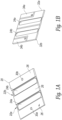
- Figures 1A and 1B are isometric front and back views of a printed circuit board 20 that is configured to support a pair of piezoelectric transducer elements.
- the circuit board 20 is rectangular and includes a pair of spaced, parallel milled slots 22a, 22b, running from one edge to another edge. Each slot includes an opening or hole 24a, 24b that is nearly the size of the slot and extends through the printed circuit board.
- the holes 24a, 24b provide an opening to the rear surface of the transducer elements (not shown) when they are mounted in the slots on the printed circuit board.
- the circuit board 20 is about 3 cm. on each side although the printed circuit board could be made larger or smaller.
- a top surface of the printed circuit board 20 includes a common ground electrode 26 made of a conductive material such as gold, copper or aluminum.
- the common ground electrode covers the entire top surface of the printed circuit board except for the area of the milled slots 22.
- a pair of through holes or vias 30a, 30b extend from the top surface of the board to the rear surface of the board for an electrical connection to the ground electrode on the front of the printed circuit board.
- FIG 1B shows a rear surface of the printed circuit board 20 shown in Figure 1A .
- the rear surface includes a pair of signal electrodes 32a, 32b surrounding each of the back sides of the slots and the openings 24a, 24b.
- the signal electrodes 32a, 32b are not electrically connected to each other so that the transducer elements on the front surface of the printed circuit board can be driven separately.
- the rear surface of the printed circuit board also includes a pair of ground electrodes 34a, 34b. In one embodiment, these ground electrodes 34a, 34b on the back side of the printed circuit board are electrically coupled to the ground electrodes 26 on the front surface of the printed circuit board through the vias 30a, 30b or another conductive path.
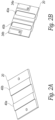
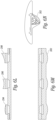
- FIGs 2A and 2B show the printed circuit board of Figures 1A, 1B with a pair of transducer elements 40a, 40b secured thereto.
- each of the transducers elements 40a, 40b comprises a rectangular sheet of PZT or other piezoelectric material.
- the transducer elements 40a, 40b are secured in the slots of the printed circuit board with a non-conductive epoxy.
- the top and bottom surfaces of the transducer elements include a conductive electrode such as a metallic coating (gold, copper or the like).
- Figure 2B shows the printed circuit board 20 with the transducer elements 40a, 40b secured in the slots and the openings 24a, 24b aligned with rear surface of the transducer elements.
- the electrodes on the PZT sheets are electrically connected to the conductive traces on the printed circuit board 20 with a conductive epoxy such as EPO-TEK H20E that bridges the gap between the surface of the printed circuit board and the electrodes on the PZT sheets.
- a metal foil or other conductor could be used to electrically connect the traces on the printed circuit board to the electrodes on the transducer elements.
- micro-coaxial conductors (not shown) are connected to the signal electrodes.
- the signal electrodes for each transducer element are electrically separate while the ground electrodes on the printed circuit board and the transducer elements are commonly connected.
- the ground electrodes on the transducer elements are facing forward and the signal electrodes are on the rear surface. It will be appreciated that this could be reversed with the ground electrode on the rear surface and the signal electrodes on the front surface.
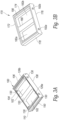
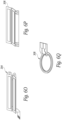
- Figures 3A and 3B show two embodiments of a frame that supports the printed circuit board and the transducer elements.
- a frame 100 includes bottom floor 102 and a set of sidewalls 104, 106, 108, 110 that extend outwardly from the bottom floor and surround the perimeter of the bottom floor 102.
- a center beam 120 connects the sidewall 104 to the sidewall 108 and divides the open space between the sidewalls of the frame into a first cavity 126a and a second cavity 126b.
- the cavities 126a, 126b are air filled and are aligned behind the exposed rear surfaces of the transducer elements.
- the sidewalls 104 and 108 also include pairs of aligned holes 130 through which a micro-coaxial cable or other conductor can be passed.
- the top perimeter of the sidewalls 104, 106, 108, 110 includes a lip around the interior of the edge that is sized to receive the perimeter of the printed circuit board 20 shown in Figures 1A, 1B , 2A, 2B .
- the printed circuit board 20 is held in the frame 100 with an adhesive.
- the sidewalls 106, 110 include a horizontally extending groove 150 on the exterior of opposing sidewalls 106, 110 that is configured to receive a flexible member such a metal, plastic or graphite rod in order to keep multiple frames aligned as will be explained in further detail below.
- a frame 170 is formed without the bottom floor.
- the frame 170 includes four connected sidewalls 172, 174, 176, 178 where the sidewalls 172 and 176 are joined by a center beam 180 that divides the open space between the sidewalls into a pair of cavities 182a, 182b.
- a lip 190 around the interior of the top surface of the sidewalls is sized to receive the outer perimeter of the printed circuit board so that the printed circuit board can be secured to the frame 170 with an adhesive or the like.
- the sidewall 176 also includes pair of holes 192a, 192b through which electrical connectors such as micro-coaxial cables can pass.
- the holes 192a, 192b are only on the sidewall 176 and therefore the frame is not designed to be electrically connected to other frames. In this embodiment, because the frame 170 lacks a bottom floor, the cavities 182a, 182b are open to the air.
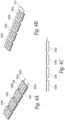
- Figure 4A shows a number of frames 100a, 100b, 100c, 100d that are positioned side by side in a line.
- a pair of flexible alignment members 198 such as flexible metal, plastic or graphite rods are positioned in the sidewall grooves of each frame to align the frames and to permit the frames to bend and conform to a curved shape of a subject's anatomy.
- a set of conductors such as micro-coaxial cables 202a, 202b electrically connect the transducer elements in each frame in parallel.
- one transducer element in each frame is a transmit (TX) element and the other transducer element is a receive (RX) element.
- all the TX transducer elements of the aligned frames are connected in parallel while all the RX transducer elements are connected in parallel.
- each of the TX and RX elements can be controlled separately. This has the benefit of being to select a TX/RX pair that is best positioned over a desired vessel to produce the signals required to analyze flow.
- Figure 4C shows a side view of a series of aligned transducer frames 100a, 100b, 100c, 100d. Because the micro co-axial cables or the flex circuit joining the frames are flexible, the arrangement of connected transducer frames can bend and conform to a subject's anatomy such as the subject's neck if the device is to measure blood flow in the carotid artery.
- the transducer elements are flat and are aligned to transmit and receive ultrasound signals in a direction that is normal to a face of the piezoelectric sheets.
- it is easier to detect fluid flow in a vessel by the measuring a Doppler shift in ultrasound signals that are transmitted and received at an angle to the fluid flow being measured. If the circuit boards described above are placed directly on a subject's anatomy, the ultrasound signals will be primarily transmitted and received in a direction that is nearly orthogonal to the fluid flow in the vessel.
- the ramp 236 is not located on the front surface of the patient pad.
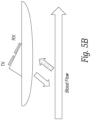
- Figure 5B shows an embodiment where the transducers are positioned behind (e.g. proximal to) the front surface of the patient pad 230 and are oriented in a desired direction with a ramp formed 238 on the rear/proximal surface of the patient pad.
- the ramp 238 is angled with respect to the front or distal surface of the patient pad such that ultrasound signals are transmitted and received in a direction that is not orthogonal to the direction of fluid flowing in a vessel of interest.
- signals are transmitted and received through the elastomeric material that makes up the patient pad and the ramp. Therefore, the elastomeric material used for the patient pad and ramp should be made of a material that is relatively transparent to ultrasound at the frequency of operation.
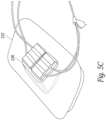
- FIG. 5C illustrates a transducer where a pair of transmit/receive elements are set in a molded patient pad of the type described in connection with Figure 5A .
- two sets of TX/RX transducers are positioned on the ramp 236 to increase the width of the transmitted and received beams.
- the ramp 236 is sized in height and width to push the transducers into a notch or recess in the subject's neck below the jaw and to the side of the trachea in a manner that the transducers are closer to the carotid and jugular vessels.
- each transducer is driven by a separate set of cables.
- the transducer elements could be wired in parallel or attached to a flex circuit as described above.
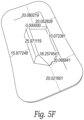
- FIGS 5D and 5E show another embodiment of a transducer in accordance with the disclosed technology.
- an ultrasound patch has a patient pad 250 formed of a flexible elastomeric sheet (molded silicone, impregnated fabric or the like) that conforms to the subject's anatomy.
- a rigid housing 260 is secured behind the patient pad 250 and contains the battery, electronics and speaker etc. that generate the ultrasound signals, detect a Doppler shift in a vessel and produce an output indicative of the Doppler shift as well as transmit the signal data to a remote device.
- the ends of the elastomeric sheet 250 can flex away from the housing 260 to conform to a subject's anatomy.
- the ramp 236 is sized to allow the transducer elements to fit within a notch between the sternocleidomastoid muscle and the trachea to be closer to the carotid artery and the jugular vein of the subject.
- the ramp is offset along the short dimension of the patient pad to provide an indication of which way round the transducer should be oriented on the subject's neck. As can be seen, the ramp is closer to one edge of the patient pad than the other while being symmetrically placed between ends on the long dimension of the patient pad so that the transducer can be positioned on either side of the neck.
- the transducer elements 240a, 240b can be oriented so they lie parallel with respect to the skin surface of the subject and a lens used to steer the signals transmitted from and received by the transducer elements in a direction away from normal due to the slight delay or advancement caused by the sound waves travelling through the thicker part of the lens depending on the lens material.
- the flex circuit extends outwardly from the PCB layers to provide a flexible connection to the front and rear surfaces of a piezoelectric transducer element.
- An airgap behind the transducer element provides an acoustic impedance mismatch to prevent/limit the rearward transmission of the ultrasound signals and reflect signals forward to increase transmission power of transducer.
- the depth of the airgap behind the transducer should be selected such that the glue used for the top PCB layer isn't drawn into the airgap by capillary forces.
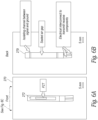
- FIG. 6C is cross-sectional end view of a transducer in accordance with some embodiments of the disclosed technology.
- the transducer 270 includes a rectangular sheet of piezoelectric material, such as PZT, that is seated within a corresponding slot, aperture or cutout in a first layer 278 of PCB material such as FR4.
- a second layer 280 of flex circuit material is behind (proximal) to the first layer 278.
- the flex circuit includes a slot or aperture over a portion of the PZT sheet to form an airgap 284 that is behind the PZT material.
- a third layer of PCB material such as FR4 overlays the second layer 280 of flex circuit layer material to seal the airgap 284.
- Figure 6D is a cross-sectional view of the transducer and shows how an electrode layer is sputter coated from the flex circuit to the rear or proximal side of the PZT sheet 276 to provide an electrical contact to the PZT material.
- the third layer 282 is placed over the flex circuit layer after the sputter coating to seal the electrical connection under the third layer and to cover/seal the airgap 284.
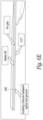
- Figure 6E is a side view of a long edge of a transducer in accordance with some embodiments of the technology.
- the top and bottom surfaces of the PZT element is coated with a metal conductor such as gold or gold plus chromium via a sputtering or other deposition process.
- a metal conductor such as gold or gold plus chromium via a sputtering or other deposition process.
- Other conductive metals such as copper or aluminum etc. could also be used.
- the PZT sheet is plated on both flat sides and then tilted and plated on one edge so that there is a continuous electrical path from the front surface to the rear surface via the plated edge.
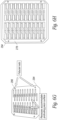
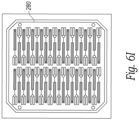
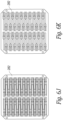
- Figures 6G-6K show a number of manufacturing steps that can be used to make a number of electrodes in a batch process.
- Figure 6G shows an assembly jig 294 that includes a number of rectangular recesses into which plated PZT elements are placed. Fiducial rods or pins 296 are placed on opposite corners of the jig to align the various layers and masks used in the manufacturing process.
- the jig is preferably made of a silicone impregnated plastic material that acts as a release. However, it may be useful to place a sheet of plastic wrap over the jig 294 before placing the transducer elements into the jig to prevent the transducer elements from becoming stuck in the jig.
- Figure 6H shows a sheet of the first PCB layer 278 placed over the transducer elements in the jig 294.
- the first PCB layer can be secured to the jig and the PZT elements placed into the cutouts of the first layer.
- the first PCB layer 287 has as number of routed slots into which the PZT elements are fitted.
- the recesses in the jig 294 are dimensioned such that top of PZT elements and the top surface of the first PCB layer 278 are co-planer when the PZT elements are seated in the recesses of the jig.
- the glue is applied to the surface of the flex layer with a roller or the like (and the second PCB layer) in order to get a thin, even layer of glue and to avoid covering the electrodes on the PZT with glue and would interfere with creating an electrical connection to the PZT as described below.
- the assembly jig allows firm pressure to be applied evenly across the entire stack while the adhesive is curing. This helps ensure flatness, good adhesion and good sealing of the air gap.
- the next step is to place a mask (not shown) over the flex circuit layer to shield the slots in the PZT elements and the traces on the flex circuit from a sputtering process.
- the sputtering process forms a conductive path from traces surrounding the slots in the flex circuit layer to the plated transducer elements.
- the conductive path could be made with conductive ink or a conductive epoxy.
- Lens elements having different shapes such as convex 294, concave 296 or tilted concave 298 can be secured via an adhesive to the front surface of the PZT elements to focus the beam from the transducer elements.
- the lens material could be cast directly onto the surface rather than being applied with a separate adhesive.
- Such lenses can be made of silicone rubber or other materials depending on the type of focusing desired.
- Figure 6M shows an embodiment where a protective layer 300 including molded lens elements is placed over a number of adjacent transducer elements.
- the protective layer 300 covers the spaces between the transducer elements and the lenses are positioned in front of the transducer elements.
- the protective layer 300 can cushion the transducer from shocks or drops while the lens elements focuses the ultrasound in a desired direction.
- Figure 6N shows an example of a lens 302 that is over molded onto a pair of transducer elements that are set on a ramp as discussed above.
- the ramp for the transmit element may have a different angle compared with the angle of the ramp for the receive element so that the focus area for the transducer elements overlap in an area of interest.
- the lens 302 is molded over the front surface of the transducer elements to focus the ultrasound in a desired direction and can serve to protect the exposed PZT elements.
- the air-backed transducer elements are generally singular elements.
- Figures 6O and 6P show two alternative designs where a single flex circuit is connected to a pair of transducer elements.
- a flex circuit at either short end of two adjacent transducer elements joins the transducer elements so that they are hinged together.
- Figure 6P shows an embodiment 306 where a single flex circuit joins two transducer elements from the long side so that they are foldable with respect to one another.
- a transducer element 308 is round and not rectangular.
- the round PZT element is plated on both sides plus at least a portion of an edge.
- One side of the PZT transducer element includes a slot or channel to break the electrical connection from the plated first side of the PZT transducer element to the second plated side of the transducer element.
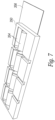
- Figure 7 shows another alternative embodiment of a frame that supports a number of transducer pairs.
- a frame 350 is molded or 3D printed to support a number of TX and RX transducer 354 elements at an angle to a front face of the transducer.
- the frame 350 supports four TX elements and four RX elements.
- the TX and RX transducer elements are supported by the frame 350 at an angle between 20 and 60 degrees with respect to a face of the transducer.
- the frame can include angled side rails in which edges of the transducer elements are fitted so that the backs of the transducer elements are open or the transducer frame can include a number of angled, acoustically transparent backing supports that support the transducer elements along their length.
- a printed flex circuit 356 includes conductors or traces (not shown) that connect to the front and rear surfaces of each transducer element.
- the frame 350 allows the rear surface of the transducer elements to be exposed (e.g. air-backed).
- a light foam material can be placed on the rear surface of the transducer elements when they are in the frame.
- the angle of the TX and RX elements is preferably set either by physically orienting the transducers in the frame or by the use of a lens or a ramp as shown in Figures 5A and 5B .
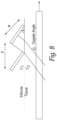
- the angle ⁇ of the transducers is set such that the Doppler angle to the flow in a vessel is between 20 and 60 degrees.
- the angle ⁇ is selected to compensate for the change in beam direction from the Snell's law effect at the transducer/tissue boundary.
- the angle of the TX and RX elements need not be the same and in some embodiments, are different so that the TX and RX beams overlap in the area of the vessel.
- the flexible phased array transducer is manufactured from a sheet of piezoelectric material 400 such as PZT or other known piezoelectric material.
- the sheet 400 starts with a thickness greater than the resonant mode thickness.
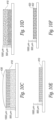
- the sheet 400 is lapped or ground to a desired thickness (e.g. about 1000 um) and is diced with a saw or patterning laser to create a number of square pillars 410 as shown in Figure 10B .
- the pillars are about 125 um on each side and are separated by 60 um kerf cuts.
- the pillars are about 500 um in height.
- other sizes could be used depending on the frequencies to be used.
- other shapes besides square pillars could be used such as triangles, pentagons, hexagons, rectangles etc. Having a large number of small pillars in the transducer allows the transducer to flex as will be described below.
- the pattern of pillars 410 is then coated with a flexible adhesive such as a flexible epoxy 430 in a manner that avoids trapping air bubbles between the pillars (e.g. under vacuum) as shown in Figure 10C .
- a flexible adhesive such as a flexible epoxy 430
- the substrate is lapped or ground on both sides to a desired thickness corresponding to the piezoelectric resonance frequency (e.g. ⁇ 500 um) as shown in Figures 10D, 10E , leaving only the pillars 410 joined by the adhesive.
- the piezoelectric resonance frequency e.g. ⁇ 500 um
- the deposited electrode metal forms fan out tabs 440 at the ends of the transducer elements to provide an electrical connection to the TX and RX elements.
- one side of the transducer has fan out tabs for all the even numbered transmit and receive elements while the other side of the transducer has the fan out tabs for the odd numbered transmit and receive elements.
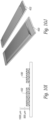
- the transmit elements 430 are separated from the receive elements 432 by cutting the transmit elements from the receive elements in the piezoelectric sheet 400 with a saw or laser as shown in Figures 10I and 10J .
- the transmit and receive elements are then rejoined to create a completed phased array transducer 450 by placing an adhesive foam strip 440, soft epoxy, RTV or other dampening material between the sheet containing the transmit elements and the sheet containing the receive elements as shown in Figures 10K and 10L .
- the transducer 450 is mounted on a flex circuit 500 as shown in Figures 10M and 10N .
- the flex circuit 500 includes a pair of ZIFF connectors 510 that receive the fan out tabs of the transducer to make an electrical connection to the transmit and receive elements.
- one ZIFF connector 510 makes connections to the even numbered transmit and receive elements and the other ZIFF connector 510 makes connections to the odd numbered transmit and receive elements.
- the transducer elements are permanently bonded to the flex circuit by soldering, wire bonding or laser-welding.
- Figure 10M shows a top surface of the flex circuit 500.
- the top surface of the flex circuit 500 also includes a number of traces (not shown) that are patterned to make connections to the other circuit components (not shown) to be placed on the flex circuit.
- the flex circuit includes a number of holes 520 about its perimeter through which wires can be passed to make connections to features on the other side of the flex circuit.
- the holes 520 can be plated through or filled with a conductive material to make an electrical connection between features on the top and bottom surfaces of the flex circuit 500.
- Figure 10N shows the bottom surface of the flex circuit 500.
- the bottom surface 530 includes a rectangular opening 540 behind which the transducer 450 is placed.
- all or a majority of the bottom surface 30 of the flex circuit 500 includes a common electrode that is electrically coupled to the electrode on the front face of the transducer via one or more tabs 550 on the flex circuit and a conductive adhesive.
- the common electrode on the bottom surface of the flex circuit can be connected to components or electrodes on the top surface of the flex circuit through a conductor passed through one or more of the holes 520, via a plating or other conductive material in the holes 520 or via a conductor (wire or foil etc.) that wraps over an edge of the flex circuit 500.
- the opening 540 exposes the bottom ground electrode surface of the transducer 450 and provides an acoustic window to allow ultrasound energy to pass through.
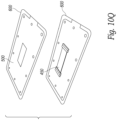
- a spacer 560 such as a strip of adhesive foam is placed around the perimeter of a rear surface of the transducer 450.
- the spacer 560 has an opening 570 positioned over the electrodes for the transmit and receive transducer elements as shown in Figure 10O .
- a cover 580 is placed over the spacer 560 ( Figure 10P ) to create an air gap behind the transducer elements. With the cover 580 in place, the transducer 450 and the flex circuit 500 can be placed in a mold and encapsulated in a flexible elastomeric material 600 such as silicone as shown in Figure 10Q . Once encapsulated, ultrasound signals created by the transducer elements and the corresponding return echo signals pass through the flexible material 600.
- the transmit and receive transducer elements are formed of a number of electrically connected, piezoelectric pillars that are joined by a flexible adhesive, the transducer 450 can bend to conform to a subject's anatomy.
- the transducer can be made to be rigid.
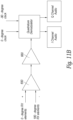
- the receive circuitry shown in Figure 11B processes the signals received by the transducer receive elements.
- signals from the 0 and 180-degree elements are applied to a differential amplifier 650 that produces a difference between the signals or equivalently, a sum of the two signals with one channel phase-shifted 180 degrees.
- the output of the difference amplifier 650 is fed to a radio frequency (RF) amplifier 660 that increases the signal strength of the difference signals.
- the output of the RF amplifier 660 is fed to a pair of demodulators (mixers and envelope detectors) that mix the signals back to baseband using the 0 and 90-degree clock signals that are used to drive the transmit elements ( Figure 11A ).
- CVP central venous pressure
- the central venous pressure waveform has been used to diagnose restrictive cardiac disease such as cardiac tamponade, constrictive pericarditis, right ventricular dysfunction, pulmonary hypertension, tricuspid regurgitation etc. Similar physiology in the hepatic veins has been used to estimate fluid responsiveness.
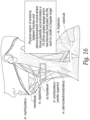
- the Doppler amplitude or Doppler power of the blood flowing though the carotid versus the jugular vein is compared and used to estimate central venous pressure as shown in Figure 16 .
- the Doppler power of blood flow in the carotid at some point in the cardiac cycle such as peak systole is compared with the Doppler power in the jugular at the same moment in time. If the ratio of the Doppler power in the jugular is low compared to the Doppler power in the carotid, e.g. 0.5:1, then central venous pressure is estimated to be low. On the other hand, if the ratio of the Doppler power in the jugular is high compared with the Doppler power in the carotid for example 2:1, then the central venous pressure is estimated to be high.
- the Doppler power or Doppler amplitude within the jugular relates to the size of the jugular vein compared to the size of the carotid at some point and has a relationship to CVP.
- multiple Doppler amplitude or Doppler power readings for blood flowing in the jugular (reverse flow) and carotid (forward flow) are computed and stored by a processor over a cardiac cycle. Variations of more than 1.0 over a cardiac cycle may signal an increased risk for high CVP.
- ECG signals are obtained simultaneously with the Doppler measurements to correlate the Doppler measurements with the cardiac cycle.
- a processor is programmed to analyze the variations in the Doppler amplitude or Doppler power over the cardiac cycle and compare against data from studies relating the Doppler amplitude and Doppler power variations to CVP.
- the processor may store the relationship data in a memory on the ultrasound patch.
- the processor of the ultrasound patch transmits the Doppler measurements to a remote computer over a wired or wireless link to a computer that stores the relationship data.
- Jugular venous velocity profiles may be used to estimate right heart function. Jugular venous physiology has also been validated in the superior vena cava. The Doppler venous velocity profile follows the time-course of the central venous pressure waveform.
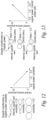
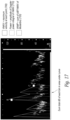
- the ratio is > 60% then normal CVP is indicated. If the ratio is between 50-60%, then rising CVP is indicated and if the ratio is ⁇ 50%, then high CVP is indicated as shown in Figure 17 .
- the particular threshold percentages may be adjusted as additional clinical data is obtained.
- measurements of the Doppler velocity profile of the jugular vein are continuously and non-invasively measured (over at least several cardiac cycles and preferably longer such as over several minutes or hours).
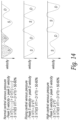
- the data are analyzed for systolic and diastolic peak jugular vein velocity as well as jugular vein systolic velocity time integral (VTI) relative to diastolic vein VTI as a qualitative and quantitative assessment of CVP, right ventricular function, fluid responsiveness and fluid tolerance.
- VTI jugular vein systolic velocity time integral
- jugular venous Doppler power is continuously and non-invasively monitored as a surrogate for vein diameter. Continuously monitored Doppler power throughout a respiration cycle is used as a surrogate for jugular vein size, collapsibility and therefore CVP.
- jugular venous power is continuously and non-invasively monitored and compared to carotid artery power - also measured by the same continuous wave ultrasound patch. The comparison is used as a surrogate for relative vascular diameters and compute a ratio as a qualitative estimation of CVP.
- the jugular venous waveform and Doppler power are continuously and non-invasively monitored, measured and compared to carotid power and waveform to identify venous waveform abnormalities.
- This data is provided to an artificial intelligence engine or neural network along with clinical data to continuously refine and enhance the non-invasive measurement of the CVP and detect cardiovascular abnormalities (e.g. tricuspid regurgitation) as well as to detect both fluid responsiveness and fluid tolerance.
- each method described has varying sensitivity and specificity for estimating an elevated central venous pressure.
- the method which has the greatest receiver operative curve statistic is an internal jugular vein area relative to carotid artery area of more than 2.0.
- the transducers are incorporated in a device with processing power (e.g. microprocessor or microcontroller), signal processing circuitry and memory that can record and store measurement data obtained over a period of time.
- processing power e.g. microprocessor or microcontroller
- the device includes circuitry to send the data to a remote computer system via a wired or wireless communication link.
- the data can be analyzed using artificial intelligence or other algorithms to estimate CVP.
- One aspect of the disclosed device is that it can record the aforementioned data for storage and analysis.
- the quadrature signal processing circuitry is configured to allow estimates of the fluid flow in both directions toward and away from the transducer elements corresponding to flow in the carotid and the jugular. Because transducer pairs overlap both the carotid artery and jugular vein, measurements of flow in both vessels can be simultaneously detected and analyzed.
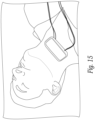
- Figure 15 shows a prototype flow measuring device in position on a subject's neck. With the elastomeric patient pad, the device is designed to be comfortable for extended subject flow monitoring.
- Figures 16A shows an anatomy in which the ramp on the bottom of some embodiments of the patient pad is designed to place the transducers near the carotid artery in a subject.
- the ramp is designed to place the transducers in the physical region between the trachea and the sternocleidomastoid muscle where tissue pliability accommodates a 10-30 mm angled wedge into the neck to create the desired Doppler angle.
- the ultrasound patch has transducers that are wide enough to produce a beam that intersects the carotid artery, the jugular vein or both.
- the disclosed technology is useful in investigating the relationship between Doppler signals detected in the carotid or other vessels and congestive heart failure.
- Congestive heart failure CHF is the most common cause of hospitalization in adults over the age of 65 years old; the burden upon the health care system of this disease is immense.
- left ventricular systolic function is ubiquitously assessed using standard echocardiography and quantified using the ejection fraction.
- an ejection fraction of less than 35-40% has major clinical implications because life-preserving pharmacological and electrophysiological therapies are indicated.
- the left ventricular ejection time is the duration (typically in milliseconds) of systole - defined on the pressure waveform from end-diastole to the dicrotic notch.
- the LVET is the duration that the aortic valve is open - ejecting blood into the arterial tree.
- there is a known, direct relationship between the LVET and ejection fraction in other words, as ejection fraction falls, so too does the LVET, in milliseconds. The relationship is robust enough that authors have advocated using the LVET to monitor heart failure therapy.
- the LVET has classically been measured using the pressure waveform, it has also been validated using the Doppler-derived spectrogram from both the left ventricular outflow tract and aorta and, quite notably, the common carotid artery. Accordingly, measurement of the common carotid ejection time has both diagnostic and therapeutic implications for the left ventricle.
- one group created an index of PEP / LVET using aortic Doppler from a transthoracic echocardiogram and found an excellent association with left ventricular ejection fraction; further, some therapies may be specifically-monitored using the PEP / LVET ratio.
- the disclosed ultrasound patch includes one or more integrated or connected ECG electrodes to detect a subject's ECG signals.
- Circuitry within the patch conditions the ECG signals for wired or wireless communication to a remote device such as an ECG detector along with ultrasound signals detected from a subject's vessel.
- a processor within the patch can also be programmed to analyze the detected ECG signals to measure the PEP, systolic ejection time, PEP/ LVET ratio as well as other combinations of electrophysiological and Doppler indices as markers of left ventricular function.
- indices have been found helpful in diagnosis of depressed left ventricular function, their diagnostic abilities are not perfect and could be refined. Additionally, other aspects of the carotid waveform may help predict cardiac ejection fraction. Artificial intelligence and machine learning could greatly improve the above-mentioned predictive metrics pulled from a wearable ultrasound patch with integrated ECG functionality. Additional, cryptic indices could be assessed and analyzed with respect to cardiac function, given that the morphology of the Doppler waveform is also determined by downstream vascular impedance. Artificial intelligence may serve to pull out the effects of both cardiac function and vascular impedance on the pulse of a major artery like the carotid.
- the ultrasound patch described above is continuous wave, rather than pulsed wave, such that the velocity profiles of the entire carotid lumen may be obtained.
- additional parameters such as spectral broadening and maximum-to-mean velocity profiles may be captured and scrutinized in the healthy and CHF populations.
- the maximum-to-mean velocity in the carotid during early systole/ejection is known to be nearly 1:1, i.e. adopt a 'plug like' profile. This is likely not the same with impaired cardiac contractility.
- power or amplitude profiles of the blood may change with diuretic-induced hemoconcentration or other pharmacological interventions - all such metrics may be teased apart with advanced machine learning.
- Data acquired from a wearable, continuous wave ultrasound patch over the common carotid artery may be analyzed and integrated to greatly improve both diagnostic and therapeutic facets of congestive heart failure - especially if integrated with an imbedded electrocardiogram.
- a convenient-to-apply ultrasound patch can improve access to care in underserved communities where cardiologists and echocardiographers are unavailable. By similar reasoning, remote monitoring of CHF therapy will be enhanced.
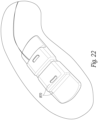
- each end of the housing for the ultrasound patch includes two openings or slots 870 on a top and side surface thereof through which a tracheostomy strap (not shown) can be passed in order to secure the patch to the subject.
- Tracheostomy straps generally include a pad that fits behind the neck and two self-adhering straps (such as hook and loop straps, e.g., Velcro ® ).
Landscapes
- Health & Medical Sciences (AREA)
- Life Sciences & Earth Sciences (AREA)
- Engineering & Computer Science (AREA)
- Physics & Mathematics (AREA)
- Molecular Biology (AREA)
- Surgery (AREA)
- Pathology (AREA)
- Radiology & Medical Imaging (AREA)
- Biophysics (AREA)
- Biomedical Technology (AREA)
- Heart & Thoracic Surgery (AREA)
- Medical Informatics (AREA)
- Veterinary Medicine (AREA)
- Nuclear Medicine, Radiotherapy & Molecular Imaging (AREA)
- Animal Behavior & Ethology (AREA)
- General Health & Medical Sciences (AREA)
- Public Health (AREA)
- Hematology (AREA)
- Computer Networks & Wireless Communication (AREA)
- Acoustics & Sound (AREA)
- Gynecology & Obstetrics (AREA)
- Cardiology (AREA)
- Ultra Sonic Daignosis Equipment (AREA)
- Measurement And Recording Of Electrical Phenomena And Electrical Characteristics Of The Living Body (AREA)
Claims (9)
- Ultraschallpflaster, das zur Verwendung auf der Haut eines Patienten konfiguriert ist, um einen Fluidstrom in einem Gefäß in dem Patienten zu detektieren, Folgendes umfassend:ein oder mehrere piezoelektrische Sendeelemente (240a);ein oder mehrere piezoelektrische Empfangselemente (240b) angrenzend an das eine oder die mehreren piezoelektrischen Sendeelemente (240a);ein starres Gehäuse (260), das eine Oberseite und eine Unterseite gegenüber der Oberseite aufweist, wobei die Oberseite dazu konfiguriert ist, von der Haut des Patienten weg zu weisen, und die Unterseite dazu konfiguriert ist, während der Verwendung mit dem Patienten zur Haut des Patienten zu weisen;ein flexibles Patientenkissen (250), das an dem starren Gehäuse befestigt ist und eine Patientenkontaktfläche, die dazu konfiguriert ist, sich an die Anatomie des Patienten anzupassen, und eine Rampe (236), die sich von der Patientenkontaktfläche nach außen erstreckt und das eine oder die mehreren piezoelektrischen Sende- und Empfangselemente (240a, 240b) in einem Winkel mit Bezug auf eine Ebene der Patientenkontaktfläche des Patientenkissens stützt, aufweist, so dass das eine oder die mehreren piezoelektrischen Sende- und Empfangselemente (240a) positioniert sind, um Ultraschall in einer Richtung zu dem Gefäß in dem Patienten zu senden und zu empfangen, wobei die Richtung nicht orthogonal zu der Richtung des Fluids ist, das in einem Gefäß von Interesse fließt.
- Ultraschallpflaster nach Anspruch 1, wobei der Winkel etwa 30 Grad beträgt.
- Ultraschallpflaster nach Anspruch 1, wobei die Rampe separate Rampen umfasst, die die Sende- und Empfangselemente in unterschiedlichen Winkeln unterstützen.
- Ultraschallpflaster nach Anspruch 1, wobei das eine oder die mehreren piezoelektrischen Sende- und Empfangselemente (240a, 240b) an einer Leiterplatte montiert sind, die einen Schlitz hinter dem einen oder den mehreren piezoelektrischen Sende- und Empfangselementen (240a, 240b) aufweist, um einen Luftspalt hinter dem einen oder den mehreren piezoelektrischen Sende- und Empfangselementen (240a, 240b) bereitzustellen, und wobei die Rampe (236) eine Aussparung aufweist, in die die Leiterplatte eingepasst ist.
- Ultraschallpflaster nach Anspruch 1, wobei die Rampe (236) so bemessen ist, dass sie in einen Raum zwischen einem Kopfnickermuskel und einer Luftröhre des Patienten passt, und symmetrisch auf dem Patientenkissen platziert ist, was eine Platzierung auf beiden Seiten des Halses des Patienten ermöglicht.
- Ultraschallpflaster nach Anspruch 1, ferner umfassend eine oder mehrere Elektrokardiogramm (EKG)-Elektroden, die dazu ausgelegt sind, ein EKG-Signal von dem Patienten zu detektieren.
- Ultraschallpflaster nach Anspruch 1, ferner umfassend eine EKG-Signaldetektionsschaltung, die dazu ausgelegt ist, ein EKG-Signal von einer entfernten EKG-Elektrode an dem Patienten zu detektieren.
- Ultraschallpflaster nach Anspruch 7, das ferner Folgendes umfasst:eine Ultraschalldetektionsschaltung, die dazu ausgebildet ist, Dopplersignale von dem Gefäß zu erfassen; undeine Kommunikationsschaltung, die dazu ausgebildet ist, das EKG-Signal und die Dopplersignale an eine entfernte Vorrichtung zu übertragen.
- Ultraschallpflaster nach Anspruch 1, ferner umfassend einen Prozessor, der dazu ausgelegt ist, eine Leistung des Dopplerflusses in einer Arterie und eine Leistung des Dopplerflusses in einer Vene zu detektieren und die Leistungen als eine Schätzung des zentralen venösen Drucks zu vergleichen.
Applications Claiming Priority (3)
| Application Number | Priority Date | Filing Date | Title |
|---|---|---|---|
| US201862699571P | 2018-07-17 | 2018-07-17 | |
| US16/377,028 US11109831B2 (en) | 2018-07-17 | 2019-04-05 | Ultrasound patch for detecting fluid flow |
| PCT/CA2019/050918 WO2020014771A1 (en) | 2018-07-17 | 2019-07-03 | Ultrasound patch for detecting fluid flow |
Publications (4)
| Publication Number | Publication Date |
|---|---|
| EP3823536A1 EP3823536A1 (de) | 2021-05-26 |
| EP3823536A4 EP3823536A4 (de) | 2022-04-13 |
| EP3823536B1 true EP3823536B1 (de) | 2025-04-09 |
| EP3823536C0 EP3823536C0 (de) | 2025-04-09 |
Family
ID=69160924
Family Applications (1)
| Application Number | Title | Priority Date | Filing Date |
|---|---|---|---|
| EP19838308.5A Active EP3823536B1 (de) | 2018-07-17 | 2019-07-03 | Ultraschall-patch zur detektion eines fluidstroms |
Country Status (5)
| Country | Link |
|---|---|
| US (3) | US11109831B2 (de) |
| EP (1) | EP3823536B1 (de) |
| JP (2) | JP7202039B2 (de) |
| CN (1) | CN112739270B (de) |
| WO (1) | WO2020014771A1 (de) |
Families Citing this family (16)
| Publication number | Priority date | Publication date | Assignee | Title |
|---|---|---|---|---|
| CN112399865B (zh) | 2018-03-09 | 2022-09-27 | 1929803安大略Dba 弗洛索尼克斯医疗公司 | 动态可控的患者流体控制装置 |
| US11109831B2 (en) | 2018-07-17 | 2021-09-07 | 1929803 Ontario Corp, (o/a FloSonics Medical) | Ultrasound patch for detecting fluid flow |
| US11779302B2 (en) * | 2018-10-20 | 2023-10-10 | Massachusetts Institute Of Technology | Methods and apparatus for imaging with conformable ultrasound patch |
| US12127994B2 (en) * | 2019-08-14 | 2024-10-29 | Taket Llc | Vibration-generating device |
| AU2021293873A1 (en) * | 2020-06-16 | 2023-01-19 | Abbott Diabetes Care Inc. | Analyte sensors featuring working electrode asperity planing for decreasing interferent signal |
| US11937976B2 (en) | 2020-07-06 | 2024-03-26 | 1929803 Ontario Corp | Ultrasound patch with integrated flexible transducer assembly |
| EP4178441A4 (de) | 2020-07-08 | 2024-07-10 | Abbott Diabetes Care Inc. | Analytsensoren mit erweiterungen zur verringerung eines interferierenden signals |
| EP4267002A4 (de) | 2020-12-23 | 2025-02-26 | Abbott Diabetes Care Inc. | Analytsensoren mit reduziertem störsignal und verfahren |
| CN113304339B (zh) * | 2021-04-16 | 2022-10-18 | 顺德职业技术学院 | 一种动静脉瘘管监测手环及设备 |
| KR20230169993A (ko) * | 2021-04-19 | 2023-12-18 | 베인테크 피티와이 엘티디 | 초음파 영상화를 위한 휴대용 초음파 디바이스 및 방법 |
| JP7666217B2 (ja) * | 2021-08-05 | 2025-04-22 | セイコーエプソン株式会社 | 超音波デバイス、超音波診断装置 |
| CN117915822A (zh) * | 2021-09-03 | 2024-04-19 | 索林Crm联合股份公司 | 个性化心脏模型的实时适配 |
| KR102732534B1 (ko) * | 2022-03-25 | 2024-11-19 | 재단법인대구경북과학기술원 | 탈착 가능하고, 개별적으로 제어 가능한 복수의 초음파 센서를 구비한 패치 |
| CA3231543A1 (en) * | 2022-03-28 | 2023-10-05 | Adam Gold | Systems, devices and methods for ultrasound detection of vascular hemodynamic measures |
| US12144682B2 (en) * | 2022-07-19 | 2024-11-19 | EchoNous, Inc. | Automation-assisted venous congestion assessment in point of care ultrasound |
| EP4487784A1 (de) | 2023-07-05 | 2025-01-08 | GAMPT mbH, Gesellschaft für Angewandte Medizinische Physik und Technik | Ultraschallvorrichtung zur messung eines blutstromes in einem blutgefäss |
Family Cites Families (94)
| Publication number | Priority date | Publication date | Assignee | Title |
|---|---|---|---|---|
| US4103679A (en) | 1977-03-22 | 1978-08-01 | Biosonics, Inc. | Method and apparatus for measuring blood flow noninvasively |
| DK139085B (da) * | 1977-04-19 | 1978-12-11 | Brueel & Kjaer As | Accelerometer. |
| JPS58118739A (ja) * | 1982-01-05 | 1983-07-14 | テルモ株式会社 | 超音波探触子およびその製造方法 |
| EP0208771A4 (de) | 1985-01-15 | 1988-03-03 | Applied Biometrics | Verfahren und anordnung zum messen der gefässblutstörung. |
| FR2585944B1 (fr) | 1985-08-12 | 1988-07-08 | Alvar Electronic Sa | Sonde a ultrasons implantable et son pro cede de fabrication |
| US5113867A (en) | 1990-05-16 | 1992-05-19 | Janszen David A | Fluid flow characterizing |
| JP3208845B2 (ja) * | 1992-06-16 | 2001-09-17 | 松下電器産業株式会社 | 超音波探触子 |
| JPH07124159A (ja) * | 1993-10-29 | 1995-05-16 | Toshiba Corp | 超音波プローブ及びその製造方法 |
| US6398734B1 (en) * | 1997-10-14 | 2002-06-04 | Vascusense, Inc. | Ultrasonic sensors for monitoring the condition of flow through a cardiac valve |
| US7004924B1 (en) | 1998-02-11 | 2006-02-28 | Nxstage Medical, Inc. | Methods, systems, and kits for the extracorporeal processing of blood |
| IL127112A0 (en) | 1998-11-18 | 1999-09-22 | Biosonix Ltd | System for measuring flow and method therefor |
| US6142946A (en) | 1998-11-20 | 2000-11-07 | Atl Ultrasound, Inc. | Ultrasonic diagnostic imaging system with cordless scanheads |
| IL129461A0 (en) | 1999-04-15 | 2000-02-29 | F R A Y Project Dev Ltd | 3-D ultrasound imaging system |
| US6554774B1 (en) | 2000-03-23 | 2003-04-29 | Tensys Medical, Inc. | Method and apparatus for assessing hemodynamic properties within the circulatory system of a living subject |
| US20070016046A1 (en) | 2000-09-29 | 2007-01-18 | New Health Sciences, Inc. | Systems and methods for using dynamic vascular assessment to distinguish among vascular states and for investigating intracranial pressure |
| US6755789B2 (en) * | 2002-02-05 | 2004-06-29 | Inceptio Medical Technologies, Llc | Ultrasonic vascular imaging system and method of blood vessel cannulation |
| JP4584586B2 (ja) * | 2002-03-15 | 2010-11-24 | アー.ヤー. アンゲルセン、ビョルン | 対象物の多走査平面超音波イメージング方法および超音波イメージング装置 |
| WO2003102513A1 (en) | 2002-06-04 | 2003-12-11 | The Tokyo Electric Power Company, Incorporated | Doppler type ultrasonic flowmeter, flow rate measuring method using doppler type ultrasonic flowmeter and flow rate measuring program used in this doppler type ultrasonic flowmeter |
| US20040116969A1 (en) | 2002-08-26 | 2004-06-17 | Owen James M. | Pulse detection using patient physiological signals |
| US20060135940A1 (en) | 2003-01-06 | 2006-06-22 | The Trustees Of Columbia | Programmed pulsed infusion methods and devices |
| US6843771B2 (en) | 2003-01-15 | 2005-01-18 | Salutron, Inc. | Ultrasonic monitor for measuring heart rate and blood flow rate |
| JP2004344564A (ja) | 2003-05-26 | 2004-12-09 | Aloka Co Ltd | 超音波診断装置 |
| US7109642B2 (en) * | 2003-11-29 | 2006-09-19 | Walter Guy Scott | Composite piezoelectric apparatus and method |
| US7542188B2 (en) * | 2004-01-20 | 2009-06-02 | National University Of Singapore | Optical scanning using vibratory diffraction gratings |
| US20070222339A1 (en) * | 2004-04-20 | 2007-09-27 | Mark Lukacs | Arrayed ultrasonic transducer |
| EP1791471A1 (de) | 2004-09-13 | 2007-06-06 | Koninklijke Philips Electronics N.V. | Verfahren und vorrichtung zur messung und/oder bestimmung des fliessverhaltens einer körperflüssigkeit mittels ultraschall |
| US7798970B2 (en) * | 2004-11-17 | 2010-09-21 | Salutron, Inc | Ultrasonic monitor for measuring blood flow and pulse rates |
| US7857763B2 (en) * | 2005-02-08 | 2010-12-28 | Alan Chi-Chung Tai | Automatic signal-optimizing transducer assembly for blood flow measurement |
| JP2008534071A (ja) | 2005-03-23 | 2008-08-28 | ニュー・ヘルス・サイエンシーズ・インコーポレイテッド | ダイナミックな血管の評価を用いた血管状態間の識別のための及び頭蓋内圧の調査ためのシステム及び方法 |
| US7815575B2 (en) * | 2005-05-09 | 2010-10-19 | Salutron, Inc. | Ultrasonic monitor with a biocompatible oil based transmission medium |
| US8162837B2 (en) | 2005-06-13 | 2012-04-24 | Spentech, Inc. | Medical doppler ultrasound system for locating and tracking blood flow |
| CN101405090A (zh) * | 2005-11-02 | 2009-04-08 | 视声公司 | 阵列式超声换能器 |
| EP1951126A2 (de) * | 2005-11-17 | 2008-08-06 | Koninklijke Philips Electronics N.V. | Über gefässflussmessung gesteuerte herz-lungen-reanimation |
| EP1982211A1 (de) | 2006-01-27 | 2008-10-22 | Koninklijke Philips Electronics N.V. | Automatische ultraschall-doppler-messungen |
| US8211048B2 (en) | 2006-02-22 | 2012-07-03 | Henry Ford Health System | System and method for delivery of regional citrate anticoagulation to extracorporeal blood circuits |
| US7539533B2 (en) | 2006-05-16 | 2009-05-26 | Bao Tran | Mesh network monitoring appliance |
| JP5551936B2 (ja) | 2006-09-29 | 2014-07-16 | コーニンクレッカ フィリップス エヌ ヴェ | ハンズフリー超音波診断装置 |
| WO2008050334A2 (en) | 2006-10-26 | 2008-05-02 | Cardiogal Ltd. | Non-invasive cardiac parameter measurement |
| EP2120721A2 (de) * | 2006-12-20 | 2009-11-25 | Koninklijke Philips Electronics N.V. | Mehrstrahlige senderisolierung |
| US9380992B2 (en) | 2007-03-30 | 2016-07-05 | General Electric Company | Method and apparatus for measuring flow in multi-dimensional ultrasound |
| CN101677807A (zh) | 2007-06-01 | 2010-03-24 | 皇家飞利浦电子股份有限公司 | 具有可听指示器的无线超声探头 |
| JP5294998B2 (ja) * | 2008-06-18 | 2013-09-18 | キヤノン株式会社 | 超音波探触子、該超音波探触子を備えた光音響・超音波システム並びに検体イメージング装置 |
| US8876720B2 (en) | 2008-08-05 | 2014-11-04 | Guardsman Scientific, Inc. | Peripheral ultrasound device providing pivotal adjustment of an imaging mechanism about two axes |
| US20160206292A1 (en) * | 2008-08-05 | 2016-07-21 | Guardsman Scientific, Inc. | Systems and methods for managing a patient |
| EP2400894A1 (de) | 2009-02-24 | 2012-01-04 | Koninklijke Philips Electronics N.V. | Ultraschall-gefässdurchblutungssensor mit dreieckiger sensorgeometrie |
| US8508103B2 (en) | 2009-03-23 | 2013-08-13 | Sonavation, Inc. | Piezoelectric identification device and applications thereof |
| WO2011066982A1 (en) * | 2009-12-03 | 2011-06-09 | Deltex Medical Limited | Method and apparatus for hemodynamic monitoring using combined blood flow and blood pressure measurement |
| US9480863B2 (en) | 2009-12-31 | 2016-11-01 | ZetrOZ Systems, LLC | Ultrasound coupling device |
| JP5499939B2 (ja) * | 2010-06-25 | 2014-05-21 | セイコーエプソン株式会社 | 測定装置、生体検査装置、流速測定方法、および圧力測定方法 |
| EP2640528B1 (de) * | 2010-11-18 | 2015-12-30 | Koninklijke Philips N.V. | Medizinische vorrichtung mit in einer flexiblen folie eingebetteten ultraschallwandlern |
| US20120138533A1 (en) | 2010-12-01 | 2012-06-07 | Curtis James R | Dialysis system control system with user interface |
| US8864670B2 (en) * | 2011-01-28 | 2014-10-21 | Hospira, Inc. | Ultrasonic monitoring device for measuring physiological parameters of a mammal |
| US20120271202A1 (en) * | 2011-03-23 | 2012-10-25 | Cutera, Inc. | Ultrasonic therapy device with diffractive focusing |
| US20120296216A1 (en) | 2011-05-16 | 2012-11-22 | Cardiogal Ltd. | Methods and systems of aiming sensor(s) for measuring cardiac parameters |
| CN102871645A (zh) | 2011-07-11 | 2013-01-16 | 浙江大学 | 近红外成像超声血管治疗仪 |
| CN103153196B (zh) * | 2011-09-22 | 2016-10-26 | 东芝医疗系统株式会社 | 超声波诊断装置 |
| EP2940487B1 (de) | 2011-10-19 | 2016-07-20 | Verasonics, Inc. | Schätzung und anzeige für vektor-doppler-bildgebung anhand der übertragung von ebenen wellen |
| WO2013070775A1 (en) | 2011-11-07 | 2013-05-16 | C.R. Bard, Inc | Ruggedized ultrasound hydrogel insert |
| JP6407719B2 (ja) | 2011-12-01 | 2018-10-17 | マウイ イマギング,インコーポレーテッド | ピングベース及び多数開口ドップラー超音波を用いた運動の検出 |
| CA2865054A1 (en) | 2012-03-20 | 2013-09-26 | Intelligendt Systems & Services Gmbh | Ultrasound probe |
| JP5733835B2 (ja) | 2012-08-27 | 2015-06-10 | ジーイー・メディカル・システムズ・グローバル・テクノロジー・カンパニー・エルエルシー | 計測装置及び超音波診断装置 |
| WO2014036170A1 (en) * | 2012-08-29 | 2014-03-06 | Thync, Inc. | Systems and devices for coupling ultrasound energy to a body |
| WO2014066859A1 (en) | 2012-10-26 | 2014-05-01 | Graham Nichol | Systems and methods for real-time assessment of the presence and quantity of carotid blood flow during cardiac arrest |
| KR20150082401A (ko) | 2012-11-08 | 2015-07-15 | 르 타이 | 개선된 혈압 모니터 및 방법 |
| WO2014099602A1 (en) | 2012-12-17 | 2014-06-26 | Board Of Regents, The University Of Texas System | A system of intravenous fluid/medication delivery that employs signature flow amplitudes or frequencies to facilitate the detection of intravenous infiltration |
| JP2014168603A (ja) | 2013-03-05 | 2014-09-18 | Jikei Univ | 超音波栓子検出装置 |
| CN104208865B (zh) * | 2013-06-03 | 2018-06-05 | 飞比特公司 | 具有高度计的健身监视装置 |
| WO2015074015A1 (en) | 2013-11-18 | 2015-05-21 | The Johns Hopkins University | Pulse detector |
| EP2894631B1 (de) * | 2013-12-20 | 2018-08-22 | Samsung Medison Co., Ltd. | Ultraschalldiagnosevorrichtung und Herstellungsverfahren dafür |
| US10693053B2 (en) * | 2014-01-29 | 2020-06-23 | Sogang University Research Foundation | Method for producing intravascular ultrasonic transducers and structure thereof |
| WO2015134765A2 (en) | 2014-03-07 | 2015-09-11 | Zoll Circulation, Inc. | Endovascular heat exchange systems and methods with blood flow monitoring and notification functions |
| US20170080255A1 (en) | 2014-03-15 | 2017-03-23 | Cerevast Medical Inc. | Thin and wearable ultrasound phased array devices |
| NO3148603T3 (de) | 2014-05-26 | 2018-06-09 | ||
| WO2015184073A1 (en) | 2014-05-28 | 2015-12-03 | University Of Washington | Device and method for guiding cardiopulmonary resuscitation during cardiac arrest |
| WO2016007250A1 (en) | 2014-07-08 | 2016-01-14 | Qualcomm Incorporated | Piezoelectric ultrasonic transducer and process |
| WO2016009337A2 (en) * | 2014-07-15 | 2016-01-21 | Koninklijke Philips N.V. | Devices and methods for intrahepatic shunts |
| WO2016060785A1 (en) | 2014-10-13 | 2016-04-21 | Agco Corporation | Electric motor addressing for planters |
| WO2016207889A1 (en) * | 2015-06-23 | 2016-12-29 | Hemonitor Medical Ltd. | Continuous ultrasonic monitoring |
| US10335830B2 (en) * | 2015-06-26 | 2019-07-02 | Toshiba Medical Systems Corporation | Ultrasonic probe |
| ES2946910T3 (es) * | 2015-08-26 | 2023-07-27 | Element Science Inc | Dispositivos de desfibrilación portátiles |
| CA2997093A1 (en) * | 2015-08-31 | 2017-03-09 | Renew Group Pte Ltd | Wireless medical evaluation device |
| US10497748B2 (en) * | 2015-10-14 | 2019-12-03 | Qualcomm Incorporated | Integrated piezoelectric micromechanical ultrasonic transducer pixel and array |
| CN108778146B (zh) | 2015-12-10 | 2022-03-11 | 1929803安大略Dba Ke2科技公司 | 用于自动流体响应测量的系统及方法 |
| US10987085B2 (en) | 2015-12-10 | 2021-04-27 | 1929803 Ontario Corp | Systems and methods for automated fluid response measurement |
| EP3196952B1 (de) * | 2016-01-21 | 2019-06-19 | AT & S Austria Technologie & Systemtechnik Aktiengesellschaft | Piezoelektrischer mems-wandler, der an einer leiterplattentragstruktur ausgebildet ist |
| US10772192B2 (en) * | 2016-05-03 | 2020-09-08 | Keyssa Systems, Inc. | Board-to-board contactless connectors and methods for the assembly thereof |
| US20180020982A1 (en) * | 2016-07-20 | 2018-01-25 | Intel Corporation | Wellness monitoring using a patch system |
| US11793487B2 (en) * | 2017-01-26 | 2023-10-24 | Annamarie Saarinen | Transducer array device, method and system for cardiac conditions |
| US10813620B2 (en) * | 2017-08-24 | 2020-10-27 | General Electric Company | Method and system for enhanced ultrasound image acquisition using ultrasound patch probes with interchangeable brackets |
| US11259831B2 (en) * | 2017-09-18 | 2022-03-01 | Novuson Surgical, Inc. | Therapeutic ultrasound apparatus and method |
| CN112399865B (zh) | 2018-03-09 | 2022-09-27 | 1929803安大略Dba 弗洛索尼克斯医疗公司 | 动态可控的患者流体控制装置 |
| US11109831B2 (en) | 2018-07-17 | 2021-09-07 | 1929803 Ontario Corp, (o/a FloSonics Medical) | Ultrasound patch for detecting fluid flow |
| US20240121137A1 (en) * | 2022-10-10 | 2024-04-11 | Aronix LLC | Ultrasound beam quality test apparatus and methods |
| US12471787B2 (en) * | 2023-09-27 | 2025-11-18 | Canary Medical Switzerland Ag | Implantable medical device with mechanical stress sensor |
-
2019
- 2019-04-05 US US16/377,028 patent/US11109831B2/en active Active
- 2019-07-03 WO PCT/CA2019/050918 patent/WO2020014771A1/en not_active Ceased
- 2019-07-03 CN CN201980061028.7A patent/CN112739270B/zh active Active
- 2019-07-03 JP JP2021525339A patent/JP7202039B2/ja active Active
- 2019-07-03 EP EP19838308.5A patent/EP3823536B1/de active Active
-
2021
- 2021-06-11 US US17/346,012 patent/US11744539B2/en active Active
-
2022
- 2022-06-30 JP JP2022106081A patent/JP2022121628A/ja not_active Withdrawn
-
2023
- 2023-08-24 US US18/455,516 patent/US20240206844A1/en active Pending
Also Published As
| Publication number | Publication date |
|---|---|
| EP3823536A1 (de) | 2021-05-26 |
| US20200022670A1 (en) | 2020-01-23 |
| US20240206844A1 (en) | 2024-06-27 |
| CN112739270A (zh) | 2021-04-30 |
| JP2022121628A (ja) | 2022-08-19 |
| US11744539B2 (en) | 2023-09-05 |
| CN112739270B (zh) | 2024-12-06 |
| US11109831B2 (en) | 2021-09-07 |
| EP3823536A4 (de) | 2022-04-13 |
| US20210298713A1 (en) | 2021-09-30 |
| WO2020014771A1 (en) | 2020-01-23 |
| EP3823536C0 (de) | 2025-04-09 |
| JP2021529651A (ja) | 2021-11-04 |
| JP7202039B2 (ja) | 2023-01-11 |
Similar Documents
| Publication | Publication Date | Title |
|---|---|---|
| EP3823536B1 (de) | Ultraschall-patch zur detektion eines fluidstroms | |
| US11937976B2 (en) | Ultrasound patch with integrated flexible transducer assembly | |
| US20240000427A1 (en) | Systems and methods for automated fluid response measurement | |
| US12402855B2 (en) | System and method for continuous non-invasive ultrasonic monitoring of blood vessels and central organs | |
| JP7344282B2 (ja) | ウェアラブル監視装置用の超音波変換器システム | |
| EP2386250B1 (de) | Herzparametermessung | |
| US20080167566A1 (en) | Systems and methods for determining systolic time intervals | |
| US20200289089A1 (en) | Ultrasound device including a detachable acoustic coupling pad | |
| US20230355204A1 (en) | Wearable ultrasound patch for monitoring subjects in motion using machine learning and wireless electronics | |
| US12207965B2 (en) | Heart valve dysfunction detection | |
| US12232853B2 (en) | Physiological parameter sensing systems and methods | |
| CN111568468B (zh) | 超声波芯片、超声波检测装置及检测血压的方法 | |
| KR20220047985A (ko) | 모니터링 패드를 구비한 의료용 초음파 시스템 및 방법 | |
| WO2024167902A9 (en) | Transcranial volumetric imaging using a conformal ultrasound patch | |
| CN115005870B (zh) | 一种综合检测装置 | |
| US20240225597A1 (en) | System and method for medical ultrasound with monitoring pad and multifunction monitoring system | |
| WO2025129147A1 (en) | Patient monitoring system using ultrasound and bioimpedance |
Legal Events
| Date | Code | Title | Description |
|---|---|---|---|
| STAA | Information on the status of an ep patent application or granted ep patent |
Free format text: STATUS: THE INTERNATIONAL PUBLICATION HAS BEEN MADE |
|
| PUAI | Public reference made under article 153(3) epc to a published international application that has entered the european phase |
Free format text: ORIGINAL CODE: 0009012 |
|
| STAA | Information on the status of an ep patent application or granted ep patent |
Free format text: STATUS: REQUEST FOR EXAMINATION WAS MADE |
|
| 17P | Request for examination filed |
Effective date: 20210113 |
|
| AK | Designated contracting states |
Kind code of ref document: A1 Designated state(s): AL AT BE BG CH CY CZ DE DK EE ES FI FR GB GR HR HU IE IS IT LI LT LU LV MC MK MT NL NO PL PT RO RS SE SI SK SM TR |
|
| DAV | Request for validation of the european patent (deleted) | ||
| DAX | Request for extension of the european patent (deleted) | ||
| A4 | Supplementary search report drawn up and despatched |
Effective date: 20220314 |
|
| RIC1 | Information provided on ipc code assigned before grant |
Ipc: A61B 8/08 20060101ALI20220308BHEP Ipc: A61B 8/00 20060101ALI20220308BHEP Ipc: A61B 8/14 20060101ALI20220308BHEP Ipc: A61B 8/13 20060101ALI20220308BHEP Ipc: A61B 5/026 20060101ALI20220308BHEP Ipc: A61B 8/06 20060101AFI20220308BHEP |
|
| STAA | Information on the status of an ep patent application or granted ep patent |
Free format text: STATUS: EXAMINATION IS IN PROGRESS |
|
| 17Q | First examination report despatched |
Effective date: 20230131 |
|
| GRAP | Despatch of communication of intention to grant a patent |
Free format text: ORIGINAL CODE: EPIDOSNIGR1 |
|
| STAA | Information on the status of an ep patent application or granted ep patent |
Free format text: STATUS: GRANT OF PATENT IS INTENDED |
|
| INTG | Intention to grant announced |
Effective date: 20241108 |
|
| GRAS | Grant fee paid |
Free format text: ORIGINAL CODE: EPIDOSNIGR3 |
|
| GRAA | (expected) grant |
Free format text: ORIGINAL CODE: 0009210 |
|
| STAA | Information on the status of an ep patent application or granted ep patent |
Free format text: STATUS: THE PATENT HAS BEEN GRANTED |
|
| AK | Designated contracting states |
Kind code of ref document: B1 Designated state(s): AL AT BE BG CH CY CZ DE DK EE ES FI FR GB GR HR HU IE IS IT LI LT LU LV MC MK MT NL NO PL PT RO RS SE SI SK SM TR |
|
| REG | Reference to a national code |
Ref country code: GB Ref legal event code: FG4D |
|
| REG | Reference to a national code |
Ref country code: CH Ref legal event code: EP |
|
| REG | Reference to a national code |
Ref country code: DE Ref legal event code: R096 Ref document number: 602019068509 Country of ref document: DE |
|
| REG | Reference to a national code |
Ref country code: IE Ref legal event code: FG4D |
|
| U01 | Request for unitary effect filed |
Effective date: 20250508 |
|
| U07 | Unitary effect registered |
Designated state(s): AT BE BG DE DK EE FI FR IT LT LU LV MT NL PT RO SE SI Effective date: 20250515 |
|
| U20 | Renewal fee for the european patent with unitary effect paid |
Year of fee payment: 7 Effective date: 20250717 |
|
| PG25 | Lapsed in a contracting state [announced via postgrant information from national office to epo] |
Ref country code: ES Free format text: LAPSE BECAUSE OF FAILURE TO SUBMIT A TRANSLATION OF THE DESCRIPTION OR TO PAY THE FEE WITHIN THE PRESCRIBED TIME-LIMIT Effective date: 20250409 |
|
| PG25 | Lapsed in a contracting state [announced via postgrant information from national office to epo] |
Ref country code: GR Free format text: LAPSE BECAUSE OF FAILURE TO SUBMIT A TRANSLATION OF THE DESCRIPTION OR TO PAY THE FEE WITHIN THE PRESCRIBED TIME-LIMIT Effective date: 20250710 Ref country code: NO Free format text: LAPSE BECAUSE OF FAILURE TO SUBMIT A TRANSLATION OF THE DESCRIPTION OR TO PAY THE FEE WITHIN THE PRESCRIBED TIME-LIMIT Effective date: 20250709 |
|
| PG25 | Lapsed in a contracting state [announced via postgrant information from national office to epo] |
Ref country code: PL Free format text: LAPSE BECAUSE OF FAILURE TO SUBMIT A TRANSLATION OF THE DESCRIPTION OR TO PAY THE FEE WITHIN THE PRESCRIBED TIME-LIMIT Effective date: 20250409 |
|
| PG25 | Lapsed in a contracting state [announced via postgrant information from national office to epo] |
Ref country code: HR Free format text: LAPSE BECAUSE OF FAILURE TO SUBMIT A TRANSLATION OF THE DESCRIPTION OR TO PAY THE FEE WITHIN THE PRESCRIBED TIME-LIMIT Effective date: 20250409 |
|
| PG25 | Lapsed in a contracting state [announced via postgrant information from national office to epo] |
Ref country code: RS Free format text: LAPSE BECAUSE OF FAILURE TO SUBMIT A TRANSLATION OF THE DESCRIPTION OR TO PAY THE FEE WITHIN THE PRESCRIBED TIME-LIMIT Effective date: 20250709 |
|
| PG25 | Lapsed in a contracting state [announced via postgrant information from national office to epo] |
Ref country code: IS Free format text: LAPSE BECAUSE OF FAILURE TO SUBMIT A TRANSLATION OF THE DESCRIPTION OR TO PAY THE FEE WITHIN THE PRESCRIBED TIME-LIMIT Effective date: 20250809 |