EP3794661B1 - Films autoportants à base de cellulose pour utilisation dans des batteries li-ion - Google Patents
Films autoportants à base de cellulose pour utilisation dans des batteries li-ion Download PDFInfo
- Publication number
- EP3794661B1 EP3794661B1 EP19802496.0A EP19802496A EP3794661B1 EP 3794661 B1 EP3794661 B1 EP 3794661B1 EP 19802496 A EP19802496 A EP 19802496A EP 3794661 B1 EP3794661 B1 EP 3794661B1
- Authority
- EP
- European Patent Office
- Prior art keywords
- self
- conductive material
- electronically conductive
- electrode
- carbon
- Prior art date
- Legal status (The legal status is an assumption and is not a legal conclusion. Google has not performed a legal analysis and makes no representation as to the accuracy of the status listed.)
- Active
Links
Images







Classifications
-
- H—ELECTRICITY
- H01—ELECTRIC ELEMENTS
- H01M—PROCESSES OR MEANS, e.g. BATTERIES, FOR THE DIRECT CONVERSION OF CHEMICAL ENERGY INTO ELECTRICAL ENERGY
- H01M10/00—Secondary cells; Manufacture thereof
- H01M10/05—Accumulators with non-aqueous electrolyte
- H01M10/052—Li-accumulators
- H01M10/0525—Rocking-chair batteries, i.e. batteries with lithium insertion or intercalation in both electrodes; Lithium-ion batteries
-
- H—ELECTRICITY
- H01—ELECTRIC ELEMENTS
- H01M—PROCESSES OR MEANS, e.g. BATTERIES, FOR THE DIRECT CONVERSION OF CHEMICAL ENERGY INTO ELECTRICAL ENERGY
- H01M10/00—Secondary cells; Manufacture thereof
- H01M10/05—Accumulators with non-aqueous electrolyte
- H01M10/054—Accumulators with insertion or intercalation of metals other than lithium, e.g. with magnesium or aluminium
-
- H—ELECTRICITY
- H01—ELECTRIC ELEMENTS
- H01M—PROCESSES OR MEANS, e.g. BATTERIES, FOR THE DIRECT CONVERSION OF CHEMICAL ENERGY INTO ELECTRICAL ENERGY
- H01M4/00—Electrodes
- H01M4/02—Electrodes composed of, or comprising, active material
- H01M4/13—Electrodes for accumulators with non-aqueous electrolyte, e.g. for lithium-accumulators; Processes of manufacture thereof
- H01M4/131—Electrodes based on mixed oxides or hydroxides, or on mixtures of oxides or hydroxides, e.g. LiCoOx
-
- H—ELECTRICITY
- H01—ELECTRIC ELEMENTS
- H01M—PROCESSES OR MEANS, e.g. BATTERIES, FOR THE DIRECT CONVERSION OF CHEMICAL ENERGY INTO ELECTRICAL ENERGY
- H01M4/00—Electrodes
- H01M4/02—Electrodes composed of, or comprising, active material
- H01M4/13—Electrodes for accumulators with non-aqueous electrolyte, e.g. for lithium-accumulators; Processes of manufacture thereof
- H01M4/136—Electrodes based on inorganic compounds other than oxides or hydroxides, e.g. sulfides, selenides, tellurides, halogenides or LiCoFy
-
- H—ELECTRICITY
- H01—ELECTRIC ELEMENTS
- H01M—PROCESSES OR MEANS, e.g. BATTERIES, FOR THE DIRECT CONVERSION OF CHEMICAL ENERGY INTO ELECTRICAL ENERGY
- H01M4/00—Electrodes
- H01M4/02—Electrodes composed of, or comprising, active material
- H01M4/13—Electrodes for accumulators with non-aqueous electrolyte, e.g. for lithium-accumulators; Processes of manufacture thereof
- H01M4/139—Processes of manufacture
- H01M4/1391—Processes of manufacture of electrodes based on mixed oxides or hydroxides, or on mixtures of oxides or hydroxides, e.g. LiCoOx
-
- H—ELECTRICITY
- H01—ELECTRIC ELEMENTS
- H01M—PROCESSES OR MEANS, e.g. BATTERIES, FOR THE DIRECT CONVERSION OF CHEMICAL ENERGY INTO ELECTRICAL ENERGY
- H01M4/00—Electrodes
- H01M4/02—Electrodes composed of, or comprising, active material
- H01M4/13—Electrodes for accumulators with non-aqueous electrolyte, e.g. for lithium-accumulators; Processes of manufacture thereof
- H01M4/139—Processes of manufacture
- H01M4/1397—Processes of manufacture of electrodes based on inorganic compounds other than oxides or hydroxides, e.g. sulfides, selenides, tellurides, halogenides or LiCoFy
-
- H—ELECTRICITY
- H01—ELECTRIC ELEMENTS
- H01M—PROCESSES OR MEANS, e.g. BATTERIES, FOR THE DIRECT CONVERSION OF CHEMICAL ENERGY INTO ELECTRICAL ENERGY
- H01M4/00—Electrodes
- H01M4/02—Electrodes composed of, or comprising, active material
- H01M4/62—Selection of inactive substances as ingredients for active masses, e.g. binders, fillers
-
- H—ELECTRICITY
- H01—ELECTRIC ELEMENTS
- H01M—PROCESSES OR MEANS, e.g. BATTERIES, FOR THE DIRECT CONVERSION OF CHEMICAL ENERGY INTO ELECTRICAL ENERGY
- H01M4/00—Electrodes
- H01M4/02—Electrodes composed of, or comprising, active material
- H01M4/62—Selection of inactive substances as ingredients for active masses, e.g. binders, fillers
- H01M4/621—Binders
-
- H—ELECTRICITY
- H01—ELECTRIC ELEMENTS
- H01M—PROCESSES OR MEANS, e.g. BATTERIES, FOR THE DIRECT CONVERSION OF CHEMICAL ENERGY INTO ELECTRICAL ENERGY
- H01M4/00—Electrodes
- H01M4/02—Electrodes composed of, or comprising, active material
- H01M4/62—Selection of inactive substances as ingredients for active masses, e.g. binders, fillers
- H01M4/621—Binders
- H01M4/622—Binders being polymers
-
- H—ELECTRICITY
- H01—ELECTRIC ELEMENTS
- H01M—PROCESSES OR MEANS, e.g. BATTERIES, FOR THE DIRECT CONVERSION OF CHEMICAL ENERGY INTO ELECTRICAL ENERGY
- H01M4/00—Electrodes
- H01M4/02—Electrodes composed of, or comprising, active material
- H01M4/64—Carriers or collectors
- H01M4/66—Selection of materials
- H01M4/663—Selection of materials containing carbon or carbonaceous materials as conductive part, e.g. graphite, carbon fibres
-
- H—ELECTRICITY
- H01—ELECTRIC ELEMENTS
- H01M—PROCESSES OR MEANS, e.g. BATTERIES, FOR THE DIRECT CONVERSION OF CHEMICAL ENERGY INTO ELECTRICAL ENERGY
- H01M4/00—Electrodes
- H01M4/02—Electrodes composed of, or comprising, active material
- H01M4/64—Carriers or collectors
- H01M4/66—Selection of materials
- H01M4/665—Composites
- H01M4/666—Composites in the form of mixed materials
-
- H—ELECTRICITY
- H01—ELECTRIC ELEMENTS
- H01M—PROCESSES OR MEANS, e.g. BATTERIES, FOR THE DIRECT CONVERSION OF CHEMICAL ENERGY INTO ELECTRICAL ENERGY
- H01M4/00—Electrodes
- H01M4/02—Electrodes composed of, or comprising, active material
- H01M4/64—Carriers or collectors
- H01M4/66—Selection of materials
- H01M4/665—Composites
- H01M4/667—Composites in the form of layers, e.g. coatings
-
- H—ELECTRICITY
- H01—ELECTRIC ELEMENTS
- H01M—PROCESSES OR MEANS, e.g. BATTERIES, FOR THE DIRECT CONVERSION OF CHEMICAL ENERGY INTO ELECTRICAL ENERGY
- H01M4/00—Electrodes
- H01M4/02—Electrodes composed of, or comprising, active material
- H01M4/64—Carriers or collectors
- H01M4/70—Carriers or collectors characterised by shape or form
- H01M4/80—Porous plates, e.g. sintered carriers
- H01M4/806—Nonwoven fibrous fabric containing only fibres
-
- H—ELECTRICITY
- H01—ELECTRIC ELEMENTS
- H01M—PROCESSES OR MEANS, e.g. BATTERIES, FOR THE DIRECT CONVERSION OF CHEMICAL ENERGY INTO ELECTRICAL ENERGY
- H01M4/00—Electrodes
- H01M4/02—Electrodes composed of, or comprising, active material
- H01M2004/026—Electrodes composed of, or comprising, active material characterised by the polarity
- H01M2004/027—Negative electrodes
-
- H—ELECTRICITY
- H01—ELECTRIC ELEMENTS
- H01M—PROCESSES OR MEANS, e.g. BATTERIES, FOR THE DIRECT CONVERSION OF CHEMICAL ENERGY INTO ELECTRICAL ENERGY
- H01M4/00—Electrodes
- H01M4/02—Electrodes composed of, or comprising, active material
- H01M2004/026—Electrodes composed of, or comprising, active material characterised by the polarity
- H01M2004/028—Positive electrodes
-
- Y—GENERAL TAGGING OF NEW TECHNOLOGICAL DEVELOPMENTS; GENERAL TAGGING OF CROSS-SECTIONAL TECHNOLOGIES SPANNING OVER SEVERAL SECTIONS OF THE IPC; TECHNICAL SUBJECTS COVERED BY FORMER USPC CROSS-REFERENCE ART COLLECTIONS [XRACs] AND DIGESTS
- Y02—TECHNOLOGIES OR APPLICATIONS FOR MITIGATION OR ADAPTATION AGAINST CLIMATE CHANGE
- Y02E—REDUCTION OF GREENHOUSE GAS [GHG] EMISSIONS, RELATED TO ENERGY GENERATION, TRANSMISSION OR DISTRIBUTION
- Y02E60/00—Enabling technologies; Technologies with a potential or indirect contribution to GHG emissions mitigation
- Y02E60/10—Energy storage using batteries
Definitions
- the technical field generally concerns self-supporting electrodes, their manufacturing methods and their use in electrochemical cells, for example in lithium-ion batteries.
- LIBs lithium-ion batteries
- the aluminum cations serve to neutralize the negative charge present on the cellulose fibers (see Anderson, RE et al., Journal of Materials Chemistry 20.12 (2010): 2400-2407 ; And Hubbe, MA, et al., Paper Technol 45.9 (2004): 27-34 ). However, this compound can react again inside the battery.
- Electrode mass reduction is another concern of the LIB industry.
- Self-supporting electrodes become very interesting in this context since the current collectors have a significant impact on the electrode mass.
- an aluminum current collector represents at least 40% of the total mass of a lithium iron phosphate (LiFePO 4 or LFP) electrode with a loading of about 6 mg/cm 2 of active material.
- Replacing the aluminum current collector mass with lightweight current collectors comprising carbon and/or carbon fibers leads to a more conductive film and better performance.
- inactive metal current collector sheets not only increase the overall weight of the cell, but can also be affected by corrosion issues (see Zhang, SS et al., Journal of Power Sources 109.2 (2002): 458-464 ).
- Organic electrodes are also known as good potential candidates for the next generation of BLIs (see Armand, M. et al., Nature 451 (2008): 652-657 ; And Tarascon JM, Philosophical Transactions of the Royal Society A 368 (2010): 3227-3241 ).
- Organic electrodes could, for example, reduce battery manufacturing costs, because organic materials can be prepared from natural products or biomass (see Chen, H. et al., ChemSusChem: Chemistry & Sustainability Energy & Materials 1.4 (2008): 348-355 ). Additionally, due to the absence of inorganic structures and metals such as cobalt or nickel, batteries containing organic materials can be more environmentally friendly and fully recyclable.
- FR 3 038 145 relates to a method for preparing a composite electrode comprising a composite material deposited on a current collector, said method comprising a step of functionalizing a carbon agent, in order to form a functionalized carbon agent, said method further comprising the preparation of an aqueous or organic paste comprising the functionalized agent, at least one active material and at least one hydrophilic polymer comprising several alcohol functions and bringing the aqueous or organic paste into contact with the current collector and heat treating the aqueous or organic paste and the current collector.
- the self-supporting electrode as defined herein further comprises a second electronically conductive material, the concentration of said second electronically conductive material increasing from the first surface to the second surface of the solid film.
- the first electronically conductive material comprises carbon fibers.
- the carbon fibers are gas-formed carbon fibers (VGCFs).
- the cellulose fibers are unmodified cellulose fibers.
- the average length of the cellulose fibers is between 5 nm and 5 mm, or between 250 nm and 3 mm, or between 500 nm and 3 mm, or between 1 ⁇ m and 3 mm, or between 100 ⁇ m and 3 mm, or between 250 ⁇ m and 3 mm, or between 500 ⁇ m and 3 mm, or between 750 ⁇ m and 2.5 mm, or between 1 mm and 2.5 mm.
- the electrochemically active material is in the form of particles coated with a carbon layer in a core-shell configuration .
- said carbon layer may be grafted with at least one aryl group of Formula I.
- the electrochemically active material is selected from metal oxide particles, lithiated metal oxide particles, metal phosphate particles, lithiated metal phosphate particles, carbon-based materials, and organic active materials.
- the metal is a transition metal selected from titanium (Ti), iron (Fe), manganese (Mn), vanadium (V), nickel (Ni), cobalt (Co), and a combination of at least two thereof.
- the self-supporting electrode is a positive electrode.
- the electrochemically active material comprises lithium iron phosphate particles (LiFePO 4 or LFP) or comprises pyromellitic dianhydride (PMDA), naphthalene-1,4,5,8-tetracarboxylic dianhydride (NTCDA), or perylene-3,4,9,10-tetracarboxylic dianhydride (PTCDA).
- the self-supporting electrode is a negative electrode.
- the electrochemically active material comprises lithium titanate particles (Li 4 Ti 5 O 12 , also referred to as LTO) or a carbon-based material.
- the carbon-based material is graphene or graphite.
- the second electronically conductive material is selected from carbon black, acetylene black, graphite, graphene, carbon fibers, carbon nanofibers, carbon nanotubes, and a combination of at least two thereof.
- the second electronically conductive material is selected from acetylene black (such as Denka Black TM ), carbon fibers, carbon nanotubes, and combinations thereof.
- the second electronically conductive material comprises carbon fibers, a combination of carbon fibers and acetylene black (such as Denka Black TM ), or a combination of carbon fibers and carbon nanotubes.
- the carbon fibers are gas-formed carbon fibers (VGCFs).
- the carbon fibers may be present in the combination at a concentration of at least 50% by weight.
- the second electronically conductive material is further grafted with at least one aryl group of Formula I.
- the hydrophilic functional group is a carboxylic acid or sulfonic acid group.
- the aryl moiety of Formula I is p-benzoic acid or p-benzenesulfonic acid.
- the film obtained in step (c) comprises a side rich in first electronically conductive material and a side rich in cellulose fibers, the side rich in first electronically conductive material facing the filter membrane.
- the electrochemically active material is in the form of particles coated with a carbon layer and the method further comprises a step of grafting at least one aryl group of Formula I onto said carbon layer before step (d).
- the method as defined herein further comprises a step of calendering the self-supporting electrode.
- the calendering step is carried out at a temperature between room temperature and about 80°C.
- the present method further comprises a step of preparing a separator by filtration of an aqueous mixture comprising cellulose fibers directly on the self-supporting electrode obtained in step (e), before step (f).
- the diazotizing agent is present in a range of from 0.01 to 0.04 equivalents relative to carbon, or about 0.03 equivalents relative to carbon.
- the diazotizing agent is present in an amount in the range of from 1 to 4 molar equivalents relative to aniline of Formula II, or about 3 molar equivalents relative to aniline of Formula II.
- the diazotizing agent is a nitrite salt or an alkyl nitrite, such as sodium nitrite (NaNO 2 ) or tert-butyl nitrite (t-BuONO).
- the aryl diazonium ion is generated in situ such that steps (i) and (ii) are performed simultaneously.
- the present technology relates to an electrochemical cell comprising a negative electrode, a positive electrode and an electrolyte, wherein at least one of the negative and positive electrodes is a self-supporting electrode as defined herein.
- both the negative electrode and the positive electrode are self-supporting electrodes.
- the present electrochemical cell further comprises a separator.
- the separator is a polypropylene (PP) separator, a polypropylene-polyethylene-polypropylene (PP/PE/PP) separator, or a cellulosic separator.
- the separator is a cellulosic separator.
- the cellulosic separator is produced by filtering an aqueous mixture comprising cellulose fibers directly onto the electrochemically active material-rich surface of the self-supporting electrode.
- the electrolyte is a liquid electrolyte comprising a lithium salt in a solvent.
- the electrolyte is a gel electrolyte comprising a lithium salt in a solvent and optionally a solvating polymer.
- the electrolyte is a solid polymer electrolyte comprising a lithium salt in a solvating polymer.
- the present technology relates to a battery comprising at least one electrochemical cell as defined herein.
- the battery is a lithium or lithium-ion battery, a sodium or sodium-ion battery, and a magnesium or magnesium-ion battery.
- the battery is a lithium-ion battery.
- concentration in this document, it means, unless otherwise indicated, a concentration greater than 50% by volume or weight, depending on whether the term is associated with a nominal value by volume or weight respectively.
- self-supporting electrode refers to an electrode without a metallic current collector.
- organic semiconductor refers to pi-bonded molecules or polymers comprising carbon atoms and hydrogen atoms.
- the molecule or polymer may further comprise heteroatoms (such as N, S, and O).
- aryl refers to substituted or unsubstituted aromatic rings, wherein the contributing atoms may form one ring or a plurality of fused rings.
- Representative aryl groups include groups having from 6 to 14 ring members.
- aryl may include phenyl, naphthyl, etc.
- the aromatic ring may be substituted at one or more ring positions with, for example, a carboxyl (-COOH) or sulfonic acid (-SO 3 H) group, an amine group, and the like.
- hydrophilic functional group refers to functional groups that are attracted to water molecules. Hydrophilic functional groups may generally be charged and/or capable of forming hydrogen bonds. Non-limiting examples of hydrophilic functional groups include hydroxyl, carboxylic acid, sulfonic acid, phosphonic acid, amine, amide, and the like. The term further encompasses salts of these groups, if any.
- the present application describes self-supporting electrodes, for example, flexible self-supporting electrodes.
- the present application also describes a water-based filtration process inspired by the paper industry for the manufacture of self-supporting electrodes.
- the present application also describes the use of these self-supporting electrodes in electrochemical cells.
- the present application describes the use of self-supporting electrodes in lithium-ion batteries (LIBs).
- LIBs lithium-ion batteries
- the present self-supporting electrodes and their method of manufacture exclude one or more of the following: a current collector (e.g., aluminum or copper current collector), an expensive binder, or a harmful solvent (e.g., N-methyl-2-pyrrolidone (NMP)).
- a current collector e.g., aluminum or copper current collector
- an expensive binder e.g., aluminum or copper current collector
- a harmful solvent e.g., N-methyl-2-pyrrolidone (NMP)
- NMP N-methyl-2-pyrrolidone
- the method of the present application uses unmodified cellulose as a binder for the self-supporting electrodes.
- Unmodified cellulose is an abundant, natural, and inexpensive polymer.
- the method of the present application is relatively simple, rapid, and easily adaptable to industrial production.
- the present method may use only water as a solvent.
- the present method may also involve the preparation of water-soluble (dispersible) carbons that can accelerate the preparation and/or facilitate the dispersion of the electrode materials in water.
- water-soluble (dispersible) carbons that can accelerate the preparation and/or facilitate the dispersion of the electrode materials in water.
- an improvement in the distribution of these modified carbons in the electrode may allow for improved electrochemical performance.
- LFP low-density polystyrene
- PTCDA perylene-3,4,9,10-tetracarboxylic dianhydride
- LTO electrodes having good mechanical strengths
- the self-supporting electrodes of the present application remain substantially intact (in their original state), even after punching of the self-supporting electrodes, after cycling and/or even after opening of the electrochemical cells.
- the electrochemical performances of the present tested positive and/or negative self-supporting electrodes are at least similar to those commonly reported for LFP and/or LTO electrodes extended on metal current collectors (e.g., aluminum or copper current collectors) following a traditional manufacturing process.
- the electrochemical cells generally maintain good stability as well as a substantially high specific capacity, even during long-term cycling.
- the first surface primarily comprises the first electronically conductive material.
- the first electronically conductive material may comprise carbon fibers, such as gas-formed carbon fibers (VGCFs).
- hydrophilic functional group examples include hydroxyl, carboxylic acid, sulfonic acid, phosphonic acid, amine, amide and the like.
- the hydrophilic functional group is a carboxylic acid or sulfonic acid functional group.
- Preferred examples of aryl group of Formula I are p-benzoic acid or p-benzenesulfonic acid.
- the binder comprises cellulose fibers, particularly unmodified cellulose fibers.
- unmodified cellulose fibers do not contain aluminum cations.
- conventional cellulose fibers are often modified with hydrated aluminum sulfate as an adjuvant, thereby neutralizing the negative charge present on the cellulose fibers by aluminum cations.
- the cellulose fibers of the present application are not modified with hydrated aluminum sulfate, as this compound can possibly react inside batteries, for example, during cycling.
- the average length of the cellulose fibers is between 5 nm and 5 mm, or between 250 nm and 3 mm, or between 500 nm and 3 mm, or between 1 ⁇ m and 3 mm, or between 100 ⁇ m and 3 mm, or between 250 ⁇ m and 3 mm, or between 500 ⁇ m and 3 mm, or between 750 ⁇ m and 2.5 mm, or between 1 mm and 2.5 mm.
- the second surface of the present self-supporting electrode mainly comprises the electrochemically active material and, optionally, the second electronically conductive material.
- the electrochemically active material may be in the form of particles.
- the electrochemically active material may be in the form of particles coated with a carbon layer in a core-shell configuration .
- the carbon layer can also optionally be grafted with at least one aryl group of Formula I.
- Non-limiting examples of electrochemically active materials include materials such as a metal phosphate, lithium metal phosphate, metal oxide, and lithium metal oxide, for example, the metal is a transition metal selected from Ti, Fe, Mn, V, Ni, Co, and combinations thereof.
- the electrochemically active material includes a lithium or nonlithium metal phosphate (e.g., LiM'PO 4 and M'PO 4 where M' is Fe, Ni, Mn, Co or a combination thereof), a vanadium oxide (e.g., LiV 3 O 8 , V 2 O 5 , LiV 2 O 5 , etc.), other lithium metal oxides such as LiMn 2 O 4 , LiM"O 2 (M" being Mn, Co, Ni or a combination thereof), Li(NiM′′′)O 2 (M′′′ being Mn, Co, Al, Fe, Cr, Ti, Zr and the like, or a combination thereof), a lithium titanate or titanate (e.g., TiO 2 , Li 2 TiO 3 , Li 4 Ti 5 O 12 , H 2 Ti 5 O 11 , H 2 Ti 4 O 9 or a combination thereof), or a combination of two or more of the above materials when compatible.
- a lithium or nonlithium metal phosphate e.g., LiM'
- the electrochemically active material may, for example, comprise lithium metal phosphate particles (such as LiFePO 4 , also referred to as LFP).
- the electrochemically active material may, for example, comprise lithium titanate particles (such as Li 4 Ti 5 O 12 , also referred to as LTO).
- the electrochemically active material may be a carbon-based material such as graphene or graphite.
- the electrochemically active material may also be an organic active material such as an electrode material comprising a polymer or polyaromatic active material.
- the organic active material may be an organic semiconductor.
- Non-limiting examples of the organic active material include dianhydride-based polymers such as pyromellitic dianhydride (PMDA), naphthalene-1,4,5,8-tetracarboxylic dianhydride (NTCDA), and perylene-3,4,9,10-tetracarboxylic dianhydride (PTCDA).
- PMDA pyromellitic dianhydride
- NTCDA naphthalene-1,4,5,8-tetracarboxylic dianhydride
- PTCDA perylene-3,4,9,10-tetracarboxylic dianhydride
- the dianhydride-based organic active material is PTCDA.
- PTCDA may, for example, be selected for its low cost or for its theoretical capacity of 273 mAh/g.
- the dianhydride-based polymer may be of Formula III(a), III(b) or III(c):
- the electrochemical performances (capacity and coulombic efficiency) obtained with the self-supporting positive electrodes comprising PTCDA are significantly improved compared to those commonly reported for PTCDA positive electrodes and this, for lower electrochemically active material loadings (see Sharma, P. et al., The Journal of Physical Chemistry Letters 4.19 (2013): 3192-3197 ).
- the organic active material may comprise a quinone derivative, such as an anthraquinone.
- the second electronically conductive material is optionally grafted with at least one aryl group of Formula I.
- Non-limiting examples of the second electronically conductive material include carbon black (such as Ketjen TM carbon), acetylene black (such as Shawinigan carbon and Denka TM carbon), graphite, graphene, carbon fibers (such as carbon nanofibers or VGCFs), and carbon nanotubes (CNTs), or a combination of two or more thereof.
- the second electronically conductive material may include at least one of acetylene black (such as Denka TM carbon), carbon fibers (VGCFs), carbon nanotubes, and combinations thereof.
- the second electronically conductive material includes VGCFs, a combination of VGCFs and Denka TM carbon, or a combination of VGCFs and CNTs. According to a variant of interest, when the VGCFs are present in combination with another electronically conductive material (e.g. CNTs or Denka MC ), the VGCFs are present in the combination at a concentration of 50% by weight or more.
- the grafting of an aryl group onto a carbon layer present on the surface of the electrochemically active material can be carried out as illustrated in Scheme 2:
- Scheme 2 uses a COOH group as the hydrophilic functional group (FG) for illustration, but it is understood that the method is also applicable to other hydrophilic functional groups.
- the method further comprises a step of grafting at least one aryl group of Formula I onto the second electronically conductive material before step (d).
- the grafting of an aryl group of Formula I onto the electronically conductive material may be performed as illustrated in Scheme 1.
- the aryl diazonium ion is generated in situ, i.e. step (i) is carried out in the presence of the carbon layer of the electrochemically active material or, alternatively, the first or second electronically conductive material of step (ii).
- the diazonium ion reacts, as it is formed, with the carbon of the carbon layer or, alternatively, of the first or second electronically conductive material.
- the aryl diazonium ion may also be generated before the addition of the electrochemically active material, or of the first or second electronically conductive material.
- the diazonium ion may be generated before its addition to the electrochemically active material or to the first or second electronically conductive material.
- the amount of diazotizing agent used may be in the range of 1 to 4 molar equivalents, preferably about 3 molar equivalents, relative to the aniline. In one example, the amount of diazotizing agent used may be in the range of 0.01 to 0.04 equivalents relative to the carbon.
- the diazotizing agent is a nitrite salt or an alkyl nitrite.
- the diazotizing agent may be a nitrite salt, for example, sodium nitrite (NaNO 2 ).
- the diazotizing agent may be an alkyl nitrite, for example, tert-butyl nitrite (t-BuONO).
- the grafting step when the grafting step is performed on the first or second electronically conductive material, it may be performed in an acidic aqueous medium.
- the acidic aqueous medium may be an aqueous solution of sulfuric acid (H 2 SO 4 ).
- the grafting step when the grafting step is carried out on the carbon layer on the surface of the electrochemically active material, it can be carried out in an aprotic polar solvent such as acetonitrile.
- the film obtained in step (c) comprises a side rich in first electronically conductive material and a side rich in cellulose fibers, the side rich in first electronically conductive material facing the filter membrane.
- the method further comprises a step of drying the film obtained in step (c).
- the electrochemically active material is in the form of particles coated with a carbon layer and the method further comprises a step of grafting at least one aryl group of Formula I onto said carbon layer before step (d).
- the method further comprises a step of calendering the self-supporting electrode.
- the calendering step may be performed at a temperature between room temperature and about 80°C, for example, in the range of about 25°C to about 80°C.
- the calendering step may be performed at room temperature.
- the calendering step may be performed at a temperature in the range of about 50°C to about 80°C.
- the method further comprises a step of producing a separator by filtering an aqueous mixture comprising cellulose fibers directly onto the self-supporting electrode produced in step (e), the step of producing a separator then generally being carried out before step (f).
- the present technology relates to an electrochemical cell comprising a negative electrode, a positive electrode and an electrolyte, wherein at least one of the negative and positive electrodes is a self-supporting electrode as defined herein.
- both the negative electrode and the positive electrode are self-supporting electrodes as defined herein.
- the electrochemical cell further comprises a separator.
- separators may include membranes of polyethylene (PE), polypropylene (PP), cellulose, polytetrafluoroethylene (PTFE), polyvinylidene fluoride (PVdF), or polypropylene-polyethylene-polypropylene (PP/PE/PP).
- the separator is a PP or PP/PE/PP separator (e.g., a separator developed by Celgard MC ) or a cellulosic separator (e.g., a separator prepared according to the present method or a paper separator marketed by Nippon Kodoshi Corporation).
- the separator is a cellulosic separator produced by filtering an aqueous mixture comprising cellulose fibers directly onto the electrochemically active material-rich side of the self-supporting electrode.
- the electrolyte is usually chosen for its compatibility with the various elements of the electrochemical cell. Any type of electrolyte is considered, for example, liquid, gel or solid electrolytes.
- the electrolyte may be a liquid electrolyte comprising a lithium salt in a solvent.
- the electrolyte may be a gel electrolyte comprising a lithium salt in a solvent and/or a solvating polymer.
- the electrolyte may be a solid polymer electrolyte comprising a lithium salt in a solvating polymer.
- Non-limiting examples of lithium salts may include lithium hexafluorophosphate (LiPF 6 ), lithium bis(trifluoromethanesulfonyl)imide (LiTFSI), lithium bis(fluorosulfonyl)imide (LiFSI), lithium 2-trifluoromethyl-4,5-dicyanoimidazolate (LiTDI), lithium 4,5-dicyano-1,2,3-triazolate (LiDCTA), lithium bis(pentafluoroethylsulfonyl)imide (LiBETI), lithium tetrafluoroborate (LiBF 4 ), lithium bis(oxalato)borate (LiBOB), lithium nitrate (LiNO 3 ), lithium chloride (LiCl), lithium bromide (LiBr), lithium fluoride (LiF), lithium perchlorate (LiClO 4 ), lithium hexafluoroarsenate (LiAsF 6 ), lithium tri
- the solvent is a non-aqueous solvent.
- non-aqueous solvents may include cyclic carbonates such as ethylene carbonate (EC), propylene carbonate (PC), butylene carbonate (BC), and vinylene carbonate (VC); acyclic carbonates such as dimethyl carbonate (DMC), diethyl carbonate (DEC), ethyl methyl carbonate (EMC), and dipropyl carbonate (DPC); lactones such as ⁇ -butyrolactone ( ⁇ -BL) and ⁇ -valerolactone ( ⁇ -VL); acyclic ethers such as 1,2-dimethoxyethane (DME), 1,2-diethoxyethane (DEE), trimethoxymethane, and ethoxymethoxyethane (EME); cyclic ethers such as 2-methyltetrahydrofuran, 1,3-dioxolane, and derivatives thereof; amides such as formamide, acetamide, and
- the present technology relates to a battery comprising at least one electrochemical cell as defined herein.
- the battery is a lithium-ion battery.
- the present technology relates to all-organic batteries comprising, for example, a self-supporting organic positive electrode and a self-supporting organic negative electrode.
- the all-organic battery comprises a self-supporting positive electrode comprising PTCDA and a self-supporting negative electrode comprising graphite.
- All-organic (transition metal-free) batteries comprising a self-supporting positive electrode with PTCDA and a self-supporting negative electrode with graphite were prepared and electrochemically tested.
- These all-organic (PTCDA/graphite) batteries comprise organic redox molecules and biodegradable components. The present technology thus demonstrates the concept of low-cost and biodegradable batteries.
- the present technology concerns the recycling of self-supporting electrodes as defined herein using an essentially ecological process.
- a battery based on recycled materials is also envisaged herein.
- aqueous mixture comprising cellulose fibres was prepared by dispersing 400 mg Södra MC black R pulp fibres in 200 ml deionised water and mixing vigorously using an ULTRA-TURRAX MC disperser for approximately 15 minutes.
- the Södra MC black R pulp fibres comprise unmodified cellulose fibres having a length in the range of 2.05 to 2.25 mm.
- the mixture was then cooled to room temperature and 200 ml of deionized water was then added to obtain an aqueous mixture comprising cellulose fibers at a concentration of approximately 1 g of cellulose fibers per liter of the mixture.
- VGCFs vapor-grown carbon fibers
- CNTs carbon nanotubes
- Denka MC acetylene black Denka MC acetylene black
- graphite graphite
- the mixture was vacuum filtered using a vacuum filtration assembly (Büchner type) and a nylon filter with a pore size of 0.22 ⁇ m.
- the modified carbon powder thus obtained was then washed successively with deionized water until a neutral pH was reached, then with acetone. Finally, the modified carbon powder was then dried under vacuum at 100 °C for at least one day before use.
- the mixture was vacuum filtered using a Büchner-type assembly and a nylon filter with a pore size of 0.22 ⁇ m.
- the modified particle powder thus obtained was then washed successively with N,N-dimethylformamide (DMF) and acetone. Finally, the modified C-LFP particle powder was dried under vacuum at 100 °C for at least one day before use.
- DMF N,N-dimethylformamide
- the self-supporting electrodes were prepared as illustrated in Figure 1 .
- a volume of the aqueous mixture comprising cellulose fibers as described in Example 1(a) corresponding to about 30 mg of cellulose fibers was added to a beaker.
- 10 mg of unmodified VGCFs carbon fibers, or VGCFs-SO 3 H or VGCFs-COOH, as described in Example 1(b) were then added to the beaker and dispersed in the aqueous mixture comprising cellulose fibers to obtain a first aqueous dispersion.
- the first aqueous dispersion was then stirred using an ultrasonic rod.
- the grafted hydrophilic VGCFs powders VGCFs-SOsH and VGCFs-COOH were instantly solubilized in the aqueous mixture while the commercial unmodified VGCFs carbon fibers took at least 10 minutes to solubilize.
- the first aqueous dispersion was filtered using a Büchner-type assembly and a nylon filter membrane with pores of 0.22 ⁇ m size and a flexible film was obtained (see Figure 2(C) ).
- the side rich in electronically conductive material of the film obtained can serve as a current collector.
- the other side of the film obtained is a side rich in cellulose fibers (see the figure 2 (B) ).
- the side rich in electronically conductive material faces the filter membrane when filtering the mixture.
- the resulting film was then dried for 10 minutes.
- a second modified or unmodified electronically conductive material (VGCFs, Denka MC , and modified or unmodified CNTs, or their combinations) were then added to the aqueous dispersion.
- VGCFs second modified or unmodified electronically conductive material
- the grafted hydrophilic carbons and the grafted hydrophilic carbon-coated LiFePO 4 particles were more easily and rapidly dispersed in water.
- the aqueous dispersion was then stirred, poured directly onto the previously prepared film in the Büchner assembly, and filtered to obtain a self-supporting electrode on the filter membrane.
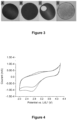
- FIG. 3 shows an LFP electrode as prepared in this example.
- the Figure 3(A) shows the side rich in electronically conductive material which remains shiny while the figure 3(B) shows the electrochemically active material (LFP) filling the pores on the cellulose fiber-rich side (opposite to the VGCFs-rich side).
- Figure 3(C) shows that the film remained intact and strong even after punching with a small electrode.
- a paper separator may be prepared directly on the self-supporting electrode.
- a volume of an aqueous mixture comprising cellulose fibers prepared according to Example 1(a) and corresponding to about 30 mg of cellulose fibers is filtered directly onto the side rich in electrochemically active material of the self-supporting electrode before the step of detaching the self-supporting electrode from the filter membrane.
- the Figure 3(D) shows a film comprising a self-supporting electrode and a separator as defined herein comprising a VGCFs-rich side serving as a current collector, an integrated LFP electrode and a paper separator.
- the films as described in Example 1(d) had a thickness of about 100 ⁇ m. Calendering of the self-supporting films reduced their thickness. In fact, an average decrease of 20 and 30% of thickness was observed when the self-supporting electrodes were calendered at a temperature of 50 and 80 °C, respectively.
- the films were flexible, pliable, rollable and strong as shown in Figure 2 .
- FIG. 3(C) shows that punching an electrode into the self-supporting electrode film did not substantially affect its integrity.
- the side rich in electronically conductive material ( Figure 2(A) ) obtained in the first manufacturing step remained substantially unchanged after the filtration step of the mixture containing the electrochemically active material.
- the pores on the cellulose fiber-rich side were filled by the electrochemically active material and by the second electronically conductive material during the second filtration step.
- the obtained self-supporting electrode consists of a cellulose-based solid film having two surfaces.
- One of the two surfaces mainly comprises the first electronically conductive material and the other surface mainly comprises the electrochemically active material and the second electronically conductive material.
- Example 1(d) The method described in Example 1(d) is very interesting because the metal current collectors are replaced by carbon as the current collector.
- the weight of the metal current collectors can, for example, be replaced by more cellulose or carbon fibers or both to obtain a stronger film with a higher carbon content than a film spread on a metal current collector.
- the electrochemically active material e.g., LFP
- the binder and electronically conductive material represent about 6 wt.%
- the inactive aluminum foil represents 41 wt.% of the total electrode weight.
- Example 1(d) Another advantage of the method described in Example 1(d) is the fact that the amount of electrochemically active material can be perfectly known since it is weighed before being added to the beaker and filtered (see figure 1 ). Therefore, depending on the battery configuration or the cathode/anode materials used, the amount of active material in mg/ cm2 in the self-supporting film can be relatively easily adapted.
- LR2032 button cells comprising two electrodes were assembled with metallic lithium as counter electrode and reference electrode and a Celgard MC -3501 separator or a Kodoshi MC paper separator impregnated with a liquid electrolyte comprising 1M LiPF 6 in an EC:DEC mixture (3:7 by volume).
- the electrochemical properties of the reference electrode (stainless steel shim alone), the paper electrode (composed of cellulose fibers), and the free-standing electrodes of LFP, PTCDA, and LTO were compared by cyclic voltammetry. A scan rate of 0.03 mV.s -1 was used between different potential windows.
- the potential was swept from the open circuit potential (OCP) to 4.2 V, followed by a reverse sweep from 4.2 V to 2.0 V vs Li/Li+.
- the potential was swept from open circuit potential (OCP) to 4.0 V, followed by a reverse sweep from 4.0 V to 2.0 V vs Li/Li+.
- OCP open circuit potential
- the potential was swept from open circuit potential (OCP) to 1.5 V followed by a reverse sweep from 1.5 V to 3.5 V vs Li/Li+.
- OCP open circuit potential
- the potential was swept from open circuit potential (OCP) to 1.2 V followed by a reverse sweep from 1.2 V to 2.5 V vs Li/Li+.
- OCP open circuit potential
- Charge and discharge cycles were performed in galvanostatic mode at different current densities between 2.0 and 4.0 V, 1.5 to 3.5 V, 0 to 1.5 V and 1.2 to 2.5 V vs Li/Li+ for LFP, PTCDA, graphite and LTO electrodes respectively. Five cycles were recorded for each cycling rate ranging from C/10 to 5C and the experiment was automatically started with two training cycles at C/24.
- LFP/LTO electrochemical cells with LFP/LTO weight ratios ranging from 1 to about 0.85 were also tested between 1.0 and 2.5 V vs LTO at different cycling rates ranging from C/24 to 5C.
- Prelithiation of PTCDA cathodes was performed in coin cells using lithium negative electrodes by performing a C/24 discharge from open circuit potential (OCP) to 1.5 V vs Li/Li+ followed by a chronoamperometric experiment at a constant potential of 1.5 V for 3 hours.
- OCP open circuit potential
- the coin cells were disassembled and the prelithiated PTCDA positive electrodes were recovered for assembly with graphite negative electrodes.
- a simple paper electrode composed entirely of cellulose fibers was prepared. This electrode was tested as a working electrode in a coin cell vs. lithium metal.
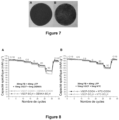
- the cyclic voltammetry experiments, illustrated in Fig. Figure 4 revealed that cellulose fibers (dashed line) were electrochemically inactive up to a potential of 4.2 V, making this type of electrode potential candidates for use in BLIs.
- the electrochemical properties of the paper electrode in the potential window from 2 V to 4.2 V vs Li/Li+ were similar to the electrochemical properties of a reference electrode consisting of a stainless steel shim as a working electrode (solid line).
- the currents recorded for the paper electrode and the reference electrode were approximately four orders of magnitude lower than those obtained with a free-standing LFP electrode as shown in Figure 5 .
- Integrated paper separators as described in Example 1(e) deposited directly on the electrode film as shown in figure 3(D) were also characterized by cyclic voltammetry to verify the influence of paper separators on the electrochemical properties.
- Figure 5 shows the cyclic voltammograms obtained for a freestanding LFP electrode including an integrated paper separator (dashed line) in comparison with a freestanding LFP electrode with a Celgard MC separator (solid line). The cyclic voltammograms obtained showed that the integrated paper separator did not substantially adversely affect the electrochemical properties of the freestanding LFP electrode, as the polarizations ( ⁇ E) of the two electrodes were similar.
- FIG. 6(A) presents the results of cyclic voltammetry and the Figure 6(B) Specific capacitance results recorded with three self-supporting LFP electrodes having the same electrochemically active material loading and obtained by the same method.
- three different carbons were used, namely unmodified VGCFs (solid line), VGCFs-COOH (dashed line) and VGCFs-SOsH (dotted line).
- the cyclic voltammograms were similar.
- the specific capacities presented at the Figure 6(B) show a substantial improvement in the electrochemical performance of the self-supporting electrodes including modified carbon, which is particularly apparent at cycling rates of 2C and 5C.
- a lower current density e.g.
- the discharge capacities of the three self-supporting LFP electrodes were similar and approximately 155 mAh.g -1 .
- the discharge capacity remained at approximately 140 mAh.g -1 for the two self-supporting LFP electrodes including modified VGCFs, while a capacity of approximately 120 mAh.g -1 was obtained using the unmodified VGCFs. This capacity is consistent with the discharge capacity obtained at a 5C rate for the two modified self-supporting LFP electrodes.
- the improved electrochemical performance can be attributed to the hydrophilic nature of the substituents which would allow the carbon to better fill the porosity created by the cellulose fibers.
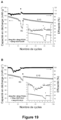
- Figure 7 shows photographs in (A) of the free-standing LFP electrode comprising unmodified VGCF, and in (B) of the free-standing LFP electrode comprising VGCF-COOH.
- Figure 7(B) shows that the cellulose fibers were visible on the electrode surface, resulting in a stronger film with the electrochemically active material and the second electronically conductive material trapped in the cellulose fibers.
- 5C approximately 50% and 77% of the initial discharge capacity were recovered when unmodified VGCFs and VGCFs-COOH were used, respectively.
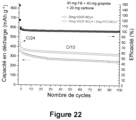
- Figure 8 compares the specific capacity of self-supporting electrodes comprising different mixtures of modified carbons.
- the Figure 8(A) shows the results for a combination of VGCFs-COOH and Denka-COOH (squares) and the results for a combination of VGCFs-SOsH and Denka-SOsH (triangles).
- Figure 8(B) shows the results of a combination of VGCFs-COOH and NTCs-COOH (squares) and the results of a combination of VGCFs-SOsH and NTCs-SOsH (circles).
- Figure 9(A) presents the results of cyclic voltammetry and the Figure 9(B) the capacity results as a function of the number of cycles of the same electrode calendered at a temperature of 25 °C and at a temperature of 50 °C.
- the Figure 9(A) shows excellent reproducibility for both self-supporting LFP electrodes calendered at different temperatures.
- the results of self-supporting LFP electrodes comprising a combination of VGCFs-COOH and CNTs-COOH as a second electronically conductive material are presented, high reproducibility was also demonstrated whether the LFP electrode comprised CNTs, Denka MC carbon or VGCFs.
- the specific capacity obtained for electrodes calendered at a temperature of 50°C or 80°C is slightly higher than that of electrodes calendered at a temperature of 25°C, as shown by the Figures 9(B) and 10 .
- This result can be attributed to better electronic contact and conductivity between the electrochemically active material and the second electronically conductive material inside the film.
- the thickness of the self-supporting electrode decreases with increasing calendering temperature.
- a thickness of about 100 ⁇ m was typically obtained at a calendering temperature of 25 °C, while a thickness of about 80 ⁇ m and about 70 ⁇ m was obtained at calendering temperatures of 50 °C and 80 °C, respectively.
- the nature of the electronically conductive material does not seem to have a significant effect on the thickness after calendering, which seems to be rather mainly influenced by the amount of cellulose fibers used.
- the use of water-soluble carbons has proven to be particularly interesting to obtain better electrochemical performances and reduce the preparation time.
- the surface of the electrochemically active material e.g., C-LFP
- at least one aryl group comprising a hydrophilic functional group e.g., -aryl-COOH
- the Figure 10 presents the electrochemical performances of two LFP electrodes of different thicknesses fabricated with the modified LFP-COOH material.
- Li 4 Ti 5 O 12 is an electrochemically active material of interest for application in BLIs. Due to its operating voltage at a sufficiently high potential (1.55 V vs. Li/Li + ), this material does not form a solid-electrolyte interphase (SEI) layer.
- LTO is referred to as a zero-strain material since it remains stable during lithium ion insertion and deinsertion (see Zaghib, K. et al., Journal of Power Sources, 248, (2014): 1050-1057 ). Similar to LFP, LTO is a relatively inexpensive material and therefore an ideal candidate for low-cost BLIs.
- VGCFs second electronic conductive material
- CNTs Denka MC carbon or CNTs
- FIG 12(A) cyclic voltammetry experiments revealed more intense and sharper oxidation and reduction peaks when a combination of VGCFs-COOH and CNTs-COOH was used (dashed line) compared to a combination of VGCFs-COOH and Denka MC -COOH (dotted line) or the control comprising only VGCFs-COOH (solid line) as a conductive material.
- the Figure 12(B) shows the cycling experiments with different cycling rates.
- Capacities of about 120, 105 and 95 mAh.g -1 were obtained at a cycling rate of 5C respectively for LTO electrodes obtained with a combination of VGCFs-COOH and CNTs-COOH (circles), the control comprising VGCFs-COOH alone (squares) and a combination of VGCFs-COOH and Denka MC -COOH carbon (triangles). Similar results were obtained when the -aryl-COOH groups were replaced by -aryl-SOsH (not shown in the Figure 12 ). As for the result of LFP electrode cycling presented in Figure 8 , the addition of Denka MC carbon decreased the electrochemical performance of LTO electrodes. However, again, an improvement in electrochemical performance was observed when a small amount (50 wt% of the amount of second electronic conductive material) of modified CNTs was added, especially at high cycling rates.
- FIG. 14 presents the specific capacity of two LFP/LTO batteries with the same amount of electrochemically active material for both electrodes but with a different separator.
- the discharge capacities obtained were higher when a Kodoshi MC paper separator (circles) was used instead of a conventional Celgard MC separator (squares).
- An increase of 10 mAh.g -1 was thus obtained for the all-paper battery for each cycling rate varying from C/24 to 2C compared to the cell assembled with a Celgard MC separator.
- 100 and 115 mAh.g -1 were obtained at 5C for the battery using the Celgard MC separator and the paper separator, respectively.
- the improved electrochemical performances obtained with a paper separator could reduce the price of energy storage devices by replacing the Celgard MC separator with a paper separator.
- the battery assembled with the electrode films comprising 40 mg of LFP and 40 mg of LTO (squares) delivered 135 mAh.g -1 at 2C, while 125 mAh.g -1 (circles) and less than 120 mAh.g -1 (stars) were obtained when the films comprising 50 mg of LFP and LTO and 60 mg of LFP and LTO were used, respectively.
- the same behavior was observed at 5C since 115 mAh.g -1 , 105 mAh.g -1 and 95 mAh.g -1 were obtained for the electrode films containing 40, 50 and 60 mg of electrochemically active material, respectively.
- Figure 16(A) shows the capacity retention over 200 charge and discharge cycles for the same battery composition, but assembled with Celgard MC (squares) and Kodoshi MC (circles) separators. As shown in the Figure 16(A) , the use of a Kodoshi MC paper separator allowed to increase the specific capacities. Approximately 140 and approximately 130 mAh.g -1 were obtained respectively for the first cycle at C/2 when a paper separator and a Celgard MC separator were used. After 200 cycles, approximately 92% of the initial discharge capacity was recovered.
- the Figure 16(A) shows that the paper separator did not significantly improve capacity retention although specific capacities remained higher. In both cases, a progressive capacity loss during cycling was observed, which can be attributed to LFP. Similar observations have been reported for electrodes made with submicrometer LFP plates (see Yang, XF et al., ChemSusChem, (2014) 7 (6), 1618-1622 ) and with reduced-size LFP particles cycled at 1C ( Lux, SF et al., Journal of the Electrochemical Society (2010) 157.3, A320-A325 ).
- the electrochemical properties of self-supporting PTCDA electrodes were evaluated.
- the Figure 18 shows cyclic voltammetry and specific capacitance results for free-standing PTCDA electrodes with metallic lithium as counter and reference electrode.
- Figure 18(A) cyclic voltammetry results revealed that an increase in the PTCDA mass in the self-supporting electrode leads to an increase in polarization although the intensity of the redox peak increases slightly on the voltammogram. This behavior was confirmed by the specific capacitance results as a function of the number of cycles (see Figure 18(B) ).
- Figure 19 presents the discharge capacity and coulombic efficiency results as a function of the number of cycles over 100 charge and discharge cycles for the same self-supporting PTCDA electrode composition, except for the composition of the second electronically conductive material.
- Figure 19(A) shows the results for a self-supporting PTCDA electrode comprising VGCFs-COOH as the second electronically conductive material and the Figure 19(B) for the same self-supporting PTCDA electrode composition but comprising a mixture of VGCFs-SOsH with a small amount of CNTs-SOsH.
- the coulombic efficiency decreases significantly with the number of cycles.
- Figures 19(A) and 19(B) also show an enlargement of the first 40 cycles. In both cases, the Coulombic efficiency decreases progressively until reaching, for example, 85% after 4 cycles and after 12 cycles at low cycling rates respectively for self-supporting electrodes without ( Figure 19(A) ) and with a small amount of NTCs-SOsH ( Figure 19(B) ).
- Coulombic efficiency is greatly improved by increasing the cycling speed, as demonstrated by Figure 19(B) .
- the cyclability of self-supporting PTCDA electrodes presented at the Figure 19 was evaluated with long cycling experiments at C/10 but without performing multiple charge and discharge cycles at low and moderate cycling rates (C/10 to 2C).
- the Figure 20 presents the capacity retention over 100 charge and discharge cycles for these two electrodes. It was shown that rapid formation (5 cycles at 5C) prevented the migration of PTCDA into the electrolyte and that the coulombic efficiency remained close to 100% throughout the cycling experiment.
- the specific capacity suddenly decreased for the self-supporting films comprising 50 mg (circles) and 60 mg (triangles) of PTCDA.
- the gradual capacity loss could be mainly related to the degradation of the metallic lithium negative electrode.
- modified CNTs significantly increased the specific surface area of the negative composite electrode and thus led to a greater degradation of the electrolyte and degradation of the lithium metal negative electrode.
- the higher electronic conductivity of the self-supporting film comprising modified CNTs provides better stability during cycling and allows to deliver an additional 75 mAh.g -1 compared to an electrode without modified CNTs. A progressive capacity loss during cycling was observed for both electrodes, this being more significant for the negative composite electrode without CNTs.
- FIG. 23(A) presents long cycling experiments for two graphite electrodes with different loadings (30 and 40 mg of active material).
- the decrease in capacity may be related to the resistance of the self-supporting film.
- the resistance of the film may be proportional to the amount of graphite used in the manufacture of said self-supporting film.
- the initial discharge capacity at C/10 was about 380 mAh.g -1 , which is substantially close to the theoretical capacity of graphite.
- the capacity loss upon cycling was also less pronounced for the self-supporting electrodes comprising 30 mg of graphite than for the self-supporting electrodes comprising 40 mg of graphite.
- FIG. 23(B) presents the cyclability of three electrodes prepared with graphite modified with aryl-SOsH.
- the discharge capacity for similar loadings of active material was significantly higher for self-supporting electrodes made of graphite modified with SOsH groups than for self-supporting electrodes made of unmodified graphite.
- a discharge capacity of 335 and 405 mAh.g -1 were obtained for the first discharge at C/10 for a self-supporting electrode comprising 40 mg of graphite and for a self-supporting electrode comprising 40 mg of graphite-SOsH, respectively.
- Increasing the active material loading up to 50 mg improved the cyclability and specific capacity.
- the -SO 3 H groups attached to the carbon surface increase the total capacity of the battery. These groups can, for example, contribute to the storage of lithium and the increase in ionic conductivity. As shown in Figure 23 , efficiency Coulombic was slightly lower in the first cycle at C/24 when modified graphite was used.
- All-organic (transition metal-free) PTCDA/graphite BLIs comprising self-supporting PTCDA and graphite electrodes, were prepared and electrochemically tested.
- the all-organic PTCDA/graphite BLIs comprised organic redox molecules and biodegradable components. These all-organic PTCDA/graphite BLIs demonstrate the concept of low-cost and biodegradable batteries.
Landscapes
- Chemical & Material Sciences (AREA)
- Engineering & Computer Science (AREA)
- Chemical Kinetics & Catalysis (AREA)
- Electrochemistry (AREA)
- General Chemical & Material Sciences (AREA)
- Materials Engineering (AREA)
- Manufacturing & Machinery (AREA)
- Inorganic Chemistry (AREA)
- Composite Materials (AREA)
- Battery Electrode And Active Subsutance (AREA)
- Secondary Cells (AREA)
- Cell Electrode Carriers And Collectors (AREA)
- Cell Separators (AREA)
Applications Claiming Priority (3)
| Application Number | Priority Date | Filing Date | Title |
|---|---|---|---|
| US201862671612P | 2018-05-15 | 2018-05-15 | |
| US201862728301P | 2018-09-07 | 2018-09-07 | |
| PCT/CA2019/050657 WO2019218067A1 (fr) | 2018-05-15 | 2019-05-15 | Films autoportants à base de cellulose pour utilisation dans des batteries li-ion |
Publications (3)
| Publication Number | Publication Date |
|---|---|
| EP3794661A1 EP3794661A1 (fr) | 2021-03-24 |
| EP3794661A4 EP3794661A4 (fr) | 2022-03-09 |
| EP3794661B1 true EP3794661B1 (fr) | 2024-08-28 |
Family
ID=68541094
Family Applications (1)
| Application Number | Title | Priority Date | Filing Date |
|---|---|---|---|
| EP19802496.0A Active EP3794661B1 (fr) | 2018-05-15 | 2019-05-15 | Films autoportants à base de cellulose pour utilisation dans des batteries li-ion |
Country Status (6)
| Country | Link |
|---|---|
| US (2) | US11811068B2 (https=) |
| EP (1) | EP3794661B1 (https=) |
| JP (1) | JP7431175B2 (https=) |
| KR (1) | KR20210006925A (https=) |
| CN (1) | CN112219299B (https=) |
| WO (1) | WO2019218067A1 (https=) |
Families Citing this family (9)
| Publication number | Priority date | Publication date | Assignee | Title |
|---|---|---|---|---|
| CN111081983B (zh) * | 2019-12-26 | 2021-01-29 | 陕西科技大学 | 一种Co9S8/碳毡钠离子电池自支撑负极的制备方法 |
| CN114824176A (zh) * | 2021-01-19 | 2022-07-29 | 香港纺织及成衣研发中心 | 预锂化负极的制造方法及其在柔性锂电池中的应用 |
| ES3061541T3 (en) * | 2021-01-27 | 2026-04-06 | Lg Energy Solution Ltd | Free standing film for dry electrode, manufacturing method thereof, dry electrode comprising the same, and secondary battery |
| KR20230170822A (ko) | 2021-11-22 | 2023-12-19 | 가부시끼가이샤 레조낙 | 정극 합제층, 도전 보조제, 정극 합제 및 리튬 이온 이차 전지 |
| CA3145611A1 (fr) * | 2022-01-14 | 2023-07-14 | Hydro-Quebec | Materiau d'electrode avec couche organique, procedes de preparation, et utilisations electrochimiques |
| CN114566650B (zh) * | 2022-03-04 | 2024-02-23 | 中南大学 | 一种钠离子电池正极补钠添加剂、补钠方法、正极、柔性电极 |
| CN118765452A (zh) * | 2022-07-28 | 2024-10-11 | 宁德时代新能源科技股份有限公司 | 电池包和用电装置 |
| WO2024121442A1 (es) * | 2022-12-05 | 2024-06-13 | Graphenano Energy, S.L. | Dispositivo de almacenamiento y/o conversión de energía y método para la fabricación de dicho dispositivo |
| CN118326739A (zh) * | 2024-03-18 | 2024-07-12 | 华南理工大学 | 一种柔性碳纸基锂离子电池负极材料及其制备方法和应用 |
Family Cites Families (14)
| Publication number | Priority date | Publication date | Assignee | Title |
|---|---|---|---|---|
| GB2389847B (en) | 2001-01-29 | 2005-08-10 | Univ Rice William M | Process for derivatizing carbon nanotubes with diazonium species and compositions thereof |
| US20050233203A1 (en) | 2004-03-15 | 2005-10-20 | Hampden-Smith Mark J | Modified carbon products, their use in fluid/gas diffusion layers and similar devices and methods relating to the same |
| JP5131723B2 (ja) | 2006-04-04 | 2013-01-30 | パナソニック株式会社 | リチウム二次電池用正極の製造方法、その正極およびリチウム二次電池 |
| FR2965109B1 (fr) * | 2010-09-17 | 2012-09-28 | Commissariat Energie Atomique | Generateur electrochimique et procede de realisation d'un tel generateur |
| JP6077460B2 (ja) * | 2010-12-23 | 2017-02-08 | ナノテク インスツルメンツ インク | 表面媒介リチウムイオン交換エネルギー貯蔵装置 |
| BR112013023730A2 (pt) | 2011-03-15 | 2016-12-13 | Nano Nouvelle Pty Ltd | baterias |
| EP2742552A4 (de) * | 2011-08-08 | 2015-05-06 | Basf Se | Elektrochemische zellen |
| CN204441379U (zh) | 2013-05-07 | 2015-07-01 | 株式会社Lg化学 | 二次电池用电极以及包含其的二次电池和线缆型二次电池 |
| US10003075B2 (en) | 2014-06-12 | 2018-06-19 | Council Of Scientific And Industrial Research | Carbon nanotube-metal nanocomposites as flexible, free standing, binder free high performance anode for Li-ion battery |
| EP3172781B1 (en) | 2014-07-21 | 2020-06-03 | Johnson & Johnson Vision Care Inc. | Flexible micro-battery |
| US10644319B2 (en) * | 2015-05-27 | 2020-05-05 | Transfert Plus, S.E.C. | Process for protecting electrode materials against moisture |
| FR3038145B1 (fr) | 2015-06-23 | 2017-07-21 | Centre Nat Rech Scient | Procede de preparation d'une electrode composite |
| JP6808948B2 (ja) | 2016-02-26 | 2021-01-06 | 株式会社豊田中央研究所 | 非水系リチウムイオン二次電池用負極、その製法及び非水系リチウムイオン二次電池 |
| JP6766467B2 (ja) | 2016-06-23 | 2020-10-14 | 株式会社デンソー | 非水電解質二次電池用電極、非水電解質二次電池及び非水電解質二次電池用電極の製造方法 |
-
2019
- 2019-05-15 CN CN201980032211.4A patent/CN112219299B/zh active Active
- 2019-05-15 US US17/048,717 patent/US11811068B2/en active Active
- 2019-05-15 EP EP19802496.0A patent/EP3794661B1/fr active Active
- 2019-05-15 WO PCT/CA2019/050657 patent/WO2019218067A1/fr not_active Ceased
- 2019-05-15 KR KR1020207034427A patent/KR20210006925A/ko not_active Ceased
- 2019-05-15 JP JP2020563789A patent/JP7431175B2/ja active Active
-
2023
- 2023-10-20 US US18/491,279 patent/US12603299B2/en active Active
Also Published As
| Publication number | Publication date |
|---|---|
| CN112219299A (zh) | 2021-01-12 |
| US20210384518A1 (en) | 2021-12-09 |
| EP3794661A1 (fr) | 2021-03-24 |
| US20240063400A1 (en) | 2024-02-22 |
| KR20210006925A (ko) | 2021-01-19 |
| CN112219299B (zh) | 2024-06-25 |
| CA3095554A1 (fr) | 2019-11-21 |
| WO2019218067A1 (fr) | 2019-11-21 |
| EP3794661A4 (fr) | 2022-03-09 |
| US12603299B2 (en) | 2026-04-14 |
| US11811068B2 (en) | 2023-11-07 |
| JP2021524129A (ja) | 2021-09-09 |
| JP7431175B2 (ja) | 2024-02-14 |
Similar Documents
| Publication | Publication Date | Title |
|---|---|---|
| EP3794661B1 (fr) | Films autoportants à base de cellulose pour utilisation dans des batteries li-ion | |
| EP3103155B1 (fr) | Batteries au lithium spécifiques comprenant des électrolytes non aqueux à base de composés sulfones | |
| EP3345234B1 (fr) | Procede de formation d'une cellule de batterie li-ion equipee d'une electrode positive comprenant un sel sacrificiel | |
| EP2989648B1 (fr) | Dispositif electrochimique du type supercondensateur a base d'un electrolyte comprenant, comme sel conducteur, au moins un sel a base d'un element alcalin autre que le lithium | |
| FR2935546A1 (fr) | Materiau composite d'electrode, electrode de batterie constituee dudit materiau et batterie au lithium comprenant une telle electrode. | |
| EP2409350A1 (fr) | Materiaux composites a base de liants fluores et nanotubes de carbone pour electrodes positives de batteries lithium | |
| WO2019148299A1 (fr) | Copolymères d'unités ester et éther, leurs procédés de fabrication et leurs utilisations | |
| EP4348733A1 (fr) | Matériaux d'enrobage à base d'hydrocarbures aliphatiques insaturés et leurs utilisations dans des applications électrochimiques | |
| WO2025030241A1 (fr) | Matériaux d'enrobage à base de molécules organiques fonctionalisées et leurs utilisations dans des applications électrochimiques | |
| WO2018141062A1 (fr) | Matériau d'électrode, électrode et batterie tout solide comprenant un oxyde complexe de structure olivine | |
| EP4365985A1 (fr) | Préparation d'une électrode de référence à partir d'un matériau électro-actif à un état de charge intermédiaire | |
| CA3095554C (fr) | Films autoportants a base de cellulose pour utilisation dans des batteries li-ion | |
| EP4287229B1 (fr) | Electrode de référence pour supercondensateur | |
| WO2026022133A1 (fr) | Elément électrochimique à très longue durée de vie calendaire | |
| EP3535797B1 (fr) | Électrolytes à base d'un additif spécifique du type liquide ionique pour batteries au lithium | |
| FR3163774A1 (fr) | Element lithium-ion avec reserve d’energie | |
| EP4365975A1 (fr) | Préparation d'un matériau actif pour électrode de référence | |
| WO2025056200A1 (fr) | Composition d'electrodes positives comprenant un melange de matieres actives de type phosphate lithie de manganese et de fer | |
| WO2025196318A1 (fr) | Procédé d'insertion chimique de cations d'un métal alcalin dans un composé solide | |
| FR3030123A1 (fr) | Accumulateur au lithium et son procede de preparation | |
| FR3013150A1 (fr) | Cellule electrochimique comprenant deux electrolytes et accumulateur au lithium comprenant une telle cellule electrochimique |
Legal Events
| Date | Code | Title | Description |
|---|---|---|---|
| STAA | Information on the status of an ep patent application or granted ep patent |
Free format text: STATUS: THE INTERNATIONAL PUBLICATION HAS BEEN MADE |
|
| PUAI | Public reference made under article 153(3) epc to a published international application that has entered the european phase |
Free format text: ORIGINAL CODE: 0009012 |
|
| STAA | Information on the status of an ep patent application or granted ep patent |
Free format text: STATUS: REQUEST FOR EXAMINATION WAS MADE |
|
| 17P | Request for examination filed |
Effective date: 20201215 |
|
| AK | Designated contracting states |
Kind code of ref document: A1 Designated state(s): AL AT BE BG CH CY CZ DE DK EE ES FI FR GB GR HR HU IE IS IT LI LT LU LV MC MK MT NL NO PL PT RO RS SE SI SK SM TR |
|
| AX | Request for extension of the european patent |
Extension state: BA ME |
|
| DAV | Request for validation of the european patent (deleted) | ||
| DAX | Request for extension of the european patent (deleted) | ||
| A4 | Supplementary search report drawn up and despatched |
Effective date: 20220204 |
|
| RIC1 | Information provided on ipc code assigned before grant |
Ipc: H01M 4/80 20060101ALI20220131BHEP Ipc: H01M 4/1397 20100101ALI20220131BHEP Ipc: H01M 4/1391 20100101ALI20220131BHEP Ipc: H01M 4/136 20100101ALI20220131BHEP Ipc: H01M 4/131 20100101ALI20220131BHEP Ipc: H01M 10/054 20100101ALI20220131BHEP Ipc: H01M 4/62 20060101ALI20220131BHEP Ipc: H01M 10/0525 20100101ALI20220131BHEP Ipc: H01M 4/66 20060101AFI20220131BHEP |
|
| GRAP | Despatch of communication of intention to grant a patent |
Free format text: ORIGINAL CODE: EPIDOSNIGR1 |
|
| STAA | Information on the status of an ep patent application or granted ep patent |
Free format text: STATUS: GRANT OF PATENT IS INTENDED |
|
| INTG | Intention to grant announced |
Effective date: 20230523 |
|
| GRAJ | Information related to disapproval of communication of intention to grant by the applicant or resumption of examination proceedings by the epo deleted |
Free format text: ORIGINAL CODE: EPIDOSDIGR1 |
|
| STAA | Information on the status of an ep patent application or granted ep patent |
Free format text: STATUS: REQUEST FOR EXAMINATION WAS MADE |
|
| INTC | Intention to grant announced (deleted) | ||
| GRAP | Despatch of communication of intention to grant a patent |
Free format text: ORIGINAL CODE: EPIDOSNIGR1 |
|
| STAA | Information on the status of an ep patent application or granted ep patent |
Free format text: STATUS: GRANT OF PATENT IS INTENDED |
|
| INTG | Intention to grant announced |
Effective date: 20240517 |
|
| GRAS | Grant fee paid |
Free format text: ORIGINAL CODE: EPIDOSNIGR3 |
|
| GRAA | (expected) grant |
Free format text: ORIGINAL CODE: 0009210 |
|
| STAA | Information on the status of an ep patent application or granted ep patent |
Free format text: STATUS: THE PATENT HAS BEEN GRANTED |
|
| P01 | Opt-out of the competence of the unified patent court (upc) registered |
Free format text: CASE NUMBER: APP_37960/2024 Effective date: 20240626 |
|
| AK | Designated contracting states |
Kind code of ref document: B1 Designated state(s): AL AT BE BG CH CY CZ DE DK EE ES FI FR GB GR HR HU IE IS IT LI LT LU LV MC MK MT NL NO PL PT RO RS SE SI SK SM TR |
|
| REG | Reference to a national code |
Ref country code: GB Ref legal event code: FG4D Free format text: NOT ENGLISH |
|
| REG | Reference to a national code |
Ref country code: CH Ref legal event code: EP |
|
| REG | Reference to a national code |
Ref country code: DE Ref legal event code: R096 Ref document number: 602019057963 Country of ref document: DE |
|
| REG | Reference to a national code |
Ref country code: IE Ref legal event code: FG4D Free format text: LANGUAGE OF EP DOCUMENT: FRENCH |
|
| REG | Reference to a national code |
Ref country code: LT Ref legal event code: MG9D |
|
| PG25 | Lapsed in a contracting state [announced via postgrant information from national office to epo] |
Ref country code: NO Free format text: LAPSE BECAUSE OF FAILURE TO SUBMIT A TRANSLATION OF THE DESCRIPTION OR TO PAY THE FEE WITHIN THE PRESCRIBED TIME-LIMIT Effective date: 20241128 |
|
| REG | Reference to a national code |
Ref country code: AT Ref legal event code: MK05 Ref document number: 1718988 Country of ref document: AT Kind code of ref document: T Effective date: 20240828 |
|
| PG25 | Lapsed in a contracting state [announced via postgrant information from national office to epo] |
Ref country code: NL Free format text: LAPSE BECAUSE OF FAILURE TO SUBMIT A TRANSLATION OF THE DESCRIPTION OR TO PAY THE FEE WITHIN THE PRESCRIBED TIME-LIMIT Effective date: 20240828 Ref country code: FI Free format text: LAPSE BECAUSE OF FAILURE TO SUBMIT A TRANSLATION OF THE DESCRIPTION OR TO PAY THE FEE WITHIN THE PRESCRIBED TIME-LIMIT Effective date: 20240828 Ref country code: GR Free format text: LAPSE BECAUSE OF FAILURE TO SUBMIT A TRANSLATION OF THE DESCRIPTION OR TO PAY THE FEE WITHIN THE PRESCRIBED TIME-LIMIT Effective date: 20241129 Ref country code: PL Free format text: LAPSE BECAUSE OF FAILURE TO SUBMIT A TRANSLATION OF THE DESCRIPTION OR TO PAY THE FEE WITHIN THE PRESCRIBED TIME-LIMIT Effective date: 20240828 Ref country code: PT Free format text: LAPSE BECAUSE OF FAILURE TO SUBMIT A TRANSLATION OF THE DESCRIPTION OR TO PAY THE FEE WITHIN THE PRESCRIBED TIME-LIMIT Effective date: 20241230 |
|
| PG25 | Lapsed in a contracting state [announced via postgrant information from national office to epo] |
Ref country code: BG Free format text: LAPSE BECAUSE OF FAILURE TO SUBMIT A TRANSLATION OF THE DESCRIPTION OR TO PAY THE FEE WITHIN THE PRESCRIBED TIME-LIMIT Effective date: 20240828 |
|
| PG25 | Lapsed in a contracting state [announced via postgrant information from national office to epo] |
Ref country code: LV Free format text: LAPSE BECAUSE OF FAILURE TO SUBMIT A TRANSLATION OF THE DESCRIPTION OR TO PAY THE FEE WITHIN THE PRESCRIBED TIME-LIMIT Effective date: 20240828 |
|
| REG | Reference to a national code |
Ref country code: NL Ref legal event code: MP Effective date: 20240828 |
|
| PG25 | Lapsed in a contracting state [announced via postgrant information from national office to epo] |
Ref country code: AT Free format text: LAPSE BECAUSE OF FAILURE TO SUBMIT A TRANSLATION OF THE DESCRIPTION OR TO PAY THE FEE WITHIN THE PRESCRIBED TIME-LIMIT Effective date: 20240828 Ref country code: IS Free format text: LAPSE BECAUSE OF FAILURE TO SUBMIT A TRANSLATION OF THE DESCRIPTION OR TO PAY THE FEE WITHIN THE PRESCRIBED TIME-LIMIT Effective date: 20241228 |
|
| PG25 | Lapsed in a contracting state [announced via postgrant information from national office to epo] |
Ref country code: HR Free format text: LAPSE BECAUSE OF FAILURE TO SUBMIT A TRANSLATION OF THE DESCRIPTION OR TO PAY THE FEE WITHIN THE PRESCRIBED TIME-LIMIT Effective date: 20240828 |
|
| PG25 | Lapsed in a contracting state [announced via postgrant information from national office to epo] |
Ref country code: RS Free format text: LAPSE BECAUSE OF FAILURE TO SUBMIT A TRANSLATION OF THE DESCRIPTION OR TO PAY THE FEE WITHIN THE PRESCRIBED TIME-LIMIT Effective date: 20241128 Ref country code: ES Free format text: LAPSE BECAUSE OF FAILURE TO SUBMIT A TRANSLATION OF THE DESCRIPTION OR TO PAY THE FEE WITHIN THE PRESCRIBED TIME-LIMIT Effective date: 20240828 |
|
| PG25 | Lapsed in a contracting state [announced via postgrant information from national office to epo] |
Ref country code: RS Free format text: LAPSE BECAUSE OF FAILURE TO SUBMIT A TRANSLATION OF THE DESCRIPTION OR TO PAY THE FEE WITHIN THE PRESCRIBED TIME-LIMIT Effective date: 20241128 Ref country code: PT Free format text: LAPSE BECAUSE OF FAILURE TO SUBMIT A TRANSLATION OF THE DESCRIPTION OR TO PAY THE FEE WITHIN THE PRESCRIBED TIME-LIMIT Effective date: 20241230 Ref country code: PL Free format text: LAPSE BECAUSE OF FAILURE TO SUBMIT A TRANSLATION OF THE DESCRIPTION OR TO PAY THE FEE WITHIN THE PRESCRIBED TIME-LIMIT Effective date: 20240828 Ref country code: NO Free format text: LAPSE BECAUSE OF FAILURE TO SUBMIT A TRANSLATION OF THE DESCRIPTION OR TO PAY THE FEE WITHIN THE PRESCRIBED TIME-LIMIT Effective date: 20241128 Ref country code: NL Free format text: LAPSE BECAUSE OF FAILURE TO SUBMIT A TRANSLATION OF THE DESCRIPTION OR TO PAY THE FEE WITHIN THE PRESCRIBED TIME-LIMIT Effective date: 20240828 Ref country code: LV Free format text: LAPSE BECAUSE OF FAILURE TO SUBMIT A TRANSLATION OF THE DESCRIPTION OR TO PAY THE FEE WITHIN THE PRESCRIBED TIME-LIMIT Effective date: 20240828 Ref country code: IS Free format text: LAPSE BECAUSE OF FAILURE TO SUBMIT A TRANSLATION OF THE DESCRIPTION OR TO PAY THE FEE WITHIN THE PRESCRIBED TIME-LIMIT Effective date: 20241228 Ref country code: HR Free format text: LAPSE BECAUSE OF FAILURE TO SUBMIT A TRANSLATION OF THE DESCRIPTION OR TO PAY THE FEE WITHIN THE PRESCRIBED TIME-LIMIT Effective date: 20240828 Ref country code: GR Free format text: LAPSE BECAUSE OF FAILURE TO SUBMIT A TRANSLATION OF THE DESCRIPTION OR TO PAY THE FEE WITHIN THE PRESCRIBED TIME-LIMIT Effective date: 20241129 Ref country code: FI Free format text: LAPSE BECAUSE OF FAILURE TO SUBMIT A TRANSLATION OF THE DESCRIPTION OR TO PAY THE FEE WITHIN THE PRESCRIBED TIME-LIMIT Effective date: 20240828 Ref country code: ES Free format text: LAPSE BECAUSE OF FAILURE TO SUBMIT A TRANSLATION OF THE DESCRIPTION OR TO PAY THE FEE WITHIN THE PRESCRIBED TIME-LIMIT Effective date: 20240828 Ref country code: BG Free format text: LAPSE BECAUSE OF FAILURE TO SUBMIT A TRANSLATION OF THE DESCRIPTION OR TO PAY THE FEE WITHIN THE PRESCRIBED TIME-LIMIT Effective date: 20240828 Ref country code: AT Free format text: LAPSE BECAUSE OF FAILURE TO SUBMIT A TRANSLATION OF THE DESCRIPTION OR TO PAY THE FEE WITHIN THE PRESCRIBED TIME-LIMIT Effective date: 20240828 |
|
| PG25 | Lapsed in a contracting state [announced via postgrant information from national office to epo] |
Ref country code: DK Free format text: LAPSE BECAUSE OF FAILURE TO SUBMIT A TRANSLATION OF THE DESCRIPTION OR TO PAY THE FEE WITHIN THE PRESCRIBED TIME-LIMIT Effective date: 20240828 Ref country code: RO Free format text: LAPSE BECAUSE OF FAILURE TO SUBMIT A TRANSLATION OF THE DESCRIPTION OR TO PAY THE FEE WITHIN THE PRESCRIBED TIME-LIMIT Effective date: 20240828 Ref country code: SM Free format text: LAPSE BECAUSE OF FAILURE TO SUBMIT A TRANSLATION OF THE DESCRIPTION OR TO PAY THE FEE WITHIN THE PRESCRIBED TIME-LIMIT Effective date: 20240828 |
|
| PG25 | Lapsed in a contracting state [announced via postgrant information from national office to epo] |
Ref country code: EE Free format text: LAPSE BECAUSE OF FAILURE TO SUBMIT A TRANSLATION OF THE DESCRIPTION OR TO PAY THE FEE WITHIN THE PRESCRIBED TIME-LIMIT Effective date: 20240828 |
|
| PG25 | Lapsed in a contracting state [announced via postgrant information from national office to epo] |
Ref country code: CZ Free format text: LAPSE BECAUSE OF FAILURE TO SUBMIT A TRANSLATION OF THE DESCRIPTION OR TO PAY THE FEE WITHIN THE PRESCRIBED TIME-LIMIT Effective date: 20240828 |
|
| PG25 | Lapsed in a contracting state [announced via postgrant information from national office to epo] |
Ref country code: IT Free format text: LAPSE BECAUSE OF FAILURE TO SUBMIT A TRANSLATION OF THE DESCRIPTION OR TO PAY THE FEE WITHIN THE PRESCRIBED TIME-LIMIT Effective date: 20240828 Ref country code: SK Free format text: LAPSE BECAUSE OF FAILURE TO SUBMIT A TRANSLATION OF THE DESCRIPTION OR TO PAY THE FEE WITHIN THE PRESCRIBED TIME-LIMIT Effective date: 20240828 |
|
| REG | Reference to a national code |
Ref country code: DE Ref legal event code: R097 Ref document number: 602019057963 Country of ref document: DE |
|
| PLBE | No opposition filed within time limit |
Free format text: ORIGINAL CODE: 0009261 |
|
| STAA | Information on the status of an ep patent application or granted ep patent |
Free format text: STATUS: NO OPPOSITION FILED WITHIN TIME LIMIT |
|
| 26N | No opposition filed |
Effective date: 20250530 |
|
| PG25 | Lapsed in a contracting state [announced via postgrant information from national office to epo] |
Ref country code: SE Free format text: LAPSE BECAUSE OF FAILURE TO SUBMIT A TRANSLATION OF THE DESCRIPTION OR TO PAY THE FEE WITHIN THE PRESCRIBED TIME-LIMIT Effective date: 20240828 |
|
| REG | Reference to a national code |
Ref country code: DE Ref legal event code: R119 Ref document number: 602019057963 Country of ref document: DE |
|
| REG | Reference to a national code |
Ref country code: CH Ref legal event code: H13 Free format text: ST27 STATUS EVENT CODE: U-0-0-H10-H13 (AS PROVIDED BY THE NATIONAL OFFICE) Effective date: 20251223 |
|
| PG25 | Lapsed in a contracting state [announced via postgrant information from national office to epo] |
Ref country code: LU Free format text: LAPSE BECAUSE OF NON-PAYMENT OF DUE FEES Effective date: 20250515 |
|
| PG25 | Lapsed in a contracting state [announced via postgrant information from national office to epo] |
Ref country code: CH Free format text: LAPSE BECAUSE OF NON-PAYMENT OF DUE FEES Effective date: 20250531 |
|
| GBPC | Gb: european patent ceased through non-payment of renewal fee |
Effective date: 20250515 |
|
| REG | Reference to a national code |
Ref country code: BE Ref legal event code: MM Effective date: 20250531 |
|
| PG25 | Lapsed in a contracting state [announced via postgrant information from national office to epo] |
Ref country code: MC Free format text: LAPSE BECAUSE OF FAILURE TO SUBMIT A TRANSLATION OF THE DESCRIPTION OR TO PAY THE FEE WITHIN THE PRESCRIBED TIME-LIMIT Effective date: 20240828 |
|
| PG25 | Lapsed in a contracting state [announced via postgrant information from national office to epo] |
Ref country code: GB Free format text: LAPSE BECAUSE OF NON-PAYMENT OF DUE FEES Effective date: 20250515 |
|
| PG25 | Lapsed in a contracting state [announced via postgrant information from national office to epo] |
Ref country code: IE Free format text: LAPSE BECAUSE OF NON-PAYMENT OF DUE FEES Effective date: 20250515 Ref country code: DE Free format text: LAPSE BECAUSE OF NON-PAYMENT OF DUE FEES Effective date: 20251202 |
|
| PG25 | Lapsed in a contracting state [announced via postgrant information from national office to epo] |
Ref country code: BE Free format text: LAPSE BECAUSE OF NON-PAYMENT OF DUE FEES Effective date: 20250531 |
|
| PG25 | Lapsed in a contracting state [announced via postgrant information from national office to epo] |
Ref country code: FR Free format text: LAPSE BECAUSE OF NON-PAYMENT OF DUE FEES Effective date: 20250531 |