EP3778666B1 - Polyethylenzusammensetzung - Google Patents
Polyethylenzusammensetzung Download PDFInfo
- Publication number
- EP3778666B1 EP3778666B1 EP20196015.0A EP20196015A EP3778666B1 EP 3778666 B1 EP3778666 B1 EP 3778666B1 EP 20196015 A EP20196015 A EP 20196015A EP 3778666 B1 EP3778666 B1 EP 3778666B1
- Authority
- EP
- European Patent Office
- Prior art keywords
- bimodal
- alternatively
- test method
- medium density
- density polyethylene
- Prior art date
- Legal status (The legal status is an assumption and is not a legal conclusion. Google has not performed a legal analysis and makes no representation as to the accuracy of the status listed.)
- Active
Links
Images

Classifications
-
- C—CHEMISTRY; METALLURGY
- C08—ORGANIC MACROMOLECULAR COMPOUNDS; THEIR PREPARATION OR CHEMICAL WORKING-UP; COMPOSITIONS BASED THEREON
- C08F—MACROMOLECULAR COMPOUNDS OBTAINED BY REACTIONS ONLY INVOLVING CARBON-TO-CARBON UNSATURATED BONDS
- C08F210/00—Copolymers of unsaturated aliphatic hydrocarbons having only one carbon-to-carbon double bond
- C08F210/16—Copolymers of ethene with alpha-alkenes, e.g. EP rubbers
-
- C—CHEMISTRY; METALLURGY
- C08—ORGANIC MACROMOLECULAR COMPOUNDS; THEIR PREPARATION OR CHEMICAL WORKING-UP; COMPOSITIONS BASED THEREON
- C08F—MACROMOLECULAR COMPOUNDS OBTAINED BY REACTIONS ONLY INVOLVING CARBON-TO-CARBON UNSATURATED BONDS
- C08F10/00—Homopolymers and copolymers of unsaturated aliphatic hydrocarbons having only one carbon-to-carbon double bond
- C08F10/02—Ethene
-
- C—CHEMISTRY; METALLURGY
- C08—ORGANIC MACROMOLECULAR COMPOUNDS; THEIR PREPARATION OR CHEMICAL WORKING-UP; COMPOSITIONS BASED THEREON
- C08L—COMPOSITIONS OF MACROMOLECULAR COMPOUNDS
- C08L23/00—Compositions of homopolymers or copolymers of unsaturated aliphatic hydrocarbons having only one carbon-to-carbon double bond; Compositions of derivatives of such polymers
- C08L23/02—Compositions of homopolymers or copolymers of unsaturated aliphatic hydrocarbons having only one carbon-to-carbon double bond; Compositions of derivatives of such polymers not modified by chemical after-treatment
- C08L23/04—Homopolymers or copolymers of ethene
- C08L23/08—Copolymers of ethene
- C08L23/0807—Copolymers of ethene with unsaturated hydrocarbons only containing four or more carbon atoms
- C08L23/0815—Copolymers of ethene with unsaturated hydrocarbons only containing four or more carbon atoms with aliphatic 1-olefins containing one carbon-to-carbon double bond
-
- C—CHEMISTRY; METALLURGY
- C08—ORGANIC MACROMOLECULAR COMPOUNDS; THEIR PREPARATION OR CHEMICAL WORKING-UP; COMPOSITIONS BASED THEREON
- C08F—MACROMOLECULAR COMPOUNDS OBTAINED BY REACTIONS ONLY INVOLVING CARBON-TO-CARBON UNSATURATED BONDS
- C08F10/00—Homopolymers and copolymers of unsaturated aliphatic hydrocarbons having only one carbon-to-carbon double bond
-
- C—CHEMISTRY; METALLURGY
- C08—ORGANIC MACROMOLECULAR COMPOUNDS; THEIR PREPARATION OR CHEMICAL WORKING-UP; COMPOSITIONS BASED THEREON
- C08F—MACROMOLECULAR COMPOUNDS OBTAINED BY REACTIONS ONLY INVOLVING CARBON-TO-CARBON UNSATURATED BONDS
- C08F210/00—Copolymers of unsaturated aliphatic hydrocarbons having only one carbon-to-carbon double bond
- C08F210/02—Ethene
-
- C—CHEMISTRY; METALLURGY
- C08—ORGANIC MACROMOLECULAR COMPOUNDS; THEIR PREPARATION OR CHEMICAL WORKING-UP; COMPOSITIONS BASED THEREON
- C08F—MACROMOLECULAR COMPOUNDS OBTAINED BY REACTIONS ONLY INVOLVING CARBON-TO-CARBON UNSATURATED BONDS
- C08F210/00—Copolymers of unsaturated aliphatic hydrocarbons having only one carbon-to-carbon double bond
- C08F210/14—Monomers containing five or more carbon atoms
-
- C—CHEMISTRY; METALLURGY
- C08—ORGANIC MACROMOLECULAR COMPOUNDS; THEIR PREPARATION OR CHEMICAL WORKING-UP; COMPOSITIONS BASED THEREON
- C08F—MACROMOLECULAR COMPOUNDS OBTAINED BY REACTIONS ONLY INVOLVING CARBON-TO-CARBON UNSATURATED BONDS
- C08F4/00—Polymerisation catalysts
- C08F4/42—Metals; Metal hydrides; Metallo-organic compounds; Use thereof as catalyst precursors
- C08F4/44—Metals; Metal hydrides; Metallo-organic compounds; Use thereof as catalyst precursors selected from light metals, zinc, cadmium, mercury, copper, silver, gold, boron, gallium, indium, thallium, rare earths or actinides
- C08F4/60—Metals; Metal hydrides; Metallo-organic compounds; Use thereof as catalyst precursors selected from light metals, zinc, cadmium, mercury, copper, silver, gold, boron, gallium, indium, thallium, rare earths or actinides together with refractory metals, iron group metals, platinum group metals, manganese, rhenium technetium or compounds thereof
- C08F4/62—Refractory metals or compounds thereof
- C08F4/64—Titanium, zirconium, hafnium or compounds thereof
- C08F4/64003—Titanium, zirconium, hafnium or compounds thereof the metallic compound containing a multidentate ligand, i.e. a ligand capable of donating two or more pairs of electrons to form a coordinate or ionic bond
- C08F4/64082—Tridentate ligand
- C08F4/64141—Dianionic ligand
- C08F4/64148—NN(R)N
-
- C—CHEMISTRY; METALLURGY
- C08—ORGANIC MACROMOLECULAR COMPOUNDS; THEIR PREPARATION OR CHEMICAL WORKING-UP; COMPOSITIONS BASED THEREON
- C08F—MACROMOLECULAR COMPOUNDS OBTAINED BY REACTIONS ONLY INVOLVING CARBON-TO-CARBON UNSATURATED BONDS
- C08F4/00—Polymerisation catalysts
- C08F4/42—Metals; Metal hydrides; Metallo-organic compounds; Use thereof as catalyst precursors
- C08F4/44—Metals; Metal hydrides; Metallo-organic compounds; Use thereof as catalyst precursors selected from light metals, zinc, cadmium, mercury, copper, silver, gold, boron, gallium, indium, thallium, rare earths or actinides
- C08F4/60—Metals; Metal hydrides; Metallo-organic compounds; Use thereof as catalyst precursors selected from light metals, zinc, cadmium, mercury, copper, silver, gold, boron, gallium, indium, thallium, rare earths or actinides together with refractory metals, iron group metals, platinum group metals, manganese, rhenium technetium or compounds thereof
- C08F4/62—Refractory metals or compounds thereof
- C08F4/64—Titanium, zirconium, hafnium or compounds thereof
- C08F4/659—Component covered by group C08F4/64 containing a transition metal-carbon bond
- C08F4/65904—Component covered by group C08F4/64 containing a transition metal-carbon bond in combination with another component of C08F4/64
-
- C—CHEMISTRY; METALLURGY
- C08—ORGANIC MACROMOLECULAR COMPOUNDS; THEIR PREPARATION OR CHEMICAL WORKING-UP; COMPOSITIONS BASED THEREON
- C08F—MACROMOLECULAR COMPOUNDS OBTAINED BY REACTIONS ONLY INVOLVING CARBON-TO-CARBON UNSATURATED BONDS
- C08F4/00—Polymerisation catalysts
- C08F4/42—Metals; Metal hydrides; Metallo-organic compounds; Use thereof as catalyst precursors
- C08F4/44—Metals; Metal hydrides; Metallo-organic compounds; Use thereof as catalyst precursors selected from light metals, zinc, cadmium, mercury, copper, silver, gold, boron, gallium, indium, thallium, rare earths or actinides
- C08F4/60—Metals; Metal hydrides; Metallo-organic compounds; Use thereof as catalyst precursors selected from light metals, zinc, cadmium, mercury, copper, silver, gold, boron, gallium, indium, thallium, rare earths or actinides together with refractory metals, iron group metals, platinum group metals, manganese, rhenium technetium or compounds thereof
- C08F4/62—Refractory metals or compounds thereof
- C08F4/64—Titanium, zirconium, hafnium or compounds thereof
- C08F4/659—Component covered by group C08F4/64 containing a transition metal-carbon bond
- C08F4/6592—Component covered by group C08F4/64 containing a transition metal-carbon bond containing at least one cyclopentadienyl ring, condensed or not, e.g. an indenyl or a fluorenyl ring
- C08F4/65922—Component covered by group C08F4/64 containing a transition metal-carbon bond containing at least one cyclopentadienyl ring, condensed or not, e.g. an indenyl or a fluorenyl ring containing at least two cyclopentadienyl rings, fused or not
- C08F4/65927—Component covered by group C08F4/64 containing a transition metal-carbon bond containing at least one cyclopentadienyl ring, condensed or not, e.g. an indenyl or a fluorenyl ring containing at least two cyclopentadienyl rings, fused or not two cyclopentadienyl rings being mutually bridged
-
- C—CHEMISTRY; METALLURGY
- C08—ORGANIC MACROMOLECULAR COMPOUNDS; THEIR PREPARATION OR CHEMICAL WORKING-UP; COMPOSITIONS BASED THEREON
- C08L—COMPOSITIONS OF MACROMOLECULAR COMPOUNDS
- C08L23/00—Compositions of homopolymers or copolymers of unsaturated aliphatic hydrocarbons having only one carbon-to-carbon double bond; Compositions of derivatives of such polymers
- C08L23/02—Compositions of homopolymers or copolymers of unsaturated aliphatic hydrocarbons having only one carbon-to-carbon double bond; Compositions of derivatives of such polymers not modified by chemical after-treatment
- C08L23/04—Homopolymers or copolymers of ethene
- C08L23/06—Polyethene
-
- C—CHEMISTRY; METALLURGY
- C08—ORGANIC MACROMOLECULAR COMPOUNDS; THEIR PREPARATION OR CHEMICAL WORKING-UP; COMPOSITIONS BASED THEREON
- C08L—COMPOSITIONS OF MACROMOLECULAR COMPOUNDS
- C08L23/00—Compositions of homopolymers or copolymers of unsaturated aliphatic hydrocarbons having only one carbon-to-carbon double bond; Compositions of derivatives of such polymers
- C08L23/02—Compositions of homopolymers or copolymers of unsaturated aliphatic hydrocarbons having only one carbon-to-carbon double bond; Compositions of derivatives of such polymers not modified by chemical after-treatment
- C08L23/04—Homopolymers or copolymers of ethene
- C08L23/08—Copolymers of ethene
-
- C—CHEMISTRY; METALLURGY
- C08—ORGANIC MACROMOLECULAR COMPOUNDS; THEIR PREPARATION OR CHEMICAL WORKING-UP; COMPOSITIONS BASED THEREON
- C08F—MACROMOLECULAR COMPOUNDS OBTAINED BY REACTIONS ONLY INVOLVING CARBON-TO-CARBON UNSATURATED BONDS
- C08F2500/00—Characteristics or properties of obtained polyolefins; Use thereof
- C08F2500/04—Broad molecular weight distribution, i.e. Mw/Mn > 6
-
- C—CHEMISTRY; METALLURGY
- C08—ORGANIC MACROMOLECULAR COMPOUNDS; THEIR PREPARATION OR CHEMICAL WORKING-UP; COMPOSITIONS BASED THEREON
- C08F—MACROMOLECULAR COMPOUNDS OBTAINED BY REACTIONS ONLY INVOLVING CARBON-TO-CARBON UNSATURATED BONDS
- C08F2500/00—Characteristics or properties of obtained polyolefins; Use thereof
- C08F2500/05—Bimodal or multimodal molecular weight distribution
-
- C—CHEMISTRY; METALLURGY
- C08—ORGANIC MACROMOLECULAR COMPOUNDS; THEIR PREPARATION OR CHEMICAL WORKING-UP; COMPOSITIONS BASED THEREON
- C08F—MACROMOLECULAR COMPOUNDS OBTAINED BY REACTIONS ONLY INVOLVING CARBON-TO-CARBON UNSATURATED BONDS
- C08F2500/00—Characteristics or properties of obtained polyolefins; Use thereof
- C08F2500/09—Long chain branches
-
- C—CHEMISTRY; METALLURGY
- C08—ORGANIC MACROMOLECULAR COMPOUNDS; THEIR PREPARATION OR CHEMICAL WORKING-UP; COMPOSITIONS BASED THEREON
- C08F—MACROMOLECULAR COMPOUNDS OBTAINED BY REACTIONS ONLY INVOLVING CARBON-TO-CARBON UNSATURATED BONDS
- C08F2500/00—Characteristics or properties of obtained polyolefins; Use thereof
- C08F2500/12—Melt flow index or melt flow ratio
-
- C—CHEMISTRY; METALLURGY
- C08—ORGANIC MACROMOLECULAR COMPOUNDS; THEIR PREPARATION OR CHEMICAL WORKING-UP; COMPOSITIONS BASED THEREON
- C08F—MACROMOLECULAR COMPOUNDS OBTAINED BY REACTIONS ONLY INVOLVING CARBON-TO-CARBON UNSATURATED BONDS
- C08F2500/00—Characteristics or properties of obtained polyolefins; Use thereof
- C08F2500/26—Use as polymer for film forming
-
- C—CHEMISTRY; METALLURGY
- C08—ORGANIC MACROMOLECULAR COMPOUNDS; THEIR PREPARATION OR CHEMICAL WORKING-UP; COMPOSITIONS BASED THEREON
- C08L—COMPOSITIONS OF MACROMOLECULAR COMPOUNDS
- C08L2205/00—Polymer mixtures characterised by other features
- C08L2205/02—Polymer mixtures characterised by other features containing two or more polymers of the same C08L -group
- C08L2205/025—Polymer mixtures characterised by other features containing two or more polymers of the same C08L -group containing two or more polymers of the same hierarchy C08L, and differing only in parameters such as density, comonomer content, molecular weight, structure
-
- C—CHEMISTRY; METALLURGY
- C08—ORGANIC MACROMOLECULAR COMPOUNDS; THEIR PREPARATION OR CHEMICAL WORKING-UP; COMPOSITIONS BASED THEREON
- C08L—COMPOSITIONS OF MACROMOLECULAR COMPOUNDS
- C08L2207/00—Properties characterising the ingredient of the composition
- C08L2207/06—Properties of polyethylene
-
- C—CHEMISTRY; METALLURGY
- C08—ORGANIC MACROMOLECULAR COMPOUNDS; THEIR PREPARATION OR CHEMICAL WORKING-UP; COMPOSITIONS BASED THEREON
- C08L—COMPOSITIONS OF MACROMOLECULAR COMPOUNDS
- C08L2308/00—Chemical blending or stepwise polymerisation process with the same catalyst
-
- C—CHEMISTRY; METALLURGY
- C08—ORGANIC MACROMOLECULAR COMPOUNDS; THEIR PREPARATION OR CHEMICAL WORKING-UP; COMPOSITIONS BASED THEREON
- C08L—COMPOSITIONS OF MACROMOLECULAR COMPOUNDS
- C08L2314/00—Polymer mixtures characterised by way of preparation
- C08L2314/06—Metallocene or single site catalysts
Definitions
- LLDPE Linear low density polyethylene
- LDPE low density polyethylene
- films, sheets, and injection molded articles are used in packaging applications and non-packaging applications. Examples are agricultural film, food packaging, garment bags, grocery bags, heavy-duty sacks, industrial sheeting, pallet and shrink wraps, and bags.
- LLDPE injection molded articles include buckets, freezer containers, lids, and toys.
- Polyethylenes are mentioned in CA 2427685 A1 ; US 7,576,166 B2 ; US 7,897,710 B2 ; US 8,008,403 B2 ; US 8,846,188 B2 ; US 8,957,158 B2 ; US 9,090,762 B2 ; US 9,284,389 B2 ; US 9,309,338 B2 ; WO 2006/045738 A1 ; and WO 2015/069637 A2 .
- US 7,576,166 B2 to J. ⁇ ärllä et al. relates to a process for the production of linear low-density polyethylene composition.
- a process for producing bimodal linear low-density polyethylene polymer compositions, useful for making films. Exemplifies Ziegler-Natta catalyst.
- WO 2015/069637 A2 to A. M. Sukhadia relates to low density polyolefin resins with low molecular weight and high molecular weight components, and films made therefrom. Ethylene-based polymers produced using dual metallocene catalyst systems.
- prior MCN-LLDPE metallocene catalyst
- prior MCN-LLDPEs may have insufficient sealability (e.g., hot seal/hot tack may be too weak) relative to prior ZN-LLDPE.
- Other processability drawbacks of prior MCN-LLDPEs may include tan delta values that are too high, molecular weight distributions (MWD) that are too narrow, and shear thinning index values that are too low.
- Prior MCN-LLDPEs also may have insufficient stiffness or other mechanical properties that are not sufficient for certain applications. For example, for certain uses Elmendorf tear in the cross direction (CD Tear) or machine direction (MD Tear) may be too likely, melt strength may be too low, secant modulus may be too low, and/or dart impact strength may be too low.
- the prior blend has dart impact property that is worse (lower) than that of the prior MCN-LLDPE alone. The more prior ZN-LLDPE that is mixed with the prior MCN-LLDPE, the worse the dart impact property of the blend gets.
- a technical solution to this problem was not obvious from the prior art.
- a problem to be solved by inventiveness then is to discover a new LMDPE that alone has at least one processability characteristic similar to that of an unblended monomodal ZN-LMDPE and at least one stiffness/mechanical property similar to that of an unblended monomodal MCN-LMDPE.
- inventions to this problem include a bimodal linear medium density polyethylene composition ("inventive bimodal LMDPE composition”) made with a bimodal catalyst system, and articles containing same.
- the inventive bimodal LMDPE has a combination of improved properties comprising at least one processability characteristic similar to that of an unblended monomodal ZN-LMDPE and a dart impact property similar to that of an unblended monomodal MCN-LMDPE.
- the inventive bimodal LMDPE composition is characterized by a density from 0.930 to 0.950 g/cm 3 , measured according to ASTM D792-13 Method B.
- the inventive bimodal LMDPE may be characterized by at least one improved (increased) property.
- the improvement may be relative to that of a prior bimodal LMDPE.
- the inventive bimodal LMDPE may be used in a number of industrial applications.
- the inventive bimodal linear medium density polyethylene composition comprises a lower molecular weight (LMW) polyethylene component and a higher molecular weight (HMW) polyethylene component, wherein each of the LMW and HMW polyethylene components comprises ethylene-derived monomeric units and (C 3 -C 20 )alpha-olefin-derived comonomeric units; and wherein the bimodal linear medium density polyethylene composition is characterized by each of limitations (a) to (e): (a) a resolved bimodality showing in a chromatogram of gel permeation chromatography (GPC) of the bimodal linear medium density polyethylene composition, wherein the chromatogram shows a peak representing the HMW polyethylene component, a peak representing the LMW polyethylene component, and a resolved bimodal molecular weight distribution characterized by a local minimum in a range of Log(molecular weight) (“Log(MW)”) 1.5 to 5.0 between the peak representing the HMW polyethylene component and the peak representing the LMW polyethylene component, measured according to Bimodality Test Method as described
- Aspect 2 The bimodal LMDPE composition of aspect 1 further described by any one of limitations (i) to (iii): (i) a melt index (190° C., 2.16 kilograms (kg), "MI 2 ”) from 0.1 to 5.0 grams per 10 minutes (g/10 min.), alternatively 0.1 to 3.0 g/10 min., alternatively 0.1 to 2.0 g/10 min., alternatively 0.1 to 1.0 g/10 min., alternatively from 0.1 to 0.5 g/10 min., all measured according to the Melt Index MI 2 Test Method, described later; (ii) a tan delta (tan ⁇ ) from 5 to 35, alternatively from 5 to 25, alternatively from 5 to 15, alternatively from 8 to 12, alternatively from 9 to 10, all measured at 190° C. and 0.1000 radians per second (rad/s) according to Tan Delta Test Method, described later; (iii) both (i) and (ii).
- a melt index 190° C., 2.16 kilograms (kg), "MI 2 ”
- Aspect 4 The bimodal LMDPE composition of any one of aspects 1 to 3 further described by any one of limitations (i) to (vi): (i) a flow index (190° C., 21.6 kg, "FI 21 ") from 4 to 500 g/10min., alternatively from 10 to 100 g/10 min., alternatively from 20 to 40 g/10 min., alternatively from 31.0 to 34.0 g/10 min., all measured according to the Flow Index FI 21 Test Method, described later; (ii) a melt flow ratio (190° C., "MI 21 /MI 2 ”) 20.0 to 50.0, alternatively from 24 to 39, alternatively from 25 to 35 and calculated according to the Melt Flow Ratio Test Method, described later; (iii) a shear thinning index value from 1.5 to 10, alternatively from 2.5 to 10.0, alternatively from 3.0 to 10.0, alternatively from 3.1 to 5.0, measured according to the Shear Thinning Index Test Method, described later; (iv) a number-average molecular weight (
- Aspect 5 The bimodal LMDPE composition of any one of aspects 1 to 4 further described by any one of limitations (i) to (iv): (i) the (C 3 -C 20 )alpha-olefin-derived comonomeric units are derived from 1-butene; (ii) the (C 3 -C 20 )alpha-olefin-derived comonomeric units are derived from 1-hexene; (iii) the (C 3 -C 20 )alpha-olefin-derived comonomeric units are derived from 1-octene; and (iv) the (C 3 -C 20 )alpha-olefin-derived comonomeric units are derived from a combination of any two, alternatively each of 1-butene, 1-hexene, and 1-octene.
- a bimodal linear medium density polyethylene composition made by copolymerizing ethylene (monomer) and at least one (C 3 -C 20 )alpha-olefin (comonomer) with a mixture of a bimodal catalyst system and a trim solution in the presence of molecular hydrogen gas (H 2 ) and an inert condensing agent (ICA) in one, two or more polymerization reactors (e.g., one fluidized bed gas phase reactor) under (co)polymerizing conditions can be provided; wherein prior to being mixed together the trim solution consists essentially of a (tetramethylcyclopentadienyl)(n-propylcyclopentadienyl)zirconium complex (procatalyst, e.g., (tetramethylcyclopentadienyl)(n-propylcyclopentadienyl)zirconium dimethyl) and an inert liquid solvent (e.g., liquid alkane) and the bi
- a method of making a bimodal linear medium density polyethylene composition comprising contacting ethylene (monomer) and at least one (C 3 -C 20 )alpha-olefin (comonomer) with a mixture of a bimodal catalyst system and a trim solution in the presence of molecular hydrogen gas (H 2 ) and an inert condensing agent (ICA) in one, two or more polymerization reactors under (co)polymerizing conditions, thereby making the bimodal linear medium density polyethylene composition; wherein prior to being mixed together the trim solution consists essentially of a (tetramethylcyclopentadienyl)(n-propylcyclopentadienyl)zirconium complex (procatalyst, e.g., (tetramethylcyclopentadienyl)(n-propylcyclopentadienyl)zirconium dimethyl) and an inert liquid solvent (e.g., liquid alkane
- the bimodal linear medium density polyethylene composition of aspect 6 or the method of aspect 7 may be further described by any one of limitations (i) to (vi): (i) wherein the bimodal catalyst system consists essentially of a bis(2-pentamethylphenylamido)ethyl)amine zirconium complex and a (tetramethylcyclopentadienyl)(n-propylcyclopentadienyl)zirconium complex in a molar ratio thereof from 1.0:1.0 to 5.0:1.0, respectively, alternatively 1.5:1.0 to 2.5:1.0, alternatively 2.0:1.0 to 4.0:1.0, 2.5:1.0 to 3.49:1.0, alternatively from 2.7:1.0 to 3.3:1.0, alternatively from 2.9:1.0 to 3.1:1.0, alternatively 1.5:1.0, alternatively 2.0:1.0, and a methylaluminoxane species, all disposed by spray-drying onto the solid support; (ii) wherein the bimodal catalyst system further consists essentially of mineral oil and the solid support is
- a manufactured article comprising a shaped form of the bimodal linear medium density polyethylene composition of any one of aspects 1 to 6.
- the manufactured article of aspect 9 selected from: coatings, films, sheets, extruded articles, and injection molded articles.
- the manufactured article may be a film, alternatively a blown film.
- a method of covering a substance or article in need of covering can be provided, the method comprising covering or sealing, alternatively sealing at least a portion, alternatively all of the substance or the manufactured article of any one of aspects 9 to 11.
- a catalyst made by activating bis(2-pentamethylphenylamido)ethyl)amine zirconium dibenzyl may be called a "bis(2-pentamethylphenylamido)ethyl)amine zirconium complex”.
- a catalyst made by activating (tetramethylcyclopentadienyl)(n-propylcyclopentadienyl)zirconium dichloride or (tetramethylcyclopentadienyl)(n-propylcyclopentadienyl)zirconium dimethyl may be called a "(tetramethylcyclopentadienyl)(n-propylcyclopentadienyl)zirconium complex".
- the catalyst made by activating (tetramethylcyclopentadienyl)(n-propylcyclopentadienyl)zirconium dichloride may be the same as or different than the catalyst made by activating (tetramethylcyclopentadienyl)(n-propylcyclopentadienyl)zirconium dimethyl.
- the metal of the activator typically is different than the metal of the procatalyst.
- the molar ratio of metal content of the activator to metal content of the procatalyst(s) may be from 1000:1 to 0.5:1, alternatively 300:1 to 1:1, alternatively 150:1 to 1:1.
- the activator may be a Lewis acid, a non-coordinating ionic activator, or an ionizing activator, or a Lewis base, an alkylaluminum, or an alkylaluminoxane.
- the alkylaluminum may be a trialkylaluminum, alkylaluminum halide, or alkylaluminum alkoxide (diethylaluminum ethoxide).
- the trialkylaluminum may be trimethylaluminum, triethylaluminum ("TEAI"), tripropylaluminum, triisobutylaluminum, and the like.
- the alkylaluminum halide may be diethylaluminum chloride.
- the alkylaluminoxane may be a methyl aluminoxane (MAO), ethyl aluminoxane, or isobutylaluminoxane.
- the activator may be a MAO that is a modified methylaluminoxane (MMAO).
- MMAO modified methylaluminoxane
- the corresponding activator species may be a derivative of the Lewis acid, non-coordinating ionic activator, ionizing activator, Lewis base, alkylaluminum, or alkylaluminoxane, respectively.
- the activator species may have a different structure or composition than the activator from which it is derived and may be a by-product of the activation of the procatalyst or a derivative of the byproduct.
- An example of the derivative of the byproduct is a methylaluminoxane species that is formed by devolatilizing during spray-drying of a bimodal catalyst system made with methylaluminoxane.
- the activator may be commercially available.
- An activator may be fed into the polymerization reactor(s) (e.g., one fluidized bed gas phase reactor) in a separate feed from that feeding the reactants used to make the bimodal catalyst system (e.g., supported bimodal catalyst system) and/or the trim solution thereinto.
- the LMW and HMW polyethylene components together constitute the bimodal polyethylene composition, which may be the inventive LMDPE composition, made with the bimodal catalyst system, and having a multimodal (e.g., bimodal) molecular weight distribution.
- the bimodal catalyst system, method employing same, and inventive bimodal LMDPE composition is free of a Ziegler-Natta catalyst.
- the bimodal catalyst system may be made by contacting at least two procatalysts having different structures from each other with at least one of the activators.
- Each procatalyst may independently comprise a metal atom, at least one ligand bonded to the metal atom, and at least one leaving group bonded to and displaceable from the metal atom.
- Each metal may be an element of any one of Groups 3 to 14, e.g., a Group 4 metal.
- Each leaving group is H, an unsubstituted alkyl, an aryl group, an aralkyl group, a halide atom, an alkoxy group, or a primary or secondary amino group.
- At least one ligand is a cyclopentadienyl or substituted cyclopentadienyl group.
- no ligand is a cyclopentadienyl or substituted cyclopentadienyl group, and instead at least one ligand has at least one O, N, and/or P atom that coordinates to the metal atom.
- the ligand(s) of the non-metallocene has at least two O, N, and/or P atoms that coordinates in a multidentate (e.g., bidentate or tridentate) binding mode to the metal atom.
- Discrete structures means the procatalysts and catalysts made therefrom have different ligands from each other, and either the same or a different metal atom, and either the same or different leaving groups.
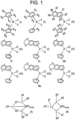
- each of the R 1 to R 10 groups is independently H, a (C 1 -C 20 )alkyl, (C 6 -C 20 )aryl, or (C 7 -C 20 )aralkyl group; M is a Group 4 metal; and each X is independently H, a halide, (C 1 -C 20 )alkyl, or (C 7 -C 20 )aralkyl group.
- each of R 7 to R 10 is H.
- each of the R 1 to R 12 groups is independently H, a (C 1 -C 20 )alkyl, (C 6 -C 20 )aryl, or (C 7 -C 20 )aralkyl group, wherein at least one of R 4 to R 7 is not H; M is a Group 4 metal (e.g., Ti, Zr, or Hf); and each X is independently H, a halide, (C 1 -C 20 )alkyl, or (C 7 -C 20 )aralkyl group.
- each of R 9 to R 12 is H in formula (III).
- Me is methyl (CH 3 )
- Pr is propyl (i.e., CH 2 CH 2 CH 3 )
- each "I" substituent on a ring represents a methyl group.
- L is a Group 15 or 16 element, such as nitrogen or oxygen; L'is a Group 15 or 16 element or Group 14 containing group, such as carbon, silicon or germanium.
- Y is a Group 15 element, such as nitrogen or phosphorus; alternatively nitrogen.
- Z is a Group 15 element, such as nitrogen or phosphorus; alternatively nitrogen.
- Subscript m is 0, -1, -2 or -3; alternatively -2; and represents the total formal charge of the Y, Z, and L in formula (A) and the total formal charge of the Y, Z, and L' in formula (B).
- R 1 , R 2 , R 3 , R 4 , R 5 , R 6 , and R 7 are independently H, a (C 1 -C 20 )hydrocarbyl group, a (C 1 -C 20 )heterohydrocarbyl group, or a (C 1 -C 20 )organoheteryl group, wherein the (C 1 -C 20 )heterohydrocarbyl group and (C 1 -C 20 )organoheteryl group each independently have at least one heteroatom selected from Si, Ge, Sn, Pb, or P.
- R 1 and R 2 are covalently bonded to each other to form a divalent group of formula -R 1a --R 2a - and/or R 4 and R 2 are covalently bonded to each other to form a divalent group of formula -R 4a -R 5a -, wherein - R 1a --R 2a - and -R 4a -R 5a - are independently a (C 1 -C 20 )hydrocarbylene group, a (C 1 -C 20 )heterohydrocarbylene group, or a (C 1 -C 20 )organoheterylene group.
- R 4 and R 5 may be a (C 1 -C 20 )alkyl group, a (C 6 -C 20 )aryl group, a substituted (C 6 -C 20 )aryl group, a (C 3 -C 20 )cycloalkyl group, a substituted (C 3 -C 20 )cycloalkyl group, a (C 8 -C 20 )bicyclic aralkyl group, or a substituted (C 8 -C 20 )bicyclic aralkyl group.
- R 6 and R 7 may be H or absent.
- R* is absent, hydrogen, a group containing Group 14 atom, halogen, or group containing heteroatom.
- the bimodal catalyst system may comprise a combination of a metallocene catalyst compound and a non-metallocene catalyst compound.
- the metallocene catalyst compound may be a metallocene ligand- metal complex such as a metallocene ligand-Group 4 metal complex, which may be made by activating (with the activator) a procatalyst compound selected from (pentamethylcyclopentadienyl)(n-propylcyclopentadienyl)zirconium dichloride, bis(n-butylcyclopentadienyl)zirconium dichloride, (pentamethylcyclopentadienyl)(n-propylcyclopentadienyl)zirconium dimethyl, and bis(n-butylcyclopentadienyl)zirconium dimethyl.
- the non-metallocene catalyst compound may be a non-metallocene ligand-metal complex such as a non-metallocene ligand-Group 4 metal complex, which may be made by activating (with the activator) a procatalyst compound selected from bis(2-(2,4,6-trimethylphenylamido)ethyl)amine zirconium dibenzyl and bis(2-(pentamethylphenylamido)ethyl)amine zirconium dibenzyl.
- a procatalyst compound selected from bis(2-(2,4,6-trimethylphenylamido)ethyl)amine zirconium dibenzyl and bis(2-(pentamethylphenylamido)ethyl)amine zirconium dibenzyl.
- the bimodal catalyst system may be made by activating, according to the method of contacting with an activator, a combination of a metallocene procatalyst compound that is (tetramethylcyclopentadienyl)(n-propylcyclopentadienyl)zirconium dichloride and a non-metallocene procatalyst compound that is bis(2-pentamethylphenylamido)ethyl)amine zirconium dibenzyl.
- a metallocene procatalyst compound that is (tetramethylcyclopentadienyl)(n-propylcyclopentadienyl)zirconium dichloride
- a non-metallocene procatalyst compound that is bis(2-pentamethylphenylamido)ethyl)amine zirconium dibenzyl.
- the (tetramethylcyclopentadienyl)(n-propylcyclopentadienyl)zirconium dichloride is a compound of formula (II) wherein M is Zr, each X is CI, R 6 is propyl (CH 2 CH 2 CH 3 ), and each of R 1 to R 4 is methyl.
- the bis(2-pentamethylphenylamido)ethyl)amine zirconium dibenzyl is a procatalyst compound of formula (A) wherein M is Zr, each X is benzyl, R 1 and R 2 are each CH 2 CH 2 ; R 3 is H; L, Y, and Z are all N; and R 4 and R 5 are each pentamethylphenyl; and R6 and R 7 are absent.
- Each of the catalyst compounds of the bimodal catalyst system independently may be unsupported, alternatively supported on a support material, in which latter case the bimodal catalyst system is a supported catalyst system.
- the catalyst compounds When each catalyst compound is supported, the catalyst compounds may reside on the same support material (e.g., same particles), or on different support materials (e.g., different particles).
- the bimodal catalyst system includes mixtures of unsupported catalyst compounds in slurry form and/or solution form.
- the support material may be a silica (e.g., fumed silica), alumina, a clay, or talc.
- the fumed silica may be hydrophilic (untreated), alternatively hydrophobic (treated).
- the support is the hydrophobic fumed silica, which may be prepared by treating an untreated fumed silica with a treating agent such as dimethyldichlorosilane, a polydimethylsiloxane fluid, or hexamethyldisilazane.
- a treating agent such as dimethyldichlorosilane, a polydimethylsiloxane fluid, or hexamethyldisilazane.
- the treating agent is dimethyldichlorosilane.
- the bimodal catalyst system is the bimodal catalyst system described in any one of the following references: US 7,193,017 B2 ; US 7,312,279 B2 ; US 7,858,702 B2 ; US 7,868,092 B2 ; US 8,202,940 B2 ; and US 8,378,029 B2 (e.g., column 4/line 60 to column 5/line 10 and column 10/lines 6 to 38 and Example 1).
- (C 1 -C 18 )alkyl group is a monovalent unsubstituted saturated hydrocarbon having from 1 to 18 carbon atoms.
- the (C 3 -C 20 )alpha-olefin is 1-propene, 1-butene, 1-hexene, or 1-octene; alternatively 1-butene, 1-hexene, or 1-octene; alternatively 1-butene or 1-hexene; alternatively 1-butene or 1-octene; alternatively 1-hexene or 1-octene; alternatively 1-butene; alternatively 1-hexene; alternatively 1-octene; alternatively a combination of any two of 1-butene, 1-hexene, and 1-octene.
- the (C 3 -C 20 )alpha-olefin is used as a comonomer from which the comonomeric units of the LMW polyethylene component are derived may be the same as, alternatively different than, the(C 3 -C 20 )alpha-olefin from which the comonomeric units of the HMW polyethylene component are derived.
- One or more of the benzyl and chloride leaving groups may be absent from the Zr in the bimodal catalyst system.
- the expression “consisting essentially of” as applied to the description of the "trim solution means the trim solution is unsupported (i.e., not disposed on a particulate solid) and is free of a Ziegler-Natta catalyst or any organic ligand other than the tetramethylcyclopentadienyl and n-propylcyclopentadienyl ligands.
- Consisting of and consists of Closed ended expressions that exclude anything that is not specifically described by the limitation that it modifies. In some aspects any one, alternatively each expression “consisting essentially of” or “consists essentially of” may be replaced by the expression “consisting of” or “consists of”, respectively.
- any result effective variable or combination of such variables such as catalyst composition; amount of reactant; molar ratio of two reactants; absence of interfering materials (e.g., H 2 O and O 2 ); or a process parameter (e.g., feed rate or temperature), step, or sequence that is effective and useful for the inventive copolymerizing method in the polymerization reactor(s) to give the inventive bimodal LMDPE composition.
- a process parameter e.g., feed rate or temperature
- each of the (co)polymerizing conditions may be fixed (i.e., unchanged) during production of the inventive bimodal LMDPE composition.
- Such fixed (co)polymerizing conditions may be referred to herein as steady-state (co)polymerizing conditions.
- Steady-state (co)polymerizing conditions are useful for continuously making embodiments of the inventive bimodal LMDPE composition having same polymer properties.
- At least one, alternatively two or more of the (co)polymerizing conditions may be varied within their defined operating parameters during production of the inventive bimodal LMDPE composition in order to transition from the production of a first embodiment of the inventive bimodal LMDPE composition having a first set of polymer properties to a second embodiment of the inventive bimodal LMDPE composition having a second set of polymer properties, wherein the first and second sets of polymer properties are different and are each within the limitations described herein for the inventive bimodal LMDPE composition.
- an operating parameter includes varying the operating temperature within the aforementioned range from 83° to 87° C. such as by changing from a first operating temperature of 85° C. to a second operating temperature of 86° C., or by changing from a third operating temperature of 87° C. to a third operating temperature of 85° C.
- an operating parameter includes varying the molar ratio of molecular hydrogen to ethylene (H2/C2) from 0.017 to 0.018, or from 0.020 to 0.019.
- another example of varying an operating parameter includes varying the molar ratio of comonomer (Comer) to the ethylene (Comer/C2 molar ratio) from 0.028 to 0.038, or from 0.041 to 0.025. Combinations of two or more of the foregoing example variations are included herein. Transitioning from one set to another set of the (co)polymerizing conditions is permitted within the meaning of "(co)polymerizing conditions" as the operating parameters of both sets of (co)polymerizing conditions are within the ranges defined therefore herein.
- a beneficial consequence of the foregoing transitioning is that any described property value for the inventive bimodal LMDPE composition, or the LMW or HMW polyethylene component thereof, may be achieved by a person of ordinary skill in the art in view of the teachings herein.
- the gas phase polymerization reactor/method may be a fluidized bed reactor/method as described in US 3,709,853 ; US 4,003,712 ; US 4,011,382 ; US 4,302,566 ; US 4,543,399 ; US 4,882,400 ; US 5,352,749 ; US 5,541,270 ; EP-A-0 802 202 ; and Belgian Patent No. 839,380 .
- These patents disclose gas phase polymerization processes wherein the polymerization medium is either mechanically agitated or fluidized by the continuous flow of the gaseous monomer and diluent.
- the (co)polymerizing conditions for gas phase reactors/polymerizations may further include an amount (e.g., 0.5 to 200 ppm based on all feeds into reactor) static control agents and/or continuity additives such as aluminum stearate or polyethyleneimine. Static control agents may be added to the gas phase reactor to inhibit formation or buildup of static charge therein.
- the (co)polymerizing conditions may further include using molecular hydrogen to control final properties of the LMW and/or HMW polyethylene components or inventive bimodal LMDPE composition.
- molecular hydrogen to control final properties of the LMW and/or HMW polyethylene components or inventive bimodal LMDPE composition.
- H 2 is generally described in Polypropylene Handbook 76-78 (Hanser Publishers, 1996 ). All other things being equal, using hydrogen can increase the melt flow rate (MFR) or melt index (MI) thereof, wherein MFR or MI are influenced by the concentration of hydrogen.
- a molar ratio of hydrogen to total monomer (H 2 /monomer), hydrogen to ethylene (H 2 /C 2 ), or hydrogen to comonomer (H 2 / ⁇ -olefin) may be from 0.0001 to 10, alternatively 0.0005 to 5, alternatively 0.001 to 3, alternatively 0.001 to 0.10.
- Feeds Quantities of reactants and/or reagents that are added or "fed” into a reactor. In continuous polymerization operation, each feed independently may be continuous or intermittent. The quantities or “feeds” may be measured, e.g., by metering, to control amounts and relative amounts of the various reactants and reagents in the reactor at any given time.
- the HMW polyethylene component of the inventive bimodal LMDPE composition may have an M W from 10,000 to 1,000,000 g/mol.
- the lower endpoint of the M W for the HMW polyethylene component may be 20,000, alternatively 50,000, alternatively 100,000, alternatively 150,000, alternatively 200,000, alternatively 250,000, alternatively 300,000 g/mol.
- the upper endpoint of M W may be 900,000, alternatively 800,000, alternatively 700,000, alternatively 600,000 g/mol.
- the bottom portion of the range of M W for the HMW polyethylene component may overlap the upper portion of the range of M W for the LMW polyethylene component, with the proviso that in any embodiment of the inventive bimodal LMDPE composition the particular M W for the HMW polyethylene component is greater than the particular M W for the LMW polyethylene component.
- the HMW polyethylene component may be made with catalyst prepared by activating a non-metallocene ligand-Group 4 metal complex.
- inert Generally, not (appreciably) reactive or not (appreciably) interfering therewith in the inventive polymerization reaction.
- inert as applied to the purge gas or ethylene feed means a molecular oxygen (O 2 ) content from 0 to less than 5 parts per million based on total parts by weight of the purge gas or ethylene feed.
- the (C 5 -C 10 )alkane is a pentane, e.g., normal-pentane or isopentane; a hexane; a heptane; an octane; a nonane; a decane; or a combination of any two or more thereof.
- the ICA is isopentane (i.e., 2-methylbutane).
- the inventive method of polymerization, which uses the ICA may be referred to herein as being an inert condensing mode operation (ICMO).
- Concentration in gas phase measured using gas chromatography by calibrating peak area percent to mole percent (mol%) with a gas mixture standard of known concentrations of ad rem gas phase components. Concentration may be from 1 to 10 mol%, alternatively from 3 to 8 mole%.
- the LMW polyethylene component of the inventive bimodal LMDPE composition may have an M W from 3,000 to 100,000 g/mol.
- the lower endpoint of the M W for the LMW polyethylene component may be 5,000, alternatively 8,000, alternatively 10,000, alternatively 12,000, alternatively 15,000, alternatively 20,000 g/mol.
- the upper endpoint of M W may be 50,000, alternatively 40,000, alternatively 35,000, alternatively 30,000 g/mol.
- the LMW polyethylene component may be made with catalyst prepared by activating a metallocene ligand-Group 4 metal complex.
- Polyethylene A macromolecule, or collection of macromolecules, composed of repeat units wherein 50 to 100 mole percent (mol%), alternatively 70 to 100 mol%, alternatively 80 to 100 mol%, alternatively 90 to 100 mol%, alternatively 95 to 100 mol%, alternatively any one of the foregoing ranges wherein the upper endpoint is ⁇ 100 mol%, of such repeat units are derived from ethylene monomer, and, in aspects wherein there are less than 100 mol% ethylenic repeat units, the remaining repeat units are comonomeric units derived from at least one (C 3 -C 20 )alpha-olefin; or collection of such macromolecules.
- Linear medium density polyethylene (LMDPE). The macromolecule having a substantially linear structure.
- Procatalyst Also referred to as a precatalyst or catalyst compound (as opposed to active catalyst compound), generally a material, compound, or combination of compounds that exhibits no or extremely low polymerization activity (e.g., catalyst efficiency may be from 0 or ⁇ 1,000) in the absence of an activator, but upon activation with an activator yields a catalyst that shows at least 10 times greater catalyst efficiency than that, if any, of the procatalyst.
- catalyst efficiency may be from 0 or ⁇ 1,000
- GPC chromatogram A molecular weight distribution having two peaks separated by an intervening local minimum.
- a resolved GPC chromatogram of the inventive polymers represented by a plot of dW/dlog(MW) versus log(MW) that features local maxima dW/dlog(MW) values for the LMW and HMW polyethylene component peaks, and a local minimum dW/dlog(MW) value at a log(MW) between the maxima.
- Start-up or restart of the polymerization reactor(s) illustrated with a fluidized bed reactor includes a time period that is prior to reaching the (co)polymerizing conditions.
- Start-up or restart may include the use of a seedbed preloaded or loaded, respectively, into the fluidized bed reactor.
- the seedbed may be composed of powder of polyethylene.
- the polyethylene of the seedbed may be a MDPE, alternatively a LMDPE, alternatively a bimodal LMDPE, alternatively a previously made embodiment of the inventive bimodal LMDPE composition.
- Start-up or restart of the fluidized bed reactor may also include gas atmosphere transitions comprising purging air or other unwanted gas(es) from the reactor with a dry (anhydrous) inert purge gas, followed by purging the dry inert purge gas from the reactor with dry ethylene gas.
- the dry inert purge gas may consist essentially of molecular nitrogen (N 2 ), argon, helium, or a mixture of any two or more thereof.
- the dry inert purge gas may be used to sweep the air from a recommissioned fluidized bed reactor during early stages of start-up to give a fluidized bed reactor having an atmosphere consisting of the dry inert purge gas.
- a transitioning fluidized bed reactor Prior to restart (e.g., after a change in seedbeds or prior to a change in alpha-olefin comonomer), a transitioning fluidized bed reactor may contain an atmosphere of unwanted alpha-olefin, unwanted ICA or other unwanted gas or vapor.
- the dry inert purge gas may be used to sweep the unwanted vapor or gas from the transitioning fluidized bed reactor during early stages of restart to give the fluidized bed reactor having an atmosphere consisting of the dry inert purge gas.
- any dry inert purge gas may itself be swept from the fluidized bed reactor with the dry ethylene gas.
- the dry ethylene gas may further contain molecular hydrogen gas such that the dry ethylene gas is fed into the fluidized bed reactor as a mixture thereof.
- the dry molecular hydrogen gas may be introduced separately and after the atmosphere of the fluidized bed reactor has been transitioned to ethylene. The gas atmosphere transitions may be done prior to, during, or after heating the fluidized bed reactor to the reaction temperature of the (co)polymerizing conditions.
- Start-up or restart of the fluidized bed reactor also includes introducing feeds of reactants and reagents thereinto.
- the reactants include the ethylene and the alpha-olefin.
- the reagents fed into the fluidized bed reactor include the molecular hydrogen gas and the inert condensing agent (ICA) and the mixture of the bimodal catalyst system and the trim solution.
- ICA inert condensing agent
- Substance or article in need of covering A naturally occurring or man-made material, or manufactured article that would benefit from having a layer of the inventive bimodal LMDPE composition thereover, therearound, or thereon.
- Substances in need of covering include those vulnerable to their external environments and those in need of segregation therefrom. External environments may contain oxygen, moisture, and/or light, which may degrade such substances but for the layer of the inventive bimodal LMDPE composition.
- Such substances include clothing, drugs, food, electronic components, hygroscopic compounds, plants, and any other light, oxygen and/or moisture-sensitive material or manufactured article.
- Articles in need of covering include ordered arrangements of materials (e.g., stacks of manufactured articles on a pallet in need of wrapping), boxes in need of shrink wrapping, loose manufactured articles in need of shipping, and toxic or corrosive materials.
- Trim solution Any one of the metallocene procatalyst compounds or the non-metallocene procatalyst compounds described earlier dissolved in the inert liquid solvent (e.g., liquid alkane).
- the trim solution is mixed with the bimodal catalyst system to make the mixture, and the mixture is used in the inventive polymerization reaction to modify at least one property of the inventive bimodal LMDPE composition made thereby.
- at least one property are density, melt index MI2, flow index FI21, melt flow ratio, and molecular mass dispersity (M w /M n ), ⁇ M .
- the mixture of the bimodal catalyst system and the trim solution may be fed into the polymerization reactor(s) in "wet mode", alternatively may be devolatilized and fed in “dry mode”.
- the dry mode is fed in the form of a dry powder or granules.
- the wet mode is fed in the form of a suspension or slurry.
- the inert liquid is a liquid alkane such as heptane.
- Ziegler-Natta catalysts Heterogeneous materials that enhance olefin polymerization reaction rates and typically are products that are prepared by contacting inorganic titanium compounds, such as titanium halides supported on a magnesium chloride support, with an activator.
- the activator may be an alkylaluminum activator such as triethylaluminum (TEA), triisobutylaluminum (TIBA), diethylaluminum chloride (DEAC), diethylaluminum ethoxide (DEAE), or ethylaluminum dichloride (EADC).
- TAA triethylaluminum
- TIBA triisobutylaluminum
- DEAC diethylaluminum chloride
- DEAE diethylaluminum ethoxide
- EMC ethylaluminum dichloride
- the inventive bimodal LMDPE It unpredictably has at least one improved property such as, for example, at least one improved (increased) processability property and/or at least one improved (increased) stiffness property.
- the improved processability property may be at least one of decreased extruder barrel pressure, increased sealability (e.g., hot seal/hot tack), decreased tan delta value, and increased shear thinning index value.
- the improved stiffness property may be at least one of increased Elmendorf tear (CD Tear and/or MD Tear), increased melt strength, and increased dart impact strength.
- inventive bimodal LMDPE is not characterized by a worsening of any three, alternatively any two, alternatively any one of the foregoing properties.
- the inventive bimodal LMDPE is not characterized by a worsening of any three, alternatively any two, alternatively any one of the foregoing properties.
- Test samples of embodiments of unfilled and filled compositions may be separately made into compression molded plaques.
- the mechanical properties of these compositions may be characterized using test samples cut from the compression molded plaques.
- concentration, c K DRI I DRI /(dn/dc), wherein K DRI is a constant determined by calibrating the DRI, / indicates division, and dn/dc is the refractive index increment for the polymer.
- K DRI is a constant determined by calibrating the DRI, / indicates division
- dn/dc is the refractive index increment for the polymer.
- dn/dc 0.109.
- Shear Thinning Index (SHI) Test Method Perform small-strain (10%) oscillatory shear measurements on polymer melts at 190° C. using an ARES-G2 Advanced Rheometric Expansion System, from TA Instruments, with parallel-plate geometry to obtain the values of storage modulus (G'), loss modulus (G") complex modulus (G*) and complex viscosity ( ⁇ *) as a function of frequency ( ⁇ ). Obtain a SHI value by calculating the complex viscosities at given values of complex modulus, and calculating the ratio of the two viscosities.
- Tan Delta Test Method a dynamic mechanical analysis (DMA) method measured at 190° C. and 0.1000 radians per second (rad/s) using the following procedure: Perform small-strain (10%) oscillatory shear measurements on polymer melts at 190° C. using an ARES-G2 Advanced Rheometric Expansion System, from TA Instruments, with parallel-plate geometry to obtain the values of storage modulus (G'), loss modulus (G") complex modulus (G*) and complex viscosity ( ⁇ *) as a function of frequency ( ⁇ ).
- the tan ⁇ value at frequency ( ⁇ ) 0.1 radian/second is used later in Table 2.
- Zero Shear Viscosity Determination Method perform small-strain (10%) oscillatory shear measurements on polymer melts at 190° C. using an ARES-G2 Advanced Rheometric Expansion System, from TA Instruments, with parallel-plate geometry to obtain complex viscosity
- Bimodal catalyst system 1 consisted essentially of or made from bis(2-pentamethylphenylamido)ethyl)amine zirconium dibenzyl and (tetramethylcyclopentadienyl)(n-propylcyclopentadienyl)zirconium dichloride spray-dried in a 3:1 molar ratio onto CAB-O-SIL TS610, a hydrophobic fumed silica made by surface treating hydrophilic (untreated) fumed silica with dimethyldichlorosilane support, and methylaluminoxane (MAO), and fed into a gas phase polymerization reactor as a slurry in mineral oil.
- bis(2-pentamethylphenylamido)ethyl)amine zirconium dibenzyl and (tetramethylcyclopentadienyl)(n-propylcyclopentadienyl)zirconium dichloride spray-dried in a 3:1 molar ratio onto CAB-
- the molar ratio of moles MAO to (moles of bis(2-pentamethylphenylamido)ethyl)amine zirconium dibenzyl + moles (tetramethylcyclopentadienyl)(n-propylcyclopentadienyl)zirconium dichloride) was 140:1.
- Trim solution 1 consisted essentially of or made from (tetramethylcyclopentadienyl)(n-propylcyclopentadienyl)zirconium dimethyl (procatalyst) dissolved in heptane to give a solution having a concentration of 0.7 gram procatalyst per milliliter solution (g/mL).
- Inventive Examples 1 and 2 Produced the bimodal LMDPE composition of IE1 in a single gas phase polymerization reactor containing a pilot plant scale continuous mode, gas phase fluidized bed reactor with a capacity of producing 22 to 110 kg resin per hour.
- preloaded the reactor before startup with a seedbed of granular resin inside.
- inventive bimodal LMDPE composition wherein density is from 0.930 to 0.945 g/cm 3 , replicate the procedure except increase the molar ratio of 1-hexene/C2 from 0.011 to a range from 0.010 to 0.040.
- Table 1 Operating constituents/parameters for IE1 and IE2.
- the inventive film IE(A) is made from higher density resin than that of the comparative CE(A) film, and yet surprisingly the inventive film has higher MD tear.
- the inventive IE(A) film also possesses significantly higher secant modulus in MD and CD and higher tensile strength than those of the comparative CE(A) film.
- the inventive IE(B) film and the comparative CE(A) film are made from resins with comparable densities, surprisingly the inventive IE(B) film has significantly higher dart impact strength and higher MD tear than those of the comparative CE(A) film.
Landscapes
- Chemical & Material Sciences (AREA)
- Health & Medical Sciences (AREA)
- Chemical Kinetics & Catalysis (AREA)
- Medicinal Chemistry (AREA)
- Polymers & Plastics (AREA)
- Organic Chemistry (AREA)
- Engineering & Computer Science (AREA)
- Materials Engineering (AREA)
- Crystallography & Structural Chemistry (AREA)
- Transition And Organic Metals Composition Catalysts For Addition Polymerization (AREA)
- Addition Polymer Or Copolymer, Post-Treatments, Or Chemical Modifications (AREA)
- Compositions Of Macromolecular Compounds (AREA)
- Manufacture Of Macromolecular Shaped Articles (AREA)
- Absorbent Articles And Supports Therefor (AREA)
- Solid-Sorbent Or Filter-Aiding Compositions (AREA)
Claims (15)
- Bimodale lineare Polyethylenzusammensetzung mittlerer Dichte, umfassend eine Polyethylenkomponente mit niedriger Molekularmasse (LMW) und eine Polyethylenkomponente mit höherer Molekularmasse (HMW), wobei jede der LMW- und HMW-Polyethylenkomponenten Ethylen-abgeleitete monomere Einheiten und (C3-C20)Alpha-olefin-abgeleitete comonomere Einheiten umfasst; und wobei die bimodale lineare Polyethylenzusammensetzung mittlerer Dichte gekennzeichnet ist durch jedes der Einschränkungen (a) bis (e): (a) eine aufgelöste Bimodalität, die in einem Chromatogramm einer Gelpermeationschromatographie (GPC) der bimodalen linearen Polyethylenzusammensetzung mittlerer Dichte zeigt, wobei das Chromatogramm einen Peak zeigt, der die HMW-Polyethylenkomponente darstellt, einen Peak, der die LMW-Polyethylenkomponente darstellt, und eine aufgelöste bimodale Molekulargewichtsverteilung, gekennzeichnet durch ein lokales Minimum in einem Bereich von Log(Molekulargewicht) ("Log(MW)") 1,5 bis 5,0 zwischen dem Peak, der die HMW-Polyethylenkomponente darstellt, und dem Peak, der die LMW-Polyethylenkomponente darstellt, gemessen gemäß einem Bimodalitätstestverfahren wie hierin beschrieben; (b) eine Molekularmassendispersität (Mw/Mn), ÐM, von 5 bis 30,1, gemessen gemäß einem Gelpermeationschromatografie-Testverfahren (GPC-Testverfahren) wie hierin beschrieben; (c) keine messbare Menge an Langkettenverzweigung pro 1.000 Kohlenstoffatome ("LCB-Index"), gemessen gemäß einem LCB-Testverfahren wie hierin beschrieben; (d) eine Dichte von 0,930 bis 0,950 Gramm pro Kubikzentimeter (g/cm3), gemessen gemäß ASTM D792-13 Verfahren B; und (e) eine Molekularmassendispersität (Mw/Mn), ÐM, der LMW-Polyethylenkomponenten von >2,0 bis <3,0, gemessen nach dem GPC-Testverfahren wie hierin beschrieben, nach einem Entfalten der LMW- und HMW-Polyethylenkomponenten der bimodalen linearen Polyethylenzusammensetzung mittlerer Dichte gemäß einem Entfaltungstestverfahren wie hierin beschrieben.
- Bimodale lineare Polyethylenzusammensetzung mittlerer Dichte nach Anspruch 1, die durch eine beliebige der Einschränkungen (i) bis (iii) beschrieben ist: (i) einen Schmelzindex (190 °C, 2,16 Kilogramm (kg), "MI2") von 0,1 bis 5,0 Gramm pro 10 Minuten (g/10 min), gemessen gemäß Schmelzindex-MI2-Testverfahren wie hierin beschrieben; (ii) ein Tan-Delta (Tan δ) von 5 bis 35, gemessen bei 190 °C und 0,1000 Radiane pro Sekunde (rad/s) gemäß einem Tan-Delta-Testverfahren wie hierin beschrieben; (iii) sowohl (i) als auch (ii).
- Bimodale lineare Polyethylenzusammensetzung mittlerer Dichte nach Anspruch 1, die durch eine beliebige der Einschränkungen (i) bis (iii) beschrieben ist: (i) einen Schmelzindex (190 °C, 2,16 Kilogramm (kg), "MI2") von 0,1 bis 5,0 Gramm pro 10 Minuten (g/10 min), gemessen gemäß Schmelzindex-MI2-Testverfahren wie hierin beschrieben; (ii) eine Molekularmassendispersität (Mw/Mn), ÐM, der HMW-Polyethylenkomponenten von >2,0 bis <3,0, gemessen gemäß dem GPC-Testverfahren wie hierin beschrieben, nach dem Entfalten der LMW- und HMW-Polyethylenkomponenten der bimodalen linearen Polyethylenzusammensetzung mittlerer Dichte gemäß dem Entfaltungstestverfahren wie hierin beschrieben; (iii) sowohl (i) als auch (ii).
- Bimodale lineare Polyethylenzusammensetzung mittlerer Dichte nach einem der Ansprüche 1 bis 3, die durch eine der Einschränkungen (i) bis (vi) beschrieben wird: (i) einen Flussindex (190 °C., 21,6 kg, "FI21") von 4 bis 500 g/10 min, gemessen gemäß dem Flussindex-FI21-Testverfahren wie hierin beschrieben; (ii) ein Schmelzflussverhältnis (190 °C., "MI21/MI2") 20,0 bis 50,0, berechnet nach dem Schmelzflussverhältnistestverfahren wie hierin beschrieben; (iii) einen Strukturviskositätsindexwert von 1,5 bis 10, gemessen gemäß dem Strukturviskositätsindextestverfahren wie hierin beschrieben; (iv) ein zahlenmittleres Molekulargewicht (Mn) von 5.000 bis 25.000 Gramm pro mol (g/mol) gemessen nach dem GPC-Testverfahren wie hierin beschrieben; (v) sowohl (i) als auch (ii); und (vi) sowohl (i) als auch (iii).
- Bimodale lineare Polyethylenzusammensetzung mittlerer Dichte nach Anspruch 4 wie durch beide Einschränkungen (i) und (iv) beschrieben ist.
- Bimodale lineare Polyethylenzusammensetzung mittlerer Dichte nach Anspruch 4 wie durch beide Einschränkungen (ii) und (iii) beschrieben ist.
- Bimodale lineare Polyethylenzusammensetzung mittlerer Dichte nach Anspruch 4 wie durch beide Einschränkungen (ii) und (iv) beschrieben ist.
- Bimodale lineare Polyethylenzusammensetzung mittlerer Dichte nach Anspruch 4 wie durch beide Einschränkungen (iii) und (iv) beschrieben ist.
- Bimodale lineare Polyethylenzusammensetzung mittlerer Dichte nach Anspruch 4 wie durch beliebige drei Einschränkungen (i) bis (iv) beschrieben ist.
- Bimodale lineare Polyethylenzusammensetzung mittlerer Dichte nach Anspruch 4 wie durch jedes der Einschränkungen (i) bis (iv) beschrieben ist.
- Bimodale lineare Polyethylenzusammensetzung mittlerer Dichte nach einem der Ansprüche 1 bis 10, die durch eine beliebige der Einschränkungen (i) bis (iv) beschrieben ist: (i) die (C3-C20)Alpha-olefin-abgeleiteten comonomeren Einheiten von 1-Buten abgeleitet sind; (ii) die (C3-C20)Alpha-olefin-abgeleiteten comonomeren Einheiten sind von 1-Hexen abgeleitet sind; (iii) die (C3-C20)Alpha-olefin-abgeleiteten comonomeren Einheiten von 1-Octen abgeleitet sind; und (iv) die (C3-C20)Alpha-olefin-abgeleiteten comonomeren Einheiten aus einer Kombination von zwei von 1-Buten, 1-Hexen und 1-Octen abgeleitet werden.
- Hergestelltes Erzeugnis, umfassend eine geformte Ausbildung der bimodalen linearen Polyethylenzusammensetzung mittlerer Dichte nach einem der Ansprüche 1 bis 11.
- Hergestelltes Erzeugnis nach Anspruch 12, das ausgewählt ist aus: Beschichtungen, Folien, Blechen, extrudierten Erzeugnissen und Spritzgusserzeugnissen.
- Hergestellte Erzeugnis nach Anspruch 12 oder 13, das aus einem beschichteten Metallrohr, einer landwirtschaftlichen Folie, einer Lebensmittelverpackung, Kleiderhüllen, Einkaufstaschen, Schwergutsäcken, Industriefolien, Paletten und Schrumpffolienverpackungen, Säcken, Eimern, Gefrierbehältern, Deckeln und Spielzeugen ausgewählt ist.
- Hergestelltes Erzeugnis nach einem der Ansprüche 12 bis 14, umfassend ein beschichtetes Stahlrohr.
Applications Claiming Priority (4)
| Application Number | Priority Date | Filing Date | Title |
|---|---|---|---|
| US201662418913P | 2016-11-08 | 2016-11-08 | |
| US201762503007P | 2017-05-08 | 2017-05-08 | |
| EP17804335.2A EP3538570B1 (de) | 2016-11-08 | 2017-10-25 | Polyethylenzusammensetzung |
| PCT/US2017/058232 WO2018089194A1 (en) | 2016-11-08 | 2017-10-25 | Polyethylene composition |
Related Parent Applications (2)
| Application Number | Title | Priority Date | Filing Date |
|---|---|---|---|
| EP17804335.2A Division EP3538570B1 (de) | 2016-11-08 | 2017-10-25 | Polyethylenzusammensetzung |
| EP17804335.2A Division-Into EP3538570B1 (de) | 2016-11-08 | 2017-10-25 | Polyethylenzusammensetzung |
Publications (2)
| Publication Number | Publication Date |
|---|---|
| EP3778666A1 EP3778666A1 (de) | 2021-02-17 |
| EP3778666B1 true EP3778666B1 (de) | 2023-12-13 |
Family
ID=60452731
Family Applications (2)
| Application Number | Title | Priority Date | Filing Date |
|---|---|---|---|
| EP20196015.0A Active EP3778666B1 (de) | 2016-11-08 | 2017-10-25 | Polyethylenzusammensetzung |
| EP17804335.2A Active EP3538570B1 (de) | 2016-11-08 | 2017-10-25 | Polyethylenzusammensetzung |
Family Applications After (1)
| Application Number | Title | Priority Date | Filing Date |
|---|---|---|---|
| EP17804335.2A Active EP3538570B1 (de) | 2016-11-08 | 2017-10-25 | Polyethylenzusammensetzung |
Country Status (10)
| Country | Link |
|---|---|
| US (1) | US11142597B2 (de) |
| EP (2) | EP3778666B1 (de) |
| KR (1) | KR102454616B1 (de) |
| CN (1) | CN109923133B (de) |
| BR (1) | BR112019008559B1 (de) |
| CA (1) | CA3043015A1 (de) |
| ES (2) | ES2923283T3 (de) |
| RU (1) | RU2758693C2 (de) |
| SG (1) | SG11201903391PA (de) |
| WO (1) | WO2018089194A1 (de) |
Families Citing this family (20)
| Publication number | Priority date | Publication date | Assignee | Title |
|---|---|---|---|---|
| EP3676298A1 (de) * | 2017-08-28 | 2020-07-08 | Univation Technologies, LLC | Bimodales polyethylen |
| CN111183160B (zh) | 2017-10-06 | 2022-06-10 | 埃克森美孚化学专利公司 | 聚乙烯挤出物及其制备方法 |
| EP3774940A1 (de) * | 2018-03-28 | 2021-02-17 | Univation Technologies, LLC | Multimodale polyethylenzusammensetzung |
| WO2020046664A1 (en) * | 2018-08-29 | 2020-03-05 | Univation Technologies, Llc | Method of changing melt rheology property of bimodal polyethylene polymer |
| EP3856801B1 (de) * | 2018-09-28 | 2024-09-04 | Univation Technologies, LLC | Bimodale polyethylen-copolymer-zusammensetzung und daraus hergestelltes rohr |
| KR102258230B1 (ko) * | 2018-10-19 | 2021-05-28 | 한화솔루션 주식회사 | 올레핀계 중합체 |
| WO2020092587A1 (en) | 2018-11-01 | 2020-05-07 | Exxonmobil Chemical Patents Inc. | On-line adjustment of mixed catalyst ratio by trim and olefin polymerization with the same |
| WO2020092584A2 (en) | 2018-11-01 | 2020-05-07 | Exxonmobil Chemical Patents Inc. | In-line trimming of dry catalyst feed |
| WO2020092597A1 (en) | 2018-11-01 | 2020-05-07 | Exxonmobil Chemical Patents Inc. | On-line adjustment of catalysts by trim and olefin polymerization |
| KR102203007B1 (ko) * | 2019-06-05 | 2021-01-14 | 대림산업 주식회사 | 다단계 연속 중합 방법을 이용한 멀티모달 폴리올레핀 제조방법 |
| US11993665B2 (en) | 2019-09-27 | 2024-05-28 | Lg Chem, Ltd. | Hybrid supported catalyst and method of preparing polyolefin using the same |
| KR102547229B1 (ko) * | 2019-10-16 | 2023-06-26 | 한화솔루션 주식회사 | 올레핀 중합용 혼성 촉매의 제조방법, 올레핀 중합용 혼성 촉매 및 올레핀계 중합체 |
| CN111114067B (zh) * | 2019-12-13 | 2022-03-25 | 新乐华宝塑料薄膜有限公司 | 一种超低克重聚乙烯膜及其制备方法 |
| EP4126997A1 (de) | 2020-04-01 | 2023-02-08 | Dow Global Technologies LLC | Bimodales lineares polyethylencopolymer mit niedriger dichte |
| WO2021251770A1 (ko) | 2020-06-10 | 2021-12-16 | 주식회사 엘지화학 | 폴리에틸렌 및 이의 염소화 폴리에틸렌 |
| KR20230048113A (ko) * | 2020-08-05 | 2023-04-10 | 다우 글로벌 테크놀로지스 엘엘씨 | 바이모달 폴리에틸렌을 포함하는 열가소성 조성물 및 이로부터 제조된 물품 |
| CA3193704A1 (en) * | 2020-09-30 | 2022-04-07 | Rujul M. MEHTA | Bimodal polyethylene copolymers for pe-80 pipe applications |
| KR102778099B1 (ko) * | 2021-09-07 | 2025-03-10 | 한화솔루션 주식회사 | 올레핀계 중합체의 제조방법 및 이를 이용하여 제조된 올레핀계 중합체 |
| WO2025128214A1 (en) * | 2023-12-12 | 2025-06-19 | Dow Global Technologies Llc | Additive for a catalyst |
| WO2025128219A1 (en) * | 2023-12-12 | 2025-06-19 | Dow Global Technologies Llc | Additive for a catalyst |
Family Cites Families (57)
| Publication number | Priority date | Publication date | Assignee | Title |
|---|---|---|---|---|
| NL135065C (de) | 1965-05-14 | |||
| US4003712A (en) | 1970-07-29 | 1977-01-18 | Union Carbide Corporation | Fluidized bed reactor |
| US3709853A (en) | 1971-04-29 | 1973-01-09 | Union Carbide Corp | Polymerization of ethylene using supported bis-(cyclopentadienyl)chromium(ii)catalysts |
| US4011382A (en) | 1975-03-10 | 1977-03-08 | Union Carbide Corporation | Preparation of low and medium density ethylene polymer in fluid bed reactor |
| US4302566A (en) | 1978-03-31 | 1981-11-24 | Union Carbide Corporation | Preparation of ethylene copolymers in fluid bed reactor |
| CA1168521A (en) | 1982-02-01 | 1984-06-05 | Clifford F. Thompson | Leak detector |
| US4588790A (en) | 1982-03-24 | 1986-05-13 | Union Carbide Corporation | Method for fluidized bed polymerization |
| US4543399A (en) | 1982-03-24 | 1985-09-24 | Union Carbide Corporation | Fluidized bed reaction systems |
| US4988783A (en) | 1983-03-29 | 1991-01-29 | Union Carbide Chemicals And Plastics Company Inc. | Ethylene polymerization using supported vanadium catalyst |
| FR2618786B1 (fr) | 1987-07-31 | 1989-12-01 | Bp Chimie Sa | Procede de polymerisation d'olefines en phase gazeuse dans un reacteur a lit fluidise |
| US4994534A (en) | 1989-09-28 | 1991-02-19 | Union Carbide Chemicals And Plastics Company Inc. | Process for producing sticky polymers |
| US5352749A (en) | 1992-03-19 | 1994-10-04 | Exxon Chemical Patents, Inc. | Process for polymerizing monomers in fluidized beds |
| US5462999A (en) | 1993-04-26 | 1995-10-31 | Exxon Chemical Patents Inc. | Process for polymerizing monomers in fluidized beds |
| ZA943399B (en) | 1993-05-20 | 1995-11-17 | Bp Chem Int Ltd | Polymerisation process |
| US5804678A (en) | 1993-07-13 | 1998-09-08 | Mitsui Petrochemical Industries, Ltd. | Process for gas phase polymerization of olefin |
| EP0649992B1 (de) | 1993-10-23 | 1997-07-30 | WABCO GmbH | Betätigungseinrichtung für eine Scheibenbremse |
| US5677375A (en) | 1995-07-21 | 1997-10-14 | Union Carbide Chemicals & Plastics Technology Corporation | Process for producing an in situ polyethylene blend |
| US5665818A (en) | 1996-03-05 | 1997-09-09 | Union Carbide Chemicals & Plastics Technology Corporation | High activity staged reactor process |
| US5627242A (en) | 1996-03-28 | 1997-05-06 | Union Carbide Chemicals & Plastics Technology Corporation | Process for controlling gas phase fluidized bed polymerization reactor |
| US6274684B1 (en) | 1999-10-22 | 2001-08-14 | Univation Technologies, Llc | Catalyst composition, method of polymerization, and polymer therefrom |
| US6489408B2 (en) | 2000-11-30 | 2002-12-03 | Univation Technologies, Llc | Polymerization process |
| US6964937B2 (en) | 2000-11-30 | 2005-11-15 | Univation Technologies, Llc | Bimetallic catalyst for producing polyethylene resins with bimodal molecular weight distribution, its preparation and use |
| EP1378528B1 (de) | 2002-06-24 | 2005-04-13 | Borealis Technology Oy | Verfahren zur Herstellung einer Lldpe Zusammensetzung |
| US7795366B2 (en) | 2002-08-12 | 2010-09-14 | Exxonmobil Chemical Patents Inc. | Modified polyethylene compositions |
| US6753390B2 (en) * | 2002-09-04 | 2004-06-22 | Univation Technologies, Llc | Gas phase polymerization process |
| US6828395B1 (en) * | 2003-10-15 | 2004-12-07 | Univation Technologies, Llc | Polymerization process and control of polymer composition properties |
| US7238756B2 (en) * | 2003-10-15 | 2007-07-03 | Univation Technologies, Llc | Polymerization process and control of polymer composition properties |
| US20050182210A1 (en) * | 2004-02-17 | 2005-08-18 | Natarajan Muruganandam | De-foaming spray dried catalyst slurries |
| DE102004020524A1 (de) | 2004-04-26 | 2005-11-10 | Basell Polyolefine Gmbh | Polyethylen und Katalysatorzusammensetzung zu dessen Herstellung |
| US7193017B2 (en) * | 2004-08-13 | 2007-03-20 | Univation Technologies, Llc | High strength biomodal polyethylene compositions |
| US8202940B2 (en) | 2004-08-19 | 2012-06-19 | Univation Technologies, Llc | Bimodal polyethylene compositions for blow molding applications |
| US7868092B2 (en) | 2005-06-14 | 2011-01-11 | Univation Technologies, Llc | Bimodal polyethylene compositions for blow molding applications |
| GB0418581D0 (en) | 2004-08-20 | 2004-09-22 | Solvay | Polymer composition |
| EP1650231A1 (de) | 2004-10-21 | 2006-04-26 | Total Petrochemicals Research Feluy | Polyolefine hergestellt mit Metallocen- und neuen Single-Site-Katalysatorkomponenten in einem Reaktor |
| US7312279B2 (en) | 2005-02-07 | 2007-12-25 | Univation Technologies, Llc | Polyethylene blend compositions |
| US7858702B2 (en) | 2005-06-14 | 2010-12-28 | Univation Technologies, Llc | Enhanced ESCR bimodal HDPE for blow molding applications |
| ATE425193T1 (de) | 2005-08-17 | 2009-03-15 | Saudi Basic Ind Corp | Polymerisations- und herstellungsverfahren einer katalysatorzusammensetzung zur polymerisation von olefinen |
| WO2007060115A1 (en) | 2005-11-28 | 2007-05-31 | Basell Polyolefine Gmbh | Polyethylene composition suitable for the preparation of films and process for preparing the same |
| WO2008060512A1 (en) * | 2006-11-14 | 2008-05-22 | Univation Technologies, Llc. | Catalyst systems and polymerization processes |
| EP1950233A1 (de) * | 2007-01-25 | 2008-07-30 | Borealis Technology Oy | Polymer |
| TWI445751B (zh) | 2008-07-16 | 2014-07-21 | Univation Tech Llc | 聚乙烯組成物 |
| CA2736415A1 (en) * | 2008-09-25 | 2010-04-01 | Basell Polyolefine Gmbh | Impact resistant lldpe composition and films made thereof |
| BRPI0919740B1 (pt) | 2008-09-25 | 2019-08-27 | Basell Polyolefine Gmbh | composição de lldpe resistente a impacto e películas feitas do mesmo |
| DE112010002182T5 (de) * | 2009-05-29 | 2012-07-26 | Sumitomo Chemical Co., Ltd. | Ethylen-α-Olefin-Copolymer, Formgegenstand, Katalysator für die Copolymerisation und Verfahren zur Herstellung eines Ethylen-α-Olefin Copolymers |
| US8288487B2 (en) | 2010-07-06 | 2012-10-16 | Chevron Phillips Chemical Company Lp | Catalysts for producing broad molecular weight distribution polyolefins in the absence of added hydrogen |
| BR112013016116B1 (pt) * | 2010-12-22 | 2020-04-28 | Univation Tech Llc | processo de polimerização e sistema catalisador |
| US9637567B2 (en) * | 2011-05-13 | 2017-05-02 | Univation Technologies, Llc | Spray-dried catalyst compositions and polymerization processes employing the same |
| EP2776476B1 (de) * | 2011-11-08 | 2019-03-13 | Univation Technologies, LLC | Verfahren zur herstellung von polyolefinen mit katalysatorsystemen |
| BR112015016824B1 (pt) * | 2013-01-14 | 2020-10-06 | Univation Technologies, Llc. | Método para produzir um sistema catalítico e processo de polimerização |
| US9181370B2 (en) | 2013-11-06 | 2015-11-10 | Chevron Phillips Chemical Company Lp | Low density polyolefin resins with low molecular weight and high molecular weight components, and films made therefrom |
| US9079993B1 (en) | 2014-05-22 | 2015-07-14 | Chevron Phillips Chemical Company Lp | High clarity low haze compositions |
| CN106661287B (zh) | 2014-07-16 | 2019-05-28 | Sabic环球技术有限责任公司 | 多峰聚乙烯 |
| US9284389B2 (en) * | 2014-07-29 | 2016-03-15 | Chevron Phillips Chemical Company Lp | Bimodal resins having good film processability |
| US9441063B2 (en) | 2014-10-09 | 2016-09-13 | Chevron Phillips Chemical Company Lp | Titanium phosphinimide and titanium iminoimidazolidide catalyst systems with activator-supports |
| EP3538571B2 (de) * | 2016-11-08 | 2025-06-25 | Univation Technologies, LLC | Bimodales polyethylen |
| WO2018089193A1 (en) | 2016-11-08 | 2018-05-17 | Univation Technologies, Llc | Polyethylene composition |
| BR112019015300B1 (pt) * | 2017-02-13 | 2023-03-28 | Univation Technologies, Llc | Polímero à base de etileno, processo para copolimerizar etileno e uma ou mais alfa-olefinas em um único reator de polimerização de olefinas e artigo |
-
2017
- 2017-10-25 EP EP20196015.0A patent/EP3778666B1/de active Active
- 2017-10-25 BR BR112019008559-9A patent/BR112019008559B1/pt active IP Right Grant
- 2017-10-25 US US16/346,245 patent/US11142597B2/en active Active
- 2017-10-25 ES ES17804335T patent/ES2923283T3/es active Active
- 2017-10-25 KR KR1020197013829A patent/KR102454616B1/ko active Active
- 2017-10-25 WO PCT/US2017/058232 patent/WO2018089194A1/en not_active Ceased
- 2017-10-25 SG SG11201903391PA patent/SG11201903391PA/en unknown
- 2017-10-25 ES ES20196015T patent/ES2970839T3/es active Active
- 2017-10-25 RU RU2019115597A patent/RU2758693C2/ru active
- 2017-10-25 CA CA3043015A patent/CA3043015A1/en active Pending
- 2017-10-25 EP EP17804335.2A patent/EP3538570B1/de active Active
- 2017-10-25 CN CN201780066618.XA patent/CN109923133B/zh active Active
Also Published As
| Publication number | Publication date |
|---|---|
| WO2018089194A1 (en) | 2018-05-17 |
| BR112019008559B1 (pt) | 2022-12-20 |
| KR102454616B1 (ko) | 2022-10-18 |
| CA3043015A1 (en) | 2018-05-17 |
| ES2923283T3 (es) | 2022-09-26 |
| ES2970839T3 (es) | 2024-05-30 |
| CN109923133B (zh) | 2022-06-28 |
| EP3538570A1 (de) | 2019-09-18 |
| EP3538570B1 (de) | 2022-05-18 |
| CN109923133A (zh) | 2019-06-21 |
| BR112019008559A2 (pt) | 2019-07-09 |
| KR20190078588A (ko) | 2019-07-04 |
| RU2019115597A (ru) | 2020-11-23 |
| SG11201903391PA (en) | 2019-05-30 |
| EP3778666A1 (de) | 2021-02-17 |
| US11142597B2 (en) | 2021-10-12 |
| US20190256629A1 (en) | 2019-08-22 |
| RU2758693C2 (ru) | 2021-11-01 |
| RU2019115597A3 (de) | 2021-01-27 |
Similar Documents
| Publication | Publication Date | Title |
|---|---|---|
| EP3778666B1 (de) | Polyethylenzusammensetzung | |
| US11203653B2 (en) | Bimodal polyethylene | |
| US11845855B2 (en) | Polyethylene composition | |
| US11827725B2 (en) | Multimodal polyethylene composition | |
| US12319759B2 (en) | Bimodal linear low density polyethylene copolymer | |
| US12503534B2 (en) | Bimodal linear low density polyethylene copolymer | |
| RU2852818C1 (ru) | Сополимер бимодального линейного полиэтилена низкой плотности | |
| RU2834225C1 (ru) | Сополимер бимодального линейного полиэтилена низкой плотности | |
| RU2791110C2 (ru) | Бимодальный полиэтилен |
Legal Events
| Date | Code | Title | Description |
|---|---|---|---|
| PUAI | Public reference made under article 153(3) epc to a published international application that has entered the european phase |
Free format text: ORIGINAL CODE: 0009012 |
|
| STAA | Information on the status of an ep patent application or granted ep patent |
Free format text: STATUS: THE APPLICATION HAS BEEN PUBLISHED |
|
| AC | Divisional application: reference to earlier application |
Ref document number: 3538570 Country of ref document: EP Kind code of ref document: P |
|
| AK | Designated contracting states |
Kind code of ref document: A1 Designated state(s): AL AT BE BG CH CY CZ DE DK EE ES FI FR GB GR HR HU IE IS IT LI LT LU LV MC MK MT NL NO PL PT RO RS SE SI SK SM TR |
|
| STAA | Information on the status of an ep patent application or granted ep patent |
Free format text: STATUS: REQUEST FOR EXAMINATION WAS MADE |
|
| 17P | Request for examination filed |
Effective date: 20210728 |
|
| RBV | Designated contracting states (corrected) |
Designated state(s): AL AT BE BG CH CY CZ DE DK EE ES FI FR GB GR HR HU IE IS IT LI LT LU LV MC MK MT NL NO PL PT RO RS SE SI SK SM TR |
|
| STAA | Information on the status of an ep patent application or granted ep patent |
Free format text: STATUS: EXAMINATION IS IN PROGRESS |
|
| 17Q | First examination report despatched |
Effective date: 20220719 |
|
| P01 | Opt-out of the competence of the unified patent court (upc) registered |
Effective date: 20230526 |
|
| GRAP | Despatch of communication of intention to grant a patent |
Free format text: ORIGINAL CODE: EPIDOSNIGR1 |
|
| STAA | Information on the status of an ep patent application or granted ep patent |
Free format text: STATUS: GRANT OF PATENT IS INTENDED |
|
| INTG | Intention to grant announced |
Effective date: 20230724 |
|
| GRAS | Grant fee paid |
Free format text: ORIGINAL CODE: EPIDOSNIGR3 |
|
| GRAA | (expected) grant |
Free format text: ORIGINAL CODE: 0009210 |
|
| STAA | Information on the status of an ep patent application or granted ep patent |
Free format text: STATUS: THE PATENT HAS BEEN GRANTED |
|
| AC | Divisional application: reference to earlier application |
Ref document number: 3538570 Country of ref document: EP Kind code of ref document: P |
|
| AK | Designated contracting states |
Kind code of ref document: B1 Designated state(s): AL AT BE BG CH CY CZ DE DK EE ES FI FR GB GR HR HU IE IS IT LI LT LU LV MC MK MT NL NO PL PT RO RS SE SI SK SM TR |
|
| REG | Reference to a national code |
Ref country code: GB Ref legal event code: FG4D |
|
| REG | Reference to a national code |
Ref country code: CH Ref legal event code: EP |
|
| REG | Reference to a national code |
Ref country code: DE Ref legal event code: R096 Ref document number: 602017077601 Country of ref document: DE |
|
| REG | Reference to a national code |
Ref country code: IE Ref legal event code: FG4D |
|
| PG25 | Lapsed in a contracting state [announced via postgrant information from national office to epo] |
Ref country code: GR Free format text: LAPSE BECAUSE OF FAILURE TO SUBMIT A TRANSLATION OF THE DESCRIPTION OR TO PAY THE FEE WITHIN THE PRESCRIBED TIME-LIMIT Effective date: 20240314 |
|
| REG | Reference to a national code |
Ref country code: LT Ref legal event code: MG9D |
|
| PG25 | Lapsed in a contracting state [announced via postgrant information from national office to epo] |
Ref country code: LT Free format text: LAPSE BECAUSE OF FAILURE TO SUBMIT A TRANSLATION OF THE DESCRIPTION OR TO PAY THE FEE WITHIN THE PRESCRIBED TIME-LIMIT Effective date: 20231213 |
|
| REG | Reference to a national code |
Ref country code: NL Ref legal event code: MP Effective date: 20231213 |
|
| PG25 | Lapsed in a contracting state [announced via postgrant information from national office to epo] |
Ref country code: LT Free format text: LAPSE BECAUSE OF FAILURE TO SUBMIT A TRANSLATION OF THE DESCRIPTION OR TO PAY THE FEE WITHIN THE PRESCRIBED TIME-LIMIT Effective date: 20231213 Ref country code: GR Free format text: LAPSE BECAUSE OF FAILURE TO SUBMIT A TRANSLATION OF THE DESCRIPTION OR TO PAY THE FEE WITHIN THE PRESCRIBED TIME-LIMIT Effective date: 20240314 Ref country code: BG Free format text: LAPSE BECAUSE OF FAILURE TO SUBMIT A TRANSLATION OF THE DESCRIPTION OR TO PAY THE FEE WITHIN THE PRESCRIBED TIME-LIMIT Effective date: 20240313 |
|
| REG | Reference to a national code |
Ref country code: AT Ref legal event code: MK05 Ref document number: 1640397 Country of ref document: AT Kind code of ref document: T Effective date: 20231213 |
|
| PG25 | Lapsed in a contracting state [announced via postgrant information from national office to epo] |
Ref country code: NL Free format text: LAPSE BECAUSE OF FAILURE TO SUBMIT A TRANSLATION OF THE DESCRIPTION OR TO PAY THE FEE WITHIN THE PRESCRIBED TIME-LIMIT Effective date: 20231213 |
|
| REG | Reference to a national code |
Ref country code: ES Ref legal event code: FG2A Ref document number: 2970839 Country of ref document: ES Kind code of ref document: T3 Effective date: 20240530 |
|
| PG25 | Lapsed in a contracting state [announced via postgrant information from national office to epo] |
Ref country code: SE Free format text: LAPSE BECAUSE OF FAILURE TO SUBMIT A TRANSLATION OF THE DESCRIPTION OR TO PAY THE FEE WITHIN THE PRESCRIBED TIME-LIMIT Effective date: 20231213 Ref country code: RS Free format text: LAPSE BECAUSE OF FAILURE TO SUBMIT A TRANSLATION OF THE DESCRIPTION OR TO PAY THE FEE WITHIN THE PRESCRIBED TIME-LIMIT Effective date: 20231213 Ref country code: NO Free format text: LAPSE BECAUSE OF FAILURE TO SUBMIT A TRANSLATION OF THE DESCRIPTION OR TO PAY THE FEE WITHIN THE PRESCRIBED TIME-LIMIT Effective date: 20240313 Ref country code: NL Free format text: LAPSE BECAUSE OF FAILURE TO SUBMIT A TRANSLATION OF THE DESCRIPTION OR TO PAY THE FEE WITHIN THE PRESCRIBED TIME-LIMIT Effective date: 20231213 Ref country code: LV Free format text: LAPSE BECAUSE OF FAILURE TO SUBMIT A TRANSLATION OF THE DESCRIPTION OR TO PAY THE FEE WITHIN THE PRESCRIBED TIME-LIMIT Effective date: 20231213 Ref country code: HR Free format text: LAPSE BECAUSE OF FAILURE TO SUBMIT A TRANSLATION OF THE DESCRIPTION OR TO PAY THE FEE WITHIN THE PRESCRIBED TIME-LIMIT Effective date: 20231213 |
|
| PG25 | Lapsed in a contracting state [announced via postgrant information from national office to epo] |
Ref country code: IS Free format text: LAPSE BECAUSE OF FAILURE TO SUBMIT A TRANSLATION OF THE DESCRIPTION OR TO PAY THE FEE WITHIN THE PRESCRIBED TIME-LIMIT Effective date: 20240413 |
|
| PG25 | Lapsed in a contracting state [announced via postgrant information from national office to epo] |
Ref country code: AT Free format text: LAPSE BECAUSE OF FAILURE TO SUBMIT A TRANSLATION OF THE DESCRIPTION OR TO PAY THE FEE WITHIN THE PRESCRIBED TIME-LIMIT Effective date: 20231213 Ref country code: CZ Free format text: LAPSE BECAUSE OF FAILURE TO SUBMIT A TRANSLATION OF THE DESCRIPTION OR TO PAY THE FEE WITHIN THE PRESCRIBED TIME-LIMIT Effective date: 20231213 |
|
| PG25 | Lapsed in a contracting state [announced via postgrant information from national office to epo] |
Ref country code: SK Free format text: LAPSE BECAUSE OF FAILURE TO SUBMIT A TRANSLATION OF THE DESCRIPTION OR TO PAY THE FEE WITHIN THE PRESCRIBED TIME-LIMIT Effective date: 20231213 |
|
| PG25 | Lapsed in a contracting state [announced via postgrant information from national office to epo] |
Ref country code: SM Free format text: LAPSE BECAUSE OF FAILURE TO SUBMIT A TRANSLATION OF THE DESCRIPTION OR TO PAY THE FEE WITHIN THE PRESCRIBED TIME-LIMIT Effective date: 20231213 Ref country code: SK Free format text: LAPSE BECAUSE OF FAILURE TO SUBMIT A TRANSLATION OF THE DESCRIPTION OR TO PAY THE FEE WITHIN THE PRESCRIBED TIME-LIMIT Effective date: 20231213 Ref country code: RO Free format text: LAPSE BECAUSE OF FAILURE TO SUBMIT A TRANSLATION OF THE DESCRIPTION OR TO PAY THE FEE WITHIN THE PRESCRIBED TIME-LIMIT Effective date: 20231213 Ref country code: IT Free format text: LAPSE BECAUSE OF FAILURE TO SUBMIT A TRANSLATION OF THE DESCRIPTION OR TO PAY THE FEE WITHIN THE PRESCRIBED TIME-LIMIT Effective date: 20231213 Ref country code: IS Free format text: LAPSE BECAUSE OF FAILURE TO SUBMIT A TRANSLATION OF THE DESCRIPTION OR TO PAY THE FEE WITHIN THE PRESCRIBED TIME-LIMIT Effective date: 20240413 Ref country code: EE Free format text: LAPSE BECAUSE OF FAILURE TO SUBMIT A TRANSLATION OF THE DESCRIPTION OR TO PAY THE FEE WITHIN THE PRESCRIBED TIME-LIMIT Effective date: 20231213 Ref country code: CZ Free format text: LAPSE BECAUSE OF FAILURE TO SUBMIT A TRANSLATION OF THE DESCRIPTION OR TO PAY THE FEE WITHIN THE PRESCRIBED TIME-LIMIT Effective date: 20231213 Ref country code: AT Free format text: LAPSE BECAUSE OF FAILURE TO SUBMIT A TRANSLATION OF THE DESCRIPTION OR TO PAY THE FEE WITHIN THE PRESCRIBED TIME-LIMIT Effective date: 20231213 |
|
| PG25 | Lapsed in a contracting state [announced via postgrant information from national office to epo] |
Ref country code: PL Free format text: LAPSE BECAUSE OF FAILURE TO SUBMIT A TRANSLATION OF THE DESCRIPTION OR TO PAY THE FEE WITHIN THE PRESCRIBED TIME-LIMIT Effective date: 20231213 Ref country code: PT Free format text: LAPSE BECAUSE OF FAILURE TO SUBMIT A TRANSLATION OF THE DESCRIPTION OR TO PAY THE FEE WITHIN THE PRESCRIBED TIME-LIMIT Effective date: 20240415 |
|
| PG25 | Lapsed in a contracting state [announced via postgrant information from national office to epo] |
Ref country code: PT Free format text: LAPSE BECAUSE OF FAILURE TO SUBMIT A TRANSLATION OF THE DESCRIPTION OR TO PAY THE FEE WITHIN THE PRESCRIBED TIME-LIMIT Effective date: 20240415 Ref country code: PL Free format text: LAPSE BECAUSE OF FAILURE TO SUBMIT A TRANSLATION OF THE DESCRIPTION OR TO PAY THE FEE WITHIN THE PRESCRIBED TIME-LIMIT Effective date: 20231213 |
|
| REG | Reference to a national code |
Ref country code: DE Ref legal event code: R097 Ref document number: 602017077601 Country of ref document: DE |
|
| PG25 | Lapsed in a contracting state [announced via postgrant information from national office to epo] |
Ref country code: DK Free format text: LAPSE BECAUSE OF FAILURE TO SUBMIT A TRANSLATION OF THE DESCRIPTION OR TO PAY THE FEE WITHIN THE PRESCRIBED TIME-LIMIT Effective date: 20231213 |
|
| PLBE | No opposition filed within time limit |
Free format text: ORIGINAL CODE: 0009261 |
|
| STAA | Information on the status of an ep patent application or granted ep patent |
Free format text: STATUS: NO OPPOSITION FILED WITHIN TIME LIMIT |
|
| PG25 | Lapsed in a contracting state [announced via postgrant information from national office to epo] |
Ref country code: SI Free format text: LAPSE BECAUSE OF FAILURE TO SUBMIT A TRANSLATION OF THE DESCRIPTION OR TO PAY THE FEE WITHIN THE PRESCRIBED TIME-LIMIT Effective date: 20231213 |
|
| PG25 | Lapsed in a contracting state [announced via postgrant information from national office to epo] |
Ref country code: SI Free format text: LAPSE BECAUSE OF FAILURE TO SUBMIT A TRANSLATION OF THE DESCRIPTION OR TO PAY THE FEE WITHIN THE PRESCRIBED TIME-LIMIT Effective date: 20231213 Ref country code: DK Free format text: LAPSE BECAUSE OF FAILURE TO SUBMIT A TRANSLATION OF THE DESCRIPTION OR TO PAY THE FEE WITHIN THE PRESCRIBED TIME-LIMIT Effective date: 20231213 |
|
| 26N | No opposition filed |
Effective date: 20240916 |
|
| PGFP | Annual fee paid to national office [announced via postgrant information from national office to epo] |
Ref country code: DE Payment date: 20240904 Year of fee payment: 8 |
|
| PGFP | Annual fee paid to national office [announced via postgrant information from national office to epo] |
Ref country code: ES Payment date: 20241104 Year of fee payment: 8 |
|
| REG | Reference to a national code |
Ref country code: CH Ref legal event code: PL |
|
| PG25 | Lapsed in a contracting state [announced via postgrant information from national office to epo] |
Ref country code: MC Free format text: LAPSE BECAUSE OF FAILURE TO SUBMIT A TRANSLATION OF THE DESCRIPTION OR TO PAY THE FEE WITHIN THE PRESCRIBED TIME-LIMIT Effective date: 20231213 |
|
| PG25 | Lapsed in a contracting state [announced via postgrant information from national office to epo] |
Ref country code: LU Free format text: LAPSE BECAUSE OF NON-PAYMENT OF DUE FEES Effective date: 20241025 |
|
| PG25 | Lapsed in a contracting state [announced via postgrant information from national office to epo] |
Ref country code: CH Free format text: LAPSE BECAUSE OF NON-PAYMENT OF DUE FEES Effective date: 20241031 |
|
| PG25 | Lapsed in a contracting state [announced via postgrant information from national office to epo] |
Ref country code: FI Free format text: LAPSE BECAUSE OF FAILURE TO SUBMIT A TRANSLATION OF THE DESCRIPTION OR TO PAY THE FEE WITHIN THE PRESCRIBED TIME-LIMIT Effective date: 20231213 |
|
| PGFP | Annual fee paid to national office [announced via postgrant information from national office to epo] |
Ref country code: BE Payment date: 20250917 Year of fee payment: 9 Ref country code: GB Payment date: 20250904 Year of fee payment: 9 |
|
| PGFP | Annual fee paid to national office [announced via postgrant information from national office to epo] |
Ref country code: FR Payment date: 20250908 Year of fee payment: 9 |
|
| PG25 | Lapsed in a contracting state [announced via postgrant information from national office to epo] |
Ref country code: IE Free format text: LAPSE BECAUSE OF NON-PAYMENT OF DUE FEES Effective date: 20241025 |