EP3775381B1 - Shock pad for synthetic turf and methods of making same - Google Patents
Shock pad for synthetic turf and methods of making same Download PDFInfo
- Publication number
- EP3775381B1 EP3775381B1 EP19781808.1A EP19781808A EP3775381B1 EP 3775381 B1 EP3775381 B1 EP 3775381B1 EP 19781808 A EP19781808 A EP 19781808A EP 3775381 B1 EP3775381 B1 EP 3775381B1
- Authority
- EP
- European Patent Office
- Prior art keywords
- pad
- aspects
- turf
- reclaimed
- fibers
- Prior art date
- Legal status (The legal status is an assumption and is not a legal conclusion. Google has not performed a legal analysis and makes no representation as to the accuracy of the status listed.)
- Active
Links
Images







Classifications
-
- D—TEXTILES; PAPER
- D04—BRAIDING; LACE-MAKING; KNITTING; TRIMMINGS; NON-WOVEN FABRICS
- D04H—MAKING TEXTILE FABRICS, e.g. FROM FIBRES OR FILAMENTARY MATERIAL; FABRICS MADE BY SUCH PROCESSES OR APPARATUS, e.g. FELTS, NON-WOVEN FABRICS; COTTON-WOOL; WADDING ; NON-WOVEN FABRICS FROM STAPLE FIBRES, FILAMENTS OR YARNS, BONDED WITH AT LEAST ONE WEB-LIKE MATERIAL DURING THEIR CONSOLIDATION
- D04H1/00—Non-woven fabrics formed wholly or mainly of staple fibres or like relatively short fibres
- D04H1/40—Non-woven fabrics formed wholly or mainly of staple fibres or like relatively short fibres from fleeces or layers composed of fibres without existing or potential cohesive properties
- D04H1/42—Non-woven fabrics formed wholly or mainly of staple fibres or like relatively short fibres from fleeces or layers composed of fibres without existing or potential cohesive properties characterised by the use of certain kinds of fibres insofar as this use has no preponderant influence on the consolidation of the fleece
- D04H1/4274—Rags; Fabric scraps
-
- A—HUMAN NECESSITIES
- A41—WEARING APPAREL
- A41G—ARTIFICIAL FLOWERS; WIGS; MASKS; FEATHERS
- A41G1/00—Artificial flowers, fruit, leaves, or trees; Garlands
- A41G1/009—Artificial grass
-
- D—TEXTILES; PAPER
- D04—BRAIDING; LACE-MAKING; KNITTING; TRIMMINGS; NON-WOVEN FABRICS
- D04H—MAKING TEXTILE FABRICS, e.g. FROM FIBRES OR FILAMENTARY MATERIAL; FABRICS MADE BY SUCH PROCESSES OR APPARATUS, e.g. FELTS, NON-WOVEN FABRICS; COTTON-WOOL; WADDING ; NON-WOVEN FABRICS FROM STAPLE FIBRES, FILAMENTS OR YARNS, BONDED WITH AT LEAST ONE WEB-LIKE MATERIAL DURING THEIR CONSOLIDATION
- D04H1/00—Non-woven fabrics formed wholly or mainly of staple fibres or like relatively short fibres
- D04H1/40—Non-woven fabrics formed wholly or mainly of staple fibres or like relatively short fibres from fleeces or layers composed of fibres without existing or potential cohesive properties
- D04H1/42—Non-woven fabrics formed wholly or mainly of staple fibres or like relatively short fibres from fleeces or layers composed of fibres without existing or potential cohesive properties characterised by the use of certain kinds of fibres insofar as this use has no preponderant influence on the consolidation of the fleece
- D04H1/4282—Addition polymers
- D04H1/4291—Olefin series
-
- D—TEXTILES; PAPER
- D04—BRAIDING; LACE-MAKING; KNITTING; TRIMMINGS; NON-WOVEN FABRICS
- D04H—MAKING TEXTILE FABRICS, e.g. FROM FIBRES OR FILAMENTARY MATERIAL; FABRICS MADE BY SUCH PROCESSES OR APPARATUS, e.g. FELTS, NON-WOVEN FABRICS; COTTON-WOOL; WADDING ; NON-WOVEN FABRICS FROM STAPLE FIBRES, FILAMENTS OR YARNS, BONDED WITH AT LEAST ONE WEB-LIKE MATERIAL DURING THEIR CONSOLIDATION
- D04H1/00—Non-woven fabrics formed wholly or mainly of staple fibres or like relatively short fibres
- D04H1/40—Non-woven fabrics formed wholly or mainly of staple fibres or like relatively short fibres from fleeces or layers composed of fibres without existing or potential cohesive properties
- D04H1/42—Non-woven fabrics formed wholly or mainly of staple fibres or like relatively short fibres from fleeces or layers composed of fibres without existing or potential cohesive properties characterised by the use of certain kinds of fibres insofar as this use has no preponderant influence on the consolidation of the fleece
- D04H1/4326—Condensation or reaction polymers
- D04H1/4334—Polyamides
-
- D—TEXTILES; PAPER
- D04—BRAIDING; LACE-MAKING; KNITTING; TRIMMINGS; NON-WOVEN FABRICS
- D04H—MAKING TEXTILE FABRICS, e.g. FROM FIBRES OR FILAMENTARY MATERIAL; FABRICS MADE BY SUCH PROCESSES OR APPARATUS, e.g. FELTS, NON-WOVEN FABRICS; COTTON-WOOL; WADDING ; NON-WOVEN FABRICS FROM STAPLE FIBRES, FILAMENTS OR YARNS, BONDED WITH AT LEAST ONE WEB-LIKE MATERIAL DURING THEIR CONSOLIDATION
- D04H1/00—Non-woven fabrics formed wholly or mainly of staple fibres or like relatively short fibres
- D04H1/40—Non-woven fabrics formed wholly or mainly of staple fibres or like relatively short fibres from fleeces or layers composed of fibres without existing or potential cohesive properties
- D04H1/54—Non-woven fabrics formed wholly or mainly of staple fibres or like relatively short fibres from fleeces or layers composed of fibres without existing or potential cohesive properties by welding together the fibres, e.g. by partially melting or dissolving
- D04H1/541—Composite fibres, e.g. sheath-core, sea-island or side-by-side; Mixed fibres
-
- D—TEXTILES; PAPER
- D04—BRAIDING; LACE-MAKING; KNITTING; TRIMMINGS; NON-WOVEN FABRICS
- D04H—MAKING TEXTILE FABRICS, e.g. FROM FIBRES OR FILAMENTARY MATERIAL; FABRICS MADE BY SUCH PROCESSES OR APPARATUS, e.g. FELTS, NON-WOVEN FABRICS; COTTON-WOOL; WADDING ; NON-WOVEN FABRICS FROM STAPLE FIBRES, FILAMENTS OR YARNS, BONDED WITH AT LEAST ONE WEB-LIKE MATERIAL DURING THEIR CONSOLIDATION
- D04H1/00—Non-woven fabrics formed wholly or mainly of staple fibres or like relatively short fibres
- D04H1/40—Non-woven fabrics formed wholly or mainly of staple fibres or like relatively short fibres from fleeces or layers composed of fibres without existing or potential cohesive properties
- D04H1/54—Non-woven fabrics formed wholly or mainly of staple fibres or like relatively short fibres from fleeces or layers composed of fibres without existing or potential cohesive properties by welding together the fibres, e.g. by partially melting or dissolving
- D04H1/542—Adhesive fibres
-
- D—TEXTILES; PAPER
- D04—BRAIDING; LACE-MAKING; KNITTING; TRIMMINGS; NON-WOVEN FABRICS
- D04H—MAKING TEXTILE FABRICS, e.g. FROM FIBRES OR FILAMENTARY MATERIAL; FABRICS MADE BY SUCH PROCESSES OR APPARATUS, e.g. FELTS, NON-WOVEN FABRICS; COTTON-WOOL; WADDING ; NON-WOVEN FABRICS FROM STAPLE FIBRES, FILAMENTS OR YARNS, BONDED WITH AT LEAST ONE WEB-LIKE MATERIAL DURING THEIR CONSOLIDATION
- D04H1/00—Non-woven fabrics formed wholly or mainly of staple fibres or like relatively short fibres
- D04H1/40—Non-woven fabrics formed wholly or mainly of staple fibres or like relatively short fibres from fleeces or layers composed of fibres without existing or potential cohesive properties
- D04H1/54—Non-woven fabrics formed wholly or mainly of staple fibres or like relatively short fibres from fleeces or layers composed of fibres without existing or potential cohesive properties by welding together the fibres, e.g. by partially melting or dissolving
- D04H1/542—Adhesive fibres
- D04H1/544—Olefin series
-
- D—TEXTILES; PAPER
- D04—BRAIDING; LACE-MAKING; KNITTING; TRIMMINGS; NON-WOVEN FABRICS
- D04H—MAKING TEXTILE FABRICS, e.g. FROM FIBRES OR FILAMENTARY MATERIAL; FABRICS MADE BY SUCH PROCESSES OR APPARATUS, e.g. FELTS, NON-WOVEN FABRICS; COTTON-WOOL; WADDING ; NON-WOVEN FABRICS FROM STAPLE FIBRES, FILAMENTS OR YARNS, BONDED WITH AT LEAST ONE WEB-LIKE MATERIAL DURING THEIR CONSOLIDATION
- D04H1/00—Non-woven fabrics formed wholly or mainly of staple fibres or like relatively short fibres
- D04H1/40—Non-woven fabrics formed wholly or mainly of staple fibres or like relatively short fibres from fleeces or layers composed of fibres without existing or potential cohesive properties
- D04H1/54—Non-woven fabrics formed wholly or mainly of staple fibres or like relatively short fibres from fleeces or layers composed of fibres without existing or potential cohesive properties by welding together the fibres, e.g. by partially melting or dissolving
- D04H1/542—Adhesive fibres
- D04H1/549—Polyamides
-
- D—TEXTILES; PAPER
- D04—BRAIDING; LACE-MAKING; KNITTING; TRIMMINGS; NON-WOVEN FABRICS
- D04H—MAKING TEXTILE FABRICS, e.g. FROM FIBRES OR FILAMENTARY MATERIAL; FABRICS MADE BY SUCH PROCESSES OR APPARATUS, e.g. FELTS, NON-WOVEN FABRICS; COTTON-WOOL; WADDING ; NON-WOVEN FABRICS FROM STAPLE FIBRES, FILAMENTS OR YARNS, BONDED WITH AT LEAST ONE WEB-LIKE MATERIAL DURING THEIR CONSOLIDATION
- D04H1/00—Non-woven fabrics formed wholly or mainly of staple fibres or like relatively short fibres
- D04H1/40—Non-woven fabrics formed wholly or mainly of staple fibres or like relatively short fibres from fleeces or layers composed of fibres without existing or potential cohesive properties
- D04H1/54—Non-woven fabrics formed wholly or mainly of staple fibres or like relatively short fibres from fleeces or layers composed of fibres without existing or potential cohesive properties by welding together the fibres, e.g. by partially melting or dissolving
- D04H1/542—Adhesive fibres
- D04H1/55—Polyesters
-
- D—TEXTILES; PAPER
- D04—BRAIDING; LACE-MAKING; KNITTING; TRIMMINGS; NON-WOVEN FABRICS
- D04H—MAKING TEXTILE FABRICS, e.g. FROM FIBRES OR FILAMENTARY MATERIAL; FABRICS MADE BY SUCH PROCESSES OR APPARATUS, e.g. FELTS, NON-WOVEN FABRICS; COTTON-WOOL; WADDING ; NON-WOVEN FABRICS FROM STAPLE FIBRES, FILAMENTS OR YARNS, BONDED WITH AT LEAST ONE WEB-LIKE MATERIAL DURING THEIR CONSOLIDATION
- D04H1/00—Non-woven fabrics formed wholly or mainly of staple fibres or like relatively short fibres
- D04H1/40—Non-woven fabrics formed wholly or mainly of staple fibres or like relatively short fibres from fleeces or layers composed of fibres without existing or potential cohesive properties
- D04H1/58—Non-woven fabrics formed wholly or mainly of staple fibres or like relatively short fibres from fleeces or layers composed of fibres without existing or potential cohesive properties by applying, incorporating or activating chemical or thermoplastic bonding agents, e.g. adhesives
- D04H1/593—Non-woven fabrics formed wholly or mainly of staple fibres or like relatively short fibres from fleeces or layers composed of fibres without existing or potential cohesive properties by applying, incorporating or activating chemical or thermoplastic bonding agents, e.g. adhesives to layered webs
-
- E—FIXED CONSTRUCTIONS
- E01—CONSTRUCTION OF ROADS, RAILWAYS, OR BRIDGES
- E01C—CONSTRUCTION OF, OR SURFACES FOR, ROADS, SPORTS GROUNDS, OR THE LIKE; MACHINES OR AUXILIARY TOOLS FOR CONSTRUCTION OR REPAIR
- E01C13/00—Pavings or foundations specially adapted for playgrounds or sports grounds; Drainage, irrigation or heating of sports grounds
- E01C13/02—Foundations, e.g. with drainage or heating arrangements
-
- E—FIXED CONSTRUCTIONS
- E01—CONSTRUCTION OF ROADS, RAILWAYS, OR BRIDGES
- E01C—CONSTRUCTION OF, OR SURFACES FOR, ROADS, SPORTS GROUNDS, OR THE LIKE; MACHINES OR AUXILIARY TOOLS FOR CONSTRUCTION OR REPAIR
- E01C13/00—Pavings or foundations specially adapted for playgrounds or sports grounds; Drainage, irrigation or heating of sports grounds
- E01C13/08—Surfaces simulating grass ; Grass-grown sports grounds
-
- D—TEXTILES; PAPER
- D10—INDEXING SCHEME ASSOCIATED WITH SUBLASSES OF SECTION D, RELATING TO TEXTILES
- D10B—INDEXING SCHEME ASSOCIATED WITH SUBLASSES OF SECTION D, RELATING TO TEXTILES
- D10B2331/00—Fibres made from polymers obtained otherwise than by reactions only involving carbon-to-carbon unsaturated bonds, e.g. polycondensation products
- D10B2331/02—Fibres made from polymers obtained otherwise than by reactions only involving carbon-to-carbon unsaturated bonds, e.g. polycondensation products polyamides
-
- D—TEXTILES; PAPER
- D10—INDEXING SCHEME ASSOCIATED WITH SUBLASSES OF SECTION D, RELATING TO TEXTILES
- D10B—INDEXING SCHEME ASSOCIATED WITH SUBLASSES OF SECTION D, RELATING TO TEXTILES
- D10B2505/00—Industrial
- D10B2505/20—Industrial for civil engineering, e.g. geotextiles
- D10B2505/202—Artificial grass
Definitions
- the reclaimed artificial turf material can comprise a polyolefin, polyamide, polystyrene, polyurethane, polyester, polyvinyl chloride, polyacrylic, or any combination thereof.
- the reclaimed artificial turf material comprises a polyolefin.
- the polyolefin comprises a polyethylene, polypropylene, or a combination thereof.
- the reclaimed artificial turf comprises a polyamide.
- the polyamide comprises nylon 6, nylon 6,6, nylon 1,6, nylon 12, nylon 6,12, or a combination thereof.
- the reclaimed artificial turf comprises a polyester.
- the polyester comprises polyethylene terephthlate, polypropylene terephthalate, polybutylene terephthlate, or any combination thereof.
- the face fibers include blends of PP, PE, and nylon in any of the following ratios of PP:PE: nylon-- 10: 10:80; 10:80:10; 80:10:10; 33:33:33, or any ratio that is within these ranges of ratios.
- the adhesive backing can include at least 5 wt %, at least 10 wt %, at least 15 wt %, at least 20 wt %, at least 25 wt %, at least 30 wt %, at least 35 wt %, at least 40 wt %, at least 45 wt %, at least 50 wt %, at least 55 wt %, at least 60 wt %, at least 65 wt %, at least 70 wt %, at least 75 wt %, at least 80 wt %, at least 85 wt %, at least 90 wt %, or at least 95 wt % hot melt adhesive.
- the low melt fiber disclosed herein can have a denier from about 3 to 15 denier per filament (DPF). It is understood that as used herein, low melt fibers define fibers having a melting point between 100 °C and 180 °C. In certain aspects, the melting point of the low melt fiber is about 110 °C, about 120°C, about 130°C, about 140 °C, about 150 °C, about 160 °C, or about 170 °C.
- DPF denier per filament
- the low melt fibers that are present as the at least one performance additive can comprise, for example and without limitation, a low-melt polyester, polypropylene, polyethylene, copolyester, copolymer nylons, engineered olefins, conjugate filament-linear low-density polyethylene, acrylics, low-melt nylon, and the like.
- a low-melt polyester polypropylene
- polyethylene polyethylene
- copolyester copolymer nylons
- engineered olefins conjugate filament-linear low-density polyethylene
- acrylics low-melt nylon, and the like.
- the at least one performance additive comprising the low-melt material can comprise glycol-modified polyethylene terephthalate (PETG).
- the at least one performance additive comprising the low-melt fiber can comprise an elastomeric low-melt fiber, including, for example and without limitation, ethylene vinyl acetate (EVA), thermoplastic elastomers (TPE), thermoplastic rubbers, thermoplastic olefins, and the like.
- EVA ethylene vinyl acetate
- TPE thermoplastic elastomers
- thermoplastic rubbers thermoplastic olefins
- the heating and re-curing of elastomeric low-melt fibers can create stretchable crossover points where the elastomeric low-melt fibers intersect with higher-melt fibers, thereby improving the load-bearing capabilities of the fiber pad.
- the at least one performance additive comprising the low-melt fiber can comprise a bi-component fiber having a portion of high- or standard-melt material and a portion of low-melt polymer.
- the bi-component fiber configuration can be, for example and without limitation, islands-in-the-sea, side-by-side, core-sheath, and the like.
- bi-component fibers can maintain their original structural integrity while also allowing each fiber to glue itself to adjacent fibers.
- the use of bi-component fibers increases the amount and strength of bonding between adjacent fibers due to the increased length of axial contact between the fibers. It is contemplated that any known materials having appropriate melt characteristics can be used to form the bi-component fibers.
- the at least one low-melt material can have any denier that is appropriate for a particular application, including any denier ranging from about 1 to about 1,500 denier per filament.
- the at least one low-melt material can have any denier ranging from about 1 to about 1,500 denier per filament, including exemplary values of about 5 denier per filament, about 10 denier per filament, about 20 denier per filament, about 50 denier per filament, about 100 denier per filament, about 200 denier per filament, about 300 denier per filament, about 400 denier per filament, about 500 denier per filament, about 600 denier per filament, about 700 denier per filament, about 800 denier per filament, about 900 denier per filament, about 1,000 denier per filament, about 1,100 denier per filament, about 1,200 denier per filament, about 1,300 denier per filament, and about 1,400 denier per filament.
- the heat set binder present in the disclosed pad comprises a low-melt fiber.
- the heat set binder is a low-melt binder.
- the low-melt fiber present as the heat set binder can be any low-melt fiber disclosed above.
- the heat set binder can comprise any of the low-melt fibers disclosed above.
- the heat set binder can comprise a low-melt powder.
- heat set binder can comprise a bi-component low melt binder.
- the nonwoven blend further comprises at least one reclaimed carpet material.
- the reclaimed carpet material can comprise a post-consumer carpet material, a post-industrial carpet material, or a combination thereof. It is understood that the at least one reclaimed carpet material present in the disclosed pad can comprise any material that is conventionally used in a carpet manufacture.
- the reclaimed carpet material can comprise one or more biodegradable materials, including, for example and without limitation, polylactic acid (PLA).
- PLA polylactic acid
- a reclaimed carpet material comprising synthetic and/or natural materials described above can optionally be present as a reclaimed carpet fiber. Any one or more of the above disclosed materials can be obtained from various component parts of the prior manufactured carpet product, for example and without limitation, a reclaimed carpet material can be obtained from a face layer, an adhesive layer, a backing layer, a secondary backing layer, an underlayment, a cushioning material, a reinforcing layer, or a scrim, or any combination thereof.
- the reclaimed carpet material can also comprise fillers.
- the fillers can be any suitable filler, including, for example, aluminum oxide trihydrate (alumina), calcium carbonate, barium sulfate or mixtures thereof.
- the fillers can be virgin filler, waste material, or even reclaimed fillers. Examples of recycled fillers include coal fly ash and calcium carbonate.
- the reclaimed carpet material can also comprise an amount of infill materials commonly used in the turf.
- the reclaimed material can comprise an amount of silica sand, rubber granules, organic components, dirt, any combination thereof, and the like.
- reclaimed carpet material can comprise a relatively coarse blend of ground or shredded post-consumer carpet (PCC) or a more refined less coarse material containing primarily opened carpet face fibers.
- the reclaimed carpet material can, for example, comprise relatively coarse slit tape fibers derived from reclaimed primary and secondary backing materials. The coarse material is able to provide a low-cost structural material that can serve as reinforcement for the pad products described herein.
- additional processing steps can be desirable.
- the post-consumer carpet material can be further chopped or sheared into any desired size, including for example, fiber or tape yarn lengths in the range of from about 1/64 inch to about 3 inches.
- a population of reclaimed carpet fibers having non-uniform linear fiber densities can, for example, have individual linear fiber densities in the range of from about 1 to about 1,500 denier per filament (DPF), including exemplary values of about 1 to about 1,500 denier per filament, including exemplary values of about 5 denier per filament, about 10 denier per filament, about 20 denier per filament, about 50 denier per filament, about 100 denier per filament, about 200 denier per filament, about 300 denier per filament, about 400 denier per filament, about 500 denier per filament, about 600 denier per filament, about 700 denier per filament, about 800 denier per filament, about 900 denier per filament, about 1,000 denier per filament, about 1,100 denier per filament, about 1,200 denier per filament, about 1,300 denier per filament, and about 1,400 denier per filament.
- DPF denier per filament
- a population of reclaimed carpet fibers having non-uniform linear density can collectively provide an average linear fiber density that is, for example, greater than 1 DPF, greater than 10 DPF, greater than 50 DPF, greater than 100 DPF, greater than 500 DPF, greater than 1,000 DPF, or even greater than 1,500 DPF.
- the reclaimed carpet material comprises a polyolefin, polyamide, polystyrene, polyurethane, polyester, polyacrylic, polyvinyl chloride, or any combination thereof.
- the polyolefin present in any part of the reclaimed carpet material comprises any of the mentioned above polyolefins.
- the polyolefin comprises a polyethylene, polypropylene, or a combination thereof. It is understood that the polyamide present in any part of the reclaimed carpet material comprises any of the mentioned above polyamides.
- the polyamide comprises nylon 6, nylon 6,6, nylon 1,6, nylon 12, nylon 6,12, or a combination thereof.
- the polyester present in any part of the reclaimed carpet material comprises any of the mentioned above polyesters.
- the polyester comprises polyethylene terephthalate, polypropylene terephthalate, polybutylene terephthlate, or any combination thereof.
- the reclaimed carpet material can comprise crosslinked styrene-butadiene copolymer, a crosslinked ethylene vinyl acetate copolymer, or a combination thereof. It is understood that the disclosed pad can use one or more materials originated from the reclaimed carpet materials. It is further understood that the materials originated from the reclaimed carpet material do not have to be chemically similar to be used in the inventive pad.
- the disclosed pad can comprise the reclaimed carpet material in any amount.
- the reclaimed carpet material can be present in the pad in an amount in the range of from greater than 0 % to 100 % by weight of the resulting pad, including exemplary amounts of about 5 %, about 10 %, about 15 %, about 20 %, about 25 %, about 30 %, about 35 %, about 40 %, about 45 %, about 50 %, about 55 %, about 60 %, about 65 %, about 70 %, about 75 %, about 80 %, about 85 %, about 90 %, and about 95 % by weight, as well as any amounts falling within ranges derived from these listed exemplary amounts.
- the reclaimed carpet material can be present in an amount within any range derived from the above values, including for example, an amount in the range of from greater than 0 % by weight to 90 % by weight, from 30 % by weight to 70 % by weight, or from 40 % by weight to 60 % by weight.
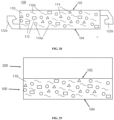
- the shock pad disclosed herein can further comprise a reinforcing scrim 116 ( FIGs 25A and 25B ) adhered to one of the face surface or back surface.
- the scrim comprises a non-woven fiberglass, a wet-laid fiberglass, a non-woven thermoplastic fabric, a woven thermoplastic fiber, or a combination thereof.
- the reinforcing scrim is permeable on the top.
- the reinforcing scrim is permeable at the bottom.
- the reinforcing scrim is impermeable at the bottom.
- the reinforcing scrim is permeable on the top and permeable on the bottom.
- the reinforcing scrim is permeable on the top and impermeable at the bottom.
- the disclosed pad can enhance drainage in a lateral direction.
- a polyethylene extruded sheet can be applied to the bottom of the pad to seal the pad.
- any other film or an impermeable spray-coat can be applied to the bottom of the pad. It should be understood that any of the aforementioned means for sealing the bottom of the pad can also provide a separation layer that enhances lateral drainage of the pad as described in more detail below.
- the scrim can behave as a visual enhancement.
- the scrim can help to ensure pad's impermeability.
- the heat and pressure applied to the pad seals the pad construction.
- the polyethylene film applied to the bottom of the pad can form an impermeable feature that can, for example, be suitable for use as a geotextile membrane.
- the polymer film is impermeable (or substantially impermeable) to water, human or pet bodily fluids, food fluids, food processing fluids, rain, or snow.
- the polymer film is a moisture barrier film. In some aspects, the moisture barrier film is adhered to the back surface of the nonwoven pad.
- the engineered film can comprise layers of polyethylene and polypropylene, or layers of polyethylene and chemically resistant ethylene vinyl alcohol (EVOH) copolymer.
- EVOH ethylene vinyl alcohol
- the engineered film used in the current disclosure can be purchased from Raven Industries, P&O Packaging, Mid-South Extrusion, or Direct Packaging.
- the composite nonwoven pad can have a thickness extending between the face surface and the opposed back surface in the range of from about 0.10 inches to about 7 inches, including exemplary values of about 0.5 inch, about 1 inch, about 2 inch, about 3 inch, about 4 inch, about 5 inch, and about 6 inch.
- the thickness can be in the range between any foregoing values.
- the thickness pad can be from about 0.15 inches to about 2 inches, from about 0.20 inches to about 1 inch, or from about 0.5 inch to about 5 inch.
- the shock absorbing pads described herein can have any desired density.
- the HIC impact can be measured according to European Standard DIN EN1177 at 23 °C or 40 °C to show the HIC equal to or less than 1,000 at fall height of about 1.0 m to about 1.3 m.
- a turf system that incorporates inventive pads as described herein can exhibit the Head Injury Criterion (HIC) test values measured according to European Standard DIN EN1177 at 23 °C or 40 °C to show the HIC less than about 900, less than about 800, less than about 700, or less than about 600.
- HIC Head Injury Criterion
- the plurality of channels present in the shock absorbing pad have a percent open area from about 1% to about 10 % based on 1 m 2 of the pad, including exemplary values of about 2 %, about 3 %, about 4 %, about 5 %, about 6 %, about 7%, about 8 %, and about 9 % based on 1 m 2 of the pad.
- the composite nonwoven pad can be provided in any form known in the art.
- the composite nonwoven pad has a continuous length and is rolled into a roll. In such aspects, the roll is unrolled on installation site.
- the composite nonwoven pad can be provided in a slab form. In such aspects, the pad form a plurality of adjacent shock pads present in interlocking installation.
- the face and opposed back surface of the composite nonwoven pad disclosed herein is substantially horizontal.
- the baled reduction of large pieces or fragments of turf to small chunks or shredded fiber to provide an amalgamated mixture can be done at the same collection facilities. It is understood that the steps describes herein can be done at the same or a different location. After this stage, the product can be used with or without further refinement or processing to remove additional contaminates.
- the reclaimed turf material can be obtained directly from the point of installation as described below. The reclaimed turf material can be also obtained directly from field sites upon turf filed replacement.
- the reclaimed carpet material is size reduced.
- the downsizing may be accomplished by hand or machine.
- the machine may be large or small and may, for example, use rotary blades or knifes or any of a variety of different methods known in the art.
- Manufacturers of exemplary cleaning equipment include Dell Orco & Villani Srl, Vecoplan, Wilson Knowles and Sons Ltd, Southern Mechatronics, Signal Machine Company Inc, Kice Industries Inc, Sterling Systems Inc, Pallmann GmbH, OMMI SpA, Pierret Industries Sprl, eFactor 3 LLC, Tria S.p.A, WEIMA America Inc, SSI Shredding Systems Inc, Erko-Trützschler GmbH, and LaRoche SA, among others.
- the at least one reclaimed artificial turf material comprises face fibers, primary backing fibers, and adhesive backing.
- the formed composite blend also comprises an artificial turf infill material.
- the artificial turf infill material can comprise at least one of silica sand, rubber crumb granules, organic component, ethylene propylene diene monomer (EPDM) rubber, thermoplastic elastomers, polyurethane or any combination thereof.
- EPDM ethylene propylene diene monomer
- the reclaimed artificial turf material used herein can comprise a thermoset polymer, a thermoplastic polymer or any combination thereof.
- the reclaimed artificial turf material can comprise a polyolefin, polyamide, polystyrene, polyurethane, polyester, polyacrylic, polyvinyl chloride, or any combination thereof.
- the modifiers used to form the composite blend can include without limitation wax, EPDM rubber; high and low density polyethylene; or high and low density polypropylene.
- the use of modifiers or elastomers can further enhance the flex properties.
- Suitable colorants include dyes and pigments; red, green, blue, black or any number of different colors can be added. However, in some aspects, colorants may have very little effect due to the dark nature of the material.
- the binder used to form the composite blend can be any binder known in the art.
- the binder can comprise a low melt fiber disclosed herein.
- the binder can comprise a low melt powder.
- the binder can comprise bi-component fibers.
- the method disclosed herein provides for the pad comprising the nonwoven pad having a thickness and width as described above.
- the method disclosed herein provide for the pad having a density from about 0.5 to about 30 lbs/ft 3 , including exemplary values of about 1 lbs/ft 3 , about 2 lbs/ft 3 , about 3 lbs/ft 3 , about 4 lbs/ft 3 , about 5 lbs/ft 3 , about 6 lbs/ft 3 , about 7 lbs/ft 3 , about 8 lbs/ft 3 , about 9 lbs/ft 3 , about 10 lbs/ft 3 , about 11 lbs/ft 3 , about 12 lbs/ft 3 , about 13 lbs/ft 3 , about 14 lbs/ft 3 , about 15 lbs/ft 3 , about 16 lbs/ft 3 , about 17 lbs/ft 3 , about 18 lbs/ft 3 , about 19 lbs/ft
- the method disclosed herein provides for a pad that when it is present as a component in a turf system, the resulting turf system can exhibit Gmax and HIC values as disclosed above.
- the method of making the inventive pad further comprises a step of forming a plurality of channels in the composite nonwoven pad, wherein the plurality of channels extends from the face surface to the opposed back surface.
- each of the plurality of channels has a first outer periphery on the face surface and a second outer periphery on the opposed back surface, wherein the first and second outer periphery define a diameter of the channel, and wherein each channel in the plurality of channels is spaced apart along the length of the nonwoven pad.
- the methods used to create the channels can comprise laser cutting, ultrasonic catting, water jet cutting, dye currying, embossing with an engraved belt, CNC (computer numerical control) routing, drilling, spiking, and the like.
- each of the plurality of channels formed by the disclosed method can be circular in cross-section, or can have any of various other cross-sectional shapes, including but is not limited to elliptical shape, oval shape, polygonal shape, star like shape, and like.
- each of the plurality of channels can have a diameter from about 1 mm to about 15 mm, including exemplary values of about 2 mm, about 3 mm, about 4 mm, about 5 mm, about 6 mm, about 7 mm, about 8 mm, about 9 mm, about 10 mm, about 11 mm, about 12 mm, about 13 mm, and about 14 mm. It is further understood that each of the plurality of the channels can have any diameter between any foregoing values.
- the plurality of channels present in the shock absorbing pad have a percent open area from about 1% to about 20 % based on 1 m 2 of the pad, including exemplary values of about 2 %, about 3 %, about 4 %, about 5 %, about 6 %, about 7%, about 8 %, about 9 %, about 11%, about 12%, about 13%, about 14%, about 15%, about 16%, about 17%, about 18%, and about 19% based on 1 m 2 of the pad.
- the method disclosed herein provides for the pad comprising the composite nonwoven pad that comprises opposed first and second side edges and wherein the method further comprises profiling the plurality of side edges to define an edge locking structure.
- the disclosed pads can be installed to provide a plurality of adjacent shock absorbing pads in any selected orientation.
- Each of the plurality of adjacent shock absorbing pads comprises a nonwoven pad comprising a plurality of side edges extending between the opposed face and back surfaces, wherein the plurality of side edges define an edge locking structure.
- the interlocking structures can be any comprise any structures known in the art and defined herein.
- the nonwoven pad formed by the methods disclosed herein can be used as an underlayment for an indoor artificial turf.
- the pad disclosed herein can be used as an underlayment for an indoor artificial turf, an outdoor artificial turf, or a combination thereof.
- the pad disclosed herein can be useful in construction of a soccer, football, baseball, hockey, lacrosse, gym floors, or a rugby field. It is understood that the pads disclosed herein are recyclable to produce third, or fourth generation products. In fact, it is further understood that the pad disclosed herein can undergo multiple recycle cycles.
Landscapes
- Engineering & Computer Science (AREA)
- Textile Engineering (AREA)
- Architecture (AREA)
- Civil Engineering (AREA)
- Structural Engineering (AREA)
- Chemical & Material Sciences (AREA)
- Chemical Kinetics & Catalysis (AREA)
- Road Paving Structures (AREA)
- Artificial Filaments (AREA)
- Carpets (AREA)
Priority Applications (1)
| Application Number | Priority Date | Filing Date | Title |
|---|---|---|---|
| EP24187541.8A EP4495322B1 (en) | 2018-04-02 | 2019-04-02 | Shock pad for synthetic turf and methods of making same |
Applications Claiming Priority (2)
| Application Number | Priority Date | Filing Date | Title |
|---|---|---|---|
| US201862651335P | 2018-04-02 | 2018-04-02 | |
| PCT/US2019/025398 WO2019195299A1 (en) | 2018-04-02 | 2019-04-02 | Shock pad for synthetic turf and methods of making same |
Related Child Applications (1)
| Application Number | Title | Priority Date | Filing Date |
|---|---|---|---|
| EP24187541.8A Division EP4495322B1 (en) | 2018-04-02 | 2019-04-02 | Shock pad for synthetic turf and methods of making same |
Publications (4)
| Publication Number | Publication Date |
|---|---|
| EP3775381A1 EP3775381A1 (en) | 2021-02-17 |
| EP3775381A4 EP3775381A4 (en) | 2022-02-16 |
| EP3775381C0 EP3775381C0 (en) | 2024-07-10 |
| EP3775381B1 true EP3775381B1 (en) | 2024-07-10 |
Family
ID=68056854
Family Applications (2)
| Application Number | Title | Priority Date | Filing Date |
|---|---|---|---|
| EP19781808.1A Active EP3775381B1 (en) | 2018-04-02 | 2019-04-02 | Shock pad for synthetic turf and methods of making same |
| EP24187541.8A Active EP4495322B1 (en) | 2018-04-02 | 2019-04-02 | Shock pad for synthetic turf and methods of making same |
Family Applications After (1)
| Application Number | Title | Priority Date | Filing Date |
|---|---|---|---|
| EP24187541.8A Active EP4495322B1 (en) | 2018-04-02 | 2019-04-02 | Shock pad for synthetic turf and methods of making same |
Country Status (9)
| Country | Link |
|---|---|
| US (3) | US11131068B2 (https=) |
| EP (2) | EP3775381B1 (https=) |
| JP (1) | JP7526670B2 (https=) |
| CN (1) | CN112189069A (https=) |
| AU (1) | AU2019249451B2 (https=) |
| CA (1) | CA3095904A1 (https=) |
| ES (1) | ES2989073T3 (https=) |
| NZ (1) | NZ768920A (https=) |
| WO (1) | WO2019195299A1 (https=) |
Families Citing this family (11)
| Publication number | Priority date | Publication date | Assignee | Title |
|---|---|---|---|---|
| US11047094B2 (en) | 2018-12-07 | 2021-06-29 | 4427017 Canada Inc. | Padding layer with drainage for sports playing field |
| EP3839142B1 (en) * | 2019-12-16 | 2024-10-09 | Calcean Minerals and Materials, LLC | Artificial turf with aragonite based infill and method of reducing temperature excursions of an artificial turf structure |
| IT202000003790A1 (it) * | 2020-02-24 | 2021-08-24 | Sofisport S R L | Sistema di tappeto erboso per uso sportivo o decorativo e metodo per la messa in posa di tale sistema |
| CN113957611B (zh) * | 2020-07-20 | 2022-12-20 | 吴江多福纺织科技有限公司 | 无纺布仿真花制作工艺及仿真花 |
| US12024828B2 (en) * | 2020-10-05 | 2024-07-02 | SafePlay LLC | Artificial turf system padding layer with integrated geofabric |
| CN113715357B (zh) * | 2021-09-02 | 2023-05-26 | 海宁舒毯地毯科技股份有限公司 | 一种透明止滑地毯的复合工艺 |
| WO2024084061A1 (en) * | 2022-10-21 | 2024-04-25 | Re-Match Holding A/S | Method for producing polymer articles from reclaimed artificial turf material, and products obtained thereby |
| KR102780506B1 (ko) | 2022-11-17 | 2025-03-12 | 홍약슬 | 생분해성 소재를 이용한 조화제조방법 및 조화제조장치 |
| KR102655659B1 (ko) * | 2022-12-29 | 2024-04-08 | 코니필드(주) | 재활용 보강층을 포함하는 충격흡수패드 |
| KR102717032B1 (ko) * | 2023-05-31 | 2024-10-15 | 코오롱글로텍주식회사 | 폐인조잔디 섬유를 포함하는 부직포 및 이를 포함하는 인조잔디 충격흡수패드 |
| KR102717027B1 (ko) * | 2023-08-31 | 2024-10-15 | 코오롱글로텍주식회사 | 물성 보강층을 포함하는 충격흡수패드 |
Family Cites Families (50)
| Publication number | Priority date | Publication date | Assignee | Title |
|---|---|---|---|---|
| JPS5842206U (ja) * | 1981-09-18 | 1983-03-19 | 旭化成株式会社 | 人工芝生の舗装構造 |
| DE4136444C2 (de) | 1991-11-06 | 1994-05-19 | Balsam Ag | Kunstrasen für Sportplätze und Verfahren zu seiner Herstellung |
| JP3401651B2 (ja) * | 1994-03-14 | 2003-04-28 | 清水建設株式会社 | 人工芝生 |
| US20030211280A1 (en) * | 1997-02-28 | 2003-11-13 | Shaw Industries, Inc. | Carpet, carpet backings and methods |
| CZ291175B6 (cs) * | 1997-03-10 | 2003-01-15 | Fieldturf Holdings Inc. | Umělý povrch |
| US6221445B1 (en) | 1999-07-20 | 2001-04-24 | U.S. Greentech, Inc. | Composite artificial turf structure with shock absorption and drainage |
| JP2002069917A (ja) | 2000-08-28 | 2002-03-08 | Hitachi Maxell Ltd | 舗装材とその製造方法 |
| JP3638872B2 (ja) | 2000-12-28 | 2005-04-13 | 住友ゴム工業株式会社 | 人工芝のリサイクル方法およびそのリサイクル材 |
| US6877932B2 (en) * | 2001-07-13 | 2005-04-12 | Fieldturf (Ip) Inc. | Drainage system and method for artificial grass using spacing grid |
| CN1337494A (zh) * | 2001-08-21 | 2002-02-27 | 钟一鸣 | 人造草皮 |
| US6818274B1 (en) | 2003-01-16 | 2004-11-16 | Bright Intellectual Asset Management, Llc | Artificial turf system using support material for infill layer |
| US20070032157A1 (en) | 2005-08-05 | 2007-02-08 | Mcgrath Ralph D | Dually dispersed fiber construction for nonwoven mats using chopped strands |
| US7875655B2 (en) * | 2006-01-20 | 2011-01-25 | Material Innovations, Llc | Carpet waste composite |
| JP2008068177A (ja) | 2006-09-13 | 2008-03-27 | Assist International Kk | 充填材入り人工芝の回収処理方法 |
| JP2008180074A (ja) | 2006-12-26 | 2008-08-07 | Daiko:Kk | 人工芝のリサイクル方法及び人工芝リサイクル用回収装置 |
| JP4219962B1 (ja) | 2007-08-10 | 2009-02-04 | クリヤマ株式会社 | 人工芝の張替え方法及び人工芝処理装置 |
| CN101424068B (zh) | 2007-11-02 | 2011-07-20 | 广州爱奇实业有限公司 | 新型人造草皮及其制造方法 |
| JP4386457B2 (ja) | 2007-12-14 | 2009-12-16 | 住友ゴム工業株式会社 | 人工芝構造体および同人工芝構造体を用いた人工芝施設並びに人工芝構造体のリサイクル方法 |
| JP4502400B2 (ja) | 2007-12-27 | 2010-07-14 | 住友ゴム工業株式会社 | 人工芝充填用粒状物および同人工芝充填用粒状物を充填してなる人工芝構造体 |
| JP4746654B2 (ja) | 2008-08-11 | 2011-08-10 | 日本中央競馬会 | 表層体及び表層体の施工方法 |
| CA2747152C (en) | 2008-12-15 | 2016-01-12 | Textile Management Associates, Inc. | Method of recycling synthetic turf and infill product |
| US9259861B2 (en) | 2008-12-15 | 2016-02-16 | Textile Management Associates, Inc. | Method of recycling synthetic turf |
| JP5416613B2 (ja) | 2009-02-26 | 2014-02-12 | 積水樹脂株式会社 | 人工芝連結体 |
| KR101084872B1 (ko) | 2009-03-16 | 2011-11-21 | 윤세균 | 폐인조잔디를 재활용하여 인조잔디용 기층을 제조하는 방법및 그 인조잔디 기층 |
| US20100239790A1 (en) * | 2009-03-19 | 2010-09-23 | Stricklen Phillip M | System and method for an improved artificial turf |
| US8464801B2 (en) | 2009-06-20 | 2013-06-18 | John H. Bearden | Apparatus for collecting artificial turf for recycling |
| GB2496320B (en) | 2010-05-24 | 2017-02-08 | Shaw Ind Group Inc | Fiber-based carpet cushion with added resilience from vertically oriented fiber construciton |
| US8545964B2 (en) * | 2010-09-23 | 2013-10-01 | Fred Svirklys | Roll-form shock and drainage pad for outdoor field installations |
| GB201105755D0 (en) | 2011-04-05 | 2011-05-18 | Ten Cate Thiolon Bv | ATP base construction |
| WO2012166612A1 (en) | 2011-06-01 | 2012-12-06 | Textile Rubber & Chemical Company, Inc. | Method for recycling synthetic turf and product |
| US9855682B2 (en) * | 2011-06-10 | 2018-01-02 | Columbia Insurance Company | Methods of recycling synthetic turf, methods of using reclaimed synthetic turf, and products comprising same |
| KR101168686B1 (ko) | 2011-09-23 | 2012-07-30 | 코오롱글로텍주식회사 | 섬유구조체를 포함하는 인조잔디의 재활용장치 |
| KR101175234B1 (ko) | 2011-09-23 | 2012-08-22 | 코오롱글로텍주식회사 | 섬유구조체를 포함하는 인조잔디의 재활용방법 |
| KR101182416B1 (ko) | 2012-02-14 | 2012-09-13 | 코오롱글로텍주식회사 | 인조잔디 구조체의 재생방법 및 재생장치 |
| US20130280445A1 (en) | 2012-04-13 | 2013-10-24 | Patrick D. McAnany | Synthetic turf recycling and reclamation system and method |
| KR20130032819A (ko) | 2012-07-09 | 2013-04-02 | 코오롱글로텍주식회사 | 섬유구조체를 포함하는 인조잔디의 재활용장치 |
| CN102808368A (zh) | 2012-08-14 | 2012-12-05 | 青岛青禾人造草坪有限公司 | 一种可以完全回收的人造草坪及其制备方法 |
| KR101484964B1 (ko) | 2013-06-21 | 2015-01-21 | 주식회사 세주 | 충격흡수패드, 이를 포함하는 잔디 구조체 및 포장체 |
| EP3138677B1 (en) | 2013-10-21 | 2020-03-18 | Re-Match (UK) Limited | Process for separating infill obtainable from a synthetic turf product |
| KR20150057854A (ko) * | 2013-11-20 | 2015-05-28 | 필드마스터 주식회사 | 인조잔디 기층용 다기능 패드 |
| US9505033B2 (en) | 2014-01-29 | 2016-11-29 | Tarkett Inc. | Method and system for processing and recycling infill material of artificial turf |
| CN204343135U (zh) | 2014-06-30 | 2015-05-20 | 泰山体育产业集团有限公司 | 一种可整体回收的低成本人造草坪 |
| GB201414012D0 (en) | 2014-08-07 | 2014-09-24 | Allen Richard A | Processing of artificial turf |
| FI127037B (en) * | 2014-08-13 | 2017-10-13 | Hannu Salmenautio | Artificial grass with non-granular filling material |
| CN105256697B (zh) * | 2015-11-10 | 2017-07-11 | 上海勘测设计研究院有限公司 | 一种人工草皮运动场的雨水生态调蓄系统 |
| JP6825220B2 (ja) | 2016-04-01 | 2021-02-03 | 住友ゴム工業株式会社 | 人工芝 |
| US11364661B2 (en) * | 2016-04-20 | 2022-06-21 | Broadview Group International, Llc | Processes and structures for recycling carpet and products of such processes |
| NL2018565B1 (en) * | 2017-03-23 | 2018-06-05 | Synprodo B V | A support layer for supporting an artificial turf assembly, and artificial turf system |
| US11021842B2 (en) * | 2017-03-29 | 2021-06-01 | Brock Usa, Llc | Infill for artificial turf system |
| US20190017231A1 (en) * | 2017-07-11 | 2019-01-17 | Watershed Geosynthetics Llc | Synthetic ground cover system for erosion protection |
-
2019
- 2019-04-02 NZ NZ768920A patent/NZ768920A/en unknown
- 2019-04-02 JP JP2020553574A patent/JP7526670B2/ja active Active
- 2019-04-02 US US16/373,338 patent/US11131068B2/en active Active
- 2019-04-02 EP EP19781808.1A patent/EP3775381B1/en active Active
- 2019-04-02 WO PCT/US2019/025398 patent/WO2019195299A1/en not_active Ceased
- 2019-04-02 CA CA3095904A patent/CA3095904A1/en active Pending
- 2019-04-02 AU AU2019249451A patent/AU2019249451B2/en active Active
- 2019-04-02 EP EP24187541.8A patent/EP4495322B1/en active Active
- 2019-04-02 CN CN201980033785.3A patent/CN112189069A/zh active Pending
- 2019-04-02 ES ES19781808T patent/ES2989073T3/es active Active
-
2020
- 2020-04-01 US US16/837,404 patent/US20200224373A1/en active Pending
-
2021
- 2021-10-28 US US17/512,738 patent/US20220049435A1/en active Pending
Also Published As
| Publication number | Publication date |
|---|---|
| EP3775381A4 (en) | 2022-02-16 |
| ES2989073T3 (es) | 2024-11-25 |
| US20220049435A1 (en) | 2022-02-17 |
| EP4495322A1 (en) | 2025-01-22 |
| US20200224373A1 (en) | 2020-07-16 |
| EP3775381A1 (en) | 2021-02-17 |
| EP3775381C0 (en) | 2024-07-10 |
| WO2019195299A1 (en) | 2019-10-10 |
| CN112189069A (zh) | 2021-01-05 |
| AU2019249451B2 (en) | 2024-02-08 |
| US20190301107A1 (en) | 2019-10-03 |
| EP4495322B1 (en) | 2026-01-21 |
| CA3095904A1 (en) | 2019-10-10 |
| JP7526670B2 (ja) | 2024-08-01 |
| NZ768920A (en) | 2024-11-29 |
| US11131068B2 (en) | 2021-09-28 |
| AU2019249451A1 (en) | 2020-11-26 |
| JP2021520458A (ja) | 2021-08-19 |
Similar Documents
| Publication | Publication Date | Title |
|---|---|---|
| EP3775381B1 (en) | Shock pad for synthetic turf and methods of making same | |
| US12297605B2 (en) | Playing surface assemblies and systems, and methods of making and using same | |
| US9855682B2 (en) | Methods of recycling synthetic turf, methods of using reclaimed synthetic turf, and products comprising same | |
| US11919278B2 (en) | Layered composite articles and methods of making same | |
| US6814826B1 (en) | Use of waste carpet as backing filler for floor coverings | |
| AU2015218484A1 (en) | Fiber-based carpet cushion with added resilience from vertically oriented fiber construction | |
| AU2008329787A1 (en) | Method for recycling floor coverings | |
| WO2024084061A1 (en) | Method for producing polymer articles from reclaimed artificial turf material, and products obtained thereby |
Legal Events
| Date | Code | Title | Description |
|---|---|---|---|
| STAA | Information on the status of an ep patent application or granted ep patent |
Free format text: STATUS: THE INTERNATIONAL PUBLICATION HAS BEEN MADE |
|
| PUAI | Public reference made under article 153(3) epc to a published international application that has entered the european phase |
Free format text: ORIGINAL CODE: 0009012 |
|
| STAA | Information on the status of an ep patent application or granted ep patent |
Free format text: STATUS: REQUEST FOR EXAMINATION WAS MADE |
|
| 17P | Request for examination filed |
Effective date: 20201028 |
|
| AK | Designated contracting states |
Kind code of ref document: A1 Designated state(s): AL AT BE BG CH CY CZ DE DK EE ES FI FR GB GR HR HU IE IS IT LI LT LU LV MC MK MT NL NO PL PT RO RS SE SI SK SM TR |
|
| AX | Request for extension of the european patent |
Extension state: BA ME |
|
| DAV | Request for validation of the european patent (deleted) | ||
| DAX | Request for extension of the european patent (deleted) | ||
| REG | Reference to a national code |
Ref country code: DE Ref legal event code: R079 Free format text: PREVIOUS MAIN CLASS: E01C0013080000 Ipc: E01C0013020000 Ref document number: 602019055022 Country of ref document: DE |
|
| A4 | Supplementary search report drawn up and despatched |
Effective date: 20220117 |
|
| RIC1 | Information provided on ipc code assigned before grant |
Ipc: A41G 1/00 20060101ALN20220111BHEP Ipc: D04H 1/58 20120101ALI20220111BHEP Ipc: D04H 1/542 20120101ALI20220111BHEP Ipc: D04H 1/4274 20120101ALI20220111BHEP Ipc: E01C 13/08 20060101ALI20220111BHEP Ipc: E01C 13/02 20060101AFI20220111BHEP |
|
| STAA | Information on the status of an ep patent application or granted ep patent |
Free format text: STATUS: EXAMINATION IS IN PROGRESS |
|
| 17Q | First examination report despatched |
Effective date: 20221219 |
|
| P01 | Opt-out of the competence of the unified patent court (upc) registered |
Effective date: 20230522 |
|
| GRAP | Despatch of communication of intention to grant a patent |
Free format text: ORIGINAL CODE: EPIDOSNIGR1 |
|
| STAA | Information on the status of an ep patent application or granted ep patent |
Free format text: STATUS: GRANT OF PATENT IS INTENDED |
|
| TPAC | Observations filed by third parties |
Free format text: ORIGINAL CODE: EPIDOSNTIPA |
|
| RIC1 | Information provided on ipc code assigned before grant |
Ipc: A41G 1/00 20060101ALN20240112BHEP Ipc: D04H 1/58 20120101ALI20240112BHEP Ipc: D04H 1/542 20120101ALI20240112BHEP Ipc: D04H 1/541 20120101ALI20240112BHEP Ipc: D04H 1/4274 20120101ALI20240112BHEP Ipc: E01C 13/08 20060101ALI20240112BHEP Ipc: E01C 13/02 20060101AFI20240112BHEP |
|
| INTG | Intention to grant announced |
Effective date: 20240130 |
|
| GRAS | Grant fee paid |
Free format text: ORIGINAL CODE: EPIDOSNIGR3 |
|
| GRAA | (expected) grant |
Free format text: ORIGINAL CODE: 0009210 |
|
| STAA | Information on the status of an ep patent application or granted ep patent |
Free format text: STATUS: THE PATENT HAS BEEN GRANTED |
|
| AK | Designated contracting states |
Kind code of ref document: B1 Designated state(s): AL AT BE BG CH CY CZ DE DK EE ES FI FR GB GR HR HU IE IS IT LI LT LU LV MC MK MT NL NO PL PT RO RS SE SI SK SM TR |
|
| REG | Reference to a national code |
Ref country code: CH Ref legal event code: EP |
|
| REG | Reference to a national code |
Ref country code: DE Ref legal event code: R096 Ref document number: 602019055022 Country of ref document: DE |
|
| U01 | Request for unitary effect filed |
Effective date: 20240809 |
|
| P04 | Withdrawal of opt-out of the competence of the unified patent court (upc) registered |
Free format text: CASE NUMBER: APP_47724/2024 Effective date: 20240819 |
|
| U07 | Unitary effect registered |
Designated state(s): AT BE BG DE DK EE FI FR IT LT LU LV MT NL PT SE SI Effective date: 20240822 |
|
| REG | Reference to a national code |
Ref country code: ES Ref legal event code: FG2A Ref document number: 2989073 Country of ref document: ES Kind code of ref document: T3 Effective date: 20241125 |
|
| P05 | Withdrawal of opt-out of the competence of the unified patent court (upc) changed |
Free format text: CASE NUMBER: APP_47724/2024 Effective date: 20240822 |
|
| PG25 | Lapsed in a contracting state [announced via postgrant information from national office to epo] |
Ref country code: NO Free format text: LAPSE BECAUSE OF FAILURE TO SUBMIT A TRANSLATION OF THE DESCRIPTION OR TO PAY THE FEE WITHIN THE PRESCRIBED TIME-LIMIT Effective date: 20241010 |
|
| PG25 | Lapsed in a contracting state [announced via postgrant information from national office to epo] |
Ref country code: PL Free format text: LAPSE BECAUSE OF FAILURE TO SUBMIT A TRANSLATION OF THE DESCRIPTION OR TO PAY THE FEE WITHIN THE PRESCRIBED TIME-LIMIT Effective date: 20240710 Ref country code: GR Free format text: LAPSE BECAUSE OF FAILURE TO SUBMIT A TRANSLATION OF THE DESCRIPTION OR TO PAY THE FEE WITHIN THE PRESCRIBED TIME-LIMIT Effective date: 20241011 |
|
| PG25 | Lapsed in a contracting state [announced via postgrant information from national office to epo] |
Ref country code: IS Free format text: LAPSE BECAUSE OF FAILURE TO SUBMIT A TRANSLATION OF THE DESCRIPTION OR TO PAY THE FEE WITHIN THE PRESCRIBED TIME-LIMIT Effective date: 20241110 |
|
| PG25 | Lapsed in a contracting state [announced via postgrant information from national office to epo] |
Ref country code: HR Free format text: LAPSE BECAUSE OF FAILURE TO SUBMIT A TRANSLATION OF THE DESCRIPTION OR TO PAY THE FEE WITHIN THE PRESCRIBED TIME-LIMIT Effective date: 20240710 |
|
| PG25 | Lapsed in a contracting state [announced via postgrant information from national office to epo] |
Ref country code: RS Free format text: LAPSE BECAUSE OF FAILURE TO SUBMIT A TRANSLATION OF THE DESCRIPTION OR TO PAY THE FEE WITHIN THE PRESCRIBED TIME-LIMIT Effective date: 20241010 |
|
| PG25 | Lapsed in a contracting state [announced via postgrant information from national office to epo] |
Ref country code: RS Free format text: LAPSE BECAUSE OF FAILURE TO SUBMIT A TRANSLATION OF THE DESCRIPTION OR TO PAY THE FEE WITHIN THE PRESCRIBED TIME-LIMIT Effective date: 20241010 Ref country code: PL Free format text: LAPSE BECAUSE OF FAILURE TO SUBMIT A TRANSLATION OF THE DESCRIPTION OR TO PAY THE FEE WITHIN THE PRESCRIBED TIME-LIMIT Effective date: 20240710 Ref country code: NO Free format text: LAPSE BECAUSE OF FAILURE TO SUBMIT A TRANSLATION OF THE DESCRIPTION OR TO PAY THE FEE WITHIN THE PRESCRIBED TIME-LIMIT Effective date: 20241010 Ref country code: IS Free format text: LAPSE BECAUSE OF FAILURE TO SUBMIT A TRANSLATION OF THE DESCRIPTION OR TO PAY THE FEE WITHIN THE PRESCRIBED TIME-LIMIT Effective date: 20241110 Ref country code: HR Free format text: LAPSE BECAUSE OF FAILURE TO SUBMIT A TRANSLATION OF THE DESCRIPTION OR TO PAY THE FEE WITHIN THE PRESCRIBED TIME-LIMIT Effective date: 20240710 Ref country code: GR Free format text: LAPSE BECAUSE OF FAILURE TO SUBMIT A TRANSLATION OF THE DESCRIPTION OR TO PAY THE FEE WITHIN THE PRESCRIBED TIME-LIMIT Effective date: 20241011 |
|
| PG25 | Lapsed in a contracting state [announced via postgrant information from national office to epo] |
Ref country code: SM Free format text: LAPSE BECAUSE OF FAILURE TO SUBMIT A TRANSLATION OF THE DESCRIPTION OR TO PAY THE FEE WITHIN THE PRESCRIBED TIME-LIMIT Effective date: 20240710 |
|
| PG25 | Lapsed in a contracting state [announced via postgrant information from national office to epo] |
Ref country code: CZ Free format text: LAPSE BECAUSE OF FAILURE TO SUBMIT A TRANSLATION OF THE DESCRIPTION OR TO PAY THE FEE WITHIN THE PRESCRIBED TIME-LIMIT Effective date: 20240710 |
|
| PG25 | Lapsed in a contracting state [announced via postgrant information from national office to epo] |
Ref country code: SK Free format text: LAPSE BECAUSE OF FAILURE TO SUBMIT A TRANSLATION OF THE DESCRIPTION OR TO PAY THE FEE WITHIN THE PRESCRIBED TIME-LIMIT Effective date: 20240710 |
|
| PLBE | No opposition filed within time limit |
Free format text: ORIGINAL CODE: 0009261 |
|
| STAA | Information on the status of an ep patent application or granted ep patent |
Free format text: STATUS: NO OPPOSITION FILED WITHIN TIME LIMIT |
|
| U20 | Renewal fee for the european patent with unitary effect paid |
Year of fee payment: 7 Effective date: 20250428 |
|
| 26N | No opposition filed |
Effective date: 20250411 |
|
| PGFP | Annual fee paid to national office [announced via postgrant information from national office to epo] |
Ref country code: ES Payment date: 20250505 Year of fee payment: 7 |
|
| REG | Reference to a national code |
Ref country code: CH Ref legal event code: H13 Free format text: ST27 STATUS EVENT CODE: U-0-0-H10-H13 (AS PROVIDED BY THE NATIONAL OFFICE) Effective date: 20251125 |
|
| PG25 | Lapsed in a contracting state [announced via postgrant information from national office to epo] |
Ref country code: MC Free format text: LAPSE BECAUSE OF FAILURE TO SUBMIT A TRANSLATION OF THE DESCRIPTION OR TO PAY THE FEE WITHIN THE PRESCRIBED TIME-LIMIT Effective date: 20240710 |
|
| PG25 | Lapsed in a contracting state [announced via postgrant information from national office to epo] |
Ref country code: CH Free format text: LAPSE BECAUSE OF NON-PAYMENT OF DUE FEES Effective date: 20250430 |
|
| PGFP | Annual fee paid to national office [announced via postgrant information from national office to epo] |
Ref country code: GB Payment date: 20260320 Year of fee payment: 8 |
|
| PGFP | Annual fee paid to national office [announced via postgrant information from national office to epo] |
Ref country code: IE Payment date: 20260311 Year of fee payment: 8 |
|
| PG25 | Lapsed in a contracting state [announced via postgrant information from national office to epo] |
Ref country code: RO Free format text: LAPSE BECAUSE OF FAILURE TO SUBMIT A TRANSLATION OF THE DESCRIPTION OR TO PAY THE FEE WITHIN THE PRESCRIBED TIME-LIMIT Effective date: 20240710 |
|
| PGFP | Annual fee paid to national office [announced via postgrant information from national office to epo] |
Ref country code: TR Payment date: 20260330 Year of fee payment: 8 |