EP3774789B1 - Auf brm abzielende verbindungen und zugehörige verfahren zur verwendung - Google Patents
Auf brm abzielende verbindungen und zugehörige verfahren zur verwendung Download PDFInfo
- Publication number
- EP3774789B1 EP3774789B1 EP19717685.2A EP19717685A EP3774789B1 EP 3774789 B1 EP3774789 B1 EP 3774789B1 EP 19717685 A EP19717685 A EP 19717685A EP 3774789 B1 EP3774789 B1 EP 3774789B1
- Authority
- EP
- European Patent Office
- Prior art keywords
- optionally substituted
- alkyl
- ulm
- group
- independently
- Prior art date
- Legal status (The legal status is an assumption and is not a legal conclusion. Google has not performed a legal analysis and makes no representation as to the accuracy of the status listed.)
- Active
Links
Images
Classifications
-
- C—CHEMISTRY; METALLURGY
- C07—ORGANIC CHEMISTRY
- C07D—HETEROCYCLIC COMPOUNDS
- C07D413/00—Heterocyclic compounds containing two or more hetero rings, at least one ring having nitrogen and oxygen atoms as the only ring hetero atoms
- C07D413/14—Heterocyclic compounds containing two or more hetero rings, at least one ring having nitrogen and oxygen atoms as the only ring hetero atoms containing three or more hetero rings
-
- A—HUMAN NECESSITIES
- A61—MEDICAL OR VETERINARY SCIENCE; HYGIENE
- A61K—PREPARATIONS FOR MEDICAL, DENTAL OR TOILETRY PURPOSES
- A61K31/00—Medicinal preparations containing organic active ingredients
- A61K31/33—Heterocyclic compounds
- A61K31/395—Heterocyclic compounds having nitrogen as a ring hetero atom, e.g. guanethidine or rifamycins
- A61K31/41—Heterocyclic compounds having nitrogen as a ring hetero atom, e.g. guanethidine or rifamycins having five-membered rings with two or more ring hetero atoms, at least one of which being nitrogen, e.g. tetrazole
- A61K31/425—Thiazoles
- A61K31/427—Thiazoles not condensed and containing further heterocyclic rings
-
- A—HUMAN NECESSITIES
- A61—MEDICAL OR VETERINARY SCIENCE; HYGIENE
- A61K—PREPARATIONS FOR MEDICAL, DENTAL OR TOILETRY PURPOSES
- A61K31/00—Medicinal preparations containing organic active ingredients
- A61K31/33—Heterocyclic compounds
- A61K31/395—Heterocyclic compounds having nitrogen as a ring hetero atom, e.g. guanethidine or rifamycins
- A61K31/495—Heterocyclic compounds having nitrogen as a ring hetero atom, e.g. guanethidine or rifamycins having six-membered rings with two or more nitrogen atoms as the only ring heteroatoms, e.g. piperazine or tetrazines
- A61K31/50—Pyridazines; Hydrogenated pyridazines
- A61K31/501—Pyridazines; Hydrogenated pyridazines not condensed and containing further heterocyclic rings
-
- A—HUMAN NECESSITIES
- A61—MEDICAL OR VETERINARY SCIENCE; HYGIENE
- A61K—PREPARATIONS FOR MEDICAL, DENTAL OR TOILETRY PURPOSES
- A61K47/00—Medicinal preparations characterised by the non-active ingredients used, e.g. carriers or inert additives; Targeting or modifying agents chemically bound to the active ingredient
- A61K47/06—Organic compounds, e.g. natural or synthetic hydrocarbons, polyolefins, mineral oil, petrolatum or ozokerite
- A61K47/08—Organic compounds, e.g. natural or synthetic hydrocarbons, polyolefins, mineral oil, petrolatum or ozokerite containing oxygen, e.g. ethers, acetals, ketones, quinones, aldehydes, peroxides
- A61K47/10—Alcohols; Phenols; Salts thereof, e.g. glycerol; Polyethylene glycols [PEG]; Poloxamers; PEG/POE alkyl ethers
-
- A—HUMAN NECESSITIES
- A61—MEDICAL OR VETERINARY SCIENCE; HYGIENE
- A61K—PREPARATIONS FOR MEDICAL, DENTAL OR TOILETRY PURPOSES
- A61K47/00—Medicinal preparations characterised by the non-active ingredients used, e.g. carriers or inert additives; Targeting or modifying agents chemically bound to the active ingredient
- A61K47/06—Organic compounds, e.g. natural or synthetic hydrocarbons, polyolefins, mineral oil, petrolatum or ozokerite
- A61K47/16—Organic compounds, e.g. natural or synthetic hydrocarbons, polyolefins, mineral oil, petrolatum or ozokerite containing nitrogen, e.g. nitro-, nitroso-, azo-compounds, nitriles, cyanates
- A61K47/18—Amines; Amides; Ureas; Quaternary ammonium compounds; Amino acids; Oligopeptides having up to five amino acids
-
- A—HUMAN NECESSITIES
- A61—MEDICAL OR VETERINARY SCIENCE; HYGIENE
- A61K—PREPARATIONS FOR MEDICAL, DENTAL OR TOILETRY PURPOSES
- A61K47/00—Medicinal preparations characterised by the non-active ingredients used, e.g. carriers or inert additives; Targeting or modifying agents chemically bound to the active ingredient
- A61K47/06—Organic compounds, e.g. natural or synthetic hydrocarbons, polyolefins, mineral oil, petrolatum or ozokerite
- A61K47/22—Heterocyclic compounds, e.g. ascorbic acid, tocopherol or pyrrolidones
-
- A—HUMAN NECESSITIES
- A61—MEDICAL OR VETERINARY SCIENCE; HYGIENE
- A61K—PREPARATIONS FOR MEDICAL, DENTAL OR TOILETRY PURPOSES
- A61K47/00—Medicinal preparations characterised by the non-active ingredients used, e.g. carriers or inert additives; Targeting or modifying agents chemically bound to the active ingredient
- A61K47/50—Medicinal preparations characterised by the non-active ingredients used, e.g. carriers or inert additives; Targeting or modifying agents chemically bound to the active ingredient the non-active ingredient being chemically bound to the active ingredient, e.g. polymer-drug conjugates
- A61K47/51—Medicinal preparations characterised by the non-active ingredients used, e.g. carriers or inert additives; Targeting or modifying agents chemically bound to the active ingredient the non-active ingredient being chemically bound to the active ingredient, e.g. polymer-drug conjugates the non-active ingredient being a modifying agent
- A61K47/54—Medicinal preparations characterised by the non-active ingredients used, e.g. carriers or inert additives; Targeting or modifying agents chemically bound to the active ingredient the non-active ingredient being chemically bound to the active ingredient, e.g. polymer-drug conjugates the non-active ingredient being a modifying agent the modifying agent being an organic compound
- A61K47/545—Heterocyclic compounds
-
- A—HUMAN NECESSITIES
- A61—MEDICAL OR VETERINARY SCIENCE; HYGIENE
- A61K—PREPARATIONS FOR MEDICAL, DENTAL OR TOILETRY PURPOSES
- A61K47/00—Medicinal preparations characterised by the non-active ingredients used, e.g. carriers or inert additives; Targeting or modifying agents chemically bound to the active ingredient
- A61K47/50—Medicinal preparations characterised by the non-active ingredients used, e.g. carriers or inert additives; Targeting or modifying agents chemically bound to the active ingredient the non-active ingredient being chemically bound to the active ingredient, e.g. polymer-drug conjugates
- A61K47/51—Medicinal preparations characterised by the non-active ingredients used, e.g. carriers or inert additives; Targeting or modifying agents chemically bound to the active ingredient the non-active ingredient being chemically bound to the active ingredient, e.g. polymer-drug conjugates the non-active ingredient being a modifying agent
- A61K47/54—Medicinal preparations characterised by the non-active ingredients used, e.g. carriers or inert additives; Targeting or modifying agents chemically bound to the active ingredient the non-active ingredient being chemically bound to the active ingredient, e.g. polymer-drug conjugates the non-active ingredient being a modifying agent the modifying agent being an organic compound
- A61K47/55—Medicinal preparations characterised by the non-active ingredients used, e.g. carriers or inert additives; Targeting or modifying agents chemically bound to the active ingredient the non-active ingredient being chemically bound to the active ingredient, e.g. polymer-drug conjugates the non-active ingredient being a modifying agent the modifying agent being an organic compound the modifying agent being also a pharmacologically or therapeutically active agent, i.e. the entire conjugate being a codrug, i.e. a dimer, oligomer or polymer of pharmacologically or therapeutically active compounds
-
- A—HUMAN NECESSITIES
- A61—MEDICAL OR VETERINARY SCIENCE; HYGIENE
- A61P—SPECIFIC THERAPEUTIC ACTIVITY OF CHEMICAL COMPOUNDS OR MEDICINAL PREPARATIONS
- A61P35/00—Antineoplastic agents
-
- C—CHEMISTRY; METALLURGY
- C07—ORGANIC CHEMISTRY
- C07D—HETEROCYCLIC COMPOUNDS
- C07D417/00—Heterocyclic compounds containing two or more hetero rings, at least one ring having nitrogen and sulfur atoms as the only ring hetero atoms, not provided for by group C07D415/00
- C07D417/14—Heterocyclic compounds containing two or more hetero rings, at least one ring having nitrogen and sulfur atoms as the only ring hetero atoms, not provided for by group C07D415/00 containing three or more hetero rings
-
- C—CHEMISTRY; METALLURGY
- C07—ORGANIC CHEMISTRY
- C07D—HETEROCYCLIC COMPOUNDS
- C07D471/00—Heterocyclic compounds containing nitrogen atoms as the only ring hetero atoms in the condensed system, at least one ring being a six-membered ring with one nitrogen atom, not provided for by groups C07D451/00 - C07D463/00
- C07D471/02—Heterocyclic compounds containing nitrogen atoms as the only ring hetero atoms in the condensed system, at least one ring being a six-membered ring with one nitrogen atom, not provided for by groups C07D451/00 - C07D463/00 in which the condensed system contains two hetero rings
- C07D471/10—Spiro-condensed systems
-
- C—CHEMISTRY; METALLURGY
- C07—ORGANIC CHEMISTRY
- C07D—HETEROCYCLIC COMPOUNDS
- C07D487/00—Heterocyclic compounds containing nitrogen atoms as the only ring hetero atoms in the condensed system, not provided for by groups C07D451/00 - C07D477/00
- C07D487/02—Heterocyclic compounds containing nitrogen atoms as the only ring hetero atoms in the condensed system, not provided for by groups C07D451/00 - C07D477/00 in which the condensed system contains two hetero rings
- C07D487/08—Bridged systems
-
- C—CHEMISTRY; METALLURGY
- C07—ORGANIC CHEMISTRY
- C07D—HETEROCYCLIC COMPOUNDS
- C07D498/00—Heterocyclic compounds containing in the condensed system at least one hetero ring having nitrogen and oxygen atoms as the only ring hetero atoms
- C07D498/02—Heterocyclic compounds containing in the condensed system at least one hetero ring having nitrogen and oxygen atoms as the only ring hetero atoms in which the condensed system contains two hetero rings
- C07D498/10—Spiro-condensed systems
-
- C—CHEMISTRY; METALLURGY
- C07—ORGANIC CHEMISTRY
- C07K—PEPTIDES
- C07K5/00—Peptides containing up to four amino acids in a fully defined sequence; Derivatives thereof
- C07K5/04—Peptides containing up to four amino acids in a fully defined sequence; Derivatives thereof containing only normal peptide links
- C07K5/06—Dipeptides
- C07K5/06139—Dipeptides with the first amino acid being heterocyclic
-
- A—HUMAN NECESSITIES
- A61—MEDICAL OR VETERINARY SCIENCE; HYGIENE
- A61K—PREPARATIONS FOR MEDICAL, DENTAL OR TOILETRY PURPOSES
- A61K38/00—Medicinal preparations containing peptides
Definitions
- the description provides bifunctional compounds comprising a target protein binding moiety and a E3 ubiquitin ligase binding moiety, and associated methods of use.
- the bifunctional compounds are useful as modulators of targeted ubiquitination, especially with respect to Switch/Sucrose Non Fermentable (SWI/SNF)-Related, Matrix-Associated, Actin-Dependent Regulator of Chromatin, Subfamily A, Member 2 (SMARCA2) (i.e., BRAHMA or BRM), which are degraded and/or otherwise inhibited by the bifunctional compounds .
- SWI/SNF Switch/Sucrose Non Fermentable
- SMARCA2 Matrix-Associated, Actin-Dependent Regulator of Chromatin, Subfamily A, Member 2
- E3 ubiquitin ligases confer substrate specificity for ubiquitination, and therefore, are more attractive therapeutic targets than general proteasome inhibitors due to their specificity for certain protein substrates.
- the development of ligands of E3 ligases has proven challenging, in part due to the fact that they must disrupt protein-protein interactions.
- recent developments have provided specific ligands which bind to these ligases.
- VHL von Hippel-Lindau
- VCB the substrate recognition subunit of the E3 ligase complex
- the primary substrate of VHL is Hypoxia Inducible Factor 1 ⁇ (HIF-1 ⁇ ), a transcription factor that upregulates genes such as the proangiogenic growth factor VEGF and the red blood cell inducing cytokine erythropoietin in response to low oxygen levels.
- HIF-1 ⁇ Hypoxia Inducible Factor 1 ⁇
- VHL Von Hippel Lindau
- Bifunctional compounds such as those that are described in U.S. Patent Application Publications 2015-0291562 and 2014-0356322 , function to recruit endogenous proteins to an E3 ubiquiuin ligase for degradation.
- the publications describe bifunctional or proteolysis targeting chimeric (PROTAC) compounds, which find utility as modulators of targeted ubiquitination of a variety of polypeptides and other proteins, which are then degraded and/or otherwise inhibited by the bifunctional compounds.
- the Switch/Sucrose Non Fermentable is a multi-subunit complex that modulates chromatic structure through the activity of two mutually exlusive helicase/ATPase catalytic subunits SWI/SNF-Related, Matrix-Associated, Actin-Dependent Regulator of Chromatin, Subfamily A, Member 2 (SMARCA2, BRAHMA or BRM) and SWI/SNF-Related, Matrix-Associated, Actin-Dependent Regulator of Chromatin, Subfamily A, Member 4 (SMARCA4 or BRG1).
- the core and the regulatory subunits couple ATP hydrolysis to the perturbation of histone-DNA contacts, thereby providing access points to transcription factors and cognate DNA elements that facilitate gene activation and repression.
- SMARCA2 has been demonstrated as one of the top essential genes in SMARCA4-related or-mutant cancer cell lines. This is because SMARCA4-deficient patient populations or cells depend exclusively on SMARCA2 activity-i.e., there is a greater incorporation of SMARCA2 into the complex to compensate for the SMARCA4 deficiency. Thus, SMARCA2 may be targeted in SMARCA4-related/deficient cancers.
- SMARCA4-related/deficient cancers The co-occurrence of the deficiency of the expression of two (or more) genes that leads to cell death is known as, synthetic lethality. Accordingly, synethetic lethality can be leveraged in the treatment of certain SMARCA2/SMARCA4-related cancers.
- the description provides methods of using an effective amount of the compounds as described herein for the treatment or amelioration of a disease condition, such as cancer, e.g., SMARCA4-related/deficient cancer, such as lung cancer or non-small cell lung cancer.
- a disease condition such as cancer, e.g., SMARCA4-related/deficient cancer, such as lung cancer or non-small cell lung cancer.
- the compounds as described herein comprise multiple independently selected ULMs, multiple PTMs, multiple chemical linkers or a combination thereof.
- VLM can be hydroxyproline or a derivative thereof.
- other contemplated VLMs are included in U.S. Patent Application Publication No. 2014/03022523 .
- “L” is a bond.
- the linker “L” is a connector with a linear non-hydrogen atom number in the range of 1 to 20.
- the connector “L” can contain, but not limited to the functional groups such as ether, amide, alkane, alkene, alkyne, ketone, hydroxyl, carboxylic acid, thioether, sulfoxide, and sulfone.
- the linker can contain aromatic, heteroaromatic, cyclic, bicyclic and tricyclic moieties. Substitution with halogen, such as Cl, F, Br and I can be included in the linker. In the case of fluorine substitution, single or multiple fluorines can be included.
- the therapeutic compositions as described herein may be used to effectuate the degradation of proteins of interest for the treatment or amelioration of a disease, e.g., cancer (including at least one of SWI/SNF associated cancer, a cancer with a SMARCA4 mutation, a cancer with a SMARCA4-deficiency, or a combination thereof), such as lung cancer (e.g., non-small cell lung cancer).
- a disease e.g., cancer (including at least one of SWI/SNF associated cancer, a cancer with a SMARCA4 mutation, a cancer with a SMARCA4-deficiency, or a combination thereof)
- lung cancer e.g., non-small cell lung cancer.
- the method may comprise administering a bifunctional compound as described herein comprising a VLM, preferably linked through a linker moiety, as otherwise described herein, wherein the VLM is coupled to the PTM through a linker to target a protein for degradation.
- a bifunctional compound as described herein comprising a VLM, preferably linked through a linker moiety, as otherwise described herein, wherein the VLM is coupled to the PTM through a linker to target a protein for degradation.
- Degradation of the target protein will occur when the target protein is placed in proximity to the E3 ubiquitin ligase, thus resulting in degradation/inhibition of the effects of the target protein and the control of protein levels.
- the control of protein levels may provide treatment of a disease state or condition, which is modulated through the target protein by lowering the level of that protein in the cells of a patient.
- the description provides methods for treating or ameliorating a disease, disorder or symptom thereof in a subject or a patient, e.g., an animal such as a human, comprising administering to a subject in need thereof a composition comprising an effective amount, e.g., a therapeutically effective amount, of a compound as described herein or salt form thereof, and a pharmaceutically acceptable carrier, wherein the composition is effective for treating or ameliorating the disease or disorder or symptom thereof in the subject.
- a composition comprising an effective amount, e.g., a therapeutically effective amount, of a compound as described herein or salt form thereof, and a pharmaceutically acceptable carrier, wherein the composition is effective for treating or ameliorating the disease or disorder or symptom thereof in the subject.
- the description provides methods for identifying the effects of the degradation of proteins of interest in a biological system using compounds taught herein.
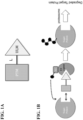
- Exemplary PROTACs comprise a protein targeting moiety (PTM; darkly shaded rectangle ), a ubiquitin ligase binding moiety (ULM; lightly shaded triangle ), and optionally a linker moiety (L; black line ) coupling or tethering the PTM to the ULM.
- PTM protein targeting moiety
- ULM ubiquitin ligase binding moiety
- L linker moiety
- B Illustrates the functional use of the PROTACs as described herein. Briefly, the ULM recognizes and binds to a specific E3 ubiquitin ligase, and the PTM binds and recruits a target protein bringing it into close proximity to the E3 ubiquitin ligase.
- the E3 ubiquitin ligase is complexed with an E2 ubiquitinconjugating protein, and either alone or via the E2 protein catalyzes attachment of ubiquitin ( dark circles ) to a lysine on the target protein via an isopeptide bond.
- the poly-ubiquitinated protein far right is then targeted for degradation by the proteosomal machinery of the cell.
- compositions and methods that relate to the surprising and unexpected discovery that an E3 ubiquitin ligase protein (e.g., Von Hippel-Lindau E3 ubiquitin ligase (VHL)) ubiquitinates a target protein once it and the target protein are placed in proximity by a bifunctional or chimeric construct that binds the E3 ubiquitin ligase protein and the target protein.
- VHL Von Hippel-Lindau E3 ubiquitin ligase
- the present disclosure provides such compounds and compositions comprising an E3 ubiquintin ligase binding moiety (“ULM”) coupled to a protein target binding moiety (“PTM”), which result in the ubiquitination of a chosen target protein, which leads to degradation of the target protein by the proteasome ( see Figure 1 ).
- ULM E3 ubiquintin ligase binding moiety
- PTM protein target binding moiety
- the present disclosure also provides a library of compositions and the use thereof.
- the present disclosure provides compounds which comprise a ligand, e.g., a small molecule ligand (i.e., having a molecular weight of below 2,000, 1,000, 500, or 200 Daltons), which is capable of binding to a ubiquitin ligase, such as VHL.
- the compounds also comprise a moiety that is capable of binding to target protein, in such a way that the target protein is placed in proximity to the ubiquitin ligase to effect degradation (and/or inhibition) of that protein.
- Small molecule can mean, in addition to the above, that the molecule is non-peptidyl, that is, it is not generally considered a peptide, e.g., comprises fewer than 4, 3, or 2 amino acids.
- the PTM, ULM or PROTAC molecule can be a small molecule.
- the phrase "at least one,” in reference to a list of one or more elements, should be understood to mean at least one element selected from anyone or more of the elements in the list of elements, but not necessarily including at least one of each and every element specifically listed within the list of elements and not excluding any combinations of elements in the list of elements.
- This definition also allows that elements may optionally be present other than the elements specifically identified within the list of elements to which the phrase "at least one" refers, whether related or unrelated to those elements specifically identified.
- At least one of A and B can refer, in one embodiment, to at least one, optionally including more than one, A, with no B present (and optionally including elements other than B); in another embodiment, to at least one, optionally including more than one, B, with no A present (and optionally including elements other than A); in yet another embodiment, to at least one, optionally including more than one, A, and at least one, optionally including more than one, B (and optionally including other elements); etc.
- co-administration and “co-administering” or “combination therapy” refer to both concurrent administration (administration of two or more therapeutic agents at the same time) and time varied administration (administration of one or more therapeutic agents at a time different from that of the administration of an additional therapeutic agent or agents), as long as the therapeutic agents are present in the patient to some extent, preferably at effective amounts, at the same time.
- one or more of the present compounds described herein are coadministered in combination with at least one additional bioactive agent, especially including an anticancer agent.
- the co-administration of compounds results in synergistic activity and/or therapy, including anticancer activity.
- compound refers to any specific chemical compound disclosed herein and includes tautomers, regioisomers, geometric isomers, and where applicable, stereoisomers, including optical isomers (enantiomers) and other stereoisomers (diastereomers) thereof, as well as pharmaceutically acceptable salts and derivatives, including prodrug and/or deuterated forms thereof where applicable, in context.
- Deuterated small molecules contemplated are those in which one or more of the hydrogen atoms contained in the drug molecule have been replaced by deuterium.
- the term compound generally refers to a single compound, but also may include other compounds such as stereoisomers, regioisomers and/or optical isomers (including racemic mixtures) as well as specific enantiomers or enantiomerically enriched mixtures of disclosed compounds.
- the term also refers, in context to prodrug forms of compounds which have been modified to facilitate the administration and delivery of compounds to a site of activity. It is noted that in describing the present compounds, numerous substituents and variables associated with same, among others, are described. It is understood by those of ordinary skill that molecules which are described herein are stable compounds as generally described hereunder. When the bond is shown, both a double bond and single bond are represented or understood within the context of the compound shown and well-known rules for valence interactions.
- ubiquitin ligase refers to a family of proteins that facilitate the transfer of ubiquitin to a specific substrate protein, targeting the substrate protein for degradation.
- an E3 ubiquitin ligase protein that alone or in combination with an E2 ubiquitinconjugating enzyme causes the attachment of ubiquitin to a lysine on a target protein, and subsequently targets the specific protein substrates for degradation by the proteasome.
- E3 ubiquitin ligase alone or in complex with an E2 ubiquitin conjugating enzyme is responsible for the transfer of ubiquitin to targeted proteins.
- the ubiquitin ligase is involved in polyubiquitination such that a second ubiquitin is attached to the first; a third is attached to the second, and so forth.
- Polyubiquitination marks proteins for degradation by the proteasome.
- Monoubiquitinated proteins are not targeted to the proteasome for degradation, but may instead be altered in their cellular location or function, for example, via binding other proteins that have domains capable of binding ubiquitin. Further complicating matters, different lysines on ubiquitin can be targeted by an E3 to make chains.
- alkynyl refers to C 2-12 alkyl group wherein at least two of the carbon atoms are sp hybridized and form a carbon-carbon triple bond between them.
- An alkynyl group provided herein may contain more than one carbon-carbon triple bond, but one is preferred.
- the alkyl portion of an alkynyl group provided herein may be substituted as provided above.
- the alkynyl group is a C 2-6 alkynyl.
- halo(C 1-x alkyl) refers to an alkyl that has 1-x carbon atoms and that is substituted with one or more (e.g. 1, 2, 3, 4, 5, or 6) halo groups.
- the term includes an alkyl group having 1-6 carbon atoms that is substituted with one or more halo groups.
- Nonlimiting examples of the term halo(C 1 -C 6 alkyl) include fluoromethyl, difluoromethyl, trifluoromethyl, chloromethyl, and 2,2,2-trifluoroethyl.
- halo(C 1-x alkoxy) refers to an alkoxy group that has 1-x carbon atoms and that is substituted with one or more (e.g. 1, 2, 3, 4, 5, or 6) halo groups.
- the term includes an alkoxy group having 1-6 carbon atoms that is substituted with one or more halo groups.
- Non-limiting examples of the term halo(C 1 -C 6 alkyl) include fluoromethoxy, difluoromethoxy, trifluoromethoxy, chloromethoxy, and 2,2,2-trifluoroethoxy.
- heteroalkyl refers to a straight- or branched-chain alkyl group, e.g. having from 2 to 14 carbons, such as 2 to 10 carbons in the chain, one or more of which has been replaced by a heteroatom selected from S, O, P and N.
- exemplary heteroalkyls include alkyl ethers, secondary and tertiary alkyl amines, alkyl amides, alkyl sulfides, and the like.
- the group may be a terminal group or a bridging group. As used herein reference to the normal chain when used in the context of a bridging group refers to the direct chain of atoms linking the two terminal positions of the bridging group.
- aryl refers to a single all carbon aromatic ring or a multiple condensed all carbon ring system wherein at least one of the rings is aromatic.
- an aryl group has 6 to 12 carbon atoms.
- Aryl includes a phenyl radical.
- Aryl also includes multiple condensed ring systems (e.g., ring systems comprising 2, 3 or 4 rings) having about 9 to 12 carbon atoms in which at least one ring is aromatic and wherein the other rings may be aromatic or not aromatic.
- Such multiple condensed ring systems are optionally substituted with one or more (e.g., 1, 2 or 3) oxo groups on any carbocycle portion of the multiple condensed ring system.
- the rings of the multiple condensed ring system can be connected to each other via fused, spiro and bridged bonds when allowed by valency requirements. It is to be understood that the point of attachment of a multiple condensed ring system, as defined above, can be at any position of the ring system including an aromatic or a carbocycle portion of the ring.
- aryl groups include, but are not limited to, phenyl, indenyl, naphthyl, 1, 2, 3, 4-tetrahydronaphthyl, and the like.
- heteroaryl refers to a single aromatic ring that has at least one atom other than carbon in the ring, wherein the atom is selected from the group consisting of oxygen, nitrogen and sulfur; "heteroaryl” also includes multiple condensed ring systems that have at least one such aromatic ring, which multiple condensed ring systems are further described below.
- heteroaryl includes single aromatic rings of from about 1 to 6 carbon atoms and about 1-4 heteroatoms selected from the group consisting of oxygen, nitrogen and sulfur. The sulfur and nitrogen atoms may also be present in an oxidized form provided the ring is aromatic.
- heteroaryl ring systems include but are not limited to pyridyl, pyrimidinyl, oxazolyl or furyl.
- Heteroaryl also includes multiple condensed ring systems (e.g., ring systems comprising 2, 3 or 4 rings) wherein a heteroaryl group, as defined above, is condensed with one or more rings selected from heteroaryls (to form for example a naphthyridinyl such as 1,8-naphthyridinyl), heterocycles, (to form for example a 1, 2, 3, 4-tetrahydronaphthyridinyl such as 1,2,3,4-tetrahydro-1,8-naphthyridinyl), carbocycles (to form for example 5,6,7,8-tetrahydroquinolyl) and aryls (to form for example indazolyl) to form the multiple condensed ring system.
- heteroaryl to form for example a naphthyridinyl
- the individual rings of the multiple condensed ring system may be connected in any order relative to one another.
- the point of attachment of a multiple condensed ring system (as defined above for a heteroaryl) can be at any position of the multiple condensed ring system including a heteroaryl, heterocycle, aryl or carbocycle portion of the multiple condensed ring system.
- the point of attachment for a heteroaryl or heteroaryl multiple condensed ring system can be at any suitable atom of the heteroaryl or heteroaryl multiple condensed ring system including a carbon atom and a heteroatom (e.g., a nitrogen).
- heteroaryls include but are not limited to pyridyl, pyrrolyl, pyrazinyl, pyrimidinyl, pyridazinyl, pyrazolyl, thienyl, indolyl, imidazolyl, oxazolyl, isoxazolyl, thiazolyl, furyl, oxadiazolyl, thiadiazolyl, quinolyl, isoquinolyl, benzothiazolyl, benzoxazolyl, indazolyl, quinoxalyl, quinazolyl, 5,6,7,8-tetrahydroisoquinolinyl benzofuranyl, benzimidazolyl, thianaphthenyl, pyrrolo[2,3-b]pyridinyl, quinazolinyl-4(3H)-one, triazolyl, 4,5,6,7-tetrahydro-1H-indazole and 3b,4,4
- heterocyclyl or “heterocycle” as used herein refers to a single saturated or partially unsaturated ring that has at least one atom other than carbon in the ring, wherein the atom is selected from the group consisting of oxygen, nitrogen and sulfur; the term also includes multiple condensed ring systems that have at least one such saturated or partially unsaturated ring, which multiple condensed ring systems are further described below.
- the term includes single saturated or partially unsaturated rings (e.g., 3, 4, 5, 6 or 7-membered rings) from about 1 to 6 carbon atoms and from about 1 to 3 heteroatoms selected from the group consisting of oxygen, nitrogen and sulfur in the ring.
- the ring may be substituted with one or more (e.g., 1, 2 or 3) oxo groups and the sulfur and nitrogen atoms may also be present in their oxidized forms.
- exemplary heterocycles include but are not limited to azetidinyl, tetrahydrofuranyl and piperidinyl.
- heterocycle also includes multiple condensed ring systems (e.g., ring systems comprising 2, 3 or 4 rings) wherein a single heterocycle ring (as defined above) can be condensed with one or more groups selected from heterocycles (to form for example a 1,8-decahydronapthyridinyl), carbocycles (to form for example a decahydroquinolyl) and aryls to form the multiple condensed ring system.
- a heterocycle a single saturated or single partially unsaturated ring or multiple condensed ring system
- Such multiple condensed ring systems may be optionally substituted with one or more (e.g., 1, 2, 3 or 4) oxo groups on the carbocycle or heterocycle portions of the multiple condensed ring.
- the rings of the multiple condensed ring system can be connected to each other via fused, spiro and bridged bonds when allowed by valency requirements. It is to be understood that the individual rings of the multiple condensed ring system may be connected in any order relative to one another.
- a heterocycle (a single saturated or single partially unsaturated ring or multiple condensed ring system) has about 3-20 atoms including about 1-6 heteroatoms within the heterocycle ring system.
- the point of attachment of a multiple condensed ring system can be at any position of the multiple condensed ring system including a heterocycle, aryl and carbocycle portion of the ring. It is also to be understood that the point of attachment for a heterocycle or heterocycle multiple condensed ring system can be at any suitable atom of the heterocycle or heterocycle multiple condensed ring system including a carbon atom and a heteroatom (e.g., a nitrogen).
- the term heterocycle includes a C 2-20 heterocycle.
- heterocycle includes a C 2-7 heterocycle.
- the term heterocycle includes a C 2-5 heterocycle.
- heterocycle includes a C 2-4 heterocycle.
- exemplary heterocycles include, but are not limited to aziridinyl, azetidinyl, pyrrolidinyl, piperidinyl, homopiperidinyl, morpholinyl, thiomorpholinyl, piperazinyl, tetrahydrofuranyl, dihydrooxazolyl, tetrahydropyranyl, tetrahydrothiopyranyl, 1,2,3,4- tetrahydroquinolyl, benzoxazinyl, dihydrooxazolyl, chromanyl, 1,2-dihydropyridinyl, 2,3-dihydrobenzofuranyl, 1,3-benzodioxolyl, 1,4-benzodioxanyl, spiro[cyclopropane-1,1'-isoindolinyl]-3'-one, isoindolinyl-1-one, 2-ox
- heterocycle refers to a monocyclic, saturated or partially unsaturated, 3-8 membered ring having at least one heteroatom.
- the term includes a monocyclic, saturated or partially unsaturated, 4, 5, 6, or 7 membered ring having at least one heteroatom.
- Non-limiting examples of heterocycle include aziridine, azetidine, pyrrolidine, piperidine, piperidine, piperazine, oxirane, morpholine, and thiomorpholine.
- the term "9- or 10-membered heterobicycle” as used herein refers to a partially unsaturated or aromatic fused bicyclic ring system having at least one heteroatom.
- heteroatom is meant to include oxygen (O), nitrogen (N), sulfur (S) and silicon (Si).
- oxygen and sulfur can be in an oxidized form when feasible.
- chiral refers to molecules which have the property of non-superimposability of the mirror image partner, while the term “achiral” refers to molecules which are superimposable on their mirror image partner.
- stereoisomers refers to compounds which have identical chemical constitution, but differ with regard to the arrangement of the atoms or groups in space. As used herein a crossed line " " indicates a mixture of E and Z stereoisomers.
- a wavy line “ " or a dashed line "----" that intersects a bond in a chemical structure indicates the point of attachment of the bond that the wavy bond intersects in the chemical structure to the remainder of a molecule.
- Diastereomer refers to a stereoisomer with two or more centers of chirality and whose molecules are not mirror images of one another. Diastereomers have different physical properties, e.g. melting points, boiling points, spectral properties, and reactivities. Mixtures of diastereomers can separate under high resolution analytical procedures such as electrophoresis and chromatography.
- Enantiomers refer to two stereoisomers of a compound which are nonsuperimposable mirror images of one another.
- the compounds of the invention can contain asymmetric or chiral centers, and therefore exist in different stereoisomeric forms. It is intended that all stereoisomeric forms of the compounds of the invention, including but not limited to, diastereomers, enantiomers and atropisomers, as well as mixtures thereof such as racemic mixtures, form part of the present invention.
- optically active compounds i.e., they have the ability to rotate the plane of plane-polarized light.
- the prefixes D and L, or R and S are used to denote the absolute configuration of the molecule about its chiral center(s).
- the prefixes d and l or (+) and (-) are employed to designate the sign of rotation of plane-polarized light by the compound, with (-) or 1 meaning that the compound is levorotatory.
- a compound prefixed with (+) or d is dextrorotatory. For a given chemical structure, these stereoisomers are identical except that they are mirror images of one another.
- a specific stereoisomer can also be referred to as an enantiomer, and a mixture of such isomers is often called an enantiomeric mixture.
- a 50:50 mixture of enantiomers is referred to as a racemic mixture or a racemate, which can occur where there has been no stereoselection or stereospecificity in a chemical reaction or process.
- the terms "racemic mixture” and “racemate” refer to an equimolar mixture of two enantiomeric species, devoid of optical activity.
- the atom to which the bond is attached includes all stereochemical possibilities.
- a bond in a compound formula herein is drawn in a defined stereochemical manner (e.g. bold, bold-wedge, dashed or dashed-wedge)
- a bond in a compound formula herein is drawn in a defined stereochemical manner (e.g. bold, bold-wedge, dashed or dashed-wedge)
- the atom to which the stereochemical bond is attached is enriched in the absolute stereoisomer depicted unless otherwise noted.
- the compound may be at least 51% the absolute stereoisomer depicted.
- the compound may be at least 80% the absolute stereoisomer depicted.
- the compound may be at least 90% the absolute stereoisomer depicted.
- the compound may be at least 95% the absolute stereoisomer depicted. In another embodiment, the compound may be at least 97% the absolute stereoisomer depicted. In another embodiment, the compound may be at least 98% the absolute stereoisomer depicted. In another embodiment, the compound may be at least 99% the absolute stereoisomer depicted.
- tautomer or “tautomeric form” refers to structural isomers of different energies which are interconvertible via a low energy barrier.
- proton tautomers also known as prototropic tautomers
- Valence tautomers include interconversions by reorganization of some of the bonding electrons.
- solvate refers to an association or complex of one or more solvent molecules and a compound of the invention.
- solvents that form solvates include, but are not limited to, water, isopropanol, ethanol, methanol, DMSO, ethyl acetate, acetic acid, and ethanolamine.
- hydrate refers to the complex where the solvent molecule is water.
- protecting group refers to a substituent that is commonly employed to block or protect a particular functional group on a compound.
- an “amino-protecting group” is a substituent attached to an amino group that blocks or protects the amino functionality in the compound.
- Suitable amino-protecting groups include acetyl, trifluoroacetyl, t-butoxycarbonyl (BOC), benzyloxycarbonyl (CBZ) and 9-fluorenylmethylenoxycarbonyl (Fmoc).
- a "hydroxy-protecting group” refers to a substituent of a hydroxy group that blocks or protects the hydroxy functionality. Suitable protecting groups include acetyl and silyl.
- a “carboxy-protecting group” refers to a substituent of the carboxy group that blocks or protects the carboxy functionality.
- Common carboxy-protecting groups include phenylsulfonylethyl, cyanoethyl, 2-(trimethylsilyl)ethyl, 2-(trimethylsilyl)ethoxymethyl, 2-(p-toluenesulfonyl)ethyl, 2-(p-nitrophenylsulfenyl)ethyl, 2-(diphenylphosphino)-ethyl, nitroethyl and the like.
- protecting groups and their use see P.G.M. Wuts and T.W. Greene, Greene's Protective Groups in Organic Synthesis 4th edition, Wiley-Interscience, New York, 2006 .
- salts are meant to include salts of the active compounds which are prepared with relatively nontoxic acids or bases, depending on the particular substituents found on the compounds described herein.
- base addition salts can be obtained by contacting the neutral form of such compounds with a sufficient amount of the desired base, either neat or in a suitable inert solvent.
- salts derived from pharmaceutically-acceptable inorganic bases include aluminum, ammonium, calcium, copper, ferric, ferrous, lithium, magnesium, manganic, manganous, potassium, sodium, zinc and the like.
- Salts derived from pharmaceutically-acceptable organic bases include salts of primary, secondary and tertiary amines, including substituted amines, cyclic amines, naturally-occurring amines and the like, such as arginine, betaine, caffeine, choline, N,N'-dibenzylethylenediamine, diethylamine, 2-diethylaminoethanol, 2-dimethylaminoethanol, ethanolamine, ethylenediamine, N-ethylmorpholine, N-ethylpiperidine, glucamine, glucosamine, histidine, hydrabamine, isopropylamine, lysine, methylglucamine, morpholine, piperazine, piperidine, polyamine resins, procaine, purines, theobromine, triethylamine, trimethylamine, tripropylamine, tromethamine and the like.
- acid addition salts can be obtained by contacting the neutral form of such compounds with a sufficient amount of the desired acid, either neat or in a suitable inert solvent.
- pharmaceutically acceptable acid addition salts include those derived from inorganic acids like hydrochloric, hydrobromic, nitric, carbonic, monohydrogencarbonic, phosphoric, monohydrogenphosphoric, dihydrogenphosphoric, sulfuric, monohydrogensulfuric, hydriodic, or phosphorous acids and the like, as well as the salts derived from relatively nontoxic organic acids like acetic, propionic, isobutyric, malonic, benzoic, succinic, suberic, fumaric, mandelic, phthalic, benzenesulfonic, p-tolylsulfonic, citric, tartaric, methanesulfonic, and the like.
- salts of amino acids such as arginate and the like, and salts of organic acids like glucuronic or galactunoric acids and the like (see, for example, Berge, S. M., et al., "Pharmaceutical Salts", Journal of Pharmaceutical Science, 1977, 66, 1-19 ).
- Certain specific compounds of the present invention contain both basic and acidic functionalities that allow the compounds to be converted into either base or acid addition salts.
- the neutral forms of the compounds can be regenerated by contacting the salt with a base or acid and isolating the parent compound in the conventional manner.
- the parent form of the compound differs from the various salt forms in certain physical properties, such as solubility in polar solvents, but otherwise the salts are equivalent to the parent form of the compound for the purposes of the present invention.
- prodrug refers to those compounds that readily undergo chemical changes under physiological conditions to provide the compounds of the present invention.
- prodrugs can be converted to the compounds of the present invention by chemical or biochemical methods in an ex vivo environment. For example, prodrugs can be slowly converted to the compounds of the present invention when placed in a transdermal patch reservoir with a suitable enzyme or chemical reagent.
- Prodrugs may include compounds wherein an amino acid residue, or a polypeptide chain of two or more (e.g., two, three or four) amino acid residues, is covalently joined through an amide or ester bond to a free amino, hydroxy or carboxylic acid group of a compound of the present invention.
- the amino acid residues include but are not limited to the 20 naturally occurring amino acids commonly designated by three letter symbols and also includes phosphoserine, phosphothreonine, phosphotyrosine, 4-hydroxyproline, hydroxylysine, demosine, isodemosine, gamma-carboxyglutamate, hippuric acid, octahydroindole-2-carboxylic acid, statine, 1,2,3,4-tetrahydroisoquinoline-3-carboxylic acid, penicillamine, ornithine, 3-methylhistidine, norvaline, beta-alanine, gamma-aminobutyric acid, citrulline, homocysteine, homoserine, methyl-alanine, para-benzoylphenylalanine, phenylglycine, propargylglycine, sarcosine, methionine sulfone and tert-butylglycine.
- prodrugs are ,for example, a free carboxyl group of a compound of the invention that can be derivatized as an amide or alkyl ester.
- compounds of this invention comprising free hydroxy groups can be derivatized as prodrugs by converting the hydroxy group into a group such as, but not limited to, a phosphate ester, hemisuccinate, dimethylaminoacetate, or phosphoryloxymethyloxycarbonyl group, as outlined in Fleisher, D. et al., (1996) Improved oral drug delivery: solubility limitations overcome by the use of prodrugs Advanced Drug Delivery Reviews, 19:115 .
- Carbamate prodrugs of hydroxy and amino groups also exist, the same as carbonate prodrugs, sulfonate esters and sulfate esters of hydroxy groups.
- Derivatization of hydroxy groups as (acyloxy)methyl and (acyloxy)ethyl ethers, wherein the acyl group can be an alkyl ester optionally substituted with groups including, but not limited to, ether, amine and carboxylic acid functionalities, or where the acyl group is an amino acid ester as described above, are also possible.
- Prodrugs of this type are described in J. Med. Chem., (1996), 39:10 .
- More specific examples include replacement of the hydrogen atom of the alcohol group with a group such as (C 1-6 )alkanoyloxymethyl, 1-((C 1-6 )alkanoyloxy)ethyl, 1-methyl-1-((C 1-6 )alkanoyloxy)ethyl, (C 1-6 )alkoxycarbonyloxymethyl, N-(C 1-6 )alkoxycarbonylaminomethyl, succinoyl, (C 1-6 )alkanoyl, alpha-amino(C 1-4 )alkanoyl, arylacyl and alpha-aminoacyl, or alpha-aminoacyl-alpha-aminoacyl, where each alpha-aminoacyl group is independently selected from the naturally occurring L-amino acids, P(O)(OH) 2 , -P(O)(O(C 1-6 )alkyl) 2 or glycosyl (the radical resulting from the removal of a hydroxyl group of
- prodrug derivatives For additional examples of prodrug derivatives, see, for example, a) Design of Prodrugs, edited by H. Bundgaard, (Elsevier, 1985 ) and Methods in Enzymology, Vol. 42, p. 309-396, edited by K. Widder, et al. (Academic Press, 1985 ); b) A Textbook of Drug Design and Development, edited by Krogsgaard-Larsen and H. Bundgaard, Chapter 5 "Design and Application of Prodrugs," by H. Bundgaard p. 113-191 (1991 ); c) H. Bundgaard, Advanced Drug Delivery Reviews, 8:1-38 (1992 ); d) H. Bundgaard, et al., Journal of Pharmaceutical Sciences, 77:285 (1988 ); and e) N. Kakeya, et al., Chem. Pharm. Bull., 32:692 (1984 ).
- metabolites of compounds of the invention can exist.
- a "metabolite” refers to a product produced through metabolism in the body of a specified compound or salt thereof. Such products can result for example from the oxidation, reduction, hydrolysis, amidation, deamidation, esterification, deesterification, enzymatic cleavage, and the like, of the administered compound.
- Metabolite products typically are identified by preparing a radiolabelled (e.g., 14 C or 3 H) isotope of a compound of the invention, administering it parenterally in a detectable dose (e.g., greater than about 0.5 mg/kg) to an animal such as rat, mouse, guinea pig, monkey, or to man, allowing sufficient time for metabolism to occur (typically about 30 seconds to 30 hours) and isolating its conversion products from the urine, blood or other biological samples.
- a detectable dose e.g., greater than about 0.5 mg/kg
- metabolites In general, analysis of metabolites is done in the same way as conventional drug metabolism studies well known to those skilled in the art.
- the metabolite products so long as they are not otherwise found in vivo, are useful in diagnostic assays for therapeutic dosing of the compounds of the invention.
- patient or “subject” is used throughout the specification to describe an animal, preferably a human or a domesticated animal, to whom treatment, including prophylactic treatment, with the compositions according to the present disclosure is provided.
- patient refers to that specific animal, including a domesticated animal such as a dog or cat or a farm animal such as a horse, cow, sheep, etc.
- patient refers to a human patient unless otherwise stated or implied from the context of the use of the term.
- the description provides compounds comprising an E3 ubiquitin ligase binding moiety (“ULM”) that is a Von Hippel-Lindae E3 ubiquitin ligase (VHL) binding moiety (VLM).
- ULM E3 ubiquitin ligase binding moiety
- VHL Von Hippel-Lindae E3 ubiquitin ligase binding moiety
- the ULM is coupled to a target protein binding moiety (PTM) via a chemical linker (L) according to the structure: (A) PTM-L-ULM wherein L is a bond or a chemical linker group, ULM is a E3 ubiquitin ligase binding moiety, and PTM is a target protein binding moiety.
- the present disclosure provides bifunctional or multifunctional compounds (e.g., PROTACs) useful for regulating protein activity by inducing the degradation of a target protein.
- the compound comprises a VLM coupled, e.g., linked covalently, directly or indirectly, to a moiety that binds a target protein (i.e., a protein targeting moiety or a "PTM").
- the VLM and PTM are joined or coupled via a chemical linker (L).
- L chemical linker
- the VLM binds VHL, and the PTM recognizes a target protein and the interaction of the respective moieties with their targets facilitates the degradation of the target protein by placing the target protein in proximity to the ubiquitin ligase protein.
- An exemplary bifunctional compound can be depicted as: PTM-VLM.
- the bifunctional compound further comprises a chemical linker ("L").
- L a chemical linker
- the bifunctional compound can be depicted as: PTM-L-VLM, wherein the PTM is a protein/polypeptide targeting moiety, the L is a chemical linker, and the VLM is a VHL binding moiety.
- the ULM (e.g., VLM) shows activity or binds to the E3 ubiquitin ligase (e.g., VHL) with an IC 50 of less than about 200 ⁇ M.
- the IC 50 can be determined according to any method known in the art, e.g., a fluorescent polarization assay.
- the bifunctional compounds described herein demonstrate an activity with an IC 50 of less than about 100, 50, 10, 1, 0.5, 0.1, 0.05, 0.01, 0.005, 0.001 mM, or less than about 100, 50, 10, 1, 0.5, 0.1, 0.05, 0.01, 0.005, 0.001 ⁇ M, or less than about 100, 50, 10, 1, 0.5, 0.1, 0.05, 0.01, 0.005, 0.001 nM, or less than about 100, 50, 10, 1, 0.5, 0.1, 0.05, 0.01, 0.005, 0.001 pM.
- the ULMs are identical.
- the compound comprising a plurality of ULMs e.g., ULM, ULM', etc.
- the compound comprising a plurality of ULMs further comprises multiple PTMs.
- the PTMs are the same or, optionally, different.
- the respective PTMs may bind the same protein target or bind specifically to a different protein target.
- the compound may comprise a plurality of ULMs and/or a plurality of ULM's.
- the compound comprising at least two different ULMs, a plurality of ULMs, and/or a plurality of ULM's further comprises at least one PTM coupled to a ULM or a ULM' directly or via a chemical linker or both.
- a compound comprising at least two different ULMs can further comprise multiple PTMs.
- the PTMs are the same or, optionally, different.
- wherein the PTMs are different the respective PTMs may bind the same protein target or bind specifically to a different protein target.
- the description provides the compounds as described herein including their enantiomers, diastereomers, solvates and polymorphs, including pharmaceutically acceptable salt forms thereof, e.g., acid and base salt forms.
- the compounds as described herein include a means for binding an E3 ubiquitin ligase, e.g., Von Hippel-Lindau E3 ubiquitin ligase.
- the ULM is VLM and comprises a chemical structure selected from the group ULM-a: wherein:
- R P is modified to form a prodrug, including by an ester or ether linkage.
- T is selected from the group of an optionally substituted alkyl, -(CH 2 ) n - group, wherein each one of the methylene groups is optionally substituted with one or two substituents selected from the group of halogen, methyl, optionally substituted alkoxy, a linear or branched C 1 -C 6 alkyl group optionally substituted by 1 or more halogen, C(O) NR 1 R 1a , or NR 1 R 1a or R 1 and R 1a are joined to form an optionally substituted heterocyclyl, or -OH groups or an amino acid side chain optionally substituted; and n is 0 to 6, often 0, 1, 2, or 3, preferably 0 or 1.
- W 4 of Formula ULM-a is wherein R 14a , R 14b , are each independently selected from the group of H, haloalkyl (e.g., fluoroalkyl), optionally substituted alkyl, optionally substituted alkoxy, optionally substituted hydroxyl alkyl, optionally substituted alkylamine, optionally substituted heterolkyl, optionally substituted alkyl-heterocycloalkyl, optionally substituted alkoxy-heterocycloalkyl, COR 26 , CONR 27a R 27b , NHCOR 26 , or NHCH 3 COR 26 ; and the other of R 14a and R 14b is H; or R 14a , R 14b , together with the carbon atom to which they are attached, form an optionally substituted 3 to 5 membered cycloalkyl, heterocycloalkyl, spirocycloalkyl or spiroheterocyclyl, wherein the spiro
- W 5 of Formula ULM-a is selected from the group of an optionally substituted phenyl, an optionally substituted napthyl or an optionally substituted 5-10 membered heteroaryl
- R 15 of Formula ULM-a is selected from the group of H, halogen, CN, OH, NO 2 , N R 14a R 14b , OR 14a , CONR 14a R 14b , NR 14a COR 14b , SO 2 NR 14a R 14b , NR 14a SO 2 R 14b , optionally substituted alkyl, optionally substituted haloalkyl, optionally substituted haloalkoxy, optionally subsituted aryl, optionally substituted heteroaryl, optionally substituted cycloalkyl, or optionally substituted heterocyclyl;
- W 4 substituents for use in the present disclosure also include specifically (and without limitation to the specific compound disclosed) the W 4 substituents which are found in the identified compounds disclosed herein
- ULM-a is optionally substituted by 0-3 R P groups in the pyrrolidine moiety.
- the W 3 , W 4 of Formula ULM-a can independently be covalently coupled to a linker which is attached one or more PTM groups. and wherein the dashed line indicates the site of attachment of at least one PTM, another ULM (ULM') or a chemical linker moiety coupling at least one PTM or a ULM' or both to ULM.
- ULM is VHL and is represented by the structure: wherein:
- R 15 of Formula ULM-b is wherein R 17 is H, halo, optionally substituted C 3-6 cycloalkyl, optionally substituted C 1-6 alkyl, optionally substituted C 1-6 alkenyl, and C 1-6 haloalkyl; and Xa is S or O.
- R 17 of Formula ULM-b is selected from the group methyl, ethyl, isopropyl, and cyclopropyl.
- R 15 of Formula ULM-b is selected from the group consisting of:
- R 11 of Formula ULM-b is selected from the group consisting of:
- R 14a , R 14b of Formula ULM-b are each independently selected from the group of H, optionally substituted haloalkyl, optionally substituted alkyl, optionally substituted alkoxy, optionally substituted hydroxyl alkyl, optionally substituted alkylamine, optionally substituted heterolkyl, optionally substituted alkyl-heterocycloalkyl, optionally substituted alkoxy-heterocycloalkyl, CH 2 OR 30 , CH 2 NHR 30 , CH 2 NCH 3 R 30 , CONR 27a R 27b , CH 2 CONR 27a R 27b , CH 2 NHCOR 26 , or CH 2 NCH 3 COR 26 ; and the other of R 14a and R 14b is H; or R 14a , R 14b , together with the carbon atom to which they are attached, form an optionally substituted 3- to 6-membered cycloalkyl, heterocycloalkyl, spirocycloalkyl or
- R 15 of Formula ULM-b is selected from H, halogen, CN, OH, NO 2 , NR 27a R 27b , OR 27a , CONR 27a R 27b , NR 27a COR 27b , SO 2 NR 27a R 27b , NR 27a SO 2 R 27b , optionally substituted alkyl, optionally substituted haloalkyl (e.g.
- optionally substituted fluoroalkyl optionally substituted haloalkoxy, optionally substituted aryl, optionally substituted heteroaryl, optionally substituted cycloalkyl, or optionally substituted heterocyclyl
- optional substitution of the said aryl, heteroaryl, cycloalkyl and heterocycloalkyl includes CH 2 OR 30 , CH 2 NHR 30 , CH 2 NCH 3 R 30 , CONR 27a R 27b , CH 2 CONR 27a R 27b , CH 2 NHCOR 26 , CH 2 NCH 3 COR 26 or wherein R 26 , R 27 , R 30 and R 14a are as described above.
- R 14a , R 14b of Formula ULM-b are each independently selected from the group of H, optionally substituted haloalkyl, optionally substituted alkyl, CH 2 OR 30 , CH 2 NHR 30 , CH 2 NCH 3 R 30 , CONR 27a R 27b , CH 2 CONR 27a R 27b , CH 2 NHCOR 26 , or CH 2 NCH 3 COR 26 ; and the other of R 14a and R 14b is H; or R 14a , R 14b , together with the carbon atom to which they are attached, form an optionally substituted 3- to 6-membered spirocycloalkyl or spiroheterocyclyl, wherein the spiroheterocyclyl is not epoxide or aziridine, the said spirocycloalkyl or spiroheterocycloalkyl itself being optionally substituted with an alkyl, a haloalkyl, or -COR
- R 15 of Formula ULM-b is selected from H, halogen, CN, OH, NO 2 , NR 27a R 27b , OR 27a , CONR 27a R 27b , NR 27a COR 27b , SO 2 NR 27a R 27b , NR 27a SO 2 R 27b , optionally substituted alkyl, optionally substituted haloalkyl, optionally substituted haloalkoxy, optionally substituted aryl, optionally substituted heteroaryl, optionally substituted cycloalkyl, or optionally substituted heterocyclyl wherein optional substitution of the said aryl, heteroaryl, cycloalkyl and heterocycloalkyl includes CH 2 OR 30 , CH 2 NHR 30 , CH 2 NCH 3 R 30 , CONR 27a R 27b , CH 2 CONR 27a R 27b , CH 2 NHCOR 26 , CH 2 NCH 3 COR 26 or wherein R 26 , R 27 , R 30 and R 14a are as
- ULM has a chemical structure selected from the group of: wherein:
- ULM comprises a group according to the chemical structure: wherein:
- the ULM is selected from the following structures: wherein n is 0 or 1.
- the ULM is selected from the following structures: wherein, the phenyl ring in ULM-a1 through ULM -a15, ULM -b1 through ULM-b12, ULM-c1 through ULM-c15 and ULM-d1 through ULM-d9 is optionally substituted with fluorine, lower alkyl and alkoxy groups, and wherein the dashed line indicates the site of attachment of at least one PTM, another ULM (ULM') or a chemical linker moiety coupling at least one PTM or a ULM' or both to ULM-a.
- the phenyl ring in ULM-a1 through ULM-a15, ULM-b1 through ULM-b12, ULM-c1 through ULM-c15 and ULM-d1 through ULM-d9 can be functionalized as the ester to make it a part of the prodrug.
- the hydroxyl group on the pyrrolidine ring of ULM-a1 through ULM-a15, ULM-b1 through ULM-b12, ULM-c1 through ULM-c15 and ULM-d1 through ULM-d9, respectively, comprises an ester-linked prodrug moiety.
- the ULM and where present, ULM' are each independently a group according to the chemical structure: or a pharmaceutically acceptable salt thereof, wherein:
- the ULM and when present, ULM' are each independently a group according to the chemical structure: wherein:
- the ULM and when present, ULM', are each independently according to the chemical structure: wherein:
- R 1' of ULM-g through ULM-i is preferably a hydroxyl group or a group which may be metabolized to a hydroxyl or carboxylic group, such that the compound represents a prodrug form of an active compound.
- Exemplary preferred R 1' groups include, for example, -(CH 2 ) n OH, (CH 2 ) n -O-(C 1 -C 6 )alkyl group, -(CH 2 ) n COOH, -(CH 2 O) n H, an optionally substituted -(CH 2 ) n OC(O)-(C 1 -C 6 alkyl), or an optionally substituted -(CH 2 ) n C(O)-O-(C 1 -C 6 alkyl), wherein n is 0 or 1.
- R 1' is or contains a carboxylic acid group, a hydroxyl group or an amine group
- the hydroxyl group, carboxylic acid group or amine may be further chemically modified to provide a covalent link to a linker group to which the PTM group (including a ULM' group) is bonded;
- Preferred Aryl groups for R 2' of ULM-g through ULM-i include optionally substituted phenyl or naphthyl groups, preferably phenyl groups, wherein the phenyl or naphthyl group is connected to a PTM (including a ULM' group) with a linker group and/or optionally substituted with a halogen (preferably F or Cl), an amine, monoalkyl- or dialkyl amine (preferably, dimethylamine), F, Cl, OH, COOH, C 1 -C 6 alkyl, preferably CH 3 , CF 3 , OMe, OCF 3 , NO 2 , or CN group (each of which may be substituted in ortho-, meta- and/or para- positions of the phenyl ring, preferably para-), an optionally substituted phenyl group (the phenyl group itself is optionally connected to a PTM group, including a ULM', with a linker group), and/or optionally substituted
- Preferred heteroaryl groups for R 2' of ULM-g through ULM-i include an optionally substituted quinoline (which may be attached to the pharmacophore or substituted on any carbon atom within the quinoline ring), an optionally substituted indole, an optionally substituted indolizine, an optionally substituted azaindolizine, an optionally substituted benzofuran, including an optionally substituted benzofuran, an optionally substituted isoxazole, an optionally substituted thiazole, an optionally substituted isothiazole, an optionally substituted thiophene, an optionally substituted pyridine (2-, 3, or 4-pyridine), an optionally substituted imidazole, an optionally substituted pyrrole, an optionally substituted diazole, an optionally substituted triazole, a tetrazole, an optionally substituted oximidazole, or a group according to the chemical structure: wherein:
- R 2' substituents of ULM-g through ULM-i also include specifically (and without limitation to the specific compound disclosed) the R 2' substituents which are found in the identified compounds disclosed herein (which includes the specific compounds which are disclosed in the present specification, and the figures which are attached hereto). Each of these R 2' substituents may be used in conjunction with any number of R 3' substituents which are also disclosed herein.
- R 3 ' of ULM-g through ULM-i is -(CH 2 ) n -Aryl, - (CH 2 CH 2 O) n -Aryl, -(CH 2 ) n -HET or -(CH 2 CH 2 O) n -HET, wherein:
- bifunctional compounds comprising a ubiquitin E3 ligase binding moiety (ULM), wherein ULM is a group according to the chemical structure: wherein:
- J is O
- R 7 is H
- each R 14 is H
- o is 0.
- J is O
- R 7 is H
- each R 14 is H
- R 15 is optionally substituted heteroaryl
- o is 0.
- M is and R 11 is each R 18 is independently H, halo, optionally substituted alkoxy, cyano, optionally substituted alkyl, haloalkyl, or haloalkoxy; and p is 0, 1, 2, 3, or 4.
- each R 14 is independently substituted with at least one of H, hydroxyl, halo, amine, amide, alkoxy, alkyl, haloalkyl, or heterocyclic.
- R 15 of ULM-j is a group according to CN, or a haloalkyl, and each R 18 is independently H, halo, optionally substituted alkoxy, cyano, aminoalkyl, amidoalkyl, optionally substituted alkyl, haloalkyl, or haloalkoxy; and p is 0, 1, 2, 3, or 4.
- ULM and where present, ULM' are each independently a group according to the chemical structure: wherein:
- R 17 of ULM-k is alkyl (e.g., methyl) or cycloalkyl (e.g., cyclopropyl).
- ULM and where present, ULM' are each independently a group according to the chemical structure: wherein:
- ULM and where present, ULM' are each independently a group according to the chemical structure: wherein:
- R 11 of ULM-j or ULM-k is selected from the group consisting of:
- R 11 of ULM-j or ULM-k is selected from the group consisting of:
- ULM (or when present ULM') is a group according to the chemical structure: wherein:
- ULM and where present, ULM' are each independently a group according to the chemical structure: wherein:
- ULM and where present, ULM' are each independently a group according to the chemical structure: wherein:
- ULM and where present, ULM' are each independently a group according to the chemical structure: or a pharmaceutically acceptable salt thereof, wherein:
- the ULM is of the formula: wherein:
- R 14a and R 14b are selected from: H, C 1-4 alkyl, C 1-4 cycloalkyl, C 1-4 haloalkyl, C 1-4 hydroxyalkyl, C 1-4 alkyloxyalkyl, C 1-4 alkyl-NR 27a R 27b and CONR 27a R 27b .
- At least one of R 14a and R 14b is H (e.g., both R 14a and R 14b are H).
- R 14a and R 14b is optionally substituted alkyl, optionally substituted haloalkyl, optionally substituted alkoxy, optionally substituted hydroxyl alkyl, optionally substituted alkylamine, optionally substituted heterolkyl, optionally substituted alkyl-heterocycloalkyl, optionally substituted alkoxy-heterocycloalkyl, COR 26 , CONR 27a R 27b , NHCOR 26 , or NHCH 3 COR 26 .
- one of R 14a and R 14b is optionally substituted alkyl, optionally substituted haloalkyl, optionally substituted alkoxy, optionally substituted hydroxyl alkyl, optionally substituted alkylamine, optionally substituted heterolkyl, optionally substituted alkyl-heterocycloalkyl, optionally substituted alkoxy-heterocycloalkyl, COR 26 , CONR 27a R 27b , NHCOR 26 , or NHCH 3 COR 26 ; and the other of R 14a and R 14b is H.
- R 14a and R 14b together with the carbon atom to which they are attached form wherein R 23 is selected from H, C 1-4 alkyl, -C(O)C 1-4 alkyl.
- ULM and where present, ULM' are each independently a group according to the chemical structure: or a pharmaceutically acceptable salt thereof, wherein:
- the ULM (or when present, ULM') as described herein may be a pharmaceutically acceptable salt, enantiomer, diastereomer, solvate or polymorph thereof.
- the ULM (or when present, ULM') as described herein may be coupled to a PTM directly via a bond or by a chemical linker.
- the ULM moiety is selected from the group consisting of: wherein the VLM may be connected to a PTM via a linker, as described herein, at any appropriate location, including, e.g., an aryl, heteroary, phenyl, or phenyl of an indole group, optionally via any appropriate functional group, such as an amine, ester, ether, alkyl, or alkoxy.
- a linker as described herein, at any appropriate location, including, e.g., an aryl, heteroary, phenyl, or phenyl of an indole group, optionally via any appropriate functional group, such as an amine, ester, ether, alkyl, or alkoxy.
- the compounds as described herein include a means for chemically coupling the PTM to the ULM, e.g., one or more PTMs chemically linked or coupled to one or more ULMs (e.g., at least one of VLM) via a chemical linker (L).
- the linker group L is a group comprising one or more covalently connected structural units (e.g., -A L 1 ...(A L ) q - or -(A L ) q -), wherein A L 1 is a group coupled to PTM, and (A L ) q is a group coupled to ULM.
- the linker (L) to ULM (e.g., VLM, ILM, CLM, or MLM) connection or coupling is a stable L-ULM connection.
- any subsequent heteroatom if present, is separated by at least one single carbon atom (e.g., -CH 2 -), such as with an acetal or aminal group.
- the heteroatom is not part of a ester.
- the linker group L is a bond or a chemical linker group represented by the formula -(A L ) q -, wherein A is a chemical moiety and q is an integer from 1-100, and wherein L is covalently bound to the PTM and the ULM, and provides for sufficient binding of the PTM to the protein target and the ULM to an E3 ubiquitin ligase to result in target protein ubiquitination.
- the linker group L is -(A L ) q -, wherein:
- q of the linker is an integer greater than or equal to 0. In certain embodiments, q is an integer greater than or equal to 1.
- (A L ) q is a group which is to A L 1 and (A L ) q wherein the units A L couple a PTM to a ULM.
- (A L ) q is a group which is connected to A L 1 and to a ULM or PTM.
- the structure of the linker group L is -A L 1 -, and A L 1 is a group which is connected to a ULM moiety and a PTM moiety.
- the unit A L of linker (L) comprises a group represented by a general structure selected from the group consisting of:
- the unit A L of linker (L) comprises a group represented by a general structure selected from the group consisting of: -N(R)-(CH2) m -O(CH2) n -O(CH2) o -O(CH2) p -O(CH2) q -O(CH2) r -OCH2-, -O-(CH2) m -O(CH2) n -O(CH2) o -O(CH2) p -O(CH2) q -O(CH2) r -OCH2-, -O-(CH2) m -O(CH2) n -O(CH2) o -O(CH2) p -O(CH2) q -O(CH2) r -O-; -N(R)-(CH2) m -O(CH2) n -O(CH2) o -O(CH2) p -O(CH2) q -O(CH2) r -O-; -
- the unit A L of linker (L) is selected from the group consisting of: wherein each m and n is independently selected from 0, 1, 2, 3, 4, 5 , or 6.
- the unit A L of linker (L) is selected from the group consisting of: wherein each m, n, o, p, q, r, and s is independently 0, 1, 2, 3, 4, 5, 6, 7, 8, 9, 10, 11, 12, 13, 14, 15, 16, 17, 18, 19, or 20.
- the unit A L of linker (L) is selected from the group consisting of: and
- the linker unit or linker (L) comprises a group represented by a structure selected from the group consisting of: -O-(CH 2 ) m -O(CH 2 ) n -O(CH 2 ) o -O(CH 2 ) p -O(CH 2 ) q -O(CH 2 ) r -O(CH 2 ) s -O(CH 2 ) t -; -O-( CH 2 ) m -O(CH 2 ) n -O(CH 2 ) o -O(CH 2 ) p -O(CH 2 ) q -O(CH 2 ) r -O(CH 2 ) s -O-; -(CH 2 ) m -O(CH 2 ) n -O(CH 2 ) o -O(CH 2 ) p -O(CH 2 ) q -O(CH 2 ) r -O(CH 2 )
- the linker (L) is selected from the group consisting of: and
- the linker (L) comprises a structure selected from, but not limited to the structure shown below, where a dashed line indicates the attachment point to the PTM or ULM moieties: wherein:
- the linker (L) comprises a structure selected from, but not limited to the structure shown below, where a dashed line indicates the attachment point to the PTM or ULM moieties: or wherein:
- the linker group is optionally substituted (poly)ethyleneglycol having between 1 and about 100 ethylene glycol units, between about 1 and about 50 ethylene glycol units, between 1 and about 25 ethylene glycol units, between about 1 and 10 ethylene glycol units, between 1 and about 8 ethylene glycol units and 1 and 6 ethylene glycol units, between 2 and 4 ethylene glycol units,or optionally substituted alkyl groups interdispersed with optionally substituted, O, N, S, P or Si atoms.
- the linker is substituted with an aryl, phenyl, benzyl, alkyl, alkylene, or heterocyclyl group.
- the linker may be asymmetric or symmetrical.
- the linker group may be any suitable moiety as described herein.
- the linker is a substituted or unsubstituted polyethylene glycol group ranging in size from about 1 to about 12 ethylene glycol units, between 1 and about 10 ethylene glycol units, about 2 about 6 ethylene glycol units, between about 2 and 5 ethylene glycol units, between about 2 and 4 ethylene glycol units.
- the present disclosure is directed to a compound which comprises a PTM group as described above, which binds to a target protein or polypeptide (e.g., SMARCA2, BRAHMA or BRM), which is ubiquitinated by a ubiquitin ligase and is chemically linked directly to the ULM group or through a linker moiety L, or PTM is alternatively a ULM' group which is also a ubiquitin ligase binding moiety, which may be the same or different than the ULM group as described above and is linked directly to the ULM group directly or through the linker moiety; and L is a linker moiety as described above which may be present or absent and which chemically (covalently) links ULM to PTM, or a pharmaceutically acceptable salt, enantiomer, stereoisomer, solvate or polymorph thereof.
- a target protein or polypeptide e.g., SMARCA2, BRAHMA or BRM
- PTM is alternatively a ULM' group which
- the linker group L is a group comprising one or more covalently connected structural units independently selected from the group consisting of:
- the X is selected from the group consisting of O, N, S, S(O) and SO 2 ; n is integer from 1 to 5;
- R L1 is hydrogen or alkyl, is a mono- or bicyclic aryl or heteroaryl optionally substituted with 1-3 substituents selected from alkyl, halogen, haloalkyl, hydroxy, alkoxy or cyano; is a mono- or bicyclic cycloalkyl or a heterocyclyl optionally substituted with 1-3 substituents selected from alkyl, halogen, haloalkyl, hydroxy, alkoxy or cyano; and the phenyl ring fragment can be optionally substituted with 1, 2 or 3 substituents selected from the grou consisting of alkyl, halogen, haloalkyl, hydroxy, alkoxy and cyano.
- the linker is independently covalently bonded to the ULM group and the PTM group preferably through an amide, ester, thioester, keto group, carbamate (urethane), carbon or ether, each of which groups may be inserted anywhere on the ULM group and PTM group to provide maximum binding of the ULM group on the ubiquitin ligase and the PTM group on the target protein to be degraded.
- the linker may be linked to an optionally substituted alkyl, alkylene, alkenyl or alkynyl group, an aryl group or a heterocyclyl group on the ULM and/or PTM groups.
- the PTM group is a moiety, which binds to target proteins, such as Switch/Sucrose Non Fermentable (SWI/SNF)-Related, Matrix-Associated, Actin-Dependent Regulator of Chromatin, Subfamily A, Member 2 (SMARCA2) or BRM.
- target proteins such as Switch/Sucrose Non Fermentable (SWI/SNF)-Related, Matrix-Associated, Actin-Dependent Regulator of Chromatin, Subfamily A, Member 2 (SMARCA2) or BRM.
- SWI/SNF Switch/Sucrose Non Fermentable
- SMARCA2 Matrix-Associated, Actin-Dependent Regulator of Chromatin, Subfamily A, Member 2
- BRM BRM
- the compounds as described herein include a means for binding a target protein, e.g., Brm.
- a target protein e.g., Brm.
- the disclosure provides a bifunctional compound having a means for binding Brm, and a means for binding VHL and a means for chemically coupling the means for binding Brm to the means for binding VHL.
- compositions described below exemplify some of the members of small molecule target protein binding moieties.
- small molecule target protein binding moieties also include pharmaceutically acceptable salts, enantiomers, solvates and polymorphs of these compositions, as well as other small molecules that may target SMARCA2.
- These binding moieties are linked to the ubiquitin ligase binding moiety preferably through a linker in order to present a target protein (to which the protein target moiety is bound) in proximity to the ubiquitin ligase for ubiquitination and degradation.
- Any protein e.g., SMARCA2, BRAHMA or BRM
- SMARCA2, BRAHMA or BRM which can bind to a protein target moiety or PTM group and acted on or degraded by a ubiquitin ligase is a target protein according to the present disclosure.
- the present disclosure may be used to treat a number of disease states and/or conditions; including any disease state and/or condition in which proteins are dysregulated (e.g., SMARCA4-deficiency/mutation) and where a patient would benefit from the degradation and/or inhibition of proteins, such as SMARCA2, BRAHMA or BRM.
- any disease state and/or condition in which proteins are dysregulated e.g., SMARCA4-deficiency/mutation
- proteins e.g., SMARCA4-deficiency/mutation
- the description provides therapeutic compositions comprising an effective amount of a compound as described herein or salt form thereof, and a pharmaceutically acceptable carrier, additive or excipient, and optionally an additional bioactive agent.
- the therapeutic compositions modulate protein degradation in a patient or subject, for example, an animal such as a human, and can be used for treating or ameliorating disease states or conditions which are modulated through the degraded protein.
- the therapeutic compositions as described herein may be used to effectuate the degradation of proteins of interest for the treatment or amelioration of a disease, e.g., cancer such as at least one of a SWI/SNF associated cancer, a SMARCA4-mutation associated cancer, a SMARCA4-deficient cancer, or a cancer with decreased expression of SMARCA4 relative to normal SMARCA4 expression (e.g., decreased expression relative to the expression of non-mutated SMARCA4 or SMARCA4 in a similarly situated non-cancerous cell with wildtype SMARCA4), including lung cancer or non-small cell lung cancer.
- a disease e.g., cancer such as at least one of a SWI/SNF associated cancer, a SMARCA4-mutation associated cancer, a SMARCA4-deficient cancer, or a cancer with decreased expression of SMARCA4 relative to normal SMARCA4 expression (e.g., decreased expression relative to the expression of non-mutated SMARCA4 or SMARCA4 in a
- the disease is at least one of SWI/SNF associated cancer, a cancer with a SMARCA4 mutation, a cancer with a SMARCA4-deficiency, or a combination thereof, which may be lung cancer or a non-small cell lung cancer.
- the therapeutic compositions as described herein may be used to effectuate the degradation of proteins of interest for the treatment or amelioration of a disease, e.g., cancer such as at least one of a SWI/SNF associated cancer, a SMARCA2- associated cancer or a cancer with normal or over-expression of SMARCA2.
- a disease e.g., cancer such as at least one of a SWI/SNF associated cancer, a SMARCA2- associated cancer or a cancer with normal or over-expression of SMARCA2.
- the present disclosure relates to a method for treating a disease state or ameliorating the symptoms of a disease or condition in a subject in need thereof by degrading a protein or polypeptide through which a disease state or condition is modulated comprising administering to said patient or subject an effective amount, e.g., a therapeutically effective amount, of at least one compound as described hereinabove, optionally in combination with a pharmaceutically acceptable carrier, additive or excipient, and optionally an additional bioactive agent, wherein the composition is effective for treating or ameliorating the disease or disorder or symptom thereof in the subject.
- the method according to the present disclosure may be used to treat a large number of disease states or conditions including cancer, by virtue of the administration of effective amounts of at least one compound described herein.
- the disease state or condition may be a disease caused by a microbial agent or other exogenous agent such as a virus, bacteria, fungus, protozoa or other microbe or may be a disease state, which is caused by overexpression of a protein, which leads to a disease state and/or condition.
- the description provides methods for identifying the effects of the degradation of proteins of interest in a biological system using compounds according to the present disclosure.
- target protein is used to describe a protein or polypeptide, which is a target for binding to a compound according to the present disclosure and degradation by ubiquitin ligase hereunder.
- target protein binding moieties also include pharmaceutically acceptable salts, enantiomers, solvates and polymorphs of these compositions, as well as other small molecules that may target a protein of interest.
- These binding moieties are linked to at least one ULM group (e.g. VLM) through at least one linker group L.
- the protein target may be used in screens that identify compound moieties which bind to the protein and by incorporation of the moiety into compounds according to the present disclosure, the level of activity of the protein may be altered for therapeutic end result.
- protein target moiety or PTM is used to describe a small molecule which binds to a target protein or other protein or polypeptide of interest, such as SMARCA2 or BRM, and places/presents that protein or polypeptide in proximity to an ubiquitin ligase such that degradation of the protein or polypeptide by ubiquitin ligase may occur.
- the compositions described below exemplify some of the members of the small molecule target proteins.
- the invention is set out in the appended set of claims. Any examples, aspects, embodiments or disclosures which are not reflected in the appended set of claims are not according to the invention and are present for illustration purposes only.
- the PTM described herein can have a chemical structure represented by: wherein:
- W PTM5 may be a piperidine.
- W PTM1 may comprise a phosphate substitution.
- the PTM of the PROTAC is represented by Formula I, wherein at least one of:
- W PTM3 can be a pyrazole or a 6-8-membered heterocyclyl (e.g., a piperazine or a diazabicyclooctane).
- the PTM can have a chemical structure represented by: wherein:
- the PTM can optionally be represented by Formula II, wherein W PTM1 , W PTM2 and W PTM5 are as described herein, and W PTM4 is a piperazine ring.
- W PTM2 and W PTM4 of Formula II taken together can constitute a dihydropirazino[2,3-e]pyridazine as shown:
- the PTM can have a chemical structure represented by: wherein:
- the PTM of the present disclosure can have a chemical structure represented by formula III, wherein W PTM1 and W PTM2 are each independently selected as described in any aspect or embodiment described herein (e.g., W PTM1 is a phenyl substituted with a hydroxy substituent with or without an additional optional substituent selected as described herein, W PTM2 is a pyridazine substituted with amino group), and W PTM6 and W PTM7 are a spirocyclic ring system, for example, a spirocyclic ring selected from:
- the PTM can optionally be respresented by: wherein W PTM1 , W PTM2 , and W PTM5 are as described in any other aspect or embodiment described herein.
- the PTM can optionally have the chemical structure represented by Formula IV, wherein at least one of:
- the PTM can optionally be represented by: or a pharmaceutically acceptable salt thereof, wherein:
- the PTM can optionally be represented by: or a pharmaceutically acceptable salt thereof, wherein:
- Tthe hydroxyl group can optionally be s modified with a phosphate group (i.e., a phosphoester group).
- the PTM can optionally have a chemical structure represented by: or
- the PTM can be optionally selected from:
- the PTM can optionally be selected from:
- the PTM can be optionally selected from the group consisting of:
- compositions described herein exemplify some of the members of these types of small molecule target protein binding moieties.
- Such small molecule target protein binding moieties also include pharmaceutically acceptable salts, enantiomers, solvates and polymorphs of these compositions, as well as other small molecules that may target a protein of interest.
- compositions comprising combinations of an effective amount of at least one bifunctional compound as described herein, and one or more of the compounds otherwise described herein, all in effective amounts, in combination with a pharmaceutically effective amount of a carrier, additive or excipient, represents a further aspect of the present disclosure.
- the present disclosure includes, where applicable, the compositions comprising the pharmaceutically acceptable salts, in particular, acid or base addition salts of compounds as described herein.
- the acids which are used to prepare the pharmaceutically acceptable acid addition salts of the aforementioned base compounds useful according to this aspect are those which form non-toxic acid addition salts, i.e., salts containing pharmacologically acceptable anions, such as the hydrochloride, hydrobromide, hydroiodide, nitrate, sulfate, bisulfate, phosphate, acid phosphate, acetate, lactate, citrate, acid citrate, tartrate, bitartrate, succinate, maleate, fumarate, gluconate, saccharate, benzoate, methanesulfonate, ethanesulfonate, benzenesulfonate, p-toluenesulfonate and pamoate [i.e., 1,1'-methylene-bis-(2-hydroxy-3 naphtho
- Pharmaceutically acceptable base addition salts may also be used to produce pharmaceutically acceptable salt forms of the compounds or derivatives according to the present disclosure.
- the chemical bases that may be used as reagents to prepare pharmaceutically acceptable base salts of the present compounds that are acidic in nature are those that form non-toxic base salts with such compounds.
- Such non-toxic base salts include, but are not limited to those derived from such pharmacologically acceptable cations such as alkali metal cations (eg., potassium and sodium) and alkaline earth metal cations (eg, calcium, zinc and magnesium), ammonium or water-soluble amine addition salts such as N-methylglucamine-(meglumine), and the lower alkanolammonium and other base salts of pharmaceutically acceptable organic amines, among others.
- the compounds as described herein may, in accordance with the disclosure, be administered in single or divided doses by the oral, parenteral or topical routes.
- Administration of the active compound may range from continuous (intravenous drip) to several oral administrations per day (for example, Q.I.D.) and may include oral, topical, parenteral, intramuscular, intravenous, sub-cutaneous, transdermal (which may include a penetration enhancement agent), buccal, sublingual and suppository administration, among other routes of administration.
- Enteric coated oral tablets may also be used to enhance bioavailability of the compounds from an oral route of administration. The most effective dosage form will depend upon the pharmacokinetics of the particular agent chosen as well as the severity of disease in the patient.
- compositions comprising an effective amount of compound as described herein, optionally in combination with a pharmaceutically acceptable carrier, additive or excipient.
- Compounds according to the present disclosure may be administered in immediate release, intermediate release or sustained or controlled release forms. Sustained or controlled release forms are preferably administered orally, but also in suppository and transdermal or other topical forms. Intramuscular injections in liposomal form may also be used to control or sustain the release of compound at an injection site.
- compositions as described herein may be formulated in a conventional manner using one or more pharmaceutically acceptable carriers and may also be administered in controlled-release formulations.
- Pharmaceutically acceptable carriers that may be used in these pharmaceutical compositions include, but are not limited to, ion exchangers, alumina, aluminum stearate, lecithin, serum proteins, such as human serum albumin, buffer substances such as phosphates, glycine, sorbic acid, potassium sorbate, partial glyceride mixtures of saturated vegetable fatty acids, water, salts or electrolytes, such as prolamine sulfate, disodium hydrogen phosphate, potassium hydrogen phosphate, sodium chloride, zinc salts, colloidal silica, magnesium trisilicate, polyvinyl pyrrolidone, cellulose-based substances, polyethylene glycol, sodium carboxymethylcellulose, polyacrylates, waxes, polyethylene-polyoxypropylene-block polymers, polyethylene glycol and wool fat.
- compositions as described herein may be administered orally, parenterally, by inhalation spray, topically, rectally, nasally, buccally, vaginally or via an implanted reservoir.
- parenteral as used herein includes subcutaneous, intravenous, intramuscular, intra-articular, intra-synovial, intrasternal, intrathecal, intrahepatic, intralesional and intracranial injection or infusion techniques.
- the compositions are administered orally, intraperitoneally or intravenously.
- Sterile injectable forms of the compositions as described herein may be aqueous or oleaginous suspension. These suspensions may be formulated according to techniques known in the art using suitable dispersing or wetting agents and suspending agents.
- the sterile injectable preparation may also be a sterile injectable solution or suspension in a non-toxic parenterally-acceptable diluent or solvent, for example as a solution in 1, 3-butanediol.
- the acceptable vehicles and solvents that may be employed are water, Ringer's solution and isotonic sodium chloride solution.
- sterile, fixed oils are conventionally employed as a solvent or suspending medium. For this purpose, any bland fixed oil may be employed including synthetic mono- or di-glycerides.
- Fatty acids such as oleic acid and its glyceride derivatives are useful in the preparation of injectables, as are natural pharmaceutically-acceptable oils, such as olive oil or castor oil, especially in their polyoxyethylated versions.
- oils such as olive oil or castor oil, especially in their polyoxyethylated versions.
- These oil solutions or suspensions may also contain a long-chain alcohol diluent or dispersant, such as Ph. Helv or similar alcohol.
- compositions as described herein may be orally administered in any orally acceptable dosage form including, but not limited to, capsules, tablets, aqueous suspensions or solutions.
- carriers which are commonly used include lactose and corn starch.
- Lubricating agents such as magnesium stearate, are also typically added.
- useful diluents include lactose and dried corn starch.
- aqueous suspensions are required for oral use, the active ingredient is combined with emulsifying and suspending agents. If desired, certain sweetening, flavoring or coloring agents may also be added.
- compositions as described herein may be administered in the form of suppositories for rectal administration.
- suppositories for rectal administration.
- a suitable non-irritating excipient which is solid at room temperature but liquid at rectal temperature and therefore will melt in the rectum to release the drug.
- suitable non-irritating excipient include cocoa butter, beeswax and polyethylene glycols.
- compositions as described herein may also be administered topically. Suitable topical formulations are readily prepared for each of these areas or organs. Topical application for the lower intestinal tract can be effected in a rectal suppository formulation (see above) or in a suitable enema formulation. Topically-acceptable transdermal patches may also be used.
- the pharmaceutical compositions may be formulated in a suitable ointment containing the active component suspended or dissolved in one or more carriers.
- Carriers for topical administration of the compounds of this disclosure include, but are not limited to, mineral oil, liquid petrolatum, white petrolatum, propylene glycol, polyoxyethylene, polyoxypropylene compound, emulsifying wax and water.
- the compounds may be coated onto a stent which is to be surgically implanted into a patient in order to inhibit or reduce the likelihood of occlusion occurring in the stent in the patient.
- the pharmaceutical compositions can be formulated in a suitable lotion or cream containing the active components suspended or dissolved in one or more pharmaceutically acceptable carriers.
- suitable carriers include, but are not limited to, mineral oil, sorbitan monostearate, polysorbate 60, cetyl esters wax, cetearyl alcohol, 2-octyldodecanol, benzyl alcohol and water.
- the pharmaceutical compositions may be formulated as micronized suspensions in isotonic, pH adjusted sterile saline, or, preferably, as solutions in isotonic, pH adjusted sterile saline, either with our without a preservative such as benzylalkonium chloride.
- the pharmaceutical compositions may be formulated in an ointment such as petrolatum.
- compositions as described herein may also be administered by nasal aerosol or inhalation.
- Such compositions are prepared according to techniques well-known in the art of pharmaceutical formulation and may be prepared as solutions in saline, employing benzyl alcohol or other suitable preservatives, absorption promoters to enhance bioavailability, fluorocarbons, and/or other conventional solubilizing or dispersing agents.
- compositions should be formulated to contain between about 0.05 milligram to about 750 milligrams or more, more preferably about 1 milligram to about 600 milligrams, and even more preferably about 10 milligrams to about 500 milligrams of active ingredient, alone or in combination with at least one other compound according to the present disclosure.
- a patient or subject in need of therapy using compounds according to the methods described herein can be treated by administering to the patient (subject) an effective amount of the compound according to the present disclosure including pharmaceutically acceptable salts, solvates or polymorphs, thereof optionally in a pharmaceutically acceptable carrier or diluent, either alone, or in combination with other known therapeutic agents as otherwise identified herein.
- These compounds can be administered by any appropriate route, for example, orally, parenterally, intravenously, intradermally, subcutaneously, or topically, including transdermally, in liquid, cream, gel, or solid form, or by aerosol form.
- the active compound is included in the pharmaceutically acceptable carrier or diluent in an amount sufficient to deliver to a patient a therapeutically effective amount for the desired indication, without causing serious toxic effects in the patient treated.
- a preferred dose of the active compound for all of the herein-mentioned conditions is in the range from about 10 ng/kg to 300 mg/kg, preferably 0.1 to 100 mg/kg per day, more generally 0.5 to about 25 mg per kilogram body weight of the recipient/patient per day.
- a typical topical dosage will range from 0.01-5% wt/wt in a suitable carrier.
- the compound is conveniently administered in any suitable unit dosage form, including but not limited to one containing less than 1mg, 1 mg to 3000 mg, preferably 5 to 500 mg of active ingredient per unit dosage form.
- An oral dosage of about 25-250 mg is often convenient.
- the active ingredient is preferably administered to achieve peak plasma concentrations of the active compound of about 0.00001-30 mM, preferably about 0.1-30 ⁇ M. This may be achieved, for example, by the intravenous injection of a solution or formulation of the active ingredient, optionally in saline, or an aqueous medium or administered as a bolus of the active ingredient. Oral administration is also appropriate to generate effective plasma concentrations of active agent.
- the concentration of active compound in the drug composition will depend on absorption, distribution, inactivation, and excretion rates of the drug as well as other factors known to those of skill in the art. It is to be noted that dosage values will also vary with the severity of the condition to be alleviated. It is to be further understood that for any particular subject, specific dosage regimens should be adjusted over time according to the individual need and the professional judgment of the person administering or supervising the administration of the compositions, and that the concentration ranges set forth herein are exemplary only and are not intended to limit the scope or practice of the claimed composition.
- the active ingredient may be administered at once, or may be divided into a number of smaller doses to be administered at varying intervals of time.
- Oral compositions will generally include an inert diluent or an edible carrier. They may be enclosed in gelatin capsules or compressed into tablets. For the purpose of oral therapeutic administration, the active compound or its prodrug derivative can be incorporated with excipients and used in the form of tablets, troches, or capsules. Pharmaceutically compatible binding agents, and/or adjuvant materials can be included as part of the composition.
- the tablets, pills, capsules, troches and the like can contain any of the following ingredients, or compounds of a similar nature: a binder such as microcrystalline cellulose, gum tragacanth or gelatin; an excipient such as starch or lactose, a dispersing agent such as alginic acid, Primogel, or corn starch; a lubricant such as magnesium stearate or Sterotes; a glidant such as colloidal silicon dioxide; a sweetening agent such as sucrose or saccharin; or a flavoring agent such as peppermint, methyl salicylate, or orange flavoring.
- a binder such as microcrystalline cellulose, gum tragacanth or gelatin
- an excipient such as starch or lactose, a dispersing agent such as alginic acid, Primogel, or corn starch
- a lubricant such as magnesium stearate or Sterotes
- a glidant such as colloidal silicon dioxide
- the active compound or pharmaceutically acceptable salt thereof can be administered as a component of an elixir, suspension, syrup, wafer, chewing gum or the like.
- a syrup may contain, in addition to the active compounds, sucrose as a sweetening agent and certain preservatives, dyes and colorings and flavors.
- the active compound or pharmaceutically acceptable salts thereof can also be mixed with other active materials that do not impair the desired action, or with materials that supplement the desired action, such as anti-cancer agents, including pembrolizumab, among others.
- one or more compounds according to the present disclosure are coadministered with another bioactive agent, such as an anti-cancer agent or a would healing agent, including an antibiotic, as otherwise described herein.
- Solutions or suspensions used for parenteral, intradermal, subcutaneous, or topical application can include the following components: a sterile diluent such as water for injection, saline solution, fixed oils, polyethylene glycols, glycerine, propylene glycol or other synthetic solvents; antibacterial agents such as benzyl alcohol or methyl parabens; antioxidants such as ascorbic acid or sodium bisulfite; chelating agents such as ethylenediaminetetraacetic acid; buffers such as acetates, citrates or phosphates and agents for the adjustment of tonicity such as sodium chloride or dextrose.
- the parental preparation can be enclosed in ampoules, disposable syringes or multiple dose vials made of glass or plastic.
- preferred carriers are physiological saline or phosphate buffered saline (PBS).
- the active compounds are prepared with carriers that will protect the compound against rapid elimination from the body, such as a controlled release formulation, including implants and microencapsulated delivery systems.
- a controlled release formulation including implants and microencapsulated delivery systems.
- Biodegradable, biocompatible polymers can be used, such as ethylene vinyl acetate, polyanhydrides, polyglycolic acid, collagen, polyorthoesters, and polylactic acid. Methods for preparation of such formulations will be apparent to those skilled in the art.
- Liposomal suspensions may also be pharmaceutically acceptable carriers. These may be prepared according to methods known to those skilled in the art, for example, as described in U.S. Pat. No. 4,522,811 .
- liposome formulations may be prepared by dissolving appropriate lipid(s) (such as stearoyl phosphatidyl ethanolamine, stearoyl phosphatidyl choline, arachadoyl phosphatidyl choline, and cholesterol) in an inorganic solvent that is then evaporated, leaving behind a thin film of dried lipid on the surface of the container. An aqueous solution of the active compound are then introduced into the container. The container is then swirled by hand to free lipid material from the sides of the container and to disperse lipid aggregates, thereby forming the liposomal suspension.
- appropriate lipid(s) such as stearoyl phosphatidyl ethanolamine, stearoyl phosphatidyl choline, arac
- Therapeutic compositions comprising an effective amount of a compound as described herein or salt form thereof, and a pharmaceutically acceptable carrier are of therapeutic ustility.
- Therapeutic compositions modulate protein degradation in a patient or subject, for example, an animal such as a human, and can be used for treating or ameliorating disease states or conditions which are modulated through the degraded protein.
- the description discloses therapeutic compositions as described herein for effectuating the degradation of proteins of interest for use in the treatment or amelioration of a disease, e.g., cancer.
- a disease e.g., cancer.
- the disease is multiple myeloma.
- the description provides a method of ubiquitinating/ degrading a target protein in a cell.
- Treatment may comprise administering a bifunctional compound as described herein comprising, e.g., a ULM and a PTM, preferably linked through a linker moiety, as otherwise described herein, wherein the ULM is coupled to the PTM and wherein the ULM recognizes a ubiquitin pathway protein (e.g., an ubiquitin ligase, such as a VHL E3 ubiquitin ligase) and the PTM recognizes the target protein such that degradation of the target protein will occur when the target protein is placed in proximity to the ubiquitin ligase, thus resulting in degradation/inhibition of the effects of the target protein and the control of protein levels.
- a bifunctional compound as described herein comprising, e.g., a ULM and a PTM, preferably linked through a linker moiety, as otherwise described herein, wherein the ULM is coupled to the PTM and wherein the ULM recognizes a ubiquitin pathway protein (e.g., an ubiquit
- the control of protein levels afforded by the compounds set forth in the appended set of claims is useful for the treatment of a disease state or condition, which is modulated through the target protein by lowering the level of that protein in the cell, e.g., cell of a patient.
- the treatment may comprise administering an effective amount of a compound as described herein, optionally including a pharamaceutically acceptable excipient, carrier, adjuvant, another bioactive agent or combination thereof.
- compositions comprising an effective amount, e.g., a therapeutically effective amount, of a compound as described herein or salt form thereof, and a pharmaceutically acceptable excipient, carrier, adjuvant, another bioactive agent or combination thereof, wherein the composition is effective for treating or ameliorating the disease or disorder or symptom thereof in the subject.
- Disease states or conditions which may be treated using compounds according to the present disclosure include, for example, asthma, autoimmune diseases such as multiple sclerosis, various cancers, ciliopathies, cleft palate, diabetes, heart disease, hypertension, inflammatory bowel disease, mental retardation, mood disorder, obesity, refractive error, infertility, Angelman syndrome, Canavan disease, Coeliac disease, Charcot-Marie-Tooth disease, Cystic fibrosis, Duchenne muscular dystrophy, Haemochromatosis, Haemophilia, Klinefelter's syndrome, Neurofibromatosis, Phenylketonuria, Polycystic kidney disease, (PKD1) or 4 (PKD2) Prader-Willi syndrome, Sickle-cell disease, Tay-Sachs disease, Turner syndrome.
- autoimmune diseases such as multiple sclerosis, various cancers, ciliopathies, cleft palate, diabetes, heart disease, hypertension, inflammatory bowel disease, mental retardation, mood disorder, obesity, refractive error
- Additional cancers which may be treated using compounds according to the present disclosure include, for example, T-lineage Acute lymphoblastic Leukemia (T-ALL), T-lineage lymphoblastic Lymphoma (T-LL), Peripheral T-cell lymphoma, Adult T-cell Leukemia, Pre-B ALL, Pre-B Lymphomas, Large B-cell Lymphoma, Burkitts Lymphoma, B-cell ALL, Philadelphia chromosome positive ALL and Philadelphia chromosome positive CML.
- T-ALL T-lineage Acute lymphoblastic Leukemia
- T-LL T-lineage lymphoblastic Lymphoma
- Peripheral T-cell lymphoma Peripheral T-cell lymphoma
- Adult T-cell Leukemia Pre-B ALL
- Pre-B Lymphomas Large B-cell Lymphoma
- Burkitts Lymphoma B-cell ALL
- Philadelphia chromosome positive ALL Philadelphia chromosome positive CML.
- bioactive agent is used to describe an agent, other than a compound according to the present disclosure, which is used in combination with the present compounds as an agent with biological activity to assist in effecting an intended therapy, inhibition and/or prevention/prophylaxis for which the present compounds are used.
- Preferred bioactive agents for use herein include those agents which have pharmacological activity similar to that for which the present compounds are used or administered and include for example, anti-cancer agents, antiviral agents, especially including anti-HIV agents and anti-HCV agents, antimicrobial agents, antifungal agents, etc.
- additional anti-cancer agent is used to describe an anti-cancer agent, which may be combined with compounds according to the present disclosure to treat cancer.
- agents include, for example, everolimus, trabectedin, abraxane, TLK 286, AV-299, DN-101, pazopanib, GSK690693, RTA 744, ON 0910.Na, AZD 6244 (ARRY-142886), AMN-107, TKI-258, GSK461364, AZD 1152, enzastaurin, vandetanib, ARQ-197, MK-0457, MLN8054, PHA-739358, R-763, AT-9263, a FLT-3 inhibitor, a VEGFR inhibitor, an EGFR TK inhibitor, an aurora kinase inhibitor, a PIK-1 modulator, a Bcl-2 inhibitor, an HDAC inhbitor, a c-MET inhibitor, a PARP inhibitor, a Cdk inhibitor,
- NNRTI's i.e., other than the NNRTI's according to the present disclosure
- NNRTI's may be selected from the group consisting of nevirapine (BI-R6-587), delavirdine (U-90152S/T), efavirenz (DMP-266), UC-781 (N-[4-chloro-3-(3-methyl-2-butenyloxy)phenyl]-2methyl3-furancarbothiamide), etravirine (TMC125), Trovirdine (Ly300046.HCl), MKC-442 (emivirine, coactinon), HI-236, HI-240, HI-280, HI-281, rilpivirine (TMC-278), MSC-127, HBY 097, DMP266, Baicalin (TJN-151) ADAM-II (Methyl 3',3'-dichloro
- pharmaceutically acceptable salt is used throughout the specification to describe, where applicable, a salt form of one or more of the compounds described herein which are presented to increase the solubility of the compound in the gastic juices of the patient's gastrointestinal tract in order to promote dissolution and the bioavailability of the compounds.
- Pharmaceutically acceptable salts include those derived from pharmaceutically acceptable inorganic or organic bases and acids, where applicable. Suitable salts include those derived from alkali metals such as potassium and sodium, alkaline earth metals such as calcium, magnesium and ammonium salts, among numerous other acids and bases well known in the pharmaceutical art. Sodium and potassium salts are particularly preferred as neutralization salts of the phosphates according to the present disclosure.
- pharmaceutically acceptable derivative is used throughout the specification to describe any pharmaceutically acceptable prodrug form (such as an ester, amide other prodrug group), which, upon administration to a patient, provides directly or indirectly the present compound or an active metabolite of the present compound.
- the synthetic realization and optimization of the bifunctional molecules as described herein may be approached in a step-wise or modular fashion.
- identification of compounds that bind to the target molecules can involve high or medium throughput screening campaigns if no suitable ligands are immediately available. It is not unusual for initial ligands to require iterative design and optimization cycles to improve suboptimal aspects as identified by data from suitable in vitro and pharmacological and/or ADMET assays. Part of the optimization/SAR campaign would be to probe positions of the ligand that are tolerant of substitution and that might be suitable places on which to attach the linker chemistry previously referred to herein. Where crystallographic or NMR structural data are available, these can be used to focus such a synthetic effort.
- PTMs and ULMs e.g. VLMs
- Linker moieties can be synthesized with a range of compositions, lengths and flexibility and functionalized such that the PTM and ULM groups can be attached sequentially to distal ends of the linker.
- a library of bifunctional molecules can be realized and profiled in in vitro and in vivo pharmacological and ADMET/PK studies.
- the final bifunctional molecules can be subject to iterative design and optimization cycles in order to identify molecules with desirable properties.
- protecting group strategies and/or functional group interconversions may be required to facilitate the preparation of the desired materials.
- FGIs functional group interconversions
- a compound having the W PTM5 moiety contains a linking group L which includes a nucleophilic group, such as an amino group.
- a compound having a good leaving group LG for instance, a perfluorosulfonyl group C 4 F 9 SO 3 -
- the coupling product reacts with a monoprotected amine molecule W PTM3 , under palladium-catalyzed conditions to attach the W PTM3 fragment.
- a more reactive halogen atom selected from Z' and Z" in W PTMS -W PTM3 undergoes nucleophilic substitution with the free amino group to form W PTM5 -W PTM3 -W PTM2 , which then reacts with a W PTM2 boronic acid to furnish the PTM binding group including the W PTM5 -W PTM3 -W PTM2 -W PTM1 fragment.
- the resulting acid is coupled with the ULM portion bearing an amino group to combine the PTM and ULM binding moieties in one molecule.
- a Mitsunobu reaction between a hydroxyl-containing moiety R 3 and a monoprotected diol including the linking group L results in a coupling product.
- the free hydroxyl group is activated, for example as a sulfonate, and is subsequently displaced with the moiety W PTM5 -W PTM3 -W PTM2 -W PTM1 bearing an amino group at W PTM5 .
- the resulting acid is coupled with the ULM portion bearing an amino group to combine the PTM and ULM binding moieties in one molecule.
- a vinyl group is first introduced into a bis-halogenated derivative W PTM2 .
- the resulting product then undergoes the palladium-catalyzed Heck coupling reaction with a halogenated moiety W PTM2 bearing a linking group L' which includes an optionally protected amino group.
- the halide portion of W PTM2 -W PTM5 is coupled with the appropriate boronic acid under Suzuki conditions, and the resulting amine reacts with the ULM-containing aldehyde to afford the PTM-ULM coupling product.
- Scheme 4 illustrates exemplary coupling reactions that are utilized for connecting the PTM-binding moiety W PTM5 -W PTM3 -W PTM2 -W PTM1 with the ULM-containing portion.
- Such reactions may include reductive amination using sodium cyanoborohydride as a reducing agent or condensation coupling reactions between a carboxylic acid and a diamine.
- a person of ordinary skill in the art would be able to select appropriate reagents and conditions to carry out the desired transformations.
- a Mitsunobu-type reaction between the hydroxyl-containing moieties R 3 and W PTM5 results in a coupling product.
- the halogen atom at W PTM5 is then displaced with the monoprotected diamine W PTM3 under Suzuki or Buchwald conditions.
- a more reactive halogen atom attached to the W PTM2 moiety is displaced to form the W PTMS -W PTM3 -W PTM2 fragment.
- the resulting monohalide is then reacted with an appropriate boronic acid under Suzuki conditions to afford the PTM-binding moiety W PTM5 -W PTM3 -W PTM2 -W PTM2 .
- the resulting acid is then coupled with the ULM portion bearing an amino group to combine the PTM and ULM binding moieties in one molecule.
- the acetal-containing ULM moiety may undergo an acidcatalyzed hydrolysis under sufficiently mild conditions to form an aldehyde, which then reacts with the W PTM5 -W PTM3 -W PTM2 -W PTM2 fragment having an amino group-containing linker L' under reductive amination conditions to form the PTM-ULM coupling product.
- a person of ordinary skill in the art would be able to select appropriate reagents and conditions to carry out the desired transformations.
- a Mitsunobu-type reaction between the hydroxyl-containing moieties R 3 and the monoprotected fluorinated diol provides a fluorine-containing intermediate.
- the free hydroxyl group is activated (for example as a sulfonate) and subsequently displaced with the moiety W PTM5 -W PTM3 -W PTM2 -W PTM1 bearing an amino group at W PTM5 .
- the resulting acid is coupled with the ULM portion bearing an amino group to combine the PTM and ULM binding moieties in one molecule.
- nucleophilic displacement of the leaving group in L'-OLG with a hydroxyl group-containing ester including R 3 results in a coupling product that combines the linkers L' and L".
- Subsequent basic hydrolysis and coupling of the resulting acid with the ULM portion bearing an amino group provides a ULM fragment to which two sequential linking groups L' and L" are attached.
- nucleophilic displacement of the fluorine atom in the moiety W PTM5 with a hydroxyl group-containing compound having R 3 provides a W PTM5 -L-R 3 halide, which is coupled under Suzuki or Buchwald conditions to a monoprotected diamine W PTM5 .
- the W PTM3 -W PTM5 -L-R 3 moiety is then reacted with bis-halogenated W PTM2 by a nucleophilic aromatic substitution to provide a monohalide.
- a subsequent Suzuki reaction with the appropriate boronic acid provides the W PTM1 -W PTM2 -W PTM3 -W PTM5 -L-R 3 ester.
- the basic hydrolysis and coupling with a ULM portion bearing an amino group provides the PTM-ULM coupling product.
- PTM of an exemplary compound represented by Formula I can be synthesized according to the general scheme below:
- exemplary compounds represented by Formula II can be prepared as described in the general synthetic scheme below where one skilled in the art would recognize that additional protection/deprotection steps may be required, dependending upon the specific chemical nature of the exemplary compound:
- the exemplary compound can be prepared according to one of the two schemes shown below below, depending on whether W PTM5 is present:
- Exemplary PTM represented by general Formula III can be prepared following the general approach described for compounds of Formula I when W PMT5 is not present.
- the resulting solution was stirred overnight at 100°C. The reaction was then quenched by the addition of water. The resulting solution was extracted with dichloromethane/MeOH and the organic layers combined. The resulting mixture was washed with saturate sodium chloride. The mixture was dried over anhydrous sodium sulfate. The residue was applied onto a silica gel column eluting with dichloromethane/methanol (10:1). The collected fractions were combined and concentrated under vacuum.
- the resulting solution was stirred for 1 overnight at 100°C in an oil bath. The reaction was then quenched by the addition of water. The resulting solution was extracted with ethyl acetate, and the organic layers combined. The resulting mixture was washed with saturate sodium chloride. The mixture was dried over anhydrous sodium sulfate. The residue was applied onto a silica gel column eluting with dichloromethane/methanol (10:1). The collected fractions were combined and concentrated under vacuum.
- the resulting solution was stirred overnight at room temperature. The reaction was then quenched by the addition of water. The resulting solution was extracted with dichloromethane, and the organic layers combined. The resulting mixture was washed with saturated sodium chloride. The mixture was dried over anhydrous sodium sulfate. The residue was applied onto a silica gel column eluting with dichloromethane/methanol (10:1). The collected fractions were combined and concentrated under vacuum.
- the resulting mixture was concentrated under vacuum.
- the resulting solution was diluted with 10 mL of H 2 O.
- the resulting solution was extracted with dichloromethane, and the aqueous layers were combined and concentrated under vacuum.
- the residue was dissolved in 10 mL of methanol.
- the solids were filtered out.
- the resulting mixture was concentrated under vacuum.
- Exemplary Compound 50 was prepared using procedures described for Exemplary Compound 31.
- the crude product was purified by prep-HPLC with the following conditions: Column, XBridge Shield RP18 OBD Column,, Sum, 19* 150mm; mobile phase, Water (0.1% FA) and acetonitrile (0.0% acetonitrile up to 4.0% in 2 min, up to 20.0% in 8 min); Detector, UV 254nm. This resulted in 1.5 g (49%) of 2-(4-hydroxy-1H-pyrazol-1-yl)-3-methylbutanoic acid as a white oil.
- the reaction was then quenched by the addition of 1 mL of water.
- the crude product was purified by Prep-HPLC with the following conditions: Column, XBridge Shield RP18 OBD Column,, 5um,19*150mm; mobile phase, water (10 mmol/L ammonium bicarbonate) and acetonitrile (35.0% acetonitrile up to 47.0% in 8 min); Detector, UV 254nm.
- 6-[2-(methoxymethoxy)phenyl]-4-(8-[2-[2-(piperazin-1-yl)ethoxy]pyridin-4-yl]-3,8-diazabicyclo[3.2.1]octan-3-yl)pyridazin-3-amine 54.6 mg, 0.1 mmol, 1.0 equiv
- acetonitrile 10.0 mL
- potassium carbonate 41 mg, 0.30mmol, 3.0 equiv
- sodium iodide (18 mg, 0.1 mmol, 1.2 equiv)
- (2S,4R)-1-2-[4-(2-bromoethoxy)-1H-pyrazol-1-yl]-3-methylbutanoyl-4-hydroxy-N-[(1S)-1-[4-(4-methyl-1,3-thiazol-5yl)phenyl]ethyl]pyrrolidine-2-carboxamide 60 mg,
- the resulting solution was stirred for 12 hours at 70°C. The reaction was then quenched by the addition of 3 mL of water. The resulting solution was extracted with ethyl acetate (30 mL x3), and the organic layers were combined and concentrated under vacuum. The residue was applied onto a silica gel column eluting with dichloromethane/methanol (10/1).
- the resulting solution was stirred for 2 hours at 70°C in an oil bath. The reaction was then quenched by the addition of 20 mL of water. The resulting solution was extracted with of ethyl acetate (3x30 mL), and the organic layers were combined and dried over anhydrous sodium sulfate and concentrated under vacuum. The residue was applied onto a silica gel column eluting with ethyl acetate/petroleum ether (1:0).
- the resulting mixture was stirred for 12 hours at 70°C in an oil bath.
- the resulting solution was extracted with dichloromethane (100 mL) and the organic layers combined.
- the resulting mixture was washed with brine (30 mL). The mixture was dried over anhydrous sodium sulfate and concentrated under vacuum.
- Exemplary Compound 40 was prepared according to the scheme below using procedures described for other examples above as well as procedures appreciated by those skilled in the art.
- Exemplary Compounds 41 and 42 were prepared according to the scheme below using procedures described above for other exemplary compounds.
- the resulting solution was stirred for 2 hours at 100°C in an oil bath. The reaction was then quenched by the addition of water (60 mL). The resulting solution was extracted with ethyl acetate (40 mL x 3) and the organic layers combined. The resulting mixture was washed with brine (60 mL x 1). The mixture was dried over anhydrous sodium sulfate and concentrated under vacuum. The residue was applied onto a silica gel column eluting with dichloromethane/methanol (10/1). The collected fractions were combined and concentrated under vacuum.
- the reaction was then quenched by the addition of water (40 mL).
- the resulting solution was extracted with ethyl acetate (30 mL x 3), and the organic layers were combined.
- the resulting mixture was washed with brine (40 mL x 1).
- the mixture was dried over anhydrous sodium sulfate and concentrated under vacuum.
- the residue was applied onto a silica gel column eluting with ethyl acetate/petroleum ether (4/1). The collected fractions were combined and concentrated under vacuum.
- the resulting solution was stirred for 2 hours at 80°C in an oil bath.
- the resulting mixture was concentrated under vacuum.
- the residue was applied onto a silica gel column eluting with dichloromethane/methanol (10:1). The collected fractions were combined and concentrated under vacuum.
- the resulting solution was stirred for 2 hours at room temperature.
- the resulting mixture was concentrated under vacuum.
- the crude product (100 mL) was purified by prep-HPLC with the following conditions: Column, XBridge Prep C18 OBD Column, 5um,19*150mm; mobile phase, Water(10 mmol/L ammonium bicarbonate) and acetonitrile (26.0% acetonitrile up to 49.0% in 8 min); Detector, UV 254nm.
- the resulting solution was stirred for 30 minutes at room temperature. The reaction was then quenched by the addition of 30 mL of water. The resulting solution was extracted with of ethyl acetate (30 mL x 3), and the organic layers were combined and concentrated under vacuum. The residue was applied onto a silica gel column eluting with dichloromethane/methanol (10:1).
- N-(2-aminoethyl)-N-(2-chloroethyl)-5-(2-[[(2E)-3-(tetramethyl-1,3,2-dioxaborolan-2-yl)prop-2-en-1-yl]oxy]ethyl)pyridin-2-amine 410 mg, 1.00 mmol, 1.00 equiv
- dichloromethane N,N-diisopropylethylamine (645 mg, 4.99 mmol, 5.00 equiv)
- tert-butyl 2-bromoacetate 585 mg, 3.00 mmol, 3.00 equiv
- the resulting solution was stirred for 3 hours at 80°C in an oil bath.
- the reaction mixture was cooled to 25°C.
- the reaction was then quenched by the addition of water (5mL).
- the resulting solution was extracted with ethyl acetate (20 mL x 2), and the organic layers were combined and dried over anhydrous sodium sulfate and concentrated under vacuum.
- tert-butyl 2-(azetidin-3-yloxy)acetate 374 mg, 2.00 mmol, 1.00 equiv
- N,N-dimethylformamide 15 mL
- potassium carbonate 828 mg, 5.99 mmol, 3.00 equiv
- 1,2-dibromoethane 1.86 g, 9.90 mmol, 5.00 equiv
- the resulting solution was stirred for 12 hours at 25°C.
- the reaction was then quenched by the addition of water (10mL).
- the resulting solution was extracted with ethyl acetate (2x20 mL), and the organic layers were combined and dried over anhydrous sodium sulfate.
- Exemplary Compound 51 was prepared according to the scheme below using procedures from examples described above (e.g., Exemplary Compound 37) and other procedures appreciated by those skilled in the art.
- Exemplary Compound 52 was prepared according to the scheme below.
- Exemplary Compound 53 was prepared according to the scheme below.
- the crude product was purified by prep-HPLC with the following conditions: Column; mobile phase, Column: XBridge Prep C18 OBD Column, 5um, 19*150mm; Mobile Phase A: Water (0.1%FA), Mobile Phase B: ACN; Flow rate: 20 mL/min; Gradient: 34% B to 48% B in 8 min; 220 nm. This resulted in 300 mg (22.4%) of 2-(4-chloro-3-methoxy-1,2-oxazol-5-yl)-3-methylbutanoic acid as a white solid.
- the resulting solution was stirred for 30 minutes at room temperature. The reaction was then quenched by the addition of 30 mL of water. The resulting solution was extracted with ethyl acetate (30 ml x 3), and the organic layers were combined and dried over anhydrous sodium sulfate and concentrated under vacuum. The residue was applied onto a silica gel column eluting with dichloromethane/methanol (10:1).
- (2S, 4R)-1-[2-(4-chloro-3-hydroxy-1, 2-oxazol-5-yl)-3-methylbutanoyl]-4-hydroxy-N-[(1S)-1-[4-(4-methyl-1, 3-thiazol-5-yl) phenyl] ethyl] pyrrolidine-2-carboxamide was converted to the final compounds, (2S,4R)-1-((2S)-2-(3-(2-(4-(2-((4-(3-(3-amino-6-(2-hydroxyphenyl)pyridazin-4-yl)-3,8-diazabicyclo[3.2.1]octan-8-yl)pyridin-2-yl)oxy)ethyl)piperazin-1-yl)ethoxy)-4-chloroisoxazol-5-yl)-3-methylbutanoyl)-4-hydroxy-N-((S)-1-(4-(4-methylthiazol-5-y
- the resulting solution was stirred overnight at 100°C. The reaction was then quenched by the addition of water (100 mL). The resulting solution was extracted with ethyl acetate (80 mL x 2), and the organic layers were combined. The resulting mixture was washed with brine (100 mL x 2). The mixture was dried over anhydrous sodium sulfate and concentrated under reduced pressure. The residue was applied onto a silica gel column eluting with ethyl acetate/hexane (1:1).
- reaction mixture was hydrogenated at 50°C for 3 days under hydrogen atmosphere using a hydrogen balloon, then filtered through a Celite pad and concentrated under reduced pressure. This resulted in 5.4 g (96%) of tert-butyl 8-[2-[(1s,3s)-3-hydroxycyclobutoxy]pyridin-4-yl]-3,8-diazabicyclo[3.2.1]octane-3-carboxylate as a light yellow oil.
- the resulting solution was stirred for 16 hours at 130°C. The reaction was then quenched by the addition of water (50 mL). The resulting solution was extracted with ethyl acetate (3x30 mL), and the organic layers combined. The resulting mixture was washed with brine (3x50 mL). The mixture was dried over anhydrous sodium sulfate. The residue was applied onto a silica gel column eluting with dichloromethane/methanol (10:1).
- the resulting solution was stirred for 2 hours at 90°C. The reaction was then quenched by the addition of water (30 mL). The resulting solution was extracted with ethyl acetate (50 mL x 2), and the organic layers combined. The resulting mixture was washed with brine (50 mL x 2). The mixture was dried over anhydrous sodium sulfate. The residue was applied onto a silica gel column eluting with dichloromethane/methanol (10:1).
- the resulting solution was stirred for 1 hour at 80°C. The reaction was then quenched by the addition of water. The resulting solution was extracted with ethyl acetate (30 mL x 3), and the organic layers were combined. The resulting mixture was washed with brine (30 mL x 2). The mixture was dried over anhydrous sodium sulfate. The residue was applied onto a silica gel column eluting with dichloromethane/methanol (10:1).
- the resulting solution was stirred overnight at 50°C. The reaction was then quenched by the addition of water. The resulting solution was extracted with ethyl acetate (30 mL x 3), and the organic layers were combined. The resulting mixture was washed with brine (50 mL). The organic phase was evaporated under reduced pressure and applied onto a silica gel column eluting with dichloromethane/methanol (10:1).
- the resulting solution was stirred for 2 hours at room temperature.
- the reaction mixture was cooled to 0°C with a water/ice bath.
- the pH value of the solution was adjusted to 7 with NH 4 HCO 3 .
- the resulting solution was extracted with dichloromethane (30 mL x 3), and the organic layers were combined.
- the resulting mixture was washed with brine (50 mL x 3). The mixture was dried over anhydrous sodium sulfate.
- the crude product was purified by Prep-HPLC with the following conditions: Column, XBridge Prep C18 OBD Column, 5um, 19*150mm; mobile phase, Water (10 mmoL/L NH 4 HCO 3 ) and ACN (41.0% ACN up to 62.0% in 8 min); Detector, UV 254nm.
- Exemplary Compound 57 was prepared according to the scheme below using procedures described above for the production of other exemplary compounds.
- the mixture was purged with nitrogen for 5 minutes and then heated to 110°C for 12 hours.
- the reaction mixture was diluted with water (200 mL) and extracted with ethyl acetate (300 mL x 3). The combined organic layers were washed with brine (200 mL x 3), dried over anhydrous sodium sulfate, filtered and concentrated under reduced pressure to give a residue.
- reaction mixture was stirred at 110°C for 2 hours.
- the reaction mixture was diluted with water (200 mL), and then extracted with ethyl acetate (200 mL x 3). The combined organic layers were washed with brine (150 mL x 3), dried over anhydrous sodium sulfate, filtered and concentrated under reduced pressure to give a residue.
- the residue was purified by prep-HPLC (basic condition: column: Phenomenex Gemini C18 250*50 mm*10 um; mobile phase: [water (0.05% ammonia hydroxide v/v)- acetonitrile]; B%: 50%-80%, 20MIN 60%min) to give desired compound.
Landscapes
- Chemical & Material Sciences (AREA)
- Organic Chemistry (AREA)
- Health & Medical Sciences (AREA)
- Life Sciences & Earth Sciences (AREA)
- General Health & Medical Sciences (AREA)
- Medicinal Chemistry (AREA)
- Animal Behavior & Ethology (AREA)
- Pharmacology & Pharmacy (AREA)
- Public Health (AREA)
- Veterinary Medicine (AREA)
- Epidemiology (AREA)
- Engineering & Computer Science (AREA)
- General Chemical & Material Sciences (AREA)
- Chemical Kinetics & Catalysis (AREA)
- Bioinformatics & Cheminformatics (AREA)
- Oil, Petroleum & Natural Gas (AREA)
- Nuclear Medicine, Radiotherapy & Molecular Imaging (AREA)
- Proteomics, Peptides & Aminoacids (AREA)
- Biophysics (AREA)
- Biochemistry (AREA)
- Genetics & Genomics (AREA)
- Molecular Biology (AREA)
- Pharmaceuticals Containing Other Organic And Inorganic Compounds (AREA)
- Nitrogen Condensed Heterocyclic Rings (AREA)
- Medicines That Contain Protein Lipid Enzymes And Other Medicines (AREA)
- Plural Heterocyclic Compounds (AREA)
- Nitrogen And Oxygen Or Sulfur-Condensed Heterocyclic Ring Systems (AREA)
- Acyclic And Carbocyclic Compounds In Medicinal Compositions (AREA)
- Peptides Or Proteins (AREA)
Claims (22)
- Verbindung mit der chemischen Struktur
PTM-L-ULM,
oder ein pharmazeutisch annehmbares Salz davon, wobei:(a) ULM Folgendes ist: W3 gegebenenfalls substituiertes Aryl, gegebenenfalls substituiertes Heteroaryl oder
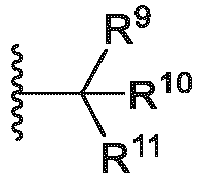 R9 und R10 unabhängig voneinander Wasserstoff, gegebenenfalls substituiertes Alkyl, gegebenenfalls substituiertes Cycloalkyl, gegebenenfalls substituiertes Hydroxyalkyl, gegebenenfalls substituiertes Heteroaryl oder Halogenalkyl sind, oder R9, R10 und das Kohlenstoffatom, an das sie gebunden sind, ein gegebenenfalls substituiertes Cycloalkyl bilden;R11 gegebenenfalls substituiertes Heterocyclyl, gegebenenfalls substituiertes Alkoxy, gegebenenfalls substituiertes Heteroaryl, gegebenenfalls substituiertes Aryl,
 R12 H oder gegebenenfalls substituiertes Alkyl ist;R13 H, gegebenenfalls substituiertes Alkyl, gegebenenfalls substituiertes Alkylcarbonyl, gegebenenfalls substituiertes (Cycloalkyl)alkylcarbonyl, gegebenenfalls substituiertes Aralkylcarbonyl, gegebenenfalls substituiertes Arylcarbonyl, gegebenenfalls substituiertes (Heterocyclyl)carbonyl oder gegebenenfalls substituiertes Aralkyl ist;eines von R14a und R14b H, Amin, Halogenalkyl, gegebenenfalls substituiertes Alkyl, gegebenenfalls substituiertes Alkoxy, gegebenenfalls substituiertes Hydroxyalkyl, gegebenenfalls substituiertes Alkylamin, gegebenenfalls substituiertes Heteroalkyl, gegebenenfalls substituiertes Alkylheterocycloalkyl, gegebenenfalls substituiertes Alkoxyheterocycloalkyl, COR26, CONR27aR27b, NHCOR26 oder NCH3COR26 ist; und das andere von R14a und R14b H ist; oder R14a und R14b zusammen mit dem Kohlenstoffatom, an das sie gebunden sind, ein gegebenenfalls substituiertes 3- bis 5-gliedriges Cycloalkyl, Heterocycloalkyl, Spirocycloalkyl mit bis zu 12 Gliedern oder Spiroheterocyclyl mit bis zu 12 Gliedern bilden, wobei das Spiroheterocyclyl kein Epoxy oder Aziridinyl ist;W5 gegebenenfalls substituiertes Phenyl, gegebenenfalls substituiertes Naphthyl oder ein gegebenenfalls substituiertes 5-10-gliedriges Heteroaryl ist;R15 H, Halogen, CN, OH, NO2, NR27aR27b, OR27a, CONR27aR27b, NR27aCOR27b, SO2NR27aR27b, NR27aSO2R27b, gegebenenfalls substituiertes Alkyl, gegebenenfalls substituiertes Halogenalkyl, gegebenenfalls substituiertes Halogenalkoxy, gegebenenfalls substituiertes Aryl, gegebenenfalls substituiertes Heteroaryl, gegebenenfalls substituiertes Cycloalkyl oder gegebenenfalls substituiertes Heterocyclyl ist;jedes R16 unabhängig voneinander Halogen, CN, gegebenenfalls substituiertes Alkyl, gegebenenfalls substituiertes Halogenalkyl, Hydroxy oder gegebenenfalls substituiertes Halogenalkoxy ist; o 0, 1, 2, 3 oder 4 ist;jedes R18 unabhängig voneinander H, Halogen, gegebenenfalls substituiertes Alkoxy, Cyano, gegebenenfalls substituiertes Alkyl, Halogenalkyl oder Halogenalkoxy ist;jedes R26 unabhängig voneinander H, gegebenenfalls substituiertes Alkyl oder NR27aR27b ist;jedes R27a und R27b unabhängig voneinander H, gegebenenfalls substituiertes Alkyl ist, oder R27a und R27b zusammen mit dem Stickstoffatom, an das sie gebunden sind, ein 4-6-gliedriges Heterocyclyl bilden;p 0, 1, 2, 3 oder 4 ist, unddie Bindungsstelle von L angibt;
 (b) L -(AL)q- ist, wobei:(AL)q eine Gruppe ist, die mit dem PTM und dem ULM verbunden ist;q des L eine ganze Zahl von 1 bis 100 ist;jedes AL unabhängig voneinander CRL1RL2, O, S, SO, SO2, NRL3, SO2NRL3, SONRL3, CONRL3, NRL3CONRL4, NRL3SO2NRL4, CO, CRL1=CRL2, C≡C, SiRL1RL2, P(O)RL1, P(O)OR L1, NRL3C(=NCN)NRL4, NRL3C(=NCN), NRL3C(=CNO2)NRL4, C3-11-Cycloalkyl, gegebenenfalls substituiert mit 1-6 RL1- und/oder RL2-Gruppen, C3-11-Heterocyclyl, gegebenenfalls substituiert mit 1-6 RL1- und/oder RL2-Gruppen, und Aryl, gegebenenfalls substituiert mit 1-6 RL1- und/oder RL2-Gruppen, und Heteroaryl, gegebenenfalls substituiert mit 1-6 RL1- und/oder RL2-Gruppen, ist, wobei RL1 oder RL2 jeweils unabhängig voneinander gegebenenfalls mit anderen Gruppen verknüpft sind, um eine Cycloalkyl- oder Heterocyclyleinheit zu bilden, die gegebenenfalls mit 1-4 RL5-Gruppen substituiert ist; undjedes RL1, RL2, RL3, RL4 und RL5 unabhängig voneinander H, Halogen, C1-8-Alkyl, OC1-8-Alkyl, SC1-8-Alkyl, NHC1-8-Alkyl, N(C1-8-Alkyl)2, C3-11-Cycloalkyl, Aryl, Heteroaryl, C3-11-Heterocyclyl, OC3-8-Cycloalkyl, SC3-8-Cycloalkyl, NHC3-8-Cycloalkyl, N(C3-8-Cycloalkyl)2, N(C3-8-Cycloalkyl)(C1-8-Alkyl), OH, NH2, SH, SO2C1-8-Alkyl, P(O)(OC1-8-Alkyl)(C1-8-Alkyl), P(O)(OC1-8-Alkyl)2, CC-C1-8-Alkyl, CCH, CH=CH(C1-8-Alkyl), C(C1-8-Alkyl)=CH(C1-8-Alkyl), C(C1-8-Alkyl)=C(C1-8-Alkyl)2, Si(OH)3, Si(C1-8-Alkyl)3, Si(OH)(C1-8-Alkyl)2, COC1-8-Alkyl, CO2H, CN, CF3, CHF2, CH2F, NO2, SF5, SO2NHC1-8-Alkyl, SO2N(C1-8-Alkyl)2, SONHC1-8-Alkyl, SON(C1-8-Alkyl)2, CONHC1-8-Alkyl, CON(C1-8-Alkyl)2, N(C1-8-Alkyl)CONH(C1-8-Alkyl), N(C1-8-Alkyl)CON(C1-8-Alkyl)2, NHCONH(C1-8-Alkyl), NHCON(C1-8-Alkyl)2, NHCONH2, N(C1-8-Alkyl)SO2NH(C1-8-Alkyl), N(C1-8-Alkyl)SO2N(C1-8-Alkyl)2, NH-SO2NH(C1-8-Alkyl), NH-SO2N(C1-8-Alkyl)2 oder NH-SO2NH2 ist; und(c) PTM Folgendes ist:(a)
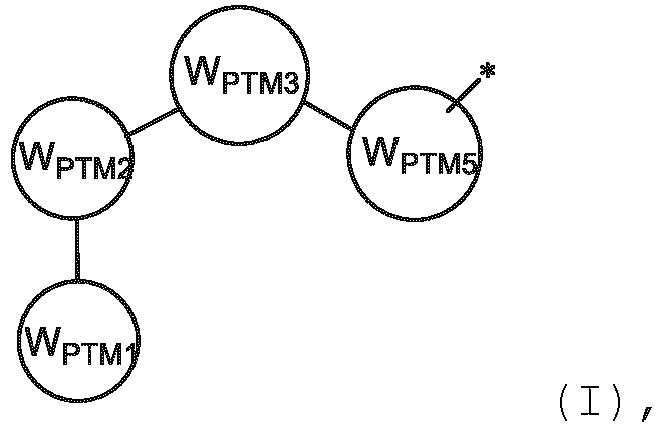 der Bindungspunkt zu L ist;
 WPTM1 ein Phenyl ist, das mit einem Hydroxysubstituenten substituiert ist und gegebenenfalls mit 1 oder 2 Substituenten substituiert ist, die unabhängig voneinander aus Hydroxy, Halogen, Alkoxy, Alkyl, Halogenalkyl, Amino, Phosphat, Alkylamino und Cyano ausgewählt sind;WPTM2 Pyridazinyl ist, das gegebenenfalls mit einer Aminogruppe substituiert ist;WPTM3 ein gegebenenfalls substituiertes 5-6-gliedriges Heteroaryl, ein gegebenenfalls substituiertes 4-9-gliedriges Cycloalkyl, ein gegebenenfalls substituiertes 4-9-gliedriges Heterocyclyl, ein gegebenenfalls substituiertes verbrücktes Bicycloalkyl oder ein gegebenenfalls substituiertes, verbrücktes Biheterocyclyl, vorzugsweise ein gegebenenfalls substituiertes Pyrazol, Pyrrol, Imidazol, Oxazol, Oxadiazol oder Triazol, ist;WPTM5 ein gegebenenfalls substituiertes 5-6-gliedriges Aryl oder ein gegebenenfalls substituiertes 5-6-gliedriges Heteroaryl ist; oder(b)
 der Bindungspunkt zu L ist;WPTM1 ein Phenyl ist, das mit einem Hydroxysubstituenten substituiert ist und gegebenenfalls mit 1 oder 2 Substituenten substituiert ist, die unabhängig voneinander aus Hydroxy, Halogen, Alkoxy, Alkyl, Halogenalkyl, Amino, Phosphat, Alkylamino und Cyano ausgewählt sind;WPTM2 ein Pyridazinyl ist, das gegebenenfalls mit einer Aminogruppe substituiert ist; undWPTM6 und WPTM7 ein spirozyklisches Ringsystem mit einer Struktur sind, die ausgewählt ist aus: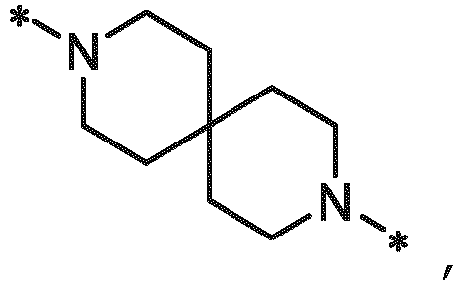


- Verbindung nach Anspruch 1, wobei das PTM Folgendes ist:

- Verbindung nach Anspruch 1, wobei das PTM Folgendes ist:

- Verbindung nach Anspruch 1, wobei das PTM Folgendes ist:


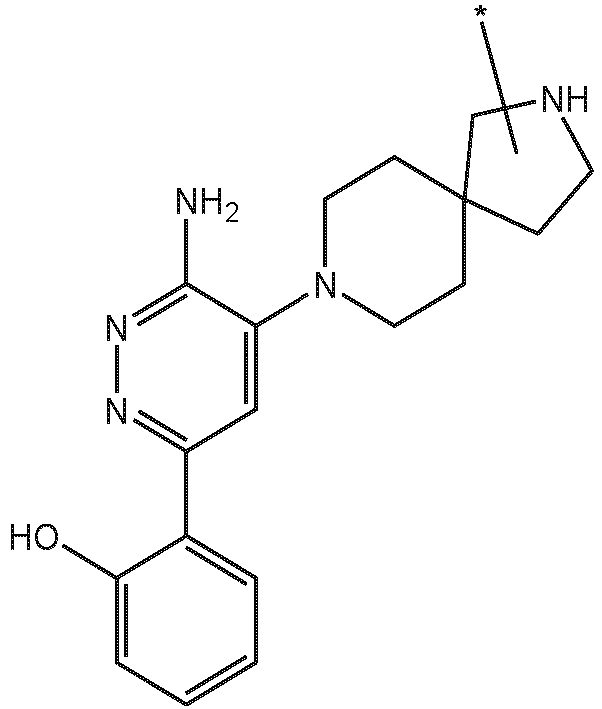


 der Bindungspunkt zu L ist.
 - Verbindung nach irgendeinem der Ansprüche 1-4, wobei:(a) das ULM Folgendes ist:
 R1 H, gegebenenfalls substituiertes Alkyl, gegebenenfalls substituiertes Cycloalkyl, gegebenenfalls substituiertes Hydroxyalkyl, gegebenenfalls substituiertes Heteroaryl oder Halogenalkyl ist;R14a H, Halogenalkyl, gegebenenfalls substituiertes Alkyl, Methyl, Fluormethyl, Hydroxymethyl, Ethyl oder Isopropyl ist;R15 H, Halogen, CN, OH, NO2, gegebenenfalls substituiertes Heteroaryl, gegebenenfalls substituiertes Aryl, gegebenenfalls substituiertes Alkyl, gegebenenfalls substituiertes Halogenalkyl, gegebenenfalls substituiertes Halogenalkoxy, gegebenenfalls substituiertes Cycloalkyl oder gegebenenfalls substituiertes Heterocyclyl ist;X CH2 oder C=O ist;R3 gegebenenfalls ein substituiertes 5- oder 6-gliedriges Heteroaryl ist; und
 (b) das ULM Folgendes ist:
 R1 H, gegebenenfalls substituiertes Alkyl oder gegebenenfalls substituiertes Cycloalkyl ist;R3 ein gegebenenfalls substituiertes 5-6-gliedriges Heteroaryl ist;W5 ein gegebenenfalls substituiertes Phenyl, ein gegebenenfalls substituiertes Naphthyl oder ein gegebenenfalls substituiertes Pyridinyl ist;eines von R14a und R14b H, gegebenenfalls substituiertes Alkyl, Halogenalkyl, gegebenenfalls substituiertes Alkoxy, gegebenenfalls substituiertes Hydroxylalkyl, gegebenenfalls substituiertes Alkylamino, gegebenenfalls substituiertes Heteroalkyl, gegebenenfalls substituiertes Alkylheterocycloalkyl, gegebenenfalls substituiertes Alkoxyheterocycloalkyl, COR26, CONR27aR27b, NHCOR26 oder NCH3COR26 ist; und das andere von R14a und R14b H ist; oder R14a und R14b zusammen mit dem Kohlenstoffatom, an das sie gebunden sind, ein gegebenenfalls substituiertes 3- bis 5-gliedriges Cycloalkyl, Heterocycloalkyl, Spirocycloalkyl oder Spiroheterocyclyl bilden, wobei das Spiroheterocyclyl kein Epoxy oder Aziridinyl ist;R15 CN, Fluoralkyl,


 jedes R26 unabhängig voneinander H, gegebenenfalls substituiertes Alkyl oder NR27aR27b ist;jedes R27a und R27b unabhängig voneinander H, gegebenenfalls substituiertes Alkyl ist, oder R27a und R27b zusammen mit dem Stickstoffatom, an das sie gebunden sind, ein 4-6-gliedriges Heterocyclyl bilden;R28 H, gegebenenfalls substituiertes Alkyl, gegebenenfalls substituiertes Alkoxy, gegebenenfalls substituiertes Heteroalkyl, gegebenenfalls substituiertes Alkylamino, gegebenenfalls substituiertes Hydroxyalkyl, Amino, gegebenenfalls substituiertes Alkinyl oder gegebenenfalls substituiertes Cycloalkyl ist;o 0, 1 oder 2 ist; und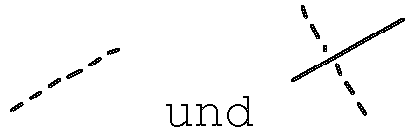
- Verbindung nach Anspruch 1, wobei das ULM Folgendes ist:
 R3 ein gegebenenfalls substituiertes 5-6-gliedriges Heteroaryl ist;jedes von X4, X5 und X6 CH oder N ist, wobei nicht mehr als 2 N sind;R1 C1-6-Alkyl ist;eines von R14a und R14b H, gegebenenfalls substituiertes Alkyl, gegebenenfalls substituiertes Halogenalkyl, gegebenenfalls substituiertes Alkoxy, gegebenenfalls substituiertes Hydroxylalkyl, gegebenenfalls substituiertes Alkylamino, gegebenenfalls substituiertes Heteroalkyl, gegebenenfalls substituiertes Alkylheterocycloalkyl, gegebenenfalls substituiertes Alkoxyheterocycloalkyl, COR26, CONR27aR27b, NHCOR26 oder NCH3COR26 ist; und das andere von R14a und R14b H ist;oder R14a und R14b zusammen mit dem Kohlenstoffatom, an das sie gebunden sind, ein gegebenenfalls substituiertes 3- bis 5-gliedriges Cycloalkyl, Heterocycloalkyl, Spirocycloalkyl oder Spiroheterocyclyl bilden, wobei das Spiroheterocyclyl kein Epoxy oder Aziridinyl ist;jedes R27a und R27b unabhängig voneinander H oder C1-6-Alkyl ist;R15
 R28 H, Methyl, CH2N(Me)2, CH2OH, CH2O(C1-4-Alkyl), CH2NHC(O)C1-4-Alkyl, NH2,
 R28C H, Methyl, Fluor oder Chlor ist;R16 H, C1-4-Alkyl, Fluor, Chlor, CN oder C1-4-Alkoxy ist; und
- Verbindung nach Anspruch 6, wobei eines von R14a und R14b Folgendes ist: H, C1-4-Alkyl, C1-4-Cycloalkyl, C1-4-Halogenalkyl, C1-4-Hydroxyalkyl, C1-4-Alkyloxyalkyl, C1-4-Alkyl-NR27aR27b und CONR27aR27b; und das andere von R14a oder R14b H ist; oder R14a und R14b zusammen mit dem Kohlenstoffatom, an das sie gebunden sind, ein C3-4-Cycloalkyl bilden.
- Verbindung nach Anspruch 6, wobei R14a und R14b zusammen mit dem Kohlenstoffatom, an das sie gebunden sind,

- Verbindung nach Anspruch 6, wobei das ULM Folgendes ist:


- Verbindung nach Anspruch 6 oder 9, wobei:(a) eines von R14a und R14b H, C1-6-Alkyl, C1-6-Halogenalkyl, gegebenenfalls substituiertes C1-4-Alkylamino, C1-6-Alkoxy, (CH2)qC1-6-Alkoxy, (CH2)qC1-6-Alkoxy-C3-7-heterocycloalkyl, (CH2)qOH, (CH2)qNR27aR27b oder (CH2)qNHCOC1-6-Alkyl ist; und das andere von R14a und R14b H ist;jedes R26 unabhängig voneinander H, C1-6-Alkyl oder NR27aR27b ist;jedes R27a und R27b unabhängig voneinander H oder C1-6-Alkyl ist; undq des ULM 1, 2, 3 oder 4 ist; oder(b) eines von R14a und R14b H, C1-4-Alkyl, C1-4-Halogenalkyl, C1-4-Alkoxy, gegebenenfalls substituiertes C1-4-Alkylamino, (CH2)qC1-6-Alkoxy, (CH2)qC1-6-Alkoxy-C3-7-heterocycloalkyl, (CH2)qOH, (CH2)qNR27aR27b oder (CH2)qNHCOC1-6-Alkyl ist; und das andere von R14a oder R14b H ist;jedes R26 unabhängig voneinander H, C1-4-Alkyl oder NR27aR27b ist;jedes R27a und R27b unabhängig voneinander H oder C1-4-Alkyl ist; undq des ULM 1 oder 2 ist; oder(c) R28 C1-6-Alkyl, C3-6-Cycloalkyl, C1-6-Halogenalkyl, (CH2)qOC1-6-Alkyl, (CH2)qOH, (CH2)qNR27aR27b, (CH2)qNHCOC1-6-Alkyl, oder
 R29 H, C1-6-Alkyl, NR27aR27b oder NHCOC1-6-Alkyl ist; undq des ULM 1 oder 2 ist.
 - Verbindung nach Anspruch 6, wobei R3 Isoxazolyl, 4-Chlorisoxazolyl, 4-Fluorisoxazolyl oder Pyrazolyl ist.
- Verbindung nach Anspruch 11, wobei:(a) X4 CH ist; und/oder(b) das ULM Folgendes ist:

 X CH oder N ist;R1 C1-6-Alkyl ist;R30 H, F oder Cl ist;R16 H, C1-4-Alkyl, Fluor, Chlor, CN oder C1-4-Alkoxy ist;R28 H, Methyl, CH2N(Me)2, CH2OH, CH2O(C1-4-Alkyl), CH2NHC(O)C1-4-Alkyl, NH2,


- Verbindung nach Anspruch 12, wobei das ULM Folgendes ist:


- Verbindung nach Anspruch 1, wobei:(a) das L Folgendes ist:

 WL1 und WL2 jeweils unabhängig voneinander ein 4-8-gliedriger Ring mit 0-4 Heteroatomen sind, der gegebenenfalls mit RQ substituiert ist, wobei jedes RQ unabhängig voneinander H, Halogen, OH, CN, CF3, gegebenenfalls substituiertes lineares oder verzweigtes C1-C6-Alkyl, gegebenenfalls substituiertes lineares oder verzweigtes C1-C6-Alkoxy ist oder 2 RQ-Gruppen zusammen mit dem Atom, an das sie gebunden sind, ein 4-8-gliedriges Ringsystem bilden, das 0-4 Heteroatome enthält;jedes YL1 unabhängig voneinander eine Bindung, gegebenenfalls substituiertes lineares oder verzweigtes C1-C6-Alkyl ist und gegebenenfalls ein oder mehrere C-Atome durch O ersetzt sind; oder gegebenenfalls substituiertes lineares oder verzweigtes C1-C6-Alkoxy ist;n 0, 1, 2, 3, 4, 5, 6, 7, 8, 9 oder 10 ist; und
 (b) das L Folgendes ist:
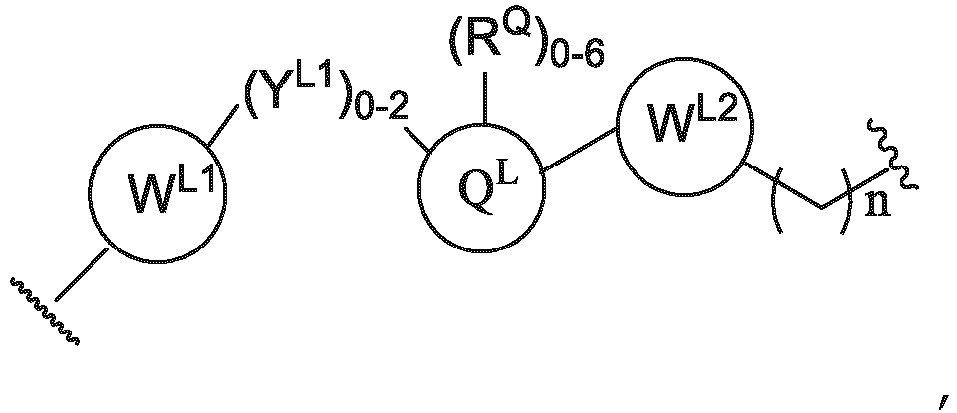 WL1 und WL2 jeweils unabhängig voneinander Aryl, Heteroaryl, cyclisch, Heterocyclyl, C1-6-Alkyl, bicyclisch, Biaryl, Biheteroaryl oder Biheterocyclyl, jeweils gegebenenfalls substituiert mit RQ, sind, jedes RQ unabhängig voneinander ein H, Halogen, OH, NH2, NRY1RY2, CN, CF3, Hydroxyl, Nitro, C≡CH, C2-6-Alkenyl, C2-6-Alkinyl, gegebenenfalls substituiertes lineares oder verzweigtes C1-C6-Alkyl, gegebenenfalls substituiertes lineares oder verzweigtes C1-C6-Alkoxy, OC1-3-Alkyl, gegebenenfalls substituiert durch 1 oder mehrere -F; oder 2 RQ-Gruppen zusammen mit dem Atom, an das sie gebunden sind, ein 4-8-gliedriges Ringsystem mit 0-4 Heteroatomen bilden;jedes YL1 unabhängig voneinander eine Bindung, NRYL1, O, S, NRYL2, CRYL1RYL2, C=O, C=S, SO, SO2, gegebenenfalls substituiertes lineares oder verzweigtes C1-C6-Alkyl ist und gegebenenfalls ein oder mehrere C-Atome durch O ersetzt sind; gegebenenfalls substituiertes lineares oder verzweigtes C1-C6-Alkoxy ist;QL ein 3-6-gliedriger alicyclischer oder aromatischer Ring mit 0-4 Heteroatomen ist, der gegebenenfalls verbrückt, gegebenenfalls substituiert mit 1-6 RQ ist, wobei jedes RQ unabhängig voneinander H, lineares oder verzweigtes C1-6-Alkyl ist, das gegebenenfalls durch 1 oder mehrere Halogene oder C1-6-Alkoxy substituiert ist, oder 2 RQ-Gruppen zusammen mit dem Atom, an das sie gebunden sind, ein 3-8-gliedriges Ringsystem mit 0-2 Heteroatomen bilden;RYL1 und RYL2 jeweils unabhängig voneinander H, OH, lineares oder verzweigtes C1-6-Alkyl, gegebenenfalls substituiert durch 1 oder mehrere Halogene, oder C1-6-Alkoxy sind, oder RYL1 und RYL2 zusammen mit dem Atom, an das sie gebunden sind, ein 3-8-gliedriges Ringsystem bilden, das 0-2 Heteroatome enthält;n 0, 1, 2, 3, 4, 5, 6, 7, 8, 9 oder 10 ist; und
- Verbindung nach Anspruch 1, wobei:(a) das L Folgendes ist:-O-(CH2)m-O(CH2)n-O(CH2)o-O(CH2)p-O(CH2)q-O(CH2)r-O(CH2)s-O(CH2)t-;-O-(CH2)m-O(CH2)n-O(CH2)o-O(CH2)p-O(CH2)q-O(CH2)r-O(CH2)s-O-;- (CH2)m-O(CH2)n-O(CH2)o-O(CH2)p-O(CH2)q-O(CH2)r-O(CH2)s-O(CH2)t-;-CH=CH(CH2)m-O(CH2)n-O(CH2)o-O(CH2)p-O(CH2)q-O(CH2)r-O(CH2)s-O(CH2)t-;-O(CH2)nNCH3C(=O)(CH2)m-;


















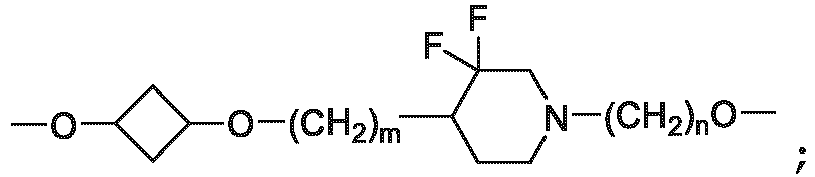



































 (b) das L Folgendes ist:

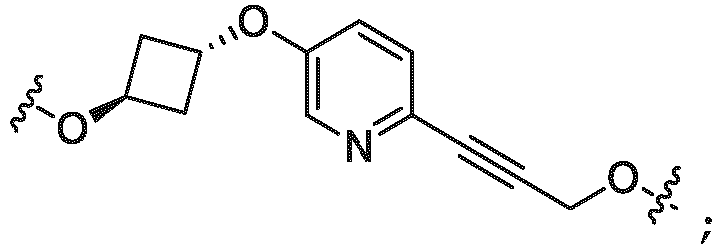

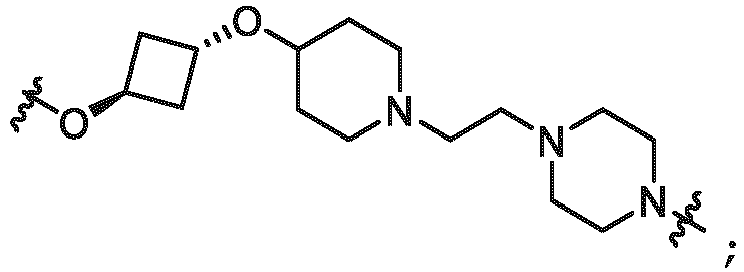
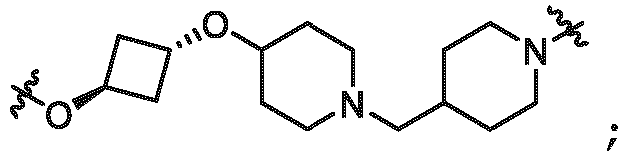
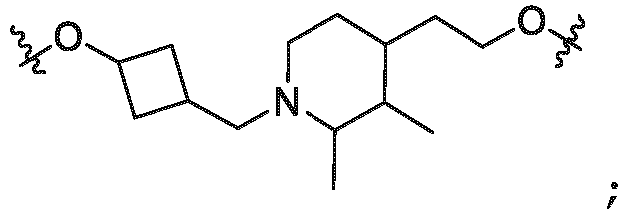


- Verbindung nach Anspruch 1, wobei die Verbindung Folgendes ist:


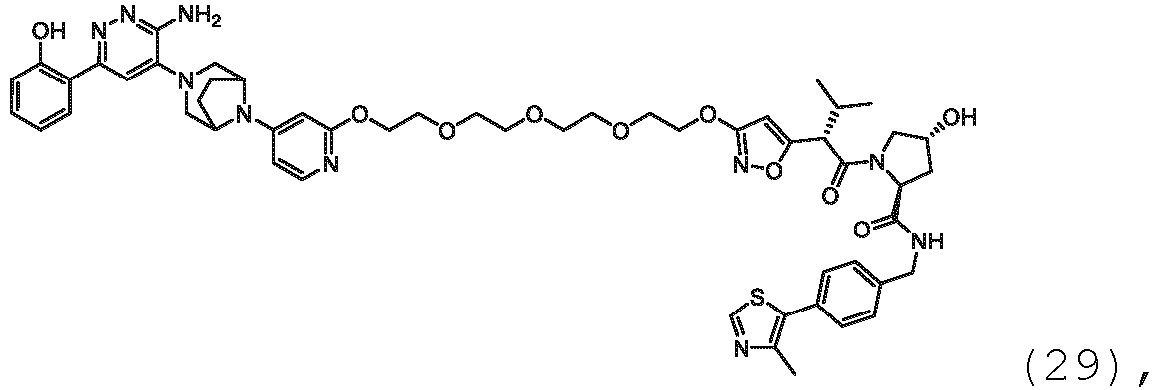


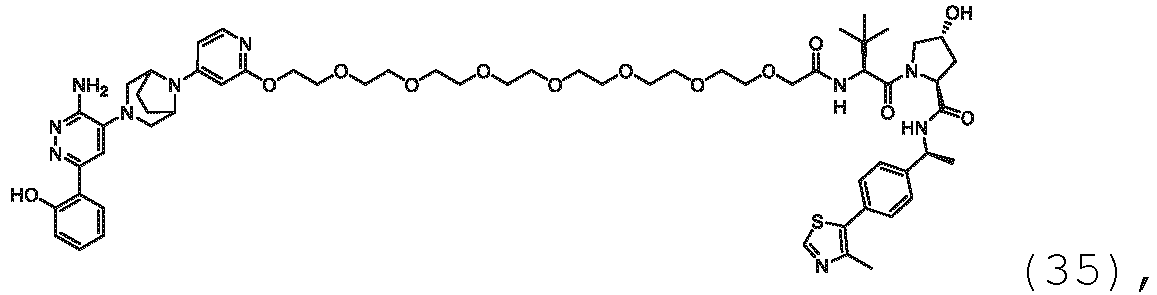
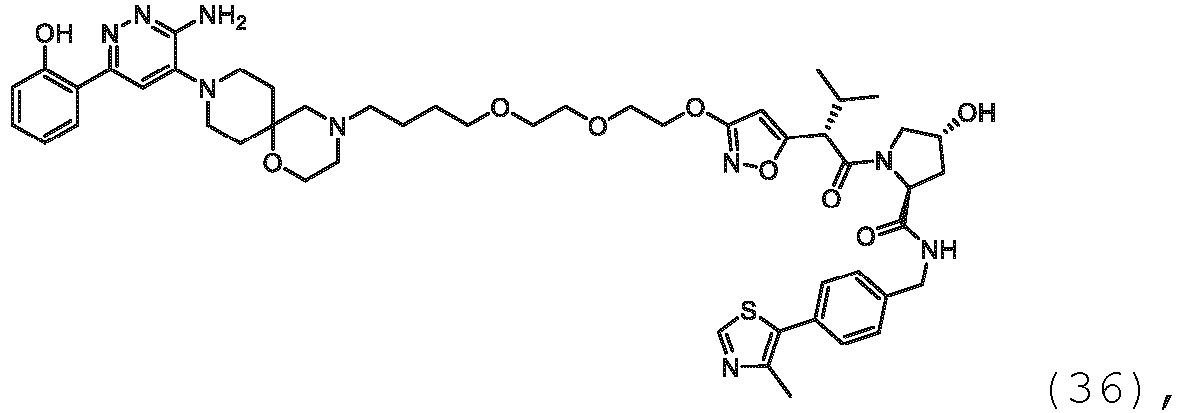


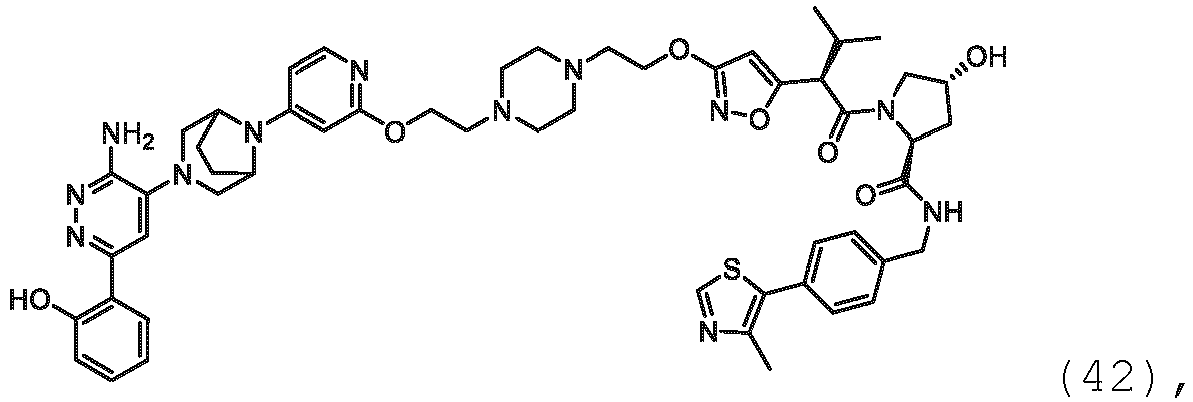
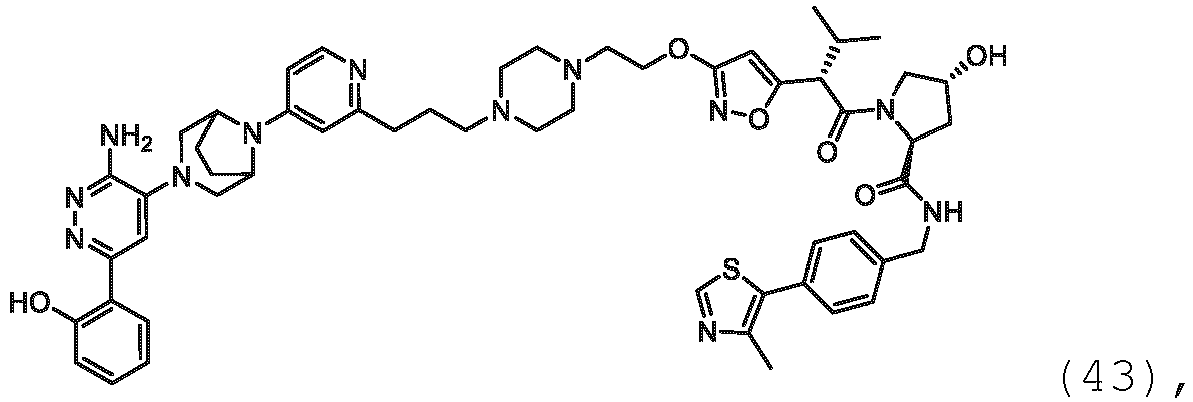


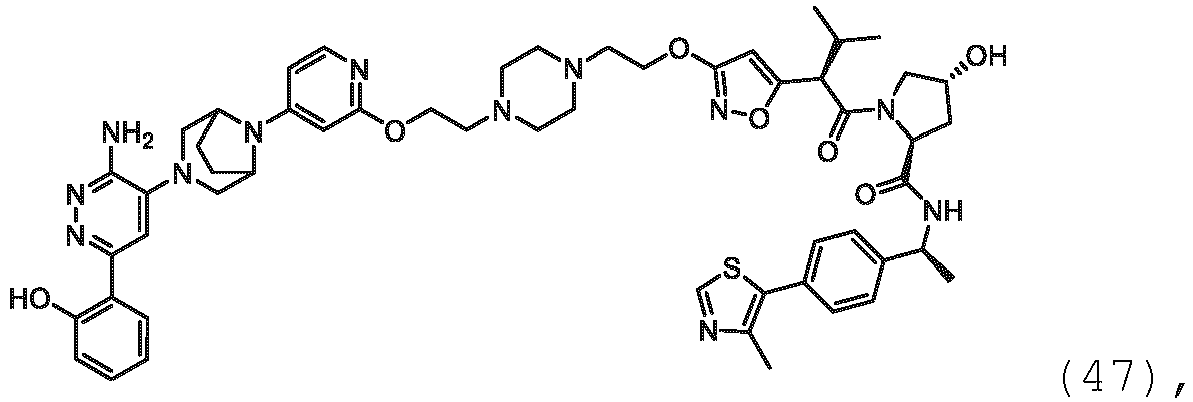


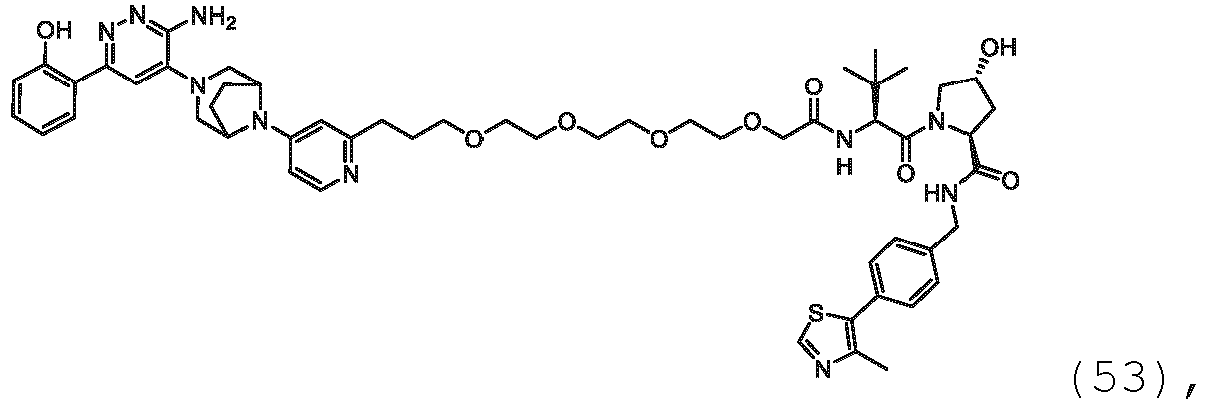
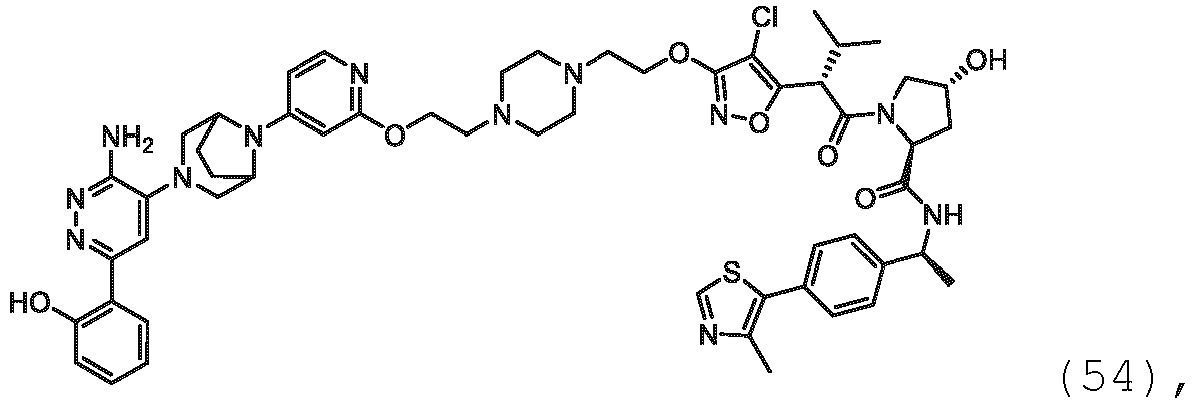


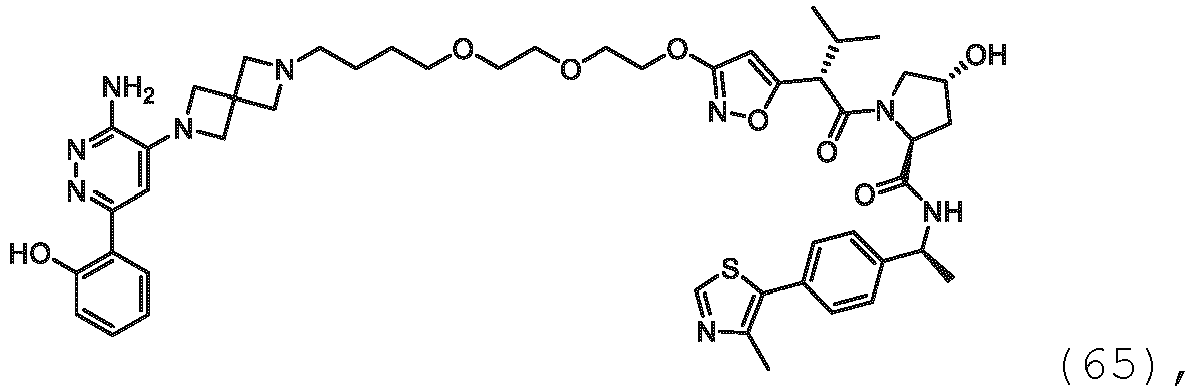


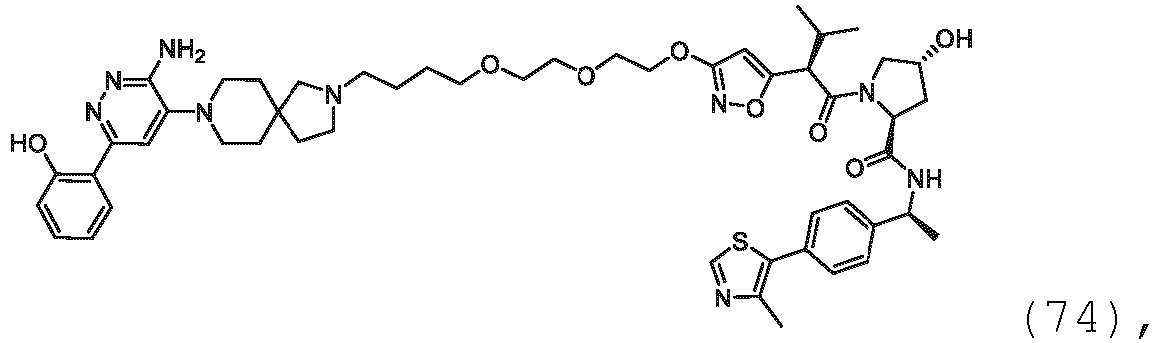


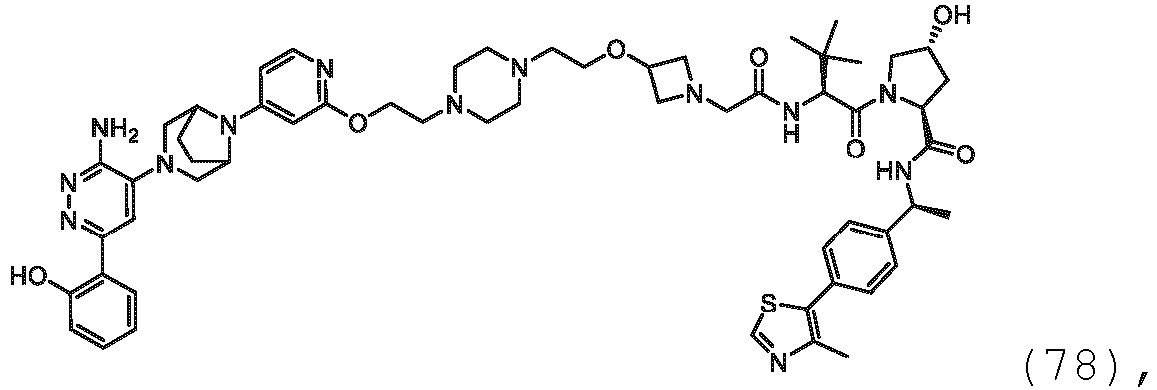


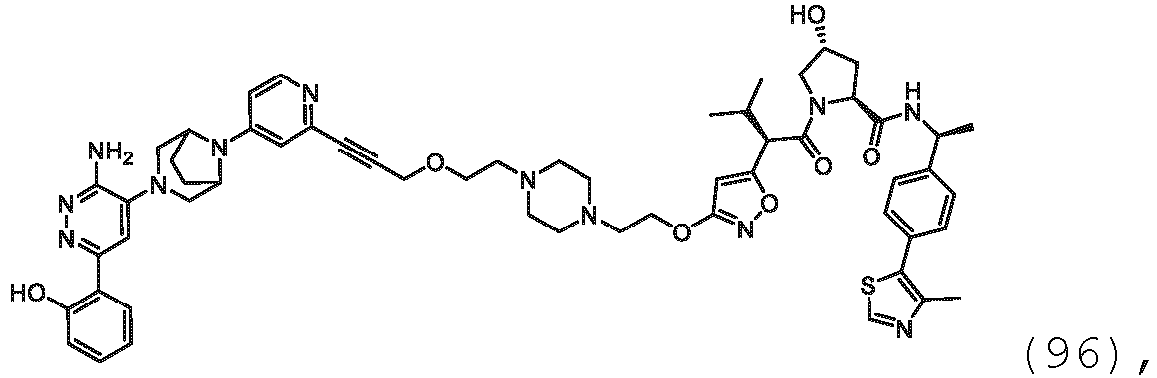


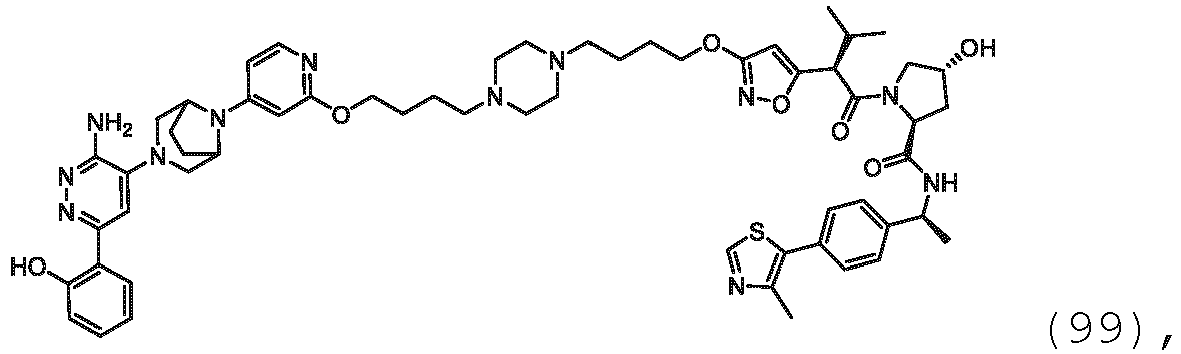

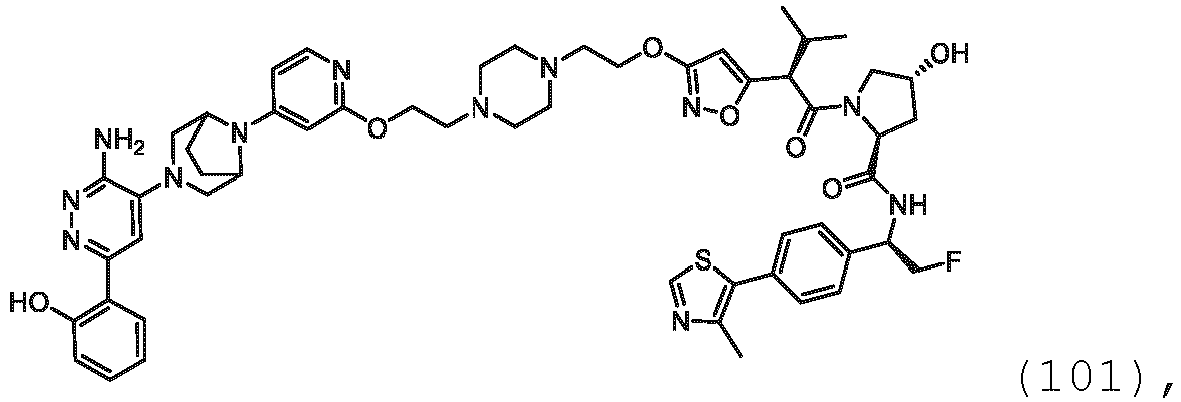


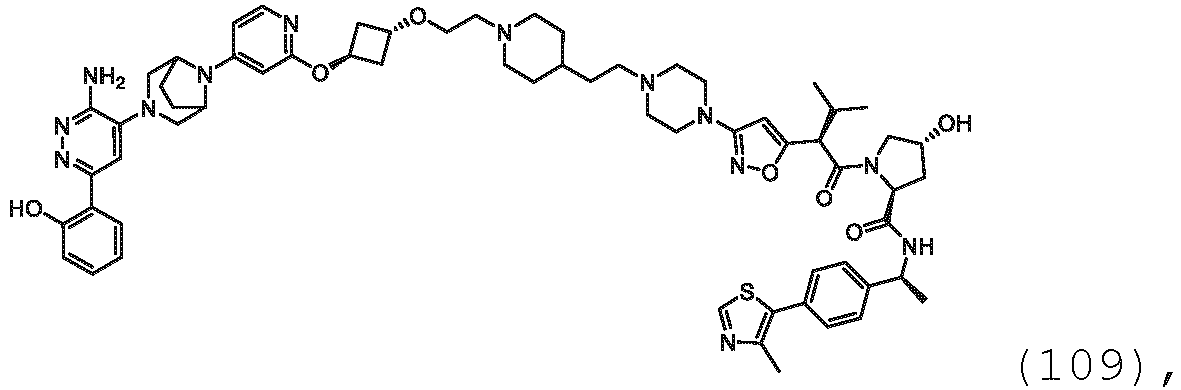


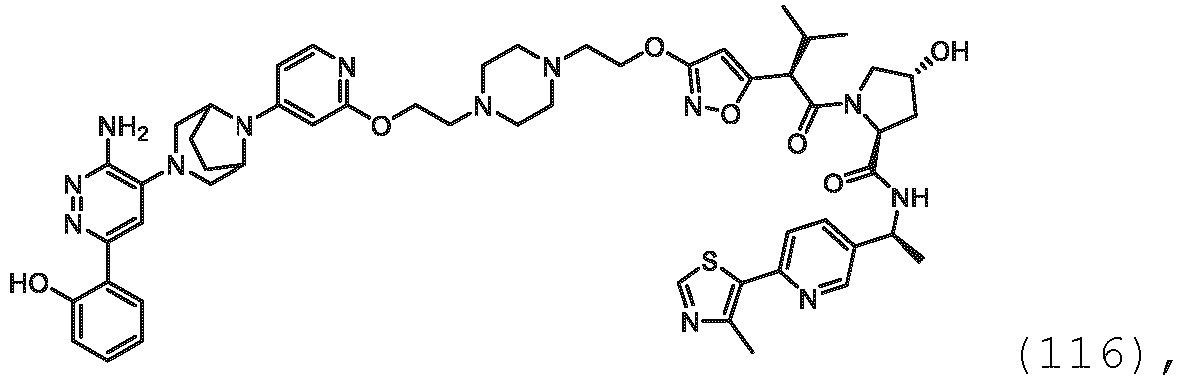

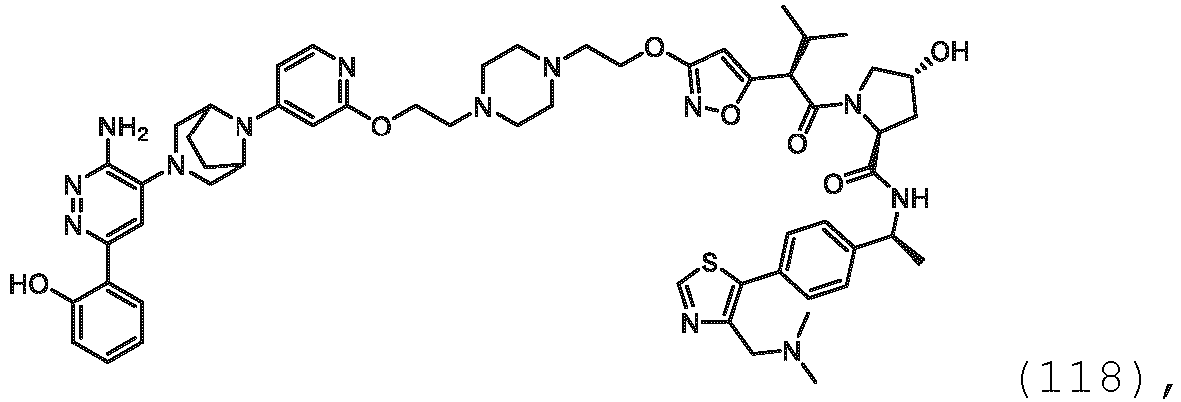
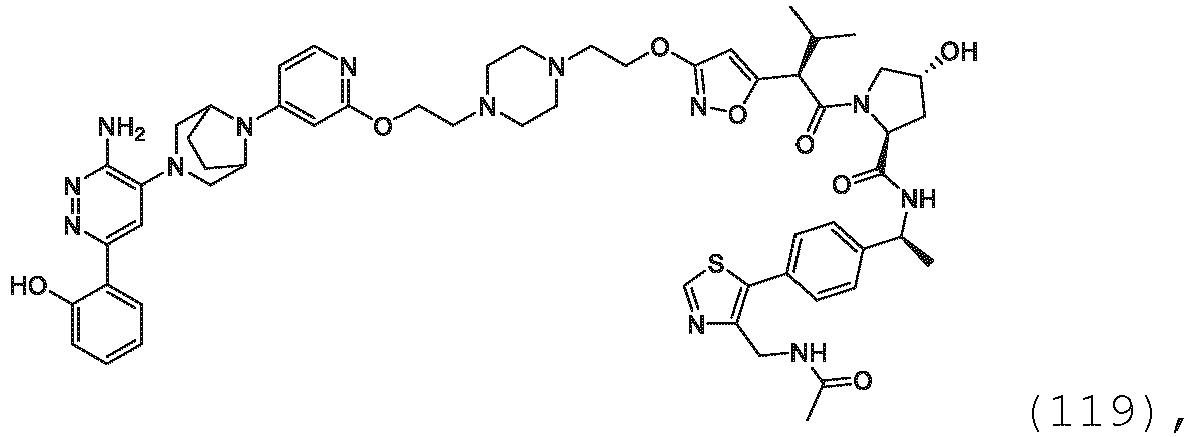

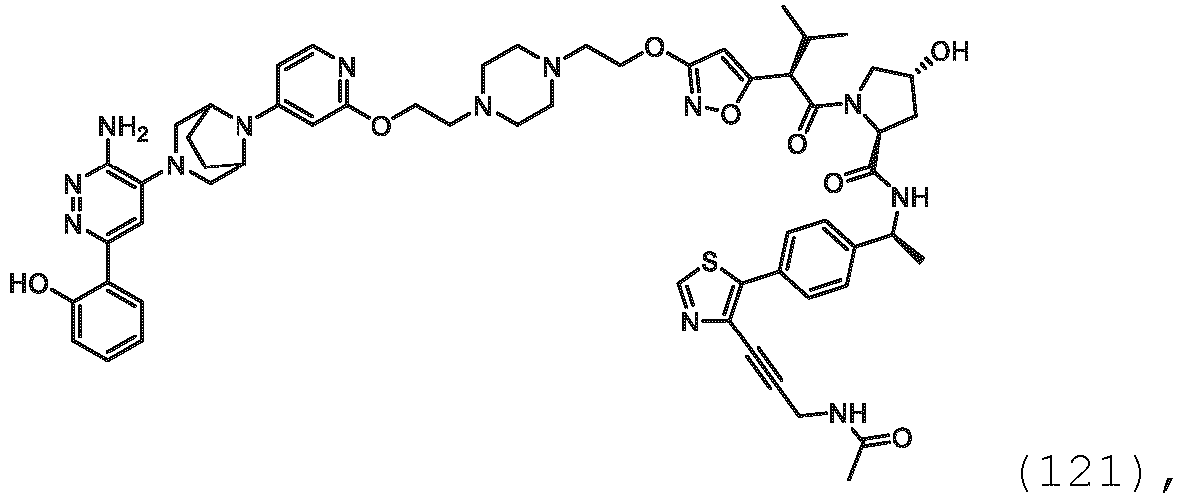


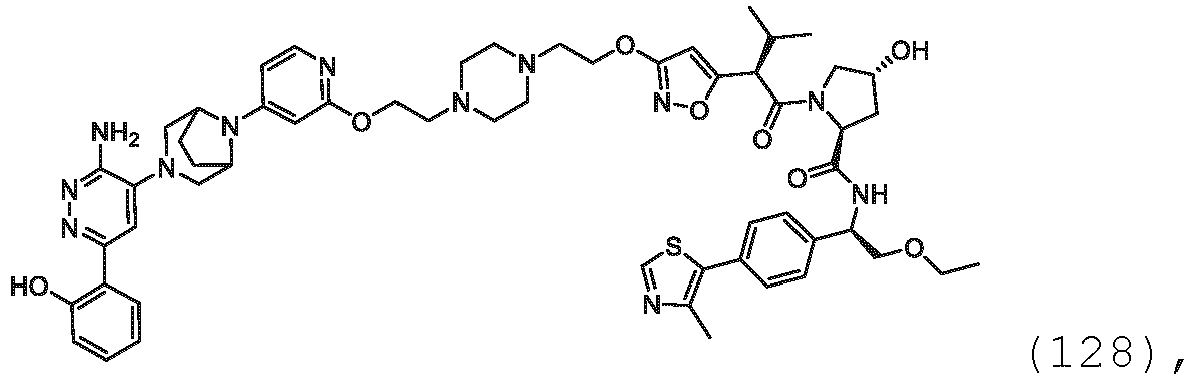


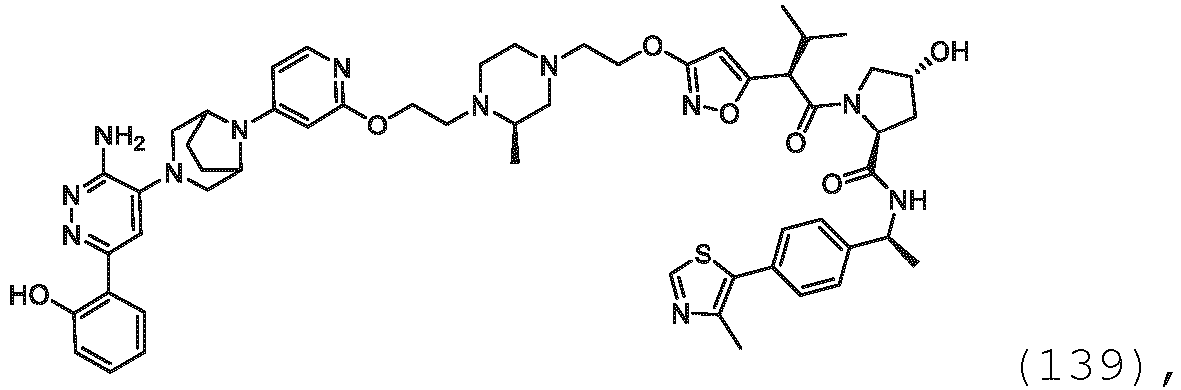

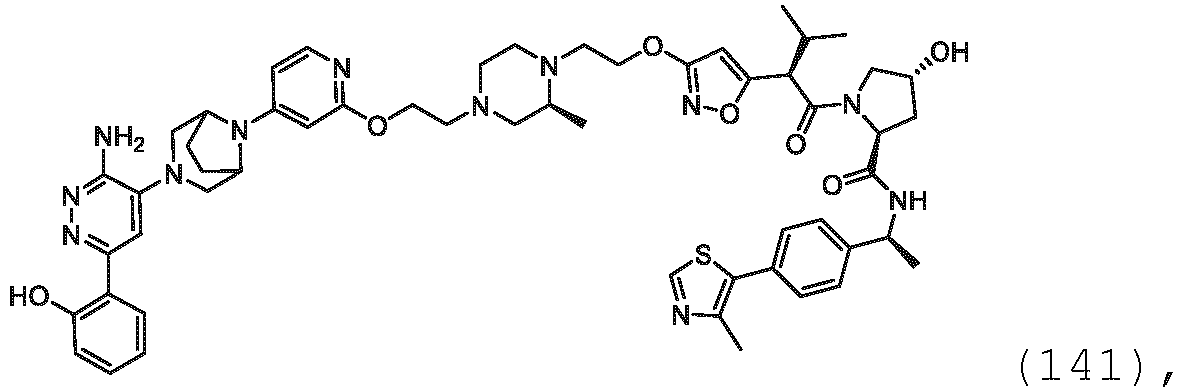
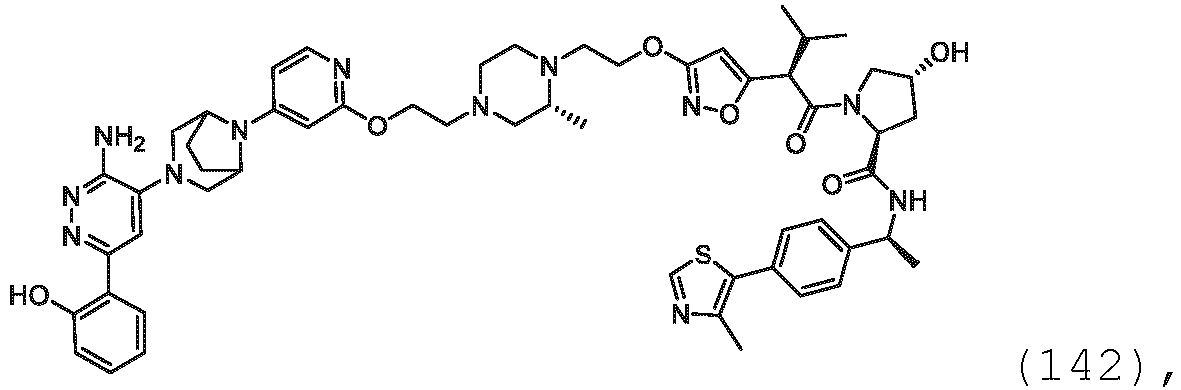
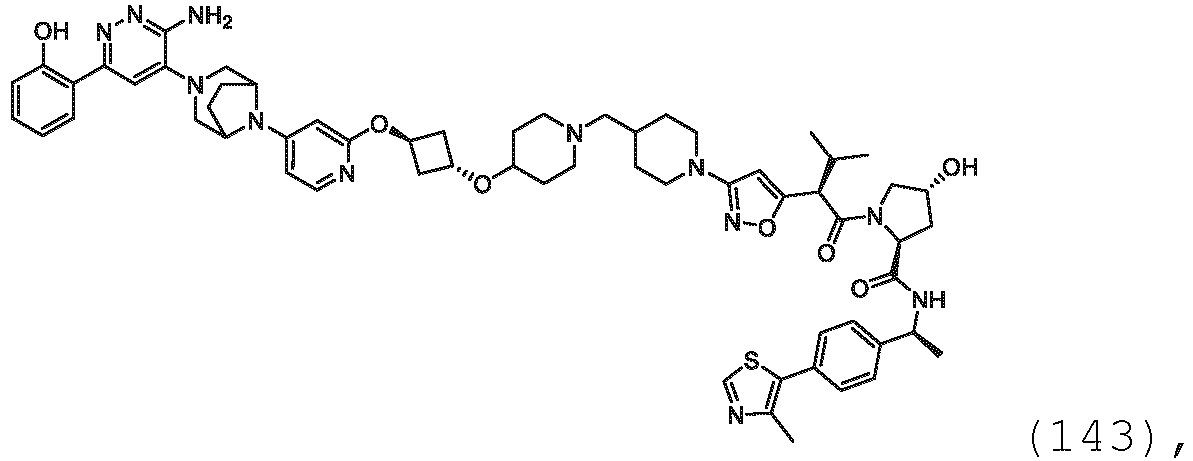


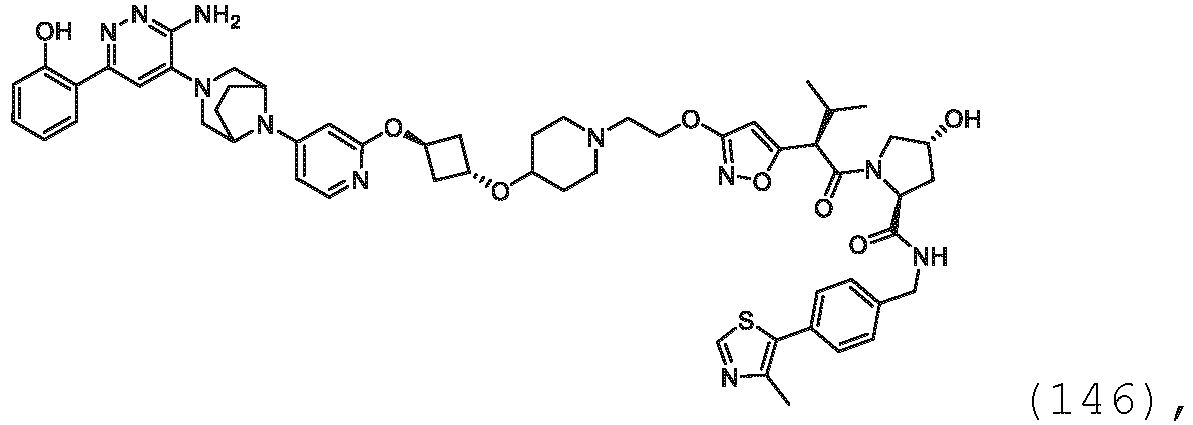


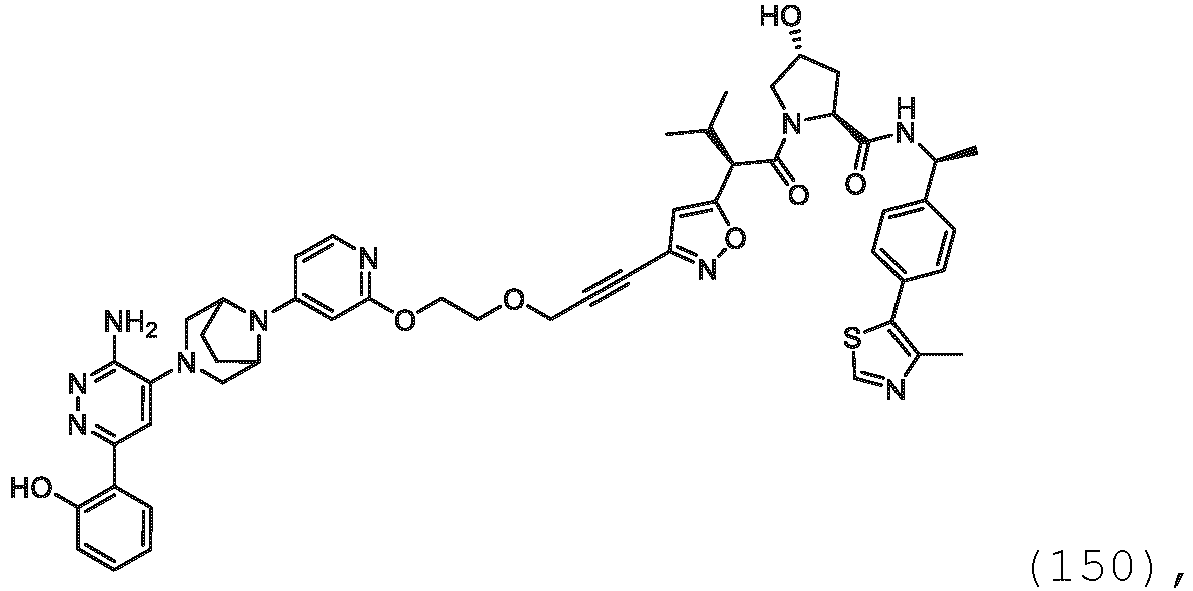

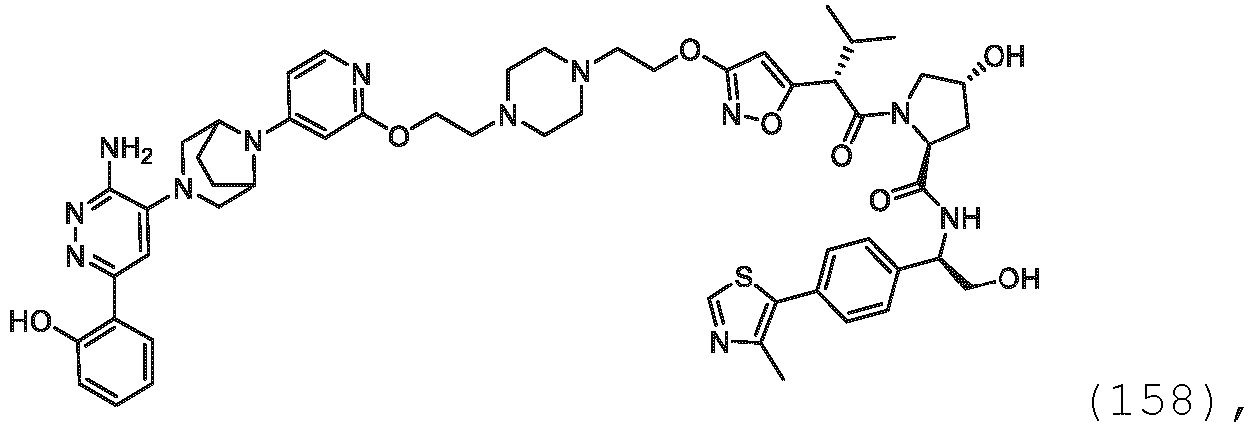


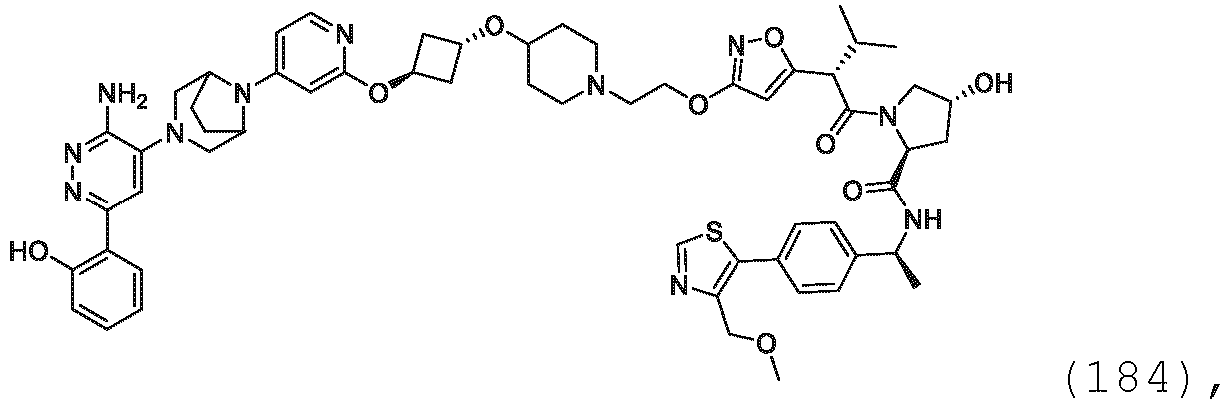

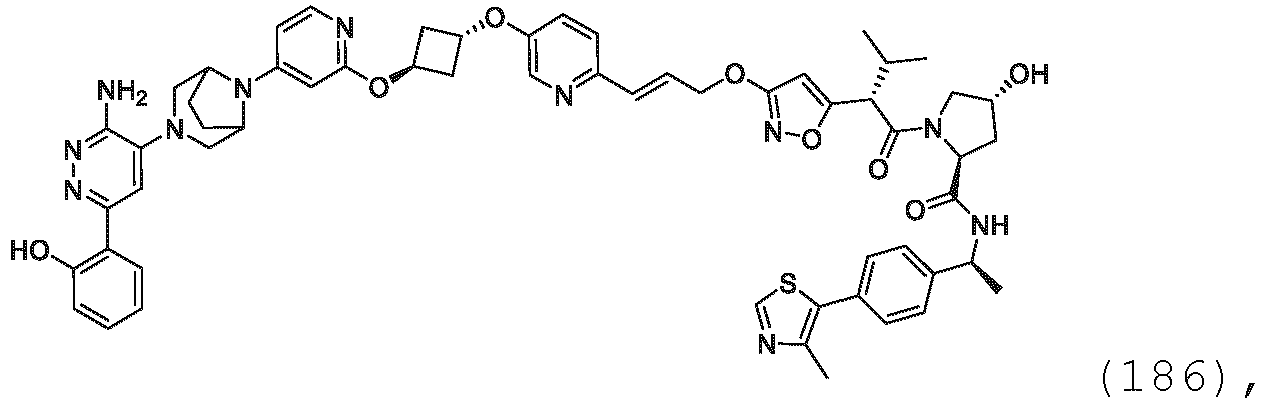

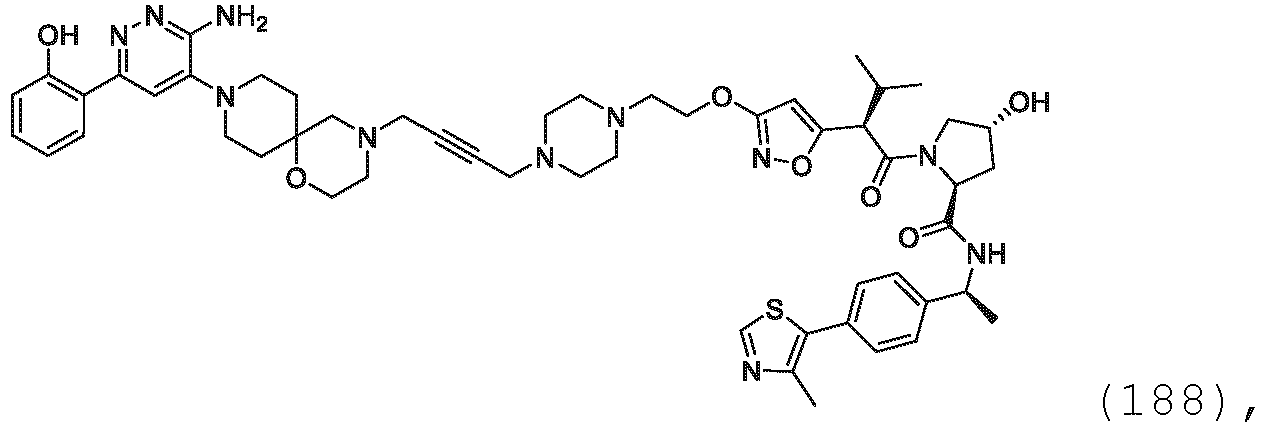


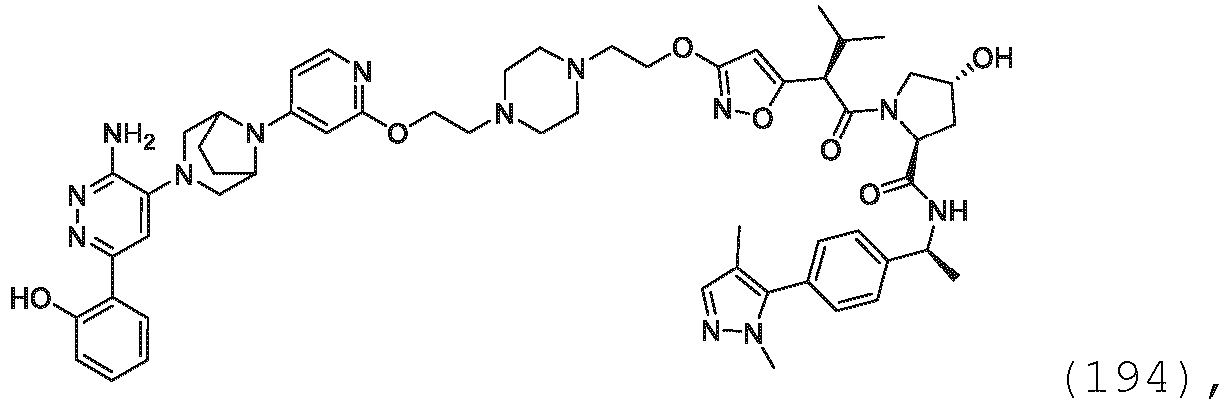


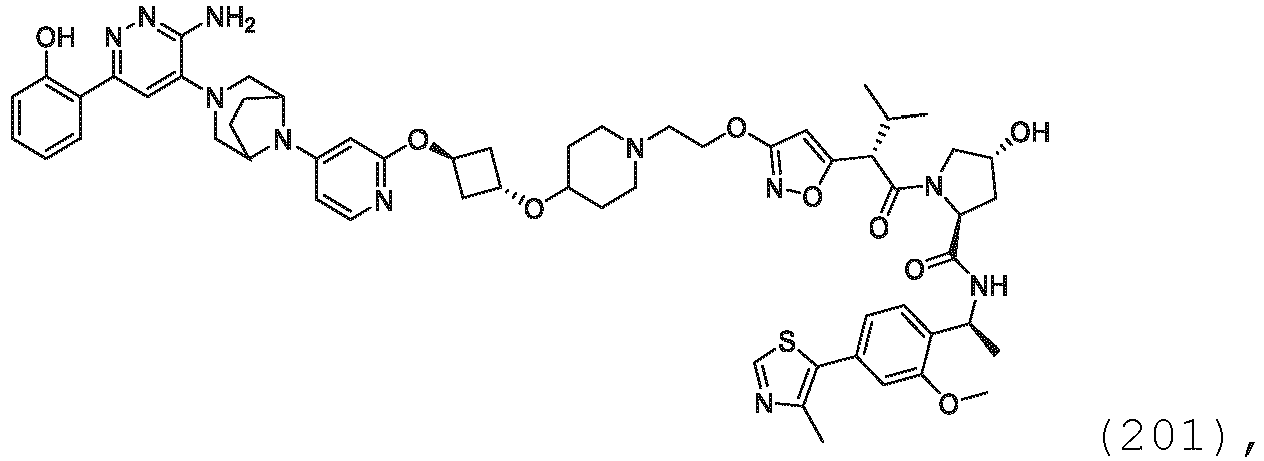


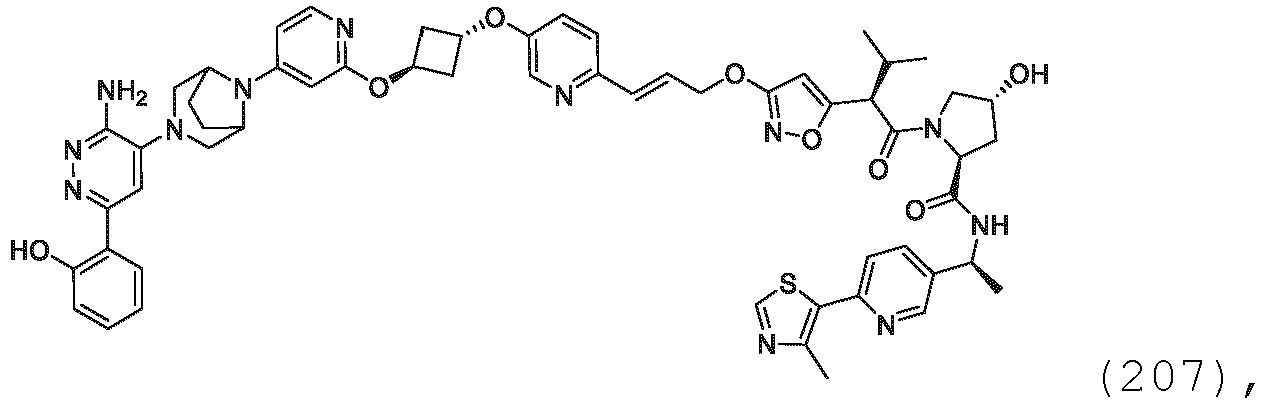

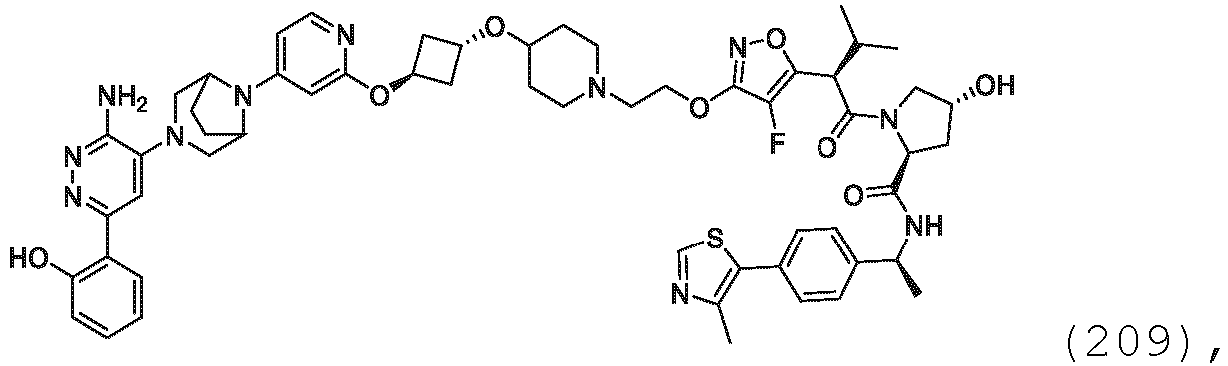


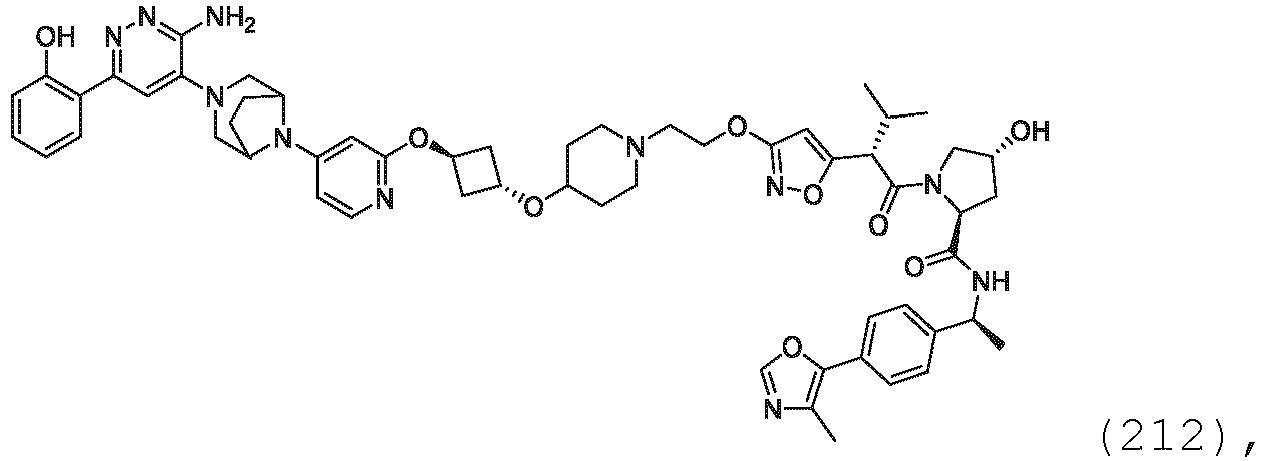

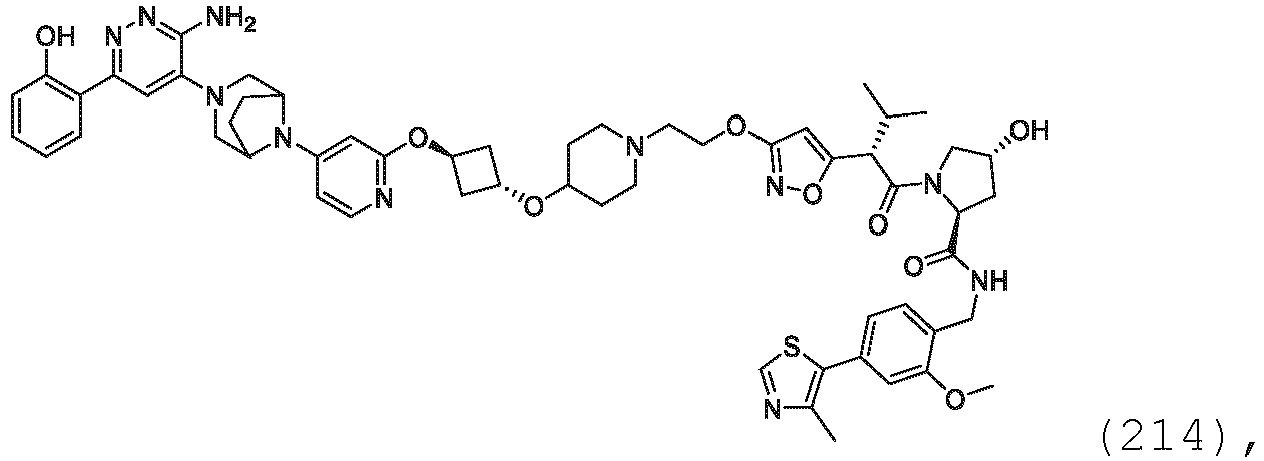


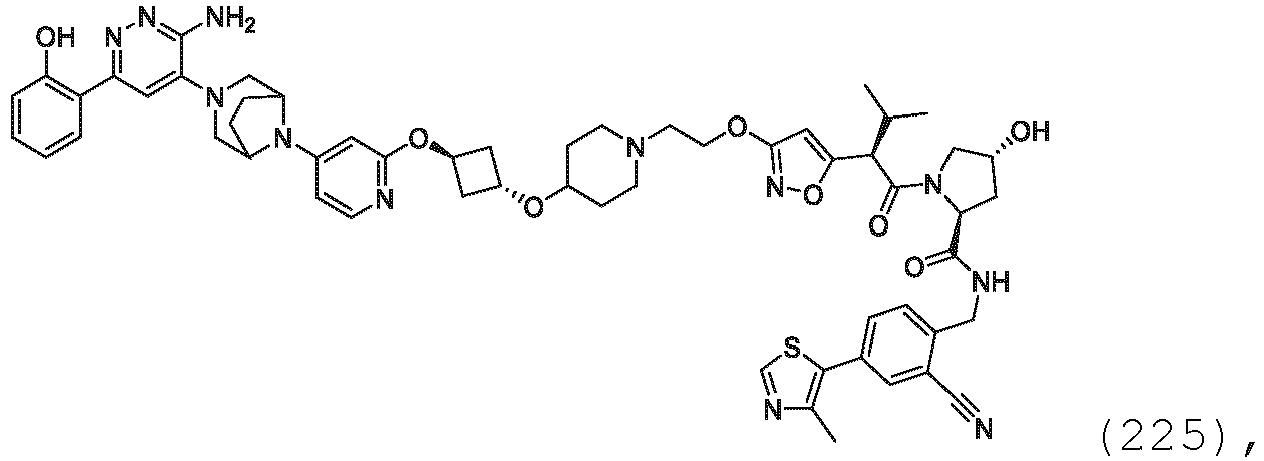


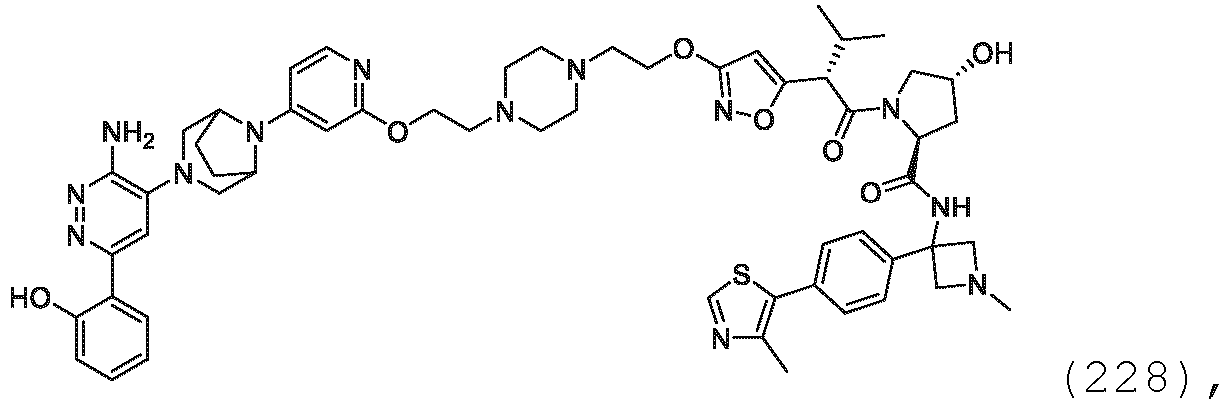


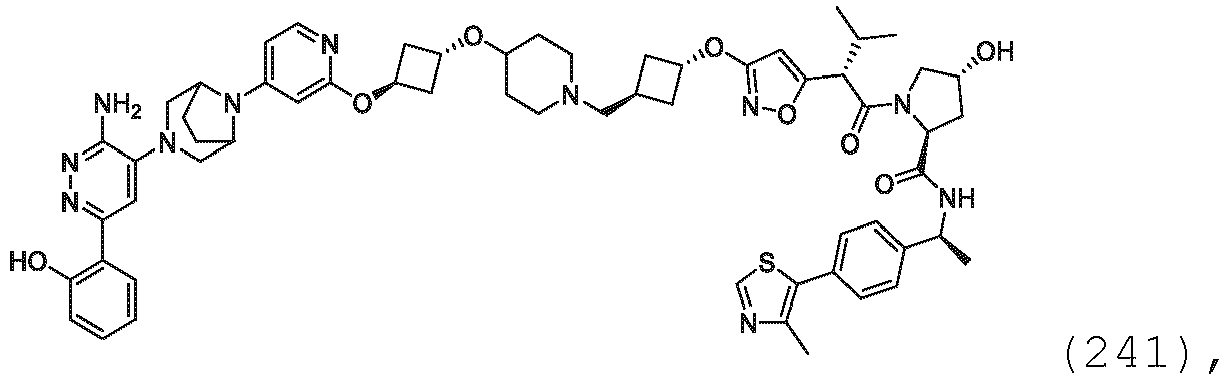
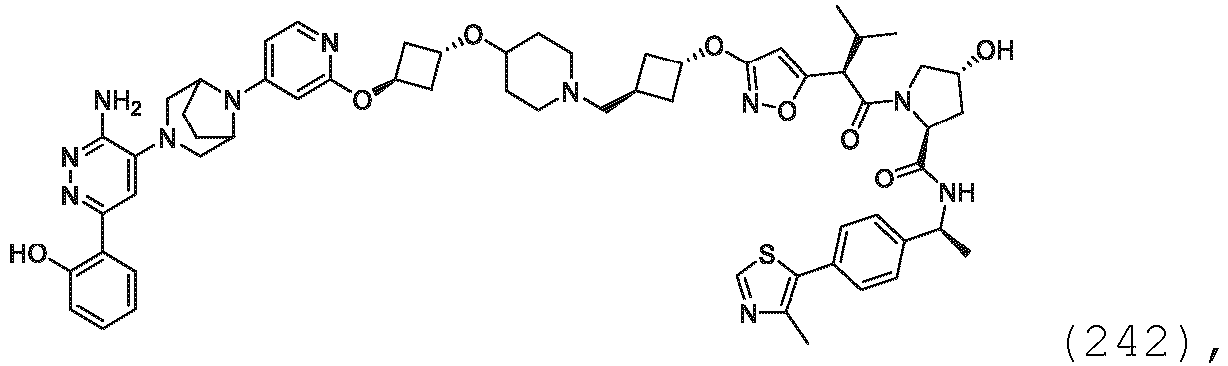


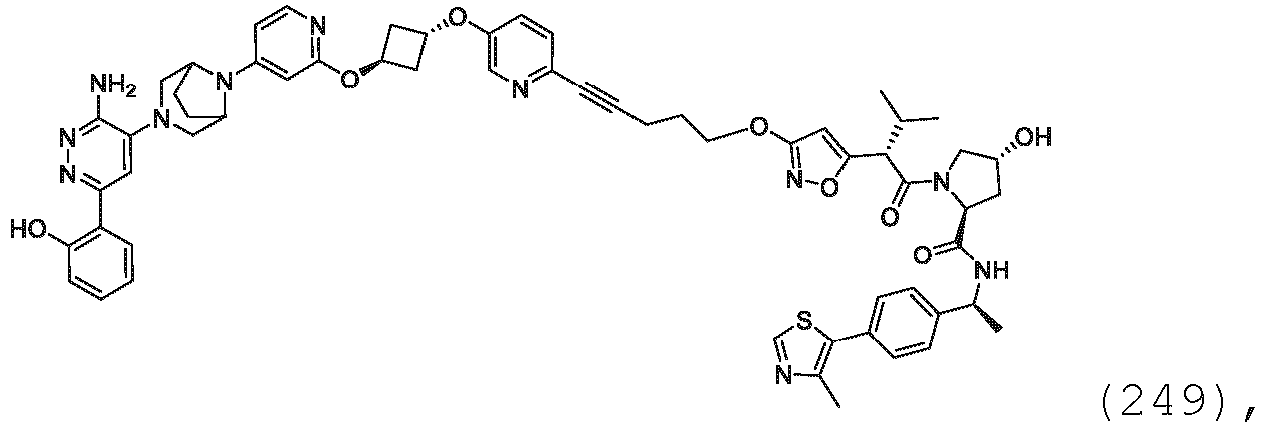
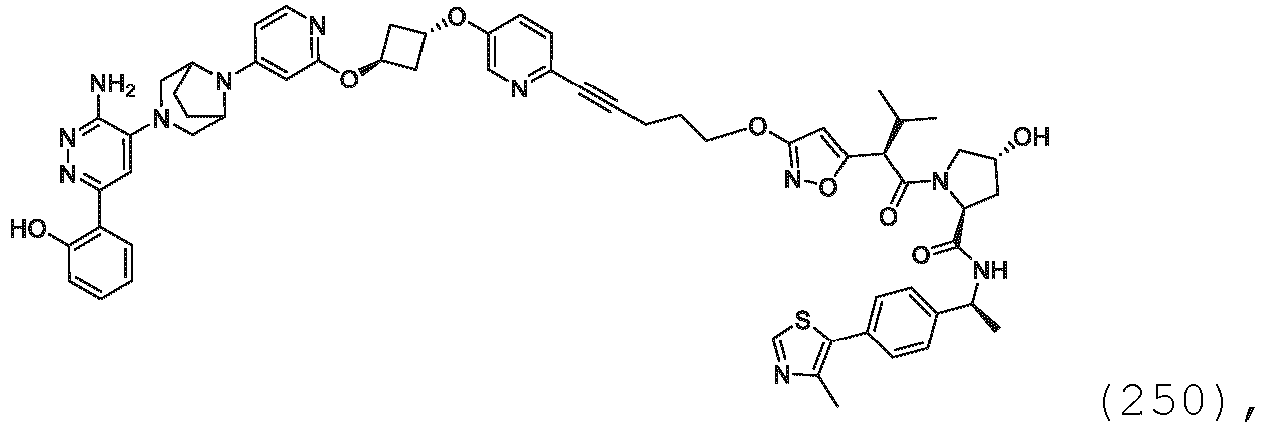


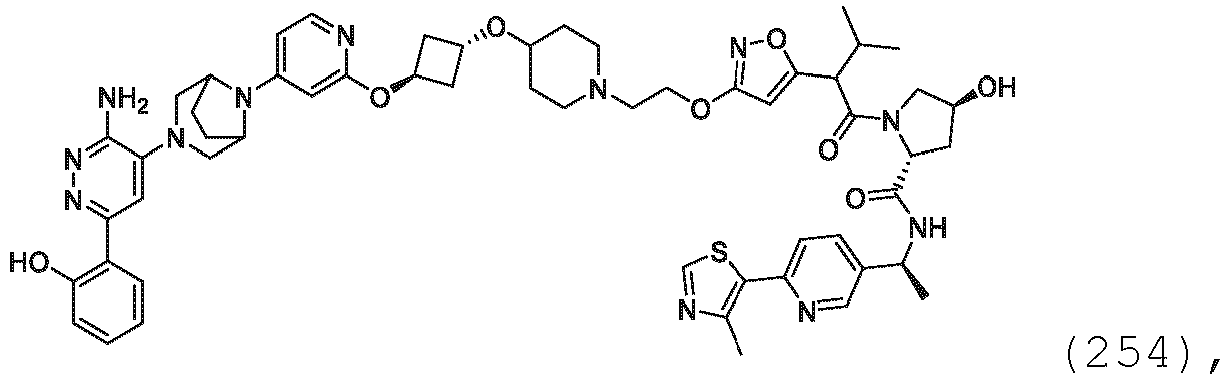

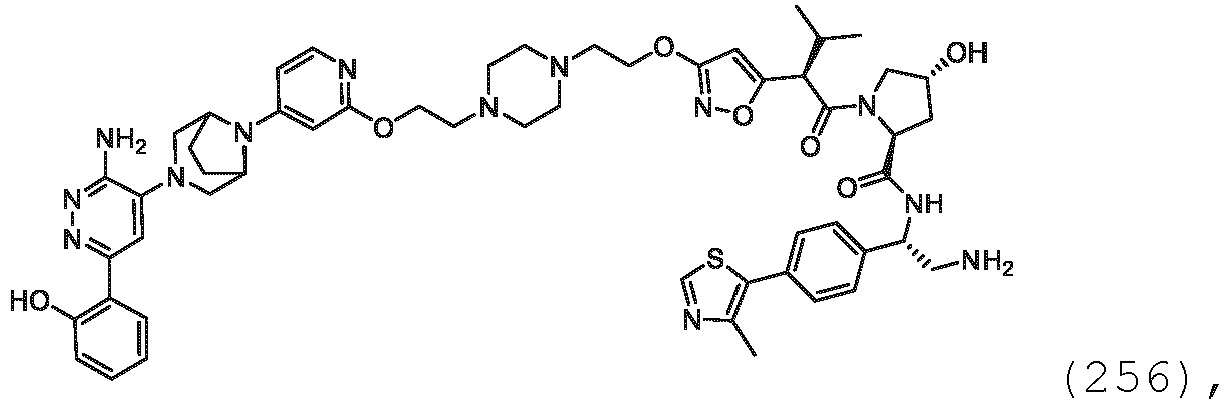


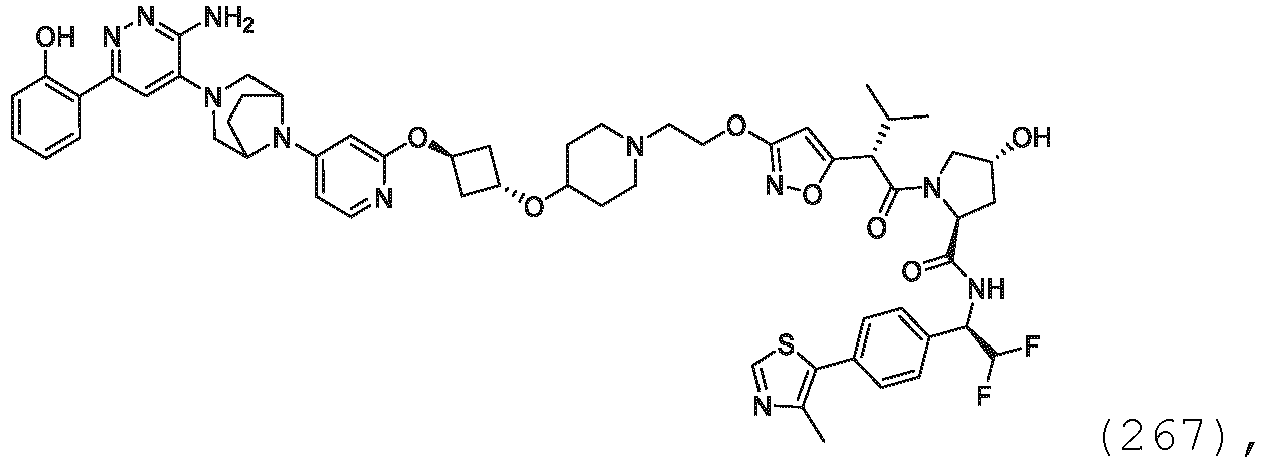

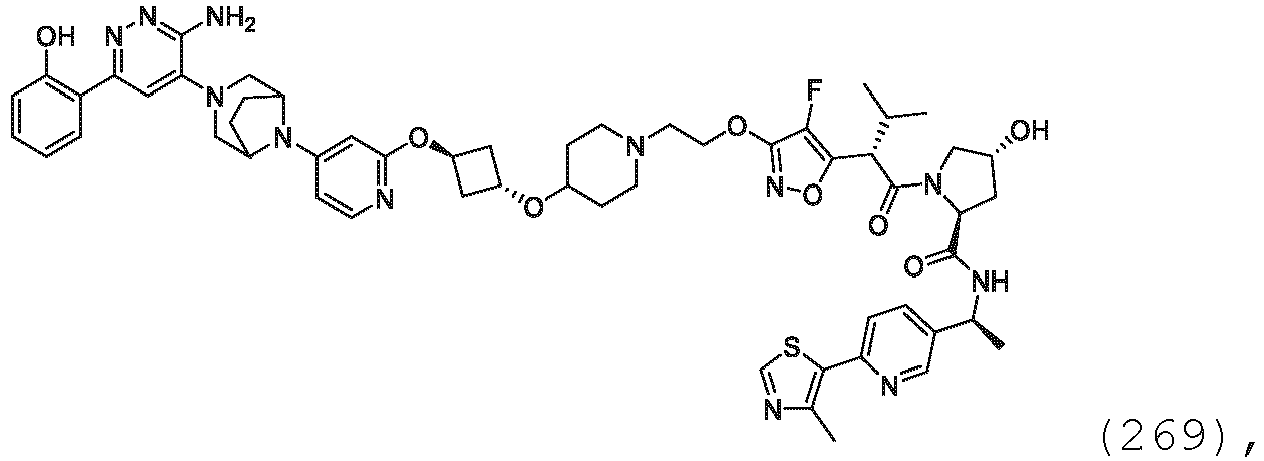


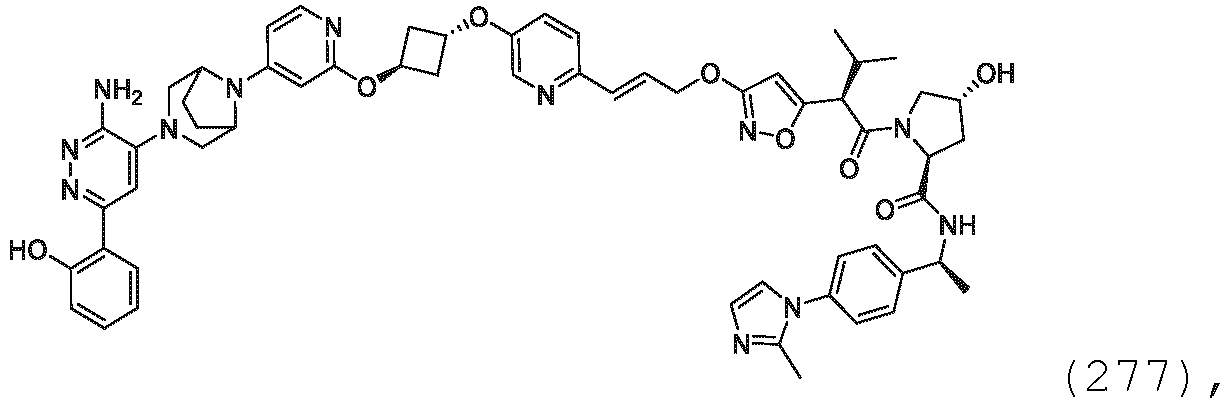
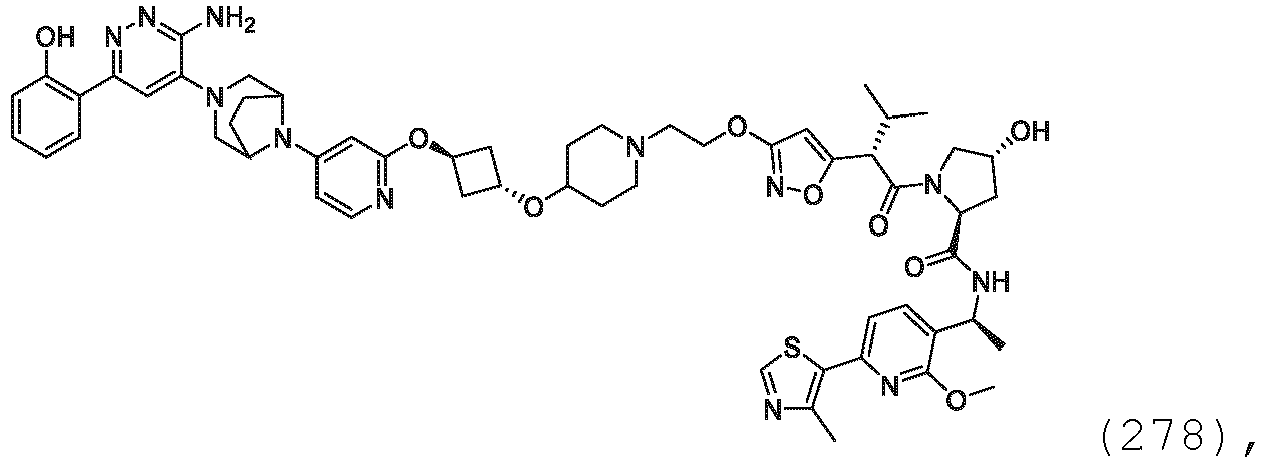
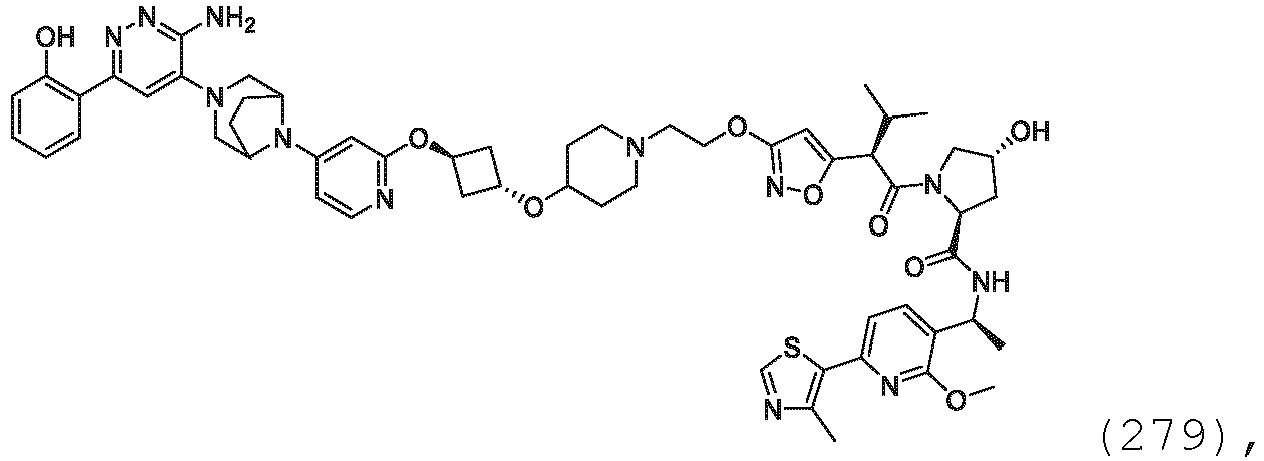
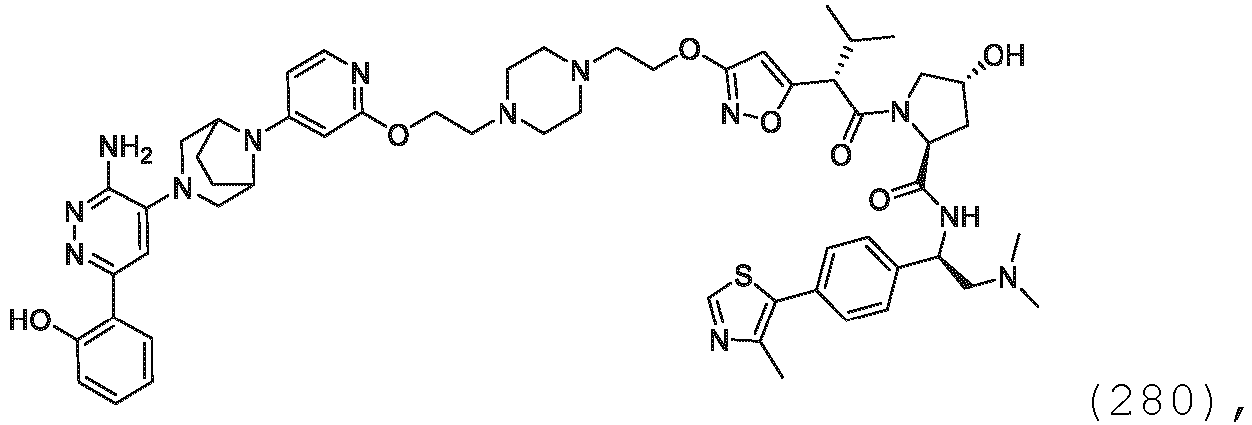


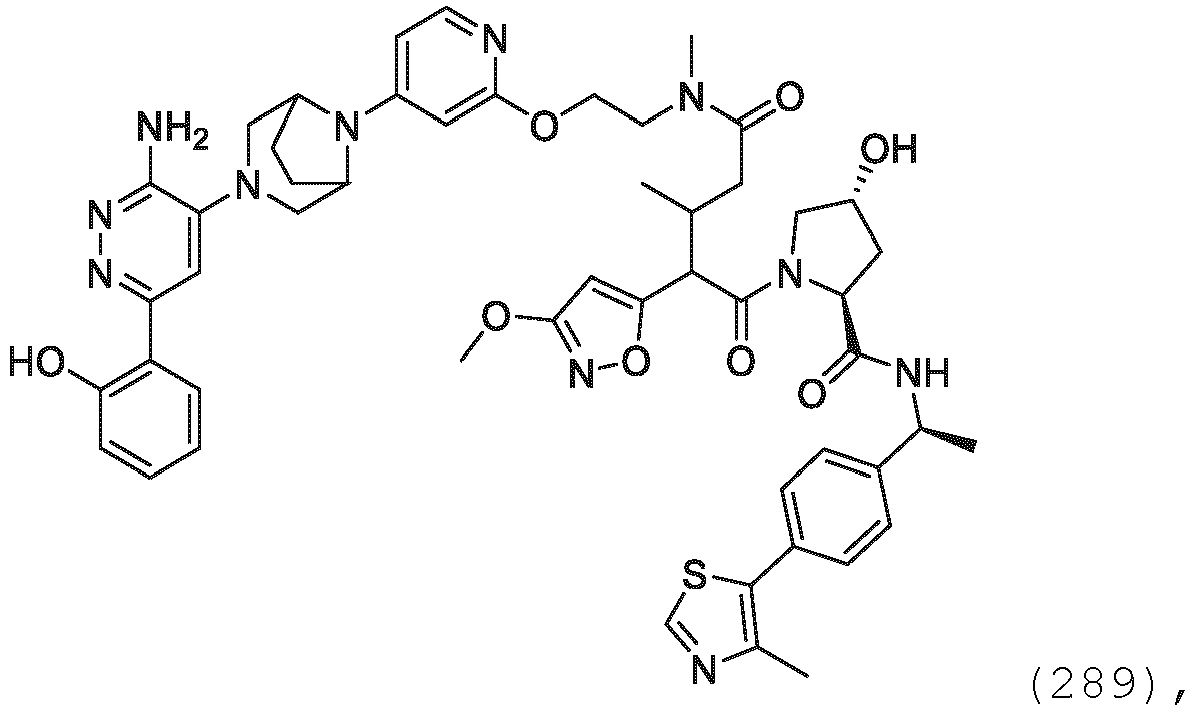


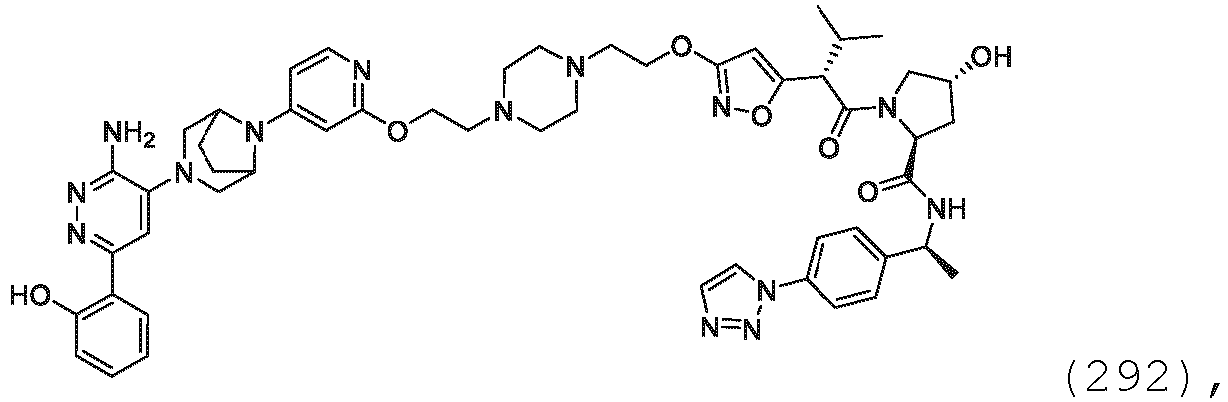


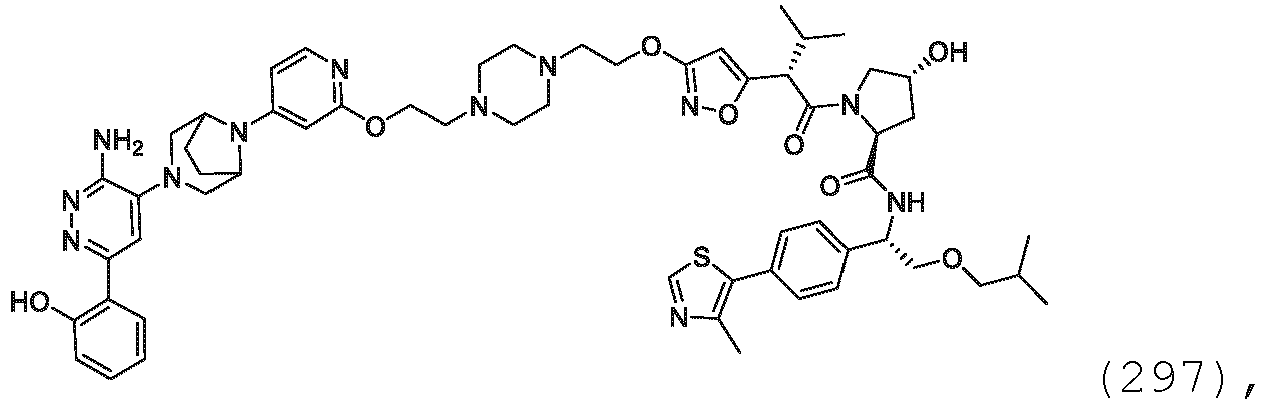
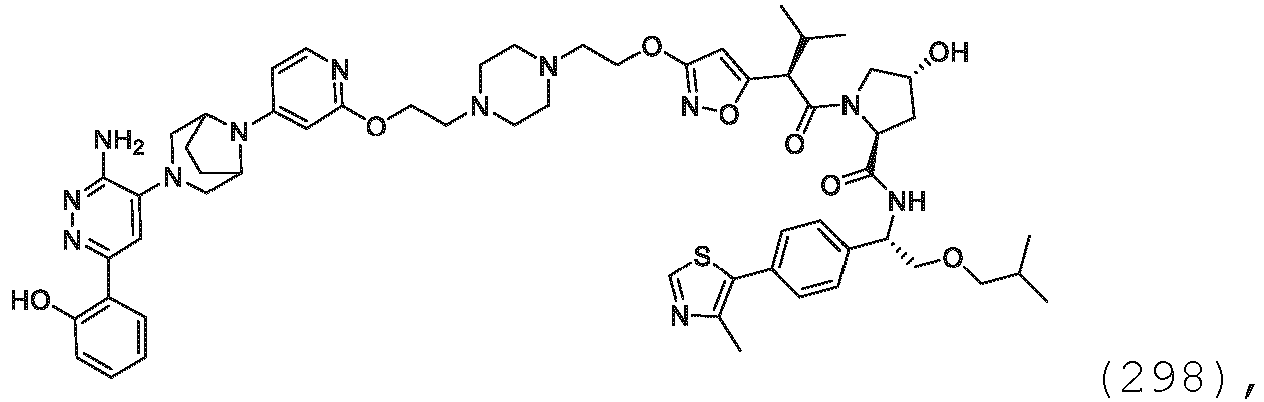


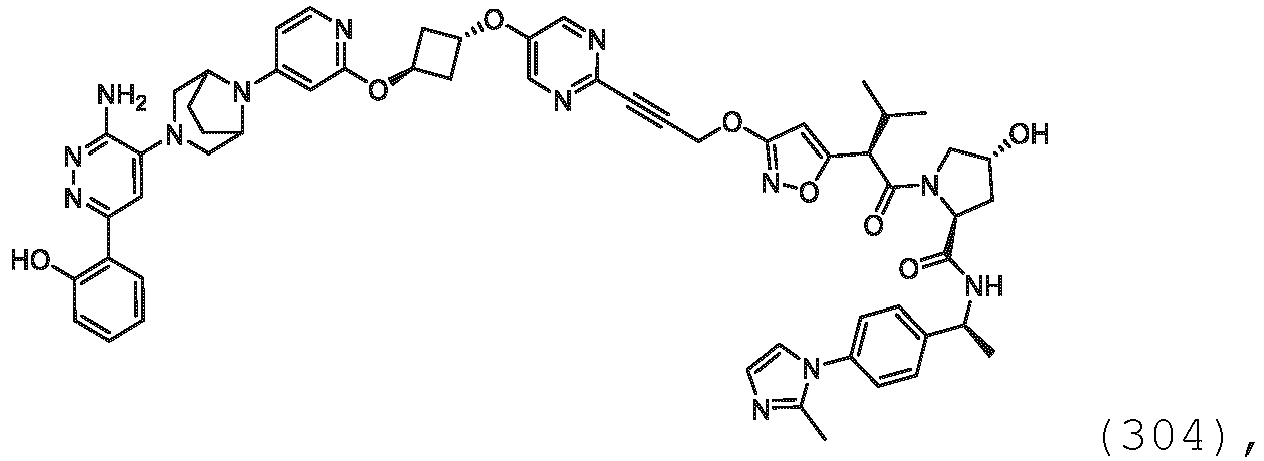

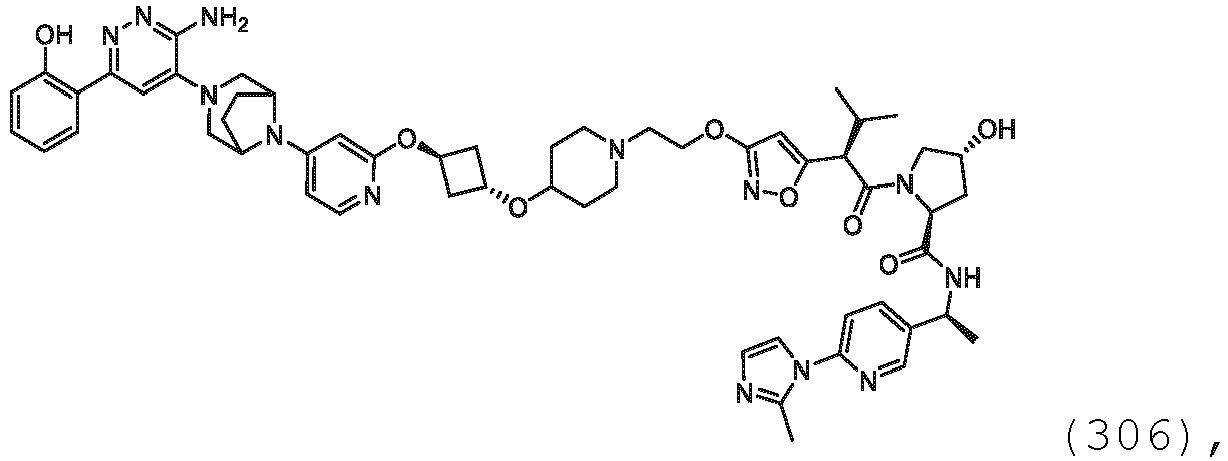


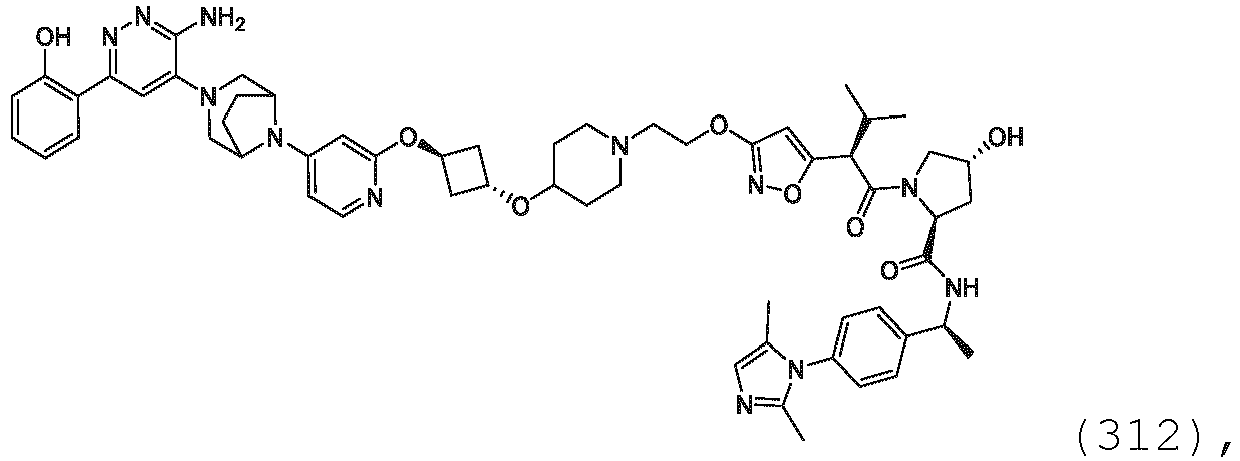
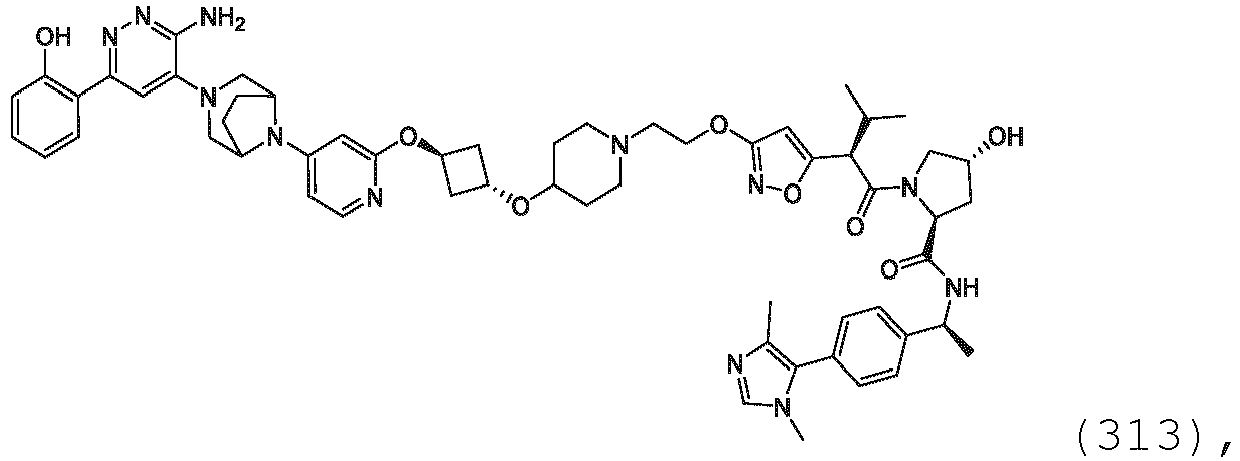
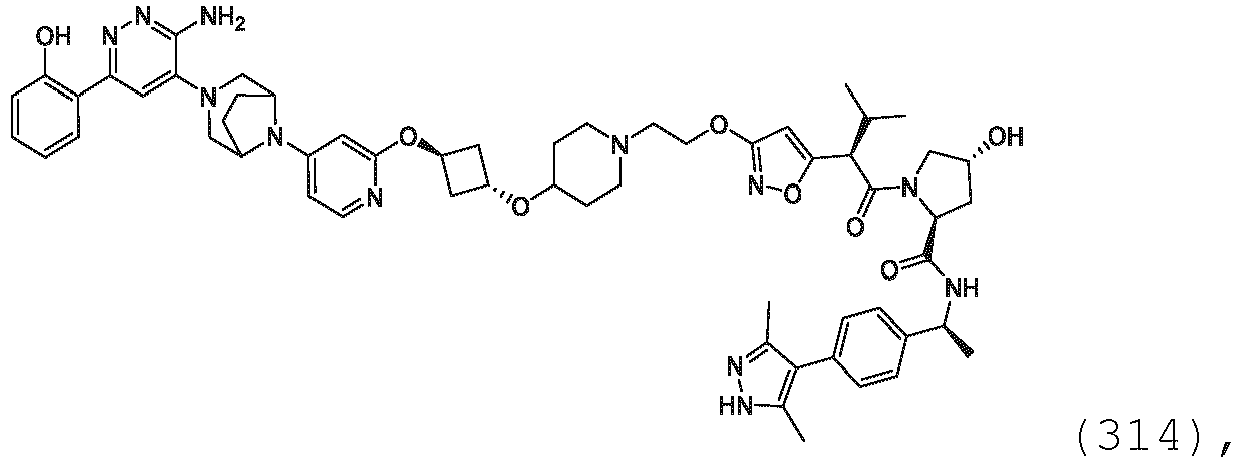


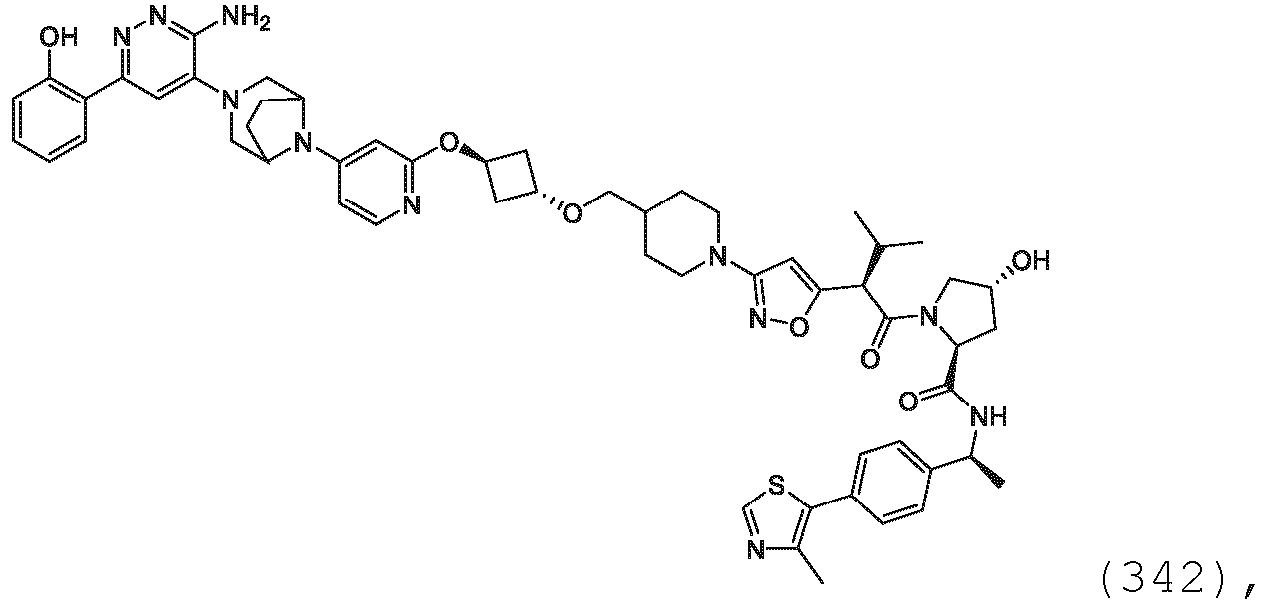
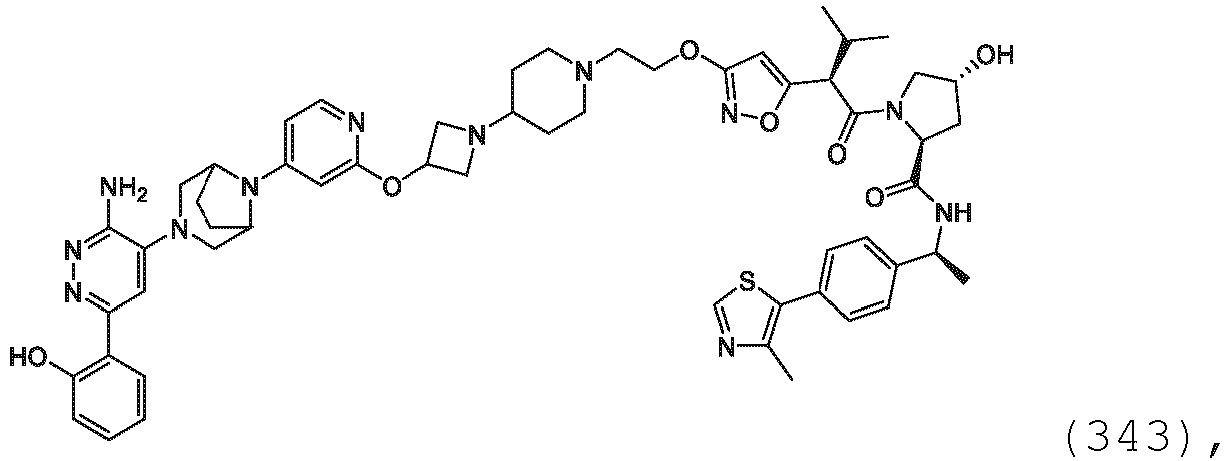


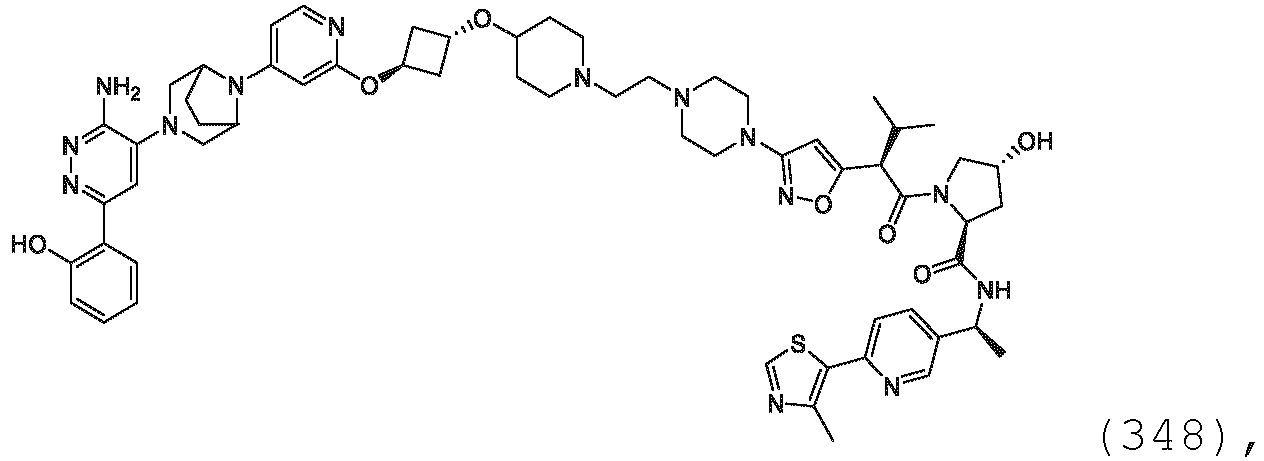


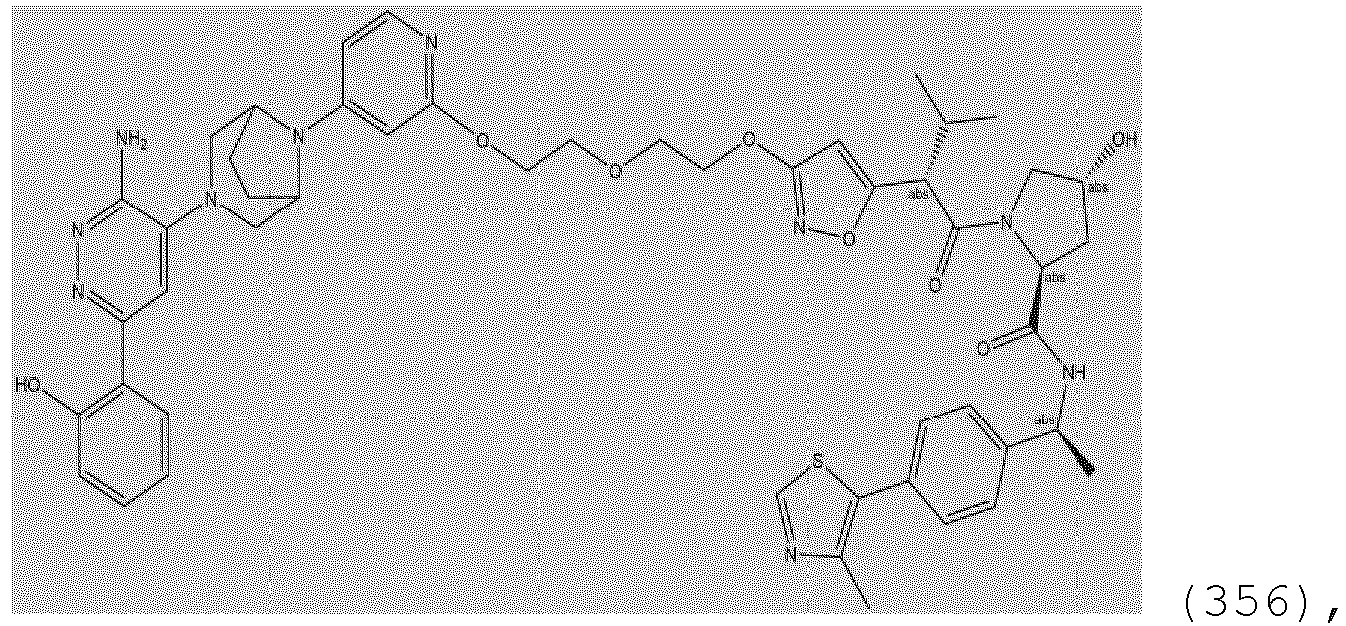

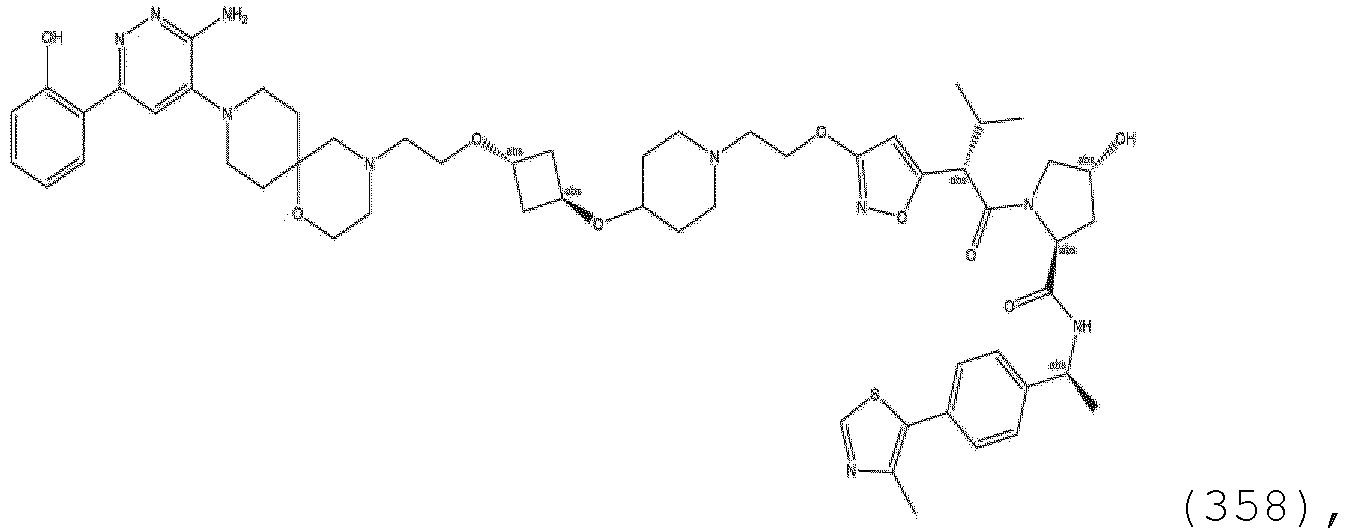


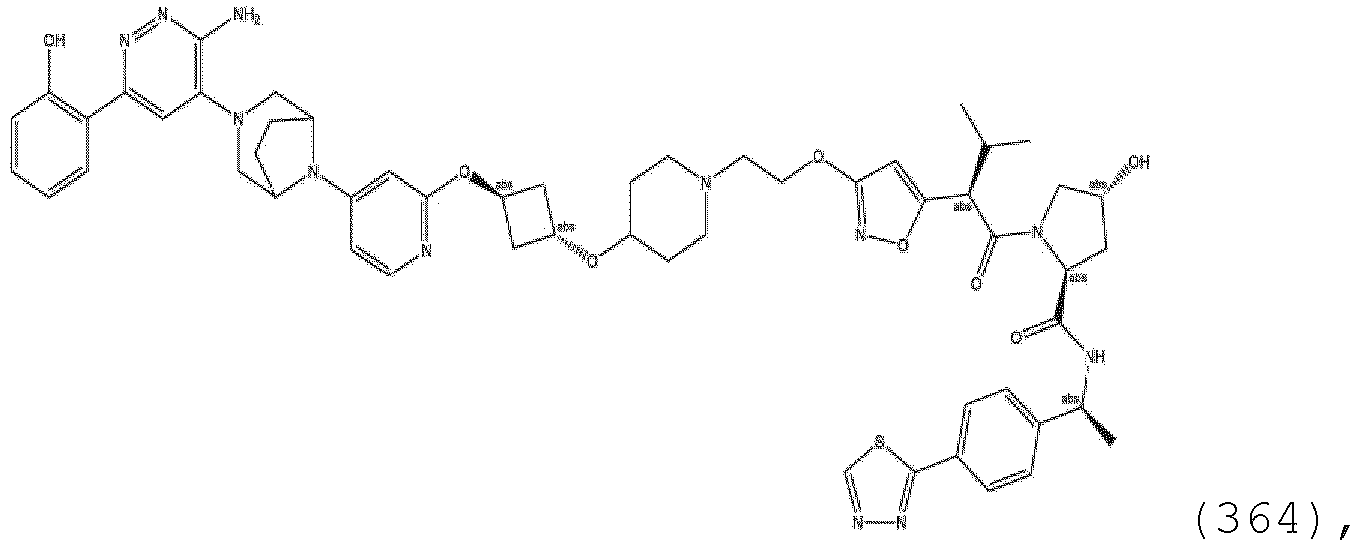


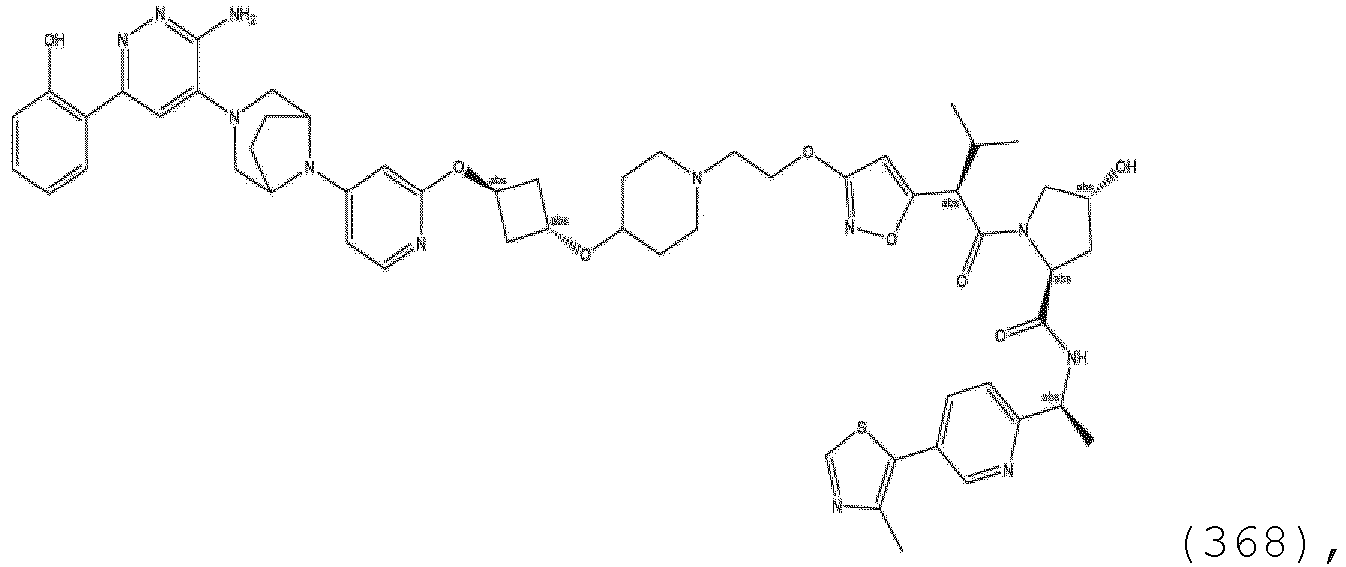


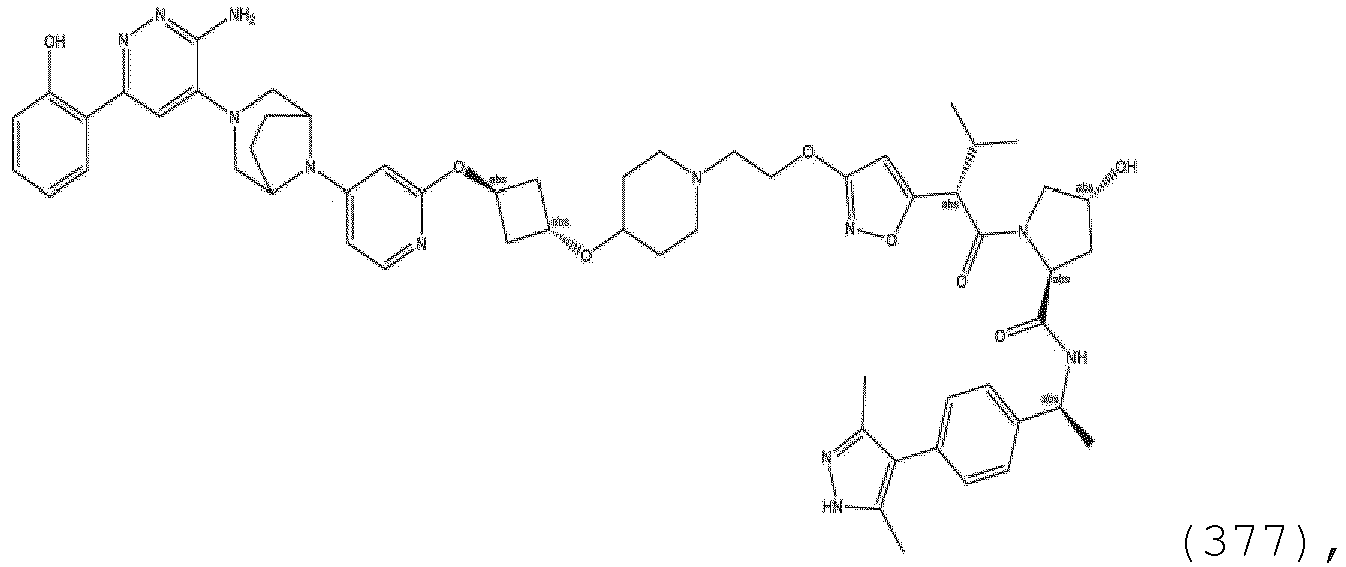

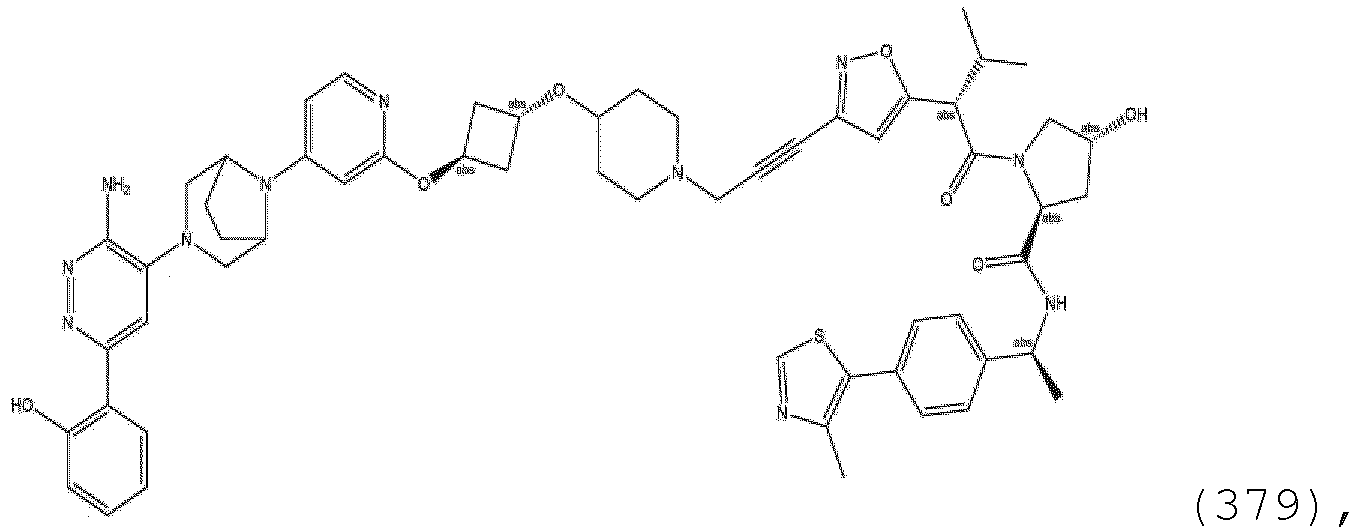

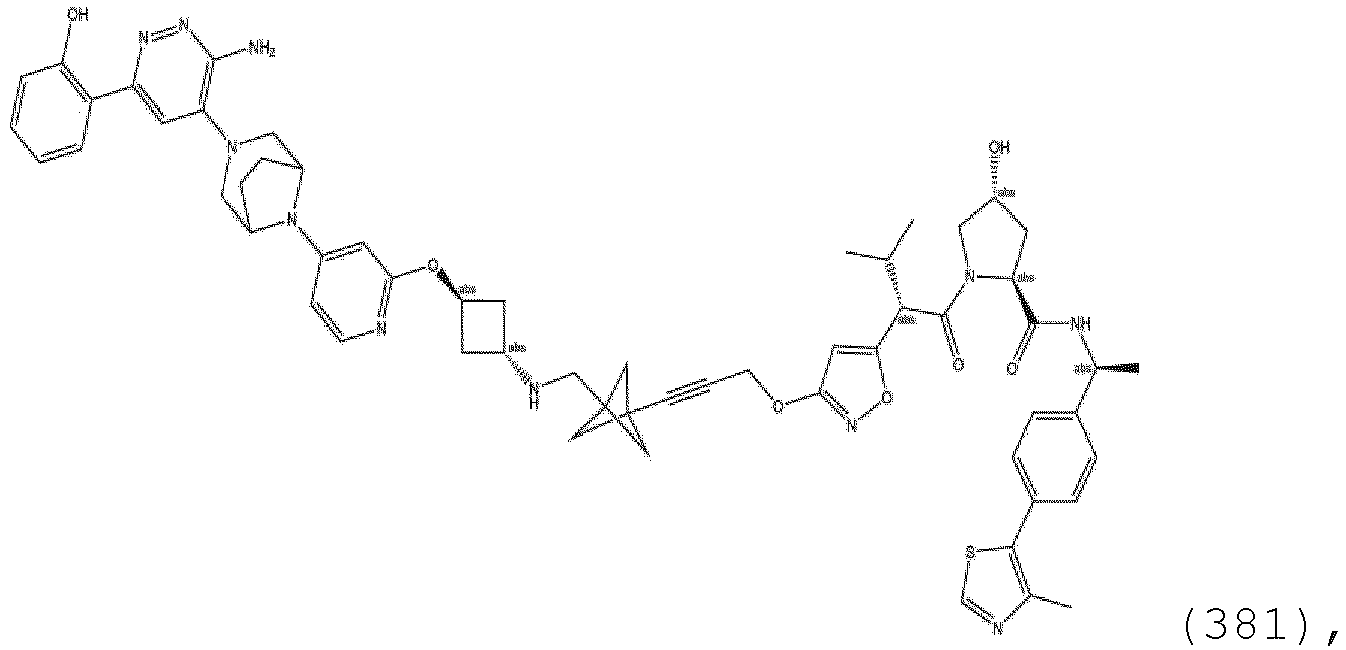

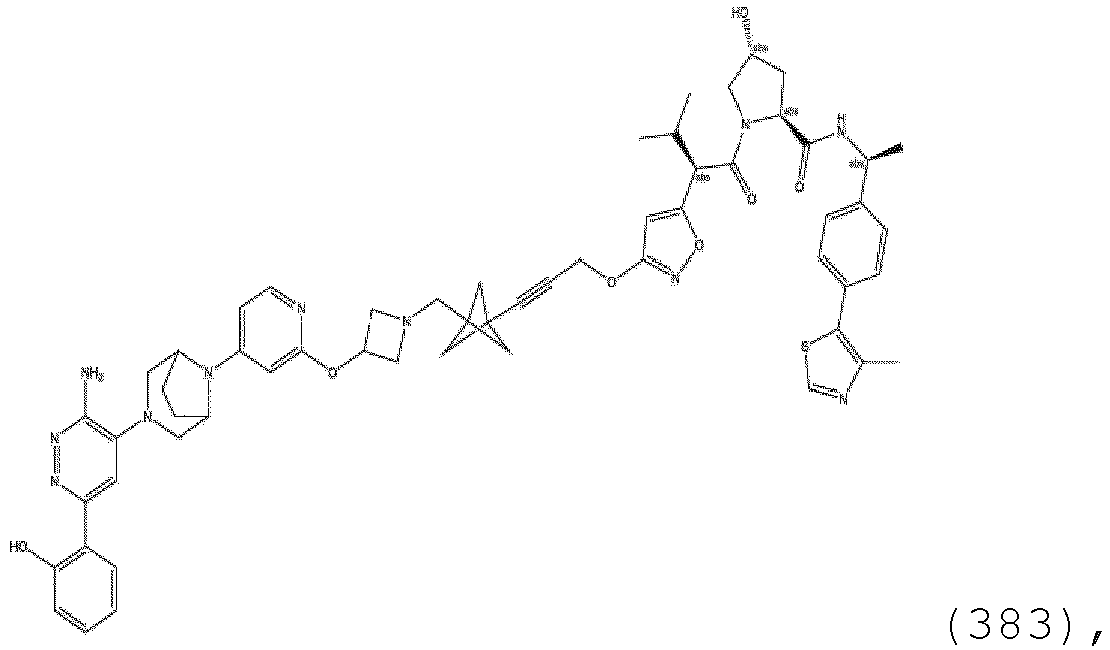
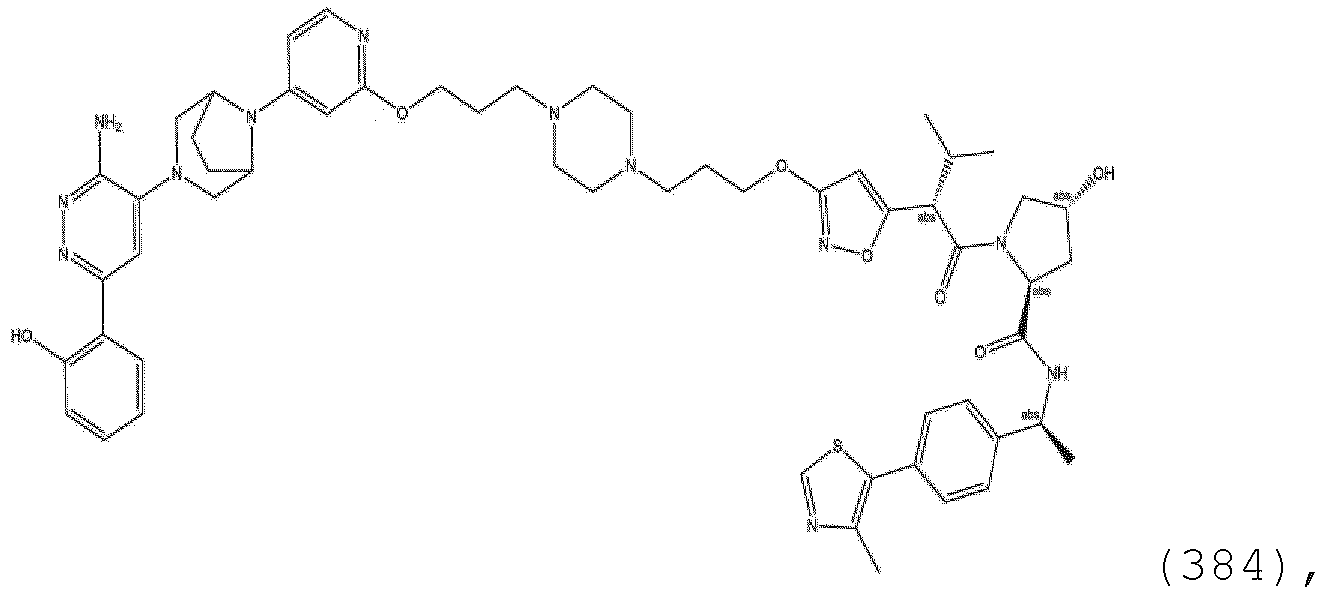


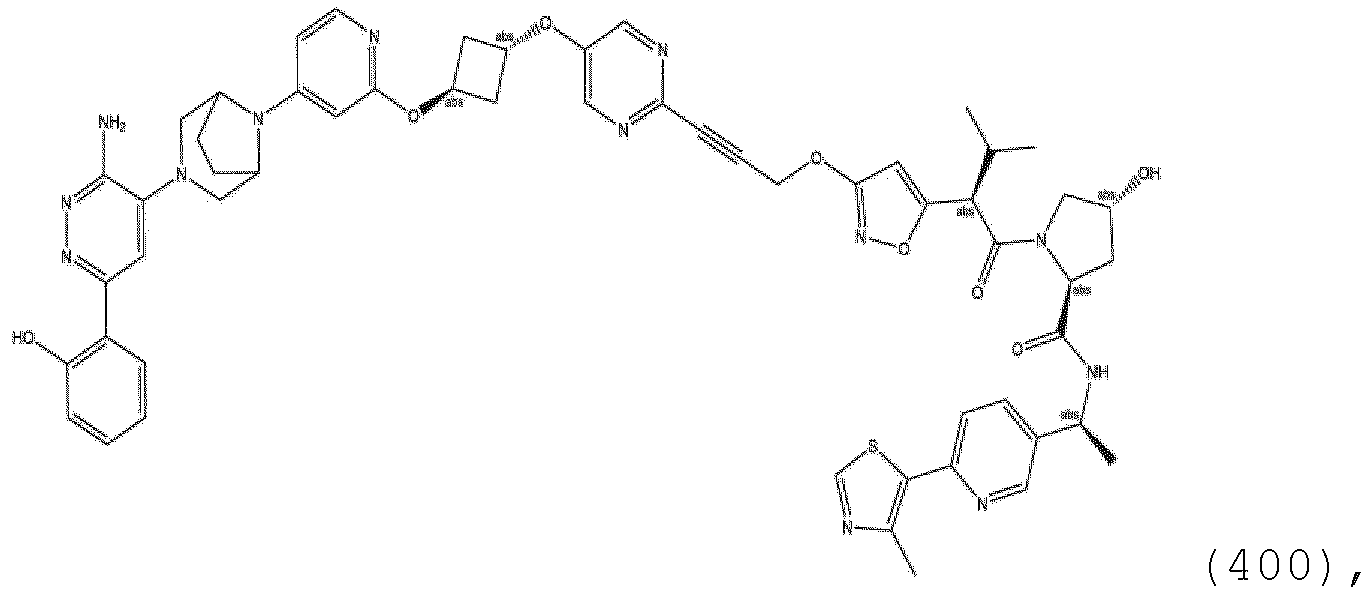

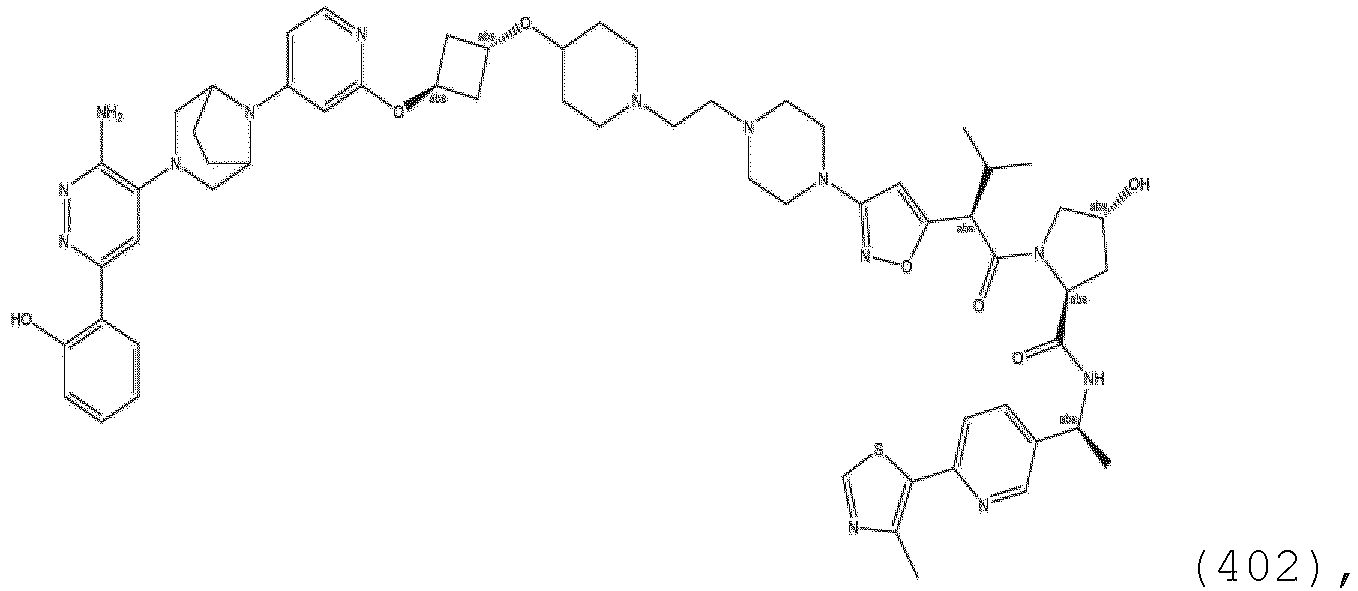
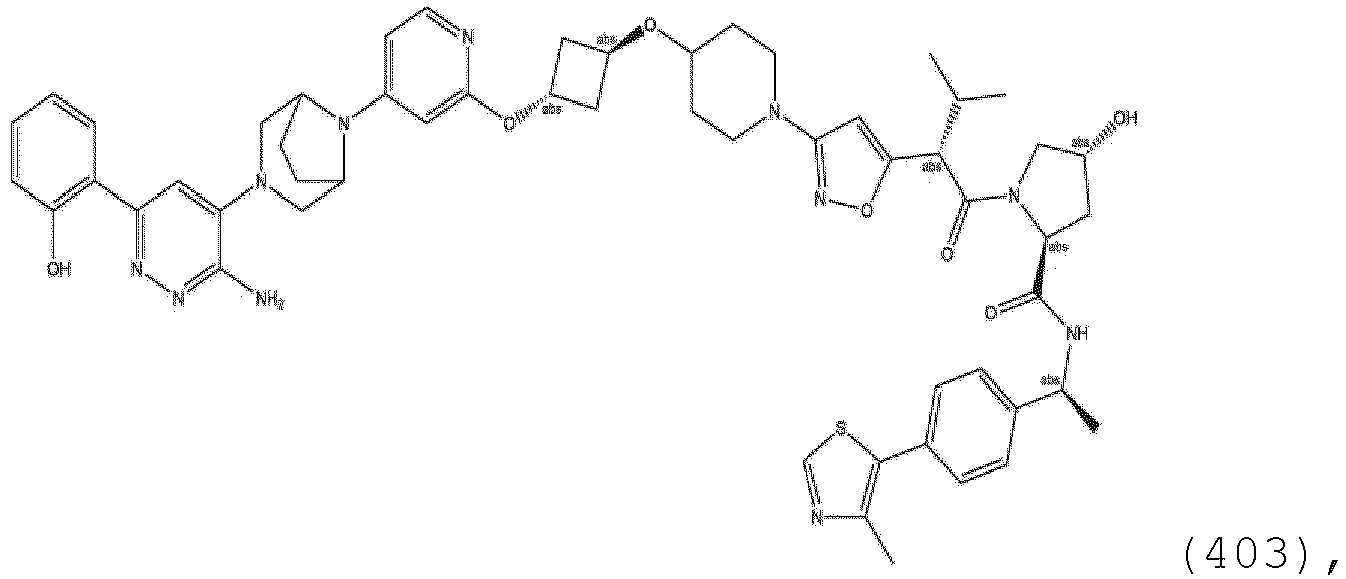


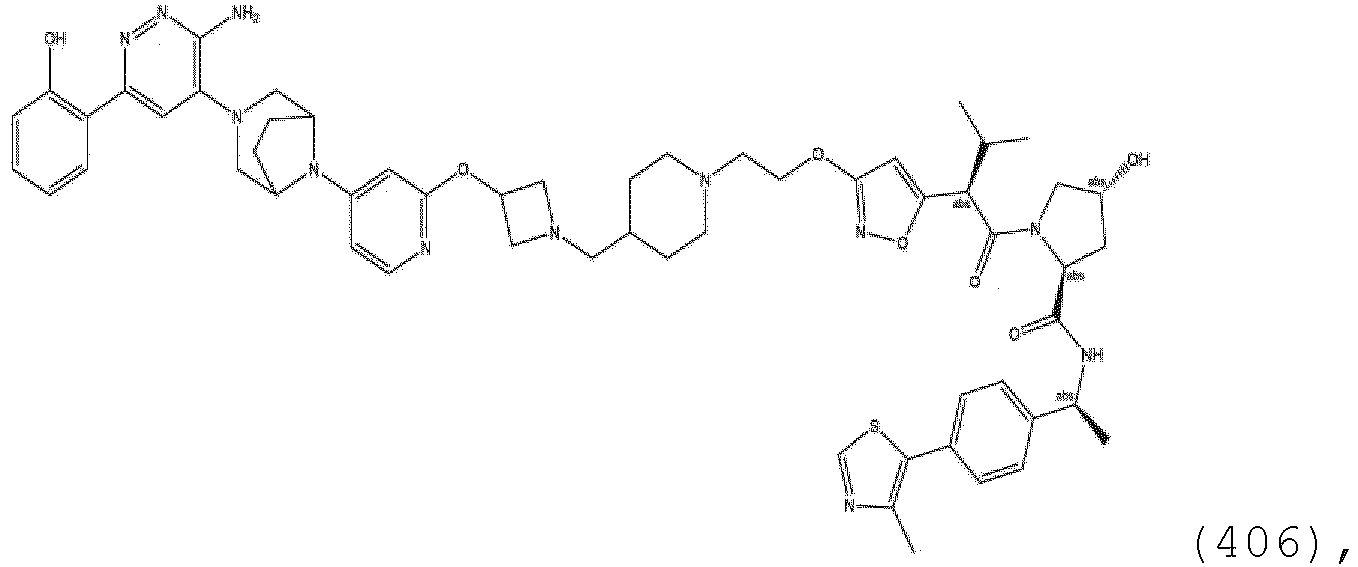


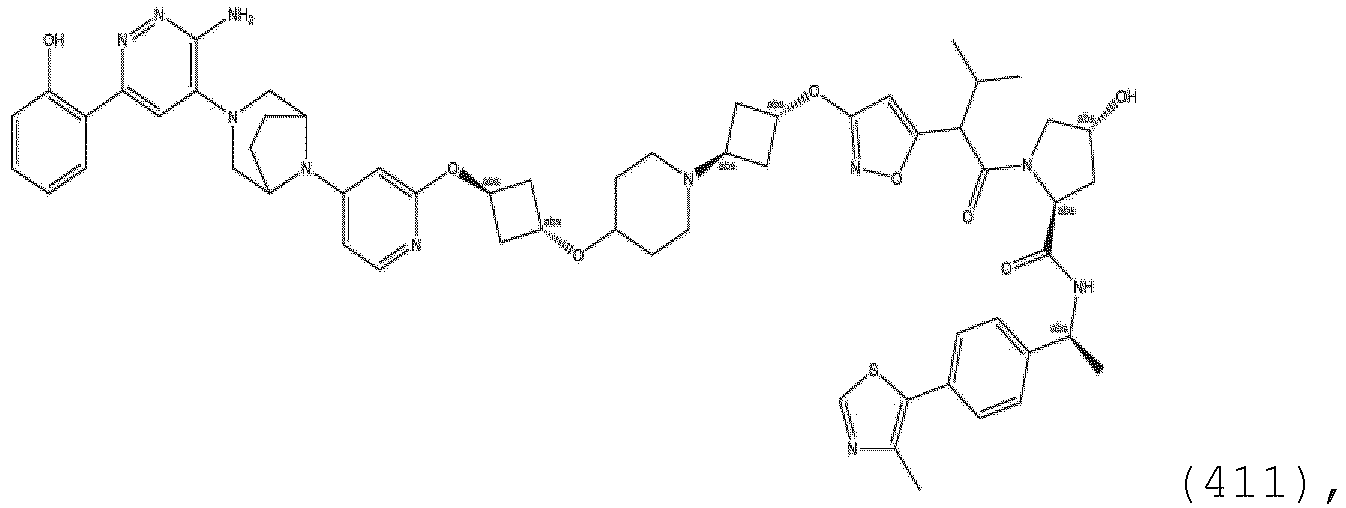

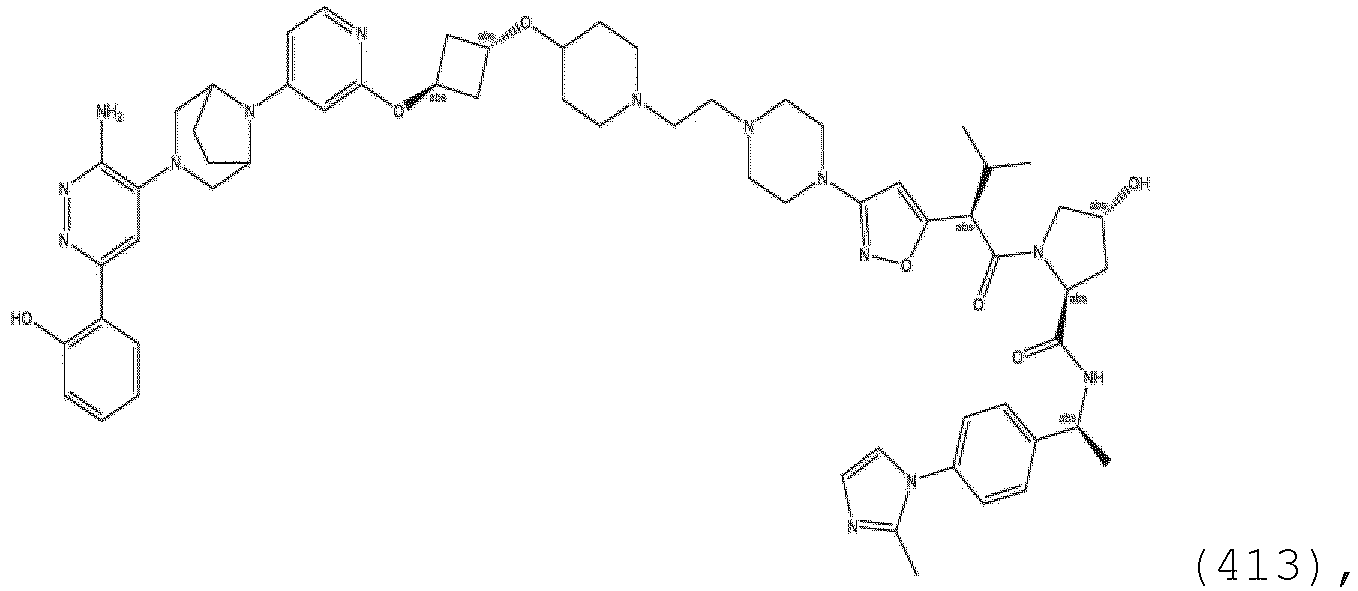
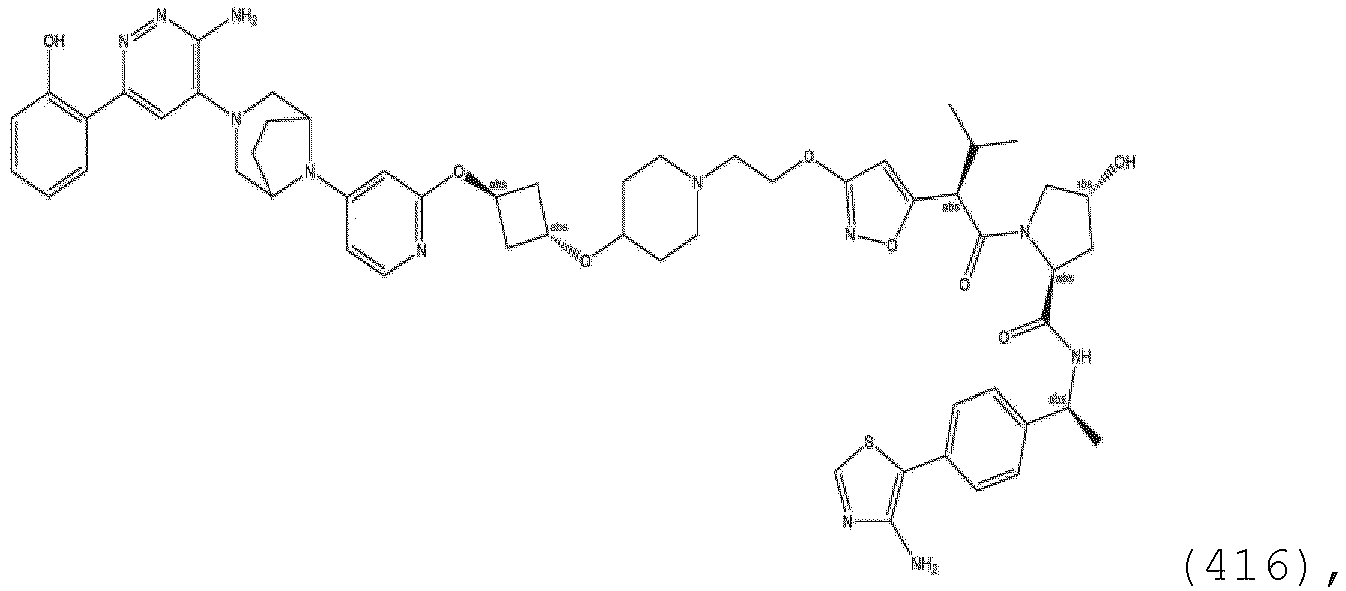


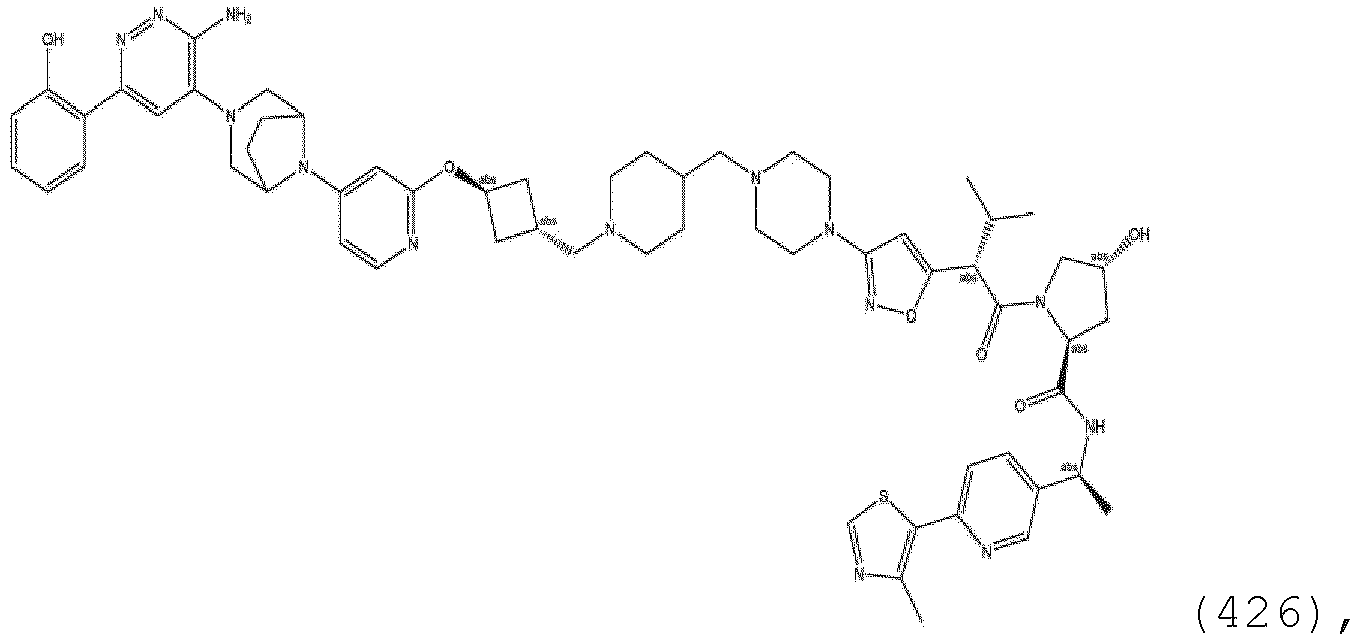


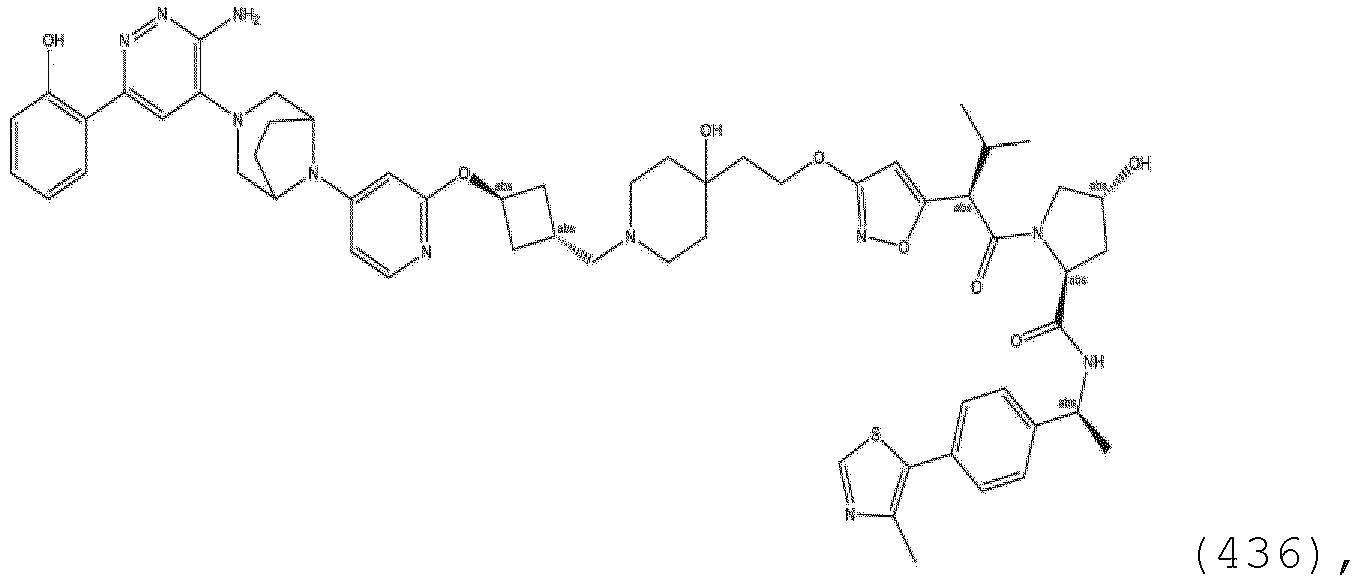


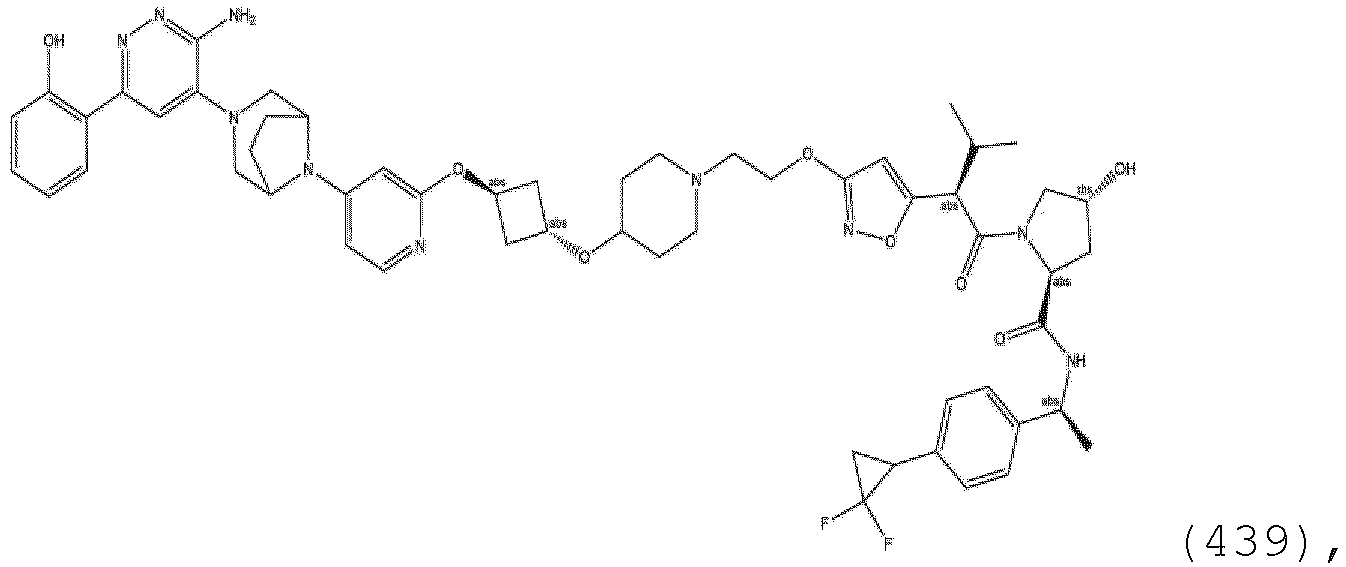
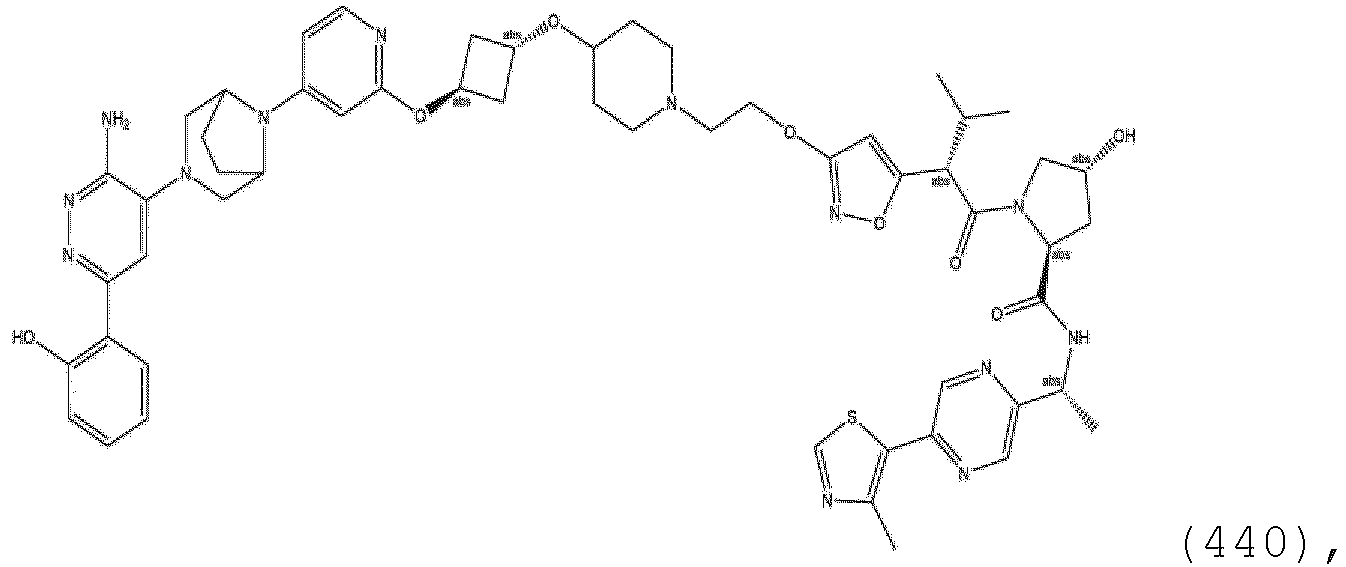


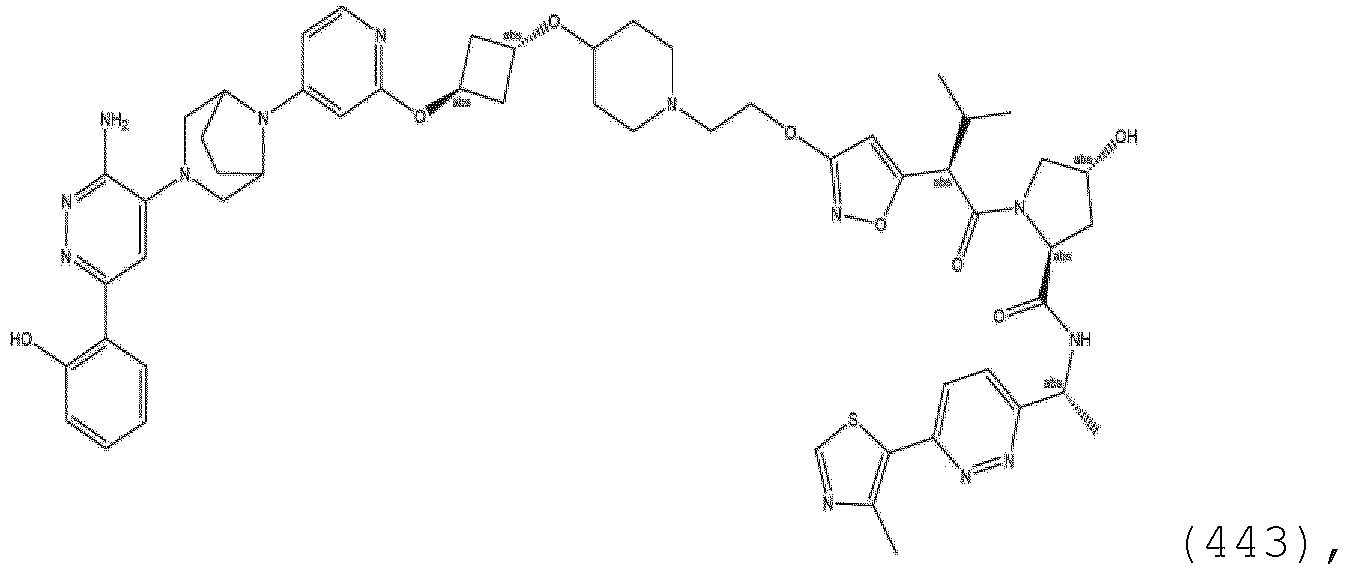


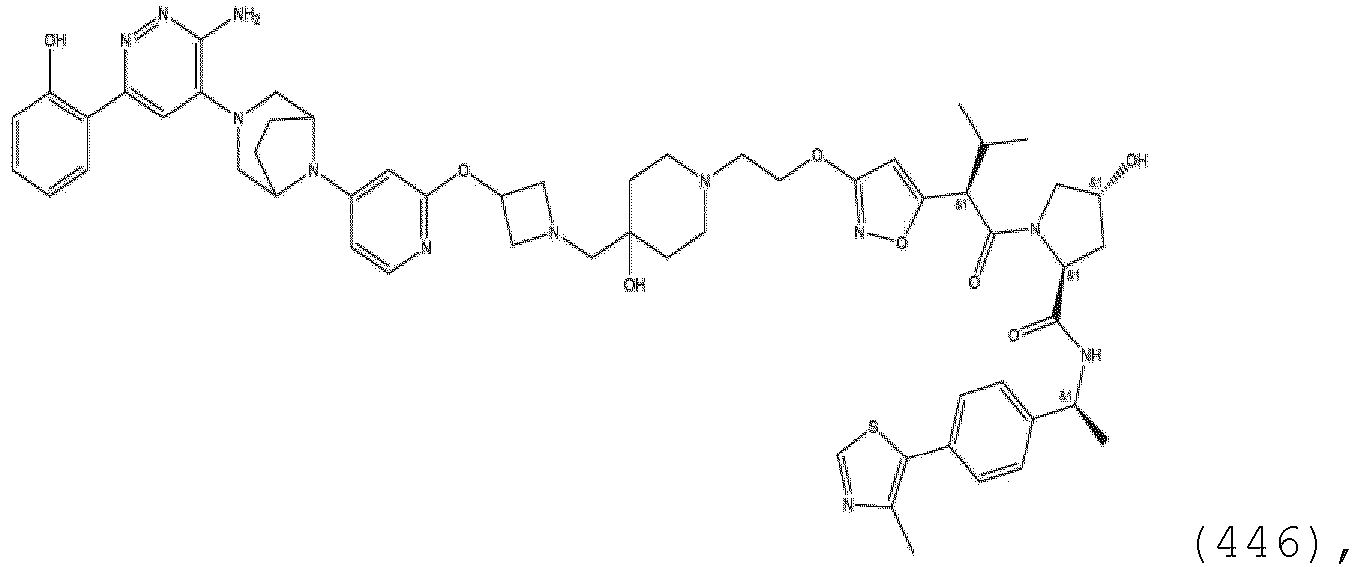

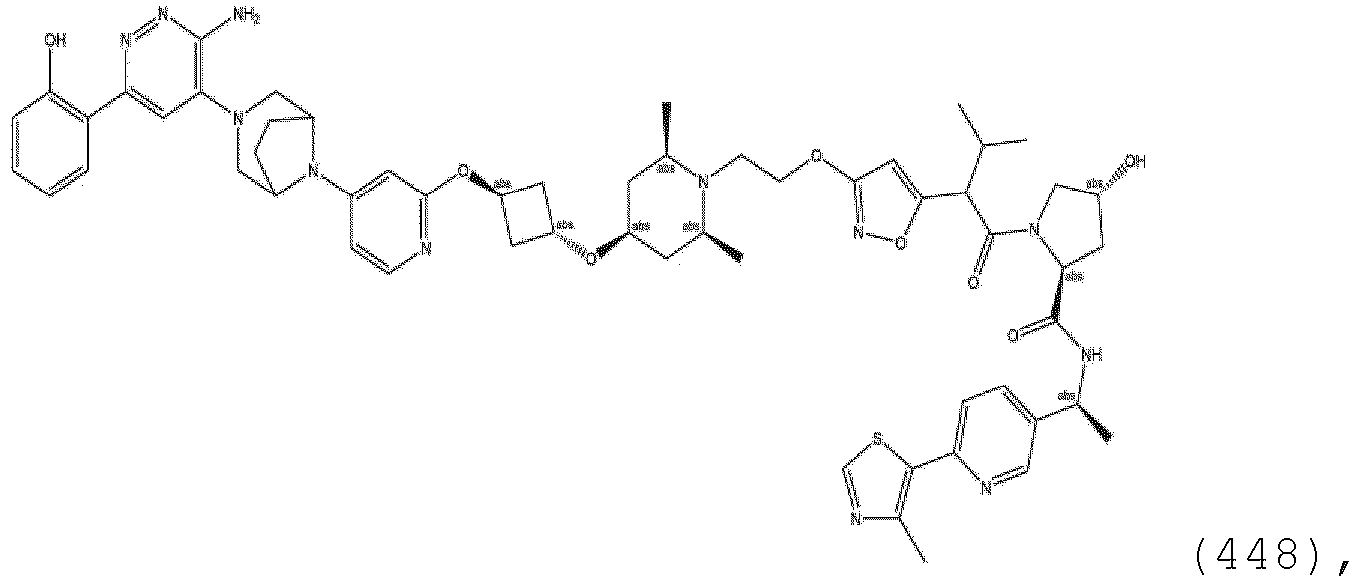


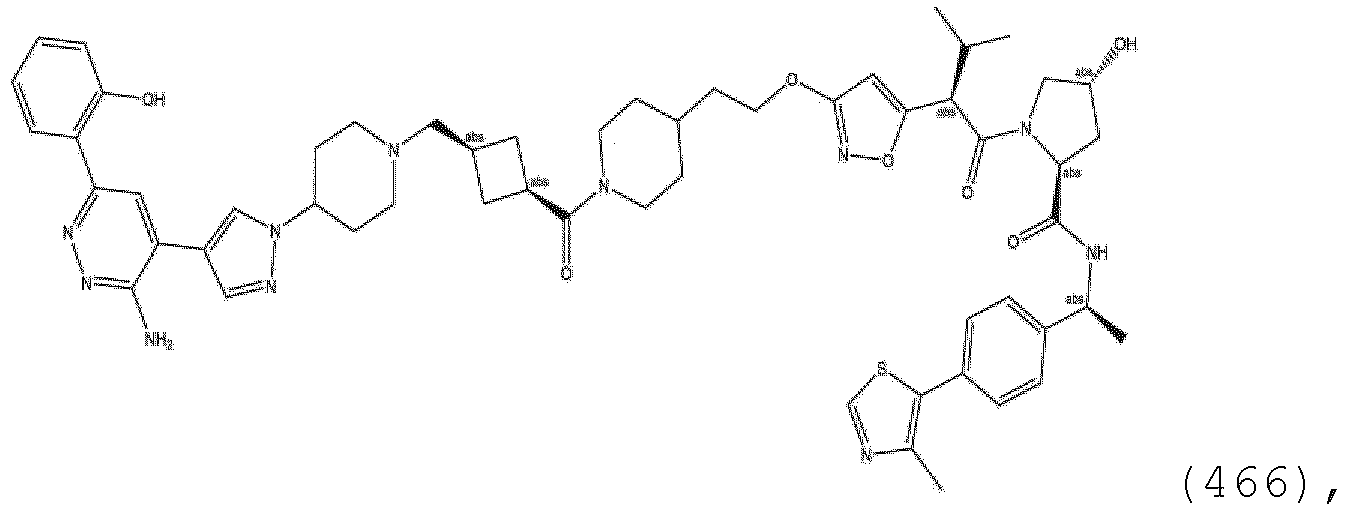


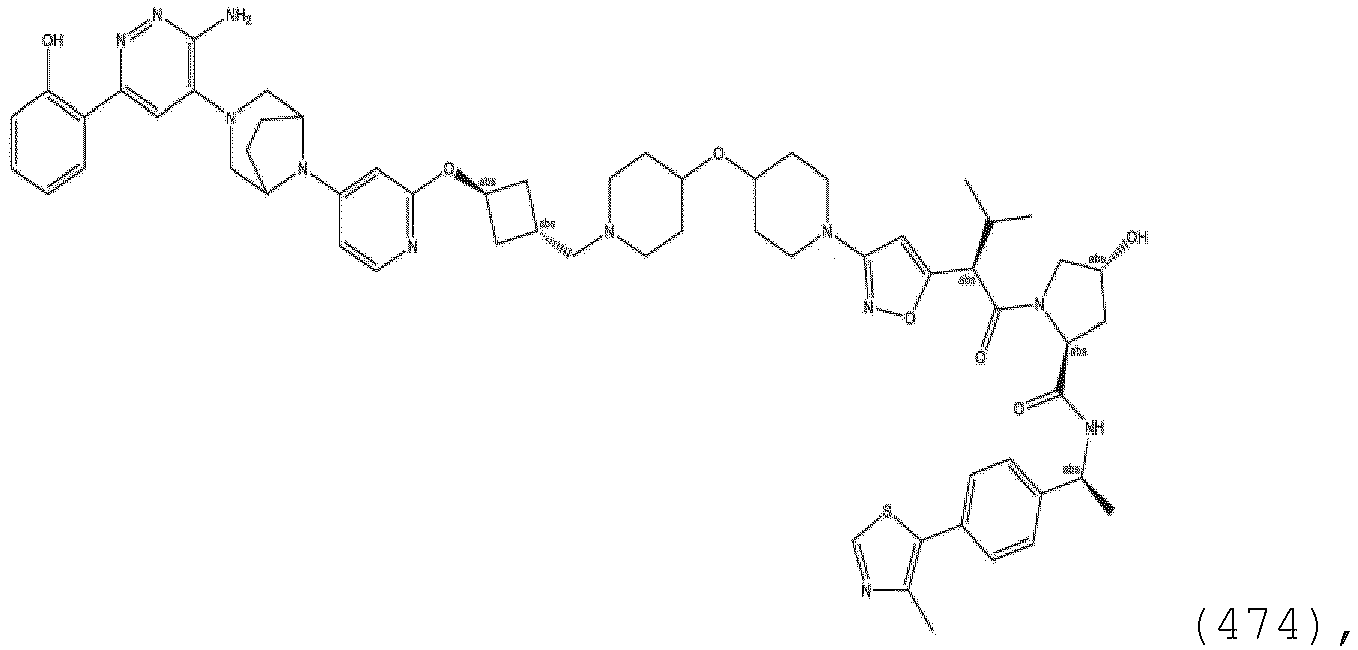


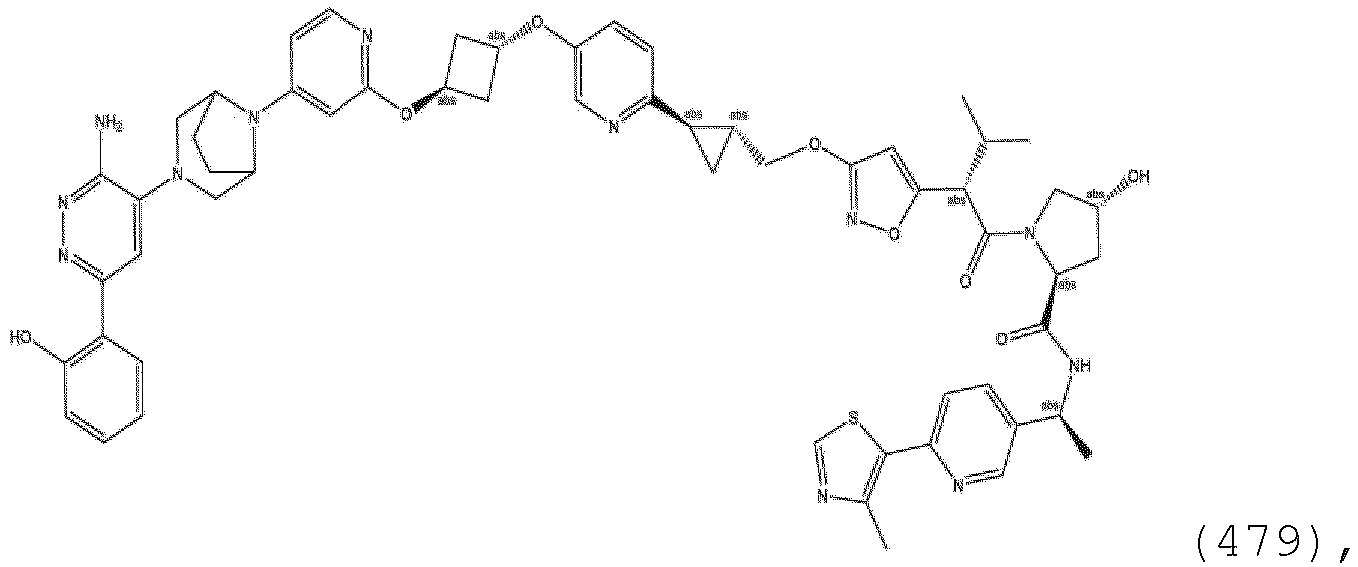


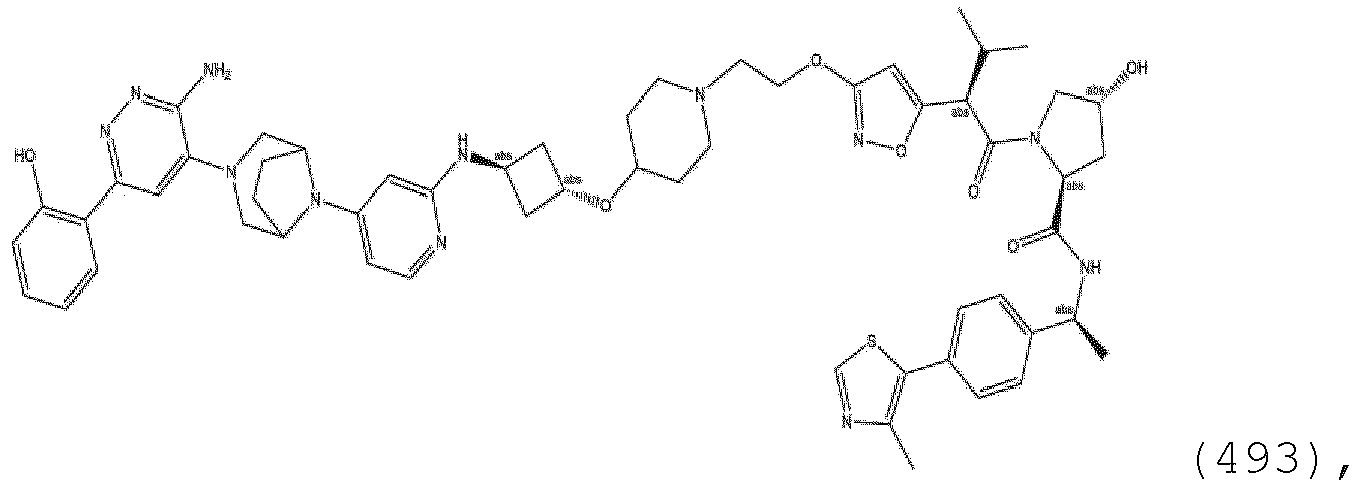


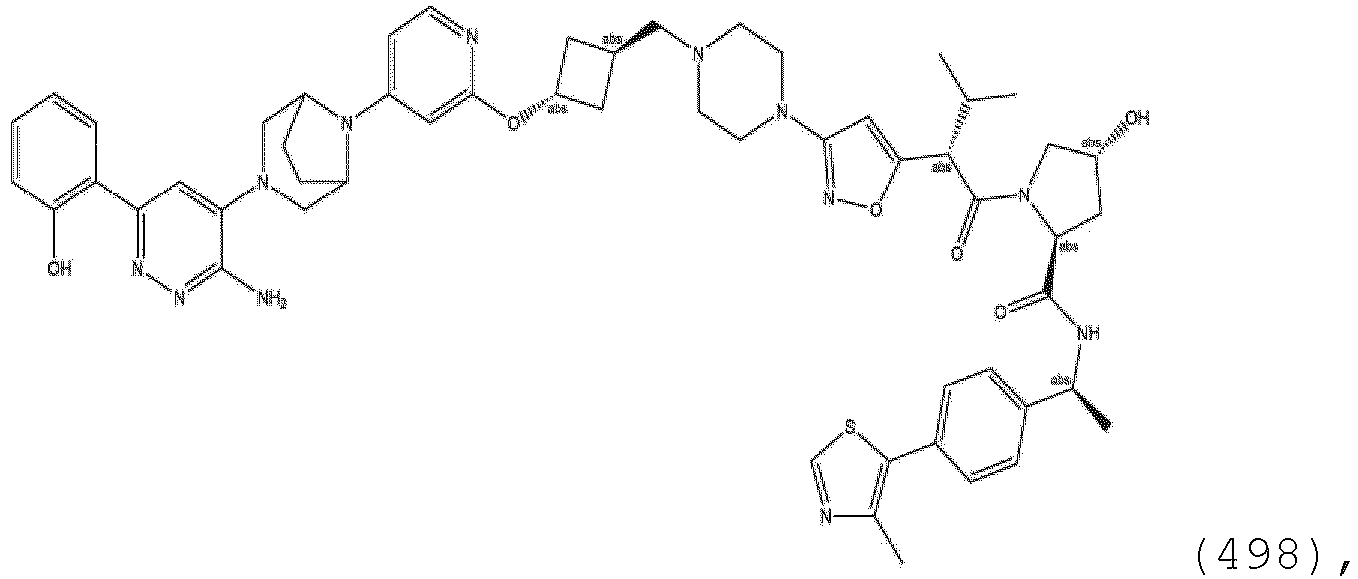


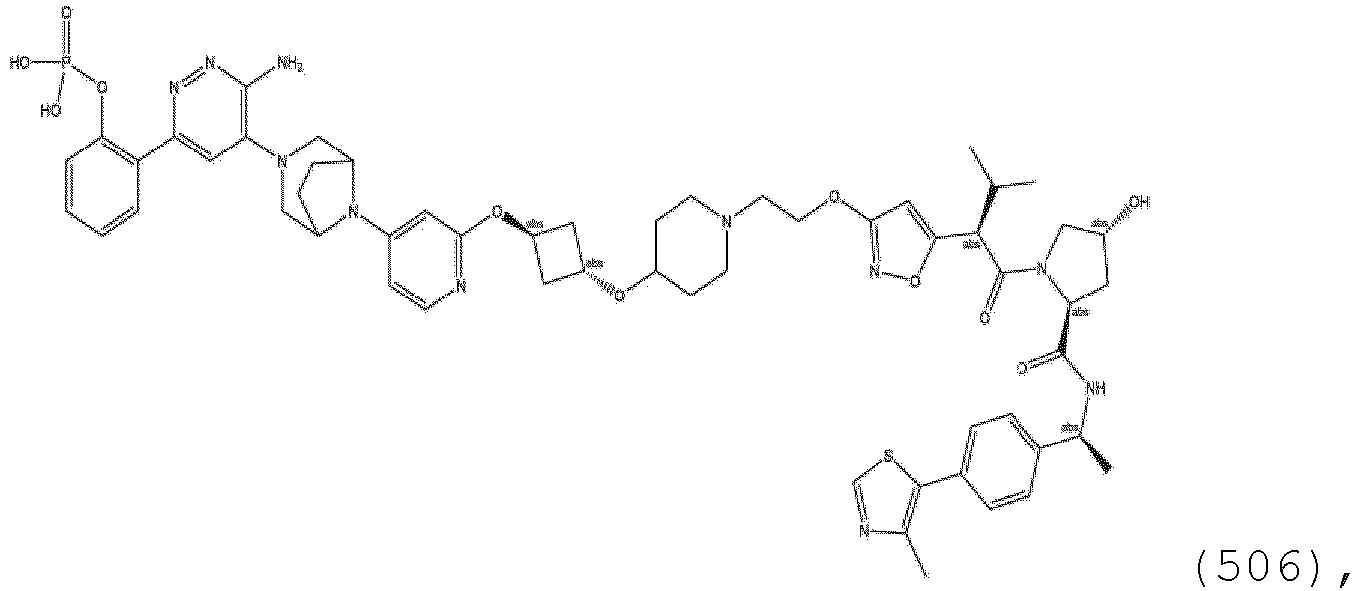


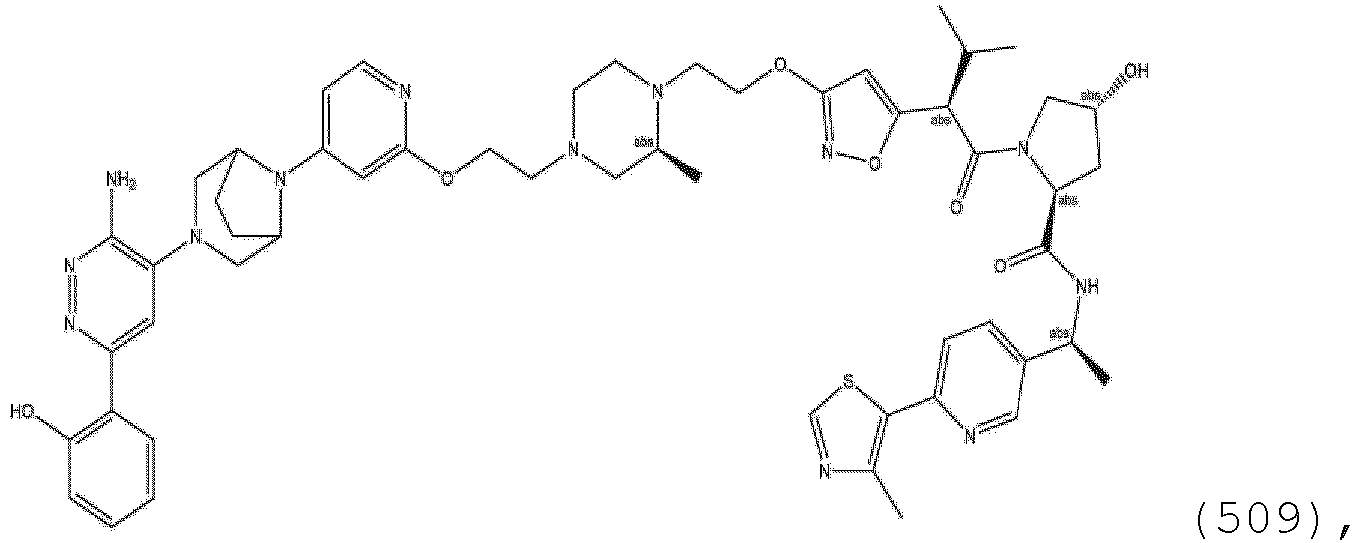


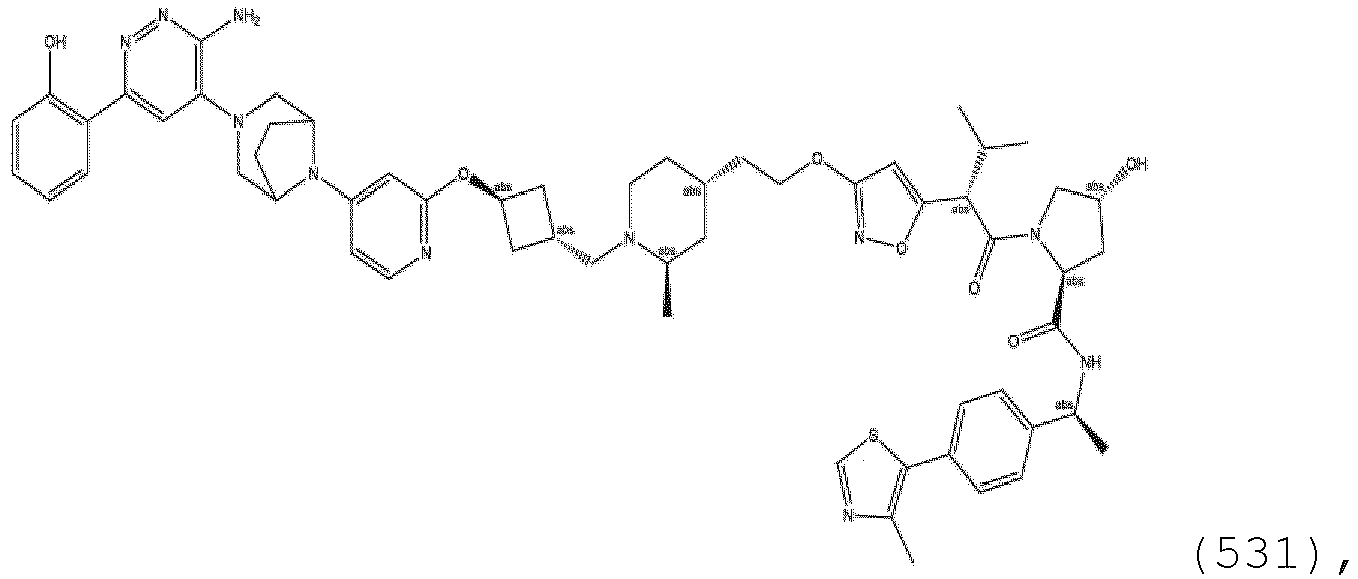


- Verbindung nach Anspruch 16, wobei die Verbindung ein Dmax größer als oder gleich 80 % aufweist.
- Verbindung nach Anspruch 1, wobei das ULM Folgendes ist:


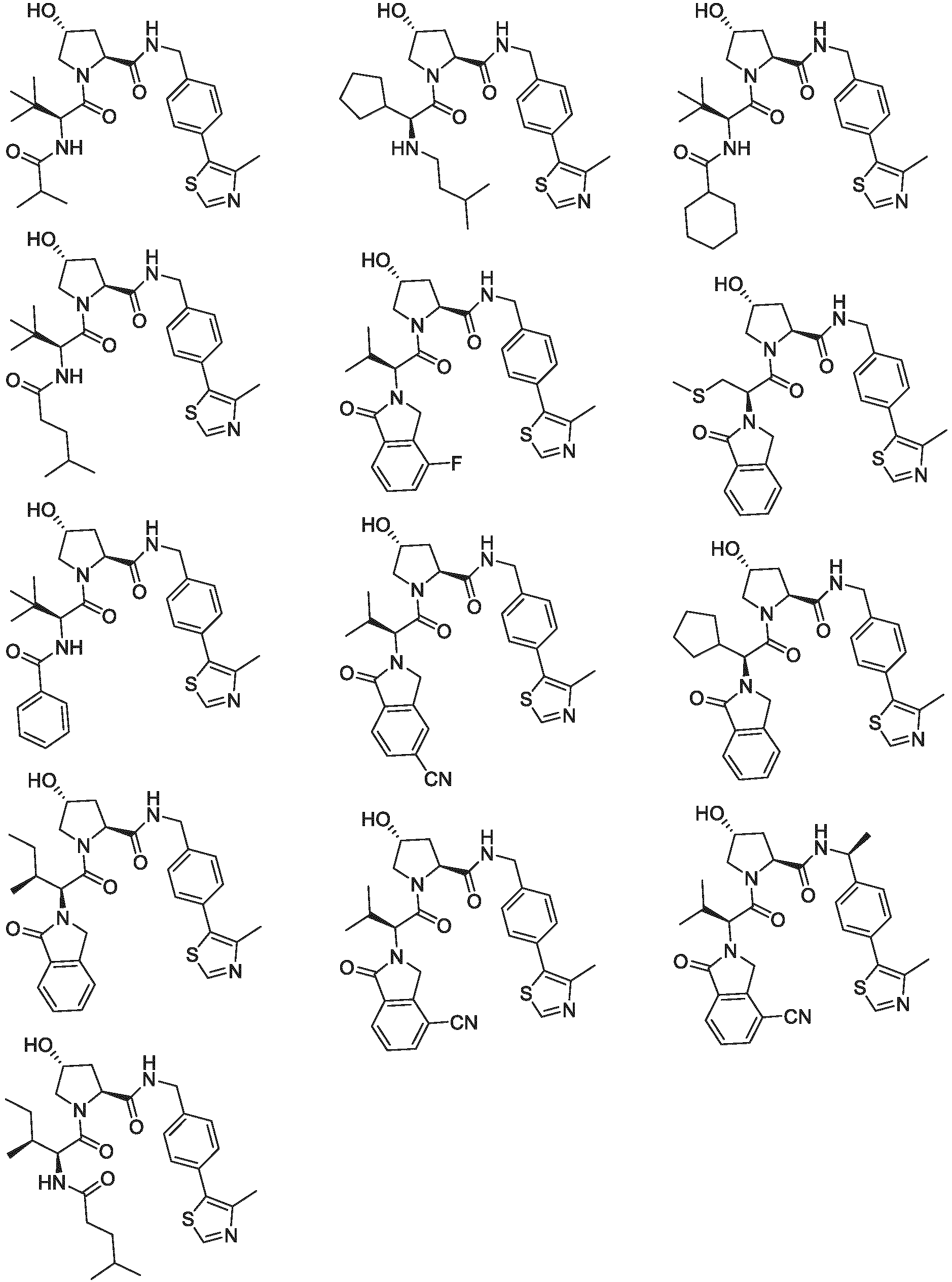


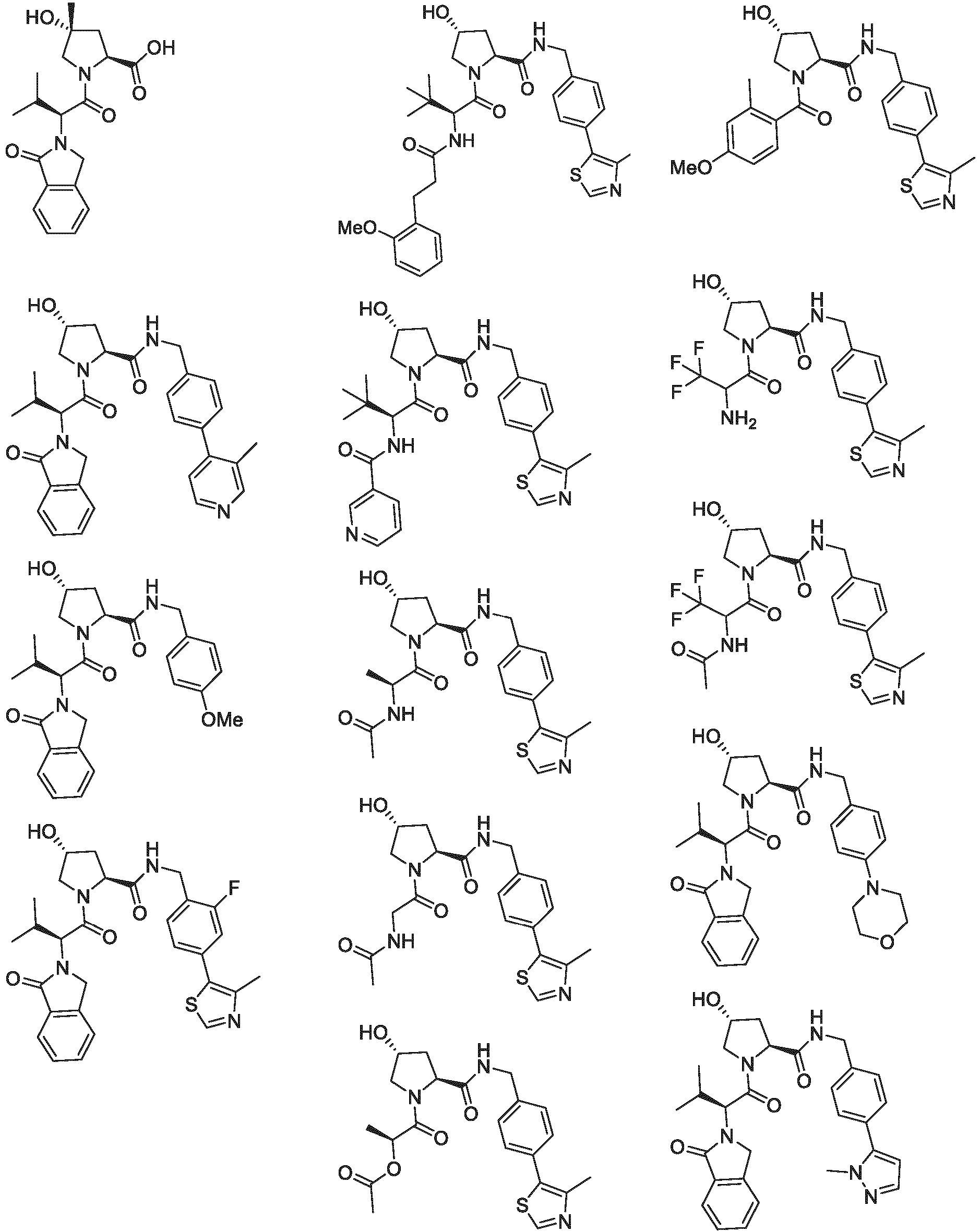


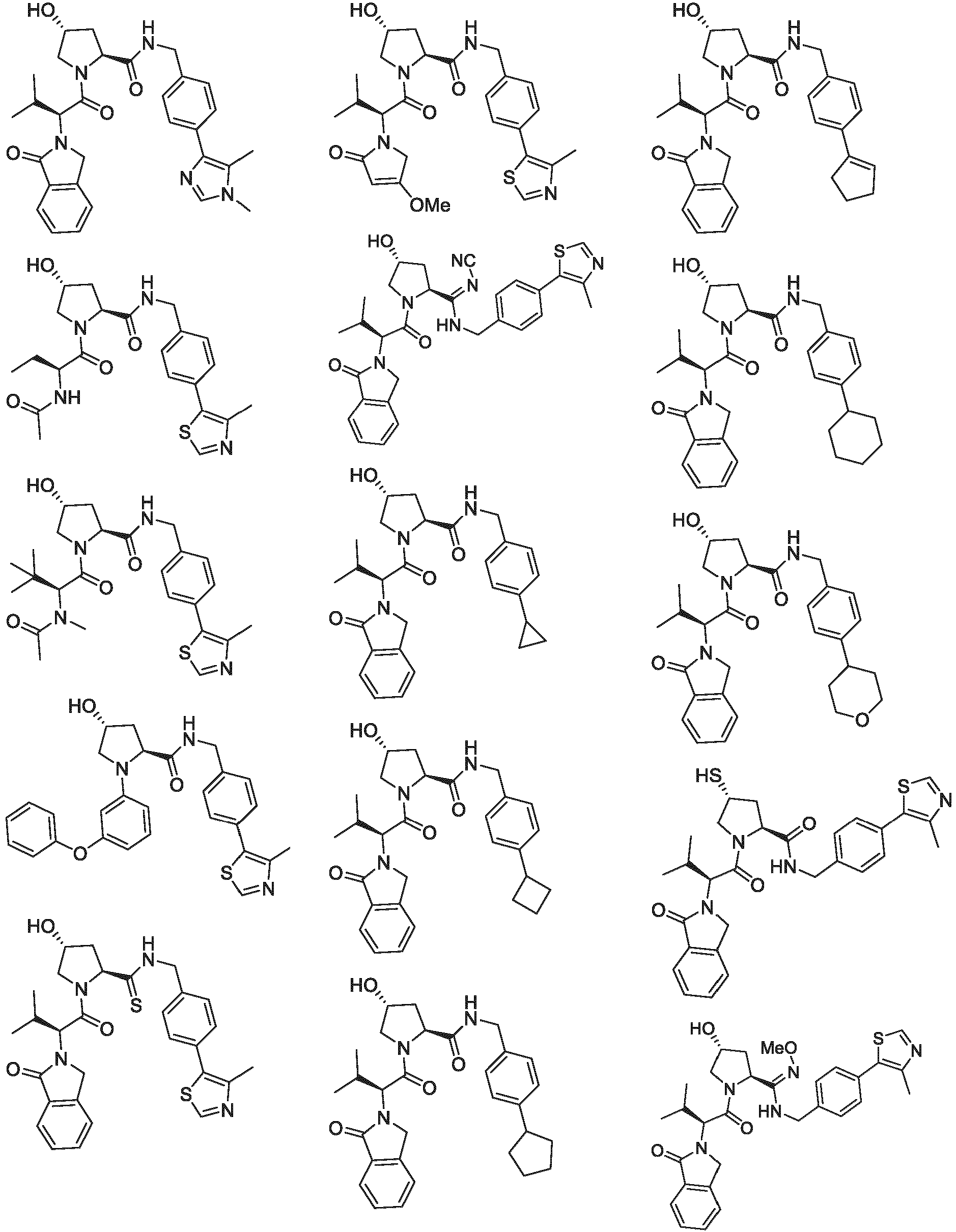


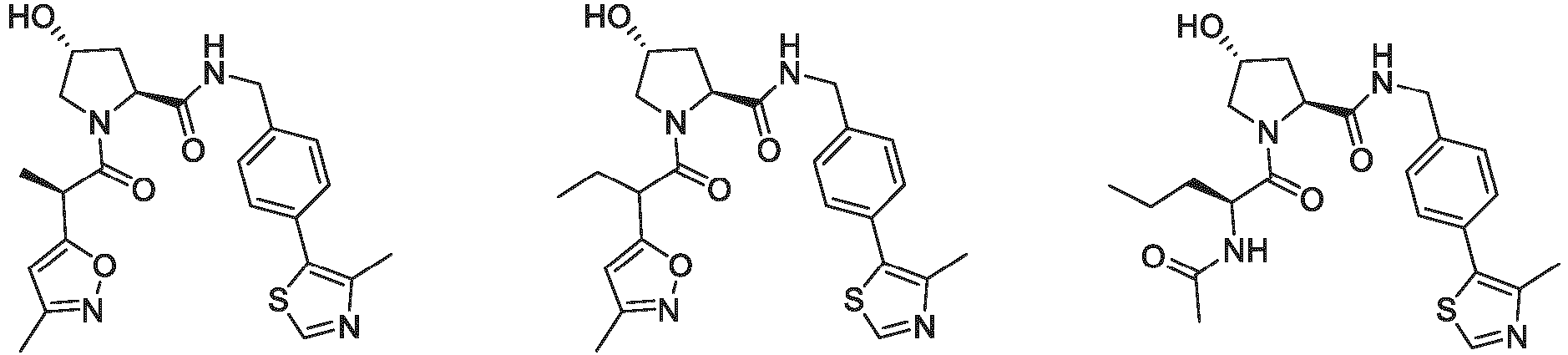

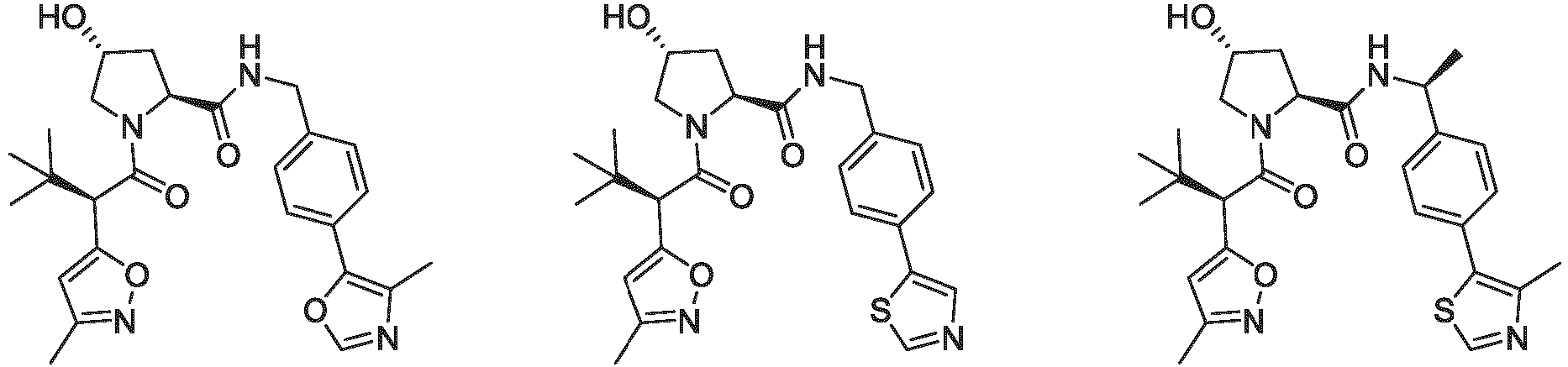
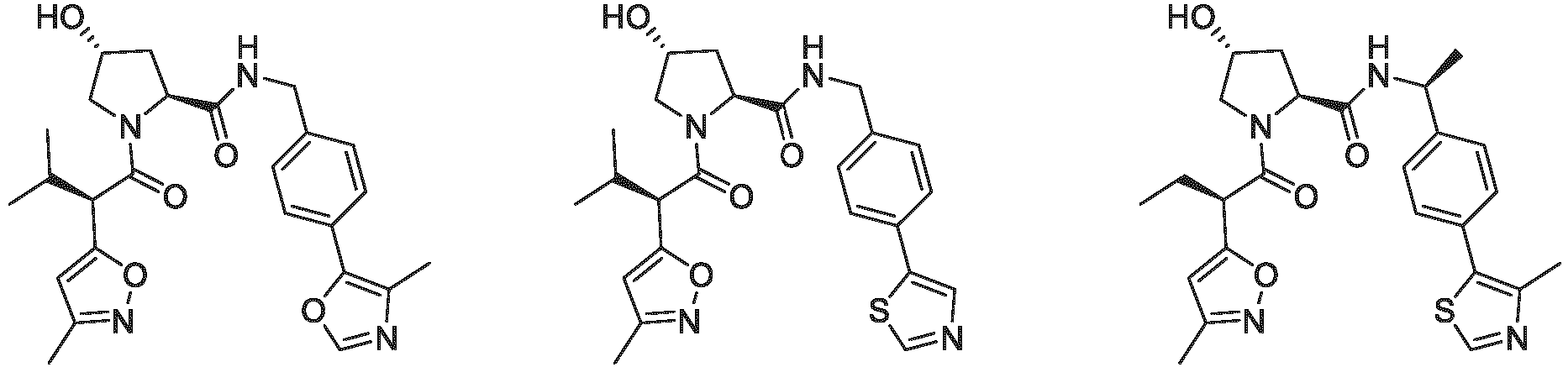


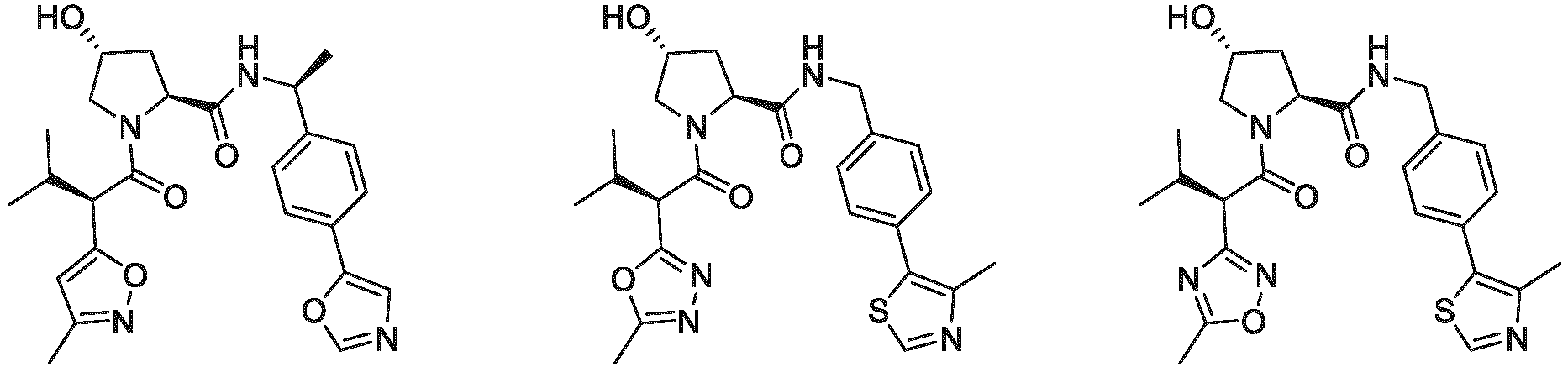


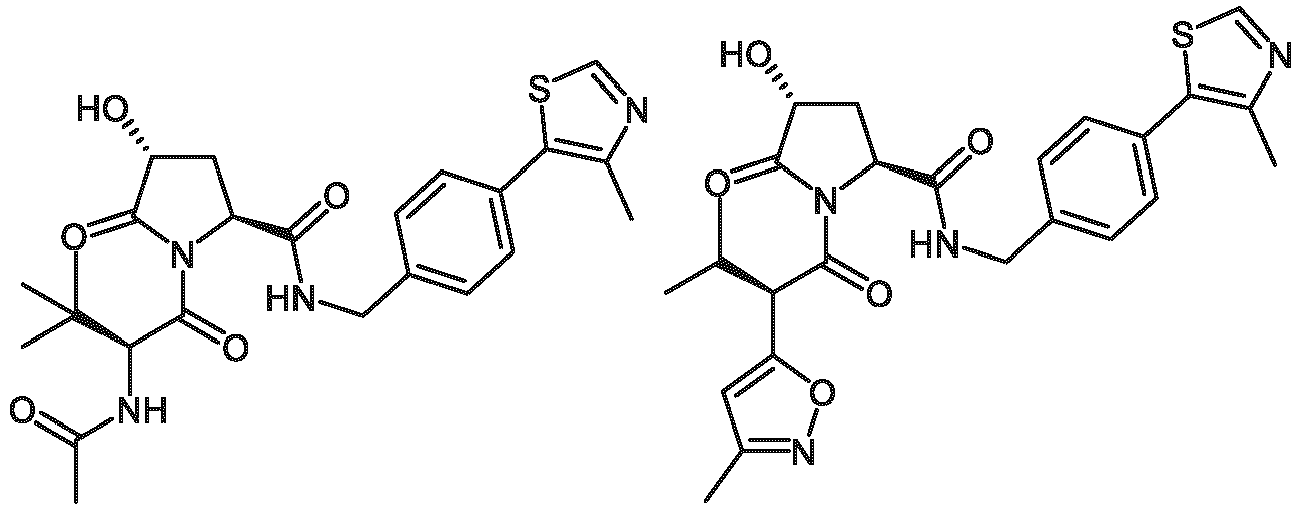


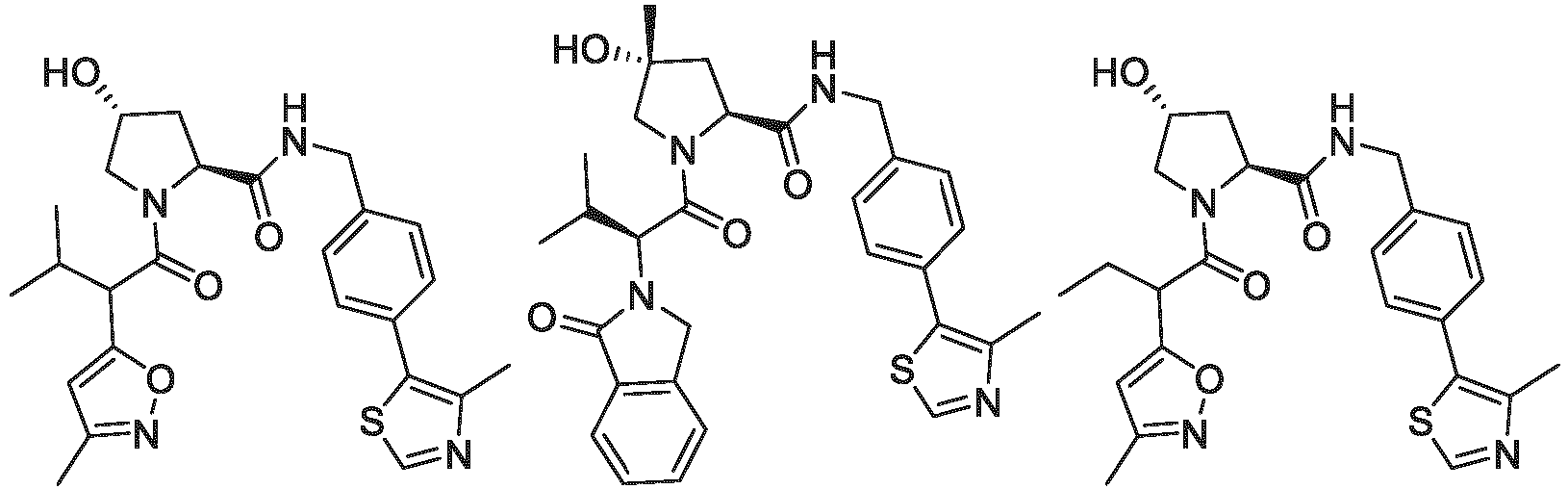


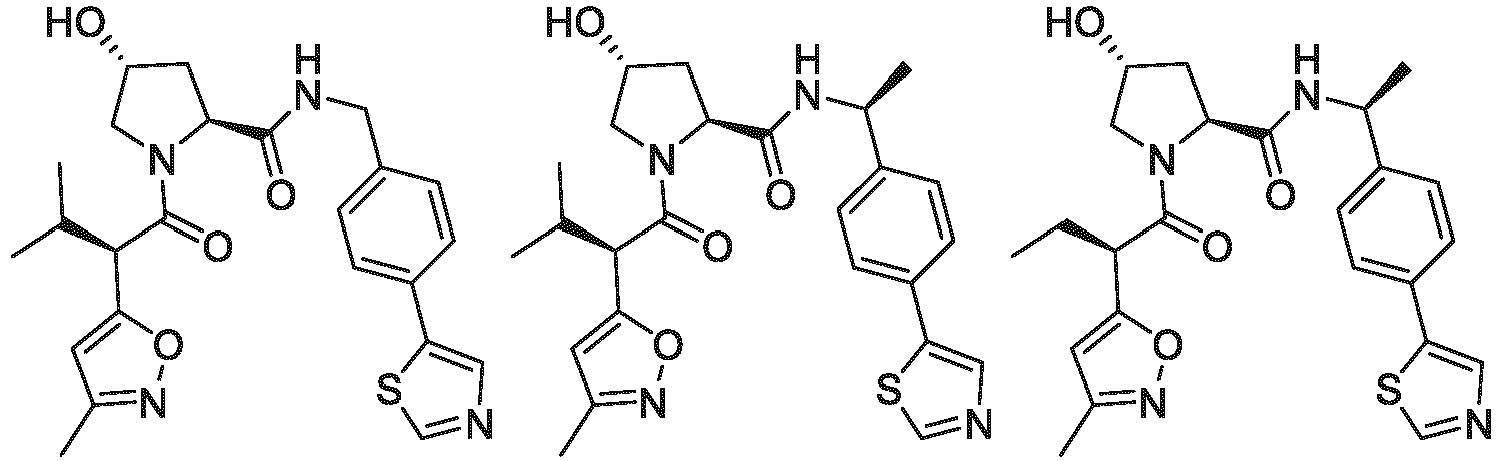


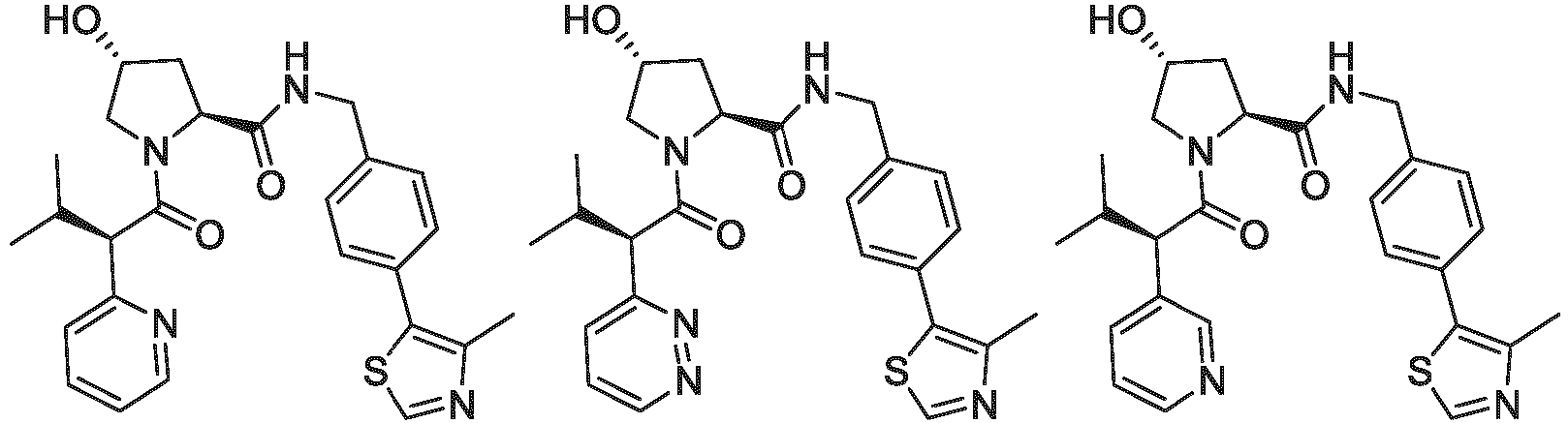

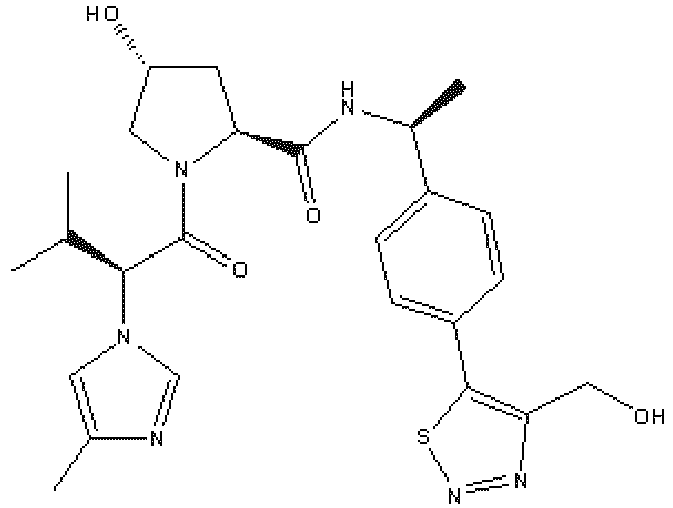


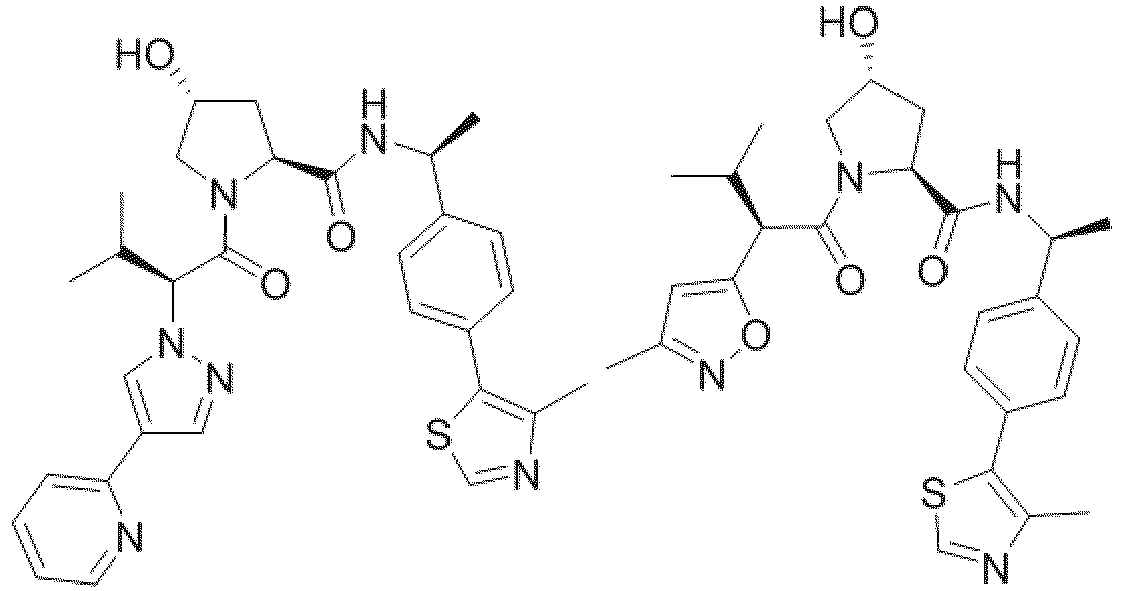


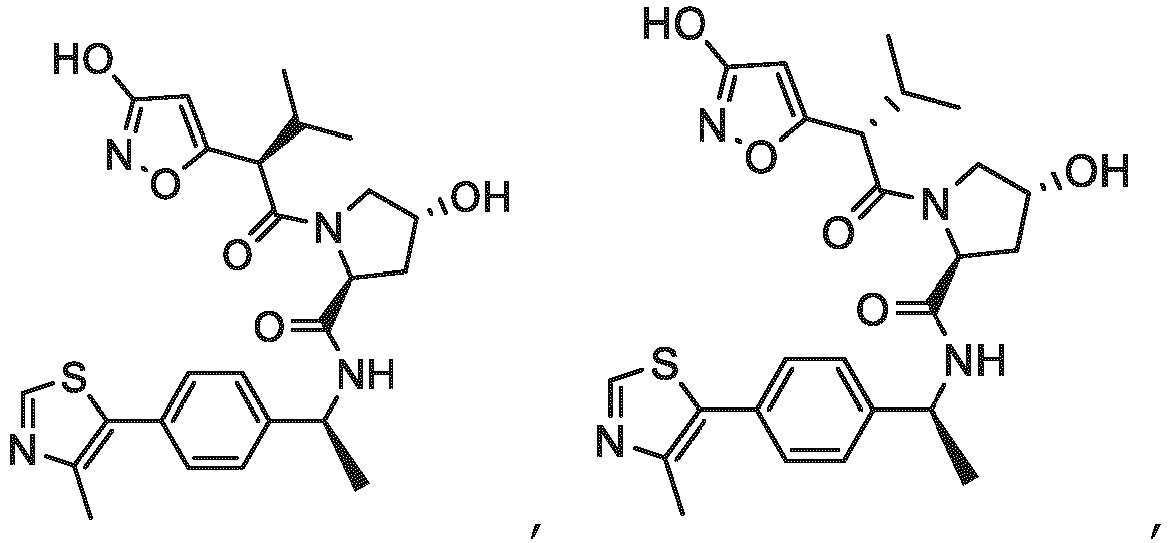


- Pharmazeutische Zusammensetzung, umfassend eine Verbindung nach irgendeinem der Ansprüche 1 bis 18 und einen pharmazeutisch annehmbaren Träger.
- Pharmazeutische Zusammensetzung nach Anspruch 19, wobei die Zusammensetzung ferner ein zusätzliches bioaktives Mittel, vorzugsweise ein Anti-Krebs-Mittel, umfasst.
- Verbindung nach irgendeinem der Ansprüche 1 bis 18 oder die pharmazeutische Zusammensetzung nach Anspruch 19 oder 20 zur Verwendung bei der Behandlung von Krebs.
- Verbindung oder pharmazeutische Zusammensetzung zur Verwendung nach Anspruch 21, wobei der Krebs Folgendes ist:(i) ein SWI/SNF-assoziierter Krebs oder ein Krebs mit einer SMARCA4-Mutation, wie etwa Lungenkrebs oder nicht-kleinzelliger Lungenkrebs; oder(ii) ein SMARCA4-defizienter Krebs oder ein Krebs mit verminderter Expression von SMARCA4 verglichen mit der normalen SMARCA4-Expression, wie etwa Lungenkrebs oder nicht-kleinzelliger Lungenkrebs.
Priority Applications (4)
| Application Number | Priority Date | Filing Date | Title |
|---|---|---|---|
| HRP20250617TT HRP20250617T1 (hr) | 2018-04-01 | 2019-04-01 | Spojevi usmjereni na modifikator biološkog odgovora (brm) i povezane metode primjene |
| SI201930935T SI3774789T1 (sl) | 2018-04-01 | 2019-04-01 | Spojine, ki ciljajo na BRM, in z njimi povezani načini uporabe |
| RS20250498A RS66841B1 (sr) | 2018-04-01 | 2019-04-01 | Jedinjenja za ciljanje brm i povezane metode upotrebe |
| EP25153421.0A EP4537905A3 (de) | 2018-04-01 | 2019-04-01 | Auf brm abzielende verbindungen und zugehörige verfahren zur verwendung |
Applications Claiming Priority (3)
| Application Number | Priority Date | Filing Date | Title |
|---|---|---|---|
| US201862651186P | 2018-04-01 | 2018-04-01 | |
| US201962797754P | 2019-01-28 | 2019-01-28 | |
| PCT/US2019/025254 WO2019195201A1 (en) | 2018-04-01 | 2019-04-01 | Brm targeting compounds and associated methods of use |
Related Child Applications (2)
| Application Number | Title | Priority Date | Filing Date |
|---|---|---|---|
| EP25153421.0A Division EP4537905A3 (de) | 2018-04-01 | 2019-04-01 | Auf brm abzielende verbindungen und zugehörige verfahren zur verwendung |
| EP25153421.0A Division-Into EP4537905A3 (de) | 2018-04-01 | 2019-04-01 | Auf brm abzielende verbindungen und zugehörige verfahren zur verwendung |
Publications (2)
| Publication Number | Publication Date |
|---|---|
| EP3774789A1 EP3774789A1 (de) | 2021-02-17 |
| EP3774789B1 true EP3774789B1 (de) | 2025-03-05 |
Family
ID=66175525
Family Applications (2)
| Application Number | Title | Priority Date | Filing Date |
|---|---|---|---|
| EP19717685.2A Active EP3774789B1 (de) | 2018-04-01 | 2019-04-01 | Auf brm abzielende verbindungen und zugehörige verfahren zur verwendung |
| EP25153421.0A Pending EP4537905A3 (de) | 2018-04-01 | 2019-04-01 | Auf brm abzielende verbindungen und zugehörige verfahren zur verwendung |
Family Applications After (1)
| Application Number | Title | Priority Date | Filing Date |
|---|---|---|---|
| EP25153421.0A Pending EP4537905A3 (de) | 2018-04-01 | 2019-04-01 | Auf brm abzielende verbindungen und zugehörige verfahren zur verwendung |
Country Status (28)
| Country | Link |
|---|---|
| US (2) | US20190300521A1 (de) |
| EP (2) | EP3774789B1 (de) |
| JP (3) | JP7721270B2 (de) |
| KR (2) | KR102697733B1 (de) |
| CN (2) | CN112166114B (de) |
| AU (3) | AU2019249849C1 (de) |
| BR (1) | BR112020020196A2 (de) |
| CA (1) | CA3094305A1 (de) |
| CL (1) | CL2020002546A1 (de) |
| CO (1) | CO2020013762A2 (de) |
| CR (1) | CR20200527A (de) |
| DK (1) | DK3774789T3 (de) |
| ES (1) | ES3027032T3 (de) |
| FI (1) | FI3774789T3 (de) |
| HR (1) | HRP20250617T1 (de) |
| HU (1) | HUE071391T2 (de) |
| IL (1) | IL277677A (de) |
| LT (1) | LT3774789T (de) |
| MX (2) | MX2020010368A (de) |
| MY (1) | MY198308A (de) |
| PE (1) | PE20212108A1 (de) |
| PH (1) | PH12020500663A1 (de) |
| PL (1) | PL3774789T3 (de) |
| PT (1) | PT3774789T (de) |
| RS (1) | RS66841B1 (de) |
| SG (1) | SG11202008898UA (de) |
| SI (1) | SI3774789T1 (de) |
| WO (1) | WO2019195201A1 (de) |
Families Citing this family (66)
| Publication number | Priority date | Publication date | Assignee | Title |
|---|---|---|---|---|
| WO2019140380A1 (en) | 2018-01-12 | 2019-07-18 | Kymera Therapeutics, Inc. | Protein degraders and uses thereof |
| US12539292B2 (en) | 2018-04-01 | 2026-02-03 | Arvinas Operations, Inc. | BRM targeting compounds and associated methods of use |
| EP3774789B1 (de) * | 2018-04-01 | 2025-03-05 | Arvinas Operations, Inc. | Auf brm abzielende verbindungen und zugehörige verfahren zur verwendung |
| JP7720698B2 (ja) | 2018-04-04 | 2025-08-08 | アルビナス・オペレーションズ・インコーポレイテッド | タンパク質分解の調節因子および関連する使用方法 |
| CN112771038B (zh) * | 2018-04-26 | 2024-09-24 | 奥里吉恩发现科技有限公司 | 作为smarca2/4降解剂的哒嗪衍生物 |
| CA3093405C (en) | 2018-04-30 | 2025-06-17 | Dana-Farber Cancer Institute, Inc. | POLYBROMO-1 SMALL MOLECULE DEGRADING AGENTS (PBRM1) |
| EP3817822A4 (de) | 2018-07-06 | 2022-07-27 | Kymera Therapeutics, Inc. | Proteinabbaumittel und verwendungen davon |
| WO2020041331A1 (en) | 2018-08-20 | 2020-02-27 | Arvinas Operations, Inc. | Proteolysis targeting chimeric (protac) compound with e3 ubiquitin ligase binding activity and targeting alpha-synuclein protein for treating neurodegenerative diseases |
| AU2019365238A1 (en) | 2018-10-24 | 2021-05-13 | F. Hoffmann-La Roche Ag | Conjugated chemical inducers of degradation and methods of use |
| CN113453679B (zh) | 2018-12-20 | 2025-07-08 | C4医药公司 | 靶向蛋白降解 |
| WO2020160192A1 (en) | 2019-01-29 | 2020-08-06 | Foghorn Therapeutics Inc. | Compounds and uses thereof |
| CN113677664B (zh) | 2019-04-12 | 2025-04-04 | C4医药公司 | Ikaros和aiolos的三环降解物 |
| WO2020251972A1 (en) | 2019-06-10 | 2020-12-17 | Kymera Therapeutics, Inc. | Smarca degraders and uses thereof |
| WO2021011913A1 (en) | 2019-07-17 | 2021-01-21 | Arvinas Operations, Inc. | Tau-protein targeting compounds and associated methods of use |
| WO2021067606A1 (en) * | 2019-10-01 | 2021-04-08 | Arvinas Operations, Inc. | Brm targeting compounds and associated methods of use |
| AU2020366135B2 (en) * | 2019-10-16 | 2024-12-12 | Proxygen Gmbh | Oxazole and thioazole-type cullin ring ubiquitin ligase compounds and uses thereof |
| CN115397821B (zh) | 2019-10-17 | 2024-09-03 | 阿尔维纳斯运营股份有限公司 | 含有与bcl6靶向部分连接的e3泛素连接酶结合部分的双官能分子 |
| WO2021086785A1 (en) * | 2019-10-28 | 2021-05-06 | F. Hoffmann-La Roche Ag | Bifunctional compounds |
| EP4051674A1 (de) * | 2019-10-29 | 2022-09-07 | F. Hoffmann-La Roche AG | Bifunktionale verbindungen zur krebsbehandlung |
| CN115297931A (zh) | 2019-12-23 | 2022-11-04 | 凯麦拉医疗公司 | Smarca降解剂和其用途 |
| AU2021205326A1 (en) * | 2020-01-10 | 2022-07-21 | Amgen Inc. | SMARCA2-VHL degraders |
| AU2021213258B2 (en) * | 2020-01-29 | 2024-05-02 | Foghorn Therapeutics Inc. | Compounds and uses thereof |
| WO2021155100A1 (en) | 2020-01-29 | 2021-08-05 | Foghorn Therapeutics Inc. | Compounds and uses thereof |
| BR112022014968A2 (pt) | 2020-01-29 | 2022-09-20 | Foghorn Therapeutics Inc | Composto, composição farmacêutica e métodos de inibição do nível de brd9 em uma célula, de inibição da atividade de brd9 em uma célula, de tratamento de um distúrbio, de tratamento de um câncer em um sujeito em necessidade e de tratamento de infecção em um sujeito em necessidade |
| US20230096160A1 (en) * | 2020-02-12 | 2023-03-30 | Dana-Farber Cancer Institute, Inc. | Compounds, compositions, and methods for protein degradation |
| MX2022010952A (es) | 2020-03-05 | 2022-10-07 | C4 Therapeutics Inc | Compuestos para la degradacion dirigida de brd9. |
| AU2021289730A1 (en) * | 2020-06-09 | 2023-01-19 | Prelude Therapeutics, Incorporated | BRM targeting compounds and associated methods of use |
| BR112023001143A2 (pt) | 2020-07-21 | 2023-02-14 | Genentech Inc | Conjugado, composto, composição farmacêutica, métodos para tratar uma doença e reduzir o nível de uma proteína brm alvo em um indivíduo |
| US11787800B2 (en) | 2020-07-29 | 2023-10-17 | Foghorn Therapeutics Inc. | BRD9 degraders and uses thereof |
| US20240018134A1 (en) * | 2020-08-04 | 2024-01-18 | Aurigene Discovery Technologies Limited | 6-Substituted Pyridazine Compounds as SMARCA2 and/or SMARCA4 Degraders |
| WO2022032026A1 (en) | 2020-08-05 | 2022-02-10 | C4 Therapeutics, Inc. | Compounds for targeted degradation of ret |
| US12448389B2 (en) | 2020-11-06 | 2025-10-21 | Prelude Therapeutics Incorporated | BRM targeting compounds and associated methods of use |
| US20240343724A1 (en) * | 2020-12-09 | 2024-10-17 | Kymera Therapeutics, Inc. | Smarca degraders and uses thereof |
| US20250109138A1 (en) * | 2020-12-09 | 2025-04-03 | Kymera Therapeutics, Inc. | Smarca degraders and uses thereof |
| EP4277901A1 (de) | 2021-01-13 | 2023-11-22 | Monte Rosa Therapeutics, Inc. | Isoindolinonverbindungen |
| TW202241855A (zh) * | 2021-01-27 | 2022-11-01 | 美商富曼西公司 | 用於防治無脊椎有害生物之唑類化合物 |
| CR20230516A (es) | 2021-04-16 | 2024-01-23 | Arvinas Operations Inc | Moduladores de la proteólisis bcl6 y métodos de uso asociados |
| KR20240017814A (ko) | 2021-05-05 | 2024-02-08 | 바이오젠 엠에이 인코포레이티드 | 브루톤 티로신 키나제의 분해를 표적으로 하는 화합물 |
| PE20242362A1 (es) * | 2021-05-10 | 2024-12-16 | Foghorn Therapeutics Inc | Compuestos y usos de estos |
| WO2023283263A1 (en) | 2021-07-06 | 2023-01-12 | Foghorn Therapeutics Inc. | Citrate salt, pharmaceutical compositions, and methods of making and using the same |
| EP4366834A1 (de) | 2021-07-07 | 2024-05-15 | Biogen MA Inc. | Verbindungen zum targeting des abbaus von irak4-proteinen |
| US20240343733A1 (en) | 2021-07-07 | 2024-10-17 | Biogen Ma Inc. | Compounds for targeting degradation of irak4 proteins |
| WO2023287787A1 (en) * | 2021-07-13 | 2023-01-19 | Prelude Therapeutics, Incorporated | Brm targeting compounds and associated methods of use |
| WO2023093728A1 (zh) * | 2021-11-23 | 2023-06-01 | 江苏先声药业有限公司 | Brm选择性降解剂化合物及其应用 |
| US20250064945A1 (en) | 2021-11-24 | 2025-02-27 | Arvinas Operations, Inc. | Brm targeting compounds and associated methods of use |
| CN118679160A (zh) | 2021-11-24 | 2024-09-20 | 阿维纳斯运营公司 | Brm靶向化合物和相关的使用方法 |
| KR102676912B1 (ko) * | 2021-12-14 | 2024-06-24 | (주)프레이저테라퓨틱스 | 폴리유비퀴틴화에 의한 표적 단백질 또는 폴리펩티드의 분해용 신규 화합물 |
| WO2023129506A1 (en) * | 2021-12-28 | 2023-07-06 | Board Of Regents, The University Of Texas System | Potent and selective smarca2 degrading chimeric molecules as cancer therapeutics |
| AR128330A1 (es) | 2022-01-26 | 2024-04-17 | Genentech Inc | Inductores químicos de degradación conjugados con anticuerpo y métodos de estos |
| AR128331A1 (es) | 2022-01-26 | 2024-04-17 | Genentech Inc | Inductores químicos de degradación conjugados con anticuerpos y métodos de estos |
| JP2025525339A (ja) | 2022-06-16 | 2025-08-05 | プレリュード・セラピューティクス・インコーポレイテッド | ビキチンリガーゼ結合部分を有するkat6標的化合物 |
| EP4549431A1 (de) * | 2022-06-30 | 2025-05-07 | Gan & Lee Pharmaceuticals Co., Ltd. | Verbindung als smarca2/4-inhibitor und verwendung davon |
| CN115353468B (zh) * | 2022-08-19 | 2023-06-30 | 安阳工学院 | 一种对甲苯磺酰氧基取代低聚乙二醇丙酸叔丁酯的制备方法 |
| AU2023382631A1 (en) | 2022-11-15 | 2025-05-29 | Prelude Therapeutics Incorporated | Brm targeting compounds and associated methods of use |
| AU2024212035A1 (en) | 2023-01-26 | 2025-08-14 | Arvinas Operations, Inc. | Cereblon-based kras degrading protacs ans uses related thereto |
| CN120752233A (zh) * | 2023-02-28 | 2025-10-03 | 上海海雁医药科技有限公司 | 取代的三环衍生物及其药物组合物和用途 |
| AR132905A1 (es) | 2023-06-08 | 2025-08-06 | Nurix Therapeutics Inc | Degradadores selectivos bifuncionales de smarca2 y sus usos terapéuticos |
| WO2024256574A1 (en) * | 2023-06-13 | 2024-12-19 | Crossfire Oncology Holding B.V. | Process for preparing macrocyclic btk inhibitors |
| AU2024305423A1 (en) | 2023-06-14 | 2026-01-22 | Astrazeneca Ab | Smarca2 degraders and uses thereof |
| TW202515566A (zh) | 2023-06-14 | 2025-04-16 | 瑞典商阿斯特捷利康公司 | Smarca2降解劑及其用途 |
| AU2024303022A1 (en) * | 2023-06-16 | 2026-01-08 | Plexium, Inc. | Compounds and pharmaceutical compositions that degrade swi/snf-related matrix-associated actin-dependent regulator of chromatin subfamily a |
| WO2025094065A1 (en) * | 2023-11-01 | 2025-05-08 | Aurigene Oncology Limited | Amino-substituted pyridazine compounds as smarca2 and/or smarca4 degraders |
| WO2025101942A1 (en) | 2023-11-10 | 2025-05-15 | Prelude Therapeutics Incorporated | Kat6 targeting compounds |
| WO2025106637A1 (en) * | 2023-11-16 | 2025-05-22 | Foghorn Therapeutics Inc. | Cinnoline derivatives useful as baf modulators |
| WO2025131111A1 (zh) * | 2023-12-22 | 2025-06-26 | 上海海雁医药科技有限公司 | 双环稠杂芳环衍生物及其药物组合物和用途 |
| US20250276074A1 (en) | 2024-03-01 | 2025-09-04 | Prelude Therapeutics Incorporated | Brm and brg1 targeting antibody-drug conjugates and methods of use thereof |
Family Cites Families (16)
| Publication number | Priority date | Publication date | Assignee | Title |
|---|---|---|---|---|
| US4522811A (en) | 1982-07-08 | 1985-06-11 | Syntex (U.S.A.) Inc. | Serial injection of muramyldipeptides and liposomes enhances the anti-infective activity of muramyldipeptides |
| TWI440981B (zh) | 2003-12-03 | 2014-06-11 | 尼康股份有限公司 | Exposure apparatus, exposure method, and device manufacturing method |
| EP3608317A1 (de) | 2012-01-12 | 2020-02-12 | Yale University | Verbindungen und verfahren für den verstärkten abbau von gezielten proteinen und anderen polypeptiden durch eine e3-ubiquitinligase |
| WO2015160845A2 (en) * | 2014-04-14 | 2015-10-22 | Arvinas, Inc. | Imide-based modulators of proteolysis and associated methods of use |
| US9694084B2 (en) * | 2014-12-23 | 2017-07-04 | Dana-Farber Cancer Institute, Inc. | Methods to induce targeted protein degradation through bifunctional molecules |
| JP6815318B2 (ja) * | 2014-12-23 | 2021-01-20 | ダナ−ファーバー キャンサー インスティテュート,インコーポレイテッド | 二官能性分子によって標的化タンパク質分解を誘導する方法 |
| HK1245791A1 (zh) | 2015-01-20 | 2018-08-31 | 阿尔维纳斯运营股份有限公司 | 用於雄激素受体的靶向降解的化合物和方法 |
| MA41598A (fr) | 2015-02-25 | 2018-01-02 | Constellation Pharmaceuticals Inc | Composés thérapeutiques de pyridazine et leurs utilisations |
| HK1249058A1 (zh) | 2015-03-18 | 2018-10-26 | Arvinas, Inc. | 用於增强靶向蛋白质降解的化合物和方法 |
| CA2988430A1 (en) * | 2015-07-10 | 2017-01-19 | Arvinas, Inc. | Mdm2-based modulators of proteolysis and associated methods of use |
| KR20180029061A (ko) * | 2015-07-13 | 2018-03-19 | 아비나스 인코포레이티드 | 단백질 분해의 알라닌계 조절인자 및 관련된 이용 방법 |
| WO2017030814A1 (en) | 2015-08-19 | 2017-02-23 | Arvinas, Inc. | Compounds and methods for the targeted degradation of bromodomain-containing proteins |
| EP3370715A4 (de) | 2015-11-02 | 2019-05-15 | Yale University | Gegen proteolyse gerichtete chimäre verbindungen und verfahren zur herstellung und verwendung davon |
| CA3050309A1 (en) | 2017-01-31 | 2018-08-09 | Arvinas Operations, Inc. | Cereblon ligands and bifunctional compounds comprising the same |
| CN107698657A (zh) | 2017-09-26 | 2018-02-16 | 中国药科大学 | 基于vhl配体和bet抑制剂诱导bet降解的双功能分子及其制备和应用 |
| EP3774789B1 (de) * | 2018-04-01 | 2025-03-05 | Arvinas Operations, Inc. | Auf brm abzielende verbindungen und zugehörige verfahren zur verwendung |
-
2019
- 2019-04-01 EP EP19717685.2A patent/EP3774789B1/de active Active
- 2019-04-01 CR CR20200527A patent/CR20200527A/es unknown
- 2019-04-01 RS RS20250498A patent/RS66841B1/sr unknown
- 2019-04-01 SI SI201930935T patent/SI3774789T1/sl unknown
- 2019-04-01 DK DK19717685.2T patent/DK3774789T3/da active
- 2019-04-01 KR KR1020207031366A patent/KR102697733B1/ko active Active
- 2019-04-01 MY MYPI2020005156A patent/MY198308A/en unknown
- 2019-04-01 PL PL19717685.2T patent/PL3774789T3/pl unknown
- 2019-04-01 PE PE2020001522A patent/PE20212108A1/es unknown
- 2019-04-01 CN CN201980036295.9A patent/CN112166114B/zh active Active
- 2019-04-01 CN CN202411543960.2A patent/CN120504668A/zh active Pending
- 2019-04-01 MX MX2020010368A patent/MX2020010368A/es unknown
- 2019-04-01 JP JP2020553643A patent/JP7721270B2/ja active Active
- 2019-04-01 HU HUE19717685A patent/HUE071391T2/hu unknown
- 2019-04-01 KR KR1020247027581A patent/KR20240130153A/ko active Pending
- 2019-04-01 ES ES19717685T patent/ES3027032T3/es active Active
- 2019-04-01 FI FIEP19717685.2T patent/FI3774789T3/fi active
- 2019-04-01 HR HRP20250617TT patent/HRP20250617T1/hr unknown
- 2019-04-01 PT PT197176852T patent/PT3774789T/pt unknown
- 2019-04-01 WO PCT/US2019/025254 patent/WO2019195201A1/en not_active Ceased
- 2019-04-01 CA CA3094305A patent/CA3094305A1/en active Pending
- 2019-04-01 LT LTEPPCT/US2019/025254T patent/LT3774789T/lt unknown
- 2019-04-01 US US16/372,345 patent/US20190300521A1/en not_active Abandoned
- 2019-04-01 EP EP25153421.0A patent/EP4537905A3/de active Pending
- 2019-04-01 SG SG11202008898UA patent/SG11202008898UA/en unknown
- 2019-04-01 AU AU2019249849A patent/AU2019249849C1/en active Active
- 2019-04-01 BR BR112020020196-0A patent/BR112020020196A2/pt unknown
-
2020
- 2020-09-15 PH PH12020500663A patent/PH12020500663A1/en unknown
- 2020-09-30 IL IL277677A patent/IL277677A/en unknown
- 2020-10-01 CL CL2020002546A patent/CL2020002546A1/es unknown
- 2020-10-01 MX MX2024000329A patent/MX2024000329A/es unknown
- 2020-10-30 CO CONC2020/0013762A patent/CO2020013762A2/es unknown
-
2022
- 2022-06-10 AU AU2022204042A patent/AU2022204042A1/en not_active Abandoned
-
2023
- 2023-02-10 US US18/108,045 patent/US20240076295A1/en not_active Abandoned
- 2023-02-17 JP JP2023023039A patent/JP2023071767A/ja active Pending
-
2024
- 2024-05-08 AU AU2024203058A patent/AU2024203058A1/en active Pending
-
2025
- 2025-05-29 JP JP2025089862A patent/JP2025143253A/ja active Pending
Also Published As
Similar Documents
| Publication | Publication Date | Title |
|---|---|---|
| EP3774789B1 (de) | Auf brm abzielende verbindungen und zugehörige verfahren zur verwendung | |
| US12539292B2 (en) | BRM targeting compounds and associated methods of use | |
| US12036209B2 (en) | Compounds and methods for the targeted degradation of Interleukin-1 receptor-associated kinase 4 polypeptides | |
| CN114787159B (zh) | Brm靶向化合物及相关使用方法 | |
| US11173211B2 (en) | Compounds and methods for the targeted degradation of rapidly accelerated Fibrosarcoma polypeptides | |
| KR20240028539A (ko) | 급속 진행형 섬유육종 폴리펩티드의 표적화 분해를 위한 다중 고리 화합물 및 방법 | |
| AU2018211975A1 (en) | Modulators of estrogen receptor proteolysis and associated methods of use | |
| EP3322986A1 (de) | Alaninbasierte modulatoren von proteolyse und assoziierte verfahren zur verwendung | |
| US20260041671A1 (en) | Brm targeting compounds and associated methods of use | |
| RU2797832C2 (ru) | Соединения, целенаправленно воздействующие на brm, и связанные с ними способы применения | |
| US20250059198A1 (en) | Brm degrading compounds and associated methods of use | |
| RU2830173C2 (ru) | Полициклические соединения и способы целенаправленной деградации полипептидов быстро ускоренной фибросаркомы | |
| US20250064945A1 (en) | Brm targeting compounds and associated methods of use | |
| HK40037668A (en) | Brm targeting compounds and associated methods of use | |
| HK40078801A (en) | Heterocyclic compounds for use in the treatment of cancer | |
| HK40078801B (en) | Heterocyclic compounds for use in the treatment of cancer |
Legal Events
| Date | Code | Title | Description |
|---|---|---|---|
| REG | Reference to a national code |
Ref country code: HR Ref legal event code: TUEP Ref document number: P20250617T Country of ref document: HR |
|
| STAA | Information on the status of an ep patent application or granted ep patent |
Free format text: STATUS: UNKNOWN |
|
| STAA | Information on the status of an ep patent application or granted ep patent |
Free format text: STATUS: THE INTERNATIONAL PUBLICATION HAS BEEN MADE |
|
| PUAI | Public reference made under article 153(3) epc to a published international application that has entered the european phase |
Free format text: ORIGINAL CODE: 0009012 |
|
| STAA | Information on the status of an ep patent application or granted ep patent |
Free format text: STATUS: REQUEST FOR EXAMINATION WAS MADE |
|
| 17P | Request for examination filed |
Effective date: 20201029 |
|
| AK | Designated contracting states |
Kind code of ref document: A1 Designated state(s): AL AT BE BG CH CY CZ DE DK EE ES FI FR GB GR HR HU IE IS IT LI LT LU LV MC MK MT NL NO PL PT RO RS SE SI SK SM TR |
|
| AX | Request for extension of the european patent |
Extension state: BA ME |
|
| DAV | Request for validation of the european patent (deleted) | ||
| DAX | Request for extension of the european patent (deleted) | ||
| STAA | Information on the status of an ep patent application or granted ep patent |
Free format text: STATUS: EXAMINATION IS IN PROGRESS |
|
| 17Q | First examination report despatched |
Effective date: 20220204 |
|
| GRAP | Despatch of communication of intention to grant a patent |
Free format text: ORIGINAL CODE: EPIDOSNIGR1 |
|
| STAA | Information on the status of an ep patent application or granted ep patent |
Free format text: STATUS: GRANT OF PATENT IS INTENDED |
|
| P01 | Opt-out of the competence of the unified patent court (upc) registered |
Effective date: 20230529 |
|
| INTG | Intention to grant announced |
Effective date: 20230628 |
|
| GRAJ | Information related to disapproval of communication of intention to grant by the applicant or resumption of examination proceedings by the epo deleted |
Free format text: ORIGINAL CODE: EPIDOSDIGR1 |
|
| STAA | Information on the status of an ep patent application or granted ep patent |
Free format text: STATUS: EXAMINATION IS IN PROGRESS |
|
| GRAP | Despatch of communication of intention to grant a patent |
Free format text: ORIGINAL CODE: EPIDOSNIGR1 |
|
| STAA | Information on the status of an ep patent application or granted ep patent |
Free format text: STATUS: GRANT OF PATENT IS INTENDED |
|
| INTC | Intention to grant announced (deleted) | ||
| INTG | Intention to grant announced |
Effective date: 20231201 |
|
| GRAJ | Information related to disapproval of communication of intention to grant by the applicant or resumption of examination proceedings by the epo deleted |
Free format text: ORIGINAL CODE: EPIDOSDIGR1 |
|
| STAA | Information on the status of an ep patent application or granted ep patent |
Free format text: STATUS: EXAMINATION IS IN PROGRESS |
|
| GRAP | Despatch of communication of intention to grant a patent |
Free format text: ORIGINAL CODE: EPIDOSNIGR1 |
|
| STAA | Information on the status of an ep patent application or granted ep patent |
Free format text: STATUS: GRANT OF PATENT IS INTENDED |
|
| INTC | Intention to grant announced (deleted) | ||
| INTG | Intention to grant announced |
Effective date: 20240425 |
|
| GRAJ | Information related to disapproval of communication of intention to grant by the applicant or resumption of examination proceedings by the epo deleted |
Free format text: ORIGINAL CODE: EPIDOSDIGR1 |
|
| STAA | Information on the status of an ep patent application or granted ep patent |
Free format text: STATUS: EXAMINATION IS IN PROGRESS |
|
| GRAP | Despatch of communication of intention to grant a patent |
Free format text: ORIGINAL CODE: EPIDOSNIGR1 |
|
| STAA | Information on the status of an ep patent application or granted ep patent |
Free format text: STATUS: GRANT OF PATENT IS INTENDED |
|
| INTC | Intention to grant announced (deleted) | ||
| INTG | Intention to grant announced |
Effective date: 20240923 |
|
| GRAS | Grant fee paid |
Free format text: ORIGINAL CODE: EPIDOSNIGR3 |
|
| GRAA | (expected) grant |
Free format text: ORIGINAL CODE: 0009210 |
|
| STAA | Information on the status of an ep patent application or granted ep patent |
Free format text: STATUS: THE PATENT HAS BEEN GRANTED |
|
| AK | Designated contracting states |
Kind code of ref document: B1 Designated state(s): AL AT BE BG CH CY CZ DE DK EE ES FI FR GB GR HR HU IE IS IT LI LT LU LV MC MK MT NL NO PL PT RO RS SE SI SK SM TR |
|
| REG | Reference to a national code |
Ref country code: GB Ref legal event code: FG4D |
|
| REG | Reference to a national code |
Ref country code: CH Ref legal event code: EP |
|
| REG | Reference to a national code |
Ref country code: IE Ref legal event code: FG4D |
|
| REG | Reference to a national code |
Ref country code: DE Ref legal event code: R096 Ref document number: 602019066827 Country of ref document: DE |
|
| REG | Reference to a national code |
Ref country code: PT Ref legal event code: SC4A Ref document number: 3774789 Country of ref document: PT Date of ref document: 20250528 Kind code of ref document: T Free format text: AVAILABILITY OF NATIONAL TRANSLATION Effective date: 20250522 |
|
| REG | Reference to a national code |
Ref country code: DK Ref legal event code: T3 Effective date: 20250603 |
|
| REG | Reference to a national code |
Ref country code: ES Ref legal event code: FG2A Ref document number: 3027032 Country of ref document: ES Kind code of ref document: T3 Effective date: 20250612 |
|
| REG | Reference to a national code |
Ref country code: FI Ref legal event code: FGE |
|
| REG | Reference to a national code |
Ref country code: NL Ref legal event code: FP |
|
| REG | Reference to a national code |
Ref country code: SE Ref legal event code: TRGR |
|
| REG | Reference to a national code |
Ref country code: HR Ref legal event code: ODRP Ref document number: P20250617T Country of ref document: HR Payment date: 20250623 Year of fee payment: 7 |
|
| PGFP | Annual fee paid to national office [announced via postgrant information from national office to epo] |
Ref country code: FI Payment date: 20250626 Year of fee payment: 7 |
|
| PGFP | Annual fee paid to national office [announced via postgrant information from national office to epo] |
Ref country code: DE Payment date: 20250626 Year of fee payment: 7 |
|
| PGFP | Annual fee paid to national office [announced via postgrant information from national office to epo] |
Ref country code: GB Payment date: 20250610 Year of fee payment: 7 Ref country code: ES Payment date: 20250617 Year of fee payment: 7 Ref country code: DK Payment date: 20250617 Year of fee payment: 7 |
|
| PGFP | Annual fee paid to national office [announced via postgrant information from national office to epo] |
Ref country code: LT Payment date: 20250617 Year of fee payment: 7 |
|
| PGFP | Annual fee paid to national office [announced via postgrant information from national office to epo] |
Ref country code: RS Payment date: 20250618 Year of fee payment: 7 Ref country code: NO Payment date: 20250618 Year of fee payment: 7 |
|
| PGFP | Annual fee paid to national office [announced via postgrant information from national office to epo] |
Ref country code: NL Payment date: 20250625 Year of fee payment: 7 Ref country code: BE Payment date: 20250623 Year of fee payment: 7 |
|
| PGFP | Annual fee paid to national office [announced via postgrant information from national office to epo] |
Ref country code: HR Payment date: 20250623 Year of fee payment: 7 |
|
| PG25 | Lapsed in a contracting state [announced via postgrant information from national office to epo] |
Ref country code: LV Free format text: LAPSE BECAUSE OF FAILURE TO SUBMIT A TRANSLATION OF THE DESCRIPTION OR TO PAY THE FEE WITHIN THE PRESCRIBED TIME-LIMIT Effective date: 20250305 |
|
| PGFP | Annual fee paid to national office [announced via postgrant information from national office to epo] |
Ref country code: PT Payment date: 20250617 Year of fee payment: 7 |
|
| PGFP | Annual fee paid to national office [announced via postgrant information from national office to epo] |
Ref country code: HU Payment date: 20250619 Year of fee payment: 7 Ref country code: FR Payment date: 20250626 Year of fee payment: 7 |
|
| REG | Reference to a national code |
Ref country code: HR Ref legal event code: T1PR Ref document number: P20250617 Country of ref document: HR |
|
| PGFP | Annual fee paid to national office [announced via postgrant information from national office to epo] |
Ref country code: BG Payment date: 20250618 Year of fee payment: 7 Ref country code: GR Payment date: 20250617 Year of fee payment: 7 |
|
| PGFP | Annual fee paid to national office [announced via postgrant information from national office to epo] |
Ref country code: RO Payment date: 20250618 Year of fee payment: 7 Ref country code: AT Payment date: 20250627 Year of fee payment: 7 |
|
| PGFP | Annual fee paid to national office [announced via postgrant information from national office to epo] |
Ref country code: TR Payment date: 20250617 Year of fee payment: 7 Ref country code: SK Payment date: 20250618 Year of fee payment: 7 |
|
| PGFP | Annual fee paid to national office [announced via postgrant information from national office to epo] |
Ref country code: CZ Payment date: 20250617 Year of fee payment: 7 |
|
| PGFP | Annual fee paid to national office [announced via postgrant information from national office to epo] |
Ref country code: IE Payment date: 20250625 Year of fee payment: 7 |
|
| PGFP | Annual fee paid to national office [announced via postgrant information from national office to epo] |
Ref country code: SI Payment date: 20250617 Year of fee payment: 7 Ref country code: SE Payment date: 20250617 Year of fee payment: 7 |
|
| REG | Reference to a national code |
Ref country code: SK Ref legal event code: T3 Ref document number: E 46494 Country of ref document: SK |
|
| REG | Reference to a national code |
Ref country code: GR Ref legal event code: EP Ref document number: 20250401121 Country of ref document: GR Effective date: 20250707 |
|
| REG | Reference to a national code |
Ref country code: HU Ref legal event code: AG4A Ref document number: E071391 Country of ref document: HU |
|
| PG25 | Lapsed in a contracting state [announced via postgrant information from national office to epo] |
Ref country code: SM Free format text: LAPSE BECAUSE OF FAILURE TO SUBMIT A TRANSLATION OF THE DESCRIPTION OR TO PAY THE FEE WITHIN THE PRESCRIBED TIME-LIMIT Effective date: 20250305 |
|
| PGFP | Annual fee paid to national office [announced via postgrant information from national office to epo] |
Ref country code: IT Payment date: 20250624 Year of fee payment: 7 Ref country code: PL Payment date: 20250620 Year of fee payment: 7 |
|
| PGFP | Annual fee paid to national office [announced via postgrant information from national office to epo] |
Ref country code: CH Payment date: 20250730 Year of fee payment: 7 |
|
| PG25 | Lapsed in a contracting state [announced via postgrant information from national office to epo] |
Ref country code: EE Free format text: LAPSE BECAUSE OF FAILURE TO SUBMIT A TRANSLATION OF THE DESCRIPTION OR TO PAY THE FEE WITHIN THE PRESCRIBED TIME-LIMIT Effective date: 20250305 |
|
| PG25 | Lapsed in a contracting state [announced via postgrant information from national office to epo] |
Ref country code: IS Free format text: LAPSE BECAUSE OF FAILURE TO SUBMIT A TRANSLATION OF THE DESCRIPTION OR TO PAY THE FEE WITHIN THE PRESCRIBED TIME-LIMIT Effective date: 20250705 |
|
| REG | Reference to a national code |
Ref country code: DE Ref legal event code: R097 Ref document number: 602019066827 Country of ref document: DE |
|
| PG25 | Lapsed in a contracting state [announced via postgrant information from national office to epo] |
Ref country code: LU Free format text: LAPSE BECAUSE OF NON-PAYMENT OF DUE FEES Effective date: 20250401 |
|
| PG25 | Lapsed in a contracting state [announced via postgrant information from national office to epo] |
Ref country code: MC Free format text: LAPSE BECAUSE OF FAILURE TO SUBMIT A TRANSLATION OF THE DESCRIPTION OR TO PAY THE FEE WITHIN THE PRESCRIBED TIME-LIMIT Effective date: 20250305 |
|
| PLBE | No opposition filed within time limit |
Free format text: ORIGINAL CODE: 0009261 |
|
| STAA | Information on the status of an ep patent application or granted ep patent |
Free format text: STATUS: NO OPPOSITION FILED WITHIN TIME LIMIT |
|
| REG | Reference to a national code |
Ref country code: CH Ref legal event code: L10 Free format text: ST27 STATUS EVENT CODE: U-0-0-L10-L00 (AS PROVIDED BY THE NATIONAL OFFICE) Effective date: 20260114 |