EP3767155A1 - Led plant growth lamp light spectrum - Google Patents
Led plant growth lamp light spectrum Download PDFInfo
- Publication number
- EP3767155A1 EP3767155A1 EP19915320.6A EP19915320A EP3767155A1 EP 3767155 A1 EP3767155 A1 EP 3767155A1 EP 19915320 A EP19915320 A EP 19915320A EP 3767155 A1 EP3767155 A1 EP 3767155A1
- Authority
- EP
- European Patent Office
- Prior art keywords
- plant growth
- led plant
- growth lamp
- light wave
- photons
- Prior art date
- Legal status (The legal status is an assumption and is not a legal conclusion. Google has not performed a legal analysis and makes no representation as to the accuracy of the status listed.)
- Withdrawn
Links
- 230000008635 plant growth Effects 0.000 title claims abstract description 48
- 238000001228 spectrum Methods 0.000 title claims abstract description 20
- 230000003595 spectral effect Effects 0.000 claims description 28
- 241000218236 Cannabis Species 0.000 claims description 23
- 230000012010 growth Effects 0.000 claims description 21
- 206010021033 Hypomenorrhoea Diseases 0.000 claims description 10
- 229930003827 cannabinoid Natural products 0.000 claims description 2
- 239000003557 cannabinoid Substances 0.000 claims description 2
- 238000000034 method Methods 0.000 claims description 2
- 229930000044 secondary metabolite Natural products 0.000 claims description 2
- 238000009825 accumulation Methods 0.000 claims 1
- 238000004519 manufacturing process Methods 0.000 abstract description 2
- 241000196324 Embryophyta Species 0.000 description 25
- 230000001850 reproductive effect Effects 0.000 description 16
- 238000010586 diagram Methods 0.000 description 14
- CYQFCXCEBYINGO-UHFFFAOYSA-N THC Natural products C1=C(C)CCC2C(C)(C)OC3=CC(CCCCC)=CC(O)=C3C21 CYQFCXCEBYINGO-UHFFFAOYSA-N 0.000 description 10
- CYQFCXCEBYINGO-IAGOWNOFSA-N delta1-THC Chemical compound C1=C(C)CC[C@H]2C(C)(C)OC3=CC(CCCCC)=CC(O)=C3[C@@H]21 CYQFCXCEBYINGO-IAGOWNOFSA-N 0.000 description 10
- 229960004242 dronabinol Drugs 0.000 description 10
- 239000000203 mixture Substances 0.000 description 9
- 230000001737 promoting effect Effects 0.000 description 9
- 239000011490 mineral wool Substances 0.000 description 8
- 239000000758 substrate Substances 0.000 description 8
- ZTGXAWYVTLUPDT-UHFFFAOYSA-N cannabidiol Natural products OC1=CC(CCCCC)=CC(O)=C1C1C(C(C)=C)CC=C(C)C1 ZTGXAWYVTLUPDT-UHFFFAOYSA-N 0.000 description 6
- DGAQECJNVWCQMB-PUAWFVPOSA-M Ilexoside XXIX Chemical compound C[C@@H]1CC[C@@]2(CC[C@@]3(C(=CC[C@H]4[C@]3(CC[C@@H]5[C@@]4(CC[C@@H](C5(C)C)OS(=O)(=O)[O-])C)C)[C@@H]2[C@]1(C)O)C)C(=O)O[C@H]6[C@@H]([C@H]([C@@H]([C@H](O6)CO)O)O)O.[Na+] DGAQECJNVWCQMB-PUAWFVPOSA-M 0.000 description 5
- 229910052708 sodium Inorganic materials 0.000 description 5
- 239000011734 sodium Substances 0.000 description 5
- QHMBSVQNZZTUGM-UHFFFAOYSA-N Trans-Cannabidiol Natural products OC1=CC(CCCCC)=CC(O)=C1C1C(C(C)=C)CCC(C)=C1 QHMBSVQNZZTUGM-UHFFFAOYSA-N 0.000 description 4
- QHMBSVQNZZTUGM-ZWKOTPCHSA-N cannabidiol Chemical compound OC1=CC(CCCCC)=CC(O)=C1[C@H]1[C@H](C(C)=C)CCC(C)=C1 QHMBSVQNZZTUGM-ZWKOTPCHSA-N 0.000 description 4
- 229950011318 cannabidiol Drugs 0.000 description 4
- PCXRACLQFPRCBB-ZWKOTPCHSA-N dihydrocannabidiol Natural products OC1=CC(CCCCC)=CC(O)=C1[C@H]1[C@H](C(C)C)CCC(C)=C1 PCXRACLQFPRCBB-ZWKOTPCHSA-N 0.000 description 4
- UVOLYTDXHDXWJU-UHFFFAOYSA-N Cannabichromene Chemical compound C1=CC(C)(CCC=C(C)C)OC2=CC(CCCCC)=CC(O)=C21 UVOLYTDXHDXWJU-UHFFFAOYSA-N 0.000 description 3
- VBGLYOIFKLUMQG-UHFFFAOYSA-N Cannabinol Chemical compound C1=C(C)C=C2C3=C(O)C=C(CCCCC)C=C3OC(C)(C)C2=C1 VBGLYOIFKLUMQG-UHFFFAOYSA-N 0.000 description 3
- 230000000052 comparative effect Effects 0.000 description 3
- VITZNDKHSIWPSR-HZPDHXFCSA-N (6ar,10ar)-1-hydroxy-6,6,9-trimethyl-3-pentyl-6a,7,8,10a-tetrahydrobenzo[c]chromene-4-carboxylic acid Chemical compound C1=C(C)CC[C@H]2C(C)(C)OC3=C(C(O)=O)C(CCCCC)=CC(O)=C3[C@@H]21 VITZNDKHSIWPSR-HZPDHXFCSA-N 0.000 description 2
- UVOLYTDXHDXWJU-NRFANRHFSA-N Cannabichromene Natural products C1=C[C@](C)(CCC=C(C)C)OC2=CC(CCCCC)=CC(O)=C21 UVOLYTDXHDXWJU-NRFANRHFSA-N 0.000 description 2
- ORKZJYDOERTGKY-UHFFFAOYSA-N Dihydrocannabichromen Natural products C1CC(C)(CCC=C(C)C)OC2=CC(CCCCC)=CC(O)=C21 ORKZJYDOERTGKY-UHFFFAOYSA-N 0.000 description 2
- 239000002253 acid Substances 0.000 description 2
- 230000000202 analgesic effect Effects 0.000 description 2
- WVOLTBSCXRRQFR-DLBZAZTESA-N cannabidiolic acid Chemical compound OC1=C(C(O)=O)C(CCCCC)=CC(O)=C1[C@H]1[C@H](C(C)=C)CCC(C)=C1 WVOLTBSCXRRQFR-DLBZAZTESA-N 0.000 description 2
- 229960003453 cannabinol Drugs 0.000 description 2
- 238000013461 design Methods 0.000 description 2
- YZSCPLGKKMSBMV-UHFFFAOYSA-N 5-fluoro-4-(8-fluoro-4-propan-2-yl-2,3-dihydro-1,4-benzoxazin-6-yl)-N-[5-(1-methylpiperidin-4-yl)pyridin-2-yl]pyrimidin-2-amine Chemical compound FC=1C(=NC(=NC=1)NC1=NC=C(C=C1)C1CCN(CC1)C)C1=CC2=C(OCCN2C(C)C)C(=C1)F YZSCPLGKKMSBMV-UHFFFAOYSA-N 0.000 description 1
- 206010061218 Inflammation Diseases 0.000 description 1
- 102000003820 Lipoxygenases Human genes 0.000 description 1
- 108090000128 Lipoxygenases Proteins 0.000 description 1
- 206010028980 Neoplasm Diseases 0.000 description 1
- OAICVXFJPJFONN-UHFFFAOYSA-N Phosphorus Chemical compound [P] OAICVXFJPJFONN-UHFFFAOYSA-N 0.000 description 1
- 102000004005 Prostaglandin-endoperoxide synthases Human genes 0.000 description 1
- 108090000459 Prostaglandin-endoperoxide synthases Proteins 0.000 description 1
- 230000001430 anti-depressive effect Effects 0.000 description 1
- 230000003556 anti-epileptic effect Effects 0.000 description 1
- 230000003110 anti-inflammatory effect Effects 0.000 description 1
- -1 anti-psychotic Substances 0.000 description 1
- 230000000561 anti-psychotic effect Effects 0.000 description 1
- 239000001961 anticonvulsive agent Substances 0.000 description 1
- 239000000935 antidepressant agent Substances 0.000 description 1
- 235000019789 appetite Nutrition 0.000 description 1
- 230000036528 appetite Effects 0.000 description 1
- 230000009286 beneficial effect Effects 0.000 description 1
- 230000033228 biological regulation Effects 0.000 description 1
- 230000001914 calming effect Effects 0.000 description 1
- 201000011510 cancer Diseases 0.000 description 1
- 238000012364 cultivation method Methods 0.000 description 1
- 230000007812 deficiency Effects 0.000 description 1
- 238000011161 development Methods 0.000 description 1
- 229940079593 drug Drugs 0.000 description 1
- 239000003814 drug Substances 0.000 description 1
- 230000009977 dual effect Effects 0.000 description 1
- 230000000694 effects Effects 0.000 description 1
- 235000015092 herbal tea Nutrition 0.000 description 1
- 210000000987 immune system Anatomy 0.000 description 1
- 230000006698 induction Effects 0.000 description 1
- 230000004054 inflammatory process Effects 0.000 description 1
- 239000004615 ingredient Substances 0.000 description 1
- 230000005764 inhibitory process Effects 0.000 description 1
- 239000000463 material Substances 0.000 description 1
- 229910001507 metal halide Inorganic materials 0.000 description 1
- 150000005309 metal halides Chemical class 0.000 description 1
- 238000012986 modification Methods 0.000 description 1
- 230000004048 modification Effects 0.000 description 1
- 235000016709 nutrition Nutrition 0.000 description 1
- 230000035764 nutrition Effects 0.000 description 1
- 239000002994 raw material Substances 0.000 description 1
- 238000011160 research Methods 0.000 description 1
- 230000001932 seasonal effect Effects 0.000 description 1
- 230000024053 secondary metabolic process Effects 0.000 description 1
Images


Classifications
-
- A—HUMAN NECESSITIES
- A01—AGRICULTURE; FORESTRY; ANIMAL HUSBANDRY; HUNTING; TRAPPING; FISHING
- A01G—HORTICULTURE; CULTIVATION OF VEGETABLES, FLOWERS, RICE, FRUIT, VINES, HOPS OR SEAWEED; FORESTRY; WATERING
- A01G7/00—Botany in general
- A01G7/04—Electric or magnetic or acoustic treatment of plants for promoting growth
- A01G7/045—Electric or magnetic or acoustic treatment of plants for promoting growth with electric lighting
-
- A—HUMAN NECESSITIES
- A01—AGRICULTURE; FORESTRY; ANIMAL HUSBANDRY; HUNTING; TRAPPING; FISHING
- A01G—HORTICULTURE; CULTIVATION OF VEGETABLES, FLOWERS, RICE, FRUIT, VINES, HOPS OR SEAWEED; FORESTRY; WATERING
- A01G7/00—Botany in general
- A01G7/04—Electric or magnetic or acoustic treatment of plants for promoting growth
-
- F—MECHANICAL ENGINEERING; LIGHTING; HEATING; WEAPONS; BLASTING
- F21—LIGHTING
- F21K—NON-ELECTRIC LIGHT SOURCES USING LUMINESCENCE; LIGHT SOURCES USING ELECTROCHEMILUMINESCENCE; LIGHT SOURCES USING CHARGES OF COMBUSTIBLE MATERIAL; LIGHT SOURCES USING SEMICONDUCTOR DEVICES AS LIGHT-GENERATING ELEMENTS; LIGHT SOURCES NOT OTHERWISE PROVIDED FOR
- F21K9/00—Light sources using semiconductor devices as light-generating elements, e.g. using light-emitting diodes [LED] or lasers
- F21K9/20—Light sources comprising attachment means
-
- F—MECHANICAL ENGINEERING; LIGHTING; HEATING; WEAPONS; BLASTING
- F21—LIGHTING
- F21V—FUNCTIONAL FEATURES OR DETAILS OF LIGHTING DEVICES OR SYSTEMS THEREOF; STRUCTURAL COMBINATIONS OF LIGHTING DEVICES WITH OTHER ARTICLES, NOT OTHERWISE PROVIDED FOR
- F21V9/00—Elements for modifying spectral properties, polarisation or intensity of the light emitted, e.g. filters
- F21V9/40—Elements for modifying spectral properties, polarisation or intensity of the light emitted, e.g. filters with provision for controlling spectral properties, e.g. colour, or intensity
-
- F—MECHANICAL ENGINEERING; LIGHTING; HEATING; WEAPONS; BLASTING
- F21—LIGHTING
- F21V—FUNCTIONAL FEATURES OR DETAILS OF LIGHTING DEVICES OR SYSTEMS THEREOF; STRUCTURAL COMBINATIONS OF LIGHTING DEVICES WITH OTHER ARTICLES, NOT OTHERWISE PROVIDED FOR
- F21V9/00—Elements for modifying spectral properties, polarisation or intensity of the light emitted, e.g. filters
- F21V9/40—Elements for modifying spectral properties, polarisation or intensity of the light emitted, e.g. filters with provision for controlling spectral properties, e.g. colour, or intensity
- F21V9/45—Elements for modifying spectral properties, polarisation or intensity of the light emitted, e.g. filters with provision for controlling spectral properties, e.g. colour, or intensity by adjustment of photoluminescent elements
-
- F—MECHANICAL ENGINEERING; LIGHTING; HEATING; WEAPONS; BLASTING
- F21—LIGHTING
- F21Y—INDEXING SCHEME ASSOCIATED WITH SUBCLASSES F21K, F21L, F21S and F21V, RELATING TO THE FORM OR THE KIND OF THE LIGHT SOURCES OR OF THE COLOUR OF THE LIGHT EMITTED
- F21Y2115/00—Light-generating elements of semiconductor light sources
- F21Y2115/10—Light-emitting diodes [LED]
-
- Y—GENERAL TAGGING OF NEW TECHNOLOGICAL DEVELOPMENTS; GENERAL TAGGING OF CROSS-SECTIONAL TECHNOLOGIES SPANNING OVER SEVERAL SECTIONS OF THE IPC; TECHNICAL SUBJECTS COVERED BY FORMER USPC CROSS-REFERENCE ART COLLECTIONS [XRACs] AND DIGESTS
- Y02—TECHNOLOGIES OR APPLICATIONS FOR MITIGATION OR ADAPTATION AGAINST CLIMATE CHANGE
- Y02P—CLIMATE CHANGE MITIGATION TECHNOLOGIES IN THE PRODUCTION OR PROCESSING OF GOODS
- Y02P60/00—Technologies relating to agriculture, livestock or agroalimentary industries
- Y02P60/14—Measures for saving energy, e.g. in green houses
Definitions
- the present invention relates to a plant growth light, and in particular, to an LED plant growth lamp spectrum.
- Cannabis products have been taken in various forms for thousands of years.
- the first description of medical use was in the Chinese herbal text of the first century AD.
- Cannabis products are orally administered in herbal tea blends and are used due to the properties of pain relief and sleep induction.
- the effective medicinal components of cannabinoid secondary metabolites are mainly tetrahydrocannabinol acid (THCa), cannabidiol acid (CBDa), cannabinol acid (CBNa), cannabichromene acid (CBCa), tetrahydrocannabinol (THC), cannabinol (CBN), cannabidiol (CBD), or cannabichromene (CBC), etc.
- the high-efficiency medicinal components are THC, CBN, CBC, and CBD.
- CBD exerts analgesic and anti-inflammatory effects through dual inhibition of cyclooxygenase and lipoxygenase, and has anti-epileptic, anti-psychotic, anti-depressant, analgesic effects, etc.
- THC can regulate an immune system, eliminate inflammation, stimulate appetite, and has a calming effect.
- the THC can be used as a potential drug for the treatment of cancer, and has a broad space for the development and research of its medicinal value. Therefore, a cannabis cultivation technology which obtains a high content of medicinal components has an important application value.
- the ecological factors in indoor cultivation of cannabis such as light, temperature, humidity and nutrition required for growth are highly stable. Therefore, it is possible to obtain plant raw materials with stable content of medicinal ingredients and stable yield. Moreover, it can be planted multiple times throughout the year without seasonal effect.
- a high pressure sodium lamp (HPS), a metal halide lamp (MH) and an LED lamp are mainly used to provide a light environment for indoor cultivation of cannabis. Because of the limitations in the spectral design of the HPS and the MH, the achievable spectral energy distribution is limited. Due to the characteristics of narrow spectrum and flexible spectral design, the LED lamp has been widely studied. However, combining LED spectral regulation technology, a solution, which promotes indoor cultivation and growth of cannabis to achieve a better effect of promoting secondary metabolism of cannabis, has not been disclosed.
- the technical problem to be solved by the present invention is to provide an LED plant growth lamp spectrum, which promotes indoor cultivation and growth of plants, and helps to increase the yield of medicinal components per unit area and per unit time in the factory production.
- An LED plant growth lamp spectrum including: a light wave of 500-599 nm and a light wave of 700-780 nm, a ratio of the number of photons in the range of 500-599 nm to the number of photons in the range of 700-780 nm being 0.9-1.6:1.
- a peak wavelength is in the range of 510-526 nm in a band of 500-550 nm.
- the spectrum further includes: a light wave of 600-699 nm and a light wave of 400-499 nm.
- a full-width-at-half-maximum of a corresponding peak light wave in the band of 500-550 nm is less than 50 nm.
- photons in a band of 500-599 account for 18-26% of all spectral photons.
- a ratio of the number of photons in a band of 600-699 nm to the number of photons in a band of 400-499 nm is 3.8-4.8:1.
- the present invention also provides an LED plant growth lamp, a spectrum of the LED plant growth lamp being proportioned using the above method.
- the present invention also provides use of the above LED plant growth lamp, in particular, use thereof in indoor cannabis cultivation.
- the LED plant growth lamp has a light intensity of 200 ⁇ mol/m 2 s to 1000 ⁇ mol/m 2 s and a light period of not higher than 15 h/d.
- a light source is implemented directly by an LED chip or by using the LED chip to excite a phosphor material.
- the present invention has the following beneficial effects:
- the cannabis seedlings with the better roots were transplanted into a substrate or a rock wool.
- Four plants are placed within one square meter.
- T 24-26° C
- the lateral branches were grown for two weeks, the lateral branches were topped to obtain more lateral branches.
- reproductive growth is beginning.
- an LED plant growth lamp provided by the present invention was used to provide a light source.
- 1 is a spectral distribution diagram of the used LED plant growth lamp, where the light intensity was 200 ⁇ mol/m 2 s to 1000 ⁇ mol/m 2 s, the light period was 14 h, the spectral composition was: 18.2% of a light wave of 500-599 nm, 20.2% of a light wave of 700-780 nm, 50.4% of a light wave of 600-699 nm, and 11.2% of 400-499 nm, a peak wavelength was 510 nm in a band of 500-550 nm, and a full-width-at-half-maximum of a peak light wave was 29 nm.
- the cannabis seedlings with the better roots were transplanted into a substrate or a rock wool.
- Four plants are placed within one square meter.
- T 24-26° C
- the lateral branches were grown for two weeks, the lateral branches were topped to obtain more lateral branches.
- reproductive growth is beginning.
- an LED plant growth lamp provided by the present invention was used to provide a light source.
- FIG. 2 is a spectral distribution diagram of the used LED plant growth lamp, where the light intensity was 200 ⁇ mol/m 2 s to 1000 ⁇ mol/m 2 s, the light period was 14 h, the spectral composition was: 21.7% of a light wave of 500-599 nm, 16.7% of a light wave of 700-780 nm, 49.8% of a light wave of 600-699 nm, and 11.8% of 400-499 nm, a peak wavelength was 515 nm in a band of 500-550 nm, and a full-width-at-half-maximum of a peak light wave was 34 nm.
- the cannabis seedlings with the better roots were transplanted into a substrate or a rock wool.
- Four plants are placed within one square meter.
- T 24-26° C
- the lateral branches were grown for two weeks, the lateral branches were topped to obtain more lateral branches.
- reproductive growth is beginning.
- an LED plant growth lamp provided by the present invention was used to provide a light source.
- FIG. 3 is a spectral distribution diagram of the used LED plant growth lamp, where the light intensity was 200 ⁇ mol/m 2 s to 1000 ⁇ mol/m 2 s, the light period was 14 h, the spectral composition was: 23.6% of a light wave of 500-599 nm, 16.9% of a light wave of 700-780 nm, 49.1% of a light wave of 600-699 nm, and 10.4% of 400-499 nm, a peak wavelength was 519 nm in a band of 500-550 nm, and a full-width-at-half-maximum of a peak light wave was 27 nm.
- the cannabis seedlings with the better roots were transplanted into a substrate or a rock wool.
- Four plants are placed within one square meter.
- T 24-26° C
- the lateral branches were grown for two weeks, the lateral branches were topped to obtain more lateral branches.
- reproductive growth is beginning.
- an LED plant growth lamp provided by the present invention was used to provide a light source.
- a peak wavelength was 523 nm in a band of 500-550 nm, and a full-width-at-half-maximum of a peak light wave was 35 nm.
- the cannabis seedlings with the better roots were transplanted into a substrate or a rock wool.
- Four plants are placed within one square meter.
- T 24-26° C
- the lateral branches were grown for two weeks, the lateral branches were topped to obtain more lateral branches.
- reproductive growth is beginning.
- an LED plant growth lamp provided by the present invention was used to provide a light source.
- 5 is a spectral distribution diagram of the used LED plant growth lamp, where the light intensity was 200 ⁇ mol/m 2 s to 1000 ⁇ mol/m 2 s, the light period was 14 h, the spectral composition was: 22.6% of a light wave of 500-599 nm, 15.1% of a light wave of 700-780 nm, 49.3% of a light wave of 600-699 nm, and 13.0% of 400-499 nm, a peak wavelength was 526 nm in a band of 500-550 nm, and a full-width-at-half-maximum of a peak light wave was 30 nm.
- the cannabis seedlings with the better roots were transplanted into a substrate or a rock wool.
- Four plants are placed within one square meter.
- T 24-26° C
- the lateral branches were grown for two weeks, the lateral branches were topped to obtain more lateral branches.
- reproductive growth is beginning.
- an LED plant growth lamp provided by the present invention was used to provide a light source.
- FIG. 6 is a spectral distribution diagram of the used LED plant growth lamp, where the light intensity was 200 ⁇ mol/m 2 s to 1000 ⁇ mol/m 2 s, the light period was 14 h, the spectral composition was: 24.7% of a light wave of 500-599 nm, 17.6% of a light wave of 700-780 nm, 47.0% of a light wave of 600-699 nm, and 10.7% of 400-499 nm, a peak wavelength was 520 nm in a band of 500-550 nm, and a full-width-at-half-maximum of a peak light wave was 27 nm.
- the cannabis seedlings with the better roots were transplanted into a substrate or a rock wool.
- Four plants are placed within one square meter.
- T 24-26° C
- the lateral branches were grown for two weeks, the lateral branches were topped to obtain more lateral branches.
- reproductive growth is beginning.
- an LED plant growth lamp provided by the present invention was used to provide a light source.
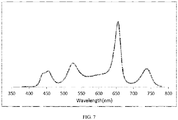
- FIG. 7 is a spectral distribution diagram of the used LED plant growth lamp, where the light intensity was 200 ⁇ mol/m 2 s to 1000 ⁇ mol/m 2 s, the light period was 14 h, the spectral composition was: 25.9% of a light wave of 500-599 nm, 16.2% of a light wave of 700-780 nm, 47.0% of a light wave of 600-699 nm, and 10.9% of 400-499 nm, a peak wavelength was 520 nm in a band of 500-550 nm, and a full-width-at-half-maximum of a peak light wave was 27 nm.
- the cannabis seedlings with the better roots were transplanted into a substrate or a rock wool.
- Four plants are placed within one square meter.
- T 24-26° C
- the lateral branches were grown for two weeks, the lateral branches were topped to obtain more lateral branches.
- reproductive growth is beginning.
- a high pressure sodium (HPS) lamp was used to provide a light source.
- the light intensity was 200 ⁇ mol/m 2 s to 1000 ⁇ mol/m 2 s, the light period was 14 h, and the spectral composition was: 50.0% of a light wave of 500-599 nm, 7.9% of a light wave of 700-780 nm, 37.9% of a light wave of 600-699 nm, and 4.2% of 400-499 nm.
- THC content in cannabis can be increased by 44-52% by the LED plant growth lamp provided by the present invention in comparison with the high pressure sodium lamp (HPS) while other growth conditions and light intensity are the same.
Landscapes
- Physics & Mathematics (AREA)
- Engineering & Computer Science (AREA)
- Spectroscopy & Molecular Physics (AREA)
- Life Sciences & Earth Sciences (AREA)
- General Engineering & Computer Science (AREA)
- Ecology (AREA)
- Environmental Sciences (AREA)
- Forests & Forestry (AREA)
- Botany (AREA)
- Biodiversity & Conservation Biology (AREA)
- Microelectronics & Electronic Packaging (AREA)
- Optics & Photonics (AREA)
- Cultivation Of Plants (AREA)
Abstract
Description
- The present invention relates to a plant growth light, and in particular, to an LED plant growth lamp spectrum.
- Cannabis products have been taken in various forms for thousands of years. The first description of medical use was in the Chinese herbal text of the first century AD. Cannabis products are orally administered in herbal tea blends and are used due to the properties of pain relief and sleep induction. The effective medicinal components of cannabinoid secondary metabolites are mainly tetrahydrocannabinol acid (THCa), cannabidiol acid (CBDa), cannabinol acid (CBNa), cannabichromene acid (CBCa), tetrahydrocannabinol (THC), cannabinol (CBN), cannabidiol (CBD), or cannabichromene (CBC), etc. The high-efficiency medicinal components are THC, CBN, CBC, and CBD. CBD exerts analgesic and anti-inflammatory effects through dual inhibition of cyclooxygenase and lipoxygenase, and has anti-epileptic, anti-psychotic, anti-depressant, analgesic effects, etc. THC can regulate an immune system, eliminate inflammation, stimulate appetite, and has a calming effect. In addition, the THC can be used as a potential drug for the treatment of cancer, and has a broad space for the development and research of its medicinal value. Therefore, a cannabis cultivation technology which obtains a high content of medicinal components has an important application value.
- The ecological factors in indoor cultivation of cannabis, such as light, temperature, humidity and nutrition required for growth are highly stable. Therefore, it is possible to obtain plant raw materials with stable content of medicinal ingredients and stable yield. Moreover, it can be planted multiple times throughout the year without seasonal effect. At present, a high pressure sodium lamp (HPS), a metal halide lamp (MH) and an LED lamp are mainly used to provide a light environment for indoor cultivation of cannabis. Because of the limitations in the spectral design of the HPS and the MH, the achievable spectral energy distribution is limited. Due to the characteristics of narrow spectrum and flexible spectral design, the LED lamp has been widely studied. However, combining LED spectral regulation technology, a solution, which promotes indoor cultivation and growth of cannabis to achieve a better effect of promoting secondary metabolism of cannabis, has not been disclosed.
- In view of the above deficiencies of the prior art, the technical problem to be solved by the present invention is to provide an LED plant growth lamp spectrum, which promotes indoor cultivation and growth of plants, and helps to increase the yield of medicinal components per unit area and per unit time in the factory production.
- A specific technical solution adopted by the present invention is as follows:
An LED plant growth lamp spectrum, including: a light wave of 500-599 nm and a light wave of 700-780 nm, a ratio of the number of photons in the range of 500-599 nm to the number of photons in the range of 700-780 nm being 0.9-1.6:1. - In order to better implement the present invention, a peak wavelength is in the range of 510-526 nm in a band of 500-550 nm.
- In order to better implement the present invention, the spectrum further includes: a light wave of 600-699 nm and a light wave of 400-499 nm.
- In order to better implement the present invention, a full-width-at-half-maximum of a corresponding peak light wave in the band of 500-550 nm is less than 50 nm.
- In order to better implement the present invention, in the spectrum, photons in a band of 500-599 account for 18-26% of all spectral photons.
- In order to better implement the present invention, a ratio of the number of photons in a band of 600-699 nm to the number of photons in a band of 400-499 nm is 3.8-4.8:1.
- Correspondingly, the present invention also provides an LED plant growth lamp, a spectrum of the LED plant growth lamp being proportioned using the above method.
- The present invention also provides use of the above LED plant growth lamp, in particular, use thereof in indoor cannabis cultivation.
- In order to better implement the present invention, during the growth of cannabis, the LED plant growth lamp has a light intensity of 200 µmol/m2s to 1000 µmol/m2s and a light period of not higher than 15 h/d.
- In order to better implement the present invention, a light source is implemented directly by an LED chip or by using the LED chip to excite a phosphor material.
- Compared with the prior art, the present invention has the following beneficial effects:
- 1. The LED plant growth lamp provided by the present invention can replace a high pressure sodium lamp, meets the needs of a growing light environment of cannabis indoor cultivation, and is more energy-saving.
- 2. Compared with the high pressure sodium lamp (HPS), the LED plant growth lamp provided by the present invention can increase the THC content in cannabis by 44-52%.
-
-
FIG. 1 is a spectral distribution diagram of an LED plant growth lamp used in Embodiment 1. -
FIG. 2 is a spectral distribution diagram of an LED plant growth lamp used in Embodiment 2. -
FIG. 3 is a spectral distribution diagram of an LED plant growth lamp used in Embodiment 3. -
FIG. 4 is a spectral distribution diagram of an LED plant growth lamp used in Embodiment 4. -
FIG. 5 is a spectral distribution diagram of an LED plant growth lamp used in Embodiment 5. -
FIG. 6 is a spectral distribution diagram of an LED plant growth lamp used in Embodiment 6. -
FIG. 7 is a spectral distribution diagram of an LED plant growth lamp used in Embodiment 7. - The present invention is further described in detail below with reference to the embodiments, but the implementation of the present invention is not limited thereto. Various alternatives and modifications made according to the ordinary skill and conventional means in the art without departing from the technical spirit of the present invention should be included in the scope of the present invention.
- The cannabis seedlings with the better roots were transplanted into a substrate or a rock wool. Four plants are placed within one square meter. The ambient temperature was set to T=24-26° C and the humidity was T=RH60-70%. When the height of plants was about 20 cm, the plants were topped for promoting the growth of lateral branches. When the lateral branches were grown for two weeks, the lateral branches were topped to obtain more lateral branches. After four weeks, reproductive growth is beginning. During the reproductive phase, an LED plant growth lamp provided by the present invention was used to provide a light source.
FIG. 1 is a spectral distribution diagram of the used LED plant growth lamp, where the light intensity was 200 µmol/m2s to 1000 µmol/m2s, the light period was 14 h, the spectral composition was: 18.2% of a light wave of 500-599 nm, 20.2% of a light wave of 700-780 nm, 50.4% of a light wave of 600-699 nm, and 11.2% of 400-499 nm, a peak wavelength was 510 nm in a band of 500-550 nm, and a full-width-at-half-maximum of a peak light wave was 29 nm. - The cannabis seedlings with the better roots were transplanted into a substrate or a rock wool. Four plants are placed within one square meter. The ambient temperature was set to T=24-26° C and the humidity was T=RH60-70%. When the height of plants was about 20 cm, the plants were topped for promoting the growth of lateral branches. When the lateral branches were grown for two weeks, the lateral branches were topped to obtain more lateral branches. After four weeks, reproductive growth is beginning. During the reproductive phase, an LED plant growth lamp provided by the present invention was used to provide a light source.
FIG. 2 is a spectral distribution diagram of the used LED plant growth lamp, where the light intensity was 200 µmol/m2s to 1000 µmol/m2s, the light period was 14 h, the spectral composition was: 21.7% of a light wave of 500-599 nm, 16.7% of a light wave of 700-780 nm, 49.8% of a light wave of 600-699 nm, and 11.8% of 400-499 nm, a peak wavelength was 515 nm in a band of 500-550 nm, and a full-width-at-half-maximum of a peak light wave was 34 nm. - The cannabis seedlings with the better roots were transplanted into a substrate or a rock wool. Four plants are placed within one square meter. The ambient temperature was set to T=24-26° C and the humidity was T=RH60-70%. When the height of plants was about 20 cm, the plants were topped for promoting the growth of lateral branches. When the lateral branches were grown for two weeks, the lateral branches were topped to obtain more lateral branches. After four weeks, reproductive growth is beginning. During the reproductive phase, an LED plant growth lamp provided by the present invention was used to provide a light source.
FIG. 3 is a spectral distribution diagram of the used LED plant growth lamp, where the light intensity was 200 µmol/m2s to 1000 µmol/m2s, the light period was 14 h, the spectral composition was: 23.6% of a light wave of 500-599 nm, 16.9% of a light wave of 700-780 nm, 49.1% of a light wave of 600-699 nm, and 10.4% of 400-499 nm, a peak wavelength was 519 nm in a band of 500-550 nm, and a full-width-at-half-maximum of a peak light wave was 27 nm. - The cannabis seedlings with the better roots were transplanted into a substrate or a rock wool. Four plants are placed within one square meter. The ambient temperature was set to T=24-26° C and the humidity was T=RH60-70%. When the height of plants was about 20 cm, the plants were topped for promoting the growth of lateral branches. When the lateral branches were grown for two weeks, the lateral branches were topped to obtain more lateral branches. After four weeks, reproductive growth is beginning. During the reproductive phase, an LED plant growth lamp provided by the present invention was used to provide a light source.
FIG. 4 is a spectral distribution diagram of the used LED plant growth lamp, where the light intensity was 200 µmol/m2s to 1000 µmol/m2s, the light period was 14 h, the spectral composition was: 21.2% of a light wave of 500-599 nm, 19.3% of a light wave of 700-780 nm, 47.8% of a light wave of 600-699 nm, and 11.7% of 400-499 nm, a peak wavelength was 523 nm in a band of 500-550 nm, and a full-width-at-half-maximum of a peak light wave was 35 nm. - The cannabis seedlings with the better roots were transplanted into a substrate or a rock wool. Four plants are placed within one square meter. The ambient temperature was set to T=24-26° C and the humidity was T=RH60-70%. When the height of plants was about 20 cm, the plants were topped for promoting the growth of lateral branches. When the lateral branches were grown for two weeks, the lateral branches were topped to obtain more lateral branches. After four weeks, reproductive growth is beginning. During the reproductive phase, an LED plant growth lamp provided by the present invention was used to provide a light source.
FIG. 5 is a spectral distribution diagram of the used LED plant growth lamp, where the light intensity was 200 µmol/m2s to 1000 µmol/m2s, the light period was 14 h, the spectral composition was: 22.6% of a light wave of 500-599 nm, 15.1% of a light wave of 700-780 nm, 49.3% of a light wave of 600-699 nm, and 13.0% of 400-499 nm, a peak wavelength was 526 nm in a band of 500-550 nm, and a full-width-at-half-maximum of a peak light wave was 30 nm. - The cannabis seedlings with the better roots were transplanted into a substrate or a rock wool. Four plants are placed within one square meter. The ambient temperature was set to T=24-26° C and the humidity was T=RH60-70%. When the height of plants was about 20 cm, the plants were topped for promoting the growth of lateral branches. When the lateral branches were grown for two weeks, the lateral branches were topped to obtain more lateral branches. After four weeks, reproductive growth is beginning. During the reproductive phase, an LED plant growth lamp provided by the present invention was used to provide a light source.
FIG. 6 is a spectral distribution diagram of the used LED plant growth lamp, where the light intensity was 200 µmol/m2s to 1000 µmol/m2s, the light period was 14 h, the spectral composition was: 24.7% of a light wave of 500-599 nm, 17.6% of a light wave of 700-780 nm, 47.0% of a light wave of 600-699 nm, and 10.7% of 400-499 nm, a peak wavelength was 520 nm in a band of 500-550 nm, and a full-width-at-half-maximum of a peak light wave was 27 nm. - The cannabis seedlings with the better roots were transplanted into a substrate or a rock wool. Four plants are placed within one square meter. The ambient temperature was set to T=24-26° C and the humidity was T=RH60-70%. When the height of plants was about 20 cm, the plants were topped for promoting the growth of lateral branches. When the lateral branches were grown for two weeks, the lateral branches were topped to obtain more lateral branches. After four weeks, reproductive growth is beginning. During the reproductive phase, an LED plant growth lamp provided by the present invention was used to provide a light source.
FIG. 7 is a spectral distribution diagram of the used LED plant growth lamp, where the light intensity was 200 µmol/m2s to 1000 µmol/m2s, the light period was 14 h, the spectral composition was: 25.9% of a light wave of 500-599 nm, 16.2% of a light wave of 700-780 nm, 47.0% of a light wave of 600-699 nm, and 10.9% of 400-499 nm, a peak wavelength was 520 nm in a band of 500-550 nm, and a full-width-at-half-maximum of a peak light wave was 27 nm. - The cannabis seedlings with the better roots were transplanted into a substrate or a rock wool. Four plants are placed within one square meter. The ambient temperature was set to T=24-26° C and the humidity was T=RH60-70%. When the height of plants was about 20 cm, the plants were topped for promoting the growth of lateral branches. When the lateral branches were grown for two weeks, the lateral branches were topped to obtain more lateral branches. After four weeks, reproductive growth is beginning. During the reproductive phase, a high pressure sodium (HPS) lamp was used to provide a light source. The light intensity was 200 µmol/m2s to 1000 µmol/m2s, the light period was 14 h, and the spectral composition was: 50.0% of a light wave of 500-599 nm, 7.9% of a light wave of 700-780 nm, 37.9% of a light wave of 600-699 nm, and 4.2% of 400-499 nm.
- The content of tetrahydrocannabinol (THC) in cannabis cultivated by the cultivation methods described in Embodiments 1-7 and Comparative Example 1 was measured, and the results are shown in Table 1.
Peak wavelength in interval of 500-550nm (nm) Full-width-at -half-maxim um of correspondin g peak light wave in interval of 500-550 nm (nm) Proportion of light wave of 500-599 nm (%) Ratio of number of photons in range of 500-599 nm to number of photons in range of 700-780 nm Ratio of number of photons of 600-699 nm to number of photons of 400-499 nm THC content (%) Comparative Example - - 50 6.3 9.0 15.8 Embodiment 1 510 29 19.2 0.9 4.5 22.9 Embodiment 2 515 34 21.7 1.3 4.2 23.3 Embodiment 3 519 27 23.6 1.4 4.7 24.0 Embodiment 4 523 35 21.2 1.1 4.1 23.7 Embodiment 5 526 30 22.6 1.5 3.8 23.1 Embodiment 6 520 27 24.7 1.4 4.4 23.8 Embodiment 7 520 27 25.9 1.6 4.3 23.2 - It can be seen from Table 1 that the THC content in cannabis can be increased by 44-52% by the LED plant growth lamp provided by the present invention in comparison with the high pressure sodium lamp (HPS) while other growth conditions and light intensity are the same.
Claims (10)
- An LED plant growth lamp spectrum, comprising: a light wave of 500-599 nm and a light wave of 700-780 nm, a ratio of the number of photons in the range of 500-599 nm to the number of photons in the range of 700-780 nm being 0.9-1.6:1.
- The LED plant growth lamp spectrum according to claim 1, wherein a peak wavelength is in the range of 510-526 nm in a band of 500-550 nm.
- The LED plant growth lamp spectrum according to claim 1, wherein a peak wavelength is in the range of 730-740 nm in a band of 700-750 nm.
- The LED plant growth lamp spectrum according to claim 1, further comprising: a light wave of 600-699 nm and a light wave of 400-499 nm.
- The LED plant growth lamp spectrum according to claim 2, wherein a full-width-at-half-maximum of a corresponding peak light wave in the band of 500-550 nm is less than 50 nm.
- The LED plant growth lamp spectrum according to claim 1, wherein in the spectrum, photons in a band of 500-599 account for 18-26% of all spectral photons.
- The LED plant growth lamp spectrum according to claim 4, wherein a ratio of the number of photons in a band of 600-699 nm to the number of photons in a band of 400-499 nm is 3.8-4.8:1.
- An LED plant growth lamp, a spectrum of the LED plant growth lamp being proportioned using a proportioning method according to any one of claims 1 to 7.
- Use of an LED plant growth lamp according to claim 8, the accumulation of cannabinoid secondary metabolites being promoted in indoor cannabis cultivation.
- The use according to claim 9, wherein during the growth of cannabis, the LED plant growth lamp has a light intensity of 200 µmol/m2s to 1000 µmol/m2s and a light period of not higher than 15 h/d.
Applications Claiming Priority (3)
| Application Number | Priority Date | Filing Date | Title |
|---|---|---|---|
| CN201910117768 | 2019-02-15 | ||
| CN201910281660.4A CN109827089B (en) | 2019-02-15 | 2019-04-09 | LED vegetation lamp spectrum |
| PCT/CN2019/082028 WO2020164179A1 (en) | 2019-02-15 | 2019-04-10 | Led plant growth lamp light spectrum |
Publications (2)
| Publication Number | Publication Date |
|---|---|
| EP3767155A1 true EP3767155A1 (en) | 2021-01-20 |
| EP3767155A4 EP3767155A4 (en) | 2021-12-15 |
Family
ID=66874904
Family Applications (1)
| Application Number | Title | Priority Date | Filing Date |
|---|---|---|---|
| EP19915320.6A Withdrawn EP3767155A4 (en) | 2019-02-15 | 2019-04-10 | LIGHT SPECTRUM OF AN LED PLANT GROWTH LAMP |
Country Status (8)
| Country | Link |
|---|---|
| US (1) | US11206765B2 (en) |
| EP (1) | EP3767155A4 (en) |
| KR (1) | KR20200120654A (en) |
| CN (1) | CN109827089B (en) |
| CA (1) | CA3094842C (en) |
| IL (1) | IL277612A (en) |
| WO (1) | WO2020164179A1 (en) |
| ZA (1) | ZA201907247B (en) |
Cited By (1)
| Publication number | Priority date | Publication date | Assignee | Title |
|---|---|---|---|---|
| EP3881671B1 (en) * | 2019-02-15 | 2023-04-05 | Fujian Sanan Sino-Science Photobiotech Co., Ltd. | Light source for indoor plant cultivation |
Families Citing this family (10)
| Publication number | Priority date | Publication date | Assignee | Title |
|---|---|---|---|---|
| US11032975B2 (en) * | 2019-06-19 | 2021-06-15 | Fujian Sanan Sino-Science Photobiotech Co., Ltd | Light regulation method for promoting accumulation of THC in cannabis plants |
| US12253249B2 (en) * | 2019-08-01 | 2025-03-18 | Schuyler David Milton | Device and method for growing crops with non-fibrous and non-consumable media |
| CN110583380B (en) * | 2019-10-16 | 2024-04-05 | 厦门通秴科技股份有限公司 | Industrial hemp planting method and plant planting lamp |
| CN111642262A (en) * | 2020-06-09 | 2020-09-11 | 福建省中科生物股份有限公司 | Method for controlling plant growth |
| CN112602489B (en) * | 2020-12-30 | 2023-08-11 | 福建省中科生物股份有限公司 | A bimodal blue light that promotes plant growth |
| KR102418254B1 (en) * | 2020-12-30 | 2022-07-06 | 강원대학교산학협력단 | Cultivation method to increase functional substances of hemp(Cannabis sativa) |
| KR102415907B1 (en) * | 2020-12-30 | 2022-07-01 | 강원대학교산학협력단 | Cultivation method to increase cannabidiol(CBD) of hemp(Cannabis sativa) |
| EP4104671A1 (en) * | 2021-06-17 | 2022-12-21 | Crocus Labs GmbH | Controlled environment agriculture method and system for plant cultivation |
| KR102784095B1 (en) * | 2022-12-06 | 2025-03-19 | 주식회사 엔씽 | Hemp cultivation method for high-concentration CBN extraction |
| KR102873928B1 (en) * | 2023-03-06 | 2025-10-28 | 김은희 | Cultivation Method of Hemp with Increased Seed Production and Hemp with Increased Seed Production Cultivated by the Method |
Family Cites Families (22)
| Publication number | Priority date | Publication date | Assignee | Title |
|---|---|---|---|---|
| GB0601602D0 (en) * | 2006-01-26 | 2006-03-08 | Scott Lionel | Plant treatment method and means therefor |
| CN102084793B (en) * | 2009-12-07 | 2012-12-12 | 季军 | LED light spectrum proportioning method for accelerating or controlling plant growth |
| JP6243347B2 (en) * | 2011-12-13 | 2017-12-06 | モンサント テクノロジー エルエルシー | Plant growth promoting microorganisms and uses thereof |
| DK2923561T3 (en) * | 2014-03-28 | 2018-02-12 | Plantui Oy | Method for hydroponic indoor gardening |
| US9844518B2 (en) * | 2014-09-30 | 2017-12-19 | MJAR Holdings, LLC | Methods of growing cannabaceae plants using artificial lighting |
| KR20170139551A (en) * | 2015-03-25 | 2017-12-19 | 비타빔 엘티디. | Method and apparatus for stimulation of plant growth and development with near infrared and visible lights |
| US10143144B2 (en) * | 2015-06-25 | 2018-12-04 | Boulder Lamp, Inc. | Daisy chain grow light |
| US20170035002A1 (en) | 2015-08-09 | 2017-02-09 | Craig Ellins | Apparatus for optimizing and enhancing plant growth, development and performance |
| US20170035008A1 (en) * | 2015-08-09 | 2017-02-09 | Craig Ellins | Method for optimizing and enhancing plant growth, development and performance |
| US10004179B2 (en) * | 2015-09-17 | 2018-06-26 | Boulder Lamp, Inc. | Vertical grow lights with frame mounts |
| KR102374266B1 (en) * | 2015-10-02 | 2022-03-18 | 삼성전자주식회사 | White light emitting module and led lighting apparatus |
| EP3453232A4 (en) * | 2016-05-02 | 2020-07-29 | Growflux Inc. | SYSTEM AND METHOD FOR EXTENDED GARDEN LIGHTING |
| CN107543038A (en) * | 2016-06-24 | 2018-01-05 | 台达电子工业股份有限公司 | Plant growth lighting device |
| US10165735B1 (en) | 2016-06-29 | 2019-01-01 | Full Spectrum Industries Corp. | Dynamic plant lighting systems and methods |
| CN106718183B (en) * | 2016-12-01 | 2021-01-15 | 福建省中科生物股份有限公司 | Water culture seedling culture light environment and seedling culture method for lettuce vegetables |
| CN106665319B (en) * | 2016-12-01 | 2021-01-15 | 福建省中科生物股份有限公司 | Cultivation luminous environment and cultivation method for lettuce vegetables |
| CN106900505B (en) * | 2017-03-03 | 2022-12-06 | 福建省中科生物股份有限公司 | Artificial light environment cultivation method for hemp |
| CN107027221B (en) * | 2017-05-09 | 2024-03-15 | 赛尔富电子有限公司 | A lighting control system for plant LED lamps |
| US10034358B1 (en) | 2017-07-08 | 2018-07-24 | Xiaolai Chen | User controllable grow lighting system, method, and online light settings store |
| CN107535212B (en) * | 2017-10-20 | 2021-02-12 | 福建省中科生物股份有限公司 | Illumination method for improving yield of secondary metabolites of medicinal plants |
| US10602671B2 (en) * | 2018-01-23 | 2020-03-31 | Grow Lites, LLC | Gas-delivery light fixture and method for making and using |
| CN108401874A (en) * | 2018-04-20 | 2018-08-17 | 云南中烟工业有限责任公司 | A kind of tobacco cultivation method based on luminous environment |
-
2019
- 2019-04-09 CN CN201910281660.4A patent/CN109827089B/en active Active
- 2019-04-10 WO PCT/CN2019/082028 patent/WO2020164179A1/en not_active Ceased
- 2019-04-10 CA CA3094842A patent/CA3094842C/en active Active
- 2019-04-10 KR KR1020207024457A patent/KR20200120654A/en not_active Ceased
- 2019-04-10 US US16/604,163 patent/US11206765B2/en active Active
- 2019-04-10 EP EP19915320.6A patent/EP3767155A4/en not_active Withdrawn
- 2019-10-31 ZA ZA2019/07247A patent/ZA201907247B/en unknown
-
2020
- 2020-09-24 IL IL277612A patent/IL277612A/en unknown
Cited By (1)
| Publication number | Priority date | Publication date | Assignee | Title |
|---|---|---|---|---|
| EP3881671B1 (en) * | 2019-02-15 | 2023-04-05 | Fujian Sanan Sino-Science Photobiotech Co., Ltd. | Light source for indoor plant cultivation |
Also Published As
| Publication number | Publication date |
|---|---|
| CA3094842A1 (en) | 2020-08-20 |
| ZA201907247B (en) | 2020-10-28 |
| IL277612A (en) | 2020-11-30 |
| US20210219497A1 (en) | 2021-07-22 |
| EP3767155A4 (en) | 2021-12-15 |
| WO2020164179A1 (en) | 2020-08-20 |
| US11206765B2 (en) | 2021-12-28 |
| KR20200120654A (en) | 2020-10-21 |
| CN109827089A (en) | 2019-05-31 |
| CA3094842C (en) | 2024-04-16 |
| CN109827089B (en) | 2020-09-11 |
| WO2020164179A8 (en) | 2020-09-17 |
Similar Documents
| Publication | Publication Date | Title |
|---|---|---|
| US11206765B2 (en) | LED plant growth lamp spectrum | |
| CA3128063C (en) | Light regulation method for promoting accumulation of secondary metaboilites in cannabis plants | |
| CN107535212B (en) | Illumination method for improving yield of secondary metabolites of medicinal plants | |
| CN110583380B (en) | Industrial hemp planting method and plant planting lamp | |
| CN105145146A (en) | Method for seedling and planting dendrobii officmalis caulis by adopting LED light source | |
| CN115413667B (en) | A preparation for alleviating cadmium stress in corn and its application | |
| CN104719016A (en) | Smilax china L. tuberous root yield and quality improvement method | |
| CN118696731B (en) | Method for improving polygonatum cyrtonema polysaccharide by utilizing LED light source | |
| CN107018782B (en) | A kind of ginseng growth promoting facility cultivation method | |
| CN109721419A (en) | A kind of preparation and method of administration of the dedicated selenium-rich nutritive fertilizer of radix tetrastigme | |
| KR20210060260A (en) | Cosmetic composition containing moringa extract and dracaena extract as active ingredients | |
| CN104058816A (en) | Fertilizer for Bupleurum chinense and application method thereof | |
| CN105248124A (en) | Culture method for improving yield of cistanche and combined fertilizer used for cistanche culture | |
| CN106665302A (en) | Method for improving transplanting survival rate of dendrobium candidum | |
| EP4260682A1 (en) | Lighting method for promoting accumulation of secondary metabolites in chelidonium majus plants | |
| CN107670003A (en) | A kind of protect liver patch | |
| CN107372611A (en) | A kind of composition of medicine and application method of biocontrol of mango powdery mildew | |
| CN107873730A (en) | A kind of special root-growing agent of camphor tree | |
| CN118104494A (en) | A kind of processing method and application of patchouli | |
| CN115176635A (en) | Cultivation control method for secondary tip-pulling of golden camellia adult trees | |
| CN106431693A (en) | Plum flower bud differentiation compound fertilizer formula and preparation and using method thereof | |
| CN106692279A (en) | Poria cocos peel, Artemisia argyi and lavender moxibustion cone |
Legal Events
| Date | Code | Title | Description |
|---|---|---|---|
| STAA | Information on the status of an ep patent application or granted ep patent |
Free format text: STATUS: THE INTERNATIONAL PUBLICATION HAS BEEN MADE |
|
| PUAI | Public reference made under article 153(3) epc to a published international application that has entered the european phase |
Free format text: ORIGINAL CODE: 0009012 |
|
| STAA | Information on the status of an ep patent application or granted ep patent |
Free format text: STATUS: REQUEST FOR EXAMINATION WAS MADE |
|
| 17P | Request for examination filed |
Effective date: 20201016 |
|
| AK | Designated contracting states |
Kind code of ref document: A1 Designated state(s): AL AT BE BG CH CY CZ DE DK EE ES FI FR GB GR HR HU IE IS IT LI LT LU LV MC MK MT NL NO PL PT RO RS SE SI SK SM TR |
|
| AX | Request for extension of the european patent |
Extension state: BA ME |
|
| RIN1 | Information on inventor provided before grant (corrected) |
Inventor name: WANG, ZHI Inventor name: MENG, LINPING Inventor name: CHEN, HENGSHENG Inventor name: NING, QIUSHI Inventor name: MA, JIAN Inventor name: LIU, GUOJIE Inventor name: LI, YANG |
|
| A4 | Supplementary search report drawn up and despatched |
Effective date: 20211116 |
|
| RIC1 | Information provided on ipc code assigned before grant |
Ipc: A01G 7/04 20060101ALI20211110BHEP Ipc: F21K 9/20 20160101AFI20211110BHEP |
|
| DAV | Request for validation of the european patent (deleted) | ||
| DAX | Request for extension of the european patent (deleted) | ||
| STAA | Information on the status of an ep patent application or granted ep patent |
Free format text: STATUS: EXAMINATION IS IN PROGRESS |
|
| 17Q | First examination report despatched |
Effective date: 20240426 |
|
| STAA | Information on the status of an ep patent application or granted ep patent |
Free format text: STATUS: THE APPLICATION IS DEEMED TO BE WITHDRAWN |
|
| 18D | Application deemed to be withdrawn |
Effective date: 20240827 |