EP3752278B1 - Verfahren zur reduktion von biofilm und sporen von membranen - Google Patents
Verfahren zur reduktion von biofilm und sporen von membranen Download PDFInfo
- Publication number
- EP3752278B1 EP3752278B1 EP19707612.8A EP19707612A EP3752278B1 EP 3752278 B1 EP3752278 B1 EP 3752278B1 EP 19707612 A EP19707612 A EP 19707612A EP 3752278 B1 EP3752278 B1 EP 3752278B1
- Authority
- EP
- European Patent Office
- Prior art keywords
- membrane
- acid
- membranes
- solution
- spores
- Prior art date
- Legal status (The legal status is an assumption and is not a legal conclusion. Google has not performed a legal analysis and makes no representation as to the accuracy of the status listed.)
- Active
Links
Images







Classifications
-
- B—PERFORMING OPERATIONS; TRANSPORTING
- B01—PHYSICAL OR CHEMICAL PROCESSES OR APPARATUS IN GENERAL
- B01D—SEPARATION
- B01D65/00—Accessories or auxiliary operations, in general, for separation processes or apparatus using semi-permeable membranes
- B01D65/08—Prevention of membrane fouling or of concentration polarisation
-
- A—HUMAN NECESSITIES
- A61—MEDICAL OR VETERINARY SCIENCE; HYGIENE
- A61L—METHODS OR APPARATUS FOR STERILISING MATERIALS OR OBJECTS IN GENERAL; DISINFECTION, STERILISATION OR DEODORISATION OF AIR; CHEMICAL ASPECTS OF BANDAGES, DRESSINGS, ABSORBENT PADS OR SURGICAL ARTICLES; MATERIALS FOR BANDAGES, DRESSINGS, ABSORBENT PADS OR SURGICAL ARTICLES
- A61L2/00—Methods or apparatus for disinfecting or sterilising materials or objects other than foodstuffs or contact lenses; Accessories therefor
- A61L2/16—Methods or apparatus for disinfecting or sterilising materials or objects other than foodstuffs or contact lenses; Accessories therefor using chemical substances
- A61L2/18—Liquid substances or solutions comprising solids or dissolved gases
- A61L2/186—Peroxide solutions
-
- B—PERFORMING OPERATIONS; TRANSPORTING
- B01—PHYSICAL OR CHEMICAL PROCESSES OR APPARATUS IN GENERAL
- B01D—SEPARATION
- B01D63/00—Apparatus in general for separation processes using semi-permeable membranes
- B01D63/02—Hollow fibre modules
-
- B—PERFORMING OPERATIONS; TRANSPORTING
- B01—PHYSICAL OR CHEMICAL PROCESSES OR APPARATUS IN GENERAL
- B01D—SEPARATION
- B01D63/00—Apparatus in general for separation processes using semi-permeable membranes
- B01D63/10—Spiral-wound membrane modules
-
- B—PERFORMING OPERATIONS; TRANSPORTING
- B01—PHYSICAL OR CHEMICAL PROCESSES OR APPARATUS IN GENERAL
- B01D—SEPARATION
- B01D65/00—Accessories or auxiliary operations, in general, for separation processes or apparatus using semi-permeable membranes
- B01D65/02—Membrane cleaning or sterilisation ; Membrane regeneration
-
- B—PERFORMING OPERATIONS; TRANSPORTING
- B01—PHYSICAL OR CHEMICAL PROCESSES OR APPARATUS IN GENERAL
- B01D—SEPARATION
- B01D65/00—Accessories or auxiliary operations, in general, for separation processes or apparatus using semi-permeable membranes
- B01D65/02—Membrane cleaning or sterilisation ; Membrane regeneration
- B01D65/022—Membrane sterilisation
-
- B—PERFORMING OPERATIONS; TRANSPORTING
- B01—PHYSICAL OR CHEMICAL PROCESSES OR APPARATUS IN GENERAL
- B01D—SEPARATION
- B01D71/00—Semi-permeable membranes for separation processes or apparatus characterised by the material; Manufacturing processes specially adapted therefor
- B01D71/06—Organic material
-
- C—CHEMISTRY; METALLURGY
- C11—ANIMAL OR VEGETABLE OILS, FATS, FATTY SUBSTANCES OR WAXES; FATTY ACIDS THEREFROM; DETERGENTS; CANDLES
- C11D—DETERGENT COMPOSITIONS; USE OF SINGLE SUBSTANCES AS DETERGENTS; SOAP OR SOAP-MAKING; RESIN SOAPS; RECOVERY OF GLYCEROL
- C11D3/00—Other compounding ingredients of detergent compositions covered in group C11D1/00
- C11D3/02—Inorganic compounds ; Elemental compounds
- C11D3/04—Water-soluble compounds
- C11D3/042—Acids
-
- C—CHEMISTRY; METALLURGY
- C11—ANIMAL OR VEGETABLE OILS, FATS, FATTY SUBSTANCES OR WAXES; FATTY ACIDS THEREFROM; DETERGENTS; CANDLES
- C11D—DETERGENT COMPOSITIONS; USE OF SINGLE SUBSTANCES AS DETERGENTS; SOAP OR SOAP-MAKING; RESIN SOAPS; RECOVERY OF GLYCEROL
- C11D3/00—Other compounding ingredients of detergent compositions covered in group C11D1/00
- C11D3/16—Organic compounds
- C11D3/20—Organic compounds containing oxygen
-
- C—CHEMISTRY; METALLURGY
- C11—ANIMAL OR VEGETABLE OILS, FATS, FATTY SUBSTANCES OR WAXES; FATTY ACIDS THEREFROM; DETERGENTS; CANDLES
- C11D—DETERGENT COMPOSITIONS; USE OF SINGLE SUBSTANCES AS DETERGENTS; SOAP OR SOAP-MAKING; RESIN SOAPS; RECOVERY OF GLYCEROL
- C11D3/00—Other compounding ingredients of detergent compositions covered in group C11D1/00
- C11D3/48—Medical, disinfecting agents, disinfecting, antibacterial, germicidal or antimicrobial compositions
-
- C—CHEMISTRY; METALLURGY
- C11—ANIMAL OR VEGETABLE OILS, FATS, FATTY SUBSTANCES OR WAXES; FATTY ACIDS THEREFROM; DETERGENTS; CANDLES
- C11D—DETERGENT COMPOSITIONS; USE OF SINGLE SUBSTANCES AS DETERGENTS; SOAP OR SOAP-MAKING; RESIN SOAPS; RECOVERY OF GLYCEROL
- C11D7/00—Compositions of detergents based essentially on non-surface-active compounds
- C11D7/22—Organic compounds
- C11D7/26—Organic compounds containing oxygen
- C11D7/265—Carboxylic acids or salts thereof
-
- A—HUMAN NECESSITIES
- A61—MEDICAL OR VETERINARY SCIENCE; HYGIENE
- A61L—METHODS OR APPARATUS FOR STERILISING MATERIALS OR OBJECTS IN GENERAL; DISINFECTION, STERILISATION OR DEODORISATION OF AIR; CHEMICAL ASPECTS OF BANDAGES, DRESSINGS, ABSORBENT PADS OR SURGICAL ARTICLES; MATERIALS FOR BANDAGES, DRESSINGS, ABSORBENT PADS OR SURGICAL ARTICLES
- A61L2202/00—Aspects relating to methods or apparatus for disinfecting or sterilising materials or objects
- A61L2202/10—Apparatus features
- A61L2202/17—Combination with washing or cleaning means
-
- B—PERFORMING OPERATIONS; TRANSPORTING
- B01—PHYSICAL OR CHEMICAL PROCESSES OR APPARATUS IN GENERAL
- B01D—SEPARATION
- B01D2321/00—Details relating to membrane cleaning, regeneration, sterilization or to the prevention of fouling
- B01D2321/16—Use of chemical agents
- B01D2321/162—Use of acids
-
- B—PERFORMING OPERATIONS; TRANSPORTING
- B01—PHYSICAL OR CHEMICAL PROCESSES OR APPARATUS IN GENERAL
- B01D—SEPARATION
- B01D2321/00—Details relating to membrane cleaning, regeneration, sterilization or to the prevention of fouling
- B01D2321/16—Use of chemical agents
- B01D2321/167—Use of scale inhibitors
-
- B—PERFORMING OPERATIONS; TRANSPORTING
- B01—PHYSICAL OR CHEMICAL PROCESSES OR APPARATUS IN GENERAL
- B01D—SEPARATION
- B01D2321/00—Details relating to membrane cleaning, regeneration, sterilization or to the prevention of fouling
- B01D2321/16—Use of chemical agents
- B01D2321/168—Use of other chemical agents
-
- B—PERFORMING OPERATIONS; TRANSPORTING
- B01—PHYSICAL OR CHEMICAL PROCESSES OR APPARATUS IN GENERAL
- B01D—SEPARATION
- B01D2321/00—Details relating to membrane cleaning, regeneration, sterilization or to the prevention of fouling
- B01D2321/28—Details relating to membrane cleaning, regeneration, sterilization or to the prevention of fouling by soaking or impregnating
-
- B—PERFORMING OPERATIONS; TRANSPORTING
- B01—PHYSICAL OR CHEMICAL PROCESSES OR APPARATUS IN GENERAL
- B01D—SEPARATION
- B01D2321/00—Details relating to membrane cleaning, regeneration, sterilization or to the prevention of fouling
- B01D2321/32—By heating or pyrolysis
-
- B—PERFORMING OPERATIONS; TRANSPORTING
- B01—PHYSICAL OR CHEMICAL PROCESSES OR APPARATUS IN GENERAL
- B01D—SEPARATION
- B01D61/00—Processes of separation using semi-permeable membranes, e.g. dialysis, osmosis or ultrafiltration; Apparatus, accessories or auxiliary operations specially adapted therefor
- B01D61/02—Reverse osmosis; Hyperfiltration ; Nanofiltration
-
- B—PERFORMING OPERATIONS; TRANSPORTING
- B01—PHYSICAL OR CHEMICAL PROCESSES OR APPARATUS IN GENERAL
- B01D—SEPARATION
- B01D61/00—Processes of separation using semi-permeable membranes, e.g. dialysis, osmosis or ultrafiltration; Apparatus, accessories or auxiliary operations specially adapted therefor
- B01D61/14—Ultrafiltration; Microfiltration
- B01D61/145—Ultrafiltration
-
- C—CHEMISTRY; METALLURGY
- C02—TREATMENT OF WATER, WASTE WATER, SEWAGE, OR SLUDGE
- C02F—TREATMENT OF WATER, WASTE WATER, SEWAGE, OR SLUDGE
- C02F1/00—Treatment of water, waste water, or sewage
- C02F1/44—Treatment of water, waste water, or sewage by dialysis, osmosis or reverse osmosis
-
- C—CHEMISTRY; METALLURGY
- C02—TREATMENT OF WATER, WASTE WATER, SEWAGE, OR SLUDGE
- C02F—TREATMENT OF WATER, WASTE WATER, SEWAGE, OR SLUDGE
- C02F1/00—Treatment of water, waste water, or sewage
- C02F1/72—Treatment of water, waste water, or sewage by oxidation
- C02F1/722—Oxidation by peroxides
-
- C—CHEMISTRY; METALLURGY
- C02—TREATMENT OF WATER, WASTE WATER, SEWAGE, OR SLUDGE
- C02F—TREATMENT OF WATER, WASTE WATER, SEWAGE, OR SLUDGE
- C02F2303/00—Specific treatment goals
- C02F2303/16—Regeneration of sorbents, filters
-
- C—CHEMISTRY; METALLURGY
- C02—TREATMENT OF WATER, WASTE WATER, SEWAGE, OR SLUDGE
- C02F—TREATMENT OF WATER, WASTE WATER, SEWAGE, OR SLUDGE
- C02F2303/00—Specific treatment goals
- C02F2303/20—Prevention of biofouling
-
- C—CHEMISTRY; METALLURGY
- C02—TREATMENT OF WATER, WASTE WATER, SEWAGE, OR SLUDGE
- C02F—TREATMENT OF WATER, WASTE WATER, SEWAGE, OR SLUDGE
- C02F2305/00—Use of specific compounds during water treatment
- C02F2305/04—Surfactants, used as part of a formulation or alone
-
- C—CHEMISTRY; METALLURGY
- C02—TREATMENT OF WATER, WASTE WATER, SEWAGE, OR SLUDGE
- C02F—TREATMENT OF WATER, WASTE WATER, SEWAGE, OR SLUDGE
- C02F5/00—Softening water; Preventing scale; Adding scale preventatives or scale removers to water, e.g. adding sequestering agents
- C02F5/08—Treatment of water with complexing chemicals or other solubilising agents for softening, scale prevention or scale removal, e.g. adding sequestering agents
- C02F5/10—Treatment of water with complexing chemicals or other solubilising agents for softening, scale prevention or scale removal, e.g. adding sequestering agents using organic substances
-
- C—CHEMISTRY; METALLURGY
- C11—ANIMAL OR VEGETABLE OILS, FATS, FATTY SUBSTANCES OR WAXES; FATTY ACIDS THEREFROM; DETERGENTS; CANDLES
- C11D—DETERGENT COMPOSITIONS; USE OF SINGLE SUBSTANCES AS DETERGENTS; SOAP OR SOAP-MAKING; RESIN SOAPS; RECOVERY OF GLYCEROL
- C11D2111/00—Cleaning compositions characterised by the objects to be cleaned; Cleaning compositions characterised by non-standard cleaning or washing processes
- C11D2111/10—Objects to be cleaned
- C11D2111/14—Hard surfaces
Definitions
- the present disclosure relates generally to methods for reducing and removing and reducing bacterial spores and biofilms. More particularly, the present disclosure relates to methods for treating membranes
- Membranes are used in separation processes or systems to filter or fractionate components in liquids.
- Various technologies utilize membranes, including those membranes used in the food and beverage industries.
- the membranes that can be treated according to the invention include those membranes that are designed for periodic cleaning, and are often utilized in various applications requiring separation by filtration.
- Exemplary industries that utilize membranes that can be treated according to the invention include the food industry, the beverage industry, the biotechnology industry, the pharmaceutical industry, the chemical industry, and the water purification industry.
- products including water, milk, whey, fruit juice, beer, and wine are often processed through a membrane for separation.
- the water purification industry often relies upon membranes for desalination, contaminant removal, and waste water treatment.
- Membranes that can be treated according to the invention include those provided in the form of spiral wound membranes, plate and frame membranes, tubular membranes, capillary membranes, hollow fiber membranes, ceramic membranes, and the like.
- the membranes can be generally characterized according to the size of the particles being filtered.
- Four common types of membrane types include microfiltration (MF) membranes, ultrafiltration (UF) membranes, nanofiltration (NF) membranes, and reverse osmosis (RO) membranes.
- MF microfiltration
- UF ultrafiltration
- NF nanofiltration
- RO reverse osmosis
- Microfiltration membranes can separate the largest macro molecules of proteins, separation of viruses, bacteria, and other microorganisms in the manufacture of artificial proteins, filtration of beer or wine, separation of various suspended substances, and removal of various kinds of turbidity.
- Ultrafiltration membranes have pore sizes within the range of about 0.02 ⁇ m to 0.1 ⁇ m and provide for separation of macro molecular substances with relative molecular mass within the range of about 1 kDa to about 1,000 kDa.
- An approximate theoretical size of a pore in nanofiltration membranes is about 0.02 ⁇ m or less for separation of polyvalent ions. In reverse osmosis, the pore size is theoretically about 0.002 ⁇ m or less and can remove a vast majority of monovalent ion substances from water.
- Microfiltration membrane systems generally operate at pressures less than about 30 psig.
- Ultrafiltration membrane systems generally operate at pressures of about 15-150 psig.
- Nanofiltration membrane systems generally operate at pressures of about 75-500 psig.
- Membranes can be formed from a variety of materials that are commonly used to form membranes including cellulose acetate, polyamide, polysulfone, vinylidene fluoride, acrylonitrile, stainless steel, ceramic, etc. These various membrane chemical types and other materials of construction may have specific pH, oxidant, solvent, chemical compatibility restrictions, and/or pressure limitations.
- a disadvantage in the use of membranes is that during operation, the membranes gradually become fouled.
- biofilm growth, spores, organic deposits, and mineral deposits on membranes including reverse osmosis membranes, nanofiltration membranes, ultrafiltration membranes, and microfiltration membranes, can have detrimental results.
- Such biofilm growth, spores, organic deposits, and mineral deposits can cause severe flux declines, increased pressure, reduced production, can negatively impact the quality of finished goods, and often result in premature replacement of such membranes.
- Endospores are dormant, tough, non-reproductive structures produced by particular species of bacteria in the Firmicute phylum. Endospores, or spores, are produced when bacterial cells in their vegetative state are exposed to stress or lack of nutrients. Endospores have a very low metabolic rate and therefore cannot be detected by methods typically employed to rapidly detect vegetative bacterial cells. Further, spores are extremely difficult to kill because they are designed to survive harsh conditions such as UV, heat, disinfectants, desiccation, and starvation. Upon exposure to favorable conditions and nutrients, the spores germinate to produce vegetative cells.
- Spore-producing bacteria are problematic because they cause illness in humans and animals, spoilage in food and beverages, and promote the perpetuation of biofilms. Spore-producing bacterial strains that are of particular concern are those in the Bacillus and Clostridium genera. Both are gram-positive, rod-shaped bacteria that include species that are harmful to humans. B. anthracis produces anthrax toxin and B. cereus causes food poisoning. C . botulinum causes botulism (also known as Botox), C . difficile causes diarrhea, C. perfringens causes food poisoning, and C . tetani causes tetanus. Bacillus, Paenibacillus, and Brevibacillus bacteria can cause problems in food packaging board products. Bacillus cereus is one of the most problematic bacteria because it has been identified as possessing increased resistance to germicidal chemicals used to decontaminate environmental surfaces.
- Bacillus cereus is frequently diagnosed as a cause of gastrointestinal disorders and has been suggested to be the cause of several food-borne illness outbreaks. Due to its rapid sporulating capacity, B. cereus easily survives in the environment. This bacterium can contaminate food directly and indirectly. B. cereus can contaminate raw milk directly via feces and soil, and can survive intestinal passage in cows and the pasteurization process. Indirect contamination can come from the presence of B. cereus spores in liquid and food packaging. Spores present in materials that come into direct contact with food can cause migration of spores into the food, resulting in spoilage.
- Filtration membranes have a tendency to foul during processing. Fouling manifests itself as a decline in flux with time of operation. Flux decline should occur when all operating parameters, such as pressure, flow rate, temperature, and feed concentration are kept constant.
- Biofouling and the formation of bacterial biofilms are problematic in industrial systems where microorganisms are in liquids. Formation of biofilms can play a role in microbiologically-influenced corrosion. Chemical biocides are typically employed to control biofouling by killing the microorganisms forming the films. However, biocides have difficulty penetrating the extracellular polymeric material in biofilms and removing them from surfaces.
- US 2017/173642 A1 discloses peroxyformic acid compositions for removal of biofilm growth and mineral deposits on membranes.
- peroxyformic acid compositions are generated in situ or on site generation for the reduction and prevention, of biofilms and the mitigation of mineral buildup on the membranes.
- the compositions are described to be compatible with the membranes under application of use conditions.
- US 2009/200234 A1 discloses methods for cleaning surfaces that are sensitive to high temperatures and/or that have pH limitations.
- Exemplary surfaces to be cleaned using the described methods include membranes.
- the methods include applying an active oxygen use solution including an active oxygen source to the surface.
- An activator complex and an alkaline override use solution are applied to the surface, either in combination, or in a stepwise manner, before, after or simultaneously with the active oxygen use solution.
- the present invention relates to a method of cleaning and sanitizing a membrane element within a membrane system according to claim 1.
- the method comprises: circulating a cleaning solution through the membrane system for 2 to 30 minutes at a temperature of 21°C to 52°C, the cleaning solution comprising 0.1 wt.% to 1 wt.% organic acid and 0.01 to 0.1 wt.% anionic surfactant, wherein the organic acid comprises a combination of citric acid, and lactic acid; adding a sanitizing solution to the cleaning solution to produce a boosted antimicrobial solution, the sanitizing solution comprising 0.02 wt.% to 0.15 wt.% percarboxylic acid oxidant; and circulating the boosted antimicrobial solution through the membrane system for an additional 1 to 20 minutes at a temperature of 21°C to 52°C.
- actives or “percent actives” or “percent by weight actives” or “actives concentration” are used interchangeably herein and refers to the concentration of those ingredients involved in cleaning expressed as a percentage minus inert ingredients such as water or salts.
- weight percent refers to the concentration of a substance as the weight of that substance divided by the total weight of the composition and multiplied by 100. It is understood that, as used here, “percent,” “%,” and the like are intended to be synonymous with “weight percent,” “wt-%,” etc.
- ppm refers to parts per million.
- Microorganism(s) means any organism small enough to insinuate itself within, adjacent to, on top of, or attached to a membrane.
- the definition includes but is not limited to those organisms so small that they cannot be seen without the aid of a microscope, collections or colonies of such small organisms that can be seen by the naked eye but which comprise a number of individual organisms that are too small to be seen by the naked eye, as well as one or more organisms that can be seen by the naked eye.
- the definition also includes but is not limited to any organism whose presence, in some way impairs the operation of a membrane; noncellular or unicellular (including colonial) organisms; all prokaryotes (and certain eukaryotes); and bacteria (including cyanobacteria), spores, lichens, fungi, protozoa, virinos, viroids, viruses, phages, and some algae.
- microbe is synonymous with microorganism.
- cleaning refers to a method used to facilitate or aid in soil removal, bleaching, microbial population reduction, and any combination thereof.
- the term "disinfectant” refers to an agent that kills all vegetative cells including most recognized pathogenic microorganisms.
- GRAS general recognized as safe
- components classified by the Food and Drug Administration as safe for direct human food consumption or as an ingredient based upon current good manufacturing practice conditions of use, as defined for example in 21 C.F.R. Chapter 1, ⁇ 170.38 and/or 570.38.
- sanitizer refers to an agent that reduces the number of bacterial contaminants to safe levels as judged by public health requirements.
- sanitizers for use in this invention will provide at least a 3 log reduction and more preferably a 5-log order reduction.
- the term "sporicide” refers to a physical or chemical agent or process having the ability to cause greater than a 90% reduction (1-log order reduction) in the population of spores of Bacillus cereus or Bacillus subtilis within 10 seconds at 60° C.
- the sporicidal compositions of the invention provide greater than a 99% reduction (2-log order reduction), greater than a 99.99% reduction (4-log order reduction), or greater than a 99.999% reduction (5-log order reduction) in such population within 10 seconds at 60° C.
- Antimicrobial compositions can affect two kinds of microbial cell damage. The first is a lethal, irreversible action resulting in complete microbial cell destruction or incapacitation. The second type of cell damage is reversible, such that if the organism is rendered free of the agent, it can again multiply.
- the former is termed microbiocidal and the later, microbiostatic.
- a sanitizer and a disinfectant are, by definition, agents which provide antimicrobial or microbiocidal activity.
- a preservative is generally described as an inhibitor or microbiostatic composition.
- the present disclosure relates to compositions and methods for removing and reducing bacterial spores and biofilm formation on membrane surfaces.
- a combination treatment of an acid cleaner and an oxidizer sanitizer are applied to membranes to remove bacterial spores and biofilms.
- the treatment can be applied in a clean-in-place (CIP) process or as part of a soaking
- CIP clean-in-place
- the claimed method is a clean-in-place method.
- the methods are applied to membranes used in the food industry, the beverage industry, the biotechnology industry, the pharmaceutical industry, the chemical industry, and the water purification industry. In the case of the food and beverage industries, the methods can be used on membranes as part of the production of water, milk, whey, fruit juice, beer, and wine.
- the membranes can include microfiltration (MF) membranes, ultrafiltration (UF) membranes, nanofiltration (NF) membranes, and reverse osmosis (RO) membranes.
- the membranes may be polymeric, ceramic, or stainless steel.
- the membrane is configured as a spiral wound membrane, hollow fiber membrane, tubular membrane, or a plate and frame flat sheet membrane.
- Membranes are utilized for a variety of separation methods to convert a mixture of a substance(s) into distinct mixtures, at least one of which is enriched in one or more of the mixture's constituents.
- the membranes that can be treated according to the invention include any membranes that are designed for periodic cleaning, and are often utilized in various applications requiring separation by filtration.
- the present disclosure describes a combination of cleaning solutions that are utilized to clean and sanitize membranes.
- the removing of microorganisms, biofilm and mineral deposits refers to the reduction in microorganisms, biofilm and mineral deposits on a membrane surface, the disbursement of microorganisms, biofilm and mineral deposits on a membrane surface, and/or the inactivating of microorganisms, biofilm and mineral deposits on a membrane surface.
- the present disclosure describes the use of a two-part cleaning system that synergistically removes and reduces bacterial spores and biofilms from membranes without significant negative impact to the performance or integrity of the membranes.
- the cleaning system also aids in de-scaling of the membranes.
- the two-part cleaning system utilizes an acid cleaning solution and an oxidizer sanitizing solution. The two parts of the system are applied to the membrane sequentially.
- the acid cleaning solution includes at least two organic acids and an anionic surfactant.
- the oxidizer sanitizing solution includes at least a peracid.
- An anionic surfactant is included in the acid cleaning solution.
- the surfactant improves the surface activity of the cleaning solution on the membrane surface.
- the anionic surfactant can also help prevent or reduce corrosion of the acid cleaning system on the membrane system.
- Anionic surfactants are surface active substances having a negative charge on the hydrophobe or have a hydrophobic section that carries no charge unless the pH is elevated to neutrality or above (e.g. carboxylic acids).
- Carboxylate, sulfonate, sulfate, and phosphate are the polar (hydrophilic) solubilizing groups found in anionic surfactants.
- Anionic surfactants useful in the acid cleaning solution include alkyl sulfates, alkyl sulfonates, alkane sulfonates, linear and branched primary and secondary alkyl sulfonates, the aromatic sulfonates with or without substituents, linear alkyl benzene or naphthalene sulfonates, secondary alkane sulfonates, alkyl ether sulfates or sulfonates, alkyl phosphates or phosphonates, and mixtures thereof.
- Specific examples include sodium alkane sulfonate, alpha olefin sulfonate, sodium lignosulfonate, sodium lauryl ether sulfate, sodium lauryl sulfate, sodium dioctyl sulfosuccinate, sodium dodecyl benzene sulfonic acid, sodium xylene sulfonate, sulfonated diphenyl oxide surfactants sold under the tradename DOWFAX including DOWFAX C6L, 3B2, 8390, and 2A1, capryleth-9 carboxylic acid/hexeth-4 carboxylic acid (such as AKYPO LF4), sodium methyl 2-sulfolaurate (such as ALPHASTEP PC48), sarcosinates, and mixtures thereof.
- DOWFAX including DOWFAX C6L, 3B2, 8390, and 2A1
- the anionic surfactant comprises a linear alkyl sulfonate, dodecyl benzene sulfonic acid (DDBSA), sodium xylene sulfonate, or a combination thereof.
- DBSA dodecyl benzene sulfonic acid
- sodium xylene sulfonate or a combination thereof.
- the acid cleaning solution includes at least two organic acids.
- Suitable organic acids include methane sulfonic acid, ethane sulfonic acid, propane sulfonic acid, butane sulfonic acid, xylene sulfonic acid, benzene sulfonic acid, formic acid, acetic acid, picolinic acid, dipicolinic acid, citric acid, lactic acid, formic acid, acetic acid, propionic acid, butyric acid, valeric acid, caproic acid, gluconic acid, itaconic acid, trichloroacetic acid, benzoic acid and mixtures thereof.
- the organic acids are selected from citric acid, lactic acid, formic acid, and methyl sulfonic acid.
- the organic acids include a combination of citric acid and lactic acid.
- the pH of the acid cleaning solution in a concentrate is preferably about 0 to about 3.
- the pH of the acid cleaning composition in a use solution is preferably about 1 to about 3.
- a use solution pH below 1.8 can be detrimental to the membrane integrity and performance.
- the oxidizer sanitizing solution includes a peracid (peroxycarboxylic acid).
- the oxidizer is a combination of oxidizing agent, carboxylic acid, and stabilizer, which produces a peroxycarboxylic acid.
- oxidizing agents can be used for generating peroxycarboxylic acids.
- Suitable oxidizing agents include inorganic and organic peroxides, such as, salts of perborate, percarbonate, and persulfate, percarbonic acid, and ozone.
- the oxidizing agent is hydrogen peroxide.
- Suitable peracids or peroxycarboxylic acids include peroxyacetic acid, peroxyoctanoic acid, peroxyformic acid, peroxypropionic acid, peroxybutyric acid, peroxyvaleric acid, peroxyhexanoic acid, peroxyheptanoic acid, peroxynonanoic acid, peroxydecanoic acid, and mixtures thereof.
- the peracid is peroxyacetic acid.
- the oxidizer sanitizing solution includes a stabilizer.
- Stabilizers particularly those suitable for stabilizing peroxygen compounds or peroxycarboxylic acids, include organic chelating compounds that sequester metal ions in solution, particularly most transition metal ions, which would promote decomposition of any peroxygen compounds therein.
- Typical complexing agents include organic amino- or hydroxy-polyphosphonic acid complexing agents (either in acid or soluble salt forms), carboxylic acids, hydroxycarboxylic acids, aminocarboxylic acids, or magnesium or tin compounds (e.g., tin oxalate).
- Chelating agents or sequestrants generally useful as stabilizers in the present compositions include salts or acids of (expressed in acid form) dipicolinic acid, picolinic acid, gluconic acid, quinolinic acid, and alkyl diamine polyacetic acid-type chelating agents such as ethylenediamine tetraacetic acid (EDTA), hydroxyethylethylethylene diamine triacetic acid (HEDTA), and ethylene triaminepentaacetic acid, acrylic and polyacrylic acid-type stabilizing agents, phosphonic acid, and phosphonate-type chelating agents among others.
- EDTA ethylenediamine tetraacetic acid
- HEDTA hydroxyethylethylethylene diamine triacetic acid
- acrylic and polyacrylic acid-type stabilizing agents phosphonic acid, and phosphonate-type chelating agents among others.
- Preferable sequestrants include phosphonic acids and phosphonate salts including 1-hydroxy ethylidene-1,1-diphosphonic acid (CH 3 C(PO 3 H 2 ) 2 OH)(HEDP); ethylenediamine tetrakis methylenephosphonic acid (EDTMP); diethylenetriamine pentakis methylenephosphonic acid (DTPMP); cyclohexane-1,2-tetramethylene phosphonic acid; amino[tri(methylene phosphonic acid)]; (ethylene diamine[tetra methylene-phosphonic acid)]; 2-phosphene butane-1,2,4-tricarboxylic acid; as well as the alkyl metal salts, ammonium salts, or alkyloyl amine salts, such as mono, di, or tetra-ethanolamine salts.
- the stabilizer is HEDP.
- a coupler or hydrotrope, is included in the oxidizer sanitizing solution.
- the coupler is sodium xylene sulfonate.
- the cleaning or antimicrobial compositions do not include materials that may be detrimental to membrane surfaces.
- the cleaning or antimicrobial compositions are free or substantially free of surfactants other than anionic surfactants. Membrane surfaces are often negatively charged and including a cationic or nonionic surfactant can have negative reactions with the membrane surface.
- the cleaning or antimicrobial compositions are free or substantially free of oxidizers other than peracids, hydrogen peroxide, or ozone.
- the cleaning or antimicrobial compositions are free or substantially free of chlorine. Chlorine and other oxidizers may negatively affect the integrity or performance of the membrane.
- the cleaning or antimicrobial compositions are free or substantially free of inorganic acids. Again, inorganic acids may negatively affect the integrity or performance of the membrane.
- Tables 1 and 2 below show exemplary concentration ranges for the various components in a concentrate and use solution composition.
- TABLE 1 Exemplary Formulations of Concentrate Components Component Concentration (wt-%) Concentration (wt-%) Concentration (wt-%) Acid Cleaner Organic Acid about 10-about 40 about 15-about 25 about 18- about 22 Anionic Surfactant about 1- about 10 about 3- about 7 about 4- about 6 Water about 50-about 90 about 60-about 80 about 65- about 75 Coupler about 0- about 20 about 1- about 15 about 6- about 10 Oxidizer Sanitizer Acid about 5- about 25 about 8- about 15 about 10- about 12 Oxidant about 75-about 90 about 80-about 88 about 82- about 86 Stabilizer about 0.5-about 2.5 about 1- about 2 about 1.5- about 1.7 Water about 1- about 10 about 2- about 5 about 2.5- about 3 TABLE 2: Exemplary Formulations of Use Components Component Concentration (wt-%) Concentration (wt-%) Concentration (wt-%) Acid Cleaner Organic Acid about 0.05-about 1
- a combination of an acid cleaning solution and an oxidizer sanitizing solution are used to synergistically clean and sanitize membranes that are prone to biofilm formation and contamination with bacterial spores.
- the acid cleaning solution is first applied to a membrane to clean the membrane.
- the oxidizer sanitizing solution is then combined with the acid cleaning solution to produce a boosted antimicrobial solution.
- This boosted solution is then circulated in the membrane to sanitize the membrane.
- the pressure of the membrane system can be modified to increase or decrease the permeation rate of this combination cleaning solution if there are cleaning issues on the permeate side of a membrane system.
- an acid cleaning solution and an oxidizer sanitizing solution are combined before application to membranes.
- the acid cleaning solution and oxidizer sanitizing solution combine to form a boosted antimicrobial solution that is packaged for use in a single step.
- the method of the invention is a clean-in-place method applied to a membrane filtration system wherein the acid cleaning solution and oxidizer sanitizing solution are circulated through the membrane filtration system.
- the cleaning solution is circulated through a membrane system for 2 to 30 minutes, or 2 to about 15 minutes.
- a sanitizing solution is added to the cleaning solution to produce a boosted antimicrobial solution, where the sanitizing solution comprises an oxidizer.
- the antimicrobial solution is circulated through the membrane system for 1 to 20 minutes, 1 to about 10 minutes or about 5 to about 10 minutes.
- the method results in at least a 1 log, at least a 2 log, or at least a 3 log reduction of bacterial spores on the membrane.
- the method results in at least a 1 log, at least a 2 log, or at least a 3 log reduction of a biofilm, biofoulant, and/or slime forming bacteria.
- the cleaning solution and antimicrobial solution are circulated in the membrane system at a temperature of (21°C) 70°F to 125°F (52°C).
- the methods and compositions described above provide a surprisingly synergistic effect over prior membrane treatments.
- the combination of organic acids, anionic surfactant, and peracid results in improved chemical compatibility with the membrane as compared to peracid alone.
- Use of CIP treatments that exhibit good chemical compatibility with membranes result in membranes that remain viable for longer periods of time despite exposure to cleaning compositions.
- Chemical compatibility of membranes are assessed by determining the membrane rejection rates. Rejection rates of membranes indicate how well the membrane is performing to filter a particular substance. For UF membranes, a high rejection rate indicates that the membrane is filtering protein effectively. Low rejection rates for UF membranes indicate that the membrane has been compromised and is no longer effectively filtering out proteins from solution. In the case of RO membranes, high rejection rates indicate that the membrane is filtering salt properly, while low rejection rates indicate that the membrane is not filtering salt properly.
- the methods are effective for removing not only bacterial spores and biofilms, but for descaling mineral deposits on membranes.
- the acid cleaning solution includes formic acid and methyl sulfonic acid in addition to an anionic surfactant are more effective at removing mineral deposits from membranes.
- Acid Cleaner A (AC-A) Wt-% Description Function 75 Water Solvent 10 Citric Acid (Anhydrous) Acidulant 10 Lactic Acid, 88% Acidulant 5 Dodecyl Benzene Sulfonic Acid (DBSA), 96% Surfactant
- Acid Cleaner B (AC-B) Wt-% Description Function 67.82 Water Solvent 14.67 Methyl Sulfonic Acid Acidulant 5 Formic Acid, 85% Acidulant 8.4 Sodium Xylene Sulfonate (SXS), 40% Coupler 4.11 Dodecyl Benzene Sulfonic Acid (DBSA), 96% Surfactant TABLE 5: Oxidizer A (O-A) Wt-% Description Function 84.3 Hydrogen peroxide 35% Peracid Grade DRM Antimicrobial 1.6 Hydroxyethylidene Diphosphonic acid, 60%, Peracid gr.
- the bacterial samples were combined with dilutions of each cleaning solution.
- the formulas in Tables 3-5 were diluted to 1% solutions and the formula in Table 6 was diluted to a 0.25% solution.
- the samples were then neutralized to stop the chemical process.
- the samples were plated onto microbiological media to incubate and count for survivors. The samples were incubated at 50°C for 2, 5, or 10 minutes.
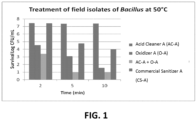
- FIG. 1 The survival log of Bacillus sp. is graphed in CFU/mL against time (minutes).
- the results show that Acid Cleaner A (AC-A) is not as effective as the Commercial Sanitizer A (CS-A) for reducing bacterial survival.
- Oxidizer A (O-A) showed improved efficacy over CS-A.
- a combination of O-A with AC-A resulted in even better antimicrobial efficacy with only a 1 CFU/mL survival rate after 10 minutes.
- spore isolates were diluted with sterile distilled water to produce a solution having a final concentration of 10 4 CFU/mL of mixture of Bacillus spore field isolates.
- 6 ultrafiltration (UF) polyethersulfone (PES) membranes (Spirapro, KOCH, Wilmington, MA) were soaked in the 10 4 CFU/mL spore solution for 24 hours. The membranes were rinsed using the dipping method and were placed into individual sterile centrifuge tubes. A combination treatment of AC-A and O-A was applied at 2500 ppm to two of the membranes in the tubes for 5 minutes.
- CS-A was applied at 2600 ppm to two of the membranes for 5 minutes as a comparison.
- Deionized water (DI) was used as a control on two membranes. Some membranes were stored wet in a preservative solution and others were tested dry.
- Example formulas were tested against Bacillus sp. spores.
- the samples were exposed to the example formulas for 2, 5, or 10 minutes at (50°C) 122°F.
- the suspension method described above in Example 1 was utilized. Samples were observed to determine the amount of time required to achieve a log reduction in organisms.
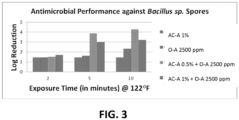
- FIG. 3 illustrates the results of a comparison of AC-A at 1% dilution, O-A at 2500ppm, AC-A at 0.5% dilution + O-A at 2500pm, and AC-A at 1% dilution + O-A at 2500ppm. While both combinations of AC-A + O-A were more effective than either AC-A or O-A alone, the combination of 0.5% AC-A + 2500ppm O-A was the most effective at eliminating Bacillus sp. spores. As can be seen in the chart of FIG. 3 , 10 minutes of exposure to AC-A 0.5% + O-A 2500ppm at (50°C) 122°F resulted in over a 4 Log reduction in the amount of spores present.
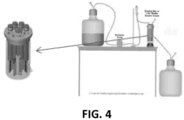
- the experimental formulas were also tested for efficacy in removing biofilm from PES UF membrane surfaces using the Centers for Disease Control (CDC) biofilm reactor (BioSurface Technologies Corporation, Bozeman, MT) illustrated in FIG. 4 .
- the test method was based upon the US EPA Standard Operating Procedure for Single Tube Method for Measuring Disinfectant Efficacy against Biofilm Grown in the CDC Biofilm Reactor.
- Bacterial strains used were Pseudomonas aeruginosa and a field isolate of Bacillus sp.
- the bacterial strains were grown in tryptic soy broth (TSB) growth media and pasteurized 2% milk.
- the bacterial cultures were grown on tryptone glucose extract (TGE) agar.
- TGE tryptone glucose extract
- 1 loop of Pseudomonas aeruginosa pure culture was inoculated into 100mL of 1% TSB and incubated for 24 hours at 35°C. This was repeated for the Bacillus sp. spores.
- Pieces of PES UF membrane were secured to the porous media holders. The membranes were then treated with a typical clean-in-place solution before using for biofilm development.
- the media membrane holders were then placed into the CDC biofilm reactor. 1 mL of the test organisms were inoculated into the biofilm reactor with growth media. Biofilms were generated on the membranes after 24 hours of no growth media cross flow using 1% TSB at 25°C with stirring at 180 rpm followed by 24 hours of a continuous supply of pasteurized 2% milk growth media flowing through the CDC biofilm reactor at 10.3 mL/min.
- the media membrane holders were then removed from the biofilm reactor and rinsed to remove planktonic cells. Each membrane holder was held vertically over a separate 50 mL conical tube containing 30 mL Standard Method Dilution Water (SMDW). The holders were immersed with continuous motion into the SMDW and immediately removed.
- SMDW Standard Method Dilution Water
- the membranes were removed from the holders and cut in half. Half of the membrane pieces were rinsed for 10 minutes in a 4 mL sterile deionized (DI) water sample. The resulting water solution was then vortexed for 30 seconds, sonicated for 30 seconds, and vortexed again for 30 seconds. The resulting solution was serially diluted in sterile DI water and plated onto TGE plating media. The remaining half of the membrane pieces were exposed to sanitizer solutions for 10 minutes. Then neutralizing solution was added to each sample to stop the chemical reaction. The resulting solution was serially diluted in sterile DI water and plated onto TGE plating media for incubation.
- DI sterile deionized
- FIG. 5 illustrates the results of the biofilm testing on membranes.
- the log reduction in biofilm growth was recorded and graphed. As is shown in the graph, treating the membrane at a temperature of (49°C) 120°F is more effective than (24°C) 75°F with O-A alone.
- the combination of O-A with AC-A was more effective at reducing biofilm than O-A alone.
- O-A + AC-A with the addition of methyl sulfonic acid (MSA) was less effective than O-A with AC-A, but more effective than O-A alone.
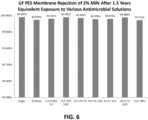
- Material compatibility testing was performed to observe effects on membrane rejection rates which is an indication of degradation to the membrane surface. Testing was performed on both PES UF membrane material and RO membranes. The samples were soaked for 5.7 days. Based upon 15 minutes of CIP contact per day, this equates to 1.5 years of daily exposure to the chemistry.
- the PES UF membranes were examined for rejection of milk proteins, where the percent rejection equals ((protein in permeate - protein in milk feed)/protein milk feed) * 100.
- the graph in FIG. 6 shows that long term chemical exposure (replicate 1.5 years) did not result in decreased rejection rates for UF PES membranes, which is an indication of material compatibility.
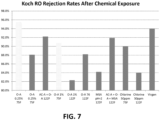
- the RO membranes were tested for rejection using conductivity with 2% NaCl as the feed solution.
- the percent rejection ((conductivity of permeate - conductivity of NaCl feed)/conductivity of NaCl feed) * 100.
- the results are shown in FIG. 7 .
- long term chemical exposure (replicate 1.5 years) using the test chemical composition of AC-A + O-A had much higher rejection rates than those observed when using an acetic acid, hydrogen peroxide, and peroxyacetic acid solution alone.
- the finding may be evidence of a RO compatible oxidizing solution that can be used at elevated temperatures.
- a description of the soaking conditions for each membrane disk are provided in Table 9. Membranes 9-12 served as controls.
- Two dilute milk spore isolate solutions were produced with field isolate mesophilic Bacillus sp. spores.
- One solution used sterile DI as diluent while the other solution used 1% AC-A solution as diluent.
- 1 inch diameter membrane disks were stored in AC-A solution and then rinsed in DI water before use.
- 6 PES and 6 RO membrane disks were soaked in AC-A (1% v/v) solution for 72 hours.
- 6 PES and 6 RO membrane disks were soaked in DI water solution for 72 hours as a control. After soaking, the membranes were placed into 25 mL plastic (Nalgene) containers. 10mL of the appropriate spore solution was placed into respective Nalgene containers and the membrane disks were allowed to soak for 24 hours. The membrane disks were then removed from the spore solutions and rinsed with DI water.
- Each membrane disk was plated. 1mL TTC dye was added to 100 mL TGE agar, which was then applied in a thin layer to petri dishes and allowed to dry. The membranes were placed on the dried plates and more agar was added until the membranes were covered. The membranes then incubated at 35 °C for 48 hours. The membranes were visually graded after 48 hours on a scale of 1-5, with 1 being no visual spores and 5 being control membranes.
- FIGs. 8A-8B The results of the plating are shown in FIGs. 8A-8B .
- Bacillus sp. spore field isolates diluted in AC-A 1% did not grow on the UF membranes or the surrounding nutrient agar. This held true for membranes soaked in DI water or AC-A 1% prior to spore exposure.
- Bacillus sp. spore field isolates adhered and grew on RO membrane surfaces more than what was observed for UF PES membrane surfaces. Both RO and UF membrane surfaces soaked in DI water and exposed to Bacillus sp. spore field isolates diluted in DI water all showed the most adhesion and growth.
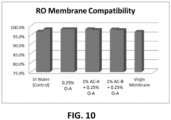
- FIG. 10 shows a graph demonstrating further RO compatibility testing simulating 1.5 years of chemical exposure using the new experimental formulation. Experimental conditions are as described above in Example 5.
- the example formulas, including AC-B were tested for performance in removing bacterial spores from membranes.
- the efficacy of O-A was compared with combinations of O-A with AC-A and O-A with AC-B.
- a mixed spore stock of powdered milk spore isolates Bacillus was diluted in sterile deionized water to approximately 1 ⁇ 10 6 spores/mL. 1 inch diameter membrane disks were prepared in 1% AC-A solution prior to testing. Each disk was rinsed with sterile DI water to remove the AC-A solution. 24 UF PES membrane disks were immersed in 10/mL of the working spore stock solution per membrane at room temperature for 24 hours. After soaking, the individual membrane disks were rinsed with sterile DI water and stored in sterile 50 mL plastic containers. The membranes were incubated at (43°C) 110°F for 5 minutes in a treatment solution.
- FIG. 11 shows the petri dishes after treatment.
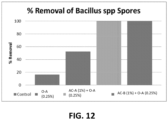
- FIG. 12 illustrates a graph representing the results.
- O-A alone eliminated about half of the spores.
- Both the combination of AC-A with O-A and AC-B with O-A were more effective for removing bacterial spores than O-A alone.
- the efficacy of AC-A versus AC-B was about the same.
- all of the spores were eliminated from the PES membrane disks.
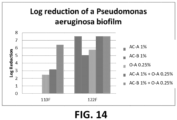
- FIG. 14 illustrates the results of a comparison of the example solutions at 110°F versus 122°F. These results indicate that treatment at a higher temperature increases the efficacy of the sanitizing treatments.
Landscapes
- Chemical & Material Sciences (AREA)
- Chemical Kinetics & Catalysis (AREA)
- Life Sciences & Earth Sciences (AREA)
- Organic Chemistry (AREA)
- Engineering & Computer Science (AREA)
- Oil, Petroleum & Natural Gas (AREA)
- Wood Science & Technology (AREA)
- Health & Medical Sciences (AREA)
- Inorganic Chemistry (AREA)
- Emergency Medicine (AREA)
- Epidemiology (AREA)
- Animal Behavior & Ethology (AREA)
- General Health & Medical Sciences (AREA)
- Public Health (AREA)
- Veterinary Medicine (AREA)
- General Chemical & Material Sciences (AREA)
- Separation Using Semi-Permeable Membranes (AREA)
- Detergent Compositions (AREA)
- Agricultural Chemicals And Associated Chemicals (AREA)
Claims (8)
- Verfahren zum Reinigen und Desinfizieren eines Membranelements innerhalb eines Membransystems, das Verfahren umfassend:Zirkulierenlassen einer Reinigungslösung durch das Membransystem für 2 bis 30 Minuten bei einer Temperatur von 21 °C (70 °F) bis 52 °C (125 °F), die Reinigungslösung umfassend zu 0,1 Gew.-% bis 1 Gew.-% organische Säure und zu 0,01 bis 0,1 Gew.-% anionisches Tensid, wobei die organische Säure eine Kombination aus Citronensäure und Milchsäure umfasst;Hinzufügen einer Desinfektionslösung zu der Reinigungslösung, um eine verstärkte antimikrobielle Lösung zu produzieren, die Desinfektionslösung umfassend zu 0,02 Gew.-% bis 0,15 Gew.-% Percarbonsäureoxidationsmittel; undZirkulierenlassen der verstärkten antimikrobiellen Lösung durch das Membransystem für weitere 1 bis 20 Minuten bei einer Temperatur von 21 °C (70 °F) bis 52 °C (125 °F).
- Verfahren nach Anspruch 1, wobei das anionische Tensid ein lineares Alkylbenzolsulfonat und vorzugsweise Dodecylbenzolsulfonsäure (DDBSA) ist.
- Verfahren nach Anspruch 1 oder 2, wobei die Percarbonsäure Peroxyessigsäure ist.
- Verfahren nach einem der Ansprüche 1 bis 3, wobei die Desinfektionslösung ferner Wasserstoffperoxid, Essigsäure und Hydroxyethylidendiphosphonsäure umfasst.
- Verfahren nach einem der Ansprüche 1 bis 4, wobei das Membransystem ein Membranfiltrationssystem in einer Molkerei, einer Brauerei, einer Weinkellerei, einer Wasseraufbereitungsanlage oder einer Lebensmittelaufbereitungsanlage ist.
- Verfahren nach einem der Ansprüche 1 bis 5, wobei die Membran aus Membranen mit Mikrofiltration (MF), Membranen mit Ultrafiltration (UF), Membranen mit Nanofiltration (NF) und Membranen mit Reversosmose (RO) ausgewählt wird.
- Verfahren nach einem der Ansprüche 1 bis 6, wobei die Membran aus Polymer, Keramik oder Edelstahl hergestellt wird.
- Verfahren nach einem der Ansprüche 1 bis 7, wobei die Membran als eine spiralförmig gewickelte Membran, eine Hohlfasermembran, eine röhrenförmige Membran oder eine Platten- und Rahmen-Flachfolienmembran konfiguriert ist.
Applications Claiming Priority (2)
| Application Number | Priority Date | Filing Date | Title |
|---|---|---|---|
| US201862630329P | 2018-02-14 | 2018-02-14 | |
| PCT/US2019/017841 WO2019160948A1 (en) | 2018-02-14 | 2019-02-13 | Compositions and methods for the reduction of biofilm and spores from membranes |
Publications (3)
| Publication Number | Publication Date |
|---|---|
| EP3752278A1 EP3752278A1 (de) | 2020-12-23 |
| EP3752278B1 true EP3752278B1 (de) | 2024-11-13 |
| EP3752278C0 EP3752278C0 (de) | 2024-11-13 |
Family
ID=65529863
Family Applications (1)
| Application Number | Title | Priority Date | Filing Date |
|---|---|---|---|
| EP19707612.8A Active EP3752278B1 (de) | 2018-02-14 | 2019-02-13 | Verfahren zur reduktion von biofilm und sporen von membranen |
Country Status (7)
| Country | Link |
|---|---|
| US (1) | US11241658B2 (de) |
| EP (1) | EP3752278B1 (de) |
| JP (1) | JP7334174B2 (de) |
| AU (1) | AU2019222696B2 (de) |
| BR (1) | BR112020016430A2 (de) |
| CA (1) | CA3091170A1 (de) |
| WO (1) | WO2019160948A1 (de) |
Families Citing this family (9)
| Publication number | Priority date | Publication date | Assignee | Title |
|---|---|---|---|---|
| WO2012090125A2 (en) | 2010-12-29 | 2012-07-05 | Ecolab Usa Inc. | Sugar ester peracid on-site generator and formulator |
| WO2017106623A1 (en) | 2015-12-16 | 2017-06-22 | Ecolab Usa Inc. | Peroxyformic acid compositions for membrane filtration cleaning |
| WO2017181005A1 (en) | 2016-04-15 | 2017-10-19 | Ecolab Usa Inc. | Performic acid biofilm prevention for industrial co2 scrubbers |
| US10524470B2 (en) | 2016-12-15 | 2020-01-07 | Ecolab Usa Inc. | Peroxyformic acid compositions for membrane filtration cleaning in energy services |
| CA3080524A1 (en) * | 2019-09-25 | 2021-03-25 | Sani-Marc Inc. | Peracetic compositions, methods and kits for removing biofilms from an enclosed surface |
| CN110699696A (zh) * | 2019-11-18 | 2020-01-17 | 爱环吴世(苏州)环保股份有限公司 | 一种不锈钢管件酸洗钝化方法 |
| AU2020408331B2 (en) | 2019-12-16 | 2023-12-14 | Ecolab Usa Inc. | Anionic surfactant impact on virucidal efficacy |
| ES2975042T3 (es) | 2020-02-28 | 2024-07-02 | Catexel Tech Limited | Método de degradación |
| JP7643701B2 (ja) * | 2020-05-21 | 2025-03-11 | 共栄社化学株式会社 | 分離膜洗浄方法及びそれに用いる分離膜用洗浄剤 |
Citations (2)
| Publication number | Priority date | Publication date | Assignee | Title |
|---|---|---|---|---|
| US20090200234A1 (en) * | 2008-02-11 | 2009-08-13 | Ecolab Inc. | Methods for cleaning surfaces with activated oxygen |
| US20170173642A1 (en) * | 2015-12-16 | 2017-06-22 | Ecolab Usa Inc. | Peroxyformic acid compositions for membrane filtration cleaning |
Family Cites Families (198)
| Publication number | Priority date | Publication date | Assignee | Title |
|---|---|---|---|---|
| US2512640A (en) | 1949-07-25 | 1950-06-27 | Buffalo Electro Chem Co | Treatment of raw plant tissue |
| NL252116A (de) | 1959-06-03 | |||
| US3248281A (en) | 1963-06-26 | 1966-04-26 | Dow Chemical Co | Iodine-peroxide-bisulfate antimicrobial composition |
| US3350265A (en) | 1966-01-04 | 1967-10-31 | Grace W R & Co | Aqueous polymeric latex with silver and sodium hypochlorite, hydrogen peroxide, or formaldehyde germicides |
| US3514278A (en) | 1968-01-08 | 1970-05-26 | Betz Laboratories | Slime control agent and methods of application |
| US3895116A (en) | 1971-11-29 | 1975-07-15 | Eastman Kodak Co | Mixtures of volatile fatty acids having anti-fungal and anti-bacterial activity |
| US3996386A (en) | 1971-12-15 | 1976-12-07 | Yrjo Malkki | Method for preventing microbial surface deterioration of foods and feeds |
| NL7608265A (nl) | 1975-08-16 | 1977-02-18 | Henkel & Cie Gmbh | Bij opslag stabiele concentraten van functionele middelen. |
| NL7608266A (nl) | 1975-08-16 | 1977-02-18 | Henkel & Cie Gmbh | Concentraten van microbicide middelen. |
| FR2324626A1 (fr) | 1975-09-19 | 1977-04-15 | Anvar | Procede de preparation d'acides peroxycarboxyliques |
| US4041149A (en) | 1976-01-12 | 1977-08-09 | Colgate-Palmolive Company | Composition and method of controlling and preventing mouth odor |
| DE2654164C2 (de) | 1976-11-30 | 1978-08-10 | Schuelke & Mayr Gmbh, 2000 Norderstedt | Wäßrige Perglutarsäurelösung und deren Verwendung |
| DE2725067A1 (de) | 1977-06-03 | 1978-12-14 | Schuelke & Mayr Gmbh | Alkohlisches desinfektionsmittel mit sporizider wirkung |
| US4191660A (en) | 1978-02-27 | 1980-03-04 | International Flavors & Fragrances Inc. | Organoleptic uses of 1-(3,3-dimethyl-2-norbornyl)-2-propanone in cationic, anionic and nonionic detergents and soaps |
| CA1146851A (en) | 1978-05-01 | 1983-05-24 | Donald F. Greene | Hydrogen peroxide disinfecting and sterilizing compositions |
| IN153503B (de) | 1979-01-11 | 1984-07-21 | Nat Res Dev | |
| DK145779A (da) | 1979-04-09 | 1980-10-10 | Novo Industri As | Fremgangsmaade til termisk destabilisering af mikrobiel osteloebe |
| US4244884A (en) | 1979-07-12 | 1981-01-13 | The Procter & Gamble Company | Continuous process for making peroxycarboxylic acids |
| ATE5896T1 (de) | 1979-11-03 | 1984-02-15 | The Procter & Gamble Company | Granulare waschmittelzusammensetzungen. |
| DE3003875A1 (de) | 1980-02-02 | 1981-08-13 | Norddeutsche Affinerie, 2000 Hamburg | Bodenbehandlungsmittel |
| US4404040A (en) | 1981-07-01 | 1983-09-13 | Economics Laboratory, Inc. | Short chain fatty acid sanitizing composition and methods |
| US4478683A (en) | 1981-11-09 | 1984-10-23 | Westvaco Corporation | Enzymatic catalyzed biocide system |
| US4370199A (en) | 1981-11-09 | 1983-01-25 | Westvaco Corporation | Enzymatic catalyzed biocide system |
| CH651314A5 (fr) | 1981-12-23 | 1985-09-13 | Colgate Palmolive Co | Composition detergente pour lave-vaisselle. |
| US4529534A (en) | 1982-08-19 | 1985-07-16 | The Procter & Gamble Company | Peroxyacid bleach compositions |
| US4477438A (en) | 1982-11-12 | 1984-10-16 | Surgikos, Inc. | Hydrogen peroxide composition |
| GB8307036D0 (en) | 1983-03-15 | 1983-04-20 | Interox Chemicals Ltd | Peroxygen compounds |
| EP0125781B1 (de) | 1983-04-14 | 1987-08-12 | Interox Chemicals Limited | Peroxyd-Zusammensetzungen |
| GB8328654D0 (en) | 1983-10-26 | 1983-11-30 | Interox Chemicals Ltd | Hydrogen peroxide compositions |
| US4655781A (en) | 1984-07-02 | 1987-04-07 | The Clorox Company | Stable bleaching compositions |
| DE3437629A1 (de) | 1984-10-13 | 1986-04-17 | Henkel KGaA, 4000 Düsseldorf | Teppichreinigungsmittel |
| FR2574424B1 (fr) | 1984-12-12 | 1987-01-16 | Interox | Procede d'activation du peroxyde d'hydrogene dans des bains de lavage ou de desinfection, compositions solides de lavage et de desinfection et utilisation de telles compositions dans des bains pour le lavage ou la desinfection des textiles |
| GB8500116D0 (en) | 1985-01-03 | 1985-02-13 | Unilever Plc | Liquid bleaching compositions |
| US4566980A (en) | 1985-01-16 | 1986-01-28 | Creative Products Resource Associates, Ltd. | Carpet treating composition |
| GB8506735D0 (en) | 1985-03-15 | 1985-04-17 | Diversey Corp | Sanitising & rinsing process |
| FR2578988B1 (fr) | 1985-03-18 | 1988-10-28 | Henkel France | Procede de regulation de la concentration de solutions de desinfection notamment oxydantes contenant des molecules desinfectantes |
| US4592488A (en) | 1985-05-24 | 1986-06-03 | Simon Gilbert I | Method for the preparation of chemotherapeutic compositions for the treatment of periodontal disease, compositions therefor and use thereof |
| US4923677A (en) | 1985-08-07 | 1990-05-08 | Roy T. Witkin | Chemical sterilization |
| US4997625A (en) | 1985-08-07 | 1991-03-05 | Simon Gilbert I | Chemical sterilization |
| GB2182051A (en) | 1985-09-10 | 1987-05-07 | Interox Chemicals Ltd | Stabilisation of peroxyacids in detergent compositions containing nonionic surfactant |
| DE3543500A1 (de) | 1985-12-10 | 1987-06-11 | Schuelke & Mayr Gmbh | Waessrige loesung aromatischer percarbonsaeuren und deren verwendung |
| GB8603960D0 (en) | 1986-02-18 | 1986-03-26 | Interox Chemicals Ltd | Disinfection process |
| US4738840A (en) | 1986-03-03 | 1988-04-19 | Simon Gilbert I | Presurgical sterilization method |
| US4715980A (en) | 1986-03-17 | 1987-12-29 | Diversey Wyandotte Corporation | Antimicrobial sanitizing composition containing n-alkyl and n-alkenyl succinic acid and methods for use |
| GB8607035D0 (en) | 1986-03-21 | 1986-04-30 | Albright & Wilson | Crop treatment processes |
| DE3702983A1 (de) | 1986-06-09 | 1987-12-10 | Henkel Kgaa | Desinfektionsmittel und ihre verwendung zur haut- und schleimhautdesinfektion |
| US4802994A (en) | 1986-07-17 | 1989-02-07 | Nalco Chemical Company | Biocide treatment to control sulfate-reducing bacteria in industrial process waste waters |
| US4683618A (en) | 1986-07-28 | 1987-08-04 | Brien Gerard T O | Reduction of bacteria count on poultry being processed into food at a poultry processing plant |
| JPS6390586A (ja) | 1986-09-29 | 1988-04-21 | リ−・フア−マス−テイカルズ・インコ−ポレイテツド | 改良された接着タブ系 |
| FR2604357B1 (fr) | 1986-09-30 | 1988-12-02 | Oreal | Composition pharmaceutique et cosmetique anti-acneique |
| DE3707409A1 (de) | 1987-03-07 | 1988-09-15 | Henkel Kgaa | Verfahren zur fleckentfernung von textilien |
| US5656302A (en) | 1987-05-14 | 1997-08-12 | Minntech Corporation | Stable, shippable, peroxy-containing microbicide |
| US4908306A (en) | 1987-06-12 | 1990-03-13 | Life Technologies, Inc. | Human papillomavirus 56 nucleic acid hybridization probes and methods for employing the same |
| US4945110A (en) | 1987-06-15 | 1990-07-31 | Quali Tech, Inc. | Membrame-forming veterinary antibacterial teat dip |
| GB2207354A (en) | 1987-07-23 | 1989-02-01 | Interox Chemicals Ltd | Compositions containing chlorine and/or hypochlorite together with an aliphatic peracid for use in disinfection |
| US4943414A (en) | 1987-07-30 | 1990-07-24 | Johnson & Johnson Medical, Inc. | Method for vapor sterilizaton of articles having lumens |
| DE3812693A1 (de) | 1988-03-19 | 1989-09-28 | Reckitt Gmbh | Reinigungstablette fuer zahnprothesen |
| US4917815A (en) | 1988-06-10 | 1990-04-17 | Sterling Drug Inc. | Stable aqueous aromatic percarboxylic acid solution |
| US5292447A (en) | 1988-06-14 | 1994-03-08 | Ausimont S.R.L. | Heterocyclic peroxides having n-amidic heteroatoms |
| JPH0211501A (ja) | 1988-06-30 | 1990-01-16 | Chisso Corp | 抗菌剤組成物 |
| US5093140A (en) | 1988-07-20 | 1992-03-03 | Eisai Co., Ltd. | Aqueous bactericide for animal treatment |
| US5639871A (en) | 1988-09-09 | 1997-06-17 | Roche Molecular Systems, Inc. | Detection of human papillomavirus by the polymerase chain reaction |
| GB8822908D0 (en) | 1988-09-29 | 1988-11-02 | Albright & Wilson | Hydroponic crop production |
| US4996062A (en) | 1988-10-28 | 1991-02-26 | Stabra Ag | Glucose oxidase food treatment and storage method |
| FR2639233B1 (fr) | 1988-11-23 | 1994-05-06 | Air Liquide | Agent d'hygiene en hemodialyse |
| US4865752A (en) | 1988-12-05 | 1989-09-12 | Jacobs Albert L | Separation and filtration membranes and their regeneration |
| US5512309A (en) | 1989-02-09 | 1996-04-30 | Rhone-Poulenc Inc. | Process for treating poultry carcasses to increase shelf-life |
| DE3906044A1 (de) | 1989-02-27 | 1990-08-30 | Henkel Kgaa | Bleichendes fluessigwaschmittel |
| US5114178A (en) | 1989-03-13 | 1992-05-19 | Baxter David A | Suspension apparatus |
| US5149463A (en) | 1989-04-21 | 1992-09-22 | The Clorox Company | Thickened acidic liquid composition with sulfonate fwa useful as a bleaching agent vehicle |
| US4937066A (en) | 1989-06-22 | 1990-06-26 | David G. Vlock | Zinc containing oral compositions |
| ATE131523T1 (de) | 1989-08-08 | 1995-12-15 | Akzo Nobel Nv | Wässerige peroxidzusammensetzungen mit verbessertem sicherheitsprofil |
| US5139788A (en) | 1989-10-17 | 1992-08-18 | Ecolab Inc. | Noncontaminating antimicrobial composition |
| US5129824A (en) | 1989-12-21 | 1992-07-14 | Keller Duane C | Method for treating periodontal disease |
| AU7067991A (en) | 1989-12-23 | 1991-07-24 | Interox Chemicals Limited | Peroxycarboxylic acids |
| US4997571A (en) | 1990-01-05 | 1991-03-05 | Mogul Corporation | Method of treating water |
| US5004760A (en) | 1990-02-16 | 1991-04-02 | The Dow Chemical Company | Biocidal foams |
| US5069286A (en) | 1990-04-30 | 1991-12-03 | The Mogul Corporation | Method for prevention of well fouling |
| GB9012790D0 (en) | 1990-06-08 | 1990-08-01 | Interox Chemicals Ltd | Food storage |
| EP0461700A1 (de) | 1990-06-12 | 1991-12-18 | Akzo Nobel N.V. | Wässrige desinfizierende Zusammensetzungen und Konzentrate fÀ¼r ihre Bereitung |
| US5043176A (en) | 1990-06-13 | 1991-08-27 | Haarmann & Reimer Corp. | Synergistic antimicrobial compositions |
| US5122538A (en) | 1990-07-23 | 1992-06-16 | Ecolab Inc. | Peroxy acid generator |
| US5084239A (en) | 1990-08-31 | 1992-01-28 | Abtox, Inc. | Plasma sterilizing process with pulsed antimicrobial agent treatment |
| US5114718A (en) | 1990-09-20 | 1992-05-19 | The Procter & Gamble Company | Sustained release compositions for treating periodontol disease |
| TW230784B (de) | 1990-10-22 | 1994-09-21 | Procter & Gamble | |
| TW291496B (de) | 1991-02-01 | 1996-11-21 | Hoechst Ag | |
| US5130124A (en) | 1991-05-01 | 1992-07-14 | Isp Investments Inc. | Stabilized, aqueous, film-forming antimicrobial compositions of hydrogen peroxide |
| GB9109929D0 (en) | 1991-05-08 | 1991-07-03 | Interox Chemicals Ltd | Thickened compositions |
| US5320805A (en) | 1991-05-15 | 1994-06-14 | Sterilex Corporation | Methods of using a cleaner, sanitizer, disinfectant, fungicide, sporicide, chemical sterilizer |
| NZ240355A (en) | 1991-06-04 | 1994-09-27 | Ecolab Inc | Sanitising composition comprising sorbic and benzoic acids |
| US5234719A (en) | 1991-06-04 | 1993-08-10 | Ecolab Inc. | Food additive sanitizing compositions |
| US5184471A (en) | 1991-07-08 | 1993-02-09 | Ocs Industries, Inc. | Food products chiller and method of using the same |
| GB2257630A (en) | 1991-07-13 | 1993-01-20 | Interox Chemicals Ltd | Activated biocidal compositions |
| EP0649310B1 (de) | 1991-07-15 | 2001-02-07 | Minntech Corporation | Stabiles, antikorrosives peressigsäure/peroxid-sterilans |
| US5200189A (en) | 1991-07-23 | 1993-04-06 | Ecolab Inc. | Peroxyacid antimicrobial composition |
| US5437868A (en) | 1991-07-23 | 1995-08-01 | Ecolab Inc. | Peroxyacid antimicrobial composition |
| KR100254852B1 (ko) | 1991-09-10 | 2000-05-01 | 클링켄빌 | 식료품 산업에서 원료, 제품 및 생산수단을 처리하기 위한 방법 및 조성물 |
| GB9122048D0 (en) | 1991-10-17 | 1991-11-27 | Interox Chemicals Ltd | Compositions and uses thereof |
| US5208057A (en) | 1991-11-12 | 1993-05-04 | Rohm And Haas Company | Process for butchering and disinfecting fowl |
| GB9124160D0 (en) | 1991-11-14 | 1992-01-08 | Interox Chemicals Ltd | Stabilised peracid solutions |
| US5176899A (en) | 1991-11-25 | 1993-01-05 | Montgomery Robert E | Antimicrobial dentifrice |
| US5268003A (en) | 1992-03-31 | 1993-12-07 | Lever Brothers Company, Division Of Conopco, Inc. | Stable amido peroxycarboxylic acids for bleaching |
| EP0569066B1 (de) | 1992-04-16 | 1995-10-25 | Unilever N.V. | Desinfizierende Zusammensetzungen |
| GB9219465D0 (en) | 1992-09-15 | 1992-10-28 | Solvay Interox Ltd | Microbicidal compositions and methods |
| NL9201631A (nl) | 1992-09-21 | 1994-04-18 | Phytocare Cv | Werkwijze en inrichting voor het desinfecteren van drainwater. |
| DK169822B1 (da) | 1992-10-20 | 1995-03-06 | Polysheet As | Forankringsøje til pressenninger og lignende overdækninger. |
| US5234703A (en) | 1992-10-31 | 1993-08-10 | Guthery B Eugene | Disinfecting product and process |
| US5436008A (en) | 1992-12-11 | 1995-07-25 | Ecolab Inc. | Sanitizing compositions |
| GB9227020D0 (en) | 1992-12-24 | 1993-02-17 | Solvay Interox Ltd | Microbicidual compositions |
| GB9300366D0 (en) | 1993-01-09 | 1993-03-03 | Solvay Interox Ltd | Compositions and uses thereof |
| US5409713A (en) | 1993-03-17 | 1995-04-25 | Ecolab Inc. | Process for inhibition of microbial growth in aqueous transport streams |
| US5683724A (en) | 1993-03-17 | 1997-11-04 | Ecolab Inc. | Automated process for inhibition of microbial growth in aqueous food transport or process streams |
| FR2704726B1 (fr) | 1993-05-05 | 1995-06-16 | Chemoxal Sa | Composition aqueuse comportant un péroxyacide organique et ses utilisations comme agents désinfections. |
| GB9316027D0 (en) | 1993-08-03 | 1993-09-15 | Solvay Interox Ltd | Egg washing and disinfection process |
| US5785867A (en) | 1993-08-05 | 1998-07-28 | Nalco Chemical Company | Method and composition for inhibiting growth of microorganisms including peracetic acid and a non-oxidizing biocide |
| CA2129489C (en) | 1993-08-05 | 2000-10-10 | Judy G. Lazonby | Method and composition for inhibiting growth of microorganisms including peracetic acid and a non-oxidizing biocide |
| US5658467A (en) | 1993-08-05 | 1997-08-19 | Nalco Chemical Company | Method and composition for inhibiting growth of microorganisms including peracetic acid and a non-oxidizing biocide |
| US5435808A (en) | 1993-09-03 | 1995-07-25 | Birko Corporation | Hide raceway treatment and improved method of curing hides |
| US5632676A (en) | 1993-10-12 | 1997-05-27 | Fmc Corporation | Use of peracetic acid to sanitize processed fowl |
| GB2286603B (en) | 1994-02-14 | 1998-03-25 | Jeyes Group Plc | Bleach compositions |
| ES2131679T3 (es) | 1994-03-09 | 1999-08-01 | Kemira Chemicals Bv | Procedimiento para la preparacion de soluciones acuosas que contienen acido performico, asi como su utilizacion. |
| US5578134A (en) | 1994-04-19 | 1996-11-26 | Ecolab Inc. | Method of sanitizing and destaining tableware |
| US6302968B1 (en) | 1994-04-19 | 2001-10-16 | Ecolab Inc. | Precarboxylic acid rinse method |
| US6257253B1 (en) | 1994-04-19 | 2001-07-10 | Ecolab Inc. | Percarboxylic acid rinse method |
| US5616616A (en) | 1994-06-01 | 1997-04-01 | Minntech Corporation | Room Temperature sterilant |
| DE4420127C1 (de) | 1994-06-09 | 1995-05-11 | Jun Heinz Stemmler | Mittel zur Steigerung der Haltbarkeit von Schlachttierkörpern |
| GB9412051D0 (en) | 1994-06-16 | 1994-08-03 | Solvay Interox Ltd | Novel peroxygen compounds |
| DK173485B1 (da) | 1994-12-02 | 2000-12-18 | Thure Barsoee Carnfeldt | Fremgangsmåde til desinfektion eller sterilisation af fødevarer, foderstoffer, maskineri og udstyr til fødevare- og foderst |
| GB9425882D0 (en) | 1994-12-21 | 1995-02-22 | Solvay Interox Ltd | Thickened peracid compositions |
| GB9425881D0 (en) | 1994-12-21 | 1995-02-22 | Solvay Interox Ltd | Thickened peracid compositions |
| US5534179A (en) | 1995-02-03 | 1996-07-09 | Procter & Gamble | Detergent compositions comprising multiperacid-forming bleach activators |
| WO1996030474A1 (en) | 1995-03-27 | 1996-10-03 | The Procter & Gamble Company | Use of amine oxide surfactants for improved stain removal performance |
| US5830839A (en) | 1995-05-17 | 1998-11-03 | Sunburst Chemicals, Inc. | Solid detergents with active enzymes and bleach |
| FR2736936B1 (fr) | 1995-07-19 | 1997-08-14 | Air Liquide | Procede de degraissage a base de peroxyde d'hydrogene et applications a des articles metalliques |
| US5641530A (en) | 1995-11-27 | 1997-06-24 | Eka Nobel Inc. | Method of disinfection |
| DE69634267T2 (de) | 1995-12-01 | 2006-01-05 | Minntech Corp., Minneapolis | Raumtemperatur-Sterilisierungsmittel für medizinische Instrumente |
| EP0779357A1 (de) | 1995-12-16 | 1997-06-18 | The Procter & Gamble Company | Stabile Emulsionen enthaltend einen hydrophobischen flüssigen Bestandteil |
| US5827542A (en) * | 1996-02-12 | 1998-10-27 | Healthpoint, Ltd. | Quick acting chemical sterilant |
| US5674828A (en) | 1996-04-08 | 1997-10-07 | Lever Brothers Company, Division Of Conopco, Inc. | Aqueous liquid compositions comprising peracid compounds and defined N-oxide compounds |
| US5712239A (en) | 1996-04-08 | 1998-01-27 | Lever Brothers Company, Division Of Conopco, Inc. | Aqueous liquid compositions comprising peracid compounds and substituted phenolic compounds |
| US5855940A (en) | 1996-04-12 | 1999-01-05 | University Of Arkansas | Method for the broad spectrum prevention and removal of microbial contamination of poultry and meat products by quaternary ammonium compounds |
| EP0805198A1 (de) | 1996-05-03 | 1997-11-05 | The Procter & Gamble Company | Reinigungszusammensetzungen |
| US5670055A (en) | 1996-08-08 | 1997-09-23 | Nalco Chemical Company | Use of the linear alkylbenzene sulfonate as a biofouling control agent |
| EP0957683A4 (de) | 1996-09-18 | 2002-05-15 | Metrex Res Corp | Wasserstoffperoxid-desinfektions- und sterilasitationszusammensetzungen |
| GB2319179A (en) | 1996-11-12 | 1998-05-20 | Reckitt & Colman Inc | Cleaning and disinfecting compositions |
| EP0843001B1 (de) | 1996-11-13 | 2003-04-23 | The Procter & Gamble Company | Wässerige alkalische Peroxidbleichmittel enthaltende Zusammensetzungen |
| GB9626637D0 (en) | 1996-12-21 | 1997-02-12 | Solvay Interox Ltd | Percarboxyilic acid solutions |
| US6028104A (en) | 1997-01-30 | 2000-02-22 | Ecolab Inc. | Use of peroxygen compounds in the control of hairy wart disease |
| GB9705448D0 (en) | 1997-03-15 | 1997-04-30 | Solvay Interox Ltd | Stabilised peracid solutions |
| US5968539A (en) | 1997-06-04 | 1999-10-19 | Procter & Gamble Company | Mild, rinse-off antimicrobial liquid cleansing compositions which provide residual benefit versus gram negative bacteria |
| US6454871B1 (en) | 1997-06-23 | 2002-09-24 | Princeton Trade & Technology, Inc. | Method of cleaning passageways using a mixed phase flow of gas and a liquid |
| US6945257B2 (en) | 1997-06-23 | 2005-09-20 | Princeton Trade & Technology | Method for cleaning hollow tubing and fibers |
| DE19812591A1 (de) | 1998-03-23 | 1999-09-30 | Degussa | Verfahren zur Bekämpfung pflanzenpathogener Mikroorganismen in Wasserkreisläufen von Gewächshäusern |
| US6165483A (en) | 1998-04-06 | 2000-12-26 | Ecolab Inc. | Peroxy acid treatment to control pathogenic organisms on growing plants |
| EP0967203A1 (de) | 1998-06-22 | 1999-12-29 | SOLVAY (Société Anonyme) | Verfahren zur Herstellung einer wässrigen Monoester Peroxycarbonsaüre Lösung, die bei diesem Verfahren hergestellte Lösung, und ihre Verwendung als Desinfektionsmittel |
| US6033705A (en) | 1998-07-08 | 2000-03-07 | Isaacs; Charles E. | Method for treating foodstuffs to reduce or prevent microbial activity |
| US6010729A (en) | 1998-08-20 | 2000-01-04 | Ecolab Inc. | Treatment of animal carcasses |
| AU758625B2 (en) | 1998-08-20 | 2003-03-27 | Ecolab Inc. | The treatment of meat products |
| GB2341870B (en) | 1998-09-22 | 2001-01-03 | Reckitt & Colman Inc | Acidic hard surface cleaning compositions |
| CN1322242A (zh) | 1998-09-25 | 2001-11-14 | 宝洁公司 | 洗涤剂组合物 |
| US6630439B1 (en) | 1998-09-25 | 2003-10-07 | The Procter & Gamble Company | Solid detergent compositions comprising sesquicarbonate |
| US7087577B2 (en) | 1998-10-16 | 2006-08-08 | Zimmer Orthobiologies, Inc. | Method of promoting natural bypass |
| US5998358A (en) | 1999-03-23 | 1999-12-07 | Ecolab Inc. | Antimicrobial acid cleaner for use on organic or food soil |
| US6024986A (en) | 1999-05-24 | 2000-02-15 | Ecolab Inc. | Method of protecting growing plants from the effects of plant pathogens |
| GB2353800A (en) | 1999-09-02 | 2001-03-07 | Procter & Gamble | Antibacterial detergent compositions |
| DE19962342A1 (de) | 1999-12-23 | 2001-07-12 | Henkel Ecolab Gmbh & Co Ohg | Persäuren mit guter Haftung auf Oberflächen |
| US6627657B1 (en) | 2000-03-22 | 2003-09-30 | Ecolab Inc. | Peroxycarboxylic acid compositions and methods of use against microbial spores |
| AU5377701A (en) | 2000-04-28 | 2001-11-12 | Ecolab Inc | Antimicrobial composition |
| US7150884B1 (en) | 2000-07-12 | 2006-12-19 | Ecolab Inc. | Composition for inhibition of microbial growth |
| US20030070691A1 (en) | 2000-08-03 | 2003-04-17 | Anthony Giletto | Biocide formation via ozonation |
| US6489281B1 (en) | 2000-09-12 | 2002-12-03 | Ecolab Inc. | Cleaning composition comprising inorganic acids, an oxidant, and a cationic surfactant |
| US6451746B1 (en) | 2000-11-03 | 2002-09-17 | Chemlink Laboratories, Llc | Carrier for liquid ingredients to be used in effervescent products |
| US6514556B2 (en) | 2000-12-15 | 2003-02-04 | Ecolab Inc. | Method and composition for washing poultry during processing |
| US6638902B2 (en) | 2001-02-01 | 2003-10-28 | Ecolab Inc. | Stable solid enzyme compositions and methods employing them |
| US6964787B2 (en) | 2001-02-01 | 2005-11-15 | Ecolab Inc. | Method and system for reducing microbial burden on a food product |
| AU2002311766A1 (en) | 2001-03-09 | 2002-11-11 | Ecolab Inc. | Stabilized ester peroxycarboxylic acid compositions |
| US20030015219A1 (en) | 2001-04-20 | 2003-01-23 | Kravitz Joseph I. | Cleaning process and composition |
| US6635286B2 (en) | 2001-06-29 | 2003-10-21 | Ecolab Inc. | Peroxy acid treatment to control pathogenic organisms on growing plants |
| US6627593B2 (en) | 2001-07-13 | 2003-09-30 | Ecolab Inc. | High concentration monoester peroxy dicarboxylic acid compositions, use solutions, and methods employing them |
| EP2338343B1 (de) * | 2002-02-12 | 2016-11-02 | Virox Technologies Inc. | Wasserstoffperoxid enthaltendes Desinfektionsmittel mit erhöhter Aktivität |
| EP1382666A1 (de) | 2002-06-21 | 2004-01-21 | Tevan B.V. | Wässrige Desinfektionszusammensetzungen mit schneller antibakterieller Wirkung |
| US9072315B2 (en) | 2002-11-12 | 2015-07-07 | Safe Foods Corporation | Application system with recycle and related use of antimicrobial quaternary ammonium compound |
| US20040140259A1 (en) | 2003-01-20 | 2004-07-22 | Cummings James A. | Membrane flux enhancement |
| US7771737B2 (en) | 2004-01-09 | 2010-08-10 | Ecolab Inc. | Medium chain peroxycarboxylic acid compositions |
| US7220358B2 (en) | 2004-02-23 | 2007-05-22 | Ecolab Inc. | Methods for treating membranes and separation facilities and membrane treatment composition |
| US20060089281A1 (en) | 2004-09-01 | 2006-04-27 | Gibson Gregory L | Methods and compositions for paint removal |
| WO2007101470A1 (en) | 2006-03-06 | 2007-09-13 | Ecolab Inc. | Liquid membrane-compatible detergent composition |
| US7662289B2 (en) | 2007-01-16 | 2010-02-16 | Nalco Company | Method of cleaning fouled or scaled membranes |
| US7838485B2 (en) | 2007-03-08 | 2010-11-23 | American Sterilizer Company | Biodegradable alkaline disinfectant cleaner with analyzable surfactant |
| WO2008148420A1 (en) | 2007-06-04 | 2008-12-11 | Ecolab Inc. | Liquid membrane compatible detergent formulation comprising branched alkoxylated fatty alcohols as non-ionic surfactants |
| US20100000579A1 (en) | 2008-07-03 | 2010-01-07 | Reinbold Robert S | Compositions And Methods For Removing Scale And Inhibiting Formation Thereof |
| EP2303474B1 (de) | 2008-07-17 | 2014-10-15 | DeLaval Holding AB | Verfahren zur reinigung einer vorrichtung zur herstellung und ausgabe von nahrungsmitteln und getränken |
| US8658584B2 (en) | 2010-06-21 | 2014-02-25 | Ecolab Usa Inc. | Sulfosuccinate functionalized alkyl polyglucosides for enhanced food and oily soil removal |
| US8246696B2 (en) | 2010-09-17 | 2012-08-21 | Ecolab Usa Inc. | Cleaning compositions employing extended chain anionic surfactants |
| PL2697369T3 (pl) | 2011-03-25 | 2018-12-31 | F.Hoffmann-La Roche Ag | Nowe sposoby oczyszczania białek |
| US8933009B2 (en) * | 2013-03-12 | 2015-01-13 | Ecolab Usa Inc. | Surfactant blends for cleaning filtration membranes |
| JP2016027938A (ja) * | 2014-07-11 | 2016-02-25 | 日本碍子株式会社 | 膜の再生方法、膜の再生装置及び分離装置 |
| JP2017176951A (ja) * | 2016-03-29 | 2017-10-05 | 東レ株式会社 | 分離膜モジュールの洗浄方法 |
-
2019
- 2019-02-13 US US16/274,487 patent/US11241658B2/en active Active
- 2019-02-13 AU AU2019222696A patent/AU2019222696B2/en active Active
- 2019-02-13 CA CA3091170A patent/CA3091170A1/en active Pending
- 2019-02-13 WO PCT/US2019/017841 patent/WO2019160948A1/en not_active Ceased
- 2019-02-13 BR BR112020016430-5A patent/BR112020016430A2/pt unknown
- 2019-02-13 EP EP19707612.8A patent/EP3752278B1/de active Active
- 2019-02-13 JP JP2020543372A patent/JP7334174B2/ja active Active
Patent Citations (2)
| Publication number | Priority date | Publication date | Assignee | Title |
|---|---|---|---|---|
| US20090200234A1 (en) * | 2008-02-11 | 2009-08-13 | Ecolab Inc. | Methods for cleaning surfaces with activated oxygen |
| US20170173642A1 (en) * | 2015-12-16 | 2017-06-22 | Ecolab Usa Inc. | Peroxyformic acid compositions for membrane filtration cleaning |
Also Published As
| Publication number | Publication date |
|---|---|
| EP3752278A1 (de) | 2020-12-23 |
| CA3091170A1 (en) | 2019-08-22 |
| US20190275468A1 (en) | 2019-09-12 |
| WO2019160948A1 (en) | 2019-08-22 |
| BR112020016430A2 (pt) | 2020-12-15 |
| JP7334174B2 (ja) | 2023-08-28 |
| EP3752278C0 (de) | 2024-11-13 |
| JP2021513458A (ja) | 2021-05-27 |
| AU2019222696A1 (en) | 2020-08-27 |
| US11241658B2 (en) | 2022-02-08 |
| AU2019222696B2 (en) | 2024-02-29 |
Similar Documents
| Publication | Publication Date | Title |
|---|---|---|
| EP3752278B1 (de) | Verfahren zur reduktion von biofilm und sporen von membranen | |
| US20250235901A1 (en) | Peroxyformic acid compositions for membrane filtration cleaning | |
| Anand et al. | Development and control of bacterial biofilms on dairy processing membranes | |
| Tang et al. | The efficacy of different cleaners and sanitisers in cleaning biofilms on UF membranes used in the dairy industry | |
| US12059002B2 (en) | Peroxyformic acid compositions for membrane filtration cleaning in energy services | |
| Araújo et al. | Antimicrobial resistance to disinfectants in biofilms | |
| Henderson | Efficacy of microscale/nanoscale aqueous ozone on the removal of Bacillus spp. biofilms from polyethersulfone membranes in the dairy industry | |
| CN115515428A (zh) | 用于生物膜控制的具有水合氢离子来源的杀生物组合物 |
Legal Events
| Date | Code | Title | Description |
|---|---|---|---|
| STAA | Information on the status of an ep patent application or granted ep patent |
Free format text: STATUS: UNKNOWN |
|
| STAA | Information on the status of an ep patent application or granted ep patent |
Free format text: STATUS: THE INTERNATIONAL PUBLICATION HAS BEEN MADE |
|
| PUAI | Public reference made under article 153(3) epc to a published international application that has entered the european phase |
Free format text: ORIGINAL CODE: 0009012 |
|
| STAA | Information on the status of an ep patent application or granted ep patent |
Free format text: STATUS: REQUEST FOR EXAMINATION WAS MADE |
|
| 17P | Request for examination filed |
Effective date: 20200907 |
|
| AK | Designated contracting states |
Kind code of ref document: A1 Designated state(s): AL AT BE BG CH CY CZ DE DK EE ES FI FR GB GR HR HU IE IS IT LI LT LU LV MC MK MT NL NO PL PT RO RS SE SI SK SM TR |
|
| AX | Request for extension of the european patent |
Extension state: BA ME |
|
| DAV | Request for validation of the european patent (deleted) | ||
| DAX | Request for extension of the european patent (deleted) | ||
| STAA | Information on the status of an ep patent application or granted ep patent |
Free format text: STATUS: EXAMINATION IS IN PROGRESS |
|
| 17Q | First examination report despatched |
Effective date: 20220104 |
|
| REG | Reference to a national code |
Ref legal event code: R079 Free format text: PREVIOUS MAIN CLASS: B01D0065020000 Ref country code: DE Ref legal event code: R079 Ref document number: 602019061870 Country of ref document: DE Free format text: PREVIOUS MAIN CLASS: B01D0065020000 Ipc: C02F0001440000 |
|
| GRAP | Despatch of communication of intention to grant a patent |
Free format text: ORIGINAL CODE: EPIDOSNIGR1 |
|
| STAA | Information on the status of an ep patent application or granted ep patent |
Free format text: STATUS: GRANT OF PATENT IS INTENDED |
|
| RIC1 | Information provided on ipc code assigned before grant |
Ipc: B01D 65/02 20060101ALI20240522BHEP Ipc: C02F 1/72 20060101ALI20240522BHEP Ipc: A61L 2/18 20060101ALI20240522BHEP Ipc: C11D 3/48 20060101ALI20240522BHEP Ipc: C11D 3/04 20060101ALI20240522BHEP Ipc: C02F 5/10 20060101ALI20240522BHEP Ipc: C02F 1/44 20060101AFI20240522BHEP |
|
| INTG | Intention to grant announced |
Effective date: 20240613 |
|
| GRAS | Grant fee paid |
Free format text: ORIGINAL CODE: EPIDOSNIGR3 |
|
| GRAA | (expected) grant |
Free format text: ORIGINAL CODE: 0009210 |
|
| STAA | Information on the status of an ep patent application or granted ep patent |
Free format text: STATUS: THE PATENT HAS BEEN GRANTED |
|
| AK | Designated contracting states |
Kind code of ref document: B1 Designated state(s): AL AT BE BG CH CY CZ DE DK EE ES FI FR GB GR HR HU IE IS IT LI LT LU LV MC MK MT NL NO PL PT RO RS SE SI SK SM TR |
|
| REG | Reference to a national code |
Ref country code: GB Ref legal event code: FG4D |
|
| REG | Reference to a national code |
Ref country code: CH Ref legal event code: EP |
|
| REG | Reference to a national code |
Ref country code: IE Ref legal event code: FG4D |
|
| REG | Reference to a national code |
Ref country code: DE Ref legal event code: R096 Ref document number: 602019061870 Country of ref document: DE |
|
| U01 | Request for unitary effect filed |
Effective date: 20241128 |
|
| U07 | Unitary effect registered |
Designated state(s): AT BE BG DE DK EE FI FR IT LT LU LV MT NL PT RO SE SI Effective date: 20241210 |
|
| U20 | Renewal fee for the european patent with unitary effect paid |
Year of fee payment: 7 Effective date: 20250107 |
|
| PG25 | Lapsed in a contracting state [announced via postgrant information from national office to epo] |
Ref country code: IS Free format text: LAPSE BECAUSE OF FAILURE TO SUBMIT A TRANSLATION OF THE DESCRIPTION OR TO PAY THE FEE WITHIN THE PRESCRIBED TIME-LIMIT Effective date: 20250313 Ref country code: HR Free format text: LAPSE BECAUSE OF FAILURE TO SUBMIT A TRANSLATION OF THE DESCRIPTION OR TO PAY THE FEE WITHIN THE PRESCRIBED TIME-LIMIT Effective date: 20241113 |
|
| PG25 | Lapsed in a contracting state [announced via postgrant information from national office to epo] |
Ref country code: ES Free format text: LAPSE BECAUSE OF FAILURE TO SUBMIT A TRANSLATION OF THE DESCRIPTION OR TO PAY THE FEE WITHIN THE PRESCRIBED TIME-LIMIT Effective date: 20241113 |
|
| PG25 | Lapsed in a contracting state [announced via postgrant information from national office to epo] |
Ref country code: NO Free format text: LAPSE BECAUSE OF FAILURE TO SUBMIT A TRANSLATION OF THE DESCRIPTION OR TO PAY THE FEE WITHIN THE PRESCRIBED TIME-LIMIT Effective date: 20250213 |
|
| PG25 | Lapsed in a contracting state [announced via postgrant information from national office to epo] |
Ref country code: GR Free format text: LAPSE BECAUSE OF FAILURE TO SUBMIT A TRANSLATION OF THE DESCRIPTION OR TO PAY THE FEE WITHIN THE PRESCRIBED TIME-LIMIT Effective date: 20250214 |
|
| PG25 | Lapsed in a contracting state [announced via postgrant information from national office to epo] |
Ref country code: PL Free format text: LAPSE BECAUSE OF FAILURE TO SUBMIT A TRANSLATION OF THE DESCRIPTION OR TO PAY THE FEE WITHIN THE PRESCRIBED TIME-LIMIT Effective date: 20241113 |
|
| PG25 | Lapsed in a contracting state [announced via postgrant information from national office to epo] |
Ref country code: RS Free format text: LAPSE BECAUSE OF FAILURE TO SUBMIT A TRANSLATION OF THE DESCRIPTION OR TO PAY THE FEE WITHIN THE PRESCRIBED TIME-LIMIT Effective date: 20250213 |
|
| PG25 | Lapsed in a contracting state [announced via postgrant information from national office to epo] |
Ref country code: SM Free format text: LAPSE BECAUSE OF FAILURE TO SUBMIT A TRANSLATION OF THE DESCRIPTION OR TO PAY THE FEE WITHIN THE PRESCRIBED TIME-LIMIT Effective date: 20241113 |
|
| PG25 | Lapsed in a contracting state [announced via postgrant information from national office to epo] |
Ref country code: SK Free format text: LAPSE BECAUSE OF FAILURE TO SUBMIT A TRANSLATION OF THE DESCRIPTION OR TO PAY THE FEE WITHIN THE PRESCRIBED TIME-LIMIT Effective date: 20241113 |
|
| PG25 | Lapsed in a contracting state [announced via postgrant information from national office to epo] |
Ref country code: CZ Free format text: LAPSE BECAUSE OF FAILURE TO SUBMIT A TRANSLATION OF THE DESCRIPTION OR TO PAY THE FEE WITHIN THE PRESCRIBED TIME-LIMIT Effective date: 20241113 |
|
| PG25 | Lapsed in a contracting state [announced via postgrant information from national office to epo] |
Ref country code: MC Free format text: LAPSE BECAUSE OF FAILURE TO SUBMIT A TRANSLATION OF THE DESCRIPTION OR TO PAY THE FEE WITHIN THE PRESCRIBED TIME-LIMIT Effective date: 20241113 |
|
| PLBE | No opposition filed within time limit |
Free format text: ORIGINAL CODE: 0009261 |
|
| STAA | Information on the status of an ep patent application or granted ep patent |
Free format text: STATUS: NO OPPOSITION FILED WITHIN TIME LIMIT |
|
| REG | Reference to a national code |
Ref country code: CH Ref legal event code: PL |
|
| PG25 | Lapsed in a contracting state [announced via postgrant information from national office to epo] |
Ref country code: CH Free format text: LAPSE BECAUSE OF NON-PAYMENT OF DUE FEES Effective date: 20250228 |
|
| 26N | No opposition filed |
Effective date: 20250814 |
|
| GBPC | Gb: european patent ceased through non-payment of renewal fee |
Effective date: 20250213 |