EP3749532B1 - Rad für ein kraftfahrzeug - Google Patents
Rad für ein kraftfahrzeug Download PDFInfo
- Publication number
- EP3749532B1 EP3749532B1 EP18836254.5A EP18836254A EP3749532B1 EP 3749532 B1 EP3749532 B1 EP 3749532B1 EP 18836254 A EP18836254 A EP 18836254A EP 3749532 B1 EP3749532 B1 EP 3749532B1
- Authority
- EP
- European Patent Office
- Prior art keywords
- wheel
- air
- rim
- holding means
- tire
- Prior art date
- Legal status (The legal status is an assumption and is not a legal conclusion. Google has not performed a legal analysis and makes no representation as to the accuracy of the status listed.)
- Active
Links
Images

Classifications
-
- B—PERFORMING OPERATIONS; TRANSPORTING
- B60—VEHICLES IN GENERAL
- B60C—VEHICLE TYRES; TYRE INFLATION; TYRE CHANGING; CONNECTING VALVES TO INFLATABLE ELASTIC BODIES IN GENERAL; DEVICES OR ARRANGEMENTS RELATED TO TYRES
- B60C5/00—Inflatable pneumatic tyres or inner tubes
- B60C5/20—Inflatable pneumatic tyres or inner tubes having multiple separate inflatable chambers
-
- B—PERFORMING OPERATIONS; TRANSPORTING
- B60—VEHICLES IN GENERAL
- B60C—VEHICLE TYRES; TYRE INFLATION; TYRE CHANGING; CONNECTING VALVES TO INFLATABLE ELASTIC BODIES IN GENERAL; DEVICES OR ARRANGEMENTS RELATED TO TYRES
- B60C5/00—Inflatable pneumatic tyres or inner tubes
- B60C5/20—Inflatable pneumatic tyres or inner tubes having multiple separate inflatable chambers
- B60C5/22—Inflatable pneumatic tyres or inner tubes having multiple separate inflatable chambers the chambers being annular
-
- B—PERFORMING OPERATIONS; TRANSPORTING
- B60—VEHICLES IN GENERAL
- B60C—VEHICLE TYRES; TYRE INFLATION; TYRE CHANGING; CONNECTING VALVES TO INFLATABLE ELASTIC BODIES IN GENERAL; DEVICES OR ARRANGEMENTS RELATED TO TYRES
- B60C19/00—Tyre parts or constructions not otherwise provided for
- B60C19/002—Noise damping elements provided in the tyre structure or attached thereto, e.g. in the tyre interior
-
- B—PERFORMING OPERATIONS; TRANSPORTING
- B60—VEHICLES IN GENERAL
- B60C—VEHICLE TYRES; TYRE INFLATION; TYRE CHANGING; CONNECTING VALVES TO INFLATABLE ELASTIC BODIES IN GENERAL; DEVICES OR ARRANGEMENTS RELATED TO TYRES
- B60C2200/00—Tyres specially adapted for particular applications
- B60C2200/10—Tyres specially adapted for particular applications for motorcycles, scooters or the like
Definitions
- the invention relates to a wheel for a motor vehicle, comprising a rim and an air-filled tire mounted on the rim.
- the WO 2015/145148 A1 discloses expandable air volume wheel assemblies.
- today's motor vehicle tires must offer the lowest possible rolling resistance, at the same time they should have a high load capacity and good driving dynamics, but they should also offer pleasant driving comfort in terms of spring properties or damping properties.
- the spring stiffness in particular has a very large influence on driving comfort.
- the vehicle tire itself is in a field of tension within the above-mentioned properties, since the improvement in one property sometimes leads to a deterioration in the other.
- the air pressure in the wheel or tire is subject to this conflict of objectives.
- the spring stiffness has a major influence on driving comfort. If the spring stiffness can be lowered, the system becomes “softer”, the amplitude of the tire acceleration is reduced and the natural frequency can be reduced. This leads to a significant improvement in comfort, both subjectively and objectively.
- the invention is therefore based on the problem of specifying a wheel that is improved compared to this.
- the invention provides for a wheel of the type mentioned at the outset that a material that adsorbs molecules contained in the air is provided inside the wheel.
- the invention is based on the idea of introducing a material that adsorbs molecules contained in the air into the inside of the wheel, resulting in a quasi “virtual” increase in the volume of air given the same available installation space or room volume.
- the adsorption material also called adsorbent, binds free molecules in the air to a large extent. Air is primarily composed of nitrogen, oxygen and carbon dioxide, with nitrogen making up the largest proportion, followed by oxygen and carbon dioxide.
- the adsorbing material is now able, due to its very large inner surface, to adsorb some or all of these types of molecules contained in the air, ie to "store” them. This makes it possible to increase the air volume in the tire with the same outer contour and inner pressure. In fact, more air can be introduced into the tires in this way without any changes in geometry or pressure.
- an increase in the volume ie the air volume inside the wheel
- a larger air volume also means a higher load capacity of the tire.
- energy storage devices such as batteries are being used more and more in vehicles, although batteries are heavy components. This increases the overall weight of the vehicle.
- a larger volume of air in the tire can provide the consequent need for higher tire load capacity.
- Activated carbon is preferably used as such an adsorbing material or adsorbent.
- Activated carbon is porous carbon with a very large internal surface. It consists mostly of carbon, usually more than 90% and has a highly porous structure with open pores, the inner surface area being between 300-2000 m 2 /g activated carbon, depending on the pore size distribution.
- the pore size ranges from submicropores with a pore size of less than 0.4 nm to micropores (0.1-0.2 nm) and mesopores (2-50 nm) to macropores (greater than 50 nm).
- Activated carbon is a very strong adsorbent, as it adsorbs the molecules present in the air very well and, due to the extremely high surface area, can store or adsorb a large volume of air.
- activated coke also based on carbon, with a somewhat smaller inner surface, zeolite or a molecular sieve, for example a carbon molecular sieve, can also be used.
- zeolite or a molecular sieve for example a carbon molecular sieve
- the material itself is preferably fixed in position so that it cannot move during movement of the wheel.
- the material for this is arranged on the rim, since the rim, unlike the tire, is not subject to any deformation while driving.
- the material is arranged around the rim base in a particularly practical way, a symmetrical distribution is easily possible here, so that the introduction of the material does not result in an imbalance.
- the material itself can either be in the form of loose bulk material that is fixed in a corresponding holding means.
- the activated carbon can, for example, be in the form of pellets or granules, which are accommodated in an appropriate holding means.
- the material can also be pressed, ie in a defined form predetermined by a pressing process.
- an air-permeable and flexible holding means is expediently used, or a housing-like, stable and perforated holding means.
- a woven or knitted fabric for example a filter fleece or the like, can be used as an air-permeable and flexible holding means, for example, in which the bulk material is received or sewn. It is conceivable for the holding means to be designed, for example, in the form of a tube or a sack or pouch and to be filled with the bulk material.
- a stable holding means can be made of plastic, for example, and be designed in the form of a ring, preferably in several parts, so that it can be arranged around the rim well in the manner of a housing and can be assembled in the form of a ring.
- the diameter of the perforation is of course made in such a way that the diameter of the perforation openings is smaller than that of the bulk material.
- the holding means can preferably be glued onto the rim or the rim base, so that there is a secure hold and there is no risk of detachment even at very high wheel speeds.
- a pressed material is used, it is preferably shaped according to the shape of the portion of the rim to which it is to be attached. If the material is applied to the rim well, for example, the pressed material can be designed in the shape of a semicircle or half shell, so that two such parts are assembled to form a ring. This pressed material is also preferably glued onto the rim, in particular the rim base.
- the invention also relates to a motor vehicle comprising a plurality of wheels of the type described.
- a motor vehicle can be, for example, a two-wheeler, ie a motorcycle, or a four-wheeled automobile.
- a wheel 1 suitable for a motor vehicle such as a motorcycle or automobile, in a partial sectional view. It comprises a rim 2 with a rim base 3 and a tire 4 mounted on the rim. The interior of the tire 4 is filled with air.
- a material 5 which adsorbs molecules contained in the air and which is activated carbon, for example.
- the material 5 is present here as loose bulk material, for example in the form of granules 6 or larger pellets.
- the material 5 is arranged and densely packed around the rim well 2 .
- a holding means 7 is provided, here consisting of an air-permeable and flexible material or fabric 8, for example a filter fleece, which is more or less tubular and is filled with the material 5 accordingly.
- the material 5 can be appropriately sewn into the fabric or fabric 8, for which purpose corresponding pocket-like receptacles 9 are formed by corresponding darts 10 or the like.
- two such filled holding means 7a, 7b are shown, each extending through 180 degrees, which complement each other to form a ring shape that surrounds the entire rim base. More than two such holding means 7 are also conceivable.
- the fixation is preferably done by gluing to the rim base.
- the introduced material 5 allows a significantly higher volume of air to be introduced into the tire 4, since the material 5, due to its extremely large surface area, adsorbs the molecules contained in the air, i.e. they are stored inside, so that a virtual increase in volume can be achieved. In this way, the driving comfort can be improved due to a resulting reduction in the spring stiffness, without a deterioration in the rolling resistance, the load capacity and the driving dynamics being associated with it.
- a material 5 is provided on the rim bed 3, for example activated carbon in the form of granules 6.
- the holding means 7 being a stable, housing-like holding means with a large number of perforation openings 11 provided here which the air molecules can enter inside.
- neck means 7a, 7b which each rotate 180 degrees and are connected to form a ring shape.
- These holding means 7a, 7b, ie the half-shell housing are made of plastic, for example. They are also preferably attached to the rim bed by means of an adhesive connection.
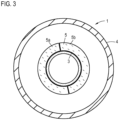
- FIG. 3 finally shows a wheel 1 according to the invention, in which the material 5 is applied to the rim well 3 in a pressed, ie stable form, preferably in turn glued.
- two halves are provided, namely the sections 5a and 5b, which in turn complement each other to form a ring shape.
- the respective pressed bodies are therefore adapted to the shape of the component on which they are arranged. In this case, therefore, the shape of the rim base 3.
- Special holding means are not required here due to the compression of the material 5, for example activated carbon.
Landscapes
- Engineering & Computer Science (AREA)
- Mechanical Engineering (AREA)
- Tires In General (AREA)
Description
- Die Erfindung betrifft ein Rad für ein Kraftfahrzeug, umfassend eine Felge und einen auf diese aufgezogenen, mit Luft gefüllten Reifen.
- Die
WO 2015/145148 A1 offenbart Radanordnungen mit erweiterbarem Luftvolumen. - Heutige Kraftfahrzeugreifen müssen einerseits einen möglich geringen Rollwiderstand bieten, gleichzeitig sollen sie eine hohe Tragfähigkeit und eine gute Fahrdynamik aufweisen, wie sie aber auch einen angenehmen Fahrkomfort hinsichtlich der Federeigenschaften oder Dämpfungseigenschaften bieten sollen. Dabei hat insbesondere die Federsteifigkeit einen sehr großen Einfluss auf den Fahrkomfort. Der Fahrzeugreifen selbst steht dabei in einem Spannungsfeld innerhalb der oben genannten Eigenschaften, da die Verbesserung der einen Eigenschaft mitunter zu einer Verschlechterung der anderen führen.
- Speziell der Luftdruck im Rad respektive im Reifen unterliegt diesem Zielkonflikt. Der Reifen arbeitet neben seiner konstruktionsbedingten Steifigkeit mit dem eingeschlossenen Luftvolumen nach dem Prinzip der Volumenfederung. Vernachlässigt man die konstruktionsbedingte Steifigkeit des Reifens, so kann vereinfacht angenommen werden, dass sich die Federsteifigkeit des Systems wie folgt berechnet:

- Mit:
- n = Polytropenexponenten
- V = Systemvolumen
- p = Systemdruck
- A = Wirksame Fläche
- Die Federsteifigkeit hat, wie ausgeführt, einen großen Einfluss auf den Fahrkomfort. Kann die Federsteifigkeit abgesenkt werden, so wird das System "weicher", die Amplitude der Reifenbeschleunigung verkleinert sich, die Eigenfrequenz kann reduziert werden. Dies führt zu einer signifikanten Verbesserung des Komfortempfindens, sowohl subjektiv als auch objektiv.
- Aus obiger Gleichung ergibt sich, dass bei einer Absenkung des Luftdrucks sich die Federsteifigkeit verringert. Mit der Absenkung des Luftdrucks einher geht allerdings auch eine Abnahme der Tragfähigkeit, wie sich auch der Rollwiderstand und die fahrdynamischen Eigenschaften des Reifens respektive des Rads verschlechtern. Die Vergrößerung des Luftvolumen bei gleichem Druck ist üblicherweise nicht möglich. Wird die Radbreite vergrößert, verschlechtert sich der Rollwiderstand, eine Vergrößerung des Radumfangs verhindern etwaige Bauraumbeschränkungen.
- Der Erfindung liegt damit das Problem zu Grunde, ein dem gegenüber verbessertes Rad anzugeben.
- Zur Lösung dieses Problems ist bei einem Rad der eingangs genannten Art erfindungsgemäß vorgesehen, dass im Inneren des Rads ein in der Luft enthaltene Moleküle adsorbierendes Material vorgesehen ist.
- Der Erfindung liegt die Überlegung zu Grunde, in das Radinnere ein in der Luft enthaltene Moleküle adsorbierendes Material einzubringen, wodurch quasi eine "virtuelle" Vergrößerung des Luftvolumens bei gleichem vorhandenem Bauraum respektive Raumvolumen gegeben ist. Das Adsorptionsmaterial, auch Adsorbenz genannt, bindet in großem Umfang freie Moleküle in der Luft. Die Luft setzt primär aus Stickstoff, Sauerstoff und Kohlendioxid zusammen, wobei Stickstoff den größten Anteil darstellt, gefolgt von Sauerstoff und Kohlendioxid. Das adsorbierende Material ist nun in der Lage, aufgrund seiner sehr großen inneren Oberfläche einen Teil dieser Molekülarten oder alle diese Molekülarten, die in der Luft enthalten sind, zu adsorbieren, mithin also "einzulagern". Hierüber ist es möglich, das Luftvolumen im Reifen bei gleichbleibender Außenkontur und gleichbleibendem Innendruck zu vergrößern. De facto kann auf diese Weise mehr Luft in den Reifen eingebracht werden, ohne dass irgendwelche Geometrie- oder Druckänderungen gegeben sind.
- Wie sich aus vorstehend angeführter Gleichung ergibt, führt eine Vergrößerung des Volumens, also des Luftvolumens im Radinneren zu einer Erniedrigung der Federsteifigkeit des Reifens respektive des Rads. Hieraus erfolgt eine Verbesserung des Fahrkomforts respektive der Komforteigenschaften des Reifens respektive Rads, resultierend aus dem Umstand, dass zum einen eine Verschiebung der Eigenfrequenz möglich ist, zum anderen aber auch eine Reduktion des Verstärkungsfaktors, der angibt, wie eine von außen über das Rad an oder in das Fahrzeug eingetragene Störung weitergegeben wird, erreicht werden kann. Je geringer die Federsteifigkeit ist, umso geringer ist der Verstärkungsfaktor. Das heißt, dass sich durch die adsorptionsbedingte Erhöhung des Luftvolumens eine Verbesserung des Fahrkomforts erreichen lässt, wenn gleichzeitig die Reifenkontur und der Luftdruck unangetastet bleiben. Dadurch können fahrdynamische Größen unterschiedlich voneinander eingestellt werden.
- Gleichzeitig bedeutet ein größeres Luftvolumen aber auch eine höhere Tragfähigkeit des Reifens. Besonders Energiespeicher wie Batterien halten immer mehr Einzug in Fahrzeuge, wobei es sich bei den Batterien um schwere Bauteile handelt. Dadurch steigt das Gesamtgewicht des Fahrzeugs. Ein größeres Luftvolumen im Reifen kann die demzufolge erforderliche höhere Tragfähigkeit des Reifens bieten.
- Als ein derartiges adsorbierendes Material respektive Adsorbenz wird bevorzugt Aktivkohle verwendet. Aktivkohle ist poröser Kohlenstoff mit sehr großer innerer Oberfläche. Sie besteht überwiegend aus Kohlenstoff, üblicherweise zu mehr als 90% und weist eine hochporöse Struktur mit offenen Poren auf, wobei je nach Porengrößenverteilung die innere Oberfläche zwischen 300-2000 m2/g Aktivkohle gegeben ist. Die Porengröße reicht von Submikroporen mit einer Porengröße kleiner 0,4 nm über Mikroporen (0,1-0,2 nm) und Mesoporen (2-50 nm) zu Makroporen (größer 50 nm). Die Aktivkohle ist ein sehr starkes Adsorbenz, da es die in der Luft vorhandenen Moleküle sehr gut adsorbiert und aufgrund der extrem hohen Oberfläche ein großes Luftvolumen einlagern respektive adsorbieren kann.
- Neben Aktivkohle kann aber auch Aktivkoks, ebenfalls Kohlenstoff basiert, mit etwas geringerer inneren Oberfläche, Zeolith oder ein Molekularsieb, beispielsweise ein Kohlenstoffmolekularsieb, verwendet werden. Geeignet ist jedes adsorbtives Material, das in der Lage ist, die in der Luft vorhandenen Moleküle zu adsorbieren und das eine hinreichend große innere Oberfläche aufweist.
- Das Material selbst ist bevorzugt positionsfest angeordnet, so dass es sich während der Bewegung des Rades nicht bewegen kann.
- Gemäß einer zweckmäßigen Ausgestaltung ist das Material hierfür an der Felge angeordnet, da die Felge, anders als der Reifen, während der Fahrt keiner Deformation unterliegt. Besonders zweckmäßig ist das Material um das Felgenbett herum angeordnet, eine symmetrische Verteilung ist hier auf einfach Weise möglich, so dass durch die Einbringung des Materials keine Unwucht entsteht.
- Das Material selbst kann entweder als loses Schüttmaterial, das in einem entsprechenden Haltemittel fixiert ist, vorliegen. Die Aktivkohle kann beispielsweise in Form von Pellets oder als Granulat vorliegen, das in einem entsprechenden Haltemittel aufgenommen ist. Alternativ kann das Material auch gepresst vorliegen, mithin also in einer definierten, durch einen Pressvorgang vorgegebenen Form.
- Wird loses Schüttmaterial verwendet, so wird zweckmäßigerweise entweder ein luftdurchlässiges und flexibles Haltemittel verwendet, oder ein gehäuseartig, stabiles und perforiertes Haltemittel. Als ein luftdurchlässiges und flexibles Haltemittel kann beispielsweise ein Gewebe oder Gewirke, beispielsweise ein Filtervlies oder Ähnliches, verwendet werden, in dem das Schüttmaterial aufgenommen respektive vernäht ist. Denkbar ist es, das Haltemittel beispielsweise schlauch- oder säckchen- oder beutelartig auszuführen und mit dem Schüttmaterial zu befüllen.
- Kommt ein stabiles Haltemittel zum Einsatz, so kann dieses beispielsweise aus Kunststoff gefertigt sein und ringförmig ausgeführt werden, bevorzugt mehrteilig, so dass es gehäuseartig und ringförmig zusammensetzbar um das Felgenbett herum angeordnet werden kann. Die Perforation wird vom Durchmesser her natürlich derart ausgeführt, dass die Perforationsöffnungen im Durchmesser kleiner sind als das Schüttmaterial.
- Zur Fixierung kann das Haltemittel bevorzugt auf die Felge respektive das Felgenbett aufgeklebt werden, so dass ein sicherer Halt gegeben ist und eine Ablösung auch bei sehr hohen Raddrehzahlen nicht zu besorgen ist.
- Wird ein gepresstes Material verwendet, so ist dieses bevorzugt entsprechend der Form des Abschnitts der Felge, an dem es anzuordnen ist, geformt. Wird das Material beispielsweise auf das Felgenbett aufgebracht, so kann das gepresste Material halbkreis- oder halbenschalenförmig ausgeführt sein, so dass zwei derartige Teile zu einem Ring zusammengesetzt werden. Auch dieses gepresste Material wird bevorzugt auf die Felge, insbesondere das Felgenbett aufgeklebt.
- Neben dem Rad selbst betrifft die Erfindung ferner ein Kraftfahrzeug, umfassend mehrere Räder der beschriebenen Art. Bei einem Kraftfahrzeug kann es sich beispielsweise um ein Zweirad, also ein Motorrad, oder ein vierrädriges Automobil handeln.
- Weitere Vorteile und Einzelheiten der Erfindung ergeben sich aus den im Folgenden beschriebenen Ausführungsbeispielen sowie anhand der Zeichnungen. Dabei zeigen:
- Fig. 1
- ein erfindungsgemäßes Rad einer ersten Ausführungsform,
- Fig. 2
- ein erfindungsgemäßes Rad einer zweiten Ausführungsform, und
- Fig. 3
- ein erfindungsgemäßes Rad einer dritten Ausführungsform.
-
Fig. 1 zeigt ein erfindungsgemäßes Rad 1, geeignet für ein Kraftfahrzeug wie Motorrad oder Automobil, in einer geschnittenen Teilansicht. Es umfasst eine Felge 2 mit einem Felgenbett 3 sowie einen auf die Felge aufgezogenen Reifen 4. Das Innere des Reifens 4 wird mit Luft gefüllt. - Im Inneren des Rads 1 respektive des Reifens 4 ist ein in der Luft enthaltene Moleküle adsorbierendes Material 5 vorgesehen, bei dem es sich beispielsweise um Aktivkohle handelt. Das Material 5 liegt hier als loses Schüttmaterial vor, beispielsweise in Form eines Granulats 6 oder größerer Pellets. Ersichtlich ist das Material 5 um das Felgenbett 2 herum angeordnet und dicht gepackt. Um es in dieser Position zu fixieren, ist ein Haltemittel 7 vorgesehen, hier bestehend aus einem luftdurchlässigen und flexiblen Stoff oder Gewebe 8, beispielsweise einem Filtervlies, das quasi schlauchförmig ist und entsprechend mit dem Material 5 befüllt ist. Das Material 5 kann in den Stoff oder das Gewebe 8 entsprechend eingenäht sein, wozu entsprechende taschenartige Aufnehmungen 9 durch entsprechende Abnäher 10 oder dergleichen ausgebildet sind. Im gezeigten Beispiel sind zwei solcher sich jeweils um 180 Grad erstreckender befüllter Haltemittel 7a, 7b dargestellt, die sich zu einer Ringform, die das gesamte Felgenbett umgibt gibt, ergänzen. Auch mehr als zwei solcher Haltemittel 7 sind denkbar. Die Fixierung erfolgt bevorzugt durch Ankleben am Felgenbett.
- Durch das eingebrachte Material 5 kann ein deutlich höheres Luftvolumen in den Reifen 4 eingebracht werden, da das Material 5 aufgrund seiner extrem großen Oberfläche die in der Luft enthaltenen Moleküle adsorbiert, also im Inneren eingelagert werden, so dass quasi eine virtuelle Volumenvergrößerung erreicht werden kann. Hierüber kann aufgrund einer daraus resultierenden Erniedrigung der Federsteifigkeit der Fahrkomfort verbessert werden, ohne dass damit eine Verschlechterung des Rollwiderstands, der Tragfähigkeit und der Fahrdynamik einhergeht.
-
Fig. 2 zeigt ein zweites Ausführungsbeispiel eines erfindungsgemäßen Rads 1, wobei vgl. Bauteile gleiche Bezugszeichen verwendet werden. Auch hier ist am Felgenbett 3 ein Material 5 vorgesehen, beispielsweise wiederum Aktivkohle in Form eines Granulats 6. Dieses ist wiederum in einem entsprechenden Haltemittel 7 aufgenommen, wobei das Haltemittel 7 hier ein stabiles, gehäuseartiges Haltemittel mit einer Vielzahl von Perforationsdurchbrechungen 11 vorgesehen ist, durch die die Luftmoleküle in das Innere eintreten können. Gezeigt sind wiederum zwei Halmittel 7a, 7b, die jeweils um 180 Grad umlaufen und zu einer Ringform verbunden sind. Diese Haltemittel 7a, 7b, also die halbschaligen Gehäuse, sind beispielsweise aus Kunststoff gefertigt. Auch sie sind bevorzugt über eine Klebeverbindung am Felgenbett befestigt. -
Fig. 3 zeigt schließlich ein erfindungsgemäßes Rad 1, bei dem auf das Felgenbett 3 das Material 5 in gepresster, also stabiler Form aufgebracht, bevorzugt wiederum aufgeklebt ist. Auch hier sind zwei Hälften vorgesehen, nämlich die Abschnitte 5a und 5b, die sich wiederum zu einer Ringform ergänzen. Die jeweiligen gepressten Körper sind also der Form des Bauteils, an dem sie angeordnet werden, angepasst. Hier also der Form des Felgenbetts 3. Besondere Haltemittel sind hier aufgrund der Verpressung des Materials 5, beispielsweise wiederum Aktivkohle, nicht erforderlich.
Claims (8)
- Rad für ein Kraftfahrzeug, umfassend eine Felge (2) und einen auf diese aufgezogenen, mit Luft gefüllten Reifen (4), wobei im Inneren des Rads (1) ein in der Luft enthaltene Moleküle adsorbierendes Material (5) vorgesehen ist, wobei das Material (5) als loses Schüttmaterial, das in einem Haltemittel (7, 7a, 7b) fixiert ist, oder als gepresstes Material (5) vorliegt, dadurch gekennzeichnet, dass zwei sich jeweils um 180° erstreckende Haltemittel (7a, 7b) oder zwei sich jeweils um 180° erstreckende Abschnitte (5a, 5b) aus gepresstem Material vorgesehen sind, die um das Felgenbett (3) herum angeordnet sind und sich zu einer Ringform ergänzen.
- Rad nach Anspruch 1, dadurch gekennzeichnet, dass das Material (5) Aktivkohle, Aktivkoks, Zeolith oder ein Molekularsieb ist.
- Rad nach Anspruch 2, dadurch gekennzeichnet, dass das Material (5) positionsfest angeordnet ist.
- Rad nach einem der vorangehenden Ansprüche, dadurch gekennzeichnet, dass das Haltemittel (7) luftdurchlässig und flexibel ist.
- Rad nach einem der vorangehenden Ansprüche, dadurch gekennzeichnet, dass das Haltemittel (7) gehäuseartig stabil und perforiert ausgeführt ist.
- Rad nach einem der vorangehenden Ansprüche, dadurch gekennzeichnet, dass das gepresste Material (5) entsprechend der Form des Abschnitts der Felge (2), an dem es anzuordnen ist, geformt ist.
- Rad nach einem der vorangehenden Ansprüche, dadurch gekennzeichnet, dass das Haltemittel (7) oder das gepresste Material (5) auf die Felge (2), insbesondere das Felgenbett (3) geklebt ist.
- Kraftfahrzeug, umfassend mehrere Räder (1) nach einem der vorangehenden Ansprüche.
Applications Claiming Priority (2)
| Application Number | Priority Date | Filing Date | Title |
|---|---|---|---|
| DE102018202003.5A DE102018202003A1 (de) | 2018-02-08 | 2018-02-08 | Rad für ein Kraftfahrzeug |
| PCT/EP2018/086761 WO2019154553A1 (de) | 2018-02-08 | 2018-12-21 | Rad für ein kraftfahrzeug |
Publications (2)
| Publication Number | Publication Date |
|---|---|
| EP3749532A1 EP3749532A1 (de) | 2020-12-16 |
| EP3749532B1 true EP3749532B1 (de) | 2023-05-10 |
Family
ID=65031013
Family Applications (1)
| Application Number | Title | Priority Date | Filing Date |
|---|---|---|---|
| EP18836254.5A Active EP3749532B1 (de) | 2018-02-08 | 2018-12-21 | Rad für ein kraftfahrzeug |
Country Status (5)
| Country | Link |
|---|---|
| US (1) | US20210146724A1 (de) |
| EP (1) | EP3749532B1 (de) |
| CN (1) | CN111683822A (de) |
| DE (1) | DE102018202003A1 (de) |
| WO (1) | WO2019154553A1 (de) |
Families Citing this family (3)
| Publication number | Priority date | Publication date | Assignee | Title |
|---|---|---|---|---|
| WO2021052653A1 (de) | 2019-09-17 | 2021-03-25 | Audi Ag | Fahrzeugluftreifen |
| WO2023021300A1 (en) * | 2021-08-19 | 2023-02-23 | Carbon Air Limited | A vehicle wheel |
| US20250050308A1 (en) * | 2023-08-08 | 2025-02-13 | GM Global Technology Operations LLC | Wheel assembly including activated carbon |
Citations (2)
| Publication number | Priority date | Publication date | Assignee | Title |
|---|---|---|---|---|
| GB2496427A (en) * | 2011-11-11 | 2013-05-15 | Bentley Motors Ltd | Vehicle wheel |
| WO2015145148A1 (en) * | 2014-03-28 | 2015-10-01 | Carbon Air Limited | Transfer method and apparatus |
Family Cites Families (9)
| Publication number | Priority date | Publication date | Assignee | Title |
|---|---|---|---|---|
| US4319893A (en) * | 1980-09-02 | 1982-03-16 | Exxon Research & Engineering Co. | Magnetically stabilized bed, temperature, partial pressure swing, hydrogen recovery process |
| JPH07290914A (ja) * | 1994-04-28 | 1995-11-07 | Sumitomo Rubber Ind Ltd | 空気入りタイヤとリムとの組立体 |
| CN101167404B (zh) * | 2005-03-28 | 2011-05-04 | 松下电器产业株式会社 | 扬声器装置 |
| CN2888914Y (zh) * | 2006-02-22 | 2007-04-18 | 永霆国际竹炭实业有限公司 | 一种含炭粒的肩部及眼部护具 |
| CN101416528B (zh) * | 2006-04-03 | 2012-10-24 | 松下电器产业株式会社 | 扬声器系统 |
| US20080115872A1 (en) * | 2006-11-16 | 2008-05-22 | Paul Harry Sandstrom | Butyl rubber which contains organoperoxide and isobutyene adsorbing activated carbon, pneumatic tire with built-in sealant and method |
| GB201017808D0 (en) * | 2010-10-21 | 2010-12-01 | Univ Salford The | An air spring |
| GB2519749B (en) * | 2013-10-24 | 2015-08-05 | Bentley Motors Ltd | Tyre cavity noise absorber |
| US10349167B2 (en) * | 2015-05-18 | 2019-07-09 | Apple Inc. | Audio speaker with back volume containing adsorptive material |
-
2018
- 2018-02-08 DE DE102018202003.5A patent/DE102018202003A1/de not_active Ceased
- 2018-12-21 EP EP18836254.5A patent/EP3749532B1/de active Active
- 2018-12-21 WO PCT/EP2018/086761 patent/WO2019154553A1/de not_active Ceased
- 2018-12-21 US US16/965,394 patent/US20210146724A1/en not_active Abandoned
- 2018-12-21 CN CN201880088896.XA patent/CN111683822A/zh active Pending
Patent Citations (2)
| Publication number | Priority date | Publication date | Assignee | Title |
|---|---|---|---|---|
| GB2496427A (en) * | 2011-11-11 | 2013-05-15 | Bentley Motors Ltd | Vehicle wheel |
| WO2015145148A1 (en) * | 2014-03-28 | 2015-10-01 | Carbon Air Limited | Transfer method and apparatus |
Also Published As
| Publication number | Publication date |
|---|---|
| WO2019154553A1 (de) | 2019-08-15 |
| DE102018202003A1 (de) | 2019-08-08 |
| CN111683822A (zh) | 2020-09-18 |
| EP3749532A1 (de) | 2020-12-16 |
| US20210146724A1 (en) | 2021-05-20 |
Similar Documents
| Publication | Publication Date | Title |
|---|---|---|
| EP3749532B1 (de) | Rad für ein kraftfahrzeug | |
| EP0160276B1 (de) | Pneumatische Feder-Dämpfer-Einheit | |
| DE10317836A1 (de) | Stabilisatorstangenanordnung für ein Kraftfahrzeug | |
| WO2010015686A2 (de) | Rad-reifenkombination für fahrzeuge. | |
| DE2935096A1 (de) | Schwingungsdaempfer fuer kraftfahrzeuge | |
| DE2905791A1 (de) | Rollbalg fuer fahrzeug-luftfederungen | |
| WO2013167390A1 (de) | Luftfeder und verfahren zum umschlagen eines luftfederbalges einer luftfeder | |
| EP0827847A2 (de) | Zentrallager für eine Hinterachse eines Kraftfahrzeuges | |
| DE3719415A1 (de) | Filtereinrichtung und verfahren zu ihrer herstellung | |
| DE602005002273T2 (de) | Selbsttragender Reifen für Fahrradräder, Motorradräder und ähnliche | |
| DE102007027834A1 (de) | Luftfedereinrichtung | |
| EP3848108B1 (de) | Filtermedium mit antiallergenen substanzen | |
| DE1207420B (de) | Wiegenloses, gasgefedertes Drehgestell fuer Schienenfahrzeuge | |
| DE1160310B (de) | Schwingungsabsorbierende Mittellagerung einer Welle, insbesondere einer Antriebswelle eines Strassenfahrzeuges | |
| DE60020155T2 (de) | Notlaufstütze und leicht montierbare stütze/felge einheit mit zentriereinrichtung für reifen | |
| EP0139905A2 (de) | Fahrzeugrad | |
| DE102016222303A1 (de) | Rad | |
| DE4014646A1 (de) | Pannensicherer kraftfahrzeugreifen | |
| CH278831A (de) | Schienenfahrzeug mit federnder Achsbüchsführung. | |
| DE4004333A1 (de) | Schwingungstilger fuer kraftfahrzeug-raeder | |
| DE102017200984B4 (de) | Kraftfahrzeug mit Hilfsrahmen und wenigstens einem Hilfsrahmenlager | |
| DE1530135C3 (de) | Luftfeder für wiegenlose Drehgestelle von Fahrzeugen, insbesondere Schienenfahrzeugen | |
| DE3035915A1 (de) | Blattfederanordnung, insbesondere fuer die abfederung von kraftfahrzeugen | |
| DE102018210714A1 (de) | Radaufhängung für ein Kraftfahrzeug | |
| DE19538074C1 (de) | Atemfilter |
Legal Events
| Date | Code | Title | Description |
|---|---|---|---|
| STAA | Information on the status of an ep patent application or granted ep patent |
Free format text: STATUS: UNKNOWN |
|
| STAA | Information on the status of an ep patent application or granted ep patent |
Free format text: STATUS: THE INTERNATIONAL PUBLICATION HAS BEEN MADE |
|
| PUAI | Public reference made under article 153(3) epc to a published international application that has entered the european phase |
Free format text: ORIGINAL CODE: 0009012 |
|
| STAA | Information on the status of an ep patent application or granted ep patent |
Free format text: STATUS: REQUEST FOR EXAMINATION WAS MADE |
|
| 17P | Request for examination filed |
Effective date: 20200908 |
|
| AK | Designated contracting states |
Kind code of ref document: A1 Designated state(s): AL AT BE BG CH CY CZ DE DK EE ES FI FR GB GR HR HU IE IS IT LI LT LU LV MC MK MT NL NO PL PT RO RS SE SI SK SM TR |
|
| AX | Request for extension of the european patent |
Extension state: BA ME |
|
| RIN1 | Information on inventor provided before grant (corrected) |
Inventor name: UNGER, ANDREAS Inventor name: SCHEURICH, BASTIAN Inventor name: SCHMID, WOLFGANG Inventor name: HENNING, KAY-UWE Inventor name: SCHMIDT, OLIVER |
|
| DAV | Request for validation of the european patent (deleted) | ||
| DAX | Request for extension of the european patent (deleted) | ||
| STAA | Information on the status of an ep patent application or granted ep patent |
Free format text: STATUS: EXAMINATION IS IN PROGRESS |
|
| 17Q | First examination report despatched |
Effective date: 20210907 |
|
| GRAP | Despatch of communication of intention to grant a patent |
Free format text: ORIGINAL CODE: EPIDOSNIGR1 |
|
| STAA | Information on the status of an ep patent application or granted ep patent |
Free format text: STATUS: GRANT OF PATENT IS INTENDED |
|
| INTG | Intention to grant announced |
Effective date: 20230215 |
|
| GRAS | Grant fee paid |
Free format text: ORIGINAL CODE: EPIDOSNIGR3 |
|
| GRAA | (expected) grant |
Free format text: ORIGINAL CODE: 0009210 |
|
| STAA | Information on the status of an ep patent application or granted ep patent |
Free format text: STATUS: THE PATENT HAS BEEN GRANTED |
|
| AK | Designated contracting states |
Kind code of ref document: B1 Designated state(s): AL AT BE BG CH CY CZ DE DK EE ES FI FR GB GR HR HU IE IS IT LI LT LU LV MC MK MT NL NO PL PT RO RS SE SI SK SM TR |
|
| REG | Reference to a national code |
Ref country code: GB Ref legal event code: FG4D Free format text: NOT ENGLISH |
|
| REG | Reference to a national code |
Ref country code: AT Ref legal event code: REF Ref document number: 1566340 Country of ref document: AT Kind code of ref document: T Effective date: 20230515 Ref country code: CH Ref legal event code: EP |
|
| REG | Reference to a national code |
Ref country code: DE Ref legal event code: R096 Ref document number: 502018012147 Country of ref document: DE |
|
| REG | Reference to a national code |
Ref country code: IE Ref legal event code: FG4D Free format text: LANGUAGE OF EP DOCUMENT: GERMAN |
|
| P01 | Opt-out of the competence of the unified patent court (upc) registered |
Effective date: 20230529 |
|
| REG | Reference to a national code |
Ref country code: LT Ref legal event code: MG9D |
|
| REG | Reference to a national code |
Ref country code: NL Ref legal event code: MP Effective date: 20230510 |
|
| PG25 | Lapsed in a contracting state [announced via postgrant information from national office to epo] |
Ref country code: SE Free format text: LAPSE BECAUSE OF FAILURE TO SUBMIT A TRANSLATION OF THE DESCRIPTION OR TO PAY THE FEE WITHIN THE PRESCRIBED TIME-LIMIT Effective date: 20230510 Ref country code: PT Free format text: LAPSE BECAUSE OF FAILURE TO SUBMIT A TRANSLATION OF THE DESCRIPTION OR TO PAY THE FEE WITHIN THE PRESCRIBED TIME-LIMIT Effective date: 20230911 Ref country code: NO Free format text: LAPSE BECAUSE OF FAILURE TO SUBMIT A TRANSLATION OF THE DESCRIPTION OR TO PAY THE FEE WITHIN THE PRESCRIBED TIME-LIMIT Effective date: 20230810 Ref country code: NL Free format text: LAPSE BECAUSE OF FAILURE TO SUBMIT A TRANSLATION OF THE DESCRIPTION OR TO PAY THE FEE WITHIN THE PRESCRIBED TIME-LIMIT Effective date: 20230510 Ref country code: ES Free format text: LAPSE BECAUSE OF FAILURE TO SUBMIT A TRANSLATION OF THE DESCRIPTION OR TO PAY THE FEE WITHIN THE PRESCRIBED TIME-LIMIT Effective date: 20230510 |
|
| PG25 | Lapsed in a contracting state [announced via postgrant information from national office to epo] |
Ref country code: RS Free format text: LAPSE BECAUSE OF FAILURE TO SUBMIT A TRANSLATION OF THE DESCRIPTION OR TO PAY THE FEE WITHIN THE PRESCRIBED TIME-LIMIT Effective date: 20230510 Ref country code: PL Free format text: LAPSE BECAUSE OF FAILURE TO SUBMIT A TRANSLATION OF THE DESCRIPTION OR TO PAY THE FEE WITHIN THE PRESCRIBED TIME-LIMIT Effective date: 20230510 Ref country code: LV Free format text: LAPSE BECAUSE OF FAILURE TO SUBMIT A TRANSLATION OF THE DESCRIPTION OR TO PAY THE FEE WITHIN THE PRESCRIBED TIME-LIMIT Effective date: 20230510 Ref country code: LT Free format text: LAPSE BECAUSE OF FAILURE TO SUBMIT A TRANSLATION OF THE DESCRIPTION OR TO PAY THE FEE WITHIN THE PRESCRIBED TIME-LIMIT Effective date: 20230510 Ref country code: IS Free format text: LAPSE BECAUSE OF FAILURE TO SUBMIT A TRANSLATION OF THE DESCRIPTION OR TO PAY THE FEE WITHIN THE PRESCRIBED TIME-LIMIT Effective date: 20230910 Ref country code: HR Free format text: LAPSE BECAUSE OF FAILURE TO SUBMIT A TRANSLATION OF THE DESCRIPTION OR TO PAY THE FEE WITHIN THE PRESCRIBED TIME-LIMIT Effective date: 20230510 Ref country code: GR Free format text: LAPSE BECAUSE OF FAILURE TO SUBMIT A TRANSLATION OF THE DESCRIPTION OR TO PAY THE FEE WITHIN THE PRESCRIBED TIME-LIMIT Effective date: 20230811 |
|
| PG25 | Lapsed in a contracting state [announced via postgrant information from national office to epo] |
Ref country code: FI Free format text: LAPSE BECAUSE OF FAILURE TO SUBMIT A TRANSLATION OF THE DESCRIPTION OR TO PAY THE FEE WITHIN THE PRESCRIBED TIME-LIMIT Effective date: 20230510 |
|
| PG25 | Lapsed in a contracting state [announced via postgrant information from national office to epo] |
Ref country code: SK Free format text: LAPSE BECAUSE OF FAILURE TO SUBMIT A TRANSLATION OF THE DESCRIPTION OR TO PAY THE FEE WITHIN THE PRESCRIBED TIME-LIMIT Effective date: 20230510 |
|
| PG25 | Lapsed in a contracting state [announced via postgrant information from national office to epo] |
Ref country code: SM Free format text: LAPSE BECAUSE OF FAILURE TO SUBMIT A TRANSLATION OF THE DESCRIPTION OR TO PAY THE FEE WITHIN THE PRESCRIBED TIME-LIMIT Effective date: 20230510 Ref country code: SK Free format text: LAPSE BECAUSE OF FAILURE TO SUBMIT A TRANSLATION OF THE DESCRIPTION OR TO PAY THE FEE WITHIN THE PRESCRIBED TIME-LIMIT Effective date: 20230510 Ref country code: RO Free format text: LAPSE BECAUSE OF FAILURE TO SUBMIT A TRANSLATION OF THE DESCRIPTION OR TO PAY THE FEE WITHIN THE PRESCRIBED TIME-LIMIT Effective date: 20230510 Ref country code: EE Free format text: LAPSE BECAUSE OF FAILURE TO SUBMIT A TRANSLATION OF THE DESCRIPTION OR TO PAY THE FEE WITHIN THE PRESCRIBED TIME-LIMIT Effective date: 20230510 Ref country code: DK Free format text: LAPSE BECAUSE OF FAILURE TO SUBMIT A TRANSLATION OF THE DESCRIPTION OR TO PAY THE FEE WITHIN THE PRESCRIBED TIME-LIMIT Effective date: 20230510 Ref country code: CZ Free format text: LAPSE BECAUSE OF FAILURE TO SUBMIT A TRANSLATION OF THE DESCRIPTION OR TO PAY THE FEE WITHIN THE PRESCRIBED TIME-LIMIT Effective date: 20230510 |
|
| REG | Reference to a national code |
Ref country code: DE Ref legal event code: R097 Ref document number: 502018012147 Country of ref document: DE |
|
| PLBE | No opposition filed within time limit |
Free format text: ORIGINAL CODE: 0009261 |
|
| STAA | Information on the status of an ep patent application or granted ep patent |
Free format text: STATUS: NO OPPOSITION FILED WITHIN TIME LIMIT |
|
| 26N | No opposition filed |
Effective date: 20240213 |
|
| PG25 | Lapsed in a contracting state [announced via postgrant information from national office to epo] |
Ref country code: SI Free format text: LAPSE BECAUSE OF FAILURE TO SUBMIT A TRANSLATION OF THE DESCRIPTION OR TO PAY THE FEE WITHIN THE PRESCRIBED TIME-LIMIT Effective date: 20230510 |
|
| PG25 | Lapsed in a contracting state [announced via postgrant information from national office to epo] |
Ref country code: SI Free format text: LAPSE BECAUSE OF FAILURE TO SUBMIT A TRANSLATION OF THE DESCRIPTION OR TO PAY THE FEE WITHIN THE PRESCRIBED TIME-LIMIT Effective date: 20230510 Ref country code: IT Free format text: LAPSE BECAUSE OF FAILURE TO SUBMIT A TRANSLATION OF THE DESCRIPTION OR TO PAY THE FEE WITHIN THE PRESCRIBED TIME-LIMIT Effective date: 20230510 |
|
| REG | Reference to a national code |
Ref country code: CH Ref legal event code: PL |
|
| PG25 | Lapsed in a contracting state [announced via postgrant information from national office to epo] |
Ref country code: LU Free format text: LAPSE BECAUSE OF NON-PAYMENT OF DUE FEES Effective date: 20231221 |
|
| PG25 | Lapsed in a contracting state [announced via postgrant information from national office to epo] |
Ref country code: MC Free format text: LAPSE BECAUSE OF FAILURE TO SUBMIT A TRANSLATION OF THE DESCRIPTION OR TO PAY THE FEE WITHIN THE PRESCRIBED TIME-LIMIT Effective date: 20230510 |
|
| REG | Reference to a national code |
Ref country code: BE Ref legal event code: MM Effective date: 20231231 |
|
| PG25 | Lapsed in a contracting state [announced via postgrant information from national office to epo] |
Ref country code: MC Free format text: LAPSE BECAUSE OF FAILURE TO SUBMIT A TRANSLATION OF THE DESCRIPTION OR TO PAY THE FEE WITHIN THE PRESCRIBED TIME-LIMIT Effective date: 20230510 Ref country code: LU Free format text: LAPSE BECAUSE OF NON-PAYMENT OF DUE FEES Effective date: 20231221 |
|
| REG | Reference to a national code |
Ref country code: IE Ref legal event code: MM4A |
|
| PG25 | Lapsed in a contracting state [announced via postgrant information from national office to epo] |
Ref country code: IE Free format text: LAPSE BECAUSE OF NON-PAYMENT OF DUE FEES Effective date: 20231221 |
|
| PG25 | Lapsed in a contracting state [announced via postgrant information from national office to epo] |
Ref country code: BE Free format text: LAPSE BECAUSE OF NON-PAYMENT OF DUE FEES Effective date: 20231231 |
|
| PG25 | Lapsed in a contracting state [announced via postgrant information from national office to epo] |
Ref country code: CH Free format text: LAPSE BECAUSE OF NON-PAYMENT OF DUE FEES Effective date: 20231231 |
|
| PG25 | Lapsed in a contracting state [announced via postgrant information from national office to epo] |
Ref country code: IE Free format text: LAPSE BECAUSE OF NON-PAYMENT OF DUE FEES Effective date: 20231221 Ref country code: CH Free format text: LAPSE BECAUSE OF NON-PAYMENT OF DUE FEES Effective date: 20231231 Ref country code: BE Free format text: LAPSE BECAUSE OF NON-PAYMENT OF DUE FEES Effective date: 20231231 |
|
| PG25 | Lapsed in a contracting state [announced via postgrant information from national office to epo] |
Ref country code: BG Free format text: LAPSE BECAUSE OF FAILURE TO SUBMIT A TRANSLATION OF THE DESCRIPTION OR TO PAY THE FEE WITHIN THE PRESCRIBED TIME-LIMIT Effective date: 20230510 |
|
| PG25 | Lapsed in a contracting state [announced via postgrant information from national office to epo] |
Ref country code: BG Free format text: LAPSE BECAUSE OF FAILURE TO SUBMIT A TRANSLATION OF THE DESCRIPTION OR TO PAY THE FEE WITHIN THE PRESCRIBED TIME-LIMIT Effective date: 20230510 |
|
| REG | Reference to a national code |
Ref country code: AT Ref legal event code: MM01 Ref document number: 1566340 Country of ref document: AT Kind code of ref document: T Effective date: 20231221 |
|
| PG25 | Lapsed in a contracting state [announced via postgrant information from national office to epo] |
Ref country code: AT Free format text: LAPSE BECAUSE OF NON-PAYMENT OF DUE FEES Effective date: 20231221 |
|
| PG25 | Lapsed in a contracting state [announced via postgrant information from national office to epo] |
Ref country code: CY Free format text: LAPSE BECAUSE OF FAILURE TO SUBMIT A TRANSLATION OF THE DESCRIPTION OR TO PAY THE FEE WITHIN THE PRESCRIBED TIME-LIMIT; INVALID AB INITIO Effective date: 20181221 |
|
| PG25 | Lapsed in a contracting state [announced via postgrant information from national office to epo] |
Ref country code: HU Free format text: LAPSE BECAUSE OF FAILURE TO SUBMIT A TRANSLATION OF THE DESCRIPTION OR TO PAY THE FEE WITHIN THE PRESCRIBED TIME-LIMIT; INVALID AB INITIO Effective date: 20181221 |
|
| PG25 | Lapsed in a contracting state [announced via postgrant information from national office to epo] |
Ref country code: TR Free format text: LAPSE BECAUSE OF FAILURE TO SUBMIT A TRANSLATION OF THE DESCRIPTION OR TO PAY THE FEE WITHIN THE PRESCRIBED TIME-LIMIT Effective date: 20230510 |
|
| PGFP | Annual fee paid to national office [announced via postgrant information from national office to epo] |
Ref country code: GB Payment date: 20251218 Year of fee payment: 8 |
|
| PGFP | Annual fee paid to national office [announced via postgrant information from national office to epo] |
Ref country code: FR Payment date: 20251218 Year of fee payment: 8 |
|
| PGFP | Annual fee paid to national office [announced via postgrant information from national office to epo] |
Ref country code: DE Payment date: 20251231 Year of fee payment: 8 |