EP3746360B1 - Segel - Google Patents
Segel Download PDFInfo
- Publication number
- EP3746360B1 EP3746360B1 EP19748026.2A EP19748026A EP3746360B1 EP 3746360 B1 EP3746360 B1 EP 3746360B1 EP 19748026 A EP19748026 A EP 19748026A EP 3746360 B1 EP3746360 B1 EP 3746360B1
- Authority
- EP
- European Patent Office
- Prior art keywords
- section
- sail
- leech
- primary
- movable
- Prior art date
- Legal status (The legal status is an assumption and is not a legal conclusion. Google has not performed a legal analysis and makes no representation as to the accuracy of the status listed.)
- Active
Links
Images






Classifications
-
- B—PERFORMING OPERATIONS; TRANSPORTING
- B63—SHIPS OR OTHER WATERBORNE VESSELS; RELATED EQUIPMENT
- B63H—MARINE PROPULSION OR STEERING
- B63H9/00—Marine propulsion provided directly by wind power
- B63H9/04—Marine propulsion provided directly by wind power using sails or like wind-catching surfaces
- B63H9/06—Types of sail; Constructional features of sails; Arrangements thereof on vessels
- B63H9/061—Rigid sails; Aerofoil sails
-
- B—PERFORMING OPERATIONS; TRANSPORTING
- B63—SHIPS OR OTHER WATERBORNE VESSELS; RELATED EQUIPMENT
- B63H—MARINE PROPULSION OR STEERING
- B63H9/00—Marine propulsion provided directly by wind power
- B63H9/04—Marine propulsion provided directly by wind power using sails or like wind-catching surfaces
- B63H9/06—Types of sail; Constructional features of sails; Arrangements thereof on vessels
- B63H9/061—Rigid sails; Aerofoil sails
- B63H9/0621—Rigid sails comprising one or more pivotally supported panels
- B63H9/0635—Rigid sails comprising one or more pivotally supported panels the panels being pivotable about vertical axes
-
- B—PERFORMING OPERATIONS; TRANSPORTING
- B60—VEHICLES IN GENERAL
- B60K—ARRANGEMENT OR MOUNTING OF PROPULSION UNITS OR OF TRANSMISSIONS IN VEHICLES; ARRANGEMENT OR MOUNTING OF PLURAL DIVERSE PRIME-MOVERS IN VEHICLES; AUXILIARY DRIVES FOR VEHICLES; INSTRUMENTATION OR DASHBOARDS FOR VEHICLES; ARRANGEMENTS IN CONNECTION WITH COOLING, AIR INTAKE, GAS EXHAUST OR FUEL SUPPLY OF PROPULSION UNITS IN VEHICLES
- B60K16/00—Arrangements in connection with power supply of propulsion units in vehicles from forces of nature, e.g. sun or wind
-
- B—PERFORMING OPERATIONS; TRANSPORTING
- B63—SHIPS OR OTHER WATERBORNE VESSELS; RELATED EQUIPMENT
- B63B—SHIPS OR OTHER WATERBORNE VESSELS; EQUIPMENT FOR SHIPPING
- B63B15/00—Superstructures, deckhouses, wheelhouses or the like; Arrangements or adaptations of masts or spars, e.g. bowsprits
- B63B15/0083—Masts for sailing ships or boats
-
- B—PERFORMING OPERATIONS; TRANSPORTING
- B63—SHIPS OR OTHER WATERBORNE VESSELS; RELATED EQUIPMENT
- B63H—MARINE PROPULSION OR STEERING
- B63H9/00—Marine propulsion provided directly by wind power
- B63H9/04—Marine propulsion provided directly by wind power using sails or like wind-catching surfaces
- B63H9/06—Types of sail; Constructional features of sails; Arrangements thereof on vessels
-
- B—PERFORMING OPERATIONS; TRANSPORTING
- B63—SHIPS OR OTHER WATERBORNE VESSELS; RELATED EQUIPMENT
- B63H—MARINE PROPULSION OR STEERING
- B63H9/00—Marine propulsion provided directly by wind power
- B63H9/04—Marine propulsion provided directly by wind power using sails or like wind-catching surfaces
- B63H9/08—Connections of sails to masts, spars, or the like
- B63H9/10—Running rigging, e.g. reefing equipment
- B63H9/1021—Reefing
-
- B—PERFORMING OPERATIONS; TRANSPORTING
- B64—AIRCRAFT; AVIATION; COSMONAUTICS
- B64C—AEROPLANES; HELICOPTERS
- B64C3/00—Wings
- B64C3/38—Adjustment of complete wings or parts thereof
- B64C3/54—Varying in area
Definitions
- the present invention relates to a sail. More particularly but not exclusively it relates to a nestable wing sail that can change its surface area by partial extension and retraction in a fore aft direction
- a yacht is preferably able to be optimised for different conditions, in particular the sail area may need to be adjusted.
- Sails are generally of two basic constructions soft, fabric-shaped sails that are shell like, and wing sails which form a 3D cross section wing shape.
- a mainsail is reefed to decrease its sail area.
- a reef reduces the area of a sail, usually by folding or furling one edge of the sail in on itself. This may be achieved by retracting the mainsail downwards towards the boom, or forward towards the mast.
- the main sail is a wing sail, which is a solid sail that is not able to be reefed, it may be difficult to decrease the area of the sail.
- One way of achieving a different sail area is by changing the wing sail for a wing sail of a different area, this requires stepping and un-stepping wing sails.
- French patent publication FR-A1-3029888 discloses a sail incorporating the features of the preamble of claim 1.
- the present invention relates to a wing sail for a yacht according to claim 1.
- the primary section comprises a cavity defined by the sides, that can receive the movable section.
- the primary section and movable section comprise sail area that make up the sail area of the wing sail.
- the sail comprises at least two sail sections, a primary section forming an aerofoil wing shape having a cavity intermediate port and starboard face sides which converge to form at the primary section a leech, and at least one movable section moveable between a first condition where the movable section is enveloped or partially enveloped in the cavity or otherwise stored at the leech, and a second condition where at least a portion of the movable section extends from the leech out of the cavity intermediate the primary section leech, where in the second condition the movable section adds to the sail area of the sail.
- the sides comprise aerofoil surfaces.
- the movable section is nested or partially nested within the primary section.
- the movable section in the first condition is fully nested within the primary section so that the leech of the primary section forms the leech of the sail.
- the aft edge of the movable section forms at least part of the leech of the sail.
- the movable section translates with respect to the primary section to move between the first and second condition.
- the movable section rotates with respect to the primary section to move between the first and second condition.
- the movable section rotates rotate about a pivot point near the head of the sail.
- the movable section rotate about a pivot point near the foot of the sail.
- the primary section comprises flexible regions at its leech that is configured to flex to allow the movable section to pass intermediate the sides of the primary section through the primary section leech.
- the movable section is a soft sail.
- the movable section is an aerofoil wing sail.
- the aft edges of a sail section form a leech when not spread laterally apart by an adjacent sail section.
- the aft edges of a sail section overlap with the adjacent section to form a join comprising a substantially continuous surface between the sections adjacent each other when spread apart by the adjacent sail section.
- the joins bridge adjacent sections so as to form a substantially continuous surface between adjacent sail sections.
- the sail comprises two or more movable sections.
- the sail comprises the movable section and a second movable section.
- the second movable section nests within the movable section, in a similar configuration to how the movable section nests within the primary section.
- At least a portion of the movable section leech is configured to allow at least a portion of the second movable section to pass therethrough.
- each sail section has a sail area greater than the sail section aft of it.
- the sail comprises a mechanism to actuate the movable sections between their first and second conditions.
- the wing sail has an adjustable effective sail area by extending or retracting a nested wing sail section through the leech of a primary wing sail section.
- the nested wing sail section nests within a cavity of the primary wing sail section.
- the area towards and along the leech of the primary wing sail section is flexible to allow the nested wing sail to pass therethrough.
- the primary wing sail section is attached to a yacht.
- the primary wing sail section comprises a mast.
- a yacht comprises the sail described above.
- the yacht comprises mechanisms to actuate the moving of the one or more movable sections.
- the yacht extends its effect sail area by moving a moveable section at least partially out of the primary section.
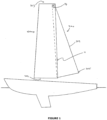
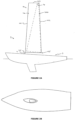
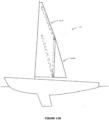
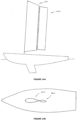
- a sail according to a first aspect of the invention is generally indicated by the numeral 10.
- a nestable wing sail 10 configured to be used on a yacht 2.
- the yacht having a hull 3, and the wing sail optionally attached to the hull via a mast 4.
- the mast may be integral with the wing sail.
- the wing sail is preferably of an aerofoil shape, and is formed from skins that create the sides of the wing sail, and the surfaces to be the effective sail area.
- the sail 10 comprises a primary, or forward section, from which two or more moveable sections are able nest within.
- the primary section comprises a cavity 109, for the moveable sections to nest.
- the moveable sections are able to extend out from the cavity 109, and aft through the leech 102. There may be multiple moveable sections able to nest within the primary section. Moveable sections may be described as first, second and third moveable sections and so forth.
- the primary section 100 (as shown in Figure 1 ) houses the moveable sections.
- Moving of the moveable sections aft from the primary section allows the sail 10 to increase its effective sail area.
- the moveable sections are retracted back into their adjacent and forward sections, from their extended position.
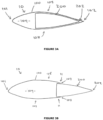
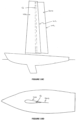
- Figure 3B shows a primary section 100 having a first moveable section 200 extending from the primary section 100 leech 102.
- the leech 102 is formed from each aft edge 107 of each side 108 of the primary section 100 (as shown in Figure 3A-B ).
- the first moveable section 200 extends out from the leech 102 about a pivot point 14 located near the head 103 of the primary section 100.
- the primary section aft edges 107 becomes a cover or join 11 intermediate the primary section 100 and the first moveable section 200.
- the leech 202 of the first moveable section 200 then becomes the leech of the sail 10.
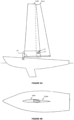
- Figure 1B shows the first moveable section 200 nested within the primary section 100.
- the leech 102 of the primary section 100 is the leech of the sail 10.
- FIGS 1 & 2 are just one embodiment of an extendable nested wing sail.
- the embodiment shown in Figures 1 & 2 shows a rotating moveable section 200.
- Other embodiments may be used and fall within the scope of invention, such as embodiments shown in Figures 8 & 9 where a translating moveable section 200 is used.
- an unfurling moveable section 200 is utilised to extend the surface area of a wing sail. This will be described in further detail later.
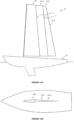
- FIGS 11A & 11B show a sail with two moveable sections 200 and 300. Again, these moveable sections 200, 300 may translate from the primary section 100, or they may rotate about a pivot point from their adjacent forward section, or both may rotate about the primary section (not shown), or they may utilise a combination or translation and rotation.
- Figures 3A & 3B show details of a simplified cross section of the embodiment of Figures 1 & 2 . It can be seen that the aft edges 107 of the leech 102 of the primary section 100 are able to open up to allow the first moveable section 200 to pass therethrough.
- Figures 4A, 4B & 5 show a perspective view of the embodiment of Figure 1 , and show that the trailing edges 107 or leech 102 of the primary section 100 open up and allow the moveable section 200 to pass through.
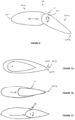
- Figure 6 shows an embodiment where the first moveable section or any of the trailing sections are able to trim or rotate with respect to the primary section, and/or their adjacent sections. This allows the wing sail 10 to be better configured for the wind / sailing conditions.
- Figures 7A-C show a sail 10 that has a nested section that is able to be partially extended out from the primary section 100. This allows a graduation of configurations between a fully retracted and a fully extended condition of the sail 10. This partial extension can be used in any of the embodiments as described herein.
- Figures 7 A-C also show the moveable section 200 being able to pivot about a point 12 to trim the sail. There may be multiple moveable sections that are able to trim. This trimming configuration may be used in any of the embodiments as described herein.
- Figures 8 & 9 show the retracted and extended configurations of a translating moveable section 200.
- Figures 8 & 9 show a translating nested section 200 that translates from the trailing edge or leech 102 of the primary section 100.
- An extension mechanism 15 and a retraction mechanism 16 is used to extend and retract the one or moveable sections.
- the extension mechanism 15 is a rope or other flexible member, such as wire, in combination with one or more pulleys 17 that allows pulling of a rope at one end to extend the first moveable section 200 from the primary section 100.
- a retraction mechanism 16 is a rope attached to the foot 104 of the moveable section 200, so the moveable section 200 is able to be pulled towards the bow of the boat, to nest inside the primary section 100.
- FIG. 12A-B An alternative rope and pulley system is shown in Figure 12A-B , where a boom 18 is utilised to locate a pulley 17 at its distal end. This allows a rope to pull out a moveable section towards the distal end of the boom 18.
- linear actuators which are, for example, hydraulic or electric powered.
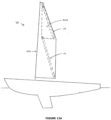
- Figures 10A-D show a further embodiment of the invention, wherein the nested section 200 is a single "soft" or “2D" sail.
- the soft moveable section 200 is configured to be unfurled about a roller 13 to extend it outwards from the leech 102. This is a more simplified design, wherein the leech 102 does not need to extend laterally as much to allow the soft moveable section 200 to pass therethrough, compared to a wing moveable section.
- Figures 13A-B show a further embodiment, where the moveable section 200 is configured to slide/translate downwards towards its extended condition as shown in Figure 13B .
- the moveable section 200 is configured to slide along tracks 19 (not all shown) to move between a retracted and extended condition.
- This embodiment allows the movable section 200 to be gravity assisted towards its extended condition.
- a simply halyard system attached to the moveable section 200 may be used to retract the moveable section 200 back into the primary section 100.
- This is just one embodiment of a tracked system there may be many different configurations and track patterns appropriate for different sail types, and designs. For example, less steep tracks, tracks that utilise hydraulics to move the moveable sections 200 etc.
- Figures 14A-E show a further embodiment of the present invention where the aerofoil shape of the moveable section 200 fully extends out of the aerofoil shape of the primary section 100.
- This configuration allows air flow intermediate the leech 102 and the luff 201 of the moveable section 201.
- This configuration of a gap seen, often seen intermediate a trim tab and main section is known in existing wing sails. However, this trim tab has not previously been able to be retracted into a forward sail section, or been able have its effective sail area removed from the overall effective sail area.
- the moveable section 200 seen in Figure 14 may be able to pivoted about an axis so as to allow differing wing shapes.
- the leech 102 may be configured to allow easy entry of the movable section 200 back in to the primary section 100.
- Figure 14 C shows the upturned edges of the leech 102 that allow the movable section 200 to start entering into the leech 102. This is required, as in other embodiments where the movable section stays keeps the leech 102 open, in the figure 14 embodiment the leech 102 is allowed to close back in on itself. And thus, a configurations such as a upturn at each leech edge is utilised to allow the movable section 200 to start entering into the leech 102
- the leech opening may be of a variety of configurations.
- the wing sections may have flexible ribs on each side that are configured to flex outwards so that the aft edge of the wing section, at the leech edge 102, able to laterally open up to allow movable sections 200 to enter and exit.
- Flexible ribs or battens are well-known in the sailing industry.
- the leech 102 of a section that is able to laterally open up has aft edges 107 as shown in figure 3B .
- the aft edges 107 are substantially stiff so that they are able to be actuated laterally outwards (independent of the respective moveable section) to allow a movable section to pass therethrough. This is an alternative to the movable section itself opening up the aft edges 107/leech 102 as it passes through.
- the aft edges that form the leech of a respective section are substantially resilient and flexible so that they follow the outer surface of the respective movable section.
- the aft edges 107 are able to form a join 11 as described previously.
- This join may include or have an integral flexible member that is compliant with the angles between two adjacent sections. The join ideally creates a smooth transition between the sail sections.
- the aft edges 107 may in some embodiments be biased open (i.e. laterally spread apart), with actuation to close the aft edges 107 to form a leech 102, in behind the moveable section once it is fully nested within the section that houses it. However, more likely, is that the aft edges 107 are biased closed, and forced to be spread laterally apart by moveable section passing through.
- the moveable sections that have further nested moveable sections within them may include the same designs, features and configurations of the primary section.
Landscapes
- Engineering & Computer Science (AREA)
- Mechanical Engineering (AREA)
- Combustion & Propulsion (AREA)
- Chemical & Material Sciences (AREA)
- Ocean & Marine Engineering (AREA)
- Sustainable Energy (AREA)
- Life Sciences & Earth Sciences (AREA)
- Sustainable Development (AREA)
- Transportation (AREA)
- Aviation & Aerospace Engineering (AREA)
- Wind Motors (AREA)
- Toys (AREA)
- Adhesives Or Adhesive Processes (AREA)
Claims (11)
- Flügelsegel (10) für eine Yacht (2), wobei das Flügelsegel (10) mindestens zwei Segelabschnitte umfasst,a. einen primären Abschnitt (100), an einem Mast (4) befestigt, integral mit diesem oder einen solchen umfassend und zwei Häute umfassend, die zumindest ein Teil einer aerodynamischen Profiloberfläche sind, wobei der primäre Abschnitt (100) außerdem ein Liek (102) an den Achterkanten (107) davon, dort, wo die beiden Häute zusammenlaufen, aufweist, undb. einen beweglichen Abschnitt (200), der dazu ausgelegt ist, sich zwischen einem ersten Zustand, bei dem der bewegliche Abschnitt (200) innerhalb oder am Liek (102) des primären Abschnitts (100) verschachtelt oder teilweise verschachtelt ist, und einem zweiten Zustand, bei dem sich der bewegliche Abschnitt (200) zumindest teilweise von zumindest einem Teil des Lieks (102) aus dem Zwischenraum der zwei Häute erstreckt, zu bewegen, dadurch gekennzeichnet, dassc. das Segel einen zweiten beweglichen Abschnitt (300) umfasst, wobei der zweite bewegliche Abschnitt (300) innerhalb des beweglichen Abschnitts (200) in ähnlicher Auslegung verschachtelt ist, wie der bewegliche Abschnitt (200) innerhalb des primären Abschnitts (100) verschachtelt ist.
- Segel (10) nach Anspruch 1, wobei der primäre Abschnitt (100) einen Hohlraum (109) zwischen den beiden Häuten aufweist, der den beweglichen Abschnitt (200) aufnehmen kann.
- Segel (10) nach Anspruch 1 oder 2, wobei der primäre Abschnitt (100) und der bewegliche Abschnitt (200) Segelfläche umfassen, die die Segelfläche des Flügelsegels ausmacht.
- Segel (10) nach einem der vorhergehenden Ansprüche, wobei im ersten Zustand der bewegliche Abschnitt (200) vollständig innerhalb des primären Abschnitts (100) verschachtelt ist, sodass das Liek (102) des primären Abschnitts das Liek des Segels (10) bildet.
- Segel (10) nach einem der vorhergehenden Ansprüche, wobei im zweiten Zustand die Achterkante des beweglichen Abschnitts (200) zumindest einen Teil des Lieks des Segels bildet.
- Segel (10) nach einem der vorhergehenden Ansprüche, wobei der bewegliche Abschnitt (200) in Bezug auf den primären Abschnitt (100) verschoben wird, um sich zwischen dem ersten und zweiten Zustand zu bewegen.
- Segel (10) nach einem der vorhergehenden Ansprüche, wobei sich der bewegliche Abschnitt (200) in Bezug auf den primären Abschnitt (100) dreht, um sich zwischen dem ersten und zweiten Zustand zu bewegen.
- Segel (10) nach einem der vorhergehenden Ansprüche, wobei der primäre Abschnitt (100) an seinem Liek (102) flexible Bereiche aufweist, die dazu ausgelegt sind, sich zu verbiegen, um dem beweglichen Abschnitt (200) zu ermöglichen, zwischen den Seiten des primären Abschnitts (100) durch das Liek des primären Abschnitts (102) zu laufen.
- Segel (10) nach einem der vorhergehenden Ansprüche, wobei die Achterkanten eines Segelabschnitts ein Liek bilden, wenn sie nicht durch einen angrenzenden Segelabschnitt lateral auseinander gespreizt werden.
- Segel (10) nach Anspruch 9, wobei die Achterkanten des primären Abschnitts (100) den angrenzenden Abschnitt überlappen, um eine Verbindung zu bilden, die eine im Wesentlichen durchgehende Fläche zwischen den aneinander angrenzenden Abschnitten umfasst, wenn sie durch den angrenzenden Segelabschnitt auseinander gespreizt werden.
- Yacht (2) mit einem Flügelsegel (10) nach einem der vorhergehenden Ansprüche.
Applications Claiming Priority (2)
| Application Number | Priority Date | Filing Date | Title |
|---|---|---|---|
| NZ73965218 | 2018-02-02 | ||
| PCT/IB2019/050765 WO2019150289A1 (en) | 2018-02-02 | 2019-01-31 | A sail |
Publications (4)
| Publication Number | Publication Date |
|---|---|
| EP3746360A1 EP3746360A1 (de) | 2020-12-09 |
| EP3746360A4 EP3746360A4 (de) | 2021-11-03 |
| EP3746360B1 true EP3746360B1 (de) | 2024-11-13 |
| EP3746360C0 EP3746360C0 (de) | 2024-11-13 |
Family
ID=67479154
Family Applications (2)
| Application Number | Title | Priority Date | Filing Date |
|---|---|---|---|
| EP19748026.2A Active EP3746360B1 (de) | 2018-02-02 | 2019-01-31 | Segel |
| EP21848632.2A Pending EP4188792A4 (de) | 2018-02-02 | 2021-07-30 | Segel |
Family Applications After (1)
| Application Number | Title | Priority Date | Filing Date |
|---|---|---|---|
| EP21848632.2A Pending EP4188792A4 (de) | 2018-02-02 | 2021-07-30 | Segel |
Country Status (5)
| Country | Link |
|---|---|
| US (1) | US11643179B2 (de) |
| EP (2) | EP3746360B1 (de) |
| CN (2) | CN111727152B (de) |
| AU (5) | AU2019213777A1 (de) |
| WO (2) | WO2019150289A1 (de) |
Families Citing this family (4)
| Publication number | Priority date | Publication date | Assignee | Title |
|---|---|---|---|---|
| EP3746360B1 (de) * | 2018-02-02 | 2024-11-13 | Mark Fraser | Segel |
| EP4491504B1 (de) * | 2022-02-01 | 2025-12-10 | AlfaWall Oceanbird AB | Verfahren zum betrieb einer windgestützten antriebsanordnung eines wasserfahrzeugs |
| CN115009496B (zh) * | 2022-05-31 | 2024-05-24 | 武汉船用机械有限责任公司 | 船用可变翼型风帆及船舶 |
| CN116080880A (zh) * | 2023-03-24 | 2023-05-09 | 上海外高桥造船有限公司 | 风力辅助船 |
Family Cites Families (24)
| Publication number | Priority date | Publication date | Assignee | Title |
|---|---|---|---|---|
| GB154556A (en) | 1919-11-27 | 1921-09-13 | Klio Werk G M B H | Improved fountain pen holder |
| FR737052A (fr) * | 1931-07-29 | 1932-12-06 | Aile d'aéroplane à surface portante agrandissable au moyen de surfaces auxiliaires développables | |
| GB454556A (en) * | 1935-03-27 | 1936-09-28 | Rose Macdonald | Improvements relating to aircraft |
| GB506136A (en) * | 1938-09-14 | 1939-05-23 | Michael Gliwa | Improvements in or relating to wings for aircraft |
| US3532067A (en) | 1968-09-18 | 1970-10-06 | Bonnie Vold Baker | Water-conveyance apparatus |
| US3853289A (en) * | 1973-02-15 | 1974-12-10 | Boeing Co | Trailing edge flap and actuating mechanism therefor |
| US4106727A (en) * | 1977-05-09 | 1978-08-15 | Teledyne Brown Engineering, A Division Of Teledyne Industries, Inc. | Aircraft folding airfoil system |
| JPS57158192A (en) * | 1981-03-26 | 1982-09-29 | Mitsui Eng & Shipbuild Co Ltd | Sailing device |
| US4388888A (en) * | 1981-04-24 | 1983-06-21 | Gushurst Jr Fred W | Adjustable airfoil |
| ES522894A0 (es) * | 1982-06-04 | 1984-05-16 | Walker Wingsail Syst | Perfeccionamientos introducidos en aparatos de vela. |
| EP0511419B1 (de) * | 1991-04-29 | 1995-01-25 | Wilhelm Brinkmann | Profilsegel |
| US5535692A (en) * | 1995-02-21 | 1996-07-16 | Ezzy; David C. | Adjustable sail head tensioning device, and methods of fabricating and utilizing same |
| DE19700293A1 (de) * | 1997-01-08 | 1998-07-09 | Roger Jurriens | Segel für ein durch Windkraft bewegbares Fahrzeug |
| JP5318008B2 (ja) * | 2010-03-19 | 2013-10-16 | 株式会社大内海洋コンサルタント | 帆走船 |
| TWI399323B (zh) * | 2010-07-20 | 2013-06-21 | wen yun Chen | 帆船 |
| CN102348256B (zh) | 2010-07-26 | 2014-10-08 | 华为技术有限公司 | 多个无线接入网聚合系统及其实现方法和接入网网元 |
| SE535362C2 (sv) | 2010-11-15 | 2012-07-10 | Scandinaos Ab | Teleskopiskt segelarrangemang |
| WO2012168048A1 (de) * | 2011-06-08 | 2012-12-13 | Libellule S.Á R.L. | Rahmeneinrichtung für eine profilsegeleinrichtung und profilsegeleinrichtung mit wenigstens einer rahmeneinrichtung |
| CN104736430B (zh) * | 2012-10-05 | 2017-11-24 | 阳光水手私人有限公司 | 打开的刚性翼板 |
| KR101471347B1 (ko) * | 2013-03-05 | 2014-12-30 | (주)에스마린시스템 | 선박용 복합 세일 시스템 |
| EP3218258A4 (de) * | 2014-11-14 | 2018-08-08 | Lamberg, Vemund | Anpassbares segel und boot mit solch einem segel |
| FR3029888A1 (fr) | 2014-12-16 | 2016-06-17 | Dws Dyna Wing Sail | Greement de propulsion a voile de queue |
| US10246172B2 (en) * | 2016-06-24 | 2019-04-02 | James G. Arendts | Deployable shell reversible camber sail system |
| EP3746360B1 (de) | 2018-02-02 | 2024-11-13 | Mark Fraser | Segel |
-
2019
- 2019-01-31 EP EP19748026.2A patent/EP3746360B1/de active Active
- 2019-01-31 AU AU2019213777A patent/AU2019213777A1/en not_active Abandoned
- 2019-01-31 WO PCT/IB2019/050765 patent/WO2019150289A1/en not_active Ceased
- 2019-01-31 CN CN201980013598.9A patent/CN111727152B/zh active Active
-
2020
- 2020-07-31 US US16/944,731 patent/US11643179B2/en active Active
-
2021
- 2021-07-30 WO PCT/IB2021/056950 patent/WO2022024051A1/en not_active Ceased
- 2021-07-30 CN CN202180053705.8A patent/CN116419887A/zh active Pending
- 2021-07-30 AU AU2021104746A patent/AU2021104746A4/en active Active
- 2021-07-30 AU AU2021104747A patent/AU2021104747A4/en active Active
- 2021-07-30 EP EP21848632.2A patent/EP4188792A4/de active Pending
- 2021-07-30 AU AU2021317173A patent/AU2021317173A1/en active Pending
-
2023
- 2023-12-22 AU AU2023285933A patent/AU2023285933B2/en active Active
Also Published As
| Publication number | Publication date |
|---|---|
| EP3746360A1 (de) | 2020-12-09 |
| AU2021104746A4 (en) | 2021-09-30 |
| US11643179B2 (en) | 2023-05-09 |
| AU2019213777A1 (en) | 2020-09-24 |
| EP3746360A4 (de) | 2021-11-03 |
| CN116419887A (zh) | 2023-07-11 |
| AU2021104747A4 (en) | 2021-09-30 |
| WO2022024051A1 (en) | 2022-02-03 |
| EP3746360C0 (de) | 2024-11-13 |
| WO2019150289A1 (en) | 2019-08-08 |
| EP4188792A4 (de) | 2024-08-21 |
| AU2021317173A1 (en) | 2023-03-02 |
| EP4188792A1 (de) | 2023-06-07 |
| AU2023285933A1 (en) | 2024-01-25 |
| CN111727152B (zh) | 2023-02-17 |
| AU2023285933B2 (en) | 2025-12-04 |
| US20200361585A1 (en) | 2020-11-19 |
| CN111727152A (zh) | 2020-09-29 |
Similar Documents
| Publication | Publication Date | Title |
|---|---|---|
| AU2021104746A4 (en) | A sail | |
| CN110520354B (zh) | 由风帆推进的船舶 | |
| US7114456B2 (en) | Reversible camber airfoil | |
| US20130014683A1 (en) | Adjusting rigid foil spar system | |
| JP2019515828A (ja) | 航海手段用の帆装 | |
| EP3297904B1 (de) | Segelschiff | |
| US3720180A (en) | Raffe sail for boats | |
| US7762204B2 (en) | Retractable bowsprit for a sailing vessel | |
| DK158257B (da) | Koelkonstruktion til et sejlfartoej | |
| US20120285354A1 (en) | Adjusting rigid foil spar system | |
| JP7168273B1 (ja) | 船舶用翼型帆装置及び船舶用翼型帆装置を備えた船 | |
| EP2209706B1 (de) | Antriebssystem für ein segelboot | |
| NO20190661A1 (en) | A structural device, a propulsive device and a propulsive system. | |
| WO2022064195A1 (en) | A wing sail for a wing propelled craft | |
| US10232912B1 (en) | Rig for sailboat | |
| EP0242408B1 (de) | Segelboot | |
| US6070545A (en) | Sails for sailboats having self-tacking leech flaps | |
| EP1180478A1 (de) | Mast mit einem im Oberbereich angeordnetem Baum | |
| US8739720B2 (en) | Storable, sickle-shaped sailboat mast | |
| AU664324B2 (en) | An adjustable foil shaped keel for sailing vessels | |
| WO2010034839A2 (en) | Sail with vertical slots | |
| WO2012094731A1 (en) | Microairfoil and method for rigging and control | |
| WO2007009740A1 (en) | Sailing boat with simplified sail plan | |
| AU6571580A (en) | Sail rigging system |
Legal Events
| Date | Code | Title | Description |
|---|---|---|---|
| STAA | Information on the status of an ep patent application or granted ep patent |
Free format text: STATUS: THE INTERNATIONAL PUBLICATION HAS BEEN MADE |
|
| PUAI | Public reference made under article 153(3) epc to a published international application that has entered the european phase |
Free format text: ORIGINAL CODE: 0009012 |
|
| STAA | Information on the status of an ep patent application or granted ep patent |
Free format text: STATUS: REQUEST FOR EXAMINATION WAS MADE |
|
| 17P | Request for examination filed |
Effective date: 20200901 |
|
| AK | Designated contracting states |
Kind code of ref document: A1 Designated state(s): AL AT BE BG CH CY CZ DE DK EE ES FI FR GB GR HR HU IE IS IT LI LT LU LV MC MK MT NL NO PL PT RO RS SE SI SK SM TR |
|
| AX | Request for extension of the european patent |
Extension state: BA ME |
|
| DAV | Request for validation of the european patent (deleted) | ||
| DAX | Request for extension of the european patent (deleted) | ||
| A4 | Supplementary search report drawn up and despatched |
Effective date: 20211005 |
|
| RIC1 | Information provided on ipc code assigned before grant |
Ipc: B63H 9/10 20060101ALI20210929BHEP Ipc: B63H 9/061 20200101ALI20210929BHEP Ipc: B63H 9/06 20200101AFI20210929BHEP |
|
| GRAP | Despatch of communication of intention to grant a patent |
Free format text: ORIGINAL CODE: EPIDOSNIGR1 |
|
| STAA | Information on the status of an ep patent application or granted ep patent |
Free format text: STATUS: GRANT OF PATENT IS INTENDED |
|
| INTG | Intention to grant announced |
Effective date: 20240620 |
|
| GRAS | Grant fee paid |
Free format text: ORIGINAL CODE: EPIDOSNIGR3 |
|
| GRAA | (expected) grant |
Free format text: ORIGINAL CODE: 0009210 |
|
| STAA | Information on the status of an ep patent application or granted ep patent |
Free format text: STATUS: THE PATENT HAS BEEN GRANTED |
|
| AK | Designated contracting states |
Kind code of ref document: B1 Designated state(s): AL AT BE BG CH CY CZ DE DK EE ES FI FR GB GR HR HU IE IS IT LI LT LU LV MC MK MT NL NO PL PT RO RS SE SI SK SM TR |
|
| REG | Reference to a national code |
Ref country code: GB Ref legal event code: FG4D |
|
| REG | Reference to a national code |
Ref country code: CH Ref legal event code: EP |
|
| REG | Reference to a national code |
Ref country code: DE Ref legal event code: R096 Ref document number: 602019061934 Country of ref document: DE |
|
| REG | Reference to a national code |
Ref country code: IE Ref legal event code: FG4D |
|
| REG | Reference to a national code |
Ref country code: GR Ref legal event code: EP Ref document number: 20240402726 Country of ref document: GR Effective date: 20241209 |
|
| U01 | Request for unitary effect filed |
Effective date: 20241126 |
|
| U07 | Unitary effect registered |
Designated state(s): AT BE BG DE DK EE FI FR IT LT LU LV MT NL PT RO SE SI Effective date: 20241203 |
|
| U20 | Renewal fee for the european patent with unitary effect paid |
Year of fee payment: 7 Effective date: 20250211 |
|
| PG25 | Lapsed in a contracting state [announced via postgrant information from national office to epo] |
Ref country code: IS Free format text: LAPSE BECAUSE OF FAILURE TO SUBMIT A TRANSLATION OF THE DESCRIPTION OR TO PAY THE FEE WITHIN THE PRESCRIBED TIME-LIMIT Effective date: 20250313 Ref country code: HR Free format text: LAPSE BECAUSE OF FAILURE TO SUBMIT A TRANSLATION OF THE DESCRIPTION OR TO PAY THE FEE WITHIN THE PRESCRIBED TIME-LIMIT Effective date: 20241113 |
|
| PG25 | Lapsed in a contracting state [announced via postgrant information from national office to epo] |
Ref country code: ES Free format text: LAPSE BECAUSE OF FAILURE TO SUBMIT A TRANSLATION OF THE DESCRIPTION OR TO PAY THE FEE WITHIN THE PRESCRIBED TIME-LIMIT Effective date: 20241113 |
|
| PG25 | Lapsed in a contracting state [announced via postgrant information from national office to epo] |
Ref country code: NO Free format text: LAPSE BECAUSE OF FAILURE TO SUBMIT A TRANSLATION OF THE DESCRIPTION OR TO PAY THE FEE WITHIN THE PRESCRIBED TIME-LIMIT Effective date: 20250213 |
|
| PGFP | Annual fee paid to national office [announced via postgrant information from national office to epo] |
Ref country code: GR Payment date: 20250128 Year of fee payment: 7 |
|
| PG25 | Lapsed in a contracting state [announced via postgrant information from national office to epo] |
Ref country code: PL Free format text: LAPSE BECAUSE OF FAILURE TO SUBMIT A TRANSLATION OF THE DESCRIPTION OR TO PAY THE FEE WITHIN THE PRESCRIBED TIME-LIMIT Effective date: 20241113 |
|
| PGFP | Annual fee paid to national office [announced via postgrant information from national office to epo] |
Ref country code: GB Payment date: 20250211 Year of fee payment: 7 |
|
| PG25 | Lapsed in a contracting state [announced via postgrant information from national office to epo] |
Ref country code: RS Free format text: LAPSE BECAUSE OF FAILURE TO SUBMIT A TRANSLATION OF THE DESCRIPTION OR TO PAY THE FEE WITHIN THE PRESCRIBED TIME-LIMIT Effective date: 20250213 |
|
| PG25 | Lapsed in a contracting state [announced via postgrant information from national office to epo] |
Ref country code: SM Free format text: LAPSE BECAUSE OF FAILURE TO SUBMIT A TRANSLATION OF THE DESCRIPTION OR TO PAY THE FEE WITHIN THE PRESCRIBED TIME-LIMIT Effective date: 20241113 |
|
| PG25 | Lapsed in a contracting state [announced via postgrant information from national office to epo] |
Ref country code: SK Free format text: LAPSE BECAUSE OF FAILURE TO SUBMIT A TRANSLATION OF THE DESCRIPTION OR TO PAY THE FEE WITHIN THE PRESCRIBED TIME-LIMIT Effective date: 20241113 |
|
| PG25 | Lapsed in a contracting state [announced via postgrant information from national office to epo] |
Ref country code: CZ Free format text: LAPSE BECAUSE OF FAILURE TO SUBMIT A TRANSLATION OF THE DESCRIPTION OR TO PAY THE FEE WITHIN THE PRESCRIBED TIME-LIMIT Effective date: 20241113 |
|
| REG | Reference to a national code |
Ref country code: CH Ref legal event code: PL |
|
| PG25 | Lapsed in a contracting state [announced via postgrant information from national office to epo] |
Ref country code: MC Free format text: LAPSE BECAUSE OF FAILURE TO SUBMIT A TRANSLATION OF THE DESCRIPTION OR TO PAY THE FEE WITHIN THE PRESCRIBED TIME-LIMIT Effective date: 20241113 |
|
| PLBE | No opposition filed within time limit |
Free format text: ORIGINAL CODE: 0009261 |
|
| STAA | Information on the status of an ep patent application or granted ep patent |
Free format text: STATUS: NO OPPOSITION FILED WITHIN TIME LIMIT |
|
| PG25 | Lapsed in a contracting state [announced via postgrant information from national office to epo] |
Ref country code: CH Free format text: LAPSE BECAUSE OF NON-PAYMENT OF DUE FEES Effective date: 20250131 |
|
| 26N | No opposition filed |
Effective date: 20250814 |