EP3740536B1 - Flexibles wachs und herstellungsverfahren dafür - Google Patents
Flexibles wachs und herstellungsverfahren dafür Download PDFInfo
- Publication number
- EP3740536B1 EP3740536B1 EP19738500.8A EP19738500A EP3740536B1 EP 3740536 B1 EP3740536 B1 EP 3740536B1 EP 19738500 A EP19738500 A EP 19738500A EP 3740536 B1 EP3740536 B1 EP 3740536B1
- Authority
- EP
- European Patent Office
- Prior art keywords
- composition
- fatty acid
- wax composition
- flexible wax
- flexible
- Prior art date
- Legal status (The legal status is an assumption and is not a legal conclusion. Google has not performed a legal analysis and makes no representation as to the accuracy of the status listed.)
- Active
Links
Images

Classifications
-
- C—CHEMISTRY; METALLURGY
- C08—ORGANIC MACROMOLECULAR COMPOUNDS; THEIR PREPARATION OR CHEMICAL WORKING-UP; COMPOSITIONS BASED THEREON
- C08L—COMPOSITIONS OF MACROMOLECULAR COMPOUNDS
- C08L91/00—Compositions of oils, fats or waxes; Compositions of derivatives thereof
- C08L91/02—Vulcanised oils, e.g. factice
-
- A—HUMAN NECESSITIES
- A23—FOODS OR FOODSTUFFS; TREATMENT THEREOF, NOT COVERED BY OTHER CLASSES
- A23L—FOODS, FOODSTUFFS OR NON-ALCOHOLIC BEVERAGES, NOT OTHERWISE PROVIDED FOR; PREPARATION OR TREATMENT THEREOF
- A23L33/00—Modifying nutritive qualities of foods; Dietetic products; Preparation or treatment thereof
- A23L33/10—Modifying nutritive qualities of foods; Dietetic products; Preparation or treatment thereof using additives
- A23L33/115—Fatty acids or derivatives thereof; Fats or oils
- A23L33/12—Fatty acids or derivatives thereof
-
- A—HUMAN NECESSITIES
- A61—MEDICAL OR VETERINARY SCIENCE; HYGIENE
- A61K—PREPARATIONS FOR MEDICAL, DENTAL OR TOILETRY PURPOSES
- A61K8/00—Cosmetics or similar toiletry preparations
- A61K8/18—Cosmetics or similar toiletry preparations characterised by the composition
- A61K8/92—Oils, fats or waxes; Derivatives thereof, e.g. hydrogenation products thereof
-
- A—HUMAN NECESSITIES
- A61—MEDICAL OR VETERINARY SCIENCE; HYGIENE
- A61Q—SPECIFIC USE OF COSMETICS OR SIMILAR TOILETRY PREPARATIONS
- A61Q19/00—Preparations for care of the skin
-
- B—PERFORMING OPERATIONS; TRANSPORTING
- B60—VEHICLES IN GENERAL
- B60C—VEHICLE TYRES; TYRE INFLATION; TYRE CHANGING; CONNECTING VALVES TO INFLATABLE ELASTIC BODIES IN GENERAL; DEVICES OR ARRANGEMENTS RELATED TO TYRES
- B60C1/00—Tyres characterised by the chemical composition or the physical arrangement or mixture of the composition
-
- C—CHEMISTRY; METALLURGY
- C08—ORGANIC MACROMOLECULAR COMPOUNDS; THEIR PREPARATION OR CHEMICAL WORKING-UP; COMPOSITIONS BASED THEREON
- C08L—COMPOSITIONS OF MACROMOLECULAR COMPOUNDS
- C08L91/00—Compositions of oils, fats or waxes; Compositions of derivatives thereof
- C08L91/06—Waxes
-
- C—CHEMISTRY; METALLURGY
- C09—DYES; PAINTS; POLISHES; NATURAL RESINS; ADHESIVES; COMPOSITIONS NOT OTHERWISE PROVIDED FOR; APPLICATIONS OF MATERIALS NOT OTHERWISE PROVIDED FOR
- C09D—COATING COMPOSITIONS, e.g. PAINTS, VARNISHES OR LACQUERS; FILLING PASTES; CHEMICAL PAINT OR INK REMOVERS; INKS; CORRECTING FLUIDS; WOODSTAINS; PASTES OR SOLIDS FOR COLOURING OR PRINTING; USE OF MATERIALS THEREFOR
- C09D191/00—Coating compositions based on oils, fats or waxes; Coating compositions based on derivatives thereof
- C09D191/06—Waxes
-
- C—CHEMISTRY; METALLURGY
- C11—ANIMAL OR VEGETABLE OILS, FATS, FATTY SUBSTANCES OR WAXES; FATTY ACIDS THEREFROM; DETERGENTS; CANDLES
- C11C—FATTY ACIDS FROM FATS, OILS OR WAXES; CANDLES; FATS, OILS OR FATTY ACIDS BY CHEMICAL MODIFICATION OF FATS, OILS, OR FATTY ACIDS OBTAINED THEREFROM
- C11C1/00—Preparation of fatty acids from fats, fatty oils, or waxes; Refining the fatty acids
- C11C1/02—Preparation of fatty acids from fats, fatty oils, or waxes; Refining the fatty acids from fats or fatty oils
- C11C1/04—Preparation of fatty acids from fats, fatty oils, or waxes; Refining the fatty acids from fats or fatty oils by hydrolysis
- C11C1/045—Preparation of fatty acids from fats, fatty oils, or waxes; Refining the fatty acids from fats or fatty oils by hydrolysis using enzymes or microorganisms, living or dead
-
- C—CHEMISTRY; METALLURGY
- C11—ANIMAL OR VEGETABLE OILS, FATS, FATTY SUBSTANCES OR WAXES; FATTY ACIDS THEREFROM; DETERGENTS; CANDLES
- C11C—FATTY ACIDS FROM FATS, OILS OR WAXES; CANDLES; FATS, OILS OR FATTY ACIDS BY CHEMICAL MODIFICATION OF FATS, OILS, OR FATTY ACIDS OBTAINED THEREFROM
- C11C3/00—Fats, oils, or fatty acids by chemical modification of fats, oils, or fatty acids obtained therefrom
- C11C3/02—Fats, oils, or fatty acids by chemical modification of fats, oils, or fatty acids obtained therefrom by esterification of fatty acids with glycerol
-
- C—CHEMISTRY; METALLURGY
- C11—ANIMAL OR VEGETABLE OILS, FATS, FATTY SUBSTANCES OR WAXES; FATTY ACIDS THEREFROM; DETERGENTS; CANDLES
- C11C—FATTY ACIDS FROM FATS, OILS OR WAXES; CANDLES; FATS, OILS OR FATTY ACIDS BY CHEMICAL MODIFICATION OF FATS, OILS, OR FATTY ACIDS OBTAINED THEREFROM
- C11C3/00—Fats, oils, or fatty acids by chemical modification of fats, oils, or fatty acids obtained therefrom
- C11C3/04—Fats, oils, or fatty acids by chemical modification of fats, oils, or fatty acids obtained therefrom by esterification of fats or fatty oils
- C11C3/10—Ester interchange
-
- C—CHEMISTRY; METALLURGY
- C11—ANIMAL OR VEGETABLE OILS, FATS, FATTY SUBSTANCES OR WAXES; FATTY ACIDS THEREFROM; DETERGENTS; CANDLES
- C11C—FATTY ACIDS FROM FATS, OILS OR WAXES; CANDLES; FATS, OILS OR FATTY ACIDS BY CHEMICAL MODIFICATION OF FATS, OILS, OR FATTY ACIDS OBTAINED THEREFROM
- C11C5/00—Candles
- C11C5/002—Ingredients
-
- C—CHEMISTRY; METALLURGY
- C11—ANIMAL OR VEGETABLE OILS, FATS, FATTY SUBSTANCES OR WAXES; FATTY ACIDS THEREFROM; DETERGENTS; CANDLES
- C11C—FATTY ACIDS FROM FATS, OILS OR WAXES; CANDLES; FATS, OILS OR FATTY ACIDS BY CHEMICAL MODIFICATION OF FATS, OILS, OR FATTY ACIDS OBTAINED THEREFROM
- C11C5/00—Candles
- C11C5/02—Apparatus for preparation thereof
-
- A—HUMAN NECESSITIES
- A23—FOODS OR FOODSTUFFS; TREATMENT THEREOF, NOT COVERED BY OTHER CLASSES
- A23V—INDEXING SCHEME RELATING TO FOODS, FOODSTUFFS OR NON-ALCOHOLIC BEVERAGES AND LACTIC OR PROPIONIC ACID BACTERIA USED IN FOODSTUFFS OR FOOD PREPARATION
- A23V2002/00—Food compositions, function of food ingredients or processes for food or foodstuffs
-
- A—HUMAN NECESSITIES
- A61—MEDICAL OR VETERINARY SCIENCE; HYGIENE
- A61K—PREPARATIONS FOR MEDICAL, DENTAL OR TOILETRY PURPOSES
- A61K2800/00—Properties of cosmetic compositions or active ingredients thereof or formulation aids used therein and process related aspects
- A61K2800/10—General cosmetic use
-
- C—CHEMISTRY; METALLURGY
- C08—ORGANIC MACROMOLECULAR COMPOUNDS; THEIR PREPARATION OR CHEMICAL WORKING-UP; COMPOSITIONS BASED THEREON
- C08L—COMPOSITIONS OF MACROMOLECULAR COMPOUNDS
- C08L2201/00—Properties
- C08L2201/06—Biodegradable
Definitions
- This application relates to natural oil-based wax compositions and methods of making the same.
- Beeswax is a naturally occurring wax which has been used since prehistoric times. Although beeswax has remained useful in the modem era, it has become increasingly costly and scarce.
- paraffin wax in the 19 th century, in parallel with the development of petroleum refining, provided a bountiful and low-cost alternative to beeswax.
- paraffin is the primary industrial wax used to produce candles and other wax-based products.
- the present disclosure provides a flexible wax composition having about 20 wt% to about 45 wt% monoacylglycerides, about 28 wt% to about 40 wt% diacyl glycerides, and about 10 wt% to about 45 wt% acylglyceride polymers, wherein acylglyceride polymers are compounds that contain one or more dimerized fatty acid residue and a plurality of glycerol moieties.
- the present disclosure also provides a flexible wax composition wherein about 40 wt% to about 75 wt% of the composition is acylglycerides having a weight average molecular weight (Mw) of about 200 Da to about 580 Da, and at least 10 wt% of the composition is acylglycerides having a weight average molecular weight of about 900 Da to about 3000 Da.
- Mw weight average molecular weight
- the present disclosure further provides a method of making a flexible wax composition.
- the method comprises mixing fatty acid and/or oil, a fatty acid dimer, and glycerin to form a reaction mixture; and adding a caustic or enzymatic catalyst to the mixture to facilitate a transesterification reaction until the mixture achieves an acid value (AV) of less than 1.5, so as to obtain a flexible wax composition.
- AV acid value
- the flexible wax compositions described herein are useful for candles, coatings, broadsizing for oriented strand board (OSB), tire and rubber applications, polyvinyl chloride (PVC) piping, crayons, and personal care products.
- OSB oriented strand board
- PVC polyvinyl chloride
- waxes are desired which have certain physical characteristics, e.g., in terms of drop point, hardness or malleability, that permit the material to be readily formed into the desired product.
- it is desirable for the wax to have properties which can improve ease of manufacturing while providing a wax producing have a pleasing appearance and feel.
- compositions described herein advantageously resist cracking when deformed or subjected to cold temperatures.
- the flexible wax compositions have an average creep stiffness (at 60 seconds and measured at 22°C) of less than about 30 MPa, less than about 25 MPa, less than about 20 MPa, less than about 15 MPa, or less than about 10 MPa.
- Reduced average creep stiffness reflects improved resistance to cracking.
- compositions herein demonstrate lower average creep stiffness and thus increased flexibility and cracking resistance compared to conventional wax formulations.
- the flexible wax composition of the present disclosure also has improved manufacturing properties.
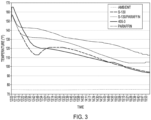
- the flexible wax composition cools faster than conventional paraffin waxes and, during cooling, the composition does not show any detrimental increase in interior temperature such as that displayed in some conventional waxes. Consistent cooling is important during candle formation and it is advantageous to avoid compositions that exhibit heats of crystallization that increase internal temperature during cooling.
- candle manufacturing relates to the amount of adhesion to the glass containers in which candles are formed. A candle having complete adhesion to the glass will have better consumer appeal than a candle which partially adheres to the glass. Moreover, a candle which lacks sufficient adhesion may rattle in the container.
- Various flexible wax compositions of the present disclosure have the advantage of offering substantially improved adhesion to glass containers. Such improved adhesion properties are also expected to improve use of the wax for various coating-based applications.
- compositions described herein are natural oil-based waxes and thus have the advantage of comprising biodegradable, renewable, and environmentally-friendly components.
- the flexible wax composition of the present disclosure can be prepared from natural oils and yet can offer the above-described advantages of resistance to cracking, faster cooling and improved glass adhesion.
- the acts can be carried out in any order without departing from the principles of the disclosure, except when a temporal or operational sequence is explicitly recited. Furthermore, specified acts can be carried out concurrently unless explicit claim language recites that they be carried out separately. For example, a claimed act of doing X and a claimed act of doing Y can be conducted simultaneously within a single operation, and the resulting process will fall within the literal scope of the claimed process.
- substantially refers to a majority of, or mostly, as in at least about 50%, 60%, 70%, 80%, 90%, 95%, 96%, 97%, 98%, 99%, 99.5%, 99.9%, 99.99%, or at least about 99.999% or more, or 100%.
- natural oil may refer to oil derived from plants or animal sources.
- natural oil includes natural oil derivatives, unless otherwise indicated.
- natural oils include, but are not limited to, vegetable oils, algae oils, animal fats, tall oils, derivatives of these oils, combinations of any of these oils, and the like.
- Representative non-limiting examples of vegetable oils include canola oil, rapeseed oil, coconut oil, corn oil, cottonseed oil, olive oil, palm oil, peanut oil, safflower oil, sesame oil, soybean oil, sunflower oil, linseed oil, palm kernel oil, tung oil, jatropha oil, mustard oil, camelina oil, pennycress oil, hemp oil, algal oil, and castor oil.
- animal fats include lard, tallow, poultry fat, yellow grease, and fish oil.
- Tall oils are by-products of wood pulp manufacture.
- the natural oil may be refined, bleached, and/or deodorized.
- the natural oil may be partially or fully hydrogenated.
- the natural oil is present individually or as mixtures thereof.
- natural oil derivatives may refer to the compounds or mixture of compounds derived from the natural oil using any one or combination of methods known in the art. Such methods include saponification, transesterification, esterification, interesterification, hydrogenation (partial or full), isomerization, oxidation, and reduction.
- Representative non-limiting examples of natural oil derivatives include gums, phospholipids, soapstock, acidulated soapstock, distillate or distillate sludge, fatty acids and fatty acid alkyl ester (e.g. non-limiting examples such as 2-ethylhexyl ester), hydroxy substituted variations thereof of the natural oil.
- a "natural oil-based" composition means that the composition contains oils and fatty acids which are predominantly, substantially or entirely, derived from natural oils and natural oil derivatives.
- natural oil-based waxes include vegetable oil-based waxes and animal oil-based waxes.
- An example vegetable oil-based wax is a soybean oil-based wax.
- the natural oil-based wax may, in various embodiments, contain oils which are at least 50%, 55%, 60%, 65%, 70%, 75%, 80%, 85%, 90%, 95%, 99%, 99.9%, 99.99% or about 100% natural oil.
- a natural oil-based wax may be substantially free of paraffin.
- the natural oil-based wax may be a non-beeswax natural oil-based wax.
- a “monoacylglyceride” refers to a molecule having a glycerol moiety with a single fatty acid residue that is linked via an ester bond.
- the terms “monoacylglycerol,” “monoacylglyceride,” “monoglyceride,” and “MAG” are used interchangeably herein.
- Monoacylglycerides include 2-acylglycerides and 1-acylglycerides.
- diacylglyceride refers to a molecule having a glycerol moiety having two fatty acid residues linked via ester bonds.
- diacylglycerol diacylglyceride
- diglyceride diglyceride
- DAG diacylglycerides
- triacylglyceride refers to a molecule having a glycerol moiety that is linked to three fatty acid residues via ester bonds.
- triacylglycerol refers to a molecule having a glycerol moiety that is linked to three fatty acid residues via ester bonds.
- triacylglycerol refers to a molecule having a glycerol moiety that is linked to three fatty acid residues via ester bonds.
- TAG triacylglyceride
- acylglyceride refers to a molecule having at least one glycerol moiety with at least one fatty acid residue that is linked via an ester bond.
- acylglycerides can include monoacylglycerides, diacylglycerides, triacylglycerides and acylglyceride polymers.
- the group acylglycerides can be further refined by additional descriptive terms and can be modified to expressly exclude or include certain subsets of acylglycerides.
- acylglycerides refers to MAGs and DAGs
- non-MAG/non-DAG acylglycerides refers to a group of acylglycerides which exclude MAGs and DAGs.
- acylglycerides comprising a C36 dimeric fatty acid residue refers only to those acylglycerides having the specified residue.
- acylglyceride polymer refers to a compound having two or more glycerol moieties linked together by at least one diacid linking residue, such as a dimerized fatty acid residue.
- the acylglyceride polymer can refer to a compound having the structure of Formula I:
- Each occurrence of X 1 , X 2 and X 3 is independently H, a fatty acid residue, a dimerized fatty acid residue, or a residue having a structure of Formula II:
- At least one of X 1 , X 2 and X 3 is a residue having a structure according to Formula II.
- G is a substituted or unsubstituted glycerol unit.
- G can be a monoacylglyceride, diacylglyceride or triacylglyceride.
- G can be the structure of Formula I wherein one of X 1 , X 2 and X 3 is replaced with a bond.
- each occurrence of X 1 , X 2 and X 3 is independently H, a non-dimerized fatty acid residue, a dimerized fatty acid residue, or a residue having a structure according to Formula IIa or Formula IIb, and at least one of X 1 , X 2 and X 3 is a residue having a structure according to Formula IIa or Formula IIb:
- A is any suitable divalent group.
- A can be -R 1 -Z-R 2 - or - R 1 -R 2 -.
- each occurrence of X 1 , X 2 and X 3 is independently H, a non-dimerized fatty acid residue, a dimerized fatty acid residue, or a residue having a structure according to Formula IIc, Formula IId, Formula IIe or Formula IIf, and at least one of X 1 , X 2 and X 3 is a residue having a structure according to Formula IIc, Formula IId, Formula He or Formula IIf:
- Each occurrence of X 4 and X 5 is independently H, a non-dimerized fatty acid residue, a dimerized fatty acid residue, or a residue having a structure according to Formula IIc, Formula IId, Formula IIe or Formula IIf.
- R 1 and R 2 are each independently a substituted or unsubstituted aliphatic group.
- the aliphatic group can correspond to a saturated fatty acid side chain or an unsaturated fatty acid side chain having one, two, three or more double bonds.
- the aliphatic group can be, for example, 1 to 30 carbons, 5 to 25 carbons, 7 to 21 carbons, 12 to 21 carbons, 15 to 19 carbons, or 17 carbons.
- R 1 and R 2 can be substituted and example substituents include alkyl, alcohol, halide, and oxygen so as to form an epoxide ring.
- R 1 and R 2 can be a saturated or unsaturated linear aliphatic group having 7, 9, 11, 13, 15, 17, 19 or 21 carbons.
- R 1 and R 2 are each a 17-carbon saturated or unsaturated group, the resulting dimerized fatty acid residue has 36 carbons.
- R 1 and R 2 can comprise hydrogen, carbon, oxygen, and nitrogen atoms; or R 1 and R 2 can consist of carbon, hydrogen, and oxygen atoms; or R 1 and R 2 can consist of carbon and hydrogen atoms.
- the linking group Z is a bond, an oxygen atom, or any other suitable linking group.
- the linking group Z may be attached to R 1 and R 2 via any position.
- acylglyceride polymer can refer to a compound having the structure of Formula III:
- G is a substituted or unsubstituted glycerol unit.
- G can be a monoacylglyceride, diacylglyceride or triacylglyceride.
- G can be the structure of Formula I wherein one of X 1 , X 2 and X 3 is replaced with a bond.
- A is a divalent group.
- A can be -R 1 -Z-R 2 - or -R 1 -R 2 - in which each of R 1 and R 2 is independently a divalent aliphatic group that corresponds to a fatty acid side chain, e.g., a 11 to 21 carbon alkyl or alkenyl chain, and the linking group Z is a bond or an oxygen bound to any position of R 1 and R 2 .
- the acylglyceride polymer can refer to a compound having the structure of Formula IVa, Formula IVb, and/or Formula IVc:
- Each occurrence of X is H, a non-dimerized fatty acid residue, a dimerized fatty acid residue, or a residue having a structure of Formula II, Formula IIa, Formula IIb, Formula IIc, Formula IId, Formula IIe, Formula IIf or Formula IIg.
- A is a divalent group.
- A can be -R 1 -Z-R 2 - or -R 1 -R 2 - in which each of R 1 and R 2 is independently a divalent aliphatic group that corresponds to a fatty acid side chain, e.g., a 11 to 21 carbon alkyl or alkenyl chain, and the linking group Z is a bond or an oxygen bound to any position of R 1 and R 2
- acylglyceride polymer can refer to a polymer comprising monomer residues according to the following structures:
- Monomer A is directly linked to 1, 2 or 3 of Monomer B. Each position of Monomer A that is not linked to Monomer B is terminated. Monomer A is terminated by H or a fatty acid residue.
- Monomer B is linked to 1 or 2 of Monomer A. Each position of Monomer B that is not linked to Monomer A is terminated. Monomer B is terminated by -OH. In a further example, substantially all instances of Monomer B are linked to 2 of Monomer A. Monomer B is a diacid linking residue and A is a divalent linking group. For example, Monomer B can be a dimerized fatty acid residue.
- A can be can be -R 1 -Z-R 2 - or -R 1 -R 2 -, in which each of R 1 and R 2 is independently a divalent aliphatic group that corresponds to a fatty acid side chain, e.g., a 11-21-carbon alkyl or alkenyl chain, and the linking group Z is a bond or an oxygen bound to any position of R 1 and R 2 .
- Acylglyceride polymers thus include compounds having a plurality of glycerol moieties and plurality of diacid linking residues.
- An acylglyceride polymer can be a linear polymer or a crosslinked polymer. Unless otherwise provided, the term acylglyceride polymer also includes compounds having only two glycerol moieties linked together by a single diacid linking residue.
- acylglyceride polymer can refer to larger compounds, such as compounds having 2 or more, 10 or more, 20 or more, 30 or more, 40 or more, 50 or more, 75 or more, 100 or more, 250 or more, 500 or more, or 1,000 or more glycerol units, or compounds having 2 or more, 10 or more, 20 or more, 30 or more, 40 or more, 50 or more, 75 or more, 100 or more, 250 or more, 500 or more, or 1,000 or more dimerized fatty acid linking residues, or any combination of such features.
- diacid linking residue refers to a residue having the structure:
- a diacid linking residue is a divalent group which can function to link two separate portions of a molecule.
- a diacid linking residue contains two terminal acyl groups which are separated by a divalent group A.
- the divalent group A can be any suitable divalent linking group.
- A can be a hydrocarbon, such as a divalent alkyl group, a divalent alkenyl group, a divalent aromatic group, or a combination thereof.
- A can be -R 1 -Z-R 2 - or -R 1 -R 2 -, in which each of R 1 and R 2 is independently a divalent aliphatic group that corresponds to a fatty acid side chain, e.g., a 11 to 21 carbon alkyl or alkenyl chain, and the linking group Z is a bond or an oxygen bound to any position of R 1 and R 2 .
- the diacid linking residue is a dimerized fatty acid residue.
- weight average molecular weight refers to M w , which is equal to ⁇ M i 2 n i / ⁇ M i n i , where m is the number of molecules of molecular weight M i .
- the weight-average molecular weight can be determined using light scattering, small angle neutron scattering, X-ray scattering, and sedimentation velocity.
- fatty acid can refer to a molecule comprising a hydrocarbon chain and a terminal carboxylic acid group.
- carboxylic acid group of the fatty acid may be modified or esterified, for example as occurs when the fatty acid is incorporated into a glyceride or another molecule (e.g., COOR, where R refers to, for example, a carbon atom).
- the carboxylic acid group may be in the free fatty acid or salt form (i.e., COO" or COOH).
- the 'tail' or hydrocarbon chain of a fatty acid may also be referred to as a fatty acid chain, fatty acid sidechain, or fatty chain.
- the hydrocarbon chain of a fatty acid will typically be a saturated or unsaturated aliphatic group.
- a fatty acid having N number of carbons will typically have a fatty acid side chain having N-1 carbons.
- the subject application also relates to modified forms of fatty acids, e,g., dimerized fatty acids, and thus the term fatty acid may be used in a context in which the fatty acid has been substituted or otherwise modified as described.
- a fatty acid may be dimerized with another fatty acid to result in a dimerized fatty acid.
- the term fatty acid as used herein refers to a non-dimerized fatty acid, while the term dimerized fatty acid and the like refer to the dimer forms of fatty acids.
- a "fatty acid residue” is a fatty acid in its acyl or esterified form.
- the levels of particular types of fatty acids may be provided herein in percentages out of the total fatty acid content of an oil or wax. Unless specifically noted otherwise, such percentages are weight percentages based on the total fatty acids, including free fatty acids and esterified fatty acids as calculated experimentally.
- a “saturated” fatty acid is a fatty acid that does not contain any carbon-carbon double bonds in the hydrocarbon chain.
- An “unsaturated” fatty acid contains one or more carbon-carbon double bonds.
- a “polyunsaturated” fatty acid contains more than one such carbon-carbon double bond while a “monounsaturated” fatty acid contains only one carbon-carbon double bond.
- Carbon-carbon double bonds may be in one of two stereoconfigurations denoted cis and trans.
- Naturally-occurring unsaturated fatty acids are generally in the "cis" form.
- Non-limiting examples of fatty acids include C8, C10, C12, C14, C16 (e.g., C16:0, C16:1), C18 (e.g., C18:0, C18:1, C18:2, C18:3, C18:4), C20 and C22 fatty acids.
- the fatty acids can be caprylic (8:0), capric (10:0), lauric (12:0), myristic (14:0), palmitic (16:0), stearic (18:0), oleic (18:1), linoleic (18:2) and linolenic (18:3) acids.
- the fatty acid composition of an oil can be determined by methods well known in the art.
- the American Oil Chemist's Society (AOCS) maintains analytical methods for a wide variety of tests performed on vegetable oils. Hydrolysis of the oil's components to produce free fatty acids, conversion of the free fatty acids to methyl esters, and analysis by gas-liquid chromatography (GLC) is the universally accepted standard method to determine the fatty acid composition of an oil sample.
- the AOCS Procedure Ce 1-62 describes the procedure used.
- fatty acid dimer and “dimerized fatty acid” are interchangeably used herein and refer generally to a compound containing two fatty acid subunits in which the respective fatty acid side chains are covalently bound to each other, e.g., via a bond or a linking group.
- the fatty acid dimer is a covalent fatty dimer.
- the fatty acid dimer can be a heterodimer or a homodimer.
- the carboxylic acid group of the fatty acid dimer may be modified or esterified, for example as occurs when the fatty acid dimer is incorporated into a glyceride or is attached to another molecule.
- Suitable fatty acid dimers are commercially available, for example, Radiacid 0960 Hydrogenated Standard Dimer and Radiacid 0970 Distilled Dimer Acid (Oleon N.V., Belgium) and UNIDYME 18 Dimer Acid (Kraton Corporation, Houston, TX).
- fatty acid dimer residue or “dimerized fatty acid residue” as used herein, refers generally to a fatty acid dimer that is linked by at least one ester bond to a parent compound, such as a glycerol or acylglyceride.
- a fatty acid dimer residue corresponds to a fatty acid dimer where one or more terminal carboxylic acid has been replaced with an acyl group.
- a fatty acid dimer residue is a type of linking group or linking residue, which can link two separate portions of a molecule via ester bonds. Suitable fatty acid dimer residues include those derived from commercially available fatty acid dimers.
- the dimerized fatty acid residue can have the structure:
- R 1 and R 2 are each independently a substituted or unsubstituted aliphatic group.
- the aliphatic group can correspond to a saturated fatty acid side chain or an unsaturated fatty acid side chain having one, two, three or more double bonds.
- the aliphatic group can be, for example, 1 to 30 carbons, 5 to 25 carbons, 7 to 21 carbons, 12 to 21 carbons, 15 to 19 carbons, or 17 carbons.
- R 1 and R 2 can be substituted and example substituents include alkyl, alcohol, halide, and oxygen so as to form an epoxide ring.
- R 1 and R 2 can be a saturated or unsaturated linear aliphatic group having 7, 9, 11, 13, 15, 17, 19 or 21 carbons. When R 1 and R 2 are each a 17-carbon saturated or unsaturated group, the resulting dimerized fatty acid residue has 36 carbons.
- R 1 and R 2 can comprise hydrogen, carbon, oxygen, and nitrogen atoms; or R 1 and R 2 can consist of carbon, hydrogen, and oxygen atoms; or R 1 and R 2 can consist of carbon and hydrogen atoms.
- the linking group Z is a bond, an oxygen atom, or any other suitable linking group.
- the linking group Z may be attached to R 1 and R 2 via any position.
- the linking group Z may be attached to a position at R 1 and R 2 other than the terminal carbons.
- R 1 and R 2 can be a linear aliphatic group which corresponds to a fatty acid side chain, and the linking group Z can be attached at omega number 2, 3, 4, 5, 6, 7, 8, 9, 10, 11, 12, 13, 14, 15, 16, 17, etc., or, alternatively the linking group Z can be linked at the terminal (m-1) carbon.
- the Z group represents multiple bonds such that R 1 and R 2 are linked so as to form a carbocyclic or heterocyclic ring between them.
- the dimerized fatty acid residue may have the structure:
- a "plurality” refers to two or more.
- a polymeric compound having a plurality of glycerol units can have 2 or more glycerol units, 10 or more glycerol units, 100 or more glycerol units, 1,000 or more glycerol units, etc.
- a “drop point” or “dropping point” generally refers to the temperature at which a wax softens and becomes sufficiently fluid to flow as determined under the conditions of a given standardized test. As used herein, drop points are determined via AOCS Standard Procedure Cc 18-80. (Official Methods and Recommended Practices of the American Oil Chemists' Society, 7th Edition). Drop point is similar to melting point in that it reflects the thermal characteristics of a compound, however, drop point can be useful for materials which do not have a defined melting point.
- the "average creep stiffness" of a wax composition can be determined by Standard Test Method for Determining The Flexural Creep Stiffness of Asphalt Binder Using the Bending Beam Rheometer test, ASTM Method D 6648-08, run at or about room temperature (e.g., about 22°C to about 25°C) using a creep load of about 500 N, which is a lower creep load than the normal 950N used in this method. As used herein, the test was performed in triplicate at 22°C under a constant load of 490 ⁇ 50 N to report an average of the three tests.
- the creep behavior can be fundamentally related to relaxation properties through theories of viscoelasticity. For simplicity the creep and relaxation properties of the waxes as demonstrated by the Bending Beam Rheometer test are herein referred to as "flexibility".
- the “acid value” is defined as the weight of KOH in mg needed to neutralize the organic acids present in 1g of test sample and it is a measure of the free fatty acids present in the composition. AV can be determined by the AOCS Official Method Cd 3d-63.
- the flexible wax composition described herein has a unique composition which provides a wax that is more flexible than traditional vegetable wax and paraffin wax.
- This flexible wax composition is achieved through the use of dimer fatty acids and either fatty acids or triglycerides that are chemically or enzymatically esterified with glycerin.
- the dimer fatty acid acts as a crosslinker between glycerides.
- acylglycerides typically, in wax manufacturing, one skilled in the art is intending to reduce the average molecular weight of acylglycerides by removing larger components such as DAGs and TAGs.
- use of larger molecular weight components has provided a flexible wax composition which is advantageously resistant to cracking and has improved manufacturing properties, such as faster cooling and improved glass adhesion.
- the present disclosure provides a flexible wax composition
- a flexible wax composition comprising monoacylglycerides, diacylglycerides and acylglyceride polymers.
- About 20 wt% to about 45 wt% of the composition is monoacylglycerides, about 28 wt% to about 40 wt% of the composition is diacylglycerides and at least 10 wt% of the composition is acylglyceride polymers.
- the acylglyceride polymers contain one or more dimerized fatty acid residue and a plurality of glycerol moieties.
- the acylglyceride polymers have a structure according to any of the acylglyceride polymer structures described herein.
- the acylglyceride polymers can have a structure according to one or more of Formula I, Formula II, Formula IIa, Formula IIb, Formula IIc, Formula IId, Formula IIe, Formula IIf, Formula IIg, Formula III, Formula IVa, Formula IVb, or Formula IVc, or any combination or permutation thereof.
- the acylglyceride poylmers can have monomers according to Monomer A and Monomer B.
- acylglyceride polymers can be about 10 wt% to about 45 wt% of the composition.
- the composition may have at least 10 wt%, 11 wt%, 12 wt%, 13 wt%, 14 wt%, 15 wt%, 20 wt%, 25 wt%, 30 wt%, 35 wt% or 40 wt% acylglyceride polymers; the composition may have up to 15 wt%, 20 wt%, 25 wt%, 30 wt%, 35 wt%, 40 wt% or 45 wt% acylglyceride polymers; or both.
- Monoacylglycerides can be present, for example, at about 21 wt% to about 45 wt%, about 25 wt% to 40 wt%, or 21 wt% to about 40 wt% of the composition.
- Diacylglycerides can be present, for example, at about 20 wt% to about 40 wt%, about 25 wt% to 40 wt%, or 30 wt% to about 39 wt% of the composition.
- Triacylglycerides can be present, for example, at about 1 wt% to about 17 wt%, at about 1 wt% to about 10 wt%, at about 3 wt% to about 8 wt%, or about 1 wt% to 5 wt% of the composition. In various embodiments, about 40 wt% to about 75 wt% of the composition is monoacylglycerides and diacylglycerides.
- composition can comprise minimal amounts of free fatty acids and glycerin.
- composition can comprise less than about 2 wt% free fatty acids and free glycerin.
- the composition can comprise less than about 1 wt%, about 2.5 wt%, less than about 5 wt%, or less than about 10 wt%, free fatty acids, free glycerin and triacylglycerides.
- about 21 wt% to about 40 wt% of the composition is monoacylglycerides, about 30 wt% to about 39 wt% of the composition is diacylglycerides and about 14 wt% to about 38 wt% of the composition is acylglyceride polymers.
- the composition contains about 2 wt% to about 17 wt% triacylglycerides.
- the flexible wax composition of the present invention can further be described in terms of average molecular weight distribution, which may be determined by gel permeation chromatography (GPC).
- At least 10 wt% of the composition is acylglycerides that have a weight average molecular weight of 900 Da, 1000 Da, 1100 Da, 1200 Da, 1300 Da, 1400 Da, 1500 Da, 1600 Da, 1700 Da, 1800 Da, 1900 Da, 2000 Da or more.
- about 10 wt% to about 45 wt% of the composition is acylglycerides that have a weight average molecular weight of 900 Da, 1000 Da, 1100 Da, 1200 Da, 1300 Da, 1400 Da, 1500 Da, 1600 Da, 1700 Da, 1800 Da, 1900 Da, 2000 Da or more.
- the composition may have at least 11 wt%, 12 wt%, 13 wt%, 14 wt%, 15 wt%, 20 wt%, 25 wt%, 30 wt%, 35 wt% or 40 wt% acylglycerides that have a weight average molecular weight of 900 Da to 3000.
- the composition may have up to 15 wt%, 20 wt%, 25 wt%, 30 wt%, 35 wt%, 40 wt% or 45 wt% is acylglycerides that have a weight average molecular weight of 900 Da to 3000.
- about 10 wt% to about 45 wt% of the composition is acylglycerides that have a weight average molecular weight of 900 Da to 3000 Da, 1000 Da to 3000 Da, 1200 Da to 3000 Da or 1500 Da to 3000 Da.
- about 10 wt% to about 38 wt%, about 10 wt% to about 35 wt%, about 10 wt% to about 30 wt%, about 10 wt% to about 25 wt%, about 10 wt% to about 20 wt%, about 14 wt% to about 38 wt%, about 14 wt% to about 35 wt%, about 14 wt% to about 30 wt%, about 14 wt% to about 25 wt%, or about 14 wt% to about 20 wt% of the composition is acylglycerides that have a weight average molecular weight of 900 Da to 3000 Da.
- about 20 wt% to about 60 wt% of the composition is acylglyceride having a weight average molecular weight of 580 Da to 3000 Da.
- about 20 wt% to about 50 wt%, about 20 wt% to about 40 wt%, about 20 wt% to about 35 wt%, about 20 wt% to about 30 wt%, about 25 wt% to about 50 wt%, about 25 wt% to about 40 wt%, about 25 wt% to about 35 wt%, or about 25 wt% to about 30 wt% of the composition is acylglyceride having a weight average molecular weight of 580 Da to 3000 Da.
- composition can be acylglyceride having a weight average molecular weight of 580 to 900 Da.
- the composition may have at least 15 wt%, 20 wt%, 25 wt% or 30 wt% is acylglyceride having a weight average molecular weight of 580 or greater; or at least 15 wt%, 20 wt%, 25 wt% or 30 wt% is acylglyceride having a weight average molecular weight of 580 Da to 3000 Da.
- the composition has less than 60 wt%, 55 wt% or 50 wt% is acylglyceride having a weight average molecular weight of 580 or greater; or less than 60 wt%, 55 wt% or 50 wt% is acylglyceride having a weight average molecular weight of 580 Da to 3000 Da.
- about 13 wt%, 14 wt% or 15 wt% of the composition can be acylglyceride with a weight average molecular weight of 580 to 3000 Da.
- the composition has less than 25 wt%, 24 wt%, 23 wt%, 22 wt%, 21 wt%, 20 wt%, 19 wt%, 18 wt%, 17 wt%, 16 wt%, 15 wt% or 14 wt% is acylglyceride having a weight average molecular weight of 580 to 900 Da.
- about 13 wt%, 14 wt% or 15 wt% of the composition can be acylglyceride having a weight average molecular weight of 580 to 900 Da.
- the flexible wax composition described herein has an average creep stiffness (at 60 seconds and measured at 22°C) of less than about 30 MPa, less than about 25 MPa, less than about 20 MPa, less than about 15 MPa, and less than about 10 MPa.
- the flexible wax composition has a drop point ranging from about 50-60°C.
- the flexible wax composition is derived from a natural oil or natural oil derivative.
- the flexible wax composition can be used in candles, paper coatings, box coatings, fruit coatings, broadsizing for OSB, tire and rubber, polyvinyl chloride (PVC) piping, crayons, and personal care.
- PVC polyvinyl chloride
- the present disclosure also describes a flexible wax composition as characterized by a combination of polymers, MAGs, DAGs, and TAGs.
- the flexible wax composition comprises about 10-45 wt% polymer, about 20-45 wt% MAGs, about 28-40 wt% DAGs, and about 10-17 wt% TAGs.
- the flexible wax composition comprises about 14-38 wt% polymer, about 21-40 wt% MAGs, about 30-39 wt% DAGs, and about 13-17 wt% TAGs.
- the present disclosure also provides a flexible wax composition, which comprises monoacylglycerides, diacylglycerides and high-molecular weight acylglycerides having a weight average molecular weight of about 900 Da to about 3000 Da.
- a flexible wax composition which comprises monoacylglycerides, diacylglycerides and high-molecular weight acylglycerides having a weight average molecular weight of about 900 Da to about 3000 Da.
- About 40 wt% to about 75 wt% of the composition is monoacylglycerides and diacylglycerides having a weight average molecular of about 200 Da to about 580 Da; and at least 10 wt% of the composition is acylglycerides having a weight average molecular weight of about 900 Da to about 3000 Da.
- the flexible wax composition of the present disclosure may contain acylglycerides having a dimerized fatty acid residue, for example, at least 10 wt%, 15 wt%, 20 wt%, 25wt%, 30wt%, 35wt%, or 40 wt% of the flexible wax composition.
- the acylglycerides containing one or more dimerized fatty acid residue may contain one, two, or more glycerol units.
- One example of such acylglycerides are the acylglyceride polymers described herein.
- Another example is acylglycerides having a single glycerol and one or more dimerized fatty acid residue.
- the dimerized fatty acid residue may have from 20 to 60 carbons. In various embodiments, the dimerized fatty acid residue has 30 to 40 carbons.
- the dimerized fatty acid residue can be a 36-carbon residue.
- the dimerized fatty acid residue can be a linoleic acid dimer residue, an oleic acid dimer residue, or an oleic acid-linoleic acid heterodimer residue.
- the dimerized fatty acid residue can be an esterified form of commercially available fatty acid dimers, for example, Radiacid 0960 Hydrogenated Standard Dimer and Radiacid 0970 Distilled Dimer Acid (Oleon N.V., Belgium) and UNIDYME 18 Dimer Acid (Kraton Corporation, Houston, TX).
- the dimerized fatty acid residue can have the structure:
- R 1 and R 2 are each independently defined divalent fatty acid chains so that R 1 and R 2 may be the same or different When R 1 and R 2 are the same, the dimerized fatty acid residue represents a fatty acid homodimer. When R 1 and R 2 are the different, the dimerized fatty acid residue represents a fatty acid heterodimer.
- each of R 1 and R 2 is independently a substituted or unsubstituted C 7 -C 21 aliphatic group corresponding to a saturated fatty acid side chain or an unsaturated fatty acid side chain having one, two, three or more double bonds.
- R 1 and R 2 can represent substituted forms of the side chains of naturally occurring fatty acids.
- R 1 and R 2 may each independently be a saturated or unsaturated linear aliphatic group having 7, 9, 11, 13, 15, 17, 19 or 21 carbons.
- R 1 and R 2 are each a 17-carbon saturated or unsaturated group, the resulting dimerized fatty acid residue has 36 carbons.
- R 1 and R 2 can comprise hydrogen, carbon, oxygen, and nitrogen atoms; or R 1 and R 2 can consist of carbon, hydrogen, and oxygen atoms; or R 1 and R 2 can consist of carbon and hydrogen atoms.
- the linking group Z is a bond, an oxygen atom, or any other suitable linking group.
- the linking group Z may be attached to R 1 and R 2 via any position.
- Z is a bond
- the dimerized fatty acid residue may have the structure:
- Non-limiting examples of a dimerized fatty acid residue are residues having the structure: or
- R 1 and/or R 2 are: or
- compositions described herein can, in various embodiments, contain a plurality of differing structures corresponding to dimerized fatty acid residues. Unless stated otherwise, a composition that is defined by the presence of one structure of dimerized fatty acid residue does not imply that other, additional dimerized fatty acid residues are absent.
- the present disclosure also provides a method of making a flexible wax composition.
- the method involves mixing one or more fatty acid and/or oil, a fatty acid dimer, and glycerin.
- the resulting mixture is treated with an esterification catalyst which induces esterification and transesterification.
- the reaction is allowed to proceed until the reaction mixture reaches an acid value of less than 1.5 so as to provide a flexible wax composition.
- the oil can be a natural oil, including a vegetable oil or an animal oil.
- oil examples include canola oil, rapeseed oil, coconut oil, corn oil, cottonseed oil, olive oil, palm oil, peanut oil, safflower oil, sesame oil, soybean oil, sunflower oil, linseed oil, palm kernel oil, tung oil, jatropha oil, mustard oil, camelina oil, pennycress oil, hemp oil, algal oil, castor oil, lard, tallow, poultry fat, yellow grease, fish oil, or mixtures thereof.
- Fatty acids can also be directly added to the mixture and may, for example, be derived from any of the aforementioned oils but may be added separately so as to better control the resulting physical properties of the wax.
- the fatty acid dimer has the structure
- R 1 and R 2 are each independently defined divalent fatty acid chains so that R 1 and R 2 may be the same or different
- the dimerized fatty acid represents a fatty acid homodimer.
- the dimerized fatty acid represents a fatty acid heterodimer.
- each of R 1 and R 2 is independently a substituted or unsubstituted C 7 -C 21 aliphatic group corresponding to a saturated chain or an unsaturated fatty acid side chain having one, two, three or more double bonds.
- R 1 and R 2 can represent substituted forms of the side chains of naturally occurring fatty acids.
- R 1 and R 2 may each independent be a saturated or unsaturated linear aliphatic group having 7, 9, 11, 13, 15, 17, 19 or 21 carbons.
- R 1 and R 2 are each a 17-carbon saturated or unsaturated group, the resulting dimerized fatty acid has 36 carbons.
- R 1 and R 2 can comprise hydrogen, carbon, oxygen, and nitrogen atoms; or R 1 and R 2 can consist of carbon, hydrogen, and oxygen atoms; or R 1 and R 2 can consist of carbon and hydrogen atoms
- the linking group Z is a bond, an oxygen atom, or a sulfur atom.
- the linking group Z may be attached to R 1 and R 2 via any position.
- Z is a bond
- the dimerized fatty acid may have the structure:
- Non-limiting examples of dimerized fatty acids include those commercially available as Radiacid 0960 Hydrogenated Standard Dimer and Radiacid 0970 Distilled Dimer Acid (Oleon N.V., Belgium) and UNIDYME 18 Dimer Acid (Kraton Corporation, Houston, TX).
- the dimerized fatty acid may be derived from a natural oil.
- a T18 dimer acid can be used.
- the method described herein may comprise the following steps. Fatty acids and/or oils, sourced from natural oils and/or natural derivatives, are pre-melted and heated to a temperature ranging from 60-80°C before adding to a reaction vessel.
- the fatty acids can be made up of, but not limited to, C8, C10, C12, C14, C16, C18:0, C 18:1, C20, or C22:0 fatty acids, and combinations thereof.
- the melted fatty acid and/or oils are added to the reaction vessel along with a nitrogen sparge to prevent oxidation. Both dimer acid and glycerin are added to the fatty acids and/or oils to form a reaction mixture.
- the reaction mixture typically comprises about 20-30 wt% glycerin and about 15-30 wt% dimer, with the remaining balance being a makeup of fatty acid and/or oil.
- the reaction mixture is treated to induce chemical or enzymatic transesterification and esterification.
- a catalyst can be added at an amount of about 0.1 wt% relative to the reaction mixture.
- Example catalysts can be potassium hydroxide or calcium hydroxide.
- the reaction temperature can then be increased to about 200-250°C. This reaction temperature is maintained until an acid value of less than 1.5 is achieved.
- An acid for example a mineral acid such as phosphoric acid, can be added at an amount of about 0.2 wt% to neutralize the catalyst with a slight excess. Such acid can be added either before or after the reaction.
- the reaction mixture can then be cooled to a temperature ranging from about 60-80°C.
- a filter media for example acid activated beaching clay, can be added to the reaction mixture in an amount of about 2 wt% relative to the reaction mixture to remove impurities from the wax.
- the final product i.e., the flexible wax composition, is then filtered to remove the salt and clay mixture.
- an enzymatic catalyst can be added at an amount of 2 wt% relative to the reaction mixture.
- An example enzymatic catalyst can be Lipase Novozyme 435.
- a vacuum of about 0. 07 bar (50 torr) can be used to remove water as the reaction is taking place.
- a reaction temperature ranging from about 60-80°C is maintained until an acid value of less than 1.5 is achieved.
- the enzymatic catalyst can then be filtered out using an appropriate filter device to obtain the final product, i.e., the flexible wax composition.
- esterification of the acylglycerides with the fatty acid dimer results in formation of polymers and crosslinked acylglycerides.
- dimer crosslinking the physical arrangement of the solidified wax product is modified so as to result in a less brittle composition due to a more random alignment of the crystal structure which can thus bend rather than break.
- Reaction temperatures were varied to determine the impact reaction times would have on product properties.
- the reaction temperature was maintained until an acid value of 1.5 or less was achieved.
- An acid, Phosphoric Acid (85% concentration) was added at 0.2% to neutralize the catalyst with a slight excess.
- the mixture was cooled to 70°C and an acid activated bleach clay, B80, was added to the reaction at 2% and allowed to absorb the salts from the catalyst.
- the product was then filtered to remove the salts and clay mixture as well as other impurities.
- Table 2 provides the formulations of each test sample. All samples in Table 2, except 405F, have dimer present in the formulation and are contemplated by the wax composition described herein. Note that paraffin is not included in Table 2 but commercially available paraffin (meeting basic industry standard parameters) was included as a comparative example as well as S-130 which is partially hydrogenated soy wax. Table 3 shows the fatty acid makeup of the fatty acid components listed in 2 1.
- Table 4 provides gel permeation chromatography (GPC) results for the wax compositions described herein.
- Table 5 provides the GPC method parameters. Distinguishable from other commercially available wax compositions is the combination of polymer, MAGs, DAGs, and TAGs caused by dimer crosslinking during the esterification/transesterification reaction.
- Peak A corresponds to the largest molecular weight components (corresponding to an Mw range of 922 to 2751). Peak A describes acylglyceride polymers. Peak B corresponds to the medium-large molecular weight components (corresponding to an Mw range of 582 to 891). Peak B describes a fraction which includes the triacylglyceride component but also includes other medium-large molecular weight components. Peak C corresponds to small molecular weight components (corresponding to an Mw range of 400 to 568). Peak C describes the diacylglyceride component. Peak D corresponds to the smallest molecular weight components (corresponding to an Mw range of 218 to 358). Peak D describes the monoacylglyceride component. Table 5.
- FIG. 1 and FIG. 2 provide average creep stiffness data (as determined by Standard Test Method for Determining The Flexural Creep Stiffness of Asphalt Binder Using the Bending Beam Rheometer, ASTM Method D 6648-08). Table 6 also provides drop point (°C) as measured by AOCS Method Cc 18-80.
- FIG. 1 specifically, compares the flexibility of wax compositions described herein to commercially available waxes, paraffin wax and partially hydrogenated soy wax (S-130). As illustrated in FIG. 1 , paraffin and S-130 have much higher creep stiffness values indicating they are more rigid than the wax compositions described herein.
- FIG. 2 specifically, compares the flexibility of the vegetable based waxes described herein and highlights the desired wax flexibility in dimer crosslinked samples. Notably, 405-F, which does not contain the dimer crosslinking, does not achieve desired flexibility characteristics of the flexible wax compositions described herein, but is still more flexible than paraffin and the normal vegetable based waxes.
- the tested wax compositions were S-130 wax (a conventional, partially hydrogenated soy wax), a conventional paraffin wax, a blend of S-130 and the paraffin wax, and Example 405-3. Cooling was measured over a period of approximately six hours.
- the conventional soy wax has a fast rate of initial cooling but then shows a significant temperature increase after about 45 minutes of cooling.
- the conventional paraffin wax shows the slowest rate of cooling.
- the blend of conventional soy wax and conventional paraffin wax shows a slow rate of cooling but also shows a cooling rate which flattens during a period from 30 minutes to 3 hours.
- Example 405-3 shows a fast rate of cooling having a rate comparable to S-130 wax, but it does not suffer from a period of increasing temperature exhibited by the S-130 wax.
- the temperature spike generated by the conventional soy wax disrupts and adversely effects the cooling process.
- the appearance of the temperature increase may be due to heats of formation of the type of internal crystal structure, which could render wax susceptible to cracking.
- the wax according to the present disclosure does not show any temperature increase.
- one possible explanation for the above-discussed improvements, e.g., resistance to cracking could be because the crystal structure of the wax is broken-up, thus leading the crystals to align in a random pattern rather than a rigid pattern upon cooling. It is believed that this differing internal structure allows the wax to bend and stretch, rather than break.
Landscapes
- Chemical & Material Sciences (AREA)
- Life Sciences & Earth Sciences (AREA)
- Oil, Petroleum & Natural Gas (AREA)
- Organic Chemistry (AREA)
- Engineering & Computer Science (AREA)
- Chemical Kinetics & Catalysis (AREA)
- Health & Medical Sciences (AREA)
- Wood Science & Technology (AREA)
- General Chemical & Material Sciences (AREA)
- Polymers & Plastics (AREA)
- Medicinal Chemistry (AREA)
- Microbiology (AREA)
- General Health & Medical Sciences (AREA)
- Veterinary Medicine (AREA)
- Public Health (AREA)
- Animal Behavior & Ethology (AREA)
- Materials Engineering (AREA)
- Biochemistry (AREA)
- Mechanical Engineering (AREA)
- Epidemiology (AREA)
- Birds (AREA)
- Dermatology (AREA)
- Mycology (AREA)
- Food Science & Technology (AREA)
- Nutrition Science (AREA)
- Fats And Perfumes (AREA)
- Zoology (AREA)
- Lubricants (AREA)
- Compositions Of Macromolecular Compounds (AREA)
- Biotechnology (AREA)
- Bioinformatics & Cheminformatics (AREA)
- General Engineering & Computer Science (AREA)
- Genetics & Genomics (AREA)
Claims (20)
- Flexible Wachszusammensetzung, umfassend:zu 20 Gew.-% bis 45 Gew.-% Monoacylglyceride,zu 28 Gew.-% bis 40 Gew.-% Diacylglyceride undzu 10 Gew.-% bis 45 Gew.-% Acylglyceridpolymere, wobei die Acylglyceridpolymere Verbindungen sind, die einen oder mehrere dimerisierte Fettsäurereste und eine Vielzahl von Glycerolteilen enthalten.
- Flexible Wachszusammensetzung nach Anspruch 1, wobei der dimerisierte Fettsäurerest die Struktur aufweist:

- Flexible Wachszusammensetzung nach Anspruch 2, wobei R1 und R2 jeweils eine zweiwertige aliphatische C18-Gruppe sind und Z eine Bindung ist.
- Flexible Wachszusammensetzung nach Anspruch 1, umfassend zu 1 Gew.-% bis 17 Gew.-% Triacylglyceride.
- Flexible Wachszusammensetzung nach Anspruch 1, wobei 40 Gew.-% bis 75 Gew.-% der Zusammensetzung Monoacylglyceride und Diacylglyceride sind.
- Flexible Wachszusammensetzung nach Anspruch 1, umfassend zu weniger als 2 Gew.-% freie Fettsäuren und freies Glycerin.
- Flexible Wachszusammensetzung nach Anspruch 1, wobei 20 Gew.-% bis 45 Gew.-% der Zusammensetzung Acylglyceride sind, die ein gewichtsmittleres Molekulargewicht von 200 Da bis 380 Da aufweisen.
- Flexible Wachszusammensetzung nach Anspruch 1, wobei 28 Gew.-% bis 40 Gew.-% der Zusammensetzung Acylglyceride sind, die ein gewichtsdurchschnittlichen Molekulargewicht von 380 Da bis 580 Da aufweisen.
- Flexible Wachszusammensetzung nach Anspruch 1, wobei 10 Gew.-% bis 17 Gew.-% der Zusammensetzung Acylglyceride sind, die ein gewichtsmittleres Molekulargewicht von 580 Da bis 900 Da aufweisen.
- Flexible Wachszusammensetzung nach Anspruch 1, wobei 10 Gew.-% bis 45 Gew.-% der Zusammensetzung Acylglyceride sind, die ein gewichtsmittleres Molekulargewicht von 900 Da bis 3000 Da aufweisen.
- Flexible Wachszusammensetzung nach Anspruch 1, wobei mindestens 20 Gew.-% der Zusammensetzung Acylglyceride sind, die ein gewichtsmittleres Molekulargewicht von 580 Da bis 3000 Da aufweisen.
- Flexible Wachszusammensetzung nach Anspruch 1, wobei mindestens 40 Gew.-% der Zusammensetzung Sojaöl sind.
- Flexible Wachszusammensetzung nach Anspruch 1, die einen Tropfpunkt aufweist, der, gemessen wie in der Beschreibung offenbart, von 50-60 °C reicht.
- Flexible Wachszusammensetzung nach Anspruch 1, die ein natürliches Wachs auf Ölbasis ist.
- Flexible Wachszusammensetzung nach Anspruch 1, die eine mittlere Kriechsteifigkeit, gemessen wie in der Beschreibung offenbart, von weniger als 30 MPa aufweist.
- Flexible Wachszusammensetzung nach Anspruch 1, die eine mittlere Kriechsteifigkeit von weniger als 15 MPa aufweist.
- Verwendung der flexiblen Wachszusammensetzung nach Anspruch 1 in Kerzen.
- Verwendung der flexiblen Wachszusammensetzung nach Anspruch 1 in Papierbeschichtungen, Kartonbeschichtungen, Obstbeschichtungen, Breitleimung für OSB, Reifen und Gummi, Polyvinylchloridrohren, Buntstiften und Körperpflegemitteln.
- Verfahren zum Herstellen einer flexiblen Wachszusammensetzung, umfassend:Mischen von Fettsäure und/oder Öl, einem Fettsäuredimer und Glycerin, um eine Mischung auszubilden; undZusetzen eines ätzenden oder enzymatischen Katalysators zu der Mischung, um Veresterungs- und Umesterungsreaktionen zu erleichtern, bis die Mischung einen Säurewert von weniger als 1,5 erreicht, um eine flexible Wachszusammensetzung zu erhalten.
- Flexible Wachszusammensetzung, umfassend:zu 40 Gew.-% bis 75 Gew.-% Monoacylglyceride und Diacylglyceride, die ein gewichtsmittleres Molekulargewicht von 200 Da bis 580 Da aufweisen, undzu mindestens 10 Gew.-% Acylglyceride, die ein gewichtsmittleres Molekulargewicht von 900 Da bis 3000 Da aufweisen.
Applications Claiming Priority (2)
| Application Number | Priority Date | Filing Date | Title |
|---|---|---|---|
| US201862617378P | 2018-01-15 | 2018-01-15 | |
| PCT/US2019/013473 WO2019140375A1 (en) | 2018-01-15 | 2019-01-14 | Flexible wax and method of making same |
Publications (3)
| Publication Number | Publication Date |
|---|---|
| EP3740536A1 EP3740536A1 (de) | 2020-11-25 |
| EP3740536A4 EP3740536A4 (de) | 2021-09-29 |
| EP3740536B1 true EP3740536B1 (de) | 2024-11-06 |
Family
ID=67219917
Family Applications (1)
| Application Number | Title | Priority Date | Filing Date |
|---|---|---|---|
| EP19738500.8A Active EP3740536B1 (de) | 2018-01-15 | 2019-01-14 | Flexibles wachs und herstellungsverfahren dafür |
Country Status (6)
| Country | Link |
|---|---|
| US (1) | US11795327B2 (de) |
| EP (1) | EP3740536B1 (de) |
| JP (1) | JP7390295B2 (de) |
| CN (1) | CN111587273B (de) |
| BR (1) | BR112020014366B1 (de) |
| WO (1) | WO2019140375A1 (de) |
Families Citing this family (11)
| Publication number | Priority date | Publication date | Assignee | Title |
|---|---|---|---|---|
| US11845848B2 (en) * | 2020-04-30 | 2023-12-19 | Iowa State University Research Foundation, Inc. | Functionalized high-oleic soybean oil wax and emulsion for post-harvest treatment of fresh fruit |
| EP4274542A1 (de) * | 2021-01-05 | 2023-11-15 | Cargill, Incorporated | Petrolatum auf erdölbasis und verfahren zu seiner herstellung |
| CN116723824A (zh) * | 2021-01-05 | 2023-09-08 | 嘉吉公司 | 天然油基凡士林及其制备方法 |
| CN117241778A (zh) * | 2021-01-05 | 2023-12-15 | 嘉吉公司 | 天然油基凡士林及其制备方法 |
| CN116723823A (zh) * | 2021-01-05 | 2023-09-08 | 嘉吉公司 | 天然油基凡士林及其制备方法 |
| US20240099958A1 (en) * | 2021-01-05 | 2024-03-28 | Cargill, Incorporated | Natural oil-based petrolatum and method of making same |
| CA3203716A1 (en) * | 2021-01-05 | 2022-07-14 | Emmanuel Paul Jos Marie Everaert | Natural oil-based petrolatum and method of making same |
| WO2022150815A1 (en) * | 2021-01-05 | 2022-07-14 | Cargill, Incorporated | Natural oil-based petrolatum and method of making same |
| CN116744891A (zh) * | 2021-01-05 | 2023-09-12 | 嘉吉公司 | 天然油基凡士林及其制备方法 |
| WO2023192493A1 (en) * | 2022-03-30 | 2023-10-05 | Cargill, Incorporated | Candle wax compositions |
| WO2023192504A1 (en) | 2022-03-30 | 2023-10-05 | Cargill, Incorporated | Candle wax compositions |
Family Cites Families (11)
| Publication number | Priority date | Publication date | Assignee | Title |
|---|---|---|---|---|
| DE2856277A1 (de) | 1978-12-27 | 1980-07-17 | Henkel Kgaa | Bienenwachsersatz |
| JP2002275020A (ja) | 2001-03-22 | 2002-09-25 | Nippon Fine Chem Co Ltd | 油剤及びこれを含有する化粧料及び外用剤 |
| JP2005089487A (ja) | 2003-09-12 | 2005-04-07 | Sakamoto Yakuhin Kogyo Co Ltd | 混合脂肪酸エステル化物及びこれを含有する毛髪化粧料 |
| EP2292697A1 (de) * | 2005-01-10 | 2011-03-09 | Elevance Renewable Sciences, Inc. | Kerze und Kerzenwachs enthaltend Metathese- und Metathese-ähnliche Produkte |
| JP4778352B2 (ja) | 2006-04-14 | 2011-09-21 | 高級アルコール工業株式会社 | 油性基剤およびそれを含有する外用剤 |
| US20080145808A1 (en) * | 2006-12-18 | 2008-06-19 | Chant Oil Co., Ltd. | Partial acyl glyceride based biowaxes, biocandles prepared therefrom and their preparation |
| US8758597B2 (en) * | 2008-08-22 | 2014-06-24 | John D. Osborn | Reclaimed asphalt pavement |
| CN102884143B (zh) * | 2010-05-12 | 2016-05-04 | 艾勒旺斯可再生科学公司 | 天然油基的标记组合物及其制造方法 |
| US9068129B2 (en) * | 2012-09-20 | 2015-06-30 | Exxonmobil Research And Engineering Company | Upgrading properties of asphalts with wax |
| CN104837962B (zh) * | 2012-10-09 | 2017-03-08 | 埃莱万斯可再生能源科学股份有限公司 | 制造重质酯、酸和其衍生物的方法 |
| JP6719268B2 (ja) | 2016-04-29 | 2020-07-08 | 東京インキ株式会社 | オフセット印刷インキおよび印刷物 |
-
2019
- 2019-01-14 EP EP19738500.8A patent/EP3740536B1/de active Active
- 2019-01-14 WO PCT/US2019/013473 patent/WO2019140375A1/en not_active Ceased
- 2019-01-14 BR BR112020014366-9A patent/BR112020014366B1/pt active IP Right Grant
- 2019-01-14 CN CN201980007982.8A patent/CN111587273B/zh active Active
- 2019-01-14 US US16/961,740 patent/US11795327B2/en active Active
- 2019-01-14 JP JP2020537762A patent/JP7390295B2/ja active Active
Also Published As
| Publication number | Publication date |
|---|---|
| BR112020014366B1 (pt) | 2024-01-02 |
| US11795327B2 (en) | 2023-10-24 |
| EP3740536A1 (de) | 2020-11-25 |
| US20210062003A1 (en) | 2021-03-04 |
| WO2019140375A1 (en) | 2019-07-18 |
| JP2021510751A (ja) | 2021-04-30 |
| JP7390295B2 (ja) | 2023-12-01 |
| BR112020014366A2 (pt) | 2020-12-01 |
| CN111587273B (zh) | 2023-04-07 |
| CN111587273A (zh) | 2020-08-25 |
| EP3740536A4 (de) | 2021-09-29 |
Similar Documents
| Publication | Publication Date | Title |
|---|---|---|
| EP3740536B1 (de) | Flexibles wachs und herstellungsverfahren dafür | |
| US9303140B2 (en) | Primary PVC plasticizers derived from vegetable oils, process for obtaining primary PVC plasticizers derived from vegetable oils and plasticized PVC composition | |
| US8623947B2 (en) | Plasticized PVC composition | |
| EP4274547A1 (de) | Petrolatum auf erdölbasis und verfahren zu seiner herstellung | |
| EP4274542A1 (de) | Petrolatum auf erdölbasis und verfahren zu seiner herstellung | |
| CA3203716A1 (en) | Natural oil-based petrolatum and method of making same | |
| JP2700377B2 (ja) | 有機液体のゲル化又は固化剤 | |
| WO2022150815A1 (en) | Natural oil-based petrolatum and method of making same | |
| KR20140004107A (ko) | 실질적으로 지방 블룸이 없는 지질계 왁스 조성물 및 제조 방법 | |
| WO2023192504A1 (en) | Candle wax compositions | |
| WO2023192493A1 (en) | Candle wax compositions | |
| EP4433020A1 (de) | Petrolatum auf erdölbasis und verfahren zu seiner herstellung | |
| JP3301589B2 (ja) | ガム用ワックス様組成物 | |
| CN117241778A (zh) | 天然油基凡士林及其制备方法 | |
| CN116723824A (zh) | 天然油基凡士林及其制备方法 | |
| CN116744891A (zh) | 天然油基凡士林及其制备方法 |
Legal Events
| Date | Code | Title | Description |
|---|---|---|---|
| STAA | Information on the status of an ep patent application or granted ep patent |
Free format text: STATUS: THE INTERNATIONAL PUBLICATION HAS BEEN MADE |
|
| PUAI | Public reference made under article 153(3) epc to a published international application that has entered the european phase |
Free format text: ORIGINAL CODE: 0009012 |
|
| STAA | Information on the status of an ep patent application or granted ep patent |
Free format text: STATUS: REQUEST FOR EXAMINATION WAS MADE |
|
| 17P | Request for examination filed |
Effective date: 20200804 |
|
| AK | Designated contracting states |
Kind code of ref document: A1 Designated state(s): AL AT BE BG CH CY CZ DE DK EE ES FI FR GB GR HR HU IE IS IT LI LT LU LV MC MK MT NL NO PL PT RO RS SE SI SK SM TR |
|
| AX | Request for extension of the european patent |
Extension state: BA ME |
|
| DAV | Request for validation of the european patent (deleted) | ||
| DAX | Request for extension of the european patent (deleted) | ||
| A4 | Supplementary search report drawn up and despatched |
Effective date: 20210827 |
|
| RIC1 | Information provided on ipc code assigned before grant |
Ipc: C11C 5/02 20060101ALI20210823BHEP Ipc: C08L 91/06 20060101ALI20210823BHEP Ipc: C08L 91/02 20060101AFI20210823BHEP |
|
| GRAP | Despatch of communication of intention to grant a patent |
Free format text: ORIGINAL CODE: EPIDOSNIGR1 |
|
| STAA | Information on the status of an ep patent application or granted ep patent |
Free format text: STATUS: GRANT OF PATENT IS INTENDED |
|
| INTG | Intention to grant announced |
Effective date: 20240603 |
|
| GRAS | Grant fee paid |
Free format text: ORIGINAL CODE: EPIDOSNIGR3 |
|
| GRAA | (expected) grant |
Free format text: ORIGINAL CODE: 0009210 |
|
| STAA | Information on the status of an ep patent application or granted ep patent |
Free format text: STATUS: THE PATENT HAS BEEN GRANTED |
|
| AK | Designated contracting states |
Kind code of ref document: B1 Designated state(s): AL AT BE BG CH CY CZ DE DK EE ES FI FR GB GR HR HU IE IS IT LI LT LU LV MC MK MT NL NO PL PT RO RS SE SI SK SM TR |
|
| REG | Reference to a national code |
Ref country code: GB Ref legal event code: FG4D |
|
| REG | Reference to a national code |
Ref country code: CH Ref legal event code: EP |
|
| REG | Reference to a national code |
Ref country code: DE Ref legal event code: R096 Ref document number: 602019061499 Country of ref document: DE |
|
| REG | Reference to a national code |
Ref country code: IE Ref legal event code: FG4D |
|
| REG | Reference to a national code |
Ref country code: NL Ref legal event code: FP |
|
| P01 | Opt-out of the competence of the unified patent court (upc) registered |
Free format text: CASE NUMBER: APP_68439/2024 Effective date: 20241227 |
|
| REG | Reference to a national code |
Ref country code: LT Ref legal event code: MG9D |
|
| PG25 | Lapsed in a contracting state [announced via postgrant information from national office to epo] |
Ref country code: HR Free format text: LAPSE BECAUSE OF FAILURE TO SUBMIT A TRANSLATION OF THE DESCRIPTION OR TO PAY THE FEE WITHIN THE PRESCRIBED TIME-LIMIT Effective date: 20241106 Ref country code: IS Free format text: LAPSE BECAUSE OF FAILURE TO SUBMIT A TRANSLATION OF THE DESCRIPTION OR TO PAY THE FEE WITHIN THE PRESCRIBED TIME-LIMIT Effective date: 20250306 Ref country code: PT Free format text: LAPSE BECAUSE OF FAILURE TO SUBMIT A TRANSLATION OF THE DESCRIPTION OR TO PAY THE FEE WITHIN THE PRESCRIBED TIME-LIMIT Effective date: 20250306 |
|
| PGFP | Annual fee paid to national office [announced via postgrant information from national office to epo] |
Ref country code: DE Payment date: 20250122 Year of fee payment: 7 |
|
| PG25 | Lapsed in a contracting state [announced via postgrant information from national office to epo] |
Ref country code: FI Free format text: LAPSE BECAUSE OF FAILURE TO SUBMIT A TRANSLATION OF THE DESCRIPTION OR TO PAY THE FEE WITHIN THE PRESCRIBED TIME-LIMIT Effective date: 20241106 |
|
| REG | Reference to a national code |
Ref country code: AT Ref legal event code: MK05 Ref document number: 1739336 Country of ref document: AT Kind code of ref document: T Effective date: 20241106 |
|
| PG25 | Lapsed in a contracting state [announced via postgrant information from national office to epo] |
Ref country code: BG Free format text: LAPSE BECAUSE OF FAILURE TO SUBMIT A TRANSLATION OF THE DESCRIPTION OR TO PAY THE FEE WITHIN THE PRESCRIBED TIME-LIMIT Effective date: 20241106 |
|
| PG25 | Lapsed in a contracting state [announced via postgrant information from national office to epo] |
Ref country code: ES Free format text: LAPSE BECAUSE OF FAILURE TO SUBMIT A TRANSLATION OF THE DESCRIPTION OR TO PAY THE FEE WITHIN THE PRESCRIBED TIME-LIMIT Effective date: 20241106 |
|
| PG25 | Lapsed in a contracting state [announced via postgrant information from national office to epo] |
Ref country code: NO Free format text: LAPSE BECAUSE OF FAILURE TO SUBMIT A TRANSLATION OF THE DESCRIPTION OR TO PAY THE FEE WITHIN THE PRESCRIBED TIME-LIMIT Effective date: 20250206 |
|
| PG25 | Lapsed in a contracting state [announced via postgrant information from national office to epo] |
Ref country code: LV Free format text: LAPSE BECAUSE OF FAILURE TO SUBMIT A TRANSLATION OF THE DESCRIPTION OR TO PAY THE FEE WITHIN THE PRESCRIBED TIME-LIMIT Effective date: 20241106 Ref country code: AT Free format text: LAPSE BECAUSE OF FAILURE TO SUBMIT A TRANSLATION OF THE DESCRIPTION OR TO PAY THE FEE WITHIN THE PRESCRIBED TIME-LIMIT Effective date: 20241106 Ref country code: GR Free format text: LAPSE BECAUSE OF FAILURE TO SUBMIT A TRANSLATION OF THE DESCRIPTION OR TO PAY THE FEE WITHIN THE PRESCRIBED TIME-LIMIT Effective date: 20250207 |
|
| PG25 | Lapsed in a contracting state [announced via postgrant information from national office to epo] |
Ref country code: PL Free format text: LAPSE BECAUSE OF FAILURE TO SUBMIT A TRANSLATION OF THE DESCRIPTION OR TO PAY THE FEE WITHIN THE PRESCRIBED TIME-LIMIT Effective date: 20241106 |
|
| PG25 | Lapsed in a contracting state [announced via postgrant information from national office to epo] |
Ref country code: RS Free format text: LAPSE BECAUSE OF FAILURE TO SUBMIT A TRANSLATION OF THE DESCRIPTION OR TO PAY THE FEE WITHIN THE PRESCRIBED TIME-LIMIT Effective date: 20250206 |
|
| PG25 | Lapsed in a contracting state [announced via postgrant information from national office to epo] |
Ref country code: SM Free format text: LAPSE BECAUSE OF FAILURE TO SUBMIT A TRANSLATION OF THE DESCRIPTION OR TO PAY THE FEE WITHIN THE PRESCRIBED TIME-LIMIT Effective date: 20241106 |
|
| PG25 | Lapsed in a contracting state [announced via postgrant information from national office to epo] |
Ref country code: DK Free format text: LAPSE BECAUSE OF FAILURE TO SUBMIT A TRANSLATION OF THE DESCRIPTION OR TO PAY THE FEE WITHIN THE PRESCRIBED TIME-LIMIT Effective date: 20241106 |
|
| PG25 | Lapsed in a contracting state [announced via postgrant information from national office to epo] |
Ref country code: EE Free format text: LAPSE BECAUSE OF FAILURE TO SUBMIT A TRANSLATION OF THE DESCRIPTION OR TO PAY THE FEE WITHIN THE PRESCRIBED TIME-LIMIT Effective date: 20241106 |
|
| PG25 | Lapsed in a contracting state [announced via postgrant information from national office to epo] |
Ref country code: RO Free format text: LAPSE BECAUSE OF FAILURE TO SUBMIT A TRANSLATION OF THE DESCRIPTION OR TO PAY THE FEE WITHIN THE PRESCRIBED TIME-LIMIT Effective date: 20241106 |
|
| PG25 | Lapsed in a contracting state [announced via postgrant information from national office to epo] |
Ref country code: SK Free format text: LAPSE BECAUSE OF FAILURE TO SUBMIT A TRANSLATION OF THE DESCRIPTION OR TO PAY THE FEE WITHIN THE PRESCRIBED TIME-LIMIT Effective date: 20241106 |
|
| PG25 | Lapsed in a contracting state [announced via postgrant information from national office to epo] |
Ref country code: CZ Free format text: LAPSE BECAUSE OF FAILURE TO SUBMIT A TRANSLATION OF THE DESCRIPTION OR TO PAY THE FEE WITHIN THE PRESCRIBED TIME-LIMIT Effective date: 20241106 |
|
| PG25 | Lapsed in a contracting state [announced via postgrant information from national office to epo] |
Ref country code: IT Free format text: LAPSE BECAUSE OF FAILURE TO SUBMIT A TRANSLATION OF THE DESCRIPTION OR TO PAY THE FEE WITHIN THE PRESCRIBED TIME-LIMIT Effective date: 20241106 |
|
| REG | Reference to a national code |
Ref country code: DE Ref legal event code: R097 Ref document number: 602019061499 Country of ref document: DE |
|
| REG | Reference to a national code |
Ref country code: CH Ref legal event code: PL |
|
| PG25 | Lapsed in a contracting state [announced via postgrant information from national office to epo] |
Ref country code: SE Free format text: LAPSE BECAUSE OF FAILURE TO SUBMIT A TRANSLATION OF THE DESCRIPTION OR TO PAY THE FEE WITHIN THE PRESCRIBED TIME-LIMIT Effective date: 20241106 |
|
| PLBE | No opposition filed within time limit |
Free format text: ORIGINAL CODE: 0009261 |
|
| STAA | Information on the status of an ep patent application or granted ep patent |
Free format text: STATUS: NO OPPOSITION FILED WITHIN TIME LIMIT |
|
| PG25 | Lapsed in a contracting state [announced via postgrant information from national office to epo] |
Ref country code: MC Free format text: LAPSE BECAUSE OF FAILURE TO SUBMIT A TRANSLATION OF THE DESCRIPTION OR TO PAY THE FEE WITHIN THE PRESCRIBED TIME-LIMIT Effective date: 20241106 Ref country code: LU Free format text: LAPSE BECAUSE OF NON-PAYMENT OF DUE FEES Effective date: 20250114 |
|
| 26N | No opposition filed |
Effective date: 20250807 |
|
| PG25 | Lapsed in a contracting state [announced via postgrant information from national office to epo] |
Ref country code: BE Free format text: LAPSE BECAUSE OF NON-PAYMENT OF DUE FEES Effective date: 20250131 |
|
| PG25 | Lapsed in a contracting state [announced via postgrant information from national office to epo] |
Ref country code: CH Free format text: LAPSE BECAUSE OF NON-PAYMENT OF DUE FEES Effective date: 20250131 |
|
| REG | Reference to a national code |
Ref country code: BE Ref legal event code: MM Effective date: 20250131 |
|
| PGFP | Annual fee paid to national office [announced via postgrant information from national office to epo] |
Ref country code: GB Payment date: 20251219 Year of fee payment: 8 |
|
| PGFP | Annual fee paid to national office [announced via postgrant information from national office to epo] |
Ref country code: NL Payment date: 20251217 Year of fee payment: 8 Ref country code: FR Payment date: 20251217 Year of fee payment: 8 |
|
| PG25 | Lapsed in a contracting state [announced via postgrant information from national office to epo] |
Ref country code: IE Free format text: LAPSE BECAUSE OF NON-PAYMENT OF DUE FEES Effective date: 20250114 |