EP3737792B1 - Maschine und verfahren zur herstellung von tissuepapier - Google Patents
Maschine und verfahren zur herstellung von tissuepapier Download PDFInfo
- Publication number
- EP3737792B1 EP3737792B1 EP19703189.1A EP19703189A EP3737792B1 EP 3737792 B1 EP3737792 B1 EP 3737792B1 EP 19703189 A EP19703189 A EP 19703189A EP 3737792 B1 EP3737792 B1 EP 3737792B1
- Authority
- EP
- European Patent Office
- Prior art keywords
- flexible member
- layer
- continuous flexible
- cellulose pulp
- roller
- Prior art date
- Legal status (The legal status is an assumption and is not a legal conclusion. Google has not performed a legal analysis and makes no representation as to the accuracy of the status listed.)
- Active
Links
Images


Classifications
-
- D—TEXTILES; PAPER
- D21—PAPER-MAKING; PRODUCTION OF CELLULOSE
- D21F—PAPER-MAKING MACHINES; METHODS OF PRODUCING PAPER THEREON
- D21F11/00—Processes for making continuous lengths of paper, or of cardboard, or of wet web for fibre board production, on paper-making machines
- D21F11/14—Making cellulose wadding, filter or blotting paper
-
- D—TEXTILES; PAPER
- D21—PAPER-MAKING; PRODUCTION OF CELLULOSE
- D21F—PAPER-MAKING MACHINES; METHODS OF PRODUCING PAPER THEREON
- D21F1/00—Wet end of machines for making continuous webs of paper
- D21F1/10—Wire-cloths
-
- D—TEXTILES; PAPER
- D21—PAPER-MAKING; PRODUCTION OF CELLULOSE
- D21F—PAPER-MAKING MACHINES; METHODS OF PRODUCING PAPER THEREON
- D21F3/00—Press section of machines for making continuous webs of paper
- D21F3/02—Wet presses
- D21F3/10—Suction rolls, e.g. couch rolls
-
- D—TEXTILES; PAPER
- D21—PAPER-MAKING; PRODUCTION OF CELLULOSE
- D21F—PAPER-MAKING MACHINES; METHODS OF PRODUCING PAPER THEREON
- D21F5/00—Dryer section of machines for making continuous webs of paper
-
- D—TEXTILES; PAPER
- D21—PAPER-MAKING; PRODUCTION OF CELLULOSE
- D21F—PAPER-MAKING MACHINES; METHODS OF PRODUCING PAPER THEREON
- D21F5/00—Dryer section of machines for making continuous webs of paper
- D21F5/001—Drying webs by radiant heating
-
- D—TEXTILES; PAPER
- D21—PAPER-MAKING; PRODUCTION OF CELLULOSE
- D21F—PAPER-MAKING MACHINES; METHODS OF PRODUCING PAPER THEREON
- D21F5/00—Dryer section of machines for making continuous webs of paper
- D21F5/18—Drying webs by hot air
- D21F5/181—Drying webs by hot air on Yankee cylinder
-
- D—TEXTILES; PAPER
- D21—PAPER-MAKING; PRODUCTION OF CELLULOSE
- D21F—PAPER-MAKING MACHINES; METHODS OF PRODUCING PAPER THEREON
- D21F7/00—Other details of machines for making continuous webs of paper
- D21F7/008—Steam showers
-
- D—TEXTILES; PAPER
- D21—PAPER-MAKING; PRODUCTION OF CELLULOSE
- D21F—PAPER-MAKING MACHINES; METHODS OF PRODUCING PAPER THEREON
- D21F7/00—Other details of machines for making continuous webs of paper
- D21F7/08—Felts
- D21F7/12—Drying
-
- D—TEXTILES; PAPER
- D21—PAPER-MAKING; PRODUCTION OF CELLULOSE
- D21H—PULP COMPOSITIONS; PREPARATION THEREOF NOT COVERED BY SUBCLASSES D21C OR D21D; IMPREGNATING OR COATING OF PAPER; TREATMENT OF FINISHED PAPER NOT COVERED BY CLASS B31 OR SUBCLASS D21G; PAPER NOT OTHERWISE PROVIDED FOR
- D21H27/00—Special paper not otherwise provided for, e.g. made by multi-step processes
- D21H27/002—Tissue paper; Absorbent paper
Definitions
- Machines and methods are disclosed for wet manufacturing of cellulose plies or webs, especially tissue paper.
- Paper is often manufactured using a wet production process.
- tissue paper from which kitchen towels, toilet paper, napkins, handkerchiefs, and the like are produced, a pulp is formed comprising a water suspension of cellulose fibers and other components, if necessary, such as wet-resistant resins, and the like.
- the pulp having a low dry content, for example approximately 0.2% wt. (0.2% wt. fibers, 99.8% wt water) is distributed, through a headbox, onto a forming wire, or in a space between a forming wire, forming a closed path, and a continuous flexible member, for example a felt.
- the pulp forms a layer, from which water is gradually removed in order to increase the percentage of solid content, so as to have a web of cellulose fibers and other components with a solid content of, for example, approximately 6% wt.
- This layer of partially dewatered cellulose pulp is moved from the continuous flexible member to a Yankee cylinder, which is internally heated and around which the cellulose web is driven in order to be dried. Air hoods surrounding the Yankee cylinder make hot air circulate outside the Yankee cylinder in the area along which the layer of cellulose pulp is driven, in order to accelerate the drying process, i.e. the dewatering process.
- the dried web is then detached from the Yankee cylinder by means of a doctor blade, and wound in a reel.
- Known machines and methods for producing paper webs with a wet process as mentioned above are disclosed for instance in EP1749934 , DE10129613 , WO2016/007081 , WO2014/137274 .
- the production process requires a lot of energy. Typically, approximately 71% of the required energy is thermal energy necessary for heating the Yankee cylinder, usually heated by means of steam, and the air hoods. Usually, the required energy is obtained by burning a fuel, for example gas. The remaining 29% of the required energy is electricity, necessary for moving the various members of the production plant. It is therefore very important to reduce the consumption of thermal energy necessary for drying.
- systems that mechanically remove part of the water from the pulp, squeezing the layer of cellulose fibers before it reaches the Yankee cylinder.
- These systems typically include suction presses or presses with dead holes, wherein a roller, having a structure suitable to dewater the layer of cellulose fibers, forms a pressure nip with the Yankee cylinder.
- presses are used having rollers with a non-perforated cylindrical surface.
- the continuous flexible member which is typically a felt, to which the layer of cellulose pulp adheres, passes through the pressure nip.
- the pressure causes dewatering of the cellulose layer and the adhesion thereof to the surface of the Yankee cylinder.
- the press increases the dry content in the cellulose pulp from approximately 6% to approximately 40%, before the cellulose layer is moved to the Yankee cylinder.
- Increasing the paper thickness is also useful in order to optimize the production yield: given the same fiber weight, the greater the thickness of the paper, the greater the volume yield.
- the thickness of the cellulose layer is affected by two parameters: the effective thickness of the fiber agglomerate forming the cellulose web; the creping degree obtained through the doctor blade which detaches the web from the Yankee cylinder. Given the same effective thickness of the fiber agglomerate, it is possible to increase the apparent web thickness by increasing creping.
- pressing systems for dewatering the layer of cellulose pulp before moving it to the Yankee cylinder allows saving thermal energy, as the percentage of water to be evaporated through the heat, produced by the Yankee cylinder and the air hoods, is reduced.
- the pressing systems negatively affect the production process as regards the final thickness of the cellulose web: given the same conditions, the greater the pressure exerted, the greater the quantity of water mechanically removed and therefore the less the thermal energy required for drying.
- the greater the pressure applied to the cellulose layer the lower the final thickness thereof.
- Shoe presses comprise a cylindrical sleeve made of a water-proof flexible material.
- the cylindrical sleeve rotates around a rotation axis and is pressed against the Yankee cylinder by means of a hydrostatic pad having a concave surface.
- a pressure area is provided between the cylindrical sleeve and the Yankee cylinder, whose extension in the direction of the circumference of the Yankee cylinder is greater than that of the pressure area provided in the traditional presses with suction rollers or rollers with dead holes.
- the layer of cellulose fibers is thus subjected to pressure for a longer time. In this way, efficient dewatering is possible with relatively low specific pressures, compared to those used in traditional presses with suction rollers. As a result, water is efficiently removed with a lower compression of the layer of cellulose fibers.
- the structure of a shoe press is very complex and requires a much higher initial investment compared to that of other systems for pressing the cellulose web.
- the shoe press requires a central support shaft, onto which the hydrostatic pad (shoe) is mounted, as well as a system for moving the hydrostatic shoe and a system for supplying pressurized oil to the hydrostatic shoe, including a hydraulic control unit.
- the cylindrical sleeve is subject to stresses and cyclical deformations, and in particular to repeated bending due to the concave shape it has in the area of contact with the shoe. For this reason, the sleeve shall be often replaced, with consequent down times. Replacing the cylindrical sleeves requires specialized workforce.
- a machine for wet manufacturing of tissue paper comprising a Yankee cylinder having a cylindrical surface and rotating around a rotation axis.
- Detaching members for detaching a cellulose web such as scraping blades or doctor blades, can co-act with the outer cylindrical surface of the Yankee cylinder.
- Air hoods can be provided around the Yankee cylinder.
- the machine further comprises a continuous flexible member, typically a felt, comprising a first surface suitable to receive a layer of cellulose pulp, containing cellulose fibers and water.
- a guide roller is also provided, around which the continuous flexible member is driven, with a second surface thereof in contact with the first guide roller.
- the position of the guide roller relative to the Yankee cylinder is such that the first surface of the continuous flexible member is spaced from the Yankee cylinder so that, in the area of contact with the guide roller, a layer of cellulose pulp adhering to the first surface of the continuous flexible member is spaced from the Yankee cylinder, i.e. it is not in contact therewith.
- the guide roller is suitable to dewater the layer of cellulose pulp through the continuous flexible member.
- the guide roller can be configured, for example, as a suction roller.
- the machine further comprises a first pressure roller, around which the continuous flexible member is driven, arranged downstream of the guide roller with respect to a feeding direction of the layer of cellulose pulp.
- the pressure roller is in contact with the second surface of the continuous flexible member, i.e. the surface opposite to that on which the layer of cellulose pulp is applied.
- the first pressure roller and the Yankee cylinder define a first pressure nip, inside which the continuous flexible member is pressed, by means of the first pressure roller, against the cylindrical surface of the Yankee cylinder, the layer of cellulose pulp being positioned between the cylindrical surface of the Yankee cylinder and the continuous flexible member.
- the first pressure roller is adapted to dewater the layer of cellulose pulp through the continuous flexible member.
- the first pressure roller can configure, together with the cylindrical surface of the Yankee cylinder, a so-called press with dead holes.
- the guide roller and the first pressure roller have outer cylindrical surfaces adapted to absorb water from the layer of cellulose pulp through the continuous flexible member.
- the pressure roller of the machine disclosed herein absorbs water inside the cylindrical skirt.
- the structure of the pressure roller is particularly simple and requires low maintenance.
- the machine configured in this way allows efficient dewatering by means of mechanical systems before the layer of cellulose pulp is heated and dried through the thermal energy supplied by the Yankee cylinder and the air hoods.
- Dewatering is done with simple and economical means, easy to maintain and control, contrary to what occurs with the prior art shoe presses.
- preliminary removal of water through the guide roller, wherein the layer of cellulose pulp is not pressed allows to have a paper layer of greater thickness with respect to that obtained with the prior art machines, given the same saving in drying energy.
- the guide roller removes part of the water in a mechanical and/or hydraulic and/or pneumatic manner, without pressing, thus making the subsequent removal by pressing more efficient, so that the layer of cellulose pulp can have higher dry content than that obtained with the traditional machines, given the same thickness.
- the guide roller comprises an outer cylindrical skirt provided with a plurality of through holes connecting an outer surface of the guide roller and an inner suction chamber of the guide roller.
- the suction chamber can extend, for example, for a portion of the circumferential extension of the suction roll and is in a stationary position with respect to the axis of the guide roller, so as to generate a suction area through the through holes of the cylindrical skirt.
- the suction area is fixed with respect to the path of the continuous flexible member and is provided along the arc of contact between the cylindrical skirt and the continuous flexible member. In this way, the suction chamber draws water from the layer of cellulose pulp through the continuous flexible member (felt) and the water accumulates in the holes of the cylindrical skirt. Due to the centrifugal force, the water is then ejected from the holes that, due to the continuous rotation of the cylindrical skirt, move away from the suction area.
- the first pressure roller can be a suction roller similar to the guide roller.
- the first pressure roller can be a pressure roller with dead holes.
- the pressure roller with dead holes may have a cylindrical skirt coated with an elastically yielding material, for example a layer of rubber, polyurethane or the like.
- the coating layer may be provided with dead holes, i.e. not through holes, connecting it to the outer surface of the pressure roller. Due to the pressure between the pressure roller and the Yankee cylinder, between which the felt - or other continuous flexible member to which the layer of cellulose pulp adheres - passes, the water is transferred from the layer of cellulose pulp to the dead holes passing through the felt or other continuous flexible member. Due to the centrifugal force, the water is then ejected from the dead holes downstream of the point where the continuous flexible member (felt) moves away from the pressure roller.
- the machine may also comprise a second pressure roller, provided along the path of the continuous flexible member (felt) and downstream of the first pressure roller.
- the continuous flexible member is driven around the second pressure roller and is pressed thereby against the cylindrical surface of the Yankee cylinder, defining a second pressure nip.
- the second pressure roller has the same structure as the first pressure roller.
- both the first pressure roller and the second pressure roller can have dead holes.
- the first pressure roller and the second pressure roller have different configurations.
- the first pressure roller is a suction roller, similar to the guide roller, and the second pressure roller is a roller with dead holes.
- the machine comprises a heating device adapted to act on the continuous flexible member to increase the temperature of the layer of cellulose pulp and thus to reduce the viscosity of water contained in the cellulose pulp.
- a heating device adapted to act on the continuous flexible member to increase the temperature of the layer of cellulose pulp and thus to reduce the viscosity of water contained in the cellulose pulp. This allows increasing the efficiency of the step of pressing the cellulose pulp between the pressure roller and the Yankee cylinder, and consequently to increase the dry content after the pressure nip defined between the pressure roller and the Yankee cylinder.
- the heating device is arranged between the guide roller and the first pressure roller.
- the particular position of the heating device, in combination with the guide roller and the first pressure roller, is particularly advantageous for better drying the cellulose pulp.
- the presence of the guide roller allows removing a certain amount of water contained in the cellulose pulp, preventing it from being absorbed by the felt.
- the heating downstream of the guide roller allows a greater heating of the cellulose pulp compared to the prior art machines, namely as the felt, through the guide roller, has been deprived of a certain percentage of water.
- the heating device is able to transmit more energy to the layer of cellulose pulp.
- the heating device can face the first surface of the continuous flexible member carrying the layer of cellulose pulp.
- the heating device is a steam heating device and/or an electrical heating device and/or an infrared heating device and/or a microwave heating device, or any other heating device.
- the heating device comprises a steam box adapted to blow steam directly onto the continuous flexible member carrying the layer of cellulose pulp.
- the heating device can comprise a thermal radiation plate facing the continuous flexible member carrying the layer of cellulose pulp.
- the heating device comprises an air suction module arranged preferably at the opposite side of the continuous flexible member and facing it, useful for removing humid air in the vicinity of the heating device.
- the machine can also comprise a further heating device, similar to the heating device described above and arranged directly upstream of the guide roller, in order to increase the temperature of the layer of cellulose pulp.
- the machine can also comprise a forming wire, suitable to receive the layer of cellulose pulp from a headbox, and adapted to transfer, directly or indirectly, the layer of cellulose pulp to the continuous flexible member.
- the guide roller and the heating device are arranged downstream of the area of separation of the forming wire from the continuous flexible member.
- a method for removing water from a layer of cellulose pulp containing water and cellulose fibers.
- the invention is defined by the features of claim 17. Only those embodiments that show all these features fall within the scope of claim 17 and describe the present invention. In embodiments described herein, the method comprises the following steps:
- the method can comprise a further step of feeding the layer of cellulose pulp in a second pressure nip defined by the Yankee cylinder and by a second pressure roller, around which the continuous flexible member is driven with the second surface in contact with the second pressure roller, and removing water from the layer of cellulose pulp through the continuous flexible member by means of the first pressure roller.
- the method can further comprise a drying step through heating of the layer of cellulose pulp between the guide of the continuous flexible member around a guide roller and the first pressure nip.
- the drying step through heating occurs through heating generated by means of steam emitted onto said layer of cellulose pulp, or through thermal radiation.
- the method can also comprise a further drying step through heating of the layer of cellulose pulp upstream of the guide roller.
- the reference to “an embodiment”, “the embodiment” or “some embodiments” means that a particular feature, structure or element described with reference to an embodiment is comprised in at least one embodiment of the described object.
- the sentences “in an embodiment” or “in the embodiment” or “in some embodiments” in the description do not therefore necessarily refer to the same embodiment or embodiments.
- the particular features, structures or elements can be furthermore combined in any adequate way in one or more embodiments.
- the machine for tissue paper wet manufacturing comprises a headbox 11 arranged in front of a forming area defined between a forming wire 15 and a continuous flexible member 17, for example a felt.
- the continuous flexible member 17, herein simply called “felt”, is driven around a forming roller 19, around which also the forming wire 15 is driven.
- the forming wire 15 follows a closed path defined by means of guide rollers 21, 22, 23, 24, as well as by means of the forming roller 19.
- the felt 17 follows a closed path defined by means of guide rollers 25, 26, 27, 28, the forming roller 19, a guide roller 31 and a first pressure roller 33, described below in greater detail.
- the machine 10 further comprises a Yankee cylinder 35, around which air hoods 37 are arranged.
- the Yankee cylinder 35 rotates around a rotation axis 35A thereof, and has an outer cylindrical surface 35S.
- the path of the felt 17 passes through a pressure nip 34 defined between the outer cylindrical surface 35S of the Yankee cylinder 35 and the pressure roller 33, which is pressed against the cylindrical surface 35S.
- a scraping blade or doctor blade 38 co-acts, which detaches a tissue paper ply V at the exit of the Yankee cylinder 35, after it has been dried.
- the headbox 11 feeds a pulp or water suspension of cellulose fibers to the nip or forming space between the felt 17 and the wire 15.
- the cellulose suspension or pulp comprises, for example, approximately 99.8% of water and 0.2% of solid matter, in particular cellulose fibers.
- Part of the water is removed, i.e. drained, through the forming wire 15, so that at the exit of the area in which the forming wire 15 and the felt 17 are in mutual contact, i.e. in the area of the guide roller 24, on the felt 17 there is a layer of cellulose pulp having approximately 6% of solid content. This layer of cellulose fibers remains adhering to the outer surface 17A of the felt 17 and is conveyed by the felt 17 towards the Yankee cylinder 35.
- the layer of cellulose pulp is transported by the felt 17 along the path defined by it, driven around the guide roller 31 and the pressure roller 33, with which the felt 17 is in contact by means of the inner surface 17B thereof, opposite to the outer surface 17A, to which the layer of cellulose pulp S adheres.
- the guide roller 31 and the pressure roller 33 are configured to remove water from the layer of cellulose pulp S before it is transferred from the felt 17 to the outer cylindrical surface 35S of the Yankee cylinder 35.
- the layer of cellulose pulp S is dried thanks to the heat provided by the Yankee cylinder 35 through the cylindrical wall thereof, and to the hot air supplied by the air hoods 37. Consequently, the layer of cellulose pulp S, which arrives to the Yankee cylinder 35 with a water percentage of more than 50%, is dried forming the ply or web V; the web V, after having been detached from the Yankee cylinder 35 through a scraping blade or a doctor blade 38, is fed to a winder, not shown, to form a reel.
- the guide roller 31 can have a structure adapted to remove a fraction of the water contained in the layer of cellulose pulp S which adheres to the felt 17, driven around the guide roller 31 and in contact with said roller through the inner surface 17B.
- the guide roller 31 comprises a rotating outer cylindrical skirt 39 and a stationary inner core 41.
- An annular volume 43 is defined between the cylindrical skirt 39, rotating around a rotation axis 31A, and the stationary core 41.
- the annular volume 43 can be subdivided into two portions 43.1 and 43.2.
- the two portions 43.1 and 43.2 can be defined by stationary separating walls 45, mounted on the inner core 41.
- the portion 43.2 can be connected to a suction line, schematically indicated with number 49.
- the suction duct can be arranged at any one or both the ends of the guide roller 31. In this way, a suction chamber is defined between the separating walls 45.
- the cylindrical skirt 39 can be provided with a plurality of through holes 51, which can be uniformly distributed over the entire extension of the cylindrical skirt 39.
- the through holes 51 connect the outer cylindrical surface of the guide roller 31 to the suction chamber 43.2 in the area comprised between the walls 45. A suction effect is thus generated in this area through the through holes 51 and through the felt 17. Due to this suction, the water contained in the layer of cellulose pulp S is sucked inside the through holes 51.
- the through holes 51 pass beyond the suction area defined between the walls 45, there is no more suction and, therefore, the centrifugal force causes the removal of the water accumulated in the through holes 51.
- the separating walls 45 are positioned relative to the path of the felt 17 such that the suction effect ends at the point, or downstream of the point, where the felt 17 moves away from the outer cylindrical surface of the guide roller 31, so that the water in the through holes 51 is removed from the roller 31 due to the centrifugal force, and does not return in the felt 17.
- the layer of cellulose pulp S is pressed between the outer surface 35S of the Yankee cylinder 35 and the felt 17 due to the pressure exerted by the pressure roller 33 against the Yankee cylinder 35.
- the structure of the pressure roller 33 can be the same as the structure of the guide roller 31, so that the water contained in the layer of cellulose pulp S is collected in the through holes of the rotating cylindrical skirt and then removed due to centrifugal effect.
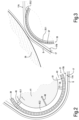
- the pressure roller 33 may have the structure shown in greater detail in the enlargement of Fig. 3 .
- This structure is typical of a so-called blind-drilled press. It consists of a roller with heads, cylindrical skirt and support pins (not shown).
- a layer of an elastic material 33.2 is applied, for example rubber or polyurethane.
- the layer of elastic material 33.2 is provided with a plurality of dead holes 57.
- the layer of cellulose pulp S and the felt 17 are pressed so that a part of the water contained in the layer of cellulose pulp S passes through the felt 17 and penetrates, through pressure, into the dead holes 57.
- the water collected in the dead holes 57 is removed through centrifugal force. In this way a part of water is removed from the layer of cellulose pulp S.
- the combined effect of the suction guide roller 31 and the pressure roller 33 decreases the wet content in the layer of cellulose pulp S to about 42-43%, applying linear pressures in the pressure nip 34 in the order of 90-100 kN/m.
- the thickness of the cellulose web V that can obtained is in the order of 95-100 ⁇ m for ten sheets, according to the standard TAPPI - T 580 Thickness (caliper) of towel, tissue, napkin and facial products. It should be understood that the numerical values of the applied linear pressures and the thicknesses are given just by way of non-limiting example. This applies, in general, to all the numerical values mentioned in the present description, unless otherwise specified.
- an effective dewatering is achieved, i.e. a substantial reduction of wet in the layer of cellulose pulp S before starting drying by thermal effect around the Yankee cylinder 35.
- Dewatering occurs without excessive reduction in the thickness of the resulting layer of cellulose fibers, thanks to the fact that part of the water is removed without compression and without pressing the layer of cellulose pulp S.
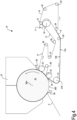
- Fig. 4 shows a second embodiment of a machine according to the invention.
- the same numbers indicate the same or equivalent parts to those of Fig. 1 , which will be not described again.
- the main difference between the embodiment of Fig. 1 and that of Fig.4 is that the latter has a second pressure roller 61 downstream of the pressure roller 33.
- the felt 17 is driven around an intermediate roller 64 provided along the closed path defined by the felt 17, between the first pressure roller 33 and the second pressure roller 61.
- the second pressure roller 61 defines a second pressure nip 63 between the pressure roller 61 and the outer cylindrical surface 35S of the Yankee cylinder 35.
- the second pressure roller can be provided with the suction structure as described with reference to the guide roller 31.
- the second pressure roller 61 has a structure with dead holes, like the structure of the first pressure roller 33 described above ( Fig. 3 ).
- the water content of the layer of cellulose pulp S is reduced in three subsequent steps: due to the suction through the guide roller 31, due to the pressing in the first pressure nip 34 through the first pressure roller 33, and due to the pressing in the second pressure nip 63 through the second pressure roller 61.
- a further machine according to the invention is shown, which is a variant of the examples of Figs. 1 and 4 and comprises a heating device 40 adapted to act on the continuous flexible member 17 (the felt) in order to increase the temperature of the layer of cellulose pulp and, consequently, to reduce the viscosity of the water contained in the cellulose pulp.
- a heating device 40 adapted to act on the continuous flexible member 17 (the felt) in order to increase the temperature of the layer of cellulose pulp and, consequently, to reduce the viscosity of the water contained in the cellulose pulp.
- the heating device 40 is arranged between the guide roller 31 and the first pressure roller 33, and faces the first surface 17A of the felt 17, i.e. the surface carrying the layer of cellulose pulp S.
- the heating device 40 is not too close to (and never overlapping) the guide roller 31 or the first pressure roller 33, i.e. that it is not arranged on the circumference of these rollers.
- the rotation of the two rollers 31 and 33 causes the dispersion in air of fragments of a cellulose pulp. If the heating device 40 overlaps one of the two rollers 31 or 33, or is arranged on the circumference thereof, the fragments of cellulose pulp tend to deposit on the heating device, forming thereon a pulp layer which would reduce the heating capacity thereof.
- the device 40 heats through steam.
- the device is a known steambox, which emits saturated, preferably dry or superheated steam on the cellulose pulp S present on the felt 17, thus contributing to the drying thereof.
- the steam used to supply the steambox can arrive, through a duct 40A, from a heat recovery unit (not shown in the figures) generating steam, using for example the fumes of the hood 37.
- this recovery unit generates high pressure steam to feed the Yankee cylinder, and, with a reduction in pressure, supplies the steambox of the device 40 through the duct 40A.
- the heat recovery unit can generate low pressure steam just for the steambox.
- the heating device 40 can be of the type exploiting electricity (joule effect), for example an electrical resistance or an induction plate, or generating infrared rays, such as infrared lamps or panels, or of the microwave type.
- electricity for example an electrical resistance or an induction plate, or generating infrared rays, such as infrared lamps or panels, or of the microwave type.
- the heating device 40 also comprises a suction module 40B, arranged opposite to the steambox with respect to the felt 17 and close to this latter, so as to suck humid air in the area.
- the sucked air is removed through a duct, not shown in the figures.
- the use of the heating device 40, between the guide roller 31 and the first pressure roller 33, is particularly effective for increasing the drying of the cellulose pulp.
- the guide roller 33 allows removing the water contained in the cellulose pulp, which is not absorbed by the felt. Consequently, the heating device 40 is able to transmit more energy to the layer of cellulose pulp, and therefore to perform an optimal drying.
- the dry content in the cellulose pulp S is increased by a value comprised least between 2.8% and 3.5% compared to the embodiments described above.
- a further heating device 40' is provided, similar to the heating device 40 described above and arranged immediately upstream of the guide roller.
- it can be of the steam type or of the type exploiting electricity, such as an electrical resistance or an induction plate, or generating infrared rays, such as infrared lamps or panels, or of the microwave type.
- It can also comprise a further suction module 40'.
- the further heating device 40' is not too close to (and never overlapping) the guide roller 31, i.e. that it is not arranged on the circumference of the roller.
- At least one or both of the rollers 33, 61 can be without perforations and have a smooth cylindrical surface.
Landscapes
- Paper (AREA)
Claims (19)
- Maschine (10) zur Nass-Herstellung von Tissue-Papier mit, in Kombination:einem Yankee-Zylinder (35) mit einer zylindrischen Seitenfläche (35S), die um seine Achse (35A) dreht,einem kontinuierlichen flexiblen Element (17) mit einer ersten Fläche (17A), die geeignet ist, um eine Schicht von Zellulose-Pulpe (S) aufzunehmen, die Zellulosefasern und Wasser enthält, und einer zweiten Fläche (17B), die der ersten Fläche (17A) gegenüberliegt,einer Ansaug-Führungswalze (31), um die das kontinuierliche flexible Element (17) angetrieben wird, wobei die zweite Fläche (17B) des kontinuierlichen flexiblen Elements (17) in Kontakt mit der ersten Ansaug-Führungswalze (31) ist, wobei in dem Bereich, der um die Walze (31) geführt ist, die erste Fläche (17A) des kontinuierlichen flexiblen Elements (17) von dem Yankee-Zylinder (35) beabstandet ist und wobei die erste Ansaug-Führungswalze (31) geeignet ist, um Wasser aus der Zellulose-Pulpe (S) durch das kontinuierliche flexible Element (17) zu entfernen,einer Presse, die durch eine Sackloch-Druckwalze (33) gebildet wird, um die das kontinuierliche flexible Element (17) getrieben wird, die stromab der ersten Ansaug-Führungswalze (31) mit Bezug auf eine Förderrichtung der Schicht der Zellulose-Pulpe (S) angeordnet ist, wobei die erste Druckwalze (33) und der Yankee-Zylinder (35) einen ersten Druckspalt (34) definieren, innerhalb dessen das kontinuierliche flexible Element (17) mittels der ersten Druckwalze (33) gegen die zylindrische Fläche (35S) des Yankee-Zylinders (35) gepresst wird,und wobei die erste Druckwalze (33) geeignet ist, um Wasser aus der Schicht der Zellulose-Pulpe (S) durch das kontinuierliche flexible Element (17) zu entfernen,einer Heizvorrichtung (40), die ausgebildet ist, um auf das kontinuierliche flexible Element (17) einzuwirken und die zwischen der ersten Ansaug-Führungswalze (31) und der ersten Druckwalze (33) angeordnet ist.
- Maschine (10) nach Anspruch 1, wobei die erste Ansaug-Führungswalze (31) eine äußere zylindrische Schürze (39) aufweist, die mit einer Anzahl von Durchgangslöchern (51) versehen ist, die eine äußere Fläche der Führungswalze und eine innere Ansaugkammer (43. 2) der Führungswalze (31) verbinden.
- Maschine (10) nach Anspruch 2, wobei die Ansaugkammer (43.2) sich zu einem Teil der umfänglichen Ausdehnung der ersten Ansaug-Führungswalze (31) erstreckt und in einer stationären Position mit Bezug auf die Drehachse (31A) der Führungswalze (31 angeordnet ist, um so einen Ansaugbereich durch die Durchgangslöcher (51) der zylindrischen Schürze (39) zu bilden, wobei der Ansaugbereich mit Bezug auf den Weg des kontinuierlichen flexiblen Elements fixiert ist.
- Maschine (10) nach Anspruch 3, wobei die Ansaugkammer (43.2) in einem Bereich der ersten Ansaug-Führungswalze (31) angeordnet ist, der in Kontakt mit dem kontinuierlichen flexiblen Element (17) steht, um so ein Ansaugen von Wasser zu erzeugen, das in der Schicht der Zellulose-Pulpe (S) enthalten ist, durch das flexible Element (17) in den Durchgangslöchern.
- Maschine (10) nach Anspruch 4, wobei innerhalb der zylindrischen Schürze (39) ein ringförmiges Volumen (43) angeordnet ist, das fluidmäßig mit den Durchgangslöchern (51) verbunden ist, wobei das ringförmige Volumen (43) in die Ansaugkammer (43.2) und einen Nicht-Ansaugbereich (43.1) unterteilt ist, sodass Wasser zeitweilig in die Durchgangslöcher (51) gesaugt wird, wenn sie die Vorderseite der Ansaugkammer (43.2) passieren, und aus den Durchgangslöchern (51) aufgrund des Zentrifugaleffekts entfernt werden, wenn die Durchgangslöcher entlang des Nicht-Ansaugbereichs (43.1) des ringförmigen Volumens (43) passieren.
- Maschine (10) nach einem oder mehreren der vorstehenden Ansprüche mit ferner einer zweiten Druckwalze (61), um die das kontinuierliche flexible Element (17) getrieben wird, wobei die zweite Druckwalze (61) und der Yankee-Zylinder (35) einen zweiten Druckspalt (63) definieren, innerhalb dessen das kontinuierliche flexible Element (17) mittels der zweiten Druckwalze (61) gegen die zylindrische Fläche (35S) des Yankee-Zylinders (35) gepresst wird, und wobei die zweite Druckwalze (61) ausgebildet ist, um Wasser aus der Zellulose-Pulpe (S) durch das kontinuierliche flexible Element (17) zu entfernen.
- Maschine (10) nach Anspruch 6, wobei die zweite Druckwalze (61) die gleiche Struktur wie die erste Druckwalze hat oder wobei die zweite Druckwalze eine unterschiedliche Struktur zu der ersten Druckwalze aufweist und insbesondere die zweite Druckwalze eine Sackloch-Struktur aufweist oder eine Durchgangsloch-Konfiguration.
- Maschine (10) nach einem oder mehreren der vorstehenden Ansprüche, wobei die Heizvorrichtung zu der ersten Fläche (17A) gerichtet ist, die die Schicht der Zellulose-Pulpe (S) trägt.
- Maschine (10) nach einem oder mehreren der vorstehenden Ansprüche, wobei die Heizvorrichtung eine Dampf-Heizvorrichtung und/oder eine Infrarot-Heizvorrichtung und/oder eine Mikrowellen-Heizvorrichtung und/oder eine elektrische Heizvorrichtung ist, beispielsweise eine Vorrichtung zum Heizen durch Widerstand und/oder elektrische Induktion.
- Maschine (10) nach einem oder mehreren der vorstehenden Ansprüche, wobei die Heizvorrichtung eine Dampfkammer aufweist, die ausgebildet ist, um Dampf direkt auf das kontinuierliche flexible Element (17) zu blasen, das die Schicht der Zellulose-Pulpe (S) trägt.
- Maschine (10) nach einem oder mehreren der vorstehenden Ansprüche, wobei die Heizvorrichtung eine Platte zur thermischen Strahlung aufweist, die auf das kontinuierliche flexible Element (17), die die Schicht der Zellulose-Pulpe (S) trägt, gerichtet ist.
- Maschine (10) nach einem oder mehreren der vorstehenden Ansprüche mit ferner einem Formdraht (15), der ausgebildet ist, um die Schicht der Zellulose-Pulpe (S) aus einem Stoffkasten (11) aufzunehmen, und ausgebildet ist, um direkt oder indirekt die Schicht der Zellulose-Pulpe auf das kontinuierliche flexible Element (17) zu übertragen.
- Maschine (10) nach einem oder mehreren der vorstehenden Ansprüche mit einem Formdraht (15), der um eine Formtrommel (19) getrieben wird, um die auch das kontinuierliche flexible Element (17) getrieben wird, um zwischen dem kontinuierlichen flexiblen Element (17) und dem Formdraht (15) ein Volumen zur Aufnahme von Zellulose-Pulpe aus einem Stoffkasten zu bilden.
- Maschine (10) nach Anspruch 12 oder 13 wobei die Führungswalze (31) und die Heizvorrichtung (40) stromab des Bereichs angeordnet sind, wo der Formdraht (15) von dem kontinuierlichen flexiblen Element (17) getrennt ist.
- Maschine (10) nach einem oder mehreren der vorstehenden Ansprüche, wobei die Heizvorrichtung ein Luft-Ansaugmodul aufweist, das vorzugsweise an einer gegenüberliegenden Seite von dem kontinuierlichen flexiblen Element angeordnet ist und zu ihm gerichtet ist.
- Maschine (10) nach einem oder mehreren der vorstehenden Ansprüche mit einer weiteren Heizvorrichtung (40') die direkt stromauf der ersten Ansaug-Führungswalze (31) angeordnet ist.
- Verfahren zum Entfernen von Wasser aus einer Schicht von Zellulose-Pulpe (S), die Wasser und Zellulosefasern enthält, wobei das Verfahren die folgenden Schritte aufweist:Bilden einer Schicht von Zellulose-Pulpe (S), die Wasser und Zellulosefasern enthält, auf einer ersten Fläche (17A) eines kontinuierlichen flexiblen Elements (17),Fördern der Schicht der Zellulose-Pulpe (S) zu einem Yankee-Zylinder (35),Antreiben des kontinuierlichen flexiblen Elements (17) um eine erste Ansaug-Führungswalze (31),wobei das kontinuierliche flexible Element (17) eine zweite Fläche (17B) in Kontakt mit der ersten Ansaug-Führungswalze (31) aufweist, und Entfernen von Wasser aus der Schicht der Zellulose-Pulpe (S) durch das kontinuierliche flexible Element (17) mittels der ersten Ansaug-Führungswalze (31) ohne Kontakt zwischen der Schicht der Zellulose-Pulpe (S) und dem Yankee-Zylinder (35), Fördern der Schicht der Zellulose-Pulpe (S) stromab der ersten Ansaug-Führungswalze (31) in einen ersten Druckspalt (34), der durch den Yankee-Zylinder (35) und durch eine erste Sackloch-Druckwalze (33) gebildet wird, um die das kontinuierliche flexible Element (17) getrieben wird, wobei die zweite Fläche (17B) in Kontakt mit der ersten Druckwalze (33) steht, und Entfernen von Wasser aus der Schicht der Zellulose-Pulpe (S) durch das flexible Element (17) mittels der ersten Druckwalze (33),und mit ferner einem Trocknungsschritt durch Heizen der Schicht der Zellulose-Pulpe (S) zwischen dem Bereich, in dem das kontinuierliche flexible Element (17) um die erste Ansaug-Führungswalze (31) geführt ist, und dem ersten Druckspalt (34) .
- Verfahren nach Anspruch 17 mit ferner dem folgenden Schritt:
Fördern der Schicht der Zellulose-Pulpe (S) stromab der ersten Druckwalze (33) in einen zweiten Druckspalt (63), der durch den Yankee-Zylinder (35) und eine zweite Druckwalze (61) gebildet wird, um die das kontinuierliche flexible Element (17) getrieben wird, wobei die zweite Fläche (17B) in Kontakt mit der zweiten Druckwalze (61) steht, und Entfernen von Wasser aus der Zellulose-Pulpe (S) durch das kontinuierliche flexible Element (17) mittels der zweiten Druckwalze (61). - Verfahren nach Anspruch 17 oder 18, wobei der Trocknungsschritt durch Heizen auftritt, das mittels Dampf erzeugt wird, das auf die Schicht der Zellulose-Pulpe (S) emittiert wird, oder durch thermische Strahlung.
Applications Claiming Priority (4)
| Application Number | Priority Date | Filing Date | Title |
|---|---|---|---|
| IT201800000720 | 2018-01-11 | ||
| IT201800005880 | 2018-05-30 | ||
| IT201800005881 | 2018-05-30 | ||
| PCT/IB2019/050183 WO2019138349A1 (en) | 2018-01-11 | 2019-01-10 | Machine and method for manufacturing tissue paper |
Publications (3)
| Publication Number | Publication Date |
|---|---|
| EP3737792A1 EP3737792A1 (de) | 2020-11-18 |
| EP3737792B1 true EP3737792B1 (de) | 2024-07-31 |
| EP3737792C0 EP3737792C0 (de) | 2024-07-31 |
Family
ID=65278426
Family Applications (1)
| Application Number | Title | Priority Date | Filing Date |
|---|---|---|---|
| EP19703189.1A Active EP3737792B1 (de) | 2018-01-11 | 2019-01-10 | Maschine und verfahren zur herstellung von tissuepapier |
Country Status (5)
| Country | Link |
|---|---|
| US (1) | US20200378068A1 (de) |
| EP (1) | EP3737792B1 (de) |
| JP (1) | JP2021510776A (de) |
| CN (1) | CN111819327B (de) |
| WO (1) | WO2019138349A1 (de) |
Families Citing this family (3)
| Publication number | Priority date | Publication date | Assignee | Title |
|---|---|---|---|---|
| AT522784B1 (de) * | 2020-02-25 | 2021-02-15 | Andritz Ag Maschf | Vorrichtung und verfahren zum herstellen einer faserstoffbahn |
| IT202000020926A1 (it) | 2020-09-03 | 2022-03-03 | A Celli Paper Spa | Pressa a scarpa per carta e relativo metodo |
| CN115287933B (zh) * | 2022-10-08 | 2022-12-27 | 龙口玉龙纸业有限公司 | 一种造纸机的烘干系统及方法 |
Family Cites Families (10)
| Publication number | Priority date | Publication date | Assignee | Title |
|---|---|---|---|---|
| US6241850B1 (en) * | 1999-06-16 | 2001-06-05 | The Procter & Gamble Company | Soft tissue product exhibiting improved lint resistance and process for making |
| DE10032251A1 (de) * | 2000-07-03 | 2002-01-17 | Voith Paper Patent Gmbh | Maschine sowie Verfahren zur Herstellung einer Faserstoffbahn |
| DE10129613A1 (de) * | 2001-06-20 | 2003-01-02 | Voith Paper Patent Gmbh | Verfahren und Vorrichtung zur Herstellung einer mit einer dreidimensionalen Oberflächenstruktur versehenen Faserstoffbahn |
| DE10218509A1 (de) * | 2002-04-25 | 2003-11-06 | Voith Paper Patent Gmbh | Verfahren zur Herstellung einer Tissuebahn |
| DE102005036891A1 (de) * | 2005-08-05 | 2007-02-08 | Voith Patent Gmbh | Maschine zur Herstellung von Tissuepapier |
| DE102005046903A1 (de) * | 2005-09-30 | 2007-04-05 | Voith Patent Gmbh | Verfahren und Vorrichtung zur Herstellung einer Tissuebahn |
| DE102005061100A1 (de) * | 2005-12-21 | 2007-06-28 | Voith Patent Gmbh | Hochvakuumsaugaggregat |
| SE533043C2 (sv) * | 2008-09-17 | 2010-06-15 | Metso Paper Karlstad Ab | Tissuepappersmaskin |
| SE1350254A1 (sv) * | 2013-03-04 | 2014-09-05 | Valmet Aktiebolag | Pressparti för maximal torrhalt |
| SE1450887A1 (sv) * | 2014-07-10 | 2016-01-11 | Valmet Aktiebolag | An arrangement and a method for drying a tissue paper web |
-
2019
- 2019-01-10 US US16/961,405 patent/US20200378068A1/en not_active Abandoned
- 2019-01-10 JP JP2020538723A patent/JP2021510776A/ja active Pending
- 2019-01-10 WO PCT/IB2019/050183 patent/WO2019138349A1/en not_active Ceased
- 2019-01-10 CN CN201980012892.8A patent/CN111819327B/zh active Active
- 2019-01-10 EP EP19703189.1A patent/EP3737792B1/de active Active
Also Published As
| Publication number | Publication date |
|---|---|
| CN111819327B (zh) | 2023-04-28 |
| BR112020014019A2 (pt) | 2021-02-09 |
| US20200378068A1 (en) | 2020-12-03 |
| WO2019138349A1 (en) | 2019-07-18 |
| JP2021510776A (ja) | 2021-04-30 |
| CN111819327A (zh) | 2020-10-23 |
| EP3737792A1 (de) | 2020-11-18 |
| EP3737792C0 (de) | 2024-07-31 |
Similar Documents
| Publication | Publication Date | Title |
|---|---|---|
| CN103946447B (zh) | 造纸机和生产薄纸的方法 | |
| US7582187B2 (en) | Process and apparatus for producing a tissue web | |
| CA2703265C (en) | Process and device for treating a pulp web in a long-nip pressing unit | |
| US5439559A (en) | Heavy-weight high-temperature pressing apparatus | |
| EP2334867B1 (de) | Papiertuchherstellungsmaschine und verfahren zur herstellung einer papiertuchbahn | |
| US3354035A (en) | Continuous process of drying uncoated fibrous webs | |
| EP3737792B1 (de) | Maschine und verfahren zur herstellung von tissuepapier | |
| EP1751350A1 (de) | Papiermaschine und verfahren zur herstellung von papier | |
| CN110914495B (zh) | 使用图案化滚筒制备纸制品的方法 | |
| CN104379835B (zh) | 延伸压区辊、使用延伸压区辊的延伸压区压榨机构、造纸机和操作延伸压区压榨机构的方法 | |
| CA3091525C (en) | Method and device for treating a pulp web in an extended-nip press unit | |
| GB2052586A (en) | Drying paper | |
| CN110904716A (zh) | 用于制造纤维料幅的机器和方法 | |
| JP2588637B2 (ja) | 平滑な光沢のある紙を製造する方法および装置 | |
| EP2331750B1 (de) | Formierpartie mit metallband | |
| BR112020014019B1 (pt) | Máquina para fabricação úmida de lenço de papel e método para remover água de uma camada de polpa de celulose | |
| EP0874083A1 (de) | Durchlufttrockner hoher Intensität zum Umbau einer konventionellen Nasspresspapiermaschine | |
| CN118166570A (zh) | 纸浆干燥机上的压榨机组 | |
| CN107524041A (zh) | 一种高速造纸机 | |
| GB2418929A (en) | Producing paper product | |
| WO2008152196A1 (en) | Method and apparatus for making paper | |
| CN112771227A (zh) | 用于制造纤维料幅的机器和方法 |
Legal Events
| Date | Code | Title | Description |
|---|---|---|---|
| STAA | Information on the status of an ep patent application or granted ep patent |
Free format text: STATUS: UNKNOWN |
|
| STAA | Information on the status of an ep patent application or granted ep patent |
Free format text: STATUS: THE INTERNATIONAL PUBLICATION HAS BEEN MADE |
|
| PUAI | Public reference made under article 153(3) epc to a published international application that has entered the european phase |
Free format text: ORIGINAL CODE: 0009012 |
|
| STAA | Information on the status of an ep patent application or granted ep patent |
Free format text: STATUS: REQUEST FOR EXAMINATION WAS MADE |
|
| 17P | Request for examination filed |
Effective date: 20200706 |
|
| AK | Designated contracting states |
Kind code of ref document: A1 Designated state(s): AL AT BE BG CH CY CZ DE DK EE ES FI FR GB GR HR HU IE IS IT LI LT LU LV MC MK MT NL NO PL PT RO RS SE SI SK SM TR |
|
| AX | Request for extension of the european patent |
Extension state: BA ME |
|
| DAV | Request for validation of the european patent (deleted) | ||
| DAX | Request for extension of the european patent (deleted) | ||
| GRAP | Despatch of communication of intention to grant a patent |
Free format text: ORIGINAL CODE: EPIDOSNIGR1 |
|
| STAA | Information on the status of an ep patent application or granted ep patent |
Free format text: STATUS: GRANT OF PATENT IS INTENDED |
|
| INTG | Intention to grant announced |
Effective date: 20240220 |
|
| GRAS | Grant fee paid |
Free format text: ORIGINAL CODE: EPIDOSNIGR3 |
|
| GRAA | (expected) grant |
Free format text: ORIGINAL CODE: 0009210 |
|
| STAA | Information on the status of an ep patent application or granted ep patent |
Free format text: STATUS: THE PATENT HAS BEEN GRANTED |
|
| AK | Designated contracting states |
Kind code of ref document: B1 Designated state(s): AL AT BE BG CH CY CZ DE DK EE ES FI FR GB GR HR HU IE IS IT LI LT LU LV MC MK MT NL NO PL PT RO RS SE SI SK SM TR |
|
| REG | Reference to a national code |
Ref country code: CH Ref legal event code: EP Ref country code: GB Ref legal event code: FG4D |
|
| REG | Reference to a national code |
Ref country code: DE Ref legal event code: R096 Ref document number: 602019056058 Country of ref document: DE |
|
| REG | Reference to a national code |
Ref country code: IE Ref legal event code: FG4D |
|
| U01 | Request for unitary effect filed |
Effective date: 20240812 |
|
| U07 | Unitary effect registered |
Designated state(s): AT BE BG DE DK EE FI FR IT LT LU LV MT NL PT SE SI Effective date: 20240827 |
|
| PG25 | Lapsed in a contracting state [announced via postgrant information from national office to epo] |
Ref country code: NO Free format text: LAPSE BECAUSE OF FAILURE TO SUBMIT A TRANSLATION OF THE DESCRIPTION OR TO PAY THE FEE WITHIN THE PRESCRIBED TIME-LIMIT Effective date: 20241031 |
|
| PG25 | Lapsed in a contracting state [announced via postgrant information from national office to epo] |
Ref country code: GR Free format text: LAPSE BECAUSE OF FAILURE TO SUBMIT A TRANSLATION OF THE DESCRIPTION OR TO PAY THE FEE WITHIN THE PRESCRIBED TIME-LIMIT Effective date: 20241101 Ref country code: PL Free format text: LAPSE BECAUSE OF FAILURE TO SUBMIT A TRANSLATION OF THE DESCRIPTION OR TO PAY THE FEE WITHIN THE PRESCRIBED TIME-LIMIT Effective date: 20240731 |
|
| PG25 | Lapsed in a contracting state [announced via postgrant information from national office to epo] |
Ref country code: IS Free format text: LAPSE BECAUSE OF FAILURE TO SUBMIT A TRANSLATION OF THE DESCRIPTION OR TO PAY THE FEE WITHIN THE PRESCRIBED TIME-LIMIT Effective date: 20241130 |
|
| PG25 | Lapsed in a contracting state [announced via postgrant information from national office to epo] |
Ref country code: HR Free format text: LAPSE BECAUSE OF FAILURE TO SUBMIT A TRANSLATION OF THE DESCRIPTION OR TO PAY THE FEE WITHIN THE PRESCRIBED TIME-LIMIT Effective date: 20240731 |
|
| PG25 | Lapsed in a contracting state [announced via postgrant information from national office to epo] |
Ref country code: RS Free format text: LAPSE BECAUSE OF FAILURE TO SUBMIT A TRANSLATION OF THE DESCRIPTION OR TO PAY THE FEE WITHIN THE PRESCRIBED TIME-LIMIT Effective date: 20241031 Ref country code: ES Free format text: LAPSE BECAUSE OF FAILURE TO SUBMIT A TRANSLATION OF THE DESCRIPTION OR TO PAY THE FEE WITHIN THE PRESCRIBED TIME-LIMIT Effective date: 20240731 |
|
| PG25 | Lapsed in a contracting state [announced via postgrant information from national office to epo] |
Ref country code: RS Free format text: LAPSE BECAUSE OF FAILURE TO SUBMIT A TRANSLATION OF THE DESCRIPTION OR TO PAY THE FEE WITHIN THE PRESCRIBED TIME-LIMIT Effective date: 20241031 Ref country code: PL Free format text: LAPSE BECAUSE OF FAILURE TO SUBMIT A TRANSLATION OF THE DESCRIPTION OR TO PAY THE FEE WITHIN THE PRESCRIBED TIME-LIMIT Effective date: 20240731 Ref country code: NO Free format text: LAPSE BECAUSE OF FAILURE TO SUBMIT A TRANSLATION OF THE DESCRIPTION OR TO PAY THE FEE WITHIN THE PRESCRIBED TIME-LIMIT Effective date: 20241031 Ref country code: IS Free format text: LAPSE BECAUSE OF FAILURE TO SUBMIT A TRANSLATION OF THE DESCRIPTION OR TO PAY THE FEE WITHIN THE PRESCRIBED TIME-LIMIT Effective date: 20241130 Ref country code: HR Free format text: LAPSE BECAUSE OF FAILURE TO SUBMIT A TRANSLATION OF THE DESCRIPTION OR TO PAY THE FEE WITHIN THE PRESCRIBED TIME-LIMIT Effective date: 20240731 Ref country code: GR Free format text: LAPSE BECAUSE OF FAILURE TO SUBMIT A TRANSLATION OF THE DESCRIPTION OR TO PAY THE FEE WITHIN THE PRESCRIBED TIME-LIMIT Effective date: 20241101 Ref country code: ES Free format text: LAPSE BECAUSE OF FAILURE TO SUBMIT A TRANSLATION OF THE DESCRIPTION OR TO PAY THE FEE WITHIN THE PRESCRIBED TIME-LIMIT Effective date: 20240731 |
|
| U20 | Renewal fee for the european patent with unitary effect paid |
Year of fee payment: 7 Effective date: 20250131 |
|
| PG25 | Lapsed in a contracting state [announced via postgrant information from national office to epo] |
Ref country code: SM Free format text: LAPSE BECAUSE OF FAILURE TO SUBMIT A TRANSLATION OF THE DESCRIPTION OR TO PAY THE FEE WITHIN THE PRESCRIBED TIME-LIMIT Effective date: 20240731 |
|
| PG25 | Lapsed in a contracting state [announced via postgrant information from national office to epo] |
Ref country code: CZ Free format text: LAPSE BECAUSE OF FAILURE TO SUBMIT A TRANSLATION OF THE DESCRIPTION OR TO PAY THE FEE WITHIN THE PRESCRIBED TIME-LIMIT Effective date: 20240731 |
|
| PG25 | Lapsed in a contracting state [announced via postgrant information from national office to epo] |
Ref country code: SK Free format text: LAPSE BECAUSE OF FAILURE TO SUBMIT A TRANSLATION OF THE DESCRIPTION OR TO PAY THE FEE WITHIN THE PRESCRIBED TIME-LIMIT Effective date: 20240731 |
|
| PLBE | No opposition filed within time limit |
Free format text: ORIGINAL CODE: 0009261 |
|
| STAA | Information on the status of an ep patent application or granted ep patent |
Free format text: STATUS: NO OPPOSITION FILED WITHIN TIME LIMIT |
|
| 26N | No opposition filed |
Effective date: 20250501 |
|
| REG | Reference to a national code |
Ref country code: CH Ref legal event code: PL |
|
| PG25 | Lapsed in a contracting state [announced via postgrant information from national office to epo] |
Ref country code: MC Free format text: LAPSE BECAUSE OF FAILURE TO SUBMIT A TRANSLATION OF THE DESCRIPTION OR TO PAY THE FEE WITHIN THE PRESCRIBED TIME-LIMIT Effective date: 20240731 |
|
| GBPC | Gb: european patent ceased through non-payment of renewal fee |
Effective date: 20250110 |
|
| PG25 | Lapsed in a contracting state [announced via postgrant information from national office to epo] |
Ref country code: GB Free format text: LAPSE BECAUSE OF NON-PAYMENT OF DUE FEES Effective date: 20250110 |
|
| PG25 | Lapsed in a contracting state [announced via postgrant information from national office to epo] |
Ref country code: CH Free format text: LAPSE BECAUSE OF NON-PAYMENT OF DUE FEES Effective date: 20250131 |