EP3725792B1 - Präparat für das naturprodukt trabectedin - Google Patents
Präparat für das naturprodukt trabectedin Download PDFInfo
- Publication number
- EP3725792B1 EP3725792B1 EP18888627.9A EP18888627A EP3725792B1 EP 3725792 B1 EP3725792 B1 EP 3725792B1 EP 18888627 A EP18888627 A EP 18888627A EP 3725792 B1 EP3725792 B1 EP 3725792B1
- Authority
- EP
- European Patent Office
- Prior art keywords
- compound
- reaction
- mmol
- solvent
- nmr
- Prior art date
- Legal status (The legal status is an assumption and is not a legal conclusion. Google has not performed a legal analysis and makes no representation as to the accuracy of the status listed.)
- Active
Links
Classifications
-
- C—CHEMISTRY; METALLURGY
- C07—ORGANIC CHEMISTRY
- C07C—ACYCLIC OR CARBOCYCLIC COMPOUNDS
- C07C269/00—Preparation of derivatives of carbamic acid, i.e. compounds containing any of the groups, the nitrogen atom not being part of nitro or nitroso groups
- C07C269/06—Preparation of derivatives of carbamic acid, i.e. compounds containing any of the groups, the nitrogen atom not being part of nitro or nitroso groups by reactions not involving the formation of carbamate groups
-
- C—CHEMISTRY; METALLURGY
- C07—ORGANIC CHEMISTRY
- C07D—HETEROCYCLIC COMPOUNDS
- C07D217/00—Heterocyclic compounds containing isoquinoline or hydrogenated isoquinoline ring systems
- C07D217/12—Heterocyclic compounds containing isoquinoline or hydrogenated isoquinoline ring systems with radicals, substituted by hetero atoms, attached to carbon atoms of the nitrogen-containing ring
- C07D217/14—Heterocyclic compounds containing isoquinoline or hydrogenated isoquinoline ring systems with radicals, substituted by hetero atoms, attached to carbon atoms of the nitrogen-containing ring other than aralkyl radicals
- C07D217/16—Heterocyclic compounds containing isoquinoline or hydrogenated isoquinoline ring systems with radicals, substituted by hetero atoms, attached to carbon atoms of the nitrogen-containing ring other than aralkyl radicals substituted by oxygen atoms
-
- C—CHEMISTRY; METALLURGY
- C07—ORGANIC CHEMISTRY
- C07D—HETEROCYCLIC COMPOUNDS
- C07D317/00—Heterocyclic compounds containing five-membered rings having two oxygen atoms as the only ring hetero atoms
- C07D317/08—Heterocyclic compounds containing five-membered rings having two oxygen atoms as the only ring hetero atoms having the hetero atoms in positions 1 and 3
- C07D317/44—Heterocyclic compounds containing five-membered rings having two oxygen atoms as the only ring hetero atoms having the hetero atoms in positions 1 and 3 ortho- or peri-condensed with carbocyclic rings or ring systems
- C07D317/46—Heterocyclic compounds containing five-membered rings having two oxygen atoms as the only ring hetero atoms having the hetero atoms in positions 1 and 3 ortho- or peri-condensed with carbocyclic rings or ring systems condensed with one six-membered ring
- C07D317/48—Methylenedioxybenzenes or hydrogenated methylenedioxybenzenes, unsubstituted on the hetero ring
- C07D317/62—Methylenedioxybenzenes or hydrogenated methylenedioxybenzenes, unsubstituted on the hetero ring with hetero atoms or with carbon atoms having three bonds to hetero atoms with at the most one bond to halogen, e.g. ester or nitrile radicals, directly attached to atoms of the carbocyclic ring
- C07D317/64—Oxygen atoms
-
- C—CHEMISTRY; METALLURGY
- C07—ORGANIC CHEMISTRY
- C07D—HETEROCYCLIC COMPOUNDS
- C07D491/00—Heterocyclic compounds containing in the condensed ring system both one or more rings having oxygen atoms as the only ring hetero atoms and one or more rings having nitrogen atoms as the only ring hetero atoms, not provided for by groups C07D451/00 - C07D459/00, C07D463/00, C07D477/00 or C07D489/00
- C07D491/02—Heterocyclic compounds containing in the condensed ring system both one or more rings having oxygen atoms as the only ring hetero atoms and one or more rings having nitrogen atoms as the only ring hetero atoms, not provided for by groups C07D451/00 - C07D459/00, C07D463/00, C07D477/00 or C07D489/00 in which the condensed system contains two hetero rings
- C07D491/04—Ortho-condensed systems
- C07D491/056—Ortho-condensed systems with two or more oxygen atoms as ring hetero atoms in the oxygen-containing ring
-
- C—CHEMISTRY; METALLURGY
- C07—ORGANIC CHEMISTRY
- C07D—HETEROCYCLIC COMPOUNDS
- C07D491/00—Heterocyclic compounds containing in the condensed ring system both one or more rings having oxygen atoms as the only ring hetero atoms and one or more rings having nitrogen atoms as the only ring hetero atoms, not provided for by groups C07D451/00 - C07D459/00, C07D463/00, C07D477/00 or C07D489/00
- C07D491/22—Heterocyclic compounds containing in the condensed ring system both one or more rings having oxygen atoms as the only ring hetero atoms and one or more rings having nitrogen atoms as the only ring hetero atoms, not provided for by groups C07D451/00 - C07D459/00, C07D463/00, C07D477/00 or C07D489/00 in which the condensed system contains four or more hetero rings
-
- C—CHEMISTRY; METALLURGY
- C07—ORGANIC CHEMISTRY
- C07D—HETEROCYCLIC COMPOUNDS
- C07D515/00—Heterocyclic compounds containing in the condensed system at least one hetero ring having nitrogen, oxygen, and sulfur atoms as the only ring hetero atoms, not provided for in groups C07D463/00, C07D477/00 or C07D499/00 - C07D507/00
- C07D515/22—Heterocyclic compounds containing in the condensed system at least one hetero ring having nitrogen, oxygen, and sulfur atoms as the only ring hetero atoms, not provided for in groups C07D463/00, C07D477/00 or C07D499/00 - C07D507/00 in which the condensed system contains four or more hetero rings
-
- C—CHEMISTRY; METALLURGY
- C07—ORGANIC CHEMISTRY
- C07C—ACYCLIC OR CARBOCYCLIC COMPOUNDS
- C07C2601/00—Systems containing only non-condensed rings
- C07C2601/12—Systems containing only non-condensed rings with a six-membered ring
- C07C2601/16—Systems containing only non-condensed rings with a six-membered ring the ring being unsaturated
Definitions
- the present invention relates to the field of synthesis. Specifically, the present invention provides a method for preparing natural product Trabectedin.
- Trabectedin (ecteinascidin-743), Et-743) is a marine natural product with an extremely complex structure from the marine tunicate animal mangrove Ecteinascidia turbinata. Since its approval in the EU in 2007 for the treatment of advanced soft tissue tumors, Trabectedin has achieved hundreds of millions of dollars in sales due to its remarkable efficacy. As the first modern marine drug, the anti-tumor activity of Trabectedin is 1-3 orders of magnitude higher than that of the currently widely used anti-tumor drugs in clinical practice. It is currently considered to be the most effective drug for the treatment of ovarian cancer. Spanish company Zeltia Pharma found that the compound exhibits significant effects on rectal cancer, breast cancer, lung cancer, melanoma, etc.
- the drug is obtained through semi-synthesis by using cyanosafracin B as a raw material, which is obtained from Pseudomonas fluorescens by fermentation. Even if the method is a semi-synthesis route, it still needs 22 steps of reaction and the total yield is only 1.0%. Such a method for obtaining the compound makes the Trabectedin production very costly.
- the object of the present invention is to provide a low-cost, high-efficiency method for preparing Trabectedin.
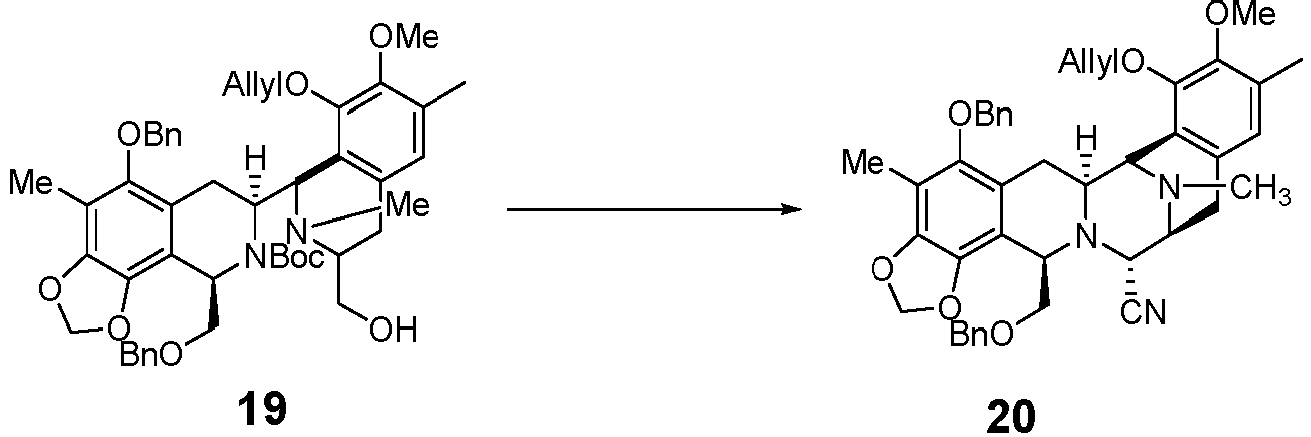
- the reaction comprises: (1) conducting a reaction in CH 3 CN / THF mixed solvent, and in the presence of HCHO, NaBH 3 CN and AcOH, then (2) conducting a reaction in acetone solvent with allylBr in the presence of K 2 CO 3 under reflux to compound 19.
- the reaction comprises (1) after reacting under Swern oxidation conditions, reacting DIPEA with compound 19 in DCM, and then with TMSCN to obtain compound 20.
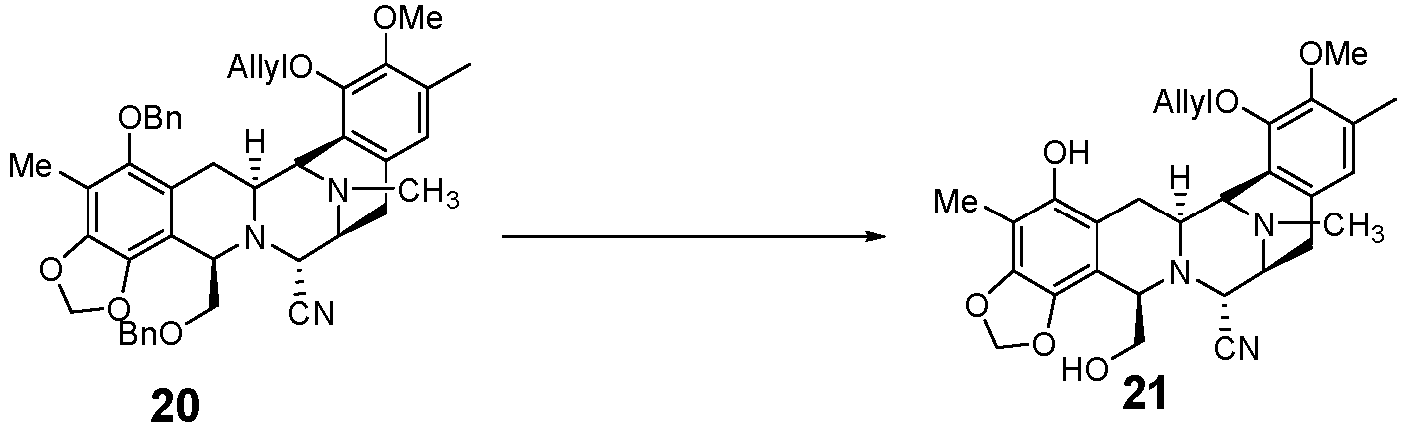
- step (d) compound 20 with BCl 3 in DCM at -80 °C, and then with TMSCN to obtain compound 21.
- step (e) compound 21 is subjected to a reaction with (PhSeO) 2 O in DCM at -10 °C to obtain compound 22.
- step (f) in the presence of EDCI and DMAP, compound 22 is subjected to a reaction with in dichloromethane to obtain compound 24.
- the reactions are sequentially performed in (1) DMSO solvent, reacting compound 24 with Tf 2 O; (2) reacting with DIPEA at 0 °C; (3) reacting with tBuOH at 0 °C; (4) reacting with at room temperature; and (5) reacting with Ac 2 O at room temperature to obtain compound 25.
- the reactions are sequentially performed in (1) DMSO solvent, reacting compound 24 with Tf 2 O; (2) reacting with DIPEA at 0 °C; (3) reacting with tBuOH at 0 °C; (4) reacting with at room temperature; and (5) reacting with Ac 2 O at room temperature to obtain compound 25.
- the preparation method includes the following steps:
- the step comprises: in DCM, in the presence of AcOH, reacting Pd(PPh 3 ) 4 and Bu 3 SnH with compound 25 to obtain compound 26.
- the preparation method further includes the following steps: Oxidating compound 26 to obtain compound 28:
- the step includes (1) reacting compound 25 with at room temperature in DMF, (2) continously reacting with DBU, and (3) reacting with oxalic acid to obtain compound 28.
- the preparation method further includes the following steps: reacting compound 28 with compound 29 to obtain compound 30:
- the step includes (1) reacting compound 28 with compound 29 in absolute ethanol in the presence of NaOAc to obtain compound 30.
- the preparation method further includes the following steps: subjecting compound 30 to the following reaction to provide compound 31 (Et-743):
- the step includes (1) reacting compound 30 with AgNO 3 in an acetonitrile / water mixed solvent to obtain compound 31.
- the above method may also comprise a method for the preparation of compound of formula 15 wherein the method comprises:
- the method includes: under blue light, reacting compound 10 in an inert solvent (preferably THF) to provide compound 11.
- an inert solvent preferably THF
- the method includes: conducting a reaction with BnBr in the presence of K 2 CO 3 to obtain compound 12; preferably, the method is carried out at 55-65 °C in acetone solvent.
- the method in the step (iii), includes: (1) conducting a reaction in the presence ofNaOH, in MeOH solvent at 100 °C; (2) in DCM solvent reacting with in the presence of NEt 3 ; (3) in the presence of NEt 3 , reacting with AcCl to obtain compound 13.
- the method includes: (1) conducting a reaction in the presence of POCl 3 , at 80 °C in CH 3 CN; (2) at 0 °C, reacting with NaBH 4 to obtain compound 14.
- the method includes: reacting with (Boc) 2 O in the presence of NEt 3 to obtain compound 15.
- the method includes: oxidizing compound 15 in the presence of Swern oxidant to obtain compound 16.
- the method is carried out in the presence of AcOH at 0 °C, and in the presence of 4A molecular sieve.
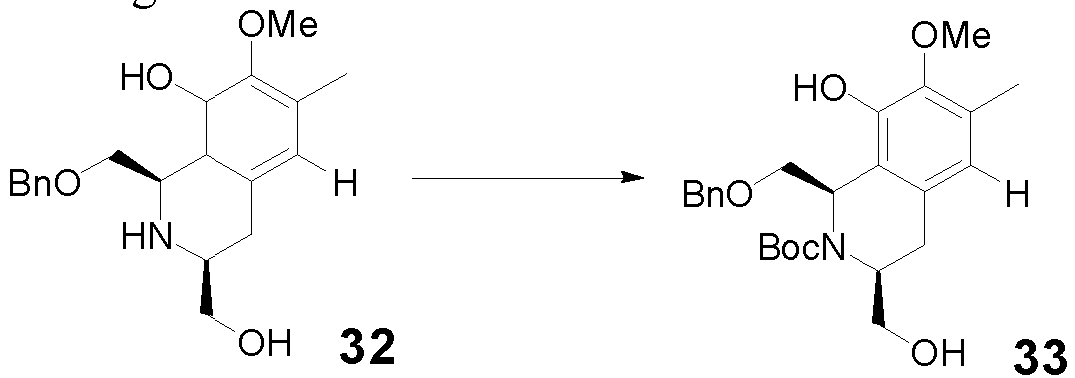
- the method in the step (ii-a), includes: in an inert solvent (preferably DCM), in the presence of NEt3, reacting Boc 2 O with compound 32 to obtain compound 33.
- an inert solvent preferably DCM
- the method in the step (iii-a), includes: in an inert solvent (preferably CH 3 CN), reacting the compound 33 with Salcomine oxidant and oxygen to obtain the compound 34.
- an inert solvent preferably CH 3 CN
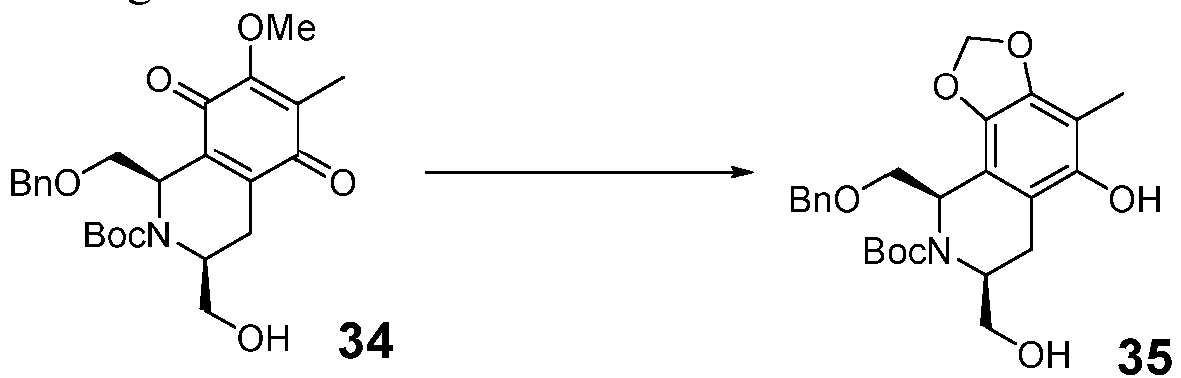
- the method in the step (iv-a), includes: under blue light, reacting compound 34 in an inert solvent (preferably THF) to provide compound 35.
- an inert solvent preferably THF
- the method in the step (v-a), includes: reacting compound 35 in an inert solvent (preferably acetone) at 65 °C to obtain compound 15; and preferably, the reaction was carried out in the presence of BnBr and K 2 CO 3 .
- an inert solvent preferably acetone
- the method further comprises a step: subjecting compound 8 to the following reaction to obtain compound 10:
- the reaction comprises: in CH 3 CN, oxidizing compound 8 with Salcomine reagent / O 2 at room temperature to obtain compound 10.
- the compound 8 is prepared by using tyrosine as a raw material.
- the above method may also comprise a method for the preparation of compound of formula 11 wherein the method includes: In an inert solvent, under a blue light, subjecting compound 10 to a photochemical reaction to obtain the compound 11;
- the inert solvent is selected from the group consisting of Et 2 O, MeCN, toluene, t-BuOH, THF, DMF, acetone, or the combinations thereof.
- the blue light is a light with a wavelength in the range of 400-500 nm.
- the above method may also comprise a method for the preparation of compound of formula 35 wherein the method comprises In an inert solvent, under a blue light, subjecting compound 34 to a photochemical reaction to obtain the compound 35;
- the inert solvent is selected from the group consisting of Et 2 O, MeCN, toluene, t-BuOH, THF, DMF, acetone, or the combinations thereof.
- the blue light is a light with a wavelength in the range of 400-500 nm.
- the above method may also comprise a method for the preparation of compound of formula 18 wherein the method comprises
- the reaction in the step (a), is performed in the presence of a catalyst (preferably selected from TFA, BF 3 ⁇ OEt 2 , HCOOH, TsOH, AcOH, Yb(OTf) 3 ), and preferably, the catalyst is AcOH.
- a catalyst preferably selected from TFA, BF 3 ⁇ OEt 2 , HCOOH, TsOH, AcOH, Yb(OTf) 3 , and preferably, the catalyst is AcOH.
- step (a) is carried out in the presence of 4A molecular sieve.
- reaction is carried out at 40-60 °C.
- the reaction is carried out at 60-80 °C.
- a method for the preparation of compound 20 comprises: (c) subjecting compound 19 to the following reaction to obtain compound 20:
- the method includes: after the reaction conducted under Swern oxidation condition, the ring is closed in the presence of TFA, DCM, and TMSCN.
- the above method may also comprise a method for the preparation of compound 25 wherein the method comprises (g) subjecting compound 24 to the following reaction to obtain compound 25:
- the reaction comprises: Sequentially reacting compound 24 in (1) Tf 2 O, DMSO; (2) DIPEA, 0 °C; (3) tBuOH, room temperature; (4) , and (5) Ac 2 O, room temperature, thereby obtaining compound 25.
- the present inventors After long-term and in-depth research, the present inventors have developed a synthetic method for Trabectedin.
- the method uses tyrosine as the starting substrate and can complete the synthesis within 26 steps of reaction.
- the raw materials and reagents used are relatively easy to be obtained, and the reaction conditions are relatively mild, thus enabling large-scale preparation.
- the present invention is completed on this basis.
- the drug is obtained through semi-synthesis by using cyanosafracin B as a raw material, which is obtained from Pseudomonas fluorescens by fermentation. Even if the method is a semi-synthesis route, it still needs 22 steps of reaction and the total yield is only 1.0%. Such way for obtaining the compound makes the Trabectedin production very costly.
- the present invention provides a novel synthetic route that uses tyrosine as the starting substrate and natural chiral source, and the five-membered ring is closed through a simple and efficient photocatalytic reaction.
- the first tetrahydroisoquinoline ring is formed by Bischler-Napieralski reaction, or the first tetrahydroisoquinoline ring is closed by Pictet-Spengler reaction, and then the five-membered ring is closed by a highly efficient photocatalytic reaction.
- the two fragments are connected by Pictet-Spengler reaction into a closed loop to construct the second tetrahydroisoquinoline ring in the molecular framework.
- the piperazine ring in the molecular framework structure is closed by intramolecular Strecker reaction to complete the molecule construction of the five-ring skeleton. Afterwards, the product is deprotected, a cysteine side chain is connected through condensation, the ten-membered thiolactone ring is closed, and the last tetrahydroisoquinoline structure was formed by a second Pictet-Spengler reaction, thereby completing the synthesis of the molecule.
- This route uses a convergent synthesis strategy, starts from the readily available natural chiral source tyrosine, and completes the full synthesis of Et-743 within at minimum 26 steps.
- the raw materials and reagents used in the synthetic route are relatively easy to be obtained, and used reaction conditions are mild, thus enabling large-scale preparation.
- compounds 9 and 16 can be synthesized separately from tyrosine, and these two compounds can form key intermediates 18 through P-S reaction. Then compound 25 was obtained through multiple steps of transformation (all the above steps are new developed synthetic route). Then the compound 25 was converted into an reported high-level intermediate through deprotection, and Et-743 was synthesized using the previously reported route. As reported in the known publications, compound 8 is synthesized from L-tyrosine in 6 steps ( R. Chen, D. Zhu, Z. Hu, Z. Zheng, X. Chen, Tetrahedron: Asymmetry, 2010, 21, 39-42 .)
- Compound 9 is obtained by deprotecting compound 8 by hydrogenation.
- Compound 16 is prepared from compound 8 through a multi-step reaction via compounds 10, 11, 12, 13, 14 and 15. Structure of each new compound is determined by 1 H NMR, 13 C NMR, MS structure, and the cis-trans structure of compound 15 is determined by Noesy.
- the photocatalytic reaction from compound 10 to compound 11 is a critical and novel reaction, which can complete the conversion that normally require 3 steps in one step with good yield and the reaction conditions are simple, thus being suitable for large-scale preparation.
- Compound 16 can also be prepared according to the following route: preparing compound 15 from compound 9, and then compound 16 is prepared by compound 15:
- the preferred light source is blue light.
- the following solvents are screened: DMF, acetone, acetonitrile, t-butanol, toluene, etc., and the preferred solvent is THF.
- the two fragments (compounds 9 and 16) are connected through Pictet-Spengler reaction into a closed loop to construct the second tetrahydroisoquinoline ring in the molecular framework.
- the piperazine ring in the molecular framework structure is closed through intramolecular Strecker reaction to complete the molecule construction of the five-ring skeleton (preparation of compound 20 from compound 19).
- compound 22 is obtained through deprotection, a cysteine side chain is connected through condensation to obtain compound 24, and the ten-membered thiolactone ring is closed to obtain compound 25:
- compound 18 can also be synthesized using the following several intermediates with different protecting groups.
- compound 8 is synthesised from L-tyrosine in 6 steps ( R. Chen, D. Zhu, Z. Hu, Z. Zheng, X. Chen, Tetrahedron: Asymmetry, 2010, 21, 39-42 .)
- the atomsphere of raw material 8 (6.0 g, 17.38 mmol) was exchanged with oxygen, and the solvent acetonitrile was added under the oxygen atmosphere to dissolve raw material 8 .
- the compound 11 (6.6 g, 18.38 mmol) was dissolved in 180 mL of acetone, K 2 CO 3 (5.07 g, 36.77 mmol) and BnBr (3.27 mL, 27.57 mmol) were added, and the reaction was refluxed at 65 °C for two hours.
- the compound 12 (2.54 g, 5.66 mmol) was dissolved in 50 mL of methanol, and 30 mL of 2M NaOH aqueous solution was added. The cloudy mixture was heated to 100 °C to reflux, and the system gradually turned to clear. The reaction was completed after 2 hours, the methanol was distilled off under reduced pressure, and the resulting system was extracted with ethyl acetate. The combined organic phases was dried over anhydrous sodium sulfate, and the solvent was distilled off under reduced pressure. The obtained crude product was dissolved in 50 mL of anhydrous dichloromethane, and NEt 3 was added (3.13 mL, 22.64 mmol).
- the compound 13 (8.5 g, 16.83 mmol) was dissolved in 170 mL of anhydrous acetonitrile.
- POCl 3 (3.14 mL, 33.66 mmol) was added and warmed to 80 °C to reflux for 3 hours.
- saturated NaHCO 3 solution was added until the reaction solution was neutral, and extracted with ethyl acetate for three times.
- the organic phases were combined, washed with saturated brine, dried over anhydrous sodium sulfate. The solvent was distilled off under reduced pressure, and the residue was dried.
- the obtained crude product was dissolved in 150 mL of anhydrous methanol, and NaBH 4 (3.18 g, 84.15 mmol) was added in portions at 0 °C and reacted for 4 hours. After the reaction was completed, the solvent was distilled off under reduced pressure, and the obtained crude product was used in the next reaction.
- the optimal condition is AcOH, 50 °C.
- the compound 18 (3.58 g, 4.85 mmol) was dissolved in a mixed solvent of CH 3 CN / THF (40 mL: 10 mL), 37% formaldehyde solution (3.93 g, 48.5 mmol) was added, and the reaction was stirred at room temperature for 20 minutes.
- NaBH 3 CN (0.76 g, 12.13 mmol) was added, and the reaction was stirred at room temperature for 20 minutes.
- AcOH (0.69 mL, 12.13 mmol) was added, and the reaction was stirred at room temperature for 90 minutes. After the reaction was completed, the solvent was distilled off under reduced pressure, and saturated sodium bicarbonate was added.
- the compound 27 (44 mg, 0.157 mmol) was dissolved in 1.5 mL of anhydrous DMF.
- the compound 26 14 mg, 0.0225 mmol dissolved in 1.5 mL of DCM was added to the system and stirred at room temperature for 4 hours.
- DBU (8.6 mg, 0.0562 mmol) was dissolved in 0.5 mL of anhydrous DCM, and slowly added to the system at 0 °C. At this time, the reaction solution was black. After 20 minutes, 1 mL of saturated oxalic acid solution was added at 0 °C, and the reaction was allowed to stand at room temperature for 45 min.
- Compound 15 can also be synthesized from compound 9 according to the following optimized route. Specific operation examples and compound data are as follows:
- the compound 33 (5.0 g, 11.3 mmol) was dissolved in 100 ml of anhydrous acetonitrile, a salcomine catalyst (0.36 g, 1.1 mmol) was added, and the atomsphere was exchanged with oxygen for 3 times, so that the reaction was conducted for 1 hour under oxygen atmosphere.
- the black solid catalyst was filtered off after the reaction was completed, and acetonitrile was distilled off under reduced pressure.
Landscapes
- Chemical & Material Sciences (AREA)
- Organic Chemistry (AREA)
- Chemical Kinetics & Catalysis (AREA)
- Pharmaceuticals Containing Other Organic And Inorganic Compounds (AREA)
- Nitrogen Condensed Heterocyclic Rings (AREA)
Claims (5)
- Verfahren zur Herstellung von Et-743:
 (a) Umsetzung von Verbindung 9 mit Verbindung 16 zur Gewinnung von Verbindung 18:
 (b) Unterziehen der Verbindung 18 der folgenden Reaktion zur Gewinnung von Verbindung 19:
 (c) Unterziehen der Verbindung 19 der folgenden Reaktion zur Gewinnung von Verbindung 20:
 (d) Unterziehen der Verbindung 20 der folgenden Reaktion zur Gewinnung von Verbindung 21:
 (e) Unterziehen der Verbindung 21 der folgenden Reaktion zur Gewinnung von Verbindung 22:
 (f) Umsetzung der Verbindung 22 mit
 (g) Unterziehen der Verbindung 24 der folgenden Reaktion zur Gewinnung von Verbindung 25:
Herstellung von Et-743 aus Verbindung 25. - Verfahren nach Anspruch 1, wobei das Verfahren den Schritt umfasst:
(vi) Unterziehen der Verbindung 15 der folgenden Reaktion zur Gewinnung von Verbindung 16: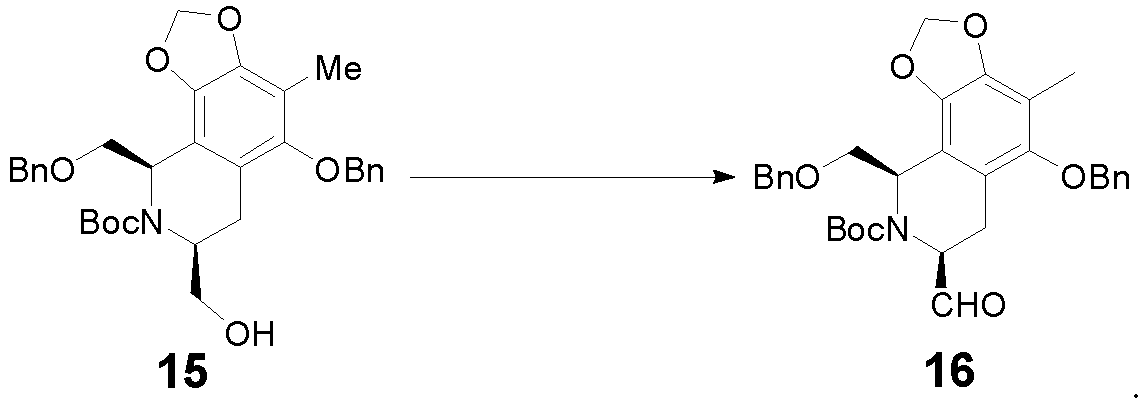
- Verfahren nach Anspruch 2, wobei die Verbindung der Formel 15 durch die folgenden Schritte hergestellt wird:(i) Unterziehen der Verbindung 10 der folgenden Reaktion zur Gewinnung von Verbindung 11:
 (ii) Unterziehen der Verbindung 11 der folgenden Reaktion zur Gewinnung von Verbindung 12:
 (iii) Unterziehen der Verbindung 12 der folgenden Reaktion zur Gewinnung von Verbindung 13:
 (iv) Unterziehen der Verbindung 13 der folgenden Reaktion zur Gewinnung von Verbindung 14:
 (v) Unterziehen der Verbindung 14 der folgenden Reaktion zur Gewinnung von Verbindung 15:
- Verfahren nach Anspruch 2, wobei die Verbindung der Formel 15 durch die folgenden Schritte hergestellt wird:(i-a) Unterziehen der Verbindung 9 der folgenden Reaktion zur Gewinnung von Verbindung 32:
 (ii-a) Unterziehen der Verbindung 32 der folgenden Reaktion zur Gewinnung von Verbindung 33:
 (iii-a) Unterziehen der Verbindung 33 der folgenden Reaktion zur Gewinnung von Verbindung 34:
 (iv-a) Unterziehen der Verbindung 34 der folgenden Reaktion zur Gewinnung von Verbindung 35:
 (v-a) Unterziehen der Verbindung 35 der folgenden Reaktion zur Gewinnung von Verbindung 15:
- Verfahren nach Anspruch 3, wobei die Verbindung der Formel 10 durch den folgenden Schritt hergestellt wird:
Unterziehen der Verbindung 8 der folgenden Reaktion zur Gewinnung von Verbindung 10:
Applications Claiming Priority (2)
| Application Number | Priority Date | Filing Date | Title |
|---|---|---|---|
| CN201711331695.1A CN109912629B (zh) | 2017-12-13 | 2017-12-13 | 天然产物Trabectedin的制备 |
| PCT/CN2018/120340 WO2019114704A1 (zh) | 2017-12-13 | 2018-12-11 | 天然产物Trabectedin的制备 |
Publications (4)
| Publication Number | Publication Date |
|---|---|
| EP3725792A1 EP3725792A1 (de) | 2020-10-21 |
| EP3725792A4 EP3725792A4 (de) | 2021-08-25 |
| EP3725792B1 true EP3725792B1 (de) | 2025-02-05 |
| EP3725792C0 EP3725792C0 (de) | 2025-02-05 |
Family
ID=66819997
Family Applications (1)
| Application Number | Title | Priority Date | Filing Date |
|---|---|---|---|
| EP18888627.9A Active EP3725792B1 (de) | 2017-12-13 | 2018-12-11 | Präparat für das naturprodukt trabectedin |
Country Status (5)
| Country | Link |
|---|---|
| US (1) | US11339179B2 (de) |
| EP (1) | EP3725792B1 (de) |
| JP (1) | JP7221548B2 (de) |
| CN (1) | CN109912629B (de) |
| WO (1) | WO2019114704A1 (de) |
Families Citing this family (6)
| Publication number | Priority date | Publication date | Assignee | Title |
|---|---|---|---|---|
| CN112679512B (zh) * | 2019-10-18 | 2023-08-25 | 南通诺泰生物医药技术有限公司 | 曲贝替定中间体及其制备方法 |
| CN111499525B (zh) * | 2020-04-23 | 2022-12-09 | 安徽实特医药科技有限公司 | 一种抗肿瘤药曲贝替定中间体合成方法 |
| CN116217584A (zh) * | 2021-12-06 | 2023-06-06 | 南通诺泰生物医药技术有限公司 | Et743及其中间体的光催化合成方法 |
| CN117126169B (zh) * | 2022-05-20 | 2026-01-09 | 华东师范大学 | 曲贝替定的制备方法 |
| CN117659032A (zh) * | 2022-08-29 | 2024-03-08 | 南通诺泰生物医药技术有限公司 | 海鞘素类衍生物的中间体及其的合成方法 |
| CN115677728A (zh) * | 2022-11-02 | 2023-02-03 | 成都科岭源医药技术有限公司 | 一种海鞘素类化合物中间体的制备方法 |
Family Cites Families (6)
| Publication number | Priority date | Publication date | Assignee | Title |
|---|---|---|---|---|
| MY130271A (en) * | 1999-05-14 | 2007-06-29 | Pharma Mar Sa | Hemisynthetic method and new compounds |
| GB0202544D0 (en) | 2002-02-04 | 2002-03-20 | Pharma Mar Sa | The synthesis of naturally occuring ecteinascidins and related compounds |
| EP1792904A1 (de) * | 2005-10-20 | 2007-06-06 | Centre National de la Recherche Scientifique (CNRS) | Zwischenprodukt und Verfahren zur Herstellung von Ecteinascidin aus diesem Zwischenprodukt |
| CN107033164A (zh) * | 2010-05-25 | 2017-08-11 | 法马马有限公司 | 制备海鞘素化合物的合成方法 |
| CN104974056B (zh) * | 2015-07-20 | 2017-01-11 | 上海皓元生物医药科技有限公司 | 一种用于制备曲贝替定的高纯度中间体的手性拆分方法 |
| CN106188073B (zh) * | 2016-06-27 | 2019-04-30 | 四川大学 | 一种ecteinascidin-743类生物碱中间体及其制备方法和应用 |
-
2017
- 2017-12-13 CN CN201711331695.1A patent/CN109912629B/zh active Active
-
2018
- 2018-12-11 US US16/772,888 patent/US11339179B2/en active Active
- 2018-12-11 EP EP18888627.9A patent/EP3725792B1/de active Active
- 2018-12-11 WO PCT/CN2018/120340 patent/WO2019114704A1/zh not_active Ceased
- 2018-12-11 JP JP2020552086A patent/JP7221548B2/ja active Active
Also Published As
| Publication number | Publication date |
|---|---|
| CN109912629A (zh) | 2019-06-21 |
| CN109912629B (zh) | 2021-12-24 |
| EP3725792A1 (de) | 2020-10-21 |
| JP2021510171A (ja) | 2021-04-15 |
| EP3725792C0 (de) | 2025-02-05 |
| US11339179B2 (en) | 2022-05-24 |
| EP3725792A4 (de) | 2021-08-25 |
| WO2019114704A1 (zh) | 2019-06-20 |
| US20210163500A1 (en) | 2021-06-03 |
| JP7221548B2 (ja) | 2023-02-14 |
Similar Documents
| Publication | Publication Date | Title |
|---|---|---|
| EP3725792B1 (de) | Präparat für das naturprodukt trabectedin | |
| Malik et al. | Ruthenium-catalyzed one-pot ring-closing metathesis/syn-dihydroxylation in the synthesis of bicyclic iminosugars | |
| Kabe et al. | Stereochemical studies of dioxetane formation with hindered olefins | |
| CN111518110B (zh) | 一种海鞘素化合物及其中间体的制备方法 | |
| Kuehne et al. | Total syntheses of tubotaiwine and 19, 20-dihydro-20-epi-akuammicine | |
| Kamijo et al. | Synthesis of cyclic ethers via the palladium catalyzed intramolecular hydrocarbonation of alkoxyallenes | |
| Natsume et al. | A new synthetic method for the framework of aspidosperma alkaloids using singlet oxygen chemistry | |
| Pavan et al. | Base catalysed synthesis of thiochromans and azo-linked chromenes using allenylphosphonates | |
| CN106188073A (zh) | 一种ecteinascidin‑743类生物碱中间体及其制备方法和应用 | |
| Qiu et al. | Stereodivergent total synthesis of chlorofusin and its all seven chromophore diastereomers | |
| CN116332932B (zh) | Ecteinascidin 743及类似生物碱的几种高级中间体的制备方法 | |
| Bläser et al. | Asymmetric Steering of Oxa Diels–Alder Reactions with Silyloxydienes Employing Proline Esters as Chiral Auxiliary Groups | |
| Coleman et al. | The development of strategies for construction of the aziridine core of the antitumor agents azinomycins A and B | |
| Wattanasin et al. | Stereocontrolled synthesis of cis-fused hydroisoquinolines by an intramolecular Diels-Alder reaction of (Z)-dienes | |
| Dulphy et al. | Methoxymethylation of tartrate as a strategy for the synthesis of chiral building blocks | |
| Sasaki et al. | Synthesis of adamantane derivatives. 42. Novel synthesis of 5-methylene-4-azahomoadamantane derivatives from 2-methyl-2-hydroxyadamantane and their carbon-13 nuclear magnetic resonance spectra | |
| Wang et al. | Asymmetric synthesis of phthalascidin, zalypsis and renieramycin T from N-Cbz-L-tyrosine | |
| Elečko et al. | Contribution to the synthesis of polyhydroxylated indolizidines starting from sugar isothiocyanates | |
| Nawasreh et al. | Novel routes to nonsymmetric cephalostatin analogous | |
| CN111793047B (zh) | 一种艾日布林中间体的制备方法 | |
| Furstoss et al. | Cage azapolycyclics. An investigation of the cyclization orientation to twisted-or nontwisted-tricyclic azabridged molecules. Synthesis and structure determination by 250-MHz nuclear magnetic resonance spectroscopy | |
| CN117126169B (zh) | 曲贝替定的制备方法 | |
| Pfister | Convenient synthesis of N-noratropine | |
| Bissember et al. | Preparation of some angularly substituted and highly functionalized quinolizidines as building blocks for the synthesis of various alkaloids and related scaffolds of medicinal interest | |
| CN114605309B (zh) | 一种氮杂双环衍生物的合成方法 |
Legal Events
| Date | Code | Title | Description |
|---|---|---|---|
| STAA | Information on the status of an ep patent application or granted ep patent |
Free format text: STATUS: THE INTERNATIONAL PUBLICATION HAS BEEN MADE |
|
| PUAI | Public reference made under article 153(3) epc to a published international application that has entered the european phase |
Free format text: ORIGINAL CODE: 0009012 |
|
| STAA | Information on the status of an ep patent application or granted ep patent |
Free format text: STATUS: REQUEST FOR EXAMINATION WAS MADE |
|
| 17P | Request for examination filed |
Effective date: 20200710 |
|
| AK | Designated contracting states |
Kind code of ref document: A1 Designated state(s): AL AT BE BG CH CY CZ DE DK EE ES FI FR GB GR HR HU IE IS IT LI LT LU LV MC MK MT NL NO PL PT RO RS SE SI SK SM TR |
|
| AX | Request for extension of the european patent |
Extension state: BA ME |
|
| DAV | Request for validation of the european patent (deleted) | ||
| DAX | Request for extension of the european patent (deleted) | ||
| A4 | Supplementary search report drawn up and despatched |
Effective date: 20210726 |
|
| RIC1 | Information provided on ipc code assigned before grant |
Ipc: C07D 515/22 20060101AFI20210720BHEP |
|
| STAA | Information on the status of an ep patent application or granted ep patent |
Free format text: STATUS: EXAMINATION IS IN PROGRESS |
|
| 17Q | First examination report despatched |
Effective date: 20230329 |
|
| GRAP | Despatch of communication of intention to grant a patent |
Free format text: ORIGINAL CODE: EPIDOSNIGR1 |
|
| STAA | Information on the status of an ep patent application or granted ep patent |
Free format text: STATUS: GRANT OF PATENT IS INTENDED |
|
| RIC1 | Information provided on ipc code assigned before grant |
Ipc: C07D 491/22 20060101ALI20240715BHEP Ipc: C07D 491/056 20060101ALI20240715BHEP Ipc: C07D 317/64 20060101ALI20240715BHEP Ipc: C07D 217/16 20060101ALI20240715BHEP Ipc: C07C 271/18 20060101ALI20240715BHEP Ipc: C07C 269/06 20060101ALI20240715BHEP Ipc: C07D 515/22 20060101AFI20240715BHEP |
|
| INTG | Intention to grant announced |
Effective date: 20240816 |
|
| GRAS | Grant fee paid |
Free format text: ORIGINAL CODE: EPIDOSNIGR3 |
|
| GRAA | (expected) grant |
Free format text: ORIGINAL CODE: 0009210 |
|
| STAA | Information on the status of an ep patent application or granted ep patent |
Free format text: STATUS: THE PATENT HAS BEEN GRANTED |
|
| AK | Designated contracting states |
Kind code of ref document: B1 Designated state(s): AL AT BE BG CH CY CZ DE DK EE ES FI FR GB GR HR HU IE IS IT LI LT LU LV MC MK MT NL NO PL PT RO RS SE SI SK SM TR |
|
| REG | Reference to a national code |
Ref country code: GB Ref legal event code: FG4D |
|
| REG | Reference to a national code |
Ref country code: CH Ref legal event code: EP |
|
| REG | Reference to a national code |
Ref country code: IE Ref legal event code: FG4D |
|
| REG | Reference to a national code |
Ref country code: DE Ref legal event code: R096 Ref document number: 602018078992 Country of ref document: DE |
|
| U01 | Request for unitary effect filed |
Effective date: 20250305 |
|
| U07 | Unitary effect registered |
Designated state(s): AT BE BG DE DK EE FI FR IT LT LU LV MT NL PT RO SE SI Effective date: 20250320 |
|
| PG25 | Lapsed in a contracting state [announced via postgrant information from national office to epo] |
Ref country code: RS Free format text: LAPSE BECAUSE OF FAILURE TO SUBMIT A TRANSLATION OF THE DESCRIPTION OR TO PAY THE FEE WITHIN THE PRESCRIBED TIME-LIMIT Effective date: 20250505 |
|
| PG25 | Lapsed in a contracting state [announced via postgrant information from national office to epo] |
Ref country code: PL Free format text: LAPSE BECAUSE OF FAILURE TO SUBMIT A TRANSLATION OF THE DESCRIPTION OR TO PAY THE FEE WITHIN THE PRESCRIBED TIME-LIMIT Effective date: 20250205 |
|
| PG25 | Lapsed in a contracting state [announced via postgrant information from national office to epo] |
Ref country code: ES Free format text: LAPSE BECAUSE OF FAILURE TO SUBMIT A TRANSLATION OF THE DESCRIPTION OR TO PAY THE FEE WITHIN THE PRESCRIBED TIME-LIMIT Effective date: 20250205 |
|
| PG25 | Lapsed in a contracting state [announced via postgrant information from national office to epo] |
Ref country code: IS Free format text: LAPSE BECAUSE OF FAILURE TO SUBMIT A TRANSLATION OF THE DESCRIPTION OR TO PAY THE FEE WITHIN THE PRESCRIBED TIME-LIMIT Effective date: 20250605 Ref country code: NO Free format text: LAPSE BECAUSE OF FAILURE TO SUBMIT A TRANSLATION OF THE DESCRIPTION OR TO PAY THE FEE WITHIN THE PRESCRIBED TIME-LIMIT Effective date: 20250505 |
|
| PG25 | Lapsed in a contracting state [announced via postgrant information from national office to epo] |
Ref country code: HR Free format text: LAPSE BECAUSE OF FAILURE TO SUBMIT A TRANSLATION OF THE DESCRIPTION OR TO PAY THE FEE WITHIN THE PRESCRIBED TIME-LIMIT Effective date: 20250205 |
|
| PG25 | Lapsed in a contracting state [announced via postgrant information from national office to epo] |
Ref country code: GR Free format text: LAPSE BECAUSE OF FAILURE TO SUBMIT A TRANSLATION OF THE DESCRIPTION OR TO PAY THE FEE WITHIN THE PRESCRIBED TIME-LIMIT Effective date: 20250506 |
|
| PG25 | Lapsed in a contracting state [announced via postgrant information from national office to epo] |
Ref country code: SM Free format text: LAPSE BECAUSE OF FAILURE TO SUBMIT A TRANSLATION OF THE DESCRIPTION OR TO PAY THE FEE WITHIN THE PRESCRIBED TIME-LIMIT Effective date: 20250205 |
|
| PG25 | Lapsed in a contracting state [announced via postgrant information from national office to epo] |
Ref country code: CZ Free format text: LAPSE BECAUSE OF FAILURE TO SUBMIT A TRANSLATION OF THE DESCRIPTION OR TO PAY THE FEE WITHIN THE PRESCRIBED TIME-LIMIT Effective date: 20250205 |
|
| PG25 | Lapsed in a contracting state [announced via postgrant information from national office to epo] |
Ref country code: SK Free format text: LAPSE BECAUSE OF FAILURE TO SUBMIT A TRANSLATION OF THE DESCRIPTION OR TO PAY THE FEE WITHIN THE PRESCRIBED TIME-LIMIT Effective date: 20250205 |
|
| PLBE | No opposition filed within time limit |
Free format text: ORIGINAL CODE: 0009261 |
|
| STAA | Information on the status of an ep patent application or granted ep patent |
Free format text: STATUS: NO OPPOSITION FILED WITHIN TIME LIMIT |
|
| 26N | No opposition filed |
Effective date: 20251106 |
|
| U21 | Renewal fee for the european patent with unitary effect paid with additional fee |
Year of fee payment: 8 Effective date: 20260225 |