EP3721746B1 - Haarschneideverfahren - Google Patents
Haarschneideverfahren Download PDFInfo
- Publication number
- EP3721746B1 EP3721746B1 EP20167544.4A EP20167544A EP3721746B1 EP 3721746 B1 EP3721746 B1 EP 3721746B1 EP 20167544 A EP20167544 A EP 20167544A EP 3721746 B1 EP3721746 B1 EP 3721746B1
- Authority
- EP
- European Patent Office
- Prior art keywords
- hair
- cutting
- wave
- point
- head
- Prior art date
- Legal status (The legal status is an assumption and is not a legal conclusion. Google has not performed a legal analysis and makes no representation as to the accuracy of the status listed.)
- Active
Links
Images


Classifications
-
- A—HUMAN NECESSITIES
- A45—HAND OR TRAVELLING ARTICLES
- A45D—HAIRDRESSING OR SHAVING EQUIPMENT; EQUIPMENT FOR COSMETICS OR COSMETIC TREATMENTS, e.g. FOR MANICURING OR PEDICURING
- A45D7/00—Processes of waving, straightening or curling hair
-
- A—HUMAN NECESSITIES
- A45—HAND OR TRAVELLING ARTICLES
- A45D—HAIRDRESSING OR SHAVING EQUIPMENT; EQUIPMENT FOR COSMETICS OR COSMETIC TREATMENTS, e.g. FOR MANICURING OR PEDICURING
- A45D7/00—Processes of waving, straightening or curling hair
- A45D2007/007—Processes of trimming or cutting hair for hairdressing purposes
-
- A—HUMAN NECESSITIES
- A45—HAND OR TRAVELLING ARTICLES
- A45D—HAIRDRESSING OR SHAVING EQUIPMENT; EQUIPMENT FOR COSMETICS OR COSMETIC TREATMENTS, e.g. FOR MANICURING OR PEDICURING
- A45D44/00—Other cosmetic or toiletry articles, e.g. for hairdressers' rooms
Definitions
- the invention relates to a method for cutting wavy human head hair.
- the curl of wavy head hair is typically characterized by a sequence of wave crests and troughs.
- the hair is closer to the head or scalp, i.e. facing the head, and in the area of the troughs there is a lowest point that is closest to the head or scalp, in mathematical language a local minimum , when the wave train formed by the hair is considered as a function of the distance from the hair root.
- there are wave crests in the area of which the hair is further away from the head or scalp, i.e. facing away from the head, and there is a highest point in the area of the wave crests, which is furthest from the head or scalp is distant, so in mathematical language it forms a local maximum.
- the wave crests have rising flanks, which lie on the side of a wave crest facing the hair root, and falling flanks, which lie on the side of a wave crest facing away from the hair root.
- the curvature of the wave train changes, and the The point in the wave train at which the curvature changes is called the turning point. If the wave train formed by the hair is viewed mathematically as a function of the distance from the hair root, the turning point is the point between the wave crest and trough at which the second derivative has a zero crossing.
- the distance between the highest points of two successive wave crests or the distance between the lowest points of two successive wave troughs is referred to as the period length of the hair curl, which can also vary along the hair.
- a method for cutting wavy human head hair under the title "3 Tips For Cutting Bangs On Curly Hair” is from the website with the URL https://behindthechair.com/articles/3-tips-for-cuttingbangs-on-curly- hair/ already known.
- Other hair cutting methods are available from the DE 195 38 367 C1 , the EP 2 526 811 A1 and the JP 2018 033896 A also known.
- the object of the present invention is to propose a hair cutting method in which the inherent structure of the hair curl is better taken into account and an impairment of the cutting result due to the inherent structure of the hair curl is avoided.
- the aim is to ensure that the ends of the hair point in a desired direction after the haircut.
- the object is achieved by a hair cutting method according to claim 1.
- Preferred embodiments are described in the subclaim.
- the first cutting area is formed by a surrounding area of the highest point of the first wave crest as seen from the hair root
- the second cutting area is formed by a surrounding area of the turning point on the sloping edge of the first wave crest facing away from the hair root
- the extent of the surrounding areas forming the first and/or second cutting area is 20%, preferably 10% of the period length of the hair curl. This can be achieved particularly well ensure that the ends of the hair point towards or away from the head as desired after the cut.
- the highest points and/or the turning points lie essentially centrally in the surrounding areas forming the cutting areas.
- the first cutting area starts from the hair root at 38% of the distance between the hair root and the lowest point of the first wave trough and / or it ends at 39% of the distance between the hair root and the highest point of the second wave crest.
- the second cutting area starts from the hair root at 61% of the distance between the hair root and the lowest point of the first wave trough and / or it ends at 62% of the distance between the hair root and the highest point of the second wave crest.
- This division divides the waves formed by the hair according to the so-called golden ratio.
- the golden ratio can be used to define first and second cutting areas in the area of the second wave crest and its falling flank or in the area of the third and further wave crest and its falling flank. Determining the cutting areas according to the golden ratio ensures particularly well that the ends of the hair point away from or towards the head as desired after the cut.
- the hair is cut at least towel-dry.
- the hair is so dry that your hand is not wet after touching the hair. Even more preferably, the hair is not moistened at all. Moisture in the hair causes a certain change in the wave structure of the hair, so that with drier hair it is possible to cut closer to the wave formation of completely dry hair, allowing for better haircut results.
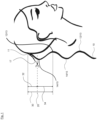
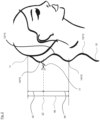
- the Figures 1 - 4 illustrate first and second cutting areas according to the method according to the invention.
- the wavy human head hair is shown schematically by a wave train 10 of wavy hair.
- the wavy hair has wave troughs 12 facing the head with a lowest point 13 and wave crests 14 facing away from the head with a highest point 15.
- Fig. 1 and 2 the hair is cut at points 20 and 22, respectively, and after cutting, the hair tip 17 of the cut hair points away from the head.
- a first cutting area extends between locations 20 and 22, and when the hair is cut in this first cutting area, the ends of the hair point away from the head after cutting. Seen from the hair root 11, the point is 20 in Fig. 1 the beginning 20 of the first cutting area and the location 22 in Fig. 2 its end 22. As can be seen, the first cutting area delimited by the beginning 20 and end 22 is a surrounding area of the highest point 15 of the first wave crest 14 as seen from the hair root 11.
- Fig. 1 further shows that point 20 divides the distance 30 from the hair root to the lowest point 13 of the first trough 12 into partial lengths 32 and 34.
- the distance 30 is divided by the partial lengths 32 and 34 in a ratio of 38.2 to 61.8, which corresponds to the so-called golden ratio.
- the beginning 20 of the first cutting area is located at the division of the distance 30 in the ratio 38.2 to 61.8.
- Fig. 2 shows the division of the distance 40 from the hair root to the highest point 15 of the second wave crest 14 as seen from the hair root 11 into partial lengths 42 and 44.
- the partial lengths 42 and 44 increase the distance 40 at point 22 in a ratio of 38.2 61.8, also divided in the ratio of the golden ratio.
- the end 22 of the first cutting area is at the division of the distance 40 in a ratio of 38.2 to 61.8.
- the first cutting area is formed by a surrounding area of the highest point 15 of the first wave crest 14, the surrounding area being 20%, preferably 10%, of the period length of the hair curl and the highest point 15 lying essentially in the middle of the first cutting area.
- the period length of the hair curl corresponds to the distance from the highest point 15 of the first wave crest 14 viewed from the hair root to the highest point 15 of the second wave crest 14, and the first cutting area in this embodiment of the method according to the invention essentially corresponds to the crest of the first wave crest , whereby the width of the peak is 20%, preferably 10%, of the period length of the hair curl.
- Fig. 3 and 4 the hair is cut at points 24 and 26, respectively, and after cutting, the hair tip 17 of the cut hair points towards the head.
- a second cutting area extends between locations 24 and 26, and when the hair is cut in this second cutting area, the ends of the hair point towards the head after cutting. Viewed from the hair root, the area is 24 in Fig. 3 the beginning 24 of the first cutting area and the point 26 in
- the second cutting area delimited by the beginning 24 and end 26 is an area surrounding the turning point 18 of the falling edge of the first wave crest 14 as seen from the hair root.
- the turning point 18 is the point on the falling edge of the wave crest 14, in which the curvature changes or which lies at the transition from the wave crest to the wave trough.
- Fig. 3 further shows that the point 24 divides the distance 30 from the hair root 11 to the lowest point 13 of the first trough 12 into partial lengths 52 and 54.
- the distance 30 is divided by the partial lengths 52 and 54 in a ratio of 61.8 to 38.2, which again corresponds to the so-called golden ratio.
- the beginning 24 of the second cutting area is located at the division of the distance 30 in a ratio of 61.8 to 38.2.
- Fig. 4 shows the division of the distance 40 from the hair root to the highest point 15 of the second wave crest 14 as seen from the hair root into partial lengths 62 and 64.
- the partial lengths 62 and 64 make the distance 40 at point 26 in a ratio of 61.8 to 38 .2, also divided in the ratio of the golden ratio.
- the end 26 of the first cutting area is at the division of the distance 40 in a ratio of 61.8 to 38.2.
- the second cutting area is formed by a surrounding area of the turning point 18 on the falling edge of the first wave crest 1, the surrounding area being 20%, preferably 10%, of the period length of the hair curl and the turning point 18 essentially in the middle of the second cutting area lies.
- the period length of the hair curl corresponds to the distance from the highest point 15 of the first wave crest 14 as seen from the hair root to the highest point 15 of the second wave crest 14.
- the special one With the hair cutting method according to the invention, in particular with the subdivision of the waves of the hair curl according to the golden ratio, the special one becomes The advantage is that the hair tips point in a desired direction after cutting. The natural curl and structure of the hair is taken into account, thus achieving a hair cutting result that corresponds to the nature of the hair and at the same time is visually advantageous.
Landscapes
- Cosmetics (AREA)
- Dry Shavers And Clippers (AREA)
Priority Applications (1)
| Application Number | Priority Date | Filing Date | Title |
|---|---|---|---|
| HRP20231370TT HRP20231370T1 (hr) | 2019-04-12 | 2020-04-01 | Metoda šišanja kose |
Applications Claiming Priority (1)
| Application Number | Priority Date | Filing Date | Title |
|---|---|---|---|
| DE102019109783.5A DE102019109783A1 (de) | 2019-04-12 | 2019-04-12 | Haarschneideverfahren |
Publications (3)
| Publication Number | Publication Date |
|---|---|
| EP3721746A1 EP3721746A1 (de) | 2020-10-14 |
| EP3721746B1 true EP3721746B1 (de) | 2023-10-25 |
| EP3721746C0 EP3721746C0 (de) | 2023-10-25 |
Family
ID=70154290
Family Applications (1)
| Application Number | Title | Priority Date | Filing Date |
|---|---|---|---|
| EP20167544.4A Active EP3721746B1 (de) | 2019-04-12 | 2020-04-01 | Haarschneideverfahren |
Country Status (5)
| Country | Link |
|---|---|
| EP (1) | EP3721746B1 (pl) |
| DE (1) | DE102019109783A1 (pl) |
| ES (1) | ES2969288T3 (pl) |
| HR (1) | HRP20231370T1 (pl) |
| PL (1) | PL3721746T3 (pl) |
Family Cites Families (4)
| Publication number | Priority date | Publication date | Assignee | Title |
|---|---|---|---|---|
| DE19538367C1 (de) * | 1995-10-14 | 1996-09-12 | Brian Mclean | Verfahren und Vorrichtung zum Schneiden von Haaren zur Erzeugung von lockigen oder gewellten Frisuren |
| US6257248B1 (en) * | 1999-12-10 | 2001-07-10 | Wen-Ya Yeh | Both hand hair cutting method |
| EP2526811B1 (de) * | 2011-05-26 | 2016-05-11 | Lara De Donno | Verfahren zum Schneiden von Kopfhaaren und Vorrichtung zur Verwendung hierbei |
| JP2018033896A (ja) * | 2016-09-04 | 2018-03-08 | 株式会社ブランシェ | ヘアカット方法、及び、捻り付曲がり鋏 |
-
2019
- 2019-04-12 DE DE102019109783.5A patent/DE102019109783A1/de not_active Ceased
-
2020
- 2020-04-01 PL PL20167544.4T patent/PL3721746T3/pl unknown
- 2020-04-01 HR HRP20231370TT patent/HRP20231370T1/hr unknown
- 2020-04-01 EP EP20167544.4A patent/EP3721746B1/de active Active
- 2020-04-01 ES ES20167544T patent/ES2969288T3/es active Active
Also Published As
| Publication number | Publication date |
|---|---|
| HRP20231370T1 (hr) | 2024-02-16 |
| EP3721746A1 (de) | 2020-10-14 |
| EP3721746C0 (de) | 2023-10-25 |
| ES2969288T3 (es) | 2024-05-17 |
| PL3721746T3 (pl) | 2024-04-02 |
| DE102019109783A1 (de) | 2020-10-15 |
Similar Documents
| Publication | Publication Date | Title |
|---|---|---|
| DE2923764C2 (pl) | ||
| EP3784438B1 (de) | Zange | |
| DE2520514A1 (de) | Schlauchklemme | |
| DE2243610B2 (de) | Kabelumschnurungsband | |
| EP1030763A1 (de) | Band- oder gattermesser | |
| DE3044791A1 (de) | Spanbrecheranordnung fuer schneideinsaetze | |
| EP0916771B1 (de) | Fräszahn zur Erdbearbeitung | |
| EP3721746B1 (de) | Haarschneideverfahren | |
| EP1167780B1 (de) | Niet | |
| EP0086536B2 (de) | Hin-und hergehend antreibbares Untermesser für Trockenrasierapparate | |
| EP1329151B1 (de) | Heckenschere | |
| AT510911B1 (de) | Bandsägeblatt | |
| DE1809143B2 (de) | Angelhaken | |
| WO2018109093A1 (de) | Haarschneidemaschine | |
| DE2613522A1 (de) | Krallenplatte | |
| WO2024141333A1 (de) | Zangenartiges schneidwerkzeug | |
| DE102004038750A1 (de) | Weinbergpfahl | |
| EP0661174B1 (de) | Schnellhefter mit Aufhängevorrichtung | |
| DE2249258A1 (de) | Kontaktelement fuer elektrisch leitende verbindungen | |
| EP3060321B1 (de) | Lauffläche für einen ski und langlaufski | |
| EP3581349B1 (de) | Verbandsstoffschere | |
| DE19616678C1 (de) | Kreismesser | |
| DE2344806C3 (de) | Kunststoff messer | |
| CH403904A (de) | Kabelführungskanal | |
| DE3733063C2 (pl) |
Legal Events
| Date | Code | Title | Description |
|---|---|---|---|
| REG | Reference to a national code |
Ref country code: HR Ref legal event code: TUEP Ref document number: P20231370T Country of ref document: HR |
|
| PUAI | Public reference made under article 153(3) epc to a published international application that has entered the european phase |
Free format text: ORIGINAL CODE: 0009012 |
|
| STAA | Information on the status of an ep patent application or granted ep patent |
Free format text: STATUS: THE APPLICATION HAS BEEN PUBLISHED |
|
| AK | Designated contracting states |
Kind code of ref document: A1 Designated state(s): AL AT BE BG CH CY CZ DE DK EE ES FI FR GB GR HR HU IE IS IT LI LT LU LV MC MK MT NL NO PL PT RO RS SE SI SK SM TR |
|
| AX | Request for extension of the european patent |
Extension state: BA ME |
|
| STAA | Information on the status of an ep patent application or granted ep patent |
Free format text: STATUS: REQUEST FOR EXAMINATION WAS MADE |
|
| 17P | Request for examination filed |
Effective date: 20210409 |
|
| RBV | Designated contracting states (corrected) |
Designated state(s): AL AT BE BG CH CY CZ DE DK EE ES FI FR GB GR HR HU IE IS IT LI LT LU LV MC MK MT NL NO PL PT RO RS SE SI SK SM TR |
|
| GRAP | Despatch of communication of intention to grant a patent |
Free format text: ORIGINAL CODE: EPIDOSNIGR1 |
|
| STAA | Information on the status of an ep patent application or granted ep patent |
Free format text: STATUS: GRANT OF PATENT IS INTENDED |
|
| RIC1 | Information provided on ipc code assigned before grant |
Ipc: A45D 44/00 20060101ALN20230519BHEP Ipc: A45D 7/00 20060101AFI20230519BHEP |
|
| RIC1 | Information provided on ipc code assigned before grant |
Ipc: A45D 44/00 20060101ALN20230613BHEP Ipc: A45D 7/00 20060101AFI20230613BHEP |
|
| INTG | Intention to grant announced |
Effective date: 20230628 |
|
| GRAS | Grant fee paid |
Free format text: ORIGINAL CODE: EPIDOSNIGR3 |
|
| GRAA | (expected) grant |
Free format text: ORIGINAL CODE: 0009210 |
|
| STAA | Information on the status of an ep patent application or granted ep patent |
Free format text: STATUS: THE PATENT HAS BEEN GRANTED |
|
| AK | Designated contracting states |
Kind code of ref document: B1 Designated state(s): AL AT BE BG CH CY CZ DE DK EE ES FI FR GB GR HR HU IE IS IT LI LT LU LV MC MK MT NL NO PL PT RO RS SE SI SK SM TR |
|
| REG | Reference to a national code |
Ref country code: GB Ref legal event code: FG4D Free format text: NOT ENGLISH |
|
| REG | Reference to a national code |
Ref country code: CH Ref legal event code: EP |
|
| REG | Reference to a national code |
Ref country code: DE Ref legal event code: R096 Ref document number: 502020005738 Country of ref document: DE |
|
| REG | Reference to a national code |
Ref country code: IE Ref legal event code: FG4D Free format text: LANGUAGE OF EP DOCUMENT: GERMAN |
|
| U01 | Request for unitary effect filed |
Effective date: 20231025 |
|
| U07 | Unitary effect registered |
Designated state(s): AT BE BG DE DK EE FI FR IT LT LU LV MT NL PT SE SI Effective date: 20231130 |
|
| REG | Reference to a national code |
Ref country code: NO Ref legal event code: T2 Effective date: 20231025 |
|
| REG | Reference to a national code |
Ref country code: HR Ref legal event code: T1PR Ref document number: P20231370 Country of ref document: HR |
|
| PG25 | Lapsed in a contracting state [announced via postgrant information from national office to epo] |
Ref country code: GR Free format text: LAPSE BECAUSE OF FAILURE TO SUBMIT A TRANSLATION OF THE DESCRIPTION OR TO PAY THE FEE WITHIN THE PRESCRIBED TIME-LIMIT Effective date: 20240126 |
|
| PG25 | Lapsed in a contracting state [announced via postgrant information from national office to epo] |
Ref country code: IS Free format text: LAPSE BECAUSE OF FAILURE TO SUBMIT A TRANSLATION OF THE DESCRIPTION OR TO PAY THE FEE WITHIN THE PRESCRIBED TIME-LIMIT Effective date: 20240225 |
|
| REG | Reference to a national code |
Ref country code: HR Ref legal event code: ODRP Ref document number: P20231370 Country of ref document: HR Payment date: 20240322 Year of fee payment: 5 |
|
| PG25 | Lapsed in a contracting state [announced via postgrant information from national office to epo] |
Ref country code: IS Free format text: LAPSE BECAUSE OF FAILURE TO SUBMIT A TRANSLATION OF THE DESCRIPTION OR TO PAY THE FEE WITHIN THE PRESCRIBED TIME-LIMIT Effective date: 20240225 Ref country code: GR Free format text: LAPSE BECAUSE OF FAILURE TO SUBMIT A TRANSLATION OF THE DESCRIPTION OR TO PAY THE FEE WITHIN THE PRESCRIBED TIME-LIMIT Effective date: 20240126 |
|
| REG | Reference to a national code |
Ref country code: ES Ref legal event code: FG2A Ref document number: 2969288 Country of ref document: ES Kind code of ref document: T3 Effective date: 20240517 |
|
| U20 | Renewal fee for the european patent with unitary effect paid |
Year of fee payment: 5 Effective date: 20240424 |
|
| PG25 | Lapsed in a contracting state [announced via postgrant information from national office to epo] |
Ref country code: RS Free format text: LAPSE BECAUSE OF FAILURE TO SUBMIT A TRANSLATION OF THE DESCRIPTION OR TO PAY THE FEE WITHIN THE PRESCRIBED TIME-LIMIT Effective date: 20231025 |
|
| PG25 | Lapsed in a contracting state [announced via postgrant information from national office to epo] |
Ref country code: CZ Free format text: LAPSE BECAUSE OF FAILURE TO SUBMIT A TRANSLATION OF THE DESCRIPTION OR TO PAY THE FEE WITHIN THE PRESCRIBED TIME-LIMIT Effective date: 20231025 |
|
| REG | Reference to a national code |
Ref country code: DE Ref legal event code: R097 Ref document number: 502020005738 Country of ref document: DE |
|
| PG25 | Lapsed in a contracting state [announced via postgrant information from national office to epo] |
Ref country code: SK Free format text: LAPSE BECAUSE OF FAILURE TO SUBMIT A TRANSLATION OF THE DESCRIPTION OR TO PAY THE FEE WITHIN THE PRESCRIBED TIME-LIMIT Effective date: 20231025 |
|
| PG25 | Lapsed in a contracting state [announced via postgrant information from national office to epo] |
Ref country code: SM Free format text: LAPSE BECAUSE OF FAILURE TO SUBMIT A TRANSLATION OF THE DESCRIPTION OR TO PAY THE FEE WITHIN THE PRESCRIBED TIME-LIMIT Effective date: 20231025 Ref country code: SK Free format text: LAPSE BECAUSE OF FAILURE TO SUBMIT A TRANSLATION OF THE DESCRIPTION OR TO PAY THE FEE WITHIN THE PRESCRIBED TIME-LIMIT Effective date: 20231025 Ref country code: RO Free format text: LAPSE BECAUSE OF FAILURE TO SUBMIT A TRANSLATION OF THE DESCRIPTION OR TO PAY THE FEE WITHIN THE PRESCRIBED TIME-LIMIT Effective date: 20231025 Ref country code: CZ Free format text: LAPSE BECAUSE OF FAILURE TO SUBMIT A TRANSLATION OF THE DESCRIPTION OR TO PAY THE FEE WITHIN THE PRESCRIBED TIME-LIMIT Effective date: 20231025 |
|
| PLBE | No opposition filed within time limit |
Free format text: ORIGINAL CODE: 0009261 |
|
| STAA | Information on the status of an ep patent application or granted ep patent |
Free format text: STATUS: NO OPPOSITION FILED WITHIN TIME LIMIT |
|
| 26N | No opposition filed |
Effective date: 20240726 |
|
| PG25 | Lapsed in a contracting state [announced via postgrant information from national office to epo] |
Ref country code: MC Free format text: LAPSE BECAUSE OF FAILURE TO SUBMIT A TRANSLATION OF THE DESCRIPTION OR TO PAY THE FEE WITHIN THE PRESCRIBED TIME-LIMIT Effective date: 20231025 |
|
| PG25 | Lapsed in a contracting state [announced via postgrant information from national office to epo] |
Ref country code: MC Free format text: LAPSE BECAUSE OF FAILURE TO SUBMIT A TRANSLATION OF THE DESCRIPTION OR TO PAY THE FEE WITHIN THE PRESCRIBED TIME-LIMIT Effective date: 20231025 |
|
| REG | Reference to a national code |
Ref country code: HR Ref legal event code: ODRP Ref document number: P20231370 Country of ref document: HR Payment date: 20250325 Year of fee payment: 6 |
|
| PG25 | Lapsed in a contracting state [announced via postgrant information from national office to epo] |
Ref country code: IE Free format text: LAPSE BECAUSE OF NON-PAYMENT OF DUE FEES Effective date: 20240401 |
|
| U20 | Renewal fee for the european patent with unitary effect paid |
Year of fee payment: 6 Effective date: 20250423 |
|
| PGFP | Annual fee paid to national office [announced via postgrant information from national office to epo] |
Ref country code: GB Payment date: 20250426 Year of fee payment: 6 Ref country code: ES Payment date: 20250505 Year of fee payment: 6 |
|
| PGFP | Annual fee paid to national office [announced via postgrant information from national office to epo] |
Ref country code: NO Payment date: 20250428 Year of fee payment: 6 |
|
| PGFP | Annual fee paid to national office [announced via postgrant information from national office to epo] |
Ref country code: CH Payment date: 20250501 Year of fee payment: 6 |
|
| PG25 | Lapsed in a contracting state [announced via postgrant information from national office to epo] |
Ref country code: CY Free format text: LAPSE BECAUSE OF FAILURE TO SUBMIT A TRANSLATION OF THE DESCRIPTION OR TO PAY THE FEE WITHIN THE PRESCRIBED TIME-LIMIT; INVALID AB INITIO Effective date: 20200401 |
|
| PG25 | Lapsed in a contracting state [announced via postgrant information from national office to epo] |
Ref country code: HU Free format text: LAPSE BECAUSE OF FAILURE TO SUBMIT A TRANSLATION OF THE DESCRIPTION OR TO PAY THE FEE WITHIN THE PRESCRIBED TIME-LIMIT; INVALID AB INITIO Effective date: 20200401 |
|
| U1N | Appointed representative for the unitary patent procedure changed after the registration of the unitary effect |
Representative=s name: LORENZ SEIDLER GOSSEL PART. MBB; DE |
|
| PGFP | Annual fee paid to national office [announced via postgrant information from national office to epo] |
Ref country code: HR Payment date: 20260317 Year of fee payment: 7 |
|
| PGFP | Annual fee paid to national office [announced via postgrant information from national office to epo] |
Ref country code: TR Payment date: 20260330 Year of fee payment: 7 |
|
| PGFP | Annual fee paid to national office [announced via postgrant information from national office to epo] |
Ref country code: PL Payment date: 20260317 Year of fee payment: 7 |
|
| REG | Reference to a national code |
Ref country code: HR Ref legal event code: ODRP Ref document number: P20231370 Country of ref document: HR Payment date: 20260317 Year of fee payment: 7 |