EP3720401B1 - Schienenbewehrte bandage und verfahren zu deren herstellung - Google Patents
Schienenbewehrte bandage und verfahren zu deren herstellung Download PDFInfo
- Publication number
- EP3720401B1 EP3720401B1 EP18822519.7A EP18822519A EP3720401B1 EP 3720401 B1 EP3720401 B1 EP 3720401B1 EP 18822519 A EP18822519 A EP 18822519A EP 3720401 B1 EP3720401 B1 EP 3720401B1
- Authority
- EP
- European Patent Office
- Prior art keywords
- splint
- fabric
- bandage
- strip
- wave
- Prior art date
- Legal status (The legal status is an assumption and is not a legal conclusion. Google has not performed a legal analysis and makes no representation as to the accuracy of the status listed.)
- Active
Links
Images



Classifications
-
- A—HUMAN NECESSITIES
- A61—MEDICAL OR VETERINARY SCIENCE; HYGIENE
- A61F—FILTERS IMPLANTABLE INTO BLOOD VESSELS; PROSTHESES; DEVICES PROVIDING PATENCY TO, OR PREVENTING COLLAPSING OF, TUBULAR STRUCTURES OF THE BODY, e.g. STENTS; ORTHOPAEDIC, NURSING OR CONTRACEPTIVE DEVICES; FOMENTATION; TREATMENT OR PROTECTION OF EYES OR EARS; BANDAGES, DRESSINGS OR ABSORBENT PADS; FIRST-AID KITS
- A61F5/00—Orthopaedic methods or devices for non-surgical treatment of bones or joints; Nursing devices ; Anti-rape devices
- A61F5/01—Orthopaedic devices, e.g. long-term immobilising or pressure directing devices for treating broken or deformed bones such as splints, casts or braces
- A61F5/04—Devices for stretching or reducing fractured limbs; Devices for distractions; Splints
- A61F5/05—Devices for stretching or reducing fractured limbs; Devices for distractions; Splints for immobilising
- A61F5/058—Splints
-
- A—HUMAN NECESSITIES
- A61—MEDICAL OR VETERINARY SCIENCE; HYGIENE
- A61F—FILTERS IMPLANTABLE INTO BLOOD VESSELS; PROSTHESES; DEVICES PROVIDING PATENCY TO, OR PREVENTING COLLAPSING OF, TUBULAR STRUCTURES OF THE BODY, e.g. STENTS; ORTHOPAEDIC, NURSING OR CONTRACEPTIVE DEVICES; FOMENTATION; TREATMENT OR PROTECTION OF EYES OR EARS; BANDAGES, DRESSINGS OR ABSORBENT PADS; FIRST-AID KITS
- A61F13/00—Bandages or dressings; Absorbent pads
-
- A—HUMAN NECESSITIES
- A61—MEDICAL OR VETERINARY SCIENCE; HYGIENE
- A61F—FILTERS IMPLANTABLE INTO BLOOD VESSELS; PROSTHESES; DEVICES PROVIDING PATENCY TO, OR PREVENTING COLLAPSING OF, TUBULAR STRUCTURES OF THE BODY, e.g. STENTS; ORTHOPAEDIC, NURSING OR CONTRACEPTIVE DEVICES; FOMENTATION; TREATMENT OR PROTECTION OF EYES OR EARS; BANDAGES, DRESSINGS OR ABSORBENT PADS; FIRST-AID KITS
- A61F13/00—Bandages or dressings; Absorbent pads
- A61F13/04—Plaster of Paris bandages; Other stiffening bandages
-
- A—HUMAN NECESSITIES
- A61—MEDICAL OR VETERINARY SCIENCE; HYGIENE
- A61F—FILTERS IMPLANTABLE INTO BLOOD VESSELS; PROSTHESES; DEVICES PROVIDING PATENCY TO, OR PREVENTING COLLAPSING OF, TUBULAR STRUCTURES OF THE BODY, e.g. STENTS; ORTHOPAEDIC, NURSING OR CONTRACEPTIVE DEVICES; FOMENTATION; TREATMENT OR PROTECTION OF EYES OR EARS; BANDAGES, DRESSINGS OR ABSORBENT PADS; FIRST-AID KITS
- A61F13/00—Bandages or dressings; Absorbent pads
- A61F13/15—Absorbent pads, e.g. sanitary towels, swabs or tampons for external or internal application to the body; Supporting or fastening means therefor; Tampon applicators
- A61F13/51—Absorbent pads, e.g. sanitary towels, swabs or tampons for external or internal application to the body; Supporting or fastening means therefor; Tampon applicators characterised by the outer layers of the pads
-
- A—HUMAN NECESSITIES
- A61—MEDICAL OR VETERINARY SCIENCE; HYGIENE
- A61L—METHODS OR APPARATUS FOR STERILISING MATERIALS OR OBJECTS IN GENERAL; DISINFECTION, STERILISATION OR DEODORISATION OF AIR; CHEMICAL ASPECTS OF BANDAGES, DRESSINGS, ABSORBENT PADS OR SURGICAL ARTICLES; MATERIALS FOR BANDAGES, DRESSINGS, ABSORBENT PADS OR SURGICAL ARTICLES
- A61L15/00—Chemical aspects of, or use of materials for, bandages, dressings or absorbent pads
- A61L15/07—Stiffening bandages
-
- B—PERFORMING OPERATIONS; TRANSPORTING
- B29—WORKING OF PLASTICS; WORKING OF SUBSTANCES IN A PLASTIC STATE IN GENERAL
- B29C—SHAPING OR JOINING OF PLASTICS; SHAPING OF MATERIAL IN A PLASTIC STATE, NOT OTHERWISE PROVIDED FOR; AFTER-TREATMENT OF THE SHAPED PRODUCTS, e.g. REPAIRING
- B29C48/00—Extrusion moulding, i.e. expressing the moulding material through a die or nozzle which imparts the desired form; Apparatus therefor
-
- B—PERFORMING OPERATIONS; TRANSPORTING
- B29—WORKING OF PLASTICS; WORKING OF SUBSTANCES IN A PLASTIC STATE IN GENERAL
- B29C—SHAPING OR JOINING OF PLASTICS; SHAPING OF MATERIAL IN A PLASTIC STATE, NOT OTHERWISE PROVIDED FOR; AFTER-TREATMENT OF THE SHAPED PRODUCTS, e.g. REPAIRING
- B29C48/00—Extrusion moulding, i.e. expressing the moulding material through a die or nozzle which imparts the desired form; Apparatus therefor
- B29C48/25—Component parts, details or accessories; Auxiliary operations
- B29C48/30—Extrusion nozzles or dies
-
- A—HUMAN NECESSITIES
- A61—MEDICAL OR VETERINARY SCIENCE; HYGIENE
- A61F—FILTERS IMPLANTABLE INTO BLOOD VESSELS; PROSTHESES; DEVICES PROVIDING PATENCY TO, OR PREVENTING COLLAPSING OF, TUBULAR STRUCTURES OF THE BODY, e.g. STENTS; ORTHOPAEDIC, NURSING OR CONTRACEPTIVE DEVICES; FOMENTATION; TREATMENT OR PROTECTION OF EYES OR EARS; BANDAGES, DRESSINGS OR ABSORBENT PADS; FIRST-AID KITS
- A61F13/00—Bandages or dressings; Absorbent pads
- A61F13/15—Absorbent pads, e.g. sanitary towels, swabs or tampons for external or internal application to the body; Supporting or fastening means therefor; Tampon applicators
- A61F13/51—Absorbent pads, e.g. sanitary towels, swabs or tampons for external or internal application to the body; Supporting or fastening means therefor; Tampon applicators characterised by the outer layers of the pads
- A61F2013/51002—Absorbent pads, e.g. sanitary towels, swabs or tampons for external or internal application to the body; Supporting or fastening means therefor; Tampon applicators characterised by the outer layers of the pads with special fibres
- A61F2013/51023—Absorbent pads, e.g. sanitary towels, swabs or tampons for external or internal application to the body; Supporting or fastening means therefor; Tampon applicators characterised by the outer layers of the pads with special fibres being polymeric fibres
- A61F2013/51026—Absorbent pads, e.g. sanitary towels, swabs or tampons for external or internal application to the body; Supporting or fastening means therefor; Tampon applicators characterised by the outer layers of the pads with special fibres being polymeric fibres being in thermoplastic material
-
- D—TEXTILES; PAPER
- D10—INDEXING SCHEME ASSOCIATED WITH SUBLASSES OF SECTION D, RELATING TO TEXTILES
- D10B—INDEXING SCHEME ASSOCIATED WITH SUBLASSES OF SECTION D, RELATING TO TEXTILES
- D10B2509/00—Medical; Hygiene
- D10B2509/02—Bandages, dressings or absorbent pads
-
- D—TEXTILES; PAPER
- D10—INDEXING SCHEME ASSOCIATED WITH SUBLASSES OF SECTION D, RELATING TO TEXTILES
- D10B—INDEXING SCHEME ASSOCIATED WITH SUBLASSES OF SECTION D, RELATING TO TEXTILES
- D10B2509/00—Medical; Hygiene
- D10B2509/02—Bandages, dressings or absorbent pads
- D10B2509/028—Elastic support stockings or elastic bandages
Definitions
- a splint-armoured bandage according to the present invention can be seen as a dry alternative to a plaster bandage which needs wetting by water in order to cure and stiffen in applied position about a limb.
- the dry splint-armoured bandage is lightweight, time saving and less sensitive to outer conditions.
- a prior splint-armoured bandage and its manufacture is disclosed in CN 104287894 A .
- polymer material splints are individually extruded and applied in situ to a fabric at intermediate angles of more than 0° and less than 90° between adjacent splints, or at angles ranging from more than 0° to less than 90° with respect to the length direction of the bandage.
- An object of the present invention is to provide a splint-armoured bandage which in use provides fixation of an injured limb.
- Embodiments of the splint include pointed, sinus-shaped, square and trapezoid wave-shapes. Each of these embodiments benefit from the technical effect of a circumferentially continuing element, which adds to rigidity in radial and circumferential directions of a dressing.
- the splint is anchored to the fabric by being fused or bonded to fibres or threads in the fabric. This embodiment ensures attachment without need for auxiliary fastening steps or arrangements.
- the splint is sandwiched between first and second superimposed layers of fabric. This embodiment secures the splint even further to the fabric. This embodiment also provides an all-textile exterior of the dressing, avoiding the risk of the splint hooking on to external objects.
- An additional step in the method comprises subjecting the splint to adjustable compression when the splint is passed under a shaping roll in plastic state.
- the sectional profile of the splint is this way controlled by pressure adjustment to achieve a width to height ratio in the range of about 0.5/1 to about 10/1, preferably to achieve a width to height ratio in the range of about 1.5/1 to about 4/1.
- the hot extrusion station 1 includes a container 3 for a thermoplastic polymer material, equipped with a heater 4 and a hot extrusion nozzle 5.
- One or more additional heaters 4' may be installed along the fabric path 2 in order to maintain or return the splint into plastic state.
- the hot extrusion nozzle 5 is suspended movable above the fabric feeding path 2 and controlled in back and forth movements, transversely to the fabric feeding path 2, by means of a nozzle control 6.
- Nozzle control also involves controlling the discharge rate of polymer product via the nozzle.
- the specification of components in the hot extrusion station 1 may correspond generally to those conventionally applied in extrusion of polymer and co-polymer materials.
- the fabric feeding path 2 defines a feed direction F from a fabric supply reel 7 to a reel 8 for a splint-armoured fabric.
- the reel 8 is driven for feeding, continuously or intermittently as the case may be, a strip of fabric 9 from the supply reel 7 to pass underneath the nozzle 5 from which a string of molten or semi-molten polymer product 10 is discharged so as to form a splint 10 on the fabric.
- the path length from the nozzle 5 to the reel 8 is long enough to permit cooling and solidification of the splint, until the fabric with splint is rolled onto the reel 8.
- the fabric feeding path 2 may include a cooling region 11 through which the fabric and splint passes before it reaches the reel 8.
- the cooling region may include a cooling fan, or a cooling plate 12, e.g., over which the fabric and splint is passed in the feed direction F.
- a fabric suitable for production of a splint-armoured bandage according to the present invention can be comprised of synthetic fibres or natural fibres, or a mix or composition of synthetic and natural fibres.
- a composite fibre may include a cotton fibre or thread coated with an elastomeric compound, e.g.
- the fibres may be formed into threads that are woven, knitted or interlaced to produce the fabric.
- At least the warp or yarn of the fabric is elastic. The elasticity may result from intrinsic properties in a synthetic, composite or rubber thread, and may alternatively be the result of appropriate knitting or weaving technique.
- a suitable fabric is a fabric comprising fibres or threads that provide a tacky effect.
- the character of tackiness which is aimed for results in self-adhesion between superimposed layers of fabric in a dressing about a limb.
- Fabric which meets the desired tackiness and elasticity can be found commercially, such as the brands of fabric which are conventionally used in adhesive bandages and wound dressings.
- a polymer suitable for production of a splint-armoured bandage according to the present invention is a thermoplastic or thermosetting polymer with a melting point temperature that is well above the upper temperatures prevailing in normal use of the bandage.
- the temperature of the polymer splint in molten or semi-molten state must not deform or damage the fibres or threads in the fabric.
- the splint material stays flexible, i.e. does not become brittle, at the lower temperatures prevailing in normal use of the bandage.
- a thermoplastic or thermosetting polymer which has a melting point temperature within a range of 60° to 300° C, and which remains flexible and elastic at temperatures of -20° C or lower, is considered to meet the purpose for a wide range of embodiments.
- a splint material may be found among, e.g., polyethylene, polypropylene, polyvinyl chloride, polyamide, or among thermoplastic cellulose derivatives such as cellulose acetate e.g., with or without plasticizer added to the polymer composition.
- a transverse section of a splint 10 is formed with a width w and a height h, the height h being a normal to the plane and surface S of the strip of fabric.
- a wider splint in the w direction will be stiffer in the longitudinal plane of the fabric (i.e., in the circumferential direction of a dressing about a limb), whereas a splint wider in the h direction will be stiffer transversely to the plane of the fabric (i.e. in radial direction of a dressing about a limb).
- the mouth of the nozzle 5 such that a polymer string is deposited onto the fabric, wherein the width w of the splint section is less than the height h of the splint section.
- This can be achieved, for example, using a rectangular nozzle mouth which is tilted at an angle of about 45° from the plane of the fabric.
- the w/h ratio may this way be extended to a lower range limit of about 0.5/1, at least.
- An upper range limit, up to which the splint will still provide adequate radial support in a dressing, is for this practical reason defined at a w/h ratio of about 10/1.
- the splint 10 includes a continuous series of splint ribs 16 and 17 distributed in the length direction L of the strip of fabric 9, and interconnected at their ends by wave crests 18 and wave troughs 19 respectively.
- a discrete length of the splint-armoured bandage may include one singular wave-shaped splint 10 extended the full length of the bandage, as illustrated in Fig. 3 .
- a splint-armoured bandage may include a series of splints 10 of shorter lengths, wherein adjacent splints are separated in the longitudinal direction L by a non-armoured length 20 of the bandage, as illustrated in Fig. 4 .
- the shortest wave-forming element wl available in a splint-armoured bandage according to the present invention is one wavelength long, including a pair of adjacent splint ribs 16 and 17, in one of their ends interconnected by a wave crest 18 or a wave trough 19 respectively.
- a splint 10 whether produced in a petroleum based or cellulose based thermoplastic polymer, provides in solidified state a flexible and elastic armour that follows in elongation E and contraction C of the fabric which is elastic in its length direction L.
- the strip of fabric 9 and the splint 10 have a length L sufficient for wrapping in layers about a limb.
- a length L in the range of 0.5 to 10 meters is considered to cover most practical cases.
- a length of fabric in one or both ends of the fabric may be left without the splint in order to facilitate the foundation and/or finishing of a dressing about a limb. Excessive lengths of the splint-armoured bandage can be cut off from a dressing by using knife or scissors.
- the frequency of waves in a dressing can also be adjusted and adopted to need and anatomy in the treated limb by more or less stretching of fabric and splint.
- the radial and circumferential rigidity in a dressing can also be enhanced locally by arranging crossing splints in overlapping layers of fabric, such as at the location of a suspected fracture, e.g.
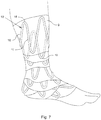
- Fig. 7 shows the splint-armoured bandage of Figs. 3-6 dressed about a human ankle. From the drawing of Fig. 7 it can be appreciated that in applied state the splint-armoured bandage forms an overlapping and crosslinked network of splints that provide all-around support, in appearance similar to scales in the panzer of a fish or reptile. Yet, the armour is still flexible to avoid discomfort caused by pressure or chafing, and permits adaptation to protrusions on the limb, such as heel and fibula e.g., which can be positioned between splint ribs 16, 17.
- the inclinations ⁇ , ⁇ of the splint ribs 16 and 17 with respect to the longitudinal direction of the strip of fabric 9 need not be the same for the full length of the strip of fabric.
- the ribs 16, 17 following each other in succession may be given different inclinations with respect to the fabric longitudinal direction.
- the splint may be anchored to the fabric through bonding at the interface between the splint and the fabric.
- bonding is used as a definition of a connection between splint and fabric that arises upon solidification of splint material which in molten or semi-molten phase has adhered to threads or fibres in the fabric. Bonding can also comprise penetration of molten splint material into and/or between threads or fibres in the fabric. If appropriate, bonding may also include fusion between the splint material and any synthetic component in the fabric. Bonding between splint and fabric can be enhanced when splint material is forced into the fabric during the step of compressing the splint while in plastic state as mentioned above.
- a splint may be anchored and affixed to the fabric in other ways beside bonding.
- One modification of the invention comprises an additional step in the production process, wherein an external layer, or string, of adhesive is applied to the outer and exposed side of the second strip of fabric 9'.
- the purpose of the added adhesive layer is to improve adhesion between overlapping layers of fabric, this way even further increasing the integrity of a dressing applied to a limb.
- the laminate of the first and second fabric with the splint positioned there-between can be fed through an adhesive transfer station 21, comprising an adhesive transfer roll or an adhesive spray curtain, e.g. At a position downstream of the location of the station 21, the laminate can be arranged to receive a protective film or paper 22 before the finished product is wound onto the reel 8.
- a splint of wave-shape may alternatively be prefabricated in a heat extrusion process and stored on a reel.
- a splint of wave-shape may also alternatively be prefabricated from a sheet of material by punching, or even produced from a solid thread that is bent into wave-shape. The prefabricated splint is then, in solid state, rolled off onto a strip of fabric moving down the fabric feeding path. By heating the splint to thermoforming temperature the splint is set in plastic state, its sectional profile shaped and bonded to the fabric by application of pressure from a shaping roll as previously explained.
Landscapes
- Health & Medical Sciences (AREA)
- Engineering & Computer Science (AREA)
- Life Sciences & Earth Sciences (AREA)
- Veterinary Medicine (AREA)
- Public Health (AREA)
- General Health & Medical Sciences (AREA)
- Animal Behavior & Ethology (AREA)
- Biomedical Technology (AREA)
- Vascular Medicine (AREA)
- Heart & Thoracic Surgery (AREA)
- Epidemiology (AREA)
- Mechanical Engineering (AREA)
- Orthopedic Medicine & Surgery (AREA)
- Nursing (AREA)
- Chemical & Material Sciences (AREA)
- Materials Engineering (AREA)
- Manufacturing & Machinery (AREA)
- Orthopedics, Nursing, And Contraception (AREA)
Claims (18)
- Bandage zur Fixierung einer Gliedmaße, wobei die Bandage mindestens eine flexible, thermoplastische Polymerschiene (10) umfasst, die geformt ist und in plastifizierter Kondition an der Oberfläche (S) eines Längsstreifens aus Stoff (9), der in seiner Längsrichtung (L) elastisch ist, angebracht ist, wobei der Stoff (9) und die Schiene (10) eine Länge (L) aufweisen, die für das Wickeln in Schichten um eine Gliedmaße ausreicht, dadurch gekennzeichnet, dass die Schiene (10) in Wellenform gebildet ist, wobei benachbarte Schienenlamellen (16, 17) durch Wellenberge (18) bzw. Wellentäler (19) miteinander verbunden sind, wobei sich mindestens einer der Wellenberge (18) und eines der Wellentäler (19) in der Nähe, d. h. im Bereich eines Längsrandes (M) des Stoffstreifens (9), befindet.
- Bandage nach Anspruch 1, wobei die Wellenform der Schiene (10) eine von spitz, sinusförmig, quadratisch und trapezoid ist.
- Bandage nach Anspruch 1 oder 2, wobei eine Schiene (10) eine fortlaufende Reihe von Schienenlamellen (16, 17) einschließt, die in der Längsrichtung (L) der Bandage verteilt sind, wobei die Schienenlamellen durch Wellenberge bzw. Wellentäler (18, 19) miteinander verbunden sind.
- Bandage nach Anspruch 1 oder 2, wobei benachbarte Schienen (10) in einer Reihe von Schienen durch nicht armierte Abschnitte (20) des Stoffs getrennt sind.
- Bandage nach einem der vorstehenden Ansprüche, wobei die Schiene (10) an dem Stoff (9) verankert ist, indem sie mit Fasern oder Fäden in dem Stoff fusioniert oder gebondet ist.
- Bandage nach einem der vorstehenden Ansprüche, wobei die Schiene (10) zwischen der ersten (9) und der zweiten (9') übereinander gelegten Stoffschicht angeordnet ist.
- Bandage nach einem der vorstehenden Ansprüche, wobei ein Querschnittsprofil der Schiene (10) mit einer Breite (w) und einer Höhe (h) gebildet ist, wobei die Höhe (h) eine Normale zur Ebene und Oberfläche (S) des Stoffstreifens (9) ist und ein Verhältnis der Breite zur Höhe (w/h) in dem Querschnittsprofil der Schiene das gesteuerte Ergebnis des Unterziehens der Schiene einer einstellbaren Kompression durch eine Formgebungswalze (15) ist, wenn die Schiene in einem plastischen Zustand ist.
- Bandage nach Anspruch 7, wobei das Querschnittsprofil der Schiene (10) ein Verhältnis der Breite zur Höhe (w/h) im Bereich von etwa 0,5/1 bis etwa 10/1 aufweist.
- Bandage nach Anspruch 8, wobei das Querschnittsprofil der Schiene (10) ein Verhältnis der Breite zur Höhe (w/h) im Bereich von etwa 1,5/1 bis etwa 4/1 aufweist.
- Verfahren zum Herstellen einer armierten Bandage zur Fixierung einer Gliedmaße, wobei das Verfahren Folgendes umfassta. Erwärmen eines thermoplastischen Polymermaterials zur Abgabe über eine Heißextrusionsdüse in geschmolzenem oder halbgeschmolzenem Zustand,b. Zuführen eines ersten Stoffstreifens unter die Heißextrusionsdüse,c. Bilden einer wellenförmigen Schiene auf dem ersten Stoffstreifen durch Extrusion aus der Düse, während die Düse quer zur Zuführung des Stoffs vor und zurück bewegt wird, wodurch eine Reihe von Schienenlamellen (16, 17) gebildet wird, die in der Längsrichtung (L) des Stoffstreifens (9) verteilt und an ihren Enden durch Wellenberge (18) bzw. Wellentäler (19) miteinander verbunden sind, undd. Positionieren mindestens eines/einer der Wellenberge (18) und der Wellentäler (19) in der Nähe, d. h. im Bereich eines Längsrandes (M) des Stoffstreifens.
- Verfahren nach Anspruch 10, umfassend den Schritt des Steuerns eines Verhältnisses der Breite zur Höhe (w/h) in dem Querschnittsprofil der Schiene durch Unterziehen der Schiene einer eingestellten Kompression, wenn die Schiene im plastischen Zustand unter einer Formgebungswalze (15) hindurchgeführt wird.
- Verfahren nach Anspruch 11, umfassend den Schritt des Bildens, durch Druckeinstellung, des Querschnittsprofils der Schiene (10) mit einem Verhältnis der Breite zur Höhe (w/h) im Bereich von etwa 0,5/1 bis etwa 10/1.
- Verfahren nach Anspruch 12, umfassend den Schritt des Bildens, durch Druckeinstellung, des Querschnittsprofils der Schiene (10) mit einem Verhältnis der Breite zur Höhe (w/h) im Bereich von etwa 1,5/1 bis etwa 4/1.
- Verfahren nach einem der Ansprüche 10-13, wobei das Erstarren der Schiene durch Leiten des Stoffstreifens durch einen Kühlbereich verstärkt wird.
- Verfahren nach einem der Ansprüche 10-14, wobei das Polymermaterial aus thermoplastischen oder duroplastischen erdöl- oder cellulosebasierten Polymeren mit einer Schmelzpunkttemperatur im Bereich von 60 °C bis 300 °C ausgewählt ist und bei Temperaturen von -20 °C oder darunter flexibel und elastisch bleibt.
- Verfahren nach einem der Ansprüche 10-15, wobei der Stoff aus einem elastischen Gewebe ausgewählt ist, das synthetische oder natürliche Fasern oder eine Mischung oder Zusammensetzung davon einschließt, wobei der Stoff eine klebrige Oberfläche aufweist.
- Verfahren nach einem der Ansprüche 10-16, umfassend den Schritt des Aufbringens eines zweiten Stoffstreifens auf den ersten Stoffstreifen und die Schiene.
- Verfahren nach Anspruch 17, umfassend den Schritt des Aufbringens eines Haftmittels auf eine exponierte Seite des ersten oder zweiten Stoffstreifens, wobei das Haftmittel gewählt ist, um Haftung zwischen sich überlappenden Stoffschichten bereitzustellen.
Applications Claiming Priority (2)
| Application Number | Priority Date | Filing Date | Title |
|---|---|---|---|
| SE1700299A SE541767C2 (en) | 2017-12-05 | 2017-12-05 | Support bandage and a method for its production |
| PCT/SE2018/051241 WO2019112508A1 (en) | 2017-12-05 | 2018-12-03 | A splint-armoured bandage and a method for its production |
Publications (2)
| Publication Number | Publication Date |
|---|---|
| EP3720401A1 EP3720401A1 (de) | 2020-10-14 |
| EP3720401B1 true EP3720401B1 (de) | 2022-01-12 |
Family
ID=64746612
Family Applications (1)
| Application Number | Title | Priority Date | Filing Date |
|---|---|---|---|
| EP18822519.7A Active EP3720401B1 (de) | 2017-12-05 | 2018-12-03 | Schienenbewehrte bandage und verfahren zu deren herstellung |
Country Status (4)
| Country | Link |
|---|---|
| US (1) | US20210177639A1 (de) |
| EP (1) | EP3720401B1 (de) |
| SE (1) | SE541767C2 (de) |
| WO (1) | WO2019112508A1 (de) |
Family Cites Families (21)
| Publication number | Priority date | Publication date | Assignee | Title |
|---|---|---|---|---|
| US2980110A (en) * | 1955-02-28 | 1961-04-18 | Richard S Brumfield | Surgical splint and bandage |
| US2957475A (en) | 1958-06-24 | 1960-10-25 | Drake Frances | Bandage with removable splints |
| DE2329314A1 (de) | 1973-06-08 | 1975-01-02 | Peter De Dr Med Vos | Elastische binde, insbesondere fuer oberschenkel |
| DE3878529D1 (de) * | 1987-10-21 | 1993-03-25 | Michel Bertheas | Vorrichtung zur behandlung von verstauchungen, insbesondere der sprunggelenke sowie zur vermeidung von dabei auftretenden bestimmten komplikationen. |
| EP0693914B1 (de) * | 1993-04-16 | 1998-12-23 | Minnesota Mining And Manufacturing Company | Materialien für orthopädische stützverbände |
| NZ333665A (en) * | 1996-07-12 | 2000-01-28 | Recorde Ltd | Non-slip bandage |
| EP1089775A1 (de) * | 1998-06-26 | 2001-04-11 | Beiersdorf Aktiengesellschaft | Orthopädische bandage |
| CN2369654Y (zh) * | 1999-02-03 | 2000-03-22 | 孝晨 | 弹性绷带夹板 |
| DE10045993A1 (de) * | 2000-09-12 | 2002-03-21 | Bernd Kuenne | Schiene bzw. Orthese aus faserigem Werkstoff |
| US7507680B2 (en) * | 2003-11-12 | 2009-03-24 | Tredegar Film Products Corporation | Composite elastic web |
| US20070078364A1 (en) * | 2005-08-17 | 2007-04-05 | Davis Belcher Linda B | Wound cover/stabilizer |
| EP2068786A1 (de) * | 2006-10-03 | 2009-06-17 | Fastform Research Limited | Orthopädische vorrichtungen |
| JP5421379B2 (ja) * | 2008-09-30 | 2014-02-19 | スリーエム イノベイティブ プロパティズ カンパニー | 送達系を備える薄膜鼻腔拡張器 |
| DE102010048083A1 (de) * | 2010-10-04 | 2012-04-05 | Bauerfeind Ag | Formgedächtniselemente für medizinische Hilfsmittel |
| CA2775687A1 (en) * | 2012-04-26 | 2013-10-26 | Dirk Wust | New kinesiology tape |
| FR3002435B1 (fr) * | 2013-02-27 | 2018-08-10 | Thonic Innovation | Bande elastique pour bandage et procedes de fabrication d'une telle bande |
| US9302137B1 (en) * | 2013-07-22 | 2016-04-05 | Christopher Joseph Yelvington | Resistance-applying garment, connector for use in garment, and method of forming garment |
| US20150265451A1 (en) * | 2014-03-18 | 2015-09-24 | Paul Forster | Limb Immobilization Wrap |
| DE102014209591A1 (de) * | 2014-05-20 | 2015-11-26 | Karl Otto Braun Gmbh & Co. Kg | Elastische Binde |
| CN204169986U (zh) * | 2014-09-10 | 2015-02-25 | 嘉兴好事帮医疗器械有限公司 | 一种支架绷带 |
| CN104287894B (zh) | 2014-09-10 | 2018-01-12 | 嘉兴好事帮医疗器械有限公司 | 一种支架绷带 |
-
2017
- 2017-12-05 SE SE1700299A patent/SE541767C2/en not_active IP Right Cessation
-
2018
- 2018-12-03 US US16/760,936 patent/US20210177639A1/en not_active Abandoned
- 2018-12-03 EP EP18822519.7A patent/EP3720401B1/de active Active
- 2018-12-03 WO PCT/SE2018/051241 patent/WO2019112508A1/en not_active Ceased
Also Published As
| Publication number | Publication date |
|---|---|
| US20210177639A1 (en) | 2021-06-17 |
| SE1700299A1 (en) | 2019-06-06 |
| WO2019112508A1 (en) | 2019-06-13 |
| SE541767C2 (en) | 2019-12-10 |
| EP3720401A1 (de) | 2020-10-14 |
Similar Documents
| Publication | Publication Date | Title |
|---|---|---|
| US4968313A (en) | Diaper with waist band elastic | |
| EP0396800B1 (de) | Wegwerfwindel mit einem elastischen Taillenband | |
| US7937973B2 (en) | Tubular spacer fabric | |
| US3424633A (en) | Method of making strap material | |
| EP0223366B1 (de) | Orthopädisches Formteil | |
| CN1158982C (zh) | 一次性单轴弹性关节热护垫 | |
| US7465283B2 (en) | Cast assembly with breathable double knit type padding | |
| US5409448A (en) | Easily removed tubular cast assembly, and method for removing a cast | |
| FI115952B (fi) | Päällevedettävä kertakäyttövaippa ja menetelmä sen valmistamiseksi | |
| JP3742107B2 (ja) | 伸縮性膝当てラップ | |
| CN2199765Y (zh) | 一次性的内裤 | |
| RU2582444C2 (ru) | Натягиваемый предмет одежды и способ его производства | |
| JPH10501195A (ja) | 弾性シート状複合材 | |
| US20030083605A1 (en) | Comfortable joint sleeve | |
| JP2003526426A (ja) | フック及びループ締結具 | |
| JP2004514500A (ja) | 個別成形テニスエルボーパット構造体 | |
| JPH11508783A (ja) | ダイヤモンド形状の熱素子パターンと滑り止め手段とを備えた伸縮性背当てラップ | |
| GB2398269A (en) | Compression brace material with spacer fabric inner layer | |
| CN1273522A (zh) | 用于抛弃型吸收物品的扣合装置 | |
| WO2005052235A1 (en) | A soft, cushioning ans stiffening spacer fabric | |
| JPH02126849A (ja) | チューブ部材 | |
| AU2003234304A1 (en) | Hardenable orthopaedic supports | |
| JP2012501765A (ja) | パンツ型の失禁用品 | |
| US20010007929A1 (en) | Human joint bandage | |
| KR101537170B1 (ko) | 재사용이 가능한 통기성 직물 구조 및 그 조립체 |
Legal Events
| Date | Code | Title | Description |
|---|---|---|---|
| STAA | Information on the status of an ep patent application or granted ep patent |
Free format text: STATUS: UNKNOWN |
|
| STAA | Information on the status of an ep patent application or granted ep patent |
Free format text: STATUS: THE INTERNATIONAL PUBLICATION HAS BEEN MADE |
|
| PUAI | Public reference made under article 153(3) epc to a published international application that has entered the european phase |
Free format text: ORIGINAL CODE: 0009012 |
|
| STAA | Information on the status of an ep patent application or granted ep patent |
Free format text: STATUS: REQUEST FOR EXAMINATION WAS MADE |
|
| 17P | Request for examination filed |
Effective date: 20200701 |
|
| AK | Designated contracting states |
Kind code of ref document: A1 Designated state(s): AL AT BE BG CH CY CZ DE DK EE ES FI FR GB GR HR HU IE IS IT LI LT LU LV MC MK MT NL NO PL PT RO RS SE SI SK SM TR |
|
| AX | Request for extension of the european patent |
Extension state: BA ME |
|
| DAV | Request for validation of the european patent (deleted) | ||
| DAX | Request for extension of the european patent (deleted) | ||
| GRAP | Despatch of communication of intention to grant a patent |
Free format text: ORIGINAL CODE: EPIDOSNIGR1 |
|
| STAA | Information on the status of an ep patent application or granted ep patent |
Free format text: STATUS: GRANT OF PATENT IS INTENDED |
|
| INTG | Intention to grant announced |
Effective date: 20210831 |
|
| GRAS | Grant fee paid |
Free format text: ORIGINAL CODE: EPIDOSNIGR3 |
|
| GRAA | (expected) grant |
Free format text: ORIGINAL CODE: 0009210 |
|
| STAA | Information on the status of an ep patent application or granted ep patent |
Free format text: STATUS: THE PATENT HAS BEEN GRANTED |
|
| AK | Designated contracting states |
Kind code of ref document: B1 Designated state(s): AL AT BE BG CH CY CZ DE DK EE ES FI FR GB GR HR HU IE IS IT LI LT LU LV MC MK MT NL NO PL PT RO RS SE SI SK SM TR |
|
| REG | Reference to a national code |
Ref country code: GB Ref legal event code: FG4D |
|
| REG | Reference to a national code |
Ref country code: CH Ref legal event code: EP |
|
| REG | Reference to a national code |
Ref country code: DE Ref legal event code: R096 Ref document number: 602018029625 Country of ref document: DE |
|
| REG | Reference to a national code |
Ref country code: IE Ref legal event code: FG4D |
|
| REG | Reference to a national code |
Ref country code: AT Ref legal event code: REF Ref document number: 1461903 Country of ref document: AT Kind code of ref document: T Effective date: 20220215 |
|
| REG | Reference to a national code |
Ref country code: SE Ref legal event code: TRGR |
|
| REG | Reference to a national code |
Ref country code: LT Ref legal event code: MG9D |
|
| REG | Reference to a national code |
Ref country code: NL Ref legal event code: MP Effective date: 20220112 |
|
| REG | Reference to a national code |
Ref country code: AT Ref legal event code: MK05 Ref document number: 1461903 Country of ref document: AT Kind code of ref document: T Effective date: 20220112 |
|
| PG25 | Lapsed in a contracting state [announced via postgrant information from national office to epo] |
Ref country code: NL Free format text: LAPSE BECAUSE OF FAILURE TO SUBMIT A TRANSLATION OF THE DESCRIPTION OR TO PAY THE FEE WITHIN THE PRESCRIBED TIME-LIMIT Effective date: 20220112 |
|
| PG25 | Lapsed in a contracting state [announced via postgrant information from national office to epo] |
Ref country code: RS Free format text: LAPSE BECAUSE OF FAILURE TO SUBMIT A TRANSLATION OF THE DESCRIPTION OR TO PAY THE FEE WITHIN THE PRESCRIBED TIME-LIMIT Effective date: 20220112 Ref country code: PT Free format text: LAPSE BECAUSE OF FAILURE TO SUBMIT A TRANSLATION OF THE DESCRIPTION OR TO PAY THE FEE WITHIN THE PRESCRIBED TIME-LIMIT Effective date: 20220512 Ref country code: NO Free format text: LAPSE BECAUSE OF FAILURE TO SUBMIT A TRANSLATION OF THE DESCRIPTION OR TO PAY THE FEE WITHIN THE PRESCRIBED TIME-LIMIT Effective date: 20220412 Ref country code: LT Free format text: LAPSE BECAUSE OF FAILURE TO SUBMIT A TRANSLATION OF THE DESCRIPTION OR TO PAY THE FEE WITHIN THE PRESCRIBED TIME-LIMIT Effective date: 20220112 Ref country code: HR Free format text: LAPSE BECAUSE OF FAILURE TO SUBMIT A TRANSLATION OF THE DESCRIPTION OR TO PAY THE FEE WITHIN THE PRESCRIBED TIME-LIMIT Effective date: 20220112 Ref country code: ES Free format text: LAPSE BECAUSE OF FAILURE TO SUBMIT A TRANSLATION OF THE DESCRIPTION OR TO PAY THE FEE WITHIN THE PRESCRIBED TIME-LIMIT Effective date: 20220112 Ref country code: BG Free format text: LAPSE BECAUSE OF FAILURE TO SUBMIT A TRANSLATION OF THE DESCRIPTION OR TO PAY THE FEE WITHIN THE PRESCRIBED TIME-LIMIT Effective date: 20220412 |
|
| PG25 | Lapsed in a contracting state [announced via postgrant information from national office to epo] |
Ref country code: PL Free format text: LAPSE BECAUSE OF FAILURE TO SUBMIT A TRANSLATION OF THE DESCRIPTION OR TO PAY THE FEE WITHIN THE PRESCRIBED TIME-LIMIT Effective date: 20220112 Ref country code: LV Free format text: LAPSE BECAUSE OF FAILURE TO SUBMIT A TRANSLATION OF THE DESCRIPTION OR TO PAY THE FEE WITHIN THE PRESCRIBED TIME-LIMIT Effective date: 20220112 Ref country code: GR Free format text: LAPSE BECAUSE OF FAILURE TO SUBMIT A TRANSLATION OF THE DESCRIPTION OR TO PAY THE FEE WITHIN THE PRESCRIBED TIME-LIMIT Effective date: 20220413 Ref country code: FI Free format text: LAPSE BECAUSE OF FAILURE TO SUBMIT A TRANSLATION OF THE DESCRIPTION OR TO PAY THE FEE WITHIN THE PRESCRIBED TIME-LIMIT Effective date: 20220112 Ref country code: AT Free format text: LAPSE BECAUSE OF FAILURE TO SUBMIT A TRANSLATION OF THE DESCRIPTION OR TO PAY THE FEE WITHIN THE PRESCRIBED TIME-LIMIT Effective date: 20220112 |
|
| PG25 | Lapsed in a contracting state [announced via postgrant information from national office to epo] |
Ref country code: IS Free format text: LAPSE BECAUSE OF FAILURE TO SUBMIT A TRANSLATION OF THE DESCRIPTION OR TO PAY THE FEE WITHIN THE PRESCRIBED TIME-LIMIT Effective date: 20220512 |
|
| REG | Reference to a national code |
Ref country code: DE Ref legal event code: R097 Ref document number: 602018029625 Country of ref document: DE |
|
| PG25 | Lapsed in a contracting state [announced via postgrant information from national office to epo] |
Ref country code: SM Free format text: LAPSE BECAUSE OF FAILURE TO SUBMIT A TRANSLATION OF THE DESCRIPTION OR TO PAY THE FEE WITHIN THE PRESCRIBED TIME-LIMIT Effective date: 20220112 Ref country code: SK Free format text: LAPSE BECAUSE OF FAILURE TO SUBMIT A TRANSLATION OF THE DESCRIPTION OR TO PAY THE FEE WITHIN THE PRESCRIBED TIME-LIMIT Effective date: 20220112 Ref country code: RO Free format text: LAPSE BECAUSE OF FAILURE TO SUBMIT A TRANSLATION OF THE DESCRIPTION OR TO PAY THE FEE WITHIN THE PRESCRIBED TIME-LIMIT Effective date: 20220112 Ref country code: EE Free format text: LAPSE BECAUSE OF FAILURE TO SUBMIT A TRANSLATION OF THE DESCRIPTION OR TO PAY THE FEE WITHIN THE PRESCRIBED TIME-LIMIT Effective date: 20220112 Ref country code: DK Free format text: LAPSE BECAUSE OF FAILURE TO SUBMIT A TRANSLATION OF THE DESCRIPTION OR TO PAY THE FEE WITHIN THE PRESCRIBED TIME-LIMIT Effective date: 20220112 Ref country code: CZ Free format text: LAPSE BECAUSE OF FAILURE TO SUBMIT A TRANSLATION OF THE DESCRIPTION OR TO PAY THE FEE WITHIN THE PRESCRIBED TIME-LIMIT Effective date: 20220112 |
|
| PLBE | No opposition filed within time limit |
Free format text: ORIGINAL CODE: 0009261 |
|
| STAA | Information on the status of an ep patent application or granted ep patent |
Free format text: STATUS: NO OPPOSITION FILED WITHIN TIME LIMIT |
|
| PG25 | Lapsed in a contracting state [announced via postgrant information from national office to epo] |
Ref country code: AL Free format text: LAPSE BECAUSE OF FAILURE TO SUBMIT A TRANSLATION OF THE DESCRIPTION OR TO PAY THE FEE WITHIN THE PRESCRIBED TIME-LIMIT Effective date: 20220112 |
|
| 26N | No opposition filed |
Effective date: 20221013 |
|
| PGFP | Annual fee paid to national office [announced via postgrant information from national office to epo] |
Ref country code: GB Payment date: 20221216 Year of fee payment: 5 Ref country code: FR Payment date: 20221216 Year of fee payment: 5 Ref country code: DE Payment date: 20221219 Year of fee payment: 5 |
|
| PG25 | Lapsed in a contracting state [announced via postgrant information from national office to epo] |
Ref country code: SI Free format text: LAPSE BECAUSE OF FAILURE TO SUBMIT A TRANSLATION OF THE DESCRIPTION OR TO PAY THE FEE WITHIN THE PRESCRIBED TIME-LIMIT Effective date: 20220112 |
|
| PG25 | Lapsed in a contracting state [announced via postgrant information from national office to epo] |
Ref country code: IT Free format text: LAPSE BECAUSE OF FAILURE TO SUBMIT A TRANSLATION OF THE DESCRIPTION OR TO PAY THE FEE WITHIN THE PRESCRIBED TIME-LIMIT Effective date: 20220112 |
|
| REG | Reference to a national code |
Ref country code: CH Ref legal event code: PL |
|
| REG | Reference to a national code |
Ref country code: BE Ref legal event code: MM Effective date: 20221231 |
|
| PG25 | Lapsed in a contracting state [announced via postgrant information from national office to epo] |
Ref country code: LU Free format text: LAPSE BECAUSE OF NON-PAYMENT OF DUE FEES Effective date: 20221203 |
|
| PG25 | Lapsed in a contracting state [announced via postgrant information from national office to epo] |
Ref country code: LI Free format text: LAPSE BECAUSE OF NON-PAYMENT OF DUE FEES Effective date: 20221231 Ref country code: IE Free format text: LAPSE BECAUSE OF NON-PAYMENT OF DUE FEES Effective date: 20221203 Ref country code: CH Free format text: LAPSE BECAUSE OF NON-PAYMENT OF DUE FEES Effective date: 20221231 |
|
| PG25 | Lapsed in a contracting state [announced via postgrant information from national office to epo] |
Ref country code: BE Free format text: LAPSE BECAUSE OF NON-PAYMENT OF DUE FEES Effective date: 20221231 |
|
| PG25 | Lapsed in a contracting state [announced via postgrant information from national office to epo] |
Ref country code: CY Free format text: LAPSE BECAUSE OF FAILURE TO SUBMIT A TRANSLATION OF THE DESCRIPTION OR TO PAY THE FEE WITHIN THE PRESCRIBED TIME-LIMIT Effective date: 20220112 |
|
| PG25 | Lapsed in a contracting state [announced via postgrant information from national office to epo] |
Ref country code: MK Free format text: LAPSE BECAUSE OF FAILURE TO SUBMIT A TRANSLATION OF THE DESCRIPTION OR TO PAY THE FEE WITHIN THE PRESCRIBED TIME-LIMIT Effective date: 20220112 Ref country code: HU Free format text: LAPSE BECAUSE OF FAILURE TO SUBMIT A TRANSLATION OF THE DESCRIPTION OR TO PAY THE FEE WITHIN THE PRESCRIBED TIME-LIMIT; INVALID AB INITIO Effective date: 20181203 |
|
| PG25 | Lapsed in a contracting state [announced via postgrant information from national office to epo] |
Ref country code: MC Free format text: LAPSE BECAUSE OF FAILURE TO SUBMIT A TRANSLATION OF THE DESCRIPTION OR TO PAY THE FEE WITHIN THE PRESCRIBED TIME-LIMIT Effective date: 20220112 |
|
| PG25 | Lapsed in a contracting state [announced via postgrant information from national office to epo] |
Ref country code: MC Free format text: LAPSE BECAUSE OF FAILURE TO SUBMIT A TRANSLATION OF THE DESCRIPTION OR TO PAY THE FEE WITHIN THE PRESCRIBED TIME-LIMIT Effective date: 20220112 |
|
| REG | Reference to a national code |
Ref country code: DE Ref legal event code: R119 Ref document number: 602018029625 Country of ref document: DE |
|
| GBPC | Gb: european patent ceased through non-payment of renewal fee |
Effective date: 20231203 |
|
| PG25 | Lapsed in a contracting state [announced via postgrant information from national office to epo] |
Ref country code: MT Free format text: LAPSE BECAUSE OF FAILURE TO SUBMIT A TRANSLATION OF THE DESCRIPTION OR TO PAY THE FEE WITHIN THE PRESCRIBED TIME-LIMIT Effective date: 20220112 |
|
| PG25 | Lapsed in a contracting state [announced via postgrant information from national office to epo] |
Ref country code: DE Free format text: LAPSE BECAUSE OF NON-PAYMENT OF DUE FEES Effective date: 20240702 |
|
| PG25 | Lapsed in a contracting state [announced via postgrant information from national office to epo] |
Ref country code: GB Free format text: LAPSE BECAUSE OF NON-PAYMENT OF DUE FEES Effective date: 20231203 |
|
| PG25 | Lapsed in a contracting state [announced via postgrant information from national office to epo] |
Ref country code: FR Free format text: LAPSE BECAUSE OF NON-PAYMENT OF DUE FEES Effective date: 20231231 |
|
| PG25 | Lapsed in a contracting state [announced via postgrant information from national office to epo] |
Ref country code: GB Free format text: LAPSE BECAUSE OF NON-PAYMENT OF DUE FEES Effective date: 20231203 Ref country code: FR Free format text: LAPSE BECAUSE OF NON-PAYMENT OF DUE FEES Effective date: 20231231 Ref country code: DE Free format text: LAPSE BECAUSE OF NON-PAYMENT OF DUE FEES Effective date: 20240702 |
|
| PGFP | Annual fee paid to national office [announced via postgrant information from national office to epo] |
Ref country code: SE Payment date: 20241212 Year of fee payment: 7 |
|
| PG25 | Lapsed in a contracting state [announced via postgrant information from national office to epo] |
Ref country code: TR Free format text: LAPSE BECAUSE OF FAILURE TO SUBMIT A TRANSLATION OF THE DESCRIPTION OR TO PAY THE FEE WITHIN THE PRESCRIBED TIME-LIMIT Effective date: 20220112 |