EP3718992B1 - Verfahren zur oligomerisierung von olefinen - Google Patents
Verfahren zur oligomerisierung von olefinen Download PDFInfo
- Publication number
- EP3718992B1 EP3718992B1 EP18884389.0A EP18884389A EP3718992B1 EP 3718992 B1 EP3718992 B1 EP 3718992B1 EP 18884389 A EP18884389 A EP 18884389A EP 3718992 B1 EP3718992 B1 EP 3718992B1
- Authority
- EP
- European Patent Office
- Prior art keywords
- catalyst
- inactivator
- phenyl
- catalyst inactivator
- oligomerization
- Prior art date
- Legal status (The legal status is an assumption and is not a legal conclusion. Google has not performed a legal analysis and makes no representation as to the accuracy of the status listed.)
- Active
Links
Images
Classifications
-
- C—CHEMISTRY; METALLURGY
- C07—ORGANIC CHEMISTRY
- C07C—ACYCLIC OR CARBOCYCLIC COMPOUNDS
- C07C2/00—Preparation of hydrocarbons from hydrocarbons containing a smaller number of carbon atoms
- C07C2/02—Preparation of hydrocarbons from hydrocarbons containing a smaller number of carbon atoms by addition between unsaturated hydrocarbons
- C07C2/04—Preparation of hydrocarbons from hydrocarbons containing a smaller number of carbon atoms by addition between unsaturated hydrocarbons by oligomerisation of well-defined unsaturated hydrocarbons without ring formation
- C07C2/06—Preparation of hydrocarbons from hydrocarbons containing a smaller number of carbon atoms by addition between unsaturated hydrocarbons by oligomerisation of well-defined unsaturated hydrocarbons without ring formation of alkenes, i.e. acyclic hydrocarbons having only one carbon-to-carbon double bond
- C07C2/08—Catalytic processes
- C07C2/26—Catalytic processes with hydrides or organic compounds
- C07C2/32—Catalytic processes with hydrides or organic compounds as complexes, e.g. acetyl-acetonates
-
- B—PERFORMING OPERATIONS; TRANSPORTING
- B01—PHYSICAL OR CHEMICAL PROCESSES OR APPARATUS IN GENERAL
- B01J—CHEMICAL OR PHYSICAL PROCESSES, e.g. CATALYSIS OR COLLOID CHEMISTRY; THEIR RELEVANT APPARATUS
- B01J31/00—Catalysts comprising hydrides, coordination complexes or organic compounds
- B01J31/02—Catalysts comprising hydrides, coordination complexes or organic compounds containing organic compounds or metal hydrides
- B01J31/12—Catalysts comprising hydrides, coordination complexes or organic compounds containing organic compounds or metal hydrides containing organo-metallic compounds or metal hydrides
- B01J31/14—Catalysts comprising hydrides, coordination complexes or organic compounds containing organic compounds or metal hydrides containing organo-metallic compounds or metal hydrides of aluminium or boron
-
- B—PERFORMING OPERATIONS; TRANSPORTING
- B01—PHYSICAL OR CHEMICAL PROCESSES OR APPARATUS IN GENERAL
- B01J—CHEMICAL OR PHYSICAL PROCESSES, e.g. CATALYSIS OR COLLOID CHEMISTRY; THEIR RELEVANT APPARATUS
- B01J31/00—Catalysts comprising hydrides, coordination complexes or organic compounds
- B01J31/02—Catalysts comprising hydrides, coordination complexes or organic compounds containing organic compounds or metal hydrides
- B01J31/12—Catalysts comprising hydrides, coordination complexes or organic compounds containing organic compounds or metal hydrides containing organo-metallic compounds or metal hydrides
- B01J31/14—Catalysts comprising hydrides, coordination complexes or organic compounds containing organic compounds or metal hydrides containing organo-metallic compounds or metal hydrides of aluminium or boron
- B01J31/143—Catalysts comprising hydrides, coordination complexes or organic compounds containing organic compounds or metal hydrides containing organo-metallic compounds or metal hydrides of aluminium or boron of aluminium
-
- B—PERFORMING OPERATIONS; TRANSPORTING
- B01—PHYSICAL OR CHEMICAL PROCESSES OR APPARATUS IN GENERAL
- B01J—CHEMICAL OR PHYSICAL PROCESSES, e.g. CATALYSIS OR COLLOID CHEMISTRY; THEIR RELEVANT APPARATUS
- B01J31/00—Catalysts comprising hydrides, coordination complexes or organic compounds
- B01J31/02—Catalysts comprising hydrides, coordination complexes or organic compounds containing organic compounds or metal hydrides
- B01J31/12—Catalysts comprising hydrides, coordination complexes or organic compounds containing organic compounds or metal hydrides containing organo-metallic compounds or metal hydrides
- B01J31/14—Catalysts comprising hydrides, coordination complexes or organic compounds containing organic compounds or metal hydrides containing organo-metallic compounds or metal hydrides of aluminium or boron
- B01J31/146—Catalysts comprising hydrides, coordination complexes or organic compounds containing organic compounds or metal hydrides containing organo-metallic compounds or metal hydrides of aluminium or boron of boron
-
- B—PERFORMING OPERATIONS; TRANSPORTING
- B01—PHYSICAL OR CHEMICAL PROCESSES OR APPARATUS IN GENERAL
- B01J—CHEMICAL OR PHYSICAL PROCESSES, e.g. CATALYSIS OR COLLOID CHEMISTRY; THEIR RELEVANT APPARATUS
- B01J31/00—Catalysts comprising hydrides, coordination complexes or organic compounds
- B01J31/16—Catalysts comprising hydrides, coordination complexes or organic compounds containing coordination complexes
- B01J31/22—Organic complexes
-
- B—PERFORMING OPERATIONS; TRANSPORTING
- B01—PHYSICAL OR CHEMICAL PROCESSES OR APPARATUS IN GENERAL
- B01J—CHEMICAL OR PHYSICAL PROCESSES, e.g. CATALYSIS OR COLLOID CHEMISTRY; THEIR RELEVANT APPARATUS
- B01J31/00—Catalysts comprising hydrides, coordination complexes or organic compounds
- B01J31/16—Catalysts comprising hydrides, coordination complexes or organic compounds containing coordination complexes
- B01J31/22—Organic complexes
- B01J31/2204—Organic complexes the ligands containing oxygen or sulfur as complexing atoms
- B01J31/2208—Oxygen, e.g. acetylacetonates
- B01J31/2226—Anionic ligands, i.e. the overall ligand carries at least one formal negative charge
- B01J31/223—At least two oxygen atoms present in one at least bidentate or bridging ligand
- B01J31/2234—Beta-dicarbonyl ligands, e.g. acetylacetonates
-
- B—PERFORMING OPERATIONS; TRANSPORTING
- B01—PHYSICAL OR CHEMICAL PROCESSES OR APPARATUS IN GENERAL
- B01J—CHEMICAL OR PHYSICAL PROCESSES, e.g. CATALYSIS OR COLLOID CHEMISTRY; THEIR RELEVANT APPARATUS
- B01J31/00—Catalysts comprising hydrides, coordination complexes or organic compounds
- B01J31/16—Catalysts comprising hydrides, coordination complexes or organic compounds containing coordination complexes
- B01J31/22—Organic complexes
- B01J31/2282—Unsaturated compounds used as ligands
- B01J31/2295—Cyclic compounds, e.g. cyclopentadienyls
-
- B—PERFORMING OPERATIONS; TRANSPORTING
- B01—PHYSICAL OR CHEMICAL PROCESSES OR APPARATUS IN GENERAL
- B01J—CHEMICAL OR PHYSICAL PROCESSES, e.g. CATALYSIS OR COLLOID CHEMISTRY; THEIR RELEVANT APPARATUS
- B01J31/00—Catalysts comprising hydrides, coordination complexes or organic compounds
- B01J31/16—Catalysts comprising hydrides, coordination complexes or organic compounds containing coordination complexes
- B01J31/24—Phosphines, i.e. phosphorus bonded to only carbon atoms, or to both carbon and hydrogen atoms, including e.g. sp2-hybridised phosphorus compounds such as phosphabenzene, phosphole or anionic phospholide ligands
-
- C—CHEMISTRY; METALLURGY
- C07—ORGANIC CHEMISTRY
- C07C—ACYCLIC OR CARBOCYCLIC COMPOUNDS
- C07C11/00—Aliphatic unsaturated hydrocarbons
- C07C11/02—Alkenes
-
- C—CHEMISTRY; METALLURGY
- C07—ORGANIC CHEMISTRY
- C07C—ACYCLIC OR CARBOCYCLIC COMPOUNDS
- C07C2/00—Preparation of hydrocarbons from hydrocarbons containing a smaller number of carbon atoms
- C07C2/02—Preparation of hydrocarbons from hydrocarbons containing a smaller number of carbon atoms by addition between unsaturated hydrocarbons
- C07C2/04—Preparation of hydrocarbons from hydrocarbons containing a smaller number of carbon atoms by addition between unsaturated hydrocarbons by oligomerisation of well-defined unsaturated hydrocarbons without ring formation
- C07C2/06—Preparation of hydrocarbons from hydrocarbons containing a smaller number of carbon atoms by addition between unsaturated hydrocarbons by oligomerisation of well-defined unsaturated hydrocarbons without ring formation of alkenes, i.e. acyclic hydrocarbons having only one carbon-to-carbon double bond
- C07C2/08—Catalytic processes
- C07C2/26—Catalytic processes with hydrides or organic compounds
- C07C2/36—Catalytic processes with hydrides or organic compounds as phosphines, arsines, stilbines or bismuthines
-
- C—CHEMISTRY; METALLURGY
- C07—ORGANIC CHEMISTRY
- C07C—ACYCLIC OR CARBOCYCLIC COMPOUNDS
- C07C7/00—Purification; Separation; Use of additives
- C07C7/04—Purification; Separation; Use of additives by distillation
-
- C—CHEMISTRY; METALLURGY
- C07—ORGANIC CHEMISTRY
- C07C—ACYCLIC OR CARBOCYCLIC COMPOUNDS
- C07C7/00—Purification; Separation; Use of additives
- C07C7/12—Purification; Separation; Use of additives by adsorption, i.e. purification or separation of hydrocarbons with the aid of solids, e.g. with ion-exchangers
-
- C—CHEMISTRY; METALLURGY
- C07—ORGANIC CHEMISTRY
- C07C—ACYCLIC OR CARBOCYCLIC COMPOUNDS
- C07C7/00—Purification; Separation; Use of additives
- C07C7/20—Use of additives, e.g. for stabilisation
-
- B—PERFORMING OPERATIONS; TRANSPORTING
- B01—PHYSICAL OR CHEMICAL PROCESSES OR APPARATUS IN GENERAL
- B01J—CHEMICAL OR PHYSICAL PROCESSES, e.g. CATALYSIS OR COLLOID CHEMISTRY; THEIR RELEVANT APPARATUS
- B01J2231/00—Catalytic reactions performed with catalysts classified in B01J31/00
- B01J2231/20—Olefin oligomerisation or telomerisation
-
- B—PERFORMING OPERATIONS; TRANSPORTING
- B01—PHYSICAL OR CHEMICAL PROCESSES OR APPARATUS IN GENERAL
- B01J—CHEMICAL OR PHYSICAL PROCESSES, e.g. CATALYSIS OR COLLOID CHEMISTRY; THEIR RELEVANT APPARATUS
- B01J2531/00—Additional information regarding catalytic systems classified in B01J31/00
- B01J2531/60—Complexes comprising metals of Group VI (VIA or VIB) as the central metal
- B01J2531/62—Chromium
-
- C—CHEMISTRY; METALLURGY
- C07—ORGANIC CHEMISTRY
- C07C—ACYCLIC OR CARBOCYCLIC COMPOUNDS
- C07C2531/00—Catalysts comprising hydrides, coordination complexes or organic compounds
- C07C2531/02—Catalysts comprising hydrides, coordination complexes or organic compounds containing organic compounds or metal hydrides
- C07C2531/12—Catalysts comprising hydrides, coordination complexes or organic compounds containing organic compounds or metal hydrides containing organo-metallic compounds or metal hydrides
- C07C2531/14—Catalysts comprising hydrides, coordination complexes or organic compounds containing organic compounds or metal hydrides containing organo-metallic compounds or metal hydrides of aluminium or boron
-
- C—CHEMISTRY; METALLURGY
- C07—ORGANIC CHEMISTRY
- C07C—ACYCLIC OR CARBOCYCLIC COMPOUNDS
- C07C2531/00—Catalysts comprising hydrides, coordination complexes or organic compounds
- C07C2531/16—Catalysts comprising hydrides, coordination complexes or organic compounds containing coordination complexes
- C07C2531/22—Organic complexes
-
- Y—GENERAL TAGGING OF NEW TECHNOLOGICAL DEVELOPMENTS; GENERAL TAGGING OF CROSS-SECTIONAL TECHNOLOGIES SPANNING OVER SEVERAL SECTIONS OF THE IPC; TECHNICAL SUBJECTS COVERED BY FORMER USPC CROSS-REFERENCE ART COLLECTIONS [XRACs] AND DIGESTS
- Y02—TECHNOLOGIES OR APPLICATIONS FOR MITIGATION OR ADAPTATION AGAINST CLIMATE CHANGE
- Y02P—CLIMATE CHANGE MITIGATION TECHNOLOGIES IN THE PRODUCTION OR PROCESSING OF GOODS
- Y02P20/00—Technologies relating to chemical industry
- Y02P20/50—Improvements relating to the production of bulk chemicals
Definitions
- the present invention relates to a method for oligomerizing olefins.
- Ethylene is a raw material used as a basic material in the chemical industry to such an extent that its production and consumption are considered as indicators of the chemical industry scale of a country.
- ethylene has been used as a monomer for preparing polymers such as polyethylene, and the like.
- linear alpha olefins (LAOs) having an approximately C4-C40 carbon length (or chain) are prepared by adjusting a degree of polymerization of ethylene, and thus are used to prepare a variety of chemicals.
- LAO is a chemical that does not contain sulfur and nitrogen derived from crude oil.
- crude oil contains impurities such as sulfur and nitrogen components in amounts of several percent by weight, it is difficult to directly prepare chemicals composed of pure hydrocarbons without such impurities.
- ethylene resulting from a catalytic cracking reaction of crude oil may be converted into LAOs, which are in turn converted into desired chemicals, thereby obtaining chemicals composed of pure hydrocarbons without impurities.
- An ethylene polymerization reaction is mainly carried out using a batch reactor under air-sensitive conditions in the presence of a metallocene catalyst. Because the metallocene catalyst is a catalyst that has a very strong single acid site, ethylene is selectively polymerized at the single acid site of the catalyst. Due to such properties, a polymer is linearly grown at the acid site of the catalyst. As a result, olefins produced by an LAO preparation reaction have a linear alpha-olefin structure having an even number of carbon atoms because ethylene is used as a monomer.
- Linear alpha olefins produced by an LAO preparation process exhibit distinct physical properties depending on the number of carbon atoms thereof, and chemicals prepared therefrom also have distinct physical properties depending on the type of LAO source materials.
- C4 LAOs obtained by polymerizing two ethylene monomers are present in a gas phase, and polymers resulting from the polymerization thereof have an excessive amount of intramolecular branches, which makes it difficult to apply to a specific product, for example, a lube base oil.
- C6 LAOs obtained by polymerizing three ethylene monomers are also converted into polymers, it is difficult to apply such polymers to a lube base oil, and the like because the polymers have many intramolecular branches.
- an ethylene-1-hexene copolymer having different physical properties from conventional polyethylene may be prepared.
- C8 LAOs obtained by polymerizing four ethylene monomers may be applied to a Group IV lube base oil via polymerization, and may be used to prepare a copolymer with ethylene, as in the C6 LAOs.
- C10-C12 LAOs are polymerized, and thus mainly used as the Group IV base oil, and C14-C16 LAOs are reacted with amine or succinic acid so that the resulting reaction products can be applied to various functional chemicals, or can be mixed and applied to inexpensive drilling fluids, and the like.
- C18 or more LAOs may be used in the form of an additive or wax for lubricants.
- 2-ethylhexanol has been commonly used as the catalyst inactivator for suppressing side reactions at the rear end of the reactor after the ethylene oligomerization reaction.
- the 2-ethylhexanol has good catalyst inactivation efficiency, but has a problem in that, when it is distilled at the latter part of the process, it is difficult to separate it from certain LAO components.
- EP 2 354 113 A1 discloses a method for deactivation of an ethylene trimerization catalyst system.
- WO 2007/057458 A1 discloses a catalytic process for the oligomerization of olefinic monomers.
- An object of the present invention is to provide a method for preparing a linear alpha olefin (LAO) from olefins capable of preparing high-purity LAOs in an economical manner by suppressing unnecessary side reactions at the rear end of a reactor to prepare linear alpha olefins with high purity and yield and simultaneously separate the prepared LAOs with high separation efficiency.
- LAO linear alpha olefin
- a method for oligomerizing olefins includes: introducing an oligomerization transition metal catalyst, a cocatalyst, an olefin monomer, and a solvent to a reactor to perform an olefin oligomerization reaction; and introducing a catalyst inactivator, which includes an oxygen-containing inorganic material in a gas phase, to a reaction product of the oligomerization reaction.
- the oxygen-containing inorganic material may be in a gas phase at 25°C and 101.325 kPa (1 atmospheric pressure (atm)).
- the oxygen-containing inorganic material may be O 2 , CO 2 , CO, H 2 O, NO x , SO x , or a mixture thereof.
- the oxygen-containing inorganic material may be O 2 or CO 2 .
- the catalyst inactivator may include 0.5 to 100% by weight of the oxygen-containing inorganic material.
- the introducing of the catalyst inactivator may be performed at 80°C to 100°C.
- the method may further include subjecting a gel- or solid-phase component including an inactivated catalyst to solid-liquid separation.
- the method may further include separating an unreacted catalyst inactivator by distillation or adsorption.
- the method may further include recirculating the reaction product, which includes an unreacted olefin monomer in the introducing of the catalyst inactivator, to perform the oligomerization reaction.
- the catalyst inactivator in the reaction product including the unreacted olefin monomer may be removed by adsorption.
- 1-Octene may be included at 30% by weight or more, based on 100% by weight of linear alpha olefins in the reaction product of the oligomerization reaction.
- the cocatalyst may be an aluminum compound, an organoaluminoxane, an organoboron compound, or a mixture thereof.
- An amount of the introduced catalyst inactivator may be such an amount that an amount of the oxygen-containing inorganic material in the catalyst inactivator is 1 to 50 times higher than the total number of moles of aluminum, boron, or a combination thereof in the cocatalyst based on the number of moles.
- the transition metal catalyst is represented by ML 1 (L 2 ) p (X) q or M 2 X 1 2 L 1 2 (L 2 ) y (X) z , wherein M is a transition metal, L 1 is a heteroligand, L 2 is an organic ligand, X and X 1 are each independently a halogen, p is an integer of 0 or 1 or more, q is an integer of (oxidation number of M - p), y is an integer of 2 or more, and z is an integer of (2 x oxidation number of M) - y.
- the olefin monomer may be ethylene, and oligomers may include a mixture of C4-C40 linear alpha olefins.
- linear alpha olefins can be prepared with high purity and yield by suppressing unnecessary side reactions at the rear end of a reactor or at the end of a reaction.
- process energy can also be reduced and process efficiency can be enhanced by separating the prepared LAOs with high separation efficiency, and the LAOs having minimized impurities can be prepared.
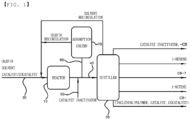
- FIG. 1 is an exemplary schematic diagram of a plant capable of performing a method for oligomerizing olefins according to one aspect of the present invention.
- One aspect of the present invention provides a method for oligomerizing olefins, which includes: introducing an oligomerization transition metal catalyst, an olefin monomer, and a solvent and performing an olefin oligomerization reaction to produce oligomers; and introducing a catalyst inactivator to a reaction product of the oligomerization reaction to inactivate the catalyst, wherein the catalyst inactivator is in a gas phase at 25°C and 101.325 kPa (1 atm), and includes an oxygen-containing inorganic material.
- the method for oligomerizing olefins may include introducing a catalyst inactivator at the end of the oligomerization reaction, wherein the catalyst inactivator is in a gas phase at 25°C and 101.325 kPa (1 atm), and may include the oxygen-containing inorganic material. Therefore, reaction selectivity of the oligomerization reaction may be improved.
- the reaction selectivity of the oligomerization reaction may be evaluated using the purity of 1-octene in the reaction product, and 1-octene is an expensive material that may be applied to Group IV lube base oil via polymerization and may also be used to prepare a copolymer with ethylene, as in the C6 LAOs. Therefore, the high purity of 1-octene makes it possible to achieve a high added value of the reaction.
- the catalyst inactivator which is in a gas phase at 25°C and 101.325 kPa (1 atm) and includes the oxygen-containing inorganic material, may be added, during an oligomerization reaction, to suppress side reactions that occur unnecessarily at the rear end of the reactor or at the end of the reaction, thereby improving the yield of C4-C40 linear alpha olefins.
- the final yield of the produced linear alpha olefins may be further improved as a result of improvement of efficiency of separation of the linear alpha olefins from the catalyst inactivator. More specifically, the final yield of 1-octene may be improved to enhance a high added value of the entire processes.
- the catalyst inactivator that is in a gas phase at 25°C and 101.325 kPa (1 atm) may be separated from the produced linear alpha olefins with high efficiency only by applying low process energy.
- the linear alpha olefins may be separated from the catalyst inactivator with high purity.
- the oxygen-containing inorganic material may be O 2 , CO 2 , CO, H 2 O, NO x , SO x , or a mixture thereof.
- the oxygen-containing inorganic material may be O 2 , CO 2 , CO, or a mixture thereof, and more specifically CO 2 and O 2 .
- CO 2 is a material that is generated as a byproduct or an exhaust gas in many fields of industry, and is purchasable at a low cost, it is desirable in terms of improving the economic feasibility of the process.
- the NO x may be, for example, NO, NO 2 , N 2 O, N 2 O 3 , N 2 O 4 , N 2 O 5 , or a mixture thereof, but the present invention is not limited thereto.
- the SO x may be SO 2 , SO 3 , or a mixture thereof, but the present invention is not limited thereto.
- the catalyst inactivator may further include another inorganic material that is in a gas phase at 25°C and 101.325 kPa (1 atm).
- the catalyst inactivator may further include an inert gas such as N 2 , Ar, He, and the like.
- the catalyst inactivator of the present invention includes the oxygen-containing inorganic material that is in a gas phase at 25°C and 101.325 kPa (1 atm), and thus may be used without limitation as long as it does not cause other side reactions in the olefin oligomerization reaction, but the present invention is not limited thereto.
- the catalyst inactivator includes 0.5 to 100% by weight of the oxygen-containing inorganic material, and may include the balance (by weight) of the another material that is in a gas phase at 25°C and 101.325 kPa (1 atm) and does not cause other side reactions in the olefin oligomerization reaction. More specifically, the catalyst inactivator may include 1 to 100% by weight, 2 to 50% by weight, or 3 to 30% by weight of the oxygen-containing inorganic material, but the present invention is not particularly limited thereto.
- Such inactivating of the catalyst may be performed at 50°C to 150°C, and more specifically 80°C to 100°C.
- a reaction product between the catalyst inactivator and the cocatalyst is extracted as a precipitate, or a phenomenon in which the rear end of the reactor is plugged due to aggregation of polymer products having lots of carbon atoms may be prevented.
- the inactivation reaction may be performed at a pressure of 1.01325 bar (atmospheric pressure) to 500 bar, specifically a pressure of 1.01325 bar (atmospheric pressure) to 100 bar, and more specifically a pressure of 1.01325 bar (atmospheric pressure) to 80 bar, but the present invention is not limited thereto.
- the method for oligomerizing olefins may further include subjecting a gel- or solid-phase component including an inactivated catalyst to solid-liquid separation.
- a gel- or solid-phase component including an inactivated catalyst to solid-liquid separation.
- the catalyst and/or cocatalyst inactivated by the catalyst inactivator aggregates so that the catalyst and/or cocatalyst can be present in a solid phase as a gel- or solid-phase aggregate in the reaction product.
- Such a gel- or solid-phase aggregate may be removed by decantation or filtration.
- the method for oligomerizing olefins may also further include separating an unreacted catalyst inactivator by distillation or adsorption.
- This step is to separate the unreacted catalyst inactivator.
- the unreacted catalyst inactivator that is in a gas phase at 25°C and 101.325 kPa (1 atm) may be easily separated from the produced linear alpha olefins.
- only low energy may be applied to separate the catalyst inactivator from the produced linear alpha olefin with high efficiency, thereby separating high-purity linear alpha olefins with low processing costs.
- the catalyst inactivator according to this aspect also has a boiling point different from certain LAOs such as the produced C10 LAOs, and the like. Therefore, because there is no problem of requiring an additional distillation column in order to separate 2-ethylhexanol and certain LAOs such as the produced C10 LAOs, and the like, plant costs, operational costs, and plant maintenance costs may be saved, thereby highly improving economic feasibility of the process.
- a concentration of 1-octene in the reaction product finally recovered after this step may be improved, and the quality of the product may be improved accordingly, thereby enhancing a high added value of the entire processes.
- a distiller is not limited to certain types of distillers, the number of distillation column stages may be adjusted when necessary. Also, a distillation method is not limited to certain distillation methods, and proper distillation methods may be used when necessary.
- the distiller includes a bottom reboiler and an overhead condenser, and a plurality of distillation columns in which the number of stages is in a range of 50 to 100 may be used.
- an adsorption column which is filled with an adsorbent capable of adsorbing the oxygen-containing inorganic material that is included in the catalyst inactivator and is in a gas phase at 25°C and 101.325 kPa (1 atm), may be used.
- the number of adsorption column stages may be adjusted when necessary, but the present invention is not particularly limited thereto.
- a metal oxide or zeolite adsorbent may be used as an adsorbent which may remove the oxygen-containing inorganic material by adsorption.
- copper oxides such as CuO, Cu 2 O, and the like, or zeolite 4A may be used.
- the method for oligomerizing olefins may further include recirculating the reaction product including an unreacted olefin monomer to perform the oligomerization reaction.
- the reaction product should be recirculated.
- the catalyst inactivator included in the reaction product during the inactivating of the catalyst may be removed using the aforementioned adsorption column in this step.
- the catalyst inactivator is a material that is in a gas phase at 25°C and 101.325 kPa (1 atm)
- the catalyst inactivator may be removed by adsorption only by passing the catalyst inactivator through an adsorption column charged with an adsorbent capable of adsorbing the catalyst inactivator.
- the linear alpha olefins in the reaction product of the oligomerization reaction may be C4-C40 linear alpha olefins, and more specifically C4-C30 or C4-C20 linear alpha olefins.
- the linear alpha olefins may include 30% by weight or more, or 50% by weight or more of 1-octene. Because 1-octene has a wide range of applications and is expensive, 1-octene may enhance a high added value of the olefin oligomerization process when 1-octene is included in this range as described above. Also, 1-octene has an advantage in that, because a content of 1-octene in the linear alpha olefins is high, only 1-octene may be easily separated with high purity even when the high-carbon linear alpha olefins are mixed with the reaction product, but the present invention is not particularly limited thereto.
- the cocatalyst may be further introduced when the oligomerization transition metal catalyst, the olefin monomer, and the solvent are introduced into the reactor to perform an olefin oligomerization reaction.
- the cocatalyst may be an organoaluminum compound, an organoaluminoxane, an organoboron compound, or a mixture thereof.
- the organoaluminum compound may be an AlR 3 compound (wherein R is each independently a (C1-C12)alkyl, a (C2-C10)alkenyl, a (C2-C10)alkynyl, a (C1-C12)alkoxy, or a halogen), or LiAlH 4 , but the present invention is not limited thereto.
- the organoaluminum compound may be one selected from trimethylaluminum (TMA), triethylaluminum (TEA), triisobutylaluminum (TIBA), tri-n-octylaluminum, methylaluminum dichloride, ethylaluminum dichloride, dimethylaluminum chloride, diethylaluminum chloride, aluminum isopropoxide, ethylaluminum sesquichloride, and methylaluminum sesquichloride, or a mixture thereof, but the present invention is not limited thereto.
- TMA trimethylaluminum
- TEA triethylaluminum
- TIBA triisobutylaluminum
- tri-n-octylaluminum tri-n-octylaluminum
- methylaluminum dichloride ethylaluminum dichloride
- dimethylaluminum chloride diethylaluminum
- the organoaluminoxane may be an oligomer compound that may be prepared by adding water to trimethylaluminum, but the present invention is not limited thereto.
- the aluminoxane oligomer compound thus prepared may be linear, cyclic, cage, or a mixture thereof.
- the organoaluminoxane may be selected from alkylaluminoxanes, for example, methylaluminoxane (MAO), ethylaluminoxane (EAO), tetraisobutylaluminoxane (TIBAO), and isobutylaluminoxane (IBAO), as well as modified alkyl aluminoxanes, for example, modified methylaluminoxane (MMAO).
- the modified methyl aluminoxane manufactured by Akzo Nobel
- the organoaluminoxane may be one selected from methylaluminoxane (MAO), modified methylaluminoxane (MMAO), ethylaluminoxane (EAO), tetraisobutylaluminoxane (TIBAO), and isobutylaluminoxane (IBAO), or a mixture thereof, but the present invention is not limited thereto.
- MAO methylaluminoxane
- MMAO modified methylaluminoxane
- EAO ethylaluminoxane
- TIBAO tetraisobutylaluminoxane
- IBAO isobutylaluminoxane
- the organoboron compound may be boroxine, NaBH 4 , triethylborane, triphenylborane, a triphenylborane ammonia complex compound, tributylborate, triisopropylborate, tris(pentafluorophenyl)borane, trityl(tetrapentafluorophenyl)borate, dimethylphenylammonium(tetrapentafluorophenyl)borate, diethylphenylammonium(tetrapentafluorophenyl)borate, methyldiphenylammonium(tetrapentafluorophenyl)borate, or ethyldiphenylammonium(tetrapentafluorophenyl)borate, and these organoboron compounds may be used as a mixture with the organoaluminum compound or the organoaluminoxane, but the present invention is not limited thereto.
- an amount of the introduced catalyst inactivator may be such an amount that an amount of the oxygen-containing inorganic material in the catalyst inactivator is 1.5 to 20 times higher than the total number of moles of aluminum, boron, or a combination thereof in the cocatalyst based on the number of moles.
- an amount of the oxygen-containing inorganic material in the catalyst inactivator is 1.5 to 20 times higher than the total number of moles of aluminum, boron, or a combination thereof in the cocatalyst based on the number of moles.
- the amount of the introduced catalyst inactivator may be such an amount that an amount of the oxygen-containing inorganic material in the catalyst inactivator is 1.5 times to 10 times, 2 times to 8 times, or 3 times to 7 times higher than the total number of moles of aluminum, boron, or a combination thereof in the cocatalyst based on the number of moles.
- FIG. 1 is an exemplary schematic diagram of a plant capable of performing a method for oligomerizing olefins according to one aspect of the present invention.
- the method for oligomerizing olefins according to one aspect of the present invention will be described in further detail with reference to FIG. 1 .
- the present invention is not limited to FIG. 1 , and may be freely modified and put into practice by those skilled in the art without departing from the technical scope of the present invention.
- a plant may include a reactor 10 configured to perform oligomerization, a feed line 30 configured to feed an olefin and a catalyst composition into the reactor 10, an outlet line 40 configured to allow an oligomerization reaction product to flow out of the reactor 10, a catalyst inactivator feed line 50 configured to introduce a catalyst inactivator through the outlet line 40, a distiller 20 configured to separate the oligomerization reaction product, a recirculation line 60 configured to recirculate unreacted olefins in an effluent discharged through the outlet line 40, and an adsorption column 70 configured to remove the catalyst inactivator from a mixture containing the recirculated unreacted olefins.
- the catalyst composition is an olefin oligomerization catalyst composition disclosed in the present invention, and may include a transition metal source and a heteroatom ligand, or an oligomerization transition metal catalyst/cocatalyst prepared therefrom.
- the reactor 10 may include a batch-type reactor, a semibatch-type reactor, and a continuous reactor, but the present invention is not limited thereto.
- the distiller 20 is not limited to certain types of distillers, and the number of distillation column stages may be adjusted when necessary. Also, a distillation method is not limited to certain distillation methods, and proper distillation methods may be used when necessary.
- the distiller 20 includes a bottom reboiler (BTM reboiler) and an overhead condenser (OVHD condenser), and a plurality of distillation columns in which the number of stages is in a range of 50 to 100 may be used.
- BTM reboiler bottom reboiler
- OVHD condenser overhead condenser
- An adsorption column which is filled with an adsorbent capable of adsorbing an oxygen-containing inorganic material that is included in the catalyst inactivator and is in a gas phase at 25°C and 101.325 kPa (1 atm), may be used as the adsorption column 70.
- the number of adsorption columns may be adjusted when necessary, but the present invention is not particularly limited thereto.
- a metal oxide or zeolite adsorbent may be used as an adsorbent which may remove the oxygen-containing inorganic material by adsorption.
- copper oxides such as CuO, Cu 2 O, and the like, or zeolite 4A may be used.
- the catalyst composition may include a transition metal source and a heteroatom ligand, or an oligomerization transition metal catalyst and cocatalyst prepared therefrom as an oligomerization transition metal catalyst.
- the solvent when the oligomerization transition metal catalyst, the olefin monomer, and the solvent are introduced into the reactor, the solvent may be an inert solvent. That is, any inert solvent that does not react with the oligomerization transition metal catalyst, the cocatalyst, and the catalyst inactivator may be used as the solvent, and the inert solvent may include an aliphatic hydrocarbon.
- the aliphatic hydrocarbon includes saturated aliphatic hydrocarbons, that is, a linear saturated aliphatic hydrocarbon represented by C n H 2n+2 (wherein n is an integer ranging from 1 to 15), an alicyclically saturated aliphatic hydrocarbon represented by C m H 2m (wherein m is an integer ranging from 3 to 8), and a saturated aliphatic hydrocarbon substituted with one or two or more lower alkyl groups having 1 to 3 carbon atoms.
- saturated aliphatic hydrocarbons that is, a linear saturated aliphatic hydrocarbon represented by C n H 2n+2 (wherein n is an integer ranging from 1 to 15), an alicyclically saturated aliphatic hydrocarbon represented by C m H 2m (wherein m is an integer ranging from 3 to 8), and a saturated aliphatic hydrocarbon substituted with one or two or more lower alkyl groups having 1 to 3 carbon atoms.
- solvent specifically listed herein may include one or more selected from hexane, heptane, octane, nonene, decane, undecane, dodecane, tetradecane, 2,2-dimethylpentane, 2,3-dimethylpentane, 2,4-dimethylpentane, 3,3-dimethylpentane, 2,2,4-trimethylpentane, 2,3,4-trimethylpentane, 2-methylhexane, 3-methylhexane, 2,2-dimethylhexane, 2,4-dimethylhexane, 2,5-dimethylhexane, 3,4-dimethylhexane, 2-methylheptane, 4-methylheptane, cyclohexane, methylcyclohexane, ethylcyclohexane, isopropylcyclohexane, 1,4-dimethylcyclohexane, and 1,2,4-trimethyl
- the oligomerization reaction may be performed at a reaction temperature, for example, a temperature of 0 to 200°C, specifically a temperature of 15 to 130°C, and even more specifically a temperature of 40 to 100°C, but the present invention is not limited thereto.
- the oligomerization reaction may be performed at a reaction pressure, for example, a pressure of 1.01325 bar (atmospheric pressure) to 500 bar, specifically a pressure of 1.01325 bar (atmospheric pressure) to 100 bar, and more specifically a pressure of 1.01325 bar (atmospheric pressure) to 80 bar, but the present invention is not limited thereto.
- oligomerization catalyst of the present invention will be described in detail. However, it should be understood that the oligomerization catalyst of the present invention is not particularly limited thereto.
- the olefin oligomerization catalyst may be directly prepared and used, or commercially available oligomerization catalysts may be used herein. Also, components that may be used to prepare an oligomerization catalyst, that is, a transition metal source and a heteroatom ligand may be used.
- the transition metal source according to one aspect of the present invention may be an inorganic transition metal salt, an organic transition metal salt, a transition metal coordination compound, or a complex of the transition metal with an organic metal, and a transition metal of the transition metal source may be a Group IV, V or VI transition metal, and specifically chromium, molybdenum, tungsten, titanium, tantalum, vanadium, or zirconium, and preferably chromium.
- a transition metal of the transition metal source may be bound with various organic ligands, and such organic ligands may be selected from the following structures. (wherein R 41 to R 45 are each independently a hydrocarbyl, a substituted hydrocarbyl, a heterohydrocarbyl, or a substituted heterohydrocarbyl).
- the organic ligand may be preferably an acetylacetonato-based ligand represented by the following Formula 2:
- R 46 and R 47 in Formula 2 may be each independently hydrogen, a halogen or a halo(C1-C10)alkyl, and R 48 may be hydrogen or a (C1-C10)alkyl.
- acetylacetonato-based ligand of Formula 2 may be selected from the following structures, but the present invention is not limited thereto.
- the transition metal when the transition metal as one specific example of the transition metal source is chromium, the transition metal may include one or two or more selected from chromium(III) acetylacetonate, chromium(III) chloride, chromium(III) naphthenate, chromium(III) 2-ethylhexanoate, chromium(III) acetate, chromium(III) 2,2,6,6-tetramethylheptadionate, chromium(III) octanoate, and chromium hexacarbonyl.
- the transition metal may be chromium(III) acetylacetonate or chromium(III) chloride.
- the heteroatom ligand according to one exemplary embodiment of the present invention may be (R) n B-C-D(R) m (wherein B and D are independently any one selected from phosphorus, arsenic, antimony, oxygen, bismuth, sulfur, selenium, and nitrogen, C is a linking group between B and D, R is the same as or different from each other, and is each independently selected from a hydrocarbyl group, a heterohydrocarbyl group, a substituted hydrocarbyl group, and a substituted heterohydrocarbyl group, n and m each may be determined from the valence and oxidation state of either B or D, respectively, B and D are preferably independently phosphorus, C may be a linking group between B and D, that is, alkylene or N(R') (wherein R' is an alkyl), R is the same as or different from each other, and is each independently selected from a hydrocarbyl group, a heterohydrocarbyl group, a
- the heteroatom ligand according to the present invention has a P-C-C-P backbone structure represented by the following Formula 3. Disclosed herein is further a P-N-P backbone structure represented by the following Formula 4 :
- R 51 to R 54 in Formulas 3 and 4 may be each independently a (C6-C20)aryl; and R 55 and R 56 may be each independently a (C1-C10)alkyl.
- R 51 to R 54 are each independently phenyl, benzyl, biphenyl, naphthyl, anthracenyl, mesityl, xylyl, methyl, ethyl, ethenyl, ethinyl, n-propyl, i-propyl, propenyl, propynyl, n-butyl, t-butyl, butenyl, butynyl, methylphenyl, ethylphenyl, methoxyphenyl, ethoxyphenyl, isopropylphenyl, isopropoxyphenyl, t-butylphenyl, cumyl, methoxy, ethoxy, phenoxy, tolyloxy, dimethylaminophenyl, cyclopropyl, cyclobutyl, cyclopentyl, cyclohexyl, methylcyclohexyl,
- the ligand having the P-C-C-P backbone structure of Formula 3 may be selected from (phenyl) 2 P-CH(methyl)CH(methyl)-P(phenyl) 2 , (4-methoxyphenyl) 2 P-CH(methyl)CH(methyl)-P(4-methoxyphenyl) 2 , (4-methylphenyl) 2 P-CH(methyl)CH(methyl)-P(4-methylphenyl) 2 , (4-ethylphenyl) 2 P-CH(methyl)CH(methyl)-P(phenyl) 2 , (2-ethylphenyl) 2 P-CH(methyl)CH(methyl)-P(2-ethylphenyl) 2 , (2-isopropylphenyl) 2 P-CH(methyl)CH(methyl)P-(2-isopropylphenyl) 2 , (2-methylphenyl) 2 P-CH(methyl)CH(2-methylphenyl) 2 , (2-ethy
- the ligand having the P-N-P backbone structure of Formula 4 may be selected from (phenyl) 2 PN(methyl)P(phenyl) 2 , (phenyl) 2 PN(pentyl)P(phenyl) 2 , (phenyl) 2 PN(phenyl)P(phenyl) 2 , (phenyl) 2 PN(p-methoxyphenyl)P(phenyl) 2 , (phenyl) 2 PN(p-tbutylphenyl)P(phenyl) 2 , (phenyl) 2 PN((CH 2 ) 3 -N-morpholine)P(phenyl) 2 , (phenyl) 2 PN(Si(CH 3 ) 3 )P(phenyl) 2 , (((phenyl) 2 P) 2 NCH 2 CH 2 )N, (ethyl) 2 PN(methyl)P(ethyl) 2 , (ethyl) 2 PN(is
- heteroatom ligand constituting the olefin oligomerization catalyst according to the present invention may be prepared using various methods known to those skilled in the art.
- the olefin oligomerization catalyst according to the present invention is mononuclear or binuclear.
- the olefin oligomerization catalyst is represented by ML 1 (L 2 ) p (X) q or M 2 X 1 2 L 1 2 (L 2 ) y (X) z , wherein M is a transition metal, L 1 is a heteroligand, L 2 is an organic ligand, X and X 1 are each independently a halogen, p is an integer of 0 or 1 or more, q is an integer of (oxidation number of M - p), y is an integer of 2 or more, and z is an integer of (2 x oxidation number of M) - y.
- the oligomerization catalyst according to one exemplary embodiment of the present invention may be represented by the following Formula 5 or 6, but the present invention is not limited thereto:
- the oligomerization catalyst may be compound in which R 46 to R 48 in Formulas 5 and 6 are each independently hydrogen, a (C1-C10)alkyl, or a halo(C1-C10)alkyl; R 51 to R 54 are each independently a (C6-C20)aryl; R 55 and R 56 may be each independently a (C1-C10)alkyl, or a compound in which R 51 to R 54 are each independently a (C6-C20)aryl; and R 55 and R 56 are each independently a (C1-C10)alkyl, and a is 0.
- reaction product was further stirred for 3 hours, and then filtered using a 0.2 um syringe filter.
- the resulting filtrate was dried under vacuum to remove volatile matters, thereby obtaining dried dark green solids, which were then used as the oligomerization catalysts of Examples and Comparative Examples as will be described below.
- This catalyst is a catalyst having very excellent ethylene oligomerization reaction activity and selectivity, and may be identified more clearly with reference to Korean Patent Application No. 10-2016-0065709 .
- a 2,000 mL stainless steel pressure reactor was washed with nitrogen under vacuum, and 1 L of methylcyclohexane (MCH) was then put into the reactor.
- MCH methylcyclohexane
- Modified methylaluminoxane (m-MAO3A, Akzo Nobel, 18% by weight in heptane) (1.57g, 4 mmol) as a cocatalyst was sequentially put into the reactor, and a temperature of the reactor was then increased to 60°C.
- a reaction product was obtained in the same manner as in Example 1, except that CO gas was used instead of the CO 2 gas. 20 mL of the filtered product was heated to 100°C for an hour in a separate flask. GC-FID analysis was performed using heptane as the internal standard, and a change in purity of 1-octene was confirmed. The results are summarized in the following Table 1.
- a reaction product was obtained in the same manner as in Example 1, except that an O 2 /N 2 mixed gas (5% by weight of O 2 and 95% by weight of N 2 ) was used instead of the CO 2 gas. 20 mL of the filtered product was heated to 100°C for an hour in a separate flask. GC-FID analysis was performed using heptane as the internal standard, and a change in purity of 1-octene was confirmed. The results are summarized in the following Table 1.
- a reaction product was obtained in the same manner as in Example 1, except that the CO 2 gas was not used. 20 mL of the filtered product was heated to 100°C for an hour in a separate flask. GC-FID analysis was performed using heptane as the internal standard, and a change in purity of 1-octene was confirmed. The results are summarized in the following Table 1.
- the purity of the reaction product was determined in the same manner as in Example 4, except that 2-ethyl-1-hexanol was used as the catalyst deactivator after the oligomerization reaction in a process simulation. Thereafter, the separation efficiency of the catalyst inactivator was evaluated.
- the results are summarized in Table 3. In the process simulation, because the boiling point of 2-ethylhexanol was distributed between the components to be separated, another two distillation columns had to be used, and the number of stages each of the seven distillation columns was set to 50.
- Example 1 Inactivator Pressure/time Purity (%,1-octene/total C8) of 1-octene after heating
- Example 1 CO 2 1 bar/10 minutes 98.93%
- Example 2 CO 1 bar/10 minutes 98.91%
- Example 3 O 2 (5% by weight) /N 2 (95% by weight) 1 bar/10 minutes 98.88% Comparative Example 1 None - 95.72%
- Example 4 Example 5
- Example 6 Comparativ e
- Example 2 Solvent (% by weight) 65.2 65.2 65.2 65.2 65.2 Lights ( ⁇ C4) (% by weight) 8.8 8.8 8.8 8.8 C6 alpha olefin (% by weight) 5.7 5.7 5.7 5.7 C8 alpha olefin (% by weight) 11.3 11.3 11.3 11.3 11.3 11.3 11.3 11.3 11.3 11.3 11.3 11.3 11.3 11.3 11.3 11.3 11.3 11.3 11.3 11.3 11.3 11.3 11.3 11.3 11.3 11.3 11.3 11.3 11.3 11.3 11.3 11.3
- the catalyst inactivator of the present invention had very excellent separation efficiency from the oligomerization reaction product, compared to those of Comparative Examples. From these results, the catalyst inactivator of the present invention is expected to remarkably reduce processing costs because the present invention may achieve high efficiency and a high added value of an ethylene oligomerization reaction, and is applicable to actual industries.
Landscapes
- Chemical & Material Sciences (AREA)
- Organic Chemistry (AREA)
- Engineering & Computer Science (AREA)
- Chemical Kinetics & Catalysis (AREA)
- Materials Engineering (AREA)
- Analytical Chemistry (AREA)
- Oil, Petroleum & Natural Gas (AREA)
- Water Supply & Treatment (AREA)
- Inorganic Chemistry (AREA)
- Organic Low-Molecular-Weight Compounds And Preparation Thereof (AREA)
- Low-Molecular Organic Synthesis Reactions Using Catalysts (AREA)
- Addition Polymer Or Copolymer, Post-Treatments, Or Chemical Modifications (AREA)
- Catalysts (AREA)
Claims (14)
- Verfahren zur Oligomerisierung von Olefinen, wobei das Verfahren die folgenden Schritte umfasst:Einbringen eines Oligomerisierungs-Übergangsmetallkatalysators, eines Cokatalysators, eines Olefinmonomers und eines Lösungsmittels in einen Reaktor, um eine Olefin-Oligomerisierungsreaktion durchzuführen; undEinbringen eines Katalysator-Inaktivators, der ein sauerstoffhaltiges anorganisches Material in einer Gasphase enthält, in ein Reaktionsprodukt der Oligomerisierungsreaktion,wobei der Übergangsmetallkatalysator dargestellt wird durch ML1(L2)p(X)q oder M2X1 2L1 2(L2)y(X)z,worin M ein Übergangsmetall ist, L1 ein Heteroligand ist, L2 ein organischer Ligand ist, X und X1 jeweils unabhängig ein Halogen sind, p eine ganze Zahl von 0 oder 1 oder mehr ist, q eine ganze Zahl von (Oxidationszahl von M - p) ist, y eine ganze Zahl von 2 oder mehr ist und z eine ganze Zahl von (2 x Oxidationszahl von M) - y ist,und wobei der Heteroligand L1 eine P-C-C-P-Grundgerüststruktur aufweist, die durch die folgende Formel 3 dargestellt wird:
 worin R51 bis R54 jeweils unabhängig voneinander ein Hydroca rbyl, ein substituiertes Hydrocarbyl, ein Heterohydrocarbyl ode r ein substituiertes Heterohydrocarbyl sind;R55 und R56 jeweils unabhängig voneinander ein Hydrocarbyl oder ein substituiertes Hydrocarbyl sind, oder R55 und R56 können über Hydrocarbylen, substituiertes Hydrocarbylen, Heterohydrocarbylen oder substituiertes Heterohydrocarbylen zusammengenommen werden, um einen Ring zu bilden.
 - Verfahren nach Anspruch 1, wobei das sauerstoffhaltige anorganische Material bei 25°C und 101,325 kPa (1 atm) in der Gasphase vorliegt.
- Verfahren nach Anspruch 1, wobei das sauerstoffhaltige anorganische Material O2, CO2, CO, H2O, NOx, SOx oder ein Gemisch davon ist.
- Verfahren nach Anspruch 1, wobei das sauerstoffhaltige anorganische Material O2 oder CO2 ist.
- Verfahren nach Anspruch 1, wobei der Katalysator-Inaktivator 0,5 bis 100 Gew.-% des sauerstoffhaltigen anorganischen Materials enthält.
- Verfahren nach Anspruch 1, wobei das Einbringen des Katalysator-Inaktivators bei 80°C bis 100°C erfolgt.
- Verfahren nach Anspruch 1, das des Weiteren umfasst, nach dem Einbringen des Katalysator-Inaktivators:
Unterziehen einer Gel- oder Festphasenkomponente, die einen inaktivierten Katalysator enthält, einer Fest-Flüssig-Trennung. - Verfahren nach Anspruch 1, das des Weiteren umfasst, nach dem Einbringen des Katalysator-Inaktivators:
Abtrennung eines nicht umgesetzten Katalysator-Inaktivators durch Destillation oder Adsorption. - Verfahren nach Anspruch 1, das des Weiteren umfasst:
Rückführung des Reaktionsprodukts, das ein nicht umgesetztes Olefinmonomer bei dem Einbringen des Katalysator-Inaktivators enthält, um die Oligomerisierungsreaktion durchzuführen. - Verfahren nach Anspruch 9, wobei bei der Rückführung des Reaktionsprodukts der Katalysator-Inaktivator im Reaktionsprodukt, das das nicht umgesetzte Olefinmonomer enthält, durch Adsorption entfernt wird.
- Verfahren nach Anspruch 1, wobei 1-Octen zu 30 Gew.-% oder mehr, bezogen auf 100 Gew.-% an linearen Alpha-Olefinen, im Reaktionsprodukt der Oligomerisierungsreaktion enthalten ist.
- Verfahren nach Anspruch 1, wobei der Cokatalysator eine Aluminiumverbindung, ein Organoaluminoxan, eine Organoborverbindung oder eine Mischung davon ist.
- Verfahren nach Anspruch 12, wobei die Menge des eingebrachten Katalysator-Inaktivators so groß ist, dass die Menge des sauerstoffhaltigen anorganischen Materials in dem Katalysator-Inaktivator 1 bis 50 Mal größer ist als die Gesamtzahl der Mole von Aluminium, Bor oder einer Kombination davon in dem Cokatalysator, bezogen auf die Anzahl von Molen.
- Verfahren nach Anspruch 1, wobei das Olefinmonomer Ethylen ist und die Oligomere ein Gemisch aus linearen C4-C40-Alpha-Olefinen enthalten.
Applications Claiming Priority (2)
| Application Number | Priority Date | Filing Date | Title |
|---|---|---|---|
| KR1020170162909A KR102334373B1 (ko) | 2017-11-30 | 2017-11-30 | 올레핀의 올리고머화 방법 |
| PCT/KR2018/010533 WO2019107713A1 (ko) | 2017-11-30 | 2018-09-10 | 올레핀의 올리고머화 방법 |
Publications (3)
| Publication Number | Publication Date |
|---|---|
| EP3718992A1 EP3718992A1 (de) | 2020-10-07 |
| EP3718992A4 EP3718992A4 (de) | 2021-09-15 |
| EP3718992B1 true EP3718992B1 (de) | 2024-07-24 |
Family
ID=66664093
Family Applications (1)
| Application Number | Title | Priority Date | Filing Date |
|---|---|---|---|
| EP18884389.0A Active EP3718992B1 (de) | 2017-11-30 | 2018-09-10 | Verfahren zur oligomerisierung von olefinen |
Country Status (7)
| Country | Link |
|---|---|
| US (1) | US11358913B2 (de) |
| EP (1) | EP3718992B1 (de) |
| JP (2) | JP7328958B2 (de) |
| KR (1) | KR102334373B1 (de) |
| CN (1) | CN111315713A (de) |
| ES (1) | ES2990068T3 (de) |
| WO (1) | WO2019107713A1 (de) |
Families Citing this family (4)
| Publication number | Priority date | Publication date | Assignee | Title |
|---|---|---|---|---|
| KR102604431B1 (ko) * | 2018-07-26 | 2023-11-22 | 에스케이이노베이션 주식회사 | 선형 알파 올레핀 제조방법 |
| KR102585400B1 (ko) | 2019-08-21 | 2023-10-05 | 주식회사 엘지화학 | 올리고머 제조 방법 및 올리고머 제조 장치 |
| KR102577661B1 (ko) * | 2019-08-21 | 2023-09-11 | 주식회사 엘지화학 | 올리고머 제조 방법 및 올리고머 제조 장치 |
| US11230514B1 (en) * | 2021-05-25 | 2022-01-25 | Chevron Phillips Chemical Company, Lp | Methods for recycling ethylene in an ethylene oligomerization reactor system |
Family Cites Families (23)
| Publication number | Priority date | Publication date | Assignee | Title |
|---|---|---|---|---|
| JP3832869B2 (ja) * | 1994-08-11 | 2006-10-11 | 出光興産株式会社 | 線状α−オレフィンの製造方法 |
| JP3890626B2 (ja) * | 1996-06-17 | 2007-03-07 | 東ソー株式会社 | 1−ヘキセンの製造方法 |
| EP1951645B1 (de) * | 2005-11-21 | 2015-09-16 | Shell Internationale Research Maatschappij B.V. | Katalytisches verfahren zur oligomerisierung von olefinischen monomeren |
| JP2007153825A (ja) | 2005-12-07 | 2007-06-21 | Sumitomo Chemical Co Ltd | α−オレフィンの製造方法 |
| US7378537B2 (en) * | 2006-07-25 | 2008-05-27 | Chevron Phillips Chemical Company Lp | Olefin oligomerization catalysts and methods of using same |
| CN102196862A (zh) * | 2008-10-31 | 2011-09-21 | 切弗朗菲利浦化学公司 | 金属前躯体和烯属稀释剂的组合物和催化剂系统 |
| KR101123154B1 (ko) | 2008-12-03 | 2012-03-19 | 주식회사 엘지화학 | 전이금속 촉매의 비활성화제 및 이를 이용한 촉매의 비활성화 방법 |
| EP2287142B1 (de) | 2009-07-24 | 2013-11-06 | Linde AG | Verfahren für die Zubereitung linearer Alpha-Olefine |
| EP2354113A1 (de) | 2010-02-04 | 2011-08-10 | Linde AG | Verfahren zur Deaktivierung eines Katalysators |
| CA2770418C (en) | 2010-03-03 | 2015-11-24 | Sk Innovation Co., Ltd. | Highly active and selective ethylene oligomerization catalyst and method of preparing hexene or octene using the same |
| EP2447288B1 (de) * | 2010-10-29 | 2016-06-22 | Linde Aktiengesellschaft | Verfahren zur Reaktionskontrolle einer exothermen Reaktion und Vorrichtung dafür |
| CN104010997A (zh) * | 2011-12-22 | 2014-08-27 | 埃克森美孚化学专利公司 | 使催化剂成分减活的方法以及装置 |
| EP2847147B1 (de) * | 2012-05-11 | 2017-07-12 | Saudi Arabian Oil Company | Ethylenoligomerisierungsverfahren |
| EP2684857A1 (de) | 2012-07-10 | 2014-01-15 | Saudi Basic Industries Corporation | Verfahren zur Oligomerisierung von Ethylen |
| WO2014091015A1 (en) * | 2012-12-13 | 2014-06-19 | Total Research & Technology Feluy | Process for removing light components from an ethylene stream |
| KR102300853B1 (ko) * | 2014-05-29 | 2021-09-13 | 사빅 에스케이 넥슬렌 컴퍼니 피티이 엘티디 | 새로운 전이금속 화합물, 이를 포함한 올레핀 중합용 전이금속 촉매 조성물 및 이를 이용한 에틸렌 단독중합체 또는 에틸렌과 α-올레핀의 공중합체의 제조방법 |
| KR101607214B1 (ko) * | 2014-06-18 | 2016-03-29 | 주식회사 엘지화학 | 올레핀 올리고머의 제조 방법 |
| KR101686950B1 (ko) | 2014-12-01 | 2016-12-20 | 김현진 | 본체의 길이조절이 가능한 넉 가래 |
| US10508065B2 (en) | 2014-12-23 | 2019-12-17 | Public Joint Stock Company “SIBUR Holding” | Methods of preparing oligomers of an olefin |
| KR101679515B1 (ko) | 2015-02-12 | 2016-11-24 | 주식회사 엘지화학 | 올리고머화 촉매계의 제조방법 및 이에 의해 제조된 올리고머화 촉매계 |
| KR20170010579A (ko) * | 2015-07-20 | 2017-02-01 | 주식회사 엘지화학 | 이차전지의 제작방법 |
| KR101740149B1 (ko) * | 2015-11-11 | 2017-06-08 | 한화토탈 주식회사 | 가공성이 우수한 에틸렌 공중합체 |
| KR102545533B1 (ko) | 2016-05-27 | 2023-06-21 | 에스케이이노베이션 주식회사 | 올리고머화 촉매 및 이를 이용한 에틸렌 올리고머의 제조방법 |
-
2017
- 2017-11-30 KR KR1020170162909A patent/KR102334373B1/ko active Active
-
2018
- 2018-09-10 JP JP2020512419A patent/JP7328958B2/ja active Active
- 2018-09-10 ES ES18884389T patent/ES2990068T3/es active Active
- 2018-09-10 WO PCT/KR2018/010533 patent/WO2019107713A1/ko not_active Ceased
- 2018-09-10 EP EP18884389.0A patent/EP3718992B1/de active Active
- 2018-09-10 US US16/649,916 patent/US11358913B2/en active Active
- 2018-09-10 CN CN201880072562.3A patent/CN111315713A/zh active Pending
-
2023
- 2023-05-09 JP JP2023077375A patent/JP2023100896A/ja not_active Withdrawn
Also Published As
| Publication number | Publication date |
|---|---|
| EP3718992A4 (de) | 2021-09-15 |
| JP2023100896A (ja) | 2023-07-19 |
| JP2021504295A (ja) | 2021-02-15 |
| JP7328958B2 (ja) | 2023-08-17 |
| US20200308082A1 (en) | 2020-10-01 |
| ES2990068T3 (es) | 2024-11-28 |
| KR102334373B1 (ko) | 2021-12-02 |
| CN111315713A (zh) | 2020-06-19 |
| US11358913B2 (en) | 2022-06-14 |
| EP3718992A1 (de) | 2020-10-07 |
| WO2019107713A1 (ko) | 2019-06-06 |
| KR20190063840A (ko) | 2019-06-10 |
Similar Documents
| Publication | Publication Date | Title |
|---|---|---|
| US8829218B2 (en) | Highly active and selective ethylene oligomerization catalyst and method of preparing hexene or octene using the same | |
| JP2023100896A (ja) | オレフィンのオリゴマー化方法 | |
| US11235315B2 (en) | Oligomerization catalyst and method for preparing ethylene oligomer using same | |
| KR20190102970A (ko) | 리간드, 이를 포함하는 올리고머화 촉매 및 이를 이용한 에틸렌 올리고머의 제조방법 | |
| EP4452489B1 (de) | Katalysatorzusammensetzung für oligomerisierungsreaktion | |
| EP3689844B1 (de) | Verfahren zur oligomerisierung von olefinen | |
| KR102450815B1 (ko) | 헤테로원자 리간드, 이를 포함하는 올리고머화 촉매 및 올리고머 제조방법 | |
| KR20210138694A (ko) | 크롬 보조 에틸렌 올리고머화 방법에서 1-옥텐 생성용 리간드 | |
| US11306043B2 (en) | Method for preparing paraffin | |
| US11325874B2 (en) | Method for preparing a linear alpha olefin including oxygen removal from the feed | |
| KR102563683B1 (ko) | 올레핀의 올리고머화 방법 |
Legal Events
| Date | Code | Title | Description |
|---|---|---|---|
| STAA | Information on the status of an ep patent application or granted ep patent |
Free format text: STATUS: THE INTERNATIONAL PUBLICATION HAS BEEN MADE |
|
| PUAI | Public reference made under article 153(3) epc to a published international application that has entered the european phase |
Free format text: ORIGINAL CODE: 0009012 |
|
| STAA | Information on the status of an ep patent application or granted ep patent |
Free format text: STATUS: REQUEST FOR EXAMINATION WAS MADE |
|
| 17P | Request for examination filed |
Effective date: 20200331 |
|
| AK | Designated contracting states |
Kind code of ref document: A1 Designated state(s): AL AT BE BG CH CY CZ DE DK EE ES FI FR GB GR HR HU IE IS IT LI LT LU LV MC MK MT NL NO PL PT RO RS SE SI SK SM TR |
|
| AX | Request for extension of the european patent |
Extension state: BA ME |
|
| DAV | Request for validation of the european patent (deleted) | ||
| DAX | Request for extension of the european patent (deleted) | ||
| A4 | Supplementary search report drawn up and despatched |
Effective date: 20210818 |
|
| RIC1 | Information provided on ipc code assigned before grant |
Ipc: C07C 2/36 20060101ALI20210812BHEP Ipc: C07C 7/12 20060101ALI20210812BHEP Ipc: C07C 7/04 20060101ALI20210812BHEP Ipc: B01J 31/14 20060101ALI20210812BHEP Ipc: B01J 31/22 20060101ALI20210812BHEP Ipc: C07C 7/20 20060101ALI20210812BHEP Ipc: C07C 11/02 20060101ALI20210812BHEP Ipc: C07C 2/32 20060101AFI20210812BHEP |
|
| RAP3 | Party data changed (applicant data changed or rights of an application transferred) |
Owner name: SK GEO CENTRIC CO., LTD. Owner name: SK INNOVATION CO., LTD. |
|
| STAA | Information on the status of an ep patent application or granted ep patent |
Free format text: STATUS: EXAMINATION IS IN PROGRESS |
|
| 17Q | First examination report despatched |
Effective date: 20230214 |
|
| P01 | Opt-out of the competence of the unified patent court (upc) registered |
Effective date: 20230622 |
|
| GRAP | Despatch of communication of intention to grant a patent |
Free format text: ORIGINAL CODE: EPIDOSNIGR1 |
|
| STAA | Information on the status of an ep patent application or granted ep patent |
Free format text: STATUS: GRANT OF PATENT IS INTENDED |
|
| RIC1 | Information provided on ipc code assigned before grant |
Ipc: B01J 31/24 20060101ALI20240226BHEP Ipc: C07C 11/02 20060101ALI20240226BHEP Ipc: C07C 7/20 20060101ALI20240226BHEP Ipc: B01J 31/22 20060101ALI20240226BHEP Ipc: B01J 31/14 20060101ALI20240226BHEP Ipc: C07C 7/04 20060101ALI20240226BHEP Ipc: C07C 7/12 20060101ALI20240226BHEP Ipc: C07C 2/36 20060101ALI20240226BHEP Ipc: C07C 2/32 20060101AFI20240226BHEP |
|
| INTG | Intention to grant announced |
Effective date: 20240318 |
|
| GRAS | Grant fee paid |
Free format text: ORIGINAL CODE: EPIDOSNIGR3 |
|
| GRAA | (expected) grant |
Free format text: ORIGINAL CODE: 0009210 |
|
| STAA | Information on the status of an ep patent application or granted ep patent |
Free format text: STATUS: THE PATENT HAS BEEN GRANTED |
|
| AK | Designated contracting states |
Kind code of ref document: B1 Designated state(s): AL AT BE BG CH CY CZ DE DK EE ES FI FR GB GR HR HU IE IS IT LI LT LU LV MC MK MT NL NO PL PT RO RS SE SI SK SM TR |
|
| REG | Reference to a national code |
Ref country code: GB Ref legal event code: FG4D |
|
| REG | Reference to a national code |
Ref country code: CH Ref legal event code: EP |
|
| REG | Reference to a national code |
Ref country code: DE Ref legal event code: R096 Ref document number: 602018072308 Country of ref document: DE |
|
| REG | Reference to a national code |
Ref country code: IE Ref legal event code: FG4D |
|
| REG | Reference to a national code |
Ref country code: LT Ref legal event code: MG9D |
|
| REG | Reference to a national code |
Ref country code: NL Ref legal event code: MP Effective date: 20240724 |
|
| REG | Reference to a national code |
Ref country code: ES Ref legal event code: FG2A Ref document number: 2990068 Country of ref document: ES Kind code of ref document: T3 Effective date: 20241128 |
|
| PG25 | Lapsed in a contracting state [announced via postgrant information from national office to epo] |
Ref country code: PT Free format text: LAPSE BECAUSE OF FAILURE TO SUBMIT A TRANSLATION OF THE DESCRIPTION OR TO PAY THE FEE WITHIN THE PRESCRIBED TIME-LIMIT Effective date: 20241125 |
|
| REG | Reference to a national code |
Ref country code: AT Ref legal event code: MK05 Ref document number: 1706206 Country of ref document: AT Kind code of ref document: T Effective date: 20240724 |
|
| PG25 | Lapsed in a contracting state [announced via postgrant information from national office to epo] |
Ref country code: NL Free format text: LAPSE BECAUSE OF FAILURE TO SUBMIT A TRANSLATION OF THE DESCRIPTION OR TO PAY THE FEE WITHIN THE PRESCRIBED TIME-LIMIT Effective date: 20240724 |
|
| PG25 | Lapsed in a contracting state [announced via postgrant information from national office to epo] |
Ref country code: PT Free format text: LAPSE BECAUSE OF FAILURE TO SUBMIT A TRANSLATION OF THE DESCRIPTION OR TO PAY THE FEE WITHIN THE PRESCRIBED TIME-LIMIT Effective date: 20241125 Ref country code: NL Free format text: LAPSE BECAUSE OF FAILURE TO SUBMIT A TRANSLATION OF THE DESCRIPTION OR TO PAY THE FEE WITHIN THE PRESCRIBED TIME-LIMIT Effective date: 20240724 |
|
| PG25 | Lapsed in a contracting state [announced via postgrant information from national office to epo] |
Ref country code: NO Free format text: LAPSE BECAUSE OF FAILURE TO SUBMIT A TRANSLATION OF THE DESCRIPTION OR TO PAY THE FEE WITHIN THE PRESCRIBED TIME-LIMIT Effective date: 20241024 |
|
| PG25 | Lapsed in a contracting state [announced via postgrant information from national office to epo] |
Ref country code: PL Free format text: LAPSE BECAUSE OF FAILURE TO SUBMIT A TRANSLATION OF THE DESCRIPTION OR TO PAY THE FEE WITHIN THE PRESCRIBED TIME-LIMIT Effective date: 20240724 Ref country code: GR Free format text: LAPSE BECAUSE OF FAILURE TO SUBMIT A TRANSLATION OF THE DESCRIPTION OR TO PAY THE FEE WITHIN THE PRESCRIBED TIME-LIMIT Effective date: 20241025 Ref country code: FI Free format text: LAPSE BECAUSE OF FAILURE TO SUBMIT A TRANSLATION OF THE DESCRIPTION OR TO PAY THE FEE WITHIN THE PRESCRIBED TIME-LIMIT Effective date: 20240724 |
|
| PG25 | Lapsed in a contracting state [announced via postgrant information from national office to epo] |
Ref country code: BG Free format text: LAPSE BECAUSE OF FAILURE TO SUBMIT A TRANSLATION OF THE DESCRIPTION OR TO PAY THE FEE WITHIN THE PRESCRIBED TIME-LIMIT Effective date: 20240724 |
|
| PG25 | Lapsed in a contracting state [announced via postgrant information from national office to epo] |
Ref country code: LV Free format text: LAPSE BECAUSE OF FAILURE TO SUBMIT A TRANSLATION OF THE DESCRIPTION OR TO PAY THE FEE WITHIN THE PRESCRIBED TIME-LIMIT Effective date: 20240724 |
|
| PG25 | Lapsed in a contracting state [announced via postgrant information from national office to epo] |
Ref country code: IS Free format text: LAPSE BECAUSE OF FAILURE TO SUBMIT A TRANSLATION OF THE DESCRIPTION OR TO PAY THE FEE WITHIN THE PRESCRIBED TIME-LIMIT Effective date: 20241124 Ref country code: AT Free format text: LAPSE BECAUSE OF FAILURE TO SUBMIT A TRANSLATION OF THE DESCRIPTION OR TO PAY THE FEE WITHIN THE PRESCRIBED TIME-LIMIT Effective date: 20240724 |
|
| PG25 | Lapsed in a contracting state [announced via postgrant information from national office to epo] |
Ref country code: HR Free format text: LAPSE BECAUSE OF FAILURE TO SUBMIT A TRANSLATION OF THE DESCRIPTION OR TO PAY THE FEE WITHIN THE PRESCRIBED TIME-LIMIT Effective date: 20240724 |
|
| PG25 | Lapsed in a contracting state [announced via postgrant information from national office to epo] |
Ref country code: RS Free format text: LAPSE BECAUSE OF FAILURE TO SUBMIT A TRANSLATION OF THE DESCRIPTION OR TO PAY THE FEE WITHIN THE PRESCRIBED TIME-LIMIT Effective date: 20241024 |
|
| PG25 | Lapsed in a contracting state [announced via postgrant information from national office to epo] |
Ref country code: RS Free format text: LAPSE BECAUSE OF FAILURE TO SUBMIT A TRANSLATION OF THE DESCRIPTION OR TO PAY THE FEE WITHIN THE PRESCRIBED TIME-LIMIT Effective date: 20241024 Ref country code: PL Free format text: LAPSE BECAUSE OF FAILURE TO SUBMIT A TRANSLATION OF THE DESCRIPTION OR TO PAY THE FEE WITHIN THE PRESCRIBED TIME-LIMIT Effective date: 20240724 Ref country code: NO Free format text: LAPSE BECAUSE OF FAILURE TO SUBMIT A TRANSLATION OF THE DESCRIPTION OR TO PAY THE FEE WITHIN THE PRESCRIBED TIME-LIMIT Effective date: 20241024 Ref country code: LV Free format text: LAPSE BECAUSE OF FAILURE TO SUBMIT A TRANSLATION OF THE DESCRIPTION OR TO PAY THE FEE WITHIN THE PRESCRIBED TIME-LIMIT Effective date: 20240724 Ref country code: IS Free format text: LAPSE BECAUSE OF FAILURE TO SUBMIT A TRANSLATION OF THE DESCRIPTION OR TO PAY THE FEE WITHIN THE PRESCRIBED TIME-LIMIT Effective date: 20241124 Ref country code: HR Free format text: LAPSE BECAUSE OF FAILURE TO SUBMIT A TRANSLATION OF THE DESCRIPTION OR TO PAY THE FEE WITHIN THE PRESCRIBED TIME-LIMIT Effective date: 20240724 Ref country code: GR Free format text: LAPSE BECAUSE OF FAILURE TO SUBMIT A TRANSLATION OF THE DESCRIPTION OR TO PAY THE FEE WITHIN THE PRESCRIBED TIME-LIMIT Effective date: 20241025 Ref country code: FI Free format text: LAPSE BECAUSE OF FAILURE TO SUBMIT A TRANSLATION OF THE DESCRIPTION OR TO PAY THE FEE WITHIN THE PRESCRIBED TIME-LIMIT Effective date: 20240724 Ref country code: BG Free format text: LAPSE BECAUSE OF FAILURE TO SUBMIT A TRANSLATION OF THE DESCRIPTION OR TO PAY THE FEE WITHIN THE PRESCRIBED TIME-LIMIT Effective date: 20240724 Ref country code: AT Free format text: LAPSE BECAUSE OF FAILURE TO SUBMIT A TRANSLATION OF THE DESCRIPTION OR TO PAY THE FEE WITHIN THE PRESCRIBED TIME-LIMIT Effective date: 20240724 |
|
| PG25 | Lapsed in a contracting state [announced via postgrant information from national office to epo] |
Ref country code: DK Free format text: LAPSE BECAUSE OF FAILURE TO SUBMIT A TRANSLATION OF THE DESCRIPTION OR TO PAY THE FEE WITHIN THE PRESCRIBED TIME-LIMIT Effective date: 20240724 Ref country code: SM Free format text: LAPSE BECAUSE OF FAILURE TO SUBMIT A TRANSLATION OF THE DESCRIPTION OR TO PAY THE FEE WITHIN THE PRESCRIBED TIME-LIMIT Effective date: 20240724 Ref country code: RO Free format text: LAPSE BECAUSE OF FAILURE TO SUBMIT A TRANSLATION OF THE DESCRIPTION OR TO PAY THE FEE WITHIN THE PRESCRIBED TIME-LIMIT Effective date: 20240724 |
|
| PG25 | Lapsed in a contracting state [announced via postgrant information from national office to epo] |
Ref country code: MC Free format text: LAPSE BECAUSE OF FAILURE TO SUBMIT A TRANSLATION OF THE DESCRIPTION OR TO PAY THE FEE WITHIN THE PRESCRIBED TIME-LIMIT Effective date: 20240724 Ref country code: EE Free format text: LAPSE BECAUSE OF FAILURE TO SUBMIT A TRANSLATION OF THE DESCRIPTION OR TO PAY THE FEE WITHIN THE PRESCRIBED TIME-LIMIT Effective date: 20240724 |
|
| PG25 | Lapsed in a contracting state [announced via postgrant information from national office to epo] |
Ref country code: CZ Free format text: LAPSE BECAUSE OF FAILURE TO SUBMIT A TRANSLATION OF THE DESCRIPTION OR TO PAY THE FEE WITHIN THE PRESCRIBED TIME-LIMIT Effective date: 20240724 |
|
| REG | Reference to a national code |
Ref country code: DE Ref legal event code: R097 Ref document number: 602018072308 Country of ref document: DE |
|
| PG25 | Lapsed in a contracting state [announced via postgrant information from national office to epo] |
Ref country code: SK Free format text: LAPSE BECAUSE OF FAILURE TO SUBMIT A TRANSLATION OF THE DESCRIPTION OR TO PAY THE FEE WITHIN THE PRESCRIBED TIME-LIMIT Effective date: 20240724 Ref country code: IT Free format text: LAPSE BECAUSE OF FAILURE TO SUBMIT A TRANSLATION OF THE DESCRIPTION OR TO PAY THE FEE WITHIN THE PRESCRIBED TIME-LIMIT Effective date: 20240724 |
|
| REG | Reference to a national code |
Ref country code: CH Ref legal event code: PL |
|
| PG25 | Lapsed in a contracting state [announced via postgrant information from national office to epo] |
Ref country code: LU Free format text: LAPSE BECAUSE OF NON-PAYMENT OF DUE FEES Effective date: 20240910 |
|
| PLBE | No opposition filed within time limit |
Free format text: ORIGINAL CODE: 0009261 |
|
| STAA | Information on the status of an ep patent application or granted ep patent |
Free format text: STATUS: NO OPPOSITION FILED WITHIN TIME LIMIT |
|
| GBPC | Gb: european patent ceased through non-payment of renewal fee |
Effective date: 20241024 |
|
| 26N | No opposition filed |
Effective date: 20250425 |
|
| PG25 | Lapsed in a contracting state [announced via postgrant information from national office to epo] |
Ref country code: GB Free format text: LAPSE BECAUSE OF NON-PAYMENT OF DUE FEES Effective date: 20241024 |
|
| REG | Reference to a national code |
Ref country code: BE Ref legal event code: MM Effective date: 20240930 |
|
| PG25 | Lapsed in a contracting state [announced via postgrant information from national office to epo] |
Ref country code: BE Free format text: LAPSE BECAUSE OF NON-PAYMENT OF DUE FEES Effective date: 20240930 |
|
| PGFP | Annual fee paid to national office [announced via postgrant information from national office to epo] |
Ref country code: FR Payment date: 20250624 Year of fee payment: 8 |
|
| PG25 | Lapsed in a contracting state [announced via postgrant information from national office to epo] |
Ref country code: CH Free format text: LAPSE BECAUSE OF NON-PAYMENT OF DUE FEES Effective date: 20240930 |
|
| PG25 | Lapsed in a contracting state [announced via postgrant information from national office to epo] |
Ref country code: IE Free format text: LAPSE BECAUSE OF NON-PAYMENT OF DUE FEES Effective date: 20240910 |
|
| PG25 | Lapsed in a contracting state [announced via postgrant information from national office to epo] |
Ref country code: SE Free format text: LAPSE BECAUSE OF FAILURE TO SUBMIT A TRANSLATION OF THE DESCRIPTION OR TO PAY THE FEE WITHIN THE PRESCRIBED TIME-LIMIT Effective date: 20240724 |
|
| PGFP | Annual fee paid to national office [announced via postgrant information from national office to epo] |
Ref country code: DE Payment date: 20250624 Year of fee payment: 8 |
|
| PG25 | Lapsed in a contracting state [announced via postgrant information from national office to epo] |
Ref country code: CY Free format text: LAPSE BECAUSE OF FAILURE TO SUBMIT A TRANSLATION OF THE DESCRIPTION OR TO PAY THE FEE WITHIN THE PRESCRIBED TIME-LIMIT; INVALID AB INITIO Effective date: 20180910 |
|
| PGFP | Annual fee paid to national office [announced via postgrant information from national office to epo] |
Ref country code: ES Payment date: 20251008 Year of fee payment: 8 |
|
| PG25 | Lapsed in a contracting state [announced via postgrant information from national office to epo] |
Ref country code: HU Free format text: LAPSE BECAUSE OF FAILURE TO SUBMIT A TRANSLATION OF THE DESCRIPTION OR TO PAY THE FEE WITHIN THE PRESCRIBED TIME-LIMIT; INVALID AB INITIO Effective date: 20180910 |