EP3716208B1 - Moving image area assessment device or method thereof - Google Patents
Moving image area assessment device or method thereof Download PDFInfo
- Publication number
- EP3716208B1 EP3716208B1 EP20175530.3A EP20175530A EP3716208B1 EP 3716208 B1 EP3716208 B1 EP 3716208B1 EP 20175530 A EP20175530 A EP 20175530A EP 3716208 B1 EP3716208 B1 EP 3716208B1
- Authority
- EP
- European Patent Office
- Prior art keywords
- region
- moving
- time
- moving image
- block
- Prior art date
- Legal status (The legal status is an assumption and is not a legal conclusion. Google has not performed a legal analysis and makes no representation as to the accuracy of the status listed.)
- Active
Links
Images










Classifications
-
- G—PHYSICS
- G06—COMPUTING OR CALCULATING; COUNTING
- G06T—IMAGE DATA PROCESSING OR GENERATION, IN GENERAL
- G06T7/00—Image analysis
- G06T7/20—Analysis of motion
- G06T7/215—Motion-based segmentation
-
- G—PHYSICS
- G06—COMPUTING OR CALCULATING; COUNTING
- G06T—IMAGE DATA PROCESSING OR GENERATION, IN GENERAL
- G06T2207/00—Indexing scheme for image analysis or image enhancement
- G06T2207/20—Special algorithmic details
- G06T2207/20021—Dividing image into blocks, subimages or windows
-
- H—ELECTRICITY
- H04—ELECTRIC COMMUNICATION TECHNIQUE
- H04N—PICTORIAL COMMUNICATION, e.g. TELEVISION
- H04N5/00—Details of television systems
- H04N5/14—Picture signal circuitry for video frequency region
- H04N5/144—Movement detection
-
- H—ELECTRICITY
- H04—ELECTRIC COMMUNICATION TECHNIQUE
- H04N—PICTORIAL COMMUNICATION, e.g. TELEVISION
- H04N7/00—Television systems
- H04N7/01—Conversion of standards, e.g. involving analogue television standards or digital television standards processed at pixel level
- H04N7/0117—Conversion of standards, e.g. involving analogue television standards or digital television standards processed at pixel level involving conversion of the spatial resolution of the incoming video signal
-
- H—ELECTRICITY
- H04—ELECTRIC COMMUNICATION TECHNIQUE
- H04N—PICTORIAL COMMUNICATION, e.g. TELEVISION
- H04N7/00—Television systems
- H04N7/01—Conversion of standards, e.g. involving analogue television standards or digital television standards processed at pixel level
- H04N7/0135—Conversion of standards, e.g. involving analogue television standards or digital television standards processed at pixel level involving interpolation processes
- H04N7/0137—Conversion of standards, e.g. involving analogue television standards or digital television standards processed at pixel level involving interpolation processes dependent on presence/absence of motion, e.g. of motion zones
Definitions
- the present invention relates to a method for determining boundaries of a rectangular moving image region.
- Patent Document 1 Japanese Unexamined Patent Application Publication No. 11-007266
- An embodiment of the present invention also provides a monitor comprising the apparatus of claim 2.
- An embodiment of the present invention also provides a set-up box comprising the apparatus of claim 2.
- column block refers to a set of unit blocks included in a column including one of the uppermost unit blocks of the unit blocks.
- a column block is determined by specifying one of the uppermost unit blocks.
- a column block may be determined by specifying a unit block in a row other than the uppermost row, as long as the column block consequently includes one of the uppermost unit blocks.
- row block refers to a set of unit blocks included in a row including one of the leftmost unit blocks.
- a unit block may be specified in any manner to determine a row block, as long as the row block consequently includes one of the leftmost unit blocks.
- row direction refers to the direction in which the rows are arranged, and corresponds to the direction ⁇ in the embodiments.
- row-direction edge refers to an edge in a direction parallel to the row direction
- column-direction edge refers to an edge in a direction parallel to the column direction.
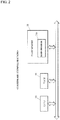
- FIG. 1 shows a function block diagram of a rectangular moving image region determination apparatus 1 of a first embodiment.
- the rectangular moving image region determination apparatus 1 is configured to determine a rectangular moving image region displayed in part of a display region having pixels arranged in row and column directions therein. It includes moving unit block judgment means 5, moving column block determination means 7, moving row block determination means 9, first rectangular moving image region determination means 11, repetition means 13, and second rectangular moving image region determination means 14.
- the moving unit block judgment means 5 divides the display region into unit blocks each including a predetermined number of pixels and judges whether each unit block is a moving unit block having a motion.
- the moving column block determination means 7 defines, as a column block, a set of unit blocks included in a column including one of the uppermost unit blocks of the unit blocks and, if one column block includes at least one moving unit block, determines the column block as a moving column block.
- the moving row block determination means 9 defines, as a row block, a set of unit blocks included in a row including one of the leftmost unit blocks and, if one row block includes at least one moving unit block, determines the row block as a moving row block.
- the first rectangular moving image region determination means 11 determines, as a rectangular moving image region, a rectangular region specified by unit blocks included in both the moving row block and the moving column block.
- the repetition means 13 causes the moving column block determination means 7, the moving row block determination means 9, and the first rectangular moving image region determination means 11 to repeatedly perform processes on the rectangular moving image region determined by the first rectangular moving image region determination means 11.
- the second rectangular moving image region determination means 14 determines a region defined by the edges of the rectangular moving image region as the rectangular moving image region.
- the CPU 23 judges whether an image region is a moving image region, which includes moving pixels, on the basis of the values of the pixels forming the display region stored in the memory 27, and then stores the judgment result in the RAM 25.
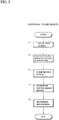
- the CPU 23 divides the display region into blocks (step S1 in FIG. 3 ).
- the display region 100 shown in FIG. 4 is divided into multiple blocks each including 32*32 pixels arranged.
- the display region 100 is divided into n+1 blocks in the direction ⁇ and m+1 blocks in the direction ⁇ .
- the CPU 23 determines the representative values of all the blocks (step S3 in FIG. 3 ).
- Examples of the representative value include the average of the pixel values in one block and the value of the first pixel in one block. Instead of using the pixel value as it is, a hash value, such as CRC, may be used as the representative value. While the average value can be represented with an 18-bit length in a 32*32*8-bit image, the centered 8 bits obtained by discarding the upper and lower 10 bits may be used as the average value. Thus, the representative values of the (n+1)*(m+1) blocks are stored in the RAM 25.
- the CPU 23 judges whether each of the (n+1)*(m+1) blocks is a moving block (step S5).
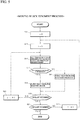
- the moving block judgment process will be described with reference to FIG. 5 .
- the CPU 23 initializes process block numbers i, j (steps S11, S13 in FIG. 5 ). A comparison is made between the representative values of block (0,0) in the current and preceding frames (step S15). In the present embodiment, a comparison is made between the representative values of times t and t-1. The CPU 23 judges whether the difference between the representative values exceeds a threshold thb (step S17). If the difference exceeds the threshold thb, it judges that the block is a moving block (step S19). In contrast, if the difference does not exceed the threshold thb, the CPU 23 judges that the block is a non-moving block (step S21).
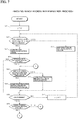
- the CPU 23 then performs a moving image region determination process (step S7 in FIG. 3 ). Details of the moving image region determination process will be described with reference to FIGS. 7 and 9 .
- the CPU 23 initializes process block number j (step S31 in FIG. 7 ).
- the CPU 23 judges whether the column block including block (0,0) includes at least one moving block (step S33). Since there is no moving block among block (0,0) and blocks (1,0) to (m,0) vertically arranged from block (0,0), as shown in FIG. 6 , the CPU 23 judges that this column is a non-moving column (step S37). The CPU 23 then judges whether there is an added and stored tentative moving column (step S39). Since there is no such column, the CPU 23 proceeds to step S46 and judges whether process block number j is the last number. Since j is 0 and therefore is not the last number, the CPU 23 increments process block number j (step S47) and repeats steps S33 and later.
- step S35 the CPU 23 repeats step S35.
- the CPU 23 judges whether there are added and stored tentative moving columns (step S39). If such columns exist, it judges whether the set of adjacent columns has a width exceeding a threshold thw (step S41).
- the threshold thw is two blocks or more. Since blocks (0,2) to (0,8) are added and stored tentative moving columns and exceed the threshold thw, the CPU 23 judges that the tentative moving columns are moving columns (step S45).
- the CPU 23 judges that this column is a non-moving column (step S37).
- the CPU 23 judges whether there are detected tentative moving columns (step S39). If such columns exist, it judges whether the set of adjacent columns has a width exceeding the threshold thw (step S41). Since it is assumed in the present embodiment that the threshold thw is two blocks or more, the width of the tentative moving column does not exceed the threshold thw. Accordingly, the CPU 23 judges whether the tentative moving column is a non-moving column (step S43).
- an image region such as a mouse cursor
- the CPU 23 sequentially judges whether each column in the row direction ⁇ includes a moving block.
- the last column may be a tentative moving column.
- the CPU 23 judges in step S49 whether there are added and stored tentative moving columns. If such columns exist, it performs steps S41 and later.
- FIG. 8 shows detected moving columns.
- a region 121 is determined as a moving column.
- the row including block (4,0) includes moving blocks. Accordingly, the CPU 23 adds and stores this row as a tentative moving row (step S55).
- Step S69 is similar to step S49 and therefore will not be described.
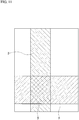
- the CPU 23 determines the blocks included in both the moving column and the moving row as a moving image region (step S70 in FIG. 9 ). Specifically, the blocks included in a region 140 where the regions 121 and 131 shown in FIG. 11 overlap each other are determined as a moving image region. Compared to the moving blocks in FIG. 6 , moving blocks (6,n-3) and (m-3,n-6) are excluded, while block (4,5) and the like are determined as a moving image region. Thus, a failure to include blocks can be prevented in relation to adjacent blocks.
- the CPU 23 then extracts upper blocks (step S80 in FIG. 12 ). Specifically, it extracts a total of seven blocks, blocks (4,2) to (4,8), shown in FIG. 13 .
- the CPU 23 then initializes process row number P (step S81) and extracts all pixels in the P'th rows of the extracted blocks and calculates the representative value thereof (step S83). Specifically, the CPU 23 extracts 32 pixels in the 0'th row of block (4,2), 32 pixels in the 0'th row of block (4,3), and the like, that is, 7*32 pixels and calculates the representative values of the row. In the present embodiment, the average of the extracted pixels is used as the representative value.
- the present apparatus can automatically detect a moving image region. Further, this detection can be performed in as few as several frames. Thus, even when a moving image region itself dynamically moves on the monitor, the present apparatus can detect the moving image region almost in real time.
- step S7 in FIG. 3 that is, the moving image region determination process is repeated.
- the moving image region determination process is repeated.
- step S7 in FIG. 3 is performed, moving image regions 301 to 304 as shown in FIG. 15 are determined.
- the region 207 is determined as not having a width exceeding the threshold thw and therefore is not detected as a moving image region.
- the CPU 23 regards the region 311 as a collective image region and detects moving image regions again. Thus, a region defined by block coordinates (y1,x1) and (y11,x11) is detected. The same goes for the region 312.
- Such repeated detection may be performed until further division becomes impossible, or the upper limit frequency of repeated detection may be determined in advance.
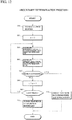
- the CPU 23 extracts blocks other than blocks serving as ends from the upper blocks (step S100 in FIG. 17 ). Specifically, the CPU 23 extracts a total of five blocks, (4,3) to (4,7), shown in FIG. 13 .
- the reason why the ends are excluded as described above is that parts of the blocks serving as both ends may not have an edge. Note that the edge blocks may also be used.
- the CPU 23 initializes process row number r and process pixel number g (steps S101, S102 in FIG. 17 ) and judges whether the g'th pixel of the extracted block of row number "0" is a horizontal-edge pixel (row-direction edge) (step S103). Whether the g'th pixel is a horizontal-edge pixel may be judged based on the difference in luminance between the g'th pixel and an adjacent pixel. In the present embodiment, a filter and formula as shown in FIG. 18A are employed.
- step S105 the CPU 23 judges that the g'th pixel is a horizontal-edge pixel, it increments a total number Et (step S105 in FIG. 17 ). The CPU 23 then judges whether all pixels in this line have been subjected to the determination process (step S107). If not, the CPU 23 increments process pixel number g (step S109) and repeats steps S103 to S107.
- the threshold ths may be a fixed threshold or may be calculated according to a predetermined ratio and the size (the number of blocks) of the detected region.
- a boundary is determined based on the total number of the vertical edges or horizontal edges.
- the present embodiment is applied to the case where the rectangular region is determined and then the single pixel-based boundaries are obtained in the blocks forming the peripheries of the rectangular region, the present embodiment is also applicable to motion estimation in general and to other fields.
- a multiple pixel-based (e.g., 2*2 pixel-based) boundary may be obtained in place of a single pixel-based boundary.
- edge pixels are extracted to determine a boundary.
- the boundary between pixels in which a motion vector can be detected and pixels in which no motion vector can be detected may be judged to be a boundary.
- the present embodiment may be applied to an apparatus for determining the rectangular boundaries of a still image rather than to multiple frames.
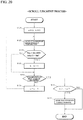
- the CPU 23 initializes target row number Q and the number of matching rows k (step S121 in FIG. 20 ) and calculates the total number of edge pixels Enq in the Q'th row of an extracted block (step S123). Whether a pixel is an edge pixel may be judged based on the difference in luminance between the pixel and an adjacent pixel.
- step S131 judges whether the number of matching rows k exceeds a threshold thg (step S135). If the number of matching rows k exceeds the threshold thg, the CPU 23 judges that the motion is being made by scrolling (step S137).
- the particular region is not limited to a moving image region detected in the moving image region detection process and may be a particular region in an image which may be a still image or moving image.
- the present embodiment also provides a method for determining a rectangular moving image region displayed in part of a display region having pixels arranged in row and column directions therein.
- the method includes: a moving unit block judgment step of dividing the display region into unit blocks each including a predetermined number of pixels and judging whether each unit block is a moving unit block having a motion; a moving column block determination step of defining, as a column block, a set of unit blocks included in a column including one of uppermost unit blocks of the unit blocks and, if one column block includes at least one moving unit block, determining the column block as a moving column block; a moving row block determination step of defining, as a row block, a set of unit blocks included in a row including one of leftmost unit blocks of the unit blocks and, if one row block includes at least one moving unit block, determining the row block as a moving row block; a first rectangular moving image region determination process of determining, as a rectangular moving image region, a rectangular region specified by unit blocks included in both the moving row block
- the second rectangular moving image region determination step includes determining a row having a different representative value in the unit blocks forming the peripheral four sides as a row-direction boundary of the rectangular moving image region and determining a column having a different representative value in the unit blocks forming the peripheral four sides as a column-direction boundary of the rectangular moving image region.
- the second rectangular moving image region determination step includes extracting pixels forming a row-direction edge and pixels forming a column-direction edge from pixels in the unit blocks forming the peripheral four sides and determining boundaries of the rectangular moving image region on the basis of the total number of pixels forming row-direction edges in respective rows and the total number of pixels forming column-direction edges in respective columns. Thus, it is possible to determine the boundaries on the basis of the row-direction edges and column-direction edges.
- a scroll judgment is made in which it is determined whether an image in the determined rectangular moving image region varies between frames due to scrolling. Thus, it is possible to judge whether the image varies due to scrolling. If it is determined that the image varies due to scrolling, the second rectangular moving image region determination step is not performed. Thus, determination of a rectangular moving image region can be made quickly as a whole.
- the scroll judgment includes judging whether each of pixels in the determined rectangular moving image region is an edge, based on a difference in value between the pixel and an adjacent pixel, recognizing, as a character gap region, a row or column in which a predetermined number or more of pixels not forming edges exist in a row or column direction, and making the scroll judgment on the basis of the ratio of the character gap region to the determined rectangular moving image region.
- the present embodiment also provides an apparatus for judging whether a target region to be judged in a screen is a scrolled region.
- the apparatus includes: edge pixel judgment means configured to judge whether each pixel in the target region is an edge, based on the difference in value between the pixel and an adjacent pixel; character gap region judgment means configured to judges, as a character gap region, a row or column including a predetermined number or more of pixels not forming edges; and scroll region judgment means configured to judge whether the target region is a scrolled region, based on the ratio of the character gap region to the target region.
- the present embodiment also provides an apparatus for determining boundaries of a rectangular region in a screen.
- the apparatus includes: edge pixel judgment means configured to judge pixels forming edges on the basis of values of target pixels to be judged; row-direction boundary determination means configured to extract pixels forming row-direction edges as row-direction edge pixels, to calculate the total number of the row-direction edges in each row, and to determine a row-direction boundary on the basis of the total number of the row-direction edge pixels in the respective rows; column-direction boundary determination means configured to extract pixels forming column-direction edges as column-direction edge pixels, to calculate the total number of the column-direction edges in each column, and to determine a column-direction boundary on the basis of the total number of the column-direction edges in the respective columns; and rectangular region determination means configured to determine the determined row-direction and column-direction boundaries as boundaries of the rectangular region.
- the above embodiments allow moving boundaries (box) having a rectangular external shape to be determined. Accordingly, when both a still image region and a moving image region are displayed, for example, when a moving image posting site is displayed on a browser, it is possible to dynamically detect the moving region to use a display method (e.g., change of the edge enhancement processing) different from that for the still image region. As a result, even when the user moves the window of the browser or changes the shape of the window, for example, by enlarging it, it is possible to cause the moving region to automatically follow the movement or the like of the window.
- a display method e.g., change of the edge enhancement processing
- a device for dynamically detecting a rectangular moving region can properly detect a rectangular moving region even in a special situation by performing the following processes.
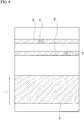
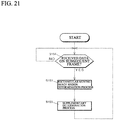
- FIG. 21 shows the relationship between the moving region detection process of the above embodiments and a supplementary determination process of the present embodiment.
- the supplementary determination process is a process performed when no moving region has been detected or an improper moving region has been detected in the moving region detection process (step S153).
- the CPU 23 When the CPU 23 receives data on a subsequent frame, it performs a moving region detection process in step S153 in FIG. 21 . In this process, a movement is detected between the respective frames of times t-1 and t. Since playback is temporarily stopped at time t, there is a difference between the frames and thus a moving region is detected.
- step S155 is shown in FIG. 22 .
- the CPU 23 judges whether there is a moving region which has been detected until just before (step S201 in FIG. 22 ). Since there has been a moving region just before, that is, at time t-1, the CPU 23 judges whether a moving region has been detected at time t (step S203).
- the CPU 23 judges whether it has received data on a subsequent frame (step S151 in FIG. 21 ).
- the CPU 23 judges whether there is a box in the moving region which has been detected until just before, of the frame of time t+1 (step S205 in FIG. 22 ). For example, the CPU 23 may judge that there is an edge between pixels when there is a predetermined or greater difference in value between the pixels and may judge that there is a box when the total number of edges exceeds the threshold. Note that other known methods may be used to judge whether there is a box.
- the CPU 23 judges whether it has received data on a subsequent frame (step S151 in FIG. 21 ) and, if it has received such data, repeats the processes of steps S153 and S155.
- the CPU 23 fails to detect a moving region in step S153 in FIG. 21 , then sequentially goes through steps S201, S203, S205, and S211 in FIG. 22 during the period from time t+2 to time t+4, and retains the moving region which has been detected until just before.
- the CPU 23 fails to detect a moving region in step S153 in FIG. 21 , then in step S155, goes through steps S201, S203, S205, S207, and step S211 in FIG. 22 during the period from time t+6 to time t+8, and retains the moving region which has been detected until just before.
- step S207 it judges whether the case where there is no box has occurred five times continuously and then discards the moving region which has been detected until just before (step S213).
- the CPU 23 can detect the region for a given period of time.
- the CPU 23 performs the moving region detection process of step S153 in FIG. 21 .
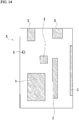
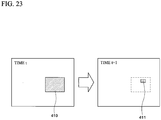
- the portion of the face is moving at time t. Accordingly, as shown in FIG. 23 , a moving region 411 which is smaller than an immediately preceding moving region 410 is detected.
- the CPU 23 then proceeds to step S153 in FIG. 21 . Specifically, at time t, the CPU 23 judges whether there is a moving region which has been detected until just before (step S201 in FIG. 22 ).
- the CPU 23 judges that the number of times is smaller than the threshold and then judges whether the time over which it has retained the moving region which has been detected until just before is longer than or equal to a threshold (step S225).
- a threshold In the present embodiment, it is assumed that the threshold of the retaining time in step S225 is three seconds.
- step S225 if the retaining time is longer than or equal to the threshold in step S225, the CPU 23 continues to retain the moving region 410, which has been detected until just before. Thus, it is possible to prevent the moving region from being detected erroneously. That is, if a moving region has been retained in the same position and with the same size for the predetermined time and if an inner portion of the moving region is detected accidentally, the CPU 23 recognizes this detection as erroneous detection and performs the process of step S211.
- the CPU 23 judges whether there are no luminance changes in and around the four corners of the moving region which has been detected until just before (step S227).
- step S229 judges whether there is a box.
- the process of step S229 is the same as that of step S205. Since there is a box in the moving region, the CPU 23 proceeds to step S211.
- the CPU 23 can retain this moving region (step S211).
- step S225 the retaining time becomes greater than or equal to the threshold in step S225. Accordingly, the CPU 23 proceeds to step S211.
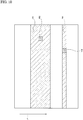
- step S227 will be described. Cases where the detected moving region is located inside the moving region which has been detected until just before, as shown in FIG. 23 , include the case where only a portion of the moving region is moving and the other portions hardly move, as well as a case where another window overlaps the moving region and thus partially hides it. In the latter case, at least one of the hidden portions includes one of the four corners of the detected region, and the luminance thereof changes. Accordingly, if there are luminance changes in at least one location in and around the four corners of the moving region which has been detected until just before, the CPU 23 proceeds to step S211; otherwise, it performs the process of step S229.
- step S229 judges in step S229 that there is no box in the moving region which has been detected until just before and regards the detected moving region as a new moving region (step S231). Note that by adjusting the threshold for detecting a box, the degree of overlap can be adjusted.
- step S227 when there are no luminance changes in one or more locations in step S227, the CPU 23 may skip step S229 and proceeds to step S231.
- step S151 the CPU 23 judges whether it has received data on a subsequent frame (step S151 in FIG. 21 ). If it has received such data, the CPU 23 repeats the processes of steps S153 and S155.
- step S223 If the number of times the detected moving region has been continuously located inside the moving region which has been detected until just before is greater than or equal to the threshold in step S223, the CPU 23 skips the judgments of steps S225 and S227 and makes the judgment of step S229.
- Steps S227, S229, and S231 produce the following effects.
- the reliability of the result is relatively low. This is because due, for example, to a movement of the mouse pointer or progress bar, the moving region is often erroneously detected so that it is larger. For this reason, during a period immediately after the moving region is detected, if there are no luminance changes in any of the four corners of the current detection region and if there is no box, the detected inner region is set as a moving region again.
- step S227 whether there are no luminance changes in at least one of the four corners is judged as a judgment criterion of step S227; alternatively, whether there are no luminance changes in the four corners plus the center, that is, in a total of five locations may be judged. In this case, whether there are no luminance changes in at least one of the four corners, as well as in the center may be judged.
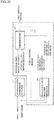
- FIG. 24 is a block diagram when the processes in FIGS. 21 and 22 are performed by hardware.
- a moving region coordinate detector 601 outputs a potential time t moving region (1) by using respective images of times t-1 and t.
- a judgment unit 603 selects between the potential time t moving region (1) and potential time t moving coordinates (2) (to be discussed later) and, at time t, outputs the moving region of time t.
- a retainer 604 retains the moving region (coordinates) of time t. At time t+1, it provides this retained moving region (coordinates) to a specified region feature detector 605 as the moving coordinates of time t and also provides this moving region (coordinates) to itself as potential time t+1 moving coordinates (2).
- the specified region feature detector 605 applies the moving coordinates of time t provided by the judgment unit 603 to the respective images of times t and t+1 to calculate feature data d(t) around the moving coordinates of time t and feature data d(t+1) around the moving coordinates of time t+1 and then provides the calculated data to the judgment unit 603.
- the judgment unit 603 judges whether there is a box, based on the feature data d(t+1). The judgment unit 603 also judges whether there are luminance changes in the four corners (step S227 in FIG. 22 ), based on the feature data d(t) and feature data d(t+1).
- rectangular moving region detection method of the present embodiment has been described in combination with those of the first to fourth embodiments, it may be combined with other rectangular moving region detection methods.
- the method for determining boundaries of a rectangular moving image region having a rectangular external shape displayed in part of a display region on the basis of a difference between respective frame images of times t and t+1 may include, for example, the following: a moving unit block judgment step of dividing the display region into unit blocks each including a predetermined number of pixels and judging whether each unit block is a moving unit block having a motion; a moving row block determination step of, if one row includes at least one moving unit block in a column direction in which rows are arranged, determining the row as a moving row block; a moving column block determination step of, if one column includes at least one moving unit block in a row direction in which columns are arranged, determining the column as a moving column block; and a first rectangular moving image region determination step of, when the number of adjacent moving row blocks of the moving row blocks is greater than or equal to a threshold, defining an external row block straight line of the set of adjacent row blocks, when the number of adjacent moving column blocks of the moving column blocks is greater than or equal to
- a frame image different from a frame image provided to the moving region coordinate detector 601 may be provided to the specified region feature detector 605.
- the inclusion relationship is judged based on the moving region obtained from the frames of times t-1 and t and the moving region obtained from the frames of times t and t+1 in the present embodiment, it may be judged based on a moving region obtained from the frames of times t and t+n and a moving region obtained from the frames of times t+m and t+p.
- n, m, and p are integers satisfying n ⁇ m and p ⁇ m.
- the frames of times t+a and t+b may be provided to the specified region feature detector 605.
- a and b are integers satisfying m ⁇ b, m ⁇ a, and a ⁇ b.
- This method can also be used to judge whether a particular region is being scrolled.
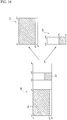
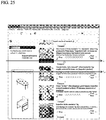
- a region is a character-incorporated region is judged based on whether the largest continuous non-edge pixel number included in each line is greater than or equal to a threshold rather than based on the difference in edge number between two lines. This judgment process will be described using the rectangular region where characters and natural images are mixed, shown in FIG. 25 , and with reference to FIG. 26 .
- the CPU 23 initializes the total number of feature lines, k, (step S22 1 in FIG. 26 ) and then initializes the number of continuous non-edge pixels, r, (step S223).
- the CPU 23 judges whether judgments have been made on all pixels in the line (step S231). If judgments have not been made on all pixels, the CPU 23 repeats steps S223 to S227.
- step S231 If the CPU 23 judges in step S231 that judgments have been made on all pixels in the row, it extracts the largest of the potential continuous non-edge pixel numbers (step S233) and then deletes all the potential numbers. The CPU 23 then judges whether the largest number extracted is greater than a threshold (step S234).
- the threshold is not limited thereto.
- row L1 in FIG. 25 is judged to be a feature line.
- row L2 is not judged to be a feature line.
- the CPU 23 increments the total number of feature lines k (step S235). The CPU 23 then judges whether judgments have been made on all rows (step S241). If judgments have not been made on all rows, the CPU 23 repeats steps S223 and later.
- the region is judged to be a character region.
- the threshold thk may be any value and, in the present embodiment, is set to 30% of the number of all rows in the region.
- the row is judged to be a feature line.
- image data including natural images includes text
- continuous non-edge pixels can be present in the largest number, since there are inter-row spaces.
- this character region judgment it is possible to prevent the region from being judged to be a moving image when characters in the browser are being scrolled, as in the fourth embodiment.
- This scroll judgment may be made on some rows in the region rather than on all rows in the region.
- scroll judgment method is not limited to that described above and may be well-known methods.
- This scroll judgment method may be optionally combined with the present embodiment.
- the present embodiment also provides an apparatus for judging whether a target region to be judged in a screen is a character-incorporated region.
- the apparatus includes: edge pixel judgment means configured to judge whether each pixel in the target region is an edge, based on the difference in value between the pixel and an adjacent pixel; character gap region judgment means configured to judge that a row or column including a predetermined number of continuous pixels which do not form edges is a character gap row or character gap column; and character-incorporated region judgment means configured to judge whether the target region is a character-incorporated region, based on the ratio of the character gap region to the target region.
- This character-incorporated region judgment apparatus may be optionally combined with methods other than the rectangle region detection method disclosed in the present embodiment.
- the scroll region judgment apparatus of the present embodiment may judge that the target region is not a moving image region.
- the luminance value is used as the pixel value in the above embodiments, the RGB values or the like may be used.
- whether the block is a block included in a moving image region is judged based on the frames of times t and t+1 in step S15 in FIG. 5 .
- other frames may be used as long as there is a time difference between the frames.
- the judgment may be made based on whether there is a movement between the frames of times t and t+2.
- a comparison may be made among more frames obtained by adding preceding and following frames.
- the frame images of times t and t+3 and the frame images of times t+1 and t+2 may be provided to the moving region coordinate detector 601 and the specified region feature detector 605, respectively.
- the frame images of times t and t+n and the frame images of times t+a and t+b may be provided to the moving region coordinate detector 601 and the specified region feature detector 605, respectively.
- a, b, and n are integers satisfying n ⁇ b>a ⁇ 0.
- the specified region feature detector 605 applies, at time t+1, the moving coordinates of time t provided by the judgment unit 603 to the respective images of times t+a and t+b to calculate feature data d(t+a) around the moving coordinates of time t and feature data d(t+b) around the moving coordinates of time t+b and then provides the calculated data to the judgment unit 603.
- the judgment unit 603 judges whether there is a box, based on the feature data d(t+b). The judgment unit 603 also judge whether there are luminance changes in the four corners, based on the feature data d(t+a) and feature data d(t+b).
- the boundary determination process of step S9 in FIG. 3 is optional. If a pixel-based boundary is not necessary, this process does not need to be performed. In the above boundary determination process, the values of all pixels in one row or one column with respect to all peripheral blocks are used. Alternatively, the pixel values may be thinned out, or a representative value may be used. Further, a judgment may be made based on some peripheral blocks rather than all peripheral blocks.
- a representative value of the past same position may be stored in advance and used for a comparison.
- one block includes 32*32 pixels but not limited thereto.
- the boundaries may be obtained in the process of step S9 in FIG. 3 by arranging pixels corresponding to one block on the periphery. For example, if 7*5 blocks are detected as a moving image region in the process of step S7, the process of step S9 is performed based on 9*7 blocks obtained by adding one block to around the blocks.
- a monitor or set-top box including the rectangular moving image region determination apparatus of the above embodiment may be formed.
- Such a set-top box may be formed as a switching hub for switching between input data destination monitors.
- a rectangular moving image region can be detected with pixel-level accuracy. Further, multiple rectangular moving image regions can be determined. Furthermore, movements of a small-width region can be eliminated. For example, quasi-movements of the mouse pointer or the like can be addressed. Since such movements can be distinguished from moving and still regions in an image, optimal control can be performed.
- whether each unit block is a moving unit block is judged by: dividing the display region into unit blocks each including a predetermined number of pixels and calculating a representative value of each unit block on the basis of the values of the predetermined number of pixels included in the unit block; comparing the calculated representative value of each unit block with a representative value of a unit block in the same position in a comparative frame; and if the difference between the representative values exceeds the threshold, judging that the unit block is a moving unit block having a motion.
- the method for judging whether each unit block is a moving unit block is not limited to that described above and may be other methods.
- there may be used any well-known moving unit block judgment method such as a comparison among the sums of the representative values of the same block in a predetermined number of frames.
- the functions shown in FIG. 1 are achieved by using the CPU 23 and executing software. Alternatively, some or all of the functions may be achieved by using hardware, such as a logic circuit. Further, part of the program may be executed by the operating system (OS).
- OS operating system
Landscapes
- Engineering & Computer Science (AREA)
- Multimedia (AREA)
- Signal Processing (AREA)
- Theoretical Computer Science (AREA)
- Physics & Mathematics (AREA)
- General Physics & Mathematics (AREA)
- Computer Vision & Pattern Recognition (AREA)
- Image Analysis (AREA)
- Transforming Electric Information Into Light Information (AREA)
- Television Systems (AREA)
- Picture Signal Circuits (AREA)
- Compression Or Coding Systems Of Tv Signals (AREA)
- Closed-Circuit Television Systems (AREA)
Applications Claiming Priority (4)
| Application Number | Priority Date | Filing Date | Title |
|---|---|---|---|
| JP2012084660 | 2012-04-03 | ||
| JP2012146851A JP5192597B1 (ja) | 2012-04-03 | 2012-06-29 | 動き画像領域判定装置またはその方法 |
| PCT/JP2012/082992 WO2013150689A1 (ja) | 2012-04-03 | 2012-12-20 | 動き画像領域判定装置またはその方法 |
| EP12873525.5A EP2835785B1 (en) | 2012-04-03 | 2012-12-20 | Moving image area assessment device or method thereof |
Related Parent Applications (2)
| Application Number | Title | Priority Date | Filing Date |
|---|---|---|---|
| EP12873525.5A Division-Into EP2835785B1 (en) | 2012-04-03 | 2012-12-20 | Moving image area assessment device or method thereof |
| EP12873525.5A Division EP2835785B1 (en) | 2012-04-03 | 2012-12-20 | Moving image area assessment device or method thereof |
Publications (2)
| Publication Number | Publication Date |
|---|---|
| EP3716208A1 EP3716208A1 (en) | 2020-09-30 |
| EP3716208B1 true EP3716208B1 (en) | 2021-06-23 |
Family
ID=48533972
Family Applications (2)
| Application Number | Title | Priority Date | Filing Date |
|---|---|---|---|
| EP20175530.3A Active EP3716208B1 (en) | 2012-04-03 | 2012-12-20 | Moving image area assessment device or method thereof |
| EP12873525.5A Active EP2835785B1 (en) | 2012-04-03 | 2012-12-20 | Moving image area assessment device or method thereof |
Family Applications After (1)
| Application Number | Title | Priority Date | Filing Date |
|---|---|---|---|
| EP12873525.5A Active EP2835785B1 (en) | 2012-04-03 | 2012-12-20 | Moving image area assessment device or method thereof |
Country Status (8)
| Country | Link |
|---|---|
| US (1) | US9332161B2 (enExample) |
| EP (2) | EP3716208B1 (enExample) |
| JP (2) | JP5192597B1 (enExample) |
| CN (1) | CN104285241B (enExample) |
| AU (1) | AU2012376388B2 (enExample) |
| IN (1) | IN2014DN08790A (enExample) |
| RU (1) | RU2623890C2 (enExample) |
| WO (1) | WO2013150689A1 (enExample) |
Families Citing this family (4)
| Publication number | Priority date | Publication date | Assignee | Title |
|---|---|---|---|---|
| JP5895242B2 (ja) * | 2011-10-19 | 2016-03-30 | パナソニックIpマネジメント株式会社 | 蝟集判定装置及び蝟集判定方法 |
| KR20160014915A (ko) * | 2014-07-30 | 2016-02-12 | 삼성전자주식회사 | 디스플레이장치 및 그 제어방법 |
| CN109729298B (zh) * | 2017-10-27 | 2020-11-06 | 联咏科技股份有限公司 | 图像处理方法与图像处理装置 |
| US10762866B2 (en) * | 2018-08-30 | 2020-09-01 | Synaptics Incorporated | Display rescan |
Family Cites Families (21)
| Publication number | Priority date | Publication date | Assignee | Title |
|---|---|---|---|---|
| JPH03126181A (ja) * | 1989-10-11 | 1991-05-29 | Oki Electric Ind Co Ltd | 文書画像の領域分割方法 |
| US5588067A (en) * | 1993-02-19 | 1996-12-24 | Peterson; Fred M. | Motion detection and image acquisition apparatus and method of detecting the motion of and acquiring an image of an object |
| JPH117266A (ja) * | 1997-06-17 | 1999-01-12 | Matsushita Electric Ind Co Ltd | ディスプレイパネルの映像表示方式およびその装置 |
| JP3230509B2 (ja) * | 1998-06-26 | 2001-11-19 | 日本電気株式会社 | 動画像処理装置 |
| RU2189628C2 (ru) * | 2000-04-04 | 2002-09-20 | Свириденко Андрей Владимирович | Способ дистанционного управления |
| RU2262661C2 (ru) * | 2000-06-26 | 2005-10-20 | Череповецкий научный координационный центр Российской Академии Наук (ЧНКЦ РАН) | Способ обнаружения движущихся транспортных средств |
| EP1403817A4 (en) * | 2000-09-06 | 2007-06-06 | Hitachi Ltd | DETECTOR FOR ABNORMES BEHAVIOR |
| US7266220B2 (en) * | 2002-05-09 | 2007-09-04 | Matsushita Electric Industrial Co., Ltd. | Monitoring device, monitoring method and program for monitoring |
| JP2006091980A (ja) * | 2004-09-21 | 2006-04-06 | Seiko Epson Corp | 画像処理装置、画像処理方法および画像処理プログラム |
| CN101288101A (zh) * | 2005-07-26 | 2008-10-15 | 皇家飞利浦电子股份有限公司 | 根据小规模重建的运动分析进行的心区检测 |
| KR101336475B1 (ko) * | 2005-09-26 | 2013-12-04 | 미쓰비시덴키 가부시키가이샤 | 동화상 부호화 장치 및 동화상 복호 장치 |
| US20070223818A1 (en) * | 2006-03-27 | 2007-09-27 | Honeywell International Inc. | Method and apparatus for predicting the accuracy of virtual Scene based on incomplete information in video |
| JP4659793B2 (ja) * | 2007-08-07 | 2011-03-30 | キヤノン株式会社 | 画像処理装置及び画像処理方法 |
| JP4992618B2 (ja) * | 2007-09-05 | 2012-08-08 | カシオ計算機株式会社 | ジェスチャー認識装置及びジェスチャー認識方法 |
| CN101320478B (zh) * | 2008-07-23 | 2010-06-02 | 北京蓝色星际软件技术发展有限公司 | 一种基于帧差的多重帧间形态学区域探测方法 |
| JP5116602B2 (ja) * | 2008-08-04 | 2013-01-09 | キヤノン株式会社 | 映像信号処理装置及び方法、プログラム |
| JP5421072B2 (ja) * | 2008-11-19 | 2014-02-19 | クラリオン株式会社 | 接近物体検知システム |
| CN101588445B (zh) * | 2009-06-09 | 2011-01-19 | 宁波大学 | 一种基于深度的视频感兴趣区域提取方法 |
| US9082278B2 (en) * | 2010-03-19 | 2015-07-14 | University-Industry Cooperation Group Of Kyung Hee University | Surveillance system |
| US20120300046A1 (en) * | 2011-05-24 | 2012-11-29 | Ilya Blayvas | Method and System for Directed Light Stereo Display |
| JP4980486B1 (ja) * | 2011-06-14 | 2012-07-18 | 株式会社ナナオ | 動き画像領域判定装置またはその方法 |
-
2012
- 2012-06-29 JP JP2012146851A patent/JP5192597B1/ja active Active
- 2012-11-16 JP JP2012252040A patent/JP5690800B2/ja active Active
- 2012-12-20 WO PCT/JP2012/082992 patent/WO2013150689A1/ja not_active Ceased
- 2012-12-20 EP EP20175530.3A patent/EP3716208B1/en active Active
- 2012-12-20 AU AU2012376388A patent/AU2012376388B2/en not_active Ceased
- 2012-12-20 US US14/390,225 patent/US9332161B2/en active Active
- 2012-12-20 RU RU2014137566A patent/RU2623890C2/ru not_active IP Right Cessation
- 2012-12-20 IN IN8790DEN2014 patent/IN2014DN08790A/en unknown
- 2012-12-20 CN CN201280073148.7A patent/CN104285241B/zh active Active
- 2012-12-20 EP EP12873525.5A patent/EP2835785B1/en active Active
Non-Patent Citations (1)
| Title |
|---|
| None * |
Also Published As
| Publication number | Publication date |
|---|---|
| JP5192597B1 (ja) | 2013-05-08 |
| US20150077638A1 (en) | 2015-03-19 |
| IN2014DN08790A (enExample) | 2015-05-29 |
| JP2013232175A (ja) | 2013-11-14 |
| JP5690800B2 (ja) | 2015-03-25 |
| EP2835785A1 (en) | 2015-02-11 |
| EP2835785B1 (en) | 2020-07-08 |
| CN104285241A (zh) | 2015-01-14 |
| AU2012376388B2 (en) | 2015-06-25 |
| US9332161B2 (en) | 2016-05-03 |
| EP3716208A1 (en) | 2020-09-30 |
| CN104285241B (zh) | 2017-08-01 |
| RU2623890C2 (ru) | 2017-06-29 |
| AU2012376388A1 (en) | 2014-10-16 |
| RU2014137566A (ru) | 2016-05-27 |
| WO2013150689A1 (ja) | 2013-10-10 |
| EP2835785A4 (en) | 2016-01-27 |
| JP2013232173A (ja) | 2013-11-14 |
Similar Documents
| Publication | Publication Date | Title |
|---|---|---|
| EP2722817B1 (en) | Motion image region identification device and method thereof | |
| EP2709039A1 (en) | Device and method for detecting the presence of a logo in a picture | |
| US20150146006A1 (en) | Display control apparatus and display control method | |
| EP3716208B1 (en) | Moving image area assessment device or method thereof | |
| EP3376470A1 (en) | Moving body tracking method, moving body tracking device, and program | |
| CN110177295A (zh) | 字幕越界的处理方法、装置和电子设备 | |
| EP2509045B1 (en) | Method of, and apparatus for, detecting image boundaries in video data | |
| JP2008269181A (ja) | 対象物検出装置 | |
| JP6451418B2 (ja) | 注視対象判定装置、注視対象判定方法、および、注視対象判定プログラム | |
| JP5542981B1 (ja) | 画像処理装置、フレームレートコントロール処理判定装置またはその方法 | |
| US20140118389A1 (en) | Character region pixel identification device and method thereof | |
| JP2001014467A (ja) | ディジタル映像処理方法及びディジタル映像処理装置 | |
| JP2015142160A (ja) | 画像処理装置、画像処理方法、及び、プログラム | |
| JP2011186265A (ja) | 動きベクトル補正装置、補正方法、プログラムおよび集積回路 | |
| JP2010041234A (ja) | フレーム補間装置 |
Legal Events
| Date | Code | Title | Description |
|---|---|---|---|
| PUAI | Public reference made under article 153(3) epc to a published international application that has entered the european phase |
Free format text: ORIGINAL CODE: 0009012 |
|
| STAA | Information on the status of an ep patent application or granted ep patent |
Free format text: STATUS: THE APPLICATION HAS BEEN PUBLISHED |
|
| AC | Divisional application: reference to earlier application |
Ref document number: 2835785 Country of ref document: EP Kind code of ref document: P |
|
| AK | Designated contracting states |
Kind code of ref document: A1 Designated state(s): AL AT BE BG CH CY CZ DE DK EE ES FI FR GB GR HR HU IE IS IT LI LT LU LV MC MK MT NL NO PL PT RO RS SE SI SK SM TR |
|
| STAA | Information on the status of an ep patent application or granted ep patent |
Free format text: STATUS: REQUEST FOR EXAMINATION WAS MADE |
|
| 17P | Request for examination filed |
Effective date: 20201020 |
|
| RBV | Designated contracting states (corrected) |
Designated state(s): AL AT BE BG CH CY CZ DE DK EE ES FI FR GB GR HR HU IE IS IT LI LT LU LV MC MK MT NL NO PL PT RO RS SE SI SK SM TR |
|
| GRAP | Despatch of communication of intention to grant a patent |
Free format text: ORIGINAL CODE: EPIDOSNIGR1 |
|
| STAA | Information on the status of an ep patent application or granted ep patent |
Free format text: STATUS: GRANT OF PATENT IS INTENDED |
|
| INTG | Intention to grant announced |
Effective date: 20201202 |
|
| GRAJ | Information related to disapproval of communication of intention to grant by the applicant or resumption of examination proceedings by the epo deleted |
Free format text: ORIGINAL CODE: EPIDOSDIGR1 |
|
| STAA | Information on the status of an ep patent application or granted ep patent |
Free format text: STATUS: REQUEST FOR EXAMINATION WAS MADE |
|
| GRAP | Despatch of communication of intention to grant a patent |
Free format text: ORIGINAL CODE: EPIDOSNIGR1 |
|
| STAA | Information on the status of an ep patent application or granted ep patent |
Free format text: STATUS: GRANT OF PATENT IS INTENDED |
|
| INTC | Intention to grant announced (deleted) | ||
| INTG | Intention to grant announced |
Effective date: 20210302 |
|
| GRAS | Grant fee paid |
Free format text: ORIGINAL CODE: EPIDOSNIGR3 |
|
| GRAA | (expected) grant |
Free format text: ORIGINAL CODE: 0009210 |
|
| STAA | Information on the status of an ep patent application or granted ep patent |
Free format text: STATUS: THE PATENT HAS BEEN GRANTED |
|
| AC | Divisional application: reference to earlier application |
Ref document number: 2835785 Country of ref document: EP Kind code of ref document: P |
|
| AK | Designated contracting states |
Kind code of ref document: B1 Designated state(s): AL AT BE BG CH CY CZ DE DK EE ES FI FR GB GR HR HU IE IS IT LI LT LU LV MC MK MT NL NO PL PT RO RS SE SI SK SM TR |
|
| REG | Reference to a national code |
Ref country code: GB Ref legal event code: FG4D |
|
| REG | Reference to a national code |
Ref country code: CH Ref legal event code: EP |
|
| REG | Reference to a national code |
Ref country code: DE Ref legal event code: R096 Ref document number: 602012075945 Country of ref document: DE Ref country code: AT Ref legal event code: REF Ref document number: 1404960 Country of ref document: AT Kind code of ref document: T Effective date: 20210715 |
|
| REG | Reference to a national code |
Ref country code: IE Ref legal event code: FG4D |
|
| REG | Reference to a national code |
Ref country code: LT Ref legal event code: MG9D |
|
| PG25 | Lapsed in a contracting state [announced via postgrant information from national office to epo] |
Ref country code: BG Free format text: LAPSE BECAUSE OF FAILURE TO SUBMIT A TRANSLATION OF THE DESCRIPTION OR TO PAY THE FEE WITHIN THE PRESCRIBED TIME-LIMIT Effective date: 20210923 Ref country code: FI Free format text: LAPSE BECAUSE OF FAILURE TO SUBMIT A TRANSLATION OF THE DESCRIPTION OR TO PAY THE FEE WITHIN THE PRESCRIBED TIME-LIMIT Effective date: 20210623 Ref country code: HR Free format text: LAPSE BECAUSE OF FAILURE TO SUBMIT A TRANSLATION OF THE DESCRIPTION OR TO PAY THE FEE WITHIN THE PRESCRIBED TIME-LIMIT Effective date: 20210623 Ref country code: LT Free format text: LAPSE BECAUSE OF FAILURE TO SUBMIT A TRANSLATION OF THE DESCRIPTION OR TO PAY THE FEE WITHIN THE PRESCRIBED TIME-LIMIT Effective date: 20210623 |
|
| REG | Reference to a national code |
Ref country code: AT Ref legal event code: MK05 Ref document number: 1404960 Country of ref document: AT Kind code of ref document: T Effective date: 20210623 |
|
| PG25 | Lapsed in a contracting state [announced via postgrant information from national office to epo] |
Ref country code: GR Free format text: LAPSE BECAUSE OF FAILURE TO SUBMIT A TRANSLATION OF THE DESCRIPTION OR TO PAY THE FEE WITHIN THE PRESCRIBED TIME-LIMIT Effective date: 20210924 Ref country code: LV Free format text: LAPSE BECAUSE OF FAILURE TO SUBMIT A TRANSLATION OF THE DESCRIPTION OR TO PAY THE FEE WITHIN THE PRESCRIBED TIME-LIMIT Effective date: 20210623 Ref country code: NO Free format text: LAPSE BECAUSE OF FAILURE TO SUBMIT A TRANSLATION OF THE DESCRIPTION OR TO PAY THE FEE WITHIN THE PRESCRIBED TIME-LIMIT Effective date: 20210923 Ref country code: SE Free format text: LAPSE BECAUSE OF FAILURE TO SUBMIT A TRANSLATION OF THE DESCRIPTION OR TO PAY THE FEE WITHIN THE PRESCRIBED TIME-LIMIT Effective date: 20210623 Ref country code: RS Free format text: LAPSE BECAUSE OF FAILURE TO SUBMIT A TRANSLATION OF THE DESCRIPTION OR TO PAY THE FEE WITHIN THE PRESCRIBED TIME-LIMIT Effective date: 20210623 |
|
| REG | Reference to a national code |
Ref country code: NL Ref legal event code: MP Effective date: 20210623 |
|
| PG25 | Lapsed in a contracting state [announced via postgrant information from national office to epo] |
Ref country code: SK Free format text: LAPSE BECAUSE OF FAILURE TO SUBMIT A TRANSLATION OF THE DESCRIPTION OR TO PAY THE FEE WITHIN THE PRESCRIBED TIME-LIMIT Effective date: 20210623 Ref country code: EE Free format text: LAPSE BECAUSE OF FAILURE TO SUBMIT A TRANSLATION OF THE DESCRIPTION OR TO PAY THE FEE WITHIN THE PRESCRIBED TIME-LIMIT Effective date: 20210623 Ref country code: ES Free format text: LAPSE BECAUSE OF FAILURE TO SUBMIT A TRANSLATION OF THE DESCRIPTION OR TO PAY THE FEE WITHIN THE PRESCRIBED TIME-LIMIT Effective date: 20210623 Ref country code: AT Free format text: LAPSE BECAUSE OF FAILURE TO SUBMIT A TRANSLATION OF THE DESCRIPTION OR TO PAY THE FEE WITHIN THE PRESCRIBED TIME-LIMIT Effective date: 20210623 Ref country code: CZ Free format text: LAPSE BECAUSE OF FAILURE TO SUBMIT A TRANSLATION OF THE DESCRIPTION OR TO PAY THE FEE WITHIN THE PRESCRIBED TIME-LIMIT Effective date: 20210623 Ref country code: RO Free format text: LAPSE BECAUSE OF FAILURE TO SUBMIT A TRANSLATION OF THE DESCRIPTION OR TO PAY THE FEE WITHIN THE PRESCRIBED TIME-LIMIT Effective date: 20210623 Ref country code: NL Free format text: LAPSE BECAUSE OF FAILURE TO SUBMIT A TRANSLATION OF THE DESCRIPTION OR TO PAY THE FEE WITHIN THE PRESCRIBED TIME-LIMIT Effective date: 20210623 Ref country code: PT Free format text: LAPSE BECAUSE OF FAILURE TO SUBMIT A TRANSLATION OF THE DESCRIPTION OR TO PAY THE FEE WITHIN THE PRESCRIBED TIME-LIMIT Effective date: 20211025 Ref country code: SM Free format text: LAPSE BECAUSE OF FAILURE TO SUBMIT A TRANSLATION OF THE DESCRIPTION OR TO PAY THE FEE WITHIN THE PRESCRIBED TIME-LIMIT Effective date: 20210623 |
|
| PG25 | Lapsed in a contracting state [announced via postgrant information from national office to epo] |
Ref country code: PL Free format text: LAPSE BECAUSE OF FAILURE TO SUBMIT A TRANSLATION OF THE DESCRIPTION OR TO PAY THE FEE WITHIN THE PRESCRIBED TIME-LIMIT Effective date: 20210623 |
|
| REG | Reference to a national code |
Ref country code: DE Ref legal event code: R097 Ref document number: 602012075945 Country of ref document: DE |
|
| PG25 | Lapsed in a contracting state [announced via postgrant information from national office to epo] |
Ref country code: DK Free format text: LAPSE BECAUSE OF FAILURE TO SUBMIT A TRANSLATION OF THE DESCRIPTION OR TO PAY THE FEE WITHIN THE PRESCRIBED TIME-LIMIT Effective date: 20210623 |
|
| PLBE | No opposition filed within time limit |
Free format text: ORIGINAL CODE: 0009261 |
|
| STAA | Information on the status of an ep patent application or granted ep patent |
Free format text: STATUS: NO OPPOSITION FILED WITHIN TIME LIMIT |
|
| 26N | No opposition filed |
Effective date: 20220324 |
|
| PG25 | Lapsed in a contracting state [announced via postgrant information from national office to epo] |
Ref country code: AL Free format text: LAPSE BECAUSE OF FAILURE TO SUBMIT A TRANSLATION OF THE DESCRIPTION OR TO PAY THE FEE WITHIN THE PRESCRIBED TIME-LIMIT Effective date: 20210623 |
|
| PG25 | Lapsed in a contracting state [announced via postgrant information from national office to epo] |
Ref country code: MC Free format text: LAPSE BECAUSE OF FAILURE TO SUBMIT A TRANSLATION OF THE DESCRIPTION OR TO PAY THE FEE WITHIN THE PRESCRIBED TIME-LIMIT Effective date: 20210623 |
|
| REG | Reference to a national code |
Ref country code: CH Ref legal event code: PL |
|
| PG25 | Lapsed in a contracting state [announced via postgrant information from national office to epo] |
Ref country code: LU Free format text: LAPSE BECAUSE OF NON-PAYMENT OF DUE FEES Effective date: 20211220 Ref country code: IE Free format text: LAPSE BECAUSE OF NON-PAYMENT OF DUE FEES Effective date: 20211220 |
|
| PG25 | Lapsed in a contracting state [announced via postgrant information from national office to epo] |
Ref country code: CH Free format text: LAPSE BECAUSE OF NON-PAYMENT OF DUE FEES Effective date: 20211231 Ref country code: LI Free format text: LAPSE BECAUSE OF NON-PAYMENT OF DUE FEES Effective date: 20211231 |
|
| PG25 | Lapsed in a contracting state [announced via postgrant information from national office to epo] |
Ref country code: CY Free format text: LAPSE BECAUSE OF FAILURE TO SUBMIT A TRANSLATION OF THE DESCRIPTION OR TO PAY THE FEE WITHIN THE PRESCRIBED TIME-LIMIT Effective date: 20210623 |
|
| P01 | Opt-out of the competence of the unified patent court (upc) registered |
Effective date: 20230517 |
|
| PG25 | Lapsed in a contracting state [announced via postgrant information from national office to epo] |
Ref country code: HU Free format text: LAPSE BECAUSE OF FAILURE TO SUBMIT A TRANSLATION OF THE DESCRIPTION OR TO PAY THE FEE WITHIN THE PRESCRIBED TIME-LIMIT; INVALID AB INITIO Effective date: 20121220 |
|
| PG25 | Lapsed in a contracting state [announced via postgrant information from national office to epo] |
Ref country code: MK Free format text: LAPSE BECAUSE OF FAILURE TO SUBMIT A TRANSLATION OF THE DESCRIPTION OR TO PAY THE FEE WITHIN THE PRESCRIBED TIME-LIMIT Effective date: 20210623 |
|
| PG25 | Lapsed in a contracting state [announced via postgrant information from national office to epo] |
Ref country code: MT Free format text: LAPSE BECAUSE OF FAILURE TO SUBMIT A TRANSLATION OF THE DESCRIPTION OR TO PAY THE FEE WITHIN THE PRESCRIBED TIME-LIMIT Effective date: 20210623 |
|
| PGFP | Annual fee paid to national office [announced via postgrant information from national office to epo] |
Ref country code: DE Payment date: 20241029 Year of fee payment: 13 |
|
| PGFP | Annual fee paid to national office [announced via postgrant information from national office to epo] |
Ref country code: BE Payment date: 20241120 Year of fee payment: 13 |
|
| PGFP | Annual fee paid to national office [announced via postgrant information from national office to epo] |
Ref country code: GB Payment date: 20241104 Year of fee payment: 13 |
|
| PGFP | Annual fee paid to national office [announced via postgrant information from national office to epo] |
Ref country code: FR Payment date: 20241111 Year of fee payment: 13 |
|
| PGFP | Annual fee paid to national office [announced via postgrant information from national office to epo] |
Ref country code: IT Payment date: 20241112 Year of fee payment: 13 |
|
| PG25 | Lapsed in a contracting state [announced via postgrant information from national office to epo] |
Ref country code: TR Free format text: LAPSE BECAUSE OF FAILURE TO SUBMIT A TRANSLATION OF THE DESCRIPTION OR TO PAY THE FEE WITHIN THE PRESCRIBED TIME-LIMIT Effective date: 20210623 |