EP3714995A2 - Vorrichtung zum beschichten von stahlblech und verfahren zum beschichten von stahlblech mit dieser vorrichtung - Google Patents
Vorrichtung zum beschichten von stahlblech und verfahren zum beschichten von stahlblech mit dieser vorrichtung Download PDFInfo
- Publication number
- EP3714995A2 EP3714995A2 EP20165491.0A EP20165491A EP3714995A2 EP 3714995 A2 EP3714995 A2 EP 3714995A2 EP 20165491 A EP20165491 A EP 20165491A EP 3714995 A2 EP3714995 A2 EP 3714995A2
- Authority
- EP
- European Patent Office
- Prior art keywords
- steel sheet
- coating
- roller
- liquid
- curing
- Prior art date
- Legal status (The legal status is an assumption and is not a legal conclusion. Google has not performed a legal analysis and makes no representation as to the accuracy of the status listed.)
- Granted
Links
Images



Classifications
-
- B—PERFORMING OPERATIONS; TRANSPORTING
- B32—LAYERED PRODUCTS
- B32B—LAYERED PRODUCTS, i.e. PRODUCTS BUILT-UP OF STRATA OF FLAT OR NON-FLAT, e.g. CELLULAR OR HONEYCOMB, FORM
- B32B15/00—Layered products comprising a layer of metal
- B32B15/18—Layered products comprising a layer of metal comprising iron or steel
-
- B—PERFORMING OPERATIONS; TRANSPORTING
- B05—SPRAYING OR ATOMISING IN GENERAL; APPLYING FLUENT MATERIALS TO SURFACES, IN GENERAL
- B05C—APPARATUS FOR APPLYING FLUENT MATERIALS TO SURFACES, IN GENERAL
- B05C1/00—Apparatus in which liquid or other fluent material is applied to the surface of the work by contact with a member carrying the liquid or other fluent material, e.g. a porous member loaded with a liquid to be applied as a coating
- B05C1/04—Apparatus in which liquid or other fluent material is applied to the surface of the work by contact with a member carrying the liquid or other fluent material, e.g. a porous member loaded with a liquid to be applied as a coating for applying liquid or other fluent material to work of indefinite length
- B05C1/08—Apparatus in which liquid or other fluent material is applied to the surface of the work by contact with a member carrying the liquid or other fluent material, e.g. a porous member loaded with a liquid to be applied as a coating for applying liquid or other fluent material to work of indefinite length using a roller or other rotating member which contacts the work along a generating line
- B05C1/0826—Apparatus in which liquid or other fluent material is applied to the surface of the work by contact with a member carrying the liquid or other fluent material, e.g. a porous member loaded with a liquid to be applied as a coating for applying liquid or other fluent material to work of indefinite length using a roller or other rotating member which contacts the work along a generating line the work being a web or sheets
- B05C1/0834—Apparatus in which liquid or other fluent material is applied to the surface of the work by contact with a member carrying the liquid or other fluent material, e.g. a porous member loaded with a liquid to be applied as a coating for applying liquid or other fluent material to work of indefinite length using a roller or other rotating member which contacts the work along a generating line the work being a web or sheets the coating roller co-operating with other rollers, e.g. dosing, transfer rollers
-
- B—PERFORMING OPERATIONS; TRANSPORTING
- B05—SPRAYING OR ATOMISING IN GENERAL; APPLYING FLUENT MATERIALS TO SURFACES, IN GENERAL
- B05D—PROCESSES FOR APPLYING FLUENT MATERIALS TO SURFACES, IN GENERAL
- B05D1/00—Processes for applying liquids or other fluent materials
- B05D1/28—Processes for applying liquids or other fluent materials performed by transfer from the surfaces of elements carrying the liquid or other fluent material, e.g. brushes, pads, rollers
-
- B—PERFORMING OPERATIONS; TRANSPORTING
- B05—SPRAYING OR ATOMISING IN GENERAL; APPLYING FLUENT MATERIALS TO SURFACES, IN GENERAL
- B05D—PROCESSES FOR APPLYING FLUENT MATERIALS TO SURFACES, IN GENERAL
- B05D3/00—Pretreatment of surfaces to which liquids or other fluent materials are to be applied; After-treatment of applied coatings, e.g. intermediate treating of an applied coating preparatory to subsequent applications of liquids or other fluent materials
- B05D3/002—Pretreatement
-
- B—PERFORMING OPERATIONS; TRANSPORTING
- B05—SPRAYING OR ATOMISING IN GENERAL; APPLYING FLUENT MATERIALS TO SURFACES, IN GENERAL
- B05D—PROCESSES FOR APPLYING FLUENT MATERIALS TO SURFACES, IN GENERAL
- B05D3/00—Pretreatment of surfaces to which liquids or other fluent materials are to be applied; After-treatment of applied coatings, e.g. intermediate treating of an applied coating preparatory to subsequent applications of liquids or other fluent materials
- B05D3/02—Pretreatment of surfaces to which liquids or other fluent materials are to be applied; After-treatment of applied coatings, e.g. intermediate treating of an applied coating preparatory to subsequent applications of liquids or other fluent materials by baking
- B05D3/0209—Multistage baking
-
- B—PERFORMING OPERATIONS; TRANSPORTING
- B05—SPRAYING OR ATOMISING IN GENERAL; APPLYING FLUENT MATERIALS TO SURFACES, IN GENERAL
- B05D—PROCESSES FOR APPLYING FLUENT MATERIALS TO SURFACES, IN GENERAL
- B05D3/00—Pretreatment of surfaces to which liquids or other fluent materials are to be applied; After-treatment of applied coatings, e.g. intermediate treating of an applied coating preparatory to subsequent applications of liquids or other fluent materials
- B05D3/02—Pretreatment of surfaces to which liquids or other fluent materials are to be applied; After-treatment of applied coatings, e.g. intermediate treating of an applied coating preparatory to subsequent applications of liquids or other fluent materials by baking
- B05D3/0254—After-treatment
-
- B—PERFORMING OPERATIONS; TRANSPORTING
- B05—SPRAYING OR ATOMISING IN GENERAL; APPLYING FLUENT MATERIALS TO SURFACES, IN GENERAL
- B05D—PROCESSES FOR APPLYING FLUENT MATERIALS TO SURFACES, IN GENERAL
- B05D3/00—Pretreatment of surfaces to which liquids or other fluent materials are to be applied; After-treatment of applied coatings, e.g. intermediate treating of an applied coating preparatory to subsequent applications of liquids or other fluent materials
- B05D3/02—Pretreatment of surfaces to which liquids or other fluent materials are to be applied; After-treatment of applied coatings, e.g. intermediate treating of an applied coating preparatory to subsequent applications of liquids or other fluent materials by baking
- B05D3/0254—After-treatment
- B05D3/0272—After-treatment with ovens
-
- B—PERFORMING OPERATIONS; TRANSPORTING
- B05—SPRAYING OR ATOMISING IN GENERAL; APPLYING FLUENT MATERIALS TO SURFACES, IN GENERAL
- B05D—PROCESSES FOR APPLYING FLUENT MATERIALS TO SURFACES, IN GENERAL
- B05D3/00—Pretreatment of surfaces to which liquids or other fluent materials are to be applied; After-treatment of applied coatings, e.g. intermediate treating of an applied coating preparatory to subsequent applications of liquids or other fluent materials
- B05D3/10—Pretreatment of surfaces to which liquids or other fluent materials are to be applied; After-treatment of applied coatings, e.g. intermediate treating of an applied coating preparatory to subsequent applications of liquids or other fluent materials by other chemical means
- B05D3/102—Pretreatment of metallic substrates
-
- B—PERFORMING OPERATIONS; TRANSPORTING
- B05—SPRAYING OR ATOMISING IN GENERAL; APPLYING FLUENT MATERIALS TO SURFACES, IN GENERAL
- B05D—PROCESSES FOR APPLYING FLUENT MATERIALS TO SURFACES, IN GENERAL
- B05D3/00—Pretreatment of surfaces to which liquids or other fluent materials are to be applied; After-treatment of applied coatings, e.g. intermediate treating of an applied coating preparatory to subsequent applications of liquids or other fluent materials
- B05D3/12—Pretreatment of surfaces to which liquids or other fluent materials are to be applied; After-treatment of applied coatings, e.g. intermediate treating of an applied coating preparatory to subsequent applications of liquids or other fluent materials by mechanical means
-
- B—PERFORMING OPERATIONS; TRANSPORTING
- B05—SPRAYING OR ATOMISING IN GENERAL; APPLYING FLUENT MATERIALS TO SURFACES, IN GENERAL
- B05D—PROCESSES FOR APPLYING FLUENT MATERIALS TO SURFACES, IN GENERAL
- B05D7/00—Processes, other than flocking, specially adapted for applying liquids or other fluent materials to particular surfaces or for applying particular liquids or other fluent materials
- B05D7/14—Processes, other than flocking, specially adapted for applying liquids or other fluent materials to particular surfaces or for applying particular liquids or other fluent materials to metal, e.g. car bodies
-
- B—PERFORMING OPERATIONS; TRANSPORTING
- B24—GRINDING; POLISHING
- B24B—MACHINES, DEVICES, OR PROCESSES FOR GRINDING OR POLISHING; DRESSING OR CONDITIONING OF ABRADING SURFACES; FEEDING OF GRINDING, POLISHING, OR LAPPING AGENTS
- B24B27/00—Other grinding machines or devices
- B24B27/033—Other grinding machines or devices for grinding a surface for cleaning purposes, e.g. for descaling or for grinding off flaws in the surface
-
- B—PERFORMING OPERATIONS; TRANSPORTING
- B24—GRINDING; POLISHING
- B24B—MACHINES, DEVICES, OR PROCESSES FOR GRINDING OR POLISHING; DRESSING OR CONDITIONING OF ABRADING SURFACES; FEEDING OF GRINDING, POLISHING, OR LAPPING AGENTS
- B24B57/00—Devices for feeding, applying, grading or recovering grinding, polishing or lapping agents
- B24B57/02—Devices for feeding, applying, grading or recovering grinding, polishing or lapping agents for feeding of fluid, sprayed, pulverised, or liquefied grinding, polishing or lapping agents
-
- B—PERFORMING OPERATIONS; TRANSPORTING
- B24—GRINDING; POLISHING
- B24B—MACHINES, DEVICES, OR PROCESSES FOR GRINDING OR POLISHING; DRESSING OR CONDITIONING OF ABRADING SURFACES; FEEDING OF GRINDING, POLISHING, OR LAPPING AGENTS
- B24B7/00—Machines or devices designed for grinding plane surfaces on work, including polishing plane glass surfaces; Accessories therefor
- B24B7/07—Machines or devices designed for grinding plane surfaces on work, including polishing plane glass surfaces; Accessories therefor involving a stationary work-table
- B24B7/08—Machines or devices designed for grinding plane surfaces on work, including polishing plane glass surfaces; Accessories therefor involving a stationary work-table having an abrasive wheel built in
-
- C—CHEMISTRY; METALLURGY
- C09—DYES; PAINTS; POLISHES; NATURAL RESINS; ADHESIVES; COMPOSITIONS NOT OTHERWISE PROVIDED FOR; APPLICATIONS OF MATERIALS NOT OTHERWISE PROVIDED FOR
- C09D—COATING COMPOSITIONS, e.g. PAINTS, VARNISHES OR LACQUERS; FILLING PASTES; CHEMICAL PAINT OR INK REMOVERS; INKS; CORRECTING FLUIDS; WOODSTAINS; PASTES OR SOLIDS FOR COLOURING OR PRINTING; USE OF MATERIALS THEREFOR
- C09D183/00—Coating compositions based on macromolecular compounds obtained by reactions forming in the main chain of the macromolecule a linkage containing silicon, with or without sulfur, nitrogen, oxygen, or carbon only; Coating compositions based on derivatives of such polymers
- C09D183/02—Polysilicates
-
- C—CHEMISTRY; METALLURGY
- C09—DYES; PAINTS; POLISHES; NATURAL RESINS; ADHESIVES; COMPOSITIONS NOT OTHERWISE PROVIDED FOR; APPLICATIONS OF MATERIALS NOT OTHERWISE PROVIDED FOR
- C09G—POLISHING COMPOSITIONS; SKI WAXES
- C09G1/00—Polishing compositions
- C09G1/02—Polishing compositions containing abrasives or grinding agents
-
- C—CHEMISTRY; METALLURGY
- C09—DYES; PAINTS; POLISHES; NATURAL RESINS; ADHESIVES; COMPOSITIONS NOT OTHERWISE PROVIDED FOR; APPLICATIONS OF MATERIALS NOT OTHERWISE PROVIDED FOR
- C09K—MATERIALS FOR MISCELLANEOUS APPLICATIONS, NOT PROVIDED FOR ELSEWHERE
- C09K3/00—Materials not provided for elsewhere
- C09K3/14—Anti-slip materials; Abrasives
- C09K3/1409—Abrasive particles per se
-
- C—CHEMISTRY; METALLURGY
- C23—COATING METALLIC MATERIAL; COATING MATERIAL WITH METALLIC MATERIAL; CHEMICAL SURFACE TREATMENT; DIFFUSION TREATMENT OF METALLIC MATERIAL; COATING BY VACUUM EVAPORATION, BY SPUTTERING, BY ION IMPLANTATION OR BY CHEMICAL VAPOUR DEPOSITION, IN GENERAL; INHIBITING CORROSION OF METALLIC MATERIAL OR INCRUSTATION IN GENERAL
- C23C—COATING METALLIC MATERIAL; COATING MATERIAL WITH METALLIC MATERIAL; SURFACE TREATMENT OF METALLIC MATERIAL BY DIFFUSION INTO THE SURFACE, BY CHEMICAL CONVERSION OR SUBSTITUTION; COATING BY VACUUM EVAPORATION, BY SPUTTERING, BY ION IMPLANTATION OR BY CHEMICAL VAPOUR DEPOSITION, IN GENERAL
- C23C18/00—Chemical coating by decomposition of either liquid compounds or solutions of the coating forming compounds, without leaving reaction products of surface material in the coating; Contact plating
- C23C18/02—Chemical coating by decomposition of either liquid compounds or solutions of the coating forming compounds, without leaving reaction products of surface material in the coating; Contact plating by thermal decomposition
- C23C18/04—Pretreatment of the material to be coated
-
- C—CHEMISTRY; METALLURGY
- C23—COATING METALLIC MATERIAL; COATING MATERIAL WITH METALLIC MATERIAL; CHEMICAL SURFACE TREATMENT; DIFFUSION TREATMENT OF METALLIC MATERIAL; COATING BY VACUUM EVAPORATION, BY SPUTTERING, BY ION IMPLANTATION OR BY CHEMICAL VAPOUR DEPOSITION, IN GENERAL; INHIBITING CORROSION OF METALLIC MATERIAL OR INCRUSTATION IN GENERAL
- C23C—COATING METALLIC MATERIAL; COATING MATERIAL WITH METALLIC MATERIAL; SURFACE TREATMENT OF METALLIC MATERIAL BY DIFFUSION INTO THE SURFACE, BY CHEMICAL CONVERSION OR SUBSTITUTION; COATING BY VACUUM EVAPORATION, BY SPUTTERING, BY ION IMPLANTATION OR BY CHEMICAL VAPOUR DEPOSITION, IN GENERAL
- C23C18/00—Chemical coating by decomposition of either liquid compounds or solutions of the coating forming compounds, without leaving reaction products of surface material in the coating; Contact plating
- C23C18/02—Chemical coating by decomposition of either liquid compounds or solutions of the coating forming compounds, without leaving reaction products of surface material in the coating; Contact plating by thermal decomposition
- C23C18/12—Chemical coating by decomposition of either liquid compounds or solutions of the coating forming compounds, without leaving reaction products of surface material in the coating; Contact plating by thermal decomposition characterised by the deposition of inorganic material other than metallic material
-
- C—CHEMISTRY; METALLURGY
- C23—COATING METALLIC MATERIAL; COATING MATERIAL WITH METALLIC MATERIAL; CHEMICAL SURFACE TREATMENT; DIFFUSION TREATMENT OF METALLIC MATERIAL; COATING BY VACUUM EVAPORATION, BY SPUTTERING, BY ION IMPLANTATION OR BY CHEMICAL VAPOUR DEPOSITION, IN GENERAL; INHIBITING CORROSION OF METALLIC MATERIAL OR INCRUSTATION IN GENERAL
- C23C—COATING METALLIC MATERIAL; COATING MATERIAL WITH METALLIC MATERIAL; SURFACE TREATMENT OF METALLIC MATERIAL BY DIFFUSION INTO THE SURFACE, BY CHEMICAL CONVERSION OR SUBSTITUTION; COATING BY VACUUM EVAPORATION, BY SPUTTERING, BY ION IMPLANTATION OR BY CHEMICAL VAPOUR DEPOSITION, IN GENERAL
- C23C18/00—Chemical coating by decomposition of either liquid compounds or solutions of the coating forming compounds, without leaving reaction products of surface material in the coating; Contact plating
- C23C18/02—Chemical coating by decomposition of either liquid compounds or solutions of the coating forming compounds, without leaving reaction products of surface material in the coating; Contact plating by thermal decomposition
- C23C18/12—Chemical coating by decomposition of either liquid compounds or solutions of the coating forming compounds, without leaving reaction products of surface material in the coating; Contact plating by thermal decomposition characterised by the deposition of inorganic material other than metallic material
- C23C18/1204—Chemical coating by decomposition of either liquid compounds or solutions of the coating forming compounds, without leaving reaction products of surface material in the coating; Contact plating by thermal decomposition characterised by the deposition of inorganic material other than metallic material inorganic material, e.g. non-oxide and non-metallic such as sulfides, nitrides based compounds
- C23C18/1208—Oxides, e.g. ceramics
- C23C18/1216—Metal oxides
-
- C—CHEMISTRY; METALLURGY
- C23—COATING METALLIC MATERIAL; COATING MATERIAL WITH METALLIC MATERIAL; CHEMICAL SURFACE TREATMENT; DIFFUSION TREATMENT OF METALLIC MATERIAL; COATING BY VACUUM EVAPORATION, BY SPUTTERING, BY ION IMPLANTATION OR BY CHEMICAL VAPOUR DEPOSITION, IN GENERAL; INHIBITING CORROSION OF METALLIC MATERIAL OR INCRUSTATION IN GENERAL
- C23C—COATING METALLIC MATERIAL; COATING MATERIAL WITH METALLIC MATERIAL; SURFACE TREATMENT OF METALLIC MATERIAL BY DIFFUSION INTO THE SURFACE, BY CHEMICAL CONVERSION OR SUBSTITUTION; COATING BY VACUUM EVAPORATION, BY SPUTTERING, BY ION IMPLANTATION OR BY CHEMICAL VAPOUR DEPOSITION, IN GENERAL
- C23C18/00—Chemical coating by decomposition of either liquid compounds or solutions of the coating forming compounds, without leaving reaction products of surface material in the coating; Contact plating
- C23C18/02—Chemical coating by decomposition of either liquid compounds or solutions of the coating forming compounds, without leaving reaction products of surface material in the coating; Contact plating by thermal decomposition
- C23C18/12—Chemical coating by decomposition of either liquid compounds or solutions of the coating forming compounds, without leaving reaction products of surface material in the coating; Contact plating by thermal decomposition characterised by the deposition of inorganic material other than metallic material
- C23C18/125—Process of deposition of the inorganic material
- C23C18/1283—Control of temperature, e.g. gradual temperature increase, modulation of temperature
-
- F—MECHANICAL ENGINEERING; LIGHTING; HEATING; WEAPONS; BLASTING
- F23—COMBUSTION APPARATUS; COMBUSTION PROCESSES
- F23C—METHODS OR APPARATUS FOR COMBUSTION USING FLUID FUEL OR SOLID FUEL SUSPENDED IN A CARRIER GAS OR AIR
- F23C6/00—Combustion apparatus characterised by the combination of two or more combustion chambers or combustion zones, e.g. for staged combustion
- F23C6/04—Combustion apparatus characterised by the combination of two or more combustion chambers or combustion zones, e.g. for staged combustion in series connection
-
- B—PERFORMING OPERATIONS; TRANSPORTING
- B05—SPRAYING OR ATOMISING IN GENERAL; APPLYING FLUENT MATERIALS TO SURFACES, IN GENERAL
- B05C—APPARATUS FOR APPLYING FLUENT MATERIALS TO SURFACES, IN GENERAL
- B05C1/00—Apparatus in which liquid or other fluent material is applied to the surface of the work by contact with a member carrying the liquid or other fluent material, e.g. a porous member loaded with a liquid to be applied as a coating
- B05C1/04—Apparatus in which liquid or other fluent material is applied to the surface of the work by contact with a member carrying the liquid or other fluent material, e.g. a porous member loaded with a liquid to be applied as a coating for applying liquid or other fluent material to work of indefinite length
- B05C1/08—Apparatus in which liquid or other fluent material is applied to the surface of the work by contact with a member carrying the liquid or other fluent material, e.g. a porous member loaded with a liquid to be applied as a coating for applying liquid or other fluent material to work of indefinite length using a roller or other rotating member which contacts the work along a generating line
- B05C1/086—Apparatus in which liquid or other fluent material is applied to the surface of the work by contact with a member carrying the liquid or other fluent material, e.g. a porous member loaded with a liquid to be applied as a coating for applying liquid or other fluent material to work of indefinite length using a roller or other rotating member which contacts the work along a generating line a pool of coating material being formed between a roller, e.g. a dosing roller and an element cooperating therewith
- B05C1/0865—Apparatus in which liquid or other fluent material is applied to the surface of the work by contact with a member carrying the liquid or other fluent material, e.g. a porous member loaded with a liquid to be applied as a coating for applying liquid or other fluent material to work of indefinite length using a roller or other rotating member which contacts the work along a generating line a pool of coating material being formed between a roller, e.g. a dosing roller and an element cooperating therewith the cooperating element being a roller, e.g. a coating roller
-
- B—PERFORMING OPERATIONS; TRANSPORTING
- B05—SPRAYING OR ATOMISING IN GENERAL; APPLYING FLUENT MATERIALS TO SURFACES, IN GENERAL
- B05C—APPARATUS FOR APPLYING FLUENT MATERIALS TO SURFACES, IN GENERAL
- B05C9/00—Apparatus or plant for applying liquid or other fluent material to surfaces by means not covered by any preceding group, or in which the means of applying the liquid or other fluent material is not important
- B05C9/08—Apparatus or plant for applying liquid or other fluent material to surfaces by means not covered by any preceding group, or in which the means of applying the liquid or other fluent material is not important for applying liquid or other fluent material and performing an auxiliary operation
- B05C9/10—Apparatus or plant for applying liquid or other fluent material to surfaces by means not covered by any preceding group, or in which the means of applying the liquid or other fluent material is not important for applying liquid or other fluent material and performing an auxiliary operation the auxiliary operation being performed before the application
-
- B—PERFORMING OPERATIONS; TRANSPORTING
- B05—SPRAYING OR ATOMISING IN GENERAL; APPLYING FLUENT MATERIALS TO SURFACES, IN GENERAL
- B05C—APPARATUS FOR APPLYING FLUENT MATERIALS TO SURFACES, IN GENERAL
- B05C9/00—Apparatus or plant for applying liquid or other fluent material to surfaces by means not covered by any preceding group, or in which the means of applying the liquid or other fluent material is not important
- B05C9/08—Apparatus or plant for applying liquid or other fluent material to surfaces by means not covered by any preceding group, or in which the means of applying the liquid or other fluent material is not important for applying liquid or other fluent material and performing an auxiliary operation
- B05C9/14—Apparatus or plant for applying liquid or other fluent material to surfaces by means not covered by any preceding group, or in which the means of applying the liquid or other fluent material is not important for applying liquid or other fluent material and performing an auxiliary operation the auxiliary operation involving heating or cooling
-
- B—PERFORMING OPERATIONS; TRANSPORTING
- B05—SPRAYING OR ATOMISING IN GENERAL; APPLYING FLUENT MATERIALS TO SURFACES, IN GENERAL
- B05D—PROCESSES FOR APPLYING FLUENT MATERIALS TO SURFACES, IN GENERAL
- B05D2202/00—Metallic substrate
- B05D2202/10—Metallic substrate based on Fe
-
- B—PERFORMING OPERATIONS; TRANSPORTING
- B05—SPRAYING OR ATOMISING IN GENERAL; APPLYING FLUENT MATERIALS TO SURFACES, IN GENERAL
- B05D—PROCESSES FOR APPLYING FLUENT MATERIALS TO SURFACES, IN GENERAL
- B05D2252/00—Sheets
- B05D2252/02—Sheets of indefinite length
-
- B—PERFORMING OPERATIONS; TRANSPORTING
- B05—SPRAYING OR ATOMISING IN GENERAL; APPLYING FLUENT MATERIALS TO SURFACES, IN GENERAL
- B05D—PROCESSES FOR APPLYING FLUENT MATERIALS TO SURFACES, IN GENERAL
- B05D7/00—Processes, other than flocking, specially adapted for applying liquids or other fluent materials to particular surfaces or for applying particular liquids or other fluent materials
- B05D7/50—Multilayers
- B05D7/52—Two layers
-
- B—PERFORMING OPERATIONS; TRANSPORTING
- B32—LAYERED PRODUCTS
- B32B—LAYERED PRODUCTS, i.e. PRODUCTS BUILT-UP OF STRATA OF FLAT OR NON-FLAT, e.g. CELLULAR OR HONEYCOMB, FORM
- B32B2255/00—Coating on the layer surface
- B32B2255/06—Coating on the layer surface on metal layer
Definitions
- the present disclosure relates to a steel sheet coating apparatus and a steel sheet coating method using the apparatus.
- a steel sheet may be coated with a coated layer for various purposes.
- the coating may include a color coating layer or other functional coating layers.
- Methods for coating the steel sheet with the coated layer may include a spray coating, a dip coating, and a roll coating.
- a coated layer may be formed on an object using one or more spray guns that spray a coating paint on the object in a pneumatic pressure or similar manner.
- an object may be placed in a container containing a coating paint therein, and taken out of the container after a predetermined time to form a coated layer on the object.
- the spray coating method and the dip coating method it may be difficult to apply the coating paint on the object with a uniform thickness of the coated layer. That is, it may be difficult to maintain thickness uniformity of the coated layer.
- the spray coating scheme and the dip coating scheme may not be applied to mass production.
- a coating paint may be applied on a roller and then a steel sheet may pass along a rotating roller such that a coating paint is transferred to the steel sheet, and thus a coated layer is formed on a surface of the steel sheet.
- the thickness of the coated layer may be uniform.
- the roll coating scheme may be advantageous for maintaining the thickness uniformity of the coated layer.
- a roll coating scheme may be performed at a low temperature lower than or equal to 250 °C.
- the coated layer may have two or more layers.
- FIG. 1 illustrates a steel sheet having a coated layer formed thereon using a coating scheme in related art.
- the coated steel sheet may include a steel sheet 10, a pretreatment layer 20, a primer layer 30, and a top coated layer 40.
- the pretreatment layer 20 may be formed by pretreating a surface of the steel sheet in order to secure interlayer adhesion between the steel sheet 10 and the primer layer 30 and corrosion resistance.
- the primer layer 30 may be formed to improve interlayer bonding force between the surface of the steel sheet 10 and the top coated layer 40.
- the primer layer 30 may have a thickness of about 5 ⁇ m, and the top coated layer 40 may have a thickness of 15 to 20 ⁇ m.
- the coated layer on the steel sheet 10 may have a total thickness of at least 20 ⁇ m.
- the steel sheet which has the coated layer including multi-layers formed thereon, may not have a thin coated layer.
- a material cost may increase due to an amount of materials applied on the steel sheet.
- characteristics of the steel sheet such as an appearance of the steel sheet or an inherent gloss of the steel sheet, may not be exposed to an outside.
- the roll coating scheme may not be suitable for a coating apparatus and a coating method using a high heat-resistant coating liquid.
- the present disclosure describes a steel sheet coating apparatus capable of controlling a thickness of a coated layer such that a thin film coated layer including a single-layer may be formed on the steel sheet, and also describes a steel sheet coating method using the apparatus.
- the present disclosure further describes a steel sheet coating apparatus that can enhance adhesion between a steel sheet and a coated layer, and describes a steel sheet coating method using the apparatus.
- the present disclosure also describes a steel sheet coating apparatus using a high temperature curing scheme suitable for coating of a high heat-resistant coating liquid, and describes a steel sheet coating method using the apparatus.
- a steel sheet coating apparatus includes a cleaner configured to apply cleaning liquid to thereby clean a surface of a steel sheet, a polisher that applies polishing liquid to the cleaned surface of the steel sheet and that includes at least one polishing wheel configured to polish the surface of the steel sheet, a coater that includes a plurality of coating rollers that are configured to coat the polished surface of the steel sheet with coating liquid, and a curing furnace that includes curing chambers that are configured to heat the steel sheet coated with the coating liquid, that have different heating temperatures, and that are configured to cure the coating liquid on the steel sheet based on heating the steel sheet in one chamber having a first temperature and then heating the steel sheet in another chamber having a second temperature greater than the first temperature.
- the polishing liquid may include water, 1 to 10% by weight of nitric acid, and 0.1 to 5% by weight of alumina having a mesh size between 1000 and 3000 mesh.
- the at least one polishing wheel may include a sponge or a polishing whetstone.
- the coating liquid may include silicate.
- each of the plurality of coating rollers of the coater may be spaced apart from the steel sheet by a distance in a range of 0.1 to 1.0 mm.
- the plurality of curing chambers may include a first curing chamber having a first heating temperature in a range of 0 to 150 °C, a second curing chamber having a second heating temperature in a range of 150 to 250 °C, and a third curing chamber having a third heating temperature in a range of 300 to 500 °C.
- the curing furnace may be configured to receive the steel sheet at the first curing chamber, transfer the steel sheet from the first curing chamber to the second curing chamber, and transfer the steel sheet from the second curing chamber to the third curing chamber.
- the curing furnace may further include one or more curing chambers that are arranged after the third curing chamber and that have heating temperatures in a range of 300 to 500 °C.
- the plurality of coating rollers may include a first coating roller and a first control roller that are disposed at a first side of the steel sheet and that contact each other.
- the first control roller may be configured to adjust an amount of the coating liquid applied to the steel sheet based on changing a rotating direction or a rotating speed.
- a first spacing from the steel sheet to the first coating roller may be less than a second spacing from the steel sheet to the first control roller.
- the coater may be configured to receive the coating liquid at a position between the first coating roller and the first control roller in a state in which the first coating roller and the first control roller rotate.
- a diameter of the first coating roller may be greater than a diameter of the first control roller, and an outer circumferential surface of the first coating roller may be configured to contact a layer of the coating liquid attached to the steel sheet, and the first control roller is spaced apart from the layer of the coating liquid.
- a steel sheet coating method includes cleaning a surface of a steel sheet using cleaning liquid, applying polishing liquid to the cleaned surface of the steel sheet, and polishing the surface of the steel sheet using at least one polishing wheel, coating the polished surface of the steel sheet with coating liquid using a plurality of coating rollers, and transferring the coated steel sheet through a plurality of curing chambers that are arranged to increase a heating temperature from one chamber to another chamber to thereby cure the coating liquid on the steel sheet.
- the polishing liquid may water, 1 to 10% by weight of nitric acid, and 0.1 to 5% by weight of alumina having a mesh size between 1000 and 3000 mesh.
- the polishing wheel may include a sponge or a polishing whetstone.
- the coating liquid may include silicate.
- coating the polished surface of the steel sheet may include moving the steel sheet at a conveying velocity in a range of 0.1 to 1m/min. In some examples, coating the polished surface of the steel sheet may be performed based on maintaining a spacing in a range of 0.1 to 1.0 mm between the steel sheet and each of the plurality of coating rollers.
- transferring the coated steel sheet is performed through at least three curing chambers including a first curing chamber having a first heating temperature in a range of 0 to 150 °C, a second curing chamber having a second heating temperature in a range of 150 to 250 °C, and a third curing chamber having a third heating temperature in a range of 300 to 500 °C.
- transferring the coated steel sheet may include receiving the steel sheet at the first curing chamber, transferring the steel sheet from the first curing chamber to the second curing chamber, transferring the steel sheet from the second curing chamber to the third curing chamber, and transferring the steel sheet from the third curing chamber to one or more curing chambers that are arranged after the third curing chamber and that have heating temperatures in a range of 300 to 500 °C.
- coating the polished surface of the steel sheet may include placing the steel sheet to a first position that faces a first coating roller and a first control roller among the plurality of coating rollers, supplying the coating liquid between the first coating roller and the first control roller based on rotating the first coating roller and the first control roller to thereby attach a first coating layer of the coating liquid, and adjusting an amount of the coating liquid based on changing a rotating direction or a rotating speed of the first control roller.
- a first spacing from the steel sheet to the first coating roller may be less than a second spacing from the steel sheet to the first control roller.
- coating the polished surface of the steel sheet may further include transferring the steel sheet from the first position to a second position that faces a second coating roller and a second control roller among the plurality of coating rollers, supplying the coating liquid between the second coating roller and the second control roller based on rotating the second coating roller and the second control roller to thereby attach a second coating layer of the coating liquid on the first coating layer, and adjusting an amount of the coating liquid based on changing a rotating direction or a rotating speed of the second control roller.
- the surface of the steel sheet may be cleaned with the cleaning liquid and then the polishing liquid is applied to the cleaned surface. Then, the steel sheet surface may be modified by performing mechanical polishing to polish the surface using the polishing wheel. This may allow the steel sheet having enhanced adhesion with the coated layer composed of a single layer.
- the coating liquid may be continuously applied on the sheet surface using the plurality of coating rollers. This may allow the steel sheet having a thin coated layer composed of a single layer whose thickness may be easily controlled to a desired coating thickness.
- the steel sheet having the high heat-resistant coated layer formed thereon may pass through the curing furnace including the plurality of curing chambers whose temperatures may be raised up in a step by step manner to a high temperature, thereby to cure the high heat-resistant coated layer in a step by step manner.
- the coated surface may be stabilized at the high temperature.
- the coated layer composed of a single layer may be formed on the steel sheet.
- appearance characteristics of a surface of the steel sheet such as gloss inherent to the steel sheet, a hairline formed via machining, and diffused reflection may be exposed to an outside.
- the surface of the steel sheet is cleaned and then is subjected to mechanical polishing to remove residue from the surface of the steel sheet. This may modify the surface of the steel sheet and improve wetting of the coated layer, thereby to enhance the adhesion between the steel sheet and the coated layer.
- temperature increase when hardening the coated layer of the steel sheet, temperature increase may be performed in a step-by-step manner. This may suppress occurrence of boiling phenomenon of a coated surface which may otherwise occur in a rapid high temperature heating scheme, thereby to stabilize the coated surface.
- a steel sheet coating method includes: a step S110 of removing a protective film from a steel sheet, a step S120 of cleaning a surface of the steel sheet from which the protective film has been removed, using a cleaning liquid; a step S130 of applying a polishing liquid to the cleaned surface of the steel sheet and polishing the surface of the steel sheet with at least one polishing wheel; a step S140 of continuously coating the coating liquid on the polished surface of the steel sheet using a plurality of coating rollers; and a step S150 of curing the coating liquid while passing the steel sheet through a plurality of curing chambers heating the sheet, wherein the curing includes increases a heating temperature in a step by step manner.
- the method may further include additional processes such as drying and rinsing between the steps described above.
- the steps S110 to S150 may be performed by one or more controllers.
- the controller may include a microprocessor, a computer, or an electric circuit.
- each step may be controlled by a separate controller.
- the S120 may be controlled by a cleaner controller
- the step S130 may be controlled by a wheel controller
- the step 140 may be controlled by a roller controller
- the step 150 may be controlled by one or more temperature controllers.
- the steps S110 to S150 may be performed by one controller.
- a steel sheet is first prepared.
- a protective film may be attached to a surface of the steel sheet in order to minimize surface scratches that may otherwise occur during a moving process thereof.
- a passive film 212 made of a stable oxide, etc. is formed to enhance corrosion resistance of the steel sheet.
- a protective film 220 having an adhesive liquid 222 applied on one surface thereof may be attached to the passive film 212 of the steel sheet 210.
- the protective film 220 attached to the steel sheet should be removed from the steel sheet transferred to the process line for coating before the sheet is subjected to a process of forming the coated layer.
- the adhesive liquid 222 may be in direct contact with the passive film 212 of the steel sheet 210. Thus, a portion of the adhesive liquid 222 may be transferred to the passive film 212, resulting in an adhesive liquid residue 224 in the passive film 212.
- the adhesive liquid residue 224 transferred to the passive film 212 may not be removed but may remain on the surface of the steel sheet 210.
- Wettability between the coated layer to be formed later and the steel sheet surface may be degraded due to the adhesive liquid residue 224 remaining on the surface of the steel sheet 210.
- Degradation of the wettability between the coated layer and the steel sheet surface reduces the adhesion of the coated layer with the surface of the steel sheet. Accordingly, it is desirable to remove the adhesive liquid residue as much as possible to minimize the degradation of the wettability between the coated layer and the steel sheet surface.
- the method includes first cleaning the surface of the steel sheet 210 from which the protective film 220 has been removed, using the cleaning liquid and a cleaning device or a cleaner.
- the cleaner may include a liquid dispenser having one or more holes configured to output the cleaning liquid.
- the cleaner may include one or more sprayer configured to output the cleaning liquid.
- the cleaner may include a reservoir configured to accommodate the cleaning liquid, and a pipe or a tube that may carry the cleaning liquid.
- the cleaner may include a liquid bath configured to accommodate the cleaning liquid, and the steel sheet may be dipped into the liquid bath or pass through the liquid bath.
- the method includes applying the polishing liquid to the cleaned surface of the steel sheet using a polisher, and polishing the surface of the steel sheet with at least one polishing wheel, such that the residue of the adhesive liquid may be removed as much as possible.
- a type of the cleaning liquid used to clean the surface of the steel sheet is not particularly limited.
- the polishing liquid is applied to the surface of the steel sheet as cleaned with the cleaning liquid.
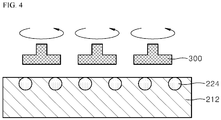
- at least one polishing wheel 300 is used to polish the surface of the steel sheet.
- the polishing liquid used to polish the surface of the steel sheet contains 1 to 10% by weight of nitric acid, 0.1 to 5% by weight of alumina with a size of 1000 to 3000 mesh, and the remainder including water.
- nitric acid When a content of the nitric acid is smaller than 1% by weight, it is difficult to remove contaminants and oil on a material surface. When the content thereof exceeds 10% by weight, corrosion of the material surface may occur and the polishing wheel may melt.
- the polishing force is insufficient to remove impurities on the surface.
- the content exceeds 5% by weight, the polishing force is improved, but there is a disadvantage that a surface gloss of a raw material may be increased before coating.
- the polishing wheel 300 may include a sponge or a polishing whetstone.
- Polishing the surface of the steel sheet using the polishing wheel 300 to achieve mechanical polishing such as the sponge or the polishing whetstone may allow removal of the remaining adhesive liquid residue 224 transferred to the passive film 212 as much as possible.
- the method includes the first chemical cleaning with the cleaning liquid, and then applying the polishing liquid, and then the second mechanical polishing, that is, the mechanical cleaning using the polishing wheel.
- the adhesive liquid residue formed on the steel sheet may be removed as much as possible
- the method has an improved effect of removing the adhesive liquid residue, compared to a case where only the chemical cleaning step is performed with the cleaning liquid or only to a case where only the mechanical cleaning is performed without the chemical cleaning with the cleaning liquid.
- removing the residue on the steel sheet surface as much as possible by performing both of the chemical cleaning and the mechanical cleaning may allow modification of the steel sheet surface and achievement of the improved wettability between the coated layer and the steel sheet surface to enhance the adhesion between the steel sheet surface and the coated layer.
- the steel sheet is transferred to a coater including a plurality of coating rollers as illustrated in FIG. 5 .
- the coating rollers may include a rotating axis and a cylindrical object configured to rotate about the rotating axis.
- the polished steel sheet may be transferred to the coater using a conveying roller 440.
- the steel sheet transferred to the coater is transferred to and passes by a coating roller 410 using a progress roller 430.
- the coating liquid is transferred from the coating roller 410 to the steel sheet while the sheet is passing through between the progress roller 430 and the coating roller 410. In this way, a coated layer 230 may be formed on the surface of the sheet.
- the coater may include a coating amount control roller 420 to control the coating amount of the coating liquid together with the coating roller 410.
- the control roller 420 may rotate in a first direction to increase the amount of coating liquid supplied to the steel sheet and rotate in a second direction to decrease the amount of coating liquid supplied to the steel sheet.
- the first direction may be opposite to the rotating direction of the first coating roller 410, and the second direction may be the same as the rotating direction of the first coating roller 410.
- the second direction may be opposite to the rotating direction of the first coating roller 410, and the first direction may be the same as the rotating direction of the first coating roller 410.
- the control roller 420 may control the amount of the coating liquid by changing the rotating speed.
- the coating liquid may include silicate-based high heat-resistant coating liquid.
- the coating liquid may contain 20 to 40% by weight of sodium silicate having good coating properties and corrosion resistance, 10 to 30% by weight of lithium silicate having good heat resistance and compatibility, 2% by weight or less of sodium tetraborate to improve moisture resistance, and the remainder, that is, a distilled water to facilitate workability and thickness control of the coating film in the coating process.
- the coating liquid has a high heat resistance at 400 °C or higher, unlike a conventional general organic coating liquid used for metal.
- easy clean performance may be imparted to the coating liquid to easily remove contaminants.
- a spray coating scheme may be used.
- the present disclosure is not limited thereto.
- a roll coating scheme may be employed.
- fine particles of the sprayed coating liquid react with CO 2 in the air and are brought into a cloudy crystalline state such as fog, and then move around in the air. This may cause a defect in operation.
- the coating liquid may be coated on the sheet using the roll coating scheme.
- a coating process may be performed more stably.
- a viscosity of the silicate-based high heat-resistant coating liquid has a low viscosity (20 °C, 1 to 1.5) similar to a viscosity of water (20 °C, 1). This is advantageous in forming the coated layer in a thin film form.
- a plurality of coating rollers 410 are continuously arranged to continuously coat the coating liquid on the surface of the steel sheet.
- one set of two coating rollers are used, but the present disclosure is not limited thereto.
- a first coated layer 232 may be formed on the steel sheet 210 as the sheet passes by a first coating roller.
- coating liquid 231 may be applied between the first coating roller 410 and the control roller 420 to form the first coated layer 232.
- a second coated layer 234 is additionally formed on the first coated layer 232 on the steel sheet 210 as the sheet passes by a second coating roller.
- the second roller may be located laterally next to the first roller 410.
- the first coated layer 232 and the second coated layer 234 may not be physically separated from each other.
- the coated layer may be repeatedly formed in order to form the coated layer having a minimum thickness to secure the physical properties of the coated layer.
- the first coating layer 232 and the second coated layer 234 are formed as the two coating steps are continuously performed. However, the first coating layer 232 and the second coated layer 234 may not be physically separated layers but are finally formed into a single layer based coated layer 230. In some cases, the first coating layer 232 and the second coated layer 234 may be formed in one coating step that is continuously performed until a target thickness is achieved.
- the steel sheet passing through the coater is subjected to a thermal curing process at a next step.
- a final thickness of the coated layer may be reduced via volatilization of liquid components present in the coated layer as the curing process proceeds.
- the coated layer of the steel sheet passing through the coater for example, has a thickness of 5 ⁇ m or greater. In some examples, the coated layer may be about 5 ⁇ m.
- the coated layer composed of a single layer is formed on the steel sheet, the appearance characteristics of the steel sheet surface such as gloss inherent to the steel sheet, hairline formed via machining, and diffused reflection may be exposed to an outside.
- a distance "d" between the steel sheet 210 and each of the coating rollers 410 may be in a range of 0.1 to 1mm.
- a distance controller may be additionally installed.
- the steel sheet 210 and the coating roller 410 When the distance between the steel sheet 210 and the coating roller 410 is smaller than 0.1mm, the steel sheet 210 and the coating roller 410 is too close to each other, so that the coating may not be performed well as the steel sheet 210 passes by the coating roller 410.
- the liquid contacts an upstream portion of the sheet but flows downwardly from a downstream portion thereof because the coating liquid has a low viscosity as in water. Thus, it is difficult to form the coated layer on the steel sheet reliably.
- a conveying velocity of the steel sheet passing by the coating rollers 410 may be in a range of 0.1 to 1m/min.
- the feed velocity of the steel sheet passing by the coating rollers is lower than 0.1m/min, a thickness of the coating liquid may be larger because the velocity at which the steel sheet is conveyed is too slow compared to the velocity at which the coating liquid flows down.
- the conveying velocity is greater than 1m/min, the thickness of the coating liquid is too small such that requirements for hardness, yellowing, cleaning properties and the like may not be satisfied.
- the curing of the coated layer proceeds.
- the coated steel sheet is transferred to a curing furnace having a plurality of curing chambers that heat the steel sheet.
- the heating temperature of the curing furnace is increased in a step by step manner.
- the curing temperature may be raised in a range of 0 to 500 °C in a step by step manner.
- the curing chambers may be sequentially arranged in a direction in which the coated steel sheet moves, and the temperatures of the curing chambers may increase in a step by step manner along the direction.
- first to last chambers are sequentially arranged along the direction in which the coated steel sheet is transferred.
- the temperatures of the first to last chambers increase in a step by step manner.
- first to last chambers are sequentially arranged along the direction in which the coated steel sheet is transferred.
- the temperatures of the first to (n)-th chambers increase in a step by step manner and then the temperatures of (n+1)-th to last curing chambers are constant.
- the heating temperatures of the first to last curing chambers may continue to rise up in a step by step.
- the temperatures of the first to (n)-th chambers increase in a step by step manner and then the temperatures of the (n+1)-th to last curing chambers are constant.
- the curing furnace may include 10 curing chambers.
- the first to tenth curing chambers may be sequentially arranged in this order in a direction in which the steel sheet is transferred to the curing furnace.
- the first curing chamber has a heating temperature of 0 to 150 °C
- the second curing chamber has a heating temperature of 150 to 250 °C
- the third curing chamber has a heating temperature of 300 to 500 °C.
- the remaining curing chambers arranged after the third curing chamber, that is, the fourth to tenth curing chambers may have the same heating temperature of 300 to 500 °C.
- the heat curing may be performed to cure the coated layer of the steel sheet.
- the thermal curing of the coated layer occurs at a rapidly elevated temperature, the coated surface may boil.
- each temperature controller may be mounted in each curing chamber to inhibit the rapid rise in temperature.
- the temperature of the steel sheet passing through the curing chambers may rise up in a step by step manner, thereby stably curing the coated surface.
- the curing temperature may increase to a high temperature in a range of 300 to 500 °C.
- the final coated layer may have a hardness equal to or similar to that of glass and may be transparent.
- the conveying velocity of the steel sheet passing through the curing furnace may be, for example, in a range of 0.1 to 1m/min.
- the curing time may be greater than or equal to 20 minutes.
- the liquid may satisfy the required properties.
- the curing time is smaller than 20 minutes, curing may not be performed properly, and thus it may be difficult to satisfy the required hardness value (9H, surface pencil hardness, 1 kg load).
- the surface of the steel sheet is cleaned with the cleaning liquid and then the polishing liquid is applied to the cleaned surface. Then, the steel sheet surface may be modified by performing mechanical polishing to polish the surface using the polishing wheel. This may allow the steel sheet having enhanced adhesion with the coated layer composed of a single layer.
- the coating liquid may be continuously applied on the sheet surface using the plurality of coating rollers. This may allow the steel sheet having a thin coated layer composed of a single layer whose thickness may be easily controlled to a desired coating thickness.
- the steel sheet having the high heat-resistant coated layer formed thereon may pass through the curing furnace including the plurality of curing chambers whose temperatures may be raised up in a step by step manner to a high temperature, thereby to cure the high heat-resistant coated layer in a step by step manner.
- the coated surface may be stabilized at the high temperature.
Landscapes
- Chemical & Material Sciences (AREA)
- Engineering & Computer Science (AREA)
- Mechanical Engineering (AREA)
- Organic Chemistry (AREA)
- Materials Engineering (AREA)
- Chemical Kinetics & Catalysis (AREA)
- General Chemical & Material Sciences (AREA)
- Metallurgy (AREA)
- Physics & Mathematics (AREA)
- Thermal Sciences (AREA)
- Inorganic Chemistry (AREA)
- Life Sciences & Earth Sciences (AREA)
- Wood Science & Technology (AREA)
- Ceramic Engineering (AREA)
- Combustion & Propulsion (AREA)
- General Engineering & Computer Science (AREA)
- Application Of Or Painting With Fluid Materials (AREA)
- Coating Apparatus (AREA)
- Finish Polishing, Edge Sharpening, And Grinding By Specific Grinding Devices (AREA)
Applications Claiming Priority (1)
| Application Number | Priority Date | Filing Date | Title |
|---|---|---|---|
| KR1020190034530A KR102658307B1 (ko) | 2019-03-26 | 2019-03-26 | 강판 코팅 장치 및 그 장치를 이용한 강판 코팅 방법 |
Publications (3)
| Publication Number | Publication Date |
|---|---|
| EP3714995A2 true EP3714995A2 (de) | 2020-09-30 |
| EP3714995A3 EP3714995A3 (de) | 2020-10-14 |
| EP3714995B1 EP3714995B1 (de) | 2024-09-11 |
Family
ID=69960562
Family Applications (1)
| Application Number | Title | Priority Date | Filing Date |
|---|---|---|---|
| EP20165491.0A Active EP3714995B1 (de) | 2019-03-26 | 2020-03-25 | Vorrichtung zum beschichten von stahlblech und verfahren zum beschichten von stahlblech mit dieser vorrichtung |
Country Status (3)
| Country | Link |
|---|---|
| US (2) | US20200307163A1 (de) |
| EP (1) | EP3714995B1 (de) |
| KR (1) | KR102658307B1 (de) |
Cited By (1)
| Publication number | Priority date | Publication date | Assignee | Title |
|---|---|---|---|---|
| CN117225653A (zh) * | 2023-09-12 | 2023-12-15 | 山东省博兴县双鑫新板材有限公司 | 一种高效隔热保温彩涂板生产装置及彩涂板 |
Families Citing this family (1)
| Publication number | Priority date | Publication date | Assignee | Title |
|---|---|---|---|---|
| NL2024281B1 (nl) * | 2019-11-21 | 2021-08-18 | Contiweb B V | Opbrenginrichting |
Family Cites Families (9)
| Publication number | Priority date | Publication date | Assignee | Title |
|---|---|---|---|---|
| US2809901A (en) * | 1952-10-22 | 1957-10-15 | Grunt Max | Protectively coated metals and process of coating same |
| US6589607B1 (en) * | 2000-06-29 | 2003-07-08 | Material Sciences Corporation | Method of coating a continuously moving substrate with thermoset material and corresponding apparatus |
| US20020114884A1 (en) * | 2000-09-01 | 2002-08-22 | Friedersdorf Fritz J. | Process for applying a coating to a continuous steel sheet and a coated steel sheet product therefrom |
| CN101607247B (zh) * | 2009-07-15 | 2012-01-18 | 史岳明 | 大型钢管防腐涂层自动涂装工艺及其生产线 |
| US20110291429A1 (en) * | 2010-05-28 | 2011-12-01 | Flat Rock Metal Inc. | Process for Coating Metal Components With a Coating That Prevents Electrochemical Plating |
| KR101233997B1 (ko) * | 2012-09-18 | 2013-02-22 | 주식회사 미로 | 내식성 및 내염해성이 강화된 금속 표면 처리용 세라믹 도료 조성물 |
| KR101649900B1 (ko) * | 2015-06-08 | 2016-08-22 | 주식회사 포스코 | 전기강판용 절연코팅장치 및 그 절연코팅방법 |
| EP3484634A4 (de) * | 2016-07-14 | 2020-07-29 | Arcanum Alloys, Inc. | Verfahren zur herstellung von teilen aus rostfreiem stahl |
| KR102217516B1 (ko) * | 2018-07-02 | 2021-02-18 | 주식회사 동진쎄미켐 | 금속막 연마용 화학 기계적 연마 슬러리 조성물 및 금속막의 연마 방법 |
-
2019
- 2019-03-26 KR KR1020190034530A patent/KR102658307B1/ko active Active
-
2020
- 2020-03-25 EP EP20165491.0A patent/EP3714995B1/de active Active
- 2020-03-26 US US16/831,538 patent/US20200307163A1/en not_active Abandoned
-
2024
- 2024-06-27 US US18/756,584 patent/US20240343020A1/en active Pending
Cited By (2)
| Publication number | Priority date | Publication date | Assignee | Title |
|---|---|---|---|---|
| CN117225653A (zh) * | 2023-09-12 | 2023-12-15 | 山东省博兴县双鑫新板材有限公司 | 一种高效隔热保温彩涂板生产装置及彩涂板 |
| CN117225653B (zh) * | 2023-09-12 | 2024-03-12 | 山东省博兴县双鑫新板材有限公司 | 一种高效隔热保温彩涂板生产装置及彩涂板 |
Also Published As
| Publication number | Publication date |
|---|---|
| US20240343020A1 (en) | 2024-10-17 |
| US20200307163A1 (en) | 2020-10-01 |
| EP3714995B1 (de) | 2024-09-11 |
| KR20200113810A (ko) | 2020-10-07 |
| EP3714995A3 (de) | 2020-10-14 |
| KR102658307B1 (ko) | 2024-04-16 |
Similar Documents
| Publication | Publication Date | Title |
|---|---|---|
| US20240343020A1 (en) | Steel sheet coating apparatus and steel sheet coating method using the apparatus | |
| US8960123B2 (en) | Coating and curing apparatus and methods | |
| JP5744899B2 (ja) | 防汚表面を有するガラス製品およびその製造方法 | |
| US20150060401A1 (en) | Method of edge coating a batch of glass articles | |
| US9314811B1 (en) | Coating and curing apparatus and methods | |
| EP1382400A2 (de) | Dünne Schichten aus Silanverläuferverbindungen | |
| CN102765271A (zh) | 一种油墨热压转移载体膜及其制作方法 | |
| CN111842389A (zh) | 一种弯曲玻璃板的表面处理方法 | |
| CN101249491A (zh) | 一种在金属制品表面喷涂聚醚醚酮的方法 | |
| US20120028051A1 (en) | Improved stain resistance | |
| KR102114261B1 (ko) | 산업용 롤의 제조방법 | |
| CN1795149A (zh) | 强化玻璃的方法和设备 | |
| CN107074631A (zh) | 把保护涂层施加到基材边缘的方法 | |
| JP2009084100A (ja) | ガラス搬送用溶融シリカ質ロールおよびその製造方法 | |
| CA2346368C (en) | Adhesion promotion | |
| JP7333401B2 (ja) | 光沢度及び表面特性に優れためっき鋼板、その製造方法 | |
| US20170100753A1 (en) | Sheet material surface treatment method and system | |
| CN117160825A (zh) | 一种多功能pet涂布膜用胶水工艺机器涂布方法 | |
| AU2001228183B2 (en) | A coating method | |
| JPS5771662A (en) | Solventless laminator coater | |
| KR19990074619A (ko) | 메탈그레즈저항기의 도포방법 및 그 방법을 수행하는 메탈그레즈저항기의 도포장치. | |
| JPS60197276A (ja) | アルミニウム−亜鉛合金めつき鋼板の表面処理法 | |
| CN121605327A (zh) | 经功能涂覆的塑料镜片的生产方法、生产装置和经功能涂覆的塑料镜片 |
Legal Events
| Date | Code | Title | Description |
|---|---|---|---|
| PUAI | Public reference made under article 153(3) epc to a published international application that has entered the european phase |
Free format text: ORIGINAL CODE: 0009012 |
|
| STAA | Information on the status of an ep patent application or granted ep patent |
Free format text: STATUS: THE APPLICATION HAS BEEN PUBLISHED |
|
| PUAL | Search report despatched |
Free format text: ORIGINAL CODE: 0009013 |
|
| AK | Designated contracting states |
Kind code of ref document: A2 Designated state(s): AL AT BE BG CH CY CZ DE DK EE ES FI FR GB GR HR HU IE IS IT LI LT LU LV MC MK MT NL NO PL PT RO RS SE SI SK SM TR |
|
| AX | Request for extension of the european patent |
Extension state: BA ME |
|
| AK | Designated contracting states |
Kind code of ref document: A3 Designated state(s): AL AT BE BG CH CY CZ DE DK EE ES FI FR GB GR HR HU IE IS IT LI LT LU LV MC MK MT NL NO PL PT RO RS SE SI SK SM TR |
|
| AX | Request for extension of the european patent |
Extension state: BA ME |
|
| RIC1 | Information provided on ipc code assigned before grant |
Ipc: B05D 3/02 20060101ALI20200908BHEP Ipc: B05D 1/28 20060101ALI20200908BHEP Ipc: B05D 7/00 20060101ALN20200908BHEP Ipc: B05D 7/14 20060101AFI20200908BHEP Ipc: B05D 3/12 20060101ALI20200908BHEP Ipc: B05D 3/10 20060101ALI20200908BHEP |
|
| STAA | Information on the status of an ep patent application or granted ep patent |
Free format text: STATUS: REQUEST FOR EXAMINATION WAS MADE |
|
| 17P | Request for examination filed |
Effective date: 20210414 |
|
| RBV | Designated contracting states (corrected) |
Designated state(s): AL AT BE BG CH CY CZ DE DK EE ES FI FR GB GR HR HU IE IS IT LI LT LU LV MC MK MT NL NO PL PT RO RS SE SI SK SM TR |
|
| STAA | Information on the status of an ep patent application or granted ep patent |
Free format text: STATUS: EXAMINATION IS IN PROGRESS |
|
| 17Q | First examination report despatched |
Effective date: 20220629 |
|
| REG | Reference to a national code |
Ref country code: DE Ref legal event code: R079 Free format text: PREVIOUS MAIN CLASS: B05D0001280000 Ipc: B05D0007140000 Ref document number: 602020037404 Country of ref document: DE |
|
| GRAP | Despatch of communication of intention to grant a patent |
Free format text: ORIGINAL CODE: EPIDOSNIGR1 |
|
| STAA | Information on the status of an ep patent application or granted ep patent |
Free format text: STATUS: GRANT OF PATENT IS INTENDED |
|
| RIC1 | Information provided on ipc code assigned before grant |
Ipc: B05C 9/14 20060101ALN20240409BHEP Ipc: B05C 9/10 20060101ALN20240409BHEP Ipc: B05C 1/08 20060101ALN20240409BHEP Ipc: B05D 7/00 20060101ALN20240409BHEP Ipc: C23C 18/12 20060101ALI20240409BHEP Ipc: C23C 18/04 20060101ALI20240409BHEP Ipc: C09G 1/02 20060101ALI20240409BHEP Ipc: B05D 3/02 20060101ALI20240409BHEP Ipc: B05D 1/28 20060101ALI20240409BHEP Ipc: B05D 3/12 20060101ALI20240409BHEP Ipc: B05D 3/10 20060101ALI20240409BHEP Ipc: B05D 7/14 20060101AFI20240409BHEP |
|
| INTG | Intention to grant announced |
Effective date: 20240425 |
|
| GRAS | Grant fee paid |
Free format text: ORIGINAL CODE: EPIDOSNIGR3 |
|
| GRAA | (expected) grant |
Free format text: ORIGINAL CODE: 0009210 |
|
| STAA | Information on the status of an ep patent application or granted ep patent |
Free format text: STATUS: THE PATENT HAS BEEN GRANTED |
|
| AK | Designated contracting states |
Kind code of ref document: B1 Designated state(s): AL AT BE BG CH CY CZ DE DK EE ES FI FR GB GR HR HU IE IS IT LI LT LU LV MC MK MT NL NO PL PT RO RS SE SI SK SM TR |
|
| REG | Reference to a national code |
Ref country code: GB Ref legal event code: FG4D |
|
| REG | Reference to a national code |
Ref country code: CH Ref legal event code: EP |
|
| REG | Reference to a national code |
Ref country code: DE Ref legal event code: R096 Ref document number: 602020037404 Country of ref document: DE |
|
| REG | Reference to a national code |
Ref country code: IE Ref legal event code: FG4D |
|
| REG | Reference to a national code |
Ref country code: LT Ref legal event code: MG9D |
|
| PG25 | Lapsed in a contracting state [announced via postgrant information from national office to epo] |
Ref country code: NO Free format text: LAPSE BECAUSE OF FAILURE TO SUBMIT A TRANSLATION OF THE DESCRIPTION OR TO PAY THE FEE WITHIN THE PRESCRIBED TIME-LIMIT Effective date: 20241211 |
|
| REG | Reference to a national code |
Ref country code: NL Ref legal event code: MP Effective date: 20240911 |
|
| PG25 | Lapsed in a contracting state [announced via postgrant information from national office to epo] |
Ref country code: GR Free format text: LAPSE BECAUSE OF FAILURE TO SUBMIT A TRANSLATION OF THE DESCRIPTION OR TO PAY THE FEE WITHIN THE PRESCRIBED TIME-LIMIT Effective date: 20241212 Ref country code: FI Free format text: LAPSE BECAUSE OF FAILURE TO SUBMIT A TRANSLATION OF THE DESCRIPTION OR TO PAY THE FEE WITHIN THE PRESCRIBED TIME-LIMIT Effective date: 20240911 |
|
| PG25 | Lapsed in a contracting state [announced via postgrant information from national office to epo] |
Ref country code: BG Free format text: LAPSE BECAUSE OF FAILURE TO SUBMIT A TRANSLATION OF THE DESCRIPTION OR TO PAY THE FEE WITHIN THE PRESCRIBED TIME-LIMIT Effective date: 20240911 |
|
| PG25 | Lapsed in a contracting state [announced via postgrant information from national office to epo] |
Ref country code: LV Free format text: LAPSE BECAUSE OF FAILURE TO SUBMIT A TRANSLATION OF THE DESCRIPTION OR TO PAY THE FEE WITHIN THE PRESCRIBED TIME-LIMIT Effective date: 20240911 |
|
| PG25 | Lapsed in a contracting state [announced via postgrant information from national office to epo] |
Ref country code: HR Free format text: LAPSE BECAUSE OF FAILURE TO SUBMIT A TRANSLATION OF THE DESCRIPTION OR TO PAY THE FEE WITHIN THE PRESCRIBED TIME-LIMIT Effective date: 20240911 |
|
| PG25 | Lapsed in a contracting state [announced via postgrant information from national office to epo] |
Ref country code: ES Free format text: LAPSE BECAUSE OF FAILURE TO SUBMIT A TRANSLATION OF THE DESCRIPTION OR TO PAY THE FEE WITHIN THE PRESCRIBED TIME-LIMIT Effective date: 20240911 Ref country code: RS Free format text: LAPSE BECAUSE OF FAILURE TO SUBMIT A TRANSLATION OF THE DESCRIPTION OR TO PAY THE FEE WITHIN THE PRESCRIBED TIME-LIMIT Effective date: 20241211 |
|
| PG25 | Lapsed in a contracting state [announced via postgrant information from national office to epo] |
Ref country code: RS Free format text: LAPSE BECAUSE OF FAILURE TO SUBMIT A TRANSLATION OF THE DESCRIPTION OR TO PAY THE FEE WITHIN THE PRESCRIBED TIME-LIMIT Effective date: 20241211 Ref country code: NO Free format text: LAPSE BECAUSE OF FAILURE TO SUBMIT A TRANSLATION OF THE DESCRIPTION OR TO PAY THE FEE WITHIN THE PRESCRIBED TIME-LIMIT Effective date: 20241211 Ref country code: LV Free format text: LAPSE BECAUSE OF FAILURE TO SUBMIT A TRANSLATION OF THE DESCRIPTION OR TO PAY THE FEE WITHIN THE PRESCRIBED TIME-LIMIT Effective date: 20240911 Ref country code: HR Free format text: LAPSE BECAUSE OF FAILURE TO SUBMIT A TRANSLATION OF THE DESCRIPTION OR TO PAY THE FEE WITHIN THE PRESCRIBED TIME-LIMIT Effective date: 20240911 Ref country code: GR Free format text: LAPSE BECAUSE OF FAILURE TO SUBMIT A TRANSLATION OF THE DESCRIPTION OR TO PAY THE FEE WITHIN THE PRESCRIBED TIME-LIMIT Effective date: 20241212 Ref country code: FI Free format text: LAPSE BECAUSE OF FAILURE TO SUBMIT A TRANSLATION OF THE DESCRIPTION OR TO PAY THE FEE WITHIN THE PRESCRIBED TIME-LIMIT Effective date: 20240911 Ref country code: ES Free format text: LAPSE BECAUSE OF FAILURE TO SUBMIT A TRANSLATION OF THE DESCRIPTION OR TO PAY THE FEE WITHIN THE PRESCRIBED TIME-LIMIT Effective date: 20240911 Ref country code: BG Free format text: LAPSE BECAUSE OF FAILURE TO SUBMIT A TRANSLATION OF THE DESCRIPTION OR TO PAY THE FEE WITHIN THE PRESCRIBED TIME-LIMIT Effective date: 20240911 |
|
| REG | Reference to a national code |
Ref country code: AT Ref legal event code: MK05 Ref document number: 1722235 Country of ref document: AT Kind code of ref document: T Effective date: 20240911 |
|
| PG25 | Lapsed in a contracting state [announced via postgrant information from national office to epo] |
Ref country code: NL Free format text: LAPSE BECAUSE OF FAILURE TO SUBMIT A TRANSLATION OF THE DESCRIPTION OR TO PAY THE FEE WITHIN THE PRESCRIBED TIME-LIMIT Effective date: 20240911 |
|
| PG25 | Lapsed in a contracting state [announced via postgrant information from national office to epo] |
Ref country code: PT Free format text: LAPSE BECAUSE OF FAILURE TO SUBMIT A TRANSLATION OF THE DESCRIPTION OR TO PAY THE FEE WITHIN THE PRESCRIBED TIME-LIMIT Effective date: 20250113 Ref country code: IS Free format text: LAPSE BECAUSE OF FAILURE TO SUBMIT A TRANSLATION OF THE DESCRIPTION OR TO PAY THE FEE WITHIN THE PRESCRIBED TIME-LIMIT Effective date: 20250111 |
|
| PG25 | Lapsed in a contracting state [announced via postgrant information from national office to epo] |
Ref country code: SM Free format text: LAPSE BECAUSE OF FAILURE TO SUBMIT A TRANSLATION OF THE DESCRIPTION OR TO PAY THE FEE WITHIN THE PRESCRIBED TIME-LIMIT Effective date: 20240911 Ref country code: RO Free format text: LAPSE BECAUSE OF FAILURE TO SUBMIT A TRANSLATION OF THE DESCRIPTION OR TO PAY THE FEE WITHIN THE PRESCRIBED TIME-LIMIT Effective date: 20240911 |
|
| PG25 | Lapsed in a contracting state [announced via postgrant information from national office to epo] |
Ref country code: EE Free format text: LAPSE BECAUSE OF FAILURE TO SUBMIT A TRANSLATION OF THE DESCRIPTION OR TO PAY THE FEE WITHIN THE PRESCRIBED TIME-LIMIT Effective date: 20240911 Ref country code: AT Free format text: LAPSE BECAUSE OF FAILURE TO SUBMIT A TRANSLATION OF THE DESCRIPTION OR TO PAY THE FEE WITHIN THE PRESCRIBED TIME-LIMIT Effective date: 20240911 |
|
| PG25 | Lapsed in a contracting state [announced via postgrant information from national office to epo] |
Ref country code: CZ Free format text: LAPSE BECAUSE OF FAILURE TO SUBMIT A TRANSLATION OF THE DESCRIPTION OR TO PAY THE FEE WITHIN THE PRESCRIBED TIME-LIMIT Effective date: 20240911 Ref country code: PL Free format text: LAPSE BECAUSE OF FAILURE TO SUBMIT A TRANSLATION OF THE DESCRIPTION OR TO PAY THE FEE WITHIN THE PRESCRIBED TIME-LIMIT Effective date: 20240911 |
|
| PG25 | Lapsed in a contracting state [announced via postgrant information from national office to epo] |
Ref country code: SK Free format text: LAPSE BECAUSE OF FAILURE TO SUBMIT A TRANSLATION OF THE DESCRIPTION OR TO PAY THE FEE WITHIN THE PRESCRIBED TIME-LIMIT Effective date: 20240911 Ref country code: IT Free format text: LAPSE BECAUSE OF FAILURE TO SUBMIT A TRANSLATION OF THE DESCRIPTION OR TO PAY THE FEE WITHIN THE PRESCRIBED TIME-LIMIT Effective date: 20240911 |
|
| REG | Reference to a national code |
Ref country code: DE Ref legal event code: R097 Ref document number: 602020037404 Country of ref document: DE |
|
| PG25 | Lapsed in a contracting state [announced via postgrant information from national office to epo] |
Ref country code: DK Free format text: LAPSE BECAUSE OF FAILURE TO SUBMIT A TRANSLATION OF THE DESCRIPTION OR TO PAY THE FEE WITHIN THE PRESCRIBED TIME-LIMIT Effective date: 20240911 |
|
| PLBE | No opposition filed within time limit |
Free format text: ORIGINAL CODE: 0009261 |
|
| STAA | Information on the status of an ep patent application or granted ep patent |
Free format text: STATUS: NO OPPOSITION FILED WITHIN TIME LIMIT |
|
| 26N | No opposition filed |
Effective date: 20250612 |
|
| PG25 | Lapsed in a contracting state [announced via postgrant information from national office to epo] |
Ref country code: SE Free format text: LAPSE BECAUSE OF FAILURE TO SUBMIT A TRANSLATION OF THE DESCRIPTION OR TO PAY THE FEE WITHIN THE PRESCRIBED TIME-LIMIT Effective date: 20240911 |
|
| PG25 | Lapsed in a contracting state [announced via postgrant information from national office to epo] |
Ref country code: MC Free format text: LAPSE BECAUSE OF FAILURE TO SUBMIT A TRANSLATION OF THE DESCRIPTION OR TO PAY THE FEE WITHIN THE PRESCRIBED TIME-LIMIT Effective date: 20240911 |
|
| REG | Reference to a national code |
Ref country code: CH Ref legal event code: H13 Free format text: ST27 STATUS EVENT CODE: U-0-0-H10-H13 (AS PROVIDED BY THE NATIONAL OFFICE) Effective date: 20251023 |
|
| PG25 | Lapsed in a contracting state [announced via postgrant information from national office to epo] |
Ref country code: LU Free format text: LAPSE BECAUSE OF NON-PAYMENT OF DUE FEES Effective date: 20250325 |
|
| GBPC | Gb: european patent ceased through non-payment of renewal fee |
Effective date: 20250325 |
|
| REG | Reference to a national code |
Ref country code: BE Ref legal event code: MM Effective date: 20250331 |
|
| PG25 | Lapsed in a contracting state [announced via postgrant information from national office to epo] |
Ref country code: GB Free format text: LAPSE BECAUSE OF NON-PAYMENT OF DUE FEES Effective date: 20250325 |
|
| PG25 | Lapsed in a contracting state [announced via postgrant information from national office to epo] |
Ref country code: BE Free format text: LAPSE BECAUSE OF NON-PAYMENT OF DUE FEES Effective date: 20250331 |
|
| PG25 | Lapsed in a contracting state [announced via postgrant information from national office to epo] |
Ref country code: CH Free format text: LAPSE BECAUSE OF NON-PAYMENT OF DUE FEES Effective date: 20250331 |
|
| PG25 | Lapsed in a contracting state [announced via postgrant information from national office to epo] |
Ref country code: IE Free format text: LAPSE BECAUSE OF NON-PAYMENT OF DUE FEES Effective date: 20250325 |
|
| PGFP | Annual fee paid to national office [announced via postgrant information from national office to epo] |
Ref country code: DE Payment date: 20260205 Year of fee payment: 7 |
|
| PGFP | Annual fee paid to national office [announced via postgrant information from national office to epo] |
Ref country code: FR Payment date: 20260209 Year of fee payment: 7 |