EP3710249B1 - Thermoplastic polymer film with interpenetrating polymer network - Google Patents
Thermoplastic polymer film with interpenetrating polymer network Download PDFInfo
- Publication number
- EP3710249B1 EP3710249B1 EP18804319.4A EP18804319A EP3710249B1 EP 3710249 B1 EP3710249 B1 EP 3710249B1 EP 18804319 A EP18804319 A EP 18804319A EP 3710249 B1 EP3710249 B1 EP 3710249B1
- Authority
- EP
- European Patent Office
- Prior art keywords
- layer
- hydroxy
- thermoplastic polymer
- phenyl
- multilayer film
- Prior art date
- Legal status (The legal status is an assumption and is not a legal conclusion. Google has not performed a legal analysis and makes no representation as to the accuracy of the status listed.)
- Active
Links
Images
Classifications
-
- B—PERFORMING OPERATIONS; TRANSPORTING
- B32—LAYERED PRODUCTS
- B32B—LAYERED PRODUCTS, i.e. PRODUCTS BUILT-UP OF STRATA OF FLAT OR NON-FLAT, e.g. CELLULAR OR HONEYCOMB, FORM
- B32B27/00—Layered products comprising a layer of synthetic resin
- B32B27/06—Layered products comprising a layer of synthetic resin as the main or only constituent of a layer, which is next to another layer of the same or of a different material
- B32B27/08—Layered products comprising a layer of synthetic resin as the main or only constituent of a layer, which is next to another layer of the same or of a different material of synthetic resin
-
- B—PERFORMING OPERATIONS; TRANSPORTING
- B29—WORKING OF PLASTICS; WORKING OF SUBSTANCES IN A PLASTIC STATE IN GENERAL
- B29C—SHAPING OR JOINING OF PLASTICS; SHAPING OF MATERIAL IN A PLASTIC STATE, NOT OTHERWISE PROVIDED FOR; AFTER-TREATMENT OF THE SHAPED PRODUCTS, e.g. REPAIRING
- B29C48/00—Extrusion moulding, i.e. expressing the moulding material through a die or nozzle which imparts the desired form; Apparatus therefor
- B29C48/022—Extrusion moulding, i.e. expressing the moulding material through a die or nozzle which imparts the desired form; Apparatus therefor characterised by the choice of material
-
- B—PERFORMING OPERATIONS; TRANSPORTING
- B29—WORKING OF PLASTICS; WORKING OF SUBSTANCES IN A PLASTIC STATE IN GENERAL
- B29C—SHAPING OR JOINING OF PLASTICS; SHAPING OF MATERIAL IN A PLASTIC STATE, NOT OTHERWISE PROVIDED FOR; AFTER-TREATMENT OF THE SHAPED PRODUCTS, e.g. REPAIRING
- B29C48/00—Extrusion moulding, i.e. expressing the moulding material through a die or nozzle which imparts the desired form; Apparatus therefor
- B29C48/16—Articles comprising two or more components, e.g. co-extruded layers
- B29C48/18—Articles comprising two or more components, e.g. co-extruded layers the components being layers
- B29C48/21—Articles comprising two or more components, e.g. co-extruded layers the components being layers the layers being joined at their surfaces
-
- B—PERFORMING OPERATIONS; TRANSPORTING
- B29—WORKING OF PLASTICS; WORKING OF SUBSTANCES IN A PLASTIC STATE IN GENERAL
- B29C—SHAPING OR JOINING OF PLASTICS; SHAPING OF MATERIAL IN A PLASTIC STATE, NOT OTHERWISE PROVIDED FOR; AFTER-TREATMENT OF THE SHAPED PRODUCTS, e.g. REPAIRING
- B29C48/00—Extrusion moulding, i.e. expressing the moulding material through a die or nozzle which imparts the desired form; Apparatus therefor
- B29C48/25—Component parts, details or accessories; Auxiliary operations
- B29C48/88—Thermal treatment of the stream of extruded material, e.g. cooling
- B29C48/91—Heating, e.g. for cross linking
-
- B—PERFORMING OPERATIONS; TRANSPORTING
- B32—LAYERED PRODUCTS
- B32B—LAYERED PRODUCTS, i.e. PRODUCTS BUILT-UP OF STRATA OF FLAT OR NON-FLAT, e.g. CELLULAR OR HONEYCOMB, FORM
- B32B27/00—Layered products comprising a layer of synthetic resin
- B32B27/16—Layered products comprising a layer of synthetic resin specially treated, e.g. irradiated
-
- B—PERFORMING OPERATIONS; TRANSPORTING
- B32—LAYERED PRODUCTS
- B32B—LAYERED PRODUCTS, i.e. PRODUCTS BUILT-UP OF STRATA OF FLAT OR NON-FLAT, e.g. CELLULAR OR HONEYCOMB, FORM
- B32B27/00—Layered products comprising a layer of synthetic resin
- B32B27/18—Layered products comprising a layer of synthetic resin characterised by the use of special additives
-
- B—PERFORMING OPERATIONS; TRANSPORTING
- B32—LAYERED PRODUCTS
- B32B—LAYERED PRODUCTS, i.e. PRODUCTS BUILT-UP OF STRATA OF FLAT OR NON-FLAT, e.g. CELLULAR OR HONEYCOMB, FORM
- B32B27/00—Layered products comprising a layer of synthetic resin
- B32B27/18—Layered products comprising a layer of synthetic resin characterised by the use of special additives
- B32B27/26—Layered products comprising a layer of synthetic resin characterised by the use of special additives using curing agents
-
- B—PERFORMING OPERATIONS; TRANSPORTING
- B32—LAYERED PRODUCTS
- B32B—LAYERED PRODUCTS, i.e. PRODUCTS BUILT-UP OF STRATA OF FLAT OR NON-FLAT, e.g. CELLULAR OR HONEYCOMB, FORM
- B32B27/00—Layered products comprising a layer of synthetic resin
- B32B27/36—Layered products comprising a layer of synthetic resin comprising polyesters
-
- B—PERFORMING OPERATIONS; TRANSPORTING
- B32—LAYERED PRODUCTS
- B32B—LAYERED PRODUCTS, i.e. PRODUCTS BUILT-UP OF STRATA OF FLAT OR NON-FLAT, e.g. CELLULAR OR HONEYCOMB, FORM
- B32B27/00—Layered products comprising a layer of synthetic resin
- B32B27/36—Layered products comprising a layer of synthetic resin comprising polyesters
- B32B27/365—Layered products comprising a layer of synthetic resin comprising polyesters comprising polycarbonates
-
- B—PERFORMING OPERATIONS; TRANSPORTING
- B32—LAYERED PRODUCTS
- B32B—LAYERED PRODUCTS, i.e. PRODUCTS BUILT-UP OF STRATA OF FLAT OR NON-FLAT, e.g. CELLULAR OR HONEYCOMB, FORM
- B32B27/00—Layered products comprising a layer of synthetic resin
- B32B27/40—Layered products comprising a layer of synthetic resin comprising polyurethanes
-
- B—PERFORMING OPERATIONS; TRANSPORTING
- B32—LAYERED PRODUCTS
- B32B—LAYERED PRODUCTS, i.e. PRODUCTS BUILT-UP OF STRATA OF FLAT OR NON-FLAT, e.g. CELLULAR OR HONEYCOMB, FORM
- B32B33/00—Layered products characterised by particular properties or particular surface features, e.g. particular surface coatings; Layered products designed for particular purposes not covered by another single class
-
- B—PERFORMING OPERATIONS; TRANSPORTING
- B32—LAYERED PRODUCTS
- B32B—LAYERED PRODUCTS, i.e. PRODUCTS BUILT-UP OF STRATA OF FLAT OR NON-FLAT, e.g. CELLULAR OR HONEYCOMB, FORM
- B32B37/00—Methods or apparatus for laminating, e.g. by curing or by ultrasonic bonding
- B32B37/14—Methods or apparatus for laminating, e.g. by curing or by ultrasonic bonding characterised by the properties of the layers
- B32B37/15—Methods or apparatus for laminating, e.g. by curing or by ultrasonic bonding characterised by the properties of the layers with at least one layer being manufactured and immediately laminated before reaching its stable state, e.g. in which a layer is extruded and laminated while in semi-molten state
- B32B37/153—Methods or apparatus for laminating, e.g. by curing or by ultrasonic bonding characterised by the properties of the layers with at least one layer being manufactured and immediately laminated before reaching its stable state, e.g. in which a layer is extruded and laminated while in semi-molten state at least one layer is extruded and immediately laminated while in semi-molten state
-
- B—PERFORMING OPERATIONS; TRANSPORTING
- B32—LAYERED PRODUCTS
- B32B—LAYERED PRODUCTS, i.e. PRODUCTS BUILT-UP OF STRATA OF FLAT OR NON-FLAT, e.g. CELLULAR OR HONEYCOMB, FORM
- B32B7/00—Layered products characterised by the relation between layers; Layered products characterised by the relative orientation of features between layers, or by the relative values of a measurable parameter between layers, i.e. products comprising layers having different physical, chemical or physicochemical properties; Layered products characterised by the interconnection of layers
- B32B7/02—Physical, chemical or physicochemical properties
-
- B—PERFORMING OPERATIONS; TRANSPORTING
- B32—LAYERED PRODUCTS
- B32B—LAYERED PRODUCTS, i.e. PRODUCTS BUILT-UP OF STRATA OF FLAT OR NON-FLAT, e.g. CELLULAR OR HONEYCOMB, FORM
- B32B7/00—Layered products characterised by the relation between layers; Layered products characterised by the relative orientation of features between layers, or by the relative values of a measurable parameter between layers, i.e. products comprising layers having different physical, chemical or physicochemical properties; Layered products characterised by the interconnection of layers
- B32B7/04—Interconnection of layers
- B32B7/12—Interconnection of layers using interposed adhesives or interposed materials with bonding properties
-
- C—CHEMISTRY; METALLURGY
- C08—ORGANIC MACROMOLECULAR COMPOUNDS; THEIR PREPARATION OR CHEMICAL WORKING-UP; COMPOSITIONS BASED THEREON
- C08F—MACROMOLECULAR COMPOUNDS OBTAINED BY REACTIONS ONLY INVOLVING CARBON-TO-CARBON UNSATURATED BONDS
- C08F283/00—Macromolecular compounds obtained by polymerising monomers on to polymers provided for in subclass C08G
-
- C—CHEMISTRY; METALLURGY
- C08—ORGANIC MACROMOLECULAR COMPOUNDS; THEIR PREPARATION OR CHEMICAL WORKING-UP; COMPOSITIONS BASED THEREON
- C08F—MACROMOLECULAR COMPOUNDS OBTAINED BY REACTIONS ONLY INVOLVING CARBON-TO-CARBON UNSATURATED BONDS
- C08F283/00—Macromolecular compounds obtained by polymerising monomers on to polymers provided for in subclass C08G
- C08F283/006—Macromolecular compounds obtained by polymerising monomers on to polymers provided for in subclass C08G on to polymers provided for in C08G18/00
-
- C—CHEMISTRY; METALLURGY
- C08—ORGANIC MACROMOLECULAR COMPOUNDS; THEIR PREPARATION OR CHEMICAL WORKING-UP; COMPOSITIONS BASED THEREON
- C08G—MACROMOLECULAR COMPOUNDS OBTAINED OTHERWISE THAN BY REACTIONS ONLY INVOLVING UNSATURATED CARBON-TO-CARBON BONDS
- C08G18/00—Polymeric products of isocyanates or isothiocyanates
- C08G18/06—Polymeric products of isocyanates or isothiocyanates with compounds having active hydrogen
- C08G18/28—Polymeric products of isocyanates or isothiocyanates with compounds having active hydrogen characterised by the compounds used containing active hydrogen
- C08G18/40—High-molecular-weight compounds
- C08G18/42—Polycondensates having carboxylic or carbonic ester groups in the main chain
- C08G18/4266—Polycondensates having carboxylic or carbonic ester groups in the main chain prepared from hydroxycarboxylic acids and/or lactones
- C08G18/4269—Lactones
- C08G18/4277—Caprolactone and/or substituted caprolactone
-
- C—CHEMISTRY; METALLURGY
- C08—ORGANIC MACROMOLECULAR COMPOUNDS; THEIR PREPARATION OR CHEMICAL WORKING-UP; COMPOSITIONS BASED THEREON
- C08G—MACROMOLECULAR COMPOUNDS OBTAINED OTHERWISE THAN BY REACTIONS ONLY INVOLVING UNSATURATED CARBON-TO-CARBON BONDS
- C08G18/00—Polymeric products of isocyanates or isothiocyanates
- C08G18/06—Polymeric products of isocyanates or isothiocyanates with compounds having active hydrogen
- C08G18/70—Polymeric products of isocyanates or isothiocyanates with compounds having active hydrogen characterised by the isocyanates or isothiocyanates used
- C08G18/72—Polyisocyanates or polyisothiocyanates
- C08G18/74—Polyisocyanates or polyisothiocyanates cyclic
- C08G18/75—Polyisocyanates or polyisothiocyanates cyclic cycloaliphatic
- C08G18/758—Polyisocyanates or polyisothiocyanates cyclic cycloaliphatic containing two or more cycloaliphatic rings
-
- C—CHEMISTRY; METALLURGY
- C08—ORGANIC MACROMOLECULAR COMPOUNDS; THEIR PREPARATION OR CHEMICAL WORKING-UP; COMPOSITIONS BASED THEREON
- C08J—WORKING-UP; GENERAL PROCESSES OF COMPOUNDING; AFTER-TREATMENT NOT COVERED BY SUBCLASSES C08B, C08C, C08F, C08G or C08H
- C08J5/00—Manufacture of articles or shaped materials containing macromolecular substances
- C08J5/18—Manufacture of films or sheets
-
- C—CHEMISTRY; METALLURGY
- C08—ORGANIC MACROMOLECULAR COMPOUNDS; THEIR PREPARATION OR CHEMICAL WORKING-UP; COMPOSITIONS BASED THEREON
- C08L—COMPOSITIONS OF MACROMOLECULAR COMPOUNDS
- C08L33/00—Compositions of homopolymers or copolymers of compounds having one or more unsaturated aliphatic radicals, each having only one carbon-to-carbon double bond, and only one being terminated by only one carboxyl radical, or of salts, anhydrides, esters, amides, imides or nitriles thereof; Compositions of derivatives of such polymers
- C08L33/02—Homopolymers or copolymers of acids; Metal or ammonium salts thereof
-
- C—CHEMISTRY; METALLURGY
- C08—ORGANIC MACROMOLECULAR COMPOUNDS; THEIR PREPARATION OR CHEMICAL WORKING-UP; COMPOSITIONS BASED THEREON
- C08L—COMPOSITIONS OF MACROMOLECULAR COMPOUNDS
- C08L51/00—Compositions of graft polymers in which the grafted component is obtained by reactions only involving carbon-to-carbon unsaturated bonds; Compositions of derivatives of such polymers
- C08L51/08—Compositions of graft polymers in which the grafted component is obtained by reactions only involving carbon-to-carbon unsaturated bonds; Compositions of derivatives of such polymers grafted on to macromolecular compounds obtained otherwise than by reactions only involving unsaturated carbon-to-carbon bonds
-
- C—CHEMISTRY; METALLURGY
- C08—ORGANIC MACROMOLECULAR COMPOUNDS; THEIR PREPARATION OR CHEMICAL WORKING-UP; COMPOSITIONS BASED THEREON
- C08L—COMPOSITIONS OF MACROMOLECULAR COMPOUNDS
- C08L75/00—Compositions of polyureas or polyurethanes; Compositions of derivatives of such polymers
- C08L75/04—Polyurethanes
- C08L75/06—Polyurethanes from polyesters
-
- B—PERFORMING OPERATIONS; TRANSPORTING
- B29—WORKING OF PLASTICS; WORKING OF SUBSTANCES IN A PLASTIC STATE IN GENERAL
- B29K—INDEXING SCHEME ASSOCIATED WITH SUBCLASSES B29B, B29C OR B29D, RELATING TO MOULDING MATERIALS OR TO MATERIALS FOR MOULDS, REINFORCEMENTS, FILLERS OR PREFORMED PARTS, e.g. INSERTS
- B29K2075/00—Use of PU, i.e. polyureas or polyurethanes or derivatives thereof, as moulding material
-
- B—PERFORMING OPERATIONS; TRANSPORTING
- B29—WORKING OF PLASTICS; WORKING OF SUBSTANCES IN A PLASTIC STATE IN GENERAL
- B29L—INDEXING SCHEME ASSOCIATED WITH SUBCLASS B29C, RELATING TO PARTICULAR ARTICLES
- B29L2007/00—Flat articles, e.g. films or sheets
- B29L2007/008—Wide strips, e.g. films, webs
-
- B—PERFORMING OPERATIONS; TRANSPORTING
- B32—LAYERED PRODUCTS
- B32B—LAYERED PRODUCTS, i.e. PRODUCTS BUILT-UP OF STRATA OF FLAT OR NON-FLAT, e.g. CELLULAR OR HONEYCOMB, FORM
- B32B2250/00—Layers arrangement
- B32B2250/02—2 layers
-
- B—PERFORMING OPERATIONS; TRANSPORTING
- B32—LAYERED PRODUCTS
- B32B—LAYERED PRODUCTS, i.e. PRODUCTS BUILT-UP OF STRATA OF FLAT OR NON-FLAT, e.g. CELLULAR OR HONEYCOMB, FORM
- B32B2250/00—Layers arrangement
- B32B2250/03—3 layers
-
- B—PERFORMING OPERATIONS; TRANSPORTING
- B32—LAYERED PRODUCTS
- B32B—LAYERED PRODUCTS, i.e. PRODUCTS BUILT-UP OF STRATA OF FLAT OR NON-FLAT, e.g. CELLULAR OR HONEYCOMB, FORM
- B32B2250/00—Layers arrangement
- B32B2250/24—All layers being polymeric
-
- B—PERFORMING OPERATIONS; TRANSPORTING
- B32—LAYERED PRODUCTS
- B32B—LAYERED PRODUCTS, i.e. PRODUCTS BUILT-UP OF STRATA OF FLAT OR NON-FLAT, e.g. CELLULAR OR HONEYCOMB, FORM
- B32B2250/00—Layers arrangement
- B32B2250/24—All layers being polymeric
- B32B2250/244—All polymers belonging to those covered by group B32B27/36
-
- B—PERFORMING OPERATIONS; TRANSPORTING
- B32—LAYERED PRODUCTS
- B32B—LAYERED PRODUCTS, i.e. PRODUCTS BUILT-UP OF STRATA OF FLAT OR NON-FLAT, e.g. CELLULAR OR HONEYCOMB, FORM
- B32B2307/00—Properties of the layers or laminate
- B32B2307/40—Properties of the layers or laminate having particular optical properties
- B32B2307/406—Bright, glossy, shiny surface
-
- B—PERFORMING OPERATIONS; TRANSPORTING
- B32—LAYERED PRODUCTS
- B32B—LAYERED PRODUCTS, i.e. PRODUCTS BUILT-UP OF STRATA OF FLAT OR NON-FLAT, e.g. CELLULAR OR HONEYCOMB, FORM
- B32B2307/00—Properties of the layers or laminate
- B32B2307/50—Properties of the layers or laminate having particular mechanical properties
- B32B2307/584—Scratch resistance
-
- B—PERFORMING OPERATIONS; TRANSPORTING
- B32—LAYERED PRODUCTS
- B32B—LAYERED PRODUCTS, i.e. PRODUCTS BUILT-UP OF STRATA OF FLAT OR NON-FLAT, e.g. CELLULAR OR HONEYCOMB, FORM
- B32B2307/00—Properties of the layers or laminate
- B32B2307/70—Other properties
- B32B2307/712—Weather resistant
-
- B—PERFORMING OPERATIONS; TRANSPORTING
- B32—LAYERED PRODUCTS
- B32B—LAYERED PRODUCTS, i.e. PRODUCTS BUILT-UP OF STRATA OF FLAT OR NON-FLAT, e.g. CELLULAR OR HONEYCOMB, FORM
- B32B2307/00—Properties of the layers or laminate
- B32B2307/70—Other properties
- B32B2307/714—Inert, i.e. inert to chemical degradation, corrosion
-
- B—PERFORMING OPERATIONS; TRANSPORTING
- B32—LAYERED PRODUCTS
- B32B—LAYERED PRODUCTS, i.e. PRODUCTS BUILT-UP OF STRATA OF FLAT OR NON-FLAT, e.g. CELLULAR OR HONEYCOMB, FORM
- B32B2405/00—Adhesive articles, e.g. adhesive tapes
-
- B—PERFORMING OPERATIONS; TRANSPORTING
- B32—LAYERED PRODUCTS
- B32B—LAYERED PRODUCTS, i.e. PRODUCTS BUILT-UP OF STRATA OF FLAT OR NON-FLAT, e.g. CELLULAR OR HONEYCOMB, FORM
- B32B2457/00—Electrical equipment
- B32B2457/20—Displays, e.g. liquid crystal displays, plasma displays
-
- B—PERFORMING OPERATIONS; TRANSPORTING
- B32—LAYERED PRODUCTS
- B32B—LAYERED PRODUCTS, i.e. PRODUCTS BUILT-UP OF STRATA OF FLAT OR NON-FLAT, e.g. CELLULAR OR HONEYCOMB, FORM
- B32B2571/00—Protective equipment
-
- C—CHEMISTRY; METALLURGY
- C08—ORGANIC MACROMOLECULAR COMPOUNDS; THEIR PREPARATION OR CHEMICAL WORKING-UP; COMPOSITIONS BASED THEREON
- C08F—MACROMOLECULAR COMPOUNDS OBTAINED BY REACTIONS ONLY INVOLVING CARBON-TO-CARBON UNSATURATED BONDS
- C08F2/00—Processes of polymerisation
- C08F2/46—Polymerisation initiated by wave energy or particle radiation
- C08F2/48—Polymerisation initiated by wave energy or particle radiation by ultraviolet or visible light
-
- C—CHEMISTRY; METALLURGY
- C08—ORGANIC MACROMOLECULAR COMPOUNDS; THEIR PREPARATION OR CHEMICAL WORKING-UP; COMPOSITIONS BASED THEREON
- C08G—MACROMOLECULAR COMPOUNDS OBTAINED OTHERWISE THAN BY REACTIONS ONLY INVOLVING UNSATURATED CARBON-TO-CARBON BONDS
- C08G2270/00—Compositions for creating interpenetrating networks
-
- C—CHEMISTRY; METALLURGY
- C08—ORGANIC MACROMOLECULAR COMPOUNDS; THEIR PREPARATION OR CHEMICAL WORKING-UP; COMPOSITIONS BASED THEREON
- C08J—WORKING-UP; GENERAL PROCESSES OF COMPOUNDING; AFTER-TREATMENT NOT COVERED BY SUBCLASSES C08B, C08C, C08F, C08G or C08H
- C08J2375/00—Characterised by the use of polyureas or polyurethanes; Derivatives of such polymers
- C08J2375/04—Polyurethanes
- C08J2375/06—Polyurethanes from polyesters
-
- C—CHEMISTRY; METALLURGY
- C08—ORGANIC MACROMOLECULAR COMPOUNDS; THEIR PREPARATION OR CHEMICAL WORKING-UP; COMPOSITIONS BASED THEREON
- C08J—WORKING-UP; GENERAL PROCESSES OF COMPOUNDING; AFTER-TREATMENT NOT COVERED BY SUBCLASSES C08B, C08C, C08F, C08G or C08H
- C08J2435/00—Characterised by the use of homopolymers or copolymers of compounds having one or more unsaturated aliphatic radicals, each having only one carbon-to-carbon double bond, and at least one being terminated by a carboxyl radical, and containing at least one other carboxyl radical in the molecule, or of salts, anhydrides, esters, amides, imides or nitriles thereof; Derivatives of such polymers
- C08J2435/02—Characterised by the use of homopolymers or copolymers of esters
-
- C—CHEMISTRY; METALLURGY
- C08—ORGANIC MACROMOLECULAR COMPOUNDS; THEIR PREPARATION OR CHEMICAL WORKING-UP; COMPOSITIONS BASED THEREON
- C08L—COMPOSITIONS OF MACROMOLECULAR COMPOUNDS
- C08L2205/00—Polymer mixtures characterised by other features
- C08L2205/04—Polymer mixtures characterised by other features containing interpenetrating networks
Definitions
- the present disclosure relates to multilayer protective polymer films, and more particularly, to multilayer polymer films for the protection of surfaces exposed to adverse environmental conditions or elements, including weather, solvents, debris, and/or dirt. Even more particularly, the disclosure relates to multilayer polymer films comprising an interpenetrating polymer network layer, and a method of making the films.
- Protective polymer films such as polyurethane films, are used to provide a strong and durable shield for any bare or painted metal, glass or plastic surface that may be exposed to extreme environmental conditions or elements, such as heat, sun, moisture, wind, debris, dirt, or those due to inclement weather, such as for example, rain, hail, snow, or sleet, as well as harsh or corrosive chemicals such as solvents or the like.
- These protective polyurethane films are useful for preventing damage from abrasion, chipping, deterioration or discoloration, and wear of the surfaces under those circumstances. Such films may be used to protect, for example, cars, trucks, appliances, mobile devices, computers, electronic display screens, and more.
- These protective polyurethane films may be either thermoset or thermoplastic.
- thermoset polyurethanes typically exhibit better abrasion resistance, heat resistance, and hardness compared to thermoplastic polyurethanes. Because thermoset polyurethanes generally comprise a network of cross-linked polymer chains, thermoset polyurethanes are typically formed using expensive casting processes. In contrast, thermoplastic polyurethanes are able to flow at elevated temperatures. The flowability of thermoplastic polyurethanes allows their production by less expensive techniques, such as for example, injection molding or extrusion.
- Interpenetrating polymer networks are combinations of two or more polymers which have been polymerized and/or crosslinked in the presence of each other.
- One approach for making cross-linked thermoplastic polyurethanes described in U.S. Patent No. 8,168,260 , involves formation of chemical bonds upon cross linking a polymer and a thermoplastic polyurethane (TPU) having terminal functional radically-polymerizable groups on both ends of the TPU.
- TPU thermoplastic polyurethane
- These interpenetrating polymer networks, or IPNs can be seen as analogous to polymer alloys, a combination of different polymers which allows the composite to collectively have certain advantageous benefits derived from, and often specifically attributable to, the individual polymer forming the alloy. Examples of these attributes may include, for example, transparency or hardness.
- the layers of a multilayer protective film may confer different properties and provide different advantages. For example, one layer may confer stain resistance, while another layer may confer chip resistance. It is therefore desirable to provide a multilayer, protective polymeric film comprising an IPN layer and a polymer layer that provides different advantages such as, for example, stain and scratch resistance as well as high gloss.
- Patent application US 2012/0045651 A1 describes a composition of matter comprising a hydrophobic or hydrophilic (or both) interpenetrating polymer network containing a non-ionic/ionic polymer and a hydrophobic thermoset or thermoplastic polymer, and articles made from such composition and methods of preparing such articles.
- the patent application also includes a process for preparing a hydrophobic/hydrophilic IPN or semi-IPN from a hydrophobic thermoset or thermoplastic polymer including the steps of placing an non-ionizable/ionizable monomer solution in contact with a hydrophobic thermoset or thermoplastic polymer, diffusing the monomer solution into the hydrophobic thermoset or thermoplastic polymer; and polymerizing the monomers to form a penetrating polymer inside the hydrophobic thermoset or thermoplastic polymer, thereby forming the IPN or semi - IPN.
- Patent application US 2010/0032090 A1 describes an article comprising two chemically grafted polymer layers comprising a hydrogel layer and an end-functionalized polyurethane layer.
- the patent application also includes methods of making and using the article.
- Patent application WO 2010/005992 describes a composition of matter comprising a water-swellable PN or semi-IPN including a hydrophobic then no set or thermoplastic polymer and an ionic polymer, articles made from such composition and methods of using such articles.
- the patent application also includes a process for producing a water-swellable IPN or semi-IPN from a hydrophobic then no set or then no plastic polymer including the steps of placing an ionizable monomer solution in contact with a solid form of the hydrophobic then no set or then no plastic polymer; diffusing the ionizable monomer solution into the hydrophobic then no set or then no plastic polymer; and polymerizing the ionizable monomers to form a ionic polymer inside the hydrophobic then no set or then no plastic polymer, thereby forming the IPN or semi-IPN.
- Patent application WO 2006/073785 describes a low refractive index composition that forms a low refractive index layer on an optical display.
- the display is formed having a co-crosslinked interpenetrating polymer network of a fluoropolymer phase and an acrylate phase.
- the fluoropolymer phase is preferably formed from fluoropolymers based on THV or FKM and having either a degree of unsaturation and/or containing a reactive cure site monomer in its polymer backbone.
- the acrylate phase includes a multifunctional acrylate crosslinker, and more preferably includes a perfluoropolyether acrylate crosslinker.
- the formed low refractive index layer has improved interfacial adhesion to other layers or substrates contained in the optical display.
- the present disclosure generally relates to a thermoplastic polymer film comprising a multilayer film having an interpenetrating polymer network (IPN) layer and a polymer layer that possesses beneficial properties useful in protecting surfaces from harmful environmental conditions or elements.
- IPN interpenetrating polymer network
- the invention relates to a multilayer film and to a method of making a multilayer film as specified in the independent claims. Embodiments of the invention are given in the dependent claims.
- the multilayer film comprises a first layer comprising an interpenetrating network.
- the interpenetrating network comprises a first thermoplastic polymer selected from the group consisting of a polyurethane, polycarbonate, polycaprolactone, and a combination thereof, and crosslinked components selected from the group consisting of triallyl isocyanurate (TAIC), triethylolpropane triacrylate (TMPTA), and di-trimethylolpropanetetraacrylate (DTMPTA), and tri-functional methacrylate, and a photoinitiator.
- the interpenetrating network comprises 65% to 75% by weight of the first thermoplastic polymer and 20% to 30% by weight of the crosslinked components.
- the second layer comprises one or more layers of a second thermoplastic polymer, wherein the second thermoplastic polymer is selected from the group consisting of a polyurethane, polycarbonate, polycaprolactone, and a combination thereof.
- thermoplastic polyurethane may be an aliphatic, polycaprolactone-based thermoplastic polyurethane.
- the interpenetrating network layer may have a dried Sharpie ® ink removal by isopropanol wipe affording a value of greater than about 90% light transmission.
- the interpenetrating network layer may have a tar stain removal of between about 4.5 to about 22 Delta YI (change in yellowness index).
- the interpenetrating network layer may have a scratch resistance of greater than about 85 gloss units. In some embodiments, the interpenetrating network layer may have a gloss of greater than about 90 gloss units.
- the invention also relates to a method for making a multilayer film, comprising:
- thermoplastic polymer film comprising a multilayer film having an interpenetrating polymer network (IPN) layer and a polymer layer.
- IPN interpenetrating polymer network
- the multilayer thermoplastic polymer film may possess beneficial and desirable properties useful in protecting surfaces from harmful environmental conditions or elements, such as for example, stain and scratch resistance as well as high gloss.
- the thermoplastic polymer in the first and/or second layer can be a commercially available product.
- the thermoplastic polymer is a polyurethane, polycarbonate, polycaprolactone, or a combination thereof.
- Thermoplastic polyurethane polymers are typically formed by reacting polyols with polyisocyanates.
- the polyols can include polyester polyols, polyether polyols, polycarbonate polyols, and polycaprolactone polyols.
- the polyol can be polycaprolactone-based.
- the thermoplastic polyurethane can be an aliphatic, polycaprolactone-based thermoplastic polyurethane.
- Polyisocyanates can include compounds having two or more isocyanate groups such as 4,4'-diisocyanatodicyclohexylmethane (H12MDI).
- H12MDI 4,4'-diisocyanatodicyclohexylmethane
- the interpenetrating network precursor Prior to crosslinking (i.e., curing), the interpenetrating network precursor comprises thermoplastic polymer and monomers. After crosslinking, the interpenetrating network comprises a thermoplastic polymer and crosslinked components, e.g. crosslinked monomers.
- the monomers and crosslinked components are chosen from triallyl isocyanurate (TAIC), triethylolpropane triacrylate (TMPTA), di-trimethylolpropane tetraacrylate (DTMPTA), and tri-functional methacrylate (Saret SR 517R).
- the interpenetrating network or its precursor can include one or more ultraviolet (UV) photoinitiators.
- UV photoinitiators can include but are not limited to: 1-hydroxy-cyclohexyl-phenyl ketone (Irgacure 184), oxy-phenyl-acetic acid 2-[2 oxo-2 phenyl-acetoxy-ethoxy]-ethyl ester and oxy-phenyl-acetic 2-[2-hydroxy-ethoxy]-ethyl ester (e.g. Irgacure 754), phosphine oxide, phenyl bis (2,4,6-trimethyl benzoyl) (e.g.
- Irgacure 819 diphenyl (2,4,6-trimethylbenzoyl)-phosphine oxide (e.g. Darocure TPO or Genocure TPO ), methylbenzoylformate (e.g. Omnirad MBF or Irgacure MBF), oligo(2-hydroxy-2-methyl-1-(4-(1-methylvinyl)phenyl)propanone) (e.g. KIP 150), 2,2-dimethoxy-1,2-diphenyl-ethanone (e.g.
- BDK ethyl phenyl (2,4,6-trimethylbenzoyl) phosphinate
- IGM Omnirad TPO-L ethyl phenyl (2,4,6-trimethylbenzoyl) phosphinate
- a mixture of 2 hydroxy-2-methylpropiophenone, ethyl (2,4,6-trimethylbenzoyl) (phenylphosphinate and oligo[2-hydroxy-2-methyl-1-[4-(1-methylvinyl)phenyl]propanone]) e.g., IGM Omnirad BL-723
- difunctional alpha-hydroxy ketone e.g., IGM Esacure One
- a blend of diphenyl(2,4,6-trimethylbenzoyl)-phosphine oxide and 2- hydroxy-2-methyl-1-phenyl-propan-1-one e.g., IGM Omnirad 4265
- the interpenetrating network layer and/or the thermoplastic polymer layer can contain additives, heat stabilizers, UV absorbers (such as Tinuvin 234), etc.
- a typical heat stabilizer includes but is not limited to pentaerythritol tetrakis (3-(3,5-di-tert-butyl-4-hydroxyphenyl) propionate) (e.g., Irganox 1010).
- the multilayer polymeric film of the present disclosure may have a first, interpenetrating network layer bonded to a major surface of a second, thermoplastic polymer layer.
- the two layers may be bonded directly, for example, during coextrusion. Alternatively, one layer may be extruded onto a release liner and then laminated to the other layer.
- the first, interpenetrating network layer may be bonded to a major surface of the second, thermoplastic polymer layer and an adhesive may be bonded to an opposite major surface of the second layer such that the second layer is between the first layer and the adhesive layer.
- the adhesive may be a pressure sensitive adhesive (PSA).
- the thickness of the IPN layer can be up to about 3 mil. In one embodiment, the thickness of the IPN film may be in the range of about 0.2 mil to about 3 mil. In another embodiment, the thickness of the IPN film may be in the range of about 0.5 mil to about 1.5 mil.
- the thickness of the second, thermoplastic polymer layer can be up to about 8 mil.
- the thickness of the thermoplastic polyurethane base layer may be in the range of about 3 mil to about 8 mil. In another embodiment, the thickness of the thermoplastic polyurethane base layer may be in the range of about 4.5 mil to about 6.5 mil.
- the thickness of the multilayer film can be in the range of about 5.5 mil to about 9.0 mil. In one embodiment, the thickness of the IPN surface layer may be about 0.5 mil, and the thickness of the thermoplastic polyurethane base layer(s) may be about 5.5 mil. In another embodiment, the thickness of the IPN surface layer may be about 1 mil, and the thickness of the thermoplastic polyurethane base layer(s) may be about 5 mil.
- the first layer can comprise various percentages by weight of the first thermoplastic polymer and the crosslinked components.
- the first layer may comprise about 65% to about 75% by weight of the first thermoplastic polymer, and about 20% to about 30% by weight of the crosslinked components.
- the first thermoplastic polymer is about 72% by weight, and the crosslinked components are about 28% by weight of the first layer.
- the multilayer polymeric film may possess a high gloss, and scratch and stain resistant properties.
- Gloss can be measured at an angle of 60 degrees (°) and calibrated using a black glass standard of 100 gloss units (GU) ("GU, 60°” or "60° Gloss").
- Stain resistance can be measured by methods known in the art, such as for example, by removal from the film of black permanent marker or tar after wiping with isopropyl alcohol or bug and tar remover, respectively.
- the first, IPN layer and/or the multilayer film may have a scratch resistance of greater than about 85 gloss units. In certain embodiments, the first, IPN layer and/or the multilayer film may have a gloss of greater than about 85 gloss units.
- Scratch resistance can be measured using methods known in the art, such as for example, a method in which (1) initial gloss can be measured as specular reflection of incident light at 60 degrees (angle between the incident light and the perpendicular), (2) scratched gloss can be measured at the time of or soon after scratching (e.g., abrading with sandpaper), and (3) recovery gloss can be measured at a given time after scratching, e.g., 24 hours after scratching.
- the multilayer polymeric film may be clear or transparent, and may be suitable for certain applications such as for paint protection.
- the multilayer polymeric film may be colored as desired.
- the thermoplastic polyurethane or the reactive mixture may comprise pigment or other coloring agent.
- the multilayer polymeric film may be shaped and sized to conform to a surface to be protected before application to the surface.
- the multilayer polymeric film may be used to protect various parts of a vehicle from ultraviolet light, weather, scratches from debris such as dirt, rocks, etc.
- methods of making the multilayer polymeric film disclosed herein and comprising an IPN layer and a thermoplastic polymer layer comprise combining a first thermoplastic polymer with monomers to form an IPN precursor, bonding the IPN precursor to a second thermoplastic polymer, and curing the IPN precursor.
- the IPN precursor layer may be deposited onto a release liner, cured, and then laminated to the second thermoplastic layer.
- Combining the first thermoplastic polyurethane with monomers can be done using conventional methods, such as for example, using a Banbury mixing machine, Farrel continuous mixer (FCM TM ), Brabender instrument, or by compounding using a twin screw extruder. Imbibition can occur, for example, by combining a thermoplastic polyurethane polymer in pellet form with a solution comprising monomers, wherein the thermoplastic polyurethane polymer pellets imbibe the components of the solution.
- FCM TM Farrel continuous mixer
- Imbibition can occur, for example, by combining a thermoplastic polyurethane polymer in pellet form with a solution comprising monomers, wherein the thermoplastic polyurethane polymer pellets imbibe the components of the solution.
- the layers of the multilayer polymeric film can be formed using conventional methods known in the art such as extrusion, calendaring, and solvent casting.
- the multilayer film can be formed by co-extrusion of the first IPN layer and the second thermoplastic polymer layer using a multi-manifold coextrusion die or a coextrusion feedblock approach.
- the layers may also be extruded sequentially.
- the methods may also include laminating the multilayer film to an adhesive layer such that the second thermoplastic polymer layer is "sandwiched" between the IPN layer and the adhesive layer.
- a UV-curable formulation was prepared by imbibing TAIC and various additives into pellets of TPU 93A.
- the overall mixture had the following composition shown in Table 1.
- Silmer ACR Di-10 (Siltech Corp.) was included to prevent self-adherence of imbibed pellets.
- Table 1 Components Weight (g) Concentration (%) TPU 93A pellets 1134 70.8 TAIC 400 25.0 Irgacure 184 64 4.0 Irganox 1010 (antioxidant) (BASF) 0.32 0.02
- Silmer ACR Di-10 diacrylate of an oligomeric dimethylsiloxane 3.20 0.2 Total 1602 100.0
- TMPTA Trimethyl tyrene
- TPU 93A Fifteen grams of TPU 93A, 8.608g TMPTA, 0.737g Irgacure 184 and 0.245g Genorad TPO were placed in a screw-cap tube together with about 8g of heptane. The mixture was held at 70°C for 2 days (or 110°C for about 5 hours). The heptane was allowed to evaporate at room temperature, and traces of it were removed by heating at 100°C/1 h to give 24.5 g of slightly self-adhered pellets. The pellets had a melt index of 2.7 g/10 min at 140°C and of 5.1g/10 min at 150°C (load: 3.8 kg; die: 2.09 mm).
- the melt index test was repeated for a blend of 25% of TMPTA and 3% Irgacure 184 and 1% Genocure TPO in TPU 93A from 120°C to 160°C. The data suggests that such blends are extrudable at 150 to 160°C.
- Formulation LR00736-04 comprising 72% CLC 93A-V pellets (aliphatic polycaprolactone TPU; Lubrizol Corp.) imbibed with 24% TAIC and 4% 2,2-dimethoxy-1,2-diphenyl-ethanone (IGM) was compared to commercially available protective films (XPEL Ultimate (XPEL Tech. Corp.; San Antonio, TX); SunTek (Eastman Chem. Co.; Martinsville, VA); PremiumShield Elite (PremiumShield, Holliston, MA), and ArgoGUARD 49510 (Argotec, Greenfield, MA)) for Sharpie ® and tar stain removal, scratch resistance, and gloss.
- XPEL Ultimate XPEL Tech. Corp.; San Antonio, TX
- SunTek Eastman Chem. Co.; Martinsville, VA
- PremiumShield Elite PremiumShield, Holliston, MA
- ArgoGUARD 49510 ArgoGUARD 49510
- Sharpie ® stain removal was evaluated by applying a coating of black marker to the film, allowing the marker to set for 2 minutes, followed by a vigorous 70% isopropyl alcohol (IPA) wiping using an IPA soaked cotton cloth until no more ink was removable. Sharpie ® stain removal was measured as % light transmission (%LT) using a transparency/clarity meter.
- IPA isopropyl alcohol
- Tar removal was evaluated by applying a blotch of tar to the film, baking the tar/film specimen for 60 minutes at 80°C. Then, the tar was removed using GM Bug and Tar Remover with a cotton cloth. Tar removal was measured as change in yellowness index (delta YI) using a spectrometer.
- CLC 93A-V pellets (aliphatic polycaprolactone TPU; Lubrizol Corp.) were imbibed with 24% TAIC and 4% 2,2-dimethoxy-1,2-diphenyl-ethanone (BDK) or 4% Irgacure 184 to form an interpenetrating network precursor blend.
- the IPN precursor blend was coextruded at about 150°C to about 160°C or laminated to ArgoGUARD 49510.
- the coextruded or laminated film was cured with UV light with PET used as an oxygen barrier to form a multilayer polymeric film comprising an interpenetrating polymer network (IPN) within a thermoplastic polyurethane (TPU) film.
- IPN interpenetrating polymer network
- TPU thermoplastic polyurethane
- the IPN layer had a thickness of about 0.5 mil.
- the TPU layer had a thickness of about 5.5 mil.
- the multilayer film had a Sharpic ® stain removal value of greater than about 90% light transmission, a tar stain removal of less than about 5.0 Delta YI, a scratch resistance of greater than about 85 gloss units, and a gloss of greater than about 90 gloss units.
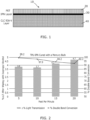
- FIG. 1 illustrates a cross-sectional view of the film 10 produced in Example 8.
- the PET layer may have a thickness of approximately 2.0 mil.
- the IPN layer may have a thickness of approximately 0.6 mil.
- the CLC 93A-V layer may have a thickness of approximately 5.5 mil.
- the test results of this material, identified as LR01267-1, are shown in Table 4 below.
- ⁇ %LT is calculated by subtracting the final percent light transmission of the film after marker removal from the initial percent light transmission of the film prior to being marked. Therefore, the lower the number, the better the removal.
Landscapes
- Chemical & Material Sciences (AREA)
- Health & Medical Sciences (AREA)
- Chemical Kinetics & Catalysis (AREA)
- Medicinal Chemistry (AREA)
- Polymers & Plastics (AREA)
- Organic Chemistry (AREA)
- Engineering & Computer Science (AREA)
- Mechanical Engineering (AREA)
- Manufacturing & Machinery (AREA)
- Physics & Mathematics (AREA)
- Thermal Sciences (AREA)
- Materials Engineering (AREA)
- Laminated Bodies (AREA)
- Polymerisation Methods In General (AREA)
- Graft Or Block Polymers (AREA)
Applications Claiming Priority (2)
| Application Number | Priority Date | Filing Date | Title |
|---|---|---|---|
| US201762587426P | 2017-11-16 | 2017-11-16 | |
| PCT/EP2018/081651 WO2019097031A1 (en) | 2017-11-16 | 2018-11-16 | Thermoplastic polymer film with interpenetrating polymer network |
Publications (2)
| Publication Number | Publication Date |
|---|---|
| EP3710249A1 EP3710249A1 (en) | 2020-09-23 |
| EP3710249B1 true EP3710249B1 (en) | 2025-07-02 |
Family
ID=64332331
Family Applications (1)
| Application Number | Title | Priority Date | Filing Date |
|---|---|---|---|
| EP18804319.4A Active EP3710249B1 (en) | 2017-11-16 | 2018-11-16 | Thermoplastic polymer film with interpenetrating polymer network |
Country Status (8)
| Country | Link |
|---|---|
| US (1) | US11794452B2 (https=) |
| EP (1) | EP3710249B1 (https=) |
| JP (1) | JP7309707B2 (https=) |
| KR (1) | KR102629420B1 (https=) |
| CN (1) | CN111491798A (https=) |
| AU (1) | AU2018367231B2 (https=) |
| ES (1) | ES3044257T3 (https=) |
| WO (1) | WO2019097031A1 (https=) |
Families Citing this family (5)
| Publication number | Priority date | Publication date | Assignee | Title |
|---|---|---|---|---|
| US11479026B2 (en) * | 2019-08-09 | 2022-10-25 | The Boeing Company | System and method for improving thermoset-thermoplastic interface adhesion |
| US11633925B2 (en) | 2019-08-09 | 2023-04-25 | The Boeing Company | System and method for improving thermoset-thermoplastic interface adhesion |
| CN112389061A (zh) * | 2020-11-17 | 2021-02-23 | 苏州顶材新材料有限公司 | 一种具有互穿聚合物网络的热塑性聚合物膜 |
| WO2022140243A1 (en) * | 2020-12-21 | 2022-06-30 | Delstar Technologies, Inc. | Thermoplastic polymer structure and methods for making the same |
| CN116003697A (zh) * | 2022-12-15 | 2023-04-25 | 锦西化工研究院有限公司 | 航空有机玻璃抛光用聚氨酯互穿网络抛光垫及其制备方法 |
Citations (3)
| Publication number | Priority date | Publication date | Assignee | Title |
|---|---|---|---|---|
| WO2006073785A1 (en) * | 2004-12-30 | 2006-07-13 | 3M Innovative Properties Company | Low refractive index fluoropolymer compositions having improved coating and durability properties |
| EP1831728B1 (en) * | 2004-12-30 | 2009-07-29 | 3M Innovative Properties Company | Displays having a high refractive index, durable hardcoat layer |
| WO2010005992A1 (en) * | 2008-07-07 | 2010-01-14 | Biomimedica, Inc. | Hydrophilic interpenetrating polymer networks derived from hydrophobic polymers |
Family Cites Families (21)
| Publication number | Priority date | Publication date | Assignee | Title |
|---|---|---|---|---|
| US4353961A (en) | 1977-09-14 | 1982-10-12 | Raychem Corporation | Shaped article from crosslinked fluorocarbon polymer |
| US5342666A (en) * | 1986-10-28 | 1994-08-30 | Rexham Industries Corp. | Injection molded plastic article with integral weatherable pigmented film surface |
| US5709948A (en) | 1995-09-20 | 1998-01-20 | Minnesota Mining And Manufacturing Company | Semi-interpenetrating polymer networks of epoxy and polyolefin resins, methods therefor, and uses thereof |
| US5965256A (en) | 1997-10-14 | 1999-10-12 | Minnesota Mining And Manufacturing Company | Protective films and coatings |
| US5959775A (en) * | 1997-12-23 | 1999-09-28 | 3M Innovative Properties Company | Urethane/acrylate bead bond for retroreflective articles |
| JP4592535B2 (ja) | 2005-02-23 | 2010-12-01 | 日東電工株式会社 | 多層シートとその製造方法及びこの多層シートを用いた粘着シート |
| KR101419056B1 (ko) | 2005-04-29 | 2014-07-11 | 쓰리엠 이노베이티브 프로퍼티즈 컴파니 | 다층 폴리우레탄 보호 필름 |
| CN101466755B (zh) | 2006-06-14 | 2013-04-24 | 亨茨曼国际有限公司 | 可交联热塑性聚氨酯 |
| US8128779B2 (en) | 2006-10-04 | 2012-03-06 | 3M Innovative Properties Company | Method of making multilayer polyurethane protective film |
| US8096508B2 (en) | 2007-08-10 | 2012-01-17 | 3M Innovative Properties Company | Erosion resistant films for use on heated aerodynamic surfaces |
| JP5324070B2 (ja) * | 2007-08-27 | 2013-10-23 | スリーエム イノベイティブ プロパティズ カンパニー | 高分子ゲル構造体及びその製造方法 |
| JP5632294B2 (ja) | 2008-02-08 | 2014-11-26 | スリーエム イノベイティブ プロパティズ カンパニー | 複合部材 |
| KR20110040969A (ko) | 2008-08-05 | 2011-04-20 | 바이오미메디카, 인코포레이티드 | 폴리우레탄-그라프트된 하이드로겔 |
| DE102008057524A1 (de) | 2008-11-15 | 2010-05-20 | Basf Coatings Ag | Kratzfestbeschichtete Polycarbonate mit hoher Transparenz, Verfahren zu deren Herstellung und deren Verwendung |
| US8568849B2 (en) | 2009-05-20 | 2013-10-29 | Ming Kun Shi | Surface treated film and/or laminate |
| CN102959018B (zh) | 2010-06-25 | 2015-11-25 | 3M创新有限公司 | 半互穿聚合物网络 |
| AU2011293169A1 (en) * | 2010-08-27 | 2013-03-21 | Biomimedica, Inc. | Hydrophobic and hydrophilic interpenetrating polymer networks derived from hydrophobic polymers and methods of preparing the same |
| KR101072371B1 (ko) | 2010-09-20 | 2011-10-11 | 주식회사 엘지화학 | 편광판용 접착제 및 이를 포함하는 편광판 |
| KR101536382B1 (ko) | 2011-01-27 | 2015-07-15 | 주식회사 엘지화학 | 다층 필름 및 이를 포함하는 광전지 모듈 |
| US9074111B2 (en) | 2011-11-21 | 2015-07-07 | 3M Innovative Properties Company | Paint protective film comprising nanoparticles |
| KR101470468B1 (ko) | 2013-03-15 | 2014-12-08 | 주식회사 엘지화학 | 플라스틱 필름 |
-
2018
- 2018-11-16 KR KR1020207016781A patent/KR102629420B1/ko active Active
- 2018-11-16 CN CN201880074620.6A patent/CN111491798A/zh active Pending
- 2018-11-16 EP EP18804319.4A patent/EP3710249B1/en active Active
- 2018-11-16 ES ES18804319T patent/ES3044257T3/es active Active
- 2018-11-16 US US16/193,637 patent/US11794452B2/en active Active
- 2018-11-16 WO PCT/EP2018/081651 patent/WO2019097031A1/en not_active Ceased
- 2018-11-16 AU AU2018367231A patent/AU2018367231B2/en active Active
- 2018-11-16 JP JP2020526919A patent/JP7309707B2/ja active Active
Patent Citations (3)
| Publication number | Priority date | Publication date | Assignee | Title |
|---|---|---|---|---|
| WO2006073785A1 (en) * | 2004-12-30 | 2006-07-13 | 3M Innovative Properties Company | Low refractive index fluoropolymer compositions having improved coating and durability properties |
| EP1831728B1 (en) * | 2004-12-30 | 2009-07-29 | 3M Innovative Properties Company | Displays having a high refractive index, durable hardcoat layer |
| WO2010005992A1 (en) * | 2008-07-07 | 2010-01-14 | Biomimedica, Inc. | Hydrophilic interpenetrating polymer networks derived from hydrophobic polymers |
Also Published As
| Publication number | Publication date |
|---|---|
| CN111491798A (zh) | 2020-08-04 |
| JP2021503392A (ja) | 2021-02-12 |
| KR102629420B1 (ko) | 2024-01-25 |
| ES3044257T3 (en) | 2025-11-26 |
| AU2018367231B2 (en) | 2024-08-08 |
| JP7309707B2 (ja) | 2023-07-18 |
| EP3710249A1 (en) | 2020-09-23 |
| US11794452B2 (en) | 2023-10-24 |
| WO2019097031A1 (en) | 2019-05-23 |
| US20190152200A1 (en) | 2019-05-23 |
| AU2018367231A1 (en) | 2020-05-21 |
| KR20200083587A (ko) | 2020-07-08 |
Similar Documents
| Publication | Publication Date | Title |
|---|---|---|
| EP3710249B1 (en) | Thermoplastic polymer film with interpenetrating polymer network | |
| EP2011837B1 (en) | Active energy ray-curable coating composition and molded article having cured coating film of the composition | |
| EP2848663B1 (en) | Coating composition with excellent tactile characteristics, preparation method thereof, and transfer sheet using same | |
| KR102555048B1 (ko) | 다층막 및 2액 경화형 코팅제 | |
| CN101939389A (zh) | 塑料基材用涂料组合物、由其形成的涂膜、以及成形体 | |
| KR102418410B1 (ko) | 자가복원성 코팅 조성물 및 이를 이용한 시트 | |
| KR102225825B1 (ko) | 광경화성 조성물 및 이의 경화물을 포함하는 코팅층 | |
| WO2008039228A1 (en) | Nanoengineered composite defog coating | |
| WO2012036084A1 (ja) | 光学物品用プライマー組成物及び光学物品 | |
| KR102643114B1 (ko) | 폴리비닐리덴 플루오라이드-아크릴레이트 및 열가소성 폴리우레탄 다층 보호 필름 | |
| KR20150032381A (ko) | 하이그로시용 원코트 상도 도료 조성물 및 그의 도장 방법 | |
| JP6369187B2 (ja) | インサート成型用耐指紋性反射防止フィルム及びこれを用いた樹脂成型品 | |
| JP2019203076A (ja) | コーティング液およびその利用品 | |
| JP7238772B2 (ja) | 積層フィルム | |
| JP2020164677A (ja) | 光重合性コーティング組成物およびその利用品 | |
| WO2019225476A1 (ja) | コーティング液およびその利用品 | |
| KR102875768B1 (ko) | 자동차 도막 보호용 코팅층 및 그 제조 방법, 및 이를 이용한 자동차 도막 보호 필름 | |
| KR20140115828A (ko) | 스크래치 자가복원 도료 조성물 | |
| KR102934228B1 (ko) | 하드 코팅 필름 | |
| WO2019159974A1 (ja) | 防曇性積層体及び防曇性積層体の製造方法 | |
| CN114787284B (zh) | 树脂组合物、由该树脂组合物形成的树脂膜、具备该树脂膜的玻璃叠层体 | |
| KR102760865B1 (ko) | 도막 보호 필름용 조성물 | |
| JP5568716B1 (ja) | 防汚性樹脂組成物 | |
| KR20210013844A (ko) | 페인트보호필름용 코팅층 조성물, 이의 경화물인 페인트보호필름용 코팅층, 및 코팅층을 포함하는 페인트보호필름 | |
| CN117801656A (zh) | 具有改进的抗菌性的用于水转印的涂料组合物 |
Legal Events
| Date | Code | Title | Description |
|---|---|---|---|
| STAA | Information on the status of an ep patent application or granted ep patent |
Free format text: STATUS: UNKNOWN |
|
| STAA | Information on the status of an ep patent application or granted ep patent |
Free format text: STATUS: THE INTERNATIONAL PUBLICATION HAS BEEN MADE |
|
| PUAI | Public reference made under article 153(3) epc to a published international application that has entered the european phase |
Free format text: ORIGINAL CODE: 0009012 |
|
| STAA | Information on the status of an ep patent application or granted ep patent |
Free format text: STATUS: REQUEST FOR EXAMINATION WAS MADE |
|
| 17P | Request for examination filed |
Effective date: 20200430 |
|
| AK | Designated contracting states |
Kind code of ref document: A1 Designated state(s): AL AT BE BG CH CY CZ DE DK EE ES FI FR GB GR HR HU IE IS IT LI LT LU LV MC MK MT NL NO PL PT RO RS SE SI SK SM TR |
|
| AX | Request for extension of the european patent |
Extension state: BA ME |
|
| DAV | Request for validation of the european patent (deleted) | ||
| DAX | Request for extension of the european patent (deleted) | ||
| STAA | Information on the status of an ep patent application or granted ep patent |
Free format text: STATUS: EXAMINATION IS IN PROGRESS |
|
| 17Q | First examination report despatched |
Effective date: 20220627 |
|
| GRAP | Despatch of communication of intention to grant a patent |
Free format text: ORIGINAL CODE: EPIDOSNIGR1 |
|
| STAA | Information on the status of an ep patent application or granted ep patent |
Free format text: STATUS: GRANT OF PATENT IS INTENDED |
|
| RIC1 | Information provided on ipc code assigned before grant |
Ipc: C08L 75/06 20060101ALI20250110BHEP Ipc: C08L 51/08 20060101ALI20250110BHEP Ipc: C08G 18/75 20060101ALI20250110BHEP Ipc: C08G 18/42 20060101ALI20250110BHEP Ipc: C08F 283/00 20060101ALI20250110BHEP Ipc: B32B 27/26 20060101ALI20250110BHEP Ipc: B32B 27/18 20060101ALI20250110BHEP Ipc: B32B 27/16 20060101ALI20250110BHEP Ipc: B32B 7/02 20190101ALI20250110BHEP Ipc: B32B 27/40 20060101ALI20250110BHEP Ipc: B32B 27/36 20060101AFI20250110BHEP |
|
| INTG | Intention to grant announced |
Effective date: 20250124 |
|
| GRAS | Grant fee paid |
Free format text: ORIGINAL CODE: EPIDOSNIGR3 |
|
| GRAA | (expected) grant |
Free format text: ORIGINAL CODE: 0009210 |
|
| STAA | Information on the status of an ep patent application or granted ep patent |
Free format text: STATUS: THE PATENT HAS BEEN GRANTED |
|
| AK | Designated contracting states |
Kind code of ref document: B1 Designated state(s): AL AT BE BG CH CY CZ DE DK EE ES FI FR GB GR HR HU IE IS IT LI LT LU LV MC MK MT NL NO PL PT RO RS SE SI SK SM TR |
|
| REG | Reference to a national code |
Ref country code: GB Ref legal event code: FG4D |
|
| P01 | Opt-out of the competence of the unified patent court (upc) registered |
Free format text: CASE NUMBER: APP_26284/2025 Effective date: 20250603 |
|
| REG | Reference to a national code |
Ref country code: CH Ref legal event code: EP |
|
| REG | Reference to a national code |
Ref country code: DE Ref legal event code: R096 Ref document number: 602018083235 Country of ref document: DE |
|
| REG | Reference to a national code |
Ref country code: IE Ref legal event code: FG4D |
|
| RAP4 | Party data changed (patent owner data changed or rights of a patent transferred) |
Owner name: MATIV LUXEMBOURG |
|
| REG | Reference to a national code |
Ref country code: DE Ref legal event code: R081 Ref document number: 602018083235 Country of ref document: DE Owner name: MATIV LUXEMBOURG, LU Free format text: FORMER OWNER: SWM LUXEMBOURG SARL, CONTERN, LU |
|
| REG | Reference to a national code |
Ref country code: NL Ref legal event code: MP Effective date: 20250702 |
|
| REG | Reference to a national code |
Ref country code: ES Ref legal event code: FG2A Ref document number: 3044257 Country of ref document: ES Kind code of ref document: T3 Effective date: 20251126 |
|
| PG25 | Lapsed in a contracting state [announced via postgrant information from national office to epo] |
Ref country code: PT Free format text: LAPSE BECAUSE OF FAILURE TO SUBMIT A TRANSLATION OF THE DESCRIPTION OR TO PAY THE FEE WITHIN THE PRESCRIBED TIME-LIMIT Effective date: 20251103 |
|
| PG25 | Lapsed in a contracting state [announced via postgrant information from national office to epo] |
Ref country code: NL Free format text: LAPSE BECAUSE OF FAILURE TO SUBMIT A TRANSLATION OF THE DESCRIPTION OR TO PAY THE FEE WITHIN THE PRESCRIBED TIME-LIMIT Effective date: 20250702 |
|
| REG | Reference to a national code |
Ref country code: AT Ref legal event code: MK05 Ref document number: 1808805 Country of ref document: AT Kind code of ref document: T Effective date: 20250702 |
|
| PG25 | Lapsed in a contracting state [announced via postgrant information from national office to epo] |
Ref country code: IS Free format text: LAPSE BECAUSE OF FAILURE TO SUBMIT A TRANSLATION OF THE DESCRIPTION OR TO PAY THE FEE WITHIN THE PRESCRIBED TIME-LIMIT Effective date: 20251102 |
|
| PGFP | Annual fee paid to national office [announced via postgrant information from national office to epo] |
Ref country code: DE Payment date: 20251028 Year of fee payment: 8 |
|
| PGFP | Annual fee paid to national office [announced via postgrant information from national office to epo] |
Ref country code: GB Payment date: 20251023 Year of fee payment: 8 |
|
| PG25 | Lapsed in a contracting state [announced via postgrant information from national office to epo] |
Ref country code: NO Free format text: LAPSE BECAUSE OF FAILURE TO SUBMIT A TRANSLATION OF THE DESCRIPTION OR TO PAY THE FEE WITHIN THE PRESCRIBED TIME-LIMIT Effective date: 20251002 |
|
| REG | Reference to a national code |
Ref country code: LT Ref legal event code: MG9D |
|
| PG25 | Lapsed in a contracting state [announced via postgrant information from national office to epo] |
Ref country code: AT Free format text: LAPSE BECAUSE OF FAILURE TO SUBMIT A TRANSLATION OF THE DESCRIPTION OR TO PAY THE FEE WITHIN THE PRESCRIBED TIME-LIMIT Effective date: 20250702 |
|
| PG25 | Lapsed in a contracting state [announced via postgrant information from national office to epo] |
Ref country code: FI Free format text: LAPSE BECAUSE OF FAILURE TO SUBMIT A TRANSLATION OF THE DESCRIPTION OR TO PAY THE FEE WITHIN THE PRESCRIBED TIME-LIMIT Effective date: 20250702 |
|
| PGFP | Annual fee paid to national office [announced via postgrant information from national office to epo] |
Ref country code: IT Payment date: 20251030 Year of fee payment: 8 |
|
| PG25 | Lapsed in a contracting state [announced via postgrant information from national office to epo] |
Ref country code: HR Free format text: LAPSE BECAUSE OF FAILURE TO SUBMIT A TRANSLATION OF THE DESCRIPTION OR TO PAY THE FEE WITHIN THE PRESCRIBED TIME-LIMIT Effective date: 20250702 |
|
| PGFP | Annual fee paid to national office [announced via postgrant information from national office to epo] |
Ref country code: FR Payment date: 20251110 Year of fee payment: 8 |
|
| PG25 | Lapsed in a contracting state [announced via postgrant information from national office to epo] |
Ref country code: GR Free format text: LAPSE BECAUSE OF FAILURE TO SUBMIT A TRANSLATION OF THE DESCRIPTION OR TO PAY THE FEE WITHIN THE PRESCRIBED TIME-LIMIT Effective date: 20251003 |
|
| PG25 | Lapsed in a contracting state [announced via postgrant information from national office to epo] |
Ref country code: SE Free format text: LAPSE BECAUSE OF FAILURE TO SUBMIT A TRANSLATION OF THE DESCRIPTION OR TO PAY THE FEE WITHIN THE PRESCRIBED TIME-LIMIT Effective date: 20250702 Ref country code: CZ Free format text: LAPSE BECAUSE OF FAILURE TO SUBMIT A TRANSLATION OF THE DESCRIPTION OR TO PAY THE FEE WITHIN THE PRESCRIBED TIME-LIMIT Effective date: 20250702 |
|
| PG25 | Lapsed in a contracting state [announced via postgrant information from national office to epo] |
Ref country code: LV Free format text: LAPSE BECAUSE OF FAILURE TO SUBMIT A TRANSLATION OF THE DESCRIPTION OR TO PAY THE FEE WITHIN THE PRESCRIBED TIME-LIMIT Effective date: 20250702 |
|
| PG25 | Lapsed in a contracting state [announced via postgrant information from national office to epo] |
Ref country code: PL Free format text: LAPSE BECAUSE OF FAILURE TO SUBMIT A TRANSLATION OF THE DESCRIPTION OR TO PAY THE FEE WITHIN THE PRESCRIBED TIME-LIMIT Effective date: 20250702 Ref country code: BG Free format text: LAPSE BECAUSE OF FAILURE TO SUBMIT A TRANSLATION OF THE DESCRIPTION OR TO PAY THE FEE WITHIN THE PRESCRIBED TIME-LIMIT Effective date: 20250702 |
|
| PG25 | Lapsed in a contracting state [announced via postgrant information from national office to epo] |
Ref country code: RS Free format text: LAPSE BECAUSE OF FAILURE TO SUBMIT A TRANSLATION OF THE DESCRIPTION OR TO PAY THE FEE WITHIN THE PRESCRIBED TIME-LIMIT Effective date: 20251002 |
|
| PGFP | Annual fee paid to national office [announced via postgrant information from national office to epo] |
Ref country code: ES Payment date: 20251212 Year of fee payment: 8 |
|
| PG25 | Lapsed in a contracting state [announced via postgrant information from national office to epo] |
Ref country code: RO Free format text: LAPSE BECAUSE OF FAILURE TO SUBMIT A TRANSLATION OF THE DESCRIPTION OR TO PAY THE FEE WITHIN THE PRESCRIBED TIME-LIMIT Effective date: 20250702 |
|
| PG25 | Lapsed in a contracting state [announced via postgrant information from national office to epo] |
Ref country code: SM Free format text: LAPSE BECAUSE OF FAILURE TO SUBMIT A TRANSLATION OF THE DESCRIPTION OR TO PAY THE FEE WITHIN THE PRESCRIBED TIME-LIMIT Effective date: 20250702 |
|
| PG25 | Lapsed in a contracting state [announced via postgrant information from national office to epo] |
Ref country code: DK Free format text: LAPSE BECAUSE OF FAILURE TO SUBMIT A TRANSLATION OF THE DESCRIPTION OR TO PAY THE FEE WITHIN THE PRESCRIBED TIME-LIMIT Effective date: 20250702 |
|
| PG25 | Lapsed in a contracting state [announced via postgrant information from national office to epo] |
Ref country code: SK Free format text: LAPSE BECAUSE OF FAILURE TO SUBMIT A TRANSLATION OF THE DESCRIPTION OR TO PAY THE FEE WITHIN THE PRESCRIBED TIME-LIMIT Effective date: 20250702 Ref country code: EE Free format text: LAPSE BECAUSE OF FAILURE TO SUBMIT A TRANSLATION OF THE DESCRIPTION OR TO PAY THE FEE WITHIN THE PRESCRIBED TIME-LIMIT Effective date: 20250702 |