EP3707356B1 - Katalysierter russfilter mit reduzierter ammoniakoxidation - Google Patents
Katalysierter russfilter mit reduzierter ammoniakoxidation Download PDFInfo
- Publication number
- EP3707356B1 EP3707356B1 EP18875123.4A EP18875123A EP3707356B1 EP 3707356 B1 EP3707356 B1 EP 3707356B1 EP 18875123 A EP18875123 A EP 18875123A EP 3707356 B1 EP3707356 B1 EP 3707356B1
- Authority
- EP
- European Patent Office
- Prior art keywords
- filter
- oxidation catalyst
- catalyst composition
- csf
- selective oxidation
- Prior art date
- Legal status (The legal status is an assumption and is not a legal conclusion. Google has not performed a legal analysis and makes no representation as to the accuracy of the status listed.)
- Active
Links
Images

Classifications
-
- F—MECHANICAL ENGINEERING; LIGHTING; HEATING; WEAPONS; BLASTING
- F01—MACHINES OR ENGINES IN GENERAL; ENGINE PLANTS IN GENERAL; STEAM ENGINES
- F01N—GAS-FLOW SILENCERS OR EXHAUST APPARATUS FOR MACHINES OR ENGINES IN GENERAL; GAS-FLOW SILENCERS OR EXHAUST APPARATUS FOR INTERNAL-COMBUSTION ENGINES
- F01N3/00—Exhaust or silencing apparatus having means for purifying, rendering innocuous, or otherwise treating exhaust
- F01N3/08—Exhaust or silencing apparatus having means for purifying, rendering innocuous, or otherwise treating exhaust for rendering innocuous
- F01N3/10—Exhaust or silencing apparatus having means for purifying, rendering innocuous, or otherwise treating exhaust for rendering innocuous by thermal or catalytic conversion of noxious components of exhaust
- F01N3/24—Exhaust or silencing apparatus having means for purifying, rendering innocuous, or otherwise treating exhaust for rendering innocuous by thermal or catalytic conversion of noxious components of exhaust characterised by constructional aspects of converting apparatus
- F01N3/28—Construction of catalytic reactors
-
- F—MECHANICAL ENGINEERING; LIGHTING; HEATING; WEAPONS; BLASTING
- F01—MACHINES OR ENGINES IN GENERAL; ENGINE PLANTS IN GENERAL; STEAM ENGINES
- F01N—GAS-FLOW SILENCERS OR EXHAUST APPARATUS FOR MACHINES OR ENGINES IN GENERAL; GAS-FLOW SILENCERS OR EXHAUST APPARATUS FOR INTERNAL-COMBUSTION ENGINES
- F01N3/00—Exhaust or silencing apparatus having means for purifying, rendering innocuous, or otherwise treating exhaust
- F01N3/08—Exhaust or silencing apparatus having means for purifying, rendering innocuous, or otherwise treating exhaust for rendering innocuous
- F01N3/10—Exhaust or silencing apparatus having means for purifying, rendering innocuous, or otherwise treating exhaust for rendering innocuous by thermal or catalytic conversion of noxious components of exhaust
- F01N3/103—Oxidation catalysts for HC and CO only
-
- B—PERFORMING OPERATIONS; TRANSPORTING
- B01—PHYSICAL OR CHEMICAL PROCESSES OR APPARATUS IN GENERAL
- B01D—SEPARATION
- B01D53/00—Separation of gases or vapours; Recovering vapours of volatile solvents from gases; Chemical or biological purification of waste gases, e.g. engine exhaust gases, smoke, fumes, flue gases, aerosols
- B01D53/34—Chemical or biological purification of waste gases
- B01D53/92—Chemical or biological purification of waste gases of engine exhaust gases
- B01D53/94—Chemical or biological purification of waste gases of engine exhaust gases by catalytic processes
- B01D53/9404—Removing only nitrogen compounds
- B01D53/9409—Nitrogen oxides
- B01D53/9413—Processes characterised by a specific catalyst
- B01D53/9418—Processes characterised by a specific catalyst for removing nitrogen oxides by selective catalytic reduction [SCR] using a reducing agent in a lean exhaust gas
-
- B—PERFORMING OPERATIONS; TRANSPORTING
- B01—PHYSICAL OR CHEMICAL PROCESSES OR APPARATUS IN GENERAL
- B01D—SEPARATION
- B01D53/00—Separation of gases or vapours; Recovering vapours of volatile solvents from gases; Chemical or biological purification of waste gases, e.g. engine exhaust gases, smoke, fumes, flue gases, aerosols
- B01D53/34—Chemical or biological purification of waste gases
- B01D53/92—Chemical or biological purification of waste gases of engine exhaust gases
- B01D53/94—Chemical or biological purification of waste gases of engine exhaust gases by catalytic processes
- B01D53/944—Simultaneously removing carbon monoxide, hydrocarbons or carbon making use of oxidation catalysts
-
- B—PERFORMING OPERATIONS; TRANSPORTING
- B01—PHYSICAL OR CHEMICAL PROCESSES OR APPARATUS IN GENERAL
- B01D—SEPARATION
- B01D53/00—Separation of gases or vapours; Recovering vapours of volatile solvents from gases; Chemical or biological purification of waste gases, e.g. engine exhaust gases, smoke, fumes, flue gases, aerosols
- B01D53/34—Chemical or biological purification of waste gases
- B01D53/92—Chemical or biological purification of waste gases of engine exhaust gases
- B01D53/94—Chemical or biological purification of waste gases of engine exhaust gases by catalytic processes
- B01D53/9459—Removing one or more of nitrogen oxides, carbon monoxide, or hydrocarbons by multiple successive catalytic functions; systems with more than one different function, e.g. zone coated catalysts
- B01D53/9463—Removing one or more of nitrogen oxides, carbon monoxide, or hydrocarbons by multiple successive catalytic functions; systems with more than one different function, e.g. zone coated catalysts with catalysts positioned on one brick
- B01D53/9472—Removing one or more of nitrogen oxides, carbon monoxide, or hydrocarbons by multiple successive catalytic functions; systems with more than one different function, e.g. zone coated catalysts with catalysts positioned on one brick in different zones
-
- B—PERFORMING OPERATIONS; TRANSPORTING
- B01—PHYSICAL OR CHEMICAL PROCESSES OR APPARATUS IN GENERAL
- B01D—SEPARATION
- B01D53/00—Separation of gases or vapours; Recovering vapours of volatile solvents from gases; Chemical or biological purification of waste gases, e.g. engine exhaust gases, smoke, fumes, flue gases, aerosols
- B01D53/34—Chemical or biological purification of waste gases
- B01D53/92—Chemical or biological purification of waste gases of engine exhaust gases
- B01D53/94—Chemical or biological purification of waste gases of engine exhaust gases by catalytic processes
- B01D53/9459—Removing one or more of nitrogen oxides, carbon monoxide, or hydrocarbons by multiple successive catalytic functions; systems with more than one different function, e.g. zone coated catalysts
- B01D53/9477—Removing one or more of nitrogen oxides, carbon monoxide, or hydrocarbons by multiple successive catalytic functions; systems with more than one different function, e.g. zone coated catalysts with catalysts positioned on separate bricks, e.g. exhaust systems
-
- B—PERFORMING OPERATIONS; TRANSPORTING
- B01—PHYSICAL OR CHEMICAL PROCESSES OR APPARATUS IN GENERAL
- B01J—CHEMICAL OR PHYSICAL PROCESSES, e.g. CATALYSIS OR COLLOID CHEMISTRY; THEIR RELEVANT APPARATUS
- B01J23/00—Catalysts comprising metals or metal oxides or hydroxides, not provided for in group B01J21/00
- B01J23/002—Mixed oxides other than spinels, e.g. perovskite
-
- B—PERFORMING OPERATIONS; TRANSPORTING
- B01—PHYSICAL OR CHEMICAL PROCESSES OR APPARATUS IN GENERAL
- B01J—CHEMICAL OR PHYSICAL PROCESSES, e.g. CATALYSIS OR COLLOID CHEMISTRY; THEIR RELEVANT APPARATUS
- B01J23/00—Catalysts comprising metals or metal oxides or hydroxides, not provided for in group B01J21/00
- B01J23/38—Catalysts comprising metals or metal oxides or hydroxides, not provided for in group B01J21/00 of noble metals
- B01J23/40—Catalysts comprising metals or metal oxides or hydroxides, not provided for in group B01J21/00 of noble metals of the platinum group metals
- B01J23/44—Palladium
-
- B—PERFORMING OPERATIONS; TRANSPORTING
- B01—PHYSICAL OR CHEMICAL PROCESSES OR APPARATUS IN GENERAL
- B01J—CHEMICAL OR PHYSICAL PROCESSES, e.g. CATALYSIS OR COLLOID CHEMISTRY; THEIR RELEVANT APPARATUS
- B01J23/00—Catalysts comprising metals or metal oxides or hydroxides, not provided for in group B01J21/00
- B01J23/70—Catalysts comprising metals or metal oxides or hydroxides, not provided for in group B01J21/00 of the iron group metals or copper
- B01J23/72—Copper
-
- B—PERFORMING OPERATIONS; TRANSPORTING
- B01—PHYSICAL OR CHEMICAL PROCESSES OR APPARATUS IN GENERAL
- B01J—CHEMICAL OR PHYSICAL PROCESSES, e.g. CATALYSIS OR COLLOID CHEMISTRY; THEIR RELEVANT APPARATUS
- B01J23/00—Catalysts comprising metals or metal oxides or hydroxides, not provided for in group B01J21/00
- B01J23/70—Catalysts comprising metals or metal oxides or hydroxides, not provided for in group B01J21/00 of the iron group metals or copper
- B01J23/89—Catalysts comprising metals or metal oxides or hydroxides, not provided for in group B01J21/00 of the iron group metals or copper combined with noble metals
- B01J23/8926—Copper and noble metals
-
- B—PERFORMING OPERATIONS; TRANSPORTING
- B01—PHYSICAL OR CHEMICAL PROCESSES OR APPARATUS IN GENERAL
- B01J—CHEMICAL OR PHYSICAL PROCESSES, e.g. CATALYSIS OR COLLOID CHEMISTRY; THEIR RELEVANT APPARATUS
- B01J29/00—Catalysts comprising molecular sieves
- B01J29/04—Catalysts comprising molecular sieves having base-exchange properties, e.g. crystalline zeolites
- B01J29/06—Crystalline aluminosilicate zeolites; Isomorphous compounds thereof
- B01J29/70—Crystalline aluminosilicate zeolites; Isomorphous compounds thereof of types characterised by their specific structure not provided for in groups B01J29/08 - B01J29/65
- B01J29/72—Crystalline aluminosilicate zeolites; Isomorphous compounds thereof of types characterised by their specific structure not provided for in groups B01J29/08 - B01J29/65 containing iron group metals, noble metals or copper
- B01J29/74—Noble metals
- B01J29/743—CHA-type, e.g. Chabazite, LZ-218
-
- B—PERFORMING OPERATIONS; TRANSPORTING
- B01—PHYSICAL OR CHEMICAL PROCESSES OR APPARATUS IN GENERAL
- B01J—CHEMICAL OR PHYSICAL PROCESSES, e.g. CATALYSIS OR COLLOID CHEMISTRY; THEIR RELEVANT APPARATUS
- B01J29/00—Catalysts comprising molecular sieves
- B01J29/04—Catalysts comprising molecular sieves having base-exchange properties, e.g. crystalline zeolites
- B01J29/06—Crystalline aluminosilicate zeolites; Isomorphous compounds thereof
- B01J29/70—Crystalline aluminosilicate zeolites; Isomorphous compounds thereof of types characterised by their specific structure not provided for in groups B01J29/08 - B01J29/65
- B01J29/72—Crystalline aluminosilicate zeolites; Isomorphous compounds thereof of types characterised by their specific structure not provided for in groups B01J29/08 - B01J29/65 containing iron group metals, noble metals or copper
- B01J29/76—Iron group metals or copper
- B01J29/763—CHA-type, e.g. Chabazite, LZ-218
-
- B—PERFORMING OPERATIONS; TRANSPORTING
- B01—PHYSICAL OR CHEMICAL PROCESSES OR APPARATUS IN GENERAL
- B01J—CHEMICAL OR PHYSICAL PROCESSES, e.g. CATALYSIS OR COLLOID CHEMISTRY; THEIR RELEVANT APPARATUS
- B01J37/00—Processes, in general, for preparing catalysts; Processes, in general, for activation of catalysts
- B01J37/02—Impregnation, coating or precipitation
- B01J37/0201—Impregnation
-
- B—PERFORMING OPERATIONS; TRANSPORTING
- B01—PHYSICAL OR CHEMICAL PROCESSES OR APPARATUS IN GENERAL
- B01J—CHEMICAL OR PHYSICAL PROCESSES, e.g. CATALYSIS OR COLLOID CHEMISTRY; THEIR RELEVANT APPARATUS
- B01J37/00—Processes, in general, for preparing catalysts; Processes, in general, for activation of catalysts
- B01J37/02—Impregnation, coating or precipitation
- B01J37/0215—Coating
-
- B—PERFORMING OPERATIONS; TRANSPORTING
- B01—PHYSICAL OR CHEMICAL PROCESSES OR APPARATUS IN GENERAL
- B01J—CHEMICAL OR PHYSICAL PROCESSES, e.g. CATALYSIS OR COLLOID CHEMISTRY; THEIR RELEVANT APPARATUS
- B01J37/00—Processes, in general, for preparing catalysts; Processes, in general, for activation of catalysts
- B01J37/04—Mixing
-
- B—PERFORMING OPERATIONS; TRANSPORTING
- B01—PHYSICAL OR CHEMICAL PROCESSES OR APPARATUS IN GENERAL
- B01J—CHEMICAL OR PHYSICAL PROCESSES, e.g. CATALYSIS OR COLLOID CHEMISTRY; THEIR RELEVANT APPARATUS
- B01J37/00—Processes, in general, for preparing catalysts; Processes, in general, for activation of catalysts
- B01J37/08—Heat treatment
- B01J37/082—Decomposition and pyrolysis
- B01J37/088—Decomposition of a metal salt
-
- F—MECHANICAL ENGINEERING; LIGHTING; HEATING; WEAPONS; BLASTING
- F01—MACHINES OR ENGINES IN GENERAL; ENGINE PLANTS IN GENERAL; STEAM ENGINES
- F01N—GAS-FLOW SILENCERS OR EXHAUST APPARATUS FOR MACHINES OR ENGINES IN GENERAL; GAS-FLOW SILENCERS OR EXHAUST APPARATUS FOR INTERNAL-COMBUSTION ENGINES
- F01N13/00—Exhaust or silencing apparatus characterised by constructional features
- F01N13/009—Exhaust or silencing apparatus characterised by constructional features having two or more separate purifying devices arranged in series
-
- F—MECHANICAL ENGINEERING; LIGHTING; HEATING; WEAPONS; BLASTING
- F01—MACHINES OR ENGINES IN GENERAL; ENGINE PLANTS IN GENERAL; STEAM ENGINES
- F01N—GAS-FLOW SILENCERS OR EXHAUST APPARATUS FOR MACHINES OR ENGINES IN GENERAL; GAS-FLOW SILENCERS OR EXHAUST APPARATUS FOR INTERNAL-COMBUSTION ENGINES
- F01N3/00—Exhaust or silencing apparatus having means for purifying, rendering innocuous, or otherwise treating exhaust
- F01N3/02—Exhaust or silencing apparatus having means for purifying, rendering innocuous, or otherwise treating exhaust for cooling, or for removing solid constituents of, exhaust
- F01N3/021—Exhaust or silencing apparatus having means for purifying, rendering innocuous, or otherwise treating exhaust for cooling, or for removing solid constituents of, exhaust by means of filters
- F01N3/033—Exhaust or silencing apparatus having means for purifying, rendering innocuous, or otherwise treating exhaust for cooling, or for removing solid constituents of, exhaust by means of filters in combination with other devices
- F01N3/035—Exhaust or silencing apparatus having means for purifying, rendering innocuous, or otherwise treating exhaust for cooling, or for removing solid constituents of, exhaust by means of filters in combination with other devices with catalytic reactors
-
- F—MECHANICAL ENGINEERING; LIGHTING; HEATING; WEAPONS; BLASTING
- F01—MACHINES OR ENGINES IN GENERAL; ENGINE PLANTS IN GENERAL; STEAM ENGINES
- F01N—GAS-FLOW SILENCERS OR EXHAUST APPARATUS FOR MACHINES OR ENGINES IN GENERAL; GAS-FLOW SILENCERS OR EXHAUST APPARATUS FOR INTERNAL-COMBUSTION ENGINES
- F01N3/00—Exhaust or silencing apparatus having means for purifying, rendering innocuous, or otherwise treating exhaust
- F01N3/08—Exhaust or silencing apparatus having means for purifying, rendering innocuous, or otherwise treating exhaust for rendering innocuous
- F01N3/0807—Exhaust or silencing apparatus having means for purifying, rendering innocuous, or otherwise treating exhaust for rendering innocuous by using absorbents or adsorbents
- F01N3/0828—Exhaust or silencing apparatus having means for purifying, rendering innocuous, or otherwise treating exhaust for rendering innocuous by using absorbents or adsorbents characterised by the absorbed or adsorbed substances
- F01N3/0842—Nitrogen oxides
-
- F—MECHANICAL ENGINEERING; LIGHTING; HEATING; WEAPONS; BLASTING
- F01—MACHINES OR ENGINES IN GENERAL; ENGINE PLANTS IN GENERAL; STEAM ENGINES
- F01N—GAS-FLOW SILENCERS OR EXHAUST APPARATUS FOR MACHINES OR ENGINES IN GENERAL; GAS-FLOW SILENCERS OR EXHAUST APPARATUS FOR INTERNAL-COMBUSTION ENGINES
- F01N3/00—Exhaust or silencing apparatus having means for purifying, rendering innocuous, or otherwise treating exhaust
- F01N3/08—Exhaust or silencing apparatus having means for purifying, rendering innocuous, or otherwise treating exhaust for rendering innocuous
- F01N3/10—Exhaust or silencing apparatus having means for purifying, rendering innocuous, or otherwise treating exhaust for rendering innocuous by thermal or catalytic conversion of noxious components of exhaust
-
- F—MECHANICAL ENGINEERING; LIGHTING; HEATING; WEAPONS; BLASTING
- F01—MACHINES OR ENGINES IN GENERAL; ENGINE PLANTS IN GENERAL; STEAM ENGINES
- F01N—GAS-FLOW SILENCERS OR EXHAUST APPARATUS FOR MACHINES OR ENGINES IN GENERAL; GAS-FLOW SILENCERS OR EXHAUST APPARATUS FOR INTERNAL-COMBUSTION ENGINES
- F01N3/00—Exhaust or silencing apparatus having means for purifying, rendering innocuous, or otherwise treating exhaust
- F01N3/08—Exhaust or silencing apparatus having means for purifying, rendering innocuous, or otherwise treating exhaust for rendering innocuous
- F01N3/10—Exhaust or silencing apparatus having means for purifying, rendering innocuous, or otherwise treating exhaust for rendering innocuous by thermal or catalytic conversion of noxious components of exhaust
- F01N3/105—General auxiliary catalysts, e.g. upstream or downstream of the main catalyst
- F01N3/106—Auxiliary oxidation catalysts
-
- F—MECHANICAL ENGINEERING; LIGHTING; HEATING; WEAPONS; BLASTING
- F01—MACHINES OR ENGINES IN GENERAL; ENGINE PLANTS IN GENERAL; STEAM ENGINES
- F01N—GAS-FLOW SILENCERS OR EXHAUST APPARATUS FOR MACHINES OR ENGINES IN GENERAL; GAS-FLOW SILENCERS OR EXHAUST APPARATUS FOR INTERNAL-COMBUSTION ENGINES
- F01N3/00—Exhaust or silencing apparatus having means for purifying, rendering innocuous, or otherwise treating exhaust
- F01N3/08—Exhaust or silencing apparatus having means for purifying, rendering innocuous, or otherwise treating exhaust for rendering innocuous
- F01N3/10—Exhaust or silencing apparatus having means for purifying, rendering innocuous, or otherwise treating exhaust for rendering innocuous by thermal or catalytic conversion of noxious components of exhaust
- F01N3/18—Exhaust or silencing apparatus having means for purifying, rendering innocuous, or otherwise treating exhaust for rendering innocuous by thermal or catalytic conversion of noxious components of exhaust characterised by methods of operation; Control
- F01N3/20—Exhaust or silencing apparatus having means for purifying, rendering innocuous, or otherwise treating exhaust for rendering innocuous by thermal or catalytic conversion of noxious components of exhaust characterised by methods of operation; Control specially adapted for catalytic conversion
-
- F—MECHANICAL ENGINEERING; LIGHTING; HEATING; WEAPONS; BLASTING
- F01—MACHINES OR ENGINES IN GENERAL; ENGINE PLANTS IN GENERAL; STEAM ENGINES
- F01N—GAS-FLOW SILENCERS OR EXHAUST APPARATUS FOR MACHINES OR ENGINES IN GENERAL; GAS-FLOW SILENCERS OR EXHAUST APPARATUS FOR INTERNAL-COMBUSTION ENGINES
- F01N3/00—Exhaust or silencing apparatus having means for purifying, rendering innocuous, or otherwise treating exhaust
- F01N3/08—Exhaust or silencing apparatus having means for purifying, rendering innocuous, or otherwise treating exhaust for rendering innocuous
- F01N3/10—Exhaust or silencing apparatus having means for purifying, rendering innocuous, or otherwise treating exhaust for rendering innocuous by thermal or catalytic conversion of noxious components of exhaust
- F01N3/18—Exhaust or silencing apparatus having means for purifying, rendering innocuous, or otherwise treating exhaust for rendering innocuous by thermal or catalytic conversion of noxious components of exhaust characterised by methods of operation; Control
- F01N3/20—Exhaust or silencing apparatus having means for purifying, rendering innocuous, or otherwise treating exhaust for rendering innocuous by thermal or catalytic conversion of noxious components of exhaust characterised by methods of operation; Control specially adapted for catalytic conversion
- F01N3/206—Adding periodically or continuously substances to exhaust gases for promoting purification, e.g. catalytic material in liquid form, NOx reducing agents
- F01N3/2066—Selective catalytic reduction [SCR]
-
- F—MECHANICAL ENGINEERING; LIGHTING; HEATING; WEAPONS; BLASTING
- F01—MACHINES OR ENGINES IN GENERAL; ENGINE PLANTS IN GENERAL; STEAM ENGINES
- F01N—GAS-FLOW SILENCERS OR EXHAUST APPARATUS FOR MACHINES OR ENGINES IN GENERAL; GAS-FLOW SILENCERS OR EXHAUST APPARATUS FOR INTERNAL-COMBUSTION ENGINES
- F01N3/00—Exhaust or silencing apparatus having means for purifying, rendering innocuous, or otherwise treating exhaust
- F01N3/08—Exhaust or silencing apparatus having means for purifying, rendering innocuous, or otherwise treating exhaust for rendering innocuous
- F01N3/10—Exhaust or silencing apparatus having means for purifying, rendering innocuous, or otherwise treating exhaust for rendering innocuous by thermal or catalytic conversion of noxious components of exhaust
- F01N3/18—Exhaust or silencing apparatus having means for purifying, rendering innocuous, or otherwise treating exhaust for rendering innocuous by thermal or catalytic conversion of noxious components of exhaust characterised by methods of operation; Control
- F01N3/20—Exhaust or silencing apparatus having means for purifying, rendering innocuous, or otherwise treating exhaust for rendering innocuous by thermal or catalytic conversion of noxious components of exhaust characterised by methods of operation; Control specially adapted for catalytic conversion
- F01N3/206—Adding periodically or continuously substances to exhaust gases for promoting purification, e.g. catalytic material in liquid form, NOx reducing agents
- F01N3/208—Control of selective catalytic reduction [SCR], e.g. by adjusting the dosing of reducing agent
-
- B—PERFORMING OPERATIONS; TRANSPORTING
- B01—PHYSICAL OR CHEMICAL PROCESSES OR APPARATUS IN GENERAL
- B01D—SEPARATION
- B01D2255/00—Catalysts
- B01D2255/10—Noble metals or compounds thereof
- B01D2255/102—Platinum group metals
- B01D2255/1023—Palladium
-
- B—PERFORMING OPERATIONS; TRANSPORTING
- B01—PHYSICAL OR CHEMICAL PROCESSES OR APPARATUS IN GENERAL
- B01D—SEPARATION
- B01D2255/00—Catalysts
- B01D2255/20—Metals or compounds thereof
- B01D2255/207—Transition metals
- B01D2255/20761—Copper
-
- B—PERFORMING OPERATIONS; TRANSPORTING
- B01—PHYSICAL OR CHEMICAL PROCESSES OR APPARATUS IN GENERAL
- B01D—SEPARATION
- B01D2255/00—Catalysts
- B01D2255/90—Physical characteristics of catalysts
- B01D2255/915—Catalyst supported on particulate filters
- B01D2255/9155—Wall flow filters
-
- B—PERFORMING OPERATIONS; TRANSPORTING
- B01—PHYSICAL OR CHEMICAL PROCESSES OR APPARATUS IN GENERAL
- B01J—CHEMICAL OR PHYSICAL PROCESSES, e.g. CATALYSIS OR COLLOID CHEMISTRY; THEIR RELEVANT APPARATUS
- B01J35/00—Catalysts, in general, characterised by their form or physical properties
- B01J35/50—Catalysts, in general, characterised by their form or physical properties characterised by their shape or configuration
- B01J35/56—Foraminous structures having flow-through passages or channels, e.g. grids or three-dimensional [3D] monoliths
-
- F—MECHANICAL ENGINEERING; LIGHTING; HEATING; WEAPONS; BLASTING
- F01—MACHINES OR ENGINES IN GENERAL; ENGINE PLANTS IN GENERAL; STEAM ENGINES
- F01N—GAS-FLOW SILENCERS OR EXHAUST APPARATUS FOR MACHINES OR ENGINES IN GENERAL; GAS-FLOW SILENCERS OR EXHAUST APPARATUS FOR INTERNAL-COMBUSTION ENGINES
- F01N2370/00—Selection of materials for exhaust purification
- F01N2370/02—Selection of materials for exhaust purification used in catalytic reactors
-
- F—MECHANICAL ENGINEERING; LIGHTING; HEATING; WEAPONS; BLASTING
- F01—MACHINES OR ENGINES IN GENERAL; ENGINE PLANTS IN GENERAL; STEAM ENGINES
- F01N—GAS-FLOW SILENCERS OR EXHAUST APPARATUS FOR MACHINES OR ENGINES IN GENERAL; GAS-FLOW SILENCERS OR EXHAUST APPARATUS FOR INTERNAL-COMBUSTION ENGINES
- F01N2370/00—Selection of materials for exhaust purification
- F01N2370/02—Selection of materials for exhaust purification used in catalytic reactors
- F01N2370/04—Zeolitic material
-
- F—MECHANICAL ENGINEERING; LIGHTING; HEATING; WEAPONS; BLASTING
- F01—MACHINES OR ENGINES IN GENERAL; ENGINE PLANTS IN GENERAL; STEAM ENGINES
- F01N—GAS-FLOW SILENCERS OR EXHAUST APPARATUS FOR MACHINES OR ENGINES IN GENERAL; GAS-FLOW SILENCERS OR EXHAUST APPARATUS FOR INTERNAL-COMBUSTION ENGINES
- F01N2510/00—Surface coverings
- F01N2510/06—Surface coverings for exhaust purification, e.g. catalytic reaction
- F01N2510/063—Surface coverings for exhaust purification, e.g. catalytic reaction zeolites
-
- F—MECHANICAL ENGINEERING; LIGHTING; HEATING; WEAPONS; BLASTING
- F01—MACHINES OR ENGINES IN GENERAL; ENGINE PLANTS IN GENERAL; STEAM ENGINES
- F01N—GAS-FLOW SILENCERS OR EXHAUST APPARATUS FOR MACHINES OR ENGINES IN GENERAL; GAS-FLOW SILENCERS OR EXHAUST APPARATUS FOR INTERNAL-COMBUSTION ENGINES
- F01N2510/00—Surface coverings
- F01N2510/06—Surface coverings for exhaust purification, e.g. catalytic reaction
- F01N2510/068—Surface coverings for exhaust purification, e.g. catalytic reaction characterised by the distribution of the catalytic coatings
- F01N2510/0682—Surface coverings for exhaust purification, e.g. catalytic reaction characterised by the distribution of the catalytic coatings having a discontinuous, uneven or partially overlapping coating of catalytic material, e.g. higher amount of material upstream than downstream or vice versa
-
- F—MECHANICAL ENGINEERING; LIGHTING; HEATING; WEAPONS; BLASTING
- F01—MACHINES OR ENGINES IN GENERAL; ENGINE PLANTS IN GENERAL; STEAM ENGINES
- F01N—GAS-FLOW SILENCERS OR EXHAUST APPARATUS FOR MACHINES OR ENGINES IN GENERAL; GAS-FLOW SILENCERS OR EXHAUST APPARATUS FOR INTERNAL-COMBUSTION ENGINES
- F01N2610/00—Adding substances to exhaust gases
- F01N2610/02—Adding substances to exhaust gases the substance being ammonia or urea
-
- F—MECHANICAL ENGINEERING; LIGHTING; HEATING; WEAPONS; BLASTING
- F01—MACHINES OR ENGINES IN GENERAL; ENGINE PLANTS IN GENERAL; STEAM ENGINES
- F01N—GAS-FLOW SILENCERS OR EXHAUST APPARATUS FOR MACHINES OR ENGINES IN GENERAL; GAS-FLOW SILENCERS OR EXHAUST APPARATUS FOR INTERNAL-COMBUSTION ENGINES
- F01N2610/00—Adding substances to exhaust gases
- F01N2610/14—Arrangements for the supply of substances, e.g. conduits
- F01N2610/1453—Sprayers or atomisers; Arrangement thereof in the exhaust apparatus
-
- F—MECHANICAL ENGINEERING; LIGHTING; HEATING; WEAPONS; BLASTING
- F01—MACHINES OR ENGINES IN GENERAL; ENGINE PLANTS IN GENERAL; STEAM ENGINES
- F01N—GAS-FLOW SILENCERS OR EXHAUST APPARATUS FOR MACHINES OR ENGINES IN GENERAL; GAS-FLOW SILENCERS OR EXHAUST APPARATUS FOR INTERNAL-COMBUSTION ENGINES
- F01N2900/00—Details of electrical control or of the monitoring of the exhaust gas treating apparatus
- F01N2900/06—Parameters used for exhaust control or diagnosing
- F01N2900/14—Parameters used for exhaust control or diagnosing said parameters being related to the exhaust gas
- F01N2900/1404—Exhaust gas temperature
-
- Y—GENERAL TAGGING OF NEW TECHNOLOGICAL DEVELOPMENTS; GENERAL TAGGING OF CROSS-SECTIONAL TECHNOLOGIES SPANNING OVER SEVERAL SECTIONS OF THE IPC; TECHNICAL SUBJECTS COVERED BY FORMER USPC CROSS-REFERENCE ART COLLECTIONS [XRACs] AND DIGESTS
- Y02—TECHNOLOGIES OR APPLICATIONS FOR MITIGATION OR ADAPTATION AGAINST CLIMATE CHANGE
- Y02A—TECHNOLOGIES FOR ADAPTATION TO CLIMATE CHANGE
- Y02A50/00—TECHNOLOGIES FOR ADAPTATION TO CLIMATE CHANGE in human health protection, e.g. against extreme weather
- Y02A50/20—Air quality improvement or preservation, e.g. vehicle emission control or emission reduction by using catalytic converters
-
- Y—GENERAL TAGGING OF NEW TECHNOLOGICAL DEVELOPMENTS; GENERAL TAGGING OF CROSS-SECTIONAL TECHNOLOGIES SPANNING OVER SEVERAL SECTIONS OF THE IPC; TECHNICAL SUBJECTS COVERED BY FORMER USPC CROSS-REFERENCE ART COLLECTIONS [XRACs] AND DIGESTS
- Y02—TECHNOLOGIES OR APPLICATIONS FOR MITIGATION OR ADAPTATION AGAINST CLIMATE CHANGE
- Y02T—CLIMATE CHANGE MITIGATION TECHNOLOGIES RELATED TO TRANSPORTATION
- Y02T10/00—Road transport of goods or passengers
- Y02T10/10—Internal combustion engine [ICE] based vehicles
- Y02T10/12—Improving ICE efficiencies
Definitions
- the present invention relates to a soot filter.
- Diesel engine exhaust is a heterogeneous mixture which contains not only gaseous emissions such as carbon monoxide (“CO”), unburned hydrocarbons (“HCs”) and nitrogen oxides (“NO x “), but also condensed phase materials, i.e. liquids and solids, which constitute the so-called particulates or particulate matter.
- Emission treatment systems for diesel engines must treat all of the components of the engine exhaust gas to meet the emission standards set by the various regulatory agencies throughout the world.
- Diesel oxidation catalysts are placed in the exhaust gas stream of a diesel engine and typically contain platinum group metals (PGM), base metals, or a combination thereof. These catalysts promote the conversion of CO and HCs emissions to carbon dioxide and water.
- PGM platinum group metals
- SCR selective catalytic reduction
- the ammonia reductant is typically in the form of aqueous urea, which is injected in the engine exhaust gas stream downstream from the diesel oxidation catalyst and the catalyzed soot filter. After water vaporization and urea hydrolysis, the formed ammonia reacts with NO x in the engine exhaust gas stream on the SCR catalyst to form N 2 .
- the ammonia reductant is typically injected into the engine exhaust gas stream before entering the SCR catalyst via a reductant delivery system.
- a catalyzed soot filter (CSF) collects soot or particulate matter from engine exhaust gas. Accumulated particulates are then combusted at elevated temperatures to regenerate the filter.
- CSF catalyzed soot filter
- Catalyst compositions deposited along the walls of the filter assist in the active and passive regeneration of the filter by promoting the combustion of the accumulated particulate matter.
- These catalyst compositions often contain PGM components as active catalyst components to ensure acceptable conversions of gaseous emissions such as HC and/or CO of the diesel exhaust to innocuous components (e.g., CO 2 , H 2 O).
- a typical diesel engine exhaust gas treatment system for light and heavy duty applications may include the use of a DOC, CSF and SCR in the form of three separate units, each positioned downstream from the other in the engine exhaust gas stream, and an urea injector placed downstream of the CSF catalyst but upstream of the SCR catalyst. While such a system is efficient for meeting current emission regulations, in some vehicle applications, there is not enough space to install the urea injector before the SCR catalyst. In this case, the urea injector has to be placed in front of the CSF catalyst. Urea (or NH 3 ) going through a conventional CSF catalyst would result in NH 3 oxidation, rendering the downstream SCR catalyst ineffective.
- WO 2009/060599 A1 discloses an exhaust purification device capable of simultaneously reducing both particulates and NOx is more easily mounted on a vehicle and operates with suppressed pressure loss.
- the exhaust purification device has a selective reduction type catalyst provided in the middle of an exhaust pipe and is adapted such that aqueous urea solution as a reducing agent is added upstream of the selective reduction type catalyst to reduce and purify NOx.
- the exhaust purification device further has an oxidation catalyst and a particulate filter. The oxidation catalyst is placed upstream of the position at which the aqueous urea solution is added and oxidizes HC in exhaust gas.
- JP 2012 215166 A discloses a system for treatment of an exhaust gas stream from an engine comprising an oxidation catalyst, a diesel particulate filter and a selective catalytic reduction catalyst.
- An injection nozzle injects ammonia or urea into the system.
- the present invention relates to a catalyzed soot filter (CSF) comprising a selective oxidation catalyst composition on a filter, wherein the selective oxidation catalyst composition has a selectivity for oxidizing hydrocarbon (HC) verses oxidizing ammonia, and wherein the selective oxidation catalyst composition is substantially free of platinum, wherein the selective oxidation catalyst composition comprises a palladium component, wherein the palladium component is impregnated on ceria, wherein the selective oxidation catalyst composition comprises a PGM component and wherein the PGM component has a loading on the filter of 3.53 g/m 3 to 353 g/m 3 (0.1 g/ft 3 to 10 g/ft 3 ).
- CSF catalyzed soot filter
- the selectivity is defined by a ratio of HC oxidation to ammonia oxidation ratio of at least 0.6 at a temperature of 450 °C to 550 °C.
- the selective oxidation catalyst composition comprises a base metal oxide component.
- the base metal oxide component is impregnated or ion-exchanged on a support material selected from the group consisting of a refractory metal oxide, an oxygen storage component, a molecular sieve, and a combination thereof.
- the selective oxidation catalyst composition has a loading of 3.05 g/l to 30.05 g/l (0.05 g/in 3 to 0.5 g/in 3 ) on the filter.
- the present disclosure includes, without limitation, the following embodiments.
- the current invention relates to a catalyzed soot filter (CSF) comprising a selective oxidation catalyst composition on a filter, wherein the selective oxidation catalyst composition has a selectivity for oxidizing HC versus oxidizing ammonia, and wherein the selective oxidation catalyst composition is substantially free of platinum, wherein the selective oxidation catalyst composition comprises a palladium component, wherein the palladium component is impregnated on ceria, wherein the selective oxidation catalyst composition comprises a PGM component and wherein the PGM component has a loading on the filter of 3.53 g/m 3 to 353 g/m 3 (0.1 g/ft 3 to about 10 g/ft 3 ).
- the CSF comprises a selective oxidation catalyst composition disposed on a filter, wherein the selective oxidation catalyst composition is adapted to oxidize hydrocarbons with a high selectivity ratio for hydrocarbon oxidation: ammonia oxidation.
- the reductant injector needed to promote the SCR reaction is positioned downstream of the CSF to prevent oxidation of the reductant, e.g., ammonia, by the CSF before it reaches the SCR catalyst. Oxidation of ammonia by the CSF reduces the amount of ammonia available for the SCR catalyst to convert NO x and thus decreases the catalytic activity of the SCR catalyst.
- the reductant injector is upstream of the CSF, but the soot filter is uncatalyzed (i.e., has no oxidation catalyst composition coated thereon) such that no oxidation of ammonia occurs over the soot filter.
- the soot filter is uncatalyzed (i.e., has no oxidation catalyst composition coated thereon) such that no oxidation of ammonia occurs over the soot filter.
- an increase in carbon monoxide and hydrocarbon slip during the regeneration process of such uncatalyzed soot filters is often observed.
- regeneration of catalyzed soot filters oxidizes, burns, and/or converts the trapped solid particles in the filter to harmless, gaseous carbon dioxide (CO 2 ) and water vapor (H 2 O) and proceeds in an active and/or passive manner.
- Active regeneration typically requires the addition of heat to the exhaust gas to increase the temperature of the soot to a point at which it will oxidize in the presence of excess oxygen in the exhaust gas stream.
- Excess diesel fuel (used as a hydrocarbon source) may be injected into the exhaust gas stream through a fuel injector located upstream of the CSF and DOC.
- the excess diesel fuel can be oxidized over the DOC as a means of increasing the CSF temperature and any remaining diesel fuel not oxidized by the DOC is typically oxidized by the CSF.
- the DOC has to compensate for the lack of oxidation activity of the uncatalyzed soot filter to minimize the amount of remaining diesel fuel present in the exhaust gas stream exiting the DOC (which is referred to as hydrocarbon slip).
- Passive regeneration does not require additional energy and relies on the oxidation of soot in the presence of NO 2 at temperatures achieved during normal engine operation.
- the disclosed exhaust gas treatment system comprises a CSF that is designed to preferentially oxidize hydrocarbons over ammonia to ensure that sufficient ammonia is present to maintain efficient NO x conversion of a downstream SCR catalyst. This selectivity is achieved by employing a selective oxidation catalyst composition on the soot filter, as described more fully herein.
- catalyst or “catalyst composition” refers to a material that promotes a reaction.
- upstream and downstream refer to relative directions according to the flow of an engine exhaust gas stream from an engine towards a tailpipe, with the engine in an upstream location and the tailpipe and any pollution abatement articles such as filters and catalysts being downstream from the engine.
- gas stream broadly refers to any combination of flowing gas that may contain solid or liquid particulate matter.
- gaseous stream or “exhaust gas stream” means a stream of gaseous constituents, such as the exhaust of a combustion engine, which may contain entrained non-gaseous components such as liquid droplets, solid particulates, and the like.
- the exhaust gas stream of a combustion engine typically further comprises combustion products (CO 2 and H 2 O), products of incomplete combustion (carbon monoxide (CO) and hydrocarbons (HC)), oxides of nitrogen (NO x ), combustible and/or carbonaceous particulate matter (soot), and un-reacted oxygen and nitrogen.
- substrate refers to the monolithic material onto which the catalyst composition is placed.
- support refers to any high surface area material, usually a metal oxide material, upon which a catalytic precious metal is applied.
- washcoat has its usual meaning in the art of a thin, adherent coating of a catalytic or other material applied to a substrate material, such as a honeycomb-type carrier member, which is sufficiently porous to permit the passage of the gas stream being treated.
- a washcoat is formed by preparing a slurry containing a certain solid content (e.g., 30%-90% by weight) of particles in a liquid vehicle, which is then coated onto a substrate and dried to provide a washcoat layer.
- catalytic article refers to an element that is used to promote a desired reaction.
- a catalytic article may comprise a washcoat containing catalytic compositions on a substrate.
- imppregnated or “impregnation” refers to permeation of the catalytic material into the porous structure of the support material.
- abatement means a decrease in the amount, caused by any means.
- the disclosed catalyzed soot filter comprises a selective oxidation catalyst composition on a filter.
- the selective oxidation catalyst composition comprises a base metal oxide component, a rare earth metal oxide component, a platinum group metal (PGM) component, or combinations thereof.
- the selective oxidation catalyst composition comprises a base metal oxide component.
- base metal oxide component refers to oxides of base metals selected from copper, iron, nickel, zinc, aluminum, tin, tungsten, molybdenum, tantalum, cobalt, bismuth, titanium, zirconium, antimony, manganese, beryllium, germanium, vanadium, gadolinium, hafnium, indium, niobium, rhenium, cerium, lanthanum, praeseodynium, neodymium, and a combination thereof.
- the base metal oxide component comprises copper oxide.
- the base metal oxide component is impregnated or ion-exchanged onto a support material.
- the amount of base metal oxide component can vary, but will typically be from 0.05 wt. % to 10 wt. %, from 2 wt. % to 8 wt. %, or from 3 wt. % to 6 wt. % (or less than 10 wt. %, less than 9 wt. %, less than 8 wt. %, less than 7 wt. %, less than 6 wt. %, less than 5 wt. %, less than 4 wt. %, less than 3 wt. %, less than 2 wt. %, or less than 1 wt. %), calculated as the oxide, based on the total weight of the support material with which it is associated.
- the base metal oxide component comprises one or more base metal oxides combined with oxides of metals selected from Group VIII, Group IIIB, rare earth metals, Group IVB, Group VB, Group VIB, Group IB, Group IIB, and a combination thereof.
- one or more base metal oxides are combined with metal oxides selected from yttrium, lanthanum, cerium, praeseodymium, titanium, zirconium, vanadium, niobium, chromium, molybdenum tungsten, and a combination thereof.
- Exemplary base metal oxide components are described in, for example, U.S. 9,616,384 B2 and U.S. 9,126,182 B2 .
- the amount of rare earth metal oxide component can vary, but will typically be from 0.1 wt.% to 10 wt.%, from 1 wt.% to 8 wt.%, or from 3 wt.% to 6 wt.% (or less than 10 wt.%, 9 wt.%, 8 wt.%, 7 wt.%, 6 wt.%, 5 wt.%, 4 wt.%, 3 wt.%, 2 wt.%, or less than 1 wt.%) relative to the weight of the support material with which it is associated.
- rare earth metal oxide component e.g., ceria
- the metal component i.e., base metal oxide component, PGM component, rare earth metal component, or combinations thereof
- a support material such as a molecular sieve, refractory metal oxide material, oxygen storage component, or a combination thereof.
- the support material comprises a molecular sieve.
- molecular sieve refers to framework materials such as zeolites and other framework materials (e.g., isomorphously substituted materials).
- Molecular sieves are materials based on an extensive three-dimensional network of oxygen ions containing generally tetrahedral type sites and having a substantially uniform pore distribution, with the average pore size being no larger than 20 ⁇ . The pore sizes are defined by the ring size.
- the molecular sieves by their framework type, it is intended to include any and all zeolite or isotypic framework materials, such as SAPO, AlPO and MeAPO, Ge-silicates, all-silica, and similar materials having the same framework type.
- zeolite or isotypic framework materials such as SAPO, AlPO and MeAPO, Ge-silicates, all-silica, and similar materials having the same framework type.
- the molecular sieve has a SAR molar ratio in the range of 10 to 200, 10 to 100, 10 to 75, 10 to 60, and 10 to 50, 15 to 100, 15 to 75, 15 to 60, and 15 to 50, 20 to 100, 20 to 75, 20 to 60, and 20 to 50.
- aluminosilicate zeolite framework type limits the material to molecular sieves that do not include phosphorus or other metals substituted in the framework.
- aluminosilicate zeolite excludes aluminophosphate materials such as SAPO, AlPO, and MeAPO materials, and the broader term “zeolite” is intended to include aluminosilicates and aluminophosphates.
- aluminophosphates refers to another specific example of a molecular sieve, including aluminum and phosphate atoms. Aluminophosphates are crystalline materials having rather uniform pore sizes.
- the molecular sieve comprises SiO 4 /AlO 4 tetrahedra that are linked by common oxygen atoms to form a three-dimensional network. In other embodiments, the molecular sieve comprises SiO 4 /AlO 4 /PO 4 tetrahedra.
- the molecular sieve of one or more embodiments can be differentiated mainly according to the geometry of the voids which are formed by the rigid network of the SiO 4 /AlO 4 , or SiO 4 /AlO 4 /PO 4 , tetrahedra.
- the entrances to the voids are formed from 6, 8, 10, or 12 ring atoms with respect to the atoms which form the entrance opening. In one or more embodiments, the molecular sieve comprises ring sizes of no larger than 12, including 6, 8, 10, and 12.
- the molecular sieve comprises an 8-ring small pore aluminosilicate zeolite.
- small pore refers to pore openings which are smaller than 5 Angstroms, for example on the order of ⁇ 3.8 Angstroms.
- the phrase "8-ring" zeolites refers to zeolites having 8-ring pore openings and double-six ring secondary building units and having a cage like structure resulting from the connection of double six-ring building units by 4 rings.
- the molecular sieve is a small pore molecular sieve having a maximum ring size of eight tetrahedral atoms.
- the molecular sieve can include all aluminosilicate, borosilicate, gallosilicate, MeAPSO, and MeAPO compositions. These include, but are not limited to SSZ-13, SSZ-62, natural chabazite, zeolite K-G, Linde D, Linde R, LZ-218, LZ-235. LZ-236, ZK-14, SAPO-34, SAPO-44, SAPO-47, ZYT-6, CuSAPO-34, CuSAPO-44, Ti-SAPO-34, and CuSAPO-47.
- the molecular sieve can be based on the framework topology by which the structures are identified.
- any framework type of zeolite can be used, such as framework types of ABW, ACO, AEI, AEL, AEN, AET, AFG, AFI, AFN, AFO, AFR, AFS, AFT, AFX, AFY, AHT, ANA, APC, APD, AST, ASV, ATN, ATO, ATS, ATT, ATV, AVL, AWO, AWW, BCT, BEA, BEC, BIK, BOG, BPH, BRE, CAN, CAS, SCO, CFI, SGF, CGS, CHA, CHI, CLO, CON, CZP, DAC, DDR, DFO, DFT, DOH, DON, EAB, EDI, EEI, EMT, EON, EPI, ERI, ESV, ETR, EUO, FAU, FER, F
- a molecular sieve comprises a framework structure type selected from AEI, AFT, AFV, AFX, AVL, CHA, DDR, EAB, EEI, ERI, IFY, IRN, KFI, LEV, LTA, LTN, MER, MWF, NPT, PAU, RHO, RTE, RTH, SAS, SAT, SAV, SFW, TSC, and UFI.
- a framework structure type selected from AEI, AFT, AFV, AFX, AVL, CHA, DDR, EAB, EEI, ERI, IFY, IRN, KFI, LEV, LTA, LTN, MER, MWF, NPT, PAU, RHO, RTE, RTH, SAS, SAT, SAV, SFW, TSC, and UFI.
- the zeolite can be a natural or synthetic zeolite such as faujasite, chabazite, chnoptilolite, mordenite, silicalite, zeolite X, zeolite Y, ultrastable zeolite Y, ZSM-5, ZSM-12, SSZ-3, SAPO 5, offretite, or a beta zeolite.
- a natural or synthetic zeolite such as faujasite, chabazite, chnoptilolite, mordenite, silicalite, zeolite X, zeolite Y, ultrastable zeolite Y, ZSM-5, ZSM-12, SSZ-3, SAPO 5, offretite, or a beta zeolite.
- Zeolites are comprised of secondary building units (SBU) and composite building units (CBU), and appear in many different framework structures. Secondary building units contain up to 16 tetrahedral atoms and are non-chiral. Composite building units are not required to be achiral, and cannot necessarily be used to build the entire framework. For example, a group of zeolites have a single 4-ring (s4r) composite building unit in their framework structure. In the 4-ring, the "4" denotes the positions of tetrahedral silicon and aluminum atoms, and the oxygen atoms are located in between tetrahedral atoms.
- SBU secondary building units
- CBU composite building units
- composite building units include, for example, a single 6-ring (s6r) unit, a double 4-ring (d4r) unit, and a double 6-ring (d6r) unit.
- the d4r unit is created by joining two s4r units.
- the d6r unit is created by joining two s6r units. In a d6r unit, there are twelve tetrahedral atoms.
- Zeolite structure types that have a d6r secondary building unit include AEI, AFT, AFX, CHA, EAB, EMT, ERI, FAU, GME, JSR, KFI, LEV, LTL, LTN, MOZ, MSO, MWW, OFF, SAS, SAT, SAV, SBS, SBT, SFW, SSF, SZR, TSC, and WEN.
- the zeolite support material comprises a d6r unit.
- the zeolite support material has a structure type selected from AEI, AFT, AFX, CHA, EAB, EMT, ERI, FAU, GME, JSR, KFI, LEV, LTL, LTN, MOZ, MSO, MWW, OFF, SAS, SAT, SAV, SBS, SBT, SFW, SSF, SZR, TSC, WEN, and combinations thereof.
- the zeolite support material has a structure type selected from the group consisting of CHA, AEI, AFX, ERI, KFI, LEV, and combinations thereof.
- the zeolite support material has a structure type selected from CHA, AEI, and AFX.
- the zeolite support material has the CHA structure type.
- the support material comprises a refractory metal oxide material.
- refractory metal oxide material refers to porous metal-containing oxide materials exhibiting chemical and physical stability at high temperatures, such as the temperatures associated with diesel engine exhaust.
- Exemplary refractory metal oxides include alumina, silica, zirconia, titania, ceria, and physical mixtures or chemical combinations thereof, including atomically-doped combinations and including high surface area or activated compounds such as activated alumina.
- the refractory metal oxide material comprises silica, e.g., silica-alumina.
- the refractory metal oxide material is modified with a metal oxide(s) of alkali, semimetal, and/or transition metal, e.g., La, Mg, Ba, Sr, Zr, Ti, Si, Ce, Mn, Nd, Pr, Sm, Nb, W, Y, Nd, Mo, Fe, or combinations thereof.
- the amount of alkali, semimetal, and/or transition metal metal oxide(s) used to modify the refractory metal oxide material can range from 0.5% to 50% by weight based on the amount of refractory metal oxide material.
- Exemplary combinations of refractory metal oxide materials include alumina-zirconia, ceria-zirconia, alumina-ceria-zirconia, lanthana-alumina, lanthana-zirconia, lanthana-zirconia-alumina, baria-alumina, baria lanthana-alumina, baria lanthana-neodymia alumina, and alumina-ceria.
- high surface area refractory metal oxide materials are used, such as alumina support materials, also referred to as "gamma alumina” or “activated alumina,” which typically exhibit a BET surface area in excess of 60 m 2 /g, often up to 200 m 2 /g or higher.
- alumina support materials also referred to as "gamma alumina” or “activated alumina”
- BET surface area has its usual meaning of referring to the Brunauer, Emmett, Teller method for determining surface area by N 2 adsorption. In one or more embodiments, the BET surface area ranges from 100 to 150 m 2 /g.
- Useful commercial alumina includes high surface area alumina, such as high bulk density gamma-alumina, and low or medium bulk density large pore gamma-alumina.
- the support material comprises an oxygen storage component (OSC).
- OSC oxygen storage component
- OSC refers to an oxygen storage component that exhibits an oxygen storage capability and often is an entity that has multi-valent oxidation states and can actively react with oxidants such as oxygen (O 2 ) or nitric oxides (NO 2 ) under oxidative conditions, or can actively react with reductants such as carbon monoxide (CO), hydrocarbons (HC), or hydrogen (H 2 ) under reduction conditions.
- Certain exemplary OSCs comprise rare earth metal oxides, which are oxides of scandium, yttrium, and/or the lanthanum series defined in the Periodic Table of Elements.
- OSCs include zirconium oxide (ZrO 2 ), ceria (CeO 2 ), titania (TiO 2 ), praseodymia (Pr 6 O 11 ), yttria (Y 2 O 3 ), neodymia (Nd 2 O 3 ), lanthana (La 2 O 3 ), gadolinium oxide (Gd 2 O 3 ), and mixtures comprising at least two of the foregoing.
- the OSC comprises ceria or zirconia.
- the OSC comprises ceria in combination with one or more other materials including, for example, oxides of zirconium (Zr), titanium (Ta), lanthanum (La), praseodymium (Pr), neodymium (Nd), niobium (Nb), yttrium (Y), nickel (Ni), manganese (Mn), iron (Fe) copper (Cu), silver (Ag), gold (Au), samarium (Sm), gadolinium (Gd), and combinations comprising at least two of the foregoing metals. Such combinations may be referred to as mixed oxide composites.
- a "ceria-zirconia composite” means a composite comprising ceria and zirconia, without specifying the amount of either component.
- Suitable ceria-zirconia composites include, but are not limited to, composites having a ceria content ranging from 5% to 95%, preferably from 5% to 75%, more preferably from 10% to 70% by weight based on the total weight of the ceria-zirconia composite (e.g., at least 5%, at least 10%, at least 20%, at least 30%, at least 40%, at least 50%, at least 60%, at least 70%, at least 80%, at least 90%, or at least 95% ceria).
- the selective oxidation catalyst composition comprises copper oxide supported on a zeolite, such as chabazite (CHA structure type).
- the selective oxidation catalyst composition comprises copper oxide supported on an OSC, e.g, ceria.
- the selective oxidation catalyst composition comprises a palladium component impregnated or ion-exchanged into a refractory metal oxide component, e.g., silica-alumina.
- the selective oxidation catalyst composition comprises a palladium component impregnated or ion-exchanged into an OSC component, e.g., ceria.
- the selective oxidation catalyst composition comprises ceria supported on an OSC, e.g., zirconia or ceria.
- the amount of the metal component (i.e., base metal oxide component, PGM component, rare earth metal oxide component) present in the selective oxidation catalyst composition can vary, but will typically be from 0.1 wt. % to 10 wt. %, from 1 wt. % to 8 wt. %, or from 3 wt. % to 6 wt. %, (or less than 10 wt. %, less than 9 wt. %, less than 8 wt. %, less than 7 wt. %, less than 6 wt. %, less than 5 wt. %, less than 4 wt. %, less than 3 wt. %, less than 2 wt. %, or less than 1 wt. %), calculated as the oxide, reported on a volatile-free basis, based on the total weight of the selective oxidation catalyst composition.
- the selective oxidation catalyst composition selectively oxidizes HCs with a selectivity ratio of HC oxidation: ammonia oxidation ranging from 0.5 to 2.0 (or at least 0.5, 0.6, 0.7, 0.8, 0.9, 1.0, 1.1, 1.2, 1.3, 1.4, 1.5, 1.6, 1.7, 1.8, 1.9, or 2.0).
- the exhibited selectivity ratios noted herein are at temperatures of, e.g., 400 °C to 600 °C, or of 450 °C to 550 °C (or lower than 600 °C, or lower then 550 °C, or lower than 540 °C, or lower then 530 °C, or lower then 520 °C, or lower then 510 °C, or lower then 500 °C, or lower then 490 °C, or lower then 480 °C, or lower then 470 °C, or lower then 460 °C, or lower then with 450 °C a lower boundary of 400 °C.
- the substrate of the catalytic articles disclosed herein may be constructed of any material typically used for preparing automotive catalysts and typically comprises a metal or ceramic monolithic honeycomb structure, such as a wall-flow substrate.
- the substrate for the selective oxidation catalyst disclosed herein is a wall-flow filter, which typically provides a plurality of wall surfaces upon which washcoats comprising the catalyst compositions described herein are applied and adhered, thereby acting as a carrier for the catalyst compositions.
- Exemplary wall-flow filter metallic substrates include heat resistant metals and metal alloys, such as titanium and stainless steel as well as other alloys in which iron is a substantial or major component.
- Such alloys may contain one or more of nickel, chromium, and/or aluminum, and the total amount of these metals may advantageously comprise at least 15 wt. % of the alloy, e.g., 10-25 wt. % of chromium, 3-8 wt. % of aluminum, and up to 20 wt. % of nickel.
- the alloys may also contain small or trace amounts of one or more other metals, such as manganese, copper, vanadium, titanium and the like.
- the surface of the wall-flow metal substrate may be oxidized at high temperatures, e.g., 1000°C and higher, to form an oxide layer on the surface of the substrate, improving the corrosion resistance of the alloy and facilitating adhesion of the washcoat layer to the metal surface.
- Ceramic materials used to construct the wall-flow substrate may include any suitable refractory material, e.g., cordierite, mullite, cordierite- ⁇ alumina, silicon carbide, silicon nitride, zircon mullite, spodumene, alumina-silica magnesia, zircon silicate, sillimanite, magnesium silicates, zircon, petalite, ⁇ alumina, aluminosilicates and the like.
- suitable refractory material e.g., cordierite, mullite, cordierite- ⁇ alumina, silicon carbide, silicon nitride, zircon mullite, spodumene, alumina-silica magnesia, zircon silicate, sillimanite, magnesium silicates, zircon, petalite, ⁇ alumina, aluminosilicates and the like.
- the wall-flow substrate employed may have a plurality of fine, parallel gas flow passages extending along the longitudinal axis of the substrate.
- Each passage in the wall-flow filter substrate is, typically, blocked at one end of the substrate body with a non-porous plug, with alternate passages blocked at opposite end-faces. This requires that gas flow through the porous walls of the wall-flow filter substrate to reach the exit.
- Such monolithic substrates may contain up to 700 or more cpsi, such as 100 to 400 cpsi and more typically 200 to 300 cpsi.
- the cross-sectional shape of the cells can vary as described above.
- Wall-flow filter substrates typically have a wall thickness between 0.002 and 0.1 inches.
- a representative commercially available wall-flow substrate is constructed from a porous cordierite, an example of which has 200 cpsi and 10 mil wall thickness or 300 cpsi with 8 mil wall thickness, and wall porosity between 45-65%.
- Other ceramic materials such as aluminum-titanate, silicon carbide and silicon nitride are also used as wall-flow filter substrates.
- the invention is not limited to a particular substrate type, material, or geometry. Note that in wall-flow substrates, the catalyst composition can permeate into the pore structure of the porous walls (i.e., partially or fully occluding the pore openings) in addition to being disposed on the surface of the walls in a wall-flow substrate.
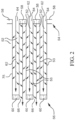
- FIGS. 1 and 2 illustrate an exemplary substrate 30 in the form of a wall-flow filter substrate having a cylindrical shape with a plurality of gas flow passages 52.
- the passages are tubularly enclosed by the internal walls 53 of the filter substrate.
- the substrate has an inlet end 54 and an outlet end 56. Alternate passages are plugged at the inlet end with inlet plugs 58 and at the outlet end with outlet plugs 60 to form opposing checkerboard patterns at the inlet 54 and outlet 56.
- a gas stream 62 enters through the unplugged channel inlet 64, is stopped by outlet plug 60 and diffuses through channel walls 53 (which are porous) to the outlet side 66. The gas cannot pass back to the inlet side of the walls because of inlet plugs 58.
- the porous wall-flow filter used in this invention is catalyzed in that the wall of said element has thereon or contained therein one or more catalytic materials.
- Catalytic materials e.g., selective oxidation catalyst composition and optional SCR materials
- This invention includes the use of one or more layers of catalytic material on the inlet and/or outlet walls of the element.
- wall-flow filters having one catalytic material disposed thereon include but are not limited to, wall-flow filters with a selective oxidation catalyst composition of the invention disposed thereon, using one or more layers to render the catalyzed soot filter of the invention.
- the only catalytic material on the filter is only the selective oxidation catalyst composition.
- the catalytic material on the filter of the CSF disclosed herein comprises two or more catalyst compositions (e.g., the selective oxidation catalyst composition and SCR material), wherein the catalyst compositions are different.
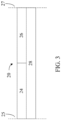
- catalyst compositions are contained in separate washcoat slurries when coating the wall-flow filter, e.g., in an axially zoned configuration, wherein the wall-flow filter is coated with a washcoat slurry of one catalyst composition and a washcoat slurry of another catalyst composition. This may be more easily understood by reference to FIG.
- FIG 3 which shows an embodiment of a zoned coated wall-flow filter 20 in which the first washcoat zone 24 and the second washcoat zone 26 are located side by side along the length of the substrate 28, which has an upstream end 25 and a downstream end 27.
- the first washcoat zone 24 is located upstream of the second washcoat zone 26 (or the second washcoat zone 26 is located downstream of the first washcoat zone 24).
- the catalytic material of the catalyzed soot filter comprises a selective oxidation catalyst composition and a second SCR material, which are disposed on the substrate in an axially zoned configuration.
- the washcoat zone 24 represents the selective oxidation catalyst composition disclosed herein and the second washcoat zone 26 represents the second SCR material disclosed herein to render a catalyzed soot filter, wherein the second SCR material is disposed downstream of the selective oxidation catalyst composition.
- first washcoat zone 24 represents the second SCR material disclosed herein and the second washcoat zone 26 represents the selective oxidation catalyst composition disclosed herein, providing a catalyzed soot filter, wherein the selective oxidation catalyst composition is disposed downstream of the second SCR material.
- the catalytic material of the catalyzed soot filter comprises a selective oxidation catalyst composition and a second SCR material mixed in the same washcoat and disposed on the substrate in a layered configuration.
- the loading of supported active metal on the catalytic article is typically from 6.1 to 366 g/l (0.1 to 6 g/in 3 ), more typically from 6.1 to 305 g/l (0.1 to 5 g/in 3 ), 6.1 to 61 g/l (0.1 to 1 g/in 3 ), or from 6.1 to 30.05 g/l (0.1 to 0.5 g/in 3 ).
- these values reflect the loading of the individual active metal (e.g., PGM component, base metal oxide component, and/or rare earth metal oxide component), taking into account the weight of the active metal and the weight of the support.
- the total loading of the active metal without support material on the catalytic article is typically in the range from 3.53 to 7060 g/m 3 (0.1 to 200 g/ft 3 ), from 3.53 to 3530 g/m 3 (0.1 to 100 g/ft 3 ), 3.53 to 353 g/m 3 (0.1 to 10 g/ft 3 ), from 3.53 to 176.5 g/m 3 (0.1 to 5 g/ft 3 ), or from 3.53 to 17.6 (0.1 to 0.5 g/ft 3 ) for each layer.
- Such values are understood in the context of the present disclosure to include, e.g., the PGM component(s), base metal oxide component(s), rare earth metal oxide component(s) in the disclosed selective oxidation catalyst composition and SCR materials, taking into account the weight of the metal(s) but not the weight of the support. It is noted that these weights per unit volume are typically calculated by weighing the catalyst substrate before and after treatment with the corresponding catalyst washcoat composition, and since the treatment process involves drying and calcining the catalyst substrate at high temperature, these weights represent an essentially solvent-free catalyst coating as essentially all of the water of the washcoat slurry has been removed.
- an emission treatment system that incorporates the catalytic article(s) described herein.
- integrated emissions treatment system comprise one or more catalytic articles/components for the treatment of exhaust gas emissions, e.g., exhaust gas emissions from a diesel engine.
- the emission treatment system may further comprise a diesel oxidation (DOC) catalyst and a selective catalytic reduction (SCR) catalyst and/or, optionally, a selective catalytic reduction/ ammonia oxidation (SCR/AMOx) catalyst, in addition to the CSF (comprising a selective oxidation catalyst on a filter) described herein.
- DOC diesel oxidation
- SCR selective catalytic reduction
- SCR/AMOx selective catalytic reduction/ ammonia oxidation
- the CSF is typically located downstream from the DOC, although the relative placement of the various components of the emission treatment system can be varied.
- the emission treatment system can further include components such as a reductant injector for ammonia precursor, a hydrocarbon injector for diesel fuel, additional particulate filtration components, and/or NO x storage and/or trapping components.
- a reductant injector for ammonia precursor a hydrocarbon injector for diesel fuel
- additional particulate filtration components a hydrocarbon injector for diesel fuel
- NO x storage and/or trapping components a NO x storage and/or trapping components.
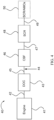
- FIG. 4 is a schematic representation of an emission treatment system 40.
- an exhaust gas stream containing gaseous pollutants and particulate matter is conveyed via exhaust pipe 42 from an engine 41 to a diesel oxidation catalyst (DOC) 43 to a CSF 46 as disclosed herein to a selective catalytic reduction (SCR) catalyst 48 and optionally to a selective catalytic reduction/ ammonia oxidation (SCR/AMOx) catalyst 50.
- DOC diesel oxidation catalyst
- SCR selective catalytic reduction
- SCR/AMOx selective catalytic reduction/ ammonia oxidation
- DOC 43 unburned gaseous and non-volatile hydrocarbons and carbon monoxide are largely combusted to form carbon dioxide and water.
- a portion of the NO of the NO x component may be oxidized to NO 2 in the DOC.
- the exhaust gas stream is next conveyed via exhaust pipe 45 to the CSF 46 disclosed herein, which is a catalyzed soot filter comprising a selective oxidation catalyst on a filter.
- CSF 46 traps any particulate matter present in the exhaust gas stream before before the exhaust gas stream reaches the SCR catalyst 48 located further downstream.
- An injector 44 for introducing a nitrogenous reducing agent into the exhaust stream is advantageously located upstream of CSF 46.
- the reducing agent promotes the reduction of the NO x to N 2 and water as the gas passes through CSF 46 and is exposed to the optional SCR material in CSF 46 and SCR catalyst 48.
- a nitrogenous reducing agent broadly covers any compound that promotes the reduction of NO x in an exhaust gas.
- reductants include ammonia, hydrazine or any suitable ammonia precursor such as urea ((NH 2 ) 2 CO), ammonium carbonate, ammonium carbamate, ammonium hydrogen carbonate or ammonium formate.
- the exhaust gas stream is conveyed via exhaust pipe 47 to a downstream SCR catalyst 48 for further treatment and/or conversion of NO x .
- the exhaust gas stream exiting SCR catalyst 48 can then optionally be conveyed via exhaust pipe 49 to a selective catalytic reduction/ ammonia oxidation (SCR/AMOx) catalyst 50 before finally exiting the engine exhaust gas treatment system 40.
- the CSF 46 can optionally comprise a second SCR material and in such cases, some SCR can be achieved on the filter (before the exhaust gas stream reaches the SCR catalyst 48).
- CSF 46 can comprise both the selective oxidation catalyst component and the first SCR material, e.g., in a zoned configuration as described above with respect to the selective oxidation catalyst composition and the first SCR material.
- separate SCR catalyst 48 is not present.
- Catalytic sample articles 1 to 8 are catalyst-coated filter samples.
- the filter substrate is a cordierite wall-flow filter with a porosity of 58%, a mean pore size of 13 ⁇ m, cell density of 300/in 2 and a wall thickness of 0.3 mm.
- Round sample cores with 1" (diameter) x 3" (length) were used for the experiment.
- Catalyst slurries consisting of variable catalytically active components dispersed in deionized water were used. Each slurry was milled to 90% of the particles having a size less than 5 ⁇ m (D 90 ⁇ 5 ⁇ m), and the slurry was adjusted to the appropriate solid content before coating.
- the slurry was washcoated onto the filter substrate by immersing the substrate into the slurry with the inlet end of the substrate down into and the outlet end just above (about 1 ⁇ 4 inch) the slurry level.
- the substrate was pulled out of the slurry, and a stream of air was blown from the outlet side of the channels until no washcoat slurry was coming out from the inlet side.
- the coated sample was then dried at 110 °C for 2h and calcined in air at 450 °C for 1h. Specific compositions for the samples thus obtained are detailed below.
- Catalytic sample article 1 was prepared according to the general procedure described above, wherein the slurry contained Cu-Chabazite (prepared according to procedures known in the art. See, for example, U.S. 7,601,662 B2 ) with a slurry solid content of 23%.
- the washcoat loading of Cu-Chabazite was 36.6 g/m 3 (0.6 g/in 3 ).
- Catalytic sample article 2 contains a mixture of Pd/SiO 2 -Al 2 O 3 with a washcoat loading of 6.1 g/m 3 (0.1 g/in 3 ) and Cu-chabazite with a washcoat loading of 6.1 g/m 3 (0.1 g/in 3 ).
- Pd/SiO 2 -Al 2 O 3 was made by impregnating Pd nitrate onto a SiO 2 -Al 2 O 3 support (5% SiO 2 ) using an incipient wetness technique. The impregnated powder was dried at 110 °C for 2h and then calcined at 500 °C for 2h.
- Catalytic sample article 2 was prepared according to the general procedure described above with the prepared Pd/SiO 2 -Al 2 O 3 /Cu-chabazite slurry to obtain catalytic sample article 2 with a palladium loading of 35.3 g/m 3 (1 g/ft 3 ).
- Catalytic sample article 3 containing Pd/Cu-chabazite with a washcoat loading of 36.6 g/m 3 (0.6 g/in 3 ), was prepared according to the general procedure described above.
- the slurry was prepared by direct addition of Pd nitrate to a slurry of Cu-Chabazite to obtain a Pd/Cu-chabazite slurry with a solid content of 23%.
- Catalytic sample article 4 contains Pd/SiO 2 -Al 2 O 3 with a washcoat loading of 48.8 g/m 3 (0.8 g/in 3 ).
- SiO 2 -Al 2 O 3 support material was jet milled to D 90 ⁇ 5 ⁇ m as dry powder prior to Pd deposition. The milled support was dispersed in deionized water at 30-40% solid. To this slurry, Pd nitrate was slowly added. The slurry was further diluted to obtain a final solid content of 23%.
- Catalytic sample article 4 was prepared according to the general procedure described above with the prepared Pd/SiO 2 -Al 2 O 3 slurry to obtain catalytic sample article 4 with a palladium loading of 105.9 g/m 3 (3 g/ft 3 ).
- a slurry containing CeO 2 /ZrO 2 (30% ZrO 2 content) was prepared with a solid content of 7%.
- Catalytic sample article 5 was prepared according to the general procedure described above with the prepared CeO 2 /ZrO 2 (30% ZrO 2 content) slurry to obtain catalytic sample article 5 with a washcoat loading of 15.3 g/m 3 (0.25 g/in 3 ).
- Catalytic sample article 7 contains 10% CuO-5% CeO 2 /CeO 2 with a washcoat loading of 15.3 g/m 3 (0.25 g/in 3 ).
- 10% CuO-5% CeO 2 /CeO 2 was prepared by co-impregnation of Cu nitrate and Ce nitrate on a CeO 2 support. The impregnated powder was dried at 110 °C for 2 h and then calcined at 450 °C for 1 h. A slurry was prepared with a slurry solid content of 5%.
- Catalytic sample article 7 was prepared according to the general procedure described above with the prepared 10% CuO-5% CeO 2 /CeO 2 slurry to obtain catalytic sample article 7.
- Tables 1 to 3 summaries the conversions of THC, NH 3 and NO x at 550, 500 and 450 °C, respectively.
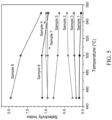
- Fig. 5 shows the selectivity index for Samples 1 to 8 as a function of reaction temperature. The selectivity index is defined as the ratio of THC conversion to NH 3 conversion. The higher this selectivity index on a catalyst, the more selective it is towards THC oxidation. The selectivity index as shown in Fig. 5 follows the following order: Sample 8 >> Sample 6 ⁇ Sample 4 ⁇ Sample 7 > Sample 5 > Sample 2 > Sample 3 > Sample 1.
- Pt is known to be much more active for NH 3 oxidation than Pd. See, for example, Y. Li and J.N. Armor, Appl. Catal. B: Environmental, 13 (1997) 131-139 , showing that on a Pt/Al 2 O 3 catalyst the NH 3 conversion is >90% when the reaction temperature is higher than 200 °C, producing mostly N 2 O as the oxidation product.
- Sample 8 in this invention contains a small amount of Pd on CeO 2 support (equivalent to 0.2% by weight on a powder basis). Without intending to be bound by theory, it is thought that the combination of low level of Pd and the active oxygen-containing support allows the catalyst to oxidize THC while minimizing NH 3 oxidation.
Landscapes
- Chemical & Material Sciences (AREA)
- Engineering & Computer Science (AREA)
- Chemical Kinetics & Catalysis (AREA)
- Materials Engineering (AREA)
- Combustion & Propulsion (AREA)
- Mechanical Engineering (AREA)
- General Engineering & Computer Science (AREA)
- Health & Medical Sciences (AREA)
- Organic Chemistry (AREA)
- Toxicology (AREA)
- Analytical Chemistry (AREA)
- Biomedical Technology (AREA)
- Environmental & Geological Engineering (AREA)
- General Chemical & Material Sciences (AREA)
- Oil, Petroleum & Natural Gas (AREA)
- Crystallography & Structural Chemistry (AREA)
- Thermal Sciences (AREA)
- Physics & Mathematics (AREA)
- Catalysts (AREA)
- Exhaust Gas After Treatment (AREA)
- Exhaust Gas Treatment By Means Of Catalyst (AREA)
- Processes For Solid Components From Exhaust (AREA)
Claims (5)
- Katalytischer Rußfilter (CSF), umfassend eine selektive Oxidationskatalysatorzusammensetzung auf einem Filter, wobei die selektive Oxidationskatalysatorzusammensetzung eine Selektivität zum Oxidieren von HC gegenüber dem Oxidieren von Ammoniak aufweist,wobei die selektive Oxidationskatalysatorzusammensetzung im Wesentlichen frei von Platin ist,wobei die selektive Oxidationskatalysatorzusammensetzung eine Palladiumkomponente umfasst,wobei die Palladiumkomponente auf Ceroxid imprägniert ist,wobei die Palladiumkomponente eine Beladung auf den Filter von 3,53 g/m3 bis 353 g/m3 (0,1 g/ft3 bis 10 g/ft3) aufweist.
- CSF nach Anspruch 1, wobei die selektive Oxidationskatalysatorzusammensetzung eine Grundmetalloxidkomponente umfasst.
- CSF nach einem der vorstehenden Ansprüche, wobei die Palladiumkomponente eine Beladung auf den Filter von 3,53 g/m.3 bis 176 g/m3 (0,1 g/ft3 bis 5 g/ft3) aufweist.
- CSF nach einem der vorstehenden Ansprüche, wobei die Palladiumkomponente eine Beladung auf den Filter von 3,53 g/m3 bis 17,6 g/m3 (0,1 g/ft3 bis 0,5 g/ft3) aufweist.
- CSF nach einem der vorstehenden Ansprüche, wobei die selektive Oxidationskatalysatorzusammensetzung eine Beladung von 3,05 g/l bis 30,05 g/l (0,05 g/in3 bis 0,5 g/in3) auf den Filter aufweist.
Applications Claiming Priority (2)
| Application Number | Priority Date | Filing Date | Title |
|---|---|---|---|
| US201762584341P | 2017-11-10 | 2017-11-10 | |
| PCT/IB2018/058787 WO2019092636A1 (en) | 2017-11-10 | 2018-11-08 | Catalyzed soot filter with reduced ammonia oxidation |
Publications (3)
| Publication Number | Publication Date |
|---|---|
| EP3707356A1 EP3707356A1 (de) | 2020-09-16 |
| EP3707356A4 EP3707356A4 (de) | 2021-05-12 |
| EP3707356B1 true EP3707356B1 (de) | 2025-03-05 |
Family
ID=66437691
Family Applications (1)
| Application Number | Title | Priority Date | Filing Date |
|---|---|---|---|
| EP18875123.4A Active EP3707356B1 (de) | 2017-11-10 | 2018-11-08 | Katalysierter russfilter mit reduzierter ammoniakoxidation |
Country Status (8)
| Country | Link |
|---|---|
| US (2) | US11486288B2 (de) |
| EP (1) | EP3707356B1 (de) |
| JP (1) | JP7368351B2 (de) |
| KR (1) | KR102659805B1 (de) |
| CN (1) | CN111315970B (de) |
| CA (1) | CA3081933A1 (de) |
| WO (1) | WO2019092636A1 (de) |
| ZA (1) | ZA202002845B (de) |
Families Citing this family (6)
| Publication number | Priority date | Publication date | Assignee | Title |
|---|---|---|---|---|
| BR112022011329A2 (pt) * | 2019-12-13 | 2022-08-23 | Basf Corp | Composição de catalisador, artigo de catalisador, sistema de tratamento de gás de exaustão, método para reduzir um nível de nox e processo para preparar um zeólito |
| US20230321636A1 (en) * | 2020-08-28 | 2023-10-12 | Basf Corporation | Oxidation catalyst comprising a platinum group metal and a base metal or metalloid oxide |
| CN112076803B (zh) * | 2020-09-16 | 2023-02-17 | 包头稀土研究院 | 氨氧化催化剂及制备方法和用途 |
| CN112295555B (zh) * | 2020-10-30 | 2022-03-22 | 大连理工大学 | 一种用于固定源烟气脱硝反应的铈钛复合纳米棒催化剂及其制备方法 |
| CN115845833B (zh) * | 2021-09-23 | 2024-06-21 | 重庆理工大学 | 一种用于SCR降解的Nb-Ce-W脱硝催化剂制备方法及应用 |
| EP4293207B1 (de) * | 2022-06-14 | 2025-02-26 | Volvo Truck Corporation | Motorsystem, welches einen wasserstoffverbrennungsmotor und ein abgasreinigungssystem umfasst |
Family Cites Families (61)
| Publication number | Priority date | Publication date | Assignee | Title |
|---|---|---|---|---|
| US4518710A (en) | 1984-01-25 | 1985-05-21 | Uop Inc. | Catalyst for the reduction of nitrogen oxides in gaseous mixtures and method of making the catalyst |
| US5137855A (en) | 1988-06-09 | 1992-08-11 | W. R. Grace & Co.-Conn. | Catalysts for selective catalytic reduction denox technology |
| HUT68783A (en) | 1991-07-29 | 1995-05-17 | British Tech Group | Process for producing metal catalyst on porous support and use thereof |
| WO1993010886A1 (en) * | 1991-11-26 | 1993-06-10 | Engelhard Corporation | Ceria-alumina oxidation catalyst and method of use |
| US20010049339A1 (en) | 2000-04-11 | 2001-12-06 | Adolf Schafer-Sindlinger | Process for the preparation of a vanadia SCR-catalyst supported on titania |
| US20030073566A1 (en) | 2001-10-11 | 2003-04-17 | Marshall Christopher L. | Novel catalyst for selective NOx reduction using hydrocarbons |
| EP1458960B1 (de) * | 2001-12-20 | 2011-02-09 | Johnson Matthey Public Limited Company | Verbesserungen bei der selektiven katalytischen reduktion |
| JP2004058013A (ja) * | 2002-07-31 | 2004-02-26 | Nissan Motor Co Ltd | 排ガス浄化触媒 |
| US7229597B2 (en) * | 2003-08-05 | 2007-06-12 | Basfd Catalysts Llc | Catalyzed SCR filter and emission treatment system |
| US7722829B2 (en) * | 2004-09-14 | 2010-05-25 | Basf Catalysts Llc | Pressure-balanced, catalyzed soot filter |
| KR100686381B1 (ko) | 2005-09-27 | 2007-02-22 | 한국전력기술 주식회사 | 넓은 활성온도 대역에서 질소산화물 및 다이옥신을제거하기 위한 천연망간광석을 포함하는 바나듐/티타니아계촉매 및 이의 사용방법 |
| US8119075B2 (en) * | 2005-11-10 | 2012-02-21 | Basf Corporation | Diesel particulate filters having ultra-thin catalyzed oxidation coatings |
| US7797931B2 (en) * | 2006-03-20 | 2010-09-21 | Ford Global Technologies, Llc | Catalyst composition for diesel particulate filter |
| US20080095682A1 (en) * | 2006-10-19 | 2008-04-24 | Kharas Karl C | Ce-Zr-R-O CATALYSTS, ARTICLES COMPRISING THE Ce Zr R O CATALYSTS AND METHODS OF MAKING AND USING THE Ce-Zr-R-O CATALYSTS |
| EP1916029B1 (de) * | 2006-10-23 | 2014-06-04 | Haldor Topsoe A/S | Verfahren und Vorrichtung zur Reinigung von Abgas aus einer Maschine mit Kompressionszündung |
| US8800268B2 (en) | 2006-12-01 | 2014-08-12 | Basf Corporation | Zone coated filter, emission treatment systems and methods |
| MX2009009095A (es) | 2007-02-27 | 2009-09-14 | Basf Catalysts Llc | Catalizadores de zeolita cha de cobre. |
| US7998423B2 (en) | 2007-02-27 | 2011-08-16 | Basf Corporation | SCR on low thermal mass filter substrates |
| US10384162B2 (en) | 2007-03-26 | 2019-08-20 | Pq Corporation | High silica chabazite for selective catalytic reduction, methods of making and using same |
| EP2044999B1 (de) * | 2007-10-01 | 2012-02-01 | Mazda Motor Corporation | Partikelfilter |
| JP2009114930A (ja) * | 2007-11-06 | 2009-05-28 | Hino Motors Ltd | 排気浄化装置 |
| US8038954B2 (en) | 2008-02-14 | 2011-10-18 | Basf Corporation | CSF with low platinum/palladium ratios |
| EP2112341B1 (de) * | 2008-04-22 | 2018-07-11 | Umicore AG & Co. KG | Verfahren zum Reinigen des Abgases eines Dieselmotors |
| JP5743885B2 (ja) | 2008-05-21 | 2015-07-01 | ビーエーエスエフ ソシエタス・ヨーロピアBasf Se | CHA構造を有するCu含有ゼオライトの直接合成のための方法 |
| US10583424B2 (en) | 2008-11-06 | 2020-03-10 | Basf Corporation | Chabazite zeolite catalysts having low silica to alumina ratios |
| WO2010108083A1 (en) * | 2009-03-20 | 2010-09-23 | Basf Catalysts Llc | EMISSIONS TREATMENT SYSTEM WITH LEAN NOx TRAP |
| US9662611B2 (en) | 2009-04-03 | 2017-05-30 | Basf Corporation | Emissions treatment system with ammonia-generating and SCR catalysts |
| CN105749747A (zh) | 2009-04-17 | 2016-07-13 | 约翰逊马西有限公司 | 小孔分子筛负载铜催化剂 |
| EP2501464B1 (de) | 2009-11-20 | 2018-02-28 | Basf Se | In zonen unterteilter katalysierter russfilter |
| US8293199B2 (en) | 2009-12-18 | 2012-10-23 | Basf Corporation | Process for preparation of copper containing molecular sieves with the CHA structure, catalysts, systems and methods |
| US8293198B2 (en) | 2009-12-18 | 2012-10-23 | Basf Corporation | Process of direct copper exchange into Na+-form of chabazite molecular sieve, and catalysts, systems and methods |
| JP5630024B2 (ja) * | 2010-01-25 | 2014-11-26 | いすゞ自動車株式会社 | ディーゼルエンジンの排気浄化装置及び排気浄化方法 |
| US8858904B2 (en) | 2010-02-23 | 2014-10-14 | Basf Corporation | Catalyzed soot filter |
| US9352307B2 (en) | 2010-04-08 | 2016-05-31 | Basf Corporation | Cu-CHA/Fe-MFI mixed zeolite catalyst and process for the treatment of NOx in gas streams |
| JP5628413B2 (ja) * | 2010-05-05 | 2014-11-19 | ビーエーエスエフ コーポレーション | 触媒化煤煙フィルターおよび排出処理システムおよび方法 |
| US8293182B2 (en) | 2010-05-05 | 2012-10-23 | Basf Corporation | Integrated SCR and AMOx catalyst systems |
| JP2012077693A (ja) * | 2010-10-01 | 2012-04-19 | Mitsubishi Motors Corp | 排気浄化装置 |
| RU2572610C2 (ru) * | 2010-11-02 | 2016-01-20 | Хальдор Топсеэ А/С | Способ получения катализируемого сажевого фильтра и катализируемый сажевый фильтр |
| EP2465606A1 (de) | 2010-12-16 | 2012-06-20 | Umicore Ag & Co. Kg | Zeolith-basierter Katalysator mit verbesserter katalytischer Aktivität zur Reduktion von Stickoxiden |
| DE112011104676T5 (de) * | 2011-01-05 | 2013-12-05 | Honda Motor Co., Ltd. | Abgasreinigender Katalysator |
| US8722000B2 (en) * | 2011-03-29 | 2014-05-13 | Basf Corporation | Multi-component filters for emissions control |
| JP2012215166A (ja) * | 2011-03-29 | 2012-11-08 | Ibiden Co Ltd | 排ガス浄化システム及び排ガス浄化方法 |
| US8101146B2 (en) | 2011-04-08 | 2012-01-24 | Johnson Matthey Public Limited Company | Catalysts for the reduction of ammonia emission from rich-burn exhaust |
| US8524182B2 (en) | 2011-05-13 | 2013-09-03 | Basf Se | Catalyzed soot filter with layered design |
| RU2597090C2 (ru) * | 2011-05-31 | 2016-09-10 | Джонсон Мэтти Паблик Лимитед Компани | Каталитический фильтр с двойной функцией |
| KR101509689B1 (ko) * | 2011-07-01 | 2015-04-08 | 현대자동차 주식회사 | 배기 가스 정화 장치 및 이를 포함하는 배기 장치 |
| US9126182B2 (en) | 2012-01-30 | 2015-09-08 | Basf Corporation | Catalyzed soot filters, systems and methods of treatment |
| KR102072063B1 (ko) * | 2012-03-29 | 2020-01-31 | 바스프 코포레이션 | 배출물 제어를 위한 다-성분 필터 |
| EP2653681B2 (de) * | 2012-04-20 | 2019-12-04 | Umicore AG & Co. KG | Verwendung eines Beschichteten Dieselpartikelfilters zum Verhindern der Kontamination eines SCR-Katalysators |
| WO2013172128A1 (ja) * | 2012-05-14 | 2013-11-21 | エヌ・イーケムキャット株式会社 | 排気ガス浄化装置 |
| KR101382544B1 (ko) | 2012-07-13 | 2014-04-10 | 한국과학기술연구원 | 질소산화물 제거용 바나디아-티타니아 촉매 및 그 제조방법 |
| EP2908946B1 (de) | 2012-10-19 | 2020-09-09 | BASF Corporation | Kleinporiges 8-ring-molekularsieb als hochtemperatur-scr-katalysator |
| GB201315892D0 (en) * | 2013-07-31 | 2013-10-23 | Johnson Matthey Plc | Zoned diesel oxidation catalyst |
| RU2744763C2 (ru) | 2013-12-02 | 2021-03-15 | Джонсон Мэтти Паблик Лимитед Компани | Синтез цеолита aei |
| US20150231620A1 (en) | 2014-02-19 | 2015-08-20 | Ford Global Technologies, Llc | IRON-ZEOLITE CHABAZITE CATALYST FOR USE IN NOx REDUCTION AND METHOD OF MAKING |
| US9616384B2 (en) | 2014-06-11 | 2017-04-11 | Basf Se | Base metal catalyst |
| MX2017012028A (es) * | 2015-03-19 | 2018-01-30 | Basf Corp | Filtro catalizado con un catalizador de scr, sistemas y metodos. |
| CA2981060A1 (en) * | 2015-03-30 | 2016-10-06 | Basf Corporation | Multifunctional filters for diesel emission control |
| CN105148981B (zh) * | 2015-09-29 | 2017-10-17 | 无锡威孚力达催化净化器有限责任公司 | 柴油车多涂层氧化性催化剂及其制备方法 |
| WO2017055810A1 (en) * | 2015-09-29 | 2017-04-06 | Johnson Matthey Public Limited Company | Catalytic filter having a soot catalyst and an scr catalyst |
| CA3021797A1 (en) * | 2016-04-26 | 2017-11-02 | Basf Corporation | Zoned configuration for oxidation catalyst combinations |
-
2018
- 2018-11-08 EP EP18875123.4A patent/EP3707356B1/de active Active
- 2018-11-08 CA CA3081933A patent/CA3081933A1/en active Pending
- 2018-11-08 KR KR1020207013063A patent/KR102659805B1/ko active Active
- 2018-11-08 CN CN201880072400.XA patent/CN111315970B/zh active Active
- 2018-11-08 JP JP2020526150A patent/JP7368351B2/ja active Active
- 2018-11-08 WO PCT/IB2018/058787 patent/WO2019092636A1/en not_active Ceased
-
2020
- 2020-05-08 US US16/869,622 patent/US11486288B2/en active Active
- 2020-05-15 ZA ZA2020/02845A patent/ZA202002845B/en unknown
-
2022
- 2022-09-26 US US17/935,179 patent/US20230027701A1/en active Pending
Also Published As
| Publication number | Publication date |
|---|---|
| ZA202002845B (en) | 2023-10-25 |
| JP2021502244A (ja) | 2021-01-28 |
| US20200263586A1 (en) | 2020-08-20 |
| JP7368351B2 (ja) | 2023-10-24 |
| KR102659805B1 (ko) | 2024-04-23 |
| CN111315970A (zh) | 2020-06-19 |
| BR112020009175A2 (pt) | 2020-11-03 |
| CN111315970B (zh) | 2023-02-03 |
| US20230027701A1 (en) | 2023-01-26 |
| KR20200071746A (ko) | 2020-06-19 |
| EP3707356A4 (de) | 2021-05-12 |
| EP3707356A1 (de) | 2020-09-16 |
| US11486288B2 (en) | 2022-11-01 |
| WO2019092636A1 (en) | 2019-05-16 |
| CA3081933A1 (en) | 2019-05-16 |
Similar Documents
| Publication | Publication Date | Title |
|---|---|---|
| US10744459B2 (en) | Zoned configuration for oxidation catalyst combinations | |
| KR102479998B1 (ko) | 배기가스 처리 시스템 | |
| EP3707356B1 (de) | Katalysierter russfilter mit reduzierter ammoniakoxidation | |
| US11331653B2 (en) | Combined NOx absorber and SCR catalyst | |
| US11154847B2 (en) | Catalytic article and exhaust gas treatment systems | |
| US10450918B2 (en) | Exhaust gas treatment system | |
| EP3307997B1 (de) | Abgasbehandlungssystem | |
| KR102924716B1 (ko) | 저온 co 산화 촉매 | |
| JP7494123B2 (ja) | 混合ゼオライト含有scr触媒 | |
| WO2018224651A2 (en) | Catalytic article and exhaust gas treatment systems |
Legal Events
| Date | Code | Title | Description |
|---|---|---|---|
| STAA | Information on the status of an ep patent application or granted ep patent |
Free format text: STATUS: THE INTERNATIONAL PUBLICATION HAS BEEN MADE |
|
| PUAI | Public reference made under article 153(3) epc to a published international application that has entered the european phase |
Free format text: ORIGINAL CODE: 0009012 |
|
| STAA | Information on the status of an ep patent application or granted ep patent |
Free format text: STATUS: REQUEST FOR EXAMINATION WAS MADE |
|
| 17P | Request for examination filed |
Effective date: 20200610 |
|
| AK | Designated contracting states |
Kind code of ref document: A1 Designated state(s): AL AT BE BG CH CY CZ DE DK EE ES FI FR GB GR HR HU IE IS IT LI LT LU LV MC MK MT NL NO PL PT RO RS SE SI SK SM TR |
|
| AX | Request for extension of the european patent |
Extension state: BA ME |
|
| DAV | Request for validation of the european patent (deleted) | ||
| DAX | Request for extension of the european patent (deleted) | ||
| A4 | Supplementary search report drawn up and despatched |
Effective date: 20210412 |
|
| RIC1 | Information provided on ipc code assigned before grant |
Ipc: F01N 3/20 20060101AFI20210406BHEP Ipc: F01N 3/10 20060101ALI20210406BHEP Ipc: F01N 3/035 20060101ALI20210406BHEP Ipc: B01J 29/74 20060101ALI20210406BHEP Ipc: F01N 13/00 20100101ALI20210406BHEP |
|
| STAA | Information on the status of an ep patent application or granted ep patent |
Free format text: STATUS: EXAMINATION IS IN PROGRESS |
|
| 17Q | First examination report despatched |
Effective date: 20220404 |
|
| RAP1 | Party data changed (applicant data changed or rights of an application transferred) |
Owner name: BASF MOBILE EMISSIONS CATALYSTS LLC |
|
| GRAP | Despatch of communication of intention to grant a patent |
Free format text: ORIGINAL CODE: EPIDOSNIGR1 |
|
| STAA | Information on the status of an ep patent application or granted ep patent |
Free format text: STATUS: GRANT OF PATENT IS INTENDED |
|
| INTG | Intention to grant announced |
Effective date: 20241004 |
|
| GRAS | Grant fee paid |
Free format text: ORIGINAL CODE: EPIDOSNIGR3 |
|
| GRAA | (expected) grant |
Free format text: ORIGINAL CODE: 0009210 |
|
| STAA | Information on the status of an ep patent application or granted ep patent |
Free format text: STATUS: THE PATENT HAS BEEN GRANTED |
|
| AK | Designated contracting states |
Kind code of ref document: B1 Designated state(s): AL AT BE BG CH CY CZ DE DK EE ES FI FR GB GR HR HU IE IS IT LI LT LU LV MC MK MT NL NO PL PT RO RS SE SI SK SM TR |
|
| REG | Reference to a national code |
Ref country code: GB Ref legal event code: FG4D |
|
| REG | Reference to a national code |
Ref country code: CH Ref legal event code: EP |
|
| REG | Reference to a national code |
Ref country code: IE Ref legal event code: FG4D |
|
| REG | Reference to a national code |
Ref country code: DE Ref legal event code: R096 Ref document number: 602018079920 Country of ref document: DE |
|
| P01 | Opt-out of the competence of the unified patent court (upc) registered |
Free format text: CASE NUMBER: APP_9427/2025 Effective date: 20250225 |
|
| PG25 | Lapsed in a contracting state [announced via postgrant information from national office to epo] |
Ref country code: RS Free format text: LAPSE BECAUSE OF FAILURE TO SUBMIT A TRANSLATION OF THE DESCRIPTION OR TO PAY THE FEE WITHIN THE PRESCRIBED TIME-LIMIT Effective date: 20250605 |
|
| PG25 | Lapsed in a contracting state [announced via postgrant information from national office to epo] |
Ref country code: FI Free format text: LAPSE BECAUSE OF FAILURE TO SUBMIT A TRANSLATION OF THE DESCRIPTION OR TO PAY THE FEE WITHIN THE PRESCRIBED TIME-LIMIT Effective date: 20250305 |
|
| REG | Reference to a national code |
Ref country code: NL Ref legal event code: MP Effective date: 20250305 |
|
| PG25 | Lapsed in a contracting state [announced via postgrant information from national office to epo] |
Ref country code: ES Free format text: LAPSE BECAUSE OF FAILURE TO SUBMIT A TRANSLATION OF THE DESCRIPTION OR TO PAY THE FEE WITHIN THE PRESCRIBED TIME-LIMIT Effective date: 20250305 |
|
| REG | Reference to a national code |
Ref country code: LT Ref legal event code: MG9D |
|
| PG25 | Lapsed in a contracting state [announced via postgrant information from national office to epo] |
Ref country code: NO Free format text: LAPSE BECAUSE OF FAILURE TO SUBMIT A TRANSLATION OF THE DESCRIPTION OR TO PAY THE FEE WITHIN THE PRESCRIBED TIME-LIMIT Effective date: 20250605 |
|
| PG25 | Lapsed in a contracting state [announced via postgrant information from national office to epo] |
Ref country code: HR Free format text: LAPSE BECAUSE OF FAILURE TO SUBMIT A TRANSLATION OF THE DESCRIPTION OR TO PAY THE FEE WITHIN THE PRESCRIBED TIME-LIMIT Effective date: 20250305 |
|
| PG25 | Lapsed in a contracting state [announced via postgrant information from national office to epo] |
Ref country code: LV Free format text: LAPSE BECAUSE OF FAILURE TO SUBMIT A TRANSLATION OF THE DESCRIPTION OR TO PAY THE FEE WITHIN THE PRESCRIBED TIME-LIMIT Effective date: 20250305 |
|
| PG25 | Lapsed in a contracting state [announced via postgrant information from national office to epo] |
Ref country code: GR Free format text: LAPSE BECAUSE OF FAILURE TO SUBMIT A TRANSLATION OF THE DESCRIPTION OR TO PAY THE FEE WITHIN THE PRESCRIBED TIME-LIMIT Effective date: 20250606 Ref country code: BG Free format text: LAPSE BECAUSE OF FAILURE TO SUBMIT A TRANSLATION OF THE DESCRIPTION OR TO PAY THE FEE WITHIN THE PRESCRIBED TIME-LIMIT Effective date: 20250305 |
|
| REG | Reference to a national code |
Ref country code: AT Ref legal event code: MK05 Ref document number: 1773109 Country of ref document: AT Kind code of ref document: T Effective date: 20250305 |
|
| PG25 | Lapsed in a contracting state [announced via postgrant information from national office to epo] |
Ref country code: NL Free format text: LAPSE BECAUSE OF FAILURE TO SUBMIT A TRANSLATION OF THE DESCRIPTION OR TO PAY THE FEE WITHIN THE PRESCRIBED TIME-LIMIT Effective date: 20250305 |
|
| PG25 | Lapsed in a contracting state [announced via postgrant information from national office to epo] |
Ref country code: SE Free format text: LAPSE BECAUSE OF FAILURE TO SUBMIT A TRANSLATION OF THE DESCRIPTION OR TO PAY THE FEE WITHIN THE PRESCRIBED TIME-LIMIT Effective date: 20250305 |
|
| PG25 | Lapsed in a contracting state [announced via postgrant information from national office to epo] |
Ref country code: SM Free format text: LAPSE BECAUSE OF FAILURE TO SUBMIT A TRANSLATION OF THE DESCRIPTION OR TO PAY THE FEE WITHIN THE PRESCRIBED TIME-LIMIT Effective date: 20250305 |
|
| PG25 | Lapsed in a contracting state [announced via postgrant information from national office to epo] |
Ref country code: PT Free format text: LAPSE BECAUSE OF FAILURE TO SUBMIT A TRANSLATION OF THE DESCRIPTION OR TO PAY THE FEE WITHIN THE PRESCRIBED TIME-LIMIT Effective date: 20250707 |
|
| PG25 | Lapsed in a contracting state [announced via postgrant information from national office to epo] |
Ref country code: PL Free format text: LAPSE BECAUSE OF FAILURE TO SUBMIT A TRANSLATION OF THE DESCRIPTION OR TO PAY THE FEE WITHIN THE PRESCRIBED TIME-LIMIT Effective date: 20250305 Ref country code: IT Free format text: LAPSE BECAUSE OF FAILURE TO SUBMIT A TRANSLATION OF THE DESCRIPTION OR TO PAY THE FEE WITHIN THE PRESCRIBED TIME-LIMIT Effective date: 20250305 |
|
| PG25 | Lapsed in a contracting state [announced via postgrant information from national office to epo] |
Ref country code: AT Free format text: LAPSE BECAUSE OF FAILURE TO SUBMIT A TRANSLATION OF THE DESCRIPTION OR TO PAY THE FEE WITHIN THE PRESCRIBED TIME-LIMIT Effective date: 20250305 |
|
| PG25 | Lapsed in a contracting state [announced via postgrant information from national office to epo] |
Ref country code: EE Free format text: LAPSE BECAUSE OF FAILURE TO SUBMIT A TRANSLATION OF THE DESCRIPTION OR TO PAY THE FEE WITHIN THE PRESCRIBED TIME-LIMIT Effective date: 20250305 Ref country code: CZ Free format text: LAPSE BECAUSE OF FAILURE TO SUBMIT A TRANSLATION OF THE DESCRIPTION OR TO PAY THE FEE WITHIN THE PRESCRIBED TIME-LIMIT Effective date: 20250305 |
|
| PG25 | Lapsed in a contracting state [announced via postgrant information from national office to epo] |
Ref country code: RO Free format text: LAPSE BECAUSE OF FAILURE TO SUBMIT A TRANSLATION OF THE DESCRIPTION OR TO PAY THE FEE WITHIN THE PRESCRIBED TIME-LIMIT Effective date: 20250305 |
|
| PG25 | Lapsed in a contracting state [announced via postgrant information from national office to epo] |
Ref country code: SK Free format text: LAPSE BECAUSE OF FAILURE TO SUBMIT A TRANSLATION OF THE DESCRIPTION OR TO PAY THE FEE WITHIN THE PRESCRIBED TIME-LIMIT Effective date: 20250305 |
|
| PG25 | Lapsed in a contracting state [announced via postgrant information from national office to epo] |
Ref country code: IS Free format text: LAPSE BECAUSE OF FAILURE TO SUBMIT A TRANSLATION OF THE DESCRIPTION OR TO PAY THE FEE WITHIN THE PRESCRIBED TIME-LIMIT Effective date: 20250705 |
|
| REG | Reference to a national code |
Ref country code: DE Ref legal event code: R097 Ref document number: 602018079920 Country of ref document: DE |
|
| PGFP | Annual fee paid to national office [announced via postgrant information from national office to epo] |
Ref country code: DE Payment date: 20251022 Year of fee payment: 8 |
|
| PGFP | Annual fee paid to national office [announced via postgrant information from national office to epo] |
Ref country code: GB Payment date: 20251022 Year of fee payment: 8 |
|
| PLBE | No opposition filed within time limit |
Free format text: ORIGINAL CODE: 0009261 |
|
| STAA | Information on the status of an ep patent application or granted ep patent |
Free format text: STATUS: NO OPPOSITION FILED WITHIN TIME LIMIT |
|
| PG25 | Lapsed in a contracting state [announced via postgrant information from national office to epo] |
Ref country code: DK Free format text: LAPSE BECAUSE OF FAILURE TO SUBMIT A TRANSLATION OF THE DESCRIPTION OR TO PAY THE FEE WITHIN THE PRESCRIBED TIME-LIMIT Effective date: 20250305 |
|
| REG | Reference to a national code |
Ref country code: CH Ref legal event code: L10 Free format text: ST27 STATUS EVENT CODE: U-0-0-L10-L00 (AS PROVIDED BY THE NATIONAL OFFICE) Effective date: 20260114 |
|
| 26N | No opposition filed |
Effective date: 20251208 |