EP3706208B1 - Positives aktivmaterial für wiederaufladbare lithiumbatterie, verfahren zur herstellung davon und wiederaufladbare lithiumbatterie damit - Google Patents
Positives aktivmaterial für wiederaufladbare lithiumbatterie, verfahren zur herstellung davon und wiederaufladbare lithiumbatterie damit Download PDFInfo
- Publication number
- EP3706208B1 EP3706208B1 EP20161073.0A EP20161073A EP3706208B1 EP 3706208 B1 EP3706208 B1 EP 3706208B1 EP 20161073 A EP20161073 A EP 20161073A EP 3706208 B1 EP3706208 B1 EP 3706208B1
- Authority
- EP
- European Patent Office
- Prior art keywords
- compound
- active material
- charge
- particles
- positive active
- Prior art date
- Legal status (The legal status is an assumption and is not a legal conclusion. Google has not performed a legal analysis and makes no representation as to the accuracy of the status listed.)
- Active
Links
Images








Classifications
-
- H—ELECTRICITY
- H01—ELECTRIC ELEMENTS
- H01M—PROCESSES OR MEANS, e.g. BATTERIES, FOR THE DIRECT CONVERSION OF CHEMICAL ENERGY INTO ELECTRICAL ENERGY
- H01M4/00—Electrodes
- H01M4/02—Electrodes composed of, or comprising, active material
- H01M4/13—Electrodes for accumulators with non-aqueous electrolyte, e.g. for lithium-accumulators; Processes of manufacture thereof
- H01M4/131—Electrodes based on mixed oxides or hydroxides, or on mixtures of oxides or hydroxides, e.g. LiCoOx
-
- H—ELECTRICITY
- H01—ELECTRIC ELEMENTS
- H01M—PROCESSES OR MEANS, e.g. BATTERIES, FOR THE DIRECT CONVERSION OF CHEMICAL ENERGY INTO ELECTRICAL ENERGY
- H01M4/00—Electrodes
- H01M4/02—Electrodes composed of, or comprising, active material
- H01M4/36—Selection of substances as active materials, active masses, active liquids
- H01M4/48—Selection of substances as active materials, active masses, active liquids of inorganic oxides or hydroxides
- H01M4/52—Selection of substances as active materials, active masses, active liquids of inorganic oxides or hydroxides of nickel, cobalt or iron
- H01M4/525—Selection of substances as active materials, active masses, active liquids of inorganic oxides or hydroxides of nickel, cobalt or iron of mixed oxides or hydroxides containing iron, cobalt or nickel for inserting or intercalating light metals, e.g. LiNiO2, LiCoO2 or LiCoOxFy
-
- H—ELECTRICITY
- H01—ELECTRIC ELEMENTS
- H01M—PROCESSES OR MEANS, e.g. BATTERIES, FOR THE DIRECT CONVERSION OF CHEMICAL ENERGY INTO ELECTRICAL ENERGY
- H01M10/00—Secondary cells; Manufacture thereof
- H01M10/05—Accumulators with non-aqueous electrolyte
- H01M10/052—Li-accumulators
- H01M10/0525—Rocking-chair batteries, i.e. batteries with lithium insertion or intercalation in both electrodes; Lithium-ion batteries
-
- H—ELECTRICITY
- H01—ELECTRIC ELEMENTS
- H01M—PROCESSES OR MEANS, e.g. BATTERIES, FOR THE DIRECT CONVERSION OF CHEMICAL ENERGY INTO ELECTRICAL ENERGY
- H01M4/00—Electrodes
- H01M4/02—Electrodes composed of, or comprising, active material
- H01M4/04—Processes of manufacture in general
- H01M4/0471—Processes of manufacture in general involving thermal treatment, e.g. firing, sintering, backing particulate active material, thermal decomposition, pyrolysis
-
- H—ELECTRICITY
- H01—ELECTRIC ELEMENTS
- H01M—PROCESSES OR MEANS, e.g. BATTERIES, FOR THE DIRECT CONVERSION OF CHEMICAL ENERGY INTO ELECTRICAL ENERGY
- H01M4/00—Electrodes
- H01M4/02—Electrodes composed of, or comprising, active material
- H01M4/13—Electrodes for accumulators with non-aqueous electrolyte, e.g. for lithium-accumulators; Processes of manufacture thereof
- H01M4/139—Processes of manufacture
- H01M4/1391—Processes of manufacture of electrodes based on mixed oxides or hydroxides, or on mixtures of oxides or hydroxides, e.g. LiCoOx
-
- H—ELECTRICITY
- H01—ELECTRIC ELEMENTS
- H01M—PROCESSES OR MEANS, e.g. BATTERIES, FOR THE DIRECT CONVERSION OF CHEMICAL ENERGY INTO ELECTRICAL ENERGY
- H01M4/00—Electrodes
- H01M4/02—Electrodes composed of, or comprising, active material
- H01M4/36—Selection of substances as active materials, active masses, active liquids
- H01M4/362—Composites
-
- H—ELECTRICITY
- H01—ELECTRIC ELEMENTS
- H01M—PROCESSES OR MEANS, e.g. BATTERIES, FOR THE DIRECT CONVERSION OF CHEMICAL ENERGY INTO ELECTRICAL ENERGY
- H01M4/00—Electrodes
- H01M4/02—Electrodes composed of, or comprising, active material
- H01M4/36—Selection of substances as active materials, active masses, active liquids
- H01M4/362—Composites
- H01M4/366—Composites as layered products
-
- H—ELECTRICITY
- H01—ELECTRIC ELEMENTS
- H01M—PROCESSES OR MEANS, e.g. BATTERIES, FOR THE DIRECT CONVERSION OF CHEMICAL ENERGY INTO ELECTRICAL ENERGY
- H01M4/00—Electrodes
- H01M4/02—Electrodes composed of, or comprising, active material
- H01M4/36—Selection of substances as active materials, active masses, active liquids
- H01M4/48—Selection of substances as active materials, active masses, active liquids of inorganic oxides or hydroxides
- H01M4/50—Selection of substances as active materials, active masses, active liquids of inorganic oxides or hydroxides of manganese
- H01M4/505—Selection of substances as active materials, active masses, active liquids of inorganic oxides or hydroxides of manganese of mixed oxides or hydroxides containing manganese for inserting or intercalating light metals, e.g. LiMn2O4 or LiMn2OxFy
-
- H—ELECTRICITY
- H01—ELECTRIC ELEMENTS
- H01M—PROCESSES OR MEANS, e.g. BATTERIES, FOR THE DIRECT CONVERSION OF CHEMICAL ENERGY INTO ELECTRICAL ENERGY
- H01M4/00—Electrodes
- H01M4/02—Electrodes composed of, or comprising, active material
- H01M2004/021—Physical characteristics, e.g. porosity, surface area
-
- H—ELECTRICITY
- H01—ELECTRIC ELEMENTS
- H01M—PROCESSES OR MEANS, e.g. BATTERIES, FOR THE DIRECT CONVERSION OF CHEMICAL ENERGY INTO ELECTRICAL ENERGY
- H01M4/00—Electrodes
- H01M4/02—Electrodes composed of, or comprising, active material
- H01M2004/026—Electrodes composed of, or comprising, active material characterised by the polarity
- H01M2004/027—Negative electrodes
-
- H—ELECTRICITY
- H01—ELECTRIC ELEMENTS
- H01M—PROCESSES OR MEANS, e.g. BATTERIES, FOR THE DIRECT CONVERSION OF CHEMICAL ENERGY INTO ELECTRICAL ENERGY
- H01M4/00—Electrodes
- H01M4/02—Electrodes composed of, or comprising, active material
- H01M2004/026—Electrodes composed of, or comprising, active material characterised by the polarity
- H01M2004/028—Positive electrodes
-
- Y—GENERAL TAGGING OF NEW TECHNOLOGICAL DEVELOPMENTS; GENERAL TAGGING OF CROSS-SECTIONAL TECHNOLOGIES SPANNING OVER SEVERAL SECTIONS OF THE IPC; TECHNICAL SUBJECTS COVERED BY FORMER USPC CROSS-REFERENCE ART COLLECTIONS [XRACs] AND DIGESTS
- Y02—TECHNOLOGIES OR APPLICATIONS FOR MITIGATION OR ADAPTATION AGAINST CLIMATE CHANGE
- Y02E—REDUCTION OF GREENHOUSE GAS [GHG] EMISSIONS, RELATED TO ENERGY GENERATION, TRANSMISSION OR DISTRIBUTION
- Y02E60/00—Enabling technologies; Technologies with a potential or indirect contribution to GHG emissions mitigation
- Y02E60/10—Energy storage using batteries
Definitions
- a positive active material for a rechargeable lithium battery, a method of preparing the same, and a rechargeable lithium battery including the same are disclosed.
- rechargeable lithium batteries In order to meet down-sizing and high performance of various devices, rechargeable lithium batteries have become increasingly important in terms of high energy density as well as down-sizing and weight reduction. In addition, high capacity and high temperature stability of rechargeable lithium batteries, and stability at a high voltage become important to apply to electric vehicles and the like.
- Nickel-based lithium transition metal oxide including Ni, Co, and Mn simultaneously provides higher discharge capacity per unit weight than LiCoO 2 , but provides low capacity per unit volume due to a low packing density and exhibits low discharge capacity in a rechargeable lithium battery.
- a rechargeable lithium battery including the nickel-based lithium transition metal oxide may show deteriorated safety during operation at a high voltage.
- An embodiment provides a positive active material for a rechargeable lithium battery having improved phase stability due to an ideal layered structure (a structure for minimizing cation mixing).
- Another embodiment provides a method of preparing the positive active material.
- Another embodiment provides a rechargeable lithium battery having improved charge/discharge capacity, charge/discharge efficiency, and cycle-life characteristics, by including the positive active material.
- One aspect of the present disclosure refers to a positive active material for a rechargeable lithium battery that includes particles of a first compound represented by Chemical Formula 1 and particles of a second compound represented by Chemical Formula 2, wherein the particles of the first compound have an average particle diameter D50 of 15 ⁇ m to 20 ⁇ m and the particles of the second compound have an average particle diameter D50 of 2 ⁇ m to 5 ⁇ m measured by scanning electron microscopy, SEM,.
- the first compound and the second compound have a Ni content of 50 at% to 60 at% of the metal elements excluding Li: [Chemical Formula 1] Li a Ni x Co y M 1 z O 2 [Chemical Formula 2] Li a Ni x Co y M 2 z O 2
- M 1 and M 2 are independently at least one metal element selected from Mn, Al, Cr, Fe, V, Mg, Ti, Zr, Nb, Mo, W, Cu, Zn, Ga, In, Sn, La, and Ce.
- At least one of the particles of the first compound and the particles of the second compound comprises a core and a surface layer surrounding the core and a Ni atom concentration (at%) of the metal elements except Li in the surface layer is higher than a Ni atom concentration (at%) of the metal elements except Li in the core.
- the surface layer may be a region corresponding to a depth of 200 nm from the surface of particles of the first compound or particles of the second compound.
- a cation mixing is less than or equal to 3%.
- the particles of the second compound have a needle-shape, a sheet-shape, or a combination thereof.
- the particles of the first compound and the particles of the second compound are mixed in a weight ratio of 90 : 10 to 50 : 50.
- Another aspect of the present disclosure refers to a method of preparing a positive active material, the method comprising the steps of:
- the particles of Compound 1A and the particles of Compound 2A are mixed in a weight ratio of 90 : 10 to 50 : 50.
- a mole ratio of Li/(Ni + Co + Mn) is greater than or equal to 0.99.
- the first heat-treating comprises a process of maintaining the mixture at 800 ° C to 1000 ° C for 1 hour to 4 hours.
- Another aspect of the present disclosure refers to a rechargeable lithium battery comprising a positive electrode comprising the before mentioned positive active material, a negative electrode comprising a negative active material; and an electrolyte.
- the charge start voltage (V s ) of the rechargeable lithium battery may be less than or equal to 3.55 V; and/or the voltage (V 1 ) may be less than or equal to 3.58 V, in particular may be the voltage (V 1 ) 3.50 V to 3.58 V.
- a differential capacity (dQ/dV)-voltage charge/discharge graph may have at least two peak values in the range of 3.60 V to 3.85 V, and the second peak value may be larger than the first peak value.
- the first peak value may be 450 mAhg -1 V -1 to 550 mAhg -1 V -1 and the second peak value may be 550 mAhg -1 V -1 to 650 mAhg -1 V -1 .
- first (or second) differential capacity (dQ/dV)-voltage charge/discharge graphs depending on voltage changes refers to a graph showing the changes in differential capacity (dQ/dV) depending on voltage changes of first (or second) charging/discharging half-cells.
- An embodiment provides a positive active material for a rechargeable lithium battery that includes particles of a first compound represented by Chemical Formula 1 and particles of a second compound having a smaller particle diameter than the first compound and represented by Chemical Formula 2, wherein the first compound and the second compound have a Ni content of 50 at% to 60 at% of the metal elements excluding Li.
- a rechargeable lithium battery including the particles of first compound and particles of the second compound satisfies Relation 1 in a differential capacity (dQ/dV)-voltage charge/discharge graph: [Chemical Formula 1] Li a Ni x CoyM 1 z O 2 [Chemical Formula 2] Li a Ni x Co y M 2 z O 2
- M 1 and M 2 are independently at least one metal element selected from Mn, Al, Cr, Fe, V, Mg, Ti, Zr, Nb, Mo, W, Cu, Zn, Ga, In, Sn, La, and Ce.
- a nickel content of the total metals except lithium is 50 at% to 60 at%, for example 51 at% to 59 at%, in particular 52 at% to 58 at%, most preferred 53 at% to 57 at%. Accordingly, the charge/discharge capacity, efficiency, and cycle-life characteristics of the battery may be improved.
- the positive active material In general, as the content of nickel included in the positive active material increases, the charge start voltage (V s ) and the voltage (V 1 ) of the battery tend to be lowered, and thus charge/discharge capacity and charge/discharge efficiency are improved.
- the positive active material according to the embodiment has a relatively low charge start voltage (V s ) and a voltage (V 1 ) in spite of low nickel content, thereby improving charge/discharge capacity and charge/discharge efficiency of the battery.
- a mole ratio (Mn/Ni) of manganese relative to nickel may independently fall in the range of 0.36 to 0.55, for example, 0.45 to 0.55, and a mole ratio (Mn/Co) of manganese relative to cobalt may fall in the range of 0.8 to 2.0, for example, 1.25 to 2.0.
- a commercially available high nickel NCM-based positive active material has an initial charge/discharge efficiency of less than 90%, but the positive active material according to the embodiment may obtain an initial charge/discharge efficiency of greater than or equal to 92%, and it also has an advantage of reducing manufacturing process costs as less cobalt is used.
- the particles of the second compound have a smaller particle size than the particles of the first compound. More precisely, the average particle diameter (D50) of the particles of the first compound is greater than or equal to 15 ⁇ m, greater than or equal to 16 ⁇ m, or greater than or equal to 17 ⁇ m, and less than or equal to 20 ⁇ m, less than or equal to 19 ⁇ m, or less than or equal to 18 ⁇ m.
- the particles of the second compound have an average particle diameter (D50) of greater than or equal to 2 ⁇ m or greater than or equal to 3 ⁇ m, and less than or equal to 5 ⁇ m, or less than or equal to 4 ⁇ m.
- a difference in average particle diameter of the particles of the first compound and the particles of the second compound may be greater than or equal to 10 ⁇ m, greater than or equal to 11 ⁇ m, or greater than or equal to 12 ⁇ m, and less than or equal to 18 ⁇ m, less than or equal to 17 ⁇ m, or less than or equal to 16 ⁇ m.
- an electrode mixture density may increase, and the high rate characteristics of the battery may be improved.
- the particles of the first compound and the second compound may be in the form of secondary particles in which a plurality of primary particles are assembled, and the average particle diameter (D50) then means an average particle diameter (D50) of the secondary particles.
- the particle diameter is defined as the average particle diameter (D50) based on 50% of the volume cumulative amount in the particle size distribution curve.
- the particle diameter is measured by an electron microscopy examination using a scanning electron microscopy (SEM).
- the particle diameter may be, for example, measured by a field emission scanning electron microscopy (FE-SEM), or a laser diffraction method. It may be measured by the laser diffraction method as follows.
- the particles to be measured are dispersed in a dispersion medium and then introduced into a commercially available laser diffraction particle size measuring apparatus (for example, MT 3000 of Microtrac), ultrasonic waves of about 28 kHz are irradiated with an output of about 60W, and an average particle diameter (D50) in 50% reference of the particle size distribution in a measuring apparatus may be calculated.
- a commercially available laser diffraction particle size measuring apparatus for example, MT 3000 of Microtrac
- ultrasonic waves of about 28 kHz are irradiated with an output of about 60W
- an average particle diameter (D50) in 50% reference of the particle size distribution in a measuring apparatus may be calculated.
- the particle size may refer to a diameter when the particle shape is a spherical shape, and when the particle has a shape like a plate shape or a needle shape other than a spherical shape, the particle diameter may refer to the longest length of the particle.
- a differential capacity (dQ/dV)-voltage (V) charge/discharge graph of a rechargeable lithium battery including the particles of the first compound and the second compound satisfies Relation 1.
- the graph is obtained using half-cells which are CC/CV-charged at 0.2 C and 4.25 V with a cut-off of 0.05 C and CC-discharged at 0.2 C with a cut-off of 3 V for the first charge/discharge.
- FIG. 2A shows a charge start voltage (V s ) in 1 st differential capacity (dQ/dV)-voltage charge/discharge graphs depending on a voltage change of the half-cell manufactured in Example 2
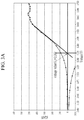
- FIG. 3A shows a voltage (V 1 ) in a 1 st differential capacity (dQ/dV)-voltage charge/discharge graph depending on a voltage change of the half-cell manufactured in Example 2.
- V s the charge start voltage (V s ) in a 1 st differential capacity (dQ/dV)-voltage charge/discharge graph depending on the voltage change.
- V s the charge start voltage (V s ) corresponds to 3.52 V.
- the voltage (V 1 ) corresponds to about 3.56 V.
- a peak value of the differential capacity (dQ/dV)-voltage charge/discharge graph indicates a dQ/dV value at the point at which a slope of the differential capacity (dQ/dV)-voltage charge/discharge graph is changed from a positive value (+) to a negative value (-).
- the charge start voltage (V s ) may be less than or equal to 3.55 V, for example, less than or equal to 3.54 V, less than or equal to 3.53 V, or less than or equal to 3.52 V. Charging of the rechargeable lithium battery may be performed while increasing a voltage from a low voltage to a high voltage under constant current conditions.
- the voltage (V 1 ) may be less than or equal to 3.58 V, for example 3.50 V to 3.58 V, or 3.54 V to 3.58 V.
- the charge start voltage (V s ) and the voltage (V 1 ) are each involved in the form of the differential capacity (dQ/dV)-voltage (V) graph, and the charge start voltage (V s ) and the voltage (V 1 ) tend to be proportional to each other. For example, when the voltage (V 1 ) falls within the above range, the charge/discharge capacity and the charge/discharge efficiency may be improved.
- the 1 st differential capacity (dQ/dV)-voltage charge/discharge graph has at least two peak values in the range of 3.60 V to 3.85 V, and the second peak value may be larger than the first peak value. In this case, the charge/discharge capacity and the charge/discharge efficiency may be improved.
- the first peak value may be 450 mAhg -1 V -1 to 550 mAhg -1 V -1 , for example, 460 mAhg -1 V -1 to 540 mAhg -1 V -1 , 470 mAhg -1 V -1 to 530 mAhg -1 V -1 , 480 mAhg -1 V -1 to 520 mAhg -1 V -1 , or 490 mAhg -1 V -1 to 510 mAhg -1 V -1 .
- the second peak value may be 550 mAhg -1 V -1 to 650 mAhg -1 V -1 , for example, 560 mAhg -1 V -1 to 640 mAhg -1 V -1 , 570 mAhg -1 V -1 to 630 mAhg -1 V -1 , 580 mAhg -1 V -1 to 620 mAhg -1 V -1 , or 590 mAhg -1 V -1 to 610 mAhg -1 V -1 -1 .
- the shape of the 2 nd differential capacity (dQ/dV)-voltage charge/discharge graph of the differential capacity (dQ/dV)-voltage (V) closely matches the shape of the 1 st differential capacity (dQ/dV)-voltage charge/discharge graph of the differential capacity (dQ/dV)-voltage (V), and the reason is considered to be that phase structures of the positive active material remains constant even after the first charge/discharge process.
- phase stability of the positive active material may be improved, and charge/discharge capacity, charge/discharge efficiency, and cycle-life characteristics of the battery may be improved.
- At least one of the first compound and the second compound may include a core and a surface layer surrounding the core.
- the surface layer may be a region within a depth of about 200 nm, for example about 190 nm or about 180 nm from a surface of the first compound secondary particle or the second compound secondary particle, and the core may be a remaining region except the surface layer.
- the Ni atom concentration (at%) of the surface layer is higher than the Ni atom concentration (at%) of the core.
- the positive active material may be prepared through two heat-treatment processes. A large amount of residual lithium present on the surface of the secondary particles generated during the first heat-treating process is introduced into the secondary particles by reacting with the transition metal hydroxide during the second heat-treating. Thereby, it is thought that the nickel content of the positive active material surface layer is increased accordingly. As a result, since the nickel content in the surface layer, which is the region where lithium ions are most active, is relatively high, the performance of the battery may be improved.
- the positive active material may have a cation mixing of less than or equal to about 3%, for example, less than or equal to about 2.9%, less than or equal to about 2.8%, less than or equal to about 2.7%, less than or equal to about 2.6%, less than or equal to about 2.5%, or less than or equal to about 2.4%.
- the cation mixing refers to a phenomenon that Li+ (0.76 ⁇ ) and Ni 2+ (0.69 ⁇ ) having a similar ion radius exchange their sites and form a crystal.
- a divalent nickel ion (Ni 2+ ) having a similar ion radius to lithium ion may be mixed into empty space of the lithium layer having a lack of lithium caused by volatilizing a raw material of lithium salt during a high temperature firing. As a result, it may cause problems of producing a lithium nickel oxide having a non-stoichiometric composition.
- Ni 2+ mixed into the lithium layer may interrupt diffusion of lithium ions and also may greatly increase irreversibility of the ion oxidation-reduction reaction of the battery, so that capacity of the rechargeable battery may be deteriorated.
- the first heat-treating is performed at a high temperature, a rapid temperature-increasing condition, and a short time, thereby reducing the cation mixing in the above range.
- the cation mixing (%) means a ratio (%) of a portion of nickel (Ni 2+ ) ion mixed to the Li site and may be calculated by measuring by an X-ray diffraction (XRD) analysis.
- the first compound and the second compound are mixed at a weight ratio of 90 : 10 to 50 : 50, for example, 80 : 20 to 70 : 30.
- a mixture density of the positive active material may be increased, and a swelling phenomenon due to gas generation at high voltage and high temperature may be reduced.
- the second compound may have a needle-shape, a sheet-shape, or a combination thereof.
- a mixture density of the positive active material may be increased and charge/discharge capacity and charge/discharge efficiency of a battery may be improved.
- Another embodiment provides a method of preparing a positive active material.
- a method of preparing a positive active material includes mixing Compound 1A represented by Chemical Formula 1A, Compound 2A represented by Chemical Formula 2A having a smaller particle diameter than Compound 1A, and a lithium salt to prepare a mixture, first heat-treating the mixture under a rapid temperature-increasing condition to prepare a first fired product including unreacted residual lithium; and second heat-treating the first fired product.
- M 1 and M 2 are independently selected from Mn, Al, Cr, Fe, V, Mg, Ti, Zr, Nb, Mo, W, Cu, Zn, Ga, In, Sn, La, and Ce.
- desirable compositions of Ni, Co, M 1 , and M 2 may share the same range as those of the first compound and second compound represented by Chemical Formula 1 and Chemical Formula 2.
- the average particle diameters of Compound 1A and Compound 2A are respectively the same as or a little smaller than those of the first compound and the second compound.
- the lithium salt may be a lithium-containing carbonate (e.g., lithium carbonate (Li 2 CO 3 ), etc.), a hydroxide (e.g., lithium hydroxide (LiOH), etc.), a hydrate (e.g., lithium hydroxide monohydrate (LiOH- H 2 O), etc.), a nitrate (e.g., lithium nitrate (LiNO 3 ), etc.), and a chloride (e.g., lithium chloride (LiCI), etc.), and one or a mixture of two or more thereof may be used, and specifically, lithium carbonate or lithium hydroxide may be used.
- a lithium-containing carbonate e.g., lithium carbonate (Li 2 CO 3 ), etc.
- a hydroxide e.g., lithium hydroxide (LiOH), etc.
- a hydrate e.g., lithium hydroxide monohydrate (LiOH- H 2 O), etc.
- a nitrate e.
- the lithium salt and Compound 1A and Compound 2A may be mixed so that a mole ratio of Li/(Ni + Co + Mn) may be greater than or equal to about 0.99, for example about 1.00 to about 1.25.
- a large amount of unreacted lithium may remain on the surface of the first fired product obtained from the first heat-treating (at least one of the first compound and the second compound), and this residual lithium may react with at least one of Compound 1A and Compound 2A during the second heat-treating and thus form the positive active material including the first compound and the second compound.
- the Compound 1A and Compound 2A may be mixed in a weight ratio of about 90:10 to about 50:50, for example, about 80:20 to about 70:30.
- the rapid temperature-increasing condition may include a process where a temperature of the mixture is raised from about 25 °C to about 100 °C to a first heat-treating reaction temperature of about 800 °C to about 1000 °C at about 4 °C/min to about 6 °C/min.
- the first heat-treating is performed at a high temperature (about 800 °C to about 1000 °C) under an air or oxidizing gas atmosphere for a short time (about 1 hour to about 4 hours), a large amount of a nickel-based transition metal hydroxide not participating in the reaction (at least one of Compound 1A and Compound 2A) is present. Accordingly, Ni is suppressed from being changed into Ni 2+ , and accordingly, the Ni 2+ is suppressed from moving into a Li site and thus cation mixing may be prevented, and a large amount of unreacted residual lithium may be included on the surface of the nickel-based lithium transition metal oxide (at least of the first compound and the second compound).
- the oxidizing gas atmosphere indicates a gas atmosphere including oxygen in the air.
- the oxidizing gas atmosphere includes oxygen in an amount of about 20 volume% to about 40 volume%.
- an insertion height may be greater than or equal to about 5 cm, for example, in a range of about 5 cm to about 8 cm.
- a production may be increased, which is economical relative to a production cost, and in addition, the unreacted residual lithium on the surface of the first fired product may be increased and thus well formed into a positive active material in the subsequent second heat-treating.
- the first fired product is subjected to a second heat-treating.
- the second heat-treating may be performed under conditions of heating at a rate of about 5 °C/min to about 10 °C/min from about 25 °C to about 100 °C to about 700 °C to about 900 °C, maintaining at about 700 °C to about 900 °C for about 3 hours to about 10 hours, and then cooling down at a rate of about 2.5 °C/min to about 5 °C/min until about 25 °C to about 100 °C.
- the second heat-treating may be performed under an oxygen atmosphere with an oxygen amount of about 40 volume% to about 100 volume%.
- the Compound 2A may have a needle-shape, a sheet-shape, or a combination thereof.
- the second compound obtained from the method of preparing the positive active material may be maintained in the shape of Compound 2A as it is.
- a rechargeable lithium battery including a positive electrode including the positive active material; a negative electrode including a negative active material; and an electrolyte.
- the positive electrode includes a current collector and a positive active material layer formed on the current collector and including a positive active material.
- the positive active material layer may include a positive active material, and optionally a binder and a conductive material.
- the positive active material is the same as described above.
- a content of the positive active material may be about 90 wt% to about 98 wt% based on a total weight of the positive active material layer.
- the binder may include polyvinyl alcohol, carboxylmethyl cellulose, hydroxypropyl cellulose, diacetyl cellulose, polyvinyl chloride, polyvinylfluoride, polyvinylpyrrolidone, polyurethane, polytetrafluoroethylene, polyvinylidene fluoride, polyethylene, polypropylene, a styrene-butadiene rubber, an acrylated styrene butadiene rubber, an epoxy resin, nylon, and the like, but is not limited thereto.
- the conductive material may include a carbon-based material such as natural graphite, artificial graphite, carbon black, acetylene black, ketjen black, carbon fiber and the like; a metal-based material of a metal powder or a metal fiber including copper, nickel, aluminum, silver, and the like; a conductive polymer such as a polyphenylene derivative; or a mixture thereof.
- a carbon-based material such as natural graphite, artificial graphite, carbon black, acetylene black, ketjen black, carbon fiber and the like
- a metal-based material of a metal powder or a metal fiber including copper, nickel, aluminum, silver, and the like a conductive polymer such as a polyphenylene derivative; or a mixture thereof.
- each content of the binder and the conductive material may be about 1 wt% to about 5 wt% based on a total weight of the positive active material layer.
- the current collector may include an aluminum foil, a nickel foil, or a combination thereof, but is not limited thereto.
- the negative electrode includes a current collector and a negative active material layer formed on the current collector and including a negative active material.
- the negative active material may include a material that reversibly intercalates/deintercalates lithium ions, a lithium metal, a lithium metal alloy, a material capable of doping/dedoping lithium, or a transition metal oxide.
- the material that reversibly intercalates/deintercalates lithium ions may include a carbonaceous material.
- the carbonaceous material may be any generally-used carbon-based negative active material in a rechargeable lithium ion battery. Examples thereof may be crystalline carbon, amorphous carbon, or a mixture thereof.
- the crystalline carbon may be non-shaped, or sheet, flake, spherical, or fiber shaped natural graphite or artificial graphite.
- the amorphous carbon may be a soft carbon, a hard carbon, a mesophase pitch carbonization product, fired coke, and the like.
- the lithium metal alloy includes an alloy of lithium and a metal selected from Na, K, Rb, Cs, Fr, Be, Mg, Ca, Sr, Si, Sb, Pb, In, Zn, Ba, Ra, Ge, Al, and Sn.
- the material capable of doping/dedoping lithium may be Si, SiOx (0 ⁇ x ⁇ 2), a Si-Q alloy (wherein Q is an element selected from an alkali metal, an alkaline-earth metal, a Group 13 element, a Group 14 element, a Group 15 element, a Group 16 element, a transition metal, a rare earth element, and a combination thereof, but not Si), Sn, SnO 2 , a Sn-R alloy (wherein R is an element selected from an alkali metal, an alkaline-earth metal, a Group 13 element, a Group 14 element, a Group 15 element, a Group 16 element, a transition metal, a rare earth element, and a combination thereof, but not Sn), and the like.
- Q is an element selected from an alkali metal, an alkaline-earth metal, a Group 13 element, a Group 14 element, a Group 15 element, a Group 16 element, a transition metal, a rare earth element, and a
- the elements Q and R may be selected from Mg, Ca, Sr, Ba, Ra, Sc, Y, Ti, Zr, Hf, V, Nb, Ta, Cr, Mo, W, Tc, Re, Fe, Pb, Ru, Os, Rh, Ir, Pd, Pt, Cu, Ag, Au, Zn, Cd, B, Al, Ga, Sn, In, TI, Ge, P, As, Sb, Bi, S, Se, Te, Po, and a combination thereof.
- the transition metal oxide may be vanadium oxide, lithium vanadium oxide, or lithium titanium oxide.
- the negative active material may be included in an amount of about 95 wt% to about 99 wt% based on the total weight of the negative active material layer.
- the negative active material layer may include a binder, and optionally a conductive material.
- a content of the binder may be about 1 wt% to about 5 wt% based on a total weight of the negative active material layer.
- the negative active material layer further includes a conductive material, the negative active material layer includes about 90 wt% to about 98 wt% of the negative active material, about 1 wt% to about 5 wt% of the binder, and about 1 wt% to about 5 wt% of the conductive material.
- the binder improves binding properties of negative active material particles with one another and with a current collector.
- the binder includes a non-water-soluble binder, a water-soluble binder, or a combination thereof.
- the non-water-soluble binder may be selected from an ethylene propylene copolymer, polyacrylonitrile, polystyrene, polyvinylchloride, carboxylated polyvinylchloride, polyvinylfluoride, polyurethane, polytetrafluoroethylene, polyvinylidene fluoride, polyethylene, polypropylene, polyamideimide, polyimide, or a combination thereof.
- the water-soluble binder may be selected from a styrene-butadiene rubber (SBR), an acrylated styrene-butadiene rubber (ABR), an acrylonitrile-butadiene rubber, an acrylic rubber, a butyl rubber, a fluorine rubber, an ethylene oxide-containing polymer, polyvinylpyrrolidone, polyepichlorohydrine, polyphosphazene, an ethylenepropylenediene copolymer, polyvinylpyridine, chlorosulfonatedpolyethylene, a latex, a polyester resin, an acrylic resin, a phenolic resin, an epoxy resin, polyvinyl alcohol, or a combination thereof.
- SBR styrene-butadiene rubber
- ABR acrylated styrene-butadiene rubber
- ABR acrylonitrile-butadiene rubber
- acrylic rubber a butyl rubber
- a fluorine rubber an ethylene oxide
- a cellulose-based compound may be further used to provide viscosity as a thickener.
- the cellulose-based compound includes one or more of carboxymethyl cellulose, hydroxypropylmethyl cellulose, methyl cellulose, or alkali metal salts thereof.
- the alkali metals may be Na, K, or Li.
- Such a thickener may be included in an amount of about 0.1 to about 3 parts by weight based on 100 parts by weight of the negative active material.
- the conductive material may include a carbon-based material such as natural graphite, artificial graphite, carbon black, acetylene black, ketjen black, a carbon fiber, and the like; a metal-based material of a metal powder or a metal fiber including copper, nickel, aluminum silver, and the like; a conductive polymer such as a polyphenylene derivative; or a mixture thereof.
- a carbon-based material such as natural graphite, artificial graphite, carbon black, acetylene black, ketjen black, a carbon fiber, and the like
- a metal-based material of a metal powder or a metal fiber including copper, nickel, aluminum silver, and the like
- a conductive polymer such as a polyphenylene derivative
- the current collector may include at least one selected from a copper foil, a nickel foil, a stainless steel foil, a titanium foil, a nickel foam, a copper foam, a polymer substrate coated with a conductive metal, and a combination thereof.
- the electrolyte includes a non-aqueous organic solvent and a lithium salt.
- the non-aqueous organic solvent serves as a medium for transmitting ions taking part in the electrochemical reaction of a battery.
- the non-aqueous organic solvent may include dimethyl carbonate (DMC), diethyl carbonate (DEC), dipropyl carbonate (DPC), methylpropyl carbonate (MPC), ethylpropyl carbonate (EPC), methylethyl carbonate (MEC), ethylene carbonate (EC), propylene carbonate (PC), butylene carbonate (BC), methyl acetate, ethyl acetate, n-propyl acetate, dimethyl acetate, methylpropionate, ethylpropionate, decanolide, mevalonolactone, caprolactone, dibutyl ether, tetraglyme, diglyme, dimethoxyethane, 2-methyltetrahydrofuran, tetrahydrofuran, cyclohexanone, ethanol, isopropyl alcohol, nitriles such as R-CN (R may be a C2 to C20 linear, branched, or cycl
- the organic solvent may be used alone or in a mixture.
- a mixing ratio may be controlled in accordance with a desirable battery performance.
- the organic solvent may further include an aromatic hydrocarbon-based organic solvent.
- aromatic hydrocarbon-based organic solvent may be selected from benzene, fluorobenzene, 1,2-difluorobenzene, 1,3-difluorobenzene, 1,4-difluorobenzene, 1,2,3-trifluorobenzene, 1,2,4-trifluorobenzene, chlorobenzene, 1,2-dichlorobenzene, 1,3-dichlorobenzene, 1,4-dichlorobenzene, 1,2,3-trichlorobenzene, 1,2,4-trichlorobenzene, iodobenzene, 1,2-diiodobenzene, 1,3-diiodobenzene, 1,4-diiodobenzene, 1,2,3-triiodobenzene, 1,2,4-triiodobenzene, toluene, fluorotoluene, 2,
- the electrolyte may further include an additive of vinylene carbonate or an ethylene carbonate-based compound as a cycle-life improvement additive.
- Examples of the ethylene carbonate-based compound may be difluoro ethylenecarbonate, chloroethylene carbonate, dichloroethylene carbonate, bromoethylene carbonate, dibromoethylene carbonate, nitroethylene carbonate, cyanoethylene carbonate, fluoroethylene carbonate, and the like.
- the amount of the cycle-life improvement additive may be used within an appropriate range.
- the lithium salt dissolved in an organic solvent supplies a battery with lithium ions, basically operates the rechargeable lithium battery, and improves transportation of the lithium ions between a positive electrode and a negative electrode.
- lithium salt examples include at least one supporting salt selected from LiPF 6 , LiBF 4 , LiSbF 6 , LiAsF 6 , LiN(SO 2 C 2 F 5 ) 2 , Li(CF 3 SO 2 ) 2 N, LiN(SO 3 C 2 F 5 ) 2 , Li(FSO 2 ) 2 N, LiC 4 F 9 SO 3 , LiClO 4 , LiAlO 2 , LiAlCl 4 , LiN(C x F 2x+1 SO 2 )(C y F 2y+1 SO 2 ) (wherein, x and y are natural numbers, for example an integer of 1 to 20), LiCI, Lil, and LiB(C 2 O 4 ) 2 (lithium bis(oxalato) borate, LiBOB).
- LiPF 6 LiBF 4 , LiSbF 6 , LiAsF 6 , LiN(SO 2 C 2 F 5 ) 2 , Li(CF 3 SO 2 ) 2 N, LiN(SO 3 C 2
- a concentration of the lithium salt may range from about 0.1 M to about 2.0 M.
- an electrolyte may have excellent performance and lithium ion mobility due to optimal electrolyte conductivity and viscosity.
- the rechargeable lithium battery may further include a separator between the negative electrode and the positive electrode, depending on a type of the battery.
- a suitable separator material include polyethylene, polypropylene, polyvinylidene fluoride, and multi-layers thereof such as a polyethylene/polypropylene double-layered separator, a polyethylene/polypropylene/polyethylene triple-layered separator, and a polypropylene/polyethylene/polypropylene triple-layered separator.
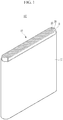
- FIG. 1 is an exploded perspective view of a rechargeable lithium battery according to an embodiment.
- the rechargeable lithium battery according to an embodiment is illustrated as a prismatic battery but is not limited thereto and may include variously-shaped batteries such as a cylindrical battery, a pouch battery, coin-type, and the like.
- a rechargeable lithium battery 100 includes an electrode assembly 40 manufactured by winding a separator 30 disposed between a positive electrode 10 and a negative electrode 20, and a battery case 50 housing the electrode assembly 40.
- An electrolyte (not shown) may be impregnated in the positive electrode 10, the negative electrode 20, and the separator 30.
- a mixture was prepared by mixing lithium carbonate (Li 2 CO 3 ) and Ni 0.55 Co 0.25 Mn 0.20 (OH) 2 to provide Li (Ni + Co + Mn) at a mole ratio of 1.01 1.00.
- Ni 0.55 Co 0.25 Mn 0 . 20 (OH) 2 was obtained by mixing Compound 1A and Compound 2A having the same composition but different particle diameters in a weight ratio of 8 : 2.
- the prepared mixture was subjected to a first heat-treating under conditions of heating at 5 °C/min from 25 °C to 900 °C, maintaining at 900 °C for 2 hours, and then cooling at 5 °C/min until 25 °C to provide a first fired product including a first compound (Li 1.01 Ni 0.55 Co 0.25 Mn 0.20 O 2 ) and a second compound (Li 1.01 Ni 0.55 Co 0.25 Mn 0.20 O 2 ). Meanwhile, the first heat-treating process was performed under an air atmosphere in an insertion height of 5 cm.
- the first fired product was subjected to a second heat-treating under conditions of heating at 5 °C/min from 25 °C to 850 °C, maintaining at 850 °C for 10 hours, and then cooling down at 5 °C/min until 25 °C to provide a positive active material in which the first compound (LiNi 0.55 Co 0.25 Mn 0.20 O 2 ) and the second compound (LiNi 0.55 Co 0.25 Mn 0.20 O 2 ) are mixed at a weight ratio of 8 : 2. Meanwhile, the second heat-treating was performed under an oxygen (O 2 ) atmosphere.
- O 2 oxygen
- an average particle diameter (D50) of the first compound was 20 ⁇ m
- an average particle diameter (D50) of the second compound was 3 ⁇ m
- an average of the average particle diameters (D50) of the first compound and the second compound was 17 ⁇ m.
- the second compound had a shape of combining a long needle shape and a sheet shape.
- the commercial product NCM111 (LiNi 1/3 Co 1/3 Mn 1/3 , Yumi Koa Co., Ltd.) was used as the positive active material.
- the commercial product NCM523 (LiNi 0.5 Co 0.2 Mn 0.3 , Easpring) was used as the positive active material.
- a mixture was prepared by mixing lithium carbonate (Li 2 CO 3 ) and Compound 1A Ni 0.55 Co 0.25 Mn 0.20 (OH) 2 to provide Li: (Ni + Co + Mn) at a mole ratio of 1.03 : 1.
- the prepared mixture was subjected to a heat treatment under conditions of heating at 2.5 °C/min from 25 °C to 850 °C, maintaining at 850 °C for 20 hours, and then cooling down at 2.5 °C/min until 25 °C to provide a first compound (Li 1.03 Ni 0.55 Co 0.25 Mn 0.20 O 2 ). Meanwhile, the heat-treating process was performed in an insertion height of 5 cm under an air atmosphere.
- Lithium carbonate (Li 2 CO 3 ) and Compound 2A (Ni 0.55 Co 0.25 Mn 0.20 (OH) 2 ) having a combination of long needle shapes and sheet shapes are mixed to provide Li: (Ni + Co + Mn) at a mole ratio of 1.00 to 1.01 : 1, and the mixture was subjected to a heat treatment under conditions of heating at 2.5 °C/min from 25 °C to 750 °C, maintaining at 750 °C for 15 hours, and then cooling down at 5 °C/min until 25 °C to provide a second compound represented by Li 1.00 Ni 0.55 Co 0.25 Mn 0.20 O 2 . The process was performed under an air atmosphere.
- the first compound and the second compound are mixed at a weight ratio of 8 : 2, and the mixture was subjected to a third heat-treating under a condition of 400 °C to provide a positive active material including the first compound and the second compound.
- the first compound has an average particle diameter (D50) of 20 ⁇ m and the second compound has an average particle diameter (D50) of 3 ⁇ m.
- the commercial product NCM622 (LiNi 0.6 Co 0.2 Mn 0.2 , Yumi Koa Co., Ltd.) was used as the positive active material.
- the commercial product NCM701515 (LiNi 0.7 Co 0.15 Mn 0.15 , L&F Co., Ltd.) was used as the positive active material.
- the commercial product NCM811 (LiNi 0.8 Co 0.1 Mn 0.1 , Yumi Koa Co., Ltd.) was used as the positive active material.
- positive active material slurry 94 wt% of positive active material prepared in Example 1, 3 wt% of ketjen black, and 3 wt% of polyvinylidene fluoride were mixed in N-methyl pyrrolidone solvent to prepare positive active material slurry.
- the positive active material slurry was coated on an Al foil followed by drying and compressing the same to manufacture a positive electrode.
- the 2032-type a half-cell was manufactured by a conventional method using the positive electrode, a lithium metal counter electrode, and an electrolyte.
- the electrolyte was a mixed solvent (50: 50 volume ratio) of ethylene carbonate and dimethyl carbonate in which 1.0 M LiPF 6 was dissolved.
- Each 2032-type half-cell was manufactured according to the same method as Example 2, except that each positive active material prepared in Comparative Example 1 to Comparative Example 6 was used.
- the 1 st differential capacity (dQ/dV)-voltage charge/discharge graphs according to the first charge/discharge and the 2 nd differential capacity (dQ/dV)-voltage charge/discharge graphs according to the second charge/discharge were measured.
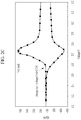
- Example 2 The 1 st differential capacity (dQ/dV)-voltage charge/discharge graphs of Example 2 and Comparative Examples 8 to 10 according to the first charge/discharge are respectively shown in FIGS. 2A and 3A (Example 2), FIGS. 2B and 3B (Comparative Example 8), FIGS. 2C and 3C (Comparative Example 9), and FIGS. 2D and 3D (Comparative Example 10).
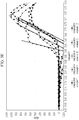
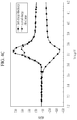
- FIG. 4A shows the 1 st differential capacity (dQ/dV)-voltage charge/discharge graph of Example 2 according to the first charge/discharge and the 2 nd differential capacity (dQ/dV)-voltage charge/discharge graph of Example 2 according to the second charge/discharge
- FIGS. 4B , 4C , and 4D respectively show the graphs of Comparative Examples 8 to 10.
- each charge capacity, discharge capacity, and charge/discharge efficiency according to the first charge/discharge and the second charge/discharge are shown in Table 1.
- Table 1 Charge capacity (mAh/g) Discharge capacity (mAh/g) Charge/discha rge efficiency (%)
- Example 2 (NCM552520) 1 st charge/discharge 186.4 172.4 92.5 2 nd charge/discharge 172.3 172.0 99.8 Difference (1 st - 2 nd ) 14.1 0.4 - Comparative Example 8 (NCM523) 1 st charge/discharge 180.1 159.4 88.5 2 nd charge/discharge 159.3 158.8 99.7 Difference (1 st - 2 nd ) 20.8 0.6 - Comparative Example 9 (NCM552520) 1 st charge/discharge 185.3 163.7 88.3 2 nd charge/discharge 163.5 162.8 99.6 Difference (1 st - 2 nd ) 21.8 0.9 - Comparative Example 10
- Example 2 using the positive active material of Example 1 exhibited improved initial charge/discharge capacity and charge/discharge efficiency compared with the half-cells of Comparative Examples 8 to 10 respectively using the positive active materials of Comparative Examples 2 to 4.
- Example 2 exhibited a little decrease (14.1 mAh/g) of the 2 nd charge capacity relative to the 1 st charge capacity, but the half-cells of Comparative Examples 8 to 10 exhibited a relatively large decrease (18.4 mAh/g to 21.8 mAh/g), and the reason is that as for Comparative Examples 8 to 10, the positive active materials had phase structure changes during the initial charge/discharge.
- the positive active materials showed consistent tendency in terms of charge/discharge characteristics depending on a nickel content, and referring to Table 2 and FIGS. 2A to 2D , 3A to 3D , and 3E , as each nickel content of the positive active materials increases, charge start voltages (V s ) and voltages (V 1 ) thereof tend to decrease. Referring to this result and the experiment results of Comparative Examples 8 to 10 of Table 1, as the charge start voltages (V s ) and voltages (V 1 ) decreased, charge/discharge capacity and charge/discharge efficiency thereof were improved.
- Example 2 included even 55 at% of nickel but was out of the aforementioned tendency and specifically, exhibited much decreased charge start voltage (V s ) and voltage (V 1 ) compared with Comparative Examples 9 to 12 including nickel at a high content, and accordingly, charge/discharge capacity and charge/discharge efficiency of Example 2 were much improved.
- the 1 st differential capacity (dQ/dV)-voltage charge/discharge graph of the half-cell of Example 2 showed two peaks within a range of 3.60 V to 3.85 V, wherein the second peak value (differential capacity) was larger than the first peak value (differential capacity).
- the 1 st differential capacity (dQ/dV)-voltage charge/discharge graphs of the half-cells of Comparative Examples 7 to 12 showed a single peak within a range of 3.60 V to 3.85 V.
- the 1 st differential capacity (dQ/dV)-voltage charge/discharge graph and the 2 nd differential capacity (dQ/dV)-voltage charge/discharge graph of the half-cell according to Example 2 were almost the same (refer to FIG. 4A ), and the reason is that the positive active material had no phase structure change during the initial charge/discharge.
- the half-cells according to Comparative Examples 8 to 10 exhibited that the 2 nd differential capacity (dQ/dV)-voltage charge/discharge graphs changed from the 1 st differential capacity (dQ/dV)-voltage charge/discharge graphs (refer to FIGS. 4B , 4C , and 4D ), and the reason is that the positive active materials exhibited a phase structure change during the initial charge/discharge.
- phase stability of the positive active material of the half-cell according to Example 2 was improved compared with that of the positive active materials of the half-cells according to Comparative Examples 8 to 10, and accordingly, charge/discharge capacity and charge/discharge efficiency thereof were improved.
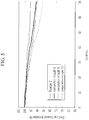
- the results of Example 2 and Comparative Examples 8 to 10 are shown in FIG. 5 .
- Example 2 exhibited excellent high temperature cycle-life characteristics compared with the half-cells according to Comparative Examples 8 to 10.
Landscapes
- Chemical & Material Sciences (AREA)
- Chemical Kinetics & Catalysis (AREA)
- Electrochemistry (AREA)
- General Chemical & Material Sciences (AREA)
- Engineering & Computer Science (AREA)
- Manufacturing & Machinery (AREA)
- Materials Engineering (AREA)
- Inorganic Chemistry (AREA)
- Composite Materials (AREA)
- Battery Electrode And Active Subsutance (AREA)
Claims (6)
- Ein positives Aktivmaterial für eine wiederaufladbare Lithiumbatterie, aufweisendPartikel einer durch die chemische Formel 1 dargestellten ersten Verbindung und Partikel einer durch die chemische Formel 2 dargestellten zweiten Verbindung, wobei die Partikel der ersten Verbindung einen mittleren Partikeldurchmesser D50 von 15 µm bis 20 µm aufweisen und die Partikel der zweiten Verbindung einen mittleren Partikeldurchmesser D50 von 2µm bis 5 µm aufweisen, die durch Rasterelektronenmikroskopie, REM, gemessen werden,wobei die erste Verbindung und die zweite Verbindung einen Ni-Gehalt von 50 At-% bis 60 At-% der Metallelemente ausgenommen Li aufweisen:
[Chemische Formel 1] LiaNixCoyM1 zO2
[Chemische Formel 2] LiaNixCoyM2 zO2
wobei in der chemischen Formel 1 und chemischen Formel 2 0,9 ≤ a ≤ 1,05, 0,5 ≤ x ≤ 0,6, 0,05 ≤ y ≤ 0,35, 0,05 ≤ z ≤ 0,35, x + y + z = 1 und M1 und M2 unabhängig voneinander zumindest ein Metallelement ausgewählt aus Mn, Al, Cr, Fe, V, Mg, Ti, Zr, Nb, Mo, W, Cu, Zn, Ga, In, Sn, La und Ce sind,wobei zumindest einer der Partikel der ersten Verbindung und der Partikel der zweiten Verbindung einen Kern und eine Oberflächenschicht, die den Kern umgibt, aufweist und eine Ni-Atomkonzentration (At-%) der Metallelemente ausgenommen Li in der Oberflächenschicht höher ist als eine Ni-Atomkonzentration (At-%) der Metallelemente ausgenommen Li im Kern. - Das positive Aktivmaterial nach Anspruch 1, wobei die Oberflächenschicht ein Bereich ist, der einer Tiefe von 200 nm von der Oberfläche der Partikel der ersten Verbindung oder der Partikel der zweiten Verbindung entspricht.
- Das positive Aktivmaterial nach einem der vorhergehenden Ansprüche, wobei eine Kationenmischung kleiner als oder gleich 3% ist.
- Das positive Aktivmaterial nach Anspruch 1, wobei die Partikel der zweiten Verbindung eine Nadelform, eine Plattenform oder eine Kombination davon aufweisen.
- Das positive Aktivmaterial nach Anspruch 1, wobei die Partikel der ersten Verbindung und die Partikel der zweiten Verbindung in einem Gewichtsverhältnis von 90 : 10 bis 50 : 50 gemischt sind.
- Eine wiederaufladbare Lithiumbatterie, aufweisendeine positive Elektrode, aufweisend ein positives Aktivmaterial nach einem der Ansprüche 1 bis 5;eine negative Elektrode, aufweisend ein negatives Aktivmaterial; undeinen Elektrolyt.
Priority Applications (1)
| Application Number | Priority Date | Filing Date | Title |
|---|---|---|---|
| PL20161073T PL3706208T3 (pl) | 2019-03-05 | 2020-03-05 | Aktywny materiał dodatni do akumulatora litowego wielokrotnego ładowania, sposób przygotowania tego materiału oraz akumulator litowy wielokrotnego ładowania zawierający ten materiał |
Applications Claiming Priority (2)
| Application Number | Priority Date | Filing Date | Title |
|---|---|---|---|
| KR20190025305 | 2019-03-05 | ||
| KR1020200027096A KR102314085B1 (ko) | 2019-03-05 | 2020-03-04 | 리튬 이차 전지용 양극 활물질, 이의 제조 방법 및 이를 포함하는 리튬 이차 전지 |
Publications (2)
| Publication Number | Publication Date |
|---|---|
| EP3706208A1 EP3706208A1 (de) | 2020-09-09 |
| EP3706208B1 true EP3706208B1 (de) | 2021-09-08 |
Family
ID=69770708
Family Applications (1)
| Application Number | Title | Priority Date | Filing Date |
|---|---|---|---|
| EP20161073.0A Active EP3706208B1 (de) | 2019-03-05 | 2020-03-05 | Positives aktivmaterial für wiederaufladbare lithiumbatterie, verfahren zur herstellung davon und wiederaufladbare lithiumbatterie damit |
Country Status (5)
| Country | Link |
|---|---|
| US (1) | US11552293B2 (de) |
| EP (1) | EP3706208B1 (de) |
| CN (1) | CN111668462B (de) |
| HU (1) | HUE056994T2 (de) |
| PL (1) | PL3706208T3 (de) |
Families Citing this family (6)
| Publication number | Priority date | Publication date | Assignee | Title |
|---|---|---|---|---|
| KR102255905B1 (ko) * | 2019-08-02 | 2021-05-24 | 삼성에스디아이 주식회사 | 리튬 이차 전지용 양극 활물질, 이의 제조 방법, 이를 포함하는 양극 및 리튬 이차 전지 |
| WO2021040306A1 (ko) * | 2019-08-23 | 2021-03-04 | 주식회사 엘지화학 | 배터리 soh 예측 방법 및 이를 적용한 배터리 팩 |
| CN113839109A (zh) * | 2021-08-17 | 2021-12-24 | 天能帅福得能源股份有限公司 | 一种快速对锂离子电池进行分容的方法 |
| CN119325651B (zh) * | 2023-10-20 | 2025-12-16 | 宁德新能源科技有限公司 | 电化学装置和电子装置 |
| KR20260049675A (ko) * | 2023-10-20 | 2026-04-14 | 닝더 엠프렉스 테크놀로지 리미티드 | 전기화학 장치 및 전자 장치 |
| KR20250130059A (ko) * | 2024-02-23 | 2025-09-01 | 삼성에스디아이 주식회사 | 양극 활물질과 이를 포함하는 양극 및 리튬 이차 전지 |
Family Cites Families (20)
| Publication number | Priority date | Publication date | Assignee | Title |
|---|---|---|---|---|
| CN101752558A (zh) | 2008-12-22 | 2010-06-23 | 深圳市比克电池有限公司 | 一种锂离子电池正极材料及其制备方法 |
| JPWO2010113512A1 (ja) | 2009-04-03 | 2012-10-04 | パナソニック株式会社 | リチウムイオン二次電池用正極活物質及びその製造方法並びにリチウムイオン二次電池 |
| KR101286761B1 (ko) | 2010-06-01 | 2013-07-16 | 주식회사 엘앤에프신소재 | 전이금속 화합물 전구체, 이를 이용한 리튬 전이금속 화합물, 상기 리튬 전이금속 화합물을 포함하는 양극 활물질 및 상기 양극 활물질을 포함하는 리튬 이온 이차전지 |
| JP6032457B2 (ja) | 2012-02-03 | 2016-11-30 | 日産自動車株式会社 | 固溶体リチウム含有遷移金属酸化物及びリチウムイオン二次電池 |
| WO2013137509A1 (ko) | 2012-03-13 | 2013-09-19 | 주식회사 엘앤에프신소재 | 리튬 이차 전지용 양극 활물질의 제조 방법, 리튬 이차전지용 양극 활물질 및 리튬 이차전지 |
| TWI549336B (zh) * | 2012-06-01 | 2016-09-11 | 輔仁大學學校財團法人輔仁大學 | 鋰鎳鈷錳正極材料粉體 |
| EP2940761B1 (de) | 2012-12-26 | 2019-12-18 | IUCF-HYU (Industry-University Cooperation Foundation Hanyang University) | Kathodenaktivmaterial für lithium-sekundärbatterie |
| JP6397007B2 (ja) | 2013-06-21 | 2018-09-26 | キャボット コーポレイションCabot Corporation | リチウムイオン電池用の活性材料 |
| KR101785262B1 (ko) | 2013-07-08 | 2017-10-16 | 삼성에스디아이 주식회사 | 양극 활물질, 그 제조방법, 이를 채용한 양극 및 리튬이차전지 |
| KR20150099219A (ko) | 2014-02-21 | 2015-08-31 | 삼성전자주식회사 | 양극 활물질, 이를 채용한 리튬 전지, 및 상기 양극 활물질의 제조방법 |
| JP6369126B2 (ja) | 2014-05-21 | 2018-08-08 | 戸田工業株式会社 | 非水電解質二次電池用正極活物質粒子粉末及びその製造方法、並びに非水電解質二次電池 |
| KR102486526B1 (ko) | 2015-09-10 | 2023-01-09 | 에스케이온 주식회사 | 리튬 이차 전지 |
| KR102101006B1 (ko) | 2015-12-10 | 2020-04-14 | 주식회사 엘지화학 | 이차전지용 양극 및 이를 포함하는 이차전지 |
| JP6631320B2 (ja) | 2016-02-29 | 2020-01-15 | 住友金属鉱山株式会社 | ニッケル複合水酸化物とその製造方法、非水系電解質二次電池用正極活物質とその製造方法、ならびに非水系電解質二次電池 |
| KR102124950B1 (ko) | 2016-11-23 | 2020-06-22 | 주식회사 엘지화학 | 이차전지용 양극, 그 제조방법 및 이를 포함하는 리튬 이차전지 |
| KR102448302B1 (ko) | 2017-04-28 | 2022-09-29 | 삼성전자주식회사 | 복합양극활물질, 이를 채용한 양극과 리튬전지 및 그 제조방법 |
| CN107611371A (zh) | 2017-08-17 | 2018-01-19 | 格林美(无锡)能源材料有限公司 | 一种高循环与结构稳定的三元材料制备方法 |
| US11081693B2 (en) | 2017-08-30 | 2021-08-03 | Samsung Electronics Co., Ltd. | Composite cathode active material, method of preparing the same, and cathode and lithium battery including the composite cathode active material |
| KR102263998B1 (ko) | 2018-11-02 | 2021-06-11 | 삼성에스디아이 주식회사 | 리튬 이차 전지용 양극 활물질, 이의 제조 방법 및 이를 포함하는 리튬 이차 전지 |
| KR102182358B1 (ko) | 2018-11-02 | 2020-11-24 | 삼성에스디아이 주식회사 | 리튬 이차 전지용 양극 활물질, 이의 제조 방법 및 이를 포함하는 리튬 이차 전지 |
-
2020
- 2020-03-04 US US16/809,460 patent/US11552293B2/en active Active
- 2020-03-05 PL PL20161073T patent/PL3706208T3/pl unknown
- 2020-03-05 EP EP20161073.0A patent/EP3706208B1/de active Active
- 2020-03-05 HU HUE20161073A patent/HUE056994T2/hu unknown
- 2020-03-05 CN CN202010146504.XA patent/CN111668462B/zh active Active
Also Published As
| Publication number | Publication date |
|---|---|
| CN111668462A (zh) | 2020-09-15 |
| CN111668462B (zh) | 2023-11-17 |
| PL3706208T3 (pl) | 2022-01-24 |
| HUE056994T2 (hu) | 2022-04-28 |
| US20200287215A1 (en) | 2020-09-10 |
| EP3706208A1 (de) | 2020-09-09 |
| US11552293B2 (en) | 2023-01-10 |
Similar Documents
| Publication | Publication Date | Title |
|---|---|---|
| EP3647269B1 (de) | Positives aktivmaterial für eine wiederaufladbare lithiumbatterie, verfahren zur herstellung davon und wiederaufladbare lithiumbatterie damit | |
| EP3708542B1 (de) | Positives aktivmaterial für wiederaufladbare lithiumbatterie, verfahren zur herstellung davon und wiederaufladbare lithiumbatterie damit | |
| EP3647270B1 (de) | Positiv aktives material für eine wiederaufladbare lithiumbatterie, herstellungsverfahren dafür und wiederaufladbare lithiumbatterie damit | |
| EP3706208B1 (de) | Positives aktivmaterial für wiederaufladbare lithiumbatterie, verfahren zur herstellung davon und wiederaufladbare lithiumbatterie damit | |
| EP3817105A1 (de) | Positives aktivmaterial für wiederaufladbare lithiumbatterie, verfahren zur herstellung davon und wiederaufladbare lithiumbatterie damit | |
| EP2420475A1 (de) | Negativelektroden-Aktivmaterial für eine wiederaufladbare Lithiumbatterie, Herstellungsverfahren dafür und wiederaufladbare Lithiumbatterie damit | |
| EP3249721A1 (de) | Positivelektrode für eine wiederaufladbare lithiumbatterie und wiederaufladbare lithiumbatterie damit | |
| KR102358675B1 (ko) | 리튬 이차 전지용 양극 활물질의 제조 방법 | |
| KR102255905B1 (ko) | 리튬 이차 전지용 양극 활물질, 이의 제조 방법, 이를 포함하는 양극 및 리튬 이차 전지 | |
| EP3486977B1 (de) | Positive elektrode für wiederaufladbare lithium-batterie, wiederaufladbare lithium-batterie mit dem gleichen und batterie-modul | |
| KR20120117526A (ko) | 리튬 이차전지용 양극 활물질의 제조 방법 및 이를 이용한 리튬 이차전지 | |
| KR102085247B1 (ko) | 리튬 이차 전지용 양극 활물질, 이의 제조 방법 및 이를 포함하는 리튬 이차 전지 | |
| KR20170133949A (ko) | 리튬 이차 전지용 양극 활물질 및 이를 포함하는 리튬 이차 전지 | |
| KR20160093817A (ko) | 리튬 이차 전지용 양극 활물질, 이의 제조방법 및 이를 포함하는 리튬 이차 전지 | |
| KR101673178B1 (ko) | 리튬 이차 전지용 양극 활물질, 이의 제조방법 및 이를 포함하는 리튬 이차 전지 | |
| KR20150093056A (ko) | 리튬 이차 전지용 양극 활물질, 이의 제조 방법 및 이를 포함하는 리튬 이차 전지 | |
| KR102314085B1 (ko) | 리튬 이차 전지용 양극 활물질, 이의 제조 방법 및 이를 포함하는 리튬 이차 전지 | |
| KR20200124515A (ko) | 리튬 이차 전지용 양극 활물질, 이의 제조 방법 및 이를 포함하는 리튬 이차 전지 | |
| EP3550655A2 (de) | Lithiumsekundärbatterie |
Legal Events
| Date | Code | Title | Description |
|---|---|---|---|
| PUAI | Public reference made under article 153(3) epc to a published international application that has entered the european phase |
Free format text: ORIGINAL CODE: 0009012 |
|
| STAA | Information on the status of an ep patent application or granted ep patent |
Free format text: STATUS: REQUEST FOR EXAMINATION WAS MADE |
|
| 17P | Request for examination filed |
Effective date: 20200305 |
|
| AK | Designated contracting states |
Kind code of ref document: A1 Designated state(s): AL AT BE BG CH CY CZ DE DK EE ES FI FR GB GR HR HU IE IS IT LI LT LU LV MC MK MT NL NO PL PT RO RS SE SI SK SM TR |
|
| AX | Request for extension of the european patent |
Extension state: BA ME |
|
| GRAP | Despatch of communication of intention to grant a patent |
Free format text: ORIGINAL CODE: EPIDOSNIGR1 |
|
| STAA | Information on the status of an ep patent application or granted ep patent |
Free format text: STATUS: GRANT OF PATENT IS INTENDED |
|
| INTG | Intention to grant announced |
Effective date: 20210617 |
|
| GRAS | Grant fee paid |
Free format text: ORIGINAL CODE: EPIDOSNIGR3 |
|
| GRAA | (expected) grant |
Free format text: ORIGINAL CODE: 0009210 |
|
| STAA | Information on the status of an ep patent application or granted ep patent |
Free format text: STATUS: THE PATENT HAS BEEN GRANTED |
|
| AK | Designated contracting states |
Kind code of ref document: B1 Designated state(s): AL AT BE BG CH CY CZ DE DK EE ES FI FR GB GR HR HU IE IS IT LI LT LU LV MC MK MT NL NO PL PT RO RS SE SI SK SM TR |
|
| REG | Reference to a national code |
Ref country code: GB Ref legal event code: FG4D |
|
| REG | Reference to a national code |
Ref country code: CH Ref legal event code: EP Ref country code: AT Ref legal event code: REF Ref document number: 1429376 Country of ref document: AT Kind code of ref document: T Effective date: 20210915 |
|
| REG | Reference to a national code |
Ref country code: IE Ref legal event code: FG4D |
|
| REG | Reference to a national code |
Ref country code: DE Ref legal event code: R096 Ref document number: 602020000496 Country of ref document: DE |
|
| REG | Reference to a national code |
Ref country code: SE Ref legal event code: TRGR |
|
| REG | Reference to a national code |
Ref country code: LT Ref legal event code: MG9D |
|
| REG | Reference to a national code |
Ref country code: NL Ref legal event code: MP Effective date: 20210908 |
|
| PG25 | Lapsed in a contracting state [announced via postgrant information from national office to epo] |
Ref country code: RS Free format text: LAPSE BECAUSE OF FAILURE TO SUBMIT A TRANSLATION OF THE DESCRIPTION OR TO PAY THE FEE WITHIN THE PRESCRIBED TIME-LIMIT Effective date: 20210908 Ref country code: ES Free format text: LAPSE BECAUSE OF FAILURE TO SUBMIT A TRANSLATION OF THE DESCRIPTION OR TO PAY THE FEE WITHIN THE PRESCRIBED TIME-LIMIT Effective date: 20210908 Ref country code: BG Free format text: LAPSE BECAUSE OF FAILURE TO SUBMIT A TRANSLATION OF THE DESCRIPTION OR TO PAY THE FEE WITHIN THE PRESCRIBED TIME-LIMIT Effective date: 20211208 Ref country code: LT Free format text: LAPSE BECAUSE OF FAILURE TO SUBMIT A TRANSLATION OF THE DESCRIPTION OR TO PAY THE FEE WITHIN THE PRESCRIBED TIME-LIMIT Effective date: 20210908 Ref country code: NO Free format text: LAPSE BECAUSE OF FAILURE TO SUBMIT A TRANSLATION OF THE DESCRIPTION OR TO PAY THE FEE WITHIN THE PRESCRIBED TIME-LIMIT Effective date: 20211208 Ref country code: HR Free format text: LAPSE BECAUSE OF FAILURE TO SUBMIT A TRANSLATION OF THE DESCRIPTION OR TO PAY THE FEE WITHIN THE PRESCRIBED TIME-LIMIT Effective date: 20210908 Ref country code: FI Free format text: LAPSE BECAUSE OF FAILURE TO SUBMIT A TRANSLATION OF THE DESCRIPTION OR TO PAY THE FEE WITHIN THE PRESCRIBED TIME-LIMIT Effective date: 20210908 |
|
| REG | Reference to a national code |
Ref country code: AT Ref legal event code: MK05 Ref document number: 1429376 Country of ref document: AT Kind code of ref document: T Effective date: 20210908 |
|
| PG25 | Lapsed in a contracting state [announced via postgrant information from national office to epo] |
Ref country code: LV Free format text: LAPSE BECAUSE OF FAILURE TO SUBMIT A TRANSLATION OF THE DESCRIPTION OR TO PAY THE FEE WITHIN THE PRESCRIBED TIME-LIMIT Effective date: 20210908 Ref country code: GR Free format text: LAPSE BECAUSE OF FAILURE TO SUBMIT A TRANSLATION OF THE DESCRIPTION OR TO PAY THE FEE WITHIN THE PRESCRIBED TIME-LIMIT Effective date: 20211209 |
|
| REG | Reference to a national code |
Ref country code: HU Ref legal event code: AG4A Ref document number: E056994 Country of ref document: HU |
|
| PG25 | Lapsed in a contracting state [announced via postgrant information from national office to epo] |
Ref country code: AT Free format text: LAPSE BECAUSE OF FAILURE TO SUBMIT A TRANSLATION OF THE DESCRIPTION OR TO PAY THE FEE WITHIN THE PRESCRIBED TIME-LIMIT Effective date: 20210908 |
|
| PG25 | Lapsed in a contracting state [announced via postgrant information from national office to epo] |
Ref country code: IS Free format text: LAPSE BECAUSE OF FAILURE TO SUBMIT A TRANSLATION OF THE DESCRIPTION OR TO PAY THE FEE WITHIN THE PRESCRIBED TIME-LIMIT Effective date: 20220108 Ref country code: SM Free format text: LAPSE BECAUSE OF FAILURE TO SUBMIT A TRANSLATION OF THE DESCRIPTION OR TO PAY THE FEE WITHIN THE PRESCRIBED TIME-LIMIT Effective date: 20210908 Ref country code: SK Free format text: LAPSE BECAUSE OF FAILURE TO SUBMIT A TRANSLATION OF THE DESCRIPTION OR TO PAY THE FEE WITHIN THE PRESCRIBED TIME-LIMIT Effective date: 20210908 Ref country code: RO Free format text: LAPSE BECAUSE OF FAILURE TO SUBMIT A TRANSLATION OF THE DESCRIPTION OR TO PAY THE FEE WITHIN THE PRESCRIBED TIME-LIMIT Effective date: 20210908 Ref country code: PT Free format text: LAPSE BECAUSE OF FAILURE TO SUBMIT A TRANSLATION OF THE DESCRIPTION OR TO PAY THE FEE WITHIN THE PRESCRIBED TIME-LIMIT Effective date: 20220110 Ref country code: NL Free format text: LAPSE BECAUSE OF FAILURE TO SUBMIT A TRANSLATION OF THE DESCRIPTION OR TO PAY THE FEE WITHIN THE PRESCRIBED TIME-LIMIT Effective date: 20210908 Ref country code: EE Free format text: LAPSE BECAUSE OF FAILURE TO SUBMIT A TRANSLATION OF THE DESCRIPTION OR TO PAY THE FEE WITHIN THE PRESCRIBED TIME-LIMIT Effective date: 20210908 Ref country code: CZ Free format text: LAPSE BECAUSE OF FAILURE TO SUBMIT A TRANSLATION OF THE DESCRIPTION OR TO PAY THE FEE WITHIN THE PRESCRIBED TIME-LIMIT Effective date: 20210908 Ref country code: AL Free format text: LAPSE BECAUSE OF FAILURE TO SUBMIT A TRANSLATION OF THE DESCRIPTION OR TO PAY THE FEE WITHIN THE PRESCRIBED TIME-LIMIT Effective date: 20210908 |
|
| REG | Reference to a national code |
Ref country code: DE Ref legal event code: R097 Ref document number: 602020000496 Country of ref document: DE |
|
| PLBE | No opposition filed within time limit |
Free format text: ORIGINAL CODE: 0009261 |
|
| STAA | Information on the status of an ep patent application or granted ep patent |
Free format text: STATUS: NO OPPOSITION FILED WITHIN TIME LIMIT |
|
| PG25 | Lapsed in a contracting state [announced via postgrant information from national office to epo] |
Ref country code: DK Free format text: LAPSE BECAUSE OF FAILURE TO SUBMIT A TRANSLATION OF THE DESCRIPTION OR TO PAY THE FEE WITHIN THE PRESCRIBED TIME-LIMIT Effective date: 20210908 |
|
| 26N | No opposition filed |
Effective date: 20220609 |
|
| PG25 | Lapsed in a contracting state [announced via postgrant information from national office to epo] |
Ref country code: SI Free format text: LAPSE BECAUSE OF FAILURE TO SUBMIT A TRANSLATION OF THE DESCRIPTION OR TO PAY THE FEE WITHIN THE PRESCRIBED TIME-LIMIT Effective date: 20210908 |
|
| PG25 | Lapsed in a contracting state [announced via postgrant information from national office to epo] |
Ref country code: MC Free format text: LAPSE BECAUSE OF FAILURE TO SUBMIT A TRANSLATION OF THE DESCRIPTION OR TO PAY THE FEE WITHIN THE PRESCRIBED TIME-LIMIT Effective date: 20210908 |
|
| REG | Reference to a national code |
Ref country code: BE Ref legal event code: MM Effective date: 20220331 |
|
| PG25 | Lapsed in a contracting state [announced via postgrant information from national office to epo] |
Ref country code: IT Free format text: LAPSE BECAUSE OF FAILURE TO SUBMIT A TRANSLATION OF THE DESCRIPTION OR TO PAY THE FEE WITHIN THE PRESCRIBED TIME-LIMIT Effective date: 20210908 Ref country code: IE Free format text: LAPSE BECAUSE OF NON-PAYMENT OF DUE FEES Effective date: 20220305 Ref country code: LU Free format text: LAPSE BECAUSE OF NON-PAYMENT OF DUE FEES Effective date: 20220305 |
|
| PG25 | Lapsed in a contracting state [announced via postgrant information from national office to epo] |
Ref country code: BE Free format text: LAPSE BECAUSE OF NON-PAYMENT OF DUE FEES Effective date: 20220331 |
|
| P01 | Opt-out of the competence of the unified patent court (upc) registered |
Effective date: 20230528 |
|
| REG | Reference to a national code |
Ref country code: CH Ref legal event code: PL |
|
| PG25 | Lapsed in a contracting state [announced via postgrant information from national office to epo] |
Ref country code: LI Free format text: LAPSE BECAUSE OF NON-PAYMENT OF DUE FEES Effective date: 20230331 Ref country code: CH Free format text: LAPSE BECAUSE OF NON-PAYMENT OF DUE FEES Effective date: 20230331 |
|
| PG25 | Lapsed in a contracting state [announced via postgrant information from national office to epo] |
Ref country code: MK Free format text: LAPSE BECAUSE OF FAILURE TO SUBMIT A TRANSLATION OF THE DESCRIPTION OR TO PAY THE FEE WITHIN THE PRESCRIBED TIME-LIMIT Effective date: 20210908 Ref country code: CY Free format text: LAPSE BECAUSE OF FAILURE TO SUBMIT A TRANSLATION OF THE DESCRIPTION OR TO PAY THE FEE WITHIN THE PRESCRIBED TIME-LIMIT Effective date: 20210908 |
|
| PG25 | Lapsed in a contracting state [announced via postgrant information from national office to epo] |
Ref country code: MT Free format text: LAPSE BECAUSE OF FAILURE TO SUBMIT A TRANSLATION OF THE DESCRIPTION OR TO PAY THE FEE WITHIN THE PRESCRIBED TIME-LIMIT Effective date: 20210908 |
|
| PG25 | Lapsed in a contracting state [announced via postgrant information from national office to epo] |
Ref country code: TR Free format text: LAPSE BECAUSE OF FAILURE TO SUBMIT A TRANSLATION OF THE DESCRIPTION OR TO PAY THE FEE WITHIN THE PRESCRIBED TIME-LIMIT Effective date: 20210908 |
|
| PGFP | Annual fee paid to national office [announced via postgrant information from national office to epo] |
Ref country code: SE Payment date: 20260227 Year of fee payment: 7 |
|
| PGFP | Annual fee paid to national office [announced via postgrant information from national office to epo] |
Ref country code: GB Payment date: 20260303 Year of fee payment: 7 |
|
| PGFP | Annual fee paid to national office [announced via postgrant information from national office to epo] |
Ref country code: DE Payment date: 20260305 Year of fee payment: 7 |
|
| PGFP | Annual fee paid to national office [announced via postgrant information from national office to epo] |
Ref country code: HU Payment date: 20260330 Year of fee payment: 7 |
|
| PGFP | Annual fee paid to national office [announced via postgrant information from national office to epo] |
Ref country code: FR Payment date: 20260309 Year of fee payment: 7 |
|
| PGFP | Annual fee paid to national office [announced via postgrant information from national office to epo] |
Ref country code: PL Payment date: 20260227 Year of fee payment: 7 |