EP3702442B1 - Cell culture media and methods - Google Patents
Cell culture media and methods Download PDFInfo
- Publication number
- EP3702442B1 EP3702442B1 EP20170574.6A EP20170574A EP3702442B1 EP 3702442 B1 EP3702442 B1 EP 3702442B1 EP 20170574 A EP20170574 A EP 20170574A EP 3702442 B1 EP3702442 B1 EP 3702442B1
- Authority
- EP
- European Patent Office
- Prior art keywords
- cells
- microsuspension
- poly
- microencapsulated
- media
- Prior art date
- Legal status (The legal status is an assumption and is not a legal conclusion. Google has not performed a legal analysis and makes no representation as to the accuracy of the status listed.)
- Active
Links
Images



Classifications
-
- C—CHEMISTRY; METALLURGY
- C12—BIOCHEMISTRY; BEER; SPIRITS; WINE; VINEGAR; MICROBIOLOGY; ENZYMOLOGY; MUTATION OR GENETIC ENGINEERING
- C12N—MICROORGANISMS OR ENZYMES; COMPOSITIONS THEREOF; PROPAGATING, PRESERVING, OR MAINTAINING MICROORGANISMS; MUTATION OR GENETIC ENGINEERING; CULTURE MEDIA
- C12N5/00—Undifferentiated human, animal or plant cells, e.g. cell lines; Tissues; Cultivation or maintenance thereof; Culture media therefor
- C12N5/0018—Culture media for cell or tissue culture
- C12N5/005—Protein-free medium
-
- B—PERFORMING OPERATIONS; TRANSPORTING
- B01—PHYSICAL OR CHEMICAL PROCESSES OR APPARATUS IN GENERAL
- B01J—CHEMICAL OR PHYSICAL PROCESSES, e.g. CATALYSIS OR COLLOID CHEMISTRY; THEIR RELEVANT APPARATUS
- B01J13/00—Colloid chemistry, e.g. the production of colloidal materials or their solutions, not otherwise provided for; Making microcapsules or microballoons
- B01J13/02—Making microcapsules or microballoons
- B01J13/06—Making microcapsules or microballoons by phase separation
-
- B—PERFORMING OPERATIONS; TRANSPORTING
- B01—PHYSICAL OR CHEMICAL PROCESSES OR APPARATUS IN GENERAL
- B01J—CHEMICAL OR PHYSICAL PROCESSES, e.g. CATALYSIS OR COLLOID CHEMISTRY; THEIR RELEVANT APPARATUS
- B01J13/00—Colloid chemistry, e.g. the production of colloidal materials or their solutions, not otherwise provided for; Making microcapsules or microballoons
- B01J13/02—Making microcapsules or microballoons
- B01J13/20—After-treatment of capsule walls, e.g. hardening
- B01J13/22—Coating
-
- B—PERFORMING OPERATIONS; TRANSPORTING
- B29—WORKING OF PLASTICS; WORKING OF SUBSTANCES IN A PLASTIC STATE IN GENERAL
- B29C—SHAPING OR JOINING OF PLASTICS; SHAPING OF MATERIAL IN A PLASTIC STATE, NOT OTHERWISE PROVIDED FOR; AFTER-TREATMENT OF THE SHAPED PRODUCTS, e.g. REPAIRING
- B29C67/00—Shaping techniques not covered by groups B29C39/00 - B29C65/00, B29C70/00 or B29C73/00
- B29C67/24—Shaping techniques not covered by groups B29C39/00 - B29C65/00, B29C70/00 or B29C73/00 characterised by the choice of material
-
- C—CHEMISTRY; METALLURGY
- C12—BIOCHEMISTRY; BEER; SPIRITS; WINE; VINEGAR; MICROBIOLOGY; ENZYMOLOGY; MUTATION OR GENETIC ENGINEERING
- C12N—MICROORGANISMS OR ENZYMES; COMPOSITIONS THEREOF; PROPAGATING, PRESERVING, OR MAINTAINING MICROORGANISMS; MUTATION OR GENETIC ENGINEERING; CULTURE MEDIA
- C12N5/00—Undifferentiated human, animal or plant cells, e.g. cell lines; Tissues; Cultivation or maintenance thereof; Culture media therefor
- C12N5/0018—Culture media for cell or tissue culture
-
- B—PERFORMING OPERATIONS; TRANSPORTING
- B29—WORKING OF PLASTICS; WORKING OF SUBSTANCES IN A PLASTIC STATE IN GENERAL
- B29L—INDEXING SCHEME ASSOCIATED WITH SUBCLASS B29C, RELATING TO PARTICULAR ARTICLES
- B29L2009/00—Layered products
-
- C—CHEMISTRY; METALLURGY
- C12—BIOCHEMISTRY; BEER; SPIRITS; WINE; VINEGAR; MICROBIOLOGY; ENZYMOLOGY; MUTATION OR GENETIC ENGINEERING
- C12N—MICROORGANISMS OR ENZYMES; COMPOSITIONS THEREOF; PROPAGATING, PRESERVING, OR MAINTAINING MICROORGANISMS; MUTATION OR GENETIC ENGINEERING; CULTURE MEDIA
- C12N2500/00—Specific components of cell culture medium
- C12N2500/30—Organic components
-
- C—CHEMISTRY; METALLURGY
- C12—BIOCHEMISTRY; BEER; SPIRITS; WINE; VINEGAR; MICROBIOLOGY; ENZYMOLOGY; MUTATION OR GENETIC ENGINEERING
- C12N—MICROORGANISMS OR ENZYMES; COMPOSITIONS THEREOF; PROPAGATING, PRESERVING, OR MAINTAINING MICROORGANISMS; MUTATION OR GENETIC ENGINEERING; CULTURE MEDIA
- C12N2500/00—Specific components of cell culture medium
- C12N2500/30—Organic components
- C12N2500/38—Vitamins
-
- C—CHEMISTRY; METALLURGY
- C12—BIOCHEMISTRY; BEER; SPIRITS; WINE; VINEGAR; MICROBIOLOGY; ENZYMOLOGY; MUTATION OR GENETIC ENGINEERING
- C12N—MICROORGANISMS OR ENZYMES; COMPOSITIONS THEREOF; PROPAGATING, PRESERVING, OR MAINTAINING MICROORGANISMS; MUTATION OR GENETIC ENGINEERING; CULTURE MEDIA
- C12N2511/00—Cells for large scale production
-
- C—CHEMISTRY; METALLURGY
- C12—BIOCHEMISTRY; BEER; SPIRITS; WINE; VINEGAR; MICROBIOLOGY; ENZYMOLOGY; MUTATION OR GENETIC ENGINEERING
- C12N—MICROORGANISMS OR ENZYMES; COMPOSITIONS THEREOF; PROPAGATING, PRESERVING, OR MAINTAINING MICROORGANISMS; MUTATION OR GENETIC ENGINEERING; CULTURE MEDIA
- C12N2533/00—Supports or coatings for cell culture, characterised by material
- C12N2533/30—Synthetic polymers
- C12N2533/32—Polylysine, polyornithine
-
- C—CHEMISTRY; METALLURGY
- C12—BIOCHEMISTRY; BEER; SPIRITS; WINE; VINEGAR; MICROBIOLOGY; ENZYMOLOGY; MUTATION OR GENETIC ENGINEERING
- C12N—MICROORGANISMS OR ENZYMES; COMPOSITIONS THEREOF; PROPAGATING, PRESERVING, OR MAINTAINING MICROORGANISMS; MUTATION OR GENETIC ENGINEERING; CULTURE MEDIA
- C12N2533/00—Supports or coatings for cell culture, characterised by material
- C12N2533/30—Synthetic polymers
- C12N2533/40—Polyhydroxyacids, e.g. polymers of glycolic or lactic acid (PGA, PLA, PLGA); Bioresorbable polymers
-
- C—CHEMISTRY; METALLURGY
- C12—BIOCHEMISTRY; BEER; SPIRITS; WINE; VINEGAR; MICROBIOLOGY; ENZYMOLOGY; MUTATION OR GENETIC ENGINEERING
- C12N—MICROORGANISMS OR ENZYMES; COMPOSITIONS THEREOF; PROPAGATING, PRESERVING, OR MAINTAINING MICROORGANISMS; MUTATION OR GENETIC ENGINEERING; CULTURE MEDIA
- C12N2533/00—Supports or coatings for cell culture, characterised by material
- C12N2533/70—Polysaccharides
-
- C—CHEMISTRY; METALLURGY
- C12—BIOCHEMISTRY; BEER; SPIRITS; WINE; VINEGAR; MICROBIOLOGY; ENZYMOLOGY; MUTATION OR GENETIC ENGINEERING
- C12N—MICROORGANISMS OR ENZYMES; COMPOSITIONS THEREOF; PROPAGATING, PRESERVING, OR MAINTAINING MICROORGANISMS; MUTATION OR GENETIC ENGINEERING; CULTURE MEDIA
- C12N2533/00—Supports or coatings for cell culture, characterised by material
- C12N2533/70—Polysaccharides
- C12N2533/72—Chitin, chitosan
-
- C—CHEMISTRY; METALLURGY
- C12—BIOCHEMISTRY; BEER; SPIRITS; WINE; VINEGAR; MICROBIOLOGY; ENZYMOLOGY; MUTATION OR GENETIC ENGINEERING
- C12N—MICROORGANISMS OR ENZYMES; COMPOSITIONS THEREOF; PROPAGATING, PRESERVING, OR MAINTAINING MICROORGANISMS; MUTATION OR GENETIC ENGINEERING; CULTURE MEDIA
- C12N2533/00—Supports or coatings for cell culture, characterised by material
- C12N2533/70—Polysaccharides
- C12N2533/74—Alginate
-
- C—CHEMISTRY; METALLURGY
- C12—BIOCHEMISTRY; BEER; SPIRITS; WINE; VINEGAR; MICROBIOLOGY; ENZYMOLOGY; MUTATION OR GENETIC ENGINEERING
- C12N—MICROORGANISMS OR ENZYMES; COMPOSITIONS THEREOF; PROPAGATING, PRESERVING, OR MAINTAINING MICROORGANISMS; MUTATION OR GENETIC ENGINEERING; CULTURE MEDIA
- C12N2533/00—Supports or coatings for cell culture, characterised by material
- C12N2533/70—Polysaccharides
- C12N2533/76—Agarose, agar-agar
-
- C—CHEMISTRY; METALLURGY
- C12—BIOCHEMISTRY; BEER; SPIRITS; WINE; VINEGAR; MICROBIOLOGY; ENZYMOLOGY; MUTATION OR GENETIC ENGINEERING
- C12N—MICROORGANISMS OR ENZYMES; COMPOSITIONS THEREOF; PROPAGATING, PRESERVING, OR MAINTAINING MICROORGANISMS; MUTATION OR GENETIC ENGINEERING; CULTURE MEDIA
- C12N2533/00—Supports or coatings for cell culture, characterised by material
- C12N2533/70—Polysaccharides
- C12N2533/78—Cellulose
-
- C—CHEMISTRY; METALLURGY
- C12—BIOCHEMISTRY; BEER; SPIRITS; WINE; VINEGAR; MICROBIOLOGY; ENZYMOLOGY; MUTATION OR GENETIC ENGINEERING
- C12N—MICROORGANISMS OR ENZYMES; COMPOSITIONS THEREOF; PROPAGATING, PRESERVING, OR MAINTAINING MICROORGANISMS; MUTATION OR GENETIC ENGINEERING; CULTURE MEDIA
- C12N2533/00—Supports or coatings for cell culture, characterised by material
- C12N2533/70—Polysaccharides
- C12N2533/80—Hyaluronan
Definitions
- compositions, methods and uses relating to novel types of cell culture media, feeds and supplements have several desirable properties, which include but are not limited to, having certain components beyond their normal solubility limits, increased tolerance of radiation, extended release properties, high solubility, increased shelf life, and thermostability. Such characteristics, in certain embodiments, improve customer workflows and bioreactor productivity.
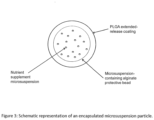
- the present invention provides a microencapsulated microsuspension of a serum-free cell culture medium composition comprising a mixture of a labile component and an antioxidant, wherein the serum-free cell culture medium composition is microencapsulated into a bead with a capsular matrix, wherein the bead has a diameter within the range of 0.05-1.5 mm, wherein a powdered cell culture medium is used for the microencapsulated microsuspension, wherein the composition is irradiated with gamma-rays, and wherein the powdered cell culture medium used for the microencapsulated microsuspension is a serum free advanced granulation technology cell culture medium.
- microencapsulated media compositions described in this disclosure have several desirable properties, which include but are not limited to, (i) ability to deliver certain components at "superconcentrated” levels extending far beyond their normal solubility limits in a culture system, (ii) increased ability to maintain media functionality even after radiation sterilization, (iii) increased ability for extended release of internal components, (iv) high and quick solubility, (v) longer shelf life in dry format, (vi) increased thermostability, (vii) reduced risk of viral contamination up to 8 logs, (viii) the ability to be combined with other sterilizing technologies such as UV, filtration, and/ or HTST pasteurization, (ix) the ability to be applied to a variety of media formats such as AGT, DPM, APM, as well as, to formulations having labile components at higher concentrations, (x) the ability to be applied to a variety of product types such as media, feeds, supplements, functional additives, etc. Due to these characteristics, the microencapsulated compositions can be added directly into a biorea
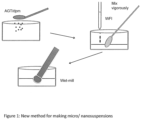
- Disclosed herein but not forming part of the present invention is a method of making a media, feed or supplement composition, the method comprising: adding a minimal volume of an aqueous solution to a dry powder of the media, feed or supplement to make a paste; and mixing the paste vigorously to prepare a microsuspension.
- Disclosed herein, but not forming part of the present invention is a method of preparing a composition comprising a labile component comprising optionally, mixing in an effective amount of an anti-oxidant with the microsuspension of the labile component to form a mixture; encapsulating the microsuspension or the mixture of step 2 in a suitable capsular material such that a microcapsule or bead is formed; and drying the microcapsule or bead.
- the labile substance is attached to a dendrimer.
- the capsular material may be selected from the group comprising, for example, alginate, poly-L-lactic acid, chitosan, agarose, gelatin, hyaluronic acid, chondroitin sulfate, dextran, dextran sulfate, heparin, heparin sulfate, heparan sulfate, gellan gum, xanthan gum, guar gum, water soluble cellulose derivatives and carrageenan.
- the bead is further coated with a material that extends the release of the labile component from the bead.
- the coating is selected from the group comprising of, for example, poly-glycolic acid, PLGA (poly-lactic-co-glycolic acid), collagen, polyhydroxy-alkanoates (PHA), poly- ⁇ -caprolactone, poly-ortho esters, poly-anhydrides, poly-phosphazenes, poly-amino acids, polydimethylsiloxane,polyurethranes, poly-tetrafluoroethylene, polyethylene, polysulphone, poly-methyl methacrylate, poly-2-hydroxyethylmethacrylate, polyamides, polypropylene, poly-vinyl chloride, polystyrene and poly-vinyl pyrrolidone.
- the bead is irradiated, and in a further embodiment, the beads are irradiated with gamma-irradiation. In certain embodiments, the bead can be additionally irradiated with UV rays, whereupon, the bead may be free of PPV and MMV viruses.
- the media is a dry-format media, and the labile component to be protected is selected from the group consisting of a polyamine, a growth factor, a cytokine and a vitamin.
- the capsular material is soluble upon reconstitution with an aqueous solvent.
- the encapsulating matrix encapsulates a dendrimer-labile component complex.
- the dendrimer is a polyamidoamine dendrimer, a polypropylenimine dendrimer, or a polypropylamine (POPAM) dendrimer.
- the methods described can, for example, achieve one or more of the following with respect to the media, feeds, supplements, or functional additives: 1) make them more resistant to irradiation (as measured, for example, based on retetention of efficacy or functionality); 2) increase stability at ambient temperature; 3) allow for extended release of some components; 4) increase stability for transport at ambient temperatures; 5) increase stability to temperature fluctuations.
- compositions used in the methods above may comprise a powdered cell culture medium further comprising a labile compound, and/or at least one concentrated component.
- the capsular material is selected from the group comprising, for example, alginate, poly-L-lactic acid, chitosan, agarose, gelatin, hyaluronic acid, chondroitin sulfate, dextran, dextran sulfate, heparin, heparin sulfate, heparan sulfate, gellan gum, xanthan gum, guar gum, water soluble cellulose derivatives and carrageenan.
- the bead is coated with a coating solution.
- the coating solution is selected form the group consisting of poly-glycolic acid, PLGA (poly-lactic-co-glycolic acid), collagen, polyhydroxyalkanoates (PHA), poly- ⁇ -caprolactone, poly-ortho esters, poly-anhydrides, poly-phosphazenes, poly-amino acids, polydimethylsiloxane,polyurethranes, poly-tetrafluoroethylene, polyethylene, polysulphone, poly-methyl methacrylate, poly-2-hydroxyethylmethacrylate, polyamides, polypropylene, poly-vinyl chloride, polystyrene, poly-vinyl pyrrolidone, poly-L-lysine and polyornithine.
- PHA polyhydroxyalkanoates
- PHA poly- ⁇ -caprolactone
- poly-ortho esters poly-anhydrides
- poly-phosphazenes poly-amino acids
- the composition further comprises a chelated reactive species.
- the reactive species are either cations, metals ions or trace elements.
- the chelating moieties are selected from the group comprising EDTA, citrate, succinate, cyclodextrin, clatharates, dendrimers and amino acids.
- the composition is irradiated with gamma-rays; and in a specific aspect, the gamma-rays may be about 25-100 kGy. In a preferred aspect, gamma-rays of 30-50 kGy are used. In a specific embodiment, the gamma-ray is 30 kGy.
- One of skill in the art will be capable of determining a level of irradiation that maximizes the objective (for example reduction of live virus or other sterilization) while minimizing the impact on, for example, the functionality of the media or the functionality of a particular component of the media (for example, as measured by a component that is particularly sensitive to irradiation or whatever sterilization technique is being employed).
- the methods described herein may be combined with additional step(s) the goal of which is to measure a functional parameter of the media or composition after sterilization (or after any final processing or finishing step).
- the sample may be subject to a functional assay for measuring the impact of the irradiation on a particular component or group of components.
- This step may be used to confirm, for example, that the composition is suitably free of virus and that the components of the media remain in satisfactory condition for the intended application.
- the encapsulated microsuspension compositions described above are added aseptically, directly into a bioreactor. In another embodiment the encapsulated microsuspension compositions described above are placed in a porous metal cylinder, that is autoclavable, within a bioreactor.
- the media used for the microencapsulated microsuspension described above is serum-free and can be protein free, or serum and protein-free.
- the media used for the microencapsulated microsuspension described above may be specifically designed for suspension cell culture, for mammalian cell culture, for insect cell culture, for hybridoma cell culture, for stem cell culture, for induced pluripotent cell culture, for pluripotent cell culture, for tissue explants and/or organ culture, for three-dimensional culture of cells on artificial cell matrices, and other cell and tissue culture applications that one of skill in the art could adapt the teachings in this disclosure to.
- the media used for the microencapsulated microsuspension is AGT (advanced granulation technology cell culture medium).
- microencapsulated microsuspension described above can be used to produce a dry format cell culture medium.
- microencapsulated microsuspension described above can increase the shelf life of the cell culture medium.
- microencapsulated microsuspension described above can be used for recombinant protein production, for vaccine production, for cell production including stem cells, for biofuel production, or for production of nutrients.
- microencapsulated microsuspension described above can be stored and handled at ambient temperatures, can withstand temperature fluctuations, can withstand HTST and/or UHT pasteurization, can withstand exposure to sterilizing radiation wavelengths such as gamma, UV, and others know in the art.
- AGT advanced granulation technology
- AGT media is a dry, powdered medium that is highly desired in the industry, for properties like large particle size, reduced amount of fine dust while handling, high wetability, low dissolution times into solvent, auto- pH and auto osmolarity maintenance, etc.
- APM powder which is "advanced powder media", which has advantageous properties of a particle size that is not as fine as DPM powder, but is not as large as AGT granules.
- sustained release compound or "sensitive compound” or “labile compound” as used in this application refers to substance, chemical or compound to be protected from degradation or reaction with “reactive species” present in dry format media.
- reactive species present in dry format media. Examples of such compounds in cell culture media include but are not limited to: ethanolamine, vitamins, cytokines, growth factors, hormones, etc.
- encapsulating agent may sometimes be referred to as "sequestering agent” in this application, and refers to the encapsulation, protection, separation, or sequestering of susceptible chemicals or components in the cell culture medium or feed, away from conditions that enhance degradation, or reactivity with other reactive chemicals such as amino acids, trace metal elements such as manganese, copper, etc., inorganic buffers such as sodium bicarbonate and other sodium phosphates; and organic buffers such as MOPS, HEPES, PIPES, etc., which may react slowly with the susceptible compound, thereby making the labile component lose its desirable properties over time.
- encapsulation, protection, separation, or sequestering may be done to protect the susceptible chemical or component from physical damage such as, radiation damage, or heat damage, or physical stress, from exposure to moisture/ condensation, or from dehydration, etc.
- the terms “protect” or “separate” or “sequester” or “encapsulate” may have been used interchangeably in the disclosure, and convey the concept of protecting the susceptible chemical or compound from degrading conditions or chemicals.
- the "soluble sequestering agent” itself may be soluble upon reconstitution with an aqueous medium, whereupon it releases the "sensitive” encapsulated material.
- the "insoluble sequestering agent" may be insoluble upon reconstitution with an aqueous medium, whereupon after releasing the "sensitive" encapsulated material, it can be removed by means such as filtration, decanting, etc. from the reconstituted endproduct.
- matrices examples include but are not limited to, alginate, poly-L-lactic acid (PLL), chitosan, agarose, gelatin, hyaluronic acid, chondroitin sulfate, dextran, dextran sulfate, heparin, heparin sulfate, heparan sulfate, gellan gum, xanthan gum, guar gum, water soluble cellulose derivatives, carrageenan and so on.
- PLL poly-L-lactic acid
- the microcapsules may be coated for one of several reasons: to extend and slowly release the microcapsule components; for protection of labile components against any type of damage, say, radiation, heat, dehydration, etc.
- Coatings may include but are not limited to, poly-glycolic acid, PLGA (poly-lactic-co-glycolic acid), collagen, polyhydroxy-alkanoates (PHA), poly- ⁇ -caprolactone, poly-ortho esters, poly-anhydrides, poly-phosphazenes, poly-amino acids, polydimethylsiloxane,polyurethranes, poly-tetrafluoroethylene, polyethylene, polysulphone, poly-methyl methacrylate, poly-2-hydroxyethylmethacrylate, polyamides, polypropylene, poly-vinyl chloride, polystyrene, poly-vinyl pyrrolidone, etc.
- Labile media or feed components include, but are not limited to, compounds such as vitamins, for example, thiamine, B12; amino acids like glutamine; polyamines like ethanolamine; cytokines; growth factors, etc.
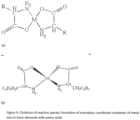
- Agents used to chelate, deactivate or shut reactive molecules within media include, but are not limited to, compounds such as EDTA, citrate, succinate, cyclodextrin, clatharates, dendrimers, amino acids, etc.
- the cell culture medium is an advanced granulation technology (AGT) cell culture medium.
- AGT advanced granulation technology
- the cell culture media also refers to feeds, concentrated supplements, concentrated media, and in some instances, liquid media, as applicable.
- cell culture refers to the maintenance of cells in an artificial (e.g., an in vitro) environment. It is to be understood, however, that the term “cell culture” is a generic term and may be used to encompass the cultivation not only of individual prokaryotic (e.g., bacterial) or eukaryotic (e.g., animal, plant and fungal) cells, but also of tissues, organs, organ systems or whole organisms, for which the terms “tissue culture,” “organ culture,” “organ system culture” or “organotypic culture” may occasionally be used interchangeably with the term “cell culture.”
- prokaryotic e.g., bacterial
- eukaryotic e.g., animal, plant and fungal
- cell culture medium refers to a nutritive composition that supports the cultivation and/or growth of cells.
- the cell culture medium may be a complete formulation, i.e., a cell culture medium that requires no supplementation to culture cells, may be an incomplete formulation, i.e., a cell culture medium that requires supplementation or may be a medium that may supplement an incomplete formulation or in the case of a complete formulation, may improve culture or culture results.
- cell culture medium refers unconditioned cell culture media that has not been incubated with cells, unless indicated otherwise from the context.
- cell culture medium As such, the terms “cell culture medium,” “culture medium,” or “medium” (and in each case plural media) are distinguished from “spent” or “conditioned” medium, which may contain many of the original components of the medium, as well as a variety of cellular metabolites and secreted proteins.
- binder or “powdered” as used in this application refers to a composition that is present in granular form, which may or may not be complexed or agglomerated with a solvent such as water or serum.
- dry powder may be used interchangeably with the term “powder;” however, “dry powder” as used herein simply refers to the gross appearance of the granulated material and is not intended to mean that the material is completely free of complexed or agglomerated solvent unless otherwise indicated.
- a “1X formulation” refers to any aqueous solution that contains some or all ingredients found in a cell culture medium at working concentrations.
- the “1X formulation” can refer to, for example, the cell culture medium or to any subgroup of ingredients for that medium.
- the concentration of an ingredient in a 1X solution is about the same as the concentration of that ingredient found in a cell culture formulation used for maintaining or cultivating cells in vitro.
- a cell culture medium used for the in vitro cultivation of cells is a 1X formulation by definition. When a number of ingredients are present, each ingredient in a 1X formulation has a concentration about equal to the concentration of those ingredients in a cell culture medium.
- a "1X formulation" of these amino acids contains about the same concentrations of these ingredients in solution.
- each ingredient in solution has the same or about the same concentration as that found in the cell culture medium being described.
- concentrations of ingredients in a 1X formulation of cell culture medium are well known to those of ordinary skill in the art. See Cell Culture Technology for Pharmaceutical and Cell-Based Therapies, 42-50 (Sadettin Ozturk and Wei-Shou Hu eds., Taylor and Francis Group 2006 ).
- the osmolarity and/or pH may differ in a 1X formulation compared to the culture medium, particularly when fewer ingredients are contained in the 1X formulation.
- a “7X formulation” is meant to refer to a concentration wherein each ingredient in that micro/ nanosuspension or encapsulated bead is about 7 times more concentrated than the same ingredient in the corresponding liquid cell culture medium/ feed or supplement.
- a “10X formulation” is meant to refer to a concentration wherein each ingredient in that micro/ nanosuspension or encapsulated bead is about 10 times more concentrated than the same ingredient in the liquid cell culture medium/ feed or supplement.
- “5X formulation,” “25X formulation,” “50X formulation,” “100X formulation,” “500X formulation,” and “1000X formulation” designate formulations that contain ingredients at about 5 to 25-, 25-50-, 50-70-, 70-100-, 100-500-, 500- 1000-fold concentrations, respectively, as compared to a 1X cell liquid medium, feed or supplement.
- the osmolarity and pH of the media formulation and concentrated solution may vary.
- a formulation may contain components or ingredients at 1X with respect to a particular cell culture protocol, but at a concentration, for example, 2, 2.5, 5, 6.7, 9, 12 etc. X with respect to a different culture protocol or different base medium.
- Nutrient feeds, functional additives or supplements are generally provided as clear liquid concentrates or as powders that get reconstituted into clear liquid concentrates for delivery directly into the bioreactor. This means that the components therein are never beyond their solubility limits. If they are prepared beyond their solubility limits, it is well known that precipitate forms, either as flakes or fine precipitates, usually white cloudiness in the bottle. Settling of these components occur in several hours, which means that the concentrated solution cannot be used to deliver accurate amounts of feed.
- This disclosure provides techniques for preparing a medium, feed and/or supplement components in such a way that the concentrated components do not precipitate out. This is achieved by making a microsuspension and/or nanosuspension (also referred to as micro/ nanosuspension) from a dry powder cell culture medium or feed that has one or more concentrated component.
- a micro/ nanosuspension is a micron/nano-sized solid in an aqueous solvent base that, in one embodiment, does not separate over time.
- Micro/ nanosuspensions for example, provide a means of concentrating one or more media/feed components beyond the solubility limit of that component.
- Some desirable properties of micro/ nanosuspensions include, but are not limited to, enabling increased nutrient supplement concentrations (e.g., amino acids) in minimal volume; extremely rapid dissolution of micro/ nanosuspensions components in aqueous solutions (more rapid than the media would dissolve absent such preparation); capacity for encapsulation (i.e. for sterilization and protection of components in encapsulated form); capacity for direct addition of sterile, micro/ nanosuspensions beads into pre-existing cultures in a bioreactor; the ability to increase efficiency and manufacturing processes in a bioreactor.
- nutrient supplement concentrations e.g., amino acids
- Microsuspensions have been prepared in other industries, for example, in the pharmaceutical or cosmetic industry, generally using two approaches: i) a top-down approach, and ii) a bottom-up approach.
- a top-down approach the particles of a dry powder are broken down by a milling process such as a Fitz ® mill (the industry standard for precise particle size reduction), until microsuspensions are obtained, or by wet-milling or by using a microfluidizer to obtain nanosuspensions.
- a milling process such as a Fitz ® mill (the industry standard for precise particle size reduction)
- the bottom-up approach components within a solution are gradually precipitated out by gentle manipulation of parameters like pH, or polymerization parameters, until micro/ or nanosuspensions are obtained.
- any aqueous base beside water for example, buffer, balanced salt solution, a liquid medium, or any solution comprising one or more media components including amino acids, lipids, etc.
- any powdered formulation may be added to any powdered formulation to make a micro/ nanosuspension described in this disclosure.
- One of skill may further adapt any of the steps or materials used in the suggested protocol: for instance, the sequence of addition steps, the sequence and number of mixing steps, the volume of liquid, the mixing time, the apparatus or device for mixing the slurry to homogeneity, the media or feed formulation, etc. and they would know how to manipulate the conditions to suit the consistency and nature of the desired micro/ nanosuspension.
- any structural or informational molecule, any nutrient, required by a cell in culture can be made into a micro/ nanosuspension using the techniques, or variations of the techniques described here.
- examples of structural and/or informational molecules may include, but are not limited to, vitamins, amino acids, peptides, macromolecules, anti-oxidants, hormones, growth factors, and so on.
- micro/ nanosuspensions of cellular scaffolding matrices complexed with cellular nutrients may be made in order to grow cells within the suspensions three dimensionally.
- micro/ nanosuspension compositions prepared as described above may be useful in many applications, for example, in nutrient supplementation to significantly boost component concentrations beyond the level of solubility of the component in question, such that, volume of addition to the reactor is minimal; or, for encapsulating the microsuspensions, as described below, and making a dried form of the encapsulated bead resulting in a "super concentrated" supplement that can be directly added to the bioreactor, which has not been done before.
- microsuspensions can be made from any form of dry powder, of any component that needs to be provided in culture in a concentrated form, and provide at least a 2 to 5-fold, 5 to 10-fold, 10 to 15- fold, 15 to 20-fold, 20 to 25-fold, 25 to 30-fold, 30 to 50-fold, 50 to 70-fold, 70 to 100-fold concentration of the component in the microsuspension over an equivalent liquid concentrate or feed having the same component in solution.
- This disclosure provides a method of microencapsulating the micro/ nanosuspension described above, that was made from a dry powdered cell culture medium, feed, supplement or concentrate.
- the resulting encapsulated products may be referred to as 'microcapsules', 'encapsulated bead', 'beads', 'capsules' or 'microbeads' in this disclosure.
- the drying step provides a greater degree of concentration of the encapsulated micro/ nanosuspensions.
- Microencapsulation may be done, for example, to "keep apart” or sequester sensitive or labile components in a complex mixture such as cell culture media/feed.
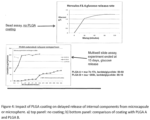
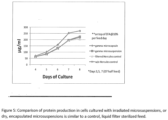
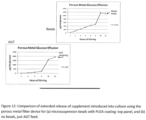
- encapsulation may yield higher concentrations of certain feed components such as, for example, amino acids, so that these feeds can be directly added as concentrated, high nutrient supplements into any culture system, for example, in fed-batch cultures. Further coating of the capsule may affect delayed-release of nutrients to into cell cultures (discussed below). Encapsulation can be done by: (a) a standard microencapsulation process of microsuspensions and nanosuspensions for "gently-releasing" some or all components over several hours; (b) an alternative bead-gelling process to significantly retard the internal component release. An exemplary demonstration of delayed release can be found in the Examples and in Figures 3 , 4 and 8 .
- the agent used to encapsulate or embed the labile component was alginate.
- Alginate microcapsules have been used for many purposes, including drug delivery and the immobilization of cells growing in cell culture to enhance cell growth and viability. See e.g., Serp et al., Biotechnology and Bioengineering, 2000, 70(1):41-53 ; Breguet et. al., Cytotechnology, 2007, 53:81-93 ; Chayosumrit et al., Biomaterials, 2010, 31:505-14 ; U.S. Patent No. 7,482,152 ; and U.S. Patent No. 7,740,861 .
- microencapsulation methods described therein can be used for stabilizing any susceptible compound required for cell culture, including but not limited to, vitamins like thiamine, B12, etc., unstable amino acids such as glutamine, cytokines, growth factors, sensitive and valuable proteins or peptides, etc. and for enhanced delivery of the stabilized compound, and can be applied to fields beyond cell culture media development.
- the encapsulation technique was adapted to micro/ nanosuspension beads, which required adaptation of several steps and techniques. For instance, the entrapping steps for susceptible compounds in the PCT/US2012/024194 application lacked several steps.
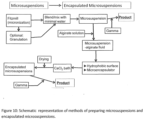
- the capsular material such as alginate, was mixed and blended with the microsuspension.
- This mix was then aspirated into a dispensing device such as a pipette or a dropper and droplets of encapsulated microsuspension were gradually generated by dropping the mix gently onto a non-stick surface, for example, on parafilm. Then, a cross-linking agent was added to the drop to form beads. These beads were desiccated and vacuum dried to remove moisture, and are generally referred to as “encapsulated microsuspension beads" or just "beads”.
- Example 2 As one of skill in the art would know based on the instant disclosure, one may adapt any of the steps or the materials used in the suggested protocol (see Example 2). For instance, a variety of capsular materials may be used, or a variety of drop delivery devices including pipettes, droppers, syringes or any adaptation thereof may be used, or any cross-linking agent may be used, or the bead may be dried or desiccated by a variety of means and to differing degrees of dryness and/or hardness.
- encapsulating agents for the purpose at hand, for instance, alginate, poly-L-lactic acid (PLL), chitosan, agarose, gelatin, hyaluronic acid, chondroitin sulfate, dextran, dextran sulfate, heparin, heparin sulfate, heparan sulfate, gellan gum, xanthan gum, guar gum, water soluble cellulose derivatives, carrageenan and so on.
- PLL poly-L-lactic acid
- Microcapsules are typically spherical particles having a diameter of 2 mm or less, usually within the diameter range of 0.05-1.5 mm.
- alginate microcapsules are formed by crosslinking between the polyanionic alginate and a divalent or trivalent polyvalent cation, such as calcium chloride.
- a divalent or trivalent polyvalent cation such as calcium chloride.
- Other salts for cross-linking may be divalent or trivalent cations, such as magnesium chloride, barium chloride, and aluminum sulfate.
- Encapsulation has several advantages, some of which include, but are not limited to, protection of labile components from degradation, or from unwanted reactions; or to delay and/or extend the release-time of the encapsulated components into cell culture. In one embodiment, protection due to microencapsulation of media; or to increase the stability and storage of cell culture media comprising labile compounds at ambient temperatures.
- the encapsulated compound can be dried into beads, which can then be blended and/or mixed with other media components.
- micro/ nanosuspensions may result in a 1-5%, 5-10%, 10-15%, 15-20%, 20-25%, 25-30%, 30-35%, 35-40%, 40-50%, 50-60%, 60-70%, 70-80%, 80-90%, or 90-100% reduction in any loss of media/ labile component functionality, which may be measured by a suitable functional assay for the encapsulated labile or media component, using techniques known in the art, including the methods disclosed in this application.
- Examples of functional assays may be, the ability of microcapsules to increase the cell viability over days, or the cell number in a culture system, or recombinant protein production, or an increase in the amount and/or the function of a recombinant protein being expressed (for example, an enzyme or a receptor functional assay, or the stability of an encapsulated labile component like glutamine can be evaluated during culture, etc., as would be known to one of skill in the art).
- a sequestering agent like alginate was used to encapsulate or embed an ethanolamine-dendrimer complex.
- Dendrimers are hyper-branched synthetic macromolecules that can be made using controlled sequential processes to give them defined structural and molecular weight characteristics; reviewed in Astruc et al., Chem. Rev. 2010, 110:1857-1959 . Dendrimers can be used to prepare the encapsulated microsuspensions of the instant invention as well.
- the dendrimer used in the methods as described in PCT/US2012/024194 was poylamidoamine, and it may be adapted for used in encapsulated micro/ nanosuspensions.
- microencapsulated micro/ nanosuspensions can be made for any component that needs to be provided in culture in a concentrated form, and provides at least a 2 to 5-fold, 5 to 10-fold, 10 to 15- fold, 15 to 20-fold, 20 to 25-fold, 25 to 30-fold, 30 to 50-fold, 50 to 70-fold, 70 to 100-fold concentration of the component in the encapsulated micro/ nanosuspension over an equivalent liquid concentrate or feed having the same component in solution.
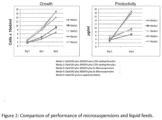
- the microsuspension preparation of a concentrated feed preparation as seen in the Figures was about 7-fold more concentrated than its corresponding liquid feed, whereas the dried encapsulated form of the same microsuspension was about 10-fold more concentrated than its corresponding liquid feed.
- labile compounds within the capsule are further combined with one or more anti-oxidants, prior to the encapsulation process. Therefore, in certain embodiments, a mixture anti-oxidant and a labile component in a powdered media may be used as a starting material to prepare the microsuspension preparation, prior to encapsulation.
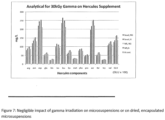
- exemplary anti-oxidants include, but are not limited to, vitamins like ascorbic acid, beta-carotene, vitamin A, E, lycopene, flavanoids, selenium, etc. Effects of anti-oxidants on protection due to irradiation is depicted in Figure 8 .
- protection due to chelation of reactive and/or ROS producing media components outside the microcapsule may result in a 1-5%, 5-10%, 10-15%, 15-20%, 20-25%, 25-30%, 30-35%, 35-40%, 40-50%, 50-60%, 60-70%, 70-80%, 80-90%, or 90-100% reduction in loss of media/ labile component functionality, which may be measured by a suitable functional assay for a labile or media component.
- Examples of functional assays may be, the ability of a media composition comprising chelated components to increase the cell viability over days, or the cell number in a culture system, or recombinant protein production, or an increase in the amount and/or the function of a recombinant protein being expressed (for example, an enzyme or a receptor functional assay, or the stability of an encapsulated labile component like glutamine can be evaluated during culture, etc., as would be known to one of skill in the art).
- the microcapsule can further be coated with protective coatings like PLGA for delayed-release or extended-release of components within the microcapsule.
- protective coatings like PLGA for delayed-release or extended-release of components within the microcapsule.
- Typical medium components for delayed release may include, but are not limited to, vitamins, glucose, amino acids, growth factors or cytokines. Components can be released from within the same microcapsule at the same rate, or released from different microcapsules at different rates and at different times, depending on the delayed-release formulation.
- An exemplary use for such a dual-format, delayed release medium would be in the release of growth components (for e.g., glucose, amino acids, etc.) early in the culture followed by release of productivity components (for e.g., recombinant protein expression inducers such as galactose, etc.) later into the post-log phase of the culture.
- growth components for e.g., glucose, amino acids, etc.
- productivity components for e.g., recombinant protein expression inducers such as galactose, etc.
- Another example would be in maintaining two or more components separate until a designated time when they need to react together within a culture for a specific purpose.
- Coating solutions that may be used to coat after microencapsulation, may be applied to provide additional layers, and include, but are not limited to, poly-glycolic acid, PLGA (poly-lactic-co-glycolic acid), collagen, polyhydroxyalkanoates (PHA), poly- ⁇ -caprolactone, poly-ortho esters, poly-anhydrides, poly-phosphazenes, poly-amino acids, polydimethylsiloxane,polyurethranes, poly-tetrafluoroethylene, polyethylene, polysulphone, poly-methyl methacrylate, poly-2-hydroxyethylmethacrylate, polyamides, polypropylene, poly-vinyl chloride, polystyrene, poly-vinyl pyrrolidone, poly-L-lysine or polyornithine.
- Encapsulated components that are formed into beads and externally coated may themselves be further encapsulated so that a wide range of release options are available depending upon the coating
- the additional outer coating may be selected from alginate, poly-L-lactic acid, chitosan, agarose, gelatin, hyaluronic acid, chondroitin sulfate, dextran, dextran sulfate, heparin, heparin sulfate, heparan sulfate, gellan gum, xanthan gum, guar gum, water soluble cellulose derivatives and carrageenan. Effects of coating are demonstrated and discussed in the Examples and in Figures 3 , 4 and 8 .
- delayed-release of internal components from a microcapsule may result in maintenance of the encapsulated component in a cell culture system over 6- 24 hours, 24-48 hours, 48- 72 hours, over 1 day, 2 days, 3-5 days, 5- 10 days, 10-15 days, 15-20 days, 20-25 days, 25-30 days, 30-40 days, 40-50 days, over the duration of the culture.
- Delayed release may be measured by a suitable time-release assay for a labile or media component within the capsule, and may optionally be coated for extended release as well. An exemplary time release assay is discussed below.
- functional assays may be, the ability of coated microcapsules to increase the cell viability over days, or the cell number in a culture system, or recombinant protein production, or an increase in the amount and/or the function of a recombinant protein being expressed (for example, an enzyme or a receptor functional assay, or the stability of an encapsulated labile component like glutamine can be evaluated during culture, etc., as would be known to one of skill in the art).
- the following cell culture nutrients/reagents may also be targeted for delayed- release. They include, but are not limited to, all chemicals or compositions that are used to promote cell metabolism whether for growth or product synthesis and secretion such as glucose and other forms of hexose, amino acids, salts, peptides, proteins such as collagen and protein fractions, lipids, hormones, vitamins, nucleotides/nucleosides, trace elements, ribonucleotides/ ribonucleosides, sera, sera fractions such as bovine albumin and ceruloplasmin, and other components that are not directly metabolized but provide cell culture-related advantages to cells in culture, such as pluronic of various types such as F68 which prevent cell clumping, fibronectin and peptide sequences such as RGD to support cell attachment and anti-foam reagents. In addition to single or multiple individual components, mixtures of components may be included in
- Detection of release-delay involves assaying over a period of time for the component(s) in question and observing an increase over time.
- One assay for measuring glucose would be measurement of glucose oxidase, which is commercially available in kit format. The principle here is that glucose oxidase reacts with glucose to yield gluconic acid and hydrogen peroxide.
- the hydrogen peroxide reacts with o-dianisidine to yield oxidized o-dianisidine, which forms a pink color upon exposure to sulfuric acid. This can be read spectrophotometrically.
- Another assay for glucose measurement or for other supplement components such as amino acids would be by HPLC. The method would measure a continual increase of the release component over time, which is the hallmark of delayed-release.
- a labile, sensitive or susceptible compound includes but is not limited to substances sensitive to physical, chemical, radiation degradation/ destruction.
- Typical sensitive media substances may be sensitive to chemical interaction with a reactive oxygen species, sensitive to metals including trace metals, sensitive to high temperature, to irradiation (gamma, X-ray, UV, ionizing, etc.), to freezing temperatures, to freeze-thaw, to pressure, agitation, etc.
- trace elements or substances generating reactive oxygen species (ROS), etc. may be chelated and/or kept on the exterior of the microcapsule comprising the labile component.
- This disclosure provides a means for sterilizing a media comprising encapsulated components using irradiation while protecting the irradiation labile components, for example, through anti-oxidant coating and/or subsequent encapsulation.
- Sterilizing irradiation includes wavelengths of light such as gamma rays, UV rays, and other ionizing radiation. Sterilizing gamma irradiation used may be from 5 kGy to 100 kGy. In one embodiment, the medium can be sterilized by gamma irradiation of up to about 50 kGy without loss of media functionality, and/or with about 8-log reduction of virus.
- the medium can be sterilized by a combination of gamma irradiation greater than 50 kGy up to 100 kGy without loss of media functionality.
- the reconstituted media can be pasteurized by techniques such as HTST (high temperature short time) or UHT (ultra high temperature), and/or by filtration through anti-viral filters of pore size 0.1-0.2 ⁇ m, which may provide further reduction of viruses such as vesivirus, porcine circovirus, and other small enveloped viruses that are problematic in the biotechnology industry, without loss of media functionality.
- HTST high temperature short time
- UHT ultra high temperature
- compositions of this disclosure would fit into an enhanced cell culture workflow and improve bioreactor productivity as they can added into a bioreactor directly during the pre-existing culture of a cell.
- the addition can be either as encapsulated beads, or in other embodiments, additions may be as micro/ nanosuspensions.
- Another example would be in the direct addition of the sterile microcapsules into the bioreactor, addition of filtered water, mixing and then addition of cells.
- Microcapsules could be used for nutrient supplementation in bioreactors in at least two ways: 1) Sterile microcapsules could be added directly to the bioreactor where they release components in a time-release manner (right), or 2) they may be added to a porous metal cylinder, cage, or any similar apparatus, with about 0.22 ⁇ pore size, keeping the beads away from contacting the cells in culture. With option 1, the beads may interfere with filtration, or may reduce cell count or productivity. With option 2, bioreactor stirring alone is enough to dissolve nutrient supplement from inside the porous metal cage and to pass into the bioreactor.
- a cell culture medium is composed of a number of ingredients and these ingredients vary from one culture medium to another.
- a cell culture medium may be a complete formulation, i.e., a cell culture medium that requires no supplementation to culture cells, may be an incomplete formulation, i.e., a cell culture medium that requires supplementation or may be a supplement that is used to supplement an incomplete formulation or in the case of a complete formulation, may improve culture or culture results.
- a cell culture medium upon reconstitution, a cell culture medium will have solutes dissolved in solvent.
- the solutes provide an osmotic force to balance the osmotic pressure across the cell membrane (or wall). Additionally the solutes will provide nutrients for the cell.
- Some nutrients will be chemical fuel for cellular operations; some nutrients may be raw materials for the cell to use in anabolism; some nutrients may be machinery, such as enzymes or carriers that facilitate cellular metabolism; some nutrients may be binding agents that bind and buffer ingredients for cell use or that bind or sequester deleterious cell products.
- the ingredients of the cell culture medium will optimally be present at concentrations balanced to optimize cell culture performance. Performance will be measured in accordance with a one or more desired characteristics, for example, cell number, cell mass, cell density, O2 consumption, consumption of a culture ingredient, such as glucose or a nucleotide, production of a biomolecule, secretion of a biomolecule, formation of a waste product or by product, e.g., a metabolite, activity on an indicator or signal molecule, etc. Each or a selection of the ingredients will thus preferably optimized to a working concentration for the intended purpose.
- a basal medium is typically used for maintenance of a cell culture, and can comprise a number of ingredients, including amino acids, vitamins, organic and inorganic salts, sugars and other components, each ingredient being present in an amount which supports the cultivation of the cell in vitro.
- the media can be a 1X formulation or can be concentrated, for example, as a 5X, 10X, 20X, 50X, 500X, or 1000X medium formulation. If the individual medium ingredients are prepared as separate concentrated solutions, an appropriate (sufficient) amount of each concentrate is combined with a diluent to produce a 1X medium formulation.
- the diluent used is water but other solutions including aqueous buffers, aqueous saline solution, or other aqueous solutions may be used.
- the media could be a basal media to which additional components need to be added, or a complete media which requires no additional additives and is capable of growing cells once reconstituted.
- the reconstituted media from the dry powder that is used for the encapsulated microsuspensions results in an auto-pH and/or auto-osmolality medium in that, it has balanced buffer concentrations and/or salt concentrations that contribute to automatically achieving a desired pH and osmolality suitable for growing a certain cell type without additional pH or salt concentration adjustment.
- the reconstituted media from the dry powder that is used for the encapsulated microsuspensions results in a chemically defined cell culture medium.
- the presence of media proteins makes purification of recombinant protein difficult, time-consuming, and expensive and can also lead to reduced product yields and/or purity.
- the cell culture medium would be serum-free and protein-free, yet complete, such that it can support the growth of a particular cell type.
- the reconstituted media from the dry powder is serum-free but still contain proteins derived from one or more non-animal derived sources (animal origin free- AOF) like from plants, yeast, algal, fungal, or recombinant sources such as bacteria, fungal, plant, yeast algal, etc. in the form of hydrolysates, or in the form of a purified protein or an hydrolysate fraction.
- serum-free media may still contain one or more of a variety of animal-derived components, including albumin, fetuin, various hormones and other proteins.
- the medium or media supplement is protein free and further, does not contain lipids, hydrolysates, or growth factors.
- the media or supplements of this disclosure can be used for fed-batch cultivation.
- Fed-batch cultivation of cells is typically used for industrial production of biomolecules, such as proteins to increase cell concentration and to extend culture lifetime for a high product concentration and volumetric productivity.
- Fed-batch cultures involve the controlled addition of one or more nutrients, such as glucose, to a basal medium.
- the nutrient(s) help to control the growth of the cell culture by preventing nutrient depletion or accumulation and byproduct accumulation, thereby maintaining important parameters, such as osmolality and CO2 concentration, within levels that promote cell growth or minimize cell death for optimal product expression.
- Microencapsulated microsuspensions of media as described herein can also be used to culture a variety of cells.
- the media is used to culture eukaryotic cells, including plant or animal cells, such as mammalian cells, fish cells, insect cells, algal cells, amphibian cells or avian cells or to produce viruses, virus-like particles.
- Mammalian cells that can be cultured with the media include primary epithelial cells (e.g., keratinocytes, cervical epithelial cells, bronchial epithelial cells, tracheal epithelial cells, kidney epithelial cells and retinal epithelial cells) and established cell lines and their strains (e.g., 293 embryonic kidney cells, BHK cells, HeLa cervical epithelial cells and PER-C6 retinal cells, MDBK (NBL-1) cells, 911 cells, CRFK cells, MDCK cells, CHO cells, BeWo cells, Chang cells, Detroit 562 cells, HeLa 229 cells, HeLa S3 cells, Hep-2 cells, KB cells, LS180 cells, LS174T cells, NCI-H-548 cells, RPMI 2650 cells, SW-13 cells, T24 cells, WI-28 VA13, 2RA cells, WISH cells, BS-C-I cells, LLC-MK2 cells, Clone M-3 cells, 1-10 cells, RAG cells
- Cells supported by the culture medium described herein can also be derived from any animal, preferably a mammal, and most preferably a mouse or a human.
- Cells cultured according to the methods disclosed herein may be normal cells, diseased cells, transformed cells, mutant cells, somatic cells, germ cells, stem cells, precursor cells or embryonic cells, any of which may be established or transformed cell lines or obtained from natural sources. Cells may be used for experimental purposes or for production of useful components.
- EXAMPLE 5 Extended-release comparisons of varying PLGA concentrations and glycolic to lactic ratios: assay
Landscapes
- Engineering & Computer Science (AREA)
- Life Sciences & Earth Sciences (AREA)
- Health & Medical Sciences (AREA)
- Chemical & Material Sciences (AREA)
- Organic Chemistry (AREA)
- Biotechnology (AREA)
- Biomedical Technology (AREA)
- Genetics & Genomics (AREA)
- Bioinformatics & Cheminformatics (AREA)
- Wood Science & Technology (AREA)
- Zoology (AREA)
- General Health & Medical Sciences (AREA)
- Cell Biology (AREA)
- Microbiology (AREA)
- Biochemistry (AREA)
- General Engineering & Computer Science (AREA)
- Dispersion Chemistry (AREA)
- Chemical Kinetics & Catalysis (AREA)
- Mechanical Engineering (AREA)
- Micro-Organisms Or Cultivation Processes Thereof (AREA)
- Medicinal Preparation (AREA)
- Medicines That Contain Protein Lipid Enzymes And Other Medicines (AREA)
- Pharmaceuticals Containing Other Organic And Inorganic Compounds (AREA)
- Acyclic And Carbocyclic Compounds In Medicinal Compositions (AREA)
- Coloring Foods And Improving Nutritive Qualities (AREA)
Applications Claiming Priority (3)
| Application Number | Priority Date | Filing Date | Title |
|---|---|---|---|
| US201161579432P | 2011-12-22 | 2011-12-22 | |
| EP12814100.9A EP2794853B1 (en) | 2011-12-22 | 2012-12-21 | Cell culture media and methods |
| PCT/US2012/071411 WO2013096858A1 (en) | 2011-12-22 | 2012-12-21 | Cell culture media and methods |
Related Parent Applications (1)
| Application Number | Title | Priority Date | Filing Date |
|---|---|---|---|
| EP12814100.9A Division EP2794853B1 (en) | 2011-12-22 | 2012-12-21 | Cell culture media and methods |
Publications (2)
| Publication Number | Publication Date |
|---|---|
| EP3702442A1 EP3702442A1 (en) | 2020-09-02 |
| EP3702442B1 true EP3702442B1 (en) | 2025-06-25 |
Family
ID=47557531
Family Applications (2)
| Application Number | Title | Priority Date | Filing Date |
|---|---|---|---|
| EP20170574.6A Active EP3702442B1 (en) | 2011-12-22 | 2012-12-21 | Cell culture media and methods |
| EP12814100.9A Active EP2794853B1 (en) | 2011-12-22 | 2012-12-21 | Cell culture media and methods |
Family Applications After (1)
| Application Number | Title | Priority Date | Filing Date |
|---|---|---|---|
| EP12814100.9A Active EP2794853B1 (en) | 2011-12-22 | 2012-12-21 | Cell culture media and methods |
Country Status (6)
| Country | Link |
|---|---|
| US (4) | US9410118B2 (enExample) |
| EP (2) | EP3702442B1 (enExample) |
| JP (4) | JP6216327B2 (enExample) |
| KR (1) | KR102039494B1 (enExample) |
| CN (2) | CN106635949B (enExample) |
| WO (1) | WO2013096858A1 (enExample) |
Families Citing this family (16)
| Publication number | Priority date | Publication date | Assignee | Title |
|---|---|---|---|---|
| CN107699540A (zh) | 2011-02-07 | 2018-02-16 | 生命技术公司 | 用于稳定敏感化合物的组合物和方法 |
| JP6216327B2 (ja) * | 2011-12-22 | 2017-10-18 | ライフ テクノロジーズ コーポレーション | 細胞培地および方法 |
| EP3019594B1 (en) * | 2013-07-11 | 2020-12-02 | Merck Patent GmbH | Cell culture media |
| KR102359148B1 (ko) * | 2014-01-23 | 2022-02-08 | 닛산 가가쿠 가부시키가이샤 | 배양 배지 조성물 |
| US20150275167A1 (en) * | 2014-03-28 | 2015-10-01 | Corning Incorporated | Composition and method for cell culture sustained release |
| CN106459907B (zh) * | 2014-04-10 | 2020-11-06 | 拜尔健康护理有限责任公司 | 复合培养基粉末制剂和制备用于细胞培养的液体培养基的方法 |
| CN107750274A (zh) * | 2015-06-08 | 2018-03-02 | 康宁股份有限公司 | 用于水凝胶微载体的干燥制剂 |
| CA3005694A1 (en) * | 2015-11-20 | 2017-05-26 | Qiagen Gmbh | Method of preparing sterilized compositions for stabilization of extracellular nucleic acids |
| KR20180091923A (ko) * | 2015-12-17 | 2018-08-16 | 라이프 테크놀로지스 코포레이션 | 세포 배양에 이용되는 펠릿 및 이의 제조 방법 |
| RU2762292C2 (ru) * | 2015-12-30 | 2021-12-17 | Лайф Текнолоджиз Корпорейшн | Слоистые частицы клеточной культуры и способы их получения |
| CN106222236A (zh) * | 2016-07-27 | 2016-12-14 | 郑州点石生物技术有限公司 | 血液中微生物检测试剂及其制备方法 |
| CN109395095B (zh) * | 2017-09-18 | 2021-09-24 | 武汉原生原代生物医药科技有限公司 | 体内用生物膜及其制备方法和用途 |
| EP3831932A4 (en) * | 2018-07-27 | 2021-09-15 | Ajinomoto Co., Inc. | SUSPENSION CULTURE ADDITIVE, SUSPENSION CULTURE MEDIA AND SUSPENSION CULTURE METHOD FOR ANIMAL CELLS |
| CN111849879A (zh) * | 2020-08-07 | 2020-10-30 | 张娇 | 一种细胞培养基及细胞培养方法 |
| CN112553116A (zh) * | 2020-12-23 | 2021-03-26 | 邢箫 | 一种益生菌培养基及益生菌制剂 |
| KR20250099169A (ko) * | 2022-10-31 | 2025-07-01 | 삼성바이오에피스 주식회사 | 고농도 액체 배지 제조 방법 |
Citations (1)
| Publication number | Priority date | Publication date | Assignee | Title |
|---|---|---|---|---|
| WO2012109279A2 (en) * | 2011-02-07 | 2012-08-16 | Life Technologies Corporation | Compositions and methods for stabilizing susceptible compounds |
Family Cites Families (21)
| Publication number | Priority date | Publication date | Assignee | Title |
|---|---|---|---|---|
| DE3870061D1 (de) * | 1987-06-19 | 1992-05-21 | Univ Temple | Mikrokapseln mit gelenkter freigabe und verfahren zu deren herstellung. |
| JPS6413986A (en) * | 1987-07-08 | 1989-01-18 | Mitsuiwa Eng Kk | Microcapsule for cultivating cell and production thereof |
| EP0626170A3 (en) * | 1993-05-10 | 1996-03-27 | Sandoz Ltd | Stabilization of pharmacologically active compounds in delayed release agents. |
| US6281015B1 (en) * | 1994-12-16 | 2001-08-28 | Children's Medical Center Corp. | Localized delivery of factors enhancing survival of transplanted cells |
| EP2243827B2 (en) * | 1996-08-30 | 2017-11-22 | Life Technologies Corporation | Serum-free mammalian cell culture medium, and uses thereof |
| US6383810B2 (en) | 1997-02-14 | 2002-05-07 | Invitrogen Corporation | Dry powder cells and cell culture reagents and methods of production thereof |
| ES2169980B1 (es) * | 1999-12-17 | 2003-11-01 | Lipotec Sa | Microcapsulas para la liberacion prolongada de farmacos. |
| JP2002114667A (ja) * | 2000-10-11 | 2002-04-16 | Ltt Institute Co Ltd | 徐放性製剤用組成物、その製造法および徐放性マイクロカプセル製剤 |
| AU2002232406C1 (en) * | 2000-11-06 | 2009-03-05 | Invitrogen Corporation | Dry powder cells and cell culture reagents and methods of production thereof |
| EP1275377B1 (en) | 2001-07-11 | 2003-06-18 | Apr Applied Pharma Research S.A. | Granulates containing liposoluble substances and process of preparation thereof |
| WO2003048313A2 (en) * | 2001-11-30 | 2003-06-12 | Invitrogen Corporation | Cell culture media |
| US6974592B2 (en) * | 2002-04-11 | 2005-12-13 | Ocean Nutrition Canada Limited | Encapsulated agglomeration of microcapsules and method for the preparation thereof |
| US20060034904A1 (en) | 2002-12-31 | 2006-02-16 | Ultra-Sonic Technologies, L.L.C. | Transdermal delivery using emcapsulated agent activated by ultrasound and or heat |
| WO2005071060A2 (en) | 2004-01-08 | 2005-08-04 | North Carolina State University | Methods and devices for microencapsulation of cells |
| US7740861B2 (en) | 2004-06-16 | 2010-06-22 | University Of Massachusetts | Drug delivery product and methods |
| WO2007094000A2 (en) | 2006-02-15 | 2007-08-23 | Botanocap Ltd. | Applications of microencapsulated essential oils |
| EP2490528A4 (en) * | 2009-10-21 | 2013-06-12 | Dow Pharmaceutical Sciences | METHOD FOR ANCHORING A POWDER CONTAINING BENZOYL PEROXIDE |
| US20110262965A1 (en) | 2010-04-23 | 2011-10-27 | Life Technologies Corporation | Cell culture medium comprising small peptides |
| JP5802047B2 (ja) * | 2010-04-28 | 2015-10-28 | 株式会社フジクラ | 光ファイバケーブル |
| WO2011137274A1 (en) | 2010-04-30 | 2011-11-03 | Bristol-Myers Squibb Company | Pharmaceutical compositions comprising n-(4-(2-amino-3-chloropyridin-4-yloxy)-3-fluorophenyl)-4-ethoxy-l-(4-fluorophenyl)-2-oxo- 1,2-dihydropyridine-3 -carboxamide |
| JP6216327B2 (ja) * | 2011-12-22 | 2017-10-18 | ライフ テクノロジーズ コーポレーション | 細胞培地および方法 |
-
2012
- 2012-12-21 JP JP2014548973A patent/JP6216327B2/ja active Active
- 2012-12-21 CN CN201611042079.XA patent/CN106635949B/zh active Active
- 2012-12-21 US US14/367,413 patent/US9410118B2/en active Active
- 2012-12-21 WO PCT/US2012/071411 patent/WO2013096858A1/en not_active Ceased
- 2012-12-21 EP EP20170574.6A patent/EP3702442B1/en active Active
- 2012-12-21 CN CN201280068225.XA patent/CN104080905B/zh active Active
- 2012-12-21 KR KR1020147019999A patent/KR102039494B1/ko active Active
- 2012-12-21 EP EP12814100.9A patent/EP2794853B1/en active Active
-
2016
- 2016-06-30 US US15/198,237 patent/US10066200B2/en active Active
-
2017
- 2017-09-22 JP JP2017181983A patent/JP6457041B2/ja active Active
-
2018
- 2018-08-03 US US16/054,601 patent/US20180346872A1/en not_active Abandoned
- 2018-12-19 JP JP2018236870A patent/JP6843824B2/ja active Active
-
2020
- 2020-07-01 US US16/918,838 patent/US12203095B2/en active Active
-
2021
- 2021-02-24 JP JP2021026972A patent/JP7217765B2/ja active Active
Patent Citations (1)
| Publication number | Priority date | Publication date | Assignee | Title |
|---|---|---|---|---|
| WO2012109279A2 (en) * | 2011-02-07 | 2012-08-16 | Life Technologies Corporation | Compositions and methods for stabilizing susceptible compounds |
Also Published As
| Publication number | Publication date |
|---|---|
| JP2019062901A (ja) | 2019-04-25 |
| CN104080905A (zh) | 2014-10-01 |
| CN104080905B (zh) | 2016-11-16 |
| JP2021087446A (ja) | 2021-06-10 |
| US20200332250A1 (en) | 2020-10-22 |
| US20150064785A1 (en) | 2015-03-05 |
| US9410118B2 (en) | 2016-08-09 |
| WO2013096858A1 (en) | 2013-06-27 |
| EP2794853A1 (en) | 2014-10-29 |
| US20160376548A1 (en) | 2016-12-29 |
| JP6843824B2 (ja) | 2021-03-17 |
| JP7217765B2 (ja) | 2023-02-03 |
| JP2015503329A (ja) | 2015-02-02 |
| US20180346872A1 (en) | 2018-12-06 |
| EP2794853B1 (en) | 2020-04-22 |
| CN106635949B (zh) | 2020-05-19 |
| KR102039494B1 (ko) | 2019-11-01 |
| CN106635949A (zh) | 2017-05-10 |
| US10066200B2 (en) | 2018-09-04 |
| JP6457041B2 (ja) | 2019-01-23 |
| EP3702442A1 (en) | 2020-09-02 |
| KR20140113693A (ko) | 2014-09-24 |
| JP6216327B2 (ja) | 2017-10-18 |
| JP2018038404A (ja) | 2018-03-15 |
| US12203095B2 (en) | 2025-01-21 |
Similar Documents
| Publication | Publication Date | Title |
|---|---|---|
| US12203095B2 (en) | Cell culture media and methods | |
| JP7759326B2 (ja) | 培養乳製品産生のための生細胞構築物およびその使用方法 | |
| US11028361B2 (en) | Compositions and methods for stabilizing susceptible compounds | |
| Elseberg et al. | The challenge of human mesenchymal stromal cell expansion: current and prospective answers | |
| EP4022034A1 (en) | Methods and compositions for culturing alveolar cells | |
| HK1226443A1 (en) | Method for producing engineered heart muscle (ehm) |
Legal Events
| Date | Code | Title | Description |
|---|---|---|---|
| PUAI | Public reference made under article 153(3) epc to a published international application that has entered the european phase |
Free format text: ORIGINAL CODE: 0009012 |
|
| STAA | Information on the status of an ep patent application or granted ep patent |
Free format text: STATUS: THE APPLICATION HAS BEEN PUBLISHED |
|
| AC | Divisional application: reference to earlier application |
Ref document number: 2794853 Country of ref document: EP Kind code of ref document: P |
|
| AK | Designated contracting states |
Kind code of ref document: A1 Designated state(s): AL AT BE BG CH CY CZ DE DK EE ES FI FR GB GR HR HU IE IS IT LI LT LU LV MC MK MT NL NO PL PT RO RS SE SI SK SM TR |
|
| STAA | Information on the status of an ep patent application or granted ep patent |
Free format text: STATUS: REQUEST FOR EXAMINATION WAS MADE |
|
| 17P | Request for examination filed |
Effective date: 20210121 |
|
| RBV | Designated contracting states (corrected) |
Designated state(s): AL AT BE BG CH CY CZ DE DK EE ES FI FR GB GR HR HU IE IS IT LI LT LU LV MC MK MT NL NO PL PT RO RS SE SI SK SM TR |
|
| STAA | Information on the status of an ep patent application or granted ep patent |
Free format text: STATUS: EXAMINATION IS IN PROGRESS |
|
| 17Q | First examination report despatched |
Effective date: 20210819 |
|
| GRAP | Despatch of communication of intention to grant a patent |
Free format text: ORIGINAL CODE: EPIDOSNIGR1 |
|
| STAA | Information on the status of an ep patent application or granted ep patent |
Free format text: STATUS: GRANT OF PATENT IS INTENDED |
|
| INTG | Intention to grant announced |
Effective date: 20250116 |
|
| GRAS | Grant fee paid |
Free format text: ORIGINAL CODE: EPIDOSNIGR3 |
|
| GRAA | (expected) grant |
Free format text: ORIGINAL CODE: 0009210 |
|
| STAA | Information on the status of an ep patent application or granted ep patent |
Free format text: STATUS: THE PATENT HAS BEEN GRANTED |
|
| AC | Divisional application: reference to earlier application |
Ref document number: 2794853 Country of ref document: EP Kind code of ref document: P |
|
| AK | Designated contracting states |
Kind code of ref document: B1 Designated state(s): AL AT BE BG CH CY CZ DE DK EE ES FI FR GB GR HR HU IE IS IT LI LT LU LV MC MK MT NL NO PL PT RO RS SE SI SK SM TR |
|
| REG | Reference to a national code |
Ref country code: GB Ref legal event code: FG4D |
|
| REG | Reference to a national code |
Ref country code: CH Ref legal event code: EP |
|
| REG | Reference to a national code |
Ref country code: DE Ref legal event code: R096 Ref document number: 602012081588 Country of ref document: DE |
|
| REG | Reference to a national code |
Ref country code: CH Ref legal event code: EP |
|
| REG | Reference to a national code |
Ref country code: IE Ref legal event code: FG4D |
|
| P01 | Opt-out of the competence of the unified patent court (upc) registered |
Free format text: CASE NUMBER: UPC_APP_1940_3702442/2025 Effective date: 20250731 |
|
| PG25 | Lapsed in a contracting state [announced via postgrant information from national office to epo] |
Ref country code: FI Free format text: LAPSE BECAUSE OF FAILURE TO SUBMIT A TRANSLATION OF THE DESCRIPTION OR TO PAY THE FEE WITHIN THE PRESCRIBED TIME-LIMIT Effective date: 20250625 |
|
| REG | Reference to a national code |
Ref country code: LT Ref legal event code: MG9D |
|
| PG25 | Lapsed in a contracting state [announced via postgrant information from national office to epo] |
Ref country code: NO Free format text: LAPSE BECAUSE OF FAILURE TO SUBMIT A TRANSLATION OF THE DESCRIPTION OR TO PAY THE FEE WITHIN THE PRESCRIBED TIME-LIMIT Effective date: 20250925 Ref country code: GR Free format text: LAPSE BECAUSE OF FAILURE TO SUBMIT A TRANSLATION OF THE DESCRIPTION OR TO PAY THE FEE WITHIN THE PRESCRIBED TIME-LIMIT Effective date: 20250926 |
|
| PG25 | Lapsed in a contracting state [announced via postgrant information from national office to epo] |
Ref country code: BG Free format text: LAPSE BECAUSE OF FAILURE TO SUBMIT A TRANSLATION OF THE DESCRIPTION OR TO PAY THE FEE WITHIN THE PRESCRIBED TIME-LIMIT Effective date: 20250625 |
|
| PG25 | Lapsed in a contracting state [announced via postgrant information from national office to epo] |
Ref country code: HR Free format text: LAPSE BECAUSE OF FAILURE TO SUBMIT A TRANSLATION OF THE DESCRIPTION OR TO PAY THE FEE WITHIN THE PRESCRIBED TIME-LIMIT Effective date: 20250625 |
|
| PG25 | Lapsed in a contracting state [announced via postgrant information from national office to epo] |
Ref country code: RS Free format text: LAPSE BECAUSE OF FAILURE TO SUBMIT A TRANSLATION OF THE DESCRIPTION OR TO PAY THE FEE WITHIN THE PRESCRIBED TIME-LIMIT Effective date: 20250925 |
|
| PG25 | Lapsed in a contracting state [announced via postgrant information from national office to epo] |
Ref country code: LV Free format text: LAPSE BECAUSE OF FAILURE TO SUBMIT A TRANSLATION OF THE DESCRIPTION OR TO PAY THE FEE WITHIN THE PRESCRIBED TIME-LIMIT Effective date: 20250625 |
|
| REG | Reference to a national code |
Ref country code: NL Ref legal event code: MP Effective date: 20250625 |
|
| PG25 | Lapsed in a contracting state [announced via postgrant information from national office to epo] |
Ref country code: NL Free format text: LAPSE BECAUSE OF FAILURE TO SUBMIT A TRANSLATION OF THE DESCRIPTION OR TO PAY THE FEE WITHIN THE PRESCRIBED TIME-LIMIT Effective date: 20250625 |
|
| PG25 | Lapsed in a contracting state [announced via postgrant information from national office to epo] |
Ref country code: PT Free format text: LAPSE BECAUSE OF FAILURE TO SUBMIT A TRANSLATION OF THE DESCRIPTION OR TO PAY THE FEE WITHIN THE PRESCRIBED TIME-LIMIT Effective date: 20251027 |
|
| REG | Reference to a national code |
Ref country code: AT Ref legal event code: MK05 Ref document number: 1806463 Country of ref document: AT Kind code of ref document: T Effective date: 20250625 |