EP3673545B1 - Interconnexions conductrices multicouches destinées à des réseaux d'émetteurs de lumière de densité élevée - Google Patents
Interconnexions conductrices multicouches destinées à des réseaux d'émetteurs de lumière de densité élevée Download PDFInfo
- Publication number
- EP3673545B1 EP3673545B1 EP18847374.8A EP18847374A EP3673545B1 EP 3673545 B1 EP3673545 B1 EP 3673545B1 EP 18847374 A EP18847374 A EP 18847374A EP 3673545 B1 EP3673545 B1 EP 3673545B1
- Authority
- EP
- European Patent Office
- Prior art keywords
- light emitting
- additional
- emitting elements
- dielectric layer
- conductor pattern
- Prior art date
- Legal status (The legal status is an assumption and is not a legal conclusion. Google has not performed a legal analysis and makes no representation as to the accuracy of the status listed.)
- Active
Links
Images


Classifications
-
- H—ELECTRICITY
- H01—ELECTRIC ELEMENTS
- H01S—DEVICES USING THE PROCESS OF LIGHT AMPLIFICATION BY STIMULATED EMISSION OF RADIATION [LASER] TO AMPLIFY OR GENERATE LIGHT; DEVICES USING STIMULATED EMISSION OF ELECTROMAGNETIC RADIATION IN WAVE RANGES OTHER THAN OPTICAL
- H01S5/00—Semiconductor lasers
- H01S5/40—Arrangement of two or more semiconductor lasers, not provided for in groups H01S5/02 - H01S5/30
- H01S5/42—Arrays of surface emitting lasers
- H01S5/423—Arrays of surface emitting lasers having a vertical cavity
-
- H—ELECTRICITY
- H01—ELECTRIC ELEMENTS
- H01S—DEVICES USING THE PROCESS OF LIGHT AMPLIFICATION BY STIMULATED EMISSION OF RADIATION [LASER] TO AMPLIFY OR GENERATE LIGHT; DEVICES USING STIMULATED EMISSION OF ELECTROMAGNETIC RADIATION IN WAVE RANGES OTHER THAN OPTICAL
- H01S5/00—Semiconductor lasers
- H01S5/04—Processes or apparatus for excitation, e.g. pumping, e.g. by electron beams
- H01S5/042—Electrical excitation ; Circuits therefor
- H01S5/0425—Electrodes, e.g. characterised by the structure
- H01S5/04256—Electrodes, e.g. characterised by the structure characterised by the configuration
-
- H—ELECTRICITY
- H01—ELECTRIC ELEMENTS
- H01S—DEVICES USING THE PROCESS OF LIGHT AMPLIFICATION BY STIMULATED EMISSION OF RADIATION [LASER] TO AMPLIFY OR GENERATE LIGHT; DEVICES USING STIMULATED EMISSION OF ELECTROMAGNETIC RADIATION IN WAVE RANGES OTHER THAN OPTICAL
- H01S5/00—Semiconductor lasers
- H01S5/10—Construction or shape of the optical resonator, e.g. extended or external cavity, coupled cavities, bent-guide, varying width, thickness or composition of the active region
- H01S5/18—Surface-emitting [SE] lasers, e.g. having both horizontal and vertical cavities
- H01S5/183—Surface-emitting [SE] lasers, e.g. having both horizontal and vertical cavities having only vertical cavities, e.g. vertical cavity surface-emitting lasers [VCSEL]
- H01S5/18361—Structure of the reflectors, e.g. hybrid mirrors
-
- H—ELECTRICITY
- H01—ELECTRIC ELEMENTS
- H01S—DEVICES USING THE PROCESS OF LIGHT AMPLIFICATION BY STIMULATED EMISSION OF RADIATION [LASER] TO AMPLIFY OR GENERATE LIGHT; DEVICES USING STIMULATED EMISSION OF ELECTROMAGNETIC RADIATION IN WAVE RANGES OTHER THAN OPTICAL
- H01S5/00—Semiconductor lasers
- H01S5/40—Arrangement of two or more semiconductor lasers, not provided for in groups H01S5/02 - H01S5/30
- H01S5/4025—Array arrangements, e.g. constituted by discrete laser diodes or laser bar
- H01S5/4031—Edge-emitting structures
- H01S5/4043—Edge-emitting structures with vertically stacked active layers
- H01S5/405—Two-dimensional arrays
-
- H—ELECTRICITY
- H01—ELECTRIC ELEMENTS
- H01S—DEVICES USING THE PROCESS OF LIGHT AMPLIFICATION BY STIMULATED EMISSION OF RADIATION [LASER] TO AMPLIFY OR GENERATE LIGHT; DEVICES USING STIMULATED EMISSION OF ELECTROMAGNETIC RADIATION IN WAVE RANGES OTHER THAN OPTICAL
- H01S2301/00—Functional characteristics
- H01S2301/17—Semiconductor lasers comprising special layers
- H01S2301/176—Specific passivation layers on surfaces other than the emission facet
-
- H—ELECTRICITY
- H01—ELECTRIC ELEMENTS
- H01S—DEVICES USING THE PROCESS OF LIGHT AMPLIFICATION BY STIMULATED EMISSION OF RADIATION [LASER] TO AMPLIFY OR GENERATE LIGHT; DEVICES USING STIMULATED EMISSION OF ELECTROMAGNETIC RADIATION IN WAVE RANGES OTHER THAN OPTICAL
- H01S5/00—Semiconductor lasers
- H01S5/02—Structural details or components not essential to laser action
- H01S5/022—Mountings; Housings
- H01S5/0233—Mounting configuration of laser chips
- H01S5/02345—Wire-bonding
-
- H—ELECTRICITY
- H01—ELECTRIC ELEMENTS
- H01S—DEVICES USING THE PROCESS OF LIGHT AMPLIFICATION BY STIMULATED EMISSION OF RADIATION [LASER] TO AMPLIFY OR GENERATE LIGHT; DEVICES USING STIMULATED EMISSION OF ELECTROMAGNETIC RADIATION IN WAVE RANGES OTHER THAN OPTICAL
- H01S5/00—Semiconductor lasers
- H01S5/04—Processes or apparatus for excitation, e.g. pumping, e.g. by electron beams
- H01S5/042—Electrical excitation ; Circuits therefor
- H01S5/0425—Electrodes, e.g. characterised by the structure
- H01S5/04252—Electrodes, e.g. characterised by the structure characterised by the material
- H01S5/04253—Electrodes, e.g. characterised by the structure characterised by the material having specific optical properties, e.g. transparent electrodes
-
- H—ELECTRICITY
- H01—ELECTRIC ELEMENTS
- H01S—DEVICES USING THE PROCESS OF LIGHT AMPLIFICATION BY STIMULATED EMISSION OF RADIATION [LASER] TO AMPLIFY OR GENERATE LIGHT; DEVICES USING STIMULATED EMISSION OF ELECTROMAGNETIC RADIATION IN WAVE RANGES OTHER THAN OPTICAL
- H01S5/00—Semiconductor lasers
- H01S5/04—Processes or apparatus for excitation, e.g. pumping, e.g. by electron beams
- H01S5/042—Electrical excitation ; Circuits therefor
- H01S5/0425—Electrodes, e.g. characterised by the structure
- H01S5/04254—Electrodes, e.g. characterised by the structure characterised by the shape
-
- H—ELECTRICITY
- H01—ELECTRIC ELEMENTS
- H01S—DEVICES USING THE PROCESS OF LIGHT AMPLIFICATION BY STIMULATED EMISSION OF RADIATION [LASER] TO AMPLIFY OR GENERATE LIGHT; DEVICES USING STIMULATED EMISSION OF ELECTROMAGNETIC RADIATION IN WAVE RANGES OTHER THAN OPTICAL
- H01S5/00—Semiconductor lasers
- H01S5/10—Construction or shape of the optical resonator, e.g. extended or external cavity, coupled cavities, bent-guide, varying width, thickness or composition of the active region
- H01S5/18—Surface-emitting [SE] lasers, e.g. having both horizontal and vertical cavities
- H01S5/183—Surface-emitting [SE] lasers, e.g. having both horizontal and vertical cavities having only vertical cavities, e.g. vertical cavity surface-emitting lasers [VCSEL]
- H01S5/18305—Surface-emitting [SE] lasers, e.g. having both horizontal and vertical cavities having only vertical cavities, e.g. vertical cavity surface-emitting lasers [VCSEL] with emission through the substrate, i.e. bottom emission
Definitions
- the present disclosure relates to multilayer conductor interconnects for high density light emitter arrays.
- VCSEL vertical cavity surface emitting laser
- 3D three-dimensional
- VCSELs and VCSEL arrays can be used for time-of-flight (“TOF") distance measurement, stereo illumination and structured light illumination.
- TOF time-of-flight
- structured light illumination including specially designed structured light patterns is projected into a scene to illuminate objects in the scene with an array of spots.
- a sensor is used to analyze an image of the objects with the structured light pattern and determine 3D information about the objects and their location.
- Applications of this technique include, but are not limited to, auto-focusing cameras and computer gaming systems. Other major applications are for self-driving vehicles and automatic transportation control.
- VCSELs can be fabricated in large arrays with the array structure comprising many forms and layouts. In simple illuminators, all the VCSEL elements are activated together and the output beams projected to form the structured illumination pattern. There are many applications, however, that require subsets of the VCSEL elements to be activated separately. These subsets can be in distinct groups or the VCSEL elements can be distributed such that the VCSELs of one group are interspersed among the VCSELs of the other groups.
- the electrical connection of distinct groups is relatively straight forward and can be accomplished, for example, using the top conducting layer and routing different sections to different connection pads at the edge of the array substrate.
- the interconnection becomes much more complex in arrangements where the VCSELs from each group are interspersed among one another.
- the individual connections have to be routed between the various VCSELs, making it difficult to fabricate large dense arrays of VCSELs.
- This disclosure describes optical modules for light projection and three-dimensional (“3D") imaging and, in particular, to miniature optical light sources and modules for producing passive and dynamic structured light patterns for 3D imaging, gesture recognition and other applications where small form factor illumination sources are required using arrays, including addressable arrays of light emitters, including surface emitting light sources such as VCSELs.
- arrays including addressable arrays of light emitters, including surface emitting light sources such as VCSELs.
- one aspect describes a device for generating high density illumination patterns.
- the device includes an array of light emitting elements on a common substrate, a common electrical contact on a bottom substrate side of the light emitting elements, and a stack of multiple conductor patterns disposed over the array.
- the conductor patterns are isolated electrically from one another, and each of the conductor pattern contacts respective electrical contact regions of the light emitting elements of a respective subset within the array.
- Electrical contact pads are disposed at a periphery of the array.
- Each of the conductor patterns is electrically connected respectively to at least one of the electrical contact pads, and at least one of the conductor patterns crosses over another one of the conductor patterns.
- the disclosure describes a device for generating high density illumination patterns.
- the device includes an array of light emitting elements on a common substrate, each light emitting element including a respective bottom reflector on a substrate side and a top reflector on another side of the light emitting element.
- the device further includes a common electrical contact on a bottom substrate side of the light emitting elements.
- a first dielectric layer is on the array of light emitting elements, wherein the first dielectric layer covers the substrate and light emitting elements except for a top electrical contact region of each light emitting element.
- a first top conductor pattern is on the first dielectric layer and contacts the respective top electrical contact regions of a first subset of the light emitting elements.
- a sequence of at least one additional dielectric layer and at least one additional top conductor pattern is disposed such that the top electrical contact regions of respective subsets of light emitting elements are connected to a respective one of the at least one additional top conductor patterns.
- Electrical contact pads are disposed at a periphery of the array, wherein each of the first top conductor pattern and the additional top conductor patterns is electrically connected respectively to one or more of the electrical contact pads.
- the array of light emitting elements comprises an array of surface emitting elements, for example, an array of VCSELs.
- This disclosure provides a solution to the complex interconnection problem of large, addressable light emitter (e.g., VCSEL) arrays with interspersed elements.
- Multiple layers of conductors are provided to connect for example, VCSELs and route the connections to contact pads at the periphery of the VCSEL array.
- Each conductor layer can be used to connect a subset of one or more VCSEL elements in the array and route the connections to the peripheral contact pads.
- conductors are not restricted to being routed side-by-side, but can be placed on top of one another so that, for example, with five layers, five conductors can be placed in the same lateral space as one conductor would be located if the standard VCSEL technology were employed.
- the multilayer conductor structure also allows conductors in one layer to cross over conductors in other layers, thereby greatly increasing the interconnect flexibility and complexity. This feature can be critical in connecting large arrays of VCSELs where the different groups have VCSEL elements interspersed among one another.
- Each conductor layer is separated from the others, for example, by an insulating dielectric layer. Suitable dielectric materials include silicon nitride, silicon oxide, polymers such as polyimide, and other insulating materials.
- Some implementations use transparent conducting layers. This feature can enable the conductors to be placed over the emitting regions of VCSELs without blocking the output light beams.
- the principles described in this disclosure are applicable not only to VCSEL arrays, but to arrays of other types of light emitting elements (e.g., LED or resonant LED arrays) and can be particularly advantageous, for example, if the light emitting elements need to be addressable and have complex array layouts.
- the light emitting elements in the array can be activated so as to illuminate a scene, for example, with a structured distribution of spots. Multiple different spot structures can be formed by separately activating each group of elements in the array.
- a top emitting VCSEL array includes VCSEL elements 101 each of which comprises a resonant optical cavity formed by a bottom distributed Bragg reflector ("DBR") (e.g., mirror) in contact with a substrate 102 and a top DBR reflector.
- DBR distributed Bragg reflector
- a gain section comprises multiple quantum well structures that provide optical gain when activated by an electrical current.
- a current confining aperture 108 is provided to concentrate the current in the center of the VCSEL structure to create high gain in the quantum wells.
- two conductors 103, 105 deliver the activation current.
- the top conductor 103 is connected to the top contact on the top DBR reflector.
- the current flows through the top DBR reflector, through the aperture and gain section, through the bottom DBR into the substrate 102.
- the substrate is electrically conducting so that the current can flow through the substrate to the bottom contact and conductor 105.
- a dielectric electrically insulating layer 104 is fabricated on the substrate and lower parts of the VCSEL elements to isolate the current in the top conductor 103 from being shorted to the bottom contact 105 through the substrate or through the side of the VCSEL elements.
- the VCSEL array in FIG. 1 is a top emitting VCSEL array, and the top DBR reflector (e.g., mirror) is made partially reflecting so that the output beam 107 is transmitted out of the top surface 106.
- the top DBR reflector e.g., mirror
- the bottom DBR is made partially reflecting and the output beam is transmitted through the substrate and out of the bottom of the VCSEL array. Apertures are formed in the bottom conductor 105 to allow the beam to be transmitted.
- Other variants of VCSELs include three mirror types in which one of the DBR mirrors is divided into two parts, and a spacer placed between them. These features change the properties of the optical resonator so as to modify the characteristics of the output beam. All these variants have the common electrical components of a top contact and bottom contact for delivering activation current into the quantum wells in the gain section, including through a confining aperture(s).
- FIG. 1 all the VCSEL elements are connected to a common top conductor so that applying current activates all the VCSELs at once.
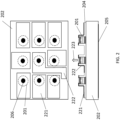
- FIG. 2 illustrates an addressable VCSEL array in which each VCSEL element 201 is connected to a separate top conductor 221, 222.
- each VCSEL can be activated separately, for example, activating conductor 222 with the bottom conductor 205 generates an output beam 223 from the center VCSEL.
- All of the conductors are coupled to pads at the edge of the substrate 202. This feature is needed so that connections off the VCSEL array chip to a submount or printed circuit board (“PCB”) can be made around the edge of the chip by wire bonding or another electrical connection technique.
- PCB printed circuit board
- the arrangement of the conductors and routing them to the edge of the chip is relatively straightforward and not complex. However, for larger arrays, the arrangement becomes very complex.
- two or more conductors may be required to connect the VCSELs in the center region of the array to pads at the periphery of the chip. Such requirements make it difficult to design and fabricate a dense structured illumination array pattern containing a high number of addressable VCSEL elements or groups of elements.
- conductors need not be restricted to being routed side-by-side, but can be placed on top of each other so that with multiple (e.g., five) layers, multiple (e.g., five) conductors can be placed in the same lateral space as would be occupied by only one conductor in the case of standard VCSEL technology.
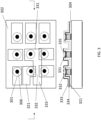
- FIG. 3 illustrates a two layer conductor arrangement in which two top conductor levels are employed.
- the lower, first layer 321 can be the same configuration as for a standard VCSEL.
- the top conductor 321 is connected to the VCSEL 301 top contact and routed to the edge of the substrate.
- a dielectric insulating layer 304 isolates the conductor 321 from the substrate and sides of the VCSEL.
- a second insulating dielectric layer 334 is deposited on top of the first conductor layer 321.
- the dielectric layer 334 can be optically transmitting to allow for transmission of the output beam from VCSELs connected to the first conductor layer 321.
- Holes 335 are formed in this dielectric layer 334 at the location of the top contacts of the VCSEL elements which are to be connected to the second conductor layer 331.
- a second conductor layer 331 is provided on top of this second dielectric layer 334. The second conductor 331 contacts the VCSEL top contact through the hole 335, and is routed to the edge 333 of the substrate.
- the conductor 331 typically is optically opaque, the conductor 331 is routed along a path 332 so that it does not block any output beams from other VCSEL elements 306.
- Examples of materials that can be used for the dielectric layers 304, 334 include silicon nitride, silicon dioxide, and polymers such as polyimide.
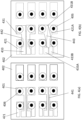
- FIGS. 4(a) and 4(b) show a comparison of the connection of individual VCSELs 406 in an addressable array using single layer conductors ( FIG. 4(a) ) and two level conductors ( FIG. 4(b)).
- FIG. 4(a) illustrates an example of a VCSEL array using single layer top conductor pattern in which the conductors 421 for the outer VCSEL elements can be routed easily to pads at the edge of the substrate 402.
- the conductors 441 have to be routed in between adjacent ones of the outer VCSELs. As indicated by FIG.
- this limitation results in very narrow conductors 441, which limits the amount of current that can be applied.
- the VCSELs 406 have to be spaced further apart to provide room for the conductors 441 from the inner VCSELs. For a small array, this spacing might be accomplished with minor difficulty. However, for large arrays, this spacing becomes extremely difficult, and in some cases impossible, to achieve. The spacing requirement also limits the layout of the VCSEL array and its connectivity.
- FIG. 4(b) illustrates some of the potential benefits of using two layer conductors 421, 431 to connect the VCSEL array elements.
- One potential benefit as shown in the upper part of the figure, is that conductors 431 having relatively wide portions 442 can be used to connect the inner VCSELs to the pads 443 at the edge of the substrate 402.
- the upper conductors 431 can pass over the lower conductors 421 because they are isolated from each other by the second dielectric insulating layer (not shown in FIG. 4(a) . This means that, for even for large arrays, the VCSEL elements can be located closer together than would otherwise be possible.
- a second potential benefit is that conductor cross-overs can be used where one conductor crosses the other conductor to a connection on the other side. This is shown in the lower part of FIG. 4(b) .
- a first one of the inner VCSELs is connected to a first pad 433A at the edge of the substrate 402 using the lower first conductor layer 421A.
- a second inner VCSEL is connected to another second pad 433B using the second layer conductor 431B. In this case, the second pad 433B is located above the first pad 433A.
- the conductor 431B passes over the lower conductor 421A and connects to the upper pad 433B by way of a portion 443 of the conductor 431B. This capability can be important for creating structured arrays where there is a need to interleave or intersperse VCSEL elements and activate them individually or in groups.
- the upper conductor layer is assumed to be opaque to the emitted optical beam from the VCSELs.
- the conductors 431, 431B are routed so they do not pass over the VCSEL emitting areas 406. It was noted above that for bottom emitting VCSELs, the bottom common conductor has apertures to allow transmission of the output beams. However, if a transmissive electrical conductor material, such as indium tin oxide, is used for the upper conductor layer, this restriction no longer applies, and the conductors can pass directly over the VCSEL emitting region(s) 406. An example of such an implementation is shown in FIG. 5 .
- a section 551 of the upper transmissive conductor 531 can pass over the VCSEL emitting region 506 and yet will not block the VCSEL output beam.
- the dielectric layer 334 also needs to be transmissive for the output beam wavelength. This also applies to cross-over situations where a section 552 of the upper transmissive conductor 531A passes over the emitting region of the VCSEL. This applies to second and higher number conductors where an isolating dielectric layer is placed over the VCSEL contact and emitting regions. A lower or first conductor 521, however, cannot pass over another VCSEL because the conductor 521 would touch the contact of that VCSEL.
- multi-layer top conductor VCSEL connections can be expanded to more than two top conductor layers.
- the same principles can be used to provide, three, four, five or even more top conductor layers for connecting single VCSEL elements or groups of VCSEL elements, and for routing these connections to contact pads at the periphery of the VCSEL array substrate.
- an additional insulating dielectric layer is provided over the previous top conductor layer, and then another top conductor layer is provided on the additional insulating dielectric layer. This process can be repeated to provide as many conductor layers as is needed for different subgroups of the VCSELs.
- the multilayer interconnections also can be used to form connections between VCSELs to form interconnected groups and can be used to connect the VCSELs to other electrical elements on the substrate.
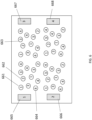
- FIG. 6 shows an example of a structured light VCSEL array illuminator in which the VCSELs elements are laid out in a non-regular array structure.
- the VCSELs are connected in four groups.
- VCSELs 661 (marked “1") form group 1 and are connected to a contact pad 665 at the edge of the substrate.
- the other groups are connected in in a similar manner (i.e., VCSELs 662, 663, 664, labelled respectively as “2,” “3,” “4,” are connected, respectively, to pads 666, 667, 668).
- One arrangement for achieving the connections is to use four top conductor layers such that each group of VCSELs is connected using a respective one of the layers. It would be extremely difficult to connect such an arrangement of VCSEL elements using a single layer conductor because the VCSEL elements belonging to each particular subgroup do not form a cohesive group, but are interspersed amongst VCSELs of the other groups.
- VCSEL array devices may be constructed for multi-wavelength application, such as a RBG or white light source.
- the multilayer conductor connection for compact dense VCSEL arrays is highly suitable for handheld devices for various applications and for volume production, reliability and lower cost.
- the principles described above are applicable not only to VCSEL arrays, but to arrays of other types of light emitting elements (e.g., LED or resonant LED arrays). Such techniques can be particularly advantageous, for example, if the light emitting elements need to be addressable and have complex array layouts.
Landscapes
- Physics & Mathematics (AREA)
- Condensed Matter Physics & Semiconductors (AREA)
- General Physics & Mathematics (AREA)
- Electromagnetism (AREA)
- Optics & Photonics (AREA)
- Semiconductor Lasers (AREA)
- Optical Communication System (AREA)
- Led Device Packages (AREA)
Claims (13)
- Dispositif permettant de générer des motifs d'illumination à haute densité, le dispositif comprenant :un réseau d'éléments émetteurs de lumière (306) sur un substrat commun (302), chaque élément émetteur de lumière incluant un réflecteur inférieur respectif sur une face du substrat et un réflecteur supérieur sur une autre face de l'élément émetteur de lumière ;un contact électrique commun (105) sur une face inférieure du substrat des éléments émetteurs de lumière ;une première couche diélectrique (304) sur le réseau d'éléments émetteurs de lumière, la première couche diélectrique couvrant le substrat et les éléments émetteurs de lumière à l'exception d'une zone de contact électrique supérieure de chaque élément émetteur de lumière ;un premier motif conducteur supérieur (321) sur la première couche diélectrique (304) et en contact avec les régions de contact électrique supérieures respectives (301) d'un premier sous-ensemble d'éléments émetteurs de lumière ;une séquence d'au moins une couche diélectrique supplémentaire (334) et d'au moins un motif conducteur supérieur supplémentaire (331) disposés de telle sorte que les régions de contact électrique supérieures de sous-ensembles respectifs d'éléments émetteurs de lumière sont connectées à un motif respectif des au moins un motifs conducteurs supérieurs supplémentaires ; etdes plots de contact électrique à une périphérie du réseau, dans lequel chacun du premier motif conducteur supérieur (321) et des motifs conducteurs supérieurs supplémentaires (331) est connecté électriquement respectivement à un ou plusieurs des plots de contact électrique.
- Dispositif selon la revendication 1, dans lequel le réseau d'éléments émetteurs de lumière (306) comprend un réseau d'éléments émetteurs de surface.
- Dispositif selon la revendication 1, dans lequel le réseau d'éléments émetteurs de lumière (306) comprend un réseau de VCSEL.
- Dispositif selon la revendication 3, dans lequel les VCSEL incluent des VCSEL à configuration à trois miroirs.
- Dispositif selon la revendication 1 dans lequel les éléments émetteurs de lumière (306) sont des éléments émetteurs par le haut VCSEL et dans lequel chacune des au moins une couche diélectrique supplémentaire (334) est optiquement transparente et couvre les régions d'émission des VCSEL.
- Dispositif selon la revendication 1, dans lequel les éléments émetteurs de lumière (306) sont des VCSEL émettant par le haut et dans lequel au moins une couche conductrice supérieure supplémentaire (331) est optiquement transparente et est acheminée sur des régions d'émission des VCSEL.
- Dispositif selon la revendication 1 dans lequel la séquence d'au moins une couche diélectrique supplémentaire (334) et d'au moins un motif conducteur supérieur supplémentaire (331) inclut :une première couche diélectrique supplémentaire sur le premier motif conducteur supérieur (321) ;un premier motif conducteur supérieur supplémentaire sur la première couche diélectrique supplémentaire et en contact avec les régions de contact électrique supérieures respectives d'un deuxième sous-ensemble des éléments émetteurs de lumière ;une deuxième couche diélectrique supplémentaire sur le premier motif conducteur supérieur supplémentaire ; etun deuxième motif conducteur supérieur supplémentaire sur la deuxième couche diélectrique supplémentaire et en contact avec les régions de contact électrique supérieures respectives d'un troisième sous-ensemble des éléments émetteurs de lumière.
- Dispositif selon la revendication 7, dans lequel la séquence d'au moins une couche diélectrique supplémentaire et d'au moins un motif conducteur supérieur supplémentaire inclut en outre :une troisième couche diélectrique supplémentaire sur le deuxième motif conducteur supérieur supplémentaire ; etun troisième motif conducteur supérieur supplémentaire sur la troisième couche diélectrique supplémentaire et en contact avec les régions de contact électrique supérieures respectives d'un quatrième sous-ensemble des éléments émetteurs de lumière.
- Dispositif selon la revendication 8, dans lequel la séquence d'au moins une couche diélectrique supplémentaire et d'au moins un motif conducteur supérieur supplémentaire inclut en outre :une quatrième couche diélectrique supplémentaire sur le troisième motif conducteur supérieur supplémentaire ; etun quatrième motif conducteur supérieur supplémentaire sur la quatrièmes couche diélectrique supplémentaire et en contact avec les régions de contact électrique supérieures respectives d'un cinquième sous-ensemble des éléments émetteurs de lumière.
- Dispositif selon la revendication 1 agencé de sorte que différents sous-ensembles des éléments émetteurs de lumière (306) peuvent être activés séparément d'autres sous-ensembles des éléments émetteurs de lumière (306).
- Dispositif selon la revendication 10 agencé de telle sorte que les éléments émetteurs de lumière (306) des différents sous-ensembles sont intercalés les uns entre les autres.
- Dispositif selon l'une quelconque des revendications précédentes, dans lequelle premier motif conducteur supérieur (321) et l'au moins un motif conducteur supérieur supplémentaire (331) forment une pile de motifs conducteurs multiples disposés sur le réseau, les motifs conducteurs multiples étant isolés électriquement les uns des autres ; etdans lequel au moins un des motifs conducteurs multiples croise un autre des motifs conducteurs multiples.
- Dispositif selon la revendication 12, dans lequel plusieurs des motifs conducteurs se croisent avec d'autres motifs conducteurs respectifs.
Applications Claiming Priority (2)
| Application Number | Priority Date | Filing Date | Title |
|---|---|---|---|
| US201762548789P | 2017-08-22 | 2017-08-22 | |
| PCT/US2018/047342 WO2019040506A1 (fr) | 2017-08-22 | 2018-08-21 | Interconnexions conductrices multicouches destinées à des réseaux d'émetteurs de lumière de densité élevée |
Publications (3)
| Publication Number | Publication Date |
|---|---|
| EP3673545A1 EP3673545A1 (fr) | 2020-07-01 |
| EP3673545A4 EP3673545A4 (fr) | 2021-05-26 |
| EP3673545B1 true EP3673545B1 (fr) | 2024-01-03 |
Family
ID=65439602
Family Applications (1)
| Application Number | Title | Priority Date | Filing Date |
|---|---|---|---|
| EP18847374.8A Active EP3673545B1 (fr) | 2017-08-22 | 2018-08-21 | Interconnexions conductrices multicouches destinées à des réseaux d'émetteurs de lumière de densité élevée |
Country Status (5)
| Country | Link |
|---|---|
| US (1) | US11527868B2 (fr) |
| EP (1) | EP3673545B1 (fr) |
| CN (1) | CN111213294B (fr) |
| TW (1) | TWI786170B (fr) |
| WO (1) | WO2019040506A1 (fr) |
Families Citing this family (4)
| Publication number | Priority date | Publication date | Assignee | Title |
|---|---|---|---|---|
| US11462888B2 (en) * | 2018-10-12 | 2022-10-04 | Lumentum Operations Llc | Emitter array with multiple groups of interspersed emitters |
| US11063407B1 (en) * | 2019-04-18 | 2021-07-13 | Facebook Technologies, Llc | Addressable vertical cavity surface emitting laser array for generating structured light patterns |
| WO2021235473A1 (fr) * | 2020-05-21 | 2021-11-25 | ソニーセミコンダクタソリューションズ株式会社 | Réseau d'éléments électroluminescents |
| CN114937915A (zh) * | 2022-05-25 | 2022-08-23 | Oppo广东移动通信有限公司 | 激光光源、激光光源模组及深度摄像头 |
Family Cites Families (21)
| Publication number | Priority date | Publication date | Assignee | Title |
|---|---|---|---|---|
| JPH06326419A (ja) * | 1993-04-20 | 1994-11-25 | Xerox Corp | モノリシック半導体発光アレイ |
| JP3013886B2 (ja) | 1996-09-27 | 2000-02-28 | 富士ゼロックス株式会社 | 2次元素子アレイ、2次元面発光レーザアレイおよび画像形成装置 |
| US6597713B2 (en) | 1998-07-22 | 2003-07-22 | Canon Kabushiki Kaisha | Apparatus with an optical functional device having a special wiring electrode and method for fabricating the same |
| US7974327B2 (en) | 2006-03-14 | 2011-07-05 | Furukawa Electric Co., Ltd. | Surface emitting laser element array |
| WO2007126159A1 (fr) * | 2006-04-28 | 2007-11-08 | Ricoh Company, Ltd. | Reseau de laser a emission en surface, dispositif de balayage optique et appareil de formation d'image |
| JP2008244431A (ja) * | 2007-02-28 | 2008-10-09 | Canon Inc | 面発光レーザアレイ及びその製造方法、面発光レーザアレイを備えている画像形成装置 |
| JP2008277780A (ja) * | 2007-04-02 | 2008-11-13 | Seiko Epson Corp | 面発光レーザアレイおよびその製造方法ならびに半導体装置 |
| KR20130006705A (ko) | 2008-02-12 | 2013-01-17 | 가부시키가이샤 리코 | 면 발광 레이저 소자, 면 발광 레이저 어레이, 광 주사 장치, 및 화상 형성 장치 |
| JP2011014632A (ja) * | 2009-06-30 | 2011-01-20 | Sony Corp | 半導体レーザ |
| US8675706B2 (en) | 2011-12-24 | 2014-03-18 | Princeton Optronics Inc. | Optical illuminator |
| US9065239B2 (en) * | 2012-04-17 | 2015-06-23 | Trilumina Corp. | Multibeam array of top emitting VCSEL elements |
| TWM441261U (en) * | 2012-05-18 | 2012-11-11 | Truelight Corp | Laser diode array die structure and has the laser diode array die structure of package device |
| CN103427333B (zh) * | 2012-05-23 | 2018-07-06 | 光环科技股份有限公司 | 激光二极管阵列晶粒结构及其封装装置 |
| JPWO2013176201A1 (ja) | 2012-05-25 | 2016-01-14 | 株式会社村田製作所 | 垂直共振面発光レーザ |
| JP6137318B2 (ja) | 2013-07-22 | 2017-05-31 | 株式会社村田製作所 | 垂直共振面発光レーザアレイ |
| US9038883B2 (en) * | 2013-09-11 | 2015-05-26 | Princeton Optronics Inc. | VCSEL packaging |
| US11095096B2 (en) * | 2014-04-16 | 2021-08-17 | Yale University | Method for a GaN vertical microcavity surface emitting laser (VCSEL) |
| US20160072252A1 (en) * | 2014-09-04 | 2016-03-10 | Canare Electric Co., Ltd. | Semiconductor Lasers |
| US20160072258A1 (en) * | 2014-09-10 | 2016-03-10 | Princeton Optronics Inc. | High Resolution Structured Light Source |
| US10177527B2 (en) * | 2015-05-28 | 2019-01-08 | Vixar Inc. | VCSELS and VCSEL arrays designed for improved performance as illumination sources and sensors |
| US10826278B2 (en) | 2017-10-11 | 2020-11-03 | Lumentum Operations Llc | Vertical-cavity surface-emitting laser array with multiple metal layers for addressing different groups of emitters |
-
2018
- 2018-08-21 EP EP18847374.8A patent/EP3673545B1/fr active Active
- 2018-08-21 US US16/640,119 patent/US11527868B2/en active Active
- 2018-08-21 CN CN201880066650.2A patent/CN111213294B/zh active Active
- 2018-08-21 TW TW107129159A patent/TWI786170B/zh active
- 2018-08-21 WO PCT/US2018/047342 patent/WO2019040506A1/fr not_active Ceased
Also Published As
| Publication number | Publication date |
|---|---|
| EP3673545A1 (fr) | 2020-07-01 |
| TW201921822A (zh) | 2019-06-01 |
| US11527868B2 (en) | 2022-12-13 |
| US20210218231A1 (en) | 2021-07-15 |
| CN111213294B (zh) | 2023-05-05 |
| EP3673545A4 (fr) | 2021-05-26 |
| WO2019040506A1 (fr) | 2019-02-28 |
| CN111213294A (zh) | 2020-05-29 |
| TWI786170B (zh) | 2022-12-11 |
Similar Documents
| Publication | Publication Date | Title |
|---|---|---|
| EP3673545B1 (fr) | Interconnexions conductrices multicouches destinées à des réseaux d'émetteurs de lumière de densité élevée | |
| CN109478767B (zh) | Vcsel照明器封装 | |
| US9553423B2 (en) | Miniature structured light illuminator | |
| KR102597579B1 (ko) | 코딩된 패턴 투영기 | |
| CN101154792B (zh) | 表面发射型半导体阵列装置 | |
| EP3580820B1 (fr) | Boîtier d'éclairage vcsel comprenant une structure optique intégrée dans l'encapsulant | |
| CN111146690B (zh) | 一种激光器模组及其制备方法 | |
| CN113169519B (zh) | 垂直腔面发射激光器(vcsel)阵列及制造方法 | |
| JP2737563B2 (ja) | 半導体発光装置 | |
| JP2004503120A (ja) | Ledランプ | |
| CN113169522B (zh) | 垂直腔面发射激光器(vcsel)阵列 | |
| JP2022500880A (ja) | 位相結合されたレーザ装置、および位相結合されたレーザ装置を製造するための方法 | |
| WO2020177007A1 (fr) | Projecteur de motif basé sur un réseau de lasers à cavité verticale émettant par la surface (vcsel) | |
| JP2009021430A (ja) | 面型光素子及び光モジュール | |
| US6853007B2 (en) | Submount for vertical cavity surface emitting lasers and detectors | |
| CN107179584B (zh) | 光学连接器 | |
| CN115380238B (zh) | 一种光发射组件、飞行时间摄像模组及移动终端 | |
| US11274812B2 (en) | LED arrangement and lighting device | |
| CN111566881A (zh) | 发光模块 | |
| JP2023145073A (ja) | 発光素子、発光素子アレイ、発光部品、光学装置、及び光計測装置 | |
| JP2018072674A (ja) | 光モジュール | |
| JP6742182B2 (ja) | 発光装置 | |
| CN118825777A (zh) | 发光装置 | |
| US20040202479A1 (en) | Transmission configuration | |
| JP2007101789A (ja) | 光伝送モジュール、光伝送モジュールの製造方法、光伝送装置および電子機器 |
Legal Events
| Date | Code | Title | Description |
|---|---|---|---|
| STAA | Information on the status of an ep patent application or granted ep patent |
Free format text: STATUS: THE INTERNATIONAL PUBLICATION HAS BEEN MADE |
|
| PUAI | Public reference made under article 153(3) epc to a published international application that has entered the european phase |
Free format text: ORIGINAL CODE: 0009012 |
|
| STAA | Information on the status of an ep patent application or granted ep patent |
Free format text: STATUS: REQUEST FOR EXAMINATION WAS MADE |
|
| 17P | Request for examination filed |
Effective date: 20200217 |
|
| AK | Designated contracting states |
Kind code of ref document: A1 Designated state(s): AL AT BE BG CH CY CZ DE DK EE ES FI FR GB GR HR HU IE IS IT LI LT LU LV MC MK MT NL NO PL PT RO RS SE SI SK SM TR |
|
| AX | Request for extension of the european patent |
Extension state: BA ME |
|
| DAV | Request for validation of the european patent (deleted) | ||
| DAX | Request for extension of the european patent (deleted) | ||
| A4 | Supplementary search report drawn up and despatched |
Effective date: 20210423 |
|
| RIC1 | Information provided on ipc code assigned before grant |
Ipc: H01S 5/42 20060101AFI20210419BHEP Ipc: H01S 5/40 20060101ALI20210419BHEP Ipc: H01S 5/042 20060101ALI20210419BHEP Ipc: H01S 5/183 20060101ALN20210419BHEP |
|
| P01 | Opt-out of the competence of the unified patent court (upc) registered |
Effective date: 20230613 |
|
| GRAP | Despatch of communication of intention to grant a patent |
Free format text: ORIGINAL CODE: EPIDOSNIGR1 |
|
| STAA | Information on the status of an ep patent application or granted ep patent |
Free format text: STATUS: GRANT OF PATENT IS INTENDED |
|
| RIC1 | Information provided on ipc code assigned before grant |
Ipc: H01S 5/183 20060101ALN20230711BHEP Ipc: H01S 5/042 20060101ALI20230711BHEP Ipc: H01S 5/40 20060101ALI20230711BHEP Ipc: H01S 5/42 20060101AFI20230711BHEP |
|
| INTG | Intention to grant announced |
Effective date: 20230731 |
|
| GRAS | Grant fee paid |
Free format text: ORIGINAL CODE: EPIDOSNIGR3 |
|
| GRAA | (expected) grant |
Free format text: ORIGINAL CODE: 0009210 |
|
| STAA | Information on the status of an ep patent application or granted ep patent |
Free format text: STATUS: THE PATENT HAS BEEN GRANTED |
|
| AK | Designated contracting states |
Kind code of ref document: B1 Designated state(s): AL AT BE BG CH CY CZ DE DK EE ES FI FR GB GR HR HU IE IS IT LI LT LU LV MC MK MT NL NO PL PT RO RS SE SI SK SM TR |
|
| REG | Reference to a national code |
Ref country code: GB Ref legal event code: FG4D |
|
| REG | Reference to a national code |
Ref country code: CH Ref legal event code: EP |
|
| REG | Reference to a national code |
Ref country code: DE Ref legal event code: R096 Ref document number: 602018063736 Country of ref document: DE |
|
| REG | Reference to a national code |
Ref country code: IE Ref legal event code: FG4D |
|
| REG | Reference to a national code |
Ref country code: LT Ref legal event code: MG9D |
|
| PG25 | Lapsed in a contracting state [announced via postgrant information from national office to epo] |
Ref country code: ES Free format text: LAPSE BECAUSE OF FAILURE TO SUBMIT A TRANSLATION OF THE DESCRIPTION OR TO PAY THE FEE WITHIN THE PRESCRIBED TIME-LIMIT Effective date: 20240103 |
|
| PG25 | Lapsed in a contracting state [announced via postgrant information from national office to epo] |
Ref country code: ES Free format text: LAPSE BECAUSE OF FAILURE TO SUBMIT A TRANSLATION OF THE DESCRIPTION OR TO PAY THE FEE WITHIN THE PRESCRIBED TIME-LIMIT Effective date: 20240103 |
|
| REG | Reference to a national code |
Ref country code: NL Ref legal event code: MP Effective date: 20240103 |
|
| REG | Reference to a national code |
Ref country code: AT Ref legal event code: MK05 Ref document number: 1647774 Country of ref document: AT Kind code of ref document: T Effective date: 20240103 |
|
| PG25 | Lapsed in a contracting state [announced via postgrant information from national office to epo] |
Ref country code: NL Free format text: LAPSE BECAUSE OF FAILURE TO SUBMIT A TRANSLATION OF THE DESCRIPTION OR TO PAY THE FEE WITHIN THE PRESCRIBED TIME-LIMIT Effective date: 20240103 |
|
| PG25 | Lapsed in a contracting state [announced via postgrant information from national office to epo] |
Ref country code: NL Free format text: LAPSE BECAUSE OF FAILURE TO SUBMIT A TRANSLATION OF THE DESCRIPTION OR TO PAY THE FEE WITHIN THE PRESCRIBED TIME-LIMIT Effective date: 20240103 |
|
| PG25 | Lapsed in a contracting state [announced via postgrant information from national office to epo] |
Ref country code: IS Free format text: LAPSE BECAUSE OF FAILURE TO SUBMIT A TRANSLATION OF THE DESCRIPTION OR TO PAY THE FEE WITHIN THE PRESCRIBED TIME-LIMIT Effective date: 20240503 |
|
| REG | Reference to a national code |
Ref country code: DE Ref legal event code: R082 Ref document number: 602018063736 Country of ref document: DE Ref country code: DE Ref legal event code: R081 Ref document number: 602018063736 Country of ref document: DE Owner name: AMS-OSRAM INTERNATIONAL GMBH, DE Free format text: FORMER OWNER: PRINCETON OPTRONICS, INC., MERCERVILLE, NJ, US |
|
| PG25 | Lapsed in a contracting state [announced via postgrant information from national office to epo] |
Ref country code: LT Free format text: LAPSE BECAUSE OF FAILURE TO SUBMIT A TRANSLATION OF THE DESCRIPTION OR TO PAY THE FEE WITHIN THE PRESCRIBED TIME-LIMIT Effective date: 20240103 |
|
| PG25 | Lapsed in a contracting state [announced via postgrant information from national office to epo] |
Ref country code: GR Free format text: LAPSE BECAUSE OF FAILURE TO SUBMIT A TRANSLATION OF THE DESCRIPTION OR TO PAY THE FEE WITHIN THE PRESCRIBED TIME-LIMIT Effective date: 20240404 |
|
| PG25 | Lapsed in a contracting state [announced via postgrant information from national office to epo] |
Ref country code: RS Free format text: LAPSE BECAUSE OF FAILURE TO SUBMIT A TRANSLATION OF THE DESCRIPTION OR TO PAY THE FEE WITHIN THE PRESCRIBED TIME-LIMIT Effective date: 20240403 Ref country code: HR Free format text: LAPSE BECAUSE OF FAILURE TO SUBMIT A TRANSLATION OF THE DESCRIPTION OR TO PAY THE FEE WITHIN THE PRESCRIBED TIME-LIMIT Effective date: 20240103 |
|
| PG25 | Lapsed in a contracting state [announced via postgrant information from national office to epo] |
Ref country code: CZ Free format text: LAPSE BECAUSE OF FAILURE TO SUBMIT A TRANSLATION OF THE DESCRIPTION OR TO PAY THE FEE WITHIN THE PRESCRIBED TIME-LIMIT Effective date: 20240103 Ref country code: AT Free format text: LAPSE BECAUSE OF FAILURE TO SUBMIT A TRANSLATION OF THE DESCRIPTION OR TO PAY THE FEE WITHIN THE PRESCRIBED TIME-LIMIT Effective date: 20240103 |
|
| PG25 | Lapsed in a contracting state [announced via postgrant information from national office to epo] |
Ref country code: RS Free format text: LAPSE BECAUSE OF FAILURE TO SUBMIT A TRANSLATION OF THE DESCRIPTION OR TO PAY THE FEE WITHIN THE PRESCRIBED TIME-LIMIT Effective date: 20240403 Ref country code: NO Free format text: LAPSE BECAUSE OF FAILURE TO SUBMIT A TRANSLATION OF THE DESCRIPTION OR TO PAY THE FEE WITHIN THE PRESCRIBED TIME-LIMIT Effective date: 20240403 Ref country code: LT Free format text: LAPSE BECAUSE OF FAILURE TO SUBMIT A TRANSLATION OF THE DESCRIPTION OR TO PAY THE FEE WITHIN THE PRESCRIBED TIME-LIMIT Effective date: 20240103 Ref country code: IS Free format text: LAPSE BECAUSE OF FAILURE TO SUBMIT A TRANSLATION OF THE DESCRIPTION OR TO PAY THE FEE WITHIN THE PRESCRIBED TIME-LIMIT Effective date: 20240503 Ref country code: HR Free format text: LAPSE BECAUSE OF FAILURE TO SUBMIT A TRANSLATION OF THE DESCRIPTION OR TO PAY THE FEE WITHIN THE PRESCRIBED TIME-LIMIT Effective date: 20240103 Ref country code: GR Free format text: LAPSE BECAUSE OF FAILURE TO SUBMIT A TRANSLATION OF THE DESCRIPTION OR TO PAY THE FEE WITHIN THE PRESCRIBED TIME-LIMIT Effective date: 20240404 Ref country code: CZ Free format text: LAPSE BECAUSE OF FAILURE TO SUBMIT A TRANSLATION OF THE DESCRIPTION OR TO PAY THE FEE WITHIN THE PRESCRIBED TIME-LIMIT Effective date: 20240103 Ref country code: BG Free format text: LAPSE BECAUSE OF FAILURE TO SUBMIT A TRANSLATION OF THE DESCRIPTION OR TO PAY THE FEE WITHIN THE PRESCRIBED TIME-LIMIT Effective date: 20240103 Ref country code: AT Free format text: LAPSE BECAUSE OF FAILURE TO SUBMIT A TRANSLATION OF THE DESCRIPTION OR TO PAY THE FEE WITHIN THE PRESCRIBED TIME-LIMIT Effective date: 20240103 |
|
| PG25 | Lapsed in a contracting state [announced via postgrant information from national office to epo] |
Ref country code: PL Free format text: LAPSE BECAUSE OF FAILURE TO SUBMIT A TRANSLATION OF THE DESCRIPTION OR TO PAY THE FEE WITHIN THE PRESCRIBED TIME-LIMIT Effective date: 20240103 Ref country code: PT Free format text: LAPSE BECAUSE OF FAILURE TO SUBMIT A TRANSLATION OF THE DESCRIPTION OR TO PAY THE FEE WITHIN THE PRESCRIBED TIME-LIMIT Effective date: 20240503 |
|
| RAP2 | Party data changed (patent owner data changed or rights of a patent transferred) |
Owner name: AMS-OSRAM INTERNATIONAL GMBH |
|
| PG25 | Lapsed in a contracting state [announced via postgrant information from national office to epo] |
Ref country code: SE Free format text: LAPSE BECAUSE OF FAILURE TO SUBMIT A TRANSLATION OF THE DESCRIPTION OR TO PAY THE FEE WITHIN THE PRESCRIBED TIME-LIMIT Effective date: 20240103 Ref country code: PT Free format text: LAPSE BECAUSE OF FAILURE TO SUBMIT A TRANSLATION OF THE DESCRIPTION OR TO PAY THE FEE WITHIN THE PRESCRIBED TIME-LIMIT Effective date: 20240503 Ref country code: PL Free format text: LAPSE BECAUSE OF FAILURE TO SUBMIT A TRANSLATION OF THE DESCRIPTION OR TO PAY THE FEE WITHIN THE PRESCRIBED TIME-LIMIT Effective date: 20240103 Ref country code: LV Free format text: LAPSE BECAUSE OF FAILURE TO SUBMIT A TRANSLATION OF THE DESCRIPTION OR TO PAY THE FEE WITHIN THE PRESCRIBED TIME-LIMIT Effective date: 20240103 |
|
| REG | Reference to a national code |
Ref country code: DE Ref legal event code: R097 Ref document number: 602018063736 Country of ref document: DE |
|
| PG25 | Lapsed in a contracting state [announced via postgrant information from national office to epo] |
Ref country code: DK Free format text: LAPSE BECAUSE OF FAILURE TO SUBMIT A TRANSLATION OF THE DESCRIPTION OR TO PAY THE FEE WITHIN THE PRESCRIBED TIME-LIMIT Effective date: 20240103 |
|
| PG25 | Lapsed in a contracting state [announced via postgrant information from national office to epo] |
Ref country code: SM Free format text: LAPSE BECAUSE OF FAILURE TO SUBMIT A TRANSLATION OF THE DESCRIPTION OR TO PAY THE FEE WITHIN THE PRESCRIBED TIME-LIMIT Effective date: 20240103 |
|
| PG25 | Lapsed in a contracting state [announced via postgrant information from national office to epo] |
Ref country code: EE Free format text: LAPSE BECAUSE OF FAILURE TO SUBMIT A TRANSLATION OF THE DESCRIPTION OR TO PAY THE FEE WITHIN THE PRESCRIBED TIME-LIMIT Effective date: 20240103 |
|
| PG25 | Lapsed in a contracting state [announced via postgrant information from national office to epo] |
Ref country code: SK Free format text: LAPSE BECAUSE OF FAILURE TO SUBMIT A TRANSLATION OF THE DESCRIPTION OR TO PAY THE FEE WITHIN THE PRESCRIBED TIME-LIMIT Effective date: 20240103 |
|
| PG25 | Lapsed in a contracting state [announced via postgrant information from national office to epo] |
Ref country code: SM Free format text: LAPSE BECAUSE OF FAILURE TO SUBMIT A TRANSLATION OF THE DESCRIPTION OR TO PAY THE FEE WITHIN THE PRESCRIBED TIME-LIMIT Effective date: 20240103 Ref country code: SK Free format text: LAPSE BECAUSE OF FAILURE TO SUBMIT A TRANSLATION OF THE DESCRIPTION OR TO PAY THE FEE WITHIN THE PRESCRIBED TIME-LIMIT Effective date: 20240103 Ref country code: RO Free format text: LAPSE BECAUSE OF FAILURE TO SUBMIT A TRANSLATION OF THE DESCRIPTION OR TO PAY THE FEE WITHIN THE PRESCRIBED TIME-LIMIT Effective date: 20240103 Ref country code: EE Free format text: LAPSE BECAUSE OF FAILURE TO SUBMIT A TRANSLATION OF THE DESCRIPTION OR TO PAY THE FEE WITHIN THE PRESCRIBED TIME-LIMIT Effective date: 20240103 Ref country code: DK Free format text: LAPSE BECAUSE OF FAILURE TO SUBMIT A TRANSLATION OF THE DESCRIPTION OR TO PAY THE FEE WITHIN THE PRESCRIBED TIME-LIMIT Effective date: 20240103 |
|
| PLBE | No opposition filed within time limit |
Free format text: ORIGINAL CODE: 0009261 |
|
| STAA | Information on the status of an ep patent application or granted ep patent |
Free format text: STATUS: NO OPPOSITION FILED WITHIN TIME LIMIT |
|
| RAP4 | Party data changed (patent owner data changed or rights of a patent transferred) |
Owner name: AMS-OSRAM INTERNATIONAL GMBH |
|
| PG25 | Lapsed in a contracting state [announced via postgrant information from national office to epo] |
Ref country code: IT Free format text: LAPSE BECAUSE OF FAILURE TO SUBMIT A TRANSLATION OF THE DESCRIPTION OR TO PAY THE FEE WITHIN THE PRESCRIBED TIME-LIMIT Effective date: 20240103 |
|
| 26N | No opposition filed |
Effective date: 20241007 |
|
| PG25 | Lapsed in a contracting state [announced via postgrant information from national office to epo] |
Ref country code: IT Free format text: LAPSE BECAUSE OF FAILURE TO SUBMIT A TRANSLATION OF THE DESCRIPTION OR TO PAY THE FEE WITHIN THE PRESCRIBED TIME-LIMIT Effective date: 20240103 |
|
| REG | Reference to a national code |
Ref country code: CH Ref legal event code: PL |
|
| PG25 | Lapsed in a contracting state [announced via postgrant information from national office to epo] |
Ref country code: LU Free format text: LAPSE BECAUSE OF NON-PAYMENT OF DUE FEES Effective date: 20240821 |
|
| GBPC | Gb: european patent ceased through non-payment of renewal fee |
Effective date: 20240821 |
|
| PG25 | Lapsed in a contracting state [announced via postgrant information from national office to epo] |
Ref country code: SI Free format text: LAPSE BECAUSE OF FAILURE TO SUBMIT A TRANSLATION OF THE DESCRIPTION OR TO PAY THE FEE WITHIN THE PRESCRIBED TIME-LIMIT Effective date: 20240103 Ref country code: CH Free format text: LAPSE BECAUSE OF NON-PAYMENT OF DUE FEES Effective date: 20240831 Ref country code: MC Free format text: LAPSE BECAUSE OF FAILURE TO SUBMIT A TRANSLATION OF THE DESCRIPTION OR TO PAY THE FEE WITHIN THE PRESCRIBED TIME-LIMIT Effective date: 20240103 |
|
| REG | Reference to a national code |
Ref country code: BE Ref legal event code: MM Effective date: 20240831 |
|
| PG25 | Lapsed in a contracting state [announced via postgrant information from national office to epo] |
Ref country code: GB Free format text: LAPSE BECAUSE OF NON-PAYMENT OF DUE FEES Effective date: 20240821 |
|
| PG25 | Lapsed in a contracting state [announced via postgrant information from national office to epo] |
Ref country code: BE Free format text: LAPSE BECAUSE OF NON-PAYMENT OF DUE FEES Effective date: 20240831 |
|
| PG25 | Lapsed in a contracting state [announced via postgrant information from national office to epo] |
Ref country code: IE Free format text: LAPSE BECAUSE OF NON-PAYMENT OF DUE FEES Effective date: 20240821 |
|
| PG25 | Lapsed in a contracting state [announced via postgrant information from national office to epo] |
Ref country code: FI Free format text: LAPSE BECAUSE OF FAILURE TO SUBMIT A TRANSLATION OF THE DESCRIPTION OR TO PAY THE FEE WITHIN THE PRESCRIBED TIME-LIMIT Effective date: 20240103 |
|
| PGFP | Annual fee paid to national office [announced via postgrant information from national office to epo] |
Ref country code: DE Payment date: 20250820 Year of fee payment: 8 |
|
| PGFP | Annual fee paid to national office [announced via postgrant information from national office to epo] |
Ref country code: FR Payment date: 20250828 Year of fee payment: 8 |