EP3670185B1 - Dehnbarer verbundfilm und herstellungsverfahren dafür - Google Patents
Dehnbarer verbundfilm und herstellungsverfahren dafür Download PDFInfo
- Publication number
- EP3670185B1 EP3670185B1 EP19206120.8A EP19206120A EP3670185B1 EP 3670185 B1 EP3670185 B1 EP 3670185B1 EP 19206120 A EP19206120 A EP 19206120A EP 3670185 B1 EP3670185 B1 EP 3670185B1
- Authority
- EP
- European Patent Office
- Prior art keywords
- group
- film
- polyurethane
- carbon atoms
- stretchable film
- Prior art date
- Legal status (The legal status is an assumption and is not a legal conclusion. Google has not performed a legal analysis and makes no representation as to the accuracy of the status listed.)
- Active
Links
Images



Classifications
-
- C—CHEMISTRY; METALLURGY
- C08—ORGANIC MACROMOLECULAR COMPOUNDS; THEIR PREPARATION OR CHEMICAL WORKING-UP; COMPOSITIONS BASED THEREON
- C08J—WORKING-UP; GENERAL PROCESSES OF COMPOUNDING; AFTER-TREATMENT NOT COVERED BY SUBCLASSES C08B, C08C, C08F, C08G or C08H
- C08J5/00—Manufacture of articles or shaped materials containing macromolecular substances
- C08J5/18—Manufacture of films or sheets
-
- C—CHEMISTRY; METALLURGY
- C08—ORGANIC MACROMOLECULAR COMPOUNDS; THEIR PREPARATION OR CHEMICAL WORKING-UP; COMPOSITIONS BASED THEREON
- C08L—COMPOSITIONS OF MACROMOLECULAR COMPOUNDS
- C08L75/00—Compositions of polyureas or polyurethanes; Compositions of derivatives of such polymers
- C08L75/04—Polyurethanes
- C08L75/14—Polyurethanes having carbon-to-carbon unsaturated bonds
- C08L75/16—Polyurethanes having carbon-to-carbon unsaturated bonds having terminal carbon-to-carbon unsaturated bonds
-
- C—CHEMISTRY; METALLURGY
- C09—DYES; PAINTS; POLISHES; NATURAL RESINS; ADHESIVES; COMPOSITIONS NOT OTHERWISE PROVIDED FOR; APPLICATIONS OF MATERIALS NOT OTHERWISE PROVIDED FOR
- C09D—COATING COMPOSITIONS, e.g. PAINTS, VARNISHES OR LACQUERS; FILLING PASTES; CHEMICAL PAINT OR INK REMOVERS; INKS; CORRECTING FLUIDS; WOODSTAINS; PASTES OR SOLIDS FOR COLOURING OR PRINTING; USE OF MATERIALS THEREFOR
- C09D175/00—Coating compositions based on polyureas or polyurethanes; Coating compositions based on derivatives of such polymers
- C09D175/04—Polyurethanes
- C09D175/08—Polyurethanes from polyethers
-
- A—HUMAN NECESSITIES
- A61—MEDICAL OR VETERINARY SCIENCE; HYGIENE
- A61B—DIAGNOSIS; SURGERY; IDENTIFICATION
- A61B5/00—Measuring for diagnostic purposes; Identification of persons
- A61B5/24—Detecting, measuring or recording bioelectric or biomagnetic signals of the body or parts thereof
- A61B5/25—Bioelectric electrodes therefor
-
- B—PERFORMING OPERATIONS; TRANSPORTING
- B05—SPRAYING OR ATOMISING IN GENERAL; APPLYING FLUENT MATERIALS TO SURFACES, IN GENERAL
- B05D—PROCESSES FOR APPLYING FLUENT MATERIALS TO SURFACES, IN GENERAL
- B05D3/00—Pretreatment of surfaces to which liquids or other fluent materials are to be applied; After-treatment of applied coatings, e.g. intermediate treating of an applied coating preparatory to subsequent applications of liquids or other fluent materials
- B05D3/02—Pretreatment of surfaces to which liquids or other fluent materials are to be applied; After-treatment of applied coatings, e.g. intermediate treating of an applied coating preparatory to subsequent applications of liquids or other fluent materials by baking
-
- C—CHEMISTRY; METALLURGY
- C08—ORGANIC MACROMOLECULAR COMPOUNDS; THEIR PREPARATION OR CHEMICAL WORKING-UP; COMPOSITIONS BASED THEREON
- C08F—MACROMOLECULAR COMPOUNDS OBTAINED BY REACTIONS ONLY INVOLVING CARBON-TO-CARBON UNSATURATED BONDS
- C08F2/00—Processes of polymerisation
- C08F2/46—Polymerisation initiated by wave energy or particle radiation
-
- C—CHEMISTRY; METALLURGY
- C08—ORGANIC MACROMOLECULAR COMPOUNDS; THEIR PREPARATION OR CHEMICAL WORKING-UP; COMPOSITIONS BASED THEREON
- C08F—MACROMOLECULAR COMPOUNDS OBTAINED BY REACTIONS ONLY INVOLVING CARBON-TO-CARBON UNSATURATED BONDS
- C08F283/00—Macromolecular compounds obtained by polymerising monomers on to polymers provided for in subclass C08G
- C08F283/006—Macromolecular compounds obtained by polymerising monomers on to polymers provided for in subclass C08G on to polymers provided for in C08G18/00
- C08F283/008—Macromolecular compounds obtained by polymerising monomers on to polymers provided for in subclass C08G on to polymers provided for in C08G18/00 on to unsaturated polymers
-
- C—CHEMISTRY; METALLURGY
- C08—ORGANIC MACROMOLECULAR COMPOUNDS; THEIR PREPARATION OR CHEMICAL WORKING-UP; COMPOSITIONS BASED THEREON
- C08F—MACROMOLECULAR COMPOUNDS OBTAINED BY REACTIONS ONLY INVOLVING CARBON-TO-CARBON UNSATURATED BONDS
- C08F290/00—Macromolecular compounds obtained by polymerising monomers on to polymers modified by introduction of aliphatic unsaturated end or side groups
- C08F290/02—Macromolecular compounds obtained by polymerising monomers on to polymers modified by introduction of aliphatic unsaturated end or side groups on to polymers modified by introduction of unsaturated end groups
- C08F290/06—Polymers provided for in subclass C08G
- C08F290/067—Polyurethanes; Polyureas
-
- C—CHEMISTRY; METALLURGY
- C08—ORGANIC MACROMOLECULAR COMPOUNDS; THEIR PREPARATION OR CHEMICAL WORKING-UP; COMPOSITIONS BASED THEREON
- C08G—MACROMOLECULAR COMPOUNDS OBTAINED OTHERWISE THAN BY REACTIONS ONLY INVOLVING UNSATURATED CARBON-TO-CARBON BONDS
- C08G18/00—Polymeric products of isocyanates or isothiocyanates
- C08G18/06—Polymeric products of isocyanates or isothiocyanates with compounds having active hydrogen
- C08G18/28—Polymeric products of isocyanates or isothiocyanates with compounds having active hydrogen characterised by the compounds used containing active hydrogen
- C08G18/30—Low-molecular-weight compounds
- C08G18/32—Polyhydroxy compounds; Polyamines; Hydroxyamines
- C08G18/3203—Polyhydroxy compounds
- C08G18/3206—Polyhydroxy compounds aliphatic
-
- C—CHEMISTRY; METALLURGY
- C08—ORGANIC MACROMOLECULAR COMPOUNDS; THEIR PREPARATION OR CHEMICAL WORKING-UP; COMPOSITIONS BASED THEREON
- C08G—MACROMOLECULAR COMPOUNDS OBTAINED OTHERWISE THAN BY REACTIONS ONLY INVOLVING UNSATURATED CARBON-TO-CARBON BONDS
- C08G18/00—Polymeric products of isocyanates or isothiocyanates
- C08G18/06—Polymeric products of isocyanates or isothiocyanates with compounds having active hydrogen
- C08G18/28—Polymeric products of isocyanates or isothiocyanates with compounds having active hydrogen characterised by the compounds used containing active hydrogen
- C08G18/30—Low-molecular-weight compounds
- C08G18/38—Low-molecular-weight compounds having heteroatoms other than oxygen
- C08G18/3893—Low-molecular-weight compounds having heteroatoms other than oxygen containing silicon
-
- C—CHEMISTRY; METALLURGY
- C08—ORGANIC MACROMOLECULAR COMPOUNDS; THEIR PREPARATION OR CHEMICAL WORKING-UP; COMPOSITIONS BASED THEREON
- C08G—MACROMOLECULAR COMPOUNDS OBTAINED OTHERWISE THAN BY REACTIONS ONLY INVOLVING UNSATURATED CARBON-TO-CARBON BONDS
- C08G18/00—Polymeric products of isocyanates or isothiocyanates
- C08G18/06—Polymeric products of isocyanates or isothiocyanates with compounds having active hydrogen
- C08G18/28—Polymeric products of isocyanates or isothiocyanates with compounds having active hydrogen characterised by the compounds used containing active hydrogen
- C08G18/40—High-molecular-weight compounds
- C08G18/42—Polycondensates having carboxylic or carbonic ester groups in the main chain
- C08G18/4236—Polycondensates having carboxylic or carbonic ester groups in the main chain containing only aliphatic groups
- C08G18/4238—Polycondensates having carboxylic or carbonic ester groups in the main chain containing only aliphatic groups derived from dicarboxylic acids and dialcohols
-
- C—CHEMISTRY; METALLURGY
- C08—ORGANIC MACROMOLECULAR COMPOUNDS; THEIR PREPARATION OR CHEMICAL WORKING-UP; COMPOSITIONS BASED THEREON
- C08G—MACROMOLECULAR COMPOUNDS OBTAINED OTHERWISE THAN BY REACTIONS ONLY INVOLVING UNSATURATED CARBON-TO-CARBON BONDS
- C08G18/00—Polymeric products of isocyanates or isothiocyanates
- C08G18/06—Polymeric products of isocyanates or isothiocyanates with compounds having active hydrogen
- C08G18/28—Polymeric products of isocyanates or isothiocyanates with compounds having active hydrogen characterised by the compounds used containing active hydrogen
- C08G18/40—High-molecular-weight compounds
- C08G18/42—Polycondensates having carboxylic or carbonic ester groups in the main chain
- C08G18/44—Polycarbonates
-
- C—CHEMISTRY; METALLURGY
- C08—ORGANIC MACROMOLECULAR COMPOUNDS; THEIR PREPARATION OR CHEMICAL WORKING-UP; COMPOSITIONS BASED THEREON
- C08G—MACROMOLECULAR COMPOUNDS OBTAINED OTHERWISE THAN BY REACTIONS ONLY INVOLVING UNSATURATED CARBON-TO-CARBON BONDS
- C08G18/00—Polymeric products of isocyanates or isothiocyanates
- C08G18/06—Polymeric products of isocyanates or isothiocyanates with compounds having active hydrogen
- C08G18/28—Polymeric products of isocyanates or isothiocyanates with compounds having active hydrogen characterised by the compounds used containing active hydrogen
- C08G18/40—High-molecular-weight compounds
- C08G18/48—Polyethers
- C08G18/4804—Two or more polyethers of different physical or chemical nature
- C08G18/4808—Mixtures of two or more polyetherdiols
-
- C—CHEMISTRY; METALLURGY
- C08—ORGANIC MACROMOLECULAR COMPOUNDS; THEIR PREPARATION OR CHEMICAL WORKING-UP; COMPOSITIONS BASED THEREON
- C08G—MACROMOLECULAR COMPOUNDS OBTAINED OTHERWISE THAN BY REACTIONS ONLY INVOLVING UNSATURATED CARBON-TO-CARBON BONDS
- C08G18/00—Polymeric products of isocyanates or isothiocyanates
- C08G18/06—Polymeric products of isocyanates or isothiocyanates with compounds having active hydrogen
- C08G18/28—Polymeric products of isocyanates or isothiocyanates with compounds having active hydrogen characterised by the compounds used containing active hydrogen
- C08G18/40—High-molecular-weight compounds
- C08G18/48—Polyethers
- C08G18/4854—Polyethers containing oxyalkylene groups having four carbon atoms in the alkylene group
-
- C—CHEMISTRY; METALLURGY
- C08—ORGANIC MACROMOLECULAR COMPOUNDS; THEIR PREPARATION OR CHEMICAL WORKING-UP; COMPOSITIONS BASED THEREON
- C08G—MACROMOLECULAR COMPOUNDS OBTAINED OTHERWISE THAN BY REACTIONS ONLY INVOLVING UNSATURATED CARBON-TO-CARBON BONDS
- C08G18/00—Polymeric products of isocyanates or isothiocyanates
- C08G18/06—Polymeric products of isocyanates or isothiocyanates with compounds having active hydrogen
- C08G18/28—Polymeric products of isocyanates or isothiocyanates with compounds having active hydrogen characterised by the compounds used containing active hydrogen
- C08G18/40—High-molecular-weight compounds
- C08G18/48—Polyethers
- C08G18/4858—Polyethers containing oxyalkylene groups having more than four carbon atoms in the alkylene group
-
- C—CHEMISTRY; METALLURGY
- C08—ORGANIC MACROMOLECULAR COMPOUNDS; THEIR PREPARATION OR CHEMICAL WORKING-UP; COMPOSITIONS BASED THEREON
- C08G—MACROMOLECULAR COMPOUNDS OBTAINED OTHERWISE THAN BY REACTIONS ONLY INVOLVING UNSATURATED CARBON-TO-CARBON BONDS
- C08G18/00—Polymeric products of isocyanates or isothiocyanates
- C08G18/06—Polymeric products of isocyanates or isothiocyanates with compounds having active hydrogen
- C08G18/28—Polymeric products of isocyanates or isothiocyanates with compounds having active hydrogen characterised by the compounds used containing active hydrogen
- C08G18/65—Low-molecular-weight compounds having active hydrogen with high-molecular-weight compounds having active hydrogen
- C08G18/66—Compounds of groups C08G18/42, C08G18/48, or C08G18/52
- C08G18/6633—Compounds of group C08G18/42
- C08G18/6637—Compounds of group C08G18/42 with compounds of group C08G18/32 or polyamines of C08G18/38
- C08G18/664—Compounds of group C08G18/42 with compounds of group C08G18/32 or polyamines of C08G18/38 with compounds of group C08G18/3203
-
- C—CHEMISTRY; METALLURGY
- C08—ORGANIC MACROMOLECULAR COMPOUNDS; THEIR PREPARATION OR CHEMICAL WORKING-UP; COMPOSITIONS BASED THEREON
- C08G—MACROMOLECULAR COMPOUNDS OBTAINED OTHERWISE THAN BY REACTIONS ONLY INVOLVING UNSATURATED CARBON-TO-CARBON BONDS
- C08G18/00—Polymeric products of isocyanates or isothiocyanates
- C08G18/06—Polymeric products of isocyanates or isothiocyanates with compounds having active hydrogen
- C08G18/28—Polymeric products of isocyanates or isothiocyanates with compounds having active hydrogen characterised by the compounds used containing active hydrogen
- C08G18/67—Unsaturated compounds having active hydrogen
- C08G18/671—Unsaturated compounds having only one group containing active hydrogen
- C08G18/672—Esters of acrylic or alkyl acrylic acid having only one group containing active hydrogen
-
- C—CHEMISTRY; METALLURGY
- C08—ORGANIC MACROMOLECULAR COMPOUNDS; THEIR PREPARATION OR CHEMICAL WORKING-UP; COMPOSITIONS BASED THEREON
- C08G—MACROMOLECULAR COMPOUNDS OBTAINED OTHERWISE THAN BY REACTIONS ONLY INVOLVING UNSATURATED CARBON-TO-CARBON BONDS
- C08G18/00—Polymeric products of isocyanates or isothiocyanates
- C08G18/06—Polymeric products of isocyanates or isothiocyanates with compounds having active hydrogen
- C08G18/28—Polymeric products of isocyanates or isothiocyanates with compounds having active hydrogen characterised by the compounds used containing active hydrogen
- C08G18/67—Unsaturated compounds having active hydrogen
- C08G18/6795—Unsaturated polyethers
-
- C—CHEMISTRY; METALLURGY
- C08—ORGANIC MACROMOLECULAR COMPOUNDS; THEIR PREPARATION OR CHEMICAL WORKING-UP; COMPOSITIONS BASED THEREON
- C08G—MACROMOLECULAR COMPOUNDS OBTAINED OTHERWISE THAN BY REACTIONS ONLY INVOLVING UNSATURATED CARBON-TO-CARBON BONDS
- C08G18/00—Polymeric products of isocyanates or isothiocyanates
- C08G18/06—Polymeric products of isocyanates or isothiocyanates with compounds having active hydrogen
- C08G18/70—Polymeric products of isocyanates or isothiocyanates with compounds having active hydrogen characterised by the isocyanates or isothiocyanates used
- C08G18/72—Polyisocyanates or polyisothiocyanates
- C08G18/74—Polyisocyanates or polyisothiocyanates cyclic
- C08G18/75—Polyisocyanates or polyisothiocyanates cyclic cycloaliphatic
- C08G18/751—Polyisocyanates or polyisothiocyanates cyclic cycloaliphatic containing only one cycloaliphatic ring
- C08G18/752—Polyisocyanates or polyisothiocyanates cyclic cycloaliphatic containing only one cycloaliphatic ring containing at least one isocyanate or isothiocyanate group linked to the cycloaliphatic ring by means of an aliphatic group
- C08G18/753—Polyisocyanates or polyisothiocyanates cyclic cycloaliphatic containing only one cycloaliphatic ring containing at least one isocyanate or isothiocyanate group linked to the cycloaliphatic ring by means of an aliphatic group containing one isocyanate or isothiocyanate group linked to the cycloaliphatic ring by means of an aliphatic group having a primary carbon atom next to the isocyanate or isothiocyanate group
- C08G18/755—Polyisocyanates or polyisothiocyanates cyclic cycloaliphatic containing only one cycloaliphatic ring containing at least one isocyanate or isothiocyanate group linked to the cycloaliphatic ring by means of an aliphatic group containing one isocyanate or isothiocyanate group linked to the cycloaliphatic ring by means of an aliphatic group having a primary carbon atom next to the isocyanate or isothiocyanate group and at least one isocyanate or isothiocyanate group linked to a secondary carbon atom of the cycloaliphatic ring, e.g. isophorone diisocyanate
-
- C—CHEMISTRY; METALLURGY
- C08—ORGANIC MACROMOLECULAR COMPOUNDS; THEIR PREPARATION OR CHEMICAL WORKING-UP; COMPOSITIONS BASED THEREON
- C08G—MACROMOLECULAR COMPOUNDS OBTAINED OTHERWISE THAN BY REACTIONS ONLY INVOLVING UNSATURATED CARBON-TO-CARBON BONDS
- C08G18/00—Polymeric products of isocyanates or isothiocyanates
- C08G18/06—Polymeric products of isocyanates or isothiocyanates with compounds having active hydrogen
- C08G18/70—Polymeric products of isocyanates or isothiocyanates with compounds having active hydrogen characterised by the isocyanates or isothiocyanates used
- C08G18/72—Polyisocyanates or polyisothiocyanates
- C08G18/74—Polyisocyanates or polyisothiocyanates cyclic
- C08G18/75—Polyisocyanates or polyisothiocyanates cyclic cycloaliphatic
- C08G18/751—Polyisocyanates or polyisothiocyanates cyclic cycloaliphatic containing only one cycloaliphatic ring
- C08G18/752—Polyisocyanates or polyisothiocyanates cyclic cycloaliphatic containing only one cycloaliphatic ring containing at least one isocyanate or isothiocyanate group linked to the cycloaliphatic ring by means of an aliphatic group
- C08G18/753—Polyisocyanates or polyisothiocyanates cyclic cycloaliphatic containing only one cycloaliphatic ring containing at least one isocyanate or isothiocyanate group linked to the cycloaliphatic ring by means of an aliphatic group containing one isocyanate or isothiocyanate group linked to the cycloaliphatic ring by means of an aliphatic group having a primary carbon atom next to the isocyanate or isothiocyanate group
- C08G18/756—Polyisocyanates or polyisothiocyanates cyclic cycloaliphatic containing only one cycloaliphatic ring containing at least one isocyanate or isothiocyanate group linked to the cycloaliphatic ring by means of an aliphatic group containing one isocyanate or isothiocyanate group linked to the cycloaliphatic ring by means of an aliphatic group having a primary carbon atom next to the isocyanate or isothiocyanate group and at least one isocyanate or isothiocyanate group linked to a tertiary carbon atom of the cycloaliphatic ring
-
- C—CHEMISTRY; METALLURGY
- C08—ORGANIC MACROMOLECULAR COMPOUNDS; THEIR PREPARATION OR CHEMICAL WORKING-UP; COMPOSITIONS BASED THEREON
- C08G—MACROMOLECULAR COMPOUNDS OBTAINED OTHERWISE THAN BY REACTIONS ONLY INVOLVING UNSATURATED CARBON-TO-CARBON BONDS
- C08G18/00—Polymeric products of isocyanates or isothiocyanates
- C08G18/06—Polymeric products of isocyanates or isothiocyanates with compounds having active hydrogen
- C08G18/70—Polymeric products of isocyanates or isothiocyanates with compounds having active hydrogen characterised by the isocyanates or isothiocyanates used
- C08G18/72—Polyisocyanates or polyisothiocyanates
- C08G18/74—Polyisocyanates or polyisothiocyanates cyclic
- C08G18/75—Polyisocyanates or polyisothiocyanates cyclic cycloaliphatic
- C08G18/758—Polyisocyanates or polyisothiocyanates cyclic cycloaliphatic containing two or more cycloaliphatic rings
-
- C—CHEMISTRY; METALLURGY
- C08—ORGANIC MACROMOLECULAR COMPOUNDS; THEIR PREPARATION OR CHEMICAL WORKING-UP; COMPOSITIONS BASED THEREON
- C08J—WORKING-UP; GENERAL PROCESSES OF COMPOUNDING; AFTER-TREATMENT NOT COVERED BY SUBCLASSES C08B, C08C, C08F, C08G or C08H
- C08J3/00—Processes of treating or compounding macromolecular substances
- C08J3/28—Treatment by wave energy or particle radiation
-
- C—CHEMISTRY; METALLURGY
- C08—ORGANIC MACROMOLECULAR COMPOUNDS; THEIR PREPARATION OR CHEMICAL WORKING-UP; COMPOSITIONS BASED THEREON
- C08J—WORKING-UP; GENERAL PROCESSES OF COMPOUNDING; AFTER-TREATMENT NOT COVERED BY SUBCLASSES C08B, C08C, C08F, C08G or C08H
- C08J7/00—Chemical treatment or coating of shaped articles made of macromolecular substances
- C08J7/04—Coating
- C08J7/042—Coating with two or more layers, where at least one layer of a composition contains a polymer binder
-
- C—CHEMISTRY; METALLURGY
- C08—ORGANIC MACROMOLECULAR COMPOUNDS; THEIR PREPARATION OR CHEMICAL WORKING-UP; COMPOSITIONS BASED THEREON
- C08J—WORKING-UP; GENERAL PROCESSES OF COMPOUNDING; AFTER-TREATMENT NOT COVERED BY SUBCLASSES C08B, C08C, C08F, C08G or C08H
- C08J7/00—Chemical treatment or coating of shaped articles made of macromolecular substances
- C08J7/08—Heat treatment
-
- C—CHEMISTRY; METALLURGY
- C09—DYES; PAINTS; POLISHES; NATURAL RESINS; ADHESIVES; COMPOSITIONS NOT OTHERWISE PROVIDED FOR; APPLICATIONS OF MATERIALS NOT OTHERWISE PROVIDED FOR
- C09D—COATING COMPOSITIONS, e.g. PAINTS, VARNISHES OR LACQUERS; FILLING PASTES; CHEMICAL PAINT OR INK REMOVERS; INKS; CORRECTING FLUIDS; WOODSTAINS; PASTES OR SOLIDS FOR COLOURING OR PRINTING; USE OF MATERIALS THEREFOR
- C09D5/00—Coating compositions, e.g. paints, varnishes or lacquers, characterised by their physical nature or the effects produced; Filling pastes
-
- H—ELECTRICITY
- H01—ELECTRIC ELEMENTS
- H01B—CABLES; CONDUCTORS; INSULATORS; SELECTION OF MATERIALS FOR THEIR CONDUCTIVE, INSULATING OR DIELECTRIC PROPERTIES
- H01B3/00—Insulators or insulating bodies characterised by the insulating materials; Selection of materials for their insulating or dielectric properties
- H01B3/18—Insulators or insulating bodies characterised by the insulating materials; Selection of materials for their insulating or dielectric properties mainly consisting of organic substances
- H01B3/30—Insulators or insulating bodies characterised by the insulating materials; Selection of materials for their insulating or dielectric properties mainly consisting of organic substances plastics; resins; waxes
- H01B3/302—Polyurethanes or polythiourethanes; Polyurea or polythiourea
-
- C—CHEMISTRY; METALLURGY
- C08—ORGANIC MACROMOLECULAR COMPOUNDS; THEIR PREPARATION OR CHEMICAL WORKING-UP; COMPOSITIONS BASED THEREON
- C08J—WORKING-UP; GENERAL PROCESSES OF COMPOUNDING; AFTER-TREATMENT NOT COVERED BY SUBCLASSES C08B, C08C, C08F, C08G or C08H
- C08J2323/00—Characterised by the use of homopolymers or copolymers of unsaturated aliphatic hydrocarbons having only one carbon-to-carbon double bond; Derivatives of such polymers
- C08J2323/02—Characterised by the use of homopolymers or copolymers of unsaturated aliphatic hydrocarbons having only one carbon-to-carbon double bond; Derivatives of such polymers not modified by chemical after treatment
- C08J2323/04—Homopolymers or copolymers of ethene
- C08J2323/06—Polyethene
-
- C—CHEMISTRY; METALLURGY
- C08—ORGANIC MACROMOLECULAR COMPOUNDS; THEIR PREPARATION OR CHEMICAL WORKING-UP; COMPOSITIONS BASED THEREON
- C08J—WORKING-UP; GENERAL PROCESSES OF COMPOUNDING; AFTER-TREATMENT NOT COVERED BY SUBCLASSES C08B, C08C, C08F, C08G or C08H
- C08J2351/00—Characterised by the use of graft polymers in which the grafted component is obtained by reactions only involving carbon-to-carbon unsaturated bonds; Derivatives of such polymers
- C08J2351/08—Characterised by the use of graft polymers in which the grafted component is obtained by reactions only involving carbon-to-carbon unsaturated bonds; Derivatives of such polymers grafted on to macromolecular compounds obtained otherwise than by reactions only involving carbon-to-carbon unsaturated bonds
-
- C—CHEMISTRY; METALLURGY
- C08—ORGANIC MACROMOLECULAR COMPOUNDS; THEIR PREPARATION OR CHEMICAL WORKING-UP; COMPOSITIONS BASED THEREON
- C08J—WORKING-UP; GENERAL PROCESSES OF COMPOUNDING; AFTER-TREATMENT NOT COVERED BY SUBCLASSES C08B, C08C, C08F, C08G or C08H
- C08J2375/00—Characterised by the use of polyureas or polyurethanes; Derivatives of such polymers
- C08J2375/04—Polyurethanes
- C08J2375/08—Polyurethanes from polyethers
-
- C—CHEMISTRY; METALLURGY
- C08—ORGANIC MACROMOLECULAR COMPOUNDS; THEIR PREPARATION OR CHEMICAL WORKING-UP; COMPOSITIONS BASED THEREON
- C08J—WORKING-UP; GENERAL PROCESSES OF COMPOUNDING; AFTER-TREATMENT NOT COVERED BY SUBCLASSES C08B, C08C, C08F, C08G or C08H
- C08J2475/00—Characterised by the use of polyureas or polyurethanes; Derivatives of such polymers
- C08J2475/04—Polyurethanes
-
- C—CHEMISTRY; METALLURGY
- C08—ORGANIC MACROMOLECULAR COMPOUNDS; THEIR PREPARATION OR CHEMICAL WORKING-UP; COMPOSITIONS BASED THEREON
- C08J—WORKING-UP; GENERAL PROCESSES OF COMPOUNDING; AFTER-TREATMENT NOT COVERED BY SUBCLASSES C08B, C08C, C08F, C08G or C08H
- C08J2475/00—Characterised by the use of polyureas or polyurethanes; Derivatives of such polymers
- C08J2475/04—Polyurethanes
- C08J2475/06—Polyurethanes from polyesters
-
- C—CHEMISTRY; METALLURGY
- C08—ORGANIC MACROMOLECULAR COMPOUNDS; THEIR PREPARATION OR CHEMICAL WORKING-UP; COMPOSITIONS BASED THEREON
- C08J—WORKING-UP; GENERAL PROCESSES OF COMPOUNDING; AFTER-TREATMENT NOT COVERED BY SUBCLASSES C08B, C08C, C08F, C08G or C08H
- C08J2475/00—Characterised by the use of polyureas or polyurethanes; Derivatives of such polymers
- C08J2475/04—Polyurethanes
- C08J2475/14—Polyurethanes having carbon-to-carbon unsaturated bonds
- C08J2475/16—Polyurethanes having carbon-to-carbon unsaturated bonds having terminal carbon-to-carbon unsaturated bonds
-
- H—ELECTRICITY
- H01—ELECTRIC ELEMENTS
- H01B—CABLES; CONDUCTORS; INSULATORS; SELECTION OF MATERIALS FOR THEIR CONDUCTIVE, INSULATING OR DIELECTRIC PROPERTIES
- H01B3/00—Insulators or insulating bodies characterised by the insulating materials; Selection of materials for their insulating or dielectric properties
- H01B3/18—Insulators or insulating bodies characterised by the insulating materials; Selection of materials for their insulating or dielectric properties mainly consisting of organic substances
- H01B3/30—Insulators or insulating bodies characterised by the insulating materials; Selection of materials for their insulating or dielectric properties mainly consisting of organic substances plastics; resins; waxes
- H01B3/44—Insulators or insulating bodies characterised by the insulating materials; Selection of materials for their insulating or dielectric properties mainly consisting of organic substances plastics; resins; waxes vinyl resins; acrylic resins
- H01B3/447—Insulators or insulating bodies characterised by the insulating materials; Selection of materials for their insulating or dielectric properties mainly consisting of organic substances plastics; resins; waxes vinyl resins; acrylic resins from acrylic compounds
-
- H—ELECTRICITY
- H01—ELECTRIC ELEMENTS
- H01B—CABLES; CONDUCTORS; INSULATORS; SELECTION OF MATERIALS FOR THEIR CONDUCTIVE, INSULATING OR DIELECTRIC PROPERTIES
- H01B3/00—Insulators or insulating bodies characterised by the insulating materials; Selection of materials for their insulating or dielectric properties
- H01B3/18—Insulators or insulating bodies characterised by the insulating materials; Selection of materials for their insulating or dielectric properties mainly consisting of organic substances
- H01B3/30—Insulators or insulating bodies characterised by the insulating materials; Selection of materials for their insulating or dielectric properties mainly consisting of organic substances plastics; resins; waxes
- H01B3/46—Insulators or insulating bodies characterised by the insulating materials; Selection of materials for their insulating or dielectric properties mainly consisting of organic substances plastics; resins; waxes silicones
-
- H—ELECTRICITY
- H01—ELECTRIC ELEMENTS
- H01B—CABLES; CONDUCTORS; INSULATORS; SELECTION OF MATERIALS FOR THEIR CONDUCTIVE, INSULATING OR DIELECTRIC PROPERTIES
- H01B7/00—Insulated conductors or cables characterised by their form
- H01B7/04—Flexible cables, conductors, or cords, e.g. trailing cables
Definitions
- the present invention relates to a composite stretchable film and a method for forming the same.
- IoT Internet of Things
- a wearable device is a type of attachment to a user's body for constantly monitoring its physical state.
- a wearable device normally includes a bio-electrode for detecting electric signals transmitted from a body, wires for sending the electric signals to a sensor, a semiconductor chip serving as the sensor, and a battery, in addition to an essential adhesive pad for attachment to the skin.
- Patent Document 1 describes detailed structures of a bio-electrode part, a wiring part connected to the electrode part, and an adhesive pad.
- a silicone-based adhesive film is provided around the bio-electrode part, and the bio-electrode part and a sensor device are connected by a meandering-shaped elastic silver wiring part coated with an elastic urethane film.
- such a urethane film has high elasticity and strength, and excellent mechanical properties as a film coated on an elastic wiring part.
- the hydrolysis inherent in a urethane film unfortunately lowers its elasticity and strength, while a silicone film has no such hydrolysis, but the strength inherently remains low.
- a cured product of a silicone urethane polymer exhibits higher strength than a single silicone component and lower hydrolysis than a single polyurethane component.
- Such a cured product fails to achieve the strength equivalent to a single polyurethane component and the water repellency equivalent to a single silicone component, and both of the strength and water repellency are restricted to in-betweens of silicone and polyurethane components.
- a highly elastic urethane film exhibits a typical feature of tacky surface for a user to touch. Accordingly, films that are adhered to each other don't separate due to their surface tackiness. When such a urethane film is screenprinted, the film adheres to a printing plate to cause defective printing. Meanwhile, silicone films don't adhere to each other due to high peeling property. Since silicone is low in strength, however, thin silicone films are readily broken when they are elongated. When a silicone film is screenprinted, the film causes no defective printing due to adhesion to a printing plate, but its low film adhesion to ink leads to peeling of cured ink. This is attributed to high silicone peeling property on the surface. On the other hand, a urethane film exhibits high adhesion to ink, thereby causing no peeling of cured ink.
- films using polyurethane with a silicone pendant are excellent in elasticity, strength, and water repellency in a well-balanced manner, but films unfortunately adhere to each other, even to a printing plate during screen-printing due to their film surface tackiness.
- Polyurethane-based films in which silicone is subjected to block copolymerization on a main chain are not tacky on the film surface, but low in strength.
- stretchable films that have high elasticity and strength and no tackiness on the surface, are capable of printing such as screen-printing and peel no ink after printing has been demanded.
- Patent Document 2 discloses a proposed skin material for a two-wheeled vehicle seat including a silicone urethane film as a surface film, a urethane film placed underneath and a polyolefinic elastomer film placed further underneath.
- the silicone urethane film is used on the outermost surface to improve the wear resistance. This technical improvement is derived from silicone's low surface energy that renders the surface non-tacky.
- the present invention was made in view of the situation to solve the problems, and has an object to provide a stretchable film that has excellent stretchability and strength, with the film surface having excellent water repellency, and a method for forming the same.
- the present invention provides a composite stretchable film, the stretchable film including: a surface film which is a cured product of a polyurethane 1 containing a copolymer of one or more of units "a1", “a2", “a3”, and “a4", each having polycarbonate or polyester and urethane bonds, and silicone-pendant type urethane units "b1" and/or "b2” represented by the following general formula (1); and an inner film which is a cured product of a polyurethane 2 containing a unit "c” having polyether and urethane bonds represented by the following general formula (2), on which the surface film is laminated: wherein, R 1 to R 4 , and R 20 to R 27 represent the same or a different linear or branched alkylene group having 2 to 12 carbon atoms; R 5 represents a linear or branched alkylene group having 2 to 20 carbon atoms, or a divalent linking group containing an aromatic group, and optionally containing an ether group,
- the composite stretchable film has excellent stretchability (elasticity) and strength, with the film surface having excellent water repellency.
- the polyurethane 1 can be a polymer having a structure containing a (meth) acrylate group as a terminal group represented by the following general formula (3): wherein, R 1 to R 12 , R 20 to R 27 , m, n, p, q, r, a1, a2, a3, a4, b1, and b2 represent the same meanings as before; R 13 represents a linear, branched, or cyclic alkylene group having 1 to 20 carbon atoms, and optionally containing an ether group; R 14 represents a hydrogen atom or a methyl group; and d represents the number of units in one molecule satisfying an inequality 1 ⁇ d ⁇ 4.
- the polymer containing a (meth) acrylate group is excellent in radical-induced crosslinkability.
- the composite stretchable film preferably has a stretching property of 20 to 1000% in a tensile test regulated by JIS K 6251.
- the composite stretchable film can desirably be used as a film coated on a stretchable wire.
- the composite stretchable film is preferably used as a film in contact with a conductive wiring having stretchability.
- the stretchable film of the present invention can particularly desirably be used for these applications.
- the present invention provides a method for forming a composite stretchable film, including:
- the method for forming a stretchable film can readily form a composite stretchable film having excellent stretchablity, strength, and water repellency on the film surface.
- the polyurethane 2 can be applied on a substrate and cured by heating and/or light exposure to form the inner film.
- the method for forming a stretchable film can more readily form a composite stretchable film having excellent stretchablity, strength, and water repellency on the film surface.
- the composite stretchable film of the present invention is excellent in stretchability (elasticity) and strength equivalent to a polyurethane component and its film surface has excellent water repellency equivalent to or more desirable than silicone whose main chain is a siloxane bond, and non-sticky feeling on the surface.
- a composite stretchable film in which a silicone-pendant type polyurethane-based layer containing polycarbonate or polyester is formed on the surface of a polyurethane-based layer containing polyether can form a film having high stretchability, strength, water repellent, and non-sticky feeling on the surface.
- Such a composite stretchable wire film obtained by bringing the stretchable film of the present invention in contact with a conductive wire and coating either or both faces of a conductive wire is excellent not only in stretchability and strength, but also in water repellency and favorable skin feeling due to non-sticky feeling on the surface. Accordingly, the stretchable film of the present invention can particularly desirably be used as a stretchable film capable of mounting not only a wiring part for connecting a bio-electrode and a sensor, but also other essential parts of a bio-electrode and a sensor in wearable devices. Also, the method for forming a stretchable film of the present invention can readily form the above-mentioned composite stretchable film.
- Polyurethane has sufficient elasticity and strength, but also low water repellency, but hydrolysis unfortunately lowers its strength and elasticity, while silicone has high water repellency but also low strength.
- a cured product of a silicone urethane polymer having both a urethane bond and a siloxane bond on a main chain is excellent in water repellency with weak sticky feeling on the film surface but also low strength, while a film based on polyurethane having polyether and silicone-pendant on a side chain has high strength, elasticity, and water repellent but has a drawback of tackiness on the surface.
- Inventors of the present invention have carried out an extended investigation and found that by forming side chain silicone polycarbonate or polyester type polyurethane layer having low elasticity but high strength, high water repellent and non-tacky surface on a surface of a film based on polyether type polyurethane having high elasticity and strength, favorable hysteresis during elongation and tackiness on the surface to prepare a composite film, the resulting excellent non-sticky stretchable film having high elasticity, strength, and water repellency, and non-sticky feeling on the surface can be provided as a particularly desirable elastic substrate film for forming an elastic wire in wearable devices. Based on that information, the present invention was accomplished.
- the present invention provides a stretchable film comprising: a surface film which is a cured product of a polyurethane 1 containing a copolymer of one or more of units “a1", “a2", “a3”, and “a4", each having polycarbonate or polyester and urethane bonds, and silicone-pendant type urethane units "b1" and/or "b2” represented by the following general formula (1); and an inner film which is a cured product of a polyurethane 2 containing a unit "c” having polyether and urethane bonds represented by the following general formula (2), on which the surface film is laminated: wherein, R 1 to R 4 , and R 20 to R 27 represent the same or a different linear or branched alkylene group having 2 to 12 carbon atoms; R 5 represents a linear or branched alkylene group having 2 to 20 carbon atoms, or a divalent linking group containing an aromatic group, and optionally containing an ether group, a thiol group
- a stretchable film of the present invention is obtained by laminating a surface film which is a cured product of a polyurethane 1 containing a copolymer of one or more of units "a1", “a2", “a3”, and “a4", each having polycarbonate or polyester and urethane bonds, and silicone-pendant type urethane units "b1" and/or "b2" on an inner film which is a cured product of a polyurethane 2 containing a unit "c" having polyether and urethane bonds.
- a surface film which is side chain silicone polycarbonate and/or polyester type polyurethane having low elasticity but high strength and water repellency, and non-tackiness on the surface on a surface of an inner film based on polyether type polyurethane having high elasticity and strength, favorable hysteresis during elongation and tackiness on the surface to prepare a composite film, an excellent non-sticky stretchable film having high elasticity, strength, water repellency, and non-sticky feeling on the surface can be provided.
- the polyurethanes 1 and 2 that provide a surface film, an inner film, and each film (layer) will be described.
- the units “a1”, “a2”, “a3”, and “a4" are also collectively called “unit “a ⁇ or ""a” unit”.
- a surface film is formed on the surface (upward of an inner film) of the stretchable film of the present invention.
- the surface film i.e., polycarbonate and/or polyester silicone-pendant type polyurethane layer
- the surface film is a cured product of a polyurethane 1 having a structure having one or more of units "a1" to "a4" and units "b1" and/or "b2" represented by the following general formula (1).
- R 1 to R 4 , and R 20 to R 27 represent the same or a different linear or branched alkylene group having 2 to 12 carbon atoms
- R 5 represents a linear or branched alkylene group having 2 to 20 carbon atoms, or a divalent linking group containing an aromatic group, and optionally containing an ether group, a thiol group, an ester group, a sulfinyl group, a sulfonyl group, a carbonyl group, or a halogen atom
- R 6 , R 7 , and R 8 represent the same or a different linear, branched, or cyclic alkyl group having 1 to 6 carbon atoms, a phenyl group, or a 3,3,3-trifluoropropyl group
- R 9 represents the same or a different linear, branched, or cyclic alkyl group having 1 to 6 carbon atoms, a phenyl group, a 3,3,3-trifluoroprop
- the polyurethane 1 is a polymer having a structure containing a (meth) acrylate group as a terminal group represented by the following general formula (3).
- R 13 represents a linear, branched, or cyclic alkylene group having 1 to 20 carbon atoms, and optionally containing an ether group
- R 14 represents a hydrogen atom or a methyl group
- d represents the number of units in one molecule satisfying an inequality 1 ⁇ d ⁇ 4.
- the polymer containing a (meth) acrylate group can readily be crosslinked (cured) by allowing the polymer to react with a radical by heating or light exposure.
- a compound containing a (meth) acrylate group as a terminal group represented by the general formula (3) can be obtained by allowing an isocyanate compound having a (meth) acrylate group to react with a diol compound having a silicon-containing group, a polycarbonate compound or a polyester compound mentioned later. Also, a compound having the (meth) acrylate group can be obtained by allowing a compound containing a (meth) acrylate group having a hydroxyl group to react with an isocyanate compound.
- a polyurethane 1 is polyurethane having a structure represented by one or more of units “a1” to “a4" and units “b1” and/or “b2" in the general formula (1), and corresponds to a copolymer of one or more of the units “a1” to “a4", each having polycarbonate or polyester and urethane bonds, and silicone-pendant type urethane units "b1" and/or “b2” represented by the general formula (1).
- the polyurethane 1 may be polyurethane containing the above-mentioned structure, and can include other structures.
- R 1 , R 2 , and R 20 to R 27 in a repeating unit "a" represent the same or a different linear or branched alkylene group having 2 to 12 carbon atoms.
- Illustrative example of the alkylene group includes an ethylene group, a n-propylene group, an isopropylene group, a n-butylene group, an isobutylene group, a sec-butylene group, a tert-butylene group, a n-pentylene group, a 1-methyl-n-butylene group, a 2-methyl-n-butylene group, a 3-methyl-n-butylene group, a 1,1-dimethyl-n-propylene group, a 1,2-dimethyl-n-propylene group, a 2,2-dimethyl-n-propylene group, a 1-ethyl-n-propylene group, a n-hexylene group, a 1-methyl-n-pentylene group
- repeating unit “a” may be one of units “a1” to “a4", or a combination of two or more units, or the unit “a1” (polycarbonate) and the units “a2" to “a4" (polyester) may be combined.
- the elasticity and strength of a stretchable film obtained by combining a soft segment of polycarbonate and a soft segment of polyester can be enhanced.
- polycarbonate-containing polyurethane in the repeating unit "a1” the following polycarbonate compounds having diol as a terminal group can be employed as a raw material.
- repeating unit in parentheses represents m.
- Diol compounds using a polyester compound having diol as a terminal group for obtaining a soft segment "a2" (unit “a2") of copolymerizable polyester as a raw material can be illustrated as follows.
- repeating unit in parentheses represents m.
- Diol compounds using a polyester compound having diol as a terminal group for obtaining a soft segment "a3" (unit “a3”) of copolymerizable polyester as a raw material can be illustrated as follows.
- repeating unit in parentheses represents m.
- Diol compounds using a polyester compound having diol as a terminal group for obtaining a soft segment "a4" (unit "a4") of copolymerizable polyester as a raw material can be illustrated as follows.
- repeating unit in parentheses represents m.
- Illustrative example of the diol compound for forming a structure represented by "b1" in the general formula (1) can include a compound represented by the following general formula (b)-1'.
- R 6 , R 7 , and R 8 represent the same or a different linear, branched, or cyclic alkyl group having 1 to 6 carbon atoms, a phenyl group, or a 3,3,3-trifluoropropyl group.
- Illustrative example thereof includes a methyl group, an ethyl group, a n-propyl group, an isopropyl group, a n-butyl group, an isobutyl group, a tert-butyl group, a n-pentyl group, a cyclopentyl group, a n-hexyl group, a cyclohexyl group, a phenyl group, and a 3,3,3-trifluoropropyl group.
- R 9 represents the same or a different linear, branched, or cyclic alkyl group having 1 to 6 carbon atoms, a phenyl group, a 3,3,3-trifluoropropyl group, or a -(OSiR 6 R 7 ) s -OSiR 6 R 7 R 8 group.
- s represents an integer of 0 to 20.
- R 10 represents a hydrogen atom, or a linear or branched alkyl group having 1 to 4 carbon atoms. Illustrative example thereof includes a methyl group, an ethyl group, a n-propyl group, an isopropyl group, a n-butyl group, an isobutyl group, and a tert-butyl group.
- R 11 represents a single bond, a methylene group, or an ethylene group;
- R 12 represents a hydrogen atom or a methyl group;
- X represents a linear or branched alkylene group having 3 to 7 carbon atoms, and may contain an ether group.
- Illustrative example of the X includes a n-propylene group, an isopropylene group, a n-butylene group, an isobutylene group, a sec-butylene group, a tert-butylene group, a n-pentylene group, a 1-methyl-n-butylene group, a 2-methyl-n-butylene group, a 3-methyl-n-butylene group, a 1,1-dimethyl-n-propylene group, a 1,2-dimethyl-n-propylene group, a 2,2-dimethyl-n-propylene group, a 1-ethyl-n-propylene group, a n-hexylene group, a 1-methyl-n-pentylene group, a 2-methyl-n-pentylene group, a 3-methyl-n-pentylene group, a 4-methyl-n-pentylene group, a 1,1-dimethyl-n-butylene group,
- a diol compound having a pendant short-chain silicone represented by the general formula (b)-1' can be obtained by allowing e.g., glycerin monoallyl ether to react with a short-chain siloxane compound having a SiH group under a platinum catalyst.
- glycerin monoallyl ether to react with a short-chain siloxane compound having a SiH group under a platinum catalyst.
- Illustrative example thereof includes the following compounds.
- Illustrative example of the diol compound for forming a structure represented by "b2" in the general formula (1) can include a compound represented by the following general formula (b)-2'. wherein, R 6 to R 9 , and X represent the same meanings as before.
- a diol compound having a pendant short-chain silicone represented by general formula (b)-2' can be obtained by allowing e.g., a dihydroxydialkenyl compound to react with a short-chain siloxane compound having a SiH group under a platinum catalyst.
- a dihydroxydialkenyl compound to react with a short-chain siloxane compound having a SiH group under a platinum catalyst.
- Illustrative example thereof includes the following compounds. In each formula, the repeating unit represents the average value.
- the polyurethane 1 having a structure represented by "a1” to "a4", "b1", and “b2" in the general formula (1), which gives a surface film of the stretchable film of the present invention, can be formed by employing a polycarbonate compound and a polyester compound having a hydroxyl group as a terminal group, and a diol compound having a silicon-containing group represented by the above-mentioned general formulae (b)-1' and (b)-2' as a raw material, and allowing the same to react with an isocyanate compound.
- Illustrative example of the isocyanate compound that reacts with the above polycarbonate compound, the polyester compound and the diol compound having the above silicon-containing group includes the following compounds.
- t represents an integer of 1 or more.
- An isocyanate compound containing a (meth) acrylate group in particular among the above-mentioned isocyanate compounds can react with a diol compound having a silicon-containing group represented by the general formulae (b)-1' and (b)-2', a polycarbonate compound or the like to obtain a compound containing a (meth) acrylate group as a terminal group represented by the general formula (3).
- a compound containing a (meth) acrylate group having a hydroxyl group can also react with an isocyanate compound to obtain a compound containing a (meth) acrylate group as a terminal group represented by the general formula (3).
- a blocked isocyanate group can be a form of isocyanate group obtained by deprotection of a blocking group by heating.
- Illustrative example thereof includes isocyanate groups substituted by alcohol, phenol, thioalcohol, imine, ketimine, amine, lactam, pyrazole, oxime, and ⁇ -diketone.
- a catalyst may be added to lower the deprotection temperature of a blocked isocyanate group.
- the catalyst includes organic tin such as dibutyltin dilaurate, bismuth salt, and zinc carboxylate such as zinc 2-ethylhexanoate and zinc acetate.
- Patent Document of JP-A-2012-152725 A describes a technique capable of colder deprotection reaction by containing a ⁇ , ⁇ -unsaturated zinc carboxylate derived from carboxylic acid as a blocked isocyanate dissociation catalyst.
- a compound containing an amino group may be added.
- the reaction of an isocyanate group and an amino group forms a urea bond.
- the portion formed of a urethane bond and a urea bond is called as "hard segment", which improves the strength by the resulting hydrogen bond. Accordingly, the strength can be improved by addition of not only a urethane bond, but also a urea bond.
- a compound containing an amino group is a strength-imparting agent.
- the inner film of the present invention is a cured product of a polyurethane 2 containing a unit "c" having polyether and urethane bonds represented by the general formula (2).
- R 3 to R 4 represent the same or a different linear or branched alkylene group having 2 to 12 carbon atoms
- R 5 represents a linear or branched alkylene group having 2 to 20 carbon atoms, or a divalent linking group containing an aromatic group, and optionally containing an ether group, a thiol group, an ester group, a sulfinyl group, a sulfonyl group, a carbonyl group, or a halogen atom.
- n and p represent an integer of 1 to 200.
- c represents the ratio of the repeating unit.
- a polyurethane 2 is polyurethane containing a unit "c" having polyether and urethane bonds represented by the general formula (2).
- the polyurethane 2 may be polyurethane containing the above-mentioned unit, and can include other structures.
- R 3 and R 4 represent the same or a different linear or branched alkylene group having 2 to 12 carbon atoms, and may be the same group as in the above-mentioned R 1 and R 2 .
- R 5 represents a linear or a branched alkylene group having 2 to 20 carbon atoms, or a divalent linking group containing an aromatic group, and optionally containing an ether group, a thiol group, an ester group, a sulfinyl group, a sulfonyl group, a carbonyl group, or a halogen atom.
- polyether in the repeating unit "c” the following polyether compounds having diol as a terminal group can be employed as a raw material.
- repeating unit in parentheses represents n or p.
- R 5 in the repeating unit "c" includes the following groups.
- the polyurethane 2 having a structure represented by "c" in the general formula (2) can be obtained by allowing a polyether compound having a hydroxyl group as a terminal group to react with an isocyanate compound.
- Illustrative example of the isocyanate compound that reacts with a polyol compound having a hydroxyl group as a terminal group includes an isocyanate compound that reacts with a polycarbonate compound having a hydroxyl group as a terminal group or a diol compound having a silicon-containing group employed as a raw material of the polyurethane 1.
- An isocyanate compound containing a (meth) acrylate group among the above-mentioned isocyanate compounds can react with a polyol compound having a hydroxyl group as a terminal group to obtain a compound containing a (meth) acrylate group as a terminal group.
- an isocyanate compound can react with moisture in the air when kept in storage to deactivate an isocyanate group, which requires sufficient moisture control and other cautions for storage. Accordingly, in order to prevent the problem, a compound containing a blocked isocyanate group by protecting an isocyanate group with a substituent may be used.
- polyether-containing polyurethanes may each be obtained by copolymerizing a polyester "d".
- diol compound for obtaining a copolymerizable polyester portion includes the following compounds.
- the polyurethanes 1 and 2 used in the method for forming a composite stretchable film of the present invention can include components other than those providing the above-mentioned "a1” to "a4", "b1", “b2", “c” or “d” units in the process of synthesis (production) as required.
- Illustrative example of these components includes a chain extender, a crosslinking agent, a catalyst, a strength-imparting agent, a radical generator, other monomers, a solvent, and a filler.
- the polyurethanes 1 and 2 used in the method for forming a composite stretchable film of the present invention preferably has a weight average molecular weight of 500 or more.
- the polyurethanes 1 and 2 can desirably be used in the stretchable film of the present invention.
- the upper limit of the weight average molecular weight of the resin is preferably 500,000 or fewer.
- the thickness of an inner film be preferably 1 to 1000 ⁇ m, and the thickness of a surface film be 0.1 to 100 ⁇ m.
- the surface film is preferably thinner than the inner film, and the ratio of "surface film"/"inner film” in thickness is preferably in the range of 0.3 to 0.0001.
- the composite stretchable film of the present invention preferably has a stretching property of 20 to 1000% in a tensile test regulated by JIS K 6251.
- the composite stretchable film can particularly desirably be used as a film coated on an elastic wire.
- the composite stretchable film of the present invention is preferably used as a film in contact with a conductive wiring having stretchability.
- the stretchable film of the present invention can desirably be used particularly for these applications.
- the composite stretchable film of the present invention described above can be a stretchable film excellent in elasticity, strength, and hysteresis that are equivalent to a polyurethane component, and the film surface has excellent water repellency and non-sticky feeling that are equivalent to a silicone component.
- the present invention provides a method for forming a composite stretchable film comprising:
- the above-mentioned inner film may be a cured product of a polyurethane 2 itself, or may be formed by applying a polyurethane 2 on a substrate and curing the same by heating and/or light exposure.
- a polyether diol compound for forming a "c" unit in the general formula (2) a compound containing an isocyanate group, a polyester diol compound for chain extension, a polycarbonate diol compound, an amine compound, a compound containing 3 or more hydroxyl groups as a crosslinking agent and a catalyst are mixed, and a film is formed from the resulting mixture and cured by heating or light exposure to form an inner film (first layer of film) as a base.
- first-layer stretchable film as a base is preferably formed (laminated) a surface film (second layer of film) obtained by mixing a polycarbonate compound for forming an "a" unit in the above general formula (1), a polyester compound, a silicone-pendant type diol compound for forming "b1" unit and/or "b2" unit, a compound containing an isocyanate group, and optionally a polyether diol compound for chain extension, a polyester diol compound, an amine compound, a compound containing 3 or more hydroxyl groups as a crosslinking agent and a catalyst, subsequently forming a film from the resulting mixture and curing the same by heating or light exposure.
- a polycarbonate compound for forming an "a" unit in the above general formula (1) a polyester compound, a silicone-pendant type diol compound for forming "b1" unit and/or "b2" unit, a compound containing an isocyanate group, and optionally a polyether diol compound for chain extension,
- One example of the method for forming a stretchable film is achieved by applying, heating and curing a first layer of the above-mentioned mixture on a substrate and a second layer thereof on the first layer.
- the reaction of an isocyanate group and a hydroxyl group forms a urethane bond and gets higher molecular weight to form a polymer network.
- the addition of a compound containing 3 or more hydroxyl groups or isocyanate groups promotes crosslinking reaction to reduce the elasticity, but to improve the film strength. Accordingly, the amount of a compound containing two or 3 hydroxyl groups or isocyanate groups to be added is controlled to adjust the hardness, elasticity, and strength. Peeling of a film from the substrate after curing can obtain a single stretchable film.
- the molar number of hydroxyl group is the same as or larger than the isocyanate group in the mixture, or the value by dividing the molar number of hydroxyl group by the molar number of isocyanate group is one or more. If the molar number of isocyanate group is smaller, reaction of an excess of isocyanate group and water generates no carbon dioxide, thereby no possibility of generating a hole in a film due to foam. Preferably, preparation of urethane foam involves an excess of isocyanate group.
- the stretchable film of the present invention requires high strength, thereby preferably generating no hole of foam in a film.
- a urethane bond can be formed only on either side of a diol compound represented by the general formulae (b')-1 and (b')-2 at a terminal of polymer. wherein, R 6 to R 9 , X, q, and r represent the same meanings as before.
- prepolymer process Another method for film formation is prepolymer process.
- a compound containing hydroxyl groups and an isocyanate compound are mixed to form a polymer (prepolymer), and a compound containing a hydroxyl group or a compound containing an isocyanate group can additionally be mixed to be heated and cured to form a film.
- a prepolymer either of a compound containing a hydroxyl group and an isocyanate compound is prepared in excess to increase the molecular weight.
- the prepolymer process can reduce the amount of residual unreactive isocyanate compared to one-shot process in which a compound containing a hydroxyl group and an isocyanate compound is mixed to form a film at a time, and a non-crosslinking portion can be reduced to form a high-strength film.
- the heating temperature is preferably in the range of room temperature to 200°C, more preferably in the range of 40 to 160°C for 5 seconds to 60 minutes.
- either or both sides of a film may be covered with a release film.
- either side is covered in curing while winding the film on a roll or both sides are covered in batch curing, but the curing process is not restricted thereto.
- a urethane polymer is synthesized by allowing an isocyanate group to react with a hydroxyl group, on which a (meth) acrylate group is formed as a terminal group represented by the general formula (3), and the polymer can be shaped into a film and cured by heating and/or light exposure to form a composite stretchable film.
- a protected or unprotected isocyanate compound, and a (meth) acrylate compound containing an isocyanate group or (meth) acrylate containing a hydroxyl group are mixed with a polycarbonate diol compound for obtaining a unit "a1" in the above general formula (1), a polyester diol compound for obtaining units "a2" to "a4", a silicone-pendant type diol compound for obtaining units "b1" and "b2" for polymerization to synthesize a polycarbonate-containing silicone-pendant type urethane (meth) acrylate polymer containing (meth) acrylate as a terminal group of a polymer.
- the polyether-containing polyurethane inner film may be a thermoplastic polyurethane (TPU) film.
- TPU thermoplastic polyurethane
- a TPU film may be a commercially available product.
- (meth) acrylate When a urethane (meth) acrylate polymer is shaped into a film and cured by heating or light exposure to form a stretchable film, (meth) acrylate is allowed to react with a free radical to be crosslinked.
- the method for radical crosslinking is preferably to add a radical generator.
- Illustrative example of the radical generator includes a heat radical generator for generating a free radical by thermal decomposition and a photo radical generator for generating a free radical by light exposure.
- Illustrative example of the heat radical generator includes an azo radical generator and a peroxide radical generator.
- Illustrative example of the azo radical generator includes 2,2'-azobisisobutyronitrile (AIBN), 2,2'-azobis (2-4-dimethylvaleronitrile), dimethyl 2,2'-azobis(2-methylpropionate), 2,2'-azobis (4-methoxy-2,4-dimethylvaleronitrile), 2,2'-azobis (cyclohexane-1-carbonitrile), and 4,4'-azobis (4-cyanovaleric acid).
- AIBN 2,2'-azobisisobutyronitrile
- 2,2'-azobis 2-4-dimethylvaleronitrile
- 2,2'-azobis cyclohexane-1-carbonitrile
- Illustrative example of the peroxide radical generator includes benzoyl peroxide, decanoyl peroxide, lauroyl peroxide, succinyl peroxide, t-butylperoxy-2-ethylhexanoate, t-butylperoxypivaloate, and 1,1,3,3-tetramethylbutylperoxy-2-ethylhexanoate.
- Illustrative example of the photo radical generator includes acetophenone, 4,4'-dimethoxybenzyl, benzyl, benzoin, benzophenone, 2-benzoylbenzoic acid, 4,4'-bis (dimethylamino)benzophenone, 4,4'-bis (diethylamino)benzophenone, benzoinmethyl ether, benzoinethyl ether, benzoinisopropyl ether, benzoinbutyl ether, benzoinisobutyl ether, 4-benzoylbenzoic acid, 2,2'-bis (2-chlorophenyl)-4,4',5,5'-tetraphenyl-1,2'-biimidazole, methyl 2-benzoylbenzoate, 2-(1,3-benzodioxole-5-yl)-4,6-bis(trichloromethyl)-1,3,5-triazine, 2-benzyl-2-(dimethylamino)-4'
- the amount of the heat or photo radical generator to be added is preferably in the range of 0.1 to 50 parts by mass, relative to 100 parts by mass of resin.
- a crosslinking agent containing a plurality of (meth) acrylates or thiols may be added to improve the efficiency of radical crosslinking.
- a monomer containing an alkyl group or an aryl group, or a monomer containing an alkyl group or an aryl group substituted by a silicon-containing group or fluorine may be added. Accordingly, the viscosity of a solution can be reduced, and thinner stretchable films can be formed. If these monomers include a polymerizable double bond, they are immobilized in a film as the film is cured.
- Illustrative example of the monomer containing an alkyl group or an aryl group includes isobornyl acrylate, lauryl acrylate, tetradecyl acrylate, stearyl acrylate, isostearyl acrylate, behenyl acrylate, adamantane acrylate, phenoxy ethylene glycol acrylate, phenoxy diethylene glycol acrylate, and 2 to 6 functional acrylates.
- bifunctional acrylate includes 1,6-hexane diol diacrylate, 1,9-nonane diol diacrylate, isononane diol diacrylate, 1,10-decane diol diacrylate, neopentyl glycol diacrylate, 2-hydroxy-3-methacryl propyl acrylate, diethylene glycol diacrylate, triethylene glycol diacrylate, polyethylene glycol diacrylate, dipropylene glycol diacrylate, tripropylene glycol diacrylate, polypropylene glycol diacrylate, polytetramethylene glycol diacrylate, polyethylene polypropylene glycol diacrylate, dioxane glycol diacrylate, tricyclodecanedimethanol diacrylate, 9,9-bis[4-(2-hydroxyethoxy)phenyl]fluorene diacrylate, ethoxylated bisphenol A diacrylate, propoxylated bisphenol A diacrylate, and ethoxylated propoxyl
- Illustrative example of the tri-functional acrylate includes trimethylolpropane triacrylate, ethoxylated trimethylolpropane triacrylate, propoxylated trimethylolpropane triacrylate, glycerin triacrylate, ethoxylated glycerin triacrylate, propoxylated glycerin triacrylate, tris (2-acryloxyethyl)isocyanurate, caprolactone modified tris (2-acryloxyethyl)isocyanurate, and pentaerythritol triacrylate.
- Illustrative example of the tetra-functional acrylate includes pentaerythritol tetraacrylate, ethoxylated pentaerythritol tetraacrylate, propoxylated pentaerythritol tetraacrylate, ditrimethylolpropane tetraacrylate, ethoxylated ditrimethylolpropane tetraacrylate, and propoxylated ditrimethylolpropane tetraacrylate.
- Illustrative example of the penta- and hexa-functional acrylates includes dipentaerythritol polyacrylate, ethoxylated dipentaerythritol polyacrylate, and propoxylated dipentaerythritol polyacrylate.
- a monomer may be used by replacing the acrylate with methacrylate.
- a stretchable film When a stretchable film is formed using a compound containing a (meth) acrylate group as a terminal group, the film may be cured by combining thermal curing and light exposure curing processes.
- a base stretchable film may be formed by thermal curing
- a stretchable film thereon may be formed by light exposure curing.
- the light exposure curing technique doesn't always require heating and allows for short-time curing.
- the light exposure curing fails to cure portions that cannot receive light.
- a combination of thermal curing and light exposure curing can provide curing options, by taking advantage of each of the characteristics.
- a solution obtained by mixing a base polymer represented by a unit “c” in the general formula (2) and a radical generator is applied on a substrate, and cured by heating or light exposure to form a first layer, on which a solution obtained by mixing a base polymer represented by combinations of units “a1” to "a4", and "b1” and “b2” in the general formula (1) and a radical generator is applied as a second layer, and cured by heating or light exposure to form a stretchable film.
- a first layer may be formed by mixing a protected or unprotected isocyanate compound, a compound containing a plurality of hydroxyl groups for chain extension or crosslinking, optionally a compound containing an amino group with a polyol diol compound for obtaining a "c" unit represented by the general formula (2) and curing the mixture
- a second layer may be formed by applying a mixed solution of a silicone-pendant type polyurethane (meth) acrylate represented by combinations of units "a1" to "a4", and "b1" and “b2” in the formula (1) and a radical generator and curing the mixture by heating or light.
- a first layer may be formed by applying a mixed solution of polyurethane (meth) acrylate represented by a "c" unit in the formula (2) and curing the mixture by heating or light
- a second layer may be formed by mixing a protected or unprotected isocyanate compound, a compound containing a plurality of hydroxyl groups for chain extension or crosslinking, optionally a compound containing an amino group with a polycarbonate diol compound and a polyester diol compound for obtaining "a1" to "a4" units represented by the general formula (1) and curing the mixture.
- a typical method for forming a first layer of the stretchable film of the present invention is to apply the above-mentioned composition on a flat substrate or a roll.
- Illustrative example of the method for applying the composition includes spin coating, bar coating, roll coating, flow coating, dip coating, spray coating, and doctor coating.
- a typical method for forming a second layer of the stretchable film of the present invention is the same as the method for forming a first layer of the stretchable film of the present invention.
- the thickness of an inner film is 1 to 1000 ⁇ m, and the thickness of a surface film is 0.1 to 100 ⁇ m.
- the surface film is preferably thinner than the inner film, and the ratio of the "surface film"/"inner film” in thickness is preferably in the range of 0.3 to 0.0001.
- Preferable encapsulating of parts with unevenness involves such methods as roll coating and spray coating, and a method for application only to a required portion by screenprinting and others.
- the viscosity of a mixed solution needs adjusting to conduct various coating and printing operations. Low viscosity can be achieved by mixing an organic solvent, while high viscosity can be made by mixing a filler such as silica.
- the organic solvent has a boiling point at atmospheric pressure in the range of 115 to 200°C.
- the organic solvent is preferably one or more types selected from 2-octanone, 2-nonanone, 2-heptanone, 3-heptanone, 4-heptanone, 2-hexanone, 3-hexanone, disobutyl ketone, methyl cyclohexanone, acetophenone, methylacetophenone, propyl acetate, butyl acetate, isobutyl acetate, amyl acetate, butenyl acetate, isoamyl acetate, phenyl acetate, propyl formate, butyl formate, isobutyl formate, amyl formate, isoamyl formate, methyl valerate, methyl pentenoate, methyl crotonate, ethyl crotonate, propylene glycol monomethyl ether, ethylene glycol monomethyl ether, ethylene glyco
- thermal curing can be conducted e.g., on a hot plate or in an oven, or by far-infrared ray irradiation.
- a compound containing a (meth) acrylate group as a terminal group is cured by heating
- thermal curing can be conducted e.g., on a hot plate or in an oven, or by far-infrared ray irradiation.
- Such a compound is preferably heated at 30 to 150°C for 10 seconds to 60 minutes, and more preferably at 50 to 120°C for 30 seconds to 20 minutes. Baking may be conducted in atmosphere, inert gas or vacuum.
- the light exposure curing is preferably performed with a wavelength of 200 to 500nm.
- a light source can be selected from a halogen lamp, a xenon lamp, an excimer laser, a metal halide lamp, LED and the like. Electron beam irradiation is also allowed. Preferably, the amount for irradiation is in the range of 1mJ/cm 2 to 100J/cm 2 .
- the composite stretchable film of the present invention is a composite stretchable film obtained by forming a surface film (a polycarbonate- or polyester-containing silicone-pendant type polyurethane layer) on a surface of an inner film (a polyether-containing polyurethane layer), and either or both faces of a polyether-containing polyurethane layer may be covered with a polycarbonate or polyester-containing silicone-pendant type polyurethane layer.
- the thickness of a polycarbonate- or polyester-containing silicone-pendant type polyurethane film is not particularly restricted, but it is preferably smaller than a polyether-containing polyurethane layer due to less degrading hysteresis and high elasticity.
- the organic solvent can be mixed to form a thinner polycarbonate- or polyester-containing silicone-pendant type polyurethane layer.
- a solution of a polyether-containing polyurethane layer in an inner film may or may not contain an organic solvent.
- the method for forming a stretchable film of the present invention provides elasticity and strength that are equivalent to or more desirable than a polyurethane component.
- a stretchable film having high water repellency and low tackiness on the film surface can readily be formed.
- the composite stretchable film of the present invention can not only be used as a single self-supporting film, but also be formed on a fiber or a membrane film.
- FIGS. 1 to 7 show the applications of a stretchable film of the present invention.
- FIG. 1 is a schematic illustration of an electrocardiograph 1 formed on a composite stretchable film 6 of the present invention viewed from the bio-electrode side.
- FIG. 2 is a cross-sectional view showing the composite stretchable film 6 (stretchable film first layer 6-1, stretchable film second layer 6-2) of the present invention formed on a substrate 7,
- FIG. 3 is a cross-sectional view showing the electrocardiograph 1 formed on the composite stretchable film 6,
- FIG. 4 is a cross-sectional view showing an elastic wire 3 and a center device 4 of the electrocardiograph 1 shown in FIG. 3 covered with the stretchable film 6, and the electrocardiograph 1 shown in FIG. 1 corresponds to the one in Patent Document 1.
- FIG. 1 in the electrocardiograph 1, 3 bio-electrodes 2 are linked to the center device 4 via the wire 3 for transmitting electric signals.
- the wire 3 may be formed of a conductive material including metal such as gold, silver, platinum, titanium, and stainless as well as carbon. In order to provide sufficient elasticity, the wire 3 may be meandering-shaped as shown in Patent Document 1. Also, the wire 3 may be formed by applying a powder of the conductive material or a wire-shaped conductive material on a stretchable film, printing a conductive ink including the conductive material, or using a conductive cloth which is a conductive material and fibers combined.
- an adhesive portion 5 is disposed around each of the bio-electrodes 2 to prevent each electrode from coming off the skin.
- an adhesive bio-electrode 2 doesn't always require a surrounding adhesive portion 5.
- the electrocardiograph 1, as shown in FIG. 1 is prepared on the stretchable film 6 as the composite stretchable film of the present invention.
- the stretchable film 6 is less tacky on the surface, thereby providing favorable separation from a printing plate when the film is printed, e.g., screenprinted.
- film separation from the plate preferably brings about ink separation, thereby never failing to transfer ink on the stretchable film 6.
- the elastic wire 3 can be covered with the stretchable film 6.
- the stretchable film 6 may not always be composite, and may be composed of only either of a stretchable film first layer 6-1 and a stretchable film second layer 6-2. In FIG. 4 , the elastic wire 3 is covered with the stretchable film second layer 6-2.
- FIG. 5 a stretchable film formed in FIG. 2 is inverted to form a stretchable film having a stretchable film second layer 6-2 formed on a face of the stretchable film first layer 6-1 where a stretchable film second layer 6-2 is not prepared.
- FIG. 6 or 7 is a cross-sectional view of an electrocardiograph using this type of stretchable film.
- Those blended into a composition for forming a stretchable film as a compound containing a (meth) acrylate group as a terminal group are polyether-containing urethane (meth) acrylates 1-1 to 1-5, polycarbonate-containing silicone urethane (meth) acrylates 2-1 to 2-4, polyether/polycarbonate copolymer-containing silicone urethane (meth) acrylate 2-5, polyester-containing silicone urethane (meth) acrylates 2-6 to 2-8, polycarbonate- and polyester-containing silicone urethane (meth) acrylate 2-9.
- a photo radical generator 1 blended into a composition for forming a stretchable film as an additive is shown as follows.
- Photo radical generator 1 diphenyl (2,4,6-trimethylbenzoyl) phosphine oxide
- a monomer containing an alkyl group or an aryl group blended into a composition for forming a stretchable film is shown as follows.
- compositions described in Table 1 a silicone urethane compound containing a (meth) acrylate group as a terminal group, a photo radical generator, and an organic solvent were mixed to prepare compositions for forming a stretchable film (stretchable film materials 1-1 to 1-5, and 2-1 to 2-10).
- First layer stretchable film materials 1-1 to 1-5 were applied on a polyethylene substrate by a slit coater and subjected to light exposure (500mJ/cm 2 ) using a 1,000W xenon lamp in nitrogen atmosphere to cure the first layers of the stretchable films.
- Second layer stretchable film materials were applied on the first layers by bar-coating method.
- the second layer stretchable film materials 2-1 to 2-4, and 2-6 to 2-10 were subjected to light exposure (500mJ/cm 2 ) using a 1,000W xenon lamp in nitrogen atmosphere to cure the second layers of the stretchable films to form composite stretchable films.
- the second layer stretchable film material 2-5 was baked at 100°C for 10 minutes to evaporate a solvent and subjected to light exposure (500mJ/cm 2 ) using a 1,000W xenon lamp in nitrogen atmosphere to cure the second layer of the stretchable film to form a composite stretchable film.
- each of single first layer stretchable film materials and single second layer stretchable film materials was applied by a slit coater and cured by light exposure under the above-mentioned conditions.
- the stretchable films of the present invention obtained show high water repellency, strength, and elasticity, and low surface tackiness.
- the stretchable films in Examples 11 to 14 where polyester-containing silicone urethane (meth) acrylate, or polycarbonate- and polyester-containing silicone urethane (meth) acrylate were blended achieve both an elongation of over 300% and high strength.
- the films composed on only one layer as in Comparative Examples 1 and 2 show high water repellency, strength and elasticity but surface tackiness and stickiness among films for single first layer stretchable films (in Comparative Examples 1 and 4), while the other films show no surface tackiness but poor elasticity for single second layer stretchable films (in Comparative Examples 2 and 3).
- Example 1 The film sheets in Example 1, Comparative Examples 1 to 3 cured by the above-mentioned method were cut into 13cm ⁇ 15cm pieces, elongated at a rate of 5%/min in the range of 0 to 20% using a tensile tester (AGS-1X 1KN, Product from Shimadzu Corporation) to measure the stress and determine a hysteresis curve.
- FIG. 8 to 11 show the hysteresis curves.
- the stretchable film of the present invention has excellent elasticity and strength, and excellent water repellency and low tackiness on the film surface, and favorable hysteresis in repeated elongation, showing excellent properties as a film capable of printing an elastic wire used in wearable devices and the like.
Landscapes
- Chemical & Material Sciences (AREA)
- Health & Medical Sciences (AREA)
- Organic Chemistry (AREA)
- Polymers & Plastics (AREA)
- Chemical Kinetics & Catalysis (AREA)
- Medicinal Chemistry (AREA)
- Engineering & Computer Science (AREA)
- Life Sciences & Earth Sciences (AREA)
- Materials Engineering (AREA)
- Physics & Mathematics (AREA)
- Manufacturing & Machinery (AREA)
- Wood Science & Technology (AREA)
- Spectroscopy & Molecular Physics (AREA)
- Thermal Sciences (AREA)
- Biomedical Technology (AREA)
- Medical Informatics (AREA)
- General Health & Medical Sciences (AREA)
- Public Health (AREA)
- Veterinary Medicine (AREA)
- Surgery (AREA)
- Molecular Biology (AREA)
- Animal Behavior & Ethology (AREA)
- Heart & Thoracic Surgery (AREA)
- Pathology (AREA)
- Biophysics (AREA)
- Laminated Bodies (AREA)
- Polyurethanes Or Polyureas (AREA)
- Measurement And Recording Of Electrical Phenomena And Electrical Characteristics Of The Living Body (AREA)
Claims (6)
- Dehnbarer Verbundfilm, umfassend:einen Oberflächenfilm, der ein gehärtetes Produkt eines Polyurethans 1 ist, das ein Copolymer aus einer oder mehreren der Einheiten "a1", "a2", "a3" und "a4", die jeweils Polycarbonat- oder Polyester- und Urethanbindungen aufweisen, und Urethaneinheiten "b1" und/oder "b2" vom Silikon-Pendant-Typ enthält, die durch die folgende allgemeine Formel (1) dargestellt werden; undeinen inneren Film, der ein gehärtetes Produkt aus einem Polyurethan 2 ist, das eine Einheit "c" mit Polyether- und Urethanbindungen enthält, die durch die folgende allgemeine Formel (2) dargestellt werden, auf den der Oberflächenfilm


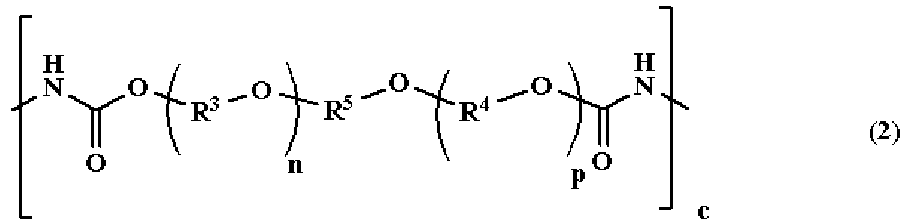
wobei R1 bis R4 und R20 bis R27 die gleiche oder eine unterschiedliche lineare oder verzweigte Alkylengruppe mit 2 bis 12 Kohlenstoffatomen darstellen; R5 eine lineare oder verzweigte Alkylengruppe mit 2 bis 20 Kohlenstoffatomen oder eine zweiwertige Verbindungsgruppe darstellt, die eine aromatische Gruppe enthält und gegebenenfalls eine Ethergruppe, eine Thiolgruppe, eine Estergruppe, eine Sulfinylgruppe, eine Sulfonylgruppe, eine Carbonylgruppe oder ein Halogenatom enthält; R6, R7 und R8 die gleiche oder eine unterschiedliche lineare, verzweigte oder cyclische Alkylgruppe mit 1 bis 6 Kohlenstoffatomen, eine Phenylgruppe oder eine 3,3,3-Trifluorpropylgruppe darstellen; R9 die gleiche oder eine unterschiedliche lineare, verzweigte oder cyclische Alkylgruppe mit 1 bis 6 Kohlenstoffatomen, eine Phenylgruppe, eine 3,3,3-Trifluorpropylgruppe oder eine -(OSiR6R7)s-OSiR6R7R8 Gruppe darstellt; R10 ein Wasserstoffatom oder eine lineare oder verzweigte Alkylgruppe mit 1 bis 4 Kohlenstoffatomen darstellt; R11 eine Einfachbindung, eine Methylengruppe oder eine Ethylengruppe darstellt; R12 ein Wasserstoffatom oder eine Methylgruppe darstellt; X eine lineare oder verzweigte Alkylengruppe mit 3 bis 7 Kohlenstoffatomen darstellt, und gegebenenfalls eine Ethergruppe enthält; m, n und p eine ganze Zahl von 1 bis 200 darstellen, und q, r und s eine ganze Zahl von 0 bis 20 darstellen; und a1, a2, a3, a4, b1, b2 und c ein Verhältnis der sich wiederholenden Einheit darstellen, das die Ungleichungen 0≤a1<1,0, 0≤a2<1,0, 0≤a3<1,0, 0≤a4<1,0, 0<a1+a2+a3+a4<1,0, 0≤b1<1,0, 0≤b2<1,0 und 0<b1+b2<1,0 in dem Polyurethan 1 erfüllen. - Dehnbarer Verbundfilm gemäß Anspruch 1, wobei das Polyurethan 1 ein Polymer mit einer Struktur ist, die eine (Meth)acrylatgruppe als Endgruppe enthält, die durch die folgende allgemeine Formel (3) dargestellt wird:


- Dehnbarer Verbundfilm gemäß Anspruch 1 oder 2, wobei der dehnbare Verbundfilm eine Dehnungseigenschaft von 20 bis 1000 % in einem durch JIS K 6251 geregelten Zugversuch aufweist.
- Dehnbarer Verbundfilm nach einem beliebigen der Ansprüche 1 bis 3, wobei der dehnbare Verbundfilm als ein Film in Kontakt mit einer leitenden Verdrahtung mit Dehnbarkeit verwendet wird.
- Verfahren zur Herstellung eines dehnbaren Verbundfilms, umfassend:Aufbringen eines Polyurethans 1, das ein Copolymer aus einer oder mehreren der Einheiten "a1", "a2", "a3" und "a4", die jeweils Polycarbonat- oder Polyester- und Urethanbindungen aufweisen, und Urethaneinheiten "b1" und/oder "b2" vom Silikon-Pendant-Typ enthält, die durch die folgende allgemeine Formel (1) dargestellt sind, auf einen inneren Film, der ein gehärtetes Produkt eines Polyurethans 2 ist, das eine Einheit "c" mit Polyether- und Urethanbindungen enthält, die durch die folgende allgemeine Formel (2) dargestellt werden; undAushärten des Polyurethans 1 durch Erhitzen und/oder Belichtung, um einen Oberflächenfilm zu bilden:


- Verfahren zur Herstellung eines dehnbaren Verbundfilms gemäß Anspruch 5, wobei das Polyurethan 2 auf ein Substrat aufgebracht und durch Erhitzen und/oder Belichten ausgehärtet wird, um den inneren Film zu bilden.
Applications Claiming Priority (1)
| Application Number | Priority Date | Filing Date | Title |
|---|---|---|---|
| JP2018236758 | 2018-12-18 |
Publications (2)
| Publication Number | Publication Date |
|---|---|
| EP3670185A1 EP3670185A1 (de) | 2020-06-24 |
| EP3670185B1 true EP3670185B1 (de) | 2022-08-10 |
Family
ID=68392869
Family Applications (1)
| Application Number | Title | Priority Date | Filing Date |
|---|---|---|---|
| EP19206120.8A Active EP3670185B1 (de) | 2018-12-18 | 2019-10-30 | Dehnbarer verbundfilm und herstellungsverfahren dafür |
Country Status (6)
| Country | Link |
|---|---|
| US (1) | US11377529B2 (de) |
| EP (1) | EP3670185B1 (de) |
| JP (1) | JP7190411B2 (de) |
| KR (1) | KR102302104B1 (de) |
| CN (1) | CN111333894B (de) |
| TW (1) | TWI730545B (de) |
Families Citing this family (5)
| Publication number | Priority date | Publication date | Assignee | Title |
|---|---|---|---|---|
| WO2021002342A1 (ja) * | 2019-07-02 | 2021-01-07 | 三洋化成工業株式会社 | 複層フィルム |
| JP7553369B2 (ja) * | 2021-01-25 | 2024-09-18 | 株式会社日本製鋼所 | 異常検知システム、成形機システム及び異常検知装置 |
| JP7715652B2 (ja) * | 2021-03-02 | 2025-07-30 | 信越化学工業株式会社 | シリコーンポリウレタン、伸縮性膜、及びその形成方法 |
| JP2024105187A (ja) | 2023-01-25 | 2024-08-06 | 信越化学工業株式会社 | 生体電極、及び生体電極の製造方法 |
| JP2024159544A (ja) | 2023-04-26 | 2024-11-08 | 信越化学工業株式会社 | 生体電極、及び生体電極の製造方法 |
Family Cites Families (13)
| Publication number | Priority date | Publication date | Assignee | Title |
|---|---|---|---|---|
| JP3164312B2 (ja) * | 1991-03-29 | 2001-05-08 | 株式会社クラレ | ポリウレタンおよびそれに用いるポリシロキサン側鎖含有高分子ジオール |
| JP2001018329A (ja) | 1999-07-05 | 2001-01-23 | Honda Motor Co Ltd | 二輪車シート用ポリオレフィン系表皮材 |
| JP3923861B2 (ja) | 2002-07-03 | 2007-06-06 | フクダ電子株式会社 | 生体電極 |
| JP2012152725A (ja) | 2011-01-28 | 2012-08-16 | Tosoh Corp | ブロックイソシアネート解離触媒及びその用途 |
| JP5977976B2 (ja) * | 2012-03-27 | 2016-08-24 | 株式会社Adeka | 光硬化性組成物及びハードコート剤 |
| JP6611728B2 (ja) * | 2014-03-26 | 2019-11-27 | スリーエム イノベイティブ プロパティズ カンパニー | ポリウレタン組成物、フィルム、及びこれらの方法 |
| CN104977633B (zh) * | 2014-04-08 | 2018-07-17 | 株式会社巴川制纸所 | 保护膜、薄膜层压体和偏光板 |
| US10966316B2 (en) * | 2015-10-16 | 2021-03-30 | Japan Science And Technology Agency | Wiring film, device transfer sheet, and textile type device |
| JP6704596B2 (ja) * | 2016-03-31 | 2020-06-03 | フジコピアン株式会社 | 自己修復性保護シート |
| JP6179697B1 (ja) * | 2016-04-14 | 2017-08-16 | Dic株式会社 | 水性ウレタン樹脂組成物、及び、合成皮革 |
| JP6871837B2 (ja) | 2016-11-17 | 2021-05-12 | 信越化学工業株式会社 | 伸縮性膜及びその形成方法、並びに伸縮性配線膜及びその製造方法 |
| JP2018103524A (ja) * | 2016-12-27 | 2018-07-05 | 日立化成株式会社 | 可撓性樹脂フィルム及び可撓性複合シート |
| JP6919992B2 (ja) * | 2017-01-30 | 2021-08-18 | 信越化学工業株式会社 | 伸縮性膜及びその形成方法 |
-
2019
- 2019-09-18 JP JP2019169559A patent/JP7190411B2/ja active Active
- 2019-10-30 EP EP19206120.8A patent/EP3670185B1/de active Active
- 2019-11-04 US US16/672,915 patent/US11377529B2/en active Active
- 2019-11-29 KR KR1020190157697A patent/KR102302104B1/ko active Active
- 2019-12-16 TW TW108145922A patent/TWI730545B/zh active
- 2019-12-17 CN CN201911324247.8A patent/CN111333894B/zh active Active
Also Published As
| Publication number | Publication date |
|---|---|
| JP2020097214A (ja) | 2020-06-25 |
| TWI730545B (zh) | 2021-06-11 |
| US20200190275A1 (en) | 2020-06-18 |
| US11377529B2 (en) | 2022-07-05 |
| CN111333894A (zh) | 2020-06-26 |
| JP7190411B2 (ja) | 2022-12-15 |
| TW202039607A (zh) | 2020-11-01 |
| CN111333894B (zh) | 2022-05-31 |
| KR20200075740A (ko) | 2020-06-26 |
| EP3670185A1 (de) | 2020-06-24 |
| KR102302104B1 (ko) | 2021-09-13 |
Similar Documents
| Publication | Publication Date | Title |
|---|---|---|
| EP3354670B1 (de) | Dehnfolie und verfahren zur herstellung der dehnfolie | |
| EP3670185A1 (de) | Dehnbarer verbundfilm und herstellungsverfahren dafür | |
| EP3604373B1 (de) | Dehnbare folie und verfahren zur formung davon | |
| JP7045767B2 (ja) | 伸縮性膜及びその形成方法 | |
| EP3470448B1 (de) | Siliciumhaltige verbindung, urethanharz, dehnbare folie und verfahren zur formung davon | |
| EP3674338B1 (de) | Dehnbare verdrahtungsfolie und verfahren zu ihrer formung | |
| EP3628478B1 (de) | Dehnfolie und verfahren zur herstellung der dehnfolie | |
| JP7132133B2 (ja) | 伸縮性膜材料組成物、伸縮性膜、及びその形成方法 | |
| EP3674337B1 (de) | Dehnbare folie und verfahren zu ihrer formung | |
| JP6978375B2 (ja) | 粘着性膜、粘着性膜の形成方法、及びウレタンポリマー | |
| EP4053183B1 (de) | Silikon-polyurethan, dehnbare folie und verfahren zur herstellung der dehnbaren folie |
Legal Events
| Date | Code | Title | Description |
|---|---|---|---|
| PUAI | Public reference made under article 153(3) epc to a published international application that has entered the european phase |
Free format text: ORIGINAL CODE: 0009012 |
|
| STAA | Information on the status of an ep patent application or granted ep patent |
Free format text: STATUS: THE APPLICATION HAS BEEN PUBLISHED |
|
| AK | Designated contracting states |
Kind code of ref document: A1 Designated state(s): AL AT BE BG CH CY CZ DE DK EE ES FI FR GB GR HR HU IE IS IT LI LT LU LV MC MK MT NL NO PL PT RO RS SE SI SK SM TR |
|
| AX | Request for extension of the european patent |
Extension state: BA ME |
|
| STAA | Information on the status of an ep patent application or granted ep patent |
Free format text: STATUS: REQUEST FOR EXAMINATION WAS MADE |
|
| 17P | Request for examination filed |
Effective date: 20200723 |
|
| RBV | Designated contracting states (corrected) |
Designated state(s): AL AT BE BG CH CY CZ DE DK EE ES FI FR GB GR HR HU IE IS IT LI LT LU LV MC MK MT NL NO PL PT RO RS SE SI SK SM TR |
|
| STAA | Information on the status of an ep patent application or granted ep patent |
Free format text: STATUS: EXAMINATION IS IN PROGRESS |
|
| 17Q | First examination report despatched |
Effective date: 20201008 |
|
| RAP3 | Party data changed (applicant data changed or rights of an application transferred) |
Owner name: SHIN-ETSU CHEMICAL CO., LTD. |
|
| GRAP | Despatch of communication of intention to grant a patent |
Free format text: ORIGINAL CODE: EPIDOSNIGR1 |
|
| STAA | Information on the status of an ep patent application or granted ep patent |
Free format text: STATUS: GRANT OF PATENT IS INTENDED |
|
| INTG | Intention to grant announced |
Effective date: 20220316 |
|
| RIN1 | Information on inventor provided before grant (corrected) |
Inventor name: IKEDA, JOE Inventor name: IWABUCHI, MOTOAKI Inventor name: HATAKEYAMA, JUN |
|
| GRAS | Grant fee paid |
Free format text: ORIGINAL CODE: EPIDOSNIGR3 |
|
| GRAA | (expected) grant |
Free format text: ORIGINAL CODE: 0009210 |
|
| STAA | Information on the status of an ep patent application or granted ep patent |
Free format text: STATUS: THE PATENT HAS BEEN GRANTED |
|
| AK | Designated contracting states |
Kind code of ref document: B1 Designated state(s): AL AT BE BG CH CY CZ DE DK EE ES FI FR GB GR HR HU IE IS IT LI LT LU LV MC MK MT NL NO PL PT RO RS SE SI SK SM TR |
|
| REG | Reference to a national code |
Ref country code: AT Ref legal event code: REF Ref document number: 1510226 Country of ref document: AT Kind code of ref document: T Effective date: 20220815 Ref country code: CH Ref legal event code: EP |
|
| REG | Reference to a national code |
Ref country code: IE Ref legal event code: FG4D |
|
| REG | Reference to a national code |
Ref country code: DE Ref legal event code: R096 Ref document number: 602019018033 Country of ref document: DE |
|
| REG | Reference to a national code |
Ref country code: NL Ref legal event code: FP |
|
| REG | Reference to a national code |
Ref country code: LT Ref legal event code: MG9D |
|
| PG25 | Lapsed in a contracting state [announced via postgrant information from national office to epo] |
Ref country code: SE Free format text: LAPSE BECAUSE OF FAILURE TO SUBMIT A TRANSLATION OF THE DESCRIPTION OR TO PAY THE FEE WITHIN THE PRESCRIBED TIME-LIMIT Effective date: 20220810 Ref country code: RS Free format text: LAPSE BECAUSE OF FAILURE TO SUBMIT A TRANSLATION OF THE DESCRIPTION OR TO PAY THE FEE WITHIN THE PRESCRIBED TIME-LIMIT Effective date: 20220810 Ref country code: PT Free format text: LAPSE BECAUSE OF FAILURE TO SUBMIT A TRANSLATION OF THE DESCRIPTION OR TO PAY THE FEE WITHIN THE PRESCRIBED TIME-LIMIT Effective date: 20221212 Ref country code: NO Free format text: LAPSE BECAUSE OF FAILURE TO SUBMIT A TRANSLATION OF THE DESCRIPTION OR TO PAY THE FEE WITHIN THE PRESCRIBED TIME-LIMIT Effective date: 20221110 Ref country code: LV Free format text: LAPSE BECAUSE OF FAILURE TO SUBMIT A TRANSLATION OF THE DESCRIPTION OR TO PAY THE FEE WITHIN THE PRESCRIBED TIME-LIMIT Effective date: 20220810 Ref country code: LT Free format text: LAPSE BECAUSE OF FAILURE TO SUBMIT A TRANSLATION OF THE DESCRIPTION OR TO PAY THE FEE WITHIN THE PRESCRIBED TIME-LIMIT Effective date: 20220810 Ref country code: FI Free format text: LAPSE BECAUSE OF FAILURE TO SUBMIT A TRANSLATION OF THE DESCRIPTION OR TO PAY THE FEE WITHIN THE PRESCRIBED TIME-LIMIT Effective date: 20220810 |
|
| REG | Reference to a national code |
Ref country code: AT Ref legal event code: MK05 Ref document number: 1510226 Country of ref document: AT Kind code of ref document: T Effective date: 20220810 |
|
| PG25 | Lapsed in a contracting state [announced via postgrant information from national office to epo] |
Ref country code: PL Free format text: LAPSE BECAUSE OF FAILURE TO SUBMIT A TRANSLATION OF THE DESCRIPTION OR TO PAY THE FEE WITHIN THE PRESCRIBED TIME-LIMIT Effective date: 20220810 Ref country code: IS Free format text: LAPSE BECAUSE OF FAILURE TO SUBMIT A TRANSLATION OF THE DESCRIPTION OR TO PAY THE FEE WITHIN THE PRESCRIBED TIME-LIMIT Effective date: 20221210 Ref country code: HR Free format text: LAPSE BECAUSE OF FAILURE TO SUBMIT A TRANSLATION OF THE DESCRIPTION OR TO PAY THE FEE WITHIN THE PRESCRIBED TIME-LIMIT Effective date: 20220810 Ref country code: GR Free format text: LAPSE BECAUSE OF FAILURE TO SUBMIT A TRANSLATION OF THE DESCRIPTION OR TO PAY THE FEE WITHIN THE PRESCRIBED TIME-LIMIT Effective date: 20221111 |
|
| PG25 | Lapsed in a contracting state [announced via postgrant information from national office to epo] |
Ref country code: SM Free format text: LAPSE BECAUSE OF FAILURE TO SUBMIT A TRANSLATION OF THE DESCRIPTION OR TO PAY THE FEE WITHIN THE PRESCRIBED TIME-LIMIT Effective date: 20220810 Ref country code: RO Free format text: LAPSE BECAUSE OF FAILURE TO SUBMIT A TRANSLATION OF THE DESCRIPTION OR TO PAY THE FEE WITHIN THE PRESCRIBED TIME-LIMIT Effective date: 20220810 Ref country code: ES Free format text: LAPSE BECAUSE OF FAILURE TO SUBMIT A TRANSLATION OF THE DESCRIPTION OR TO PAY THE FEE WITHIN THE PRESCRIBED TIME-LIMIT Effective date: 20220810 Ref country code: DK Free format text: LAPSE BECAUSE OF FAILURE TO SUBMIT A TRANSLATION OF THE DESCRIPTION OR TO PAY THE FEE WITHIN THE PRESCRIBED TIME-LIMIT Effective date: 20220810 Ref country code: CZ Free format text: LAPSE BECAUSE OF FAILURE TO SUBMIT A TRANSLATION OF THE DESCRIPTION OR TO PAY THE FEE WITHIN THE PRESCRIBED TIME-LIMIT Effective date: 20220810 Ref country code: AT Free format text: LAPSE BECAUSE OF FAILURE TO SUBMIT A TRANSLATION OF THE DESCRIPTION OR TO PAY THE FEE WITHIN THE PRESCRIBED TIME-LIMIT Effective date: 20220810 |
|
| REG | Reference to a national code |
Ref country code: DE Ref legal event code: R119 Ref document number: 602019018033 Country of ref document: DE |
|
| PG25 | Lapsed in a contracting state [announced via postgrant information from national office to epo] |
Ref country code: SK Free format text: LAPSE BECAUSE OF FAILURE TO SUBMIT A TRANSLATION OF THE DESCRIPTION OR TO PAY THE FEE WITHIN THE PRESCRIBED TIME-LIMIT Effective date: 20220810 Ref country code: MC Free format text: LAPSE BECAUSE OF FAILURE TO SUBMIT A TRANSLATION OF THE DESCRIPTION OR TO PAY THE FEE WITHIN THE PRESCRIBED TIME-LIMIT Effective date: 20220810 Ref country code: EE Free format text: LAPSE BECAUSE OF FAILURE TO SUBMIT A TRANSLATION OF THE DESCRIPTION OR TO PAY THE FEE WITHIN THE PRESCRIBED TIME-LIMIT Effective date: 20220810 |
|
| REG | Reference to a national code |
Ref country code: CH Ref legal event code: PL |
|
| PLBE | No opposition filed within time limit |
Free format text: ORIGINAL CODE: 0009261 |
|
| STAA | Information on the status of an ep patent application or granted ep patent |
Free format text: STATUS: NO OPPOSITION FILED WITHIN TIME LIMIT |
|
| REG | Reference to a national code |
Ref country code: BE Ref legal event code: MM Effective date: 20221031 |
|
| PG25 | Lapsed in a contracting state [announced via postgrant information from national office to epo] |
Ref country code: LU Free format text: LAPSE BECAUSE OF NON-PAYMENT OF DUE FEES Effective date: 20221030 Ref country code: AL Free format text: LAPSE BECAUSE OF FAILURE TO SUBMIT A TRANSLATION OF THE DESCRIPTION OR TO PAY THE FEE WITHIN THE PRESCRIBED TIME-LIMIT Effective date: 20220810 |
|
| 26N | No opposition filed |
Effective date: 20230511 |
|
| PG25 | Lapsed in a contracting state [announced via postgrant information from national office to epo] |
Ref country code: LI Free format text: LAPSE BECAUSE OF NON-PAYMENT OF DUE FEES Effective date: 20221031 Ref country code: FR Free format text: LAPSE BECAUSE OF NON-PAYMENT OF DUE FEES Effective date: 20221031 Ref country code: DE Free format text: LAPSE BECAUSE OF NON-PAYMENT OF DUE FEES Effective date: 20230503 Ref country code: CH Free format text: LAPSE BECAUSE OF NON-PAYMENT OF DUE FEES Effective date: 20221031 |
|
| PG25 | Lapsed in a contracting state [announced via postgrant information from national office to epo] |
Ref country code: SI Free format text: LAPSE BECAUSE OF FAILURE TO SUBMIT A TRANSLATION OF THE DESCRIPTION OR TO PAY THE FEE WITHIN THE PRESCRIBED TIME-LIMIT Effective date: 20220810 |
|
| PG25 | Lapsed in a contracting state [announced via postgrant information from national office to epo] |
Ref country code: BE Free format text: LAPSE BECAUSE OF NON-PAYMENT OF DUE FEES Effective date: 20221031 |
|
| PG25 | Lapsed in a contracting state [announced via postgrant information from national office to epo] |
Ref country code: IE Free format text: LAPSE BECAUSE OF NON-PAYMENT OF DUE FEES Effective date: 20221030 |
|
| PG25 | Lapsed in a contracting state [announced via postgrant information from national office to epo] |
Ref country code: HU Free format text: LAPSE BECAUSE OF FAILURE TO SUBMIT A TRANSLATION OF THE DESCRIPTION OR TO PAY THE FEE WITHIN THE PRESCRIBED TIME-LIMIT; INVALID AB INITIO Effective date: 20191030 |
|
| PG25 | Lapsed in a contracting state [announced via postgrant information from national office to epo] |
Ref country code: CY Free format text: LAPSE BECAUSE OF FAILURE TO SUBMIT A TRANSLATION OF THE DESCRIPTION OR TO PAY THE FEE WITHIN THE PRESCRIBED TIME-LIMIT Effective date: 20220810 |
|
| PG25 | Lapsed in a contracting state [announced via postgrant information from national office to epo] |
Ref country code: MK Free format text: LAPSE BECAUSE OF FAILURE TO SUBMIT A TRANSLATION OF THE DESCRIPTION OR TO PAY THE FEE WITHIN THE PRESCRIBED TIME-LIMIT Effective date: 20220810 Ref country code: IT Free format text: LAPSE BECAUSE OF FAILURE TO SUBMIT A TRANSLATION OF THE DESCRIPTION OR TO PAY THE FEE WITHIN THE PRESCRIBED TIME-LIMIT Effective date: 20220810 |
|
| GBPC | Gb: european patent ceased through non-payment of renewal fee |
Effective date: 20231030 |
|
| PG25 | Lapsed in a contracting state [announced via postgrant information from national office to epo] |
Ref country code: GB Free format text: LAPSE BECAUSE OF NON-PAYMENT OF DUE FEES Effective date: 20231030 |
|
| PG25 | Lapsed in a contracting state [announced via postgrant information from national office to epo] |
Ref country code: GB Free format text: LAPSE BECAUSE OF NON-PAYMENT OF DUE FEES Effective date: 20231030 Ref country code: BG Free format text: LAPSE BECAUSE OF FAILURE TO SUBMIT A TRANSLATION OF THE DESCRIPTION OR TO PAY THE FEE WITHIN THE PRESCRIBED TIME-LIMIT Effective date: 20220810 |
|
| PG25 | Lapsed in a contracting state [announced via postgrant information from national office to epo] |
Ref country code: MT Free format text: LAPSE BECAUSE OF FAILURE TO SUBMIT A TRANSLATION OF THE DESCRIPTION OR TO PAY THE FEE WITHIN THE PRESCRIBED TIME-LIMIT Effective date: 20220810 |
|
| PGFP | Annual fee paid to national office [announced via postgrant information from national office to epo] |
Ref country code: NL Payment date: 20251021 Year of fee payment: 7 |
|
| PG25 | Lapsed in a contracting state [announced via postgrant information from national office to epo] |
Ref country code: TR Free format text: LAPSE BECAUSE OF FAILURE TO SUBMIT A TRANSLATION OF THE DESCRIPTION OR TO PAY THE FEE WITHIN THE PRESCRIBED TIME-LIMIT Effective date: 20220810 |