EP3667729B1 - Herstellungsverfahren für ein array-substrat und für eine anzeigevorrichtung - Google Patents
Herstellungsverfahren für ein array-substrat und für eine anzeigevorrichtung Download PDFInfo
- Publication number
- EP3667729B1 EP3667729B1 EP18842919.5A EP18842919A EP3667729B1 EP 3667729 B1 EP3667729 B1 EP 3667729B1 EP 18842919 A EP18842919 A EP 18842919A EP 3667729 B1 EP3667729 B1 EP 3667729B1
- Authority
- EP
- European Patent Office
- Prior art keywords
- protective layer
- display area
- layer
- substrate
- array substrate
- Prior art date
- Legal status (The legal status is an assumption and is not a legal conclusion. Google has not performed a legal analysis and makes no representation as to the accuracy of the status listed.)
- Active
Links
Images


Classifications
-
- H—ELECTRICITY
- H10—SEMICONDUCTOR DEVICES; ELECTRIC SOLID-STATE DEVICES NOT OTHERWISE PROVIDED FOR
- H10D—INORGANIC ELECTRIC SEMICONDUCTOR DEVICES
- H10D86/00—Integrated devices formed in or on insulating or conducting substrates, e.g. formed in silicon-on-insulator [SOI] substrates or on stainless steel or glass substrates
- H10D86/40—Integrated devices formed in or on insulating or conducting substrates, e.g. formed in silicon-on-insulator [SOI] substrates or on stainless steel or glass substrates characterised by multiple TFTs
-
- H—ELECTRICITY
- H10—SEMICONDUCTOR DEVICES; ELECTRIC SOLID-STATE DEVICES NOT OTHERWISE PROVIDED FOR
- H10K—ORGANIC ELECTRIC SOLID-STATE DEVICES
- H10K59/00—Integrated devices, or assemblies of multiple devices, comprising at least one organic light-emitting element covered by group H10K50/00
- H10K59/10—OLED displays
- H10K59/12—Active-matrix OLED [AMOLED] displays
- H10K59/131—Interconnections, e.g. wiring lines or terminals
-
- H—ELECTRICITY
- H10—SEMICONDUCTOR DEVICES; ELECTRIC SOLID-STATE DEVICES NOT OTHERWISE PROVIDED FOR
- H10D—INORGANIC ELECTRIC SEMICONDUCTOR DEVICES
- H10D48/00—Individual devices not covered by groups H10D1/00 - H10D44/00
- H10D48/01—Manufacture or treatment
- H10D48/04—Manufacture or treatment of devices having bodies comprising selenium or tellurium in uncombined form
- H10D48/042—Preparation of foundation plates
-
- H—ELECTRICITY
- H10—SEMICONDUCTOR DEVICES; ELECTRIC SOLID-STATE DEVICES NOT OTHERWISE PROVIDED FOR
- H10D—INORGANIC ELECTRIC SEMICONDUCTOR DEVICES
- H10D86/00—Integrated devices formed in or on insulating or conducting substrates, e.g. formed in silicon-on-insulator [SOI] substrates or on stainless steel or glass substrates
- H10D86/01—Manufacture or treatment
- H10D86/021—Manufacture or treatment of multiple TFTs
-
- H—ELECTRICITY
- H10—SEMICONDUCTOR DEVICES; ELECTRIC SOLID-STATE DEVICES NOT OTHERWISE PROVIDED FOR
- H10D—INORGANIC ELECTRIC SEMICONDUCTOR DEVICES
- H10D86/00—Integrated devices formed in or on insulating or conducting substrates, e.g. formed in silicon-on-insulator [SOI] substrates or on stainless steel or glass substrates
- H10D86/40—Integrated devices formed in or on insulating or conducting substrates, e.g. formed in silicon-on-insulator [SOI] substrates or on stainless steel or glass substrates characterised by multiple TFTs
- H10D86/441—Interconnections, e.g. scanning lines
- H10D86/443—Interconnections, e.g. scanning lines adapted for preventing breakage, peeling or short circuiting
-
- H—ELECTRICITY
- H10—SEMICONDUCTOR DEVICES; ELECTRIC SOLID-STATE DEVICES NOT OTHERWISE PROVIDED FOR
- H10D—INORGANIC ELECTRIC SEMICONDUCTOR DEVICES
- H10D86/00—Integrated devices formed in or on insulating or conducting substrates, e.g. formed in silicon-on-insulator [SOI] substrates or on stainless steel or glass substrates
- H10D86/40—Integrated devices formed in or on insulating or conducting substrates, e.g. formed in silicon-on-insulator [SOI] substrates or on stainless steel or glass substrates characterised by multiple TFTs
- H10D86/60—Integrated devices formed in or on insulating or conducting substrates, e.g. formed in silicon-on-insulator [SOI] substrates or on stainless steel or glass substrates characterised by multiple TFTs wherein the TFTs are in active matrices
-
- H—ELECTRICITY
- H10—SEMICONDUCTOR DEVICES; ELECTRIC SOLID-STATE DEVICES NOT OTHERWISE PROVIDED FOR
- H10H—INORGANIC LIGHT-EMITTING SEMICONDUCTOR DEVICES HAVING POTENTIAL BARRIERS
- H10H20/00—Individual inorganic light-emitting semiconductor devices having potential barriers, e.g. light-emitting diodes [LED]
- H10H20/80—Constructional details
- H10H20/84—Coatings, e.g. passivation layers or antireflective coatings
-
- H—ELECTRICITY
- H10—SEMICONDUCTOR DEVICES; ELECTRIC SOLID-STATE DEVICES NOT OTHERWISE PROVIDED FOR
- H10K—ORGANIC ELECTRIC SOLID-STATE DEVICES
- H10K50/00—Organic light-emitting devices
- H10K50/80—Constructional details
- H10K50/84—Passivation; Containers; Encapsulations
- H10K50/844—Encapsulations
-
- H—ELECTRICITY
- H10—SEMICONDUCTOR DEVICES; ELECTRIC SOLID-STATE DEVICES NOT OTHERWISE PROVIDED FOR
- H10K—ORGANIC ELECTRIC SOLID-STATE DEVICES
- H10K59/00—Integrated devices, or assemblies of multiple devices, comprising at least one organic light-emitting element covered by group H10K50/00
- H10K59/80—Constructional details
- H10K59/87—Passivation; Containers; Encapsulations
- H10K59/871—Self-supporting sealing arrangements
-
- H—ELECTRICITY
- H10—SEMICONDUCTOR DEVICES; ELECTRIC SOLID-STATE DEVICES NOT OTHERWISE PROVIDED FOR
- H10K—ORGANIC ELECTRIC SOLID-STATE DEVICES
- H10K71/00—Manufacture or treatment specially adapted for the organic devices covered by this subclass
-
- H—ELECTRICITY
- H10—SEMICONDUCTOR DEVICES; ELECTRIC SOLID-STATE DEVICES NOT OTHERWISE PROVIDED FOR
- H10K—ORGANIC ELECTRIC SOLID-STATE DEVICES
- H10K71/00—Manufacture or treatment specially adapted for the organic devices covered by this subclass
- H10K71/70—Testing, e.g. accelerated lifetime tests
-
- H—ELECTRICITY
- H10—SEMICONDUCTOR DEVICES; ELECTRIC SOLID-STATE DEVICES NOT OTHERWISE PROVIDED FOR
- H10K—ORGANIC ELECTRIC SOLID-STATE DEVICES
- H10K59/00—Integrated devices, or assemblies of multiple devices, comprising at least one organic light-emitting element covered by group H10K50/00
- H10K59/10—OLED displays
- H10K59/12—Active-matrix OLED [AMOLED] displays
- H10K59/1201—Manufacture or treatment
Definitions
- the present disclosure relates to the field of panel display, in particular to an array substrate, a manufacturing method thereof and a display panel.
- a display panel has a display area (or active area, AA area) and a non-display area.
- a display area or active area, AA area
- a plurality of pixels are configured to form a pixel array
- a plurality of metal layers are disposed to form peripheral lines.
- Each pixel generally includes at least a thin film transistor and a pixel electrode connected to the thin film transistor, and each pixel is surrounded by two adjacent scanning lines and two adjacent data lines. These scanning lines and data lines extend from the display area to the non-display area, and are electrically connected to a driving chip via the peripheral lines of the non-display area, thus realizing the normal work of the display panel.
- a fan-out line is formed by the convergence of the peripheral lines from one end connecting the scanning line and the data line to the area where the driving chip is located. That is, a plurality of peripheral lines have large spacing at the end near the active area and a small spacing at the end near the driving chip, thus forming a fan shape substantially.
- Patent application US 2016/293883 A1 discloses an organic light-emitting display apparatus.
- the organic light-emitting display apparatus includes a first substrate including a display area and a peripheral area; a second substrate opposing the first substrate; an insulating layer disposed on the first substrate and including one or more openings; and a sealing member interconnecting the first substrate and the second substrate to each other and interposed between the first and second substrates.
- the one or more openings are disposed between a first conductive layer disposed on the display area and a second conductive layer disposed on the peripheral area.
- the one or more openings are at least partially or entirely filled with the sealing member.
- US 2017/098797 A1 discloses an organic light-emitting display apparatus sealed with a glass frit member.
- Metal Crack is a common phenomenon in fan-out lines, especially metal lines, leading to bright traces in the display panel eventually, which has a great impact on the yield of the display panel. Therefore, how to reduce or even avoid the occurrence of metal cracks is a technical problem needs to be solved urgently by those skilled in the art.
- the purpose of the present disclosure is to provide a method for manufacturing an array substrate, and a method for manufacturing a display panel, which can reduce the occurrence rate of metal cracks and improve the image quality of the display panel.
- the present disclosure provides a method for manufacturing an array substrate, including:
- the present disclosure further provides a method for manufacturing a display panel, including:
- the protective layer can protect the metal layer and avoid the damage to the metal layer caused by subsequent laser irradiation of the frit in the display panel, thereby reducing the occurrence rate of metal cracks and advantageously improving the yield of the display panel.
- the bonding force between the frit and the protective layer can be improved.
- a display panel such as an OLED (Organic Light-Emitting Diode) display panel generally includes an array substrate and a glass cover plate which are provided oppositely.
- the display panel includes a display area and a non-display area, and a package area is provided in the non-display area and is used to package the array substrate and the glass cover plate by being coated with a frit.
- OLED Organic Light-Emitting Diode
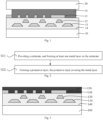
- FIG. 1 it is a partial structural schematic diagram of a non-display area of a display panel.
- the display panel includes a substrate 1 and a glass cover plate 2 which are provided oppositely.
- a plurality of metal layers are formed on the substrate 1.
- a bottom metal layer 11 a middle metal layer 12 and a top metal layer 13.
- the three metal layers are separated from each other by dielectric layers 14, and the top metal layer 13 in the package area is directly coated with a frit 15, and then the substrate 1 and the glass cover plate 2 are packaged to form a display panel.
- the metal layers such as the bottom metal layer 11, the middle metal layer 12 and the top metal layer 13 formed in the non-display area belong to fan-out lines, and are used for connecting a driving chip to a data line or a scanning line in the display area, and transmitting electrical signals provided by the driving chip to the data line or the scanning line.
- a solution of an embodiment of the present disclosure is as follows: providing a substrate; forming at least one metal layer on the substrate; and forming a protective layer, the protective layer covering the metal layer.
- the protective layer can protect the metal layer and avoid damaging the metal layer when a glass frit in the display panel is subsequently irradiated by laser (for example, to avoid cracks in the metal layer in a direction perpendicular to the forwarding direction of laser), thus reducing the occurrence of metal cracks.
- this method also reduces the rejection rate of bright traces in the display panel. This is because the damage or crack of the metal layer may cause a data line or a scanning line in the display area unable to receive a signal or the receiving inaccurate signals, resulting in bright traces on the display panel.
- Figure 2 it is a flowchart of a method for manufacturing an array substrate provided by an embodiment of the present disclosure. As shown in Figure 2 , the present disclosure provides a method for manufacturing an array substrate, including the following steps:
- FIG 3 is a partial structural schematic diagram of a non-display area of an array substrate provided by an embodiment of the present disclosure.
- the substrate 100 includes a display area and a non-display area, the non-display area surrounds the display area, and Figure 3 only shows a portion of the non-display area including a package area.
- the non-display area and the display area may also be located on different surfaces of the substrate.
- the non-display area is located on the back surface of the substrate and does not occupy the area of the display area, so as to improve a resolution and achieve a narrow frame or no frame. The present disclosure does not limit this.
- the substrate 100 may be made of a transparent material, such as glass, quartz, silicon wafer, polycarbonate, poly (methyl methacrylate) or metal foil.
- the substrate 100 may be a rigid substrate or a flexible substrate. The selection and pretreatment of the substrate 100 are familiar by those skilled in the art, and thus are not described in detail.
- the display area is subsequently used for forming a scanning line, a data line, a transistor switch or a pixel electrode on the substrate 100, and the non-display area is subsequently used for forming a fan-out line on the substrate 100, to connect the scanning line, the data line and the like of the display area to the driving chip.
- the non-display area further includes a package area, and the package area is coated with a frit after the array substrate is formed, for packaging the array substrate and the glass cover plate to form a display panel.
- a fan-out line is also provided in the package area.
- the package area is annular and surrounds the display area.
- Figure 3 only shows a cross-sectional diagram of a portion of the non-display area including the package area.
- At least one metal layer is formed on the substrate 100.
- at least one metal layer is formed in the non-display area of the substrate 100.
- three metal layers i.e., a bottom metal layer 110, a middle metal layer 120 and a top metal layer 130 are formed in the non-display area of the substrate 100.
- a plurality of metal film layers are formed in the display area of the substrate 100, such as a data line, a scanning line or a pixel electrode. That is, while a data line, a scanning line, a pixel electrode or other metal film layers are formed in the display area, a plurality of metal layers are formed in the non-display area.
- the material of the plurality of metal layers are depended on the material of the data line, the scanning line, the pixel electrode or other metal film layers formed simultaneously in the display area.
- the materials of the plurality of metal layers may be different from each other or identical.
- the material of the plurality of metal layers may include, but not limited to, copper, aluminum, nickel, magnesium, chromium, molybdenum, tungsten and alloys thereof.
- the plurality of metal layers may also be formed in the non-display area of the substrate 100 separately.
- the plurality of metal layers are separated by dielectric layers 140, and the dielectric layers 140 between different metal layers are formed in different steps, but all configured to separate the metal layers. Therefore, no distinction is made in Figure 3 . It can be understood that the formation of the dielectric layers 140 are also synchronized with the formation of the insulating layers in the display area. For example, if any one of the dielectric layers 140 is formed in the process of forming a gate insulating layer, a interlayer insulating layer and the like of a transistor, the material of the dielectric layer is the same as that of the gate insulating layer and the interlayer insulating layer formed at the same time.
- the material of the dielectric layers 140 includes, but not limited to, oxides or nitrides.
- the materials of the dielectric layers between different metal layers may be different. It can be understood that the dielectric layer 140 may also be formed separately between the plurality of metal layers. That is, the plurality of metal layers and the dielectric layers formed in the non-display area may be formed simultaneously with the metal layers or the insulating layers in the display area, or may also be formed separately.
- a method for forming the plurality of metal layers and the dielectric layers in the non-display area of the substrate 100 is briefly described below, including the following steps: Firstly, a first dielectric layer is formed on the substrate 100, preferably by chemical vapor deposition, such as High Density Plasma Chemical Vapor Deposition (HDPCVD), Low Pressure Chemical Vapor Deposition (LPCVD) or Ultra-High Vacuum Chemical Vapor Deposition (UHVCVD) and the like.
- chemical vapor deposition such as High Density Plasma Chemical Vapor Deposition (HDPCVD), Low Pressure Chemical Vapor Deposition (LPCVD) or Ultra-High Vacuum Chemical Vapor Deposition (UHVCVD) and the like.
- a bottom layer of metal is formed on the first dielectric layer, preferably by sputtering; and then the bottom layer of metal is patterned by adopting a patterning process including, for example, photoresist spin-coating, exposure, development and etching processes, to form a bottom metal layer 110. Then, the above-mentioned steps are repeated to form a second dielectric layer on the bottom metal layer 110, the second dielectric layer covering the bottom metal layer 110. Then middle metal is formed on the second dielectric layer, and is etched into a middle metal layer 120. Then a third dielectric layer is formed on the middle metal layer 120, the third dielectric layer covering the middle metal layer 120.
- a top layer of metal is formed on the third dielectric layer, and is etched into a top metal layer 130.
- the first dielectric layer, the second dielectric layer and the third dielectric layer form the dielectric layers 140 shown in Figure 3 .
- the metal layers are not limited to three layers mentioned above, but may include only two metal layers, or more than four metal layers.
- the number of the dielectric layers may also be adaptively changed according to the number of the metal layers.
- a protective layer is formed, and the protective layer covers the metal layers.
- the protective layer 150 is formed on the top metal layer 130 of the plurality of metal layers in the non-display area.
- the protective layer 150 may be a single-layer structure or a stack structure.
- the material of the protective layer 150 includes, but not limited to, silicon nitride, silicon oxide or silicon oxynitride.
- the material of the protective layer 150 may also be other materials known to those skilled in the art, which can prevent the metal layers from being damaged by laser irradiation used in subsequent packaging. Since silicon nitride, silicon oxide or silicon oxynitride is a conventional material in the art, it can be used as a preferred material in this embodiment.
- the thickness of the protective layer 150 is preferably 2000 ⁇ to 4000 ⁇ , and most preferably, the thickness of the protective layer 150 is 3000 ⁇ .
- the protective layer 150 with this thickness can prevent the metal layers from being damaged by laser irradiation, and will not affect the thickness of the display panel formed finally.
- the protective layer 150 is formed by chemical vapor deposition. Conditions for forming the protective layer 150 are preferably as follows: chamber temperature is 350°C to 400°C, chamber pressure is 900 mtorr to 1100 mtorr, and film forming time is 350 s to 450 s, most preferably, chamber temperature is 385°C, chamber pressure is 1000 mtorr, and film forming time is 400 s.
- a protective layer 150 is formed on the top metal layer 130 in the non-display area
- a protective layer is also formed in the display area. That is, protective layers are formed simultaneously on the entire substrate 100, and the protective layer at the position where a contact hole is provided in the display area is etched to expose the contact hole, so as to avoid the influence of the protective layer on the connection of the display area.
- the film layer before the formation of the protective layer in the display area is not limited.
- a protective layer is formed on the data line in the display area, and if a protective layer needs to be further formed in the display area after other film layers (e.g. scanning lines) are formed on the data line, a protective layer is formed on the scanning lines in the display area.
- film layers e.g. scanning lines
- the protective layer 150 is formed on the top metal layer 130, the protective layer 150 is used for protecting the metal layers and avoiding the influence of laser on the metal layers during subsequent laser irradiation, thereby avoiding the occurrence of metal cracks, reducing the occurrence rate of metal cracks, and ultimately improving the yield of the display panel.
- Figure 4 is a top view of an array substrate provided by an embodiment of the present disclosure.
- the array substrate includes a display area 10 and a non-display area 20 surrounding the display area 10.
- a package area 30 and a binding area 40 are provided in the non-display area 20.
- the package area 30 is annular and surrounds the display area 10, and the binding area 40 is located in the non-display area 20 between the package area 30 and the edge of one side of the array substrate.
- the protective layer 150 is formed only in the package area 30.
- the protective layer 150 in the remaining areas of the non-display area may not be etched. That is, the protective layer 150 is located in the whole non-display area. In this way, the occurrence of bright traces can be reduced, but the occurrence of electrostatic defects will be increased. That is, in addition to the formation of the protective layer 150 above the package area reducing the occurrence of metal cracks, the formation of the protective layer at the remaining positions of the non-display area can reduce the occurrence of bright traces.
- the protective layer of the display area may also be etched at the same time. That is, after the protective layer is formed, the protective layer at the position where the contact hole is located in the display area needs to be etched to expose the contact hole. In the etching process, the protective layer in the remaining areas except the package area in the non-display area may be removed by etching, or all protective layers in the display area may be etched, depending on the actual situation.
- a photoresist layer is coated onto the protective layer 150 and exposed by a mask.
- the mask may only expose the contact hole in the display area, or expose the entire display area, or expose other areas except the package area in the non-display area, or expose all areas except the package area.
- the used mask is determined according to the specific situation.
- the exposed photoresist layer is developed to form a patterned photoresist layer.
- the protective layer is etched by using the patterned photoresist layer as a mask. Finally, the remaining photoresist layer is peeled off to form a required protective layer pattern.
- the etching selection ratio can be adjusted, and the appropriate etching selection ratio can be selected to etch the protective layer, so as to ensure a high etching rate to the protective layer, a low etching rate to the other film layers, or the other film layers being not etched.
- the protective layer is etched by plasma etching, the etching gas includes a mixture of C 2 HF 5 (pentafluoroethane), H 2 (hydrogen) and Ar (argon), and the etching selection ratio of the protective layer to the other film layers is preferably greater than 5:1.
- the protective layer 150 in the package area may also be partially etched such that at least a portion of the surface of the protective layer 150 in the package area opposite to the top metal layer 130 is a concave surface, convex surface or concave-convex surface. That is, at least a portion of the surface of the protective layer 150 opposite to the top metal layer 130 is a non-planar surface, ensuring a better bonding force between the frit coated subsequently and the protective layer 150. That is, the bonding force between the frit and the protective layer is increased through the non-planar surface, thereby improving the reliability of the finally formed display panel.
- the concave surface or convex surface is one or a combination of two or more of a cylinder, a cone, a circular truncated cone and a hemisphere, and the concave-convex surface is formed by the concave surface and the convex surface which are connected in an interlaced manner, or may be formed by the concave surface and the convex surface which are distributed at an interval in an interlaced manner.
- the concave surface is formed by a plurality of grooves formed in the surface of the protective layer 150. The dimensions and shapes of these grooves may be the same or different.
- the convex surface is formed by a plurality of protrusions formed on the surface of the protective layer 150.
- the dimensions and shapes of these protrusions may be the same or different.
- the concave-convex surface is jointly formed by a plurality of grooves and a plurality of protrusions formed on the surface of the protective layer 150.
- the shapes and sizes of the grooves and protrusions are not limited.
- the protective layer 150 may also be formed only in the package area, thus the protective layer 150 is prevented from being etched, and the production time and cost can be reduced.
- a mask exposing the package area is fabricated and deposition is performed by using the mask as a mask to form a protective layer, but the precision of the protective layer fabricated by this method is relatively lower.
- the protective layer may be formed in the package area by adopting the method of the mask plate in combination with the chemical vapor deposition.
- whether to etch after a protective layer is formed or to form a protective layer only where it is needed should be determined according to the actual requirements, which is not limited in the present disclosure.
- the protective layer may also be formed by adopting other methods known to those skilled in the art.
- the structure as shown in Figure 4 is formed.
- the fabrication of each film layer in the display area of the substrate 100 is completed before packaging.
- the fabrication method is familiar by those skilled in the art and thus is not described in detail, and finally the fabrication of the array substrate is completed.
- the present disclosure further provides a method for manufacturing a display panel, including the method for manufacturing the array substrate described above.
- the method for manufacturing the display panel is defined in claim 4 and includes
- Figure 6 it is a data schematic diagram of metal cracks in a display panel provided by an embodiment of the present disclosure.
- a display panel of a certain size such as 5.5 inch
- the occurrence rate of cracks is decreased significantly as compared with the previous 20% (no protective layer is formed).
- the row 7.5 W 11 mm/s in the table of Figure 6 represents the conditions for laser irradiation, in which 7.5 W represents the laser energy and 11 mm/s represents the laser moving speed.
- Table 1 shows reliability results of a display panel provided by an embodiment of the present disclosure.
- Table 1 the reliability of the display panel manufactured by the method for manufacturing the array substrate provided by the present disclosure is verified.
- temperature and humidity action tests being carried out, the temperature is 60°C, the humidity is 90% RH, the test time is 120 H, and an R/G/B dark spot (red/green/blue dark spot) appears on one of 10 display panels when the test is carried out for 60 H.
- the bad spot is an anode black spot caused by abnormal fabrication of anode or anode etching, which is not related to cracks.
- the high temperature action test being carried out, the temperature is 60°C, the test time is 120 H, and there is no new abnormality.
- the high temperature storage test being carried out, the temperature is 70°C, the test time is 120 H, and there is no new abnormality, either. Therefore, it can be determined that the method of forming a protective layer on the top metal layer of the package area can reduce the occurrence rate of cracks and does not cause other abnormalities.
- Table 1 /N Evaluation item Sample Number Evaluation conditions Summary of abnormalities Judgment &basis 1
- Temperature and humidity action test 10 pcs 60°C, 90% RH, 120 H 60H, 1 pcs is newly added with an R/G/b dark spot Qualified The defect is not related to the verification purpose. 2 High temperature action test 10 pcs 60°C, 120 H No abnormality is newly added.
- the present disclosure further provides an array substrate, which is manufactured by adopting the method for manufacturing the array substrate.
- the array substrate includes:
- the array substrate includes: a substrate 100 including a display area and a non-display area (only part of the non-display area containing a package area is shown in Figure 3 ), and a plurality of metal layers located in the non-display area of the substrate 100, preferably three layers, i.e. a bottom metal layer 110, a middle metal layer 120 and a top metal layer 130; further includes dielectric layers 140 located between the three metal layers, surrounding the bottom metal layer 110 and the middle metal layer 120, and located between the bottom metal layer 110 and the substrate 100; and further includes a protective layer 150 on the top metal layer 130.
- a substrate 100 including a display area and a non-display area (only part of the non-display area containing a package area is shown in Figure 3 ), and a plurality of metal layers located in the non-display area of the substrate 100, preferably three layers, i.e. a bottom metal layer 110, a middle metal layer 120 and a top metal layer 130; further includes dielectric layers 140 located between the
- the protective layer 150 is located only above the top metal layer 130 in the package area. In other embodiments, the protective layer 150 may also be located in other areas except the package area in the non-display area, or the protective layer 150 may also be located in the display area. Of course, the protective layer 150 at the position where a contact hole is provided in the display area needs to be removed to avoid affecting the contact of the display area.
- the present disclosure further provides a display panel, which is manufactured by adopting the method for manufacturing the display panel.
- the display panel includes:
- Figure 7 it is a partial structural schematic diagram of a non-display area of a display panel provided by another embodiment of the present disclosure, wherein the metal layer and the protective layer in the non-display area of the array substrate are formed in same steps as the metal layer and the protective layer in the display area.
- the display panel includes:
- the protective layer can protect the metal layers and avoid damaging the metal layer when a glass frit in the display panel is subsequently irradiated by lase in the display panel, thereby reducing the occurrence rate of metal cracks and advantageously improving the yield of the display panel.
- the surface of the protective layer in the package area opposite to the metal layers is a concave surface, convex surface or concave-convex surface, when the frit is formed on the surface, the bonding force between the frit and the protective layer can be improved.
Landscapes
- Engineering & Computer Science (AREA)
- Microelectronics & Electronic Packaging (AREA)
- Manufacturing & Machinery (AREA)
- Devices For Indicating Variable Information By Combining Individual Elements (AREA)
- Physics & Mathematics (AREA)
- Optics & Photonics (AREA)
- Electroluminescent Light Sources (AREA)
- Thin Film Transistor (AREA)
Claims (5)
- Verfahren zur Herstellung eines Arraysubstrats, umfassend:Bereitstellen eines Substrats (1, 100, 300) und Bilden mindestens einer Metallschicht auf dem Substrat (1, 100, 300);Bilden einer Schutzschicht (150, 380), wobei die Schutzschicht (150, 380) die Metallschicht bedeckt, wobei das Substrat (1, 100, 300) einen Verkapselungsbereich (30) umfasst und die Schutzschicht (150, 380) ferner geätzt wird, so dass nur die Schutzschicht (150, 380) auf der Metallschicht in dem Verkapselungsbereich (30) beibehalten wird; undBeschichten einer Fritte (15, 160, 390) auf den Verkapselungsbereich (30), wobei die Fritte (15, 160, 390) auf der Schutzschicht (150, 380) angeordnet ist,wobei die Schutzschicht (150, 380) durch Plasmaätzen unter Verwendung eines Ätzgases einer Mischung aus C2HF5 (Pentafluorethan), H2 (Wasserstoff) und Ar (Argon) geätzt wird.
- Verfahren zur Herstellung eines Arraysubstrats nach Anspruch 1, wobei das Substrat (1, 100, 300) einen Anzeigebereich (10) und einen Nicht-Anzeigebereich (20) umfasst und der Verkapselungsbereich (30) in dem Nicht-Anzeigebereich (20) angeordnet ist;wobei die Metallschicht gleichzeitig in dem Nicht-Anzeigebereich (20) und dem Anzeigebereich (10) ausgebildet ist; undwobei die Schutzschicht (150, 380) gleichzeitig in dem Nicht-Anzeigebereich (20) und dem Anzeigebereich (10) ausgebildet ist, und wobei das Verfahren ferner das Entfernen eines mit einer Position eines Kontaktlochs in dem Anzeigebereich (10) korrespondierenden Teils der Schutzschicht (150, 380) umfasst, um das Kontaktloch freizulegen.
- Verfahren zur Herstellung eines Arraysubstrats nach Anspruch 1, wobei die Schutzschicht (150, 380) eine Dicke von 2000 Ä bis 4000 Ä aufweist.
- Verfahren zur Herstellung eines Anzeigefelds, umfassend:Herstellen eines Arraysubstrats durch Anwenden des Verfahrens zur Herstellung des Arraysubstrats nach einem der Ansprüche 1 bis 3 und Bereitstellen einer Glasabdeckplatte (2, 200, 400), wobei das Arraysubstrat hergestellt wird, indem ein Substrat (1, 100, 300) bereitgestellt wird und mindestens eine Metallschicht auf dem Substrat (1, 100, 300) gebildet wird; Bilden einer Schutzschicht (150, 380), wobei die Schutzschicht (150, 380) die Metallschicht bedeckt, wobei das Substrat (1, 100, 300) einen Verkapselungsbereich (30) umfasst und die Schutzschicht (150, 380) ferner geätzt wird, so dass nur die Schutzschicht (150, 380) auf der Metallschicht in dem Verkapselungsbereich (30) zu beibehalten wird;Beschichten einer Fritte (15) auf einen Verkapselungsbereich (30) des Arraysubstrats oder auf die Glasabdeckplatte (2, 200, 400) und Verkapseln des Arraysubstrats und der Glasabdeckplatte (2, 200, 400); undDurchführen einer Laserbestrahlung an der Fritte (15),wobei die Schutzschicht (150, 380) durch Plasmaätzen unter Verwendung eines Ätzgases einer Mischung aus C2HF5 (Pentafluorethan), H2 (Wasserstoff) und Ar (Argon) geätzt wird.
- Verfahren zur Herstellung eines Anzeigefelds nach Anspruch 4, wobei die Schutzschicht (150, 380) eine Dicke von 2000 Ä bis 4000 Ä aufweist.
Applications Claiming Priority (2)
| Application Number | Priority Date | Filing Date | Title |
|---|---|---|---|
| CN201710676914.3A CN109390352A (zh) | 2017-08-09 | 2017-08-09 | 阵列基板及其制造方法、显示面板及其制造方法 |
| PCT/CN2018/081499 WO2019029169A1 (zh) | 2017-08-09 | 2018-04-02 | 阵列基板及其制造方法、显示面板及其制造方法 |
Publications (3)
| Publication Number | Publication Date |
|---|---|
| EP3667729A1 EP3667729A1 (de) | 2020-06-17 |
| EP3667729A4 EP3667729A4 (de) | 2020-07-29 |
| EP3667729B1 true EP3667729B1 (de) | 2023-11-08 |
Family
ID=65033786
Family Applications (1)
| Application Number | Title | Priority Date | Filing Date |
|---|---|---|---|
| EP18842919.5A Active EP3667729B1 (de) | 2017-08-09 | 2018-04-02 | Herstellungsverfahren für ein array-substrat und für eine anzeigevorrichtung |
Country Status (7)
| Country | Link |
|---|---|
| US (1) | US11362302B2 (de) |
| EP (1) | EP3667729B1 (de) |
| JP (1) | JP6876829B2 (de) |
| KR (1) | KR102303734B1 (de) |
| CN (1) | CN109390352A (de) |
| TW (1) | TWI661579B (de) |
| WO (1) | WO2019029169A1 (de) |
Families Citing this family (6)
| Publication number | Priority date | Publication date | Assignee | Title |
|---|---|---|---|---|
| CN110140203A (zh) | 2016-11-18 | 2019-08-16 | 哈钦森技术股份有限公司 | 高纵横比电镀结构和各向异性电镀工艺 |
| US11521785B2 (en) | 2016-11-18 | 2022-12-06 | Hutchinson Technology Incorporated | High density coil design and process |
| KR20210086792A (ko) | 2019-12-30 | 2021-07-09 | 삼성디스플레이 주식회사 | 디스플레이 장치 |
| CN113394325B (zh) * | 2021-06-09 | 2023-04-28 | 京东方科技集团股份有限公司 | 电路基板及其制备方法、发光基板 |
| CN118714882A (zh) * | 2022-06-30 | 2024-09-27 | 厦门天马显示科技有限公司 | 一种显示面板及显示装置 |
| US20240170208A1 (en) * | 2022-11-17 | 2024-05-23 | Hutchinson Technology Incorporated | High-Aspect Ratio Electroplated Structures And Anisotropic Electroplating Processes |
Family Cites Families (22)
| Publication number | Priority date | Publication date | Assignee | Title |
|---|---|---|---|---|
| JP3626352B2 (ja) * | 1998-07-15 | 2005-03-09 | パイオニア株式会社 | プラズマディスプレイパネル |
| KR100635514B1 (ko) * | 2006-01-23 | 2006-10-18 | 삼성에스디아이 주식회사 | 유기전계발광표시장치 및 그 제조방법 |
| US20070170846A1 (en) * | 2006-01-23 | 2007-07-26 | Choi Dong-Soo | Organic light emitting display and method of fabricating the same |
| KR100685852B1 (ko) | 2006-01-23 | 2007-02-22 | 삼성에스디아이 주식회사 | 유기전계발광표시장치 및 그 제조방법 |
| KR100759667B1 (ko) | 2006-01-27 | 2007-09-17 | 삼성에스디아이 주식회사 | 평판 표시장치 및 그의 제조방법 |
| US7652305B2 (en) * | 2007-02-23 | 2010-01-26 | Corning Incorporated | Methods and apparatus to improve frit-sealed glass package |
| JP4982609B2 (ja) * | 2008-07-23 | 2012-07-25 | シャープ株式会社 | アクティブマトリクス基板、表示装置、アクティブマトリクス基板の検査方法、および表示装置の検査方法 |
| KR20130119319A (ko) * | 2010-10-01 | 2013-10-31 | 니폰 덴키 가라스 가부시키가이샤 | 전기소자 패키지 |
| KR20120066497A (ko) * | 2010-12-14 | 2012-06-22 | 삼성모바일디스플레이주식회사 | 유기발광표시장치 및 그 제조방법 |
| KR101791578B1 (ko) * | 2011-02-17 | 2017-10-31 | 삼성디스플레이 주식회사 | 액정 표시 장치 |
| KR20140016170A (ko) | 2012-07-30 | 2014-02-07 | 가부시키가이샤 한도오따이 에네루기 켄큐쇼 | 밀봉체 및 유기 전계 발광 장치 |
| CN103309106B (zh) * | 2013-07-10 | 2015-11-11 | 深圳市华星光电技术有限公司 | 彩色滤光阵列基板及其制造方法 |
| CN104638201A (zh) * | 2015-03-06 | 2015-05-20 | 京东方科技集团股份有限公司 | Oled显示母板、封装系统及其封装方法 |
| KR102399574B1 (ko) * | 2015-04-03 | 2022-05-19 | 삼성디스플레이 주식회사 | 유기 발광 표시 장치 |
| JP2018520218A (ja) | 2015-05-05 | 2018-07-26 | スリーエム イノベイティブ プロパティズ カンパニー | 温めると溶ける光学的に透明な接着剤及びそのディスプレイアセンブリ用途 |
| CN104834143A (zh) | 2015-06-03 | 2015-08-12 | 合肥京东方光电科技有限公司 | 一种阵列基板及其制备方法、显示装置 |
| TWI578517B (zh) | 2015-08-14 | 2017-04-11 | 群創光電股份有限公司 | 有機發光二極體顯示面板 |
| KR102439308B1 (ko) * | 2015-10-06 | 2022-09-02 | 삼성디스플레이 주식회사 | 표시장치 |
| KR102491876B1 (ko) * | 2015-11-16 | 2023-01-27 | 삼성디스플레이 주식회사 | 표시장치 |
| CN105468202B (zh) | 2016-01-29 | 2018-09-14 | 上海中航光电子有限公司 | 阵列基板、触控显示面板及触控显示装置 |
| CN105955542A (zh) * | 2016-05-31 | 2016-09-21 | 京东方科技集团股份有限公司 | 触摸屏及其制作方法、显示装置 |
| CN106876328B (zh) * | 2017-02-20 | 2020-07-03 | 京东方科技集团股份有限公司 | Oled显示面板及其制备方法、显示装置 |
-
2017
- 2017-08-09 CN CN201710676914.3A patent/CN109390352A/zh active Pending
-
2018
- 2018-04-02 KR KR1020197021405A patent/KR102303734B1/ko active Active
- 2018-04-02 JP JP2019562455A patent/JP6876829B2/ja active Active
- 2018-04-02 EP EP18842919.5A patent/EP3667729B1/de active Active
- 2018-04-02 WO PCT/CN2018/081499 patent/WO2019029169A1/zh not_active Ceased
- 2018-04-02 US US16/324,661 patent/US11362302B2/en active Active
- 2018-04-25 TW TW107114046A patent/TWI661579B/zh active
Also Published As
| Publication number | Publication date |
|---|---|
| EP3667729A1 (de) | 2020-06-17 |
| KR102303734B1 (ko) | 2021-09-23 |
| JP6876829B2 (ja) | 2021-05-26 |
| CN109390352A (zh) | 2019-02-26 |
| KR20190092581A (ko) | 2019-08-07 |
| TW201841390A (zh) | 2018-11-16 |
| EP3667729A4 (de) | 2020-07-29 |
| JP2020507817A (ja) | 2020-03-12 |
| US11362302B2 (en) | 2022-06-14 |
| US20210336197A1 (en) | 2021-10-28 |
| WO2019029169A1 (zh) | 2019-02-14 |
| TWI661579B (zh) | 2019-06-01 |
Similar Documents
| Publication | Publication Date | Title |
|---|---|---|
| EP3667729B1 (de) | Herstellungsverfahren für ein array-substrat und für eine anzeigevorrichtung | |
| KR102201113B1 (ko) | 어레이 기판 및 그 제조 방법, 디스플레이 패널 및 그 제조 방법 | |
| KR101074682B1 (ko) | 유기발광장치의 제조방법 | |
| US20230006024A1 (en) | Display substrate, manufacturing method and display device | |
| CN210245502U (zh) | 显示基板、显示面板及显示装置 | |
| US20210217780A1 (en) | Array substrate and display screen | |
| US20230165103A1 (en) | Stretchable display panel and manufacturing method therefor | |
| US12120923B2 (en) | Display device and method for manufacturing same | |
| CN118660531A (zh) | 显示面板及其制备方法 | |
| JP6168742B2 (ja) | 有機el装置 | |
| CN115079864B (zh) | 一种显示面板及显示装置 | |
| CN111952348A (zh) | 一种显示基板及其制作方法 | |
| KR20010024571A (ko) | 평면장치용 전자방출장치에서의 복수의 세그먼트를 갖는코팅의 형성방법 | |
| WO2025261104A1 (zh) | 显示基板及其制作方法、显示装置 | |
| CN118540980A (zh) | 显示面板、显示面板的制造方法及显示装置 | |
| CN115172409A (zh) | 显示面板及移动终端 | |
| CN120569060B (zh) | 显示面板及其制备方法、显示装置 | |
| CN114420861B (zh) | 显示面板及其制作方法 | |
| JP4618497B2 (ja) | 表示装置および表示装置の製造方法 | |
| US6432593B1 (en) | Gripping multi-level structure | |
| CN120475873A (zh) | 显示面板及显示装置 | |
| CN120112091A (zh) | 显示面板和显示装置 | |
| CN121941212A (zh) | 显示面板、显示面板的制备方法及电子设备 | |
| CN119497532A (zh) | 显示面板、显示装置和显示面板的制备方法 |
Legal Events
| Date | Code | Title | Description |
|---|---|---|---|
| STAA | Information on the status of an ep patent application or granted ep patent |
Free format text: STATUS: THE INTERNATIONAL PUBLICATION HAS BEEN MADE |
|
| PUAI | Public reference made under article 153(3) epc to a published international application that has entered the european phase |
Free format text: ORIGINAL CODE: 0009012 |
|
| STAA | Information on the status of an ep patent application or granted ep patent |
Free format text: STATUS: REQUEST FOR EXAMINATION WAS MADE |
|
| 17P | Request for examination filed |
Effective date: 20190802 |
|
| AK | Designated contracting states |
Kind code of ref document: A1 Designated state(s): AL AT BE BG CH CY CZ DE DK EE ES FI FR GB GR HR HU IE IS IT LI LT LU LV MC MK MT NL NO PL PT RO RS SE SI SK SM TR |
|
| AX | Request for extension of the european patent |
Extension state: BA ME |
|
| A4 | Supplementary search report drawn up and despatched |
Effective date: 20200629 |
|
| RIC1 | Information provided on ipc code assigned before grant |
Ipc: H01L 27/32 20060101AFI20200623BHEP Ipc: H01L 51/52 20060101ALI20200623BHEP |
|
| DAV | Request for validation of the european patent (deleted) | ||
| DAX | Request for extension of the european patent (deleted) | ||
| STAA | Information on the status of an ep patent application or granted ep patent |
Free format text: STATUS: EXAMINATION IS IN PROGRESS |
|
| 17Q | First examination report despatched |
Effective date: 20210701 |
|
| REG | Reference to a national code |
Free format text: PREVIOUS MAIN CLASS: H01L0027320000 Ref country code: DE Ref legal event code: R079 Ref document number: 602018060925 Country of ref document: DE Free format text: PREVIOUS MAIN CLASS: H01L0027320000 Ipc: H10K0050842000 |
|
| RIC1 | Information provided on ipc code assigned before grant |
Ipc: H10K 71/70 20230101ALI20230524BHEP Ipc: H10K 59/131 20230101ALI20230524BHEP Ipc: H10K 50/844 20230101ALI20230524BHEP Ipc: H10K 50/842 20230101AFI20230524BHEP |
|
| GRAP | Despatch of communication of intention to grant a patent |
Free format text: ORIGINAL CODE: EPIDOSNIGR1 |
|
| STAA | Information on the status of an ep patent application or granted ep patent |
Free format text: STATUS: GRANT OF PATENT IS INTENDED |
|
| INTG | Intention to grant announced |
Effective date: 20230711 |
|
| GRAS | Grant fee paid |
Free format text: ORIGINAL CODE: EPIDOSNIGR3 |
|
| GRAA | (expected) grant |
Free format text: ORIGINAL CODE: 0009210 |
|
| STAA | Information on the status of an ep patent application or granted ep patent |
Free format text: STATUS: THE PATENT HAS BEEN GRANTED |
|
| AK | Designated contracting states |
Kind code of ref document: B1 Designated state(s): AL AT BE BG CH CY CZ DE DK EE ES FI FR GB GR HR HU IE IS IT LI LT LU LV MC MK MT NL NO PL PT RO RS SE SI SK SM TR |
|
| REG | Reference to a national code |
Ref country code: GB Ref legal event code: FG4D |
|
| REG | Reference to a national code |
Ref country code: CH Ref legal event code: EP |
|
| REG | Reference to a national code |
Ref country code: DE Ref legal event code: R096 Ref document number: 602018060925 Country of ref document: DE |
|
| REG | Reference to a national code |
Ref country code: IE Ref legal event code: FG4D |
|
| REG | Reference to a national code |
Ref country code: LT Ref legal event code: MG9D |
|
| REG | Reference to a national code |
Ref country code: NL Ref legal event code: MP Effective date: 20231108 |
|
| PG25 | Lapsed in a contracting state [announced via postgrant information from national office to epo] |
Ref country code: GR Free format text: LAPSE BECAUSE OF FAILURE TO SUBMIT A TRANSLATION OF THE DESCRIPTION OR TO PAY THE FEE WITHIN THE PRESCRIBED TIME-LIMIT Effective date: 20240209 |
|
| PG25 | Lapsed in a contracting state [announced via postgrant information from national office to epo] |
Ref country code: IS Free format text: LAPSE BECAUSE OF FAILURE TO SUBMIT A TRANSLATION OF THE DESCRIPTION OR TO PAY THE FEE WITHIN THE PRESCRIBED TIME-LIMIT Effective date: 20240308 |
|
| PG25 | Lapsed in a contracting state [announced via postgrant information from national office to epo] |
Ref country code: LT Free format text: LAPSE BECAUSE OF FAILURE TO SUBMIT A TRANSLATION OF THE DESCRIPTION OR TO PAY THE FEE WITHIN THE PRESCRIBED TIME-LIMIT Effective date: 20231108 |
|
| REG | Reference to a national code |
Ref country code: AT Ref legal event code: MK05 Ref document number: 1630836 Country of ref document: AT Kind code of ref document: T Effective date: 20231108 |
|
| PG25 | Lapsed in a contracting state [announced via postgrant information from national office to epo] |
Ref country code: NL Free format text: LAPSE BECAUSE OF FAILURE TO SUBMIT A TRANSLATION OF THE DESCRIPTION OR TO PAY THE FEE WITHIN THE PRESCRIBED TIME-LIMIT Effective date: 20231108 |
|
| PG25 | Lapsed in a contracting state [announced via postgrant information from national office to epo] |
Ref country code: AT Free format text: LAPSE BECAUSE OF FAILURE TO SUBMIT A TRANSLATION OF THE DESCRIPTION OR TO PAY THE FEE WITHIN THE PRESCRIBED TIME-LIMIT Effective date: 20231108 |
|
| PG25 | Lapsed in a contracting state [announced via postgrant information from national office to epo] |
Ref country code: ES Free format text: LAPSE BECAUSE OF FAILURE TO SUBMIT A TRANSLATION OF THE DESCRIPTION OR TO PAY THE FEE WITHIN THE PRESCRIBED TIME-LIMIT Effective date: 20231108 |
|
| PG25 | Lapsed in a contracting state [announced via postgrant information from national office to epo] |
Ref country code: NL Free format text: LAPSE BECAUSE OF FAILURE TO SUBMIT A TRANSLATION OF THE DESCRIPTION OR TO PAY THE FEE WITHIN THE PRESCRIBED TIME-LIMIT Effective date: 20231108 Ref country code: LT Free format text: LAPSE BECAUSE OF FAILURE TO SUBMIT A TRANSLATION OF THE DESCRIPTION OR TO PAY THE FEE WITHIN THE PRESCRIBED TIME-LIMIT Effective date: 20231108 Ref country code: IS Free format text: LAPSE BECAUSE OF FAILURE TO SUBMIT A TRANSLATION OF THE DESCRIPTION OR TO PAY THE FEE WITHIN THE PRESCRIBED TIME-LIMIT Effective date: 20240308 Ref country code: GR Free format text: LAPSE BECAUSE OF FAILURE TO SUBMIT A TRANSLATION OF THE DESCRIPTION OR TO PAY THE FEE WITHIN THE PRESCRIBED TIME-LIMIT Effective date: 20240209 Ref country code: ES Free format text: LAPSE BECAUSE OF FAILURE TO SUBMIT A TRANSLATION OF THE DESCRIPTION OR TO PAY THE FEE WITHIN THE PRESCRIBED TIME-LIMIT Effective date: 20231108 Ref country code: BG Free format text: LAPSE BECAUSE OF FAILURE TO SUBMIT A TRANSLATION OF THE DESCRIPTION OR TO PAY THE FEE WITHIN THE PRESCRIBED TIME-LIMIT Effective date: 20240208 Ref country code: AT Free format text: LAPSE BECAUSE OF FAILURE TO SUBMIT A TRANSLATION OF THE DESCRIPTION OR TO PAY THE FEE WITHIN THE PRESCRIBED TIME-LIMIT Effective date: 20231108 Ref country code: PT Free format text: LAPSE BECAUSE OF FAILURE TO SUBMIT A TRANSLATION OF THE DESCRIPTION OR TO PAY THE FEE WITHIN THE PRESCRIBED TIME-LIMIT Effective date: 20240308 |
|
| PG25 | Lapsed in a contracting state [announced via postgrant information from national office to epo] |
Ref country code: SE Free format text: LAPSE BECAUSE OF FAILURE TO SUBMIT A TRANSLATION OF THE DESCRIPTION OR TO PAY THE FEE WITHIN THE PRESCRIBED TIME-LIMIT Effective date: 20231108 Ref country code: RS Free format text: LAPSE BECAUSE OF FAILURE TO SUBMIT A TRANSLATION OF THE DESCRIPTION OR TO PAY THE FEE WITHIN THE PRESCRIBED TIME-LIMIT Effective date: 20231108 Ref country code: PL Free format text: LAPSE BECAUSE OF FAILURE TO SUBMIT A TRANSLATION OF THE DESCRIPTION OR TO PAY THE FEE WITHIN THE PRESCRIBED TIME-LIMIT Effective date: 20231108 Ref country code: NO Free format text: LAPSE BECAUSE OF FAILURE TO SUBMIT A TRANSLATION OF THE DESCRIPTION OR TO PAY THE FEE WITHIN THE PRESCRIBED TIME-LIMIT Effective date: 20240208 Ref country code: LV Free format text: LAPSE BECAUSE OF FAILURE TO SUBMIT A TRANSLATION OF THE DESCRIPTION OR TO PAY THE FEE WITHIN THE PRESCRIBED TIME-LIMIT Effective date: 20231108 Ref country code: HR Free format text: LAPSE BECAUSE OF FAILURE TO SUBMIT A TRANSLATION OF THE DESCRIPTION OR TO PAY THE FEE WITHIN THE PRESCRIBED TIME-LIMIT Effective date: 20231108 |
|
| PG25 | Lapsed in a contracting state [announced via postgrant information from national office to epo] |
Ref country code: DK Free format text: LAPSE BECAUSE OF FAILURE TO SUBMIT A TRANSLATION OF THE DESCRIPTION OR TO PAY THE FEE WITHIN THE PRESCRIBED TIME-LIMIT Effective date: 20231108 |
|
| PG25 | Lapsed in a contracting state [announced via postgrant information from national office to epo] |
Ref country code: CZ Free format text: LAPSE BECAUSE OF FAILURE TO SUBMIT A TRANSLATION OF THE DESCRIPTION OR TO PAY THE FEE WITHIN THE PRESCRIBED TIME-LIMIT Effective date: 20231108 |
|
| PG25 | Lapsed in a contracting state [announced via postgrant information from national office to epo] |
Ref country code: SK Free format text: LAPSE BECAUSE OF FAILURE TO SUBMIT A TRANSLATION OF THE DESCRIPTION OR TO PAY THE FEE WITHIN THE PRESCRIBED TIME-LIMIT Effective date: 20231108 |
|
| PG25 | Lapsed in a contracting state [announced via postgrant information from national office to epo] |
Ref country code: SM Free format text: LAPSE BECAUSE OF FAILURE TO SUBMIT A TRANSLATION OF THE DESCRIPTION OR TO PAY THE FEE WITHIN THE PRESCRIBED TIME-LIMIT Effective date: 20231108 Ref country code: SK Free format text: LAPSE BECAUSE OF FAILURE TO SUBMIT A TRANSLATION OF THE DESCRIPTION OR TO PAY THE FEE WITHIN THE PRESCRIBED TIME-LIMIT Effective date: 20231108 Ref country code: RO Free format text: LAPSE BECAUSE OF FAILURE TO SUBMIT A TRANSLATION OF THE DESCRIPTION OR TO PAY THE FEE WITHIN THE PRESCRIBED TIME-LIMIT Effective date: 20231108 Ref country code: IT Free format text: LAPSE BECAUSE OF FAILURE TO SUBMIT A TRANSLATION OF THE DESCRIPTION OR TO PAY THE FEE WITHIN THE PRESCRIBED TIME-LIMIT Effective date: 20231108 Ref country code: EE Free format text: LAPSE BECAUSE OF FAILURE TO SUBMIT A TRANSLATION OF THE DESCRIPTION OR TO PAY THE FEE WITHIN THE PRESCRIBED TIME-LIMIT Effective date: 20231108 Ref country code: DK Free format text: LAPSE BECAUSE OF FAILURE TO SUBMIT A TRANSLATION OF THE DESCRIPTION OR TO PAY THE FEE WITHIN THE PRESCRIBED TIME-LIMIT Effective date: 20231108 Ref country code: CZ Free format text: LAPSE BECAUSE OF FAILURE TO SUBMIT A TRANSLATION OF THE DESCRIPTION OR TO PAY THE FEE WITHIN THE PRESCRIBED TIME-LIMIT Effective date: 20231108 |
|
| REG | Reference to a national code |
Ref country code: DE Ref legal event code: R097 Ref document number: 602018060925 Country of ref document: DE |
|
| PLBE | No opposition filed within time limit |
Free format text: ORIGINAL CODE: 0009261 |
|
| STAA | Information on the status of an ep patent application or granted ep patent |
Free format text: STATUS: NO OPPOSITION FILED WITHIN TIME LIMIT |
|
| 26N | No opposition filed |
Effective date: 20240809 |
|
| PG25 | Lapsed in a contracting state [announced via postgrant information from national office to epo] |
Ref country code: SI Free format text: LAPSE BECAUSE OF FAILURE TO SUBMIT A TRANSLATION OF THE DESCRIPTION OR TO PAY THE FEE WITHIN THE PRESCRIBED TIME-LIMIT Effective date: 20231108 |
|
| PG25 | Lapsed in a contracting state [announced via postgrant information from national office to epo] |
Ref country code: SI Free format text: LAPSE BECAUSE OF FAILURE TO SUBMIT A TRANSLATION OF THE DESCRIPTION OR TO PAY THE FEE WITHIN THE PRESCRIBED TIME-LIMIT Effective date: 20231108 |
|
| PG25 | Lapsed in a contracting state [announced via postgrant information from national office to epo] |
Ref country code: MC Free format text: LAPSE BECAUSE OF FAILURE TO SUBMIT A TRANSLATION OF THE DESCRIPTION OR TO PAY THE FEE WITHIN THE PRESCRIBED TIME-LIMIT Effective date: 20231108 |
|
| PG25 | Lapsed in a contracting state [announced via postgrant information from national office to epo] |
Ref country code: MC Free format text: LAPSE BECAUSE OF FAILURE TO SUBMIT A TRANSLATION OF THE DESCRIPTION OR TO PAY THE FEE WITHIN THE PRESCRIBED TIME-LIMIT Effective date: 20231108 |
|
| REG | Reference to a national code |
Ref country code: CH Ref legal event code: PL |
|
| PG25 | Lapsed in a contracting state [announced via postgrant information from national office to epo] |
Ref country code: LU Free format text: LAPSE BECAUSE OF NON-PAYMENT OF DUE FEES Effective date: 20240402 |
|
| REG | Reference to a national code |
Ref country code: BE Ref legal event code: MM Effective date: 20240430 |
|
| PG25 | Lapsed in a contracting state [announced via postgrant information from national office to epo] |
Ref country code: LU Free format text: LAPSE BECAUSE OF NON-PAYMENT OF DUE FEES Effective date: 20240402 |
|
| PG25 | Lapsed in a contracting state [announced via postgrant information from national office to epo] |
Ref country code: BE Free format text: LAPSE BECAUSE OF NON-PAYMENT OF DUE FEES Effective date: 20240430 |
|
| PG25 | Lapsed in a contracting state [announced via postgrant information from national office to epo] |
Ref country code: BE Free format text: LAPSE BECAUSE OF NON-PAYMENT OF DUE FEES Effective date: 20240430 Ref country code: CH Free format text: LAPSE BECAUSE OF NON-PAYMENT OF DUE FEES Effective date: 20240430 |
|
| PG25 | Lapsed in a contracting state [announced via postgrant information from national office to epo] |
Ref country code: IE Free format text: LAPSE BECAUSE OF NON-PAYMENT OF DUE FEES Effective date: 20240402 |
|
| PGFP | Annual fee paid to national office [announced via postgrant information from national office to epo] |
Ref country code: DE Payment date: 20250411 Year of fee payment: 8 |
|
| PGFP | Annual fee paid to national office [announced via postgrant information from national office to epo] |
Ref country code: GB Payment date: 20250417 Year of fee payment: 8 |
|
| PGFP | Annual fee paid to national office [announced via postgrant information from national office to epo] |
Ref country code: FR Payment date: 20250429 Year of fee payment: 8 |
|
| PG25 | Lapsed in a contracting state [announced via postgrant information from national office to epo] |
Ref country code: CY Free format text: LAPSE BECAUSE OF FAILURE TO SUBMIT A TRANSLATION OF THE DESCRIPTION OR TO PAY THE FEE WITHIN THE PRESCRIBED TIME-LIMIT; INVALID AB INITIO Effective date: 20180402 |
|
| PG25 | Lapsed in a contracting state [announced via postgrant information from national office to epo] |
Ref country code: HU Free format text: LAPSE BECAUSE OF FAILURE TO SUBMIT A TRANSLATION OF THE DESCRIPTION OR TO PAY THE FEE WITHIN THE PRESCRIBED TIME-LIMIT; INVALID AB INITIO Effective date: 20180402 |
|
| PG25 | Lapsed in a contracting state [announced via postgrant information from national office to epo] |
Ref country code: FI Free format text: LAPSE BECAUSE OF FAILURE TO SUBMIT A TRANSLATION OF THE DESCRIPTION OR TO PAY THE FEE WITHIN THE PRESCRIBED TIME-LIMIT Effective date: 20231108 |
|
| PG25 | Lapsed in a contracting state [announced via postgrant information from national office to epo] |
Ref country code: TR Free format text: LAPSE BECAUSE OF FAILURE TO SUBMIT A TRANSLATION OF THE DESCRIPTION OR TO PAY THE FEE WITHIN THE PRESCRIBED TIME-LIMIT Effective date: 20231108 |