EP3662794B1 - Verfahren zum steuern einer kaffeemühle - Google Patents
Verfahren zum steuern einer kaffeemühle Download PDFInfo
- Publication number
- EP3662794B1 EP3662794B1 EP18210018.0A EP18210018A EP3662794B1 EP 3662794 B1 EP3662794 B1 EP 3662794B1 EP 18210018 A EP18210018 A EP 18210018A EP 3662794 B1 EP3662794 B1 EP 3662794B1
- Authority
- EP
- European Patent Office
- Prior art keywords
- flowmeter
- coffee
- grinder
- control unit
- brewing machine
- Prior art date
- Legal status (The legal status is an assumption and is not a legal conclusion. Google has not performed a legal analysis and makes no representation as to the accuracy of the status listed.)
- Active
Links
Images
Classifications
-
- A—HUMAN NECESSITIES
- A23—FOODS OR FOODSTUFFS; TREATMENT THEREOF, NOT COVERED BY OTHER CLASSES
- A23F—COFFEE; TEA; THEIR SUBSTITUTES; MANUFACTURE, PREPARATION, OR INFUSION THEREOF
- A23F5/00—Coffee; Coffee substitutes; Preparations thereof
- A23F5/08—Methods of grinding coffee
-
- A—HUMAN NECESSITIES
- A23—FOODS OR FOODSTUFFS; TREATMENT THEREOF, NOT COVERED BY OTHER CLASSES
- A23F—COFFEE; TEA; THEIR SUBSTITUTES; MANUFACTURE, PREPARATION, OR INFUSION THEREOF
- A23F5/00—Coffee; Coffee substitutes; Preparations thereof
- A23F5/24—Extraction of coffee; Coffee extracts; Making instant coffee
- A23F5/26—Extraction of water soluble constituents
- A23F5/262—Extraction of water soluble constituents the extraction liquid flowing through a stationary bed of solid substances, e.g. in percolation columns
-
- A—HUMAN NECESSITIES
- A47—FURNITURE; DOMESTIC ARTICLES OR APPLIANCES; COFFEE MILLS; SPICE MILLS; SUCTION CLEANERS IN GENERAL
- A47J—KITCHEN EQUIPMENT; COFFEE MILLS; SPICE MILLS; APPARATUS FOR MAKING BEVERAGES
- A47J31/00—Apparatus for making beverages
- A47J31/42—Beverage-making apparatus with incorporated grinding or roasting means for coffee
-
- A—HUMAN NECESSITIES
- A47—FURNITURE; DOMESTIC ARTICLES OR APPLIANCES; COFFEE MILLS; SPICE MILLS; SUCTION CLEANERS IN GENERAL
- A47J—KITCHEN EQUIPMENT; COFFEE MILLS; SPICE MILLS; APPARATUS FOR MAKING BEVERAGES
- A47J31/00—Apparatus for making beverages
- A47J31/44—Parts or details or accessories of beverage-making apparatus
- A47J31/46—Dispensing spouts, pumps, drain valves or like liquid transporting devices
- A47J31/462—Dispensing spouts, pumps, drain valves or like liquid transporting devices with an intermediate liquid storage tank
- A47J31/465—Dispensing spouts, pumps, drain valves or like liquid transporting devices with an intermediate liquid storage tank for the heated water
-
- A—HUMAN NECESSITIES
- A47—FURNITURE; DOMESTIC ARTICLES OR APPLIANCES; COFFEE MILLS; SPICE MILLS; SUCTION CLEANERS IN GENERAL
- A47J—KITCHEN EQUIPMENT; COFFEE MILLS; SPICE MILLS; APPARATUS FOR MAKING BEVERAGES
- A47J31/00—Apparatus for making beverages
- A47J31/44—Parts or details or accessories of beverage-making apparatus
- A47J31/46—Dispensing spouts, pumps, drain valves or like liquid transporting devices
- A47J31/468—Pumping means
-
- A—HUMAN NECESSITIES
- A47—FURNITURE; DOMESTIC ARTICLES OR APPLIANCES; COFFEE MILLS; SPICE MILLS; SUCTION CLEANERS IN GENERAL
- A47J—KITCHEN EQUIPMENT; COFFEE MILLS; SPICE MILLS; APPARATUS FOR MAKING BEVERAGES
- A47J31/00—Apparatus for making beverages
- A47J31/44—Parts or details or accessories of beverage-making apparatus
- A47J31/52—Alarm-clock-controlled mechanisms for coffee- or tea-making apparatus ; Timers for coffee- or tea-making apparatus; Electronic control devices for coffee- or tea-making apparatus
- A47J31/525—Alarm-clock-controlled mechanisms for coffee- or tea-making apparatus ; Timers for coffee- or tea-making apparatus; Electronic control devices for coffee- or tea-making apparatus the electronic control being based on monitoring of specific process parameters
-
- A—HUMAN NECESSITIES
- A47—FURNITURE; DOMESTIC ARTICLES OR APPLIANCES; COFFEE MILLS; SPICE MILLS; SUCTION CLEANERS IN GENERAL
- A47J—KITCHEN EQUIPMENT; COFFEE MILLS; SPICE MILLS; APPARATUS FOR MAKING BEVERAGES
- A47J31/00—Apparatus for making beverages
- A47J31/44—Parts or details or accessories of beverage-making apparatus
- A47J31/52—Alarm-clock-controlled mechanisms for coffee- or tea-making apparatus ; Timers for coffee- or tea-making apparatus; Electronic control devices for coffee- or tea-making apparatus
- A47J31/525—Alarm-clock-controlled mechanisms for coffee- or tea-making apparatus ; Timers for coffee- or tea-making apparatus; Electronic control devices for coffee- or tea-making apparatus the electronic control being based on monitoring of specific process parameters
- A47J31/5255—Alarm-clock-controlled mechanisms for coffee- or tea-making apparatus ; Timers for coffee- or tea-making apparatus; Electronic control devices for coffee- or tea-making apparatus the electronic control being based on monitoring of specific process parameters of flow rate
-
- A—HUMAN NECESSITIES
- A47—FURNITURE; DOMESTIC ARTICLES OR APPLIANCES; COFFEE MILLS; SPICE MILLS; SUCTION CLEANERS IN GENERAL
- A47J—KITCHEN EQUIPMENT; COFFEE MILLS; SPICE MILLS; APPARATUS FOR MAKING BEVERAGES
- A47J42/00—Coffee mills; Spice mills
- A47J42/38—Parts or details
- A47J42/40—Parts or details relating to discharge, receiving container or the like; Bag clamps, e.g. with means for actuating electric switches
-
- A—HUMAN NECESSITIES
- A47—FURNITURE; DOMESTIC ARTICLES OR APPLIANCES; COFFEE MILLS; SPICE MILLS; SUCTION CLEANERS IN GENERAL
- A47J—KITCHEN EQUIPMENT; COFFEE MILLS; SPICE MILLS; APPARATUS FOR MAKING BEVERAGES
- A47J42/00—Coffee mills; Spice mills
- A47J42/38—Parts or details
- A47J42/44—Automatic starting or stopping devices; Warning devices
Definitions
- the present invention relates to a method for controlling a coffee grinder.
- the coffee brewing process starting out from coffee beans involves the steps of grinding the coffee beans and subsequently extracting the coffee from the ground coffee beans by feeding a preset amount of hot water into a corresponding brewing chamber.
- the coffee brewing machines are highly surface that highly controlled machines having a variety of sensors and control mechanisms to make sure that water of the appropriate pressure and temperature, if need be according to a corresponding pressure and temperature profile, is supplied to the brewing chamber, typically in this field in the form of a porta filter.
- the porta filter also sometimes spelled porta-filter or portafilter is the component of the espresso maker that holds the ground espresso beans (coffee grounds) before and during the brewing process.
- a handle which allows the person who is brewing the espresso to hold the portafilter unit, on the one hand for inserting it in a corresponding opening of the coffee bean grinding machine and to fill it with ground coffee, and on the other hand to transfer it to the coffee brewing machine, attaching it to it, typically using a bayonet mechanism, and after the brewing process to remove it again and empty it tipping it over.
- the filter basket which fits inside the exterior of the portafilter. It is normally made of metal and has small holes which act as a screen and allow the extracted espresso to run through, down towards the bottom and out a hole or chute into the cup sitting below.
- WO-A-2014207281 relates to the production of a coffee drink having a flavour independent of the roast of the coffee and the wear condition of the mill.
- the device comprises: a mill; means for preparing pressurised hot water; a chamber for housing the ground coffee and bringing same into contact with the pressurised hot water; a filter for retaining the ground coffee particles in the chamber; a sensor for determining the flow rate at the outlet of the chamber; actuation means; and a control unit connected to the sensor for controlling the actuation means so that they act on the mill, altering the grinding when the value of the flow rate is not between predetermined minimum and maximum threshold values.
- WO-A-2009010190 discloses a method for controlling a coffee machine grinder comprising one step of measuring the actual value of a physical quantity relating to the percolation process and one step of modifying the ground coffee grain size at least for the next percolation so that a possible detected deviation between the actual value and a reference value for the physical quantity is compensated.
- US-A-2018325303 discloses a coffee making appliance including a housing having a base for supporting a container configured to receive brewed coffee and a reservoir for receiving water to be heated.
- a hopper is configured to receive a quantity of whole coffee beans and is positioned adjacent a grinder that is itself configured to transform the whole coffee beans into ground coffee.
- a passageway is formed in the housing for channeling the ground coffee from the grinder to a brewing chamber.
- a pump configured to supply the water from said reservoir to said brewing chamber via a brew path and the brew path then directs said heated water over the passageway, thereby cleaning the passageway of particulates of the ground coffee.
- EP-A-3162256 proposes a coffee machine comprising a weighing system to measure the weight of the liquid coffee extracted in a cup and a coffee grinding machine comprising a weight system to measure the weight of the ground coffee dispensed in a filter-holder.
- the coffee machine comprises a control unit provided with a memory, wherein infusion ratios for different types of coffees are saved and the coffee grinding machine comprises a control unit operatively connected to the control unit of the coffee machine to send information about the weight of the ground coffee contained in the filter-holder.
- the control unit of the coffee machine uses the information received from the coffee grinding machine to extract a coffee that satisfies an infusion ratio selected by the operator.
- EP-A-2314188 relates to an apparatus for refilling the filter-holders of a machine for the preparation of espresso coffee with selected doses of ground coffee to order, comprising at least one machine for the preparation of espresso coffee provided with at least one dispensing unit for the prepared beverage, the dispensing unit comprising a detachable filter-holder and a plurality of keys for selecting the beverage to be dispensed by the relative dispensing unit, and at least one coffee bean grinder and metering device provided with a hopper for supplying the beans with adjustable grinding adapted to provide a desired grain size for the ground coffee, an outlet for supplying the ground coffee and means for maintaining the filter-holder of the coffee machine with respect to the supply outlet when it is being refilled with the dose of ground coffee.
- the machine comprises an identification unit generating information on the type of dose with which the filter-holder of a relative dispensing unit is to be refilled and the coffee bean metering and grinding device comprises a detection unit for the information generated by the identification unit, the detection unit causing the corresponding dose to be supplied to the filter-holder when the latter is positioned and held by the means of the metering and grinding device.
- the aim is to provide a method for controlling the coffee bean grinder to adapt optimally to the corresponding operation of a coffee brewing machine.
- a flowmeter sniffer element is located in or at a housing of said coffee brewing machine and is capturing the water flow-through information measured by a water flowmeter of said coffee brewing machine.
- the flowmeter then transmits the water flow-through information to a grinder control unit located in the automatic coffee bean grinder, and the grinder control unit controls the grinder module as a function of the water flow-through information transmitted from said flowmeter sniffer element.
- control of the automatic coffee brewing machine is not controlling the grinding process in the coffee bean grinder and/or the automatic coffee brewing machine is a separate machine from the coffee bean grinder machine in a separate housing and with separate control and preferably no direct data exchange between the control units of the two machines.
- the grinder can be controlled most efficiently.
- the water flow characteristics are essential for the reliability and the constant quality of the final coffee. Therefore measuring the flow of the water in the coffee brewing machine is the optimum position to control the process also of the grinder.
- the proposed flowmeter sniffer one makes use of the sensors already available in the coffee brewing machine, without however changing anything else in the brewing machine, i.e. changing the brewing protocols et cetera. All that takes place is that the flowmeter sniffer detects the water flow in the coffee brewing machine and transmits it to the grinder. The grinder control then uses the corresponding information to adapt the grinding process.
- the grinder process can be adapted so as to for example lead to coarser ground coffee or two generate a smaller amount of coffee proportion to be put into a porta filter.
- the automatic grinder as envisaged in this application is not only able to grind the coffee, it also automatically adjusts the amount of coffee per portion and to be filled into a porta filter. It furthermore has means to adapt the grinding process, in particular to change the degree of grinding, by changing the speed of the grinder and/or the distance in the grinding slot.
- the grinder can determine the brewing process parameters, e.g. used amount of water, the extraction time and also the flowrate profile for each shot.
- the flowmeter sniffer element transmits the water flow-through information by way of wireless communication to the grinder control unit, preferably by way of one of the standards selected from: Bluetooth, BLE, ZigBee, Z-wave, 6LoWPAN, Thread, LoRaWAN, 2G, 3G, 4G, 5G, LTE, NFC.
- Using a wireless communication protocol further simplifies the process enormously. To establish a corresponding control one can simply remove the required part of the housing in the coffee brewing machine, attach the flowmeter sniffer to the flowmeter of the coffee brewing machine, if need be attach the flowmeter sniffer parasitically also to the power supply of the coffee brewing machine, or have it powered by a battery, and then close the coffee brewing machine housing again. No further alteration is required, and the coffee brewing machine can operate as usual. All that then takes place is that the grinder gets information automatically about the water flow characteristics in the coffee brewing machine, and it can automatically adapt and optimize the coffee making process.
- the water flow-through information is normally a train of impulses as a function of time, the occurrence and/or spacing of which impulses is a function of or allows the determination of the total brewing time, the flow speed as a function of time, or a combination thereof, or is directly information on the total brewing time and/or total brewing water amount and/or water flow as a function of time.
- Flowmeters in conventional coffee brewing machines are typically turbine flowmeters where the rotation of the spinning wheel is detected by way of a magnetic element rotating with that spinning wheel, and a hall sensor on the housing detecting the passing of the corresponding magnet and sending out impulses each time a magnet passes the sensor.
- the resulting signal is a train of impulses as a function of time, which is characteristic of the flow-through the measurement device.
- the flow meter in the present context can be a volumetric flow meter for coffee machines comprising: a hollow cylindrical structure, two tangential couplings for the connection of pipes conveying water respectively into and out of said hollow cylindrical structure; an impeller which can be associated with rotational support system, suitable to allow rotation thereof on a plane normal to a pin forming the rotation axis of the impeller; electronic means for detecting the revolutions of said impeller; wherein said pin is associated with the impeller.
- Said electronic means for detecting the revolutions of said impeller may comprise at least one fixed Hall effect sensor, which detects the passage of magnetic means associated with said impeller and emits electrical pulses.
- Said magnetic means may comprise two through magnets, i.e. installed on the impeller so as to pass there through parallel to its rotation axis. Possible is a flow meter according to WO-A-2009127952 .
- the impulses obtained by the flowmeter sniffer element from the flowmeter are time stamped in the flowmeter to eliminate the influence of transmission delays between the flowmeter sniffer and the grinder control unit, and then transmitted with the timestamp as water flow-through information to the grinder control unit.
- the water flow-through information received by the grinder control unit from that flowmeter sniffer element can be used by the grinder control unit to adapt the grinder module operation in terms of grain size, grinding duration per portion, total weight of ground coffee per portion, or a combination thereof.
- the coffee bean grinder may further comprise, according to another preferred embodiment, or be connected to a load cell which measures the effective weight of the ground coffee per portion, said load cell being in data communication with the grinder control unit , and wherein the method involves adapting controlling the grinder module to produce a predetermined effective weight of ground coffee proportion as a function of input obtained from said load cell as well as from the flowmeter sniffer element.
- the coffee brewing machine typically comprises at least one water tank, at least one water pump to pump water from the water tank to an interface to a porta filter, at least one heater, preferably located downstream of said pump, to heat the water to a predetermined temperature and bring it up to the desired pressure, as well as at least one flowmeter, preferably located upstream of said pump to measure the water flow-through information of pumped water from the water tank, a brewer control unit controlling pump and/or heater as a function of said water flow-through information, as well as preferably at least one user interface to allow for user input, in particular brewing profile selection, and/or for user output, in particular status and operational information display.
- the flowmeter sniffer element is a separate, normally small size unit (typically not more than 1 ⁇ 1 ⁇ 1cm) having connector elements to physically connect to the output lines or to intercept and/or sniff the data line between the flowmeter and a brewer control unit, a power supply element, preferably in the form of a battery or to be (e.g. parasitically) attached to the power supply of said coffee brewing machine, and a wireless transmission unit to wirelessly transmit water flow-through information read out from the flowmeter to the grinder control unit.
- a power supply element preferably in the form of a battery or to be (e.g. parasitically) attached to the power supply of said coffee brewing machine
- a wireless transmission unit to wirelessly transmit water flow-through information read out from the flowmeter to the grinder control unit.
- Said flowmeter sniffer element preferably being part of the coffee bean grinder product package, can be inserted into the housing of the coffee brewing machine only upon installation of the coffee bean grinder for cooperation and control of the coffee bean grinder.
- the method is used for upgrading an existing setup comprising a coffee brewing machine and separate therefrom a coffee bean grinder, including, prior to capturing the water flow-through information measured by said water flowmeter of said coffee brewing machine, attaching a flowmeter sniffer element, separate from said automatic coffee bean grinder directly or indirectly to the output of a flowmeter of said coffee brewing machine , preferably by opening the housing of the coffee brewing machine and attaching the flowmeter sniffer to the output lines of the flowmeter, leaving the flowmeter sniffer element within the coffee brewing machine and closing the housing of the coffee brewing machine , and establishing a wireless communication between said flowmeter sniffer and a grinder control unit of the coffee brewing machine.
- Said flowmeter sniffer element may comprise at least
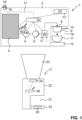
- FIG. 1 shows the coffee brewing machine 1 and the separate coffee bean grinder 2 being to physically separate machine entities.
- the coffee brewing machine 1 comprises, in a housing 3, a water tank 4, a flowmeter 5, a pump 6, a water flow-through heater 7, and an interface to a porta filter, which typically is in the form of an attachment by way of a bayonet mechanism.
- a porta filter typically is in the form of an attachment by way of a bayonet mechanism.
- the heater is attached to a corresponding power supply (not illustrated) and heats the water to the desired temperature. Additional valves (not illustrated) are provided to make sure not only the desired temperature but also the desired pressure are reached. Downstream of the water heater 7 the line carries on to the interface 8.
- the coffee brewing machine 1 comprises a brewed coffee dispensing area 19, which is typically like a cutout or a recessed portion in the housing 3. That housing can be used to insert the porta filter 9, by holding it on the handle 10, and attaching it to the corresponding interface 8 firmly. Furthermore there is provided a user input/output device 13. Once the porta filter is inserted into the area 19 and attached to the interface 8 the user can start the desired brewing process by interacting with the interface 13. Coffee is then brewed and is flowing into the coffee cup 11, which is located on a corresponding base 12 of the machine 1.
- a flowmeter sniffer 15 in the housing 3 of the coffee brewing machine and attached by way of a data line 16 directly to the flowmeter.
- the flowmeter sniffer 15 comprises either a small battery or is attached to the power supply in the coffee brewing machine 1. It is provided with a small CPU and storage means and interface means able to receive the water flow information from the flowmeter via line 16, if need be to timestamp the corresponding information, and to then transmitted by way of a wireless communication, for example Bluetooth, to the coffee bean grinder machine 2, or more specifically, to the grinder control unit 26, which itself is provided with means for wireless communication with the flowmeter sniffer.
- a wireless communication for example Bluetooth
- the flowmeter sniffer detects each impulse coming from the flowmeter and sends for each impulse a digital signal to the grinder.
- the grinder then adds to every incoming signal a relative or absolute timestamp for further calculation and control.
- Absolute timestamps are an ideal option if the grinder is connected to telemetric services: In this case any operator with access to these telemetric data has an overview about statistics, coming only from the grinder and not from the coffee machine. This is a special advantage if e.g. a coffeehouse chain is using expensive espresso machines with no telemetric options available: Only by using a grinder according to this invention he has a complete overview what is going on in his coffee houses without replacing the espresso machines.
- the true information content of the data provided by the flowmeter sniffer depends on the type of the flowmeter in the coffee brewing machine.
- the operator examines the flowmeter and identifies its type, and this information is programmed into the grinder control so the grinder knows which amount of water is e.g. associated with each tick of the flowmeter.
- the memory of the grinder there is provided a look-up table of the most common flowmeters in coffee brewing machines, so that the operator upon installation can just input a identification information of the flowmeter and the grinder then looks that up and knows, what this means in terms of data received by the flowmeter sniffer (one tick means xx ml of water etc.).
- the automatic detection and identification of the flowmeter by the grinder by way of the type of ticks etc. transmitted by the flowmeter sniffer.
- the grinder has to detect this starting point from the permanent incoming data sent by the flowmeter sniffer: In a very simple way it can be the occurrence of one or more ticks in between a pre-defined time interval.
- the end point of the brewing process After the starting point of the brewing process has been detected the end point can be detected by a pre-defined timeout for one or more ticks.
- the flowmeter sniffer can send special events in case the flowmeter sniffer itself detects a timeout of ticks (in case no water is running through the flowmeter) so that the grinder has a permanent non-timeout connection with the flowmeter sniffer.
- the grinder can adjust in an autonomous way with no additional information coming from the coffee machine the grinding discs adjustment (i.e. the distance between the rotating and fixed blade) and/or the amount of ground coffee e.g. by corresponding timing of the grinding.
- the grinder only adjusts the grinding blades space on the basis of one brewing process parameter, e.g. the extraction time: If the pre-defined "ideal" extraction time given to the grinder (e.g. 25 seconds) falls below a pre-defined value (e.g. 24 seconds) or threshold (in this case one second) resulting from analysis of the ticks of the last shot the grinder will automatically increase the grinding fineness of the ground coffee by reducing the space between the grinding blades or grinding discs and vice versa. In this embodiment it is important that the grinder constantly grinds the same amount of coffee which is controlled either by time, by weight or a combination of time and weight.
- a pre-defined value e.g. 24 seconds
- threshold in this case one second
- the space between the grinding blades is kept constant: If the extraction time is exceeded the amount of ground coffee is decreased and vice versa.
- the great advantage of all embodiments of this invention is that the barista has only to focus on the grinder and not on the coffee machine:
- the barista's main recipe is a double espresso: He defines once in the permanent memory of the grinder the ideal extraction time, the ideal amount of used water and/or the ideal flowrate profile and the parameters to control (i.e. the grinding blades distance and/or the amount of ground coffee) for the perfect taste in his double espresso cups by using an App or the GUI of the grinder. The rest is done by the grinder autonomously.
- the coffee machine sends additional information to the grinder to take control over the recipe (i.e. presets and grinding parameters) but not over the grinder.
- the coffee machine sends to the grinder all parameters needed for controlling the brewing process by the grinder, e.g. ideal extraction time, the ideal amount of used water and/or the ideal flowrate profile and the parameters to control but not the grinding discs adjustment.
- the flowmeter sniffer as well as the coffee machine could use two separate senders, the grinder can have only one receiver if the protocol is e.g. Bluetooth.
Landscapes
- Engineering & Computer Science (AREA)
- Food Science & Technology (AREA)
- Mechanical Engineering (AREA)
- Life Sciences & Earth Sciences (AREA)
- Chemical & Material Sciences (AREA)
- Polymers & Plastics (AREA)
- Physics & Mathematics (AREA)
- Fluid Mechanics (AREA)
- Apparatus For Making Beverages (AREA)
Claims (13)
- Verfahren zur Steuerung eines Kaffeebohnenmahlautomaten (2), der von einem Kaffeebrühautomaten (1) getrennt ist, unter Verwendung von durch den Kaffeebohnenmahlautomaten (2) erzeugtem gemahlenem Kaffee, wobei ein in oder an einem Gehäuse (3) des Kaffeebrühautomaten (1) angeordnetes Durchflussmesser-Schnüffelelement (15) die von einem Wasserdurchflussmesser (5) des Kaffeebrühautomaten (1) gemessene Wasserdurchflussinformation erfasst, und die Wasserdurchflussinformation an eine Mahlwerksteuereinheit (26) überträgt, die sich in dem Kaffeebohnenmahlautomaten (2) befindet, und die Mahlwerksteuereinheit (26) das Mahlwerkmodul (24) in Abhängigkeit von der Wasserdurchflussinformation steuert, die von dem Durchflussmesser-Schnüffelelement (15) übertragen wird.
- Verfahren nach Anspruch 1, wobei das Durchflussmesser-Schnüffelelement (15) die Wasserdurchflussinformationen über drahtlose Kommunikation an die Mahlwerksteuereinheit (26) überträgt, vorzugsweise über einen der Standards ausgewählt aus: Bluetooth, BLE, ZigBee, Z-wave, 6LoWPAN, Thread, LoRaWAN, 2G, 3G, 4G, 5G, LTE, NFC.
- Verfahren nach einem der vorhergehenden Ansprüche, wobei die Wasserdurchflussinformation eine Folge von Impulsen als Funktion der Zeit ist, deren Auftreten und/oder Abstand eine Funktion der gesamten Brühzeit, der gesamten Brühwassermenge, des Wasserdurchflusses als Funktion der Zeit oder einer Kombination davon ist oder die Bestimmung derselben ermöglicht, oder eine direkte Information über die gesamte Brühzeit und/oder die gesamte Brühwassermenge und/oder den Wasserdurchfluss als Funktion der Zeit ist.
- Verfahren nach Anspruch 3, bei dem die vom Durchflussmesser-Schnüffelelement (15) vom Durchflussmesser (5) erhaltenen Impulse mit einem Zeitstempel versehen und dann mit dem Zeitstempel als Wasserdurchflussinformation an die Mahlwerksteuereinheit (26) übertragen werden.
- Verfahren nach einem der vorhergehenden Ansprüche, wobei die von der Mahlwerksteuereinheit (26) von dem Durchflussmesser-Schnüffelelement (15) empfangene Wasserdurchflussinformation von der Mahlwerksteuereinheit (26) verwendet wird, um den Betrieb des Mahlwerksmoduls (24) in Bezug auf die Korngröße, die Mahldauer pro Portion, das Gesamtgewicht des gemahlenen Kaffees pro Portion oder eine Kombination davon anzupassen.
- Verfahren nach einem der vorhergehenden Ansprüche, wobei der Kaffeebohnenmahlautomat (2) ferner eine Wägezelle (25) umfasst oder mit ihr verbunden ist, die das effektive Gewicht des gemahlenen Kaffees pro Portion misst, wobei die Wägezelle (25) in Datenkommunikation mit der Mahlwerksteuereinheit (26) steht, und wobei das Verfahren das Anpassen der Steuerung des Mahlwerksmoduls (24) umfasst, um ein vorbestimmtes effektives Gewicht des gemahlenen Kaffeeanteils als eine Funktion der Eingabe zu erzeugen, die von der Wägezelle (25) sowie von dem Durchflussmesser-Schnüffelelement (15) erhalten wird.
- Verfahren nach einem der vorhergehenden Ansprüche, wobei der Kaffeebrühautomat (1) mindestens einen Wassertank (4), mindestens eine Wasserpumpe (6) zum Pumpen von Wasser aus dem Wassertank zu einer Schnittstelle (8) zu einem Porta-Filter (9), mindestens eine Heizung (7), die vorzugsweise stromabwärts der Pumpe (6) angeordnet ist, um das Wasser auf eine vorbestimmte Temperatur zu erhitzen, sowie mindestens einen Durchflussmesser (5) umfasst, vorzugsweise stromaufwärts der Pumpe (6) angeordnet, um die Wasserdurchflussinformation des aus dem Wassertank gepumpten Wassers zu messen, eine Brauereisteuereinheit (14), die die Pumpe (6) und/oder die Heizung (7) in Abhängigkeit von der Wasserdurchflussinformation steuert, sowie vorzugsweise mindestens eine Benutzerschnittstelle (13), um eine Benutzereingabe, insbesondere die Auswahl des Brühprofils, und/oder eine Benutzerausgabe, insbesondere die Anzeige von Status- und Betriebsinformationen, zu ermöglichen.
- Verfahren nach einem der vorhergehenden Ansprüche, bei dem das Durchflussmesser-Schnüffelelement (15) eine separate Einheit ist, die Anschlusselemente zum physischen Verbinden mit den Ausgangsleitungen oder zum Abfangen und/oder Schnüffeln der Datenleitung zwischen dem Durchflussmesser (5) und einer Brühmaschinen-Steuereinheit (14), ein Stromversorgungselement, vorzugsweise in Form einer Batterie oder zum, vorzugsweise parasitären, Anschließen an die Stromversorgung des Kaffeebrühautomaten (1), und eine drahtlose Übertragungseinheit zum drahtlosen Übertragen von aus dem Durchflussmesser (5) ausgelesenen Wasserdurchflussinformationen an die Mahlwerk-Steuereinheit aufweist.
- Verfahren nach Anspruch 8, wobei das Durchflussmesser-Schnüffelelement (15), das vorzugsweise Teil der Produktverpackung der Kaffeebohnenmahlautomat (2) ist, erst bei der Installation des Kaffeebohnenmahlautomaten (2) in das Gehäuse (3) des Kaffeebrühautomaten (1) eingesetzt wird, um mit dem Kaffeebohnenmahlautomaten (2) zusammenzuarbeiten und sie zu steuern.
- Verfahren nach Anspruch 8, wobei der Kaffeebrühautomat (1) mit einer Schnittstelle (18) für ein Durchflussmesser-Schnüffelelement (15) versehen ist, wobei die Schnittstelle (18) an der Außenseite des Gehäuses angeordnet oder in das Gehäuse des Kaffeebrühautomaten (1) integriert ist und von der Brühsteuereinheit (14) mit Wasserdurchflussinformationen aus dem Durchflussmesser (5) versorgt wird, und wobei das Durchflussmesser-Schnüffelelement (15), das vorzugsweise Teil der Produktverpackung des Kaffeebohnenmahlautomaten (2) ist, an der Schnittstelle (18) des Kaffeebrühautomaten (1) nur bei der Installation des Kaffeebohnenmahlautomaten (2) zur Zusammenarbeit und Steuerung des Kaffeebohnenmahlautomaten (2) angebracht wird.
- Verfahren nach einem der vorhergehenden Ansprüche, bei dem zum Nachrüsten einer bestehenden Einrichtung, die einen Kaffeebrühautomaten (1) und einen davon getrennte Kaffeebohnenmahlautomaten (2) umfasst, vor dem Erfassen der von dem Wasserdurchflussmesser (5) des Kaffeebrühautomaten (1) gemessenen Wasserdurchflussinformation ein von dem Kaffeebohnenmahlautomaten (2) getrenntes Durchflussmesser-Schnüffelelement (15) direkt oder indirekt an den Ausgang des Durchflussmessers (5) des Kaffeebrühautomaten (1) angeschlossen wird, vorzugsweise durch Öffnen des Gehäuses (3) des Kaffeebrühautomaten (1) und Anschließen des Durchflussmesser-Schnüffelelements (15) an die Ausgangsleitungen des Durchflussmessers (5), Verlassen des Durchflussmesser-Schnüffelelements (15) innerhalb des Kaffeebrühautomaten (1) und Schließen des Gehäuses (3) des Kaffeebrühautomaten (1) und Herstellen einer drahtlosen Verbindung zwischen dem Durchflussmesser-Schnüffelelement (15) und einer Mahlwerksteuereinheit (26) des Kaffeebrühautomaten (1).
- Verfahren nach Anspruch 11, bei dem das Schnüffelelement (15) des Durchflussmessers mindestens Folgendes umfasstAnschlusselemente zum physischen Anschluss an die Ausgangsleitungen oder zum Abfangen und/oder Abhören der Datenleitung zwischen einem Durchflussmesser (5) und einer Brüheinheit (14) eines Standard- Kaffeebrühautomaten (1),ein Stromversorgungselement, das vorzugsweise in Form einer Batterie vorliegt oder vorzugsweise parasitär an die Stromversorgung der Standard- Kaffeebrühautomaten (1) angeschlossen wird, undeine drahtlose Übertragungseinheit zum drahtlosen Übertragen von aus dem Durchflussmesser (5) ausgelesenen Wasserdurchflussinformationen an die Mahlwerksteuereinheit (26).
- Verwendung eines Durchflussmesser-Schnüffelelements (15) zur Steuerung eines Kaffeebohnenmahlautomaten (2), das vom Kaffeebohnenmahlautomaten (2) getrennt ist, wobei das Durchflussmesser-Schnüffelelement (15) Folgendes aufweistAnschlusselemente zum physischen Anschluss an die Ausgangsleitungen oder zum Abfangen und/oder Abhören der Datenleitung zwischen einem Durchflussmesser (5) und einer Brüheinheit (14) eines Standard-Kaffeebrühautomaten (1),ein Stromversorgungselement, das vorzugsweise in Form einer Batterie vorliegt oder vorzugsweise parasitär an die Stromversorgung des Standard-Kaffeebrühautomaten (1) angeschlossen wird, undeine drahtlose Übertragungseinheit zur drahtlosen Übertragung von aus dem Durchflussmesser (5) ausgelesenen Wasserdurchflussinformationen an die Zerkleinerungssteuereinheitin einem Verfahren nach einem der vorhergehenden Ansprüche.
Priority Applications (6)
| Application Number | Priority Date | Filing Date | Title |
|---|---|---|---|
| EP18210018.0A EP3662794B1 (de) | 2018-12-04 | 2018-12-04 | Verfahren zum steuern einer kaffeemühle |
| JP2019196115A JP7424792B2 (ja) | 2018-12-04 | 2019-10-29 | コーヒー挽き機の制御方法 |
| AU2019261673A AU2019261673B2 (en) | 2018-12-04 | 2019-11-04 | Method for controlling a coffee grinder |
| KR1020190153066A KR102757861B1 (ko) | 2018-12-04 | 2019-11-26 | 커피 분쇄기 제어 방법 |
| US16/700,030 US11622647B2 (en) | 2018-12-04 | 2019-12-02 | Method and apparatus for controlling a coffee grinder |
| CN201911215011.0A CN111265115A (zh) | 2018-12-04 | 2019-12-02 | 咖啡研磨机的控制方法 |
Applications Claiming Priority (1)
| Application Number | Priority Date | Filing Date | Title |
|---|---|---|---|
| EP18210018.0A EP3662794B1 (de) | 2018-12-04 | 2018-12-04 | Verfahren zum steuern einer kaffeemühle |
Publications (3)
| Publication Number | Publication Date |
|---|---|
| EP3662794A1 EP3662794A1 (de) | 2020-06-10 |
| EP3662794C0 EP3662794C0 (de) | 2025-01-15 |
| EP3662794B1 true EP3662794B1 (de) | 2025-01-15 |
Family
ID=64604504
Family Applications (1)
| Application Number | Title | Priority Date | Filing Date |
|---|---|---|---|
| EP18210018.0A Active EP3662794B1 (de) | 2018-12-04 | 2018-12-04 | Verfahren zum steuern einer kaffeemühle |
Country Status (6)
| Country | Link |
|---|---|
| US (1) | US11622647B2 (de) |
| EP (1) | EP3662794B1 (de) |
| JP (1) | JP7424792B2 (de) |
| KR (1) | KR102757861B1 (de) |
| CN (1) | CN111265115A (de) |
| AU (1) | AU2019261673B2 (de) |
Families Citing this family (24)
| Publication number | Priority date | Publication date | Assignee | Title |
|---|---|---|---|---|
| IT201900024847A1 (it) * | 2019-12-19 | 2021-06-19 | Delonghi Appliances Srl | Erogatore di prodotto sfuso |
| IT202000008761A1 (it) * | 2020-04-23 | 2021-10-23 | Rancilio Group Spa | Sistema comprendente una macchina per caffè ed un dispositivo accessorio ad essa associato e metodo per controllare il funzionamento di detto sistema |
| MX2022014594A (es) | 2020-06-24 | 2022-12-13 | Nestle Sa | Aparato de molienda y extraccion de granos de cafe. |
| KR102241337B1 (ko) * | 2020-07-09 | 2021-04-19 | 박상엽 | 커피 추출 과정에서 데이터 센싱이 가능한 포타필터 및 이를 이용한 커피 추출 과정 제어 방법 |
| KR102218251B1 (ko) * | 2020-08-26 | 2021-02-19 | 임은성 | 자동 판매기용 커피 추출장치 |
| CN114568944B (zh) * | 2020-11-30 | 2024-07-23 | 大圈科技股份有限公司 | 冲泡机 |
| JP7144073B2 (ja) * | 2020-12-03 | 2022-09-29 | 株式会社大都技研 | コーヒー豆挽き装置 |
| KR102441190B1 (ko) * | 2020-12-29 | 2022-09-08 | 주식회사 상화 | 커피 제조 시스템 및 이의 동작 방법 |
| IT202100005867A1 (it) | 2021-03-12 | 2022-09-12 | Fiorenzato M C Srl | “sistema di regolazione della macinatura, con retroazione combinata” |
| IT202100009692A1 (it) * | 2021-04-16 | 2022-10-16 | La San Marco S P A | Macchina per caffè e procedimento di erogazione di detto caffè |
| US20240251996A1 (en) * | 2021-06-01 | 2024-08-01 | Jura Elektroapparate Ag | Method for grinding material to be ground |
| EP4108144B1 (de) * | 2021-06-22 | 2023-12-20 | BSH Hausgeräte GmbH | Kaffeemaschine |
| US20240285117A1 (en) | 2021-06-23 | 2024-08-29 | Hemro International AG | Sensor for a coffee grinder |
| CN118102956A (zh) * | 2021-08-17 | 2024-05-28 | 布瑞威利私人有限公司 | 咖啡研磨机控制系统 |
| CN114052502B (zh) * | 2021-12-22 | 2023-11-24 | 云南云磐科技有限公司 | 一种全自动手冲咖啡智能设备及其工作方法 |
| SE546464C2 (en) * | 2023-01-26 | 2024-11-12 | Aarke Ab | A coffee bean grinder |
| CN117958603B (zh) * | 2023-07-06 | 2026-05-19 | 深圳市朗空亿科科技有限公司 | 冲挂耳咖啡机器人智能热水装置 |
| EP4759204A1 (de) * | 2023-09-26 | 2026-06-17 | Caye Technology (Suzhou) Co., Ltd. | Vorladevorrichtung, intelligente vollautomatische getränkemaschine mit vorladevorrichtung und steuerungsverfahren für intelligente vollautomatische getränkemaschine |
| CN117652856A (zh) * | 2023-11-30 | 2024-03-08 | 珠海格力电器股份有限公司 | 参数调整方法、装置、设备、咖啡机及存储介质 |
| CN117652851B (zh) * | 2023-12-28 | 2026-04-14 | 珠海市福龙电器有限公司 | 咖啡机 |
| US12369741B1 (en) | 2024-01-18 | 2025-07-29 | Sharkninja Operating Llc | Preventing coffee bean grinder jamming |
| WO2025155321A1 (en) | 2024-01-18 | 2025-07-24 | Sharkninja Operating Llc | Suggesting coffee bean grind size for beverage machines |
| US12369744B1 (en) | 2024-01-18 | 2025-07-29 | Sharkninja Operating Llc | Preparation of beverage machines for cold beverage brewing |
| USD1138431S1 (en) | 2024-05-03 | 2026-08-04 | Sharkninja Operating Llc | Espresso machine |
Family Cites Families (27)
| Publication number | Priority date | Publication date | Assignee | Title |
|---|---|---|---|---|
| IT1140758B (it) | 1980-02-29 | 1986-10-10 | Lucio Grossi | Dispositivo per la regolazione automatica della granulometria in macinatori di caffe' associati a macchine automatiche o simili |
| DE3615158C2 (de) | 1986-05-05 | 1990-11-15 | Cafina Ag | Verfahren zur Zubereitung einer Mehrzahl von Kaffeeportionen |
| US5186399A (en) * | 1988-08-01 | 1993-02-16 | Bunn-O-Matic Corporation | Digital control system for a coffee grinder and associated coffee brewer |
| US5660336A (en) * | 1995-02-10 | 1997-08-26 | National Controls Corporation | Control apparatus and method for coffee grinder and brewer |
| JP4016555B2 (ja) | 1999-12-13 | 2007-12-05 | 富士電機リテイルシステムズ株式会社 | カップ式自動販売機 |
| EP1955624B1 (de) * | 2007-02-08 | 2010-04-21 | Wmf Württembergische Metallwarenfabrik Ag | Kaffeemaschine |
| GB2448891B (en) * | 2007-05-01 | 2011-09-28 | Cafe Data Systems Ltd | Coffee quality monitoring system |
| EP1994866A1 (de) * | 2007-05-23 | 2008-11-26 | Rhea Vendors S.p.A. | Vorrichtung zum Mahlen von Kaffee oder anderen Nahrungsmitteln |
| ITMI20071442A1 (it) * | 2007-07-18 | 2009-01-19 | De Longhi Appliances Srl | Procedimento per il controllo di un maciinino di una macchina da caffe' |
| ITCR20080008A1 (it) | 2008-04-15 | 2009-10-16 | Prometec Srl | Contatore volumetrico per macchine da caffe' |
| EP2314183B1 (de) * | 2009-10-23 | 2011-09-28 | Gruppo Cimbali S.p.A. | Kaffeemaschine mit Abgabedruckregulierung und damit zusammenhängendes Verfahren |
| PT2314188E (pt) * | 2009-10-23 | 2012-11-21 | Gruppo Cimbali Spa | Aparelho e método para reabastecer os porta-filtros de uma máquina de café expresso com doses seleccionadas de café moído no momento |
| DE102011110312B4 (de) * | 2011-05-20 | 2016-06-16 | Wmf Group Gmbh | Kaffeevollautomat oder Espressomaschine sowie Verfahren zum Zubereiten von Kaffee oder Espresso |
| US8944354B2 (en) | 2011-09-30 | 2015-02-03 | Starbucks Corporation | Apparatus, systems, and methods for grinding a material |
| CN202875028U (zh) * | 2012-08-15 | 2013-04-17 | 威斯达电器(中山)制造有限公司 | 磨豆咖啡机 |
| ES2525965B1 (es) * | 2013-06-27 | 2015-12-16 | Jofemar, S.A. | Dispositivo de control de molido de café, máquina dispensadora de bebidas de café, procedimiento de elaboración de una bebida de café, y bebida de café |
| CH709458B1 (de) * | 2014-04-01 | 2018-06-29 | Schaerer Ag | Kaffeemaschine sowie Verfahren zum Betrieb einer solchen Kaffeemaschine. |
| KR101648202B1 (ko) * | 2014-12-08 | 2016-08-30 | 양재영 | 온도차 보정 수단을 포함하는 전자동 원두 커피 머신 및 온도차 보정 방법 |
| ES2745857T3 (es) * | 2015-01-12 | 2020-03-03 | Global Coffee Service F V | Método de regulación de la finura de un molinillo de café |
| AU2016274559B2 (en) * | 2015-06-09 | 2021-04-15 | Plae 2 Tech Ab | Brewing system and process of brewing a beverage |
| EP3146874A1 (de) * | 2015-09-24 | 2017-03-29 | Jura Elektroapparate Ag | Verfahren zum erzeugen eines kaffeegetränks in einer brühvorrichtung eines kaffeeautomaten sowie kaffeeautomat zum durchführen des verfahrens |
| US10786116B2 (en) * | 2015-10-12 | 2020-09-29 | Koninklijke Philips N.V. | Grinding unit and coffee machine |
| IT201600098511A1 (it) * | 2015-10-30 | 2018-03-30 | Simonelli Group Spa | Macchina da caffe' e relativo metodo di estrazione del caffe'. |
| US10542839B2 (en) * | 2015-12-30 | 2020-01-28 | Conair Corporation | Coffee making appliance |
| US11160419B2 (en) * | 2016-04-20 | 2021-11-02 | Sorry Robots Llc | Grinders, analyzers, and related technologies |
| JP6364571B1 (ja) | 2016-09-26 | 2018-07-25 | 株式会社ミツウロコクリエイティブソリューションズ | ガス供給管理システム、ガス供給管理方法、情報送信装置 |
| IT201600122725A1 (it) | 2016-12-02 | 2018-06-02 | Gruppo Cimbali Spa | Metodo e macchina per erogare dosi di caffè macinato |
-
2018
- 2018-12-04 EP EP18210018.0A patent/EP3662794B1/de active Active
-
2019
- 2019-10-29 JP JP2019196115A patent/JP7424792B2/ja active Active
- 2019-11-04 AU AU2019261673A patent/AU2019261673B2/en active Active
- 2019-11-26 KR KR1020190153066A patent/KR102757861B1/ko active Active
- 2019-12-02 CN CN201911215011.0A patent/CN111265115A/zh active Pending
- 2019-12-02 US US16/700,030 patent/US11622647B2/en active Active
Also Published As
| Publication number | Publication date |
|---|---|
| EP3662794A1 (de) | 2020-06-10 |
| JP2020114375A (ja) | 2020-07-30 |
| US11622647B2 (en) | 2023-04-11 |
| CN111265115A (zh) | 2020-06-12 |
| EP3662794C0 (de) | 2025-01-15 |
| KR102757861B1 (ko) | 2025-01-20 |
| JP7424792B2 (ja) | 2024-01-30 |
| KR20200068581A (ko) | 2020-06-15 |
| US20200170444A1 (en) | 2020-06-04 |
| AU2019261673A1 (en) | 2020-06-18 |
| AU2019261673B2 (en) | 2025-08-14 |
Similar Documents
| Publication | Publication Date | Title |
|---|---|---|
| US11622647B2 (en) | Method and apparatus for controlling a coffee grinder | |
| US20240285117A1 (en) | Sensor for a coffee grinder | |
| CN101094602B (zh) | 用于控制饮料配制的过程和器具 | |
| US8833237B2 (en) | Coffee machine | |
| CN102869291B (zh) | 用于控制调制的饮料质量的方法和设备 | |
| EP3833228B1 (de) | Anordnung mit einer espressokaffeemaschine und einer kaffeemühle | |
| CN110100157A (zh) | 咖啡粉的称重组件、包括这种称重组件的咖啡研磨器和咖啡机及其操作方法 | |
| CN115701924A (zh) | 用于分配研磨咖啡的方法 | |
| CN115697142B (zh) | 用于分配研磨咖啡的系统 | |
| CN114828703A (zh) | 用于制备和输送咖啡基饮料的机器及方法 | |
| RU2840608C1 (ru) | Способ выдачи молотого кофе | |
| RU2840153C1 (ru) | Система для выдачи молотого кофе | |
| TWI760114B (zh) | 包括咖啡機及咖啡研磨機之裝置 | |
| AU2011203240B2 (en) | Process and double piston apparatus for controlling the preparation of beverages |
Legal Events
| Date | Code | Title | Description |
|---|---|---|---|
| PUAI | Public reference made under article 153(3) epc to a published international application that has entered the european phase |
Free format text: ORIGINAL CODE: 0009012 |
|
| STAA | Information on the status of an ep patent application or granted ep patent |
Free format text: STATUS: THE APPLICATION HAS BEEN PUBLISHED |
|
| AK | Designated contracting states |
Kind code of ref document: A1 Designated state(s): AL AT BE BG CH CY CZ DE DK EE ES FI FR GB GR HR HU IE IS IT LI LT LU LV MC MK MT NL NO PL PT RO RS SE SI SK SM TR |
|
| AX | Request for extension of the european patent |
Extension state: BA ME |
|
| STAA | Information on the status of an ep patent application or granted ep patent |
Free format text: STATUS: REQUEST FOR EXAMINATION WAS MADE |
|
| 17P | Request for examination filed |
Effective date: 20201027 |
|
| RBV | Designated contracting states (corrected) |
Designated state(s): AL AT BE BG CH CY CZ DE DK EE ES FI FR GB GR HR HU IE IS IT LI LT LU LV MC MK MT NL NO PL PT RO RS SE SI SK SM TR |
|
| STAA | Information on the status of an ep patent application or granted ep patent |
Free format text: STATUS: EXAMINATION IS IN PROGRESS |
|
| 17Q | First examination report despatched |
Effective date: 20210512 |
|
| RAP3 | Party data changed (applicant data changed or rights of an application transferred) |
Owner name: HEMRO INTERNATIONAL AG |
|
| GRAP | Despatch of communication of intention to grant a patent |
Free format text: ORIGINAL CODE: EPIDOSNIGR1 |
|
| STAA | Information on the status of an ep patent application or granted ep patent |
Free format text: STATUS: GRANT OF PATENT IS INTENDED |
|
| INTG | Intention to grant announced |
Effective date: 20240809 |
|
| GRAS | Grant fee paid |
Free format text: ORIGINAL CODE: EPIDOSNIGR3 |
|
| GRAA | (expected) grant |
Free format text: ORIGINAL CODE: 0009210 |
|
| STAA | Information on the status of an ep patent application or granted ep patent |
Free format text: STATUS: THE PATENT HAS BEEN GRANTED |
|
| AK | Designated contracting states |
Kind code of ref document: B1 Designated state(s): AL AT BE BG CH CY CZ DE DK EE ES FI FR GB GR HR HU IE IS IT LI LT LU LV MC MK MT NL NO PL PT RO RS SE SI SK SM TR |
|
| REG | Reference to a national code |
Ref country code: CH Ref legal event code: EP Ref country code: GB Ref legal event code: FG4D |
|
| REG | Reference to a national code |
Ref country code: DE Ref legal event code: R096 Ref document number: 602018078483 Country of ref document: DE |
|
| REG | Reference to a national code |
Ref country code: IE Ref legal event code: FG4D |
|
| U01 | Request for unitary effect filed |
Effective date: 20250123 |
|
| U07 | Unitary effect registered |
Designated state(s): AT BE BG DE DK EE FI FR IT LT LU LV MT NL PT RO SE SI Effective date: 20250130 |
|
| PG25 | Lapsed in a contracting state [announced via postgrant information from national office to epo] |
Ref country code: RS Free format text: LAPSE BECAUSE OF FAILURE TO SUBMIT A TRANSLATION OF THE DESCRIPTION OR TO PAY THE FEE WITHIN THE PRESCRIBED TIME-LIMIT Effective date: 20250415 |
|
| PG25 | Lapsed in a contracting state [announced via postgrant information from national office to epo] |
Ref country code: PL Free format text: LAPSE BECAUSE OF FAILURE TO SUBMIT A TRANSLATION OF THE DESCRIPTION OR TO PAY THE FEE WITHIN THE PRESCRIBED TIME-LIMIT Effective date: 20250115 |
|
| PG25 | Lapsed in a contracting state [announced via postgrant information from national office to epo] |
Ref country code: ES Free format text: LAPSE BECAUSE OF FAILURE TO SUBMIT A TRANSLATION OF THE DESCRIPTION OR TO PAY THE FEE WITHIN THE PRESCRIBED TIME-LIMIT Effective date: 20250115 |
|
| PG25 | Lapsed in a contracting state [announced via postgrant information from national office to epo] |
Ref country code: NO Free format text: LAPSE BECAUSE OF FAILURE TO SUBMIT A TRANSLATION OF THE DESCRIPTION OR TO PAY THE FEE WITHIN THE PRESCRIBED TIME-LIMIT Effective date: 20250415 Ref country code: IS Free format text: LAPSE BECAUSE OF FAILURE TO SUBMIT A TRANSLATION OF THE DESCRIPTION OR TO PAY THE FEE WITHIN THE PRESCRIBED TIME-LIMIT Effective date: 20250515 |
|
| PG25 | Lapsed in a contracting state [announced via postgrant information from national office to epo] |
Ref country code: HR Free format text: LAPSE BECAUSE OF FAILURE TO SUBMIT A TRANSLATION OF THE DESCRIPTION OR TO PAY THE FEE WITHIN THE PRESCRIBED TIME-LIMIT Effective date: 20250115 |
|
| PG25 | Lapsed in a contracting state [announced via postgrant information from national office to epo] |
Ref country code: GR Free format text: LAPSE BECAUSE OF FAILURE TO SUBMIT A TRANSLATION OF THE DESCRIPTION OR TO PAY THE FEE WITHIN THE PRESCRIBED TIME-LIMIT Effective date: 20250416 |
|
| PG25 | Lapsed in a contracting state [announced via postgrant information from national office to epo] |
Ref country code: SM Free format text: LAPSE BECAUSE OF FAILURE TO SUBMIT A TRANSLATION OF THE DESCRIPTION OR TO PAY THE FEE WITHIN THE PRESCRIBED TIME-LIMIT Effective date: 20250115 |
|
| PG25 | Lapsed in a contracting state [announced via postgrant information from national office to epo] |
Ref country code: CZ Free format text: LAPSE BECAUSE OF FAILURE TO SUBMIT A TRANSLATION OF THE DESCRIPTION OR TO PAY THE FEE WITHIN THE PRESCRIBED TIME-LIMIT Effective date: 20250115 |
|
| PG25 | Lapsed in a contracting state [announced via postgrant information from national office to epo] |
Ref country code: SK Free format text: LAPSE BECAUSE OF FAILURE TO SUBMIT A TRANSLATION OF THE DESCRIPTION OR TO PAY THE FEE WITHIN THE PRESCRIBED TIME-LIMIT Effective date: 20250115 |
|
| PLBE | No opposition filed within time limit |
Free format text: ORIGINAL CODE: 0009261 |
|
| STAA | Information on the status of an ep patent application or granted ep patent |
Free format text: STATUS: NO OPPOSITION FILED WITHIN TIME LIMIT |
|
| REG | Reference to a national code |
Ref country code: CH Ref legal event code: L10 Free format text: ST27 STATUS EVENT CODE: U-0-0-L10-L00 (AS PROVIDED BY THE NATIONAL OFFICE) Effective date: 20251126 |
|
| 26N | No opposition filed |
Effective date: 20251016 |
|
| REG | Reference to a national code |
Ref country code: CH Ref legal event code: U11 Free format text: ST27 STATUS EVENT CODE: U-0-0-U10-U11 (AS PROVIDED BY THE NATIONAL OFFICE) Effective date: 20260101 |
|
| PGFP | Annual fee paid to national office [announced via postgrant information from national office to epo] |
Ref country code: GB Payment date: 20251219 Year of fee payment: 8 |
|
| U20 | Renewal fee for the european patent with unitary effect paid |
Year of fee payment: 8 Effective date: 20251211 |
|
| PGFP | Annual fee paid to national office [announced via postgrant information from national office to epo] |
Ref country code: CH Payment date: 20260101 Year of fee payment: 8 |
|
| PG25 | Lapsed in a contracting state [announced via postgrant information from national office to epo] |
Ref country code: MC Free format text: LAPSE BECAUSE OF FAILURE TO SUBMIT A TRANSLATION OF THE DESCRIPTION OR TO PAY THE FEE WITHIN THE PRESCRIBED TIME-LIMIT Effective date: 20250115 |