EP3649868A1 - Procédé de fabrication d'un corps gélifié de denrée alimentaire de consistance ferme à partir des protéines de plantes, corps gélifié de denrée alimentaire ainsi qu'agrégateur destiné à la mise en uvre dudit procédé - Google Patents
Procédé de fabrication d'un corps gélifié de denrée alimentaire de consistance ferme à partir des protéines de plantes, corps gélifié de denrée alimentaire ainsi qu'agrégateur destiné à la mise en uvre dudit procédé Download PDFInfo
- Publication number
- EP3649868A1 EP3649868A1 EP18204936.1A EP18204936A EP3649868A1 EP 3649868 A1 EP3649868 A1 EP 3649868A1 EP 18204936 A EP18204936 A EP 18204936A EP 3649868 A1 EP3649868 A1 EP 3649868A1
- Authority
- EP
- European Patent Office
- Prior art keywords
- composition
- peak
- temperature
- weight
- protein concentrate
- Prior art date
- Legal status (The legal status is an assumption and is not a legal conclusion. Google has not performed a legal analysis and makes no representation as to the accuracy of the status listed.)
- Granted
Links
Images




Classifications
-
- A—HUMAN NECESSITIES
- A23—FOODS OR FOODSTUFFS; TREATMENT THEREOF, NOT COVERED BY OTHER CLASSES
- A23J—PROTEIN COMPOSITIONS FOR FOODSTUFFS; WORKING-UP PROTEINS FOR FOODSTUFFS; PHOSPHATIDE COMPOSITIONS FOR FOODSTUFFS
- A23J3/00—Working-up of proteins for foodstuffs
- A23J3/22—Working-up of proteins for foodstuffs by texturising
-
- A—HUMAN NECESSITIES
- A23—FOODS OR FOODSTUFFS; TREATMENT THEREOF, NOT COVERED BY OTHER CLASSES
- A23C—DAIRY PRODUCTS, e.g. MILK, BUTTER OR CHEESE; MILK OR CHEESE SUBSTITUTES; PREPARATION THEREOF
- A23C20/00—Cheese substitutes
- A23C20/02—Cheese substitutes containing neither milk components, nor caseinate, nor lactose, as sources of fats, proteins or carbohydrates
- A23C20/025—Cheese substitutes containing neither milk components, nor caseinate, nor lactose, as sources of fats, proteins or carbohydrates mainly containing proteins from pulses or oilseeds
-
- A—HUMAN NECESSITIES
- A23—FOODS OR FOODSTUFFS; TREATMENT THEREOF, NOT COVERED BY OTHER CLASSES
- A23J—PROTEIN COMPOSITIONS FOR FOODSTUFFS; WORKING-UP PROTEINS FOR FOODSTUFFS; PHOSPHATIDE COMPOSITIONS FOR FOODSTUFFS
- A23J3/00—Working-up of proteins for foodstuffs
- A23J3/14—Vegetable proteins
-
- A—HUMAN NECESSITIES
- A23—FOODS OR FOODSTUFFS; TREATMENT THEREOF, NOT COVERED BY OTHER CLASSES
- A23J—PROTEIN COMPOSITIONS FOR FOODSTUFFS; WORKING-UP PROTEINS FOR FOODSTUFFS; PHOSPHATIDE COMPOSITIONS FOR FOODSTUFFS
- A23J3/00—Working-up of proteins for foodstuffs
- A23J3/22—Working-up of proteins for foodstuffs by texturising
- A23J3/225—Texturised simulated foods with high protein content
-
- A—HUMAN NECESSITIES
- A23—FOODS OR FOODSTUFFS; TREATMENT THEREOF, NOT COVERED BY OTHER CLASSES
- A23L—FOODS, FOODSTUFFS OR NON-ALCOHOLIC BEVERAGES, NOT OTHERWISE PROVIDED FOR; PREPARATION OR TREATMENT THEREOF
- A23L11/00—Pulses, i.e. fruits of leguminous plants, for production of food; Products from legumes; Preparation or treatment thereof
- A23L11/40—Pulse curds
-
- A—HUMAN NECESSITIES
- A23—FOODS OR FOODSTUFFS; TREATMENT THEREOF, NOT COVERED BY OTHER CLASSES
- A23P—SHAPING OR WORKING OF FOODSTUFFS, NOT FULLY COVERED BY A SINGLE OTHER SUBCLASS
- A23P30/00—Shaping or working of foodstuffs characterised by the process or apparatus
- A23P30/10—Moulding
Definitions
- the invention relates to a method according to claim 1 for producing a cut-resistant, in particular vegan, food gel body, preferably a food gel block, based on vegetable proteins.
- the food gel body is characterized by a continuous phase of aggregated, i.e. three-dimensionally cross-linked plant proteins and water, i.e. through a three-dimensional plant protein matrix.
- the invention relates to an elastic and cut-resistant, preferably vegan, food gel body, preferably food gel block according to claim 14, in particular as a result of the method according to the invention.
- the invention relates to an aggregator, i.e. a device according to claim 15 for performing the method according to the invention and for producing the food gel body according to the invention.
- the corresponding use of an aggregator according to the invention is expressly disclosed as being essential to the invention.
- Cut-resistant vegan food gel bodies previously available on the market, for example in the form of cheese replacement slices, are produced on the basis of starch gels. Hydrocolloids are also used here.
- the well-known starch gel bodies are characterized by a low protein content. If you want to produce alternative products with a high protein content, you can see that the addition of vegetable proteins to a carbohydrate or starch matrix is limited due to a limited miscibility if the product is to continue to be an elastic gel system. Higher amounts of vegetable proteins lead to the destruction of the elastic starch gel, which results in a rather mushy and therefore inelastic and no longer cut-resistant mass. In practice, therefore, only small amounts of vegetable proteins (about 1 to 2% by weight) are added to the carbohydrate gel system.
- Cut-resistant vegan, highly elastic sausage substitutes without the addition of technical additives such as transglutaminase or hydrocolloids have so far not been available in retail stores.
- the gel system is generally based on the coagulation of chicken egg white, since chicken egg white gels are comparatively insensitive to additives of any kind.
- the DE 10 2014 005 466 A1 describes the extraction of rapeseed protein.
- the extraction of oat protein is, for example, in the US 2016/030 9762 A1 described.
- the US 2017/023 8590 A1 describes methods for extracting mung bean protein for the production of scrambled egg substitute.
- the invention is based on the object of specifying an elastic, in particular vegan, cut-resistant food gel body based on vegetable proteins and a process for its production.
- the task is to propose an aggregator for performing the method or for producing the food gel block.
- the invention is based on the idea of producing or specifying a, in particular vegan, cut-resistant food gel body from suitable plant proteins, such as, for example, almond proteins, cashew proteins, mung bean proteins, coconut proteins, chickpea proteins, peanut proteins, oat proteins, etc., which is distinguished by the fact that the plant proteins do this Form gel-like elastic network, ie represent the continuous phase of the food gel body.
- suitable plant proteins such as, for example, almond proteins, cashew proteins, mung bean proteins, coconut proteins, chickpea proteins, peanut proteins, oat proteins, etc.
- Other optional additives also known as disturbance variables based on the gel network
- fat, sugar, salt, flavoring ingredients such as herbs, colors and / or flavorings, if added, serve as fillers within this continuous phase and / or as flavor carriers.
- the food gel bodies obtained, in particular in the form of gel blocks can serve as cheese or meat or sausage substitute food. Further processing into blocks, disks, shreds, cubes, pins,
- the starting point for the process according to the invention for producing the food gel body is an aqueous plant protein concentrate solution, the plant proteins contained therein being distinguished by high, in particular complete, functionality.
- This native behavior is required in the context of the method according to the invention in order to aggregate the proteins, i.e. network three-dimensionally to a plant protein gel system.
- a plant protein concentrate solution suitable for the method according to the invention i.e. for the extraction and concentration of plant proteins, methods known per se can be used, which are preferably optimally adapted to the respective type of protein or raw material source.
- Oil-containing seeds can, for example, be largely freed of oil by pressing in an oil press, in particular until a residual oil content of between 10 and 12% by weight remains, whereupon the pressed seeds or the press cake can / can be ground.
- the press cake and the flour from it are an ideal starting material for the extraction of proteins.
- Starchy seeds, such as legumes can either be soaked or ground directly and then sent for extraction. All of these preparation steps are known to the person skilled in the art.
- the extraction preferably proceeds according to the following basic scheme:
- The, in particular ground, vegetable raw material is mixed with water in a dilution of in particular 1: 4 to 1:10.
- the pH of the water is between 5.8 and 9.6 in Dependency of the raw material.
- the NaCl content is generally between 0 mol / l and 2 mol / l.
- a temperature of between 10 ° C. and 50 ° C. is preferably maintained during the extraction, the respective suspension being stirred for a minimum of between 1 and 5 hours.
- the proteins are released from the raw material and are then in solution in the solution. This is preferably followed by a filtration step and, in many cases, centrifugation of the filtered suspension in order to separate undesired solid constituents.
- the supernatant is processed further.
- pH-controlled precipitation of the proteins is preferably brought about, in particular at pH values between 4.5 and 5.6. Centrifugation takes place to separate the proteins, the resulting protein precipitate usually having a water content of between 50% by weight and 80% by weight.
- the proteins are then usually brought back into solution, the redilution being carried out with an aqueous solution whose pH is adjusted such that, after the redilution, the aqueous protein concentrate solution has a pH between 4.5 and 7.5, in particular between 5 , 4 and 7.2.
- the buffering effect of the proteins must be taken into account.
- the solution for re-dilution can also contain NaCl, in particular between 0.5 and 2% by weight, depending on the origin of the protein.
- the finished protein concentrate solution is preferably characterized by a protein concentration between 12 and 35% by weight, in particular between 16 and 30% by weight, very particularly preferably between 18 and 22% by weight.
- the protein concentrates can be frozen, for example, or pasteurized depending on the type of protein.
- the production of the vegetable protein concentrate solution is a component or upstream process step of the method according to the invention.
- a plant protein concentrate solution suitable for carrying out the method according to the invention is distinguished in that it has an endothermic peak, which is characterized by a DSC curve resulting from a dynamic differential calorimetry measurement and describing the relationship between the specific thermal energy converted and the temperature a peak temperature range over which the peak extends, which is limited by a peak start temperature and a peak end temperature.
- the examination method differential calorimetry measurement mentioned above and explained in detail below can be used to check whether it is a suitable plant protein concentrate solution or within the scope of the invention, the proteins of which have a high or sufficient functionality.
- the enthalpy of denaturation (corresponds to the peak area) is at least 10J / g protein.
- 50 to 100 mg of the vegetable protein concentrate with a known protein content are placed in a steel vessel with a volume of 100 ⁇ l weighed in and sealed pressure-tight. Another steel vessel is filled with water and serves as a reference for the measurement. Mettler Toledo Type DSC 1 Star is the preferred measuring system.
- the differential calorimetry measurement consists in performing a temperature scan with a heating rate of 2 K / min. The scanning area starts at 25 ° Celsius and preferably ends at 130 ° Celsius.
- Denaturing of the proteins in a specific temperature range is visible in the DSC curve obtained as an endothermic peak.
- a peak is characterized by a peak start temperature, a peak maximum temperature, ie a temperature at the peak maximum, in particular between 90 ° Celsius and 125 ° Celsius and a peak end temperature.
- the temperature range ie the peak temperature range which is covered between the peak start temperature and the peak end temperature, is preferably between 25 ° Celsius and 40 ° Celsius, in particular between 30 ° Celsius and 35 ° Celsius.
- the peak area of the endothermic peak in the DSC curve is a measure of the extent of denaturation. Different proteins have different enthalpies of denaturation.
- these are preferably above 10 J / g protein, very particularly preferably between 12 J / g and 30 J / g protein.
- the enthalpy of denaturation is a measure of how much of the protein present is still native, that is to say has functionality and how much has already been denatured. The greatest possible value should be aimed for.
- the formation of a peak in a DSC curve in a differential calorimetry measurement of a plant protein concentrate solution used is a first necessary prerequisite for the suitability and formation or nature of the plant protein concentrate solution for carrying out an inventive process
- the procedure is that of denaturing, however the plant proteins are not synonymous with their aggregation behavior, ie gel formation behavior.
- the plant proteins of the plant protein concentrate solution used must not only be distinguished by native, ie still denaturable, plant proteins, but also by a suitable gel formation behavior as a second quality requirement.
- a plant protein concentrate solution based on lupine protein shows a clear peak in a differential calorimetry measurement as described, but still does not form elastic gels.
- the oscillation rheology can be used to check whether the plant protein concentrate solution used has sufficient aggregation behavior to carry out the method according to the invention or whether the plant protein type used is suitable for carrying out the method according to the invention (for example, lupine is not), i.e. fulfills the second condition.
- the advantage of this method is that the measured substance, in this case the plant protein concentrate solution used, is in no way influenced by the measurement, since it is not stirred, but rather the measuring system only oscillates by a small angle.
- the plant protein concentrate solution is poured into a suitable steel vessel (beaker: C25 DIN system) between 10 and 15 ml. The steel vessel is closed pressure-tight.
- the rheological properties are measured by means of the cylinder (C25 DIN system) which is located in the steel vessel (beaker) with the protein concentrate solution.
- the cylinder in the cup is driven by a magnetic coupling so that the system is absolutely pressure-tight.
- the Bohlin Gemini HR nano coaxial cylinder (C25 DIN3019) measuring system is preferred for the measurement.
- G 'and G " ie the elastic and the viscous portion of the viscoelastic concentrate, are measured.
- the two portions G' and G" change in the subsequent temperature program. It starts at 25 ° Celsius. Then rapid heating takes place with a heating rate between 3 K / min and 5 K / min up to the respective peak end temperature from the previous differential calorimetry measurement.
- G' values storage module values
- suitable vegetable protein concentrate solutions with an aggregation behavior suitable or sufficient for carrying out the method according to the invention
- the plant protein concentrate solution is suitable for carrying out the method according to the invention when the storage module rises by at least a factor of 6, in particular a factor of 6-12, particularly preferably a factor of 7 to 12, compared to the storage value at the beginning, during the heating phase the measurement, in particular at 25 ° C. Lupine protein does not reach this factor.
- the storage module G 'then rises further on cooling until the gel has solidified.
- Characteristic of an aggregation behavior suitable for the method according to the invention however, the increase in G 'during the Heating phase in the area between the peak start temperature and the peak end temperature - surprisingly, the modulus of elasticity increases with increasing temperature until the peak end temperature is reached.
- plant protein concentrate solution The selection or suitability of the plant protein concentrate used (plant protein concentrate solution) is an essential part of the invention.
- the tests described above are used to characterize a plant protein concentrate solution for carrying out the invention or to define a suitable nature of the plant protein concentrate solution.
- a composition can be produced as the basis for the aggregation process according to the invention.
- the composition can consist exclusively of the vegetable protein concentrate solution or, which is preferred, contain at least one further ingredient, such as fat and / or sugar and / or salt and / or aroma and / or color.
- the total protein content of the composition carries or is adjusted to a value between 12% by weight and 28% by weight.
- the protein contents or proportions disclosed in the context of the present application are preferably determined by means of nitrogen determination according to Kjeldahl (AOAC 991.20 "Cheese Method").
- the composition is characterized by the fact that it has an endothermic peak, which is characterized by a peak temperature range and which results from a dynamic differential calorimetry measurement and describes the relationship between the specific converted thermal energy and the temperature over which the peak extends, which is limited by a peak start temperature and a peak end temperature. Determining the DSC curve of the composition with its endothermic peak as well The associated peak temperatures, such as the peak start temperature, the peak end temperature, the peak temperature range and the peak maximum temperature, are carried out as previously described in connection with the protein concentrate solution, with the difference that instead of the protein concentrate solution, 50 to 100 mg of the composition are examined or subjected to the differential calorimetry measurement .
- the differential calorimetry measurement consists in performing a temperature scan with a heating rate of 2 K / min. The scanning area starts at 25 ° Celsius and preferably ends at 130 ° Celsius. Denaturing of the proteins in a specific temperature range is visible in the DSC curve obtained as an endothermic peak. Such a peak is characterized by a peak start temperature, a peak maximum temperature, ie a temperature at the peak maximum.
- the composition can correspond to the protein concentrate solution, or it preferably differs from this by additions such as fat, etc.
- the composition is preferably vegan - in this case the fat or the fats are vegetable fat.
- animal fat in addition or as an alternative to vegetable fat.
- additives such as NaCl
- the NaCl content of the composition is preferably adjusted, either by adding NaCl or by choosing a protein concentrate solution with a correspondingly high NaCl content, such that the peak end temperature of the endothermic peak of the composition is at least 94 ° C., preferably at least 96 ° C., even more preferred is at least 98 ° C, very particularly preferably at least 100 ° C or above. It is important for the aggregation of the composition described below that the peak temperatures described in connection with the aggregation of the composition (recipe) are those from the DSC curve of the composition. If, therefore, there is talk of peak temperatures or peak temperatures of the composition in connection with the aggregation of the composition, then these are peak temperatures from the DSC curve of the differential calorimetry measurement of the composition.
- the aggregation of the composition into an elastic, cut-resistant gel generally takes place above 100 ° Celsius, depending on the type of protein and, if appropriate, the choice of a corresponding NaCl content.
- the temperature of the composition is at least partially increased to at least 100 ° Celsius during the aggregation - this is due to the fact that the composition used to achieve a suitable maximum temperature for the aggregation Heating medium must be heated to a higher temperature than this maximum temperature in order to achieve sufficient or optimal aggregation within a reasonable process time, whereby temperatures of over 100 ° Celsius can be reached at least partially in the composition.
- the aggregation is carried out according to the invention in a closable, pressure-resistant vessel (pressure container) which is designed for a corresponding excess pressure , in particular for an absolute pressure between 1.3 and 5 bar, in particular between 2 and 3 bar.
- the composition is heated by suitable heating means in the pressure vessel to the aforementioned maximum temperature (not to be confused with the lower maximum temperature at the peak maximum of the endothermic peak of the composition), which in particular is at least partially at least 100 ° Celsius.
- the maximum temperature is characterized by the fact that it lies above the peak start temperature of the composition and preferably above the peak maximum temperature of the differential calorimetry measurement of the composition.
- the maximum temperature is preferably in the range of the peak end temperature of the composition. After reaching the maximum temperature, in particular after adhering to an optional hot holding time to be explained later, the composition is cooled to a cooling temperature which is below 100 ° Celsius and below the peak start temperature of the composition.
- the pressure vessel used in accordance with the invention is required in order to avoid boiling and thus undesired bubble formation during the aggregation process by means of a counter pressure acting on the composition.
- the back pressure is at least the saturated steam pressure Composition at a respective process temperature, preferably plus a safety margin.
- the back pressure is formed in the pressure vessel solely by the heating process without further measures. At least for the cooling process, however, an active counterpressure of the composition has to take place at least temporarily until the temperature falls below the 100 ° C. limit, for example by applying a corresponding compressed gas, in particular compressed air, to the pressure vessel. In the simplest case, a suitable back pressure that is sufficient for the entire aggregation process is built up before and / or during heating.
- the invention is not limited to providing the back pressure by means of compressed gas, in particular compressed air - other alternatives, such as, for example, mechanical and / or hydraulic pressurization of the pressure container and / or the composition, in particular by deformation of the volume container by reducing the volume, for example by retracting one Piston, etc. is conceivable - it is important that, as mentioned, gas bubbles do not form due to boiling, particularly and especially during the cooling phase, since there is a particular risk of boiling in the area of contact of the composition with the surrounding materials.
- a corresponding back pressure above atmospheric pressure should be present and maintained at least for the time as long as the composition, even if only partially, has a temperature of 100 ° Celsius or higher.
- the process according to the invention results in a preferably gel-free, cut-resistant, preferably vegan, food gel body with a continuous phase based on aggregated, ie three-dimensionally cross-linked, plant proteins, which is used due to a high protein content and good gel properties.
- the food gel body is particularly suitable for use as a cheese or sausage substitute and can be provided in block, slice, rasp, stick or cube form, etc.
- a significant advantage of the method and the food gel body according to the invention is that the actual gel system is formed by the vegetable proteins and no additional gel formers such as starch or hydrocolloids are required. It is therefore preferred not to add starch and / or hydrocolloids and / or other gel formers.
- the quality, ie the strength and elasticity of the vegetable protein gel it is advantageous for the quality, ie the strength and elasticity of the vegetable protein gel, to go through the peak temperature range, ie the temperature range of the DSC peak of the composition, to a large extent, in particular for the most part, very particularly preferably, and further preferably as quickly as possible, the composition temperature after heating up being brought back as quickly as possible below the DSC peak start temperature of the composition by choosing a preferred large cooling rate to be explained later.
- the vegetable protein concentrate also completely reaches the intended maximum temperature. Too slow Raising the temperature, incompletely reaching the maximum temperature and too long holding times in the range of the maximum temperature can lead to a deterioration in the gel quality. It is very particularly preferred to reach the peak end temperature of the denaturation peak of the composition in order to thus produce gels with optimal properties.
- a plant protein concentrate solution which is suitable or can be obtained and / or provided for carrying out the method according to the invention, it has already been explained in detail. It is particularly advantageous if the plant protein concentrate solution, in addition to the formation of an endothermic peak in the DSC curve, a differential calorimetry measurement and in addition to an increase (at least six times as much) of the storage module G 'in an oscillation rheology measurement already described in detail is distinguished by the fact that it can be aggregated into a gel body (under the application of counterpressure according to the invention), the storage module G 'of which in a plate-plate rheometer has a measured value of at least 30,000 Pa preferably at least 50,000 Pa, more preferably between 50,000 Pa and 150,000 Pa, even more preferably between 50,000 Pa and 100,000 Pa.
- a plant protein concentrate solution which is particularly suitable for carrying out the method according to the invention should, in a further development of the invention, lead as a third condition by aggregation to a gel body which, in the case of a rheological measurement mentioned above, leads to a previously specified storage module value G '.
- the plant protein concentrate solution is aggregated, as specified in claim 1 in connection with the aggregation of the composition, ie in a pressure vessel by heating to a maximum temperature, in particular at least partially of at least 100 ° Celsius and above the peak start temperature of the plant protein concentrate solution, in particular to the peak end temperature, whereupon the plant protein concentrate solution or the gel that has already formed is cooled to a temperature below 100 ° Celsius and below the peak start temperature of the plant protein concentrate solution, the heating and cooling, at least in the range of temperatures of over 100 ° Celsius with a counterpressure in the pressure vessel acting on the vegetable protein concentrate solution, which is above atmospheric normal pressure, such that ei n Boiling of the vegetable protein concentrate solution is avoided.
- a circular disk with a diameter of 20 mm and a thickness or height of 2.5 mm is obtained therefrom, in particular by cutting out.
- the disc is heated to 16 ° Celsius and then placed directly on the measuring unit and the gap distance set to 2.5 mm.
- a Bohlin rheometer Gemini HR is preferred Nano with a plate-plate measuring system (PP20).
- PP20 plate-plate measuring system
- the disc is placed directly under the top plate in the rheometer and moved down until a normal force of 1N is established.
- the sample is then oscillated at a constant deformation mode of 1% at a frequency of 1 Hz.
- the measuring points after 100, 200 and 300s are exported and an average is formed.
- Plant protein concentrate solutions made from unsuitable plant proteins, such as lupine in particular do not achieve the desired high storage module values and do not lead to the desired highly elastic gel systems, but rather to pulpy particle gels.
- the vegetable protein concentrate solution used has a certain percentage of vegetable proteins between 12 and 35% by weight and / or a pH value from a value range between 4.0 and 7.5, in particular between 5.4 and 7.2. It is particularly preferred if the NaCl content of the vegetable protein concentrate solution is between 0 and 1.0 mol / l. It is particularly advantageous if the plant protein concentrate solution is such that the denaturation enthalpy of the proteins of the plant protein concentrate solution, which can be determined by means of the dynamic differential calorimetry measurement described above, is at least 10 J / g, in particular between 10 J / g and 30 J / g, more preferably between 15 J / g and 25 J / g.
- the storage module G 'of the plant protein concentrate solution in the aforementioned oscillation rheology measurement after passing through the peak temperature range of the plant protein concentrate solution from the peak start temperature in the direction of the peak end temperature of the plant protein concentrate solution, that is to say before the cooling process begins is at least 900 Pa and very special preferably has a value from a range between 900 Pa and 1500 Pa, in particular between 900 and 1200 Pa.
- the size of the back pressure corresponds at least to the saturated steam pressure of the composition at the respective temperature of the composition during the aggregation process. It is preferably the saturated steam pressure plus a safety margin of at least 0.1 bar, preferably of at least 0.25 bar or higher.
- the back pressure acting on the composition can be generated and / or applied in different ways. It is easiest to apply a correspondingly high and certainly sufficient back pressure before the heating phase and / or during the heating phase in the pressure vessel. Basically, as mentioned, it is conceivable that a (natural) back pressure builds up automatically only by heating the composition in the closed pressure vessel. When cooling down at the latest, active application of a sufficiently high back pressure must be ensured to ensure that the existing back pressure is sufficiently high to avoid boiling.
- the gel body generally cools down more slowly when cooled than a medium and / or material surrounding it, such as a heater and / or a container wall, as a result of which it is in the contact area between the gel body and the surrounding medium and / or If there is insufficient back pressure, material can boil and gas bubbles can form, which is avoided according to the invention by maintaining a sufficient back pressure.
- a medium and / or material surrounding it such as a heater and / or a container wall
- no shear force is introduced into the composition, for example by stirring, during the heating and / or cooling. It is also preferred to avoid heating by direct steam injection - overall, it is advantageous to minimize the movement or mixing of the composition during the aggregation (heating and cooling phase) and preferably to avoid it completely.
- the maximum temperature to which the composition is heated for aggregation should at least correspond to the peak maximum temperature at the peak maximum of the endothermic peak of the composition or more preferably from a temperature range between the peak maximum temperature of the composition and the peak end temperature of the composition and / or the peak maximum temperature of the Composition and peak temperature of the composition plus 20% can be selected. Basically, a slight exceeding of the final peak temperature of the composition is not critical.
- the maximum temperature corresponds at most to the peak end temperature of the composition plus 20% and / or that the maximum temperature of the peak end temperature of the composition is +/- 10 ° Celsius, preferably +/- 5 ° Celsius, in particular +/- 3 ° Celsius, more preferably corresponds to +/- 1 ° Celsius.
- the average heating rate, at least from reaching the peak starting temperature of the composition and / or the average cooling rate, at least until reaching the peak starting temperature of the composition is at least 4 K / min, more preferably at least 8 K / min and / or from one Value range between 4 K / min and 15 K / min, more preferably between 8 K / min and 15 K / min. It is particularly preferred to keep the heating rate and / or the cooling rate constant, at least in the temperature range of the peak temperature range of the composition.
- a holding phase after the heating phase before the cooling phase begins, in particular between 0.5 and 10 minutes, preferably between 0.2 and 1 minute, the holding temperature being from a temperature range between the peak maximum temperature of the composition and the Maximum temperature is selected and most preferably corresponds to the maximum temperature.
- the vegetable proteins are preferably obtained from the following vegetable raw materials, the selection not being limited to this: almond, mung bean, coconut, chickpea, peanut, cashew, oat, pea, bean, rice, wheat gluten, lentils, amaranth, Beans, white beans, kidney beans, fava beans, soybeans, cereals.
- the fat content of the composition ranges from 0% by weight to 30% by weight, in particular between 1% by weight and 30% by weight, more preferably between 10% by weight. -% and 20 wt .-% is selected.
- the fat content discussed in the context of the present disclosure can be determined using the common Soxhlet method AOAC 933.05 Fat in Cheese.
- sugar can be added to the composition as an ingredient.
- the peak end temperature of the composition during the aggregation is above 94 ° Celsius, preferably above 98 ° Celsius, very particularly preferably at least 100 ° Celsius or above and very particularly preferably in one Temperature range is between 101 ° Celsius and 140 ° Celsius.
- the peak final temperature of the composition can also be higher, since the addition of sugar (as with NaCl addition) shifts the denaturation peak of the composition (compared to the denaturation peak of the protein concentrate solution) to higher temperatures.
- sugar in particular sucrose, is possible up to a total sugar content in the composition of 60% by weight.
- the composition can comprise at least one functional ingredient, in particular from the group of substances: coloring substance, aroma, in particular cheese flavor aroma, preservative, flavoring ingredient, especially herbs. It is particularly preferred to do without preservatives.
- the ingredients of the composition are preferably emulsified, in particular if the composition contains fat, in particular by applying a corresponding amount of shear force, it being particularly preferred if gas bubbles are removed from the composition during and / or in particular after the emulsification phase and / or formed during the emulsion process Foam is removed by an evacuation process or step in which the composition is subjected to negative pressure.
- Examples 1 to 4 eight example formulations for advantageous compositions based on an almond protein concentrate solution (Examples 1 to 4) and on the basis of a mung bean protein concentrate solution (Examples 5 to 8) are shown in the form of Tables 1 to 4.
- the respective protein concentrate solutions are referred to in the tables as protein concentrate.
- the values given are percentages by weight.
- Example 3 Almond recipes with functional ingredients
- Example 4 Almond protein concentrate (18% protein, 1.9% NaCl) 83.8 - Almond protein concentrate (22% protein, 1.6% NaCl) - 78.8
- Example 7 Example 8 Mung bean protein concentrate (18% protein, 1.7% NaCl) 83.8 - Mung bean protein concentrate (22% protein, 1.4% NaCl) - 78.8
- Table 5 shows the aforementioned different limit parameters that should be maintained in the development of the invention from the composition to obtain a protein network with desired properties, such as elastic properties and strength properties.
- the addition of fat can be minimized to zero, since it does not play a major role in aggregation.
- the upper limit of the fat content should be limited, otherwise the protein cross-linking may be disturbed.
- As a lower limit for the formation of a highly elastic protein network a minimum total protein content of 12% by weight and / or a protein / water ratio of 16% should be observed.
- the protein / water ratio or the protein / water content depends on the fat content.
- the protein / water content should also be increased, as can be seen, for example, from Example 9 which is shown below.
- the stated maximum values for the protein content or the protein / water ratio should be evaluated as a process limit, since higher protein contents lead to highly viscous masses, which require comparatively difficult handling.
- Table 6 which appears below, shows two defined borderline formulations using the example of a composition based on an almond protein concentrate solution:
- Example 9 shows a recipe or a composition with which a continuous protein network can certainly be formed despite the increased fat content and the reduced protein content. If the protein content is further reduced, even though the protein / water ratio is kept the same, this could result in the proteins no longer linking or crosslinking / aggregating with one another, as a result of which a pulpy, non-elastic consistency can be obtained. If the protein / water ratio is lowered and the total protein content remains the same, this can also be disadvantageous for the formation of a continuous protein structure.
- Example 10 shows a maximum formulation or composition with twice the protein content in the water phase. It is conceivable to set the protein content higher in order to maintain a stable protein network even then. Due to the associated increasing viscosity, however, the handling of the composition becomes much more difficult.
- borderline recipes are shown using the example of a composition based on a Mung bean protein concentrate solution.
- Table 7 Border recipes using the Mung bean as an example Example 11
- Example 12 Mung bean protein concentrate (18% protein, 1.9% NaCl) 70 - Mung bean protein concentrate (35% protein, 1.7% NaCl) - 80
- Coconut fat 30th 20th coloring ingredients - - flavoring ingredients - - Preservatives - - Total 100 100 Fat (absolute) 30th 20th Bold iT 67 40 Protein (absolute) 12.6 28 Protein / water 18.5 36.2 Salt (absolute) 1.2
- Mung bean protein concentrate (18% protein, 1.9% NaCl) 70 - Mung bean protein concentrate (35% protein, 1.7% NaCl) - 80
- Coconut fat 30th 20th coloring ingredients - - flavoring ingredients - -
- Protein absolute (absolute) 1
- Example 11 shows a composition with which a continuous protein network can still be formed in spite of an increased fat content and a reduced protein content. If the protein content is further reduced, even though the protein / water ratio is kept the same, this could result in the proteins no longer (adequately) crosslinking, which increases the risk of developing a mushy, non-elastic consistency. If the protein / water ratio is lowered and the total protein content remains the same, the risk increases that a continuous protein scaffold cannot be built up.
- Example 12 shows a maximum formulation or composition with twice as high a protein content in the water phase.
- the invention also leads to a, preferably vegan, food gel body, in particular in the form of a food gel block, obtained by carrying out a method according to the invention, the continuous aqueous phase of which is aggregated, ie three-dimensionally cross-linked, vegetable proteins, the food body being characterized by a percentage by weight of each other aggregated plant proteins from a value range between 12 and 28 wt .-% and a fat content between 0 and 30 wt .-%.
- the food gel body can be provided in the form of a block, in the form of disks, pens, cubes, shreds, etc., in particular by comminuting a food gel block obtained as a process result.
- the food gel body has a strength from a value range between 15N and 40N, in particular between 17N and 35N.
- the breaking strength of a food gel body according to the invention is preferably between 20N and 70N, more preferably between 25N and 45N. It is particularly preferred if the elasticity of a food gel body according to the invention is between 85% and 100%, very particularly preferably between 90% and 95%.
- the bendability of a food body according to the invention is preferably between 80% and 100%, preferably between 85% and 98%.
- the flexural strength of a food gel body designed according to the concept of the invention is preferably between 10mN and 1000mN, preferably between 15mN and 400mN.
- the parameters of strength, elasticity and breaking strength discussed or disclosed in the context of the present disclosure are determined by means of a so-called texture analyzer (texture analysis device).
- the texture analyzer TA-XTplus, Stable Micro Systems was used specifically.
- a modified texture profile analysis is used to measure strength, breaking strength and elasticity, with the samples being standardized as follows: circular cylindrical shape with a diameter of 47 mm and a height of 25 mm. The samples should be tempered to 16 ° Celsius.
- the compression of the sample by 5 mm corresponds to a deformation of 20% of the total height.
- the measuring stamp is moved back to its starting point and the sample is left to stand for 15 s, before which further compression takes place.
- the strength corresponds to the maximum force from the first measuring cycle.
- the elasticity is calculated from the ratio of the positive peak areas of both measurements in a diagram in which the force applied is plotted over time.
- the tensile strength determines which force is required for the non-reversible deformation of the sample. 15 mm should be selected as the penetration depth.
- the parameters of the bending ability and bending strength discussed in the context of the present disclosure are determined with the texture analyzer: Texture Analyzer TA-XTplus, Stable Micro Systems. Table 9 Settings Test settings Test Mode: Compression PreTest Speed: 1mm / s Test Speed: 1mm / s PostTest Speed (post test speed): 5mm / s Target Mode: Distance Distance: 25mm Trigger Type: Auto (Force) Trigger Force: 1g Break Mode: Off Stop Plot At: end position Tare Mode: Auto Advanced Options: Off Measuring cell 5kg Measuring pin SMS P / 75 Temperature 16 ° C
- the samples are standardized as follows for the bending tests to be carried out using the texture analyzer (texture analysis device): Rectangular disc 35 x 30 mm with a thickness (material thickness) of 2mm.
- the samples are tempered to a temperature of 16 ° Celsius.
- the bendability is the percentage of the distance by which the sample (disk) can be compressed in the texture measuring device without breaking. As the distance between the base plate and the measuring stamp are set as the starting position 32 mm before the sample is clamped in height.
- the bendability is calculated from the ratio of the distance at break and the maximum distance.
- the invention also leads to an aggregator and its use for carrying out a method according to the invention, the aggregator according to the invention having a pressure container for holding the composition to be aggregated.
- the aggregator comprises heating and cooling agents for heating and cooling the composition, the heating and cooling agents preferably being designed in such a way that the process parameters specified in the process disclosure, such as, for example, the heating and cooling rate, can be met or fulfilled .
- the back pressure adjusting means for adjusting a back pressure at least temporarily, ie at least at temperatures of the composition of at least partially at least 100 ° Celsius, are associated with the composition and are explained in the context of the above disclosure.
- the counterpressure setting means can comprise, for example, a compressed gas, in particular compressed air connection, by means of which the container interior can be brought to the counterpressure disclosed within the scope of the method disclosure.
- a compressed gas in particular compressed air connection
- the counter pressure means but not limited to such a compressed gas version - alternative counterpressure adjusting means are also feasible within the scope of the invention, which generate the counterpressure acting on the composition, for example mechanically or hydraulically and / or by changing the volume of the pressure container, etc.
- Fig. 1 a possible manufacturing process of a protein concentrate solution is shown using the example of almond.
- almond flour for example comprising 45 to 55% by weight of protein and 11 to 16% by weight of fat, the protein content preferably being at least 50% by weight and the fat content preferably not exceeding 13% by weight.
- the plant protein is extracted in water at a dilution of 1: 4, the pH value preferably being adjusted to 5.8 to 6.5.
- a pH of 6.0 is particularly preferred.
- the extraction takes place in particular at a temperature between 15 and 25 ° Celsius, very particularly preferably at 20 ° Celsius, the extraction time being at least one hour, preferably while stirring, in particular at a speed between 300 and 600 rpm, preferably of 400 rpm
- the centrifugation at III. is preferably carried out for at least one hour at a preferred temperature between 15 and 25 ° Celsius, very particularly preferably of 20 ° Celsius.
- the centrifugation is preferably carried out at between 14,000 and 27,000 g, very particularly preferably at 27,000 g.
- the precipitated protein is then centrifuged at VII., In particular at 14,000 to 27,000 g, in particular at 27,000 g, very particularly preferably for at least 20 minutes, even more preferably for 45 minutes, in particular at a temperature between 4 and 8 ° Celsius, very particularly preferably at 8 ° Celsius.
- a supernatant is obtained in VIII. With the arrears at IX. it is an acidic protein concentrate (protein precipitate) with a protein weight fraction between 45 and 50%.
- the pH, protein and NaCI concentration are adjusted.
- the pH is preferably adjusted to a value in a range between 5.2 and 6.5, very particularly preferably to 5.4.
- the protein content is preferably set to 16 to 30% by weight, particularly preferably to 18 to 22% and the NaCl content to 0 to 3.3% by weight, very particularly preferably to 1.6 to 1.9% by weight. %.
- the result of the process at XI a protein concentrate solution suitable for carrying out a method according to the invention.
- FIG. 2 the process of aggregating a composition to obtain an aggregated product, ie a food gel body, is shown.
- an aggregator 1 is used, as exemplified in FIG Fig. 10 is shown.
- a pressure vessel 2 can be seen, which is designed for excess pressure.
- the pressure container 2 delimits an internal volume 3 (container volume) for receiving a composition designed according to the concept of the invention.
- the Pressure vessel 2 can be closed in a pressure-tight manner and can be acted upon with a back pressure above atmospheric pressure by means of back pressure setting means 4.
- Heating means 5 and coolant 6 are also assigned to pressure vessel 2.
- the heating means 5 are designed, for example, as electrical heating cartridges in the container wall, while the cooling means 6 comprise cooling channels through which a cooling medium can be conveyed.
- I. provides a composition in the form of an emulsion based on an almond protein concentrate solution.
- the composition comprises, for example, between 13 and 24% by weight of protein, between 0 and 2.8% by weight of NaCl, between 0 and 1.8% by weight of aroma, in the present case cheese flavorings and between 10 and 30% by weight of fat .
- a back pressure of, for example, at least 1.3 bar is set.
- There is a heating phase in particular with a heating rate of 6.5 and 8 K / min. to a maximum temperature between 108 ° Celsius and 120 ° Celsius.
- the heating-up phase is followed by an optional holding time at maximum temperature between 0 and 10 min, whereupon at VI. a cooling phase takes place, in particular with a cooling rate between 7 and 8.5 K / min.
- a food gel body according to the invention is obtained in VII.
- Table 10 shows preferred aggregation conditions using the example of an almond protein concentrate solution: Table 10: Aggregation conditions using the example of almond protein concentrate MIN MAX OPTIMUM Heating phase (K / min) 6.5 8.0 8.0 Holding time (min ) 0 10th 0 Cooling phase (K / min) 7.0 8.5 8.5 Temperature (° C) 108 120 113
- the following table 11 shows preferred minimum and maximum and optimal maximum temperatures, to which different compositions based on different plant protein concentrate solutions shown in the table are heated in the aggregator during the heating phase, where T-min denotes a preferred minimum maximum temperature to be set, T-max a preferred maximum temperature to be selected and T-opt. an optimally adjustable maximum temperature for aggregation.
- Table 11 preferred minimum, maximum and optimal maximum temperatures for the aggregation of composition based on different vegetable protein concentrate solutions T min (° C) T max (° C) T opt. (° C) Almond protein 108 120 113 Mung protein 95 108 100 Coconut protein 108 120 113 Chickpea protein 108 120 113 Oat protein 118 125 120 Peanut protein 110 120 115
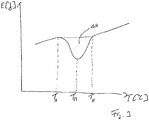
- Fig. 3 a typical DSC curve from a dynamic differential calorimetry measurement of a suitable plant protein concentrate solution is shown. It can be seen that the specific, converted thermal energy is plotted against the temperature in the diagram. The curve shows an endothermic peak, the peak area representing the enthalpy of denaturation ⁇ H of the proteins contained.
- the peak extends over a peak temperature range which ranges from a peak start temperature T A to a peak end temperature T E.
- the peak has a maximum at a peak maximum temperature T M.
- the maximum temperature to which a composition is preferably heated for aggregation is preferably in the range of the peak end temperature T E , in any case above the peak maximum temperature T M.
- a separate representation of a DSC curve from a dynamic differential calorimetry measurement of a composition was dispensed with.
- the above explanations of the endothermic peak and the associated temperatures apply analogously.
- the endothermic peak of the DSC curve of the composition can be shifted on the temperature axis compared to the endothermic peak of the DSC curve of the associated protein concentrate solution, with NaCl addition further to the right.
- protein concentrate solution in particular its NaCL content in connection with the preparation of the composition, for example by adding water, the peak can be shifted further to the left, ie towards lower temperatures.
- the peak temperatures from the DSC curve of the composition are decisive for the selection of the maximum temperature for aggregating the composition.
- a protein concentrate solution based on almond protein is provided. This is preferably characterized by a protein content between 16 and 30% by weight, in particular between 18 and 22% by weight, and by an NaCl content between 0 and 3.3% by weight, preferably between 1.6 and 1.9% by weight.
- the protein concentrate solution is also preferably characterized by a pH between 5.2 and 6.5, in particular 5.4.
- meltted fat especially coconut fat
- aroma is added, for example between 0 and 2% by weight.
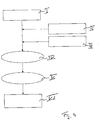
- An emulsification step takes place, in particular for 1 to 3 minutes at preferably 8,000 to 20,000 rpm. Emulsification is very particularly preferably carried out for 2 min at a speed between 15,000 and 20,000 rpm.
- an evacuation step at five for removing gas bubbles and / or destroying the foam formed during the emulsification process, in particular for 2 to 5 minutes, more preferably for 3 minutes.
- the pressure for the evacuation is preferably reduced to 100 to 300 mbar, very particularly preferably to 150 m bar - the evacuation is preferably carried out at a temperature between 20 and 25 ° Celsius.
- VI. obtain a composition in the form of a protein-based almond emulsion, which is preferably characterized by a protein weight fraction between 13 and 24% by weight, preferably between 15 and 17.5% by weight, an NaCl content between 0 and 2.8% by weight %, in particular between 1.3 and 1.6% by weight, an aroma content between 0 and 1.8% by weight and a fat content between 10 and 30% by weight, in particular between 15 and 20% by weight.
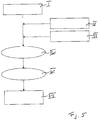
- FIG. 5 An exemplary process of manufacturing a composition based on a mung bean protein concentrate solution is shown. This is provided by I. and is preferably characterized by a protein weight fraction between 16 and 30% by weight, in particular between 18 and 22% by weight, an NaCl content between 0 and 3.3% by weight, in particular between 1.4 and 1.7% by weight and a pH between 5.2 and 6.5, preferably of 5.8.
- Steps II. To V. are then identical to those in connection with Fig. 4 explained.
- the result of the procedure in VI. receive a composition in the form of a protein-based mung bean emulsion, the preferred protein, NaCl, flavor and fat contents according to those from the exemplary embodiment Fig. 4 correspond.
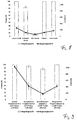
- the strength and breaking strength increase with decreasing water content, at the same time the elasticity decreases. While the young Gouda still has an elasticity of 95%, this drops to 85 and 46% in the middle-aged and old Gouda. Edam and Emmental are both in the same range as young Gouda, namely 95 and 93%.
- the strength and breaking strength of the old Gouda are highest at 70 and 72N respectively, with the water content being the lowest here at 31% by weight.
- the middle-aged Gouda has an almost half as strong structure (strength: 32.7N; breaking strength: 37.9N), with the water content being only 4.5% by weight higher lies.
- the water content of Edamer and Gouda is highest at 45 and 41%, the strengths are therefore lowest at 17.6 and 17.2N, or 27.3 and 29.1N breaking strength.
- the Emmentaler is shortly behind the two, with a strength of 25N and a breaking strength of just under 42N.
- the water content of the aggregated concentrates is around 70% and 73% by weight for almond and mung bean, respectively. In the case of the recipes (see example 2 and example 6), this drops to 55 or 57% by weight (almond or mung bean) due to the addition of fat.
- the strengths and breaking strengths as well as the elasticities can be compared with conventional grades.
- the almond gel without the addition of fat has the highest strength (38N) or breaking strength (65N), and shows a very high elasticity (95%), which is comparable to a young Gouda.
- the breaking strength of the almond sample is 26N, which is in the Edamer range.
- the elasticity remains almost identical, around 95%.
- the Mung bean sample without the addition of fat has a strength that is equivalent to the middle-aged Gouda (32N), with a slightly higher breaking strength of 52N. At 91%, the elasticity is just below an Emmental sample.
- the Mung bean recipe benefits from the added fat in terms of elasticity and reaches a value of almost 96%.
- the strength and breaking strength are 31 and 42N, respectively.
- the aggregated lupine protein concentrate shows significantly poorer values in all areas. The strength and breaking strength are the same, since the sample breaks at a low penetration depth. These values are 0.9N.
- the elasticity of the sample is also extremely low at 27.5%. It can be seen from this that the aggregate of a composition based on lupine protein does not belong to the invention, but only serves as a comparative approach.
- the slices of young Gouda, Edam and Emmental are still intact after a complete compression cycle and therefore have a bending capacity of 100%.
- a force of approx. 125mN is required for a complete compression of the Edamer, whereas Emmentaler requires around 50mN more force on average.
- Young Gouda has the highest flexural strength. Here the value is around 260mN.
- the older and less elastic cheeses of the Middle Ages and old Gouda cannot withstand the bending test.
- the middle-aged Gouda breaks after about 83% of the way.
- the bending strength (corresponds to the force at break) is accordingly lower, namely at 115mN.
- the old Gouda has an extremely poor ability to bend. It breaks after 6.5% of the distance, after a force of just under 52mN.
- the samples without additives (22% by weight protein, almond: 1.6% by weight NaCl, mung. 1.4% by weight NaCl) both have a very high bendability.
- the almond sample shows an analogous behavior to the young Gouda, Edam and Emmentaler, with 100% flexibility.
- the bending strength is comparatively very high, with 1037mN.
- the sample of mung protein concentrate has a bendability of almost 96%, with a bend strength of 424mN.
- 20% by weight of fat is added to the almond protein concentrate (see recipe example 2)
- the bendability drops to 87%, which is equivalent to a structure between a young and a middle-aged Gouda.
- the bending strength drops significantly to 176mN, which is in the area of the Emmental.
Landscapes
- Life Sciences & Earth Sciences (AREA)
- Chemical & Material Sciences (AREA)
- Engineering & Computer Science (AREA)
- Food Science & Technology (AREA)
- Polymers & Plastics (AREA)
- Health & Medical Sciences (AREA)
- Nutrition Science (AREA)
- Biochemistry (AREA)
- Molecular Biology (AREA)
- Agronomy & Crop Science (AREA)
- Botany (AREA)
- Manufacturing & Machinery (AREA)
- Peptides Or Proteins (AREA)
- Jellies, Jams, And Syrups (AREA)
- Seeds, Soups, And Other Foods (AREA)
- General Preparation And Processing Of Foods (AREA)
Priority Applications (7)
| Application Number | Priority Date | Filing Date | Title |
|---|---|---|---|
| PL18204936T PL3649868T3 (pl) | 2018-11-07 | 2018-11-07 | Sposób wytwarzania krajalnej żelowej bryły środka spożywczego z białek roślinnych, żelowa bryła środka spożywczego |
| DK18204936.1T DK3649868T3 (da) | 2018-11-07 | 2018-11-07 | Fremgangsmåde til fremstilling af et skærefast levnedsmiddel-gellegeme af planteproteiner, levnedsmiddel-gellegeme |
| ES18204936T ES2895728T3 (es) | 2018-11-07 | 2018-11-07 | Procedimiento para la producción de un cuerpo de gel alimenticio resistente al corte a partir de proteínas vegetales, así como cuerpo de gel alimenticio |
| EP18204936.1A EP3649868B1 (fr) | 2018-11-07 | 2018-11-07 | Procédé de fabrication d'un corps gélifié de denrée alimentaire de consistance ferme à partir des protéines de plantes, corps gélifié de denrée alimentaire |
| CA3118960A CA3118960C (fr) | 2018-11-07 | 2019-10-31 | Procede pour la fabrication d'un corps gelifie alimentaire resistant a la coupe a partir de proteines vegetales, corps gelifie alimentaire ainsi qu'utilisation d'un agregateur pou r l'execution du procede |
| PCT/EP2019/079868 WO2020094501A1 (fr) | 2018-11-07 | 2019-10-31 | Procédé pour la fabrication d'un corps gélifié alimentaire résistant à la coupe à partir de protéines végétales, corps gélifié alimentaire ainsi qu'utilisation d'un agrégateur pour l'exécution du procédé |
| US17/292,015 US20220256885A1 (en) | 2018-11-07 | 2019-10-31 | Method for producing a firm gel food body made of plant proteins, a gel food body, and use of an aggregator for carrying out the method |
Applications Claiming Priority (1)
| Application Number | Priority Date | Filing Date | Title |
|---|---|---|---|
| EP18204936.1A EP3649868B1 (fr) | 2018-11-07 | 2018-11-07 | Procédé de fabrication d'un corps gélifié de denrée alimentaire de consistance ferme à partir des protéines de plantes, corps gélifié de denrée alimentaire |
Publications (2)
| Publication Number | Publication Date |
|---|---|
| EP3649868A1 true EP3649868A1 (fr) | 2020-05-13 |
| EP3649868B1 EP3649868B1 (fr) | 2021-09-08 |
Family
ID=64401973
Family Applications (1)
| Application Number | Title | Priority Date | Filing Date |
|---|---|---|---|
| EP18204936.1A Active EP3649868B1 (fr) | 2018-11-07 | 2018-11-07 | Procédé de fabrication d'un corps gélifié de denrée alimentaire de consistance ferme à partir des protéines de plantes, corps gélifié de denrée alimentaire |
Country Status (7)
| Country | Link |
|---|---|
| US (1) | US20220256885A1 (fr) |
| EP (1) | EP3649868B1 (fr) |
| CA (1) | CA3118960C (fr) |
| DK (1) | DK3649868T3 (fr) |
| ES (1) | ES2895728T3 (fr) |
| PL (1) | PL3649868T3 (fr) |
| WO (1) | WO2020094501A1 (fr) |
Citations (10)
| Publication number | Priority date | Publication date | Assignee | Title |
|---|---|---|---|---|
| GB1300711A (en) * | 1970-05-25 | 1972-12-20 | Ralston Purina Co | Proteinaceous food product |
| GB1318596A (en) | 1970-10-09 | 1973-05-31 | Unilever Ltd | Extraction of protein from seed |
| GB2016255A (en) * | 1978-03-06 | 1979-09-26 | Miles Lab | Process for preparing cheese analogs |
| US5225233A (en) * | 1990-05-08 | 1993-07-06 | Otsuka Foods Co., Ltd. | Process for the production of food materials |
| CH684923A5 (de) * | 1993-01-20 | 1995-02-15 | Bechtiger Edelstahl | Käsepressform. |
| DE102014005466A1 (de) | 2014-04-12 | 2015-10-15 | Klaus Düring | Verfahren zur Gewinnung von Napin und Cruciferin oder einem Gemisch davon aus Raps |
| EP2984936A1 (fr) | 2014-08-07 | 2016-02-17 | Fuji Oil Company, Limited | Composition gélifiée de la protéine du haricot mungo et aliment de type fromage |
| US20160309762A1 (en) | 2014-12-01 | 2016-10-27 | The Governors Of The University Of Alberta | Oat protein gels |
| US20170105438A1 (en) * | 2015-10-20 | 2017-04-20 | SAVAGE RIVER, INC. dba BEYOND MEAT | Meat-like food products |
| US20170238590A1 (en) | 2016-02-19 | 2017-08-24 | Hampton Creek, Inc. | Functional mung bean-derived compositions |
-
2018
- 2018-11-07 PL PL18204936T patent/PL3649868T3/pl unknown
- 2018-11-07 DK DK18204936.1T patent/DK3649868T3/da active
- 2018-11-07 EP EP18204936.1A patent/EP3649868B1/fr active Active
- 2018-11-07 ES ES18204936T patent/ES2895728T3/es active Active
-
2019
- 2019-10-31 WO PCT/EP2019/079868 patent/WO2020094501A1/fr not_active Ceased
- 2019-10-31 US US17/292,015 patent/US20220256885A1/en not_active Abandoned
- 2019-10-31 CA CA3118960A patent/CA3118960C/fr active Active
Patent Citations (10)
| Publication number | Priority date | Publication date | Assignee | Title |
|---|---|---|---|---|
| GB1300711A (en) * | 1970-05-25 | 1972-12-20 | Ralston Purina Co | Proteinaceous food product |
| GB1318596A (en) | 1970-10-09 | 1973-05-31 | Unilever Ltd | Extraction of protein from seed |
| GB2016255A (en) * | 1978-03-06 | 1979-09-26 | Miles Lab | Process for preparing cheese analogs |
| US5225233A (en) * | 1990-05-08 | 1993-07-06 | Otsuka Foods Co., Ltd. | Process for the production of food materials |
| CH684923A5 (de) * | 1993-01-20 | 1995-02-15 | Bechtiger Edelstahl | Käsepressform. |
| DE102014005466A1 (de) | 2014-04-12 | 2015-10-15 | Klaus Düring | Verfahren zur Gewinnung von Napin und Cruciferin oder einem Gemisch davon aus Raps |
| EP2984936A1 (fr) | 2014-08-07 | 2016-02-17 | Fuji Oil Company, Limited | Composition gélifiée de la protéine du haricot mungo et aliment de type fromage |
| US20160309762A1 (en) | 2014-12-01 | 2016-10-27 | The Governors Of The University Of Alberta | Oat protein gels |
| US20170105438A1 (en) * | 2015-10-20 | 2017-04-20 | SAVAGE RIVER, INC. dba BEYOND MEAT | Meat-like food products |
| US20170238590A1 (en) | 2016-02-19 | 2017-08-24 | Hampton Creek, Inc. | Functional mung bean-derived compositions |
Non-Patent Citations (2)
| Title |
|---|
| BAINY EDUARDA M ET AL: "Assessment of the effects of soy protein isolates with different protein compositions on gluten thermosetting gelation", FOOD RESEARCH INTERNATIONAL, vol. 43, no. 6, July 2010 (2010-07-01), pages 1684 - 1691, XP002790567, ISSN: 0963-9969 * |
| JEREZ ET AL: "Egg white-based bioplastics developed by thermomechanical processing", JOURNAL OF FOOD ENGINEERING, BARKING, ESSEX, GB, vol. 82, no. 4, 14 May 2007 (2007-05-14), pages 608 - 617, XP022077937, ISSN: 0260-8774, DOI: 10.1016/J.JFOODENG.2007.03.020 * |
Also Published As
| Publication number | Publication date |
|---|---|
| CA3118960A1 (fr) | 2020-05-14 |
| ES2895728T3 (es) | 2022-02-22 |
| US20220256885A1 (en) | 2022-08-18 |
| PL3649868T3 (pl) | 2022-01-31 |
| CA3118960C (fr) | 2023-09-26 |
| DK3649868T3 (da) | 2021-12-06 |
| WO2020094501A1 (fr) | 2020-05-14 |
| EP3649868B1 (fr) | 2021-09-08 |
Similar Documents
| Publication | Publication Date | Title |
|---|---|---|
| AT518771B1 (de) | Verfahren zur Herstellung von Fleischersatz- bzw. Fleischimitatprodukten | |
| EP2086344B1 (fr) | Procédé d'obtention de fractions protéiques de légumineuse d'un poids moléculaire moyen | |
| DE69214723T2 (de) | Verfahren zur Herstellung von Proteinkörnchen geeignet zur Fleischstreckung | |
| EP2303033A2 (fr) | Particules de matière collagénique et procédé de fabrication | |
| DE2557782C3 (de) | Wärmekoagulierbares viskoses Proteinprodukt, Verfahren zu seiner Herstellung und seine Verwendung | |
| EP3620059B1 (fr) | Procédé de fabrication d'une matière particulaire de denrée alimentaire, de préférence végane,à base de farine d'amandes | |
| DE69807514T2 (de) | Verwendung von mikrofibrillierter cellulose in trockener form in lebensmitteln | |
| DE2527118A1 (de) | Verfahren zur herstellung von texturiertem proteinmaterial | |
| DE2353126A1 (de) | Verfahren zur herstellung eines poroesen expandierten nahrungsmittels mit einem fleischaroma | |
| EP2112888B1 (fr) | Préparation aqueuse à base de protéines végétales et procédé de production | |
| EP3649868B1 (fr) | Procédé de fabrication d'un corps gélifié de denrée alimentaire de consistance ferme à partir des protéines de plantes, corps gélifié de denrée alimentaire | |
| DE2837513C2 (de) | Verfahren zur Herstellung eines texturierten proteinischen Nahrungsmittelprodukts | |
| DE60215529T2 (de) | Tofupüree-haltige saure getränke | |
| DE102010017210A1 (de) | Verfahren zur Herstellung von Pulver, Pulver und Adsorptionsvorrichtung | |
| DE2849129A1 (de) | Verfahren zur herstellung texturierter oelsaatproteinprodukte bzw. zur konzentration einer oelsaatmilch und danach hergestellte produkte | |
| EP4192260A1 (fr) | Composition de fibres végétales contenant de la pectine pour boissons protéinées à base végétale | |
| RU2778570C1 (ru) | Способ получения режущегося желеобразного пищевого продукта из растительных белков, желеобразный пищевой продукт, а также применение устройства агрегирования для осуществления способа | |
| EP4543214B1 (fr) | Procédé de production d'un produit alimentaire végan de substitution de la mozzarella ayant une texture fibreuse, et produit alimentaire végan de substitution de la mozzarella | |
| EP1611793A1 (fr) | Fromage frais en tranches et procédé de préparation de tranches de fromage frais | |
| DE4119808C2 (de) | Verfahren zur Verstärkung einiger funktioneller Eigenschaften von Protein-Material | |
| EP4223128A1 (fr) | Utilisation d'une fibre de fruit désestérifiée activable et déestérifiée pour la préparation de moûts ou de produits de substitution de viande sans addition de phosphate | |
| DE102021111185A1 (de) | Verwendung eines Gemisches aus Fruchtfaser und niederverestertem Pektin zur Herstellung eines Nahrungs- oder Futtermittels | |
| KR102707440B1 (ko) | 대체 지방 조직의 제조방법 및 이에 따라 제조된 대체 지방 조직 | |
| EP4491031A1 (fr) | Composition alimentaire lipidique mise en forme | |
| DE102022128750A1 (de) | Verfahren zur Herstellung einer zum Verzehr geeigneten Paste |
Legal Events
| Date | Code | Title | Description |
|---|---|---|---|
| PUAI | Public reference made under article 153(3) epc to a published international application that has entered the european phase |
Free format text: ORIGINAL CODE: 0009012 |
|
| STAA | Information on the status of an ep patent application or granted ep patent |
Free format text: STATUS: THE APPLICATION HAS BEEN PUBLISHED |
|
| STAA | Information on the status of an ep patent application or granted ep patent |
Free format text: STATUS: REQUEST FOR EXAMINATION WAS MADE |
|
| AK | Designated contracting states |
Kind code of ref document: A1 Designated state(s): AL AT BE BG CH CY CZ DE DK EE ES FI FR GB GR HR HU IE IS IT LI LT LU LV MC MK MT NL NO PL PT RO RS SE SI SK SM TR |
|
| AX | Request for extension of the european patent |
Extension state: BA ME |
|
| 17P | Request for examination filed |
Effective date: 20200423 |
|
| RBV | Designated contracting states (corrected) |
Designated state(s): AL AT BE BG CH CY CZ DE DK EE ES FI FR GB GR HR HU IE IS IT LI LT LU LV MC MK MT NL NO PL PT RO RS SE SI SK SM TR |
|
| STAA | Information on the status of an ep patent application or granted ep patent |
Free format text: STATUS: EXAMINATION IS IN PROGRESS |
|
| 17Q | First examination report despatched |
Effective date: 20200715 |
|
| GRAP | Despatch of communication of intention to grant a patent |
Free format text: ORIGINAL CODE: EPIDOSNIGR1 |
|
| STAA | Information on the status of an ep patent application or granted ep patent |
Free format text: STATUS: GRANT OF PATENT IS INTENDED |
|
| INTG | Intention to grant announced |
Effective date: 20210416 |
|
| GRAS | Grant fee paid |
Free format text: ORIGINAL CODE: EPIDOSNIGR3 |
|
| GRAA | (expected) grant |
Free format text: ORIGINAL CODE: 0009210 |
|
| STAA | Information on the status of an ep patent application or granted ep patent |
Free format text: STATUS: THE PATENT HAS BEEN GRANTED |
|
| AK | Designated contracting states |
Kind code of ref document: B1 Designated state(s): AL AT BE BG CH CY CZ DE DK EE ES FI FR GB GR HR HU IE IS IT LI LT LU LV MC MK MT NL NO PL PT RO RS SE SI SK SM TR |
|
| REG | Reference to a national code |
Ref country code: GB Ref legal event code: FG4D Free format text: NOT ENGLISH |
|
| REG | Reference to a national code |
Ref country code: AT Ref legal event code: REF Ref document number: 1427709 Country of ref document: AT Kind code of ref document: T Effective date: 20210915 Ref country code: CH Ref legal event code: EP |
|
| REG | Reference to a national code |
Ref country code: IE Ref legal event code: FG4D Free format text: LANGUAGE OF EP DOCUMENT: GERMAN |
|
| REG | Reference to a national code |
Ref country code: DE Ref legal event code: R096 Ref document number: 502018006947 Country of ref document: DE |
|
| REG | Reference to a national code |
Ref country code: CH Ref legal event code: PK Free format text: BERICHTIGUNGEN |
|
| REG | Reference to a national code |
Ref country code: DK Ref legal event code: T3 Effective date: 20211203 |
|
| REG | Reference to a national code |
Ref country code: NL Ref legal event code: FP |
|
| REG | Reference to a national code |
Ref country code: FI Ref legal event code: FGE |
|
| REG | Reference to a national code |
Ref country code: SE Ref legal event code: TRGR |
|
| REG | Reference to a national code |
Ref country code: LT Ref legal event code: MG9D |
|
| PG25 | Lapsed in a contracting state [announced via postgrant information from national office to epo] |
Ref country code: RS Free format text: LAPSE BECAUSE OF FAILURE TO SUBMIT A TRANSLATION OF THE DESCRIPTION OR TO PAY THE FEE WITHIN THE PRESCRIBED TIME-LIMIT Effective date: 20210908 Ref country code: HR Free format text: LAPSE BECAUSE OF FAILURE TO SUBMIT A TRANSLATION OF THE DESCRIPTION OR TO PAY THE FEE WITHIN THE PRESCRIBED TIME-LIMIT Effective date: 20210908 Ref country code: LT Free format text: LAPSE BECAUSE OF FAILURE TO SUBMIT A TRANSLATION OF THE DESCRIPTION OR TO PAY THE FEE WITHIN THE PRESCRIBED TIME-LIMIT Effective date: 20210908 Ref country code: BG Free format text: LAPSE BECAUSE OF FAILURE TO SUBMIT A TRANSLATION OF THE DESCRIPTION OR TO PAY THE FEE WITHIN THE PRESCRIBED TIME-LIMIT Effective date: 20211208 |
|
| PGFP | Annual fee paid to national office [announced via postgrant information from national office to epo] |
Ref country code: NO Payment date: 20211119 Year of fee payment: 4 |
|
| REG | Reference to a national code |
Ref country code: NO Ref legal event code: T2 Effective date: 20210908 |
|
| REG | Reference to a national code |
Ref country code: ES Ref legal event code: FG2A Ref document number: 2895728 Country of ref document: ES Kind code of ref document: T3 Effective date: 20220222 |
|
| PG25 | Lapsed in a contracting state [announced via postgrant information from national office to epo] |
Ref country code: LV Free format text: LAPSE BECAUSE OF FAILURE TO SUBMIT A TRANSLATION OF THE DESCRIPTION OR TO PAY THE FEE WITHIN THE PRESCRIBED TIME-LIMIT Effective date: 20210908 Ref country code: GR Free format text: LAPSE BECAUSE OF FAILURE TO SUBMIT A TRANSLATION OF THE DESCRIPTION OR TO PAY THE FEE WITHIN THE PRESCRIBED TIME-LIMIT Effective date: 20211209 |
|
| PG25 | Lapsed in a contracting state [announced via postgrant information from national office to epo] |
Ref country code: IS Free format text: LAPSE BECAUSE OF FAILURE TO SUBMIT A TRANSLATION OF THE DESCRIPTION OR TO PAY THE FEE WITHIN THE PRESCRIBED TIME-LIMIT Effective date: 20220108 Ref country code: SM Free format text: LAPSE BECAUSE OF FAILURE TO SUBMIT A TRANSLATION OF THE DESCRIPTION OR TO PAY THE FEE WITHIN THE PRESCRIBED TIME-LIMIT Effective date: 20210908 Ref country code: SK Free format text: LAPSE BECAUSE OF FAILURE TO SUBMIT A TRANSLATION OF THE DESCRIPTION OR TO PAY THE FEE WITHIN THE PRESCRIBED TIME-LIMIT Effective date: 20210908 Ref country code: PT Free format text: LAPSE BECAUSE OF FAILURE TO SUBMIT A TRANSLATION OF THE DESCRIPTION OR TO PAY THE FEE WITHIN THE PRESCRIBED TIME-LIMIT Effective date: 20220110 Ref country code: EE Free format text: LAPSE BECAUSE OF FAILURE TO SUBMIT A TRANSLATION OF THE DESCRIPTION OR TO PAY THE FEE WITHIN THE PRESCRIBED TIME-LIMIT Effective date: 20210908 Ref country code: CZ Free format text: LAPSE BECAUSE OF FAILURE TO SUBMIT A TRANSLATION OF THE DESCRIPTION OR TO PAY THE FEE WITHIN THE PRESCRIBED TIME-LIMIT Effective date: 20210908 Ref country code: AL Free format text: LAPSE BECAUSE OF FAILURE TO SUBMIT A TRANSLATION OF THE DESCRIPTION OR TO PAY THE FEE WITHIN THE PRESCRIBED TIME-LIMIT Effective date: 20210908 |
|
| REG | Reference to a national code |
Ref country code: DE Ref legal event code: R097 Ref document number: 502018006947 Country of ref document: DE |
|
| PG25 | Lapsed in a contracting state [announced via postgrant information from national office to epo] |
Ref country code: MC Free format text: LAPSE BECAUSE OF FAILURE TO SUBMIT A TRANSLATION OF THE DESCRIPTION OR TO PAY THE FEE WITHIN THE PRESCRIBED TIME-LIMIT Effective date: 20210908 |
|
| PLBE | No opposition filed within time limit |
Free format text: ORIGINAL CODE: 0009261 |
|
| STAA | Information on the status of an ep patent application or granted ep patent |
Free format text: STATUS: NO OPPOSITION FILED WITHIN TIME LIMIT |
|
| 26N | No opposition filed |
Effective date: 20220609 |
|
| PG25 | Lapsed in a contracting state [announced via postgrant information from national office to epo] |
Ref country code: SI Free format text: LAPSE BECAUSE OF FAILURE TO SUBMIT A TRANSLATION OF THE DESCRIPTION OR TO PAY THE FEE WITHIN THE PRESCRIBED TIME-LIMIT Effective date: 20210908 |
|
| PG25 | Lapsed in a contracting state [announced via postgrant information from national office to epo] |
Ref country code: IT Free format text: LAPSE BECAUSE OF FAILURE TO SUBMIT A TRANSLATION OF THE DESCRIPTION OR TO PAY THE FEE WITHIN THE PRESCRIBED TIME-LIMIT Effective date: 20210908 |
|
| REG | Reference to a national code |
Ref country code: NO Ref legal event code: MMEP |
|
| PG25 | Lapsed in a contracting state [announced via postgrant information from national office to epo] |
Ref country code: CY Free format text: LAPSE BECAUSE OF FAILURE TO SUBMIT A TRANSLATION OF THE DESCRIPTION OR TO PAY THE FEE WITHIN THE PRESCRIBED TIME-LIMIT Effective date: 20210908 |
|
| P01 | Opt-out of the competence of the unified patent court (upc) registered |
Effective date: 20230601 |
|
| PG25 | Lapsed in a contracting state [announced via postgrant information from national office to epo] |
Ref country code: NO Free format text: LAPSE BECAUSE OF NON-PAYMENT OF DUE FEES Effective date: 20221130 Ref country code: HU Free format text: LAPSE BECAUSE OF FAILURE TO SUBMIT A TRANSLATION OF THE DESCRIPTION OR TO PAY THE FEE WITHIN THE PRESCRIBED TIME-LIMIT; INVALID AB INITIO Effective date: 20181107 |
|
| PGFP | Annual fee paid to national office [announced via postgrant information from national office to epo] |
Ref country code: LU Payment date: 20231120 Year of fee payment: 6 |
|
| PGFP | Annual fee paid to national office [announced via postgrant information from national office to epo] |
Ref country code: FI Payment date: 20231120 Year of fee payment: 6 |
|
| PGFP | Annual fee paid to national office [announced via postgrant information from national office to epo] |
Ref country code: BE Payment date: 20231121 Year of fee payment: 6 |
|
| PG25 | Lapsed in a contracting state [announced via postgrant information from national office to epo] |
Ref country code: MK Free format text: LAPSE BECAUSE OF FAILURE TO SUBMIT A TRANSLATION OF THE DESCRIPTION OR TO PAY THE FEE WITHIN THE PRESCRIBED TIME-LIMIT Effective date: 20210908 |
|
| PG25 | Lapsed in a contracting state [announced via postgrant information from national office to epo] |
Ref country code: TR Free format text: LAPSE BECAUSE OF FAILURE TO SUBMIT A TRANSLATION OF THE DESCRIPTION OR TO PAY THE FEE WITHIN THE PRESCRIBED TIME-LIMIT Effective date: 20210908 |
|
| PG25 | Lapsed in a contracting state [announced via postgrant information from national office to epo] |
Ref country code: MT Free format text: LAPSE BECAUSE OF FAILURE TO SUBMIT A TRANSLATION OF THE DESCRIPTION OR TO PAY THE FEE WITHIN THE PRESCRIBED TIME-LIMIT Effective date: 20210908 |
|
| PGFP | Annual fee paid to national office [announced via postgrant information from national office to epo] |
Ref country code: DK Payment date: 20241120 Year of fee payment: 7 |
|
| PGFP | Annual fee paid to national office [announced via postgrant information from national office to epo] |
Ref country code: GB Payment date: 20241121 Year of fee payment: 7 |
|
| PGFP | Annual fee paid to national office [announced via postgrant information from national office to epo] |
Ref country code: FR Payment date: 20241122 Year of fee payment: 7 |
|
| PGFP | Annual fee paid to national office [announced via postgrant information from national office to epo] |
Ref country code: IE Payment date: 20241120 Year of fee payment: 7 |
|
| PGFP | Annual fee paid to national office [announced via postgrant information from national office to epo] |
Ref country code: ES Payment date: 20241213 Year of fee payment: 7 |
|
| PGFP | Annual fee paid to national office [announced via postgrant information from national office to epo] |
Ref country code: SE Payment date: 20241120 Year of fee payment: 7 |
|
| PG25 | Lapsed in a contracting state [announced via postgrant information from national office to epo] |
Ref country code: FI Free format text: LAPSE BECAUSE OF NON-PAYMENT OF DUE FEES Effective date: 20241107 |
|
| PG25 | Lapsed in a contracting state [announced via postgrant information from national office to epo] |
Ref country code: LU Free format text: LAPSE BECAUSE OF NON-PAYMENT OF DUE FEES Effective date: 20241107 |
|
| REG | Reference to a national code |
Ref country code: BE Ref legal event code: MM Effective date: 20241130 |
|
| PG25 | Lapsed in a contracting state [announced via postgrant information from national office to epo] |
Ref country code: BE Free format text: LAPSE BECAUSE OF NON-PAYMENT OF DUE FEES Effective date: 20241130 |
|
| REG | Reference to a national code |
Ref country code: CH Ref legal event code: U11 Free format text: ST27 STATUS EVENT CODE: U-0-0-U10-U11 (AS PROVIDED BY THE NATIONAL OFFICE) Effective date: 20251201 |
|
| PGFP | Annual fee paid to national office [announced via postgrant information from national office to epo] |
Ref country code: NL Payment date: 20251119 Year of fee payment: 8 |
|
| PGFP | Annual fee paid to national office [announced via postgrant information from national office to epo] |
Ref country code: DE Payment date: 20251124 Year of fee payment: 8 |
|
| PGFP | Annual fee paid to national office [announced via postgrant information from national office to epo] |
Ref country code: AT Payment date: 20251117 Year of fee payment: 8 |
|
| PGFP | Annual fee paid to national office [announced via postgrant information from national office to epo] |
Ref country code: CH Payment date: 20251201 Year of fee payment: 8 |
|
| PGFP | Annual fee paid to national office [announced via postgrant information from national office to epo] |
Ref country code: PL Payment date: 20251027 Year of fee payment: 8 |
|
| PGFP | Annual fee paid to national office [announced via postgrant information from national office to epo] |
Ref country code: RO Payment date: 20251030 Year of fee payment: 8 |
|
| REG | Reference to a national code |
Ref country code: DK Ref legal event code: EBP Effective date: 20251130 |
|
| PG25 | Lapsed in a contracting state [announced via postgrant information from national office to epo] |
Ref country code: SE Free format text: LAPSE BECAUSE OF NON-PAYMENT OF DUE FEES Effective date: 20251108 |