EP3645139B1 - Periodische gegenstromchromatographietrennung von plasmiden - Google Patents
Periodische gegenstromchromatographietrennung von plasmiden Download PDFInfo
- Publication number
- EP3645139B1 EP3645139B1 EP18711827.8A EP18711827A EP3645139B1 EP 3645139 B1 EP3645139 B1 EP 3645139B1 EP 18711827 A EP18711827 A EP 18711827A EP 3645139 B1 EP3645139 B1 EP 3645139B1
- Authority
- EP
- European Patent Office
- Prior art keywords
- chromatography column
- eluent
- conveying
- plasmid
- chromatography
- Prior art date
- Legal status (The legal status is an assumption and is not a legal conclusion. Google has not performed a legal analysis and makes no representation as to the accuracy of the status listed.)
- Active
Links
Images




Classifications
-
- G—PHYSICS
- G01—MEASURING; TESTING
- G01N—INVESTIGATING OR ANALYSING MATERIALS BY DETERMINING THEIR CHEMICAL OR PHYSICAL PROPERTIES
- G01N30/00—Investigating or analysing materials by separation into components using adsorption, absorption or similar phenomena or using ion-exchange, e.g. chromatography or field flow fractionation
- G01N30/02—Column chromatography
- G01N30/26—Conditioning of the fluid carrier; Flow patterns
- G01N30/38—Flow patterns
- G01N30/42—Flow patterns using counter-current
-
- B—PERFORMING OPERATIONS; TRANSPORTING
- B01—PHYSICAL OR CHEMICAL PROCESSES OR APPARATUS IN GENERAL
- B01D—SEPARATION
- B01D15/00—Separating processes involving the treatment of liquids with solid sorbents; Apparatus therefor
- B01D15/08—Selective adsorption, e.g. chromatography
- B01D15/10—Selective adsorption, e.g. chromatography characterised by constructional or operational features
- B01D15/18—Selective adsorption, e.g. chromatography characterised by constructional or operational features relating to flow patterns
- B01D15/1864—Selective adsorption, e.g. chromatography characterised by constructional or operational features relating to flow patterns using two or more columns
- B01D15/1885—Selective adsorption, e.g. chromatography characterised by constructional or operational features relating to flow patterns using two or more columns placed in parallel
-
- B—PERFORMING OPERATIONS; TRANSPORTING
- B01—PHYSICAL OR CHEMICAL PROCESSES OR APPARATUS IN GENERAL
- B01D—SEPARATION
- B01D15/00—Separating processes involving the treatment of liquids with solid sorbents; Apparatus therefor
- B01D15/08—Selective adsorption, e.g. chromatography
- B01D15/10—Selective adsorption, e.g. chromatography characterised by constructional or operational features
- B01D15/18—Selective adsorption, e.g. chromatography characterised by constructional or operational features relating to flow patterns
- B01D15/1864—Selective adsorption, e.g. chromatography characterised by constructional or operational features relating to flow patterns using two or more columns
-
- B—PERFORMING OPERATIONS; TRANSPORTING
- B01—PHYSICAL OR CHEMICAL PROCESSES OR APPARATUS IN GENERAL
- B01D—SEPARATION
- B01D15/00—Separating processes involving the treatment of liquids with solid sorbents; Apparatus therefor
- B01D15/08—Selective adsorption, e.g. chromatography
- B01D15/26—Selective adsorption, e.g. chromatography characterised by the separation mechanism
- B01D15/34—Size-selective separation, e.g. size-exclusion chromatography; Gel filtration; Permeation
-
- G—PHYSICS
- G01—MEASURING; TESTING
- G01N—INVESTIGATING OR ANALYSING MATERIALS BY DETERMINING THEIR CHEMICAL OR PHYSICAL PROPERTIES
- G01N30/00—Investigating or analysing materials by separation into components using adsorption, absorption or similar phenomena or using ion-exchange, e.g. chromatography or field flow fractionation
- G01N30/02—Column chromatography
- G01N30/88—Integrated analysis systems specially adapted therefor, not covered by a single one of the groups G01N30/04 - G01N30/86
-
- B—PERFORMING OPERATIONS; TRANSPORTING
- B01—PHYSICAL OR CHEMICAL PROCESSES OR APPARATUS IN GENERAL
- B01D—SEPARATION
- B01D15/00—Separating processes involving the treatment of liquids with solid sorbents; Apparatus therefor
- B01D15/08—Selective adsorption, e.g. chromatography
- B01D15/10—Selective adsorption, e.g. chromatography characterised by constructional or operational features
- B01D15/18—Selective adsorption, e.g. chromatography characterised by constructional or operational features relating to flow patterns
- B01D15/1814—Recycling of the fraction to be distributed
- B01D15/1821—Simulated moving beds
-
- C—CHEMISTRY; METALLURGY
- C07—ORGANIC CHEMISTRY
- C07K—PEPTIDES
- C07K1/00—General methods for the preparation of peptides, i.e. processes for the organic chemical preparation of peptides or proteins of any length
- C07K1/14—Extraction; Separation; Purification
- C07K1/16—Extraction; Separation; Purification by chromatography
-
- G—PHYSICS
- G01—MEASURING; TESTING
- G01N—INVESTIGATING OR ANALYSING MATERIALS BY DETERMINING THEIR CHEMICAL OR PHYSICAL PROPERTIES
- G01N30/00—Investigating or analysing materials by separation into components using adsorption, absorption or similar phenomena or using ion-exchange, e.g. chromatography or field flow fractionation
- G01N30/02—Column chromatography
- G01N30/50—Conditioning of the sorbent material or stationary liquid
- G01N30/58—Conditioning of the sorbent material or stationary liquid the sorbent moving as a whole
- G01N2030/587—Continuous annular chromatography
-
- G—PHYSICS
- G01—MEASURING; TESTING
- G01N—INVESTIGATING OR ANALYSING MATERIALS BY DETERMINING THEIR CHEMICAL OR PHYSICAL PROPERTIES
- G01N30/00—Investigating or analysing materials by separation into components using adsorption, absorption or similar phenomena or using ion-exchange, e.g. chromatography or field flow fractionation
- G01N30/02—Column chromatography
- G01N30/88—Integrated analysis systems specially adapted therefor, not covered by a single one of the groups G01N30/04 - G01N30/86
- G01N2030/8809—Integrated analysis systems specially adapted therefor, not covered by a single one of the groups G01N30/04 - G01N30/86 analysis specially adapted for the sample
- G01N2030/8813—Integrated analysis systems specially adapted therefor, not covered by a single one of the groups G01N30/04 - G01N30/86 analysis specially adapted for the sample biological materials
- G01N2030/8836—Integrated analysis systems specially adapted therefor, not covered by a single one of the groups G01N30/04 - G01N30/86 analysis specially adapted for the sample biological materials involving saccharides
Definitions
- the present invention relates to separation processes in the manufacturing of biopharmaceuticals, and more particularly to a separation process useful for separation of large species such as plasmids, virus particles etc.
- Multicolumn continuous chromatography processes are available, where the feed is applied to a first column and is then diverted to one or more subsequent columns as the first columns approaches saturation and the first column is eluted and regenerated to be loaded again during elution and regeneration of the subsequent column(s).
- Such processes can be denoted periodic countercurrent chromatography (PCC) or simulated moving bed (SMB) and are of considerable interest for separation of biopharmaceuticals, see e.g. US7901581 , US20130248451 , US20130280788 and US7220356 .
- PCC/SMB processes can significantly increase the productivity, but the increases achieved can depend quite strongly on the design of the process.
- Plasmids are of interest in the biopharmaceutical area primarily as vectors for gene therapies and certain cell therapies (e.g. for preparing CAR-T cells) but also in vaccine technology.
- the plasmids are large ring-shaped DNA molecules of bacterial origin, which present particular issues in chromatographic processes as their size prevents them from entering the pores of most chromatography media.
- a common first step in plasmid purification is a so-called group separation, where the plasmid preparation is applied to a gel filtration resin and the plasmid is recovered in the void fraction or a slightly retained fraction, while RNA, a major contaminant, enters the pores of the resin and is significantly retained. As with other gel filtration processes, this is a slow process with limited loading capacity and it would be highly interesting to speed it up by applying continuous processing.
- One aspect of the invention is to provide an efficient method for continuously separating a plasmid or e.g. a virus particle or other large species. This is achieved with a method of applying a process feed containing a plasmid/virus particle or other large species to an apparatus with at least three chromatography columns packed with separation matrix particles, wherein while one chromatography column is loaded with the process feed, another chromatography column is eluted with an eluent to recover the separated plasmid, and yet another chromatography column is eluted with a further eluent to remove contaminants.
- the present invention discloses a method of continuous separation of a plasmid from a process feed comprising a plasmid in an apparatus with at least three chromatography columns.
- the method can also be used for other separations of large species, e.g. viruses, virus-like particles, antigen conjugates etc., from lower molecular-weight contaminants.
- the columns are packed with separation matrix particles, and while one chromatography column is loaded with the process feed, another chromatography column is eluted with an eluent to recover the separated plasmid, and yet another chromatography column is eluted with a further eluent (which can be the same eluent as used for eluting the plasmid) to remove contaminants such as RNA. It can be advantageous if the flow rates in the different steps are matched, so that no standstill is required in any step to wait for another step to finish.
- the method may in some embodiments, as illustrated by Fig. 3 , comprise the steps of:
- steps a)-c) may repeated for the duration of the continuous process, e.g. until the entire process feed has been processed.
- step a) may further comprise conveying a further eluent through the second chromatography column while conveying an eluent through the third chromatography column and recovering the eluent with the plasmid after passage of the third chromatography column; and step b) may further comprise conveying a further eluent through the third chromatography column.
- a process feed or eluent is conveyed through all three columns throughout all of steps a)-c), i.e. no flows are stopped to wait for another column/step to finish.
- the method comprises the steps of:
- steps a)-d) may be repeated for the duration of the continuous process, e.g. until the entire process feed has been processed.
- step a) may further comprise conveying a further eluent through the third chromatography column and conveying an eluent through the fourth chromatography column while recovering the eluent with the plasmid after passage of the fourth chromatography column; and step b) may further comprises conveying a further eluent through the fourth chromatography column.
- a process feed or eluent is conveyed through all three columns throughout all of steps a)-d), i.e. no flows are stopped to wait for another column/step to finish.
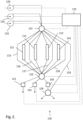
- the method can e.g. be carried out in a chromatography system 10 as illustrated in Fig. 1 .
- a chromatography system 10 as illustrated in Fig. 1 .
- Such a system comprises a plurality of chromatography columns 11,12,13 (three columns are shown in Fig. 1 but four or more columns are equally possible).
- the system can suitably be arranged for performing continuous chromatography.
- the columns may be packed with the same separation matrix and connected with one or more connecting lines 14,15,16 such that liquid can flow from one column 11 , 12 to a subsequent one 12 , 13 and from a last column 13 to a first column 11 and each connecting line between two columns may comprise at least one on/off valve 17 , 18 , 19 , which may be three-way or four-way valves.
- valves in conjunction with valves/valve blocks 23 , 25 , 29 also allow parallel operations of the columns, e.g. elution of one or more columns simultaneously with the loading of one or more other columns.
- the system may further comprise a feed pump 20 , e.g. connected via a first detector 21 to a first valve block 22 and one or more buffer pumps 34 , 35 , e.g. connected to valve block 22 .
- the first valve block 22 can further be connected to the inlet of a first column 11 via a first valve 23 .
- An outlet end of the first column 11 may be connected to a second valve 17 through a second detector 24 .
- the first valve block 22 can further be connected to the inlet of a second column 12 via a second valve or valve block 25 .
- An outlet end of the second column 12 can be connected to valve 18 via a third detector 26 .
- a valve 27 can be connected between valve 17 and valve 18 .
- Valve 27 can also be connected to a valve 28 which is also connected to valve 23 and the second valve block 25 .
- the effluent from the first column 11 can be directed to the inlet of the second column 12 through connecting line 14 , valves 17 , 27 , 28 and 25 .
- the first valve block 22 can be connected to the inlet of a third column 13 via valve 29 .
- An outlet end of the third column 13 may be connected to valve 19 via a fourth detector 30 .
- valve 31 can be connected between valve 18 and valve 19 .
- Valve 31 can also be connected to valve 32 which may also be connected to the second valve block 25 and valve 29 .
- the effluent from the second column 12 can be directed to the inlet of the third column 13 through connecting line 15 .
- the effluent from the third column 13 can be directed to the inlet of the first column 11 through connecting line 16 via valves 19 and 23 (alternatively it can be directed to a subsequent fourth column).
- the first, second, third and fourth detectors 21 , 24 , 26 , 30 may all be connected to a determining unit 37 .
- the determining unit can be adapted to use the detected signals from the detectors to determine breakthrough and saturation points for the three different columns.
- the determining unit 37 and all the valve blocks, valves and pumps may further be connected to a control unit 33 (all the connections are not shown in Fig. 1 ) which is adapted to control the chromatography system in terms of when to remove or add columns from/into the loading zone, change flow rates, start new elution steps, etc.
- the detectors 21 , 24 , 26 , 30 can e.g. be UV detectors.
- the control unit 33 may be configured to control the system according to breakthrough data obtained from the determining unit 37 . Alternatively, control unit 33 can use fixed predetermined step times for the switching operations.
- Fig. 2 illustrates an alternative chromatography system 110 for carrying out the method of the invention.
- the system comprises a plurality of chromatography columns (e.g. three or four columns) 111 , 112 , 113 , 114 , which may be packed with the same separation matrix.
- the columns are independently connectable to a feed pump 120 , buffer pumps 134 , 135 and/or connecting lines 115 , 116 , 117 , 118 , 119 via a multifunctional first valve block 122 . They are also independently connectable to the connecting lines and to the detectors 121 , 124 , 126 via multifunctional second valve block 125 .
- Valve blocks 122 and 125 allow the parallel coupling of several different flowpaths within the blocks (see e.g.
- WO2015094095 or WO2015094096 for useful designs of valves/valve blocks). They can also be used to connect one or more of the pumps with one or more of the connecting lines for bypassing or backflushing one or more of the columns.
- a further valve or valve block 129 allows the direction of a flow from detector 126 to either one or more collection vessels, waste or to connection line 119 for e.g. application on another column.
- Valves/valve blocks 122 , 125 , 129 , detectors 121 , 124 , 126 and pumps 120 , 134 , 135 are electrically or electromagnetically connected to a combined determining unit and control unit 133 for detection and for control of the flows.
- System 110 is similar to the commercially available ⁇ KTA TM pcc 75 system (GE Healthcare Life Sciences), with some minor modifications, e.g. the three pumps being directly connectable to three different columns. Both systems 10 and 110 may of course be further modified, e.g. by adding further columns, pumps, valves and/or detectors.
- the separation matrix particles can suitably be gel filtration particles having an exclusion limit for dextrans of less than 5000 kDa, such as of 500 kDa-5000 kDa or 500-3000 kDa.
- These particles enable the separation of a plasmid, which can often be in the size range of 2-20 kb (2-7 kb for vaccine-type plasmids and up to 20 kb for plasmids to be used in gene therapy), from lower molecular weight contaminants such as the more or less degraded RNA present in cell lysates, typically having a size of ⁇ 1 kb.
- the separation matrix particles may comprise a crosslinked polysaccharide, such as crosslinked agarose or alternatively crosslinked agar, cellulose or dextran.
- a crosslinked polysaccharide such as crosslinked agarose or alternatively crosslinked agar, cellulose or dextran.
- crosslinked agarose particles can e.g. be Sepharose TM 6 Fast Flow beads (GE Healthcare Life Sciences) with a dextran exclusion limit of 2000 kDa, average particle diameter 90 ⁇ m and particle diameter range 45-165 ⁇ m.
- Sepharose CL-6B crosslinked agarose beads GE Healthcare Life Sciences
- dextran exclusion limit approx. 1000 kDa may be used, although Sepharose 6 Fast Flow will allow higher flow rates due to its higher rigidity.
- highly rigid crosslinked agarose beads may be used, e.g. beads as described in US6602990 .
- the eluent (and optionally a further eluent) comprises at least 1.5 M of a salt, such as 1.5-2.5 M or 1.8-2.3 M salt.
- the total salt concentration of the eluent (and optionally the further eluent) may be at least 1.5 M, such as 1.5-2.5 M or 1.8-2.3 M.
- the salt may e.g. be ammonium sulfate and the eluent/further eluent may e.g. comprise at least 1.5 M ammonium sulfate, such as 1.5-2.5 or 1.8-2.3 M ammonium sulfate.
- the presence of the salt/ammonium sulfate improves the separation between the plasmid and the RNA contaminants.
- the process feed may comprise a clarified cell lysate, such as a lysate of gram negative cells, e.g. E. coli.
- the method comprises, before the separation, a step 0) of preparing a clarified cell lysate as the process feed.
- Step 0) may comprise contacting cells, such as E. coli cells, with alkali and a surfactant, such as SDS, to induce lysis and neutralizing e.g. with potassium acetate.
- This is a well-known method, involving the addition of NaOH and SDS to final concentrations of e.g. 0.1 M and 0.05% (see e.g.
- Step 0) may also be carried out in a continuous mode, e.g. by adding the lysis reagents in a static mixer or similar (see e.g. US2007/0213289 ).
- the clarification can be done by traditional filtration, but to avoid excessive clogging of filters, it can be advantageous to remove the bulk of the particulates by flocculation/flotation before a final filtration.
- This can be achieved by adding a hydrogen carbonate, e.g. ammonium hydrogen carbonate, to the crude neutralised lysate at a pH around 5, such as at pH 4-6 or 4.5-5.5. If the pH is outside this interval, it may be adjusted after the hydrogen carbonate addition so as to fall within the interval.
- the carbon dioxide bubbles generated under these conditions will cause flotation of flocculated particulates to the surface, leaving an almost totally clarified lysate as the bulk liquid.
- Such a flotation process can also be performed continuously, e.g. by flowing the lysate through a flotation vessel where the flotated material on the surface is scraped off or otherwise diverted, while the clarified lysate is passed through a filter without any clogging issues.
- the method may further comprise, after the separation, a step e) of purifying the recovered plasmid.
- a step e) of purifying the recovered plasmid This can be done e.g. by bind-elute chromatography and may suitably involve separating the desired super-coiled (sc) plasmid from open circle (oc) and other conformations of the plasmid.
- sc super-coiled
- oc open circle
- Both thiophilic and hydrophobic interaction chromatography methods can be used for this purpose.
- resins like PlasmidSelect TM or PlasmidSelect Xtra (GE Healthcare Life Sciences) may be used, while various chromatographic resins with e.g.
- Step e) can also be performed in a continuous mode, e.g. by using PCC or SMB continuous chromatography techniques. This can be achieved by the direct application of eluate from the steps above to a second multicolumn chromatography system.
- some columns may be used for the initial separation and some columns may be used for the further purification.
- the system may comprise both columns packed with gel filtration resin and columns packed with e.g. thiophilic or hydrophobic interaction resin.
- the flow rates were increased in comparison with run 1. As shown in Fig. 6 , the shape of the plasmid peak is still similar to run 1.
- the plasmid peak has a volume of 7.7 ml, corresponding to 0.39 column volumes, which indicates a certain degree of dilution.
- a periodic countercurrent chromatography (PCC) setup with four columns of the same type as used in Example 1 was arranged in the ⁇ KTA pcc 75 chromatography system.
- the sample and the buffers were the same as in Example 1, although the equilibration step was only performed once for all the columns before starting the PCC cycles.
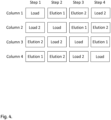
- Fig. 4 shows an overview of the different columns during the process.
- the loading step two serially coupled columns were used so that the outflow from the first loading column (Load 1) was directed to a second loading column (Load 2), The effect of the Load 2 step was primarily to wash the second column with the buffer flowing out from the first column.
- the duration of the Elution 2 step was longer than for the other steps, necessitating some waiting time in the other steps.
- the results are shown in Figs 8 and 9 , demonstrating a fully continuous separation.
- the electrophoresis gel in Fig. 10 shows an essentially complete removal of the low Mw RNA band from the high Mw plasmid.
- a simple way of expressing the productivity is to calculate the number of column volumes (CV) loaded per hour.
- CV column volumes
- the column can be loaded every 12 min, i.e. the productivity is 1.5 CV/h.
- PCC run 2 0.18 CV can be loaded every 4.2 min, corresponding to a productivity of 2.6 CV/h, i.e. a 170% improvement over Run 2 and 370% over Run 1.
- a continuous three-column setup can be expected to give even higher productivities.
Landscapes
- Chemical & Material Sciences (AREA)
- Analytical Chemistry (AREA)
- Chemical Kinetics & Catalysis (AREA)
- General Health & Medical Sciences (AREA)
- Life Sciences & Earth Sciences (AREA)
- Biochemistry (AREA)
- Physics & Mathematics (AREA)
- General Physics & Mathematics (AREA)
- Immunology (AREA)
- Pathology (AREA)
- Health & Medical Sciences (AREA)
- Treatment Of Liquids With Adsorbents In General (AREA)
- Saccharide Compounds (AREA)
Claims (15)
- Verfahren zur kontinuierlichen Trennung eines Plasmids aus einer ein Plasmid umfassenden Prozessbeschickung in einer Einrichtung mit mindestens drei Chromatographiesäulen, die mit Partikeln derselben Trennmatrix gepackt sind, wobei, während eine Chromatographiesäule mit der Prozessbeschickung beladen wird, eine andere Chromatographiesäule mit einem Eluenten eluiert wird, um das getrennte Plasmid zu gewinnen, und eine weitere Chromatographiesäule mit einem weiteren Eluenten eluiert wird, um Verunreinigungen zu entfernen.
- Verfahren nach Anspruch 1, umfassend die aufeinanderfolgenden Schritte des:a) Förderns einer Prozessbeschickung, die ein Plasmid umfasst, durch eine erste Chromatographiesäule, die ein gepacktes Bett aus Trennmatrixpartikeln umfasst;b) Förderns eines Eluenten durch die erste Chromatographiesäule, des Gewinnens des Eluenten mit dem Plasmid nach dem Durchlaufen der ersten Chromatographiesäule; und des Förderns der Prozessbeschickung durch eine zweite Chromatographiesäule, die mit der gleichen Trennmatrix wie die erste Chromatographiesäule gepackt ist; undc) Förderns eines weiteren Eluenten durch die erste Chromatographiesäule; des Förderns eines Eluenten durch die zweite Chromatographiesäule, des Gewinnens des Eluenten mit dem Plasmid nach dem Durchlaufen der zweiten Chromatographiesäule; und des Förderns der Prozessbeschickung durch eine dritte Chromatographiesäule, die mit der gleichen Trennmatrix wie die erste und zweite Chromatographiesäule gepackt ist.
- Verfahren nach Anspruch 2, wobei nach Schritt c) die Schritte a)-c) für die Dauer des kontinuierlichen Prozesses wiederholt werden, und wobei wahlweise in den Wiederholungen:Schritt a) weiter Fördern eines weiteren Eluenten durch die zweite Chromatographiesäule, während ein Eluent durch die dritte Chromatographiesäule gefördert wird, und Gewinnen des Eluenten mit dem Plasmid nach dem Durchlaufen der dritten Chromatographiesäule umfasst; undSchritt b) weiter Fördern eines weiteren Eluenten durch die dritte Chromatographiesäule umfasst.
- Verfahren nach einem der Ansprüche 2-3, wobei eine Prozessbeschickung oder ein Eluent durch alle drei Säulen während aller Schritte a)-c) gefördert wird.
- Verfahren nach Anspruch 1, umfassend die aufeinanderfolgenden Schritte des:a) Förderns einer Prozessbeschickung, die ein Plasmid umfasst, durch eine erste Chromatographiesäule, die ein gepacktes Bett von Trennmatrixpartikeln umfasst, und des Förderns eines Ausflusses aus der ersten Chromatographiesäule durch eine zweite Chromatographiesäule, die mit der gleichen Trennmatrix wie die erste Säule gepackt ist;b) Förderns eines Eluenten durch die erste Chromatographiesäule, des Gewinnens des Eluenten mit dem Plasmid nach dem Durchlaufen der ersten Chromatographiesäule; und des Förderns der Prozessbeschickung durch die zweite Chromatographiesäule und weiter durch eine dritte Chromatographiesäule, die mit der gleichen Trennmatrix wie die erste und zweite Säule gepackt ist;c) Förderns eines weiteren Eluenten durch die erste Chromatographiesäule; des Förderns eines Eluenten durch die zweite Chromatographiesäule, des Gewinnens des Eluenten mit dem Plasmid nach dem Durchlaufen der zweiten Chromatographiesäule; und des Förderns der Prozessbeschickung durch die dritte Chromatographiesäule und weiter durch eine vierte Chromatographiesäule, die mit der gleichen Trennmatrix wie die erste, zweite und dritte Säule gepackt ist; undd) Förderns einer Prozessbeschickung, die ein Plasmid umfasst, durch die vierte Chromatographiesäule und des Förderns eines Ausflusses aus der vierten Chromatographiesäule durch die erste Chromatographiesäule; des Förderns eines weiteren Eluenten durch die zweite Chromatographiesäule; und des Förderns eines Eluenten durch die dritte Chromatographiesäule, des Gewinnens des Eluenten mit dem Plasmid nach dem Durchlaufen der dritten Chromatographiesäule.
- Verfahren nach Anspruch 5, wobei nach Schritt d) die Schritte a)-d) für die Dauer des kontinuierlichen Prozesses wiederholt werden, und wobei wahlweise in den Wiederholungen:Schritt a) weiter Fördern eines weiteren Eluenten durch die dritte Chromatographiesäule und Fördern eines Eluenten durch die vierte Chromatographiesäule umfasst, während der Eluent mit dem Plasmid nach dem Durchlaufen der vierten Chromatographiesäule gewonnen wird; undSchritt b) weiter Fördern eines weiteren Eluenten durch die vierte Chromatographiesäule umfasst.
- Verfahren nach einem der Ansprüche 5-6, wobei eine Prozessbeschickung oder ein Eluent durch alle drei Säulen während aller Schritte a)-d) gefördert wird.
- Verfahren nach einem vorstehenden Anspruch, wobei die Trennmatrixpartikel Gelfiltrationspartikel sind, die eine Ausschlussgrenze für Dextran von weniger als 5000 kDa wie 500 kDa-5000 kDa oder 500-3000 kDa aufweisen.
- Verfahren nach einem vorstehenden Anspruch, wobei die Trennmatrixpartikel ein vernetztes Polysaccharid, wie vernetzte Agarose, umfassen.
- Verfahren nach einem vorstehenden Anspruch, wobei:a) der Eluent mindestens 1,5 M eines Salzes umfasst, wie 1,5-2,5 oder 1,8-2,3 M Salz;b) die Gesamtsalzkonzentration des Eluenten mindestens 1,5 M, wie 1,5-2,5 oder 1,8-2,3 M beträgt; und/oderc) der Eluent mindestens 1,5 M Ammoniumsulfat, wie 1,5-2,5 oder 1,8-2,3 M Ammoniumsulfat, umfasst.
- Verfahren nach einem vorstehenden Anspruch, wobei die Prozessbeschickung ein geklärtes Zelllysat umfasst.
- Verfahren nach einem vorstehenden Anspruch, umfassend vor der Trennung einen Schritt 0) zum Herstellen eines geklärten Zelllysats als Prozessbeschickung, wobei Schritt 0) wahlweise Kontaktieren von Zellen, wie E. coli-Zellen, mit Alkali und einem Tensid, wie SDS, umfasst und weiter wahlweise in einem kontinuierlichen Modus durchgeführt wird.
- Verfahren nach Anspruch 12, wobei Schritt 0) weiter die Zugabe eines Hydrogencarbonatsalzes, wie Ammoniumhydrogencarbonat, wahlweise gefolgt von einer Anpassung des pH-Werts auf 4-6 umfasst.
- Verfahren nach einem vorstehenden Anspruch, weiter umfassend nach der Trennung einen Schritt e) zum Reinigen des gewonnenen Plasmids, der wahlweise eine Binden-Eluieren-Chromatographie, wie die thiophile oder hydrophobe Wechselwirkungschromatographie, umfasst.
- Verfahren nach Anspruch 14, wobei Schritt e) in einem kontinuierlichen Modus durchgeführt wird.
Applications Claiming Priority (2)
| Application Number | Priority Date | Filing Date | Title |
|---|---|---|---|
| GBGB1710130.4A GB201710130D0 (en) | 2017-06-26 | 2017-06-26 | A Method of seperation |
| PCT/EP2018/054478 WO2019001778A1 (en) | 2017-06-26 | 2018-02-23 | PER PLASMID PERIODIC CONTAMINOGRAPHIC CHROMATOGRAPHY SEPARATION |
Publications (2)
| Publication Number | Publication Date |
|---|---|
| EP3645139A1 EP3645139A1 (de) | 2020-05-06 |
| EP3645139B1 true EP3645139B1 (de) | 2023-07-26 |
Family
ID=59523684
Family Applications (1)
| Application Number | Title | Priority Date | Filing Date |
|---|---|---|---|
| EP18711827.8A Active EP3645139B1 (de) | 2017-06-26 | 2018-02-23 | Periodische gegenstromchromatographietrennung von plasmiden |
Country Status (6)
| Country | Link |
|---|---|
| US (1) | US20200141912A1 (de) |
| EP (1) | EP3645139B1 (de) |
| CN (1) | CN110769909B (de) |
| ES (1) | ES2953488T3 (de) |
| GB (1) | GB201710130D0 (de) |
| WO (1) | WO2019001778A1 (de) |
Families Citing this family (6)
| Publication number | Priority date | Publication date | Assignee | Title |
|---|---|---|---|---|
| WO2020123307A1 (en) | 2018-12-13 | 2020-06-18 | Paragon 28, Inc. | Trial insert assembly |
| CN114072217A (zh) * | 2019-06-28 | 2022-02-18 | 信达生物制药(苏州)有限公司 | 组合式层析装置、无缝连接层析方法和生物制剂的纯化方法 |
| GB202006310D0 (en) | 2020-04-29 | 2020-06-10 | Puridify Ltd | Preparative chromatography system and method for chromatography separations |
| WO2022191971A1 (en) * | 2021-03-10 | 2022-09-15 | Amgen Inc. | Parallel chromatography systems and methods |
| USD1079977S1 (en) | 2023-04-07 | 2025-06-17 | Heart, Health Resource Technology, Llc | Liquid chromatography device |
| US20240337670A1 (en) * | 2023-04-07 | 2024-10-10 | Heart, Health Resource Technology, Llc | Divider for Separating Lipoproteins from Blood and Related Systems and Methods of Use |
Family Cites Families (15)
| Publication number | Priority date | Publication date | Assignee | Title |
|---|---|---|---|---|
| SE9601368D0 (sv) | 1996-04-11 | 1996-04-11 | Pharmacia Biotech Ab | Process for the production of a porous cross-linked polysaccharide gel |
| JPH1190106A (ja) * | 1997-09-26 | 1999-04-06 | Daicel Chem Ind Ltd | 擬似移動床式クロマト分離装置 |
| US20020104801A1 (en) * | 1998-04-06 | 2002-08-08 | Nicolas Voute | Small dense microporous solid support materials, their preparation,and use for purification of large macromolecules and bioparticles |
| US7108789B2 (en) * | 2002-07-29 | 2006-09-19 | Calgon Carbon Corporation | High performance continuous reaction/separation process using a continuous liquid-solid contactor |
| DK1545574T3 (da) | 2002-09-13 | 2014-09-08 | Biogen Idec Inc | Fremgangsmåde til rensning af polypeptider ved simuleret moving-bed-chromatografi |
| DE602005026113D1 (de) | 2004-04-19 | 2011-03-10 | Aventis Pharma Sa | Verfahren zur herstellung von plasmid dns in pharmazeutischer qualität |
| EP1716900A1 (de) * | 2005-04-29 | 2006-11-02 | Eidgenössische Technische Hochschule Zürich | Verfahren und Vorrichtung zur chromatographischen Reinigung |
| US7901581B2 (en) | 2007-06-15 | 2011-03-08 | Ge Healthcare Bio-Sciences Ab | Chromatography method |
| FR2929533B1 (fr) * | 2008-04-03 | 2010-04-30 | Novasep | Procede de separation multicolonnes a gradient. |
| US20130248451A1 (en) | 2010-12-03 | 2013-09-26 | Ge Healthcare Bio-Sciences Ab | System and process for biopolymer chromatography |
| EP2656892A1 (de) | 2012-04-23 | 2013-10-30 | Merck Patent GmbH | Chromatographieverfahren |
| CN105829884B (zh) | 2013-12-19 | 2019-03-08 | 通用电气健康护理生物科学股份公司 | 旋转阀 |
| EP3084420B1 (de) | 2013-12-19 | 2018-10-17 | GE Healthcare Bio-Sciences AB | Chromatographie-vorrichtung mit einem drehventil und einem strömungsweg zur rückführung des eluents |
| ES2897581T3 (es) * | 2014-12-18 | 2022-03-01 | Cytiva Sweden Ab | Método y sistema para determinar el nivel de saturación de una columna de cromatografía basado en la detección de presión |
| US11835501B2 (en) * | 2015-07-13 | 2023-12-05 | Sartorius Stedim Chromatography Systems Ltd. | Optimizing operating binding capacity for a multiple column chromatography process |
-
2017
- 2017-06-26 GB GBGB1710130.4A patent/GB201710130D0/en not_active Ceased
-
2018
- 2018-02-23 US US16/622,467 patent/US20200141912A1/en not_active Abandoned
- 2018-02-23 EP EP18711827.8A patent/EP3645139B1/de active Active
- 2018-02-23 ES ES18711827T patent/ES2953488T3/es active Active
- 2018-02-23 WO PCT/EP2018/054478 patent/WO2019001778A1/en not_active Ceased
- 2018-02-23 CN CN201880042678.2A patent/CN110769909B/zh active Active
Also Published As
| Publication number | Publication date |
|---|---|
| ES2953488T3 (es) | 2023-11-13 |
| EP3645139A1 (de) | 2020-05-06 |
| GB201710130D0 (en) | 2017-08-09 |
| CN110769909B (zh) | 2023-06-20 |
| US20200141912A1 (en) | 2020-05-07 |
| CN110769909A (zh) | 2020-02-07 |
| WO2019001778A1 (en) | 2019-01-03 |
Similar Documents
| Publication | Publication Date | Title |
|---|---|---|
| EP3645139B1 (de) | Periodische gegenstromchromatographietrennung von plasmiden | |
| Eon-Duval et al. | Purification of pharmaceutical-grade plasmid DNA by anion-exchange chromatography in an RNase-free process | |
| KR101790700B1 (ko) | 관류 공정의 용량을 증가시키는 방법 | |
| Urthaler et al. | Improved downstream process for the production of plasmid DNA for gene therapy. | |
| KR102919038B1 (ko) | 음이온 교환 크로마토그래피를 이용한 플라스미드 dna와 같은 생물학적 분자의 정제 공정 | |
| US10859542B2 (en) | High efficiency continuous countercurrent tangential negative chromatography | |
| EP3105580A1 (de) | Mehrstufiges automatisches reinigungssystem | |
| CN106884011B (zh) | 一种规模化质粒纯化的联合液相层析分离方法 | |
| Urthaler et al. | Industrial scale cGMP purification of pharmaceutical grade plasmid‐DNA | |
| Dutta et al. | Performance optimization of continuous countercurrent tangential chromatography for antibody capture | |
| CN109030686A (zh) | 一种三维液相色谱蛋白纯化装置及其使用方法 | |
| US11110374B2 (en) | Continuous countercurrent spiral chromatography | |
| Walch et al. | Continuous desalting of refolded protein solution improves capturing in ion exchange chromatography: a seamless process | |
| Shinkazh et al. | Countercurrent tangential chromatography for large‐scale protein purification | |
| KR20190076046A (ko) | 단백질 용액의 탈염 공정 | |
| JP6991312B2 (ja) | インラインミキサーとハイドロサイクロンを統合したモジュールを複数用いて抗体を細胞培養液から連続的に製造する装置および当該装置を用いた抗体の製造方法 | |
| Guerrero‐Germán et al. | Purification of plasmid DNA from Escherichia coli ferments using anion‐exchange membrane and hydrophobic chromatography | |
| EP4234695A1 (de) | Verfahren zur selektiven entfernung von verunreinigungen während eines verfahrens zur reinigung von biologischen mitteln | |
| May et al. | Improving process economy with expanded-bed adsorption technology | |
| Bates | Downstream processing | |
| Macdonald | Disrupting Downstream Bottlenecks | |
| Boulaisa et al. | Implementation of a process-scale adenovirus purification with a single-use platform | |
| Kanani et al. | Salt-tolerant cation exchange HD-Sb hydrogel membrane: mAb purification performance in flowthrough mode | |
| Labant | Boosting Downstream Productivity |
Legal Events
| Date | Code | Title | Description |
|---|---|---|---|
| STAA | Information on the status of an ep patent application or granted ep patent |
Free format text: STATUS: UNKNOWN |
|
| STAA | Information on the status of an ep patent application or granted ep patent |
Free format text: STATUS: THE INTERNATIONAL PUBLICATION HAS BEEN MADE |
|
| PUAI | Public reference made under article 153(3) epc to a published international application that has entered the european phase |
Free format text: ORIGINAL CODE: 0009012 |
|
| STAA | Information on the status of an ep patent application or granted ep patent |
Free format text: STATUS: REQUEST FOR EXAMINATION WAS MADE |
|
| 17P | Request for examination filed |
Effective date: 20191211 |
|
| AK | Designated contracting states |
Kind code of ref document: A1 Designated state(s): AL AT BE BG CH CY CZ DE DK EE ES FI FR GB GR HR HU IE IS IT LI LT LU LV MC MK MT NL NO PL PT RO RS SE SI SK SM TR |
|
| AX | Request for extension of the european patent |
Extension state: BA ME |
|
| RAP1 | Party data changed (applicant data changed or rights of an application transferred) |
Owner name: CYTIVA BIOPROCESS R&D AB |
|
| DAV | Request for validation of the european patent (deleted) | ||
| DAX | Request for extension of the european patent (deleted) | ||
| GRAP | Despatch of communication of intention to grant a patent |
Free format text: ORIGINAL CODE: EPIDOSNIGR1 |
|
| STAA | Information on the status of an ep patent application or granted ep patent |
Free format text: STATUS: GRANT OF PATENT IS INTENDED |
|
| INTG | Intention to grant announced |
Effective date: 20230405 |
|
| GRAS | Grant fee paid |
Free format text: ORIGINAL CODE: EPIDOSNIGR3 |
|
| GRAA | (expected) grant |
Free format text: ORIGINAL CODE: 0009210 |
|
| STAA | Information on the status of an ep patent application or granted ep patent |
Free format text: STATUS: THE PATENT HAS BEEN GRANTED |
|
| P01 | Opt-out of the competence of the unified patent court (upc) registered |
Effective date: 20230526 |
|
| AK | Designated contracting states |
Kind code of ref document: B1 Designated state(s): AL AT BE BG CH CY CZ DE DK EE ES FI FR GB GR HR HU IE IS IT LI LT LU LV MC MK MT NL NO PL PT RO RS SE SI SK SM TR |
|
| REG | Reference to a national code |
Ref country code: CH Ref legal event code: EP |
|
| REG | Reference to a national code |
Ref country code: IE Ref legal event code: FG4D |
|
| REG | Reference to a national code |
Ref country code: DE Ref legal event code: R096 Ref document number: 602018054007 Country of ref document: DE |
|
| REG | Reference to a national code |
Ref country code: NL Ref legal event code: FP |
|
| REG | Reference to a national code |
Ref country code: LT Ref legal event code: MG9D |
|
| REG | Reference to a national code |
Ref country code: ES Ref legal event code: FG2A Ref document number: 2953488 Country of ref document: ES Kind code of ref document: T3 Effective date: 20231113 |
|
| PG25 | Lapsed in a contracting state [announced via postgrant information from national office to epo] |
Ref country code: GR Free format text: LAPSE BECAUSE OF FAILURE TO SUBMIT A TRANSLATION OF THE DESCRIPTION OR TO PAY THE FEE WITHIN THE PRESCRIBED TIME-LIMIT Effective date: 20231027 |
|
| PG25 | Lapsed in a contracting state [announced via postgrant information from national office to epo] |
Ref country code: SE Free format text: LAPSE BECAUSE OF FAILURE TO SUBMIT A TRANSLATION OF THE DESCRIPTION OR TO PAY THE FEE WITHIN THE PRESCRIBED TIME-LIMIT Effective date: 20230726 Ref country code: RS Free format text: LAPSE BECAUSE OF FAILURE TO SUBMIT A TRANSLATION OF THE DESCRIPTION OR TO PAY THE FEE WITHIN THE PRESCRIBED TIME-LIMIT Effective date: 20230726 Ref country code: PT Free format text: LAPSE BECAUSE OF FAILURE TO SUBMIT A TRANSLATION OF THE DESCRIPTION OR TO PAY THE FEE WITHIN THE PRESCRIBED TIME-LIMIT Effective date: 20231127 Ref country code: NO Free format text: LAPSE BECAUSE OF FAILURE TO SUBMIT A TRANSLATION OF THE DESCRIPTION OR TO PAY THE FEE WITHIN THE PRESCRIBED TIME-LIMIT Effective date: 20231026 Ref country code: LV Free format text: LAPSE BECAUSE OF FAILURE TO SUBMIT A TRANSLATION OF THE DESCRIPTION OR TO PAY THE FEE WITHIN THE PRESCRIBED TIME-LIMIT Effective date: 20230726 Ref country code: LT Free format text: LAPSE BECAUSE OF FAILURE TO SUBMIT A TRANSLATION OF THE DESCRIPTION OR TO PAY THE FEE WITHIN THE PRESCRIBED TIME-LIMIT Effective date: 20230726 Ref country code: HR Free format text: LAPSE BECAUSE OF FAILURE TO SUBMIT A TRANSLATION OF THE DESCRIPTION OR TO PAY THE FEE WITHIN THE PRESCRIBED TIME-LIMIT Effective date: 20230726 Ref country code: GR Free format text: LAPSE BECAUSE OF FAILURE TO SUBMIT A TRANSLATION OF THE DESCRIPTION OR TO PAY THE FEE WITHIN THE PRESCRIBED TIME-LIMIT Effective date: 20231027 Ref country code: FI Free format text: LAPSE BECAUSE OF FAILURE TO SUBMIT A TRANSLATION OF THE DESCRIPTION OR TO PAY THE FEE WITHIN THE PRESCRIBED TIME-LIMIT Effective date: 20230726 |
|
| REG | Reference to a national code |
Ref country code: AT Ref legal event code: UEP Ref document number: 1591274 Country of ref document: AT Kind code of ref document: T Effective date: 20230726 |
|
| PG25 | Lapsed in a contracting state [announced via postgrant information from national office to epo] |
Ref country code: PL Free format text: LAPSE BECAUSE OF FAILURE TO SUBMIT A TRANSLATION OF THE DESCRIPTION OR TO PAY THE FEE WITHIN THE PRESCRIBED TIME-LIMIT Effective date: 20230726 |
|
| REG | Reference to a national code |
Ref country code: DE Ref legal event code: R097 Ref document number: 602018054007 Country of ref document: DE |
|
| PG25 | Lapsed in a contracting state [announced via postgrant information from national office to epo] |
Ref country code: SM Free format text: LAPSE BECAUSE OF FAILURE TO SUBMIT A TRANSLATION OF THE DESCRIPTION OR TO PAY THE FEE WITHIN THE PRESCRIBED TIME-LIMIT Effective date: 20230726 Ref country code: RO Free format text: LAPSE BECAUSE OF FAILURE TO SUBMIT A TRANSLATION OF THE DESCRIPTION OR TO PAY THE FEE WITHIN THE PRESCRIBED TIME-LIMIT Effective date: 20230726 Ref country code: EE Free format text: LAPSE BECAUSE OF FAILURE TO SUBMIT A TRANSLATION OF THE DESCRIPTION OR TO PAY THE FEE WITHIN THE PRESCRIBED TIME-LIMIT Effective date: 20230726 Ref country code: DK Free format text: LAPSE BECAUSE OF FAILURE TO SUBMIT A TRANSLATION OF THE DESCRIPTION OR TO PAY THE FEE WITHIN THE PRESCRIBED TIME-LIMIT Effective date: 20230726 Ref country code: CZ Free format text: LAPSE BECAUSE OF FAILURE TO SUBMIT A TRANSLATION OF THE DESCRIPTION OR TO PAY THE FEE WITHIN THE PRESCRIBED TIME-LIMIT Effective date: 20230726 Ref country code: SK Free format text: LAPSE BECAUSE OF FAILURE TO SUBMIT A TRANSLATION OF THE DESCRIPTION OR TO PAY THE FEE WITHIN THE PRESCRIBED TIME-LIMIT Effective date: 20230726 |
|
| PLBE | No opposition filed within time limit |
Free format text: ORIGINAL CODE: 0009261 |
|
| STAA | Information on the status of an ep patent application or granted ep patent |
Free format text: STATUS: NO OPPOSITION FILED WITHIN TIME LIMIT |
|
| 26N | No opposition filed |
Effective date: 20240429 |
|
| PG25 | Lapsed in a contracting state [announced via postgrant information from national office to epo] |
Ref country code: SI Free format text: LAPSE BECAUSE OF FAILURE TO SUBMIT A TRANSLATION OF THE DESCRIPTION OR TO PAY THE FEE WITHIN THE PRESCRIBED TIME-LIMIT Effective date: 20230726 |
|
| PG25 | Lapsed in a contracting state [announced via postgrant information from national office to epo] |
Ref country code: MC Free format text: LAPSE BECAUSE OF FAILURE TO SUBMIT A TRANSLATION OF THE DESCRIPTION OR TO PAY THE FEE WITHIN THE PRESCRIBED TIME-LIMIT Effective date: 20230726 |
|
| PG25 | Lapsed in a contracting state [announced via postgrant information from national office to epo] |
Ref country code: LU Free format text: LAPSE BECAUSE OF NON-PAYMENT OF DUE FEES Effective date: 20240223 |
|
| PG25 | Lapsed in a contracting state [announced via postgrant information from national office to epo] |
Ref country code: LU Free format text: LAPSE BECAUSE OF NON-PAYMENT OF DUE FEES Effective date: 20240223 |
|
| PG25 | Lapsed in a contracting state [announced via postgrant information from national office to epo] |
Ref country code: BG Free format text: LAPSE BECAUSE OF FAILURE TO SUBMIT A TRANSLATION OF THE DESCRIPTION OR TO PAY THE FEE WITHIN THE PRESCRIBED TIME-LIMIT Effective date: 20230726 |
|
| PG25 | Lapsed in a contracting state [announced via postgrant information from national office to epo] |
Ref country code: BG Free format text: LAPSE BECAUSE OF FAILURE TO SUBMIT A TRANSLATION OF THE DESCRIPTION OR TO PAY THE FEE WITHIN THE PRESCRIBED TIME-LIMIT Effective date: 20230726 |
|
| PGFP | Annual fee paid to national office [announced via postgrant information from national office to epo] |
Ref country code: CH Payment date: 20250301 Year of fee payment: 8 |
|
| PG25 | Lapsed in a contracting state [announced via postgrant information from national office to epo] |
Ref country code: CY Free format text: LAPSE BECAUSE OF FAILURE TO SUBMIT A TRANSLATION OF THE DESCRIPTION OR TO PAY THE FEE WITHIN THE PRESCRIBED TIME-LIMIT; INVALID AB INITIO Effective date: 20180223 |
|
| PG25 | Lapsed in a contracting state [announced via postgrant information from national office to epo] |
Ref country code: HU Free format text: LAPSE BECAUSE OF FAILURE TO SUBMIT A TRANSLATION OF THE DESCRIPTION OR TO PAY THE FEE WITHIN THE PRESCRIBED TIME-LIMIT; INVALID AB INITIO Effective date: 20180223 |
|
| PG25 | Lapsed in a contracting state [announced via postgrant information from national office to epo] |
Ref country code: TR Free format text: LAPSE BECAUSE OF FAILURE TO SUBMIT A TRANSLATION OF THE DESCRIPTION OR TO PAY THE FEE WITHIN THE PRESCRIBED TIME-LIMIT Effective date: 20230726 |
|
| REG | Reference to a national code |
Ref country code: CH Ref legal event code: U11 Free format text: ST27 STATUS EVENT CODE: U-0-0-U10-U11 (AS PROVIDED BY THE NATIONAL OFFICE) Effective date: 20260301 |
|
| PGFP | Annual fee paid to national office [announced via postgrant information from national office to epo] |
Ref country code: NL Payment date: 20260220 Year of fee payment: 9 |
|
| PGFP | Annual fee paid to national office [announced via postgrant information from national office to epo] |
Ref country code: GB Payment date: 20260223 Year of fee payment: 9 |
|
| PGFP | Annual fee paid to national office [announced via postgrant information from national office to epo] |
Ref country code: ES Payment date: 20260317 Year of fee payment: 9 |
|
| PGFP | Annual fee paid to national office [announced via postgrant information from national office to epo] |
Ref country code: DE Payment date: 20260220 Year of fee payment: 9 Ref country code: IE Payment date: 20260219 Year of fee payment: 9 |
|
| PGFP | Annual fee paid to national office [announced via postgrant information from national office to epo] |
Ref country code: AT Payment date: 20260218 Year of fee payment: 9 |
|
| PGFP | Annual fee paid to national office [announced via postgrant information from national office to epo] |
Ref country code: BE Payment date: 20260220 Year of fee payment: 9 Ref country code: IT Payment date: 20260220 Year of fee payment: 9 |
|
| PGFP | Annual fee paid to national office [announced via postgrant information from national office to epo] |
Ref country code: IS Payment date: 20260218 Year of fee payment: 9 Ref country code: FR Payment date: 20260227 Year of fee payment: 9 |