EP3645129B1 - Atemschutz-halbmaske - Google Patents
Atemschutz-halbmaske Download PDFInfo
- Publication number
- EP3645129B1 EP3645129B1 EP18734127.6A EP18734127A EP3645129B1 EP 3645129 B1 EP3645129 B1 EP 3645129B1 EP 18734127 A EP18734127 A EP 18734127A EP 3645129 B1 EP3645129 B1 EP 3645129B1
- Authority
- EP
- European Patent Office
- Prior art keywords
- chin
- nose
- half mask
- recesses
- basic
- Prior art date
- Legal status (The legal status is an assumption and is not a legal conclusion. Google has not performed a legal analysis and makes no representation as to the accuracy of the status listed.)
- Active
Links
Images


Classifications
-
- A—HUMAN NECESSITIES
- A41—WEARING APPAREL
- A41D—OUTERWEAR; PROTECTIVE GARMENTS; ACCESSORIES
- A41D13/00—Professional, industrial or sporting protective garments, e.g. surgeons' gowns or garments protecting against blows or punches
- A41D13/05—Professional, industrial or sporting protective garments, e.g. surgeons' gowns or garments protecting against blows or punches protecting only a particular body part
- A41D13/11—Protective face masks, e.g. for surgical use, or for use in foul atmospheres
- A41D13/1107—Protective face masks, e.g. for surgical use, or for use in foul atmospheres characterised by their shape
- A41D13/1115—Protective face masks, e.g. for surgical use, or for use in foul atmospheres characterised by their shape with a horizontal pleated pocket
-
- A—HUMAN NECESSITIES
- A41—WEARING APPAREL
- A41D—OUTERWEAR; PROTECTIVE GARMENTS; ACCESSORIES
- A41D13/00—Professional, industrial or sporting protective garments, e.g. surgeons' gowns or garments protecting against blows or punches
- A41D13/05—Professional, industrial or sporting protective garments, e.g. surgeons' gowns or garments protecting against blows or punches protecting only a particular body part
- A41D13/11—Protective face masks, e.g. for surgical use, or for use in foul atmospheres
- A41D13/1161—Means for fastening to the user's head
-
- A—HUMAN NECESSITIES
- A62—LIFE-SAVING; FIRE-FIGHTING
- A62B—DEVICES, APPARATUS OR METHODS FOR LIFE-SAVING
- A62B23/00—Filters for breathing-protection purposes
- A62B23/02—Filters for breathing-protection purposes for respirators
- A62B23/025—Filters for breathing-protection purposes for respirators the filter having substantially the shape of a mask
Definitions
- the invention relates to a respiratory half mask for filtering the breathing air of a wearer of the respiratory half mask according to claim 1. Furthermore, the invention is directed to a method for producing such a respiratory half mask according to claim 14.
- the WO 2011/142487 A1 discloses a generic foldable half mask made of a fleece laminate.
- the mask comprises a base body and a foldable nose part and chin part connected to it. Furthermore, the mask has two side panels which, when the mask is in the finished state, are folded onto the base body and form a headband guide.
- Another generic half mask respirator is for example from WO 96/28216 A1 previously known.
- a half mask respirator which can be moved from a folded position into a wearing position.
- An upper nose part and a lower chin part of the half mask respirator are connected to a base part of the half mask respirator via weld seams.
- the US 2011/0155138 A1 discloses another respiratory half mask of the prior art which is designed as a folding mask.
- the respiratory half mask has a base part on which an upper nose part and a lower chin part are arranged.
- the invention is based on the object of providing an improved respiratory half mask.
- the half mask respirator should be extremely user-friendly or easy to manufacture.
- a corresponding manufacturing process is also to be created.
- the partial recesses can reliably prevent an undesired fixing of the folded or folded side panels on the nose part and chin part during the production of the half mask.
- An, in particular complete, folding of the nose part and chin part from the, advantageously flat, storage position into the respective, advantageously unfolded, carrying position is possible in this way easily and without problems, which also leads to particularly good protection for the wearer of the respiratory half mask. Leakage or damage to the respiratory protection half-mask, in particular when the side panels are fixed to the base part, can be safely avoided.
- the base part and the chin part run adjacent or parallel to one another in the chin part storage position.
- the base part and the nose part advantageously run adjacent or parallel to one another in the nose part storage position.
- the half mask respirator is preferably shell-like.
- the half mask respirator then in particular assumes a wearing position itself. It is useful if the base part, nose part and / or chin part comprises at least one stiffening means, such as a seam, clip or the like.
- the respiratory half mask is preferably designed as a folding or folding mask. It is advantageous if the half mask respirator is symmetrical with respect to a center plane. Alternatively, the half mask respirator is asymmetrical.
- the base part, nose part and / or chin part is preferably each multilayered.
- the base part, nose part and / or chin part are each single-layer.
- the base part, the nose part and the chin part are advantageously formed from an identical material. It is advantageous if the respiratory half mask is made from a filter material.
- the filter material is, for example, a fleece material and conveniently allows breathing directly through it. The filter material filters the air you breathe. It is advantageous if the half-mask respirator can be used to filter particles or for gases and vapors.
- the respiratory half mask can have at least one inhalation valve and / or exhalation valve. If at least one inhalation valve and / or exhalation valve is present, the base part, nose part and / or chin part can be formed from an air-impermeable material.
- the base part, nose part and chin part are originally connected to one another in one piece and are connected to one another, for example by means of folding lines or folding lines.
- the base part, nose part and chin part are originally designed separately and then joined together to form the half-mask body of the respiratory protection.
- a seam can be used for joining.
- the at least one head holding means is designed as a tape, cord or the like, for example. It is made of rubber or textile, for example. It is advantageous if the at least one head holding means is adjustable in length.
- the head holding means receptacles are expediently completely closed on the circumference. They are preferably open at the end.
- the at least one head holding means is expediently guided, in particular displaceably, in the head holding means receptacles. It is preferably passed through this, in particular in a displaceable manner.
- the at least one cohesive fixing point according to dependent claim 3 is favorably a non-releasable connection. It is preferably point-shaped and / or linear. It is advantageous if the at least one material connection fixing point is formed by welding, in particular ultrasonic welding, or gluing. A welding location is preferably created by heat and / or pressure. It is advantageous if the side panels and / or the base part are temporarily softened or melted in areas in order to fix them to one another. When it cools down, the fixed connection between the base part and the respective side panel is preferably created.
- the dimensions of the nose part-part recesses given in the dependent claims 4 and 5 allow reliable prevention of the fixing the folded side panels on the nose part. Conversely, they allow the side fields to be securely fixed on the base part.
- the dimensions of the chin part-part recesses given in the dependent claims 8 and 9 allow a reliable prevention of the fixing of the folded-over side panels on the chin part. Conversely, they allow the side fields to be securely fixed on the base part.
- nasal part partial recesses and chin part partial recesses are arranged in pairs or adjacent to one another and form overall recesses.
- the respective nose part part recesses and chin part part recesses then preferably complement one another and merge into one another in order to form the overall recesses.
- Subclaims 2 to 13 preferably also relate to advantageous configurations of the subject matter according to Claim 14.
- Subclaims 15, 16 preferably also relate to advantageous configurations of the subject matter according to Claim 1.
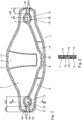
- a half-mask respirator shown in the figures comprises a half-mask body 1 and a headband 2 arranged on the half-mask body 1 for holding the half-mask body 1 on a head 3 of a wearer.
- the respiratory protection half-mask body 1 is designed symmetrically with respect to a center plane 4.
- the respiratory protection half-mask body 1 comprises a base part 5 and a nose part 6 arranged on the base part 5 and a chin part 7 arranged on the base part 5.
- the base part 5 has an upper edge area 8 and a lower edge area 9, which runs opposite the upper edge area 8 and is arranged at a distance from it.
- the nose part 6 adjoins the upper edge area 8, while the chin part 7 adjoins the lower edge area 9.
- the nose part 6 is advantageously arranged on the base part 5 by means of an upper weld seam 10 adjacent to the upper edge region 8, while preferably the chin part 7 is arranged on the base part 5 by means of a lower weld seam 11 adjacent to the lower edge region 9. It is useful if the edge areas 8, 9 starting from the central plane 4 together or towards one another.
- the nose part 6 has a free sealing edge 12 which runs at a distance from or opposite to the base part 5.
- the nose part 6 has two nose part-part recesses 13.
- the nose part-part recesses 13 are spatially limited by the free sealing edge 12 and are open in areas around the circumference.
- the free sealing edge 12 projects onto the upper edge area 8 in areas.
- the nose part-part recesses 13 are open opposite the upper edge region 8. They penetrate the nose part 6 completely.
- Each nose part-part recess 13 has in the circumferential direction of the nose part 6 a length LN which is between 5 mm and 20 mm, and perpendicular to the length LN a width BN which is between 2 mm and 8 mm.
- the chin part 7 has a free sealing edge 14 which extends at a distance from or opposite to the base part 5. Furthermore, the chin part 7 has two chin part part recesses 15. The chin part part recesses 15 are spatially delimited by the free sealing edge 14 and open on the circumferential side. To form the partial recesses 15 of the chin part, the free sealing edge 14 projects onto the lower edge area 9 in some areas. The chin part part recesses 15 are open opposite the lower edge region 9. They penetrate the chin part 7 completely.
- Each chin part partial recess 15 has a length LK in the circumferential direction of the chin part 7, which is between 5 mm and 20 mm, and perpendicular to the length LK a width BK which is between 2 mm and 8 mm.
- the base part 5, the nose part 6 and the chin part 7 have an identical width perpendicular to the central plane 4.
- the respiratory protection half-mask body 1 also has two opposing front side panels 16 which run adjacent to the base part 5, forming lateral headband receptacles 17.
- Each side panel 16 is welded to the base part 5 by means of a point-shaped weld fixing point 18.
- Each side panel 16 is fixed in place in a folded-down position on the base part 5 by means of the welding fixing point 18. It is laterally limited by a fold-over line 19 which runs essentially parallel to the center line 4.
- Each fold-over line 19 extends at a distance from the adjacent weld fixing point 18.
- the rear of the nose part 6 rests flat against the base 5, while the chin part 7 then overlaps the base part 5 and in some areas the nose part 6 on the rear. In the storage position, the rear of the chin part 7 rests flat against the nose part 6.
- the free sealing edge 14 of the chin part 7 then extends adjacent to the upper edge region 8, while the free sealing edge 12 of the nose part 6 then extends adjacent to the lower edge region 9.
- each overall recess is through a nose part-part recess 13 and one Chin part part recess 15 is formed.
- Each overall recess is more or less closed on the circumference.
- Each overall recess is at a distance AA from the adjacent fold line 19.
- Each welding fixing point 18 is at a distance AS from the adjacent fold-over line 19 which is greater than the distance AA, but smaller than the sum of the distance AA and the length LN or LK.
- the manufacturing process for the half mask respirator is described below.
- the nose part 6 and the chin part 7 are welded to the base part 5 with linear weld seams.
- the nose part 6 and chin part 7 as well as the base part 5 are preferably in a corresponding overlapping arrangement Fig. 2 .
- a respiratory protection half-mask body 1 including the nose part 6, the chin part 7 and the base part 5 is formed directly from a corresponding material, in particular from a multi-layer fleece material or composite material.
- the nose part 6 and the chin part 7 as well as the base part 5 are made of a multi-layer fleece material by means of welds and alignment of different layers of the fleece material directly from a composite.
- each side panel 16 has a length LS which is greater than the distance AS.
- Each side panel 16 overlaps or thus at least partially overlaps the overall recesses on a side of the base part 5 facing away from the overall recesses.
- the side panels 16 are then welded to the base part 5 by means of a welding device (not shown) in their folded position, forming the headband receptacles 17.
- Each weld fixing point 18 produced and the adjacent fold-over line 19 delimit the respective headband receptacle 17 laterally.
- the weld fixing points 18 are arranged adjacent to the overall receptacle or quasi within it.
- the nose part 6 and the chin part 7 run at a distance from the welding fixing points 18. Even if the base part 5 is melted over its entire thickness by welding the side panels 16 on, there is no unwanted welded connection between the base part 5 and the nose part 6 and / or Chin part 7, since only the entire recordings and not material of the nose part 6 and / or chin part 7 are located there.
- the headband 2 is then threaded through the headband receptacles 17.
- the respiratory protection half-mask body 1 is transferred from its storage position or its production position into a carrying position.
- the half-mask body 1 is unfolded or unfolded.
- the sealing edge 14 of the chin part 7 is lifted off the base part 5, the chin part 7 being opened or folded over with respect to the base part 5.
- the sealing edge 12 of the nose part 6 is lifted off the base part 5, the nose part 6 being opened or folded over with respect to the base part 5.
- the nose part 6 is folded around the upper weld seam 10, while the chin part 7 is folded around the lower weld seam 11.
- the respiratory half mask is then shell-like and delimits an interior space.
- the free sealing edge 12 of the nose part 6 lies against the nose and the cheek areas of the wearer in a sealing manner, while the free sealing edge 14 of the chin part 7 lies against the chin of the wearer in a sealing manner.
- the side panels 16 face away from the wearer and are arranged adjacent to the cheeks of the wearer.
Landscapes
- Health & Medical Sciences (AREA)
- General Health & Medical Sciences (AREA)
- Physical Education & Sports Medicine (AREA)
- Engineering & Computer Science (AREA)
- Textile Engineering (AREA)
- Business, Economics & Management (AREA)
- Emergency Management (AREA)
- Respiratory Apparatuses And Protective Means (AREA)
Description
- Die vorliegende Patentanmeldung nimmt die Priorität der deutschen Patentanmeldung
DE 10 2017 211 182.8 in Anspruch, deren Inhalt durch Bezugnahme hierin aufgenommen wird. - Die Erfindung betrifft eine Atemschutz-Halbmaske zum Filtern von Atemluft eines Trägers der Atemschutz-Halbmaske gemäß Anspruch 1. Ferner richtet sich die Erfindung auf ein Verfahren zur Herstellung einer solchen Atemschutz-Halbmaske gemäß Anspruch 14.
- Die
WO 2011/142487 A1 offenbart eine gattungsgemäße faltbare Atemschutz-Halbmaske aus einem Vlieslaminat. Die Maske umfasst einen Grundkörper und ein mit diesem in Verbindung stehendes, klappbares Nasenteil sowie Kinnteil. Ferner hat die Maske zwei Seitenfelder, die in fertigem Zustand der Maske auf den Grundkörper geklappt sind und eine Kopfbandführung bilden. - Eine weitere gattungsgemäße Atemschutz-Halbmaske ist beispielsweise aus der
WO 96/28216 A1 - Aus der
US 2004/0069302 A1 ist eine Atemschutz-Halbmaske bekannt, die aus einer Faltstellung in eine Tragestellung überführbar ist. Ein oberes Nasenteil und ein unteres Kinnteil der Atemschutz-Halbmaske sind über Schweißnähte mit einem Grundteil der Atemschutz-Halbmaske verbunden. DieUS 2011/0155138 A1 offenbart eine weitere Atemschutz-Halbmaske des Stands der Technik, die als Faltmaske ausgeführt ist. Die Atemschutz-Halbmaske hat ein Grundteil, an dem ein oberes Nasenteil und ein unteres Kinnteil angeordnet sind. - Der Erfindung liegt die Aufgabe zu Grunde, eine verbesserte Atemschutz-Halbmaske bereitzustellen. Insbesondere soll die Atemschutz-Halbmaske äußerst benutzerfreundlich beziehungsweise einfach herstellbar sein. Ein entsprechendes Herstellungsverfahren soll ebenfalls geschaffen werden.
- Diese Aufgabe wird erfindungsgemäß durch die in den unabhängigen Ansprüchen 1 und 14 angegebenen Merkmale gelöst. Der Kern liegt darin, dass durch die Teil-Aussparungen eine ungewünschte Festlegung der umgeklappten beziehungsweise eingeklappten Seitenfelder an dem Nasenteil und Kinnteil bei der Herstellung der Atemschutz-Halbmaske sicher verhinderbar ist. Ein, insbesondere vollständiges, Klappen des Nasenteils und Kinnteils aus der, günstigerweise flachen, Aufbewahrungsstellung in die jeweilige, günstigerweise aufgeklappte, Tragestellung ist so einfach und problemlos möglich, was auch zu einem besonders guten Schutz des Trägers der Atemschutz-Halbmaske führt. Leckagen bzw. Beschädigungen der Atemschutz-Halbmaske, insbesondere bei Festlegestellen der Seitenfelder an dem Grundteil, sind sicher vermeidbar.
- Es ist von Vorteil, wenn das Grundteil und das Kinnteil in der Kinnteil-Aufbewahrungsstellung benachbart beziehungsweise parallel zueinander verlaufen. Günstigerweise verlaufen das Grundteil und das Nasenteil in der Nasenteil-Aufbewahrungsstellung benachbart beziehungsweise parallel zueinander. Wenn sich das Kinnteil und Nasenteil jeweils in der Aufbewahrungsstellung befinden, ist die Atemschutz-Halbmaske insbesondere flach. Die Atemschutz-Halbmaske nimmt dann insbesondere selbst eine Aufbewahrungsstellung ein.
- Wenn sich dagegen das Kinnteil und Nasenteil jeweils in der Tragestellung befinden, ist die Atemschutz-Halbmaske vorzugsweise schalenartig. Die Atemschutz-Halbmaske nimmt dann insbesondere selbst eine Tragestellung ein. Es ist zweckmäßig, wenn das Grundteil, Nasenteil und/oder Kinnteil mindestens ein Versteifungsmittel, wie eine Naht, Klammer oder dergleichen, umfasst.
- Die Atemschutz-Halbmaske ist vorzugsweise als Falt- beziehungsweise Klappmaske ausgeführt. Es ist von Vorteil, wenn die Atemschutz-Halbmaske bezüglich einer Mittelebene symmetrisch ist. Alternativ ist die Atemschutz-Halbmaske asymmetrisch.
- Das Grundteil, Nasenteil und/oder Kinnteil ist vorzugsweise jeweils mehrlagig. Alternativ ist das Grundteil, Nasenteil und/oder Kinnteil jeweils einlagig.
- Das Grundteil, Nasenteil und Kinnteil sind günstigerweise aus einem identischen Material gebildet. Es ist von Vorteil, wenn die Atemschutz-Halbmaske aus einem Filtermaterial gebildet ist. Das Filtermaterial ist beispielsweise ein Vliesmaterial und ermöglicht günstigerweise ein Atmen direkt durch dasselbe. Das Filtermaterial filtert die Atemluft. Es ist von Vorteil, wenn die Atemschutz-Halbmaske partikelfiltrierend oder bei Gasen und Dämpfen einsetzbar ist.
- Die Atemschutz-Halbmaske kann mindestens ein Einatemventil und/oder Ausatemventil haben. Wenn mindestens ein Einatemventil und/oder Ausatemventil vorhanden ist, so kann das Grundteil, Nasenteil und/oder Kinnteil aus einem Luft-undurchlässigen Material gebildet sein.
- Günstigerweise sind das Grundteil, Nasenteil und Kinnteil bereits ursprünglich einstückig miteinander verbunden und stehen beispielsweise mittels Klapplinien beziehungsweise Faltlinien miteinander in Verbindung. Alternativ sind beispielsweise das Grundteil, Nasenteil und Kinnteil ursprünglich separat ausgeführt und dann zu dem Atemschutz-Halbmaskenkörper zusammengefügt. Zum Zusammenfügen kann beispielsweise eine Naht herangezogen werden.
- Das mindestens eine Kopf-Haltemittel ist beispielsweise als Band, Schnur oder dergleichen ausgeführt. Es ist beispielsweise aus Gummi oder Textil gebildet. Es ist von Vorteil, wenn das mindestens eine Kopf-Haltemittel in seiner Länge verstellbar ist.
- Die Kopf-Haltemittel-Aufnahmen sind günstigerweise umfangsseitig vollständig geschlossen. Sie sind vorzugsweise endseitig offen. Das mindestens eine Kopf-Haltemittel ist günstigerweise in den Kopf-Haltemittel-Aufnahmen, insbesondere verlagerbar, geführt. Es ist vorzugsweise durch diese, insbesondere verlagerbar, hindurchgeführt.
- Weitere vorteilhafte Ausgestaltungen der Erfindung sind in den Unteransprüchen angegeben.
- Die mindestens eine Stoffschluss-Festlegestelle gemäß dem Unteranspruch 3 ist günstigerweise eine nicht-lösbare Verbindung. Sie ist vorzugsweise punktförmig und/oder linienförmig. Es ist von Vorteil, wenn die mindestens eine Stoffschluss-Festlegestelle durch Schweißen, insbesondere Ultraschallschweißen, oder Kleben gebildet ist. Eine Schweiß-Festlegestelle ist vorzugsweise durch Wärme und/oder Druck erzeugt. Es ist von Vorteil, wenn die Seitenfelder und/oder das Grundteil zum Festlegen aneinander bereichsweise zeitweilig erweicht beziehungsweise aufgeschmolzen werden. Bei Abkühlung entsteht bevorzugt die feste Verbindung zwischen dem Grundteil und dem jeweiligen Seitenfeld.
- Die in den Unteransprüchen 4 und 5 angegebenen Abmessungen der Nasenteil-Teil-Aussparungen erlauben ein sicheres Verhindern der Festlegung der umgeklappten Seitenfelder an dem Nasenteil. Sie erlauben umgekehrt eine sichere Festlegung der Seitenfelder an dem Grundteil.
- Die in den Unteransprüchen 8 und 9 angegebenen Abmessungen der Kinnteil-Teil-Aussparungen erlauben ein sicheres Verhindern der Festlegung der umgeklappten Seitenfelder an dem Kinnteil. Sie erlauben umgekehrt eine sichere Festlegung der Seitenfelder an dem Grundteil.
- Gemäß dem Unteranspruch 12 sind in den Aufbewahrungsstellungen des Kinnteils und Nasenteils Nasenteil-Teil-Aussparungen und Kinnteil-Teil-Aussparungen paarweise beziehungsweise benachbart zueinander angeordnet und bilden Gesamt-Aussparungen. Die jeweiligen Nasenteil-Teil-Aussparungen und Kinnteil-Teil-Aussparungen ergänzen sich dann bevorzugt und gehen ineinander über, um die Gesamt-Aussparungen zu bilden.
- Die Unteransprüche 2 bis 13 betreffen vorzugsweise auch vorteilhafte Ausgestaltungen des Gegenstands nach Anspruch 14. Die Unteransprüche 15, 16 betreffen vorzugsweise auch vorteilhafte Ausgestaltungen des Gegenstands nach Anspruch 1.
- Nachfolgend wird unter Bezugnahme auf die beigefügte Zeichnung eine bevorzugte Ausführungsform der Erfindung beispielhaft beschrieben. Dabei zeigen:
- Fig.1
- eine vorderseitige Ansicht einer erfindungsgemäßen Atemschutz-Halbmaske in einer flachen Aufbewahrungsstellung,
- Fig. 2
- eine rückseitige Ansicht der in
Fig. 1 gezeigten Atemschutz-Halbmaske, - Fig. 3
- eine Schnittansicht entsprechend der in
Fig. 2 gezeigten Schnittlinie III-III, und - Fig. 4
- eine perspektivische Ansicht, die ein Tragen der in
Fig. 1 ,2 gezeigten Atemschutz-Halbmaske in der Tragestellung veranschaulicht. - Eine in den Figuren dargestellte Atemschutz-Halbmaske umfasst einen Atemschutz-Halbmaskenkörper 1 und ein an dem Atemschutz-Halbmaskenkörper 1 angeordnetes Kopfband 2 zum Halten des Atemschutz-Halbmaskenkörpers 1 an einem Kopf 3 eines Trägers. Wie die
Fig. 1 ,2 zeigen, ist der Atemschutz-Halbmaskenkörper 1 bezüglich einer Mittelebene 4 symmetrisch ausgeführt. - Der Atemschutz-Halbmaskenkörper 1 umfasst ein Grundteil 5 und ein an dem Grundteil 5 angeordnetes Nasenteil 6 sowie ein an dem Grundteil 5 angeordnetes Kinnteil 7.
- Das Grundteil 5 hat einen oberen Randbereich 8 und einen unteren Randbereich 9, der gegenüberliegend zu dem oberen Randbereich 8 verläuft und beabstandet zu diesem angeordnet ist. An den oberen Randbereich 8 schließt sich das Nasenteil 6 an, während sich an den unteren Randbereich 9 das Kinnteil 7 anschließt. Günstigerweise ist das Nasenteil 6 an dem Grundteil 5 mittels einer oberen Schweißnaht 10 benachbart zu dem oberen Randbereich 8 angeordnet, während vorzugsweise das Kinnteil 7 an dem Grundteil 5 mittels einer unteren Schweißnaht 11 benachbart zu dem unteren Randbereich 9 angeordnet ist. Es ist zweckmäßig, wenn die Randbereiche 8, 9 von der Mittelebene 4 ausgehend zusammen beziehungsweise aufeinander zu laufen.
- Das Nasenteil 6 hat eine freie Dichtkante 12, die beabstandet beziehungsweise gegenüberliegend zu dem Grundteil 5 verläuft. Das Nasenteil 6 weist zwei Nasenteil-Teil-Aussparungen 13 auf. Die Nasenteil-Teil-Aussparungen 13 sind durch die freie Dichtkante 12 räumlich begrenzt und umfangsseitig bereichsweise offen. Zur Bildung der Nasenteil-Teil-Aussparungen 13 springt die freie Dichtkante 12 bereichsweise auf den oberen Randbereich 8 vor. Die Nasenteil-Teil-Aussparungen 13 sind gegenüberliegend zu dem oberen Randbereich 8 offen. Sie durchdringen das Nasenteil 6 vollständig.
- Jede Nasenteil-Teil-Aussparung 13 hat in Umfangsrichtung des Nasenteils 6 eine Länge LN, die zwischen 5 mm und 20 mm liegt, und senkrecht zu der Länge LN eine Breite BN, die zwischen 2 mm und 8 mm liegt.
- Das Kinnteil 7 hat eine freie Dichtkante 14, die beabstandet beziehungsweise gegenüberliegend zu dem Grundteil 5 verläuft. Ferner hat das Kinnteil 7 zwei Kinnteil-Teil-Aussparungen 15. Die Kinnteil-Teil-Aussparungen 15 sind durch die freie Dichtkante 14 räumlich begrenzt und umfangsseitig bereichsweise offen. Zur Bildung der Kinnteil-Teil-Aussparungen 15 springt die freie Dichtkante 14 bereichsweise auf den unteren Randbereich 9 vor. Die Kinnteil-Teil-Aussparungen 15 sind gegenüberliegend zu dem unteren Randbereich 9 offen. Sie durchdringen das Kinnteil 7 vollständig.
- Jede Kinnteil-Teil-Aussparung 15 hat in Umfangsrichtung des Kinnteils 7 eine Länge LK, die zwischen 5 mm und 20 mm liegt, und senkrecht zu der Länge LK eine Breite BK, die zwischen 2 mm und 8 mm liegt.
- Das Grundteil 5, das Nasenteil 6 und das Kinnteil 7 haben senkrecht zu der Mittelebene 4 eine identische Breite.
- Der Atemschutz-Halbmaskenkörper 1 hat ferner zwei einander gegenüberliegende vordere Seitenfelder 16, die benachbart zu dem Grundteil 5 unter Bildung seitlicher Kopfband-Aufnahmen 17 verlaufen. Jedes Seitenfeld 16 ist durch eine punktförmige Schweiß-Festlegestelle 18 an das Grundteil 5 angeschweißt. Jedes Seitenfeld 16 ist in einer umgeklappten Stellung an dem Grundteil 5 mittels der Schweiß-Festlegestelle 18 örtlich festgelegt. Es ist durch eine Umklapplinie 19 seitlich begrenzt, die im Wesentlichen parallel zu der Mittellinie 4 verläuft. Jede Umklapplinie 19 erstreckt sich beabstandet zu der benachbarten Schweiß-Festlegestelle 18.
- In der Aufbewahrungsstellung liegt das Nasenteil 6 rückseitig flächig an der Grundlage 5 an, während das Kinnteil 7 dann rückseitig das Grundteil 5 und bereichsweise das Nasenteil 6 überlappt. In der Aufbewahrungsstellung liegt das Kinnteil 7 rückseitig flächig an dem Nasenteil 6 an. Die freie Dichtkante 14 des Kinnteils 7 erstreckt sich dann benachbart zu dem oberen Randbereich 8, während sich die freie Dichtkante 12 des Nasenteils 6 dann benachbart zu dem unteren Randbereich 9 erstreckt.
- Es sind so in der Aufbewahrungsstellung der Atemschutz-Halbmaske zwei Gesamt-Aussparungen durch die Teil-Aussparungen 13, 15 gebildet. Jede Gesamt-Aussparung ist durch eine Nasenteil-Teil-Aussparung 13 und eine Kinnteil-Teil-Aussparung 15 gebildet. Jede Gesamt-Aussparung ist umfangsseitig quasi geschlossen.
- Jede Gesamt-Aussparung hat von der benachbarten Umklapplinie 19 einen Abstand AA. Jede Schweiß-Festlegestelle 18 hat von der benachbarten Umklapplinie 19 einen Abstand AS, der größer als der Abstand AA, aber kleiner als die Summe aus dem Abstand AA und der Länge LN bzw. LK ist.
- Nachfolgend wird das Herstellungsverfahren der Atemschutz-Halbmaske beschrieben. Zur Bildung des Atemschutz-Halbmaskenkörpers 1 werden das Nasenteil 6 und das Kinnteil 7 an das Grundteil 5 mit linienförmigen Schweißnähten angeschweißt. Das Nasenteil 6 und Kinnteil 7 sowie Grundteil 5 befinden sich dabei vorzugsweise in einer einander überlappenden Anordnung entsprechend
Fig. 2 . Alternativ wird ein das Nasenteil 6, das Kinnteil 7 und das Grundteil 5 einschließender Atemschutz-Halbmaskenkörper 1 direkt aus einem entsprechenden Material, insbesondere aus einem mehrlagigen Vliesmaterial bzw. Verbundmaterial, gebildet. Insbesondere werden beispielsweise zur Bildung des Atemschutz-Halbmaskenkörpers 1 das Nasenteil 6 und das Kinnteil 7 sowie das Grundteil 5 aus einem mehrlagigen Vliesmaterial mittels Schweißnähten und Ausrichten verschiedener Lagen des Vliesmaterials direkt aus einem Verbund gefertigt. - Anschließend wird der Atemschutz-Halbmaskenkörper 1 unter Bildung der Seitenfelder 16 nach vorne unter Bildung der Umklapplinien 19 geklappt, sodass die Seitenfelder 16 an dem Grundteil 5 vorderseitig anliegen. Jedes Seitenfeld 16 hat ausgehend von der benachbarten Umklapplinie 19 eine Länge LS, die größer als der Abstand AS ist. Jedes Seitenfeld 16 überlappt beziehungsweise übergreift somit auf einer den Gesamt-Aussparungen abgewandten Seite des Grundteils 5 die Gesamt-Aussparungen zumindest teilweise.
- Die Seitenfelder 16 werden anschließend mittels einer Schweißvorrichtung (nicht dargestellt) in ihrer umgeklappten Stellung unter Bildung der Kopfband-Aufnahmen 17 an dem Grundteil 5 angeschweißt. Jede erzeugte Schweiß-Festlegestelle 18 und die benachbarte Umklapplinie 19 begrenzen die jeweilige Kopfband-Aufnahme 17 seitlich. Die Schweiß-Festlegestellen 18 sind benachbart zu der Gesamt-Aufnahme beziehungsweise quasi innerhalb angeordnet. Das Nasenteil 6 und das Kinnteil 7 verlaufen beabstandet zu den Schweiß-Festlegestellen 18. Selbst wenn also durch das Anschweißen der Seitenfelder 16 das Grundteil 5 über seine gesamte Dicke aufgeschmolzen wird, unterbleibt eine ungewollte Schweißverbindung zwischen dem Grundteil 5 und dem Nasenteil 6 und/oder Kinnteil 7, da sich dort nur die Gesamt-Aufnahmen und nicht Material des Nasenteils 6 und/oder Kinnteils 7 befindet/befinden. Eine solche ungewollte Schweißverbindung zwischen dem Grundteil 5 und Nasenteil 6 und/oder Kinnteil 7 würde ein Überführen der Atemschutz-Halbmaske in ihre Tragestellung behindern. Ein vollständiges Aufklappen der Atemschutz-Halbmaske ist dann unmöglich. Eine solche ungewollte Schweißverbindung würde möglicherweise auch zu einer Beschädigung der Atemschutz-Halbmaske bei der Schweißverbindung bei dem Aufklappen führen, da die Atemschutz-Halbmaske bei der Schweißverbindung beim Aufklappen aufgerissen wird.
- Anschließend wird das Kopfband 2 durch die Kopfband-Aufnahmen 17 gefädelt.
- Für den Gebrauch wird der Atemschutz-Halbmaskenkörper 1 aus seiner Aufbewahrungsstellung beziehungsweise seiner Herstellungsstellung in eine Tragestellung überführt. Dazu wird der Atemschutz-Halbmaskenkörper 1 aufgefaltet beziehungsweise aufgeklappt. Die Dichtkante 14 des Kinnteils 7 wird von dem Grundteil 5 abgehoben, wobei das Kinnteil 7 gegenüber dem Grundteil 5 aufgeklappt beziehungsweise umgeklappt wird. Die Dichtkante 12 des Nasenteils 6 wird von dem Grundteil 5 abgehoben, wobei das Nasenteil 6 gegenüber dem Grundteil 5 aufgeklappt beziehungsweise umgeklappt wird. Das Nasenteils 6 wird um die obere Schweißnaht 10 geklappt, während das Kinnteil 7 um die untere Schweißnaht 11 geklappt wird. Die Atemschutz-Halbmaske ist dann schalenartig und begrenzt einen Innenraum.
- In der Tragestellung liegt die freie Dichtkante 12 des Nasenteils 6 an der Nase und den Wangenbereichen des Trägers dichtend an, während die freie Dichtkante 14 des Kinnteils 7 an dem Kinn des Trägers dichtend anliegt. Die Seitenfelder 16 sind dem Träger abgewandt und benachbart zu den Wangen des Trägers angeordnet.
Claims (16)
- Atemschutz-Halbmaske zum Filtern von Atemluft eines Trägers der Atemschutz-Halbmaske,a) mit einem Atemschutz-Halbmaskenkörper (1), der aufweisti. ein flexibles Grundteil (5) zum Bedecken des Mundes des Trägers,ii. zwei einander gegenüberliegende Seitenfelder (16), die in einer umgeklappten Stellung an dem Grundteil (5) unter Bildung von Kopf-Haltemittel-Aufnahmen (17) zum Aufnehmen mindestens eines Kopf-Haltemittels (2) zum Halten des Atemschutz-Halbmaskenkörpers (1) an dem Träger festgelegt sind,iii. ein mit dem Grundteil (5) fest verbundenes flexibles Nasenteil (6) zum Bedecken der Nase des Trägers, wobei das Nasenteil (6)- zwischen einer Nasenteil-Tragestellung und einer Nasenteil-Aufbewahrungsstellung gegenüber dem Grundteil (5) klappbar ist, undiv. ein mit dem Grundteil (5) fest verbundenes flexibles Kinnteil (7) zum Bedecken des Kinns des Trägers, wobei das Kinnteil (7)dadurch gekennzeichnet, dass- zwischen einer Kinnteil-Tragestellung und einer Kinnteil-Aufbewahrungsstellung gegenüber dem Grundteil (5) klappbar ist,- das Nasenteil (6) mindestens zwei, insbesondere randseitige, Nasenteil-Teil-Aussparungen (13) zum Verhindern einer Festlegung der umgeklappten Seitenfelder (16) an dem Nasenteil (6) beim Festlegen der Seitenfelder (16) an dem Grundteil (5) aufweist, und- das Kinnteil (7) mindestens zwei, insbesondere randseitige, Kinnteil-Teil-Aussparungen (15) zum Verhindern einer Festlegung der umgeklappten Seitenfelder (16) an dem Kinnteil (7) beim Festlegen der Seitenfelder (16) an dem Grundteil (5) aufweist.
- Atemschutz-Halbmaske nach Anspruch 1, dadurch gekennzeichnet, dass das Nasenteil (6) und das Kinnteil (7) mit einander gegenüberliegenden Randbereichen (8, 9) des Grundteils (5) fest verbunden sind.
- Atemschutz-Halbmaske nach Anspruch 1 oder 2, dadurch gekennzeichnet, dass jedes der Seitenfelder (16) zum Halten desselben in dessen umgeklappten Stellung über mindestens eine Stoffschluss-Festlegestelle (18), insbesondere ausschließlich, an dem Grundteil (5) festgelegt ist.
- Atemschutz-Halbmaske nach einem der vorherigen Ansprüche, dadurch gekennzeichnet, dass jede der Nasenteil-Teil-Aussparungen (13) in Umfangsrichtung des Nasenteils (6) eine Länge LN aufweist, die zwischen 5 mm und 20 mm liegt.
- Atemschutz-Halbmaske nach einem der vorherigen Ansprüche, dadurch gekennzeichnet, dass jede der Nasenteil-Teil-Aussparungen (13) senkrecht zu einer Umfangsrichtung des Nasenteils (6) eine Breite BN aufweist, die zwischen 2 mm und 8 mm liegt.
- Atemschutz-Halbmaske nach einem der vorherigen Ansprüche, dadurch gekennzeichnet, dass das Grundteil (5) im Bereich der Nasenteil-Teil-Aussparungen (13), insbesondere rückseitig, freiliegt, wenn sich das Nasenteil (6) in seiner Nasenteil-Aufbewahrungsstellung befindet.
- Atemschutz-Halbmaske nach einem der vorherigen Ansprüche, dadurch gekennzeichnet, dass sich die Seitenfelder (16) in ihrer umgeklappten Stellung abgewandt zu dem Nasenteil (6) zumindest teilweise über die Nasenteil-Teil-Aussparungen (13) erstrecken, wenn sich das Nasenteil (6) in seiner Nasenteil-Aufbewahrungsstellung befindet.
- Atemschutz-Halbmaske nach einem der vorherigen Ansprüche, dadurch gekennzeichnet, dass jede der Kinnteil-Teil-Aussparungen (15) in Umfangsrichtung des Kinnteils (7) eine Länge LK aufweist, die zwischen 5 mm und 20 mm liegt.
- Atemschutz-Halbmaske nach einem der vorherigen Ansprüche, dadurch gekennzeichnet, dass jede der Kinnteil-Teil-Aussparungen (15) senkrecht zu einer Umfangsrichtung des Kinnteils (7) eine Breite BK aufweist, die zwischen 2 mm und 8 mm liegt.
- Atemschutz-Halbmaske nach einem der vorherigen Ansprüche, dadurch gekennzeichnet, dass das Grundteil (5) im Bereich der Kinnteil-Teil-Aussparungen (15), insbesondere rückseitig, freiliegt, wenn sich das Kinnteil (7) in seiner Kinnteil-Aufbewahrungsstellung befindet.
- Atemschutz-Halbmaske nach einem der vorherigen Ansprüche, dadurch gekennzeichnet, dass sich die Seitenfelder (16) in ihrer umgeklappten Stellung abgewandt zu dem Kinnteil (7) zumindest teilweise über die Kinnteil-Teil-Aussparungen (15) erstrecken, wenn sich das Kinnteil (7) in seiner Kinnteil-Aufbewahrungsstellung befindet.
- Atemschutz-Halbmaske nach einem der vorherigen Ansprüche, dadurch gekennzeichnet, dass jeweils zwei der Nasenteil-Teil-Aussparungen (13) und Kinnteil-Teil-Aussparungen (15) in den Aufbewahrungsstellungen des Kinnteils (7) und des Nasenteils (6) benachbart zueinander angeordnet sind und Gesamt-Aussparungen bilden.
- Atemschutz-Halbmaske nach einem der vorherigen Ansprüche, gekennzeichnet durch mindestens ein in den Kopf-Haltemittel-Aufnahmen (17) aufgenommenes Kopf-Haltemittel (2).
- Verfahren zum Herstellen einer Atemschutz-Halbmaske, insbesondere nach einem der vorherigen Ansprüche, umfassend die Schritte- Bereitstellen eines Atemschutz-Halbmaskenkörpers (1) mit einem flexiblen Grundteil (5) zum Bedecken des Mundes des Trägers und einem mit dem Grundteil (5) fest verbundenen flexiblen Nasenteil (6) zum Bedecken der Nase des Trägers sowie einem mit dem Grundteil (5) fest verbundenen flexiblen Kinnteil (7) zum Bedecken des Kinns des Trägers,- wobei das Nasenteil (6) zwischen einer Nasenteil-Tragestellung und einer Nasenteil-Aufbewahrungsstellung gegenüber dem Grundteil (5) klappbar ist,- wobei das Kinnteil (7) zwischen einer Kinnteil-Tragestellung und einer Kinnteil-Aufbewahrungsstellung gegenüber dem Grundteil (5) klappbar ist,- Umklappen von zwei einander gegenüberliegenden Seitenfeldern (16) der Atemschutz-Halbmaske unter Bildung von Kopf-Haltemittel-Aufnahmen (17) für mindestens ein Kopf-Haltemittel (2) zum Halten der Atemschutz-Halbmaske an dem Kopf des Trägers, und- Festlegen der Seitenfelder (16) in ihrer umgeklappten Stellung an dem Grundteil (5),dadurch gekennzeichnet, dass- das Nasenteil (6) mindestens zwei, insbesondere randseitige, Nasenteil-Teil-Aussparungen (13) zum Verhindern einer Festlegung der umgeklappten Seitenfelder (16) an dem Nasenteil (6) beim Festlegen der Seitenfelder (16) an dem Grundteil (5) aufweist, und- das Kinnteil (7) mindestens zwei, insbesondere randseitige, Kinnteil-Teil-Aussparungen (15) zum Verhindern einer Festlegung der umgeklappten Seitenfelder (16) an dem Kinnteil (7) beim Festlegen der Seitenfelder (16) an dem Grundteil (5) aufweist.
- Verfahren nach Anspruch 14, dadurch gekennzeichnet, dass das Festlegen der Seitenfelder (16) in ihrer umgeklappten Stellung an dem Grundteil (5) erfolgt, wenn sich das Nasenteil (6) und/oder Kinnteil (7) in einer eingeklappten Aufbewahrungsstellung befindet/befinden.
- Verfahren nach Anspruch 14 oder 15, dadurch gekennzeichnet, dass beim Festlegen der Seitenfelder (16) an dem Grundteil (5) das Grundteil (5) bereichsweise zwischen den umgeklappten Seitenfeldern (16) und dem sich in der Nasenteil-Aufbewahrungsstellung befindenden Nasenteil (6) und/oder dem sich in der Kinnteil-Aufbewahrungsstellung befindenden Kinnteil (7) angeordnet ist.
Applications Claiming Priority (2)
| Application Number | Priority Date | Filing Date | Title |
|---|---|---|---|
| DE102017211182.8A DE102017211182A1 (de) | 2017-06-30 | 2017-06-30 | Atemschutz-Halbmaske |
| PCT/EP2018/065766 WO2019001973A1 (de) | 2017-06-30 | 2018-06-14 | Atemschutz-halbmaske |
Publications (2)
| Publication Number | Publication Date |
|---|---|
| EP3645129A1 EP3645129A1 (de) | 2020-05-06 |
| EP3645129B1 true EP3645129B1 (de) | 2020-08-19 |
Family
ID=62748935
Family Applications (1)
| Application Number | Title | Priority Date | Filing Date |
|---|---|---|---|
| EP18734127.6A Active EP3645129B1 (de) | 2017-06-30 | 2018-06-14 | Atemschutz-halbmaske |
Country Status (6)
| Country | Link |
|---|---|
| US (1) | US11712074B2 (de) |
| EP (1) | EP3645129B1 (de) |
| CN (1) | CN110769900B (de) |
| DE (1) | DE102017211182A1 (de) |
| WO (1) | WO2019001973A1 (de) |
| ZA (1) | ZA201908438B (de) |
Cited By (1)
| Publication number | Priority date | Publication date | Assignee | Title |
|---|---|---|---|---|
| DE102022102888A1 (de) | 2022-02-08 | 2023-08-10 | Franz Durst | Atemschutz-Halbmaske |
Families Citing this family (11)
| Publication number | Priority date | Publication date | Assignee | Title |
|---|---|---|---|---|
| GB2567212B (en) * | 2017-10-06 | 2021-11-24 | Jsp Ltd | Personal respiratory protection device and method of manufacturing a personal respiratory protection device |
| TWD197902S (zh) * | 2017-10-12 | 2019-06-01 | 英商Jsp有限公司 | 呼吸面罩 |
| US11766079B2 (en) | 2020-03-30 | 2023-09-26 | Under Armour, Inc. | Face mask and method of making the same |
| US11284654B2 (en) | 2020-06-10 | 2022-03-29 | Under Armour, Inc. | Breathable face mask |
| US12186647B2 (en) | 2020-08-24 | 2025-01-07 | Under Armour, Inc. | Face guard |
| USD983461S1 (en) * | 2020-09-11 | 2023-04-11 | Nuangel, Inc. | Face mask with stretchy back strap |
| USD956361S1 (en) * | 2020-09-28 | 2022-06-28 | Penson & Company, Llc | Face mask |
| USD994875S1 (en) * | 2020-12-21 | 2023-08-08 | United One America, Inc. | Face mask |
| WO2022133608A1 (en) * | 2020-12-23 | 2022-06-30 | Takaya Technology Inc. | Respirator |
| FR3153975A1 (fr) | 2023-10-12 | 2025-04-18 | Medicom | Masque de protection respiratoire filtrant à ventilation libre à barrettes nasales déformables |
| US20260000137A1 (en) * | 2024-06-26 | 2026-01-01 | Makrite Industries Inc. | Three-dimensional mask |
Family Cites Families (10)
| Publication number | Priority date | Publication date | Assignee | Title |
|---|---|---|---|---|
| US4688566A (en) * | 1986-04-25 | 1987-08-25 | Professional Tape Converters, Inc. | Filter mask |
| AU2095895A (en) | 1995-03-09 | 1996-10-02 | Minnesota Mining And Manufacturing Company | Fold flat respirators and processes for preparing same |
| US5701893A (en) * | 1996-05-20 | 1997-12-30 | Survivair, Inc. | Disposable face mask |
| GB0216284D0 (en) * | 2002-07-15 | 2002-08-21 | 3M Innovative Properties Co | Eye-wear articles for use with respiratory masks |
| KR100891701B1 (ko) * | 2008-09-01 | 2009-04-03 | 장정산업 주식회사 | 4면 방진마스크 |
| TWM380141U (en) * | 2009-12-24 | 2010-05-11 | Jing-Zhi Lin | Three-dimensional gauze mask |
| WO2011142487A1 (ko) | 2010-05-12 | 2011-11-17 | (주)에버그린 | 접이식 마스크 및 그의 제조방법 |
| KR101697766B1 (ko) * | 2013-11-19 | 2017-01-18 | 이상호 | 수평 적첩식 안면부 여과식 호흡기 |
| CN105495777B (zh) * | 2016-02-02 | 2017-03-08 | 李�学 | 一种口鼻隔离面罩 |
| CN205695854U (zh) * | 2016-04-05 | 2016-11-23 | 东莞市亿茂滤材有限公司 | 一种过滤性贴面防尘口罩 |
-
2017
- 2017-06-30 DE DE102017211182.8A patent/DE102017211182A1/de not_active Withdrawn
-
2018
- 2018-06-14 CN CN201880041865.9A patent/CN110769900B/zh active Active
- 2018-06-14 WO PCT/EP2018/065766 patent/WO2019001973A1/de not_active Ceased
- 2018-06-14 US US16/619,184 patent/US11712074B2/en active Active
- 2018-06-14 EP EP18734127.6A patent/EP3645129B1/de active Active
-
2019
- 2019-12-18 ZA ZA2019/08438A patent/ZA201908438B/en unknown
Non-Patent Citations (1)
| Title |
|---|
| None * |
Cited By (1)
| Publication number | Priority date | Publication date | Assignee | Title |
|---|---|---|---|---|
| DE102022102888A1 (de) | 2022-02-08 | 2023-08-10 | Franz Durst | Atemschutz-Halbmaske |
Also Published As
| Publication number | Publication date |
|---|---|
| CN110769900A (zh) | 2020-02-07 |
| US20200113256A1 (en) | 2020-04-16 |
| US11712074B2 (en) | 2023-08-01 |
| ZA201908438B (en) | 2024-04-24 |
| WO2019001973A1 (de) | 2019-01-03 |
| EP3645129A1 (de) | 2020-05-06 |
| CN110769900B (zh) | 2021-08-17 |
| DE102017211182A1 (de) | 2019-01-03 |
Similar Documents
| Publication | Publication Date | Title |
|---|---|---|
| WO2019001973A1 (de) | Atemschutz-halbmaske | |
| DE19983183B4 (de) | Wegwerfbare Aerosolmaske mit ungleichen Bereichen | |
| DE69618769T2 (de) | Flachfaltbare persönliche atemschutzvorrichtung und verfahren zu ihrer herstellung | |
| DE69912981T2 (de) | Biegsamer filter für beatmungsgerät | |
| DE112007002586T5 (de) | Weiche Luftfilter-Atemmaske | |
| DE3125819A1 (de) | Gesichtsfiltermaske | |
| EP3743166B1 (de) | Atemhalbmaske und verfahren zur herstellung einer atemhalbmaske | |
| DE3230071A1 (de) | Zusammenfaltbare atemschutzmaske und verfahren zur herstellung derselben | |
| WO2012001058A1 (de) | Gassackanordnungen für ein lenkrad eines kraftfahrzeuges | |
| DE202011000339U1 (de) | Staubsaugerbeutel | |
| EP3944779A1 (de) | Atemschutzmaske | |
| DE202020104361U1 (de) | Atemschutzmaske | |
| DE2121308A1 (de) | Schützende Kopfabdeckung | |
| DE102017011320B4 (de) | Atemhalbmaske | |
| DE102011016310A1 (de) | Gassackmodul mit einem das Gassackpaket einschließenden Verschlusslappen und Verfahren zu seiner Herstellung | |
| DE102015014017A1 (de) | Partikelfilter sowie Verfahren zu dessen Herstellung | |
| DE202020106886U1 (de) | Atemschutzmaske | |
| DE3019117A1 (de) | Gesichtsfiltermaske | |
| WO2022185142A1 (de) | Atemschutzmaske | |
| DE102021000815A1 (de) | Atemmaske | |
| CH718426A2 (de) | Atemschutzmaske. | |
| DE102010062431A1 (de) | Persönliche Atemschutzeinrichtung | |
| EP4066904A1 (de) | Schutzmaske und verfahren zum erhalten einer schutzmaske | |
| DE9011154U1 (de) | Partikelfiltrierende Halbmaske | |
| DE102020201217B3 (de) | Atemschutz-Maske |
Legal Events
| Date | Code | Title | Description |
|---|---|---|---|
| STAA | Information on the status of an ep patent application or granted ep patent |
Free format text: STATUS: UNKNOWN |
|
| STAA | Information on the status of an ep patent application or granted ep patent |
Free format text: STATUS: THE INTERNATIONAL PUBLICATION HAS BEEN MADE |
|
| PUAI | Public reference made under article 153(3) epc to a published international application that has entered the european phase |
Free format text: ORIGINAL CODE: 0009012 |
|
| STAA | Information on the status of an ep patent application or granted ep patent |
Free format text: STATUS: REQUEST FOR EXAMINATION WAS MADE |
|
| 17P | Request for examination filed |
Effective date: 20191230 |
|
| AK | Designated contracting states |
Kind code of ref document: A1 Designated state(s): AL AT BE BG CH CY CZ DE DK EE ES FI FR GB GR HR HU IE IS IT LI LT LU LV MC MK MT NL NO PL PT RO RS SE SI SK SM TR |
|
| AX | Request for extension of the european patent |
Extension state: BA ME |
|
| GRAJ | Information related to disapproval of communication of intention to grant by the applicant or resumption of examination proceedings by the epo deleted |
Free format text: ORIGINAL CODE: EPIDOSDIGR1 |
|
| GRAP | Despatch of communication of intention to grant a patent |
Free format text: ORIGINAL CODE: EPIDOSNIGR1 |
|
| GRAP | Despatch of communication of intention to grant a patent |
Free format text: ORIGINAL CODE: EPIDOSNIGR1 |
|
| STAA | Information on the status of an ep patent application or granted ep patent |
Free format text: STATUS: GRANT OF PATENT IS INTENDED |
|
| GRAS | Grant fee paid |
Free format text: ORIGINAL CODE: EPIDOSNIGR3 |
|
| INTG | Intention to grant announced |
Effective date: 20200612 |
|
| GRAA | (expected) grant |
Free format text: ORIGINAL CODE: 0009210 |
|
| STAA | Information on the status of an ep patent application or granted ep patent |
Free format text: STATUS: THE PATENT HAS BEEN GRANTED |
|
| DAV | Request for validation of the european patent (deleted) | ||
| DAX | Request for extension of the european patent (deleted) | ||
| AK | Designated contracting states |
Kind code of ref document: B1 Designated state(s): AL AT BE BG CH CY CZ DE DK EE ES FI FR GB GR HR HU IE IS IT LI LT LU LV MC MK MT NL NO PL PT RO RS SE SI SK SM TR |
|
| REG | Reference to a national code |
Ref country code: CH Ref legal event code: EP |
|
| REG | Reference to a national code |
Ref country code: DE Ref legal event code: R096 Ref document number: 502018002248 Country of ref document: DE |
|
| REG | Reference to a national code |
Ref country code: AT Ref legal event code: REF Ref document number: 1303277 Country of ref document: AT Kind code of ref document: T Effective date: 20200915 |
|
| REG | Reference to a national code |
Ref country code: IE Ref legal event code: FG4D Free format text: LANGUAGE OF EP DOCUMENT: GERMAN |
|
| REG | Reference to a national code |
Ref country code: NL Ref legal event code: FP |
|
| REG | Reference to a national code |
Ref country code: LT Ref legal event code: MG4D |
|
| PG25 | Lapsed in a contracting state [announced via postgrant information from national office to epo] |
Ref country code: FI Free format text: LAPSE BECAUSE OF FAILURE TO SUBMIT A TRANSLATION OF THE DESCRIPTION OR TO PAY THE FEE WITHIN THE PRESCRIBED TIME-LIMIT Effective date: 20200819 Ref country code: GR Free format text: LAPSE BECAUSE OF FAILURE TO SUBMIT A TRANSLATION OF THE DESCRIPTION OR TO PAY THE FEE WITHIN THE PRESCRIBED TIME-LIMIT Effective date: 20201120 Ref country code: PT Free format text: LAPSE BECAUSE OF FAILURE TO SUBMIT A TRANSLATION OF THE DESCRIPTION OR TO PAY THE FEE WITHIN THE PRESCRIBED TIME-LIMIT Effective date: 20201221 Ref country code: LT Free format text: LAPSE BECAUSE OF FAILURE TO SUBMIT A TRANSLATION OF THE DESCRIPTION OR TO PAY THE FEE WITHIN THE PRESCRIBED TIME-LIMIT Effective date: 20200819 Ref country code: BG Free format text: LAPSE BECAUSE OF FAILURE TO SUBMIT A TRANSLATION OF THE DESCRIPTION OR TO PAY THE FEE WITHIN THE PRESCRIBED TIME-LIMIT Effective date: 20201119 Ref country code: NO Free format text: LAPSE BECAUSE OF FAILURE TO SUBMIT A TRANSLATION OF THE DESCRIPTION OR TO PAY THE FEE WITHIN THE PRESCRIBED TIME-LIMIT Effective date: 20201119 Ref country code: HR Free format text: LAPSE BECAUSE OF FAILURE TO SUBMIT A TRANSLATION OF THE DESCRIPTION OR TO PAY THE FEE WITHIN THE PRESCRIBED TIME-LIMIT Effective date: 20200819 Ref country code: SE Free format text: LAPSE BECAUSE OF FAILURE TO SUBMIT A TRANSLATION OF THE DESCRIPTION OR TO PAY THE FEE WITHIN THE PRESCRIBED TIME-LIMIT Effective date: 20200819 |
|
| PG25 | Lapsed in a contracting state [announced via postgrant information from national office to epo] |
Ref country code: PL Free format text: LAPSE BECAUSE OF FAILURE TO SUBMIT A TRANSLATION OF THE DESCRIPTION OR TO PAY THE FEE WITHIN THE PRESCRIBED TIME-LIMIT Effective date: 20200819 Ref country code: LV Free format text: LAPSE BECAUSE OF FAILURE TO SUBMIT A TRANSLATION OF THE DESCRIPTION OR TO PAY THE FEE WITHIN THE PRESCRIBED TIME-LIMIT Effective date: 20200819 Ref country code: RS Free format text: LAPSE BECAUSE OF FAILURE TO SUBMIT A TRANSLATION OF THE DESCRIPTION OR TO PAY THE FEE WITHIN THE PRESCRIBED TIME-LIMIT Effective date: 20200819 Ref country code: IS Free format text: LAPSE BECAUSE OF FAILURE TO SUBMIT A TRANSLATION OF THE DESCRIPTION OR TO PAY THE FEE WITHIN THE PRESCRIBED TIME-LIMIT Effective date: 20201219 |
|
| PG25 | Lapsed in a contracting state [announced via postgrant information from national office to epo] |
Ref country code: RO Free format text: LAPSE BECAUSE OF FAILURE TO SUBMIT A TRANSLATION OF THE DESCRIPTION OR TO PAY THE FEE WITHIN THE PRESCRIBED TIME-LIMIT Effective date: 20200819 Ref country code: DK Free format text: LAPSE BECAUSE OF FAILURE TO SUBMIT A TRANSLATION OF THE DESCRIPTION OR TO PAY THE FEE WITHIN THE PRESCRIBED TIME-LIMIT Effective date: 20200819 Ref country code: CZ Free format text: LAPSE BECAUSE OF FAILURE TO SUBMIT A TRANSLATION OF THE DESCRIPTION OR TO PAY THE FEE WITHIN THE PRESCRIBED TIME-LIMIT Effective date: 20200819 Ref country code: EE Free format text: LAPSE BECAUSE OF FAILURE TO SUBMIT A TRANSLATION OF THE DESCRIPTION OR TO PAY THE FEE WITHIN THE PRESCRIBED TIME-LIMIT Effective date: 20200819 Ref country code: SM Free format text: LAPSE BECAUSE OF FAILURE TO SUBMIT A TRANSLATION OF THE DESCRIPTION OR TO PAY THE FEE WITHIN THE PRESCRIBED TIME-LIMIT Effective date: 20200819 |
|
| REG | Reference to a national code |
Ref country code: DE Ref legal event code: R097 Ref document number: 502018002248 Country of ref document: DE |
|
| PG25 | Lapsed in a contracting state [announced via postgrant information from national office to epo] |
Ref country code: AL Free format text: LAPSE BECAUSE OF FAILURE TO SUBMIT A TRANSLATION OF THE DESCRIPTION OR TO PAY THE FEE WITHIN THE PRESCRIBED TIME-LIMIT Effective date: 20200819 Ref country code: ES Free format text: LAPSE BECAUSE OF FAILURE TO SUBMIT A TRANSLATION OF THE DESCRIPTION OR TO PAY THE FEE WITHIN THE PRESCRIBED TIME-LIMIT Effective date: 20200819 |
|
| PLBE | No opposition filed within time limit |
Free format text: ORIGINAL CODE: 0009261 |
|
| STAA | Information on the status of an ep patent application or granted ep patent |
Free format text: STATUS: NO OPPOSITION FILED WITHIN TIME LIMIT |
|
| PG25 | Lapsed in a contracting state [announced via postgrant information from national office to epo] |
Ref country code: SK Free format text: LAPSE BECAUSE OF FAILURE TO SUBMIT A TRANSLATION OF THE DESCRIPTION OR TO PAY THE FEE WITHIN THE PRESCRIBED TIME-LIMIT Effective date: 20200819 |
|
| 26N | No opposition filed |
Effective date: 20210520 |
|
| PG25 | Lapsed in a contracting state [announced via postgrant information from national office to epo] |
Ref country code: MC Free format text: LAPSE BECAUSE OF FAILURE TO SUBMIT A TRANSLATION OF THE DESCRIPTION OR TO PAY THE FEE WITHIN THE PRESCRIBED TIME-LIMIT Effective date: 20200819 |
|
| REG | Reference to a national code |
Ref country code: BE Ref legal event code: MM Effective date: 20210630 |
|
| PG25 | Lapsed in a contracting state [announced via postgrant information from national office to epo] |
Ref country code: LU Free format text: LAPSE BECAUSE OF NON-PAYMENT OF DUE FEES Effective date: 20210614 |
|
| PG25 | Lapsed in a contracting state [announced via postgrant information from national office to epo] |
Ref country code: IE Free format text: LAPSE BECAUSE OF NON-PAYMENT OF DUE FEES Effective date: 20210614 |
|
| REG | Reference to a national code |
Ref country code: DE Ref legal event code: R081 Ref document number: 502018002248 Country of ref document: DE Owner name: UVEX ARBEITSSCHUTZ GMBH, DE Free format text: FORMER OWNER: UVEX ARBEITSSCHUTZ GMBH & CO KG, 90766 FUERTH, DE |
|
| PG25 | Lapsed in a contracting state [announced via postgrant information from national office to epo] |
Ref country code: BE Free format text: LAPSE BECAUSE OF NON-PAYMENT OF DUE FEES Effective date: 20210630 |
|
| P01 | Opt-out of the competence of the unified patent court (upc) registered |
Effective date: 20230503 |
|
| PG25 | Lapsed in a contracting state [announced via postgrant information from national office to epo] |
Ref country code: CY Free format text: LAPSE BECAUSE OF FAILURE TO SUBMIT A TRANSLATION OF THE DESCRIPTION OR TO PAY THE FEE WITHIN THE PRESCRIBED TIME-LIMIT Effective date: 20200819 |
|
| PG25 | Lapsed in a contracting state [announced via postgrant information from national office to epo] |
Ref country code: HU Free format text: LAPSE BECAUSE OF FAILURE TO SUBMIT A TRANSLATION OF THE DESCRIPTION OR TO PAY THE FEE WITHIN THE PRESCRIBED TIME-LIMIT; INVALID AB INITIO Effective date: 20180614 |
|
| PG25 | Lapsed in a contracting state [announced via postgrant information from national office to epo] |
Ref country code: SI Free format text: LAPSE BECAUSE OF FAILURE TO SUBMIT A TRANSLATION OF THE DESCRIPTION OR TO PAY THE FEE WITHIN THE PRESCRIBED TIME-LIMIT Effective date: 20200819 |
|
| PG25 | Lapsed in a contracting state [announced via postgrant information from national office to epo] |
Ref country code: MK Free format text: LAPSE BECAUSE OF FAILURE TO SUBMIT A TRANSLATION OF THE DESCRIPTION OR TO PAY THE FEE WITHIN THE PRESCRIBED TIME-LIMIT Effective date: 20200819 |
|
| PG25 | Lapsed in a contracting state [announced via postgrant information from national office to epo] |
Ref country code: MT Free format text: LAPSE BECAUSE OF FAILURE TO SUBMIT A TRANSLATION OF THE DESCRIPTION OR TO PAY THE FEE WITHIN THE PRESCRIBED TIME-LIMIT Effective date: 20200819 |
|
| PGFP | Annual fee paid to national office [announced via postgrant information from national office to epo] |
Ref country code: GB Payment date: 20250620 Year of fee payment: 8 |
|
| PGFP | Annual fee paid to national office [announced via postgrant information from national office to epo] |
Ref country code: NL Payment date: 20250618 Year of fee payment: 8 |
|
| PGFP | Annual fee paid to national office [announced via postgrant information from national office to epo] |
Ref country code: FR Payment date: 20250618 Year of fee payment: 8 |
|
| PGFP | Annual fee paid to national office [announced via postgrant information from national office to epo] |
Ref country code: AT Payment date: 20250509 Year of fee payment: 8 |
|
| PGFP | Annual fee paid to national office [announced via postgrant information from national office to epo] |
Ref country code: DE Payment date: 20250815 Year of fee payment: 8 |
|
| PGFP | Annual fee paid to national office [announced via postgrant information from national office to epo] |
Ref country code: IT Payment date: 20250630 Year of fee payment: 8 |
|
| PGFP | Annual fee paid to national office [announced via postgrant information from national office to epo] |
Ref country code: CH Payment date: 20250701 Year of fee payment: 8 |
|
| PG25 | Lapsed in a contracting state [announced via postgrant information from national office to epo] |
Ref country code: TR Free format text: LAPSE BECAUSE OF FAILURE TO SUBMIT A TRANSLATION OF THE DESCRIPTION OR TO PAY THE FEE WITHIN THE PRESCRIBED TIME-LIMIT Effective date: 20200819 |