EP3638054B1 - Procédé d'extraction de composés hydrosolubles à partir de microalgues et/ou de cyanobactéries - Google Patents
Procédé d'extraction de composés hydrosolubles à partir de microalgues et/ou de cyanobactéries Download PDFInfo
- Publication number
- EP3638054B1 EP3638054B1 EP18745997.9A EP18745997A EP3638054B1 EP 3638054 B1 EP3638054 B1 EP 3638054B1 EP 18745997 A EP18745997 A EP 18745997A EP 3638054 B1 EP3638054 B1 EP 3638054B1
- Authority
- EP
- European Patent Office
- Prior art keywords
- microalgae
- cyanobacteria
- water
- soluble compounds
- temperature
- Prior art date
- Legal status (The legal status is an assumption and is not a legal conclusion. Google has not performed a legal analysis and makes no representation as to the accuracy of the status listed.)
- Active
Links
Images
Classifications
-
- A—HUMAN NECESSITIES
- A23—FOODS OR FOODSTUFFS; TREATMENT THEREOF, NOT COVERED BY OTHER CLASSES
- A23L—FOODS, FOODSTUFFS OR NON-ALCOHOLIC BEVERAGES, NOT OTHERWISE PROVIDED FOR; PREPARATION OR TREATMENT THEREOF
- A23L5/00—Preparation or treatment of foods or foodstuffs, in general; Food or foodstuffs obtained thereby; Materials therefor
- A23L5/40—Colouring or decolouring of foods
- A23L5/42—Addition of dyes or pigments, e.g. in combination with optical brighteners
- A23L5/46—Addition of dyes or pigments, e.g. in combination with optical brighteners using dyes or pigments of microbial or algal origin
-
- B—PERFORMING OPERATIONS; TRANSPORTING
- B01—PHYSICAL OR CHEMICAL PROCESSES OR APPARATUS IN GENERAL
- B01D—SEPARATION
- B01D11/00—Solvent extraction
- B01D11/02—Solvent extraction of solids
- B01D11/0261—Solvent extraction of solids comprising vibrating mechanisms, e.g. mechanical, acoustical
- B01D11/0265—Applying ultrasound
-
- A—HUMAN NECESSITIES
- A23—FOODS OR FOODSTUFFS; TREATMENT THEREOF, NOT COVERED BY OTHER CLASSES
- A23L—FOODS, FOODSTUFFS OR NON-ALCOHOLIC BEVERAGES, NOT OTHERWISE PROVIDED FOR; PREPARATION OR TREATMENT THEREOF
- A23L33/00—Modifying nutritive qualities of foods; Dietetic products; Preparation or treatment thereof
- A23L33/10—Modifying nutritive qualities of foods; Dietetic products; Preparation or treatment thereof using additives
-
- A—HUMAN NECESSITIES
- A23—FOODS OR FOODSTUFFS; TREATMENT THEREOF, NOT COVERED BY OTHER CLASSES
- A23L—FOODS, FOODSTUFFS OR NON-ALCOHOLIC BEVERAGES, NOT OTHERWISE PROVIDED FOR; PREPARATION OR TREATMENT THEREOF
- A23L33/00—Modifying nutritive qualities of foods; Dietetic products; Preparation or treatment thereof
- A23L33/10—Modifying nutritive qualities of foods; Dietetic products; Preparation or treatment thereof using additives
- A23L33/17—Amino acids, peptides or proteins
- A23L33/195—Proteins from microorganisms
-
- A—HUMAN NECESSITIES
- A61—MEDICAL OR VETERINARY SCIENCE; HYGIENE
- A61K—PREPARATIONS FOR MEDICAL, DENTAL OR TOILETRY PURPOSES
- A61K35/00—Medicinal preparations containing materials or reaction products thereof with undetermined constitution
- A61K35/66—Microorganisms or materials therefrom
- A61K35/74—Bacteria
- A61K35/748—Cyanobacteria, i.e. blue-green bacteria or blue-green algae, e.g. spirulina
-
- A—HUMAN NECESSITIES
- A61—MEDICAL OR VETERINARY SCIENCE; HYGIENE
- A61K—PREPARATIONS FOR MEDICAL, DENTAL OR TOILETRY PURPOSES
- A61K36/00—Medicinal preparations of undetermined constitution containing material from algae, lichens, fungi or plants, or derivatives thereof, e.g. traditional herbal medicines
- A61K36/02—Algae
-
- B—PERFORMING OPERATIONS; TRANSPORTING
- B01—PHYSICAL OR CHEMICAL PROCESSES OR APPARATUS IN GENERAL
- B01D—SEPARATION
- B01D11/00—Solvent extraction
- B01D11/04—Solvent extraction of solutions which are liquid
- B01D11/0484—Controlling means
-
- B—PERFORMING OPERATIONS; TRANSPORTING
- B01—PHYSICAL OR CHEMICAL PROCESSES OR APPARATUS IN GENERAL
- B01D—SEPARATION
- B01D21/00—Separation of suspended solid particles from liquids by sedimentation
- B01D21/26—Separation of sediment aided by centrifugal force or centripetal force
- B01D21/262—Separation of sediment aided by centrifugal force or centripetal force by using a centrifuge
-
- A—HUMAN NECESSITIES
- A61—MEDICAL OR VETERINARY SCIENCE; HYGIENE
- A61K—PREPARATIONS FOR MEDICAL, DENTAL OR TOILETRY PURPOSES
- A61K2236/00—Isolation or extraction methods of medicinal preparations of undetermined constitution containing material from algae, lichens, fungi or plants, or derivatives thereof, e.g. traditional herbal medicine
-
- A—HUMAN NECESSITIES
- A61—MEDICAL OR VETERINARY SCIENCE; HYGIENE
- A61K—PREPARATIONS FOR MEDICAL, DENTAL OR TOILETRY PURPOSES
- A61K2236/00—Isolation or extraction methods of medicinal preparations of undetermined constitution containing material from algae, lichens, fungi or plants, or derivatives thereof, e.g. traditional herbal medicine
- A61K2236/30—Extraction of the material
-
- A—HUMAN NECESSITIES
- A61—MEDICAL OR VETERINARY SCIENCE; HYGIENE
- A61K—PREPARATIONS FOR MEDICAL, DENTAL OR TOILETRY PURPOSES
- A61K2236/00—Isolation or extraction methods of medicinal preparations of undetermined constitution containing material from algae, lichens, fungi or plants, or derivatives thereof, e.g. traditional herbal medicine
- A61K2236/30—Extraction of the material
- A61K2236/37—Extraction at elevated pressure or temperature, e.g. pressurized solvent extraction [PSE], supercritical carbon dioxide extraction or subcritical water extraction
-
- B—PERFORMING OPERATIONS; TRANSPORTING
- B01—PHYSICAL OR CHEMICAL PROCESSES OR APPARATUS IN GENERAL
- B01D—SEPARATION
- B01D2259/00—Type of treatment
- B01D2259/80—Employing electric, magnetic, electromagnetic or wave energy, or particle radiation
- B01D2259/816—Sonic or ultrasonic vibration
Definitions
- the present invention relates to the field of biomass recovery, in particular algal biomass, more precisely the present invention relates to a process for extracting water-soluble compounds from microalgae and/or cyanobacteria, as well as the product obtained by this process and its applications, in particular in the food sector or as food supplements.
- microalgae In order to meet the increasing global demand for food, many industrialists are turning to alternative resources such as microalgae. These microorganisms, with great biodiversity, represent a unique source of biomass. Their production differs from that of market gardening and cereal plants, grown on arable land, by their very high surface yield.
- microalgae are a food product in their own right.
- the first consists of aiming for consumption of the entire microalgae, the second concerns the extraction, transformation and packaging of bioactive molecules derived from them.
- the second concerns the extraction, transformation and packaging of bioactive molecules derived from them.
- spirulina or Arthrospira platensis the green microalgae Chlorella and the diatom Odontella aurita.
- These microorganisms are emerging as major elements in the global food challenge, thanks to their unique protein content and the low environmental impact of their production: low water and energy consumption.
- spirulina has attracted the attention of a large number of researchers and industrialists in recent years. It is already widely available on the market in its unprocessed dried form, for consumption as a food supplement.
- spirulina contains a large number of compounds of interest with high added value, many researchers and industrialists have become interested in the extraction of compounds of interest from this cyanobacterium.
- the biomolecule usually extracted from spirulina is phycocyanin (PC), a blue pigment protein with antioxidant activity, representing 20% of its dry weight (Vonshak, 1997).
- PC phycocyanin
- This growing interest in phycocyanin can be explained in particular by its coloring power.
- the blue food colorings used in France are synthetic: patent blue V and brilliant blue; they are often among the ingredients of sweets and drinks...
- Patent blue V is said to be the cause of an amplification of hyperactivity in children and could constitute a potential allergen, which is why it was recently banned in the United States, Canada and Australia.
- Supercritical fluids are mainly used to extract hydrophobic, liposoluble compounds such as carotenoids, tocopherols, fatty acids, etc. (Supercritical Carbon Dioxide and Microwave-Assisted Extraction of Functional Lipophilic Compounds from Arthrospira platensis, Esquivel-Hernández et al, 2016).
- Chlorella which is made of cellulose and has a high rigidity resulting in high resistance of the algae to mechanical stress, these processes would not allow the efficient extraction of water-soluble compounds such as chlorophyll.
- the Applicants have now developed a process that allows the cavitation bubbles generated by ultrasound, which are the source of the extraction efficiency, to be modulated by other parameters applied during the treatment of microalgae with ultrasound, such as pressure, temperature, and flow rate, thus allowing an intensification and modulation of the process for extracting water-soluble compounds, depending on the nature and quantity of the water-soluble compounds desired in the extract.
- the method according to the invention makes it possible to generate in an optimized manner, on an industrial scale, from a starting microalgae biomass, an aqueous solution and a method, different extracts with high nutritional value, rich in water-soluble compounds, in particular proteins, water-soluble vitamins, chlorophyll, phycocyanin and minerals, intended for human consumption, said extracts having compositions that can be modulated in said water-soluble compounds.
- said extracts having compositions that can be modulated in said water-soluble compounds.
- ultrasonic power Pus
- temperature, pressure and flow rate chosen at the start it is thus possible to vary the nutritional composition of the extract but also its color.
- a first subject of the present invention relates to a process for obtaining water-soluble compounds from eukaryotic microalgae (microalgae) or prokaryotic microalgae (cyanobacteria), characterized in that said process comprises at least one step of extracting said water-soluble compounds by an ultrasound treatment with application of an ultrasound power (Pus) of between 10 and 1000 W/L applied to the microalgae or to the cyanobacteria mixed with an aqueous solution to which is applied, preferably concomitantly, a pressure (P) of between 1 and 2 bars, a temperature (T) of between 5 and 70°C, and a flow rate (D) of between 1 and 1000 L/hour.
- an ultrasound power Pus
- Pus ultrasound power
- T temperature
- D flow rate
- microalgae means eukaryotic microalgae, which are characterized by a cell wall and a nucleus, including chlorophytes, chrysophytes and pyrrophytes, said eukaryotic microalgae being commonly called “microalgae”, and prokaryotic microalgae, which do not have a nucleus and cell wall, including cyanophytes, hereinafter specifically called “cyanobacteria”.
- the eukaryotic microalgae are chosen from chlorophytes, preferably from Chlorella, Nannocloropsis, Dunaliella and Euglena.
- the cyanobacteria are chosen from spirulina (Arthrospira platensis or Spirulina maxima) and AFA (Aphanizomenon Floes-aquae).
- the microalgae according to the invention is spirulina.
- water-soluble compounds it is meant according to the present invention compounds soluble in water and contained in microalgae and/or cyanobacteria, preferably chosen from proteins and peptides, water-soluble vitamins, preferably vitamins of group B (in particular Thiamine (B1), Riboflavin (B2), Niacin (B3), Pantothenic acid (B5), Pyridoxine (B6), Biotin (B8), Folate (B9), Cobalamin (B12)), minerals, preferably sodium, calcium, potassium, magnesium and iron, C-phycocyanin (or phycocyanin), and chlorophyll.
- group B in particular Thiamine (B1), Riboflavin (B2), Niacin (B3), Pantothenic acid (B5), Pyridoxine (B6), Biotin (B8), Folate (B9), Cobalamin (B12)
- minerals preferably sodium, calcium, potassium, magnesium and
- the microalgae according to the invention is spirulina and the water-soluble compound is C-phycocyanin.
- ultrasound treatment with application of ultrasonic power is meant according to the present invention a physical treatment using an ultrasonic reactor.
- the ultrasonic power is between 10 and 1000 W/L of aqueous solution mixed with microalgae or cyanobacteria, preferably between 30 and 100 W/L, more preferably between 50 and 80 W/L.
- the energy deployed by the ultrasonic reactor varies between 500 and 5000 J
- the feed rate of the ultrasonic reactor varies from 1 L/hour to 1000 L/hour, preferably 1 L/hour
- the ultrasonic treatment is carried out for a duration varying from 30 seconds to 90 minutes.
- aqueous solution is meant according to the present invention an aqueous solution compatible for food use.
- buffered water preferably phosphate buffer at pH 7, the buffer used being sodium phosphate.
- the aqueous solution according to the invention does not comprise chemical preservatives, or organic solvents of petrochemical origin (methanol, chloroform, hexane, ethanol) which have a toxicity which would make them incompatible for food use of the water-soluble compounds obtained by the process according to the invention.
- organic solvents of petrochemical origin methanol, chloroform, hexane, ethanol
- It is also not desirable to use an acidic solvent because certain water-soluble compounds such as phycocyanin are very sensitive to pH and any significant variation in pH, below pH5 and above pH 7.5, leads to its precipitation.
- An alcoholic solvent is not preferred because certain water-soluble compounds such as phycocyanin then lose a large part of their antioxidant properties.
- the microalgae or cyanobacteria/aqueous solution ratio is between 1/5 and 1/50 .
- a pressure (P) of between 1 and 2 bars is applied, and a temperature (T) of between 5 and 70°C, preferably between 20 and 30°C.
- T a temperature of between 5 and 70°C, preferably between 20 and 30°C.
- the temperature is kept constant between 20 and 30°C throughout the duration of the process for extracting the water-soluble compounds.
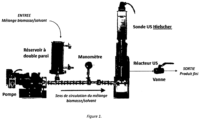
- the microalgae/aqueous solution mixture is received in a double-walled tank.
- Said tank can be thermostatically controlled by means of a water circulation and a thermostat for adjusting the desired temperature.
- the mixture is then sent by means of a pump and a valve to an ultrasonic reactor comprising an ultrasonic probe connected to an ultrasonic generator.
- Said ultrasonic reactor can also preferably be provided with a double wall allowing it to be thermostatically controlled by means of a water circulation and a thermostat for adjusting the desired temperature.
- the valve allows to impose a resistance to the circulation of the mixture and therefore to increase the pressure undergone by the mixture.
- a pressure gauge makes it possible to monitor, upstream of the ultrasonic reactor, the pressure exerted on the mixture, and to modulate the opening of the valve to apply the desired pressure on the mixture.
- the temperature (T) is controlled by means of a thermostat, preferably via a circulation of thermostatically controlled water in the double wall of a reactor comprising the microalgae/aqueous solution mixture, and the mixture is maintained at the desired temperature.
- a thermostat preferably via a circulation of thermostatically controlled water in the double wall of a reactor comprising the microalgae/aqueous solution mixture, and the mixture is maintained at the desired temperature.
- the temperature of the mixture will tend to increase, and that the thermostat can then have the role of maintaining a constant temperature of the mixture. Controlling the temperature makes it possible to avoid an excessive increase which could risk damaging the heat-sensitive water-soluble compounds, known as thermolabile.
- the Applicant has demonstrated that when the temperature exceeds 40°C, certain molecules of interest such as phycoyanin can be masked (by chlorophyll for example).
- the optimum temperature for extracting water-soluble compounds of interest is around 25°C.
- thermoregulation at 20°C coupled with the heating effect of ultrasound, a temperature of around 25-30°C (close to the optimum extraction temperature) is obtained.
- temperature modulation allows different types of compounds to be extracted: at low temperatures, the extraction of thermolabile compounds is favored, while at high temperatures, heat-sensitive compounds are masked, but other molecules that are more difficult to extract in the cold are found in solution, such as chlorophyll (non-polar in nature, soluble in organic solvents in normal times).
- the pressure (P) is applied using a valve on the system for supplying the reactor where P will be applied and makes it possible to impose resistance to the circulation of the microalgae/aqueous solution mixture in the system.
- the ultrasonic power, pressure, temperature and flow rate are modulated to vary the water-soluble compounds extracted from said eukaryotic microalgae or cyanobacteria.
- the greater the ultrasonic power, pressure and temperature delivered to the medium the richer the extract will be in proteins and chlorophyll.
- the lower the ultrasonic power and temperature the less the extract will be rich in water-soluble compounds.
- the duration of the ultrasonic treatment step is between 1 and 90 minutes. Modulating the duration makes it possible to vary the composition of water-soluble compounds, and therefore also the concentration. This is explained by the fact that the more frequently the microalgae/aqueous solution mixture passes through the ultrasonic reactor, the more it will be subjected to ultrasound and release water-soluble compounds.
- the ultrasonic power, pressure, temperature and flow rate are modulated to vary the color of the extract obtained by said method.
- the greater the ultrasonic power, the pressure and the temperature delivered to the medium the richer the extract will be in proteins and chlorophyll and therefore of an intense green color.
- the lower the ultrasonic power and The higher the temperature the less the extract will be rich in water-soluble compounds and the bluer the color of the extract generated will be (due to the absence of chlorophyll).
- the steps are applied to the mixture of eukaryotic microalgae or cyanobacteria and aqueous solution continuously, preferably using a pump ensuring the circulation of the mixture in a closed or open circuit.
- the method for obtaining water-soluble compounds according to the invention further comprises an additional step of solid-liquid separation, preferably by centrifugation, of the extract obtained during the extraction step.
- the method for obtaining water-soluble compounds according to the invention further comprises an additional step of filtration of the liquid part obtained by separation of the solid part (cellular debris) from the extract.
- the filtration is carried out frontally, advantageously on a food filter, for example made of polyamide, in particular nylon, with a fineness of 2 to 50 microns, preferably less than 25 microns.
- a food filter for example made of polyamide, in particular nylon, with a fineness of 2 to 50 microns, preferably less than 25 microns.
- the products as obtained by the process according to the invention contain water-soluble compounds present in microalgae or cyanobacteria.
- said method makes it possible to extract from microalgae and cyanobacteria the water-soluble compounds, separated from the liposoluble fraction of the microalgae or cyanobacteria.
- the extract produced will have organoleptic qualities as well as an optimal nutritional composition.
- the products as obtained by the process according to the invention can be used in chemical, food, cosmetic or pharmaceutical compositions.
- FIG. 1 is a diagram of the mano-thermo-sonication (MTS) mounting device for implementing the method according to the invention, comprising a probe and an ultrasonic reactor for generating Pus, a thermostat for adjusting T, a valve and a pressure gauge for adjusting P and a pump for adjusting D.
- MTS mano-thermo-sonication
- the system is drained in order to bring the mixture into a centrifugation module allowing separation solid/liquid between the solid biomass residues and the water-soluble fraction.
- a filtration step allows a clear and limpid extract to be obtained.
- Example 1 US low power, no pressure ⁇ blue extract
- the biomass Arthrospira platensis
- an aqueous extraction solution phosphate buffer pH 7
- phosphate buffer pH 7 phosphate buffer pH 7
- the mixture is subjected to ultrasound at low ultrasound power (30 W) for 10 min, with thermoregulation at 20 °C. No pressure is imposed on the system.
- the extracts are then centrifuged for 10 min at 8000 rpm and then filtered by frontal filtration on Büchner (porosity 8 ⁇ m) in order to remove any suspended particles.
- the extract obtained is blue in color due to the presence of phycocyanin (8.34 g/100 g Dry Matter (DM)) and contains 33.36 g/100 g DM of proteins.
- Example 2 US high power + pressure ⁇ green extract rich in proteins
- the biomass Arthrospira platensis
- the aqueous extraction solution phosphate buffer pH 7
- phosphate buffer pH 7 phosphate buffer pH 7
- the mixture is subjected to ultrasound at ultrasonic power (100 W/L, i.e. approximately 80% amplitude) for 10 min, with thermoregulation at 20 °C and a pressure of around 2 bars.
- the extracts are then centrifuged for 10 min at 8000 rpm and then filtered by frontal filtration on Büchner (porosity 8 ⁇ m) in order to remove any suspended particles.
- the extract obtained is of intense green color due to the presence of chlorophyll which has been extracted due to the intensity of the method.
- Phycocyanin is still present in the extract (11.47 g/100 g DM) and the protein content is 46.19%.
Landscapes
- Life Sciences & Earth Sciences (AREA)
- Health & Medical Sciences (AREA)
- Chemical & Material Sciences (AREA)
- Engineering & Computer Science (AREA)
- Biotechnology (AREA)
- Mycology (AREA)
- Natural Medicines & Medicinal Plants (AREA)
- Microbiology (AREA)
- Chemical Kinetics & Catalysis (AREA)
- Veterinary Medicine (AREA)
- Pharmacology & Pharmacy (AREA)
- Animal Behavior & Ethology (AREA)
- General Health & Medical Sciences (AREA)
- Public Health (AREA)
- Medicinal Chemistry (AREA)
- Epidemiology (AREA)
- Food Science & Technology (AREA)
- Polymers & Plastics (AREA)
- Nutrition Science (AREA)
- Acoustics & Sound (AREA)
- Physics & Mathematics (AREA)
- Alternative & Traditional Medicine (AREA)
- Botany (AREA)
- Medical Informatics (AREA)
- Mechanical Engineering (AREA)
- Proteomics, Peptides & Aminoacids (AREA)
- Molecular Biology (AREA)
- Preparation Of Compounds By Using Micro-Organisms (AREA)
- Coloring Foods And Improving Nutritive Qualities (AREA)
- Micro-Organisms Or Cultivation Processes Thereof (AREA)
- Medicines Containing Plant Substances (AREA)
- Nitrogen Condensed Heterocyclic Rings (AREA)
- Pharmaceuticals Containing Other Organic And Inorganic Compounds (AREA)
- Pyrrole Compounds (AREA)
- Cosmetics (AREA)
- Medicines That Contain Protein Lipid Enzymes And Other Medicines (AREA)
- Medicines Containing Material From Animals Or Micro-Organisms (AREA)
- Acyclic And Carbocyclic Compounds In Medicinal Compositions (AREA)
Applications Claiming Priority (2)
| Application Number | Priority Date | Filing Date | Title |
|---|---|---|---|
| FR1770630A FR3067569B1 (fr) | 2017-06-15 | 2017-06-15 | Procede d’extraction de composes hydrosolubles a partir de microalgues et/ou de cyanobacteries |
| PCT/FR2018/000172 WO2018229364A1 (fr) | 2017-06-15 | 2018-06-15 | Procédé d'extraction de composés hydrosolubles à partir de microalgues et/ou de cyanobactéries |
Publications (3)
| Publication Number | Publication Date |
|---|---|
| EP3638054A1 EP3638054A1 (fr) | 2020-04-22 |
| EP3638054B1 true EP3638054B1 (fr) | 2024-08-21 |
| EP3638054C0 EP3638054C0 (fr) | 2024-08-21 |
Family
ID=60202258
Family Applications (1)
| Application Number | Title | Priority Date | Filing Date |
|---|---|---|---|
| EP18745997.9A Active EP3638054B1 (fr) | 2017-06-15 | 2018-06-15 | Procédé d'extraction de composés hydrosolubles à partir de microalgues et/ou de cyanobactéries |
Country Status (6)
| Country | Link |
|---|---|
| US (1) | US11202973B2 (https=) |
| EP (1) | EP3638054B1 (https=) |
| JP (1) | JP7260097B2 (https=) |
| CN (1) | CN110944522A (https=) |
| FR (1) | FR3067569B1 (https=) |
| WO (1) | WO2018229364A1 (https=) |
Families Citing this family (5)
| Publication number | Priority date | Publication date | Assignee | Title |
|---|---|---|---|---|
| KR102007675B1 (ko) * | 2019-03-05 | 2019-08-06 | 한국해양과학기술원 | 스피룰리나 추출물 제조방법, 스피룰리나 추출물을 포함하는 인지능 개선용 약학적 조성물 및 건강기능식품 |
| WO2021234700A1 (en) * | 2020-05-19 | 2021-11-25 | Vaxa Technologies Ltd. | Photosynthetically controlled spirulina extracts for treating the cytokine storm syndrome |
| FR3122829A1 (fr) * | 2021-05-11 | 2022-11-18 | Algama | Co-extraction de composés actifs à caractères hydrophiles et hydrophobes issus de microalgues et macroalgues |
| CN121693339A (zh) | 2023-08-23 | 2026-03-17 | 松下知识产权经营株式会社 | 抗氧化剂、活性氧的除去方法和抗氧化剂的制造方法 |
| MA66491B1 (fr) * | 2024-06-26 | 2026-03-31 | Université Mohammed V Rabat | Méthode de préparation d´un complément alimentaire liquide riche à base de microalgues |
Family Cites Families (7)
| Publication number | Priority date | Publication date | Assignee | Title |
|---|---|---|---|---|
| JP2003342489A (ja) * | 2002-05-28 | 2003-12-03 | Dainippon Ink & Chem Inc | 藍藻類からのフィコシアニンの抽出方法 |
| JP4677250B2 (ja) | 2005-02-24 | 2011-04-27 | Dicライフテック株式会社 | 藍藻類からのフィコシアニンの抽出方法 |
| MY169496A (en) * | 2006-06-27 | 2019-04-15 | Nutratec S R L | Extracts of aphanizomenon flos aquae and nutritional, cosmetic and pharmaceutical compositions containing the same |
| FR2995531B1 (fr) | 2012-09-20 | 2014-10-10 | Ecosystem | Procede d'extraction et de stabilisation de phycocyanine et ses applications |
| BR112015021105B1 (pt) * | 2013-03-27 | 2021-08-17 | The Coca-Cola Company | Processo para fornecer base de soja |
| CN104844707A (zh) * | 2015-05-28 | 2015-08-19 | 江西三达新大泽生物工程有限公司 | 从螺旋藻中提取藻蓝色素的提取方法 |
| CN105820237A (zh) * | 2016-04-18 | 2016-08-03 | 东台市赐百年生物工程有限公司 | 一种葡聚糖和酒石酸钾钠双水相萃取分离藻蓝蛋白的方法 |
-
2017
- 2017-06-15 FR FR1770630A patent/FR3067569B1/fr active Active
-
2018
- 2018-06-15 JP JP2019565306A patent/JP7260097B2/ja active Active
- 2018-06-15 WO PCT/FR2018/000172 patent/WO2018229364A1/fr not_active Ceased
- 2018-06-15 CN CN201880036496.4A patent/CN110944522A/zh active Pending
- 2018-06-15 EP EP18745997.9A patent/EP3638054B1/fr active Active
- 2018-06-15 US US16/618,640 patent/US11202973B2/en active Active
Also Published As
| Publication number | Publication date |
|---|---|
| CN110944522A (zh) | 2020-03-31 |
| JP2020527026A (ja) | 2020-09-03 |
| US20210146275A1 (en) | 2021-05-20 |
| FR3067569B1 (fr) | 2021-05-28 |
| FR3067569A1 (fr) | 2018-12-21 |
| US11202973B2 (en) | 2021-12-21 |
| EP3638054A1 (fr) | 2020-04-22 |
| EP3638054C0 (fr) | 2024-08-21 |
| JP7260097B2 (ja) | 2023-04-18 |
| WO2018229364A1 (fr) | 2018-12-20 |
Similar Documents
| Publication | Publication Date | Title |
|---|---|---|
| EP3638054B1 (fr) | Procédé d'extraction de composés hydrosolubles à partir de microalgues et/ou de cyanobactéries | |
| EP3601319B1 (fr) | Procédé de préparation d'un extrait liquide de phycobiliproteines, en particulier de phycocyanine, à partir de cyanobacteries ou de microalgues et extrait ainsi obtenu | |
| WO2016009146A1 (fr) | Procede d'extraction des proteines solubles de biomasses de microalgues | |
| EP3169695B1 (fr) | Procede d'extraction des proteines solubles de biomasses de microalgues | |
| CA3064142A1 (fr) | Procede d'obtention d'une boisson alimentaire stabilisee a base de jus de fruits comprenant des extraits de microalgues et/ou des cyanobacteries | |
| EP2297249A1 (fr) | Matieres colorantes d'origine vegetale et leur utilisation pour colorer des compositions, en particulier cosmetiques | |
| KR20170105498A (ko) | 지질이 풍부한 분쇄 미세조류 가루를 제조하는 방법 | |
| WO2015071477A1 (fr) | Procédé d'obtention d'extraits d'algues marines | |
| EP3119872A1 (fr) | Procédé de perméabilisation thermique d'une biomasse de microalgues | |
| FR2789399A1 (fr) | Procede de fabrication d'extraits de micro-organismes photosynthetiques tels que notamment de spiruline | |
| CA3128866A1 (fr) | Procede optimise d'exploitation industrielle d'algues rouges unicellulaires | |
| Hardiningtyas et al. | Effect of ultrasonication-assisted extraction time on the profile of phycocyanin from wet biomass Spirulina plantesis | |
| WO2016120548A1 (fr) | Procede de fractionnement des composants d'une biomasse de microalgues riches en proteines | |
| WO2013117634A1 (fr) | Procédé d'enrichissement d'un corps gras en caroténoïdes | |
| EP3206477B1 (fr) | Procede de demucilagination | |
| JP5219477B2 (ja) | アスタキサンチンの製造方法 | |
| Batghare et al. | Production of nutraceutical astaxanthin from waste resources | |
| EP3522738A1 (fr) | Aliment ou boisson a base d'une microalgue marine | |
| WO2024088564A1 (fr) | Fraction hydrosoluble de plantes limpide | |
| FR3151332A1 (fr) | Extrait aqueux rouge de Tetraselmis et ses utilisations | |
| FR3134290A1 (fr) | Extraction non destructive de composés d’intérêt alimentaire issus d’algues vivantes |
Legal Events
| Date | Code | Title | Description |
|---|---|---|---|
| STAA | Information on the status of an ep patent application or granted ep patent |
Free format text: STATUS: UNKNOWN |
|
| STAA | Information on the status of an ep patent application or granted ep patent |
Free format text: STATUS: THE INTERNATIONAL PUBLICATION HAS BEEN MADE |
|
| PUAI | Public reference made under article 153(3) epc to a published international application that has entered the european phase |
Free format text: ORIGINAL CODE: 0009012 |
|
| STAA | Information on the status of an ep patent application or granted ep patent |
Free format text: STATUS: REQUEST FOR EXAMINATION WAS MADE |
|
| 17P | Request for examination filed |
Effective date: 20200115 |
|
| AK | Designated contracting states |
Kind code of ref document: A1 Designated state(s): AL AT BE BG CH CY CZ DE DK EE ES FI FR GB GR HR HU IE IS IT LI LT LU LV MC MK MT NL NO PL PT RO RS SE SI SK SM TR |
|
| AX | Request for extension of the european patent |
Extension state: BA ME |
|
| DAV | Request for validation of the european patent (deleted) | ||
| DAX | Request for extension of the european patent (deleted) | ||
| STAA | Information on the status of an ep patent application or granted ep patent |
Free format text: STATUS: EXAMINATION IS IN PROGRESS |
|
| 17Q | First examination report despatched |
Effective date: 20201015 |
|
| GRAP | Despatch of communication of intention to grant a patent |
Free format text: ORIGINAL CODE: EPIDOSNIGR1 |
|
| STAA | Information on the status of an ep patent application or granted ep patent |
Free format text: STATUS: GRANT OF PATENT IS INTENDED |
|
| INTG | Intention to grant announced |
Effective date: 20240314 |
|
| GRAS | Grant fee paid |
Free format text: ORIGINAL CODE: EPIDOSNIGR3 |
|
| GRAA | (expected) grant |
Free format text: ORIGINAL CODE: 0009210 |
|
| STAA | Information on the status of an ep patent application or granted ep patent |
Free format text: STATUS: THE PATENT HAS BEEN GRANTED |
|
| AK | Designated contracting states |
Kind code of ref document: B1 Designated state(s): AL AT BE BG CH CY CZ DE DK EE ES FI FR GB GR HR HU IE IS IT LI LT LU LV MC MK MT NL NO PL PT RO RS SE SI SK SM TR |
|
| REG | Reference to a national code |
Ref country code: GB Ref legal event code: FG4D Free format text: NOT ENGLISH |
|
| REG | Reference to a national code |
Ref country code: CH Ref legal event code: EP |
|
| REG | Reference to a national code |
Ref country code: IE Ref legal event code: FG4D Free format text: LANGUAGE OF EP DOCUMENT: FRENCH |
|
| REG | Reference to a national code |
Ref country code: DE Ref legal event code: R096 Ref document number: 602018073345 Country of ref document: DE |
|
| U01 | Request for unitary effect filed |
Effective date: 20240912 |
|
| U07 | Unitary effect registered |
Designated state(s): AT BE BG DE DK EE FI FR IT LT LU LV MT NL PT RO SE SI Effective date: 20240924 |
|
| PG25 | Lapsed in a contracting state [announced via postgrant information from national office to epo] |
Ref country code: NO Free format text: LAPSE BECAUSE OF FAILURE TO SUBMIT A TRANSLATION OF THE DESCRIPTION OR TO PAY THE FEE WITHIN THE PRESCRIBED TIME-LIMIT Effective date: 20241121 |
|
| PG25 | Lapsed in a contracting state [announced via postgrant information from national office to epo] |
Ref country code: PL Free format text: LAPSE BECAUSE OF FAILURE TO SUBMIT A TRANSLATION OF THE DESCRIPTION OR TO PAY THE FEE WITHIN THE PRESCRIBED TIME-LIMIT Effective date: 20240821 Ref country code: GR Free format text: LAPSE BECAUSE OF FAILURE TO SUBMIT A TRANSLATION OF THE DESCRIPTION OR TO PAY THE FEE WITHIN THE PRESCRIBED TIME-LIMIT Effective date: 20241122 |
|
| PG25 | Lapsed in a contracting state [announced via postgrant information from national office to epo] |
Ref country code: IS Free format text: LAPSE BECAUSE OF FAILURE TO SUBMIT A TRANSLATION OF THE DESCRIPTION OR TO PAY THE FEE WITHIN THE PRESCRIBED TIME-LIMIT Effective date: 20241221 |
|
| PG25 | Lapsed in a contracting state [announced via postgrant information from national office to epo] |
Ref country code: HR Free format text: LAPSE BECAUSE OF FAILURE TO SUBMIT A TRANSLATION OF THE DESCRIPTION OR TO PAY THE FEE WITHIN THE PRESCRIBED TIME-LIMIT Effective date: 20240821 |
|
| PG25 | Lapsed in a contracting state [announced via postgrant information from national office to epo] |
Ref country code: ES Free format text: LAPSE BECAUSE OF FAILURE TO SUBMIT A TRANSLATION OF THE DESCRIPTION OR TO PAY THE FEE WITHIN THE PRESCRIBED TIME-LIMIT Effective date: 20240821 Ref country code: RS Free format text: LAPSE BECAUSE OF FAILURE TO SUBMIT A TRANSLATION OF THE DESCRIPTION OR TO PAY THE FEE WITHIN THE PRESCRIBED TIME-LIMIT Effective date: 20241121 |
|
| PG25 | Lapsed in a contracting state [announced via postgrant information from national office to epo] |
Ref country code: RS Free format text: LAPSE BECAUSE OF FAILURE TO SUBMIT A TRANSLATION OF THE DESCRIPTION OR TO PAY THE FEE WITHIN THE PRESCRIBED TIME-LIMIT Effective date: 20241121 Ref country code: PL Free format text: LAPSE BECAUSE OF FAILURE TO SUBMIT A TRANSLATION OF THE DESCRIPTION OR TO PAY THE FEE WITHIN THE PRESCRIBED TIME-LIMIT Effective date: 20240821 Ref country code: NO Free format text: LAPSE BECAUSE OF FAILURE TO SUBMIT A TRANSLATION OF THE DESCRIPTION OR TO PAY THE FEE WITHIN THE PRESCRIBED TIME-LIMIT Effective date: 20241121 Ref country code: IS Free format text: LAPSE BECAUSE OF FAILURE TO SUBMIT A TRANSLATION OF THE DESCRIPTION OR TO PAY THE FEE WITHIN THE PRESCRIBED TIME-LIMIT Effective date: 20241221 Ref country code: HR Free format text: LAPSE BECAUSE OF FAILURE TO SUBMIT A TRANSLATION OF THE DESCRIPTION OR TO PAY THE FEE WITHIN THE PRESCRIBED TIME-LIMIT Effective date: 20240821 Ref country code: GR Free format text: LAPSE BECAUSE OF FAILURE TO SUBMIT A TRANSLATION OF THE DESCRIPTION OR TO PAY THE FEE WITHIN THE PRESCRIBED TIME-LIMIT Effective date: 20241122 Ref country code: ES Free format text: LAPSE BECAUSE OF FAILURE TO SUBMIT A TRANSLATION OF THE DESCRIPTION OR TO PAY THE FEE WITHIN THE PRESCRIBED TIME-LIMIT Effective date: 20240821 |
|
| PG25 | Lapsed in a contracting state [announced via postgrant information from national office to epo] |
Ref country code: SM Free format text: LAPSE BECAUSE OF FAILURE TO SUBMIT A TRANSLATION OF THE DESCRIPTION OR TO PAY THE FEE WITHIN THE PRESCRIBED TIME-LIMIT Effective date: 20240821 |
|
| PG25 | Lapsed in a contracting state [announced via postgrant information from national office to epo] |
Ref country code: CZ Free format text: LAPSE BECAUSE OF FAILURE TO SUBMIT A TRANSLATION OF THE DESCRIPTION OR TO PAY THE FEE WITHIN THE PRESCRIBED TIME-LIMIT Effective date: 20240821 |
|
| PG25 | Lapsed in a contracting state [announced via postgrant information from national office to epo] |
Ref country code: SK Free format text: LAPSE BECAUSE OF FAILURE TO SUBMIT A TRANSLATION OF THE DESCRIPTION OR TO PAY THE FEE WITHIN THE PRESCRIBED TIME-LIMIT Effective date: 20240821 |
|
| PLBE | No opposition filed within time limit |
Free format text: ORIGINAL CODE: 0009261 |
|
| STAA | Information on the status of an ep patent application or granted ep patent |
Free format text: STATUS: NO OPPOSITION FILED WITHIN TIME LIMIT |
|
| U20 | Renewal fee for the european patent with unitary effect paid |
Year of fee payment: 8 Effective date: 20250604 |
|
| 26N | No opposition filed |
Effective date: 20250522 |
|
| REG | Reference to a national code |
Ref country code: CH Ref legal event code: H13 Free format text: ST27 STATUS EVENT CODE: U-0-0-H10-H13 (AS PROVIDED BY THE NATIONAL OFFICE) Effective date: 20260127 |
|
| PG25 | Lapsed in a contracting state [announced via postgrant information from national office to epo] |
Ref country code: MC Free format text: LAPSE BECAUSE OF FAILURE TO SUBMIT A TRANSLATION OF THE DESCRIPTION OR TO PAY THE FEE WITHIN THE PRESCRIBED TIME-LIMIT Effective date: 20240821 |
|
| GBPC | Gb: european patent ceased through non-payment of renewal fee |
Effective date: 20250615 |
|
| PG25 | Lapsed in a contracting state [announced via postgrant information from national office to epo] |
Ref country code: GB Free format text: LAPSE BECAUSE OF NON-PAYMENT OF DUE FEES Effective date: 20250615 |
|
| PG25 | Lapsed in a contracting state [announced via postgrant information from national office to epo] |
Ref country code: IE Free format text: LAPSE BECAUSE OF NON-PAYMENT OF DUE FEES Effective date: 20250615 |
|
| PG25 | Lapsed in a contracting state [announced via postgrant information from national office to epo] |
Ref country code: CH Free format text: LAPSE BECAUSE OF NON-PAYMENT OF DUE FEES Effective date: 20250630 |