EP3632541A1 - Functional structure and production method for functional structure - Google Patents
Functional structure and production method for functional structure Download PDFInfo
- Publication number
- EP3632541A1 EP3632541A1 EP18809413.0A EP18809413A EP3632541A1 EP 3632541 A1 EP3632541 A1 EP 3632541A1 EP 18809413 A EP18809413 A EP 18809413A EP 3632541 A1 EP3632541 A1 EP 3632541A1
- Authority
- EP
- European Patent Office
- Prior art keywords
- functional structural
- structural body
- metallic nanoparticles
- precursor material
- body according
- Prior art date
- Legal status (The legal status is an assumption and is not a legal conclusion. Google has not performed a legal analysis and makes no representation as to the accuracy of the status listed.)
- Pending
Links
Images


Classifications
-
- B—PERFORMING OPERATIONS; TRANSPORTING
- B01—PHYSICAL OR CHEMICAL PROCESSES OR APPARATUS IN GENERAL
- B01J—CHEMICAL OR PHYSICAL PROCESSES, e.g. CATALYSIS OR COLLOID CHEMISTRY; THEIR RELEVANT APPARATUS
- B01J29/00—Catalysts comprising molecular sieves
- B01J29/04—Catalysts comprising molecular sieves having base-exchange properties, e.g. crystalline zeolites
- B01J29/06—Crystalline aluminosilicate zeolites; Isomorphous compounds thereof
- B01J29/08—Crystalline aluminosilicate zeolites; Isomorphous compounds thereof of the faujasite type, e.g. type X or Y
- B01J29/10—Crystalline aluminosilicate zeolites; Isomorphous compounds thereof of the faujasite type, e.g. type X or Y containing iron group metals, noble metals or copper
- B01J29/14—Iron group metals or copper
-
- B—PERFORMING OPERATIONS; TRANSPORTING
- B01—PHYSICAL OR CHEMICAL PROCESSES OR APPARATUS IN GENERAL
- B01D—SEPARATION
- B01D53/00—Separation of gases or vapours; Recovering vapours of volatile solvents from gases; Chemical or biological purification of waste gases, e.g. engine exhaust gases, smoke, fumes, flue gases, aerosols
- B01D53/34—Chemical or biological purification of waste gases
- B01D53/92—Chemical or biological purification of waste gases of engine exhaust gases
- B01D53/94—Chemical or biological purification of waste gases of engine exhaust gases by catalytic processes
-
- B—PERFORMING OPERATIONS; TRANSPORTING
- B01—PHYSICAL OR CHEMICAL PROCESSES OR APPARATUS IN GENERAL
- B01D—SEPARATION
- B01D53/00—Separation of gases or vapours; Recovering vapours of volatile solvents from gases; Chemical or biological purification of waste gases, e.g. engine exhaust gases, smoke, fumes, flue gases, aerosols
- B01D53/34—Chemical or biological purification of waste gases
- B01D53/92—Chemical or biological purification of waste gases of engine exhaust gases
- B01D53/94—Chemical or biological purification of waste gases of engine exhaust gases by catalytic processes
- B01D53/9404—Removing only nitrogen compounds
- B01D53/9409—Nitrogen oxides
-
- B—PERFORMING OPERATIONS; TRANSPORTING
- B01—PHYSICAL OR CHEMICAL PROCESSES OR APPARATUS IN GENERAL
- B01D—SEPARATION
- B01D53/00—Separation of gases or vapours; Recovering vapours of volatile solvents from gases; Chemical or biological purification of waste gases, e.g. engine exhaust gases, smoke, fumes, flue gases, aerosols
- B01D53/34—Chemical or biological purification of waste gases
- B01D53/92—Chemical or biological purification of waste gases of engine exhaust gases
- B01D53/94—Chemical or biological purification of waste gases of engine exhaust gases by catalytic processes
- B01D53/9404—Removing only nitrogen compounds
- B01D53/9409—Nitrogen oxides
- B01D53/9413—Processes characterised by a specific catalyst
-
- B—PERFORMING OPERATIONS; TRANSPORTING
- B01—PHYSICAL OR CHEMICAL PROCESSES OR APPARATUS IN GENERAL
- B01J—CHEMICAL OR PHYSICAL PROCESSES, e.g. CATALYSIS OR COLLOID CHEMISTRY; THEIR RELEVANT APPARATUS
- B01J29/00—Catalysts comprising molecular sieves
- B01J29/03—Catalysts comprising molecular sieves not having base-exchange properties
- B01J29/035—Microporous crystalline materials not having base exchange properties, such as silica polymorphs, e.g. silicalites
-
- B—PERFORMING OPERATIONS; TRANSPORTING
- B01—PHYSICAL OR CHEMICAL PROCESSES OR APPARATUS IN GENERAL
- B01J—CHEMICAL OR PHYSICAL PROCESSES, e.g. CATALYSIS OR COLLOID CHEMISTRY; THEIR RELEVANT APPARATUS
- B01J29/00—Catalysts comprising molecular sieves
- B01J29/03—Catalysts comprising molecular sieves not having base-exchange properties
- B01J29/035—Microporous crystalline materials not having base exchange properties, such as silica polymorphs, e.g. silicalites
- B01J29/0352—Microporous crystalline materials not having base exchange properties, such as silica polymorphs, e.g. silicalites containing iron group metals, noble metals or copper
-
- B—PERFORMING OPERATIONS; TRANSPORTING
- B01—PHYSICAL OR CHEMICAL PROCESSES OR APPARATUS IN GENERAL
- B01J—CHEMICAL OR PHYSICAL PROCESSES, e.g. CATALYSIS OR COLLOID CHEMISTRY; THEIR RELEVANT APPARATUS
- B01J29/00—Catalysts comprising molecular sieves
- B01J29/03—Catalysts comprising molecular sieves not having base-exchange properties
- B01J29/035—Microporous crystalline materials not having base exchange properties, such as silica polymorphs, e.g. silicalites
- B01J29/0352—Microporous crystalline materials not having base exchange properties, such as silica polymorphs, e.g. silicalites containing iron group metals, noble metals or copper
- B01J29/0354—Noble metals
-
- B—PERFORMING OPERATIONS; TRANSPORTING
- B01—PHYSICAL OR CHEMICAL PROCESSES OR APPARATUS IN GENERAL
- B01J—CHEMICAL OR PHYSICAL PROCESSES, e.g. CATALYSIS OR COLLOID CHEMISTRY; THEIR RELEVANT APPARATUS
- B01J29/00—Catalysts comprising molecular sieves
- B01J29/03—Catalysts comprising molecular sieves not having base-exchange properties
- B01J29/035—Microporous crystalline materials not having base exchange properties, such as silica polymorphs, e.g. silicalites
- B01J29/0352—Microporous crystalline materials not having base exchange properties, such as silica polymorphs, e.g. silicalites containing iron group metals, noble metals or copper
- B01J29/0356—Iron group metals or copper
-
- B—PERFORMING OPERATIONS; TRANSPORTING
- B01—PHYSICAL OR CHEMICAL PROCESSES OR APPARATUS IN GENERAL
- B01J—CHEMICAL OR PHYSICAL PROCESSES, e.g. CATALYSIS OR COLLOID CHEMISTRY; THEIR RELEVANT APPARATUS
- B01J29/00—Catalysts comprising molecular sieves
- B01J29/03—Catalysts comprising molecular sieves not having base-exchange properties
- B01J29/035—Microporous crystalline materials not having base exchange properties, such as silica polymorphs, e.g. silicalites
- B01J29/0358—Microporous crystalline materials not having base exchange properties, such as silica polymorphs, e.g. silicalites containing arsenic, antimony, bismuth, vanadium, niobium, tantalum, polonium, chromium, molybdenum, tungsten, manganese, technetium or rhenium
-
- B—PERFORMING OPERATIONS; TRANSPORTING
- B01—PHYSICAL OR CHEMICAL PROCESSES OR APPARATUS IN GENERAL
- B01J—CHEMICAL OR PHYSICAL PROCESSES, e.g. CATALYSIS OR COLLOID CHEMISTRY; THEIR RELEVANT APPARATUS
- B01J29/00—Catalysts comprising molecular sieves
- B01J29/04—Catalysts comprising molecular sieves having base-exchange properties, e.g. crystalline zeolites
- B01J29/06—Crystalline aluminosilicate zeolites; Isomorphous compounds thereof
- B01J29/064—Crystalline aluminosilicate zeolites; Isomorphous compounds thereof containing iron group metals, noble metals or copper
-
- B—PERFORMING OPERATIONS; TRANSPORTING
- B01—PHYSICAL OR CHEMICAL PROCESSES OR APPARATUS IN GENERAL
- B01J—CHEMICAL OR PHYSICAL PROCESSES, e.g. CATALYSIS OR COLLOID CHEMISTRY; THEIR RELEVANT APPARATUS
- B01J29/00—Catalysts comprising molecular sieves
- B01J29/04—Catalysts comprising molecular sieves having base-exchange properties, e.g. crystalline zeolites
- B01J29/06—Crystalline aluminosilicate zeolites; Isomorphous compounds thereof
- B01J29/064—Crystalline aluminosilicate zeolites; Isomorphous compounds thereof containing iron group metals, noble metals or copper
- B01J29/068—Noble metals
-
- B—PERFORMING OPERATIONS; TRANSPORTING
- B01—PHYSICAL OR CHEMICAL PROCESSES OR APPARATUS IN GENERAL
- B01J—CHEMICAL OR PHYSICAL PROCESSES, e.g. CATALYSIS OR COLLOID CHEMISTRY; THEIR RELEVANT APPARATUS
- B01J29/00—Catalysts comprising molecular sieves
- B01J29/04—Catalysts comprising molecular sieves having base-exchange properties, e.g. crystalline zeolites
- B01J29/06—Crystalline aluminosilicate zeolites; Isomorphous compounds thereof
- B01J29/064—Crystalline aluminosilicate zeolites; Isomorphous compounds thereof containing iron group metals, noble metals or copper
- B01J29/072—Iron group metals or copper
-
- B—PERFORMING OPERATIONS; TRANSPORTING
- B01—PHYSICAL OR CHEMICAL PROCESSES OR APPARATUS IN GENERAL
- B01J—CHEMICAL OR PHYSICAL PROCESSES, e.g. CATALYSIS OR COLLOID CHEMISTRY; THEIR RELEVANT APPARATUS
- B01J29/00—Catalysts comprising molecular sieves
- B01J29/04—Catalysts comprising molecular sieves having base-exchange properties, e.g. crystalline zeolites
- B01J29/06—Crystalline aluminosilicate zeolites; Isomorphous compounds thereof
- B01J29/076—Crystalline aluminosilicate zeolites; Isomorphous compounds thereof containing arsenic, antimony, bismuth, vanadium, niobium, tantalum, polonium, chromium, molybdenum, tungsten, manganese, technetium or rhenium
-
- B—PERFORMING OPERATIONS; TRANSPORTING
- B01—PHYSICAL OR CHEMICAL PROCESSES OR APPARATUS IN GENERAL
- B01J—CHEMICAL OR PHYSICAL PROCESSES, e.g. CATALYSIS OR COLLOID CHEMISTRY; THEIR RELEVANT APPARATUS
- B01J29/00—Catalysts comprising molecular sieves
- B01J29/04—Catalysts comprising molecular sieves having base-exchange properties, e.g. crystalline zeolites
- B01J29/06—Crystalline aluminosilicate zeolites; Isomorphous compounds thereof
- B01J29/08—Crystalline aluminosilicate zeolites; Isomorphous compounds thereof of the faujasite type, e.g. type X or Y
- B01J29/085—Crystalline aluminosilicate zeolites; Isomorphous compounds thereof of the faujasite type, e.g. type X or Y containing rare earth elements, titanium, zirconium, hafnium, zinc, cadmium, mercury, gallium, indium, thallium, tin or lead
-
- B—PERFORMING OPERATIONS; TRANSPORTING
- B01—PHYSICAL OR CHEMICAL PROCESSES OR APPARATUS IN GENERAL
- B01J—CHEMICAL OR PHYSICAL PROCESSES, e.g. CATALYSIS OR COLLOID CHEMISTRY; THEIR RELEVANT APPARATUS
- B01J29/00—Catalysts comprising molecular sieves
- B01J29/04—Catalysts comprising molecular sieves having base-exchange properties, e.g. crystalline zeolites
- B01J29/06—Crystalline aluminosilicate zeolites; Isomorphous compounds thereof
- B01J29/08—Crystalline aluminosilicate zeolites; Isomorphous compounds thereof of the faujasite type, e.g. type X or Y
- B01J29/10—Crystalline aluminosilicate zeolites; Isomorphous compounds thereof of the faujasite type, e.g. type X or Y containing iron group metals, noble metals or copper
-
- B—PERFORMING OPERATIONS; TRANSPORTING
- B01—PHYSICAL OR CHEMICAL PROCESSES OR APPARATUS IN GENERAL
- B01J—CHEMICAL OR PHYSICAL PROCESSES, e.g. CATALYSIS OR COLLOID CHEMISTRY; THEIR RELEVANT APPARATUS
- B01J29/00—Catalysts comprising molecular sieves
- B01J29/04—Catalysts comprising molecular sieves having base-exchange properties, e.g. crystalline zeolites
- B01J29/06—Crystalline aluminosilicate zeolites; Isomorphous compounds thereof
- B01J29/08—Crystalline aluminosilicate zeolites; Isomorphous compounds thereof of the faujasite type, e.g. type X or Y
- B01J29/10—Crystalline aluminosilicate zeolites; Isomorphous compounds thereof of the faujasite type, e.g. type X or Y containing iron group metals, noble metals or copper
- B01J29/12—Noble metals
-
- B—PERFORMING OPERATIONS; TRANSPORTING
- B01—PHYSICAL OR CHEMICAL PROCESSES OR APPARATUS IN GENERAL
- B01J—CHEMICAL OR PHYSICAL PROCESSES, e.g. CATALYSIS OR COLLOID CHEMISTRY; THEIR RELEVANT APPARATUS
- B01J29/00—Catalysts comprising molecular sieves
- B01J29/04—Catalysts comprising molecular sieves having base-exchange properties, e.g. crystalline zeolites
- B01J29/06—Crystalline aluminosilicate zeolites; Isomorphous compounds thereof
- B01J29/08—Crystalline aluminosilicate zeolites; Isomorphous compounds thereof of the faujasite type, e.g. type X or Y
- B01J29/16—Crystalline aluminosilicate zeolites; Isomorphous compounds thereof of the faujasite type, e.g. type X or Y containing arsenic, antimony, bismuth, vanadium, niobium, tantalum, polonium, chromium, molybdenum, tungsten, manganese, technetium or rhenium
-
- B—PERFORMING OPERATIONS; TRANSPORTING
- B01—PHYSICAL OR CHEMICAL PROCESSES OR APPARATUS IN GENERAL
- B01J—CHEMICAL OR PHYSICAL PROCESSES, e.g. CATALYSIS OR COLLOID CHEMISTRY; THEIR RELEVANT APPARATUS
- B01J29/00—Catalysts comprising molecular sieves
- B01J29/04—Catalysts comprising molecular sieves having base-exchange properties, e.g. crystalline zeolites
- B01J29/06—Crystalline aluminosilicate zeolites; Isomorphous compounds thereof
- B01J29/18—Crystalline aluminosilicate zeolites; Isomorphous compounds thereof of the mordenite type
- B01J29/185—Crystalline aluminosilicate zeolites; Isomorphous compounds thereof of the mordenite type containing rare earth elements, titanium, zirconium, hafnium, zinc, cadmium, mercury, gallium, indium, thallium, tin or lead
-
- B—PERFORMING OPERATIONS; TRANSPORTING
- B01—PHYSICAL OR CHEMICAL PROCESSES OR APPARATUS IN GENERAL
- B01J—CHEMICAL OR PHYSICAL PROCESSES, e.g. CATALYSIS OR COLLOID CHEMISTRY; THEIR RELEVANT APPARATUS
- B01J29/00—Catalysts comprising molecular sieves
- B01J29/04—Catalysts comprising molecular sieves having base-exchange properties, e.g. crystalline zeolites
- B01J29/06—Crystalline aluminosilicate zeolites; Isomorphous compounds thereof
- B01J29/18—Crystalline aluminosilicate zeolites; Isomorphous compounds thereof of the mordenite type
- B01J29/20—Crystalline aluminosilicate zeolites; Isomorphous compounds thereof of the mordenite type containing iron group metals, noble metals or copper
-
- B—PERFORMING OPERATIONS; TRANSPORTING
- B01—PHYSICAL OR CHEMICAL PROCESSES OR APPARATUS IN GENERAL
- B01J—CHEMICAL OR PHYSICAL PROCESSES, e.g. CATALYSIS OR COLLOID CHEMISTRY; THEIR RELEVANT APPARATUS
- B01J29/00—Catalysts comprising molecular sieves
- B01J29/04—Catalysts comprising molecular sieves having base-exchange properties, e.g. crystalline zeolites
- B01J29/06—Crystalline aluminosilicate zeolites; Isomorphous compounds thereof
- B01J29/18—Crystalline aluminosilicate zeolites; Isomorphous compounds thereof of the mordenite type
- B01J29/20—Crystalline aluminosilicate zeolites; Isomorphous compounds thereof of the mordenite type containing iron group metals, noble metals or copper
- B01J29/22—Noble metals
-
- B—PERFORMING OPERATIONS; TRANSPORTING
- B01—PHYSICAL OR CHEMICAL PROCESSES OR APPARATUS IN GENERAL
- B01J—CHEMICAL OR PHYSICAL PROCESSES, e.g. CATALYSIS OR COLLOID CHEMISTRY; THEIR RELEVANT APPARATUS
- B01J29/00—Catalysts comprising molecular sieves
- B01J29/04—Catalysts comprising molecular sieves having base-exchange properties, e.g. crystalline zeolites
- B01J29/06—Crystalline aluminosilicate zeolites; Isomorphous compounds thereof
- B01J29/18—Crystalline aluminosilicate zeolites; Isomorphous compounds thereof of the mordenite type
- B01J29/20—Crystalline aluminosilicate zeolites; Isomorphous compounds thereof of the mordenite type containing iron group metals, noble metals or copper
- B01J29/24—Iron group metals or copper
-
- B—PERFORMING OPERATIONS; TRANSPORTING
- B01—PHYSICAL OR CHEMICAL PROCESSES OR APPARATUS IN GENERAL
- B01J—CHEMICAL OR PHYSICAL PROCESSES, e.g. CATALYSIS OR COLLOID CHEMISTRY; THEIR RELEVANT APPARATUS
- B01J29/00—Catalysts comprising molecular sieves
- B01J29/04—Catalysts comprising molecular sieves having base-exchange properties, e.g. crystalline zeolites
- B01J29/06—Crystalline aluminosilicate zeolites; Isomorphous compounds thereof
- B01J29/18—Crystalline aluminosilicate zeolites; Isomorphous compounds thereof of the mordenite type
- B01J29/26—Crystalline aluminosilicate zeolites; Isomorphous compounds thereof of the mordenite type containing arsenic, antimony, bismuth, vanadium, niobium, tantalum, polonium, chromium, molybdenum, tungsten, manganese, technetium or rhenium
-
- B—PERFORMING OPERATIONS; TRANSPORTING
- B01—PHYSICAL OR CHEMICAL PROCESSES OR APPARATUS IN GENERAL
- B01J—CHEMICAL OR PHYSICAL PROCESSES, e.g. CATALYSIS OR COLLOID CHEMISTRY; THEIR RELEVANT APPARATUS
- B01J29/00—Catalysts comprising molecular sieves
- B01J29/04—Catalysts comprising molecular sieves having base-exchange properties, e.g. crystalline zeolites
- B01J29/06—Crystalline aluminosilicate zeolites; Isomorphous compounds thereof
- B01J29/40—Crystalline aluminosilicate zeolites; Isomorphous compounds thereof of the pentasil type, e.g. types ZSM-5, ZSM-8 or ZSM-11, as exemplified by patent documents US3702886, GB1334243 and US3709979, respectively
-
- B—PERFORMING OPERATIONS; TRANSPORTING
- B01—PHYSICAL OR CHEMICAL PROCESSES OR APPARATUS IN GENERAL
- B01J—CHEMICAL OR PHYSICAL PROCESSES, e.g. CATALYSIS OR COLLOID CHEMISTRY; THEIR RELEVANT APPARATUS
- B01J29/00—Catalysts comprising molecular sieves
- B01J29/04—Catalysts comprising molecular sieves having base-exchange properties, e.g. crystalline zeolites
- B01J29/06—Crystalline aluminosilicate zeolites; Isomorphous compounds thereof
- B01J29/40—Crystalline aluminosilicate zeolites; Isomorphous compounds thereof of the pentasil type, e.g. types ZSM-5, ZSM-8 or ZSM-11, as exemplified by patent documents US3702886, GB1334243 and US3709979, respectively
- B01J29/405—Crystalline aluminosilicate zeolites; Isomorphous compounds thereof of the pentasil type, e.g. types ZSM-5, ZSM-8 or ZSM-11, as exemplified by patent documents US3702886, GB1334243 and US3709979, respectively containing rare earth elements, titanium, zirconium, hafnium, zinc, cadmium, mercury, gallium, indium, thallium, tin or lead
-
- B—PERFORMING OPERATIONS; TRANSPORTING
- B01—PHYSICAL OR CHEMICAL PROCESSES OR APPARATUS IN GENERAL
- B01J—CHEMICAL OR PHYSICAL PROCESSES, e.g. CATALYSIS OR COLLOID CHEMISTRY; THEIR RELEVANT APPARATUS
- B01J29/00—Catalysts comprising molecular sieves
- B01J29/04—Catalysts comprising molecular sieves having base-exchange properties, e.g. crystalline zeolites
- B01J29/06—Crystalline aluminosilicate zeolites; Isomorphous compounds thereof
- B01J29/40—Crystalline aluminosilicate zeolites; Isomorphous compounds thereof of the pentasil type, e.g. types ZSM-5, ZSM-8 or ZSM-11, as exemplified by patent documents US3702886, GB1334243 and US3709979, respectively
- B01J29/42—Crystalline aluminosilicate zeolites; Isomorphous compounds thereof of the pentasil type, e.g. types ZSM-5, ZSM-8 or ZSM-11, as exemplified by patent documents US3702886, GB1334243 and US3709979, respectively containing iron group metals, noble metals or copper
-
- B—PERFORMING OPERATIONS; TRANSPORTING
- B01—PHYSICAL OR CHEMICAL PROCESSES OR APPARATUS IN GENERAL
- B01J—CHEMICAL OR PHYSICAL PROCESSES, e.g. CATALYSIS OR COLLOID CHEMISTRY; THEIR RELEVANT APPARATUS
- B01J29/00—Catalysts comprising molecular sieves
- B01J29/04—Catalysts comprising molecular sieves having base-exchange properties, e.g. crystalline zeolites
- B01J29/06—Crystalline aluminosilicate zeolites; Isomorphous compounds thereof
- B01J29/40—Crystalline aluminosilicate zeolites; Isomorphous compounds thereof of the pentasil type, e.g. types ZSM-5, ZSM-8 or ZSM-11, as exemplified by patent documents US3702886, GB1334243 and US3709979, respectively
- B01J29/42—Crystalline aluminosilicate zeolites; Isomorphous compounds thereof of the pentasil type, e.g. types ZSM-5, ZSM-8 or ZSM-11, as exemplified by patent documents US3702886, GB1334243 and US3709979, respectively containing iron group metals, noble metals or copper
- B01J29/44—Noble metals
-
- B—PERFORMING OPERATIONS; TRANSPORTING
- B01—PHYSICAL OR CHEMICAL PROCESSES OR APPARATUS IN GENERAL
- B01J—CHEMICAL OR PHYSICAL PROCESSES, e.g. CATALYSIS OR COLLOID CHEMISTRY; THEIR RELEVANT APPARATUS
- B01J29/00—Catalysts comprising molecular sieves
- B01J29/04—Catalysts comprising molecular sieves having base-exchange properties, e.g. crystalline zeolites
- B01J29/06—Crystalline aluminosilicate zeolites; Isomorphous compounds thereof
- B01J29/40—Crystalline aluminosilicate zeolites; Isomorphous compounds thereof of the pentasil type, e.g. types ZSM-5, ZSM-8 or ZSM-11, as exemplified by patent documents US3702886, GB1334243 and US3709979, respectively
- B01J29/42—Crystalline aluminosilicate zeolites; Isomorphous compounds thereof of the pentasil type, e.g. types ZSM-5, ZSM-8 or ZSM-11, as exemplified by patent documents US3702886, GB1334243 and US3709979, respectively containing iron group metals, noble metals or copper
- B01J29/46—Iron group metals or copper
-
- B—PERFORMING OPERATIONS; TRANSPORTING
- B01—PHYSICAL OR CHEMICAL PROCESSES OR APPARATUS IN GENERAL
- B01J—CHEMICAL OR PHYSICAL PROCESSES, e.g. CATALYSIS OR COLLOID CHEMISTRY; THEIR RELEVANT APPARATUS
- B01J29/00—Catalysts comprising molecular sieves
- B01J29/04—Catalysts comprising molecular sieves having base-exchange properties, e.g. crystalline zeolites
- B01J29/06—Crystalline aluminosilicate zeolites; Isomorphous compounds thereof
- B01J29/40—Crystalline aluminosilicate zeolites; Isomorphous compounds thereof of the pentasil type, e.g. types ZSM-5, ZSM-8 or ZSM-11, as exemplified by patent documents US3702886, GB1334243 and US3709979, respectively
- B01J29/48—Crystalline aluminosilicate zeolites; Isomorphous compounds thereof of the pentasil type, e.g. types ZSM-5, ZSM-8 or ZSM-11, as exemplified by patent documents US3702886, GB1334243 and US3709979, respectively containing arsenic, antimony, bismuth, vanadium, niobium tantalum, polonium, chromium, molybdenum, tungsten, manganese, technetium or rhenium
-
- B—PERFORMING OPERATIONS; TRANSPORTING
- B01—PHYSICAL OR CHEMICAL PROCESSES OR APPARATUS IN GENERAL
- B01J—CHEMICAL OR PHYSICAL PROCESSES, e.g. CATALYSIS OR COLLOID CHEMISTRY; THEIR RELEVANT APPARATUS
- B01J29/00—Catalysts comprising molecular sieves
- B01J29/04—Catalysts comprising molecular sieves having base-exchange properties, e.g. crystalline zeolites
- B01J29/06—Crystalline aluminosilicate zeolites; Isomorphous compounds thereof
- B01J29/60—Crystalline aluminosilicate zeolites; Isomorphous compounds thereof of the type L, as exemplified by patent document US3216789
- B01J29/605—Crystalline aluminosilicate zeolites; Isomorphous compounds thereof of the type L, as exemplified by patent document US3216789 containing rare earth elements, titanium, zirconium, hafnium, zinc, cadmium, mercury, gallium, indium, thallium, tin or lead
-
- B—PERFORMING OPERATIONS; TRANSPORTING
- B01—PHYSICAL OR CHEMICAL PROCESSES OR APPARATUS IN GENERAL
- B01J—CHEMICAL OR PHYSICAL PROCESSES, e.g. CATALYSIS OR COLLOID CHEMISTRY; THEIR RELEVANT APPARATUS
- B01J29/00—Catalysts comprising molecular sieves
- B01J29/04—Catalysts comprising molecular sieves having base-exchange properties, e.g. crystalline zeolites
- B01J29/06—Crystalline aluminosilicate zeolites; Isomorphous compounds thereof
- B01J29/60—Crystalline aluminosilicate zeolites; Isomorphous compounds thereof of the type L, as exemplified by patent document US3216789
- B01J29/61—Crystalline aluminosilicate zeolites; Isomorphous compounds thereof of the type L, as exemplified by patent document US3216789 containing iron group metals, noble metals or copper
-
- B—PERFORMING OPERATIONS; TRANSPORTING
- B01—PHYSICAL OR CHEMICAL PROCESSES OR APPARATUS IN GENERAL
- B01J—CHEMICAL OR PHYSICAL PROCESSES, e.g. CATALYSIS OR COLLOID CHEMISTRY; THEIR RELEVANT APPARATUS
- B01J29/00—Catalysts comprising molecular sieves
- B01J29/04—Catalysts comprising molecular sieves having base-exchange properties, e.g. crystalline zeolites
- B01J29/06—Crystalline aluminosilicate zeolites; Isomorphous compounds thereof
- B01J29/60—Crystalline aluminosilicate zeolites; Isomorphous compounds thereof of the type L, as exemplified by patent document US3216789
- B01J29/61—Crystalline aluminosilicate zeolites; Isomorphous compounds thereof of the type L, as exemplified by patent document US3216789 containing iron group metals, noble metals or copper
- B01J29/62—Noble metals
-
- B—PERFORMING OPERATIONS; TRANSPORTING
- B01—PHYSICAL OR CHEMICAL PROCESSES OR APPARATUS IN GENERAL
- B01J—CHEMICAL OR PHYSICAL PROCESSES, e.g. CATALYSIS OR COLLOID CHEMISTRY; THEIR RELEVANT APPARATUS
- B01J29/00—Catalysts comprising molecular sieves
- B01J29/04—Catalysts comprising molecular sieves having base-exchange properties, e.g. crystalline zeolites
- B01J29/06—Crystalline aluminosilicate zeolites; Isomorphous compounds thereof
- B01J29/60—Crystalline aluminosilicate zeolites; Isomorphous compounds thereof of the type L, as exemplified by patent document US3216789
- B01J29/61—Crystalline aluminosilicate zeolites; Isomorphous compounds thereof of the type L, as exemplified by patent document US3216789 containing iron group metals, noble metals or copper
- B01J29/63—Iron group metals or copper
-
- B—PERFORMING OPERATIONS; TRANSPORTING
- B01—PHYSICAL OR CHEMICAL PROCESSES OR APPARATUS IN GENERAL
- B01J—CHEMICAL OR PHYSICAL PROCESSES, e.g. CATALYSIS OR COLLOID CHEMISTRY; THEIR RELEVANT APPARATUS
- B01J29/00—Catalysts comprising molecular sieves
- B01J29/04—Catalysts comprising molecular sieves having base-exchange properties, e.g. crystalline zeolites
- B01J29/06—Crystalline aluminosilicate zeolites; Isomorphous compounds thereof
- B01J29/60—Crystalline aluminosilicate zeolites; Isomorphous compounds thereof of the type L, as exemplified by patent document US3216789
- B01J29/64—Crystalline aluminosilicate zeolites; Isomorphous compounds thereof of the type L, as exemplified by patent document US3216789 containing arsenic, antimony, bismuth, vanadium, niobium, tantalum, polonium, chromium, molybdenum, tungsten, manganese, technetium or rhenium
-
- B—PERFORMING OPERATIONS; TRANSPORTING
- B01—PHYSICAL OR CHEMICAL PROCESSES OR APPARATUS IN GENERAL
- B01J—CHEMICAL OR PHYSICAL PROCESSES, e.g. CATALYSIS OR COLLOID CHEMISTRY; THEIR RELEVANT APPARATUS
- B01J29/00—Catalysts comprising molecular sieves
- B01J29/04—Catalysts comprising molecular sieves having base-exchange properties, e.g. crystalline zeolites
- B01J29/06—Crystalline aluminosilicate zeolites; Isomorphous compounds thereof
- B01J29/65—Crystalline aluminosilicate zeolites; Isomorphous compounds thereof of the ferrierite type, e.g. types ZSM-21, ZSM-35 or ZSM-38, as exemplified by patent documents US4046859, US4016245 and US4046859, respectively
- B01J29/655—Crystalline aluminosilicate zeolites; Isomorphous compounds thereof of the ferrierite type, e.g. types ZSM-21, ZSM-35 or ZSM-38, as exemplified by patent documents US4046859, US4016245 and US4046859, respectively containing rare earth elements, titanium, zirconium, hafnium, zinc, cadmium, mercury, gallium, indium, thallium, tin or lead
-
- B—PERFORMING OPERATIONS; TRANSPORTING
- B01—PHYSICAL OR CHEMICAL PROCESSES OR APPARATUS IN GENERAL
- B01J—CHEMICAL OR PHYSICAL PROCESSES, e.g. CATALYSIS OR COLLOID CHEMISTRY; THEIR RELEVANT APPARATUS
- B01J29/00—Catalysts comprising molecular sieves
- B01J29/04—Catalysts comprising molecular sieves having base-exchange properties, e.g. crystalline zeolites
- B01J29/06—Crystalline aluminosilicate zeolites; Isomorphous compounds thereof
- B01J29/65—Crystalline aluminosilicate zeolites; Isomorphous compounds thereof of the ferrierite type, e.g. types ZSM-21, ZSM-35 or ZSM-38, as exemplified by patent documents US4046859, US4016245 and US4046859, respectively
- B01J29/66—Crystalline aluminosilicate zeolites; Isomorphous compounds thereof of the ferrierite type, e.g. types ZSM-21, ZSM-35 or ZSM-38, as exemplified by patent documents US4046859, US4016245 and US4046859, respectively containing iron group metals, noble metals or copper
-
- B—PERFORMING OPERATIONS; TRANSPORTING
- B01—PHYSICAL OR CHEMICAL PROCESSES OR APPARATUS IN GENERAL
- B01J—CHEMICAL OR PHYSICAL PROCESSES, e.g. CATALYSIS OR COLLOID CHEMISTRY; THEIR RELEVANT APPARATUS
- B01J29/00—Catalysts comprising molecular sieves
- B01J29/04—Catalysts comprising molecular sieves having base-exchange properties, e.g. crystalline zeolites
- B01J29/06—Crystalline aluminosilicate zeolites; Isomorphous compounds thereof
- B01J29/65—Crystalline aluminosilicate zeolites; Isomorphous compounds thereof of the ferrierite type, e.g. types ZSM-21, ZSM-35 or ZSM-38, as exemplified by patent documents US4046859, US4016245 and US4046859, respectively
- B01J29/66—Crystalline aluminosilicate zeolites; Isomorphous compounds thereof of the ferrierite type, e.g. types ZSM-21, ZSM-35 or ZSM-38, as exemplified by patent documents US4046859, US4016245 and US4046859, respectively containing iron group metals, noble metals or copper
- B01J29/67—Noble metals
-
- B—PERFORMING OPERATIONS; TRANSPORTING
- B01—PHYSICAL OR CHEMICAL PROCESSES OR APPARATUS IN GENERAL
- B01J—CHEMICAL OR PHYSICAL PROCESSES, e.g. CATALYSIS OR COLLOID CHEMISTRY; THEIR RELEVANT APPARATUS
- B01J29/00—Catalysts comprising molecular sieves
- B01J29/04—Catalysts comprising molecular sieves having base-exchange properties, e.g. crystalline zeolites
- B01J29/06—Crystalline aluminosilicate zeolites; Isomorphous compounds thereof
- B01J29/65—Crystalline aluminosilicate zeolites; Isomorphous compounds thereof of the ferrierite type, e.g. types ZSM-21, ZSM-35 or ZSM-38, as exemplified by patent documents US4046859, US4016245 and US4046859, respectively
- B01J29/66—Crystalline aluminosilicate zeolites; Isomorphous compounds thereof of the ferrierite type, e.g. types ZSM-21, ZSM-35 or ZSM-38, as exemplified by patent documents US4046859, US4016245 and US4046859, respectively containing iron group metals, noble metals or copper
- B01J29/68—Iron group metals or copper
-
- B—PERFORMING OPERATIONS; TRANSPORTING
- B01—PHYSICAL OR CHEMICAL PROCESSES OR APPARATUS IN GENERAL
- B01J—CHEMICAL OR PHYSICAL PROCESSES, e.g. CATALYSIS OR COLLOID CHEMISTRY; THEIR RELEVANT APPARATUS
- B01J29/00—Catalysts comprising molecular sieves
- B01J29/04—Catalysts comprising molecular sieves having base-exchange properties, e.g. crystalline zeolites
- B01J29/06—Crystalline aluminosilicate zeolites; Isomorphous compounds thereof
- B01J29/65—Crystalline aluminosilicate zeolites; Isomorphous compounds thereof of the ferrierite type, e.g. types ZSM-21, ZSM-35 or ZSM-38, as exemplified by patent documents US4046859, US4016245 and US4046859, respectively
- B01J29/69—Crystalline aluminosilicate zeolites; Isomorphous compounds thereof of the ferrierite type, e.g. types ZSM-21, ZSM-35 or ZSM-38, as exemplified by patent documents US4046859, US4016245 and US4046859, respectively containing arsenic, antimony, bismuth, vanadium, niobium, tantalum, polonium, chromium, molybdenum, tungsten, manganese, technetium or rhenium
-
- B—PERFORMING OPERATIONS; TRANSPORTING
- B01—PHYSICAL OR CHEMICAL PROCESSES OR APPARATUS IN GENERAL
- B01J—CHEMICAL OR PHYSICAL PROCESSES, e.g. CATALYSIS OR COLLOID CHEMISTRY; THEIR RELEVANT APPARATUS
- B01J29/00—Catalysts comprising molecular sieves
- B01J29/04—Catalysts comprising molecular sieves having base-exchange properties, e.g. crystalline zeolites
- B01J29/06—Crystalline aluminosilicate zeolites; Isomorphous compounds thereof
- B01J29/70—Crystalline aluminosilicate zeolites; Isomorphous compounds thereof of types characterised by their specific structure not provided for in groups B01J29/08 - B01J29/65
- B01J29/7007—Zeolite Beta
-
- B—PERFORMING OPERATIONS; TRANSPORTING
- B01—PHYSICAL OR CHEMICAL PROCESSES OR APPARATUS IN GENERAL
- B01J—CHEMICAL OR PHYSICAL PROCESSES, e.g. CATALYSIS OR COLLOID CHEMISTRY; THEIR RELEVANT APPARATUS
- B01J29/00—Catalysts comprising molecular sieves
- B01J29/04—Catalysts comprising molecular sieves having base-exchange properties, e.g. crystalline zeolites
- B01J29/06—Crystalline aluminosilicate zeolites; Isomorphous compounds thereof
- B01J29/70—Crystalline aluminosilicate zeolites; Isomorphous compounds thereof of types characterised by their specific structure not provided for in groups B01J29/08 - B01J29/65
- B01J29/7038—MWW-type, e.g. MCM-22, ERB-1, ITQ-1, PSH-3 or SSZ-25
-
- B—PERFORMING OPERATIONS; TRANSPORTING
- B01—PHYSICAL OR CHEMICAL PROCESSES OR APPARATUS IN GENERAL
- B01J—CHEMICAL OR PHYSICAL PROCESSES, e.g. CATALYSIS OR COLLOID CHEMISTRY; THEIR RELEVANT APPARATUS
- B01J29/00—Catalysts comprising molecular sieves
- B01J29/04—Catalysts comprising molecular sieves having base-exchange properties, e.g. crystalline zeolites
- B01J29/06—Crystalline aluminosilicate zeolites; Isomorphous compounds thereof
- B01J29/70—Crystalline aluminosilicate zeolites; Isomorphous compounds thereof of types characterised by their specific structure not provided for in groups B01J29/08 - B01J29/65
- B01J29/7049—Crystalline aluminosilicate zeolites; Isomorphous compounds thereof of types characterised by their specific structure not provided for in groups B01J29/08 - B01J29/65 containing rare earth elements, titanium, zirconium, hafnium, zinc, cadmium, mercury, gallium, indium, thallium, tin or lead
-
- B—PERFORMING OPERATIONS; TRANSPORTING
- B01—PHYSICAL OR CHEMICAL PROCESSES OR APPARATUS IN GENERAL
- B01J—CHEMICAL OR PHYSICAL PROCESSES, e.g. CATALYSIS OR COLLOID CHEMISTRY; THEIR RELEVANT APPARATUS
- B01J29/00—Catalysts comprising molecular sieves
- B01J29/04—Catalysts comprising molecular sieves having base-exchange properties, e.g. crystalline zeolites
- B01J29/06—Crystalline aluminosilicate zeolites; Isomorphous compounds thereof
- B01J29/70—Crystalline aluminosilicate zeolites; Isomorphous compounds thereof of types characterised by their specific structure not provided for in groups B01J29/08 - B01J29/65
- B01J29/7049—Crystalline aluminosilicate zeolites; Isomorphous compounds thereof of types characterised by their specific structure not provided for in groups B01J29/08 - B01J29/65 containing rare earth elements, titanium, zirconium, hafnium, zinc, cadmium, mercury, gallium, indium, thallium, tin or lead
- B01J29/7057—Zeolite Beta
-
- B—PERFORMING OPERATIONS; TRANSPORTING
- B01—PHYSICAL OR CHEMICAL PROCESSES OR APPARATUS IN GENERAL
- B01J—CHEMICAL OR PHYSICAL PROCESSES, e.g. CATALYSIS OR COLLOID CHEMISTRY; THEIR RELEVANT APPARATUS
- B01J29/00—Catalysts comprising molecular sieves
- B01J29/04—Catalysts comprising molecular sieves having base-exchange properties, e.g. crystalline zeolites
- B01J29/06—Crystalline aluminosilicate zeolites; Isomorphous compounds thereof
- B01J29/70—Crystalline aluminosilicate zeolites; Isomorphous compounds thereof of types characterised by their specific structure not provided for in groups B01J29/08 - B01J29/65
- B01J29/7049—Crystalline aluminosilicate zeolites; Isomorphous compounds thereof of types characterised by their specific structure not provided for in groups B01J29/08 - B01J29/65 containing rare earth elements, titanium, zirconium, hafnium, zinc, cadmium, mercury, gallium, indium, thallium, tin or lead
- B01J29/7088—MWW-type, e.g. MCM-22, ERB-1, ITQ-1, PSH-3 or SSZ-25
-
- B—PERFORMING OPERATIONS; TRANSPORTING
- B01—PHYSICAL OR CHEMICAL PROCESSES OR APPARATUS IN GENERAL
- B01J—CHEMICAL OR PHYSICAL PROCESSES, e.g. CATALYSIS OR COLLOID CHEMISTRY; THEIR RELEVANT APPARATUS
- B01J29/00—Catalysts comprising molecular sieves
- B01J29/04—Catalysts comprising molecular sieves having base-exchange properties, e.g. crystalline zeolites
- B01J29/06—Crystalline aluminosilicate zeolites; Isomorphous compounds thereof
- B01J29/70—Crystalline aluminosilicate zeolites; Isomorphous compounds thereof of types characterised by their specific structure not provided for in groups B01J29/08 - B01J29/65
- B01J29/72—Crystalline aluminosilicate zeolites; Isomorphous compounds thereof of types characterised by their specific structure not provided for in groups B01J29/08 - B01J29/65 containing iron group metals, noble metals or copper
- B01J29/7215—Zeolite Beta
-
- B—PERFORMING OPERATIONS; TRANSPORTING
- B01—PHYSICAL OR CHEMICAL PROCESSES OR APPARATUS IN GENERAL
- B01J—CHEMICAL OR PHYSICAL PROCESSES, e.g. CATALYSIS OR COLLOID CHEMISTRY; THEIR RELEVANT APPARATUS
- B01J29/00—Catalysts comprising molecular sieves
- B01J29/04—Catalysts comprising molecular sieves having base-exchange properties, e.g. crystalline zeolites
- B01J29/06—Crystalline aluminosilicate zeolites; Isomorphous compounds thereof
- B01J29/70—Crystalline aluminosilicate zeolites; Isomorphous compounds thereof of types characterised by their specific structure not provided for in groups B01J29/08 - B01J29/65
- B01J29/72—Crystalline aluminosilicate zeolites; Isomorphous compounds thereof of types characterised by their specific structure not provided for in groups B01J29/08 - B01J29/65 containing iron group metals, noble metals or copper
- B01J29/7276—MWW-type, e.g. MCM-22, ERB-1, ITQ-1, PSH-3 or SSZ-25
-
- B—PERFORMING OPERATIONS; TRANSPORTING
- B01—PHYSICAL OR CHEMICAL PROCESSES OR APPARATUS IN GENERAL
- B01J—CHEMICAL OR PHYSICAL PROCESSES, e.g. CATALYSIS OR COLLOID CHEMISTRY; THEIR RELEVANT APPARATUS
- B01J29/00—Catalysts comprising molecular sieves
- B01J29/04—Catalysts comprising molecular sieves having base-exchange properties, e.g. crystalline zeolites
- B01J29/06—Crystalline aluminosilicate zeolites; Isomorphous compounds thereof
- B01J29/70—Crystalline aluminosilicate zeolites; Isomorphous compounds thereof of types characterised by their specific structure not provided for in groups B01J29/08 - B01J29/65
- B01J29/72—Crystalline aluminosilicate zeolites; Isomorphous compounds thereof of types characterised by their specific structure not provided for in groups B01J29/08 - B01J29/65 containing iron group metals, noble metals or copper
- B01J29/74—Noble metals
- B01J29/7415—Zeolite Beta
-
- B—PERFORMING OPERATIONS; TRANSPORTING
- B01—PHYSICAL OR CHEMICAL PROCESSES OR APPARATUS IN GENERAL
- B01J—CHEMICAL OR PHYSICAL PROCESSES, e.g. CATALYSIS OR COLLOID CHEMISTRY; THEIR RELEVANT APPARATUS
- B01J29/00—Catalysts comprising molecular sieves
- B01J29/04—Catalysts comprising molecular sieves having base-exchange properties, e.g. crystalline zeolites
- B01J29/06—Crystalline aluminosilicate zeolites; Isomorphous compounds thereof
- B01J29/70—Crystalline aluminosilicate zeolites; Isomorphous compounds thereof of types characterised by their specific structure not provided for in groups B01J29/08 - B01J29/65
- B01J29/72—Crystalline aluminosilicate zeolites; Isomorphous compounds thereof of types characterised by their specific structure not provided for in groups B01J29/08 - B01J29/65 containing iron group metals, noble metals or copper
- B01J29/74—Noble metals
- B01J29/7476—MWW-type, e.g. MCM-22, ERB-1, ITQ-1, PSH-3 or SSZ-25
-
- B—PERFORMING OPERATIONS; TRANSPORTING
- B01—PHYSICAL OR CHEMICAL PROCESSES OR APPARATUS IN GENERAL
- B01J—CHEMICAL OR PHYSICAL PROCESSES, e.g. CATALYSIS OR COLLOID CHEMISTRY; THEIR RELEVANT APPARATUS
- B01J29/00—Catalysts comprising molecular sieves
- B01J29/04—Catalysts comprising molecular sieves having base-exchange properties, e.g. crystalline zeolites
- B01J29/06—Crystalline aluminosilicate zeolites; Isomorphous compounds thereof
- B01J29/70—Crystalline aluminosilicate zeolites; Isomorphous compounds thereof of types characterised by their specific structure not provided for in groups B01J29/08 - B01J29/65
- B01J29/72—Crystalline aluminosilicate zeolites; Isomorphous compounds thereof of types characterised by their specific structure not provided for in groups B01J29/08 - B01J29/65 containing iron group metals, noble metals or copper
- B01J29/76—Iron group metals or copper
-
- B—PERFORMING OPERATIONS; TRANSPORTING
- B01—PHYSICAL OR CHEMICAL PROCESSES OR APPARATUS IN GENERAL
- B01J—CHEMICAL OR PHYSICAL PROCESSES, e.g. CATALYSIS OR COLLOID CHEMISTRY; THEIR RELEVANT APPARATUS
- B01J29/00—Catalysts comprising molecular sieves
- B01J29/04—Catalysts comprising molecular sieves having base-exchange properties, e.g. crystalline zeolites
- B01J29/06—Crystalline aluminosilicate zeolites; Isomorphous compounds thereof
- B01J29/70—Crystalline aluminosilicate zeolites; Isomorphous compounds thereof of types characterised by their specific structure not provided for in groups B01J29/08 - B01J29/65
- B01J29/72—Crystalline aluminosilicate zeolites; Isomorphous compounds thereof of types characterised by their specific structure not provided for in groups B01J29/08 - B01J29/65 containing iron group metals, noble metals or copper
- B01J29/76—Iron group metals or copper
- B01J29/7615—Zeolite Beta
-
- B—PERFORMING OPERATIONS; TRANSPORTING
- B01—PHYSICAL OR CHEMICAL PROCESSES OR APPARATUS IN GENERAL
- B01J—CHEMICAL OR PHYSICAL PROCESSES, e.g. CATALYSIS OR COLLOID CHEMISTRY; THEIR RELEVANT APPARATUS
- B01J29/00—Catalysts comprising molecular sieves
- B01J29/04—Catalysts comprising molecular sieves having base-exchange properties, e.g. crystalline zeolites
- B01J29/06—Crystalline aluminosilicate zeolites; Isomorphous compounds thereof
- B01J29/70—Crystalline aluminosilicate zeolites; Isomorphous compounds thereof of types characterised by their specific structure not provided for in groups B01J29/08 - B01J29/65
- B01J29/72—Crystalline aluminosilicate zeolites; Isomorphous compounds thereof of types characterised by their specific structure not provided for in groups B01J29/08 - B01J29/65 containing iron group metals, noble metals or copper
- B01J29/76—Iron group metals or copper
- B01J29/7669—MTW-type, e.g. ZSM-12, NU-13, TPZ-12 or Theta-3
-
- B—PERFORMING OPERATIONS; TRANSPORTING
- B01—PHYSICAL OR CHEMICAL PROCESSES OR APPARATUS IN GENERAL
- B01J—CHEMICAL OR PHYSICAL PROCESSES, e.g. CATALYSIS OR COLLOID CHEMISTRY; THEIR RELEVANT APPARATUS
- B01J29/00—Catalysts comprising molecular sieves
- B01J29/04—Catalysts comprising molecular sieves having base-exchange properties, e.g. crystalline zeolites
- B01J29/06—Crystalline aluminosilicate zeolites; Isomorphous compounds thereof
- B01J29/70—Crystalline aluminosilicate zeolites; Isomorphous compounds thereof of types characterised by their specific structure not provided for in groups B01J29/08 - B01J29/65
- B01J29/72—Crystalline aluminosilicate zeolites; Isomorphous compounds thereof of types characterised by their specific structure not provided for in groups B01J29/08 - B01J29/65 containing iron group metals, noble metals or copper
- B01J29/76—Iron group metals or copper
- B01J29/7676—MWW-type, e.g. MCM-22, ERB-1, ITQ-1, PSH-3 or SSZ-25
-
- B—PERFORMING OPERATIONS; TRANSPORTING
- B01—PHYSICAL OR CHEMICAL PROCESSES OR APPARATUS IN GENERAL
- B01J—CHEMICAL OR PHYSICAL PROCESSES, e.g. CATALYSIS OR COLLOID CHEMISTRY; THEIR RELEVANT APPARATUS
- B01J29/00—Catalysts comprising molecular sieves
- B01J29/04—Catalysts comprising molecular sieves having base-exchange properties, e.g. crystalline zeolites
- B01J29/06—Crystalline aluminosilicate zeolites; Isomorphous compounds thereof
- B01J29/70—Crystalline aluminosilicate zeolites; Isomorphous compounds thereof of types characterised by their specific structure not provided for in groups B01J29/08 - B01J29/65
- B01J29/78—Crystalline aluminosilicate zeolites; Isomorphous compounds thereof of types characterised by their specific structure not provided for in groups B01J29/08 - B01J29/65 containing arsenic, antimony, bismuth, vanadium, niobium, tantalum, polonium, chromium, molybdenum, tungsten, manganese, technetium or rhenium
- B01J29/7815—Zeolite Beta
-
- B—PERFORMING OPERATIONS; TRANSPORTING
- B01—PHYSICAL OR CHEMICAL PROCESSES OR APPARATUS IN GENERAL
- B01J—CHEMICAL OR PHYSICAL PROCESSES, e.g. CATALYSIS OR COLLOID CHEMISTRY; THEIR RELEVANT APPARATUS
- B01J29/00—Catalysts comprising molecular sieves
- B01J29/04—Catalysts comprising molecular sieves having base-exchange properties, e.g. crystalline zeolites
- B01J29/06—Crystalline aluminosilicate zeolites; Isomorphous compounds thereof
- B01J29/70—Crystalline aluminosilicate zeolites; Isomorphous compounds thereof of types characterised by their specific structure not provided for in groups B01J29/08 - B01J29/65
- B01J29/78—Crystalline aluminosilicate zeolites; Isomorphous compounds thereof of types characterised by their specific structure not provided for in groups B01J29/08 - B01J29/65 containing arsenic, antimony, bismuth, vanadium, niobium, tantalum, polonium, chromium, molybdenum, tungsten, manganese, technetium or rhenium
- B01J29/7876—MWW-type, e.g. MCM-22, ERB-1, ITQ-1, PSH-3 or SSZ-25
-
- B—PERFORMING OPERATIONS; TRANSPORTING
- B01—PHYSICAL OR CHEMICAL PROCESSES OR APPARATUS IN GENERAL
- B01J—CHEMICAL OR PHYSICAL PROCESSES, e.g. CATALYSIS OR COLLOID CHEMISTRY; THEIR RELEVANT APPARATUS
- B01J35/00—Catalysts, in general, characterised by their form or physical properties
- B01J35/19—Catalysts containing parts with different compositions
-
- B—PERFORMING OPERATIONS; TRANSPORTING
- B01—PHYSICAL OR CHEMICAL PROCESSES OR APPARATUS IN GENERAL
- B01J—CHEMICAL OR PHYSICAL PROCESSES, e.g. CATALYSIS OR COLLOID CHEMISTRY; THEIR RELEVANT APPARATUS
- B01J35/00—Catalysts, in general, characterised by their form or physical properties
- B01J35/30—Catalysts, in general, characterised by their form or physical properties characterised by their physical properties
- B01J35/391—Physical properties of the active metal ingredient
-
- B—PERFORMING OPERATIONS; TRANSPORTING
- B01—PHYSICAL OR CHEMICAL PROCESSES OR APPARATUS IN GENERAL
- B01J—CHEMICAL OR PHYSICAL PROCESSES, e.g. CATALYSIS OR COLLOID CHEMISTRY; THEIR RELEVANT APPARATUS
- B01J35/00—Catalysts, in general, characterised by their form or physical properties
- B01J35/30—Catalysts, in general, characterised by their form or physical properties characterised by their physical properties
- B01J35/391—Physical properties of the active metal ingredient
- B01J35/394—Metal dispersion value, e.g. percentage or fraction
-
- B—PERFORMING OPERATIONS; TRANSPORTING
- B01—PHYSICAL OR CHEMICAL PROCESSES OR APPARATUS IN GENERAL
- B01J—CHEMICAL OR PHYSICAL PROCESSES, e.g. CATALYSIS OR COLLOID CHEMISTRY; THEIR RELEVANT APPARATUS
- B01J35/00—Catalysts, in general, characterised by their form or physical properties
- B01J35/30—Catalysts, in general, characterised by their form or physical properties characterised by their physical properties
- B01J35/396—Distribution of the active metal ingredient
-
- B—PERFORMING OPERATIONS; TRANSPORTING
- B01—PHYSICAL OR CHEMICAL PROCESSES OR APPARATUS IN GENERAL
- B01J—CHEMICAL OR PHYSICAL PROCESSES, e.g. CATALYSIS OR COLLOID CHEMISTRY; THEIR RELEVANT APPARATUS
- B01J35/00—Catalysts, in general, characterised by their form or physical properties
- B01J35/40—Catalysts, in general, characterised by their form or physical properties characterised by dimensions, e.g. grain size
- B01J35/45—Nanoparticles
-
- B—PERFORMING OPERATIONS; TRANSPORTING
- B01—PHYSICAL OR CHEMICAL PROCESSES OR APPARATUS IN GENERAL
- B01J—CHEMICAL OR PHYSICAL PROCESSES, e.g. CATALYSIS OR COLLOID CHEMISTRY; THEIR RELEVANT APPARATUS
- B01J37/00—Processes, in general, for preparing catalysts; Processes, in general, for activation of catalysts
- B01J37/0009—Use of binding agents; Moulding; Pressing; Powdering; Granulating; Addition of materials ameliorating the mechanical properties of the product catalyst
- B01J37/0018—Addition of a binding agent or of material, later completely removed among others as result of heat treatment, leaching or washing,(e.g. forming of pores; protective layer, desintegrating by heat)
-
- B—PERFORMING OPERATIONS; TRANSPORTING
- B01—PHYSICAL OR CHEMICAL PROCESSES OR APPARATUS IN GENERAL
- B01J—CHEMICAL OR PHYSICAL PROCESSES, e.g. CATALYSIS OR COLLOID CHEMISTRY; THEIR RELEVANT APPARATUS
- B01J37/00—Processes, in general, for preparing catalysts; Processes, in general, for activation of catalysts
- B01J37/0072—Preparation of particles, e.g. dispersion of droplets in an oil bath
-
- B—PERFORMING OPERATIONS; TRANSPORTING
- B01—PHYSICAL OR CHEMICAL PROCESSES OR APPARATUS IN GENERAL
- B01J—CHEMICAL OR PHYSICAL PROCESSES, e.g. CATALYSIS OR COLLOID CHEMISTRY; THEIR RELEVANT APPARATUS
- B01J37/00—Processes, in general, for preparing catalysts; Processes, in general, for activation of catalysts
- B01J37/02—Impregnation, coating or precipitation
- B01J37/0201—Impregnation
-
- B—PERFORMING OPERATIONS; TRANSPORTING
- B01—PHYSICAL OR CHEMICAL PROCESSES OR APPARATUS IN GENERAL
- B01J—CHEMICAL OR PHYSICAL PROCESSES, e.g. CATALYSIS OR COLLOID CHEMISTRY; THEIR RELEVANT APPARATUS
- B01J37/00—Processes, in general, for preparing catalysts; Processes, in general, for activation of catalysts
- B01J37/02—Impregnation, coating or precipitation
- B01J37/0201—Impregnation
- B01J37/0203—Impregnation the impregnation liquid containing organic compounds
-
- B—PERFORMING OPERATIONS; TRANSPORTING
- B01—PHYSICAL OR CHEMICAL PROCESSES OR APPARATUS IN GENERAL
- B01J—CHEMICAL OR PHYSICAL PROCESSES, e.g. CATALYSIS OR COLLOID CHEMISTRY; THEIR RELEVANT APPARATUS
- B01J37/00—Processes, in general, for preparing catalysts; Processes, in general, for activation of catalysts
- B01J37/02—Impregnation, coating or precipitation
- B01J37/0201—Impregnation
- B01J37/0205—Impregnation in several steps
-
- B—PERFORMING OPERATIONS; TRANSPORTING
- B01—PHYSICAL OR CHEMICAL PROCESSES OR APPARATUS IN GENERAL
- B01J—CHEMICAL OR PHYSICAL PROCESSES, e.g. CATALYSIS OR COLLOID CHEMISTRY; THEIR RELEVANT APPARATUS
- B01J37/00—Processes, in general, for preparing catalysts; Processes, in general, for activation of catalysts
- B01J37/02—Impregnation, coating or precipitation
- B01J37/0201—Impregnation
- B01J37/0207—Pretreatment of the support
-
- B—PERFORMING OPERATIONS; TRANSPORTING
- B01—PHYSICAL OR CHEMICAL PROCESSES OR APPARATUS IN GENERAL
- B01J—CHEMICAL OR PHYSICAL PROCESSES, e.g. CATALYSIS OR COLLOID CHEMISTRY; THEIR RELEVANT APPARATUS
- B01J37/00—Processes, in general, for preparing catalysts; Processes, in general, for activation of catalysts
- B01J37/02—Impregnation, coating or precipitation
- B01J37/0201—Impregnation
- B01J37/0211—Impregnation using a colloidal suspension
-
- B—PERFORMING OPERATIONS; TRANSPORTING
- B01—PHYSICAL OR CHEMICAL PROCESSES OR APPARATUS IN GENERAL
- B01J—CHEMICAL OR PHYSICAL PROCESSES, e.g. CATALYSIS OR COLLOID CHEMISTRY; THEIR RELEVANT APPARATUS
- B01J37/00—Processes, in general, for preparing catalysts; Processes, in general, for activation of catalysts
- B01J37/02—Impregnation, coating or precipitation
- B01J37/0236—Drying, e.g. preparing a suspension, adding a soluble salt and drying
-
- B—PERFORMING OPERATIONS; TRANSPORTING
- B01—PHYSICAL OR CHEMICAL PROCESSES OR APPARATUS IN GENERAL
- B01J—CHEMICAL OR PHYSICAL PROCESSES, e.g. CATALYSIS OR COLLOID CHEMISTRY; THEIR RELEVANT APPARATUS
- B01J37/00—Processes, in general, for preparing catalysts; Processes, in general, for activation of catalysts
- B01J37/08—Heat treatment
- B01J37/10—Heat treatment in the presence of water, e.g. steam
-
- B—PERFORMING OPERATIONS; TRANSPORTING
- B01—PHYSICAL OR CHEMICAL PROCESSES OR APPARATUS IN GENERAL
- B01J—CHEMICAL OR PHYSICAL PROCESSES, e.g. CATALYSIS OR COLLOID CHEMISTRY; THEIR RELEVANT APPARATUS
- B01J37/00—Processes, in general, for preparing catalysts; Processes, in general, for activation of catalysts
- B01J37/08—Heat treatment
- B01J37/10—Heat treatment in the presence of water, e.g. steam
- B01J37/105—Hydropyrolysis
-
- B—PERFORMING OPERATIONS; TRANSPORTING
- B01—PHYSICAL OR CHEMICAL PROCESSES OR APPARATUS IN GENERAL
- B01J—CHEMICAL OR PHYSICAL PROCESSES, e.g. CATALYSIS OR COLLOID CHEMISTRY; THEIR RELEVANT APPARATUS
- B01J37/00—Processes, in general, for preparing catalysts; Processes, in general, for activation of catalysts
- B01J37/16—Reducing
- B01J37/18—Reducing with gases containing free hydrogen
-
- C—CHEMISTRY; METALLURGY
- C01—INORGANIC CHEMISTRY
- C01B—NON-METALLIC ELEMENTS; COMPOUNDS THEREOF; METALLOIDS OR COMPOUNDS THEREOF NOT COVERED BY SUBCLASS C01C
- C01B39/00—Compounds having molecular sieve and base-exchange properties, e.g. crystalline zeolites; Their preparation; After-treatment, e.g. ion-exchange or dealumination
- C01B39/02—Crystalline aluminosilicate zeolites; Isomorphous compounds thereof; Direct preparation thereof; Preparation thereof starting from a reaction mixture containing a crystalline zeolite of another type, or from preformed reactants; After-treatment thereof
-
- F—MECHANICAL ENGINEERING; LIGHTING; HEATING; WEAPONS; BLASTING
- F01—MACHINES OR ENGINES IN GENERAL; ENGINE PLANTS IN GENERAL; STEAM ENGINES
- F01N—GAS-FLOW SILENCERS OR EXHAUST APPARATUS FOR MACHINES OR ENGINES IN GENERAL; GAS-FLOW SILENCERS OR EXHAUST APPARATUS FOR INTERNAL-COMBUSTION ENGINES
- F01N3/00—Exhaust or silencing apparatus having means for purifying, rendering innocuous, or otherwise treating exhaust
- F01N3/08—Exhaust or silencing apparatus having means for purifying, rendering innocuous, or otherwise treating exhaust for rendering innocuous
- F01N3/10—Exhaust or silencing apparatus having means for purifying, rendering innocuous, or otherwise treating exhaust for rendering innocuous by thermal or catalytic conversion of noxious components of exhaust
- F01N3/24—Exhaust or silencing apparatus having means for purifying, rendering innocuous, or otherwise treating exhaust for rendering innocuous by thermal or catalytic conversion of noxious components of exhaust characterised by constructional aspects of converting apparatus
- F01N3/28—Construction of catalytic reactors
- F01N3/2803—Construction of catalytic reactors characterised by structure, by material or by manufacturing of catalyst support
- F01N3/2825—Ceramics
- F01N3/2828—Ceramic multi-channel monoliths, e.g. honeycombs
-
- B—PERFORMING OPERATIONS; TRANSPORTING
- B01—PHYSICAL OR CHEMICAL PROCESSES OR APPARATUS IN GENERAL
- B01D—SEPARATION
- B01D2255/00—Catalysts
- B01D2255/20—Metals or compounds thereof
- B01D2255/204—Alkaline earth metals
- B01D2255/2042—Barium
-
- B—PERFORMING OPERATIONS; TRANSPORTING
- B01—PHYSICAL OR CHEMICAL PROCESSES OR APPARATUS IN GENERAL
- B01D—SEPARATION
- B01D2255/00—Catalysts
- B01D2255/20—Metals or compounds thereof
- B01D2255/206—Rare earth metals
- B01D2255/2063—Lanthanum
-
- B—PERFORMING OPERATIONS; TRANSPORTING
- B01—PHYSICAL OR CHEMICAL PROCESSES OR APPARATUS IN GENERAL
- B01D—SEPARATION
- B01D2255/00—Catalysts
- B01D2255/20—Metals or compounds thereof
- B01D2255/207—Transition metals
- B01D2255/2073—Manganese
-
- B—PERFORMING OPERATIONS; TRANSPORTING
- B01—PHYSICAL OR CHEMICAL PROCESSES OR APPARATUS IN GENERAL
- B01D—SEPARATION
- B01D2255/00—Catalysts
- B01D2255/20—Metals or compounds thereof
- B01D2255/209—Other metals
- B01D2255/2092—Aluminium
-
- B—PERFORMING OPERATIONS; TRANSPORTING
- B01—PHYSICAL OR CHEMICAL PROCESSES OR APPARATUS IN GENERAL
- B01D—SEPARATION
- B01D2255/00—Catalysts
- B01D2255/40—Mixed oxides
- B01D2255/402—Perovskites
-
- B—PERFORMING OPERATIONS; TRANSPORTING
- B01—PHYSICAL OR CHEMICAL PROCESSES OR APPARATUS IN GENERAL
- B01D—SEPARATION
- B01D2255/00—Catalysts
- B01D2255/90—Physical characteristics of catalysts
- B01D2255/915—Catalyst supported on particulate filters
- B01D2255/9155—Wall flow filters
-
- B—PERFORMING OPERATIONS; TRANSPORTING
- B01—PHYSICAL OR CHEMICAL PROCESSES OR APPARATUS IN GENERAL
- B01J—CHEMICAL OR PHYSICAL PROCESSES, e.g. CATALYSIS OR COLLOID CHEMISTRY; THEIR RELEVANT APPARATUS
- B01J2229/00—Aspects of molecular sieve catalysts not covered by B01J29/00
- B01J2229/10—After treatment, characterised by the effect to be obtained
- B01J2229/12—After treatment, characterised by the effect to be obtained to alter the outside of the crystallites, e.g. selectivation
- B01J2229/126—After treatment, characterised by the effect to be obtained to alter the outside of the crystallites, e.g. selectivation in order to reduce the pore-mouth size
-
- B—PERFORMING OPERATIONS; TRANSPORTING
- B01—PHYSICAL OR CHEMICAL PROCESSES OR APPARATUS IN GENERAL
- B01J—CHEMICAL OR PHYSICAL PROCESSES, e.g. CATALYSIS OR COLLOID CHEMISTRY; THEIR RELEVANT APPARATUS
- B01J2229/00—Aspects of molecular sieve catalysts not covered by B01J29/00
- B01J2229/10—After treatment, characterised by the effect to be obtained
- B01J2229/14—After treatment, characterised by the effect to be obtained to alter the inside of the molecular sieve channels
-
- B—PERFORMING OPERATIONS; TRANSPORTING
- B01—PHYSICAL OR CHEMICAL PROCESSES OR APPARATUS IN GENERAL
- B01J—CHEMICAL OR PHYSICAL PROCESSES, e.g. CATALYSIS OR COLLOID CHEMISTRY; THEIR RELEVANT APPARATUS
- B01J2229/00—Aspects of molecular sieve catalysts not covered by B01J29/00
- B01J2229/10—After treatment, characterised by the effect to be obtained
- B01J2229/18—After treatment, characterised by the effect to be obtained to introduce other elements into or onto the molecular sieve itself
- B01J2229/186—After treatment, characterised by the effect to be obtained to introduce other elements into or onto the molecular sieve itself not in framework positions
-
- B—PERFORMING OPERATIONS; TRANSPORTING
- B01—PHYSICAL OR CHEMICAL PROCESSES OR APPARATUS IN GENERAL
- B01J—CHEMICAL OR PHYSICAL PROCESSES, e.g. CATALYSIS OR COLLOID CHEMISTRY; THEIR RELEVANT APPARATUS
- B01J2229/00—Aspects of molecular sieve catalysts not covered by B01J29/00
- B01J2229/10—After treatment, characterised by the effect to be obtained
- B01J2229/20—After treatment, characterised by the effect to be obtained to introduce other elements in the catalyst composition comprising the molecular sieve, but not specially in or on the molecular sieve itself
-
- B—PERFORMING OPERATIONS; TRANSPORTING
- B01—PHYSICAL OR CHEMICAL PROCESSES OR APPARATUS IN GENERAL
- B01J—CHEMICAL OR PHYSICAL PROCESSES, e.g. CATALYSIS OR COLLOID CHEMISTRY; THEIR RELEVANT APPARATUS
- B01J2229/00—Aspects of molecular sieve catalysts not covered by B01J29/00
- B01J2229/10—After treatment, characterised by the effect to be obtained
- B01J2229/22—After treatment, characterised by the effect to be obtained to destroy the molecular sieve structure or part thereof
-
- B—PERFORMING OPERATIONS; TRANSPORTING
- B01—PHYSICAL OR CHEMICAL PROCESSES OR APPARATUS IN GENERAL
- B01J—CHEMICAL OR PHYSICAL PROCESSES, e.g. CATALYSIS OR COLLOID CHEMISTRY; THEIR RELEVANT APPARATUS
- B01J2229/00—Aspects of molecular sieve catalysts not covered by B01J29/00
- B01J2229/30—After treatment, characterised by the means used
- B01J2229/32—Reaction with silicon compounds, e.g. TEOS, siliconfluoride
-
- B—PERFORMING OPERATIONS; TRANSPORTING
- B01—PHYSICAL OR CHEMICAL PROCESSES OR APPARATUS IN GENERAL
- B01J—CHEMICAL OR PHYSICAL PROCESSES, e.g. CATALYSIS OR COLLOID CHEMISTRY; THEIR RELEVANT APPARATUS
- B01J2229/00—Aspects of molecular sieve catalysts not covered by B01J29/00
- B01J2229/30—After treatment, characterised by the means used
- B01J2229/34—Reaction with organic or organometallic compounds
-
- B—PERFORMING OPERATIONS; TRANSPORTING
- B01—PHYSICAL OR CHEMICAL PROCESSES OR APPARATUS IN GENERAL
- B01J—CHEMICAL OR PHYSICAL PROCESSES, e.g. CATALYSIS OR COLLOID CHEMISTRY; THEIR RELEVANT APPARATUS
- B01J2229/00—Aspects of molecular sieve catalysts not covered by B01J29/00
- B01J2229/30—After treatment, characterised by the means used
- B01J2229/38—Base treatment
-
- B—PERFORMING OPERATIONS; TRANSPORTING
- B01—PHYSICAL OR CHEMICAL PROCESSES OR APPARATUS IN GENERAL
- B01J—CHEMICAL OR PHYSICAL PROCESSES, e.g. CATALYSIS OR COLLOID CHEMISTRY; THEIR RELEVANT APPARATUS
- B01J2229/00—Aspects of molecular sieve catalysts not covered by B01J29/00
- B01J2229/30—After treatment, characterised by the means used
- B01J2229/40—Special temperature treatment, i.e. other than just for template removal
-
- B—PERFORMING OPERATIONS; TRANSPORTING
- B01—PHYSICAL OR CHEMICAL PROCESSES OR APPARATUS IN GENERAL
- B01J—CHEMICAL OR PHYSICAL PROCESSES, e.g. CATALYSIS OR COLLOID CHEMISTRY; THEIR RELEVANT APPARATUS
- B01J2235/00—Indexing scheme associated with group B01J35/00, related to the analysis techniques used to determine the catalysts form or properties
-
- B—PERFORMING OPERATIONS; TRANSPORTING
- B01—PHYSICAL OR CHEMICAL PROCESSES OR APPARATUS IN GENERAL
- B01J—CHEMICAL OR PHYSICAL PROCESSES, e.g. CATALYSIS OR COLLOID CHEMISTRY; THEIR RELEVANT APPARATUS
- B01J2235/00—Indexing scheme associated with group B01J35/00, related to the analysis techniques used to determine the catalysts form or properties
- B01J2235/30—Scanning electron microscopy; Transmission electron microscopy
-
- C—CHEMISTRY; METALLURGY
- C10—PETROLEUM, GAS OR COKE INDUSTRIES; TECHNICAL GASES CONTAINING CARBON MONOXIDE; FUELS; LUBRICANTS; PEAT
- C10G—CRACKING HYDROCARBON OILS; PRODUCTION OF LIQUID HYDROCARBON MIXTURES, e.g. BY DESTRUCTIVE HYDROGENATION, OLIGOMERISATION, POLYMERISATION; RECOVERY OF HYDROCARBON OILS FROM OIL-SHALE, OIL-SAND, OR GASES; REFINING MIXTURES MAINLY CONSISTING OF HYDROCARBONS; REFORMING OF NAPHTHA; MINERAL WAXES
- C10G2300/00—Aspects relating to hydrocarbon processing covered by groups C10G1/00 - C10G99/00
- C10G2300/70—Catalyst aspects
-
- F—MECHANICAL ENGINEERING; LIGHTING; HEATING; WEAPONS; BLASTING
- F01—MACHINES OR ENGINES IN GENERAL; ENGINE PLANTS IN GENERAL; STEAM ENGINES
- F01N—GAS-FLOW SILENCERS OR EXHAUST APPARATUS FOR MACHINES OR ENGINES IN GENERAL; GAS-FLOW SILENCERS OR EXHAUST APPARATUS FOR INTERNAL-COMBUSTION ENGINES
- F01N2330/00—Structure of catalyst support or particle filter
- F01N2330/06—Ceramic, e.g. monoliths
-
- F—MECHANICAL ENGINEERING; LIGHTING; HEATING; WEAPONS; BLASTING
- F01—MACHINES OR ENGINES IN GENERAL; ENGINE PLANTS IN GENERAL; STEAM ENGINES
- F01N—GAS-FLOW SILENCERS OR EXHAUST APPARATUS FOR MACHINES OR ENGINES IN GENERAL; GAS-FLOW SILENCERS OR EXHAUST APPARATUS FOR INTERNAL-COMBUSTION ENGINES
- F01N2370/00—Selection of materials for exhaust purification
- F01N2370/02—Selection of materials for exhaust purification used in catalytic reactors
- F01N2370/04—Zeolitic material
-
- F—MECHANICAL ENGINEERING; LIGHTING; HEATING; WEAPONS; BLASTING
- F01—MACHINES OR ENGINES IN GENERAL; ENGINE PLANTS IN GENERAL; STEAM ENGINES
- F01N—GAS-FLOW SILENCERS OR EXHAUST APPARATUS FOR MACHINES OR ENGINES IN GENERAL; GAS-FLOW SILENCERS OR EXHAUST APPARATUS FOR INTERNAL-COMBUSTION ENGINES
- F01N2510/00—Surface coverings
- F01N2510/06—Surface coverings for exhaust purification, e.g. catalytic reaction
- F01N2510/063—Surface coverings for exhaust purification, e.g. catalytic reaction zeolites
Definitions
- the present invention relates to a functional structural body having a skeletal body of a porous structure and metallic nanoparticles, and a method for making the functional structural body.
- Petrochemical raw materials called naphtha and various fuels such as heavy oil, light oil, kerosene, gasoline, and LP gas are produced from crude oil in petroleum complexes in oil manufacturers. Since the crude oil is a mixture in which various impurities are mixed in addition to the petrochemical raw materials and the various fuels described above, a step of distilling and separating the components contained in the crude oil is required.
- the difference in boiling point of each component is used, and crude oil is heated at a shelf stage in a column in an atmospheric pressure distillation apparatus to separate the crude oil into the components, and then the separated substances are concentrated.
- a low-boiling point substance such as LP gas or naphtha is removed at the upper shelf stage of the atmospheric pressure distillation apparatus while a high-boiling point substance such as heavy oil is removed from the bottom of the atmospheric pressure distillation apparatus.
- the separated and concentrated substances are subjected to secondary processing such as desulfurization to produce various fuel products.
- refining catalysts have been used to efficiently modify low boiling point naphtha and the like in the above petroleum refining process to produce gasoline having a high octane number and the like. Since the naphtha fraction in the crude oil has a low octane number as it is, and is not suitable as the gasoline for vehicle operation, by modifying the paraffins and naphthenes having a low octane number in the naphtha fraction to an aromatic fractions having a high octane number using refining catalysts, reformed gasoline having characteristics suitable for vehicle fuel is produced.
- hydrocracking treatment is performed in which heavy oil is hydrodesulfurized using a hydrodesulfurization apparatus such as a direct desulfurization apparatus, an indirect desulfurization apparatus, and the like to obtain desulfurized heavy oil, desulfurized heavy gas oil, and the like that are further decomposed to increase production of desulfurized naphtha, desulfurized kerosene, desulfurized light oil, and the like.
- a hydrodesulfurization apparatus such as a direct desulfurization apparatus, an indirect desulfurization apparatus, and the like to obtain desulfurized heavy oil, desulfurized heavy gas oil, and the like that are further decomposed to increase production of desulfurized naphtha, desulfurized kerosene, desulfurized light oil, and the like.
- the yields of the desulfurized light gas distillate and the desulfurized naphtha fraction are increased and the desulfurized heavy oil is decreased, and the LPG fraction, FCC gasoline fraction, and LCO fraction are produced from the desulfurized heavy oil in the catalytic cracking device, and thereby the residual oil is decreased and the distillate of light oil is increased.
- a catalyst including a crystalline aluminosilicate support, which is an exemplary zeolite, and a hydrocracking catalyst containing specific proportions of zeolite and a porous inorganic oxide have been proposed.
- a catalyst in which a metal made from a material selected from Pd, Pt, Co, Fe, Cr, Mo, W and mixtures thereof is deposited on the surface of a support including Y type zeolite as a hydrocracking catalyst (Patent Document 1).
- a ceramic catalyst body in which a ceramic support is disposed on a ceramic surface of a substrate, and both a main catalyst component and a co-catalyst component are supported on the ceramic support.
- a large number of pores formed from lattice defects and the like in the crystal lattice are formed in the surface of a ceramic support made of ⁇ -alumina, and a main catalyst component including Ce-Zr, Pt, and the like is directly supported near the surface of the ceramic support (Patent Document 2).
- the catalyst particles because the catalyst particles are supported on or near the surfaces of the supports, the catalyst particles move within the supports due to the effects of the force, heat, and the like of fluid such as a material to be modified during the modification process, and the aggregation of the catalyst particles (sintering) easily occurs.
- the catalytic activity decreases due to the reduction in effective surface area as a catalyst, and therefore the life time of the catalyst becomes shorter than normal. Therefore, the catalyst structural body itself must be replaced or regenerated over a short period of time, which leads to the problem that the replacement operation is cumbersome and resource saving cannot be achieved.
- An object of the present invention is to provide a functional structural body that can realize a long life time by suppressing the decline in function and that can fulfill resource saving without requiring a complicated replacement operation, and to provide a method for making the functional structural body.
- the present inventors have found and completed the invention based on such a finding that the functional structural body that can suppress the decline in function of metallic nanoparticles and that can realize a long life time is obtained by including: a skeletal body of a porous structure composed of a zeolite-type compound and at least one type of metallic nanoparticles present in the skeletal body, wherein the skeletal body has channels connecting with each other, and the metallic nanoparticles are held on at least in the channels of the skeletal body.
- the main configurations of the present invention are as follows.
- the present invention provides a functional structural body that can realize a long life time by suppressing the decline in function and that can fulfill resource saving without requiring a complicated replacement operation.
- FIGS. 1A AND 1B is a diagram schematically illustrating a configuration of a functional structural body according to an embodiment of the present invention.
- FIG. 1A is a perspective view (partially shown in cross-section), and
- FIG. 1B is a partially enlarged cross-sectional view.
- the functional structural body in FIG. 1 is an example of the functional structural body, and the shape, dimension, and the like of each of the configurations according to the present invention are not limited to those illustrated in FIG. 1 .
- a functional structural body 1 includes a skeletal body 10 of a porous structure composed of a zeolite-type compound, and at least one type of metallic nanoparticles 20 present in the skeletal body 10.
- This metallic nanoparticle 20 is a substance that exhibits one or more functions by itself, or in cooperation with the skeletal body 10. Specific examples of the function described above include catalytic function, light emission (or fluorescent) function, light-absorbing function, and identification function.
- the metallic nanoparticles 20 are preferably, for example, a catalytic substance having a catalytic function.
- the skeletal body 10 is a support that supports the catalytic substance.
- a plurality of types of metallic nanoparticles 20, 20,... are embedded in the porous structure of the skeletal body 10.
- the catalytic substance as an example of the metallic nanoparticles 20 is preferably metallic nanoparticles.
- the metallic nanoparticles are described in detail below.
- the metallic nanoparticles 20 may be particles including a metal oxide, a metal alloy, or their composites.
- the skeletal body 10 is a porous structure, and as illustrated in FIG. 1B , a plurality of pores 11a, 11a,... are preferably formed so as to have channels 11 connecting with each other.
- the metallic nanoparticles 20 are present at least in the channel 11 of the skeletal body 10, and are preferably held at least in the channel 11 of the skeletal body 10.
- the functional structural body when used in a fluid (e.g., a heavy oil, or reformed gas such as NOx, etc.), it can be subjected to external forces from the fluid.
- a fluid e.g., a heavy oil, or reformed gas such as NOx, etc.
- the metallic nanoparticles are only held in an attached state to the outer surface of the skeletal body 10, there is a problem in that they are easy to detach from the outer surface of the skeletal body 10 due to the effect of external force from the fluid.
- the metallic nanoparticles 20 are held at least in the channels 11 of the skeletal body 10, and therefore, even if subjected to an external force caused by the fluid, the metallic nanoparticles 20 are less likely to detach from the skeletal body 10.
- the fluid flows into the channel 11 from the pore 11a of the skeletal body 10, so that the speed of the fluid flowing through the channel 11 is slower than the speed of the fluid flowing on the outer surface of the skeletal body 10 due to the flow path resistance (frictional force). Due to the effect of such flow path resistance, the pressure received by the metallic nanoparticles 20 held in the channel 11 from the fluid is lower than the pressure received by the metallic nanoparticles from the fluid outside of the skeletal body 10. As a result, detachment of the metallic nanoparticles 20 present in the skeletal body 11 can be effectively suppressed, and the function of the metallic nanoparticles 20 can be stably maintained over a long period of time. Note that the flow path resistance as described above is thought to be larger as the channel 11 of the skeletal body 10 has a plurality of bends and branches, and the interior of the skeletal body 10 becomes a more complex three-dimensional structure.
- the channel 11 has any one of a one-dimensional pore, a two-dimensional pore, and a three-dimensional pore defined by the framework of a zeolite-type compound and an enlarged pore portion 12 which has a diameter different from any one of the one-dimensional pore, the two-dimensional pore, and the three-dimensional pore.
- the metallic nanoparticles 20 are preferably present at least in the enlarged pore portion 12. More preferably, the metallic nanoparticles 20 are embedded at least in the enlarged pore portion 12.
- the "one-dimensional pore” refers to a tunnel-shaped or cage-shaped pore forming a one-dimensional channel, or a plurality of tunnel-shaped or cage-shaped pores (a plurality of one-dimensional channels) forming a plurality of one-dimensional channels.
- the "two-dimensional pore” refers to a two-dimensional channel in which a plurality of one-dimensional channels are connected two-dimensionally.
- the "three-dimensional pore” refers to a three-dimensional channel in which a plurality of one-dimensional channels are connected three-dimensionally.
- the term "embedding" refers to a state in which the metallic nanoparticles 20 are capsuled inside the skeletal body 10. At this time, the metallic nanoparticles 20 and the skeletal body 10 need not necessarily be in direct contact with each other, but the metallic nanoparticles 20 may be indirectly held by the skeletal body 10 with other substances (e.g., a surfactant, etc.) interposed between the metallic nanoparticles 20 and the skeletal body 10.
- substances e.g., a surfactant, etc.
- FIG. 1B illustrates the case in which the metallic nanoparticles 20 are embedded in the enlarged pore portion 12
- the metallic nanoparticles 20 are not limited to this configuration only, and the metallic nanoparticles 20 may be present in the channel 11 with a portion thereof protruding outward of the enlarged pore portion 12.
- the metallic nanoparticles 20 may be partially embedded in a portion of the channel 11 other than the enlarged pore portion 12 (for example, an inner wall portion of the channel 11), or may be held by fixing, for example.
- the enlarged pore portion 12 preferably connects with the plurality of pores 11a, 11a constituting any one of the one-dimensional pore, the two-dimensional pore, and the three-dimensional pore.
- a separate channel different from the one-dimensional pore, the two-dimensional pore, or the three-dimensional pore is provided in the interior of the skeletal body 10, so that the function of the metallic nanoparticles 20 can be further exhibited.
- the channel 11 is formed three-dimensionally by including a branch portion or a merging portion in the interior of the skeletal body 10, and the enlarged pore portion 12 is preferably provided in the branch portion or the merging portion of the channel 11.
- the average inner diameter D F of the channel 11 formed in the skeletal body 10 is calculated from the average value of the short diameter and the long diameter of the pore 11a constituting any one of the one-dimensional pore, the two-dimensional pore, and the three-dimensional pore. For example, it is from 0.1 nm to 1.5 nm, and preferably from 0.5 nm to 0.8 nm.
- the inner diameter D E of the enlarged pore portion 12 is for example from 0.5 nm to 50 nm, preferably from 1.1 nm to 40 nm, and more preferably from 1.1 nm to 3.3 nm.
- the inner diameter D E of the enlarged pore portion 12 depends on the pore diameter of the precursor material (A) described below and the average particle size D C of the metallic nanoparticles 20 to be embedded.
- the inner diameter D E of the enlarged pore portion 12 is sized so that the enlarged pore portion 12 is able to embed the metallic nanoparticles 20.
- the skeletal body 10 is composed of a zeolite-type compound.
- zeolite-type compounds include zeolite analog compounds such as zeolites (alminosilicate salts), cation exchanged zeolites, silicate compounds such as silicalite, alminoborate salts, alminoarsenate salts, and germanate salts; and phosphate-based zeolite analog materials such as molybdenum phosphate.
- the zeolite-type compound is preferably a silicate compound.
- the framework of the zeolite-type compound is selected from FAU type (Y type or X type), MTW type, MFI type (ZSM-5), FER type (ferrierite), LTA type (A type), MWW type (MCM-22), MOR type (mordenite), LTL type (L type), and BEA type (beta type).
- FAU type Y type or X type
- MTW type MFI type
- ZSM-5 FER type
- LTA type A type
- MCM-22 MOR type
- MOR type memory
- LTL type L type
- BEA type beta type
- it is MFI type, and more preferably ZSM-5.
- a plurality of pores having a pore diameter corresponding to each framework are formed in the zeolite-type compound.
- the maximum pore diameter of MFI type is 0.636 nm (6.36 ⁇ ) and the average pore diameter is 0.560 nm (5.60 ⁇ ).
- the metallic nanoparticles 20 may be primary particles or secondary particles formed by aggregation of primary particles, but the average particle size D C of the metallic nanoparticles 20 is preferably larger than the average inner diameter D F of the channel 11 and not greater than the inner diameter D E of the enlarged pore portion 12 (D F ⁇ D C ⁇ D E ).
- Such metallic nanoparticles 20 are suitably embedded in the enlarged pore portion 12 within the channel 11, and the movement of the nanoparticles 20 within the skeletal body 10 is restricted.
- movement of the metallic nanoparticles 20 within the skeletal body 10 is suppressed, thereby effectively preventing contact and aggregation between the metallic nanoparticles 20, 20,... embedded in the enlarged pore portions 12, 12,... dispersed in the channel 11 of the skeletal body 10.
- the average particle size D C of the metallic nanoparticles 20 is preferably from 0.08 nm to 30 nm, more preferably 0.08 nm or higher and less than 25 nm, and further preferably from 0.4 nm to 11.0 nm, and particularly preferably from 0.8 nm to 2.7 nm.
- the ratio (D C /D F ) of the average particle size D C of the metallic nanoparticles 20 to the average inner diameter D F of the channel 11 is preferably from 0.05 to 300, more preferably from 0.1 to 30, even more preferably from 1.1 to 30, and particularly preferably from 1.4 to 3.6.
- the metal element (M) of the metallic nanoparticles is preferably contained in 0.5 to 2.5 mass% relative to the functional structural body 1, and more preferably from 0.5 to 1.5 mass% relative to the functional structural body 1.
- the content of Co element (mass%) is expressed as ⁇ (mass of Co element)/(mass of all elements of the functional structural body 1) ⁇ ⁇ 100.
- the metallic nanoparticles only need to be constituted by a metal that is not oxidized, and may be constituted by a single metal or a mixture of two or more types of metals, for example.
- the "metal" constituting the metallic nanoparticles refers to an elemental metal containing one type of metal element (M) and a metal alloy containing two or more types of metal elements (M), and the term is a generic term for a metal containing one or more metal elements (M).
- Examples of such a metal include platinum (Pt), palladium (Pd), ruthenium (Ru), nickel (Ni), cobalt (Co), molybdenum (Mo), tungsten (W), iron (Fe), chromium (Cr), cerium (Ce), copper (Cu), magnesium (Mg), and aluminum (Al).
- platinum Pt
- palladium Pd
- ruthenium Ru
- nickel Ni
- cobalt Co
- Mo molybdenum
- Mo molybdenum
- W tungsten
- iron (Fe) iron
- Cr chromium
- Ce cerium
- Cu copper
- Al aluminum
- any one of metals described above is the major component.
- the ratio of silicon (Si) constituting the skeletal body 10 to the metal element (M) constituting the metallic nanoparticles 20 is preferably from 10 to 1000, and more preferably from 50 to 200. If the ratio is greater than 1000, the metallic nanoparticles may have a low activity for example, and the effect thereof may not be sufficiently obtained. On the other hand, if the ratio is smaller than 10, the proportion of the metallic nanoparticles 20 becomes too large, and the strength of the skeletal body 10 tends to decrease. Note that the metallic nanoparticles 20 described here, which are present in the interior of the skeletal body 10 or are supported, do not include metallic nanoparticles adhered to the outer surface of the skeletal body 10.
- the functional structural body 1 includes the skeletal body 10 of a porous structure and at least one type of metallic nanoparticles 20 present in the skeletal body, as described above.
- the functional structural body 1 exhibits a function depending on the function of the metallic nanoparticles 20 upon contact of the metallic nanoparticles 20 present in the skeletal body with a fluid.
- the fluid in contact with the outer surface 10a of the functional structural body 1 flows into the skeletal body 10 through the pore 11a formed in the outer surface 10a and guided into the channel 11, moves through the channel 11, and exits to the exterior of the functional structural body 1 through the other pore 11a.
- the functional structural body 1 has molecule sieving capability due to a porous structure of the skeletal body.
- the functional structural body 1 has a molecule sieving capability that screens intended molecules contained in a heavy oil such as a residue oil. Specifically, as shown in FIG. 2A , molecules having a size less than or equal to the inner diameter of the hole 11a formed in the outer surface 10a of the skeletal body 10 can enter into the skeletal body 10, and molecules having a size greater than the inner diameter of the pore 11a are restricted from entering into the skeletal body 10. This molecule sieving capability allows preferential reaction of the intended molecules capable of entering into the pore 11a.
- the metallic nanoparticles 20 are suitably embedded in the enlarged pore portion 12 of the channel 11.
- the molecules that have entered into the pore 11a, or the channel 11 come into contact with the metallic nanoparticles 20.
- the primary average particle size D C of the metallic nanoparticles 20 is larger than the average inner diameter D F of the channel 11 and smaller than the inner diameter D E of the enlarged pore portion 12 (D F ⁇ D C ⁇ D E )
- a small channel 13 is formed between the metallic nanoparticles 20 and the enlarged pore portion 12 ( FIG. 2B ), and the molecules that have entered into the small channel 13 come into contact with the metallic nanoparticles 20.
- the metallic nanoparticles 20 is embedded in the enlarged pore portion 12, thereby restricting the movement thereof, so that their contact area with the fluid containing the molecules that have entered into the channel 11 is maintained.
- the molecules that have entered into the channel 11 come into contact with the metallic nanoparticles 20, the molecules (substance to be modified) are modified by the oxidative decomposition reaction of the metallic nanoparticles 20.
- the oxidative decomposition reaction For example, when ruthenium contained in the metallic nanoparticles 20 is used as a catalyst, ammonia is oxidatively decomposed to generate nitrogen and hydrogen.
- the hydrogen used in the hydrocracking process in the related art becomes unnecessary, and heavy components, which have not been sufficiently utilized in terms of local limitations and costs of hydrogen supply, can be modified into light oils.
- the substance to be treated is not limited to the intended molecules contained in a heavy oil, and may be intended molecules contained in other raw oils such as naphtha, kerosene, and light oil.
- the metallic nanoparticles 20 are a non-oxidized metal, when the fluid is at a high temperature, the metallic nanoparticles 20 can diffuse due to heat received from the fluid and finely divided by diffusion, and can be detached from the enlarged pore portion 12.
- the phenomenon in which small metallic nanoparticles having a small particle size of approximately 5 nm diffuse in the form of smaller metallic nanoparticles is unstable, and high activation energy is required for the progress of the diffusion, thus the above-described diffusion is difficult to proceed.
- the metallic nanoparticles 20 become finely divided, thus the effective surface area as a catalyst after diffusion increases compared to before diffusion.
- the channel 11 is described in a simplified form in FIG.
- the channel 11 actually has a three-dimensional complex structure due to the inclusion of the metallic nanoparticles 20 inside, and thus the movement of metal atoms along the inner wall surface of the channel 11 is likely restricted to an extent to suppress aggregation (sintering) caused by the movement of metal atoms. Furthermore, even when the metallic nanoparticles 20 are detached from the enlarged pore portion 12, the retention time of the metallic nanoparticles in the skeletal body 10 is likely prolonged by the above-described structure of the channel 11. Therefore, the embedding of the metallic nanoparticles 20 in the enlarged pore portion 12 allows the catalytic function to be exhibited over a long period of time.
- FIG. 3 is a flowchart illustrating a method for making the functional structural body 1 of FIGS. 1A and 1B .
- An example of the method for making the functional structural body will be described below using, as an example, the case in which the metallic nanoparticles are present in the skeletal body.
- Step S1 Preparation step
- the precursor material (A) is first prepared for obtaining the skeletal body of the porous structure composed of the zeolite-type compound.
- the precursor material (A) is preferably a regular mesopore material, and can be appropriately selected according to the type (composition) of the zeolite-type compound constituting the skeletal body of the functional structural body.
- the regular mesopore material is preferably a compound including a Si-O skeleton in which pores having a pore diameter of 1 to 50 nm are uniformly sized and regularly developed one-dimensionally, two-dimension-ally, or three-dimensionally. While such a regular mesopore material is obtained as a variety of synthetic materials depending on the synthetic conditions. Specific examples of the synthetic material include SBA-1, SBA-15, SBA-16, KIT-6, FSM-16, and MCM-41. Among them, MCM-41 is preferred.
- the pore diameter of SBA-1 is from 10 to 30 nm
- the pore diameter of SBA-15 is from 6 to 10 nm
- the pore diameter of SBA-16 is 6 nm
- the pore diameter of KIT-6 is 9 nm
- the pore diameter of FSM-16 is from 3 to 5 nm
- the pore diameter of MCM-41 is from 1 to 10 nm.
- regular mesopore material include mesoporous silica, mesoporous aluminosilicate, and mesoporous metallosilicate.
- the precursor material (A) may be a commercially available product or a synthetic product.
- the precursor material (A) can be synthesized by a known method for synthesizing a regular mesopore material. For example, a mixed solution including a raw material containing the constituent elements of the precursor material (A) and a molding agent for defining the structure of the precursor material (A) is prepared, and the pH is adjusted as necessary to perform hydrothermal treatment (hydrothermal synthesis). Thereafter, the precipitate (product) obtained by hydrothermal treatment is collected (e.g., filtered), washed and dried as necessary, and then calcinated to obtain a precursor material (A) which is a powdered regular mesopore material.
- examples of the solvent of the mixed solution include water, an organic solvent such as alcohol, or a mixed solvent thereof.
- the raw material is selected according to the type of the skeletal body, but examples thereof include silica agents such as tetraethoxysilane (TEOS), fumed silica, and quartz sand.
- TEOS tetraethoxysilane
- various types of surfactants, block copolymers, and the like can be used as the molding agent, and it is preferably selected depending on the type of the synthetic materials of the regular mesopore material.
- a surfactant such as hexadecyltrimethylammonium bromide is preferable for producing MCM-41.
- the hydrothermal treatment can be performed at 0 to 2,000 kPa at 80 to 800°C for 5 hours to 240 hours in a sealed container.
- the calcination treatment can be performed in air, at 350 to 850°C for 2 hours to 30 hours.
- the prepared precursor material (A) is then impregnated with the metal containing solution to obtain the precursor material (B).
- the metal containing solution is a solution containing a metal component (for example, a metal ion) corresponding to the metal element (M) constituting the metallic nanoparticles of the functional structural body, and can be prepared, for example, by dissolving a metal salt containing the metal element (M) in a solvent.
- metal salts include metal salts such as chlorides, hydroxides, oxides, sulfates, and nitrates. Of these, nitrates are preferable.
- the solvent that can be used include water, an organic solvent such as alcohol, or a mixed solvent thereof.
- the method for impregnating the precursor material (A) with the metal containing solution is not particularly limited; however, for example, the metal containing solution is preferably added in portions several times under stirring the powdered precursor material (A) before the calcination step described below.
- the surfactant is preferably added to the precursor material (A) as an additive to the precursor material (A) before adding the metal containing solution, from the perspective of allowing the metal containing solution to enter the pores of the precursor material (A) more easily. It is believed that such additives serve to cover the outer surface of the precursor material (A) and inhibit the subsequently added metal containing solution from adhering to the outer surface of the precursor material (A), making it easier for the metal containing solution to enter the pores of the precursor material (A).
- non-ionic surfactants such as polyoxyethylene oleyl ether, polyoxyethylene alkyl ether, and polyoxyethylene alkylphenyl ether. It is believed that these surfactants do not adhere to the interior of the pores because their molecular size is large and cannot enter the pores of the precursor material (A), and will not interfere with the penetration of the metal containing solution into the pores.
- the method for adding the non-ionic surfactant for example, it is preferable to add from 50 to 500 mass% of the non-ionic surfactant relative to the precursor material (A) prior to the calcination step described below.
- the added amount of the non-ionic surfactant is less than 50 mass% relative to the precursor material (A), the aforementioned suppressing effect is not easily exhibited, and when more than 500 mass% of the non-ionic surfactant relative to the precursor material (A) is added, the viscosity is too high, which is not preferable.
- the added amount of the non-ionic surfactant relative to the precursor material (A) is a value within the range described above.
- the added amount of the metal containing solution added to the precursor material (A) is preferably adjusted as appropriate in consideration of the amount of the metal element (M) contained in the metal containing solution with which the precursor material (A) is impregnated (that is, the amount of the metal element (M) present in the precursor material (B)).
- the added amount of the metal containing solution added to the precursor material (A) in terms of a ratio of silicon (Si) constituting the precursor material (A) to a metal element (M) included in the metal containing solution added to the precursor material (A) (the ratio of number of atoms Si/M), is preferably adjusted to 10 to 1000, and more preferably 50 to 200.
- the content of the metal element (M) of the metallic nanoparticles in the functional structural body 1 can be adjusted to 0.5 to 2.5 mass% by adding the metal containing solution to the precursor material (A) in an amount of 50 to 200 in terms of the ratio of number of atoms Si/M.
- the amount of the metal element (M) present within the pores is generally proportional to the added amount of the metal containing solution added to the precursor material (A) if the metal concentration of the metal containing solution, the presence or absence of additives, and other conditions such as temperature, pressure, and the like are the same.
- the amount of the metal element (M) present in the precursor material (B) is in a proportional relation to the amount of the metal element constituting the metallic nanoparticles present in the skeletal body of the functional structural body.
- the pores of the precursor material (A) can be sufficiently impregnated with the metal containing solution, and thus the amount of the metallic nanoparticles present in the skeletal body of the functional structural body can be adjusted.
- a washing treatment may be performed as necessary.
- the washing solution that can be used include water, an organic solvent such as alcohol, or a mixed solvent thereof.
- the precursor material (A) is preferably impregnated with the metal containing solution, and after the washing treatment is performed as necessary, the precursor material (A) is further subjected to drying treatment. Drying treatments include overnight natural drying and high temperature drying at 150°C or lower.
- the skeletal structure as the regular mesopore material of the precursor material (A) may be broken, and thus it is preferable to dry them sufficiently.
- a precursor material (C) is obtained by calcinating the precursor material (B) obtained by impregnating the precursor material (A) for obtaining the skeletal body of the porous structure composed of a zeolite-type compound with the metal containing solution.
- the calcination treatment is preferably performed in air, at 350 to 850°C for 2 hours to 30 hours.
- the metal component that has entered into the pores of the regular mesopore material undergoes crystal growth, and metallic nanoparticles are formed in the pores.
- a mixed solution of the precursor material (C) and a structure directing agent is then prepared, and the precursor material (C) obtained by calcinating the precursor material (B) is hydrothermally treated to obtain a functional structural body.
- the structure directing agent is a molding agent for defining the framework of the skeletal body of the functional structural body, for example the surfactant can be used.
- the structure directing agent is preferably selected according to the framework of the skeletal body of the functional structural body, and for example, a surfactant such as tetramethylammonium bromide (TMABr), tetraethylammonium bromide (TEABr), and tetrapropylammonium bromide (TPABr) are suitable.
- TMABr tetramethylammonium bromide
- TEABr tetraethylammonium bromide
- TPABr tetrapropylammonium bromide
- the mixing of the precursor material (C) and the structure directing agent may be performed during the hydrothermal treatment step or may be performed before the hydrothermal treatment step.
- the method for preparing the mixed solution is not particularly limited, and the precursor material (C), the structure directing agent, and the solvent may be mixed simultaneously, or the respective dispersion solutions may be mixed after the precursor material (C) and the structure directing agent are each dispersed in the solvent to form a solution.
- the solvent that can be used include water, an organic solvent such as alcohol, or a mixed solvent thereof.
- it is preferable that the pH of the mixed solution is adjusted using an acid or a base prior to performing the hydrothermal treatment.
- the hydrothermal treatment can be performed by a known method.
- the hydrothermal treatment can be preferably performed at 0 to 2,000 kPa at 80 to 800°C for 5 hours to 240 hours in a sealed container.
- the hydrothermal treatment is preferably performed under a basic condition.
- the reaction mechanism here is not necessarily clear, by performing hydrothermal treatment using the precursor material (C) as a raw material, the skeletal structure as the regular mesopore material of the precursor material (C) becomes gradually disrupted.
- a new framework (porous structure) is formed as the skeletal body of the functional structural body while substantially maintaining the position of the metallic nanoparticles within the pores of the precursor material (C).
- the functional structural body obtained in this way includes the skeletal body having the porous structure and metallic nanoparticles present in the skeletal body, and the skeletal body has a channel in which a plurality of pores connect with each other by the porous structure, and at least a portion of the metallic nanoparticles are present in the channel of the skeletal body.
- a mixed solution in which the precursor material (C) and the structure directing agent are mixed is prepared, and the precursor material (C) is subjected to hydrothermal treatment, which is not a limitation.
- the precursor material (C) may be subjected to hydrothermal treatment without mixing the precursor material (C) and the structure directing agent.
- the precipitate obtained after hydrothermal treatment is preferably washed, dried, and calcinated as necessary after being collected (e.g., filtered).
- the washing solution that can be used include water, an organic solvent such as alcohol, or a mixed solution thereof. Drying treatments include overnight natural drying and high temperature drying at 150°C or lower. Note that when calcination treatment is performed in the state in which there is a large amount of moisture remaining in the precipitate, the framework as a skeletal body of the functional structural body may be broken, and thus it is preferable to dry the precipitate sufficiently.
- the calcination treatment can be performed in air, at 350 to 850°C for 2 hours to 30 hours.
- Such calcination treatment burns out the structure directing agent that has been attached to the functional structural body.
- the functional structural body can be used as is without subjecting the collected precipitate to calcination treatment, depending on the intended use.
- the environment in which the functional structural body is used is a high temperature environment of an oxidizing atmosphere
- exposing the functional structural body to a usage environment for a period of time allows the structure directing agent to be burned out and to obtain a functional structural body similar to that when subjected to calcination treatment.
- the obtained functional structural body can be used as is.
- the metal element (M) contained in the metal containing solution that impregnates the precursor material (A) is a metal species (e.g., a noble metal) that is hard to be oxidized.
- the hydrothermally treated precursor material (C) after the hydrothermal treatment step is preferably subjected to reduction treatment.
- the metal element (M) contained in the metal containing solution is an easily oxidized metal species
- the metal component can be oxidized by the heat treatment in the steps (steps S3 to S4) after the impregnating treatment (step S2). Therefore, metal oxide nanoparticles are present in the skeletal body formed in the hydrothermal treatment step (step S4).
- the collected precipitate be calcinated after the hydrothermal treatment, and further subjected to reduction treatment in a reducing gas atmosphere such as hydrogen gas (step S5: reduction treatment step).
- a reducing gas atmosphere such as hydrogen gas
- step S5 reduction treatment step
- the metallic nanoparticles present in the skeletal body are reduced to form metallic nanoparticles that correspond to the metal element (M) constituting the metal oxide nanoparticles.
- M metal element
- the metallic nanoparticles are reduced by exposing the functional structural body to a usage environment for a period of time, so that a functional structural body similar to that obtained when subjected to reduction treatment is obtained.
- the obtained functional structural body can be used as is in the form including oxide nanoparticles in the skeletal body.
- FIG. 4 is a schematic view illustrating a modified example of the functional structural body 1 in FIGS. 1A and 1B .
- the functional structural body 1 of FIGS. 1A and 1B illustrates the case in which it includes the skeletal body 10 and the metallic nanoparticles 20 present in the skeletal body 10, the functional structural body is not limited to this configuration.
- the functional structural body 2 may further include at least one type of metallic nanoparticles 30 held on the outer surface 10a of the skeletal body 10.
- This metallic nanoparticles 30 is a substance that exhibits one or more functions.
- the function of the metallic nanoparticles 30 may be the same as or different from the function of the metallic nanoparticles 20.
- a specific example of the function of the metallic nanoparticles 30 is the same as that described for the metallic nanoparticles 20, and preferably has a catalytic function, and in this case the metallic nanoparticles 30 are a catalytic substance.
- both of the metallic nanoparticles 20 and 30 are materials having the same function, the material of the other metallic nanoparticles 30 may be the same as or different from the material of the metallic nanoparticles 20. According to this configuration, the content of the metallic nanoparticles held in the functional structural body 2 can be increased, and the functions of the metallic nanoparticles can be further exhibited.
- the content of the metallic nanoparticles 20 present in the skeletal body 10 is preferably greater than that of the other metallic nanoparticles 30 held on the outer surface 10a of the skeletal body 10.
- the function of the metallic nanoparticles 20 held inside the skeletal body 10 becomes dominant, whereby the function of the metallic nanoparticles is stably exhibited.
- a mixed aqueous solution was prepared by mixing a silica agent (tetraethoxysilane (TEOS), available from Wako Pure Chemical Industries, Ltd.) and a surfactant as a molding agent.
- a silica agent tetraethoxysilane (TEOS), available from Wako Pure Chemical Industries, Ltd.
- TEOS tetraethoxysilane
- surfactant as a molding agent.
- the pH was adjusted as appropriate, and hydrothermal treatment was performed at 80 to 350°C for 100 hours in a sealed container. Thereafter, the produced precipitate was filtered out, washed with water and ethanol, and then calcinated in air at 600°C for 24 hours to obtain the precursor material (A) having the type and the pore diameter shown in Tables 1 to 8.
- the following surfactant was used depending on the type of the precursor material (A) ("the type of precursor material (A): surfactant").
- a metal containing aqueous solution was prepared by dissolving a metal salt containing the metal element (M) in water according to the metal element (M) constituting the metallic nanoparticles of the type shown in Tables 1 to 8. Following metal salts were used in accordance with the type of metallic nanoparticles ("metallic nanoparticles: metal salt").
- the added amount of the metal containing aqueous solution added to the precursor material (A) was adjusted such that the value obtained by converting it to a ratio of silicon (Si) constituting the precursor material (A) to a metal element (M) included in the metal containing solution (the ratio of number of atoms of Si/M) is in Tables 1 to 8.
- the precursor material (B) impregnated with the metal containing aqueous solution obtained as described above was calcinated in air at 600°C for 24 hours to obtain the precursor material (C).
- the precursor material (C) obtained as described above and the structure directing agent shown in Tables 1 to 8 were mixed to produce a mixed aqueous solution. Hydrothermal treatment was performed under the conditions of at 80 to 350°C, at pH and time shown in Tables 1 to 8 in a sealed container. Thereafter, the produced precipitate was filtered out, washed with water, dried at 100°C for 12 hours or longer, and then calcinated in air at 600°C for 24 hours. The calcinated product was then collected and subjected to reduction treatment under purging hydrogen gas at 400°C for 350 minutes to obtain functional structural bodies containing a skeletal body and metallic nanoparticles shown in Tables 1 to 8 (Examples 1 to 384).
- Comparative Example 1 cobalt oxide powder (II, III) having an average particle size of 50 nm or less (available from Sigma-Aldrich Japan LLC) was mixed with MFI type silicalite, subjected to hydrogen reduction treatment in the similar manner as in Examples, thereby obtaining a functional structural body in which cobalt oxide nanoparticles were attached as the functional substance to the outer surface of the silicalite as the skeletal body.
- MFI type silicalite was synthesized in the similar manner as in Examples 52 to 57 except for a step of adding a metal.
- Comparative Example 2 MFI type silicalite was synthesized in the similar manner as in Comparative Example 1 except that the step of attaching the cobalt oxide nanoparticles was omitted.
- the functional structural bodies of the examples and the silicalite of the comparative examples were pulverized to make observation samples, and their cross sections were observed using a transmission electron microscope (TEM) (TITAN G2, available from FEI).
- TEM transmission electron microscope
- the functional structural body including iron nanoparticles (Fe) capsuled therein as the metal was cut out to obtain a cross section by focused ion beam (FIB) processing, and cross-sectional elemental analysis was performed using SEM (SU8020, available from Hitachi High-Technologies Corporation) and EDX (X-Max, available from Horiba, Ltd.). As a result, elements Fe were detected inside the skeletal body.
- FIB focused ion beam
- SAXS small angle X-ray scattering
- the amount of metal was quantified by ICP (radiofrequency inductively coupled plasma) alone or in combination with ICP and XRF (fluorescence X-ray analysis).
- XRF energy dispersive fluorescent x-ray analyzer "SEA1200VX", available from SSI Nanotechnology
- SEA1200VX energy dispersive fluorescent x-ray analyzer "SEA1200VX”
- SEA1200VX energy dispersive fluorescent x-ray analyzer "SEA1200VX”
- the amount of metal embedded in the functional structural body increases as the added amount of the metal containing solution increases, and was at least within a range that the ratio of numbers of atoms is within 50 to 1000.
- the catalytic ability (performance) of the metallic nanoparticles was evaluated for the functional structural bodies of the examples described above and the silicalite of the comparative examples. The results are shown in Tables 1 to 8.
- the catalytic activity was evaluated under the following conditions: First, 0.2 g of the functional structural body was charged in a normal pressure flow reactor, and a decomposition reaction of butylbenzene (model material for heavy oil) was performed with nitrogen gas (N 2 ) as a carrier gas (5 ml/min) at 400°C for 2 hours.
- N 2 nitrogen gas
- the generated gas and the generated liquid that were collected were analyzed by gas chromatography (GC) and gas chromatography mass spectrometry (GC/MS) for the composition.
- GC gas chromatography
- GC/MS gas chromatography mass spectrometry
- the yield (mol%) of a compound having a molecular weight lower than that of butylbenzene was determined.
- the yield of the compound was calculated as the percentage (mol%) of the total amount (mol) of the amount of substance of the compound having a lower molecular weight than the butylbenzene contained in the production liquid (mol%) relative to the amount of substance (mol) of butylbenzene prior to the reaction.
- the yield of a compound having a molecular weight lower than that of butylbenzene contained in the product liquid is 40 mol% or more, it is determined that the catalytic activity (capacity of decomposition) is excellent, and considered as "A”.
- the catalytic activity is good, and considered as "B”.
- it is 10 mol% or more and less than 25 mol% it is determined that the catalytic activity is not good, but is pass level (acceptable), and considered as "C”.
- it is less than 10 mol% it is determined that the catalytic activity is poor (not pass), and considered as "D”.
- the durability was evaluated under the following conditions: First, the functional structural body used in evaluation (1) above was collected and heated at 650°C for 12 hours to produce a functional structural body after heating. Next, a decomposition reaction of butylbenzene (model material of heavy oil) was performed by the similar method as in evaluation (1) above using the obtained functional structural body after heating, and composition analysis of the generated gas and the generated liquid was performed in the similar manner as in the above evaluation (1).
- the yield (mol%) of a compound having a molecular weight lower than that of butylbenzene was determined in the similar manner as in evaluation (1) above. Furthermore, the yield of the above compound by the functional structural body after heating was compared with the yield of the above compound by the functional structural body prior to heating (the yield determined in evaluation (1) above) to determine the degree of maintenance. Specifically, the percentage (%) of the yield of the compound obtained by the functional structural body after heating (yield determined by the present evaluation (2) above) to the yield of the above compound by the functional structural body prior to heating (yield determined by the evaluation (1) above) was calculated.
- the yield of the compound (yield determined by the present evaluation (2)) of the above compound obtained by the functional structural body after heating is maintained at least 80% compared to the yield of the compound obtained by the functional structural body prior to heating (yield determined by evaluation (1) above)
- it is maintained 60% or more and less than 80% it is determined that the durability (heat resistance) is good, and considered as "B”.
- it is maintained 40% or more and less than 60% it is determined that the durability (heat resistance) is not good, but is pass level (acceptable), and considered as "C”.
- it is reduced below 40% it is determined that the durability (heat resistance) is poor (not pass), and considered as "D”.
- Comparative Example 2 contains the skeletal body only, but do not contain the functional substance. Therefore, in the performance evaluation described above, only the skeletal body of Comparative Example 2 was charged in place of the functional structural body. The results are shown in Table 8.
- the functional structural bodies (Examples 1 to 384), which were confirmed by cross sectional observation to hold the metallic nanoparticles inside the skeletal bodies, were found to exhibit excellent catalytic activity in the decomposition reaction of butylbenzene and excellent durability as a catalyst compared to the functional structural body in which the metallic nanoparticles were simply adhered to the outer surface of the skeletal body (Comparative Example 1) or the skeletal body having no functional substance (Comparative Example 2).
- the amount of the metal containing solution added to the precursor material (A) was from 50 to 200 in terms of the ratio of number of atoms Si/M (the content of the metal element (M) of the metallic nanoparticles relative to the functional structural body was from 0.5 to 2.5 mass%)
- the yield of the compound having a molecular weight lower than that of butylbenzene contained in the product liquid was 32 mol% or greater, and the catalytic activity in the decomposition reaction of butylbenzene was particularly excellent.
- the silicalite of Comparative Example 1 in which the metallic nanoparticles were attached only to the outer surface of the skeletal body, exhibited improved catalytic activity in the decomposition reaction of butylbenzene compared to the skeletal body having no metallic nanoparticle in Comparative Example 2, but exhibited inferior durability as a catalyst compared to the functional structural bodies in Examples 1 to 384.
- the skeletal body having no functional substance in Comparative Example 2 exhibited little catalytic activity in the decomposition reaction of butylbenzene, and was inferior in both the catalytic activity and the durability to the functional structural bodies in Examples 1 to 384.
Landscapes
- Chemical & Material Sciences (AREA)
- Engineering & Computer Science (AREA)
- Chemical Kinetics & Catalysis (AREA)
- Organic Chemistry (AREA)
- Materials Engineering (AREA)
- Crystallography & Structural Chemistry (AREA)
- Combustion & Propulsion (AREA)
- Health & Medical Sciences (AREA)
- Oil, Petroleum & Natural Gas (AREA)
- General Chemical & Material Sciences (AREA)
- Analytical Chemistry (AREA)
- Environmental & Geological Engineering (AREA)
- Biomedical Technology (AREA)
- Physics & Mathematics (AREA)
- Thermal Sciences (AREA)
- Ceramic Engineering (AREA)
- Life Sciences & Earth Sciences (AREA)
- General Life Sciences & Earth Sciences (AREA)
- Geology (AREA)
- Dispersion Chemistry (AREA)
- Mechanical Engineering (AREA)
- Inorganic Chemistry (AREA)
- Toxicology (AREA)
- General Engineering & Computer Science (AREA)
- Catalysts (AREA)
- Silicates, Zeolites, And Molecular Sieves (AREA)
- Production Of Liquid Hydrocarbon Mixture For Refining Petroleum (AREA)
Abstract
Description
- The present invention relates to a functional structural body having a skeletal body of a porous structure and metallic nanoparticles, and a method for making the functional structural body.
- Petrochemical raw materials called naphtha and various fuels such as heavy oil, light oil, kerosene, gasoline, and LP gas are produced from crude oil in petroleum complexes in oil manufacturers. Since the crude oil is a mixture in which various impurities are mixed in addition to the petrochemical raw materials and the various fuels described above, a step of distilling and separating the components contained in the crude oil is required.
- Therefore, in the petroleum refining process, the difference in boiling point of each component is used, and crude oil is heated at a shelf stage in a column in an atmospheric pressure distillation apparatus to separate the crude oil into the components, and then the separated substances are concentrated. As a result, a low-boiling point substance such as LP gas or naphtha is removed at the upper shelf stage of the atmospheric pressure distillation apparatus while a high-boiling point substance such as heavy oil is removed from the bottom of the atmospheric pressure distillation apparatus. Then, the separated and concentrated substances are subjected to secondary processing such as desulfurization to produce various fuel products.
- In general, refining catalysts have been used to efficiently modify low boiling point naphtha and the like in the above petroleum refining process to produce gasoline having a high octane number and the like. Since the naphtha fraction in the crude oil has a low octane number as it is, and is not suitable as the gasoline for vehicle operation, by modifying the paraffins and naphthenes having a low octane number in the naphtha fraction to an aromatic fractions having a high octane number using refining catalysts, reformed gasoline having characteristics suitable for vehicle fuel is produced.
- In addition, as crude oil becomes heavier, hydrocracking treatment is performed in which heavy oil is hydrodesulfurized using a hydrodesulfurization apparatus such as a direct desulfurization apparatus, an indirect desulfurization apparatus, and the like to obtain desulfurized heavy oil, desulfurized heavy gas oil, and the like that are further decomposed to increase production of desulfurized naphtha, desulfurized kerosene, desulfurized light oil, and the like. For example, by hydrocracking the atmospheric pressure distilled residual oil, the yields of the desulfurized light gas distillate and the desulfurized naphtha fraction are increased and the desulfurized heavy oil is decreased, and the LPG fraction, FCC gasoline fraction, and LCO fraction are produced from the desulfurized heavy oil in the catalytic cracking device, and thereby the residual oil is decreased and the distillate of light oil is increased. In this case, a catalyst including a crystalline aluminosilicate support, which is an exemplary zeolite, and a hydrocracking catalyst containing specific proportions of zeolite and a porous inorganic oxide have been proposed.
- For example, a catalyst is disclosed in which a metal made from a material selected from Pd, Pt, Co, Fe, Cr, Mo, W and mixtures thereof is deposited on the surface of a support including Y type zeolite as a hydrocracking catalyst (Patent Document 1).
- Furthermore, in the automotive field, as a catalyst structural body for exhaust emissions of automotive equipped with a diesel engine, a ceramic catalyst body is proposed in which a ceramic support is disposed on a ceramic surface of a substrate, and both a main catalyst component and a co-catalyst component are supported on the ceramic support. In this ceramic catalyst body, a large number of pores formed from lattice defects and the like in the crystal lattice are formed in the surface of a ceramic support made of γ-alumina, and a main catalyst component including Ce-Zr, Pt, and the like is directly supported near the surface of the ceramic support (Patent Document 2).
-
- Patent Document 1:
US 2016/0030934 - Patent Document 2:
US 2003/0109383 - However, in the catalyst structural body described above, because the catalyst particles are supported on or near the surfaces of the supports, the catalyst particles move within the supports due to the effects of the force, heat, and the like of fluid such as a material to be modified during the modification process, and the aggregation of the catalyst particles (sintering) easily occurs. When aggregation of catalyst particles occurs, the catalytic activity decreases due to the reduction in effective surface area as a catalyst, and therefore the life time of the catalyst becomes shorter than normal. Therefore, the catalyst structural body itself must be replaced or regenerated over a short period of time, which leads to the problem that the replacement operation is cumbersome and resource saving cannot be achieved. Furthermore, since refining catalysts are typically connected to the downstream side of the atmospheric pressure distillation apparatus and are used continuously in a petroleum refining process, it is difficult to apply the catalyst reactivation technique, and even if the reactivation technique can be applied, the work is very complicated.
- An object of the present invention is to provide a functional structural body that can realize a long life time by suppressing the decline in function and that can fulfill resource saving without requiring a complicated replacement operation, and to provide a method for making the functional structural body.
- As a result of diligent research to achieve the object described above, the present inventors have found and completed the invention based on such a finding that the functional structural body that can suppress the decline in function of metallic nanoparticles and that can realize a long life time is obtained by including: a skeletal body of a porous structure composed of a zeolite-type compound and at least one type of metallic nanoparticles present in the skeletal body, wherein the skeletal body has channels connecting with each other, and the metallic nanoparticles are held on at least in the channels of the skeletal body.
- Namely, the main configurations of the present invention are as follows.
- [1] A functional structural body, including:
- a skeletal body of a porous structure composed of a zeolite-type compound; and
- at least one type of metallic nanoparticles present in the skeletal body,
- wherein the skeletal body has channels connecting with each other, and
- the metallic nanoparticles are present at least in the channels of the skeletal body.
- [2] The functional structural body according to [1], wherein the channels have any one of a one-dimensional pore, a two-dimensional pore, and a three-dimensional pore defined by the framework of the zeolite-type compound and an enlarged pore portion which has a diameter different from any one of the one-dimensional pore, the two-dimensional pore, and the three-dimensional pore, and
the metallic nanoparticles are present at least in the enlarged pore portion. - [3] The functional structural body according to [2], wherein the enlarged pore portion allows a plurality of pores constituting any one of the one-dimensional pore, a two-dimensional pore, and a three-dimensional pore to connect with each other.
- [4] The functional structural body according to any one of [1] to [3], wherein the metallic nanoparticles are a catalytic substance, and
the skeletal body is a support that supports at least one catalytic substance. - [5] The functional structural body according to any one of [1] to [4], wherein an average particle size of the metallic nanoparticles is greater than an average inner diameter of the channels and is less than or equal to an inner diameter of the enlarged pore portion.
- [6] The functional structural body according to any one of [1] to [5], wherein a metal element (M) of the metallic nanoparticles is contained in an amount of 0.5 mass% to 2.5 mass% based on the functional structural body.
- [7] The functional structural body according to any one of [1] to [6], wherein the average particle size of the metallic nanoparticles is from 0.08 nm to 30 nm.
- [8] The functional structural body according to [7], wherein the average particle size of the metallic nanoparticles is from 0.4 nm to 11.0 nm.
- [9] The functional structural body according to any one of [1] to [8], wherein the ratio of the average particle size of the metallic nanoparticles to the average inner diameter of the channels is from 0.05 to 300.
- [10] The functional structural body according to [9], wherein the ratio of the average particle size of the metallic nanoparticles to the average inner diameter of the channels is from 0.1 to 30.
- [11] The functional structural body according to [10], wherein the ratio of the average particle size of the metallic nanoparticles to the average inner diameter of the channels is from 1.4 to 3.6.
- [12] The functional structural body according to any one of [2] to [11], wherein the average inner diameter of the channels is from 0.1 nm to 1.5 nm, and the inner diameter of the enlarged pore portion is from 0.5 nm to 50 nm.
- [13] The functional structural body according to any one of [1] to [12], further including at least one type of metallic nanoparticles held on the outer surface of the skeletal body.
- [14] The functional structural body according to [13], wherein the content of the at least one type of metallic nanoparticles present in the skeletal body is greater than that of the at least one metallic nanoparticles held on the outer surface of the skeletal body.
- [15] The functional structural body according to any one of [1] to [14], wherein the zeolite-type compound is a silicate compound.
- [16] A method for making a functional structural body, including:
- a calcination step of calcinating a precursor material (B) obtained by impregnating a precursor material (A) for obtaining a skeletal body of a porous structure composed of a zeolite-type compound with a metal containing solution;
- a hydrothermal treatment step of hydrothermally treating a precursor material (C) obtained by calcinating the precursor material (B); and
- a step of subjecting the hydrothermally treated precursor material (C) to a reduction treatment.
- [17] The method for making a functional structural body according to [16], wherein 50 to 500 mass% of a non-ionic surfactant is added to the precursor material (A) prior to the calcination step.
- [18] The method for making a functional structural body according to [16] or [17], wherein the precursor material (A) is impregnated with the metal containing solution by adding the metal containing solution to the precursor material (A) in multiple portions prior to the calcination step.
- [19] The method for making a functional structural body according to any one of [16] to [18], wherein in impregnating the precursor material (A) with the metal containing solution prior to the calcination step, the amount of the metal containing solution added to the precursor material (A) is adjusted to 10 to 1000 in terms of the ratio of silicon (Si) constituting the precursor material (A) to the metal element (M) included in the metal containing solution added to the precursor material (A) (ratio of number of atoms Si/M).
- [20] The method for making a functional structural body according to [16], wherein in the hydrothermal treatment step, the precursor material (C) and a structure directing agent are mixed.
- [21] The method for making a functional structural body according to [16], wherein the hydrothermal treatment step is performed in a basic condition.
- The present invention provides a functional structural body that can realize a long life time by suppressing the decline in function and that can fulfill resource saving without requiring a complicated replacement operation.
-
-
FIGS. 1A and 1B are diagrams schematically illustrating a functional structural body according to an embodiment of the present invention so that the inner structure can be understood.FIG. 1A is a perspective view (partially shown in cross-section), andFIG. 1B is a partially enlarged cross-sectional view. -
FIGS. 2A and 2B are partial enlarged cross-sectional views for explaining an example of the function of the functional structural body ofFIGS. 1A and 1B .FIG. 2A is a diagram illustrating the function of a sieve, andFIG. 2B is a diagram explaining the catalytic function. -
FIG. 3 is a flowchart illustrating an example of a method for making the functional structural body ofFIGS. 1A AND 1B. -
FIG. 4 is a schematic view illustrating a modified example of the functional structural body ofFIGS. 1A AND 1B. - Hereinafter, embodiments of the present invention will be described in detail with reference to drawings.
-
FIGS. 1A AND 1B is a diagram schematically illustrating a configuration of a functional structural body according to an embodiment of the present invention.FIG. 1A is a perspective view (partially shown in cross-section), andFIG. 1B is a partially enlarged cross-sectional view. Note that the functional structural body inFIG. 1 is an example of the functional structural body, and the shape, dimension, and the like of each of the configurations according to the present invention are not limited to those illustrated inFIG. 1 . - As shown in
FIG. 1A , a functionalstructural body 1 includes askeletal body 10 of a porous structure composed of a zeolite-type compound, and at least one type ofmetallic nanoparticles 20 present in theskeletal body 10. - This
metallic nanoparticle 20 is a substance that exhibits one or more functions by itself, or in cooperation with theskeletal body 10. Specific examples of the function described above include catalytic function, light emission (or fluorescent) function, light-absorbing function, and identification function. Themetallic nanoparticles 20 are preferably, for example, a catalytic substance having a catalytic function. When themetallic nanoparticles 20 are a catalytic substance, theskeletal body 10 is a support that supports the catalytic substance. - In the functional
structural body 1, a plurality of types ofmetallic nanoparticles skeletal body 10. The catalytic substance as an example of themetallic nanoparticles 20 is preferably metallic nanoparticles. The metallic nanoparticles are described in detail below. Furthermore, themetallic nanoparticles 20 may be particles including a metal oxide, a metal alloy, or their composites. - The
skeletal body 10 is a porous structure, and as illustrated inFIG. 1B , a plurality ofpores channels 11 connecting with each other. Here, themetallic nanoparticles 20 are present at least in thechannel 11 of theskeletal body 10, and are preferably held at least in thechannel 11 of theskeletal body 10. - With such a configuration, movement of the
metallic nanoparticles 20 within theskeletal body 10 is restricted, and aggregation between themetallic nanoparticles metallic nanoparticles 20 can be effectively suppressed, and the function of themetallic nanoparticles 20 lasts for a long period of time. In other words, according to the functionalstructural body 1, the decline in function due to aggregation of themetallic nanoparticles 20 can be suppressed, and the long life time of the functionalstructural body 1 can be extended. In addition, due to the long life time of the functionalstructural body 1, the replacement frequency of the functionalstructural body 1 can be reduced, and the amount of waste of the used functionalstructural body 1 can be significantly reduced, and thereby can save resources. - Typically, when the functional structural body is used in a fluid (e.g., a heavy oil, or reformed gas such as NOx, etc.), it can be subjected to external forces from the fluid. In this case, if the metallic nanoparticles are only held in an attached state to the outer surface of the
skeletal body 10, there is a problem in that they are easy to detach from the outer surface of theskeletal body 10 due to the effect of external force from the fluid. In contrast, in the functionalstructural body 1, themetallic nanoparticles 20 are held at least in thechannels 11 of theskeletal body 10, and therefore, even if subjected to an external force caused by the fluid, themetallic nanoparticles 20 are less likely to detach from theskeletal body 10. That is, when the functionalstructural body 1 is in the fluid, the fluid flows into thechannel 11 from thepore 11a of theskeletal body 10, so that the speed of the fluid flowing through thechannel 11 is slower than the speed of the fluid flowing on the outer surface of theskeletal body 10 due to the flow path resistance (frictional force). Due to the effect of such flow path resistance, the pressure received by themetallic nanoparticles 20 held in thechannel 11 from the fluid is lower than the pressure received by the metallic nanoparticles from the fluid outside of theskeletal body 10. As a result, detachment of themetallic nanoparticles 20 present in theskeletal body 11 can be effectively suppressed, and the function of themetallic nanoparticles 20 can be stably maintained over a long period of time. Note that the flow path resistance as described above is thought to be larger as thechannel 11 of theskeletal body 10 has a plurality of bends and branches, and the interior of theskeletal body 10 becomes a more complex three-dimensional structure. - Preferably, the
channel 11 has any one of a one-dimensional pore, a two-dimensional pore, and a three-dimensional pore defined by the framework of a zeolite-type compound and anenlarged pore portion 12 which has a diameter different from any one of the one-dimensional pore, the two-dimensional pore, and the three-dimensional pore. In this case, themetallic nanoparticles 20 are preferably present at least in theenlarged pore portion 12. More preferably, themetallic nanoparticles 20 are embedded at least in theenlarged pore portion 12. Here, the "one-dimensional pore" refers to a tunnel-shaped or cage-shaped pore forming a one-dimensional channel, or a plurality of tunnel-shaped or cage-shaped pores (a plurality of one-dimensional channels) forming a plurality of one-dimensional channels. Also, the "two-dimensional pore" refers to a two-dimensional channel in which a plurality of one-dimensional channels are connected two-dimensionally. The "three-dimensional pore" refers to a three-dimensional channel in which a plurality of one-dimensional channels are connected three-dimensionally. - As a result, movement of the
metallic nanoparticles 20 within theskeletal body 10 is further restricted, whereby detachment of themetallic nanoparticles 20 and aggregation between themetallic nanoparticles metallic nanoparticles 20 are capsuled inside theskeletal body 10. At this time, themetallic nanoparticles 20 and theskeletal body 10 need not necessarily be in direct contact with each other, but themetallic nanoparticles 20 may be indirectly held by theskeletal body 10 with other substances (e.g., a surfactant, etc.) interposed between themetallic nanoparticles 20 and theskeletal body 10. - Although
FIG. 1B illustrates the case in which themetallic nanoparticles 20 are embedded in theenlarged pore portion 12, themetallic nanoparticles 20 are not limited to this configuration only, and themetallic nanoparticles 20 may be present in thechannel 11 with a portion thereof protruding outward of theenlarged pore portion 12. Furthermore, themetallic nanoparticles 20 may be partially embedded in a portion of thechannel 11 other than the enlarged pore portion 12 (for example, an inner wall portion of the channel 11), or may be held by fixing, for example. - Additionally, the
enlarged pore portion 12 preferably connects with the plurality ofpores skeletal body 10, so that the function of themetallic nanoparticles 20 can be further exhibited. - Additionally, the
channel 11 is formed three-dimensionally by including a branch portion or a merging portion in the interior of theskeletal body 10, and theenlarged pore portion 12 is preferably provided in the branch portion or the merging portion of thechannel 11. - The average inner diameter DF of the
channel 11 formed in theskeletal body 10 is calculated from the average value of the short diameter and the long diameter of thepore 11a constituting any one of the one-dimensional pore, the two-dimensional pore, and the three-dimensional pore. For example, it is from 0.1 nm to 1.5 nm, and preferably from 0.5 nm to 0.8 nm. The inner diameter DE of theenlarged pore portion 12 is for example from 0.5 nm to 50 nm, preferably from 1.1 nm to 40 nm, and more preferably from 1.1 nm to 3.3 nm. For example, the inner diameter DE of theenlarged pore portion 12 depends on the pore diameter of the precursor material (A) described below and the average particle size DC of themetallic nanoparticles 20 to be embedded. The inner diameter DE of theenlarged pore portion 12 is sized so that theenlarged pore portion 12 is able to embed themetallic nanoparticles 20. - The
skeletal body 10 is composed of a zeolite-type compound. Examples of zeolite-type compounds include zeolite analog compounds such as zeolites (alminosilicate salts), cation exchanged zeolites, silicate compounds such as silicalite, alminoborate salts, alminoarsenate salts, and germanate salts; and phosphate-based zeolite analog materials such as molybdenum phosphate. Among these, the zeolite-type compound is preferably a silicate compound. - The framework of the zeolite-type compound is selected from FAU type (Y type or X type), MTW type, MFI type (ZSM-5), FER type (ferrierite), LTA type (A type), MWW type (MCM-22), MOR type (mordenite), LTL type (L type), and BEA type (beta type). Preferably, it is MFI type, and more preferably ZSM-5. A plurality of pores having a pore diameter corresponding to each framework are formed in the zeolite-type compound. For example, the maximum pore diameter of MFI type is 0.636 nm (6.36 Å) and the average pore diameter is 0.560 nm (5.60 Å).
- Hereinafter, a case in which the
metallic nanoparticles 20 are metallic nanoparticles will be described in detail. - The
metallic nanoparticles 20 may be primary particles or secondary particles formed by aggregation of primary particles, but the average particle size DC of themetallic nanoparticles 20 is preferably larger than the average inner diameter DF of thechannel 11 and not greater than the inner diameter DE of the enlarged pore portion 12 (DF < DC ≤ DE). Suchmetallic nanoparticles 20 are suitably embedded in theenlarged pore portion 12 within thechannel 11, and the movement of thenanoparticles 20 within theskeletal body 10 is restricted. Thus, even if themetallic nanoparticles 20 are subjected to an external force from the fluid, movement of themetallic nanoparticles 20 within theskeletal body 10 is suppressed, thereby effectively preventing contact and aggregation between themetallic nanoparticles enlarged pore portions channel 11 of theskeletal body 10. - In addition, whether the
metallic nanoparticles 20 are primary or secondary particles, the average particle size DC of themetallic nanoparticles 20 is preferably from 0.08 nm to 30 nm, more preferably 0.08 nm or higher and less than 25 nm, and further preferably from 0.4 nm to 11.0 nm, and particularly preferably from 0.8 nm to 2.7 nm. Furthermore, the ratio (DC/DF) of the average particle size DC of themetallic nanoparticles 20 to the average inner diameter DF of thechannel 11 is preferably from 0.05 to 300, more preferably from 0.1 to 30, even more preferably from 1.1 to 30, and particularly preferably from 1.4 to 3.6. - When the
functional substance 20 is a metallic nanoparticle, the metal element (M) of the metallic nanoparticles is preferably contained in 0.5 to 2.5 mass% relative to the functionalstructural body 1, and more preferably from 0.5 to 1.5 mass% relative to the functionalstructural body 1. For example, when the metal element (M) is Co, the content of Co element (mass%) is expressed as {(mass of Co element)/(mass of all elements of the functional structural body 1)} × 100. - The metallic nanoparticles only need to be constituted by a metal that is not oxidized, and may be constituted by a single metal or a mixture of two or more types of metals, for example. Note that in the present specification, the "metal" constituting the metallic nanoparticles (as the raw material) refers to an elemental metal containing one type of metal element (M) and a metal alloy containing two or more types of metal elements (M), and the term is a generic term for a metal containing one or more metal elements (M).
- Examples of such a metal include platinum (Pt), palladium (Pd), ruthenium (Ru), nickel (Ni), cobalt (Co), molybdenum (Mo), tungsten (W), iron (Fe), chromium (Cr), cerium (Ce), copper (Cu), magnesium (Mg), and aluminum (Al). Preferably, any one of metals described above is the major component.
- Furthermore, the ratio of silicon (Si) constituting the
skeletal body 10 to the metal element (M) constituting the metallic nanoparticles 20 (the ratio of number of atoms Si/M) is preferably from 10 to 1000, and more preferably from 50 to 200. If the ratio is greater than 1000, the metallic nanoparticles may have a low activity for example, and the effect thereof may not be sufficiently obtained. On the other hand, if the ratio is smaller than 10, the proportion of themetallic nanoparticles 20 becomes too large, and the strength of theskeletal body 10 tends to decrease. Note that themetallic nanoparticles 20 described here, which are present in the interior of theskeletal body 10 or are supported, do not include metallic nanoparticles adhered to the outer surface of theskeletal body 10. - The functional
structural body 1 includes theskeletal body 10 of a porous structure and at least one type ofmetallic nanoparticles 20 present in the skeletal body, as described above. The functionalstructural body 1 exhibits a function depending on the function of themetallic nanoparticles 20 upon contact of themetallic nanoparticles 20 present in the skeletal body with a fluid. In particular, the fluid in contact with theouter surface 10a of the functionalstructural body 1 flows into theskeletal body 10 through thepore 11a formed in theouter surface 10a and guided into thechannel 11, moves through thechannel 11, and exits to the exterior of the functionalstructural body 1 through theother pore 11a. In the pathway through which the fluid travels through thechannel 11, contacting with themetallic nanoparticles 20 held in thechannel 11 results in a reaction (e.g., a catalytic reaction) depending on the function of themetallic nanoparticles 20. In addition, the functionalstructural body 1 has molecule sieving capability due to a porous structure of the skeletal body. - The functional
structural body 1 has a molecule sieving capability that screens intended molecules contained in a heavy oil such as a residue oil. Specifically, as shown inFIG. 2A , molecules having a size less than or equal to the inner diameter of thehole 11a formed in theouter surface 10a of theskeletal body 10 can enter into theskeletal body 10, and molecules having a size greater than the inner diameter of thepore 11a are restricted from entering into theskeletal body 10. This molecule sieving capability allows preferential reaction of the intended molecules capable of entering into thepore 11a. - In addition, through the above-described reaction, of the molecules generated in the
pore 11a by the reaction described above, only the molecules that can exit from thepore 11a to the outside of theskeletal body 10 are obtained as a product, and the molecules that cannot exit from thepore 11a to the outside of theskeletal body 10 are converted to molecules having such a size that they can exit from thepore 11a, and then exit from thepore 11a to the outside of theskeletal body 10. As a result, the product obtained by the catalytic reaction can be limited to intended molecules. - In the functional
structural body 1, themetallic nanoparticles 20 are suitably embedded in theenlarged pore portion 12 of thechannel 11. Thus, the molecules that have entered into thepore 11a, or thechannel 11 come into contact with themetallic nanoparticles 20. When the primary average particle size DC of themetallic nanoparticles 20 is larger than the average inner diameter DF of thechannel 11 and smaller than the inner diameter DE of the enlarged pore portion 12 (DF < DC < DE), asmall channel 13 is formed between themetallic nanoparticles 20 and the enlarged pore portion 12 (FIG. 2B ), and the molecules that have entered into thesmall channel 13 come into contact with themetallic nanoparticles 20. At this time, themetallic nanoparticles 20 is embedded in theenlarged pore portion 12, thereby restricting the movement thereof, so that their contact area with the fluid containing the molecules that have entered into thechannel 11 is maintained. - When the molecules that have entered into the
channel 11 come into contact with themetallic nanoparticles 20, the molecules (substance to be modified) are modified by the oxidative decomposition reaction of themetallic nanoparticles 20. For example, when ruthenium contained in themetallic nanoparticles 20 is used as a catalyst, ammonia is oxidatively decomposed to generate nitrogen and hydrogen. By performing the oxidative decomposition treatment using a metal catalyst in this manner, the hydrogen used in the hydrocracking process in the related art becomes unnecessary, and heavy components, which have not been sufficiently utilized in terms of local limitations and costs of hydrogen supply, can be modified into light oils. The substance to be treated is not limited to the intended molecules contained in a heavy oil, and may be intended molecules contained in other raw oils such as naphtha, kerosene, and light oil. - Because the
metallic nanoparticles 20 are a non-oxidized metal, when the fluid is at a high temperature, themetallic nanoparticles 20 can diffuse due to heat received from the fluid and finely divided by diffusion, and can be detached from theenlarged pore portion 12. However, the phenomenon in which small metallic nanoparticles having a small particle size of approximately 5 nm diffuse in the form of smaller metallic nanoparticles is unstable, and high activation energy is required for the progress of the diffusion, thus the above-described diffusion is difficult to proceed. In addition, even if diffusion has progressed, themetallic nanoparticles 20 become finely divided, thus the effective surface area as a catalyst after diffusion increases compared to before diffusion. In addition, although thechannel 11 is described in a simplified form inFIG. 1B , thechannel 11 actually has a three-dimensional complex structure due to the inclusion of themetallic nanoparticles 20 inside, and thus the movement of metal atoms along the inner wall surface of thechannel 11 is likely restricted to an extent to suppress aggregation (sintering) caused by the movement of metal atoms. Furthermore, even when themetallic nanoparticles 20 are detached from theenlarged pore portion 12, the retention time of the metallic nanoparticles in theskeletal body 10 is likely prolonged by the above-described structure of thechannel 11. Therefore, the embedding of themetallic nanoparticles 20 in theenlarged pore portion 12 allows the catalytic function to be exhibited over a long period of time. -
FIG. 3 is a flowchart illustrating a method for making the functionalstructural body 1 ofFIGS. 1A and 1B . An example of the method for making the functional structural body will be described below using, as an example, the case in which the metallic nanoparticles are present in the skeletal body. - As shown in
FIG. 3 , the precursor material (A) is first prepared for obtaining the skeletal body of the porous structure composed of the zeolite-type compound. The precursor material (A) is preferably a regular mesopore material, and can be appropriately selected according to the type (composition) of the zeolite-type compound constituting the skeletal body of the functional structural body. - Here, when the zeolite-type compound constituting the skeletal body of the functional structural body is a silicate compound, the regular mesopore material is preferably a compound including a Si-O skeleton in which pores having a pore diameter of 1 to 50 nm are uniformly sized and regularly developed one-dimensionally, two-dimension-ally, or three-dimensionally. While such a regular mesopore material is obtained as a variety of synthetic materials depending on the synthetic conditions. Specific examples of the synthetic material include SBA-1, SBA-15, SBA-16, KIT-6, FSM-16, and MCM-41. Among them, MCM-41 is preferred. Note that the pore diameter of SBA-1 is from 10 to 30 nm, the pore diameter of SBA-15 is from 6 to 10 nm, the pore diameter of SBA-16 is 6 nm, the pore diameter of KIT-6 is 9 nm, the pore diameter of FSM-16 is from 3 to 5 nm, and the pore diameter of MCM-41 is from 1 to 10 nm. Examples of such a regular mesopore material include mesoporous silica, mesoporous aluminosilicate, and mesoporous metallosilicate.
- The precursor material (A) may be a commercially available product or a synthetic product. When the precursor material (A) is synthesized, it can be synthesized by a known method for synthesizing a regular mesopore material. For example, a mixed solution including a raw material containing the constituent elements of the precursor material (A) and a molding agent for defining the structure of the precursor material (A) is prepared, and the pH is adjusted as necessary to perform hydrothermal treatment (hydrothermal synthesis). Thereafter, the precipitate (product) obtained by hydrothermal treatment is collected (e.g., filtered), washed and dried as necessary, and then calcinated to obtain a precursor material (A) which is a powdered regular mesopore material. Here, examples of the solvent of the mixed solution that can be used include water, an organic solvent such as alcohol, or a mixed solvent thereof. In addition, the raw material is selected according to the type of the skeletal body, but examples thereof include silica agents such as tetraethoxysilane (TEOS), fumed silica, and quartz sand. In addition, various types of surfactants, block copolymers, and the like can be used as the molding agent, and it is preferably selected depending on the type of the synthetic materials of the regular mesopore material. For example, a surfactant such as hexadecyltrimethylammonium bromide is preferable for producing MCM-41. The hydrothermal treatment can be performed at 0 to 2,000 kPa at 80 to 800°C for 5 hours to 240 hours in a sealed container. For example, the calcination treatment can be performed in air, at 350 to 850°C for 2 hours to 30 hours.
- The prepared precursor material (A) is then impregnated with the metal containing solution to obtain the precursor material (B).
- The metal containing solution is a solution containing a metal component (for example, a metal ion) corresponding to the metal element (M) constituting the metallic nanoparticles of the functional structural body, and can be prepared, for example, by dissolving a metal salt containing the metal element (M) in a solvent. Examples of such metal salts include metal salts such as chlorides, hydroxides, oxides, sulfates, and nitrates. Of these, nitrates are preferable. Examples of the solvent that can be used include water, an organic solvent such as alcohol, or a mixed solvent thereof.
- The method for impregnating the precursor material (A) with the metal containing solution is not particularly limited; however, for example, the metal containing solution is preferably added in portions several times under stirring the powdered precursor material (A) before the calcination step described below. In addition, the surfactant is preferably added to the precursor material (A) as an additive to the precursor material (A) before adding the metal containing solution, from the perspective of allowing the metal containing solution to enter the pores of the precursor material (A) more easily. It is believed that such additives serve to cover the outer surface of the precursor material (A) and inhibit the subsequently added metal containing solution from adhering to the outer surface of the precursor material (A), making it easier for the metal containing solution to enter the pores of the precursor material (A).
- Examples of such additives include non-ionic surfactants such as polyoxyethylene oleyl ether, polyoxyethylene alkyl ether, and polyoxyethylene alkylphenyl ether. It is believed that these surfactants do not adhere to the interior of the pores because their molecular size is large and cannot enter the pores of the precursor material (A), and will not interfere with the penetration of the metal containing solution into the pores. As the method for adding the non-ionic surfactant, for example, it is preferable to add from 50 to 500 mass% of the non-ionic surfactant relative to the precursor material (A) prior to the calcination step described below. If the added amount of the non-ionic surfactant is less than 50 mass% relative to the precursor material (A), the aforementioned suppressing effect is not easily exhibited, and when more than 500 mass% of the non-ionic surfactant relative to the precursor material (A) is added, the viscosity is too high, which is not preferable. Thus, the added amount of the non-ionic surfactant relative to the precursor material (A) is a value within the range described above.
- Furthermore, the added amount of the metal containing solution added to the precursor material (A) is preferably adjusted as appropriate in consideration of the amount of the metal element (M) contained in the metal containing solution with which the precursor material (A) is impregnated (that is, the amount of the metal element (M) present in the precursor material (B)). For example, prior to the calcination step described below, the added amount of the metal containing solution added to the precursor material (A), in terms of a ratio of silicon (Si) constituting the precursor material (A) to a metal element (M) included in the metal containing solution added to the precursor material (A) (the ratio of number of atoms Si/M), is preferably adjusted to 10 to 1000, and more preferably 50 to 200. For example, if a surfactant as an additive is added to the precursor material (A) prior to adding the metal containing solution to the precursor material (A), the content of the metal element (M) of the metallic nanoparticles in the functional
structural body 1 can be adjusted to 0.5 to 2.5 mass% by adding the metal containing solution to the precursor material (A) in an amount of 50 to 200 in terms of the ratio of number of atoms Si/M. In the state of the precursor material (B), the amount of the metal element (M) present within the pores is generally proportional to the added amount of the metal containing solution added to the precursor material (A) if the metal concentration of the metal containing solution, the presence or absence of additives, and other conditions such as temperature, pressure, and the like are the same. Additionally, the amount of the metal element (M) present in the precursor material (B) is in a proportional relation to the amount of the metal element constituting the metallic nanoparticles present in the skeletal body of the functional structural body. Thus, by controlling the amount of the metal containing solution added to the precursor material (A) to the range described above, the pores of the precursor material (A) can be sufficiently impregnated with the metal containing solution, and thus the amount of the metallic nanoparticles present in the skeletal body of the functional structural body can be adjusted. - After impregnating the precursor material (A) with the metal containing solution, a washing treatment may be performed as necessary. Examples of the washing solution that can be used include water, an organic solvent such as alcohol, or a mixed solvent thereof. Furthermore, the precursor material (A) is preferably impregnated with the metal containing solution, and after the washing treatment is performed as necessary, the precursor material (A) is further subjected to drying treatment. Drying treatments include overnight natural drying and high temperature drying at 150°C or lower. Note that when calcination treatment described below is performed in the state in which a large amount of moisture contained in the metal containing solution and the wash solution remains in the precursor material (A), the skeletal structure as the regular mesopore material of the precursor material (A) may be broken, and thus it is preferable to dry them sufficiently.
- Next, a precursor material (C) is obtained by calcinating the precursor material (B) obtained by impregnating the precursor material (A) for obtaining the skeletal body of the porous structure composed of a zeolite-type compound with the metal containing solution.
- For example, the calcination treatment is preferably performed in air, at 350 to 850°C for 2 hours to 30 hours. Through this calcination treatment, the metal component that has entered into the pores of the regular mesopore material undergoes crystal growth, and metallic nanoparticles are formed in the pores.
- A mixed solution of the precursor material (C) and a structure directing agent is then prepared, and the precursor material (C) obtained by calcinating the precursor material (B) is hydrothermally treated to obtain a functional structural body.
- The structure directing agent is a molding agent for defining the framework of the skeletal body of the functional structural body, for example the surfactant can be used. The structure directing agent is preferably selected according to the framework of the skeletal body of the functional structural body, and for example, a surfactant such as tetramethylammonium bromide (TMABr), tetraethylammonium bromide (TEABr), and tetrapropylammonium bromide (TPABr) are suitable.
- The mixing of the precursor material (C) and the structure directing agent may be performed during the hydrothermal treatment step or may be performed before the hydrothermal treatment step. Furthermore, the method for preparing the mixed solution is not particularly limited, and the precursor material (C), the structure directing agent, and the solvent may be mixed simultaneously, or the respective dispersion solutions may be mixed after the precursor material (C) and the structure directing agent are each dispersed in the solvent to form a solution. Examples of the solvent that can be used include water, an organic solvent such as alcohol, or a mixed solvent thereof. In addition, it is preferable that the pH of the mixed solution is adjusted using an acid or a base prior to performing the hydrothermal treatment.
- The hydrothermal treatment can be performed by a known method. For example, the hydrothermal treatment can be preferably performed at 0 to 2,000 kPa at 80 to 800°C for 5 hours to 240 hours in a sealed container. Furthermore, the hydrothermal treatment is preferably performed under a basic condition.
- Although the reaction mechanism here is not necessarily clear, by performing hydrothermal treatment using the precursor material (C) as a raw material, the skeletal structure as the regular mesopore material of the precursor material (C) becomes gradually disrupted. However, under the action of the structure directing agent, a new framework (porous structure) is formed as the skeletal body of the functional structural body while substantially maintaining the position of the metallic nanoparticles within the pores of the precursor material (C). The functional structural body obtained in this way includes the skeletal body having the porous structure and metallic nanoparticles present in the skeletal body, and the skeletal body has a channel in which a plurality of pores connect with each other by the porous structure, and at least a portion of the metallic nanoparticles are present in the channel of the skeletal body.
- Furthermore, in the present embodiment, in the hydrothermal treatment step, a mixed solution in which the precursor material (C) and the structure directing agent are mixed is prepared, and the precursor material (C) is subjected to hydrothermal treatment, which is not a limitation. The precursor material (C) may be subjected to hydrothermal treatment without mixing the precursor material (C) and the structure directing agent.
- The precipitate obtained after hydrothermal treatment (functional structural body) is preferably washed, dried, and calcinated as necessary after being collected (e.g., filtered). Examples of the washing solution that can be used include water, an organic solvent such as alcohol, or a mixed solution thereof. Drying treatments include overnight natural drying and high temperature drying at 150°C or lower. Note that when calcination treatment is performed in the state in which there is a large amount of moisture remaining in the precipitate, the framework as a skeletal body of the functional structural body may be broken, and thus it is preferable to dry the precipitate sufficiently. For example, the calcination treatment can be performed in air, at 350 to 850°C for 2 hours to 30 hours. Such calcination treatment burns out the structure directing agent that has been attached to the functional structural body. Furthermore, the functional structural body can be used as is without subjecting the collected precipitate to calcination treatment, depending on the intended use. For example, if the environment in which the functional structural body is used is a high temperature environment of an oxidizing atmosphere, exposing the functional structural body to a usage environment for a period of time allows the structure directing agent to be burned out and to obtain a functional structural body similar to that when subjected to calcination treatment. Thus, the obtained functional structural body can be used as is.
- The making method described above is an example in which the metal element (M) contained in the metal containing solution that impregnates the precursor material (A) is a metal species (e.g., a noble metal) that is hard to be oxidized.
- When the metal element (M) contained in the metal containing solution that impregnates the precursor material (A) is an easily oxidized metal species (e.g., Fe, Co, or Cu), the hydrothermally treated precursor material (C) after the hydrothermal treatment step is preferably subjected to reduction treatment. When the metal element (M) contained in the metal containing solution is an easily oxidized metal species, the metal component can be oxidized by the heat treatment in the steps (steps S3 to S4) after the impregnating treatment (step S2). Therefore, metal oxide nanoparticles are present in the skeletal body formed in the hydrothermal treatment step (step S4). Therefore, in order to obtain a functional structural body in which metallic nanoparticles are present in its skeletal body, it is preferred that the collected precipitate be calcinated after the hydrothermal treatment, and further subjected to reduction treatment in a reducing gas atmosphere such as hydrogen gas (step S5: reduction treatment step). Through the reduction treatment, the metallic nanoparticles present in the skeletal body are reduced to form metallic nanoparticles that correspond to the metal element (M) constituting the metal oxide nanoparticles. As a result, a functional structural body in which metallic nanoparticles are present in its skeletal body is obtained. The reduction treatment may be performed as necessary. For example, if the environment in which the functional structural body is used is a reducing atmosphere, the metallic nanoparticles are reduced by exposing the functional structural body to a usage environment for a period of time, so that a functional structural body similar to that obtained when subjected to reduction treatment is obtained. Thus, the obtained functional structural body can be used as is in the form including oxide nanoparticles in the skeletal body.
-
FIG. 4 is a schematic view illustrating a modified example of the functionalstructural body 1 inFIGS. 1A and 1B . - Although the functional
structural body 1 ofFIGS. 1A and 1B illustrates the case in which it includes theskeletal body 10 and themetallic nanoparticles 20 present in theskeletal body 10, the functional structural body is not limited to this configuration. For example, as illustrated inFIG. 4 , the functionalstructural body 2 may further include at least one type ofmetallic nanoparticles 30 held on theouter surface 10a of theskeletal body 10. - This
metallic nanoparticles 30 is a substance that exhibits one or more functions. The function of themetallic nanoparticles 30 may be the same as or different from the function of themetallic nanoparticles 20. A specific example of the function of themetallic nanoparticles 30 is the same as that described for themetallic nanoparticles 20, and preferably has a catalytic function, and in this case themetallic nanoparticles 30 are a catalytic substance. Also, if both of themetallic nanoparticles metallic nanoparticles 30 may be the same as or different from the material of themetallic nanoparticles 20. According to this configuration, the content of the metallic nanoparticles held in the functionalstructural body 2 can be increased, and the functions of the metallic nanoparticles can be further exhibited. - In this case, the content of the
metallic nanoparticles 20 present in theskeletal body 10 is preferably greater than that of the othermetallic nanoparticles 30 held on theouter surface 10a of theskeletal body 10. As a result, the function of themetallic nanoparticles 20 held inside theskeletal body 10 becomes dominant, whereby the function of the metallic nanoparticles is stably exhibited. - Hereinbefore, the functional structural body according to the embodiments of the invention has been described, but the present invention is not limited to the above embodiments, and various modifications and changes are possible on the basis of the technical concept of the present invention.
- A mixed aqueous solution was prepared by mixing a silica agent (tetraethoxysilane (TEOS), available from Wako Pure Chemical Industries, Ltd.) and a surfactant as a molding agent. The pH was adjusted as appropriate, and hydrothermal treatment was performed at 80 to 350°C for 100 hours in a sealed container. Thereafter, the produced precipitate was filtered out, washed with water and ethanol, and then calcinated in air at 600°C for 24 hours to obtain the precursor material (A) having the type and the pore diameter shown in Tables 1 to 8. Note that the following surfactant was used depending on the type of the precursor material (A) ("the type of precursor material (A): surfactant").
- MCM - 41: Hexadecyltrimethylammonium bromide (CTAB) (available from Wako Pure Chemical Industries, Ltd.)
- SBA - 1: Pluronic P123 (available from BASF)
- Next, a metal containing aqueous solution was prepared by dissolving a metal salt containing the metal element (M) in water according to the metal element (M) constituting the metallic nanoparticles of the type shown in Tables 1 to 8. Following metal salts were used in accordance with the type of metallic nanoparticles ("metallic nanoparticles: metal salt").
- Co: cobalt nitrate (II) hexahydrate (available from Wako Pure Chemical Industries, Ltd.)
- Ni: nickel nitrate (II) hexahydrate (available from Wako Pure Chemical Industries, Ltd.)
- Fe: Iron nitrate (III) nonahydrate (available from Wako Pure Chemical Industries, Ltd.)
- Cu: Copper nitrate (II) trihydrate (available from Wako Pure Chemical Industries, Ltd.)
- Next, a metal containing solution was added to the powdered precursor material (A) in portions, and dried at room temperature (20°C ± 10°C) for 12 hours or longer to obtain the precursor material (B).
- Note that when the presence or absence of additives shown in Tables 1 to 8 is "yes", pretreatment in which an aqueous solution of polyoxyethylene (15) oleyl ether (NIKKOL BO-15 V, available from Nikko Chemicals Co., Ltd.) is added as the additive to the precursor material (A) prior to adding the metal containing aqueous solution, and then the aqueous solution containing a metal was added as described above. Note that when "no" is used in the presence or absence of an additive, pretreatment with an additive such as that described above has not been performed.
- Furthermore, the added amount of the metal containing aqueous solution added to the precursor material (A) was adjusted such that the value obtained by converting it to a ratio of silicon (Si) constituting the precursor material (A) to a metal element (M) included in the metal containing solution (the ratio of number of atoms of Si/M) is in Tables 1 to 8.
- Next, the precursor material (B) impregnated with the metal containing aqueous solution obtained as described above was calcinated in air at 600°C for 24 hours to obtain the precursor material (C).
- The precursor material (C) obtained as described above and the structure directing agent shown in Tables 1 to 8 were mixed to produce a mixed aqueous solution. Hydrothermal treatment was performed under the conditions of at 80 to 350°C, at pH and time shown in Tables 1 to 8 in a sealed container. Thereafter, the produced precipitate was filtered out, washed with water, dried at 100°C for 12 hours or longer, and then calcinated in air at 600°C for 24 hours. The calcinated product was then collected and subjected to reduction treatment under purging hydrogen gas at 400°C for 350 minutes to obtain functional structural bodies containing a skeletal body and metallic nanoparticles shown in Tables 1 to 8 (Examples 1 to 384).
- In Comparative Example 1, cobalt oxide powder (II, III) having an average particle size of 50 nm or less (available from Sigma-Aldrich Japan LLC) was mixed with MFI type silicalite, subjected to hydrogen reduction treatment in the similar manner as in Examples, thereby obtaining a functional structural body in which cobalt oxide nanoparticles were attached as the functional substance to the outer surface of the silicalite as the skeletal body. MFI type silicalite was synthesized in the similar manner as in Examples 52 to 57 except for a step of adding a metal.
- In Comparative Example 2, MFI type silicalite was synthesized in the similar manner as in Comparative Example 1 except that the step of attaching the cobalt oxide nanoparticles was omitted.
- Various characteristic evaluations were performed on the functional structural bodies of the above examples and the silicalite of the comparative examples under the conditions described below.
- The functional structural bodies of the examples and the silicalite of the comparative examples were pulverized to make observation samples, and their cross sections were observed using a transmission electron microscope (TEM) (TITAN G2, available from FEI).
- As a result, it was confirmed that, in the functional structural body of the examples described above, metallic nanoparticles were included and held in the skeletal body made of silicalite or zeolite. On the other hand, in the silicalite of Comparative Example 1, the metallic nanoparticles were only attached to the outer surface of the skeletal body and were not present in the skeletal body.
- In addition, of the examples described above, the functional structural body including iron nanoparticles (Fe) capsuled therein as the metal was cut out to obtain a cross section by focused ion beam (FIB) processing, and cross-sectional elemental analysis was performed using SEM (SU8020, available from Hitachi High-Technologies Corporation) and EDX (X-Max, available from Horiba, Ltd.). As a result, elements Fe were detected inside the skeletal body.
- From the results of the cross-sectional observation using TEM and SEM/EDX, the presence of iron nanoparticles in the skeletal body was confirmed.
- In the TEM image taken by the cross-sectional observation performed in evaluation [A] above, 500 channels of the skeletal body were randomly selected, and the respective major diameter and the minor diameter were measured, and the respective inner diameters were calculated from the average values (N = 500), and the average value of the inner diameter was designated as the average inner diameter DF of the channel of the skeletal body. In addition, in the same manner for the metallic nanoparticles, 500 metallic nanoparticles were randomly selected from the TEM image, and the respective particle sizes were measured (N = 500), and the average value thereof was designated as the average particle size DC of the metallic nanoparticles. The results are shown in Tables 1 to 8.
- Also, SAXS (small angle X-ray scattering) was used to analyze the average particle size and dispersion status of the functional substance. Measurements by SAXS were performed using a Spring-8 beam line BL19B2. The obtained SAXS data was fitted with a spherical model using the Guinier approximation method, and the particle size was calculated. The particle size was measured for the functional structural body in which the metal was iron nanoparticles. Furthermore, as a comparative reference, commercially available iron nanoparticles (available from Wako) was observed and measured on SEM.
- As a result, in the commercial product, various sizes of iron nanoparticles were randomly present in a range of particle sizes of approximately 50 nm to 400 nm, whereas in the measurement results of SAXS, scattering peaks with particle sizes of 10 nm or less were also detected for the functional structural bodies of Examples having an average particle size of 1.2 nm to 2.0 nm as determined from the TEM image. From the results of SAXS measurement and the SEM/EDX cross-sectional measurement, it was found that functional substances having a particle size of 10 nm or less are present in the skeletal body in a very highly dispersed state with a uniform particle sizes.
- A functional structural body in which metallic nanoparticles were embedded in the skeletal body at an added amount in terms of the ratio of number of atoms of Si/M = 50, 100, 200, 1000 (M = Co, Ni, Fe, Cu) was produced, and then the amount of metal (mass%) that was embedded in the skeletal body of the functional structural body made at the above added amount was measured. Note that in the present measurement, a functional structural body with the ratio of number of atoms Si/M = 100, 200, 1000 is produced by adjusting the added amount of the metal containing solution in the same manner as the functional structural body of the ratio of number of atoms Si/M = 100, 200, 1000 in Examples 1 to 384, and functional structural bodies with the ratio of number of atoms Si/M = 50 were made in the same manner as the functional structural body with the ratio of number of atoms Si/M = 100, 200, 1000, except that the added amount of the metal containing solution was different.
- The amount of metal was quantified by ICP (radiofrequency inductively coupled plasma) alone or in combination with ICP and XRF (fluorescence X-ray analysis). XRF (energy dispersive fluorescent x-ray analyzer "SEA1200VX", available from SSI Nanotechnology) was performed under conditions of a vacuum atmosphere, an accelerating voltage of 15 kV (using a Cr filter), or an accelerating voltage of 50 kV (using a Pb filter).
- XRF is a method for calculating the amount of metal present in terms of fluorescence intensity, and XRF alone cannot calculate a quantitative value (in terms of mass%). Therefore, the metal content of the functional structural body to which the metal was added at Si/M = 100 was determined by ICP analysis, and the metal content of the functional structural body in which the metal was added at Si/M = 50 and less than 100 was calculated based on XRF measurement results and ICP measurement results.
- As a result, it was confirmed that the amount of metal embedded in the functional structural body increases as the added amount of the metal containing solution increases, and was at least within a range that the ratio of numbers of atoms is within 50 to 1000.
- The catalytic ability (performance) of the metallic nanoparticles (catalytic substance) was evaluated for the functional structural bodies of the examples described above and the silicalite of the comparative examples. The results are shown in Tables 1 to 8.
- The catalytic activity was evaluated under the following conditions:
First, 0.2 g of the functional structural body was charged in a normal pressure flow reactor, and a decomposition reaction of butylbenzene (model material for heavy oil) was performed with nitrogen gas (N2) as a carrier gas (5 ml/min) at 400°C for 2 hours. - After completion of the reaction, the generated gas and the generated liquid that were collected were analyzed by gas chromatography (GC) and gas chromatography mass spectrometry (GC/MS) for the composition. Note that, as the analysis device, TRACE 1310 GC (available from Thermo Fisher Scientific Inc., detector: thermal conductivity detector, flame ionization detector), and TRACE DSQ (Thermo Fischer Scientific Inc., detector: mass detector, ionization method: EI (ion source temperature 250°C, MS transfer line temperature of 320°C)) were used.
- Furthermore, based on the results of the composition analysis described above, the yield (mol%) of a compound having a molecular weight lower than that of butylbenzene (specifically, benzene, toluene, ethylbenzene, styrene, cumene, methane, ethane, ethylene, propane, propylene, butane, butene, and the like) was determined. The yield of the compound was calculated as the percentage (mol%) of the total amount (mol) of the amount of substance of the compound having a lower molecular weight than the butylbenzene contained in the production liquid (mol%) relative to the amount of substance (mol) of butylbenzene prior to the reaction.
- In the present example, when the yield of a compound having a molecular weight lower than that of butylbenzene contained in the product liquid is 40 mol% or more, it is determined that the catalytic activity (capacity of decomposition) is excellent, and considered as "A". When it is 25 mol% or more and less than 40 mol%, it is determined that the catalytic activity is good, and considered as "B". When it is 10 mol% or more and less than 25 mol%, it is determined that the catalytic activity is not good, but is pass level (acceptable), and considered as "C". When it is less than 10 mol%, it is determined that the catalytic activity is poor (not pass), and considered as "D".
- The durability was evaluated under the following conditions:
First, the functional structural body used in evaluation (1) above was collected and heated at 650°C for 12 hours to produce a functional structural body after heating. Next, a decomposition reaction of butylbenzene (model material of heavy oil) was performed by the similar method as in evaluation (1) above using the obtained functional structural body after heating, and composition analysis of the generated gas and the generated liquid was performed in the similar manner as in the above evaluation (1). - Based on the obtained analytical results, the yield (mol%) of a compound having a molecular weight lower than that of butylbenzene was determined in the similar manner as in evaluation (1) above. Furthermore, the yield of the above compound by the functional structural body after heating was compared with the yield of the above compound by the functional structural body prior to heating (the yield determined in evaluation (1) above) to determine the degree of maintenance. Specifically, the percentage (%) of the yield of the compound obtained by the functional structural body after heating (yield determined by the present evaluation (2) above) to the yield of the above compound by the functional structural body prior to heating (yield determined by the evaluation (1) above) was calculated.
- In the present embodiment, when the yield of the compound (yield determined by the present evaluation (2)) of the above compound obtained by the functional structural body after heating (yield determined by the present evaluation (2)) is maintained at least 80% compared to the yield of the compound obtained by the functional structural body prior to heating (yield determined by evaluation (1) above), it is determined that the durability (heat resistance) is excellent, and considered as "A". When it is maintained 60% or more and less than 80%, it is determined that the durability (heat resistance) is good, and considered as "B". When it is maintained 40% or more and less than 60%, it is determined that the durability (heat resistance) is not good, but is pass level (acceptable), and considered as "C". When it is reduced below 40%, it is determined that the durability (heat resistance) is poor (not pass), and considered as "D".
- Performance evaluations similar to those of evaluation (1) and (2) above were also performed on Comparative Examples 1 and 2. Note that Comparative Example 2 contains the skeletal body only, but do not contain the functional substance. Therefore, in the performance evaluation described above, only the skeletal body of Comparative Example 2 was charged in place of the functional structural body. The results are shown in Table 8.


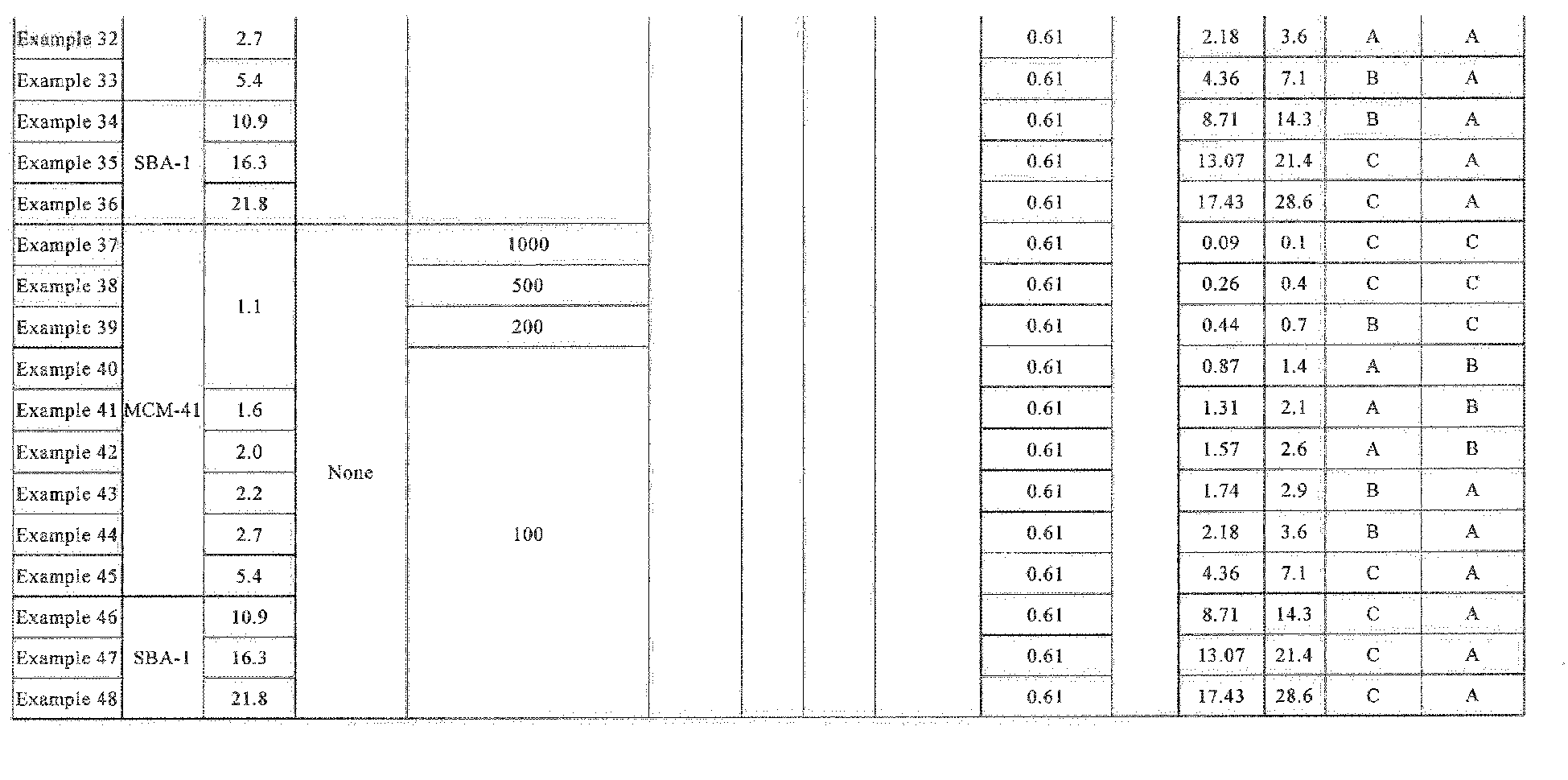


- As can be seen from Tables 1 to 8, the functional structural bodies (Examples 1 to 384), which were confirmed by cross sectional observation to hold the metallic nanoparticles inside the skeletal bodies, were found to exhibit excellent catalytic activity in the decomposition reaction of butylbenzene and excellent durability as a catalyst compared to the functional structural body in which the metallic nanoparticles were simply adhered to the outer surface of the skeletal body (Comparative Example 1) or the skeletal body having no functional substance (Comparative Example 2).
- In addition, the relationship between the amount of metal (mass%) embedded in the skeletal body of the functional structural body measured in the evaluation [C] and the yield (mol %) determined in the evaluation (1) was evaluated. The evaluation method was the same as the evaluation method performed in "(1) catalytic activity" in the [D] "performance evaluation" described above.
- As a result, in each example, when the amount of the metal containing solution added to the precursor material (A) was from 50 to 200 in terms of the ratio of number of atoms Si/M (the content of the metal element (M) of the metallic nanoparticles relative to the functional structural body was from 0.5 to 2.5 mass%), the yield of the compound having a molecular weight lower than that of butylbenzene contained in the product liquid was 32 mol% or greater, and the catalytic activity in the decomposition reaction of butylbenzene was particularly excellent.
- On the other hand, the silicalite of Comparative Example 1, in which the metallic nanoparticles were attached only to the outer surface of the skeletal body, exhibited improved catalytic activity in the decomposition reaction of butylbenzene compared to the skeletal body having no metallic nanoparticle in Comparative Example 2, but exhibited inferior durability as a catalyst compared to the functional structural bodies in Examples 1 to 384.
- In addition, the skeletal body having no functional substance in Comparative Example 2 exhibited little catalytic activity in the decomposition reaction of butylbenzene, and was inferior in both the catalytic activity and the durability to the functional structural bodies in Examples 1 to 384.
-
- 1 Functional Structural Body
- 10 Skeletal body
- 10a Outer surface
- 11 Channel
- 11a Pore
- 12 Enlarged pore portion
- 20 Metallic nanoparticles
- 30 Metallic nanoparticles
- DC Average particle size
- DF Average inner diameter
- DE Inner diameter
Claims (21)
- A functional structural body, comprising:a skeletal body of a porous structure composed of a zeolite-type compound; andat least one type of metallic nanoparticles present in the skeletal body,wherein the skeletal body has channels connecting with each other, andthe metallic nanoparticles are present at least in the channels of the skeletal body.
- The functional structural body according to claim 1, wherein the channels have any one of a one-dimensional pore, a two-dimensional pore, and a three-dimensional pore defined by the framework of the zeolite-type compound and an enlarged pore portion which has a diameter different from any one of the one-dimensional pore, the two-dimensional pore, and the three-dimensional pore, and
the metallic nanoparticles are present at least in the enlarged pore portion. - The functional structural body according to claim 2, wherein the enlarged pore portion allows a plurality of pores that constitutes any one of the one-dimensional pore, the two-dimensional pore, and the three-dimensional pore to connect with each other.
- The functional structural body according to any one of claims 1 to 3, wherein the metallic nanoparticles are a catalytic substance; and
the skeletal body is a support that supports at least one of the catalytic substances. - The functional structural body according to any one of claims 1 to 4, wherein an average particle size of the metallic nanoparticles is greater than an average inner diameter of the channels and is less than or equal to an inner diameter of the enlarged pore portion.
- The functional structural body according to any one of claims 1 to 5, wherein a metal element (M) of the metallic nanoparticles is contained in an amount of 0.5 mass% to 2.5 mass% based on the functional structural body.
- The functional structural body according to any one of claims 1 to 6, wherein the average particle size of the metallic nanoparticles is from 0.08 nm to 30 nm.
- The functional structural body according to claim 7, wherein the average particle size of the metallic nanoparticles is from 0.4 nm to 11.0 nm.
- The functional structural body according to any one of claims 1 to 8, wherein the ratio of the average particle size of the metallic nanoparticles to the average inner diameter of the channels is from 0.05 to 300.
- The functional structural body according to claim 9, wherein the ratio of the average particle size of the metallic nanoparticles to the average inner diameter of the channels is from 0.1 to 30.
- The functional structural body according to claim 10, wherein the ratio of the average particle size of the metallic nanoparticles to the average inner diameter of the channels is from 1.4 to 3.6.
- The functional structural body according to any one of claims 2 to 11, wherein the average inner diameter of the channels is from 0.1 nm to 1.5 nm, and the inner diameter of the enlarged pore portion is from 0.5 nm to 50 nm.
- The functional structural body according to any one of claims 1 to 12, further comprising at least one type of metallic nanoparticles held on the outer surface of the skeletal body.
- The functional structural body according to claim 13, wherein the content of the at least one type of the metallic nanoparticles present in the skeletal body is greater than that of the at least one type of the metallic nanoparticles held on the outer surface of the skeletal body.
- The functional structural body according to any one of claims 1 to 14, wherein the zeolite-type compound is a silicate compound.
- A method for making a functional structural body, comprising:a calcination step of calcinating a precursor material (B) obtained by impregnating a precursor material (A) for obtaining a skeletal body of a porous structure composed of a zeolite-type compound with a metal containing solution;a hydrothermal treatment step of hydrothermally treating a precursor material (C) obtained by calcinating the precursor material (B); anda step of subjecting the hydrothermally treated precursor material (C) to a reduction treatment.
- The method for making a functional structural body according to claim 16, wherein 50 to 500 mass% of a non-ionic surfactant is added to the precursor material (A) prior to the calcination step.
- The method for making a functional structural body according to claim 16 or 17, wherein the precursor material (A) is impregnated with the metal containing solution by adding the metal containing solution to the precursor material (A) in multiple portions prior to the calcination step.
- The method for making a functional structural body according to any one of claims 16 to 18, wherein in impregnating the precursor material (A) with the metal containing solution prior to the calcination step, the amount of the metal containing solution added to the precursor material (A) is adjusted to 10 to 1000 in terms of the ratio of silicon (Si) constituting the precursor material (A) to a metal element (M) included in the metal containing solution added to the precursor material (A) (a ratio of number of atoms Si/M).
- The method for making a functional structural body according to claim 16, wherein in the hydrothermal treatment step, the precursor material (C) and the structure directing agent are mixed.
- The method for making a functional structural body according to claim 16, wherein the hydrothermal treatment step is performed in a basic condition.
Applications Claiming Priority (2)
| Application Number | Priority Date | Filing Date | Title |
|---|---|---|---|
| JP2017108584 | 2017-05-31 | ||
| PCT/JP2018/021079 WO2018221691A1 (en) | 2017-05-31 | 2018-05-31 | Functional structure and production method for functional structure |
Publications (2)
| Publication Number | Publication Date |
|---|---|
| EP3632541A1 true EP3632541A1 (en) | 2020-04-08 |
| EP3632541A4 EP3632541A4 (en) | 2021-03-10 |
Family
ID=64455999
Family Applications (1)
| Application Number | Title | Priority Date | Filing Date |
|---|---|---|---|
| EP18809413.0A Pending EP3632541A4 (en) | 2017-05-31 | 2018-05-31 | FUNCTIONAL STRUCTURE AND PROCESS FOR THE PRODUCTION OF FUNCTIONAL STRUCTURE |
Country Status (7)
| Country | Link |
|---|---|
| US (2) | US11648538B2 (en) |
| EP (1) | EP3632541A4 (en) |
| JP (2) | JP7340198B2 (en) |
| CN (1) | CN110678258A (en) |
| AU (1) | AU2018276617B2 (en) |
| SA (1) | SA519410677B1 (en) |
| WO (1) | WO2018221691A1 (en) |
Families Citing this family (12)
| Publication number | Priority date | Publication date | Assignee | Title |
|---|---|---|---|---|
| AU2018276618B2 (en) | 2017-05-31 | 2021-05-27 | Furukawa Electric Co., Ltd. | Functional structure and production method for functional structure |
| WO2018221703A1 (en) | 2017-05-31 | 2018-12-06 | 古河電気工業株式会社 | Catalyst structure for catalytic cracking or hydrodesulfurization, catalytic cracking device and hydrodesulfurization device using said catalyst structure, and production method for catalyst structure for catalytic cracking or hydrodesulfurization |
| AU2018277967B2 (en) | 2017-05-31 | 2021-05-27 | Furukawa Electric Co., Ltd. | Functional structure and production method for functional structure |
| WO2018221690A1 (en) | 2017-05-31 | 2018-12-06 | 国立大学法人北海道大学 | Functional structure and production method for functional structure |
| CN110678262A (en) | 2017-05-31 | 2020-01-10 | 古河电气工业株式会社 | Exhaust gas purifying oxidation catalyst structure, method for producing same, exhaust gas treatment device for automobile, catalyst molded body, and gas purifying method |
| EP3632545A4 (en) | 2017-05-31 | 2021-01-27 | Furukawa Electric Co., Ltd. | STEAM REFORMING CATALYST STRUCTURE, REFORMING DEVICE WITH THE STEAM REFORMING CATALYST STRUCTURE, AND MANUFACTURING METHOD OF STEAM REFORMING CATALYST STRUCTURE |
| WO2018221698A1 (en) | 2017-05-31 | 2018-12-06 | 古河電気工業株式会社 | Co shift or reverse shift catalyst structure and production method thereof, co shift or reverse shift reaction device, production method of carbon dioxide and hydrogen, and production method of carbon monoxide and water |
| EP3632555A4 (en) | 2017-05-31 | 2021-01-27 | Furukawa Electric Co., Ltd. | Hydrodesulfurization catalyst structure, hydrodesulfurization device provided with said catalyst structure, and production method of hydrodesulfurization catalyst structure |
| WO2018221706A1 (en) | 2017-05-31 | 2018-12-06 | 古河電気工業株式会社 | Methanol reforming catalyst structure, methanol reforming device, production method for methanol reforming catalyst structure, and production method for at least one of olefins and aromatic hydrocarbons |
| EP3632541A4 (en) | 2017-05-31 | 2021-03-10 | National University Corporation Hokkaido University | FUNCTIONAL STRUCTURE AND PROCESS FOR THE PRODUCTION OF FUNCTIONAL STRUCTURE |
| WO2020116469A1 (en) | 2018-12-03 | 2020-06-11 | 国立大学法人北海道大学 | Functional structure |
| JPWO2020116470A1 (en) * | 2018-12-03 | 2021-12-09 | 国立大学法人北海道大学 | Functional structure |
Family Cites Families (123)
| Publication number | Priority date | Publication date | Assignee | Title |
|---|---|---|---|---|
| US3898180A (en) | 1970-07-23 | 1975-08-05 | Ici Ltd | Catalyst pellet |
| JPS5746925A (en) | 1980-09-03 | 1982-03-17 | Res Assoc Petroleum Alternat Dev<Rapad> | Preparation of hydrocarbon |
| US4552855A (en) | 1982-12-30 | 1985-11-12 | Ozin Geoffrey A | Metal zeolite catalyst preparation |
| US5026673A (en) | 1989-06-23 | 1991-06-25 | University Of Delaware | Stable zeolite-supported transition metal catalysts, methods for making them, and uses thereof |
| JP2771321B2 (en) | 1990-11-09 | 1998-07-02 | 日本碍子株式会社 | Exhaust gas purifying catalyst composition, exhaust gas purifying catalyst and method for producing the same |
| US5275720A (en) | 1990-11-30 | 1994-01-04 | Union Oil Company Of California | Gasoline hydrocracking catalyst and process |
| US5236575A (en) | 1991-06-19 | 1993-08-17 | Mobil Oil Corp. | Synthetic porous crystalline mcm-49, its synthesis and use |
| JPH0549943A (en) * | 1991-08-20 | 1993-03-02 | Sakai Chem Ind Co Ltd | Oxidizing catalyst |
| JPH06142456A (en) | 1992-11-08 | 1994-05-24 | Sekiyu Sangyo Kasseika Center | Method for removing nox in exhaust gas |
| JPH0796195A (en) | 1993-09-29 | 1995-04-11 | Hino Motors Ltd | Exhaust gas purification catalyst |
| JP2006021994A (en) | 1993-12-28 | 2006-01-26 | Toto Ltd | Method of manufacturing multifunctional material having photocatalytic function |
| US5849652A (en) | 1994-03-14 | 1998-12-15 | Northeastern University | Metal containing catalysts and methods for making same |
| JPH08155303A (en) | 1994-12-01 | 1996-06-18 | Toyota Central Res & Dev Lab Inc | Exhaust gas purifying catalyst carrier, exhaust gas purifying catalyst, method for manufacturing exhaust gas purifying catalyst carrier, and exhaust gas purifying method |
| US5994603A (en) | 1996-05-29 | 1999-11-30 | Exxon Chemical Patents Inc. | Methylation of toluene to para-xylene |
| US6040259A (en) * | 1996-05-29 | 2000-03-21 | Exxon Chemical Patents Inc. | Metal-containing zeolite catalyst, preparation thereof and use for hydrocarbon conversion |
| CN1223602A (en) | 1996-05-29 | 1999-07-21 | 埃克森化学专利公司 | Metal-containing zeolite catalysts, their preparation and their use in hydrocarbon conversion |
| JPH11151440A (en) | 1997-07-18 | 1999-06-08 | Tokyo Gas Co Ltd | Catalyst for decomposing and removing nitrogen oxides and method for decomposing and removing nitrogen oxides |
| JPH1133412A (en) | 1997-07-23 | 1999-02-09 | Unitika Ltd | Production of metal-supporting catalyst |
| JP2000197822A (en) | 1999-01-08 | 2000-07-18 | Tokyo Gas Co Ltd | Catalyst for decomposing and removing nitrogen oxides and method for decomposing and removing nitrogen oxides |
| JP3897143B2 (en) | 1999-05-11 | 2007-03-22 | 富士電機ホールディングス株式会社 | Reforming apparatus, starting method thereof, and fuel cell power generation apparatus |
| US6930219B2 (en) | 1999-09-07 | 2005-08-16 | Abb Lummus Global Inc. | Mesoporous material with active metals |
| US7074373B1 (en) | 2000-11-13 | 2006-07-11 | Harvest Energy Technology, Inc. | Thermally-integrated low temperature water-gas shift reactor apparatus and process |
| FR2819432B1 (en) | 2001-01-18 | 2003-04-11 | Rhodia Chimie Sa | MESOSTRUCTURE CATALYST INTEGRATING NANOMETRIC PARTICLES |
| JP2002255537A (en) | 2001-02-22 | 2002-09-11 | National Institute Of Advanced Industrial & Technology | Solid acid catalyst |
| JP2002336704A (en) | 2001-05-18 | 2002-11-26 | Masaru Ichikawa | Catalyst for aromatization reaction of methane and its preparation method |
| US6881703B2 (en) | 2001-08-08 | 2005-04-19 | Corning Incorporated | Thermally conductive honeycombs for chemical reactors |
| JP2003230838A (en) | 2001-12-06 | 2003-08-19 | Denso Corp | Ceramic catalyst body |
| CN1329286C (en) | 2002-12-20 | 2007-08-01 | 本田技研工业株式会社 | Noble metal-free nickel catalyst formulations for hydrogen |
| JP2005170903A (en) | 2003-12-15 | 2005-06-30 | Idemitsu Kosan Co Ltd | Method for producing bicyclo [2.2.1] heptane derivative |
| JP4334336B2 (en) | 2003-12-26 | 2009-09-30 | 株式会社フジクラ | Light switch |
| WO2005083013A1 (en) | 2004-01-30 | 2005-09-09 | Millennium Chemicals | Coating composition having surface depolluting properties |
| JP4469975B2 (en) | 2004-03-23 | 2010-06-02 | 国立大学法人広島大学 | Photocatalyst composite and organic substance conversion method using the same |
| JP5194249B2 (en) * | 2004-03-29 | 2013-05-08 | 国立大学法人広島大学 | Composite porous body, method for producing the same, and organic substance conversion method using the same |
| US20090325790A1 (en) | 2004-06-17 | 2009-12-31 | Yale University | Size-controllable transition metal clusters in mcm-41 for improving chemical catalysis |
| PL1861478T3 (en) | 2005-03-16 | 2012-07-31 | Fuelcor Llc | Systems and methods for production of synthetic hydrocarbon compounds |
| US7824656B2 (en) | 2005-03-24 | 2010-11-02 | University Of Regina | Catalysts for hydrogen production |
| FR2886636B1 (en) | 2005-06-02 | 2007-08-03 | Inst Francais Du Petrole | INORGANIC MATERIAL HAVING METALLIC NANOPARTICLES TRAPPED IN A MESOSTRUCTURED MATRIX |
| CN100392047C (en) | 2005-06-09 | 2008-06-04 | 中国科学院大连化学物理研究所 | A method for producing olefins by catalytic oxidation cracking of petroleum hydrocarbons |
| JP5042827B2 (en) | 2005-06-29 | 2012-10-03 | イビデン株式会社 | Honeycomb structure |
| WO2007023558A1 (en) | 2005-08-26 | 2007-03-01 | Suminoe Textile Co., Ltd. | Tungsten oxide photocatalyst, process for producing the same, and fiber cloth having deodorizing/antifouling function |
| MXPA05009283A (en) | 2005-08-31 | 2007-02-27 | Mexicano Inst Petrol | PROCEDURE FOR THE PREPARATION OF A CATALYTIC COMPOSITION FOR THE HYDROPROCESSING OF PETROLEUM FRACTIONS. |
| JP4879574B2 (en) | 2005-09-16 | 2012-02-22 | 旭化成ケミカルズ株式会社 | Process for producing ethylene and propylene |
| MY145567A (en) | 2005-09-16 | 2012-02-29 | Asahi Kasei Chemicals Corp | Method for producing ethylene and propylene |
| JP2007130525A (en) | 2005-11-08 | 2007-05-31 | Nissan Motor Co Ltd | Inclusion catalyst and production method thereof |
| JP5076377B2 (en) | 2006-07-03 | 2012-11-21 | トヨタ自動車株式会社 | Exhaust gas purification catalyst |
| US7592291B2 (en) | 2006-08-15 | 2009-09-22 | Batelle Energy Alliance, Llc | Method of fabricating a catalytic structure |
| US7879749B2 (en) | 2006-08-15 | 2011-02-01 | Battelle Energy Alliance, Llc | Methods of using structures including catalytic materials disposed within porous zeolite materials to synthesize hydrocarbons |
| CN101130466B (en) | 2006-08-23 | 2011-05-04 | 中国科学院大连化学物理研究所 | Method of start working of fluidization catalytic reaction device for preparing low carbon olefinic hydrocarbon |
| US8993468B2 (en) | 2007-05-24 | 2015-03-31 | Saudi Basic Industries Corporation | Catalyst for conversion of hydrocarbons, process of making and process of using thereof—Ge zeolites |
| CN101362959B (en) | 2007-08-09 | 2012-09-05 | 中国石油化工股份有限公司 | Catalytic conversion method for preparing propone and high-octane number gasoline |
| WO2009096548A1 (en) | 2008-02-01 | 2009-08-06 | Shimadzu System Solutions Co., Ltd. | Silver-(titanium oxide)-zeolite adsorbent/decomposing material and process for production thereof |
| FR2929264B1 (en) | 2008-03-31 | 2010-03-19 | Inst Francais Du Petrole | INORGANIC MATERIAL FORM OF SPHERICAL PARTICLES OF SPECIFIC SIZE AND HAVING METALLIC NANOPARTICLES TRAPPED IN A MESOSTRUCTURED MATRIX |
| JP2009255014A (en) | 2008-04-21 | 2009-11-05 | Mitsubishi Chemicals Corp | Catalyst for producing olefin from methanol |
| WO2009150973A1 (en) | 2008-06-10 | 2009-12-17 | 三井化学株式会社 | Method for producing an alkylated aromatic compound and method for producing phenol |
| JP4639247B2 (en) | 2008-07-23 | 2011-02-23 | 石油資源開発株式会社 | Hydrocarbon reforming catalyst, process for producing the same, and process for producing synthesis gas using the same |
| JP2010099638A (en) | 2008-10-27 | 2010-05-06 | Nissan Motor Co Ltd | Catalyst, catalyst for purifying exhaust gas, and method for manufacturing the catalyst |
| WO2010097108A1 (en) | 2009-02-27 | 2010-09-02 | Haldor Topsøe A/S | Process for the preparation of hybrid zeolite or zeolite-like materials |
| US9187702B2 (en) | 2009-07-01 | 2015-11-17 | Chevron U.S.A. Inc. | Hydroprocessing catalyst and method of making the same |
| IN2012DN00813A (en) | 2009-07-30 | 2015-06-26 | Mitsubishi Chem Corp | |
| JP2012250133A (en) | 2009-09-30 | 2012-12-20 | Toto Ltd | Photocatalyst-coated object, and photocatalyst coating liquid therefor |
| EP2505261A4 (en) | 2009-11-27 | 2013-05-15 | Murata Manufacturing Co | CATALYTIC ANTI-CONVERSION REACTION CATALYST, AND PROCESS FOR PRODUCTION OF SYNTHETIC GAS USING THE CATALYST |
| WO2011128968A1 (en) | 2010-04-12 | 2011-10-20 | 株式会社メタルテック | Photocatalytic coating material |
| JP6003643B2 (en) | 2010-06-10 | 2016-10-05 | 宇部興産株式会社 | Catalyst for alkylation reaction and method for producing alkyl aromatic hydrocarbon compound using the catalyst |
| US20120042631A1 (en) | 2010-08-20 | 2012-02-23 | Gm Global Technology Operations, Inc. | Catalyst materials for ammonia oxidation in lean-burn engine exhaust |
| US8539760B2 (en) | 2010-09-14 | 2013-09-24 | GM Global Technology Operations LLC | Catalyst materials for NOx oxidation in an exhaust aftertreatment system that uses passive ammonia SCR |
| KR101920942B1 (en) * | 2010-09-17 | 2018-11-21 | 후루카와 덴키 고교 가부시키가이샤 | Porous silicon particles and complex porous silicon particles, and method for producing both |
| FR2969513B1 (en) | 2010-12-22 | 2013-04-12 | IFP Energies Nouvelles | PROCESS FOR THE PREPARATION OF A SPHERICAL MATERIAL HIERARCHISED POROSITY COMPRISING METALLIC PARTICLES PIEGEES IN A MESOSTRUCTURED MATRIX |
| JP5552067B2 (en) | 2011-01-26 | 2014-07-16 | 住友ゴム工業株式会社 | Synthetic system, rubber chemicals for tire, synthetic rubber for tire and pneumatic tire |
| EP2543654B1 (en) | 2011-01-26 | 2018-09-12 | Sumitomo Rubber Industries, Ltd. | Synthesis system, rubber chemical substance for tires, synthetic rubber for tires, and pneumatic tire |
| JP2012160394A (en) | 2011-02-02 | 2012-08-23 | Sony Corp | Method for producing oxide semiconductor layer |
| JP2012170951A (en) | 2011-02-24 | 2012-09-10 | Kyushu Univ | Photocatalyst-adsorbent composite powder |
| JP2012210557A (en) | 2011-03-30 | 2012-11-01 | Panasonic Corp | Water-repellent photocatalytic composition and water-repellent photocatalytic coating film |
| CN102247887B (en) | 2011-05-20 | 2013-03-06 | 汕头大学 | Preparation method of high-efficiency and low-load methane aromatization catalyst |
| BR112013031349A2 (en) | 2011-06-05 | 2016-11-29 | Johnson Matthey Plc | catalyst, catalyst article, method for treating emissions, and system for treating exhaust gas |
| GB201118228D0 (en) * | 2011-10-21 | 2011-12-07 | Ingen Gtl Ltd | Methods of preparation and forming supported active metal catalysts and precursors |
| WO2013057319A2 (en) * | 2011-10-21 | 2013-04-25 | Ingen Gtl Limited | Methods of preparation and forming supported active metal catalysts and precursors |
| JP6061872B2 (en) | 2012-01-31 | 2017-01-18 | 国立研究開発法人科学技術振興機構 | Titanium oxide mesocrystal |
| US20160017238A1 (en) | 2012-02-17 | 2016-01-21 | Kior, Inc. | Mesoporous Zeolite-Containing Catalysts For The Thermoconversion Of Biomass And For Upgrading Bio-Oils |
| JP5972678B2 (en) | 2012-06-14 | 2016-08-17 | 三菱化学株式会社 | Synthesis gas production catalyst and synthesis gas production method |
| CN103663490B (en) | 2012-09-26 | 2016-04-20 | 中国科学院大连化学物理研究所 | A kind of SAPO-34 molecular sieve and synthetic method thereof |
| US9573121B2 (en) | 2012-11-08 | 2017-02-21 | Rive Technology, Inc. | Mesoporous zeolite catalyst supports |
| JP5762386B2 (en) | 2012-11-28 | 2015-08-12 | 株式会社日立製作所 | Shift catalyst, gas purification method and gas purification equipment for coal gasification plant |
| US9931623B2 (en) | 2012-11-30 | 2018-04-03 | Hiroshima University | Method for producing metal nanoparticle complex, and metal nanoparticle complex produced by said method |
| US10137438B2 (en) | 2013-02-09 | 2018-11-27 | Indian Oil Corporation Limited | Hydroprocessing catalyst composition and process thereof |
| CN105008492A (en) | 2013-02-21 | 2015-10-28 | 吉坤日矿日石能源株式会社 | Method for producing single-ring aromatic hydrocarbons |
| WO2014132367A1 (en) | 2013-02-27 | 2014-09-04 | 三菱重工業株式会社 | Co shift catalyst, co shift reaction apparatus and method for purifying gasified gas |
| KR102221550B1 (en) | 2013-03-22 | 2021-03-02 | 삼성전자주식회사 | Nickel catalysts for reforming hydrocarbons |
| US10693146B2 (en) | 2013-05-01 | 2020-06-23 | University Of Yamanashi | Production method for fine metal particles, production method for fuel cell electrode catalyst, supported fine metal particle catalyst, and fuel cell electrode catalyst |
| WO2015001122A1 (en) | 2013-07-05 | 2015-01-08 | Danmarks Tekniske Universitet | Method of producing zeolite encapsulated nanoparticles |
| DK3016741T3 (en) | 2013-07-05 | 2020-07-27 | Univ Danmarks Tekniske | Process for the production of zeolites and zeotypes |
| CN104650291B (en) | 2013-11-19 | 2018-02-02 | 中国石油天然气股份有限公司 | Method for preparing reinforced styrene-butadiene rubber by using olefin metathesis catalyst |
| CN104774639A (en) | 2014-01-13 | 2015-07-15 | 通用电气公司 | Hydrocarbon cracking method and hydrocarbon cracking apparatus |
| JP6234297B2 (en) * | 2014-03-27 | 2017-11-22 | 株式会社タカギ | Zeolite compact and method for producing the same |
| JP6379273B2 (en) | 2014-04-10 | 2018-08-22 | ダンマークス・テクニスケ・ユニヴェルシテット | General method of incorporating metal nanoparticles into zeolites and zeotypes |
| JP6303850B2 (en) | 2014-06-18 | 2018-04-04 | 株式会社Ihi | Catalyst production method |
| US9938157B2 (en) | 2014-07-23 | 2018-04-10 | Chevron U.S.A. Inc. | Interzeolite transformation and metal encapsulation in the absence of an SDA |
| JP6604501B2 (en) * | 2014-09-16 | 2019-11-13 | 国立大学法人山梨大学 | Ammonia decomposition catalyst, method for producing the same, and apparatus using the same |
| JP6344764B2 (en) | 2014-09-30 | 2018-06-20 | 国立大学法人山口大学 | Isopropyl alcohol storage method and filler |
| US9682367B2 (en) | 2014-10-22 | 2017-06-20 | King Fahd University Of Petroleum And Minerals | Monolith structure loaded with metal promoted nanozeolites for enhanced propylene selectivity in methanol conversion |
| JP6427387B2 (en) | 2014-10-31 | 2018-11-21 | 地方独立行政法人東京都立産業技術研究センター | Quantum dot compound photocatalyst |
| JP2015165138A (en) | 2015-04-30 | 2015-09-17 | 日野自動車株式会社 | Exhaust gas purification device |
| JP6467502B2 (en) | 2015-05-12 | 2019-02-13 | 日本曹達株式会社 | Photocatalyst-containing coating liquid and photocatalyst carrying structure |
| EP3318327A4 (en) | 2015-07-02 | 2019-02-27 | Dalian Institute Of Chemical Physics Chinese Academy of Sciences | CATALYST AND PROCESS FOR THE PREPARATION OF OLEFINE LIGHT DIRECTLY FROM A SYNTHESIS GAS BY A ONE-STEP PROCESS |
| JP6598576B2 (en) | 2015-08-17 | 2019-10-30 | 学校法人東京理科大学 | Laminate and method for producing laminate |
| JP6489990B2 (en) | 2015-09-30 | 2019-03-27 | Jxtgエネルギー株式会社 | Hydrodesulfurization catalyst for hydrocarbon oil and method for producing the same |
| US20180311651A1 (en) | 2015-10-30 | 2018-11-01 | Sabic Global Technologies B.V. | Use of hollow zeolites doped with bimetallic or trimetallic particles for hydrocarbon reforming reactions |
| CN105347359B (en) | 2015-11-27 | 2017-10-03 | 中国石油大学(北京) | A kind of duct includes the synthesis and its application of the zeolite molecular sieve of solid acid |
| JP6651362B2 (en) * | 2016-01-20 | 2020-02-19 | 日揮触媒化成株式会社 | Zeolite containing metal particles |
| CN106362787B (en) | 2016-08-06 | 2019-01-08 | 浙江大学 | A kind of preparation method of the immobilized photochemical catalyst of zeolite |
| EP3632545A4 (en) | 2017-05-31 | 2021-01-27 | Furukawa Electric Co., Ltd. | STEAM REFORMING CATALYST STRUCTURE, REFORMING DEVICE WITH THE STEAM REFORMING CATALYST STRUCTURE, AND MANUFACTURING METHOD OF STEAM REFORMING CATALYST STRUCTURE |
| WO2018221703A1 (en) | 2017-05-31 | 2018-12-06 | 古河電気工業株式会社 | Catalyst structure for catalytic cracking or hydrodesulfurization, catalytic cracking device and hydrodesulfurization device using said catalyst structure, and production method for catalyst structure for catalytic cracking or hydrodesulfurization |
| EP3632541A4 (en) | 2017-05-31 | 2021-03-10 | National University Corporation Hokkaido University | FUNCTIONAL STRUCTURE AND PROCESS FOR THE PRODUCTION OF FUNCTIONAL STRUCTURE |
| WO2018221690A1 (en) | 2017-05-31 | 2018-12-06 | 国立大学法人北海道大学 | Functional structure and production method for functional structure |
| US11161101B2 (en) | 2017-05-31 | 2021-11-02 | Furukawa Electric Co., Ltd. | Catalyst structure and method for producing the catalyst structure |
| WO2018221702A1 (en) | 2017-05-31 | 2018-12-06 | 古河電気工業株式会社 | Photocatalyst structure, photocatalyst structure composition, photocatalyst coating material, production method of photocatalyst structure, and decomposition method of aldehydes |
| EP3632555A4 (en) | 2017-05-31 | 2021-01-27 | Furukawa Electric Co., Ltd. | Hydrodesulfurization catalyst structure, hydrodesulfurization device provided with said catalyst structure, and production method of hydrodesulfurization catalyst structure |
| WO2018221706A1 (en) | 2017-05-31 | 2018-12-06 | 古河電気工業株式会社 | Methanol reforming catalyst structure, methanol reforming device, production method for methanol reforming catalyst structure, and production method for at least one of olefins and aromatic hydrocarbons |
| CN110678262A (en) | 2017-05-31 | 2020-01-10 | 古河电气工业株式会社 | Exhaust gas purifying oxidation catalyst structure, method for producing same, exhaust gas treatment device for automobile, catalyst molded body, and gas purifying method |
| JPWO2018221704A1 (en) | 2017-05-31 | 2020-03-26 | 古河電気工業株式会社 | Aromatic hydrocarbon production catalyst structure, aromatic hydrocarbon production apparatus including the aromatic hydrocarbon production catalyst structure, method for producing aromatic hydrocarbon production catalyst structure, and method for producing aromatic hydrocarbon |
| WO2018221698A1 (en) | 2017-05-31 | 2018-12-06 | 古河電気工業株式会社 | Co shift or reverse shift catalyst structure and production method thereof, co shift or reverse shift reaction device, production method of carbon dioxide and hydrogen, and production method of carbon monoxide and water |
| AU2018277967B2 (en) | 2017-05-31 | 2021-05-27 | Furukawa Electric Co., Ltd. | Functional structure and production method for functional structure |
| AU2018276618B2 (en) | 2017-05-31 | 2021-05-27 | Furukawa Electric Co., Ltd. | Functional structure and production method for functional structure |
| EP3687681A4 (en) | 2017-09-29 | 2021-07-07 | President and Fellows of Harvard College | ENHANCED CATALYTIC MATERIALS CONTAINING PARTLY INCORPORATED CATALYTIC NANOPARTICLES |
-
2018
- 2018-05-31 EP EP18809413.0A patent/EP3632541A4/en active Pending
- 2018-05-31 WO PCT/JP2018/021079 patent/WO2018221691A1/en not_active Ceased
- 2018-05-31 JP JP2019521319A patent/JP7340198B2/en active Active
- 2018-05-31 AU AU2018276617A patent/AU2018276617B2/en active Active
- 2018-05-31 CN CN201880035026.6A patent/CN110678258A/en active Pending
-
2019
- 2019-11-27 US US16/698,670 patent/US11648538B2/en active Active
- 2019-11-28 SA SA519410677A patent/SA519410677B1/en unknown
-
2023
- 2023-04-19 US US18/303,034 patent/US12179182B2/en active Active
- 2023-05-01 JP JP2023075779A patent/JP7744657B2/en active Active
Also Published As
| Publication number | Publication date |
|---|---|
| US11648538B2 (en) | 2023-05-16 |
| JP2023087023A (en) | 2023-06-22 |
| US20230330646A1 (en) | 2023-10-19 |
| AU2018276617A1 (en) | 2020-01-23 |
| CN110678258A (en) | 2020-01-10 |
| JP7340198B2 (en) | 2023-09-07 |
| JPWO2018221691A1 (en) | 2020-05-21 |
| WO2018221691A1 (en) | 2018-12-06 |
| AU2018276617B2 (en) | 2021-03-25 |
| JP7744657B2 (en) | 2025-09-26 |
| US20200108374A1 (en) | 2020-04-09 |
| SA519410677B1 (en) | 2023-11-22 |
| EP3632541A4 (en) | 2021-03-10 |
| US12179182B2 (en) | 2024-12-31 |
Similar Documents
| Publication | Publication Date | Title |
|---|---|---|
| US12179182B2 (en) | Method for making functional structural body | |
| US12115523B2 (en) | Functional structural body and method for making functional structural body | |
| US11655157B2 (en) | Functional structural body and method for making functional structural body | |
| US11654422B2 (en) | Structured catalyst for catalytic cracking or hydrodesulfurization, catalytic cracking apparatus and hydrodesulfurization apparatus including the structured catalyst, and method for producing structured catalyst for catalytic cracking or hydrodesulfurization | |
| US11680211B2 (en) | Structured catalyst for hydrodesulfurization, hydrodesulfurization device including the structured catalyst, and method for producing structured catalyst for hydrodesulfurization | |
| JP7613686B2 (en) | Functional Structures | |
| JP7635943B2 (en) | Functional structure and method for producing the functional structure | |
| JP7812526B2 (en) | functional structure | |
| JP7644925B2 (en) | Functional Structures | |
| EP3632540A1 (en) | Hydrogenolysis catalyst structure, hydrogenolysis device provided with said hydrogenolysis catalyst structure, and production method of hydrogenolysis catalyst structure | |
| JP2020089812A (en) | Functional structure and method for producing light hydrocarbon gas |
Legal Events
| Date | Code | Title | Description |
|---|---|---|---|
| STAA | Information on the status of an ep patent application or granted ep patent |
Free format text: STATUS: THE INTERNATIONAL PUBLICATION HAS BEEN MADE |
|
| PUAI | Public reference made under article 153(3) epc to a published international application that has entered the european phase |
Free format text: ORIGINAL CODE: 0009012 |
|
| STAA | Information on the status of an ep patent application or granted ep patent |
Free format text: STATUS: REQUEST FOR EXAMINATION WAS MADE |
|
| 17P | Request for examination filed |
Effective date: 20191217 |
|
| AK | Designated contracting states |
Kind code of ref document: A1 Designated state(s): AL AT BE BG CH CY CZ DE DK EE ES FI FR GB GR HR HU IE IS IT LI LT LU LV MC MK MT NL NO PL PT RO RS SE SI SK SM TR |
|
| AX | Request for extension of the european patent |
Extension state: BA ME |
|
| DAV | Request for validation of the european patent (deleted) | ||
| DAX | Request for extension of the european patent (deleted) | ||
| A4 | Supplementary search report drawn up and despatched |
Effective date: 20210208 |
|
| RIC1 | Information provided on ipc code assigned before grant |
Ipc: B01J 29/14 20060101ALI20210202BHEP Ipc: B01J 29/46 20060101ALI20210202BHEP Ipc: B01J 29/76 20060101ALI20210202BHEP Ipc: B01J 29/035 20060101AFI20210202BHEP Ipc: B01J 29/68 20060101ALI20210202BHEP |