EP3623036B1 - Zoned diesel oxidation catalyst - Google Patents
Zoned diesel oxidation catalyst Download PDFInfo
- Publication number
- EP3623036B1 EP3623036B1 EP19205487.2A EP19205487A EP3623036B1 EP 3623036 B1 EP3623036 B1 EP 3623036B1 EP 19205487 A EP19205487 A EP 19205487A EP 3623036 B1 EP3623036 B1 EP 3623036B1
- Authority
- EP
- European Patent Office
- Prior art keywords
- washcoat
- washcoat region
- pgm
- substrate
- region
- Prior art date
- Legal status (The legal status is an assumption and is not a legal conclusion. Google has not performed a legal analysis and makes no representation as to the accuracy of the status listed.)
- Active
Links
Images


Classifications
-
- B—PERFORMING OPERATIONS; TRANSPORTING
- B01—PHYSICAL OR CHEMICAL PROCESSES OR APPARATUS IN GENERAL
- B01J—CHEMICAL OR PHYSICAL PROCESSES, e.g. CATALYSIS OR COLLOID CHEMISTRY; THEIR RELEVANT APPARATUS
- B01J23/00—Catalysts comprising metals or metal oxides or hydroxides, not provided for in group B01J21/00
- B01J23/38—Catalysts comprising metals or metal oxides or hydroxides, not provided for in group B01J21/00 of noble metals
- B01J23/40—Catalysts comprising metals or metal oxides or hydroxides, not provided for in group B01J21/00 of noble metals of the platinum group metals
- B01J23/42—Platinum
-
- F—MECHANICAL ENGINEERING; LIGHTING; HEATING; WEAPONS; BLASTING
- F01—MACHINES OR ENGINES IN GENERAL; ENGINE PLANTS IN GENERAL; STEAM ENGINES
- F01N—GAS-FLOW SILENCERS OR EXHAUST APPARATUS FOR MACHINES OR ENGINES IN GENERAL; GAS-FLOW SILENCERS OR EXHAUST APPARATUS FOR INTERNAL-COMBUSTION ENGINES
- F01N3/00—Exhaust or silencing apparatus having means for purifying, rendering innocuous, or otherwise treating exhaust
- F01N3/08—Exhaust or silencing apparatus having means for purifying, rendering innocuous, or otherwise treating exhaust for rendering innocuous
- F01N3/10—Exhaust or silencing apparatus having means for purifying, rendering innocuous, or otherwise treating exhaust for rendering innocuous by thermal or catalytic conversion of noxious components of exhaust
-
- B—PERFORMING OPERATIONS; TRANSPORTING
- B01—PHYSICAL OR CHEMICAL PROCESSES OR APPARATUS IN GENERAL
- B01J—CHEMICAL OR PHYSICAL PROCESSES, e.g. CATALYSIS OR COLLOID CHEMISTRY; THEIR RELEVANT APPARATUS
- B01J23/00—Catalysts comprising metals or metal oxides or hydroxides, not provided for in group B01J21/00
- B01J23/38—Catalysts comprising metals or metal oxides or hydroxides, not provided for in group B01J21/00 of noble metals
- B01J23/40—Catalysts comprising metals or metal oxides or hydroxides, not provided for in group B01J21/00 of noble metals of the platinum group metals
- B01J23/44—Palladium
-
- B—PERFORMING OPERATIONS; TRANSPORTING
- B01—PHYSICAL OR CHEMICAL PROCESSES OR APPARATUS IN GENERAL
- B01D—SEPARATION
- B01D53/00—Separation of gases or vapours; Recovering vapours of volatile solvents from gases; Chemical or biological purification of waste gases, e.g. engine exhaust gases, smoke, fumes, flue gases, aerosols
- B01D53/34—Chemical or biological purification of waste gases
- B01D53/92—Chemical or biological purification of waste gases of engine exhaust gases
- B01D53/94—Chemical or biological purification of waste gases of engine exhaust gases by catalytic processes
-
- B—PERFORMING OPERATIONS; TRANSPORTING
- B01—PHYSICAL OR CHEMICAL PROCESSES OR APPARATUS IN GENERAL
- B01D—SEPARATION
- B01D53/00—Separation of gases or vapours; Recovering vapours of volatile solvents from gases; Chemical or biological purification of waste gases, e.g. engine exhaust gases, smoke, fumes, flue gases, aerosols
- B01D53/34—Chemical or biological purification of waste gases
- B01D53/92—Chemical or biological purification of waste gases of engine exhaust gases
- B01D53/94—Chemical or biological purification of waste gases of engine exhaust gases by catalytic processes
- B01D53/944—Simultaneously removing carbon monoxide, hydrocarbons or carbon making use of oxidation catalysts
-
- B—PERFORMING OPERATIONS; TRANSPORTING
- B01—PHYSICAL OR CHEMICAL PROCESSES OR APPARATUS IN GENERAL
- B01D—SEPARATION
- B01D53/00—Separation of gases or vapours; Recovering vapours of volatile solvents from gases; Chemical or biological purification of waste gases, e.g. engine exhaust gases, smoke, fumes, flue gases, aerosols
- B01D53/34—Chemical or biological purification of waste gases
- B01D53/92—Chemical or biological purification of waste gases of engine exhaust gases
- B01D53/94—Chemical or biological purification of waste gases of engine exhaust gases by catalytic processes
- B01D53/9445—Simultaneously removing carbon monoxide, hydrocarbons or nitrogen oxides making use of three-way catalysts [TWC] or four-way-catalysts [FWC]
-
- B—PERFORMING OPERATIONS; TRANSPORTING
- B01—PHYSICAL OR CHEMICAL PROCESSES OR APPARATUS IN GENERAL
- B01D—SEPARATION
- B01D53/00—Separation of gases or vapours; Recovering vapours of volatile solvents from gases; Chemical or biological purification of waste gases, e.g. engine exhaust gases, smoke, fumes, flue gases, aerosols
- B01D53/34—Chemical or biological purification of waste gases
- B01D53/92—Chemical or biological purification of waste gases of engine exhaust gases
- B01D53/94—Chemical or biological purification of waste gases of engine exhaust gases by catalytic processes
- B01D53/9459—Removing one or more of nitrogen oxides, carbon monoxide, or hydrocarbons by multiple successive catalytic functions; systems with more than one different function, e.g. zone coated catalysts
- B01D53/9463—Removing one or more of nitrogen oxides, carbon monoxide, or hydrocarbons by multiple successive catalytic functions; systems with more than one different function, e.g. zone coated catalysts with catalysts positioned on one brick
- B01D53/9468—Removing one or more of nitrogen oxides, carbon monoxide, or hydrocarbons by multiple successive catalytic functions; systems with more than one different function, e.g. zone coated catalysts with catalysts positioned on one brick in different layers
-
- B—PERFORMING OPERATIONS; TRANSPORTING
- B01—PHYSICAL OR CHEMICAL PROCESSES OR APPARATUS IN GENERAL
- B01D—SEPARATION
- B01D53/00—Separation of gases or vapours; Recovering vapours of volatile solvents from gases; Chemical or biological purification of waste gases, e.g. engine exhaust gases, smoke, fumes, flue gases, aerosols
- B01D53/34—Chemical or biological purification of waste gases
- B01D53/92—Chemical or biological purification of waste gases of engine exhaust gases
- B01D53/94—Chemical or biological purification of waste gases of engine exhaust gases by catalytic processes
- B01D53/9459—Removing one or more of nitrogen oxides, carbon monoxide, or hydrocarbons by multiple successive catalytic functions; systems with more than one different function, e.g. zone coated catalysts
- B01D53/9463—Removing one or more of nitrogen oxides, carbon monoxide, or hydrocarbons by multiple successive catalytic functions; systems with more than one different function, e.g. zone coated catalysts with catalysts positioned on one brick
- B01D53/9472—Removing one or more of nitrogen oxides, carbon monoxide, or hydrocarbons by multiple successive catalytic functions; systems with more than one different function, e.g. zone coated catalysts with catalysts positioned on one brick in different zones
-
- B—PERFORMING OPERATIONS; TRANSPORTING
- B01—PHYSICAL OR CHEMICAL PROCESSES OR APPARATUS IN GENERAL
- B01J—CHEMICAL OR PHYSICAL PROCESSES, e.g. CATALYSIS OR COLLOID CHEMISTRY; THEIR RELEVANT APPARATUS
- B01J23/00—Catalysts comprising metals or metal oxides or hydroxides, not provided for in group B01J21/00
- B01J23/38—Catalysts comprising metals or metal oxides or hydroxides, not provided for in group B01J21/00 of noble metals
- B01J23/40—Catalysts comprising metals or metal oxides or hydroxides, not provided for in group B01J21/00 of noble metals of the platinum group metals
-
- F—MECHANICAL ENGINEERING; LIGHTING; HEATING; WEAPONS; BLASTING
- F01—MACHINES OR ENGINES IN GENERAL; ENGINE PLANTS IN GENERAL; STEAM ENGINES
- F01N—GAS-FLOW SILENCERS OR EXHAUST APPARATUS FOR MACHINES OR ENGINES IN GENERAL; GAS-FLOW SILENCERS OR EXHAUST APPARATUS FOR INTERNAL-COMBUSTION ENGINES
- F01N3/00—Exhaust or silencing apparatus having means for purifying, rendering innocuous, or otherwise treating exhaust
- F01N3/02—Exhaust or silencing apparatus having means for purifying, rendering innocuous, or otherwise treating exhaust for cooling, or for removing solid constituents of, exhaust
- F01N3/021—Exhaust or silencing apparatus having means for purifying, rendering innocuous, or otherwise treating exhaust for cooling, or for removing solid constituents of, exhaust by means of filters
- F01N3/033—Exhaust or silencing apparatus having means for purifying, rendering innocuous, or otherwise treating exhaust for cooling, or for removing solid constituents of, exhaust by means of filters in combination with other devices
- F01N3/035—Exhaust or silencing apparatus having means for purifying, rendering innocuous, or otherwise treating exhaust for cooling, or for removing solid constituents of, exhaust by means of filters in combination with other devices with catalytic reactors
-
- F—MECHANICAL ENGINEERING; LIGHTING; HEATING; WEAPONS; BLASTING
- F01—MACHINES OR ENGINES IN GENERAL; ENGINE PLANTS IN GENERAL; STEAM ENGINES
- F01N—GAS-FLOW SILENCERS OR EXHAUST APPARATUS FOR MACHINES OR ENGINES IN GENERAL; GAS-FLOW SILENCERS OR EXHAUST APPARATUS FOR INTERNAL-COMBUSTION ENGINES
- F01N3/00—Exhaust or silencing apparatus having means for purifying, rendering innocuous, or otherwise treating exhaust
- F01N3/08—Exhaust or silencing apparatus having means for purifying, rendering innocuous, or otherwise treating exhaust for rendering innocuous
- F01N3/10—Exhaust or silencing apparatus having means for purifying, rendering innocuous, or otherwise treating exhaust for rendering innocuous by thermal or catalytic conversion of noxious components of exhaust
- F01N3/101—Three-way catalysts
-
- F—MECHANICAL ENGINEERING; LIGHTING; HEATING; WEAPONS; BLASTING
- F01—MACHINES OR ENGINES IN GENERAL; ENGINE PLANTS IN GENERAL; STEAM ENGINES
- F01N—GAS-FLOW SILENCERS OR EXHAUST APPARATUS FOR MACHINES OR ENGINES IN GENERAL; GAS-FLOW SILENCERS OR EXHAUST APPARATUS FOR INTERNAL-COMBUSTION ENGINES
- F01N3/00—Exhaust or silencing apparatus having means for purifying, rendering innocuous, or otherwise treating exhaust
- F01N3/08—Exhaust or silencing apparatus having means for purifying, rendering innocuous, or otherwise treating exhaust for rendering innocuous
- F01N3/10—Exhaust or silencing apparatus having means for purifying, rendering innocuous, or otherwise treating exhaust for rendering innocuous by thermal or catalytic conversion of noxious components of exhaust
- F01N3/103—Oxidation catalysts for HC and CO only
-
- F—MECHANICAL ENGINEERING; LIGHTING; HEATING; WEAPONS; BLASTING
- F01—MACHINES OR ENGINES IN GENERAL; ENGINE PLANTS IN GENERAL; STEAM ENGINES
- F01N—GAS-FLOW SILENCERS OR EXHAUST APPARATUS FOR MACHINES OR ENGINES IN GENERAL; GAS-FLOW SILENCERS OR EXHAUST APPARATUS FOR INTERNAL-COMBUSTION ENGINES
- F01N3/00—Exhaust or silencing apparatus having means for purifying, rendering innocuous, or otherwise treating exhaust
- F01N3/08—Exhaust or silencing apparatus having means for purifying, rendering innocuous, or otherwise treating exhaust for rendering innocuous
- F01N3/10—Exhaust or silencing apparatus having means for purifying, rendering innocuous, or otherwise treating exhaust for rendering innocuous by thermal or catalytic conversion of noxious components of exhaust
- F01N3/18—Exhaust or silencing apparatus having means for purifying, rendering innocuous, or otherwise treating exhaust for rendering innocuous by thermal or catalytic conversion of noxious components of exhaust characterised by methods of operation; Control
-
- F—MECHANICAL ENGINEERING; LIGHTING; HEATING; WEAPONS; BLASTING
- F01—MACHINES OR ENGINES IN GENERAL; ENGINE PLANTS IN GENERAL; STEAM ENGINES
- F01N—GAS-FLOW SILENCERS OR EXHAUST APPARATUS FOR MACHINES OR ENGINES IN GENERAL; GAS-FLOW SILENCERS OR EXHAUST APPARATUS FOR INTERNAL-COMBUSTION ENGINES
- F01N3/00—Exhaust or silencing apparatus having means for purifying, rendering innocuous, or otherwise treating exhaust
- F01N3/08—Exhaust or silencing apparatus having means for purifying, rendering innocuous, or otherwise treating exhaust for rendering innocuous
- F01N3/10—Exhaust or silencing apparatus having means for purifying, rendering innocuous, or otherwise treating exhaust for rendering innocuous by thermal or catalytic conversion of noxious components of exhaust
- F01N3/24—Exhaust or silencing apparatus having means for purifying, rendering innocuous, or otherwise treating exhaust for rendering innocuous by thermal or catalytic conversion of noxious components of exhaust characterised by constructional aspects of converting apparatus
- F01N3/28—Construction of catalytic reactors
-
- B—PERFORMING OPERATIONS; TRANSPORTING
- B01—PHYSICAL OR CHEMICAL PROCESSES OR APPARATUS IN GENERAL
- B01D—SEPARATION
- B01D2255/00—Catalysts
- B01D2255/10—Noble metals or compounds thereof
- B01D2255/102—Platinum group metals
-
- B—PERFORMING OPERATIONS; TRANSPORTING
- B01—PHYSICAL OR CHEMICAL PROCESSES OR APPARATUS IN GENERAL
- B01D—SEPARATION
- B01D2255/00—Catalysts
- B01D2255/10—Noble metals or compounds thereof
- B01D2255/102—Platinum group metals
- B01D2255/1021—Platinum
-
- B—PERFORMING OPERATIONS; TRANSPORTING
- B01—PHYSICAL OR CHEMICAL PROCESSES OR APPARATUS IN GENERAL
- B01D—SEPARATION
- B01D2255/00—Catalysts
- B01D2255/10—Noble metals or compounds thereof
- B01D2255/102—Platinum group metals
- B01D2255/1023—Palladium
-
- B—PERFORMING OPERATIONS; TRANSPORTING
- B01—PHYSICAL OR CHEMICAL PROCESSES OR APPARATUS IN GENERAL
- B01D—SEPARATION
- B01D2255/00—Catalysts
- B01D2255/90—Physical characteristics of catalysts
- B01D2255/902—Multilayered catalyst
- B01D2255/9022—Two layers
-
- B—PERFORMING OPERATIONS; TRANSPORTING
- B01—PHYSICAL OR CHEMICAL PROCESSES OR APPARATUS IN GENERAL
- B01D—SEPARATION
- B01D2255/00—Catalysts
- B01D2255/90—Physical characteristics of catalysts
- B01D2255/903—Multi-zoned catalysts
- B01D2255/9035—Three zones
-
- B—PERFORMING OPERATIONS; TRANSPORTING
- B01—PHYSICAL OR CHEMICAL PROCESSES OR APPARATUS IN GENERAL
- B01D—SEPARATION
- B01D2258/00—Sources of waste gases
- B01D2258/01—Engine exhaust gases
- B01D2258/012—Diesel engines and lean burn gasoline engines
-
- F—MECHANICAL ENGINEERING; LIGHTING; HEATING; WEAPONS; BLASTING
- F01—MACHINES OR ENGINES IN GENERAL; ENGINE PLANTS IN GENERAL; STEAM ENGINES
- F01N—GAS-FLOW SILENCERS OR EXHAUST APPARATUS FOR MACHINES OR ENGINES IN GENERAL; GAS-FLOW SILENCERS OR EXHAUST APPARATUS FOR INTERNAL-COMBUSTION ENGINES
- F01N2510/00—Surface coverings
- F01N2510/06—Surface coverings for exhaust purification, e.g. catalytic reaction
- F01N2510/068—Surface coverings for exhaust purification, e.g. catalytic reaction characterised by the distribution of the catalytic coatings
- F01N2510/0682—Surface coverings for exhaust purification, e.g. catalytic reaction characterised by the distribution of the catalytic coatings having a discontinuous, uneven or partially overlapping coating of catalytic material, e.g. higher amount of material upstream than downstream or vice versa
-
- F—MECHANICAL ENGINEERING; LIGHTING; HEATING; WEAPONS; BLASTING
- F01—MACHINES OR ENGINES IN GENERAL; ENGINE PLANTS IN GENERAL; STEAM ENGINES
- F01N—GAS-FLOW SILENCERS OR EXHAUST APPARATUS FOR MACHINES OR ENGINES IN GENERAL; GAS-FLOW SILENCERS OR EXHAUST APPARATUS FOR INTERNAL-COMBUSTION ENGINES
- F01N2510/00—Surface coverings
- F01N2510/06—Surface coverings for exhaust purification, e.g. catalytic reaction
- F01N2510/068—Surface coverings for exhaust purification, e.g. catalytic reaction characterised by the distribution of the catalytic coatings
- F01N2510/0684—Surface coverings for exhaust purification, e.g. catalytic reaction characterised by the distribution of the catalytic coatings having more than one coating layer, e.g. multi-layered coatings
-
- Y—GENERAL TAGGING OF NEW TECHNOLOGICAL DEVELOPMENTS; GENERAL TAGGING OF CROSS-SECTIONAL TECHNOLOGIES SPANNING OVER SEVERAL SECTIONS OF THE IPC; TECHNICAL SUBJECTS COVERED BY FORMER USPC CROSS-REFERENCE ART COLLECTIONS [XRACs] AND DIGESTS
- Y02—TECHNOLOGIES OR APPLICATIONS FOR MITIGATION OR ADAPTATION AGAINST CLIMATE CHANGE
- Y02A—TECHNOLOGIES FOR ADAPTATION TO CLIMATE CHANGE
- Y02A50/00—TECHNOLOGIES FOR ADAPTATION TO CLIMATE CHANGE in human health protection, e.g. against extreme weather
- Y02A50/20—Air quality improvement or preservation, e.g. vehicle emission control or emission reduction by using catalytic converters
-
- Y—GENERAL TAGGING OF NEW TECHNOLOGICAL DEVELOPMENTS; GENERAL TAGGING OF CROSS-SECTIONAL TECHNOLOGIES SPANNING OVER SEVERAL SECTIONS OF THE IPC; TECHNICAL SUBJECTS COVERED BY FORMER USPC CROSS-REFERENCE ART COLLECTIONS [XRACs] AND DIGESTS
- Y02—TECHNOLOGIES OR APPLICATIONS FOR MITIGATION OR ADAPTATION AGAINST CLIMATE CHANGE
- Y02T—CLIMATE CHANGE MITIGATION TECHNOLOGIES RELATED TO TRANSPORTATION
- Y02T10/00—Road transport of goods or passengers
- Y02T10/10—Internal combustion engine [ICE] based vehicles
- Y02T10/12—Improving ICE efficiencies
Definitions
- the invention relates to a vehicle comprising a diesel engine and an exhaust system comprising a zoned oxidation catalyst that does not comprise rhodium and a downstream diesel particulate filter (DPF) or a catalysed soot filter (CSF) emissions control device for treating an exhaust gas from the diesel engine and means for heating the DPF or the CSF to a regeneration temperature, which is an injector for injecting combustible hydrocarbon into the exhaust gas downstream of the diesel engine.
- DPF diesel particulate filter
- CSF catalysed soot filter
- the invention also relates to the use of an oxidation catalyst of defined arrangement in the regeneration of an emissions control device having a filtering substrate by injecting combustible hydrocarbon into the exhaust gas downstream of the diesel engine
- Diesel engines also referred to as compression ignition engines produce an exhaust emission that generally contains at least four classes of pollutant that are legislated against by inter-governmental organisations throughout the world: carbon monoxide (CO), unburned hydrocarbons (HCs), oxides of nitrogen (NO x ) and particulate matter (PM).
- CO carbon monoxide
- HCs unburned hydrocarbons
- NO x oxides of nitrogen
- PM particulate matter
- Oxidation catalysts comprising platinum group metals (PGMs) have been used to treat carbon monoxide (CO) and hydrocarbons (HCs), including the volatile organic fraction (VOF) of particulate matter (PM), in exhaust emissions produced by diesel engines.
- PGMs platinum group metals
- Such catalysts treat carbon monoxide (CO) by oxidising it to carbon dioxide (CO 2 ), and treat hydrocarbons (HCs) by oxidising them to water (H 2 O) and carbon dioxide (CO 2 ).
- Some platinum group metals particularly when supported on a refractory oxide, can also promote the oxidation of nitric oxide (NO) to nitrogen dioxide (NO 2 ).
- Platinum group metals are expensive metals. Catalyst manufacturers are under pressure to maximise the effectiveness of any PGMs that are included in an oxidation catalyst to minimise its material cost.
- the method of producing the oxidation catalyst is also important because there is a manufacturing cost associated with each step of applying a washcoat to a substrate and to the subsequent drying and calcination steps.
- Our earlier WO 2007/077462 describes an exhaust system for a lean-burn internal combustion engine comprising a catalyst for oxidising carbon monoxide (CO) and hydrocarbons (HCs), where the catalyst comprises a first washcoat zone containing at least one PGM, which first washcoat zone being defined at an upstream end by an inlet end of a substrate monolith and at a downstream end by a point less than half way along a length of the substrate monolith measured from the inlet end; a second washcoat zone containing at least one PGM, which second washcoat zone comprising the point halfway along the substrate monolith length measured from the inlet end; and a third washcoat zone containing at least one PGM, which third washcoat zone being defined at a downstream end by an outlet end of the substrate monolith and at an upstream end by a point at most three quarters of the way along the substrate monolith length from the inlet end, wherein both the PGM loading in the first washcoat zone and the PGM loading in the third washcoat zone is greater than the PGM loading in the
- WO 92/09848A1 discloses a palladium catalyst comprising palladium on a support and a partial combustion process in which the fuel is partially combusted using that catalyst.
- the palladium catalyst can be graded such as to have higher activity in the forward edge of the catalyst.
- a first zone of less than the axial length of the catalyst and defined at the forward edge of the catalyst is completely overlayed by a second layer also defined at the forward edge of the catalyst.
- US patent publication no. 2010/183490A1 discloses an oxidation catalyst composite for abatement of exhaust gas emissions from an engine comprising: a carrier substrate having a length, an inlet end and an outlet end, a diesel oxidation catalyst catalytic material on the carrier, the diesel oxidation catalyst catalytic material including a first washcoat layer and a second washcoat layer, the first washcoat layer comprising a palladium (Pd) component and first refractory metal oxide support including cerium, the first washcoat layer being substantially free of a molecular sieve; and the second washcoat layer comprising a second refractory oxide support, a platinum component and a molecular sieve, the second washcoat layer being substantially free of palladium.
- a carrier substrate having a length, an inlet end and an outlet end, a diesel oxidation catalyst catalytic material on the carrier, the diesel oxidation catalyst catalytic material including a first washcoat layer and a second washcoat layer, the first washcoat layer comprising a palladium
- US patent publication no. 2004/001781A1 discloses an exhaust gas treatment article, comprising: a substrate comprising an inlet axial end, an outlet axial end, wall elements having a length extending between the inlet axial end to the outlet axial end and a plurality of axially enclosed channels defined by the wall elements; an inlet layer deposited on the wall elements beginning at the inlet axial end and having a length extending for less than the wall elements' length, wherein the inlet layer comprises a first inlet palladium component; and an outlet layer beginning at the outlet axial end and having a length extending for less than the wall elements' length, the outlet layer at least partially overlying the wall elements and the inlet layer, wherein the outlet layer comprises an outlet palladium component.
- WO 99/55459A1 discloses an article comprising: a substrate comprising an inlet end, an outlet end, axial wall elements extending from the inlet end to the outlet end, and a plurality of axially enclosed channels defined by the wall elements, with at least some of the channels having a channel inlet at the inlet end and a channel outlet at the outlet end; a first inlet layer located on the walls and extending for at least part of the length from the inlet end toward the outlet end to an inlet layer axial end, with the first inlet layer extending for only part of the length from the inlet end toward the outlet end, the at least one inlet layer comprising a first inlet composition comprising at least one first inlet component selected from first inlet base metal oxides; the first inlet layer coated by a method comprising the steps of: passing a fluid containing the first inlet composition into the inlet end of the substrate to form the first inlet layer; and applying a vacuum to the outlet end while forcing a heated gas stream through the channels from the inlet end without
- the inventors have devised an oxidation catalyst having an arrangement that can be manufactured in a cost-effective manner and which maximises the effectiveness of its component PGMs.
- the oxidation catalyst provides excellent CO and HC oxidation activity and is tolerant to sulphur in diesel fuel and its oxides.
- the oxidation catalyst also shows good activity toward oxidising nitric oxide (NO) to nitrogen dioxide (NO 2 ).
- the invention provides a vehicle comprising a diesel engine and an exhaust system comprising an oxidation catalyst that does not comprise rhodium and a downstream diesel particulate filter (DPF) or a catalysed soot filter (CSF) emissions control device for treating an exhaust gas from a diesel engine and means for heating the DPF or the CSF to a regeneration temperature, which is an injector for injecting combustible hydrocarbon into the exhaust gas downstream of the diesel engine, which oxidation catalyst comprises: a flow-through monolith substrate; a first washcoat region comprising a first washcoat layer disposed on the substrate, wherein the first washcoat region comprises a first platinum group metal (PGM), which is a combination of platinum and palladium and a first support material, which first support material does not comprise cerium oxide; a second washcoat region adjacent to the first washcoat region, wherein the second washcoat region comprises a second platinum group metal (PGM), which is a combination of platinum and palladium, and a second support material; a third washcoat
- This arrangement in the oxidation catalyst for use in the invention can be used to provide good tolerance to poisoning by sulphur in diesel fuel and to optimise the oxidation of nitric oxide (NO) to nitrogen dioxide (NO 2 ).
- NO nitric oxide
- NO 2 nitrogen dioxide
- the oxidation activity of the catalyst toward HCs can be maintained, even after some sulphation has occurred.
- the oxidation of nitric oxide (NO) to nitrogen dioxide (NO 2 ) by the oxidation catalyst can be important for the overall removal of pollutants by an exhaust system.
- the ratio of NO 2 to NO in an exhaust gas can affect the active or passive regeneration of an emissions control device that comprises a filtering substrate (e.g. diesel particulate filter (DPF), catalysed soot filter (CSF), selective catalytic reduction filter (SCRF TM )).
- NO 2 in an exhaust gas can assist in the oxidation of particulate matter (PM) collected by a filtering substrate of a downstream emissions control device.
- the oxidation catalyst of the invention is particularly suitable for use in the active regeneration of an emissions control device comprising a filtering substrate.
- the amount of NO 2 in an exhaust gas can also affect the performance of an emissions control device that is downstream of the oxidation catalyst.
- Selective catalytic reduction (SCR) catalysts and selective catalytic reduction filter (SCRF TM ) catalysts for treating NO x often require the ratio of NO 2 to NO in the inlet gas to be within a specific range for optimum catalytic performance.
- the optimal NO 2 proportion of NO x typically depends on the type of composition used in the SCR or SCRF TM catalyst.
- the oxidation catalyst of the invention can be used with an SCR or SCRF TM catalyst, particularly an SCR or SCRF TM catalyst comprising a copper exchanged zeolite.
- the oxidation catalyst is located downstream of a turbo of the diesel engine.
- a method (not according to the invention) of producing an oxidation catalyst for use in the present application comprises:
- an oxidation catalyst that does not comprise rhodium for treating an exhaust gas from a diesel engine
- which oxidation catalyst comprises: a flow-through monolith substrate; a first washcoat region comprising a first washcoat layer disposed on the substrate, wherein the first washcoat region comprises a first platinum group metal (PGM), which is a combination of platinum and palladium and a first support material, which first support material does not comprise cerium oxide; a second washcoat region adjacent to the first washcoat region, wherein the second washcoat region comprises a second platinum group metal (PGM) and a second support material; a third washcoat region disposed on the substrate, wherein the third washcoat region comprises a third platinum group metal (PGM) and a third support material, wherein the third washcoat region is adjacent to the second washcoat region, the arrangement being such that exhaust gas entering the oxidation catalyst comes into contact with the second washcoat region before the third washcoat region, and wherein the first washcoat region comprises a part of an up
- the oxidation catalyst for use in the present invention comprises a total amount by mass of the platinum group metal (PGM) component of 2.0 to 8.0 g.
- PGM platinum group metal
- the total amount of PGM component that is used depends on, amongst other things, the size of the substrate and the intended application of the oxidation catalyst.
- the oxidation catalyst for use in the present invention comprises a ratio of the total mass of platinum to the total mass of the palladium of 3:1 to 1:3 (e.g. 2:1 to 1:2), such as 1.5:1 to 1:1.5. It is preferred that the total mass of platinum is greater than the total mass of palladium. Preferably, the ratio of the total mass of platinum to the total mass of palladium is 3:1 to 1.1:1 (e.g. 2.5:1 to 7:6), such as 2:1 to 1.25:1.
- the oxidation catalyst for use in the present invention generally has a total loading of platinum group metal of from 0.71 to 7.06 g/L (20 to 200 g ft -3 ), preferably 0.88 to 6.18 g/L (25 to 175 g ft -3 ), and more preferably 1.06 to 5.65 g/L (30 to 160 g ft -3 ).
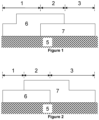
- the oxidation catalyst of the invention comprises a substrate (5); a first washcoat region (1) disposed on the substrate (5); a second washcoat region (2) adjacent to the first washcoat region (1); and a third washcoat region (3) disposed on the substrate (5).
- the third washcoat region (3) may be adjacent to the second washcoat region (2) (see Figure 1 ).
- the second washcoat region (2) is adjacent to the first washcoat region (1) on the substrate (i.e., the second washcoat region is disposed next to the first washcoat region along the length of the substrate).
- the first washcoat region (1), the second washcoat region (2) and the third washcoat region (3) are supported on the same substrate.
- the oxidation catalyst may comprise an underlying washcoat layer disposed (e.g., directly disposed or supported) on the substrate.
- the first washcoat region, the second washcoat region and the third washcoat region may be directly disposed or supported on the underlying washcoat layer.
- the second washcoat region may be directly disposed or supported on the underlying washcoat layer.
- the underlying washcoat layer typically has a length of at least 90 % of the length of the substrate, such as 95 to 100 % of the length of the substrate. It is preferred that the underlying washcoat layer has a length that is the same as the length of the substrate.
- the first washcoat region is, in general, directly disposed (i.e. directly supported) on the substrate. This means that the first washcoat region is in contact with a surface of the substrate. It is preferred that there is no intermediary washcoat region (e.g. the underlying washcoat layer) between a surface of the substrate and the first washcoat region. More preferably, there is no intermediary washcoat region (e.g. the underlying washcoat layer) between a surface of the substrate and the first washcoat region, the second washcoat region and the third washcoat region.
- intermediary washcoat region e.g. the underlying washcoat layer
- the first washcoat region is upstream of the second washcoat region (i.e. the first washcoat region is nearer to an inlet end of the substrate than the second washcoat region is to the inlet end).
- the exhaust gas entering the oxidation catalyst will come into contact with the first washcoat region before it comes into contact with the second washcoat region.
- the first washcoat region of the oxidation catalyst for use in the invention is for initiating oxidation of hydrocarbons (HCs) and/or carbon monoxide (CO) in the exhaust gas, particularly hydrocarbons (HCs).
- the first washcoat region has a low HC light off temperature and/or CO light off temperature (e.g. a low HC T 50 and/or a low CO T 50 ).
- the activity of the first washcoat region is advantageous for relatively low exhaust gas temperatures, such as shortly after starting a diesel engine.
- the oxidation of HCs and/or CO by the first washcoat region generates an exotherm, which can increase the temperature of the exhaust gas and the body of the catalyst to a temperature that is optimal for catalysis by the second and third washcoat regions.
- the first washcoat region comprises, or consists of, a first washcoat layer.
- the first washcoat layer may be directly disposed (i.e., directly supported) on the substrate.
- the first washcoat region comprises, or may consist of, a part or portion of the first washcoat layer (see (1) and (6) in Figures 1 and 2 ).
- the part of the first washcoat layer is a part length (e.g., not the whole or complete length) of the first washcoat region.
- first washcoat region or the part of the first washcoat layer may comprise a PGM zone.
- the part of the first washcoat layer i.e. that forms the first washcoat region
- the PGM zone can be prepared in accordance with methods described hereinbelow.
- the PGM zone may be formulated to provide high oxidation activity toward hydrocarbons, such as higher activity than the remainder of the oxidation catalyst.
- the length of the PGM zone is typically less than the length of the first washcoat region or the part of the first washcoat layer (i.e. that forms the first washcoat region).
- the first washcoat region or part of the first washcoat layer may be subdivided into a PGM zone and an adjacent part or portion of the first washcoat layer.
- the PGM zone is at or adjacent to an inlet end of the substrate.
- the PGM is preferably upstream of the adjacent part or portion of the first washcoat layer.
- the first washcoat region may comprise a first washcoat layer and a fourth washcoat layer, wherein the fourth washcoat layer is disposed on the first washcoat layer.
- the first washcoat region comprises a first washcoat layer and a fourth washcoat layer
- the first washcoat region comprises a part or portion of the first washcoat layer and a part or portion of the fourth washcoat layer, wherein the part of the fourth washcoat layer is disposed on the part of the first washcoat layer.
- the part of the first washcoat layer is a part length (e.g. not the whole or complete length) of the first washcoat layer.
- the part of the fourth washcoat layer is a part length (e.g. not the whole or complete length) of the fourth washcoat layer.
- the first washcoat region has a length that is less than the length (i.e. axial length L) of the substrate. It is preferred that the first washcoat region has a length of at least 5 % of the length of the substrate.
- the first washcoat region typically has a length of 10 to 80 % of the length of the substrate, preferably 20 to 70 %, more preferably 30 to 60 % of the length of the substrate, such as 40 to 60 % of the length of the substrate.
- the first washcoat region is less than or equal to 50 % of the length of the substrate, preferably less than 50 % of the length of the substrate, more preferably less than 30 % of the length of the substrate.
- the first washcoat region preferably has a length of 10 to 50 % of the length of the substrate, more preferably 15 to 45 % of the length of the substrate, such as 20 to 40 % of the length of the substrate, and even more preferably 25 to 35 % of the length of the substrate.
- the length of the PGM zone is typically 1 to 25 % of the length of the substrate, preferably 2.5 to 20 % of the length of the substrate (e.g. 2.5 to 7.5 % of the length of the substrate, more preferably 5 to 15 % of the length of the substrate (e.g. 5 to 10 % of the length of the substrate).
- the PGM zone may have a length of 12.7 to 50.8 mm (0.5 to 2 inches). It is preferred that the PGM zone has a length of 12.7 to 44.5 mm (0.5 to 1.75 inches), such as 12.7 to 38.1 mm (0.5 to 1.5 inches) or 15.2 to 44.5 mm (0.6 to 1.75 inches), more preferably 19.1 to 31.8 mm (0.75 to 1.25 inches). Typically, the PGM zone has a length of about or approximately 1 inch (2.54 cm).
- the first washcoat region is disposed at or adjacent to an inlet end of the substrate.
- the first washcoat region comprises a first platinum group metal (PGM). It is preferred that the only PGM in the first washcoat region is the first PGM.
- PGM platinum group metal
- the first PGM is a combination of platinum and palladium.
- the total loading of the first PGM is greater than the total loading of the third PGM.
- the first washcoat region typically has a total loading of the first PGM of 0.177 to 10.594 g/L (5 to 300 g ft -3 ).
- the total loading of the first PGM is 0.353 to 8.829 g/L (10 to 250 g ft -3 ), more preferably 0.530 to 7.063 g/L (15 to 200 g ft -3 ) (e.g.0.530 to 3.531 g/L (15 to 100 g ft -3 )), still more preferably 0.706 to 5.297 g/L (20 to 150 g ft -3 ) (e.g.
- the first washcoat layer has a total loading of the first PGM of 0.177 to 10.594 g/L (5 to 300 g ft -3 ).
- the total loading of the first PGM is 0.353 to 8.829 g/L (10 to 250 g ft -3 ), more preferably 0.530 to 7.063 g/L (15 to 200 g ft -3 ) (e.g.
- 0.530 to 3.531 g/L (15 to 100 g ft -3 )), still more preferably 0.706 to 5.297 g/L (20 to 150 g ft -3 ) (e.g. 0.706 to 2.649 g/L (20 to 75 g ft -3 )) and even more preferably 0.883 to 3.531 g/L (25 to 100 g ft -3 ).
- the first PGM is a combination of platinum and palladium.
- the first washcoat region or the first washcoat layer comprises a ratio of the total mass of platinum to the total mass of palladium of 3.5:1 to 1:3.5 (e.g. 3:1 to 1:3), preferably 2:1 to 1:2, and more preferably 1.5:1 to 1:1.5 (e.g. about 1:1).
- a total mass of platinum that is greater than or equal to the total mass of palladium (e.g. the ratio of the total mass of platinum to the total mass of palladium is ⁇ 1:1).
- Advantageous light-off activity can be obtained when the total mass of platinum is greater than or equal to the total mass of palladium in the first washcoat region. More preferably, the ratio of the total mass of platinum to the total mass of palladium is 3.5:1 to 1:1 (e.g. 3.5:1 to 1.1:1), preferably 3:1 to 1.25:1, and more preferably 2.5:1 to 1.5:1.
- the first washcoat region may comprise gold.
- the first washcoat region may comprise a palladium-gold alloy (e.g. the palladium of the first platinum group metal may be present as an alloy with gold).
- Catalysts comprising gold (Au) can be prepared using the method described in WO 2012/120292 .
- the first washcoat region comprises gold, such as a palladium-gold alloy
- the first washcoat region comprises a ratio of the total mass of palladium (Pd) to the total mass of gold (Au) of 9:1 to 1:9, preferably 5:1 to 1:5, and more preferably 2:1 to 1:2.
- the PGM zone comprises a combination of platinum and palladium.
- the definition of the first PGM comprises the platinum group metal (PGM) of the PGM zone.
- the PGM zone comprises a different total amount (e.g. total loading) of PGM than the remainder of the first washcoat region (i.e. the adjacent part of the first washcoat layer). It is preferred that the PGM zone has a total amount (e.g. total loading) of PGM that is greater than the remainder of the first washcoat region.
- the total loading of platinum (Pt) in the PGM zone is greater than the total loading of platinum (Pt) in the remainder of the first washcoat region (i.e. the adjacent part of the first washcoat layer). More preferably, the total loading of palladium (Pd) in the PGM zone is less than the total loading of palladium (Pd) in the remainder of the first washcoat region (i.e. the adjacent part of the first washcoat layer).
- the PGM zone comprises platinum (Pt) and palladium (Pd)
- the weight ratio of platinum (Pt) to palladium (Pd) is ⁇ 1:1. It is preferred that the weight ratio of platinum (Pt) to palladium (Pd) is ⁇ 1.1:1, more preferably ⁇ 1.25:1, particularly ⁇ 1.5:1, such as ⁇ 1.75:1 (e.g. ⁇ 2:1), and still more preferably ⁇ 2.5:1 (e.g. ⁇ 5:1).
- the PGM zone typically comprises platinum (Pt) and palladium (Pd) in a weight ratio of 10:1 to 1:1 (e.g. 2:1 to 1.1:1 or 7.5:1 to 5:1), more preferably 8:1 to 1.25:1 (e.g. 7:1 to 1.5:1), and still more preferably 6:1 to 2.5:1.
- the first support material comprises, or consists essentially of, a refractory metal oxide.
- Refractory metal oxides suitable for use as a support material in an oxidation catalyst for a diesel engine are well known in the art.
- the refractory metal oxide may be selected from the group consisting of alumina, silica, titania, zirconia and mixed or composite oxides of two or more thereof. It is preferred that the refractory metal oxide is selected from alumina, silica and mixed or composite oxides thereof. More preferably, the refractory metal oxide is selected from alumina and silica-alumina. Even more preferably, the refractory metal oxide is alumina.
- the first support material does not comprise, or consist of, cerium oxide, particularly ceria (CeO 2 ) or ceria-zirconia (CeO 2 -ZrO 2 ).
- the first PGM is disposed or supported on the first support material.
- the gold or the palladium-gold alloy may be disposed or supported on the first support material.
- the first PGM and/or gold can be dispersed on the first support material and/or impregnated into the first support material.
- the first washcoat region or the first washcoat layer typically comprises a total washcoat loading of 15.26 to 305.12 g/L (0.25 to 5 g in -3 ), preferably 30.51 to 244.10 g/L (0.5 to 4 g in -3 ), such as 45.77 to 183.07 g/L (0.75 to 3 g in -3 ), more preferably 61.02 to 152.56 g/L (1.0 to 2.5 g in -3 ), such as 76.28 to 122.05 g/L (1.25 to 2.0 g in -3 ).
- the first washcoat region or the first washcoat layer may further comprise a hydrocarbon adsorbent.
- the hydrocarbon adsorbent may be selected from a zeolite, active charcoal, porous graphite and a combination of two or more thereof. It is preferred that the hydrocarbon adsorbent is a zeolite.
- the total amount of hydrocarbon adsorbent is 3.05 to 183.07 g/L (0.05 to 3.00 g in -3 ), particularly 6.10 to 122.05 g/L (0.10 to 2.00 g in -3 ) (e.g. 12.20 to 48.82 g/L (0.2 to 0.8 g in -3 ).
- the first washcoat region or the first washcoat layer may or may not comprise an alkaline earth metal.
- the alkaline earth metal comprises magnesium (Mg), calcium (Ca), strontium (Sr), barium (Ba) or a combination of two or more thereof. It is preferred that the alkaline earth metal comprises calcium (Ca), strontium (Sr), or barium (Ba), more preferably strontium (Sr) or barium (Ba), and most preferably the alkaline earth metal comprises barium (Ba).
- the amount of the alkaline earth metal is 2.47 to 132.43 mol/m 3 (0.07 to 3.75 mol ft -3 ), particularly 3.53 to 105.94 mol/m 3 (0.1 to 3.0 mol ft -3 ), more particularly 7.06 to 88.29 mol/m 3 (0.2 to 2.5 mol ft -3 ) (e.g.
- the first support material may or may not comprise, or consist essentially of, alumina doped with a heteroatom component.
- the heteroatom component typically comprises silicon, magnesium, barium, lanthanum, titanium, or zirconium or a combination of two or more thereof.
- the heteroatom component may comprise, or consist essentially of, an oxide of silicon, an oxide of magnesium, an oxide of barium, an oxide of lanthanum, an oxide of titanium or an oxide of zirconium. More preferably, the alumina doped with a heteroatom component is alumina doped with silica or alumina doped with magnesium oxide.
- the alumina doped with a heteroatom component is alumina doped with silica.
- Alumina doped with a heteroatom component can be prepared using methods known in the art or, for example, by a method described in US 5,045,519 .
- the first washcoat region or the first washcoat layer may consist essentially of a first PGM, a first support material and an alkaline earth metal component.
- the first washcoat region or the first washcoat layer preferably consists essentially of a first PGM and a first support material.
- the second washcoat region is adjacent to the first washcoat region.
- the second washcoat region is adjacent (e.g. directly adjacent) to the third washcoat region.
- Exhaust gas entering the catalyst of the invention generally comes into contact with the second washcoat region before the third washcoat region.
- the second washcoat region acts as a "stabilizer” for the first washcoat region.
- the second washcoat region acts as a "stabilizer” in the sense that it performs some or all of the oxidation reactions of the first washcoat region, but the second washcoat region may have a higher light off temperature for HC and/or CO than that of the first washcoat region. This is to ensure that the oxidation of HCs and/or CO is continued at higher exhaust gas temperatures and it may generate an additional exotherm.
- the second washcoat region may also provide two other functions: (1) to oxidise NO to NO 2 and/or (2) to protect the third washcoat region from being poisoned by sulphur in diesel fuel or the oxides thereof, particularly when the third PGM of the third washcoat region comprises palladium. Platinum is generally more resistant than palladium to poisoning by sulphur. Platinum also shows excellent NO oxidation activity.
- the second washcoat region has a different composition (i.e. a different overall composition) to the first washcoat region.
- the second washcoat region has a length that is less than the length (i.e. axial length L) of the substrate. It is preferred that the second washcoat region has a length of at least 10 % of the length of the substrate, more preferably at least 15 % of the length of the substrate, such as at least 20 % of the length of the substrate.
- the second washcoat region may have a length of 10 to 70 % of the length of the substrate (e.g. 40 to 70 %), such as 15 to 60 % of the length of the substrate, particularly, 20 to 50 % of the length of the substrate, preferably 30 to 40 % of the length of the substrate.
- the second washcoat region may comprise, or consist of, a second washcoat zone.
- the second washcoat region comprises a second washcoat layer.
- the second washcoat region typically abuts or is contiguous with the first washcoat region.
- the second washcoat region comprises a second platinum group metal (PGM). It is preferred that the only PGM in the second washcoat region is the second PGM.
- PGM platinum group metal
- the second PGM is selected from the group consisting of platinum and a combination of platinum and palladium.
- the second PGM may be platinum (e.g. platinum only).
- the second PGM may be a combination of platinum and palladium (e.g. platinum and palladium only).
- the second washcoat region typically has a total loading of the second PGM of 0.177 to 10.594 g/L (5 to 300 g ft -3 ).
- the total loading of the second PGM is 0.353 to 8.829 g/L (10 to 250 g ft -3 ), more preferably 0.530 to 7.063 g/L (15 to 200 g ft -3 ) (e.g. 0.530 to 3.531 g/L (15 to 100 g ft -3 )), still more preferably 0.706 to 5.297 g/L (20 to 150 g ft -3 ) (e.g.
- the second washcoat region comprises, or consists of, a second washcoat layer
- the second washcoat layer has a total loading of the second PGM of 0.353 to 8.829 g/L (10 to 250 g ft -3 ), more preferably 0.530 to 7.063 g/L (15 to 200 g ft -3 ) (e.g.
- 0.530 to 3.531 g/L (15 to 100 g ft -3 )), still more preferably 0.706 to 5.297 g/L (20 to 150 g ft -3 ) (e.g. 0.706 to 2.649 g/L (20 to 75 g ft -3 )), such as 0.883 to 3.531 g/L (25 to 100 g ft -3 ).
- the second washcoat region or the second washcoat layer comprises a ratio of the total mass of platinum to the total mass of palladium of 10:1 to 1:10 (e.g. 7.5:1 to 1:7.5), preferably 5:1 to 1:5 (e.g. 3:1 to 1:3), and more preferably 2.5:1 to 1:2.5 (e.g. 2:1 to 1:2).
- the second washcoat region may comprise gold.
- the second washcoat region or the second washcoat zone may comprise a palladium-gold alloy (e.g. the palladium of the second PGM may be an alloy with gold).
- the second washcoat region comprises gold, such as a palladium-gold alloy
- the second washcoat region or the second washcoat layer comprises a ratio of the total mass of palladium (Pd) to the total mass of gold (Au) of 9:1 to 1:9, preferably 5:1 to 1:5, and more preferably 2:1 to 1:2.
- the second support material comprises, or consists essentially of, a refractory metal oxide.
- the refractory metal oxide may be selected from the group consisting of alumina, silica, titania, zirconia, ceria and mixed or composite oxides of two or more thereof. It is preferred that the refractory metal oxide is selected from alumina, silica and mixed or composite oxides thereof. More preferably, the refractory metal oxide is selected from alumina and silica-alumina. Even more preferably, the refractory metal oxide is alumina.
- the second PGM is disposed or supported on the second support material.
- the gold or the palladium-gold alloy may be disposed or supported on the second support material.
- the second PGM and/or gold can be dispersed on the second support material and/or impregnated into the second support material.
- the second support material may or may not comprise, or consist of, cerium oxide, particularly ceria (CeO 2 ) or ceria-zirconia (CeO 2 -ZrO 2 ).
- the second washcoat region, the second washcoat layer or the second washcoat zone typically comprises a total washcoat loading of 15.26 to 305.12 g/L (0.25 to 5 g in -3 ), preferably 30.51 to 244.10 g/L (0.5 to 4 g in -3 ), such as 45.77 to 183.07 g/L (0.75 to 3 g in -3 ), more preferably 61.02 to 152.56 g/L (1.0 to 2.5 g in -3 ), such as 76.28 to 122.05 g/L (1.25 to 2.0 g in -3 ).
- the second washcoat region or the second washcoat layer may further comprise a hydrocarbon adsorbent.
- the hydrocarbon adsorbent may be selected from a zeolite, active charcoal, porous graphite and a combination of two or more thereof. It is preferred that the hydrocarbon adsorbent is a zeolite.
- the total amount of hydrocarbon adsorbent is 3.05 to 183.07 g/L (0.05 to 3.00 g in -3 ), particularly 6.10 to 122.05 g/L (0.10 to 2.00 g in -3 ), more particularly 12.20 to 48.82 g/L (0.2 to 0.8 g in -3 ).
- the second washcoat region or the second washcoat layer may or may not comprise an alkaline earth metal.
- the alkaline earth metal comprises magnesium (Mg), calcium (Ca), strontium (Sr), barium (Ba) or a combination of two or more thereof. It is preferred that the alkaline earth metal comprises calcium (Ca), strontium (Sr), or barium (Ba), more preferably strontium (Sr) or barium (Ba), and most preferably the alkaline earth metal comprises barium (Ba).
- the amount of the alkaline earth metal is 2.47 to 132.43 mol/m 3 (0.07 to 3.75 mol ft -3 ), particularly 3.53 to 105.94 mol/m 3 (0.1 to 3.0 mol ft -3 ), more particularly 7.06 to 88.29 mol/m 3 (0.2 to 2.5 mol ft -3 ) (e.g.
- the second support material may or may not comprise, or consist essentially of, alumina doped with a heteroatom component.
- the heteroatom component typically comprises silicon, magnesium, barium, lanthanum, cerium, titanium, or zirconium or a combination of two or more thereof.
- the heteroatom component may comprises, or consist essentially of, an oxide of silicon, an oxide of magnesium, an oxide of barium, an oxide of lanthanum, an oxide of cerium, an oxide of titanium or an oxide of zirconium. More preferably, the alumina doped with a heteroatom component is alumina doped with silica or alumina doped with magnesium oxide. Even more preferably, the alumina doped with a heteroatom component is alumina doped with silica.
- the second washcoat region or the second washcoat layer may consist essentially of a second PGM, a second support material and an alkaline earth metal component.
- the second washcoat region, the second washcoat zone or the second washcoat layer preferably consists essentially of a second PGM and a second support material.
- the third washcoat region is directly disposed (i.e. directly supported) on the substrate. This means that the third washcoat region is in contact with a surface of the substrate. It is preferred that there is no intermediary washcoat region between a surface of the substrate and the third washcoat region.
- the third washcoat region is downstream of the first washcoat region (i.e. the third washcoat region is nearer to an outlet end of the substrate than the first washcoat region is to the inlet end). Exhaust gas entering the oxidation catalyst will come into contact with both the first washcoat region and also the second washcoat region before it comes into contact with the third washcoat region.
- Exhaust gas entering the catalyst comes into contact with the third washcoat region after it has contacted the first and second washcoat regions.
- the first and second washcoat regions advantageously generate heat by oxidising HCs and CO, which can bring the temperature of the exhaust gas and the third washcoat region up to its light off temperature for NO oxidation.
- the third washcoat region has a different composition (i.e. a different overall composition) to the second washcoat region. It is preferred that the third washcoat region has a different composition (i.e. a different overall composition) to both the first washcoat region and the second washcoat region.
- the third washcoat region may comprise, or consist of, a third washcoat layer.
- the third washcoat region comprises a third platinum group metal (PGM). It is preferred that the only PGM in the third washcoat region is the third PGM.
- PGM platinum group metal
- the third PGM is selected from the group consisting of platinum and a combination of platinum and palladium.
- the third PGM may be platinum (e.g. platinum only).
- the third PGM may be a combination of platinum and palladium (e.g. platinum and palladium only).
- the third washcoat region typically has a total loading of the third PGM of 0.177 to 10.594 g/L (5 to 300 g ft -3 ).
- the total loading of the third PGM is 0.265 to 8.829 g/L (7.5 to 250 g ft -3 ), more preferably 0.353 to 7.063 g/L (10 to 200 g ft -3 ) (e.g. 0.530 to 3.531 g/L (15 to 100 g ft -3 )), still more preferably 0.706 to 5.297 g/L (15 to 150 g ft -3 ) (e.g.
- the third washcoat region comprises, or consists of, a third washcoat layer
- the third washcoat layer or third washcoat zone has a total loading of the third PGM of 0.353 to 8.829 g/L (10 to 250 g ft -3 ), more preferably 0.530 to 7.063 g/L (15 to 200 g ft -3 ) (e.g.
- 0.530 to 3.531 g/L (15 to 100 g ft -3 )), still more preferably 0.706 to 5.297 g/L (20 to 150 g ft -3 ) (e.g. 0.706 to 2.649 g/L (20 to 75 g ft -3 )) and even more preferably 0.883 to 3.531 g/L (25 to 100 g ft -3 ).
- the third washcoat region comprises a ratio of the total mass of platinum to the total mass of palladium of 10:1 to 1:10 (e.g. 7.5:1 to 1:7.5), preferably 5:1 to 1:5 (e.g. 3:1 to 1:3), and more preferably 2.5:1 to 1:2.5 (e.g. 2:1 to 1:2).
- the third washcoat region comprises a total mass of platinum that is greater than or equal to the total mass of palladium (e.g. the ratio of the total mass of platinum to the total mass of palladium is ⁇ 1:1). More preferably, the ratio of the total mass of platinum to the total mass of palladium is 10:1 to 1:1 (e.g. 7.5:1 to 1.1:1), preferably 5:1 to 1.25:1, and more preferably 2.5:1 to 1.5:1.
- the third washcoat region may comprise gold.
- the third washcoat region may comprise a palladium-gold alloy (e.g. the palladium of the third PGM may be an alloy with gold).
- the third washcoat region comprises gold, such as a palladium-gold alloy
- the third washcoat region comprises a ratio of the total mass of palladium (Pd) to the total mass of gold (Au) of 9:1 to 1:9, preferably 5:1 to 1:5, and more preferably 2:1 to 1:2.
- the third support material comprises, or consists essentially of, a refractory metal oxide.
- the refractory metal oxide may be selected from the group consisting of alumina, silica, titania, zirconia, ceria and mixed or composite oxides of two or more thereof. It is preferred that the refractory metal oxide is selected from alumina, silica and mixed or composite oxides thereof. More preferably, the refractory metal oxide is selected from alumina and silica-alumina. Even more preferably, the refractory metal oxide is alumina.
- the third support material may or may not comprise, or consist of, cerium oxide, particularly ceria (CeO 2 ) or ceria-zirconia (CeO 2 -ZrO 2 ).
- the third PGM is disposed or supported on the third support material.
- the gold or the palladium-gold alloy may be disposed or supported on the third support material.
- the third PGM and/or gold can be dispersed on the third support material and/or impregnated into the third support material.
- the third washcoat region, the third washcoat layer or the third washcoat zone typically comprises a total washcoat loading of 15.26 to 305.12 g/L (0.25 to 5 g in -3 ), preferably 30.51 to 244.10 g/L (0.5 to 4 g in -3 ), such as 45.77 to 183.07 g/L (0.75 to 3 g in -3 ), more preferably 61.02 to 152.56 g/L (1.0 to 2.5 g in -3 ), such as 76.28 to 122.05 g/L (1.25 to 2.0 g in -3 ).
- the third washcoat region or the third washcoat layer may further comprise a hydrocarbon adsorbent.
- the hydrocarbon adsorbent may be selected from a zeolite, active charcoal, porous graphite and a combination of two or more thereof. It is preferred that the hydrocarbon adsorbent is a zeolite.
- the total amount of hydrocarbon adsorbent is 3.05 to 183.07 g/L (0.05 to 3.00 g in -3 ), particularly 6.10 to 122.05 g/L (0.10 to 2.00 g in -3 ), more particularly 12.20 to 48.82 g/L (0.2 to 0.8 g in -3 ).
- the third washcoat region or the third washcoat layer may or may not comprise an alkaline earth metal.
- the alkaline earth metal comprises magnesium (Mg), calcium (Ca), strontium (Sr), barium (Ba) or a combination of two or more thereof. It is preferred that the alkaline earth metal comprises calcium (Ca), strontium (Sr), or barium (Ba), more preferably strontium (Sr) or barium (Ba), and most preferably the alkaline earth metal comprises barium (Ba).
- the amount of the alkaline earth metal is 2.47 to 132.43 mol/m 3 (0.07 to 3.75 mol ft -3 ), particularly 3.53 to 105.94 mol/m 3 (0.1 to 3.0 mol ft -3 ), more particularly 7.06 to 88.29 mol/m 3 (0.2 to 2.5 mol ft -3 ) (e.g.
- the first support material may or may not comprise, or consist essentially of, alumina doped with a heteroatom component.
- the heteroatom component typically comprises silicon, magnesium, barium, lanthanum, cerium, titanium, or zirconium or a combination of two or more thereof.
- the heteroatom component may comprise, or consist essentially of, an oxide of silicon, an oxide of magnesium, an oxide of barium, an oxide of lanthanum, an oxide of cerium, an oxide of titanium or an oxide of zirconium. More preferably, the alumina doped with a heteroatom component is alumina doped with silica or alumina doped with magnesium oxide. Even more preferably, the alumina doped with a heteroatom component is alumina doped with silica.
- the third washcoat region may consist essentially of a third PGM, a third support material and an alkaline earth metal component.
- the third washcoat region preferably consists essentially of a third PGM and a third support material.
- the third washcoat region is adjacent (i.e. directly adjacent) to the second washcoat region.
- the third washcoat region abuts or is contiguous with the second washcoat region.
- the third washcoat region is adjacent to the second washcoat region on the substrate (i.e. the third washcoat region is disposed next to the first second region along the length of the substrate).
- each of the second washcoat region and the third washcoat region is directly disposed (i.e. directly supported) on the substrate.
- the third washcoat region is disposed at or adjacent to an outlet end of the substrate.
- the total loading of the second PGM is greater than the total loading of the third PGM; and the total loading of the second PGM is greater than the total loading of the first PGM.
- the first washcoat region comprises a part or portion (a front part or portion) of an upstream washcoat layer (the first washcoat layer as defined herein)
- the second washcoat region comprises a part or portion (a rear part or portion) of the upstream washcoat layer and a part or portion (a front part or portion) of a downstream washcoat layer
- the third washcoat region comprises a part or portion (e.g. a rear part or portion) of the downstream washcoat layer.
- the sum of the lengths of the first washcoat region, the second washcoat region and the third washcoat region is the same as the length of the substrate.
- the second washcoat region may have a length as defined above.
- the second washcoat region has a length of 10 to 40 % of the length of the substrate, more preferably 15 to 35 % of the length of the substrate, such as 20 to 30 % of the length of the substrate.
- the third washcoat region, in the oxidation catalyst, typically has a length of 10 to 40 % of the length of the substrate, more preferably 15 to 35 % of the length of the substrate, such as 20 to 30 % of the length of the substrate.
- the first washcoat region comprises, or consists of, a part or portion of an upstream washcoat layer (the first washcoat layer as defined herein)
- the first washcoat region or the part or portion of the upstream washcoat layer may comprise a PGM zone.
- the PGM may be as defined above.
- the second washcoat region may comprise, or consist of, a rear part or portion of the upstream washcoat layer disposed on (i.e. overlapping) a front part or portion of the downstream washcoat layer (see Figure 1 ).
- the downstream washcoat layer e.g. all or the whole of the downstream washcoat layer
- a rear part or portion of the downstream washcoat layer does not support (e.g. is not covered by or does not underlie) the upstream washcoat layer.
- the first washcoat of length L 1 forms part of the third washcoat region and the part of second washcoat region directly disposed on the substrate.
- the second washcoat of length L 2 forms part of the first washcoat region and the part of the second washcoat region that is disposed on an underlying washcoat layer.
- the length of the first washcoat region is given by L - L 1
- the length of the second washcoat region is given by L 2 + L 1 - L
- the length of the third washcoat region is given by L - L 2 .
- the second washcoat region may comprise, or consist of, a front part or portion of the downstream washcoat layer disposed on (i.e. overlapping) a rear part or portion of the upstream washcoat layer (see Figure 2 ).
- the upstream washcoat layer e.g. all or the whole of the upstream washcoat layer
- a front part or portion of the upstream washcoat layer does not support (e.g. is not covered by or does not underlie) the downstream washcoat layer.
- the first washcoat of length L 1 forms part of the first washcoat region and the part of second washcoat region directly disposed on the substrate.
- the second washcoat of length L 2 forms part of the third washcoat region and the part of the second washcoat region that is disposed on an underlying washcoat layer.
- the length of the first washcoat region is given by L - L 2
- the length of the second washcoat region is given by L 2 + L 1 - L
- the length of the third washcoat region is given by L - L 1 .
- the first PGM (of the first washcoat region) is a combination of platinum and palladium.
- the third PGM (e.g. of the third washcoat region) is preferably platinum (e.g. platinum only).
- the second PGM (e.g. of the second washcoat region) is a combination of platinum and palladium.
- the first washcoat region or the upstream washcoat layer comprises a total mass of platinum that is greater than or equal to the total mass of palladium, such as described above.
- Each refractory metal (e.g. of the first, second or third support materials) oxide may be doped.
- the inclusion of a dopant can thermally stabilise the first support material. It is to be understood that any reference to "doped” in this context refers to a material where the bulk or host lattice of the refractory metal oxide is substitution doped or interstitially doped with a dopant.
- the total amount of dopant is 0.1 to 5 % by weight (i.e. % by weight of the refractory metal oxide). It is preferred that the total amount of dopant is 0.25 to 2.5 % by weight, more preferably 0.5 to 1.5 % by weight (e.g. about 1 % by weight).
- the refractory metal oxide may be doped with one or more dopant selected from the group consisting of zirconium (Zr), titanium (Ti), silicon (Si), yttrium (Y), lanthanum (La), (where present) cerium (Ce), praseodymium (Pr), samarium (Sm), neodymium (Nd) and an oxide thereof.
- Zr zirconium
- Ti titanium
- Si silicon
- Y yttrium
- La lanthanum
- Ce cerium
- Pr praseodymium
- Sm samarium
- Nd neodymium
- each zeolite is a medium pore zeolite (e.g. a zeolite having a maximum ring size of eight tetrahedral atoms) or a large pore zeolite (e.g. a zeolite having a maximum ring size of ten tetrahedral atoms).
- medium pore zeolite e.g. a zeolite having a maximum ring size of eight tetrahedral atoms
- a large pore zeolite e.g. a zeolite having a maximum ring size of ten tetrahedral atoms
- zeolites or types of zeolite include faujasite, clinoptilolite, mordenite, silicalite, ferrierite, zeolite X, zeolite Y, ultrastable zeolite Y, AEI zeolite, ZSM-5 zeolite, ZSM-12 zeolite, ZSM-20 zeolite, ZSM-34 zeolite, CHA zeolite, SSZ-3 zeolite, SAPO-5 zeolite, offretite, a beta zeolite or a copper CHA zeolite.
- Each zeolite is preferably ZSM-5, a beta zeolite or a Y zeolite.
- the oxidation catalyst for use in the invention does not comprise rhodium. It is preferred that the oxidation catalyst also does not comprise ruthenium and iridium.
- the oxidation catalyst for use in the invention is, in general, not a three-way catalyst (i.e. it does not have three-way catalyst activity).
- the oxidation catalyst of the invention does not typically perform substantial reduction of NO x to N 2 and O 2 .
- a further general feature of the oxidation catalyst for use in the invention is that when an alkali metal, particularly sodium or potassium, and especially potassium, is present, then preferably only the hydrocarbon adsorbent comprises the alkali metal, especially when the hydrocarbon adsorbent is a zeolite. It is further preferred that the oxidation catalyst of the invention does not comprise an alkali metal, particularly sodium or potassium.
- the oxidation catalyst for use in the invention may or may not comprise an alkaline earth metal component (as defined above) and/or alumina doped with a heteroatom component (e.g. a heteroatom component as defined above).
- the substrate typically has a plurality of channels (e.g. for the exhaust gas to flow through).
- the substrate is a ceramic material or a metallic material.
- the substrate is made or composed of cordierite (SiO 2 -Al 2 O 3 -MgO), silicon carbide (SiC), Fe-Cr-AI alloy, Ni-Cr-AI alloy, or a stainless-steel alloy.
- the substrate may have a diameter of from 6.35 to 38.1 cm (2.5 to 15 inches), such as 10.16 to 38.1 cm (4 to 15 inches), preferably 12.7 to 31.75 cm (5 to 12.5 inches), such as 15.24 to 25.4 cm (6 to 10 inches).
- the length of the substrate is typically 6.35 to 38.1 cm (2.5 to 15 inches), such as 7.62 to 31.75 cm (3 to 12.5 inches), preferably 10.16 to 27.94 cm (4 to 11 inches) (e.g. 12.7 to 25.4 cm (5 to 10 inches)).
- the substrate monolith is a flow-through monolith.
- a flow-through monolith typically comprises a honeycomb monolith (e.g. a metal or ceramic honeycomb monolith, such as a substrate of the monolithic honeycomb cordierite type or a substrate of the monolithic honeycomb SiC type) having a plurality of channels extending therethrough, which channels are open at both ends.
- the oxidation catalyst of the invention is typically a diesel oxidation catalyst (DOC) or is for use as a diesel oxidation catalyst (DOC).
- DOC diesel oxidation catalyst
- the substrate may be of any shape or size.
- the shape and size of the substrate is usually selected to optimise exposure of the catalytically active materials in the catalyst to the exhaust gas.
- the oxidation catalyst described herein is for use as a diesel oxidation catalyst (DOC).
- DOC diesel oxidation catalyst
- the invention also provides an exhaust system comprising the oxidation catalyst and an emissions control device.
- the emissions control device is separate to the oxidation catalyst (e.g. the emissions control device has a separate substrate to the substrate of the oxidation catalyst), and preferably the oxidation catalyst is upstream of the emissions control device.
- the emissions control device may be selected from a diesel particulate filter (DPF), a NO x adsorber catalyst (NAC), a lean NO x catalyst (LNC), a selective catalytic reduction (SCR) catalyst, a diesel oxidation catalyst (DOC), a catalysed soot filter (CSF), a selective catalytic reduction filter (SCRF TM ) catalyst, and combinations of two or more thereof.
- DPF diesel particulate filter
- NAC NO x adsorber catalyst
- LNC lean NO x catalyst
- SCR selective catalytic reduction
- DOC diesel oxidation catalyst
- CSF catalysed soot filter
- SCRF TM selective catalytic reduction filter
- DPFs diesel particulate filters
- NACs NO x adsorber catalysts
- LNCs lean NO x catalysts
- SCR selective catalytic reduction
- DOCs diesel oxidation catalyst
- CSFs catalysed soot filters
- SCRF TM selective catalytic reduction filter
- An emissions control device having a filtering substrate may be selected from the group consisting of a diesel particulate filter (DPF), a catalysed soot filter (CSF) and a selective catalytic reduction filter (SCRF TM ) catalyst.
- DPF diesel particulate filter
- CSF catalysed soot filter
- SCRF TM selective catalytic reduction filter
- a filtering monolith generally comprises a plurality of inlet channels and a plurality of outlet channels, wherein the inlet channels are open at an upstream end (i.e. exhaust gas inlet side) and are plugged or sealed at a downstream end (i.e. exhaust gas outlet side), the outlet channels are plugged or sealed at an upstream end and are open at a downstream end, and wherein each inlet channel is separated from an outlet channel by a porous structure.
- the oxidation catalyst of the invention is typically a catalysed soot filter (CSF) or is for use as a catalysed soot filter (CSF).
- the filtering monolith is a wall-flow filter.
- each inlet channel is alternately separated from an outlet channel by a wall of the porous structure and vice versa. It is preferred that the inlet channels and the outlet channels are arranged in a honeycomb arrangement. When there is a honeycomb arrangement, it is preferred that the channels vertically and laterally adjacent to an inlet channel are plugged at an upstream end and vice versa (i.e. the channels vertically and laterally adjacent to an outlet channel are plugged at a downstream end). When viewed from either end, the alternately plugged and open ends of the channels take on the appearance of a chessboard.
- the exhaust system comprises the oxidation catalyst of the invention (e.g. as a DOC) and either a diesel particulate filter (DPF) or a catalysed soot filter (CSF).
- a diesel particulate filter DPF
- CSF catalysed soot filter
- This embodiment also relates to the use of the oxidation catalyst for treating an exhaust gas from a diesel engine in combination with a diesel particulate filter or a catalysed soot filter.
- the oxidation catalyst is typically followed by (e.g. is upstream of) the diesel particulate filter (DPF) or the catalysed soot filter (CSF).
- an outlet of the oxidation catalyst is connected to an inlet of the diesel particulate filter or the catalysed soot filter.
- the exhaust system comprises the oxidation catalyst of the invention (e.g. as a DOC or a NAC, preferably a DOC) and a selective catalytic reduction (SCR) catalyst.
- the oxidation catalyst of the invention e.g. as a DOC or a NAC, preferably a DOC
- SCR selective catalytic reduction
- This embodiment also relates to the use of the oxidation catalyst for treating an exhaust gas from a diesel engine in combination with a selective catalytic reduction filter (SCRF TM ) catalyst.
- SCRF TM selective catalytic reduction filter
- the oxidation catalyst for use in the invention is typically followed by (e.g. is upstream of) the selective catalytic reduction (SCR) catalyst.
- a third exhaust system embodiment comprises the oxidation catalyst of the invention (e.g. as a DOC) and a selective catalytic reduction filter (SCRF TM ) catalyst.
- This embodiment also relates to the use of the oxidation catalyst for treating an exhaust gas from a diesel engine in combination with a selective catalytic reduction filter (SCRF TM ) catalyst.
- the oxidation catalyst for use in the invention is typically followed by (e.g. is upstream of) the selective catalytic reduction filter (SCRF TM ) catalyst
- a fourth exhaust system embodiment relates to an exhaust system comprising the oxidation catalyst of the invention (e.g. as a DOC), a diesel particulate filter or a catalysed soot filter (CSF), and a selective catalytic reduction (SCR) catalyst.
- the DOC/DPF/SCR or DOC/CSF/SCR arrangement is a preferred exhaust system for a light-duty diesel vehicle.
- This embodiment also relates to the use of the oxidation catalyst for treating an exhaust gas from a diesel engine in combination with either a diesel particulate filter or a catalysed soot filter (CSF), and a selective catalytic reduction (SCR) catalyst.
- the oxidation catalyst is typically followed by (e.g. is upstream of) the diesel particulate filter or the catalysed soot filter (CSF).
- the DPF or CSF is typically followed by (e.g. is upstream of) the selective catalytic reduction (SCR) catalyst.
- the exhaust system comprises the oxidation catalyst of the invention (e.g. as a DOC), a selective catalytic reduction (SCR) catalyst and either a catalysed soot filter (CSF) or a diesel particulate filter (DPF).
- This embodiment also relates to the use of the oxidation catalyst for treating an exhaust gas from a diesel engine in combination with a selective catalytic reduction (SCR) catalyst and either a catalysed soot filter (CSF) or a diesel particulate filter (DPF).
- the oxidation catalyst for use in the invention is typically followed by (e.g. is upstream of) the selective catalytic reduction (SCR) catalyst.
- the selective catalytic reduction (SCR) catalyst is typically followed by (e.g. are upstream of) the catalysed soot filter (CSF) or the diesel particulate filter (DPF).
- the exhaust system may comprise a means for heating the DPF or the CSF to a regeneration temperature. Additional heat may be required for active regeneration of the DPF or CSF.
- the means for heating the DPF or the CSF to a regeneration temperature may be selected from resistive heating coils, an injector for injecting combustible HC into the exhaust gas downstream of the diesel engine and means for adjusting engine operation to generate additional HC in the exhaust gas. It is preferred that the means for heating the DPF or the CSF to a regeneration temperature is a means for adjusting engine operation to generate additional HC in the exhaust gas.
- the DPF or CSF may further comprise resistive heating coils.
- the injector is downstream of the diesel engine and upstream the DPF or CSF and optionally upstream of the oxidation catalyst.
- a nitrogenous reductant injector may be directly upstream of the selective catalytic reduction (SCR) catalyst or the selective catalyst reduction filter (SCRF TM ) catalyst.
- SCR selective catalytic reduction
- SCRF TM selective catalyst reduction filter
- the oxidation catalyst may be followed by (e.g. is upstream of) the nitrogenous reductant injector, and the nitrogenous reductant injector may be followed by (e.g. is upstream of) the SCR catalyst or the SCRF TM catalyst.
- the DPF or CSF may be followed by (e.g. is upstream of) a nitrogenous reductant injector, and the nitrogenous reductant injector may be followed by (e.g. is upstream of) the selective catalytic reduction (SCR) catalyst.
- SCR selective catalytic reduction
- the exhaust system may further comprise an NO 2 sensor and/or a temperature sensor.
- the SCR catalyst or the SCRF TM catalyst comprises a copper exchanged zeolite or an iron exchanged zeolite. It is preferred that the SCR catalyst or the SCRF TM catalyst comprises a copper exchanged zeolite, such as a copper exchanged zeolite where the zeolite has a chabazite (CHA) structure.
- CHA chabazite
- the diesel engine may be a homogeneous charge compression ignition (HCCI) engine, a pre-mixed charge compression ignition (PCCI) engine or a low temperature combustion (LTC) engine. It is preferred that the diesel engine is a conventional (i.e. traditional) diesel engine.
- HCCI homogeneous charge compression ignition
- PCCI pre-mixed charge compression ignition
- LTC low temperature combustion
- the vehicle may be a light-duty diesel vehicle (LDV), such as defined in US or European legislation.
- LDV light-duty diesel vehicle
- a light-duty diesel vehicle typically has a weight of ⁇ 2840 kg, more preferably a weight of ⁇ 2610 kg.
- a light-duty diesel vehicle refers to a diesel vehicle having a gross weight of ⁇ 3855.5 kg ( ⁇ 8,500 pounds (US lbs)).
- the term light-duty diesel vehicle refers to (i) passenger vehicles comprising no more than eight seats in addition to the driver's seat and having a maximum mass not exceeding 5 tonnes, and (ii) vehicles for the carriage of goods having a maximum mass not exceeding 12 tonnes.
- the vehicle may be a heavy-duty diesel vehicle (HDV), such as a diesel vehicle having a gross weight of > 3855.5 kg (> 8,500 pounds (US lbs)), as defined in US legislation.
- HDV heavy-duty diesel vehicle
- Methods for preparing the oxidation catalyst of the invention are known in the art. See, for example, our WO 99/47260 , WO 2007/077462 and WO 2011/080525 . Similarly, the conditions for drying and calcining a washcoat are also well known.
- the oxidation catalyst for use in the invention can be produced according to the following method, which is particularly advantageous because it is cost effective.
- the method allows the preparation of an oxidation catalyst of the invention using a single calcination pass.
- the method for preparing an oxidation catalyst of the invention comprises a single step of calcining the substrate coated with the first washcoat, the second washcoat and optionally the impregnated platinum group metal.
- the method of producing the oxidation catalyst comprises, or consists of, the steps: (i) coating a substrate from a first end with a first washcoat of length L 1 , wherein the substrate has an axial length L and L 1 is less than the axial length L (e.g. L 1 ⁇ L); then (ii) coating the substrate from a second end with a second washcoat of length L 2 , wherein L 2 is greater than the difference between L and L 1 (e.g. L 2 > L - L 1 ); and (iii) calcining the substrate coated with the first washcoat and the second washcoat.
- the length L 2 is less than or equal to the length of the substrate L (e.g. L 2 ⁇ L), preferably length L 2 is less than or equal to the length of the substrate (e.g. L 2 ⁇ L).
- This method can be used to produce an oxidation catalyst for use in the invention where the second washcoat region is formed by the overlap between an upstream washcoat layer and a downstream washcoat layer (e.g. a third washcoat layer). Since the sum of the lengths of the first and second washcoats is greater than the axial length of the substrate (i.e.
- the oxidation catalyst for use in the invention can modulate the content of nitrogen oxides (NO x ) in an exhaust gas from a diesel engine for an emissions control device.
- Any reference to "modulate the NO x content” as used herein refers to changing (i.e. adjusting) or maintaining the ratio (in ppm or % volume, typically at the temperature and pressure of the exhaust gas) of NO:NO 2 to be within a predefined range.
- moduleate the NO x content refers to changing or maintaining, preferably changing, the ratio (in ppm or % volume) of NO:NO 2 in an exhaust gas, typically directly from the diesel engine, to be less than 17:3 (i.e. the amount of NO to NO 2 is less than that which is normally found in an exhaust gas from a diesel engine), preferably the ratio of NO:NO 2 is from 5:1 to 1:5, more preferably 2.5:1 to 1:2.5, and even more preferably 2:1 to 1:2 (e.g. 1.5:1 to 1:1.5 or about 1:1).
- platinum group metal generally refers to the metals Ru, Rh, Pd, Os, Ir and Pt of the Periodic Table, particularly the metals Ru, Rh, Pd, Ir and Pt.
- washcoat is known in the art and refers to an adherent coating that is applied to a substrate during production of a catalyst.
- the coating or washcoat generally comprises one or more components of a catalyst formulation.
- washcoat region refers to an area or portion of one or more washcoats on a substrate.
- a washcoat region has a distinct, overall composition that is different to an adjacent or neighbouring washcoat region.
- the term “washcoat region” embraces the terms "washcoat layer” and "washcoat zone”.
- a washcoat region may comprise, or consist of, a single washcoat layer.
- the washcoat region may comprise, or consist of, two washcoat layers.
- the washcoat region may comprise all or part of each washcoat layer.
- a washcoat region could be the area or region of washcoats on a substrate where an end of a first washcoat layer overlaps with an end of a second washcoat layer (e.g. see (2) in Figures 1 and 2 ).
- a washcoat region may comprise, or consist of, a single washcoat zone.
- washcoat zone refers to the horizontal arrangement of either one or more washcoats along the length of a substrate or an impregnated part or portion of one or more washcoats along the length of a substrate.
- a “washcoat zone” has a distinct upstream and downstream boundary or edge (i.e. it is possible to distinguish one washcoat zone from another washcoat zone or layer using conventional analytical techniques).
- the washcoat zone refers to the arrangement of an impregnated part or portion of one or more washcoats along the length of a substrate
- the washcoat zone may be a part or portion of a single washcoat layer.
- the washcoat zone may be a part or portion of a plurality of washcoat layers, such as two washcoat layers.
- One of the boundaries or edges of the washcoat zone will be at an end of the substrate (e.g. an inlet end or an outlet end of the substrate).
- the washcoat zone is a part or portion of a plurality of washcoat layers, then the washcoat layers will have a common boundary or edge (i.e. along the length of the substrate).
- washcoat layer refers to a thickness of washcoat spread over a surface (e.g. a surface of the substrate or another washcoat), which has a substantially uniform composition (i.e. there is no substantial difference in the composition of the washcoat when comparing one part of the washcoat region with another part of that washcoat region).
- substantially uniform composition in this context typically refers to a washcoat layer where the difference in composition when comparing one part of the layer with another part of the layer is 5% or less, usually 2.5% or less, and most commonly 1 % or less.
- a washcoat layer is a discrete region or area of washcoat on the substrate.
- any reference to a washcoat region, zone or layer "disposed at an inlet end of the substrate” used herein refers to a washcoat region, zone or layer that is located on a substrate at a position that is nearer to an inlet end of the substrate than it is to an outlet end of the substrate.
- the midpoint of the washcoat region, zone or layer i.e. at half its length
- the midpoint of the washcoat region, zone or layer is nearer to the inlet end of the substrate than the midpoint is to the outlet end of the substrate.
- Any reference to "disposed at an outlet end of the substrate” used herein refers to a washcoat region, zone or layer that is located on a substrate at a position is nearer to an outlet end of the substrate than it is to an inlet end of the substrate.
- the midpoint of the washcoat region, zone or layer i.e. at half its length
- is nearer to the outlet end of the substrate than the midpoint is to the inlet end of the substrate.
- mixture oxide used herein generally refers to a mixture of oxides in a single phase, as known in the art.
- composite oxide used herein generally refers to a composition of oxides having more than one phase, as known in the art.
- any reference herein to an amount in units of grams per litre refers to the mean weight of a component per volume of the substrate.
- any reference to the length of a zone, layer or region used herein refers to its mean length. It is well known in the art that there may be some variation in the precise length of the zone, layer or region depending on the method used for its manufacture. Normally, the length does not deviate by more than 5 %, preferably not more than 1 %, from the mean value of the length.
- the length of a zone, layer or region is measured parallel to the longitudinal axis (i.e. axial length) of the oxidation catalyst.
- any reference to a first end of the substrate relates to a different end of the substrate to the second end of the substrate. Normally, the first end of the substrate is the opposite end of the substrate to the second end.
- adsorber or "adsorbent” as used herein is synonymous with “absorber” or “absorbent”.
- a zoned diesel oxidation catalyst (Zoned DOC) was prepared in accordance with the second method aspect of the invention and as described in WO 99/47260 .
- the zoned (DOC) has a structure as shown in Figure 2 .
- the length of the first washcoat region (1) (e.g. L - L 2 ) was 25 % of the length of the substrate (e.g. L).
- the loading of platinum was 0.943 g/L (26.7 g ft -3 ) and the loading of palladium was 0.943 g/L (26.7 g ft -3 ) in the first washcoat region.
- the length of the second washcoat region (2) (e.g. L 2 + L 1 - L) was 20 % of the length of the substrate.
- the loading of platinum was 1.225 g/L (34.7 g ft -3 ) and the loading of palladium was 0.943 g/L (26.7 g ft -3 ) in the second washcoat region.
- the length of the third washcoat region (3) (e.g. L - L 1 ) was 55 % of the length of the substrate.
- the loading of platinum was 0.283 g/L (8 g ft -3 ) in the third washcoat region and no palladium was present.
- the overall loading of PGM (e.g. platinum and palladium) of the catalyst was 1.059 g/L (30 g ft -3 ).
- the ratio of the total mass of platinum to the total mass of palladium in the oxidation catalyst was 1.5:1.
- a reference diesel oxidation catalyst (Reference DOC) was prepared using a method as described in WO 99/47260 for comparative purposes.
- the reference oxidation catalyst had two washcoat layers, which were each coated along the entire length of the substrate.
- a first layer that was coated directly onto the substrate contained a platinum loading of 0.565 g/L (16 g ft -3 ) and a palladium loading of 0.565 g/L (16 g ft -3 ).
- a second layer was coated onto the first layer and contained a platinum loading of 0.283 g/L (8 g ft -3 ).
- the overall loading of PGM (e.g. platinum and palladium) of the catalyst was 1.413 g/L (40 g ft -3 ).
- the ratio of the total mass of platinum to the total mass of palladium in the oxidation catalyst was 1.5:1.
- Zoned DOC shows greater NO oxidation activity than the Reference DOC ( ⁇ ) even though the Zoned DOC has a lower total PGM loading of 1.059 g/L (30 g ft -3 ) than the Reference DOC, which has a total PGM loading of 1.413 g/L (40 g ft -3 ).
- the Zoned DOC and the Reference DOC were tested before and after ageing on a 7 L IT4 engine at 610 °C for 50 and 100 hours in a DOC+CSF filter configuration.
- the Zoned DOC and Reference DOC were compared in a quench test. Diesel fuel was injected over each catalyst to generate an exotherm, so that the exhaust gas temperature leaving the catalyst was 610 °C. Exotherm generation was stabilized at steady state temperature and flow conditions (speed and load of the engine) and then the load of the engine was reduced so that the catalyst inlet temperature was reduced. When the catalyst inlet temperature becomes too low to sustain exotherm generation the catalyst quenches. The results are shown in Figures 4 and 5 .
- the Reference DOC quenches at 270 °C.
- the Zoned DOC does not quench under the same conditions (see Figure 5 ), which indicates that it has superior HC oxidation activity compared to the Reference DOC.
- the Zoned DOC maintains its HC oxidation performance at lower temperatures than the Reference DOC. This indicates that the Zoned DOC can be used to regenerate emissions control devices comprising a filtering substrate at low operating temperatures.
- the HC slip from each catalyst was also tested under the same catalyst inlet temperature and flow conditions.
- the results shown in Figure 6 were obtained with an exhaust flow of about 880 kg h -1 , a GHSV of 75 k h -1 , the catalyst inlet and outlet temperatures were 340 and 610 °C respectively.
- the results shown in Figure 7 were obtained with an exhaust flow of about 1050 kg h -1 , a GHSV of 115 k h -1 , the catalyst inlet and outlet temperatures were 330 and 610 °C respectively.
- the Zoned DOC shows lower HC slip than the Reference DOC.
- Zoned DOC and the Reference DOC were each sulphated with low S diesel (1.5 g L -1 of sulphur) and the NO oxidation performance was measured at 275 °C. It can be seen from Figure 8 that the Zoned DOC loses less NO oxidation performance after S exposure than the Reference DOC. The Zoned DOC also recovers fully after regeneration, while the Reference DOC recovers partially after regeneration at the same temperature. The HC slip during regeneration for each catalyst did not change after sulphation.
Landscapes
- Chemical & Material Sciences (AREA)
- Engineering & Computer Science (AREA)
- Chemical Kinetics & Catalysis (AREA)
- Combustion & Propulsion (AREA)
- Health & Medical Sciences (AREA)
- Analytical Chemistry (AREA)
- Biomedical Technology (AREA)
- Environmental & Geological Engineering (AREA)
- General Chemical & Material Sciences (AREA)
- Oil, Petroleum & Natural Gas (AREA)
- Materials Engineering (AREA)
- Mechanical Engineering (AREA)
- General Engineering & Computer Science (AREA)
- Toxicology (AREA)
- Organic Chemistry (AREA)
- Catalysts (AREA)
- Exhaust Gas After Treatment (AREA)
- Exhaust Gas Treatment By Means Of Catalyst (AREA)
Applications Claiming Priority (5)
| Application Number | Priority Date | Filing Date | Title |
|---|---|---|---|
| US201361860608P | 2013-07-31 | 2013-07-31 | |
| GBGB1315892.8A GB201315892D0 (en) | 2013-07-31 | 2013-09-06 | Zoned diesel oxidation catalyst |
| GBGB1316278.9A GB201316278D0 (en) | 2013-07-31 | 2013-09-12 | Zoned diesel oxidation catalyst |
| PCT/GB2014/052313 WO2015015182A1 (en) | 2013-07-31 | 2014-07-29 | Zoned diesel oxidation catalyst |
| EP14744949.0A EP3027297A1 (en) | 2013-07-31 | 2014-07-29 | Zoned diesel oxidation catalyst |
Related Parent Applications (1)
| Application Number | Title | Priority Date | Filing Date |
|---|---|---|---|
| EP14744949.0A Division EP3027297A1 (en) | 2013-07-31 | 2014-07-29 | Zoned diesel oxidation catalyst |
Publications (3)
| Publication Number | Publication Date |
|---|---|
| EP3623036A2 EP3623036A2 (en) | 2020-03-18 |
| EP3623036A3 EP3623036A3 (en) | 2020-09-30 |
| EP3623036B1 true EP3623036B1 (en) | 2023-05-10 |
Family
ID=49486838
Family Applications (2)
| Application Number | Title | Priority Date | Filing Date |
|---|---|---|---|
| EP19205487.2A Active EP3623036B1 (en) | 2013-07-31 | 2014-07-29 | Zoned diesel oxidation catalyst |
| EP14744949.0A Ceased EP3027297A1 (en) | 2013-07-31 | 2014-07-29 | Zoned diesel oxidation catalyst |
Family Applications After (1)
| Application Number | Title | Priority Date | Filing Date |
|---|---|---|---|
| EP14744949.0A Ceased EP3027297A1 (en) | 2013-07-31 | 2014-07-29 | Zoned diesel oxidation catalyst |
Country Status (10)
| Country | Link |
|---|---|
| US (3) | US9764310B2 (enExample) |
| EP (2) | EP3623036B1 (enExample) |
| JP (3) | JP2016531737A (enExample) |
| KR (2) | KR102329491B1 (enExample) |
| CN (2) | CN105813716B (enExample) |
| BR (1) | BR112016001927B1 (enExample) |
| DE (1) | DE102014110701B4 (enExample) |
| GB (4) | GB201315892D0 (enExample) |
| RU (2) | RU2019125720A (enExample) |
| WO (1) | WO2015015182A1 (enExample) |
Families Citing this family (52)
| Publication number | Priority date | Publication date | Assignee | Title |
|---|---|---|---|---|
| EP2153157A4 (en) | 2007-05-11 | 2014-02-26 | Sdcmaterials Inc | WATER COOLING SYSTEM AND HEAT TRANSFER SYSTEM |
| US8481449B1 (en) | 2007-10-15 | 2013-07-09 | SDCmaterials, Inc. | Method and system for forming plug and play oxide catalysts |
| GB2514177A (en) * | 2013-05-17 | 2014-11-19 | Johnson Matthey Plc | Oxidation catalyst for a compression ignition engine |
| GB201315892D0 (en) * | 2013-07-31 | 2013-10-23 | Johnson Matthey Plc | Zoned diesel oxidation catalyst |
| US9427732B2 (en) | 2013-10-22 | 2016-08-30 | SDCmaterials, Inc. | Catalyst design for heavy-duty diesel combustion engines |
| WO2015143225A1 (en) | 2014-03-21 | 2015-09-24 | SDCmaterials, Inc. | Compositions for passive nox adsorption (pna) systems |
| JP6716067B2 (ja) * | 2014-08-19 | 2020-07-01 | ヤンマーパワーテクノロジー株式会社 | ディーゼル用酸化触媒 |
| GB2538414B (en) * | 2015-04-15 | 2017-05-03 | Johnson Matthey Plc | Catalytic article for treating exhaust gas |
| US9937489B2 (en) * | 2015-06-18 | 2018-04-10 | Johnson Matthey Public Limited Company | Exhaust system without a DOC having an ASC acting as a DOC in a system with an SCR catalyst before the ASC |
| SE539134C2 (sv) | 2015-08-27 | 2017-04-11 | Scania Cv Ab | Avgasbehandlingssystem och förfarande för behandling av en avgasström |
| SE539130C2 (sv) * | 2015-08-27 | 2017-04-11 | Scania Cv Ab | Förfarande och avgasbehandlingssystem för behandling av en avgasström |
| SE539131C2 (sv) | 2015-08-27 | 2017-04-11 | Scania Cv Ab | Förfarande och avgasbehandlingssystem för behandling av en avgasström |
| SE539129C2 (en) | 2015-08-27 | 2017-04-11 | Scania Cv Ab | Process and system for processing a single stream combustion exhaust stream |
| RU2696654C1 (ru) | 2015-08-27 | 2019-08-05 | Сканиа Св Аб | Способ и система для очистки потока выхлопных газов |
| SE539133C2 (sv) | 2015-08-27 | 2017-04-11 | Scania Cv Ab | Avgasbehandlingssystem och förfarande för behandling av en avgasström |
| KR101745150B1 (ko) * | 2015-10-13 | 2017-06-09 | 현대자동차주식회사 | Lnt촉매 |
| GB201614705D0 (en) * | 2016-08-31 | 2016-10-12 | Johnson Matthey Plc | Oxidation catalyst for a diesel engine exhaust |
| DE102015225579A1 (de) * | 2015-12-17 | 2017-06-22 | Umicore Ag & Co. Kg | Verfahren zur Verhinderung der Kontamination eines SCR-Katalysators mit Platin |
| JP6635819B2 (ja) * | 2016-02-16 | 2020-01-29 | 日本碍子株式会社 | ハニカム構造体 |
| US10099212B2 (en) * | 2016-03-15 | 2018-10-16 | Cummins Emission Solutions Inc. | Hydrocarbon storage optimization and coking prevention on an oxidation catalyst |
| US9919294B2 (en) | 2016-04-27 | 2018-03-20 | Ford Global Technologies, Llc | Phosphorus tolerant catalyst washcoat structure |
| DE102016207484A1 (de) * | 2016-05-02 | 2017-11-02 | Umicore Ag & Co. Kg | Dieseloxidationskatalysator |
| RU2019100972A (ru) * | 2016-06-17 | 2020-07-17 | Басф Корпорейшн | Палладиевый дизельный катализатор окисления |
| DE102017117695A1 (de) | 2016-08-05 | 2018-02-08 | Johnson Matthey Public Limited Company | Dieseloxidationskatalysator mit einer Einfangregion für Schwefel enthaltende Verunreinigungen |
| GB2557644A (en) | 2016-12-14 | 2018-06-27 | Ford Global Tech Llc | Improvements in or relating to flow optimised washcoating |
| JP6693406B2 (ja) * | 2016-12-20 | 2020-05-13 | 三菱自動車工業株式会社 | 排気ガス浄化装置 |
| US10183287B1 (en) | 2017-07-06 | 2019-01-22 | Umicore Ag & Co. Kg | Method of applying a multilayer wet-on-wet coating to a substrate |
| JP6865664B2 (ja) | 2017-09-25 | 2021-04-28 | 株式会社キャタラー | 排ガス浄化用酸化触媒装置 |
| CA3081933A1 (en) * | 2017-11-10 | 2019-05-16 | Basf Corporation | Catalyzed soot filter with reduced ammonia oxidation |
| CN108816224A (zh) * | 2018-06-26 | 2018-11-16 | 中国天辰工程有限公司 | 一种处理硅铝磷分子筛焙烧中的废气的催化剂及制备方法 |
| JP7245613B2 (ja) * | 2018-07-05 | 2023-03-24 | 株式会社キャタラー | 排ガス浄化触媒装置 |
| US11331651B2 (en) * | 2018-09-06 | 2022-05-17 | Umicore Ag & Co. Kg | Three-way catalyst |
| CN114072223B (zh) * | 2019-03-11 | 2024-05-24 | 印度商宜诺摩托克普有限公司 | 用于处理机动车排气的催化剂系统及其制造方法 |
| GB201914958D0 (en) * | 2019-06-26 | 2019-11-27 | Johnson Matthey Plc | Composite, zoned oxidation catalyst for a compression ignition internal combustion engine |
| CN117085675B (zh) * | 2019-06-26 | 2024-12-31 | 庄信万丰股份有限公司 | 用于压缩点火内燃机的复合分区氧化催化剂 |
| US12318760B2 (en) | 2019-10-16 | 2025-06-03 | Johnson Matthey Public Limited Company | Composite, zone-coated, dual-use ammonia (AMOX) and nitric oxide oxidation catalyst |
| GB2605036B (en) * | 2019-10-16 | 2024-09-11 | Johnson Matthey Plc | Compression ignition internal combustion engine comprising an exhaust system comprising a composite, zoned oxidation catalyst |
| GB202004769D0 (en) | 2019-10-16 | 2020-05-13 | Johnson Matthey Plc | Composite, zoned oxidation catalyst for a compression ignition internal combustion engine |
| EP3815780B1 (en) * | 2019-10-30 | 2024-06-19 | Umicore AG & Co. KG | Diesel oxidation catalyst |
| EP3865209A1 (en) * | 2020-02-17 | 2021-08-18 | UMICORE AG & Co. KG | Diesel oxidation catalyst |
| US20230104565A1 (en) * | 2020-03-30 | 2023-04-06 | Johnson Matthey Public Limited Company | Layered zone-coated diesel oxidation catalysts for improved co/hc conversion and no oxidation |
| EP4129465A4 (en) * | 2020-03-31 | 2024-10-02 | Tosoh Corporation | Hydrocarbon adsorbent and hydrocarbon adsorption method |
| EP3906999A1 (de) * | 2020-05-06 | 2021-11-10 | UMICORE AG & Co. KG | Oxidationskatalysator mit phosphorfaenger |
| WO2022047134A1 (en) * | 2020-08-28 | 2022-03-03 | Basf Corporation | Oxidation catalyst comprising a platinum group metal and a base metal or metalloid oxide |
| JP7235417B2 (ja) * | 2020-08-28 | 2023-03-08 | トヨタ自動車株式会社 | 排ガス浄化装置 |
| CN115697551A (zh) * | 2020-09-17 | 2023-02-03 | 巴斯夫公司 | 催化颗粒过滤器 |
| EP4284551A4 (en) * | 2021-01-27 | 2024-11-27 | BASF Corporation | PARTICLE FILTER HAVING CENTRALIZED DELIVERY PGM AND ITS PREPARATION PROCESS |
| JP2023135093A (ja) * | 2022-03-15 | 2023-09-28 | トヨタ自動車株式会社 | 排ガス浄化用触媒の製造方法 |
| CN115487824B (zh) * | 2022-08-18 | 2023-10-13 | 无锡双翼汽车环保科技有限公司 | 一种矿用防爆柴油机尾气净化装置 |
| CN115292331B (zh) * | 2022-10-09 | 2023-03-24 | 淄博青禾检测科技有限公司 | 一种异常地理区域的获取方法、设备及介质 |
| CN116440944A (zh) * | 2023-04-27 | 2023-07-18 | 合肥中科弘逸环保科技有限责任公司 | 一种应用于氢气内燃机场景的h2-scr催化剂制备方法及应用方法 |
| EP4570360A1 (en) * | 2023-12-14 | 2025-06-18 | Johnson Matthey Public Limited Company | Low pgm loaded diesel oxidation catalyst for exotherm generation |
Family Cites Families (35)
| Publication number | Priority date | Publication date | Assignee | Title |
|---|---|---|---|---|
| US257843A (en) * | 1882-05-16 | Railway-car | ||
| US104491A (en) * | 1870-06-21 | Simeon a | ||
| DE3839580C1 (enExample) | 1988-11-24 | 1990-07-05 | Condea Chemie Gmbh, 2212 Brunsbuettel, De | |
| DE69130894T2 (de) | 1990-11-26 | 1999-09-02 | Tanaka Kikinzoku Kogyo K.K. | Palladium katalysatoren für unvollständige verbrennung und verfahren zu deren verwendung |
| US20010026838A1 (en) * | 1996-06-21 | 2001-10-04 | Engelhard Corporation | Monolithic catalysts and related process for manufacture |
| GB9805815D0 (en) | 1998-03-19 | 1998-05-13 | Johnson Matthey Plc | Manufacturing process |
| AU3381899A (en) * | 1998-04-28 | 1999-11-16 | Engelhard Corporation | Monolithic catalysts and related process for manufacture |
| US20040001781A1 (en) * | 2002-06-27 | 2004-01-01 | Engelhard Corporation | Multi-zone catalytic converter |
| US7229597B2 (en) * | 2003-08-05 | 2007-06-12 | Basfd Catalysts Llc | Catalyzed SCR filter and emission treatment system |
| JP2005334801A (ja) * | 2004-05-28 | 2005-12-08 | Cataler Corp | 排ガス浄化用触媒 |
| WO2006057067A1 (ja) * | 2004-11-25 | 2006-06-01 | Cataler Corporation | 排ガス浄化用触媒 |
| GB0600130D0 (en) | 2006-01-06 | 2006-02-15 | Johnson Matthey Plc | Exhaust system comprising zoned oxidation catalyst |
| US20080125313A1 (en) * | 2006-11-27 | 2008-05-29 | Fujdala Kyle L | Engine Exhaust Catalysts Containing Palladium-Gold |
| US7922988B2 (en) * | 2007-08-09 | 2011-04-12 | Michel Deeba | Multilayered catalyst compositions |
| JP2009050789A (ja) * | 2007-08-27 | 2009-03-12 | Tokyo Roki Co Ltd | 排ガス浄化用触媒 |
| US20090175773A1 (en) * | 2008-01-08 | 2009-07-09 | Chen Shau-Lin F | Multilayered Catalyst Compositions |
| US9440192B2 (en) * | 2009-01-16 | 2016-09-13 | Basf Corporation | Diesel oxidation catalyst and use thereof in diesel and advanced combustion diesel engine systems |
| US8637426B2 (en) * | 2009-04-08 | 2014-01-28 | Basf Corporation | Zoned catalysts for diesel applications |
| JP5492448B2 (ja) | 2009-04-28 | 2014-05-14 | 株式会社キャタラー | 排ガス浄化用触媒 |
| US8557203B2 (en) * | 2009-11-03 | 2013-10-15 | Umicore Ag & Co. Kg | Architectural diesel oxidation catalyst for enhanced NO2 generator |
| EP2498898B1 (de) * | 2009-11-12 | 2016-07-13 | Umicore AG & Co. KG | Verbesserter dieseloxidationskatalysator |
| GB201000019D0 (en) | 2010-01-04 | 2010-02-17 | Johnson Matthey Plc | Coating a monolith substrate with catalyst component |
| US8293182B2 (en) | 2010-05-05 | 2012-10-23 | Basf Corporation | Integrated SCR and AMOx catalyst systems |
| US20110286900A1 (en) * | 2010-05-21 | 2011-11-24 | Basf Corporation | PGM-Zoned Catalyst for Selective Oxidation of Ammonia in Diesel Systems |
| JP2012035206A (ja) | 2010-08-09 | 2012-02-23 | Johnson Matthey Japan Inc | 排ガス浄化触媒 |
| JP5195873B2 (ja) | 2010-11-05 | 2013-05-15 | トヨタ自動車株式会社 | 自動車排ガス浄化用触媒 |
| US8323599B2 (en) | 2010-11-22 | 2012-12-04 | Umicore Ag & Co. Kg | Three-way catalyst having an upstream multi-layer catalyst |
| US8557204B2 (en) | 2010-11-22 | 2013-10-15 | Umicore Ag & Co. Kg | Three-way catalyst having an upstream single-layer catalyst |
| GB201110850D0 (en) | 2011-03-04 | 2011-08-10 | Johnson Matthey Plc | Catalyst and mehtod of preparation |
| WO2012156883A1 (en) | 2011-05-13 | 2012-11-22 | Basf Se | Catalyzed soot filter with layered design |
| CN102806012B (zh) * | 2011-06-03 | 2016-11-23 | 通用汽车环球科技运作有限责任公司 | 用于将no氧化成no2的非化学计量的钙钛矿氧化物氧化催化剂 |
| GB2497597A (en) * | 2011-12-12 | 2013-06-19 | Johnson Matthey Plc | A Catalysed Substrate Monolith with Two Wash-Coats |
| GB201121468D0 (en) | 2011-12-14 | 2012-01-25 | Johnson Matthey Plc | Improvements in automotive catalytic aftertreatment |
| GB201315892D0 (en) * | 2013-07-31 | 2013-10-23 | Johnson Matthey Plc | Zoned diesel oxidation catalyst |
| JP6716067B2 (ja) | 2014-08-19 | 2020-07-01 | ヤンマーパワーテクノロジー株式会社 | ディーゼル用酸化触媒 |
-
2013
- 2013-09-06 GB GBGB1315892.8A patent/GB201315892D0/en not_active Ceased
- 2013-09-12 GB GBGB1316278.9A patent/GB201316278D0/en not_active Ceased
-
2014
- 2014-07-29 CN CN201480049351.XA patent/CN105813716B/zh active Active
- 2014-07-29 BR BR112016001927-0A patent/BR112016001927B1/pt active IP Right Grant
- 2014-07-29 CN CN201911270091.XA patent/CN110947378B/zh active Active
- 2014-07-29 EP EP19205487.2A patent/EP3623036B1/en active Active
- 2014-07-29 GB GB1413369.8A patent/GB2517300B/en active Active
- 2014-07-29 RU RU2019125720A patent/RU2019125720A/ru not_active Application Discontinuation
- 2014-07-29 GB GB1517083.0A patent/GB2527234B/en active Active
- 2014-07-29 US US14/445,125 patent/US9764310B2/en active Active
- 2014-07-29 KR KR1020207037586A patent/KR102329491B1/ko active Active
- 2014-07-29 WO PCT/GB2014/052313 patent/WO2015015182A1/en not_active Ceased
- 2014-07-29 JP JP2016530602A patent/JP2016531737A/ja not_active Withdrawn
- 2014-07-29 DE DE102014110701.2A patent/DE102014110701B4/de active Active
- 2014-07-29 RU RU2016106693A patent/RU2699621C2/ru active
- 2014-07-29 KR KR1020167004267A patent/KR102280528B1/ko active Active
- 2014-07-29 EP EP14744949.0A patent/EP3027297A1/en not_active Ceased
-
2017
- 2017-09-12 US US15/701,560 patent/US10449518B2/en active Active
-
2019
- 2019-03-25 JP JP2019056137A patent/JP6814835B2/ja active Active
- 2019-06-24 US US16/449,708 patent/US10843171B2/en active Active
-
2020
- 2020-08-26 JP JP2020142261A patent/JP2021000632A/ja not_active Withdrawn
Also Published As
Similar Documents
| Publication | Publication Date | Title |
|---|---|---|
| US10843171B2 (en) | Zoned diesel oxidation catalyst | |
| US9636634B2 (en) | Diesel oxidation catalyst and exhaust system | |
| GB2561834A (en) | Passive NOx adsorber | |
| GB2546039A (en) | Oxidation catalyst for a compression ingition engine | |
| US10596550B2 (en) | Three layer NOx adsorber catalyst | |
| KR102444621B1 (ko) | NOx 흡착제 촉매 | |
| US10974228B2 (en) | NOx adsorber catalyst | |
| US20180318800A1 (en) | NOx ADSORBER CATALYST | |
| WO2021074605A1 (en) | Composite, zoned oxidation catalyst for a compression ignition internal combustion engine | |
| EP4045175A1 (en) | Composite, zoned oxidation catalyst for a compression ignition internal combustion engine |
Legal Events
| Date | Code | Title | Description |
|---|---|---|---|
| PUAI | Public reference made under article 153(3) epc to a published international application that has entered the european phase |
Free format text: ORIGINAL CODE: 0009012 |
|
| STAA | Information on the status of an ep patent application or granted ep patent |
Free format text: STATUS: REQUEST FOR EXAMINATION WAS MADE |
|
| 17P | Request for examination filed |
Effective date: 20191025 |
|
| AC | Divisional application: reference to earlier application |
Ref document number: 3027297 Country of ref document: EP Kind code of ref document: P |
|
| AK | Designated contracting states |
Kind code of ref document: A2 Designated state(s): AL AT BE BG CH CY CZ DE DK EE ES FI FR GB GR HR HU IE IS IT LI LT LU LV MC MK MT NL NO PL PT RO RS SE SI SK SM TR |
|
| PUAL | Search report despatched |
Free format text: ORIGINAL CODE: 0009013 |
|
| STAA | Information on the status of an ep patent application or granted ep patent |
Free format text: STATUS: EXAMINATION IS IN PROGRESS |
|
| AK | Designated contracting states |
Kind code of ref document: A3 Designated state(s): AL AT BE BG CH CY CZ DE DK EE ES FI FR GB GR HR HU IE IS IT LI LT LU LV MC MK MT NL NO PL PT RO RS SE SI SK SM TR |
|
| RIC1 | Information provided on ipc code assigned before grant |
Ipc: B01D 53/94 20060101AFI20200826BHEP |
|
| 17Q | First examination report despatched |
Effective date: 20200909 |
|
| GRAP | Despatch of communication of intention to grant a patent |
Free format text: ORIGINAL CODE: EPIDOSNIGR1 |
|
| STAA | Information on the status of an ep patent application or granted ep patent |
Free format text: STATUS: GRANT OF PATENT IS INTENDED |
|
| INTG | Intention to grant announced |
Effective date: 20220829 |
|
| GRAJ | Information related to disapproval of communication of intention to grant by the applicant or resumption of examination proceedings by the epo deleted |
Free format text: ORIGINAL CODE: EPIDOSDIGR1 |
|
| STAA | Information on the status of an ep patent application or granted ep patent |
Free format text: STATUS: EXAMINATION IS IN PROGRESS |
|
| INTC | Intention to grant announced (deleted) | ||
| GRAP | Despatch of communication of intention to grant a patent |
Free format text: ORIGINAL CODE: EPIDOSNIGR1 |
|
| STAA | Information on the status of an ep patent application or granted ep patent |
Free format text: STATUS: GRANT OF PATENT IS INTENDED |
|
| GRAS | Grant fee paid |
Free format text: ORIGINAL CODE: EPIDOSNIGR3 |
|
| GRAA | (expected) grant |
Free format text: ORIGINAL CODE: 0009210 |
|
| STAA | Information on the status of an ep patent application or granted ep patent |
Free format text: STATUS: THE PATENT HAS BEEN GRANTED |
|
| INTG | Intention to grant announced |
Effective date: 20230329 |
|
| RBV | Designated contracting states (corrected) |
Designated state(s): AL AT BE BG CH CY CZ DE DK EE ES FI FR GR HR HU IE IS IT LI LT LU LV MC MK MT NL NO PL PT RO RS SE SI SK SM TR |
|
| AC | Divisional application: reference to earlier application |
Ref document number: 3027297 Country of ref document: EP Kind code of ref document: P |
|
| AK | Designated contracting states |
Kind code of ref document: B1 Designated state(s): AL AT BE BG CH CY CZ DE DK EE ES FI FR GR HR HU IE IS IT LI LT LU LV MC MK MT NL NO PL PT RO RS SE SI SK SM TR |
|
| REG | Reference to a national code |
Ref country code: AT Ref legal event code: REF Ref document number: 1566157 Country of ref document: AT Kind code of ref document: T Effective date: 20230515 Ref country code: CH Ref legal event code: EP |
|
| REG | Reference to a national code |
Ref country code: DE Ref legal event code: R096 Ref document number: 602014086948 Country of ref document: DE |
|
| REG | Reference to a national code |
Ref country code: IE Ref legal event code: FG4D |
|
| P01 | Opt-out of the competence of the unified patent court (upc) registered |
Effective date: 20230526 |
|
| REG | Reference to a national code |
Ref country code: SE Ref legal event code: TRGR |
|
| REG | Reference to a national code |
Ref country code: NL Ref legal event code: FP |
|
| REG | Reference to a national code |
Ref country code: LT Ref legal event code: MG9D |
|
| REG | Reference to a national code |
Ref country code: AT Ref legal event code: MK05 Ref document number: 1566157 Country of ref document: AT Kind code of ref document: T Effective date: 20230510 |
|
| PG25 | Lapsed in a contracting state [announced via postgrant information from national office to epo] |
Ref country code: PT Free format text: LAPSE BECAUSE OF FAILURE TO SUBMIT A TRANSLATION OF THE DESCRIPTION OR TO PAY THE FEE WITHIN THE PRESCRIBED TIME-LIMIT Effective date: 20230911 Ref country code: NO Free format text: LAPSE BECAUSE OF FAILURE TO SUBMIT A TRANSLATION OF THE DESCRIPTION OR TO PAY THE FEE WITHIN THE PRESCRIBED TIME-LIMIT Effective date: 20230810 Ref country code: ES Free format text: LAPSE BECAUSE OF FAILURE TO SUBMIT A TRANSLATION OF THE DESCRIPTION OR TO PAY THE FEE WITHIN THE PRESCRIBED TIME-LIMIT Effective date: 20230510 Ref country code: AT Free format text: LAPSE BECAUSE OF FAILURE TO SUBMIT A TRANSLATION OF THE DESCRIPTION OR TO PAY THE FEE WITHIN THE PRESCRIBED TIME-LIMIT Effective date: 20230510 |
|
| PG25 | Lapsed in a contracting state [announced via postgrant information from national office to epo] |
Ref country code: RS Free format text: LAPSE BECAUSE OF FAILURE TO SUBMIT A TRANSLATION OF THE DESCRIPTION OR TO PAY THE FEE WITHIN THE PRESCRIBED TIME-LIMIT Effective date: 20230510 Ref country code: PL Free format text: LAPSE BECAUSE OF FAILURE TO SUBMIT A TRANSLATION OF THE DESCRIPTION OR TO PAY THE FEE WITHIN THE PRESCRIBED TIME-LIMIT Effective date: 20230510 Ref country code: LV Free format text: LAPSE BECAUSE OF FAILURE TO SUBMIT A TRANSLATION OF THE DESCRIPTION OR TO PAY THE FEE WITHIN THE PRESCRIBED TIME-LIMIT Effective date: 20230510 Ref country code: LT Free format text: LAPSE BECAUSE OF FAILURE TO SUBMIT A TRANSLATION OF THE DESCRIPTION OR TO PAY THE FEE WITHIN THE PRESCRIBED TIME-LIMIT Effective date: 20230510 Ref country code: IS Free format text: LAPSE BECAUSE OF FAILURE TO SUBMIT A TRANSLATION OF THE DESCRIPTION OR TO PAY THE FEE WITHIN THE PRESCRIBED TIME-LIMIT Effective date: 20230910 Ref country code: HR Free format text: LAPSE BECAUSE OF FAILURE TO SUBMIT A TRANSLATION OF THE DESCRIPTION OR TO PAY THE FEE WITHIN THE PRESCRIBED TIME-LIMIT Effective date: 20230510 Ref country code: GR Free format text: LAPSE BECAUSE OF FAILURE TO SUBMIT A TRANSLATION OF THE DESCRIPTION OR TO PAY THE FEE WITHIN THE PRESCRIBED TIME-LIMIT Effective date: 20230811 |
|
| PG25 | Lapsed in a contracting state [announced via postgrant information from national office to epo] |
Ref country code: FI Free format text: LAPSE BECAUSE OF FAILURE TO SUBMIT A TRANSLATION OF THE DESCRIPTION OR TO PAY THE FEE WITHIN THE PRESCRIBED TIME-LIMIT Effective date: 20230510 |
|
| PG25 | Lapsed in a contracting state [announced via postgrant information from national office to epo] |
Ref country code: SK Free format text: LAPSE BECAUSE OF FAILURE TO SUBMIT A TRANSLATION OF THE DESCRIPTION OR TO PAY THE FEE WITHIN THE PRESCRIBED TIME-LIMIT Effective date: 20230510 |
|
| PG25 | Lapsed in a contracting state [announced via postgrant information from national office to epo] |
Ref country code: SM Free format text: LAPSE BECAUSE OF FAILURE TO SUBMIT A TRANSLATION OF THE DESCRIPTION OR TO PAY THE FEE WITHIN THE PRESCRIBED TIME-LIMIT Effective date: 20230510 Ref country code: SK Free format text: LAPSE BECAUSE OF FAILURE TO SUBMIT A TRANSLATION OF THE DESCRIPTION OR TO PAY THE FEE WITHIN THE PRESCRIBED TIME-LIMIT Effective date: 20230510 Ref country code: RO Free format text: LAPSE BECAUSE OF FAILURE TO SUBMIT A TRANSLATION OF THE DESCRIPTION OR TO PAY THE FEE WITHIN THE PRESCRIBED TIME-LIMIT Effective date: 20230510 Ref country code: EE Free format text: LAPSE BECAUSE OF FAILURE TO SUBMIT A TRANSLATION OF THE DESCRIPTION OR TO PAY THE FEE WITHIN THE PRESCRIBED TIME-LIMIT Effective date: 20230510 Ref country code: DK Free format text: LAPSE BECAUSE OF FAILURE TO SUBMIT A TRANSLATION OF THE DESCRIPTION OR TO PAY THE FEE WITHIN THE PRESCRIBED TIME-LIMIT Effective date: 20230510 Ref country code: CZ Free format text: LAPSE BECAUSE OF FAILURE TO SUBMIT A TRANSLATION OF THE DESCRIPTION OR TO PAY THE FEE WITHIN THE PRESCRIBED TIME-LIMIT Effective date: 20230510 |
|
| REG | Reference to a national code |
Ref country code: DE Ref legal event code: R097 Ref document number: 602014086948 Country of ref document: DE |
|
| PG25 | Lapsed in a contracting state [announced via postgrant information from national office to epo] |
Ref country code: MC Free format text: LAPSE BECAUSE OF FAILURE TO SUBMIT A TRANSLATION OF THE DESCRIPTION OR TO PAY THE FEE WITHIN THE PRESCRIBED TIME-LIMIT Effective date: 20230510 |
|
| PG25 | Lapsed in a contracting state [announced via postgrant information from national office to epo] |
Ref country code: MC Free format text: LAPSE BECAUSE OF FAILURE TO SUBMIT A TRANSLATION OF THE DESCRIPTION OR TO PAY THE FEE WITHIN THE PRESCRIBED TIME-LIMIT Effective date: 20230510 |
|
| REG | Reference to a national code |
Ref country code: CH Ref legal event code: PL |
|
| PLBE | No opposition filed within time limit |
Free format text: ORIGINAL CODE: 0009261 |
|
| STAA | Information on the status of an ep patent application or granted ep patent |
Free format text: STATUS: NO OPPOSITION FILED WITHIN TIME LIMIT |
|
| REG | Reference to a national code |
Ref country code: BE Ref legal event code: MM Effective date: 20230731 |
|
| PG25 | Lapsed in a contracting state [announced via postgrant information from national office to epo] |
Ref country code: LU Free format text: LAPSE BECAUSE OF NON-PAYMENT OF DUE FEES Effective date: 20230729 |
|
| PG25 | Lapsed in a contracting state [announced via postgrant information from national office to epo] |
Ref country code: LU Free format text: LAPSE BECAUSE OF NON-PAYMENT OF DUE FEES Effective date: 20230729 |
|
| 26N | No opposition filed |
Effective date: 20240213 |
|
| REG | Reference to a national code |
Ref country code: IE Ref legal event code: MM4A |
|
| PG25 | Lapsed in a contracting state [announced via postgrant information from national office to epo] |
Ref country code: CH Free format text: LAPSE BECAUSE OF NON-PAYMENT OF DUE FEES Effective date: 20230731 |
|
| PG25 | Lapsed in a contracting state [announced via postgrant information from national office to epo] |
Ref country code: SI Free format text: LAPSE BECAUSE OF FAILURE TO SUBMIT A TRANSLATION OF THE DESCRIPTION OR TO PAY THE FEE WITHIN THE PRESCRIBED TIME-LIMIT Effective date: 20230510 |
|
| PG25 | Lapsed in a contracting state [announced via postgrant information from national office to epo] |
Ref country code: SI Free format text: LAPSE BECAUSE OF FAILURE TO SUBMIT A TRANSLATION OF THE DESCRIPTION OR TO PAY THE FEE WITHIN THE PRESCRIBED TIME-LIMIT Effective date: 20230510 Ref country code: BE Free format text: LAPSE BECAUSE OF NON-PAYMENT OF DUE FEES Effective date: 20230731 |
|
| PG25 | Lapsed in a contracting state [announced via postgrant information from national office to epo] |
Ref country code: IE Free format text: LAPSE BECAUSE OF NON-PAYMENT OF DUE FEES Effective date: 20230729 |
|
| PG25 | Lapsed in a contracting state [announced via postgrant information from national office to epo] |
Ref country code: IE Free format text: LAPSE BECAUSE OF NON-PAYMENT OF DUE FEES Effective date: 20230729 |
|
| PG25 | Lapsed in a contracting state [announced via postgrant information from national office to epo] |
Ref country code: BG Free format text: LAPSE BECAUSE OF FAILURE TO SUBMIT A TRANSLATION OF THE DESCRIPTION OR TO PAY THE FEE WITHIN THE PRESCRIBED TIME-LIMIT Effective date: 20230510 |
|
| PG25 | Lapsed in a contracting state [announced via postgrant information from national office to epo] |
Ref country code: BG Free format text: LAPSE BECAUSE OF FAILURE TO SUBMIT A TRANSLATION OF THE DESCRIPTION OR TO PAY THE FEE WITHIN THE PRESCRIBED TIME-LIMIT Effective date: 20230510 |
|
| PGFP | Annual fee paid to national office [announced via postgrant information from national office to epo] |
Ref country code: NL Payment date: 20250620 Year of fee payment: 12 |
|
| PGFP | Annual fee paid to national office [announced via postgrant information from national office to epo] |
Ref country code: FR Payment date: 20250620 Year of fee payment: 12 |
|
| PG25 | Lapsed in a contracting state [announced via postgrant information from national office to epo] |
Ref country code: CY Free format text: LAPSE BECAUSE OF FAILURE TO SUBMIT A TRANSLATION OF THE DESCRIPTION OR TO PAY THE FEE WITHIN THE PRESCRIBED TIME-LIMIT; INVALID AB INITIO Effective date: 20140729 |
|
| PGFP | Annual fee paid to national office [announced via postgrant information from national office to epo] |
Ref country code: SE Payment date: 20250619 Year of fee payment: 12 |
|
| PG25 | Lapsed in a contracting state [announced via postgrant information from national office to epo] |
Ref country code: HU Free format text: LAPSE BECAUSE OF FAILURE TO SUBMIT A TRANSLATION OF THE DESCRIPTION OR TO PAY THE FEE WITHIN THE PRESCRIBED TIME-LIMIT; INVALID AB INITIO Effective date: 20140729 |
|
| PGFP | Annual fee paid to national office [announced via postgrant information from national office to epo] |
Ref country code: DE Payment date: 20250620 Year of fee payment: 12 |
|
| PGFP | Annual fee paid to national office [announced via postgrant information from national office to epo] |
Ref country code: IT Payment date: 20250619 Year of fee payment: 12 |