EP3612642B1 - Methods and kits for preparing nucleic acid libraries - Google Patents
Methods and kits for preparing nucleic acid libraries Download PDFInfo
- Publication number
- EP3612642B1 EP3612642B1 EP18721095.0A EP18721095A EP3612642B1 EP 3612642 B1 EP3612642 B1 EP 3612642B1 EP 18721095 A EP18721095 A EP 18721095A EP 3612642 B1 EP3612642 B1 EP 3612642B1
- Authority
- EP
- European Patent Office
- Prior art keywords
- ato
- sequence
- target
- target polynucleotide
- primer
- Prior art date
- Legal status (The legal status is an assumption and is not a legal conclusion. Google has not performed a legal analysis and makes no representation as to the accuracy of the status listed.)
- Active
Links
Images






Classifications
-
- C—CHEMISTRY; METALLURGY
- C12—BIOCHEMISTRY; BEER; SPIRITS; WINE; VINEGAR; MICROBIOLOGY; ENZYMOLOGY; MUTATION OR GENETIC ENGINEERING
- C12Q—MEASURING OR TESTING PROCESSES INVOLVING ENZYMES, NUCLEIC ACIDS OR MICROORGANISMS; COMPOSITIONS OR TEST PAPERS THEREFOR; PROCESSES OF PREPARING SUCH COMPOSITIONS; CONDITION-RESPONSIVE CONTROL IN MICROBIOLOGICAL OR ENZYMOLOGICAL PROCESSES
- C12Q1/00—Measuring or testing processes involving enzymes, nucleic acids or microorganisms; Compositions therefor; Processes of preparing such compositions
- C12Q1/68—Measuring or testing processes involving enzymes, nucleic acids or microorganisms; Compositions therefor; Processes of preparing such compositions involving nucleic acids
- C12Q1/6806—Preparing nucleic acids for analysis, e.g. for polymerase chain reaction [PCR] assay
-
- C—CHEMISTRY; METALLURGY
- C12—BIOCHEMISTRY; BEER; SPIRITS; WINE; VINEGAR; MICROBIOLOGY; ENZYMOLOGY; MUTATION OR GENETIC ENGINEERING
- C12N—MICROORGANISMS OR ENZYMES; COMPOSITIONS THEREOF; PROPAGATING, PRESERVING, OR MAINTAINING MICROORGANISMS; MUTATION OR GENETIC ENGINEERING; CULTURE MEDIA
- C12N15/00—Mutation or genetic engineering; DNA or RNA concerning genetic engineering, vectors, e.g. plasmids, or their isolation, preparation or purification; Use of hosts therefor
- C12N15/09—Recombinant DNA-technology
- C12N15/10—Processes for the isolation, preparation or purification of DNA or RNA
- C12N15/1034—Isolating an individual clone by screening libraries
- C12N15/1093—General methods of preparing gene libraries, not provided for in other subgroups
-
- C—CHEMISTRY; METALLURGY
- C12—BIOCHEMISTRY; BEER; SPIRITS; WINE; VINEGAR; MICROBIOLOGY; ENZYMOLOGY; MUTATION OR GENETIC ENGINEERING
- C12Q—MEASURING OR TESTING PROCESSES INVOLVING ENZYMES, NUCLEIC ACIDS OR MICROORGANISMS; COMPOSITIONS OR TEST PAPERS THEREFOR; PROCESSES OF PREPARING SUCH COMPOSITIONS; CONDITION-RESPONSIVE CONTROL IN MICROBIOLOGICAL OR ENZYMOLOGICAL PROCESSES
- C12Q1/00—Measuring or testing processes involving enzymes, nucleic acids or microorganisms; Compositions therefor; Processes of preparing such compositions
- C12Q1/68—Measuring or testing processes involving enzymes, nucleic acids or microorganisms; Compositions therefor; Processes of preparing such compositions involving nucleic acids
- C12Q1/6869—Methods for sequencing
- C12Q1/6874—Methods for sequencing involving nucleic acid arrays, e.g. sequencing by hybridisation
-
- C—CHEMISTRY; METALLURGY
- C40—COMBINATORIAL TECHNOLOGY
- C40B—COMBINATORIAL CHEMISTRY; LIBRARIES, e.g. CHEMICAL LIBRARIES
- C40B50/00—Methods of creating libraries, e.g. combinatorial synthesis
- C40B50/06—Biochemical methods, e.g. using enzymes or whole viable microorganisms
Definitions
- the present invention is directed to methods for extending target polynucleotides.
- An adaptor sequence is added to the 3' end of single stranded nucleic acids.
- Duplex sequencing ( Schmitt, et al PNAS 109: 14508-14513 ) is one of them. This approach greatly reduces errors by independently tagging and sequencing each of the two strands of a DNA duplex. As the two strands are complementary, true mutations are found at the same position in both strands. In contrast, PCR or sequencing errors result in mutations in only one strand and can thus be discounted as technical error.
- Safe-Sequencing System Safe-Sequencing System
- the keys to this approach are (i) assignment of a unique identifier (UID) to each template molecule, (ii) amplification of each uniquely tagged template molecule to create UID families, and (iii) redundant sequencing of the amplification products. PCR fragments with the same UID are considered mutant ("supermutants") only if ⁇ 95% of them contain the identical mutation.
- US Patents US8,722,368 , US8,685,678 , US8,742,606 describe methods of sequencing polynucleotides attached with degenerate base region to determine/estimate the number of different starting polynucleotides. However, these methods cannot easily be used for targeted amplicon sequencing, and often involve ligating to attach degenerate base region.
- WO2007062495 provides methods for adding a terminal sequence tag to nucleic acid molecules.
- the oligonucleotide used in the methods comprises: a 5'-overhanging portion comprising a first identical sequence tag, a sequence hybridizing portion able to the target nucleic acid molecule, said hybridizing portion comprising a ribonucleic acid section and; c) a blocked 3'-end; tin which the ribonucleotide is digested and thereby rendering an extendable free 3'OH end.
- a sample refers to any substance containing or presumed to contain nucleic acids and includes a sample of tissue or fluid isolated from an individual or individuals.
- the nucleic acid sample may be obtained from a single cell, an organism or a combination of organisms selected from viruses, bacteria, fungi, plants, and animals.
- the nucleic acid sample is obtained from a mammal. In a preferred embodiment, the mammal is human.
- the nucleic acid sample can be obtained from a specimen of body fluid or tissue biopsy of a subject, or from cultured cells.
- the body fluid may be selected from whole blood, serum, plasma, urine, sputum, bile, stool, bone marrow, lymph, semen, breast exudate, bile, saliva, tears, bronchial washings, gastric washings, spinal fluids, synovial fluids, peritoneal fluids, pleural effusions, and amniotic fluid.
- a "individual sample” may be a single cell, which can be one T cell or one B cell, while the plurality of samples may be many blood cells in a blood sample.
- nucleotide sequence refers to either a homopolymer or a heteropolymer of deoxyribonucleotides, ribonucleotides, or other nucleic acids.
- nucleotide generally refers to the monomer components of nucleotide sequences even though the monomers may be nucleoside and/or nucleotide analogs, and/or modified nucleosides such as amino modified nucleosides in addition to nucleotides.
- nucleotide includes non-naturally occurring analog structures. Nucleotide may be deoxyribonucleotides, ribonucleotides, or other nucleic acids
- nucleic acid refers to at least two nucleotides covalently linked together.
- a nucleic acid will generally contain phosphodiester bonds, although in some cases nucleic acid analogs are included that may have alternate backbones.
- Nucleic acids may be single-stranded or double-stranded, as specified, or contain portions of both double-stranded and single-stranded sequence.
- the nucleic acid may be DNA, both genomic and cDNA, RNA, DNA and RNA mixtures, or DNA-RNA hybrids, where the nucleic acid contains any combination of deoxyribo- and ribo-nucleotides, and any combination of bases, including uracil, adenine, thymine, cytosine, guanine, inosine, xathanine, hypoxathanine, etc.
- Reference to a "DNA sequence” or "RNA sequence” can include both single-stranded and double-stranded DNA or RNA.
- a specific sequence unless the context indicates otherwise, refers to the single stranded DNA or RNA of such sequence, the duplex of such sequence with its complement (double stranded DNA or RNA) and/or the complement of such sequence.
- polynucleotide and oligonucleotide are types of “nucleic acid”, and generally refer to primers, or oligomer fragments to be detected. There is no intended distinction in length between the term “nucleic acid”, “polynucleotide”, and “oligonucleotide”, and these terms will be used interchangeably.
- Nucleic acid”, “DNA”, and “RNA” and similar terms also include nucleic acid analogs.
- the oligonucleotide is not necessarily physically derived from any existing or natural sequence but may be generated in any manner, including chemical synthesis, DNA replication, reverse transcription, or a combination thereof.
- target sequence As used herein, the terms "target sequence”, “target nucleic acid”, “target polynucleotide”, and “nucleic acids of interest” are used interchangeably and refer to a desired region which is to be either amplified, detected, or both, or is the subject of hybridization with a complementary oligonucleotide, polynucleotide, e.g., a blocking oligomer, or the subject of a primer extension process.
- the target sequence can be composed of DNA, RNA, analogs thereof, or combinations thereof.
- the target sequence can be single-stranded or double-stranded.
- the target polynucleotide which forms a hybridization duplex with an oligonucleotide may be referred to as a "primer”, or the target nucleic acid which forms a hybridization duplex with the primer may also be referred to as a "template.”
- a template serves as a pattern for the synthesis of a complementary polynucleotide.
- a target sequence may be derived from any living or once living organism, including but not limited to prokaryotes, eukaryotes, plants, animals, and viruses, as well as synthetic and/or recombinant target sequences, or a combination thereof.
- duplex and “double-stranded” are interchangeable, meaning a structure formed as a result of hybridization between two complementary sequences of nucleic acids.
- duplexes can be formed by the complementary binding of two DNA segments to each other, two RNA segments to each other, or of a DNA segment to an RNA segment, or two segments composed of a mixture of RNA and DNA to one another, the latter structures may also be termed as a hybrid duplex.
- Either or both members of such duplexes can contain modified nucleotides and/or nucleotide analogues as well as nucleoside analogues.
- such duplexes are formed as the result of binding of one or more blocking oligonucleotides to a sample sequence.
- the moieties are uracil nucleotides, wherein the agent is a dU-glycosylase, or a dU-glycosylase and apurinic/apyrimidinic endonuclease, which is capable of digesting/removing the ATO following the first extension reaction.
- the ATO may be a combination of one or more different ATO.
- the combination of ATO may vary in sequence.
- the combined ATOs may vary in design.
- the combined ATO may vary in function.
- 'ATO' may refer to a combination of one or more ATOs, to any sequence of ATO, to any designed of ATO with any combination of ATO design features, to any combination of ATO with any combination of functions.
- the term universal sequence is used in these cases as well.
- RNA polymerase sequence may be located in the loop part, or part of the stem and part of the loop, or in the stem.
- the loop part may comprise a non-copiable linkage.
- the loop part may not comprise a non-copiable linkage.
- the stem part may comprise a non-copiable linkage. If the 5' of the stem portion comprises an additional sequence, a non-copiable linkage may be present between the stem portion and the additional sequence. Alternatively, the stem part may not comprise a non-copiable linkage. In another embodiment, the 5' stem portion comprises a non-copiable linkage.
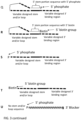
- an ATO comprises an upper separate strand which is complementary or partially complementary to all or part of the lower strand including the universal sequence.
- the 5' end of the upper separate strand may comprise a phosphate group.
- the 3' end of ATO may comprise modified nucleotide(s) or linkages which make the ATO resistant to 3' exonuclease activity of a DNA polymerase.
- the modified linkages include phosphorothioate linkage.
- the polymerase may be a mixture of one or more different DNA polymerases, or one or more RNA polymerases, or a combination of one or more DNA or RNA polymerases.
- the polymerase is a template-dependent polymerase and is not a template-independent polymerase.
- the ATO comprises moiety(ies) which renders ATO degradable, wherein the moiety is recognisable by an agent, which facilitates digestion/removal of ATO.
- the ATO comprises moiety(ies) which renders the ATO non-interfering and/or non-competing in the reaction following the extension reaction.
- the moiety may be a modified nucleotide or nucleotide analogous.
- the modified nucleotide may be a non-canonical nucleotide (non-dA, non-dG, non-dT, non-dC), which is a naturally occurring or artificial nucleotide.
- the non-canonical nucleotide may be a universal nucleotide.
- the modified nucleotides/analogous may be present in the 5' universal sequence (5' universal portion), or in the 3' random/degenerated portion, or the modified nucleotides/analogous may be present both in the 5' universal portion and in the 3' random sequence (3' random portion).
- Universal bases are analog compounds that can replace any of the four DNA bases with weak base-pair interactions. Commonly used universal bases may be 3-nitropyrrole, 5-nitroindole, or 2'-deoxyinosine. Inosine displays a slight bias in nucleotide hybridization with dI:dC being favoured over other pairings.
- Universal bases may pair indiscriminately with any other base, but, in general, lower the melting temperature of the sequence considerably; examples include 2'-deoxyinosine (hypoxanthine deoxynucleotide) and its derivatives, nitroazole analogues, and hydrophobic aromatic non-hydrogen-bonding bases (strong stacking effects).
- This disclosure has explored this property to make the Inosine containing ATO having lower Tm than normal oligonucleotide so that ATO does not interfere with subsequence reaction, where the annealing temperature is higher than the Tm of ATO's universal portion.
- DeoxyInosine a naturally occurring base, was considered the first "universal" base-meaning that it could base pair with the other natural bases, A, C, G, and T. Studies on deoxyInosine, in fact, indicate that it functions as a specific analog of deoxyGuanosine, although it does not self-aggregate as does deoxyGuanosine.
- the weak pairing nucleotides in the universal portion of ATO comprise modified nucleotides, nucleotide analog or/and modified linkages which may be, but not limited to, inosine, dinosine, or phosphorothioate linkages, methylphosphonate linkage. Any modification of the nucleotides or/and linkages can be used, as long as they provide weak pairing compared with native nucleotides or linkages.
- Weak pairing in the universal portion of ATO may be also relative to the primer used in the subsequent reaction. If the weak pairing nucleotides are normal native nucleotides, the primer used in the subsequent reaction may comprise strong pairing nucleotides which are modified nucleotides or/and modified linkages.
- the modified nucleotides which provide strong or weak pairing ability may include, but not limited to, LNA, O-me RNA, 2-amino-dA, 2-Thiol-dT, 2-aminopurine, 2' FluoRNA bases, AP-dC, C5-propyne and merhylanalogues of dC and dT, deoxyinosine, deoxyuridine, or superbases nucleotides (Epoch Bioscience).
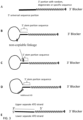
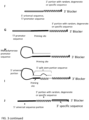
- the ATO may comprise a 5' stem portion sequence which is complementary to a part of the universal sequence, which are capable of forming a stem-loop structure,
- the 5' stem portion sequence may comprise sequence complementary or substantially complementary to a part of the 5' universal sequence, preferably to the part adjacent to the random sequence.
- the loop part may comprise a non-copiable linkage, wherein the polymerase in the ATO reaction may contain a strand displacement activity or 5' to 3' exonuclease activity. It is desirable that the target polynucleotide hybridises to 3' random/degenerated/target specific sequence of the ATO only, not to the 5' universal sequence. This is achieved by the stem-loop structure, which prevents the target polynucleotide hybridising to the universal sequence of ATO in the ATO reaction.
- the target polynucleotide hybridises to the 3' random sequence and is extended by a DNA polymerase, an RNA polymerase.
- the extended strand displaces the stem portion and stops at the non-copiable linkage.
- the stem-loop structure prevents the ATO from competing with binding to the modified target polynucleotide, so that any added primer can efficiently bind to the modified target polynucleotide for amplification.
- the stem portion and non-copiable linkage serve as moiety rendering ATO non-interfering and non-competing in the reaction after the ATO reaction.
- the ATO may or may not comprise other modifications such as uracil nucleotide(s), or ribonucleotides, which can be digested after the ATO reaction.
- the loop part of ATO may comprise nucleotides which can be digested such as uracil nucleotide(s), or ribonucleotides.
- the target polynucleotide hybridises to the 3' random sequence and is extended by a DNA polymerase.
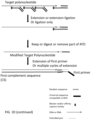
- the extended strand meets with the 5' end of the stem strand which contains 5' phosphate group and is ligated by a DNA ligase.
- the reaction comprises DNA polymerase with nick filling activity such as Polymerase 1 or Klenow large fragments, and DNA ligase.
- the ATO molecule may comprise multiple uracil nucleotide, or ribonucleotides. After the ATO reaction, the ATO molecule can be digested.
- the loop part of ATO may comprise nucleotides which can be digested such as uracil nucleotide, or ribonucleotides.
- the target polynucleotide hybridises to the 3' random sequence adjacent to the 5' end of the stem strand and is ligated to the 5' end of the stem strand by a DNA ligase.
- the 5' universal sequence portion may comprise multiple uracil nucleotide, or ribonucleotides. After first reaction, the 5' universal sequence portion can be digested.
- the target polynucleotide hybridises to the 3' random sequence and is extended by a DNA polymerase.
- the extended strand may displace the upper strand.
- the extended strand meets with the 5' end of the upper strand which has a 5' phosphate group at the 5' end and is then ligated by a DNA ligase.
- the reaction comprises DNA polymerase with nick filling activity such as Polymerase 1 or Klenow large fragments, and DNA ligase.
- the 5' universal sequence portion may comprise multiple uracil nucleotides, or ribonucleotides. After first reaction, the 5' universal sequence portion can be digested.
- the target polynucleotide in the first reaction, may hybridise to the 3' random sequence adjacent to the 5' end of the upper strand and is ligated to the 5' end of the upper strand by a DNA ligase.
- the 5' universal sequence portion as well as 3' random portion may comprise multiple uracil nucleotides.
- the ATO molecule can be digested.
- the 5' end of the upper separate strand may comprise a phosphate group
- the 3' end of the upper separate strand may comprise a biotin.
- the 5' end of the upper separate strand does not comprise a phosphate group
- the 3' end of the upper separate strand does not comprise a biotin
- the upper separate strand may comprise nucleotides which can be digested such as uracil nucleotide.
- the random sequence portion can be any length, which may have a range of 3 to 48 nucleotides, preferably having a range of 3 to 36 nucleotides, or most preferably having a range of 12 to 30 nucleotides. Specifically, the random sequence portion has 3, 4, 5, 6, 7, 8, 9, 10, 11, 12, 13, 14, 15, 16, 17, 18, 19, 20, 21, 22, 23, 24, 25, 26, 27, 28, 29, 30, 31, 32, 33, 34, 35, 36, 37, 38, 39, 40, 41, 42, 43, 44, 45, 46, 47, 48, or more nucleotides. Random sequence may comprise completely random nucleotides, wherein any of four nucleotides can be present at any position. Alternatively, degenerated nucleotides may be present at some places.
- the random sequence portion may comprise some specific (non-random) nucleotide(s) at some specific location(s), for example the 3' terminus nucleotide may be a specific nucleotide such as T residue, or an A residue, or a G residue, or a C residue.
- the specific 3' terminus nucleotide is chosen for easy and inexpensive attaching modification, such as biotin, spacer or phosphate blocker.
- the random sequence may comprise degenerate or semi-degenerate or completely random nucleotides, as well as specific nucleotides, wherein the random nucleotides are present dominantly.
- the random sequence may also comprise modified nucleotides, either naturally occurring or artificial.
- modified nucleotides may be universal base as described above.
- the random sequence may have a sequence bias, such as making the whole sequence C and G residue rich, meaning greater than 50% of the nucleotides are composed of C and G, or, A and T residue rich, meaning greater than 50% of the nucleotides are composed of A and T.
- the random sequence may be in part, or completely, replaced by a target specific sequence.
- the ATO is hybridised to target polynucleotide through random sequence at non-stringency condition, where 3' end of polynucleotide is hybridised to the random sequence and in one embodiment, as described herein, is extended using ATO as template.
- the random sequence provides function as a template which hybridises to the target polynucleotide and directs extension of the target polynucleotide using ATO as a template.
- the random sequence also provides a second function as UID (unique identifier, molecular barcode) in next generation sequencing.
- the ATO molecule may comprise 3' additional specific sequence which is located 3' of the random sequence portion.
- the 3' additional specific sequence may comprise the sequence, which is capable of hybridising to a specific location of a target polynucleotide.
- the 3' additional specific sequence may comprise restriction enzyme recognition sequence, which, when hybridising to the target sequence, may cause nicking on a target polynucleotide by an enzyme.
- the 3' end of ATO may be attached with a blocker group, which makes ATO non-extendable. Any blocker group can be used.
- the 3' terminus of the ATO will be "blocked” to prohibit the ATO acting as primer, except when the extension of the ATO is necessary by design where by the 3' will not be blocked and extension will be allowed.
- “Blocking” can be achieved by attaching a chemical moiety such as biotin or a phosphate group to the 3' hydroxyl of the last nucleotide, which may, depending upon the selected group, serve a dual purpose by also acting as an affinity capture moiety for subsequent removal or capture of the ATO following the ATO reaction.
- Blocking can also be achieved by removing the 3' OH or by using a nucleotide that lacks a 3' OH such as a dideoxynucleotide.
- the blocking group may be selected from the group consisting of at least one ribonucleotide, at least one deoxynucleotide, a C3 spacer, a phosphate, a dideoxynucleotide, an amino group, and an inverted deoxythymidine.
- the ATO reaction preferably contains polymerase with 3' to 5' exonuclease activity, therefore the ATO molecule preferably comprises modified nucleotides or linkage at the 3' end, which prevent digestion by the polymerase. Any resistant modification can be used.
- the 3' end comprises modified linkage between the final nucleotides, preferably the final two nucleotides, at this position so that it comprises a resistant moiety such as phosphorothioate instead of the conventional phosphodiester.
- the 5' universal sequence portion is a part of a sequence providing the function as template for target polynucleotide extending, whose product is equivalent to adding an adaptor for sequencing library preparation via ligation. But the extended sequence - adaptor-alike is newly synthesised and is not attached with any added oligos.
- the 5' universal sequence portion comprises primer sequence or primer binding sequence, which is compatible to a next (or third) generation sequencing (NGS) or other massive parallel sequencing.
- NGS next (or third) generation sequencing
- the 5' universal sequence portion may comprise sequencing primer sequences for Illumina platform, and/or anchoring primer sequences for Illumina platform.
- the 5' universal sequence portion may form a stem-loop or hairpin structure, where the stem part end is close to the 5' end of random sequence portion.
- the 5' end of the stem may form a 5' overhang.
- the stem part can have any length.
- the stem part can have any length ranging from 3 to 30 nucleotides, preferably 4 to 24 nucleotides.
- the stem part may be fully double-stranded, or preferably not fully double-stranded.
- the stem part may comprise non-pairing region(s).
- the non-pairing region(s) may comprise random sequence, which serves a function of UID (molecular barcode) in NGS.
- the stem part may comprise sequence recognisable and cleavable by an enzyme, for example restriction enzyme site.
- the stem formation may prevent the hybridisation of the universal sequence to the target polynucleotide.
- the loop part can be any length.
- the loop part can be any length ranging from 0 to 36 nucleotides, preferably 1 to 30 nucleotides.
- the loop may comprise in part of completely of a nucleotide analog or other chemical linkage, which is non-copiable by a polymerase, for example an abasic site, hexethylene glycol (HEG) monomer, an 18-atom hexa-ethyleneglycol spacer, or an 1',2'-Dideoxyribose (dSpacer).
- HOG hexethylene glycol
- dSpacer 1',2'-Dideoxyribose
- ATO molecule comprises nucleotides selected from the group consisting of 2'-deoxythymidine 5'-monophosphate (dTMP), 2'-deoxyguanosine 5'-monophosphate (dGMP), 2'-deoxyadenosine 5'-monophosphate (dAMP), 2'-deoxycytidine 5'-monophosphate (dCMP), 2'-deoxyuridine 5'-monophosphate (dUMP), thymidine monophosphate (TMP), guanosine monophosphate (GMP), adenosine monophosphate (AMP), cytidine monophosphate (CMP), uridine monophosphate (UMP), a base analog, and combinations thereof. It is also contemplated that the ATO comprises a modified nucleotide or linkage modification as defined herein.
- Modified oligonucleotides or polynucleotides may comprise both one or more sugar and/or one or more internucleotide linkage of the nucleotide units in the oligo-polynucleotide is replaced with "non-naturally occurring" groups.
- this embodiment contemplates a peptide nucleic acid (PNA).
- PNA peptide nucleic acid
- the sugar-backbone of a polynucleotide is replaced with an amide containing backbone.
- Modified oligo-polynucleotide backbones may contain a phosphorus atom include, for example, phosphorothioates, chiral phosphorothioates, phosphorodithioates, phosphotriesters, aminoalkylphosphotriesters, methyl, and other alkyl phosphonates.
- Modified oligonucleotide or polynucleotides may also contain one or more substituted sugar moieties. Further modifications include those that extend the genetic code such as, without limitation, Iso-dC and Iso-dG. Iso-dC and Iso-dG are chemical variants of cytosine and guanine, respectively.
- the first primer may comprise a sample barcode (SBC) sequence and additional 5' universal sequence compatible for a NGS platform.
- SBC sample barcode
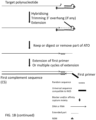
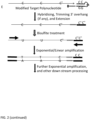
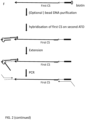
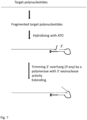
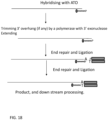
- the method provides a method of extending a target polynucleotide comprising mixing the target polynucleotide with polymerase enzymes, ATO comprising the NGS adaptor sequence; performing the trimming and extending reaction, followed by incubation with a first primer complementary to the universal NGS adaptor sequence, a DNA polymerase and dNTPs to perform an extension reaction to generate CS and a double stranded substrate molecule ; performing a ligation with T4 DNA ligase and a blunt-end or T-tailed adaptor which is formed by annealing two oligonucleotides comprising NGS adaptor sequence and a truncated complement and a 3' phosphate, wherein the one oligonucleotide is ligated to the 5' phosphate of the modified target polynucleotide molecule to complete a linear NGS library molecule.
- the present disclosure further provides a method of accurately determining the sequence of a target polynucleotide comprising:
- the present disclosure further provides a kit for generating a library of polynucleotides comprising an adaptor template oligonucleotide (ATO) of any one of the above-mentioned ATO, and primers compatible to a NGS platform.
- ATO adaptor template oligonucleotide
- a kit for generating a library of polynucleotides comprises an adaptor template oligonucleotide (ATO) described above, polymerase and primers compatible to NGS platform.
- ATO adaptor template oligonucleotide
- a target polynucleotide is a polynucleotide, modified polynucleotide or combination thereof as described herein below.
- the target polynucleotide is, in various embodiments, DNA, RNA, or a combination thereof.
- the target polynucleotide is chemically treated nucleic acid, including but not limited to embodiments wherein the substrate polynucleotide is bisulfite-treated DNA to detect methylation status by NGS.
- a target polynucleotide complement sequence is a polynucleotide comprising a sequence complementary to a target sequence or a complement thereof (complement of a sequence complementary to a target sequence).
- a target polynucleotide complement sequence comprises a first complement sequence.
- a "first complement sequence” is a polynucleotide reverse transcribed from a target polynucleotide or formed from a primer extension reaction on a target polynucleotide or RNA polynucleotide transcribed from a double -stranded RNA polymerase promotor from the modified target polynucleotide by a RNA polymerase.
- a modified target polynucleotide is a target polynucleotide extended on ATO comprising random sequence and universal sequence.
- a target polynucleotide complement sequence comprises a second complement sequence.
- a "second complement sequence” is a polynucleotide comprising a sequence complementary to a first complement sequence.
- a target polynucleotide complement sequence may comprise a UID.
- a first complement sequence may comprise a UID which is provided by a random sequence of ATO and by the 3' end part of the randomly fragmented target polynucleotide.
- the second or third primer may be a set of a plurality of second or third primers. Each second or third primer of a plurality of second or third primers is extended simultaneously, is extended in the same reaction chamber.
- the amplification step using target specific second primers may be divided into two reactions: forward reaction and reverse reaction.
- the forward reaction comprises forward set of multiple target specific second primers annealing to first strands of the multiple target CS from one sample
- the reverse reaction comprises a reverse set of multiple target specific second primers annealing to the second strands of the multiple target CS from the same sample.
- the method further comprises analysing the NGS reads derived from the forward reaction and the reverse reaction, which represent two different strands of target sequences, comprising generating an error-corrected consensus sequences by (i) grouping into families containing the same random sequence identifier (UID) sequences; (ii) removing the target sequences of the same family having one or more nucleotide positions where the target sequence disagree with majority members, and (iii) examining if the same mutations appearing in the two reactions, which represent different strands of a target sequence.
- UID random sequence identifier
- the method further comprises analysing the NGS reads derived from the forward reaction and the reverse reaction, which represent two different strands of target sequences, comprising generating consensus sequences by grouping into families containing the same random sequence identifier (UID) sequences; and counting the numbers of families.
- This method provides an accurate counting for the numbers of original target nucleic acids present in a sample.
- the methods can be used to quantitate the starting molecules, the counting of UID families of a target sequence in comparison with other samples or comparing between forward reaction and reverse reaction may provide accurate counting information.
- UID The purpose of UID is twofold. First is the assignment of a unique UID to each original DNA or RNA template molecule. The second is the amplification of each uniquely tagged template, so that many daughter molecules with the identical UID sequence are generated (defined as a UID family). If a mutation pre-existed in the template molecule used for amplification, that mutation should be present in every daughter molecule containing that UID.
- the universal primers may contain one, or two, or more terminal phosphorothioates to make them resistant to any exonuclease activity. They may also contain 5' grafting sequences necessary for hybridization to NGS flow cell, for example the Illumina GA IIx flow cell. Finally, they may contain an index sequence between the grafting sequence and the universal tag sequence. This index sequence enables the PCR products from multiple different individuals to be simultaneously analysed in the same flow cell compartment of the sequencer.
- the target nucleic acid sequence of a sample may comprise a nucleic acid fragment or gene which contains variant nucleotide(s) and may be selected from the group consisting of disorder-associated SNP(s)/deletion(s)/insertion(s), chromosome rearrangement(s), trisomy, or cancer gene(s), drug-resistance gene(s), and virulence gene(s).
- the disorder-associated gene may include but is not limited to cancer-associated genes and genes associated with a hereditary disease.
- the sample may be genomic DNA, circulating nucleic acid, RNA, mRNA, small RNA, micro RNA, or FFPE DNA or RNA.
- the variant nucleotide(s) in the diagnostic region of the target polynucleotide sequence may include one or more nucleotide substitutions, chromosome rearrangement, deletions, insertions and/or abnormal methylation.
- DNA methylation is an important epigenetic modification of the genome. Abnormal DNA methylation may result in silencing of tumour suppressor genes and is common in a variety of human cancer cells.
- a preliminary treatment should be conducted prior to the practice of the present method.
- the nucleic acid sample should be chemically modified by a bisulphite treatment, which will convert cytosine to uracil but not the methylated cytosine (i.e., 5-methylcytosine, which is resistant to this treatment and remains as cytosine).
- the method can be applied to the detection of abnormal methylation(s) in the target nucleic acid.
- the modification by bisulphite treatment occurs after the ATO reaction.
- the modification by bisulphite treatment occurs after the generation of the first CS.
- the present disclosure provides a method of analysing a biological sample for the presence and/or the amount and/or frequency of mutations or polymorphisms at multiple loci of different target nucleic acid sequences.
- the present disclosure provides a method of analysing a biological sample for chromosomes abnormality of, for example trisomy.
- the ATO reaction may be followed by next generation sequencing, digital PCR, microarray, or other high throughput analysis.
- the number of multiplexing of target loci may be more than 5, or more than 10, or more than 30, or more than 50, or more than 100, or more than 500, more than 1000, even more than 2000.
- a mutant When a mutant is in very low concentration in a sample, for example one or two mutants are present in the sample, after dividing the sample nucleic acid into two reactions, only one reaction may contain the mutant. The comparison of two strands sequences from the two reactions may reveal that only one reaction may contain mutation. It will be classified as the true mutation if more than one read families contain the same mutation, even when the mutation appears in only one reaction.
- the modified target polynucleotide can be amplified by linear or exponential amplification prior to dividing the sample nucleic acid into two reactions, for one or more subsequent rounds of amplification. Due to the increase in the copy number of all original molecules, the comparison of two strands sequences from the two reactions are more likely to reveal the presence of a mutation.
- the modified target polynucleotide is not divided into two reactions and only one of the two strands is probed for the presence of the mutation.
- the target polynucleotide is not divided into two reactions, and both strands are separately and sequentially amplified to allow analysis of both strands.
- the methods of the present invention can substantially improve the accuracy of massively parallel sequencing.
- the approach can easily be used to identify rare mutants in a population of DNA templates.
- the two strands of one target template in sample each is uniquely tagged and independently sequenced. Comparing the sequences of the two strands results in either agreement to each other or disagreement. The agreement gives the confidence to score a mutation as true positive.
- the barcoded random sequence identifier in the target specific primer can also be used for single-molecule counting to precisely determine relative or absolute DNA and/or RNA copy numbers. Because tagging occurs before major amplification, the relative abundance of variants in a population can be accurately assessed given that proportional representation is not subject to skewing by amplification biases.
- the methods of the present invention greatly reduce errors by tagging each target sequence with random sequence identifier and sequencing the two strands.
- Analysis provides error-corrected consensus sequences by grouping the sequenced uniquely tagged sequences; removing the target sequences of the same family having one or more nucleotide positions where the target sequence disagrees with majority members in a family; and same mutations appearing in the two populations would be the true mutations.
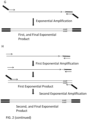
- the modified target polynucleotide purified or un-purified, is combined with a universal primer complementary to the universal sequence originally on the ATO(s) and now present on the 3' end of target polynucleotide, a pool of target specific primers designed to target regions of DNA which contain mutations of interest (for example and without limitation, single nucleotide polymorphism(s), indel(s), DNA fusion(s)), a suitable quantity of DNA polymerase(s), proof reading or not proof reading (for example and without limitation Taq DNA polymerase, or Phusion), suitable buffer(s), suitable dNTPs, and other suitable or necessary additives (for example and without limitation, DMSO, betaine, and ammonium sulfate).
- a universal primer complementary to the universal sequence originally on the ATO(s) and now present on the 3' end of target polynucleotide a pool of target specific primers designed to target regions of DNA which contain mutations of interest (for example and without limitation, single nucleo
- 5ul of the modified target polynucleotide 50 pmole of 2-004, 100 pmole of a pool of target specific primers, 12 nmole of each dNTP (dATP/dTTP/dCTP/dGTP), 2 units of Phusion DNA Polymerase, 10 ul of 5x Phusion buffer, and 1 umole of ammonium sulfate were combined in a final volume of 50 ul.
- the mixture is then thermocycled to amplify the chosen regions of the target nucleic acid extension product, in this example 98°C for 1 min, 15 cycles of 98°C for 5 seconds, 60°C for 5 minutes, and 72°C for 30 seconds, followed by 72°C for 2 minutes.
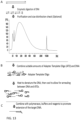
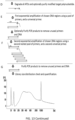
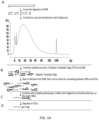
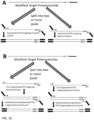
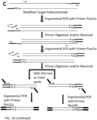
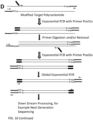
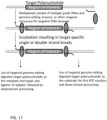
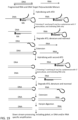
- the amplification product can then be optionally purified by any suitable method, for example using magnetic beads, in this example PCR products were eluted in 30 ul, as depicted in section (E) of figure 13 .
- the purified first exponential amplification product is combined with a second nested universal primer with sequence similarity with, and designed to bind to, the universal sequence introduced by the first universal primer which will contain sequences compatible and necessary for sequencing using Next Generation Sequencing technologies (for example and without limitation, P5 or P7 adaptor sequences, patient/sample index sequences, Illumina or custom read 1 or read 2 sequences for compatibility with Illumina Next Generation Sequencers), a second pool of targeted primers designed to target regions of DNA, including or nested, relative to the first primer pool which also target regions of DNA containing mutations of interest and also contains sequences compatible and necessary for compatibility with next generation sequencing technologies (for example and without limitation, P5 or P7 adaptor sequences, patient/sample index sequences, Illumina or custom read 1 or read 2 sequencing primer sites, for compatibility with Illumina Next Generation Sequencers), a proof reading polymerase (for example and without limitation Phusion DNA polymerase, Q5), suitable buffer(s), suitable dNTPs, and other suitable
- 10ul of the purified first amplification product 12.5 pmole of 2-005, 50 pmole of a nested pool of target specific primers, 5 nmole of each dNTP (dATP/dTTP/dCTP/dGTP), 1 unit of Phusion DNA Polymerase, 5 ul of 5x Phusion buffer, 1x SYBRgreen, and 0.5 umole of ammonium sulfate were combined in a final volume of 25 ul.
- the mixture is then thermocycled to amplify the chosen regions of the first exponential amplification product, in this example 98°C for 1 min, 15 cycles of 98°C for 5 seconds, 60oC for 5 minutes, and 72°C for 30 seconds, followed by 72oC for 2 minutes, as depicted in section (F) of figure 13 .
- the amplification product can then be purified by any suitable method, for example using magnetic beads, and will be suitable for Next Generation Sequencing on a compatible technology.
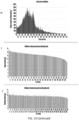
- the second exponential amplification product was bead purified before, and size distribution determined, being used to generate 150bp pair-end reads with a MiSeq, as depicted in section (G) of figure 13 .
- first and second exponential amplifications were able to successfully amplify target regions of the modified target polynucleotide and produce a targeted amplicon library.
- the inclusion of SYBRgreen in the second exponential amplification reactions allowed for monitoring of the amplification rate of the final library products, melt curve analysis showed relative to a no template control the whole method was capable of producing substantially more high molecular weight products.
- Using a bioanalyzer high sensitivity kit from Agilent (product ID 5067-4626) to assess the final complete sequencing library we were able to demonstrate that the final product of the library preparation has a size distribution equivalent to that which would be expected given the distribution of input material.
- RNA was quantified using a high sensitivity Qubit3 reagent, a total of 107 ng/ ⁇ l was measured, resulting in a total quantity of 2035 ng of RNA produced from the overnight, 18 hour, incubation.
- the RNA can then form the input material for any suitable RNA based downstream applications, for example and without limitation, RNA Next Generation Sequencing, cDNA synthesis, in situ hybridisation, qPCR, or any other suitable downstream process.
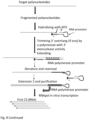
- the ATO containing a sequence designed to function as a promoter for an RNA polymerase when double stranded was used in a first ATO reaction for producing a modified target polynucleotide.
- This first reaction can be judged to be successful as the product of it was used in an invitro transcription reaction which generated a total of 2 ug of RNA.
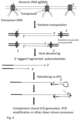
- a nucleotide sequence designed to function as an RNA polymerase promoter can be successfully incorporated into the design of the ATO. After the first ATO extension a portion of the modified target polynucleotide will be double stranded and contain an RNA polymerase promoter. This double strand RNA polymerase promoter can then be used to amplify the target polynucleotide into RNA, rather than DNA. This has the possibility to quickly and robustly greatly amplify a small quantity of DNA into RNA which can then be used as a template for any of a number of downstream applications including RNA-Seq, and cDNA syntheses.
- the ATO containing a sequence designed to function as a promoter for an RNA polymerase when double stranded was used in a first ATO reaction for producing a modified target polynucleotide.
- This first reaction can be judged to be successful as the product of it was used in an invitro transcription reaction which generated RNA.
- a nucleotide sequence designed to function as an RNA polymerase promoter can be successfully incorporated into the design of the ATO.
- the ATO is digested and removed and complementary oligo is hybridised to the modified target polynucleotide, a portion of the modified target polynucleotide will be double stranded and contain an RNA polymerase promoter.
- This double strand RNA polymerase promoter can then be used to amplify the target polynucleotide into RNA, rather than DNA. This has the possibility to quickly and robustly greatly amplify a small quantity of DNA into RNA which can then be used as a template for any of a number of downstream applications including RNA-Seq, and cDNA syntheses.
- DNA deoxyribonucleic acid
- RNA polymerase Using deoxyribonucleic acid (DNA) as the target polynucleotide for incorporating a promoter for an RNA polymerase to produce amplification of DNA in to RNA using for example and without limitation, an adaptor template oligo(s) with a hairpin (stem-loop) structure produced with two short stem regions of partial or complete complementarity separated by a random, specifically designed, or specifically chosen sequence.
- RNA polymerase promoter contains a hairpin produced with two short regions of partial or complete complementarity separated by a random, specifically designed, or specifically chosen sequence, 1-021.
- the modified target polynucleotide reaction mixture is combined with additional heat stable DNA polymerase(s), proof reading or not proof reading (for example and without limitation Taq DNA polymerase, or Phusion), mixed with suitable buffer(s), and suitable dNTPs.
- additional heat stable DNA polymerase(s) for example and without limitation Taq DNA polymerase, or Phusion
- suitable buffer(s) for example and without limitation Taq DNA polymerase, or Phusion
- suitable buffer(s) for example and without limitation Taq DNA polymerase, or Phusion
- suitable buffer(s) for example and without limitation Taq DNA polymerase, or Phusion
- the temperature is then raised to a suitable temperature for a suitable time necessary to fully extend the 3' end which will act as a primer to initiate extension and formation of a full or partial double stranded target deoxyribonucleic acid extension product with a hairpin separating the two complementary strands, in this example 72°C for 10 minutes.
- the ATO containing a sequencing designed to function as a promoter for an RNA polymerase when double stranded as well as a sequence which would form an internal hairpin was used in a first ATO reaction for producing a modified target polynucleotide. This first reaction can be judged to be successful as the product of it was used in an invitro transcription reaction which generated RNA.
- a nucleotide sequence designed to function as an RNA polymerase promoter can be successfully incorporated into the design of the ATO in combination with the internal hairpin and extension.
- the regions of complementarity are able reanneal and extend to produce a double strand modified target polynucleotide with a hairpin.
- This double strand RNA polymerase promoter can then be used to amplify the target polynucleotide into RNA, rather than DNA. This has the possibility to quickly and robustly greatly amplify a small quantity of DNA into RNA which can then be used as a template for any of a number of downstream applications including RNA-Seq, and cDNA syntheses.
- deoxyribonucleic acid (DNA) as the target polynucleotide for producing a Next Generation Sequencing Library (for example and without limitation, compatible with Illumina Next Generation Sequencers) using for example and without limitation, an adaptor template oligo(s) with a hairpin produced with two short regions of partial or complete complementarity separated by a random, specifically designed, or specifically chosen sequence.
- deoxyribonucleic acid (DNA) as the target polynucleotide for producing a PCR free Next Generation Sequencing Library (for example and without limitation, compatible with Illumina Next Generation Sequencers) using for example and without limitation, an adaptor template oligo(s) with a hairpin (stem-loop structure0 wherein the loop comprises a chemical spacer (for example and without limitation, a C3 spacer, a C18 spacer), and a double-stranded or partially double-stranded ordinary adaptor.
- a chemical spacer for example and without limitation, a C3 spacer, a C18 spacer
- the hairpin in the ATO is generated by a chemical spacer, 1-024.
- the purified target nucleic acid extension product is combined with an oligonucleotide primer complementary to the conserved sequence now present on the 3' end of the modified target DNA molecules, a polymerase (for example and without limitation Phusion DNA polymerase), suitable buffer(s), and suitable dNTPs.
- a polymerase for example and without limitation Phusion DNA polymerase
- suitable buffer(s) for example and without limitation Phusion DNA polymerase
- suitable dNTPs for example and without limitation Phusion DNA polymerase
- 50 pmoles of a primer complementary to the conserved sequence now present on target DNA molecules (2-006) 2 units of Phusion DNA polymerase, 6 ul of 5x Phusion DNA polymerase buffer, 12 nmole of each dNTP (dATP/dTTP/dCTP/dGTP), and 15 ⁇ l of purified modified target polynucleotide, in a final volume of 30 ul.
- the mixture is incubated at, in this example 60-72°C for 30 minutes, or other suitable temperatures and times capable of promoting enzyme activity to extend the oligonucleotide(s) to create a blunt end or A-Tailed double strand DNA product.
- the products can then be purified using any suitable purification method.
- DNA deoxyribonucleic acid
- Next Generation Sequencing Library for example and without limitation, compatible with Illumina Next Generation Sequencers
- a single stranded adaptor template oligo(s) for example and without limitation, a single stranded adaptor template oligo(s).
- DNA deoxyribonucleic acid
- Next Generation Sequencing Library for example and without limitation, compatible with Illumina Next Generation Sequencers
- an adaptor template oligo(s) separated into two complementary strands for example and without limitation, an adaptor template oligo(s) separated into two complementary strands.
- ATO is an equal molar mixture of two single strand oligos, 1-027, 1-028.
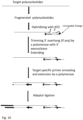
- the reaction contains DNA ligase. If the 3' end of the target polynucleotide hybridise to the ATO and is located directly abutting the phosphorylated 5' end of upper strand of the ATO, the 3'end of the target polynucleotide is ligated to the 5' end upper strand of ATO without needing extension.
- the reaction contains extension components as example 1 and in addition with 100 units of T4 DNA ligase, 2.5 ul of 10x DNA ligase buffer, in a final volume of 25 ul.
- ATO is an equal molar mixture of two single strand oligos, 1-029, 1-030.
- the ATOs are a pool of 200 different ATOs whose 3' ends have target specific sequences.
- the 3' end of the target polynucleotide may be an overhang when hybridising to its ATO, the 3' exonuclease of the DNA polymerase trim the overhang before extension takes place.
- RNA deoxyribonucleic acid
- target polynucleotide for example and without limitation, compatible with Illumina Next Generation Sequencers
- a chemical spacer for example and without limitation, a C3 spacer, a C18 spacer
- the purified modified target polynucleotide is combined with a universal primer with sequence similarity with, and designed to bind to, the conserved sequence(s) introduced by the ATO(s), which contain sequences compatible and necessary with next generation sequencing technologies (for example and without limitation, P5 or P7 adaptor sequences, patient/sample index sequences, Illumina or custom read 1 or read 2 sequences for compatibility with Illumina Next Generation Sequencers), a pool of primers designed to target regions of DNA in proximity to the pool of ATO oligos which also target regions of DNA containing mutations of interest and also contains sequences compatible and necessary for compatibility with next generation sequencing technologies (for example and without limitation, P5 or P7 adaptor sequences, patient/sample index sequences, Illumina or custom read 1 or read 2 sequencing primer sites, for compatibility with Illumina Next Generation Sequencers), a proof reading polymerase (for example and without limitation Phusion DNA polymerase, Q5), suitable buffer(s), suitable dNTPs, and other suitable or necessary additive
- 20ul of the purified modified target polynucleotide 25 pmole of 2-003, a total of 100 pmole of a pool of target specific primers, 10 nmole of each dNTP (dATP/dTTP/dCTP/dGTP), 1 unit of Phusion DNA Polymerase, 10 ul of 5x Phusion buffer, 1x SYBRgreen, and 1 umole of ammonium sulfate were combined in a final volume of 50 ul.
- the mixture is then thermocycled to amplify the chosen regions, in this example 98°C for 1 min, 15 cycles of 98°C for 5 seconds, 60°C for 5 minutes, and 72°C for 30 seconds, followed by 72°C for 2 minutes.
- the amplification product can then be purified by any suitable method, for example using magnetic beads, and will be suitable for Next Generation Sequencing on a compatible technology.
- RNA ribonucleic acid
- Next Generation Sequencing Library for example and without limitation, compatible with Illumina Next Generation Sequencers
- an adaptor template oligo(s) with a hairpin for example and without limitation, an adaptor template oligo(s) with a hairpin
- the modified target polynucleotide purified or un-purified, is combined with a primer complementary to the conserved (universal) sequence now present on the 3' end of the target RNA molecules, a reverse transcriptase (for example and without limitation, M-MuLV, or AMV Reverse Transcriptase), suitable buffer(s), and suitable dNTPs.
- a reverse transcriptase for example and without limitation, M-MuLV, or AMV Reverse Transcriptase
- suitable buffer(s) for example and without limitation, a reverse transcriptase
- suitable buffer(s) for example and without limitation, a reverse transcriptase
- suitable buffer(s) for example and without limitation, a reverse transcriptase
- suitable buffer(s) for example and without limitation, a reverse transcriptase
- suitable buffer(s) for example and without limitation, a reverse transcriptase
- suitable buffer(s) for example and without limitation, a reverse transcriptase
- suitable buffer(s) for example and without
- DNA deoxyribonucleic acid
- Targeted Amplicon Next Generation Sequencing Libraries for example and without limitation, compatible with Illumina Next Generation Sequencers
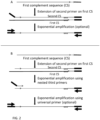
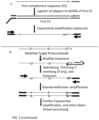
- each aliquot is combined with a universal primer complementary to the conserved sequence originally on the ATO(s) and now present on the 3' ends of the modified target DNA molecules, one of two different pools of primers (herein termed 'Pool1a' and 'Pool2a'), primers Pool1 are designed to target one DNA strand of the target regions of DNA which contains changes of interest, whereas Pool2 is designed to target the complementary strand of the target regions.
- a pool of nested primers designed to target regions of DNA relative to the first primer pool (Pool1a or Pool2a) which also target regions of DNA containing mutations of interest and also contains sequences compatible and necessary for compatibility with next generation sequencing technologies (for example and without limitation, P5 or P7 adaptor sequences, patient/sample index sequences, Illumina or custom read 1 or read 2 sequencing primer sites, for compatibility with Illumina Next Generation Sequencers).
- DNA deoxyribonucleic acid
- the first complementary strand is used as the template and split into two pools.
- DNA deoxyribonucleic acid
- an adaptor template oligo(s) with a hairpin produced using a chemical spacer (for example and without limitation, a C3 spacer, a C18 spacer).
- the first exponential amplification product is mixed with a single strand specific nuclease (for example exonuclease 1), at a temperate, for example 37°C, for a time, for example 15 minutes, or any other suitable time or temperature capable of resulting in enzyme activity resulting in degradation of all single strand DNA present in the exponential amplification product.
- a single strand specific nuclease for example exonuclease 1
- a temperate for example 37°C
- a time for example 15 minutes, or any other suitable time or temperature capable of resulting in enzyme activity resulting in degradation of all single strand DNA present in the exponential amplification product.
- 20 units of Exonuclease I were added to the first amplification products and incubated at 37°C for 25 minutes.
- the single strand specific nuclease can then be inactivated by incubating the reaction mixture at a temperature, in this example 80°C, for a time, in this example 15 minutes, capable of inactivating the single
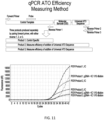
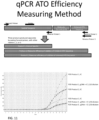
- a cancer mutation hot spot panel was designed, containing 245x2 primer pairs.
- the Panel contains four pools of primers used to perform amplicon libraries from genomic "hot spot” regions that are frequently mutated in human cancer genes.
- the Hotspot Panel was designed to amplify 245 amplicons covering approximately 3,000 COSMIC mutations from 50 oncogenes and tumor suppressor genes.
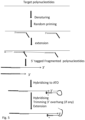
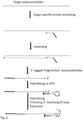
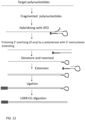
- ATO are hybridised to the target polynucleotide sequences of a sample.
- the target polynucleotide is extended using ATO as template.
- the extension generates a modified target polynucleotide, which comprises a random sequence as UID and a 3' universal sequence.
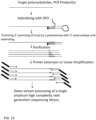
- the first universal primers and the Fp5 pool or Rp5 pool of target specific primers are added to hybridise to the modified target polynucleotide and PCR amplified the target sequences.
- a third reaction is carried out by using nested target specific primers (Fp7 or Rp7) and universal primers.
- Each tagged amplicon library was subsequently purified from small residual DNA fragments and the DNA concentration determined. Next, these purified and individually tagged amplicon libraries were pooled equimolarly, resulting in an amplicon pool or sequencing sample.
Landscapes
- Chemical & Material Sciences (AREA)
- Life Sciences & Earth Sciences (AREA)
- Organic Chemistry (AREA)
- Health & Medical Sciences (AREA)
- Engineering & Computer Science (AREA)
- Zoology (AREA)
- Wood Science & Technology (AREA)
- Proteomics, Peptides & Aminoacids (AREA)
- Genetics & Genomics (AREA)
- Analytical Chemistry (AREA)
- Biochemistry (AREA)
- General Engineering & Computer Science (AREA)
- Bioinformatics & Cheminformatics (AREA)
- Biotechnology (AREA)
- Molecular Biology (AREA)
- Microbiology (AREA)
- General Health & Medical Sciences (AREA)
- Biophysics (AREA)
- Physics & Mathematics (AREA)
- Immunology (AREA)
- Chemical Kinetics & Catalysis (AREA)
- Biomedical Technology (AREA)
- Bioinformatics & Computational Biology (AREA)
- Crystallography & Structural Chemistry (AREA)
- Plant Pathology (AREA)
- Medicinal Chemistry (AREA)
- General Chemical & Material Sciences (AREA)
- Measuring Or Testing Involving Enzymes Or Micro-Organisms (AREA)
- Enzymes And Modification Thereof (AREA)
Applications Claiming Priority (4)
| Application Number | Priority Date | Filing Date | Title |
|---|---|---|---|
| GBGB1706059.1A GB201706059D0 (en) | 2017-04-17 | 2017-04-17 | Methods, compositions, and kits for preparing library and targeted sequencing |
| GBGB1708384.1A GB201708384D0 (en) | 2017-05-25 | 2017-05-25 | Methods, compositions, and kits for preparing library and targeted sequencing |
| GBGB1719114.9A GB201719114D0 (en) | 2017-11-17 | 2017-11-17 | Methods, compositions, and kits for preparing library and targeted sequencing |
| PCT/GB2018/051000 WO2018193233A1 (en) | 2017-04-17 | 2018-04-17 | Methods, compositions, and kits for preparing nucleic acid libraries |
Publications (3)
| Publication Number | Publication Date |
|---|---|
| EP3612642A1 EP3612642A1 (en) | 2020-02-26 |
| EP3612642B1 true EP3612642B1 (en) | 2025-07-09 |
| EP3612642C0 EP3612642C0 (en) | 2025-07-09 |
Family
ID=62089770
Family Applications (1)
| Application Number | Title | Priority Date | Filing Date |
|---|---|---|---|
| EP18721095.0A Active EP3612642B1 (en) | 2017-04-17 | 2018-04-17 | Methods and kits for preparing nucleic acid libraries |
Country Status (8)
| Country | Link |
|---|---|
| US (4) | US11408025B2 (enExample) |
| EP (1) | EP3612642B1 (enExample) |
| JP (1) | JP7079029B2 (enExample) |
| CN (2) | CN110832084B (enExample) |
| AU (1) | AU2018254190B2 (enExample) |
| CA (1) | CA3060018A1 (enExample) |
| ES (1) | ES3035812T3 (enExample) |
| WO (1) | WO2018193233A1 (enExample) |
Families Citing this family (22)
| Publication number | Priority date | Publication date | Assignee | Title |
|---|---|---|---|---|
| AU2018254190B2 (en) | 2017-04-17 | 2024-05-30 | Guoliang Fu | Methods, compositions, and kits for preparing nucleic acid libraries |
| AU2019384154B2 (en) * | 2018-11-21 | 2025-11-20 | Agilent Technologies, Inc. | Methods for targeted nucleic acid library formation |
| US11390915B2 (en) * | 2019-04-26 | 2022-07-19 | New England Biolabs, Inc. | Polynucleotide adapter design for reduced bias |
| CN114026249B (zh) | 2019-06-20 | 2024-01-23 | 深圳华大生命科学研究院 | 基于rna样本构建文库的方法及应用 |
| US20220356467A1 (en) * | 2019-06-25 | 2022-11-10 | Board Of Regents, The University Of Texas System | Methods for duplex sequencing of cell-free dna and applications thereof |
| EP4342999B1 (en) * | 2020-01-16 | 2025-06-11 | DNAe Diagnostics Limited | Compositions, kits and methods for isolating target polynucleotides |
| WO2021232023A2 (en) * | 2020-05-15 | 2021-11-18 | Swift Biosciences, Inc. | Methods for ligation-coupled-pcr |
| CA3188197A1 (en) * | 2020-09-11 | 2022-03-17 | Andrew Slatter | Methods of enriching a target sequence from a sequencing library using hairpin adaptors |
| GB202108427D0 (en) | 2021-06-14 | 2021-07-28 | Fu Guoliang | Methods, compositions, and kits for preparing sequencing library |
| CN113684249B (zh) * | 2021-08-25 | 2024-10-22 | 广州达安基因股份有限公司 | 一种rna和dna二代测序文库的构建方法及二代测序盒 |
| WO2023077128A1 (en) * | 2021-10-29 | 2023-05-04 | Board Of Regents, The University Of Texas System | Shielded small nucleotides for intracellular barcoding |
| US20250179567A1 (en) * | 2022-02-18 | 2025-06-05 | Agilent Technologies, Inc. | Systems and methods for targeted nucleic acid capture and barcoding |
| US20250179568A1 (en) * | 2022-03-09 | 2025-06-05 | New England Biolabs, Inc. | Target Enrichment |
| US20250382607A1 (en) * | 2022-05-17 | 2025-12-18 | Nanjing GenScript Biotech Co., Ltd. | Sgrna sequencing linker and use thereof |
| CN117487884B (zh) * | 2022-08-01 | 2025-04-15 | 南京诺唯赞生物科技股份有限公司 | 一种高样品利用率的基于转座酶的测序文库构建方法及相关寡核苷酸 |
| CN120603940A (zh) * | 2022-11-11 | 2025-09-05 | 生米公司 | 用于处理和扩增核酸的方法和组合物 |
| WO2024137316A1 (en) * | 2022-12-23 | 2024-06-27 | Foundation Medicine, Inc. | Oligonucleotides and methods for capturing single-stranded templates and/or templates with 3' overhangs |
| GB202308392D0 (en) | 2023-06-06 | 2023-07-19 | Fu Guoliang | Methods, compositions, and kits for preparing library and targeted sequencing |
| GB202319353D0 (en) | 2023-12-17 | 2024-01-31 | Fu Guoliang | Tail sequence guided addition of adaptor |
| CN117701679B (zh) | 2024-02-06 | 2024-06-14 | 中国医学科学院基础医学研究所 | 一种基于5’连接的单链dna特异的高通量测序方法 |
| WO2025184067A1 (en) * | 2024-02-26 | 2025-09-04 | Biomeme, Inc. | Methods and compositions for processing and amplification of nucleic acids |
| WO2026050948A1 (zh) * | 2024-09-04 | 2026-03-12 | 深圳华大生命科学研究院 | 核酸文库的构建方法及应用 |
Family Cites Families (16)
| Publication number | Priority date | Publication date | Assignee | Title |
|---|---|---|---|---|
| CA2501983A1 (en) | 2002-10-30 | 2004-05-27 | Pamgene B.V. | Improved methods for generating multiple rna copies |
| US20120156729A1 (en) * | 2003-12-02 | 2012-06-21 | Sooknanan Roy R | Selective terminal tagging of nucleic acids |
| US20050153333A1 (en) * | 2003-12-02 | 2005-07-14 | Sooknanan Roy R. | Selective terminal tagging of nucleic acids |
| EP1954706B1 (en) * | 2005-11-30 | 2012-03-28 | Epicentre Technologies Corporation | Method using reversibly blocked tagging oligonucleotides |
| US7754429B2 (en) * | 2006-10-06 | 2010-07-13 | Illumina Cambridge Limited | Method for pair-wise sequencing a plurity of target polynucleotides |
| EP2280081A1 (en) | 2009-07-31 | 2011-02-02 | Qiagen GmbH | Method of normalized quantification of RNA |
| KR101599555B1 (ko) | 2009-12-24 | 2016-03-03 | 두산인프라코어 주식회사 | 하이브리드용 전력 변환 장치 |
| EP2619327B1 (en) | 2010-09-21 | 2014-10-22 | Population Genetics Technologies LTD. | Increasing confidence of allele calls with molecular counting |
| WO2014145078A1 (en) * | 2013-03-15 | 2014-09-18 | Verinata Health, Inc. | Generating cell-free dna libraries directly from blood |
| WO2014176355A1 (en) * | 2013-04-23 | 2014-10-30 | President And Fellows Of Harvard College | In situ interaction determination |
| CN105917002A (zh) * | 2013-11-18 | 2016-08-31 | 鲁比康基因组学公司 | 用于减少背景的可降解适体 |
| IL274464B2 (en) * | 2013-12-11 | 2023-08-01 | Accuragen Holdings Ltd | Preparations and methods for the detection of rare sequence variants |
| US10407720B2 (en) * | 2013-12-15 | 2019-09-10 | Academia Sinica | Methods for full-length amplification of double-stranded linear nucleic acids of unknown sequences |
| EP3105349B1 (en) * | 2014-02-11 | 2020-07-15 | F. Hoffmann-La Roche AG | Targeted sequencing and uid filtering |
| EP3169799B1 (en) * | 2014-07-15 | 2019-09-04 | Qiagen Sciences, LLC | Semi-random barcodes for nucleic acid analysis |
| AU2018254190B2 (en) | 2017-04-17 | 2024-05-30 | Guoliang Fu | Methods, compositions, and kits for preparing nucleic acid libraries |
-
2018
- 2018-04-17 AU AU2018254190A patent/AU2018254190B2/en active Active
- 2018-04-17 EP EP18721095.0A patent/EP3612642B1/en active Active
- 2018-04-17 CN CN201880040163.9A patent/CN110832084B/zh active Active
- 2018-04-17 ES ES18721095T patent/ES3035812T3/es active Active
- 2018-04-17 JP JP2020505541A patent/JP7079029B2/ja active Active
- 2018-04-17 CN CN202510735693.7A patent/CN120796437A/zh active Pending
- 2018-04-17 CA CA3060018A patent/CA3060018A1/en active Pending
- 2018-04-17 US US16/605,520 patent/US11408025B2/en active Active
- 2018-04-17 WO PCT/GB2018/051000 patent/WO2018193233A1/en not_active Ceased
-
2022
- 2022-07-20 US US17/869,595 patent/US11993805B2/en active Active
-
2023
- 2023-06-26 US US18/341,446 patent/US12297484B2/en active Active
-
2025
- 2025-05-12 US US19/204,940 patent/US20250270621A1/en active Pending
Also Published As
| Publication number | Publication date |
|---|---|
| US11993805B2 (en) | 2024-05-28 |
| ES3035812T3 (en) | 2025-09-09 |
| US20230121409A1 (en) | 2023-04-20 |
| US12297484B2 (en) | 2025-05-13 |
| EP3612642C0 (en) | 2025-07-09 |
| US11408025B2 (en) | 2022-08-09 |
| JP2020512845A (ja) | 2020-04-30 |
| US20200115736A1 (en) | 2020-04-16 |
| JP7079029B2 (ja) | 2022-06-01 |
| CA3060018A1 (en) | 2018-10-25 |
| CN110832084B (zh) | 2025-06-20 |
| US20240002906A1 (en) | 2024-01-04 |
| CN120796437A (zh) | 2025-10-17 |
| AU2018254190A1 (en) | 2019-10-31 |
| AU2018254190B2 (en) | 2024-05-30 |
| WO2018193233A1 (en) | 2018-10-25 |
| EP3612642A1 (en) | 2020-02-26 |
| CN110832084A (zh) | 2020-02-21 |
| US20250270621A1 (en) | 2025-08-28 |
Similar Documents
| Publication | Publication Date | Title |
|---|---|---|
| US12297484B2 (en) | Methods, compositions, and kits for preparing nucleic acid libraries | |
| JP6479083B2 (ja) | 組み合わせたヌクレアーゼ反応、連結反応、およびポリメラーゼ反応を用いて核酸配列、発現、またはコピー変化を相対的に定量するための方法 | |
| EP3567122B1 (en) | Method for identification and enumeration of nucleic acid sequence, expression, copy, or dna methylation changes, using combined nuclease, ligase, polymerase, and sequencing reactions | |
| CA2948951C (en) | Synthesis of double-stranded nucleic acids | |
| JP2016511007A (ja) | 鎖になったrnaまたはdnaのライブラリを生成するための方法、組成物およびキット | |
| US20240384261A1 (en) | Methods, compositions, and kits for preparing sequencing library | |
| AU2024285380A1 (en) | Methods, compositions, and kits for preparing library and targeted sequencing | |
| WO2025133584A1 (en) | Tail sequence guided addition of adaptor |
Legal Events
| Date | Code | Title | Description |
|---|---|---|---|
| STAA | Information on the status of an ep patent application or granted ep patent |
Free format text: STATUS: UNKNOWN |
|
| STAA | Information on the status of an ep patent application or granted ep patent |
Free format text: STATUS: THE INTERNATIONAL PUBLICATION HAS BEEN MADE |
|
| PUAI | Public reference made under article 153(3) epc to a published international application that has entered the european phase |
Free format text: ORIGINAL CODE: 0009012 |
|
| STAA | Information on the status of an ep patent application or granted ep patent |
Free format text: STATUS: REQUEST FOR EXAMINATION WAS MADE |
|
| 17P | Request for examination filed |
Effective date: 20191107 |
|
| AK | Designated contracting states |
Kind code of ref document: A1 Designated state(s): AL AT BE BG CH CY CZ DE DK EE ES FI FR GB GR HR HU IE IS IT LI LT LU LV MC MK MT NL NO PL PT RO RS SE SI SK SM TR |
|
| AX | Request for extension of the european patent |
Extension state: BA ME |
|
| DAV | Request for validation of the european patent (deleted) | ||
| DAX | Request for extension of the european patent (deleted) | ||
| STAA | Information on the status of an ep patent application or granted ep patent |
Free format text: STATUS: EXAMINATION IS IN PROGRESS |
|
| 17Q | First examination report despatched |
Effective date: 20200820 |
|
| RIN1 | Information on inventor provided before grant (corrected) |
Inventor name: DUNWELL, THOMAS Inventor name: FU, GUOLIANG |
|
| RAP3 | Party data changed (applicant data changed or rights of an application transferred) |
Owner name: FU, GUOLIANG Owner name: GENEFIRST LTD. |
|
| GRAP | Despatch of communication of intention to grant a patent |
Free format text: ORIGINAL CODE: EPIDOSNIGR1 |
|
| STAA | Information on the status of an ep patent application or granted ep patent |
Free format text: STATUS: GRANT OF PATENT IS INTENDED |
|
| INTG | Intention to grant announced |
Effective date: 20241206 |
|
| GRAS | Grant fee paid |
Free format text: ORIGINAL CODE: EPIDOSNIGR3 |
|
| RAP3 | Party data changed (applicant data changed or rights of an application transferred) |
Owner name: FU, GUOLIANG Owner name: GENEFIRST LIMITED |
|
| GRAA | (expected) grant |
Free format text: ORIGINAL CODE: 0009210 |
|
| STAA | Information on the status of an ep patent application or granted ep patent |
Free format text: STATUS: THE PATENT HAS BEEN GRANTED |
|
| AK | Designated contracting states |
Kind code of ref document: B1 Designated state(s): AL AT BE BG CH CY CZ DE DK EE ES FI FR GB GR HR HU IE IS IT LI LT LU LV MC MK MT NL NO PL PT RO RS SE SI SK SM TR |
|
| REG | Reference to a national code |
Ref country code: GB Ref legal event code: FG4D |
|
| REG | Reference to a national code |
Ref country code: CH Ref legal event code: EP |
|
| REG | Reference to a national code |
Ref country code: IE Ref legal event code: FG4D |
|
| REG | Reference to a national code |
Ref country code: DE Ref legal event code: R096 Ref document number: 602018083392 Country of ref document: DE |
|
| REG | Reference to a national code |
Ref country code: ES Ref legal event code: FG2A Ref document number: 3035812 Country of ref document: ES Kind code of ref document: T3 Effective date: 20250909 |
|
| U01 | Request for unitary effect filed |
Effective date: 20250804 |
|
| U07 | Unitary effect registered |
Designated state(s): AT BE BG DE DK EE FI FR IT LT LU LV MT NL PT RO SE SI Effective date: 20250808 |
|
| PG25 | Lapsed in a contracting state [announced via postgrant information from national office to epo] |
Ref country code: IS Free format text: LAPSE BECAUSE OF FAILURE TO SUBMIT A TRANSLATION OF THE DESCRIPTION OR TO PAY THE FEE WITHIN THE PRESCRIBED TIME-LIMIT Effective date: 20251109 |
|
| PG25 | Lapsed in a contracting state [announced via postgrant information from national office to epo] |
Ref country code: NO Free format text: LAPSE BECAUSE OF FAILURE TO SUBMIT A TRANSLATION OF THE DESCRIPTION OR TO PAY THE FEE WITHIN THE PRESCRIBED TIME-LIMIT Effective date: 20251009 |
|
| PG25 | Lapsed in a contracting state [announced via postgrant information from national office to epo] |
Ref country code: HR Free format text: LAPSE BECAUSE OF FAILURE TO SUBMIT A TRANSLATION OF THE DESCRIPTION OR TO PAY THE FEE WITHIN THE PRESCRIBED TIME-LIMIT Effective date: 20250709 |
|
| PG25 | Lapsed in a contracting state [announced via postgrant information from national office to epo] |
Ref country code: GR Free format text: LAPSE BECAUSE OF FAILURE TO SUBMIT A TRANSLATION OF THE DESCRIPTION OR TO PAY THE FEE WITHIN THE PRESCRIBED TIME-LIMIT Effective date: 20251010 |
|
| PG25 | Lapsed in a contracting state [announced via postgrant information from national office to epo] |
Ref country code: PL Free format text: LAPSE BECAUSE OF FAILURE TO SUBMIT A TRANSLATION OF THE DESCRIPTION OR TO PAY THE FEE WITHIN THE PRESCRIBED TIME-LIMIT Effective date: 20250709 |
|
| PG25 | Lapsed in a contracting state [announced via postgrant information from national office to epo] |
Ref country code: RS Free format text: LAPSE BECAUSE OF FAILURE TO SUBMIT A TRANSLATION OF THE DESCRIPTION OR TO PAY THE FEE WITHIN THE PRESCRIBED TIME-LIMIT Effective date: 20251009 |
|
| PG25 | Lapsed in a contracting state [announced via postgrant information from national office to epo] |
Ref country code: SM Free format text: LAPSE BECAUSE OF FAILURE TO SUBMIT A TRANSLATION OF THE DESCRIPTION OR TO PAY THE FEE WITHIN THE PRESCRIBED TIME-LIMIT Effective date: 20250709 |
|
| PGFP | Annual fee paid to national office [announced via postgrant information from national office to epo] |
Ref country code: GB Payment date: 20260311 Year of fee payment: 9 |
|
| PG25 | Lapsed in a contracting state [announced via postgrant information from national office to epo] |
Ref country code: CZ Free format text: LAPSE BECAUSE OF FAILURE TO SUBMIT A TRANSLATION OF THE DESCRIPTION OR TO PAY THE FEE WITHIN THE PRESCRIBED TIME-LIMIT Effective date: 20250709 |
|
| PG25 | Lapsed in a contracting state [announced via postgrant information from national office to epo] |
Ref country code: SK Free format text: LAPSE BECAUSE OF FAILURE TO SUBMIT A TRANSLATION OF THE DESCRIPTION OR TO PAY THE FEE WITHIN THE PRESCRIBED TIME-LIMIT Effective date: 20250709 |
|
| REG | Reference to a national code |
Ref country code: CH Ref legal event code: U11 Free format text: ST27 STATUS EVENT CODE: U-0-0-U10-U11 (AS PROVIDED BY THE NATIONAL OFFICE) Effective date: 20260501 |
|
| PLBE | No opposition filed within time limit |
Free format text: ORIGINAL CODE: 0009261 |
|
| STAA | Information on the status of an ep patent application or granted ep patent |
Free format text: STATUS: NO OPPOSITION FILED WITHIN TIME LIMIT |
|
| REG | Reference to a national code |
Ref country code: CH Ref legal event code: L10 Free format text: ST27 STATUS EVENT CODE: U-0-0-L10-L00 (AS PROVIDED BY THE NATIONAL OFFICE) Effective date: 20260521 |
|
| U20 | Renewal fee for the european patent with unitary effect paid |
Year of fee payment: 9 Effective date: 20260428 |
|
| 26N | No opposition filed |
Effective date: 20260410 |
|
| PGFP | Annual fee paid to national office [announced via postgrant information from national office to epo] |
Ref country code: ES Payment date: 20260615 Year of fee payment: 9 |
|
| PGFP | Annual fee paid to national office [announced via postgrant information from national office to epo] |
Ref country code: CH Payment date: 20260501 Year of fee payment: 9 Ref country code: IE Payment date: 20260420 Year of fee payment: 9 |