EP3605696A2 - Redox flow battery with electrolyte balancing and compatibility enabling features - Google Patents
Redox flow battery with electrolyte balancing and compatibility enabling features Download PDFInfo
- Publication number
- EP3605696A2 EP3605696A2 EP19188587.0A EP19188587A EP3605696A2 EP 3605696 A2 EP3605696 A2 EP 3605696A2 EP 19188587 A EP19188587 A EP 19188587A EP 3605696 A2 EP3605696 A2 EP 3605696A2
- Authority
- EP
- European Patent Office
- Prior art keywords
- electrolyte solution
- cell
- electrode
- iron
- circulation loop
- Prior art date
- Legal status (The legal status is an assumption and is not a legal conclusion. Google has not performed a legal analysis and makes no representation as to the accuracy of the status listed.)
- Granted
Links
Images


Classifications
-
- H—ELECTRICITY
- H01—ELECTRIC ELEMENTS
- H01M—PROCESSES OR MEANS, e.g. BATTERIES, FOR THE DIRECT CONVERSION OF CHEMICAL ENERGY INTO ELECTRICAL ENERGY
- H01M8/00—Fuel cells; Manufacture thereof
- H01M8/04—Auxiliary arrangements, e.g. for control of pressure or for circulation of fluids
- H01M8/04082—Arrangements for control of reactant parameters, e.g. pressure or concentration
- H01M8/04186—Arrangements for control of reactant parameters, e.g. pressure or concentration of liquid-charged or electrolyte-charged reactants
-
- H—ELECTRICITY
- H01—ELECTRIC ELEMENTS
- H01M—PROCESSES OR MEANS, e.g. BATTERIES, FOR THE DIRECT CONVERSION OF CHEMICAL ENERGY INTO ELECTRICAL ENERGY
- H01M8/00—Fuel cells; Manufacture thereof
- H01M8/18—Regenerative fuel cells, e.g. redox flow batteries or secondary fuel cells
- H01M8/184—Regeneration by electrochemical means
-
- H—ELECTRICITY
- H01—ELECTRIC ELEMENTS
- H01M—PROCESSES OR MEANS, e.g. BATTERIES, FOR THE DIRECT CONVERSION OF CHEMICAL ENERGY INTO ELECTRICAL ENERGY
- H01M4/00—Electrodes
- H01M4/02—Electrodes composed of, or comprising, active material
- H01M4/36—Selection of substances as active materials, active masses, active liquids
- H01M4/368—Liquid depolarisers
-
- H—ELECTRICITY
- H01—ELECTRIC ELEMENTS
- H01M—PROCESSES OR MEANS, e.g. BATTERIES, FOR THE DIRECT CONVERSION OF CHEMICAL ENERGY INTO ELECTRICAL ENERGY
- H01M8/00—Fuel cells; Manufacture thereof
- H01M8/04—Auxiliary arrangements, e.g. for control of pressure or for circulation of fluids
- H01M8/04082—Arrangements for control of reactant parameters, e.g. pressure or concentration
- H01M8/04201—Reactant storage and supply, e.g. means for feeding, pipes
-
- H—ELECTRICITY
- H01—ELECTRIC ELEMENTS
- H01M—PROCESSES OR MEANS, e.g. BATTERIES, FOR THE DIRECT CONVERSION OF CHEMICAL ENERGY INTO ELECTRICAL ENERGY
- H01M8/00—Fuel cells; Manufacture thereof
- H01M8/04—Auxiliary arrangements, e.g. for control of pressure or for circulation of fluids
- H01M8/04298—Processes for controlling fuel cells or fuel cell systems
- H01M8/04694—Processes for controlling fuel cells or fuel cell systems characterised by variables to be controlled
- H01M8/04791—Concentration; Density
- H01M8/04798—Concentration; Density of fuel cell reactants
-
- H—ELECTRICITY
- H01—ELECTRIC ELEMENTS
- H01M—PROCESSES OR MEANS, e.g. BATTERIES, FOR THE DIRECT CONVERSION OF CHEMICAL ENERGY INTO ELECTRICAL ENERGY
- H01M8/00—Fuel cells; Manufacture thereof
- H01M8/04—Auxiliary arrangements, e.g. for control of pressure or for circulation of fluids
- H01M8/04298—Processes for controlling fuel cells or fuel cell systems
- H01M8/04694—Processes for controlling fuel cells or fuel cell systems characterised by variables to be controlled
- H01M8/04791—Concentration; Density
- H01M8/0482—Concentration; Density of the electrolyte
-
- H—ELECTRICITY
- H01—ELECTRIC ELEMENTS
- H01M—PROCESSES OR MEANS, e.g. BATTERIES, FOR THE DIRECT CONVERSION OF CHEMICAL ENERGY INTO ELECTRICAL ENERGY
- H01M8/00—Fuel cells; Manufacture thereof
- H01M8/08—Fuel cells with aqueous electrolytes
-
- H—ELECTRICITY
- H01—ELECTRIC ELEMENTS
- H01M—PROCESSES OR MEANS, e.g. BATTERIES, FOR THE DIRECT CONVERSION OF CHEMICAL ENERGY INTO ELECTRICAL ENERGY
- H01M8/00—Fuel cells; Manufacture thereof
- H01M8/18—Regenerative fuel cells, e.g. redox flow batteries or secondary fuel cells
- H01M8/184—Regeneration by electrochemical means
- H01M8/188—Regeneration by electrochemical means by recharging of redox couples containing fluids; Redox flow type batteries
-
- H—ELECTRICITY
- H01—ELECTRIC ELEMENTS
- H01M—PROCESSES OR MEANS, e.g. BATTERIES, FOR THE DIRECT CONVERSION OF CHEMICAL ENERGY INTO ELECTRICAL ENERGY
- H01M8/00—Fuel cells; Manufacture thereof
- H01M8/20—Indirect fuel cells, e.g. fuel cells with redox couple being irreversible
-
- H—ELECTRICITY
- H01—ELECTRIC ELEMENTS
- H01M—PROCESSES OR MEANS, e.g. BATTERIES, FOR THE DIRECT CONVERSION OF CHEMICAL ENERGY INTO ELECTRICAL ENERGY
- H01M8/00—Fuel cells; Manufacture thereof
- H01M8/24—Grouping of fuel cells, e.g. stacking of fuel cells
- H01M8/2455—Grouping of fuel cells, e.g. stacking of fuel cells with liquid, solid or electrolyte-charged reactants
-
- H—ELECTRICITY
- H01—ELECTRIC ELEMENTS
- H01M—PROCESSES OR MEANS, e.g. BATTERIES, FOR THE DIRECT CONVERSION OF CHEMICAL ENERGY INTO ELECTRICAL ENERGY
- H01M2300/00—Electrolytes
- H01M2300/0002—Aqueous electrolytes
- H01M2300/0005—Acid electrolytes
-
- H—ELECTRICITY
- H01—ELECTRIC ELEMENTS
- H01M—PROCESSES OR MEANS, e.g. BATTERIES, FOR THE DIRECT CONVERSION OF CHEMICAL ENERGY INTO ELECTRICAL ENERGY
- H01M2300/00—Electrolytes
- H01M2300/0002—Aqueous electrolytes
- H01M2300/0014—Alkaline electrolytes
-
- Y—GENERAL TAGGING OF NEW TECHNOLOGICAL DEVELOPMENTS; GENERAL TAGGING OF CROSS-SECTIONAL TECHNOLOGIES SPANNING OVER SEVERAL SECTIONS OF THE IPC; TECHNICAL SUBJECTS COVERED BY FORMER USPC CROSS-REFERENCE ART COLLECTIONS [XRACs] AND DIGESTS
- Y02—TECHNOLOGIES OR APPLICATIONS FOR MITIGATION OR ADAPTATION AGAINST CLIMATE CHANGE
- Y02E—REDUCTION OF GREENHOUSE GAS [GHG] EMISSIONS, RELATED TO ENERGY GENERATION, TRANSMISSION OR DISTRIBUTION
- Y02E60/00—Enabling technologies; Technologies with a potential or indirect contribution to GHG emissions mitigation
- Y02E60/10—Energy storage using batteries
-
- Y—GENERAL TAGGING OF NEW TECHNOLOGICAL DEVELOPMENTS; GENERAL TAGGING OF CROSS-SECTIONAL TECHNOLOGIES SPANNING OVER SEVERAL SECTIONS OF THE IPC; TECHNICAL SUBJECTS COVERED BY FORMER USPC CROSS-REFERENCE ART COLLECTIONS [XRACs] AND DIGESTS
- Y02—TECHNOLOGIES OR APPLICATIONS FOR MITIGATION OR ADAPTATION AGAINST CLIMATE CHANGE
- Y02E—REDUCTION OF GREENHOUSE GAS [GHG] EMISSIONS, RELATED TO ENERGY GENERATION, TRANSMISSION OR DISTRIBUTION
- Y02E60/00—Enabling technologies; Technologies with a potential or indirect contribution to GHG emissions mitigation
- Y02E60/30—Hydrogen technology
- Y02E60/50—Fuel cells
Definitions
- Flow batteries also known as redox flow batteries or redox flow cells, are designed to convert electrical energy into chemical energy that can be stored and later released when there is demand.
- a flow battery may be used with a renewable energy system, such as a wind-powered system, to store energy that exceeds consumer demand and later release that energy when there is greater demand.
- a typical flow battery includes a redox flow cell that has a negative electrode and a positive electrode separated by an electrolyte layer, which may include a separator, such as an ion-exchange membrane.
- a negative fluid electrolyte (sometimes referred to as the anolyte) is delivered to the negative electrode and a positive fluid electrolyte (sometimes referred to as the catholyte) is delivered to the positive electrode to drive reversible redox reactions between redox pairs.
- the electrical energy supplied causes a chemical reduction reaction in one electrolyte and an oxidation reaction in the other electrolyte.
- the separator prevents the electrolytes from freely and rapidly mixing but permits selected ions to pass through to complete the redox reactions.
- the chemical energy contained in the liquid electrolytes is released in the reverse reactions and electrical energy can be drawn from the electrodes.
- a redox flow battery (e.g. a battery for use in a method as described herein) according to an example of the present disclosure includes first and second cells. Each cell has first and second electrodes and a separator layer arranged between the first and second electrodes.
- a first circulation loop is fluidly connected with the first electrode of the first cell.
- a polysulfide electrolyte solution has a pH 11.5 or greater and is contained in the first recirculation loop.
- a second circulation loop is fluidly connected with the second electrode of the second cell.
- An iron electrolyte solution has a pH 3 or less and is contained in the second circulation loop.
- a third circulation loop is fluidly connected with the second electrode of the first cell and the first electrode of the second cell.
- An intermediator electrolyte solution is contained in the third circulation loop.
- the polysulfide electrolyte solution and the intermediator electrolyte solution in the first cell, and the iron electrolyte solution and the intermediator electrolyte solution in the second cell, are operable to undergo reversible reactions to store input electrical energy upon charging and discharge the stored electrical energy upon discharging.
- the intermediator electrolyte solution has a pH 12 or greater.
- the first cell has standard electrode potential of greater than -0.3V SHE.
- the intermediator electrolyte solution includes at least one of quinoxaline, anthraquinone, or benzoquinone.
- the intermediator electrolyte solution includes 1,2-benzoquinone-3,5-disulfonic acid.
- the intermediator electrolyte solution includes at least one of 2,6-DBEAQ, 1,2-DBEAQ, or 1,8-DBEAQ.
- the first circulation loop includes a bypass line and a third cell in the bypass line.
- the third cell is operable to electrolyze the polysulfide electrolyte solution to produce hydrogen gas.
- the third cell is connected by a hydrogen bleed line to the second circulation loop.
- the second circulation loop includes a bypass line and a third cell in the bypass line.
- the third cell is operable to electrolyze the iron electrolyte solution to produce oxygen gas.
- the third cell is connected by an oxygen bleed line to the first circulation loop.
- a method for using a redox flow battery includes using first and second cells of a redox flow battery to store input electrical energy upon charging and discharge the stored electrical energy upon discharging.
- Each cell has a separator layer arranged between first and second electrodes.
- a polysulfide electrolyte solution of pH 11.5 or greater is circulated through a first circulation loop in fluid connection with the first electrode of the first cell, and an iron electrolyte solution of pH 3 or less is circulated through a second circulation loop in fluid connection with the second electrode of the second cell, and an intermediator electrolyte solution is circulated through a third circulation loop in fluid connection with the second electrode of the first cell and the first electrode of the second cell.
- the intermediator electrolyte solution is emptied from either the second electrode of the first cell or the first electrode of the second cell, either the solid sulfide product is recovered to the polysulfide electrolyte solution or the solid iron product is recovered to the iron electrolyte solution by, respectively, circulating at least a portion of the polysulfide electrolyte solution from the first circulation loop through the second electrode to dissolve, and thereby remove, the solid sulfide product from the second electrode of the first cell, and then transferring the polysulfide electrolyte solution with the dissolved solid sulfide product back in to the first loop, or circulating at least a portion of the iron electrolyte solution from the second circulation loop through the first electrode to dissolve, and thereby remove, the solid iron product from the first electrode of the second cell, and then transferring the iron electrolyte solution with the dissolved solid iron product back in to the second loop.
- a further embodiment of any of the foregoing embodiments includes maintaining the intermediator electrolyte solution at a pH 12 or greater so that the iron precipitates upon permeation through the ion-exchange layer from the second electrode of the second cell into the first electrode of the second cell.
- a further embodiment of any of the foregoing embodiments includes maintaining the intermediator electrolyte solution at a pH 12 or greater so that the sulfur precipitates upon permeation through the ion-exchange layer from the first electrode of the first cell into the second electrode of the first cell.
- a method for using a redox flow battery includes using first and second cells of a redox flow battery to store input electrical energy upon charging and discharge the stored electrical energy upon discharging.
- Each cell has a separator layer arranged between first and second electrodes.
- a polysulfide electrolyte solution of pH 11.5 or greater is circulated through a first circulation loop in fluid connection with the first electrode of the first cell, an iron electrolyte solution of pH 3 or less is circulated through a second circulation loop in fluid connection with the second electrode of the second cell, and an intermediator electrolyte solution is circulated through a third circulation loop in fluid connection with the second electrode of the first cell and the first electrode of the second cell.
- a third cell is used to electrolyze either the polysulfide electrolyte solution to produce hydrogen gas or the iron electrolyte solution to produce oxygen gas.
- the pH of the polysulfide electrolyte solution is maintained to be pH 11.5 or greater or the pH of the iron electrolyte solution is maintained to be pH 3 or less by, respectively, introducing the oxygen gas into the polysulfide electrolyte solution to adjust the pH of the polysulfide electrolyte solution, or introducing the hydrogen gas into the iron electrolyte solution to adjust the pH of the iron electrolyte solution.
- the introducing of the oxygen gas includes sparging the oxygen gas through the polysulfide electrolyte solution.
- the introducing of the hydrogen gas includes sparging the hydrogen gas through the iron electrolyte solution.
- a method for using a redox flow battery includes using a cell of a redox flow battery to store input electrical energy upon charging and discharge the stored electrical energy upon discharging.
- the cell has a separator layer arranged between first and second electrodes.
- a polysulfide electrolyte solution of pH 11.5 or greater is circulated through a first circulation loop in fluid connection with the first electrode of the cell, and a manganate electrolyte solution is circulated through a second circulation loop in fluid connection with the second electrode of the cell.
- Sulfur from the polysulfide electrolyte solution in the first electrode permeates through the ion-exchange layer and precipitates as a solid sulfide product in the second electrode and manganese from the manganate electrolyte solution in the second electrode permeates through the ion-exchange layer of the cell and precipitates as solid iron product in the first electrode.
- a further embodiment of any of the foregoing embodiments includes passing the polysulfide electrolyte solution with the dissolved solid sulfide product in a first direction through a bi-directional filter and passing the manganate electrolyte solution with the dissolved solid manganese product in a second, opposite direction through the bi-directional filter.
- a redox flow battery (e.g. a battery for use in a method as described herein) according to an example of the present disclosure includes a cell that has first and second electrodes and an ion-exchange layer arranged between the first and second electrodes.
- a first circulation loop fluidly connects with the first electrode.
- a polysulfide electrolyte solution has a pH 11.5 or greater and is contained in the first recirculation loop.
- a second circulation loop fluidly connects with the second electrode.
- An iron or manganate electrolyte solution is contained in the second circulation loop.
- a first auxiliary loop connects the first circulation loop with the second electrode through a bi-directional filter, and a second auxiliary loop connects the second circulation loop with the first electrode through the bi-directional filter.
- Redox flow batteries utilize electrochemically active species that include ions of elements that have multiple, reversible oxidation states in a selected liquid solution.
- Example species may include transition metals, such as vanadium, iron, manganese, chromium, zinc, or molybdenum, or other elements such as sulfur, cerium, lead, tin, titanium, germanium, bromine, or chlorine. Although these species have been used, not all of them are compatible for use together. For instance, over time, there is mixing of species due to cross-over of the species through the separator. If incompatible, the cross-over species may react to precipitate as an insoluble solid or to generate gases that escape to the surroundings. Insoluble solids may block flow and debit performance. Gaseous losses may pose a health concern and may reduce species availability for proper functionality.
- iron and sulfur electrolytes Two species that are attractive for use in RFBs due to low cost are iron and sulfur.
- iron and sulfur electrolytes such as iron in hydrochloric acid and sulfur in sodium hydroxide, are highly incompatible. Iron that crosses-over into the basic pH sulfur electrolyte reacts to form insoluble iron oxide (Fe 2 O 3 ) and sulfur that crosses-over into the acidic pH iron electrolyte reacts to form gaseous hydrogen sulfide (H2S). Over time, the loss of iron, clogging from the insoluble iron oxide, and the loss of sulfur to hydrogen sulfide will render the RFB inoperable or, at the least, reduce round-trip efficiency to unfeasible levels for use as an RFB. As will be discussed below, the disclosed RFB utilizes an intermediator electrolyte that mitigates incompatibility and enables use of sulfide and iron electrolytes in the RFB.
- FIG. 1 schematically illustrates an RFB 20.
- the RFB 20 includes a first cell 22 and a second cell 24.
- the cells 22 and 24 are of nominally identical constriction.
- the cells 22 and 24 include, respectively, first electrodes 22a and 24a, second electrodes 22b and 24b, and separator layers 22c and 24c between the electrodes (layer 22c between electrodes 22a and 22b, and layer 24c between electrodes 24a and 24b).
- the electrodes 22a, 22b, 24a, and 24b are porous carbon structures, such as carbon paper or felt.
- the separator layers are ion-exchange membranes 22c and 24c, which permit selected ions to pass through to complete the redox reactions while electrically isolating the electrodes.
- a first circulation loop 26 is fluidly connected with the first electrode 22a of the first cell 22, and a second circulation loop 28 is fluidly connected with the second electrode 24b of the second cell 24.
- a "loop" refers to a continuous, closed circuit fluid passage.
- the first circulation loop 26 and the second circulation loop 28 may include respective electrolyte storage tanks 30 and 32.
- a polysulfide electrolyte solution 34 is contained in the first recirculation loop 26 (e.g., in the tank 30), and an iron electrolyte solution 36 is contained in the second circulation loop 28 (i.e., in the tank 32).
- the polysulfide electrolyte solution 34 has a pH 11.5 or greater, and the iron electrolyte solution has a pH 3 or less.
- the polysulfide in the polysulfide electrolyte solution 34 generally refers to salts of sulfur in a basic pH solution.
- the salt is sodium salt with the formula Na 2 S x , where x is 2 to 5, in sodium hydroxide.
- the polysulfide electrolyte solution 34 may be 2M Na 2 S x in 1M sodium hydroxide.
- the iron in the iron electrolyte solution 36 generally refers to iron salts in an acidic solution.
- the iron electrolyte solution 36 may be 1M FeCl x in 1M NaCl and 0.3M HCl.
- the RFB 20 further includes a third circulation loop 38 fluidly connected with the second electrode 22b of the first cell 22 and the first electrode 24a of the second cell 24.
- the third circulation loop 38 may include an electrolyte storage tank 40.
- the third circulation loop 38 contains an intermediator electrolyte solution 42 (i.e., in the tank 42) that participates in reactions in both cells 22 and 24.
- the intermediator electrolyte solution 42 has a pH 12 or greater.
- the intermediator electrolyte solution 42 includes at least one of quinoxaline, anthraquinone, or benzoquinone.
- the intermediator electrolyte solution 42 includes at least one of 1,2-benzoquinone-3,5-disulfonic acid, 4,4'-((9,10-anthraquinone-2,6-diyl)dioxy)dibutyrate (2,6-DBEAQ), 1,2-DBEAQ, or 1,8-DBEAQ.
- Other functionalized hydroxylated anthraquinones e.g. 2,6-dihydroxyanthraquinone (2,6-DHAQ)
- Other organic-based redox couples include molecules based on viologens, quinoxalines, or alloxazines. Organomettalic reactants may also be used, such as ferrocenes.
- the intermediator electrolyte solution is 0.4M NaFe(CN) 6 in 1M NaOH and 1M NaCl. In another example, the intermediator electrolyte solution is 0.5M 2,6-DBEAQ in 0.5M NaOH and 0.5M NaCl.
- the polysulfide electrolyte solution 34 circulates through the first electrode 22a of the first cell 22 and the iron electrolyte solution circulates through the second electrode 24b of the second cell 24.
- the intermediator electrolyte solution 42 circulates through the second electrode 22b of the first cell 22 and the first electrode 24a of the second cell 24.
- the polysulfide electrolyte solution 34 and the intermediator electrolyte solution 42 in the first cell 22, and the iron electrolyte solution 36 and the intermediator electrolyte solution 42 in the second cell 24, are operable to undergo reversible reactions to store input electrical energy upon charging and discharge the stored electrical energy upon discharging.
- the electrical energy may be transmitted to and from the cells 22 and 24 through an electric circuit that is electrically coupled with the electrodes 22a, 22b, 24a, and 24b.
- the intermediator electrolyte solution 42 in the RFB 20 mitigates the incompatibility and enables use of sulfide and iron electrolytes together. For instance, rather than sulfur crossing-over into an iron solution, the sulfur in the RFB 20 crosses-over into the intermediator electrolyte solution 42. And rather than iron crossing-over into a sulfur solution, the iron in the RFB 20 crosses-over into the intermediator electrolyte solution 42.
- the intermediator electrolyte solution 42 is selected to produce more desirable reactions with the sulfur and the iron such that the sulfur and iron can readily be recovered and returned to their respective solutions 34 and 36.
- the sulfur when sulfur crosses-over from the first electrode 22a through the ion-exchange layer 22c and into the intermediator electrolyte solution 42 at the second electrode 22b, the sulfur precipitates as a solid sulfur product.
- the iron crosses-over from the second electrode 24b through the ion-exchange layer 24c and into the intermediator electrolyte solution 42 at the first electrode 24a, the iron precipitates as a solid iron product.
- the conditions for the sulfur and the iron to precipitate require that the pH of the intermediator electrolyte solution 42 be 12 or greater and that the standard electrode potential be greater than -0.3V.
- the sulfur may react to form hydrogen sulfide gas and the iron may react to form insoluble iron oxide.
- the solid sulfur product and solid iron oxide product can readily be recovered and incorporated back into, respectively, the polysulfide electrolyte solution 34 and the iron electrolyte solution 36 to maintain RFB performance.
- the selected intermediator electrolyte solution 42 has highly reversible kinetics between its reduction and oxidation reactions, has ionic function groups (e.g., OH - ), and is a large molecule to reduce cross-over of the intermediator. Solubility of the intermediator electrolyte solution 42 is not critical, since the intermediator electrolyte solution 42 maintains a state-of-charge of approximately 50% at all times and only a limited quantity of the intermediator electrolyte is required (i.e., the amount does not determine the total energy capacity of the battery).
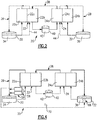
- FIG 2 depicts a further example of the RFB 20.
- the RFB 20 additionally includes one or more flush lines 44.
- the flush lines 44 may be used to remove and recover the solid sulfur product and the solid iron product according to an electrolyte-takeover method (ETM) 50 illustrated in Figure 3 .
- the method 50 generally includes steps 52 and 54.
- the intermediator electrolyte solution 42 is emptied from the second electrode 22b of the first cell and/or the first electrode 24a of the second cell 24.
- the polysulfide electrolyte solution 34 is circulated via the flush line 44 through the second electrode 22b of the first cell and/or the iron electrolyte solution 36 is circulated via the flush line 44 through the first electrode 24a of the second cell 24.
- the solid sulfide product is readily soluble in the polysulfide electrolyte solution 34.
- the polysulfide electrolyte solution 34 thus dissolves and removes the solid sulfide product from the second electrode 22b.
- the solid iron product is readily soluble in the iron electrolyte solution 36.
- the iron electrolyte solution 36 thus dissolves and removes the solid iron product from the first electrode 24b.
- the polysulfide electrolyte solution 34 is then transferred back into the first loop 26 and the iron electrolyte solution 36 is transferred back into the second loop 28.
- the intermediator electrolyte solution 42 can then resume circulation through the cells 22 and 24 to charge or discharge the RFB 20.
- FIGs 4 and 5 depict further examples of the RFB 20.
- the RFB 20 additionally includes a bypass line 56 and a third cell 58 in the bypass line 56.
- the bypass line 56 and the third cell 58 are in the first loop 26, and in Figure 5 the bypass line 56 and the third cell 58 are in the second loop 28.
- the bypass line 56 and the third cell 58 may be used according to a method 60 in Figure 6 to maintain the pH of the polysulfide electrolyte solution 34 to be pH 11.5 or greater or the pH of the iron electrolyte solution 36 to be pH 3 or less.
- the third cell 58 is used to electrolyze the polysulfide electrolyte solution 34 ( Figure 4 ) or the iron electrolyte solution 36 ( Figure 5 ).
- the third cell 58 is an electrolyzer cell that uses input electrical power to drive an electrolysis reaction of the polysulfide electrolyte solution 34 to generate hydrogen gas or the iron electrolyte solution 36 to generate oxygen gas.
- the respective net reactions are as follows.
- the hydrogen can be introduced into the iron electrolyte solution 36 to adjust the pH of the iron electrolyte solution 36 and/or the oxygen gas can be introduced into the polysulfide electrolyte solution 34 to adjust the pH of the polysulfide electrolyte solution 34.
- the introducing of the hydrogen gas involves sparging (bubbling) the hydrogen gas through iron electrolyte solution 36, such as in the tank 32 as shown at 66 ( Figure 4 ).
- the hydrogen reacts with the iron electrolyte solution 36 to lower the pH.
- the introducing of the oxygen gas involves sparging (bubbling) the oxygen gas through polysulfide electrolyte solution 34, such as in the tank 30 as shown at 68 ( Figure 5 ).
- the oxygen reacts with the polysulfide electrolyte solution 34 to increase the pH.
- the third cell 58 may be connected by a bleed line 70 to either the second loop 28 ( Figure 4 ) or the first loop ( Figure 5 ).
- Additional species that are attractive for use in RFBs due to low cost are permanganate and sulfur.
- manganate species that cross-over into the low potential sulfur electrolyte reduces to form insoluble manganate hydroxide Mn(OH) 2 and sulfur that crosses-over into the manganate electrolyte oxidizes to form solid sulfur metal.
- the loss of sulfur and manganate species, and clogging from the insoluble sulfur and manganate species will render the RFB inoperable or, at the least, reduce round-trip efficiency to unfeasible levels for use as an RFB.
- the disclosed RFB that utilizes manganate and sulfur does not necessarily require an intermediator electrolyte; however, it may employ similar recovery strategies as described above to mitigate the issues resulting from crossover in the RFB.
- crossover results in solid deposits enables the S and Mn to be separated and returned to their original electrolyte.
- the ETM method 50 described above for the Fe and S system
- the membrane then exposing both electrodes to the same electrolyte should enable dissolution and recovery.
- This recovery mechanism is expected to be quick (i.e., ⁇ 1 hour) and, if needed, it can be conducted at elevated temperatures to accelerate the process. The end result is that electrolyte balance is maintained.
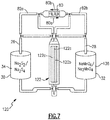
- FIG. 7 shows another example RFB 120.
- the RFB 120 in this example does not include a third circulation loop and only includes a single, common cell 122 or stack of common cells.
- the cell 122 includes a first electrode 122a, a second electrode 122b, and separator layers 122c between the electrodes 122a and 122b.
- like reference numerals designate like elements where appropriate and reference numerals with the addition of one-hundred or multiples thereof designate modified elements that are understood to incorporate the same features and benefits of the corresponding elements.
- the first circulation loop 26 is fluidly connected with the first electrode 122a of the cell 122, and a second circulation loop 28 is fluidly connected with the second electrode 122b of the cell 122.
- the polysulfide electrolyte solution 34 is contained in the first recirculation loop 26 (e.g., in the tank 30), and a manganate electrolyte solution 136 is contained in the second circulation loop 28 (i.e., in the tank 32).
- the polysulfide electrolyte solution 34 is pumped through the second electrode 122b (after draining), which reduces, dissolves, and recaptures any solid S 0 .
- the polysulfide electrolyte solution 34 is passed in a first direction 80a and through a bi-directional filter 80 that is in a first auxiliary loop 82a to capture any residual Mn that precipitates.
- the manganate electrolyte solution 136 is pumped through first electrode 122a (after draining), which oxidizes and dissolves any Mn(OH) 2 precipitate.
- the manganate electrolyte solution 136 is passed in a second direction 80b through the same bi-directional filter 80 but as a part of a second auxiliary loop 82b to capture any residual S that precipitates.
- the bi-directional filter 80 enables recapture of precipitated species that are filtered out to be recaptured in the polysulfide electrolyte solution 34 and the manganate electrolyte solution 136.
- O 2 can be consumed by allowing it to react with the negolyte by connecting the gas space above the posolyte and negolyte reservoirs (this gas space shall be maintained as a N 2 blanket to prevent discharge of the anolyte): O 2 + 2H 2 O + 4Na 2 S 2 ⁇ 2Na 2 S 4 + 4NaOH
Landscapes
- Chemical & Material Sciences (AREA)
- Chemical Kinetics & Catalysis (AREA)
- Electrochemistry (AREA)
- General Chemical & Material Sciences (AREA)
- Life Sciences & Earth Sciences (AREA)
- Engineering & Computer Science (AREA)
- Manufacturing & Machinery (AREA)
- Sustainable Development (AREA)
- Sustainable Energy (AREA)
- Fuel Cell (AREA)
Abstract
Description
- Flow batteries, also known as redox flow batteries or redox flow cells, are designed to convert electrical energy into chemical energy that can be stored and later released when there is demand. As an example, a flow battery may be used with a renewable energy system, such as a wind-powered system, to store energy that exceeds consumer demand and later release that energy when there is greater demand.
- A typical flow battery includes a redox flow cell that has a negative electrode and a positive electrode separated by an electrolyte layer, which may include a separator, such as an ion-exchange membrane. A negative fluid electrolyte (sometimes referred to as the anolyte) is delivered to the negative electrode and a positive fluid electrolyte (sometimes referred to as the catholyte) is delivered to the positive electrode to drive reversible redox reactions between redox pairs. Upon charging, the electrical energy supplied causes a chemical reduction reaction in one electrolyte and an oxidation reaction in the other electrolyte. The separator prevents the electrolytes from freely and rapidly mixing but permits selected ions to pass through to complete the redox reactions. Upon discharge, the chemical energy contained in the liquid electrolytes is released in the reverse reactions and electrical energy can be drawn from the electrodes.
- A redox flow battery (e.g. a battery for use in a method as described herein) according to an example of the present disclosure includes first and second cells. Each cell has first and second electrodes and a separator layer arranged between the first and second electrodes. A first circulation loop is fluidly connected with the first electrode of the first cell. A polysulfide electrolyte solution has a pH 11.5 or greater and is contained in the first recirculation loop. A second circulation loop is fluidly connected with the second electrode of the second cell. An iron electrolyte solution has a pH 3 or less and is contained in the second circulation loop. A third circulation loop is fluidly connected with the second electrode of the first cell and the first electrode of the second cell. An intermediator electrolyte solution is contained in the third circulation loop. The polysulfide electrolyte solution and the intermediator electrolyte solution in the first cell, and the iron electrolyte solution and the intermediator electrolyte solution in the second cell, are operable to undergo reversible reactions to store input electrical energy upon charging and discharge the stored electrical energy upon discharging.
- In a further embodiment of any of the foregoing embodiments, the intermediator electrolyte solution has a pH 12 or greater.
- In a further embodiment of any of the foregoing embodiments, the first cell has standard electrode potential of greater than -0.3V SHE.
- In a further embodiment of any of the foregoing embodiments, the intermediator electrolyte solution includes at least one of quinoxaline, anthraquinone, or benzoquinone.
- In a further embodiment of any of the foregoing embodiments, the intermediator electrolyte solution includes 1,2-benzoquinone-3,5-disulfonic acid.
- In a further embodiment of any of the foregoing embodiments, the intermediator electrolyte solution includes at least one of 2,6-DBEAQ, 1,2-DBEAQ, or 1,8-DBEAQ.
- In a further embodiment of any of the foregoing embodiments, the first circulation loop includes a bypass line and a third cell in the bypass line. The third cell is operable to electrolyze the polysulfide electrolyte solution to produce hydrogen gas.
- In a further embodiment of any of the foregoing embodiments, the third cell is connected by a hydrogen bleed line to the second circulation loop.
- In a further embodiment of any of the foregoing embodiments, the second circulation loop includes a bypass line and a third cell in the bypass line. The third cell is operable to electrolyze the iron electrolyte solution to produce oxygen gas.
- In a further embodiment of any of the foregoing embodiments, the third cell is connected by an oxygen bleed line to the first circulation loop.
- A method for using a redox flow battery (e.g. a redox flow battery as herein described) according to an example of the present disclosure includes using first and second cells of a redox flow battery to store input electrical energy upon charging and discharge the stored electrical energy upon discharging. Each cell has a separator layer arranged between first and second electrodes. A polysulfide electrolyte solution of pH 11.5 or greater is circulated through a first circulation loop in fluid connection with the first electrode of the first cell, and an iron electrolyte solution of pH 3 or less is circulated through a second circulation loop in fluid connection with the second electrode of the second cell, and an intermediator electrolyte solution is circulated through a third circulation loop in fluid connection with the second electrode of the first cell and the first electrode of the second cell. Sulfur from the polysulfide electrolyte solution in the first electrode of the first cell permeates through the ion-exchange layer of the first cell and precipitates as a solid sulfide product in the second electrode and iron from the iron electrolyte solution in the second electrode of the second cell permeates through the ion-exchange layer of the second cell and precipitates as solid iron product. The intermediator electrolyte solution is emptied from either the second electrode of the first cell or the first electrode of the second cell, either the solid sulfide product is recovered to the polysulfide electrolyte solution or the solid iron product is recovered to the iron electrolyte solution by, respectively, circulating at least a portion of the polysulfide electrolyte solution from the first circulation loop through the second electrode to dissolve, and thereby remove, the solid sulfide product from the second electrode of the first cell, and then transferring the polysulfide electrolyte solution with the dissolved solid sulfide product back in to the first loop, or circulating at least a portion of the iron electrolyte solution from the second circulation loop through the first electrode to dissolve, and thereby remove, the solid iron product from the first electrode of the second cell, and then transferring the iron electrolyte solution with the dissolved solid iron product back in to the second loop.
- A further embodiment of any of the foregoing embodiments includes maintaining the intermediator electrolyte solution at a pH 12 or greater so that the iron precipitates upon permeation through the ion-exchange layer from the second electrode of the second cell into the first electrode of the second cell.
- A further embodiment of any of the foregoing embodiments includes maintaining the intermediator electrolyte solution at a pH 12 or greater so that the sulfur precipitates upon permeation through the ion-exchange layer from the first electrode of the first cell into the second electrode of the first cell.
- A method for using a redox flow battery (e.g. a redox flow battery as herein described) according to an example of the present disclosure includes using first and second cells of a redox flow battery to store input electrical energy upon charging and discharge the stored electrical energy upon discharging. Each cell has a separator layer arranged between first and second electrodes. A polysulfide electrolyte solution of pH 11.5 or greater is circulated through a first circulation loop in fluid connection with the first electrode of the first cell, an iron electrolyte solution of pH 3 or less is circulated through a second circulation loop in fluid connection with the second electrode of the second cell, and an intermediator electrolyte solution is circulated through a third circulation loop in fluid connection with the second electrode of the first cell and the first electrode of the second cell. A third cell is used to electrolyze either the polysulfide electrolyte solution to produce hydrogen gas or the iron electrolyte solution to produce oxygen gas. The pH of the polysulfide electrolyte solution is maintained to be pH 11.5 or greater or the pH of the iron electrolyte solution is maintained to be pH 3 or less by, respectively, introducing the oxygen gas into the polysulfide electrolyte solution to adjust the pH of the polysulfide electrolyte solution, or introducing the hydrogen gas into the iron electrolyte solution to adjust the pH of the iron electrolyte solution.
- In a further embodiment of any of the foregoing embodiments, the introducing of the oxygen gas includes sparging the oxygen gas through the polysulfide electrolyte solution.
- In a further embodiment of any of the foregoing embodiments, the introducing of the hydrogen gas includes sparging the hydrogen gas through the iron electrolyte solution.
- A method for using a redox flow battery (e.g. a redox battery as described herein) according to an example of the present disclosure includes using a cell of a redox flow battery to store input electrical energy upon charging and discharge the stored electrical energy upon discharging. The cell has a separator layer arranged between first and second electrodes. A polysulfide electrolyte solution of pH 11.5 or greater is circulated through a first circulation loop in fluid connection with the first electrode of the cell, and a manganate electrolyte solution is circulated through a second circulation loop in fluid connection with the second electrode of the cell. Sulfur from the polysulfide electrolyte solution in the first electrode permeates through the ion-exchange layer and precipitates as a solid sulfide product in the second electrode and manganese from the manganate electrolyte solution in the second electrode permeates through the ion-exchange layer of the cell and precipitates as solid iron product in the first electrode. Either the solid sulfide product is recovered to the polysulfide electrolyte solution or the solid manganese product is recovered to the manganate electrolyte solution by, respectively, circulating at least a portion of the polysulfide electrolyte solution from the first circulation loop through the second electrode to dissolve, and thereby remove, the solid sulfide product from the second electrode, and then transferring the polysulfide electrolyte solution with the dissolved solid sulfide product back in to the first loop, or circulating at least a portion of the manganate electrolyte solution from the second circulation loop through the first electrode to dissolve, and thereby remove, the solid manganese product from the first electrode, and then transferring the manganese electrolyte solution with the dissolved solid iron product back in to the second loop.
- A further embodiment of any of the foregoing embodiments includes passing the polysulfide electrolyte solution with the dissolved solid sulfide product in a first direction through a bi-directional filter and passing the manganate electrolyte solution with the dissolved solid manganese product in a second, opposite direction through the bi-directional filter.
- A redox flow battery (e.g. a battery for use in a method as described herein) according to an example of the present disclosure includes a cell that has first and second electrodes and an ion-exchange layer arranged between the first and second electrodes. A first circulation loop fluidly connects with the first electrode. A polysulfide electrolyte solution has a pH 11.5 or greater and is contained in the first recirculation loop. A second circulation loop fluidly connects with the second electrode. An iron or manganate electrolyte solution is contained in the second circulation loop. A first auxiliary loop connects the first circulation loop with the second electrode through a bi-directional filter, and a second auxiliary loop connects the second circulation loop with the first electrode through the bi-directional filter.
- The various features and advantages of the present disclosure will become apparent to those skilled in the art from the following detailed description. The drawings that accompany the detailed description can be briefly described as follows.
-
Figure 1 illustrates an example redox flow battery. -
Figure 2 illustrates the redox flow battery with flush lines. -
Figure 3 illustrates a method for recovering sulfur, iron, or manganese in a redox flow battery. -
Figure 4 illustrates a bypass line and a third cell in the first loop of the redox flow battery. -
Figure 5 illustrates a bypass line and a third cell in the second loop of the redox flow battery. -
Figure 6 illustrates an example method of maintaining pH in the polysulfide electrolyte solution or the iron electrolyte solution of the flow battery. -
Figure 7 illustrates another example redox flow battery and method in which sulfur and manganese are used as active species and precipitate of each is recovered using a recovery strategy method. - Redox flow batteries ("RFB") utilize electrochemically active species that include ions of elements that have multiple, reversible oxidation states in a selected liquid solution. Example species may include transition metals, such as vanadium, iron, manganese, chromium, zinc, or molybdenum, or other elements such as sulfur, cerium, lead, tin, titanium, germanium, bromine, or chlorine. Although these species have been used, not all of them are compatible for use together. For instance, over time, there is mixing of species due to cross-over of the species through the separator. If incompatible, the cross-over species may react to precipitate as an insoluble solid or to generate gases that escape to the surroundings. Insoluble solids may block flow and debit performance. Gaseous losses may pose a health concern and may reduce species availability for proper functionality.
- Two species that are attractive for use in RFBs due to low cost are iron and sulfur. However, iron and sulfur electrolytes, such as iron in hydrochloric acid and sulfur in sodium hydroxide, are highly incompatible. Iron that crosses-over into the basic pH sulfur electrolyte reacts to form insoluble iron oxide (Fe2O3) and sulfur that crosses-over into the acidic pH iron electrolyte reacts to form gaseous hydrogen sulfide (H2S). Over time, the loss of iron, clogging from the insoluble iron oxide, and the loss of sulfur to hydrogen sulfide will render the RFB inoperable or, at the least, reduce round-trip efficiency to unfeasible levels for use as an RFB. As will be discussed below, the disclosed RFB utilizes an intermediator electrolyte that mitigates incompatibility and enables use of sulfide and iron electrolytes in the RFB.
-
Figure 1 schematically illustrates anRFB 20. TheRFB 20 includes afirst cell 22 and asecond cell 24. Thecells cells first electrodes second electrodes separator layers layer 22c betweenelectrodes layer 24c betweenelectrodes electrodes exchange membranes - A
first circulation loop 26 is fluidly connected with thefirst electrode 22a of thefirst cell 22, and asecond circulation loop 28 is fluidly connected with thesecond electrode 24b of thesecond cell 24. As used herein, a "loop" refers to a continuous, closed circuit fluid passage. Thefirst circulation loop 26 and thesecond circulation loop 28 may include respectiveelectrolyte storage tanks polysulfide electrolyte solution 34 is contained in the first recirculation loop 26 (e.g., in the tank 30), and aniron electrolyte solution 36 is contained in the second circulation loop 28 (i.e., in the tank 32). Thepolysulfide electrolyte solution 34 has a pH 11.5 or greater, and the iron electrolyte solution has a pH 3 or less. - The polysulfide in the
polysulfide electrolyte solution 34 generally refers to salts of sulfur in a basic pH solution. For example, the salt is sodium salt with the formula Na2Sx, where x is 2 to 5, in sodium hydroxide. In one example, thepolysulfide electrolyte solution 34 may be 2M Na2Sx in 1M sodium hydroxide. The iron in theiron electrolyte solution 36 generally refers to iron salts in an acidic solution. In one example, theiron electrolyte solution 36 may be 1M FeClx in 1M NaCl and 0.3M HCl. - The
RFB 20 further includes athird circulation loop 38 fluidly connected with thesecond electrode 22b of thefirst cell 22 and thefirst electrode 24a of thesecond cell 24. Thethird circulation loop 38 may include anelectrolyte storage tank 40. Thethird circulation loop 38 contains an intermediator electrolyte solution 42 (i.e., in the tank 42) that participates in reactions in bothcells 22 and 24.Theintermediator electrolyte solution 42 has a pH 12 or greater. For example, theintermediator electrolyte solution 42 includes at least one of quinoxaline, anthraquinone, or benzoquinone. In one example, theintermediator electrolyte solution 42 includes at least one of 1,2-benzoquinone-3,5-disulfonic acid, 4,4'-((9,10-anthraquinone-2,6-diyl)dioxy)dibutyrate (2,6-DBEAQ), 1,2-DBEAQ, or 1,8-DBEAQ. Other functionalized hydroxylated anthraquinones, e.g. 2,6-dihydroxyanthraquinone (2,6-DHAQ), may also be used. Other organic-based redox couples include molecules based on viologens, quinoxalines, or alloxazines. Organomettalic reactants may also be used, such as ferrocenes. In one example, the intermediator electrolyte solution is 0.4M NaFe(CN)6 in 1M NaOH and 1M NaCl. In another example, the intermediator electrolyte solution is 0.5M 2,6-DBEAQ in 0.5M NaOH and 0.5M NaCl. - The
polysulfide electrolyte solution 34 circulates through thefirst electrode 22a of thefirst cell 22 and the iron electrolyte solution circulates through thesecond electrode 24b of thesecond cell 24. Theintermediator electrolyte solution 42 circulates through thesecond electrode 22b of thefirst cell 22 and thefirst electrode 24a of thesecond cell 24. Thepolysulfide electrolyte solution 34 and theintermediator electrolyte solution 42 in thefirst cell 22, and theiron electrolyte solution 36 and theintermediator electrolyte solution 42 in thesecond cell 24, are operable to undergo reversible reactions to store input electrical energy upon charging and discharge the stored electrical energy upon discharging. The electrical energy may be transmitted to and from thecells electrodes - The following equations demonstrate example reactions in the
first cell 22, as well as the resulting standard electrode potential (E°) versus Standard Hydrogen Electrode (SHE) and Open Cell Voltage (OCV) is defined herein as the difference of the standard electrode potentials of the two electrode reactions.
2Na2S2 ↔ Na2S4 + 2Na+ + 2e';
Eo = - 0.45 vs SHE
[Fe(CN)6]3- + e' ↔ [Fe(CN)6]4-;
Eo = + 0.36 vs SHE OCV = 0.81 V - The following equations demonstrate example reactions in the
second cell 24, as well as the resulting standard electrode potential (E°) versus Standard Hydrogen Electrode (SHE) and Open Cell Voltage (OCV).
[Fe(CN)6]4- ↔ [Fe(CN)6]3- + e';
Eo = + 0.36 vs SHE
2FeCl3 + 2Na+ + 2e' ↔ 2FeCl2 + 2NaCl;
Eo = + 0.771 vs SHE OCV = 0.41 V - The net reaction is:
2Na2S2 + 2FeCl3 → Na2S4 + 2FeCl2 + 2NaCl
OCV = 1.218 V - As discussed above, polysulfide and iron electrolyte solutions are generally incompatible in RFBs. However, the
intermediator electrolyte solution 42 in theRFB 20 mitigates the incompatibility and enables use of sulfide and iron electrolytes together. For instance, rather than sulfur crossing-over into an iron solution, the sulfur in theRFB 20 crosses-over into theintermediator electrolyte solution 42. And rather than iron crossing-over into a sulfur solution, the iron in theRFB 20 crosses-over into theintermediator electrolyte solution 42. Theintermediator electrolyte solution 42 is selected to produce more desirable reactions with the sulfur and the iron such that the sulfur and iron can readily be recovered and returned to theirrespective solutions - For example, when sulfur crosses-over from the
first electrode 22a through the ion-exchange layer 22c and into theintermediator electrolyte solution 42 at thesecond electrode 22b, the sulfur precipitates as a solid sulfur product. When iron crosses-over from thesecond electrode 24b through the ion-exchange layer 24c and into theintermediator electrolyte solution 42 at thefirst electrode 24a, the iron precipitates as a solid iron product. The conditions for the sulfur and the iron to precipitate require that the pH of theintermediator electrolyte solution 42 be 12 or greater and that the standard electrode potential be greater than -0.3V. At pH less than approximately 12 or standard electrode potential less than approximately -0.3V, the sulfur may react to form hydrogen sulfide gas and the iron may react to form insoluble iron oxide. As will be discussed later below, the solid sulfur product and solid iron oxide product can readily be recovered and incorporated back into, respectively, thepolysulfide electrolyte solution 34 and theiron electrolyte solution 36 to maintain RFB performance. - In addition to a pH of 12 or greater and a standard electrode potential of -0.3V or higher, the selected
intermediator electrolyte solution 42 has highly reversible kinetics between its reduction and oxidation reactions, has ionic function groups (e.g., OH-), and is a large molecule to reduce cross-over of the intermediator. Solubility of theintermediator electrolyte solution 42 is not critical, since theintermediator electrolyte solution 42 maintains a state-of-charge of approximately 50% at all times and only a limited quantity of the intermediator electrolyte is required (i.e., the amount does not determine the total energy capacity of the battery). -
Figure 2 depicts a further example of theRFB 20. In this example, theRFB 20 additionally includes one or more flush lines 44. Theflush lines 44 may be used to remove and recover the solid sulfur product and the solid iron product according to an electrolyte-takeover method (ETM) 50 illustrated inFigure 3 . Themethod 50 generally includessteps step 52 theintermediator electrolyte solution 42 is emptied from thesecond electrode 22b of the first cell and/or thefirst electrode 24a of thesecond cell 24. Atstep 54 thepolysulfide electrolyte solution 34 is circulated via theflush line 44 through thesecond electrode 22b of the first cell and/or theiron electrolyte solution 36 is circulated via theflush line 44 through thefirst electrode 24a of thesecond cell 24. The solid sulfide product is readily soluble in thepolysulfide electrolyte solution 34. Thepolysulfide electrolyte solution 34 thus dissolves and removes the solid sulfide product from thesecond electrode 22b. Similarly, the solid iron product is readily soluble in theiron electrolyte solution 36. Theiron electrolyte solution 36 thus dissolves and removes the solid iron product from thefirst electrode 24b. - Once the solid sulfur and/or iron products have been removed to a desired level, the
polysulfide electrolyte solution 34 is then transferred back into thefirst loop 26 and theiron electrolyte solution 36 is transferred back into thesecond loop 28. Theintermediator electrolyte solution 42 can then resume circulation through thecells RFB 20. -
Figures 4 and5 depict further examples of theRFB 20. In these examples, theRFB 20 additionally includes abypass line 56 and athird cell 58 in thebypass line 56. InFigure 4 , thebypass line 56 and thethird cell 58 are in thefirst loop 26, and inFigure 5 thebypass line 56 and thethird cell 58 are in thesecond loop 28. Thebypass line 56 and thethird cell 58 may be used according to amethod 60 inFigure 6 to maintain the pH of thepolysulfide electrolyte solution 34 to be pH 11.5 or greater or the pH of theiron electrolyte solution 36 to be pH 3 or less. - At
step 62, thethird cell 58 is used to electrolyze the polysulfide electrolyte solution 34 (Figure 4 ) or the iron electrolyte solution 36 (Figure 5 ). Thethird cell 58 is an electrolyzer cell that uses input electrical power to drive an electrolysis reaction of thepolysulfide electrolyte solution 34 to generate hydrogen gas or theiron electrolyte solution 36 to generate oxygen gas. The respective net reactions are as follows. - (polysulfide electrolyte solution)
2H2O + 2Na2S2 → Na2S4 + 2NaOH + H2 (g)
- (iron electrolyte solution)
2H2O + 4FeCl3 → 4FeCl2 + 4HCl + O2 (g)
- At
step 64, the hydrogen can be introduced into theiron electrolyte solution 36 to adjust the pH of theiron electrolyte solution 36 and/or the oxygen gas can be introduced into thepolysulfide electrolyte solution 34 to adjust the pH of thepolysulfide electrolyte solution 34. For instance, the introducing of the hydrogen gas involves sparging (bubbling) the hydrogen gas throughiron electrolyte solution 36, such as in thetank 32 as shown at 66 (Figure 4 ). The hydrogen reacts with theiron electrolyte solution 36 to lower the pH. The introducing of the oxygen gas involves sparging (bubbling) the oxygen gas throughpolysulfide electrolyte solution 34, such as in thetank 30 as shown at 68 (Figure 5 ). The oxygen reacts with thepolysulfide electrolyte solution 34 to increase the pH. In these regards, thethird cell 58 may be connected by ableed line 70 to either the second loop 28 (Figure 4 ) or the first loop (Figure 5 ). - Additional species that are attractive for use in RFBs due to low cost are permanganate and sulfur. However, manganate species that cross-over into the low potential sulfur electrolyte reduces to form insoluble manganate hydroxide Mn(OH)2 and sulfur that crosses-over into the manganate electrolyte oxidizes to form solid sulfur metal. Over time, the loss of sulfur and manganate species, and clogging from the insoluble sulfur and manganate species will render the RFB inoperable or, at the least, reduce round-trip efficiency to unfeasible levels for use as an RFB. As will be discussed below, the disclosed RFB that utilizes manganate and sulfur does not necessarily require an intermediator electrolyte; however, it may employ similar recovery strategies as described above to mitigate the issues resulting from crossover in the RFB.
- The desired reactions in the polysulfide and maganate RFB are:
- Negative:
2Na2S2 ↔ Na2S4 + 2Na+ + 2e-
Eo = - 0.447 vs. SHE - Positive:
2NaMnO4 + 2Na+ + 2e- ↔ 2Na2MnO4
Eo = + 0.558 vs. SHE - Net cell:
2Na2S2 + 2NaMnO4 ↔ Na2S4 + 2Na2MnO4
OCV = 1.01 V - The fact that crossover results in solid deposits enables the S and Mn to be separated and returned to their original electrolyte. If solids are deposited in the electrodes, the
ETM method 50 described above (for the Fe and S system) can be applied to dissolve and return the solid species to their original electrolyte. Furthermore, if these solids are in the membrane, then exposing both electrodes to the same electrolyte should enable dissolution and recovery. This recovery mechanism is expected to be quick (i.e., < 1 hour) and, if needed, it can be conducted at elevated temperatures to accelerate the process. The end result is that electrolyte balance is maintained. - To illustrate,
Figure 7 shows anotherexample RFB 120. TheRFB 120 in this example does not include a third circulation loop and only includes a single,common cell 122 or stack of common cells. Thecell 122 includes afirst electrode 122a, asecond electrode 122b, andseparator layers 122c between theelectrodes - The
first circulation loop 26 is fluidly connected with thefirst electrode 122a of thecell 122, and asecond circulation loop 28 is fluidly connected with thesecond electrode 122b of thecell 122. Thepolysulfide electrolyte solution 34 is contained in the first recirculation loop 26 (e.g., in the tank 30), and amanganate electrolyte solution 136 is contained in the second circulation loop 28 (i.e., in the tank 32). - In the
ETP method 50 thepolysulfide electrolyte solution 34 is pumped through thesecond electrode 122b (after draining), which reduces, dissolves, and recaptures any solid S0. Thepolysulfide electrolyte solution 34 is passed in a first direction 80a and through abi-directional filter 80 that is in a firstauxiliary loop 82a to capture any residual Mn that precipitates. Similarly, but at a different time, themanganate electrolyte solution 136 is pumped through first electrode 122a (after draining), which oxidizes and dissolves any Mn(OH)2 precipitate. Themanganate electrolyte solution 136 is passed in asecond direction 80b through the samebi-directional filter 80 but as a part of a secondauxiliary loop 82b to capture any residual S that precipitates. Thebi-directional filter 80 enables recapture of precipitated species that are filtered out to be recaptured in thepolysulfide electrolyte solution 34 and themanganate electrolyte solution 136. - If the solids that result from crossover collect in the
tanks tanks 30 or 32 (the solids have significantly higher densities than the liquids and thus sink). It is expected that this process would not need to be done often, if at all, and does not need to be fully automated (i.e., this could be part of annual maintenance procedures). - Disproportionation reactions are a possibility, since Mn has a large number of oxidation states. If manganate disproportionates to Mn(V)O4 3-, the compound rapidly decomposes and precipitates to MnO2, but under strongly alkaline conditions, this reaction is not a concern (i.e., pH ≥ 14). However, at high concentrations of NaOH, the following reaction can occur slowly:
4NaMnO4 + 4NaOH → 4Na2MnO4 + 2H2O + O2
- Further reduction of manganate(VI) does not occur. The reaction is slow; measurements with a 4 M solution of MnO4 - in 7.5M OH- indicate a capacity retention of 80% after 1 month of storage of a fully charged solution. Nevertheless, this reaction will result in a permanent capacity loss, unless a mitigation strategy, such as one described below, is employed. Oxygen generation is also a concern since the reversible potential of the manganese couple is 157 mV higher than E° for O2 evolution (0.401 V vs. SHE) at pH = 14. Therefore, the positive electrode material must be chosen to minimize catalyzing of O2 evolution. H2 evolution is not a concern because the reversible potential for polysulfide is above Eo for H2 evolution.
- Small amounts of O2 evolved from the disproportionation reaction, or produced by the oxygen-evolution reaction in the positive electrode, can lead to electrolyte imbalance and result in energy capacity fade in the RFB. In this case, O2 can be consumed by allowing it to react with the negolyte by connecting the gas space above the posolyte and negolyte reservoirs (this gas space shall be maintained as a N2 blanket to prevent discharge of the anolyte):
O2 + 2H2O + 4Na2S2 ↔ 2Na2S4 + 4NaOH
- The net of this reaction and the one above is a discharge of both electrolytes, but it results in the electrolytes being maintained at a constant composition. Another result of these reactions will be an increase of the pH of
polysulfide electrolyte solution 34 and a decrease in themanganate electrolyte solution 136, but changes in water concentrations and [OH-] should be offset by diffusion through the membrane. If this is not the case, one can optionally utilize the pH adjustment cells and process described above for the Fe and S inmethod 60, except only using thesecond step 64 to adjust for the decomposition of the manganese electrolyte (i.e., introduce O2 gas into the polysulfide, which is already included therein). - Although a combination of features is shown in the illustrated examples, not all of them need to be combined to realize the benefits of various embodiments of this disclosure. In other words, a system designed according to an embodiment of this disclosure will not necessarily include all of the features shown in any one of the Figures or all of the portions schematically shown in the Figures. Moreover, selected features of one example embodiment may be combined with selected features of other example embodiments.
- Certain embodiments of the present disclosure include the following:
- 1. A redox flow battery comprising:
- first and second cells, each said cell having first and second electrodes and a separator layer arranged between the first and second electrodes;
- a first circulation loop fluidly connected with the first electrode of the first cell;
- a polysulfide electrolyte solution having a pH 11.5 or greater contained in the first recirculation loop;
- a second circulation loop fluidly connected with the second electrode of the second cell;
- an iron electrolyte solution having a pH 3 or less contained in the second circulation loop;
- a third circulation loop fluidly connected with the second electrode of the first cell and the first electrode of the second cell; and
- an intermediator electrolyte solution contained in the third circulation loop,
- wherein the polysulfide electrolyte solution and the intermediator electrolyte solution in the first cell, and the iron electrolyte solution and the intermediator electrolyte solution in the second cell, are operable to undergo reversible reactions to store input electrical energy upon charging and discharge the stored electrical energy upon discharging.
- 2. The redox flow battery as recited in embodiment 1, wherein the intermediator electrolyte solution has a pH 12 or greater.
- 3. The redox flow battery as recited in embodiment 2, wherein the first cell has standard electrode potential of greater than -0.3V SHE.
- 4. The redox flow battery as recited in embodiment 1, wherein the intermediator electrolyte solution includes at least one of quinoxaline, anthraquinone, or benzoquinone.
- 5. The redox flow battery as recited in embodiment 4, wherein the intermediator electrolyte solution includes 1,2-benzoquinone-3,5-disulfonic acid.
- 6. The redox flow battery as recited in embodiment 4, wherein the intermediator electrolyte solution includes at least one of 2,6-DBEAQ, 1,2-DBEAQ, or 1,8-DBEAQ.
- 7. The redox flow battery as recited in embodiment 1, wherein the first circulation loop includes a bypass line and a third cell in the bypass line, the third cell operable to electrolyze the polysulfide electrolyte solution to produce hydrogen gas.
- 8. The redox flow battery as recited in embodiment 7, wherein the third cell is connected by a hydrogen bleed line to the second circulation loop.
- 9. The redox flow battery as recited in embodiment 1, wherein the second circulation loop includes a bypass line and a third cell in the bypass line, the third cell operable to electrolyze the iron electrolyte solution to produce oxygen gas.
- 10. The redox flow battery as recited in embodiment 9, wherein the third cell is connected by an oxygen bleed line to the first circulation loop.
- 11. A method for a redox flow battery, the method comprising:
- using first and second cells of a redox flow battery to store input electrical energy upon charging and discharge the stored electrical energy upon discharging,
- wherein each said cell has a separator layer arranged between first and second electrodes,
- wherein the using includes
- circulating a polysulfide electrolyte solution of pH 11.5 or greater through a first circulation loop in fluid connection with the first electrode of the first cell,
- circulating an iron electrolyte solution of pH 3 or less through a second circulation loop in fluid connection with the second electrode of the second cell, and
- circulating an intermediator electrolyte solution through a third circulation loop in fluid connection with the second electrode of the first cell and the first electrode of the second cell, and
- sulfur from the polysulfide electrolyte solution in the first electrode of the first cell permeates through the ion-exchange layer of the first cell and precipitates as a solid sulfide product in the second electrode and iron from the iron electrolyte solution in the second electrode of the second cell permeates through the ion-exchange layer of the second cell and precipitates as solid iron product;
- emptying the intermediator electrolyte solution from either the second electrode of the first cell or the first electrode of the second cell; and
- recovering either the solid sulfide product to the polysulfide electrolyte solution or the solid iron product to the iron electrolyte solution by, respectively,
- circulating at least a portion of the polysulfide electrolyte solution from the first circulation loop through the second electrode to dissolve, and thereby remove, the solid sulfide product from the second electrode of the first cell, and then transferring the polysulfide electrolyte solution with the dissolved solid sulfide product back in to the first loop, or
- circulating at least a portion of the iron electrolyte solution from the second circulation loop through the first electrode to dissolve, and thereby remove, the solid iron product from the first electrode of the second cell, and then transferring the iron electrolyte solution with the dissolved solid iron product back in to the second loop.
- using first and second cells of a redox flow battery to store input electrical energy upon charging and discharge the stored electrical energy upon discharging,
- 12. The method as recited in embodiment 12, including maintaining the intermediator electrolyte solution at a pH 12 or greater so that the iron precipitates upon permeation through the ion-exchange layer from the second electrode of the second cell into the first electrode of the second cell.
- 13. The method as recited in embodiment 11, including maintaining the intermediator electrolyte solution at a pH 12 or greater so that the sulfur precipitates upon permeation through the ion-exchange layer from the first electrode of the first cell into the second electrode of the first cell.
- 14. A method for a redox flow battery, the method comprising:
- using first and second cells of a redox flow battery to store input electrical energy upon charging and discharge the stored electrical energy upon discharging,
- wherein each said cell has a separator layer arranged between first and second electrodes,
- wherein the using includes
- circulating a polysulfide electrolyte solution of pH 11.5 or greater through a first circulation loop in fluid connection with the first electrode of the first cell,
- circulating an iron electrolyte solution of pH 3 or less through a second circulation loop in fluid connection with the second electrode of the second cell, and
- circulating an intermediator electrolyte solution through a third circulation loop in fluid connection with the second electrode of the first cell and the first electrode of the second cell,
- using a third cell to electrolyze either the polysulfide electrolyte solution to produce hydrogen gas or the iron electrolyte solution to produce oxygen gas; and
- maintaining the pH of polysulfide electrolyte solution to be pH 11.5 or greater or the pH of the iron electrolyte solution to be pH 3 or less by, respectively,
- introducing the oxygen gas into the polysulfide electrolyte solution to adjust the pH of the polysulfide electrolyte solution, or
- introducing the hydrogen gas into the iron electrolyte solution to adjust the pH of the iron electrolyte solution.
- using first and second cells of a redox flow battery to store input electrical energy upon charging and discharge the stored electrical energy upon discharging,
- 15. The method as recited in embodiment 14, wherein the introducing of the oxygen gas includes sparging the oxygen gas through the polysulfide electrolyte solution.
- 16. The method as recited in embodiment 14, wherein the introducing of the hydrogen gas includes sparging the hydrogen gas through the iron electrolyte solution.
- 17. A method for a redox flow battery, the method comprising:
- using a cell of a redox flow battery to store input electrical energy upon charging and discharge the stored electrical energy upon discharging,
- wherein the cell has a separator layer arranged between first and second electrodes,
- wherein the using includes
- circulating a polysulfide electrolyte solution of pH 11.5 or greater through a first circulation loop in fluid connection with the first electrode of the cell,
- circulating an manganate electrolyte solution through a second circulation loop in fluid connection with the second electrode of the cell, and
- sulfur from the polysulfide electrolyte solution in the first electrode permeates through the ion-exchange layer and precipitates as a solid sulfide product in the second electrode and manganese from the manganate electrolyte solution in the permeates through the ion-exchange layer of the second cell and precipitates as solid iron product in the first electrode;
- recovering either the solid sulfide product to the polysulfide electrolyte solution or the solid manganese product to the manganate electrolyte solution by, respectively,
- circulating at least a portion of the polysulfide electrolyte solution from the first circulation loop through the second electrode to dissolve, and thereby remove, the solid sulfide product from the second electrode, and then transferring the polysulfide electrolyte solution with the dissolved solid sulfide product back in to the first loop, or
- circulating at least a portion of the manganate electrolyte solution from the second circulation loop through the first electrode to dissolve, and thereby remove, the solid manganese product from the first electrode, and then transferring the manganese electrolyte solution with the dissolved solid iron product back in to the second loop.
- using a cell of a redox flow battery to store input electrical energy upon charging and discharge the stored electrical energy upon discharging,
- 18. The method as recited in embodiment 17, further comprising passing the polysulfide electrolyte solution with the dissolved solid sulfide product in a first direction through a bi-directional filter and passing the manganate electrolyte solution with the dissolved solid manganese product in a second, opposite direction through the bi-directional filter.
- 19. A redox flow battery comprising:
- a cell having first and second electrodes and an ion-exchange layer arranged between the first and second electrodes;
- a first circulation loop fluidly connected with the first electrode;
- a polysulfide electrolyte solution having a pH 11.5 or greater contained in the first recirculation loop;
- a second circulation loop fluidly connected with the second electrode;
- an iron or manganate electrolyte solution contained in the second circulation loop;
- a bi-directional filter;
- a first auxiliary loop connecting the first circulation loop with the second electrode through the bi-directional filter; and
- a second auxiliary loop connecting the second circulation loop with the first electrode through the bi-directional filter.
- The preceding description is exemplary rather than limiting in nature. Variations and modifications to the disclosed examples may become apparent to those skilled in the art that do not necessarily depart from this disclosure. The scope of legal protection given to this disclosure can only be determined by studying the following claims.
Claims (15)
- A redox flow battery comprising:first and second cells, each said cell having first and second electrodes and a separator layer arranged between the first and second electrodes;a first circulation loop fluidly connected with the first electrode of the first cell;a polysulfide electrolyte solution having a pH 11.5 or greater contained in the first recirculation loop;a second circulation loop fluidly connected with the second electrode of the second cell;an iron electrolyte solution having a pH 3 or less contained in the second circulation loop;a third circulation loop fluidly connected with the second electrode of the first cell and the first electrode of the second cell; andan intermediator electrolyte solution contained in the third circulation loop,wherein the polysulfide electrolyte solution and the intermediator electrolyte solution in the first cell, and the iron electrolyte solution and the intermediator electrolyte solution in the second cell, are operable to undergo reversible reactions to store input electrical energy upon charging and discharge the stored electrical energy upon discharging.
- The redox flow battery as recited in claim 1, wherein the intermediator electrolyte solution has a pH 12 or greater.
- The redox flow battery as recited in claim 1 or claim 2, wherein the first cell has standard electrode potential of greater than -0.3V SHE.
- The redox flow battery as recited in any one of claims 1-3, wherein the intermediator electrolyte solution includes at least one of quinoxaline, anthraquinone, or benzoquinone; wherein the intermediator electrolyte solution includes 1,2-benzoquinone-3,5-disulfonic acid; and/or wherein the intermediator electrolyte solution includes at least one of 2,6-DBEAQ, 1,2-DBEAQ, or 1,8-DBEAQ.
- The redox flow battery as recited in any preceding claim, wherein the first circulation loop includes a bypass line and a third cell in the bypass line, the third cell operable to electrolyze the polysulfide electrolyte solution to produce hydrogen gas.
- The redox flow battery as recited in claim 5, wherein the third cell is connected by a hydrogen bleed line to the second circulation loop.
- The redox flow battery as recited in any preceding claim, wherein the second circulation loop includes a bypass line and a third cell in the bypass line, the third cell operable to electrolyze the iron electrolyte solution to produce oxygen gas; preferably wherein the third cell is connected by an oxygen bleed line to the first circulation loop.
- A method for using a redox flow battery, the method comprising:using first and second cells of a redox flow battery to store input electrical energy upon charging and discharge the stored electrical energy upon discharging,wherein each said cell has a separator layer arranged between first and second electrodes,wherein the using includescirculating a polysulfide electrolyte solution of pH 11.5 or greater through a first circulation loop in fluid connection with the first electrode of the first cell,circulating an iron electrolyte solution of pH 3 or less through a second circulation loop in fluid connection with the second electrode of the second cell, andcirculating an intermediator electrolyte solution through a third circulation loop in fluid connection with the second electrode of the first cell and the first electrode of the second cell, andsulfur from the polysulfide electrolyte solution in the first electrode of the first cell permeates through the ion-exchange layer of the first cell and precipitates as a solid sulfide product in the second electrode and iron from the iron electrolyte solution in the second electrode of the second cell permeates through the ion-exchange layer of the second cell and precipitates as solid iron product;emptying the intermediator electrolyte solution from either the second electrode of the first cell or the first electrode of the second cell; andrecovering either the solid sulfide product to the polysulfide electrolyte solution or the solid iron product to the iron electrolyte solution by, respectively,circulating at least a portion of the polysulfide electrolyte solution from the first circulation loop through the second electrode to dissolve, and thereby remove, the solid sulfide product from the second electrode of the first cell, and then transferring the polysulfide electrolyte solution with the dissolved solid sulfide product back in to the first loop, orcirculating at least a portion of the iron electrolyte solution from the second circulation loop through the first electrode to dissolve, and thereby remove, the solid iron product from the first electrode of the second cell, and then transferring the iron electrolyte solution with the dissolved solid iron product back in to the second loop.
- The method as recited in claim 8, including maintaining the intermediator electrolyte solution at a pH 12 or greater so that the iron precipitates upon permeation through the ion-exchange layer from the second electrode of the second cell into the first electrode of the second cell.
- The method as recited in claim 8 or claim 9, including maintaining the intermediator electrolyte solution at a pH 12 or greater so that the sulfur precipitates upon permeation through the ion-exchange layer from the first electrode of the first cell into the second electrode of the first cell.
- A method for using a redox flow battery, the method comprising:using first and second cells of a redox flow battery to store input electrical energy upon charging and discharge the stored electrical energy upon discharging,wherein each said cell has a separator layer arranged between first and second electrodes,wherein the using includescirculating a polysulfide electrolyte solution of pH 11.5 or greater through a first circulation loop in fluid connection with the first electrode of the first cell,circulating an iron electrolyte solution of pH 3 or less through a second circulation loop in fluid connection with the second electrode of the second cell, andcirculating an intermediator electrolyte solution through a third circulation loop in fluid connection with the second electrode of the first cell and the first electrode of the second cell,using a third cell to electrolyze either the polysulfide electrolyte solution to produce hydrogen gas or the iron electrolyte solution to produce oxygen gas; andmaintaining the pH of polysulfide electrolyte solution to be pH 11.5 or greater or the pH of the iron electrolyte solution to be pH 3 or less by, respectively,introducing the oxygen gas into the polysulfide electrolyte solution to adjust the pH of the polysulfide electrolyte solution, orintroducing the hydrogen gas into the iron electrolyte solution to adjust the pH of the iron electrolyte solution.
- The method as recited in claim 11, wherein the introducing of the oxygen gas includes sparging the oxygen gas through the polysulfide electrolyte solution; and/or wherein the introducing of the hydrogen gas includes sparging the hydrogen gas through the iron electrolyte solution.
- A method for using a redox flow battery, the method comprising:using a cell of a redox flow battery to store input electrical energy upon charging and discharge the stored electrical energy upon discharging,wherein the cell has a separator layer arranged between first and second electrodes,wherein the using includescirculating a polysulfide electrolyte solution of pH 11.5 or greater through a first circulation loop in fluid connection with the first electrode of the cell,circulating an manganate electrolyte solution through a second circulation loop in fluid connection with the second electrode of the cell, andsulfur from the polysulfide electrolyte solution in the first electrode permeates through the ion-exchange layer and precipitates as a solid sulfide product in the second electrode and manganese from the manganate electrolyte solution in the second electrode permeates through the ion-exchange layer of the cell and precipitates as solid iron product in the first electrode;recovering either the solid sulfide product to the polysulfide electrolyte solution or the solid manganese product to the manganate electrolyte solution by, respectively,circulating at least a portion of the polysulfide electrolyte solution from the first circulation loop through the second electrode to dissolve, and thereby remove, the solid sulfide product from the second electrode, and then transferring the polysulfide electrolyte solution with the dissolved solid sulfide product back in to the first loop, orcirculating at least a portion of the manganate electrolyte solution from the second circulation loop through the first electrode to dissolve, and thereby remove, the solid manganese product from the first electrode, and then transferring the manganese electrolyte solution with the dissolved solid iron product back in to the second loop.
- The method as recited in claim 13, further comprising passing the polysulfide electrolyte solution with the dissolved solid sulfide product in a first direction through a bi-directional filter and passing the manganate electrolyte solution with the dissolved solid manganese product in a second, opposite direction through the bi-directional filter.
- A redox flow battery comprising:a cell having first and second electrodes and an ion-exchange layer arranged between the first and second electrodes;a first circulation loop fluidly connected with the first electrode;a polysulfide electrolyte solution having a pH 11.5 or greater contained in the first recirculation loop;a second circulation loop fluidly connected with the second electrode;an iron or manganate electrolyte solution contained in the second circulation loop;a bi-directional filter;a first auxiliary loop connecting the first circulation loop with the second electrode through the bi-directional filter; anda second auxiliary loop connecting the second circulation loop with the first electrode through the bi-directional filter.
Applications Claiming Priority (1)
| Application Number | Priority Date | Filing Date | Title |
|---|---|---|---|
| US16/052,727 US11056698B2 (en) | 2018-08-02 | 2018-08-02 | Redox flow battery with electrolyte balancing and compatibility enabling features |
Publications (3)
| Publication Number | Publication Date |
|---|---|
| EP3605696A2 true EP3605696A2 (en) | 2020-02-05 |
| EP3605696A3 EP3605696A3 (en) | 2020-07-29 |
| EP3605696B1 EP3605696B1 (en) | 2021-12-22 |
Family
ID=67439077
Family Applications (1)
| Application Number | Title | Priority Date | Filing Date |
|---|---|---|---|
| EP19188587.0A Active EP3605696B1 (en) | 2018-08-02 | 2019-07-26 | Redox flow battery with electrolyte balancing and compatibility enabling features |
Country Status (4)
| Country | Link |
|---|---|
| US (2) | US11056698B2 (en) |
| EP (1) | EP3605696B1 (en) |
| JP (1) | JP7201552B2 (en) |
| DK (1) | DK3605696T3 (en) |
Cited By (4)
| Publication number | Priority date | Publication date | Assignee | Title |
|---|---|---|---|---|
| CN111261917A (en) * | 2018-11-30 | 2020-06-09 | 中国科学院大连化学物理研究所 | Application of soluble manganate as additive in positive electrolyte of zinc-nickel flow battery |
| CN114105893A (en) * | 2020-08-28 | 2022-03-01 | 西湖大学 | Electrolyte based on amino acid derivatives and application thereof in flow batteries |
| WO2022125931A1 (en) * | 2020-12-11 | 2022-06-16 | Raytheon Technologies Corporation | Redox flow battery with improved efficiency |
| EP4730449A1 (en) * | 2024-10-17 | 2026-04-22 | Centre National de la Recherche Scientifique | Redox flow battery |
Families Citing this family (13)
| Publication number | Priority date | Publication date | Assignee | Title |
|---|---|---|---|---|
| MA53343A (en) | 2018-07-27 | 2022-03-23 | Form Energy Inc | NEGATIVE ELECTRODES FOR ELECTROCHEMICAL CELLS |
| US12294086B2 (en) | 2019-07-26 | 2025-05-06 | Form Energy, Inc. | Low cost metal electrodes |
| US11637341B1 (en) * | 2020-02-14 | 2023-04-25 | Massachusetts Institute Of Technology | Multi-phase electrochemical cells and related systems and methods |
| KR102486285B1 (en) * | 2020-10-08 | 2023-01-10 | 탑에코에너지주식회사 | Redox flow battery |
| DE102020130693A1 (en) * | 2020-11-20 | 2022-05-25 | Schaeffler Technologies AG & Co. KG | Component for an electrochemical cell, as well as a redox flow cell, fuel cell and electrolyser |
| CA3198734A1 (en) * | 2020-12-24 | 2022-06-30 | Peter Geigle | Aqueous energy storage system for redox flow batteries |
| US12288912B2 (en) | 2020-12-31 | 2025-04-29 | Uop Llc | Redox flow battery with a balancing cell |
| US11664518B2 (en) * | 2021-05-21 | 2023-05-30 | Raytheon Technologies Corporation | Alkaline manganese redox flow battery with inhibitor |
| US12206144B2 (en) * | 2022-03-25 | 2025-01-21 | The Chinese University Of Hong Kong | Polysulfide-based aqueous redox flow battery with soluble organic catalyst |
| EP4523270A4 (en) | 2022-05-09 | 2026-04-22 | Lockheed Martin Energy Llc | RIVER BATTERY WITH A DYNAMIC FLUID NETWORK |
| CN115000480B (en) * | 2022-07-28 | 2024-10-22 | 长沙理工大学 | High-energy-density alkaline iron-sulfur flow battery and preparation method thereof |
| CN115275293A (en) * | 2022-08-12 | 2022-11-01 | 北京九州恒盛电力科技有限公司 | Flow battery and control method thereof |
| CN118412509B (en) * | 2024-05-27 | 2025-02-07 | 安徽恒焺储能科技有限公司 | Acid-base amphoteric iron-sulfur hybrid flow battery and preparation method thereof |
Family Cites Families (205)
| Publication number | Priority date | Publication date | Assignee | Title |
|---|---|---|---|---|
| NL261579A (en) | 1960-02-23 | |||
| BE603874A (en) | 1960-05-17 | |||
| DE2109034C3 (en) | 1971-02-25 | 1978-10-12 | Siemens Ag, 1000 Berlin Und 8000 Muenchen | Battery from a plurality of cells |
| US4053684A (en) | 1972-10-10 | 1977-10-11 | Gel, Inc. | Method of operating a fuel cell |
| US4124478A (en) | 1977-02-07 | 1978-11-07 | Tsien Hsue C | Thin sheet apparatus and a fluid flow device |
| JPS5929786B2 (en) | 1977-07-14 | 1984-07-23 | 松下電工株式会社 | Manufacturing method of solar collector |
| US4180623A (en) | 1977-12-19 | 1979-12-25 | Lockheed Missiles & Space Company, Inc. | Electrically rechargeable battery |
| CH642407A5 (en) | 1980-03-05 | 1984-04-13 | Grob & Co Ag | FABRIC. |
| US4407902A (en) | 1980-12-08 | 1983-10-04 | Ford Motor Company | Chemically regenerable redox fuel cell and method of operating the same |
| JPS61173468A (en) | 1985-01-28 | 1986-08-05 | Mitsui Eng & Shipbuild Co Ltd | electrolytic or battery equipment |
| US4786567A (en) | 1986-02-11 | 1988-11-22 | Unisearch Limited | All-vanadium redox battery |
| JPS63213261A (en) | 1987-02-27 | 1988-09-06 | Nkk Corp | Electrolyte flow type battery |
| JPH01146267A (en) | 1987-12-03 | 1989-06-08 | Chiyoda Corp | Operation of redox-flow cell |
| WO1989005528A1 (en) | 1987-12-10 | 1989-06-15 | Unisearch Limited | Vanadium charging cell and vanadium dual battery system |
| WO1989005363A1 (en) | 1987-12-10 | 1989-06-15 | Unisearch Limited | Vanadium compound dissolution processes |
| WO1990003666A1 (en) | 1988-09-23 | 1990-04-05 | Unisearch Limited | State of charge of redox cell |
| JP2920230B2 (en) | 1988-11-30 | 1999-07-19 | 東洋紡績株式会社 | Redox flow battery |
| JP2815112B2 (en) | 1989-01-23 | 1998-10-27 | 住友電気工業株式会社 | Electrolyte recycling secondary battery |
| JPH0799688B2 (en) | 1990-12-26 | 1995-10-25 | トヨタ自動車株式会社 | Zinc bromine battery |
| US5188911A (en) | 1991-02-25 | 1993-02-23 | Magnavox Electronic Systems Company | Tapered manifold for batteries requiring forced electrolyte flow |
| US5318865A (en) | 1991-06-06 | 1994-06-07 | Director-General, Agency Of Industrial Science And Technology | Redox battery |
| US5270132A (en) | 1991-12-26 | 1993-12-14 | International Fuel Cells Corporation | Minimized corrosion fuel cell device and a method of making the same |
| US5298341A (en) | 1992-08-20 | 1994-03-29 | Cerramatec, Inc. | Multiple stack ion conducting devices |
| DE69310529T2 (en) * | 1992-10-14 | 1997-11-06 | Nat Power Plc | ELECTROCHEMICAL ENERGY STORAGE AND POWER SUPPLY METHOD USING AN IRON-SULFUR COUPLE |
| US5496659A (en) | 1992-10-14 | 1996-03-05 | National Power Plc | Electrochemical apparatus for energy storage and/or power delivery comprising multi-compartment cells |
| US5830603A (en) | 1993-09-03 | 1998-11-03 | Sumitomo Electric Industries, Ltd. | Separator film for a storage battery |
| JP3193991B2 (en) | 1993-12-24 | 2001-07-30 | 経済産業省産業技術総合研究所長 | Electrolyte flow battery |
| US5612148A (en) * | 1994-04-13 | 1997-03-18 | National Power Plc | Process for energy storage and/or power delivery with means for restoring electrolyte balance |
| US6309532B1 (en) | 1994-05-20 | 2001-10-30 | Regents Of The University Of California | Method and apparatus for capacitive deionization and electrochemical purification and regeneration of electrodes |
| JP3560181B2 (en) | 1995-04-13 | 2004-09-02 | 東洋紡績株式会社 | Electrode material for liquid flow type electrolytic cell |
| NZ306364A (en) | 1995-05-03 | 1999-04-29 | Unisearch Ltd | High energy density vanadium electrolyte solutions, preparation thereof and redox cells and batteries containing the electrolyte solution |
| US6167301A (en) | 1995-08-29 | 2000-12-26 | Flower; Ronald J. | Iontophoretic drug delivery device having high-efficiency DC-to-DC energy conversion circuit |
| JPH09101286A (en) | 1995-10-04 | 1997-04-15 | Kashimakita Kyodo Hatsuden Kk | Method and instrument for measuring atomicity and concentration of vanadium ion of electrolyte for vanadium redox flow battery |
| JP3505918B2 (en) | 1996-06-19 | 2004-03-15 | 住友電気工業株式会社 | Redox flow battery |
| DE19624883C1 (en) | 1996-06-21 | 1997-07-03 | Pauling Hans Juergen | Making a vehicle battery safe for servicing or after accident |
| JP3098961B2 (en) | 1996-07-24 | 2000-10-16 | 住友電気工業株式会社 | Redox flow battery and method of operating the same |
| US6007933A (en) | 1998-04-27 | 1999-12-28 | Plug Power, L.L.C. | Fuel cell assembly unit for promoting fluid service and electrical conductivity |
| JP2994337B1 (en) | 1998-07-10 | 1999-12-27 | 住友電気工業株式会社 | Method for regenerating electrolyte solution for all vanadium redox flow batteries |
| JP4318771B2 (en) | 1998-11-06 | 2009-08-26 | 本田技研工業株式会社 | Fuel cell stack |
| CA2357928A1 (en) | 1998-12-30 | 2000-07-13 | Ballard Power Systems Inc. | Fuel cell fluid flow field plate and methods of making fuel cell flow field plates |
| PT1192680E (en) | 1999-07-02 | 2004-04-30 | Regenesys Tech Ltd | ELECTROLYTE RE-BALANCE SYSTEM |
| DK1186069T3 (en) | 2000-03-31 | 2003-10-27 | Squirrel Holdings Ltd | Redox flow-through battery and method for operating it |
| US6476583B2 (en) | 2000-07-21 | 2002-11-05 | Jomahip, Llc | Automatic battery charging system for a battery back-up DC power supply |
| KR20030034146A (en) | 2000-08-16 | 2003-05-01 | 스쿼럴 홀딩스 리미티드 | Vanadium electrolyte preparation using asymmetric vanadium reduction cells and use of an asymmetric vanadium reduction cell for rebalancing the state of charge of the electrolytes of an operating vanadium redox battery |
| JP2003079070A (en) | 2000-09-28 | 2003-03-14 | Kansai Electric Power Co Inc:The | Electric power storage system |
| JP2002175822A (en) | 2000-12-07 | 2002-06-21 | Sumitomo Electric Ind Ltd | Redox flow battery and method of operating the same |
| US20020076582A1 (en) | 2000-12-20 | 2002-06-20 | Reiser Carl A. | Procedure for starting up a fuel cell system using a fuel purge |
| US6472095B2 (en) | 2000-12-29 | 2002-10-29 | Utc Fuel Cells, Llc | Hybrid fuel cell reactant flow fields |
| US6628085B2 (en) | 2001-01-17 | 2003-09-30 | Tai-Her Yang | Limit voltage circuit using light emitting diodes as thermal-loss reducing impedances, especially for matching a saturation voltage of rechargeable cells during charging |
| GB2372143B (en) | 2001-02-12 | 2003-04-09 | Morgan Crucible Co | Flow field plate geometries for a fuel cell, including for a polymer electrolyte fuel cell |
| US6905797B2 (en) | 2001-04-12 | 2005-06-14 | Squirrel Holdings Ltd. | Porous mat electrodes for electrochemical reactor having electrolyte solution distribution channels |
| JP2002329522A (en) | 2001-05-01 | 2002-11-15 | Sumitomo Electric Ind Ltd | Secondary battery and method of operating the same |
| US6884530B2 (en) | 2001-05-31 | 2005-04-26 | Sfc, Smart Fuel Cell Ag | Method of improving the performance of a direct feed fuel cell |
| JP3897544B2 (en) | 2001-06-07 | 2007-03-28 | 住友電気工業株式会社 | Redox flow battery electrolyte and redox flow battery |
| JP3657538B2 (en) | 2001-06-12 | 2005-06-08 | 住友電気工業株式会社 | Cell stack for redox flow battery |
| JP2002367658A (en) | 2001-06-12 | 2002-12-20 | Sumitomo Electric Ind Ltd | Cell frame for redox flow battery and redox flow battery |
| ITVA20010019A1 (en) | 2001-06-28 | 2002-12-28 | Chemieco S R L | REDOX CELL WITH NON-SELECTIVE IONIC SEPARATOR |
| US6828055B2 (en) | 2001-07-27 | 2004-12-07 | Hewlett-Packard Development Company, L.P. | Bipolar plates and end plates for fuel cells and methods for making the same |
| JP2003052132A (en) | 2001-08-03 | 2003-02-21 | Sumitomo Electric Ind Ltd | How to operate the power supply system |
| AU2002367842A1 (en) | 2001-10-22 | 2003-11-11 | The C And M Group, Llc | Mediated electrochemical oxidation of organic waste materials |
| GB2382455B (en) | 2001-11-07 | 2004-10-13 | Intelligent Energy Ltd | Fuel cell fluid flow field plates |
| JP2003157883A (en) | 2001-11-21 | 2003-05-30 | Sumitomo Electric Ind Ltd | Method for regenerating electrolyte for vanadium redox battery |
| US20040028989A1 (en) | 2001-12-11 | 2004-02-12 | Sun Hoi-Cheong Steve | Electrochemical device with adjustable-area electrodes using a hydrogen peroxide catholyte |
| DE10297626B4 (en) | 2002-01-04 | 2013-04-18 | Utc Fuel Cells, Llc | A method of starting up a fuel cell system having an anode exhaust gas recycle loop |
| US6686084B2 (en) | 2002-01-04 | 2004-02-03 | Hybrid Power Generation Systems, Llc | Gas block mechanism for water removal in fuel cells |
| US6713206B2 (en) | 2002-01-14 | 2004-03-30 | Board Of Trustees Of University Of Illinois | Electrochemical cells comprising laminar flow induced dynamic conducting interfaces, electronic devices comprising such cells, and methods employing same |
| JP3838107B2 (en) | 2002-01-21 | 2006-10-25 | 三菱マテリアル株式会社 | Separator, separator manufacturing method, and polymer electrolyte fuel cell |
| JP2003303611A (en) | 2002-04-10 | 2003-10-24 | Sumitomo Electric Ind Ltd | How to operate a redox flow battery |
| US7687181B2 (en) | 2002-04-23 | 2010-03-30 | Protonex Technology Corporation | Channel-based electrochemical cassettes |
| US7105245B2 (en) | 2002-07-03 | 2006-09-12 | Neah Power Systems, Inc. | Fluid cell system reactant supply and effluent storage cartridges |
| GB2390738B (en) | 2002-07-09 | 2005-05-11 | Intelligent Energy Ltd | Fuel cell direct water injection |
| WO2004025755A2 (en) | 2002-09-12 | 2004-03-25 | Metallic Power, Inc. | Methods and devices for controlling flow and particle fluidization in a fuel cell |
| US6989205B2 (en) | 2002-10-31 | 2006-01-24 | Motorola, Inc. | Hydrophilic side-chain polymer electrolyte membranes |
| US20040151960A1 (en) | 2003-01-31 | 2004-08-05 | Rock Jeffrey Allan | Flow restrictors in fuel cell flow-field |
| WO2004071967A1 (en) | 2003-02-12 | 2004-08-26 | The C & M Group, Llc | Mediated electrochemical oxidation of animal waste materials |
| WO2004079849A1 (en) | 2003-03-04 | 2004-09-16 | Squirrel Holdings Ltd. | Multi voltage tap redox flow battery composed of stacked cell modules of adjustable cell area |
| AU2003901763A0 (en) | 2003-04-14 | 2003-05-01 | Michael Kazacos | Novel bromide redox flow cells and batteries |
| US7855015B1 (en) | 2003-04-17 | 2010-12-21 | University Of South Florida | Aluminum and solid alkali peroxide galvanic cell |
| US7632583B2 (en) | 2003-05-06 | 2009-12-15 | Ballard Power Systems Inc. | Apparatus for improving the performance of a fuel cell electric power system |
| US6984464B2 (en) | 2003-08-06 | 2006-01-10 | Utc Fuel Cells, Llc | Hydrogen passivation shut down system for a fuel cell power plant |
| US8142950B2 (en) | 2003-08-06 | 2012-03-27 | Utc Power Corporation | Hydrogen passivation shut down system for a fuel cell power plant |
| US6991864B2 (en) | 2003-09-23 | 2006-01-31 | Utc Fuel Cells, Llc | Storage of fuel cell energy during startup and shutdown |
| US7041405B2 (en) | 2003-10-07 | 2006-05-09 | Utc Fuel Cells, Llc | Fuel cell voltage control |
| US7923172B2 (en) | 2003-11-14 | 2011-04-12 | Basf Fuel Cell Gmbh | Structures for gas diffusion materials and methods for their fabrication |
| AU2003304610A1 (en) | 2003-12-12 | 2005-06-29 | Lg Electronics Inc. | Bipolar plate of fuel cell |
| US20050136301A1 (en) | 2003-12-19 | 2005-06-23 | Ballard Power Systems Inc. | Monitoring fuel cells using RFID devices |
| US20050142407A1 (en) | 2003-12-26 | 2005-06-30 | Fuller Thomas F. | Start up cascaded fuel cell stack |
| US8277964B2 (en) | 2004-01-15 | 2012-10-02 | Jd Holding Inc. | System and method for optimizing efficiency and power output from a vanadium redox battery energy storage system |
| JP2005228645A (en) | 2004-02-13 | 2005-08-25 | Sumitomo Electric Ind Ltd | Retaining structure of redox flow battery cell, battery, and electrode |
| US7309540B2 (en) | 2004-05-21 | 2007-12-18 | Sarnoff Corporation | Electrical power source designs and components |
| WO2006076031A2 (en) | 2004-05-22 | 2006-07-20 | Foster-Miller, Inc. | Solid polymer electrolyte membranes |
| KR20060016399A (en) | 2004-08-17 | 2006-02-22 | 현대모비스 주식회사 | Separation plate of fuel cell |
| US7267908B2 (en) | 2004-08-30 | 2007-09-11 | Toyota Technical Center Usa, Inc. | In cycling stability of Li-ion battery with molten salt electrolyte |
| US7396440B2 (en) | 2004-11-19 | 2008-07-08 | Steven Amendola | Load leveling and electrolysis system |
| JP2006156029A (en) | 2004-11-26 | 2006-06-15 | Kansai Electric Power Co Inc:The | Carbon electrode material for vanadium redox flow battery |
| US7569294B2 (en) | 2004-12-23 | 2009-08-04 | Air Products And Chemicals, Inc. | Modular portable battery charging system using hydrogen fuel cells |
| JP2006313691A (en) | 2005-05-09 | 2006-11-16 | Sumitomo Electric Ind Ltd | Redox flow battery system |
| WO2006138611A2 (en) | 2005-06-16 | 2006-12-28 | Trustees Of Boston University | Waste to hydrogen conversion process and related apparatus |
| DK1905117T3 (en) | 2005-06-20 | 2019-08-19 | Newsouth Innovations Pty Ltd | IMPROVED PERFLUORATED MEMBRANES AND IMPROVED ELECTROLYTS FOR REDOX CELLS AND BATTERIES |
| CN101366130B (en) | 2005-12-28 | 2011-12-28 | Utc电力公司 | Fuel cell flow field channels with partially closed ends |
| JP2007188729A (en) | 2006-01-12 | 2007-07-26 | Sumitomo Electric Ind Ltd | Regeneration method of vanadium redox flow battery |
| KR100718113B1 (en) | 2006-01-27 | 2007-05-15 | 삼성에스디아이 주식회사 | Fuel cell bipolar plates and fuel cells |
| CN1845368A (en) | 2006-03-10 | 2006-10-11 | 清华大学深圳研究生院 | Current collection plate for all vanadium redox flow battery |
| US8062801B2 (en) | 2006-08-31 | 2011-11-22 | Utc Power Corporation | Avoiding coolant slump into reactant fields during PEM fuel cell shutdown |
| US8157981B2 (en) | 2006-11-22 | 2012-04-17 | Strategic Resource Optimization, LLC | Electrolytic system and method for enhanced release and deposition of sub-surface and surface components |
| JP2008166164A (en) | 2006-12-28 | 2008-07-17 | Toyota Motor Corp | FUEL CELL SYSTEM AND CONTROL METHOD FOR FUEL CELL SYSTEM |
| GB0701449D0 (en) | 2007-01-26 | 2007-03-07 | Secr Defence | Anion Exchange Membranes |
| US7855005B2 (en) | 2007-02-12 | 2010-12-21 | Deeya Energy, Inc. | Apparatus and methods of determination of state of charge in a redox flow battery |
| US8551667B2 (en) | 2007-04-17 | 2013-10-08 | Ini Power Systems, Inc. | Hydrogel barrier for fuel cells |
| EP1986264A1 (en) | 2007-04-26 | 2008-10-29 | Technische Universität München | System for generating electrical energy comprising an electrochemical reformer and a fuel cell |
| CN202144772U (en) | 2007-06-07 | 2012-02-15 | 韦福普泰有限公司 | A power generation system that generates and stores electricity |
| CN101325252B (en) | 2007-06-15 | 2010-09-29 | 清华大学 | A bipolar plate for a flow battery |
| JP2009009815A (en) | 2007-06-28 | 2009-01-15 | Toyota Central R&D Labs Inc | ELECTRODE CATALYST SUBSTRATE, PROCESS FOR PRODUCING THE SAME, AND SOLID POLYMER FUEL CELL |
| AT505169B1 (en) | 2007-07-02 | 2008-11-15 | Cellstrom Gmbh | REDOX FLOW BATTERY |
| WO2009017150A1 (en) | 2007-08-02 | 2009-02-05 | Sony Corporation | Fuel cell stack system, channel structure, fuel cell, electrode, and electronic device |
| US10079391B2 (en) | 2007-10-09 | 2018-09-18 | Uvic Industry Partnerships Inc. | Fuel cell with flow-through porous electrodes |
| US8313870B2 (en) | 2007-10-31 | 2012-11-20 | Electrochem, Inc. | Integrated flow field (IFF) structure |
| CN102007631B (en) | 2008-04-18 | 2013-10-30 | Utc电力公司 | Fuel cell component with interdigitated flow fields |
| KR101732783B1 (en) | 2008-04-22 | 2017-05-04 | 아우디 아게 | Polymer coating of pem fuel cell catalyst layers |
| JP2009283425A (en) | 2008-05-19 | 2009-12-03 | Yamabishi Ind Co Ltd | Oxidation reduction-type electricity storage device using circulatory regenerated pure water as electrolyte solution |
| US8722226B2 (en) | 2008-06-12 | 2014-05-13 | 24M Technologies, Inc. | High energy density redox flow device |
| CN102119461B (en) | 2008-06-12 | 2016-08-03 | 麻省理工学院 | High energy density redox flow device |
| EP2301105A4 (en) | 2008-06-16 | 2013-06-19 | Polyplus Battery Co Inc | AQUEOUS LITHIUM / AIR BATTERIES |
| US7927731B2 (en) | 2008-07-01 | 2011-04-19 | Deeya Energy, Inc. | Redox flow cell |
| US7820321B2 (en) | 2008-07-07 | 2010-10-26 | Enervault Corporation | Redox flow battery system for distributed energy storage |
| US20130011704A1 (en) * | 2008-07-07 | 2013-01-10 | Enervault Corporation | Redox Flow Battery System with Multiple Independent Stacks |
| US8785023B2 (en) | 2008-07-07 | 2014-07-22 | Enervault Corparation | Cascade redox flow battery systems |
| JP5561916B2 (en) | 2008-07-11 | 2014-07-30 | ミツミ電機株式会社 | Battery status monitoring device |
| JP5403971B2 (en) | 2008-08-06 | 2014-01-29 | 京セラ株式会社 | Fuel cell system |
| CN102246338B (en) | 2008-10-10 | 2014-06-11 | 迪亚能源股份有限公司 | Thermal control of a flow cell battery |
| US20100136455A1 (en) | 2008-10-10 | 2010-06-03 | Rick Winter | Common Module Stack Component Design |
| KR101009440B1 (en) | 2008-10-10 | 2011-01-19 | 한국과학기술연구원 | Electrode for soluble lead acid redox flow battery and soluble lead acid redox flow battery using the same |
| WO2010065938A1 (en) * | 2008-12-05 | 2010-06-10 | Deeya Energy Technologies, Inc. | Preparation of electrolytes for redox flow batteries |
| JP5093249B2 (en) | 2008-12-12 | 2012-12-12 | トヨタ自動車株式会社 | Fuel cell |
| WO2010068929A2 (en) | 2008-12-12 | 2010-06-17 | Ionix Power Systems | Active electrolyte electrochemical capacitor |
| US8722276B2 (en) | 2009-01-08 | 2014-05-13 | United Technologies Corporation | Multiple transition flow field and method |
| JP5321086B2 (en) | 2009-01-23 | 2013-10-23 | トヨタ自動車株式会社 | Fuel cell |
| CN101800322A (en) | 2009-02-06 | 2010-08-11 | 北京金能燃料电池有限公司 | Flow battery electrodes |
| WO2010107429A1 (en) | 2009-03-18 | 2010-09-23 | Utc Power Corporation | Fuel cell for moisture management at gas inlets |
| US8778552B2 (en) | 2009-04-06 | 2014-07-15 | 24M Technologies, Inc. | Fuel system using redox flow battery |
| JP2010244972A (en) | 2009-04-09 | 2010-10-28 | Sharp Corp | Redox flow battery |
| US8587255B2 (en) | 2009-05-28 | 2013-11-19 | Deeya Energy, Inc. | Control system for a flow cell battery |
| CN102460811B (en) | 2009-05-28 | 2015-11-25 | 艾默吉电力系统股份有限公司 | Redox flow cell rebalancing |
| JP5488254B2 (en) | 2009-06-26 | 2014-05-14 | 日産自動車株式会社 | Hydrophilic porous layer for fuel cell, gas diffusion electrode, production method thereof, and membrane electrode assembly |
| AU2010266526B2 (en) | 2009-06-29 | 2015-01-22 | Lummus Technology Inc. | Method and manifold for carrying reduced moment due to dimensional change in pressure vessel; removable insert with valve seat; pressure assisted valve arrangement and method |
| US8581554B2 (en) | 2009-07-10 | 2013-11-12 | Schneider Electric It Corporation | Battery charging method and apparatus |
| KR101828094B1 (en) | 2009-09-09 | 2018-03-22 | 이 아이 듀폰 디 네모아 앤드 캄파니 | Herbicidal pyrimidone derivatives |
| US20110087389A1 (en) | 2009-10-09 | 2011-04-14 | Gm Global Technology Operations, Inc. | Standby mode for optimization of efficiency and durability of a fuel cell vehicle application |
| CN102044648B (en) | 2009-10-16 | 2013-04-10 | 大连融科储能技术发展有限公司 | Polyaryl ether benzimidazole ion exchange membrane and its preparation and all-vanadium redox flow battery |
| US20110117975A1 (en) | 2009-11-17 | 2011-05-19 | Etymotic Research, Inc. | Two-Way Communication Device |
| DK2514015T3 (en) | 2009-12-18 | 2015-07-20 | United Technologies Corp | CURRENT BATTERY WITH COMPLETE CURRENT FIELD |
| CA2748146C (en) | 2010-03-12 | 2012-10-02 | Sumitomo Electric Industries, Ltd. | Redox flow battery |
| US9722334B2 (en) | 2010-04-07 | 2017-08-01 | Black & Decker Inc. | Power tool with light unit |
| WO2011127384A1 (en) | 2010-04-09 | 2011-10-13 | Massachussetts Institute Of Technology | Energy transfer using electrochemically isolated fluids |
| WO2011140322A1 (en) | 2010-05-05 | 2011-11-10 | Benham Roger A | Pressure density differential device |
| EP2390142B1 (en) | 2010-05-31 | 2013-07-31 | Hübner Transportation GbmH | Device for extendible holder for a ramp |
| CN102340463B (en) | 2010-07-26 | 2014-07-30 | 华为技术有限公司 | Channel estimation method, device and system |
| FR2963623B1 (en) | 2010-08-04 | 2012-08-17 | Michelin Soc Tech | TRIAZINE POLYMER USEFUL AS A MEMBRANE IN A FUEL CELL |
| KR101103847B1 (en) | 2010-08-16 | 2012-01-06 | 숭실대학교산학협력단 | Fuel Cell Including Cathode Electrode Using Iron Redox Pair |
| US8808888B2 (en) | 2010-08-25 | 2014-08-19 | Applied Materials, Inc. | Flow battery systems |
| US8202641B2 (en) | 2010-09-08 | 2012-06-19 | Primus Power Corporation | Metal electrode assembly for flow batteries |
| US20120308856A1 (en) | 2010-12-08 | 2012-12-06 | Enervault Corporation | Shunt current resistors for flow battery systems |
| WO2012088442A2 (en) | 2010-12-23 | 2012-06-28 | 24M Technologies, Inc. | Semi-solid filled battery and method of manufacture |
| CN103339762B (en) | 2011-01-13 | 2016-03-30 | 伊莫基动力系统公司 | Flow cell stack |
| US8884578B2 (en) | 2011-02-07 | 2014-11-11 | United Technologies Corporation | Method and system for operating a flow battery system based on energy costs |
| JP5768997B2 (en) | 2011-02-07 | 2015-08-26 | 住友電気工業株式会社 | Electrolyte battery |
| US20120202099A1 (en) | 2011-02-08 | 2012-08-09 | United Technologies Corporation | Flow battery having a low resistance membrane |
| US9123962B2 (en) | 2011-02-07 | 2015-09-01 | United Technologies Corporation | Flow battery having electrodes with a plurality of different pore sizes and or different layers |
| US8609270B2 (en) * | 2011-03-25 | 2013-12-17 | Battelle Memorial Institute | Iron-sulfide redox flow batteries |
| JP5007849B1 (en) | 2011-03-25 | 2012-08-22 | 住友電気工業株式会社 | Redox flow battery and operation method thereof |
| US8916281B2 (en) | 2011-03-29 | 2014-12-23 | Enervault Corporation | Rebalancing electrolytes in redox flow battery systems |
| US8980484B2 (en) | 2011-03-29 | 2015-03-17 | Enervault Corporation | Monitoring electrolyte concentrations in redox flow battery systems |
| US9413025B2 (en) | 2011-05-23 | 2016-08-09 | The University Of Kentucky Research Foundation | Hybrid flow battery and Mn/Mn electrolyte system |
| WO2012160406A1 (en) | 2011-05-26 | 2012-11-29 | Krisada Kampanatsanyakorn | Method of conducting an all vanadium redox flow battery and implementing system |
| US9196933B2 (en) | 2011-06-02 | 2015-11-24 | Robert Bosch Gmbh | System and method for discharging a high impedance battery |
| US9083019B2 (en) | 2011-06-14 | 2015-07-14 | United Technologies Corporation | System and method for operating a flow battery system at an elevated temperature |
| US9478803B2 (en) | 2011-06-27 | 2016-10-25 | Primus Power Corporation | Electrolyte flow configuration for a metal-halogen flow battery |
| US8808897B2 (en) | 2011-07-19 | 2014-08-19 | Fu Jen Catholic University | Electrode structure of vanadium redox flow battery |
| US20130029196A1 (en) | 2011-07-29 | 2013-01-31 | Pratt & Whitney Rocketdyne, Inc. | Flow battery cells arranged between an inlet manifold and an outlet manifold |
| JP5466209B2 (en) | 2011-08-03 | 2014-04-09 | 日立アプライアンス株式会社 | Air conditioner |
| CN108075145B (en) | 2011-08-22 | 2022-01-07 | 安辛可公司 | Reversible polarity operation and switching method for ZnBr flow cell connected to common DC bus |
| WO2013027076A1 (en) | 2011-08-23 | 2013-02-28 | Squirrel Holdings Ltd. | "in situ" production of electrolyte solution from vanadium pentoxide for use in a flow redox battery storage system |
| CN102354761B (en) | 2011-10-10 | 2013-12-25 | 中国东方电气集团有限公司 | Flow cell system and shutdown protection method as well as device thereof |
| WO2013054921A1 (en) | 2011-10-14 | 2013-04-18 | 株式会社ギャラキシー | Vanadium electrolyte, production method therefor, and production device therefor |
| JP2014532284A (en) | 2011-10-14 | 2014-12-04 | ディーヤ エナジー,インコーポレーテッド | Vanadium flow cell |
| IN2014DN03035A (en) | 2011-12-20 | 2015-05-08 | United Technologies Corp | |
| US9853454B2 (en) | 2011-12-20 | 2017-12-26 | Jd Holding Inc. | Vanadium redox battery energy storage system |
| KR101679940B1 (en) | 2011-12-20 | 2016-11-25 | 유나이티드 테크놀로지스 코포레이션 | Flow battery with enhanced durability |
| US9231268B2 (en) | 2011-12-20 | 2016-01-05 | United Technologies Corporation | Flow battery system with standby mode |
| KR101684036B1 (en) | 2011-12-28 | 2016-12-07 | 아사히 가세이 가부시키가이샤 | Redox flow secondary battery and electrolyte membrane for redox flow secondary batteries |
| WO2013131838A1 (en) | 2012-03-05 | 2013-09-12 | Eos Holding Sa | Redox flow battery for hydrogen generation |
| KR20130132107A (en) | 2012-05-25 | 2013-12-04 | 삼성전자주식회사 | Ion exchange membrane filling composition, method of preparing ion exchange membrane, ion exchange membrane and redox flow battery |
| US20130316199A1 (en) | 2012-05-25 | 2013-11-28 | Deeya Energy, Inc. | Electrochemical balance in a vanadium flow battery |
| EP2862225A4 (en) | 2012-06-15 | 2015-12-30 | Univ Delaware | MODEL REDOX FLOW BATTERIES HAVING MULTIPLE MEMBRANES AND SEVERAL ELECTROLYTES |
| US9865893B2 (en) | 2012-07-27 | 2018-01-09 | Lockheed Martin Advanced Energy Storage, Llc | Electrochemical energy storage systems and methods featuring optimal membrane systems |
| JP2014098137A (en) | 2012-10-15 | 2014-05-29 | Toray Ind Inc | Block copolymer, method for producing the same, and polymer electrolyte material, polymer electrolyte forming body, and polymer electrolyte fuel cell using block copolymer |
| JP6047373B2 (en) | 2012-10-31 | 2016-12-21 | アイシン・エィ・ダブリュ株式会社 | Vehicle control apparatus and vehicle control method |
| US9236620B2 (en) | 2012-11-05 | 2016-01-12 | Battelle Memorial Institute | Composite separators and redox flow batteries based on porous separators |
| CN104969387B (en) | 2012-12-09 | 2018-09-14 | 联合工艺公司 | Flow battery with limitation voltage device |
| US20150340710A1 (en) | 2012-12-23 | 2015-11-26 | United Technologies Corporation | Carbon electrode and method therefor |
| CN103000927A (en) | 2012-12-29 | 2013-03-27 | 大连融科储能技术发展有限公司 | Application of small organic molecules as capacity recovery additives for vanadium redox flow batteries |
| CN105453321B (en) | 2013-05-16 | 2018-07-31 | 联合工艺公司 | Flow battery with the hydrated ion exchange membrane for possessing maximum waters cluster size |
| KR102364280B1 (en) * | 2013-09-25 | 2022-02-16 | 록히드 마틴 에너지, 엘엘씨 | Electrolyte balancing strategies for flow batteries |
| JP6447520B2 (en) | 2014-02-07 | 2019-01-09 | 東洋紡株式会社 | Ion exchange membrane for redox battery, composite, and redox battery |
| CN105679985B (en) | 2014-11-17 | 2019-02-01 | 中国科学院大连化学物理研究所 | A kind of quinone polyhalide flow battery |
-
2018
- 2018-08-02 US US16/052,727 patent/US11056698B2/en active Active
-
2019
- 2019-07-26 DK DK19188587.0T patent/DK3605696T3/en active
- 2019-07-26 EP EP19188587.0A patent/EP3605696B1/en active Active
- 2019-07-31 JP JP2019140397A patent/JP7201552B2/en active Active
-
2021
- 2021-06-29 US US17/361,385 patent/US11637298B2/en active Active
Cited By (7)
| Publication number | Priority date | Publication date | Assignee | Title |
|---|---|---|---|---|
| CN111261917A (en) * | 2018-11-30 | 2020-06-09 | 中国科学院大连化学物理研究所 | Application of soluble manganate as additive in positive electrolyte of zinc-nickel flow battery |
| CN111261917B (en) * | 2018-11-30 | 2021-06-22 | 中国科学院大连化学物理研究所 | Application of soluble manganate as additive in cathode electrolyte of zinc-nickel flow battery |
| CN114105893A (en) * | 2020-08-28 | 2022-03-01 | 西湖大学 | Electrolyte based on amino acid derivatives and application thereof in flow batteries |
| CN114105893B (en) * | 2020-08-28 | 2024-10-18 | 西湖大学 | Amino acid derivative-based electrolytes and their applications in flow batteries |
| WO2022125931A1 (en) * | 2020-12-11 | 2022-06-16 | Raytheon Technologies Corporation | Redox flow battery with improved efficiency |
| EP4730449A1 (en) * | 2024-10-17 | 2026-04-22 | Centre National de la Recherche Scientifique | Redox flow battery |
| WO2026082907A1 (en) * | 2024-10-17 | 2026-04-23 | Centre National De La Recherche Scientifique | Redox flow battery |
Also Published As
| Publication number | Publication date |
|---|---|
| EP3605696B1 (en) | 2021-12-22 |
| US20210328241A1 (en) | 2021-10-21 |
| JP7201552B2 (en) | 2023-01-10 |
| EP3605696A3 (en) | 2020-07-29 |
| JP2020021732A (en) | 2020-02-06 |
| US11637298B2 (en) | 2023-04-25 |
| US20200044267A1 (en) | 2020-02-06 |
| DK3605696T3 (en) | 2022-01-31 |
| US11056698B2 (en) | 2021-07-06 |
Similar Documents
| Publication | Publication Date | Title |
|---|---|---|
| US11637298B2 (en) | Redox flow battery with electrolyte balancing and compatibility enabling features | |
| CN102859775B (en) | Redox-flow battery and method of operating thereof | |
| TWI669849B (en) | Redox flow battery operation method and redox flow battery system | |
| AU2002249417B2 (en) | Regenerative fuel cell with pH control | |
| US6841294B1 (en) | Electrolyte rebalancing system | |
| JP2724817B2 (en) | All Vanadium Redox Battery | |
| CN102790234A (en) | Redox flow battery | |
| JP7760590B2 (en) | Improved efficiency of redox flow batteries | |
| JP2014137946A (en) | Method for operating redox flow cell | |
| EP1192680B1 (en) | Electrolyte rebalancing system | |
| JP2994337B1 (en) | Method for regenerating electrolyte solution for all vanadium redox flow batteries | |
| JP7595172B2 (en) | Improved efficiency of redox flow batteries | |
| JP7686084B2 (en) | Alkaline manganese redox flow battery using inhibitors | |
| WO2021108244A1 (en) | Flow battery systems and methods of using the same | |
| TW201931658A (en) | Electrolytic solution and redox flow battery | |
| HK1167932A (en) | Redox flow battery |
Legal Events
| Date | Code | Title | Description |
|---|---|---|---|
| PUAI | Public reference made under article 153(3) epc to a published international application that has entered the european phase |
Free format text: ORIGINAL CODE: 0009012 |
|
| STAA | Information on the status of an ep patent application or granted ep patent |
Free format text: STATUS: THE APPLICATION HAS BEEN PUBLISHED |
|
| AK | Designated contracting states |
Kind code of ref document: A2 Designated state(s): AL AT BE BG CH CY CZ DE DK EE ES FI FR GB GR HR HU IE IS IT LI LT LU LV MC MK MT NL NO PL PT RO RS SE SI SK SM TR |
|
| AX | Request for extension of the european patent |
Extension state: BA ME |
|
| PUAL | Search report despatched |
Free format text: ORIGINAL CODE: 0009013 |
|
| AK | Designated contracting states |
Kind code of ref document: A3 Designated state(s): AL AT BE BG CH CY CZ DE DK EE ES FI FR GB GR HR HU IE IS IT LI LT LU LV MC MK MT NL NO PL PT RO RS SE SI SK SM TR |
|
| AX | Request for extension of the european patent |
Extension state: BA ME |
|
| RIC1 | Information provided on ipc code assigned before grant |
Ipc: H01M 8/20 20060101ALI20200619BHEP Ipc: H01M 8/18 20060101AFI20200619BHEP |
|
| STAA | Information on the status of an ep patent application or granted ep patent |
Free format text: STATUS: REQUEST FOR EXAMINATION WAS MADE |
|
| 17P | Request for examination filed |
Effective date: 20210128 |
|
| RBV | Designated contracting states (corrected) |
Designated state(s): AL AT BE BG CH CY CZ DE DK EE ES FI FR GB GR HR HU IE IS IT LI LT LU LV MC MK MT NL NO PL PT RO RS SE SI SK SM TR |
|
| GRAP | Despatch of communication of intention to grant a patent |
Free format text: ORIGINAL CODE: EPIDOSNIGR1 |
|
| STAA | Information on the status of an ep patent application or granted ep patent |
Free format text: STATUS: GRANT OF PATENT IS INTENDED |
|
| RAP1 | Party data changed (applicant data changed or rights of an application transferred) |
Owner name: RAYTHEON TECHNOLOGIES CORPORATION |
|
| INTG | Intention to grant announced |
Effective date: 20210317 |
|
| GRAJ | Information related to disapproval of communication of intention to grant by the applicant or resumption of examination proceedings by the epo deleted |
Free format text: ORIGINAL CODE: EPIDOSDIGR1 |
|
| STAA | Information on the status of an ep patent application or granted ep patent |
Free format text: STATUS: REQUEST FOR EXAMINATION WAS MADE |
|
| INTC | Intention to grant announced (deleted) | ||
| GRAP | Despatch of communication of intention to grant a patent |
Free format text: ORIGINAL CODE: EPIDOSNIGR1 |
|
| STAA | Information on the status of an ep patent application or granted ep patent |
Free format text: STATUS: GRANT OF PATENT IS INTENDED |
|
| INTG | Intention to grant announced |
Effective date: 20210709 |
|
| GRAS | Grant fee paid |
Free format text: ORIGINAL CODE: EPIDOSNIGR3 |
|
| GRAA | (expected) grant |
Free format text: ORIGINAL CODE: 0009210 |
|
| STAA | Information on the status of an ep patent application or granted ep patent |
Free format text: STATUS: THE PATENT HAS BEEN GRANTED |
|
| AK | Designated contracting states |
Kind code of ref document: B1 Designated state(s): AL AT BE BG CH CY CZ DE DK EE ES FI FR GB GR HR HU IE IS IT LI LT LU LV MC MK MT NL NO PL PT RO RS SE SI SK SM TR |
|
| REG | Reference to a national code |
Ref country code: GB Ref legal event code: FG4D |
|
| REG | Reference to a national code |
Ref country code: CH Ref legal event code: EP |
|
| REG | Reference to a national code |
Ref country code: DE Ref legal event code: R096 Ref document number: 602019010229 Country of ref document: DE |
|
| REG | Reference to a national code |
Ref country code: AT Ref legal event code: REF Ref document number: 1457659 Country of ref document: AT Kind code of ref document: T Effective date: 20220115 |
|
| REG | Reference to a national code |
Ref country code: IE Ref legal event code: FG4D |
|
| REG | Reference to a national code |
Ref country code: DK Ref legal event code: T3 Effective date: 20220127 |
|
| REG | Reference to a national code |
Ref country code: LT Ref legal event code: MG9D |
|
| PG25 | Lapsed in a contracting state [announced via postgrant information from national office to epo] |
Ref country code: RS Free format text: LAPSE BECAUSE OF FAILURE TO SUBMIT A TRANSLATION OF THE DESCRIPTION OR TO PAY THE FEE WITHIN THE PRESCRIBED TIME-LIMIT Effective date: 20211222 Ref country code: LT Free format text: LAPSE BECAUSE OF FAILURE TO SUBMIT A TRANSLATION OF THE DESCRIPTION OR TO PAY THE FEE WITHIN THE PRESCRIBED TIME-LIMIT Effective date: 20211222 Ref country code: FI Free format text: LAPSE BECAUSE OF FAILURE TO SUBMIT A TRANSLATION OF THE DESCRIPTION OR TO PAY THE FEE WITHIN THE PRESCRIBED TIME-LIMIT Effective date: 20211222 Ref country code: BG Free format text: LAPSE BECAUSE OF FAILURE TO SUBMIT A TRANSLATION OF THE DESCRIPTION OR TO PAY THE FEE WITHIN THE PRESCRIBED TIME-LIMIT Effective date: 20220322 |
|
| REG | Reference to a national code |
Ref country code: NL Ref legal event code: MP Effective date: 20211222 |
|
| RAP4 | Party data changed (patent owner data changed or rights of a patent transferred) |
Owner name: RAYTHEON TECHNOLOGIES CORPORATION |
|
| PG25 | Lapsed in a contracting state [announced via postgrant information from national office to epo] |
Ref country code: SE Free format text: LAPSE BECAUSE OF FAILURE TO SUBMIT A TRANSLATION OF THE DESCRIPTION OR TO PAY THE FEE WITHIN THE PRESCRIBED TIME-LIMIT Effective date: 20211222 Ref country code: NO Free format text: LAPSE BECAUSE OF FAILURE TO SUBMIT A TRANSLATION OF THE DESCRIPTION OR TO PAY THE FEE WITHIN THE PRESCRIBED TIME-LIMIT Effective date: 20220322 Ref country code: LV Free format text: LAPSE BECAUSE OF FAILURE TO SUBMIT A TRANSLATION OF THE DESCRIPTION OR TO PAY THE FEE WITHIN THE PRESCRIBED TIME-LIMIT Effective date: 20211222 Ref country code: HR Free format text: LAPSE BECAUSE OF FAILURE TO SUBMIT A TRANSLATION OF THE DESCRIPTION OR TO PAY THE FEE WITHIN THE PRESCRIBED TIME-LIMIT Effective date: 20211222 Ref country code: GR Free format text: LAPSE BECAUSE OF FAILURE TO SUBMIT A TRANSLATION OF THE DESCRIPTION OR TO PAY THE FEE WITHIN THE PRESCRIBED TIME-LIMIT Effective date: 20220323 |
|
| PG25 | Lapsed in a contracting state [announced via postgrant information from national office to epo] |
Ref country code: NL Free format text: LAPSE BECAUSE OF FAILURE TO SUBMIT A TRANSLATION OF THE DESCRIPTION OR TO PAY THE FEE WITHIN THE PRESCRIBED TIME-LIMIT Effective date: 20211222 |
|
| PG25 | Lapsed in a contracting state [announced via postgrant information from national office to epo] |
Ref country code: SM Free format text: LAPSE BECAUSE OF FAILURE TO SUBMIT A TRANSLATION OF THE DESCRIPTION OR TO PAY THE FEE WITHIN THE PRESCRIBED TIME-LIMIT Effective date: 20211222 Ref country code: SK Free format text: LAPSE BECAUSE OF FAILURE TO SUBMIT A TRANSLATION OF THE DESCRIPTION OR TO PAY THE FEE WITHIN THE PRESCRIBED TIME-LIMIT Effective date: 20211222 Ref country code: RO Free format text: LAPSE BECAUSE OF FAILURE TO SUBMIT A TRANSLATION OF THE DESCRIPTION OR TO PAY THE FEE WITHIN THE PRESCRIBED TIME-LIMIT Effective date: 20211222 Ref country code: PT Free format text: LAPSE BECAUSE OF FAILURE TO SUBMIT A TRANSLATION OF THE DESCRIPTION OR TO PAY THE FEE WITHIN THE PRESCRIBED TIME-LIMIT Effective date: 20220422 Ref country code: ES Free format text: LAPSE BECAUSE OF FAILURE TO SUBMIT A TRANSLATION OF THE DESCRIPTION OR TO PAY THE FEE WITHIN THE PRESCRIBED TIME-LIMIT Effective date: 20211222 Ref country code: EE Free format text: LAPSE BECAUSE OF FAILURE TO SUBMIT A TRANSLATION OF THE DESCRIPTION OR TO PAY THE FEE WITHIN THE PRESCRIBED TIME-LIMIT Effective date: 20211222 Ref country code: CZ Free format text: LAPSE BECAUSE OF FAILURE TO SUBMIT A TRANSLATION OF THE DESCRIPTION OR TO PAY THE FEE WITHIN THE PRESCRIBED TIME-LIMIT Effective date: 20211222 |
|
| PG25 | Lapsed in a contracting state [announced via postgrant information from national office to epo] |
Ref country code: PL Free format text: LAPSE BECAUSE OF FAILURE TO SUBMIT A TRANSLATION OF THE DESCRIPTION OR TO PAY THE FEE WITHIN THE PRESCRIBED TIME-LIMIT Effective date: 20211222 |
|
| REG | Reference to a national code |
Ref country code: DE Ref legal event code: R097 Ref document number: 602019010229 Country of ref document: DE |
|
| PG25 | Lapsed in a contracting state [announced via postgrant information from national office to epo] |
Ref country code: IS Free format text: LAPSE BECAUSE OF FAILURE TO SUBMIT A TRANSLATION OF THE DESCRIPTION OR TO PAY THE FEE WITHIN THE PRESCRIBED TIME-LIMIT Effective date: 20220422 |
|
| PLBE | No opposition filed within time limit |
Free format text: ORIGINAL CODE: 0009261 |
|
| STAA | Information on the status of an ep patent application or granted ep patent |
Free format text: STATUS: NO OPPOSITION FILED WITHIN TIME LIMIT |
|
| PG25 | Lapsed in a contracting state [announced via postgrant information from national office to epo] |
Ref country code: AL Free format text: LAPSE BECAUSE OF FAILURE TO SUBMIT A TRANSLATION OF THE DESCRIPTION OR TO PAY THE FEE WITHIN THE PRESCRIBED TIME-LIMIT Effective date: 20211222 |
|
| 26N | No opposition filed |
Effective date: 20220923 |
|
| PG25 | Lapsed in a contracting state [announced via postgrant information from national office to epo] |
Ref country code: SI Free format text: LAPSE BECAUSE OF FAILURE TO SUBMIT A TRANSLATION OF THE DESCRIPTION OR TO PAY THE FEE WITHIN THE PRESCRIBED TIME-LIMIT Effective date: 20211222 Ref country code: MC Free format text: LAPSE BECAUSE OF FAILURE TO SUBMIT A TRANSLATION OF THE DESCRIPTION OR TO PAY THE FEE WITHIN THE PRESCRIBED TIME-LIMIT Effective date: 20211222 |
|
| REG | Reference to a national code |
Ref country code: CH Ref legal event code: PL |
|
| REG | Reference to a national code |
Ref country code: BE Ref legal event code: MM Effective date: 20220731 |
|
| PG25 | Lapsed in a contracting state [announced via postgrant information from national office to epo] |
Ref country code: LU Free format text: LAPSE BECAUSE OF NON-PAYMENT OF DUE FEES Effective date: 20220726 Ref country code: LI Free format text: LAPSE BECAUSE OF NON-PAYMENT OF DUE FEES Effective date: 20220731 Ref country code: CH Free format text: LAPSE BECAUSE OF NON-PAYMENT OF DUE FEES Effective date: 20220731 |
|
| PG25 | Lapsed in a contracting state [announced via postgrant information from national office to epo] |
Ref country code: IT Free format text: LAPSE BECAUSE OF FAILURE TO SUBMIT A TRANSLATION OF THE DESCRIPTION OR TO PAY THE FEE WITHIN THE PRESCRIBED TIME-LIMIT Effective date: 20211222 Ref country code: BE Free format text: LAPSE BECAUSE OF NON-PAYMENT OF DUE FEES Effective date: 20220731 |
|
| P01 | Opt-out of the competence of the unified patent court (upc) registered |
Effective date: 20230521 |
|
| REG | Reference to a national code |
Ref country code: AT Ref legal event code: UEP Ref document number: 1457659 Country of ref document: AT Kind code of ref document: T Effective date: 20211222 |
|
| PG25 | Lapsed in a contracting state [announced via postgrant information from national office to epo] |
Ref country code: HU Free format text: LAPSE BECAUSE OF FAILURE TO SUBMIT A TRANSLATION OF THE DESCRIPTION OR TO PAY THE FEE WITHIN THE PRESCRIBED TIME-LIMIT; INVALID AB INITIO Effective date: 20190726 |
|
| PG25 | Lapsed in a contracting state [announced via postgrant information from national office to epo] |
Ref country code: MK Free format text: LAPSE BECAUSE OF FAILURE TO SUBMIT A TRANSLATION OF THE DESCRIPTION OR TO PAY THE FEE WITHIN THE PRESCRIBED TIME-LIMIT Effective date: 20211222 Ref country code: CY Free format text: LAPSE BECAUSE OF FAILURE TO SUBMIT A TRANSLATION OF THE DESCRIPTION OR TO PAY THE FEE WITHIN THE PRESCRIBED TIME-LIMIT Effective date: 20211222 |
|
| PG25 | Lapsed in a contracting state [announced via postgrant information from national office to epo] |
Ref country code: MT Free format text: LAPSE BECAUSE OF FAILURE TO SUBMIT A TRANSLATION OF THE DESCRIPTION OR TO PAY THE FEE WITHIN THE PRESCRIBED TIME-LIMIT Effective date: 20211222 |
|
| PGFP | Annual fee paid to national office [announced via postgrant information from national office to epo] |
Ref country code: GB Payment date: 20250619 Year of fee payment: 7 Ref country code: DK Payment date: 20250619 Year of fee payment: 7 |
|
| PGFP | Annual fee paid to national office [announced via postgrant information from national office to epo] |
Ref country code: FR Payment date: 20250620 Year of fee payment: 7 |
|
| PGFP | Annual fee paid to national office [announced via postgrant information from national office to epo] |
Ref country code: IE Payment date: 20250623 Year of fee payment: 7 |
|
| PGFP | Annual fee paid to national office [announced via postgrant information from national office to epo] |
Ref country code: DE Payment date: 20250620 Year of fee payment: 7 |
|
| PGFP | Annual fee paid to national office [announced via postgrant information from national office to epo] |
Ref country code: AT Payment date: 20250623 Year of fee payment: 7 |
|
| PG25 | Lapsed in a contracting state [announced via postgrant information from national office to epo] |
Ref country code: TR Free format text: LAPSE BECAUSE OF FAILURE TO SUBMIT A TRANSLATION OF THE DESCRIPTION OR TO PAY THE FEE WITHIN THE PRESCRIBED TIME-LIMIT Effective date: 20211222 |