EP3602816B1 - Erweiterte strahlbasierte codebuch-untermengeneinschränkungssignalisierung - Google Patents
Erweiterte strahlbasierte codebuch-untermengeneinschränkungssignalisierung Download PDFInfo
- Publication number
- EP3602816B1 EP3602816B1 EP18756511.4A EP18756511A EP3602816B1 EP 3602816 B1 EP3602816 B1 EP 3602816B1 EP 18756511 A EP18756511 A EP 18756511A EP 3602816 B1 EP3602816 B1 EP 3602816B1
- Authority
- EP
- European Patent Office
- Prior art keywords
- component
- codebooks
- layer
- group
- precoders
- Prior art date
- Legal status (The legal status is an assumption and is not a legal conclusion. Google has not performed a legal analysis and makes no representation as to the accuracy of the status listed.)
- Active
Links
Images






Classifications
-
- H—ELECTRICITY
- H04—ELECTRIC COMMUNICATION TECHNIQUE
- H04B—TRANSMISSION
- H04B7/00—Radio transmission systems, i.e. using radiation field
- H04B7/02—Diversity systems; Multi-antenna system, i.e. transmission or reception using multiple antennas
- H04B7/04—Diversity systems; Multi-antenna system, i.e. transmission or reception using multiple antennas using two or more spaced independent antennas
- H04B7/0413—MIMO systems
- H04B7/0456—Selection of precoding matrices or codebooks, e.g. using matrices antenna weighting
- H04B7/0478—Special codebook structures directed to feedback optimisation
-
- H—ELECTRICITY
- H04—ELECTRIC COMMUNICATION TECHNIQUE
- H04B—TRANSMISSION
- H04B7/00—Radio transmission systems, i.e. using radiation field
- H04B7/02—Diversity systems; Multi-antenna system, i.e. transmission or reception using multiple antennas
- H04B7/04—Diversity systems; Multi-antenna system, i.e. transmission or reception using multiple antennas using two or more spaced independent antennas
- H04B7/0413—MIMO systems
- H04B7/0456—Selection of precoding matrices or codebooks, e.g. using matrices antenna weighting
- H04B7/046—Selection of precoding matrices or codebooks, e.g. using matrices antenna weighting taking physical layer constraints into account
- H04B7/0473—Selection of precoding matrices or codebooks, e.g. using matrices antenna weighting taking physical layer constraints into account taking constraints in layer or codeword to antenna mapping into account
-
- H—ELECTRICITY
- H04—ELECTRIC COMMUNICATION TECHNIQUE
- H04B—TRANSMISSION
- H04B7/00—Radio transmission systems, i.e. using radiation field
- H04B7/02—Diversity systems; Multi-antenna system, i.e. transmission or reception using multiple antennas
- H04B7/04—Diversity systems; Multi-antenna system, i.e. transmission or reception using multiple antennas using two or more spaced independent antennas
- H04B7/0413—MIMO systems
- H04B7/0456—Selection of precoding matrices or codebooks, e.g. using matrices antenna weighting
- H04B7/046—Selection of precoding matrices or codebooks, e.g. using matrices antenna weighting taking physical layer constraints into account
- H04B7/0469—Selection of precoding matrices or codebooks, e.g. using matrices antenna weighting taking physical layer constraints into account taking special antenna structures, e.g. cross polarized antennas into account
-
- H—ELECTRICITY
- H04—ELECTRIC COMMUNICATION TECHNIQUE
- H04B—TRANSMISSION
- H04B7/00—Radio transmission systems, i.e. using radiation field
- H04B7/02—Diversity systems; Multi-antenna system, i.e. transmission or reception using multiple antennas
- H04B7/04—Diversity systems; Multi-antenna system, i.e. transmission or reception using multiple antennas using two or more spaced independent antennas
- H04B7/0413—MIMO systems
- H04B7/0456—Selection of precoding matrices or codebooks, e.g. using matrices antenna weighting
- H04B7/0478—Special codebook structures directed to feedback optimisation
- H04B7/0479—Special codebook structures directed to feedback optimisation for multi-dimensional arrays, e.g. horizontal or vertical pre-distortion matrix index [PMI]
-
- H—ELECTRICITY
- H04—ELECTRIC COMMUNICATION TECHNIQUE
- H04B—TRANSMISSION
- H04B7/00—Radio transmission systems, i.e. using radiation field
- H04B7/02—Diversity systems; Multi-antenna system, i.e. transmission or reception using multiple antennas
- H04B7/04—Diversity systems; Multi-antenna system, i.e. transmission or reception using multiple antennas using two or more spaced independent antennas
- H04B7/0413—MIMO systems
- H04B7/0456—Selection of precoding matrices or codebooks, e.g. using matrices antenna weighting
- H04B7/0478—Special codebook structures directed to feedback optimisation
- H04B7/0481—Special codebook structures directed to feedback optimisation using subset selection of codebooks
-
- H—ELECTRICITY
- H04—ELECTRIC COMMUNICATION TECHNIQUE
- H04B—TRANSMISSION
- H04B7/00—Radio transmission systems, i.e. using radiation field
- H04B7/02—Diversity systems; Multi-antenna system, i.e. transmission or reception using multiple antennas
- H04B7/04—Diversity systems; Multi-antenna system, i.e. transmission or reception using multiple antennas using two or more spaced independent antennas
- H04B7/0413—MIMO systems
- H04B7/0456—Selection of precoding matrices or codebooks, e.g. using matrices antenna weighting
- H04B7/0486—Selection of precoding matrices or codebooks, e.g. using matrices antenna weighting taking channel rank into account
-
- H—ELECTRICITY
- H04—ELECTRIC COMMUNICATION TECHNIQUE
- H04B—TRANSMISSION
- H04B7/00—Radio transmission systems, i.e. using radiation field
- H04B7/02—Diversity systems; Multi-antenna system, i.e. transmission or reception using multiple antennas
- H04B7/04—Diversity systems; Multi-antenna system, i.e. transmission or reception using multiple antennas using two or more spaced independent antennas
- H04B7/06—Diversity systems; Multi-antenna system, i.e. transmission or reception using multiple antennas using two or more spaced independent antennas at the transmitting station
- H04B7/0613—Diversity systems; Multi-antenna system, i.e. transmission or reception using multiple antennas using two or more spaced independent antennas at the transmitting station using simultaneous transmission
- H04B7/0615—Diversity systems; Multi-antenna system, i.e. transmission or reception using multiple antennas using two or more spaced independent antennas at the transmitting station using simultaneous transmission of weighted versions of same signal
- H04B7/0619—Diversity systems; Multi-antenna system, i.e. transmission or reception using multiple antennas using two or more spaced independent antennas at the transmitting station using simultaneous transmission of weighted versions of same signal using feedback from receiving side
- H04B7/0621—Feedback content
- H04B7/0626—Channel coefficients, e.g. channel state information [CSI]
-
- H—ELECTRICITY
- H04—ELECTRIC COMMUNICATION TECHNIQUE
- H04B—TRANSMISSION
- H04B7/00—Radio transmission systems, i.e. using radiation field
- H04B7/02—Diversity systems; Multi-antenna system, i.e. transmission or reception using multiple antennas
- H04B7/04—Diversity systems; Multi-antenna system, i.e. transmission or reception using multiple antennas using two or more spaced independent antennas
- H04B7/06—Diversity systems; Multi-antenna system, i.e. transmission or reception using multiple antennas using two or more spaced independent antennas at the transmitting station
- H04B7/0613—Diversity systems; Multi-antenna system, i.e. transmission or reception using multiple antennas using two or more spaced independent antennas at the transmitting station using simultaneous transmission
- H04B7/0615—Diversity systems; Multi-antenna system, i.e. transmission or reception using multiple antennas using two or more spaced independent antennas at the transmitting station using simultaneous transmission of weighted versions of same signal
- H04B7/0619—Diversity systems; Multi-antenna system, i.e. transmission or reception using multiple antennas using two or more spaced independent antennas at the transmitting station using simultaneous transmission of weighted versions of same signal using feedback from receiving side
- H04B7/0636—Feedback format
- H04B7/0639—Using selective indices, e.g. of a codebook, e.g. pre-distortion matrix index [PMI] or for beam selection
-
- H—ELECTRICITY
- H04—ELECTRIC COMMUNICATION TECHNIQUE
- H04B—TRANSMISSION
- H04B7/00—Radio transmission systems, i.e. using radiation field
- H04B7/02—Diversity systems; Multi-antenna system, i.e. transmission or reception using multiple antennas
- H04B7/04—Diversity systems; Multi-antenna system, i.e. transmission or reception using multiple antennas using two or more spaced independent antennas
- H04B7/06—Diversity systems; Multi-antenna system, i.e. transmission or reception using multiple antennas using two or more spaced independent antennas at the transmitting station
- H04B7/0613—Diversity systems; Multi-antenna system, i.e. transmission or reception using multiple antennas using two or more spaced independent antennas at the transmitting station using simultaneous transmission
- H04B7/0615—Diversity systems; Multi-antenna system, i.e. transmission or reception using multiple antennas using two or more spaced independent antennas at the transmitting station using simultaneous transmission of weighted versions of same signal
- H04B7/0619—Diversity systems; Multi-antenna system, i.e. transmission or reception using multiple antennas using two or more spaced independent antennas at the transmitting station using simultaneous transmission of weighted versions of same signal using feedback from receiving side
- H04B7/0658—Feedback reduction
-
- H—ELECTRICITY
- H04—ELECTRIC COMMUNICATION TECHNIQUE
- H04B—TRANSMISSION
- H04B7/00—Radio transmission systems, i.e. using radiation field
- H04B7/02—Diversity systems; Multi-antenna system, i.e. transmission or reception using multiple antennas
- H04B7/04—Diversity systems; Multi-antenna system, i.e. transmission or reception using multiple antennas using two or more spaced independent antennas
- H04B7/06—Diversity systems; Multi-antenna system, i.e. transmission or reception using multiple antennas using two or more spaced independent antennas at the transmitting station
- H04B7/0697—Diversity systems; Multi-antenna system, i.e. transmission or reception using multiple antennas using two or more spaced independent antennas at the transmitting station using spatial multiplexing
-
- H—ELECTRICITY
- H04—ELECTRIC COMMUNICATION TECHNIQUE
- H04L—TRANSMISSION OF DIGITAL INFORMATION, e.g. TELEGRAPHIC COMMUNICATION
- H04L1/00—Arrangements for detecting or preventing errors in the information received
- H04L1/12—Arrangements for detecting or preventing errors in the information received by using return channel
- H04L1/16—Arrangements for detecting or preventing errors in the information received by using return channel in which the return channel carries supervisory signals, e.g. repetition request signals
- H04L1/1607—Details of the supervisory signal
- H04L1/1614—Details of the supervisory signal using bitmaps
-
- H—ELECTRICITY
- H04—ELECTRIC COMMUNICATION TECHNIQUE
- H04L—TRANSMISSION OF DIGITAL INFORMATION, e.g. TELEGRAPHIC COMMUNICATION
- H04L5/00—Arrangements affording multiple use of the transmission path
- H04L5/003—Arrangements for allocating sub-channels of the transmission path
- H04L5/0048—Allocation of pilot signals, i.e. of signals known to the receiver
Definitions
- the application relates to systems, methods, and apparatus for wireless communication, and in particular, for enhanced codebook subset restriction (CBSR) signaling.
- CBSR codebook subset restriction
- 5G Fifth-Generation (5G) air-interface protocols, also referred to as New Radio (NR), are currently being developed by the Third Generation Partnership Project (3GPP).
- 3GPP Third Generation Partnership Project
- the beam-based rank-agnostic CBSR approach used in Long Term Evolution (LTE) cannot be directly reused for NR as the same beam-based quantity is not a constituent component of the precoders for all ranks. Namely, the precoder codebooks for ranks 3 and 4 in LTE are constructed with a different beam-based quantity than the remaining ranks.
- An alternative is to use the pre-LTE full dimension multiple-input, multiple-output (FD-MIMO) CBSR approach based on precoding matrix indicator (PMI)-based per-rank CBSR, however this would lead to around 8 times more signaling overhead compared to LTE.
- PMI precoding matrix indicator
- NR codebooks use a generalized co-phasing behavior that is different from prior art codebooks in LTE, as there are now two parameters ( ⁇ _n and ⁇ _p) used to co-phase the two-dimensional discrete Fourier transform (2D DFT) beams.
- the co-phasing behavior depends on the number of Channel State Information Reference Signal (CSI-RS) ports used in the codebook and may be different for codebooks of different ranks. Consequently, new mechanisms are needed in NR for codebook restriction of co-phasing and rank.
- CSI-RS Channel State Information Reference Signal
- Prior art document WO 2016/114708 A2 discloses methods for jointly restricting different groups of precoders / codebooks.
- the present disclosure describes techniques for codebook subset restriction and precoder selection in wireless telecommunications systems.
- the invention is defined by independent claims 1, 4, 9, 10, 11 and 12. Preferred embodiments of the invention are stipulated in the dependent claims. While several embodiments and/or examples have been disclosed in this description, the subject matter for which protection is sought is strictly and solely limited to those embodiments and/or examples encompassed by the scope of the appended claims. Embodiments and/ or examples mentioned in the description that do not fall under the scope of the claims are useful for understanding the invention.
- Embodiments herein also include corresponding apparatus, computer programs, and carriers ( e.g ., computer program products), as well as network-side aspects performed by a network node.
- a UE receives, from a network node, CBSR signaling that indicates a first component (or components) common to precoders in a first group of codebooks.
- the UE maps the first component to a second component that is different than the first component and that is common to precoders in a second group of codebooks, and restricts precoders selectable from a codebook in the second group of codebooks based on the second component.
- Multi-antenna techniques can significantly increase the data rates and reliability of a wireless communication system. The performance is in particular improved if both the transmitter and the receiver are equipped with multiple antennas, which results in a multiple-input multiple-output (MIMO) communication channel.
- MIMO multiple-input multiple-output
- Such systems and/or related techniques are commonly referred to as MIMO.
- NR The NR standard is currently being specified.
- a core aspect of NR is the support of MIMO antenna deployments and MIMO related techniques.
- NR will support an 8-layer spatial multiplexing mode for up to 32 TX antenna ports with channel dependent precoding.
- the spatial multiplexing mode aims for high data rates in favorable channel conditions.
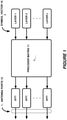
- an information carrying symbol vector s 10 is multiplied by an N T ⁇ r precoder matrix W 11, which serves to distribute the transmit energy in a subspace of the N T (corresponding to N T antenna ports 12) -dimensional vector space.
- the precoder matrix 11 is typically selected from a codebook of possible precoder matrices, and typically indicated by means of a precoder matrix indicator (PMI), which specifies a unique precoder matrix in the codebook for a given number of symbol streams.
- PMI precoder matrix indicator
- the r symbols in symbol vector s 10 each correspond to a layer and r is referred to as the transmission rank. In this way, spatial multiplexing is achieved since multiple symbols can be transmitted simultaneously over the same time/frequency resource element (TFRE).
- the number of symbols r is typically adapted to suit the current channel properties.
- the precoder W can be a wideband precoder, which is constant over frequency, or frequency selective.
- the precoder matrix W is often chosen to match the characteristics of the N R x N T MIMO channel matrix H n , resulting in so-called channel dependent precoding. This is also commonly referred to as closed-loop precoding and essentially strives for focusing the transmit energy into a subspace which is strong in the sense of conveying much of the transmitted energy to the UE.
- the precoder matrix may also be selected to strive for orthogonalizing the channel, meaning that after proper linear equalization at the UE, the inter-layer interference is reduced.
- One example method for a UE to select a precoder matrix W can be to select the W k that maximizes the Frobenius norm of the hypothesized equivalent channel: max k ⁇ H ⁇ n W k ⁇ F 2 where:
- the UE transmits (based on channel measurements in the forward link/downlink) recommendations to the gNB (also referred to herein as a gNB, eNB, base station, or the like) regarding a suitable precoder to use. For example, by transmitting or sending a PMI to the gNB.
- the gNB may configure the UE to provide feedback, and may transmit CSI-RS and/or may configure the UE to use measurements of CSI-RS to feed back recommended precoding matrices that the UE selects from a codebook.
- a single precoder or indication thereof that is supposed to cover a large bandwidth (wideband precoding) may be fed back.
- a frequency-selective precoding report e.g . several precoders or indications thereof, one per subband.
- Such other information may include channel quality indicators (CQIs) as well as transmission rank indicator (RI).
- the gNB determines the transmission parameters it wishes to use to transmit to the UE, including the precoding matrix or precoder, transmission rank, and modulation and coding state (MCS). These transmission parameters may differ from the recommendations the UE makes. Therefore, a rank indicator and MCS may be signaled in downlink control information (DCI), and the precoding matrix or precoder or indication thereof can be signaled in DCI or the gNB can transmit a demodulation reference signal from which the equivalent channel can be measured.
- DCI downlink control information
- the precoding matrix or precoder or indication thereof can be signaled in DCI or the gNB can transmit a demodulation reference signal from which the equivalent channel can be measured.
- the transmission rank, and thus the number of spatially multiplexed layers, is reflected in the number of columns of the precoder W . For efficient performance, it is important that a transmission rank that matches the channel properties is selected.
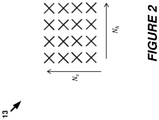
- the example embodiments presented in this disclosure may be used with two-dimensional antenna arrays and some of the presented embodiments use such antennas.
- Such antenna arrays may be (partly) described by the number of antenna columns corresponding to the horizontal dimension N h , the number of antenna rows corresponding to the vertical dimension N v and the number of dimensions corresponding to different polarizations N p .
- the concept of an antenna is non-limiting in the sense that it can refer to any virtualization ( e.g ., linear mapping) of the physical antenna elements.
- pairs of physical subelements could be fed the same signal, and hence share the same virtualized antenna port.
- Precoding may be interpreted as multiplying the signal with different beamforming weights for each antenna prior to transmission.
- a typical approach is to tailor the precoder to the antenna form factor, i.e. taking into account N h ,N v and N p when designing the precoder codebook.
- Elevation beamforming which can be achieved by using codebook-based precoding from a 2D or vertical antenna array, is a powerful tool for directing the transmitted energy towards the UE of interest, thereby increasing the received signal level.
- Interference is another aspect that should be taken into consideration to maximize system performance.
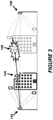
- dynamic elevation beamforming can cause significant interference, as illustrated in Figure 3 .
- Figure 3 when a gNB 14 directs its transmitted power towards a UE 15A it may at the same time also direct the transmitted energy towards another UE 15B currently receiving a signal from another gNB 18B.
- gNBs 14 may cause interference to their neighboring cells when performing elevation beamforming and this interference may be very harmful for the system.
- this interference is not mitigated, it is possible that employing elevation beamforming in a communication system will not lead to a system-level gain, since the increase in received signal level by dynamic beam selection may be less than the simultaneous increase in the interference level.
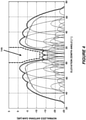
- FIG. 4 shows such a gap 16 as gap 16, where normalized antenna gain (y-axis) drops off in a range of elevation zenith angles (x-axis) compared to the antenna gain levels of adjacent zenith angles.
- Such a transmission gap 16 can be attained by codebook subset restriction, in which the gNB instructs the UE to not use a subset of the precoding matrices in that codebook which would correspond to beam directions causing excessive inter-cell interference. Note that there may also be azimuthal directions which can cause excessive inter-cell interference, and restricting the transmission in these directions may be beneficial as well.
- the definitions of the rank-2 and rank-4 codebooks are given in Table 1 and Table 2, below, where i 1,1 and i 1,2 are the 2D DFT beam indices in each dimension and i 2 is the corresponding co-phasing index:
- LTE FD-MIMO uses beam-based rank-agnostic CBSR signaling as opposed to PMI-based per-rank CBSR as was used in earlier releases of LTE.
- precoders are restricted by signaling one or more bitmaps for each rank ( i.e. 8 sets of bitmaps for ranks 1-8) and each bit in the bitmap restricts one PMI index (e.g . i1 or i2) for the codebook of a specific rank.
- the constituent 2D DFT beams v l,m are restricted instead, resulting in a size N 1 N 2 O 1 O 2 bitmap where each bit is associated with one oversampled 2D DFT beam, v l,m .
- the corresponding DFT beam is restricted or should not be used for CSI estimation. Since the quantity v l,m are the constructing blocks for precoders of all ranks, a substantial overhead reduction in CBSR signaling is attained.
- a particular precoder in the codebook is restricted if any of the restricted beams v l , m is present in the precoder.
- Beam-based CBSR requires a second set of restrictions to control rank and/or i2. These restrictions are indicated by a joint rank-i2 restriction in LTE, where a bitmap of the combinations of rank ⁇ and codebook index i2. As stated in 3GPP TS 36.213, bit b g ( ⁇ -1)+ i 2 is associated with the precoder for ⁇ layers ( ⁇ ⁇ 1,2,3,4 ⁇ ) and codebook index i 2 where g ( ⁇ ) is given in Table 3, below: Table 3 V alue of Codebook-Config g ( ⁇ ) 1 ⁇ 0,4,8,10 ⁇ 2 ⁇ 0,16,32,48 ⁇ 3 ⁇ 0,16,32,48 ⁇ 4 ⁇ 0,16,32,48 ⁇
- the NR Type I codebooks are similar in many ways to the LTE FD-MIMO codebooks, but contain some differences.
- One difference is that the rank-3 and rank-4 codebooks use "antenna grouping" when the number of antenna ports is larger than 16 (for the smaller than 16 port case, the rank-3 and rank-4 codebooks are similar to the LTE codebooks).
- This has led to the introduction of two quantities that correspond to 2D DFT beams: v l,m and ⁇ l,m , where v l,m is used for the ranks 1,2,5,6,7,8 codebooks for 16 antenna ports and larger (and ranks 1-8 for smaller than 16 antenna ports) and ⁇ l,m is used for rank-3 and rank-4 codebooks for larger than or equal to 16 antenna ports.
- rank-2 and rank-4 codebooks are also given in Table 4 and Table 5, respectively:
- the beam-based rank-agnostic CBSR approach used in LTE cannot be directly reused for NR as the same beam-based quantity is not constituent component of the precoders for all ranks.
- An alternative is to use the pre-"LTE FD-MIMO" CBSR approach based on PMI-based per-rank CBSR, however this would lead to around eight times more signaling overhead compared to LTE.
- NR codebooks use a generalized co-phasing behavior that is different from prior art codebooks in LTE, as there are now two parameters ⁇ n and ⁇ p used to co-phase the 2D DFT beams ⁇ l , m .
- the co-phasing behavior depends on the number of CSI-RS ports used in the codebook and on the rank of the report. Consequently, new mechanisms, such as those described throughout the present disclosure, are needed in NR for codebook restriction of co-phasing and rank.
- the present description further relates to techniques for compressing codebook subset restriction signaling and is applicable to precoder codebooks where the per-rank codebooks may be divided in two groups.
- the precoders in the per-rank codebooks of the first group are all constructed using a first component while the precoders in the per-rank codebooks of the second group are all constructed using a second component, where the second component is different from the first component.
- each component can take a number of different values.
- the techniques disclosed by the present disclosure are applicable (in a non-limiting fashion) to the NR Type I codebooks (for larger and equal to 16 antenna ports).
- FIG. 5 illustrates a wireless communication system 100 that includes a network node 106 and a UE 102 in wireless communication over one or more communication channels.
- the UE 102 may divide the codebooks possible for utilization by network node 106 into separate groups, such as first group of codebooks 118 and second group of codebooks 120.
- the UE may receive CBSR signaling 114 from the network node on the downlink, and may restrict precoders of the codebooks from the first 118 and second 120 groups of codebooks based on one or more components indicated in the CBSR signaling 114 (also referred to herein simply as CBSR).
- CBSR CBSR signaling
- the UE 102 can select a precoder from the restricted codebooks and report the selected precoder to the network node 106 in CSI message 116 in the uplink.
- a codebook subset restriction or indication thereof is signaled from a network node 106 to a UE 102 via CBSR signaling 114 containing a first component 128, or an indication thereof, which is used for defining the CBSR for precoders 124 in the first group of codebooks 118.
- the restricted first components 128 are then mapped or has a mapping to restricted second components 130 using or based on a predefined mapping.
- the CBSR of the precoders in the second group of codebooks120 is defined based on the restricted second components 130.
- beam-based rank-agnostic CBSR is applied to define the CBSR for the first per-rank codebooks according to existing techniques. Namely, each precoder in the first group of codebooks 118 that is constructed using one or more of the restricted first components 128 are not allowed to be used for CSI reporting by the UE.
- each first component can be mapped or maps to one or more second component.
- each second component 130 is mapped or maps to one or more first components 128.
- each second component 130 can be mapped or maps to one or more first components 128 and each first component 128 can be mapped or maps to one or more second components 130.
- a restriction of the second components 130 is determined such that if at least one restricted first component 128 is mapped to a second component 130, that second component 130 is restricted.
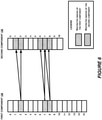
- FIG. 6 illustrates how indices of a first component 128 (or restriction thereof) might map to those of a second component 130.
- the first components 128 with indices 2, 7, and 8 are restricted.
- the first component with index 2 maps to second components 130 with indices 1 and 2, which implies that these second components are restricted.
- the CBSR for the precoders of the per-rank codebooks in the second group can be determined by applying beam-based rank-agnostic CBSR within the second group.
- the NR Type I codebooks is used, where the first and second groups are defined as above.
- the signaling of the restriction of the first component may for instance be done using a length N 1 N 2 O 1 O 2 bitmap a 0 a 1 ... a N 1 N 2 O 1 O 2 - 1_ where each bit is mapped to an ( l 1 ,m ) value which in turn indicates the restriction of the first component 128.
- the term “component” can correspond to a numerical vector.
- the first component 128, for instance, may be referred to through the present disclosure mathematically as v l 1 , m .
- the second component may be represented mathematically in the present disclosure as ⁇ l 2 , m .
- any component or entity described according to the format v l x ,m or ⁇ l x ,m identifies a vector representation of a component, as introduced above.
- the term “component” is particularly defined for purposes of the present disclosure as well as a corresponding mathematical representation of the component/vector, it should also be appreciated that each component and mathematical representation thereof represents, in practical terms, a particular beam direction for wireless transmission.
- v l 1 , m may be a 2D DFT vector that is applied to (each polarization of) the antenna array while ⁇ l 2 , m may be a 2D DFT beam of half-size compared to v l 1 , m , which is applied to (each polarization of) each antenna group of the antenna array and where each of the two antenna groups are formed by splitting the antenna array in half along the first dimension (which is typically the horizontal dimension).
- ⁇ l 2 , m is applied to both the left half and the right half of the antenna array.
- the mapping between v l 1 , m , and ⁇ l 2 , m is only performed when the number of antenna ports is greater or equal to 16, and the CBSR for rank-3 and rank-4 codebooks is achieved by applying beam-based CBSR using the restricted ⁇ l 2 , m .
- the CBSR for rank-3 and rank-4 codebooks is applied using the set v l 1 ,m .
- the problem can be reduced to finding a mapping rule in the first dimension, i.e. to find a mapping rule between the indices l 1 and l 2 .
- the entries of the array steering vector e j 2 ⁇ sin( ⁇ )d ⁇ n where ⁇ is the steering angle, d ⁇ the array element separation in wavelengths and n the array element index.
- phase e j 2 ⁇ sin( ⁇ )d ⁇ n shall be applied to each array element n ( i.e. , the complex conjugate of the steering phase shall be applied).
- the first component v l 1 , m has a phase progression of e j 2 ⁇ l 1 n O 1 N 1 along the first dimension while the second component ⁇ l 2 , m has a phase progression of e j 2 ⁇ l 2 n O 1 N 1 / 2 .
- the mapping between restricted first and second components is given as follows.
- l 1 2 is not an integer and so does not map to an l 2 index.
- the odd l 1 values are simply ignored so that there is a one-to-one mapping between restricted first and restricted second components.
- separate CBSRs are signaled for the first group and the second group.
- the CBSR signaling for the first group defines a restriction of the first component while the CBSR signaling for the second group defines a restriction of the second component.
- the CBSR signaling for the first group thus determines the CBSR for the precoders of certain ranks while the CBSR signaling for the second group determines the CBSR for the precoders of other ranks.
- the signaling of the CBSR corresponding to the second group depends on the number of antenna ports configured. For instance, when the number of antenna ports is less than 16, the CBSR corresponding to the second group is not signaled. When the number of antenna ports is larger than or equal to 16, the CBSR corresponding to the second group is signaled.
- the NR Type I codebook is used and the CBSR signaling comprises two bitmaps:
- the UE can receive a second component or indication thereof for codebook subset restriction as well.
- the UE can receive CBSR from a network node, the CBSR indicating a first component for codebook restriction of a first group of codebooks.
- the first component can be common to precoders of the first group of precoders.
- the CBSR can indicate a second component for codebook restriction of a second group of codebooks, where the second component is common to precoders of the second group of precoders.
- the second component can be different than the first component.
- the UE can restrict precoders selectable from a codebook in the first group of codebooks based on the first component and can restrict precoders selectable from a codebook in the second group of codebooks based on the second component.
- a UE can receive a joint indication of a combination of a rank value and a first index and/or a second index.
- the first index identifies at least a first complex number that scales a two-dimensional (2D) Discrete Fourier Transform (DFT) beam and the second index identifies at least a second complex number that also scales the 2D DFT beam.
- the UE can also determine a number of states that the first index and/or second index can attain according to (a) the rank value and (b) at least one of a codebook configuration and a number of channel state information (CSI) reference signal ports.
- CSI channel state information
- a UE 102 may implement co-phasing and rank subset restriction as a mechanism of adjusting combinations used in CSI reporting.
- this mechanism can include a UE 102 receiving a joint indication of combinations of a rank value and a first index and/or a second index from a network node 106, where the first index identifies at least a first complex number ⁇ n that scales a 2D DFT beam, the second index identifies at least a second complex number that also scales the 2D DFT beam.
- the UE 102 can determine a number of states that the first and/or second index can attain according to the rank value and a codebook configuration and/or a number of CSI-RS ports.
- the mechanism can involve the UE 102 generating a CSI report that indicates only the values of rank and the first index and/or second index that are permitted according to the joint indication.
- the UE 102 can also transmit the generated CSI report to a network node 106.
- co-phasing and rank may be jointly indicated using a bitmap identifying combinations of a first and/or second index (such as i 1,3 and i 2 ) and a rank indication v .
- the codebook subset restriction bitmap value b g ( v -1)+ C 2 i 1,3+ C 1 i 2 is associated with the precoder for v layers.
- Codebook index i 1,3 identifies the state of a first co-phasing parameter ⁇ p
- index i 2 identifies the state of a second co-phasing parameter ⁇ n .
- Vector c n is a noise/interference vector indicating the results of a random process.
- the remaining factor, g ( ⁇ ) can be defined according to Table 6, below: Table 6 Value of Codebook-Config , with Number of CSI-RS ports P CSI-RS g ( ⁇ ) 2 with P CSI-RS ⁇ 16 ⁇ 0, 16, 24, 26, 28, 30, 32, 34 ⁇ 2 with P CSI-RS ⁇ 16 ⁇ 0, 16, 24, 32, 40, 42, 44, 46 ⁇ 1 with P CSI-RS ⁇ 16 ⁇ 0, 4, 6, 8, 10, 12, 14, 16 ⁇ 1 with P CSI-RS ⁇ 16 ⁇ 0,4, 6, 14, 22, 24, 26, 28 ⁇
- Codebook-Config 1 then requires 4 and 2 states for rank 1 and 2, respectively, to represent the second cophasing parameter ⁇ n , and 2 or 1 bit(s) for the second index i 2 in this case.
- the parameter ⁇ p requires 4 states, and so i 1,3 then uses 2 bits. Since the parameter ⁇ p may only be used in some conditions, such as for ranks 3 and 4, and when the number of CSI-RS ports P CSI-RS used in the codebook is greater than or equal to 16, then the additional states or bits for ⁇ p are not needed in all codebook configurations.
- the performance benefits from a larger number of states used for co-phasing parameter ⁇ n tends to diminish as the rank increases. Consequently, the number of states used for ⁇ n can be 4 for rank 1 and 2 for higher ranks, such as ranks 2 through 8. This means that above rank 4, i 2 can require only 1 bit.
- These conditions lead to the embodiment illustrated in Table 6, above, where the function g ( ⁇ ) is determined according to the status of these two conditions, as evidenced by each of the four permutations being indicated on one of the four rows.
- a mechanism of adjusting combinations used in CSI reporting in a UE 102 may include a UE 102 receiving a joint indication of combinations of a rank value and a first index and/or a second index.
- this first index identifies (at least) a first complex number ⁇ n that scales a 2D DFT beam
- the second index identifies (at least) a second complex number that also scales the 2D DFT beam.
- the mechanism can also include the UE 102 determining the number of states that the first and/or second index can attain according to the rank value and at least one of a codebook configuration and a number of CSI-RS ports.
- the UE 102 can generate a CSI report that only indicates values of rank and the first index and/or second index that are permitted according to the joint indication. Finally, the UE 102 can round out the mechanism by transmitting the CSI report to a network node 106.
- Figures 7A-7E show flow diagrams of five example methods that may, in some examples, be performed by the UE 102 to carry out the techniques discussed above.
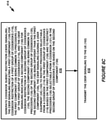
- Figures 8A-8C show flow diagrams of three non-limiting methods that may be performed by the network node 106 in some examples.
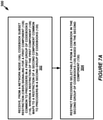
- Figure 7A illustrates an example method 300 for carrying out the above-described aspects at UE 102.
- the UE 102 can receive CBSR signaling for a first component 128 common to precoders in a first group of codebooks 118.
- a restriction of the first component 128 maps or can map to a restriction of a second component.
- the second component 130 is common to precoders in a second group of codebooks 120.
- the UE 102 can restrict precoders selectable from a codebook in the second group of codebooks 120 based on the second component 130.
- the term "restrict” or “restricting” can mean "defining a restriction of a component or components.”
- method 306 can include receiving, from a network node 106, CBSR signaling for a first component 128 common to precoders in a first group of codebooks 118.
- the first component 128 maps to a second component 130 and the second component 130 is common to precoders in a second group of codebooks 120.
- method 306 can include restricting precoders selectable from a codebook in the second group of codebooks 120 based on the second component 130.
- FIG. 7C A further example embodiment of a method 312 for codebook subset restriction at a UE is shown in Figure 7C .
- the UE 102 can receive, from a network node 106, CBSR signaling that indicates a first component 128 common to precoders in a first group of codebooks 118.
- the UE 102 can map the first component 128 to a second component 130 that is different than the first component 128 and that is common to precoders in a second group of codebooks 120.
- method 312 includes restricting precoders 126 selectable from a codebook 121 in the second group of codebooks 120 based on the second component 130.
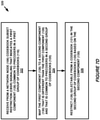
- method 320 can include, at block 322, receiving codebook subset restriction CBSR signaling from a network node 106 that indicates a restriction for a first component 128 common to precoders 124 in a first group of codebooks 118.
- the method may also include, at block 324, mapping the restriction for the first component 128 to a restriction for a second component 130.
- the second component 130 can be different than the first component 128 and can be common to precoders 126 in a second group of codebooks 120.
- method 320 can include, at block 326, restricting precoders 126 selectable from a codebook 121 in the second group of codebooks 120 based on the restriction for the second component 130.
- Figure 7E presents yet another example method 328 for codebook selection restriction at a user equipment UE 102.
- the method 328 can include receiving codebook subset restriction CBSR signaling from a network node 106, the CBSR signaling indicating a first component 128 for codebook restriction of a first group of codebooks 118.
- the CBSR signaling can indicate a second component 130 for codebook restriction of a second group of codebooks 120, the second component 130 being different than the first component 128.
- method 328 can include restricting precoders selectable from a codebook in the first group of codebooks 118 based on the first component 128 as well as restricting precoders 126 selectable from a codebook 121 in the second group of codebooks 120 based on the second component 130).
- the first component is a vector from a first set of vectors
- the precoders in the first group of codebooks include one or more vectors from the first set of vectors.
- the second component is a vector from a second set of vectors, where the precoders in the second group of codebooks include one or more vectors from the second set of vectors.
- the second component constitutes a vector of a different size than that of the first component, such as where vectors in the second set of vectors are half the size of the vectors in the first set of vectors
- the CBSR signaling can include a bitmap that contains a plurality of bits, where each bit of the plurality of bits indicates a vector from the first set of vectors. Some examples can include determining whether the second component is restricted based on a bit indicating that the first component is restricted, for instance.
- the first component can be utilized to restrict precoders selectable from a codebook in the first group of codebooks based on the first component.
- the first component may be a length N 1 N 2 O 1 O 2 bitmap a 0 a 1 ... a N 1 N 2 O 1 O 2 - 1 _ where each bit constitutes an ( l 1 , m ) value indicating, at least in part, a first two-dimensional restriction vector v l 1 , m .
- any of Figures 7A , 7B , 7C , 7D , and 7E can involve selecting a precoder from the precoders selectable from the codebook in the second group of codebooks.
- the methods can include generating a CSI report indicating the selected precoder, and optionally also transmitting the CSI report to ta network node.
- some implementations can include determining whether the second component is restricted based on a plurality of bits indicating whether the first component is restricted for at least one of (or for each of) v 2 l +1 ,m , v 2 l -1, m , and v 2l,m .
- the first component has an associated index l 1 and the second component has an associated index l 2
- the first group of codebooks can include rank 1, rank 2, rank 5, rank 6, rank 7, and/or rank 8 codebooks, and/or the second group of codebooks can include rank 3 and/or rank 4 codebooks.
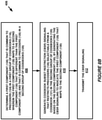
- FIG. 8A the figure illustrates a method 400 performed by a network node 106 for codebook subset restriction, which includes generating 402 codebook subset restriction CBSR signaling that indicates a first component 128 common to precoders 124 in a first group of codebooks 118, where the first component 128 maps to a second component 130 common to precoders 126 in a second group of codebooks 120.
- the CBSR signaling is configured to cause a UE 102 to restrict precoders 126 selectable from a codebook 121 in the second group of codebooks 120 based on the second component 130.
- method 400 includes transmitting the CBSR signaling to the UE.
- Figure 8B presents another network node 106 method 406 that includes determining a first component 128 that is common to precoders 124 in a first group of codebooks 118 at block 408. Again, the first component 128 maps to a second component 130 that is different than the first component 128 and is common to precoders 126 in a second group of codebooks 120.
- the method 406 includes generating CBSR signaling that restricts precoders 126 selectable from a codebook 121 in the second group of codebooks 120 based on the second component 130. This includes the network node 106 generating the CBSR signaling to indicate the first component 128 that maps to the second component 130.
- method 406 can include transmitting the CBSR signaling at block 412.
- the network node 106 can generate, at block 416, codebook subset restriction CBSR signaling.
- the CBSR signaling indicates a first component 128 for codebook restriction of a first group of codebooks 118 and a second component 130 for codebook restriction of a second group of codebooks 120.
- the CBSR signaling causes the UE 102 to restrict precoders selectable from a codebook 119 in the first group of codebooks 118 based on the first component 128 and to restrict precoders 126 selectable from a codebook 121 in the second group of codebooks 120 based on the second component 130.
- the network node 106 transmits the CBSR signaling to the UE 102.
- the first component is a vector from a first set of vectors
- the precoders in the first group of codebooks include one or more vectors from the first set of vectors.
- the second component is a vector from a second set of vectors, where the precoders in the second group of codebooks include one or more vectors from the second set of vectors.
- the second component constitutes a vector of a different size than that of the first component, such as where vectors in the second set of vectors are half the size of the vectors in the first set of vectors.
- some embodiments can include the network node receiving 106, from the UE 102, CSI report indicating permitted codebook subsets corresponding to restricted codebook subsets.
- the first component may be a length N 1 N 2 O 1 O 2 bitmap a 0 a 1 ... a N 1 N 2 O 1 O 2 -1_ where each bit constitutes an ( l 1 , m ) value indicating, at least in part, a first two-dimensional restriction vector v l 1 , m .
- FIG. 9A illustrates additional details of an example UE 102 of a wireless communication system 100 according to one or more embodiments.
- the UE 102 is configured, e.g ., via functional means or units (also may be referred to as modules or components herein), to implement processing to perform certain aspects described above in reference to at least methods presented in Figures 7A , 7B , 7C , 7D , and 7E .
- the UE 102 in some embodiments for example includes means, modules, components, or units 530, 540, and 550 (among other possible means, modules, components, or units not shown explicitly in Fig. 5B) for performing aspects of these methods.
- these means, modules, components, or units can be realized in processing circuitry 500.
- the functional means or units of the UE 102 may include a receiving unit/module 530 configured to receive one or more wireless communications from a network node, such as CBSR signaling in blocks 302, 308, 314, 322, and 330 of Figures 7A , 7B , 7C , 7D , and 7E .
- the UE can include a mapping unit/module 540 to perform mapping of a first component (and/or restriction thereof) to a second component as described above and performed, for example, blocks 316 and 324 of Figures7 and 7D , above.
- UE 102 may include a restrict unit/module for restricting precoders selectable from a codebook as a result of the mapping, for instance in block 332.
- the UE 102 comprises one or more processing circuitry/circuits 500 configured to implement processing of the methods presented in Figures 7A , 7B , 7C , 7D , and 7E and certain associated processing of the features described in relation to other figures, such as by implementing functional means or units above.
- the processing circuit(s) 500 implements functional means or units as respective circuits.
- the circuits in this regard may comprise circuits dedicated to performing certain functional processing and/or one or more microprocessors in conjunction with memory 520.
- memory 520 which may comprise one or several types of memory such as read-only memory (ROM), random-access memory, cache memory, flash memory devices, optical storage devices, etc.
- the memory 520 stores program code that, when executed by the one or more for carrying out one or more microprocessors, carries out the techniques described herein.
- the UE 102 also comprises communication circuitry 510.
- the communication circuitry 510 includes various components (e.g ., antennas) for sending and receiving data and control signals. More particularly, the circuitry 510 includes a transmitter that is configured to use known signal processing techniques, typically according to one or more standards, and is configured to condition a signal for transmission ( e.g ., over the air via one or more antennas). Similarly, the communication circuitry includes a receiver that is configured to convert signals received ( e.g. , via the antenna(s)) into digital samples for processing by the one or more processing circuits.
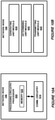
- FIG 10A illustrates additional details of an example network node 106 of a wireless communication system 10 according to one or more embodiments.
- the network node 106 is configured, e.g ., via functional means, components, modules, or units to implement processing to perform certain aspects described above in reference to at least methods presented in Figures 8A , 8B , and 8C .
- these means, modules, components, or units may be realized via processing circuitry 600 of Figure 10A .
- the network node 106 comprises one or more processing circuits 600 configured to implement processing of the methods of Figures 8A , 8B , and 8C , such as by implementing functional means or units above.
- the one or more processing circuits (or processing circuitry) 600 implements functional means or units as respective circuits.
- the circuits in this regard may comprise circuits dedicated to performing certain functional processing and/or one or more microprocessors in conjunction with memory 1020.
- memory 1020 which may comprise one or several types of memory such as read-only memory (ROM), random-access memory, cache memory, flash memory devices, optical storage devices, etc.
- the memory 1020 stores program code that, when executed by the one or more for carrying out one or more microprocessors, carries out the techniques described herein.
- the network node 106 also comprises communication circuitry 601.
- the communication circuitry 601 includes various components (e . g ., antennas) for sending and receiving data and control signals. More particularly, the circuitry 601 includes a transmitter that is configured to use known signal processing techniques, typically according to one or more standards, and is configured to condition a signal for transmission ( e . g ., over the air via one or more antennas). Similarly, the communication circuitry includes a receiver that is configured to convert signals received ( e . g ., via the antenna(s)) into digital samples for processing by the one or more processing circuits.
- embodiments herein further include corresponding computer programs.
- a computer program comprises instructions which, when executed on at least one processor of the network node 106 or UE 102, cause these devices to carry out any of the respective processing described above.
- the processing or functionality of network node 106 or UE 102 may be considered as being performed by a single instance or device or may be divided across a plurality of instances of network node 106 or UE 102 that may be present in a given system such that together the device instances perform all disclosed functionality.
- the user equipment 102 may correspond to any mobile (or even stationary) device that is configured to receive/consume user data from a network-side infrastructure, including laptops, phones, tablets, loT devices, etc.
- the network node 106 may be any network device, such as a base station, eNB, gNB, access point, or any other similar device.
- Embodiments further include a carrier containing such a computer program.
- This carrier may comprise one of an electronic signal, optical signal, radio signal, or computer readable storage medium.
- a computer program in this regard may comprise one or more code modules corresponding to the means or units described above.
Landscapes
- Engineering & Computer Science (AREA)
- Signal Processing (AREA)
- Computer Networks & Wireless Communication (AREA)
- Physics & Mathematics (AREA)
- Mathematical Physics (AREA)
- Mobile Radio Communication Systems (AREA)
- Data Exchanges In Wide-Area Networks (AREA)
Claims (12)
- Verfahren (300) zur Codebuchuntermengenbeschränkung bei einem Benutzergerät (User Equipment, UE) (102), das Folgendes umfasst:Empfangen (302), von einem Netzknoten (106), einer Codebuchuntermengenbeschränkungs (codebook subset restriction,CBSR) -Signalisierung für eine erste Komponente (128), die Vorcodierer in einer ersten Gruppe von Codebüchern (118) gemeinsam haben, wobei eine Beschränkung der ersten Komponente (128) auf eine Beschränkung einer zweiten Komponente abgebildet wird, wobei Vorcodierer in einer zweiten Gruppe von Codebüchern (120) die zweite Komponente (130) gemeinsam haben, wobei die erste Komponente (128) einen zugehörigen Index l1 hat und die zweite Komponente (130) einen zugehörigen Index l2 hat, und wobei die zweite Komponente (130) mit Index l2 beschränkt ist, wenn die erste Komponente mit Index l1 in einem Fenster [2l 2 -Δ1,2l 2+ Δ2] beschränkt ist, wobei die erste Gruppe von Codebüchern 1-Schicht-, 2-Schichten-, 5-Schichten-, 6-Schichten-, 7-Schichten- und/oder 8-Schichten-Codebücher umfasst, und wobei die zweite Gruppe von Codebüchern 3-Schichten- und/oder 4-Schichten-Codebücher umfasst, wobei die Anzahl von Antennenanschlüssen gleich oder größer als 16 Antennenanschlüsse ist; undBeschränken (304) von Vorcodierern, die aus einem Codebuch in der zweiten Gruppe von Codebüchern (120) ausgewählt werden können, auf der Grundlage der zweiten Komponente (130).
- Verfahren nach Anspruch 1, wobei Δ1=Δ2.
- Verfahren nach Anspruch 1, wobei Δ1=Δ2=1 und die Fenstergröße drei ist.
- Verfahren (400), das von einem Netzknoten (106) zur Codebuchuntermengenbeschränkung durchgeführt wird und das Folgendes umfasst:Erzeugen (402) einer Codebuchuntermengenbeschränkungs (CBSR) - Signalisierung, die eine erste Komponente (128) anzeigt, die Vorcodierer (124) in einer ersten Gruppe von Codebüchern (118) gemeinsam haben, wobei die erste Komponente (128) auf eine zweite Komponente abgebildet wird, die Vorcodierer (126) in einer zweiten Gruppe von Codebüchern (120) gemeinsam haben,wobei die CBSR-Signalisierung konfiguriert ist, um ein Benutzergerät (UE) (102) zu veranlassen, Vorcodierer (126), die aus einem Codebuch (121) in der zweiten Gruppe von Codebüchern (120) ausgewählt werden können, auf der Grundlage der zweiten Komponente (130) zu beschränken, wobei die erste Komponente (128) einen zugehörigen Index l1 hat und die zweite Komponente (130) einen zugehörigen Index l2 hat, und wobei die zweite Komponente (130) mit Index l2 beschränkt ist, wenn die erste Komponente mit Index l1 in einem Fenster [2l 2 - Δ1, 2l 2+ Δ2] beschränkt ist, wobei die erste Gruppe von Codebüchern 1-Schicht-, 2-Schichten-, 5-Schichten-, 6-Schichten-, 7-Schichten- und/oder 8-Schichten-Codebücher umfasst und wobei die zweite Gruppe von Codebüchern 3-Schichten- und/oder 4-Schichten-Codebücher umfasst, wobei die Anzahl von Antennenanschlüssen gleich oder größer als 16 Antennenanschlüsse ist; und Übermitteln (404) der CBSR-Signalisierung an das UE (102).
- Verfahren nach Anspruch 4, wobei die erste Komponente (128) ein Vektor aus einem ersten Satz von Vektoren ist, und wobei die Vorcodierer in der ersten Gruppe von Codebüchern (118) einen oder mehrere Vektoren aus dem ersten Satz von Vektoren umfassen.
- Verfahren nach Anspruch 4 oder Anspruch 5, wobei die zweite Komponente (130) ein Vektor aus einem zweiten Satz von Vektoren ist, und wobei die Vorcodierer in der zweiten Gruppe von Codebüchern (120) einen oder mehrere Vektoren aus dem zweiten Satz von Vektoren umfassen.
- Verfahren nach Anspruch 5 oder Anspruch 6, wobei die zweite Komponente (130) einen Vektor mit einer anderen Größe als den der ersten Komponente (128) umfasst.
- Verfahren nach Anspruch 6 oder Anspruch 7, wobei die Vektoren in dem zweiten Satz von Vektoren halb so groß sind wie die Vektoren in dem ersten Satz von Vektoren.
- Benutzergerät (UE) (102) in einem drahtlosen Kommunikationsnetzwerk (100), wobei das UE (102) mindestens einen Prozessor (900) und einen Speicher (920) umfasst, wobei der Speicher (920) Anweisungen enthält, die, wenn sie von dem Prozessor (900) ausgeführt werden, das UE (102) zu Folgendem veranlassen:Empfangen, von einem Netzknoten (106), einer Codebuchuntermengenbeschränkungs (CBSR) -Signalisierung für eine erste Komponente (128), die Vorcodierer in einer ersten Gruppe von Codebüchern (118) gemeinsam haben, wobei eine Beschränkung der ersten Komponente (128) auf eine Beschränkung einer zweiten Komponente abgebildet wird, und wobei Vorcodierer in einer zweiten Gruppe von Codebüchern (120) die zweite Komponente (130) gemeinsam haben, wobei die erste Komponente (128) einen zugehörigen Index l1 hat und die zweite Komponente (130) einen zugehörigen Index l2 hat, und wobei die zweite Komponente (130) mit Index l2 beschränkt ist, wenn die erste Komponente mit Index l1 in einem Fenster [2l 2 - Δ1, 2l 2 + Δ2] beschränkt ist, wobei die erste Gruppe von Codebüchern 1-Schicht-, 2-Schichten-, 5-Schichten-, 6-Schichten-, 7-Schichten- und/oder 8-Schichten-Codebücher umfasst und wobei die zweite Gruppe von Codebüchern 3-Schichten- und/oder 4-Schichten-Codebücher umfasst, wobei die Anzahl von Antennenanschlüssen gleich oder größer als 16 Antennenanschlüsse ist; undBeschränken von Vorcodierern, die aus einem Codebuch in der zweiten Gruppe von Codebüchern (120) ausgewählt werden können, auf der Grundlage der zweiten Komponente (130).
- Netzknoten (106) in einem drahtlosen Kommunikationsnetzwerk, wobei der Netzknoten (106) mindestens einen Prozessor (1000) und einen Speicher (1010) umfasst, wobei der Speicher (1010) Anweisungen enthält, die von dem Prozessor (1000) für Folgendes ausgeführt werden können:Erzeugen einer Codebuchuntermengenbeschränkungs (CBSR) - Signalisierung, die eine erste Komponente (128) anzeigt, die Vorcodierer (124) in einer ersten Gruppe von Codebüchern (118) gemeinsam haben, wobei die erste Komponente (128) auf eine zweite Komponente abgebildet wird, die Vorcodierer (126) in einer zweiten Gruppe von Codebüchern (120) gemeinsam haben,wobei die CBSR-Signalisierung konfiguriert ist, um ein Benutzergerät (UE) (102) zu veranlassen, Vorcodierer (126), die aus einem Codebuch (121) in der zweiten Gruppe von Codebüchern (120) ausgewählt werden können, auf der Grundlage der zweiten Komponente (130) zu beschränken, wobei die erste Komponente (128) einen zugehörigen Index l1 hat und die zweite Komponente (130) einen zugehörigen Index l2 hat, und wobei die zweite Komponente (130) mit Index l2 beschränkt ist, wenn die erste Komponente mit Index l1 in einem Fenster [2l 2 - Δ1, 2l 2+ Δ2] beschränkt ist, wobei die erste Gruppe von Codebüchern 1-Schicht-, 2-Schichten-, 5-Schichten-, 6-Schichten-, 7-Schichten- und/oder 8-Schichten-Codebücher umfasst und wobei die zweite Gruppe von Codebüchern 3-Schichten- und/oder 4-Schichten-Codebücher umfasst, wobei die Anzahl von Antennenanschlüssen gleich oder größer als 16 Antennenanschlüsse ist; und Übermitteln der CBSR-Signalisierung an das UE (102).
- Computerprogramm, das Anweisungen umfasst, die, wenn sie von einem Prozessor (920) eines Benutzergeräts (UE) (102) ausgeführt werden, das UE (102) zu Folgendem veranlassen:Empfangen, von einem Netzknoten (106), einer Codebuchuntermengenbeschränkungs (CBSR) -Signalisierung für eine erste Komponente (128), die Vorcodierer in einer ersten Gruppe von Codebüchern (118) gemeinsam haben, wobei eine Beschränkung der ersten Komponente (128) auf eine Beschränkung einer zweiten Komponente abgebildet wird, und wobei Vorcodierer in einer zweiten Gruppe von Codebüchern (120) die zweite Komponente (130) gemeinsam haben, wobei die erste Komponente (128) einen zugehörigen Index l1 hat und die zweite Komponente (130) einen zugehörigen Index l2 hat, und wobei die zweite Komponente (130) mit Index l2 beschränkt ist, wenn die erste Komponente mit Index l1 in einem Fenster [2l 2 - Δ1, 2l 2+ Δ2] beschränkt ist, wobei die erste Gruppe von Codebüchern 1-Schicht-, 2-Schichten-, 5-Schichten-, 6-Schichten-, 7-Schichten- und/oder 8-Schichten-Codebücher umfasst und wobei die zweite Gruppe von Codebüchern 3-Schichten- und/oder 4-Schichten-Codebücher umfasst, wobei die Anzahl von Antennenanschlüssen gleich oder größer als 16 Antennenanschlüsse ist; undBeschränken von Vorcodierern, die aus einem Codebuch in der zweiten Gruppe von Codebüchern (120) ausgewählt werden können, auf der Grundlage der zweiten Komponente (130).
- Computerprogramm, das Anweisungen umfasst, die, wenn sie von mindestens einem Prozessor (1000) eines Netzknotens (106) ausgeführt werden, den Netzknoten (106) zu Folgendem veranlassen:Erzeugen einer Codebuchuntermengenbeschränkungs (CBSR) - Signalisierung, die eine erste Komponente (128) anzeigt, die Vorcodierer (124) in einer ersten Gruppe von Codebüchern (118) gemeinsam haben, wobei die erste Komponente (128) auf eine zweite Komponente abgebildet wird, die Vorcodierer (126) in einer zweiten Gruppe von Codebüchern (120) gemeinsam haben,wobei die CBSR-Signalisierung konfiguriert ist, um ein Benutzergerät (UE) (102) zu veranlassen, Vorcodierer (126), die aus einem Codebuch (121) in der zweiten Gruppe von Codebüchern (120) ausgewählt werden können, auf der Grundlage der zweiten Komponente (130) zu beschränken, wobei die erste Komponente (128) einen zugehörigen Index l1 hat und die zweite Komponente (130) einen zugehörigen Index l2 hat, und wobei die zweite Komponente (130) mit Index l2 beschränkt ist, wenn die erste Komponente mit Index l1 in einem Fenster [2l 2 - Δ1, 2l 2+ Δ2] beschränkt ist, wobei die erste Gruppe von Codebüchern 1-Schicht-, 2-Schichten-, 5-Schichten-, 6-Schichten-, 7-Schichten- und/oder 8-Schichten-Codebücher umfasst und wobei die zweite Gruppe von Codebüchern 3-Schichten- und/oder 4-Schichten-Codebücher umfasst, wobei die Anzahl von Antennenanschlüssen gleich oder größer als 16 Antennenanschlüsse ist; und Übermitteln der CBSR-Signalisierung an die UE (102).
Priority Applications (2)
| Application Number | Priority Date | Filing Date | Title |
|---|---|---|---|
| EP22155752.3A EP4016863A1 (de) | 2017-08-11 | 2018-08-06 | Erweiterte strahlbasierte codebuch-untermengeneinschränkungssignalisierung |
| PL18756511T PL3602816T3 (pl) | 2017-08-11 | 2018-08-06 | Ulepszona oparta na wiązce sygnalizacja ograniczenia podzbioru książki kodowej |
Applications Claiming Priority (2)
| Application Number | Priority Date | Filing Date | Title |
|---|---|---|---|
| US201762544761P | 2017-08-11 | 2017-08-11 | |
| PCT/SE2018/050794 WO2019032018A1 (en) | 2017-08-11 | 2018-08-06 | SIGNALING FOR LIMITING AN ENHANCED CODES BOOK SUB-ASSEMBLY BASED ON BEAMS |
Related Child Applications (1)
| Application Number | Title | Priority Date | Filing Date |
|---|---|---|---|
| EP22155752.3A Division EP4016863A1 (de) | 2017-08-11 | 2018-08-06 | Erweiterte strahlbasierte codebuch-untermengeneinschränkungssignalisierung |
Publications (2)
| Publication Number | Publication Date |
|---|---|
| EP3602816A1 EP3602816A1 (de) | 2020-02-05 |
| EP3602816B1 true EP3602816B1 (de) | 2022-03-02 |
Family
ID=63259553
Family Applications (2)
| Application Number | Title | Priority Date | Filing Date |
|---|---|---|---|
| EP18756511.4A Active EP3602816B1 (de) | 2017-08-11 | 2018-08-06 | Erweiterte strahlbasierte codebuch-untermengeneinschränkungssignalisierung |
| EP22155752.3A Pending EP4016863A1 (de) | 2017-08-11 | 2018-08-06 | Erweiterte strahlbasierte codebuch-untermengeneinschränkungssignalisierung |
Family Applications After (1)
| Application Number | Title | Priority Date | Filing Date |
|---|---|---|---|
| EP22155752.3A Pending EP4016863A1 (de) | 2017-08-11 | 2018-08-06 | Erweiterte strahlbasierte codebuch-untermengeneinschränkungssignalisierung |
Country Status (20)
| Country | Link |
|---|---|
| US (6) | US10411773B2 (de) |
| EP (2) | EP3602816B1 (de) |
| JP (1) | JP6883097B2 (de) |
| KR (1) | KR102280940B1 (de) |
| CN (2) | CN110999105B (de) |
| AU (1) | AU2018313622B2 (de) |
| CA (1) | CA3070932C (de) |
| CL (1) | CL2020000333A1 (de) |
| CO (1) | CO2020000213A2 (de) |
| DE (1) | DE202018006314U1 (de) |
| DK (1) | DK3602816T3 (de) |
| ES (1) | ES2912343T3 (de) |
| IL (1) | IL272071B (de) |
| MX (2) | MX2020001378A (de) |
| PH (1) | PH12020500084A1 (de) |
| PL (1) | PL3602816T3 (de) |
| PT (1) | PT3602816T (de) |
| RU (1) | RU2742463C1 (de) |
| WO (1) | WO2019032018A1 (de) |
| ZA (1) | ZA202000282B (de) |
Families Citing this family (16)
| Publication number | Priority date | Publication date | Assignee | Title |
|---|---|---|---|---|
| PL3245744T3 (pl) | 2015-01-14 | 2020-03-31 | Telefonaktiebolaget Lm Ericsson (Publ) | Sygnalizowanie ograniczenia podzbioru książki kodowej |
| US10389426B2 (en) * | 2017-04-25 | 2019-08-20 | Samsung Electronics Co., Ltd. | Method and apparatus for higher rank CSI reporting in advanced wireless communication systems |
| US11012126B2 (en) | 2017-08-04 | 2021-05-18 | Samsung Electronics Co., Ltd. | Method and apparatus for beam selection for CSI reporting in advanced wireless communication systems |
| CA3070932C (en) * | 2017-08-11 | 2023-04-04 | Telefonaktiebolaget Lm Ericsson (Publ) | Enhanced beam-based codebook subset restriction signaling |
| CN115088334B (zh) * | 2020-02-14 | 2025-02-21 | 高通股份有限公司 | 用于多个发送和接收点的联合端口选择 |
| US11515927B2 (en) * | 2020-10-30 | 2022-11-29 | Qualcomm Incorporated | Beam management with backtracking and dithering |
| US12335757B2 (en) | 2021-03-08 | 2025-06-17 | Qualcomm Incorporated | Techniques for beam selection using channel state information reference signal acquisition resources |
| US12267137B2 (en) * | 2021-05-11 | 2025-04-01 | Nokia Technologies Oy | Reporting channel state information (CSI) precoding matrix indicator (PMI) |
| US12068832B2 (en) * | 2021-11-30 | 2024-08-20 | Qualcomm Incorporated | Beam selection and codebook learning based on XR perception |
| US20260058699A1 (en) * | 2022-10-10 | 2026-02-26 | Qualcomm Incorporated | Ul codebook adaptation for pusch |
| JP7499903B1 (ja) | 2023-03-07 | 2024-06-14 | ソフトバンク株式会社 | 広域セル基地局、システム、並びに、アンテナ指向性のヌルを形成する方法及びプログラム |
| JP7463583B1 (ja) | 2023-03-07 | 2024-04-08 | ソフトバンク株式会社 | 基地局、システム、並びに、アンテナ指向性のヌルを形成する方法及びプログラム |
| US12676651B2 (en) * | 2023-05-13 | 2026-07-07 | Apple Inc. | Codebook subset design for uplink data transmission |
| WO2025206609A1 (ko) * | 2024-03-26 | 2025-10-02 | 엘지전자 주식회사 | 무선 통신 시스템에서 단말 또는 네트워크에 의해 수행되는 방법 및 이를 위한 장치 |
| CN120934577A (zh) * | 2024-05-10 | 2025-11-11 | 华为技术有限公司 | 一种通信方法及装置 |
| CN121463219A (zh) * | 2024-08-01 | 2026-02-03 | 中兴通讯股份有限公司 | 码本子集限制比特序列的配置方法 |
Family Cites Families (53)
| Publication number | Priority date | Publication date | Assignee | Title |
|---|---|---|---|---|
| CA2553678C (en) | 2004-01-30 | 2014-07-08 | Universite Laval | Multi-user adaptive array receiver and method |
| US20080051091A1 (en) | 2006-08-25 | 2008-02-28 | Nokia Corporation | Apparatus, method and computer program product providing enhanced robustness of handover in E-UTRAN with paging of the active UE |
| TWI467971B (zh) * | 2006-10-26 | 2015-01-01 | Qualcomm Inc | 於多重存取無線通訊系統中編碼簿交換之方法及裝置 |
| WO2009061814A2 (en) | 2007-11-05 | 2009-05-14 | University Of Florida Research Foundation, Inc. | Lossless data compression and real-time decompression |
| KR101435846B1 (ko) | 2008-10-30 | 2014-08-29 | 엘지전자 주식회사 | 다중안테나를 갖는 무선 통신 시스템에서 간섭 제어 방법 |
| BRPI0823365A2 (pt) | 2008-12-22 | 2015-06-16 | Ericsson Telefon Ab L M | Primeiro nó em um sistema de comunicação sem fio, e, método para estabelecer comunicação entre um primeiro nó e um segundo nó em um sistema de comunicação sem fio. |
| US8428177B2 (en) | 2009-02-25 | 2013-04-23 | Samsung Electronics Co., Ltd. | Method and apparatus for multiple input multiple output (MIMO) transmit beamforming |
| BRPI1012727B1 (pt) | 2009-03-16 | 2020-12-29 | Blackberry Limited | método de transmissão a partir de um transmissor em um enlace de comunicação e estação base |
| BR112012004797A2 (pt) | 2009-09-02 | 2017-02-21 | Rockstar Bidco Lp | sistemas e métodos para codificação usando uma tabela de codificação reduzida com reconfiguração adaptativa |
| US8488725B2 (en) | 2010-01-12 | 2013-07-16 | Zte Corporation | Method and system for spatial channel state information feedback based on a kronecker product |
| KR20110083537A (ko) | 2010-01-12 | 2011-07-20 | 엘지전자 주식회사 | 다중 안테나 지원 무선 통신 시스템에서 코드북 구성 및 하향링크 신호 전송 방법 및 장치 |
| KR101276855B1 (ko) | 2010-03-08 | 2013-06-18 | 엘지전자 주식회사 | 프리코딩 행렬 정보 전송방법 및 사용자기기와, 프리코딩 행렬 구성방법 및 기지국 |
| US9088322B2 (en) | 2010-03-31 | 2015-07-21 | Nokia Technologies Oy | Codebook subset restriction based on codebook grouping |
| WO2011124012A1 (en) | 2010-04-06 | 2011-10-13 | Nokia Corporation | Codebook design and structure for multi-granular feedback |
| ES2750869T3 (es) * | 2010-04-07 | 2020-03-27 | Ericsson Telefon Ab L M | Una estructura de precodificador para precodificación MIMO |
| CN103039014B (zh) | 2010-04-08 | 2015-07-08 | Lg电子株式会社 | 在支持多天线的无线通信系统中使用码本的信号传输方法和装置 |
| WO2011150549A1 (en) | 2010-06-01 | 2011-12-08 | Nokia Corporation | Apparatus and method for selection of beam groups and subset of beams in communication system |
| US8494033B2 (en) | 2010-06-15 | 2013-07-23 | Telefonaktiebolaget L M Ericsson (Publ) | Methods providing precoder feedback using multiple precoder indices and related communications devices and systems |
| KR20120003781A (ko) | 2010-07-05 | 2012-01-11 | 주식회사 팬택 | 송신장치 및 그 통신방법, 수신장치, 그 통신방법 |
| CN102082637B (zh) | 2010-09-16 | 2015-03-25 | 电信科学技术研究院 | 一种码本子集约束的处理方法及设备 |
| EP2619922B1 (de) | 2010-09-23 | 2016-08-10 | Optis Cellular Technology, LLC | Antennenvorrichtung und verfahren in einem mimo-system |
| PL3352380T3 (pl) | 2010-10-04 | 2019-11-29 | Samsung Electronics Co Ltd | Sposób i urządzenie do wysyłania i odbierania bitmapy ograniczenia podzbioru zestawu kodowego |
| KR20120049095A (ko) | 2010-11-08 | 2012-05-16 | 주식회사 팬택 | 송신장치 및 그 통신방법, 수신장치, 그 통신방법 |
| CN102082639B (zh) | 2010-11-08 | 2014-01-29 | 大唐移动通信设备有限公司 | 信道状态信息的传输方法和设备 |
| WO2012067448A2 (ko) | 2010-11-17 | 2012-05-24 | 엘지전자 주식회사 | 무선 통신 시스템에서 하향링크제어채널을 송수신하는 방법 및 장치 |
| JP5265657B2 (ja) | 2010-12-27 | 2013-08-14 | シャープ株式会社 | 基地局装置、端末装置、通信システムおよび通信方法 |
| EP2820773B1 (de) | 2012-03-02 | 2017-12-27 | Telefonaktiebolaget LM Ericsson (publ) | Funkbasisstation und verfahren darin zur umwandlung eines datenübertragungssignals |
| EP2820772B1 (de) | 2012-03-02 | 2019-11-20 | Telefonaktiebolaget LM Ericsson (publ) | Funkbasisstation und verfahren zur übertragung eines datensignals an eine benutzervorrichtung in einem funkkommunikationsnetz |
| US8913682B2 (en) | 2012-05-18 | 2014-12-16 | Samsung Electronics Co., Ltd. | Apparatus and method for channel state information codeword construction for a cellular wireless communication system |
| US9438321B2 (en) * | 2012-07-12 | 2016-09-06 | Samsung Electronics Co., Ltd. | Methods and apparatus for codebook subset restriction for two-dimensional advanced antenna systems |
| US9130619B2 (en) | 2012-09-11 | 2015-09-08 | Telefonaktiebolaget L M Ericsson (Publ) | Finding channel state information with reduced codebook in a multi-antenna wireless communication system |
| TWI617148B (zh) | 2012-09-28 | 2018-03-01 | 內數位專利控股公司 | 用於報告回饋的無線發射/接收單元及方法 |
| US8942302B2 (en) | 2012-12-20 | 2015-01-27 | Google Technology Holdings LLC | Method and apparatus for antenna array channel feedback |
| US8971437B2 (en) | 2012-12-20 | 2015-03-03 | Google Technology Holdings LLC | Method and apparatus for antenna array channel feedback |
| US20140198868A1 (en) | 2013-01-17 | 2014-07-17 | Nokia Solutions And Networks Oy | DL MIMO Precoding Enhancement |
| US10020859B2 (en) | 2013-01-17 | 2018-07-10 | Nec Corporation | Channel feedback for vertical and full-dimensional beamforming |
| US9755716B2 (en) | 2013-03-07 | 2017-09-05 | Nec Corporation | Codebook construction |
| US9401749B2 (en) | 2013-03-08 | 2016-07-26 | Google Technology Holdings LLC | Method for codebook enhancement for multi-user multiple-input multiple-output systems |
| US20140301492A1 (en) | 2013-03-08 | 2014-10-09 | Samsung Electronics Co., Ltd. | Precoding matrix codebook design for advanced wireless communications systems |
| WO2014176813A1 (zh) | 2013-04-28 | 2014-11-06 | 华为技术有限公司 | 预编码矩阵指示的反馈方法、接收端和发射端 |
| CN105359569B (zh) | 2013-07-09 | 2019-07-09 | Lg电子株式会社 | 在无线通信系统中用于信道状态报告的方法及其设备 |
| KR102064939B1 (ko) | 2013-08-07 | 2020-01-13 | 삼성전자 주식회사 | 다수의 이차원 배열 안테나를 사용하는 이동통신 시스템에서의 피드백 송수신 방법 및 장치 |
| WO2015199256A1 (ko) | 2014-06-25 | 2015-12-30 | 엘지전자 주식회사 | 무선 통신 시스템에서 이동성 기반 빔포밍 수행 방법 및 이를 위한 장치 |
| US20160072562A1 (en) | 2014-09-10 | 2016-03-10 | Samsung Electronics Co., Ltd. | Channel state information reporting with basis expansion for advanced wireless communications systems |
| US20190089441A1 (en) | 2014-10-01 | 2019-03-21 | Nec Corporation | Method and system for mimo communication |
| CN105530037B (zh) | 2014-10-24 | 2019-04-19 | 电信科学技术研究院 | 一种信道状态信息的反馈、获取方法及装置 |
| US9893777B2 (en) | 2014-11-17 | 2018-02-13 | Samsung Electronics Co., Ltd. | Method and apparatus for precoding channel state information reference signal |
| PL3245744T3 (pl) * | 2015-01-14 | 2020-03-31 | Telefonaktiebolaget Lm Ericsson (Publ) | Sygnalizowanie ograniczenia podzbioru książki kodowej |
| WO2016153163A1 (en) | 2015-03-22 | 2016-09-29 | Lg Electronics Inc. | Method and apparatus for transmitting feedback of multi-feedback chain-based channel status information for 3d mimo in a wireless communication system |
| US10110286B2 (en) | 2015-03-30 | 2018-10-23 | Samsung Electronics Co., Ltd. | Method and apparatus for codebook design and signaling |
| US9806781B2 (en) | 2015-04-29 | 2017-10-31 | Samsung Electronics Co., Ltd. | Codebook design and structure for advanced wireless communication systems |
| US9838095B2 (en) | 2015-07-21 | 2017-12-05 | Samsung Electronics Co., Ltd. | Higher rank codebooks for advanced wireless communication systems |
| CA3070932C (en) * | 2017-08-11 | 2023-04-04 | Telefonaktiebolaget Lm Ericsson (Publ) | Enhanced beam-based codebook subset restriction signaling |
-
2018
- 2018-08-06 CA CA3070932A patent/CA3070932C/en active Active
- 2018-08-06 JP JP2019520090A patent/JP6883097B2/ja active Active
- 2018-08-06 PL PL18756511T patent/PL3602816T3/pl unknown
- 2018-08-06 PT PT187565114T patent/PT3602816T/pt unknown
- 2018-08-06 DE DE202018006314.2U patent/DE202018006314U1/de active Active
- 2018-08-06 WO PCT/SE2018/050794 patent/WO2019032018A1/en not_active Ceased
- 2018-08-06 AU AU2018313622A patent/AU2018313622B2/en active Active
- 2018-08-06 MX MX2020001378A patent/MX2020001378A/es unknown
- 2018-08-06 RU RU2020105650A patent/RU2742463C1/ru active
- 2018-08-06 CN CN201880051790.2A patent/CN110999105B/zh active Active
- 2018-08-06 ES ES18756511T patent/ES2912343T3/es active Active
- 2018-08-06 EP EP18756511.4A patent/EP3602816B1/de active Active
- 2018-08-06 DK DK18756511.4T patent/DK3602816T3/da active
- 2018-08-06 EP EP22155752.3A patent/EP4016863A1/de active Pending
- 2018-08-06 KR KR1020207005510A patent/KR102280940B1/ko active Active
- 2018-08-06 CN CN202210369082.1A patent/CN114696880A/zh active Pending
- 2018-12-28 US US16/235,273 patent/US10411773B2/en active Active
-
2019
- 2019-07-22 US US16/518,462 patent/US10608715B2/en active Active
-
2020
- 2020-01-10 PH PH12020500084A patent/PH12020500084A1/en unknown
- 2020-01-10 CO CONC2020/0000213A patent/CO2020000213A2/es unknown
- 2020-01-15 IL IL272071A patent/IL272071B/en active IP Right Grant
- 2020-01-15 ZA ZA2020/00282A patent/ZA202000282B/en unknown
- 2020-02-04 MX MX2023008337A patent/MX2023008337A/es unknown
- 2020-02-07 CL CL2020000333A patent/CL2020000333A1/es unknown
- 2020-02-13 US US16/789,759 patent/US10972162B2/en active Active
-
2021
- 2021-03-02 US US17/190,034 patent/US11757499B2/en active Active
-
2023
- 2023-07-19 US US18/223,734 patent/US12063083B2/en active Active
-
2024
- 2024-07-05 US US18/764,654 patent/US20240364394A1/en active Pending
Also Published As
Similar Documents
| Publication | Publication Date | Title |
|---|---|---|
| US12063083B2 (en) | Enhanced beam-based codebook subset restriction signaling | |
| KR102441741B1 (ko) | Mimo 무선 통신 시스템을 위한 개선된 빔 형성 및 피드백 방법 | |
| EP3243279B1 (de) | Verfahren und vorrichtung für indikationsparameter eines precoders in einem drahtloskommunikationsnetzwerk | |
| EP2820773B1 (de) | Funkbasisstation und verfahren darin zur umwandlung eines datenübertragungssignals | |
| EP2374221B1 (de) | Vorcodierende codebücher für mimo-kommunikationssysteme | |
| EP2556599B1 (de) | Parametrisiertes codebuch mit subseteinschränkungen zur vorcodierung für mimo-übertragungen | |
| EP2537263B1 (de) | Verfahren zur erzeugung eines codebuchs | |
| EP3754863A1 (de) | Mehrstrahl-codebücher mit weiter optimierten verwaltungsdaten | |
| EP3345307B1 (de) | Vorcodierung einer übertragung von einer eindimensionalen gruppenantenne mit in der einzigen räumlichen dimension der gruppe ausgerichteten, co-polarisierten antennenelementen | |
| US9369193B2 (en) | Efficient feedback transmission method in multi-antenna wireless communication system and device for same | |
| EP2899896B1 (de) | Verfahren zur übertragung eines effizienten feedbacks in einem drahtlosen mehrantennen-kommunikationssystem und vorrichtung dafür | |
| EP2961081B1 (de) | Verfahren zur übertragung eines signals in einem drahtlosen kommunikationssystem und vorrichtung dafür | |
| EP3461024B1 (de) | Verfahren und vorrichtung zur bestimmung eines vorcodierungsmatrixindikators, benutzervorrichtung und basisstation | |
| EP2913949B1 (de) | Verfahren, system und vorrichtung zur übertragung vorcodierter indikationsinformationen und bestimmung einer vorcodierungsmatrix | |
| CN104753628A (zh) | 一种信道信息反馈方法、系统及基站和终端 | |
| BR112020002932B1 (pt) | Método para restrição de subconjunto de livro código em um equipamento de usuário, método desempenhado por um nó de rede para restrição de subconjunto de livro código, equipamento de usuário e nó de rede relacionados | |
| HK40010566A (en) | Precoding a transmission from a multi-panel antenna array |
Legal Events
| Date | Code | Title | Description |
|---|---|---|---|
| STAA | Information on the status of an ep patent application or granted ep patent |
Free format text: STATUS: UNKNOWN |
|
| STAA | Information on the status of an ep patent application or granted ep patent |
Free format text: STATUS: THE INTERNATIONAL PUBLICATION HAS BEEN MADE |
|
| PUAI | Public reference made under article 153(3) epc to a published international application that has entered the european phase |
Free format text: ORIGINAL CODE: 0009012 |
|
| STAA | Information on the status of an ep patent application or granted ep patent |
Free format text: STATUS: REQUEST FOR EXAMINATION WAS MADE |
|
| 17P | Request for examination filed |
Effective date: 20191030 |
|
| AK | Designated contracting states |
Kind code of ref document: A1 Designated state(s): AL AT BE BG CH CY CZ DE DK EE ES FI FR GB GR HR HU IE IS IT LI LT LU LV MC MK MT NL NO PL PT RO RS SE SI SK SM TR |
|
| AX | Request for extension of the european patent |
Extension state: BA ME |
|
| RAP1 | Party data changed (applicant data changed or rights of an application transferred) |
Owner name: TELEFONAKTIEBOLAGET LM ERICSSON (PUBL) |
|
| RIN1 | Information on inventor provided before grant (corrected) |
Inventor name: GAO, SHIWEI Inventor name: FAXER, SEBASTIAN Inventor name: HARRISON, ROBERT MARK Inventor name: MURUGANATHAN, SIVA |
|
| DAV | Request for validation of the european patent (deleted) | ||
| DAX | Request for extension of the european patent (deleted) | ||
| STAA | Information on the status of an ep patent application or granted ep patent |
Free format text: STATUS: EXAMINATION IS IN PROGRESS |
|
| 17Q | First examination report despatched |
Effective date: 20210415 |
|
| GRAP | Despatch of communication of intention to grant a patent |
Free format text: ORIGINAL CODE: EPIDOSNIGR1 |
|
| STAA | Information on the status of an ep patent application or granted ep patent |
Free format text: STATUS: GRANT OF PATENT IS INTENDED |
|
| INTG | Intention to grant announced |
Effective date: 20211201 |
|
| GRAS | Grant fee paid |
Free format text: ORIGINAL CODE: EPIDOSNIGR3 |
|
| GRAA | (expected) grant |
Free format text: ORIGINAL CODE: 0009210 |
|
| STAA | Information on the status of an ep patent application or granted ep patent |
Free format text: STATUS: THE PATENT HAS BEEN GRANTED |
|
| AK | Designated contracting states |
Kind code of ref document: B1 Designated state(s): AL AT BE BG CH CY CZ DE DK EE ES FI FR GB GR HR HU IE IS IT LI LT LU LV MC MK MT NL NO PL PT RO RS SE SI SK SM TR |
|
| REG | Reference to a national code |
Ref country code: GB Ref legal event code: FG4D |
|
| REG | Reference to a national code |
Ref country code: CH Ref legal event code: EP Ref country code: AT Ref legal event code: REF Ref document number: 1473105 Country of ref document: AT Kind code of ref document: T Effective date: 20220315 |
|
| REG | Reference to a national code |
Ref country code: DK Ref legal event code: T3 Effective date: 20220315 |
|
| REG | Reference to a national code |
Ref country code: SE Ref legal event code: TRGR |
|
| REG | Reference to a national code |
Ref country code: DE Ref legal event code: R096 Ref document number: 602018031651 Country of ref document: DE |
|
| REG | Reference to a national code |
Ref country code: FI Ref legal event code: FGE |
|
| REG | Reference to a national code |
Ref country code: IE Ref legal event code: FG4D |
|
| REG | Reference to a national code |
Ref country code: PT Ref legal event code: SC4A Ref document number: 3602816 Country of ref document: PT Date of ref document: 20220407 Kind code of ref document: T Free format text: AVAILABILITY OF NATIONAL TRANSLATION Effective date: 20220329 |
|
| REG | Reference to a national code |
Ref country code: GR Ref legal event code: EP Ref document number: 20220400652 Country of ref document: GR Effective date: 20220418 |
|
| REG | Reference to a national code |
Ref country code: NL Ref legal event code: FP |
|
| REG | Reference to a national code |
Ref country code: ES Ref legal event code: FG2A Ref document number: 2912343 Country of ref document: ES Kind code of ref document: T3 Effective date: 20220525 |
|
| REG | Reference to a national code |
Ref country code: NO Ref legal event code: T2 Effective date: 20220302 |
|
| REG | Reference to a national code |
Ref country code: LT Ref legal event code: MG9D |
|
| PG25 | Lapsed in a contracting state [announced via postgrant information from national office to epo] |
Ref country code: RS Free format text: LAPSE BECAUSE OF FAILURE TO SUBMIT A TRANSLATION OF THE DESCRIPTION OR TO PAY THE FEE WITHIN THE PRESCRIBED TIME-LIMIT Effective date: 20220302 Ref country code: LT Free format text: LAPSE BECAUSE OF FAILURE TO SUBMIT A TRANSLATION OF THE DESCRIPTION OR TO PAY THE FEE WITHIN THE PRESCRIBED TIME-LIMIT Effective date: 20220302 Ref country code: HR Free format text: LAPSE BECAUSE OF FAILURE TO SUBMIT A TRANSLATION OF THE DESCRIPTION OR TO PAY THE FEE WITHIN THE PRESCRIBED TIME-LIMIT Effective date: 20220302 Ref country code: BG Free format text: LAPSE BECAUSE OF FAILURE TO SUBMIT A TRANSLATION OF THE DESCRIPTION OR TO PAY THE FEE WITHIN THE PRESCRIBED TIME-LIMIT Effective date: 20220602 |
|
| REG | Reference to a national code |
Ref country code: AT Ref legal event code: MK05 Ref document number: 1473105 Country of ref document: AT Kind code of ref document: T Effective date: 20220302 |
|
| PG25 | Lapsed in a contracting state [announced via postgrant information from national office to epo] |
Ref country code: LV Free format text: LAPSE BECAUSE OF FAILURE TO SUBMIT A TRANSLATION OF THE DESCRIPTION OR TO PAY THE FEE WITHIN THE PRESCRIBED TIME-LIMIT Effective date: 20220302 |
|
| PG25 | Lapsed in a contracting state [announced via postgrant information from national office to epo] |
Ref country code: SM Free format text: LAPSE BECAUSE OF FAILURE TO SUBMIT A TRANSLATION OF THE DESCRIPTION OR TO PAY THE FEE WITHIN THE PRESCRIBED TIME-LIMIT Effective date: 20220302 Ref country code: SK Free format text: LAPSE BECAUSE OF FAILURE TO SUBMIT A TRANSLATION OF THE DESCRIPTION OR TO PAY THE FEE WITHIN THE PRESCRIBED TIME-LIMIT Effective date: 20220302 Ref country code: RO Free format text: LAPSE BECAUSE OF FAILURE TO SUBMIT A TRANSLATION OF THE DESCRIPTION OR TO PAY THE FEE WITHIN THE PRESCRIBED TIME-LIMIT Effective date: 20220302 Ref country code: EE Free format text: LAPSE BECAUSE OF FAILURE TO SUBMIT A TRANSLATION OF THE DESCRIPTION OR TO PAY THE FEE WITHIN THE PRESCRIBED TIME-LIMIT Effective date: 20220302 Ref country code: CZ Free format text: LAPSE BECAUSE OF FAILURE TO SUBMIT A TRANSLATION OF THE DESCRIPTION OR TO PAY THE FEE WITHIN THE PRESCRIBED TIME-LIMIT Effective date: 20220302 Ref country code: AT Free format text: LAPSE BECAUSE OF FAILURE TO SUBMIT A TRANSLATION OF THE DESCRIPTION OR TO PAY THE FEE WITHIN THE PRESCRIBED TIME-LIMIT Effective date: 20220302 |
|
| PG25 | Lapsed in a contracting state [announced via postgrant information from national office to epo] |
Ref country code: IS Free format text: LAPSE BECAUSE OF FAILURE TO SUBMIT A TRANSLATION OF THE DESCRIPTION OR TO PAY THE FEE WITHIN THE PRESCRIBED TIME-LIMIT Effective date: 20220702 Ref country code: AL Free format text: LAPSE BECAUSE OF FAILURE TO SUBMIT A TRANSLATION OF THE DESCRIPTION OR TO PAY THE FEE WITHIN THE PRESCRIBED TIME-LIMIT Effective date: 20220302 |
|
| REG | Reference to a national code |
Ref country code: DE Ref legal event code: R097 Ref document number: 602018031651 Country of ref document: DE |
|
| PLBE | No opposition filed within time limit |
Free format text: ORIGINAL CODE: 0009261 |
|
| STAA | Information on the status of an ep patent application or granted ep patent |
Free format text: STATUS: NO OPPOSITION FILED WITHIN TIME LIMIT |
|
| 26N | No opposition filed |
Effective date: 20221205 |
|
| PG25 | Lapsed in a contracting state [announced via postgrant information from national office to epo] |
Ref country code: SI Free format text: LAPSE BECAUSE OF FAILURE TO SUBMIT A TRANSLATION OF THE DESCRIPTION OR TO PAY THE FEE WITHIN THE PRESCRIBED TIME-LIMIT Effective date: 20220302 |
|
| PG25 | Lapsed in a contracting state [announced via postgrant information from national office to epo] |
Ref country code: MC Free format text: LAPSE BECAUSE OF FAILURE TO SUBMIT A TRANSLATION OF THE DESCRIPTION OR TO PAY THE FEE WITHIN THE PRESCRIBED TIME-LIMIT Effective date: 20220302 |
|
| PG25 | Lapsed in a contracting state [announced via postgrant information from national office to epo] |
Ref country code: LU Free format text: LAPSE BECAUSE OF NON-PAYMENT OF DUE FEES Effective date: 20220806 |
|
| REG | Reference to a national code |
Ref country code: BE Ref legal event code: MM Effective date: 20220831 |
|
| P01 | Opt-out of the competence of the unified patent court (upc) registered |
Effective date: 20230524 |
|
| PG25 | Lapsed in a contracting state [announced via postgrant information from national office to epo] |
Ref country code: BE Free format text: LAPSE BECAUSE OF NON-PAYMENT OF DUE FEES Effective date: 20220831 |
|
| PG25 | Lapsed in a contracting state [announced via postgrant information from national office to epo] |
Ref country code: HU Free format text: LAPSE BECAUSE OF FAILURE TO SUBMIT A TRANSLATION OF THE DESCRIPTION OR TO PAY THE FEE WITHIN THE PRESCRIBED TIME-LIMIT; INVALID AB INITIO Effective date: 20180806 |
|
| PG25 | Lapsed in a contracting state [announced via postgrant information from national office to epo] |
Ref country code: CY Free format text: LAPSE BECAUSE OF FAILURE TO SUBMIT A TRANSLATION OF THE DESCRIPTION OR TO PAY THE FEE WITHIN THE PRESCRIBED TIME-LIMIT Effective date: 20220302 |
|
| PG25 | Lapsed in a contracting state [announced via postgrant information from national office to epo] |
Ref country code: MK Free format text: LAPSE BECAUSE OF FAILURE TO SUBMIT A TRANSLATION OF THE DESCRIPTION OR TO PAY THE FEE WITHIN THE PRESCRIBED TIME-LIMIT Effective date: 20220302 |
|
| PG25 | Lapsed in a contracting state [announced via postgrant information from national office to epo] |
Ref country code: MT Free format text: LAPSE BECAUSE OF FAILURE TO SUBMIT A TRANSLATION OF THE DESCRIPTION OR TO PAY THE FEE WITHIN THE PRESCRIBED TIME-LIMIT Effective date: 20220302 |
|
| PGFP | Annual fee paid to national office [announced via postgrant information from national office to epo] |
Ref country code: NL Payment date: 20250826 Year of fee payment: 8 |
|
| PGFP | Annual fee paid to national office [announced via postgrant information from national office to epo] |
Ref country code: ES Payment date: 20250901 Year of fee payment: 8 Ref country code: PT Payment date: 20250722 Year of fee payment: 8 Ref country code: FI Payment date: 20250825 Year of fee payment: 8 |
|
| PGFP | Annual fee paid to national office [announced via postgrant information from national office to epo] |
Ref country code: DE Payment date: 20250827 Year of fee payment: 8 Ref country code: DK Payment date: 20250825 Year of fee payment: 8 |
|
| PGFP | Annual fee paid to national office [announced via postgrant information from national office to epo] |
Ref country code: GR Payment date: 20250826 Year of fee payment: 8 Ref country code: NO Payment date: 20250827 Year of fee payment: 8 |
|
| PGFP | Annual fee paid to national office [announced via postgrant information from national office to epo] |
Ref country code: PL Payment date: 20250724 Year of fee payment: 8 Ref country code: IT Payment date: 20250820 Year of fee payment: 8 Ref country code: TR Payment date: 20250721 Year of fee payment: 8 |
|
| PGFP | Annual fee paid to national office [announced via postgrant information from national office to epo] |
Ref country code: GB Payment date: 20250827 Year of fee payment: 8 |
|
| PGFP | Annual fee paid to national office [announced via postgrant information from national office to epo] |
Ref country code: FR Payment date: 20250825 Year of fee payment: 8 |
|
| PGFP | Annual fee paid to national office [announced via postgrant information from national office to epo] |
Ref country code: CH Payment date: 20250901 Year of fee payment: 8 Ref country code: SE Payment date: 20250827 Year of fee payment: 8 |
|
| PGFP | Annual fee paid to national office [announced via postgrant information from national office to epo] |
Ref country code: IE Payment date: 20250827 Year of fee payment: 8 |