EP3602217B1 - Transportvorrichtung zur rotatorischen und/oder linearen bewegung eines werkstücks - Google Patents
Transportvorrichtung zur rotatorischen und/oder linearen bewegung eines werkstücks Download PDFInfo
- Publication number
- EP3602217B1 EP3602217B1 EP18743431.1A EP18743431A EP3602217B1 EP 3602217 B1 EP3602217 B1 EP 3602217B1 EP 18743431 A EP18743431 A EP 18743431A EP 3602217 B1 EP3602217 B1 EP 3602217B1
- Authority
- EP
- European Patent Office
- Prior art keywords
- motor
- transport
- rest
- motor control
- drive groove
- Prior art date
- Legal status (The legal status is an assumption and is not a legal conclusion. Google has not performed a legal analysis and makes no representation as to the accuracy of the status listed.)
- Active
Links
Images

Classifications
-
- B—PERFORMING OPERATIONS; TRANSPORTING
- B23—MACHINE TOOLS; METAL-WORKING NOT OTHERWISE PROVIDED FOR
- B23Q—DETAILS, COMPONENTS, OR ACCESSORIES FOR MACHINE TOOLS, e.g. ARRANGEMENTS FOR COPYING OR CONTROLLING; MACHINE TOOLS IN GENERAL CHARACTERISED BY THE CONSTRUCTION OF PARTICULAR DETAILS OR COMPONENTS; COMBINATIONS OR ASSOCIATIONS OF METAL-WORKING MACHINES, NOT DIRECTED TO A PARTICULAR RESULT
- B23Q7/00—Arrangements for handling work specially combined with or arranged in, or specially adapted for use in connection with, machine tools, e.g. for conveying, loading, positioning, discharging, sorting
- B23Q7/02—Arrangements for handling work specially combined with or arranged in, or specially adapted for use in connection with, machine tools, e.g. for conveying, loading, positioning, discharging, sorting by means of drums or rotating tables or discs
-
- B—PERFORMING OPERATIONS; TRANSPORTING
- B23—MACHINE TOOLS; METAL-WORKING NOT OTHERWISE PROVIDED FOR
- B23Q—DETAILS, COMPONENTS, OR ACCESSORIES FOR MACHINE TOOLS, e.g. ARRANGEMENTS FOR COPYING OR CONTROLLING; MACHINE TOOLS IN GENERAL CHARACTERISED BY THE CONSTRUCTION OF PARTICULAR DETAILS OR COMPONENTS; COMBINATIONS OR ASSOCIATIONS OF METAL-WORKING MACHINES, NOT DIRECTED TO A PARTICULAR RESULT
- B23Q7/00—Arrangements for handling work specially combined with or arranged in, or specially adapted for use in connection with, machine tools, e.g. for conveying, loading, positioning, discharging, sorting
- B23Q7/002—Screw or rotary spiral conveyors
-
- B—PERFORMING OPERATIONS; TRANSPORTING
- B23—MACHINE TOOLS; METAL-WORKING NOT OTHERWISE PROVIDED FOR
- B23Q—DETAILS, COMPONENTS, OR ACCESSORIES FOR MACHINE TOOLS, e.g. ARRANGEMENTS FOR COPYING OR CONTROLLING; MACHINE TOOLS IN GENERAL CHARACTERISED BY THE CONSTRUCTION OF PARTICULAR DETAILS OR COMPONENTS; COMBINATIONS OR ASSOCIATIONS OF METAL-WORKING MACHINES, NOT DIRECTED TO A PARTICULAR RESULT
- B23Q1/00—Members which are comprised in the general build-up of a form of machine, particularly relatively large fixed members
- B23Q1/25—Movable or adjustable work or tool supports
- B23Q1/44—Movable or adjustable work or tool supports using particular mechanisms
- B23Q1/50—Movable or adjustable work or tool supports using particular mechanisms with rotating pairs only, the rotating pairs being the first two elements of the mechanism
- B23Q1/52—Movable or adjustable work or tool supports using particular mechanisms with rotating pairs only, the rotating pairs being the first two elements of the mechanism a single rotating pair
-
- B—PERFORMING OPERATIONS; TRANSPORTING
- B23—MACHINE TOOLS; METAL-WORKING NOT OTHERWISE PROVIDED FOR
- B23Q—DETAILS, COMPONENTS, OR ACCESSORIES FOR MACHINE TOOLS, e.g. ARRANGEMENTS FOR COPYING OR CONTROLLING; MACHINE TOOLS IN GENERAL CHARACTERISED BY THE CONSTRUCTION OF PARTICULAR DETAILS OR COMPONENTS; COMBINATIONS OR ASSOCIATIONS OF METAL-WORKING MACHINES, NOT DIRECTED TO A PARTICULAR RESULT
- B23Q1/00—Members which are comprised in the general build-up of a form of machine, particularly relatively large fixed members
- B23Q1/25—Movable or adjustable work or tool supports
- B23Q1/44—Movable or adjustable work or tool supports using particular mechanisms
- B23Q1/50—Movable or adjustable work or tool supports using particular mechanisms with rotating pairs only, the rotating pairs being the first two elements of the mechanism
- B23Q1/54—Movable or adjustable work or tool supports using particular mechanisms with rotating pairs only, the rotating pairs being the first two elements of the mechanism two rotating pairs only
-
- B—PERFORMING OPERATIONS; TRANSPORTING
- B23—MACHINE TOOLS; METAL-WORKING NOT OTHERWISE PROVIDED FOR
- B23Q—DETAILS, COMPONENTS, OR ACCESSORIES FOR MACHINE TOOLS, e.g. ARRANGEMENTS FOR COPYING OR CONTROLLING; MACHINE TOOLS IN GENERAL CHARACTERISED BY THE CONSTRUCTION OF PARTICULAR DETAILS OR COMPONENTS; COMBINATIONS OR ASSOCIATIONS OF METAL-WORKING MACHINES, NOT DIRECTED TO A PARTICULAR RESULT
- B23Q16/00—Equipment for precise positioning of tool or work into particular locations not otherwise provided for
- B23Q16/02—Indexing equipment
- B23Q16/021—Indexing equipment in which only the positioning elements are of importance
-
- F—MECHANICAL ENGINEERING; LIGHTING; HEATING; WEAPONS; BLASTING
- F16—ENGINEERING ELEMENTS AND UNITS; GENERAL MEASURES FOR PRODUCING AND MAINTAINING EFFECTIVE FUNCTIONING OF MACHINES OR INSTALLATIONS; THERMAL INSULATION IN GENERAL
- F16H—GEARING
- F16H53/00—Cams or cam-followers, e.g. rollers for gearing mechanisms
- F16H53/02—Single-track cams for single-revolution cycles; Camshafts with such cams
-
- B—PERFORMING OPERATIONS; TRANSPORTING
- B23—MACHINE TOOLS; METAL-WORKING NOT OTHERWISE PROVIDED FOR
- B23Q—DETAILS, COMPONENTS, OR ACCESSORIES FOR MACHINE TOOLS, e.g. ARRANGEMENTS FOR COPYING OR CONTROLLING; MACHINE TOOLS IN GENERAL CHARACTERISED BY THE CONSTRUCTION OF PARTICULAR DETAILS OR COMPONENTS; COMBINATIONS OR ASSOCIATIONS OF METAL-WORKING MACHINES, NOT DIRECTED TO A PARTICULAR RESULT
- B23Q16/00—Equipment for precise positioning of tool or work into particular locations not otherwise provided for
- B23Q16/02—Indexing equipment
- B23Q16/08—Indexing equipment having means for clamping the relatively movable parts together in the indexed position
- B23Q16/10—Rotary indexing
- B23Q16/102—Rotary indexing with a continuous drive
-
- B—PERFORMING OPERATIONS; TRANSPORTING
- B23—MACHINE TOOLS; METAL-WORKING NOT OTHERWISE PROVIDED FOR
- B23Q—DETAILS, COMPONENTS, OR ACCESSORIES FOR MACHINE TOOLS, e.g. ARRANGEMENTS FOR COPYING OR CONTROLLING; MACHINE TOOLS IN GENERAL CHARACTERISED BY THE CONSTRUCTION OF PARTICULAR DETAILS OR COMPONENTS; COMBINATIONS OR ASSOCIATIONS OF METAL-WORKING MACHINES, NOT DIRECTED TO A PARTICULAR RESULT
- B23Q2210/00—Machine tools incorporating a specific component
- B23Q2210/004—Torque motors
-
- B—PERFORMING OPERATIONS; TRANSPORTING
- B23—MACHINE TOOLS; METAL-WORKING NOT OTHERWISE PROVIDED FOR
- B23Q—DETAILS, COMPONENTS, OR ACCESSORIES FOR MACHINE TOOLS, e.g. ARRANGEMENTS FOR COPYING OR CONTROLLING; MACHINE TOOLS IN GENERAL CHARACTERISED BY THE CONSTRUCTION OF PARTICULAR DETAILS OR COMPONENTS; COMBINATIONS OR ASSOCIATIONS OF METAL-WORKING MACHINES, NOT DIRECTED TO A PARTICULAR RESULT
- B23Q2220/00—Machine tool components
- B23Q2220/004—Rotary tables
Definitions
- the present invention relates to a transport device for the rotary and / or linear movement of a workpiece with a transport element suitable for receiving the workpiece, which can be moved rotationally and / or linearly from a first rest position to a second rest position by means of a motor, the transport element being effective for driving with at least a driver is connected, which engages in a drive groove of a cam drum, which can be driven by the motor, which can be controlled by means of a programmable control device on the basis of a motor control curve.
- a transport device is essentially of the type shown in FIG DE 10 2009 049 618 A1 known.
- a wide variety of devices can be used to move a workpiece.
- a conveyor belt or a gripper that can be moved by a linear motor are suitable for generating a linear or translational movement.
- Workpiece carriers can preferably be subjected to a linear transport movement by means of a linear assembly system.
- So-called rotary indexing tables are often used if the workpiece is to be set in a rotary motion.
- Such rotary indexing tables are basically known from the prior art in different embodiments. They are used, for example, to transport workpieces arranged on an output flange in the form of a turntable, in each case by rotating the output flange from one processing or assembly station to the next processing or assembly station. This transport can take place as part of a cyclical operation take place in which the turntable is rotated by a certain angle with each cycle.
- the workpiece In the case of a linear transport movement as well as a rotary transport movement, it is often the case that small tolerances or on the precision. In other words, the workpiece should be moved reliably and precisely from the first rest position into a predetermined second rest position. In many cases, it is not only necessary that the second rest position is taken exactly, but also a movement profile of the workpiece between the two rest positions must obey predetermined boundary conditions such as, for example, predetermined speeds or predetermined accelerations.
- a further requirement can also be that the transport should be as energy-efficient as possible.
- the transport devices used should consume as little energy as possible while maintaining the usual performance and with the same precision.
- a transport device with the features of claim 1 for moving a workpiece from a first rest position to a second rest position and, in particular, in that the mechanical control cam of the cam drum, designed for example as a drive groove, has a variable, ie non-constant, Has slope, and that the motor control curve also has at least regionally a variable or time-variable slope, the movement of the transport element from a simultaneous superimposition of a first movement component, which is based on a range of variable slope of the drive groove or the mechanical control cam, and a second movement component, which is based on a range of variable slope of the motor control curve.
- the motor control curve indicates a time-dependent angle of rotation ⁇ of the motor to achieve a desired movement profile of the transport element, so that the current supplied to the motor can be regulated on the basis of the motor control curve.
- a transport device for the first time in which the movement profile of the workpiece to be transported or the transport element is on the one hand in a variable mechanical control curve as in a conventional fixed-cycle system and on the other hand in a time-variable or variable motor control curve as in a conventional freely programmable system is stored, whereby at each point in time the movement components resulting on the one hand from the mechanical control cam and on the other hand from the motor control cam are matched to one another in such a way that the transport element follows a predetermined or desired movement profile.
- the mechanical control curve on the one hand and the motor control curve on the other hand can be optimized such that the specified movement profile is adhered to as precisely as possible. It is also possible to achieve a desired movement profile of the workpiece between the two rest positions, for example, to specify a mechanical control curve that is freely selected within certain limits and to adapt the motor control curve accordingly, so that by superimposing the two movement components that result from the mechanical control cam on the one hand and the motor control cam on the other hand result, the desired movement profile emerges.
- the engine control curve can be optimized on the basis of the dynamics of the respective engine, so that the engine can always be operated in the vicinity of its optimal operating point or in the vicinity of its optimal torque range. In this way, a significant energy saving effect can be achieved compared to conventional systems, which means that a less powerful motor can be used for one and the same transport task compared to conventional systems. Furthermore, by adapting the motor control cam and / or the mechanical control cam of the cam drum, the maximum jerk value of the movement profile of the workpiece can be kept small.
- the motor can be controlled on the basis of a range of variable slope of the motor control curve during a time window in which the at least one driver is located in a range of variable slope of the mechanical control curve.
- the at least one driver can be located in an area of variable gradient of the mechanical control curve during a time window in which an area of variable gradient of the motor control curve for controlling the motor is active.
- the mechanical control cam has neither at a point corresponding to the first rest position nor at a point corresponding to the second rest position and also not in between Rest gear, ie an area with a slope of zero.
- detent gears are required to accelerate the motor to its nominal speed.
- latching gear phases can be dispensed with, since the acceleration of the motor or the movement component that results from it is superimposed with the movement component that results from the mechanical control curve in such a way that the resulting movement profile of the workpiece corresponds to a predetermined movement profile. Because the mechanical control cam does not have a latching gear, the cycle time can be shortened compared to conventional clocking systems with the same motor size without increasing mechanical loads.
- the mechanical control cam and the motor control cam each have one or more areas where they are variable or not constant; According to a preferred embodiment, however, it can be provided that the slope of the mechanical control cam is consistently variable between a point on the mechanical control cam corresponding to the first rest position and a point on the mechanical control cam corresponding to the second rest position and in particular does not have any areas of constant slope.
- the motor control curve and in particular its gradient between a point corresponding to the first rest position and a point corresponding to the second rest position can be variable throughout and do not have a constant curve range. This enables the mechanical control cam and the motor control cam to be optimized over the entire movement profile of the workpiece between the two rest positions, as a result of which the energy consumption of the transport device can be minimized in the desired manner.
- the transport element can be a workpiece carrier of a linear assembly system, which is movably guided along a rail of the linear assembly system.
- the transport element can be an output flange of a rotary indexing table designed as a turntable.
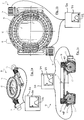
- the Fig. 1a shows a perspective view of a rotary indexing table 10 which, in the embodiment specifically illustrated here, has an annular output flange 12 or rotary plate 12, which is driven by two motors 14 to make a rotary movement.
- the output flange 12 can also be driven in a manner known per se via only a single motor or via more than two motors.
- the output flange 12 is annular and encloses a central opening 16 in which, for example, one or more processing machines for processing workpieces fastened on the turntable 12 can be located.
- FIG. 1b essentially shows the embodiment of FIG Fig. 1a in a plan view, wherein the dashed lines can be seen drivers 18, which can be designed, for example, as roller bolts and on the - in the position of use - the lower side of the output flange 12 are drivingly connected to this. Only the motors 14 are dimensioned differently than those in FIG Fig. 1a motors 14 shown.
- the drivers 18 and in particular the cam rollers 48 rotatably mounted on them engage in drive grooves 20 which are formed in cam drums 22 driven by the two motors 14 to rotate.
- the rotary movements of the cam drums 22 entrain the drivers 18, which engage in the drive grooves 20 spiraling around the cam drums 22, as a result of which the turntable 12 is driven to rotate.
- the drive grooves 20 thus form a mechanical control curve, since their slope determines, among other things, the movement profile of the turntable 12.
- the motors 14 and the cam drums 22 can be arranged coaxially. In the present embodiment, however, a transmission (not shown) is interposed in order to reduce a drive speed of the motors 14 (indirect drive).
- a preferred embodiment provides for the use of synchronous motors.
- the two motors 14 are connected in parallel and supplied with power by a common control device 30 on the basis of a motor control curve 32, which can be stored in a programmable memory 34 of the control device 30.
- the motor control curve 32 can specify an angle of rotation ⁇ of each motor 14, the angle of rotation ⁇ changing continuously as a function of time; for example, the engine control curve 32 have a bell-shaped varying angle of rotation profile.
- the motor control curve 32 is dependent on the time and indicates the angle of rotation ⁇ of the motor 14, which is required so that the output flange 12 covers a certain distance or angle as a function of time.
- the drive grooves 20, which are formed in the cam drums 22, also have a variable, ie a non-constant slope, even if this is particularly the case here Figure 1b cannot be clearly recognized.
- the current is supplied to the motors 14 on the basis of the motor control curve 32, in that the actual angle of rotation of the respective motor 14 is recorded by means of a rotary encoder (not shown) and compared to the time-dependent target angle of rotation ⁇ according to the motor control curve 32, so that this comparison is based on this the current supplied to the motor 14 can be regulated by the control device 30.
- the rotational movement of the output flange 12 is composed of two movement components that are simultaneously superimposed: see above One movement component of the output flange 12 is based on the gradient of the rotating drive groove 20 and a second movement component is based on the current supply to the motors 14, which varies on the basis of the motor control curve 32.
- both the slope of the drive grooves 20 is variable at least in some areas and the motor control curve 32 also has a variable slope at least in some areas
- the simultaneous superimposition of the movement component based on an area of variable slope of the drive grooves 20 and the movement component based on an area variable slope of the motor control curve 32 achieve a desired movement profile of the output flange 12, which can be as complex as desired.
- an optimization can be made of the movement profile of the output flange 12 by varying the motor control cam 32.
- a linear transport system 40 for use in, for example, a linear assembly system.
- the illustrated linear transport system 40 has a workpiece carrier 42 as a transport element, which is mounted on a rail 44 by means of rollers 46 so that the workpiece carrier 42 can be moved along the rail 44 to different assembly stations that are along the linear transport system 40 or the rail 44 are arranged. If the individual assembly stations are further apart, the workpiece carriers 42 can be moved between the individual assembly stations at high speed by means of a linear motor arrangement (not shown).
- the workpiece carrier 42 is driven in the region of the assembly station with high precision via a cam drum 22 which extends along the rail 44 and is driven by a motor 14 via a gear 50.
- the rotary movement of the cam drum 22 is converted into a longitudinal movement of the workpiece carrier 42 in that a driver 18 provided on the side of the workpiece carrier 42 and in particular its cam roller 48 engages in a drive groove 20 which is formed in the cam drum 22 and surrounds it in a spiral shape.
- the rotary movement of the cam drum 22 thus entrains the driver 18, which engages in the drive groove 20 which is spirally surrounded by the cam drum, whereby the workpiece carrier 42 is moved along the rail 44.
- the drive groove 20 has a slope which changes continuously over the entire length of the cam drum 22.
- the energization of the motor 14 takes place here again by means of a control device 30 on the basis of a motor control curve 32, which in a programmable Memory 34 of the control device 30 is stored.
- the motor control curve 32 is dependent on the time and indicates the angle of rotation ⁇ of the motor 14, which is required so that the workpiece carrier 42 covers a certain distance or stroke as a function of time.
- the current is supplied to the motor 14 on the basis of the motor control curve 32 in that the actual angle of rotation of the motor 14 is detected by means of a rotary encoder (not shown) and compared to the time-dependent target angle of rotation ⁇ according to the motor control curve 32, so that on the basis of this comparison of the control device 30 of the current supplied to the motor 14 can be regulated.
- the slope of the motor control curve 32 is variable over its entire temporal course and in particular has an angle of rotation course that varies in the manner of a bell curve;
- the motor control cam 32 can also only have a variable slope in some areas, provided that the slope of the drive groove 20 also changes at the same time.
- a desired movement profile of the workpiece carrier 42 can be achieved, which can be as complex as desired .
Landscapes
- Engineering & Computer Science (AREA)
- Mechanical Engineering (AREA)
- General Engineering & Computer Science (AREA)
- Transmission Devices (AREA)
- Specific Conveyance Elements (AREA)
- Non-Mechanical Conveyors (AREA)
Description
- Die vorliegende Erfindung betrifft eine Transportvorrichtung zur rotatorischen und/oder linearen Bewegung eines Werkstücks mit einem zur Aufnahme des Werkstücks geeigneten Transportelement, das mittels eines Motors rotatorisch und/oder linear von einer ersten Ruheposition in eine zweite Ruheposition bewegbar ist, wobei das Transportelement antriebswirksam mit zumindest einem Mitnehmer verbunden ist, der in eine Antriebsnut einer Kurventrommel eingreift, die von dem Motor antreibbar ist, der mittels einer programmierbaren Steuervorrichtung auf Grundlage einer Motorsteuerkurve ansteuerbar ist. Solch eine Transportvorrichtung ist der Art nach im Wesentlichen aus der
DE 10 2009 049 618 A1 bekannt. - Zur Bewegung eines Werkstücks können unterschiedlichste Vorrichtungen zum Einsatz kommen. Zur Erzeugung einer linearen bzw. translatorischen Bewegung bieten sich beispielsweise ein Transportband oder ein von einem Linearmotor verfahrbarer Greifer an. Vorzugsweise können Werkstückträger mittels eines Linearmontagesystems einer linearen Transportbewegung unterworfen werden. Soll das Werkstück in eine Drehbewegung versetzt werden, finden oftmals sogenannte Rundschalttische Verwendung. Derartige Rundschalttische sind grundsätzlich aus dem Stand der Technik in unterschiedlichen Ausführungsformen bekannt. Sie dienen beispielsweise dazu, auf einem als Drehteller ausgebildeten Abtriebsflansch angeordnete Werkstücke jeweils durch eine Rotation des Abtriebsflanschs von einer Bearbeitungs- oder Montagestation zu einer nächsten Bearbeitungs- oder Montagestation zu transportieren. Dieser Transport kann im Rahmen eines Taktbetriebs erfolgen, bei dem der Drehteller mit jedem Takt um ein bestimmtes Winkelmaß gedreht wird.
- Sowohl bei einer linearen Transportbewegung als auch bei einer rotatorischen Transportbewegung kommt es häufig auf die Einhaltung geringer Toleranzen bzw. auf die Präzision an. Mit anderen Worten soll das Werkstück aus der ersten Ruheposition zuverlässig und präzise in eine vorbestimmte zweite Ruheposition bewegt werden. In vielen Fällen ist es dabei nicht nur erforderlich, dass die zweite Ruheposition exakt eingenommen wird, sondern auch ein Bewegungsprofil des Werkstücks zwischen den beiden Ruhepositionen muss vorgegebene Randbedingungen wie beispielsweise vorgegebenen Geschwindigkeiten oder vorgegebenen Beschleunigungen gehorchen.
- Ferner kann als weitere Anforderung hinzukommen, dass der Transport möglichst energiesparend erfolgen soll. Die verwendeten Transportvorrichtungen sollen dabei möglichst unter Beibehaltung der üblichen Leistungsfähigkeit und bei gleicher Präzision möglichst wenig Energie verbrauchen. Zwar sind gewisse Einsparungspotentiale - beispielsweise durch Verringerung der Reibung zwischen den einzelnen Bauteilen - vorhanden, allerdings sind konstruktive Änderungen häufig mit höheren Herstellungs- und/oder Wartungskosten verbunden, so dass Optimierungen in diesem Bereich schnell an wirtschaftliche Grenzen stoßen.
- Es ist daher eine Aufgabe der vorliegenden Erfindung, eine Transportvorrichtung zur rotatorischen und/oder linearen Bewegung eines Werkstücks von einer ersten Ruheposition in eine zweite Ruheposition anzugeben, die einen möglichst effizienten Betrieb ermöglicht, ohne dass wesentliche Abstriche bei der Präzision oder der Dynamik der Transportbewegung in Kauf genommen werden müssen.
- Die Lösung dieser Aufgabe erfolgt durch eine Transportvorrichtung mit den Merkmalen des Anspruchs 1 zur Bewegung eines Werkstücks von einer ersten Ruheposition in eine zweite Ruheposition und insbesondere dadurch, dass die beispielsweise als Antriebsnut ausgebildete mechanische Steuerkurve der Kurventrommel zumindest bereichsweise eine variable, d.h. eine nicht konstante, Steigung aufweist, und dass die Motorsteuerkurve ebenfalls zumindest bereichsweise eine variable bzw. zeitlich veränderliche Steigung aufweist, wobei die Bewegung des Transportelements aus einer gleichzeitigen Überlagerung eines ersten Bewegungsanteils, der auf einem Bereich variabler Steigung der Antriebsnut bzw. der mechanischen Steuerkurve basiert, und eines zweiten Bewegungsanteils resultiert, der auf einem Bereich variabler Steigung der Motorsteuerkurve basiert. Die Motorsteuerkurve gibt dabei einen von der Zeit abhängigen Drehwinkel ϕ des Motors zur Erzielung eines gewünschten Bewegungsprofils des Transportelements an, so dass der dem Motor zugeführte Strom auf Grundlage der Motorsteuerkurve geregelt werden kann.
- Erfindungsgemäß wird somit erstmals eine Transportvorrichtung vorgeschlagen, bei der das Bewegungsprofil des zu transportierenden Werkstücks bzw. des Transportelements einerseits wie bei einem herkömmlichen fest taktenden System in einer variablen mechanischen Steuerkurve und andererseits wie bei einem herkömmlichen frei programmierbaren System in einer zeitlich veränderlichen bzw. variablen Motorsteuerkurve hinterlegt ist, wobei zu jedem Zeitpunkt die Bewegungsanteile, die einerseits aus der mechanischen Steuerkurve und andererseits aus der Motorsteuerkurve resultieren, derart aufeinander abgestimmt sind, dass das Transportelement einem vorgegebenen bzw. gewünschten Bewegungsprofil folgt.
- Ist also beispielsweise Ausgangspunkt für eine bestimmte Transportaufgabe ein vorgegebenes Bewegungsprofil des Werkstücks zwischen den beiden Ruhepositionen, so können die mechanische Steuerkurve einerseits und die Motorsteuerkurve andererseits derart optimiert werden, dass das vorgegebene Bewegungsprofil möglichst genau eingehalten wird. Gleichermaßen ist es möglich, zur Erzielung eines gewünschten Bewegungsprofils des Werkstücks zwischen den beiden Ruhepositionen beispielsweise eine im Rahmen gewisser Grenzen beliebig gewählte mechanische Steuerkurve vorzugeben und die Motorsteuerkurve entsprechend anzupassen, so dass durch Überlagerung der beiden Bewegungsanteile, die aus der mechanischen Steuerkurve einerseits und der Motorsteuerkurve andererseits resultieren, das gewünschte Bewegungsprofil hervorgeht.
- Zusätzlich kann die Motorsteuerkurve auf Grundlage der Dynamik des jeweiligen Motors optimiert werden, so dass der Motor stets in der Nähe seines optimalen Betriebspunkts bzw. in der Nähe seines optimalen Drehmomentbereichs betrieben werden kann. Hierdurch lässt sich gegenüber herkömmlichen Systemen ein deutlicher Energieeinsparungseffekt erzielen, wodurch im Ergebnis gegenüber herkömmlichen Systemen für ein und dieselbe Transportaufgabe ein weniger leistungsstarker Motor zum Einsatz kommen kann. Ferner kann durch Anpassung der Motorsteuerkurve und/oder der mechanischen Steuerkurve der Kurventrommel der maximale Ruckwert des Bewegungsprofils des Werkstücks klein gehalten werden.
- Im Folgenden wird nun auf bevorzugte Ausführungsformen der Erfindung eingegangen. Weitere Ausführungsformen können sich aus den abhängigen Ansprüchen, der Figurenbeschreibung sowie den Zeichnungen ergeben.
- So kann es gemäß einer Ausführungsform vorgesehen sein, dass der Motor auf Grundlage eines Bereichs variabler Steigung der Motorsteuerkurve während eines Zeitfensters ansteuerbar ist, in dem sich der zumindest eine Mitnehmer in einem Bereich variabler Steigung der mechanischen Steuerkurve befindet. Anders ausgedrückt kann sich der zumindest eine Mitnehmer in einem Bereich variabler Steigung der mechanischen Steuerkurve während eines Zeitfensters befinden, in dem ein Bereich variabler Steigung der Motorsteuerkurve zur Ansteuerung des Motors aktiv ist.
- Gemäß einer weiteren Ausführungsform weist die mechanische Steuerkurve weder an einer der ersten Ruheposition entsprechenden Stelle noch an einer der zweiten Ruheposition entsprechenden Stelle und auch nicht dazwischen einen Rastgang, d.h. einen Bereich mit der Steigung Null, auf. Bei herkömmlichen taktenden Systemen werden derartige Rastgänge hingegen benötigt, um den Motor auf seine Nenndrehzahl zu beschleunigen. Demgegenüber können erfindungsgemäß derartige Rastgangphasen entfallen, da das Beschleunigen des Motors bzw. der Bewegungsanteil, der hieraus resultiert, mit dem Bewegungsanteil, der aus der mechanischen Steuerkurve resultiert, derart überlagert wird, dass das resultierende Bewegungsprofil des Werkstücks einem vorgegebenen Bewegungsprofil entspricht. Dadurch, dass die mechanische Steuerkurve keinen Rastgang aufweist, kann die Taktzeit gegenüber herkömmlichen taktenden Systemen bei gleicher Motorgröße ohne die Erhöhung mechanischer Belastungen verkürzt werden.
- Zwar kann es zur Erzielung der zuvor beschriebenen vorteilhaften Wirkungen hinreichend sein, wenn die mechanische Steuerkurve und die Motorsteuerkurve jeweils einen oder mehrere Bereiche aufweist/aufweisen, wo sie variabel bzw. nicht konstant ist; gemäß einer bevorzugten Ausführungsform kann es jedoch vorgesehen sein, dass die Steigung der mechanischen Steuerkurve zwischen einer der ersten Ruheposition entsprechenden Stelle der mechanischen Steuerkurve und einer der zweiten Ruheposition entsprechenden Stelle der mechanischen Steuerkurve durchweg variabel ist und insbesondere keine Bereiche konstanter Steigung aufweist. In entsprechender Weise kann die Motorsteuerkurve und insbesondere deren Steigung zwischen einer der ersten Ruheposition entsprechenden Stelle und einer der zweiten Ruheposition entsprechenden Stelle durchweg variabel sein und keinen konstanten Kurvenbereich aufweisen. Dies ermöglicht eine Optimierung der mechanischen Steuerkurve und der Motorsteuerkurve über das gesamte Bewegungsprofil des Werkstücks zwischen den beiden Ruhepositionen hinweg, wodurch der Energieverbrauch der Transportvorrichtung in der gewünschten Weise minimiert werden kann.
- Gemäß einer bevorzugten Ausführungsform kann das Transportelement ein Werkstückträger eines Linearmontagesystems sein, der entlang einer Schiene des Linearmontagesystems beweglich geführt ist.
- Gemäß einer anderen Ausführungsform kann das Transportelement ein als Drehteller ausgebildeter Abtriebsflansch eines Rundschalttischs sein.
- Im Folgenden wird die Erfindung nun rein exemplarisch unter Bezugnahme auf die Zeichnungen erläutert, in denen:
- Fig. 1a - 1c
- eine Ausführungsform einer als Rundschalttisch ausgebildeten Transportvorrichtung in unterschiedlichen Ansichten zeigen; und
- Fig. 2a - 2c
- eine Ausführungsform einer als Lineartransportsystems ausgebildeten Transportvorrichtung in unterschiedlichen Ansichten zeigen.
- Die
Fig. 1a zeigt perspektivisch einen Rundschalttisch 10, der bei der hier konkret dargestellten Ausführungsform einen ringförmigen Abtriebsflansch 12 bzw. Drehteller 12 aufweist, der von zwei Motoren 14 zu einer Drehbewegung angetrieben wird. Anstelle den Abtriebsflansch 12 gemäß der hier dargestellten Ausführungsform mittels zweier Motoren 14 anzutreiben, kann der Abtriebsflansch 12 auch in an sich bekannter weise über nur einen einzigen Motor oder über mehr als zwei Motoren angetrieben werden. Bei der hier dargestellten Ausführungsform ist der Abtriebsflansch 12 ringförmig ausgebildet und umschließt eine zentrale Öffnung 16, in der sich beispielsweise ein oder mehrere Bearbeitungsmaschinen zur Bearbeitung von auf dem Drehteller 12 befestigten Werkstücken befinden können. - Die
Fig. 1b zeigt im Wesentlichen die Ausführungsform derFig. 1a in einer Draufsicht, wobei gestrichelt eingezeichnete Mitnehmer 18 zu erkennen sind, die beispielweise als Rollenbolzen ausgebildet sein können und an der - in Gebrauchslage - unteren Seite des Abtriebsflansch 12 antriebswirksam mit diesem verbunden sind. Lediglich die Motoren 14 sind anders dimensioniert als die in derFig. 1a gezeigten Motoren 14. - Wie in der
Fig. 1c ersichtlich, greifen die Mitnehmer 18 und insbesondere an denselben drehbar gelagerte die Kurvenrollen 48 in Antriebsnuten 20 ein, die in von den beiden Motoren 14 zu einer Drehbewegung angetriebenen Kurventrommeln 22 ausgebildet sind. Durch die Drehbewegungen der Kurventrommeln 22 werden die Mitnehmer 18 mitgeschleppt, die in die spiralförmig die Kurventrommeln 22 umlaufenden Antriebsnuten 20 eingreifen, wodurch der Drehteller 12 zu einer Drehbewegung angetrieben wird. Die Antriebsnuten 20 bilden somit eine mechanische Steuerkurve, da durch deren Steigung unter anderem das Bewegungsprofil des Drehtellers 12 bestimmt wird. - Grundsätzlich können die Motoren 14 und die Kurventrommeln 22 koaxial angeordnet sein. Bei der vorliegenden Ausführungsform ist jedoch ein (nicht gezeigtes) Getriebe zwischengeschaltet, um eine Antriebsdrehzahl der Motoren 14 zu untersetzen (indirekter Antrieb). Obwohl unterschiedliche Arten von Motoren zum Einsatz kommen können, ist gemäß einer bevorzugten Ausführungsform die Verwendung von Synchronmotoren vorgesehen. Dazu werden die beiden Motoren 14 parallel geschaltet und von einer gemeinsamen Steuervorrichtung 30 auf Grundlage einer Motorsteuerkurve 32 mit Strom versorgt, die in einem programmierbaren Speicher 34 der Steuervorrichtung 30 hinterlegt sein kann.
- Wie den
Fig. 1a bis 1c entnommen werden kann, kann die Motorsteuerkurve 32 einen Drehwinkel ϕ jedes Motors 14 angeben, wobei sich der Drehwinkel ϕ in Abhängigkeit der Zeit kontinuierlich verändert; beispielweis kann die Motorsteuerkurve 32 eine glockenkurvenartig variierenden Drehwinkelverlauf aufweisen. Die Motorsteuerkurve 32 ist dabei von der Zeit abhängig und gibt dem Drehwinkel ϕ des Motors 14 an, welcher erforderlich ist, damit der Abtriebsflansch 12 zeitabhängig einen bestimmten Weg bzw. Winkel zurücklegt. Ferner weisen auch die Antriebsnuten 20, die in den Kurventrommeln 22 ausgebildet sind, eine variable, d.h. eine nicht konstante Steigung auf, auch wenn dies hier insbesondere in derFig. 1b nicht genau zu erkennen ist. - Die Bestromung der Motoren 14 erfolgt dabei auf Grundlage der Motorsteuerkurve 32, indem mittels eines Drehgebers (nicht dargestellt) der Ist-Drehwinkel des jeweiligen Motors 14 erfasst und dem zeitabhängigen Soll-Drehwinkel ϕ gemäß der Motorsteuerkurve 32 gegenüber gestellt wird, sodass auf Grundlage dieser Gegenüberstellung von der Steuervorrichtung 30 der dem Motor 14 zugeführte Strom geregelt werden kann. Wird nun der Abtriebsflansch 12 mittels der beiden Motoren 14 über die jeweiligen Kurventrommeln 22 auf Grundlage der in dem Speicher 34 der Steuervorrichtung 30 hinterlegten Motorsteuerkurve 32 angetrieben, so setzt sich die rotatorische Bewegung des Abtriebsflanschs 12 aus zwei Bewegungsanteilen zusammen, die sich gleichzeitig überlagern: so basiert ein Bewegungsanteil des Abtriebsflanschs 12 auf der Steigung der sich drehenden Antriebsnut 20 und ein zweiter Bewegungsanteil basiert auf der auf Grundlage der Motorsteuerkurve 32 variierenden Bestromung der Motoren 14.
- Da sowohl die Steigung der Antriebsnuten 20 zumindest bereichsweise variabel ist und auch die Motorsteuerkurve 32 zumindest bereichsweise eine variable Steigung aufweist, lässt sich durch gleichzeitige Überlagerung des Bewegungsanteils, der auf einem Bereich variabler Steigung der Antriebsnuten 20 basiert, und des Bewegungsanteils, der auf einem Bereich variabler Steigung der Motorsteuerkurve 32 basiert, ein gewünschtes Bewegungsprofil des Abtriebsflanschs 12 erzielen, das beliebig komplex sein kann. Auf diese Weise lässt sich beispielsweise bei vorgewähltem Profil bzw. Steigungsverlauf der Abtriebsnuten 20 eine Optimierung des Bewegungsprofils des Abtriebsflanschs 12 durch Variation der Motorsteuerkurve 32 erzielen.
- Bei der Ausführungsform gemäß den
Fig. 2a bis 2c handelt es sich um ein Lineartransportsystem 40 zum Einsatz bei beispielsweise einem Linearmontagesystem. Das dargestellte Lineartransportsystem 40 weist als Transportelement einen Werkstückträger 42 auf, der mittels Rollen 46 an einer Schiene 44 gelagert ist, sodass der Werkstückträger 42 durch die Schiene 44 geführt entlang derselben zu unterschiedlichen Montagestation verfahren werden kann, die entlang des Lineartransportsystems 40 bzw. der Schiene 44 angeordnet sind. Sind die einzelnen Montagestationen weiter voneinander entfernt, können die Werkstückträger 42 mittels einer Linearmotor-Anordnung (nicht dargestellt) mit hoher Geschwindigkeit zwischen den einzelnen Montagestationen verfahren werden. - Bei der hier dargestellten Ausführungsform erfolgt der Antrieb des Werkstückträgers 42 im Bereich der Montagestation hochpräzise über eine Kurventrommel 22, die sich entlang der Schiene 44 erstreckt und von einem Motor 14 über ein Getriebe 50 angetrieben wird. Die Drehbewegung der Kurventrommel 22 wird dabei in eine Längsbewegung des Werkstückträgers 42 umgesetzt, indem ein seitlich an dem Werkstückträger 42 vorgesehener Mitnehmer 18 und insbesondere dessen Kurvenrolle 48 in einer Antriebsnut 20 eingreift, die in der Kurventrommel 22 ausgebildet ist und dieselbe spiralförmig umgibt. Durch die Drehbewegung der Kurventrommel 22 wird somit der Mitnehmer 18 mitgeschleppt, der in die spiralförmig die Kurventrommel umgebene Antriebsnut 20 eingreift, wodurch der Werkstückträger 42 entlang der Schiene 44 verfahren wird. Wie hier insbesondere der
Figur 2b entnommen werden kann, weist die Antriebsnut 20 eine Steigung auf, die sich über die gesamte Länge der Kurventrommel 22 hinweg kontinuierlich verändert. - Die Bestromung des Motors 14 erfolgt auch hier wiederum mittels einer Steuervorrichtung 30 auf Grundlage einer Motorsteuerkurve 32, die in einem programmierbaren Speicher 34 der Steuervorrichtung 30 hinterlegt ist. Die Motorsteuerkurve 32 ist dabei von der Zeit abhängig und gibt dem Drehwinkel ϕ des Motors 14 an, welcher erforderlich ist, damit der Werkstückträger 42 zeitabhängig einen bestimmten Weg bzw. Hub zurücklegt. Die Bestromung des Motors 14 erfolgt dabei auf Grundlage der Motorsteuerkurve 32, indem mittels eines Drehgebers (nicht dargestellt) der Ist-Drehwinkel des Motors 14 erfasst und dem zeitabhängigen Soll-Drehwinkel ϕ gemäß der Motorsteuerkurve 32 gegenüber gestellt wird, sodass auf Grundlage dieser Gegenüberstellung von der Steuervorrichtung 30 der dem Motor 14 zugeführte Strom geregelt werden kann.
- Zwar ist hier die Steigung der Motorsteuerkurve 32 ihren gesamten zeitlichen Verlauf hinweg variabel und weist insbesondere einen glockenkurvenartig variierenden Drehwinkelverlauf auf; die Motorsteuerkurve 32 kann jedoch auch nur bereichsweise eine variable Steigung aufweisen, sofern sich gleichzeitig auch die Steigung der Antriebsnut 20 verändert.
- Somit lässt sich auch hier durch gleichzeitige Überlagerung eines Bewegungsanteils, der auf einem Bereich variabler Steigung der Antriebsnut 20 basiert, und des Bewegungsanteils, der auf einem Bereich variabler Steigung der Motorsteuerkurve 32 basiert, ein gewünschtes Bewegungsprofil des Werkstückträgers 42 erzielen, das beliebig komplex sein kann.
-
- 10
- Rundschalttisch
- 12
- Drehteller bzw. Abtriebsflansch
- 14
- Motor
- 16
- Öffnung
- 18
- Mitnehmer
- 20
- Antriebsnut
- 22
- Kurventrommel
- 30
- Steuervorrichtung
- 32
- Motorsteuerkurve
- 34
- Speicher
- 40
- Lineartransportsystem
- 42
- Werkstückträger
- 44
- Schiene
- 46
- Rolle
- 48
- Kurvenrolle
- 50
- Getriebe
Claims (9)
- Transportvorrichtung mit einem zur Aufnahme eines Werkstücks geeigneten Transportelement, das mittels eines Motors (14) rotatorisch und/oder linear von einer ersten Ruheposition in eine zweite Ruheposition bewegbar ist, wobei das Transportelement antriebswirksam mit zumindest einem Mitnehmer (18) verbunden ist, der in eine Antriebsnut (20) einer Kurventrommel (22) eingreift, die von dem Motor (14) antreibbar ist, der mittels einer programmierbaren Steuervorrichtung (30) auf Grundlage einer Motorsteuerkurve (34) ansteuerbar ist,
dadurch gekennzeichnet, dass
die Antriebsnut (20) zumindest bereichsweise eine variable Steigung aufweist und dass die Motorsteuerkurve (32) ebenfalls zumindest bereichsweise eine variable Steigung aufweist, wobei die Bewegung des Transportelements aus einer gleichzeitigen Überlagerung eines ersten Bewegungsanteils, der auf einem Bereich variabler Steigung der Antriebsnut (20) basiert, und eines zweiten Bewegungsanteils resultiert, der auf einem variablen Steigungsbereich der Motorsteuerkurve (32) basiert. - Transportvorrichtung nach Anspruch 1,
dadurch gekennzeichnet, dass
der Motor (14) auf Grundlage eines Bereichs variabler Steigung der Motorsteuerkurve (32) ansteuerbar ist, während sich der zumindest eine Mitnehmer (18) in einem Bereich variabler Steigung der Antriebsnut (20) befindet. - Transportvorrichtung nach Anspruch 1 oder 2,
dadurch gekennzeichnet, dass
sich der zumindest eine Mitnehmer (18) in einem Bereich variabler Steigung der Antriebsnut (20) befindet, während ein Bereich variabler Steigung der Motorsteuerkurve (32) zur Ansteuerung des Motors (14) aktiv ist. - Transportvorrichtung nach zumindest einem der vorstehenden Ansprüche,
dadurch gekennzeichnet, dass
die Motorsteuerkurve (32) einen von der Zeit abhängigen Drehwinkel (ϕ) des Motors (14) zur Erzielung eines gewünschten Bewegungsprofils des Transportelements angibt. - Transportvorrichtung nach zumindest einem der vorstehenden Ansprüche,
dadurch gekennzeichnet, dass
die Antriebsnut (20) weder an einer der ersten Ruheposition entsprechenden Stelle noch an einer der zweiten Ruheposition entsprechenden Stelle und auch nicht dazwischen einen Rastgang aufweist. - Transportvorrichtung nach zumindest einem der vorstehenden Ansprüche,
dadurch gekennzeichnet, dass
die Steigung der Antriebsnut (20) zwischen einer der ersten Ruheposition entsprechenden Stelle der Antriebsnut und einer der zweiten Ruheposition entsprechenden Stelle der Antriebsnut (20) variabel ist und insbesondere keine Bereiche konstanter Steigung aufweist. - Transportvorrichtung nach zumindest einem der vorstehenden Ansprüche,
dadurch gekennzeichnet, dass
die Motorsteuerkurve (32) zwischen einer der ersten Ruheposition entsprechenden Stelle und einer der zweiten Ruheposition entsprechenden Stelle variabel ist und insbesondere keine Kurvenbereiche mit konstanter Steigung aufweist. - Transportvorrichtung nach zumindest einem der vorstehenden Ansprüche,
dadurch gekennzeichnet, dass
das Transportelement ein Werkstückträger (42) eines Lineartransportsystems (40) ist, der entlang einer Schiene (44) des Lineartransportsystems (40) geführt ist. - Transportvorrichtung nach zumindest einem der Ansprüche 1 bis 7,
dadurch gekennzeichnet, dass
das Transportelement ein Drehteller (12) eines Rundschalttischs (10) ist.
Priority Applications (1)
| Application Number | Priority Date | Filing Date | Title |
|---|---|---|---|
| PL18743431T PL3602217T3 (pl) | 2017-07-20 | 2018-07-10 | Urządzenie transportowe do obrotowego i/lub liniowego przemieszczania przedmiotu obrabianego |
Applications Claiming Priority (2)
| Application Number | Priority Date | Filing Date | Title |
|---|---|---|---|
| DE102017116414.6A DE102017116414A1 (de) | 2017-07-20 | 2017-07-20 | Transportvorrichtung zur rotatorischen und/oder linearen bewegung eines werkstücks |
| PCT/EP2018/068703 WO2019016038A1 (de) | 2017-07-20 | 2018-07-10 | Transportvorrichtung zur rotatorischen und/oder linearen bewegung eines werkstücks |
Publications (2)
| Publication Number | Publication Date |
|---|---|
| EP3602217A1 EP3602217A1 (de) | 2020-02-05 |
| EP3602217B1 true EP3602217B1 (de) | 2021-03-24 |
Family
ID=62981183
Family Applications (1)
| Application Number | Title | Priority Date | Filing Date |
|---|---|---|---|
| EP18743431.1A Active EP3602217B1 (de) | 2017-07-20 | 2018-07-10 | Transportvorrichtung zur rotatorischen und/oder linearen bewegung eines werkstücks |
Country Status (9)
| Country | Link |
|---|---|
| US (1) | US10987773B2 (de) |
| EP (1) | EP3602217B1 (de) |
| KR (1) | KR102311543B1 (de) |
| CN (1) | CN110869862B (de) |
| CA (1) | CA3063802C (de) |
| DE (1) | DE102017116414A1 (de) |
| DK (1) | DK3602217T3 (de) |
| PL (1) | PL3602217T3 (de) |
| WO (1) | WO2019016038A1 (de) |
Families Citing this family (5)
| Publication number | Priority date | Publication date | Assignee | Title |
|---|---|---|---|---|
| CN112357481A (zh) * | 2020-11-06 | 2021-02-12 | 博众精工科技股份有限公司 | 一种托盘输送线体 |
| CN112357482A (zh) * | 2020-11-06 | 2021-02-12 | 安徽芜湖宝丰输送机械有限公司 | 一种等量均匀配送式自动运输设备 |
| CN112548245B (zh) * | 2020-12-26 | 2022-02-08 | 景荣精密模具(深圳)有限公司 | 一种线切割机 |
| CN116497926B (zh) * | 2023-05-11 | 2025-07-15 | 中铁七局集团第三工程有限公司 | 一种排水管道结晶堵塞清除装置 |
| DE102024127746A1 (de) | 2024-09-25 | 2026-03-26 | Weiss Gmbh | Verfahren zur Herstellung einer Kurventrommel für eine Transporteinrichtung |
Citations (12)
| Publication number | Priority date | Publication date | Assignee | Title |
|---|---|---|---|---|
| GB1477821A (en) | 1975-04-16 | 1977-06-29 | Rino Berardi Spa Off Mec | Device for controlling the relative motions of two structural members or components particularly in machine tools |
| EP0366594A2 (de) | 1988-10-26 | 1990-05-02 | Emerson Electric Co. | Nockenlinearantriebseinheit |
| EP0620080A1 (de) | 1993-03-18 | 1994-10-19 | SIM ZUFÜHR-UND Montagetechnik GmbH & CO.KG | Vorrichtung für den Transport und die Positionierung von Werkstückträgern, die als Lineareinheit ausgeführt ist |
| US5644950A (en) | 1995-11-17 | 1997-07-08 | Norco, Inc. | Heavy-duty mechanical oscillator |
| DE10162178A1 (de) | 2001-12-18 | 2003-07-03 | Abb Patent Gmbh | Hebevorrichtung zum Bewegen von Lasten |
| US20040144191A1 (en) | 2002-10-22 | 2004-07-29 | Sankyo Seisakusho Co | Inclining and rotating table apparatus |
| JP2006077842A (ja) | 2004-09-08 | 2006-03-23 | Sankyo Mfg Co Ltd | 駆動機構及びこれを用いた移動テーブル |
| DE102005038663A1 (de) | 2005-08-16 | 2007-02-22 | Weiss Gmbh Sondermaschinentechnik | Rundschalttisch |
| DE102007021681B3 (de) | 2007-05-09 | 2008-09-11 | Tünkers Maschinenbau Gmbh | Schrittschaltdrehtisch |
| DE102009049618A1 (de) | 2009-10-16 | 2011-04-21 | Weiß GmbH Sondermaschinentechnik | Rundschalttisch |
| US20130206514A1 (en) | 2010-08-06 | 2013-08-15 | Coreeelevator Co., Ltd. | Wormgear shaped driving part, elevator using wormgear shaped driving part and elevating system |
| EP3064417A1 (de) | 2015-03-03 | 2016-09-07 | Expert-Tünkers GmbH | Transportvorrichtung zum bewegen von werkstücken für den karosseriebau der kfz-industrie |
Family Cites Families (18)
| Publication number | Priority date | Publication date | Assignee | Title |
|---|---|---|---|---|
| US3682005A (en) * | 1970-03-30 | 1972-08-08 | Umc Ind | Double cam drive |
| DE2035462C3 (de) * | 1970-07-17 | 1973-09-27 | Volkswagenwerk Ag, 3180 Wolfsburg | Steuerungsanordnung mit einem ein Maschinenteil einer Kraft oder Arbeite maschine penodisch bewegenden Nocken und einer Schwingungsdämpfung |
| US3850051A (en) * | 1972-09-01 | 1974-11-26 | Umc Ind | Precision functioning variable speed indexing apparatus |
| US4496280A (en) * | 1982-12-22 | 1985-01-29 | Brems John Henry | Workpiece transfer mechanism |
| US4704152A (en) * | 1986-07-28 | 1987-11-03 | Owens-Illinois, Inc. | Method of and apparatus for press forming cathode ray tube faceplate panels |
| FR2614818B2 (fr) | 1987-05-05 | 1990-03-02 | Dejoux Andre | Dispositif de guidage et d'entrainement d'organes mecaniques mobiles a deplacement notamment lineaire |
| KR100635008B1 (ko) | 2006-06-30 | 2006-10-16 | 서동식 | 회동 및 요동 병행 배럴캠 및 이를 이용한 인덱스 장치 |
| ATE545076T1 (de) * | 2008-02-25 | 2012-02-15 | Tuenkers Maschinenbau Gmbh | Drehtisch mit einer zugeordneten steuerung oder regelung |
| DE102009023079A1 (de) * | 2009-05-28 | 2010-12-02 | Weiß GmbH Sondermaschinentechnik | Rundschalttisch |
| US9868183B2 (en) * | 2009-10-16 | 2018-01-16 | Weiss Gmbh | Rotary indexing table having a direct drive of the transport cam |
| DE102010013527A1 (de) * | 2010-03-31 | 2011-10-06 | Weiß GmbH Sondermaschinentechnik | Verfahren zur schwingungsgedämpften Bewegung eines Werkstücks |
| DE102010013526A1 (de) * | 2010-03-31 | 2011-10-06 | Weiß GmbH Sondermaschinentechnik | Verfahren zur rotatorischen und/oder linearen Bewegung eines Werkstücks |
| DE102010018003A1 (de) * | 2010-04-23 | 2011-10-27 | Weiß GmbH Sondermaschinentechnik | Verfahren zum Betrieb eines Schwenkantriebs |
| US8720289B2 (en) * | 2011-01-05 | 2014-05-13 | General Dynamics Ordnance And Tactical Systems, Inc. | Loading machine for feeding a receiver |
| DE102011107467A1 (de) * | 2011-07-08 | 2013-01-10 | Ingenieurbüro IKS Neufeld | Rundtaktmaschine |
| WO2015081950A2 (de) * | 2013-12-06 | 2015-06-11 | Schaeffler Technologies AG & Co. KG | Aktuator mit einem eine drehbewegung in eine lineare bewegung umwandelnden getriebe |
| DE102014107654A1 (de) | 2014-05-30 | 2015-12-03 | Weiss Gmbh | Antriebseinheit |
| DE102015013651B4 (de) * | 2015-10-22 | 2019-02-07 | EXPERT-TÜNKERS GmbH | Doppelwalzendrehtisch |
-
2017
- 2017-07-20 DE DE102017116414.6A patent/DE102017116414A1/de not_active Withdrawn
-
2018
- 2018-07-10 PL PL18743431T patent/PL3602217T3/pl unknown
- 2018-07-10 WO PCT/EP2018/068703 patent/WO2019016038A1/de not_active Ceased
- 2018-07-10 US US16/632,049 patent/US10987773B2/en active Active
- 2018-07-10 DK DK18743431.1T patent/DK3602217T3/da active
- 2018-07-10 CA CA3063802A patent/CA3063802C/en active Active
- 2018-07-10 EP EP18743431.1A patent/EP3602217B1/de active Active
- 2018-07-10 CN CN201880032839.XA patent/CN110869862B/zh active Active
- 2018-07-10 KR KR1020207004802A patent/KR102311543B1/ko active Active
Patent Citations (15)
| Publication number | Priority date | Publication date | Assignee | Title |
|---|---|---|---|---|
| GB1477821A (en) | 1975-04-16 | 1977-06-29 | Rino Berardi Spa Off Mec | Device for controlling the relative motions of two structural members or components particularly in machine tools |
| EP0366594A2 (de) | 1988-10-26 | 1990-05-02 | Emerson Electric Co. | Nockenlinearantriebseinheit |
| EP0620080A1 (de) | 1993-03-18 | 1994-10-19 | SIM ZUFÜHR-UND Montagetechnik GmbH & CO.KG | Vorrichtung für den Transport und die Positionierung von Werkstückträgern, die als Lineareinheit ausgeführt ist |
| US5644950A (en) | 1995-11-17 | 1997-07-08 | Norco, Inc. | Heavy-duty mechanical oscillator |
| DE10162178A1 (de) | 2001-12-18 | 2003-07-03 | Abb Patent Gmbh | Hebevorrichtung zum Bewegen von Lasten |
| US20040144191A1 (en) | 2002-10-22 | 2004-07-29 | Sankyo Seisakusho Co | Inclining and rotating table apparatus |
| EP1413387B1 (de) | 2002-10-24 | 2006-01-18 | Sankyo Seisakusho Co. | Lineares Antriebsystem mit Nocken und Nockenfolgern |
| DE60303266T2 (de) | 2002-10-24 | 2006-09-28 | Sankyo Seisakusho Co. | Lineares Antriebsystem mit Nocken und Nockenfolgern |
| JP2006077842A (ja) | 2004-09-08 | 2006-03-23 | Sankyo Mfg Co Ltd | 駆動機構及びこれを用いた移動テーブル |
| DE102005038663A1 (de) | 2005-08-16 | 2007-02-22 | Weiss Gmbh Sondermaschinentechnik | Rundschalttisch |
| DE102007021681B3 (de) | 2007-05-09 | 2008-09-11 | Tünkers Maschinenbau Gmbh | Schrittschaltdrehtisch |
| DE102009049618A1 (de) | 2009-10-16 | 2011-04-21 | Weiß GmbH Sondermaschinentechnik | Rundschalttisch |
| US20130206514A1 (en) | 2010-08-06 | 2013-08-15 | Coreeelevator Co., Ltd. | Wormgear shaped driving part, elevator using wormgear shaped driving part and elevating system |
| EP3064417A1 (de) | 2015-03-03 | 2016-09-07 | Expert-Tünkers GmbH | Transportvorrichtung zum bewegen von werkstücken für den karosseriebau der kfz-industrie |
| DE102015002928A1 (de) | 2015-03-03 | 2016-09-08 | EXPERT-TÜNKERS GmbH | Transportvorrichtung zum Bewegen von Werkstücken, zum Beispiel für den Karosseriebau der Kfz-Industrie |
Non-Patent Citations (5)
| Title |
|---|
| ANONYMOUS: "DREHEN POSITIONIEREN TAKTEN AUTOMATION IN ALLEN DIMENSIONEN", TÜNKERS KATALOG DREHEN POSITIONIEREN TAKTEN, TÜNKERS MASCHINENBAU GMBH, 1 January 2019 (2019-01-01), pages 1 - 31, XP093141091, Retrieved from the Internet <URL:https://www.tuenkers.de/publish/binarydata/Service/download/katalog-expert-doppelseite.pdf> [retrieved on 20240313] |
| ANONYMOUS: "Drehen", FLYER TÜNKERS, TÜNKERS MASCHINENBAU GMBH, 1 July 2017 (2017-07-01), pages 1 - 3, XP093141087, Retrieved from the Internet <URL:https://www.tuenkers.de/publish/binarydata/Service/Praesentationen/2018/deutsch/07-tuenkers-imageflyer-drehen-d.pdf> [retrieved on 20240313] |
| ANONYMOUS: "Neun Module der Automation", TÜNKERS KATALOGE, TÜNKERS MASCHINENBAU GMBH, 1 April 2017 (2017-04-01), pages 1 - 390, XP093141221, Retrieved from the Internet <URL:https://www.expert-tuenkers.de/publish/binarydata/Download/Kataloge/expert_tuenkers_neun_komplett.pdf> [retrieved on 20240314] |
| ANONYMOUS: "Schnelles Takten und Positionieren", TÜNKERS KATALOGE, EXPERT-TÜNKERS GMBH, 1 September 2012 (2012-09-01), pages 1 - 109, XP093141220, Retrieved from the Internet <URL:https://www.expert-tuenkers.de/publish/binarydata/Download/Kataloge/katalog-takten-und-positionieren-kl.pdf> [retrieved on 20240314] |
| ANONYMOUS: "Taken und positioneren ", 1 October 2012 (2012-10-01), pages 1 - 9, XP093156353, Retrieved from the Internet <URL:https://tuenkers.com.br/wp-content/uploads/2017/07/edx-series-06-12-2012.pdf> [retrieved on 20240426] |
Also Published As
| Publication number | Publication date |
|---|---|
| DK3602217T3 (da) | 2021-05-03 |
| BR112019023413A2 (pt) | 2020-06-16 |
| KR102311543B1 (ko) | 2021-10-08 |
| US20200230763A1 (en) | 2020-07-23 |
| CA3063802A1 (en) | 2019-12-09 |
| DE102017116414A1 (de) | 2019-01-24 |
| CN110869862A (zh) | 2020-03-06 |
| KR20200041879A (ko) | 2020-04-22 |
| CA3063802C (en) | 2023-01-03 |
| CN110869862B (zh) | 2022-12-06 |
| EP3602217A1 (de) | 2020-02-05 |
| US10987773B2 (en) | 2021-04-27 |
| PL3602217T3 (pl) | 2021-09-27 |
| WO2019016038A1 (de) | 2019-01-24 |
Similar Documents
| Publication | Publication Date | Title |
|---|---|---|
| WO2019016038A1 (de) | Transportvorrichtung zur rotatorischen und/oder linearen bewegung eines werkstücks | |
| DE2936785C2 (de) | ||
| EP2756893A1 (de) | Materialbearbeitungsvorrichtung, insbesondere eine Umformmaschine | |
| DE102015111602A1 (de) | Werkzeugmaschine mit Schiebetür | |
| EP3066533B1 (de) | Verfahren zur bearbeitung eines rohteils mittels eines werkzeuges | |
| DE60222101T2 (de) | Vorrichtung zum antreiben und damit hergestelltes spannwerkeug | |
| DE102010042086A1 (de) | Drehteller mit Indexiereinheit und Betriebsverfahren | |
| EP3642140B1 (de) | Transportvorrichtung mit an einer schiene verfahrbar geführten schlitten | |
| CH704221A2 (de) | Vorrichtung und Verfahren zum Umformen von hohlzylindrischen Körpern. | |
| EP1516699B1 (de) | Fertigung- und/oder Montagevorrichtung | |
| WO2015000855A1 (de) | Vorrichtung und verfahren zum transferieren eines bauteils und werkzeugsystem | |
| EP0264474B1 (de) | Verfahren und Maschine zum Drehräumen von rotationssymmetrischen Werkstücken | |
| EP1632444A1 (de) | Vorrichtung zum getakteten Transport von Werkstückträgern | |
| EP2543474B1 (de) | Rundtaktmaschine | |
| EP2497331A2 (de) | Verfahren und vorrichtung zum induktiven härten grosser ringförmiger werkstücke | |
| EP3641983B1 (de) | Rundschalttisch mit kraft-optimiertem antrieb | |
| EP1571034B1 (de) | Längseinsteller für einen Fahrzeugsitz | |
| DE3436576A1 (de) | Beschickungs- und entnahmevorrichtung, insbesondere an pressen | |
| DE3104995A1 (de) | Werkzeugmaschine, insbesondere mehrspindelautomat | |
| DE102010033997A1 (de) | Metall- oder Keramikpulver-Elektropresse und Steuerverfahren dafür | |
| DE102010034359A1 (de) | Einrichtung zur Erzeugung einer Dreh- und Hubbewegung | |
| EP4334234B1 (de) | Hubvorrichtung, hubeinheit und transportfahrzeug | |
| EP1633507A1 (de) | Transfervorrichtung an einer presse | |
| DE202013103426U1 (de) | Vorrichtung zur Erzeugung einer Bohrung in einem Werkstück oder eines Gewindes in einer Bohrung eines Werkstücks | |
| DE3034469A1 (de) | Transportvorrichtung fuer werkstuecke |
Legal Events
| Date | Code | Title | Description |
|---|---|---|---|
| STAA | Information on the status of an ep patent application or granted ep patent |
Free format text: STATUS: UNKNOWN |
|
| STAA | Information on the status of an ep patent application or granted ep patent |
Free format text: STATUS: THE INTERNATIONAL PUBLICATION HAS BEEN MADE |
|
| PUAI | Public reference made under article 153(3) epc to a published international application that has entered the european phase |
Free format text: ORIGINAL CODE: 0009012 |
|
| STAA | Information on the status of an ep patent application or granted ep patent |
Free format text: STATUS: REQUEST FOR EXAMINATION WAS MADE |
|
| 17P | Request for examination filed |
Effective date: 20191025 |
|
| AK | Designated contracting states |
Kind code of ref document: A1 Designated state(s): AL AT BE BG CH CY CZ DE DK EE ES FI FR GB GR HR HU IE IS IT LI LT LU LV MC MK MT NL NO PL PT RO RS SE SI SK SM TR |
|
| AX | Request for extension of the european patent |
Extension state: BA ME |
|
| REG | Reference to a national code |
Ref country code: DE Ref legal event code: R079 Ref document number: 502018004477 Country of ref document: DE Free format text: PREVIOUS MAIN CLASS: G05B0019418000 Ipc: B23Q0001520000 |
|
| GRAP | Despatch of communication of intention to grant a patent |
Free format text: ORIGINAL CODE: EPIDOSNIGR1 |
|
| STAA | Information on the status of an ep patent application or granted ep patent |
Free format text: STATUS: GRANT OF PATENT IS INTENDED |
|
| RIC1 | Information provided on ipc code assigned before grant |
Ipc: B23Q 16/02 20060101ALI20200831BHEP Ipc: B23Q 1/52 20060101AFI20200831BHEP Ipc: F16H 53/02 20060101ALI20200831BHEP Ipc: B23Q 7/02 20060101ALI20200831BHEP |
|
| DAV | Request for validation of the european patent (deleted) | ||
| DAX | Request for extension of the european patent (deleted) | ||
| INTG | Intention to grant announced |
Effective date: 20201002 |
|
| GRAS | Grant fee paid |
Free format text: ORIGINAL CODE: EPIDOSNIGR3 |
|
| GRAA | (expected) grant |
Free format text: ORIGINAL CODE: 0009210 |
|
| STAA | Information on the status of an ep patent application or granted ep patent |
Free format text: STATUS: THE PATENT HAS BEEN GRANTED |
|
| AK | Designated contracting states |
Kind code of ref document: B1 Designated state(s): AL AT BE BG CH CY CZ DE DK EE ES FI FR GB GR HR HU IE IS IT LI LT LU LV MC MK MT NL NO PL PT RO RS SE SI SK SM TR |
|
| REG | Reference to a national code |
Ref country code: GB Ref legal event code: FG4D Free format text: NOT ENGLISH |
|
| REG | Reference to a national code |
Ref country code: CH Ref legal event code: EP |
|
| REG | Reference to a national code |
Ref country code: DE Ref legal event code: R096 Ref document number: 502018004477 Country of ref document: DE |
|
| REG | Reference to a national code |
Ref country code: IE Ref legal event code: FG4D Free format text: LANGUAGE OF EP DOCUMENT: GERMAN |
|
| REG | Reference to a national code |
Ref country code: AT Ref legal event code: REF Ref document number: 1373998 Country of ref document: AT Kind code of ref document: T Effective date: 20210415 Ref country code: CH Ref legal event code: NV Representative=s name: INTELLECTUAL PROPERTY SERVICES GMBH, CH |
|
| REG | Reference to a national code |
Ref country code: DK Ref legal event code: T3 Effective date: 20210428 |
|
| REG | Reference to a national code |
Ref country code: FI Ref legal event code: FGE |
|
| REG | Reference to a national code |
Ref country code: NL Ref legal event code: FP |
|
| REG | Reference to a national code |
Ref country code: LT Ref legal event code: MG9D |
|
| PG25 | Lapsed in a contracting state [announced via postgrant information from national office to epo] |
Ref country code: BG Free format text: LAPSE BECAUSE OF FAILURE TO SUBMIT A TRANSLATION OF THE DESCRIPTION OR TO PAY THE FEE WITHIN THE PRESCRIBED TIME-LIMIT Effective date: 20210624 Ref country code: GR Free format text: LAPSE BECAUSE OF FAILURE TO SUBMIT A TRANSLATION OF THE DESCRIPTION OR TO PAY THE FEE WITHIN THE PRESCRIBED TIME-LIMIT Effective date: 20210625 Ref country code: HR Free format text: LAPSE BECAUSE OF FAILURE TO SUBMIT A TRANSLATION OF THE DESCRIPTION OR TO PAY THE FEE WITHIN THE PRESCRIBED TIME-LIMIT Effective date: 20210324 Ref country code: NO Free format text: LAPSE BECAUSE OF FAILURE TO SUBMIT A TRANSLATION OF THE DESCRIPTION OR TO PAY THE FEE WITHIN THE PRESCRIBED TIME-LIMIT Effective date: 20210624 |
|
| REG | Reference to a national code |
Ref country code: DE Ref legal event code: R026 Ref document number: 502018004477 Country of ref document: DE |
|
| PLBI | Opposition filed |
Free format text: ORIGINAL CODE: 0009260 |
|
| PG25 | Lapsed in a contracting state [announced via postgrant information from national office to epo] |
Ref country code: LV Free format text: LAPSE BECAUSE OF FAILURE TO SUBMIT A TRANSLATION OF THE DESCRIPTION OR TO PAY THE FEE WITHIN THE PRESCRIBED TIME-LIMIT Effective date: 20210324 Ref country code: RS Free format text: LAPSE BECAUSE OF FAILURE TO SUBMIT A TRANSLATION OF THE DESCRIPTION OR TO PAY THE FEE WITHIN THE PRESCRIBED TIME-LIMIT Effective date: 20210324 Ref country code: SE Free format text: LAPSE BECAUSE OF FAILURE TO SUBMIT A TRANSLATION OF THE DESCRIPTION OR TO PAY THE FEE WITHIN THE PRESCRIBED TIME-LIMIT Effective date: 20210324 |
|
| REG | Reference to a national code |
Ref country code: FI Ref legal event code: MDE Opponent name: EXPERT-TUENKERS GMBH |
|
| 26 | Opposition filed |
Opponent name: EXPERT-TUENKERS GMBH Effective date: 20210809 |
|
| PG25 | Lapsed in a contracting state [announced via postgrant information from national office to epo] |
Ref country code: CZ Free format text: LAPSE BECAUSE OF FAILURE TO SUBMIT A TRANSLATION OF THE DESCRIPTION OR TO PAY THE FEE WITHIN THE PRESCRIBED TIME-LIMIT Effective date: 20210324 Ref country code: EE Free format text: LAPSE BECAUSE OF FAILURE TO SUBMIT A TRANSLATION OF THE DESCRIPTION OR TO PAY THE FEE WITHIN THE PRESCRIBED TIME-LIMIT Effective date: 20210324 Ref country code: LT Free format text: LAPSE BECAUSE OF FAILURE TO SUBMIT A TRANSLATION OF THE DESCRIPTION OR TO PAY THE FEE WITHIN THE PRESCRIBED TIME-LIMIT Effective date: 20210324 Ref country code: SM Free format text: LAPSE BECAUSE OF FAILURE TO SUBMIT A TRANSLATION OF THE DESCRIPTION OR TO PAY THE FEE WITHIN THE PRESCRIBED TIME-LIMIT Effective date: 20210324 |
|
| PG25 | Lapsed in a contracting state [announced via postgrant information from national office to epo] |
Ref country code: IS Free format text: LAPSE BECAUSE OF FAILURE TO SUBMIT A TRANSLATION OF THE DESCRIPTION OR TO PAY THE FEE WITHIN THE PRESCRIBED TIME-LIMIT Effective date: 20210724 Ref country code: RO Free format text: LAPSE BECAUSE OF FAILURE TO SUBMIT A TRANSLATION OF THE DESCRIPTION OR TO PAY THE FEE WITHIN THE PRESCRIBED TIME-LIMIT Effective date: 20210324 Ref country code: PT Free format text: LAPSE BECAUSE OF FAILURE TO SUBMIT A TRANSLATION OF THE DESCRIPTION OR TO PAY THE FEE WITHIN THE PRESCRIBED TIME-LIMIT Effective date: 20210726 Ref country code: SK Free format text: LAPSE BECAUSE OF FAILURE TO SUBMIT A TRANSLATION OF THE DESCRIPTION OR TO PAY THE FEE WITHIN THE PRESCRIBED TIME-LIMIT Effective date: 20210324 |
|
| PLAX | Notice of opposition and request to file observation + time limit sent |
Free format text: ORIGINAL CODE: EPIDOSNOBS2 |
|
| PG25 | Lapsed in a contracting state [announced via postgrant information from national office to epo] |
Ref country code: AL Free format text: LAPSE BECAUSE OF FAILURE TO SUBMIT A TRANSLATION OF THE DESCRIPTION OR TO PAY THE FEE WITHIN THE PRESCRIBED TIME-LIMIT Effective date: 20210324 Ref country code: ES Free format text: LAPSE BECAUSE OF FAILURE TO SUBMIT A TRANSLATION OF THE DESCRIPTION OR TO PAY THE FEE WITHIN THE PRESCRIBED TIME-LIMIT Effective date: 20210324 |
|
| PG25 | Lapsed in a contracting state [announced via postgrant information from national office to epo] |
Ref country code: SI Free format text: LAPSE BECAUSE OF FAILURE TO SUBMIT A TRANSLATION OF THE DESCRIPTION OR TO PAY THE FEE WITHIN THE PRESCRIBED TIME-LIMIT Effective date: 20210324 |
|
| PLBB | Reply of patent proprietor to notice(s) of opposition received |
Free format text: ORIGINAL CODE: EPIDOSNOBS3 |
|
| PG25 | Lapsed in a contracting state [announced via postgrant information from national office to epo] |
Ref country code: MC Free format text: LAPSE BECAUSE OF FAILURE TO SUBMIT A TRANSLATION OF THE DESCRIPTION OR TO PAY THE FEE WITHIN THE PRESCRIBED TIME-LIMIT Effective date: 20210324 |
|
| REG | Reference to a national code |
Ref country code: BE Ref legal event code: MM Effective date: 20210731 |
|
| PG25 | Lapsed in a contracting state [announced via postgrant information from national office to epo] |
Ref country code: IS Free format text: LAPSE BECAUSE OF FAILURE TO SUBMIT A TRANSLATION OF THE DESCRIPTION OR TO PAY THE FEE WITHIN THE PRESCRIBED TIME-LIMIT Effective date: 20210724 Ref country code: LU Free format text: LAPSE BECAUSE OF NON-PAYMENT OF DUE FEES Effective date: 20210710 |
|
| PG25 | Lapsed in a contracting state [announced via postgrant information from national office to epo] |
Ref country code: IE Free format text: LAPSE BECAUSE OF NON-PAYMENT OF DUE FEES Effective date: 20210710 Ref country code: BE Free format text: LAPSE BECAUSE OF NON-PAYMENT OF DUE FEES Effective date: 20210731 |
|
| PG25 | Lapsed in a contracting state [announced via postgrant information from national office to epo] |
Ref country code: CY Free format text: LAPSE BECAUSE OF FAILURE TO SUBMIT A TRANSLATION OF THE DESCRIPTION OR TO PAY THE FEE WITHIN THE PRESCRIBED TIME-LIMIT Effective date: 20210324 |
|
| P01 | Opt-out of the competence of the unified patent court (upc) registered |
Effective date: 20230525 |
|
| PG25 | Lapsed in a contracting state [announced via postgrant information from national office to epo] |
Ref country code: HU Free format text: LAPSE BECAUSE OF FAILURE TO SUBMIT A TRANSLATION OF THE DESCRIPTION OR TO PAY THE FEE WITHIN THE PRESCRIBED TIME-LIMIT; INVALID AB INITIO Effective date: 20180710 |
|
| PLBD | Termination of opposition procedure: decision despatched |
Free format text: ORIGINAL CODE: EPIDOSNOPC1 |
|
| REG | Reference to a national code |
Ref country code: DE Ref legal event code: R100 Ref document number: 502018004477 Country of ref document: DE |
|
| PLBP | Opposition withdrawn |
Free format text: ORIGINAL CODE: 0009264 |
|
| REG | Reference to a national code |
Ref country code: FI Ref legal event code: FGE |
|
| PG25 | Lapsed in a contracting state [announced via postgrant information from national office to epo] |
Ref country code: MK Free format text: LAPSE BECAUSE OF FAILURE TO SUBMIT A TRANSLATION OF THE DESCRIPTION OR TO PAY THE FEE WITHIN THE PRESCRIBED TIME-LIMIT Effective date: 20210324 |
|
| REG | Reference to a national code |
Ref country code: CH Ref legal event code: PK Free format text: DIE PUBLIKATION VOM 27.03.2024 WURDE AM 24.04.2024 IRRTUEMLICHERWEISE ERNEUT PUBLIZIERT. LA PUBLICATION DU 27.03.2024 A ETE REPUBLIEE PAR ERREUR LE 24.04.2024. LA PUBBLICAZIONE DEL 27.03.2024 E STATA ERRONEAMENTE RIPUBBLICATA IL 24.04.2024. |
|
| PLBM | Termination of opposition procedure: date of legal effect published |
Free format text: ORIGINAL CODE: 0009276 |
|
| 27C | Opposition proceedings terminated |
Effective date: 20240319 |
|
| PG25 | Lapsed in a contracting state [announced via postgrant information from national office to epo] |
Ref country code: MT Free format text: LAPSE BECAUSE OF FAILURE TO SUBMIT A TRANSLATION OF THE DESCRIPTION OR TO PAY THE FEE WITHIN THE PRESCRIBED TIME-LIMIT Effective date: 20210324 |
|
| PGFP | Annual fee paid to national office [announced via postgrant information from national office to epo] |
Ref country code: PL Payment date: 20250627 Year of fee payment: 8 |
|
| PGFP | Annual fee paid to national office [announced via postgrant information from national office to epo] |
Ref country code: NL Payment date: 20250721 Year of fee payment: 8 |
|
| PGFP | Annual fee paid to national office [announced via postgrant information from national office to epo] |
Ref country code: FI Payment date: 20250725 Year of fee payment: 8 |
|
| PGFP | Annual fee paid to national office [announced via postgrant information from national office to epo] |
Ref country code: DK Payment date: 20250725 Year of fee payment: 8 |
|
| PGFP | Annual fee paid to national office [announced via postgrant information from national office to epo] |
Ref country code: IT Payment date: 20250724 Year of fee payment: 8 |
|
| PGFP | Annual fee paid to national office [announced via postgrant information from national office to epo] |
Ref country code: GB Payment date: 20250722 Year of fee payment: 8 |
|
| PGFP | Annual fee paid to national office [announced via postgrant information from national office to epo] |
Ref country code: FR Payment date: 20250725 Year of fee payment: 8 Ref country code: AT Payment date: 20250722 Year of fee payment: 8 |
|
| PGFP | Annual fee paid to national office [announced via postgrant information from national office to epo] |
Ref country code: CH Payment date: 20250801 Year of fee payment: 8 |
|
| PG25 | Lapsed in a contracting state [announced via postgrant information from national office to epo] |
Ref country code: TR Free format text: LAPSE BECAUSE OF FAILURE TO SUBMIT A TRANSLATION OF THE DESCRIPTION OR TO PAY THE FEE WITHIN THE PRESCRIBED TIME-LIMIT Effective date: 20210324 |
|
| PGFP | Annual fee paid to national office [announced via postgrant information from national office to epo] |
Ref country code: DE Payment date: 20250926 Year of fee payment: 8 |