EP3601160B1 - Verfahren zur herstellung von fe(ii)p / fe(ii)metp-verbindungen - Google Patents
Verfahren zur herstellung von fe(ii)p / fe(ii)metp-verbindungen Download PDFInfo
- Publication number
- EP3601160B1 EP3601160B1 EP18715570.0A EP18715570A EP3601160B1 EP 3601160 B1 EP3601160 B1 EP 3601160B1 EP 18715570 A EP18715570 A EP 18715570A EP 3601160 B1 EP3601160 B1 EP 3601160B1
- Authority
- EP
- European Patent Office
- Prior art keywords
- iron
- met
- metal
- iii
- mixture
- Prior art date
- Legal status (The legal status is an assumption and is not a legal conclusion. Google has not performed a legal analysis and makes no representation as to the accuracy of the status listed.)
- Active
Links
Images


Classifications
-
- C—CHEMISTRY; METALLURGY
- C01—INORGANIC CHEMISTRY
- C01B—NON-METALLIC ELEMENTS; COMPOUNDS THEREOF; METALLOIDS OR COMPOUNDS THEREOF NOT COVERED BY SUBCLASS C01C
- C01B25/00—Phosphorus; Compounds thereof
- C01B25/16—Oxyacids of phosphorus; Salts thereof
- C01B25/26—Phosphates
- C01B25/37—Phosphates of heavy metals
- C01B25/375—Phosphates of heavy metals of iron
-
- C—CHEMISTRY; METALLURGY
- C01—INORGANIC CHEMISTRY
- C01B—NON-METALLIC ELEMENTS; COMPOUNDS THEREOF; METALLOIDS OR COMPOUNDS THEREOF NOT COVERED BY SUBCLASS C01C
- C01B25/00—Phosphorus; Compounds thereof
- C01B25/16—Oxyacids of phosphorus; Salts thereof
- C01B25/26—Phosphates
- C01B25/38—Condensed phosphates
- C01B25/42—Pyrophosphates
-
- C—CHEMISTRY; METALLURGY
- C01—INORGANIC CHEMISTRY
- C01B—NON-METALLIC ELEMENTS; COMPOUNDS THEREOF; METALLOIDS OR COMPOUNDS THEREOF NOT COVERED BY SUBCLASS C01C
- C01B25/00—Phosphorus; Compounds thereof
- C01B25/16—Oxyacids of phosphorus; Salts thereof
- C01B25/26—Phosphates
- C01B25/38—Condensed phosphates
- C01B25/44—Metaphosphates
-
- C—CHEMISTRY; METALLURGY
- C01—INORGANIC CHEMISTRY
- C01B—NON-METALLIC ELEMENTS; COMPOUNDS THEREOF; METALLOIDS OR COMPOUNDS THEREOF NOT COVERED BY SUBCLASS C01C
- C01B25/00—Phosphorus; Compounds thereof
- C01B25/16—Oxyacids of phosphorus; Salts thereof
- C01B25/26—Phosphates
- C01B25/45—Phosphates containing plural metal, or metal and ammonium
-
- C—CHEMISTRY; METALLURGY
- C01—INORGANIC CHEMISTRY
- C01P—INDEXING SCHEME RELATING TO STRUCTURAL AND PHYSICAL ASPECTS OF SOLID INORGANIC COMPOUNDS
- C01P2002/00—Crystal-structural characteristics
- C01P2002/70—Crystal-structural characteristics defined by measured X-ray, neutron or electron diffraction data
- C01P2002/72—Crystal-structural characteristics defined by measured X-ray, neutron or electron diffraction data by d-values or two theta-values, e.g. as X-ray diagram
-
- C—CHEMISTRY; METALLURGY
- C01—INORGANIC CHEMISTRY
- C01P—INDEXING SCHEME RELATING TO STRUCTURAL AND PHYSICAL ASPECTS OF SOLID INORGANIC COMPOUNDS
- C01P2004/00—Particle morphology
- C01P2004/51—Particles with a specific particle size distribution
-
- C—CHEMISTRY; METALLURGY
- C01—INORGANIC CHEMISTRY
- C01P—INDEXING SCHEME RELATING TO STRUCTURAL AND PHYSICAL ASPECTS OF SOLID INORGANIC COMPOUNDS
- C01P2004/00—Particle morphology
- C01P2004/51—Particles with a specific particle size distribution
- C01P2004/53—Particles with a specific particle size distribution bimodal size distribution
-
- C—CHEMISTRY; METALLURGY
- C01—INORGANIC CHEMISTRY
- C01P—INDEXING SCHEME RELATING TO STRUCTURAL AND PHYSICAL ASPECTS OF SOLID INORGANIC COMPOUNDS
- C01P2004/00—Particle morphology
- C01P2004/60—Particles characterised by their size
- C01P2004/61—Micrometer sized, i.e. from 1-100 micrometer
Definitions
- the starting materials are reacted in a suitable solvent under increased pressure in an autoclave at temperatures of 100 - 400 ° C.
- the special reaction conditions improve the solvent's dissolving power, so that this process even enables reactions that would not be possible under pressureless conditions.
- solvents are water (hydrothermal synthesis), short-chain alcohols, ammonia or carbon dioxide.
- the reactants are brought into solution, suspension or mixed with one another to react, with oxidation and reduction processes taking place in which a sparingly soluble product is formed and precipitates from the corresponding medium.
- WO 98/31630 A1 relates to a process for the production of synthetic phosphorus-containing minerals which are said to have improved composition homogeneity and modified crystal structures, in particular calcium-containing minerals for cement compositions which are said to be suitable for repairing and replacing bones in orthopedic and dental processes.
- One example describes the production of an iron (II) phosphate, using aqueous phosphinic acid solution, H 3 PO 2 , with iron (III) nitrate nonahydrate, Fe (NO 3 ) 3 9H 2 O, in a molar ratio of Fe / P of 1: 1 can be mixed and implemented.
- the iron (III) nitrate first dissolves, and during the reaction, among other products, a yellow solid and NO x gas are formed.
- the yellow solid was subjected to a heat treatment in air for 1 hour at 500 ° C. and then analyzed by means of X-ray diffraction (XRD).
- XRD X-ray diffraction
- LiFePO 4 by co-precipitation in an anhydrous medium.
- the synthesis of LiFePO 4 takes place in a two-stage process.
- iron sulfate heptahydrate, FeSO 4 7H 2 O, and lithium acetate are dissolved in ethylene glycol in an inert atmosphere and ammonium dihydrogen phosphate in ethylene glycol is added dropwise. A precipitate formed during the reaction was separated off, washed several times with acetone and dried in air at 40 ° C. for 24 h.
- the intermediate product referred to as LiFePO 4 precursor, was then calcined at 550-750 ° C. for 12 hours under an inert gas atmosphere.
- Disadvantages of this process are the long drying and calcination times and the fact that both the co-precipitation and the calcination step must be carried out under an inert gas atmosphere.
- the WO 2010/076265 A1 relates to a process for the production of lithium metal phosphates under hydrothermal conditions, wherein the metal can be a subgroup element such as iron.
- the subgroup element is at least partially present in the starting material in an oxidation state> +2. In the reduction step of the process, this subgroup element is reduced in order to obtain an oxidation number of +2.
- the US 2002/039552 A1 concerns, among other things, the production of an iron (II) orthophosphate with a graftonite structure.
- H 3 PO 2 and Fe (NO 3 ) 3 * 9 H 2 O are used as the starting materials for the manufacturing process. NO x is released during the exothermic reaction.
- the US 2002/140137 A1 also discloses the production of an iron (II) orthophosphate with a graftonite structure starting from H 3 PO 2 and Fe (NO 3 ) 3 * 9 H 2 O. NO x is released during the exothermic reaction.
- the object of the present invention was to provide a process for the preparation of iron (II) phosphate compounds of the type mentioned above which are free of water of crystallization and which overcomes the disadvantages of the prior art processes, in particular the low efficiency and undesirable side reactions.
- the product prepared according to the invention is or comprises anhydrous monometallic iron (II) orthophosphate of the general formula Fe 3 (PO 4 ) 2 .
- monometallic means here that the product contains only iron (II) as the metallic (cationic) component.
- the product prepared according to the invention is or comprises mixed metallic iron (II) metal orthophosphate, iron (II) metal pyrophosphate or iron (II) metal metaphosphate of the general empirical formula Fe a Met b (PO c ) d , where a is a number from 1 to 5, b is a number from> 0 to 5, c is a number from 2.5 to 5, d is a number from 0.5 to 3.
- mixed metallic means here that the product contains as metallic (cationic) components in addition to iron (II) at least one further metal, which is abbreviated to “Met” herein.
- the phosphorus is in the oxidation state (V). Small proportions of phosphorus in other oxidation states cannot be ruled out due to the manufacturing process and should be covered by the protection to the extent of unavoidable impurities.
- Steps a), b) and c) of the process according to the invention, including particular embodiments thereof, are described in more detail below.
- iron compound (A) and reducing agent (B) and optionally phosphate donor (C) and metal (Met) donor (D) in step a) of the process according to the invention can be carried out by dissolving, suspending and / or mixing the constituents take place in an aqueous or organic solvent or without additional solvent.
- the proportions by weight of constituents (A) to (D) of the mixture given herein relate to the proportions of the substances without solvents and / or suspending agents.
- a phosphoric acid [H 3 PO 4 ] introduced as a phosphate donor (C) which is used as an aqueous solution the proportion by weight of H 3 PO 4 is given without the proportion of water introduced as a solvent.
- a polar solvent is preferably used to prepare the mixture according to the invention in stage a), expediently a solvent with low viscosity and / or low boiling point, since this considerably simplifies and accelerates the subsequent drying step, especially when using the spray drying process.
- Water, alcohols and polyols of low chain length and ammonia and mixtures of the aforementioned are suitable. Water is particularly preferred because it has a low viscosity and very good dissolving properties.
- the solvent and / or suspending agent can be present in a ratio to the total mass of the mixture without solvents and / or suspending agents of 10 to 0.1.
- a weight ratio of 8 to 1 is preferred, particularly preferably 4 to 1.
- a high proportion of solvent and / or suspending agent can simplify the processing of the mixture, whereas a lower proportion of solvent and / or suspending agent shortens the subsequent drying step accordingly.
- the Fe (III) and / or Fe (III) / Fe (II) compounds used as iron compound (A) are selected from oxides, hydroxides, oxide hydroxides, orthophosphates, pyrophosphates, metaphosphates and sulfates. These have the advantage that the anion is stable during the mixing and drying process. In this context, stable means that no undesired decomposition and / or redox reactions occur. Furthermore, these anions offer the advantage that they do not release any undesired by-products during the redox processes taking place in temperature treatment stage c). Thereby, a product with more uniform grain size distribution and porosity can be obtained.
- the proportion of the iron compound (A) in the mixture prepared in stage a) is 20 to 90% by weight, preferably 25 to 85% by weight, particularly preferably 30 to 75% by weight, based on the total weight of all constituents i ) to iv) without solvents or suspending agents.
- the reducing agent (B) is selected from phosphonic acid, phosphinic acid, hypodisphosphoric acid, diphosphonic acid and hypodiphosphonic acid or mixtures thereof.
- these are easy to handle and thus enable very simple process control and metering of the substances.
- the acid anhydrides phosphorus trioxide, phosphorus tetraoxide or a mixture thereof can be used as the reducing agent (B) according to the invention.
- the use of an anhydride has the advantage that the drying step b) which follows step a) can be carried out relatively quickly due to the lower water content of the anhydride.
- the proportion of the reducing agent (B) in the mixture prepared in stage a) is 5 to 50% by weight, preferably 7.5 to 40% by weight, particularly preferably 10 to 30% by weight, based on the total weight of all Components i) to iv) without solvents or suspending agents.
- the mixture produced in stage a) can additionally contain a phosphate donor (C) which introduces phosphate anions with phosphorus in the oxidation stage (V) into the mixture. It is advantageous to add the additional phosphate donor (C) in an amount such that those generated from the reducing agent (B) in the temperature treatment stage c) Phosphate ions and the phosphate ions introduced by the phosphate donor (C) are present in such a molar amount in relation to the Fe ions and possibly Met ions that sufficient phosphate ions are available for product formation.
- the use of aqueous, strongly acidic solutions of phosphoric acid as the phosphate donor (C) is advantageous due to the good availability, the simple metering and the very low price.
- the use of the corresponding acid anhydride P 2 O 5 is associated with the advantage that the drying step following the mixing can be carried out considerably more quickly due to the lower water content.
- the reducing effect of the reducing agent (B) in the mixture can also be advantageously controlled or adjusted, for example to prevent over-reduction, z. B. to the phosphide, to prevent and at the same time to provide sufficient phosphorus compound to obtain the desired product.
- the proportion of the additional phosphate donor (C) in the mixture prepared in stage a) is 0 to 50% by weight, preferably 0 to 40% by weight, particularly preferably 0 to 30% by weight, based on the total weight of all constituents i) to iv) without solvents or suspending agents.
- the mixture produced in stage a) can also contain a metal donor (D).
- This metal donor (D) provides in the inventive production of anhydrous mixed-metallic iron (II) metal orthophosphate, iron (II) metal pyrophosphate or iron (II) metal metaphosphate of the general formula Fe a Met b (PO c ) d in addition to iron-containing metal component "Met", unless this is already introduced in a sufficient proportion via the phosphate donor (C). It goes without saying that metal donor (D) and phosphate donor (C) containing "Met” are not used in the preparation according to the invention of anhydrous monometallic iron (II) orthophosphate.
- the metal (Met) donor (D) is selected from the group consisting of oxides, hydroxides, oxide hydroxides, carbonates, oxalates, formates, acetates, citrates, lactates, orthophosphates, pyrophosphates, sulfates and mixtures thereof.
- the use of hydroxides, oxide hydroxides, carbonates, oxalates, formates, acetates, citrates and / or lactates has the advantage that no residues of the anion remain as impurities in the product from these compounds after the temperature treatment in stage c).
- orthophosphates and pyrophosphates has the advantage that they simultaneously provide phosphate anions for the formation of the end product.
- the proportion of the additional metal donor (D) in the mixture prepared in stage a) is 0 to 50% by weight, preferably 0 to 40% by weight, particularly preferably 0 to 30% by weight, based on the total weight of all constituents i) to iv) without solvents or suspending agents.
- the mixture is expediently prepared in a stirred batch container (vessel) with or without a solvent or suspending agent.
- a stirred batch container vessel
- at least one agitator such as, for example, propeller stirrer, inclined blade stirrer, disc stirrer, swash plate stirrer, hollow blade stirrer, impeller stirrer, cross-beam stirrer, anchor stirrer, blade stirrer, grid stirrer, gas inlet stirrer, residual stirrer, combination of these units, disperser, toothed disk stirrer.
- the mixture is prepared using at least one uniaxial stirrer (blade stirrer, bar stirrer, perforated bar stirrer, cross-bar stirrer, propeller stirrer, turbine stirrer, disc stirrer, impeller stirrer) with 1 to 3 stirrer levels and at least one stirrer or rotating stirrer.
- Dispersers such as toothed disks or dispersers.
- at least one dispersing unit is arranged outside the vessel in a pumping circuit through which the solution or suspension is continuously circulated.
- the mixture is produced in a batch container which has heating and / or cooling elements in the form of built-in coils or a double jacket in order to set the temperature of the mixture.
- the mixture according to the invention can be heated with the aid of a steam lance.
- the temperature of the mixture according to the invention is controlled via a pumping circuit on the reactor which is equipped with a heat exchanger.
- the batch container is equipped in a preferred embodiment with at least one reflux condenser in order to essentially prevent a change in the solids content due to evaporating solvent.
- the mixture according to the invention is prepared in the temperature range between 10 ° C or room temperature and the boiling point of the solution or suspension, preferably at a temperature ⁇ 150 ° C.
- the solution or suspension according to the invention can be produced using a closed container at temperatures above the boiling point of the liquid under the autogenous pressure of the solvent at the corresponding temperature.
- the mixture produced in step a) of the process according to the invention is, if it contains aqueous and / or organic solvent, dried in the subsequent step b) at a temperature of less than 400.degree.
- the temperature of less than 400 ° C refers to the temperature of the mixture to be dried in the drying process. Depending on the drying process, the temperature of the surrounding atmosphere can be higher.
- drying means that water and / or other solvents are removed from the mixture to such an extent that the water and / or other solvent content after the drying process is no more than 5% by weight of the total mass of the mixture, preferably no more than 3 % By weight, particularly preferably not more than 0.8% by weight.
- the degree of drying can be determined, for example, by means of thermogravimetry (TGA).
- the drying of the mixture in stage b) can be carried out with any suitable drying process, for example freeze drying, supercritical drying, microwave drying, vacuum drying, convective drying, such as convective air drying or convective drying under an inert gas atmosphere, spray drying, spray granulation or drying in a rotary kiln.
- any suitable drying process for example freeze drying, supercritical drying, microwave drying, vacuum drying, convective drying, such as convective air drying or convective drying under an inert gas atmosphere, spray drying, spray granulation or drying in a rotary kiln.
- drying processes are convective drying under an inert gas atmosphere and spray drying or spray granulation, since these keep the product's tendency to oxidize to a minimum.
- Spray drying is very particularly preferred, since it is very energy-efficient and provides a product with a uniform particle size distribution.
- the temperature of the drying gas can be up to 600 ° C if the drying is carried out under an inert gas atmosphere, whereby the temperature of the mixture to be dried must not exceed 400 ° C.
- the temperature of the drying gas should not exceed 400 ° C., preferably 300 ° C., particularly preferably 250 ° C., in order to reduce oxidation of the reducing agent in the mixture by oxygen.
- the products according to the invention are dried in step (b) by atomizing the solution or suspension produced according to the invention into a stream of hot gas in a spray dryer.
- the hot gas and product stream are guided in cocurrent or countercurrent, and atomization takes place using at least one pressure nozzle, a single-fluid nozzle or a two-fluid nozzle or at least one rotary atomizer or combinations thereof. Drying in the cocurrent process is particularly preferred.
- Heated air and burner exhaust gases are preferably used as the hot gas stream Containing air, oxygen-reduced air enriched with nitrogen or inert gases, and nitrogen. The use of heated air and air containing burner exhaust gases is particularly preferred.
- the hot gas stream is preferably heated by means of at least one burner, hot gas generator, electrical gas heater or steam heat exchanger and combinations thereof.
- the use of at least one two-substance nozzle or a rotary atomizer is preferred for atomization.
- the separation of the dried product stream from the process gas stream is preferably carried out with at least one cyclone or at least one filter or combinations thereof.
- the use of a filter is particularly preferred.
- the mean particle size of the product obtained is preferably in the range from 1 to 150 ⁇ m (d50).
- the products according to the invention are dried by atomizing the solution or suspension produced according to the invention onto a bed of already dried material swirled in a stream of hot gas in a spray granulator with at least one granulation zone.
- the solution or suspension according to the invention is atomized with at least one pressure nozzle, a single-fluid nozzle, a two-fluid nozzle, a multi-fluid nozzle or a combination thereof. Production can be carried out either in batches (batch process) or continuously.
- the spray granulation is carried out with a granulation zone in a continuous manner by continuously spraying on the solution or suspension and continuously removing dried granules from the fluidized bed.
- Heated air, air containing heated burner exhaust gases, heated, oxygen-reduced air that is enriched with nitrogen or inert gases, and heated nitrogen are suitable as the hot gas stream.
- heated air and air containing heated burner exhaust gases is particularly preferred.
- the last vortex zone is used to cool the material and is swirled with cooler gas and discharged without spraying the solution or suspension according to the invention.
- the required fluidized bed is expediently generated continuously in the spray granulator by abrasion and spray drying and made available in the device by means of filters or filter return.
- the granulation system also has a sieve-grinding circuit, from which, on the one hand, the dry product according to the invention is separated from particles that are too coarse and too fine by sieving and the coarse and fine fractions are fed back to the spray granulator as a fluidized bed via grinding .
- the hot gas generation for spray granulation takes place in the same way as the hot gas generation for spray drying.
- the mean particle size (d50) of the granules produced in this way are suitably in the range from 150 to 2000 ⁇ m, preferably 150 to 1000 ⁇ m, particularly preferably 300 to 800 ⁇ m.
- the dried mixture is then subjected to a temperature treatment (calcination) in the range from 400 to 1200.degree. C., preferably from 500 to 1100.degree. C., particularly preferably from 600 to 1000.degree.
- the temperature should be selected so high that melting of all substances involved in the reaction is guaranteed.
- a high temperature leads to high ion mobility and thus rapid reaction kinetics with a corresponding influence on the required reaction time.
- the temperature treatment of the products according to the invention is carried out batchwise or continuously under an inert or reducing atmosphere, preferably nitrogen, noble gas, forming gas with at most 5% by volume of H 2 or combinations thereof.
- the volumetric oxygen content of the process gas is expediently 0.0-1.0% by volume, preferably less than 0.3% by volume, particularly preferably less than 0.03% by volume.
- the temperature treatment in stage (c) is carried out continuously under controlled atmospheres, the process gas atmosphere being conducted in cocurrent with the product or in countercurrent.
- the compounds according to the invention are thermally treated by thermal treatment with counter-rotating process gas in a rotary kiln with an attached cooling zone.
- the process gas is introduced on the cooling zone side and The cooling material flows over it in order to prevent oxidation.
- indirectly heated rotary tubes with at least one heated zone but preferably 2 to 8 independently controllable heating zones, is particularly advantageous.
- the indirect heating can take place in the most varied of ways, typically with electrical resistance heaters (heating rods, heating coils), with gas burners, oil burners, by induction, etc. Electrical resistance heaters and gas burners are preferred.
- the rotary tube has internals in the form of lifting blades, preferably two to six radially conveying lifting blades, which improve the mixing of the solids with the gas phase and promote heat transfer on the wall side.
- lifting blades or built-in components with an axial conveying component which are suitable for shortening the dwell times in the rotary tube, are also useful.
- Suitable drilling pipes have gas-purged seals to which inert gas or a reducing atmosphere is applied in order to prevent the ingress of oxygen. Atmospheric decoupling is expediently carried out using double pendulum flaps, rotary valves and / or flushed screws. Overlaying the feed material with an inert or reducing atmosphere minimizes the entry of oxygen into the furnace.
- the Fe (III) ions introduced into the mixture by the iron compound (A) are to be reduced to Fe (II).
- the temperature treatment in stage c) is carried out in a rotary kiln.
- a rotary kiln This enables a continuous temperature treatment process that is generally more cost-effective than a batch process.
- the use of an indirectly heated rotary kiln is particularly preferred, since this enables the product space atmosphere to be precisely controlled.
- the temperature treatment in stage c) of the process according to the invention can advantageously take place under an inert gas atmosphere, ie the atmosphere consists of a gas or gas mixture which does not react with the constituents of the mixture in the corresponding temperature range.
- N 2 or noble gases, in particular argon, are preferably suitable as inert gases.
- a reducing gas atmosphere means that it contains at least one reducing gas component which is suitable for reducing components of the treated mixture, in particular Fe (III) ions introduced into the mixture by the iron compound (A) to Fe (II) - to reduce ions.
- Suitable reducing gas components are CO and H 2 .
- the use of forming gas which contains 5% by volume of H 2 in N 2 is particularly preferred, since this is neither flammable nor toxic.
- the mixture produced in stage a) contains Fe (III) ions in a molar ratio to the reducing agent (B) which, based on the stoichiometry and assuming 100% conversion, is a reduction of 70 up to 99%, preferably 80 to 98%, particularly preferably 90 to 95% of the Fe (III) ions would be supplied to Fe (II) ions by the reducing agent (B).
- the reducing agent (B) When using higher proportions of reducing agents than stoichiometrically required, there is a risk of the formation of metal phosphides and / or elemental metals, which can contaminate the product and turn it dark.
- 100% stoichiometric conversion or reduction of Fe (III) ions by the reducing agent (B) used does not take place. The remaining reduction can then be achieved through the reducing gas atmosphere.
- a particular advantage of the process according to the invention is its high efficiency and the avoidance of undesired side reactions which lead to the formation of impurities.
- Another advantage is that no additional reducing agents, such as elemental metals, are required to reduce Fe (III) to Fe (II).
- the reduction can take place solely through the oxidation of phosphorus-oxygen compounds with an oxidation level of phosphorus ⁇ 5, with a reducing atmosphere in stage c) of the temperature treatment being able to supplement the reduction in order to avoid the risk of the formation of metal phosphides and / or elemental metals .
- a further advantage of the process according to the invention is the short residence or reaction times compared to known processes for the synthesis of iron (II) phosphate, pyrophosphate and metaphosphate compounds.
- the temperature treatment in stage c) according to the process of the invention can be carried out very efficiently with residence or reaction times of less than 4 hours, in many cases even less than 1 to 2 hours. In contrast to this, common syntheses according to the prior art sometimes require dwell or. Response times over 24 hours.
- the product produced is anhydrous iron (II) orthophosphate of the general formula Fe 3 (PO 4 ) 2 , which has the graftonite crystal structure.
- this product is particularly suitable as an absorber for electromagnetic radiation, in particular IR radiation, and for this purpose it can advantageously be incorporated into a carrier material, preferably into thermoplastic polymers.
- iron (II) metal metaphosphates of the general formula Fe a Met b (PO c ) d are those in which "Met” is selected from potassium, magnesium, manganese and zinc.
- the products of these compositions according to the invention are suitable, inter alia, for use in products that come into contact with food, such as packaging materials for food, since such compositions, at least in many countries, do not currently require a separate food law approval.
- the iron (II) phosphate produced is mixed metallic iron (II) metal orthophosphate, free of water of crystallization, of the general formula Fe a Met b (PO c ) d , Met being one or a combination of the metals potassium (K) , Magnesium (Mg) and zinc (Zn), preferably potassium (K) alone or in combination with either magnesium (Mg) or zinc (Zn), the iron (II) metal orthophosphate particularly preferably KFePO 4 , K ( Fe 0.75 Zn 0.25 ) PO 4 or K (Fe 0.75 Mg 0.25 ) PO 4 .
- the iron (II) phosphate produced is mixed metallic iron (II) metal pyrophosphate of the general formula Fe a Met b (P 2 O 7 ) d , where Met is one or a combination of the metals magnesium ( Mg), calcium (Ca), strontium (Sr) and barium (Ba), the iron (II) metal pyrophosphate being particularly preferably MgFeP 2 O 7 , CaFeP 2 O 7 , SrFeP 2 O 7 or BaFeP 2 O 7 is.
- the aforementioned mixed-metallic anhydrous iron (II) metal orthophosphates and pyrophosphates are suitable, like the aforementioned iron (II) orthophosphate with the graftonite structure, especially as absorbers for electromagnetic radiation, especially IR radiation, and can be used for this purpose likewise advantageously incorporated into a carrier material, preferably into thermoplastic polymers.
- the material obtained in stage (c) is preferably adjusted to a particle size (d50) ⁇ 150 ⁇ m, preferably ⁇ 30 ⁇ m, more preferably ⁇ 4 ⁇ m.
- X-ray diffraction measurements were carried out on the products produced according to the examples below on a diffractometer of the type D8 Advance A25 (Bruker) using CuK ⁇ radiation.
- the person skilled in the art can use common methods such as light scattering or microscopic methods to determine the mean grain sizes.
- the mean grain sizes (particle sizes) according to the invention specified herein were determined with a laser particle size measuring device (model LA-950V2 from Horiba; software version 7.2).
- Preparation example 2 phase mixture of anhydrous Mg 1.5 Fe 1.5 (PO 4 ) 2 and Fe 3 (PO 4 ) 2
Landscapes
- Chemical & Material Sciences (AREA)
- Organic Chemistry (AREA)
- Inorganic Chemistry (AREA)
- Compounds Of Iron (AREA)
- Silicates, Zeolites, And Molecular Sieves (AREA)
- Catalysts (AREA)
- Compositions Of Oxide Ceramics (AREA)
Description
- Die vorliegende Erfindung betrifft ein Verfahren zur Herstellung von
- kristallwasserfreiem Eisen(II)-Orthophosphat der allgemeinen Formel Fe3(PO4)2 oder
- kristallwasserfreiem Eisen(II)-Metall-Orthophosphat, Eisen(II)-Metall-Pyrophosphat oder Eisen(II)-Metall-Metaphosphat der allgemeinen Formel FeaMetb(POc)d, worin a eine Zahl von 1 bis 5 ist, b eine Zahl von >0 bis 5 ist, c eine Zahl von 2,5 bis 5 ist, d eine Zahl von 0,5 bis 3 ist und wobei Met ein oder mehrere Metalle repräsentiert, ausgewählt aus der Gruppe, bestehend aus K, Rb, Cs, Mg, Ca, Sr, Ba, den Übergangsmetallen (d-Block), insbesondere Sc, Y, La, Ti, Zr, Hf, Nb, Ta, Cr, Mo, W, Mn, Cu, Zn, sowie den Metallen und Halbmetallen der dritten, vierten und fünften Hauptgruppe, insbesondere B, AI, Ga, In, Si, Sn, Sb, Bi, und den Lanthanoiden, oder Kombinationen der vorgenannten Phosphate.
- Aus der Literatur ist eine Vielzahl verschiedener Verfahren zur Herstellung von Metallphosphat-Verbindungen bekannt. Beispielhaft seien Hochtemperaturfestphasenreaktionen, Sol-Gel-Prozesse, Carbothermalsynthesen und Co-Präzipitationen genannt. Aufgrund des breiten Anwendungsspektrums sind Solvothermalsynthesen und Redoxausfällungsreaktionen, an die sich häufig Wärmebehandlungsschritte anschließen, um die gebildeten Vorläuferverbindungen in die gewünschten Phasen zu überführen, besonders vorteilhaft.
- Bei Solvothermalsynthesen werden die Edukte in einem geeigneten Lösemittel unter erhöhtem Druck in einem Autoklaven bei Temperaturen von 100 - 400°C umgesetzt. Durch die speziellen Reaktionsbedingungen wird das Lösevermögen des Lösemittels verbessert, sodass mit diesem Verfahren selbst Reaktionen möglich sind, die unter drucklosen Bedingungen nicht durchführbar wären. Häufig verwendete Lösemittel sind Wasser (Hydrothermalsynthese), kurzkettige Alkohole, Ammoniak oder Kohlendioxid.
- Bei Redoxausfällungsreaktionen werden die Edukte in Lösung, Suspension oder in Vermengung miteinander zur Umsetzung gebracht, wobei Oxidations- und Reduktionsprozesse ablaufen, bei denen ein schwerlösliches Produkt entsteht und aus dem entsprechenden Medium ausfällt.
-
WO 98/31630 A1 WO 98/31630 A1 WO 98/31630 A1 - Swider, J. et al., Procedia Engineering, 98 (2014), 36-41, beschreibt die Synthese von hochreinem, nanokristallinem LiFePO4 durch Co-Präzipitation in einem wasserfreiem Medium. Die Synthese des LiFePO4 erfolgt über einen zweistufigen Prozess. Hierzu werden Eisensulfat-Heptahydrat, FeSO4 7H2O, und Lithiumacetat in inerter Atmosphäre in Ethylenglykol gelöst und tropfenweise Ammoniumdihydrogenphosphat in Ethylenglykol zugegebenen. Ein bei der Umsetzung entstehendes Präzipitat wurde abgetrennt, mehrmals mit Aceton gewaschen und bei 40°C für 24 h an Luft getrocknet. Das Zwischenprodukt, bezeichnet als LiFePO4-Precursor, wurde dann bei 550-750°C für 12h unter Inertgasatmosphäre kalziniert. Nachteilig sind bei diesem Verfahren die langen Trocknungs- und Kalzinierungsdauern und, dass sowohl die Co-Präzipitation als auch der Kalzinierungsschritt unter Inertgasatmosphäre durchgeführt werden müssen.
- Die
WO 2010/076265 A1 betrifft ein Verfahren zur Herstellung von Lithium-Metall-Phosphaten unter hydrothermalen Bedingungen, wobei das Metall ein Nebengruppenelement wie Eisen sein kann. Das Nebengruppenelement liegt im Ausgangsmaterial zumindest teilweise in einer Oxidationsstufe > +2 vor. Im Reduktionsschritt des Verfahrens wird dieses Nebengruppenelement reduziert, um eine Oxidationsstufe von +2 zu erhalten. - Die
US 2002/039552 A1 betrifft u.a. die Herstellung eines Eisen(II)-Orthophosphats mit Graftonit-Struktur. Als Ausgangsmaterial des Herstellverfahrens dienen H3PO2 und Fe(NO3)3*9 H2O. Bei der exothermen Reaktion wird NOx freigesetzt. - Die
US 2002/140137 A1 offenbart ebenfalls die Herstellung eines Eisen(II)-Orthophosphats mit Graftonit-Struktur ausgehend von H3PO2 und Fe(NO3)3*9 H2O. Bei der exothermen Reaktion wird NOx freigesetzt. - Die Aufgabe der vorliegenden Erfindung bestand in der Bereitstellung eines Verfahrens zur Herstellung von kristallwasserfreien Eisen(II)-Phosphat-Verbindungen der eingangs genannten Art, welches die Nachteile der Verfahren nach dem Stand der Technik überwindet, insbesondere die geringe Effizienz und unerwünschte Nebenreaktionen.
- Diese Aufgabe wird erfindungsgemäß gelöst durch ein Verfahren zur Herstellung von
- kristallwasserfreiem monometallischem Eisen(II)-Orthophosphat der allgemeinen Formel Fe3(PO4)2 oder
- kristallwasserfreiem gemischtmetallischem Eisen(II)-Metall-Orthophosphat, Eisen(II)-Metall-Pyrophosphat oder Eisen(II)-Metall-Metaphosphat der allgemeinen Formel FeaMetb(POc)d, worin a eine Zahl von 1 bis 5 ist, b eine Zahl von >0 bis 5 ist, c eine Zahl von 2,5 bis 5 ist, d eine Zahl von 0,5 bis 3 ist und wobei Met ein oder mehrere Metalle repräsentiert, ausgewählt aus der Gruppe, bestehend aus K, Rb, Cs, Mg, Ca, Sr, Ba, den Übergangsmetallen (d-Block), insbesondere Sc, Y, La, Ti, Zr, Hf, Nb, Ta, Cr, Mo, W, Mn, Cu, Zn, sowie den Metallen und Halbmetallen der dritten, vierten und fünften Hauptgruppe, insbesondere B, AI, Ga, In, Si, Sn, Sb, Bi, und den Lanthanoiden,
oder Kombinationen der vorgenannten Phosphate - a) Herstellen eines Gemisches, enthaltend:
- i) Eisenverbindung (A), ausgewählt unter Fe(III)-Verbindungen, Fe(III)/Fe(II)-Verbindungen und Gemischen davon, in einem Anteil von 20 bis 90 Gew.-% des Gemisches, ausgewählt aus der Gruppe bestehend aus Oxiden, Hydroxiden, Oxidhydroxiden, Carbonaten, Carboxylaten wie Oxalaten, Formiaten, Acetaten, Citraten, Lactaten, Orthophosphaten, Phosphonaten, Metaphosphaten, Pyrophosphaten, Sulfaten und Gemischen der vorgenannten,
- ii) Reduktionsmittel (B) in einem Anteil von 5 bis 50 Gew.-% des Gemisches, ausgewählt aus der Gruppe, bestehend aus Phosphonsäure [H3PO3], Phosphortrioxid [P2O3], Phosphinsäure [H3PO2], Phosphortetraoxid [P2O4], Hypodiphosphorsäure [H4P2O6], Diphosphonsäure [H4P2O5], Hypodiphosphonsäure [H4P2O4], Fe-Salzen und Met-Salzen der vorgenannten Säuren und Gemischen der vorgenannten, als Feststoffe oder wässrige Lösung oder Suspension,
- iii) optional Phosphatdonor (C) in einem Anteil von 0 bis 50 Gew.-% des Gemisches, ausgewählt unter Phosphorsäure [H3PO4] als wässrige Lösung, Metallphosphat [Metx(PO4)z] oder saures Metallphosphat [MetxHY(PO4)z] mit 1≥x≥4, 1≥y≥5 und 1≥z≥4 als Feststoff oder wässrige Lösung oder Suspension, Diphosphorsäure [H4P2O7], Metaphosphorsäure [(HPO3)n] mit n≥3 oder deren Salze, Phosphorpentoxid [P2O5] oder Gemische der vorgenannten, wobei Met wie oben definiert ist,
- iv) optional Metal (Met)-Donor (D) in einem Anteil von 0 bis 50 Gew.-% des Gemisches, ausgewählt unter Metallverbindungen von einem oder mehreren Metallen aus der Gruppe, bestehend aus K, Rb, Cs, Mg, Ca, Sr, Ba, den Übergangsmetallen (d-Block), insbesondere Sc, Y, La, Ti, Zr, Hf, Nb, Ta, Cr, Mo, W, Mn, Cu, Zn, sowie den Metallen und Halbmetallen der dritten, vierten und fünften Hauptgruppe, insbesondere B, Al, Ga, In, Si, Sn, Sb, Bi, und den Lanthanoiden, und ausgewählt unter Oxiden, Hydroxiden, Oxidhydroxiden, Carbonaten, Oxalaten, Formiaten, Acetaten, Citraten, Lactaten, Orthophosphaten, Pyrophosphaten und Sulfaten der vorgenannten Metalle und Gemischen davon,
- b) das erhaltene Gemisch, sofern wässriges und/oder organisches Lösungsmittel enthalten ist, bei einer Temperatur von weniger als 400°C trocknet,
- c) das trockene oder getrocknete Gemisch bei einer Temperatur im Bereich von 400 bis 1200°C behandelt.
- In einer Ausführungsform der Erfindung ist oder umfasst das erfindungsgemäß hergestellte Produkt kristallwasserfreies monometallisches Eisen(II)-Orthophosphat der allgemeinen Formel Fe3(PO4)2. Der Begriff "monometallisch" bedeutet hierin, dass das Produkt als metallische (kationische) Komponente nur Eisen(II) enthält.
- In weiteren Ausführungsformen der Erfindung ist oder umfasst das erfindungsgemäß hergestellte Produkt kristallwasserfreies gemischtmetallisches Eisen(II)-Metall-Orthophosphat, Eisen(II)-Metall-Pyrophosphat oder Eisen(II)-Metall-Metaphosphat der allgemeinen Summenformel FeaMetb(POc)d, worin a eine Zahl von 1 bis 5 ist, b eine Zahl von >0 bis 5 ist, c eine Zahl von 2,5 bis 5 ist, d eine Zahl von 0,5 bis 3 ist. Der Begriff" gemischtmetallisch" bedeutet hierin, dass das Produkt als metallische (kationische) Komponenten neben Eisen(II) wenigstens ein weiteres Metall enthält, welches hierin mit "Met" abgekürzt ist.
- Bei den erfindungsgemäßen Produkten liegt der Phosphor in der Oxidationsstufe (V) vor. Geringe Anteile von Phosphor in anderen Oxidationsstufen sind herstellungsbedingt nicht auszuschließen und sollen vom Schutz im Umfang unvermeidbarer Verunreinigungen umfasst sein. Die erfindungsgemäßen Produkte leiten sich von der Orthophosphorsäure (H3PO4) und ihren Kondensaten (Polymeren) ab. Orthophosphate besitzen die anionische Struktureinheit [PO4 3-], Pyrophosphate, auch Diphosphate, besitzen die Struktureinheit [P2O7 4-] und die zyklischen Metaphosphate besitzen die Struktureinheit = [(PO3 -)n].
- Nachfolgend werden die Stufen a), b) und c) des erfindungsgemäßen Verfahrens einschließlich besonderer Ausführungsformen davon näher beschrieben.
- Das Herstellen des Gemisches der erfindungsgemäßen Edukte Eisenverbindung (A) und Reduktionsmittel (B) sowie optional Phosphatdonor (C) und Metal (Met)-Donor (D) in Stufe a) des erfindungsgemäßen Verfahrens kann durch Lösen, Suspendieren und/oder Vermengen der Bestandteile in einem wässrigen oder organischen Lösungsmittel oder ohne zusätzliches Lösungsmittel erfolgen.
- Die hierin angegebenen Gewichtsanteile der Bestandteile (A) bis (D) des Gemisches beziehen sich auf die Anteile der Stoffe ohne Lösungsmittel und/oder Suspendiermittel. So wird beispielsweise bei einer als Phosphatdonor (C) eingebrachten Phosphorsäure [H3PO4], die als wässrige Lösung eingesetzt wird, der Gewichtsanteil H3PO4 ohne den als Lösungsmittel eingebrachten Wasseranteil angegeben.
- Das Herstellen einer Suspension in einem polaren Lösungsmittel, welches wenigstens eines der Edukte suspendiert enthält, kann vorteilhaft sein, da die Produkte in gängigen polaren Lösemitteln üblicherweise gut löslich sind und dies den Reaktionsfortschritt begünstigen kann.
- Bevorzugt wird zur Herstellung des erfindungsgemäßen Gemisches in Stufe a) ein polares Lösungsmittel eingesetzt, zweckmäßigerweise ein Lösungsmittel mit niedriger Viskosität und/oder mit niedrigem Siedepunkt, da hierdurch der anschließende Trocknungsschritt insbesondere bei Anwendung des Sprühtrocknungsverfahrens erheblich vereinfacht und beschleunigt wird. Geeignet sind Wasser, Alkohole und Polyole niedriger Kettenlänge und Ammoniak sowie Gemische der vorgenannten. Besonders bevorzugt ist Wasser, da es eine niedrige Viskosität und sehr gute Löseeigenschaften aufweist.
- Das Lösungs- und/oder Suspendiermittel kann in einem Verhältnis zur Gesamtmasse des Gemisches ohne Lösungs- und/oder Suspendiermittel von 10 bis 0,1 vorliegen. Bevorzugt ist ein Gewichtsverhältnis von 8 bis 1, besonders bevorzugt 4 bis 1. Ein hoher Anteil an Lösungs- und/oder Suspendiermittel kann das Prozessieren des Gemisches vereinfachen, wohingegen ein geringerer Anteil an Lösungs- und/oder Suspendiermittel den anschließenden Trocknungsschritt entsprechend verkürzt.
- In einer bevorzugten Ausführungsform der Erfindung sind die als Eisenverbindung (A) eingesetzten Fe(III)- und/oder Fe(III)/Fe(II)-Verbindungen unter Oxiden, Hydroxiden, Oxidhydroxiden, Orthophosphaten, Pyrophosphaten, Metaphosphaten und Sulfaten ausgewählt. Diese haben den Vorteil, dass das Anion während des Mischungs- und Trocknungsvorgangs stabil ist. Stabil heißt in diesem Zusammenhang, dass keine unerwünschten Zersetzungs- und/oder Redoxreaktionen auftreten. Weiterhin bieten diese Anionen den Vorteil, dass sie während der in der Temperaturbehandlungsstufe c) stattfindenden Redoxprozesse keine unerwünschten Nebenprodukte freisetzen. Dadurch kann ein Produkt mit gleichförmigerer Korngrößenverteilung und Porosität erhalten werden. Zudem ist keine aufwendige Aufreinigung der Reaktionsatmosphäre erforderlich, wie teilweise in den literaturbekannten Verfahren. Die Verwendung von Fe(III)- und/oder Fe(III)/Fe(II)-Orthophosphaten, -Pyrophosphaten und -Metaphosphaten hat den weiteren Vorteil, dass sie gleichzeitig Phosphationen mit Phosphor in der Oxidationsstufe (V) für die Produktbildung bereitstellen.
- Der Anteil der Eisenverbindung (A) an dem in Stufe a) hergestellten Gemisch beträgt 20 bis 90 Gew.-%, vorzugsweise 25 bis 85 Gew.-%, besonders bevorzugt 30 bis 75 Gew.-%, bezogen auf das Gesamtgewicht aller Bestandteile i) bis iv) ohne Lösungs- bzw. Suspendiermittel.
- In einer bevorzugten Ausführungsform der Erfindung ist das Reduktionsmittel (B) unter Phosphonsäure, Phosphinsäure, Hypodisphosphorsäure, Diphosphonsäure und Hypodiphosphonsäure oder Gemischen davon ausgewählt. Diese sind als Lösung einfach zu handhaben und ermöglichen damit eine sehr einfache Prozessführung und Zudosierung der Substanzen.
- Alternativ oder ergänzend können als erfindungsgemäßes Reduktionsmittel (B) die Säureanhydride Phosphortrioxid, Phosphortetraoxid oder ein Gemisch davon eingesetzt werden. Die Verwendung eines Anhydrids hat den Vorteil, dass der sich an die Stufe a) anschließende Trocknungsschritt b) aufgrund des geringeren Wassergehaltes des Anhydride verhältnismäßig schnell durchgeführt werden kann.
- Der Anteil des Reduktionsmittels (B) an dem in Stufe a) hergestellten Gemisch beträgt 5 bis 50 Gew.-%, vorzugsweise 7,5 bis 40 Gew.-%, besonders bevorzugt 10 bis 30 Gew.-%, bezogen auf das Gesamtgewicht aller Bestandteile i) bis iv) ohne Lösungs- bzw. Suspendiermittel.
- Das in Stufe a) hergestellte Gemisch kann weiterhin zusätzlich einen Phosphatdonor (C) enthalten, der Phosphatanionen mit Phosphor in der Oxidationsstufe (V) in das Gemisch einbringt. Vorteilhaft ist es, den zusätzlichen Phosphatdonor (C) in einer Menge zuzusetzen, sodass die aus dem Reduktionsmittel (B) in der Temperaturbehandlungsstufe c) erzeugten Phosphationen und die durch den Phosphatdonor (C) eingebrachten Phosphationen in einer solchen molaren Menge im Verhältnis zu den Fe-lonen und ggf. Met-lonen vorliegen, dass ausreichend Phosphationen für die Produktbildung bereitstehen. Aufgrund der guten Verfügbarkeit, der einfachen Dosierbarkeit und des sehr geringen Preises ist der Einsatz von wässrigen, stark sauren Lösungen von Phosphorsäure als Phosphatdonor (C) vorteilhaft. Die Verwendung des korrespondieren Säureanhydrids P2O5 ist mit dem Vorteil verbunden, dass der sich an die Vermischung anschließende Trocknungsschritt aufgrund des geringeren Wassergehaltes erheblich schneller durchgeführt werden kann.
- Durch die Auswahl der Anteile an Phosphatdonor (C) und Reduktionsmittel (B), welche beide zum Phosphatanteil im Endprodukt beitragen, lässt sich zudem mit Vorteil die reduzierende Wirkung des Reduktionsmittels (B) in dem Gemisch kontrollieren bzw. einstellen, um beispielsweise eine Überreduzierung, z. B. zum Phosphid, zu verhindern und gleichzeitig ausreichend Phosphorverbindung für den Erhalt des gewünschten Produkts bereitzustellen.
- Der Anteil des zusätzlichen Phosphatdonors (C) an dem in Stufe a) hergestellten Gemisch beträgt 0 bis 50 Gew.-%, vorzugsweise 0 bis 40 Gew.-%, besonders bevorzugt 0 bis 30 Gew.-%, bezogen auf das Gesamtgewicht aller Bestandteile i) bis iv) ohne Lösungs- bzw. Suspendiermittel.
- Das in Stufe a) hergestellte Gemisch kann weiterhin zusätzlich einen Metalldonor (D) enthalten. Dieser Metalldonor (D) liefert bei der erfindungsgemäßen Herstellung von kristallwasserfreiem gemischtmetallischem Eisen(II)-Metall-Orthophosphat, Eisen(II)-Metall-Pyrophosphat oder Eisen(II)-Metall-Metaphosphat der allgemeinen Formel FeaMetb(POc)d zusätzlich zu Eisen enthaltende Metall-Komponente "Met", sofern diese nicht bereits in ausreichendem Anteil über den Phosphatdonor (C) eingebracht wird. Es versteht sich, dass Metalldonor (D) und "Met" enthaltender Phosphatdonor (C) nicht bei der erfindungsgemäßen Herstellung von kristallwasserfreiem monometallischem Eisen(II)-Orthophosphat eingesetzt werden.
- Erfindungsgemäß ist der Metall (Met)-Donor (D) aus der Gruppe ausgewählt, bestehend aus Oxiden, Hydroxiden, Oxidhydroxiden, Carbonaten, Oxalaten, Formiaten, Acetaten, Citraten, Lactaten, Orthophosphaten, Pyrophosphaten, Sulfaten und Gemischen davon. Die Verwendung von Hydroxiden, Oxidhydroxiden, Carbonaten, Oxalaten, Formiaten, Acetaten, Citraten und/oder Lactaten hat den Vorteil, dass aus diesen Verbindungen nach der Temperaturbehandlung in Stufe c) keine Rückstände des Anions als Verunreinigungen im Produkt zurückbleiben. Die Verwendung von Orthophosphaten und Pyrophosphaten hat den Vorteil, dass damit gleichzeitig Phosphatanionen für die Bildung des Endprodukts bereitgestellt werden.
- Der Anteil des zusätzlichen Metalldonors (D) an dem in Stufe a) hergestellten Gemisch beträgt 0 bis 50 Gew.-%, vorzugsweise 0 bis 40 Gew.-%, besonders bevorzugt 0 bis 30 Gew.-%, bezogen auf das Gesamtgewicht aller Bestandteile i) bis iv) ohne Lösungs- bzw. Suspendiermittel.
- Die Herstellung des Gemisches erfolgt zweckmäßigerweise in einem gerührten Ansatzbehälter (Kessel) mit oder ohne Lösungs- bzw. Suspendiermittel. Vorteilhaft ist auch die Verwendung wenigstens eines Rühraggregats, wie beispielsweise Propellerrührer, Schrägblattrührer, Scheibenrührer, Taumelscheibenrührer, Hollowbladerührer, Impellerrührer, Kreuzbalkenrührer, Ankerrührer, Blattrührer, Gitterrührer, Gaseinleitungsrührer, Wendelrührer, Zahnscheibenrührer, Restmengenrührer, Leitstrahlmischer, Dispergierer sowie Kombinationen dieser Aggregate. In einer besonders bevorzugten Variante erfolgt die Herstellung des Gemisches unter gleichzeitiger Verwendung von mindestens einem einachsigen Rührer (Blattrührer, Balkenrührer, Lochbalkenrührer, Kreuzbalkenrührer, Propellerrührer, Turbinenrührer, Scheibenrührer, Impellerrührer) mit 1 bis 3 Rührerebenen und mindestens einem Dispersionsaggregat in Form schelllaufender Rührer bzw. Dispergierer, wie etwa Zahnscheibe oder Disperser. In einer weiteren bevorzugten Variante ist wenigstens ein Dispergieraggregat ausserhalb des Kessels in einem Umpumpkreislauf angeordnet, durch das die Lösung bzw. Suspension kontinuierlich im Kreislauf gefördert wird. In einer weiteren bevorzugten Variante erfolgt die Herstellung des Gemisches in einem Ansatzbehälter, der über Heiz- und/oder Kühlelemente in Form von eigebauten Wendeln oder eines Doppelmantels vefügt, um die Temperatur des Gemisches einzustellen. Darüber hinaus kann das Aufheizen des erfindungsgemäßen Gemisches mit Hilfe einer Dampflanze erfolgen. In einer weiteren bevorzugten Variante erfolgt die Temperaturkontrolle des erfindungsgemäßen Gemisches über einen Umpumpkreislauf am Reaktor, der mit einem Wärmetauscher ausgestattet ist.
- Für das erfindungsmäße Verfahren, bei dem das Gemisch eine Lösung oder Suspension ist, ist der Ansatzbehälter in einer bevorzugten Ausführungsform mit mindestens einem Rückflusskühler ausgestattet, um eine Veränderung des Feststoffgehaltes durch verdampfendes Lösungsmittel im Wesentlichen zu unterbinden.
- In einer weiteren Variante, bei der das Gemisch eine Lösung oder Suspension ist, erfolgt die Herstellung des erfindungsgemäßen Gemisches im Temperaturbereich zwischen 10°C oder Raumtemperatur und dem Siedepunkt der Lösung bzw. Suspension, vorzugsweise bei einer Temperatur < 150°C. Bevorzugt ist ein Temperaturbereich von 20°C bis 100°C, besonders bevorzugt von 40°C bis 90°C. Des Weiteren kann die Herstellung der erfindungsgemäßen Lösung bzw. Suspension unter Verwendung eines geschlossenen Behälters bei Temperaturen oberhalb des Siedepunktes der Flüssigkeit unter autogenem Druck des Lösungsmittels bei der entsprechenden Temperatur durchgeführt werden.
- Das in Stufe a) des erfindungsgemäßen Verfahrens hergestellte Gemisch wird, sofern wässriges und/oder organisches Lösungsmittel enthalten ist, in der sich anschließenden Stufe b) bei einer Temperatur von weniger als 400°C getrocknet. Dabei bezeichnet die Temperatur von weniger als 400°C die Temperatur des zu trocknenden Gemisches im Trocknungsvorgang. Je nach Trocknungsvefahren kann die Temperatur der umgebenden Atmosphäre darüber liegen.
- Trocknen bedeutet in diesem Zusammenhang, dass Wasser und/oder andere Lösemittel soweit aus dem Gemisch entfernt werden, dass der Gehalt an Wasser und/oder anderem Lösemittel nach dem Trocknungsvorgang höchstens noch 5 Gew.-% der Gesamtmasse des Gemisches, bevorzugt nicht mehr als 3 Gew.-%, besonders bevorzugt nicht mehr als 0,8 Gew.-% ausmachen. Der Trocknungsgrad lässt sich beispielsweise mittels Thermogravimetrie (TGA) ermitteln.
- Das Trocknen des Gemisches in Stufe b) kann mit jedem geeigneten Trocknungsverfahren durchgeführt werden, beispielsweise Gefriertrocknung, überkritische Trocknung, Mikrowellentrocknung, Vakuumtrocknung, konvektive Trocknung, wie konvektive Lufttrocknung oder konvektive Trocknung unter Inertgasatmosphäre, Sprühtrocknung, Sprühgranulation oder Trocknung im Drehrohrofen.
- Besonders bevorzugte Trocknungsverfahren sind konvektive Trocknung unter Inertgasatmosphäre und Sprühtrocknung oder Sprühgranulation, da diese die Oxidationsneigung des Produktes gering halten. Ganz besonders bevorzugt ist die Sprühtrocknung, da diese sehr energieeffizient ist und ein Produkt mit gleichförmiger Partikelgrößenverteilung liefert. Bei der Trocknung durch konvektive Verfahren, beispielsweise im Drehrohrofen, kann die Temperatur des Trocknungsgases bis zu 600°C betragen, wenn die Trocknung unter Inertgasatmosphäre durchgeführt wird, wobei die Temperatur des zu trocknenden Gemisches 400°C nicht übersteigen darf. Wenn die konvektive Trocknung nicht unter Inertgasatmosphäre durchgeführt wird, sollte die Temperatur des Trocknungsgases 400°C, vorzugsweise 300°C, besonders bevorzugt 250°C nicht übersteigen, um eine Oxidation des Reduktionsmittels in dem Gemisch durch Sauerstoff zu vermindern.
- In einer bevorzugten Herstellvariante erfolgt die Trocknung der erfindungsgemäßen Produkte in Stufe (b) durch Zerstäuben der erfindungsgemäß hergestellten Lösung bzw. Suspension in einen Heißgasstrom in einem Sprühtrockner. Dabei werden Heißgas und Produktstrom im Gleich- oder Gegenstrom geführt, und die Zerstäubung erfolgt unter Verwendung von mindestens einer Druckdüse, einer Einstoffdüse oder einer Zweistoffdüse oder mindestens eines Rotationszerstäubers oder Kombinationen davon. Besonders bevorzugt ist die Trocknung im Gleichstromverfahren. Als Heißgasstrom dienen vorzugsweise erhitze Luft, Brennerabgase enthaltende Luft, sauerstoffreduzierte Luft, die mit Stickstoff oder Inertgasen angereichert sind, sowie Stickstoff. Besonders bevorzugt ist die Verwendung erhitzter Luft sowie Brennerabgase enthaltende Luft. Dier Erhitzung des Heißgasstroms erfolgt dabei vorzugsweise mittels mindestens einem Brenner, Heißgaserzeuger, elektrischem Gaserhitzer oder Dampfwärmetauscher sowie Kombinationen davon. Bevorzugt bei der Zerstäubung ist die Verwendung mindestens einer Zweistoffdüse oder eines Rotationszerstäubers. Besonders bevorzugt erfolgt die Zerstäubung in einer Zweistoffdüse unter Verwendung von Pressluft, Stickstoff oder Heißdampf mit einem Druck von 1,0 bis 6,0 bar (= 100.000 bis 600.000 m-1·kg·s-2). Insbesondere bevorzugt ist die Verwendung von Pressluft im Druckbereich von 1,5 -3,0 bar (= 150.000 bis 300.000 m-1·kg·s-2).
- Die Abscheidung des getrockneten Produktstroms aus dem Prozessgasstrom wird vorzugsweise mit mindestens einem Zyklon oder mindestens einem Filter oder Kombinationen daraus durchgeführt. Besonders bevorzugt ist die Verwendung eines Filters.
- Die mittlere Partikelgröße des erhaltenen Produkts liegt bevorzugt im Bereich von 1 bis 150µm (d50).
- In einer weiteren bevorzugten Herstellvariante erfolgt die Trocknung der erfindungsgemäßen Produkte durch Zerstäuben der erfindungsgemäß hergestellten Lösung bzw. Suspension auf ein in einem Heißgasstrom gewirbeltes Bett aus bereits getrocknetem Gut in einem Sprühgranulator mit mindestens einer Granulationszone. Dabei erfolgt die Zerstäubung der erfindungsgemäßen Lösung bzw. Suspension mit mindestens einer Druckdüse, einer Einstoffdüse, einer Zweistoffdüse, einer Mehrstoffdüse oder einer Kombination daraus. Die Herstellung kann dabei sowohl ansatzweise (Batch-Verfahren) oder kontinuierlich erfolgen. Bevorzugt erfolgt die Zerstäubung mit Zweistoffdüsen unter Verwendung von Pressluft, Stickstoff oder Heißdampf mit einem Druck von 1,0 bis 6,0 bar (= 100.000 bis 600.000 m-1·kg·s-2).. Besonders bevorzugt ist die Verwendung von Pressluft im Druckbereich von 1,5 -3,0 bar (= 150.000 bis 300.000 m-1·kg·s-2).
- In einer besonders bevorzugten Variante erfolgt die Sprühgranulation mit einer Granulationszone in kontinuierlicher Fahrweise durch kontinuierliches Aufsprühen der Lösung bzw. Suspension und kontinuierliche Entnahme von getrocknetem Granulat aus der Wirbelschicht. Als Heißgasstrom eignen sich erhitze Luft, erhitzte Brennerabgase enthaltende Luft, erhitzte sauerstoffreduzierte Luft die mit Stickstoff oder Inertgasen angereichert ist, sowie erhitzter Stickstoff. Besonders bevorzugt ist die Verwendung erhitzter Luft sowie erhitzter Brennerabgase enthaltender Luft. besonders bevorzugten Variante wird die letzte Wirbelzone zum Kühlen des Gutes genutzt und ohne Aufsprühen der erfindungsgemäßen Lösung bzw. Suspension mit kühlerem Gas gewirbelt und ausgetragen.
- Bei dem Verfahren der Sprühgranulation wird zweckmäßigerweise die erforderliche Wirbelschicht im Sprühgranulator kontinuierlich durch Abrieb und Sprühtrocknung erzeugt und mittels Filtern bzw. Filterrückführung im Gerät bereitgestellt. In einer besonders bevorzugten Ausführungsform verfügt die Granulationsanlage zusätzlich über einen Sieb-Mahl-Kreislauf, aus dem zum Einen das erfindungsgemäße Trockenprodukt von zu groben und zu feinen Partikeln durch Siebung getrennt und die Grob- und Feinfraktionen über eine Mahlung dem Sprühgranulator wieder als Wirbelschicht zugeführt werden. Die Heißgaserzeugung für die Sprühgranulation erfolgt analog zur Heißgaserzeugung bei der Sprühtrocknung.
- Die mittlere Partikelgröße (d50) der so erzeugten Granulate liegen geeigneterweise im Bereich von 150 bis 2000 µm, bevorzugt 150 bis 1000 µm, besonders bevorzugt 300 bis 800 µm.
- Das getrocknete Gemisch wird anschließend einer Temperaturbehandlung (Kalzinierung) im Bereich von 400 bis 1200°C, vorzugsweise 500 bis 1100°C, besonders bevorzugt 600 bis 1000°C unterzogen. Die Temperatur ist so hoch zu wählen, dass ein Schmelzen aller reaktionsbeteiligten Stoffe gewährleistet ist. Zudem führt eine hohe Temperatur zu einer hohen lonenbeweglichkeit und damit einer schnellen Reaktionskinetik mit entsprechendem Einfluss auf die erforderliche Reaktionsdauer.
- Die Temperaturbehandlung der erfindungsmäßen Produkte erfolgt ansatzweise oder kontinuierlich unter inerter oder reduzierender Atmosphäre, vorzugsweise Stickstoff, Edelgas, Formiergas mit höchstens 5 Vol.-% H2 oder Kombinationen daraus. Der volumetrische Sauerstoffanteil des Prozessgases beträgt zweckmäßigerweise 0,0 - 1,0 Vol.-%, bevorzugt weniger als 0,3 Vol.-%, besonders bevorzugt weniger als 0,03 Vol.-%. Ganz besonders bevorzugt ist die Verwendung von Formiergas "95/5", d. h. 95 Vol.-% Stickstoff (N2) und 5 Vol.-% Wasserstoff (H2).
- In einer bevorzugten Ausführungsform erfolgt die Temperaturbehandlung in Stufe (c) in kontinuierlicher Fahrweise unter kontrollierten Atmosphären, wobei die Prozessgasatmosphäre im Gleichstrom mit dem Produkt oder im Gegenstrom geführt wird.
- In einer weiteren bevorzugten Variante werden die erfindungsgemäßen Verbindungen durch thermische Behandlung mit gegenläufigem Prozessgas in einem Drehrohr mit angeschlossener Kühlzone thermisch behandelt. Dabei wird das Prozessgas kühlzonenseitig eingeleitet und überströmt das abkühlende Gut, um eine Oxidation zu verhindern. Besonders vorteilhaft ist dabei die Verwendung indirekt beheizter Drehrohre mit mindestens einer beheizten Zone, bevorzugt aber 2 bis 8 unabhängig regelbaren Heizzonen. Die indirekte Beheizung kann dabei auf verschiedenste Weisen erfolgen, typischerweise mit elektrischen Widerstandsheizungen (Heizstäbe, Heizwendel), mit Gasbrennern, Ölbrennern, durch Induktion etc. Bevorzugt sind elektrische Widerstandsheizungen und Gasbrenner.
- In einer weiteren bevorzugten Ausführungsform verfügt das Drehrohr innenseitig über Einbauten in Form von Hubschaufeln, vorzugsweise zwei bis sechs radial fördernden Hubschaufeln, welche die Durchmischung der Feststoffe mit der Gasphase verbessern und den Wärmeübergang wandseitig begünstigen. Darüber hinaus sind auch Hubschaufeln oder Einbauten mit axialer Förderkomponente zweckmäßig, welche geeignet sind, die Verweilzeiten im Drehrohr zu verkürzen. Geeignete Drherohre verfügen über gasgespülte Dichtungen, die mit Inertgas bzw. reduzierender Atmosphäre beaufschlagt werden, um das Eindringen von Sauerstoff zu unterbinden. Eine atmosphärische Entkopplung erfolgt zweckmäßigerweise über Doppelpendelklappen, Zellradschleusen und/oder gespülte Schnecken. Eine Überschichtung des Aufgabegutes mit inerter bzw. reduzierender Atmosphäre minimiert den Eintrag von Sauerstoff in den Ofen.
- Bei der Temperaturbehandlung in Stufe c) sollen unter anderem die durch die Eisenverbindung (A) in das Gemisch eingebrachten Fe(III)-lonen zu Fe(II) reduziert werden.
- In einer bevorzugten Ausführungsform wird die Temperaturbehandlung in Stufe c) in einem Drehrohrofen durchgeführt. Dies ermöglicht ein kontinuierliches und damit gegenüber einem Batch-Verfahren in der Regel kostengünstigeres Temperaturbehandlungsverfahren. Besonders bevorzugt ist die Nutzung eines indirekt beheizten Drehrohrofens, da dies eine genaue Steuerung der Produktraumatmosphäre ermöglicht.
- Die Temperaturbehandlung in Stufe c) des erfindungsgemäßen Verfahrens kann mit Vorteil unter Inertgasatmosphäre erfolgen, d. h. dass die Atmosphäre aus einem Gas oder Gasgemisch besteht, das im entsprechenden Temperaturbereich nicht mit den Bestandteilen des Gemisches reagiert. Als Inertgase eignen sich bevorzugt N2 oder Edelgase, insbesondere Argon.
- In einer bevorzugten Ausführungsform des erfindungsgemäßen Verfahrens erfolgt die Temperaturbehandlung in Stufe c) unter einer reduzierenden Gasatmosphäre. Eine reduzierende Gasatmosphäre bedeutet in diesem Zusammenhang, dass diese wenigstens einen reduzierenden Gasbestandteil enthält, der geeignet ist, Bestandteile des behandelten Gemisches zu reduzieren, insbesondere durch die Eisenverbindung (A) in das Gemisch eingebrachte Fe(III)-lonen zu Fe(II)-lonen zu reduzieren. Geeignete reduzierende Gasbestandteile sind CO und H2. Besonders bevorzugt ist der Einsatz von Formiergas, welches 5 Vol-% H2 in N2 enthält, da dieses weder entzündbar noch giftig ist.
- Erfindungsgemäß besonders bevorzugt ist es, den Großteil der Reduktion der Fe(III)-lonen zu Fe(II)-lonen mit Hilfe des Reduktionsmittels (B) und die restliche Reduktion mit Hilfe einer reduzierenden Gasatmosphäre durchzuführen. Dadurch kann sowohl die Bildung von freiem Kohlenstoff als auch die Bildung von Metallphosphiden unterdrückt werden.
- In einer bevorzugten Ausführungsform des erfindungsgemäßen Verfahrens enthält das in Stufe a) hergestellte Gemisch Fe(III)-lonen in einem molaren Verhältnis zum Reduktionsmittel (B), welches basierend auf der Stöchiometrie und unter der Annahme einer 100%-igen Umsetzung eine Reduktion von 70 bis 99%, vorzugsweise 80 bis 98%, besonders bevorzugt 90 bis 95% der Fe(III)-lonen durch das Reduktionsmittel (B) zu Fe(II)-lonen liefern würde. Bei Verwendung von höheren Anteilen an Reduktionsmitteln als stöchiometrisch benötigt, besteht die Gefahr der Bildung von Metallphosphiden und/oder elementaren Metallen, die das Produkt verunreinigen und dunkel färben können. Hierbei ist erfahrungsgemäß davon auszugehen, dass 100%-ige stöchiometrische Umsetzung bzw. Reduktion von Fe(III)-lonen durch das eingesetzte Reduktionsmittel (B) nicht stattfindet. Die restliche Reduktion kann dann durch die reduzierende Gasatmosphäre erzielt werden.
- Am Beispiel von Phosphonsäure [H3PO3] als Reduktionsmittel mit Phosphor in der Oxidationsstufe (III) entspräche dies einem stöchiometrischen Verhältnis von P(III)-Atomen des Reduktionsmittels zu Fe(III)-lonen von 0,35:1 bis 0,495:1 bei einer angenommenen Reduktion von 70 bis 99%.
- Ein besonderer Vorteil des erfindungsgemäßen Verfahrens besteht in der hohen Effizienz und der Vermeidung unerwünschter Nebenreaktionen, die zur Bildung von Verunreinigungen führen. Ein weiterer Vorteil ist, dass keine zusätzlichen Reduktionsmittel, wie beispielsweise elementare Metalle, benötigt werden, um Fe(III) zu Fe(II) zu reduzieren. Die Reduktion kann alleine durch die Oxidation von Phosphor-Sauerstoffverbindungen mit einer Oxidationsstufe des Phosphors <5 erfolgen, wobei eine reduzierende Atmosphäre in der Stufe c) der Temperaturbehandlung die Reduktion ergänzen kann, um die Gefahr der Bildung von Metallphosphiden und/oder elementaren Metallen zu vermeiden.
- Ein weiterer Vorteil des erfindungsgemäßen Verfahrens sind die gegenüber bekannten Verfahren für die Synthese von Eisen(II)-Phosphat-, -Pyrophosphat- und -Metaphosphatverbindungen kurzen Verweil- bzw. Reaktionszeiten. Die Temperaturbehandlung in Stufe c) nach dem erfindungsgemäßen Verfahren kann mit Verweil- bzw. Reaktionszeiten von weniger als 4 Stunden, in vielen Fällen sogar weniger als 1 bis 2 Stunden sehr effizient durchgeführt werden. Im Gegensatz dazu erfordern gängige Synthesen nach dem Stand der Technik teilweise Verweil-bzw. Reaktionszeiten über 24 Stunden.
- In einer Ausführungsform der Erfindung ist das hergestellte Produkt kristallwasserfreies Eisen(II)-Orthophosphat der allgemeinen Formel Fe3(PO4)2, welches die Graftonit-Kristallstruktur aufweist. Dieses Produkt eignet sich unter anderem besonders als Absorber für elektromagnetische Strahlung, insbesondere IR-Strahlung, und lässt sich zu diesem Zweck mit Vorteil in ein Trägermaterial, vorzugsweise in thermoplastische Polymere, einarbeiten.
- Besonders vorteilhafte Eisen(II)-Metall-Metaphosphate der allgemeinen Formel FeaMetb(POc)d sind solche, in denen "Met" unter Kalium, Magnesium, Mangan und Zink ausgewählt sind. Die erfindungsgemäßen Produkte dieser Zusammensetzungen sind unter anderem für den Einsatz in Produkten geeignet, die mit Lebensmitteln in Kontakt kommen, wie beispielsweise Verpackungsmaterialien für Lebensmittel, da solche Zusammensetzungen zumindest in vielen Ländern nach derzeitigem Stand keine gesonderte lebensmittelrechtliche Zulassung erfordern.
- In einer weiteren Ausführungsform der Erfindung ist das hergestellte Eisen(II)-Phosphat gemischtmetallisches kristallwasserfreies Eisen(II)-Metall-Orthophosphat der allgemeinen Formel FeaMetb(POc)d, wobei Met eines oder eine Kombination der Metalle Kalium (K), Magnesium (Mg) und Zink (Zn) repräsentiert, vorzugsweise Kalium (K) alleine oder in Kombination mit entweder Magnesium (Mg) oder Zink (Zn), wobei das Eisen(II)-Metall-Orthophosphat besonders bevorzugt KFePO4, K(Fe0,75Zn0,25)PO4 oder K(Fe0,75Mg0,25)PO4 ist.
- In einer weiteren Ausführungsform der Erfindung ist das hergestellte Eisen(II)-Phosphat gemischtmetallisches kristallwasserfreies Eisen(II)-Metall-Pyrophosphat der allgemeinen Formel FeaMetb(P2O7)d, wobei Met eines oder eine Kombination der Metalle Magnesium(Mg), Calcium (Ca), Strontium (Sr) und Barium (Ba) repräsentiert, wobei das Eisen(II)-Metall- Pyrophosphat besonders bevorzugt MgFeP2O7, CaFeP2O7, SrFeP2O7 oder BaFeP2O7 ist.
- Die vorgenannten gemischtmetallischen kristallwasserfreien Eisen(II)-Metall-Orthophosphate und -Pyrophosphate eignen sich, wie das vorgenannte Eisen(II)-Orthophosphat mit der Graftonit-Struktur, unter anderem besonders als Absorber für elektromagnetische Strahlung, insbesondere IR-Strahlung, und lassen sich zu diesem Zweck ebenfalls mit Vorteil in ein Trägermaterial, vorzugsweise in thermoplastische Polymere, einarbeiten.
- Vorzugsweise wird in Stufe (c) erhaltene Material auf eine Partikelgröße (d50) < 150µm, bevorzugt < 30 µm, besnders bevorzugt < 4 µm eingestellt.
- Die Erfindung wird nun anhand von Ausführungsbeispielen und der angefügten Figuren weiter erläutert.
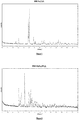
- Figur 1
- zeigt das Röntgendiffraktogramm von erfindungsgemäß nach Herstellungsbeispiel 1 hergestelltem kristallwasserfreiem Fe2P2O7.
- Figur 2
- zeigt das Röntgendiffraktogramm von erfindungsgemäß nach Herstellungsbeispiel 2 hergestelltem Phasengemisch von kristallwasserfreiem Mg1,5Fe1,5(PO4)2 und Fe3(PO4)2.
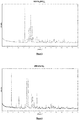
- Figur 3
- zeigt das Röntgendiffraktogramm von erfindungsgemäß nach Herstellungsbeispiel 3 hergestelltem kristallwasserfreiem Fe3(PO4)2.
- Figur 4
- zeigt das Röntgendiffraktogramm von erfindungsgemäß nach Herstellungsbeispiel 4 hergestelltem kristallwasserfreiem KFe(PO4).
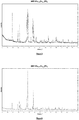
- Figur 5
- zeigt das Röntgendiffraktogramm von erfindungsgemäß nach Herstellungsbeispiel 5 hergestelltem kristallwasserfreiem KFe0,90Zn0,10(PO4).
- Figur 6
- zeigt das Röntgendiffraktogramm von erfindungsgemäß nach Herstellungsbeispiel 6 hergestelltem kristallwasserfreiem KFe0,75Zn0,25(PO4).
- Figur 7
- zeigt das Röntgendiffraktogramm von erfindungsgemäß nach Herstellungsbeispiel 7 hergestelltem kristallwasserfreiem KFe0,75Mn0,25(PO4).
- Figur 8
- zeigt das Röntgendiffraktogramm von erfindungsgemäß nach Herstellungsbeispiel 8 hergestelltem kristallwasserfreiem BaFeP2O7.
- Figur 9
- zeigt die Partikelgrößenverteilung von erfindungsgemäß nach Herstellungsbeispiel 3 hergestelltem kristallwasserfreiem Fe3(PO4)2.
- Von den gemäß den nachfolgenden Beispielen hergestellten Produkten wurden Röntgenbeugungsmessungen (XRD) an einem Diffraktometer des Typs D8 Advance A25 (Firma Bruker) unter Verwendung von CuKα-Strahlung durchgeführt.
- Die Produkte und deren Kristallstrukturen wurden anhand entsprechender Referenzdiffraktogramme (Powder Diffraction Files; PDF) der Datenbank des ICDD (International Centre for Diffraction Data), vormals JCPDS (Joint Committee on Powder Diffraction Standards) identifiziert. Sofern für die hergestellten Produkte keine PDF-Karten zur Verfügung standen, wurden PDF-Karten isotyper Verbindungen (= Verbindungen vom gleichen Strukturtyp) verwendet.
- Zur Ermittlung und Bestätigung der Stöchiometrien der hergestellten Produkte wurden Elementaranalysen mittels Röntgenfluoreszenzanalyse (XRF) unter Verwendung des Spektrometers Axios FAST (Firma PANalytical) durchgeführt.
- Zur Bestimmung der mittleren Korngrößen können vom Fachmann gängige Methoden wie Lichtstreuung oder mikroskopische Verfahren genutzt werden. Die hierin angegebenen erfindungsgemäßen mittleren Korngrößen (Partikelgrößen) wurden mit einem Laser-Teilchengrößenmessgerät (Modell LA-950V2 der Firma Horiba; Softwareversion 7.2) bestimmt.
- Eine Suspension aus
- i) 35,5 kg Eisen(III)-Oxidhydroxid [FeO(OH) bzw. Fe2O3 1H2O],
- ii) 16,5 kg 98%iger Phosphonsäure [H3PO3],
- iii) 26,5 kg 75%iger Phosphorsäure [H3PO4] und
- Eine Suspension aus
- i) 8,45 kg Eisen(III)-Oxidhydroxid [FeO(OH) bzw. Fe2O3 1H2O],
- ii) 7,95 kg 98%iger Phosphonsäure [H3PO3],
- iii) 19,6 kg Eisen(III)-Phosphat-Dihydrat [FePO4 2H2O],
- iv) 8,43 kg Magnesiumcarbonat [MgCO3] und
- Eine Suspension aus
- i) 21,75 kg Eisen(III)-Oxidhydroxid [FeO(OH) bzw. Fe2O3 1H2O],
- ii) 12,15 kg 98%iger Phosphonsäure [H3PO3],
- iii) 10,3 kg Eisen(III)-Phosphat-Dihydrat [FePO4 2H2O] und
- Eine Suspension aus
- i) 11,80 kg Eisen(III)-Oxidhydroxid [FeO(OH) bzw. Fe2O3 1H2O],
- ii) 10,70 kg 98%iger Phosphonsäure [H3PO3],
- iii) 24,8 kg Eisen(III)-Phosphat-Dihydrat [FePO4 2H2O]
- IV) 29,8 kg 50%iger Kalilauge [KOH]
- V) 1,0 kg 75%iger Phosphorsäure [H3PO4] und
- Eine Suspension aus
- i) 10,60 kg Eisen(III)-Oxidhydroxid [FeO(OH) bzw. Fe2O3 1H2O],
- ii) 9,65 kg 98%iger Phosphonsäure [H3PO3],
- iii) 22,30 kg Eisen(III)-Phosphat-Dihydrat [FePO4 2H2O]
- IV) 2,15 kg Zinkoxid [ZnO]
- IV) 29,8 kg 50%iger Kalilauge [KOH]
- V) 4,15 kg 75%iger Phosphorsäure [H3PO4] und
- Eine Suspension aus
- i) 8,85 kg Eisen(III)-Oxidhydroxid [FeO(OH) bzw. Fe2O3 1H2O],
- ii) 8,05 kg 98%iger Phosphonsäure [H3PO3],
- iii) 18,60 kg Eisen(III)-Phosphat-Dihydrat [FePO4 2H2O]
- IV) 5,40 kg Zinkoxid [ZnO]
- IV) 29,8 kg 50%iger Kalilauge [KOH]
- V) 9,30 kg 75%iger Phosphorsäure [H3PO4] und
- Eine Suspension aus
- i) 8,85 kg Eisen(III)-Oxidhydroxid [FeO(OH) bzw. Fe2O3 1H2O],
- ii) 8,05 kg 98%iger Phosphonsäure [H3PO3],
- iii) 18,60 kg Eisen(III)-Phosphat-Dihydrat [FePO4 2H2O]
- IV) 8,85 kg Mangancarbonat-Hydrat [MnCO3 H2O]
- IV) 29,8 kg 50%iger Kalilauge [KOH]
- V) 9,30 kg 75%iger Phosphorsäure [H3PO4] und
- Eine Suspension aus
- i) 8,70 kg Eisen(III)-Oxidhydroxid [FeO(OH) bzw. Fe2O3 1H2O],
- ii) 8,20 kg 98%iger Phosphonsäure [H3PO3],
- iii) 19,05 kg Eisen(III)-Phosphat-Dihydrat [FePO4 2H2O]
- IV) 63,09 kg Bariumhydroxid-Oktahydrat [Ba(OH)2 8H2O]
- V) 26,15 kg 75%iger Phosphorsäure [H3PO4] und
wurde sprühgranuliert. Das so erhaltene Granulat wurde in einem Drehrohrofen bei einer mittleren Verweilzeit von 4 h unter Formiergasatmosphäre (5 Vol-% H2 in N2) bei 700°C temperaturbehandelt. Man erhielt ein fast farbloses bis zart rosafarbenes Produkt. Das Röntgendiffraktogramm (XRD) des Produkts ist in
wurde sprühgranuliert. Das so erhaltene Granulat wurde in einem Drehrohrofen bei einer mittleren Verweilzeit von 3 h unter Formiergasatmosphäre (5 Vol-% H2 in N2) bei 750°C temperaturbehandelt. Man erhielt ein fast farbloses Produkt. Das Röntgendiffraktogramm (XRD) des Produkts ist in
wurde sprühgranuliert. Das so erhaltene Granulat wurde in einem Drehrohrofen bei einer mittleren Verweilzeit von 90 Minuten unter Formiergasatmosphäre (5 Vol-% H2 in N2) bei 750°C temperaturbehandelt. Man erhielt ein fast farbloses Produkt. Das Röntgendiffraktogramm (XRD) des Produkts ist in
wurde sprühgranuliert. Das so erhaltene Granulat wurde in einem Drehrohrofen bei einer mittleren Verweilzeit von 3 h unter Formiergasatmosphäre (5 Vol-% H2 in N2) bei 650°C temperaturbehandelt. Man erhielt ein blass hellgrünes Produkt. Das Röntgendiffraktogramm (XRD) des Produkts ist in
wurde sprühgranuliert. Das so erhaltene Granulat wurde in einem Drehrohrofen bei einer mittleren Verweilzeit von 2 h unter Formiergasatmosphäre (5 Vol-% H2 in N2) bei 600°C temperaturbehandelt. Man erhielt ein hellgraues Produkt. Das Röntgendiffraktogramm (XRD) des Produkts ist in
wurde sprühgranuliert. Das so erhaltene Granulat wurde in einem Drehrohrofen bei einer mittleren Verweilzeit von 2 h unter Formiergasatmosphäre (5 Vol-% H2 in N2) bei 600°C temperaturbehandelt. Man erhielt ein hellgraues Produkt. Das Röntgendiffraktogramm (XRD) des Produkts ist in
wurde sprühgranuliert. Das so erhaltene Granulat wurde in einem Drehrohrofen bei einer mittleren Verweilzeit von 2 h unter Formiergasatmosphäre (5 Vol-% H2 in N2) bei 600°C temperaturbehandelt. Man erhielt ein hellgraues Produkt. Das Röntgendiffraktogramm (XRD) des Produkts ist in
wurde sprühgranuliert. Das so erhaltene Granulat wurde in einem Drehrohrofen bei einer mittleren Verweilzeit von 4 h unter Formiergasatmosphäre (5 Vol-% H2 in N2) bei 800°C temperaturbehandelt. Man erhielt ein hellgraues Produkt. Das Röntgendiffraktogramm (XRD) des Produkts ist in
Claims (10)
- Verfahren zur Herstellung von- kristallwasserfreiem Eisen(II)-Orthophosphat der allgemeinen Formel Fe3(PO4)2 oder- kristallwasserfreiem Eisen(II)-Metall-Orthophosphat, Eisen(II)-Metall-Pyrophosphat oder Eisen(II)-Metall-Metaphosphat der allgemeinen Formel FeaMetb(POc)d, worin a eine Zahl von 1 bis 5 ist, b eine Zahl von >0 bis 5 ist, c eine Zahl von 2,5 bis 5 ist, d eine Zahl von 0,5 bis 3 ist und wobei Met ein oder mehrere Metalle repräsentiert, ausgewählt aus der Gruppe, bestehend aus K, Rb, Cs, Mg, Ca, Sr, Ba, den Übergangsmetallen (d-Block), insbesondere Sc, Y, La, Ti, Zr, Hf, Nb, Ta, Cr, Mo, W, Mn, Cu, Zn, sowie den Metallen und Halbmetallen der dritten, vierten und fünften Hauptgruppe, insbesondere B, Al, Ga, In, Si, Sn, Sb, Bi, und den Lanthanoiden,mit den Stufen:
oder Kombinationen der vorgenannten Phosphatea) Herstellen eines Gemisches, enthaltend:i) Eisenverbindung (A), ausgewählt unter Fe(III)-Verbindungen, Fe(III)/Fe(II)-Verbindungen und Gemischen davon, in einem Anteil von 20 bis 90 Gew.-% des Gemisches, ausgewählt aus der Gruppe bestehend aus Oxiden, Hydroxiden, Oxidhydroxiden, Carbonaten, Carboxylaten wie Oxalaten, Formiaten, Acetaten, Citraten, Lactaten, Orthophosphaten, Phosphonaten, Metaphosphaten, Pyrophosphaten, Sulfaten und Gemischen der vorgenannten,ii) Reduktionsmittel (B) in einem Anteil von 5 bis 50 Gew.-% des Gemisches, ausgewählt aus der Gruppe, bestehend aus Phosphonsäure [H3PO3], Phosphortrioxid [P2O3], Phosphinsäure [H3PO2], Phosphortetraoxid [P2O4], Hypodiphosphorsäure [H4P2O6], Diphosphonsäure [H4P2O5], Hypodiphosphonsäure [H4P2O4], Fe-Salzen und Met-Salzen der vorgenannten Säuren und Gemischen der vorgenannten, als Feststoffe oder wässrige Lösung oder Suspension,iii) optional Phosphatdonor (C) in einem Anteil von 0 bis 50 Gew.-% des Gemisches, ausgewählt unter Phosphorsäure [H3PO4] als wässrige Lösung, Metallphosphat [Metx(PO4)z] oder saures Metallphosphat [MetxHY(PO4)z] mit 1≥x≥4, 1≥y≥5 und 1≥z≥4 als Feststoff oder wässrige Lösung oder Suspension, Diphosphorsäure [H4P2O7], Metaphosphorsäure [(HPO3)n] mit n≥3 oder deren Salze, Phosphorpentoxid [P2O5] oder Gemische der vorgenannten, wobei Met wie oben definiert ist,iv) optional Metal (Met)-Donor (D) in einem Anteil von 0 bis 50 Gew.-% des Gemisches, ausgewählt unter Metallverbindungen von einem oder mehreren Metallen aus der Gruppe, bestehend aus K, Rb, Cs, Mg, Ca, Sr, Ba, den Übergangsmetallen (d-Block), insbesondere Sc, Y, La, Ti, Zr, Hf, Nb, Ta, Cr, Mo, W, Mn, Cu, Zn, sowie den Metallen und Halbmetallen der dritten, vierten und fünften Hauptgruppe, insbesondere B, Al, Ga, In, Si, Sn, Sb, Bi, und den Lanthanoiden, und ausgewählt unter Oxiden, Hydroxiden, Oxidhydroxiden, Carbonaten, Oxalaten, Formiaten, Acetaten, Citraten, Lactaten, Orthophosphaten, Pyrophosphaten und Sulfaten der vorgenannten Metalle und Gemischen davon,wobei sich die Gewichtsanteile der Bestandteile (A) bis (D) des Gemisches auf die Anteile der Stoffe ohne Lösungsmittel und/oder Suspendiermittel beziehen,b) das erhaltene Gemisch, sofern wässriges und/oder organisches Lösungsmittel enthalten ist, bei einer Temperatur von weniger als 400°C trocknet,c) das trockene oder getrocknete Gemisch bei einer Temperatur im Bereich von 400 bis 1200°C behandelt. - Verfahren nach einem der vorausgehenden Ansprüche, dadurch gekennzeichnet, dass das Trocknen in Stufe b) durch konvektives Trocknen, bevorzugt durch Sprühtrocknen, bei einer Temperatur im Bereich von 100 bis 400°C, vorzugsweise im Bereich von 110 bis 350°C, besonders bevorzugt im Bereich von 150 bis 270°C erfolgt.
- Verfahren nach einem der vorausgehenden Ansprüche, dadurch gekennzeichnet, dass man die Temperaturbehandlung in Stufe c) unter Inertgasatmosphäre oder reduzierender Gasatmosphäre, vorzugweise in Formiergasatmosphäre mit ≤ 5 Vol-% H2 in N2 oder in Edelgasatmosphäre durchführt.
- Verfahren nach einem der vorausgehenden Ansprüche, dadurch gekennzeichnet, dass man die Temperaturbehandlung in Stufe c) im Drehrohrofen durchführt.
- Verfahren nach einem der vorausgehenden Ansprüche, dadurch gekennzeichnet, dass man die Temperaturbehandlung in Stufe c) bei einer Temperatur im Bereich von 500 bis 1100°C, bevorzugt im Bereich von 600 bis 1000°C, besonders bevorzugt von 700 bis 800°C durchführt.
- Verfahren nach einem der vorausgehenden Ansprüche, dadurch gekennzeichnet, dass das Eisen(II)-Phosphat kristallwasserfreies Eisen(II)-Orthophosphat der allgemeinen Formel Fe3(PO4)2 ist und die Graftonit-Kristallstruktur aufweist.
- Verfahren nach einem der Ansprüche 1 bis 5, dadurch gekennzeichnet, dass das Eisen(II)-Phosphat gemischtmetallisches kristallwasserfreies Eisen(II)-Metall-Orthophosphat der allgemeinen Formel FeaMetb(POc)d ist, wobei Met eines oder eine Kombination der Metalle Kalium (K), Magnesium (Mg) und Zink (Zn) repräsentiert, vorzugsweise Kalium (K) alleine oder in Kombination mit entweder Magnesium (Mg) oder Zink (Zn), wobei das Eisen(II)-Metall-Orthophosphat besonders bevorzugt KFePO4, K(Fe0,90Zn0,10)PO4, K(Fe0,75Mn0,25)PO4, K(Fe0,75Zn0,25)PO4 oder K(Fe0,75M90,25)PO4 ist.
- Verfahren nach einem der Ansprüche 1 bis 5, dadurch gekennzeichnet, dass das Eisen(II)-Phosphat gemischtmetallisches kristallwasserfreies Eisen(II)-Metall-Pyrophosphat der allgemeinen Formel FeaMetb(P2O7)d ist, wobei Met eines oder eine Kombination der Metalle Calcium (Ca), Strontium (Sr) und Barium (Ba) repräsentiert, wobei das Eisen(II)-Metall- Pyrophosphat besonders bevorzugt CaFeP2O7, SrFeP2O7 oder BaFeP2O7 ist.
- Verfahren nach einem der vorausgehenden Ansprüche, dadurch gekennzeichnet, dass die als Eisenverbindung (A) eingesetzten Fe(III)- und/oder Fe(III)/Fe(II)-Verbindungen unter Oxiden, Oxidhydroxiden, Hydroxiden, Orthophosphaten, Pyrophosphaten, Metaphosphaten und Sulfaten ausgewählt sind.
- Verfahren nach einem der vorausgehenden Ansprüche, dadurch gekennzeichnet, dass das nach der Temperaturbehandlung in Stufe c) erhaltene Produkt in seiner Partikelgröße eingestellt wird, bevorzugt auf eine Partikelgröße (d50) < 150 µm, besonders bevorzugt (d50) < 30 µm, ganz besonders bevorzugt (d50) < 4 µm.
Applications Claiming Priority (2)
| Application Number | Priority Date | Filing Date | Title |
|---|---|---|---|
| DE102017106912.7A DE102017106912A1 (de) | 2017-03-30 | 2017-03-30 | Verfahren zur Herstellung von Fe(II)P / Fe(II)MetP-Verbindungen |
| PCT/EP2018/057660 WO2018178021A1 (de) | 2017-03-30 | 2018-03-26 | Verfahren zur herstellung von fe(ii)p / fe(ii)metp-verbindungen |
Publications (2)
| Publication Number | Publication Date |
|---|---|
| EP3601160A1 EP3601160A1 (de) | 2020-02-05 |
| EP3601160B1 true EP3601160B1 (de) | 2021-02-17 |
Family
ID=61899222
Family Applications (1)
| Application Number | Title | Priority Date | Filing Date |
|---|---|---|---|
| EP18715570.0A Active EP3601160B1 (de) | 2017-03-30 | 2018-03-26 | Verfahren zur herstellung von fe(ii)p / fe(ii)metp-verbindungen |
Country Status (11)
| Country | Link |
|---|---|
| US (1) | US10793437B2 (de) |
| EP (1) | EP3601160B1 (de) |
| JP (1) | JP6770205B2 (de) |
| CN (1) | CN110475746B (de) |
| BR (1) | BR112019017125A2 (de) |
| DE (1) | DE102017106912A1 (de) |
| EA (1) | EA201992301A1 (de) |
| ES (1) | ES2858462T3 (de) |
| MX (1) | MX2019011650A (de) |
| PH (1) | PH12019502215A1 (de) |
| WO (1) | WO2018178021A1 (de) |
Families Citing this family (9)
| Publication number | Priority date | Publication date | Assignee | Title |
|---|---|---|---|---|
| DE102017106913A1 (de) | 2017-03-30 | 2018-10-04 | Chemische Fabrik Budenheim Kg | Verfahren zur Herstellung von elektrisch leitenden Strukturen auf einem Trägermaterial |
| DE102017106911A1 (de) | 2017-03-30 | 2018-10-04 | Chemische Fabrik Budenheim Kg | Verwendung von kristallwasserfreien Fe(II)-Verbindungen als Strahlungsabsorber |
| CN111874885B (zh) * | 2020-07-31 | 2022-09-06 | 合肥国轩高科动力能源有限公司 | 一种改性磷酸铁的制备方法及应用 |
| CN114433154B (zh) * | 2020-10-31 | 2023-09-01 | 中国石油化工股份有限公司 | 一种钒磷氧催化剂前驱体的制备方法,及由其制备的催化剂和应用 |
| CN112411251B (zh) * | 2020-11-20 | 2022-09-23 | 河南中烟工业有限责任公司 | 一种包灰助剂、制备方法及包灰卷烟纸 |
| EP3988320A1 (de) | 2021-12-20 | 2022-04-27 | Sicpa Holding SA | Sicherheitsmarkierung, entsprechende gravierte tiefdruckplatte, verfahren und vorrichtungen zur herstellung, codierung/decodierung und authentifizierung der sicherheitsmarkierung |
| CN114275753A (zh) * | 2022-01-21 | 2022-04-05 | 上海太洋科技有限公司 | 一种高纯度偏磷酸铜的制备方法 |
| CN116553508B (zh) * | 2023-05-05 | 2025-04-25 | 南昌大学 | 一种含Fe或In单相高熵稀土基陶瓷催化剂、其制备方法及其应用 |
| CN116924376B (zh) * | 2023-09-18 | 2023-11-28 | 贝特瑞(天津)纳米材料制造有限公司 | 一种基于双峰粒度磷酸铁制备高压实、高导电性磷酸铁锂的方法 |
Family Cites Families (31)
| Publication number | Priority date | Publication date | Assignee | Title |
|---|---|---|---|---|
| DE3917294A1 (de) | 1989-05-27 | 1990-11-29 | Huels Chemische Werke Ag | Mit laserlicht beschriftbare hochpolymere materialien |
| US5302362A (en) * | 1992-04-10 | 1994-04-12 | Uop | Crystalline microporous metallo-zinc phosphate compositions |
| US5939039A (en) | 1997-01-16 | 1999-08-17 | Orthovita, Inc. | Methods for production of calcium phosphate |
| DE19723734C2 (de) | 1997-06-06 | 2002-02-07 | Gerhard Naundorf | Leiterbahnstrukturen auf einem nichtleitenden Trägermaterial und Verfahren zu ihrer Herstellung |
| US6383519B1 (en) | 1999-01-26 | 2002-05-07 | Vita Special Purpose Corporation | Inorganic shaped bodies and methods for their production and use |
| EP1191127B1 (de) | 2000-09-26 | 2004-10-13 | Enthone-OMI (Deutschland) GmbH | Verfahren zur selektiven Metallisierung dielektrischer Materialien |
| DE10053639B4 (de) | 2000-10-28 | 2007-04-12 | Chemische Fabrik Budenheim Kg | Verwendung von Eisen-, Cobalt-, Nickel- oder Molybdänsalzen |
| DE10132092A1 (de) | 2001-07-05 | 2003-01-23 | Lpkf Laser & Electronics Ag | Leiterbahnstrukturen und Verfahren zu ihrer Herstellung |
| DE10356334B4 (de) | 2003-11-28 | 2016-02-11 | Sachtleben Chemie Gmbh | Verwendung von thermoplastischen, polymeren Werkstoffen mit hoher IR-Absorption |
| DK1790701T4 (da) | 2005-11-25 | 2012-04-02 | Sicpa Holding Sa | IR-absorberende dybtryksfarve |
| DE102006038043A1 (de) | 2006-08-14 | 2008-02-21 | Chemische Fabrik Budenheim Kg | Laserbeschriftbares Polymermaterial |
| DE102007012724A1 (de) | 2007-03-16 | 2008-09-18 | Basf Se | Polynäres Metalloxidphosphat |
| DE102007012725A1 (de) | 2007-03-16 | 2008-09-18 | Basf Se | Polynäres Metalloxidphosphat |
| DE102007012723A1 (de) | 2007-03-16 | 2008-09-18 | Basf Se | Polynäres Vanadylpyrophosphat |
| US8168329B2 (en) * | 2007-06-18 | 2012-05-01 | Advanced Lithium Electrochemistry Co., Ltd. | Electrochemical composition and associated technology |
| TWI474970B (zh) | 2008-12-29 | 2015-03-01 | Basf Se | 於水熱條件下合成鋰-金屬-磷酸鹽 |
| DE102009001204A1 (de) * | 2009-02-26 | 2010-09-02 | Chemische Fabrik Budenheim Kg | Herstellung von Eisenorthophosphat |
| DE102009001335A1 (de) | 2009-03-04 | 2010-09-09 | Chemische Fabrik Budenheim Kg | Strahlung absorbierendes Material |
| CN101659406B (zh) * | 2009-09-25 | 2011-05-11 | 四川大学 | 由磷铁制备磷酸铁的方法 |
| US9139429B2 (en) * | 2010-03-02 | 2015-09-22 | Guiqing Huang | High performance cathode material LiFePO4, its precursors and methods of making thereof |
| EP2632689B2 (de) | 2010-10-26 | 2022-03-23 | Basell Poliolefine Italia S.r.l. | Verfahren zur herstellung von streckblasgeformten polyolefinbehältern |
| DE102011056815A1 (de) | 2011-12-21 | 2013-08-01 | Chemische Fabrik Budenheim Kg | Nährstoffzusammensetzung für biologische Systeme |
| DE102013100583A1 (de) | 2013-01-21 | 2014-07-24 | Chemische Fabrik Budenheim Kg | Suszeptorsysteme für Verpackungsmaterialien |
| CN103466583B (zh) * | 2013-08-29 | 2016-05-11 | 黄靖元 | 一种磷铁氧化渣制取磷酸铁的方法 |
| DE102013112387B3 (de) | 2013-11-11 | 2014-12-24 | Chemische Fabrik Budenheim Kg | Dotiertes Kupfer-II-Hydroxid-Phosphat, Verfahren zu dessen Herstellung und Verwendung |
| KR101825589B1 (ko) | 2013-11-27 | 2018-02-05 | 사빅 글로벌 테크놀러지스 비.브이. | 개선된 도금 성능을 갖는 높은 탄성률 레이저 직접 구조화 폴리카보네이트 조성물들 및 반사 첨가제들에 의한 넓은 레이저 윈도우 |
| EP2886605B2 (de) | 2013-12-20 | 2021-09-01 | Ems-Chemie Ag | Kunststoffformmasse und deren Verwendung |
| KR101722744B1 (ko) | 2014-10-23 | 2017-04-03 | 주식회사 엘지화학 | 전자기파 조사에 의한 도전성 패턴 형성용 조성물, 이를 사용한 도전성 패턴 형성 방법과, 도전성 패턴을 갖는 수지 구조체 |
| CN105899609B (zh) | 2014-12-01 | 2018-03-13 | Lg化学株式会社 | 聚碳酸酯树脂组合物及其制备方法 |
| CN107646047B (zh) | 2015-05-28 | 2020-07-31 | 帝斯曼知识产权资产管理有限公司 | 热塑性聚合物组合物、由其制成的制品及其制备方法 |
| DE102017106913A1 (de) * | 2017-03-30 | 2018-10-04 | Chemische Fabrik Budenheim Kg | Verfahren zur Herstellung von elektrisch leitenden Strukturen auf einem Trägermaterial |
-
2017
- 2017-03-30 DE DE102017106912.7A patent/DE102017106912A1/de not_active Withdrawn
-
2018
- 2018-03-26 CN CN201880023246.7A patent/CN110475746B/zh active Active
- 2018-03-26 EA EA201992301A patent/EA201992301A1/ru unknown
- 2018-03-26 JP JP2019553906A patent/JP6770205B2/ja active Active
- 2018-03-26 BR BR112019017125A patent/BR112019017125A2/pt not_active Application Discontinuation
- 2018-03-26 ES ES18715570T patent/ES2858462T3/es active Active
- 2018-03-26 MX MX2019011650A patent/MX2019011650A/es unknown
- 2018-03-26 WO PCT/EP2018/057660 patent/WO2018178021A1/de not_active Ceased
- 2018-03-26 EP EP18715570.0A patent/EP3601160B1/de active Active
- 2018-03-26 US US16/498,645 patent/US10793437B2/en active Active
-
2019
- 2019-09-25 PH PH12019502215A patent/PH12019502215A1/en unknown
Non-Patent Citations (1)
| Title |
|---|
| None * |
Also Published As
| Publication number | Publication date |
|---|---|
| JP2020512265A (ja) | 2020-04-23 |
| DE102017106912A1 (de) | 2018-10-04 |
| EP3601160A1 (de) | 2020-02-05 |
| BR112019017125A2 (pt) | 2020-04-14 |
| CN110475746A (zh) | 2019-11-19 |
| US20200095127A1 (en) | 2020-03-26 |
| WO2018178021A1 (de) | 2018-10-04 |
| EA201992301A1 (ru) | 2019-12-30 |
| JP6770205B2 (ja) | 2020-10-14 |
| US10793437B2 (en) | 2020-10-06 |
| MX2019011650A (es) | 2019-12-19 |
| ES2858462T3 (es) | 2021-09-30 |
| PH12019502215A1 (en) | 2020-07-06 |
| CN110475746B (zh) | 2020-10-20 |
Similar Documents
| Publication | Publication Date | Title |
|---|---|---|
| EP3601160A1 (de) | Verfahren zur herstellung von fe(ii)p / fe(ii)metp-verbindungen | |
| EP2401228B1 (de) | Herstellung von eisenorthophosphat | |
| EP2802531B1 (de) | Kondensierte eisen (iiii) phosphate | |
| WO2013093017A2 (de) | Metallphosphate und verfahren zu deren herstellung | |
| WO2008113731A2 (de) | Polynäres metalloxidphosphat | |
| DE3311681A1 (de) | Verfahren zur herstellung einer oxidationskatalysator-zusammensetzung | |
| EP2137104A2 (de) | Polynäres vanadylpyrophosphat | |
| DE68905893T2 (de) | Verfahren zur Herstellung eines kristallinen Vanadium-Phosphoroxids und dieses kristalline Oxid enthaltender Katalysator. | |
| DE1966747B2 (de) | Verfahren zur Herstellung von Titan- und/oder Zirkonoxid unter gleichzeitiger Gewinnung von Phosphor und metallischem Titan und/oder Zirken | |
| EP2137103A2 (de) | Polynäres metalloxidposphat | |
| WO2008113729A2 (de) | Polynäres metall-vanadiumoxidphosphat | |
| DE2012902A1 (de) | Verfahren zur Herstellung Phosphorsauerstoffsäuresalzen von Metallen der Gruppe IVa des Periodensystems | |
| DE10015365C2 (de) | Mischkatalysator aus Oxovanadiumdiphosphat und weiteren Komponenten | |
| HK40018383A (en) | Method for the preparation of fe(ii)p / fe(ii)metp compounds | |
| Legrouri et al. | Preparation and thermal properties of a series of mixed calcium-cobalt phosphates | |
| DE102012012317A1 (de) | Verfahren zur Regeneration eines Katalysators zur Herstellung von Methacrylsäure und Verfahren zur Herstellung von Methacrylsäure | |
| DE2828700C2 (de) | Verfahren zur Herstellung von Barium- bzw. Strontium-Ferriten | |
| WO2025262224A1 (de) | Verfahren und vorrichtung zur herstellung eines natriumhaltigen batteriematerials | |
| EP4438560A1 (de) | Verfahren zur herstellung von eisenchlorid und aluminiumchlorid aus klärschlammaschen | |
| DE3032152A1 (de) | Verfahren zur herstellung eines phosphor-vanadin-sauerstoff-komplex-katalysators | |
| DE1202768B (de) | Verfahren zur Herstellung eines mindestens etwa 25 Gewichtsprozent Alkalitrimetaphosphat enthaltenden Alkalipolyphosphatproduktes | |
| DE3040194A1 (de) | Verfahren zur herstellung von phosphor-vanadium-sauerstoff-katalysatorkomplexen zur erzeugung von maleinsaeureanhydrid | |
| DE19724613A1 (de) | Verfahren zur Herstellung von Natriumtrimetaphosphat | |
| WO2013068898A1 (de) | Silber-vanadiumphosphate |
Legal Events
| Date | Code | Title | Description |
|---|---|---|---|
| STAA | Information on the status of an ep patent application or granted ep patent |
Free format text: STATUS: UNKNOWN |
|
| STAA | Information on the status of an ep patent application or granted ep patent |
Free format text: STATUS: THE INTERNATIONAL PUBLICATION HAS BEEN MADE |
|
| PUAI | Public reference made under article 153(3) epc to a published international application that has entered the european phase |
Free format text: ORIGINAL CODE: 0009012 |
|
| STAA | Information on the status of an ep patent application or granted ep patent |
Free format text: STATUS: REQUEST FOR EXAMINATION WAS MADE |
|
| 17P | Request for examination filed |
Effective date: 20191015 |
|
| AK | Designated contracting states |
Kind code of ref document: A1 Designated state(s): AL AT BE BG CH CY CZ DE DK EE ES FI FR GB GR HR HU IE IS IT LI LT LU LV MC MK MT NL NO PL PT RO RS SE SI SK SM TR |
|
| AX | Request for extension of the european patent |
Extension state: BA ME |
|
| RIN1 | Information on inventor provided before grant (corrected) |
Inventor name: ENGERS, DAVID Inventor name: EICH, GERHARD Inventor name: ADOLF, JOACHIM Inventor name: BRAUN, DOMINIK Inventor name: LITTERSCHEID, CHRISTIAN Inventor name: WISSEMBORSKI, RUEDIGER Inventor name: EWALD, BASTIAN |
|
| DAV | Request for validation of the european patent (deleted) | ||
| DAX | Request for extension of the european patent (deleted) | ||
| STAA | Information on the status of an ep patent application or granted ep patent |
Free format text: STATUS: EXAMINATION IS IN PROGRESS |
|
| 17Q | First examination report despatched |
Effective date: 20200717 |
|
| GRAP | Despatch of communication of intention to grant a patent |
Free format text: ORIGINAL CODE: EPIDOSNIGR1 |
|
| STAA | Information on the status of an ep patent application or granted ep patent |
Free format text: STATUS: GRANT OF PATENT IS INTENDED |
|
| INTG | Intention to grant announced |
Effective date: 20201021 |
|
| GRAS | Grant fee paid |
Free format text: ORIGINAL CODE: EPIDOSNIGR3 |
|
| RIN1 | Information on inventor provided before grant (corrected) |
Inventor name: WISSEMBORSKI, RUEDIGER Inventor name: EWALD, BASTIAN Inventor name: BRAUN, DOMINIK Inventor name: ADOLF, JOACHIM Inventor name: EICH, GERHARD Inventor name: LITTERSCHEID, CHRISTIAN Inventor name: ENGERS, DAVID |
|
| GRAA | (expected) grant |
Free format text: ORIGINAL CODE: 0009210 |
|
| STAA | Information on the status of an ep patent application or granted ep patent |
Free format text: STATUS: THE PATENT HAS BEEN GRANTED |
|
| AK | Designated contracting states |
Kind code of ref document: B1 Designated state(s): AL AT BE BG CH CY CZ DE DK EE ES FI FR GB GR HR HU IE IS IT LI LT LU LV MC MK MT NL NO PL PT RO RS SE SI SK SM TR |
|
| REG | Reference to a national code |
Ref country code: GB Ref legal event code: FG4D Free format text: NOT ENGLISH |
|
| REG | Reference to a national code |
Ref country code: CH Ref legal event code: NV Representative=s name: ISLER AND PEDRAZZINI AG, CH Ref country code: CH Ref legal event code: EP |
|
| REG | Reference to a national code |
Ref country code: DE Ref legal event code: R096 Ref document number: 502018003920 Country of ref document: DE |
|
| REG | Reference to a national code |
Ref country code: AT Ref legal event code: REF Ref document number: 1361226 Country of ref document: AT Kind code of ref document: T Effective date: 20210315 |
|
| REG | Reference to a national code |
Ref country code: IE Ref legal event code: FG4D Free format text: LANGUAGE OF EP DOCUMENT: GERMAN |
|
| REG | Reference to a national code |
Ref country code: NL Ref legal event code: FP |
|
| REG | Reference to a national code |
Ref country code: LT Ref legal event code: MG9D |
|
| PG25 | Lapsed in a contracting state [announced via postgrant information from national office to epo] |
Ref country code: PT Free format text: LAPSE BECAUSE OF FAILURE TO SUBMIT A TRANSLATION OF THE DESCRIPTION OR TO PAY THE FEE WITHIN THE PRESCRIBED TIME-LIMIT Effective date: 20210617 Ref country code: NO Free format text: LAPSE BECAUSE OF FAILURE TO SUBMIT A TRANSLATION OF THE DESCRIPTION OR TO PAY THE FEE WITHIN THE PRESCRIBED TIME-LIMIT Effective date: 20210517 Ref country code: LT Free format text: LAPSE BECAUSE OF FAILURE TO SUBMIT A TRANSLATION OF THE DESCRIPTION OR TO PAY THE FEE WITHIN THE PRESCRIBED TIME-LIMIT Effective date: 20210217 Ref country code: BG Free format text: LAPSE BECAUSE OF FAILURE TO SUBMIT A TRANSLATION OF THE DESCRIPTION OR TO PAY THE FEE WITHIN THE PRESCRIBED TIME-LIMIT Effective date: 20210517 Ref country code: FI Free format text: LAPSE BECAUSE OF FAILURE TO SUBMIT A TRANSLATION OF THE DESCRIPTION OR TO PAY THE FEE WITHIN THE PRESCRIBED TIME-LIMIT Effective date: 20210217 Ref country code: GR Free format text: LAPSE BECAUSE OF FAILURE TO SUBMIT A TRANSLATION OF THE DESCRIPTION OR TO PAY THE FEE WITHIN THE PRESCRIBED TIME-LIMIT Effective date: 20210518 Ref country code: HR Free format text: LAPSE BECAUSE OF FAILURE TO SUBMIT A TRANSLATION OF THE DESCRIPTION OR TO PAY THE FEE WITHIN THE PRESCRIBED TIME-LIMIT Effective date: 20210217 |
|
| PG25 | Lapsed in a contracting state [announced via postgrant information from national office to epo] |
Ref country code: SE Free format text: LAPSE BECAUSE OF FAILURE TO SUBMIT A TRANSLATION OF THE DESCRIPTION OR TO PAY THE FEE WITHIN THE PRESCRIBED TIME-LIMIT Effective date: 20210217 Ref country code: RS Free format text: LAPSE BECAUSE OF FAILURE TO SUBMIT A TRANSLATION OF THE DESCRIPTION OR TO PAY THE FEE WITHIN THE PRESCRIBED TIME-LIMIT Effective date: 20210217 Ref country code: PL Free format text: LAPSE BECAUSE OF FAILURE TO SUBMIT A TRANSLATION OF THE DESCRIPTION OR TO PAY THE FEE WITHIN THE PRESCRIBED TIME-LIMIT Effective date: 20210217 Ref country code: LV Free format text: LAPSE BECAUSE OF FAILURE TO SUBMIT A TRANSLATION OF THE DESCRIPTION OR TO PAY THE FEE WITHIN THE PRESCRIBED TIME-LIMIT Effective date: 20210217 |
|
| PG25 | Lapsed in a contracting state [announced via postgrant information from national office to epo] |
Ref country code: IS Free format text: LAPSE BECAUSE OF FAILURE TO SUBMIT A TRANSLATION OF THE DESCRIPTION OR TO PAY THE FEE WITHIN THE PRESCRIBED TIME-LIMIT Effective date: 20210617 |
|
| REG | Reference to a national code |
Ref country code: ES Ref legal event code: FG2A Ref document number: 2858462 Country of ref document: ES Kind code of ref document: T3 Effective date: 20210930 |
|
| PG25 | Lapsed in a contracting state [announced via postgrant information from national office to epo] |
Ref country code: EE Free format text: LAPSE BECAUSE OF FAILURE TO SUBMIT A TRANSLATION OF THE DESCRIPTION OR TO PAY THE FEE WITHIN THE PRESCRIBED TIME-LIMIT Effective date: 20210217 Ref country code: CZ Free format text: LAPSE BECAUSE OF FAILURE TO SUBMIT A TRANSLATION OF THE DESCRIPTION OR TO PAY THE FEE WITHIN THE PRESCRIBED TIME-LIMIT Effective date: 20210217 Ref country code: SM Free format text: LAPSE BECAUSE OF FAILURE TO SUBMIT A TRANSLATION OF THE DESCRIPTION OR TO PAY THE FEE WITHIN THE PRESCRIBED TIME-LIMIT Effective date: 20210217 |
|
| REG | Reference to a national code |
Ref country code: DE Ref legal event code: R097 Ref document number: 502018003920 Country of ref document: DE |
|
| PG25 | Lapsed in a contracting state [announced via postgrant information from national office to epo] |
Ref country code: MC Free format text: LAPSE BECAUSE OF FAILURE TO SUBMIT A TRANSLATION OF THE DESCRIPTION OR TO PAY THE FEE WITHIN THE PRESCRIBED TIME-LIMIT Effective date: 20210217 Ref country code: DK Free format text: LAPSE BECAUSE OF FAILURE TO SUBMIT A TRANSLATION OF THE DESCRIPTION OR TO PAY THE FEE WITHIN THE PRESCRIBED TIME-LIMIT Effective date: 20210217 Ref country code: RO Free format text: LAPSE BECAUSE OF FAILURE TO SUBMIT A TRANSLATION OF THE DESCRIPTION OR TO PAY THE FEE WITHIN THE PRESCRIBED TIME-LIMIT Effective date: 20210217 Ref country code: SK Free format text: LAPSE BECAUSE OF FAILURE TO SUBMIT A TRANSLATION OF THE DESCRIPTION OR TO PAY THE FEE WITHIN THE PRESCRIBED TIME-LIMIT Effective date: 20210217 |
|
| REG | Reference to a national code |
Ref country code: BE Ref legal event code: MM Effective date: 20210331 |
|
| PLBE | No opposition filed within time limit |
Free format text: ORIGINAL CODE: 0009261 |
|
| STAA | Information on the status of an ep patent application or granted ep patent |
Free format text: STATUS: NO OPPOSITION FILED WITHIN TIME LIMIT |
|
| 26N | No opposition filed |
Effective date: 20211118 |
|
| PG25 | Lapsed in a contracting state [announced via postgrant information from national office to epo] |
Ref country code: IE Free format text: LAPSE BECAUSE OF NON-PAYMENT OF DUE FEES Effective date: 20210326 Ref country code: AL Free format text: LAPSE BECAUSE OF FAILURE TO SUBMIT A TRANSLATION OF THE DESCRIPTION OR TO PAY THE FEE WITHIN THE PRESCRIBED TIME-LIMIT Effective date: 20210217 |
|
| PG25 | Lapsed in a contracting state [announced via postgrant information from national office to epo] |
Ref country code: SI Free format text: LAPSE BECAUSE OF FAILURE TO SUBMIT A TRANSLATION OF THE DESCRIPTION OR TO PAY THE FEE WITHIN THE PRESCRIBED TIME-LIMIT Effective date: 20210217 |
|
| PG25 | Lapsed in a contracting state [announced via postgrant information from national office to epo] |
Ref country code: IS Free format text: LAPSE BECAUSE OF FAILURE TO SUBMIT A TRANSLATION OF THE DESCRIPTION OR TO PAY THE FEE WITHIN THE PRESCRIBED TIME-LIMIT Effective date: 20210617 |
|
| PG25 | Lapsed in a contracting state [announced via postgrant information from national office to epo] |
Ref country code: BE Free format text: LAPSE BECAUSE OF NON-PAYMENT OF DUE FEES Effective date: 20210331 |
|
| PG25 | Lapsed in a contracting state [announced via postgrant information from national office to epo] |
Ref country code: CY Free format text: LAPSE BECAUSE OF FAILURE TO SUBMIT A TRANSLATION OF THE DESCRIPTION OR TO PAY THE FEE WITHIN THE PRESCRIBED TIME-LIMIT Effective date: 20210217 |
|
| P01 | Opt-out of the competence of the unified patent court (upc) registered |
Effective date: 20230530 |
|
| PG25 | Lapsed in a contracting state [announced via postgrant information from national office to epo] |
Ref country code: HU Free format text: LAPSE BECAUSE OF FAILURE TO SUBMIT A TRANSLATION OF THE DESCRIPTION OR TO PAY THE FEE WITHIN THE PRESCRIBED TIME-LIMIT; INVALID AB INITIO Effective date: 20180326 |
|
| PG25 | Lapsed in a contracting state [announced via postgrant information from national office to epo] |
Ref country code: MK Free format text: LAPSE BECAUSE OF FAILURE TO SUBMIT A TRANSLATION OF THE DESCRIPTION OR TO PAY THE FEE WITHIN THE PRESCRIBED TIME-LIMIT Effective date: 20210217 |
|
| PG25 | Lapsed in a contracting state [announced via postgrant information from national office to epo] |
Ref country code: TR Free format text: LAPSE BECAUSE OF FAILURE TO SUBMIT A TRANSLATION OF THE DESCRIPTION OR TO PAY THE FEE WITHIN THE PRESCRIBED TIME-LIMIT Effective date: 20210217 |
|
| PG25 | Lapsed in a contracting state [announced via postgrant information from national office to epo] |
Ref country code: MT Free format text: LAPSE BECAUSE OF FAILURE TO SUBMIT A TRANSLATION OF THE DESCRIPTION OR TO PAY THE FEE WITHIN THE PRESCRIBED TIME-LIMIT Effective date: 20210217 |
|
| PGFP | Annual fee paid to national office [announced via postgrant information from national office to epo] |
Ref country code: ES Payment date: 20250416 Year of fee payment: 8 |
|
| PGFP | Annual fee paid to national office [announced via postgrant information from national office to epo] |
Ref country code: IT Payment date: 20250331 Year of fee payment: 8 |
|
| PGFP | Annual fee paid to national office [announced via postgrant information from national office to epo] |
Ref country code: CH Payment date: 20250401 Year of fee payment: 8 |
|
| REG | Reference to a national code |
Ref country code: CH Ref legal event code: U11 Free format text: ST27 STATUS EVENT CODE: U-0-0-U10-U11 (AS PROVIDED BY THE NATIONAL OFFICE) Effective date: 20260401 |
|
| PGFP | Annual fee paid to national office [announced via postgrant information from national office to epo] |
Ref country code: GB Payment date: 20260324 Year of fee payment: 9 |
|
| PGFP | Annual fee paid to national office [announced via postgrant information from national office to epo] |
Ref country code: DE Payment date: 20260310 Year of fee payment: 9 |
|
| PGFP | Annual fee paid to national office [announced via postgrant information from national office to epo] |
Ref country code: AT Payment date: 20260319 Year of fee payment: 9 |
|
| PGFP | Annual fee paid to national office [announced via postgrant information from national office to epo] |
Ref country code: LU Payment date: 20260320 Year of fee payment: 9 |
|
| PGFP | Annual fee paid to national office [announced via postgrant information from national office to epo] |
Ref country code: NL Payment date: 20260323 Year of fee payment: 9 |
|
| PGFP | Annual fee paid to national office [announced via postgrant information from national office to epo] |
Ref country code: FR Payment date: 20260324 Year of fee payment: 9 |