EP3592152B1 - Verfahren zur herstellung von gefrorenen kokosnüssen - Google Patents
Verfahren zur herstellung von gefrorenen kokosnüssen Download PDFInfo
- Publication number
- EP3592152B1 EP3592152B1 EP17899628.6A EP17899628A EP3592152B1 EP 3592152 B1 EP3592152 B1 EP 3592152B1 EP 17899628 A EP17899628 A EP 17899628A EP 3592152 B1 EP3592152 B1 EP 3592152B1
- Authority
- EP
- European Patent Office
- Prior art keywords
- coconut
- coconuts
- dehusked
- frozen
- shell
- Prior art date
- Legal status (The legal status is an assumption and is not a legal conclusion. Google has not performed a legal analysis and makes no representation as to the accuracy of the status listed.)
- Active
Links
Images




Classifications
-
- A—HUMAN NECESSITIES
- A23—FOODS OR FOODSTUFFS; TREATMENT THEREOF, NOT COVERED BY OTHER CLASSES
- A23B—PRESERVATION OF FOODS, FOODSTUFFS OR NON-ALCOHOLIC BEVERAGES; CHEMICAL RIPENING OF FRUIT OR VEGETABLES
- A23B7/00—Preservation of fruit or vegetables; Chemical ripening of fruit or vegetables
- A23B7/04—Freezing; Subsequent thawing; Cooling
-
- A—HUMAN NECESSITIES
- A23—FOODS OR FOODSTUFFS; TREATMENT THEREOF, NOT COVERED BY OTHER CLASSES
- A23B—PRESERVATION OF FOODS, FOODSTUFFS OR NON-ALCOHOLIC BEVERAGES; CHEMICAL RIPENING OF FRUIT OR VEGETABLES
- A23B2/00—Preservation of foods or foodstuffs, in general
- A23B2/80—Freezing; Subsequent thawing; Cooling
- A23B2/85—Freezing; Subsequent thawing; Cooling with addition of or treatment with chemicals
- A23B2/88—Freezing; Subsequent thawing; Cooling with addition of or treatment with chemicals with direct contact between the food and the chemical, e.g. liquid N2 at cryogenic temperature
-
- A—HUMAN NECESSITIES
- A23—FOODS OR FOODSTUFFS; TREATMENT THEREOF, NOT COVERED BY OTHER CLASSES
- A23B—PRESERVATION OF FOODS, FOODSTUFFS OR NON-ALCOHOLIC BEVERAGES; CHEMICAL RIPENING OF FRUIT OR VEGETABLES
- A23B7/00—Preservation of fruit or vegetables; Chemical ripening of fruit or vegetables
- A23B7/04—Freezing; Subsequent thawing; Cooling
- A23B7/0425—Materials not being transported through or in the apparatus, with or without shaping, e.g. in the form of powders, granules or flakes
-
- A—HUMAN NECESSITIES
- A23—FOODS OR FOODSTUFFS; TREATMENT THEREOF, NOT COVERED BY OTHER CLASSES
- A23B—PRESERVATION OF FOODS, FOODSTUFFS OR NON-ALCOHOLIC BEVERAGES; CHEMICAL RIPENING OF FRUIT OR VEGETABLES
- A23B7/00—Preservation of fruit or vegetables; Chemical ripening of fruit or vegetables
- A23B7/04—Freezing; Subsequent thawing; Cooling
- A23B7/0441—Treatment other than blanching preparatory to freezing
-
- A—HUMAN NECESSITIES
- A23—FOODS OR FOODSTUFFS; TREATMENT THEREOF, NOT COVERED BY OTHER CLASSES
- A23B—PRESERVATION OF FOODS, FOODSTUFFS OR NON-ALCOHOLIC BEVERAGES; CHEMICAL RIPENING OF FRUIT OR VEGETABLES
- A23B7/00—Preservation of fruit or vegetables; Chemical ripening of fruit or vegetables
- A23B7/14—Preserving or ripening with chemicals not covered by group A23B7/08 or A23B7/10
- A23B7/144—Preserving or ripening with chemicals not covered by group A23B7/08 or A23B7/10 in the form of gases, e.g. fumigation; Compositions or apparatus therefor
- A23B7/148—Preserving or ripening with chemicals not covered by group A23B7/08 or A23B7/10 in the form of gases, e.g. fumigation; Compositions or apparatus therefor in a controlled atmosphere, e.g. partial vacuum, comprising only CO2, N2, O2 or H2O
-
- A—HUMAN NECESSITIES
- A23—FOODS OR FOODSTUFFS; TREATMENT THEREOF, NOT COVERED BY OTHER CLASSES
- A23B—PRESERVATION OF FOODS, FOODSTUFFS OR NON-ALCOHOLIC BEVERAGES; CHEMICAL RIPENING OF FRUIT OR VEGETABLES
- A23B7/00—Preservation of fruit or vegetables; Chemical ripening of fruit or vegetables
- A23B7/14—Preserving or ripening with chemicals not covered by group A23B7/08 or A23B7/10
- A23B7/153—Preserving or ripening with chemicals not covered by group A23B7/08 or A23B7/10 in the form of liquids or solids
-
- A—HUMAN NECESSITIES
- A23—FOODS OR FOODSTUFFS; TREATMENT THEREOF, NOT COVERED BY OTHER CLASSES
- A23N—MACHINES OR APPARATUS FOR TREATING HARVESTED FRUIT, VEGETABLES OR FLOWER BULBS IN BULK, NOT OTHERWISE PROVIDED FOR; PEELING VEGETABLES OR FRUIT IN BULK; APPARATUS FOR PREPARING ANIMAL FEEDING- STUFFS
- A23N12/00—Machines for cleaning, blanching, drying or roasting fruits or vegetables, e.g. coffee, cocoa, nuts
- A23N12/08—Machines for cleaning, blanching, drying or roasting fruits or vegetables, e.g. coffee, cocoa, nuts for drying or roasting
-
- A—HUMAN NECESSITIES
- A23—FOODS OR FOODSTUFFS; TREATMENT THEREOF, NOT COVERED BY OTHER CLASSES
- A23N—MACHINES OR APPARATUS FOR TREATING HARVESTED FRUIT, VEGETABLES OR FLOWER BULBS IN BULK, NOT OTHERWISE PROVIDED FOR; PEELING VEGETABLES OR FRUIT IN BULK; APPARATUS FOR PREPARING ANIMAL FEEDING- STUFFS
- A23N5/00—Machines for hulling, husking or cracking nuts
- A23N5/03—Machines for hulling, husking or cracking nuts for coconuts
-
- A—HUMAN NECESSITIES
- A23—FOODS OR FOODSTUFFS; TREATMENT THEREOF, NOT COVERED BY OTHER CLASSES
- A23V—INDEXING SCHEME RELATING TO FOODS, FOODSTUFFS OR NON-ALCOHOLIC BEVERAGES AND LACTIC OR PROPIONIC ACID BACTERIA USED IN FOODSTUFFS OR FOOD PREPARATION
- A23V2002/00—Food compositions, function of food ingredients or processes for food or foodstuffs
Definitions
- the present invention generally relates to a method for preparing frozen coconuts containing entire coconut meat intact with coconut water preserved within the coconut shell.
- coconuts are popularly known for their great numbers of usages, ranging from traditional usages for food and cosmetics.
- Coconuts are part of regular dishes in many cultures around the world living in tropics and sub-tropics.
- the primary distinctiveness of coconuts from other fruits is they contain large quantity of drinkable "water", and when immature, are known as tender-nuts or jelly-nuts and may be harvested for potable coconut water.
- the oil and milk derived from coconuts are commonly used in cooking and frying, as well as in soaps and cosmetics.
- the husks and leaves can be used to make a variety of products for furnishing and decorating.
- coconut water has a sweet and nutty taste. It contains easily digestable carbohydrate in the form of sugar and electrolytes. Not to be confused with high-fat coconut milk or oil, coconut water is a clear liquid in fruit's center which is tapped from young and green coconuts.
- coconut water has fewer calories, less sodium, and more potassium than any other sports drink. Ounce per ounce, most unflavoured coconut water contains 5.45 calories, 1.3 grams of sugar, 61 milligrams (mg) of potassium, and 5.45 mg of sodium compared to Gatorade, which has 6.25 calories, 1.75 grams of sugar, 3.75 mg of potassium, and 13.75 mg of sodium.
- coconut water has always been a very popular drink in the tropical countries and getting popular beyond the tropics because of their healthy and thirst quenching water, which has increased consumer demand and triggered on increasing sales of the processed coconut water. Once the coconut water is exposed to the environment it becomes highly perishable for contamination and will lose all its nutrients. Shipping raw coconuts in its natural state is highly uneconomical because of their weight, size, and limited shelf life. Currently, standard process is followed for extending the shelf-life of young fresh coconut water is through high heat pasteurization. Coconut water is pasteurized, processed and stored in cans, bottles, canisters or boxes which kill all its nutrient, electrolytes and flavor, which in turn reduces consumer satisfaction and trust.
- One more method generally used for preserving coconut water is adding artificial flavors, stabilizers, and sweeteners for increasing the shelf life of coconut water, which reduce the natural flavor of the coconut water. After adding, artificial preservatives in to coconut water all its nutrients are destroyed. In some cases, coconuts are also preserved to increase the shelf-life by dipping in chemicals, but there is a high possibility of the chemicals seeping into, and poisoning the coconut meat and water.
- US 2014/272089 A1 discloses a method for isolating and freezing coconut water from coconuts. Either the coconut water is canned or frozen in containers with artificial preservatives or coconut meat is grated and stored in an airtight bag in the fridge. Most of the known processes do not assure preservation of fresh coconuts along with natural flavor, when they are thawed, mainly due to the large amount of water contained inside the coconut. Also, there is no method reported yet which preserves young coconut water inside its own natural environment and no known method to consistently and safely freeze fresh coconut inside its own natural environment without frequently breaking the coconut shell during the freezing process.
- the primary objective of the present invention is to provide a method for preparation of frozen coconuts, which has coconut meat and coconut water enclosed and intact inside its own hardened coconut shells.
- Another objective of the present invention is to provide a method for preparing frozen coconuts in which untapped young coconut water is preserved inside its coconut shell for extended period of time without adding any preservatives in its natural environment.
- Another objective of the present invention is to provide a method for preparing frozen coconuts comprising frozen young coconut water, untapped, untouched and preserved intact with coconut meat in its own confined coconut shell.
- the invention provides a method according to claim 1.
- Embodiments in accordance with the present innovation disclose a method for preparing frozen coconuts using a shock freezing unit which is provided herein.
- Embodiments include harvesting 25 days old young coconuts having two layers of coconut meat and sorting of coconuts according to their sizes and quality. Further the method may include storing and resting of raw coconuts in ambient conditions for at least 2 days to reduce the inner pressure of coconuts.
- the embodiment further includes dehusking of outer green layer and fibrous husk of a raw coconut using a sharp edged weapon leaving the coconut shell without any or minimal amount of fibrous material on the outer surface of the dehusked coconut shell.
- the embodiment further include sorting of the coconut shell according to its size, thickness and weight.
- the embodiment further includes optionally polishing the outer hairs of the dehusked coconut using a polishing machine such as but not limited to a copper bristle polishing machine.
- the embodiment further includes optionally preventing of oxidation and contamination of the dehusked coconut shell surface and top husk cone by first immersing the dehusked coconut shell into one or several solutions, having antioxidant, anti-bug, anti-fungal and anti-mold properties, for preventing oxidation and contamination of the dehusked coconut shell surface and top husk cone.
- Said solutions can be organic or non-organic solutions such as but not limited to ascorbic acid solution or similar anti- browning solutions, the dehusked coconut shells are then taken out of one or several solutions and let get dry.
- the embodiment further includes weighing of the dehusked coconuts and moving the dehusked coconuts in a dry room until they lose more than 5% of their initial weight.
- the embodiment further includes optionally sealing of dried dehusked coconut shell in vacuum bag using a vacuum sealing machine which make contact with the coconut shell and prevent any liquid leakage inside the bag by applying 360 even pressure around the dried dehusked coconut shell, which further prevents cracking of the dried dehusked coconut shell during further freezing process.
- the embodiment further includes placing the dried dehusked coconuts in a chilling room until the coconut water becomes partially slushy and inner pressure of the vacuum sealed coconut shell bag is further reduced to the levels at which the partially frozen vacuum sealed coconuts can then be completely frozen.
- the embodiment further includes placing the vacuum-sealed coconut shell bags containing the partially frozen coconuts in an individual container basket or coconut holding tray.
- the embodiment further includes flash freezing the partially frozen coconut so as to preserve its nutrients by either completely immersing the coconut holding tray in an insulated tub comprising cooling bath mixture for at least 40-50 minutes in between -72 degree Celsius to -65 degree Celsius depending on the batch size of partially frozen vacuum sealed coconut shell bags or by flash freezing the partially frozen coconut inside an air blast tunnel.
- the embodiment further includes storing the frozen coconut in a frozen storage unit having -18 degree Celsius temperature, or -25 degree Celsius, or -6 degree Celsius, or any temperature at or below 0 degree Celsius.
- the dehusked coconuts are rested for about three days in a dry room having less than 40 % humidity and over 25 degree Celsius temperature until they lost more than 5% of their weight.
- the either vacuum sealed coconut shell bags or simply unpackaged dried dehusked coconuts are moved to a chilling room until the core temperature of the coconut reaches in between -0.1 degree Celsius to -3 degree Celsius for at least 2 days.
- the coconut holding tray is immersed in an insulated tub containing cooling bath mixture for 40-50 minutes.
- the temperature range of cooling bath mixture is in between -72 degree Celsius to -65 degree Celsius.
- the cooling bath mixture is alcohol-based, and contains at least one of dry ice and liquid nitrogen, such as, but not limited to, mixtures of 99.9 % ethanol and dry ice, or mixtures of methanol and liquid nitrogen.
- the frozen coconuts are stored in a frozen storage having -18 degree Celsius temperature, in another it is -25 degree Celsius, in another it is -6 degree Celsius, and in another it is any temperature at or below 0 degree Celsius.
- the shelf life of frozen coconut is more than one year.
- Embodiments in accordance with the present innovation disclose a method for preparing frozen coconuts using slow freezing unit is provided herein.
- the embodiment includes harvesting 25 days old young coconuts having two layers of coconut meat and sorting of coconuts according to their sizes and quality. Further the embodiment may include storing and resting of coconuts in ambient conditions for at least 2 days to reduce the inner pressure of coconuts.
- the embodiment further includes dehusking of the outer green layer and the fibrous husk of a raw coconut using a sharp edged weapon leaving the coconut shell without any or minimal amount of fibrous material on the outer surface of dehusked coconut shell.
- the embodiment further includes optionally polishing the outer hairs of the dehusked coconut using a polishing machine such as but not limited to a copper bristle polishing machine.
- the embodiment may further include sorting of the coconut shell according to its size, weight and thickness.
- the embodiment further includes optionally preventing of oxidation and contamination of the dehusked coconut shell surface and top husk cone by first immersing the dehusked coconut shell into one or several solutions, having anti-oxidant, anti-bug, anti-fungal and anti-mold properties, for preventing oxidation and contamination of the dehusked and polished coconut shell surface and top husk cone.
- Said solutions can be organic or non-organic solutions such as but not limited to ascorbic acid solution or similar anti- browning solutions, the dehusked coconut shells are then taken out of one or several solutions and let get dry.
- the embodiment further includes weighing of the dehusked coconuts and moving the dehusked coconuts in a dry room for about three days until they lose more than 5% of their weight and the dehusked coconut shell becomes dry.
- the embodiment further includes optionally sealing of dried dehusked coconut shell in vacuum bag using a vacuum sealing machine which make contact with the coconut shell and prevent any liquid leakage inside the bag by applying 360 even pressure around the dried dehusked coconut shell, which further prevents cracking of the dried dehusked coconut shell during further freezing process.
- the embodiment may further include placing the dried dehusked coconuts in a chilling room until the coconut water becomes partially slushy and inner pressure of the vacuum sealed coconut shell bag is further reduced to the levels at which the partially frozen vacuum sealed coconuts can then be completely frozen in a freezing unit.
- the embodiment may further include placing the vacuum sealed coconut shell bags containing the partially frozen coconuts in an individual container basket or coconut holding tray.
- the embodiment may further include placing the partially frozen coconuts in plastic trays having air-holes allowing airflow within the freezer unit.
- the embodiment may further include placing the trays containing partially frozen coconuts in a standard freezer for at least 24 hours at -25 degree Celsius temperature depending on the batch size of coconuts.
- the embodiment may further include storing the frozen coconut shell in a freezer or frozen storage unit having -18 degree Celsius temperature.
- the dehusked coconuts are rested for about three days in a dry room having less than 40 % humidity and over 25 degree Celsius temperature until they lost more than 5% of their weight.
- the either vacuum sealed coconut shell bags or simply unpackaged dried dehusked coconuts are moved to a chilling room until the core temperature of the coconut reaches in between -0.1 degree Celsius to -3 degree Celsius for at least 2 days.
- the partially frozen coconut is either contained in a vacuum sealed coconut shell bag or is a partially frozen coconut without any packaging.
- the frozen coconuts are stored in frozen storage having -18 degree Celsius temperature.
- the shelf life of frozen coconut is more than year.
- the word “may” is used in a permissive sense (i.e., meaning having the potential to), rather than the mandatory sense (i.e., meaning must).
- the words “include”, “including”, and “includes” mean including but not limited to.
- each of the expressions “at least one of A, B and C”, “at least one of A, B, or C”, “one or more of A, B, and C", “one or more of A, B, or C" and "A, B, and/ or C” means A alone, B alone, C alone, A and B together, A and C together, B and C together, or A, B and C together.
- automated refers to any process or operation done without material human input when the process or operation is performed. However, a process or operation can be automatic, even though performance of the process or operation uses material or immaterial human input, if the input is received before performance of the process or operation. Human input is deemed to be material if such input influences how the process or operation will be performed. Human input that consents to the performance of the process or operation is not deemed to be "material”.
- FIG. 1A illustrates a schematic representation of system and a method for preparing frozen coconuts from raw coconuts up to getting frozen coconuts.
- the system comprises a sorting and dehusking unit whereby the harvested coconuts are being dehusked.
- the dehusked coconuts are formed by firstly sorting and resting the raw coconuts in green husk for two days so to allow a first reduction of pressure inside the coconut before dehusking the coconut.
- the dehusked coconuts can optionally be polished using polishing machines.
- the dehusked and optionally polished coconuts are stored in a drying unit until the dehusked coconuts loose at least 5% of their weight.
- the dried coconuts are then optionally sealed in vacuum bags using a vacuum-sealing machine. Vacuum bags apply uniform pressure around the dried dehusked coconut. Alternatively the dried dehusked coconuts may be left unpackaged.
- the system further comprises a chilling room having -5 degree Celsius temperature for partially freezing the content of dried dehusked (and optionally vacuum sealed) coconuts and a freezing unit for completely freezing the partially frozen coconuts and forming frozen coconuts enclosing entire coconut water and coconut meat within itself.
- the system further comprises a freezing unit where the partially frozen (optionally vacuum sealed) coconuts are moved for completely freezing the partially frozen coconuts.
- the freezing unit either freezes the partially frozen coconut shell by a shock freezing method or by a slow freezing method, forming a frozen coconut enclosing entire coconut water and coconut meat within its own hard shell.
- FIG. IB illustrates a schematic representation of a raw coconut from getting harvested, stored and dehusked up to getting further dried into a drying unit, according to an embodiment of the present invention.
- the raw coconuts 102 after they are collected and picked up by farmers are taken to an inspection facility for different kinds of inspections.
- the raw coconut 102 is being inspected for any visible outside damage, weighed via scale to ensure it meets minimum weight requirement for purchase and so on.
- An applied water bucket test (to determine the maturity of the coconut) is also performed to guarantee that the raw coconut 102 contains exactly two layers of coconut meat inside its inner shell.
- the raw coconuts 102 after passing all the quality inspections are stored in a room 104 having ambient temperature and away from direct sunlight for at least 2 days for reducing the inside pressure of the coconut before being dehusked.
- the outer green layer (exocarp) and the fibrous husk (mesocarp) of the raw coconut 102 are removed, leaving the shell of the dehusked coconut 106 without or minimal amount of the fibrous material that surrounds it. All the husk is removed optionally excluding a piece of protective cone shaped husk atop the coconut. The remaining husk covers two closed holes and the spore of the shell of the dehusked coconut 106, shielding the delicate opening on top.
- the dehusked coconut 106 is then weighed and measured for height and circumference.
- the dehusked coconut 106 is then separated according to its size which can be small, medium or large. All this information gets updated in the inventory system and tagged accordingly on their mesh bag.
- the dehusked coconut 106 then waits for optional polishing.
- the hair around the shell of the dehusked coconut 106 is optionally removed with a polishing machine such as but not limited to copper bristle polishing machine, similar to that of a shoe shiner. Holding the shell tightly, a worker slowly turns the shell underneath rotating bristles that gently remove the coir without bothering the cone, leaving a smooth shell surface. The shell of the dehusked coconut 106 after getting polished turns into a dehusked and polished coconut 108.
- a polishing machine such as but not limited to copper bristle polishing machine, similar to that of a shoe shiner. Holding the shell tightly, a worker slowly turns the shell underneath rotating bristles that gently remove the coir without bothering the cone, leaving a smooth shell surface. The shell of the dehusked coconut 106 after getting polished turns into a dehusked and polished coconut 108.
- the dehusked and polished coconut 108 after being polished is then placed in a bucket or successive buckets containing one or several organic or non-organic solutions with anti-oxidation, anti-bug, anti-mold or anti-fungal properties including for example but not limited an ascorbic acid solution that prevents oxidation of the surface and top husk cone of the dehusked and polished coconut 108 shell.
- the dehusked coconut 106 is taken out of the one or several solutions and placed in their respected numbered mesh bags and left to dry for further processing.
- the dehusked and polished coconut 108 (or simply the dehusked coconut 106) is moved into a drying unit such as a dry room 110 having humidity less than 40 % and temperature above 25 degree Celsius until the dehusked and polished coconut 108 has lost more than 5 % of its initial inside coconut water weight.
- a dried dehusked coconut shell 112 is obtained.
- FIG. 2A illustrates a schematic representation of system for preparing frozen coconuts from dried dehusked coconuts sealed in vacuum seal bags before being frozen in shock freezing unit, according to an embodiment of the present invention.
- the system 200 (a) comprises a vacuum sealing machine 202 for sealing the dried dehusked coconut 112 in vacuum bag 204 which applies uniform pressure around the dried dehusked coconut shell 112 preventing it from breaking during freezing; a chilling unit such as a chilling room 206 for partially freezing the content of the coconuts and getting partially frozen coconuts 208; and a freezing unit 212 for completely freezing the partially frozen coconuts and forming a completely frozen coconut 216 enclosing entire coconut water and coconut meat within itself.
- a vacuum sealing machine 202 for sealing the dried dehusked coconut 112 in vacuum bag 204 which applies uniform pressure around the dried dehusked coconut shell 112 preventing it from breaking during freezing
- a chilling unit such as a chilling room 206 for partially freezing the content of the coconuts and getting partially frozen coconuts 208
- a freezing unit 212 for completely freezing the partially frozen coconuts and forming a completely frozen coconut 216 enclosing entire coconut water and coconut meat within itself.
- a dried dehusked coconut 112 is sealed in vacuum bag using vacuum sealing machine 202.
- Any locally available vacuum sealing machine can be used for sealing coconut shells.
- the vacuum bags used for sealing dried dehusked coconut 112 are K-nylon bags having 100 micron thickness which make contact with the coconut shell and prevent any liquid leakage inside the bag by applying 360 degree even pressure around the coconut shell and prevent it from rupturing during freezing process. The vacuum bags also protect the coconut shell from rupturing upon thawing.
- the vacuum sealed coconut shell bag 204 is moved to a chilling room 206 having - 5 degree Celsius temperature to partially froze the content of coconut shell until core temperature of coconut shell reaches anywhere in between -0.1 degree Celsius to -3 degree Celsius.
- the chilling room helps reducing the inner pressure of the dried dehusked coconut 112 to the levels at which to the coconut may be further freezed without risk of coconut shell cracking during the freezing process.
- the partially frozen vacuum sealed coconuts 208 are arranged on a coconut holding tray 302 (a) and moved to shock freezing unit 212. Referring to Figures 3A-3C , each individual container basket holding only one partially frozen vacuum sealed coconut 208.
- the coconut holding tray 302 (a) is immersed in shock freezing unit 212.
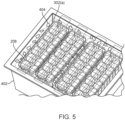
- the shock freezing unit 212 as shown in Figures 4 and 5 comprises an insulated tub 402 for holding coconut holding tray 302 and cooling bath mixture 404 for completely freezing the coconut shell.
- the coconut holding tray 302 containing partially frozen vacuum sealed coconuts 208 is fully immersed in cooling bath mixture in temperature range -72 degree Celsius to -65 degree Celsius for 40- 50 minutes depending on the batch size of coconuts.
- the cooling bath mixture is alcohol-based, and contains at least one of dry ice and liquid nitrogen, such as, but not limited to, mixtures of 99.9 % ethanol and dry ice, or mixtures of methanol and liquid nitrogen.
- the completely frozen coconut shells 216 are stored in frozen storage 218 at - 18 degree Celsius. Alternatively, it could be stored at -25 degree Celsius, -6 degree Celsius, or at any temperature at or below 0 degree Celsius.
- FIG. 2B illustrates a schematic representation of system and method for preparing frozen coconuts from dried dehusked coconuts optionally sealed in vacuum seal bags in slow freezing unit, according to an embodiment of the present invention.
- the dried dehusked coconuts 112 are either vacuum sealed using vacuum sealing machine to form vacuum sealed coconuts 204 or used as dried dehusked coconuts without any packaging 112 for partially freezing the content and reducing the inner pressure of the dried dehusked coconuts 112.
- the vacuum sealed coconuts 204 and the completely dried dehusked coconuts 112 are moved to a chilling unit such as a chilling room 206 for forming partially frozen vacuum sealed coconuts 208 and partially frozen coconuts without any packaging 210 respectively.
- a chilling unit such as a chilling room 206 for forming partially frozen vacuum sealed coconuts 208 and partially frozen coconuts without any packaging 210 respectively.
- the partially frozen coconuts without any packaging 210 and the partially frozen vacuum sealed coconuts 208 are arranged in a porous coconut holding tray 302 (b), 302 (c) respectively.
- the coconut holding tray 302 (b), 302 (c) are placed in slow freezing unit.
- the slow freezing unit 214 referring to Figures 6A and 6B , is a standard freezer having -25 degree Celsius temperature.
- the coconut are kept for at least 24 hours depending on the batch size of coconut shells.
- This freezing unit 214 is used for freezing both partially frozen vacuum sealed coconuts 208 and partially frozen coconuts without any packaging 210.
- FIG. 3A illustrates a schematic representation of a coconut holding tray capable to hold partially frozen vacuum sealed or unpackaged coconuts to be completely frozen; not according to an embodiment of the present invention.
- a coconut holding tray 302 (a) comprising a top cover 304, a base 306, a plurality of side casings 314, 316, at least one partitioned compartment 308, 310, 312 comprising individual container basket 318 for holding one partially frozen vacuum sealed coconut shell bag 208.
- Each compartment 308, 310, 312 comprise at least one round shaped opening.
- the individual container basket 318 comprises partially frozen vacuum sealed coconut shell bag 208 (or an unpackaged coconut not shown in the figure).
- the at least one partially frozen vacuum sealed coconut 208 is accessible only through the at least one round shaped opening which is located on the top cover 304 of the coconut holding tray 302 (a) which allows free liquid flow across the compartments but prevents partially frozen vacuum sealed coconuts 208 to touch other each other to prevent them from sticking together or from potential cracking of the vacuum bags sealing the vacuum sealed coconuts.
- FIGS. 3B and 3C illustrate a schematic representation of a coconut holding tray 302 capable of holding partially frozen vacuum sealed coconuts 208 or partially frozen coconut shell without any packaging 210 for producing completely frozen coconut shell 216, not according to an embodiment of the present invention.
- a coconut holding tray 302 (b), 302 (c) comprising porous air holes 320, peripheral side-walls 322, and space 324 for holding coconut shell.
- the porous air holes 320 in the coconut holding tray allows good air flow inside freezing unit.
- FIGS. 4 and 5 illustrate a schematic representation of top and side view of shock freezing unit comprising insulated tub for holding coconut holding tray and cooling bath mixture for completely freezing the partially frozen vacuum sealed coconuts and producing frozen coconuts, not according to the invention.
- the shock freezing unit 212 (as shown in Figure 2A ) comprises an insulated tub 402 for holding coconut holding tray 302 and cooling bath mixture 404 for completely freezing the partially frozen vacuum sealed coconuts 208.
- FIGS. 6A and 6B illustrate a schematic representation of a slow freezing unit 214 comprising coconut holding tray containing partially frozen coconuts and standard freezer for freezing the partially frozen vacuum sealed coconuts 208 or partially frozen unpackaged coconut 210 and producing frozen coconuts respectively, not according to the invention.
- the slow freezing unit 214 is a standard freezer having -25 degree Celsius temperature for completely freezing the partially frozen coconut shell bag. This freezing unit 214 is used for freezing both partially frozen vacuum sealed coconut shell bag 208 and partially frozen coconut shell without any packaging 210.
- FIG. 7 illustrates an exemplary flowchart 700 illustrating a method of preparing the frozen coconuts using a shock freezing unit, according to an embodiment of the present invention.
- the raw coconuts after having been harvested preferably in the afternoon and after 25 days so that they have preferably two layers of coconut meat, and after inspection, are stored for at least two days in a storage room having ambient temperature and away from direct sunlight for reducing the inner pressure of raw coconuts.
- the outer green layer and the fibrous husk of raw coconuts are dehusked leaving the coconut shells without any or minimal amount of fibrous material surrounding the coconut shells.
- the dehusked coconut shells are sorted according to their sizes, weight and thickness.
- the outer hairs of the dehusked coconut shells are optionally polished using a polishing machine such as copper bristle polishing machine.
- the coconut shells are optionally put into one or several organic or non-organic solutions such as an ascorbic acid solution, and then taken out of the solution to get dry.
- organic or non-organic solutions such as an ascorbic acid solution
- the dehusked (and optionally polished) coconut shells are weighed and moved into a dry room having humidity less than 40 % and temperature more than 25 degree Celsius and kept there until the coconuts lose more than 5% of their initial weight prior to drying.
- the dried dehusked coconut shells can be optionally sealed in vacuum bags using a vacuum sealing machine.
- the either vacuum sealed coconuts or unpackaged coconuts are moved into a cold storage unit such as a chilling room having -5 degree Celsius temperature for at least 2-3 days until the coconut water in the coconut shell becomes partially slushy and with a core temperature of -0.1 degree Celsius to -3 degree Celsius and inner pressure inside the partially frozen coconut has decreased.
- a cold storage unit such as a chilling room having -5 degree Celsius temperature for at least 2-3 days until the coconut water in the coconut shell becomes partially slushy and with a core temperature of -0.1 degree Celsius to -3 degree Celsius and inner pressure inside the partially frozen coconut has decreased.
- the partially frozen vacuum sealed or unpackaged coconuts are placed in individual container basket of coconut holding tray.
- the coconut holding tray containing partially frozen vacuum sealed or unpackaged coconuts proceeds to a shock freezing unit.
- the coconut holding tray can for example be immersed in insulated tub filled with cooling bath mixture for 40 -50 minutes at -72 degree to -65 degree Celsius depending on the batch size of coconut shells or be processed through an air blast flash freezing tunnel.
- the frozen coconuts are brought to frozen storage and stored at -18 degree Celsius. Alternatively, they could be stored at -25 degree Celsius, -6 degree Celsius, or at any temperature at or below 0 degree Celsius.
- FIG. 8 depicts an exemplary flowchart illustrating a method of preparing frozen coconuts using a slow freezing unit, according to an embodiment of the present invention.
- the raw coconuts after having been harvested preferably in the afternoon and after 25 days so that they have preferably two layers of coconut meat, and after inspection, are stored for at least two days in a storage room having ambient temperature and away from direct sunlight for reducing the inner pressure of raw coconuts.
- the outer green layer and the fibrous husk of raw coconuts are dehusked using a sharp edged weapon leaving the coconut shells without any fibrous material surrounding it.
- the dehusked coconut shells are sorted according to their sizes, weight and thickness.
- the outer hairs of the dehusked coconut shells are optionally polished using a polishing machine such as copper bristle polishing machine.
- the coconut shells are optionally put into one or several organic or non-organic solutions such as an ascorbic acid solution, and then taken out of the solution to dry.
- organic or non-organic solutions such as an ascorbic acid solution
- the dehusked (and optionally polished) coconut shells are weighed and moved into a dry room having humidity less than 40 % and temperature more than 25 degree Celsius and kept there until the coconuts lose more than 5% of their initial weight prior to drying.
- the dried dehusked coconuts without any packaging are moved into a cold storage having -5 degree Celsius temperature for at least 2-3 days until the coconut water in the coconut becomes partially slushy forming partially frozen coconut and with a core temperature of -0.1 degree Celsius to -3 degree Celsius and inner pressure inside the partially frozen coconut has decreased.
- the partially frozen coconuts without any packaging are arranged in porous plastic coconut holding tray.
- the coconut holding tray containing partially frozen coconuts without any packaging is kept in a freezer having -25 degree Celsius temperature for at least 24 hours depending on the batch size of coconuts.
- the partially frozen vacuum sealed coconuts are arranged in porous plastic coconut holding tray.
Landscapes
- Life Sciences & Earth Sciences (AREA)
- Engineering & Computer Science (AREA)
- Chemical & Material Sciences (AREA)
- Food Science & Technology (AREA)
- Polymers & Plastics (AREA)
- Wood Science & Technology (AREA)
- Zoology (AREA)
- Chemical Kinetics & Catalysis (AREA)
- General Chemical & Material Sciences (AREA)
- Preparation Of Fruits And Vegetables (AREA)
- Storage Of Fruits Or Vegetables (AREA)
Claims (6)
- Verfahren zur Herstellung von gefrorener Kokosnuss, die gefrorenes Kokosnussfleisch und gefrorenes Kokosnusswasser enthält, in dem die gesamte Kokosnussschale unversehrt erhalten bleibt, wobei das Kokosnussfleisch und Kokosnusswasser im Inneren der Kokosnussschale vorliegen, wobei das Verfahren Folgendes umfasst:a. Entfernen der Außenschale einer Kokosnuss, um eine äußere grüne Schicht und zumindest einen Hauptteil einer faserigen Schale davon zu entfernen;b. Trocknen der geschälten Kokosnuss bis sie mindestens 5 % weniger wiegt als ihr Gewicht vor dem Trocknen; undc. Gefrieren der Kokosnuss in einer Umgebung bei oder unterhalb von 0 Grad Celsius.
- Verfahren nach Anspruch 1, das weiter, vor dem Gefrieren der Kokosnüsse, das Kühlen der Kokosnüsse einschließt, um die Kokosnüsse teilweise zu gefrieren.
- Verfahren nach Anspruch 1, wobei das Trocknen in einer Umgebung mit einer Feuchte von weniger als 40 % und/oder Temperatur oberhalb von 25 Grad Celsius stattfindet.
- Verfahren nach Anspruch 1, wobei das Gefrieren das Aussetzen der Kokosnuss gegenüber einer Umgebung bei oder unterhalb von -6 Grad Celsius, bevorzugt bei oder unterhalb von -18 Grad Celsius, bevorzugter bei oder unterhalb von -25 Grad Celsius einschließt.
- Verfahren nach Anspruch 1, das weiter das Behandeln der Kokosnuss in einer Lösung einschließt, um Oxidation der Kokosnuss zu minimieren.
- Verfahren nach Anspruch 1, wobei der Schritt des Entfernens der Außenschale der Kokosnuss das Hinterlassen der geschälten Kokosnuss ohne jedwedes faserige Material, das diese umgibt, umfasst.
Applications Claiming Priority (1)
| Application Number | Priority Date | Filing Date | Title |
|---|---|---|---|
| PCT/US2017/021649 WO2018164689A1 (en) | 2017-03-09 | 2017-03-09 | System and method of preparing frozen coconuts |
Publications (4)
| Publication Number | Publication Date |
|---|---|
| EP3592152A1 EP3592152A1 (de) | 2020-01-15 |
| EP3592152A4 EP3592152A4 (de) | 2020-12-02 |
| EP3592152B1 true EP3592152B1 (de) | 2025-01-15 |
| EP3592152C0 EP3592152C0 (de) | 2025-01-15 |
Family
ID=63449135
Family Applications (1)
| Application Number | Title | Priority Date | Filing Date |
|---|---|---|---|
| EP17899628.6A Active EP3592152B1 (de) | 2017-03-09 | 2017-03-09 | Verfahren zur herstellung von gefrorenen kokosnüssen |
Country Status (3)
| Country | Link |
|---|---|
| US (1) | US12514258B2 (de) |
| EP (1) | EP3592152B1 (de) |
| WO (1) | WO2018164689A1 (de) |
Families Citing this family (3)
| Publication number | Priority date | Publication date | Assignee | Title |
|---|---|---|---|---|
| WO2018164689A1 (en) | 2017-03-09 | 2018-09-13 | Cocorilla Ltd | System and method of preparing frozen coconuts |
| MY206094A (en) | 2021-02-08 | 2024-11-28 | Naim Shadid | Process for freezing kinds of fresh coconut fruits |
| US12049336B1 (en) * | 2023-02-10 | 2024-07-30 | Kingo Fruits Co., Ltd. | Vacuum-packed coconut, preparation method thereof, and ready-to-drink trimmed coconut |
Family Cites Families (18)
| Publication number | Priority date | Publication date | Assignee | Title |
|---|---|---|---|---|
| CA763671A (en) * | 1967-07-25 | M. Allen Kenneth | Method and apparatus for quick freezing food products | |
| US2385140A (en) * | 1939-10-23 | 1945-09-18 | Beltice Corp | Process of freezing food |
| GB664320A (en) * | 1949-09-22 | 1952-01-02 | Yeo Noy Seng | An improved process for chilling coconuts to solidify and preserve their contents |
| US2973271A (en) * | 1957-01-14 | 1961-02-28 | Gen Foods Corp | Process for irradiating frozen coconut meat |
| US3297454A (en) * | 1966-02-03 | 1967-01-10 | Air Reduction | Curtailed immersion food freezing |
| US4307120A (en) * | 1978-12-26 | 1981-12-22 | Escudero Conrado A | Coconut method and product |
| US7300682B2 (en) * | 2000-11-15 | 2007-11-27 | Sabinsa Corporation | Method of preparation and use of coconut water in mamalian tissue nourishment growth and healthy maintenance |
| EP1360907A1 (de) * | 2001-02-14 | 2003-11-12 | De La Mora y de La Mora, Alejandro Eduardo | Verbessertes verfahren zur konservierung von sämtlichem, wasser enthaltendem kokosnussmark |
| EP1906761A2 (de) * | 2005-06-27 | 2008-04-09 | Applesweets LLC | Aromatisierte fruchtsegmente und verfahren zu ihrer herstellung |
| IL172001A (en) * | 2005-11-16 | 2012-10-31 | Fresh Defrost Ltd | Method for preserving pomegranate arils and other small seedless and seed-bearing fruit juice bearing vesicles |
| US20080241285A1 (en) * | 2007-04-01 | 2008-10-02 | Muhammed Majeed | Compositions and Methods to Treat Alopecia |
| WO2009125041A1 (es) * | 2008-04-10 | 2009-10-15 | Blanca Rosich Ferrer | Procedimiento para la congelación de productos hortofrutícolas |
| US20100152895A1 (en) * | 2008-12-05 | 2010-06-17 | Zhengshan Dai | Shock freezer and system for preparing samples for analysis using the same |
| BRPI1002346A2 (pt) * | 2010-07-19 | 2012-09-18 | Fundacao Universidade Estadual Do Ceara | processo de obtenção de água de coco desidratada e produto resultante |
| US20140272089A1 (en) | 2013-03-13 | 2014-09-18 | Alvin Velasco | Method for production of frozen untapped young coconut water inside its carved tender coconut meat |
| PH12014000076B1 (en) * | 2013-07-01 | 2024-01-10 | Priscila F Kimes | Improved processes in the preparation of coconut meat based composition and films |
| US20150359237A1 (en) * | 2014-06-12 | 2015-12-17 | Tropic Sol LLC | Process for packaging young fresh coconuts to enhance the consumer satisfaction |
| WO2018164689A1 (en) | 2017-03-09 | 2018-09-13 | Cocorilla Ltd | System and method of preparing frozen coconuts |
-
2017
- 2017-03-09 WO PCT/US2017/021649 patent/WO2018164689A1/en not_active Ceased
- 2017-03-09 EP EP17899628.6A patent/EP3592152B1/de active Active
- 2017-03-09 US US16/604,563 patent/US12514258B2/en active Active
Also Published As
| Publication number | Publication date |
|---|---|
| WO2018164689A1 (en) | 2018-09-13 |
| EP3592152A1 (de) | 2020-01-15 |
| US12514258B2 (en) | 2026-01-06 |
| EP3592152A4 (de) | 2020-12-02 |
| US20210084919A1 (en) | 2021-03-25 |
| EP3592152C0 (de) | 2025-01-15 |
Similar Documents
| Publication | Publication Date | Title |
|---|---|---|
| US12082599B2 (en) | Process for preparing a frozen coconut product and frozen coconut product prepared thereby | |
| CN107258882A (zh) | 一种小黄鱼超低温深冷速冻保鲜的方法 | |
| EP3592152B1 (de) | Verfahren zur herstellung von gefrorenen kokosnüssen | |
| CN104886231A (zh) | 保鲜荔枝加工工艺 | |
| Muthukumarappan et al. | Refrigeration and freezing preservation of vegetables | |
| CN103371217A (zh) | 一种冷鲜鸡肉的加工工艺 | |
| US4670275A (en) | Prolonging the shelf life of fresh root vegetables | |
| US9271511B2 (en) | Firming process to enhance texture of thermally processed IQF fruits and vegetables | |
| US4879127A (en) | Method of preserving produce for further processing | |
| US2780551A (en) | Procedure for preserving foods | |
| CN107439677A (zh) | 一种鲜湿青皮核桃的护绿保鲜贮运方法及应用 | |
| US4855153A (en) | Prolonging the shelf life of fresh root vegetables | |
| US5277922A (en) | Method for the preservation of whole citrus fruit | |
| US4808420A (en) | Fresh root vegetables with prolonged shelf life | |
| EP0221489B1 (de) | Verlängerung der Aufbewahrungsdauer für Wurzelgemüse | |
| US4919948A (en) | Prolonging the shelf life of fresh root vegetables | |
| Burrows | Production of thermally processed and frozen fruit | |
| CN108719870A (zh) | 一种液氮结合高静压处理的果蔬浆速冻方法 | |
| US20250008994A1 (en) | Process for preparing a frozen coconut product and frozen coconut product prepared thereby | |
| Woodroof | Preserving Fruits by Freezing: Peaches. I | |
| CN105746694A (zh) | 樱桃冻干工艺 | |
| CN1515168A (zh) | 荔枝龙眼类水果的保鲜方法 | |
| Rose | The effect of quick freezing on the nutritive values of foods | |
| Diehl et al. | Preservation of fruits and vegetables by freezing in the pacific Northwest | |
| CN102132723A (zh) | 一种雪莲果的贮藏保鲜方法 |
Legal Events
| Date | Code | Title | Description |
|---|---|---|---|
| STAA | Information on the status of an ep patent application or granted ep patent |
Free format text: STATUS: THE INTERNATIONAL PUBLICATION HAS BEEN MADE |
|
| PUAI | Public reference made under article 153(3) epc to a published international application that has entered the european phase |
Free format text: ORIGINAL CODE: 0009012 |
|
| STAA | Information on the status of an ep patent application or granted ep patent |
Free format text: STATUS: REQUEST FOR EXAMINATION WAS MADE |
|
| 17P | Request for examination filed |
Effective date: 20191009 |
|
| AK | Designated contracting states |
Kind code of ref document: A1 Designated state(s): AL AT BE BG CH CY CZ DE DK EE ES FI FR GB GR HR HU IE IS IT LI LT LU LV MC MK MT NL NO PL PT RO RS SE SI SK SM TR |
|
| AX | Request for extension of the european patent |
Extension state: BA ME |
|
| DAV | Request for validation of the european patent (deleted) | ||
| DAX | Request for extension of the european patent (deleted) | ||
| A4 | Supplementary search report drawn up and despatched |
Effective date: 20201102 |
|
| RIC1 | Information provided on ipc code assigned before grant |
Ipc: A23B 7/02 20060101ALI20201027BHEP Ipc: A23B 7/04 20060101AFI20201027BHEP Ipc: A23N 7/02 20060101ALI20201027BHEP |
|
| RAP1 | Party data changed (applicant data changed or rights of an application transferred) |
Owner name: BIO-DIVERSIFIED VENTURES INC. |
|
| STAA | Information on the status of an ep patent application or granted ep patent |
Free format text: STATUS: EXAMINATION IS IN PROGRESS |
|
| 17Q | First examination report despatched |
Effective date: 20240311 |
|
| GRAP | Despatch of communication of intention to grant a patent |
Free format text: ORIGINAL CODE: EPIDOSNIGR1 |
|
| STAA | Information on the status of an ep patent application or granted ep patent |
Free format text: STATUS: GRANT OF PATENT IS INTENDED |
|
| RIC1 | Information provided on ipc code assigned before grant |
Ipc: A23L 3/375 20060101ALI20240711BHEP Ipc: A23B 7/148 20060101ALI20240711BHEP Ipc: A23B 7/02 20060101ALI20240711BHEP Ipc: A23N 7/02 20060101ALI20240711BHEP Ipc: A23B 7/04 20060101AFI20240711BHEP |
|
| INTG | Intention to grant announced |
Effective date: 20240806 |
|
| GRAS | Grant fee paid |
Free format text: ORIGINAL CODE: EPIDOSNIGR3 |
|
| GRAA | (expected) grant |
Free format text: ORIGINAL CODE: 0009210 |
|
| STAA | Information on the status of an ep patent application or granted ep patent |
Free format text: STATUS: THE PATENT HAS BEEN GRANTED |
|
| AK | Designated contracting states |
Kind code of ref document: B1 Designated state(s): AL AT BE BG CH CY CZ DE DK EE ES FI FR GB GR HR HU IE IS IT LI LT LU LV MC MK MT NL NO PL PT RO RS SE SI SK SM TR |
|
| REG | Reference to a national code |
Ref country code: CH Ref legal event code: EP Ref country code: GB Ref legal event code: FG4D |
|
| REG | Reference to a national code |
Ref country code: DE Ref legal event code: R096 Ref document number: 602017087391 Country of ref document: DE |
|
| REG | Reference to a national code |
Ref country code: IE Ref legal event code: FG4D |
|
| U01 | Request for unitary effect filed |
Effective date: 20250130 |
|
| U07 | Unitary effect registered |
Designated state(s): AT BE BG DE DK EE FI FR IT LT LU LV MT NL PT RO SE SI Effective date: 20250206 |
|
| PGFP | Annual fee paid to national office [announced via postgrant information from national office to epo] |
Ref country code: GB Payment date: 20250328 Year of fee payment: 9 |
|
| U20 | Renewal fee for the european patent with unitary effect paid |
Year of fee payment: 9 Effective date: 20250328 |
|
| PG25 | Lapsed in a contracting state [announced via postgrant information from national office to epo] |
Ref country code: RS Free format text: LAPSE BECAUSE OF FAILURE TO SUBMIT A TRANSLATION OF THE DESCRIPTION OR TO PAY THE FEE WITHIN THE PRESCRIBED TIME-LIMIT Effective date: 20250415 |
|
| PG25 | Lapsed in a contracting state [announced via postgrant information from national office to epo] |
Ref country code: PL Free format text: LAPSE BECAUSE OF FAILURE TO SUBMIT A TRANSLATION OF THE DESCRIPTION OR TO PAY THE FEE WITHIN THE PRESCRIBED TIME-LIMIT Effective date: 20250115 |
|
| PG25 | Lapsed in a contracting state [announced via postgrant information from national office to epo] |
Ref country code: ES Free format text: LAPSE BECAUSE OF FAILURE TO SUBMIT A TRANSLATION OF THE DESCRIPTION OR TO PAY THE FEE WITHIN THE PRESCRIBED TIME-LIMIT Effective date: 20250115 |
|
| PG25 | Lapsed in a contracting state [announced via postgrant information from national office to epo] |
Ref country code: IS Free format text: LAPSE BECAUSE OF FAILURE TO SUBMIT A TRANSLATION OF THE DESCRIPTION OR TO PAY THE FEE WITHIN THE PRESCRIBED TIME-LIMIT Effective date: 20250515 Ref country code: NO Free format text: LAPSE BECAUSE OF FAILURE TO SUBMIT A TRANSLATION OF THE DESCRIPTION OR TO PAY THE FEE WITHIN THE PRESCRIBED TIME-LIMIT Effective date: 20250415 |
|
| PG25 | Lapsed in a contracting state [announced via postgrant information from national office to epo] |
Ref country code: HR Free format text: LAPSE BECAUSE OF FAILURE TO SUBMIT A TRANSLATION OF THE DESCRIPTION OR TO PAY THE FEE WITHIN THE PRESCRIBED TIME-LIMIT Effective date: 20250115 |
|
| PG25 | Lapsed in a contracting state [announced via postgrant information from national office to epo] |
Ref country code: GR Free format text: LAPSE BECAUSE OF FAILURE TO SUBMIT A TRANSLATION OF THE DESCRIPTION OR TO PAY THE FEE WITHIN THE PRESCRIBED TIME-LIMIT Effective date: 20250416 |
|
| PG25 | Lapsed in a contracting state [announced via postgrant information from national office to epo] |
Ref country code: SM Free format text: LAPSE BECAUSE OF FAILURE TO SUBMIT A TRANSLATION OF THE DESCRIPTION OR TO PAY THE FEE WITHIN THE PRESCRIBED TIME-LIMIT Effective date: 20250115 |
|
| PG25 | Lapsed in a contracting state [announced via postgrant information from national office to epo] |
Ref country code: MC Free format text: LAPSE BECAUSE OF FAILURE TO SUBMIT A TRANSLATION OF THE DESCRIPTION OR TO PAY THE FEE WITHIN THE PRESCRIBED TIME-LIMIT Effective date: 20250115 |
|
| PG25 | Lapsed in a contracting state [announced via postgrant information from national office to epo] |
Ref country code: CZ Free format text: LAPSE BECAUSE OF FAILURE TO SUBMIT A TRANSLATION OF THE DESCRIPTION OR TO PAY THE FEE WITHIN THE PRESCRIBED TIME-LIMIT Effective date: 20250115 |
|
| REG | Reference to a national code |
Ref country code: CH Ref legal event code: H13 Free format text: ST27 STATUS EVENT CODE: U-0-0-H10-H13 (AS PROVIDED BY THE NATIONAL OFFICE) Effective date: 20251023 |
|
| PG25 | Lapsed in a contracting state [announced via postgrant information from national office to epo] |
Ref country code: SK Free format text: LAPSE BECAUSE OF FAILURE TO SUBMIT A TRANSLATION OF THE DESCRIPTION OR TO PAY THE FEE WITHIN THE PRESCRIBED TIME-LIMIT Effective date: 20250115 |
|
| PLBE | No opposition filed within time limit |
Free format text: ORIGINAL CODE: 0009261 |
|
| STAA | Information on the status of an ep patent application or granted ep patent |
Free format text: STATUS: NO OPPOSITION FILED WITHIN TIME LIMIT |
|
| 26N | No opposition filed |
Effective date: 20251016 |
|
| PG25 | Lapsed in a contracting state [announced via postgrant information from national office to epo] |
Ref country code: CH Free format text: LAPSE BECAUSE OF NON-PAYMENT OF DUE FEES Effective date: 20250331 |
|
| PG25 | Lapsed in a contracting state [announced via postgrant information from national office to epo] |
Ref country code: IE Free format text: LAPSE BECAUSE OF NON-PAYMENT OF DUE FEES Effective date: 20250309 |